EP2925673B1 - Hochreines pulver zum thermischen spritzen - Google Patents
Hochreines pulver zum thermischen spritzen Download PDFInfo
- Publication number
- EP2925673B1 EP2925673B1 EP13824014.8A EP13824014A EP2925673B1 EP 2925673 B1 EP2925673 B1 EP 2925673B1 EP 13824014 A EP13824014 A EP 13824014A EP 2925673 B1 EP2925673 B1 EP 2925673B1
- Authority
- EP
- European Patent Office
- Prior art keywords
- powder
- less
- particles
- size
- préférence
- Prior art date
- Legal status (The legal status is an assumption and is not a legal conclusion. Google has not performed a legal analysis and makes no representation as to the accuracy of the status listed.)
- Active
Links
Images


Classifications
-
- C—CHEMISTRY; METALLURGY
- C01—INORGANIC CHEMISTRY
- C01G—COMPOUNDS CONTAINING METALS NOT COVERED BY SUBCLASSES C01D OR C01F
- C01G27/00—Compounds of hafnium
- C01G27/02—Oxides
-
- B—PERFORMING OPERATIONS; TRANSPORTING
- B05—SPRAYING OR ATOMISING IN GENERAL; APPLYING FLUENT MATERIALS TO SURFACES, IN GENERAL
- B05B—SPRAYING APPARATUS; ATOMISING APPARATUS; NOZZLES
- B05B7/00—Spraying apparatus for discharge of liquids or other fluent materials from two or more sources, e.g. of liquid and air, of powder and gas
- B05B7/16—Spraying apparatus for discharge of liquids or other fluent materials from two or more sources, e.g. of liquid and air, of powder and gas incorporating means for heating or cooling the material to be sprayed
- B05B7/22—Spraying apparatus for discharge of liquids or other fluent materials from two or more sources, e.g. of liquid and air, of powder and gas incorporating means for heating or cooling the material to be sprayed electrically, magnetically or electromagnetically, e.g. by arc
-
- B—PERFORMING OPERATIONS; TRANSPORTING
- B65—CONVEYING; PACKING; STORING; HANDLING THIN OR FILAMENTARY MATERIAL
- B65D—CONTAINERS FOR STORAGE OR TRANSPORT OF ARTICLES OR MATERIALS, e.g. BAGS, BARRELS, BOTTLES, BOXES, CANS, CARTONS, CRATES, DRUMS, JARS, TANKS, HOPPERS, FORWARDING CONTAINERS; ACCESSORIES, CLOSURES, OR FITTINGS THEREFOR; PACKAGING ELEMENTS; PACKAGES
- B65D25/00—Details of other kinds or types of rigid or semi-rigid containers
- B65D25/14—Linings or internal coatings
-
- C—CHEMISTRY; METALLURGY
- C01—INORGANIC CHEMISTRY
- C01F—COMPOUNDS OF THE METALS BERYLLIUM, MAGNESIUM, ALUMINIUM, CALCIUM, STRONTIUM, BARIUM, RADIUM, THORIUM, OR OF THE RARE-EARTH METALS
- C01F17/00—Compounds of rare earth metals
- C01F17/20—Compounds containing only rare earth metals as the metal element
- C01F17/206—Compounds containing only rare earth metals as the metal element oxide or hydroxide being the only anion
- C01F17/212—Scandium oxides or hydroxides
-
- C—CHEMISTRY; METALLURGY
- C01—INORGANIC CHEMISTRY
- C01F—COMPOUNDS OF THE METALS BERYLLIUM, MAGNESIUM, ALUMINIUM, CALCIUM, STRONTIUM, BARIUM, RADIUM, THORIUM, OR OF THE RARE-EARTH METALS
- C01F17/00—Compounds of rare earth metals
- C01F17/20—Compounds containing only rare earth metals as the metal element
- C01F17/206—Compounds containing only rare earth metals as the metal element oxide or hydroxide being the only anion
- C01F17/218—Yttrium oxides or hydroxides
-
- C—CHEMISTRY; METALLURGY
- C01—INORGANIC CHEMISTRY
- C01F—COMPOUNDS OF THE METALS BERYLLIUM, MAGNESIUM, ALUMINIUM, CALCIUM, STRONTIUM, BARIUM, RADIUM, THORIUM, OR OF THE RARE-EARTH METALS
- C01F17/00—Compounds of rare earth metals
- C01F17/20—Compounds containing only rare earth metals as the metal element
- C01F17/206—Compounds containing only rare earth metals as the metal element oxide or hydroxide being the only anion
- C01F17/224—Oxides or hydroxides of lanthanides
-
- C—CHEMISTRY; METALLURGY
- C01—INORGANIC CHEMISTRY
- C01F—COMPOUNDS OF THE METALS BERYLLIUM, MAGNESIUM, ALUMINIUM, CALCIUM, STRONTIUM, BARIUM, RADIUM, THORIUM, OR OF THE RARE-EARTH METALS
- C01F17/00—Compounds of rare earth metals
- C01F17/30—Compounds containing rare earth metals and at least one element other than a rare earth metal, oxygen or hydrogen, e.g. La4S3Br6
- C01F17/32—Compounds containing rare earth metals and at least one element other than a rare earth metal, oxygen or hydrogen, e.g. La4S3Br6 oxide or hydroxide being the only anion, e.g. NaCeO2 or MgxCayEuO
-
- C—CHEMISTRY; METALLURGY
- C23—COATING METALLIC MATERIAL; COATING MATERIAL WITH METALLIC MATERIAL; CHEMICAL SURFACE TREATMENT; DIFFUSION TREATMENT OF METALLIC MATERIAL; COATING BY VACUUM EVAPORATION, BY SPUTTERING, BY ION IMPLANTATION OR BY CHEMICAL VAPOUR DEPOSITION, IN GENERAL; INHIBITING CORROSION OF METALLIC MATERIAL OR INCRUSTATION IN GENERAL
- C23C—COATING METALLIC MATERIAL; COATING MATERIAL WITH METALLIC MATERIAL; SURFACE TREATMENT OF METALLIC MATERIAL BY DIFFUSION INTO THE SURFACE, BY CHEMICAL CONVERSION OR SUBSTITUTION; COATING BY VACUUM EVAPORATION, BY SPUTTERING, BY ION IMPLANTATION OR BY CHEMICAL VAPOUR DEPOSITION, IN GENERAL
- C23C4/00—Coating by spraying the coating material in the molten state, e.g. by flame, plasma or electric discharge
- C23C4/04—Coating by spraying the coating material in the molten state, e.g. by flame, plasma or electric discharge characterised by the coating material
- C23C4/10—Oxides, borides, carbides, nitrides or silicides; Mixtures thereof
- C23C4/11—Oxides
-
- C—CHEMISTRY; METALLURGY
- C23—COATING METALLIC MATERIAL; COATING MATERIAL WITH METALLIC MATERIAL; CHEMICAL SURFACE TREATMENT; DIFFUSION TREATMENT OF METALLIC MATERIAL; COATING BY VACUUM EVAPORATION, BY SPUTTERING, BY ION IMPLANTATION OR BY CHEMICAL VAPOUR DEPOSITION, IN GENERAL; INHIBITING CORROSION OF METALLIC MATERIAL OR INCRUSTATION IN GENERAL
- C23C—COATING METALLIC MATERIAL; COATING MATERIAL WITH METALLIC MATERIAL; SURFACE TREATMENT OF METALLIC MATERIAL BY DIFFUSION INTO THE SURFACE, BY CHEMICAL CONVERSION OR SUBSTITUTION; COATING BY VACUUM EVAPORATION, BY SPUTTERING, BY ION IMPLANTATION OR BY CHEMICAL VAPOUR DEPOSITION, IN GENERAL
- C23C4/00—Coating by spraying the coating material in the molten state, e.g. by flame, plasma or electric discharge
- C23C4/12—Coating by spraying the coating material in the molten state, e.g. by flame, plasma or electric discharge characterised by the method of spraying
- C23C4/134—Plasma spraying
-
- C—CHEMISTRY; METALLURGY
- C01—INORGANIC CHEMISTRY
- C01P—INDEXING SCHEME RELATING TO STRUCTURAL AND PHYSICAL ASPECTS OF SOLID INORGANIC COMPOUNDS
- C01P2004/00—Particle morphology
- C01P2004/54—Particles characterised by their aspect ratio, i.e. the ratio of sizes in the longest to the shortest dimension
-
- C—CHEMISTRY; METALLURGY
- C01—INORGANIC CHEMISTRY
- C01P—INDEXING SCHEME RELATING TO STRUCTURAL AND PHYSICAL ASPECTS OF SOLID INORGANIC COMPOUNDS
- C01P2004/00—Particle morphology
- C01P2004/60—Particles characterised by their size
-
- C—CHEMISTRY; METALLURGY
- C01—INORGANIC CHEMISTRY
- C01P—INDEXING SCHEME RELATING TO STRUCTURAL AND PHYSICAL ASPECTS OF SOLID INORGANIC COMPOUNDS
- C01P2004/00—Particle morphology
- C01P2004/60—Particles characterised by their size
- C01P2004/61—Micrometer sized, i.e. from 1-100 micrometer
-
- C—CHEMISTRY; METALLURGY
- C01—INORGANIC CHEMISTRY
- C01P—INDEXING SCHEME RELATING TO STRUCTURAL AND PHYSICAL ASPECTS OF SOLID INORGANIC COMPOUNDS
- C01P2006/00—Physical properties of inorganic compounds
- C01P2006/10—Solid density
-
- C—CHEMISTRY; METALLURGY
- C01—INORGANIC CHEMISTRY
- C01P—INDEXING SCHEME RELATING TO STRUCTURAL AND PHYSICAL ASPECTS OF SOLID INORGANIC COMPOUNDS
- C01P2006/00—Physical properties of inorganic compounds
- C01P2006/12—Surface area
-
- C—CHEMISTRY; METALLURGY
- C01—INORGANIC CHEMISTRY
- C01P—INDEXING SCHEME RELATING TO STRUCTURAL AND PHYSICAL ASPECTS OF SOLID INORGANIC COMPOUNDS
- C01P2006/00—Physical properties of inorganic compounds
- C01P2006/14—Pore volume
-
- C—CHEMISTRY; METALLURGY
- C01—INORGANIC CHEMISTRY
- C01P—INDEXING SCHEME RELATING TO STRUCTURAL AND PHYSICAL ASPECTS OF SOLID INORGANIC COMPOUNDS
- C01P2006/00—Physical properties of inorganic compounds
- C01P2006/80—Compositional purity
Definitions
- the invention relates to a plasma-deposited powder, a process for producing such a powder, and a coating obtained by plasma spraying said powder.
- plasma etching English "plasma etch”
- silicon wafers are conventionally protected with a ceramic coating applied by plasma spraying.
- This coating must be highly resistant to plasmas including halogens or highly corrosive environments.
- Plasma spraying requires, as a feed powder, a powder having a good fluidity and a particle morphology allowing a suitable heating during the projection. In particular, the size of the particles must be sufficient for the particles to enter the plasma and to limit losses by vaporization.
- very fine powders directly obtained by chemical or pyrolytic manufacturing processes are not suitable for plasma spraying without additional consolidation step to form larger (and porous) agglomerates, especially sintered agglomerates. Since plasma spraying does not lead to the melting of all agglomerates, the resulting coating has porosity. The total porosity of the sintered agglomerate coating is typically 2-3%, which would not be suitable for protecting the internal surfaces of a semiconductor etch chamber.
- the sintered powders described in US6,916,534 , US2007 / 077363 or US2008 / 0112873 can not lead to a very dense coating by thermal spraying.
- coatings obtained from porous agglomerates lead, in time, to the release of particles when exposed to corrosive environments.
- US 7,931,836 or US 2011/0129399 disclose a particle powder resulting from plasma fusion to form liquid droplets that solidify in free fall.
- more than about 90% of the raw material particles may be wholly or partially converted to liquid form.
- the apparent density of the resulting powder is between 1.2 and 2.2 g / cm 3 .
- the powders obtained by grinding a melt are not suitable either, because of the impurities that are added during the grinding step.
- Rare earth oxides and / or hafnium oxide and / or yttrium aluminum oxides are known to have good intrinsic resistance to chemical attack. However, they have a high melting temperature and a low thermal diffusion. It is therefore difficult to obtain a very dense coating from these particles by plasma spraying.
- An object of the invention is to provide a powder that can be efficiently projected by plasma, with good productivity, and which can lead to a very pure and extremely dense coating.
- a feed powder according to the invention is therefore a very pure powder, composed largely of spherical particles.
- This powder is remarkable, in particular, for the small size dispersion of the particles, in that the apparent density of the particles having a size smaller than the median particle size D 50 is substantially the same as that of particles having a size greater than or equal to D 50 , and in that it comprises few very fine particles having a size less than or equal to 5 microns.
- steps a) and b) there is no intermediate step of consolidation, and in particular no sintering, between steps a) and b).
- This lack of intermediate consolidation step advantageously improves the purity of the feed powder.
- the invention also relates to a plasma torch for producing, preferably with a method according to the invention, a feed powder according to the invention, said torch comprising a plasma gun configured to generate a plasma jet along an axis X , and an injector for injecting a powder of granules into said plasma jet, said X axis forming an angle ⁇ less than 30 °, less than 20 °, less than 10 °, less than 5 °, preferably zero, with a line vertical.
- a plasma torch according to the invention advantageously produces a feed powder which is very pure and dense, with few satellites, the apparent density of the powder reaching 2.3 g / cm 3 and more, to be compared with the preferred density.
- the invention also relates to a thermal spraying method comprising a step of plasma spraying a feed powder according to the invention on a substrate in order to obtain a coating.
- the invention also relates to a body comprising a substrate and a coating covering, at least partially, said substrate, said coating comprising more than 99.8% of a rare earth oxide and / or hafnium oxide and / or an oxide of yttrium-aluminum, in weight percent on the oxide basis, and having a porosity of less than or equal to 1.5%, measured in a photograph of a polished section of said coating.
- the porosity of the coating is less than 1%.
- the coating comprises more than 99.9%, more than 99.95%, more than 99.97%, more than 99.98%, more than 99.99%, preferably more than 99.999% by weight.
- Such a coating can be manufactured with a thermal spraying method according to the invention.
- the substrate may be a wall of an oven used in semiconductor processing.
- the furnace may contain semiconductors, in particular silicon wafers.
- the furnace may be equipped with chemical vapor deposition (CVD) means or physical vapor deposition (PVD) means.
- CVD chemical vapor deposition
- PVD physical vapor deposition
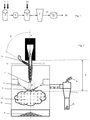
- the figure 1 illustrates an embodiment of step a) of a method of manufacturing a feed powder according to the invention.
- Any known method of granulation can be used.
- those skilled in the art know how to prepare a slip suitable for granulation.
- a binder mixture is prepared by adding PVA (polyvinyl alcohol) 2 in deionized water 4.
- This binder mixture 6 is then filtered through a 5 ⁇ m filter 8.
- Yttrium powder (for example of purity 99.99%), with a median size of 1 micron, is mixed in the filtered binder mixture to form a slurry 12.
- the slip can comprise, for example, 55% by mass. yttrium oxide and 0.55% PVA, the 100% complement being water.
- This slip is injected into an atomizer 14 to obtain a powder of granules 16 having a D 10 of 20 microns and a D 90 of 63 microns.
- the person skilled in the art knows how to adapt the atomizer to obtain the desired particle size distribution.
- the granules are agglomerates of particles of an oxide material having a median size of less than 3 ⁇ m, preferably less than 2 ⁇ m, and preferably less than 1.5 ⁇ m.
- the granule powder can be sieved (5 mm sieve 18, for example) to eliminate the possible presence of residues fallen from the walls of the atomizer.
- the resulting powder is a "spray-dried only” (SDO) granule powder.
- the figures 2 and 3 illustrate an embodiment of step b) of melting a method of manufacturing a feed powder according to the invention.
- An SDO 20 granule powder for example, as manufactured according to the method illustrated in the figure 1 , is injected by an injector 21 into a plasma jet 22 produced by a plasma gun 24, for example an HP ProPlasma.
- a plasma jet 22 produced by a plasma gun 24, for example an HP ProPlasma.
- Conventional plasma injection and projection techniques can be used to mix the SDO granule powder with a carrier gas and to inject the resulting mixture into the hot plasma core.
- the injected granule powder does not need to be consolidated. In the absence of any intermediate consolidation step, i.e. in the preferred embodiment, the injection must be done gently to avoid breakage of granules.
- the skilled person can adapt the injection parameters for a smooth injection of the granules, and choose the granules so that the feed powder obtained at the end of steps c) or d) has a composition and a particle size distribution according to the invention.
- a gentle injection is not conventional. Indeed, it is generally considered preferable to inject the particles so as to disperse them in a highly viscous plasma jet which flows at a very high speed.
- the injected particles come into contact with such a plasma jet, they are subjected to violent shocks, which can break them into pieces.
- the particles to be dispersed are generally injected with a high speed, so as to benefit from a high kinetic energy.
- the particles to be injected must also have a high mechanical resistance to resist these shocks.
- unconsolidated granules are injected into a plasma torch, possibly a conventional torch, the parameters of which are adjusted to such a degree. so that the speed of the plasma jet and the speed of the injected granules are low, preferably, are as low as possible.
- the plasma jet velocity can be reduced by using a large diameter anode and / or by reducing the rate of flow of the primary gas.
- the speed of the granules is determined by the flow rate of the carrier gas.
- the energy of the plasma jet determined by the flow rate of the secondary gas, must be high enough to melt the granules.
- the granule powder is injected with a carrier gas, preferably without any liquid.
- Table 1 presents the preferred ranges for the parameters of the melting step b).
- the granules are melted into droplets 25.
- This fusion advantageously reduces the level of impurities.
- the droplets On leaving the hot zone of the plasma jet, the droplets are rapidly cooled by the surrounding cold air, but also by a forced circulation 26 of a cooling gas, preferably air. Air advantageously limits the reducing effect of hydrogen.
- the forced cooling is generated by a set of nozzles 28 disposed about the X-axis of the plasma jet 22, so as to create a substantially conical or annular flow of cooling gas.
- the plasma gun 24 is oriented vertically towards the ground.
- the angle between the vertical and the X axis of the plasma gun is less than 10 °, preferably less than 5 °.
- the flow of cooling gas is perfectly centered with respect to the axis X of the plasma jet.
- the minimum distance d between the external surface of the anode and the cooling zone (where the droplets come into contact with the injected cooling fluid) is between 50 mm and 400 mm, preferably between 100 mm and 300 mm. mm.
- the forced cooling limits the generation of satellites, resulting from the contact between very large hot particles and small particles in suspension in the densification chamber 32. Moreover, such a cooling operation makes it possible to reduce the overall size of the treatment equipment, especially the size of the collection chamber.
- the cooling of the droplets 25 makes it possible to obtain feed particles 30, which can be extracted in the lower part of the densification chamber 32.
- the densification chamber can be connected to a cyclone 34, whose exhaust gas is directed to a dust collector 36, so as to separate very fine particles 40.
- These very fine particles can result from the breaking up of the fragile granules in the plasma jet, although the preferred method of the invention allows to limit these decays.
- certain feed particles in accordance with the invention may also be collected in the cyclone. Preferably, these feed particles can be separated, in particular with an air separator.
- the collected feed particles 38 can be filtered, so that the median size D 50 is between 10 and 40 ⁇ m [microns].
- the characteristics of a column are preferably, but not necessarily, combined.
- the characteristics of the two columns can also be combined ⁇ u> Table 1 ⁇ / u> Step b)
- Favorite features Even more preferred features Gun High performance pistol with low wear (to treat powder without contaminating it)
- Primary gas flow ⁇ 50 1 / min preferably ⁇ 40 1 / min 36 1 / min Nature of the secondary gas H 2 H 2 Secondary gas flow > 20 vol% of the plasma gas mixture About 25 vol% of the plasma gas mixture
- Injection of the granule powder Total flow of powder injected (g / min
- the most preferred characteristics are in particular suitable for a powder injection rate of 120 g / min (powder of yttrium oxide granules).
- the speed and temperature of the droplets are evaluated by a SprayWatch system, from the Oseir Company, placed 100 mm downstream of the injection of the powder, with an injection rate of 40 g / min.
- the cooling rate is estimated for a powder having a median size D 50 of between 10 and 40 ⁇ m [microns], under an air flow.
- the plasma torch "ProPlasmaHP” is sold by Saint-Gobain Coating Solution. This torch corresponds to the torch T1 described in WO2010 / 103497 .
- a feed powder according to the invention is very homogeneous from one feed particle to another.
- a pure yttrium oxide feed powder according to the invention may have a bulk density of 2.30 g / cm 3 to 2.60 g / cm 3 .
- the cumulative specific volume of pores with a radius of less than 1 ⁇ m, measured according to ISO 15901-1, may be less than 20 ⁇ 10 -3 cm 3 / g.
- the inventors have found that, surprisingly, most of the particles having a size of less than 20 ⁇ m [microns] are full, that is to say without a central cavity, whereas most particles having a size greater than 20 ⁇ m [microns] are hollow with a very dense wall. This observation may explain why, surprisingly, the apparent density dispersion index of a feed powder according to the invention is less than 0.2.
- the hollow particles usually have a shell that has a thickness of about 5 to 10 ⁇ m [microns]. Since the median size of the D 50 particles is less than 40 ⁇ m [microns] and the size dispersion index (D 90 -D 10 ) / D 50 is less than 3, the hollow particles are thus efficiently melted in the plasma jet. in the same way as the finest full particles. The percentage of particles injected into the plasma jet that are completely melted is therefore very high, which can lead, in particular for a coating of Y 2 O 3 , to a porosity less than or equal to 1%.
- the feed powder contains substantially no very fine particles.
- the kinetic energy of the particles is therefore also suitable for good penetration into the plasma jet.
- the size dispersion index is preferably greater than or equal to 0.4 in order to avoid excessive costs.
- the low apparent density dispersion index and the specific size distribution of a feed powder according to the invention advantageously leads to a very homogeneous and very dense coating when this feed powder is sprayed with a plasma torch.
- Deposition of particles to effect coating with a plasma gun is a conventional technique. Any known technique can be used. The following table provides the preferred settings. ⁇ u> Table 2 ⁇ / u> Coating Deposition: Preferred Parameters Gun HP ProPlasma Pistol Anode HP 6.5 anode (diameter: 6.5 mm) Cathode Proplasma tungsten doped cathode Current > 600A, preferably about 650A Power > 40kW, preferably about 49kW Nature of primary gas Argon Primary gas flow > 35 l / min, preferably about 40 l / min Nature of the secondary gas Hydrogen Secondary gas flow > 20% of the plasmagenic mixture, preferably about 25% Nature of the vector gas Argon Vector gas flow About 5 l / min Injection rate of feed powder (g / min) 30 to 90, preferably 50 to 70 Projection distance > 90 mm, preferably about 120 mm Diameter of the injector orifice (mm) 1.8 mm for 25 to 35 g / min per injector Distance between
- the metal substrates may be cooled, for example with air, for example by cooling nozzles mounted on the plasma torch to maintain the substrate temperature below 300 ° C, preferably below 150 ° C.
- preheating may be performed to improve adhesion (as described, for example, in US Pat. No. 7,329,467).
- the feed powders I1 to I5, C1 and C2 were manufactured according to the invention with a plasma torch similar to the plasma torch shown in FIG. figure 2 from a source of pure Y 2 O 3 powder having a median diameter D 50 of 1.2 ⁇ m [micron], measured with a Horiba laser particle analyzer, and a chemical purity of 99.999% Y 2 O 3 .
- a binder mixture is prepared by adding PVA (polyvinyl alcohol) binding 2 in deionized water 4. This binder mixture is then filtered through a 5 ⁇ m filter 8. The oxide of Yttrium powder is mixed in the filtered binder mixture to form a slurry 12.
- the slurry is prepared so as to comprise, as a percentage by weight, 55% of yttrium oxide and 0.55% of PVA, the balance being 100% being deionized water.
- the slurry is mixed intensively using a high shear mixer.
- the granules G3 and G6 are then obtained by atomizing the slip, using an atomizer.
- the slurry is atomized in the chamber of a GEA Niro SD 6.3 R atomizer, the slurry being introduced at a flow rate of approximately 0.38 l / min.
- the speed of the rotating atomization wheel driven by a Niro FS1 engine, is adjusted to obtain the sizes of the targeted granules.
- the speed of this wheel is higher for the manufacture of G3 granules than for the manufacture of G6 granules.
- the air flow rate is adjusted to maintain the inlet temperature at 295 ° C and the outlet temperature near 125 ° C so that the residual moisture of the granules is between 0.5% and 1%.
- step b) the granules of step a) are injected into a plasma produced with a plasma gun.
- the powder collection yield in chamber 38 is the ratio of the amount of feed particles collected in chamber 38 to the total amount of granules injected into the plasma.
- Powder I1 offers the best compromise between the yield, which must be as high as possible, and the percentages of very fine particles ( ⁇ 10 ⁇ m and ⁇ 5 ⁇ m), which must be as low as possible, with an acceptable bulk density.
- the powder I5 is used to illustrate the effect of the size dispersion index. This powder was obtained from G6 granules by plasma treatment.
- Comparative feed powder G3 was manufactured according to the same step a) as I1 and I5, but it did not undergo steps b) and c) before spraying to form a coating.
- Comparative feed powder G4 was manufactured as G3, but after the spray-drying step , the powder was sintered in air at 1600 ° C for a period of two hours.
- Table 3 ⁇ / u> Powder treatment Spray dried + plasma spray Spray dried only Spray dried and sintered Granules (particles obtained after spray drying)
- Reference granules G3 G6 G3 G4 Type of granules Spray-dried yttrium oxide powder Granules D 10 ( ⁇ m) 23.4 23 Granules D 50 ( ⁇ m) 39.0 47 Granules D 90 ( ⁇ m) 63.0 102 Average apparent density 1.05 0.95 1.05 1.45 Cumulative specific volume of pores with a radius of less than 1 ⁇ m [micron] (10 -3 cm 3 / g of the powder sample) 260 430 260 140
- Table 3 shows that soft injection parameters, with a large injector diameter and a low flow rate of the argon carrier gas, help to reduce the amount of very fine particles in the pure yttrium oxide feed powder. , which are harmful to the final coating. A small amount of very fine particles also facilitates the application of the thermal spray coating. It improves flowability and deposit efficiency.
- Coatings on an aluminum substrate were obtained using feed powders I1, C1, C2, G3 and G4.
- the plasma projection parameters are summarized in Table 4.
- the porosity of the coatings was measured by scanning electron microscope (SEM) image analysis on polished sections of samples having an average thickness of 0.4 mm.
- SEM scanning electron microscope
- Table 4 ⁇ / u>
- Example 1 2 3 * 4 * 5 6 * 7 * Feeding powder I1 I1 G3 G4 I5 C2 C1 Plasma torch ProPlasmaHP Diameter of the anode 6.5 mm Power generator Current (A) 650 Voltage (V) 74 Power (kW) 48 Plasmagene gas Argon (l / min) 40 Hydrogen (l / min) 13 Helium (l / min) 0 Projection of the powder Vector gas Ar Vector gas flow (l / min) 5.0 Injection rate of the powder (g / min) 50 70 70 70 50 50 Projection distance (distance between the torch outlet and the substrate) (mm) 100 120 120 120 100 100 Diameter of the orifice for the injection of the powder to be sprayed 1,8mm Distance between the injector and the X axis of the plasma jet
- the coatings of the examples of the invention are very dense and are manufactured with good deposition efficiency and good projection productivity.
- Comparative Examples 3 * and 4 * show, respectively, that the use of an unconsolidated feed powder or a sintered feed powder instead of feed powder according to the invention (powder of feeding resulting from a plasma melting of unconsolidated granules: I1 and I5) considerably increases the porosity of the coating.
- Examples 5 and 6 * show that an increase in size dispersion index increases the porosity of the coating.
- Comparative Example 7 * shows that the use of a powder having a high fraction of particles having a size less than or equal to 5 ⁇ m [microns] increases the porosity of the coating.
- the invention provides a feed powder having size and bulk density distributions imparting a very high density to the coating.
- this feed powder can be efficiently projected by plasma and with good productivity.
Landscapes
- Chemical & Material Sciences (AREA)
- Organic Chemistry (AREA)
- Engineering & Computer Science (AREA)
- Inorganic Chemistry (AREA)
- Physics & Mathematics (AREA)
- Geology (AREA)
- Life Sciences & Earth Sciences (AREA)
- Plasma & Fusion (AREA)
- Mechanical Engineering (AREA)
- Chemical Kinetics & Catalysis (AREA)
- Materials Engineering (AREA)
- Metallurgy (AREA)
- Electromagnetism (AREA)
- Coating By Spraying Or Casting (AREA)
- Compounds Of Alkaline-Earth Elements, Aluminum Or Rare-Earth Metals (AREA)
- Powder Metallurgy (AREA)
- Inorganic Compounds Of Heavy Metals (AREA)
Claims (14)
- Pulver aus Teilchen, wobei mehr als 95 % der Teilchen eine Zirkularität größer oder gleich 0,85 aufweisen, wobei das Pulver mehr als 99,8 Gew.-% eines Seltenerd-Oxids und/oder eines Hafnium-Oxids und/oder eines Yttrium-Aluminium-Oxids in Massenprozent, bezogen auf Oxide, enthält und mit:- einer Median-Größe der Teilchen D50 zwischen 10 und 40 µm [Mikrometer] und einem Größen-Dispersionsindex (D90 - D10)/D50 kleiner als 3;- einem Prozentsatz von Teilchen mit einer Größe von weniger als oder gleich 5 µm, der weniger als 5 % beträgt;- einem Schüttdichte-Dispersionsindex (P<50 - P)P kleiner als 0,2,wobei das kumulative spezifische Volumen von Poren mit einem Radius von weniger als 1 µm weniger als 10 % des Schüttvolumens des Pulvers beträgt,
wobei die Prozentsätze Dn des Pulvers die Teilchengrößen sind, die den Prozentsätzen von n% auf der kumulativen Teilchengrößenverteilungskurve des Pulvers entsprechen, wobei die Teilchengrößen in aufsteigender Reihenfolge klassifiziert sind, wobei die Dichte P<50 die Schüttdichte des Bruchteils der Teilchen mit einer Größe kleiner oder gleich D50 ist und die Dichte P die Schüttdichte des Pulvers ist. - Pulver nach dem vorangehenden Anspruch, wobei- die Median-Größe der Teilchen D50 größer als 15 µm ist, und/oder- der Größen-Dispersionsindex (D90-D10)/D50 kleiner als 2,2 und/oder größer als 0,4 ist, und/oder- der zahlenmäßige Prozentsatz der Teilchen mit einer Größe von weniger als 10 Mikrometern weniger als 3 % beträgt und/oder- die spezifische Oberfläche weniger als 3 m2/g beträgt, und/oder- der Dichte-Dispersionsindex (P<50-P)/P kleiner als 0,15 ist.
- Pulver nach einem der vorangehenden Ansprüche, wobei- die Median-Größe der Teilchen D50 weniger als 30 µm beträgt, und/oder- der Größen-Dispersionsindex (D90-D10)/D50 kleiner als 1,3 ist, und/oder- der zahlenmäßige Prozentsatz der Teilchen mit einer Größe von weniger als 10 Mikrometern weniger als 2 % beträgt und/oder- die spezifische Oberfläche weniger als 1 m2/g beträgt, und/oder- der Schüttdichte-Dispersionsindex (P<50-P)P kleiner als 0,1 ist.
- Pulver nach einem der vorangehenden Ansprüche, wobei- der Größen-Dispersionsindex (D90-DF10)/D50 größer als 0,7 ist und/oder- die spezifische Oberfläche kleiner als 0,5 m2/g ist.
- Pulver nach einem der vorangehenden Ansprüche, wobei die relative Dichte der Teilchen größer als 0,4 ist.
- Pulver nach dem vorangehenden Anspruch, wobei die Schüttdichte der Teilchen größer als 2,25 ist.
- Verfahren zur Herstellung eines Pulvers nach einem der vorangehenden Ansprüche, insbesondere zur Verwendung als Beschichtungspulver für das thermische Spritzen, wobei das Verfahren die folgenden Schritte umfasst:(a) Granulieren von Teilchen, um ein Pulver aus Granulaten mit einer Median-Größe D50 zwischen 20 und 60 µm [Mikrometer] zu erhalten, und das mehr als 99,8 % eines Seltenerd-Oxids und/oder Hafniumoxids und/oder Yttrium-Aluminiumoxids in Massenprozent, bezogen auf die Oxide, umfasst;(b) Einspritzen des Granulatpulvers über ein Trägergas durch einen Injektor in einen von einer Plasmakanone erzeugten Plasmastrahl, um geschmolzene Tröpfchen zu erhalten;(c) Kühlen der geschmolzenen Tröpfchen, um ein Einsatzpulver nach einem der vorangehenden Ansprüche zu erhalten;(d) gegebenenfalls granulometrische Auswahl des Einsatzpulvers, vorzugsweise durch Sieben oder pneumatische Klassifizierung.
- Verfahren nach dem unmittelbar vorangehenden Anspruch, wobei die Plasmakanone konfiguriert ist, um den Plasmastrahl um eine X-Achse zu erzeugen, die einen Winkel α von weniger als 30° mit einer vertikalen Linie bildet.
- Verfahren nach einem der beiden unmittelbar vorangehenden Ansprüche, wobei ein Kühlfluid, vorzugsweise Luft, in den Plasmastrahl eingespritzt wird, um die Tröpfchen zu kühlen, wobei das Kühlfluid stromabwärts des Plasmastrahls eingespritzt wird und der Winkel γ zwischen dem Tröpfchenweg und dem Kühlfluidweg weniger oder gleich 80° beträgt.
- Verfahren nach dem unmittelbar vorangehenden Anspruch, wobei ein ringförmiger Kühlmittelstrom um die X-Achse erzeugt wird.
- Verfahren nach einem der beiden unmittelbar vorangehenden Ansprüche, wobei der Mindestabstand zwischen einer Außenfläche einer Anode der Plasmakanone und dem Bereich, in dem die Tropfen mit dem Kühlgas in Kontakt kommen, zwischen 50 mm und 400 mm liegt.
- Verfahren nach einem der unmittelbar vorangehenden fünf Ansprüche, wobei die Granulierung Zerstäuben umfasst.
- Thermisches Spritzverfahren, umfassend einen Schritt des thermischen Sprühens eines Pulvers nach einem der Ansprüche 1 bis 6 oder hergestellt nach einem der Ansprüche 7 bis 12.
- Halbleiterbehandlungskammer, wobei die Kammer eine durch eine Beschichtung geschützte Wand umfasst, wobei die Beschichtung mehr als 99,95 % eines Seltenerd-Oxids und/oder einer Lanthanidverbindung in Massenprozent, bezogen auf die Oxide, umfasst und eine Porosität von 1,5 % oder weniger aufweist, wobei die Beschichtung durch thermisches Sprühen eines Pulvers nach einem der Ansprüche 1 bis 6 erhalten oder durch ein Verfahren nach einem der Ansprüche 7 bis 12 hergestellt wird.
Applications Claiming Priority (3)
| Application Number | Priority Date | Filing Date | Title |
|---|---|---|---|
| FR1261421A FR2998561B1 (fr) | 2012-11-29 | 2012-11-29 | Poudre haute purete destinee a la projection thermique |
| US201261734744P | 2012-12-07 | 2012-12-07 | |
| PCT/IB2013/060514 WO2014083544A1 (fr) | 2012-11-29 | 2013-11-29 | Poudre haute pureté destinée à la projection thermique |
Publications (2)
| Publication Number | Publication Date |
|---|---|
| EP2925673A1 EP2925673A1 (de) | 2015-10-07 |
| EP2925673B1 true EP2925673B1 (de) | 2019-01-30 |
Family
ID=47902120
Family Applications (1)
| Application Number | Title | Priority Date | Filing Date |
|---|---|---|---|
| EP13824014.8A Active EP2925673B1 (de) | 2012-11-29 | 2013-11-29 | Hochreines pulver zum thermischen spritzen |
Country Status (13)
| Country | Link |
|---|---|
| US (1) | US10252919B2 (de) |
| EP (1) | EP2925673B1 (de) |
| JP (1) | JP6284947B2 (de) |
| KR (1) | KR102207879B1 (de) |
| CN (1) | CN104981431B (de) |
| AU (1) | AU2013350757B2 (de) |
| BR (1) | BR112015012469B1 (de) |
| CA (1) | CA2893458C (de) |
| EA (1) | EA201591036A1 (de) |
| FR (1) | FR2998561B1 (de) |
| MX (1) | MX375501B (de) |
| SG (1) | SG11201504225QA (de) |
| WO (1) | WO2014083544A1 (de) |
Families Citing this family (32)
| Publication number | Priority date | Publication date | Assignee | Title |
|---|---|---|---|---|
| FR2998561B1 (fr) * | 2012-11-29 | 2014-11-21 | Saint Gobain Ct Recherches | Poudre haute purete destinee a la projection thermique |
| WO2015081209A1 (en) | 2013-11-26 | 2015-06-04 | Scoperta, Inc. | Corrosion resistant hardfacing alloy |
| US11130205B2 (en) | 2014-06-09 | 2021-09-28 | Oerlikon Metco (Us) Inc. | Crack resistant hardfacing alloys |
| CN106470811A (zh) * | 2014-07-02 | 2017-03-01 | 康宁股份有限公司 | 用于等离子体熔融的喷涂干燥混合的批料材料 |
| CA2971202C (en) | 2014-12-16 | 2023-08-15 | Scoperta, Inc. | Tough and wear resistant ferrous alloys containing multiple hardphases |
| MX2018002635A (es) | 2015-09-04 | 2019-02-07 | Scoperta Inc | Aleaciones resistentes al desgaste sin cromo y bajas en cromo. |
| EP3347501B8 (de) | 2015-09-08 | 2021-05-12 | Oerlikon Metco (US) Inc. | Nichtmagnetische, starke karbidbildende legierungen für pulverherstellung |
| JP6741410B2 (ja) * | 2015-09-25 | 2020-08-19 | 株式会社フジミインコーポレーテッド | 溶射用スラリー、溶射皮膜および溶射皮膜の形成方法 |
| JP6706894B2 (ja) * | 2015-09-25 | 2020-06-10 | 株式会社フジミインコーポレーテッド | 溶射材料 |
| EP3374536A4 (de) | 2015-11-10 | 2019-03-20 | Scoperta, Inc. | Doppeldraht-lichtbogenspritzmaterialien mit oxidationskontrolle |
| CA3017642A1 (en) | 2016-03-22 | 2017-09-28 | Scoperta, Inc. | Fully readable thermal spray coating |
| US11105789B2 (en) * | 2016-08-08 | 2021-08-31 | Nippon Paper Industries Co., Ltd. | Method for evaluating cellulose nanofiber dispersion, cellulose nanofiber aqueous dispersion, and cellulose nanofiber-containing food, cosmetic, and rubber composition |
| KR102085258B1 (ko) * | 2016-09-08 | 2020-03-05 | 주식회사 세원하드페이싱 | 고유동성 용사용 입자 및 이의 제조 방법 |
| CA3052259A1 (en) * | 2017-02-03 | 2018-08-09 | The South African Nuclear Energy Corporation Soc Limited | Preparation process for rare earth metal fluorides |
| FR3077286B1 (fr) | 2018-01-31 | 2022-08-12 | Saint Gobain Ct Recherches | Barriere environnementale |
| FR3077288A1 (fr) * | 2018-01-31 | 2019-08-02 | Saint-Gobain Centre De Recherches Et D'etudes Europeen | Poudre pour barriere thermique |
| FR3077287B1 (fr) | 2018-01-31 | 2023-09-22 | Saint Gobain Ct Recherches | Poudre pour revetement de chambre de gravure |
| CN108408754B (zh) * | 2018-02-05 | 2019-11-12 | 常州市卓群纳米新材料有限公司 | 一种有利于控制喷涂后颜色的耐等离子腐蚀热喷涂用造粒氧化钇的制备方法 |
| CA3095046A1 (en) | 2018-03-29 | 2019-10-03 | Oerlikon Metco (Us) Inc. | Reduced carbides ferrous alloys |
| JP7124798B2 (ja) * | 2018-07-17 | 2022-08-24 | 信越化学工業株式会社 | 成膜用粉末、皮膜の形成方法、及び成膜用粉末の製造方法 |
| EP3870727A1 (de) | 2018-10-26 | 2021-09-01 | Oerlikon Metco (US) Inc. | Korrosions- und verschleissbeständige legierungen auf nickelbasis |
| CN113631750A (zh) | 2019-03-28 | 2021-11-09 | 欧瑞康美科(美国)公司 | 用于涂布发动机气缸孔的热喷涂铁基合金 |
| CA3136967A1 (en) | 2019-05-03 | 2020-11-12 | Oerlikon Metco (Us) Inc. | Powder feedstock for wear resistant bulk welding configured to optimize manufacturability |
| KR102870036B1 (ko) | 2019-07-09 | 2025-10-13 | 오를리콘 메트코 (유에스) 아이엔씨. | 내마모성 및 내부식성을 위해 설계된 철 기반 합금 |
| WO2021173117A1 (en) * | 2020-02-25 | 2021-09-02 | Hewlett-Packard Development Company, L.P. | Printable recording media |
| CN111270193B (zh) * | 2020-04-01 | 2020-11-24 | 山东大学 | 一种热喷涂随动冷却装置 |
| JP7359136B2 (ja) * | 2020-12-22 | 2023-10-11 | 信越化学工業株式会社 | 粒子状溶射材料及び希土類酸化物溶射材料の製造方法、並びに希土類酸化物溶射膜及びその形成方法 |
| US20240109813A1 (en) * | 2021-02-05 | 2024-04-04 | Oerlikon Metco (Us) Inc. | Oxidation barrier materials and process for ceramic matrix composites |
| FR3127212B1 (fr) * | 2021-09-17 | 2025-01-17 | Framatome Sa | Procédé de fabrication d’une poudre d’oxyde métallique granulée et poudre d’oxyde métallique granulée correspondante |
| KR102416127B1 (ko) * | 2021-11-01 | 2022-07-05 | (주)코미코 | 구상의 yof계 분말의 제조방법, 이를 통해 제조된 구상의 yof계 분말 및 yof계 코팅층 |
| FR3131295B1 (fr) | 2021-12-23 | 2023-12-29 | Saint Gobain Ct Recherches | support de cuisson de poudre alcaline avec revêtement de porosité contrôlée |
| CN115992337B (zh) * | 2023-03-23 | 2023-07-11 | 国营川西机器厂 | 高温合金压气机叶片叶尖强化修复方法及修复用粉末 |
Family Cites Families (18)
| Publication number | Priority date | Publication date | Assignee | Title |
|---|---|---|---|---|
| US4450184A (en) * | 1982-02-16 | 1984-05-22 | Metco Incorporated | Hollow sphere ceramic particles for abradable coatings |
| DE69717805T2 (de) * | 1997-07-18 | 2003-09-04 | Ansaldo Ricerche S.R.L., Genua/Genova | Verfahren und Vorrichtung zur Herstellung von porösen keramischen Beschichtungen, insbesondere wärmedämmende Beschichtungen, auf metallische Substrate |
| JP3672833B2 (ja) * | 2000-06-29 | 2005-07-20 | 信越化学工業株式会社 | 溶射粉及び溶射被膜 |
| DE60127035T2 (de) * | 2000-06-29 | 2007-11-08 | Shin-Etsu Chemical Co., Ltd. | Thermisches Sprühbeschichtungsverfahren und Pulver aus Oxyden der seltenen Erden dafür |
| JP4044348B2 (ja) * | 2001-03-08 | 2008-02-06 | 信越化学工業株式会社 | 溶射用球状粒子および溶射部材 |
| EP1239055B1 (de) * | 2001-03-08 | 2017-03-01 | Shin-Etsu Chemical Co., Ltd. | Sphärische Teilchen zum thermischen Spritzen sowie bespritzte Bauteile |
| EP1243666B1 (de) * | 2001-03-21 | 2008-05-07 | Shin-Etsu Chemical Co., Ltd. | Partikel aus Oxyden der seltenen Erden für das thermische Spritzen, gespritzte Objekte und Korrosionsbetändige Objekte |
| US7329467B2 (en) | 2003-08-22 | 2008-02-12 | Saint-Gobain Ceramics & Plastics, Inc. | Ceramic article having corrosion-resistant layer, semiconductor processing apparatus incorporating same, and method for forming same |
| JP4560387B2 (ja) * | 2004-11-30 | 2010-10-13 | 株式会社フジミインコーポレーテッド | 溶射用粉末、溶射方法及び溶射皮膜 |
| TWI400358B (zh) | 2005-09-30 | 2013-07-01 | 福吉米股份有限公司 | 熱噴塗粉末及形成熱噴塗塗層之方法 |
| EP1777302B1 (de) * | 2005-10-21 | 2009-07-15 | Sulzer Metco (US) Inc. | Verfahren zur Herstellung hochreinen fliessfähigen Metalloxidpulvers durch Plasmaschmelzen |
| JP2008115407A (ja) | 2006-10-31 | 2008-05-22 | Fujimi Inc | 溶射用粉末及び溶射皮膜の形成方法 |
| JP4341680B2 (ja) | 2007-01-22 | 2009-10-07 | セイコーエプソン株式会社 | プロジェクタ |
| KR100855537B1 (ko) * | 2007-01-22 | 2008-09-01 | 주식회사 코미코 | 플라즈마 용사 코팅용 분말을 제조하는 방법 |
| JP5669353B2 (ja) * | 2008-12-25 | 2015-02-12 | 株式会社フジミインコーポレーテッド | 溶射用スラリー、溶射皮膜の形成方法、及び溶射皮膜 |
| FR2943209B1 (fr) | 2009-03-12 | 2013-03-08 | Saint Gobain Ct Recherches | Torche a plasma avec injecteur lateral |
| JP5549834B2 (ja) | 2009-04-30 | 2014-07-16 | 住友大阪セメント株式会社 | 溶射膜及びその製造方法 |
| FR2998561B1 (fr) | 2012-11-29 | 2014-11-21 | Saint Gobain Ct Recherches | Poudre haute purete destinee a la projection thermique |
-
2012
- 2012-11-29 FR FR1261421A patent/FR2998561B1/fr not_active Expired - Fee Related
-
2013
- 2013-11-29 JP JP2015544600A patent/JP6284947B2/ja active Active
- 2013-11-29 AU AU2013350757A patent/AU2013350757B2/en not_active Ceased
- 2013-11-29 CN CN201380071798.2A patent/CN104981431B/zh active Active
- 2013-11-29 MX MX2015006834A patent/MX375501B/es active IP Right Grant
- 2013-11-29 EP EP13824014.8A patent/EP2925673B1/de active Active
- 2013-11-29 SG SG11201504225QA patent/SG11201504225QA/en unknown
- 2013-11-29 CA CA2893458A patent/CA2893458C/fr active Active
- 2013-11-29 BR BR112015012469-0A patent/BR112015012469B1/pt not_active IP Right Cessation
- 2013-11-29 WO PCT/IB2013/060514 patent/WO2014083544A1/fr not_active Ceased
- 2013-11-29 KR KR1020157016969A patent/KR102207879B1/ko active Active
- 2013-11-29 EA EA201591036A patent/EA201591036A1/ru unknown
- 2013-11-29 US US14/648,539 patent/US10252919B2/en active Active
Non-Patent Citations (1)
| Title |
|---|
| None * |
Also Published As
| Publication number | Publication date |
|---|---|
| AU2013350757B2 (en) | 2016-11-17 |
| AU2013350757A1 (en) | 2015-06-18 |
| US10252919B2 (en) | 2019-04-09 |
| EP2925673A1 (de) | 2015-10-07 |
| CN104981431B (zh) | 2018-06-22 |
| KR20150089065A (ko) | 2015-08-04 |
| JP2016505486A (ja) | 2016-02-25 |
| CN104981431A (zh) | 2015-10-14 |
| CA2893458C (fr) | 2021-03-02 |
| KR102207879B1 (ko) | 2021-01-27 |
| MX375501B (es) | 2025-03-06 |
| FR2998561B1 (fr) | 2014-11-21 |
| SG11201504225QA (en) | 2015-07-30 |
| MX2015006834A (es) | 2015-09-16 |
| BR112015012469B1 (pt) | 2021-07-13 |
| CA2893458A1 (fr) | 2014-06-05 |
| US20150298986A1 (en) | 2015-10-22 |
| FR2998561A1 (fr) | 2014-05-30 |
| JP6284947B2 (ja) | 2018-02-28 |
| BR112015012469A2 (pt) | 2017-08-29 |
| WO2014083544A1 (fr) | 2014-06-05 |
| EA201591036A1 (ru) | 2015-11-30 |
Similar Documents
| Publication | Publication Date | Title |
|---|---|---|
| CA2893458C (fr) | Poudre haute purete destinee a la projection thermique | |
| EP3746406A1 (de) | Pulver zur beschichtung einer ätzkammer | |
| JP6117195B2 (ja) | プラズマ処理装置用部品およびプラズマ処理装置用部品の製造方法 | |
| WO2012073954A1 (ja) | プラズマエッチング装置用部品およびプラズマエッチング装置用部品の製造方法 | |
| WO2019149856A1 (fr) | Barriere environnementale | |
| EP3746405A1 (de) | Pulver für eine wärmedämmschicht | |
| WO2019149850A1 (fr) | Poudre pour barriere thermique |
Legal Events
| Date | Code | Title | Description |
|---|---|---|---|
| PUAI | Public reference made under article 153(3) epc to a published international application that has entered the european phase |
Free format text: ORIGINAL CODE: 0009012 |
|
| 17P | Request for examination filed |
Effective date: 20150629 |
|
| AK | Designated contracting states |
Kind code of ref document: A1 Designated state(s): AL AT BE BG CH CY CZ DE DK EE ES FI FR GB GR HR HU IE IS IT LI LT LU LV MC MK MT NL NO PL PT RO RS SE SI SK SM TR |
|
| AX | Request for extension of the european patent |
Extension state: BA ME |
|
| DAX | Request for extension of the european patent (deleted) | ||
| STAA | Information on the status of an ep patent application or granted ep patent |
Free format text: STATUS: EXAMINATION IS IN PROGRESS |
|
| 17Q | First examination report despatched |
Effective date: 20171102 |
|
| GRAP | Despatch of communication of intention to grant a patent |
Free format text: ORIGINAL CODE: EPIDOSNIGR1 |
|
| STAA | Information on the status of an ep patent application or granted ep patent |
Free format text: STATUS: GRANT OF PATENT IS INTENDED |
|
| RIC1 | Information provided on ipc code assigned before grant |
Ipc: B05B 7/22 20060101ALI20180921BHEP Ipc: C01G 27/02 20060101AFI20180921BHEP Ipc: B65D 25/14 20060101ALI20180921BHEP Ipc: C01F 17/00 20060101ALI20180921BHEP Ipc: C23C 4/11 20160101ALI20180921BHEP Ipc: C23C 4/134 20160101ALI20180921BHEP |
|
| INTG | Intention to grant announced |
Effective date: 20181015 |
|
| GRAS | Grant fee paid |
Free format text: ORIGINAL CODE: EPIDOSNIGR3 |
|
| GRAA | (expected) grant |
Free format text: ORIGINAL CODE: 0009210 |
|
| STAA | Information on the status of an ep patent application or granted ep patent |
Free format text: STATUS: THE PATENT HAS BEEN GRANTED |
|
| AK | Designated contracting states |
Kind code of ref document: B1 Designated state(s): AL AT BE BG CH CY CZ DE DK EE ES FI FR GB GR HR HU IE IS IT LI LT LU LV MC MK MT NL NO PL PT RO RS SE SI SK SM TR |
|
| REG | Reference to a national code |
Ref country code: GB Ref legal event code: FG4D Free format text: NOT ENGLISH |
|
| REG | Reference to a national code |
Ref country code: CH Ref legal event code: EP |
|
| RIC2 | Information provided on ipc code assigned after grant |
Ipc: B05B 7/22 20060101ALI20180921BHEP Ipc: C23C 4/11 20160101ALI20180921BHEP Ipc: B65D 25/14 20060101ALI20180921BHEP Ipc: C01F 17/00 20060101ALI20180921BHEP Ipc: C23C 4/134 20160101ALI20180921BHEP Ipc: C01G 27/02 20060101AFI20180921BHEP |
|
| REG | Reference to a national code |
Ref country code: AT Ref legal event code: REF Ref document number: 1093102 Country of ref document: AT Kind code of ref document: T Effective date: 20190215 |
|
| REG | Reference to a national code |
Ref country code: IE Ref legal event code: FG4D Free format text: LANGUAGE OF EP DOCUMENT: FRENCH |
|
| REG | Reference to a national code |
Ref country code: DE Ref legal event code: R096 Ref document number: 602013050325 Country of ref document: DE |
|
| REG | Reference to a national code |
Ref country code: LT Ref legal event code: MG4D |
|
| REG | Reference to a national code |
Ref country code: NL Ref legal event code: MP Effective date: 20190130 |
|
| PG25 | Lapsed in a contracting state [announced via postgrant information from national office to epo] |
Ref country code: ES Free format text: LAPSE BECAUSE OF FAILURE TO SUBMIT A TRANSLATION OF THE DESCRIPTION OR TO PAY THE FEE WITHIN THE PRESCRIBED TIME-LIMIT Effective date: 20190130 Ref country code: NL Free format text: LAPSE BECAUSE OF FAILURE TO SUBMIT A TRANSLATION OF THE DESCRIPTION OR TO PAY THE FEE WITHIN THE PRESCRIBED TIME-LIMIT Effective date: 20190130 Ref country code: LT Free format text: LAPSE BECAUSE OF FAILURE TO SUBMIT A TRANSLATION OF THE DESCRIPTION OR TO PAY THE FEE WITHIN THE PRESCRIBED TIME-LIMIT Effective date: 20190130 Ref country code: PL Free format text: LAPSE BECAUSE OF FAILURE TO SUBMIT A TRANSLATION OF THE DESCRIPTION OR TO PAY THE FEE WITHIN THE PRESCRIBED TIME-LIMIT Effective date: 20190130 Ref country code: NO Free format text: LAPSE BECAUSE OF FAILURE TO SUBMIT A TRANSLATION OF THE DESCRIPTION OR TO PAY THE FEE WITHIN THE PRESCRIBED TIME-LIMIT Effective date: 20190430 Ref country code: FI Free format text: LAPSE BECAUSE OF FAILURE TO SUBMIT A TRANSLATION OF THE DESCRIPTION OR TO PAY THE FEE WITHIN THE PRESCRIBED TIME-LIMIT Effective date: 20190130 Ref country code: PT Free format text: LAPSE BECAUSE OF FAILURE TO SUBMIT A TRANSLATION OF THE DESCRIPTION OR TO PAY THE FEE WITHIN THE PRESCRIBED TIME-LIMIT Effective date: 20190530 Ref country code: SE Free format text: LAPSE BECAUSE OF FAILURE TO SUBMIT A TRANSLATION OF THE DESCRIPTION OR TO PAY THE FEE WITHIN THE PRESCRIBED TIME-LIMIT Effective date: 20190130 |
|
| REG | Reference to a national code |
Ref country code: AT Ref legal event code: MK05 Ref document number: 1093102 Country of ref document: AT Kind code of ref document: T Effective date: 20190130 |
|
| PG25 | Lapsed in a contracting state [announced via postgrant information from national office to epo] |
Ref country code: RS Free format text: LAPSE BECAUSE OF FAILURE TO SUBMIT A TRANSLATION OF THE DESCRIPTION OR TO PAY THE FEE WITHIN THE PRESCRIBED TIME-LIMIT Effective date: 20190130 Ref country code: HR Free format text: LAPSE BECAUSE OF FAILURE TO SUBMIT A TRANSLATION OF THE DESCRIPTION OR TO PAY THE FEE WITHIN THE PRESCRIBED TIME-LIMIT Effective date: 20190130 Ref country code: BG Free format text: LAPSE BECAUSE OF FAILURE TO SUBMIT A TRANSLATION OF THE DESCRIPTION OR TO PAY THE FEE WITHIN THE PRESCRIBED TIME-LIMIT Effective date: 20190430 Ref country code: LV Free format text: LAPSE BECAUSE OF FAILURE TO SUBMIT A TRANSLATION OF THE DESCRIPTION OR TO PAY THE FEE WITHIN THE PRESCRIBED TIME-LIMIT Effective date: 20190130 Ref country code: IS Free format text: LAPSE BECAUSE OF FAILURE TO SUBMIT A TRANSLATION OF THE DESCRIPTION OR TO PAY THE FEE WITHIN THE PRESCRIBED TIME-LIMIT Effective date: 20190530 |
|
| PG25 | Lapsed in a contracting state [announced via postgrant information from national office to epo] |
Ref country code: SK Free format text: LAPSE BECAUSE OF FAILURE TO SUBMIT A TRANSLATION OF THE DESCRIPTION OR TO PAY THE FEE WITHIN THE PRESCRIBED TIME-LIMIT Effective date: 20190130 Ref country code: AL Free format text: LAPSE BECAUSE OF FAILURE TO SUBMIT A TRANSLATION OF THE DESCRIPTION OR TO PAY THE FEE WITHIN THE PRESCRIBED TIME-LIMIT Effective date: 20190130 Ref country code: CZ Free format text: LAPSE BECAUSE OF FAILURE TO SUBMIT A TRANSLATION OF THE DESCRIPTION OR TO PAY THE FEE WITHIN THE PRESCRIBED TIME-LIMIT Effective date: 20190130 Ref country code: RO Free format text: LAPSE BECAUSE OF FAILURE TO SUBMIT A TRANSLATION OF THE DESCRIPTION OR TO PAY THE FEE WITHIN THE PRESCRIBED TIME-LIMIT Effective date: 20190130 Ref country code: IT Free format text: LAPSE BECAUSE OF FAILURE TO SUBMIT A TRANSLATION OF THE DESCRIPTION OR TO PAY THE FEE WITHIN THE PRESCRIBED TIME-LIMIT Effective date: 20190130 Ref country code: DK Free format text: LAPSE BECAUSE OF FAILURE TO SUBMIT A TRANSLATION OF THE DESCRIPTION OR TO PAY THE FEE WITHIN THE PRESCRIBED TIME-LIMIT Effective date: 20190130 Ref country code: EE Free format text: LAPSE BECAUSE OF FAILURE TO SUBMIT A TRANSLATION OF THE DESCRIPTION OR TO PAY THE FEE WITHIN THE PRESCRIBED TIME-LIMIT Effective date: 20190130 |
|
| REG | Reference to a national code |
Ref country code: DE Ref legal event code: R097 Ref document number: 602013050325 Country of ref document: DE |
|
| PG25 | Lapsed in a contracting state [announced via postgrant information from national office to epo] |
Ref country code: SM Free format text: LAPSE BECAUSE OF FAILURE TO SUBMIT A TRANSLATION OF THE DESCRIPTION OR TO PAY THE FEE WITHIN THE PRESCRIBED TIME-LIMIT Effective date: 20190130 |
|
| PLBE | No opposition filed within time limit |
Free format text: ORIGINAL CODE: 0009261 |
|
| STAA | Information on the status of an ep patent application or granted ep patent |
Free format text: STATUS: NO OPPOSITION FILED WITHIN TIME LIMIT |
|
| PG25 | Lapsed in a contracting state [announced via postgrant information from national office to epo] |
Ref country code: AT Free format text: LAPSE BECAUSE OF FAILURE TO SUBMIT A TRANSLATION OF THE DESCRIPTION OR TO PAY THE FEE WITHIN THE PRESCRIBED TIME-LIMIT Effective date: 20190130 |
|
| 26N | No opposition filed |
Effective date: 20191031 |
|
| PG25 | Lapsed in a contracting state [announced via postgrant information from national office to epo] |
Ref country code: SI Free format text: LAPSE BECAUSE OF FAILURE TO SUBMIT A TRANSLATION OF THE DESCRIPTION OR TO PAY THE FEE WITHIN THE PRESCRIBED TIME-LIMIT Effective date: 20190130 |
|
| PG25 | Lapsed in a contracting state [announced via postgrant information from national office to epo] |
Ref country code: TR Free format text: LAPSE BECAUSE OF FAILURE TO SUBMIT A TRANSLATION OF THE DESCRIPTION OR TO PAY THE FEE WITHIN THE PRESCRIBED TIME-LIMIT Effective date: 20190130 |
|
| REG | Reference to a national code |
Ref country code: CH Ref legal event code: PL |
|
| PG25 | Lapsed in a contracting state [announced via postgrant information from national office to epo] |
Ref country code: LU Free format text: LAPSE BECAUSE OF NON-PAYMENT OF DUE FEES Effective date: 20191129 Ref country code: MC Free format text: LAPSE BECAUSE OF FAILURE TO SUBMIT A TRANSLATION OF THE DESCRIPTION OR TO PAY THE FEE WITHIN THE PRESCRIBED TIME-LIMIT Effective date: 20190130 Ref country code: CH Free format text: LAPSE BECAUSE OF NON-PAYMENT OF DUE FEES Effective date: 20191130 Ref country code: LI Free format text: LAPSE BECAUSE OF NON-PAYMENT OF DUE FEES Effective date: 20191130 |
|
| REG | Reference to a national code |
Ref country code: BE Ref legal event code: MM Effective date: 20191130 |
|
| PG25 | Lapsed in a contracting state [announced via postgrant information from national office to epo] |
Ref country code: IE Free format text: LAPSE BECAUSE OF NON-PAYMENT OF DUE FEES Effective date: 20191129 |
|
| PG25 | Lapsed in a contracting state [announced via postgrant information from national office to epo] |
Ref country code: BE Free format text: LAPSE BECAUSE OF NON-PAYMENT OF DUE FEES Effective date: 20191130 |
|
| PG25 | Lapsed in a contracting state [announced via postgrant information from national office to epo] |
Ref country code: CY Free format text: LAPSE BECAUSE OF FAILURE TO SUBMIT A TRANSLATION OF THE DESCRIPTION OR TO PAY THE FEE WITHIN THE PRESCRIBED TIME-LIMIT Effective date: 20190130 |
|
| PG25 | Lapsed in a contracting state [announced via postgrant information from national office to epo] |
Ref country code: GR Free format text: LAPSE BECAUSE OF FAILURE TO SUBMIT A TRANSLATION OF THE DESCRIPTION OR TO PAY THE FEE WITHIN THE PRESCRIBED TIME-LIMIT Effective date: 20190130 |
|
| PG25 | Lapsed in a contracting state [announced via postgrant information from national office to epo] |
Ref country code: MT Free format text: LAPSE BECAUSE OF FAILURE TO SUBMIT A TRANSLATION OF THE DESCRIPTION OR TO PAY THE FEE WITHIN THE PRESCRIBED TIME-LIMIT Effective date: 20190130 Ref country code: HU Free format text: LAPSE BECAUSE OF FAILURE TO SUBMIT A TRANSLATION OF THE DESCRIPTION OR TO PAY THE FEE WITHIN THE PRESCRIBED TIME-LIMIT; INVALID AB INITIO Effective date: 20131129 |
|
| PG25 | Lapsed in a contracting state [announced via postgrant information from national office to epo] |
Ref country code: MK Free format text: LAPSE BECAUSE OF FAILURE TO SUBMIT A TRANSLATION OF THE DESCRIPTION OR TO PAY THE FEE WITHIN THE PRESCRIBED TIME-LIMIT Effective date: 20190130 |
|
| PGFP | Annual fee paid to national office [announced via postgrant information from national office to epo] |
Ref country code: DE Payment date: 20251119 Year of fee payment: 13 |
|
| PGFP | Annual fee paid to national office [announced via postgrant information from national office to epo] |
Ref country code: GB Payment date: 20251121 Year of fee payment: 13 |
|
| PGFP | Annual fee paid to national office [announced via postgrant information from national office to epo] |
Ref country code: FR Payment date: 20251125 Year of fee payment: 13 |