EP2913498A1 - Sunlight-utilizing gas turbine power generation system provided with hydrogen-generating unit - Google Patents
Sunlight-utilizing gas turbine power generation system provided with hydrogen-generating unit Download PDFInfo
- Publication number
- EP2913498A1 EP2913498A1 EP13848381.3A EP13848381A EP2913498A1 EP 2913498 A1 EP2913498 A1 EP 2913498A1 EP 13848381 A EP13848381 A EP 13848381A EP 2913498 A1 EP2913498 A1 EP 2913498A1
- Authority
- EP
- European Patent Office
- Prior art keywords
- hydrogen
- reaction
- generating unit
- turbine
- generation system
- Prior art date
- Legal status (The legal status is an assumption and is not a legal conclusion. Google has not performed a legal analysis and makes no representation as to the accuracy of the status listed.)
- Granted
Links
Images


Classifications
-
- F—MECHANICAL ENGINEERING; LIGHTING; HEATING; WEAPONS; BLASTING
- F02—COMBUSTION ENGINES; HOT-GAS OR COMBUSTION-PRODUCT ENGINE PLANTS
- F02C—GAS-TURBINE PLANTS; AIR INTAKES FOR JET-PROPULSION PLANTS; CONTROLLING FUEL SUPPLY IN AIR-BREATHING JET-PROPULSION PLANTS
- F02C3/00—Gas-turbine plants characterised by the use of combustion products as the working fluid
- F02C3/20—Gas-turbine plants characterised by the use of combustion products as the working fluid using a special fuel, oxidant, or dilution fluid to generate the combustion products
- F02C3/22—Gas-turbine plants characterised by the use of combustion products as the working fluid using a special fuel, oxidant, or dilution fluid to generate the combustion products the fuel or oxidant being gaseous at standard temperature and pressure
-
- F—MECHANICAL ENGINEERING; LIGHTING; HEATING; WEAPONS; BLASTING
- F02—COMBUSTION ENGINES; HOT-GAS OR COMBUSTION-PRODUCT ENGINE PLANTS
- F02C—GAS-TURBINE PLANTS; AIR INTAKES FOR JET-PROPULSION PLANTS; CONTROLLING FUEL SUPPLY IN AIR-BREATHING JET-PROPULSION PLANTS
- F02C1/00—Gas-turbine plants characterised by the use of hot gases or unheated pressurised gases, as the working fluid
- F02C1/04—Gas-turbine plants characterised by the use of hot gases or unheated pressurised gases, as the working fluid the working fluid being heated indirectly
- F02C1/05—Gas-turbine plants characterised by the use of hot gases or unheated pressurised gases, as the working fluid the working fluid being heated indirectly characterised by the type or source of heat, e.g. using nuclear or solar energy
-
- F—MECHANICAL ENGINEERING; LIGHTING; HEATING; WEAPONS; BLASTING
- F02—COMBUSTION ENGINES; HOT-GAS OR COMBUSTION-PRODUCT ENGINE PLANTS
- F02C—GAS-TURBINE PLANTS; AIR INTAKES FOR JET-PROPULSION PLANTS; CONTROLLING FUEL SUPPLY IN AIR-BREATHING JET-PROPULSION PLANTS
- F02C3/00—Gas-turbine plants characterised by the use of combustion products as the working fluid
- F02C3/04—Gas-turbine plants characterised by the use of combustion products as the working fluid having a turbine driving a compressor
-
- F—MECHANICAL ENGINEERING; LIGHTING; HEATING; WEAPONS; BLASTING
- F02—COMBUSTION ENGINES; HOT-GAS OR COMBUSTION-PRODUCT ENGINE PLANTS
- F02C—GAS-TURBINE PLANTS; AIR INTAKES FOR JET-PROPULSION PLANTS; CONTROLLING FUEL SUPPLY IN AIR-BREATHING JET-PROPULSION PLANTS
- F02C6/00—Plural gas-turbine plants; Combinations of gas-turbine plants with other apparatus; Adaptations of gas-turbine plants for special use
-
- F—MECHANICAL ENGINEERING; LIGHTING; HEATING; WEAPONS; BLASTING
- F02—COMBUSTION ENGINES; HOT-GAS OR COMBUSTION-PRODUCT ENGINE PLANTS
- F02C—GAS-TURBINE PLANTS; AIR INTAKES FOR JET-PROPULSION PLANTS; CONTROLLING FUEL SUPPLY IN AIR-BREATHING JET-PROPULSION PLANTS
- F02C6/00—Plural gas-turbine plants; Combinations of gas-turbine plants with other apparatus; Adaptations of gas-turbine plants for special use
- F02C6/04—Gas-turbine plants providing heated or pressurised working fluid for other apparatus, e.g. without mechanical power output
- F02C6/10—Gas-turbine plants providing heated or pressurised working fluid for other apparatus, e.g. without mechanical power output supplying working fluid to a user, e.g. a chemical process, which returns working fluid to a turbine of the plant
-
- F—MECHANICAL ENGINEERING; LIGHTING; HEATING; WEAPONS; BLASTING
- F02—COMBUSTION ENGINES; HOT-GAS OR COMBUSTION-PRODUCT ENGINE PLANTS
- F02C—GAS-TURBINE PLANTS; AIR INTAKES FOR JET-PROPULSION PLANTS; CONTROLLING FUEL SUPPLY IN AIR-BREATHING JET-PROPULSION PLANTS
- F02C6/00—Plural gas-turbine plants; Combinations of gas-turbine plants with other apparatus; Adaptations of gas-turbine plants for special use
- F02C6/18—Plural gas-turbine plants; Combinations of gas-turbine plants with other apparatus; Adaptations of gas-turbine plants for special use using the waste heat of gas-turbine plants outside the plants themselves, e.g. gas-turbine power heat plants
-
- F—MECHANICAL ENGINEERING; LIGHTING; HEATING; WEAPONS; BLASTING
- F02—COMBUSTION ENGINES; HOT-GAS OR COMBUSTION-PRODUCT ENGINE PLANTS
- F02C—GAS-TURBINE PLANTS; AIR INTAKES FOR JET-PROPULSION PLANTS; CONTROLLING FUEL SUPPLY IN AIR-BREATHING JET-PROPULSION PLANTS
- F02C7/00—Features, components parts, details or accessories, not provided for in, or of interest apart form groups F02C1/00 - F02C6/00; Air intakes for jet-propulsion plants
- F02C7/08—Heating air supply before combustion, e.g. by exhaust gases
-
- F—MECHANICAL ENGINEERING; LIGHTING; HEATING; WEAPONS; BLASTING
- F02—COMBUSTION ENGINES; HOT-GAS OR COMBUSTION-PRODUCT ENGINE PLANTS
- F02C—GAS-TURBINE PLANTS; AIR INTAKES FOR JET-PROPULSION PLANTS; CONTROLLING FUEL SUPPLY IN AIR-BREATHING JET-PROPULSION PLANTS
- F02C7/00—Features, components parts, details or accessories, not provided for in, or of interest apart form groups F02C1/00 - F02C6/00; Air intakes for jet-propulsion plants
- F02C7/22—Fuel supply systems
-
- F—MECHANICAL ENGINEERING; LIGHTING; HEATING; WEAPONS; BLASTING
- F02—COMBUSTION ENGINES; HOT-GAS OR COMBUSTION-PRODUCT ENGINE PLANTS
- F02C—GAS-TURBINE PLANTS; AIR INTAKES FOR JET-PROPULSION PLANTS; CONTROLLING FUEL SUPPLY IN AIR-BREATHING JET-PROPULSION PLANTS
- F02C7/00—Features, components parts, details or accessories, not provided for in, or of interest apart form groups F02C1/00 - F02C6/00; Air intakes for jet-propulsion plants
- F02C7/32—Arrangement, mounting, or driving, of auxiliaries
-
- F—MECHANICAL ENGINEERING; LIGHTING; HEATING; WEAPONS; BLASTING
- F03—MACHINES OR ENGINES FOR LIQUIDS; WIND, SPRING, OR WEIGHT MOTORS; PRODUCING MECHANICAL POWER OR A REACTIVE PROPULSIVE THRUST, NOT OTHERWISE PROVIDED FOR
- F03G—SPRING, WEIGHT, INERTIA OR LIKE MOTORS; MECHANICAL-POWER PRODUCING DEVICES OR MECHANISMS, NOT OTHERWISE PROVIDED FOR OR USING ENERGY SOURCES NOT OTHERWISE PROVIDED FOR
- F03G6/00—Devices for producing mechanical power from solar energy
- F03G6/02—Devices for producing mechanical power from solar energy using a single state working fluid
- F03G6/04—Devices for producing mechanical power from solar energy using a single state working fluid gaseous
-
- F—MECHANICAL ENGINEERING; LIGHTING; HEATING; WEAPONS; BLASTING
- F24—HEATING; RANGES; VENTILATING
- F24S—SOLAR HEAT COLLECTORS; SOLAR HEAT SYSTEMS
- F24S90/00—Solar heat systems not otherwise provided for
-
- F—MECHANICAL ENGINEERING; LIGHTING; HEATING; WEAPONS; BLASTING
- F05—INDEXING SCHEMES RELATING TO ENGINES OR PUMPS IN VARIOUS SUBCLASSES OF CLASSES F01-F04
- F05D—INDEXING SCHEME FOR ASPECTS RELATING TO NON-POSITIVE-DISPLACEMENT MACHINES OR ENGINES, GAS-TURBINES OR JET-PROPULSION PLANTS
- F05D2220/00—Application
- F05D2220/30—Application in turbines
- F05D2220/32—Application in turbines in gas turbines
-
- F—MECHANICAL ENGINEERING; LIGHTING; HEATING; WEAPONS; BLASTING
- F05—INDEXING SCHEMES RELATING TO ENGINES OR PUMPS IN VARIOUS SUBCLASSES OF CLASSES F01-F04
- F05D—INDEXING SCHEME FOR ASPECTS RELATING TO NON-POSITIVE-DISPLACEMENT MACHINES OR ENGINES, GAS-TURBINES OR JET-PROPULSION PLANTS
- F05D2220/00—Application
- F05D2220/60—Application making use of surplus or waste energy
-
- F—MECHANICAL ENGINEERING; LIGHTING; HEATING; WEAPONS; BLASTING
- F05—INDEXING SCHEMES RELATING TO ENGINES OR PUMPS IN VARIOUS SUBCLASSES OF CLASSES F01-F04
- F05D—INDEXING SCHEME FOR ASPECTS RELATING TO NON-POSITIVE-DISPLACEMENT MACHINES OR ENGINES, GAS-TURBINES OR JET-PROPULSION PLANTS
- F05D2260/00—Function
- F05D2260/20—Heat transfer, e.g. cooling
-
- Y—GENERAL TAGGING OF NEW TECHNOLOGICAL DEVELOPMENTS; GENERAL TAGGING OF CROSS-SECTIONAL TECHNOLOGIES SPANNING OVER SEVERAL SECTIONS OF THE IPC; TECHNICAL SUBJECTS COVERED BY FORMER USPC CROSS-REFERENCE ART COLLECTIONS [XRACs] AND DIGESTS
- Y02—TECHNOLOGIES OR APPLICATIONS FOR MITIGATION OR ADAPTATION AGAINST CLIMATE CHANGE
- Y02E—REDUCTION OF GREENHOUSE GAS [GHG] EMISSIONS, RELATED TO ENERGY GENERATION, TRANSMISSION OR DISTRIBUTION
- Y02E10/00—Energy generation through renewable energy sources
- Y02E10/40—Solar thermal energy, e.g. solar towers
- Y02E10/46—Conversion of thermal power into mechanical power, e.g. Rankine, Stirling or solar thermal engines
Definitions
- the present invention relates to a gas turbine power generation system which generates power by utilizing sunlight as a heat source.
- Patent Document 1 JP Laid-open Patent Publication No. 2011-032960
- an object of the present invention is to provide a gas turbine power generation system which is able to perform power supply corresponding to an increase or decrease in power demand while utilizing sunlight as a heat source.
- a gas turbine power generation system is a power generation system having a gas turbine engine that utilizes sunlight.
- the power generation system includes: a compressor configured to compress an air which is a working medium; a solar heater configured to heat the air compressed by the compressor, utilizing sunlight as a heat source; a hydrogen combustor configured to burn the air compressed by the compressor, utilizing hydrogen as a fuel; a turbine configured to output a motive power from a high-temperature gas heated by at least one of the solar heater and the hydrogen combustor; a power generator configured to be driven by the turbine; and at least one hydrogen-generating unit configured to generate hydrogen by utilizing an output of the turbine or exhaust heat from the turbine to decompose water, and supply the hydrogen so generated to the hydrogen combustor.
- the hydrogen-generating unit may be an electrolysis hydrogen-generating unit configured to perform electrolysis of a water by utilizing a power generated by the power generator. According to this configuration, it is possible to perform power supply corresponding to an increase or decrease in power demand by effectively utilizing surplus power generated when an amount of insolation is large with respect to power demand.
- the gas turbine power generation system may further include a pyrolysis hydrogen-generating unit configured to generate hydrogen by pyrolysis of a water by utilizing an exhaust gas from the turbine. According to this configuration, by further utilizing exhaust heat from the gas turbine engine, it is possible to perform power supply corresponding to an increase or decrease in power demand while the efficiency of the entire system is increased.
- the gas turbine power generation system may further include a compressed air preheating path configured to preheat the air compressed by the compressor, utilizing heat generated in the pyrolysis hydrogen-generating unit.
- the compressed air preheating path may be provided with a mechanism to switch a flow path in response to interchanging of a reaction chamber in which an endothermic reaction is conducted with a reaction chamber in which an exothermic reaction is conducted, in the pyrolysis hydrogen-generating unit, such that the flow path extends near the reaction chamber in which the exothermic reaction is conducted.
- the gas turbine power generation system may further include an exhaust gas heat exchange path configured to cause the exhaust gas from the turbine to pass therethrough to exchange heat between the exhaust gas and the pyrolysis hydrogen-generating unit, and the exhaust gas heat exchange path has a mechanism to switch a flow path in response to interchanging of a reaction chamber in which an endothermic reaction is conducted with a reaction chamber in which an exothermic reaction is conducted, in the pyrolysis hydrogen-generating unit, such that the flow path extends near the reaction chamber in which the endothermic reaction is conducted.
- an exhaust gas heat exchange path configured to cause the exhaust gas from the turbine to pass therethrough to exchange heat between the exhaust gas and the pyrolysis hydrogen-generating unit
- the exhaust gas heat exchange path has a mechanism to switch a flow path in response to interchanging of a reaction chamber in which an endothermic reaction is conducted with a reaction chamber in which an exothermic reaction is conducted, in the pyrolysis hydrogen-generating unit, such that the flow path extends near the reaction chamber in which the endothermic reaction is conducted.
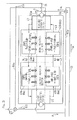
- Fig. 1 is a schematic configuration diagram showing a gas turbine power generation system (hereinafter, simply referred to as "power generation system”) S according to one embodiment of the present invention.
- the power generation system S includes a gas turbine engine GE which utilizes sunlight. That is, the power generation system S includes a compressor 1 for compressing an air A which is a working medium, a solar heater 3 and a hydrogen combustor 5 both for heating the air A compressed by the compressor 1, and a turbine 7 for outputting motive power from the compressed and heated air A.
- the power generation system S is configured as a regenerative cycle engine which supplies the air A discharged from the turbine 7, to the compressor 1 for reusing.
- a power generator 9 which is a load is driven by an output of the gas turbine engine GE.
- the air A compressed by the compressor 1 passes through a regenerator 13 via a compressed air supply path 11 and then is sent to the solar heater 3.
- the regenerator 13 utilizes heat of a high-temperature exhaust gas EG discharged from the turbine 7, to preheat the air A flowing from the compressor 1 toward the solar heater 3 and the hydrogen combustor 5.
- the solar heater 3 which is disposed between the compressor 1 and the turbine 7 receives sunlight SL supplied from a sunlight condensing device 15 which is provided outside the power generation system S, and heats the air A utilizing the sunlight SL as a heat source.
- a sunlight condensing device 15 which is provided outside the power generation system S, and heats the air A utilizing the sunlight SL as a heat source.
- multiple mirrors MR adjustable in angle so as to condense light toward the solar heater 3 are used as the sunlight condensing device 15.
- the hydrogen combustor 5 which bums the air A with hydrogen as a fuel is provided between the solar heater 3 and the turbine 7.
- the high-temperature and high-pressure air A supplied from the solar heater 3 or the hydrogen combustor 5 drives the turbine 7 and then is discharged as a high-temperature and low-pressure exhaust gas EG from the turbine 7.
- the turbine 7 is connected to the compressor 1 via a rotary shaft 17.
- the compressor 1 and the power generator 9 are driven by the turbine 7 via the rotary shaft 17.
- the hydrogen combustor 5 is connected to a hydrogen fuel reservoir 21 via a hydrogen fuel supply path 19 and is supplied with a hydrogen fuel from the hydrogen fuel reservoir 21.
- the hydrogen fuel reservoir 21 is connected to a first hydrogen-generating unit 25 via a first hydrogen introduction path 23.
- the first hydrogen-generating unit 25 is configured as an electrolysis hydrogen-generating unit which generates hydrogen by electrolysis of a water.
- the first hydrogen-generating unit 25 is supplied with power required for the electrolysis, from the power generator 9 which is driven by the turbine 7.
- a bypass path 27 which bypasses the compressed air A from the solar heater 3 as necessary, and a bypass switching valve 29 which switches a flow path to the bypass path 27 are provided between the regenerator 13 and the hydrogen combustor 5 on the compressed air supply path 11.
- the hydrogen fuel reservoir 21 is also connected to a second hydrogen-generating unit 33 via a second hydrogen introduction path 31.
- the second hydrogen-generating unit 33 is configured as a pyrolysis hydrogen-generating unit which generates hydrogen by pyrolysis of water.
- the second hydrogen-generating unit 33 utilizes the heat of the high-temperature exhaust gas EG discharged from the turbine 7, as a heat source required for the pyrolysis.
- the second hydrogen-generating unit 33 according to the shown example utilizes a so-called UT-3 process as a pyrolysis process for hydrogen.
- the UT-3 process is composed of the following four reactions using compounds of calcium, iron, bromine, and the like as process circulation substances.
- reaction (1-A) calcium bromide and water vapor are reacted by reaction (1-A) to generate hydrogen bromide gas and calcium oxide.
- the calcium oxide is reacted with bromine at a temperature of about 500°C by reaction (1-B) to regenerate calcium bromide and generate oxygen.
- iron bromide is reacted with water vapor at a temperature of about 600°C by reaction (2-B) to obtain hydrogen bromide gas and iron oxide and generate hydrogen.
- the iron oxide is reacted with the hydrogen bromide gas at a temperature of about 350°C by reaction (2-A) to regenerate bromine and iron bromide. All of these reactions are reactions of solids and gases.
- the two hydrolysis reactions (1-A) and (2-B) which react a bromide with water vapor are endothermic reactions, and the other reactions (1-B) and (2-A) are exothermic reactions.
- the second hydrogen-generating unit 33 includes, as schematically shown in Fig. 2 , a calcium reaction section 41, an iron reaction section 43, an oxygen separation section 45, and a hydrogen separation section 47.
- a calcium reaction section 41 the above reactions (1-A) and (1-B), which use a calcium compound, are conducted.
- iron reaction section 43 the above reactions (2-A) and (2-B), which use an iron compound, are conducted.
- oxygen separation section 45 oxygen that has been generated by the reaction (1-B) in the calcium reaction section 41 is separated and taken out.
- hydrogen separation section 47 hydrogen that has been generated by the reaction (2-B) in the iron reaction section 43 is separated and taken out.
- the calcium reaction section 41 includes two reaction chambers (a first calcium reaction chamber 41a and a second calcium reaction chamber 41b), one of the above reactions (1-A) and (1-B) is conducted in the first calcium reaction chamber 41a, and the other reaction is conducted in the second calcium reaction chamber 41b.
- the iron reaction section 43 includes two reaction chambers (a first iron reaction chamber 43a and a second iron reaction chamber 43b), one of the above reactions (2-A) and (2-B) is conducted in the first iron reaction chamber 43a, and the other reaction is conducted in the second iron reaction chamber 43b.
- reaction chambers are arranged such that: the reaction chambers in which the endothermic reactions of the above reactions (1-A) and (1-B), which use a calcium compound, and the above reactions (2-A) and (2-B), which use an iron compound, are conducted are adjacent to each other; and the reaction chambers in which the exothermic reactions of the above reactions (1-A) and (1-B) and the above reactions (2-A) and (2-B) are conducted are adjacent to each other.
- the first calcium reaction chamber 41a and the first iron reaction chamber 43 a are arranged adjacent to each other
- the second calcium reaction chamber 41b and the second iron reaction chamber 43b are arranged adjacent to each other.
- the endothermic reactions are conducted in the first calcium reaction chamber 41a and the first iron reaction chamber 43a, which are adjacent to each other, to form an endothermic reaction region Ren, and the exothermic reactions are conducted in the second calcium reaction chamber 41b and the second iron reaction chamber 43b, which are adjacent to each other, to form an exothermic reaction region Rex (hereinafter, this state is referred to as a first phase).
- the exothermic reactions are conducted in the first calcium reaction chamber 41a and the first iron reaction chamber 43a, which are adjacent to each other, to form the exothermic reaction region Rex
- the endothermic reactions are conducted in the second calcium reaction chamber 41b and the second iron reaction chamber 43b, which are adjacent to each other, to form the endothermic reaction region Ren (hereinafter, this state is referred to as a second phase).
- the reaction chambers which form the endothermic reaction region Ren and the reaction chambers which form the exothermic reaction region Rex are interchanged with each other at certain time intervals to alternately repeat the first phase and the second phase.
- an exhaust gas heat exchange path 53 for exchanging heat between the exhaust gas EG and the second hydrogen-generating unit 33 is provided so as to branch from a middle portion of an exhaust gas path 51 through which the high-temperature exhaust gas EG is discharged from the turbine 7.
- An exhaust gas flow path switching valve 55 which switches a flow path for the exhaust gas EG between the exhaust gas path 51 and the exhaust gas heat exchange path 53 is provided at the branch point between the exhaust gas path 51 and the exhaust gas heat exchange path 53.
- the exhaust gas heat exchange path 53 branches at a middle portion thereof into a first endothermic reaction side heat exchange path 53a and a second endothermic reaction side heat exchange path 53b.
- a heat exchange flow path switching valve 57 is provided at the branch point between the first endothermic reaction side heat exchange path 53a and the second endothermic reaction side heat exchange path 53b.
- a compressed air preheating path 61 for preheating the compressed air A by heat generated in the second hydrogen-generating unit 33 is provided so as to branch from a middle portion of the compressed air supply path 11.
- a compressed air flow path switching valve 63 which switches a flow path for the compressed air A between the compressed air supply path 11 and the compressed air preheating path 61 is provided at the branch point between the compressed air supply path 11 and the compressed air preheating path 61.
- the compressed air preheating path 61 branches at a middle portion thereof into a first exothermic reaction side compressed air preheating path 61 a and a second exothermic reaction side compressed air preheating path 61b.
- a compressed air preheating path switching valve 65 is provided at the branch point between the first exothermic reaction side compressed air preheating path 61 a and the second exothermic reaction side compressed air preheating path 61b.
- the first endothermic reaction side heat exchange path 53a and the second exothermic reaction side compressed air preheating path 61b extend near the first calcium reaction chamber 41a of the calcium reaction section 41 and the first iron reaction chamber 43a of the iron reaction section 43 of the second hydrogen-generating unit 33.
- the second endothermic reaction side heat exchange path 53b and the first exothermic reaction side compressed air preheating path 61a extend near the second calcium reaction chamber 41b of the calcium reaction section 41 and the second iron reaction chamber 43b of the iron reaction section 43 of the second hydrogen-generating unit 33.
- the above reaction (1-A), which is an endothermic reaction, is conducted in the first calcium reaction chamber 41 a
- the above reaction (2-B), which is an endothermic reaction is conducted in the first iron reaction chamber 43a
- the above reaction (1-B), which is an exothermic reaction is conducted in the second calcium reaction chamber 41b
- the above reaction (2-A), which is an exothermic reaction is conducted in the second iron reaction chamber 43b.
- the heat exchange flow path switching valve 57 on the exhaust gas heat exchange path 53 is switched to the side of the first endothermic reaction side heat exchange path 53a extending near the endothermic reaction region Ren, and the compressed air flow path switching valve 63 on the compressed air preheating path 61 is switched to the side of the first exothermic reaction side compressed air preheating path 61a extending near the exothermic reaction region Rex.
- the heat exchange flow path switching valve 57 on the exhaust gas heat exchange path 53 is switched to the side of the second endothermic reaction side heat exchange path 53b, and the compressed air flow path switching valve 63 on the compressed air preheating path 61 is switched to the side of the second exothermic reaction side compressed air preheating path 61b.
- the arrangements of the respective reaction chambers within the endothermic reaction region Ren and the exothermic reaction region Rex are preferably set such that energy loss in heat exchange between the exhaust gas EG and the compressed air A is minimized. That is, within the endothermic reaction region Ren where heat is received from the exhaust gas EG, the reaction chambers are arranged from the upstream side toward the downstream side in flow of the exhaust gas EG in order of the reaction chamber in which the higher temperature reaction is conducted and the reaction chamber in which the lower temperature reaction is conducted (in order of the first calcium reaction chamber 41 a in which the reaction temperature is about 730°C and the first iron reaction chamber 43a in which the reaction temperature is about 600°C in the example of the present embodiment); and within the exothermic reaction region Rex where heat is provided to the compressed air A, the reaction chambers are arranged from the upstream side toward the downstream side in flow of the compressed air A in order of the reaction chamber in which the lower temperature reaction is conducted and the reaction chamber in which the higher temperature reaction is conducted (in order
- the endothermic reactions and the exothermic reactions are interchanged between the two reaction chambers 41 a and 41b of the calcium reaction section 41 and between the two reaction chambers 43a and 43b of the iron reaction section 43 as described above.
- the heat exchange flow path switching valve 57 on the exhaust gas heat exchange path 53 is switched to the side of the first endothermic reaction side heat exchange path 53a to cause the exhaust gas EG to flow near the first calcium reaction chamber 41a and the first iron reaction chamber 43a
- the compressed air preheating path switching valve 65 on the compressed air preheating path 61 is switched to the side of the first exothermic reaction side compressed air preheating path 61 a to cause the air A to flow near the second calcium reaction chamber 41b and the second iron reaction chamber 43b in which the exothermic reactions progress.
- the heat exchange flow path switching valve 57 on the exhaust gas heat exchange path 53 is switched to the side of the second exothermic reaction side compressed air preheating path 61b to cause the exhaust gas EG to flow near the second calcium reaction chamber 41b and the second iron reaction chamber 43b
- the compressed air preheating path switching valve 65 on the compressed air preheating path 61 is switched to the side of the exothermic reaction side compressed air preheating path 61b to cause the air A to flow near the first calcium reaction chamber 41a and the first iron reaction chamber 43 a.
- the heat of the high-temperature exhaust gas EG passing through the first endothermic reaction side heat exchange path 53a or the second endothermic reaction side heat exchange path 53b which forms a part of the exhaust gas heat exchange path 53 is supplied to the endothermic reaction region Ren to accelerate the endothermic reactions.
- the heat generated in the exothermic reaction region Rex preheats the air A passing through the first exothermic reaction side compressed air preheating path 61a or the second exothermic reaction side compressed air preheating path 61b.
- the exhaust gas EG having passed through the second hydrogen-generating unit 33 is supplied as a heating medium to the regenerator 13.
- the air A having passed through the second hydrogen-generating unit 33 is supplied as a medium to be heated to the regenerator 13.
- the exhaust gas heat exchange path 53 which causes the exhaust gas EG and the pyrolysis hydrogen-generating unit to exchange heat therebetween is provided with a mechanism to switch a flow path in response to interchanging of the reaction chambers which form the endothermic reaction region Ren with the reaction chambers which form the exothermic reaction region Rex, in the second hydrogen-generating unit 33 which is the pyrolysis hydrogen-generating unit, such that the flow path extends near the endothermic reaction region Ren.
- this flow path switching mechanism is the paths 53a and 53b at the endothermic reaction side and the switching valve 57 which switches these paths.
- the compressed air preheating path 61 which causes the air A and the pyrolysis hydrogen-generating unit to exchange heat therebetween is provided with a mechanism to switch a flow path in response to interchanging of the reaction chambers which form the endothermic reaction region with the reaction chambers which form the exothermic reaction region, in the second hydrogen-generating unit 33 which is the pyrolysis hydrogen-generating unit, such that the flow path extends near the exothermic reaction region Rex.
- this flow path switching mechanism is the paths 61 a and 61b at the exothermic reaction side and the switching valve 65 which switches these paths. Therefore, it is possible to improve the efficiency of the entire system by effectively utilizing the heat of the exhaust gas EG and the heat generated by the pyrolysis reaction.
- the exhaust gas flow path switching valve 55 is switched to the side of the exhaust gas path 51 to supply the exhaust gas EG as a heating medium directly to the regenerator 13.
- the compressed air flow path switching valve 63 is switched to the side of the compressed air supply path 11 to supply the compressed air A as a medium to be heated directly to the regenerator 13.
- the air A may be supplied from the regenerator 13 via the bypass path 27 directly to the hydrogen combustor 5, and heating (burning) may be performed only with the hydrogen combustor 5.
- the water decomposition process used in the second hydrogen-generating unit which is the pyrolysis hydrogen-generating unit, is not limited to the UT-3 process, and, for example, an IS process (Iodine-Sulfur process) may be utilized as the water decomposition process.
- an IS process Iodine-Sulfur process
- the IS process is composed of three reactions, that is, (1) a reaction in which sulfur dioxide gas is absorbed by a mixture of water and iodine at a temperature of about 100°C to obtain hydrogen iodide and sulfuric acid, (2) a reaction in which pyrolysis of hydrogen iodide is performed at a temperature of 400°C to 500°C to generate hydrogen, and (3) a reaction in which sulfuric acid is decomposed at a temperature of about 850°C to generate oxygen.
- the reaction (3) is an endothermic reaction
- the reaction (1) is an exothermic reaction.
- the exhaust gas heat exchange path which causes the exhaust gas EG and the pyrolysis hydrogen-generating unit to exchange heat therebetween is provided with a mechanism to switch a flow path such that the flow path extends near the endothermic reaction region
- the compressed air preheating path which causes the compressed air A and the pyrolysis hydrogen-generating unit to exchange heat therebetween is provided with a mechanism to switch a flow path such that the flow path extends near the exothermic reaction region.
- the pyrolysis for hydrogen such as the UT-3 process and the IS process requires a high temperature of 750°C or higher.
- a gas turbine cycle a regenerative cycle with a low pressure ratio which can handle this is selected, and a gas turbine cycle suited for an individual pyrolysis process to be used is selected.
- hydrogen separation which is an endothermic reaction and oxygen separation which is an exothermic reaction may be conducted simultaneously, or a heat storage function may be provided by increasing a medium amount for the reactions, and the reactions may be conducted during different periods of time.
- either one of the first and second hydrogen-generating units 25 and 33 may be omitted.
- the second hydrogen-generating unit 33 which is the pyrolysis hydrogen-generating unit, may be omitted, and hydrogen which is a fuel for the hydrogen combustor 5 may be generated and supplied only by the first hydrogen-generating unit, which is the electrolysis hydrogen-generating unit.
Landscapes
- Engineering & Computer Science (AREA)
- Chemical & Material Sciences (AREA)
- Combustion & Propulsion (AREA)
- Mechanical Engineering (AREA)
- General Engineering & Computer Science (AREA)
- Sustainable Energy (AREA)
- Sustainable Development (AREA)
- Life Sciences & Earth Sciences (AREA)
- Physics & Mathematics (AREA)
- High Energy & Nuclear Physics (AREA)
- General Chemical & Material Sciences (AREA)
- Chemical Kinetics & Catalysis (AREA)
- Thermal Sciences (AREA)
- Engine Equipment That Uses Special Cycles (AREA)
Abstract
Description
- This application is based on and claims Convention priority to Japanese patent application No.
2012-236377, filed October 26, 2012 - The present invention relates to a gas turbine power generation system which generates power by utilizing sunlight as a heat source.
- In recent years, as one solution for the environmental issues and energy issues, the technique to generate power by a turbine device which utilizes sunlight as a heat source, for example, a gas turbine power generation system which utilizes the heat of sunlight, has been proposed (e.g., see Patent Document 1).
- [Patent Document 1]
JP Laid-open Patent Publication No. 2011-032960 - However, in general, such a facility which utilizes sunlight cannot control a supply amount of sunlight which is an energy source, and thus it is difficult to supply power appropriately corresponding to a change in demand for power. Therefore, there is the problem that while surplus power occurs during the daytime when a power demand is low with respect to an amount of insolation, power cannot be supplied during the nighttime or under bad weather.
- Therefore, in order to solve the above-described problem, an object of the present invention is to provide a gas turbine power generation system which is able to perform power supply corresponding to an increase or decrease in power demand while utilizing sunlight as a heat source.
- In order to achieve the above-described object, a gas turbine power generation system according to the present invention is a power generation system having a gas turbine engine that utilizes sunlight. The power generation system includes: a compressor configured to compress an air which is a working medium; a solar heater configured to heat the air compressed by the compressor, utilizing sunlight as a heat source; a hydrogen combustor configured to burn the air compressed by the compressor, utilizing hydrogen as a fuel; a turbine configured to output a motive power from a high-temperature gas heated by at least one of the solar heater and the hydrogen combustor; a power generator configured to be driven by the turbine; and at least one hydrogen-generating unit configured to generate hydrogen by utilizing an output of the turbine or exhaust heat from the turbine to decompose water, and supply the hydrogen so generated to the hydrogen combustor.
- According to this configuration, when an amount of insolation is large and a power demand is low, hydrogen is generated by the hydrogen-generating unit and stored, and when a power demand is high or during the nighttime when there is no sunlight, an amount of supplied power can be increased by utilizing the hydrogen that has been stored. Thus, it is possible to perform power supply corresponding to an increase or decrease in power demand while utilizing sunlight as a heat source.
- In one embodiment of the present invention, the hydrogen-generating unit may be an electrolysis hydrogen-generating unit configured to perform electrolysis of a water by utilizing a power generated by the power generator. According to this configuration, it is possible to perform power supply corresponding to an increase or decrease in power demand by effectively utilizing surplus power generated when an amount of insolation is large with respect to power demand.
- In one embodiment of the present invention, the gas turbine power generation system may further include a pyrolysis hydrogen-generating unit configured to generate hydrogen by pyrolysis of a water by utilizing an exhaust gas from the turbine. According to this configuration, by further utilizing exhaust heat from the gas turbine engine, it is possible to perform power supply corresponding to an increase or decrease in power demand while the efficiency of the entire system is increased.
- In one embodiment of the present invention, the gas turbine power generation system may further include a compressed air preheating path configured to preheat the air compressed by the compressor, utilizing heat generated in the pyrolysis hydrogen-generating unit. In this case, further, the compressed air preheating path may be provided with a mechanism to switch a flow path in response to interchanging of a reaction chamber in which an endothermic reaction is conducted with a reaction chamber in which an exothermic reaction is conducted, in the pyrolysis hydrogen-generating unit, such that the flow path extends near the reaction chamber in which the exothermic reaction is conducted. According to this configuration, it is possible to improve the efficiency of the entire system by effectively utilizing heat generated in the pyrolysis reaction.
- In one embodiment of the present invention, the gas turbine power generation system may further include an exhaust gas heat exchange path configured to cause the exhaust gas from the turbine to pass therethrough to exchange heat between the exhaust gas and the pyrolysis hydrogen-generating unit, and the exhaust gas heat exchange path has a mechanism to switch a flow path in response to interchanging of a reaction chamber in which an endothermic reaction is conducted with a reaction chamber in which an exothermic reaction is conducted, in the pyrolysis hydrogen-generating unit, such that the flow path extends near the reaction chamber in which the endothermic reaction is conducted. According to this configuration, it is possible to improve the efficiency of the entire system by effectively utilizing the heat of the exhaust gas from the turbine.
- Any combination of at least two constructions, disclosed in the appended claims and/or the specification and/or the accompanying drawings should be construed as included within the scope of the present invention. In particular, any combination of two or more of the appended claims should be equally construed as included within the scope of the present invention.
- In any event, the present invention will become more clearly understood from the following description of embodiments thereof, when taken in conjunction with the accompanying drawings. However, the embodiments and the drawings are given only for the purpose of illustration and explanation, and are not to be taken as limiting the scope of the present invention in any way whatsoever, which scope is to be determined by the appended claims. In the accompanying drawings, like reference numerals are used to denote like parts throughout the several views, and:
-
Fig. 1 is a block diagram showing a schematic configuration of a gas turbine power generation system according to one embodiment of the present invention; -
Fig. 2 is a block diagram showing a schematic configuration of a second hydrogen-generating unit (first phase) of the embodiment ofFig. 1 in an enlarged manner; and -
Fig. 3 is a block diagram showing a schematic configuration of the second hydrogen-generating unit (second phase) of the embodiment ofFig. 1 in an enlarged manner. - Hereinafter, embodiments of the present invention will be described with reference to the drawings.
Fig. 1 is a schematic configuration diagram showing a gas turbine power generation system (hereinafter, simply referred to as "power generation system") S according to one embodiment of the present invention. The power generation system S includes a gas turbine engine GE which utilizes sunlight. That is, the power generation system S includes a compressor 1 for compressing an air A which is a working medium, a solar heater 3 and a hydrogen combustor 5 both for heating the air A compressed by the compressor 1, and a turbine 7 for outputting motive power from the compressed and heated air A. In the present embodiment, the power generation system S is configured as a regenerative cycle engine which supplies the air A discharged from the turbine 7, to the compressor 1 for reusing. A power generator 9 which is a load is driven by an output of the gas turbine engine GE. - The air A compressed by the compressor 1 passes through a
regenerator 13 via a compressedair supply path 11 and then is sent to the solar heater 3. Theregenerator 13 utilizes heat of a high-temperature exhaust gas EG discharged from the turbine 7, to preheat the air A flowing from the compressor 1 toward the solar heater 3 and the hydrogen combustor 5. - The solar heater 3 which is disposed between the compressor 1 and the turbine 7 receives sunlight SL supplied from a
sunlight condensing device 15 which is provided outside the power generation system S, and heats the air A utilizing the sunlight SL as a heat source. In the present embodiment, multiple mirrors MR adjustable in angle so as to condense light toward the solar heater 3 are used as thesunlight condensing device 15. - The hydrogen combustor 5 which bums the air A with hydrogen as a fuel is provided between the solar heater 3 and the turbine 7. The high-temperature and high-pressure air A supplied from the solar heater 3 or the hydrogen combustor 5 drives the turbine 7 and then is discharged as a high-temperature and low-pressure exhaust gas EG from the turbine 7. The turbine 7 is connected to the compressor 1 via a
rotary shaft 17. The compressor 1 and the power generator 9 are driven by the turbine 7 via therotary shaft 17. - The hydrogen combustor 5 is connected to a
hydrogen fuel reservoir 21 via a hydrogenfuel supply path 19 and is supplied with a hydrogen fuel from thehydrogen fuel reservoir 21. Thehydrogen fuel reservoir 21 is connected to a first hydrogen-generatingunit 25 via a firsthydrogen introduction path 23. The first hydrogen-generatingunit 25 is configured as an electrolysis hydrogen-generating unit which generates hydrogen by electrolysis of a water. The first hydrogen-generatingunit 25 is supplied with power required for the electrolysis, from the power generator 9 which is driven by the turbine 7. Abypass path 27 which bypasses the compressed air A from the solar heater 3 as necessary, and abypass switching valve 29 which switches a flow path to thebypass path 27 are provided between theregenerator 13 and the hydrogen combustor 5 on the compressedair supply path 11. - The
hydrogen fuel reservoir 21 is also connected to a second hydrogen-generatingunit 33 via a secondhydrogen introduction path 31. The second hydrogen-generatingunit 33 is configured as a pyrolysis hydrogen-generating unit which generates hydrogen by pyrolysis of water. The second hydrogen-generatingunit 33 utilizes the heat of the high-temperature exhaust gas EG discharged from the turbine 7, as a heat source required for the pyrolysis. The second hydrogen-generatingunit 33 according to the shown example utilizes a so-called UT-3 process as a pyrolysis process for hydrogen. - The UT-3 process is composed of the following four reactions using compounds of calcium, iron, bromine, and the like as process circulation substances.
CaBr2 + H2O → CaO + 2HBr (1-A)
CaO + Br2 → CaBr2 + 1/2O2 (1-B)
Fe3O4 + 8HBr → 3FeBr2 + 4H2O + Br2 (2-A)
3FeBr2 + 4H2O → Fe3O4 + 6HBr + H2 (2-B)
- First, at a temperature of about 730°C, calcium bromide and water vapor are reacted by reaction (1-A) to generate hydrogen bromide gas and calcium oxide. The calcium oxide is reacted with bromine at a temperature of about 500°C by reaction (1-B) to regenerate calcium bromide and generate oxygen. Meanwhile, iron bromide is reacted with water vapor at a temperature of about 600°C by reaction (2-B) to obtain hydrogen bromide gas and iron oxide and generate hydrogen. The iron oxide is reacted with the hydrogen bromide gas at a temperature of about 350°C by reaction (2-A) to regenerate bromine and iron bromide. All of these reactions are reactions of solids and gases. The two hydrolysis reactions (1-A) and (2-B) which react a bromide with water vapor are endothermic reactions, and the other reactions (1-B) and (2-A) are exothermic reactions.
- The second hydrogen-generating
unit 33 includes, as schematically shown inFig. 2 , acalcium reaction section 41, aniron reaction section 43, anoxygen separation section 45, and ahydrogen separation section 47. In thecalcium reaction section 41, the above reactions (1-A) and (1-B), which use a calcium compound, are conducted. In theiron reaction section 43, the above reactions (2-A) and (2-B), which use an iron compound, are conducted. In theoxygen separation section 45, oxygen that has been generated by the reaction (1-B) in thecalcium reaction section 41 is separated and taken out. In thehydrogen separation section 47, hydrogen that has been generated by the reaction (2-B) in theiron reaction section 43 is separated and taken out. - The
calcium reaction section 41 includes two reaction chambers (a firstcalcium reaction chamber 41a and a secondcalcium reaction chamber 41b), one of the above reactions (1-A) and (1-B) is conducted in the firstcalcium reaction chamber 41a, and the other reaction is conducted in the secondcalcium reaction chamber 41b. Similarly, theiron reaction section 43 includes two reaction chambers (a firstiron reaction chamber 43a and a secondiron reaction chamber 43b), one of the above reactions (2-A) and (2-B) is conducted in the firstiron reaction chamber 43a, and the other reaction is conducted in the secondiron reaction chamber 43b. These reaction chambers are arranged such that: the reaction chambers in which the endothermic reactions of the above reactions (1-A) and (1-B), which use a calcium compound, and the above reactions (2-A) and (2-B), which use an iron compound, are conducted are adjacent to each other; and the reaction chambers in which the exothermic reactions of the above reactions (1-A) and (1-B) and the above reactions (2-A) and (2-B) are conducted are adjacent to each other. Specifically, in the shown example, the firstcalcium reaction chamber 41a and the firstiron reaction chamber 43 a are arranged adjacent to each other, and the secondcalcium reaction chamber 41b and the secondiron reaction chamber 43b are arranged adjacent to each other. The endothermic reactions are conducted in the firstcalcium reaction chamber 41a and the firstiron reaction chamber 43a, which are adjacent to each other, to form an endothermic reaction region Ren, and the exothermic reactions are conducted in the secondcalcium reaction chamber 41b and the secondiron reaction chamber 43b, which are adjacent to each other, to form an exothermic reaction region Rex (hereinafter, this state is referred to as a first phase). - Understandably, as the pyrolysis hydrogen generation reaction progresses, in the
calcium reaction section 41, CaBr2 in the firstcalcium reaction chamber 41 a changes to CaO, and CaO in the secondcalcium reaction chamber 41b changes to CaBr2. Thus, the compositions in bothreaction chambers iron reaction section 43, FeBr2 in the firstiron reaction chamber 43a changes to Fe3O4, and Fe3O4 in the secondiron reaction chamber 43b changes to FeBr2. Thus, the compositions in bothreaction chambers unit 33 is reversed as shown inFig. 3 , so that the endothermic reaction (1-A) which has been conducted in the firstcalcium reaction chamber 41 a and the exothermic reaction (1-B) which has been conducted in the secondcalcium reaction chamber 41b are interchanged with each other and the endothermic reaction (2-B) which has been conducted in the firstiron reaction chamber 43a and the exothermic reaction (2-A) which has been conducted in the secondiron reaction chamber 43b are interchanged with each other. That is, after the certain period of time, the exothermic reactions are conducted in the firstcalcium reaction chamber 41a and the firstiron reaction chamber 43a, which are adjacent to each other, to form the exothermic reaction region Rex, and the endothermic reactions are conducted in the secondcalcium reaction chamber 41b and the secondiron reaction chamber 43b, which are adjacent to each other, to form the endothermic reaction region Ren (hereinafter, this state is referred to as a second phase). Also, thereafter, the reaction chambers which form the endothermic reaction region Ren and the reaction chambers which form the exothermic reaction region Rex are interchanged with each other at certain time intervals to alternately repeat the first phase and the second phase. - Next, a structure to exchange heat between the gas turbine engine GE and the second hydrogen-generating
unit 33 will be described. As shown inFig. 1 , an exhaust gasheat exchange path 53 for exchanging heat between the exhaust gas EG and the second hydrogen-generatingunit 33 is provided so as to branch from a middle portion of anexhaust gas path 51 through which the high-temperature exhaust gas EG is discharged from the turbine 7. An exhaust gas flowpath switching valve 55 which switches a flow path for the exhaust gas EG between theexhaust gas path 51 and the exhaust gasheat exchange path 53 is provided at the branch point between theexhaust gas path 51 and the exhaust gasheat exchange path 53. The exhaust gasheat exchange path 53 branches at a middle portion thereof into a first endothermic reaction sideheat exchange path 53a and a second endothermic reaction sideheat exchange path 53b. A heat exchange flowpath switching valve 57 is provided at the branch point between the first endothermic reaction sideheat exchange path 53a and the second endothermic reaction sideheat exchange path 53b. - In addition, a compressed
air preheating path 61 for preheating the compressed air A by heat generated in the second hydrogen-generatingunit 33 is provided so as to branch from a middle portion of the compressedair supply path 11. A compressed air flowpath switching valve 63 which switches a flow path for the compressed air A between the compressedair supply path 11 and the compressedair preheating path 61 is provided at the branch point between the compressedair supply path 11 and the compressedair preheating path 61. The compressedair preheating path 61 branches at a middle portion thereof into a first exothermic reaction side compressedair preheating path 61 a and a second exothermic reaction side compressedair preheating path 61b. A compressed air preheatingpath switching valve 65 is provided at the branch point between the first exothermic reaction side compressedair preheating path 61 a and the second exothermic reaction side compressedair preheating path 61b. - As shown in
Fig. 2 , the first endothermic reaction sideheat exchange path 53a and the second exothermic reaction side compressedair preheating path 61b extend near the firstcalcium reaction chamber 41a of thecalcium reaction section 41 and the firstiron reaction chamber 43a of theiron reaction section 43 of the second hydrogen-generatingunit 33. The second endothermic reaction sideheat exchange path 53b and the first exothermic reaction side compressedair preheating path 61a extend near the secondcalcium reaction chamber 41b of thecalcium reaction section 41 and the secondiron reaction chamber 43b of theiron reaction section 43 of the second hydrogen-generatingunit 33. - In the first phase shown in
Fig. 2 , the above reaction (1-A), which is an endothermic reaction, is conducted in the firstcalcium reaction chamber 41 a, the above reaction (2-B), which is an endothermic reaction, is conducted in the firstiron reaction chamber 43a, the above reaction (1-B), which is an exothermic reaction, is conducted in the secondcalcium reaction chamber 41b, and the above reaction (2-A), which is an exothermic reaction, is conducted in the secondiron reaction chamber 43b. In this state, the heat exchange flowpath switching valve 57 on the exhaust gasheat exchange path 53 is switched to the side of the first endothermic reaction sideheat exchange path 53a extending near the endothermic reaction region Ren, and the compressed air flowpath switching valve 63 on the compressedair preheating path 61 is switched to the side of the first exothermic reaction side compressedair preheating path 61a extending near the exothermic reaction region Rex. - Meanwhile, in the second phase shown in
Fig. 3 , the heat exchange flowpath switching valve 57 on the exhaust gasheat exchange path 53 is switched to the side of the second endothermic reaction sideheat exchange path 53b, and the compressed air flowpath switching valve 63 on the compressedair preheating path 61 is switched to the side of the second exothermic reaction side compressedair preheating path 61b. - In any of the first phase and the second phase, the arrangements of the respective reaction chambers within the endothermic reaction region Ren and the exothermic reaction region Rex are preferably set such that energy loss in heat exchange between the exhaust gas EG and the compressed air A is minimized. That is, within the endothermic reaction region Ren where heat is received from the exhaust gas EG, the reaction chambers are arranged from the upstream side toward the downstream side in flow of the exhaust gas EG in order of the reaction chamber in which the higher temperature reaction is conducted and the reaction chamber in which the lower temperature reaction is conducted (in order of the first
calcium reaction chamber 41 a in which the reaction temperature is about 730°C and the firstiron reaction chamber 43a in which the reaction temperature is about 600°C in the example of the present embodiment); and within the exothermic reaction region Rex where heat is provided to the compressed air A, the reaction chambers are arranged from the upstream side toward the downstream side in flow of the compressed air A in order of the reaction chamber in which the lower temperature reaction is conducted and the reaction chamber in which the higher temperature reaction is conducted (in order of the secondiron reaction chamber 43b in which the reaction temperature is about 350°C and the secondcalcium reaction chamber 41b in which the reaction temperature is about 500°C in the example of the present embodiment). - Next, an operation of the power generation system S configured as described above will be described. As shown in
Fig. 1 , during a period of time when a power demand is low, hydrogen is generated by the first and second hydrogen-generatingunits unit 33 is activated, the exhaust gas flowpath switching valve 55 is switched to the side of the exhaust gasheat exchange path 53 to supply the exhaust gas EG to the exhaust gasheat exchange path 53, and the compressed air flowpath switching valve 63 is switched to the side of the compressedair preheating path 61 to supply the compressed air A to the compressedair preheating path 61. - In the second hydrogen-generating
unit 33, as the reactions of the pyrolysis reaction process progress, the endothermic reactions and the exothermic reactions are interchanged between the tworeaction chambers calcium reaction section 41 and between the tworeaction chambers iron reaction section 43 as described above. In the first phase in which the endothermic reactions progress in the firstcalcium reaction chamber 41a and the firstiron reaction chamber 43a adjacent thereto, the heat exchange flowpath switching valve 57 on the exhaust gasheat exchange path 53 is switched to the side of the first endothermic reaction sideheat exchange path 53a to cause the exhaust gas EG to flow near the firstcalcium reaction chamber 41a and the firstiron reaction chamber 43a, and the compressed air preheatingpath switching valve 65 on the compressedair preheating path 61 is switched to the side of the first exothermic reaction side compressedair preheating path 61 a to cause the air A to flow near the secondcalcium reaction chamber 41b and the secondiron reaction chamber 43b in which the exothermic reactions progress. - Meanwhile, in the second phase in which the exothermic reactions progress in the first
calcium reaction chamber 41a and the firstiron reaction chamber 43a adjacent thereto, of the second hydrogen-generating unit, the heat exchange flowpath switching valve 57 on the exhaust gasheat exchange path 53 is switched to the side of the second exothermic reaction side compressedair preheating path 61b to cause the exhaust gas EG to flow near the secondcalcium reaction chamber 41b and the secondiron reaction chamber 43b, and the compressed air preheatingpath switching valve 65 on the compressedair preheating path 61 is switched to the side of the exothermic reaction side compressedair preheating path 61b to cause the air A to flow near the firstcalcium reaction chamber 41a and the firstiron reaction chamber 43 a. - In either case, the heat of the high-temperature exhaust gas EG passing through the first endothermic reaction side
heat exchange path 53a or the second endothermic reaction sideheat exchange path 53b which forms a part of the exhaust gasheat exchange path 53 is supplied to the endothermic reaction region Ren to accelerate the endothermic reactions. Meanwhile, the heat generated in the exothermic reaction region Rex preheats the air A passing through the first exothermic reaction side compressedair preheating path 61a or the second exothermic reaction side compressedair preheating path 61b. Thereafter, the exhaust gas EG having passed through the second hydrogen-generatingunit 33 is supplied as a heating medium to theregenerator 13. The air A having passed through the second hydrogen-generatingunit 33 is supplied as a medium to be heated to theregenerator 13. - As described above, in the power generation system S according to the present embodiment, the exhaust gas
heat exchange path 53 which causes the exhaust gas EG and the pyrolysis hydrogen-generating unit to exchange heat therebetween is provided with a mechanism to switch a flow path in response to interchanging of the reaction chambers which form the endothermic reaction region Ren with the reaction chambers which form the exothermic reaction region Rex, in the second hydrogen-generatingunit 33 which is the pyrolysis hydrogen-generating unit, such that the flow path extends near the endothermic reaction region Ren. In the example of the present embodiment, this flow path switching mechanism is thepaths valve 57 which switches these paths. The compressedair preheating path 61 which causes the air A and the pyrolysis hydrogen-generating unit to exchange heat therebetween is provided with a mechanism to switch a flow path in response to interchanging of the reaction chambers which form the endothermic reaction region with the reaction chambers which form the exothermic reaction region, in the second hydrogen-generatingunit 33 which is the pyrolysis hydrogen-generating unit, such that the flow path extends near the exothermic reaction region Rex. In the example of the present embodiment, this flow path switching mechanism is thepaths valve 65 which switches these paths. Therefore, it is possible to improve the efficiency of the entire system by effectively utilizing the heat of the exhaust gas EG and the heat generated by the pyrolysis reaction. - During a period of time when a power demand is high, generation of hydrogen by the first and second hydrogen-generating units is stopped, and an amount of generated power is increased by utilizing hydrogen stored in the
hydrogen fuel reservoir 21. At that time, the exhaust gas flowpath switching valve 55 is switched to the side of theexhaust gas path 51 to supply the exhaust gas EG as a heating medium directly to theregenerator 13. In addition, the compressed air flowpath switching valve 63 is switched to the side of the compressedair supply path 11 to supply the compressed air A as a medium to be heated directly to theregenerator 13. It should be noted that in the case where an amount of insolation is very small, such as during the nighttime or when the weather is bad, the air A may be supplied from theregenerator 13 via thebypass path 27 directly to the hydrogen combustor 5, and heating (burning) may be performed only with the hydrogen combustor 5. - It should be noted that the water decomposition process used in the second hydrogen-generating unit, which is the pyrolysis hydrogen-generating unit, is not limited to the UT-3 process, and, for example, an IS process (Iodine-Sulfur process) may be utilized as the water decomposition process. The IS process is composed of three reactions, that is, (1) a reaction in which sulfur dioxide gas is absorbed by a mixture of water and iodine at a temperature of about 100°C to obtain hydrogen iodide and sulfuric acid, (2) a reaction in which pyrolysis of hydrogen iodide is performed at a temperature of 400°C to 500°C to generate hydrogen, and (3) a reaction in which sulfuric acid is decomposed at a temperature of about 850°C to generate oxygen. The reaction (3) is an endothermic reaction, and the reaction (1) is an exothermic reaction. Therefore, in the case of utilizing the IS process as well, preferably, in the second hydrogen-generating unit which is the pyrolysis hydrogen-generating unit, in response to interchanging of the reaction chambers which form the endothermic reaction region with the reaction chambers which form the exothermic reaction region, the exhaust gas heat exchange path which causes the exhaust gas EG and the pyrolysis hydrogen-generating unit to exchange heat therebetween is provided with a mechanism to switch a flow path such that the flow path extends near the endothermic reaction region, and the compressed air preheating path which causes the compressed air A and the pyrolysis hydrogen-generating unit to exchange heat therebetween is provided with a mechanism to switch a flow path such that the flow path extends near the exothermic reaction region.
- Even when any pyrolysis process is utilized, the pyrolysis for hydrogen such as the UT-3 process and the IS process requires a high temperature of 750°C or higher. Thus, as a gas turbine cycle, a regenerative cycle with a low pressure ratio which can handle this is selected, and a gas turbine cycle suited for an individual pyrolysis process to be used is selected. In addition, of the pyrolysis reactions for hydrogen, hydrogen separation which is an endothermic reaction and oxygen separation which is an exothermic reaction may be conducted simultaneously, or a heat storage function may be provided by increasing a medium amount for the reactions, and the reactions may be conducted during different periods of time.
- In addition, either one of the first and second hydrogen-generating
units unit 33, which is the pyrolysis hydrogen-generating unit, may be omitted, and hydrogen which is a fuel for the hydrogen combustor 5 may be generated and supplied only by the first hydrogen-generating unit, which is the electrolysis hydrogen-generating unit. In this case as well, it is possible to perform power supply corresponding to an increase or decrease in power demand by effectively utilizing surplus power generated when an amount of insolation is large with respect to power demand. - As described above, in the power generation system S according to the present embodiment, when an amount of insolation is large and a power demand is low, hydrogen is generated by the hydrogen-generating unit and stored, and when a power demand is high, an amount of supplied power can be increased by utilizing the hydrogen that has been stored. Thus, it is possible to perform power supply corresponding to an increase or decrease in power demand while utilizing sunlight as a heat source.
- Although the present invention has been described above in connection with the embodiments thereof with reference to the accompanying drawings, numerous additions, changes, or deletions can be made without departing from the gist of the present invention. Accordingly, such additions, changes, or deletions are to be construed as included in the scope of the present invention.
-
- 1
- Compressor
- 3
- Solar heater
- 5
- Hydrogen combustor
- 7
- Turbine
- 9
- Power generator
- 25
- First hydrogen-generating unit
- 33
- Second hydrogen-generating unit
- A
- Air
- S
- Gas turbine power generation system
Claims (6)
- A power generation system having a gas turbine engine that utilizes sunlight, the power generation system comprising:a compressor configured to compress an air which is a working medium;a solar heater configured to heat the air compressed by the compressor, utilizing sunlight as a heat source;a hydrogen combustor configured to burn the air compressed by the compressor, utilizing hydrogen as a fuel;a turbine configured to output a motive power from a high-temperature gas heated by at least one of the solar heater and the hydrogen combustor;a power generator configured to be driven by the turbine; andat least one hydrogen-generating unit configured to generate hydrogen by utilizing an output of the turbine or exhaust heat from the turbine to decompose a water, and supply the hydrogen so generated to the hydrogen combustor.
- The gas turbine power generation system as claimed in claim 1, wherein the hydrogen-generating unit is an electrolysis hydrogen-generating unit configured to perform electrolysis of a water by utilizing power generated by the power generator.
- The gas turbine power generation system as claimed in claim 2, further comprising a pyrolysis hydrogen-generating unit configured to generate hydrogen by utilizing an exhaust gas from the turbine to pyrolyze a water.
- The gas turbine power generation system as claimed in claim 3, further comprising a compressed air preheating path configured to preheat the air compressed by the compressor, utilizing a heat generated in the pyrolysis hydrogen-generating unit.
- The gas turbine power generation system as claimed in claim 4, wherein the compressed air preheating path is provided with a mechanism to switch a flow path thereof in response to interchanging of a reaction chamber in which an endothermic reaction is conducted with a reaction chamber in which an exothermic reaction is conducted in the pyrolysis hydrogen-generating unit, such that the flow path extends near the reaction chamber in which the exothermic reaction is conducted.
- The gas turbine power generation system as claimed in any one of claims 3 to 5, further comprising an exhaust gas heat exchange path configured to cause the exhaust gas from the turbine to pass therethrough to exchange heat between the exhaust gas and the pyrolysis hydrogen-generating unit,
wherein the exhaust gas heat exchange path is provided with a mechanism to switch a flow path thereof in response to interchanging of a reaction chamber in which an endothermic reaction is conducted with a reaction chamber in which an exothermic reaction is conducted in the pyrolysis hydrogen-generating unit, such that the flow path extends near the reaction chamber in which the endothermic reaction is conducted.
Applications Claiming Priority (2)
| Application Number | Priority Date | Filing Date | Title |
|---|---|---|---|
| JP2012236377A JP5460816B1 (en) | 2012-10-26 | 2012-10-26 | Photovoltaic gas turbine power generation system with hydrogen generator |
| PCT/JP2013/078168 WO2014065185A1 (en) | 2012-10-26 | 2013-10-17 | Sunlight-utilizing gas turbine power generation system provided with hydrogen-generating unit |
Publications (3)
| Publication Number | Publication Date |
|---|---|
| EP2913498A1 true EP2913498A1 (en) | 2015-09-02 |
| EP2913498A4 EP2913498A4 (en) | 2016-07-27 |
| EP2913498B1 EP2913498B1 (en) | 2017-12-06 |
Family
ID=50544565
Family Applications (1)
| Application Number | Title | Priority Date | Filing Date |
|---|---|---|---|
| EP13848381.3A Not-in-force EP2913498B1 (en) | 2012-10-26 | 2013-10-17 | Sunlight-utilizing gas turbine power generation system provided with hydrogen-generating unit |
Country Status (6)
| Country | Link |
|---|---|
| US (1) | US10196978B2 (en) |
| EP (1) | EP2913498B1 (en) |
| JP (1) | JP5460816B1 (en) |
| CN (1) | CN104797798B (en) |
| CA (1) | CA2889491C (en) |
| WO (1) | WO2014065185A1 (en) |
Families Citing this family (12)
| Publication number | Priority date | Publication date | Assignee | Title |
|---|---|---|---|---|
| US9476357B2 (en) * | 2010-03-15 | 2016-10-25 | HNO Green Fuels, Inc. | Method and apparatus for increasing combustion efficiency and reducing particulate matter emissions in jet engines |
| US20130305736A1 (en) * | 2010-03-15 | 2013-11-21 | Hno Greenfuels, Inc. | Method and apparatus for increasing combustion efficiency and reducing particulate matter emissions in jet engines |
| JP6417565B2 (en) * | 2014-08-04 | 2018-11-07 | 川崎重工業株式会社 | External combustion Brayton cycle engine using solar heat |
| CN105484863A (en) * | 2015-12-24 | 2016-04-13 | 清华大学 | Air system of turbine piston combined engine |
| CN105508158B (en) * | 2015-12-28 | 2018-07-24 | 华能国际电力股份有限公司 | Natural gas distributed energy system coupled with solar energy |
| US10494996B2 (en) * | 2016-08-12 | 2019-12-03 | Zhejiang University | Device of high-temperature solar turbine power generation with thermal energy storage |
| IT201700032837A1 (en) * | 2017-03-24 | 2018-09-24 | Angelo Minotti | Device for electricity generation |
| EP4085183B1 (en) * | 2020-03-06 | 2024-05-01 | Siemens Energy Global GmbH & Co. KG | System having a combustion power plant and an electrolysis unit, and method for operating a system of this type |
| US11149635B1 (en) * | 2020-05-22 | 2021-10-19 | Rolls-Royce North American Technologies Inc. | Closed compressed gas power and thermal management system |
| CN113074095B (en) * | 2021-03-29 | 2022-04-22 | 中国科学院理化技术研究所 | Combined hydrogen production system of solar energy and thermoacoustic power generation |
| CN113756955B (en) * | 2021-08-24 | 2022-08-23 | 中国联合重型燃气轮机技术有限公司 | Gas turbine power generation system and power generation method |
| JP2024058066A (en) * | 2022-10-14 | 2024-04-25 | 映二 白石 | Hydrogen burner generator and power generation system |
Family Cites Families (15)
| Publication number | Priority date | Publication date | Assignee | Title |
|---|---|---|---|---|
| JPH07332023A (en) * | 1994-06-13 | 1995-12-19 | Hitachi Ltd | Hydrogen production type combined cycle power plant |
| CA2350529C (en) * | 2000-05-15 | 2005-03-08 | Nichirin Co., Ltd. | Hydrogen gas producing method |
| JP2004324626A (en) * | 2003-04-22 | 2004-11-18 | Goro Igarashi | Hydrogen and power generation using exhaust heat from power plants |
| JP2005054582A (en) * | 2003-08-01 | 2005-03-03 | Hitachi Ltd | Gas turbine power generation system, micro gas turbine power generation system, and micro combined cycle power generation system |
| JP4468027B2 (en) * | 2004-03-17 | 2010-05-26 | 小川 卓也 | Combustion device, gas turbine power generation device, combustion method, gas turbine power generation method, and gas turbine device remodeling method |
| JP5011462B2 (en) * | 2004-08-31 | 2012-08-29 | 国立大学法人東京工業大学 | Solar collector, solar collector, solar collector and solar energy utilization system |
| US7188478B2 (en) * | 2004-09-13 | 2007-03-13 | General Electric Company | Power generation system and method of operating same |
| TW200626786A (en) * | 2004-12-13 | 2006-08-01 | Satoru Aritaka | Electric energy generation system |
| JP4791841B2 (en) * | 2006-02-09 | 2011-10-12 | 株式会社東芝 | Power generation system |
| GB0708963D0 (en) * | 2007-05-10 | 2007-06-20 | Alstom Technology Ltd | Solar hybrid power plant |
| US8272216B2 (en) * | 2008-02-22 | 2012-09-25 | Toyota Jidosha Kabushiki Kaisha | Method for converting solar thermal energy |
| JP5291541B2 (en) * | 2009-06-01 | 2013-09-18 | 三菱重工業株式会社 | Solar gas turbine and solar gas turbine power generator |
| JP2011032960A (en) | 2009-08-04 | 2011-02-17 | Mitsubishi Heavy Ind Ltd | Solar heat gas turbine power generator and solar heat gas turbine power generation method |
| DE102010042792A1 (en) * | 2010-10-22 | 2012-04-26 | Man Diesel & Turbo Se | System for generating mechanical and / or electrical energy |
| JP2012177352A (en) * | 2011-02-28 | 2012-09-13 | Mitsubishi Heavy Ind Ltd | Control apparatus for solar thermal electric generation system |
-
2012
- 2012-10-26 JP JP2012236377A patent/JP5460816B1/en not_active Expired - Fee Related
-
2013
- 2013-10-17 EP EP13848381.3A patent/EP2913498B1/en not_active Not-in-force
- 2013-10-17 CA CA2889491A patent/CA2889491C/en not_active Expired - Fee Related
- 2013-10-17 WO PCT/JP2013/078168 patent/WO2014065185A1/en not_active Ceased
- 2013-10-17 CN CN201380055558.3A patent/CN104797798B/en not_active Expired - Fee Related
-
2015
- 2015-04-24 US US14/695,192 patent/US10196978B2/en not_active Expired - Fee Related
Also Published As
| Publication number | Publication date |
|---|---|
| CA2889491A1 (en) | 2014-05-01 |
| US20150226119A1 (en) | 2015-08-13 |
| JP5460816B1 (en) | 2014-04-02 |
| CN104797798B (en) | 2017-04-12 |
| CN104797798A (en) | 2015-07-22 |
| JP2014084838A (en) | 2014-05-12 |
| EP2913498A4 (en) | 2016-07-27 |
| US10196978B2 (en) | 2019-02-05 |
| EP2913498B1 (en) | 2017-12-06 |
| WO2014065185A1 (en) | 2014-05-01 |
| CA2889491C (en) | 2017-04-11 |
Similar Documents
| Publication | Publication Date | Title |
|---|---|---|
| EP2913498B1 (en) | Sunlight-utilizing gas turbine power generation system provided with hydrogen-generating unit | |
| JP6078655B2 (en) | An integrated carbon dioxide conversion system that links pure oxygen combustion and catalytic conversion processes | |
| JP4987285B2 (en) | Operation method of combined system of solid oxide fuel cell power generator and gas turbine | |
| AU2011300352B2 (en) | An energy generation system and method thereof | |
| JP6796140B2 (en) | Carbon dioxide capture system, thermal power generation equipment, and carbon dioxide capture method | |
| US9819038B2 (en) | Fuel cell reforming system with carbon dioxide removal | |
| KR101339672B1 (en) | Heating and cooling system using heat from fuel cell | |
| JP2013196890A (en) | Co2 recovery type power generation system | |
| WO2009031747A1 (en) | Power plant having pure oxygen combustor | |
| KR102029421B1 (en) | Fuel cell hybrid generation system | |
| KR101597287B1 (en) | Solid oxide cell system and method for manufacturing the same | |
| JP4508660B2 (en) | Combined power generation system using high-temperature fuel cell | |
| JP4744971B2 (en) | Low quality waste heat recovery system | |
| KR20140046837A (en) | Fuel cell hybrid system | |
| CN120109235B (en) | Solid ammonia SOFC-PEMFC-GT hybrid power generation system and operation method thereof | |
| JP4424467B2 (en) | Hydrogen production system | |
| Wang et al. | A new energy supply system based on the complementary utilization of concentrated solar-driven thermochemical water splitting and chemical recuperation cycle | |
| JP2002313375A (en) | Fuel cell power generating facility and turbine power generating facility | |
| CN120231653A (en) | A solid oxide fuel cell-gas turbine-organic Rankine cycle hybrid power generation system based on low-temperature ammonia reforming | |
| WO2003023888A1 (en) | Fuel cell device and power generating facility | |
| Nicolin et al. | Thermodynamic and Economic Optimization of a MCFC Power Generation Unit Coupled With Hydrogen Production | |
| JPH0466703A (en) | Power generation plant | |
| JP2016186929A (en) | Fuel cell system | |
| KR20130025685A (en) | Apparatus and method for combined heat and power generation using solar thermal gas turbine hybrid system | |
| IL224758A (en) | Energy generation system and method thereof |
Legal Events
| Date | Code | Title | Description |
|---|---|---|---|
| PUAI | Public reference made under article 153(3) epc to a published international application that has entered the european phase |
Free format text: ORIGINAL CODE: 0009012 |
|
| 17P | Request for examination filed |
Effective date: 20150430 |
|
| AK | Designated contracting states |
Kind code of ref document: A1 Designated state(s): AL AT BE BG CH CY CZ DE DK EE ES FI FR GB GR HR HU IE IS IT LI LT LU LV MC MK MT NL NO PL PT RO RS SE SI SK SM TR |
|
| AX | Request for extension of the european patent |
Extension state: BA ME |
|
| DAX | Request for extension of the european patent (deleted) | ||
| RA4 | Supplementary search report drawn up and despatched (corrected) |
Effective date: 20160628 |
|
| RIC1 | Information provided on ipc code assigned before grant |
Ipc: F03G 6/04 20060101ALI20160622BHEP Ipc: F02C 6/18 20060101ALI20160622BHEP Ipc: F02C 3/22 20060101ALI20160622BHEP Ipc: F03G 6/00 20060101ALI20160622BHEP Ipc: F02C 6/00 20060101AFI20160622BHEP Ipc: F01K 23/10 20060101ALI20160622BHEP Ipc: F02C 7/22 20060101ALI20160622BHEP Ipc: F02C 7/08 20060101ALI20160622BHEP Ipc: F02C 1/05 20060101ALI20160622BHEP |
|
| GRAP | Despatch of communication of intention to grant a patent |
Free format text: ORIGINAL CODE: EPIDOSNIGR1 |
|
| STAA | Information on the status of an ep patent application or granted ep patent |
Free format text: STATUS: GRANT OF PATENT IS INTENDED |
|
| INTG | Intention to grant announced |
Effective date: 20170515 |
|
| GRAS | Grant fee paid |
Free format text: ORIGINAL CODE: EPIDOSNIGR3 |
|
| GRAA | (expected) grant |
Free format text: ORIGINAL CODE: 0009210 |
|
| STAA | Information on the status of an ep patent application or granted ep patent |
Free format text: STATUS: THE PATENT HAS BEEN GRANTED |
|
| AK | Designated contracting states |
Kind code of ref document: B1 Designated state(s): AL AT BE BG CH CY CZ DE DK EE ES FI FR GB GR HR HU IE IS IT LI LT LU LV MC MK MT NL NO PL PT RO RS SE SI SK SM TR |
|
| REG | Reference to a national code |
Ref country code: GB Ref legal event code: FG4D |
|
| REG | Reference to a national code |
Ref country code: AT Ref legal event code: REF Ref document number: 952597 Country of ref document: AT Kind code of ref document: T Effective date: 20171215 Ref country code: CH Ref legal event code: EP |
|
| REG | Reference to a national code |
Ref country code: IE Ref legal event code: FG4D |
|
| REG | Reference to a national code |
Ref country code: DE Ref legal event code: R096 Ref document number: 602013030597 Country of ref document: DE |
|
| REG | Reference to a national code |
Ref country code: NL Ref legal event code: MP Effective date: 20171206 |
|
| REG | Reference to a national code |
Ref country code: LT Ref legal event code: MG4D |
|
| PG25 | Lapsed in a contracting state [announced via postgrant information from national office to epo] |
Ref country code: SE Free format text: LAPSE BECAUSE OF FAILURE TO SUBMIT A TRANSLATION OF THE DESCRIPTION OR TO PAY THE FEE WITHIN THE PRESCRIBED TIME-LIMIT Effective date: 20171206 Ref country code: NO Free format text: LAPSE BECAUSE OF FAILURE TO SUBMIT A TRANSLATION OF THE DESCRIPTION OR TO PAY THE FEE WITHIN THE PRESCRIBED TIME-LIMIT Effective date: 20180306 Ref country code: LT Free format text: LAPSE BECAUSE OF FAILURE TO SUBMIT A TRANSLATION OF THE DESCRIPTION OR TO PAY THE FEE WITHIN THE PRESCRIBED TIME-LIMIT Effective date: 20171206 Ref country code: ES Free format text: LAPSE BECAUSE OF FAILURE TO SUBMIT A TRANSLATION OF THE DESCRIPTION OR TO PAY THE FEE WITHIN THE PRESCRIBED TIME-LIMIT Effective date: 20171206 Ref country code: FI Free format text: LAPSE BECAUSE OF FAILURE TO SUBMIT A TRANSLATION OF THE DESCRIPTION OR TO PAY THE FEE WITHIN THE PRESCRIBED TIME-LIMIT Effective date: 20171206 |
|
| REG | Reference to a national code |
Ref country code: AT Ref legal event code: MK05 Ref document number: 952597 Country of ref document: AT Kind code of ref document: T Effective date: 20171206 |
|
| PG25 | Lapsed in a contracting state [announced via postgrant information from national office to epo] |
Ref country code: RS Free format text: LAPSE BECAUSE OF FAILURE TO SUBMIT A TRANSLATION OF THE DESCRIPTION OR TO PAY THE FEE WITHIN THE PRESCRIBED TIME-LIMIT Effective date: 20171206 Ref country code: BG Free format text: LAPSE BECAUSE OF FAILURE TO SUBMIT A TRANSLATION OF THE DESCRIPTION OR TO PAY THE FEE WITHIN THE PRESCRIBED TIME-LIMIT Effective date: 20180306 Ref country code: GR Free format text: LAPSE BECAUSE OF FAILURE TO SUBMIT A TRANSLATION OF THE DESCRIPTION OR TO PAY THE FEE WITHIN THE PRESCRIBED TIME-LIMIT Effective date: 20180307 Ref country code: LV Free format text: LAPSE BECAUSE OF FAILURE TO SUBMIT A TRANSLATION OF THE DESCRIPTION OR TO PAY THE FEE WITHIN THE PRESCRIBED TIME-LIMIT Effective date: 20171206 Ref country code: HR Free format text: LAPSE BECAUSE OF FAILURE TO SUBMIT A TRANSLATION OF THE DESCRIPTION OR TO PAY THE FEE WITHIN THE PRESCRIBED TIME-LIMIT Effective date: 20171206 |
|
| PG25 | Lapsed in a contracting state [announced via postgrant information from national office to epo] |
Ref country code: NL Free format text: LAPSE BECAUSE OF FAILURE TO SUBMIT A TRANSLATION OF THE DESCRIPTION OR TO PAY THE FEE WITHIN THE PRESCRIBED TIME-LIMIT Effective date: 20171206 |
|
| PG25 | Lapsed in a contracting state [announced via postgrant information from national office to epo] |
Ref country code: EE Free format text: LAPSE BECAUSE OF FAILURE TO SUBMIT A TRANSLATION OF THE DESCRIPTION OR TO PAY THE FEE WITHIN THE PRESCRIBED TIME-LIMIT Effective date: 20171206 Ref country code: CZ Free format text: LAPSE BECAUSE OF FAILURE TO SUBMIT A TRANSLATION OF THE DESCRIPTION OR TO PAY THE FEE WITHIN THE PRESCRIBED TIME-LIMIT Effective date: 20171206 Ref country code: SK Free format text: LAPSE BECAUSE OF FAILURE TO SUBMIT A TRANSLATION OF THE DESCRIPTION OR TO PAY THE FEE WITHIN THE PRESCRIBED TIME-LIMIT Effective date: 20171206 |
|
| PG25 | Lapsed in a contracting state [announced via postgrant information from national office to epo] |
Ref country code: AT Free format text: LAPSE BECAUSE OF FAILURE TO SUBMIT A TRANSLATION OF THE DESCRIPTION OR TO PAY THE FEE WITHIN THE PRESCRIBED TIME-LIMIT Effective date: 20171206 Ref country code: SM Free format text: LAPSE BECAUSE OF FAILURE TO SUBMIT A TRANSLATION OF THE DESCRIPTION OR TO PAY THE FEE WITHIN THE PRESCRIBED TIME-LIMIT Effective date: 20171206 Ref country code: IT Free format text: LAPSE BECAUSE OF FAILURE TO SUBMIT A TRANSLATION OF THE DESCRIPTION OR TO PAY THE FEE WITHIN THE PRESCRIBED TIME-LIMIT Effective date: 20171206 Ref country code: RO Free format text: LAPSE BECAUSE OF FAILURE TO SUBMIT A TRANSLATION OF THE DESCRIPTION OR TO PAY THE FEE WITHIN THE PRESCRIBED TIME-LIMIT Effective date: 20171206 Ref country code: PL Free format text: LAPSE BECAUSE OF FAILURE TO SUBMIT A TRANSLATION OF THE DESCRIPTION OR TO PAY THE FEE WITHIN THE PRESCRIBED TIME-LIMIT Effective date: 20171206 |
|
| REG | Reference to a national code |
Ref country code: DE Ref legal event code: R097 Ref document number: 602013030597 Country of ref document: DE |
|
| PLBE | No opposition filed within time limit |
Free format text: ORIGINAL CODE: 0009261 |
|
| STAA | Information on the status of an ep patent application or granted ep patent |
Free format text: STATUS: NO OPPOSITION FILED WITHIN TIME LIMIT |
|
| 26N | No opposition filed |
Effective date: 20180907 |
|
| PG25 | Lapsed in a contracting state [announced via postgrant information from national office to epo] |
Ref country code: DK Free format text: LAPSE BECAUSE OF FAILURE TO SUBMIT A TRANSLATION OF THE DESCRIPTION OR TO PAY THE FEE WITHIN THE PRESCRIBED TIME-LIMIT Effective date: 20171206 Ref country code: SI Free format text: LAPSE BECAUSE OF FAILURE TO SUBMIT A TRANSLATION OF THE DESCRIPTION OR TO PAY THE FEE WITHIN THE PRESCRIBED TIME-LIMIT Effective date: 20171206 |
|
| REG | Reference to a national code |
Ref country code: CH Ref legal event code: PL |
|
| REG | Reference to a national code |
Ref country code: BE Ref legal event code: MM Effective date: 20181031 |
|
| PG25 | Lapsed in a contracting state [announced via postgrant information from national office to epo] |
Ref country code: LU Free format text: LAPSE BECAUSE OF NON-PAYMENT OF DUE FEES Effective date: 20181017 Ref country code: MC Free format text: LAPSE BECAUSE OF FAILURE TO SUBMIT A TRANSLATION OF THE DESCRIPTION OR TO PAY THE FEE WITHIN THE PRESCRIBED TIME-LIMIT Effective date: 20171206 |
|
| REG | Reference to a national code |
Ref country code: IE Ref legal event code: MM4A |
|
| PG25 | Lapsed in a contracting state [announced via postgrant information from national office to epo] |
Ref country code: CH Free format text: LAPSE BECAUSE OF NON-PAYMENT OF DUE FEES Effective date: 20181031 Ref country code: FR Free format text: LAPSE BECAUSE OF NON-PAYMENT OF DUE FEES Effective date: 20181031 Ref country code: BE Free format text: LAPSE BECAUSE OF NON-PAYMENT OF DUE FEES Effective date: 20181031 Ref country code: LI Free format text: LAPSE BECAUSE OF NON-PAYMENT OF DUE FEES Effective date: 20181031 |
|
| PG25 | Lapsed in a contracting state [announced via postgrant information from national office to epo] |
Ref country code: IE Free format text: LAPSE BECAUSE OF NON-PAYMENT OF DUE FEES Effective date: 20181017 |
|
| PG25 | Lapsed in a contracting state [announced via postgrant information from national office to epo] |
Ref country code: MT Free format text: LAPSE BECAUSE OF NON-PAYMENT OF DUE FEES Effective date: 20181017 |
|
| PG25 | Lapsed in a contracting state [announced via postgrant information from national office to epo] |
Ref country code: TR Free format text: LAPSE BECAUSE OF FAILURE TO SUBMIT A TRANSLATION OF THE DESCRIPTION OR TO PAY THE FEE WITHIN THE PRESCRIBED TIME-LIMIT Effective date: 20171206 |
|
| PG25 | Lapsed in a contracting state [announced via postgrant information from national office to epo] |
Ref country code: PT Free format text: LAPSE BECAUSE OF FAILURE TO SUBMIT A TRANSLATION OF THE DESCRIPTION OR TO PAY THE FEE WITHIN THE PRESCRIBED TIME-LIMIT Effective date: 20171206 |
|
| PG25 | Lapsed in a contracting state [announced via postgrant information from national office to epo] |
Ref country code: HU Free format text: LAPSE BECAUSE OF FAILURE TO SUBMIT A TRANSLATION OF THE DESCRIPTION OR TO PAY THE FEE WITHIN THE PRESCRIBED TIME-LIMIT; INVALID AB INITIO Effective date: 20131017 Ref country code: MK Free format text: LAPSE BECAUSE OF NON-PAYMENT OF DUE FEES Effective date: 20171206 Ref country code: CY Free format text: LAPSE BECAUSE OF FAILURE TO SUBMIT A TRANSLATION OF THE DESCRIPTION OR TO PAY THE FEE WITHIN THE PRESCRIBED TIME-LIMIT Effective date: 20171206 |
|
| PG25 | Lapsed in a contracting state [announced via postgrant information from national office to epo] |
Ref country code: AL Free format text: LAPSE BECAUSE OF FAILURE TO SUBMIT A TRANSLATION OF THE DESCRIPTION OR TO PAY THE FEE WITHIN THE PRESCRIBED TIME-LIMIT Effective date: 20171206 Ref country code: IS Free format text: LAPSE BECAUSE OF FAILURE TO SUBMIT A TRANSLATION OF THE DESCRIPTION OR TO PAY THE FEE WITHIN THE PRESCRIBED TIME-LIMIT Effective date: 20180406 |
|
| PGFP | Annual fee paid to national office [announced via postgrant information from national office to epo] |
Ref country code: GB Payment date: 20220901 Year of fee payment: 10 |
|
| PGFP | Annual fee paid to national office [announced via postgrant information from national office to epo] |
Ref country code: DE Payment date: 20220621 Year of fee payment: 10 |
|
| REG | Reference to a national code |
Ref country code: DE Ref legal event code: R119 Ref document number: 602013030597 Country of ref document: DE |
|
| GBPC | Gb: european patent ceased through non-payment of renewal fee |
Effective date: 20231017 |
|
| PG25 | Lapsed in a contracting state [announced via postgrant information from national office to epo] |
Ref country code: GB Free format text: LAPSE BECAUSE OF NON-PAYMENT OF DUE FEES Effective date: 20231017 |
|
| PG25 | Lapsed in a contracting state [announced via postgrant information from national office to epo] |
Ref country code: GB Free format text: LAPSE BECAUSE OF NON-PAYMENT OF DUE FEES Effective date: 20231017 Ref country code: DE Free format text: LAPSE BECAUSE OF NON-PAYMENT OF DUE FEES Effective date: 20240501 |