EP2903735B1 - Verfahren zur herstellung von edelmetalloxalat-komplexen - Google Patents
Verfahren zur herstellung von edelmetalloxalat-komplexen Download PDFInfo
- Publication number
- EP2903735B1 EP2903735B1 EP13773193.1A EP13773193A EP2903735B1 EP 2903735 B1 EP2903735 B1 EP 2903735B1 EP 13773193 A EP13773193 A EP 13773193A EP 2903735 B1 EP2903735 B1 EP 2903735B1
- Authority
- EP
- European Patent Office
- Prior art keywords
- platinum
- oxalic acid
- temperature
- oxalate
- added
- Prior art date
- Legal status (The legal status is an assumption and is not a legal conclusion. Google has not performed a legal analysis and makes no representation as to the accuracy of the status listed.)
- Active
Links
Images
Classifications
-
- C—CHEMISTRY; METALLURGY
- C07—ORGANIC CHEMISTRY
- C07C—ACYCLIC OR CARBOCYCLIC COMPOUNDS
- C07C51/00—Preparation of carboxylic acids or their salts, halides or anhydrides
- C07C51/41—Preparation of salts of carboxylic acids
- C07C51/412—Preparation of salts of carboxylic acids by conversion of the acids, their salts, esters or anhydrides with the same carboxylic acid part
-
- C—CHEMISTRY; METALLURGY
- C07—ORGANIC CHEMISTRY
- C07C—ACYCLIC OR CARBOCYCLIC COMPOUNDS
- C07C51/00—Preparation of carboxylic acids or their salts, halides or anhydrides
- C07C51/41—Preparation of salts of carboxylic acids
- C07C51/418—Preparation of metal complexes containing carboxylic acid moieties
Definitions
- the present invention relates to the preparation of platinum oxalate complexes.
- Platinum oxalate complexes are also referred to below as platinum oxalates for the sake of simplicity. It relates in particular to the preparation of platinum oxalate complexes of platinum precursors and oxalic acid and / or oxalic acid salts.
- the preparation of noble metal oxalate complexes of noble metal precursors and oxalic acid and / or oxalic acid salts has long been known.
- the preparation of platinum oxalate complexes is usually carried out by reaction of platinum oxide hydrate (platinum (IV) hydroxo acid, dihydrogen hexahydroxoplatinate (IV), hydroxoplatinic acid) with oxalic acid at a temperature of 60 ° C. ( K. Krogmann, P. Dodel, Chem. Ber. 1966, 99, 3408-3418 ).
- EP 0 254 935 A1 describes a process for the preparation of large particle diameter silver oxalate. According to this method, silver salt and oxalic acid or oxalic acid salts are reacted at a pH of not more than 5. The reaction is carried out at a temperature of 0 to 80 ° C, preferably at a temperature of 40 to 60 ° C.
- the preparation of precious metal oxalate complexes of noble metal precursors and oxalic acid and / or oxalic acid salts is an exothermic reaction in which heat and CO 2 are formed.
- the temperature may rise above the decomposition point of the Edelmetalloxalat complexes, which at the same time further CO 2 is released.
- the object of the present invention is therefore to provide a process for the preparation of platinum oxalate complexes which can be carried out on an industrial scale.
- a process for the preparation of platinum oxalate complexes in which platinum precursors are reacted with oxalic acid and / or oxalic acid salts and introduced into the reaction mixture in the platinum oxalate as autocatalyst.
- the educts used according to the invention are platinum precursors and oxalic acid and / or oxalic acid salts. Many starting materials are conceivable, with the educts platinum precursor and oxalic acid and / or oxalic acid salts, of course, differing from the end product platinum oxalate.
- the platinum precursor is platinum oxide hydrate, which is also referred to as platinum (IV) hydroxoacid (see Gmelin, Verlag Chemie GmbH, Berlin 1940, p. 47-48 ), or one of its salts.
- the starting material for platinum oxalate is platinum (IV) hydroxo acid or one of its salts, such as, for example, K 2 Pt (OH) 6 , Na 2 Pt (OH) 6, etc. Basically, the free acid is preferred.
- Oxalic acid salts may be, for example, sodium oxalate, ammonium oxalate or potassium oxalate or mixtures thereof. However, it is also possible to use a mixture of oxalic acid and one or more oxalic acid salts. In principle, however, the use of free oxalic acid is particularly preferred. For example, particularly preferably oxalic acid is used for the preparation of platinum oxalate.
- a starting-material combination of platinum oxide hydrate and oxalic acid is particularly preferred since, in addition to platinum oxalate complexes, only carbon dioxide and water are formed. More preferably, oxalic acid or oxalic acid salt is added in a suitable stoichiometric ratio. In the case of the preparation of platinum oxalate complexes, this means that oxalic acid or oxalic acid salt is added in 1.8 to 2.8 molar equivalents relative to platinum in the form of the platinum precursor. This reaction produces a mixture of different dioxalatoplatinic acids or platinum oxalate complexes. A detailed description of such mixtures can be found in K.Krogmann, P.Dodel, Chem. Ber. 1966, 99, 3402-3407 and 3408-3418 ,
- oxalic acid and / or oxalic acid salt is added depends on the platinum oxalate complex to be prepared. It is preferably added in the form of an aqueous solution or in solid form. Oxalic acid is preferred and is preferably used in solid form as Oxalklaredihydrat.
- the reaction is carried out at a temperature below the decomposition temperature of the platinum oxalate complexes.
- a risk assessment is to be used, which includes important procedural parameters, apparatus-related parameters, safety considerations and safety-related data, e.g. involves the decomposition temperature or the decomposition range of the platinum oxalate complexes.
- the reaction temperature can be approximated to the decomposition temperature.
- the reaction is thus preferably carried out at a temperature below the decomposition temperature of the platinum oxalate complexes.
- the difference between the reaction temperature and decomposition temperature should be at least 1 ° C, preferably, the difference is at least 5 ° C.
- the decomposition temperature is defined as the incipient decomposition temperature, the incipient decomposition being determined by means of long-term differential thermal analysis in glass ampoules at a heating rate of 0.05 K / min according to temperature difference thermoanalysis according to DIN 51007.
- a temperature range between 0 ° C and 56 ° C has been found for the reaction between platinum precursors and oxalic acid and / or oxalic acid salts, more preferably between 30 ° C and 52 ° C and most preferably between 35 ° C and 45 ° C.
- the reaction preferably at a temperature of up to 56 ° C, more preferably up to 52 ° C, and most preferably to 45 ° C is performed.
- the reaction is carried out above 0 ° C, preferably above 30 ° C and most preferably at a temperature of 35 ° C to 42 ° C.
- the decomposition temperature of the platinum oxalate complexes is to be determined according to the invention by means of long-term differential thermal analysis (DTA) according to DIN51007 (Jun1994).
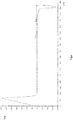
- the determination can be made of solutions of platinum oxalate complexes corresponding to the product solution in a closed glass ampoule at a heating rate of 0.05 K / min between 0 ° C and a temperature above the measured peak minimum (see figure).
- the decomposition temperature according to the invention is understood to be the temperature of the first deviation (see FIG. 57 ° C.) of the measurement curve from the initial base curve (5.2 DIN 51007).
- Tempering means in the present description that the reaction mixture is adjusted to a certain temperature.
- the tempering may e.g. with the help of water.
- an aqueous solution or suspension of platinum oxide hydrate or platinum salt is first prepared.
- the introduction of small amounts of platinum oxalate complexes into the reaction mixture is autocatalytic.
- the addition of platinum oxalate complexes significantly shortens an induction period of the reaction (very slow initial phase of the reaction). This allows a controlled reaction.
- the added platinum oxalate complexes are referred to as autocatalysts.
- a small amount of autocatalyst is added.
- the autocatalyst is in an amount of 1 ⁇ 10 -4 to 5 ⁇ 10 -2 molar equivalents of platinum with respect to added the platinum in the platinum precursor.
- the autocatalyst is added in an amount of 5 ⁇ 10 -4 to 1 ⁇ 10 -2 molar equivalents of platinum with respect to the platinum in the platinum precursor, and most preferably the autocatalyst is added in an amount of 5 ⁇ 10 -4 to 7 ⁇ 10 -3 molar equivalents of platinum added to the platinum in the platinum precursor.
- the autocatalyst is preferably added in aqueous solution. Typical concentrations are 5-20% by weight, for example 8-15% by weight.
- the autocatalyst (corresponding to the meaning of the term "autocatalyst") expediently uses the platinum oxalate complexes corresponding to the product to be prepared. That for the preparation of platinum oxalate, platinum oxalate is used as the autocatalyst.
- the order of delivery of platinum precursor, autocatalyst and oxalic acid and / or oxalic acid salt is of minor importance.
- the autocatalyst may be added to the reaction solution or suspension simultaneously with the total amount of oxalic acid and / or oxalic acid salt, with a portion of oxalic acid and / or oxalic acid salt or prior to the addition of oxalic acid and / or oxalic acid salt.
- either a solution or suspension of platinum precursor be submitted or added later.
- the addition should take place at a temperature below the desired reaction temperature.
- the addition takes place at a temperature of up to 37 ° C, more preferably up to 32 ° C.
- the forming reaction mixture is then heated to the desired reaction temperature. The rate of heating then depends on the onset of the reaction.
- the oxalic acid or the oxalic acid salt may be added in one or more portions.
- the portions can be the same size, but it can also be added several different sized portions. In the event that the portions are not the same size, advantageously a larger portion is added first and then one or more smaller or smaller and smaller. Thus, it has proven to be advantageous first to add a portion of 0.4 to 1.4 molar equivalents based on platinum in the form of the platinum precursor and then, for example, in several equal amounts, the remaining oxalic acid or the remaining oxalic acid salt.
- the solution or suspension is stirred during the reaction.
- the oxalic acid or oxalic acid salt is added depending on the stirring conditions, the concentration of the solution or suspension, and the reactor dimension. Basically, the rate at which oxalic acid or oxalic acid salt can be added is well adjusted by CO 2 evolution and temperature evolution.
- Platinum oxalate complexes prepared in this way can advantageously be used as precursors for platinum catalysts.
- the qualitative analyzes were carried out by NMR and UV spectroscopy.
- the UV spectrum was measured at room temperature using a Specord® 200 UV spectrometer from Analytic Jena AG in 1 cm cuvettes (quartz glass cuvettes QS Suprasil® from Heraeus Quarzglas GmbH) in a measurement range from 190 nm to 1100 nm with a resolution of 2 nm measured.
- the platinum content was determined gravimetrically.
- the starting materials were platinum (IV) hydroxo acid (H 2 [Pt (OH) 6 ]) from our own production (w (Pt): 55.51%), oxalic acid dihydrate for analysis EMSURE® ACS, ISO, Reag. Ph Eur from Merck KGaA, Art. No. 100495 and platinum oxalate from our own production (w (Pt): 11.72%).
- the suspension was heated from room temperature in a water bath within 20 minutes at 40 ° C.
- the mixture was filtered through a 0.2 ⁇ m membrane filter (Sartorius filtration unit). The filtration took place within 30 minutes.
- the suspension was heated from 19 ° C in a water bath at about 1 ° C / 10 min.
- the solution reached a temperature of 40 ° C. It was possible to observe a gas evolution over a period of 50 minutes during which the solution reached a temperature of 45 ° C.
- the heater was turned off, the solution was kept stirring until room temperature was reached.
- the mixture was filtered through a 0.2 ⁇ m membrane filter (Sartorius filtration unit). Filtration took place within 90 minutes.
- Comparative Experiment 1 was repeated, with the difference that the solution was heated from 23 ° C to a temperature of 40 ° C over a period of 210 minutes. After 150 minutes, the solution turned greenish at a temperature of 35 ° C. After 190 minutes, and at a temperature of 37 ° C, the solution began to discolor bluish and after 230 minutes, gas evolution was observed over a period of 65 minutes. There were obtained 80.972 g of product with a Pt content of 12.25 wt .-% in a yield of 99.19% based on platinum.
- the suspension was heated starting from 20 ° C in a water bath within 40 minutes at 40 ° C.
- the mixture was filtered through a 0.2 ⁇ m membrane filter (Sartorius filtration unit). The filtration took place within 30 minutes.
Landscapes
- Chemical & Material Sciences (AREA)
- Organic Chemistry (AREA)
- Engineering & Computer Science (AREA)
- Oil, Petroleum & Natural Gas (AREA)
- Organic Low-Molecular-Weight Compounds And Preparation Thereof (AREA)
- Catalysts (AREA)
- Low-Molecular Organic Synthesis Reactions Using Catalysts (AREA)
- Materials Engineering (AREA)
- Chemical Kinetics & Catalysis (AREA)
Description
- Die vorliegende Erfindung betrifft die Herstellung von Platinoxalat-Komplexen. Platinoxalat-Komplexe werden im Folgenden der Einfachheit halber auch als Platinoxalate bezeichnet. Sie betrifft insbesondere die Herstellung von Platinoxalat-Komplexen aus Platin-Präkursoren und Oxalsäure und/oder Oxalsäuresalzen.
- Die Herstellung von Edelmetalloxalat-Komplexen aus Edelmetall-Präkursoren und Oxalsäure und/oder Oxalsäuresalzen ist seit langem bekannt. Die Herstellung von Platinoxalat-Komplexen erfolgt üblicherweise durch Reaktion von Platinoxid-Hydrat (Platin-(IV)-hydroxosäure, Dihydrogenhexahydroxoplatinat(IV), Hydroxoplatinic acid) mit Oxalsäure bei einer Temperatur von 60°C (K. Krogmann, P. Dodel, Chem. Ber. 1966, 99, 3408-3418).
-
EP 0 254 935 A1 beschreibt ein Verfahren zur Herstellung von Silberoxalat mit großem Partikeldurchmesser. Nach diesem Verfahren werden Silbersalz und Oxalsäure oder Oxalsäuresalze bei einem pH-Wert von nicht mehr als 5 zur Reaktion gebracht. Die Reaktion wird bei einer Temperatur von 0 bis 80°C, bevorzugt bei einer Temperatur von 40 bis 60°C durchgeführt. - Barbara J. Keller ET AL berichten in "Solution equilibria leading to the formation of metal-metal bonds in partially oxidized bisoxalatoplatinate(II) systems", INORGANICA CHIMICAACTA, Bd. 357, (2004), Seiten 853-858 über die Reaktion von [PtII(oxalat)2]2- und geeigneten Oxidationsmitteln unter Bildung des dimeren unverbrückten Platinkomplexes [{PtII(oxalat)2}2]2- sowie die Bildung von Spezies der allgemeinen Formel [{Pt(oxalat)2}n]n-.
- Die Herstellung von Edelmetalloxalat-Komplexen aus Edelmetall-Präkursoren und Oxalsäure und/oder Oxalsäuresalzen ist eine exotherme Reaktion, bei der Wärme und CO2 gebildet werden. Dabei kann die Temperatur über den Zersetzungspunkt der Edelmetalloxalat-Komplexe ansteigen, wodurch gleichzeitig weiteres CO2 freigesetzt wird. In diesem Zusammenhang siehe z.B. Sano, Isamu, Bulletin, 15 (1940), 196 ff. "On the Catalytic Decomposition of Oxalic Acid by Colloidal Platinum", und Szabö, Z.G. und Biro-Sugar, E., Zeitschrift für Elektrochemie Bd. 50, Nr. 8, 1956, S. 869-874, "Kinetik der thermischen Zersetzung von Silberoxalat".
- Aus sicherheitstechnischen Gründen ist bei der Durchführung der Reaktion in großtechnischem Maßstab daher zu berücksichtigen, dass es nicht zur Zersetzung des Produktes aufgrund von Wärmeentwicklung während der Reaktion kommt.
- Aufgabe der vorliegenden Erfindung ist es daher, ein Verfahren zur Herstellung von Platinoxalat-Komplexen bereitzustellen, welches im großtechnischen Maßstab durchgeführt werden kann.
- Somit soll ein Verfahren entwickelt werden, das eine kontrollierte Reaktionsführung ermöglicht. Es ist sicherzustellen, dass die bei der Synthese anfallenden Gas- und Wärmemengen vom Reaktor sicher abgeführt werden können.
- Diese Aufgabe wird durch ein Verfahren mit den Merkmalen des Anspruchs 1 gelöst. Weiterbildungen der Erfindung sind durch die Unteransprüche definiert.
- Erfindungsgemäß wird ein Verfahren zur Herstellung von Platinoxalat-Komplexen bereitgestellt, bei dem Platin-Präkursoren mit Oxalsäure und/oder Oxalsäuresalzen zur Reaktion gebracht werden und bei dem Platinoxalat als Autokatalysator in die Reaktionsmischung eingebracht wird.
- Als Edukte werden erfindungsgemäß Platin-Präkursoren und Oxalsäure und/oder Oxalsäuresalze verwendet. Denkbar sind viele Ausgangsstoffe, wobei sich die Edukte Platin-Präkursor und Oxalsäure und/oder Oxalsäuresalze natürlich vom Endprodukt Platinoxalat unterscheiden.
- Bei dem Platin-Präkursor handelt es sich um Platinoxid-Hydrat, welches auch als Platin-(IV)-hydroxosäure bezeichnet wird (siehe Gmelin, Verlag Chemie GmbH, Berlin 1940, S. 47-48), oder eines ihrer Salze. Als Ausgangsstoff für Platinoxalat wird Platin-(IV)-hydroxosäure oder eines ihrer Salze, wie z.B. K2Pt(OH)6, Na2Pt(OH)6 etc., verwendet. Grundsätzlich ist die freie Säure bevorzugt.
- Oxalsäuresalze können zum Beispiel Natriumoxalat, Ammoniumoxalat oder Kaliumoxalat oder Mischungen aus diesen sein. Es ist aber auch möglich eine Mischung aus Oxalsäure und einem oder mehreren Oxalsäuresalzen einzusetzen. Grundsätzlich ist jedoch der Einsatz der freien Oxalsäure besonders bevorzugt. So wird auch für die Herstellung von Platinoxalat besonders bevorzugt Oxalsäure verwendet.
- Erfindungsgemäß ist eine Edukt-Kombination aus Platinoxid-Hydrat und Oxalsäure besonders bevorzugt, da neben Platinoxalat-Komplexen lediglich Kohlendioxid und Wasser entsteht. Besonders bevorzugt wird Oxalsäure oder Oxalsäuresalz in einem geeigneten stöchiometrischen Verhältnis zugegeben. Im Fall der Herstellung von Platinoxalat-Komplexen bedeutet dies, dass Oxalsäure oder Oxalsäuresalz in 1,8 bis 2,8 molaren Äquivalenten in Bezug auf Platin in Form des Platin-Präkursors zugegeben wird. Bei dieser Reaktion entsteht eine Mischung aus verschiedenen Dioxalatoplatinsäuren oder Platinoxalat-Komplexen. Eine ausführliche Beschreibung solcher Mischungen findet sich in K.Krogmann, P.Dodel, Chem. Ber. 1966, 99, 3402-3407 und 3408-3418.
- In welcher Form Oxalsäure und/oder Oxalsäuresalz zugegeben wird, hängt von dem herzustellenden Platinoxalat-Komplex ab. Bevorzugt wird es in Form einer wässrigen Lösung oder in fester Form zugegeben. Oxalsäure ist bevorzugt und wird bevorzugt in fester Form als Oxalsäuredihydrat eingesetzt.
- Die Reaktion wird bei einer Temperatur durchgeführt, die unterhalb der Zersetzungstemperatur der Platinoxalat-Komplexe liegt. Für die Festlegung der Sicherheitsspanne bei der Reaktionstemperatur im konkreten Fall ist eine Gefährdungsbeurteilung heranzuziehen, die wichtige verfahrenstechnische Parameter, apparatetechnische Parameter, sicherheitstechnische Überlegungen sowie sicherheitstechnische Daten, wie z.B. die Zersetzungstemperatur bzw. den Zersetzungsbereich der Platinoxalat-Komplexe mit einbezieht. In Abhängigkeit von der Datenlage kann die Reaktionstemperatur an die Zersetzungstemperatur angenähert werden.
- Die Reaktion wird somit bevorzugt bei einer Temperatur unterhalb der Zersetzungstemperatur der Platinoxalat-Komplexe durchgeführt. Dabei sollte die Differenz zwischen Reaktionstemperatur und Zersetzungstemperatur mindestens 1°C betragen, bevorzugt ist die Differenz mindestens 5°C. Die Zersetzungstemperatur ist als Temperatur der beginnenden Zersetzung definiert, wobei die beginnende Zersetzung mittels Langzeitdifferenzthermoanalyse in Glasampullen mit einer Heizgeschwindigkeit von 0,05 K/min gemäß Temperatur-Differenz-Thermoanalyse nach DIN 51007 bestimmt wird. Als bevorzugt hat sich für die Reaktion zwischen Platin-Präkursoren und Oxalsäure und/oder Oxalsäuresalzen ein Temperaturbereich zwischen 0°C und 56°C herausgestellt, besonders bevorzugt zwischen 30°C und 52°C und ganz besonders bevorzugt zwischen 35°C und 45°C.
- Insbesondere für Platinoxalat-Komplexe, die sich bereits bei einer Temperatur von 57°C zersetzen (siehe Figur), gilt, dass die Reaktion bevorzugt bei einer Temperatur von bis zu 56°C, besonders bevorzugt bis 52°C, und ganz besonders bevorzugt bis 45°C durchgeführt wird. Die Reaktion wird oberhalb von 0°C, bevorzugt oberhalb von 30°C und ganz besonders bevorzugt bei einer Temperatur von 35°C bis 42°C durchgeführt.
- Die Zersetzungstemperatur der Platinoxalat-Komplexe ist im Sinne der Erfindung mittels Langzeit-Differenzthermoanalyse (DTA) gemäß DIN51007(Jun1994) zu bestimmen. Die Bestimmung kann an Lösungen von Platinoxalat-Komplexen, welche der Produktlösung entsprechen, in einer geschlossenen Glasampulle mit einer Heizgeschwindigkeit von 0,05 K /min zwischen 0°C und einer Temperatur oberhalb des gemessenen Peakminimums erfolgen (siehe Figur). Als Zersetzungstemperatur wird erfindungsgemäß die Temperatur der ersten Abweichung (siehe Figur, 57°C) der Messkurve von der Anfangsbasiskurve verstanden (5.2 DIN 51007).
- Im konkreten Fall wurden 2934,5 mg einer 10 Gew.-%igen Platinoxalatlösung in Wasser verwendet. Die Messung erfolgte in Glasampullen mit einer Heizgeschwindigkeit von 0,05 K/min. Die Figur zeigt den Wärmefluss W/g in Abhängigkeit von der Temperatur zwischen 2°C und 83°C.
- Temperieren bedeutet in vorliegender Beschreibung, dass die Reaktionsmischung auf eine bestimmte Temperatur eingestellt wird. Das Temperieren kann z.B. mit Hilfe von Wasser erfolgen.
- Vorteilhaft wird zunächst eine wässrige Lösung oder Suspension aus Platinoxid-Hydrat oder Platinsalz hergestellt. Im Falle der Herstellung von Platinoxalat-Komplexen wird bevorzugt zunächst eine wässrige Suspension aus Platinoxid-Hydrat (H2[Pt(OH)6] oder Platin-(IV)-hydroxosäure) hergestellt. Bevorzugt wird eine 5 bis 25 Gew.-%ige Suspension, besonders bevorzugt eine 7-15 Gew.-%ige Suspension bezogen auf Platin in Wasser hergestellt.
- Überraschend hat sich gezeigt, dass das Einbringen geringer Mengen von Platinoxalat-Komplexen in die Reaktionsmischung autokatalytisch wirkt. Durch die Zugabe von Platinoxalat-Komplexen wird eine Induktionsperiode der Reaktion (sehr langsame Anfangsphase der Reaktion) signifikant verkürzt. Dadurch wird eine kontrollierte Reaktionsführung ermöglicht. Im Folgenden werden daher die zugefügten Platinoxalat-Komplexe als Autokatalysator bezeichnet. Erfindungsgemäß wird eine geringe Menge Autokatalysator zugegeben. Bevorzugt wird der Autokatalysator in einer Menge von 1×10⁻⁴ bis 5×10⁻² molaren Äquivalenten Platin in Bezug auf das Platin im Platin-Präkursor zugegeben. Besonders bevorzugt wird der Autokatalysator in einer Menge von 5×10⁻⁴ bis 1×10⁻² molaren Äquivalenten Platin in Bezug auf das Platin im Platin-Präkursor zugegeben und ganz besonders bevorzugt wird der Autokatalysator in einer Menge von 5×10⁻⁴ bis 7×10⁻³ molaren Äquivalenten Platin in Bezug auf das Platin im Platin-Präkursor zugegeben. Der Autokatalysator wird bevorzugt in wässriger Lösung zugegeben. Übliche Konzentrationen sind 5-20 Gew.-%, z.B. 8-15 Gew.-%.
- Zweckmäßig werden als Autokatalysator (entsprechend der Bedeutung des Begriffs "Autokatalysator") die dem herzustellenden Produkt entsprechenden Platinoxalat-Komplexe eingesetzt. D.h. zur Herstellung von Platinoxalat wird als Autokatalysator Platinoxalat eingesetzt.
- Die Reihenfolge der Zuführung von Platin-Präkursor, Autokatalysator und Oxalsäure und/oder Oxalsäuresalz ist von untergeordneter Bedeutung. Der Autokatalysator kann gleichzeitig mit der Gesamtmenge an Oxalsäure und/oder Oxalsäuresalz, mit einem Teil von Oxalsäure und/oder Oxalsäuresalz oder vor der Zugabe von Oxalsäure und/oder Oxalsäuresalz zur Reaktionslösung oder -suspension gegeben werden. Dabei kann entweder eine Lösung oder Suspension aus Platin-Präkursor vorgelegt werden oder später zugegeben werden.
- Wird der Platin-Präkursor vorgelegt, und der Autokatalysator gleichzeitig mit Oxalsäure zugegeben, so sollte die Zugabe bei einer Temperatur unterhalb der gewünschten Reaktionstemperatur erfolgen. Bevorzugt erfolgt die Zugabe bei einer Temperatur von bis zu 37°C, besonders bevorzugt bis zu 32°C. Die sich bildende Reaktionsmischung wird anschließend auf die gewünschte Reaktionstemperatur aufgeheizt. Die Geschwindigkeit des Aufheizens richtet sich dann nach dem Einsetzen der Reaktion.
- Es hat sich als jedoch als vorteilhaft erwiesen, zunächst den Platin-Präkursor in Lösung oder Suspension vorzulegen, den Autokatalysator zuzugeben und zumindest den größeren Teil der Oxalsäure oder des Oxalsäuresalzes erst nach Erreichen der Reaktionstemperatur zuzugeben.
- Die Oxalsäure oder das Oxalsäuresalz kann in einer oder mehreren Portionen zugegeben werden. Die Portionen können gleich groß sein, es können jedoch auch mehrere unterschiedlich große Portionen zugegeben werden. In dem Fall, dass die Portionen nicht gleich groß sind, wird vorteilhaft zunächst eine größere Portion zugegeben und anschließend eine oder mehrere kleinere oder immer kleiner werdende. So hat es sich als vorteilhaft erwiesen, zunächst eine Portion von 0,4 bis 1,4 molaren Äquivalenten bezogen auf Platin in Form des Platin-Präkursors zuzugeben und anschließend z.B. in mehreren gleichen Mengen die restliche Oxalsäure oder das restliche Oxalsäuresalz. Das kann beispielsweise in einer einzigen weiteren Zugabe von z.B. 0,4 bis 1,4 molaren Äquivalenten, in 2 weiteren Zugaben von z.B. 0,2 bis 0,9 molaren Äquivalenten, in 3 weiteren Zugaben von z.B. 0,1 bis 0,7 molaren Äquivalenten, in 4 weiteren Zugaben von z.B. 0,1 bis 0,6 molaren Äquivalenten, usw. erfolgen. Denkbar ist jedoch auch eine gleichmäßige, kontinuierliche Zugabe der Oxalsäure oder des Oxalsäuresalzes.
- Vorteilhaft wird die Lösung oder Suspension während der Reaktion gerührt. In der bevorzugten Ausführungsform erfolgt die Zugabe der Oxalsäure oder des Oxalsäuresalzes in Abhängigkeit von den Rührbedingungen, der Konzentration der Lösung oder Suspension und der Reaktordimension. Grundsätzlich lässt sich die Geschwindigkeit, mit der Oxalsäure oder Oxalsäuresalz zugegeben werden kann, gut anhand der CO2-Entwicklung und der Temperaturentwicklung einstellen.
- Auf diese Weise hergestellte Platinoxalat-Komplexe können vorteilhaft als Präkursoren für Platinkatalysatoren eingesetzt werden.
- Die folgenden Beispiele dienen der Erläuterung und sind nicht als Einschränkung zu verstehen.
- Die qualitativen Analysen erfolgten mittels NMR und UV-Spektroskopie.
- Das UV-Spektrum wurde bei Zimmertemperatur unter Verwendung eines UV-Spektrometers Specord® 200 der Firma Analytic Jena AG in 1 cm Küvetten (Quarzglasküvetten QS Suprasil® der Firma Heraeus Quarzglas GmbH) in einem Messbereich von 190 nm -1100 nm mit einer Auflösung von 2 nm gemessen.
- Die Kernresonanzspektroskopischen Messungen wurden an einem Bruker Avance 400 MHz-NMR-Spektrometer (Vergleichsbeispiel 1) und einem Bruker Avance 600 MHz-NMR Spektrometer (Beispiel, Vergleichsbeispiele 2 und 3) vorgenommen.
- Der Platingehalt wurde gravimetrisch bestimmt.
- Als Edukte wurden Platin(IV)-hydroxosäure (H2[Pt(OH)6]) aus eigener Produktion (w(Pt): 55,51 %), Oxalsäure-Dihydrat zur Analyse EMSURE® ACS, ISO, Reag. Ph Eur der Firma Merck KGaA, Art Nr. 100495 und Platinoxalat aus eigener Produktion (w(Pt): 11,72 %) verwendet.
- In einem 250 ml-Dreihals-Rundkolben wurden 10 g Pt (50 mmol) in Form von 18,01 g H2[Pt(OH)6] in 54,29 ml vollentsalztem Wasser (VEW) vorgelegt.
- Anschließend wurden bei Zimmertemperatur (23°C) unter Rühren (250 U/min) mittels eines Magnetrührers 0,04 g Pt-Oxalat (0,24 mmol Pt) als Autokatalysator zugegeben. Es entstand eine blass-grünliche Suspension.
- Die Suspension wurde ausgehend von Zimmertemperatur in einem Wasserbad innerhalb von 20 Minuten auf 40°C aufgeheizt.
- Sobald die Suspension eine Temperatur von 40°C erreicht hatte, wurde eine von fünf gleichen Portionen von je 2,568 g (20 mmol) Oxalsäure-Dihydrat zugegeben. Dabei wurde sofort eine Gasentwicklung beobachtet, die über einen Zeitraum von 60 min andauerte. Es wurden 270 ml CO2 aufgefangen.
- Nach Abschluss der Gasbildung wurde eine weitere Portion von 2,568 g (20 mmol) Oxalsäure-Dihydrat zugegeben. Es konnten 40 ml CO2 aufgefangen werden.
- Nach Abschluss der Gasbildung wurde eine weitere Portion von 2,568 g (20 mmol) Oxalsäure-Dihydrat zugegeben. Nach 10 Min. wechselte die Farbe der Lösung von grün ins Türkis-blaue. Innerhalb von 60 Min wurden 300 ml CO2 aufgefangen.
- Nach Abschluss der Gasbildung wurde eine weitere Portion von 2,568 g (20 mmol) Oxalsäure-Dihydrat zugegeben. Innerhalb von 60 Min wurden 270 ml CO2 aufgefangen.
- Nach Abschluss der Gasbildung wurde eine weitere Portion von 2,568 g (20 mmol) Oxalsäure-Dihydrat zugegeben. Innerhalb von 110 min konnten 300 ml CO2 aufgefangen werden. Während weiterer 10 Minuten Rühren bei 40°C wurde keine Gasentwicklung mehr beobachtet.
- Die Heizung wurde abgeschaltet. Die Lösung wurde weitergerührt, bis Zimmertemperatur erreicht wurde.
- Die Mischung wurde über einen 0,2 µm Membranfilter (Sartorius Filtrationseinheit) filtriert. Die Filtration erfolgte innerhalb von 30 Minuten.
- Es wurden 74,49 g Produkt mit einem Pt-Gehalt von 13,40 Gew.-% in einer Ausbeute von 99,82 % bezogen auf Platin erhalten.
13C-NMR (151 MHz, 299,6 K, DMSO-d6 Kapillare): δ = 168,70; 167,16 ppm UV-VIS: 627 nm (A=0,399); 417 nm (0,415) - In einem 250 ml-Dreihals-Rundkolben wurden 10 g Pt (50 mmol) in Form von 18,01 g H2[Pt(OH)6] in 54,29 ml vollentsalztem Wasser (VEW) vorgelegt. Anschließend wurden unter Rühren (250 U/min) mittels eines Magnetrührers 12,93 g (100 mmol) Oxalsäure-Dihydrat zugegeben. Es entstand eine milchige, gelblich-weiße Suspension.
- Die Suspension wurde ausgehend von 19°C in einem Wasserbad mit etwa 1°C/10 min erwärmt.
- Bei einer Temperatur von 35°C begann sich die Lösung grünlich zu verfärben.
- Bei einer Temperatur von 38°C wurde die Lösung türkis-blau.
- Bei einer Temperatur von 39°C wurde die Lösung tiefblau.
- Die Lösung erreichte eine Temperatur von 40°C. Es konnte eine Gasentwicklung über einen Zeitraum von 50 Min beobachtet werden, in dem die Lösung eine Temperatur von 45°C erreichte.
- Eine Temperatur von 50°C wurde erreicht. Es fand keine Gasentwicklung mehr statt.
- Die Heizung wurde abgeschaltet, die Lösung wurde weitergerührt, bis Zimmertemperatur erreicht wurde.
- Die Mischung wurde über einen 0,2 µm Membranfilter (Sartorius Filtrationseinheit) filtriert. Die Filtration erfolgte innerhalb von 90 Minuten.
- Es wurden 47,82 g Produkt mit einem Pt-Gehalt von 20,75 Gew.-% in einer Ausbeute von 99,23 % bezogen auf Platin erhalten.
13C-NMR (100,6 MHz, 303 K, DMSO-d6 Kapillare): δ = 168,43; 166,72 ppm UV-VIS 664 nm (A=0,731); 417 nm (0,763) - Es wurde Vergleichsversuch 1 wiederholt, mit dem Unterschied, dass die Lösung über einen Zeitraum von 210 Minuten von 23°C auf eine Temperatur von 40°C aufgeheizt wurde. Nach 150 Minuten färbte sich die Lösung bei einer Temperatur von 35°C grünlich. Nach 190 Minuten, und bei einer Temperatur von 37°C begann sich die Lösung bläulich zu verfärben und nach 230 Minuten konnte über einen Zeitraum von 65 Minuten eine Gasentwicklung beobachtet werden. Es wurden 80,972 g Produkt mit einem Pt-Gehalt von 12,25 Gew.-% in einer Ausbeute von 99,19 % bezogen auf Platin erhalten.
13C-NMR (151 MHz, 298 K, DMSO-d6 Kapillare): δ = 168,16; 166,67 ppm UV-VIS 641,05 nm (A=0,342); 417 nm (0,374) - In einem 250 ml-Dreihals-Rundkolben wurden 10 g Pt (50 mmol) in Form von 18,01 g H2[Pt(OH)6] in 54,29 ml vollentsalztem Wasser (VEW) vorgelegt.
- Die Suspension wurde ausgehend von 20°C in einem Wasserbad innerhalb von 40 Minuten auf 40°C aufgeheizt.
- Sobald die Suspension eine Temperatur von 40°C erreicht hatte, wurde eine von fünf gleichen Portionen von je 2,568 g (20 mmol) Oxalsäure-Dihydrat zugegeben. Es wurde weder eine Farbveränderung noch eine Gasentwicklung beobachtet. Nach weiteren 60 Minuten wurde eine weitere Portion von 2,568 g (20 mmol) Oxalsäure-Dihydrat zugegeben. Auch jetzt wurde weder Farbveränderung noch Gasentwicklung beobachtet.
- Eine weitere Portion von 2,568 g (20 mmol) Oxalsäure-Dihydrat wurde zugegeben. 10 Minuten später verfärbte sich die Lösung grünlich. Nach weiteren 30 Min (bei 200 Minuten) wechselte die Farbe der Lösung von grün ins Türkis-blaue.
- Eine weitere Portion von 2,568 g (20 mmol) Oxalsäure-Dihydrat wurde zugegeben. 10 Minuten später konnte eine Gasentwicklung beobachtet werden.
- Es wurde eine weitere Portion von 2,568 g (20 mmol) Oxalsäure-Dihydrat zugegeben. Die Gasentwicklung setzte sich fort bis zum Zeitpunkt 300 Minuten. Danach konnte keine Gasentwicklung mehr beobachtet werden.
- Die Heizung wurde abgeschaltet. Die Lösung wurde weitergerührt, bis Zimmertemperatur erreicht wurde.
- Die Mischung wurde über einen 0,2 µm Membranfilter (Sartorius Filtrationseinheit) filtriert. Die Filtration erfolgte innerhalb von 30 Minuten.
- Es wurden 77,39 g Produkt mit einem Pt-Gehalt von 12,85 Gew.-% in einer Ausbeute von 99,45 % bezogen auf Platin erhalten.
13C-NMR (151 MHz, 299,6 K, DMSO-d6 Kapillare): δ = 168,16; 166,66 ppm UV-VIS 664 nm (A=0,373); 417 nm (0,403)
Claims (10)
- Verfahren zur Herstellung von Platinoxalat-Komplexen, wobei ein Platin-Präkursor mit Oxalsäure und/oder Oxalsäuresalz zur Reaktion gebracht wird,
dadurch gekennzeichnet, dass es sich bei dem Platin-Präkursor um Platinoxid-Hydrat (Platin-(IV)-hydroxosäure) oder eines ihrer Salze handelt und dass dem Produkt entsprechende Platinoxalat-Komplexe als Autokatalysator zugegeben werden. - Verfahren zur Herstellung von Platinoxalat-Komplexen nach Anspruch 1,
dadurch gekennzeichnet,
dass die Reaktion bei einer Temperatur unterhalb der Zersetzungstemperatur der Platinoxalat-Komplexe durchgeführt wird. - Verfahren zur Herstellung von Platinoxalat-Komplexen nach Anspruch 2,
dadurch gekennzeichnet,
dass die Reaktion bei einer maximalen Temperatur von 1°C unterhalb der Zersetzungstemperatur der Platinoxalat-Komplexe durchgeführt wird. - Verfahren zur Herstellung von Platinoxalat-Komplexen nach Anspruch 1,
dadurch gekennzeichnet,
dass die Reaktion bei einer Temperatur zwischen 0 und 56°C durchgeführt wird. - Verfahren nach einem der vorhergehenden Ansprüche,
dadurch gekennzeichnet,
dass im ersten Schritt eine wässrige Lösung oder Suspension aus Platin-Präkursor und der Platinoxalat-Komplexe hergestellt wird,
im zweiten Schritt die wässrige Lösung oder Suspension aus dem ersten Schritt auf Reaktionstemperatur temperiert wird,
und
im dritten Schritt Oxalsäure und/oder Oxalsäuresalz zugegeben wird. - Verfahren nach einem der Ansprüche 1 bis 5,
dadurch gekennzeichnet,
dass der Autokatalysator in einer Menge von 1×10⁻⁴ bis 5×10⁻² molaren Äquivalenten bezogen auf das Platin in der Platin-Präkursorlösung zugegeben wird. - Verfahren nach einem der Ansprüche 1 bis 6,
dadurch gekennzeichnet,
dass Oxalsäure und/oder Oxalsäuresalz aus der Gruppe ausgewählt sind, die aus Oxalsäure, Natriumoxalat, Ammoniumoxalat und Kaliumoxalat und Mischungen aus diesen besteht. - Verfahren nach einem der vorhergehenden Ansprüche,
dadurch gekennzeichnet,
dass die Reaktion bei einer Temperatur von 30°C bis 45°C durchgeführt wird. - Verfahren nach einem der vorhergehenden Ansprüche,
dadurch gekennzeichnet,
dass Oxalsäure in einer Menge von 1,8 bis 2,8 molaren Äquivalenten in Bezug auf Platin im Platin-Präkursor zugegeben wird. - Verfahren nach einem der vorhergehenden Ansprüche,
dadurch gekennzeichnet,
dass1) eine Suspension von Platinoxid-Hydrat (Platin-(IV)-hydroxosäure) in Wasser hergestellt wird,2) eine Lösung von Platinoxalat-Komplexen in Wasser hergestellt wird,3) die Suspension aus 1) und die Lösung aus 2) vereinigt werden und die resultierende Mischung auf die Reaktionstemperatur temperiert wird,4) eine erste Portion von 0,4 bis 1,4 molaren Äquivalenten Oxalsäure bezogen auf Platin in Platinoxid-Hydrat (Platin-(IV)-hydroxosäure) zugegeben wird, und5) eine zweite Portion von 0,1 bis 1,4 molaren Äquivalenten Oxalsäure bezogen auf Platin in Platinoxid-Hydrat (Platin-(IV)-hydroxosäure) zugegeben wird, und6) optional Schritt 5) 1 bis mehrmals wiederholt wird, bis eine Gesamtmenge von 1,8 bis 2,8 molaren Äquivalenten Oxalsäure in Bezug auf Platin in Platinoxid-Hydrat (Platin-(IV)-hydroxosäure) zugegeben worden ist.
Applications Claiming Priority (3)
| Application Number | Priority Date | Filing Date | Title |
|---|---|---|---|
| US201261710226P | 2012-10-05 | 2012-10-05 | |
| DE102012019560 | 2012-10-05 | ||
| PCT/EP2013/069787 WO2014053351A1 (de) | 2012-10-05 | 2013-09-24 | Verfahren zur herstellung von edelmetalloxalat-komplexen |
Publications (2)
| Publication Number | Publication Date |
|---|---|
| EP2903735A1 EP2903735A1 (de) | 2015-08-12 |
| EP2903735B1 true EP2903735B1 (de) | 2016-12-14 |
Family
ID=49303950
Family Applications (1)
| Application Number | Title | Priority Date | Filing Date |
|---|---|---|---|
| EP13773193.1A Active EP2903735B1 (de) | 2012-10-05 | 2013-09-24 | Verfahren zur herstellung von edelmetalloxalat-komplexen |
Country Status (15)
| Country | Link |
|---|---|
| US (1) | US9156767B2 (de) |
| EP (1) | EP2903735B1 (de) |
| JP (1) | JP6180532B2 (de) |
| KR (1) | KR101794425B1 (de) |
| CN (1) | CN104703695B (de) |
| AR (1) | AR092760A1 (de) |
| BR (1) | BR112015007325B1 (de) |
| CA (1) | CA2887017C (de) |
| CL (1) | CL2015000850A1 (de) |
| DE (1) | DE102013207045A1 (de) |
| HK (1) | HK1207028A1 (de) |
| RU (1) | RU2015116613A (de) |
| SG (1) | SG11201502650TA (de) |
| TW (1) | TWI491615B (de) |
| WO (1) | WO2014053351A1 (de) |
Families Citing this family (7)
| Publication number | Priority date | Publication date | Assignee | Title |
|---|---|---|---|---|
| DE112016003411A5 (de) * | 2015-07-28 | 2018-04-26 | Umicore Ag & Co. Kg | Bis(oxalato)Platinsäure "on the rocks" |
| ES2763323T3 (es) * | 2016-04-20 | 2020-05-28 | Heraeus Deutschland Gmbh & Co Kg | Procedimiento para eliminar compuestos gaseosos oxidables de una mezcla de gases por medio de un catalizador de oxidación que contiene platino |
| EP3269681B1 (de) | 2016-07-13 | 2018-12-19 | Heraeus Deutschland GmbH & Co. KG | Verfahren zur katalytischen spontanzersetzung von wasserstoffperoxid |
| KR102227759B1 (ko) * | 2016-12-21 | 2021-03-15 | 내셔날 인스티튜트 오브 어드밴스드 인더스트리얼 사이언스 앤드 테크놀로지 | 시클로메탈화 이리듐 착체의 제조 방법 |
| WO2019150732A1 (ja) * | 2018-02-02 | 2019-08-08 | 松田産業株式会社 | シュウ酸銀 |
| US12544738B2 (en) * | 2021-07-12 | 2026-02-10 | Johnson Matthey Public Limited Company | Anionic PGM carboxylate assisted PGM nanoparticle synthesis for exhaust gas treatment applications |
| CN115010193A (zh) * | 2022-06-23 | 2022-09-06 | 昆明贵金属研究所 | 一种四氮合铂(ii)酸盐的制备方法 |
Family Cites Families (10)
| Publication number | Priority date | Publication date | Assignee | Title |
|---|---|---|---|---|
| US2636892A (en) * | 1948-04-23 | 1953-04-28 | Int Standard Electric Corp | Production of metal oxalates |
| JPH0678271B2 (ja) | 1986-07-12 | 1994-10-05 | 三菱油化株式会社 | シユウ酸銀の製造法 |
| FR2652822B1 (fr) * | 1989-10-11 | 1993-06-11 | Onera (Off Nat Aerospatiale) | Bain a l'hydrazine pour le depot chimique de platine et/ou de palladium, et procede de fabrication d'un tel bain. |
| JPH06279475A (ja) * | 1993-03-26 | 1994-10-04 | Tsumura & Co | 新規な白金錯体 |
| DE10150489B4 (de) * | 2001-10-16 | 2004-02-05 | W. C. Heraeus Gmbh & Co. Kg | Herstellungsverfahren von Platin-Alkenylpolysiloxan-Komplexe, insbesondere Platin-Divinyltetramethyldisiloxan |
| US20030186804A1 (en) * | 2002-03-28 | 2003-10-02 | Sud-Chemie, Inc. | Catalyst for production of hydrogen |
| CA2547275A1 (en) * | 2003-11-25 | 2005-06-09 | Platco Technologies (Proprietary) Limited | Platinum(ii) complexes, preparation and use |
| PL1789427T3 (pl) * | 2004-09-01 | 2009-10-30 | Platco Tech Proprietary Limited | Otrzymywanie kompleksów platyny (II) |
| CN101658800B (zh) * | 2008-08-29 | 2011-11-02 | 上海焦化有限公司 | 用于制备乙酸、乙酸酐或同时制备乙酸和乙酸酐的催化剂体系及其制备方法 |
| JP6078271B2 (ja) * | 2012-09-06 | 2017-02-08 | 株式会社パイオラックスメディカルデバイス | カテーテル |
-
2013
- 2013-04-18 DE DE201310207045 patent/DE102013207045A1/de not_active Withdrawn
- 2013-09-24 SG SG11201502650TA patent/SG11201502650TA/en unknown
- 2013-09-24 CN CN201380052126.7A patent/CN104703695B/zh active Active
- 2013-09-24 US US14/432,224 patent/US9156767B2/en active Active
- 2013-09-24 BR BR112015007325-5A patent/BR112015007325B1/pt not_active IP Right Cessation
- 2013-09-24 EP EP13773193.1A patent/EP2903735B1/de active Active
- 2013-09-24 WO PCT/EP2013/069787 patent/WO2014053351A1/de not_active Ceased
- 2013-09-24 HK HK15107504.7A patent/HK1207028A1/xx unknown
- 2013-09-24 CA CA2887017A patent/CA2887017C/en active Active
- 2013-09-24 RU RU2015116613A patent/RU2015116613A/ru unknown
- 2013-09-24 KR KR1020157011703A patent/KR101794425B1/ko not_active Expired - Fee Related
- 2013-09-24 JP JP2015534959A patent/JP6180532B2/ja not_active Expired - Fee Related
- 2013-10-01 AR ARP130103551A patent/AR092760A1/es active IP Right Grant
- 2013-10-04 TW TW102136092A patent/TWI491615B/zh not_active IP Right Cessation
-
2015
- 2015-04-02 CL CL2015000850A patent/CL2015000850A1/es unknown
Non-Patent Citations (1)
| Title |
|---|
| BARBARA J KELLER ET AL: "Solution equilibria leading to the formation of metal-metal bonds in partially oxidized bisoxalatoplatinate(II) systems", INORGANICA CHIMICA ACTA, vol. 357, no. 3, 1 February 2004 (2004-02-01), NL, pages 853 - 858, XP055265291, ISSN: 0020-1693, DOI: 10.1016/j.ica.2003.09.009 * |
Also Published As
| Publication number | Publication date |
|---|---|
| BR112015007325B1 (pt) | 2019-09-03 |
| KR101794425B1 (ko) | 2017-11-06 |
| CA2887017C (en) | 2017-05-09 |
| CN104703695A (zh) | 2015-06-10 |
| TW201425316A (zh) | 2014-07-01 |
| CA2887017A1 (en) | 2014-04-10 |
| CN104703695B (zh) | 2016-11-09 |
| BR112015007325A2 (pt) | 2017-07-04 |
| KR20150065848A (ko) | 2015-06-15 |
| AR092760A1 (es) | 2015-04-29 |
| HK1207028A1 (en) | 2016-01-22 |
| US9156767B2 (en) | 2015-10-13 |
| SG11201502650TA (en) | 2015-05-28 |
| TWI491615B (zh) | 2015-07-11 |
| WO2014053351A1 (de) | 2014-04-10 |
| US20150232405A1 (en) | 2015-08-20 |
| JP6180532B2 (ja) | 2017-08-23 |
| DE102013207045A1 (de) | 2014-06-12 |
| EP2903735A1 (de) | 2015-08-12 |
| JP2016500664A (ja) | 2016-01-14 |
| RU2015116613A (ru) | 2016-11-20 |
| CL2015000850A1 (es) | 2015-07-10 |
Similar Documents
| Publication | Publication Date | Title |
|---|---|---|
| WO2014053351A1 (de) | Verfahren zur herstellung von edelmetalloxalat-komplexen | |
| DE102007038045B4 (de) | Verfahren zur Herstellung eines Palladium/Kohle-Katalysators | |
| DE2528601B2 (de) | Verfahren zur Herstellung von Wasserstoffperoxid durch Umsetzung von Sauerstoff und Wasserstoff | |
| DE19713376A1 (de) | Hydrierkatalysator für die Herstellung von Wasserstoffperoxid, und Verfahren zu dessen Herstellung | |
| EP2574609B1 (de) | Verfahren zur Herstellung von Furanverbindungen aus nachwachsenden Rohstoffen | |
| DE69200624T2 (de) | Direktsynthese von wasserstoffperoxid durch heterogene katalyse, katalysator fuer diese synthese und verfahren zur herstellung dieser katalysator. | |
| EP0629439B1 (de) | Platin auf Aktivkohle enthaltender sulfidierter Katalysator | |
| DE69312806T2 (de) | Metall auf Trägerkatalysator für die Hydrierung von organischen Verbindungen und Verfahren zur dessen Herstellung | |
| WO2010025921A1 (de) | Verfahren und reaktionssystem zur gewinnung von wasserstoff | |
| DE69202432T2 (de) | Direkte Synthese von Wasserstoffperoxid mittels heterogener Katalyse. | |
| EP1116724B2 (de) | Verfahren zur Herstellung von [IrCODCl]2 | |
| EP0472014A1 (de) | Verfahren zur Herstellung von Katalysatoren | |
| EP3243914B1 (de) | Verfahren zur herstellung von partikulärem ruthenium | |
| DE1965384C3 (de) | Verfahren zur Herstellung von p-Nitropheonlen | |
| EP3755382A1 (de) | Herstellungsverfahren für ein kontrastmittel | |
| DE69015697T2 (de) | Verfahren zur Herstellung von N-Phosphonomethylglyzin. | |
| DE3026686A1 (de) | Verfahren zur herstellung von synthetischem eisenoxidgelb | |
| CN110695368B (zh) | 八杈金纳米粒子、制备方法、应用及其中间体 | |
| EP3601206B1 (de) | Verfahren zur herstellung einer korrosionsschutzkomponente für ein gefrierschutzmittel | |
| EP3009402A1 (de) | Verfahren zur Herstellung von gemischten Metallhalogenid-Alkoxiden und Metalloxid-Nanopartikeln | |
| DE102009053992B4 (de) | Verfahren zur Herstellung kupfer- und chromhaltiger Mischoxide mit großer spezifischer Oberfläche | |
| DE60009699T2 (de) | Diammonium ruthenium diethylentriaminpentaacetat oder hydrate davon und ein verfahren zur herstellung von beidem | |
| EP3081529A1 (de) | Verfahren zur freisetzung von wasserstoff aus dem addukt von ammoniak und boran sowie verwendung von übergangsmetallfreien katalysatoren zur freisetzung von wasserstoff aus dem addukt von ammoniak und boran | |
| EP0723809A1 (de) | Verfahren zur Herstellung eines Hydrierungskatalysators | |
| WO2016005282A1 (de) | Verfahren zur herstellung von hydridocarbonyltris(triphenylphosphin)rhodium(i) |
Legal Events
| Date | Code | Title | Description |
|---|---|---|---|
| PUAI | Public reference made under article 153(3) epc to a published international application that has entered the european phase |
Free format text: ORIGINAL CODE: 0009012 |
|
| 17P | Request for examination filed |
Effective date: 20150401 |
|
| AK | Designated contracting states |
Kind code of ref document: A1 Designated state(s): AL AT BE BG CH CY CZ DE DK EE ES FI FR GB GR HR HU IE IS IT LI LT LU LV MC MK MT NL NO PL PT RO RS SE SI SK SM TR |
|
| AX | Request for extension of the european patent |
Extension state: BA ME |
|
| DAX | Request for extension of the european patent (deleted) | ||
| 17Q | First examination report despatched |
Effective date: 20160425 |
|
| GRAP | Despatch of communication of intention to grant a patent |
Free format text: ORIGINAL CODE: EPIDOSNIGR1 |
|
| INTG | Intention to grant announced |
Effective date: 20160915 |
|
| STAA | Information on the status of an ep patent application or granted ep patent |
Free format text: STATUS: GRANT OF PATENT IS INTENDED |
|
| GRAS | Grant fee paid |
Free format text: ORIGINAL CODE: EPIDOSNIGR3 |
|
| GRAA | (expected) grant |
Free format text: ORIGINAL CODE: 0009210 |
|
| STAA | Information on the status of an ep patent application or granted ep patent |
Free format text: STATUS: THE PATENT HAS BEEN GRANTED |
|
| AK | Designated contracting states |
Kind code of ref document: B1 Designated state(s): AL AT BE BG CH CY CZ DE DK EE ES FI FR GB GR HR HU IE IS IT LI LT LU LV MC MK MT NL NO PL PT RO RS SE SI SK SM TR |
|
| REG | Reference to a national code |
Ref country code: GB Ref legal event code: FG4D Free format text: NOT ENGLISH |
|
| REG | Reference to a national code |
Ref country code: CH Ref legal event code: EP |
|
| REG | Reference to a national code |
Ref country code: IE Ref legal event code: FG4D Free format text: LANGUAGE OF EP DOCUMENT: GERMAN |
|
| REG | Reference to a national code |
Ref country code: AT Ref legal event code: REF Ref document number: 853078 Country of ref document: AT Kind code of ref document: T Effective date: 20170115 |
|
| REG | Reference to a national code |
Ref country code: DE Ref legal event code: R096 Ref document number: 502013005758 Country of ref document: DE |
|
| REG | Reference to a national code |
Ref country code: NL Ref legal event code: FP |
|
| PG25 | Lapsed in a contracting state [announced via postgrant information from national office to epo] |
Ref country code: LV Free format text: LAPSE BECAUSE OF FAILURE TO SUBMIT A TRANSLATION OF THE DESCRIPTION OR TO PAY THE FEE WITHIN THE PRESCRIBED TIME-LIMIT Effective date: 20161214 |
|
| REG | Reference to a national code |
Ref country code: LT Ref legal event code: MG4D |
|
| PG25 | Lapsed in a contracting state [announced via postgrant information from national office to epo] |
Ref country code: NO Free format text: LAPSE BECAUSE OF FAILURE TO SUBMIT A TRANSLATION OF THE DESCRIPTION OR TO PAY THE FEE WITHIN THE PRESCRIBED TIME-LIMIT Effective date: 20170314 Ref country code: GR Free format text: LAPSE BECAUSE OF FAILURE TO SUBMIT A TRANSLATION OF THE DESCRIPTION OR TO PAY THE FEE WITHIN THE PRESCRIBED TIME-LIMIT Effective date: 20170315 Ref country code: SE Free format text: LAPSE BECAUSE OF FAILURE TO SUBMIT A TRANSLATION OF THE DESCRIPTION OR TO PAY THE FEE WITHIN THE PRESCRIBED TIME-LIMIT Effective date: 20161214 Ref country code: LT Free format text: LAPSE BECAUSE OF FAILURE TO SUBMIT A TRANSLATION OF THE DESCRIPTION OR TO PAY THE FEE WITHIN THE PRESCRIBED TIME-LIMIT Effective date: 20161214 |
|
| PG25 | Lapsed in a contracting state [announced via postgrant information from national office to epo] |
Ref country code: HR Free format text: LAPSE BECAUSE OF FAILURE TO SUBMIT A TRANSLATION OF THE DESCRIPTION OR TO PAY THE FEE WITHIN THE PRESCRIBED TIME-LIMIT Effective date: 20161214 Ref country code: RS Free format text: LAPSE BECAUSE OF FAILURE TO SUBMIT A TRANSLATION OF THE DESCRIPTION OR TO PAY THE FEE WITHIN THE PRESCRIBED TIME-LIMIT Effective date: 20161214 Ref country code: FI Free format text: LAPSE BECAUSE OF FAILURE TO SUBMIT A TRANSLATION OF THE DESCRIPTION OR TO PAY THE FEE WITHIN THE PRESCRIBED TIME-LIMIT Effective date: 20161214 |
|
| PG25 | Lapsed in a contracting state [announced via postgrant information from national office to epo] |
Ref country code: RO Free format text: LAPSE BECAUSE OF FAILURE TO SUBMIT A TRANSLATION OF THE DESCRIPTION OR TO PAY THE FEE WITHIN THE PRESCRIBED TIME-LIMIT Effective date: 20161214 Ref country code: IS Free format text: LAPSE BECAUSE OF FAILURE TO SUBMIT A TRANSLATION OF THE DESCRIPTION OR TO PAY THE FEE WITHIN THE PRESCRIBED TIME-LIMIT Effective date: 20170414 Ref country code: CZ Free format text: LAPSE BECAUSE OF FAILURE TO SUBMIT A TRANSLATION OF THE DESCRIPTION OR TO PAY THE FEE WITHIN THE PRESCRIBED TIME-LIMIT Effective date: 20161214 Ref country code: SK Free format text: LAPSE BECAUSE OF FAILURE TO SUBMIT A TRANSLATION OF THE DESCRIPTION OR TO PAY THE FEE WITHIN THE PRESCRIBED TIME-LIMIT Effective date: 20161214 Ref country code: EE Free format text: LAPSE BECAUSE OF FAILURE TO SUBMIT A TRANSLATION OF THE DESCRIPTION OR TO PAY THE FEE WITHIN THE PRESCRIBED TIME-LIMIT Effective date: 20161214 |
|
| PG25 | Lapsed in a contracting state [announced via postgrant information from national office to epo] |
Ref country code: PL Free format text: LAPSE BECAUSE OF FAILURE TO SUBMIT A TRANSLATION OF THE DESCRIPTION OR TO PAY THE FEE WITHIN THE PRESCRIBED TIME-LIMIT Effective date: 20161214 Ref country code: ES Free format text: LAPSE BECAUSE OF FAILURE TO SUBMIT A TRANSLATION OF THE DESCRIPTION OR TO PAY THE FEE WITHIN THE PRESCRIBED TIME-LIMIT Effective date: 20161214 Ref country code: BG Free format text: LAPSE BECAUSE OF FAILURE TO SUBMIT A TRANSLATION OF THE DESCRIPTION OR TO PAY THE FEE WITHIN THE PRESCRIBED TIME-LIMIT Effective date: 20170314 Ref country code: PT Free format text: LAPSE BECAUSE OF FAILURE TO SUBMIT A TRANSLATION OF THE DESCRIPTION OR TO PAY THE FEE WITHIN THE PRESCRIBED TIME-LIMIT Effective date: 20170414 Ref country code: SM Free format text: LAPSE BECAUSE OF FAILURE TO SUBMIT A TRANSLATION OF THE DESCRIPTION OR TO PAY THE FEE WITHIN THE PRESCRIBED TIME-LIMIT Effective date: 20161214 |
|
| REG | Reference to a national code |
Ref country code: DE Ref legal event code: R097 Ref document number: 502013005758 Country of ref document: DE |
|
| REG | Reference to a national code |
Ref country code: FR Ref legal event code: PLFP Year of fee payment: 5 |
|
| PLBE | No opposition filed within time limit |
Free format text: ORIGINAL CODE: 0009261 |
|
| STAA | Information on the status of an ep patent application or granted ep patent |
Free format text: STATUS: NO OPPOSITION FILED WITHIN TIME LIMIT |
|
| 26N | No opposition filed |
Effective date: 20170915 |
|
| PG25 | Lapsed in a contracting state [announced via postgrant information from national office to epo] |
Ref country code: DK Free format text: LAPSE BECAUSE OF FAILURE TO SUBMIT A TRANSLATION OF THE DESCRIPTION OR TO PAY THE FEE WITHIN THE PRESCRIBED TIME-LIMIT Effective date: 20161214 |
|
| PG25 | Lapsed in a contracting state [announced via postgrant information from national office to epo] |
Ref country code: SI Free format text: LAPSE BECAUSE OF FAILURE TO SUBMIT A TRANSLATION OF THE DESCRIPTION OR TO PAY THE FEE WITHIN THE PRESCRIBED TIME-LIMIT Effective date: 20161214 |
|
| PG25 | Lapsed in a contracting state [announced via postgrant information from national office to epo] |
Ref country code: MC Free format text: LAPSE BECAUSE OF FAILURE TO SUBMIT A TRANSLATION OF THE DESCRIPTION OR TO PAY THE FEE WITHIN THE PRESCRIBED TIME-LIMIT Effective date: 20161214 |
|
| REG | Reference to a national code |
Ref country code: IE Ref legal event code: MM4A |
|
| PG25 | Lapsed in a contracting state [announced via postgrant information from national office to epo] |
Ref country code: LU Free format text: LAPSE BECAUSE OF NON-PAYMENT OF DUE FEES Effective date: 20170924 |
|
| PG25 | Lapsed in a contracting state [announced via postgrant information from national office to epo] |
Ref country code: IE Free format text: LAPSE BECAUSE OF NON-PAYMENT OF DUE FEES Effective date: 20170924 |
|
| REG | Reference to a national code |
Ref country code: FR Ref legal event code: PLFP Year of fee payment: 6 |
|
| PG25 | Lapsed in a contracting state [announced via postgrant information from national office to epo] |
Ref country code: MT Free format text: LAPSE BECAUSE OF FAILURE TO SUBMIT A TRANSLATION OF THE DESCRIPTION OR TO PAY THE FEE WITHIN THE PRESCRIBED TIME-LIMIT Effective date: 20161214 |
|
| PG25 | Lapsed in a contracting state [announced via postgrant information from national office to epo] |
Ref country code: HU Free format text: LAPSE BECAUSE OF FAILURE TO SUBMIT A TRANSLATION OF THE DESCRIPTION OR TO PAY THE FEE WITHIN THE PRESCRIBED TIME-LIMIT; INVALID AB INITIO Effective date: 20130924 |
|
| PG25 | Lapsed in a contracting state [announced via postgrant information from national office to epo] |
Ref country code: CY Free format text: LAPSE BECAUSE OF FAILURE TO SUBMIT A TRANSLATION OF THE DESCRIPTION OR TO PAY THE FEE WITHIN THE PRESCRIBED TIME-LIMIT Effective date: 20161214 |
|
| REG | Reference to a national code |
Ref country code: AT Ref legal event code: MM01 Ref document number: 853078 Country of ref document: AT Kind code of ref document: T Effective date: 20180924 |
|
| PG25 | Lapsed in a contracting state [announced via postgrant information from national office to epo] |
Ref country code: MK Free format text: LAPSE BECAUSE OF FAILURE TO SUBMIT A TRANSLATION OF THE DESCRIPTION OR TO PAY THE FEE WITHIN THE PRESCRIBED TIME-LIMIT Effective date: 20161214 |
|
| PG25 | Lapsed in a contracting state [announced via postgrant information from national office to epo] |
Ref country code: AT Free format text: LAPSE BECAUSE OF NON-PAYMENT OF DUE FEES Effective date: 20180924 |
|
| PG25 | Lapsed in a contracting state [announced via postgrant information from national office to epo] |
Ref country code: TR Free format text: LAPSE BECAUSE OF FAILURE TO SUBMIT A TRANSLATION OF THE DESCRIPTION OR TO PAY THE FEE WITHIN THE PRESCRIBED TIME-LIMIT Effective date: 20161214 |
|
| PG25 | Lapsed in a contracting state [announced via postgrant information from national office to epo] |
Ref country code: AL Free format text: LAPSE BECAUSE OF FAILURE TO SUBMIT A TRANSLATION OF THE DESCRIPTION OR TO PAY THE FEE WITHIN THE PRESCRIBED TIME-LIMIT Effective date: 20161214 |
|
| P01 | Opt-out of the competence of the unified patent court (upc) registered |
Effective date: 20230527 |
|
| PGFP | Annual fee paid to national office [announced via postgrant information from national office to epo] |
Ref country code: NL Payment date: 20230920 Year of fee payment: 11 |
|
| PGFP | Annual fee paid to national office [announced via postgrant information from national office to epo] |
Ref country code: CH Payment date: 20231001 Year of fee payment: 11 |
|
| REG | Reference to a national code |
Ref country code: CH Ref legal event code: PL |
|
| REG | Reference to a national code |
Ref country code: NL Ref legal event code: MM Effective date: 20241001 |
|
| PG25 | Lapsed in a contracting state [announced via postgrant information from national office to epo] |
Ref country code: NL Free format text: LAPSE BECAUSE OF NON-PAYMENT OF DUE FEES Effective date: 20241001 |
|
| PG25 | Lapsed in a contracting state [announced via postgrant information from national office to epo] |
Ref country code: CH Free format text: LAPSE BECAUSE OF NON-PAYMENT OF DUE FEES Effective date: 20240930 |
|
| PGFP | Annual fee paid to national office [announced via postgrant information from national office to epo] |
Ref country code: DE Payment date: 20250919 Year of fee payment: 13 |
|
| PGFP | Annual fee paid to national office [announced via postgrant information from national office to epo] |
Ref country code: IT Payment date: 20250923 Year of fee payment: 13 |
|
| PGFP | Annual fee paid to national office [announced via postgrant information from national office to epo] |
Ref country code: BE Payment date: 20250918 Year of fee payment: 13 Ref country code: GB Payment date: 20250918 Year of fee payment: 13 |
|
| PGFP | Annual fee paid to national office [announced via postgrant information from national office to epo] |
Ref country code: FR Payment date: 20250922 Year of fee payment: 13 |