EP2893381B1 - Mutli-layer microprismatic retroreflective sheeting and method of manufacturing the same - Google Patents
Mutli-layer microprismatic retroreflective sheeting and method of manufacturing the same Download PDFInfo
- Publication number
- EP2893381B1 EP2893381B1 EP14719129.0A EP14719129A EP2893381B1 EP 2893381 B1 EP2893381 B1 EP 2893381B1 EP 14719129 A EP14719129 A EP 14719129A EP 2893381 B1 EP2893381 B1 EP 2893381B1
- Authority
- EP
- European Patent Office
- Prior art keywords
- layer
- film
- polymeric material
- acrylic
- prism
- Prior art date
- Legal status (The legal status is an assumption and is not a legal conclusion. Google has not performed a legal analysis and makes no representation as to the accuracy of the status listed.)
- Active
Links
Images

Classifications
-
- G—PHYSICS
- G02—OPTICS
- G02B—OPTICAL ELEMENTS, SYSTEMS OR APPARATUS
- G02B5/00—Optical elements other than lenses
- G02B5/12—Reflex reflectors
- G02B5/122—Reflex reflectors cube corner, trihedral or triple reflector type
- G02B5/124—Reflex reflectors cube corner, trihedral or triple reflector type plural reflecting elements forming part of a unitary plate or sheet
-
- B—PERFORMING OPERATIONS; TRANSPORTING
- B32—LAYERED PRODUCTS
- B32B—LAYERED PRODUCTS, i.e. PRODUCTS BUILT-UP OF STRATA OF FLAT OR NON-FLAT, e.g. CELLULAR OR HONEYCOMB, FORM
- B32B37/00—Methods or apparatus for laminating, e.g. by curing or by ultrasonic bonding
- B32B37/14—Methods or apparatus for laminating, e.g. by curing or by ultrasonic bonding characterised by the properties of the layers
- B32B37/16—Methods or apparatus for laminating, e.g. by curing or by ultrasonic bonding characterised by the properties of the layers with all layers existing as coherent layers before laminating
-
- B—PERFORMING OPERATIONS; TRANSPORTING
- B32—LAYERED PRODUCTS
- B32B—LAYERED PRODUCTS, i.e. PRODUCTS BUILT-UP OF STRATA OF FLAT OR NON-FLAT, e.g. CELLULAR OR HONEYCOMB, FORM
- B32B38/00—Ancillary operations in connection with laminating processes
- B32B38/06—Embossing
-
- G—PHYSICS
- G02—OPTICS
- G02B—OPTICAL ELEMENTS, SYSTEMS OR APPARATUS
- G02B5/00—Optical elements other than lenses
- G02B5/04—Prisms
- G02B5/045—Prism arrays
-
- B—PERFORMING OPERATIONS; TRANSPORTING
- B29—WORKING OF PLASTICS; WORKING OF SUBSTANCES IN A PLASTIC STATE IN GENERAL
- B29C—SHAPING OR JOINING OF PLASTICS; SHAPING OF MATERIAL IN A PLASTIC STATE, NOT OTHERWISE PROVIDED FOR; AFTER-TREATMENT OF THE SHAPED PRODUCTS, e.g. REPAIRING
- B29C48/00—Extrusion moulding, i.e. expressing the moulding material through a die or nozzle which imparts the desired form; Apparatus therefor
- B29C48/001—Combinations of extrusion moulding with other shaping operations
- B29C48/0021—Combinations of extrusion moulding with other shaping operations combined with joining, lining or laminating
-
- B—PERFORMING OPERATIONS; TRANSPORTING
- B29—WORKING OF PLASTICS; WORKING OF SUBSTANCES IN A PLASTIC STATE IN GENERAL
- B29C—SHAPING OR JOINING OF PLASTICS; SHAPING OF MATERIAL IN A PLASTIC STATE, NOT OTHERWISE PROVIDED FOR; AFTER-TREATMENT OF THE SHAPED PRODUCTS, e.g. REPAIRING
- B29C48/00—Extrusion moulding, i.e. expressing the moulding material through a die or nozzle which imparts the desired form; Apparatus therefor
- B29C48/03—Extrusion moulding, i.e. expressing the moulding material through a die or nozzle which imparts the desired form; Apparatus therefor characterised by the shape of the extruded material at extrusion
- B29C48/07—Flat, e.g. panels
- B29C48/08—Flat, e.g. panels flexible, e.g. films
-
- B—PERFORMING OPERATIONS; TRANSPORTING
- B29—WORKING OF PLASTICS; WORKING OF SUBSTANCES IN A PLASTIC STATE IN GENERAL
- B29C—SHAPING OR JOINING OF PLASTICS; SHAPING OF MATERIAL IN A PLASTIC STATE, NOT OTHERWISE PROVIDED FOR; AFTER-TREATMENT OF THE SHAPED PRODUCTS, e.g. REPAIRING
- B29C48/00—Extrusion moulding, i.e. expressing the moulding material through a die or nozzle which imparts the desired form; Apparatus therefor
- B29C48/16—Articles comprising two or more components, e.g. co-extruded layers
- B29C48/18—Articles comprising two or more components, e.g. co-extruded layers the components being layers
- B29C48/21—Articles comprising two or more components, e.g. co-extruded layers the components being layers the layers being joined at their surfaces
-
- B—PERFORMING OPERATIONS; TRANSPORTING
- B32—LAYERED PRODUCTS
- B32B—LAYERED PRODUCTS, i.e. PRODUCTS BUILT-UP OF STRATA OF FLAT OR NON-FLAT, e.g. CELLULAR OR HONEYCOMB, FORM
- B32B37/00—Methods or apparatus for laminating, e.g. by curing or by ultrasonic bonding
- B32B37/14—Methods or apparatus for laminating, e.g. by curing or by ultrasonic bonding characterised by the properties of the layers
- B32B37/24—Methods or apparatus for laminating, e.g. by curing or by ultrasonic bonding characterised by the properties of the layers with at least one layer not being coherent before laminating, e.g. made up from granular material sprinkled onto a substrate
- B32B2037/243—Coating
-
- B—PERFORMING OPERATIONS; TRANSPORTING
- B32—LAYERED PRODUCTS
- B32B—LAYERED PRODUCTS, i.e. PRODUCTS BUILT-UP OF STRATA OF FLAT OR NON-FLAT, e.g. CELLULAR OR HONEYCOMB, FORM
- B32B2307/00—Properties of the layers or laminate
- B32B2307/40—Properties of the layers or laminate having particular optical properties
- B32B2307/416—Reflective
-
- B—PERFORMING OPERATIONS; TRANSPORTING
- B32—LAYERED PRODUCTS
- B32B—LAYERED PRODUCTS, i.e. PRODUCTS BUILT-UP OF STRATA OF FLAT OR NON-FLAT, e.g. CELLULAR OR HONEYCOMB, FORM
- B32B2307/00—Properties of the layers or laminate
- B32B2307/50—Properties of the layers or laminate having particular mechanical properties
- B32B2307/54—Yield strength; Tensile strength
-
- B—PERFORMING OPERATIONS; TRANSPORTING
- B32—LAYERED PRODUCTS
- B32B—LAYERED PRODUCTS, i.e. PRODUCTS BUILT-UP OF STRATA OF FLAT OR NON-FLAT, e.g. CELLULAR OR HONEYCOMB, FORM
- B32B2307/00—Properties of the layers or laminate
- B32B2307/50—Properties of the layers or laminate having particular mechanical properties
- B32B2307/558—Impact strength, toughness
-
- B—PERFORMING OPERATIONS; TRANSPORTING
- B32—LAYERED PRODUCTS
- B32B—LAYERED PRODUCTS, i.e. PRODUCTS BUILT-UP OF STRATA OF FLAT OR NON-FLAT, e.g. CELLULAR OR HONEYCOMB, FORM
- B32B37/00—Methods or apparatus for laminating, e.g. by curing or by ultrasonic bonding
- B32B37/0046—Methods or apparatus for laminating, e.g. by curing or by ultrasonic bonding characterised by constructional aspects of the apparatus
-
- B—PERFORMING OPERATIONS; TRANSPORTING
- B32—LAYERED PRODUCTS
- B32B—LAYERED PRODUCTS, i.e. PRODUCTS BUILT-UP OF STRATA OF FLAT OR NON-FLAT, e.g. CELLULAR OR HONEYCOMB, FORM
- B32B37/00—Methods or apparatus for laminating, e.g. by curing or by ultrasonic bonding
- B32B37/10—Methods or apparatus for laminating, e.g. by curing or by ultrasonic bonding characterised by the pressing technique, e.g. using action of vacuum or fluid pressure
- B32B37/1027—Pressing using at least one press band
-
- B—PERFORMING OPERATIONS; TRANSPORTING
- B32—LAYERED PRODUCTS
- B32B—LAYERED PRODUCTS, i.e. PRODUCTS BUILT-UP OF STRATA OF FLAT OR NON-FLAT, e.g. CELLULAR OR HONEYCOMB, FORM
- B32B37/00—Methods or apparatus for laminating, e.g. by curing or by ultrasonic bonding
- B32B37/14—Methods or apparatus for laminating, e.g. by curing or by ultrasonic bonding characterised by the properties of the layers
- B32B37/16—Methods or apparatus for laminating, e.g. by curing or by ultrasonic bonding characterised by the properties of the layers with all layers existing as coherent layers before laminating
- B32B37/20—Methods or apparatus for laminating, e.g. by curing or by ultrasonic bonding characterised by the properties of the layers with all layers existing as coherent layers before laminating involving the assembly of continuous webs only
- B32B37/203—One or more of the layers being plastic
-
- Y—GENERAL TAGGING OF NEW TECHNOLOGICAL DEVELOPMENTS; GENERAL TAGGING OF CROSS-SECTIONAL TECHNOLOGIES SPANNING OVER SEVERAL SECTIONS OF THE IPC; TECHNICAL SUBJECTS COVERED BY FORMER USPC CROSS-REFERENCE ART COLLECTIONS [XRACs] AND DIGESTS
- Y10—TECHNICAL SUBJECTS COVERED BY FORMER USPC
- Y10T—TECHNICAL SUBJECTS COVERED BY FORMER US CLASSIFICATION
- Y10T156/00—Adhesive bonding and miscellaneous chemical manufacture
- Y10T156/10—Methods of surface bonding and/or assembly therefor
Definitions
- the disclosure is directed to a retroreflective film and a method of manufacturing such film.
- microprismatic retroreflective film generally consists of a plastic film containing many microscopic cube corner retroreflective elements (also known as either microprismatic retroreflective elements or microprisms). These retroreflective elements have three mutually substantially perpendicular lateral faces, which intersect at a single point, or apex. These cube corner retroreflective elements operate to return impinging light towards its source. Light enters each cube corner retroreflective element and is then reflected from each of the three lateral faces to return towards its source.
- Such microprisms are generally shaped like a tetrahedron, but also exist in truncated versions, known in the art as full-cube microprisms.
- Reflection from the three lateral faces occurs either through specular reflection or total internal reflection.
- specular reflection the cube corner retroreflective elements are coated with a reflective material, such as either aluminum or silver, as is the case with metalized microprismatic retroreflective film.
- total internal reflection the cube corner retroreflective elements have not been coated with a reflective material, but instead are governed by Snell's Law where any light impinging on one of the lateral faces passes through the face unless it strikes the face at an angle less than its critical angle, in which case the light is reflected.
- Encapsulated microprismatic reflective film is one such retroreflective film construction where the microprisms operate through the principles of total internal reflection.
- microprisms function through total internal reflection or specular reflection
- the tolerances on the microprisms must be tightly controlled to ensure that the lateral faces are substantially perpendicular to each other. Even minor deviations in the dihedral angles between the lateral faces from 90° can cause a substantial change in the retroreflective properties.
- Both encapsulated microprismatic reflective films and metalized microprismatic reflective films are commonly supplied with an adhesive backing to allow for application on sign faces or other substrates.
- Microprismatic retroreflective film 10 is made from a light-transmissive polymeric material and consists of a smooth outer-surface 11 and microprismatic retroreflective cube corner elements 12. Light impinging on the outer-surface 11 passes through the film to be reflected by the lateral faces 13 of the microprisms 12 and returned towards the source of the light as depicted by arrow 14.
- FIG. 1 depicts the retroreflective film as a single layer of polymeric material
- most microprismatic reflective sheeting materials available on the market today consist of two or more layers of polymeric materials.
- FIG. 2 shows the cross-section of a microprismatic retroreflective film 20 with two different polymeric layers.
- the first polymeric layer is known as the prism layer 25, which is a light-transmissive polymeric layer containing the microprisms 12.
- the second polymeric layer is the body layer 28.
- the outer surface 21 is part of the body layer 28, and the body layer 28 also functions as the outer surface layer of the retroreflective film construction.
- the prism layer 25 is made from a single layer of polymeric material, it can further be categorized into two different sections.
- the portion of the prism layer 25 above the base of the microprisms can be defined as the land section 26 of the prism layer 25.
- the portion of the prism layer 25 consisting of the microprims 12 can be defined as the prism section 27 of the of the prism layer 25. As such, the height of the microprisms 12 equals the thickness of prism section 27.
- each layer performs a different function to balance end-use performance and application properties against manufacturing considerations and raw material costs.
- a body layer may provide ultraviolet (UV)-light screening functions to enhance the overall durability and weatherability of the microprismatic sheeting.
- UV-light screening layers may protect underlying polymeric layers, any pigments or colorants, or any printed graphics or other printed images that may be printed on a lower layer.
- Pavelka, et al., U.S. Patent No. 5,387,458 outlines the use of protective UV-light screening layers to protect fluorescent colorants in a lower layer.
- a two-layer construction is commonly used where the body layer is made from a flexible polymeric material and the prism layer is made from a rigid polymeric material.
- Such microprismatic constructions are discussed in Smith, et al., U.S. Patent No. 5,450,235 .
- the prism layer is preferable for the prism layer to be made from a rigid polymeric material, such as acrylic, polyester, or polycarbonate. This ensures that the precise dimensions of the microprisms can be maintained to maximize levels of retroreflection. If the microprisms were formed from a soft or flexible polymer, such as flexible polyurethane or plasticized polyvinyl chloride, the shape of the microprisms could be easily distorted and the levels of retroreflection could be greatly diminished.
- a rigid polymeric material such as acrylic, polyester, or polycarbonate.
- acrylic such as polymethyl methacrylate acrylic.
- it has lower processing temperatures (compared with other rigid polymers such as polycarbonate or polyester) and the microprisms can therefore be more easily formed into the prism layer.
- acrylic is less hydroscopic in nature and therefore less prone to generating moisture bubbles or similar defects during the molding or forming of the microprisms into the prism layer.
- acrylic is generally a weatherable and durable polymeric material. Further, it appears to metalize more easily compared with other polymeric materials to provide a brighter metallic finish when used in metalized microprismatic retroreflective sheeting materials.
- acrylic polymeric materials such as polymethyl methacrylate
- acrylic polymers are naturally weatherable.
- the use of acrylic materials as the outer surface layer of the reflective film can prolong outdoor life of the film since acrylic polymers generally do not yellow, chalk, or haze over time as rapidly as do other polymeric materials.
- Such materials can further provide a UV-light screening functionality by blending UV-light absorbing additives (such benzophenone or benzotriazole additives) into this outer surface acrylic layer.
- UV-light absorbing additives such benzophenone or benzotriazole additives
- acrylic is often more cost effective.
- Acrylics can be relatively brittle compared to other polymeric materials. This can be true even when the acrylic polymers are impact-modified acrylic polymers. Microprismatic sheeting made from only acrylic polymers can easily crack upon impact or can easily snap or break when flexed. In some instances, the relatively brittle nature of acrylic polymers may create problems during application of the reflective sheeting. For example, if a strip of adhesive-backed reflective film is misaligned during application, microprismatic reflective film made from only acrylic polymers may crack or tear when being repositioned to correct the misalignment.
- the relatively brittle nature of many acrylic materials can be further characterized by the Notched Izod impact strength of the polymers as measured by ASTM D256 at 23°C.
- a typical polymethyl methacrylate acrylic polymer has a Notched Izod impact strength of about 15 - 20 J/m.
- many impact-modified polymethyl methacrylate acrylic polymers still have a Notched Izod impact strength only up to about 60 to 70 J/m.
- the retroreflective microprismatic body of the Avery Dennison V-5720 Conspicuity Tape product is believed to be made from only acrylic polymers.
- the adhesive supplied with the product contains a thin polyester supporting film in the middle of the adhesive.
- the retroreflective microprismatic body of this product is still prone to cracking and breaking, and such adhesive systems incorporating a supporting film can be more expensive to manufacture.
- WO 03/093007 A1 discloses articles which have fluorescent properties and which are suitable for use in making retroreflective articles such as safety and informational signage.
- the articles have at least two film layers, each film layer including a colorant dye.
- the multiple film layer sheeting exhibits excellent resistance to weathering and overall color durability while also providing chromaticity properties dictated by industry standards for a particular coloration.
- a method of preparing the articles is provided.
- the articles embody retroreflective properties and are fluorescent yellow signs.
- a multi-layer microprismatic retroreflective film and method of manufacture is presented in accordance with the independent claims attached hereto. Optional features are provided in accordance with the dependent claims.
- the present disclosure provides a novel microprismatic reflective film structure to allow acrylic polymers to be used in both the prism layer and outer surface layer (or upper body layer) while still addressing the brittleness issues associated with all acrylic microprismatic retroreflective films.
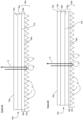
- FIG. 3A One embodiment not according to the invention is shown in FIG. 3A . It consists of prism layer 25a made from acrylic polymers; strengthening layer 33a made from a polymer other than acrylic to improve the strength and impact resistance of the retroreflective sheeting; and an upper body layer 34a also comprising acrylic polymers. Additionally, FIG. 3A contains a buffer section 35a.
- FIG. 3B An embodiment according to the invention is shown in FIG. 3B . It contains prism layer 25b, strengthening layer 33b, and upper body layer 34b. However, the embodiment also contains lower body layer 36b, which is also made from acrylic. In this embodiment, the buffer section 35b encompasses both the land section 26b and the lower body layer 36b.
- the buffer section 35 is defined as the section extending from the base of the microprisms (as depicted as dashed line 29 in the FIGs.) to the lower interface 31 between the lower acrylic layers and the strengthening layer 33.
- the strengthening layer 33 acts to improve the overall mechanical properties to make the resulting retroreflective film structure significantly stronger and less brittle.
- Preferred polymeric materials for strengthening layer 33 are polycarbonate and copolyester materials that have mechanical properties (such as tensile strength, impact strength, flexural strength, flexural modulus, tear strength, or tear resistance properties) greater than acrylic.
- the polymeric material of the strengthening layer has a Notched Izod impact strength of 100 J/m greater than that of the acrylic polymeric material of the prism layer.
- the strengthening layer has an Izod notched impact strength of 400 J/m greater than that of the acrylic prism layer.
- the strengthening layer has a tensile strength of 2,000 psi greater than that of the acrylic polymers in the prism layer. Preferably, greater than 3,500 psi compared with the prism layer. Tensile strength of films can be measured according to ASTM D638. In other embodiments, the strengthening layer has both a Notched Izod impact strength of 400 J/m greater than that of the acrylic polymeric material of the prism layer and a tensile strength of 2,000 psi greater than the acrylic of the prism layer.
- Such multi-layer constructions have historically created manufacturing challenges.
- the resulting mixture may appear hazy or cloudy even if the polymers are individually highly clear and transparent.
- Such an internal haze can be especially problematic in retroreflective film because the haze can cause light impinging on the retroreflective microprisms to be scattered in an undesirable pattern and thereby decrease the retroreflectivity.
- the act of molding or forming the microprisms into the prism layer can cause other layers to mix together, especially at the interface between different layers.
- the strengthening layer should also have thermal properties significantly higher than the acrylic materials of the buffer section. This is a critical feature of the invention to prevent undesirable mixing between the different layers of polymeric materials with different refractive indices. If the strengthening layer has higher thermal properties compared to the surrounding acrylic, the probability of any undesirable polymeric mixing between the layers is reduced as the strengthening layer will not soften or melt or flow to the same degree as the surrounding polymeric materials, and therefore, any potential mixing between the layers can be minimized.
- the polymeric material of the strengthening layer has a Vicat softening point at least 20°F greater than the acrylic of the buffer section adjacent to the strengthening layer of the construction. More preferably, the Vicat softening point differential is at least 50°F or more.
- the Vicat softening point can be determined by the ASTM D1525 test method using a load of 50N and a heating rate of 50°C per hour.
- Polymeric materials for the strengthening layer include polycarbonates and copolyesters.
- Polycarbonate is an advantageous polymeric material due to its high level of impact resistance, high tensile strength, and high Vicat softening point.
- the construction must also contain an acrylic buffer section 35 having an acceptable thickness.
- Buffering section 25 functions as a buffering layer between the prism section 27 of the prism layer 25 and the strengthening layer 33 to prevent any undesirable mixing of acrylic polymers with the different polymers of the strengthening layer 33.
- the microprisms are first molded into the prism layer and then one or more additional layers are laminated onto the prism layer at a later stage of the manufacturing process while the prism layer polymer is still in a heated and softened and flowable form.
- the thickness of the buffer section is at least 75% of the height of the microprisms. In still other embodiments, the thickness of the buffer section is greater than the height of the microprisms. As the microprisms increase in size, more acrylic polymer must melt and flow in order to form the microprisms.
- the thickness of the buffer section must be increased to off-set the increase of acrylic material that must be softened to flow and to form the microprisms. Without being bound by any particular theory, it is believed that that a thicker buffer section allows the acrylic in the land section and/or the lower body layer to spread out and flow parallel to the interface with the strengthening layer without substantially mixing with it. However, if the buffer section is too thin, the acrylic becomes mixed with the strengthening layer because there is nowhere else for the acrylic to flow during lamination of the strengthening layer onto the prism layer.
- the thickness of the buffer section can be minimized by providing a portion of the buffer section as a lower body layer as opposed to having the buffer section consist entirely of the land section of the prism layer.
- the benefit of separately incorporating a lower body layer is that it can be laminated to the prism layer at the same time as the strengthening layer. Since the heat of the prism layer will first soften and melt the lower body layer, the possibility of interlayer polymeric mixing between the buffer section and the strengthening layer can be further reduced.
- the prism layer and the lower body layer do not consist of exactly the same acrylic polymers.
- the prism layer and the lower body layer can be made from two different impact-modified polymethyl methacrylate acrylics where the levels of impact modifiers are different within each acrylic.
- the acrylic upper body layer 34 functions as a weatherable outer surface layer to allow the retroreflective film to be used in outdoor environments.
- the acrylic upper body layer also contains UV-light absorbing and/or UV-light stabilizing additives or other additives to further enhance the durability of the retroreflective film.
- the acrylic of the upper body layer can be blended with other polymers (such as polyvinylidene fluoride or other fluoropolymers) to enhance certain performance properties, Of course, as discussed above, care must be taken to ensure that any such blending does not result in an internal haze or cloudiness.
- FIG. 3C shows still another embodiment of this disclosure containing prism layer 25c, lower body layer 36c, strengthening layer 33c, and upper body layer 34c.
- the buffer section 35c includes both land section 26c and the lower body layer 36c.
- this construction also provides for an optional cover layer 37c added above the upper body layer 34c.
- This optional cover layer 37c may provide additional performance features to the reflective sheeting construction, such as scratch resistance or dew resistance or graffiti protection.
- the cover layer 37c may consist of an additional layer of acrylic polymer to further enhance the durability of the retroreflective sheeting.
- Observation angularity is defined as the level of retroreflectivity that occurs when a slight off-set angle exists between the light impinging on face of the reflective film and the eye of the viewer of the retroreflective film. For example, the eye of the driver of an automobile is slightly off-set from the headlights of the automobile.
- Test Method ASTM E-810-10 provides a detailed technical definition of observation angle.
- observation angularity is particularly useful for metalized microprismatic reflective film, which often have lower levels of retroreflection at larger observation angles such as 0.33° or 0.5° when compared with encapsulated microprismatic films.
- metalized microprismatic reflective film which often have lower levels of retroreflection at larger observation angles such as 0.33° or 0.5° when compared with encapsulated microprismatic films.
- the refraction of light as it passes through the multiple polymeric layers with different refractive indexes creates a slight divergence effect as the light is retroreflected (back) towards the source, which thereby enhances the observation angularity.
- the observation angularity of a microprismatic retroreflective sheeting can be tailored for specific applications by varying the refractive index and/or the thickness of the strengthening layer
- novel retroreflective films of the present disclosure can be manufactured by any suitable manufacturing process where the microprisms are initially formed into the acrylic prism layer, and then, during a subsequent step in the manufacturing process, the additional layers and optional cover layer are laminated or otherwise bonded to the acrylic prism layer.
- Such useful manufacturing processes include embossing of preformed films into a molding tool (such as processes disclosed Buoni, et al., U.S. Patent No. 6,375,776 B1 ), casting a fluid material into a molding tool (such as processes disclosed in Rowland, U.S. Patent No. 3,689,346 ), extrusion embossing (such as the process defined in Mimura, et al., U.S. Patent No.
- Useful molding tools for manufacturing the retroreflective sheeting include discrete molding panels or continuous belts. Such tools may be formed by following a replication process in which an optical master containing the microprisms is repeatedly replicated and then the replicated copies are assembled together to form a larger tool or molding belt.
- the microprisms on the optical master may be formed by direct precision machining, such as through a diamond turning or diamond ruling process.
- Replicated copies may be made through electroforming processes, such a electrolytic nickel deposition, and then assembled together through laser welding or other known assembly techniques.
- An example of such a replication and precision assembly process is outlined in Pricone, et al., U.S. Patent 4,478,769 ).
- the different laminating layers are previously coextruded into a single composite film consisting of the different polymeric materials before being provided for bonding to the acrylic prism layer.
- the benefit of coextruding these layers is to lower manufacturing costs and to simplify the overall manufacturing process by reducing the total number of films required to be handled.
- coextrusion it is important to ensure that the different polymeric materials do not mix together to create the internal haze referenced above. As known in the industry, this can be accomplished by using a highly polished die block on the coextrusion line while maintaining separation and good temperature control between the different polymer layers until the lamination point near the exit of the coextrusion die.
- FIGs. 3A, 3B , or 3C After manufacturing the multi-layer retroreflective film as depicted in FIGs. 3A, 3B , or 3C , additional processing steps can be taken to manufacture an encapsulated microprismatic retroreflective film or a metalized microprismatic retroreflective film, as shown in FIGs. 4 and 5 .
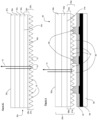
- FIG. 4 depicts an encapsulated microprismatic retroreflective film 60 of the present disclosure incorporating the multi-layer retroreflective film 30a of FIG. 3A .
- Retroreflective film 30a is bonded to backing film 61 through a series of interconnecting bridges 62.
- the microprismatic retroreflective elements 12 are then encapsulated in air cells 63.
- Adhesive layer 64 is provided on the underside of backing film 61 with release liner 65, which can be removed from the adhesive 64 prior to application.
- the microprisms of encapsulated microprismatic retroreflective film 60 operate through the principles of total internal reflection.
- FIG. 5 depicts a metalized microprismatic retroreflective film 70 of the present disclosure incorporating the multi-layer retroreflective film 30c.
- the cube corner retroreflective elements 12 of retroreflective film 30c have been coated with a reflective coating 71.
- Adhesive layer 72 is the provided on the underside of reflective coating 71 with release liner 73, which can be removed from the adhesive 72 prior to application.
- the microprisms function through the principles of specular reflection.
- the reflective coating 71 is commonly applied through vacuum metallization or similar processes and is typically a metallic coating of either aluminum, silver, or nickel.
- any of the layers can be dyed, pigmented, or otherwise colored. Additionally, one or more of the layers can be printed with graphics, symbols, words or other designs. Further, any polymer additives, such as UV-light absorbers, UV-light stabilizers, anti-oxidants, plasticizers, impact-modifiers, flame retardants, antifungal agents, or other additives, can be incorporated into any of the polymer layers.
- microprisms were forward-tilted microprisms as defined in Hoopman, U.S. Patent No. 4,588,258 , with a prism height of approximately 67 microns and a tilt angle of approximately 6.2°.
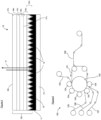
- a 50 micron thick impact-modified acrylic film 103 which was made from Optix CA-1000 resin (commercially available from Plaskolite West, Inc., of Compton, California, USA), was fed onto molding belt 101 and the microprisms were then continuously molded into acrylic film 103 through heat and pressure to form the acrylic prism layer with a resulting land section of approximately 28 microns.
- the pressure was provided by a series of nip pressure rollers 104.
- a first laminating film layer 105 and a second laminating film 106 were subsequently provided and laminated to the acrylic prism layer using additional nip pressure rollers 104 while the acrylic prism layer film 103 was still engaged with the molding belt 101.
- both laminating film layers may have been a coextruded film consisting of multiple polymer layers.
- a temporary polyester carrier film 107 was laminated onto the outer surface of the film structure. The temporary polyester carrier film 107 functioned as a polishing film to ensure a high-gloss surface was formed on the outer surface of the retroreflective film structure. After cooling the resulting multi-layer retroreflective film structure to substantially below the glass transition temperature of the acrylic polymer used in the acrylic prism layer, retroreflective film 108 was removed from the rotating molding belt 101.
- a reflective coating was then applied to the acrylic prism layer of retroreflective film 108.
- the reflective coating consisted of greater than 99.9% purity aluminum and was applied through a vacuum-metalization process. After metallization, a pressure-sensitive adhesive and release liner were applied to the reverse-side of the resulting metalized retroreflective film and temporary polyester carrier 107 was removed from the face of the sheeting.
- a first laminating film was prepared through a coextrusion process and consisted of three different polymeric layers.
- the total thickness of the first laminating film was approximately 150 microns.
- the lower layer of the first laminating film was approximately 37 microns thick and accounted for approximately 25% of the total thickness.
- the lower layer was made from Acrypet MF-001 polymethyl methacrylate acrylic resin (commercially available from Mitsubishi Rayon Co., Ltd., of Tokyo, Japan) and contained 19.5% by weight of an acrylic-rubber impact-modifier additive (EM-600 commercially available from LG Chem, Ltd., of South Korea). This lower layer of the first laminating film became the lower body layer.
- the middle layer of the first laminating film was approximately 75 microns thick and accounted for approximately 50% of the total thickness.
- the middle layer was made from Panlite ® L-1250Y polycarbonate resin (commercially available from Teijin Kasei America, Inc. of Norcross, Georgia). This middle layer of the first laminating film became the strengthening layer.
- the upper layer of the first laminating film was also approximately 37 microns thick and likewise accounted for approximately 25% of the total thickness.
- the upper layer was made using the same acrylic formula as the lower layer of the first laminating film and became the upper body layer of the resulting retroreflective film structure.
- the Vicat softening point of the Panlite ® L-1250Y polycarbonate is 300°F
- 192°F is the Vicat softening point for the Acrypet MF-001.
- a second laminating film was extruded at 75 microns thickness and was made from Acrypet MF-001 polymethyl methacrylate acrylic resin (commercially available from Mitsubishi Rayon Co., Ltd., of Tokyo, Japan) and contained 18% by weight of an acrylic-rubber impact-modifier additive (EM-600 commercially available from LG Chem, Ltd., of South Korea), 2.0% Tinuvin ® 234, 3.0% Tinuvin ® 326, and 3.0% Tinuvin ® 900.
- Each of the Tinuvin ® additives are UV-light absorbing and UV-light stabilizing additives commercially available from BASF Corporation of Wyandotte, Michigan. This second laminating film became a cover layer in the resulting retroreflective sheeting structure.
- the resulting metalized retroreflective sheeting possessed the structure of the sheeting depicted in FIG. 5 .
- the buffer section of this construction was approximately 65 microns, which is about 97% of the height of the microprisms.
- the mechanical properties and thermal properties of the polymers of the prism layer, lower body layer, and strengthening layer are listed in Table 1.
- the Vicat softening point of CA-1000 is estimated at 208°F for a 50N based upon available data where the Vicat softening point has been measured at 227°F using a 10N load.
- Comparative Example 1B represents a conventional construction containing only acrylic polymers. Comparative Example 1B was prepared in an identical fashion to Example 1A except that the first laminating film consisted of a single-layer extruded film of DR-101 impact-modified acrylic resin (commercially available from Arkema, Inc., of Philadelphia, Pennsylvania.) The thickness of this first laminating film was 100 microns.
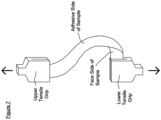
- Example 1A Upon bending Comparative Example 1B backwards upon itself, the structure easily snapped in half. However, due to the presence of the polycarbonate strengthening layer, Example 1A, as covered by this disclosure, did not snap or break when folded backwards upon itself. As seen in Table 1, the mechanical properties of the polycarbonate in the strengthening layer are significantly higher those properties of the acrylic used in the prism layer.
- Example 1A A comparison of the levels of retroreflection between Example 1A and Comparative Example 1B is provided in Table 2. As shown in the table, the levels of retroreflection are similar indicating minimal internal mixing between the different polymer layers in Example 1A. Table 2 Comparison of Coefficient of Retroreflection (cd/lx/m 2 ) Observation Angle Entrance Angle Example 1A Conventional Construction Example 1B % of Conventional Construction Example 1B 0.2° -4° 619 653 94.7% 0.2° 30° 466 477 97.7%
- Example 2 is another metalized microprismatic retroreflective film and is identical to Example 1A except that the middle layer of the coextruded first laminating film was made from Eastar Copolyester AN014, which is believed to be a polycyclohexylenedimethylene terephthalate copolyester alloy polymer known as PCTA, commercially available from Eastman Chemical of Kingsport, Tennessee. As with Example 1A, the thickness of this strengthening layer was approximately 75 microns.
- the retroreflectivity properties of Example 2 are shown in Table 3. Table 3 Comparison of Coefficient of Retroreflection (cd/lx/m 2 ) Observation Angle Entrance Angle Example 2 % of Conventional Construction Example 1B 0.2° -4° 512 78.4% 0.2° 30° 323 67.7%
- the use of PCTA as the strengthening layer results in lower levels of retroreflection compared with the use of polycarbonate in Example 1A.
- the Vicat softening temperature of AN014 PCTA copolyester alloy is estimated at 172°F, which is lower than the Vicat softening point of the adjacent acrylic in the lower body layer as well as that of the prism layer acrylic.
- the Vicat softening point of 172°F for a 50N load test method was estimated based upon available data for AN014 PCTA where the Vicat softening point was measured at 186°F for a 10N load.
- the refractive index of the lower body layer acrylic is 1.49 while the refractive index of the PCTA is 1.54.
- a cloudiness or haze can form within the film, which could then result in the decrease in retroreflectivity levels.
- Example 1A With the use of polycarbonate as the strengthening layer in Example 1A, it is believed that due to the higher thermal properties, as indicated by the Vicat softening point of 300°F, the polycarbonate did not soften and flow to the same degree as the PCTA during the manufacturing process. Therefore, the polycarbonate is more resistant to mixing with the surrounding acrylic layers and, despite the different refractive index of 1.585 for the polycarbonate, higher levels of retroreflection were maintained.
- Example 3 a metalized microprismatic retroreflective film was constructed using the same layers and polymer materials as Example 1A. However, the thickness of the three layers was varied. The lower body layer and the upper body layer were both approximately 30 microns, and the strengthening layer of polycarbonate was approximately 90 microns. Thus, the buffer section was approximately 58 microns (approximately 86% of the microprism height). The sample was difficult to break upon bending the sample back upon itself. Table 4 shows that similar levels of retroreflection were obtained and indicates how different thicknesses can be used for the each of the layers. Table 4 Comparison of Coefficient of Retroreflection (cd/lx/m 2 ) Observation Angle Entrance Angle Example 3 % of Conventional Construction Example 1B 0.2° -4° 650 99.5% 0.2° 30° 482 101.0%
- Example 4A and Comparative Example 4B demonstrate that retroreflectivity levels decrease when the acrylic buffer section is relatively thin. Both Example 4A and 4B are metalized microprismatic retroreflective constructions.
- Example 4A was prepared with a first laminating film consisting of a two-layer coextruded film with a total thickness of approximately 160microns.
- the lower-layer of the coextruded film was approximately 80 microns thick and was made from Panlite ® L-1250Z polycarbonate resin (commercially available from Teijin Kasei America, Inc. of Norcross, Georgia). This lower-layer of the coextruded film became the strengthening layer.
- the upper-layer of the coextruded film was approximately 80 microns thick and was made from Acrylite 7N acrylic resin (commercially available from Evonik Cyro, LLC, of Parsippany, New Jersey) and contained 15% by weight of an acrylic-rubber impact-modifier additive (EM-600 commercially available from LG Chem, Ltd., of South Korea).
- This upper-layer became the upper body layer in the metalized retroreflective film construction.
- Example 4A did not incorporate a lower body layer, and therefore, the land section of the prism layer alone functioned as the buffer section. As mentioned above, the land section has a thickness of approximately 28 microns, which represents approximately 42% of the height of the microprisms.
- the second laminating film was a 75 micron UV-screening acrylic film commercially available from Aura Optical Systems, L.P. of Fort Worth, Texas with the product code of AURA ® 9127 film, which became a cover layer in the final retroreflective film construction.
- Comparative Example 4B is a conventional construction consisting only of acrylic polymers. It was prepared with a first laminating film consisting of a single-layer extruded film of DR-101 impact-modified acrylic resin with a thickness of 150 microns. The second laminating film was the same 75 micron UV-screening acrylic film as Example 4A.
- Example 5 Comparison of Coefficient of Retroreflection (cd/lx/m 2 ) Observation Angle Entrance Angle Example 4A Comparative Example 4B (Conventional Construction) % of Comparative Example 4B 0.2° -4° 213 1063 19.9% 0.2° 30° 147 800 18.3%
- Example 5A and Comparative Example 5B demonstrate the improvement in observation angularity with the present disclosure. Both Example 5A and Comparative Example 5B are metalized microprismatic retroreflective sheetings.
- Example 5A as covered by an embodiment of this disclosure, was prepared with the same first laminating film of Example 1A.
- the second laminating film was a 75 micron UV-screening acrylic film commercially available from Aura Optical Systems, L.P. with product code of AURA ® 9127 and became the cover layer in the final retroreflective film construction.
- the resulting metalized retroreflective structure was the same as that shown in FIG. 5 .
- Comparative Example 5B is a conventional construction consisting only of acrylic polymers. It was prepared with a first laminating film consisting of a single-layer extruded film of DR-101 impact-modified acrylic resin with a thickness of 125 microns. The second laminating film was the same 75 micron UV-light screening acrylic film as Example 5A.
- Table 6 shows the resulting improvement in observation angularity as a result of the incorporation of the polycarbonate strengthening layer.
- Table 6 Comparison of Coefficient of Retroreflection (cd/lx/m 2 ) Observation Angle Entrance Angle Example 5A Comparative Example 5B (Conventional Construction) % of Comparative Example 5B (Conventional Construction) 0.33° -4° 410 303 135.3% 0.5° -4° 167 125 133.6%
- Values in Table 7 are an average of three samples.
- Values in Table 8 are averages of three samples.
- Example 6 demonstrates how the improvements to the mechanical properties can be achieved through the use of different polycarbonate materials or through the use of various other polymers as the strengthening layer.
- the first laminating film was a 2-layer coextruded film of acrylic and another polymer as outlined in Table 9.
- the thickness of the first laminating film of each sample was approximately 150 microns with the thickness of the acrylic portion of the first laminating film at approximately 75 microns.
- the acrylic layer of the first laminating film became the lower body layer and was positioned against the acrylic microprism layer in order to increase the total thickness of the buffer section beyond that only provided by the land section of the acrylic prism layer.
- each sample had a buffer section thickness of approximately 103 microns, equating to a thickness of approximately 154% of the height of the microprisms.
- the second laminating film for each sample of Example 6 was the same AURA ® 9127 UV-screening film of Example 5A. Table 10 lists the thermal and mechanical properties of each of the polymers of each layer. As with other samples, a reflective aluminum coating was applied to each sample through a vacuum-metalization process and a pressure-sensitive adhesive layer and release liner was provided.
- Table 11 shows the resulting improvements to tensile strength and tear strength as measured by the test methods of Example 5.
- Table 11 also provides the coefficient of retroreflection at a -4° entrance angle and 0.2° observation angle. It is believed that the strong reflectivity was maintained because the Vicat softening point of the strengthening layer was sufficiently higher than that of the acrylic in the lower body layer, which is the portion of the buffer layer in contact with the strengthening layer.
- Acrypet MF-001 polymethyl methacrylate acrylic resin is commercially available from Mitsubishi Rayon Co., Ltd., of Tokyo, Japan.
- EM-600 acrylic-rubber impact-modifier additive is commercially available from LG Chem, Ltd., of South Korea.
- Makrolon ET3113 polycarbonate resin is commercially available from Bayer Corporation of Pittsburgh, Pennsylvania, USA.
- Lexan 101 polycarbonate resin is commercially available from SABIC Innovative Plastics of Pittsfield, Massachusetts, USA.
- Panlite ® L-1250WP polycarbonate resin is commercially available from Teijin Kasei America, Inc. of Norcross, Georgia, USA.
- Tritan FX200 glycol-modified polycyclohexylenedimethylene terephthalate (PCTG) co-polyester resin is commercially available from Eastman Chemical of Kingsport, Tennessee, USA.
- Optix CA-1000 impact-modified polymethyl methacrylate acrylic resin is commercially available from Plaskolite West, Inc., of Compton, California, USA.
- the U-polymer U-8400H resin blend of polyethylene terephthalate polyester and polyarylate is commercially available from Unitika, Ltd., of Uji City, Japan.
- the Vicat softening point of CA-1000 is estimated at 208°F for a 50N test methodology based upon available data where the Vicat softening point has been measured at 227°F using a 10N load.
- the Notched Izod impact strength of ET3113 is estimated at 640J/m based upon available data where the Notched Izod impact strength was measured at 80kJ/m2 using the alternative ISO 180 test method.
- the Notched Izod impact strength of Lexan 101 is estimated at 560J/m based upon available data where the Notched Izod impact strength was measured at 70kJ/m2 using the alternative ISO 180 test method.
- the Vicat softening point of U-8400H is estimated at 282°F for a 50N test methodology based upon available data where the Vicat softening point has been measured at 300°F using a 10N load.
- Table 11 Mechanical Properties and Coefficient of Retroreflection of Example 6 Sample ID Force Required to Break Force Required to Tear Coefficient of Retroreflection (cd/lx/m2) 6-A 16.7 Lbf 5.75 Lbf 872 6-B 16.5 Lbf 3.28 Lbf 892 6-C 16.7 Lbf 4.44 Lbf 1118 6-D 13.4 Lbf 1.66 Lbf 871 6-E 15.5 Lbf 2.36 Lbf 640
- Example 7 shows how a range of different thicknesses can be used for the buffer section and strengthening layer while still maintaining improved mechanical properties and strong levels of retroreflection.
- each sample in Example 7 was prepared as outlined in Example 6.
- the first laminating film for each sample consisted of a 2-layer extruded film containing an acrylic layer made from Optix CA-1000 impact-modified polymethyl methacrylate acrylic resin, which became a portion of the buffer section as the lower body layer, and a polycarbonate layer to ultimately function as the strengthening layer made from Panlite L-1250WP.
- the thickness of the different layers was varied as shown in Table 12, which resulted in a range of thicknesses for the buffer section of each sample.
Landscapes
- Physics & Mathematics (AREA)
- General Physics & Mathematics (AREA)
- Optics & Photonics (AREA)
- Optical Elements Other Than Lenses (AREA)
- Laminated Bodies (AREA)
- Extrusion Moulding Of Plastics Or The Like (AREA)
- Shaping Of Tube Ends By Bending Or Straightening (AREA)
- Fluid Mechanics (AREA)
Applications Claiming Priority (3)
| Application Number | Priority Date | Filing Date | Title |
|---|---|---|---|
| US201361777608P | 2013-03-12 | 2013-03-12 | |
| US14/200,373 US9746591B2 (en) | 2013-03-12 | 2014-03-07 | Multi-layer microprismatic retroreflective sheeting and method of manufacturing the same |
| PCT/US2014/022619 WO2014164502A1 (en) | 2013-03-12 | 2014-03-10 | Mutli-layer microprismatic retroreflective sheeting and method of manufacturing the same |
Publications (2)
| Publication Number | Publication Date |
|---|---|
| EP2893381A1 EP2893381A1 (en) | 2015-07-15 |
| EP2893381B1 true EP2893381B1 (en) | 2023-06-14 |
Family
ID=51526028
Family Applications (1)
| Application Number | Title | Priority Date | Filing Date |
|---|---|---|---|
| EP14719129.0A Active EP2893381B1 (en) | 2013-03-12 | 2014-03-10 | Mutli-layer microprismatic retroreflective sheeting and method of manufacturing the same |
Country Status (6)
| Country | Link |
|---|---|
| US (1) | US9746591B2 (enExample) |
| EP (1) | EP2893381B1 (enExample) |
| JP (1) | JP6568049B2 (enExample) |
| KR (1) | KR20150127026A (enExample) |
| CN (1) | CN104823081B (enExample) |
| WO (1) | WO2014164502A1 (enExample) |
Families Citing this family (9)
| Publication number | Priority date | Publication date | Assignee | Title |
|---|---|---|---|---|
| JP6890012B2 (ja) * | 2013-08-19 | 2021-06-18 | スリーエム イノベイティブ プロパティズ カンパニー | 実質的に非晶質のポリマー層を有する再帰反射性シート材 |
| JP6809824B2 (ja) * | 2016-07-04 | 2021-01-06 | 日東電工株式会社 | 光学積層体の製造方法、および光学積層体中間体 |
| CN107187013A (zh) * | 2017-07-18 | 2017-09-22 | 江西盛汇光学科技协同创新有限公司 | 一种多功能压型复合机组及制作微棱镜薄膜的方法 |
| US11001979B2 (en) | 2018-08-13 | 2021-05-11 | Vergence Automation, Inc. | Methods and apparatus for ultrawide entrance angle reflective articles for use with autonomous vehicle machine vision systems |
| US11762133B1 (en) | 2018-09-13 | 2023-09-19 | Vergence Automation, Inc. | Retroreflective materials and articles incorporating near-ideal total internal retroreflective elements |
| EP3871880A4 (en) * | 2018-10-26 | 2021-11-24 | Mitsubishi Gas Chemical Company, Inc. | THERMOPLASTIC RESIN LAMINATE |
| WO2020163340A2 (en) * | 2019-02-08 | 2020-08-13 | Avery Dennison Corporation | Flexible retroreflective sheeting |
| EP4010743B1 (en) * | 2019-08-05 | 2026-02-18 | Avery Dennison Corporation | Retroreflective films comprising fluorescent dyes |
| CN114213992A (zh) * | 2021-11-29 | 2022-03-22 | 安徽创研新材料有限公司 | 一种热熔胶反光膜及其制备工艺 |
Family Cites Families (21)
| Publication number | Priority date | Publication date | Assignee | Title |
|---|---|---|---|---|
| US3689346A (en) | 1970-09-29 | 1972-09-05 | Rowland Dev Corp | Method for producing retroreflective material |
| US4478769A (en) | 1982-09-30 | 1984-10-23 | Amerace Corporation | Method for forming an embossing tool with an optically precise pattern |
| US4588258A (en) | 1983-09-12 | 1986-05-13 | Minnesota Mining And Manufacturing Company | Cube-corner retroreflective articles having wide angularity in multiple viewing planes |
| ZA918849B (en) * | 1990-12-06 | 1992-08-26 | Minnesota Mining & Mfg | Articles exhibiting durable fluorescence |
| US5450235A (en) | 1993-10-20 | 1995-09-12 | Minnesota Mining And Manufacturing Company | Flexible cube-corner retroreflective sheeting |
| JP3113621B2 (ja) | 1997-04-07 | 2000-12-04 | 三洋電機株式会社 | 加熱調理器 |
| JP2000000930A (ja) * | 1998-06-16 | 2000-01-07 | Idemitsu Petrochem Co Ltd | 積層リフレクターおよびその製造方法 |
| JP4577928B2 (ja) | 1999-10-06 | 2010-11-10 | スリーエム イノベイティブ プロパティズ カンパニー | 接着剤組成物及びそれを用いた再帰性反射部材 |
| US6375776B1 (en) | 2000-01-24 | 2002-04-23 | Avery Dennison Corporation | Method for forming multi-layer laminates with microstructures |
| US6514594B1 (en) | 2000-11-09 | 2003-02-04 | Avery Dennison Corporation | Fluorescent polymeric articles having screening layer formed from U.V. light absorbing polymer |
| US7618709B2 (en) | 2002-04-30 | 2009-11-17 | Avery Dennison Corporation | Fluorescent articles having multiple film layers |
| JP4610331B2 (ja) * | 2002-04-30 | 2011-01-12 | アベリー・デニソン・コーポレーション | 多重フィルム層を有する蛍光物品 |
| JP2003342539A (ja) * | 2002-05-28 | 2003-12-03 | Diatex Co Ltd | 再帰反射粘着シート |
| JP4287159B2 (ja) * | 2003-01-20 | 2009-07-01 | 大日本印刷株式会社 | 真偽判定体 |
| US8226880B2 (en) | 2003-07-07 | 2012-07-24 | 10X Technology, Llc | Process for fabricating precise microstructures |
| CN101421645B (zh) * | 2006-04-18 | 2011-06-15 | 3M创新有限公司 | 包含含氮成分的微结构化制品 |
| JP5544686B2 (ja) * | 2008-03-28 | 2014-07-09 | 住友化学株式会社 | 射出成形同時貼合用多層フィルム |
| WO2010021133A1 (ja) * | 2008-08-20 | 2010-02-25 | 日本カーバイド工業株式会社 | 光学シート製造装置、及び、光学シートの製造方法 |
| JP2010181709A (ja) * | 2009-02-06 | 2010-08-19 | Gunze Ltd | 光拡散フィルムとその製造方法 |
| US8322868B2 (en) * | 2009-05-12 | 2012-12-04 | Avery Dennison Corporation | Durable fluorescent articles having multiple film layers |
| JP2012048229A (ja) * | 2010-07-30 | 2012-03-08 | Nippon Carbide Ind Co Inc | 再帰反射シート及びそれを用いた車両用ナンバープレート |
-
2014
- 2014-03-07 US US14/200,373 patent/US9746591B2/en active Active
- 2014-03-10 KR KR1020157009869A patent/KR20150127026A/ko not_active Withdrawn
- 2014-03-10 WO PCT/US2014/022619 patent/WO2014164502A1/en not_active Ceased
- 2014-03-10 JP JP2016501016A patent/JP6568049B2/ja active Active
- 2014-03-10 CN CN201480002878.7A patent/CN104823081B/zh active Active
- 2014-03-10 EP EP14719129.0A patent/EP2893381B1/en active Active
Also Published As
| Publication number | Publication date |
|---|---|
| KR20150127026A (ko) | 2015-11-16 |
| WO2014164502A1 (en) | 2014-10-09 |
| JP6568049B2 (ja) | 2019-08-28 |
| JP2016512618A (ja) | 2016-04-28 |
| US20140268337A1 (en) | 2014-09-18 |
| EP2893381A1 (en) | 2015-07-15 |
| US9746591B2 (en) | 2017-08-29 |
| CN104823081A (zh) | 2015-08-05 |
| CN104823081B (zh) | 2018-10-02 |
Similar Documents
| Publication | Publication Date | Title |
|---|---|---|
| US9746591B2 (en) | Multi-layer microprismatic retroreflective sheeting and method of manufacturing the same | |
| KR101251675B1 (ko) | 광학체 및 광학체 제조 방법 | |
| EP2002292B1 (en) | Conformable retroreflective film structure | |
| US7991257B1 (en) | Method of manufacturing an optical composite | |
| KR100380677B1 (ko) | 재귀성반사시트및재귀성반사성능을갖는물품 | |
| KR950004149B1 (ko) | 역 반사 시이트용의 투명한 다층 커버 필름 | |
| EP2046576B1 (en) | Retroreflective article comprising a copolyester ether composition layer and method of making same | |
| TW200907428A (en) | Optical article and method of making | |
| KR20020033091A (ko) | 투명광학물품 | |
| EP2620280B1 (en) | Fluorescent articles having multiple film layers | |
| KR102499366B1 (ko) | 재귀 반사 인몰드 사출물 | |
| KR101647389B1 (ko) | 2층 구조의 공압출 재귀반사필름 및 이의 제조방법 | |
| KR101515277B1 (ko) | 재귀반사필름 및 이의 제조방법 | |
| JP2960846B2 (ja) | 熱線遮蔽材 | |
| US20250172729A1 (en) | Optical sheet and optical component | |
| JP4639876B2 (ja) | 耐候性に優れたポリカーボネート樹脂積層体及びその製造方法 | |
| KR101647392B1 (ko) | 2층 구조의 공압출 재귀반사필름 및 이의 제조방법 | |
| KR101647385B1 (ko) | 2층 구조의 공압출 재귀반사필름 및 이의 제조방법 | |
| JP2023147945A (ja) | 光学シートおよび光学部品 | |
| JP2023147946A (ja) | 光学シートおよび光学部品 | |
| KR20240178813A (ko) | 자동차 투명 외장재용 복층 플라스틱 시트 및 그 제조방법 | |
| JP2005208083A (ja) | 再帰反射材 |
Legal Events
| Date | Code | Title | Description |
|---|---|---|---|
| PUAI | Public reference made under article 153(3) epc to a published international application that has entered the european phase |
Free format text: ORIGINAL CODE: 0009012 |
|
| 17P | Request for examination filed |
Effective date: 20150407 |
|
| AK | Designated contracting states |
Kind code of ref document: A1 Designated state(s): AL AT BE BG CH CY CZ DE DK EE ES FI FR GB GR HR HU IE IS IT LI LT LU LV MC MK MT NL NO PL PT RO RS SE SI SK SM TR |
|
| AX | Request for extension of the european patent |
Extension state: BA ME |
|
| 17Q | First examination report despatched |
Effective date: 20151020 |
|
| DAX | Request for extension of the european patent (deleted) | ||
| STAA | Information on the status of an ep patent application or granted ep patent |
Free format text: STATUS: EXAMINATION IS IN PROGRESS |
|
| GRAP | Despatch of communication of intention to grant a patent |
Free format text: ORIGINAL CODE: EPIDOSNIGR1 |
|
| STAA | Information on the status of an ep patent application or granted ep patent |
Free format text: STATUS: GRANT OF PATENT IS INTENDED |
|
| RIC1 | Information provided on ipc code assigned before grant |
Ipc: B32B 38/06 20060101ALI20221207BHEP Ipc: G02B 5/124 20060101ALI20221207BHEP Ipc: G02B 5/04 20060101AFI20221207BHEP |
|
| INTG | Intention to grant announced |
Effective date: 20230104 |
|
| GRAS | Grant fee paid |
Free format text: ORIGINAL CODE: EPIDOSNIGR3 |
|
| GRAA | (expected) grant |
Free format text: ORIGINAL CODE: 0009210 |
|
| STAA | Information on the status of an ep patent application or granted ep patent |
Free format text: STATUS: THE PATENT HAS BEEN GRANTED |
|
| AK | Designated contracting states |
Kind code of ref document: B1 Designated state(s): AL AT BE BG CH CY CZ DE DK EE ES FI FR GB GR HR HU IE IS IT LI LT LU LV MC MK MT NL NO PL PT RO RS SE SI SK SM TR |
|
| REG | Reference to a national code |
Ref country code: CH Ref legal event code: EP |
|
| P01 | Opt-out of the competence of the unified patent court (upc) registered |
Effective date: 20230512 |
|
| REG | Reference to a national code |
Ref country code: DE Ref legal event code: R096 Ref document number: 602014087363 Country of ref document: DE |
|
| REG | Reference to a national code |
Ref country code: AT Ref legal event code: REF Ref document number: 1579638 Country of ref document: AT Kind code of ref document: T Effective date: 20230715 |
|
| REG | Reference to a national code |
Ref country code: NL Ref legal event code: FP |
|
| REG | Reference to a national code |
Ref country code: LT Ref legal event code: MG9D |
|
| PG25 | Lapsed in a contracting state [announced via postgrant information from national office to epo] |
Ref country code: SE Free format text: LAPSE BECAUSE OF FAILURE TO SUBMIT A TRANSLATION OF THE DESCRIPTION OR TO PAY THE FEE WITHIN THE PRESCRIBED TIME-LIMIT Effective date: 20230614 Ref country code: NO Free format text: LAPSE BECAUSE OF FAILURE TO SUBMIT A TRANSLATION OF THE DESCRIPTION OR TO PAY THE FEE WITHIN THE PRESCRIBED TIME-LIMIT Effective date: 20230914 Ref country code: ES Free format text: LAPSE BECAUSE OF FAILURE TO SUBMIT A TRANSLATION OF THE DESCRIPTION OR TO PAY THE FEE WITHIN THE PRESCRIBED TIME-LIMIT Effective date: 20230614 |
|
| REG | Reference to a national code |
Ref country code: AT Ref legal event code: MK05 Ref document number: 1579638 Country of ref document: AT Kind code of ref document: T Effective date: 20230614 |
|
| PG25 | Lapsed in a contracting state [announced via postgrant information from national office to epo] |
Ref country code: RS Free format text: LAPSE BECAUSE OF FAILURE TO SUBMIT A TRANSLATION OF THE DESCRIPTION OR TO PAY THE FEE WITHIN THE PRESCRIBED TIME-LIMIT Effective date: 20230614 Ref country code: LV Free format text: LAPSE BECAUSE OF FAILURE TO SUBMIT A TRANSLATION OF THE DESCRIPTION OR TO PAY THE FEE WITHIN THE PRESCRIBED TIME-LIMIT Effective date: 20230614 Ref country code: LT Free format text: LAPSE BECAUSE OF FAILURE TO SUBMIT A TRANSLATION OF THE DESCRIPTION OR TO PAY THE FEE WITHIN THE PRESCRIBED TIME-LIMIT Effective date: 20230614 Ref country code: HR Free format text: LAPSE BECAUSE OF FAILURE TO SUBMIT A TRANSLATION OF THE DESCRIPTION OR TO PAY THE FEE WITHIN THE PRESCRIBED TIME-LIMIT Effective date: 20230614 Ref country code: GR Free format text: LAPSE BECAUSE OF FAILURE TO SUBMIT A TRANSLATION OF THE DESCRIPTION OR TO PAY THE FEE WITHIN THE PRESCRIBED TIME-LIMIT Effective date: 20230915 |
|
| PG25 | Lapsed in a contracting state [announced via postgrant information from national office to epo] |
Ref country code: FI Free format text: LAPSE BECAUSE OF FAILURE TO SUBMIT A TRANSLATION OF THE DESCRIPTION OR TO PAY THE FEE WITHIN THE PRESCRIBED TIME-LIMIT Effective date: 20230614 |
|
| PG25 | Lapsed in a contracting state [announced via postgrant information from national office to epo] |
Ref country code: SK Free format text: LAPSE BECAUSE OF FAILURE TO SUBMIT A TRANSLATION OF THE DESCRIPTION OR TO PAY THE FEE WITHIN THE PRESCRIBED TIME-LIMIT Effective date: 20230614 |
|
| PG25 | Lapsed in a contracting state [announced via postgrant information from national office to epo] |
Ref country code: IS Free format text: LAPSE BECAUSE OF FAILURE TO SUBMIT A TRANSLATION OF THE DESCRIPTION OR TO PAY THE FEE WITHIN THE PRESCRIBED TIME-LIMIT Effective date: 20231014 |
|
| PG25 | Lapsed in a contracting state [announced via postgrant information from national office to epo] |
Ref country code: SM Free format text: LAPSE BECAUSE OF FAILURE TO SUBMIT A TRANSLATION OF THE DESCRIPTION OR TO PAY THE FEE WITHIN THE PRESCRIBED TIME-LIMIT Effective date: 20230614 Ref country code: SK Free format text: LAPSE BECAUSE OF FAILURE TO SUBMIT A TRANSLATION OF THE DESCRIPTION OR TO PAY THE FEE WITHIN THE PRESCRIBED TIME-LIMIT Effective date: 20230614 Ref country code: RO Free format text: LAPSE BECAUSE OF FAILURE TO SUBMIT A TRANSLATION OF THE DESCRIPTION OR TO PAY THE FEE WITHIN THE PRESCRIBED TIME-LIMIT Effective date: 20230614 Ref country code: PT Free format text: LAPSE BECAUSE OF FAILURE TO SUBMIT A TRANSLATION OF THE DESCRIPTION OR TO PAY THE FEE WITHIN THE PRESCRIBED TIME-LIMIT Effective date: 20231016 Ref country code: IS Free format text: LAPSE BECAUSE OF FAILURE TO SUBMIT A TRANSLATION OF THE DESCRIPTION OR TO PAY THE FEE WITHIN THE PRESCRIBED TIME-LIMIT Effective date: 20231014 Ref country code: EE Free format text: LAPSE BECAUSE OF FAILURE TO SUBMIT A TRANSLATION OF THE DESCRIPTION OR TO PAY THE FEE WITHIN THE PRESCRIBED TIME-LIMIT Effective date: 20230614 Ref country code: CZ Free format text: LAPSE BECAUSE OF FAILURE TO SUBMIT A TRANSLATION OF THE DESCRIPTION OR TO PAY THE FEE WITHIN THE PRESCRIBED TIME-LIMIT Effective date: 20230614 Ref country code: AT Free format text: LAPSE BECAUSE OF FAILURE TO SUBMIT A TRANSLATION OF THE DESCRIPTION OR TO PAY THE FEE WITHIN THE PRESCRIBED TIME-LIMIT Effective date: 20230614 |
|
| PG25 | Lapsed in a contracting state [announced via postgrant information from national office to epo] |
Ref country code: PL Free format text: LAPSE BECAUSE OF FAILURE TO SUBMIT A TRANSLATION OF THE DESCRIPTION OR TO PAY THE FEE WITHIN THE PRESCRIBED TIME-LIMIT Effective date: 20230614 |
|
| REG | Reference to a national code |
Ref country code: DE Ref legal event code: R097 Ref document number: 602014087363 Country of ref document: DE |
|
| PLBE | No opposition filed within time limit |
Free format text: ORIGINAL CODE: 0009261 |
|
| STAA | Information on the status of an ep patent application or granted ep patent |
Free format text: STATUS: NO OPPOSITION FILED WITHIN TIME LIMIT |
|
| PG25 | Lapsed in a contracting state [announced via postgrant information from national office to epo] |
Ref country code: DK Free format text: LAPSE BECAUSE OF FAILURE TO SUBMIT A TRANSLATION OF THE DESCRIPTION OR TO PAY THE FEE WITHIN THE PRESCRIBED TIME-LIMIT Effective date: 20230614 |
|
| PG25 | Lapsed in a contracting state [announced via postgrant information from national office to epo] |
Ref country code: SI Free format text: LAPSE BECAUSE OF FAILURE TO SUBMIT A TRANSLATION OF THE DESCRIPTION OR TO PAY THE FEE WITHIN THE PRESCRIBED TIME-LIMIT Effective date: 20230614 |
|
| 26N | No opposition filed |
Effective date: 20240315 |
|
| PG25 | Lapsed in a contracting state [announced via postgrant information from national office to epo] |
Ref country code: SI Free format text: LAPSE BECAUSE OF FAILURE TO SUBMIT A TRANSLATION OF THE DESCRIPTION OR TO PAY THE FEE WITHIN THE PRESCRIBED TIME-LIMIT Effective date: 20230614 Ref country code: IT Free format text: LAPSE BECAUSE OF FAILURE TO SUBMIT A TRANSLATION OF THE DESCRIPTION OR TO PAY THE FEE WITHIN THE PRESCRIBED TIME-LIMIT Effective date: 20230614 |
|
| REG | Reference to a national code |
Ref country code: CH Ref legal event code: PL |
|
| PG25 | Lapsed in a contracting state [announced via postgrant information from national office to epo] |
Ref country code: BG Free format text: LAPSE BECAUSE OF FAILURE TO SUBMIT A TRANSLATION OF THE DESCRIPTION OR TO PAY THE FEE WITHIN THE PRESCRIBED TIME-LIMIT Effective date: 20230614 |
|
| PG25 | Lapsed in a contracting state [announced via postgrant information from national office to epo] |
Ref country code: LU Free format text: LAPSE BECAUSE OF NON-PAYMENT OF DUE FEES Effective date: 20240310 |
|
| PG25 | Lapsed in a contracting state [announced via postgrant information from national office to epo] |
Ref country code: MC Free format text: LAPSE BECAUSE OF FAILURE TO SUBMIT A TRANSLATION OF THE DESCRIPTION OR TO PAY THE FEE WITHIN THE PRESCRIBED TIME-LIMIT Effective date: 20230614 |
|
| PG25 | Lapsed in a contracting state [announced via postgrant information from national office to epo] |
Ref country code: MC Free format text: LAPSE BECAUSE OF FAILURE TO SUBMIT A TRANSLATION OF THE DESCRIPTION OR TO PAY THE FEE WITHIN THE PRESCRIBED TIME-LIMIT Effective date: 20230614 Ref country code: LU Free format text: LAPSE BECAUSE OF NON-PAYMENT OF DUE FEES Effective date: 20240310 Ref country code: BG Free format text: LAPSE BECAUSE OF FAILURE TO SUBMIT A TRANSLATION OF THE DESCRIPTION OR TO PAY THE FEE WITHIN THE PRESCRIBED TIME-LIMIT Effective date: 20230614 |
|
| REG | Reference to a national code |
Ref country code: BE Ref legal event code: MM Effective date: 20240331 |
|
| PG25 | Lapsed in a contracting state [announced via postgrant information from national office to epo] |
Ref country code: BE Free format text: LAPSE BECAUSE OF NON-PAYMENT OF DUE FEES Effective date: 20240331 |
|
| PG25 | Lapsed in a contracting state [announced via postgrant information from national office to epo] |
Ref country code: FR Free format text: LAPSE BECAUSE OF NON-PAYMENT OF DUE FEES Effective date: 20240331 |
|
| PG25 | Lapsed in a contracting state [announced via postgrant information from national office to epo] |
Ref country code: IE Free format text: LAPSE BECAUSE OF NON-PAYMENT OF DUE FEES Effective date: 20240310 |
|
| PG25 | Lapsed in a contracting state [announced via postgrant information from national office to epo] |
Ref country code: IE Free format text: LAPSE BECAUSE OF NON-PAYMENT OF DUE FEES Effective date: 20240310 Ref country code: FR Free format text: LAPSE BECAUSE OF NON-PAYMENT OF DUE FEES Effective date: 20240331 Ref country code: BE Free format text: LAPSE BECAUSE OF NON-PAYMENT OF DUE FEES Effective date: 20240331 Ref country code: CH Free format text: LAPSE BECAUSE OF NON-PAYMENT OF DUE FEES Effective date: 20240331 |
|
| PG25 | Lapsed in a contracting state [announced via postgrant information from national office to epo] |
Ref country code: CY Free format text: LAPSE BECAUSE OF FAILURE TO SUBMIT A TRANSLATION OF THE DESCRIPTION OR TO PAY THE FEE WITHIN THE PRESCRIBED TIME-LIMIT; INVALID AB INITIO Effective date: 20140310 |
|
| PG25 | Lapsed in a contracting state [announced via postgrant information from national office to epo] |
Ref country code: HU Free format text: LAPSE BECAUSE OF FAILURE TO SUBMIT A TRANSLATION OF THE DESCRIPTION OR TO PAY THE FEE WITHIN THE PRESCRIBED TIME-LIMIT; INVALID AB INITIO Effective date: 20140310 |
|
| PG25 | Lapsed in a contracting state [announced via postgrant information from national office to epo] |
Ref country code: TR Free format text: LAPSE BECAUSE OF FAILURE TO SUBMIT A TRANSLATION OF THE DESCRIPTION OR TO PAY THE FEE WITHIN THE PRESCRIBED TIME-LIMIT Effective date: 20230614 |
|
| PGFP | Annual fee paid to national office [announced via postgrant information from national office to epo] |
Ref country code: NL Payment date: 20260223 Year of fee payment: 13 |
|
| PGFP | Annual fee paid to national office [announced via postgrant information from national office to epo] |
Ref country code: GB Payment date: 20260223 Year of fee payment: 13 |
|
| PGFP | Annual fee paid to national office [announced via postgrant information from national office to epo] |
Ref country code: DE Payment date: 20260224 Year of fee payment: 13 |