EP2890651B1 - Niobium doped silica titania glass and method of preparation - Google Patents
Niobium doped silica titania glass and method of preparation Download PDFInfo
- Publication number
- EP2890651B1 EP2890651B1 EP13759399.2A EP13759399A EP2890651B1 EP 2890651 B1 EP2890651 B1 EP 2890651B1 EP 13759399 A EP13759399 A EP 13759399A EP 2890651 B1 EP2890651 B1 EP 2890651B1
- Authority
- EP
- European Patent Office
- Prior art keywords
- glass
- titania
- silica
- range
- temperature
- Prior art date
- Legal status (The legal status is an assumption and is not a legal conclusion. Google has not performed a legal analysis and makes no representation as to the accuracy of the status listed.)
- Not-in-force
Links
- 239000011521 glass Substances 0.000 title claims description 170
- GWEVSGVZZGPLCZ-UHFFFAOYSA-N Titan oxide Chemical compound O=[Ti]=O GWEVSGVZZGPLCZ-UHFFFAOYSA-N 0.000 title claims description 100
- 238000000034 method Methods 0.000 title claims description 49
- VYPSYNLAJGMNEJ-UHFFFAOYSA-N Silicium dioxide Chemical compound O=[Si]=O VYPSYNLAJGMNEJ-UHFFFAOYSA-N 0.000 title claims description 44
- 239000000377 silicon dioxide Substances 0.000 title claims description 20
- 239000010955 niobium Substances 0.000 title description 15
- 229910052758 niobium Inorganic materials 0.000 title description 10
- GUCVJGMIXFAOAE-UHFFFAOYSA-N niobium atom Chemical compound [Nb] GUCVJGMIXFAOAE-UHFFFAOYSA-N 0.000 title description 9
- 238000002360 preparation method Methods 0.000 title description 3
- 238000001816 cooling Methods 0.000 claims description 51
- 239000000463 material Substances 0.000 claims description 30
- 238000007596 consolidation process Methods 0.000 claims description 24
- 239000004071 soot Substances 0.000 claims description 24
- 238000010438 heat treatment Methods 0.000 claims description 18
- 239000002243 precursor Substances 0.000 claims description 16
- 238000000137 annealing Methods 0.000 claims description 14
- 239000000203 mixture Substances 0.000 claims description 10
- 239000001307 helium Substances 0.000 claims description 8
- 229910052734 helium Inorganic materials 0.000 claims description 8
- SWQJXJOGLNCZEY-UHFFFAOYSA-N helium atom Chemical compound [He] SWQJXJOGLNCZEY-UHFFFAOYSA-N 0.000 claims description 8
- 230000003139 buffering effect Effects 0.000 claims description 6
- 239000003349 gelling agent Substances 0.000 claims description 6
- 150000002822 niobium compounds Chemical class 0.000 claims description 6
- 229910052681 coesite Inorganic materials 0.000 claims description 4
- 229910052906 cristobalite Inorganic materials 0.000 claims description 4
- 238000007872 degassing Methods 0.000 claims description 4
- 238000001035 drying Methods 0.000 claims description 4
- 238000002156 mixing Methods 0.000 claims description 4
- 229910052682 stishovite Inorganic materials 0.000 claims description 4
- 229910052905 tridymite Inorganic materials 0.000 claims description 4
- 230000032683 aging Effects 0.000 claims description 3
- 239000011230 binding agent Substances 0.000 claims description 3
- 238000002425 crystallisation Methods 0.000 claims description 3
- 230000008025 crystallization Effects 0.000 claims description 3
- XLYOFNOQVPJJNP-UHFFFAOYSA-M hydroxide Chemical compound [OH-] XLYOFNOQVPJJNP-UHFFFAOYSA-M 0.000 claims description 3
- 230000036962 time dependent Effects 0.000 claims description 2
- YHBDIEWMOMLKOO-UHFFFAOYSA-I pentachloroniobium Chemical compound Cl[Nb](Cl)(Cl)(Cl)Cl YHBDIEWMOMLKOO-UHFFFAOYSA-I 0.000 description 15
- 239000000243 solution Substances 0.000 description 14
- 229910019804 NbCl5 Inorganic materials 0.000 description 12
- 239000002002 slurry Substances 0.000 description 10
- 238000001900 extreme ultraviolet lithography Methods 0.000 description 8
- 230000008901 benefit Effects 0.000 description 7
- 239000007789 gas Substances 0.000 description 7
- 239000002019 doping agent Substances 0.000 description 6
- 238000004519 manufacturing process Methods 0.000 description 5
- 239000002904 solvent Substances 0.000 description 5
- 239000010936 titanium Substances 0.000 description 5
- XKRFYHLGVUSROY-UHFFFAOYSA-N Argon Chemical compound [Ar] XKRFYHLGVUSROY-UHFFFAOYSA-N 0.000 description 4
- 206010040925 Skin striae Diseases 0.000 description 4
- 238000005516 engineering process Methods 0.000 description 4
- 238000001459 lithography Methods 0.000 description 4
- 230000005855 radiation Effects 0.000 description 4
- 238000003980 solgel method Methods 0.000 description 4
- 239000000758 substrate Substances 0.000 description 4
- VXUYXOFXAQZZMF-UHFFFAOYSA-N titanium(IV) isopropoxide Chemical compound CC(C)O[Ti](OC(C)C)(OC(C)C)OC(C)C VXUYXOFXAQZZMF-UHFFFAOYSA-N 0.000 description 4
- ZAMOUSCENKQFHK-UHFFFAOYSA-N Chlorine atom Chemical compound [Cl] ZAMOUSCENKQFHK-UHFFFAOYSA-N 0.000 description 3
- LFQSCWFLJHTTHZ-UHFFFAOYSA-N Ethanol Chemical compound CCO LFQSCWFLJHTTHZ-UHFFFAOYSA-N 0.000 description 3
- 229910003910 SiCl4 Inorganic materials 0.000 description 3
- 239000007864 aqueous solution Substances 0.000 description 3
- 239000012159 carrier gas Substances 0.000 description 3
- 239000000460 chlorine Substances 0.000 description 3
- 229910052801 chlorine Inorganic materials 0.000 description 3
- 230000018044 dehydration Effects 0.000 description 3
- 238000006297 dehydration reaction Methods 0.000 description 3
- 229910052731 fluorine Inorganic materials 0.000 description 3
- 239000005350 fused silica glass Substances 0.000 description 3
- 239000007788 liquid Substances 0.000 description 3
- ZKATWMILCYLAPD-UHFFFAOYSA-N niobium pentoxide Inorganic materials O=[Nb](=O)O[Nb](=O)=O ZKATWMILCYLAPD-UHFFFAOYSA-N 0.000 description 3
- 239000004065 semiconductor Substances 0.000 description 3
- FDNAPBUWERUEDA-UHFFFAOYSA-N silicon tetrachloride Chemical compound Cl[Si](Cl)(Cl)Cl FDNAPBUWERUEDA-UHFFFAOYSA-N 0.000 description 3
- YYTSGNJTASLUOY-UHFFFAOYSA-N 1-chloropropan-2-ol Chemical compound CC(O)CCl YYTSGNJTASLUOY-UHFFFAOYSA-N 0.000 description 2
- IJGRMHOSHXDMSA-UHFFFAOYSA-N Atomic nitrogen Chemical compound N#N IJGRMHOSHXDMSA-UHFFFAOYSA-N 0.000 description 2
- HEDRZPFGACZZDS-UHFFFAOYSA-N Chloroform Chemical compound ClC(Cl)Cl HEDRZPFGACZZDS-UHFFFAOYSA-N 0.000 description 2
- PXGOKWXKJXAPGV-UHFFFAOYSA-N Fluorine Chemical compound FF PXGOKWXKJXAPGV-UHFFFAOYSA-N 0.000 description 2
- 229910004014 SiF4 Inorganic materials 0.000 description 2
- 229910052786 argon Inorganic materials 0.000 description 2
- QVGXLLKOCUKJST-UHFFFAOYSA-N atomic oxygen Chemical compound [O] QVGXLLKOCUKJST-UHFFFAOYSA-N 0.000 description 2
- 230000015572 biosynthetic process Effects 0.000 description 2
- 238000009826 distribution Methods 0.000 description 2
- 239000011737 fluorine Substances 0.000 description 2
- 238000001879 gelation Methods 0.000 description 2
- 239000001301 oxygen Substances 0.000 description 2
- 229910052760 oxygen Inorganic materials 0.000 description 2
- 239000002245 particle Substances 0.000 description 2
- RMAQACBXLXPBSY-UHFFFAOYSA-N silicic acid Chemical compound O[Si](O)(O)O RMAQACBXLXPBSY-UHFFFAOYSA-N 0.000 description 2
- ABTOQLMXBSRXSM-UHFFFAOYSA-N silicon tetrafluoride Chemical compound F[Si](F)(F)F ABTOQLMXBSRXSM-UHFFFAOYSA-N 0.000 description 2
- VZGDMQKNWNREIO-UHFFFAOYSA-N tetrachloromethane Chemical compound ClC(Cl)(Cl)Cl VZGDMQKNWNREIO-UHFFFAOYSA-N 0.000 description 2
- WGTYBPLFGIVFAS-UHFFFAOYSA-M tetramethylammonium hydroxide Chemical compound [OH-].C[N+](C)(C)C WGTYBPLFGIVFAS-UHFFFAOYSA-M 0.000 description 2
- XJDNKRIXUMDJCW-UHFFFAOYSA-J titanium tetrachloride Chemical compound Cl[Ti](Cl)(Cl)Cl XJDNKRIXUMDJCW-UHFFFAOYSA-J 0.000 description 2
- KZBUYRJDOAKODT-UHFFFAOYSA-N Chlorine Chemical compound ClCl KZBUYRJDOAKODT-UHFFFAOYSA-N 0.000 description 1
- 229910003074 TiCl4 Inorganic materials 0.000 description 1
- ORYWTXKWYHGEFF-UHFFFAOYSA-N [Si].[Ti].[Nb] Chemical compound [Si].[Ti].[Nb] ORYWTXKWYHGEFF-UHFFFAOYSA-N 0.000 description 1
- 150000001298 alcohols Chemical class 0.000 description 1
- 239000000908 ammonium hydroxide Substances 0.000 description 1
- 239000012298 atmosphere Substances 0.000 description 1
- 238000009835 boiling Methods 0.000 description 1
- 239000003638 chemical reducing agent Substances 0.000 description 1
- 150000001875 compounds Chemical class 0.000 description 1
- 238000005336 cracking Methods 0.000 description 1
- 230000003247 decreasing effect Effects 0.000 description 1
- 230000008021 deposition Effects 0.000 description 1
- 230000018109 developmental process Effects 0.000 description 1
- 238000004090 dissolution Methods 0.000 description 1
- 150000002170 ethers Chemical class 0.000 description 1
- 239000012025 fluorinating agent Substances 0.000 description 1
- -1 for example Substances 0.000 description 1
- 239000000446 fuel Substances 0.000 description 1
- 239000003517 fume Substances 0.000 description 1
- 239000006112 glass ceramic composition Substances 0.000 description 1
- 239000011261 inert gas Substances 0.000 description 1
- 229910052757 nitrogen Inorganic materials 0.000 description 1
- HMMGMWAXVFQUOA-UHFFFAOYSA-N octamethylcyclotetrasiloxane Chemical compound C[Si]1(C)O[Si](C)(C)O[Si](C)(C)O[Si](C)(C)O1 HMMGMWAXVFQUOA-UHFFFAOYSA-N 0.000 description 1
- 238000010943 off-gassing Methods 0.000 description 1
- 230000003287 optical effect Effects 0.000 description 1
- 230000001590 oxidative effect Effects 0.000 description 1
- 230000020477 pH reduction Effects 0.000 description 1
- 238000000206 photolithography Methods 0.000 description 1
- 238000009700 powder processing Methods 0.000 description 1
- 125000001453 quaternary ammonium group Chemical group 0.000 description 1
- 150000003839 salts Chemical class 0.000 description 1
- 229910052710 silicon Inorganic materials 0.000 description 1
- 238000003756 stirring Methods 0.000 description 1
- 239000000126 substance Substances 0.000 description 1
- 150000005622 tetraalkylammonium hydroxides Chemical class 0.000 description 1
- 229910052719 titanium Inorganic materials 0.000 description 1
- 238000009827 uniform distribution Methods 0.000 description 1
- XLYOFNOQVPJJNP-UHFFFAOYSA-N water Chemical compound O XLYOFNOQVPJJNP-UHFFFAOYSA-N 0.000 description 1
Images

Classifications
-
- C—CHEMISTRY; METALLURGY
- C03—GLASS; MINERAL OR SLAG WOOL
- C03C—CHEMICAL COMPOSITION OF GLASSES, GLAZES OR VITREOUS ENAMELS; SURFACE TREATMENT OF GLASS; SURFACE TREATMENT OF FIBRES OR FILAMENTS MADE FROM GLASS, MINERALS OR SLAGS; JOINING GLASS TO GLASS OR OTHER MATERIALS
- C03C3/00—Glass compositions
- C03C3/04—Glass compositions containing silica
- C03C3/076—Glass compositions containing silica with 40% to 90% silica, by weight
- C03C3/097—Glass compositions containing silica with 40% to 90% silica, by weight containing phosphorus, niobium or tantalum
-
- C—CHEMISTRY; METALLURGY
- C03—GLASS; MINERAL OR SLAG WOOL
- C03B—MANUFACTURE, SHAPING, OR SUPPLEMENTARY PROCESSES
- C03B19/00—Other methods of shaping glass
- C03B19/12—Other methods of shaping glass by liquid-phase reaction processes
-
- C—CHEMISTRY; METALLURGY
- C03—GLASS; MINERAL OR SLAG WOOL
- C03C—CHEMICAL COMPOSITION OF GLASSES, GLAZES OR VITREOUS ENAMELS; SURFACE TREATMENT OF GLASS; SURFACE TREATMENT OF FIBRES OR FILAMENTS MADE FROM GLASS, MINERALS OR SLAGS; JOINING GLASS TO GLASS OR OTHER MATERIALS
- C03C3/00—Glass compositions
- C03C3/04—Glass compositions containing silica
- C03C3/06—Glass compositions containing silica with more than 90% silica by weight, e.g. quartz
-
- C—CHEMISTRY; METALLURGY
- C03—GLASS; MINERAL OR SLAG WOOL
- C03C—CHEMICAL COMPOSITION OF GLASSES, GLAZES OR VITREOUS ENAMELS; SURFACE TREATMENT OF GLASS; SURFACE TREATMENT OF FIBRES OR FILAMENTS MADE FROM GLASS, MINERALS OR SLAGS; JOINING GLASS TO GLASS OR OTHER MATERIALS
- C03C3/00—Glass compositions
- C03C3/04—Glass compositions containing silica
- C03C3/076—Glass compositions containing silica with 40% to 90% silica, by weight
-
- C—CHEMISTRY; METALLURGY
- C03—GLASS; MINERAL OR SLAG WOOL
- C03C—CHEMICAL COMPOSITION OF GLASSES, GLAZES OR VITREOUS ENAMELS; SURFACE TREATMENT OF GLASS; SURFACE TREATMENT OF FIBRES OR FILAMENTS MADE FROM GLASS, MINERALS OR SLAGS; JOINING GLASS TO GLASS OR OTHER MATERIALS
- C03C3/00—Glass compositions
- C03C3/04—Glass compositions containing silica
- C03C3/076—Glass compositions containing silica with 40% to 90% silica, by weight
- C03C3/095—Glass compositions containing silica with 40% to 90% silica, by weight containing rare earths
-
- C—CHEMISTRY; METALLURGY
- C03—GLASS; MINERAL OR SLAG WOOL
- C03C—CHEMICAL COMPOSITION OF GLASSES, GLAZES OR VITREOUS ENAMELS; SURFACE TREATMENT OF GLASS; SURFACE TREATMENT OF FIBRES OR FILAMENTS MADE FROM GLASS, MINERALS OR SLAGS; JOINING GLASS TO GLASS OR OTHER MATERIALS
- C03C4/00—Compositions for glass with special properties
- C03C4/0085—Compositions for glass with special properties for UV-transmitting glass
-
- C—CHEMISTRY; METALLURGY
- C03—GLASS; MINERAL OR SLAG WOOL
- C03B—MANUFACTURE, SHAPING, OR SUPPLEMENTARY PROCESSES
- C03B2201/00—Type of glass produced
- C03B2201/06—Doped silica-based glasses
- C03B2201/07—Impurity concentration specified
- C03B2201/075—Hydroxyl ion (OH)
-
- C—CHEMISTRY; METALLURGY
- C03—GLASS; MINERAL OR SLAG WOOL
- C03B—MANUFACTURE, SHAPING, OR SUPPLEMENTARY PROCESSES
- C03B2201/00—Type of glass produced
- C03B2201/06—Doped silica-based glasses
- C03B2201/20—Doped silica-based glasses doped with non-metals other than boron or fluorine
- C03B2201/23—Doped silica-based glasses doped with non-metals other than boron or fluorine doped with hydroxyl groups
-
- C—CHEMISTRY; METALLURGY
- C03—GLASS; MINERAL OR SLAG WOOL
- C03B—MANUFACTURE, SHAPING, OR SUPPLEMENTARY PROCESSES
- C03B2201/00—Type of glass produced
- C03B2201/06—Doped silica-based glasses
- C03B2201/30—Doped silica-based glasses doped with metals, e.g. Ga, Sn, Sb, Pb or Bi
- C03B2201/40—Doped silica-based glasses doped with metals, e.g. Ga, Sn, Sb, Pb or Bi doped with transition metals other than rare earth metals, e.g. Zr, Nb, Ta or Zn
-
- C—CHEMISTRY; METALLURGY
- C03—GLASS; MINERAL OR SLAG WOOL
- C03B—MANUFACTURE, SHAPING, OR SUPPLEMENTARY PROCESSES
- C03B2201/00—Type of glass produced
- C03B2201/06—Doped silica-based glasses
- C03B2201/30—Doped silica-based glasses doped with metals, e.g. Ga, Sn, Sb, Pb or Bi
- C03B2201/40—Doped silica-based glasses doped with metals, e.g. Ga, Sn, Sb, Pb or Bi doped with transition metals other than rare earth metals, e.g. Zr, Nb, Ta or Zn
- C03B2201/42—Doped silica-based glasses doped with metals, e.g. Ga, Sn, Sb, Pb or Bi doped with transition metals other than rare earth metals, e.g. Zr, Nb, Ta or Zn doped with titanium
-
- C—CHEMISTRY; METALLURGY
- C03—GLASS; MINERAL OR SLAG WOOL
- C03C—CHEMICAL COMPOSITION OF GLASSES, GLAZES OR VITREOUS ENAMELS; SURFACE TREATMENT OF GLASS; SURFACE TREATMENT OF FIBRES OR FILAMENTS MADE FROM GLASS, MINERALS OR SLAGS; JOINING GLASS TO GLASS OR OTHER MATERIALS
- C03C2201/00—Glass compositions
- C03C2201/06—Doped silica-based glasses
- C03C2201/20—Doped silica-based glasses containing non-metals other than boron or halide
- C03C2201/23—Doped silica-based glasses containing non-metals other than boron or halide containing hydroxyl groups
-
- C—CHEMISTRY; METALLURGY
- C03—GLASS; MINERAL OR SLAG WOOL
- C03C—CHEMICAL COMPOSITION OF GLASSES, GLAZES OR VITREOUS ENAMELS; SURFACE TREATMENT OF GLASS; SURFACE TREATMENT OF FIBRES OR FILAMENTS MADE FROM GLASS, MINERALS OR SLAGS; JOINING GLASS TO GLASS OR OTHER MATERIALS
- C03C2201/00—Glass compositions
- C03C2201/06—Doped silica-based glasses
- C03C2201/30—Doped silica-based glasses containing metals
- C03C2201/40—Doped silica-based glasses containing metals containing transition metals other than rare earth metals, e.g. Zr, Nb, Ta or Zn
-
- C—CHEMISTRY; METALLURGY
- C03—GLASS; MINERAL OR SLAG WOOL
- C03C—CHEMICAL COMPOSITION OF GLASSES, GLAZES OR VITREOUS ENAMELS; SURFACE TREATMENT OF GLASS; SURFACE TREATMENT OF FIBRES OR FILAMENTS MADE FROM GLASS, MINERALS OR SLAGS; JOINING GLASS TO GLASS OR OTHER MATERIALS
- C03C2201/00—Glass compositions
- C03C2201/06—Doped silica-based glasses
- C03C2201/30—Doped silica-based glasses containing metals
- C03C2201/40—Doped silica-based glasses containing metals containing transition metals other than rare earth metals, e.g. Zr, Nb, Ta or Zn
- C03C2201/42—Doped silica-based glasses containing metals containing transition metals other than rare earth metals, e.g. Zr, Nb, Ta or Zn containing titanium
-
- C—CHEMISTRY; METALLURGY
- C03—GLASS; MINERAL OR SLAG WOOL
- C03C—CHEMICAL COMPOSITION OF GLASSES, GLAZES OR VITREOUS ENAMELS; SURFACE TREATMENT OF GLASS; SURFACE TREATMENT OF FIBRES OR FILAMENTS MADE FROM GLASS, MINERALS OR SLAGS; JOINING GLASS TO GLASS OR OTHER MATERIALS
- C03C2203/00—Production processes
- C03C2203/20—Wet processes, e.g. sol-gel process
- C03C2203/34—Wet processes, e.g. sol-gel process adding silica powder
-
- C—CHEMISTRY; METALLURGY
- C03—GLASS; MINERAL OR SLAG WOOL
- C03C—CHEMICAL COMPOSITION OF GLASSES, GLAZES OR VITREOUS ENAMELS; SURFACE TREATMENT OF GLASS; SURFACE TREATMENT OF FIBRES OR FILAMENTS MADE FROM GLASS, MINERALS OR SLAGS; JOINING GLASS TO GLASS OR OTHER MATERIALS
- C03C2203/00—Production processes
- C03C2203/40—Gas-phase processes
- C03C2203/42—Gas-phase processes using silicon halides as starting materials
-
- C—CHEMISTRY; METALLURGY
- C03—GLASS; MINERAL OR SLAG WOOL
- C03C—CHEMICAL COMPOSITION OF GLASSES, GLAZES OR VITREOUS ENAMELS; SURFACE TREATMENT OF GLASS; SURFACE TREATMENT OF FIBRES OR FILAMENTS MADE FROM GLASS, MINERALS OR SLAGS; JOINING GLASS TO GLASS OR OTHER MATERIALS
- C03C2203/00—Production processes
- C03C2203/50—After-treatment
Definitions
- This disclosure is directed to silica-titania glasses, and in particular to a silica-titania glass that is further doped with niobium; and to a method for making the glass.
- EUVL Extreme Ultra-Violet Lithography
- EUVL uses a 13.5 nm radiation for forming the circuit pattern image with much higher resolution.
- This EUV radiation will be absorbed by all materials and hence conventional refractive optics cannot be employed for this lithography technique.
- these EUVL systems have to use projection or reflective optics.
- These projection optics require a substrate, on which reflecting layers are applied to reflect the EUV radiation. The most critical requirement for these substrates is near zero (less than 10 parts per billion) thermal expansion properties at the operating temperature of the EUVL systems.
- the EUVL scanners which produce the integrated chips, are being produced in small scale to demonstrate this new technology and the optics systems are an important part of these scanners.
- glass ceramic materials were considered and tried for the optics system parts.
- silica-titania glass which exhibits a combination of good thermal expansion and its ability to be polished to low High Spatial Frequency Roughness. properties , is being used for making the substrates for these optics and optical systems.
- the advantages of silica-titania glass are polishability to the required finish, CTE (Coefficient of Thermal Expansion) control, dimensional stability and radiation stability.
- This disclosure is directed to a silica-titania glass that is further doped with niobium to reduce the expansivity of the glass or to increase the temperature width in which the CTE is zero, and to control Tzc spatial homogeneity.
- the composition of the disclosed silica-titania-niobia (SiO 2 -TiO 2 -Nb 2 O 5 or STN) glass, determined as the oxides, is Nb 2 O 5 in an amount in the range of 0.005 wt.% to 1.2 wt.%, TiO 2 in an amount in the range of 5 wt.% to 10 wt.%, and the remainder of the glass is SiO 2 .
- the STN glass has a lower expansivity slope than that of a silica-titania only glass having a substantially equivalent titania content.
- substantially equivalent as used herein is best understood by an example.
- it means that if the STN glass has a Ti content of 7.0 wt.%, its expansivity slope will be lower than that of a silica-titania glasses having a Ti content of 7.0 ⁇ 0.5 wt.%.
- a STN glass having a reduced expansivity, or increased temperature width range, in which CTE is zero, the zero CTE range is 20 to 100°C.
- the disclosure is also directed to a process for making a silica-titania-niobia glass by a new sol-gel based method.
- the Nb dopant in the form of an aqueous solution of NbCl 5 as disclosed herein, and a silica-titania soot are mixed in a solvent to form a slurry which is then gelled by adjusting its pH. This gelled material is carefully dried and consolidated to form the Nb doped silica-titania glass.
- the disclosure is also directed to a silica-titania-niobia or STN glass comprising, in wt.% measured as the oxide, niobia in an amount in the range of 0.005 wt. % to 1.2 wt. % , titania in an amount in the range of 5 wt. % to 10 wt. %, and the remainder of the glass is silica, SiO 2 .
- the niobia range is 0.1 wt.% to 1.0 wt.%
- the titania is an amount in the range of 5 wt.% to 10 wt.%
- the remainder of the glass is silica, SiO 2 .
- the disclosure is further directed to a method for making a silica-titania-niobia glass having a composition comprising niobia in an amount in the range of 0.005 wt.% to 1.2 wt. % , titania in an amount in the range of 5 wt. % to 10 wt. %, and the remainder of the glass is silica, the method comprising the steps of:
- the glass is annealed by lowering the temperature of the glass from the consolidation temperature to a temperature of 1000°C ⁇ 100°C and holding the glass at this temperature for a time in the range of 1- 2 hours followed by cooling the glass to a temperature of 750 ⁇ 50°C at a rate less than 10°C per hour before turning off the furnace and cooling the glass to room temperature at the natural cooling rate of the furnace.
- the glass is placed in an annealing oven and heated to 1000°C ⁇ 100°C over a time in the range of 1 - 2 hours and held at 1000°C ⁇ 100°C for a time in the range of 1 - 2 hours, followed by cooling to 750 ⁇ 50°C at a rate less than 10°C per hour before turning off the furnace and cooling the glass to room temperature at the natural cooling rate of the furnace.
- the fictive temperature of the glass is controlled by changing the annealing procedure prior to cooling by lowering the temperature from the consolidation temperature to 1100°C and then to a selected temperature in the range of 700°C to 900°C at a rate of less than 2°C/minute ; holding the glass at the selected temperature for a time in the range of 5 hours to 400 hours; cooling the glass to a temperature of at most 500°C at an average cooling rate of at most 150°C/hr.; and turning off the heat to the furnace and allowing the furnace and glass therein to cool to room temperature at their natural rate.
- the average cooling rate is at most 50°C/hr. In another embodiment the average cooling rate is at most 10°C/hr.
- the silica-titania-niobia glass according to this disclosure has a lower expansivity slope that is lower than the expansivity slope of a silica-titania glass having a substantially equivalent titania content.
- the silica-titania-niobia glass according to this disclosure has a lower expansivity than that of a silica-titania glass having an equivalent or substantially equivalent titania content.[Isn't this a repeat of the first sentence?]
- the absolute CTE of the STN glass is lower than that of the a silica-titania glass having a substantially equivalent titania content which can be changed by adjusting the titania content of the STN glass. This fact means that there are two independent variables, the niobia content and the titania content, that can be used to adjust the absolute CTE as well as the expansivity slope of the STN glass.
- This disclosure describes a silica-titania-niobia glass and a sol-gel based method for making such glass.
- a selected compound of Nb for example without limitation NbCl 5
- a selected solvent for example, an aqueous solution of a quaternary ammonium hydroxide.
- the NbCl 5 be dissolved in an aqueous solution of a tetra alkyl ammonium hydroxide, for example tetramethyl ammonium hydroxide (CH 3 ) 4 NOH.
- NbCl 5 While low amounts of NbCl 5 ( ⁇ 0,25 wt.%) can easily be completely dissolved in the solvent, higher concentrations of the NbCl 5 salt require additional amounts of a concentrated version of the solvent. It is important to maintain the pH of the solution above 12.5 in order to enable the formation of a stable sol of the dissolved NbCl 5 and the silica-titania soot.
- the silica-titania soot is added and thoroughly mixed into the NbCl 5 solution to form a slurry for at least a time in the range of 12-24 hours.
- the resultant slurry was slowly mixed overnight, approximately 12-16 hours, using a roller mill.
- a longer mixing time can also be used, for example without limitation, up to a time of 120 hour.
- the gelation was achieved by reducing the pH of the slurry using a buffering gelling agent, a pH reducing agent, for example without limitation 1-chloro-2-propanol or other buffering gelling agent, to bring the pH below 10, preferably close to the iso-electric point (IEP) of silica sol whose pH is approximately 9, for example, lowering the pH to the range of pH 8.7-9.3.
- a buffering gelling agent for example without limitation 1-chloro-2-propanol or other buffering gelling agent
- IEP iso-electric point
- 1-chloro-2-propanol as the buffering gelling agent was added in the required amount to achieve this pH reduction over a period of approximately 3 hours which helps in degassing the slurry by keeping it in a vacuum chamber to remove entrapped air and further handling of the slurry.
- the addition was done outside a vacuum chamber by pouring the slurry into a container, placing the open container into the vacuum chamber, and applying vacuum without any stirring. The vacuum was applied slowly to prevent spattering of the slurry from the container to the walls of the vacuum chamber. After outgassing, the container was removed from the vacuum chamber, closed and kept in an atmosphere containing a minimum 75% relative humidity at room temperature, 18-30°C, preferably 18-25°C, so that air circulation above the gel and/or dehydration of the gel is minimized.
- the container was opened and the gelled material was allowed to air dry for at least 5 days by which time the mass of the gelled material is reduced to less than 70% of the mass of the starting slurry.
- the material was then dried in an oven by heating it to a selected temperature in the range of 110-150°C for a time in the range of 18 -30 hours.
- the heating to the selected temperature was slowly carried out, for example by heating at a rate in the range of 2-20°C/hour, from the room's temperature to the maximum temperature in order to prevent cracking of the gelled material.
- the material can be dried at 120°C for a time of approximately 30 hours by heating the material from room temperature to 120°C over a time of 24 hours and then holding the temperature at 120°C for 2 hours or more.
- the dried material is then heated, at a rate in the range of 4°C to 10°C/hour to a temperature in the range of 700-900°C and held in this temperature range for a time in the range of 70 hours to 100 hours.
- the dried material is to a temperature of approximately 800°C and held for a time in the range of >0 hours to 2 hours, the heating being at a rate of ⁇ 10°C/hour from the temperature of 120°C to 550°C, and at the same or higher rate to 800°C, to remove the organic substances that are present in the dried sol-gel material without damaging the gelled material. After the organics have been thoroughly burnt out the resulting material is ready for consolidation into glass.
- the material is consolidated at a selected temperature in the range of 1600°C to 1700°C in flowing helium (He) for a time in the range of 5 hours to 15 hours.
- He helium
- the consolidation was carried out at a temperature of 1670 ⁇ 10°C in flowing He for a time in the range of 7 hours to 10 hours. It is especially important that the heating be at a rate in the range of 10 - 20°C/minute above 1535°C to avoid crystallization in the glass.
- the He flow can optionally be switched off and argon (Ar) is flowed through the consolidation chamber for the remainder of the consolidation time.
- This switching of the gas from He to Ar reduces and can substantially eliminate bubbles of He that may be trapped in the glass.
- the initial flow of He also serves to lower the OH content of the glass; for example to an OH content less than 500 ppm. In an embodiment the OH content is less than 200 ppm. In another embodiment the OH content is les than 100 ppm. In a further embodiment the OH content is in the range of 10-70 ppm.
- the switch to Ar is done because He, being a smaller atom, will more easily escape from the glass during consolidation than would Ar, a larger atom, if Ar were used during the entire consolidation process.
- the consolidated glass is annealed in flowing N 2 .
- An exemplary annealing schedule is cooling from 1050°C to 700°C at a rate of 1 to 5°C/hour.
- the OH level of the glass will typically be above 500 ppm.
- the OH content can be in the range 800-1000 ppm.
- This OH level can be decreased to a lower value without the use of helium by dehydrating using a chlorine containing gas admixed with the air, a O 2 /N 2 mixture, N 2 or Ar.
- the OH level can also be increased, for example up to approximately 2000 ppm, by adding steam (water vapor) to the gas or gases being used during consolidation.
- the preparation of a silica-titania soot has been described in numerous patents and patent application.
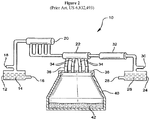
- U.S. Patent No.6,832,493 provides an exemplary method, and a system 10 as shown therein as Fig.2 (shown as Figure 2 in the present application), that can be used to prepare the soot.
- the method for producing the soot includes a source of silica precursor 14, for example without limitation, octamethylcyclotetrasiloxane or SiCl 4 .
- a carrier gas 16 such as nitrogen or helium, is introduced at or near the base of source 12.
- a bypass stream of carrier gas is introduced at 18 to prevent saturation of the vaporous stream.
- the vaporous stream passes through distribution system 20 to manifold 22.
- System 10 also includes source 24 of the titania precursor 26, for example without limitation, titanium tetrachloride or titanium tetraisopropoxide.
- the method can be used to produce silica-titania glasses contain 3-20 wt.% titania. In the present application the method can be used to produce a silica-titania glass containing 5-10 wt.% titania, and in one embodiment 6-8 wt.% titania.
- a source 24 also has inlet 28 for a carrier gas that is transmitted through precursor material 26.
- a by-pass stream is introduced at 30.
- the vaporous stream passes through distribution system 32 to manifold 22.
- the silica vapor stream and the titania vapor stream mix in manifold 22.
- the mixture passes through fume lines 34 to burners 36 mounted in upper portion of furnace 38.
- the mixed vapor stream is further joined with a fuel/oxygen mixture at burners 36.
- the vapor stream combusts and is oxidized to form silica-titania particles at a temperature in excess of 1600°C.
- the particles cool and are directed into collection chamber 40.
- the resulting silica-titania soot can then be used to for addition to the niobium pentachloride slurry to prepare the silica-titania-niobia glass described herein.
- the silica and titania precursors can be mixed in the liquid state and vaporized together.
- the niobium doping of the silica-titania glass reduces the CTE as well as the rate at which CTE changes with temperature which is the expansivity.
- the reduced expansivity along with an increased temperature width in which the CTE is zero, is an important and critical requirement of the a silica-titania glass for EUVL applications, for example without limitation, projection or reflective optics, and lithography mask substrates.
- An advantage of the sol-gel process is that it does not give rise to striae whereas in a soot-to-glass process, whether the soot is (a) first made into a preform, for example a boule, rod or plate, which is then consolidated into glass after the preform is made (the indirect process) or (b) collected in a vessel at consolidation temperatures as it formed and simultaneously or substantially simultaneously consolidated into glass (the direct process), striae are typically formed.
- a powder processing method such as a sol-gel eliminates or substantially eliminates this concern about striae formation.
- a STN glass can also be made by "oxidizing" Si, Ti and Nb precursors in an oxygen containing flame using either the direct or indirect processes described.
- the challenge in this instance is the fact that many of the niobium precursors that would be used are air and/or moisture sensitive. Further, those that are liquids frequently decompose upon heating because of their high boiling point. However, air/moisture sensitive liquids such as SiCl 4 and TiCl 4 were long used to make silica-titania glasses.
- Niobium pentachloride, NbCl 5 is soluble in alcohols, ethers and chloroform. As a result, it is possible to prepare a STN glass using a NbCl 5 solution as one of the feedstocks.
- silica, titania and niobia precursors are fed to a burner in the appropriate Si:Ti:Nb ration and are combusted to form a STN soot.
- the soot is collected in a vessel or on a bait, and, after the soot collection is completed, it is consolidated at consolidation temperatures, for example, at a temperature above 1600°C, to form a STN glass.
- the soot is consolidated as it is collected in a vessel.
- the collected soot can also be subject to additional treatment, for example, dehydration using a suitable dehydrating gas such as Cl 2 or a chlorine containing gas, for example, CCl 4 ; hydrated to increase the OH content using steam; or further doped, for example by fluorine using a gaseous fluorinating agent, for example, SiF4, SF 4 .
- a suitable dehydrating gas such as Cl 2 or a chlorine containing gas, for example, CCl 4
- hydrated to increase the OH content using steam or further doped, for example by fluorine using a gaseous fluorinating agent, for example, SiF4, SF 4 .
- the soot can be deposited on a mandrel or bait using the VAD (vertical axial deposition) method to form a porous preform.
- VAD vertical axial deposition
- the porous preform can also be dehydrated, hydrated or further doped as described above if desired.
- the preform is consolidated and removed from the mandrel or bait, and it is formed into a glass object.
- Niobia will lower the CTE of fused silica, but not to zero levels.
- Fused silica has an average CTE of approximately 550 ppb/°C over the temperature range 0-300°C.
- the addition of niobia to the fused silica glass will lower the CTE to approximately 470 ppb/°C over the temperature range 0-300°C.
- the actual niobia content in the glass ranged from 1.6 wt.% to 6.9 wt.%.
- Silica-titania glass as presently made has an average CTE of approximately 0 ⁇ 10 ppb/°C over the temperature range of 20-320°C. Over the temperature range of 20-320°C niobia in a silica-titania glass will result in a similar reduction in CTE since the glass is predominantly a silica glass. Niobia also lowers the viscosity of the silica-titania glass. This feature is an advantage in controlling the CTE as well as the expansivity vs. Temperature, and is also an advantage in adjusting the fictive temperature of a silica-titania-niobia glass. In addition, the sol-gel method is used to make a STN glass the niobia did not separate out during consolidation.
- the Tzc of the resulting STN glass is also adjustable using the method described in U.S. Patent Application No. 12/856728 which describes a "Photoelastic Method for the Absolute Determination of Zero CTE Crossover in Low Expansion Silica-titania Glass Samples" and U.S. Application No. 12/868394 which describes a method for "Tuning Tzc by the Annealing of Ultra Low Expansion Glass.”
- the titania level in the glass is adjustable to obtain a desired T ZC (temperature at which CTE is zero) for each different Nb level and Tzc.
- a further advantage of the sol-gel method is that it easier to make large number of doped glass parts without a large capital investment.
- the method described herein for making a STN glass ensures uniform distribution of the niobium dopant in the glass to a high degree which is critical for the Tzc spatial homogeneity in the glass parts.
- This method also offers the flexibility in the use of different concentration levels of the dopants, the use of different dopants, for example Ta, Yb, Al, B, K, F and Na, and use of a combination of dopants without additional equipment.
- the OH content of the STN glasses is less than 200ppm. In another embodiment the OH concentration is less than 100 ppm. In a further embodiment the OH content is in the range 10- 70 ppm. If it is desired to further dehydrate the silicon-titanium-niobium material after drying and removal of the organics and before consolidation, this can be done using chlorine or fluorine, or other gases such as CF 4 or SiF 4 as described in US Patent No. 8,047,023 and other patent documents. The dehydration using these gasses is preferably carried out in the presence of an inert gas such as helium. In addition, the glass can be fluorinated using the methods that are used to obtain F-doped silica glass and F-doped silica-titania glass.
- the disclosure is directed to a method for making a silica-titania-niobia glass having a composition comprising niobia in an amount in the range of 0.005 wt..% to 1.2 wt.% , titania in an amount in the range of 5 wt.% to 10 wt.%, and the remainder of the glass is silica, the method comprising the steps of:
- the glass is annealed.
- the temperature of the glass is lowered from the consolidation temperature to a temperature of 1050°C ⁇ 25°C and held at this temperature for a time in the range of 1- 2 hours followed by cooling to a 700°C at a rate in the range of 1°C to 10°C per hour before turning off the furnace and cooling the glass to room temperature at the natural cooling rate of the furnace.
- the glass is placed in an annealing oven and heated to 1050°C ⁇ 25°C in 1 - 2 hours and held at 1050°C ⁇ 25°C for a time in the range of 1 - 2 hours followed by cooling to 700°C at a rate in the range of 1°C to 10°C per hour before turning off the furnace and cooling the glass to room temperature at the natural cooling rate of the furnace.
- the fictive temperature of the glass is controlled by changing the annealing procedure prior to cooling. This involves changing the annealing temperature and the cooling rate down from the annealing temperature to lower temperatures. This is accomplished by lowering the temperature from the consolidation temperature- to a selected temperature of in the range of 700°C to at most 1200°C and holding the glass at the selected temperature for a time in the range of 5 hours to 400 hours, and then cooling the STN glass to a temperature of at most 500°C at an average cooling rate of at most 150°C/hr. In an embodiment the average cooling rate is at most 100°C/hr.
- the average cooling rate is at most 50°C/hr. In a further embodiment the average cooling rate is at most 10°C/hr. In an additional embodiment the average cooling rate is at most 5°C/hr. After the glass has reached 500°C the heat to the furnace can be turned off and the furnace and glass within allowed to cool at the natural cooling rate of the furnace.
- the fictive temperature of a cooled STN glass is shifted by the use of a selected annealing cycle of the glass. For example, after the cooled STN glass is removed from the furnace, the glass is placed in an annealing oven and heated to a selected temperature of in the range of 700°C to at most 1200°C for a time in the range of 5 hours to 400 hours, and then the STN glass is cooled to a temperature of at most 500°C at an average cooling rate of at most 150°C/hr. In an embodiment the average cooling rate is at most 100°C/hr. In another embodiment the average cooling rate is at most 50°C/hr. In a further embodiment the average cooling rate is at most 10°C/hr. In an additional embodiment the average cooling rate is at most 5°C/hr. After the glass has reached 500°C the heat to the furnace can be turned off and the furnace and glass within allowed to cool at the natural cooling rate of the furnace.
Landscapes
- Chemical & Material Sciences (AREA)
- Engineering & Computer Science (AREA)
- Chemical Kinetics & Catalysis (AREA)
- Materials Engineering (AREA)
- Organic Chemistry (AREA)
- Life Sciences & Earth Sciences (AREA)
- General Chemical & Material Sciences (AREA)
- Geochemistry & Mineralogy (AREA)
- Ceramic Engineering (AREA)
- Manufacturing & Machinery (AREA)
- Glass Compositions (AREA)
- Glass Melting And Manufacturing (AREA)
Applications Claiming Priority (2)
| Application Number | Priority Date | Filing Date | Title |
|---|---|---|---|
| US201261694932P | 2012-08-30 | 2012-08-30 | |
| PCT/US2013/057041 WO2014036116A1 (en) | 2012-08-30 | 2013-08-28 | Niobium doped silica titania glass and method of preparation |
Publications (2)
| Publication Number | Publication Date |
|---|---|
| EP2890651A1 EP2890651A1 (en) | 2015-07-08 |
| EP2890651B1 true EP2890651B1 (en) | 2016-12-14 |
Family
ID=49118827
Family Applications (1)
| Application Number | Title | Priority Date | Filing Date |
|---|---|---|---|
| EP13759399.2A Not-in-force EP2890651B1 (en) | 2012-08-30 | 2013-08-28 | Niobium doped silica titania glass and method of preparation |
Country Status (4)
| Country | Link |
|---|---|
| US (1) | US8987155B2 (https=) |
| EP (1) | EP2890651B1 (https=) |
| JP (1) | JP6302910B2 (https=) |
| WO (1) | WO2014036116A1 (https=) |
Families Citing this family (5)
| Publication number | Priority date | Publication date | Assignee | Title |
|---|---|---|---|---|
| US9505649B2 (en) * | 2013-09-13 | 2016-11-29 | Corning Incorporated | Ultralow expansion glass |
| JP2017536323A (ja) | 2014-11-26 | 2017-12-07 | コーニング インコーポレイテッド | 低膨張率を有するドープされたシリカ−チタニアガラスおよびその製造方法 |
| US9822030B2 (en) * | 2015-02-13 | 2017-11-21 | Corning Incorporated | Ultralow expansion titania-silica glass |
| US10464840B2 (en) | 2016-10-05 | 2019-11-05 | Corning Incorporated | Near infrared shielding and laser-resistant window |
| CN115181502B (zh) | 2016-12-21 | 2023-09-22 | 康宁股份有限公司 | 烧结系统和烧结制品 |
Family Cites Families (40)
| Publication number | Priority date | Publication date | Assignee | Title |
|---|---|---|---|---|
| US3673049A (en) * | 1970-10-07 | 1972-06-27 | Corning Glass Works | Glass laminated bodies comprising a tensilely stressed core and a compressively stressed surface layer fused thereto |
| US3801294A (en) | 1971-12-15 | 1974-04-02 | Corning Glass Works | Method of producing glass |
| US3806570A (en) * | 1972-03-30 | 1974-04-23 | Corning Glass Works | Method for producing high quality fused silica |
| US3785722A (en) | 1972-06-20 | 1974-01-15 | Corning Glass Works | USE OF SiO{11 -NB{11 O{11 {11 AND/OR Ta{11 O{11 {11 GLASSES AS ULTRAVIOLET FILTERS |
| JPS6191024A (ja) | 1984-10-05 | 1986-05-09 | Seiko Epson Corp | 円筒状シリカ系ガラスの製造方法 |
| US4961767A (en) | 1987-05-20 | 1990-10-09 | Corning Incorporated | Method for producing ultra-high purity, optical quality, glass articles |
| EP0369091A1 (en) | 1988-11-15 | 1990-05-23 | Battelle Memorial Institute | Method for manufacturing amorphous silica objects |
| US5028568A (en) | 1989-07-05 | 1991-07-02 | Wisconsin Alumni Research Foundation | Niobium-doped titanium membranes |
| EP0441622B1 (en) | 1990-02-07 | 1994-11-02 | Shin-Etsu Chemical Co., Ltd. | Epoxy resin compositions containing highly transparent silica-titania glass beads |
| JP3115366B2 (ja) | 1991-09-02 | 2000-12-04 | 株式会社トクヤマ | シリカ−チタニアガラスの製造方法 |
| EP0535388A1 (en) | 1991-09-03 | 1993-04-07 | Konica Corporation | A blank member and a glass optical element and processes for manufacturing them |
| JPH09202652A (ja) * | 1995-11-24 | 1997-08-05 | Olympus Optical Co Ltd | 屈折率分布型光学素子の製造方法 |
| JP4002625B2 (ja) | 1996-03-19 | 2007-11-07 | 株式会社鈴木製作所 | 横ピロー三方シールフイルム包装方法および包装機 |
| US6309991B1 (en) | 1996-08-29 | 2001-10-30 | Corning Incorporated | Silica with low compaction under high energy irradiation |
| US6209357B1 (en) | 1998-07-21 | 2001-04-03 | Lucent Technologies Inc. | Method for forming article using sol-gel processing |
| US5970751A (en) | 1998-09-22 | 1999-10-26 | Corning Incorporated | Fused SiO2 -TiO2 glass method |
| US6931097B1 (en) | 1999-07-22 | 2005-08-16 | Corning Incorporated | Extreme ultraviolet soft x-ray projection lithographic method system and lithographic elements |
| US6442977B1 (en) | 2000-06-20 | 2002-09-03 | Fitel Usa Corp. | Sol-gel process for fabricating germanium-doped silica article |
| US6457329B1 (en) | 2000-12-14 | 2002-10-01 | Fitel Usa Corp. | Process for fabricating sol-gel article involving low-shrinkage formulation |
| US8047023B2 (en) | 2001-04-27 | 2011-11-01 | Corning Incorporated | Method for producing titania-doped fused silica glass |
| US6832493B2 (en) | 2002-02-27 | 2004-12-21 | Corning Incorporated | High purity glass bodies formed by zero shrinkage casting |
| US7053017B2 (en) | 2002-03-05 | 2006-05-30 | Corning Incorporated | Reduced striae extreme ultraviolet elements |
| DE60324625D1 (de) * | 2002-04-04 | 2008-12-24 | Tosoh Corp | Thermisch-gespritzte Quarzglasteile und Herstellungsverfahren |
| JP2004131373A (ja) | 2002-09-09 | 2004-04-30 | Corning Inc | シリカ・チタニア極端紫外線光学素子の製造方法 |
| JP4792705B2 (ja) * | 2003-04-03 | 2011-10-12 | 旭硝子株式会社 | TiO2を含有するシリカガラスおよびその製造法 |
| JP5367204B2 (ja) | 2003-04-03 | 2013-12-11 | 旭硝子株式会社 | TiO2を含有するシリカガラスおよびEUVリソグラフィ用光学部材 |
| JP4792706B2 (ja) * | 2003-04-03 | 2011-10-12 | 旭硝子株式会社 | TiO2を含有するシリカガラスおよびその製造方法 |
| EP1471038A3 (de) | 2003-04-26 | 2005-11-23 | Schott Ag | Verfahren zur Herstellung von Glaskörpern aus dotiertem Quarzglas |
| US7155936B2 (en) | 2003-08-08 | 2007-01-02 | Corning Incorporated | Doped silica glass articles and methods of forming doped silica glass boules and articles |
| JP4492123B2 (ja) | 2004-01-05 | 2010-06-30 | 旭硝子株式会社 | シリカガラス |
| JP4957249B2 (ja) * | 2004-07-01 | 2012-06-20 | 旭硝子株式会社 | TiO2を含有するシリカガラスおよびその製造方法 |
| US20060179879A1 (en) | 2004-12-29 | 2006-08-17 | Ellison Adam J G | Adjusting expansivity in doped silica glasses |
| JP5035516B2 (ja) | 2005-12-08 | 2012-09-26 | 信越化学工業株式会社 | フォトマスク用チタニアドープ石英ガラスの製造方法 |
| JP5058649B2 (ja) | 2007-03-29 | 2012-10-24 | 株式会社沖データ | 定着器制御装置及び画像形成装置 |
| JP5428323B2 (ja) * | 2007-12-27 | 2014-02-26 | 旭硝子株式会社 | TiO2を含有するシリカガラス |
| JP5644058B2 (ja) * | 2008-03-21 | 2014-12-24 | 旭硝子株式会社 | TiO2を含有するシリカガラス |
| EP2468692A1 (en) * | 2009-08-19 | 2012-06-27 | Asahi Glass Company, Limited | Tio2-containing silicia glass, and optical member for euv lithography |
| US8328417B2 (en) | 2009-08-20 | 2012-12-11 | Corning Incorporated | Photoelastic method for absolute determination of zero CTE crossover in low expansion silica-titania glass samples |
| US8713969B2 (en) | 2009-08-31 | 2014-05-06 | Corning Incorporated | Tuning Tzc by the annealing of ultra low expansion glass |
| US8541325B2 (en) | 2010-02-25 | 2013-09-24 | Corning Incorporated | Low expansivity, high transmission titania doped silica glass |
-
2013
- 2013-08-22 US US13/973,428 patent/US8987155B2/en not_active Expired - Fee Related
- 2013-08-28 WO PCT/US2013/057041 patent/WO2014036116A1/en not_active Ceased
- 2013-08-28 JP JP2015529991A patent/JP6302910B2/ja not_active Expired - Fee Related
- 2013-08-28 EP EP13759399.2A patent/EP2890651B1/en not_active Not-in-force
Also Published As
| Publication number | Publication date |
|---|---|
| US20140066286A1 (en) | 2014-03-06 |
| WO2014036116A1 (en) | 2014-03-06 |
| EP2890651A1 (en) | 2015-07-08 |
| US8987155B2 (en) | 2015-03-24 |
| JP6302910B2 (ja) | 2018-04-11 |
| JP2015530346A (ja) | 2015-10-15 |
Similar Documents
| Publication | Publication Date | Title |
|---|---|---|
| EP1390309B1 (en) | Method for producing titania-doped fused silica extreme ultraviolet lithography substrates glass | |
| US7155936B2 (en) | Doped silica glass articles and methods of forming doped silica glass boules and articles | |
| US20060179879A1 (en) | Adjusting expansivity in doped silica glasses | |
| US8901019B2 (en) | Very low CTE slope doped silica-titania glass | |
| EP2890651B1 (en) | Niobium doped silica titania glass and method of preparation | |
| TWI380957B (zh) | 具有低羥基及氘氧基之融熔矽石及製造方法 | |
| JP5644058B2 (ja) | TiO2を含有するシリカガラス | |
| US20040045318A1 (en) | Method of making silica-titania extreme ultraviolet elements | |
| TW200940472A (en) | TiO2-containing silica glass | |
| JP2017537050A (ja) | 高ヒドロキシルTiO2−SiO2ガラス | |
| JP2017508713A (ja) | 非常に小さいcte勾配を有するホウ素ドープチタニア−シリカガラス | |
| JP6532362B2 (ja) | Euvリソグラフィ用高珪酸含量のフッ素及びチタンドープガラスブランクの製造方法及びその製造方法によって製造されたブランク | |
| US9611169B2 (en) | Doped ultra-low expansion glass and methods for making the same | |
| KR101740067B1 (ko) | TiO₂를 함유하는 실리카 유리를 포함하는 광학 부재 | |
| EP3380441B1 (en) | Doped ultra-low expansion glass and methods for annealing the same | |
| JP2000264650A (ja) | エキシマレーザー用光学石英ガラスの製造方法および縦型加熱炉 | |
| JPH05186234A (ja) | エキシマレーザー用石英ガラス部材の製造方法 | |
| KR20240104056A (ko) | TiO2-SiO2 유리체의 제조방법 및 그 제조방법으로 제조된 유리체 |
Legal Events
| Date | Code | Title | Description |
|---|---|---|---|
| PUAI | Public reference made under article 153(3) epc to a published international application that has entered the european phase |
Free format text: ORIGINAL CODE: 0009012 |
|
| 17P | Request for examination filed |
Effective date: 20150327 |
|
| AK | Designated contracting states |
Kind code of ref document: A1 Designated state(s): AL AT BE BG CH CY CZ DE DK EE ES FI FR GB GR HR HU IE IS IT LI LT LU LV MC MK MT NL NO PL PT RO RS SE SI SK SM TR |
|
| AX | Request for extension of the european patent |
Extension state: BA ME |
|
| DAX | Request for extension of the european patent (deleted) | ||
| GRAP | Despatch of communication of intention to grant a patent |
Free format text: ORIGINAL CODE: EPIDOSNIGR1 |
|
| INTG | Intention to grant announced |
Effective date: 20160623 |
|
| GRAS | Grant fee paid |
Free format text: ORIGINAL CODE: EPIDOSNIGR3 |
|
| GRAA | (expected) grant |
Free format text: ORIGINAL CODE: 0009210 |
|
| AK | Designated contracting states |
Kind code of ref document: B1 Designated state(s): AL AT BE BG CH CY CZ DE DK EE ES FI FR GB GR HR HU IE IS IT LI LT LU LV MC MK MT NL NO PL PT RO RS SE SI SK SM TR |
|
| REG | Reference to a national code |
Ref country code: GB Ref legal event code: FG4D |
|
| REG | Reference to a national code |
Ref country code: CH Ref legal event code: EP |
|
| REG | Reference to a national code |
Ref country code: IE Ref legal event code: FG4D |
|
| REG | Reference to a national code |
Ref country code: AT Ref legal event code: REF Ref document number: 853399 Country of ref document: AT Kind code of ref document: T Effective date: 20170115 |
|
| REG | Reference to a national code |
Ref country code: DE Ref legal event code: R096 Ref document number: 602013015374 Country of ref document: DE |
|
| PG25 | Lapsed in a contracting state [announced via postgrant information from national office to epo] |
Ref country code: LV Free format text: LAPSE BECAUSE OF FAILURE TO SUBMIT A TRANSLATION OF THE DESCRIPTION OR TO PAY THE FEE WITHIN THE PRESCRIBED TIME-LIMIT Effective date: 20161214 |
|
| REG | Reference to a national code |
Ref country code: LT Ref legal event code: MG4D |
|
| REG | Reference to a national code |
Ref country code: NL Ref legal event code: MP Effective date: 20161214 |
|
| PG25 | Lapsed in a contracting state [announced via postgrant information from national office to epo] |
Ref country code: SE Free format text: LAPSE BECAUSE OF FAILURE TO SUBMIT A TRANSLATION OF THE DESCRIPTION OR TO PAY THE FEE WITHIN THE PRESCRIBED TIME-LIMIT Effective date: 20161214 Ref country code: GR Free format text: LAPSE BECAUSE OF FAILURE TO SUBMIT A TRANSLATION OF THE DESCRIPTION OR TO PAY THE FEE WITHIN THE PRESCRIBED TIME-LIMIT Effective date: 20170315 Ref country code: LT Free format text: LAPSE BECAUSE OF FAILURE TO SUBMIT A TRANSLATION OF THE DESCRIPTION OR TO PAY THE FEE WITHIN THE PRESCRIBED TIME-LIMIT Effective date: 20161214 Ref country code: NO Free format text: LAPSE BECAUSE OF FAILURE TO SUBMIT A TRANSLATION OF THE DESCRIPTION OR TO PAY THE FEE WITHIN THE PRESCRIBED TIME-LIMIT Effective date: 20170314 |
|
| REG | Reference to a national code |
Ref country code: AT Ref legal event code: MK05 Ref document number: 853399 Country of ref document: AT Kind code of ref document: T Effective date: 20161214 |
|
| PG25 | Lapsed in a contracting state [announced via postgrant information from national office to epo] |
Ref country code: HR Free format text: LAPSE BECAUSE OF FAILURE TO SUBMIT A TRANSLATION OF THE DESCRIPTION OR TO PAY THE FEE WITHIN THE PRESCRIBED TIME-LIMIT Effective date: 20161214 Ref country code: RS Free format text: LAPSE BECAUSE OF FAILURE TO SUBMIT A TRANSLATION OF THE DESCRIPTION OR TO PAY THE FEE WITHIN THE PRESCRIBED TIME-LIMIT Effective date: 20161214 Ref country code: FI Free format text: LAPSE BECAUSE OF FAILURE TO SUBMIT A TRANSLATION OF THE DESCRIPTION OR TO PAY THE FEE WITHIN THE PRESCRIBED TIME-LIMIT Effective date: 20161214 |
|
| PG25 | Lapsed in a contracting state [announced via postgrant information from national office to epo] |
Ref country code: NL Free format text: LAPSE BECAUSE OF FAILURE TO SUBMIT A TRANSLATION OF THE DESCRIPTION OR TO PAY THE FEE WITHIN THE PRESCRIBED TIME-LIMIT Effective date: 20161214 |
|
| PG25 | Lapsed in a contracting state [announced via postgrant information from national office to epo] |
Ref country code: IS Free format text: LAPSE BECAUSE OF FAILURE TO SUBMIT A TRANSLATION OF THE DESCRIPTION OR TO PAY THE FEE WITHIN THE PRESCRIBED TIME-LIMIT Effective date: 20170414 Ref country code: RO Free format text: LAPSE BECAUSE OF FAILURE TO SUBMIT A TRANSLATION OF THE DESCRIPTION OR TO PAY THE FEE WITHIN THE PRESCRIBED TIME-LIMIT Effective date: 20161214 Ref country code: CZ Free format text: LAPSE BECAUSE OF FAILURE TO SUBMIT A TRANSLATION OF THE DESCRIPTION OR TO PAY THE FEE WITHIN THE PRESCRIBED TIME-LIMIT Effective date: 20161214 Ref country code: EE Free format text: LAPSE BECAUSE OF FAILURE TO SUBMIT A TRANSLATION OF THE DESCRIPTION OR TO PAY THE FEE WITHIN THE PRESCRIBED TIME-LIMIT Effective date: 20161214 Ref country code: SK Free format text: LAPSE BECAUSE OF FAILURE TO SUBMIT A TRANSLATION OF THE DESCRIPTION OR TO PAY THE FEE WITHIN THE PRESCRIBED TIME-LIMIT Effective date: 20161214 |
|
| PG25 | Lapsed in a contracting state [announced via postgrant information from national office to epo] |
Ref country code: ES Free format text: LAPSE BECAUSE OF FAILURE TO SUBMIT A TRANSLATION OF THE DESCRIPTION OR TO PAY THE FEE WITHIN THE PRESCRIBED TIME-LIMIT Effective date: 20161214 Ref country code: IT Free format text: LAPSE BECAUSE OF FAILURE TO SUBMIT A TRANSLATION OF THE DESCRIPTION OR TO PAY THE FEE WITHIN THE PRESCRIBED TIME-LIMIT Effective date: 20161214 Ref country code: BE Free format text: LAPSE BECAUSE OF FAILURE TO SUBMIT A TRANSLATION OF THE DESCRIPTION OR TO PAY THE FEE WITHIN THE PRESCRIBED TIME-LIMIT Effective date: 20161214 Ref country code: AT Free format text: LAPSE BECAUSE OF FAILURE TO SUBMIT A TRANSLATION OF THE DESCRIPTION OR TO PAY THE FEE WITHIN THE PRESCRIBED TIME-LIMIT Effective date: 20161214 Ref country code: BG Free format text: LAPSE BECAUSE OF FAILURE TO SUBMIT A TRANSLATION OF THE DESCRIPTION OR TO PAY THE FEE WITHIN THE PRESCRIBED TIME-LIMIT Effective date: 20170314 Ref country code: PT Free format text: LAPSE BECAUSE OF FAILURE TO SUBMIT A TRANSLATION OF THE DESCRIPTION OR TO PAY THE FEE WITHIN THE PRESCRIBED TIME-LIMIT Effective date: 20170414 Ref country code: SM Free format text: LAPSE BECAUSE OF FAILURE TO SUBMIT A TRANSLATION OF THE DESCRIPTION OR TO PAY THE FEE WITHIN THE PRESCRIBED TIME-LIMIT Effective date: 20161214 Ref country code: PL Free format text: LAPSE BECAUSE OF FAILURE TO SUBMIT A TRANSLATION OF THE DESCRIPTION OR TO PAY THE FEE WITHIN THE PRESCRIBED TIME-LIMIT Effective date: 20161214 |
|
| REG | Reference to a national code |
Ref country code: DE Ref legal event code: R097 Ref document number: 602013015374 Country of ref document: DE |
|
| PLBE | No opposition filed within time limit |
Free format text: ORIGINAL CODE: 0009261 |
|
| STAA | Information on the status of an ep patent application or granted ep patent |
Free format text: STATUS: NO OPPOSITION FILED WITHIN TIME LIMIT |
|
| 26N | No opposition filed |
Effective date: 20170915 |
|
| PG25 | Lapsed in a contracting state [announced via postgrant information from national office to epo] |
Ref country code: DK Free format text: LAPSE BECAUSE OF FAILURE TO SUBMIT A TRANSLATION OF THE DESCRIPTION OR TO PAY THE FEE WITHIN THE PRESCRIBED TIME-LIMIT Effective date: 20161214 |
|
| PG25 | Lapsed in a contracting state [announced via postgrant information from national office to epo] |
Ref country code: SI Free format text: LAPSE BECAUSE OF FAILURE TO SUBMIT A TRANSLATION OF THE DESCRIPTION OR TO PAY THE FEE WITHIN THE PRESCRIBED TIME-LIMIT Effective date: 20161214 |
|
| REG | Reference to a national code |
Ref country code: CH Ref legal event code: PL |
|
| PG25 | Lapsed in a contracting state [announced via postgrant information from national office to epo] |
Ref country code: MC Free format text: LAPSE BECAUSE OF FAILURE TO SUBMIT A TRANSLATION OF THE DESCRIPTION OR TO PAY THE FEE WITHIN THE PRESCRIBED TIME-LIMIT Effective date: 20161214 |
|
| GBPC | Gb: european patent ceased through non-payment of renewal fee |
Effective date: 20170828 |
|
| PG25 | Lapsed in a contracting state [announced via postgrant information from national office to epo] |
Ref country code: CH Free format text: LAPSE BECAUSE OF NON-PAYMENT OF DUE FEES Effective date: 20170831 Ref country code: LI Free format text: LAPSE BECAUSE OF NON-PAYMENT OF DUE FEES Effective date: 20170831 |
|
| REG | Reference to a national code |
Ref country code: FR Ref legal event code: ST Effective date: 20180430 |
|
| REG | Reference to a national code |
Ref country code: IE Ref legal event code: MM4A |
|
| PG25 | Lapsed in a contracting state [announced via postgrant information from national office to epo] |
Ref country code: LU Free format text: LAPSE BECAUSE OF NON-PAYMENT OF DUE FEES Effective date: 20170828 |
|
| PG25 | Lapsed in a contracting state [announced via postgrant information from national office to epo] |
Ref country code: GB Free format text: LAPSE BECAUSE OF NON-PAYMENT OF DUE FEES Effective date: 20170828 Ref country code: IE Free format text: LAPSE BECAUSE OF NON-PAYMENT OF DUE FEES Effective date: 20170828 |
|
| PG25 | Lapsed in a contracting state [announced via postgrant information from national office to epo] |
Ref country code: FR Free format text: LAPSE BECAUSE OF NON-PAYMENT OF DUE FEES Effective date: 20170831 |
|
| PG25 | Lapsed in a contracting state [announced via postgrant information from national office to epo] |
Ref country code: MT Free format text: LAPSE BECAUSE OF NON-PAYMENT OF DUE FEES Effective date: 20170828 |
|
| PG25 | Lapsed in a contracting state [announced via postgrant information from national office to epo] |
Ref country code: HU Free format text: LAPSE BECAUSE OF FAILURE TO SUBMIT A TRANSLATION OF THE DESCRIPTION OR TO PAY THE FEE WITHIN THE PRESCRIBED TIME-LIMIT; INVALID AB INITIO Effective date: 20130828 |
|
| PG25 | Lapsed in a contracting state [announced via postgrant information from national office to epo] |
Ref country code: CY Free format text: LAPSE BECAUSE OF FAILURE TO SUBMIT A TRANSLATION OF THE DESCRIPTION OR TO PAY THE FEE WITHIN THE PRESCRIBED TIME-LIMIT Effective date: 20161214 |
|
| PG25 | Lapsed in a contracting state [announced via postgrant information from national office to epo] |
Ref country code: MK Free format text: LAPSE BECAUSE OF FAILURE TO SUBMIT A TRANSLATION OF THE DESCRIPTION OR TO PAY THE FEE WITHIN THE PRESCRIBED TIME-LIMIT Effective date: 20161214 |
|
| PG25 | Lapsed in a contracting state [announced via postgrant information from national office to epo] |
Ref country code: TR Free format text: LAPSE BECAUSE OF FAILURE TO SUBMIT A TRANSLATION OF THE DESCRIPTION OR TO PAY THE FEE WITHIN THE PRESCRIBED TIME-LIMIT Effective date: 20161214 |
|
| PG25 | Lapsed in a contracting state [announced via postgrant information from national office to epo] |
Ref country code: AL Free format text: LAPSE BECAUSE OF FAILURE TO SUBMIT A TRANSLATION OF THE DESCRIPTION OR TO PAY THE FEE WITHIN THE PRESCRIBED TIME-LIMIT Effective date: 20161214 |
|
| PGFP | Annual fee paid to national office [announced via postgrant information from national office to epo] |
Ref country code: DE Payment date: 20200713 Year of fee payment: 8 |
|
| REG | Reference to a national code |
Ref country code: DE Ref legal event code: R119 Ref document number: 602013015374 Country of ref document: DE |
|
| PG25 | Lapsed in a contracting state [announced via postgrant information from national office to epo] |
Ref country code: DE Free format text: LAPSE BECAUSE OF NON-PAYMENT OF DUE FEES Effective date: 20220301 |