EP2870144B1 - Orexin receptor antagonists - Google Patents
Orexin receptor antagonists Download PDFInfo
- Publication number
- EP2870144B1 EP2870144B1 EP13734146.7A EP13734146A EP2870144B1 EP 2870144 B1 EP2870144 B1 EP 2870144B1 EP 13734146 A EP13734146 A EP 13734146A EP 2870144 B1 EP2870144 B1 EP 2870144B1
- Authority
- EP
- European Patent Office
- Prior art keywords
- mmol
- dioxide
- benzothiadiazin
- chloro
- difluoro
- Prior art date
- Legal status (The legal status is an assumption and is not a legal conclusion. Google has not performed a legal analysis and makes no representation as to the accuracy of the status listed.)
- Active
Links
- 0 CCCC[C@]([C@](C)S([C@](C(CC(OC)=C1)C=C1OC)*=O)(O)=O)NCC(C(C)C)=IC=* Chemical compound CCCC[C@]([C@](C)S([C@](C(CC(OC)=C1)C=C1OC)*=O)(O)=O)NCC(C(C)C)=IC=* 0.000 description 5
- PNRCMDJRYGPWSL-UHFFFAOYSA-N C/[Br]=C\CCC1CC1 Chemical compound C/[Br]=C\CCC1CC1 PNRCMDJRYGPWSL-UHFFFAOYSA-N 0.000 description 1
- ZQKYWPQZFBCJTC-UHFFFAOYSA-N CC1(C(N(Cc2c(C)cc(C)cn2)C(N2c(cc3)cc(OC)c3OC)=O)=CC=CC1)S2(=O)=O Chemical compound CC1(C(N(Cc2c(C)cc(C)cn2)C(N2c(cc3)cc(OC)c3OC)=O)=CC=CC1)S2(=O)=O ZQKYWPQZFBCJTC-UHFFFAOYSA-N 0.000 description 1
- HAIOHPDYPCLOBO-VIFPVBQESA-N CC[C@@H]1C=C(CC)C(NC)=CC1 Chemical compound CC[C@@H]1C=C(CC)C(NC)=CC1 HAIOHPDYPCLOBO-VIFPVBQESA-N 0.000 description 1
- UJQXYVOVLYXSBS-UHFFFAOYSA-N CN(C)c1nc(N(C(Nc2c3cccc2)=O)S3(=O)=O)ccc1 Chemical compound CN(C)c1nc(N(C(Nc2c3cccc2)=O)S3(=O)=O)ccc1 UJQXYVOVLYXSBS-UHFFFAOYSA-N 0.000 description 1
- XMBBGELOFGHVOP-UHFFFAOYSA-N CN(C=C(C=C1)N(C(N(Cc(c(F)ccc2)c2Cl)c2c3cccc2)=O)S3(=O)=O)C1=O Chemical compound CN(C=C(C=C1)N(C(N(Cc(c(F)ccc2)c2Cl)c2c3cccc2)=O)S3(=O)=O)C1=O XMBBGELOFGHVOP-UHFFFAOYSA-N 0.000 description 1
- YSSPBTMLGSSASS-UHFFFAOYSA-N COc(cc(cc1OC)N(C(Nc2ccccc22)=O)S2(=O)=O)c1OC Chemical compound COc(cc(cc1OC)N(C(Nc2ccccc22)=O)S2(=O)=O)c1OC YSSPBTMLGSSASS-UHFFFAOYSA-N 0.000 description 1
- QDQGJOPFXQZYOA-UHFFFAOYSA-N COc(ccc(N(C(N(Cc(c(F)cc(F)c1)c1F)c1ncccc11)=O)S1(=O)=O)c1)c1OC Chemical compound COc(ccc(N(C(N(Cc(c(F)cc(F)c1)c1F)c1ncccc11)=O)S1(=O)=O)c1)c1OC QDQGJOPFXQZYOA-UHFFFAOYSA-N 0.000 description 1
- AAISYOYYSSSBGG-UHFFFAOYSA-N COc(ccc(NC(N(Cc(cc1F)ccc1OC)c(cccc1)c1S=O)=O)c1)c1OC Chemical compound COc(ccc(NC(N(Cc(cc1F)ccc1OC)c(cccc1)c1S=O)=O)c1)c1OC AAISYOYYSSSBGG-UHFFFAOYSA-N 0.000 description 1
- SXZSRZJAVCBXPN-UHFFFAOYSA-N COc1cc(N(C(N(Cc(c(F)cc(F)c2)c2F)c2c3cccc2)=O)S3(=O)=O)cnc1OC Chemical compound COc1cc(N(C(N(Cc(c(F)cc(F)c2)c2F)c2c3cccc2)=O)S3(=O)=O)cnc1OC SXZSRZJAVCBXPN-UHFFFAOYSA-N 0.000 description 1
- TXDCPWCNFLEWHM-UHFFFAOYSA-N COc1cc(N(C(N(Cc2cccc(C#N)c2)c2c3cccc2)=O)S3(=O)=O)ccc1O Chemical compound COc1cc(N(C(N(Cc2cccc(C#N)c2)c2c3cccc2)=O)S3(=O)=O)ccc1O TXDCPWCNFLEWHM-UHFFFAOYSA-N 0.000 description 1
- AZAANRKVBSCLCL-UHFFFAOYSA-N COc1nc(OC)cc(N(C(N(Cc(c(F)cc(F)c2)c2Cl)c2c3cccc2)=O)S3(=O)=O)c1 Chemical compound COc1nc(OC)cc(N(C(N(Cc(c(F)cc(F)c2)c2Cl)c2c3cccc2)=O)S3(=O)=O)c1 AZAANRKVBSCLCL-UHFFFAOYSA-N 0.000 description 1
- PVJDBJGTQHGUTI-UHFFFAOYSA-N CSc(nc1)ccc1N(C(N(Cc(c(F)cc(F)c1)c1F)c1c2cccc1)=O)S2(=O)=O Chemical compound CSc(nc1)ccc1N(C(N(Cc(c(F)cc(F)c1)c1F)c1c2cccc1)=O)S2(=O)=O PVJDBJGTQHGUTI-UHFFFAOYSA-N 0.000 description 1
- RTJCNPUEOIERPQ-UHFFFAOYSA-N Cc1c(CN(c(cccc2)c2S(N2c3cc(Cl)c(C)cc3)(=O)=O)C2=O)cccc1 Chemical compound Cc1c(CN(c(cccc2)c2S(N2c3cc(Cl)c(C)cc3)(=O)=O)C2=O)cccc1 RTJCNPUEOIERPQ-UHFFFAOYSA-N 0.000 description 1
- GEUXWEVDAWEUGV-UHFFFAOYSA-N Cc1cc(C)cc(NS(c(cccn2)c2Cl)(=O)=O)c1 Chemical compound Cc1cc(C)cc(NS(c(cccn2)c2Cl)(=O)=O)c1 GEUXWEVDAWEUGV-UHFFFAOYSA-N 0.000 description 1
- WOVLGUAQWCYVBM-UHFFFAOYSA-N Cc1cc(N(C(Nc2c3cccn2)=O)S3(=O)=O)nc(C)c1 Chemical compound Cc1cc(N(C(Nc2c3cccn2)=O)S3(=O)=O)nc(C)c1 WOVLGUAQWCYVBM-UHFFFAOYSA-N 0.000 description 1
- YPOYTKDPGSMVHU-UHFFFAOYSA-N Cc1ccccc1CN(c(cccc1)c1S(C)(N1c(cc2OC)ccc2OC)(O)=O)C1=O Chemical compound Cc1ccccc1CN(c(cccc1)c1S(C)(N1c(cc2OC)ccc2OC)(O)=O)C1=O YPOYTKDPGSMVHU-UHFFFAOYSA-N 0.000 description 1
- OVLOXLPOWPMMRL-UHFFFAOYSA-N N#CCCC[n]1c2ccccc2nc1CN(c(cccc1)c1S(N1C2CC2)(=O)=O)C1=O Chemical compound N#CCCC[n]1c2ccccc2nc1CN(c(cccc1)c1S(N1C2CC2)(=O)=O)C1=O OVLOXLPOWPMMRL-UHFFFAOYSA-N 0.000 description 1
- JEHBLDNYJWWYMS-UHFFFAOYSA-N O=C(N(Cc(c(F)ccc1)c1Cl)c1c2cccc1)N(c1ccccc1)S2(=O)=O Chemical compound O=C(N(Cc(c(F)ccc1)c1Cl)c1c2cccc1)N(c1ccccc1)S2(=O)=O JEHBLDNYJWWYMS-UHFFFAOYSA-N 0.000 description 1
- UVRBIQUPIWQSRN-UHFFFAOYSA-N O=C(N(Cc1nc2ccccc2[n]1CCCF)c1c2cccc1)N(C1CC1)S2(=O)=O Chemical compound O=C(N(Cc1nc2ccccc2[n]1CCCF)c1c2cccc1)N(C1CC1)S2(=O)=O UVRBIQUPIWQSRN-UHFFFAOYSA-N 0.000 description 1
- LALKHGXYNIMDMY-UHFFFAOYSA-N O=C(N1)N(Cc(c(F)ccc2)c2F)c2ccccc2S1(=O)=O Chemical compound O=C(N1)N(Cc(c(F)ccc2)c2F)c2ccccc2S1(=O)=O LALKHGXYNIMDMY-UHFFFAOYSA-N 0.000 description 1
Images
Classifications
-
- C—CHEMISTRY; METALLURGY
- C07—ORGANIC CHEMISTRY
- C07D—HETEROCYCLIC COMPOUNDS
- C07D417/00—Heterocyclic compounds containing two or more hetero rings, at least one ring having nitrogen and sulfur atoms as the only ring hetero atoms, not provided for by group C07D415/00
- C07D417/02—Heterocyclic compounds containing two or more hetero rings, at least one ring having nitrogen and sulfur atoms as the only ring hetero atoms, not provided for by group C07D415/00 containing two hetero rings
- C07D417/06—Heterocyclic compounds containing two or more hetero rings, at least one ring having nitrogen and sulfur atoms as the only ring hetero atoms, not provided for by group C07D415/00 containing two hetero rings linked by a carbon chain containing only aliphatic carbon atoms
-
- A—HUMAN NECESSITIES
- A61—MEDICAL OR VETERINARY SCIENCE; HYGIENE
- A61K—PREPARATIONS FOR MEDICAL, DENTAL OR TOILETRY PURPOSES
- A61K31/00—Medicinal preparations containing organic active ingredients
- A61K31/33—Heterocyclic compounds
- A61K31/395—Heterocyclic compounds having nitrogen as a ring hetero atom, e.g. guanethidine or rifamycins
- A61K31/54—Heterocyclic compounds having nitrogen as a ring hetero atom, e.g. guanethidine or rifamycins having six-membered rings with at least one nitrogen and one sulfur as the ring hetero atoms, e.g. sulthiame
- A61K31/549—Heterocyclic compounds having nitrogen as a ring hetero atom, e.g. guanethidine or rifamycins having six-membered rings with at least one nitrogen and one sulfur as the ring hetero atoms, e.g. sulthiame having two or more nitrogen atoms in the same ring, e.g. hydrochlorothiazide
-
- A—HUMAN NECESSITIES
- A61—MEDICAL OR VETERINARY SCIENCE; HYGIENE
- A61P—SPECIFIC THERAPEUTIC ACTIVITY OF CHEMICAL COMPOUNDS OR MEDICINAL PREPARATIONS
- A61P21/00—Drugs for disorders of the muscular or neuromuscular system
-
- A—HUMAN NECESSITIES
- A61—MEDICAL OR VETERINARY SCIENCE; HYGIENE
- A61P—SPECIFIC THERAPEUTIC ACTIVITY OF CHEMICAL COMPOUNDS OR MEDICINAL PREPARATIONS
- A61P25/00—Drugs for disorders of the nervous system
-
- A—HUMAN NECESSITIES
- A61—MEDICAL OR VETERINARY SCIENCE; HYGIENE
- A61P—SPECIFIC THERAPEUTIC ACTIVITY OF CHEMICAL COMPOUNDS OR MEDICINAL PREPARATIONS
- A61P25/00—Drugs for disorders of the nervous system
- A61P25/02—Drugs for disorders of the nervous system for peripheral neuropathies
-
- A—HUMAN NECESSITIES
- A61—MEDICAL OR VETERINARY SCIENCE; HYGIENE
- A61P—SPECIFIC THERAPEUTIC ACTIVITY OF CHEMICAL COMPOUNDS OR MEDICINAL PREPARATIONS
- A61P25/00—Drugs for disorders of the nervous system
- A61P25/04—Centrally acting analgesics, e.g. opioids
-
- A—HUMAN NECESSITIES
- A61—MEDICAL OR VETERINARY SCIENCE; HYGIENE
- A61P—SPECIFIC THERAPEUTIC ACTIVITY OF CHEMICAL COMPOUNDS OR MEDICINAL PREPARATIONS
- A61P25/00—Drugs for disorders of the nervous system
- A61P25/06—Antimigraine agents
-
- A—HUMAN NECESSITIES
- A61—MEDICAL OR VETERINARY SCIENCE; HYGIENE
- A61P—SPECIFIC THERAPEUTIC ACTIVITY OF CHEMICAL COMPOUNDS OR MEDICINAL PREPARATIONS
- A61P25/00—Drugs for disorders of the nervous system
- A61P25/18—Antipsychotics, i.e. neuroleptics; Drugs for mania or schizophrenia
-
- A—HUMAN NECESSITIES
- A61—MEDICAL OR VETERINARY SCIENCE; HYGIENE
- A61P—SPECIFIC THERAPEUTIC ACTIVITY OF CHEMICAL COMPOUNDS OR MEDICINAL PREPARATIONS
- A61P25/00—Drugs for disorders of the nervous system
- A61P25/20—Hypnotics; Sedatives
-
- A—HUMAN NECESSITIES
- A61—MEDICAL OR VETERINARY SCIENCE; HYGIENE
- A61P—SPECIFIC THERAPEUTIC ACTIVITY OF CHEMICAL COMPOUNDS OR MEDICINAL PREPARATIONS
- A61P25/00—Drugs for disorders of the nervous system
- A61P25/22—Anxiolytics
-
- A—HUMAN NECESSITIES
- A61—MEDICAL OR VETERINARY SCIENCE; HYGIENE
- A61P—SPECIFIC THERAPEUTIC ACTIVITY OF CHEMICAL COMPOUNDS OR MEDICINAL PREPARATIONS
- A61P25/00—Drugs for disorders of the nervous system
- A61P25/24—Antidepressants
-
- A—HUMAN NECESSITIES
- A61—MEDICAL OR VETERINARY SCIENCE; HYGIENE
- A61P—SPECIFIC THERAPEUTIC ACTIVITY OF CHEMICAL COMPOUNDS OR MEDICINAL PREPARATIONS
- A61P25/00—Drugs for disorders of the nervous system
- A61P25/28—Drugs for disorders of the nervous system for treating neurodegenerative disorders of the central nervous system, e.g. nootropic agents, cognition enhancers, drugs for treating Alzheimer's disease or other forms of dementia
-
- A—HUMAN NECESSITIES
- A61—MEDICAL OR VETERINARY SCIENCE; HYGIENE
- A61P—SPECIFIC THERAPEUTIC ACTIVITY OF CHEMICAL COMPOUNDS OR MEDICINAL PREPARATIONS
- A61P25/00—Drugs for disorders of the nervous system
- A61P25/30—Drugs for disorders of the nervous system for treating abuse or dependence
-
- A—HUMAN NECESSITIES
- A61—MEDICAL OR VETERINARY SCIENCE; HYGIENE
- A61P—SPECIFIC THERAPEUTIC ACTIVITY OF CHEMICAL COMPOUNDS OR MEDICINAL PREPARATIONS
- A61P3/00—Drugs for disorders of the metabolism
- A61P3/04—Anorexiants; Antiobesity agents
-
- A—HUMAN NECESSITIES
- A61—MEDICAL OR VETERINARY SCIENCE; HYGIENE
- A61P—SPECIFIC THERAPEUTIC ACTIVITY OF CHEMICAL COMPOUNDS OR MEDICINAL PREPARATIONS
- A61P3/00—Drugs for disorders of the metabolism
- A61P3/08—Drugs for disorders of the metabolism for glucose homeostasis
- A61P3/10—Drugs for disorders of the metabolism for glucose homeostasis for hyperglycaemia, e.g. antidiabetics
-
- A—HUMAN NECESSITIES
- A61—MEDICAL OR VETERINARY SCIENCE; HYGIENE
- A61P—SPECIFIC THERAPEUTIC ACTIVITY OF CHEMICAL COMPOUNDS OR MEDICINAL PREPARATIONS
- A61P39/00—General protective or antinoxious agents
- A61P39/02—Antidotes
-
- A—HUMAN NECESSITIES
- A61—MEDICAL OR VETERINARY SCIENCE; HYGIENE
- A61P—SPECIFIC THERAPEUTIC ACTIVITY OF CHEMICAL COMPOUNDS OR MEDICINAL PREPARATIONS
- A61P43/00—Drugs for specific purposes, not provided for in groups A61P1/00-A61P41/00
-
- C—CHEMISTRY; METALLURGY
- C07—ORGANIC CHEMISTRY
- C07D—HETEROCYCLIC COMPOUNDS
- C07D285/00—Heterocyclic compounds containing rings having nitrogen and sulfur atoms as the only ring hetero atoms, not provided for by groups C07D275/00 - C07D283/00
- C07D285/15—Six-membered rings
- C07D285/16—Thiadiazines; Hydrogenated thiadiazines
- C07D285/18—1,2,4-Thiadiazines; Hydrogenated 1,2,4-thiadiazines
- C07D285/20—1,2,4-Thiadiazines; Hydrogenated 1,2,4-thiadiazines condensed with carbocyclic rings or ring systems
- C07D285/22—1,2,4-Thiadiazines; Hydrogenated 1,2,4-thiadiazines condensed with carbocyclic rings or ring systems condensed with one six-membered ring
- C07D285/24—1,2,4-Thiadiazines; Hydrogenated 1,2,4-thiadiazines condensed with carbocyclic rings or ring systems condensed with one six-membered ring with oxygen atoms directly attached to the ring sulfur atom
-
- C—CHEMISTRY; METALLURGY
- C07—ORGANIC CHEMISTRY
- C07D—HETEROCYCLIC COMPOUNDS
- C07D417/00—Heterocyclic compounds containing two or more hetero rings, at least one ring having nitrogen and sulfur atoms as the only ring hetero atoms, not provided for by group C07D415/00
- C07D417/02—Heterocyclic compounds containing two or more hetero rings, at least one ring having nitrogen and sulfur atoms as the only ring hetero atoms, not provided for by group C07D415/00 containing two hetero rings
-
- C—CHEMISTRY; METALLURGY
- C07—ORGANIC CHEMISTRY
- C07D—HETEROCYCLIC COMPOUNDS
- C07D417/00—Heterocyclic compounds containing two or more hetero rings, at least one ring having nitrogen and sulfur atoms as the only ring hetero atoms, not provided for by group C07D415/00
- C07D417/02—Heterocyclic compounds containing two or more hetero rings, at least one ring having nitrogen and sulfur atoms as the only ring hetero atoms, not provided for by group C07D415/00 containing two hetero rings
- C07D417/04—Heterocyclic compounds containing two or more hetero rings, at least one ring having nitrogen and sulfur atoms as the only ring hetero atoms, not provided for by group C07D415/00 containing two hetero rings directly linked by a ring-member-to-ring-member bond
-
- C—CHEMISTRY; METALLURGY
- C07—ORGANIC CHEMISTRY
- C07D—HETEROCYCLIC COMPOUNDS
- C07D417/00—Heterocyclic compounds containing two or more hetero rings, at least one ring having nitrogen and sulfur atoms as the only ring hetero atoms, not provided for by group C07D415/00
- C07D417/14—Heterocyclic compounds containing two or more hetero rings, at least one ring having nitrogen and sulfur atoms as the only ring hetero atoms, not provided for by group C07D415/00 containing three or more hetero rings
-
- C—CHEMISTRY; METALLURGY
- C07—ORGANIC CHEMISTRY
- C07D—HETEROCYCLIC COMPOUNDS
- C07D513/00—Heterocyclic compounds containing in the condensed system at least one hetero ring having nitrogen and sulfur atoms as the only ring hetero atoms, not provided for in groups C07D463/00, C07D477/00 or C07D499/00 - C07D507/00
- C07D513/02—Heterocyclic compounds containing in the condensed system at least one hetero ring having nitrogen and sulfur atoms as the only ring hetero atoms, not provided for in groups C07D463/00, C07D477/00 or C07D499/00 - C07D507/00 in which the condensed system contains two hetero rings
- C07D513/04—Ortho-condensed systems
Definitions
- This application relates to novel compounds and their use as orexin receptor antagonists.
- Compounds described herein may be useful in the treatment or prevention of diseases in which orexin receptors are involved.
- the application is also directed to pharmaceutical compositions comprising these compounds and the manufacture and use of these compounds and compositions in the prevention or treatment of such diseases in which orexin receptors are involved.
- the orexins comprise two neuropeptides produced in the hypothalamus: the orexin A (OX-A) (a 33 amino acid peptide) and the orexin B (OX-B) (a 28 amino acid peptide).
- OX-A a 33 amino acid peptide
- OX-B a 28 amino acid peptide
- Two orexin receptors have been studied in mammals, both belonging to the super family of G-protein coupled receptors.
- the orexin-1 receptor (OX 1 or OX1R) is selective for OX-A and the orexin-2 receptor (OX 2 or OX2R) is capable to bind OX-A as well as OX-B.
- the physiological actions in which orexins are presumed to participate are thought to be expressed via one or both of OX 1 receptor and OX 2 receptor as the two subtypes of orexin receptors.
- Orexins also regulate states of sleep and wakefulness, opening potentially novel medicament based therapeutic approaches for narcoleptic or insomniac patients.
- Orexin receptors are found in the mammalian brain and may have numerous implications in pathologies related to general orexin system dysfunction. Prior art compounds for the treatment of orexin system dysfunction are shown in, for example
- the structures of the compounds contained in these prior art disclosures are entirely different to the structures disclosed below.
- the most advanced orexin receptor antagonists are almorexant, suvorexant (MK-4305) and MK-6096; these compounds are dual orexin receptor antagonists (DORA), displaying similar affinities for both OX 1 and OX 2 receptor subtypes. These compounds have been shown to be effective in promoting sleep in preclinical species, reducing active wake and increasing both non-REM and REM sleep in rodent and dog studies. In a Phase II clinical trial, almorexant dose-dependently increased sleep efficiency in patients with primary insomnia and tended to improve wake after sleep onset and reduce the latency to persistent sleep.
- Orexins have been found to stimulate food consumption in rats, suggesting a physiological role for these peptides as mediators in the central feedback mechanism that regulates feeding behaviour.
- Orexin- A is believed to be an endogenous regulator of appetite and an OX 1 receptor antagonist reduces food intake in rats.
- Antagonists of the orexin-A receptor(s) may therefore be useful in the treatment of obesity and diabetes via regulation of appetite.
- Orexin receptor antagonists may also be useful in the treatment of binge eating disorder and other compulsive disorders including impulse control disorders.
- the search for new therapies to treat obesity and other eating disorders is an important and increasing challenge, particularly in westernised societies. Current treatments for obesity and diabetes are often either ineffective or show unacceptably high toxicity.
- Orexinergic neurons project from the lateral hypothalamus to the ventral tegmental area, amygdala, nucleus accumbens and pre-frontal cortex, indicating a role in reward pathways.
- Orexin receptor antagonists have been shown to ameliorate sensitisation, withdrawal and self-administration of a number of drugs of abuse in animal models, suggesting that such compounds could have utility in the treatment of dependence and addiction.
- Many of the regions innervated and modulated by orexin neurons are dopaminergic, suggesting an interplay between these neurotransmitter systems.
- Antagonists of orexin receptors could modulate central dopaminergic transmission and be effective in the treatment of movement disorders in which dopamine levels are abnormal.
- Orexin peptides also play a role in arousal, vigilance and in centrally-controlled autonomic function and have been shown to be involved in the development of a panic-prone state in rodents, an effect that could be reversed by orexin receptor antagonists, suggesting that these would have utility in the treatment of anxiety and panic.
- levels of beta-amyloid the pathological hallmark of Alzheimer's disease, were increased by sleep deprivation and orexin peptide infusion in mice.
- levels of beta-amyloid and amyloid placque formation were reduced in amyloid precursor protein transgenic mice upon treatment with an orexin receptor antagonist, suggesting that such compounds may have utility in the treatment of Azheimer's disease and other dementia-related cognitive dysfunction.
- MK-6096 has also completed a Phase II trial evaluating safety and efficacy versus placebo for preventing migraines in participants with episodic migraine.
- orexin receptor antagonists may have utility in the treatment or prevention of migraine or other headache disorders, such as tension-type headache, cluster headache, other trigeminal autonomic cephalalgias, other primary headaches such as hemicrania continua or those listed in the International Headache Society 2nd Edition of The International Headache Classification (ICHD-2), secondary headaches such as those listed in ICHD-2, cranial neuralgias such as trigeminal neuralgia or those listed in ICHD-2, or other causes of headache, cranial neuralgia, central or primary facial pain such as those listed in ICHD-2.
- migraine or other headache disorders such as tension-type headache, cluster headache, other trigeminal autonomic cephalalgias, other primary headaches such as hemicrania continua or those listed in the International Headache Society 2nd Edition of The International Headache Classification (ICH
- MK-6096 has also completed a Phase II trial evaluating safety and efficacy in the treatment of painful diabetic neuropathy (PDN) in adults. This observation suggests that orexin receptor antagonists may have utility in the treatment of neuropathic pain or other pain disorders.
- PDN painful diabetic neuropathy
- the invention relates to novel compounds.
- the invention further relates to the first medical use of these compounds.
- the invention further relates to the novel compounds for use as orexin receptor antagonists or for the treatment of orexin system dysfunction.
- the invention further relates to compounds, compositions and medicaments for the treatment of diabetes, obesity, insomnia, neurological or psychiatric disorders.
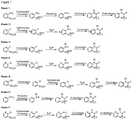
- Figure 1 A schematic of different routes available to prepare compounds described herein.
- the invention relates to novel compounds.
- the invention also relates to the novel compounds for use as orexin receptor antagonists or for the treatment of orexin system dysfunction.
- the invention further relates to compounds, compositions and medicaments for the treatment of insomnia, migraine, cluster headache and other headache disorders, diabetes, obesity, substance dependence, addiction, movement disorders, anxiety disorders, panic disorders, cognitive impairment or Alzheimer's disease.
- the present disclosure provides methods for treating, preventing, ameliorating, controlling or reducing the risk of a variety of neurological and psychiatric disorders associated with orexin receptors, including disturbed biological and circadian rhythms, sleep disorders, sleep disturbances, including enhancing sleep quality, improving sleep quality, increasing sleep efficiency, augmenting sleep maintenance; increasing the value which is calculated from the time that a subject sleeps divided by the time that a subject is attempting to sleep; improving sleep initiation; decreasing sleep latency or onset (the time it takes to fall asleep); decreasing difficulties in falling asleep; increasing sleep continuity; decreasing the number of awakenings during sleep; altering the timing, frequency or duration of REM sleep bouts; altering the timing, frequency or duration of slow wave sleep bouts; reducing daytime drowsiness; treating or reducing excessive daytime sleepiness, REM sleep interruptions, sleep apnea, narcolepsy, insomnia, parasomnia, jet-lag, shift workers' sleep disturbances, dyssomnias, night terror, sleep disturbances associated with diseases
- the present disclosure provides methods for treatment of pain disorders including neuropathic pain and restless leg syndrome, migraine, cluster headache, tension-type headache, trigeminal autonomic cephalalgias, hemicrania continua, trigeminal neuralgia, other headache disorders, hyperalgesia, pain, enhanced or exaggerated sensitivity to pain such as hyperalgesia, causalgia, and allodynia, acute pain, burn pain, atypical facial pain, neuropathic pain, back pain, complex regional pain syndrome I and II, arthritic pain, sports injury pain, pain related to infection e.g.
- HIV post-chemotherapy pain, post-stroke pain, post-operative pain, neuralgia, conditions associated with visceral pain such as irritable bowel syndrome, and angina
- obesity-related disorders including overeating and bulimia nervosa, hypertension, congestive heart failure, pathological conditions showing reduced metabolic activity or a decrease in resting energy expenditure as a percentage of total fat-free mass, diabetes, impaired glucose tolerance
- cardiovascular disease including acute and congestive heart failure, hypotension, hypertension, angina pectoris, myocardinal infarction
- eating disorders including anorexia, cachexia, addictive feeding behaviors
- binge/purge feeding behaviours such as binge eating disorder, appetite/taste disorders
- addictive behaviours including dependence or withdrawal from substances including, but not limited to, alcohol, amphetamines, cannabis, cocaine, hallucinogens, inhalants, nicotine, opioids, phencyclidine, sedatives, hypnotics or anxiolytics; tolerance to narcotics or withdrawal from n
- any of Y 1 , Y 2 , Y 3 or Y 4 are independently carbon atoms or nitrogen atoms.
- the carbon atoms Y 1 , Y 2 , Y 3 or Y 4 may bear hydrogen atoms (i.e. form CH groups) or may be substituted, for example with halo groups (fluoro, chloro, bromo or iodo), hydroxyl groups, alkyl groups or substituted alkyl groups, alkenyl or alkynyl groups or alkoxy groups.
- any of Y 1 , Y 2 , Y 3 or Y 4 may be independently N, C-H, C-F, C-Cl, C-Br, C-I, C-alkyl or C-OH.
- the alkyl groups may be for example methyl, ethyl, propyl or any other alkyl group as defined under the definitions of alkyl groups found herein.
- the alkyl, alkenyl or alkynyl group may contain 1-4 carbon atoms.
- the alkyl group may be a cyclic group such as cyclopropyl or cyclobutyl.
- no more than one of Y 1 , Y 2 , Y 3 and Y 4 is N.
- Y 1 may be nitrogen.
- Y 3 may be nitrogen.
- Y 1 or Y 3 may be CF.
- Each of Y 1 -Y 4 may be C-H.
- Y 4 may be CH or N.
- Y 4 has been described for a variety of carbon linked mono, bi or tri cyclic amino groups. All medical uses of the compounds described in WO2007108569 require that Y 4 is a carbon atom linked to a nitrogen atom. The preparation of said compounds was carried out using intermediates where Y 4 consists of a carbon-halogen bond, or similar reactive leaving group. This prior art does not disclose compounds as disclosed herein wherein X and W are both ring structures as described herein where Y 4 is CH, or where Y 4 is a nitrogen atom in the ring itself.
- compounds of the disclosure may be exemplified herein based around the structure: in which any of Y 2 , Y 3 or Y 4 are independently carbon atoms or nitrogen atoms.
- the carbon atoms Y 2 , Y 3 or Y 4 may be further substituted, for example with halo groups (fluoro, chloro, bromo or iodo), hydroxyl groups, alkyl groups or substituted alkyl groups, alkenyl or alkynyl groups or alkoxy groups.
- any of Y 2 , Y 3 or Y 4 may be independently N, C-H, C-F, C-Cl, C-Br, C-I, C-alkyl or C-OH.
- the alkyl groups may be for example methyl, ethyl, propyl or any other alkyl group as defined under the definitions of alkyl groups found herein.
- the alkyl, alkenyl or alkynyl group may contain 1-4 carbon atoms.
- the alkyl group may be cyclic groups such as cyclopropyl or cyclobutyl.
- W is a methylene group or CH(alkyl) group substituted by an optionally substituted aryl, optionally substituted cycloalkyl, optionally substituted heterocycloalkyl or optionally substituted heteroaryl moiety.
- X comprises an optionally substituted aryl, optionally substituted heteroaryl, optionally substituted cycloalkyl, or optionally substituted heterocycloalkyl moiety.
- the moiety W may be a methylene group substituted by a substituted aryl, or optionally substituted heteroaryl or heterocycloalkyl moiety.
- the substituted aryl and heteroaryl groups may be any of the aryl and heteroaryl groups listed below in the "Definitions" section of this application.
- the aryl group is a phenyl group which is substituted as defined herein.
- the heteroaryl group which may be optionally substituted as defined herein, can be monocyclic or polycyclic (e.g bicyclic or tricyclic) and may, for example, contain up to 14 ring members, more typically 5 to 10.
- the heteroaryl group e.g. 5- or 6-membered heteroaryl
- the heteroaryl (e.g. 5- or 6-membered heteroaryl) group contains one or more (e.g. 1, 2 or 3) heteroatoms which are typically selected from nitrogen, oxygen and sulphur.
- heteroaryl groups are 5- and 6-membered heteroaryl groups containing a nitrogen atom ring member and optionally a second heteroatom ring member selected from nitrogen, oxygen and sulphur.
- Particular heteroaryl groups are pyridyl and pyrazolyl groups
- W is a methylene group substituted with a substituted phenyl, or optionally substituted monocyclic 5- or 6-membered heteroaryl moiety containing up to two heteroatom ring members selected from nitrogen, oxygen and sulphur.
- W is a methylene group substituted with a substituted phenyl or optionally substituted pyridyl or pyrazolyl group.
- the aryl group forming part of W is substituted and the heteroaryl group is optionally substituted.
- the substituents may be as defined below in the "Definitions" section below.
- the substituents for the aryl and heteroaryl groups forming part of W may be selected from halo (fluoro, chloro, bromo or iodo), C 1-4 alkyl, C 3-6 cycloalkyl, hydroxy, C 1-4 alkoxy, cyano, amino, C 1-4 alkylamino, di-C 1-4 alkylamino, C 1-4 acylamino, carboxy, C 1-4 alkoxycarbonyl, carbamoyl, mono-C 1-4 carbamoyl, di-C 1-4 carbamoyl or any of the above sustituents in which a hydrocarbyl moiety is itself substituted by halo, cyano, hydroxy, C 1-2 alkoxy, amino, nitro, carbamoyl, carboxy or C 1-2 alkoxycarbonyl.
- the substituents for the aryl and heteroaryl groups forming part of W may be selected from fluoro, chloro, bromo, C 1-3 alkyl, C 3-6 cycloalkyl, hydroxy, C 1-4 alkoxy, cyano, amino, C 1-2 alkylamino, di-C 1-2 alkylamino, C 1-2 acylamino, carboxy, C 1-2 alkoxycarbonyl, carbamoyl, mono-C 1-2 carbamoyl, di-C 1-2 carbamoyl or any of the above substituents in which a hydrocarbyl moiety is itself substituted by one or more fluorine atoms or by cyano, hydroxy, C 1-2 alkoxy, amino, carbamoyl, carboxy or C 1-2 alkoxycarbonyl.
- W comprises one or more carbon atoms in the form of a ring structure.
- W is a formula of wherein R' and R" are independently H or alkyl (e.g. C 1-2 alkyl, more preferably methyl) and R'" is an optionally substituted aryl, optionally substituted cycloalkyl, optionally substituted heteroaryl or optionally substituted heterocycloalkyl group.
- R' may be methyl.
- R" may be methyl.
- the optional substituents may consist of one or more halo, alkyl or alkoxy groups, or may be selected from the list of optional substituents shown below.
- the R"' group may comprise a substituted aryl or heteroaryl group. In a 6-membered aromatic ring the substituents may be located at the 2, 3, 4, 5 or 6 positions.
- the aryl or heteroaryl group may comprise one, two, three, four or more substituents. The aryl group may be disubstituted, with the substitutions at any two of positions 2 to 6.
- the aryl group may be a 2,3-disubstituted, 2,4-disubstituted, 2,5-disubstituted, 2,6-disubstituted, 3,4-disubstituted or 3,5-disubstituted aryl group.
- disubstituted aryl groups include 2-fluoro-6-chloro or 2-chloro-4-fluoro.
- the groups may be linked together to form a further ring, for example a 2,3 or 3,4 cyclic acetal group of type O-CH 2 -O.
- the aryl group may comprise a 2, 3 or 4 methoxy group.
- the R"' group may comprise an optionally substituted cyclopropyl, cyclobutyl, cyclopentyl or cyclohexyl group.
- the R"' group may be a heteroaryl group, for example 2, 3 or 4 pyridyl.
- the heteroaryl group may optionally be further substituted, for example 2-fluoro,4-pyridyl or disubstituted, for example 2,6-difluoro,4-pyridyl.
- the heteroaryl group may be 3, 4, 5, 6 or 7 membered, and contain one or more heteroatoms.
- the heteroaryl group may be a 5 membered ring containing two or more heteroatoms.
- the heteratoms may be independently nitrogen, oxygen or sulphur.
- the heteroaryl group may be further substituted with one or more rings, which may be linked onto one or more positions of the heteroaryl group, for example to form a bicyclic heteroaryl group selected from the definitions of heteroaryl found herein.
- W may be selected from one of the following groups
- W may be selected from one of the following groups:
- any of Y 1 , Y 2 , Y 3 , Y 4 may be independently N, C-H, C-F, C-Cl, C-Br, C-I, C-alkyl or C-OH.
- no more than one of Y 1 , Y 2 , Y 3 and Y 4 is N.
- the alkyl groups may be for example methyl, ethyl, propyl or any other alkyl group as defined under the definitions of alkyl groups found herein.
- the alkyl, alkenyl or alkynyl group may contain 1-4 carbon atoms.
- the alkyl group may be cyclic groups such as cyclopropyl or cyclobutyl.
- R' and R" are independently H or alkyl.
- Y 5 , Y 6 , and Y 7 are each independently substituted carbon atoms or heteroatoms.
- each of Y 5 , Y 6 , and Y 7 may be independently N, C-F, C-Cl, C-Br, C-I, C-alkyl, C-O-alkyl or C-OH.
- X comprises an optionally substituted aryl, optionally substituted heteroaryl, optionally substituted cycloalkyl, or optionally substituted heterocycloalkyl moiety.
- X comprises an optionally substituted aryl, optionally substituted heteroaryl, optionally substituted cycloalkyl, or optionally substituted heterocycloalkyl moiety which may either be attached directly to the thiadiazinone ring or attached through an alkylene linker group.
- the alkylene linker group whem present, may have a chain length (extending between the thiadiazinone ring and the cyclic moiety) of up to 3 carbon atoms, one or more of which may optionally bear an alkyl side chain.
- the alkylene linker group when present, typically contains a maximum of 6 carbon atoms.
- the moiety X comprises one or more carbon atoms in the form of a ring structure.
- X may comprise an optionally substituted aryl, optionally substituted cycloalkyl, optionally substituted heteroaryl or optionally substituted heterocycloalkyl group.
- the optionally substituted aryl, optionally substituted cycloalkyl, optionally substituted heteroaryl or optionally substituted heterocycloalkyl group may be connected directly to the nitrogen atom, or may have one or more intervening aliphatic carbon atoms.
- the intervening carbon atoms may be in the form of a CH 2 , CH 2 CH 2 or CH(alkyl)-group.
- an aryl group at position X may therefore be in the form of N-aryl, or N-CH 2 -aryl (benzyl) or N-CH 2 CH 2 -aryl etc, and the term 'comprising' an optionally substituted aryl, optionally substituted cycloalkyl, optionally substituted heteroaryl or optionally substituted heterocycloalkyl group includes the optional aliphatic groups as well as the directly attached rings.
- the optional substituents may be selected from the list of optional substituents shown below.
- the substituents for the optionally substituted aryl, optionally substituted heteroaryl, optionally substituted cycloalkyl, or optionally substituted heterocycloalkyl moiety forming part of X may be selected from halo (fluoro, chloro, bromo or iodo), oxo, C 1-4 alkyl, C 1-4 alkylsulfanyl, C 1-4 alkylsulfinyl, C 1-4 alkylsulphonyl, C 3-6 cycloalkyl, hydroxy, C 1-4 alkoxy, cyano, nitro, amino, C 1-4 alkylamino, C 2-4 alkenylamino, di-C 1-4 alkylamino, C 1-4 acylamino, phenyl, phenylamino, benzoylamino, benzylamino, phenylamido, carboxy, C 1-4 alkoxycarbonyl or phenyl-C 1-10 alk
- the substituents for the optionally substituted aryl, optionally substituted heteroaryl, optionally substituted cycloalkyl, or optionally substituted heterocycloalkyl moiety forming part of X may be selected from halo (fluoro, chloro, bromo or iodo), oxo, C 1-4 alkyl, C 3-6 cycloalkyl, C 1-4 alkylsulfanyl, C 1-4 alkylsulfinyl, C 1-4 alkylsulphonyl, hydroxy, C 1-4 alkoxy, cyano, amino, C 1-4 alkylamino, di-C 1-4 alkylamino, C 1-4 acylamino, carboxy, C 1-4 alkoxycarbonyl, carbamoyl, mono-C 1-4 carbamoyl, di-C 1-4 carbamoyl or any of the above sustituents in which a hydrocarbyl moiety is itself substituted by halo,
- the substituents for the optionally substituted aryl, optionally substituted heteroaryl, optionally substituted cycloalkyl, or optionally substituted heterocycloalkyl moiety forming part of X may be selected from fluoro, chloro, bromo, oxo, C 1-3 alkyl, C 3-6 cycloalkyl, C 1-3 alkylsulfanyl, C 1-3 alkylsulfinyl, C 1-3 alkylsulphonyl, hydroxy, C 1-3 alkoxy, cyano, amino, C 1-2 alkylamino, di-C 1-2 alkylamino, C 1-2 acylamino, carboxy, C 1-2 alkoxycarbonyl, carbamoyl, mono-C 1-2 carbamoyl, di-C 1-2 carbamoyl or any of the above substituents in which a hydrocarbyl moiety is itself substituted by one or more fluorine atoms or by cyano,
- the substituents for the optionally substituted aryl, optionally substituted heteroaryl, optionally substituted cycloalkyl, or optionally substituted heterocycloalkyl moiety forming part of X may be selected from fluoro, chloro, bromo, oxo, C 1-3 alkyl, C 1-3 alkylsulfanyl, C 1-3 alkylsulfinyl, C 1-3 alkylsulphonyl, hydroxy, C 1-3 alkoxy, cyano, amino, C 1-2 alkylamino and di-C 1-2 alkylamino.
- the substituents for the optionally substituted aryl, optionally substituted heteroaryl, optionally substituted cycloalkyl, or optionally substituted heterocycloalkyl moiety forming part of X may be selected from oxo, C 1-3 alkyl, C 1-3 alkylsulfanyl, C 1-3 alkylsulfinyl, C 1-3 alkylsulphonyl, hydroxy, C 1-3 alkoxy and di-C 1-2 alkylamino.
- the substituents may consist of one or more halo, alkyl or alkoxy groups.
- the moiety X may comprise a substituted aryl or heteroaryl group.
- the substituents may be located at the 2, 3, 4, 5 or 6 positions.
- the aryl or heteroaryl group may comprise one, two, three, four or more substituents as defined herein, and more particularly may comprise one, two or three substituents.
- the aryl group may be disubstituted, with the substitutions at any two of positions 2-6.
- the aryl group may be a 2,3-disubstituted, 2,4-disubstituted, 2,5-disubstituted, 2,6-disubstituted, 3,4-disubstituted or 3,5-disubstituted aryl group.
- disubstituted aryl groups include 3,4-dimethoxy, 3,5-dimethoxy, 3,4-dimethyl and 3,5-dimethyl, 3-fluoro,4-cyano and 3-fluoro,4-methyl.
- the groups may be linked together to form a further ring, for example a 2,3 or 3,4 cyclic acetal group of type O-CH 2 -O.
- the aryl group may comprise a 2, 3 or 4 methoxy group, ethoxy group or thio-alkyl group.
- the alkoxy or thio-alkoxy groups may be further substituted, for example to make O-CF 3 or S-CF 3 groups.
- the aryl group may comprise a fluoro, chloro, bromo, methyl, ethyl or cyano group, which may be at the 2, 3 or 4 position.
- the subsituents may be acyl groups of type CO-alkyl or acyl esters of type -CO-O-alkyl, for example -CO 2 CH 3 .
- the subsituents may be primary, secondary or tertiary amide groups of type CO-NH 2 , CO-NH-alkyl or CO-N(alkyl) 2 .
- the aryl group may be a trisubstituted aryl group, for example a 3,4,5-trisubstituted aryl group.
- the X group may comprise an optionally substituted cyclopropyl, cyclobutyl, cyclopentyl or cyclohexyl group.
- the cyclopropyl, cyclobutyl, cyclopentyl or cyclohexyl group may be attached directly to the nitrogen atom, or may comprise one or more CH 2 or CH(alkyl) groups.
- X may be of the following structure
- the X group may comprise an optionally substituted heterocycloalkyl group.
- the heterocycloalkyl group may comprise a cyclopropyl, cyclobutyl, cyclopentyl or cyclohexyl group comprising one or more heteroatoms.
- the heterocyclopropyl, heterocyclobutyl, heterocyclopentyl or heterocyclohexyl group may be attached directly to the nitrogen atom, or may comprise one or more CH 2 or CH(alkyl) groups.
- the heteroatoms may be oxygen, nitrogen or sulphur.
- the X group may be a heteroaryl group, for example 2, 3 or 4 pyridyl, or 2 or 3 pyrryl.
- the heterocycle group may optionally be further substituted, for example 2-fluoro,4-pyridyl or disubstituted, for example 2,6-difluoro, 4-pyridyl.
- the heteroaryl group may be 3, 4, 5, 6 or 7 membered, and contain one or more heteroatoms.
- the heteroaryl group may be a 5 or 6 membered ring containing two or more heteroatoms.
- the heteratoms may be independently nitrogen, oxygen or sulphur, and the heteroatoms may be further optionally substituted.
- the heteroaryl group may comprise, for example, a N-substituted triazole moiety or an N-substituted imidazoyl moiety.
- the heteroaryl group may comprise one or more further rings, which may have aromatic conjugation.
- X may be a benzothiazolyl, indazolyl or quinolinyl group.
- X in which Y 1 is a nitrogen atom, or in which W comprises a 2,4,6- tri-substituted benzylic group or is an optionally substituted heteroaryl or optionally substituted heterocycloalkyl moiety, X can be selected from the following list.
- any of Y 1 , Y 2 , Y 3 , Y 4 are independently carbon atoms or heteroatoms.
- the carbon atoms Y 1 , Y 2 , Y 3 , Y 4 may be further substituted, for example with halo groups (fluoro, chloro, bromo or iodo), hydroxyl groups, alkyl groups or substituted alkyl groups, alkenyl or alkynyl groups or alkoxy groups.
- any of Y 1 , Y 2 , Y 3 , Y 4 may be independently N, C-H, C-F, C-Cl, C-Br, C-I, C-alkyl or C-OH.
- any of Y 1 , Y 2 , Y 3 , Y 4 are independently carbon atoms or heteroatoms.
- the carbon atoms Y 1 , Y 2 , Y 3 , Y 4 may be further substituted, for example with halo groups (fluoro, chloro, bromo or iodo), hydroxyl groups, alkyl groups or substituted alkyl groups, alkenyl or alkynyl groups or alkoxy groups.
- any of Y 1 , Y 2 , Y 3 , Y 4 may be independently N, C-H, C-F, C-Cl, C-Br, C-I, C-alkyl or C-OH.
- the alkyl groups may be for example methyl, ethyl, propyl or any other alkyl group as defined under the definitions of alkyl groups found herein.
- the alkyl, alkenyl or alkynyl group may contain 1-4 carbon atoms.
- the alkyl group may be cyclic groups such as cyclopropyl or cyclobutyl.
- R' and R" are independently H or alkyl.
- R'" is a substituted aryl, optionally substituted cycloalkyl, optionally substituted heteroaryl or optionally substituted heterocycloalkyl group.
- Y 5 , Y 6 , Y 7 , Y 8 , and Y 9 are independently carbon atoms or heteroatoms.
- the carbon atoms Y 5 , Y 6 , Y 7 , Y 8 , and Y 9 may be further substituted, for example with halo groups (fluoro, chloro, bromo or iodo), hydroxyl groups, alkyl groups or substituted alkyl groups, alkenyl or alkynyl groups, amino or alkoxy groups.
- any of Y 5 , Y 6 , Y 7 , Y 8 , and Y 9 may be independently N, C-H, C-F, C-Cl, C-Br, C-I, C-alkyl, C-Me, C-OMe, C-NH 2 , CNH-Me, C-N(Me) 2 or C-OH.
- Compounds where Y 8 is N, C-Me, C-OMe or C-N(Me) 2 show high affinity as orexin receptor binders and may be preferred.
- a compound as hereinbefore defined, or a salt thereof wherein Y 1 is CH, C-halo or N, where halo is a halogen atom; Y 2 is CH; Y 3 is CH or N, provided that no more than one of Y 1 and Y 3 may be N; Y 4 is CH; W is a methylene group substituted with a phenyl, pyridyl or pyrazole group, wherein the pyrazole or pyridyl groups are each optionally substituted with one or more C 1-4 alkyl groups, and the phenyl group is substituted with one or more substituents selected from halogen, C 1-4 alkyl and C 1-4 alkoxy; and X is selected from:
- a compound as hereinbefore defined, or a salt thereof wherein Y 1 is CH, CF or N; Y 2 is CH; Y 3 is CH or N, provided that no more than one of Y 1 and Y 3 may be N; Y 4 is CH; W is a methylene group substituted with a moiety selected from:
- the following compounds are known, but have not been associated with a particular medical use. In all cases the compounds do not contain a substituted aryl group at position W. In all cases, the compounds do not disclose where Y 4 is CH, or where Y 4 is N.
- FIG. 1 For embodiments of the disclosure, further embodiments of the disclosure include methods of treatment comprising administering a compound of formula wherein Y 1 , Y 2 , Y 3 are independently an optionally substituted carbon or a nitrogen atom; and Y 4 is is C-alkyl, C-halogen, C-H or N,W is a methylene group or CH(alkyl) group substituted by an optionally substituted aryl, optionally substituted cycloalkyl, optionally substituted heterocycloalkyl or optionally substituted heteroaryl moiety and X comprises an optionally substituted aryl, optionally substituted heteroaryl, optionally substituted cycloalkyl, or optionally substituted heterocycloalkyl moiety, wherein X is not cyclopropyl.
- the methods of treatment may be used in treating, preventing, ameliorating, controlling or reducing the risk of neurological or psychiatric disorders associated with orexin receptors, for example insomnia, diabetes, obesity, the treatment or prevention of substance dependence, addiction, movement disorders, anxiety disorders, panic disorders, cognitive impairment or Alzheimer's disease.
- neurological or psychiatric disorders associated with orexin receptors for example insomnia, diabetes, obesity, the treatment or prevention of substance dependence, addiction, movement disorders, anxiety disorders, panic disorders, cognitive impairment or Alzheimer's disease.
- the methods of treatment will typically involve the administration of a therapeutically effective amount (preferably a non-toxic amount) of the compound to a subject (e.g. a mammalian subject such as a human) in need thereof.
- a therapeutically effective amount preferably a non-toxic amount
- a subject e.g. a mammalian subject such as a human
- Certain novel compounds of the invention show particularly high activities as orexin antagonists; for example
- the present invention extends to all optical isomers of such compounds, whether in the form of racemates or resolved enantiomers.
- the disclosure relates to all crystal forms, solvates and hydrates of any of the disclosed compounds however so prepared.
- any of the compounds disclosed herein have acid or basic centres such as carboxylates or amino groups, then all salt forms of said compounds are included herein.
- the salt should be seen as being a pharmaceutically acceptable salt.
- salts include acid addition salts and base addition salts.
- Such salts may be formed by conventional means, for example by reaction of a free acid or a free base form of a compound with one or more equivalents of an appropriate acid or base, optionally in a solvent, or in a medium in which the salt is insoluble, followed by removal of said solvent, or said medium, using standard techniques (e.g. in vacuo, by freeze-drying or by filtration).
- Salts may also be prepared by exchanging a counter-ion of a compound in the form of a salt with another counter-ion, for example using a suitable ion exchange resin.
- Examples of pharmaceutically acceptable salts include acid addition salts derived from mineral acids and organic acids, and salts derived from metals such as sodium, magnesium, or preferably, potassium and calcium.
- acid addition salts include acid addition salts formed with acetic, 2,2-dichloroacetic, adipic, alginic, aryl sulfonic acids (e.g. benzenesulfonic, naphthalene-2-sulfonic, naphthalene-1,5-disulfonic and p-toluenesulfonic), ascorbic (e.g.
- D-glucuronic D-glucuronic
- glutamic e.g. L-glutamic
- ⁇ -oxoglutaric glycolic, hippuric, hydrobromic, hydrochloric, hydriodic, isethionic
- lactic e.g. (+)-L-lactic and ( ⁇ )-DL-lactic
- lactobionic maleic, malic (e.g.
- salts are salts derived from mineral acids such as hydrochloric, hydrobromic, phosphoric, metaphosphoric, nitric and sulfuric acids; from organic acids, such as tartaric, acetic, citric, malic, lactic, fumaric, benzoic, glycolic, gluconic, succinic, arylsulfonic acids; and from metals such as sodium, magnesium, or preferably, potassium and calcium.
- mineral acids such as hydrochloric, hydrobromic, phosphoric, metaphosphoric, nitric and sulfuric acids
- organic acids such as tartaric, acetic, citric, malic, lactic, fumaric, benzoic, glycolic, gluconic, succinic, arylsulfonic acids
- metals such as sodium, magnesium, or preferably, potassium and calcium.
- Alkyl means an aliphatic hydrocarbon group.
- the alkyl group may be straight or branched.
- Branched means that at least one carbon branch point is present in the group. Thus, for example, tert -butyl and isopropyl are both branched groups.
- the alkyl group may be a lower alkyl group.
- “Lower alkyl” means an alkyl group, straight or branched, having 1 to about 6 carbon atoms, e.g. 2, 3, 4, 5 or 6 carbon atoms.
- Exemplary alkyl groups include methyl, ethyl, n -propyl, i -propyl, n -butyl, t -butyl, s- butyl, n -pentyl, 2-pentyl, 3-pentyl, n-hexyl, 2-hexyl, 3-hexyl, n-heptyl, 2-heptyl, 3-heptyl, 4-heptyl, 2-methyl-but-l-yl, 2-methyl-but-3-yl, 2-methyl-pent-1-yl, 2-methyl-pent-3-yl.
- the alkyl group may be optionally substituted, e.g. as exemplified below.
- Alkenyl means an unsaturated aliphatic hydrocarbon group.
- the unsaturation may include one or more double bond, one or more triple bond or any combination thereof.
- the alkenyl group may be straight or branched. "Branched" means that at least one carbon branch point is present in the group. Any double bond may, independently of any other double bond in the group, be in either the (E) or the (Z) configuration.
- the alkenyl group may be a lower alkenyl group.
- “Lower alkenyl” means an alkenyl group, straight or branched, having 2 to 6 carbon atoms, e.g. 2, 3, 4, 5 or 6 carbon atoms.
- alkenyl groups include ethenyl, n -propenyl, i -propenyl, but-1-en-1-yl, but-2-en-1-yl, but-3-en-1-yl, pent-1-en-1-yl, pent-2-en-1-yl, pent-3-en-1-yl, pent-4-en-1-yl, pent-1-en-2-yl, pent-2-en-2-yl, pent-3-en-2-yl, pent-4-en-2-yl, pent-1-en-3-yl, pent-2-en-3-yl, pentadien-1-yl, pentadien-2-yl, pentadien-3-yl.
- the alkenyl group may be optionally substituted, e.g. as exemplified below.
- Alkylidene means any alkyl or alkenyl group linked to the remainder of the molecule via a double bond.
- alkyl and alkenyl groups apply with appropriate modification also to alkylidene groups.
- Cycloalkyl means a cyclic non-aromatic hydrocarbon group.
- the cycloalkyl group may include non-aromatic unsaturation.
- the cycloalkyl group may have 3 to 6 carbon atoms, e.g. 3, 4, 5 or 6 carbon atoms.
- Exemplary cycloalkyl groups include cyclopropyl, cyclobutyl, cyclopentyl, cyclohexyl, cyclopentenyl, cyclohexenyl.
- the cycloalkyl group may be optionally substituted, as defined below, e.g. as exemplified below.
- exemplary substituted cycloalkyl groups include mono- or polyalkyl-substituted cycloalkyl groups such as 1-methylcyclopropyl, 1-methylcyclobutyl, 1-methylcyclopentyl, 1-methylcyclohexyl, 2-methylcyclopropyl, 2-methylcyclobutyl, 2-methylcyclopentyl, 2-methylcyclohexyl, 1,2-dimethylcyclohexyl or 1,3-dimethylcyclohexyl.
- Cycloalkylidene means any cycloalkyl group linked to the remainder of the molecule via a double bond.
- the definitions and illustrations provided herein for cycloalkyl groups apply with appropriate modification also to cycloalkylidene groups.
- Aryl means any aromatic group in which all of the ring members are carbon atoms, for example having up to 12 carbon atom ring members, e.g. 6, 7, 8, 9, 10, 11 or 12 carbon atom ring members.
- the aryl group may comprise one, two or more rings. Where two or more rings are present they may if desired be fused.
- the aryl groups may be optionally substituted further, as described below.
- the aryl group may comprise one or more phenyl ring. The point of attachment of aryl groups may be via any atom of the ring system.
- Exemplary aryl groups include phenyl, naphthyl, tetrahydronaphthyl, biphenyl, indanyl and dihydroindanyl groups.
- the point of attachment may be via any atom of the ring system.
- Heteroaryl means an aromatic group in which at least one ring member is other than carbon.
- at least one ring member (for example one, two or three ring members) may be selected from nitrogen, oxygen and sulphur.
- the heteroaryl group may comprise one, two or more rings. Where two or more rings are present they may if desired be fused.
- the heteroaryl groups may be optionally substituted further, as described below.
- a second and/or third ring may be heteroaromaic or may be a phenyl ring.
- the point of attachment of heteroaryl groups may be via any atom of the ring system.
- heteroaryl groups include pyridyl, pyrazinyl, pyrimidinyl, furyl, thiophenyl, pyrrolyl, oxazolyl, thiazolyl, pyrazolyl, 1,2,3-triazolyl, 1,2,4-triazolyl, tetrazolyl, indolyl, indolizinyl, isoindolyl, indolinyl, purinyl, furazanyl, imidazolyl, indazolyl, isothiazolyl, isoxazolyl, 1,2,3-oxadiazolyl, 1,2,4-oxadiazolyl, 1,2,5-oxadiazolyl, 1,3,4-oxadiazolyl, 1,2-oxazinanyl, 1,3-oxazinanyl, pyrazolyl, tetrazolyl, 1,2,3-thiadiazolyl, 1,2,4-thiadiazolyl, 1,2,5-thio
- heterocycloalkyl groups include azetidinyl, pyrrolidinyl, piperidinyl, azepinyl, diazepinyl, dihydrofuranyl (e.g. 2,3-dihydrofuranyl, 2,5-dihydrofuranyl), 4,5-dihydro-1H-maleimido, dioxolanyl, 2-imidazolinyl, imidazolidinyl, isoxazolidinyl, morpholinyl, oxazolidinyl, piperazinyl, pyrrolidinonyl, 2-pyrrolinyl, 3-pyrrolinyl, sulfolanyl, 3-sulfolenyl, tetrahydrofuranyl, thiomorpholinyl, dihydropyranyl (e.g.
- the point of attachment may be via any atom of the ring system.
- Heterocycloalkylidene means any heterocycloalkyl group linked to the remainder of the molecule via a double bond.
- the definitions and illustrations provided herein for heterocycloalkyl groups apply with appropriate modification also to heterocycloalkylidene groups.
- Optionally substituted as applied to any group means that the said group may if desired be substituted with one or more substituents, which may be the same or different.
- substituents for "substituted” and “optionally substituted” moieties include halo (fluoro, chloro, bromo or iodo), C 1-6 alkyl, C 3-6 cycloalkyl, hydroxy, C 1-6 alkoxy, cyano, amino, nitro, C 1-6 alkylamino, C 2-6 alkenylamino, di-C 1-6 alkylamino, C 1-6 acylamino, di-C 1-6 acylamino, C 1-6 aryl, C 1-6 arylamino, C 1-6 aroylamino, benzylamino, C 1-6 arylamido, carboxy, C 1-6 alkoxycarbonyl or (C 1-6 aryl)(C 1-10 alkoxy)carbonyl, carbamoyl, mono-C 1-6 carbamoyl, di-C 1-6 carbamoyl or any of the above in which a hydrocarbyl moiety is itself substituted by
- the oxygen atom can be replaced with sulphur to make groups such as thio (SH) and thio-alkyl (S-alkyl).
- Optional substituents therefore includes groups such as S-methyl.
- the sulphur atom may be further oxidised to make a sulfoxide or sulfone, and thus optional substituents therefore includes groups such as S(O)-alkyl and S(O) 2 -alkyl.
- Substituted groups thus include for example CN, CFH 2 , CF 2 H, CF 3 , CH 2 NH 2 , CH 2 OH, CH 2 CN, CH 2 SCH 3 , CH 2 OCH 3 , OMe, OEt, Me, Et, -OCH 2 O-, CO 2 Me, C(O)Me, i -Pr, SCF 3 , SO 2 Me, NMe 2 etc.
- the substitutions may be in the form of rings from adjacent carbon atoms in the aryl ring, for example cyclic acetals such as O-CH 2 -O.
- acyl means an H-CO- or C 1-10 alkyl-CO- group wherein the alkyl group is as defined herein.
- exemplary acyl groups include formyl, acetyl, propanoyl, 2-methylpropanoyl and butanoyl.
- composition in the context of this invention means a composition comprising an active agent and comprising additionally one or more pharmaceutically acceptable carriers.
- the composition may further contain ingredients selected from, for example, diluents, adjuvants, excipients, vehicles, preserving agents, fillers, disintegrating agents, wetting agents, emulsifying agents, suspending agents, sweetening agents, flavouring agents, perfuming agents, antibacterial agents, antifungal agents, lubricating agents and dispersing agents, depending on the nature of the mode of administration and dosage forms.
- compositions may take the form, for example, of tablets, dragees, powders, elixirs, syrups, liquid preparations including suspensions, sprays, inhalants, tablets, lozenges, emulsions, solutions, cachets, granules, capsules and suppositories, as well as liquid preparations for injections, including liposome preparations.
- the dosages may be varied depending upon the requirements of the patient, the severity of the condition being treated, and the compound being employed. Determination of the proper dosage for a particular situation is within the skill of the art. Generally, treatment is initiated with the smaller dosages which are less than the optimum dose of the compound. Thereafter the dosage is increased by small increments until the optimum effect under the circumstances is reached. For convenience, the total daily dosage may be divided and administered in portions during the day if desired.
- the daily dose range may be from about 10 ⁇ g to about 30 mg per kg body weight of a human and non-human animal, preferably from about 50 ⁇ g to about 30 mg per kg of body weight of a human and non-human animal, for example from about 50 ⁇ g to about 10 mg per kg of body weight of a human and non-human animal, for example from about 100 ⁇ g to about 30 mg per kg of body weight of a human and non-human animal, for example from about 100 ⁇ g to about 10 mg per kg of body weight of a human and non-human animal and most preferably from about 100 ⁇ g to about 1 mg per kg of body weight of a human and non-human animal.
- Compounds may be prepared via a variety of synthetic routes. A schematic of some of the different routes available is shown in Figure 1 .
- Sulphonamide formations can be achieved by reaction of an amine with an aromatic or heteroaromatic sulfonyl chloride in a suitable solvent such as 1,4-dioxane, diethyl ether, DCM or 1,2-dichloroethane, in the absence of a base, or in the presence of base such as triethylamine, pyridine or N,N- di iso propylethylamine.
- a suitable solvent such as 1,4-dioxane, diethyl ether, DCM or 1,2-dichloroethane
- base such as triethylamine, pyridine or N,N- di iso propylethylamine.
- this coupling procedure is conducted at a temperature of between -10°C and 100°C.
- the coupling can be conducted in the presence of bis(trimethylsilyl)trifluoroacetamide and pyridine in DCM.
- Reduction of an aromatic nitro group can be performed under reaction conditions known to those skilled in the art; for example catalytic hydrogenation using a catalyst such as palladium on charcoal, palladium oxide or platinum oxide in a suitable solvent such as ethanol, water, ethyl acetate or combinations thereof under an atmosphere of hydrogen.
- a catalyst such as palladium on charcoal, palladium oxide or platinum oxide in a suitable solvent such as ethanol, water, ethyl acetate or combinations thereof under an atmosphere of hydrogen.
- Alternative conditions will be known to those skilled in the art, for example reduction with tin(II) chloride in ethanol, typically at an elevated temperature such as 100°C or with iron powder and acetic acid, typically at an elevated temperature such as 60°C.
- Intramolecular cyclisation reactions between adjacent aromatic and sulphonamide groups on an aromatic or heteroaromatic ring can be perfomed for example with 1,1'-carbonyldiimidazole and a base such as triethylamine in a suitable solvent such as DMF at elevated temperature, for example 100°C, as described by Hanson et al in Tetrahedron Lett. 2009, 50, 6935 .
- a suitable solvent e.g. 1,4-dioxane
- N-alkylation reactions for example Route 1, Step 4 and Route 6, Step 3
- S N 2 reactions with an alkyl (or benzyl) halide or other electrophilic species such as an alkyl (or benzyl) tosylate or mesylate, in the presence of a base (e.g. potassium carbonate or cesium carbonate) in a suitable solvent such as 1,4-dioxane or DMF at a suitable temperature such as room temperature to 130°C.
- a base e.g. potassium carbonate or cesium carbonate
- suitable solvent such as 1,4-dioxane or DMF
- suitable temperature such as room temperature to 130°C.
- Mitsunobu coupling conditions see Mitsunobu, O.
- Nucleophilic aromatic substitution reactions (S N Ar reactions) (for example Routes 2-4 inclusive, Step 2 and Route 5, Step 3) are typically conducted at elevated temperature (e.g. 100-200°C), in some instances in a microwave reactor, in a suitable solvent (e.g. acetonitrile), in some instances with additional base such as triethylamine or N , N- diisopropylethylamine. In some instances (e.g. Route 7, Step 2) autoclave conditions are used.
- elevated temperature e.g. 100-200°C
- a suitable solvent e.g. acetonitrile
- additional base such as triethylamine or N , N- diisopropylethylamine.
- autoclave conditions are used.
- Sulfonamide N-arylation reactions are widely described in the literature, and typically use an aryl halide, a palladium or copper(I) calatyst and a suitable ligand, for example as described in Han, Tetrahedron Lett. 2010, 51, 360 .
- Chlorination reactions to convert a hydroxy to a chloro substituent in heteroaromatic systems can be formed under reaction conditions which will be known to those skilled in the art, for example using phosphorous(V) oxychloride in a suitable solvent such as 1,2-dichloroethane.
- Cyclisation of a substituted aromatic amine to form a 4-substituted-2H-1,2,4-benzothiadiazin-3(4H)-one 1,1-dioxide ring system can be performed using chlorosulfonylisocyanate in a suitable solvent (e.g. nitroethane or nitromethane) at low temperature (e.g. -40°C to -45°C); followed by treatment with aluminium chloride and heating (see for example Tedesco et al, J. Med. Chem. 2006 , 49 , 971).
- a suitable solvent e.g. nitroethane or nitromethane
- the functional groups of intermediate compounds may need to be protected by protecting groups.
- the protection and deprotection of functional groups may take place before or after a reaction in the below-mentioned schemes.
- Protecting groups may be removed in accordance with techniques that are well known to those skilled in the art and as described hereinafter.
- protected compounds/intermediates described herein may be converted chemically to unprotected compounds using standard deprotection techniques.
- the type of chemistry involved will dictate the need, and type, of protecting groups as well as the sequence for accomplishing the synthesis.
- the use of protecting groups is fully described in " Protective Groups in Organic Chemistry", edited by J. W. F. McOmie, Plenum Press (1973 ), and " Protective Groups in Organic Synthesis", 4th edition, T.W. Greene & P.G.M. Wuts, Wiley (2006 ).
- Examples of the invention may be transformed into further examples of the invention by modification of substituents, for example an aromatic or heteroaromatic methyl ether may be transformed into an aromatic or heteroaromatic hydroxyl group by removal of the methyl ether under standard conditions (e.g. BBr 3 in DCM at low temperature).
- an aromatic or heteroaromatic sulphide can be oxidised to an aromatic or heteroaromatic sulfone in the presence of a suitable oxidising agent (for example meta chloroperoxybenzoic acid, KMnO 4 , t-butylammoniumperiodate and/or potassium peroxymonosulfate (e.g. Oxone).
- a suitable oxidising agent for example meta chloroperoxybenzoic acid, KMnO 4 , t-butylammoniumperiodate and/or potassium peroxymonosulfate (e.g. Oxone).
- Reference compounds 1-82 and exemplary compounds 83-186 of the invention, and their corresponding biological data are shown below: Table 1 STRUCTURE ref number Name OX2 pKi ave 1 4-(1,3-benzodioxol-5-ylmethyl)-2-(3,4-dimethoxyphenyl)-2 H -1,2,4-benzothiadiazin-3(4 H )-one 1,1-dioxide 6.5 2 2-(3,4-dimethoxyphenyl)-4-(3-fluoro-4-methoxybenzyl)-2 H -1,2,4-benzothiadiazin-3(4 H )-one 1,1-dioxide 6.85 3 2-(3,5-dimethoxyphenyl)-4-(3-methoxybenzyl)-2H-1,2,4-benzothiadiazin-3(4H)-one 1,1-dioxide 6.35 4 3- ⁇ [2-(3,4-dimethoxyphenyl)-1,1-dioxido-3-oxo
- Coupling constants are listed as J values, measured in Hz. NMR and mass spectroscopy results were corrected to account for background peaks. Chromatography refers to column chromatography performed using 60-120 mesh silica gel and executed under nitrogen pressure (flash chromatography) conditions. TLC for monitoring reactions refers to TLC run using the specified mobile phase and the Silica gel F254 as a stationary phase from Merck. Microwave-mediated reactions were performed in Biotage Initiator or CEM Discover microwave reactors.
- Mass spectroscopy was carried out on Shimadzu LC-2010 EV, Waters ZQ-2000, UPLC-Mass SQD-3100 or Applied Biosystem API-2000 spectrometers using electrospray conditions as specified for each compound in the detailed experimental section.
- Preparative HPLC was typically carried out under the following conditions.
- Method A (Gilson HPLC): Column: PrepHT Extend C-18, 21.2 x 100mm, 5 micron; Mobile phase: Gradients of water and MeCN (each containing 0.1 % Formic Acid); Gradient: 5% MeCN to 95% MeCN in water over 16.30 minutes at 28 mL / min.
- Method B (Waters HPLC): Column: XSelect CSH Prep C-18, 19 x 50mm, 5 micron; Mobile phase: Gradients of water and MeCN (each containing 0.1 % Formic Acid); Gradient: 5% MeCN to 95% MeCN in water over 16.30 minutes at 28 mL / min.
- Method C (Gilson HPLC): Column: Waters XBridge Prep C-18, 19 x 150mm, 5 micron; Mobile phase: Gradients of water and MeOH (each containing 0.1% NH 3 ); Gradient: 10% MeOH to 95% MeOH in water over 14.50 minutes at 18 mL / min.
- n-, s-, i-, t- and tert- have their usual meanings: normal, secondary, iso , and tertiary.
- Step 1 Preparation of N -(3,4-dimethoxyphenyl)-2-nitrobenzenesulfonamide
- Step 3 Preparation of 2-(3,4-dimethoxyphenyl)-2 H -1,2,4-benzothiadiazin-3(4H)-one 1,1-dioxide
- the title compound (2.2 g, 7.21 mmol) was prepared in three steps from 2-nitrobenzenesulfonyl chloride (16.0 g, 72.5 mmol), 2-methoxy-4-aminopyridine (10.0 g, 80.6 mmol) and triethylamine (8.95 g, 88.6 mmol) using the methods of (IntA1).
- the title compound (0.6 g, 1.97 mmol) was prepared in three steps from 2-nitrobenzenesulfonyl chloride (5.5 g, 24.8 mmol), 2-amino-6-methoxypyridine (3.08 g, 24.8 mmol) and triethylamine (2.75 g, 27.2 mmol) using the methods of (IntA1).
- the title compound (0.80 g, 2.41 mmol) was prepared in three steps from 2-nitrobenzenesulfonyl chloride (5.0 g, 22.6 mmol) and 6-aminobenzothiazole (3.39 g, 22.6 mmol) using the methods of (IntA1).
- the title compound (0.80 g, 2.74 mmol) was prepared in three steps from 2-nitrobenzenesulfonyl chloride (2.65 g, 11.9 mmol), 1-ethyl-1H-pyrazol-4-amine hydrochloride (1.8 g, 12.0 mmol) and triethylamine (3.0 g, 2.99 mmol) using the methods of (IntA1).
- the title compound (0.40 g, 1.24 mmol) was prepared in three steps from 2-nitrobenzenesulfonyl chloride (0.78 g, 3.57 mmol) and 5-(methylsulfanyl)pyridin-3-amine (0.5 g, 3.57 mmol) using the methods of (IntA1).
- the title compound (0.2 g, 0.60 mmol) was prepared in three steps from 2-nitrobenzenesulfonyl chloride (1.0 g, 4.51 mmol) and 3,5-dimethoxyaniline (0.7 g, 4.96 mmol) using the methods of (IntA1).
- Step 1 Preparation of 2-nitro- N - ⁇ 3-[(trifluoromethyl)sulfanyl]phenyl ⁇ benzenesulfonamide
- Step 2 Preparation of 2-amino- N - ⁇ 3-[(trifluoromethyl)sulfanyl]phenyl ⁇ benzenesulfonamide
- Step 3 Preparation of 2- ⁇ 3-[(trifluoromethyl)sulfanyl]phenyl ⁇ -2H-1,2,4-benzothiadiazin-3(4H)-one 1,1-dioxide
- the title compound (143 mg, 0.47 mmol) was prepared from 2-amino- N -(6-methoxypyridin-3-yl)benzenesulfonamide (209 mg, 0.75 mmol), 1,1'-carbonyldiimidazole (486 mg, 3.0 mmol) and triethylamine (0.28 mL, 1.5 mmol) in DMF (3.75 mL) using the methods of (IntA14), step 3.
- Step 1 Preparation of N -[6-(dimethylamino)pyridin-2-yl]-2-nitrobenzenesulfonamide
- Step 2 Preparation of 2-amino- N -[6-(dimethylamino)pyridin-2-yl]benzenesulfonamide
- the title compound (0.20 g, 0.63 mmol) was prepared from 2-amino- N -[6-(dimethylamino)pyridin-2-yl]benzenesulfonamide (0.7 g, 2.39 mmol) and triphosgene (2.5 g, 8.3 mmol) in 1,4-dioxane (25 mL) using the methods of (IntA1).
- the title compound (0.12 g, 0.38 mmol) was prepared in three steps from N 2 , N 2 -dimethylpyridine-2,4-diamine (2.29 g, 16.6 mmol), 2-nitrobenzenesulfonyl chloride (3.3 g, 15 mmol) and pyridine (13.1 g, 16.6 mmol) using the methods of (IntA17).
- Step 1 Preparation of N -(5,6-Dimethoxypyridin-3-yl)-2-nitrobenzenesulfonamide
- the title compound (0.30 g, 0.89 mmol) was prepared in three steps from 2-nitrobenzenesulfonyl chloride (1.05 g, 4.72 mmol), 5,6-dimethoxypyridin-2-amine (0.80 g, 5.19 mmol) and pyridine (1.15 mL, 14.2 mmol) in 1,4-dioxane (19 mL) using the methods of (IntA19).
- the title compound (0.40 g, 1.19 mmol) was prepared in three steps from 2-nitrobenzenesulfonyl chloride (2.66 g, 12.0 mmol), 2,6-dimethoxypyridin-4-amine (2.04 g, 13.2 mmol) and pyridine (2.9 mL, 36.0 mmol) in 1,4-dioxane (48 mL) using the methods of (IntA19).
- Methyl iodide (1.97 mL, 31.6 mmol) was added to a suspension of 2,4-difluoro-6-hydroxybenzoic acid (2.50 g, 14.4 mmol) and K 2 CO 3 (5.96 g, 43.1 mmol) in acetone (50 mL) and the mixture heated at reflux for 12 h. After concentration in vacuo the material was suspended in DCM (50 mL) and filtered, rinsing the residue with DCM (2 x 50 mL). The combined filtrates were concentrated in vacuo and purified by gradient flash chromatography eluting with 5-40% EtOAc in iso-hexane to yield the title compound (1.15 g, 5.71 mmol).
- Step 2 Preparation of (2,4-difluoro-6-methoxyphenyl)methanol.
- tert- Butyl(chloro)dimethylsilane (6.42 g, 42.6 mmol) was added to a solution of 2,6-difluoro-4-hydroxybenzoic acid (3.09 g, 17.8 mmol) in THF (50 mL), followed by the addition of N , N -diisopropylethylamine (9.19 mL, 51.5 mmol) over 5 min. After stirring at rt for 10 min the solution was concentrated in vacuo.
- Step 3 Preparation of 2-(6-methoxy-5-methylpyridin-3-yl)-2 H -1,2,4-benzothiadiazin-3(4 H )-one 1,1-dioxide
- the title compound was prepared from 2-amino- N -(6-methoxy-5-methylpyridin-3-yl)benzenesulfonamide (2.60 g) and triphosgene (815 mg, 2.75 mmol) in anhydrous 1,4-dioxane (160 mL) using the methods of (IntA1) step 3. Concentration in vacuo after completion of the reaction yielded the title compound (3.38 g, 10.6 mmol, approximately 80% purity by LCMS) which was used without further purification.
- Steps 1 and 2 Preparation of 2-amino- N -(5,6-dimethylpyridin-3-yl)benzenesulfonamide
- the title compound (2.7 g, 13.0 mmol) was prepared in two steps from 2-nitrobenzenesulfonyl chloride (3.20 g, 14.4 mmol) and 5,6-dimethylpyridin-3-amine (1.5 g, 12.3 mmol) in pyridine (20 mL) at rt; followed by SnCl 2 (8.88 g, 46.8 mmol) in ethanol at reflux for 2 h using the methods of (IntA1), steps 1 and 2.
- Step 3 Preparation of 2-(5,6-dimethylpyridin-3-yl)-2 H -1,2,4-benzothiadiazin-3(4 H )-one 1,1-dioxide
- the title compound (2.17 g, 7.15 mmol) was prepared from 2-amino- N -(5,6-dimethylpyridin-3-yl)benzenesulfonamide (2.7 g, 13.0 mmol) and 1,1'-carbonyldiimidazole (4.74 g, 29.2 mmol) in 1,2-dichloroethane (25 mL) at 110°C for 3 h using the methods of (IntA14), step 3.
- Step 3 Preparation of tert -butyl (6-bromo-3-methoxypyridin-2-yl)carbamate
- the title compound (1.03 g, 2.37 mmol) was prepared in three steps from 2-nitrobenzenesulfonyl chloride (1.12 g, 5.05 mmol), tert -butyl (6-amino-3-methoxypyridin-2-yl)methylcarbamate (1.41 g, 5.56 mmol) and pyridine (1.23 mL, 15.2 mmol) in DCM (25 mL) at 0°C to rt; followed by 10% Pd/C (895 mg) in EtOAc (40 mL); followed by 1,1'-carbonyldiimidazole (2.65 g, 16.4 mmol) and triethylamine (1.14 mL, 8.18 mmol) in DMF (80 mL) using the methods of (IntA17), step 1 and (IntA14), steps 2 and 3.
- the title compound was prepared in two steps from N-(4,5-dimethoxypyrimidin-2-yl)-2-nitrobenzenesulfonamide (231 mg, 0.68 mmol), Fe powder (380 mg, 6.8 mmol) and acetic acid (5 mL); followed by 1,1'-carbonyldiimidazole (396 mg, 2.44 mmol) and triethylamine (0.17 mL, 1.22 mmol) in DMF (4.0 mL) using the methods of (IntA17), step 2 and (IntA14), step 3. The residue from step 3 was triturated with Et 2 O to yield the title compound (104 mg, 0.31 mmol).
- the title compound (316 mg, 0.94 mmol) was prepared in three steps from 2-nitrobenzenesulfonyl chloride (2.15 g, 9.7 mmol), 4,6-dimethoxypyridin-2-amine hydrochloride (2.04 g, 10.7 mmol) and pyridine (2.35 mL, 29.1 mmol) in DCM (35 mL) at rt; followed by Fe powder (1.38 g, 24.7 mmol) and acetic acid (15 mL); followed by 1,1'-carbonyldiimidazole (1.62 g, 10.0 mmol) and triethylamine (0.70 mL, 5.0 mmol) in DMF (10.0 mL) using the methods of (IntA1), step 1, (IntA17), step 2 and (IntA14), step 3.
- the title compound (2.12 g, 4.84 mmol) was prepared in three steps from 2-nitrobenzenesulfonyl chloride (1.11 g, 5.0 mmol), tert -butyl (5-amino-2-methoxypyridin-3-yl)methylcarbamate (IntA34) (1.39 g, 5.5 mmol) and pyridine (1.21 mL, 15.0 mmol) in 1,4-dioxane (20 mL); followed by followed by 10% Pd/C (212 mg) in water/EtOH (1:1, 100 mL); followed by 1,1'-carbonyldiimidazole (1.14 g, 7.02 mmol) and triethylamine (0.49 mL, 3.51 mmol) in DMF (8 mL) using the methods of (IntA1), step 1 and (IntA14), steps 2 and 3.
- Step 2 Preparation of 2-[(2-chloro-6-fluorobenzyl)amino]-N-(1-methyl-6-oxo-1,6-dihydropyridin-3-yl)benzenesulfonamide (IntB1)
- the title compound (106 mg, impure, used without further purification) was prepared in two steps from 2-fluorobenzenesulfonyl chloride (0.46 mL, 3.5 mmol) and 5-amino-2-methoxypyrimidine (482 mg, 3.85 mmol) in 1,4-dioxane at 100°C; followed by 2-chloro-6-fluorobenzyl amine (0.36 mL, 2.8 mmol) in MeCN (1.5 mL) at 180°C in a Biotage Initiator microwave reactor using the methods of (IntB1).
- the title compound (139 mg, 0.32 mmol) was prepared in two steps from 2,5-difluorobenzenesulfonyl chloride (1.07 g, 5.0 mmol) and 3-(methylsulfanyl)aniline (769 mg, 5.5 mmol) in 1,4-dioxane at 70°C; followed by 1-(2-fluorophenyl)ethanamine (500 mg, 3.6 mmol) in MeCN (0.5 mL) at 200°C in a Biotage Initiator microwave reactor using the methods of (IntB1).
- the title compound (119 mg, 0.26 mmol) was prepared in two steps from 2,5-difluorobenzenesulfonyl chloride (1.07 g, 5.0 mmol) and 3-(methylsulfanyl)aniline (769 mg, 5.5 mmol) in 1,4-dioxane at 70°C; followed by 2-chloro-6-fluorobenzyl amine (762 uL, 5.9 mmol) in MeCN (1.5 mL) at 180°C in a Biotage Initiator microwave reactor using the methods of (IntB1).
- the title compound (139 mg, 0.32 mmol) was prepared in two steps from 2,3-difluorobenzenesulfonyl chloride (1.0 g, 4.7 mmol) and 6-methoxypyridin-3-amine (642 mg, 5.2 mmol) in 1,4-dioxane at 100°C; followed by 2-chloro-6-fluorobenzyl amine (547 mg, 3.4 mmol) in MeCN (3 mL) at 180°C in a Biotage Initiator microwave reactor using the methods of (IntB1).
- the title compound (139 mg, 0.35 mmol) was prepared in two steps from 2,3-difluorobenzenesulfonyl chloride (1.0 g, 4.7 mmol) and 6-methoxypyridin-3-amine (642 mg, 5.2 mmol) in 1,4-dioxane at 100°C; followed by 2-methylbenzyl amine (425 uL, 3.4 mmol) in MeCN (3 mL) at 180°C in a Biotage Initiator microwave reactor using the methods of (IntB1).
- the title compound (623 mg, 1.89 mmol) was prepared from 2-chloropyridine-3-sulfonyl chloride (530 mg, 2.5 mmol), 2,6-dimethoxy-4-pyridinamine (424 mg, 2.8 mmol) and pyridine (0.6 mL, 7.5 mmol) in DCM (10 mL) using the methods of (IntC1).
- the title compound (549 mg, 1.66 mmol) was prepared from 2-chloropyridine-3-sulfonyl chloride (530 mg, 2.5 mmol), 5,6-dimethoxypyridin-2-amine (424 mg, 2.8 mmol) and pyridine (0.6 mL, 7.5 mmol) in DCM (10 mL) using the methods of (IntC1).
- the title compound (542 mg, 1.64 mmol) was prepared from 2-chloropyridine-3-sulfonyl chloride (530 mg, 2.5 mmol), 5,6-dimethoxypyridin-3-amine (424 mg, 2.8 mmol) and pyridine (0.6 mL, 7.5 mmol) in DCM (10 mL) using the methods of (IntC1).
- Step 1 Preparation of tert -butyl (6-bromo-2-methoxypyridin-3-yl)carbamate
- Step 2 Preparation of tert -butyl (6-amino-2-methoxypyridin-3-yl)methylcarbamate
- the title compound was prepared from tert -butyl (6-bromo-2-methoxypyridin-3-yl)carbamate (7.07 g, 23.3 mmol) and iodomethane (6.17 mL, 98.0 mmol); followed by sodium tert -butoxide (2.17 g, 22.6 mmol), BINAP (1.41 g, 2.26 mmol), benzophenone imine (2.08 mL, 12.4 mmol), tert -butyl (6-bromo-2-methoxypyridin-3-yl)(methyl)carbamate (3.58 g, 11.3 mmol) and Pd 2 (dba) 3 (1.03 g, 1.13 mmol) in toluene (60 mL) at 80°C using the methods of (IntA30), step 4.
- step 4 Combination with batches of material derived from tert -butyl (6-bromo-2-methoxypyridin-3-yl)(methyl)carbamate (3.24 g and 576 mg) before purification using the methods of (IntA30), step 4 yielded the title compound (5.83 g, 23.0 mmol).
- the title compound (1.51 g, 3.53 mmol) was prepared from 2-chloropyridine-3-sulfonyl chloride (1.16 g, 5.48 mmol), tert -butyl (6-amino-2-methoxypyridin-3-yl)methylcarbamate (IntC7) (1.53 g, 6.03 mmol) and pyridine (1.33 mL, 16.4 mmol) in DCM (20 mL) at rt using the methods of (IntC1).
- the reaction mixture was combined with 2 previous batches derived from 6-acetamido-3-methylpyridin-2-yl acetate (590 mg, 2.83 mmol and 3.44 g, 16.5 mmol) and the combined batches were filtered through celite, rinsing with DCM. After concentration of the filtrate in vacuo purification by gradient column chromatography eluting with 20-50% EtOAc in heptane yielded the title compound (4.27 g, 23.7 mmol) as a white solid.
- the title compound (1.60 g, 5.10 mmol) was prepared from 2-chloropyridine-3-sulfonyl chloride (1.35 g, 6.39 mmol), 6-methoxy-5-methylpyridin-2-amine (IntC10) (970 mg, 7.02 mmol) and pyridine (1.55 mL, 19.2 mmol) in 1,4-dioxane (25 mL) at rt using the methods of (IntC1).
- Step 1 Preparation of tert -butyl methyl(3-methyl-5-nitropyridin-2-yl)carbamate
- N ,3-dimethyl-5-nitropyridin-2-amine (4.44 g) which was used without further purification.
- a mixture of N ,3-dimethyl-5-nitropyridin-2-amine (4.44 g, 26.6 mmol), Boc 2 O (11.6 g, 53.1 mmol) and 4-(dimethylamino)pyridine (649 mg, 5.31 mmol) in MeCN (230 mL) was stirred at 75°C for 21 h. Further Boc 2 O (2.32 g, 10.6 mmol) was added and heating at 75°C was continued for 24 h, before cooling to rt.
- Step 2 Preparation of tert -butyl (5-amino-3-methylpyridin-2-yl)methylcarbamate
- the title compound (1.98 g) was prepared from 2-chloropyridine-3-sulfonyl chloride (910 mg, 4.29 mmol), tert -butyl (5-amino-3-methylpyridin-2-yl)methylcarbamate (IntC12) (1.12 g, 4.72 mmol) and pyridine (1.04 mL, 12.9 mmol) in DCM (25 mL) at rt using the methods of (IntC1).
- the title compound (117 mg, 0.372 mmol) was prepared from 2-chloropyridine-3-sulfonyl chloride (469 mg, 2.2 mmol), 5-methoxy-6-methylpyridin-3-amine (336 mg, 2.4 mmol) and pyridine (0.54 mL, 7.5 mmol) in DCM (9 mL) at 0°C to rt using the methods of (IntC1).
- the title compound (2.12 g, 4.94 mmol) was prepared from 2-chloropyridine-3-sulfonyl chloride (1.10 g, 5.20 mmol), tert -butyl (5-amino-2-methoxypyridin-3-yl)methylcarbamate (IntA34) (1.45 g, 5.72 mmol) and pyridine (1.26 mL, 15.6 mmol) in DCM (20 mL) at rt using the methods of (IntC1).
- Step 1 Preparation of tert -butyl (3-methoxy-5-nitropyridin-2-yl)methylcarbamate
- Step 2 Preparation of tert -butyl (5-amino-3-methoxypyridin-2-yl)methylcarbamate
- the title compound (2.21 g, 5.15 mmol) was prepared from 2-chloropyridine-3-sulfonyl chloride (1.10 g, 5.20 mmol), tert -butyl (5-amino-3-methoxypyridin-2-yl)methylcarbamate (IntC16) (1.45 g, 5.72 mmol) and pyridine (1.26 mL, 15.6 mmol) in DCM (20 mL) at rt using the methods of (IntC1).
- Aluminium chloride (8.32 g, 62.4 mmol) was added and the mixture heated at reflux for 30 min, before cooling to rt and cautious addition to stirred ice-H 2 O (approximately 300 mL). After stirring for 15 min, the title compound (11.8 g, 34.6 mmol) was isolated by filtration.
- the title compound (4.2 g, 12.3 mmol) was prepared in two steps from aniline (8.8 g, 94.7 mmol), 2-fluoro-4-chlorobenzaldehyde (9.0 g, 63.0 mmol), glacial acetic acid (11.36 g, 183 mmol) and sodium triacetoxyborohydride (20.0 g, 94.5 mmol); followed by chlorosulfonylisocyanate (4.3 g, 30.0 mmol) and aluminium chloride (4.78 g, 35.7 mmol) using the methods of (IntE1).
- Step 2 4-(2,6-difluorobenzyl)-2H-1,2,4-benzothiadiazin-3(4H)-one 1,1-dioxide (IntE3)
- Step 1 Preparation of 2-chloro- N -(5,6-dimethylpyridin-2-yl)pyridine-3-sulfonamide
- the title compound (5.0 g, 16.8 mmol) was prepared from 2-chloropyridine-3-sulfonyl chloride (5.0 g, 23.7 mmol) and 5,6-dimethylpyridin-2-amine (2.4 g, 19.6 mmol) in pyridine (25 mL) at rt using the methods of (IntC1), step 1.
- Step 2 Preparation of 2-amino- N -(5,6-dimethylpyridin-2-yl)pyridine-3-sulfonamide
- Step 3 Preparation of 2-(5,6-dimethylpyridin-2-yl)-2H-pyrido[2,3-e][1,2,4]thiadiazin-3(4 H )-one 1,1-dioxide
- the title compound (0.4 g, 1.31 mmol) was prepared from 2-amino- N -(5,6-dimethylpyridin-2-yl)pyridine-3-sulfonamide (0.6 g, 2.16 mmol) and triphosgene (0.7 g, 2.36 mmol) in 1,4-dioxane (15 mL) at 80°C using the methods of (IntA1), step 3.
- the title compound (0.6 g, 1.97 mmol) was prepared in three steps from 2-chloropyridine-3-sulfonyl chloride (6.5 g, 30.0 mmol) and 4,6-dimethylpyridin-2-amine (2.5 g, 20.4 mmol) in pyridine (6 mL) at rt; followed by ammonia in an autoclave at 140°C for 16 h; followed by triphosgene (930 mg, 3.14 mmol) in 1,4-dioxane (20 mL) at approximately 90°C for 6 h using the methods of (IntF1).
- the title compound (2.6 g, 7.73 mmol) was prepared in three steps from 2-chloropyridine-3-sulfonyl chloride (8.24 g, 38.9 mmol) and 2,6-dimethoxypyridin-4-amine (6.0 g, 38.9 mmol) in pyridine (25 mL) at rt; followed by ammonia in an autoclave at 100°C for 16 h; followed by 1,1'-carbonyldiimidazole (6.2 g, 38.2 mmol) in 1,2-dichloroethane (100 mL) at 90°C for 16 h using the methods of (IntF1), steps 1 and 2, and (IntA14), step 3.
- Steps 1 and 2 Preparation of 2-amino- N -(5,6-dimethoxypyridin-3-yl)pyridine-3-sulfonamide
- Step 3 Preparation of 2-(5,6-dimethoxypyridin-3-yl)-2H-pyrido[2,3-e][1,2,4]thiadiazin-3(4H)-one 1,1-dioxide
- the title compound (1.4 g, 4.16 mmol) was prepared from 2-amino- N -(5,6-dimethoxypyridin-3-yl) pyridine-3-sulfonamide (2.0 g, 6.44 mmol) and 1,1'-carbonyldiimidazole (3.13 g, 19.3 mmol) in 1,2-dichloroethane (15 mL) at 90°C for 16 h using the methods of (IntA14) step 3.
- the title compound (0.05 g, 0.11 mmol) was prepared from (IntA1) (0.2 g, 0.59 mmol) and 2-fluoro-6-methylbenzylalcohol (0.08 g, 0.59 mmol) using the methods of (77).
- the title compound (0.03 g, 0.07 mmol) was prepared from (IntA1) (0.15 g, 0.44 mmol) and 2,4-dimethyl-3-pyridinemethanol (0.07 g, 0.49 mmol) using the methods of (77).
- the title compound (0.08 g, 0.15 mmol) was prepared from (IntA1) (0.2 g, 0.59 mmol) and 5-bromo-3-fluoro-2-pyridinemethanol (0.13 g, 0.65 mmol) using the methods of (77).
- the title compound (0.05 g, 0.10 mmol) was prepared from (IntA2) (0.2 g, 0.54 mmol) and 2-chloro-6-fluorobenzyl alcohol (0.09 g, 0.60 mmol) using the methods of (77).
- the title compound (0.03 g, 0.07 mmol) was prepared from (IntA3) (0.2 g, 0.69 mmol) and 2-chloro-6-fluorobenzyl alcohol (0.12 g, 0.76 mmol) using the methods of (77).
- the title compound (0.05 g, 0.11 mmol) was prepared from (IntA5) (0.2 g, 0.65 mmol) and 2,4,6-trifluorobenzyl alcohol (0.11 g, 0.72 mmol) using the methods of (77).
- the title compound (0.16 g, 0.34 mmol) was prepared from (IntA6) (0.30 g, 0.90 mmol) and 2-chloro-4-fluorobenzyl alcohol (0.21 g, 1.35 mmol) using the methods of (77).
- the title compound (0.05 g, 0.11 mmol) was prepared from (IntA7) (0.2 g, 0.60 mmol) and 2,4,6-trifluorobenzyl alcohol (0.1 g, 0.60 mmol) ) using the methods of (77).
- the title compound (0.08 g, 0.17 mmol) was prepared from (IntA17) (0.18 g, 0.58 mmol) and 2,4,6-trifluorobenzyl alcohol (0.10 g, 0.63 mmol) using the methods of (77).
- the title compound (0.07 g, 0.15 mmol) was prepared from (IntA18) (0.07 g, 0.22 mmol) and 2,4,6-trifluorobenzyl alcohol (0.04 g, 0.24 mmol) using the methods of (77).
- the title compound (90 mg, 0.20 mmol) was prepared from (IntA13) (0.3 g, 0.98 mmol) and 2-chloro-6-fluorobenzyl alcohol (45 mg, 0.28 mmol) using the methods of (77).
- the title compound (47 mg, 0.10 mmol) was prepared from (IntA1) (167 mg, 0.50 mmol) and 3,5-difluoropyridine-4-methanol (109 mg, 0.75 mmol) using the methods of (113).
- the title compound (152 mg, 0.34 mmol) was prepared from (IntA1) (167 mg, 0.50 mmol), and (3-fluoropyridin-2-yl)methanol (95 mg, 0.75 mmol) using the methods of (113).
- the title compound (162 mg, 0.35 mmol) was prepared from (IntA5) (152 mg, 0.5 mmol), and (2-chloro-4,6-difluorophenyl)methanol ((lntA22), 134 mg, 0.75 mmol) using the methods of (113).
- the title compound (130 mg, 0.28 mmol) was prepared from (IntA4) (152 mg, 0.5 mmol), and (2-chloro-4,6-difluorophenyl)methanol ((lntA22), 134 mg, 0.75 mmol) using the methods of (113).
- the title compound (11 mg, 0.03 mmol) was prepared from (IntA12) (48 mg, 0.15 mmol), and (3-methylpyridin-2-yl)methanol (28 mg, 0.23 mmol) using the methods of (113).
- the title compound (212 mg, 0.43 mmol) was prepared from (IntA1) (179 mg, 0.54 mmol), and (IntA23) (140 mg, 0.80 mmol) using the methods of (113).
- the title compound (199 mg, 0.41 mmol) was prepared from (IntA1) (149 mg, 0.44 mmol), and (IntA24) (116 mg, 0.66 mmol) using the methods of (113).
- the title compound (176 mg, 0.36 mmol) was prepared from (IntA1) (148 mg, 0.44 mmol), and (IntA22) (118 mg, 0.66 mmol) using the methods of (113).
- the title compound (11 mg, 0.02 mmol) was prepared from (IntA21) (84 mg, 0.25 mmol) and (IntA22) (49 mg, 0.28 mmol) using the methods of (113).
- the title compound (44 mg, 0.10 mmol) was prepared from (IntA15) (76 mg, 0.25 mmol) and (IntA24) (48 mg, 0.28 mmol) using the methods of (113).
- the title compound (35 mg, 0.07 mmol) was prepared from (IntA15) (76 mg, 0.25 mmol) and (IntA25) (52 mg, 0.28 mmol) using the methods of (113).
- the title compound (0.20 g, 0.42 mmol) was prepared from (IntA6) (0.35 g, 1.00 mmol), 2-chloro-6-fluorobenzyl bromide (0.34 g, 1.5 mmol) and K 2 CO 3 (0.20 g, 1.5 mmol) in 1,4-Dioxane (10 mL) using the methods of (115).
- the title compound (0.1 g, 0.23 mmol) was prepared from (IntA8) (0.14 g, 0.47 mmol), 2-chloro-6-fluorobenzyl bromide (0.10 g, 0.47 mmol) and K 2 CO 3 (0.08 g, 0.62 mmol) in DMF (3 mL) using the methods of (115).
- the title compound (0.06 g, 0.13 mmol) was prepared from (IntA9) (0.1 g, 0.31 mmol), 2-chloro-6-fluorobenzyl bromide (0.07 g, 0.34 mmol) and K 2 CO 3 (0.06 g, 0.46 mmol) in DMF (10 mL) using the methods of (115).
- the title compound (0.05 g, 0.11 mmol) was prepared from (IntA9) (0.1 g, 0.31 mmol), 2,4,6-trifluorobenzyl bromide (0.07 g, 0.34 mmol) and K 2 CO 3 (0.06 g, 0.46 mmol) in DMF (10 mL) using the methods of (115).
- the title compound (0.1 g, 0.21 mmol) was prepared from (IntA10) (0.2 g, 0.21 mmol), K 2 CO 3 (0.26 g, 1.86 mmol) and 2,4,6-trifluorobenzyl bromide (0.16 g, 0.68 mmol) in DMF (10 mL) using the methods of (115).
- the title compound (52 mg, 0.11 mmol) was prepared from (IntA1) (67 mg, 0.20 mmol), K 2 CO 3 (83 mg, 0.60 mmol) and 2,6-dichlorobenzyl chloride (47 mg, 0.24 mmol) in DMF (2 mL) using the methods of (115).
- the title compound (61 mg, 0.13 mmol) was prepared from (IntA11) (67 mg, 0.20 mmol), K 2 CO 3 (83 mg, 0.60 mmol) and 2-chloro-6-fluorobenzyl bromide (54 mg, 0.24 mmol) in DMF (2 mL) using the methods of (115).
- the title compound (89 mg, 0.20 mmol) was prepared from (IntA1) (167 mg, 0.50 mmol), K 2 CO 3 (207 mg, 1.5 mmol) and 2-(chloromethyl)-3,5-dimethylpyridine (93 mg, 0.6 mmol) in DMF (5 mL) using the methods of (115).
- the title compound (186 mg, 0.39 mmol) was prepared from (IntA12) (160 mg, 0.50 mmol), K 2 CO 3 (207 mg, 1.5 mmol) and 2,6-difluoro-4-methoxybenzyl bromide (142 mg, 0.6 mmol) in DMF (5 mL) using the methods of (115).
- the title compound (41 mg, 0.10 mmol) was prepared from (IntA12) (48 mg, 0.15 mmol), K 2 CO 3 (62 mg, 0.45 mmol) and 5-(chloromethyl)-1,3-dimethyl-1 H -pyrazole (26 mg, 0.18 mmol) in DMF (2 mL) using the methods of (115).
- the title compound (33 mg, 0.06 mmol) was prepared from (IntA14) (45 mg, 0.12 mmol), K 2 CO 3 (50 mg, 0.36 mmol) and 2-chloro-6-fluorobenzyl bromide (31 mg, 0.14 mmol) in DMF (1.5 mL) using the methods of (115).
- the title compound (32 mg, 0.06 mmol) was prepared from (IntA14) (50 mg, 0.13 mmol), K 2 CO 3 (55 mg, 0.40 mmol) and 2,6-difluorobenzyl bromide (33 mg, 0.16 mmol) in DMF (2 mL) using the methods of (115).
- the title compound (79 mg, 0.18 mmol) was prepared from (IntA15) (75 mg, 0.25 mmol), K 2 CO 3 (104 mg, 0.75 mmol) and 2-chloro-6-fluorobenzyl bromide (67 mg, 0.30 mmol) in DMF (2 mL) using the methods of (115).
- the title compound (74 mg, 0.15 mmol) was subsequently prepared from 6-fluoro-2-[3-(methylsulfanyl)phenyl]-2H-1,2,4-benzothiadiazin-3(4H)-one 1,1-dioxide (110 mg), K 2 CO 3 (180 mg, 1.30 mmol) and 2-chloro-6-fluorobenzyl bromide (89 uL, 0.65 mmol) in DMF (5 mL) using the methods of (115).
- the title compound (58 mg, 0.13 mmol) was prepared from (IntA15) (76 mg, 0.25 mmol), K 2 CO 3 (104 mg, 0.75 mmol) and 2,6-difluoro-4-methoxybenzyl bromide (71 mg, 0.30 mmol) in DMF (2 mL) using the methods of (115).
- the title compound (103 mg, 0.21 mmol) was prepared from (IntA19) (84 mg, 0.25 mmol), K 2 CO 3 (104 mg, 0.75 mmol) and 2,4,6-trifluorobenzyl bromide (68 mg, 0.30 mmol) in DMF (2 mL) using the methods of (115).
- the title compound (62 mg, 0.13 mmol) was prepared from (IntA20) (84 mg, 0.25 mmol), 2,4,6-trifluorobenzyl bromide (68 mg, 0.30 mmol) and K 2 CO 3 (104 mg, 0.75 mmol) using the methods of (115).
- the title compound (103 mg, 0.21 mmol) was prepared from (IntA21,) (84 mg, 0.25 mmol), 2,4,6-trifluorobenzyl bromide (68 mg, 0.30 mmol) and K 2 CO 3 (104 mg, 0.75 mmol) using the methods of (115).
- the title compound (48 mg, 0.10 mmol) was prepared from (IntA21) (101 mg, 0.34 mmol), 2-chloro-6-fluorobenzyl bromide (80 mg, 0.36 mmol) and K 2 CO 3 (124 mg, 0.9 mmol) in DMF (1.5 mL) using the methods of (115).
- the title compound (45 mg, 0.10 mmol) was prepared from (IntA21) (101 mg, 0.34 mmol), 2,6-difluorobenzyl bromide (75 mg, 0.36 mmol) and K 2 CO 3 (124 mg, 0.9 mmol) in DMF (1.5 mL) using the methods of (115).
- the title compound (0.12 g, 0.26 mmol) was prepared from (81) (0.23 g, 0.48 mmol) and boron tribromide (1.0M solution in DCM, 0.60 mL, 0.60 mmol) using the methods of (114).
- the title compound (60 mg, 0.13 mmol) was prepared from 2-(6-methoxy-5-methylpyridin-3-yl)-2H-1,2,4-benzothiadiazin-3(4H)-one 1,1-dioxide (IntA28) (161 mg, 0.50 mmol), 2,6-difluoro-4-methoxybenzyl bromide (179 mg, 0.76 mmol) and K 2 CO 3 (104 mg, 0.75 mmol) in DMF (3 mL) using the methods of (115).
- the title compound (58 mg, 0.13 mmol) was prepared from 2-(5,6-dimethylpyridin-3-yl)-2 H -1,2,4-benzothiadiazin-3(4 H )-one 1,1-dioxide (IntA29) (150 mg, 0.49 mmol), 2,6-difluoro-4-methoxybenzyl bromide (129 mg, 0.54 mmol) and K 2 CO 3 (102 mg, 0.74 mmol) in DMF (3 mL) at 50°C using the methods of (115).
- Step 1 Preparation of tert -butyl ⁇ 6-[4-(2,6-difluoro-4-methoxybenzyl)-1,1-dioxido-3-oxo-3,4-dihydro-2 H -1,2,4-benzothiadiazin-2-yl]-3-methoxypyridin-2-yl ⁇ methylcarbamate
- the title compound (301 mg, 0.51 mmol) was prepared from tert -butyl [6-(1,1-dioxido-3-oxo-3,4-dihydro-2H-1,2,4-benzothiadiazin-2-yl)-3-methoxypyridin-2-yl]methylcarbamate (IntA31) (343 mg, 0.79 mmol), 2,6-difluoro-4-methoxybenzyl bromide (225 mg, 0.95 mmol) and K 2 CO 3 (164 mg, 1.19 mmol) in DMF (4 mL) at rt using the methods of (115).
- Step 2 Preparation of 4-(2,6-difluoro-4-methoxybenzyl)-2-[5-methoxy-6-(methylamino)pyridin-2-yl]-2 H -1,2,4-benzothiadiazin-3(4 H )-one 1,1-dioxide
- the title compound was prepared from 2-(4,5-dimethoxypyrimidin-2-yl)-2H-1,2,4-benzothiadiazin-3(4H)-one 1,1-dioxide (IntA32) (50 mg, 0.15 mmol), 2,4,6-trifluorobenzyl bromide (41 mg, 0.18 mmol) and K 2 CO 3 (62 mg, 0.45 mmol) in DMF (1.5 mL) using the methods of (115). After purification by gradient column chromatography further purification by preparative HPLC (method C) yielded the title compound (8 mg, 0.02 mmol).
- the title compound was prepared from 2-(4,6-dimethoxypyridin-2-yl)-2 H -1,2,4-benzothiadiazin-3(4 H )-one 1,1-dioxide (IntA33) (101 mg, 0.3 mmol), 2,6-difluoro-4-methoxybenzyl bromide (85 mg, 0.36 mmol) and K 2 CO 3 (124 mg, 0.9 mmol) in DMF (1.5 mL) using the methods of (115). After trituration with Et 2 O further purification by preparative HPLC (method C) yielded the title compound (7 mg, 0.01 mmol).
- the title compound (40 mg, 0.09 mmol) was prepared from (IntB2) (106 mg), 1,1'-carbonyldiimidazole (162 mg, 1.0 mmol) and triethylamine (0.07 mL, 0.50 mmol) using the methods of (132).
- the title compound (81 mg, 0.17 mmol) was prepared from (IntB4) (119 mg, 0.26 mmol), 1,1'-carbonyldiimidazole (169 mg, 1.0 mmol) and triethylamine (0.07 mL, 0.50 mmol) using the methods of (132).
Landscapes
- Health & Medical Sciences (AREA)
- Chemical & Material Sciences (AREA)
- Organic Chemistry (AREA)
- Public Health (AREA)
- Animal Behavior & Ethology (AREA)
- Medicinal Chemistry (AREA)
- Veterinary Medicine (AREA)
- General Health & Medical Sciences (AREA)
- Pharmacology & Pharmacy (AREA)
- Life Sciences & Earth Sciences (AREA)
- Engineering & Computer Science (AREA)
- Bioinformatics & Cheminformatics (AREA)
- Nuclear Medicine, Radiotherapy & Molecular Imaging (AREA)
- General Chemical & Material Sciences (AREA)
- Chemical Kinetics & Catalysis (AREA)
- Neurology (AREA)
- Neurosurgery (AREA)
- Biomedical Technology (AREA)
- Psychiatry (AREA)
- Diabetes (AREA)
- Pain & Pain Management (AREA)
- Epidemiology (AREA)
- Obesity (AREA)
- Hematology (AREA)
- Endocrinology (AREA)
- Anesthesiology (AREA)
- Addiction (AREA)
- Hospice & Palliative Care (AREA)
- Child & Adolescent Psychology (AREA)
- Emergency Medicine (AREA)
- Orthopedic Medicine & Surgery (AREA)
- Physical Education & Sports Medicine (AREA)
- Toxicology (AREA)
- Pharmaceuticals Containing Other Organic And Inorganic Compounds (AREA)
- Nitrogen- Or Sulfur-Containing Heterocyclic Ring Compounds With Rings Of Six Or More Members (AREA)
- Plural Heterocyclic Compounds (AREA)
- Nitrogen And Oxygen Or Sulfur-Condensed Heterocyclic Ring Systems (AREA)
Applications Claiming Priority (2)
| Application Number | Priority Date | Filing Date | Title |
|---|---|---|---|
| US201261667540P | 2012-07-03 | 2012-07-03 | |
| PCT/GB2013/051761 WO2014006402A1 (en) | 2012-07-03 | 2013-07-03 | Orexin receptor antagonists |
Publications (2)
| Publication Number | Publication Date |
|---|---|
| EP2870144A1 EP2870144A1 (en) | 2015-05-13 |
| EP2870144B1 true EP2870144B1 (en) | 2017-04-19 |
Family
ID=48746574
Family Applications (1)
| Application Number | Title | Priority Date | Filing Date |
|---|---|---|---|
| EP13734146.7A Active EP2870144B1 (en) | 2012-07-03 | 2013-07-03 | Orexin receptor antagonists |
Country Status (5)
| Country | Link |
|---|---|
| US (4) | US9249160B2 (enExample) |
| EP (1) | EP2870144B1 (enExample) |
| JP (2) | JP6484553B2 (enExample) |
| BR (1) | BR112015000176A2 (enExample) |
| WO (1) | WO2014006402A1 (enExample) |
Families Citing this family (14)
| Publication number | Priority date | Publication date | Assignee | Title |
|---|---|---|---|---|
| EP2870144B1 (en) | 2012-07-03 | 2017-04-19 | Heptares Therapeutics Limited | Orexin receptor antagonists |
| WO2016130043A1 (ru) * | 2015-02-13 | 2016-08-18 | Александ Васильевич ИВАЩЕНКО | Бензо[1,2,4]тиадиазиновые ингибиторы репликации вируса гепатита в и фармацевтическая композиция для лечения гепатита в |
| CA2989146A1 (en) | 2015-06-12 | 2016-12-15 | Board Of Regents, The University Of Texas System | Sulfonamide derivative and pharmaceutically acceptable acid addition salt thereof |
| SG11201806429PA (en) * | 2016-02-04 | 2018-08-30 | Takeda Pharmaceuticals Co | Substituted piperidine compound and use thereof |
| CN107179356B (zh) * | 2016-03-11 | 2021-07-16 | 广东东阳光药业有限公司 | 一种用hplc法测定苏沃雷生有关物质的方法 |
| RU2662161C1 (ru) * | 2017-08-11 | 2018-07-24 | Васильевич Иващенко Александр | Ингибитор входа вируса гепатита и фармацевтическая композиция для лечения гепатита |
| GB201718256D0 (en) * | 2017-11-03 | 2017-12-20 | Heptares Therapeutics Ltd | Ox1 antagonists |
| JP7170996B2 (ja) * | 2017-12-12 | 2022-11-15 | 国立大学法人 筑波大学 | スルホンアミド誘導体またはその薬学的に許容される酸付加塩 |
| SG11202106108WA (en) | 2019-01-28 | 2021-08-30 | Suntory Holdings Ltd | Composition for competitive inhibition of orexin receptors |
| US11098029B2 (en) | 2019-02-13 | 2021-08-24 | Merck Sharp & Dohme Corp. | 5-alkyl pyrrolidine orexin receptor agonists |
| JP7833486B2 (ja) | 2021-05-26 | 2026-03-19 | アルカーメス,インコーポレイテッド | 置換されるカルバメート大環状化合物および関連のある治療方法 |
| AU2024275892A1 (en) * | 2023-05-23 | 2026-01-22 | Institute For Cancer Research D/B/A The Research Institute Of Fox Chase Cancer Center | Compounds that re-activate mutant p53 |
| CN122374291A (zh) | 2023-12-12 | 2026-07-10 | 爱杜西亚药品有限公司 | 作为食欲素受体调节剂的芳基砜及砜酮衍生物 |
| WO2025132542A1 (en) | 2023-12-19 | 2025-06-26 | Idorsia Pharmaceuticals Ltd | Macrocyclic orexin agonists |
Family Cites Families (12)
| Publication number | Priority date | Publication date | Assignee | Title |
|---|---|---|---|---|
| JPS5642897A (en) * | 1979-09-17 | 1981-04-21 | Tokyo Shibaura Electric Co | Display unit |
| DE3835291A1 (de) | 1988-04-19 | 1989-11-02 | Bayer Ag | 1,3-disubstituierte pyrrolidine |
| JP3000943B2 (ja) | 1996-07-02 | 2000-01-17 | トヨタ自動車株式会社 | 動力出力装置およびその制御方法 |
| DE19952146A1 (de) | 1999-10-29 | 2001-06-07 | Boehringer Ingelheim Pharma | Arylalkane, Arylalkene und Aryl-azaalkane, diese Verbindungen enthaltende Arzneimittel und Verfahren zu ihrer Herstellung |
| US6774134B2 (en) | 2000-12-20 | 2004-08-10 | Bristol-Myers Squibb Company | Heterocyclic substituted 2-methyl-benzimidazole antiviral agents |
| WO2002051232A2 (en) * | 2000-12-27 | 2002-07-04 | Actelion Pharmaceuticals Ltd. | Novel benzazepines and related heterocyclic derivatives |
| US6919331B2 (en) | 2001-12-10 | 2005-07-19 | Bristol-Myers Squibb Company | Substituted 2-methyl-benzimidazole respiratory syncytial virus antiviral agents |
| JP2008540574A (ja) * | 2005-05-11 | 2008-11-20 | タケダ サン ディエゴ インコーポレイテッド | ヒストンデアセチラーゼ阻害剤 |
| KR100787130B1 (ko) * | 2006-03-23 | 2007-12-21 | 한국화학연구원 | 신규의 치환된 1,1-다이옥소-벤조[1,2,4]티아디아진-3-온, 이의 제조방법 및 이를 포함하는 약학적 조성물 |
| EP2049110B1 (en) * | 2006-07-14 | 2014-08-20 | Merck Sharp & Dohme Corp. | Bridged diazepan orexin receptor antagonists |
| EP2870144B1 (en) * | 2012-07-03 | 2017-04-19 | Heptares Therapeutics Limited | Orexin receptor antagonists |
| JP2018072560A (ja) * | 2016-10-28 | 2018-05-10 | 富士通株式会社 | 情報処理システム、情報処理装置及び情報処理方法 |
-
2013
- 2013-07-03 EP EP13734146.7A patent/EP2870144B1/en active Active
- 2013-07-03 JP JP2015519353A patent/JP6484553B2/ja not_active Expired - Fee Related
- 2013-07-03 WO PCT/GB2013/051761 patent/WO2014006402A1/en not_active Ceased
- 2013-07-03 BR BR112015000176A patent/BR112015000176A2/pt not_active Application Discontinuation
- 2013-07-03 US US14/411,269 patent/US9249160B2/en active Active
-
2016
- 2016-01-13 US US14/994,607 patent/US9555044B2/en active Active
-
2017
- 2017-01-18 US US15/409,246 patent/US9850237B2/en active Active
- 2017-12-20 US US15/848,771 patent/US10316028B2/en active Active
-
2018
- 2018-04-04 JP JP2018072560A patent/JP6424285B2/ja active Active
Non-Patent Citations (1)
| Title |
|---|
| None * |
Also Published As
| Publication number | Publication date |
|---|---|
| US20180370961A1 (en) | 2018-12-27 |
| US20160213678A1 (en) | 2016-07-28 |
| EP2870144A1 (en) | 2015-05-13 |
| JP6424285B2 (ja) | 2018-11-14 |
| US10316028B2 (en) | 2019-06-11 |
| JP2015521999A (ja) | 2015-08-03 |
| US9249160B2 (en) | 2016-02-02 |
| WO2014006402A1 (en) | 2014-01-09 |
| JP6484553B2 (ja) | 2019-03-13 |
| BR112015000176A2 (pt) | 2017-06-27 |
| US20150126498A1 (en) | 2015-05-07 |
| US20170121320A1 (en) | 2017-05-04 |
| JP2018135349A (ja) | 2018-08-30 |
| US9555044B2 (en) | 2017-01-31 |
| US9850237B2 (en) | 2017-12-26 |
Similar Documents
| Publication | Publication Date | Title |
|---|---|---|
| US10316028B2 (en) | Orexin receptor antagonists | |
| TWI444378B (zh) | 具有β-分泌酶抑制作用之含硫雜環衍生物及其用途 | |
| EP2915804B1 (en) | Novel amine derivative or salt thereof as tnf alpha inhibitors | |
| US20100311748A1 (en) | Heterocyclic amides useful for the treatment of cancer and psoriasis | |
| US8138168B1 (en) | Renin inhibitors | |
| BG65086B1 (bg) | Триазоли с допамин-d3 рецепторен афинитет | |
| EA011011B1 (ru) | 6-ЗАМЕЩЁННЫЕ 2,3,4,5-ТЕТРАГИДРО-1H-БЕНЗО[d]АЗЕПИНЫ В КАЧЕСТВЕ АГОНИСТОВ РЕЦЕПТОРОВ 5-HT | |
| WO2002022587A1 (en) | Pyridazinones and triazinones and medicinal use thereof | |
| EP2516437A1 (en) | Disubstituted heteroaryl-fused pyridines | |
| EP2128156A1 (en) | Novel oxadiazole derivatives and thiadiazole derivatives having neovascularization inhibiting activity | |
| JP2008540574A (ja) | ヒストンデアセチラーゼ阻害剤 | |
| CN117015526A (zh) | 作为食欲素受体激动剂的芳基磺酰胺 | |
| BR112013017164B1 (pt) | composto e composição farmacêutica | |
| EP3194374B1 (en) | Triazole compounds as t-type calcium channel blockers | |
| JP2016510810A (ja) | オレキシン受容体アンタゴニストとしてのアゼチジンアミド誘導体 | |
| JP2009079039A (ja) | クマリン化合物及びその用途 | |
| CN101939055A (zh) | 2-氨基喹啉 | |
| US20210179578A1 (en) | Ox1 antagonists | |
| WO2016012384A1 (en) | Trifluormethyloxazine amidines as bace1 inhibitors | |
| TWI309567B (en) | Benzothiazole derivatives | |
| WO2010111634A2 (en) | Renin inhibitors | |
| HK1168839A (en) | Alkynyl derivatives as modulators of metabotropic glutamate receptors |
Legal Events
| Date | Code | Title | Description |
|---|---|---|---|
| PUAI | Public reference made under article 153(3) epc to a published international application that has entered the european phase |
Free format text: ORIGINAL CODE: 0009012 |
|
| 17P | Request for examination filed |
Effective date: 20150126 |
|
| AK | Designated contracting states |
Kind code of ref document: A1 Designated state(s): AL AT BE BG CH CY CZ DE DK EE ES FI FR GB GR HR HU IE IS IT LI LT LU LV MC MK MT NL NO PL PT RO RS SE SI SK SM TR |
|
| AX | Request for extension of the european patent |
Extension state: BA ME |
|
| DAX | Request for extension of the european patent (deleted) | ||
| 17Q | First examination report despatched |
Effective date: 20160613 |
|
| GRAP | Despatch of communication of intention to grant a patent |
Free format text: ORIGINAL CODE: EPIDOSNIGR1 |
|
| INTG | Intention to grant announced |
Effective date: 20161122 |
|
| GRAS | Grant fee paid |
Free format text: ORIGINAL CODE: EPIDOSNIGR3 |
|
| GRAA | (expected) grant |
Free format text: ORIGINAL CODE: 0009210 |
|
| AK | Designated contracting states |
Kind code of ref document: B1 Designated state(s): AL AT BE BG CH CY CZ DE DK EE ES FI FR GB GR HR HU IE IS IT LI LT LU LV MC MK MT NL NO PL PT RO RS SE SI SK SM TR |
|
| REG | Reference to a national code |
Ref country code: GB Ref legal event code: FG4D |
|
| REG | Reference to a national code |
Ref country code: CH Ref legal event code: EP |
|
| REG | Reference to a national code |
Ref country code: AT Ref legal event code: REF Ref document number: 885807 Country of ref document: AT Kind code of ref document: T Effective date: 20170515 |
|
| REG | Reference to a national code |
Ref country code: IE Ref legal event code: FG4D |
|
| REG | Reference to a national code |
Ref country code: DE Ref legal event code: R096 Ref document number: 602013020021 Country of ref document: DE |
|
| REG | Reference to a national code |
Ref country code: NL Ref legal event code: FP |
|
| REG | Reference to a national code |
Ref country code: SE Ref legal event code: TRGR |
|
| REG | Reference to a national code |
Ref country code: CH Ref legal event code: NV Representative=s name: MICHELI AND CIE SA, CH |
|
| REG | Reference to a national code |
Ref country code: FR Ref legal event code: PLFP Year of fee payment: 5 |
|
| REG | Reference to a national code |
Ref country code: LT Ref legal event code: MG4D |
|
| REG | Reference to a national code |
Ref country code: AT Ref legal event code: MK05 Ref document number: 885807 Country of ref document: AT Kind code of ref document: T Effective date: 20170419 |
|
| PG25 | Lapsed in a contracting state [announced via postgrant information from national office to epo] |
Ref country code: HR Free format text: LAPSE BECAUSE OF FAILURE TO SUBMIT A TRANSLATION OF THE DESCRIPTION OR TO PAY THE FEE WITHIN THE PRESCRIBED TIME-LIMIT Effective date: 20170419 Ref country code: GR Free format text: LAPSE BECAUSE OF FAILURE TO SUBMIT A TRANSLATION OF THE DESCRIPTION OR TO PAY THE FEE WITHIN THE PRESCRIBED TIME-LIMIT Effective date: 20170720 Ref country code: LT Free format text: LAPSE BECAUSE OF FAILURE TO SUBMIT A TRANSLATION OF THE DESCRIPTION OR TO PAY THE FEE WITHIN THE PRESCRIBED TIME-LIMIT Effective date: 20170419 Ref country code: FI Free format text: LAPSE BECAUSE OF FAILURE TO SUBMIT A TRANSLATION OF THE DESCRIPTION OR TO PAY THE FEE WITHIN THE PRESCRIBED TIME-LIMIT Effective date: 20170419 Ref country code: NO Free format text: LAPSE BECAUSE OF FAILURE TO SUBMIT A TRANSLATION OF THE DESCRIPTION OR TO PAY THE FEE WITHIN THE PRESCRIBED TIME-LIMIT Effective date: 20170719 Ref country code: ES Free format text: LAPSE BECAUSE OF FAILURE TO SUBMIT A TRANSLATION OF THE DESCRIPTION OR TO PAY THE FEE WITHIN THE PRESCRIBED TIME-LIMIT Effective date: 20170419 Ref country code: AT Free format text: LAPSE BECAUSE OF FAILURE TO SUBMIT A TRANSLATION OF THE DESCRIPTION OR TO PAY THE FEE WITHIN THE PRESCRIBED TIME-LIMIT Effective date: 20170419 |
|
| PG25 | Lapsed in a contracting state [announced via postgrant information from national office to epo] |
Ref country code: PL Free format text: LAPSE BECAUSE OF FAILURE TO SUBMIT A TRANSLATION OF THE DESCRIPTION OR TO PAY THE FEE WITHIN THE PRESCRIBED TIME-LIMIT Effective date: 20170419 Ref country code: LV Free format text: LAPSE BECAUSE OF FAILURE TO SUBMIT A TRANSLATION OF THE DESCRIPTION OR TO PAY THE FEE WITHIN THE PRESCRIBED TIME-LIMIT Effective date: 20170419 Ref country code: IS Free format text: LAPSE BECAUSE OF FAILURE TO SUBMIT A TRANSLATION OF THE DESCRIPTION OR TO PAY THE FEE WITHIN THE PRESCRIBED TIME-LIMIT Effective date: 20170819 Ref country code: BG Free format text: LAPSE BECAUSE OF FAILURE TO SUBMIT A TRANSLATION OF THE DESCRIPTION OR TO PAY THE FEE WITHIN THE PRESCRIBED TIME-LIMIT Effective date: 20170719 Ref country code: RS Free format text: LAPSE BECAUSE OF FAILURE TO SUBMIT A TRANSLATION OF THE DESCRIPTION OR TO PAY THE FEE WITHIN THE PRESCRIBED TIME-LIMIT Effective date: 20170419 |
|
| REG | Reference to a national code |
Ref country code: DE Ref legal event code: R097 Ref document number: 602013020021 Country of ref document: DE |
|
| PG25 | Lapsed in a contracting state [announced via postgrant information from national office to epo] |
Ref country code: SK Free format text: LAPSE BECAUSE OF FAILURE TO SUBMIT A TRANSLATION OF THE DESCRIPTION OR TO PAY THE FEE WITHIN THE PRESCRIBED TIME-LIMIT Effective date: 20170419 Ref country code: RO Free format text: LAPSE BECAUSE OF FAILURE TO SUBMIT A TRANSLATION OF THE DESCRIPTION OR TO PAY THE FEE WITHIN THE PRESCRIBED TIME-LIMIT Effective date: 20170419 Ref country code: DK Free format text: LAPSE BECAUSE OF FAILURE TO SUBMIT A TRANSLATION OF THE DESCRIPTION OR TO PAY THE FEE WITHIN THE PRESCRIBED TIME-LIMIT Effective date: 20170419 Ref country code: EE Free format text: LAPSE BECAUSE OF FAILURE TO SUBMIT A TRANSLATION OF THE DESCRIPTION OR TO PAY THE FEE WITHIN THE PRESCRIBED TIME-LIMIT Effective date: 20170419 Ref country code: CZ Free format text: LAPSE BECAUSE OF FAILURE TO SUBMIT A TRANSLATION OF THE DESCRIPTION OR TO PAY THE FEE WITHIN THE PRESCRIBED TIME-LIMIT Effective date: 20170419 |
|
| PLBE | No opposition filed within time limit |
Free format text: ORIGINAL CODE: 0009261 |
|
| STAA | Information on the status of an ep patent application or granted ep patent |
Free format text: STATUS: NO OPPOSITION FILED WITHIN TIME LIMIT |
|
| PG25 | Lapsed in a contracting state [announced via postgrant information from national office to epo] |
Ref country code: IT Free format text: LAPSE BECAUSE OF FAILURE TO SUBMIT A TRANSLATION OF THE DESCRIPTION OR TO PAY THE FEE WITHIN THE PRESCRIBED TIME-LIMIT Effective date: 20170419 Ref country code: SM Free format text: LAPSE BECAUSE OF FAILURE TO SUBMIT A TRANSLATION OF THE DESCRIPTION OR TO PAY THE FEE WITHIN THE PRESCRIBED TIME-LIMIT Effective date: 20170419 |
|
| 26N | No opposition filed |
Effective date: 20180122 |
|
| PG25 | Lapsed in a contracting state [announced via postgrant information from national office to epo] |
Ref country code: SI Free format text: LAPSE BECAUSE OF FAILURE TO SUBMIT A TRANSLATION OF THE DESCRIPTION OR TO PAY THE FEE WITHIN THE PRESCRIBED TIME-LIMIT Effective date: 20170419 |
|
| PG25 | Lapsed in a contracting state [announced via postgrant information from national office to epo] |
Ref country code: LU Free format text: LAPSE BECAUSE OF NON-PAYMENT OF DUE FEES Effective date: 20170703 |
|
| REG | Reference to a national code |
Ref country code: FR Ref legal event code: PLFP Year of fee payment: 6 |
|
| PG25 | Lapsed in a contracting state [announced via postgrant information from national office to epo] |
Ref country code: MT Free format text: LAPSE BECAUSE OF NON-PAYMENT OF DUE FEES Effective date: 20170703 |
|
| PG25 | Lapsed in a contracting state [announced via postgrant information from national office to epo] |
Ref country code: MC Free format text: LAPSE BECAUSE OF FAILURE TO SUBMIT A TRANSLATION OF THE DESCRIPTION OR TO PAY THE FEE WITHIN THE PRESCRIBED TIME-LIMIT Effective date: 20170419 Ref country code: HU Free format text: LAPSE BECAUSE OF FAILURE TO SUBMIT A TRANSLATION OF THE DESCRIPTION OR TO PAY THE FEE WITHIN THE PRESCRIBED TIME-LIMIT; INVALID AB INITIO Effective date: 20130703 |
|
| PG25 | Lapsed in a contracting state [announced via postgrant information from national office to epo] |
Ref country code: CY Free format text: LAPSE BECAUSE OF FAILURE TO SUBMIT A TRANSLATION OF THE DESCRIPTION OR TO PAY THE FEE WITHIN THE PRESCRIBED TIME-LIMIT Effective date: 20170419 |
|
| PG25 | Lapsed in a contracting state [announced via postgrant information from national office to epo] |
Ref country code: MK Free format text: LAPSE BECAUSE OF FAILURE TO SUBMIT A TRANSLATION OF THE DESCRIPTION OR TO PAY THE FEE WITHIN THE PRESCRIBED TIME-LIMIT Effective date: 20170419 |
|
| PG25 | Lapsed in a contracting state [announced via postgrant information from national office to epo] |
Ref country code: TR Free format text: LAPSE BECAUSE OF FAILURE TO SUBMIT A TRANSLATION OF THE DESCRIPTION OR TO PAY THE FEE WITHIN THE PRESCRIBED TIME-LIMIT Effective date: 20170419 |
|
| PG25 | Lapsed in a contracting state [announced via postgrant information from national office to epo] |
Ref country code: PT Free format text: LAPSE BECAUSE OF FAILURE TO SUBMIT A TRANSLATION OF THE DESCRIPTION OR TO PAY THE FEE WITHIN THE PRESCRIBED TIME-LIMIT Effective date: 20170419 |
|
| PG25 | Lapsed in a contracting state [announced via postgrant information from national office to epo] |
Ref country code: AL Free format text: LAPSE BECAUSE OF FAILURE TO SUBMIT A TRANSLATION OF THE DESCRIPTION OR TO PAY THE FEE WITHIN THE PRESCRIBED TIME-LIMIT Effective date: 20170419 |
|
| PGFP | Annual fee paid to national office [announced via postgrant information from national office to epo] |
Ref country code: NL Payment date: 20200727 Year of fee payment: 8 |
|
| PGFP | Annual fee paid to national office [announced via postgrant information from national office to epo] |
Ref country code: FR Payment date: 20200723 Year of fee payment: 8 Ref country code: DE Payment date: 20200721 Year of fee payment: 8 Ref country code: IE Payment date: 20200727 Year of fee payment: 8 |
|
| PGFP | Annual fee paid to national office [announced via postgrant information from national office to epo] |
Ref country code: SE Payment date: 20200727 Year of fee payment: 8 Ref country code: BE Payment date: 20200727 Year of fee payment: 8 Ref country code: CH Payment date: 20200721 Year of fee payment: 8 |
|
| REG | Reference to a national code |
Ref country code: DE Ref legal event code: R119 Ref document number: 602013020021 Country of ref document: DE |
|
| REG | Reference to a national code |
Ref country code: CH Ref legal event code: PL |
|
| REG | Reference to a national code |
Ref country code: NL Ref legal event code: MM Effective date: 20210801 |
|
| REG | Reference to a national code |
Ref country code: BE Ref legal event code: MM Effective date: 20210731 |
|
| PG25 | Lapsed in a contracting state [announced via postgrant information from national office to epo] |
Ref country code: LI Free format text: LAPSE BECAUSE OF NON-PAYMENT OF DUE FEES Effective date: 20210731 Ref country code: DE Free format text: LAPSE BECAUSE OF NON-PAYMENT OF DUE FEES Effective date: 20220201 Ref country code: CH Free format text: LAPSE BECAUSE OF NON-PAYMENT OF DUE FEES Effective date: 20210731 |
|
| PG25 | Lapsed in a contracting state [announced via postgrant information from national office to epo] |
Ref country code: SE Free format text: LAPSE BECAUSE OF NON-PAYMENT OF DUE FEES Effective date: 20210704 Ref country code: NL Free format text: LAPSE BECAUSE OF NON-PAYMENT OF DUE FEES Effective date: 20210801 Ref country code: FR Free format text: LAPSE BECAUSE OF NON-PAYMENT OF DUE FEES Effective date: 20210731 |
|
| PG25 | Lapsed in a contracting state [announced via postgrant information from national office to epo] |
Ref country code: IE Free format text: LAPSE BECAUSE OF NON-PAYMENT OF DUE FEES Effective date: 20210703 Ref country code: BE Free format text: LAPSE BECAUSE OF NON-PAYMENT OF DUE FEES Effective date: 20210731 |
|
| P01 | Opt-out of the competence of the unified patent court (upc) registered |
Effective date: 20230512 |
|
| PGFP | Annual fee paid to national office [announced via postgrant information from national office to epo] |
Ref country code: GB Payment date: 20260608 Year of fee payment: 14 |