EP2861345B1 - Katalysatorzusammensetzung - Google Patents
Katalysatorzusammensetzung Download PDFInfo
- Publication number
- EP2861345B1 EP2861345B1 EP13728802.3A EP13728802A EP2861345B1 EP 2861345 B1 EP2861345 B1 EP 2861345B1 EP 13728802 A EP13728802 A EP 13728802A EP 2861345 B1 EP2861345 B1 EP 2861345B1
- Authority
- EP
- European Patent Office
- Prior art keywords
- catalyst
- catalytic convertor
- palladium
- support
- exhaust gas
- Prior art date
- Legal status (The legal status is an assumption and is not a legal conclusion. Google has not performed a legal analysis and makes no representation as to the accuracy of the status listed.)
- Not-in-force
Links
Images

Classifications
-
- B—PERFORMING OPERATIONS; TRANSPORTING
- B01—PHYSICAL OR CHEMICAL PROCESSES OR APPARATUS IN GENERAL
- B01D—SEPARATION
- B01D53/00—Separation of gases or vapours; Recovering vapours of volatile solvents from gases; Chemical or biological purification of waste gases, e.g. engine exhaust gases, smoke, fumes, flue gases, aerosols
- B01D53/34—Chemical or biological purification of waste gases
- B01D53/92—Chemical or biological purification of waste gases of engine exhaust gases
- B01D53/94—Chemical or biological purification of waste gases of engine exhaust gases by catalytic processes
- B01D53/9445—Simultaneously removing carbon monoxide, hydrocarbons or nitrogen oxides making use of three-way catalysts [TWC] or four-way-catalysts [FWC]
- B01D53/945—Simultaneously removing carbon monoxide, hydrocarbons or nitrogen oxides making use of three-way catalysts [TWC] or four-way-catalysts [FWC] characterised by a specific catalyst
-
- F—MECHANICAL ENGINEERING; LIGHTING; HEATING; WEAPONS; BLASTING
- F01—MACHINES OR ENGINES IN GENERAL; ENGINE PLANTS IN GENERAL; STEAM ENGINES
- F01N—GAS-FLOW SILENCERS OR EXHAUST APPARATUS FOR MACHINES OR ENGINES IN GENERAL; GAS-FLOW SILENCERS OR EXHAUST APPARATUS FOR INTERNAL-COMBUSTION ENGINES
- F01N3/00—Exhaust or silencing apparatus having means for purifying, rendering innocuous, or otherwise treating exhaust
- F01N3/08—Exhaust or silencing apparatus having means for purifying, rendering innocuous, or otherwise treating exhaust for rendering innocuous
- F01N3/10—Exhaust or silencing apparatus having means for purifying, rendering innocuous, or otherwise treating exhaust for rendering innocuous by thermal or catalytic conversion of noxious components of exhaust
- F01N3/24—Exhaust or silencing apparatus having means for purifying, rendering innocuous, or otherwise treating exhaust for rendering innocuous by thermal or catalytic conversion of noxious components of exhaust characterised by constructional aspects of converting apparatus
- F01N3/28—Construction of catalytic reactors
- F01N3/2803—Construction of catalytic reactors characterised by structure, by material or by manufacturing of catalyst support
- F01N3/2807—Metal other than sintered metal
-
- B—PERFORMING OPERATIONS; TRANSPORTING
- B01—PHYSICAL OR CHEMICAL PROCESSES OR APPARATUS IN GENERAL
- B01J—CHEMICAL OR PHYSICAL PROCESSES, e.g. CATALYSIS OR COLLOID CHEMISTRY; THEIR RELEVANT APPARATUS
- B01J37/00—Processes, in general, for preparing catalysts; Processes, in general, for activation of catalysts
- B01J37/02—Impregnation, coating or precipitation
- B01J37/03—Precipitation; Co-precipitation
- B01J37/031—Precipitation
- B01J37/035—Precipitation on carriers
-
- B—PERFORMING OPERATIONS; TRANSPORTING
- B01—PHYSICAL OR CHEMICAL PROCESSES OR APPARATUS IN GENERAL
- B01J—CHEMICAL OR PHYSICAL PROCESSES, e.g. CATALYSIS OR COLLOID CHEMISTRY; THEIR RELEVANT APPARATUS
- B01J23/00—Catalysts comprising metals or metal oxides or hydroxides, not provided for in group B01J21/00
- B01J23/38—Catalysts comprising metals or metal oxides or hydroxides, not provided for in group B01J21/00 of noble metals
- B01J23/54—Catalysts comprising metals or metal oxides or hydroxides, not provided for in group B01J21/00 of noble metals combined with metals, oxides or hydroxides provided for in groups B01J23/02 - B01J23/36
- B01J23/56—Platinum group metals
- B01J23/63—Platinum group metals with rare earths or actinides
-
- B—PERFORMING OPERATIONS; TRANSPORTING
- B01—PHYSICAL OR CHEMICAL PROCESSES OR APPARATUS IN GENERAL
- B01D—SEPARATION
- B01D53/00—Separation of gases or vapours; Recovering vapours of volatile solvents from gases; Chemical or biological purification of waste gases, e.g. engine exhaust gases, smoke, fumes, flue gases, aerosols
- B01D53/34—Chemical or biological purification of waste gases
- B01D53/74—General processes for purification of waste gases; Apparatus or devices specially adapted therefor
- B01D53/86—Catalytic processes
- B01D53/864—Removing carbon monoxide or hydrocarbons
-
- B—PERFORMING OPERATIONS; TRANSPORTING
- B01—PHYSICAL OR CHEMICAL PROCESSES OR APPARATUS IN GENERAL
- B01D—SEPARATION
- B01D53/00—Separation of gases or vapours; Recovering vapours of volatile solvents from gases; Chemical or biological purification of waste gases, e.g. engine exhaust gases, smoke, fumes, flue gases, aerosols
- B01D53/34—Chemical or biological purification of waste gases
- B01D53/92—Chemical or biological purification of waste gases of engine exhaust gases
- B01D53/94—Chemical or biological purification of waste gases of engine exhaust gases by catalytic processes
-
- B—PERFORMING OPERATIONS; TRANSPORTING
- B01—PHYSICAL OR CHEMICAL PROCESSES OR APPARATUS IN GENERAL
- B01J—CHEMICAL OR PHYSICAL PROCESSES, e.g. CATALYSIS OR COLLOID CHEMISTRY; THEIR RELEVANT APPARATUS
- B01J23/00—Catalysts comprising metals or metal oxides or hydroxides, not provided for in group B01J21/00
- B01J23/10—Catalysts comprising metals or metal oxides or hydroxides, not provided for in group B01J21/00 of rare earths
-
- B—PERFORMING OPERATIONS; TRANSPORTING
- B01—PHYSICAL OR CHEMICAL PROCESSES OR APPARATUS IN GENERAL
- B01J—CHEMICAL OR PHYSICAL PROCESSES, e.g. CATALYSIS OR COLLOID CHEMISTRY; THEIR RELEVANT APPARATUS
- B01J23/00—Catalysts comprising metals or metal oxides or hydroxides, not provided for in group B01J21/00
- B01J23/16—Catalysts comprising metals or metal oxides or hydroxides, not provided for in group B01J21/00 of arsenic, antimony, bismuth, vanadium, niobium, tantalum, polonium, chromium, molybdenum, tungsten, manganese, technetium or rhenium
- B01J23/32—Manganese, technetium or rhenium
- B01J23/34—Manganese
-
- B—PERFORMING OPERATIONS; TRANSPORTING
- B01—PHYSICAL OR CHEMICAL PROCESSES OR APPARATUS IN GENERAL
- B01J—CHEMICAL OR PHYSICAL PROCESSES, e.g. CATALYSIS OR COLLOID CHEMISTRY; THEIR RELEVANT APPARATUS
- B01J23/00—Catalysts comprising metals or metal oxides or hydroxides, not provided for in group B01J21/00
- B01J23/38—Catalysts comprising metals or metal oxides or hydroxides, not provided for in group B01J21/00 of noble metals
- B01J23/40—Catalysts comprising metals or metal oxides or hydroxides, not provided for in group B01J21/00 of noble metals of the platinum group metals
- B01J23/42—Platinum
-
- B—PERFORMING OPERATIONS; TRANSPORTING
- B01—PHYSICAL OR CHEMICAL PROCESSES OR APPARATUS IN GENERAL
- B01J—CHEMICAL OR PHYSICAL PROCESSES, e.g. CATALYSIS OR COLLOID CHEMISTRY; THEIR RELEVANT APPARATUS
- B01J23/00—Catalysts comprising metals or metal oxides or hydroxides, not provided for in group B01J21/00
- B01J23/38—Catalysts comprising metals or metal oxides or hydroxides, not provided for in group B01J21/00 of noble metals
- B01J23/40—Catalysts comprising metals or metal oxides or hydroxides, not provided for in group B01J21/00 of noble metals of the platinum group metals
- B01J23/44—Palladium
-
- B—PERFORMING OPERATIONS; TRANSPORTING
- B01—PHYSICAL OR CHEMICAL PROCESSES OR APPARATUS IN GENERAL
- B01J—CHEMICAL OR PHYSICAL PROCESSES, e.g. CATALYSIS OR COLLOID CHEMISTRY; THEIR RELEVANT APPARATUS
- B01J23/00—Catalysts comprising metals or metal oxides or hydroxides, not provided for in group B01J21/00
- B01J23/38—Catalysts comprising metals or metal oxides or hydroxides, not provided for in group B01J21/00 of noble metals
- B01J23/48—Silver or gold
- B01J23/52—Gold
-
- B—PERFORMING OPERATIONS; TRANSPORTING
- B01—PHYSICAL OR CHEMICAL PROCESSES OR APPARATUS IN GENERAL
- B01J—CHEMICAL OR PHYSICAL PROCESSES, e.g. CATALYSIS OR COLLOID CHEMISTRY; THEIR RELEVANT APPARATUS
- B01J23/00—Catalysts comprising metals or metal oxides or hydroxides, not provided for in group B01J21/00
- B01J23/38—Catalysts comprising metals or metal oxides or hydroxides, not provided for in group B01J21/00 of noble metals
- B01J23/54—Catalysts comprising metals or metal oxides or hydroxides, not provided for in group B01J21/00 of noble metals combined with metals, oxides or hydroxides provided for in groups B01J23/02 - B01J23/36
- B01J23/66—Silver or gold
-
- B—PERFORMING OPERATIONS; TRANSPORTING
- B01—PHYSICAL OR CHEMICAL PROCESSES OR APPARATUS IN GENERAL
- B01J—CHEMICAL OR PHYSICAL PROCESSES, e.g. CATALYSIS OR COLLOID CHEMISTRY; THEIR RELEVANT APPARATUS
- B01J23/00—Catalysts comprising metals or metal oxides or hydroxides, not provided for in group B01J21/00
- B01J23/70—Catalysts comprising metals or metal oxides or hydroxides, not provided for in group B01J21/00 of the iron group metals or copper
- B01J23/74—Iron group metals
- B01J23/745—Iron
-
- C—CHEMISTRY; METALLURGY
- C22—METALLURGY; FERROUS OR NON-FERROUS ALLOYS; TREATMENT OF ALLOYS OR NON-FERROUS METALS
- C22C—ALLOYS
- C22C5/00—Alloys based on noble metals
- C22C5/02—Alloys based on gold
-
- C—CHEMISTRY; METALLURGY
- C22—METALLURGY; FERROUS OR NON-FERROUS ALLOYS; TREATMENT OF ALLOYS OR NON-FERROUS METALS
- C22C—ALLOYS
- C22C5/00—Alloys based on noble metals
- C22C5/04—Alloys based on a platinum group metal
-
- F—MECHANICAL ENGINEERING; LIGHTING; HEATING; WEAPONS; BLASTING
- F01—MACHINES OR ENGINES IN GENERAL; ENGINE PLANTS IN GENERAL; STEAM ENGINES
- F01N—GAS-FLOW SILENCERS OR EXHAUST APPARATUS FOR MACHINES OR ENGINES IN GENERAL; GAS-FLOW SILENCERS OR EXHAUST APPARATUS FOR INTERNAL-COMBUSTION ENGINES
- F01N3/00—Exhaust or silencing apparatus having means for purifying, rendering innocuous, or otherwise treating exhaust
- F01N3/02—Exhaust or silencing apparatus having means for purifying, rendering innocuous, or otherwise treating exhaust for cooling, or for removing solid constituents of, exhaust
- F01N3/021—Exhaust or silencing apparatus having means for purifying, rendering innocuous, or otherwise treating exhaust for cooling, or for removing solid constituents of, exhaust by means of filters
- F01N3/033—Exhaust or silencing apparatus having means for purifying, rendering innocuous, or otherwise treating exhaust for cooling, or for removing solid constituents of, exhaust by means of filters in combination with other devices
- F01N3/035—Exhaust or silencing apparatus having means for purifying, rendering innocuous, or otherwise treating exhaust for cooling, or for removing solid constituents of, exhaust by means of filters in combination with other devices with catalytic reactors
-
- F—MECHANICAL ENGINEERING; LIGHTING; HEATING; WEAPONS; BLASTING
- F01—MACHINES OR ENGINES IN GENERAL; ENGINE PLANTS IN GENERAL; STEAM ENGINES
- F01N—GAS-FLOW SILENCERS OR EXHAUST APPARATUS FOR MACHINES OR ENGINES IN GENERAL; GAS-FLOW SILENCERS OR EXHAUST APPARATUS FOR INTERNAL-COMBUSTION ENGINES
- F01N3/00—Exhaust or silencing apparatus having means for purifying, rendering innocuous, or otherwise treating exhaust
- F01N3/08—Exhaust or silencing apparatus having means for purifying, rendering innocuous, or otherwise treating exhaust for rendering innocuous
- F01N3/10—Exhaust or silencing apparatus having means for purifying, rendering innocuous, or otherwise treating exhaust for rendering innocuous by thermal or catalytic conversion of noxious components of exhaust
-
- B—PERFORMING OPERATIONS; TRANSPORTING
- B01—PHYSICAL OR CHEMICAL PROCESSES OR APPARATUS IN GENERAL
- B01D—SEPARATION
- B01D2255/00—Catalysts
- B01D2255/10—Noble metals or compounds thereof
- B01D2255/102—Platinum group metals
- B01D2255/1023—Palladium
-
- B—PERFORMING OPERATIONS; TRANSPORTING
- B01—PHYSICAL OR CHEMICAL PROCESSES OR APPARATUS IN GENERAL
- B01D—SEPARATION
- B01D2255/00—Catalysts
- B01D2255/10—Noble metals or compounds thereof
- B01D2255/106—Gold
-
- B—PERFORMING OPERATIONS; TRANSPORTING
- B01—PHYSICAL OR CHEMICAL PROCESSES OR APPARATUS IN GENERAL
- B01D—SEPARATION
- B01D2255/00—Catalysts
- B01D2255/20—Metals or compounds thereof
- B01D2255/206—Rare earth metals
- B01D2255/2065—Cerium
-
- B—PERFORMING OPERATIONS; TRANSPORTING
- B01—PHYSICAL OR CHEMICAL PROCESSES OR APPARATUS IN GENERAL
- B01D—SEPARATION
- B01D2255/00—Catalysts
- B01D2255/20—Metals or compounds thereof
- B01D2255/207—Transition metals
- B01D2255/20707—Titanium
-
- B—PERFORMING OPERATIONS; TRANSPORTING
- B01—PHYSICAL OR CHEMICAL PROCESSES OR APPARATUS IN GENERAL
- B01D—SEPARATION
- B01D2255/00—Catalysts
- B01D2255/20—Metals or compounds thereof
- B01D2255/207—Transition metals
- B01D2255/20715—Zirconium
-
- B—PERFORMING OPERATIONS; TRANSPORTING
- B01—PHYSICAL OR CHEMICAL PROCESSES OR APPARATUS IN GENERAL
- B01D—SEPARATION
- B01D2255/00—Catalysts
- B01D2255/20—Metals or compounds thereof
- B01D2255/207—Transition metals
- B01D2255/2073—Manganese
-
- B—PERFORMING OPERATIONS; TRANSPORTING
- B01—PHYSICAL OR CHEMICAL PROCESSES OR APPARATUS IN GENERAL
- B01D—SEPARATION
- B01D2255/00—Catalysts
- B01D2255/20—Metals or compounds thereof
- B01D2255/207—Transition metals
- B01D2255/20738—Iron
-
- B—PERFORMING OPERATIONS; TRANSPORTING
- B01—PHYSICAL OR CHEMICAL PROCESSES OR APPARATUS IN GENERAL
- B01D—SEPARATION
- B01D2255/00—Catalysts
- B01D2255/20—Metals or compounds thereof
- B01D2255/207—Transition metals
- B01D2255/20746—Cobalt
-
- B—PERFORMING OPERATIONS; TRANSPORTING
- B01—PHYSICAL OR CHEMICAL PROCESSES OR APPARATUS IN GENERAL
- B01D—SEPARATION
- B01D2255/00—Catalysts
- B01D2255/20—Metals or compounds thereof
- B01D2255/207—Transition metals
- B01D2255/20761—Copper
-
- B—PERFORMING OPERATIONS; TRANSPORTING
- B01—PHYSICAL OR CHEMICAL PROCESSES OR APPARATUS IN GENERAL
- B01D—SEPARATION
- B01D2255/00—Catalysts
- B01D2255/20—Metals or compounds thereof
- B01D2255/209—Other metals
- B01D2255/2092—Aluminium
-
- B—PERFORMING OPERATIONS; TRANSPORTING
- B01—PHYSICAL OR CHEMICAL PROCESSES OR APPARATUS IN GENERAL
- B01D—SEPARATION
- B01D2255/00—Catalysts
- B01D2255/20—Metals or compounds thereof
- B01D2255/209—Other metals
- B01D2255/2094—Tin
-
- B—PERFORMING OPERATIONS; TRANSPORTING
- B01—PHYSICAL OR CHEMICAL PROCESSES OR APPARATUS IN GENERAL
- B01D—SEPARATION
- B01D2255/00—Catalysts
- B01D2255/30—Silica
-
- B—PERFORMING OPERATIONS; TRANSPORTING
- B01—PHYSICAL OR CHEMICAL PROCESSES OR APPARATUS IN GENERAL
- B01D—SEPARATION
- B01D2255/00—Catalysts
- B01D2255/50—Zeolites
-
- B—PERFORMING OPERATIONS; TRANSPORTING
- B01—PHYSICAL OR CHEMICAL PROCESSES OR APPARATUS IN GENERAL
- B01D—SEPARATION
- B01D2258/00—Sources of waste gases
- B01D2258/01—Engine exhaust gases
- B01D2258/012—Diesel engines and lean burn gasoline engines
-
- Y—GENERAL TAGGING OF NEW TECHNOLOGICAL DEVELOPMENTS; GENERAL TAGGING OF CROSS-SECTIONAL TECHNOLOGIES SPANNING OVER SEVERAL SECTIONS OF THE IPC; TECHNICAL SUBJECTS COVERED BY FORMER USPC CROSS-REFERENCE ART COLLECTIONS [XRACs] AND DIGESTS
- Y02—TECHNOLOGIES OR APPLICATIONS FOR MITIGATION OR ADAPTATION AGAINST CLIMATE CHANGE
- Y02A—TECHNOLOGIES FOR ADAPTATION TO CLIMATE CHANGE
- Y02A50/00—TECHNOLOGIES FOR ADAPTATION TO CLIMATE CHANGE in human health protection, e.g. against extreme weather
- Y02A50/20—Air quality improvement or preservation, e.g. vehicle emission control or emission reduction by using catalytic converters
-
- Y—GENERAL TAGGING OF NEW TECHNOLOGICAL DEVELOPMENTS; GENERAL TAGGING OF CROSS-SECTIONAL TECHNOLOGIES SPANNING OVER SEVERAL SECTIONS OF THE IPC; TECHNICAL SUBJECTS COVERED BY FORMER USPC CROSS-REFERENCE ART COLLECTIONS [XRACs] AND DIGESTS
- Y02—TECHNOLOGIES OR APPLICATIONS FOR MITIGATION OR ADAPTATION AGAINST CLIMATE CHANGE
- Y02T—CLIMATE CHANGE MITIGATION TECHNOLOGIES RELATED TO TRANSPORTATION
- Y02T10/00—Road transport of goods or passengers
- Y02T10/10—Internal combustion engine [ICE] based vehicles
- Y02T10/12—Improving ICE efficiencies
Definitions
- the present invention relates to a catalytic convertor for treating exhaust gases emitted from internal combustion engines, especially lean burn internal combustion engines, such as a diesel engine.
- the present invention relates to a catalytic convertor for oxidising exhaust gas components including carbon monoxide (CO) and hydrocarbons (HCs).
- CO carbon monoxide
- HCs hydrocarbons
- Carbon dioxide is one of the main gaseous emissions from the combustion process within an internal combustion engine. It is considered by many in the scientific community to be a major factor in global warming as a result of increase of greenhouse effect due to its emissions.
- In the UK financial measures have been introduced in 2001 in an attempt to lower carbon dioxide emissions by linking vehicle excise duty to carbon dioxide emission levels and type of fuel used. Therefore passenger car buyers pay lower annual vehicle excise duty for vehicles that emit lower levels of carbon dioxide.
- GCG Greenhouse Gas
- EPA Environmental Protection Agency
- NHTSA National Highway Traffic Safety Administration
- Catalysts that have been used most successfully for oxidation reactions in catalytic convertors are precious metals, specifically platinum, which is a very expensive material. Palladium has been combined with platinum to reduce the catalyst costs and also has been found to reduce sintering of the platinum at higher temperatures. However palladium itself is known to have lower reactivity under very oxidising (lean oxidising) conditions relative to platinum. Unlike platinum, which has a higher ionisation potential and lower oxide stability, palladium exists mostly as an oxide with low specific activity for the oxidation of carbon monoxide and hydrocarbons.
- Palladium is also known for its ability to react with sulphur dioxide, present in diesel exhaust gases, to form a stable sulphate which requires high temperatures to decompose.
- the decomposition of palladium sulphate in a lean environment requires temperatures in excess of 700°C or lower temperatures in rich fuel gas exhaust but then there is a fuel penalty because of the creation of the rich environment.
- sulphur poisoning of exhaust gas catalysts is still an issue.
- WO2010/090841 A1 discloses preparation of a palladium gold catalyst which is supported on alumina.
- the palladium and gold particles are described as being "in close contact”. There is no mention of whether they are or can be present as an alloy.
- Pd-Au (wt% Au-Pd of ⁇ 1:1.5) on alumina were exposed to a gas mixture having the composition: 1000 ppm CO, 225 ppm propene, 105 ppm propene, 450 ppm NO, 10% O 2 and He balance and heated to 673 K at 10K/min.
- Figures 7A-B and 8A-8B show the oxidation profiles of carbon monoxide and propene respectively with light off temperatures which all seem to be above 150°C. It appears that the choice of metal oxide support for the Pd and Au particles has not been deemed important to the optimisation of the catalyst activity nor is the formation of the alloy between the particles.
- WO2009/136206 A1 discloses an exhaust system for lean-burn internal combustion comprising a Pd-Au alloy catalyst on a metal oxide support. There is no disclosure in the patent specification of possible types of metal support but alumina is used in all the Examples. A variety of catalysts were exposed to a gas mixture having the composition: 1000 ppm CO, 900 ppm hydrocarbon, 200 ppm NO, 2ppm SO 2 , 12% O 2 , 4.5% CO 2 , 4.5% H 2 O and N 2 balance. Data for a variety of Au : Pd ratios show temperatures for 80% carbon monoxide conversion and temperatures for 50% hydrocarbon conversion of at least 150°C.
- EP 0602865 A1 discloses noble metal-metal oxide catalysts prepared by co-precipitation and their use to catalyse the oxidation of carbon monoxide and hydrocarbons in internal combustion engine exhaust gas.
- the metal oxide comprises one or more of ceria, zirconia, titania or stannic oxide with ceria being especially preferred.
- Noble metals disclosed include one or more of ruthenium, rhodium, palladium, osmium, iridium, platinum and gold.
- catalysts tested on simulated car gas exhaust which is rich of stoichiometric at a lambda value of 0.98 convert one or more of a) 50% CO at a temperature lower than 250°C, preferably lower than 150°C b) 50% of nitrogen monoxide at a temperature lower than 300°C, preferably lower than 250°C and c) 50% of hydrocarbons present as propene at a temperature lower than 350°C, preferably lower than 300°C.
- the Examples disclosed include Pd-ceria, Pt-ceria, Pd-Pt-ceria, Pd-Pt-ceria-alumina, Pt-stannic oxide and Au-zirconia.
- WO2004/025096 A1 discloses a supported palladium catalyst for homogeneous charge compression ignition diesel engine (HCCI). This engine differs from a conventional direct injection diesel engine in that all fuel for combustion is injected into the combustion chamber prior to the start of combustion. Such engines were found to produce high levels of CO and relatively high levels of HC on combustion compared to conventional direct injection diesel engines.
- the examples show temperature of conversion for a variety of catalysts according to the invention for exhaust gas emissions from both HCCI and direct injection diesel engines.
- Pt-alumina was superior to Pd-ceria for low temperature conversion of both CO and HC (Example 1).
- US 2008/125308 A1 describes an emission control catalyst that includes a supported platinum-based catalyst, and a supported palladium-gold catalyst.
- US 2010/158779 A1 describes a method that includes applying a catalyst including gold and a platinum group metal to a particulate filter.
- concentration of the gold and the platinum group metal is sufficient to enable oxidation of carbon monoxide and nitric oxide.
- WO 2012/120292 A1 was published before the filing date and after the priority dates of the present case. It describes a method of making a supported catalytic species comprising an alloy of at least two metals, which method comprises the steps of: (i) combining a particulate support material, a solution of a first metal compound, a solution of a second metal compound, and a solution of an alkaline precipitating agent to form a slurry mixture; (ii) agitating the resultant mixture; and (iii) contacting the solids with a reducing agent, wherein the first metal in the first metal compound and the second metal in the second metal compound is each independently selected from the group consisting of gold, palladium, platinum, rhodium, iridium, silver, osmium and ruthenium; and wherein the first metal is not the same as the second metal.
- the invention provides a catalytic convertor comprising a substrate monolith coated with a catalyst composition comprising a mixed metal catalyst which comprises:
- a process for preparing a catalyst composition comprising a mixed metal catalyst which comprises unalloyed palladium and palladium-gold alloy disposed on a support, and at least one promoter in which said promoter comprises at least one reducible metal oxide which process comprises deposition of a solution of metal salts of the mixed metal catalyst on to a slurry of at least one promoter and support, where the promoter and support may be the same or different, controlled at a pH of between 6 and 8, followed by washing, drying and calcining of the resultant precipitate.
- the palladium-gold alloy is typically enriched in gold.
- a method for reducing the light off temperature of carbon monoxide and/or hydrocarbons comprises passing exhaust gas through a catalyst composition according to the first aspect of the invention.
- the invention also provides a lean burn internal combustion engine exhaust gas emission treatment system.
- the lean burn internal combustion engine exhaust gas emission treatment system comprises a catalytic convertor of the invention.
- the invention further provides an apparatus comprising a lean burn internal combustion engine and a lean burn internal combustion engine exhaust gas emission treatment system of the invention.
- the invention further relates to a vehicle including an apparatus according to the sixth aspect of the invention.
- Also described is a method of treating an exhaust gas from or produced by a lean burn internal combustion engine which method comprises contacting the exhaust gas with a either a catalytic convertor of the invention or a lean burn internal combustion engine exhaust emission treatment system of the invention.
- This relates to the use of either (i) the catalytic convertor of the invention or (ii) the lean burn internal combustion engine exhaust emission treatment system for treating an exhaust gas from or produced by a lean burn internal combustion engine.
- Gold is a precious metal, which depending on the prevailing economic situation can be cheaper than platinum. It is a noble metal with more "metallic" qualities than palladium, i.e. similar to platinum. When alloyed with palladium, it can make palladium more metallic, e.g. less likely to form PdO.
- the atomic ratio of Pd:Au in the mixed metal catalyst is from 95:5 to 80:20.
- the weight ratio of Pd : Au in the mixed metal catalyst is > 3:1, more preferably > 3.5:1.
- the amount of Au and Pd (i.e. total Au and Pd) in the mixed metal catalyst is typically from 0.5 to 10 wt%, preferably 1 to 5 wt%. In general, the amount is based on the total weight of the support and supported metal.
- the at least one promoter comprises at least one reducible metal oxide.
- the at least one reducible metal oxide is ceria (e.g. CeO 2 ).
- Reducible metal oxides are versatile solid state compounds that exhibit a rich chemistry related to changes in the oxidation state of the metal.
- Ce02 is able to undergo rapid and reversible Ce 4+ / Ce 3+ redox cycles depending on the conditions in the exhaust gas emission stream.
- Ce2 is reduced by reacting with CO to form Ce 2 O 3 and when there is an oxygen surplus Ce 2 O 3 is oxidised to CeO 2 .
- Ceria (cerium dioxide) is known to be thermally stable but it is susceptible to sulphur poisoning.
- the particle size of the reducible metal oxide is typically up to 50 nm, preferably in the range of 1 to 25 nm (e.g. as determined by conventional laser diffraction techniques).
- the reducible metal oxide can be dispersed or supported on a particulate metal oxide (e.g. a particulate metal oxide support).
- the support can comprise, or consist of, a reducible metal oxide, such as a particulate reducible metal oxide (e.g. a particulate bulk reducible oxide).
- the support material usually has a high surface area. Metal oxides may be used because of their generally high thermal and chemical stability.
- the support or the particulate metal oxide support does not comprise or consist of alumina, particularly a lanthanum stabilised alumina.
- the mixed metal catalyst is not disposed on a support comprising or consisting of alumina, such as a lanthanum stabilised alumina.
- the mixed metal catalyst may be supported on particulate ceria.
- the ceria is both the promoter and the support.
- the catalyst composition may comprise platinum. Pt is more tolerant than Pd to sulphur. This may enable the catalyst composition as a whole to be desulphated more effectively at lower temperature.
- the catalyst composition further comprises platinum, wherein the platinum is located on a separate (e.g. separate and distinct support, such as a metal oxide support) from the mixed metal catalyst disposed on a support (e.g. the supported mixed metal catalyst with at least one promoter according to the first aspect of the invention).
- the support for platinum may be a support comprising, or consisting of, alumina, magnesia, silica-alumina, zirconia, a zeolite or a mixture, composite oxide or mixed oxide of any two or more thereof, and optionally can be doped.
- a dopant which is a basic metal selected from zirconium, lanthanum, aluminium, yttrium, praseodymium, cerium, barium and neodymium.
- the dopant is present at 1-10 wt% of the support. It is preferred that the support for the platinum is different (e.g. has a different composition) to the support for the mixed metal catalyst.
- the platinum is combined with palladium (more preferably as an alloy, such as a platinum-palladium alloy). Combining the platinum with palladium may improve the sintering resistance of the platinum.
- the platinum and palladium components of the catalyst composition may be arranged in a variety of ways.
- the mixed metal catalyst may be on (e.g. supported on) a first reducible metal oxide (e.g. acting as a combined support and promoter) and the platinum (and optional palladium) is on (e.g. supported on) a second metal oxide support, wherein both the mixed metal catalyst and the platinum are disposed in the same washcoat region, preferably the same washcoat layer.
- a first reducible metal oxide e.g. acting as a combined support and promoter
- platinum and optional palladium
- the platinum (and optional palladium) may be on (e.g. supported on) a second metal oxide support, which is located in a zone (e.g. a first zone) of a substrate monolith upstream of a zone (e.g. a second zone) comprising the mixed metal catalyst on (e.g. supported on) the reducible metal oxide.
- the reducible metal oxide is the support and promoter.
- the platinum (and optional palladium) on (e.g. supported on) a second metal oxide support may be disposed in a layer, which layer is under an overlayer comprising the mixed metal catalyst on (e.g. supported on) a first reducible metal oxide (i.e. the first reducible metal oxide is the support and promoter).
- the layer under the overlayer is preferably disposed directly onto the substrate monolith.
- the catalyst composition of the invention does not, in general, comprise an alkali metal acetate.
- the catalyst composition may be prepared by a conventional impregnation technique, such as that disclosed in GB2122912 A , co-precipitation, such as that disclosed in EP0602865 A , or deposition/precipitation. It is preferred that the catalyst composition is prepared by deposition/precipitation of a solution of catalyst metal salts onto a slurry of at least one promoter and support, where the promoter and support may be the same or different, controlled at a pH of between 6 and 8. The resultant precipitate is washed, dried and calcined.
- a method for reducing the light off temperature of carbon monoxide and/or hydrocarbons is also described herein.
- a typical direct injection light duty diesel fuelled engine produces approximately 1000 ppm CO and 900 ppm HC at an exhaust gas emission temperature of about 185 °C.
- Catalyst compositions of the catalytic convertor of the invention were tested for CO and HC light off in a flowing gas mixture having the above specified concentrations of CO and HC in a simulated catalyst activity test (SCAT) gas apparatus.
- Catalyst compositions of the catalytic convertor of the invention tested in the SCAT gas apparatus preferably have CO light off (temperature at 80% CO conversion) of less than 180 °C, more preferably less than 150 °C and HC light off (temperature at 80% HC conversion) of preferably less than 200 °C, more preferably less than 180 °C.
- the light off temperatures are preferably less than 150 °C, more preferably less than 130 °C for CO and preferably less than 190 °C more preferably less than 180 °C for HC.
- Catalyst compositions of the catalytic convertor of the invention are effective in converting these high levels of CO when present in the exhaust gas emissions.
- Catalyst compositions of the catalytic convertor of the invention tested in the SCAT gas apparatus with CO levels of up to 2000 ppm have CO light off (temperature at 80% CO conversion) of preferably less than 180 °C, more preferably less than 150 °C. For 50% CO conversion the light off temperature is preferably less than 150 °C, more preferably less than 130 °C.
- the catalyst composition has a temperature for 80% carbon monoxide conversion of less than 180 °C, preferably less than 150 °C, when fresh catalyst composition is exposed to a flowing gas mixture which mimics conventional direct injection diesel engine emissions in a simulated catalyst activity test gas apparatus in the presence of up to 2000 ppm carbon monoxide.
- the catalyst composition of the catalytic convertor of the invention may have a temperature for 80% carbon monoxide conversion of less than 180 °C, preferably less than 150 °C, after the catalyst composition has been aged at 500 °C for 2hr or 600 °C for 2hr, and when it is exposed to a flowing gas mixture which mimics conventional direct injection diesel engine emissions in a simulated catalyst activity test gas apparatus.
- the catalyst composition of the catalytic convertor of the invention may have a temperature for 80% carbon monoxide conversion of less than 180 °C, after the catalyst composition has been subjected to sulphation and desulphation processes, and when it is exposed to a flowing gas mixture which mimics conventional direct injection diesel engine emissions in a simulated catalyst activity test gas apparatus.
- the catalyst composition has a temperature for 80% carbon monoxide conversion of less than 180°C, preferably less than 150°C when fresh catalyst composition is exposed to a flowing gas mixture which mimics conventional direct injection diesel engine emissions in a simulated catalyst activity test gas apparatus.
- Catalyst compositions of the catalytic convertor of the invention tested in the SCAT gas apparatus with HC levels of up to 2000 ppm have HC light off (temperature at 80% HC conversion) of preferably less than 180°C, more preferably less than 150°C.
- Catalyst compositions of the catalytic convertor of the invention are thermally stable such that the conversion of CO and HC is not adversely affected as the catalyst compositions ages.
- Catalyst compositions of the catalytic convertor of the invention which have been aged by heating at 500°C for 2hrs and then at 750°C for 10hrs and tested in the SCAT gas apparatus using the conditions as described for fresh catalysts have CO light off (temperature at 80% CO conversion) of preferably less than 180°C, more preferably less than 150°C.
- Catalyst compositions of the catalytic convertor of the invention are tolerant to sulphation and desulphation processes. Desulphation can be readily achieved by contacting the catalyst compositions with exhaust gas at elevated temperatures. Furthermore the conversion of CO and HC is not adversely affected by repeated sulphation and desulphation. When exposed to a flowing gas mixture which mimics conventional direct injection diesel engine emissions with the addition of SO 2 in a concentration sufficient to provide about 10 mg S per g catalyst composition the light off temperature for 80% CO conversion was preferably less than 180 °C.
- the catalyst composition of the catalytic convertor of the invention may have a temperature for 80% hydrocarbon conversion of less than 200 °C, preferably less than 180 °C, when fresh catalyst composition is exposed to a flowing gas mixture which mimics conventional direct injection diesel engine emissions in a simulated catalyst activity test gas apparatus.
- the catalyst composition has a temperature for 80% hydrocarbon conversion monoxide of less than 200 °C, preferably less than 180 °C, when fresh catalyst composition is exposed to a flowing gas mixture which mimics conventional direct injection diesel engine emissions in a simulated catalyst activity test gas apparatus in the presence of up to 2000 ppm carbon.
- the 2wt% Au-0.5wt% Pd/CeO 2 catalyst of the present invention has a slightly better COT 80 and COT 70 fresh, aged, sulphated and desulphated activity than the 0.5wt% Au-2wt% Pd/CeO 2 catalyst of the invention in synthetic catalytic activity test (SCAT) gas apparatus tests.
- SCAT synthetic catalytic activity test
- the substrate monolith of the catalytic convertor can be a flow-through monolith (e.g. a honeycomb flow-through monolith) or a filter (e.g. a filtering monolith).
- the filter can be full filter (typically known as a wall-flow filter) or a partial filter as known in the art (see e.g. WO 01/080978 ).
- the flow-through monolith e.g. a honeycomb flow-through monolith
- a filter e.g. a filtering monolith
- the flow-through monolith can be metallic or ceramic.
- a flow-through monolith typically comprises a honeycomb monolith (e.g. a metal or ceramic honeycomb monolith) having a plurality of channels extending therethrough, which channels are open at both ends.
- the catalytic convertor of the invention is typically a diesel oxidation catalyst (DOC) or is for use as a diesel oxidation catalyst (DOC).
- a filter or filtering monolith generally comprises a plurality of inlet channels and a plurality of outlet channels, wherein the inlet channels are open at an upstream end (i.e. exhaust gas inlet side) and are plugged or sealed at a downstream end (i.e. exhaust gas outlet side), the outlet channels are plugged or sealed at an upstream end and are open at a downstream end, and wherein each inlet channel is separated from an outlet channel by a porous structure.
- the catalytic convertor of the invention is typically a catalysed soot filter (CSF) or is for use as a catalysed soot filter (CSF).
- the filtering monolith is a wall-flow filter.
- each inlet channel is alternately separated from an outlet channel by a wall of the porous structure and vice versa. It is preferred that the inlet channels and the outlet channels are arranged in a honeycomb arrangement. When there is a honeycomb arrangement, it is preferred that the channels vertically and laterally adjacent to an inlet channel are plugged at an upstream end and vice versa (i.e. the channels vertically and laterally adjacent to an outlet channel are plugged at a downstream end). When viewed from either end, the alternately plugged and open ends of the channels take on the appearance of a chessboard.
- the substrate monolith may be of any shape or size. However, the shape and size of the substrate monolith is usually selected to optimise exposure of the catalyst composition to the exhaust gas.
- the substrate monolith may, for example, have a tubular, fibrous or particulate form.
- suitable supporting substrate monoliths include a substrate monolith of the honeycomb cordierite type, a substrate monolith of the honeycomb SiC type, a substrate monolith of the layered fibre or knitted fabric type, a substrate monolith of the foam type, a substrate monolith of the crossflow type, a substrate monolith of the metal wire mesh type, a substrate monolith of the metal porous body type and a substrate monolith of the ceramic particle type.
- the catalytic convertor of the invention is typically for use as a diesel oxidation catalyst (DOC) or a catalysed soot filter (CSF).
- DOC diesel oxidation catalyst
- CSF catalysed soot filter
- the invention provides a lean burn internal combustion engine exhaust gas emission treatment system.
- the exhaust gas emission treatment system comprises the catalytic convertor and an emissions control device.
- the emissions control device is separate to the catalytic convertor (e.g. the emissions control device has a separate substrate monolith to the substrate monolith of the catalytic convertor), and preferably the catalytic convertor is upstream of the emissions control device.
- the emissions control device may be selected from a diesel particulate filter (DPF), a NO x adsorber catalyst (NAC), a lean NO x catalyst (LNC), a selective catalytic reduction (SCR) catalyst, a diesel oxidation catalyst (DOC), a catalysed soot filter (CSF), a selective catalytic reduction filter (SCRF) catalyst, and combinations of two or more thereof.
- DPF diesel particulate filter
- NAC NO x adsorber catalyst
- LNC lean NO x catalyst
- SCR selective catalytic reduction
- DOC diesel oxidation catalyst
- CSF catalysed soot filter
- SCRF selective catalytic reduction filter
- DPFs diesel particulate filters
- NACs NO x adsorber catalysts
- LNCs lean NOx catalysts
- SCR selective catalytic reduction
- DOCs diesel oxidation catalyst
- CSFs catalysed soot filters
- SCRF selective catalytic reduction filter
- emissions control devices for use with the catalytic convertor of the invention or for inclusion in the exhaust gas emission treatment system of the invention are provided below.
- a diesel particulate filter is an emissions control device having a filtering substrate.
- the diesel particulate filter preferably comprises a substrate, wherein the substrate monolith is a filtering monolith or a flow-through monolith as defined above, preferably a filtering monolith.
- the substrate monolith may be coated with a catalyst composition.
- the catalyst composition of the diesel particulate file may be suitable for oxidising (i) particulate matter (PM) and/or (ii) carbon monoxide (CO) and hydrocarbons (HCs).
- the catalyst composition is suitable for oxidising PM, then the resulting emissions control device is known as a catalysed soot filter (CSF).
- a catalysed soot filter (CSF) is also an emissions control device having a filtering substrate.
- the catalyst formulation of a CSF comprises platinum and/or palladium.
- the catalyst composition of the diesel particulate filter may be a NO x adsorber composition.
- the emissions control device is an example of a NO x adsorber catalyst (NAC).
- NAC NO x adsorber catalyst
- Emissions control devices where the catalyst composition is a NO x adsorber composition have been described (see, for example, EP 0766993 ).
- NO x adsorber compositions are well known in the art (see, for example, EP 0766993 and US 5,473,887 ).
- NO x adsorber compositions are designed to adsorb NO x from lean exhaust gas (lambda >1) and to desorb the NO x when the oxygen concentration in the exhaust gas is decreased.
- Desorbed NO x may then be reduced to N 2 with a suitable reductant (e.g. engine fuel) and promoted by a catalyst component, such as rhodium, of the NO x adsorber composition itself or located downstream of the NO x adsorber composition.
- a suitable reductant e.g. engine fuel
- a catalyst component such as rhodium
- a NO x adsorber composition comprises an alkali metal component, an alkaline earth metal component or a rare earth metal component or a combination of two or more components thereof, wherein the rare earth metal component comprises lanthanum or yttrium. It is preferred that the alkali metal component comprises potassium or sodium, more preferably potassium. It is preferred that the alkaline earth metal component comprises barium or strontium, more preferably barium.
- the NO x adsorber composition may further comprise a support material and/or a catalytic metal component.
- the support material may be selected from alumina, ceria, titania, zirconia and mixtures thereof.
- the catalytic metal component may comprise a metal selected from platinum (Pt), palladium (Pd), rhodium (Rh) and combinations of two or more thereof.
- Lean NO x catalysts are well known in the art.
- Preferred lean NO x catalysts comprises either (a) platinum (Pt) supported on alumina or (b) a copper exchanged zeolite, particularly copper exchanged ZSM-5.
- the exhaust gas emission treatment system of the invention comprises an SCR catalyst
- the exhaust gas emission treatment system may further comprise an injector for injecting a nitrogenous reductant, such as ammonia or urea, into exhaust gas downstream of the catalyst for oxidising carbon monoxide (CO) and hydrocarbons (HCs) and upstream of the SCR catalyst.
- a nitrogenous reductant such as ammonia or urea
- the exhaust gas emission treatment system may further comprise an engine management means for enriching the exhaust gas with hydrocarbons.
- the SCR catalyst can then use the hydrocarbons as a reductant to reduce NO x .
- the substrate of the SCR catalyst is a filtering monolith
- the catalyst is an SCRF catalyst.
- An SCRF catalyst is an emissions control device having a filtering substrate.
- the exhaust gas emission treatment system comprises the catalytic convertor of the invention, preferably as a DOC, and a selective catalytic reduction (SCR) catalyst.
- a DOC/SCR selective catalytic reduction
- This embodiment also relates to the use of the catalytic convertor for treating an exhaust gas from a lean burn internal combustion engine in combination with a selective catalytic reduction filter (SCRFTM) catalyst, preferably wherein the catalytic convertor is, or is for use as, a diesel oxidation catalyst.
- SCRFTM selective catalytic reduction filter
- the catalytic convertor of the invention is typically followed by (e.g. is upstream of) the selective catalytic reduction (SCR) catalyst.
- a nitrogenous reductant injector may be arranged between the catalytic convertor and the selective catalytic reduction (SCR) catalyst.
- the catalytic convertor may be followed by (e.g. is upstream of) a nitrogenous reductant injector, and the nitrogenous reductant injector may be followed by (e.g. is upstream of) the selective catalytic reduction (SCR) catalyst.
- a second exhaust gas emission treatment system embodiment comprises the catalytic convertor of the invention, preferably as a DOC, and a selective catalytic reduction filter (SCRFTM) catalyst. Such an arrangement may be called a DOC/SCRFTM.
- This embodiment also relates to the use of the catalytic convertor for treating an exhaust gas from a lean burn internal combustion engine in combination with a selective catalytic reduction filter (SCRFTM) catalyst, preferably wherein the catalytic convertor is, or is for use as, a diesel oxidation catalyst.
- the catalytic convertor of the invention is typically followed by (e.g. is upstream of) the selective catalytic reduction filter (SCRFTM) catalyst.
- a nitrogenous reductant injector may be arranged between the catalytic convertor and the selective catalytic reduction filter (SCRFTM) catalyst.
- the catalytic convertor may be followed by (e.g. is upstream of) a nitrogenous reductant injector, and the nitrogenous reductant injector may be followed by (e.g. is upstream of) the selective catalytic reduction filter (SCRFTM) catalyst.
- the exhaust gas emission treatment system comprises the catalytic convertor of the invention, preferably as a DOC, and either a diesel particulate filter (DPF) or a catalysed soot filter (CSF).
- a DOC/DPF or a DOC/CSF Such an arrangement may be called a DOC/DPF or a DOC/CSF.
- This embodiment also relates to the use of the catalytic convertor for treating an exhaust gas from a lean burn internal combustion engine in combination with a diesel particulate filter or a catalysed soot filter, preferably wherein the catalytic convertor is, or is for use as, a diesel oxidation catalyst.
- the catalytic convertor is typically followed by (e.g. is upstream of) the diesel particulate filter or the catalysed soot filter (CSF).
- an outlet of the catalytic convertor is connected to an inlet of the diesel particulate filter or the catalysed soot filter.
- the exhaust gas emission treatment system comprises a diesel oxidation catalyst and the catalytic convertor of the invention, preferably as a catalysed soot filter (CSF).
- CSF catalysed soot filter
- the embodiment further relates to the use of the catalytic convertor for treating an exhaust gas from a lean burn internal combustion engine in combination with a diesel oxidation catalyst (DOC), preferably wherein the oxidation catalyst is, or is for use as, a catalysed soot filter.
- DOC diesel oxidation catalyst
- the diesel oxidation catalyst (DOC) is followed by (e.g. is upstream of) the catalytic convertor of the invention.
- an outlet of the diesel oxidation catalyst is connected to an inlet of the catalytic convertor of the invention.
- a fifth exhaust gas emission treatment system embodiment relates to an exhaust gas emission treatment system comprising the catalytic convertor of the invention, preferably as a DOC, a diesel particulate filter or a catalysed soot filter (CSF), and a selective catalytic reduction (SCR) catalyst.
- the catalytic convertor of the invention preferably as a DOC, a diesel particulate filter or a catalysed soot filter (CSF), and a selective catalytic reduction (SCR) catalyst.
- Such an arrangement may be called a DOC/DPF/SCR or a DOC/CSF/SCR and is a preferred exhaust gas emission treatment system for a light-duty diesel vehicle.
- This embodiment also relates to the use of the catalytic convertor for treating an exhaust gas from a lean burn internal combustion engine in combination with either a diesel particulate filter or a catalysed soot filter (CSF), and a selective catalytic reduction (SCR) catalyst, preferably wherein the catalytic convertor is, or is for use as, a diesel oxidation catalyst.
- the catalytic convertor is typically followed by (e.g. is upstream of) the diesel particulate filter or the catalysed soot filter (CSF).
- the DPF or CSF is typically followed by (e.g. is upstream of) the selective catalytic reduction (SCR) catalyst.
- a nitrogenous reductant injector may be arranged between the DPF or CSF and the selective catalytic reduction (SCR) catalyst.
- the DPF or CSF may be followed by (e.g. is upstream of) a nitrogenous reductant injector, and the nitrogenous reductant injector may be followed by (e.g. is upstream of) the selective catalytic reduction (SCR) catalyst.
- a sixth exhaust gas emission treatment system embodiment relates to an exhaust gas emission treatment system comprising a diesel oxidation catalyst (DOC), the catalytic convertor of the invention, preferably as a catalysed soot filter (CSF), and a selective catalytic reduction (SCR) catalyst.
- DOC diesel oxidation catalyst
- SCR selective catalytic reduction
- a further aspect of this embodiment relates to the use of the catalytic convertor for treating an exhaust gas from a lean burn internal combustion engine in combination with a diesel oxidation catalyst (DOC) and a selective catalytic reduction (SCR) catalyst, preferably wherein the catalytic convertor is, or is for use as, a catalysed soot filter (CSF).
- DOC diesel oxidation catalyst
- SCR selective catalytic reduction
- the diesel oxidation catalyst (DOC) is typically followed by (e.g. is upstream of) the catalytic convertor of the invention.
- the catalytic convertor of the invention is typically followed by (e.g. is upstream of) the selective catalytic reduction (SCR) catalyst.
- a nitrogenous reductant injector may be arranged between the catalytic convertor and the selective catalytic reduction (SCR) catalyst.
- the catalytic convertor may be followed by (e.g. is upstream of) a nitrogenous reductant injector, and the nitrogenous reductant injector may be followed by (e.g. is upstream of) the selective catalytic reduction (SCR) catalyst.
- the exhaust gas emission treatment system comprises the catalytic convertor of the invention, preferably as a DOC, a selective catalytic reduction (SCR) catalyst and either a catalysed soot filter (CSF) or a diesel particulate filter (DPF).
- the arrangement is either a DOC/SCR/CSF or a DOC/SCR/DPF.
- This embodiment also relates to the use of the catalytic convertor for treating an exhaust gas from a lean burn internal combustion engine in combination with a selective catalytic reduction (SCR) catalyst and either a catalysed soot filter (CSF) or a diesel particulate filter (DPF), preferably wherein the catalytic convertor is, or is for use as, a diesel oxidation catalyst.
- SCR selective catalytic reduction
- CSF catalysed soot filter
- DPF diesel particulate filter
- the catalytic convertor of the invention is typically followed by (e.g. is upstream of) the selective catalytic reduction (SCR) catalyst.
- a nitrogenous reductant injector may be arranged between the catalytic convertor and the selective catalytic reduction (SCR) catalyst.
- the catalytic convertor may be followed by (e.g. is upstream of) a nitrogenous reductant injector, and the nitrogenous reductant injector may be followed by (e.g. is upstream of) the selective catalytic reduction (SCR) catalyst.
- the selective catalytic reduction (SCR) catalyst are followed by (e.g. are upstream of) the catalysed soot filter (CSF) or the diesel particulate filter (DPF).
- Lean burn refers to the use of lean combustion mixtures in both a gasoline and diesel (compression-ignition) fuel powered internal combustion engine.
- the engine fuel can also include at least some biodiesel, bioethanol, components derived from a gas-to-liquid process, liquid petroleum gas or natural gas.
- the engine may be used in a mobile application, such as a vehicle, or a stationary application, such as a power generation unit.
- Preferably use of the lean mixtures is in a diesel internal combustion engine (i.e. a diesel engine), more preferably a diesel internal combustion engine in a mobile application, especially in a vehicle.
- Vehicles include both light duty and heavy duty diesel for, for example cars, trains and boats, with a preference for light duty vehicles, more preferably passenger cars.
- the lean burn internal combustion engine is a diesel engine.
- unalloyed palladium typically refers to palladium metal or palladium oxide.
- the "unalloyed palladium” is to separate to (i.e. is not part of) the palladium-gold alloy.
- unalloyed palladium is present as palladium oxide.
- mixed oxide generally refers to a mixture of oxides in a single phase, as is conventionally known in the art.
- composite oxide generally refers to a composition of oxides having more than one phase, as is conventionally known in the art.
- the "composite oxide” is a largely amorphous oxide material comprising oxides of at least two elements which are not true mixed oxides consisting of the at least two elements.
- washcoat is well known in the art and refers to an adherent coating that is applied to a substrate monolith usually during production of a catalytic convertor.
- the coating or washcoat generally comprises one or more components of a catalyst composition.
- washcoat region refers to an area of washcoat on a substrate monolith.
- a “washcoat region” can, for example, be disposed or supported on a substrate monolith as a "layer” or a “zone”.
- the area or arrangement of a washcoat on a substrate monolith is generally controlled during the process of applying the washcoat to the substrate monolith.
- the "washcoat region” typically has distinct boundaries or edges (i.e. it is possible to distinguish one washcoat region from another washcoat region using conventional analytical techniques).
- zone refers to a washcoat region of substantially uniform length.
- the length of a zone may be the same as the total length of the substrate monolith. In general, the length of a zone is less than the total length of the substrate monolith.
- Catalyst compositions prepared are detailed in Table 1.
- the reducible metal oxide promoter is ceria which also acts as support.
- Table 1 Catalyst Composition wt% Pd-Au Atomic Ratio Pd : Au Pd-Au-CeO 2 1.0-1.0 ⁇ 65 : 35 Pd-Au-CeO 2 0.5-2.0 ⁇ 32 : 68 Pd-Au-CeO 2 2.0-0.5* ⁇ 88 : 12 * composition in accordance with the invention
- Pt-CeO 2 50 g of Pt-CeO 2 with a nominal loading of 0.9 wt% Pt was prepared using Ce(NO 3 ) 3 .6H 2 O (126 g), chloroplatinic acid (CPA) (1.148 g) and solid NaOH (36 g).
- the NaOH was dissolved in 6 litres of de-ionised water and brought to the boil.
- the CPA and Ce(NO) 3 were dissolved in water and made up to 500 cm 3 .
- the resulting solution was added drop-wise to the boiling NaOH solution and produced a black precipitate.
- the precipitate was then boiled for an hour, filtered and washed to remove NO 3 - , Cl - and Na + .
- the washed precipitate was dried at 110 °C and then calcined in air at 500 °C.
- Ceria was prepared using Ce(NO 3 ) 3 .6H 2 O (126 g) and solid NaOH (36 g).
- the NaOH was dissolved in 6 litres of de-ionised water and brought to the boil.
- the Ce(NO) 3 was dissolved in water and made up to 500 cm 3 .
- the resulting solution was added drop-wise to the boiling NaOH solution to provide a greyish white precipitate.
- the precipitate was then boiled for an hour, filtered and washed to remove NO 3 - and Na + .
- the washed precipitate was dried at 110 °C and then calcined in air at 500 °C.
- Pt nitrate was diluted with approximately 5ml demineralised water. The mixture was added in one step to 50 g of the CeO 2 obtained by the method described hereinabove. The Pt/CeO 2 was dried in an air oven overnight and then calcined at 500 °C for 2 hr.
- 0.26588 g Pd nitrate was diluted with approximately 5 ml of demineralised water. The mixture was added stepwise to 20 g CeO 2 obtained by the method described hereinabove. The 2Pd-CeO 2 was dried in oven at 105 °C for a few hours then calcined at 500 °C for 2 hr.
- “Fresh” catalyst compositions were prepared by calcining in air at 500 °C for 2 hr (see Example 2 hereinabove).
- High temperature aged catalysts were prepared by taking the fresh catalyst and heating it in air at 600 °C for 2 hr or at 750 °C for 10 hrs.
- Aged or fresh catalysts are described as "clean” when they have not been exposed to sulphur, or “sulphated” when they have, or “desulphated” when sulphated catalyst has been exposed to higher temperature gas stream including additional hydrocarbon, which is intended to remove sulphur species adsorbed thereon.
- Catalyst compositions were tested in a simulated catalyst activity testing (SCAT) gas apparatus using the inlet gas mixtures in Table 2.
- SCAT catalyst activity testing
- Table 2 Exhaust Gas Composition Tables 3 & 5 below Table 4 below Tables 6 and 7 below ppm CO 1000 1000 or 2000 1500 ppm HC 900 as propene 900 40 as propene; 50 as decane.
- ppm NO x 200 200 100 % CO 2 4.5 5 5 % H 2 O 4.5 5 5 % O 2 12 12 14
- Table 3 shows temperatures for conversion of 80% CO and 50% HC for fresh catalyst prepared according to the invention in Example 1 and comparative fresh catalysts prepared according to Example 2 tested in SCAT gas apparatus as described in Example 4.
- Table 3 Catalyst Temperature for 80% CO conversion (°C) Temperature for 50% HC conversion (°C) 2Pd-0.5Au-CeO 2 138 169 Comparative Pd-CeO 2 (wetness/impregnation) 168 177 Comparative Pt-CeO 2 (co-precipitation) 188 210 Comparative Pt-CeO 2 (impregnation) 261 262
- Table 3 clearly shows that the fresh catalyst provides a lower light off temperature at both 80% CO and 50% HC conversion as compared to the comparative fresh catalysts.
- Table 4 shows the temperatures for 80% conversion of CO and 50% conversion of HC in the presence of high concentrations of CO for fresh catalyst prepared according to the invention and comparative fresh catalysts tested in SCAT gas apparatus as described in Example 4.
- Table 4 Catalyst CO concentration (ppm) Temperature for 80% CO conversion (°C) Temperature for 50% HC conversion (°C) 2Pd-0.5Au-CeO 2 1000 139 169 2Pd-0.5Au-CeO 2 2000 135 159 Comparative 2Pd-CeO 2 1000 167 178 Comparative 2Pd-CeO 2 2000 161 150
- Table 4 clearly shows that the fresh catalyst provides a lower light off temperature for 80% CO conversion as compared to the comparative fresh catalysts in the presence of a higher concentration of CO. Furthermore the light off temperatures for both HC and CO reduces as the concentration of CO is increased.
- Table 5 shows temperatures for 80% conversion of CO for fresh and aged catalyst compositions and comparative fresh and aged catalyst compositions, aged as described in Example 3, tested in SCAT gas apparatus as described in Example 4.
- Table 5 Catalyst Temperature for 80% CO conversion (°C) Fresh (calcined at 500 °C for 2hr) Aged (calcined at 600 °C for 2hr) 2Pd-0.5Au-CeO 2 136 138 Comparative Pt-0.5Au (co-precipitation) 160 223 Comparative Pt-CeO 2 (co-precipitation) 188 228
- Table 5 clearly shows that the aged catalyst composition is thermally stable and capable of maintaining the low light off temperatures for both 80% conversion of CO.
- the aged comparative catalyst compositions are shown to be considerably less stable than their fresh counterparts.
- Table 6 shows temperatures for 80% conversion of CO and 50% conversion of HC for aged catalyst compositions and comparative aged catalyst compositions, aged as described in Example 3 for 10 hrs at 750°C, tested in SCAT gas apparatus as described in Example 4, in the presence of a mixture of hydrocarbons.
- Table 6 Catalyst Mixture of 2HC Temperature for conversion of 80% CO (°C) Temperature for conversion of 50% HC (°C) 2Pd-0.5Au-CeO 2 138 155 Comparative 2Pd-CeO 2 153 158
- the mixture of hydrocarbons has been chosen to simulate engine testing conditions. For both hydrocarbon mixtures there is an improvement in the low light off temperature for both CO and HC for the thermally aged catalyst of the invention as compared to the comparative catalyst.
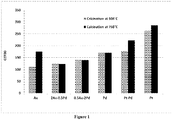
- Figure 1 is a chart which shows how the temperature for conversion of 80% CO varies after thermal ageing at 750 °C for 10 hrs for catalyst compositions i.e. 2Pd-0.5Au-CeO 2 and 0.5Pd-2Au-CeO 2 and comparative catalyst compositions i.e. Au-CeO 2 , Pd- CeO 2 , Pt-Pd-CeO 2 , and Pt-CeO 2 (impregnated), relative to fresh samples of the same catalysts, i.e. calcined at 500 °C for 2hrs.
- catalyst compositions i.e. 2Pd-0.5Au-CeO 2 and 0.5Pd-2Au-CeO 2
- comparative catalyst compositions i.e. Au-CeO 2 , Pd- CeO 2 , Pt-Pd-CeO 2 , and Pt-CeO 2 (impregnated), relative to fresh samples of the same catalysts, i.e. calc
- Figure 1 clearly shows that the catalyst compositions have enhanced thermal stability as compared to comparative catalyst compositions.
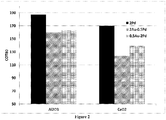
- Figure 2 is a chart which shows how the temperature for conversion of 50% CO varies when the catalyst composition has been subjected to sustained calcination for 10 hours at 750 °C for the catalyst compositions i.e. 2Pd-0.5Au-CeO 2 and 0.5Pd-2Au-CeO 2 and comparative catalyst compositions i.e. Pd-Al 2 O 3 , 2Au-0.5Pd-Al 2 O 3 ,0.5Au-2Pd- Al 2 O 3 .
- Figure 2 clearly shows that the catalyst composition where the promoter is ceria has higher activity due to the combined effect of the Au-Pd interaction with the ceria as compared to the alumina.
- Figure 3 is a chart which shows how the temperature for conversion of 70% CO varies when the catalyst composition is clean and after sulphation at 300 °C and high temperature desulphation for the catalyst compositions i.e. 2Pd-0.5Au-CeO 2 and 0.5Pd-2Au-CeO 2 and comparative catalyst compositions i.e. 2Pd-CeO 2 .
- Figure 3 clearly shows that the catalyst composition where the Au is coupled to Pd that the Pd-Au alloy enriched in Au has enhanced sulphur tolerance and is less affected by the high temperature desulphation process compared to the metal, i.e. Pd, alone.
- the catalyst composition provides lower light off temperatures for both CO and HC conversion as compared to known catalyst compositions in the art. Furthermore the catalyst activity is maintained in the presence of high CO levels, i.e. at engine start up, the catalyst composition is thermally stable and can be readily sulphated and desulphated without significantly compromising its catalytic activity.
Landscapes
- Chemical & Material Sciences (AREA)
- Engineering & Computer Science (AREA)
- Chemical Kinetics & Catalysis (AREA)
- Materials Engineering (AREA)
- Organic Chemistry (AREA)
- Combustion & Propulsion (AREA)
- Health & Medical Sciences (AREA)
- Environmental & Geological Engineering (AREA)
- Mechanical Engineering (AREA)
- General Chemical & Material Sciences (AREA)
- Analytical Chemistry (AREA)
- Oil, Petroleum & Natural Gas (AREA)
- Biomedical Technology (AREA)
- General Engineering & Computer Science (AREA)
- Toxicology (AREA)
- Metallurgy (AREA)
- Catalysts (AREA)
- Exhaust Gas After Treatment (AREA)
- Exhaust Gas Treatment By Means Of Catalyst (AREA)
- Processes For Solid Components From Exhaust (AREA)
Claims (13)
- Katalytischer Konverter, der einen Substratmonolithen umfasst, der mit einer Katalysatorzusammensetzung beschichtet ist, die einen Mischmetallkatalysator umfasst, wobei der katalytische Konverter Folgendes umfasst:unlegiertes Palladium (Pd) und Palladium-Gold-Legierung (Pd-Au-Legierung), die auf einem Träger angeordnet sind, und wobei das Atomverhältnis von Pd:Au in dem Mischmetallkatalysator von 95:5 bis 80:20 beträgt; undmindestens einen Promotor, wobei der Promotor mindestens ein reduzierbares Metalloxid umfasst, wobei der mindestens eine Promotor der Träger für den Mischmetallkatalysator ist und wobei der Promotor und der Träger Ceroxid sind.
- Katalytischer Konverter nach Anspruch 1, wobei die Menge an Palladium (Pd) und Gold (Au) in dem Mischmetallkatalysator von 0,5-10 Gew.-% beträgt.
- Katalytischer Konverter nach einem der vorhergehenden Ansprüche, wobei das mindestens eine reduzierbare Oxid mit einem Stabilisator kombiniert oder in einem Verbund- oder Mischoxid mit einem refraktären Oxid kombiniert ist.
- Katalytischer Konverter nach einem der vorhergehenden Ansprüche, wobei der Träger mit einem basischen Metall dotiert ist.
- Katalytischer Konverter nach einem der vorhergehenden Ansprüche, wobei die Katalysatorzusammensetzung weiterhin Platin umfasst, das sich auf einem separaten und anderen Metalloxidträger zu dem Mischmetallkatalysator befindet.
- Katalytischer Konverter nach Anspruch 5, wobei das Platin, das sich auf einem separaten und anderen Metalloxidträger befindet, und der Mischmetallkatalysator in derselben Washcoat-Schicht angeordnet sind.
- Katalytischer Konverter nach Anspruch 5, wobei das Platin, das sich auf einem separaten und anderen Metalloxidträger befindet, in einer Schicht unter einer Deckschicht, die den Mischmetallkatalysator umfasst, angeordnet ist.
- Katalytischer Konverter nach Anspruch 5, wobei der separate und andere Metalloxidträger ebenfalls Palladium enthält.
- Katalytischer Konverter nach Anspruch 8, wobei das Platin, das sich auf einem separaten und anderen Metalloxidträger befindet, und außerdem Palladium und der Mischmetallkatalysator in derselben Washcoat-Schicht angeordnet sind.
- Katalytischer Konverter nach Anspruch 8, wobei das Platin, das sich auf einem separaten und anderen Metalloxidträger befindet, und außerdem Palladium in einer Schicht unter einer Deckschicht, die den Mischmetallkatalysator umfasst, angeordnet sind.
- Katalytischer Konverter nach einem der vorhergehenden Ansprüche, wobei der Substratmonolith ein Wabendurchflussmonolith oder ein Filter ist.
- Magerverbrennungsmotorabgasbehandlungssystem, das einen katalytischen Konverter nach einem der vorhergehenden Ansprüche umfasst.
- Vorrichtung, die einen Magerverbrennungsmotor und ein Magerverbrennungsmotorabgasbehandlungssystem nach Anspruch 12 umfasst.
Applications Claiming Priority (3)
| Application Number | Priority Date | Filing Date | Title |
|---|---|---|---|
| US201261661607P | 2012-06-19 | 2012-06-19 | |
| GBGB1210891.6A GB201210891D0 (en) | 2012-06-19 | 2012-06-20 | Catalyst composition |
| PCT/GB2013/051501 WO2013190268A1 (en) | 2012-06-19 | 2013-06-07 | Catalyst composition |
Publications (2)
| Publication Number | Publication Date |
|---|---|
| EP2861345A1 EP2861345A1 (de) | 2015-04-22 |
| EP2861345B1 true EP2861345B1 (de) | 2019-01-09 |
Family
ID=46641188
Family Applications (1)
| Application Number | Title | Priority Date | Filing Date |
|---|---|---|---|
| EP13728802.3A Not-in-force EP2861345B1 (de) | 2012-06-19 | 2013-06-07 | Katalysatorzusammensetzung |
Country Status (10)
| Country | Link |
|---|---|
| US (1) | US9243539B2 (de) |
| EP (1) | EP2861345B1 (de) |
| JP (1) | JP6348110B2 (de) |
| KR (1) | KR20150021055A (de) |
| CN (1) | CN104428062A (de) |
| BR (1) | BR112014031489A2 (de) |
| DE (1) | DE102013210557A1 (de) |
| GB (2) | GB201210891D0 (de) |
| RU (1) | RU2635092C2 (de) |
| WO (1) | WO2013190268A1 (de) |
Families Citing this family (8)
| Publication number | Priority date | Publication date | Assignee | Title |
|---|---|---|---|---|
| US9034269B2 (en) | 2012-11-29 | 2015-05-19 | Basf Se | Diesel oxidation catalyst comprising palladium, gold and ceria |
| WO2015134470A1 (en) * | 2014-03-04 | 2015-09-11 | Prism Analytical Technologies, Inc. | Formaldehyde emission reduction in natural gas fired reciprocating internal combustion engines (rice) |
| WO2017004414A1 (en) * | 2015-07-01 | 2017-01-05 | Basf Corporation | Nitrous oxide removal catalysts for exhaust systems |
| KR101964275B1 (ko) | 2015-09-01 | 2019-04-01 | 주식회사 엘지화학 | 아크릴산 제조용 촉매 제조방법 및 이로부터 제조되는 촉매 |
| KR102268466B1 (ko) * | 2019-09-27 | 2021-06-24 | 한국과학기술원 | 완전 분산과 환원된 금속 상태를 갖는 고내구성 금속 앙상블 촉매 |
| US12320288B2 (en) * | 2019-10-18 | 2025-06-03 | Umicore Shokubai Japan Co., Ltd. | Exhaust gas purification catalyst, method of purifying exhaust gas, and method of manufacturing exhaust gas purification catalyst |
| KR102391273B1 (ko) * | 2020-06-23 | 2022-04-27 | 한국과학기술원 | 백금 단일 원자 촉매 및 이의 제조 방법 |
| CN112675845B (zh) * | 2020-12-28 | 2022-03-29 | 四川大学 | 一种用于天然气车尾气净化的Pd-Rh单涂层催化剂及其制备方法 |
Family Cites Families (27)
| Publication number | Priority date | Publication date | Assignee | Title |
|---|---|---|---|---|
| DE10020170C1 (de) | 2000-04-25 | 2001-09-06 | Emitec Emissionstechnologie | Verfahren zum Entfernen von Rußpartikeln aus einem Abgas und zugehöriges Auffangelement |
| GB2122912A (en) | 1982-06-29 | 1984-01-25 | Johnson Matthey Plc | Exhaust gas purification catalyst |
| DE4127918A1 (de) * | 1991-03-05 | 1992-09-10 | Interox Int Sa | Verfahren zur herstellung von wasserstoffperoxid |
| CA2097609C (en) | 1991-10-03 | 1999-03-16 | Shinichi Takeshima | Device for purifying exhaust of internal combustion engine |
| GB9226434D0 (en) | 1992-12-18 | 1993-02-10 | Johnson Matthey Plc | Catalyst |
| US5347046A (en) * | 1993-05-25 | 1994-09-13 | Engelhard Corporation | Catalyst and process for using same for the preparation of unsaturated carboxylic acid esters |
| ZA963235B (en) * | 1995-06-15 | 1996-10-25 | Engelhard Corp | Diesel exhaust stream treating catalyst and method of use |
| JP3387290B2 (ja) | 1995-10-02 | 2003-03-17 | トヨタ自動車株式会社 | 排ガス浄化用フィルター |
| JP3384255B2 (ja) * | 1996-07-11 | 2003-03-10 | 株式会社日立製作所 | 内燃機関排ガスの浄化方法 |
| JP3876634B2 (ja) * | 2001-03-14 | 2007-02-07 | トヨタ自動車株式会社 | 合金触媒と排気ガス浄化用触媒の製造方法 |
| JP2005538301A (ja) | 2002-09-13 | 2005-12-15 | ジョンソン、マッセイ、パブリック、リミテッド、カンパニー | 圧縮着火機関排ガスの処理方法 |
| JP2004209403A (ja) * | 2003-01-06 | 2004-07-29 | Nissan Motor Co Ltd | 排気ガス浄化触媒 |
| CN100515564C (zh) * | 2004-07-08 | 2009-07-22 | 日产自动车株式会社 | 催化剂、废气净化催化剂及其制造方法 |
| EP1721665A1 (de) * | 2005-05-13 | 2006-11-15 | HTE Aktiengesellschaft The High Throughput Experimentation Company | Katalysator zur Abgasbehandlung und Verfahren zu seiner Herstellung |
| US7534738B2 (en) * | 2006-11-27 | 2009-05-19 | Nanostellar, Inc. | Engine exhaust catalysts containing palladium-gold |
| KR101051874B1 (ko) * | 2007-01-17 | 2011-07-25 | 나노스텔라 인코포레이티드 | 팔라듐-금을 함유하는 엔진 배기가스 촉매 |
| KR100865362B1 (ko) * | 2007-03-28 | 2008-10-24 | 희성촉매 주식회사 | 디젤산화 활성이 개선된 Pd-Au 적용 디젤산화촉매 |
| DE102007025362A1 (de) * | 2007-05-31 | 2008-12-11 | Süd-Chemie AG | Dotierter Pd/Au-Schalenkatalysator, Verfahren zu dessen Herstellung sowie dessen Verwendung |
| JP2009011951A (ja) * | 2007-07-05 | 2009-01-22 | Toyota Motor Corp | 合金クラスター触媒 |
| DE102007047430A1 (de) * | 2007-10-04 | 2009-04-09 | Evonik Degussa Gmbh | Katalysator |
| GB0808427D0 (en) * | 2008-05-09 | 2008-06-18 | Johnson Matthey Plc | Apparatus |
| US8071504B2 (en) * | 2008-12-19 | 2011-12-06 | Caterpillar Inc. | Exhaust system having a gold-platinum group metal catalyst |
| US8415269B2 (en) | 2009-01-21 | 2013-04-09 | WGCH Technology Limited | Palladium-gold catalyst synthesis |
| CN101698149B (zh) * | 2009-10-14 | 2012-11-07 | 安立敦 | 储存性能稳定的负载型金-pgm合金催化剂及其制备方法 |
| US8765625B2 (en) * | 2009-12-10 | 2014-07-01 | Shubin, Inc. | Engine exhaust catalysts containing copper-ceria |
| RU2428769C1 (ru) * | 2010-04-08 | 2011-09-10 | Учреждение Российской академии наук Институт катализа им. Г.К. Борескова Сибирского отделения РАН | Способ приготовления биметаллического катализатора (варианты) и его применение для топливных элементов |
| GB201110850D0 (en) * | 2011-03-04 | 2011-08-10 | Johnson Matthey Plc | Catalyst and mehtod of preparation |
-
2012
- 2012-06-20 GB GBGB1210891.6A patent/GB201210891D0/en not_active Ceased
-
2013
- 2013-06-06 DE DE102013210557.6A patent/DE102013210557A1/de not_active Withdrawn
- 2013-06-07 US US13/912,248 patent/US9243539B2/en not_active Expired - Fee Related
- 2013-06-07 GB GB1310148.0A patent/GB2504819B/en not_active Expired - Fee Related
- 2013-06-07 KR KR20147035736A patent/KR20150021055A/ko not_active Withdrawn
- 2013-06-07 JP JP2015517837A patent/JP6348110B2/ja not_active Expired - Fee Related
- 2013-06-07 WO PCT/GB2013/051501 patent/WO2013190268A1/en not_active Ceased
- 2013-06-07 RU RU2015101227A patent/RU2635092C2/ru not_active IP Right Cessation
- 2013-06-07 BR BR112014031489A patent/BR112014031489A2/pt not_active Application Discontinuation
- 2013-06-07 EP EP13728802.3A patent/EP2861345B1/de not_active Not-in-force
- 2013-06-07 CN CN201380032446.6A patent/CN104428062A/zh active Pending
Non-Patent Citations (1)
| Title |
|---|
| None * |
Also Published As
| Publication number | Publication date |
|---|---|
| KR20150021055A (ko) | 2015-02-27 |
| DE102013210557A1 (de) | 2014-02-13 |
| GB2504819B (en) | 2015-08-26 |
| RU2635092C2 (ru) | 2017-11-09 |
| US9243539B2 (en) | 2016-01-26 |
| JP2015521540A (ja) | 2015-07-30 |
| BR112014031489A2 (pt) | 2017-06-27 |
| EP2861345A1 (de) | 2015-04-22 |
| RU2015101227A (ru) | 2016-08-10 |
| JP6348110B2 (ja) | 2018-06-27 |
| GB2504819A (en) | 2014-02-12 |
| GB201310148D0 (en) | 2013-07-24 |
| CN104428062A (zh) | 2015-03-18 |
| GB201210891D0 (en) | 2012-08-01 |
| US20130333362A1 (en) | 2013-12-19 |
| WO2013190268A1 (en) | 2013-12-27 |
Similar Documents
| Publication | Publication Date | Title |
|---|---|---|
| EP2861345B1 (de) | Katalysatorzusammensetzung | |
| US10449518B2 (en) | Zoned diesel oxidation catalyst | |
| EP2922631B1 (de) | Russfilter mit katalysator zur behandlung von abgasen eines selbszündungsmotors | |
| JP6007306B2 (ja) | アンモニア酸化触媒、および排気ガス浄化装置並びに排気ガス浄化方法 | |
| JP5806131B2 (ja) | NOx吸蔵脱硝触媒 | |
| KR101953402B1 (ko) | NOx 흡수제 촉매 | |
| US8551411B2 (en) | Exhaust system for lean-burn internal combustion engine comprising Pd-Au-alloy catalyst | |
| GB2514204A (en) | Oxidation catalyst for a compression ignition engine | |
| JP2007534467A (ja) | リーンバーンエンジンからの排気ガスから汚染物質を除去するための酸化鉄で安定化された貴金属触媒 | |
| JP2010029752A (ja) | 排気ガス浄化触媒装置、並びに排気ガス浄化方法 | |
| KR20050052497A (ko) | 압축 점화 엔진 및 그것을 위한 배기 시스템 | |
| US8986637B2 (en) | Bimetallic catalyst | |
| EP3097977A1 (de) | Abgasreinigungskatalysator für magermotor | |
| US11305260B2 (en) | Catalyst for gasoline engine exhaust gas aftertreatment | |
| JP2001079402A (ja) | 排ガス浄化触媒及びその製造方法 |
Legal Events
| Date | Code | Title | Description |
|---|---|---|---|
| PUAI | Public reference made under article 153(3) epc to a published international application that has entered the european phase |
Free format text: ORIGINAL CODE: 0009012 |
|
| 17P | Request for examination filed |
Effective date: 20141128 |
|
| AK | Designated contracting states |
Kind code of ref document: A1 Designated state(s): AL AT BE BG CH CY CZ DE DK EE ES FI FR GB GR HR HU IE IS IT LI LT LU LV MC MK MT NL NO PL PT RO RS SE SI SK SM TR |
|
| AX | Request for extension of the european patent |
Extension state: BA ME |
|
| DAX | Request for extension of the european patent (deleted) | ||
| 17Q | First examination report despatched |
Effective date: 20160610 |
|
| STAA | Information on the status of an ep patent application or granted ep patent |
Free format text: STATUS: EXAMINATION IS IN PROGRESS |
|
| GRAP | Despatch of communication of intention to grant a patent |
Free format text: ORIGINAL CODE: EPIDOSNIGR1 |
|
| STAA | Information on the status of an ep patent application or granted ep patent |
Free format text: STATUS: GRANT OF PATENT IS INTENDED |
|
| INTG | Intention to grant announced |
Effective date: 20180727 |
|
| GRAS | Grant fee paid |
Free format text: ORIGINAL CODE: EPIDOSNIGR3 |
|
| GRAA | (expected) grant |
Free format text: ORIGINAL CODE: 0009210 |
|
| STAA | Information on the status of an ep patent application or granted ep patent |
Free format text: STATUS: THE PATENT HAS BEEN GRANTED |
|
| RBV | Designated contracting states (corrected) |
Designated state(s): AL AT BE BG CH CY CZ DE DK EE ES FI FR GR HR HU IE IS IT LI LT LU LV MC MK MT NL NO PL PT RO RS SE SI SK SM TR |
|
| RIN1 | Information on inventor provided before grant (corrected) |
Inventor name: PHILLIPS, PAUL RICHARD Inventor name: RAJ, AGNES SUGANYA Inventor name: RAJARAM, RAJ RAO |
|
| AK | Designated contracting states |
Kind code of ref document: B1 Designated state(s): AL AT BE BG CH CY CZ DE DK EE ES FI FR GR HR HU IE IS IT LI LT LU LV MC MK MT NL NO PL PT RO RS SE SI SK SM TR |
|
| REG | Reference to a national code |
Ref country code: CH Ref legal event code: EP Ref country code: AT Ref legal event code: REF Ref document number: 1086633 Country of ref document: AT Kind code of ref document: T Effective date: 20190115 |
|
| REG | Reference to a national code |
Ref country code: DE Ref legal event code: R096 Ref document number: 602013049540 Country of ref document: DE |
|
| REG | Reference to a national code |
Ref country code: IE Ref legal event code: FG4D |
|
| REG | Reference to a national code |
Ref country code: NL Ref legal event code: MP Effective date: 20190109 |
|
| REG | Reference to a national code |
Ref country code: LT Ref legal event code: MG4D |
|
| PG25 | Lapsed in a contracting state [announced via postgrant information from national office to epo] |
Ref country code: NL Free format text: LAPSE BECAUSE OF FAILURE TO SUBMIT A TRANSLATION OF THE DESCRIPTION OR TO PAY THE FEE WITHIN THE PRESCRIBED TIME-LIMIT Effective date: 20190109 |
|
| REG | Reference to a national code |
Ref country code: AT Ref legal event code: MK05 Ref document number: 1086633 Country of ref document: AT Kind code of ref document: T Effective date: 20190109 |
|
| PG25 | Lapsed in a contracting state [announced via postgrant information from national office to epo] |
Ref country code: FI Free format text: LAPSE BECAUSE OF FAILURE TO SUBMIT A TRANSLATION OF THE DESCRIPTION OR TO PAY THE FEE WITHIN THE PRESCRIBED TIME-LIMIT Effective date: 20190109 Ref country code: LT Free format text: LAPSE BECAUSE OF FAILURE TO SUBMIT A TRANSLATION OF THE DESCRIPTION OR TO PAY THE FEE WITHIN THE PRESCRIBED TIME-LIMIT Effective date: 20190109 Ref country code: PL Free format text: LAPSE BECAUSE OF FAILURE TO SUBMIT A TRANSLATION OF THE DESCRIPTION OR TO PAY THE FEE WITHIN THE PRESCRIBED TIME-LIMIT Effective date: 20190109 Ref country code: PT Free format text: LAPSE BECAUSE OF FAILURE TO SUBMIT A TRANSLATION OF THE DESCRIPTION OR TO PAY THE FEE WITHIN THE PRESCRIBED TIME-LIMIT Effective date: 20190509 Ref country code: ES Free format text: LAPSE BECAUSE OF FAILURE TO SUBMIT A TRANSLATION OF THE DESCRIPTION OR TO PAY THE FEE WITHIN THE PRESCRIBED TIME-LIMIT Effective date: 20190109 Ref country code: SE Free format text: LAPSE BECAUSE OF FAILURE TO SUBMIT A TRANSLATION OF THE DESCRIPTION OR TO PAY THE FEE WITHIN THE PRESCRIBED TIME-LIMIT Effective date: 20190109 Ref country code: NO Free format text: LAPSE BECAUSE OF FAILURE TO SUBMIT A TRANSLATION OF THE DESCRIPTION OR TO PAY THE FEE WITHIN THE PRESCRIBED TIME-LIMIT Effective date: 20190409 |
|
| PG25 | Lapsed in a contracting state [announced via postgrant information from national office to epo] |
Ref country code: GR Free format text: LAPSE BECAUSE OF FAILURE TO SUBMIT A TRANSLATION OF THE DESCRIPTION OR TO PAY THE FEE WITHIN THE PRESCRIBED TIME-LIMIT Effective date: 20190410 Ref country code: HR Free format text: LAPSE BECAUSE OF FAILURE TO SUBMIT A TRANSLATION OF THE DESCRIPTION OR TO PAY THE FEE WITHIN THE PRESCRIBED TIME-LIMIT Effective date: 20190109 Ref country code: RS Free format text: LAPSE BECAUSE OF FAILURE TO SUBMIT A TRANSLATION OF THE DESCRIPTION OR TO PAY THE FEE WITHIN THE PRESCRIBED TIME-LIMIT Effective date: 20190109 Ref country code: IS Free format text: LAPSE BECAUSE OF FAILURE TO SUBMIT A TRANSLATION OF THE DESCRIPTION OR TO PAY THE FEE WITHIN THE PRESCRIBED TIME-LIMIT Effective date: 20190509 Ref country code: LV Free format text: LAPSE BECAUSE OF FAILURE TO SUBMIT A TRANSLATION OF THE DESCRIPTION OR TO PAY THE FEE WITHIN THE PRESCRIBED TIME-LIMIT Effective date: 20190109 Ref country code: BG Free format text: LAPSE BECAUSE OF FAILURE TO SUBMIT A TRANSLATION OF THE DESCRIPTION OR TO PAY THE FEE WITHIN THE PRESCRIBED TIME-LIMIT Effective date: 20190409 |
|
| REG | Reference to a national code |
Ref country code: DE Ref legal event code: R097 Ref document number: 602013049540 Country of ref document: DE |
|
| PG25 | Lapsed in a contracting state [announced via postgrant information from national office to epo] |
Ref country code: AT Free format text: LAPSE BECAUSE OF FAILURE TO SUBMIT A TRANSLATION OF THE DESCRIPTION OR TO PAY THE FEE WITHIN THE PRESCRIBED TIME-LIMIT Effective date: 20190109 Ref country code: IT Free format text: LAPSE BECAUSE OF FAILURE TO SUBMIT A TRANSLATION OF THE DESCRIPTION OR TO PAY THE FEE WITHIN THE PRESCRIBED TIME-LIMIT Effective date: 20190109 Ref country code: RO Free format text: LAPSE BECAUSE OF FAILURE TO SUBMIT A TRANSLATION OF THE DESCRIPTION OR TO PAY THE FEE WITHIN THE PRESCRIBED TIME-LIMIT Effective date: 20190109 Ref country code: CZ Free format text: LAPSE BECAUSE OF FAILURE TO SUBMIT A TRANSLATION OF THE DESCRIPTION OR TO PAY THE FEE WITHIN THE PRESCRIBED TIME-LIMIT Effective date: 20190109 Ref country code: SK Free format text: LAPSE BECAUSE OF FAILURE TO SUBMIT A TRANSLATION OF THE DESCRIPTION OR TO PAY THE FEE WITHIN THE PRESCRIBED TIME-LIMIT Effective date: 20190109 Ref country code: AL Free format text: LAPSE BECAUSE OF FAILURE TO SUBMIT A TRANSLATION OF THE DESCRIPTION OR TO PAY THE FEE WITHIN THE PRESCRIBED TIME-LIMIT Effective date: 20190109 Ref country code: EE Free format text: LAPSE BECAUSE OF FAILURE TO SUBMIT A TRANSLATION OF THE DESCRIPTION OR TO PAY THE FEE WITHIN THE PRESCRIBED TIME-LIMIT Effective date: 20190109 Ref country code: DK Free format text: LAPSE BECAUSE OF FAILURE TO SUBMIT A TRANSLATION OF THE DESCRIPTION OR TO PAY THE FEE WITHIN THE PRESCRIBED TIME-LIMIT Effective date: 20190109 |
|
| PLBE | No opposition filed within time limit |
Free format text: ORIGINAL CODE: 0009261 |
|
| STAA | Information on the status of an ep patent application or granted ep patent |
Free format text: STATUS: NO OPPOSITION FILED WITHIN TIME LIMIT |
|
| PG25 | Lapsed in a contracting state [announced via postgrant information from national office to epo] |
Ref country code: SM Free format text: LAPSE BECAUSE OF FAILURE TO SUBMIT A TRANSLATION OF THE DESCRIPTION OR TO PAY THE FEE WITHIN THE PRESCRIBED TIME-LIMIT Effective date: 20190109 |
|
| 26N | No opposition filed |
Effective date: 20191010 |
|
| REG | Reference to a national code |
Ref country code: DE Ref legal event code: R119 Ref document number: 602013049540 Country of ref document: DE |
|
| PG25 | Lapsed in a contracting state [announced via postgrant information from national office to epo] |
Ref country code: MC Free format text: LAPSE BECAUSE OF FAILURE TO SUBMIT A TRANSLATION OF THE DESCRIPTION OR TO PAY THE FEE WITHIN THE PRESCRIBED TIME-LIMIT Effective date: 20190109 |
|
| REG | Reference to a national code |
Ref country code: CH Ref legal event code: PL |
|
| PG25 | Lapsed in a contracting state [announced via postgrant information from national office to epo] |
Ref country code: SI Free format text: LAPSE BECAUSE OF FAILURE TO SUBMIT A TRANSLATION OF THE DESCRIPTION OR TO PAY THE FEE WITHIN THE PRESCRIBED TIME-LIMIT Effective date: 20190109 |
|
| REG | Reference to a national code |
Ref country code: BE Ref legal event code: MM Effective date: 20190630 |
|
| PG25 | Lapsed in a contracting state [announced via postgrant information from national office to epo] |
Ref country code: TR Free format text: LAPSE BECAUSE OF FAILURE TO SUBMIT A TRANSLATION OF THE DESCRIPTION OR TO PAY THE FEE WITHIN THE PRESCRIBED TIME-LIMIT Effective date: 20190109 |
|
| PG25 | Lapsed in a contracting state [announced via postgrant information from national office to epo] |
Ref country code: IE Free format text: LAPSE BECAUSE OF NON-PAYMENT OF DUE FEES Effective date: 20190607 Ref country code: DE Free format text: LAPSE BECAUSE OF NON-PAYMENT OF DUE FEES Effective date: 20200101 |
|
| PG25 | Lapsed in a contracting state [announced via postgrant information from national office to epo] |
Ref country code: LI Free format text: LAPSE BECAUSE OF NON-PAYMENT OF DUE FEES Effective date: 20190630 Ref country code: CH Free format text: LAPSE BECAUSE OF NON-PAYMENT OF DUE FEES Effective date: 20190630 Ref country code: LU Free format text: LAPSE BECAUSE OF NON-PAYMENT OF DUE FEES Effective date: 20190607 Ref country code: BE Free format text: LAPSE BECAUSE OF NON-PAYMENT OF DUE FEES Effective date: 20190630 |
|
| PG25 | Lapsed in a contracting state [announced via postgrant information from national office to epo] |
Ref country code: FR Free format text: LAPSE BECAUSE OF NON-PAYMENT OF DUE FEES Effective date: 20190630 |
|
| PG25 | Lapsed in a contracting state [announced via postgrant information from national office to epo] |
Ref country code: CY Free format text: LAPSE BECAUSE OF FAILURE TO SUBMIT A TRANSLATION OF THE DESCRIPTION OR TO PAY THE FEE WITHIN THE PRESCRIBED TIME-LIMIT Effective date: 20190109 |
|
| PG25 | Lapsed in a contracting state [announced via postgrant information from national office to epo] |
Ref country code: MT Free format text: LAPSE BECAUSE OF FAILURE TO SUBMIT A TRANSLATION OF THE DESCRIPTION OR TO PAY THE FEE WITHIN THE PRESCRIBED TIME-LIMIT Effective date: 20190109 Ref country code: HU Free format text: LAPSE BECAUSE OF FAILURE TO SUBMIT A TRANSLATION OF THE DESCRIPTION OR TO PAY THE FEE WITHIN THE PRESCRIBED TIME-LIMIT; INVALID AB INITIO Effective date: 20130607 |
|
| PG25 | Lapsed in a contracting state [announced via postgrant information from national office to epo] |
Ref country code: MK Free format text: LAPSE BECAUSE OF FAILURE TO SUBMIT A TRANSLATION OF THE DESCRIPTION OR TO PAY THE FEE WITHIN THE PRESCRIBED TIME-LIMIT Effective date: 20190109 |