EP2844383B1 - Water repellent organopolysiloxane materials - Google Patents
Water repellent organopolysiloxane materials Download PDFInfo
- Publication number
- EP2844383B1 EP2844383B1 EP13720910.2A EP13720910A EP2844383B1 EP 2844383 B1 EP2844383 B1 EP 2844383B1 EP 13720910 A EP13720910 A EP 13720910A EP 2844383 B1 EP2844383 B1 EP 2844383B1
- Authority
- EP
- European Patent Office
- Prior art keywords
- microcapsules
- water
- water repellent
- product
- composition
- Prior art date
- Legal status (The legal status is an assumption and is not a legal conclusion. Google has not performed a legal analysis and makes no representation as to the accuracy of the status listed.)
- Active
Links
Images
Classifications
-
- C—CHEMISTRY; METALLURGY
- C04—CEMENTS; CONCRETE; ARTIFICIAL STONE; CERAMICS; REFRACTORIES
- C04B—LIME, MAGNESIA; SLAG; CEMENTS; COMPOSITIONS THEREOF, e.g. MORTARS, CONCRETE OR LIKE BUILDING MATERIALS; ARTIFICIAL STONE; CERAMICS; REFRACTORIES; TREATMENT OF NATURAL STONE
- C04B24/00—Use of organic materials as active ingredients for mortars, concrete or artificial stone, e.g. plasticisers
- C04B24/40—Compounds containing silicon, titanium or zirconium or other organo-metallic compounds; Organo-clays; Organo-inorganic complexes
- C04B24/42—Organo-silicon compounds
-
- B—PERFORMING OPERATIONS; TRANSPORTING
- B01—PHYSICAL OR CHEMICAL PROCESSES OR APPARATUS IN GENERAL
- B01J—CHEMICAL OR PHYSICAL PROCESSES, e.g. CATALYSIS OR COLLOID CHEMISTRY; THEIR RELEVANT APPARATUS
- B01J13/00—Colloid chemistry, e.g. the production of colloidal materials or their solutions, not otherwise provided for; Making microcapsules or microballoons
- B01J13/02—Making microcapsules or microballoons
- B01J13/06—Making microcapsules or microballoons by phase separation
- B01J13/14—Polymerisation; cross-linking
- B01J13/18—In situ polymerisation with all reactants being present in the same phase
-
- C—CHEMISTRY; METALLURGY
- C04—CEMENTS; CONCRETE; ARTIFICIAL STONE; CERAMICS; REFRACTORIES
- C04B—LIME, MAGNESIA; SLAG; CEMENTS; COMPOSITIONS THEREOF, e.g. MORTARS, CONCRETE OR LIKE BUILDING MATERIALS; ARTIFICIAL STONE; CERAMICS; REFRACTORIES; TREATMENT OF NATURAL STONE
- C04B20/00—Use of materials as fillers for mortars, concrete or artificial stone according to more than one of groups C04B14/00 - C04B18/00 and characterised by shape or grain distribution; Treatment of materials according to more than one of the groups C04B14/00 - C04B18/00 specially adapted to enhance their filling properties in mortars, concrete or artificial stone; Expanding or defibrillating materials
- C04B20/10—Coating or impregnating
- C04B20/1051—Organo-metallic compounds; Organo-silicon compounds, e.g. bentone
-
- C—CHEMISTRY; METALLURGY
- C04—CEMENTS; CONCRETE; ARTIFICIAL STONE; CERAMICS; REFRACTORIES
- C04B—LIME, MAGNESIA; SLAG; CEMENTS; COMPOSITIONS THEREOF, e.g. MORTARS, CONCRETE OR LIKE BUILDING MATERIALS; ARTIFICIAL STONE; CERAMICS; REFRACTORIES; TREATMENT OF NATURAL STONE
- C04B28/00—Compositions of mortars, concrete or artificial stone, containing inorganic binders or the reaction product of an inorganic and an organic binder, e.g. polycarboxylate cements
- C04B28/02—Compositions of mortars, concrete or artificial stone, containing inorganic binders or the reaction product of an inorganic and an organic binder, e.g. polycarboxylate cements containing hydraulic cements other than calcium sulfates
-
- C—CHEMISTRY; METALLURGY
- C04—CEMENTS; CONCRETE; ARTIFICIAL STONE; CERAMICS; REFRACTORIES
- C04B—LIME, MAGNESIA; SLAG; CEMENTS; COMPOSITIONS THEREOF, e.g. MORTARS, CONCRETE OR LIKE BUILDING MATERIALS; ARTIFICIAL STONE; CERAMICS; REFRACTORIES; TREATMENT OF NATURAL STONE
- C04B38/00—Porous mortars, concrete, artificial stone or ceramic ware; Preparation thereof
- C04B38/10—Porous mortars, concrete, artificial stone or ceramic ware; Preparation thereof by using foaming agents or by using mechanical means, e.g. adding preformed foam
-
- C—CHEMISTRY; METALLURGY
- C04—CEMENTS; CONCRETE; ARTIFICIAL STONE; CERAMICS; REFRACTORIES
- C04B—LIME, MAGNESIA; SLAG; CEMENTS; COMPOSITIONS THEREOF, e.g. MORTARS, CONCRETE OR LIKE BUILDING MATERIALS; ARTIFICIAL STONE; CERAMICS; REFRACTORIES; TREATMENT OF NATURAL STONE
- C04B41/00—After-treatment of mortars, concrete, artificial stone or ceramics; Treatment of natural stone
- C04B41/009—After-treatment of mortars, concrete, artificial stone or ceramics; Treatment of natural stone characterised by the material treated
-
- C—CHEMISTRY; METALLURGY
- C04—CEMENTS; CONCRETE; ARTIFICIAL STONE; CERAMICS; REFRACTORIES
- C04B—LIME, MAGNESIA; SLAG; CEMENTS; COMPOSITIONS THEREOF, e.g. MORTARS, CONCRETE OR LIKE BUILDING MATERIALS; ARTIFICIAL STONE; CERAMICS; REFRACTORIES; TREATMENT OF NATURAL STONE
- C04B41/00—After-treatment of mortars, concrete, artificial stone or ceramics; Treatment of natural stone
- C04B41/45—Coating or impregnating, e.g. injection in masonry, partial coating of green or fired ceramics, organic coating compositions for adhering together two concrete elements
- C04B41/46—Coating or impregnating, e.g. injection in masonry, partial coating of green or fired ceramics, organic coating compositions for adhering together two concrete elements with organic materials
- C04B41/49—Compounds having one or more carbon-to-metal or carbon-to-silicon linkages ; Organo-clay compounds; Organo-silicates, i.e. ortho- or polysilicic acid esters ; Organo-phosphorus compounds; Organo-inorganic complexes
- C04B41/4905—Compounds having one or more carbon-to-metal or carbon-to-silicon linkages ; Organo-clay compounds; Organo-silicates, i.e. ortho- or polysilicic acid esters ; Organo-phosphorus compounds; Organo-inorganic complexes containing silicon
- C04B41/495—Compounds having one or more carbon-to-metal or carbon-to-silicon linkages ; Organo-clay compounds; Organo-silicates, i.e. ortho- or polysilicic acid esters ; Organo-phosphorus compounds; Organo-inorganic complexes containing silicon applied to the substrate as oligomers or polymers
- C04B41/4961—Polyorganosiloxanes, i.e. polymers with a Si-O-Si-O-chain; "silicones"
-
- C—CHEMISTRY; METALLURGY
- C04—CEMENTS; CONCRETE; ARTIFICIAL STONE; CERAMICS; REFRACTORIES
- C04B—LIME, MAGNESIA; SLAG; CEMENTS; COMPOSITIONS THEREOF, e.g. MORTARS, CONCRETE OR LIKE BUILDING MATERIALS; ARTIFICIAL STONE; CERAMICS; REFRACTORIES; TREATMENT OF NATURAL STONE
- C04B41/00—After-treatment of mortars, concrete, artificial stone or ceramics; Treatment of natural stone
- C04B41/45—Coating or impregnating, e.g. injection in masonry, partial coating of green or fired ceramics, organic coating compositions for adhering together two concrete elements
- C04B41/50—Coating or impregnating, e.g. injection in masonry, partial coating of green or fired ceramics, organic coating compositions for adhering together two concrete elements with inorganic materials
- C04B41/502—Water
-
- C—CHEMISTRY; METALLURGY
- C04—CEMENTS; CONCRETE; ARTIFICIAL STONE; CERAMICS; REFRACTORIES
- C04B—LIME, MAGNESIA; SLAG; CEMENTS; COMPOSITIONS THEREOF, e.g. MORTARS, CONCRETE OR LIKE BUILDING MATERIALS; ARTIFICIAL STONE; CERAMICS; REFRACTORIES; TREATMENT OF NATURAL STONE
- C04B41/00—After-treatment of mortars, concrete, artificial stone or ceramics; Treatment of natural stone
- C04B41/60—After-treatment of mortars, concrete, artificial stone or ceramics; Treatment of natural stone of only artificial stone
- C04B41/61—Coating or impregnation
- C04B41/62—Coating or impregnation with organic materials
- C04B41/64—Compounds having one or more carbon-to-metal of carbon-to-silicon linkages
-
- C—CHEMISTRY; METALLURGY
- C08—ORGANIC MACROMOLECULAR COMPOUNDS; THEIR PREPARATION OR CHEMICAL WORKING-UP; COMPOSITIONS BASED THEREON
- C08L—COMPOSITIONS OF MACROMOLECULAR COMPOUNDS
- C08L83/00—Compositions of macromolecular compounds obtained by reactions forming in the main chain of the macromolecule a linkage containing silicon with or without sulfur, nitrogen, oxygen or carbon only; Compositions of derivatives of such polymers
- C08L83/04—Polysiloxanes
-
- B—PERFORMING OPERATIONS; TRANSPORTING
- B27—WORKING OR PRESERVING WOOD OR SIMILAR MATERIAL; NAILING OR STAPLING MACHINES IN GENERAL
- B27K—PROCESSES, APPARATUS OR SELECTION OF SUBSTANCES FOR IMPREGNATING, STAINING, DYEING, BLEACHING OF WOOD OR SIMILAR MATERIALS, OR TREATING OF WOOD OR SIMILAR MATERIALS WITH PERMEANT LIQUIDS, NOT OTHERWISE PROVIDED FOR; CHEMICAL OR PHYSICAL TREATMENT OF CORK, CANE, REED, STRAW OR SIMILAR MATERIALS
- B27K2240/00—Purpose of the treatment
- B27K2240/70—Hydrophobation treatment
-
- B—PERFORMING OPERATIONS; TRANSPORTING
- B27—WORKING OR PRESERVING WOOD OR SIMILAR MATERIAL; NAILING OR STAPLING MACHINES IN GENERAL
- B27K—PROCESSES, APPARATUS OR SELECTION OF SUBSTANCES FOR IMPREGNATING, STAINING, DYEING, BLEACHING OF WOOD OR SIMILAR MATERIALS, OR TREATING OF WOOD OR SIMILAR MATERIALS WITH PERMEANT LIQUIDS, NOT OTHERWISE PROVIDED FOR; CHEMICAL OR PHYSICAL TREATMENT OF CORK, CANE, REED, STRAW OR SIMILAR MATERIALS
- B27K3/00—Impregnating wood, e.g. impregnation pretreatment, for example puncturing; Wood impregnation aids not directly involved in the impregnation process
- B27K3/02—Processes; Apparatus
- B27K3/15—Impregnating involving polymerisation including use of polymer-containing impregnating agents
- B27K3/153—Without in-situ polymerisation, condensation, or cross-linking reactions
-
- C—CHEMISTRY; METALLURGY
- C04—CEMENTS; CONCRETE; ARTIFICIAL STONE; CERAMICS; REFRACTORIES
- C04B—LIME, MAGNESIA; SLAG; CEMENTS; COMPOSITIONS THEREOF, e.g. MORTARS, CONCRETE OR LIKE BUILDING MATERIALS; ARTIFICIAL STONE; CERAMICS; REFRACTORIES; TREATMENT OF NATURAL STONE
- C04B2103/00—Function or property of ingredients for mortars, concrete or artificial stone
- C04B2103/0045—Polymers chosen for their physico-chemical characteristics
- C04B2103/0052—Hydrophobic polymers
-
- C—CHEMISTRY; METALLURGY
- C04—CEMENTS; CONCRETE; ARTIFICIAL STONE; CERAMICS; REFRACTORIES
- C04B—LIME, MAGNESIA; SLAG; CEMENTS; COMPOSITIONS THEREOF, e.g. MORTARS, CONCRETE OR LIKE BUILDING MATERIALS; ARTIFICIAL STONE; CERAMICS; REFRACTORIES; TREATMENT OF NATURAL STONE
- C04B2103/00—Function or property of ingredients for mortars, concrete or artificial stone
- C04B2103/0045—Polymers chosen for their physico-chemical characteristics
- C04B2103/0058—Core-shell polymers
-
- C—CHEMISTRY; METALLURGY
- C04—CEMENTS; CONCRETE; ARTIFICIAL STONE; CERAMICS; REFRACTORIES
- C04B—LIME, MAGNESIA; SLAG; CEMENTS; COMPOSITIONS THEREOF, e.g. MORTARS, CONCRETE OR LIKE BUILDING MATERIALS; ARTIFICIAL STONE; CERAMICS; REFRACTORIES; TREATMENT OF NATURAL STONE
- C04B2103/00—Function or property of ingredients for mortars, concrete or artificial stone
- C04B2103/40—Surface-active agents, dispersants
-
- C—CHEMISTRY; METALLURGY
- C04—CEMENTS; CONCRETE; ARTIFICIAL STONE; CERAMICS; REFRACTORIES
- C04B—LIME, MAGNESIA; SLAG; CEMENTS; COMPOSITIONS THEREOF, e.g. MORTARS, CONCRETE OR LIKE BUILDING MATERIALS; ARTIFICIAL STONE; CERAMICS; REFRACTORIES; TREATMENT OF NATURAL STONE
- C04B2111/00—Mortars, concrete or artificial stone or mixtures to prepare them, characterised by specific function, property or use
- C04B2111/20—Resistance against chemical, physical or biological attack
- C04B2111/27—Water resistance, i.e. waterproof or water-repellent materials
-
- C—CHEMISTRY; METALLURGY
- C08—ORGANIC MACROMOLECULAR COMPOUNDS; THEIR PREPARATION OR CHEMICAL WORKING-UP; COMPOSITIONS BASED THEREON
- C08L—COMPOSITIONS OF MACROMOLECULAR COMPOUNDS
- C08L2205/00—Polymer mixtures characterised by other features
- C08L2205/02—Polymer mixtures characterised by other features containing two or more polymers of the same C08L -group
- C08L2205/025—Polymer mixtures characterised by other features containing two or more polymers of the same C08L -group containing two or more polymers of the same hierarchy C08L, and differing only in parameters such as density, comonomer content, molecular weight, structure
-
- C—CHEMISTRY; METALLURGY
- C08—ORGANIC MACROMOLECULAR COMPOUNDS; THEIR PREPARATION OR CHEMICAL WORKING-UP; COMPOSITIONS BASED THEREON
- C08L—COMPOSITIONS OF MACROMOLECULAR COMPOUNDS
- C08L2207/00—Properties characterising the ingredient of the composition
- C08L2207/53—Core-shell polymer
Definitions
- This invention relates to water repellent materials used to treat porous substrates with a high tendency to absorb water in order to reduce water absorption.
- porous substrates are cementitious substrates, clay-based bricks, gypsum-based substrates, lime-based substrates or wood-based substrates.
- Organosilicon materials such as organopolysiloxanes or organosilanes have been used as water repellents for porous substrates. They have been used as coatings on the porous substrate or as additives incorporated into the porous substrate, for example incorporated into a cementitious composition before it is set.
- EP 0811584 describes a granulated hydrophobing additive in cement.
- the granulated additive comprises an active organopolysiloxane component, a water-soluble or water dispersible binder and water-soluble, water-insoluble or water dispersible carrier particles.
- the additive is readily dispersible in cementitious materials upon the addition of water due to the non-hydrophobic nature of the binder and carrier of the granules.
- WO 2008/062018 describes a process for preparing a granulated hydrophobing additive for cementitious material in which an organosilicon component and a binder polymer are applied to a particulate carrier from aqueous emulsion.
- the granulated hydrophobic additive thus prepared provides a high initial hydrophobicity to cementitious materials to which it is applied and the hydrophobicity can last during a long period of time.
- US 6268423 describes building compositions containing hydrophobing powders comprising silica as support material and an organosilicon compound and optionally solvent and/or water and emulsifier.
- US 2012/0101227 discloses aqueous suspensions of silicate shell microcapsules wherein a first portion of the silicate shell micro-capsules contain an organopolysiloxane having at least two alkenyl groups and a hydrosilylation catalyst as Part A of a curable siloxane composition, and a second portion of the silicate shell microcapsules contain an organohydrogensiloxane as Part B of the curable siloxane composition.
- US 6251313 discloses the preparation of microcapsules having shell walls of organopolysiloxane and a core material, where the shell walls are produced in situ by hydrolysis and polycondensation of organosilanes and/or their condensates having not more than 4 silicon atoms.
- US 2004/0256748 relates to a process for preparing silica microcapsules and more particularly, to a process for preparing silica microcapsules comprising the steps of dissolving tetraethyl orthosilicate (TEOS) into an aqueous solution containing a hydrolysis catalyst to control a degree of hydrolysis and contribute hydrophilicity or lipophilicity, adding a core material and an appropriate amount of aminopropyltrialkoxysilane(APS) as a gelling agent into the solution, and emulsifying and dispersing the resulting solution to a solution having a polarity opposite to that of the core material to microcapsulate by coating the core material with silica shell via a sol-gel reaction.
- TEOS tetraethyl orthosilicate
- EP 0811584 discloses a cementitious material in powder form comprising cement, also comprising sufficient of a granulated hydrophobing additive, which comprises from 5 to 15 parts by weight of an organopolysiloxane component, from 10 to 40 parts by weight of a water-soluble or water-dispersible binder and from 50 to 80 parts by weight of a carrier particle, to give from 0.01 to 5% by weight of the organosiloxane component based on the weight of the cement.
- a granulated hydrophobing additive which comprises from 5 to 15 parts by weight of an organopolysiloxane component, from 10 to 40 parts by weight of a water-soluble or water-dispersible binder and from 50 to 80 parts by weight of a carrier particle, to give from 0.01 to 5% by weight of the organosiloxane component based on the weight of the cement.
- An additive according to the present invention for increasing the hydrophobicity of a porous product comprises microcapsules comprising a water repellent organopolysiloxane core material and a shell of a silicon-based network polymer comprising silica units.
- a water-reactive silicon compound comprising a tetraalkoxysilane is added to an aqueous emulsion of a water repellent organopolysiloxane, whereby the water-reactive silicon compound condenses and polymerises at the interface of the droplets in the emulsion to form microcapsules.
- the water repellent organopolysiloxane is a material based on a Si-O-Si polymer chain and may comprise mono-functional, di-functional, tri-functional and/or tetra-functional siloxane units. It is preferred that the majority of siloxane units are di-functional units having the general formula RR'SiO 2/2 wherein R and R' each independently denotes an organic component or a hydroxyl or hydrogen substituent.
- R and R' are selected from alkyl groups, alkenyl groups, aryl groups, alkyl-aryl groups or aryl-alkyl groups. More preferably a substantial part, most preferably a majority of the R substituents will be alkyl groups having from 1 to 12 carbon atoms, most preferably methyl or ethyl groups.
- the organopolysiloxane comprises for example polydimethylsiloxane (PDMS), alternatively, the organopolysiloxane is polydimethylsiloxane.
- the PDMS can for example be a hydroxyl-terminated PDMS or a trimethylsilyl-terminated PDMS.
- the organopolysiloxane may comprise methylalkylsiloxane units in which the said alkyl group contains 2-20 carbon atoms, particularly those in which the said alkyl group contains 6-20 carbon atoms.
- a polymer is a dimethyl methyloctyl siloxane copolymer sold by Dow Corning under the product name 16-846.
- Blends of organopolysiloxanes can be used, for example a blend of a methylalkylsiloxane polymer with a linear PDMS.
- R groups of the organopolysiloxane can be alkyl groups bearing an alkoxysilyl moiety, for example a trialkoxysilyl moiety.
- An example of such a polyorganosiloxane is the dimethyl methyloctyl methyl(triethoxysilyl)propyl siloxane copolymer sold by Dow Corning under the product name 16-606.
- siloxane units are di-functional siloxane units
- other units such as tri-functional or tetra-functional units may also be present resulting in the polymer chain exhibiting a certain amount of branching.
- resinous organopolysiloxane materials may be used such as a condensation product of a partially hydrolysed trialkoxysilane. Blends of such resinous organopolysiloxane materials with a linear polyorganosiloxane such as PDMS can be used.
- the total number of siloxane units is preferably such that the organopolysiloxane material has a viscosity in the range of from 1 to 120,000 mm 2 /s at 25°C.
- a trimethylsilyl-terminated PDMS for example may preferably have a viscosity in the range of from 100 to 80,000 mm 2 /s at 25°C.
- the organopolysiloxane can have a higher viscosity if desired; this can for example be achieved by carrying out polymerisation within the emulsion droplets.
- a water-reactive silicon compound comprising a tetraalkoxysilane is added to an aqueous emulsion of a water repellent organopolysiloxane.
- the water repellent organopolysiloxane composition is emulsified in an aqueous medium preferably with the aid of a surfactant.
- the particle size (particle diameter) of the emulsion of water repellent organopolysiloxane is generally in the range 0.01 to 500, preferably 0,1 to 50 micrometres.
- the emulsion can alternatively be a microemulsion of particle size 10-150 nm.
- the surfactant can be a cationic, non-ionic or amphoteric surfactant.
- Cationic and/or amphoteric surfactants which readily form an emulsion of positive zeta-potential, may be preferred.
- a positive zeta-potential promotes condensation and polymerisation of the tetraalkoxysilane at the interface of the emulsified droplets of the water repellent organopolysiloxane, as described in EP 1471995 .
- Nonionic surfactants can be used either alone or in conjunction with a cationic or amphoteric surfactant; for example the cationic or amphoteric surfactant can be mixed with up to an equal weight of nonionic surfactant.
- cationic surfactants include quaternary ammonium hydroxides such as octyl trimethyl ammonium hydroxide, dodecyl trimethyl ammonium hydroxide, hexadecyl trimethyl ammonium hydroxide, octyl dimethyl benzyl ammonium hydroxide, decyl dimethyl benzyl ammonium hydroxide, didodecyl dimethyl ammonium hydroxide, dioctadecyl dimethyl ammonium hydroxide, tallow trimethyl ammonium hydroxide and coco trimethyl ammonium hydroxide as well as corresponding salts of these materials.
- quaternary ammonium hydroxides such as octyl trimethyl ammonium hydroxide, dodecyl trimethyl ammonium hydroxide, hexadecyl trimethyl ammonium hydroxide, octyl dimethyl benzyl ammonium hydroxide, decyl dimethyl benzy
- Chloride salts may be preferred, for example hexadecyl trimethyl ammonium chloride.
- suitable cationic surfactants include fatty amines and fatty acid amides and their derivatives, basic pyridinium compounds, quaternary ammonium bases of benzimidazolines and polypropanolpolyethanol amines.
- Cationic surfactants containing an organosilicon group can be used.
- An example of such a surfactant is N-octadecyl-N,N-dimethyl-trimethoxysilylpropylammonium chloride of the formula
- cationic alkoxysilanes may be more valuable when added after formation of the emulsion to act as a deposition aid, as described below.
- amphoteric surfactants include cocamidopropyl betaine, cocamidopropyl hydroxysulfate, cocobetaine, sodium cocoamidoacetate, cocodimethyl betaine, N-coco-3-aminobutyric acid and imidazolinium carboxyl compounds.
- the above surfactants may be used individually or in combination.
- non-ionic surfactants include polyoxyalkylene alkyl ethers such as polyethylene glycol long chain (12-14C) alkyl ether, polyoxyalkylene sorbitan ethers, polyoxyalkylene alkoxylate esters, polyoxyalkylene alkylphenol ethers, ethylene glycol propylene glycol copolymers, polyvinyl alcohol and alkylpolysaccharides, for example materials of the structure R 1 -O-(R 2 O) m -(G) n wherein R 1 represents a linear or branched alkyl group, a linear or branched alkenyl group or an alkylphenyl group, R 2 represent an alkylene group, G represents a reduced sugar, m denotes 0 or a positive integer and n represent a positive integer as described in US Patent 5,035,832 .
- polyoxyalkylene alkyl ethers such as polyethylene glycol long chain (12-14C) alkyl ether, polyoxyalkylene
- the concentration of surfactant in the aqueous emulsion of water repellent organopolysiloxane can be between 0.01 and 5% by weight, but is preferably below 2%, most preferably 0.02 to 1 by weight of the emulsion, particularly 0.05-0.5%.
- the weight ratio of oil (organopolysiloxane) phase to aqueous phase in the emulsion can generally be between 40:1 and 1:50, although the higher proportions of aqueous phase are economically disadvantageous particularly when forming an emulsion of microcapsules.
- the weight ratio of oil phase to aqueous phase is between 2:1 and 1:3.
- a phase inversion process can be used in which the oil phase is mixed with surfactant and a small amount of water, for example 2.5 to 10% by weight based on the oil phase, forming a water-in-oil emulsion which inverts to an oil-in-water emulsion as it is sheared. Further water can then be added to dilute the emulsion to the required concentration.
- the continuous phase of the emulsion can be a mixture of water with a water-miscible organic solvent such as an alcohol or lactam provided that the continuous phase is not miscible with the water repellent organopolysiloxane.
- the particle size of the emulsion of lipophilic active material can be reduced before addition of the water-reactive silicon compound, for example in an apparatus applying increased shear such as a homogeniser or microfluidiser, or a sonolator (ultrasonic mixer), producing an emulsion of microcapsules of particle size 200 nm to 10 ⁇ m, most preferably between 2 ⁇ m and 5 ⁇ m.
- the particle size of the microcapsules produced generally corresponds to the particle size of the starting emulsion and can for example be in the range 0.01-500 ⁇ m, most preferably 200 nm to 10 ⁇ m. If microcapsules of particle size 10-500 ⁇ m, particularly up to 50 or 100 ⁇ m are required, the aqueous phase of the emulsion preferably contains a thickener, for example polyvinylpyrrolidone, polyvinyl alcohol, bentonite clay, a cellulose derivative, particularly a cellulose ether such as sodium carboxymethylcellulose, a lightly crosslinked acrylic polymer, modified starch, an alginate or xanthan gum, to inhibit settling of the microcapsules from the emulsion during formation or subsequently.
- the thickener is added to the emulsion before addition of the tetraalkoxysilane.
- the water reactive silicon compound comprises a tetraalkoxysilane, for example tetraethoxysilane (tetraethyl orthosilicate or TEOS).
- tetraethoxysilane tetraethyl orthosilicate or TEOS
- TEOS tetraethyl orthosilicate
- the tetraalkoxysilane such as TEOS can be used in monomeric form or as a liquid partial condensate.
- the tetraalkoxysilane can be used alone or in conjunction with one or more other water-reactive silicon compound having at least two, preferably at least three, Si-OH groups or hydrolysable groups bonded to silicon, for example an alkyltrialkoxysilane such as methyltrimethoxysilane or a liquid condensate of an alkyltrialkoxysilane.
- Hydrolysable groups can for example be alkoxy or acyloxy groups bonded to silicon.
- the water reactive silicon compound can for example comprise 75-100% by weight tetraalkoxysilane and 0-25% trialkoxysilane.
- the alkyl and alkoxy groups in the tetraalkoxysilanes or other silanes preferably contain 1 to 4 carbon atoms, most preferably 1 or 2 carbon atoms.
- the water-reactive silicon compound preferably consists of at least 75%, and most preferably 90-100% tetraalkoxysilane.
- a tetraalkoxysilane is the most effective silicon compound for forming microcapsules, forming a 3-dimensional network consisting substantially of SiO 4/2 units.
- tri, di and monoalkoxysilanes are used in conjunction with the tetraalkoxysilane to provide organofunctions to the silica shell.
- the tri, di and monoalkoxysilanes react with the tetraalkoxysilane so that organofunctional units derived from the tri, di and monoalkoxysilane are incorporated into the network polymer which forms the shell of the microcapsules.
- a cationic alkoxysilane is used in conjunction with the tetraalkoxysilane.
- N-octadecyl-N,N-dimethyl-trimethoxysilylpropylammonium chloride is an example of such a cationic alkoxysilane.
- the cationic alkoxysilane improves the deposition of the microcapsules on a substrate from suspension, and is thus advantageous when a suspension of the microcapsules of water repellent organosilicon material is to be applied to the surface of a preformed porous product.
- the cationic alkoxysilane is added to the aqueous emulsion before or simultaneously with the tetraalkoxysilane.
- the cationic alkoxysilane reacts with the tetraalkoxysilane so that siloxane units derived from the cationic alkoxysilane are incorporated into the network polymer which forms the shell of the microcapsules.
- the tetraalkoxysilane, and other water reactive silicon compound if used, can be added to the emulsion of water repellent organopolysiloxane as an undiluted liquid or as a solution in an organic solvent.
- the tetraalkoxysilane and the emulsion are generally mixed under shear during addition and subsequently during condensation to form the silicon-based polymer shell on the surface of the emulsified droplets.
- Mixing can for example be by stirring, but it is preferred that the emulsion and the tetraalkoxysilane are subjected to high shear, for example in a mixer of the rotor and stator type such as a Silverson (trade mark) mixer, either during addition of the tetraalkoxysilane or after addition of the tetraalkoxysilane and before formation of microcapsules is complete.
- High shear mixing immediately after addition of the tetraalkoxysilane is preferred. This leads to microcapsules of reduced particle size and appears to promote polymerisation of substantially all the tetraalkoxysilane at the interface of the emulsion droplets.
- the condensation reaction of the water reactive silicon compound can be conducted at acidic, neutral or basic pH.
- the condensation reaction is generally carried out at ambient temperature and pressure, but can be carried out at increased temperature, for example up to 95°C, and increased or decreased pressure, for example under vacuum to strip the volatile alcohol produced during the condensation reaction.
- the weight ratio of water repellent organopolysiloxane to water reactive silicon compound is preferably at least 0.5:1 and in many cases may be at least 1.5:1, for example 2:1 to 20:1. Smaller microcapsules, for example those formed from a microemulsion, generally have a lower ratio of water repellent organopolysiloxane to water reactive silicon compound.
- a catalyst for hydrolysis and/or condensation of the water reactive silicon compound to form the silicon-based network polymer may be used.
- the catalyst is preferably an oil soluble organic metal compound, for example an organic tin compound, particularly an organotin compound such as a diorganotin diester, for example dimethyl tin di(neodecanoate), dibutyl tin dilaurate or dibutyl tin diacetate, or alternatively a tin carboxylate such as stannous octoate, or an organic titanium compound such as tetrabutyl titanate.
- An organotin catalyst can for example be used at 0.05 to 2% by weight based on the water reactive silicon compound.
- An organotin catalyst has the advantage of effective catalysis at neutral pH.
- a catalyst is most preferably mixed with the water repellent organopolysiloxane before it is emulsified, since this promotes condensation of the water reactive silicon compound at the surface of the emulsified organopolysiloxane droplets.
- a catalyst can alternatively be added to the emulsion before the addition of the water-reactive silicon compound, or simultaneously with the water-reactive silicon compound, or after the addition of the water-reactive silicon compound to harden and make more impervious the shell of silicon-based polymer which has been formed. Encapsulation can however be achieved without catalyst.
- the catalyst when used, can be added undiluted, or as a solution in an organic solvent such as a hydrocarbon, alcohol or ketone, or as a multiphasic system such as an emulsion or suspension.
- the product of hydrolysis and condensation of the water reactive silicon compound is an aqueous suspension of microcapsules.
- the aqueous continuous phase can contain water miscible organic solvent; for example it usually contains an alcohol such as ethanol generated by hydrolysis of Si-bonded alkoxy groups. It may be advantageous to use the suspension of microcapsules as an additive to a porous product without separating the microcapsules from the suspension.
- microcapsules isolated from the aqueous media it may be advantageous to work with the microcapsules isolated from the aqueous media.
- recovery or isolation of the microcapsules from the suspension can be achieved by any known liquid removal technique, for example by spray drying, spray chilling, filtering, oven drying or lyophilisation.
- microcapsules can further be surface treated in suspension or in isolated (dry) form by the addition of tri, di or monoalkoxysilanes.
- Surface treatment of the microcapsules may modify compatibility, pH resistance, mechanical strength of said microcapsules.
- the hydrophobicity of a porous product can be increased by treating the product, or a composition providing for a porous product, with an aqueous suspension of microcapsules produced by the process of the invention as described above, optionally after dilution.
- This has particular advantage in post-treatment of an already formed porous product.
- post-treatment is generally carried out using an emulsion of a water repellent, but this leaves surfactant on the surface of the porous product.
- the clearest visible evidence of water repellency is 'beading', that is the formation of separated water droplets when a surface is wetted. Treatment with an emulsion does not achieve 'beading' at least initially.
- Treatment with the aqueous suspension of microcapsules according to the invention is a low surfactant delivery system and can achieve 'beading' immediately after application.
- concentration of the water repellent organopolysiloxane in the suspension of microcapsules applied to the formed porous product is preferably in the range 0.5% to 10% by weight, more preferably 1 to 5%, of the suspension.
- the microcapsules are used in the invention for treating cementitious substrates, clay-based substrates, gypsum-based substrates, lime-based substrates or wood-based substrates.
- the cementitious substrate can for example be a cement block, concrete, aerated cement or fibre reinforced cement.
- the clay-based substrate can for example be a brick, tile or pipe.
- the gypsum-based substrate can for example be plaster, gypsum panel, gypsum base.
- the lime-based substrate can for example be lime render.
- the wood-based substrate can for example be wood such as wood board or wood chips; or engineered wood such as laminated wood; plywood; OSB (Oriented Strand Board); particle board; fibre board such as insulation board, MDF (Medium Density Fiberboard) or the like.
- a suspension of the microcapsules of the invention has a much lower surfactant content than an emulsion of the same water repellent organosilicon material, resulting in a surface that is less wettable.
- microcapsules of the invention have the further advantage when treating porous construction materials, for example concrete or wood, that they also make the surface of the porous product oil repellent.
- the very low level of surfactant applied to the porous substrate by applying the microcapsules, compared to application of an emulsion, allows the water and oil repellent properties of the organopolysiloxane to be more effectively used.
- a water repellent cementitious product can be produced by adding the microcapsules of the invention to a cementitious composition and shaping and hardening the composition to form the cementitious product.
- the cementitious composition can for example be concrete, aerated cement or fibre reinforced cement.
- the microcapsules can be added to the cementitious composition as an aqueous suspension of microcapsules produced as described above, or the microcapsules can be isolated from suspension before being added to the cementitious composition.
- the microcapsules are preferably added to the cementitious composition at a concentration of 0.05 to 2 % by weight water repellent organopolysiloxane based on the cementitious composition.
- a water repellent brick or tile product can be produced by adding the microcapsules of the invention to a clay based composition and shaping and hardening the clay based composition to form the brick or tile product.
- the microcapsules can be added to the clay based composition as an aqueous suspension of microcapsules or as isolated microcapsules.
- the microcapsules are preferably added to the clay composition at a concentration of 0.05 to 2 % by weight water repellent organopolysiloxane based on the clay composition.
- the microcapsules of the invention have the advantage that the water repellent is initially kept apart from the composition by the shell wall.
- the water repellent does not interfere with the hydrating reaction of the cement because the microcapsules survive for a time.
- the high pH of the cementitious composition eventually dissolves the shell wall so that the water repellent organopolysiloxane is released throughout the composition to form a uniformly water repellent cementitious product.
- a cementitious product in which the microcapsules of the invention are particularly advantageous is an aerated cement product.
- the microcapsules can be added to a foamable cementitious composition.
- a foamable cementitious composition For example an aqueous suspension of microcapsules or isolated microcapsules can be added to the foamable cementitious composition.
- Hydrophobic materials effective as water repellents are generally also foam suppressants.
- the water repellent is kept apart from the foamable composition by the shell wall of the microcapsules for a long enough time for foaming of the composition to take place.
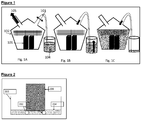
- Figures 1 and 2 relate to evaluation of efficiency in hydrophobing wood substrates.
- microcapsules comprised a core of PDMS and a shell of a network polymer of TEOS comprising silica units and cationic siloxane units derived from the N-octadecyl-N,N-dimethyl-trimethoxysilylpropylammonium chloride.
- the suspension of microcapsules was diluted with water so that it contained 5% PDMS.
- the diluted suspension was sprayed onto the surface of preformed concrete blocks of size 4 x 4 x 16 cm. Two samples were treated; the amount of diluted suspension applied is shown in Table 1.
- the speed of development of the hydrophobic properties was assessed by placing a drop of water on the surface of the treated blocks at measured times after application of the water repellent. After 10 minutes, the droplet was wiped off and the residual mark on the concrete blocks was rated according to the following scale.
- Comparative example C1 the lower particle size emulsion produced in the first stage of Example 1 was diluted to a concentration of 5% PDMS. This diluted emulsion was tested in the same way as the microcapsule suspension of Example 1.
- Example 1 The suspension of microcapsules produced in Example 1 was diluted with water so that it contained 3% PDMS (Example 2) or 1% PDMS (Example 3). The diluted suspension was sprayed onto the surface of preformed concrete blocks and tested as described in Example 1. The amounts applied and the test results are shown in Table 1.
- Table 1 Example Concentration of PDMS Application rate (g) Test results after 30 minutes Test results after 5 hours No treatment 6 ; 6 6 ; 6 Example 1 5% 0.28 ; 0.24 1 ; 1 1 ; 1 Comparative example C1 5% 0.22 ; 0.26 5 ; 5 6 ; 5 Example 2 3% 0.39 ; 0.33 1 ; 2 1 ; 2 Example 3 1% 0.38 ; 0.30 2 ; 3 2 ; 3
- Example 1 the suspension of microcapsules used in Example 1 impart much better hydrophobic properties than the emulsion from which the microcapsules are produced Comparative example 1. Even when the suspension of microcapsules is diluted further in Examples 2 and 3 it imparts better hydrophobic properties than the emulsion of Comparative example C1. The results obtained 30 minutes after application show the extremely quick development of hydrophobic properties achieved by the suspension of microcapsules of the present invention.
- Example 1 The suspension of Example 1 and the emulsion of Comparative example C1 were tested again using a higher rate of application.
- the "drop entry time" was recorded in addition to the test rating 10 minutes after placing of the water drop.
- Drop entry time is the time required to have a 50 ⁇ l water droplet completely absorbed by the treated substrates.
- Table 2 No treatment Example 1 Comparative example C1 Application rate 2.19g 2.17g Test result after 45 mins 6 1 5 Drop entry time after 45 mins 15 mins 2 hour 15 mins 30 mins Test result after 3 hours 6 1 5 Drop entry time after 3 hours 15 mins 2 hour 45 mins 50 mins Test result after 24 hours 6 1 5 Drop entry time after 24 hours 6 mins 3 hours 70 mins
- the drop entry times confirm the superior hydrophobic properties of the concrete blocks treated with the suspension of microcapsules of the invention.
- Example 4 25% water repellent silanol terminated PDMS of viscosity 50 000 mm2/s at 25°C was emulsified in 66.2% water containing 0.11% hexadecyl trimethyl ammonium chloride cationic surfactant using a high shear rotor stator mixer. 3.2% N-octadecyl-N,N-dimethyl-trimethoxysilylpropylammonium chloride was added to the emulsion produced. 4.8% TEOS was added to the emulsion while stirring. Microcapsules of median diameter 3 ⁇ m were produced in suspension.
- microcapsules comprised a core of silanol terminated PDMS and a shell of a network polymer of TEOS comprising silica units and cationic siloxane units derived from the N-octadecyl-N,N-dimethyl-trimethoxysilylpropylammonium chloride.
- Comparative example C2 is a non-ionic emulsion of 60 000 mm 2 /s trimethyl-terminated PDMS.
- Example 4 and Comparative example C2 were tested for efficiency in hydrophobing wood substrates following a method of wood treatment via impregnation, and subsequent water absorption of said treated wood, versus untreated wood.
- the impregnation level is measured by weight difference before impregnation and after impregnation + drying steps.
- Weight absorption is calculated as a percentage based on the weight before absorption and the weight after absorption of water.
- Table 3 Water uptake (% of dry wood samples weight) as a function of time in hours (hours) 0 h 1 h 3 h 6 h 8 h 24 h Comparative example C2 0 8,4 13,1 18,1 20,6 33,8 Example 4 0 2,8 5,0 7,3 8,4 13,9 No treatment 0 18,5 25,2 32,1 35,4 51,3
Landscapes
- Chemical & Material Sciences (AREA)
- Engineering & Computer Science (AREA)
- Ceramic Engineering (AREA)
- Organic Chemistry (AREA)
- Materials Engineering (AREA)
- Structural Engineering (AREA)
- Chemical Kinetics & Catalysis (AREA)
- Inorganic Chemistry (AREA)
- Polymers & Plastics (AREA)
- Medicinal Chemistry (AREA)
- Health & Medical Sciences (AREA)
- Dispersion Chemistry (AREA)
- Life Sciences & Earth Sciences (AREA)
- Wood Science & Technology (AREA)
- Forests & Forestry (AREA)
- Materials Applied To Surfaces To Minimize Adherence Of Mist Or Water (AREA)
- Manufacturing Of Micro-Capsules (AREA)
- Silicon Polymers (AREA)
- Aftertreatments Of Artificial And Natural Stones (AREA)
- Curing Cements, Concrete, And Artificial Stone (AREA)
Applications Claiming Priority (2)
| Application Number | Priority Date | Filing Date | Title |
|---|---|---|---|
| GB201207662A GB201207662D0 (en) | 2012-05-02 | 2012-05-02 | Water repellent organopolysiloxane materials |
| PCT/EP2013/059081 WO2013164381A1 (en) | 2012-05-02 | 2013-05-02 | Water repellent organopolysiloxane materials |
Publications (2)
| Publication Number | Publication Date |
|---|---|
| EP2844383A1 EP2844383A1 (en) | 2015-03-11 |
| EP2844383B1 true EP2844383B1 (en) | 2018-04-04 |
Family
ID=46330668
Family Applications (1)
| Application Number | Title | Priority Date | Filing Date |
|---|---|---|---|
| EP13720910.2A Active EP2844383B1 (en) | 2012-05-02 | 2013-05-02 | Water repellent organopolysiloxane materials |
Country Status (9)
| Country | Link |
|---|---|
| US (1) | US20150087747A1 (enExample) |
| EP (1) | EP2844383B1 (enExample) |
| JP (1) | JP6178408B2 (enExample) |
| CN (1) | CN104271226B (enExample) |
| GB (1) | GB201207662D0 (enExample) |
| IN (1) | IN2014DN09957A (enExample) |
| RU (1) | RU2634780C2 (enExample) |
| SG (1) | SG11201406783PA (enExample) |
| WO (1) | WO2013164381A1 (enExample) |
Families Citing this family (8)
| Publication number | Priority date | Publication date | Assignee | Title |
|---|---|---|---|---|
| KR102554516B1 (ko) * | 2017-01-30 | 2023-07-13 | 다우 도레이 캄파니 리미티드 | 콘크리트 구조물용 코팅제 |
| JP6926925B2 (ja) * | 2017-10-17 | 2021-08-25 | 信越化学工業株式会社 | シリカ被覆シリコーンエラストマー球状粒子の製造方法及びシリカ被覆シリコーンエラストマー球状粒子 |
| KR102196117B1 (ko) * | 2018-11-06 | 2020-12-30 | 박명주 | 건축물의 콘크리트 구조체의 미세기공에 대한 침투율을 조절할 수 있는 콘크리트 보호재의 제조방법 및 이를 이용하여 제조된 건축물의 콘크리트 보호재 |
| CN111410454A (zh) * | 2019-01-08 | 2020-07-14 | 疏科纳米疏水科技(嘉兴)有限公司 | 一种制备高效内掺型纳米超疏水混凝土或水泥砂浆的方法 |
| US20230131818A1 (en) * | 2020-03-17 | 2023-04-27 | Dow Toray Co., Ltd. | Cement composition and cured product thereof |
| WO2021187520A1 (ja) * | 2020-03-17 | 2021-09-23 | ダウ・東レ株式会社 | プレキャストコンクリート成形体 |
| CN111908860B (zh) * | 2020-07-09 | 2021-12-21 | 长安大学 | 寒区裂缝自愈合超高性能水泥基复合材料及制备方法 |
| JP7870143B2 (ja) * | 2021-03-24 | 2026-06-04 | Muマテックス株式会社 | モルタル組成物及びモルタル硬化体 |
Family Cites Families (16)
| Publication number | Priority date | Publication date | Assignee | Title |
|---|---|---|---|---|
| GB701668A (en) * | 1950-12-23 | 1953-12-30 | Cowles Chem Co | Cementitious composition |
| SU621366A1 (ru) * | 1976-02-04 | 1978-09-19 | Украинская Ордена Трудового Красного Знамени Сельскохозяйственная Академия | Способ микрокапсулировани |
| SE419747C (sv) * | 1979-02-15 | 1984-10-22 | Siporex Int Ab | Sett vid framstellning av angherdad gasbetong med vattenavvisande egenskaper |
| SU872518A1 (ru) * | 1979-12-12 | 1981-10-15 | Военный Инженерный Краснознаменный Институт Им.А.Ф.Можайского | Эмульси дл поверхностной гидрофобизации бетонных покрытий |
| US5356716A (en) * | 1992-09-04 | 1994-10-18 | Patel Pratim R | Waterproofing sealer/repellent compositions for concrete, masonry and porous surfaces |
| JPH0931449A (ja) * | 1995-07-24 | 1997-02-04 | Matsushita Electric Ind Co Ltd | 表面処理剤及びその使用方法 |
| FR2745816A1 (fr) * | 1996-03-06 | 1997-09-12 | Rhone Poulenc Chimie | Particules composites comprenant un polymere organique et un oxyde, particules creuses a base d'oxyde, leur preparation et leurs utilisations |
| GB9611776D0 (en) * | 1996-06-06 | 1996-08-07 | Dow Corning | Cementitious materials |
| FR2789679B1 (fr) * | 1999-02-12 | 2001-03-30 | Lafarge Platres | Element de construction prefabrique a base de platre, presentant une resistance a l'eau |
| CN101331093A (zh) * | 2005-11-04 | 2008-12-24 | Sika技术股份公司 | 降低腐蚀的用途和方法 |
| FR2897863B1 (fr) * | 2006-02-28 | 2008-07-11 | Bpb Plc | Procede d'hydrofugation d'un produit a base de gypse forme a partir d'une composition a base de platre |
| GB0623232D0 (en) * | 2006-11-22 | 2007-01-03 | Dow Corning | Cementitious materials |
| GB0818864D0 (en) * | 2008-10-15 | 2008-11-19 | Dow Corning | Fabric and fibre conditioning additives |
| WO2011002695A1 (en) * | 2009-07-01 | 2011-01-06 | Dow Corning Corporation | Microcapsules containing curable siloxanes |
| US8980377B1 (en) * | 2011-04-22 | 2015-03-17 | Eduard A. Stefanescu | Clay-based concrete sealer |
| GB201207664D0 (en) * | 2012-05-02 | 2012-06-13 | Dow Corning | Water repellent organosilicon |
-
2012
- 2012-05-02 GB GB201207662A patent/GB201207662D0/en not_active Ceased
-
2013
- 2013-05-02 EP EP13720910.2A patent/EP2844383B1/en active Active
- 2013-05-02 WO PCT/EP2013/059081 patent/WO2013164381A1/en not_active Ceased
- 2013-05-02 RU RU2014145021A patent/RU2634780C2/ru active
- 2013-05-02 JP JP2015509433A patent/JP6178408B2/ja active Active
- 2013-05-02 SG SG11201406783PA patent/SG11201406783PA/en unknown
- 2013-05-02 IN IN9957DEN2014 patent/IN2014DN09957A/en unknown
- 2013-05-02 US US14/396,229 patent/US20150087747A1/en not_active Abandoned
- 2013-05-02 CN CN201380022769.7A patent/CN104271226B/zh active Active
Also Published As
| Publication number | Publication date |
|---|---|
| JP6178408B2 (ja) | 2017-08-09 |
| EP2844383A1 (en) | 2015-03-11 |
| RU2014145021A (ru) | 2016-06-27 |
| CN104271226B (zh) | 2016-12-21 |
| US20150087747A1 (en) | 2015-03-26 |
| WO2013164381A1 (en) | 2013-11-07 |
| GB201207662D0 (en) | 2012-06-13 |
| RU2634780C2 (ru) | 2017-11-03 |
| CN104271226A (zh) | 2015-01-07 |
| JP2015525246A (ja) | 2015-09-03 |
| IN2014DN09957A (enExample) | 2015-08-14 |
| SG11201406783PA (en) | 2014-11-27 |
Similar Documents
| Publication | Publication Date | Title |
|---|---|---|
| EP2844625B1 (en) | Process for increasing the hydrophobicity of a porous product | |
| US20150087747A1 (en) | Water Repellent Organopolysiloxane Materials | |
| JP5306220B2 (ja) | シリコーン樹脂の水性エマルジョン | |
| JP3160231B2 (ja) | 安定な水性クリーム、その製造方法、およびそれからなる疎水性化剤、結合剤および下塗り剤 | |
| KR101033180B1 (ko) | 오르가노실리콘 화합물의 수계 분산액 | |
| EP2089336B1 (en) | Cementitious materials | |
| AU709998B2 (en) | Emulsions of organosilicon compounds for imparting water repellency to building materials | |
| US20080187673A1 (en) | Aqueous Emulsions of Functional Alkoxysilanes and Condensed Oligomers Thereof, Their Preparation and Use For Surface Treatment | |
| CN103492490B (zh) | 有机硅化合物的水分散体 | |
| JP2002536463A (ja) | オルガノケイ素化合物の水性クリーム剤 | |
| EP1660584B1 (en) | Silicone oil-in-water (o/w) emulsions or compositions useful for water repellent applications | |
| KR102647253B1 (ko) | 자기 분산성 혼합물 실리콘 첨가제 조성물, 이의 에멀젼 및 이의 용도 | |
| WO2014019878A1 (de) | Nicht-filmbildende formulierungen auf basis von organosiliciumverbindungen | |
| US8075998B2 (en) | Water-in-oil creams of organosilicon compounds | |
| WO2021126175A1 (en) | Aqueous dispersions of organosilicon compounds | |
| KR20170086598A (ko) | 소성 세라믹 성형체의 소수성 함침 방법 | |
| US20150284583A1 (en) | Hydrophobing dispersion gel having reduced active ingredient content, method for the production thereof, and use thereof for the hydrophobing of mineral materials | |
| WO2015042669A2 (en) | Method for the manufacture of water-repellent products |
Legal Events
| Date | Code | Title | Description |
|---|---|---|---|
| PUAI | Public reference made under article 153(3) epc to a published international application that has entered the european phase |
Free format text: ORIGINAL CODE: 0009012 |
|
| 17P | Request for examination filed |
Effective date: 20140715 |
|
| AK | Designated contracting states |
Kind code of ref document: A1 Designated state(s): AL AT BE BG CH CY CZ DE DK EE ES FI FR GB GR HR HU IE IS IT LI LT LU LV MC MK MT NL NO PL PT RO RS SE SI SK SM TR |
|
| AX | Request for extension of the european patent |
Extension state: BA ME |
|
| RIN1 | Information on inventor provided before grant (corrected) |
Inventor name: SALVATI, SABRINA Inventor name: MARTEAUX, LEON Inventor name: LECOMTE, JEAN-PAUL Inventor name: CAMPEOL, FREDERICK Inventor name: GALEONE, FABRIZIO Inventor name: DIMITROVA, TATIANA |
|
| DAX | Request for extension of the european patent (deleted) | ||
| GRAP | Despatch of communication of intention to grant a patent |
Free format text: ORIGINAL CODE: EPIDOSNIGR1 |
|
| STAA | Information on the status of an ep patent application or granted ep patent |
Free format text: STATUS: GRANT OF PATENT IS INTENDED |
|
| INTG | Intention to grant announced |
Effective date: 20171207 |
|
| GRAS | Grant fee paid |
Free format text: ORIGINAL CODE: EPIDOSNIGR3 |
|
| GRAA | (expected) grant |
Free format text: ORIGINAL CODE: 0009210 |
|
| STAA | Information on the status of an ep patent application or granted ep patent |
Free format text: STATUS: THE PATENT HAS BEEN GRANTED |
|
| AK | Designated contracting states |
Kind code of ref document: B1 Designated state(s): AL AT BE BG CH CY CZ DE DK EE ES FI FR GB GR HR HU IE IS IT LI LT LU LV MC MK MT NL NO PL PT RO RS SE SI SK SM TR |
|
| REG | Reference to a national code |
Ref country code: GB Ref legal event code: FG4D |
|
| REG | Reference to a national code |
Ref country code: FR Ref legal event code: PLFP Year of fee payment: 6 |
|
| REG | Reference to a national code |
Ref country code: CH Ref legal event code: EP |
|
| REG | Reference to a national code |
Ref country code: AT Ref legal event code: REF Ref document number: 984999 Country of ref document: AT Kind code of ref document: T Effective date: 20180415 |
|
| REG | Reference to a national code |
Ref country code: DE Ref legal event code: R096 Ref document number: 602013035356 Country of ref document: DE |
|
| REG | Reference to a national code |
Ref country code: IE Ref legal event code: FG4D |
|
| RAP2 | Party data changed (patent owner data changed or rights of a patent transferred) |
Owner name: DOW SILICONES CORPORATION |
|
| REG | Reference to a national code |
Ref country code: NL Ref legal event code: MP Effective date: 20180404 |
|
| REG | Reference to a national code |
Ref country code: LT Ref legal event code: MG4D |
|
| PG25 | Lapsed in a contracting state [announced via postgrant information from national office to epo] |
Ref country code: NL Free format text: LAPSE BECAUSE OF FAILURE TO SUBMIT A TRANSLATION OF THE DESCRIPTION OR TO PAY THE FEE WITHIN THE PRESCRIBED TIME-LIMIT Effective date: 20180404 |
|
| PG25 | Lapsed in a contracting state [announced via postgrant information from national office to epo] |
Ref country code: AL Free format text: LAPSE BECAUSE OF FAILURE TO SUBMIT A TRANSLATION OF THE DESCRIPTION OR TO PAY THE FEE WITHIN THE PRESCRIBED TIME-LIMIT Effective date: 20180404 Ref country code: ES Free format text: LAPSE BECAUSE OF FAILURE TO SUBMIT A TRANSLATION OF THE DESCRIPTION OR TO PAY THE FEE WITHIN THE PRESCRIBED TIME-LIMIT Effective date: 20180404 Ref country code: NO Free format text: LAPSE BECAUSE OF FAILURE TO SUBMIT A TRANSLATION OF THE DESCRIPTION OR TO PAY THE FEE WITHIN THE PRESCRIBED TIME-LIMIT Effective date: 20180704 Ref country code: PL Free format text: LAPSE BECAUSE OF FAILURE TO SUBMIT A TRANSLATION OF THE DESCRIPTION OR TO PAY THE FEE WITHIN THE PRESCRIBED TIME-LIMIT Effective date: 20180404 Ref country code: LT Free format text: LAPSE BECAUSE OF FAILURE TO SUBMIT A TRANSLATION OF THE DESCRIPTION OR TO PAY THE FEE WITHIN THE PRESCRIBED TIME-LIMIT Effective date: 20180404 Ref country code: SE Free format text: LAPSE BECAUSE OF FAILURE TO SUBMIT A TRANSLATION OF THE DESCRIPTION OR TO PAY THE FEE WITHIN THE PRESCRIBED TIME-LIMIT Effective date: 20180404 Ref country code: BG Free format text: LAPSE BECAUSE OF FAILURE TO SUBMIT A TRANSLATION OF THE DESCRIPTION OR TO PAY THE FEE WITHIN THE PRESCRIBED TIME-LIMIT Effective date: 20180704 Ref country code: FI Free format text: LAPSE BECAUSE OF FAILURE TO SUBMIT A TRANSLATION OF THE DESCRIPTION OR TO PAY THE FEE WITHIN THE PRESCRIBED TIME-LIMIT Effective date: 20180404 |
|
| PG25 | Lapsed in a contracting state [announced via postgrant information from national office to epo] |
Ref country code: RS Free format text: LAPSE BECAUSE OF FAILURE TO SUBMIT A TRANSLATION OF THE DESCRIPTION OR TO PAY THE FEE WITHIN THE PRESCRIBED TIME-LIMIT Effective date: 20180404 Ref country code: LV Free format text: LAPSE BECAUSE OF FAILURE TO SUBMIT A TRANSLATION OF THE DESCRIPTION OR TO PAY THE FEE WITHIN THE PRESCRIBED TIME-LIMIT Effective date: 20180404 Ref country code: GR Free format text: LAPSE BECAUSE OF FAILURE TO SUBMIT A TRANSLATION OF THE DESCRIPTION OR TO PAY THE FEE WITHIN THE PRESCRIBED TIME-LIMIT Effective date: 20180705 Ref country code: HR Free format text: LAPSE BECAUSE OF FAILURE TO SUBMIT A TRANSLATION OF THE DESCRIPTION OR TO PAY THE FEE WITHIN THE PRESCRIBED TIME-LIMIT Effective date: 20180404 |
|
| REG | Reference to a national code |
Ref country code: CH Ref legal event code: PL |
|
| REG | Reference to a national code |
Ref country code: AT Ref legal event code: MK05 Ref document number: 984999 Country of ref document: AT Kind code of ref document: T Effective date: 20180404 |
|
| PG25 | Lapsed in a contracting state [announced via postgrant information from national office to epo] |
Ref country code: PT Free format text: LAPSE BECAUSE OF FAILURE TO SUBMIT A TRANSLATION OF THE DESCRIPTION OR TO PAY THE FEE WITHIN THE PRESCRIBED TIME-LIMIT Effective date: 20180806 |
|
| REG | Reference to a national code |
Ref country code: DE Ref legal event code: R097 Ref document number: 602013035356 Country of ref document: DE |
|
| PG25 | Lapsed in a contracting state [announced via postgrant information from national office to epo] |
Ref country code: SK Free format text: LAPSE BECAUSE OF FAILURE TO SUBMIT A TRANSLATION OF THE DESCRIPTION OR TO PAY THE FEE WITHIN THE PRESCRIBED TIME-LIMIT Effective date: 20180404 Ref country code: EE Free format text: LAPSE BECAUSE OF FAILURE TO SUBMIT A TRANSLATION OF THE DESCRIPTION OR TO PAY THE FEE WITHIN THE PRESCRIBED TIME-LIMIT Effective date: 20180404 Ref country code: DK Free format text: LAPSE BECAUSE OF FAILURE TO SUBMIT A TRANSLATION OF THE DESCRIPTION OR TO PAY THE FEE WITHIN THE PRESCRIBED TIME-LIMIT Effective date: 20180404 Ref country code: MC Free format text: LAPSE BECAUSE OF FAILURE TO SUBMIT A TRANSLATION OF THE DESCRIPTION OR TO PAY THE FEE WITHIN THE PRESCRIBED TIME-LIMIT Effective date: 20180404 Ref country code: AT Free format text: LAPSE BECAUSE OF FAILURE TO SUBMIT A TRANSLATION OF THE DESCRIPTION OR TO PAY THE FEE WITHIN THE PRESCRIBED TIME-LIMIT Effective date: 20180404 Ref country code: RO Free format text: LAPSE BECAUSE OF FAILURE TO SUBMIT A TRANSLATION OF THE DESCRIPTION OR TO PAY THE FEE WITHIN THE PRESCRIBED TIME-LIMIT Effective date: 20180404 Ref country code: CZ Free format text: LAPSE BECAUSE OF FAILURE TO SUBMIT A TRANSLATION OF THE DESCRIPTION OR TO PAY THE FEE WITHIN THE PRESCRIBED TIME-LIMIT Effective date: 20180404 |
|
| PLBE | No opposition filed within time limit |
Free format text: ORIGINAL CODE: 0009261 |
|
| STAA | Information on the status of an ep patent application or granted ep patent |
Free format text: STATUS: NO OPPOSITION FILED WITHIN TIME LIMIT |
|
| REG | Reference to a national code |
Ref country code: IE Ref legal event code: MM4A |
|
| PG25 | Lapsed in a contracting state [announced via postgrant information from national office to epo] |
Ref country code: LI Free format text: LAPSE BECAUSE OF NON-PAYMENT OF DUE FEES Effective date: 20180531 Ref country code: CH Free format text: LAPSE BECAUSE OF NON-PAYMENT OF DUE FEES Effective date: 20180531 Ref country code: IT Free format text: LAPSE BECAUSE OF FAILURE TO SUBMIT A TRANSLATION OF THE DESCRIPTION OR TO PAY THE FEE WITHIN THE PRESCRIBED TIME-LIMIT Effective date: 20180404 Ref country code: SM Free format text: LAPSE BECAUSE OF FAILURE TO SUBMIT A TRANSLATION OF THE DESCRIPTION OR TO PAY THE FEE WITHIN THE PRESCRIBED TIME-LIMIT Effective date: 20180404 |
|
| 26N | No opposition filed |
Effective date: 20190107 |
|
| PG25 | Lapsed in a contracting state [announced via postgrant information from national office to epo] |
Ref country code: LU Free format text: LAPSE BECAUSE OF NON-PAYMENT OF DUE FEES Effective date: 20180502 |
|
| PG25 | Lapsed in a contracting state [announced via postgrant information from national office to epo] |
Ref country code: IE Free format text: LAPSE BECAUSE OF NON-PAYMENT OF DUE FEES Effective date: 20180502 |
|
| PG25 | Lapsed in a contracting state [announced via postgrant information from national office to epo] |
Ref country code: SI Free format text: LAPSE BECAUSE OF FAILURE TO SUBMIT A TRANSLATION OF THE DESCRIPTION OR TO PAY THE FEE WITHIN THE PRESCRIBED TIME-LIMIT Effective date: 20180404 |
|
| PG25 | Lapsed in a contracting state [announced via postgrant information from national office to epo] |
Ref country code: MT Free format text: LAPSE BECAUSE OF NON-PAYMENT OF DUE FEES Effective date: 20180502 |
|
| PG25 | Lapsed in a contracting state [announced via postgrant information from national office to epo] |
Ref country code: TR Free format text: LAPSE BECAUSE OF FAILURE TO SUBMIT A TRANSLATION OF THE DESCRIPTION OR TO PAY THE FEE WITHIN THE PRESCRIBED TIME-LIMIT Effective date: 20180404 |
|
| PG25 | Lapsed in a contracting state [announced via postgrant information from national office to epo] |
Ref country code: HU Free format text: LAPSE BECAUSE OF FAILURE TO SUBMIT A TRANSLATION OF THE DESCRIPTION OR TO PAY THE FEE WITHIN THE PRESCRIBED TIME-LIMIT; INVALID AB INITIO Effective date: 20130502 |
|
| PG25 | Lapsed in a contracting state [announced via postgrant information from national office to epo] |
Ref country code: MK Free format text: LAPSE BECAUSE OF NON-PAYMENT OF DUE FEES Effective date: 20180404 Ref country code: CY Free format text: LAPSE BECAUSE OF FAILURE TO SUBMIT A TRANSLATION OF THE DESCRIPTION OR TO PAY THE FEE WITHIN THE PRESCRIBED TIME-LIMIT Effective date: 20180404 |
|
| PG25 | Lapsed in a contracting state [announced via postgrant information from national office to epo] |
Ref country code: IS Free format text: LAPSE BECAUSE OF FAILURE TO SUBMIT A TRANSLATION OF THE DESCRIPTION OR TO PAY THE FEE WITHIN THE PRESCRIBED TIME-LIMIT Effective date: 20180804 |
|
| P01 | Opt-out of the competence of the unified patent court (upc) registered |
Effective date: 20230526 |
|
| PGFP | Annual fee paid to national office [announced via postgrant information from national office to epo] |
Ref country code: GB Payment date: 20260313 Year of fee payment: 14 |
|
| PGFP | Annual fee paid to national office [announced via postgrant information from national office to epo] |
Ref country code: BE Payment date: 20260317 Year of fee payment: 14 |
|
| PGFP | Annual fee paid to national office [announced via postgrant information from national office to epo] |
Ref country code: FR Payment date: 20260309 Year of fee payment: 14 |
|
| PGFP | Annual fee paid to national office [announced via postgrant information from national office to epo] |
Ref country code: DE Payment date: 20260310 Year of fee payment: 14 |