EP2836196B1 - Zubereitung zur topischen anwendung auf schleimhäuten mit polyhexanid als wirkstoff - Google Patents
Zubereitung zur topischen anwendung auf schleimhäuten mit polyhexanid als wirkstoff Download PDFInfo
- Publication number
- EP2836196B1 EP2836196B1 EP13714213.9A EP13714213A EP2836196B1 EP 2836196 B1 EP2836196 B1 EP 2836196B1 EP 13714213 A EP13714213 A EP 13714213A EP 2836196 B1 EP2836196 B1 EP 2836196B1
- Authority
- EP
- European Patent Office
- Prior art keywords
- preparation
- polyhexanide
- sugar
- preparation according
- throat
- Prior art date
- Legal status (The legal status is an assumption and is not a legal conclusion. Google has not performed a legal analysis and makes no representation as to the accuracy of the status listed.)
- Revoked
Links
Classifications
-
- A—HUMAN NECESSITIES
- A61—MEDICAL OR VETERINARY SCIENCE; HYGIENE
- A61K—PREPARATIONS FOR MEDICAL, DENTAL OR TOILETRY PURPOSES
- A61K9/00—Medicinal preparations characterised by special physical form
- A61K9/0012—Galenical forms characterised by the site of application
- A61K9/0053—Mouth and digestive tract, i.e. intraoral and peroral administration
- A61K9/0056—Mouth soluble or dispersible forms; Suckable, eatable, chewable coherent forms; Forms rapidly disintegrating in the mouth; Lozenges; Lollipops; Bite capsules; Baked products; Baits or other oral forms for animals
-
- A—HUMAN NECESSITIES
- A61—MEDICAL OR VETERINARY SCIENCE; HYGIENE
- A61K—PREPARATIONS FOR MEDICAL, DENTAL OR TOILETRY PURPOSES
- A61K31/00—Medicinal preparations containing organic active ingredients
- A61K31/74—Synthetic polymeric materials
- A61K31/785—Polymers containing nitrogen
-
- A—HUMAN NECESSITIES
- A61—MEDICAL OR VETERINARY SCIENCE; HYGIENE
- A61P—SPECIFIC THERAPEUTIC ACTIVITY OF CHEMICAL COMPOUNDS OR MEDICINAL PREPARATIONS
- A61P31/00—Antiinfectives, i.e. antibiotics, antiseptics, chemotherapeutics
- A61P31/02—Local antiseptics
Definitions
- the present invention relates to a bacteriophage-free preparation for topical oral administration in the non-frozen state on mucous membranes in the nose and throat of humans, characterized in that they polyhexanide (Polyhexamethylenbiguanid), or a water-soluble salt thereof, as an anti-infective agent, with a molar mass of 2300 to 3100 g / mol and one or more additives selected from flavoring / flavoring agents, vitamins, as well as galenic adjuvants selected from sugars, sugar substitutes, sugar substitutes, acidulants, solubilizers, thickeners, sweeteners, colorants, preservatives, or combinations thereof, wherein the preparation is substantially free of further anti-infective agents, and is present as a solid dosage form with sugars and / or sugar substitutes as carrier.
- polyhexanide Polyhexamethylenbiguanid
- a water-soluble salt thereof as an anti-infective agent
- the agent may comprise polyhexanide in amounts which provide good potency but no toxic effects.
- the preparations are suitable for irritations such as sore throat, which may also be accompanied by hoarseness, throat scratching, by potentially pathogenic microorganisms of healthy adults in the mouth or throat (bacteria such as alphahemolysing streptococci, Streptococcus pyogenes, Streptococcus pneumoniae, Pseudomonas aeruginosa, Staphylococcus aureus, Candida albicans , Enterococcus faecalis, Haemophilus influenza, Candida albicans, Staphylococcus aureus, but not chlamydia), or even in irritant conditions caused by inflammation following infection.
- Cetylpyridinium chloride (1-hexadecylpyridinium chloride), for example in the form of lozenges, is known above all as active ingredients for the topical treatment of inflammatory processes of the oropharynx. However, this ingredient can cause gastrointestinal problems.
- Another active ingredient known for the purpose mentioned is hexidine (1,3-bis (2-ethyl-hexyl) -hexahydro-5-methyl-5-pyridine-amine), e.g. In the form of a spray or as a gargle solution. However, hexidine can cause taste irritation (see also EP 1799186 , Introduction).
- active ingredients of natural origin are used as plant extracts, eg. B. Icelandic moss, sage and the like .. But not always the desired results are achieved.
- polyhexanide polyhexamethylene biguanide
- This is known as a disinfecting agent for surfaces, and especially as a wound antiseptic or agent for the production of wound dressings.
- polyhexanide is usually used in aqueous solution, for example as hydrochloride, together with additives such as polyethylene glycol, see also EP B 0700249 B1 relating to an anti-infective agent, in particular a wound treatment agent or an iv-use agent containing polyhexanide (Polyhexamethylenbiguanid) having an average molecular weight of 2900 to 15000, especially in combination with other active ingredients.
- the DE 10 2009 005 862 A1 refers to units with frozen solid aqueous dosage forms, which dissolve on application in the pharynx by the local heat and therefore can be used as a lollipop.
- cooling agents such as essential oils (menthol etc.), plant substances or also chemical anti-infective agents such as eg polyhexanide, in particular combinations of such active ingredients, may be present.
- the DE 10 2009 008 919 A1 relates to aqueous agents having a pH of 2.5 to 3.5, containing iron, zinc (compounds), an acid, a surfactant and polyhexanide for the treatment of chronic or acute wounds.
- aqueous agents having a pH of 2.5 to 3.5, containing iron, zinc (compounds), an acid, a surfactant and polyhexanide for the treatment of chronic or acute wounds.
- From the DE 10 2008 064 481A1 are known means which may necessarily contain vitamins, at least one metal compound (from Group IV, subgroup I, II, VIII of the Periodic Table such as cobalt, iron, copper, silver) and a surfactant and a disinfectant such as a biguanide.
- Such combination agents should be suitable as disinfectants for inanimate and animated surfaces (such as skin, hair, mucous membranes).
- the DE 10 2008 005 193 A1 discloses preparations of lytic bacteriophages and polyhexanide which can be topically applied to the skin / mucosa in the oropharynx.
- the polyhexanide concentration must be so low that it inhibits the external bacteria, but the internal bacteriophages are not destroyed.
- the DE 19936545 A1 refers essentially to anhydrous polyhexanide preparations for nasal application which have no shorter alcohols, but neutral oils (triglycerides).
- the European patent EP 1 799 186 B1 (Priority: DE 10 2004052308 A1 ) relates to lozenges for use in throat and throat diseases with octenidine as the active ingredient.
- octenidine may also have cytotoxic and tissue toxic side effects comparable to chlorhexidine, see Kramer A., Adrian V., Rudolph P., Wurster S., Lippert H., Explantation test with neonatal rat skin and peritoneum as a predictive test for the compatibility of local anti-infective agents for wounds and body cavities, surgeon. 1998b; 69: 840-5 ', in particular Tab. 49.2.
- polyhexanide eg in the form of drops, gels, spray solutions, emulsions, creams, if necessary with polyethylene glycol
- polyhexanide having a molecular weight of at most 5000 in infections by intracellular propagating bacteria (such as chlamydia), in the eye, genitourinary tract, Peritoneal tract known.
- the EP 1575600 B1 relates to cosmetic drug combinations of polyhexamethylene biguanide hydro-chloride and distearyldimethylammonium chloride in the form of O / W emulsions as antibacterial, antimycotic or antiviral agents.
- the DE 100 12 026 A1 relates to a medical wash or shower gel of 0.01-0.3 wt.% Polyhexanide, 1 to 15% glycerol, 0.2 to 5 wt.% Hydroxyethylcellulose and water.
- Mouthwashes which in aqueous solution polyhexanide (1500 to 15000 g / mol) and an artificial sweetener such as acesulfame, aspartame, cyclamate to prevent the loss of efficacy by the bitter Have drug taste masking additives.
- the WO 97/00076 A1 describes the use of polyhexanide for eye treatment, especially as a solution, suspension or cream.
- Rosin, M. et al describe in "The effect of polyhexamethylene biguanide mouthris compared to an essential oil rinse and chlorhexidine on bacterial counts and 4-day plaque regrowth" in J. Clin. Periodont., 2002, Vol. 98, p. 392 -399 a liquid composition of 0.12% polyhexanide, 0.1% aromatic oil, 0.1% emulsifier surfactant, 10.4% ethanol as another effective ingredient of aqueous isotonic solution to reduce mouth / tooth plaque. This should be the product 'Lavasept®'. This includes according to Müller, G. et al.
- the JP 2004/026725 A in particular Abstract, relates to a lozenge with a cationic bactericide and a sugar alcohol as a carrier. Polyhexanide is not mentioned.
- EP 0181 179 A2 relates to agents for the treatment of gingivitis or plaque and discloses preparations with a vegetable oil or PEG (lubricant), sugar and chlorhexidine.
- the object of the present invention was to provide an agent which in disorders caused by toxins, dust, allergens, bacterial / viral pathogens of colds and sequelae thereof u.ä disorders / inflammation in the mouth, throat, nose and throat without the previous, by drugs conditional side effects as described, in particular, can be reliably used by the user caused by octenidine tissue impairment. Furthermore, complex manufacturing processes such as liposomes or special galenic additives or application forms such. As lipids, frozen preparations are avoided. Also possible combinations of various known as anti-infective agents should be avoided.
- polyhexanide or, in particular, a water-soluble salt thereof having an average molar mass of from 2300 to 3100 g / mol as (in particular anti-infective) active ingredient, especially in pharmaceutical compositions for topical use on mucous membranes of humans, im Mouth / throat, nose and / or throat used.
- the application according to the means / preparation is mainly substantially free of other anti-infective agents such as in particular zinc and / or iron compounds (especially salts thereof) or ethanol, octenidine, chlorhexidine, or similar known anti-infective agents.
- the agent is furthermore essentially free of lipids (especially triglyceride) and has a pH of more than 3.5, in particular 3.7 to 8, preferably 4.3 to 7.5, in particular 4.5 to 7 (10% aqueous solution, RT).
- lipids especially triglyceride
- pharmaceutical agent means any type of pharmaceutical preparation, especially medical devices, but also pharmaceuticals, or cosmetics, if explicitly named.
- the preparations according to the application comprise as active ingredient polyhexanide as well as further additives, depending on the galenic dosage form. These are essentially largely anhydrous solid preparations.
- the preparations described are thus present in the non-frozen state. They must therefore not be cooled before use. Furthermore, preference is given to no lipids, preferably selected from triglycerides, or else from phospholipids.
- the active ingredient is not packed liposomally.
- the preparations are particularly suitable for topical oral supportive / curative application to mucous membranes in the mouth, nose, throat and / or pharynx, especially in the case of irritation, possibly inflammatory conditions such as sore throat.
- the preparations are used for non-therapeutic purposes as a cosmetic or, above all, therapeutically, in particular as medical products.
- various galenic forms may be present, such as solid, preferably suckable, forms such as lozenges, lollipops, in particular caramels (mouth / throat / throat).
- suitable additives are incorporated.
- flavors / flavorings especially essential oils, vitamins, and galenic adjuvants selected from sugars, sugar substitutes, Sugar substitutes, acidulants, solubilizers such as water, glycol, glycerol, thickeners, sweeteners, colorants (dyes) or preservatives or combinations thereof.
- the preparations are so far above all substantially free of further anti-infective agents.
- irritation conditions can be treated as explained above if the active ingredient selected is polyhexanide, or preferably a salt thereof, having an average molar mass as described. While the prior art either indicates no molecular weight or partly others, if a direct application to live surfaces is to take place, it was surprising that an effect can even be achieved with compositions according to the application since these or solutions thereof are different from those in the prior art State of the art proposed may also have higher pH values and, secondly, above all, no combinations of active substances are included as required for this purpose (wound treatment) as required.
- the formulation exhibits particular efficacy on mucous membranes together with either water and / or lipid-free systems, which is not the case with chlamydia (ie, intracellularly propagating bacteria) .
- active compound such as 0.01 to 0.5% by weight, may be sufficient in this way.
- the active ingredient is free and not liposomal or in bacteriophages.
- a liquid or solid form of the polyhexanide is used.
- the hydrochloride salt is used.
- the amount of polyhexanide drug can vary widely.
- the agent according to the application contains the active ingredient in amounts of 0.0001 to 5 wt .-%, in particular 0.001 to 2 wt .-%, preferably 0.01 to 1.5 wt .-%, particularly preferably 0.01 to 1 wt .-%, based on the total amount of the preparation. Nevertheless, depending on the application or the individual case, it may be advantageous or necessary to deviate from the abovementioned quantitative ranges without departing from the scope of the present invention.
- the preparations according to the application further comprise additives.
- additives are preferably selected from aromas / flavors, especially essential oils, vitamins, and galenic adjuvants selected from sugars, sugar substitutes, sugar substitutes, acidulants, solubilizers such.
- essential oils which can be used as flavorings or as flavorings.
- These are generally volatile extracts from plants, plant parts with the characteristic odor that can be obtained mainly by steam distillation of plants or parts of plants.
- Examples include: essential oils / extracts or flavorings from sage, cloves, chamomile, anise, star anise, thyme, tea tree, peppermint, mint oil, (menthol, cineole), eucalyptus oil, mango, figs, lavender oil, chamomile flowers, pine needle, Cypress, oranges, rosewood, plums, currant, cherry, birch leaves, Cinnamon, lime, grapefruit, mandarin, juniper, valerian, lemon balm, lemongrass, palmarosa, cranberry, pomegranate, rosemary, ginger, pineapple, guava, echinacea, ivy leaf extract, blueberry, persimmon, melons and more. ⁇ ., or mixtures thereof, such as
- flavorings can be used in amounts of from 0.0001 to 10% by weight (in particular as a mixture), especially from 0.001 to 6% by weight, preferably from 0.001 to 4% by weight, particularly preferably from 0.01 to 1 wt.%, Based on the total preparation. Depending on the application or individual case, it may be advantageous to use deviating quantities.
- the water-soluble representatives include in particular: vitamin C or suitable derivatives thereof such as - palmitate, calcium ascorbate / sodium ascorbate, potassium ascorbate, furthermore the vitamins of the B group such as B1 (thiamine, eg thiamine nitrate), B2 (Riboflavin), B3 (niacin, nicotinic acid and derivatives thereof such as niacinamide), B5 (pantothenic acid) such as calcium pantothenate or provitamin B5; B6 (pyridoxine or pyridoxine hydrochloride or phosphate), B7 (vitamin H, biotin), B9 (folic acid), B12 (cobalamin) or carotenoids such as beta / alpha-carotene, beta-cryptoxanthin, lutein, zeaxanthin, lycopene.
- B1 thiamine, eg thiamine nitrate
- B2 Raboflavin
- B3 n
- the more fat-soluble vitamins include, in particular, vitamin E (tocopherol and derivatives thereof such as tocopheryl acetate, tocopheryl palmitate, tocopheryl succinate), furthermore vitamin A (retinol) and derivatives such as retinyl palmitate, retinyl acetate, retinyl propionate; Vitamin D (cholecalciferol, ergocalciferol) or vitamin K (phylloquinone).
- vitamin E tocopherol and derivatives thereof such as tocopheryl acetate, tocopheryl palmitate, tocopheryl succinate
- vitamin A retinol
- Vitamin D cholesterolcalciferol, ergocalciferol
- vitamin K phytoquinone
- vitamin C in particular palmitate or Ca ascorbate
- vitamin E in particular acetate, succinate
- vitamin A in particular the palmitate, vitamin E acetate, beta-carotene, folic acid and / or vitamin B5.
- vitamin C z.
- vitamin C palmitate can be combined with niacinamide, provitamin B5 or pantothenic acid.
- the individual vitamins or derivatives thereof are in the appropriate amounts between 0.01 and 3% each, a total of z. B. in an amount of 0.05 to 5 wt.%, Based on the total weight of the preparation used.
- Vitamins may also be used as dyes, such as riboflavin, carotenoids, other B vitamins, or mixtures thereof, as described below.
- the galenic excipients include, in particular, sugars, including sugar substitutes, which serve as carriers for solid administration forms of the preparations according to the application.
- sugars including sugar substitutes
- lozenges lozenges, especially hard caramels are produced.
- Sugars of all kinds and / or sugar substitutes are suitable as sugars.
- sugar substitutes are used technologically as sucrose, d. H. they have a physiological calorific value.
- sugar substitutes corresponds within wide limits to that of sucrose.
- sugar substitutes have an insulin-independent metabolism (advantageous, for example, for diabetics).
- insulin-independent metabolism advantageous, for example, for diabetics.
- sugars are sucrose, glucose, glucose syrup, dextrose, mannose, fructose, galactose, ribose, arabinose, xylose, or sorbose and mixtures thereof with one another.
- Sugar substitutes are selected in particular from sugar alcohols (reduced sugars) such as glycerol, threitol and erythritol, adonite, arabitol, galactitol (ol), sorbitol (ol), mannitol (ol), xylitol, isomalt, maltitol syrup, lactitol, leucrose, fructooligosaccharides, glucans and polyglucose.
- sugar alcohols reduced sugars
- sugar / sugar substitutes are glucose syrup, maltitol syrup, isomalt or mixtures thereof.
- sugar substitutes as described are particularly preferably used, especially isomalt, maltitol, mannitol (mannitol or xylitol or xylitol) or mixtures thereof or sugar substitutes in combination with sugars, sugar substitutes preferably being present in excess (more than 50% of the mixture).
- the total amount of sugars and / or sugar substitutes can vary widely. It is generally in solid formulations (wherein these substances serve as a carrier) in the range of 80 to 99 wt .-%, in particular 85 to 99 wt .-%, preferably 90 to 98 wt .-%, particularly preferably 93 to 98 wt .-%, based on the total amount of the preparation.
- galenic adjuvants are:
- Suitable solubilizers are in particular hydrophilic solubilizers such as water, saline, glycerol, polyethylene glycols of various molar mass such as 200 to 400 g / mol. Also suitable are solubilizers such as nonionic agents such. Polyoxyethylated fatty acids, polyoxyethylated fatty alcohols such as polysorbates, e.g. Polysorbate 20, poloxamers (polyethylene glycol-polypropylene block copolymers such as those having the appropriate molecular weight available under the trade name Lutrol®).
- Alcohols in particular monohydric alcohols, especially ethanol, or else n-propanol / isopropanol, or optionally glycerol, are not required according to the application and preferably are not present.
- Acidifying agents are especially buffers such as phosphate or citrate buffers and acids such as citric acid, tartaric acid, sorbic acid, especially potassium citrate, sodium citrate, buffers such as sodium (hydrogen) phosphate / carbonate, hydrochloric acid and the like; or mixtures thereof.
- buffers such as phosphate or citrate buffers and acids such as citric acid, tartaric acid, sorbic acid, especially potassium citrate, sodium citrate, buffers such as sodium (hydrogen) phosphate / carbonate, hydrochloric acid and the like; or mixtures thereof.
- Thickeners are z.
- B. Arabian gum Cellulose derivatives, e.g. Hydroxyethylcellulose, hydroxypropylcellulose, methylcellulose, methylhydroxyethylcellulose; Dextrins such as cyclodextrin, maltodextrin, dextrin guargalactomannan, dextran; Gelatin, polydextrose, chitosan, chitosan hydrochloride; Polyethylene / propylene glycol; Gelatin; Silica, magnesium stearate and xanthan gum; Sugars such as the above, sucrose; Salts such as sodium chloride, or mixtures of the aforementioned substances.
- Cellulose derivatives e.g. Hydroxyethylcellulose, hydroxypropylcellulose, methylcellulose, methylhydroxyethylcellulose
- Dextrins such as cyclodextrin, maltodextrin, dextrin guargalactomannan, dextran
- Sweeteners are sugar substitutes, especially sucralose; Honey; synthetic sweeteners such as aspartame or analogs; Saccharin-Na, or mixtures thereof, or other sweeteners known to those skilled in the art, such as acesulfame (for example acesulfame-K), cyclamate, glycyrrhizin, dulcine, saccharin (for example sodium saccharin and / or calcium saccharin), rebaudioside (eg rebaudioside A), stevioside, naringin dihydrochalcone, monellin, neohesperidin dihydrochalcone (NHDC) ), Sucralose, thaumatin, neotame and their mixtures and combinations, in particular aspartame and / or acesulfame, preferably aspartame and acesulfame.
- acesulfame for example acesulfame-K
- Preservatives may be used as needed and selected from potassium sorbate, methyl-ethyl paraben, sodium benzoate and similar substances known to those skilled in the art or mixtures thereof.
- Suitable dyes are especially natural ones like B vitamins, plant extracts like e.g. Beets and dyes permitted in food and / or medicinal products.
- solid dosage forms are obtained.
- Preferred embodiments comprise, in particular, solid, substantially anhydrous (i.e. less than 5% by weight, in particular less than 2% by weight hydrous), above all injectable, dosage forms. These are in particular lollipops, z. As hard caramels, or lozenges, which have a total weight of about 0.5 to 5 g. These are preferably unfilled.
- the solid dosage forms are prepared above all on the basis of sugars and / or sugar substitutes (carriers) as mentioned above, in particular selected from glucose, maltose, isomaltose, dextrose, fructose, xylose, lactose, lactulose, galactose, inulin, maltitol, sorbitol, Xylitol, mannitol, erythritol, preferably isomalt, maltitol syrup or mixtures thereof, in a total amount based on the total preparation, of 85 to 99 wt.%, Preferably 90 to 98 wt.%.
- Preferred dosage forms include unfilled hard candies / pastilles of the type described above.
- the amount of excipients as described above may also be divided into solid dosage forms into an outer casing (shell) comprising additives, and the substantial amount of carrier such as 60 to 90% of the total carrier, and an inner filling part comprising the anti-infective agent and optionally Additives and the rest of carriers, which accordingly has the lower proportion as 40 to 10% of the total carrier amount.
- an outer casing (shell) comprising additives, and the substantial amount of carrier such as 60 to 90% of the total carrier, and an inner filling part comprising the anti-infective agent and optionally Additives and the rest of carriers, which accordingly has the lower proportion as 40 to 10% of the total carrier amount.
- Preference is given here to the ratio of carrier component / shell to carrier component / body 8: 1 to 3: 1, especially 6: 1 to 4.5: 1.
- lozenges especially based on hard caramel
- Sugar carriers if appropriate sugar, in particular glucose syrup, liquid isomalt, maltitol syrup, sorbitol, xyllite or mixtures thereof, are used here as carriers, preferably in amounts of from 80 to 99% by weight, based on the total weight of the preparation, preferably 90 up to 98% by weight.
- the solid preparations are present especially in the form of sucking pastilles, in particular hard caramels.
- These comprise as ingredients (in each case as stated above) substantially sugar / sugar substitutes, especially glucose syrup, liquid isomalt, maltitol syrup, or mixtures thereof, as a carrier and the intended amount of polyhexanide active ingredient and optionally additives, in particular selected from flavor - / flavors, especially flavoring mixtures such as Menthol, star anise oil, peppermint oil, further acidulants such as citric acid, sweeteners such as sucralose, dyes or combinations thereof.
- the caramel made in the heat can be formed into suitably shaped lozenges (round, elliptical) and assembled after cooling to single or multiple packages.
- the additives are above all selected from aromas / flavorings (for example menthol, peppermint oil, star aniseed oil and / or cherry), acidulants, in particular citric acid, as well as sweeteners, especially sucralose, and / or dyes.
- aromas / flavorings for example menthol, peppermint oil, star aniseed oil and / or cherry
- acidulants in particular citric acid
- sweeteners especially sucralose, and / or dyes.
- the pH of a 10% aqueous solution of such a dosage form is preferably between more than 3.5 and 7.
- sugar substitutes alone
- sugar substitutes a mixture thereof with sugar or sugar alone, in particular glucose syrup, and the other constituents are used as mentioned in the preparation described above.
- the solid preparations are in the form of filled lozenges, with a higher proportion of the galenic additives in the casing, and a minor part in the filling.
- the active substance is then released in the oropharynx.
- filled lozenges (lozenges) based on a carrier selected from sugar substitutes, sugars or combinations thereof may be present with an outer shell portion (shell) and an inner filling portion, wherein in the outer shell portion (shell) the anti-infective agent and additives, and 60 to 90 % of the total amount of sugar / sugar replacement carrier, and the inner filling part optionally additives and the balance of excipients.
- the carrier especially sugar / sugar substitutes
- the carrier is present in the casing in amounts of from 60 to 85% by weight and in the filling in an amount of from 5 to 20% by weight (based on the total weight of the preparation, preferably not more in total) than 95% carriers are present).
- the polyhexanide active ingredient and any additives are present as described above for the solid dosage form.
- the preparations according to the application have the anti-infective active ingredient polyhexanide, with an average molar mass as described, or a water-soluble salt thereof, especially the chloride, in combination with at least one, especially several aroma / flavorings, especially essential oils (Extracts), on.
- preparations according to the invention are substantially or in particular free of monohydric alcohols, especially ethanol.
- Small amounts may result from the presence of other additives and therefore be present.
- Solid dosage forms are prepared in a known manner.
- the carriers in particular sugar / sugar substitutes, heated to temperatures of e.g. 110 ° C to 150 ° C.
- the other additives such as flavor, citric acid and dyes
- the active ingredient can be metered.
- they may be pressed into a suitable mold (preferably round or elliptical) and then completely cooled to room temperature.
- Pastilles such as lozenges
- hard caramels can also be prepared by mixing the carrier (eg glucose syrup, liquid isomalt, maltitol syrup, xyllite, sorbitol) with the preparation base mixture (active substance, additives) and then in devices known for this purpose Strang discharged and cut into suitable large parts.
- carrier eg glucose syrup, liquid isomalt, maltitol syrup, xyllite, sorbitol
- preparation base mixture active substance, additives
- a particularly suitable method comprises the following production steps:
- the lozenge mass is made from liquefied isomalt.
- the basic recipe is cooked and then vacuumed.
- the aroma mixture eg menthol, star anise oil, peppermint oil
- citric acid eg one of the aforementioned vitamins B
- a dye eg one of the aforementioned vitamins B
- polyhexanide are added and mixed in via metering pumps.
- the hard caramel mass is tempered on the steel strip.
- the ready-cooked and tempered lozenge mass is transported from the steel band of the cooking plant in the cone roller.
- the pastille strand drawn out in the strand former is shaped into pastilles in the embossing plant and then cooled in the cooling tunnel.
- a filling part is mixed with the above-described respective preparation mixture (eg containing liquid isomalt) and then filled in a suitable device (double tube guide) the casing part (eg with maltitol syrup). Both product strands are then discharged simultaneously and portioned.
- a suitable device double tube guide
- Chewable tablets can be prepared by adding to the base (e.g., from 75 to 88% by weight dextrose or polydextrose) the preparation mix in conventional equipment.
- the base e.g., from 75 to 88% by weight dextrose or polydextrose
- the solid preparations are separated and / or packaged in bags, sachets or blister packs.
- the preparations are storage stable.
- the preparations according to the application are preferably used for topical-oral supportive, protective / curative application to mucous membranes, especially in humans, in the mouth, throat, nose and / or throat in the case of irritations and irritations such as sore throats, accompanied by sore throat and / or hoarseness by bacteria such as alpha hemolytic streptococci, Streptococcus pyogenes, Streptococcus pneumoniae, Pseudomonas aeruginosa, Staphylococcus aureus, Candida albicans, Enterococcus faecalis, Haemophilus influenza, Candida albicans, Staphylococcus aureus, and inflammation caused as a result of such infections.
- bacteria such as alpha hemolytic streptococci, Streptococcus pyogenes, Streptococcus pneumoniae, Pseudomonas aeruginosa, Staphylococcus aureus, Candida
- Irritations due to chlamydia and such organisms are not covered by preparations according to the application.
- Preparations for the treatment of the eyes are preferably not included according to the invention.
- the oral application forms according to the application such as above all pharmaceutical preparations, medical products (which include cosmetic products (non-therapeutic), medical devices, and pharmaceuticals (therapeutic)) are used, in particular: suckable pastilles, hard caramels (unfilled), filled pastilles
- the active ingredient is released by the application from the preparations
- the preparations are preferably in the form of medical products, in particular in the form of hard caramels Pastilles, hard caramels are, in particular, medical devices.
- compositions according to the application can therefore be used in particular for the preparation of a therapeutic agent, or even a non-therapeutic agent, or can be used as a therapeutic or cosmetic for the mucosal application in irritant conditions such as sore throat, which may also be associated with hoarseness, neck scratching, in the oral cavity.
- Nasopharyngeal cavity for example, by bacteria such as alpha hemolytic streptococci, Streptococcus pyogenes, Streptococcus pneumoniae, Pseudomonas aeruginosa, Staphylococcus aureus, Candida albicans, Enterococcus faecalis, Haemophilus influenza, Candida albicans, Staphylococcus. aureus caused as well as in inflammatory conditions as a result of such infection.
- the application according to the application, as described prepared means are solid, especially sucked (lollipops, lozenges, suckable hard caramels).
Landscapes
- Health & Medical Sciences (AREA)
- Life Sciences & Earth Sciences (AREA)
- Veterinary Medicine (AREA)
- Animal Behavior & Ethology (AREA)
- Public Health (AREA)
- General Health & Medical Sciences (AREA)
- Chemical & Material Sciences (AREA)
- Medicinal Chemistry (AREA)
- Pharmacology & Pharmacy (AREA)
- Epidemiology (AREA)
- Physiology (AREA)
- Nutrition Science (AREA)
- Zoology (AREA)
- Communicable Diseases (AREA)
- Oncology (AREA)
- Chemical Kinetics & Catalysis (AREA)
- General Chemical & Material Sciences (AREA)
- Nuclear Medicine, Radiotherapy & Molecular Imaging (AREA)
- Organic Chemistry (AREA)
- Medicinal Preparation (AREA)
- Acyclic And Carbocyclic Compounds In Medicinal Compositions (AREA)
Description
- Die vorliegende Erfindung betrifft eine bakteriophagenfreie Zubereitung zur topisch-oralen Anwendung im nicht gefrorenen Zustand auf Schleimhäuten im Mund-Nasen- und Rachenraum bei Menschen,dadurch gekennzeichnet, dass sie Polyhexanid (Polyhexamethylenbiguanid), oder ein wasserlösliches Salz hiervon, als antiinfektiven Wirkstoff, mit einer molaren Masse von 2300 bis 3100 g/mol und einen oder mehrere Zusatzstoffe, ausgewählt aus Aroma-/Geschmacksstoffen, Vitaminen, sowie galenischen Hilfsstoffen, ausgewählt aus Zuckern, Zuckeraustauschstoffen, Zuckerersatzstoffen, Säuerungsmitteln, Lösungsvermittlern, Verdickern, Süßungsmitteln, Farbstoffen, Konservierungsmitteln, oder Kombinationen hiervon aufweist, wobei die Zubereitung im Wesentlichen frei ist von weiteren antiinfektiven Wirkstoffen, und als feste Dareichungsform mit Zuckern und/oder Zuckeraustauschstoffen als Träger vorliegt. Besondere stabilisierende galenische Zusatzstoffe wie bestimmte lipidische Komponenten wie z. B. Phospholipide sind hierbei nicht erforderlich. Das Mittel kann Polyhexanid in Mengen aufweisen, welche eine gute Wirksamkeit, jedoch keine toxischen Effekte bedingen. Geeignet sind die Zubereitungen bei Reizungen wie Halsschmerzen, die eventuell auch mit Heiserkeit, Halskratzen einhergehen, die durch potenziell pathogene Mikroorganismen gesunder Erwachsener in Mund oder Rachen (Bakterien wie z.B. alphahämolysierende Streptokokken, Streptococcus pyogenes, Streptococcus pneumoniae, Pseudomonas aeruginosa, Staphylococcus aureus, Candida albicans, Enterococcus faecalis, Haemophilus influenza, Candida albicans, Staphylococcus aureus, nicht jedoch Chlamydien), oder auch bei Reizzuständen, die durch die auf die Infektion folgende Entzündung verursacht werden.
- Als Wirkstoffe zur topischen Behandlung von entzündlichen Prozessen des Mund- und Rachenraums ist vor allem Cetylpyridiniumchlorid (1-Hexadecylpyridinium-chlorid), z.B. in Form von Lutschtabletten bekannt. Dieser Wirkstoff kann jedoch Magen-Darmbeschwerden auslösen. Ein anderer zum genannten Zweck bekannter Wirkstoff ist Hexidin (1,3-Bis(2-ethyl-hexyl)-hexahydro-5-methyl-5-pyridin-amin), z. B. in Form eines Sprays oder als Gurgellösung. Hexidin kann jedoch zu Geschmacksirritationen führen (siehe auch
EP 1799186 , Einleitung). - Darüberhinaus werden auch Wirkstoffe natürlichen Ursprungs eingesetzt wie Pflanzenextrakte, z. B. Isländisch Moos, Salbei u.ä.. Dabei werden aber nicht immer die gewünschten Erfolge erzielt.
- Ein weiterer Wirkstoff mit antiinfektivem Potential ist Polyhexanid (Polyhexamethylenbiguanid). Dieser ist als desinfizierender Wirkstoff für Oberflächen, und vor allem auch als Wundantiseptikum oder Mittel für die Herstellung von Wundauflagen bekannt. Dabei wird Polyhexanid meist in wässriger Lösung, z.B. als Hydrochlorid, zusammen mit Zusatzstoffen wie Polyethylenglykol eingesetzt, siehe auch
EP B 0700249 B1 - Die
DE 10 2009 005 862 A1 betrifft Einheiten mit gefrorenen festen wässrigen Dosierungsformen, welche sich bei der Anwendung im Rachenraum durch die dortige Wärme auflösen und daher als Lutschbonbon eingesetzt werden können. Dabei können vor allem kühlende Wirkstoffe wie ätherische Öle (Menthol etc.), Pflanzenstoffe oder auch chemische Antiinfektiva wie z.B. Polyhexanid, insbesondere Kombinationen derartiger Wirkstoffe vorhanden sein. - Die
DE 10 2009 008 919 A1 betrifft wässrige Mittel mit einem pH-Wert von 2,5 bis 3,5, ent-haltend Eisen, Zink (Verbindungen), eine Säure, ein Tensid sowie Polyhexanid zur Behandlung chronischer oder akuter Wunden. Aus derDE 10 2008 064 481A1 sind Mittel bekannt, welche zwingend Vitamine, mindestens eine Metallverbindung (aus der Gruppe IV, Nebengruppe I, II, VIII des Periodensystems wie Kobalt, Eisen, Kupfer, Silber) sowie ein Tensid und ein Desinfektionsmittel wie ein Biguanid aufweisen können. Derartige Kombinationsmittel sollen als Desinfektionsmittel für unbelebte und belebte Oberflächen (wie Haut, Haare, Schleimhäute) geeignet sein. - Die
DE 10 2008 005 193 A1 offenbart Zubereitungen aus lytischen Bakteriophagen und Polyhexanid, welche topisch im Mund-Rachenraum auf Haut/Schleimhaut angewendet werden können. Dabei muss die Polyhexanid-Konzentration so gering sein, dass sie die externen Bakterien hemmt, aber die internen Bakteriophagen nicht zerstört werden. - Die Veröffentlichungen
DE 10 2006 015 271 A1 bzw.EP 2 001 440 B1 beschreiben Polyhexanid- beladene Liposomen, insbesondere zum Einsatz bei der Wundbehandlung. Für Polyhexanid wird hier festgestellt, dass dessen Wirkung eher verlangsamt eintritt. - Aus der
DE 296 112 66 U1 sind Polyhexanid- haltige Mittel zur Wundbehandlung bekannt, deren Träger eine höhere Viskosität als Wasser aufweisen, wie z.B. Cremes oder Salben. Damit soll eine bessere Hautverträglichkeit erzielt werden. Das Europäische PatentEP 1214055 B1 schützt Phospholipid- und Vitaminhaltige Polyhexanid-Gele, die eine verbesserte Hautverträglichkeit aufweisen. - Die
DE 19936545 A1 betrifft im Wesentlichen wasserfreie Polyhexanid- Zubereitungen zur nasalen Anwendung, welche keine kürzeren Alkohole, jedoch Neutralöle (Trigylceride) aufweisen. - Das Europäische Patent
EP 1 799 186 B1 (Priorität:DE 10 2004052308 A1 ) betrifft Lutschtabletten zur Anwendung bei Hals- und Rachenerkrankungen mit Octenidin als Wirkstoff. Octenidin kann jedoch auch zyto- und gewebetoxische Nebenwirkungen, vergleichbar mit Chlorhexidin, mit sich bringen, siehe Kramer A., Adrian V., Rudolph P., Wurster S., Lippert H., Explantationstest mit Haut und Peritoneum der neonatalen Ratte als Voraussagetest zur Verträglichkeit lokaler Antiinfektiva für Wunden und Körperhöhlen, Chirurg. 1998b; 69:840-5', insbesondere Tab. 49.2. - Aus der
EP 0 788 797 A1 ist die Verwendung von Polyhexanid (z. B in Form von Tropfen, Gelen, Sprühlösungen, Emulsionen, Cremes, ggf. mit Polyethylenglykol) mit einem Molekulargewicht von maximal 5000 bei Infektionen durch sich intrazellular vermehrende Bakterien (wie Chlamydien), im Auge, Urogenitaltrakt, Peritonealtrakt bekannt. - Die
EP 1575600 B1 betrifft kosmetische Wirkstoffkombinationen aus Polyhexamethylenbiguanid-Hydro-Chlorid und Distearyldimethylammoniumchlorid in Form von O/W-Emulsionen als antibakterielle, antimycotische oder antivirale Wirkstoffe. - Weiterhin bekannt ist auf dem deutschsprachigen Markt die Anwendung von Polyhexanid in Kombination mit mindestens einem weiteren Wirkstoff wie quaternäre Ammoniumsalze sowie einem Tensid in der Mundhöhle. Dort erreicht es z.T. die Wirksamkeit von Chlorhexidin bei gleichzeitiger Plaquehemmung, speziell in der Langzeitanwendung. Rezepturmäßig werden in Apotheken derzeit derartige Polyhexanid-/andere Wirkstoffe enthaltende Augen- und Nasentropfen hergestellt.
- Die
DE 100 12 026 A1 betrifft ein medizinisches Wasch- oder Duschgel aus 0,01-0,3 Gew. % Polyhexanid, 1 bis 15 % Glycerin, 0,2 bis 5 Gew. % Hydroxyethylcellulose und Wasser. - Aus der
DE 10 2004 037 598 A1 sind Mundspüllösungen bekannt, welche in wässriger Lösung Polyhexanid (1500 bis 15000 g/mol) und einen künstlichen Süßstoff wie Acesulfam, Aspartam, Cyclamat zur Verhinderung des Wirkungsverlusts durch den bitteren Wirkstoff-Geschmack maskierender Zusätze aufweisen. DieWO 97/00076 A1 - Rosin, M. et al beschreiben in "The effect of polyhexamethylene biguanide mouthrinse compared to an essential oil rinse and chlorhexidine on bacterial counts and 4-day plaque regrowth" in J. Clin.periodont., 2002, Vol. 98, S. 392-399 eine flüssige Zusammensetzung aus 0,12% Polyhexanid, 0,1% Aromaöl, 0,1 % Emulgatortensid, 10,4% Ethanol als weiteren wirksamen Inhaltsstoff wässriger isotonischer Lösung zur Reduktion von Plaque im Mund-/Zahnbereich. Dabei soll es sich um das Produkt 'Lavasept®' handeln. Dieses umfasst gemäß Müller, G. et al. "Vergleich der bakerioziden Wirksamkeit und In-vitro-Zytotoxizität von Lavasept® und Prontosan®, GMS Krankenhaushygiene Interdisziplinär, 2007, Vol. 2, S. 1-11, Polyhexanid mit einer mittleren Molmasse von 2800 g/Mol und Tensidwirkstoffe (Wirkverstärker).Die
US 2004/0009144 A1 betrifft eine pharmazeutische Zubereitung mit einem Polybiguanid-Cyanoguanidin- oder Aminderivat zur Virus- vor allem HIV-Inhibierung. - Aus der
DE 39 00 896 A1 ist ein Mundpflegemittel mit einem Polyakylenoxid-Polymertensid und einem Antiinfektivum bekannt. Polyhexanid ist nicht erwähnt. - Die
JP 2004/026725 A -
EP 0181 179 A2 betrifft Mittel zur Behandlung von Gingivitis oder Plaque und offenbart Zubereitungen mit einem Pflanzenöl oder PEG (lubricant), Zucker und Chlorhexidin. - Aufgabe vorliegender Erfindung war es, ein Mittel bereitzustellen, welches bei durch Toxine, Staub, Allergene, bakterielle /virale Erreger von Erkältungen und Folgeerscheinungen hiervon u.ä hervorgerufenen Störungen/Entzündungen im Mund- Hals- Nasen- und Rachenraum ohne die bisherigen, durch Wirkstoffe bedingten Nebenwirkungen wie geschildert, insbesondere die durch Octenidin hervorgerufene Gewebebeeinträchtigung des Anwenders zuverlässig eingesetzt werden kann. Ferner sollen aufwendige Herstellungsverfahren wie Liposomen oder besondere galenische Zusätze bzw. Anwendungsformen wie z. B. Lipide, gefrorene Darreichungen vermieden werden. Auch sollen möglichst Kombinationen verschiedener als Antiinfektiva bekannter Wirkstoffe vermieden werden.
- Diese Aufgabe wird erfindungsgemäß dadurch gelöst, dass man Polyhexanid oder insbesondere ein wasserlösliches Salz hiervon, mit einer mittleren molaren Masse von von 2300 bis 3100 g/mol als (insbesondere antiinfektiven) Wirkstoff vor allem in pharmazeutischen Mitteln zum topischen Einsatz auf Schleimhäuten des Menschen, im Mund-/Hals-, Nasen-und/oder Rachenraum einsetzt. Insofern ist das anmeldungsgemäße Mittel/die Zubereitung vor allem im Wesentlichen frei von weiteren antiinfektiven Wirkstoffen wie insbesondere Zink-und/oder Eisenverbindungen (vor allem Salze hiervon) oder Ethanol, Octenidin, Chlorhexidin, oder ähnlichen bekannten antiinfektiven Wirkstoffen. Vorzugsweise ist das Mittel weiterhin im Wesentlichen Lipid- (vor allem Triglycerid)-frei und weist einen pH-Wert von mehr als 3,5, insbesondere 3,7 bis 8, vorzugsweise von 4,3 bis 7,5, insbesondere 4,5 bis 7 (10%ige wässrige Lösung, RT) auf.
- Gemäß vorliegender Erfindung bedeutet "pharmazeutisches Mittel" jede Art von pharmazeutischer Zubereitung, vor allem Medizinprodukte, aber auch Arzneimittel, oder auch Kosmetikum, sofern ausdrücklich jeweils benannt.
- Die anmeldungsgemäßen Zubereitungen umfassen als Wirkstoff Polyhexanid sowie weiterhin Zusatzstoffe, in Abhängigkeit von der galenischen Darreichungsform. Dabei handelt es sich im Wesentlichen um weitgehend wasserfreie feste Zubereitungen.
- Die beschriebenen Zubereitungen liegen demnach im nicht gefrorenen Zustand vor. Sie müssen daher vor der Anwendung auch nicht gekühlt werden. Des Weiteren sind bevorzugt keine Lipide, vorzugsweise ausgewählt aus Trigylceriden, oder auch aus Phospholipiden enthalten. Der Wirkstoff ist vor allem nicht liposomal verpackt.
- Die Zubereitungen eignen sich insbesondere zur topisch-oralen unterstützenden/kurativen Anwendung auf Schleimhäuten im Mund- Nasen- Hals und/oder Rachenraum, vor allem bei Reizzuständen, ggf. Entzündungszuständen wie Halsschmerzen. Die Zubereitungen werden zu nicht therapeutischen Zwecken als Kosmetikum oder vor allem therapeutisch, insbesondere als Medizinprodukte eingesetzt. Je nach Einsatzgebiet (Mund-Nase-Rachen) können verschiedene galenische Formen vorliegen wie feste, vorzugsweise lutschbare Formen wie Lutschbonbons, Lutschdragees, insbesondere Karamellen (Mund/ Hals /Rachen). Dazu werden, sofern erforderlich, geeignete Zusatzstoffe inkorporiert. Hierzu gehören Aromen/ Geschmacksstoffe, insbesondere ätherische Öle, Vitamine, sowie galenische Hilfsstoffe, ausgewählt aus Zuckern, Zuckeraustauschstoffen, Zuckerersatzstoffen, Säuerungsmitteln, Lösungsvermittlern wie Wasser, Glykol, Glycerin, Verdickern, Süßungsmitteln, Färbemitteln (Farbstoffen) oder Konservierungsmitteln oder Kombinationen hiervon.
- Die Zubereitungen sind insofern vor allem auch im Wesentlichen frei von weiteren antiinfektiven Wirkstoffen.
- Überraschenderweise können Reizzustände wie oben erläutert behandelt werden, wenn als Wirkstoff Polyhexanid, oder vorzugsweise ein Salz hiervon, mit einer mittleren molaren Masse wie beschrieben ausgewählt wird. Während der Stand der Technik entweder keine Molmasse angibt oder zum Teil andere, wenn ein direktes Auftragen auf belebte Oberflächen erfolgen soll, war es überraschend, dass mit anmeldungsgemäßen Mitteln überhaupt ein Effekt erzielt werden kann, da diese bzw. Lösungen hiervon zum einen anders als im Stand der Technik vorgeschlagen, auch höhere pH-Werte aufweisen können und zum anderen vor allem auch keine Wirkstoffkombinationen wie zu diesem Zweck (Wundbehandlung) als erforderlich genannt umfasst sind. Es wird angenommen, dass die Zubereitung aufgrund der Auswahl des Wirkstoffes in bestimmten Molmassenbereichen zusammen mit entweder wasser-und/ oder lipidfreien Systemen eine besondere Wirksamkeit auf Schleimhäuten entfaltet, wobei es sich hierbei nicht um die Anwendung bei Chlamydien (d.h. sich intrazellular vermehrenden Bakterien) handelt. Vor allem können auf diese Weise geringe Wirkstoffmengen wie 0,01 bis 0,5 Gew.% schon ausreichend sein.
- Nachfolgend werden die Inhaltsstoffe der anmeldungsgemäßen Zubereitungen näher beschrieben. Die Mengenangaben beziehen sich auf Gew.%, bezogen auf die Gesamtzubereitung soweit nicht anders angegeben.
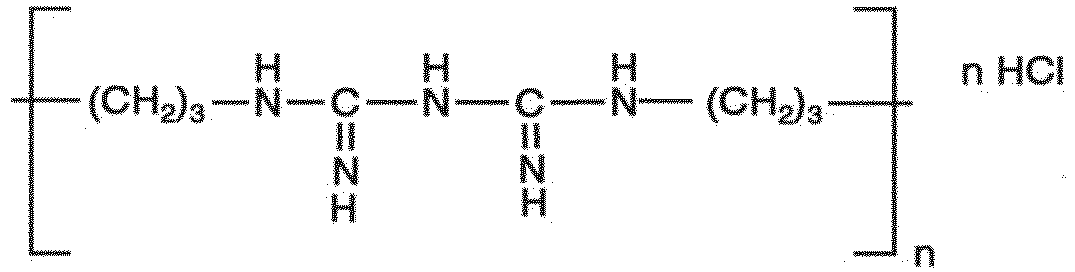
- Wesentlicher (Haupt-) Wirkstoff in anmeldungsgemäßen Zubereitungen ist Polyhexanid (Polyhexamethylenbiguanid= PHMB) oder ein Salz hiervon, vor allem das Hydrochlorid gemäß folgender Formel:
- Der Wirkstoff liegt frei und nicht liposomal oder in Bakteriophagen vor. Dabei kann die freie Base oder vorzugsweise ein wasserlösliches Salz, z.B. das Hydrochlorid, als Pulver (z.B. gefriergetrocknet) in 100 %iger Konzentration oder in wässriger Lösung eingesetzt werden. Je nach gewünschter galenischer Darreichungsform wird eine flüssige oder feste Form des Polyhexanids eingesetzt.
- Bevorzugt wird das Hydrochlorid-Salz eingesetzt.
- Die Menge an Polyhexanid- Wirkstoff kann in weiten Bereichen variieren. Üblicherweise enthält das anmeldungsgemäße Mittel den Wirkstoff in Mengen von 0,0001 bis 5 Gew.-%, insbesondere 0,001 bis 2 Gew.-%, vorzugsweise 0,01 bis 1,5 Gew.-%, besonders bevorzugt 0,01 bis 1 Gew.-%, bezogen auf die Gesamtmenge der Zubereitung. Dennoch kann es anwendungsbedingt oder einzelfallabhängig vorteilhaft bzw. erforderlich sein, von den vorgenannten Mengenbereichen abzuweichen, ohne dass der Rahmen der vorliegenden Erfindung verlassen wird.
- Die anmeldungsgemäßen Zubereitungen weisen weiterhin Zusatzstoffe auf. Diese werden vorzugsweise ausgewählt aus Aromen/Geschmacksstoffen, insbesondere ätherischen Ölen, Vitaminen, sowie galenischen Hilfsstoffen, ausgewählt aus Zuckern, Zuckeraustauschstoffen, Zuckerersatzstoffen, Säuerungsmitteln, Lösungsvermittlern wie z. B. Wasser, Glykol, Glycerin, Verdickern, Süßungsmitteln, Farbstoffen oder Konservierungsmitteln oder Kombinationen hiervon, auch in Abhängigkeit von der galenischen Darreichungsform.
- Hierzu gehören vor allem ätherische Öle, die als Aroma- bzw. als Geschmacksstoffe verwendbar sind. Dabei handelt es sich um im Allgemeinen flüchtige Extrakte aus Pflanzen, Pflanzenteilen mit dem dafür charakteristischen Geruch, die vor allem durch Wasserdampfdestillation aus Pflanzen oder Pflanzenteilen gewonnen werden können. Beispielhaft können hier genannt werden: ätherische Öle/Extrakte bzw. Aromastoffe aus Salbei, Nelken, Kamille, Anis, Sternanis, Thymian, Teebaum, Pfefferminze, Minzöl, (Menthol, Cineol), Eukalyptusöl, Mango, Feigen, Lavendelöl, Kamillenblüten, Kiefernnadel, Zypresse, Orangen, Rosenholz, Pflaumen-, Johannisbeer-, Kirscharoma, Birkenblätter, Zimt, Limetten, Grapefruit, Mandarine, Wacholder, Baldrian, Zitronenmelisse, Zitronengras, Palmarosa, Cranberry, Granatapfel, Rosmarin, Ingwer, Ananas, Guave, Echinacea, Efeublätterextrakt, Heidelbeere, Kaki, Melonen u. ä. oder Mischungen hiervon wie Mischungen aus Menthol, Pfefferminz- und Sternanisöl oder Menthol und Kirscharoma.
- Diese Aroma- bzw. Geschmacksstoffe können in Mengen von 0,0001 bis 10 Gew.-% (insbesondere als Mischung), vor allem 0,001 bis 6 Gew.-%, bevorzugt 0,001 bis 4 Gew.-%, besonders bevorzugt 0,01 bis 1 Gew.%, bezogen auf die Gesamtzubereitung vorliegen. Anwendungsbedingt oder einzelfallabhängig kann es von Vorteil sein, hiervon abweichende Mengen einzusetzen.
- Hier kommen sowohl eher wasserlösliche als auch eher fettlösliche Substanzen in Betracht. Je nach Zubereitungsart können feste oder flüssige Substanzen bzw. jeweils Derivate eingesetzt werden. Zu den wasserlöslichen Vertretern zählen insbesondere: Vitamin C bzw. geeignete Derivate hiervon wie - Palmitat, Calcium-Ascorbat / Natrium-Ascorbat, Kalium- Ascorbat, ferner die Vitamine der B- Gruppe wie B1 (Thiamin, z. B. Thiaminnitrat), B2 (Riboflavin), B3 (Niacin, Nicotinsäure und Derivate hiervon wie Niacinamid), B5 (Pantothensäure) wie Calciumpantothenat oder Provitamin B5; B6 (Pyridoxin oder Pyridoxin-Hydrochlorid- oder -phosphat), B7 (Vitamin H, Biotin), B9 (Folsäure), B12 (Cobalamin) oder auch Carotinoide wie Beta / Alpha-Carotin, Beta-Cryptoxanthin, Lutein, Zeaxanthin, Lycopin. Zu den eher fettlöslichen Vitaminen gehören vor allem Vitamin E (Tocopherol und Derivate hiervon wie Tocopherylacetat, Tocopherylpalmitat;Tocopherylsuccinat), ferner Vitamin A (Retinol) und Derivate wie Retinylpalmitat, Retinylacetat, Retinylproprionat; Vitamin D (Cholecalciferol, Ergocalciferol) oder Vitamin K (Phyllochinon).
- Besonders bevorzugt werden Vitamin C, insbesondere -palmitat oder Ca-Ascorbat, und/oder Vitamin - E (insbesondere -acetat, succinat,) und/oder Vitamin B5 kombiniert.
- Eine weitere geeignete Vitamin- Kombination in anmeldungsgemäßen Zubereitungen umfasst Vitamin A, insbesondere das -Palmitat, Vitamin- E- Acetat, beta-Carotin, Folsäure und /oder Vitamin B5.
- Auch können Vitamin C, z. B. Vitamin C- Palmitat zusammen mit Niacinamid, Provitamin B5 oder Pantothensäure kombiniert werden.
- Die einzelnen Vitamine bzw. Derivate hiervon werden in den dafür geeigneten Mengen zwischen 0,01 und 3% jeweils, insgesamt z. B. in einer Menge von 0,05 bis 5 Gew.%, bezogen auf die Gesamtgewichtsmenge der Zubereitung, eingesetzt. Vitamine können auch als Farbstoffe eingesetzt werden wie Riboflavin, Carotinoide, andere B-Vitamine oder Mischungen hiervon wie nachfolgend beschrieben.
- Zu den galenischen Hilfsstoffen gehören insbesondere Zucker, einschließlich Zuckeraustauschstoffe, die bei festen Darreichungsformen der anmeldungsgemäßen Zubereitungen als Träger dienen. Vorzugsweise werden damit Lutschbonbons, Lutschtabletten, insbesondere Hartkaramellen hergestellt.
- Als Zucker eignen sich Zucker aller Art und/oder Zuckeraustauschstoffe. Im Gegensatz zu den meist intensiv schmeckenden Zuckern werden Zuckeraustauschstoffe technologisch wie Saccharose eingesetzt, d. h. sie besitzen einen physiologischen Brennwert.
- Die Süßkraft der Zuckeraustauschstoffe entspricht in weiten Grenzen etwa der von Saccharose. Zuckeraustauschstoffe verfügen im Gegensatz zu Saccharose aber über eine Insulin unabhängige Metabolisierung (vorteilhaft z. B. für Diabetiker). Auch kann hier eine geringere kariogene Wirkung vorliegen. Sie sind daher anmeldungsgemäß bevorzugt.
- Beispiele für Zucker sind Saccharose, Glucose, Glucosesirup, Dextrose, Mannose, Fructose, Galactose, Ribose, Arabinose, Xylose, oder Sorbose sowie deren Mischungen untereinander. Zuckeraustauschstoffe sind insbesondere ausgewählt aus Zuckeralkoholen (reduzierte Zucker) wie Glycerin, Threit und Erythrit, Adonit, Arabit, Galactit(ol), Sorbit(ol), Mannit(ol), Xylit, Isomalt, Maltitsirup, Lactit, Leucrose, Fructooligosacchariden, Glucanen und Polyglucose. Besonders bevorzugte Zucker/Zuckeraustauschstoffe sind Glucosesirup, Maltitsirup, Isomalt oder sowie Mischungen hiervon. Besonders bevorzugt werden anmeldungsgemäß Zuckeraustauschstoffe wie beschrieben, vor allem Isomalt, Maltit, Mannit (Mannitol oder Xylit (Xylitol) oder Mischungen hiervon oder Zuckeraustauschstoffe in Kombination mit Zuckern eingesetzt, wobei vorzugsweise Zuckeraustauschstoffe im Überschuss (mehr als 50% der Mischung) vorliegen.
- Die Gesamtmenge an Zuckern und/oder Zuckeraustauschstoffen kann in weiten Bereichen variieren. Sie liegt im allgemeinen bei festen Zubereitungen (worin diese Substanzen als Träger dienen) im Bereich von 80 bis 99 Gew.-%, insbesondere 85 bis 99 Gew.-%, bevorzugt 90 bis 98 Gew.-%, besonders bevorzugt 93 bis 98 Gew.-%, bezogen auf die Gesamtmenge des Zubereitung.
- Weitere galenische Hilfsstoffe sind:
- Als Lösungsvermittler eignen sich insbesondere hydrophile Lösungsvermittler wie Wasser, Kochsalzlösung, Glycerin, Polyethylenglykole verschiedener molarer Masse wie 200 bis 400 g/mol. Weiterhin geeignet sind Lösungsvermittler wie nicht ionische Mittel wie z. B. polyoxyethylierte Fettsäuren, polyoxyethylierte Fettalkohole, wie Polysorbate, z. B. Polysorbat 20, Poloxamere (Polyethylenglykol-Polypropylen-Block-Copolymere wie z.B. solche unter dem Handelsnamen Lutrol® erhältliche Produkte mit geeigneter Molmasse).
- Alkohole, insbesondere einwertige Alkohole, vor allem Ethanol, oder auch n-Propanol/Isopropanol, oder ggf. Glycerin, sind anmeldungsgemäß nicht erforderlich und bevorzugt nicht vorhanden.
- Säuerungsmittel sind insbesondere Puffer wie Phosphat- oder Citratpuffer sowie Säuren wie Zitronensäure, Weinsäure, Sorbinsäure, vor allem Kaliumcitrat, Natriumcitrat, Puffer wie Natrium(hydrogen)-phosphat/carbonat, Salzsäure u.a.; oder Mischungen hiervon.
- Verdicker sind z. B. Arabisches Gummi; Cellulosederivate, z. B. Hydroxyethylcellulose, Hy-droxypropylcellulose, Methylcellulose, Methylhydroxyethylcellulose; Dextrine wie Cyclodextrin, Maltodextrin, Dextrin Guargalactomannan, Dextran; Gelatine, Polydextrose, Chitosan, Chitosanhydrochlorid; Polyethylen-/propylenglycol; Gelatine; Siliciumdioxid, Magnesiumstearat und Xanthan; Zucker wie die vorstehend genannten, Saccharose; Salze wie Natriumchlorid, oder Mischungen aus vorgenannten Substanzen.
- Süßungsmittel sind Zuckerersatzstoffe, insbesondere Sucralose; Honig; synthetische Süßstoffe wie Aspartam oder Analoga; Saccharin-Na, oder Mischungen hiervon oder andere, dem Fachmann zu diesem Zweck bekannte Süßungsmittel wie z.B. Acesulfam (beispielsweise auch Acesulfam-K), Cyclamat, Glycyrrhizin, Dulcin, Saccharin (beispielsweise auch Natrium-saccharin und/oder Calciumsaccharin), Rebaudiosid (z. B. Rebaudiosid A), Steviosid, Naringin-Dihydrochalkon, Monellin, Neohesperidin-Dihydrochalkon (NHDC), Sucralose, Thaumatin, Neotam sowie deren Mischungen und Kombinationen, insbesondere Aspartam und/oder Acesulfam, bevorzugt Aspartam und Acesulfam.
- Konservierungsmittel können bei Bedarf eingesetzt und dabei ausgewählt werden aus Kaliumsorbat, Methyl-Ethylparaben, Natriumbenzoat und ähnlichen dem Fachmann zu diesem Zweck bekannten Substanzen oder Gemischen hiervon.
- Geeignete Farbstoffe sind vor allem natürliche wie B-Vitamine, Pflanzenextrakte wie z.B. Rote Beete und in Lebensmitteln und/oder Arzneimitteln zulässige Farbstoffe.
- Je nach Wahl bzw. Anteil der galenischen Hilfsstoffe werden feste Darreichungsformen erhalten. Der höhere Anteil an galenischem Hilfsstoff kann dann als Träger bezeichnet werden (s.u.): so kann bei festen Produkten ein oder mehrere Zucker/Zuckeraustauschstoffe als anteilshöchster galenischer Hilfsstoff (=Träger) vorhanden sein.
- Bevorzugte Ausführungsformen umfassen insbesondere feste, im Wesentlichen wasserfreie (d.h. weniger als 5 Gew%, insbesondere weniger als 2 Gew.% wasserhaltig), vor allem lutschbare, Darreichungsformen. Dabei handelt es sich insbesondere um Lutschbonbons, z. B. Hartkaramellen, oder Pastillen, welche ein Gesamtgewicht von ca. 0,5 bis 5 g aufweisen. Diese sind bevorzugt ungefüllt.
- Die festen Darreichungsformen sind vor allem auf Basis von Zuckern und/oder Zuckeraustauschstoffen (Trägerstoffe) wie vorstehend genannt hergestellt, vor allem ausgewählt aus Glucose, Maltose, Isomaltose, Dextrose, Fructose, Xylose, Lactose, Lactulose, Galactose, Inulin, Maltitol, Sorbitol, Xylitol, Mannitol, Erythritol, vorzugsweise Isomalt, Maltitsirup oder Mischungen hiervon, in einer Gesamtmenge bezogen auf die Gesamtzubereitung, von 85 bis 99 Gew.%, vorzugsweise 90 bis 98 Gew.%.
- Bevorzugte Darreichungsformen umfassen ungefüllte Hartkaramellen/Pastillen der oben beschriebenen Art.
- Die Menge an Trägerstoffen wie oben beschrieben kann in festen Darreichungsformen auch aufgeteilt werden in einen äußeren Hüllungsteil (Mantel), umfassend Zusatzstoffe, und den wesentlichen Anteil an Träger wie 60 bis 90 % der Gesamtträgerstoffmenge, und einen inneren Füllungsteil, umfassend den antiinfektiven Wirkstoff und ggf. Zusatzstoffe sowie den Rest an Trägerstoffen, der dementsprechend den geringeren Anteil aufweist wie 40 bis 10 % der Gesamtträgerstoffmenge. Bevorzugt ist hierbei das Verhältnis von Trägerstoffanteil/Hülle zu Trägerstoffanteil/Fülle 8:1 bis 3:1, vor allem 6:1 bis 4,5:1.
- In den festen Zubereitungen, insbesondere Lutschbonbons, vor allem auf Hartkaramellenbasis, sind vor allem 0,01 bis 1 Gew.% Polyhexanid, vorzugsweise 0,1 bis 1 Gew.% Polyhexanid, oder ein ein Salz wie Hydrochlorid hiervon, insbesondere mit einer mittleren Molmasse von 2300 bis 3100 g/mol, sowie 1 bis 4 Gew.% Zusatzstoffe, ausgewählt aus Aromen/Geschmacksstoffen, Farbstoffen, Vitaminen, Süßungsmitteln, Säuerungsmitteln, Verdickern oder Kombinationen einer oder mehrerer solcher Substanzen vorhanden. Als Träger werden hier vor allem Zuckeraustauschstoffe, ggf. Zucker, vor allem Glucosesirup, flüssiges Isomalt, Maltitsirup, Sorbit, Xyllit oder Mischungen hiervon, eingesetzt, bevorzugt in Mengen von 80 bis 99 Gew.%, bezogen auf das Gesamtgewicht der Zubereitung, vorzugsweise 90 bis 98 Gew.%.
- Wie erläutert, liegen die festen Zubereitungen vor allem in Form von Lutschpastillen, insbesondere Hartkaramellen vor. Diese umfassen als Inhaltsstoffe (jeweils in Mengen wie oben angegeben) im Wesentlichen Zucker/Zuckeraustauschstoffe, vor allem Glucosesirup, flüssiges Isomalt, Maltitsirup, oder Mischungen hiervon, als Träger sowie die vorgesehene Menge an Polyhexanid-Wirkstoff und ggf. Zusatzstoffe, insbesondere ausgewählt aus Aroma-/Geschmacksstoffen, insbesondere Aromamischungen wie z.B. Menthol, Sternanisöl, Pfefferminzöl, ferner Säuerungsmittel wie Zitronensäure, Süßungsmittel wie Sucralose, Farbstoffe oder Kombinationen hiervon. Die in der Wärme hergestellten Karamellen können zu geeignet geformten Pastillen (rund, elliptisch) ausgeprägt und nach dem Abkühlen konfektioniert werden zu Einzel- oder Mehrfachgebinden.
- Eine besonders bevorzugte Ausführungsform fester Darreichungsformen, insbesondere ausfertigt als Hartkaramelle, Pastille (vor allem ungefüllt), umfasst:
- 94 bis 98 Gewichtsprozent Träger, ausgewählt aus einem oder mehreren Zuckeraustauschstoffen, insbesondere Isomalt, Maltit oder Mischungen hiervon;
- 0,1 bis 0,7 Gew.% Polyhexanid, insbesondere in Form des Hydrochlorids; vor allem mit einer mittleren molaren Masse von 2300 bis 3100 g/mol;
- 0,1 bis 4 Gew.% Zusatzstoffe sowie eine geringe Restmenge (weniger als 2 Gew.%, insbesondere weniger als 1,7 Gew.% Wasser).
- Die Zusatzstoffe sind vor allem ausgewählt aus Aromen/Geschmacksstoffen (z.B. Menthol, Pfefferminzöl, Sternanisöl und/oder Kirsche), Säuerungsmitteln, insbesondere Zitronensäure, sowie Süßungsmitteln wie vor allem Sucralose, und/oder Farbstoffen.
- Der pH-Wert einer 10%igen wässrigen Lösung einer derartigen Darreichungsform liegt bevorzugt zwischen mehr als 3,5 und 7.
- In einer weiteren Ausführungsform werden in der oben beschriebenen Zubereitung statt 94-98 Gew. % Zuckeraustauschstoffe (alleine) eine Mischung hiervon mit Zucker oder Zucker alleine, insbesondere Glucosesirup, und die übrigen Bestandteile wie erwähnt eingesetzt.
- In einer anderen Ausführungsform liegen die festen Zubereitungen in Form von gefüllten Lutschbonbons vor, mit einem höheren Teil der galenischen Zusatzstoffe in der Hülle, und einem geringeren Teil in der Füllung. Bei Anwendung wird dann der Wirkstoff im Mund-Rachenraum freigesetzt. Derartige gefüllte Lutschbonbons (Pastillen) auf Basis eines Trägerstoffes, ausgewählt aus Zuckeraustauschstoffen, Zuckern oder Kombinationen hiervon können mit einem äußeren Hüllenteil (Mantel) und einem inneren Füllungsteil vorliegen, wobei im äußeren Hüllungsteil (Mantel) der antiinfektive Wirkstoff und Zusatzstoffe, und 60 bis 90 % der Gesamtmenge an Zucker/Zuckeraustausch-Trägerstoff, und der innere Füllungsteil ggf. Zusatzstoffe sowie den Rest an Trägerstoffen, aufweist.
- Insbesondere liegt der Träger, vor allem Zucker/Zuckeraustauschstoffe in der Hülle in Mengen von 60 bis 85 Gew.% und in der Füllung in einer Menge von 5 bis 20 Gew.% vor (bezogen auf das Gesamtgewicht der Zubereitung, wobei insgesamt vorzugsweise nicht mehr als 95% Träger vorhanden sind). Der Polyhexanid-Wirkstoff sowie eventuell vorhandene Zusatzstoffe sind wie oben für die feste Darreichungsform beschrieben vorhanden.
- In einer weiteren bevorzugten Ausführungsform weisen die anmeldungsgemäßen Zubereitungen den antiinfektiven Wirkstoff Polyhexanid, mit einer mittleren molaren Masse wie beschrieben, oder ein wasserlösliches Salz hiervon, vor allem das Chlorid, in Kombination mit wenigstens einem, vor allem mehreren Aroma/Geschmacksstoffen, vor allem ätherischen Ölen (Extrakten), auf.
- In einer anderen bevorzugten Ausführungsform sind anmeldungsgemäße, insbesondere vorstehend beschriebene Zubereitungen im Wesentlichen oder insbesondere frei von einwertigen Alkoholen, vor allem Ethanol. Geringe Mengen (kleiner 1 Gew. %, vor allem geringer 0,1 Gew. %) können aus dem Vorhandensein anderer Zusatzstoffe resultieren und daher vorhanden sein.
- Feste Darreichungsformen, insbesondere Lutschbonbons, werden auf bekannte Weise hergestellt. Dazu werden zunächst die Trägerstoffe, insbesondere Zucker/Zuckeraustauschstoffe, erwärmt auf Temperaturen von z.B. 110°C bis 150°C. Dazu können dann die übrigen Zusatzstoffe (wie Aroma, Zitronensäure und Farbstoffe) sowie der Wirkstoff eindosiert werden. Nach dem Abkühlen auf Temperaturen, bei denen die Zubereitungen noch nicht fest sind, können diese in eine geeignete Form (vorzugsweise rund oder elliptisch) gepresst und sodann vollständig auf Raumtemperatur gekühlt werden.
- Pastillen (wie Lutschbonbons), Hartkaramellen können auch hergestellt werden, indem der Träger (z. B. Glucosesirup, flüssiges Isomalt, Maltitsirup, Xyllit, Sorbit) mit der Zubereitungs-Grundmischung (Wirkstoff, Zusatzstoffe) vermengt wird und anschließend in dafür bekannten Vorrichtungen als Strang ausgetragen und in geeignet große Teile geschnitten wird.
- Ein besonders geeignetes Verfahren umfasst folgende Herstellungsschritte:
Die Pastillen-Masse wird aus verflüssigtem Isomalt hergestellt. Diesem wird Sucralose hinzugefügt und eingemischt (= Grundrezeptur). Die Grundrezeptur wird gekocht und danach vakuumiert. Über Dosierpumpen werden die Aromamischung (z.B. Menthol, Sternanisöl, Pfefferminzöl), Zitronensäure, ein Farbstoff (z.B. eines der vorgenannten Vitamine B) sowie Polyhexanid hinzugegeben und eingemischt. Die Hartkaramellmasse wird auf dem Stahlband temperiert. Die fertig gekochte und temperierte Pastillen-Masse wird vom Stahlband der Kochanlage in den Kegelroller befördert. Der im Strangformer ausgezogene Pastillenstrang wird in der Prägeanlage zu Pastillen ausgeprägt und anschließend im Kühltunnel abgekühlt. - Bei gefüllten Pastillen mit verschiedenen Hüllungs- bzw. Füllungsteilen wird ein Füllungsteil mit der oben beschriebenen jeweiligen Zubereitungsmischung (z. B. enthaltend flüssiges Isomalt) vermischt und sodann in einer geeigneten Vorrichtung (Doppelrohrführung) der Hüllungsteil (z.B. mit Maltitsirup) eingefüllt. Beide Produktstränge werden dann gleichzeitig ausgetragen und portioniert.
- Kautabletten können hergestellt werden, indem man der Basis (z.B. 75 bis 88 Gew. % Dextrose oder Polydextrose) die Zubereitungsmischung in üblichen Apparaturen hinzufügt.
- Die festen Zubereitungen werden vereinzelt und/oder in dafür vorgesehene Beutel, Sachets oder Blisterpackungen verpackt. Die Zubereitungen sind lagerstabil.
- Die anmeldungsgemäßen Zubereitungen werden vorzugsweise eingesetzt zur topisch-oralen unterstützenden, protektiven/kurativen Anwendung auf Schleimhäuten, insbesondere bei Menschen, im Mund-Hals-Nasen-und/oder Rachenraum bei Irritationen und Reizungen wie Halsschmerzen, einhergehend mit Halskratzen und/oder Heiserkeit, die durch Bakterien wie z.B. alphahämolysierende Streptokokken, Streptococcus pyogenes, Streptococcus Pneumoniae, Pseudomonas aeruginosa, Staphylococcus aureus, Candida albicans, Enterococcus faecalis, Haemophilus Influenza, Candida albicans, Staphylococcus aureus verursacht sind sowie Entzündungen, die als Folge einer solchen Infektionen hervorgerufen werden. Reizungen durch Chlamydien und derartige Organismen werden mit anmeldungsgemäßen Zubereitungen nicht erfasst. Zubereitungen zur Behandlung der Augen werden erfindungsgemäß bevorzugt nicht umfasst. Insbesondere werden die anmeldungsgemäßen oralen Anwendungsformen, wie vor allem pharmazeutische Zubereitungen, Medizinprodukte (zu denen Kosmetikprodukte ((nicht therapeutisch), Medizinprodukte, und Arzneimittel (therapeutisch) gehören) eingesetzt. Dazu gehören: vor allem lutschbare Pastillen, Hartkaramellen (ungefüllt), gefüllte Pastillen (Bonbons), Lutschtabletten-. Aus den Zubereitungen wird der Wirkstoff durch die Anwendung freigesetzt. Bevorzugt liegen die Zubereitungen in Form von Medizinprodukten, insbesondere in Form von Hartkaramellen vor. Pastillen, Hartkaramellen sind insbesondere Medizinprodukte.
- Die anmeldungsgemäßen Mittel können daher insbesondere verwendet werden zur Herstellung eines therapeutischen Mittels, oder auch eines nicht therapeutischen Mittels, bzw. können verwendet werden als Therapeutikum oder Kosmetikum für die Schleimhautapplikation bei Reizzuständen wie Halsschmerzen, die eventuell auch mit Heiserkeit, Halskratzen einhergehen, im Mund-Nasen-Rachenraum, die z.B. durch Bakterien wie alphahämolysierende Streptokokken, Streptococcus pyogenes, Streptococcus pneumoniae, Pseudomonas aeruginosa, Staphylococcus aureus, Candida albicans, Enterococcus faecalis, Haemophilus influenza, Candida albicans, Staphylococcus. aureus verursacht sind sowie bei entzündlichen Zuständen als Folge einer solchen Infektion.
- Die anmeldungsgemäß, wie beschrieben hergestellten Mittel sind fest, vor allem lutschbar (Lutschbonbons, Lutschpastillen, lutschbare Hartkaramellen).
- Die Erfindung wird anhand der nachfolgenden Beispiele, die den beschriebenen Gegenstand jedoch nicht beschränken, näher erläutert.
Beispiel 1 Lutschbonbons zuckerfrei Inhaltsstoff Chemische Bezeichnung / Funktion Menge [g] Isomalt flüssig Typ ST Zuckeraustauschstoff E953 97,2142 Sucralose Süßstoff E955 0,0808 Menthol Geschmacksgebung 0,0265 Sternanisöl Geschmacksgebung 0,0208 Pfefferminzöl Geschmacksgebung 0,0069 Zitronensäure anhydro Säuerungsmittel 0,4269 Farbstoff Farbgebung 0,1242 Polyhexanid Lösung* Wirkstoff 0,5000 Restfeuchte (Wasser) 1,5996 100,000 • Polyhexanid-Lösung: 20%ige, wässrige Lösung von Poly-Hexamethylene-Biguanide-Hydrochlorid (=PHMB = Polyhexanid), mittlere molare Masse: 2300-3100 g/mol. Inhaltsstoff Chemische Bezeichnung / Funktion Menge [g] Glucosesirup Zucker 97,2142 Sucralose Süßstoff E955 0,0808 Menthol Geschmacksgebung 0,0265 Kirscharoma Geschmacksgebung 0,0277 Zitronensäure anhydro Säuerungsmittel 0,4269 Farbstoff Farbgebung 0,1242 Polyhexanid Lösung * Wirkstoff 0,5000 Restfeuchte (Wasser) 1,5996 100,000 • Polyhexanid Lösung: 20%ige, wässrige Lösung von Poly-Hexamethylene-Biguanide-Hydrochlorid (=PHMB = Polyhexanid), mittlere molare Masse: 2300-3100 g/mol. Beispiel 3 Lutschbonbons gefüllt Inhaltsstoff Chemische Bezeichnung / Funktion Menge [g] Im Mantel enthalten Isomalt flüssig Typ ST Zuckeraustauschstoff E953 78,971 Sucralose Süßstoff E955 0,009 Aroma Geschmacksgebung 0,639 Zitronensäure anhydro Säuerungsmittel 1,078 Polyhexanid Lösung* Wirkstoff 0,500 Farbstoff Farbgebung 0,163 Restfeuchte (Wasser) 1,640 in der Füllung enthalten Maltitsirup Zuckeraustauschstoff E963 13,690 Zitronensäure anhydro Säuerungsmittel 0,226 Aroma Geschmacksgebung 0,531 Restfeuchte (Wasser) 2,553 100,000 • Polyhexanid Lösung: 20i%ge, wässrige Lösung von Poly-Hexamethylene-Biguanide-Hydrochlorid (=PHMB = Polyhexanid), mittlere molare Masse: 2300-3100 g/mol.
Claims (11)
- Bakteriophagenfreie Zubereitung zur topisch-oralen Anwendung im nicht gefrorenen Zustand auf Schleimhäuten im Mund- Nasen- und Rachenraum bei Menschen, dadurch gekennzeichnet, dass sie Polyhexanid (Polyhexamethylenbiguanid), oder ein wasserlösliches Salz hiervon, als antiinfektiven Wirkstoff, mit einer molaren Masse von 2300 bis 3100 g/mol und einen oder mehrere Zusatzstoffe, ausgewählt aus Aroma-/Geschmacksstoffen, Vitaminen, sowie galenischen Hilfsstoffen, ausgewählt aus Zuckern, Zuckeraustauschstoffen, Zuckerersatzstoffen, Säuerungsmitteln, Lösungsvermittlern, Verdickern, Süßungsmitteln, Farbstoffen, Konservierungsmitteln, oder Kombinationen hiervon aufweist, wobei die Zubereitung im Wesentlichen frei ist von weiteren antiinfektiven Wirkstoffen, und als feste Dareichungsform mit Zuckern und/oder Zuckeraustauschstoffen als Träger vorliegt.
- Zubereitung nach Anspruch 1, dadurch gekennzeichnet, dass sie als pharmazeutische Zubereitung vorliegt.
- Zubereitung nach Anspruch 1 oder 2, dadurch gekennzeichnet, dass sie in Form einer im wesentlichen wasserfreien festen Zubereitung auf Zucker/-Zuckeraustauschstoffbasis als Trägerstoff in Form eines Lutschbonbons vorliegt.
- Zubereitung nach einem der Ansprüche 1 bis 3 zur topisch-oralen therapeutischen oder nicht therapeutischen protektiven und/oder unterstützenden, oder kurativen Anwendung auf Schleimhäuten im Mund-Nasenraum und/oder Rachen bei infektiösen, nicht durch Chlamydien verursachten und/oder entzündlichen Zuständen.
- Zubereitung nach einem der Ansprüche 1 bis 4, dadurch gekennzeichnet, dass sie in Form eines Medizinproduktes zur topisch-oralen therapeutischen unterstützenden Anwendung im Hals-Rachenraum bei infektiösen, nicht durch Chlamydien verursachten und/oder entzündlichen Zuständen vorliegt.
- Zubereitung nach einem der Ansprüche 1 bis 5, dadurch gekennzeichnet, dass sie Polyhexanid oder ein wasserlösliches Salz hiervon in Kombination mit wenigstens einem Aroma-/Geschmacksstoff aufweist.
- Zubereitung nach einem der Ansprüche 1 bis 6 , dadurch gekennzeichnet, dass sie in Form einer festen lutschbaren Hartkaramelle oder Pastille vorliegt, umfassend 0,01 bis 1 Gew.% Polyhexanid oder ein wasserlösliches Salz hiervon, mit einer mittleren Molmasse von 2300 bis 3100 g/mol, 1 bis 4 Gew.% Zusatzstoffe, ausgewählt aus Aromen/Geschmacksstoffen, Farbstoffen, Vitaminen, Süßungsmitteln, Säuerungsmitteln, Verdickern oder Kombinationen einer oder mehrerer solcher Substanzen, sowie 80 bis 99 Gew.%, bezogen auf das Gesamtgewicht der Zubereitung, Trägerstoffe, ausgewählt aus Zuckeraustauschstoffen, Zuckern oder Mischungen hiervon.
- Zubereitung nach Anspruch 7, dadurch gekennzeichnet, dass sie in Form eines Lutschbonbons auf Basis eines Trägerstoffes, ausgewählt aus Zuckeraustauschstoffen, Zuckern oder Kombinationen hiervon mit einem äußeren Hüllenteil (Mantel) und einem inneren Füllungsteil vorliegt, wobei im äußeren Hüllungsteil (Mantel) der antiinfektive Wirkstoff Polyhexanid oder ein wasserlösliches Salz hiervon, und Zusatzstoffe, und 60 bis 90 % der Gesamtmenge an Zucker/Zuckeraustausch-Trägerstoff, und der innere Füllungsteil ggf. Zusatzstoffe sowie den Rest an Trägerstoffen, aufweist.
- Zubereitung nach einem der Ansprüche 7 oder 8, dadurch gekennzeichnet, dass der oder die Trägerstoffe ausgewählt ist/sind aus Glucosesirup, flüssigem Isomalt, Maltitsirup oder Mischungen hiervon.
- Zubereitung nach einem der Ansprüche 1 bis 9, dadurch gekennzeichnet, dass sie Polyhexanid oder das Hydrochlorid-Salz hiervon in einer Menge von 0,01 bis 1 Gew.%, bezogen auf die Gesamtmenge der Zubereitung, aufweist.
- Bakteriophagenfreie, feste Zubereitungen gemäß Anspruch 1 zur topischen Anwendung für die Schleimhautapplikation bei Reizzuständen wie Halskratzen und/oder Halsschmerzen, die eventuell mit Heiserkeit einhergehen sowie entzündlichen Zuständen, im Mund-Nasen-Rachenraum, die durch Bakterien wie alphahämolylierende Streptokokken, Streptococcus pyogenes, Streptococcus pneumoniae, Pseudomonas aeruginosa, Staphylococcus aureus, Candida albicans, Enterococcus faecalis, Haemophilus influenza, Candida albicans, Staphylococcus aureus verursacht werden sowie bei entzündlichen Zuständen als Folge dieser Infektionen im Mund-Nasen-Rachenraum.
Applications Claiming Priority (2)
| Application Number | Priority Date | Filing Date | Title |
|---|---|---|---|
| DE102012007212A DE102012007212A1 (de) | 2012-04-11 | 2012-04-11 | Zubereitung zur topischen Anwendung auf Schleimhäuten mit Polyhexanid als Wirkstoff |
| PCT/EP2013/000986 WO2013152838A1 (de) | 2012-04-11 | 2013-04-03 | Zubereitung zur topischen anwendung auf schleimhäuten mit polyhexanid als wirkstoff |
Publications (2)
| Publication Number | Publication Date |
|---|---|
| EP2836196A1 EP2836196A1 (de) | 2015-02-18 |
| EP2836196B1 true EP2836196B1 (de) | 2019-06-12 |
Family
ID=48047975
Family Applications (1)
| Application Number | Title | Priority Date | Filing Date |
|---|---|---|---|
| EP13714213.9A Revoked EP2836196B1 (de) | 2012-04-11 | 2013-04-03 | Zubereitung zur topischen anwendung auf schleimhäuten mit polyhexanid als wirkstoff |
Country Status (3)
| Country | Link |
|---|---|
| EP (1) | EP2836196B1 (de) |
| DE (1) | DE102012007212A1 (de) |
| WO (1) | WO2013152838A1 (de) |
Cited By (1)
| Publication number | Priority date | Publication date | Assignee | Title |
|---|---|---|---|---|
| US10786448B2 (en) | 2018-01-18 | 2020-09-29 | Christian Arnold | Chewing gum composition comprising polyhexanide |
Families Citing this family (2)
| Publication number | Priority date | Publication date | Assignee | Title |
|---|---|---|---|---|
| JP6454325B2 (ja) | 2013-04-26 | 2019-01-16 | バイオインタラクションズ・リミテッドBioInteractions Ltd | 生物活性被覆 |
| USRE49528E1 (en) | 2013-04-26 | 2023-05-16 | Biointeractions Ltd. | Bioactive coatings |
Citations (30)
| Publication number | Priority date | Publication date | Assignee | Title |
|---|---|---|---|---|
| EP0181179A2 (de) | 1984-11-02 | 1986-05-14 | The Procter & Gamble Company | Antimikrobische Pastille |
| WO1988000463A1 (en) | 1986-07-11 | 1988-01-28 | Oral Research Laboratories, Inc. | Compositions for the prolonged action of anti-plaque agents |
| DE3900896A1 (de) | 1988-01-18 | 1989-07-27 | Ici Plc | Mundpflegemittel |
| WO1994027440A1 (de) | 1993-05-26 | 1994-12-08 | Fresenius Ag | Antiinfektivum |
| DE29611266U1 (de) | 1996-07-01 | 1996-09-19 | Bakhtiari, Cyrus, Dr.med., 48165 Münster | Antiseptikum |
| WO1997000076A1 (en) | 1995-06-16 | 1997-01-03 | Moorfields Eye Hospital | Compositions containing poly(hexamethylene biguanide) salts and uses thereof |
| EP0788797A1 (de) | 1996-02-08 | 1997-08-13 | Fresenius AG | Verwendung von PHMB zur Behandlung von durch sich intrazellulär vermehrende Erreger verursachten Infektionen |
| WO2000033829A1 (de) | 1998-12-05 | 2000-06-15 | Fresenius Kabi Deutschland Gmbh | Verwendung von poly (hexamethylen) biguanid zur herstellung eines mittels zur förderung der heilung von infektionsfreien wunden |
| DE19936545A1 (de) | 1999-08-03 | 2001-02-08 | Hexal Ag | Neue pharmazeutische Zusammensetzung zur nasalen Anwendung von wasserlöslichen Wirkstoffen |
| DE10012026A1 (de) | 2000-03-11 | 2001-09-20 | Prontomed Gmbh | Medizinisches Gel und dessen Verwendung |
| US20040009144A1 (en) | 2000-01-27 | 2004-01-15 | Labib Mohamed E. | Method for the treatment or prevention of virus infection using polybiguanide-based compounds |
| JP2004026725A (ja) | 2002-06-26 | 2004-01-29 | Sunstar Inc | 固形製剤 |
| WO2004032945A1 (de) | 2001-09-25 | 2004-04-22 | Beiersdorf Ag | Wirkstoffkombinationen aus polyhexamethylenbiguanid-hydrochlorid und distearyldimethylammoniumchlorid und zubereitungen, solche wirkstoffkombinationen enthaltend |
| EP1214055B1 (de) | 1999-09-23 | 2005-05-04 | Hexal Ag | Pharmazeutisches, wirkstoffhaltiges gel |
| US20050158252A1 (en) | 2003-12-22 | 2005-07-21 | Radek Romanowski | Method and compositions for oral hygiene |
| US20050180927A1 (en) | 2002-04-04 | 2005-08-18 | Aldous Graham L. | Novel anti-bacterial compositions |
| DE102004037598A1 (de) | 2004-08-03 | 2006-02-23 | Prontomed Gmbh | Mundspüllösung |
| DE102004052308A1 (de) | 2004-10-12 | 2006-04-13 | Divapharma-Knufinke Arzneimittelwerk Gmbh | Octenidinhaltige Lutschtabletten gegen entzündliche Erkrankungen des Mund- und Rachenraums |
| US20060115440A1 (en) | 2004-09-07 | 2006-06-01 | Arata Andrew B | Silver dihydrogen citrate compositions |
| DE102006015271A1 (de) | 2006-04-01 | 2007-10-11 | Lohmann & Rauscher Gmbh & Co. Kg | Biguanidhaltige Liposomen |
| US20070282008A1 (en) | 2004-04-08 | 2007-12-06 | Demcare-Vet Pty Ltd | Antimicrobial Compositions and Methods for Their Use |
| EP1982696A1 (de) | 2007-04-19 | 2008-10-22 | Dr. August Wolff GmbH & Co. KG Arzneimittel | Gel zur Behandlung von Wunden |
| DE202009000862U1 (de) | 2009-01-07 | 2009-04-16 | Klosterfrau Berlin Gmbh | Dosiereinheit und Zusammensetzung zur Behandlung von entzündlichen Erkrankungen des Mund- und Rachenraums |
| DE102008005193A1 (de) | 2008-01-18 | 2009-07-23 | Dahlen, Neithard | Bakteriophagenpräparation und Verwendung |
| WO2010003472A2 (de) | 2008-06-30 | 2010-01-14 | Maria Clementine Martin Klosterfrau Vertriebsgesellschaft Mbh | Lutschzusammensetzung zur behandlung von entzündlichen erkrankungen des mund- und rachenraums |
| EP2165701A1 (de) | 2008-09-18 | 2010-03-24 | Croma-Pharma Gesellschaft m.b.H. | Antimikrobiell und intiviral wirkende zusammensetzung |
| DE102008064481A1 (de) | 2008-12-18 | 2010-08-12 | Bode Chemie Gmbh | Kombinierte Desinfektions- und Dekontaminationsmittel mit erhöhter Wirksamkeit |
| DE102009008919A1 (de) | 2009-02-13 | 2010-08-26 | Nawa-Heilmittel Gmbh | Behandlungslösung für die Behandlung von Wunden, insbesondere für die liquide Wundbehandlung |
| EP1635774B2 (de) | 2003-06-23 | 2011-01-26 | Colgate-Palmolive Company | Stabile zahnreinigungszusammensetzungen |
| EP2291185B1 (de) | 2008-11-14 | 2011-12-28 | Artan Holding Ag | Octenidin-zusammensetzung |
-
2012
- 2012-04-11 DE DE102012007212A patent/DE102012007212A1/de not_active Ceased
-
2013
- 2013-04-03 WO PCT/EP2013/000986 patent/WO2013152838A1/de not_active Ceased
- 2013-04-03 EP EP13714213.9A patent/EP2836196B1/de not_active Revoked
Patent Citations (34)
| Publication number | Priority date | Publication date | Assignee | Title |
|---|---|---|---|---|
| EP0181179A2 (de) | 1984-11-02 | 1986-05-14 | The Procter & Gamble Company | Antimikrobische Pastille |
| WO1988000463A1 (en) | 1986-07-11 | 1988-01-28 | Oral Research Laboratories, Inc. | Compositions for the prolonged action of anti-plaque agents |
| DE3900896A1 (de) | 1988-01-18 | 1989-07-27 | Ici Plc | Mundpflegemittel |
| EP0700249B1 (de) | 1993-05-26 | 1998-07-22 | Fresenius AG | Antiinfektivum |
| WO1994027440A1 (de) | 1993-05-26 | 1994-12-08 | Fresenius Ag | Antiinfektivum |
| WO1997000076A1 (en) | 1995-06-16 | 1997-01-03 | Moorfields Eye Hospital | Compositions containing poly(hexamethylene biguanide) salts and uses thereof |
| EP0788797A1 (de) | 1996-02-08 | 1997-08-13 | Fresenius AG | Verwendung von PHMB zur Behandlung von durch sich intrazellulär vermehrende Erreger verursachten Infektionen |
| DE29611266U1 (de) | 1996-07-01 | 1996-09-19 | Bakhtiari, Cyrus, Dr.med., 48165 Münster | Antiseptikum |
| WO2000033829A1 (de) | 1998-12-05 | 2000-06-15 | Fresenius Kabi Deutschland Gmbh | Verwendung von poly (hexamethylen) biguanid zur herstellung eines mittels zur förderung der heilung von infektionsfreien wunden |
| DE19936545A1 (de) | 1999-08-03 | 2001-02-08 | Hexal Ag | Neue pharmazeutische Zusammensetzung zur nasalen Anwendung von wasserlöslichen Wirkstoffen |
| EP1214055B1 (de) | 1999-09-23 | 2005-05-04 | Hexal Ag | Pharmazeutisches, wirkstoffhaltiges gel |
| US20040009144A1 (en) | 2000-01-27 | 2004-01-15 | Labib Mohamed E. | Method for the treatment or prevention of virus infection using polybiguanide-based compounds |
| DE10012026A1 (de) | 2000-03-11 | 2001-09-20 | Prontomed Gmbh | Medizinisches Gel und dessen Verwendung |
| WO2004032945A1 (de) | 2001-09-25 | 2004-04-22 | Beiersdorf Ag | Wirkstoffkombinationen aus polyhexamethylenbiguanid-hydrochlorid und distearyldimethylammoniumchlorid und zubereitungen, solche wirkstoffkombinationen enthaltend |
| US20050180927A1 (en) | 2002-04-04 | 2005-08-18 | Aldous Graham L. | Novel anti-bacterial compositions |
| JP2004026725A (ja) | 2002-06-26 | 2004-01-29 | Sunstar Inc | 固形製剤 |
| EP1635774B2 (de) | 2003-06-23 | 2011-01-26 | Colgate-Palmolive Company | Stabile zahnreinigungszusammensetzungen |
| US20050158252A1 (en) | 2003-12-22 | 2005-07-21 | Radek Romanowski | Method and compositions for oral hygiene |
| US20070282008A1 (en) | 2004-04-08 | 2007-12-06 | Demcare-Vet Pty Ltd | Antimicrobial Compositions and Methods for Their Use |
| DE102004037598A1 (de) | 2004-08-03 | 2006-02-23 | Prontomed Gmbh | Mundspüllösung |
| US20060115440A1 (en) | 2004-09-07 | 2006-06-01 | Arata Andrew B | Silver dihydrogen citrate compositions |
| EP1799186B1 (de) | 2004-10-12 | 2008-06-18 | Divapharma GmbH | Octenidinhaltige lutschtabletten gegen entzündliche erkrankungen des mund- und rachenraums |
| WO2006039961A1 (de) | 2004-10-12 | 2006-04-20 | Divapharma-Knufinke Arzneimittelwerk Gmbh | Octenidinhaltige lutschtabletten gegen entzündliche erkrankungen des mund- und rachenraums |
| DE102004052308A1 (de) | 2004-10-12 | 2006-04-13 | Divapharma-Knufinke Arzneimittelwerk Gmbh | Octenidinhaltige Lutschtabletten gegen entzündliche Erkrankungen des Mund- und Rachenraums |
| DE102006015271A1 (de) | 2006-04-01 | 2007-10-11 | Lohmann & Rauscher Gmbh & Co. Kg | Biguanidhaltige Liposomen |
| EP2001440B1 (de) | 2006-04-01 | 2010-02-10 | Lohmann & Rauscher GmbH & Co. KG | Polihexanidhaltige Liposomen |
| EP1982696A1 (de) | 2007-04-19 | 2008-10-22 | Dr. August Wolff GmbH & Co. KG Arzneimittel | Gel zur Behandlung von Wunden |
| DE102008005193A1 (de) | 2008-01-18 | 2009-07-23 | Dahlen, Neithard | Bakteriophagenpräparation und Verwendung |
| WO2010003472A2 (de) | 2008-06-30 | 2010-01-14 | Maria Clementine Martin Klosterfrau Vertriebsgesellschaft Mbh | Lutschzusammensetzung zur behandlung von entzündlichen erkrankungen des mund- und rachenraums |
| EP2165701A1 (de) | 2008-09-18 | 2010-03-24 | Croma-Pharma Gesellschaft m.b.H. | Antimikrobiell und intiviral wirkende zusammensetzung |
| EP2291185B1 (de) | 2008-11-14 | 2011-12-28 | Artan Holding Ag | Octenidin-zusammensetzung |
| DE102008064481A1 (de) | 2008-12-18 | 2010-08-12 | Bode Chemie Gmbh | Kombinierte Desinfektions- und Dekontaminationsmittel mit erhöhter Wirksamkeit |
| DE202009000862U1 (de) | 2009-01-07 | 2009-04-16 | Klosterfrau Berlin Gmbh | Dosiereinheit und Zusammensetzung zur Behandlung von entzündlichen Erkrankungen des Mund- und Rachenraums |
| DE102009008919A1 (de) | 2009-02-13 | 2010-08-26 | Nawa-Heilmittel Gmbh | Behandlungslösung für die Behandlung von Wunden, insbesondere für die liquide Wundbehandlung |
Non-Patent Citations (13)
| Title |
|---|
| "Empfehlung zur Pr�vention nosokomialer Infektionen bei neonatologischen Intensivpflegepatienten mit einem Geburtsgewicht unter 1500 g; Mitteilung der Kommission f�r Krankenhaushygiene und Infektionspr�vention beim Robert Koch-Institut", BUNDESGESUNDHEITSBLATT - GESUNDHEITSFORSCHUNG - GESUNDHEITSSCHUTZ, SPRINGER, BERLIN, DE, vol. 50, no. 10, 5 October 2007 (2007-10-05), Berlin, DE, pages 1265 - 1303, XP019546723, ISSN: 1437-1588, DOI: 10.1007/s00103-007-0337-0 |
| "Rote Liste Arzneimittelverzeichnis für Deutschland", 1 January 2011, ROTE LISTE, article ANONYMOUS: "Desinfizientia", pages: 1 - 4, XP055714159 |
| ANONYMOUS: "Chlorhexidin – Wikipedia", WIKIPEDIA, 10 February 2020 (2020-02-10), pages 1 - 7, XP055714169, Retrieved from the Internet <URL:https://de.wikipedia.org/wiki/Chlorhexidin> [retrieved on 20200713] |
| ANONYMOUS: "Molmassenverteilung – Wikipedia", WIKIPEDIA, 4 March 2020 (2020-03-04), pages 1 - 6, XP055714305, Retrieved from the Internet <URL:https://de.wikipedia.org/wiki/Molmassenverteilung> [retrieved on 20200713] |
| ANONYMOUS: "OCTENIDIN", WIKIPEDIA, 10 February 2020 (2020-02-10), pages 1 - 2, XP055714166, [retrieved on 20200713] |
| ANONYMOUS: "Phasenübergang – Wikipedia", WIKIPEDIA, 4 March 2020 (2020-03-04), pages 1 - 8, XP055714296, Retrieved from the Internet <URL:https://de.wikipedia.org/wiki/Phasenübergang> [retrieved on 20200713] |
| ANONYMOUS: "Phasenübergang", CHEMIE.DE, 4 March 2020 (2020-03-04), pages 1 - 3, XP055714292, Retrieved from the Internet <URL:https://www.chemie.de/lexikon/Phasenübergang.html> [retrieved on 20200713] |
| ANONYMOUS: "Polyhexanid – Wikipedia", WIKIPEDIA, 10 February 2020 (2020-02-10), pages 1 - 4, XP055714163, Retrieved from the Internet <URL:https://de.wikipedia.org/wiki/Polyhexanid> [retrieved on 20200713] |
| AXEL KRAMER, MÜLLER GERALD: "Mikrobiozide Wirksamkeit,weitere biologische Wirkungen, Verträglichkeit und Abbaubarkeit von Octenidindihydrochlorid", GMS KRANKENHAUSHYGIENE INTERDISZIPLINÄR, 1 January 2007 (2007-01-01), pages 1 - 5, XP055714178, Retrieved from the Internet <URL:https://www.egms.de/static/pdf/journals/dgkh/2007-2/dgkh000082.pdf> [retrieved on 20200713] |
| GERALD MÜLLER, ET AL: "Vergleich der bakterioziden Wirksamkeit und In-vitroZytotoxizität von Lavasept® und Prontosan", GMS KRANKENHAUSHYGIENE INTERDISZIPLINÄR, 1 January 2007 (2007-01-01), pages 1 - 11, XP055714152, Retrieved from the Internet <URL:https://www.egms.de/static/pdf/journals/dgkh/2007-2/dgkh000075.pdf> [retrieved on 20200713] |
| J. DISSEMOND, ET AL: "Classification of Wounds at Risk and Their Antimicrobial Treatment with Polihexanide: A Practice-Oriented Expert Recommendation", SKIN PHARMACOLOGY AND PHYSIOLOGY, vol. 24, no. 5, 1 January 2011 (2011-01-01), pages 245 - 255, XP055714172 |
| KRAMER A. ET AL.: "Explantationstest mit Haut und Peritoneum der neonatalen Ratte als Voraussagetest zur Vertraglich- keit lokaler Antiinfektiva f0r Wunden und Körperhöhlen", CHIRURG, vol. 69, 1998, pages 840 - 845, XP009096321 |
| ROSIN, M. ET AL.: "The effect of polyhexamethylene biguanide mouthrinse compared to an essential oil rinse and a chlorhexidine rinse on bacterial counts and 4-day plaque regrowth", J CLIN PERIODONTOL, vol. 98, 2002, pages 392 - 399, XP055196421, DOI: 10.1034/j.1600-051X.2002.290503.x |
Cited By (1)
| Publication number | Priority date | Publication date | Assignee | Title |
|---|---|---|---|---|
| US10786448B2 (en) | 2018-01-18 | 2020-09-29 | Christian Arnold | Chewing gum composition comprising polyhexanide |
Also Published As
| Publication number | Publication date |
|---|---|
| WO2013152838A1 (de) | 2013-10-17 |
| DE102012007212A1 (de) | 2013-10-17 |
| EP2836196A1 (de) | 2015-02-18 |
Similar Documents
| Publication | Publication Date | Title |
|---|---|---|
| EP1993515B1 (de) | Verfahren zum solubilisieren, dispergieren und stabilisieren von stoffen, nach dem verfahren hergestellte erzeugnisse sowie die verwendung derselben | |
| EP0886474B1 (de) | Karamellen enthaltend ein süssungsmittel | |
| DE69033994T2 (de) | Flüssige Polymerzusammensetzung und Verfahren zu ihrer Verwendung | |
| EP1059911B1 (de) | Formulierungen mit antiviraler wirkung | |
| EP3300722B1 (de) | Cineolhaltige zusammensetzung für die nasale applikation | |
| EP1799186B1 (de) | Octenidinhaltige lutschtabletten gegen entzündliche erkrankungen des mund- und rachenraums | |
| EP2836196B1 (de) | Zubereitung zur topischen anwendung auf schleimhäuten mit polyhexanid als wirkstoff | |
| US20060263414A1 (en) | Confectionery products for the treatment of dry mouth | |
| EP2981275B1 (de) | Lutschtablette zur behandlung von halsschmerz, heiserkeit und assoziiertem trockenen husten, sowie entzündlichen erkrankungen des mund und rachenraums | |
| DE202009000862U1 (de) | Dosiereinheit und Zusammensetzung zur Behandlung von entzündlichen Erkrankungen des Mund- und Rachenraums | |
| EP1217898B1 (de) | Hartkaramellen mit verbesserter lagerstabilität | |
| DE60221989T2 (de) | Mundpflegemittel enthaltend einen fluor-ion-vektor und ein antioxidationsmittel | |
| US20060263412A1 (en) | Confectionery products for the treatment of dry mouth | |
| DE69912978T2 (de) | Oral anzuwendendes sertralinhaltiges konzentrat | |
| EP2617412B1 (de) | Zusammensetzung für die topische Behandlung | |
| EP1871340B1 (de) | Reizlinderndes hustenmittel enthaltend extrakte aus isländischem moos und malve sowie zinkverbindungen | |
| WO2013124041A1 (de) | Kombination aus lipidtransferproteinen und phenolderivate enthaltenden pflanzenstoffen mit lokal-mucosaler effizienz | |
| DE202004016646U1 (de) | Octenidinhaltige Lutschtabletten gegen entzündliche Erkrankungen des Mund- und Rachenraums | |
| DE202006011920U1 (de) | Zusammensetzung zur Behandlung von Rhinitis | |
| DE202004016077U1 (de) | Lutschtablette gegen entzündliche Erkrankungen des Mund- und Rachenraums | |
| DE202004016078U1 (de) | Schleimdrogenbasierte Lutschtablette gegen entzündliche Erkrankungen des Mund- und Rachenraums | |
| WO2022207843A2 (de) | Zusammensetzung zur topischen anwendung an einem subjekt | |
| DE102004050589A1 (de) | Lutschtablette gegen entzündliche Erkrankungen des Mund- und Rachenraums | |
| US20220087916A1 (en) | Oral rinse composition, oral cleansing kit, method of cleansing oral cavity and method of making oral rinse composition | |
| HK1108835B (en) | Octenidine-containing lozenges used against inflammatory oral and pharyngeal diseases |
Legal Events
| Date | Code | Title | Description |
|---|---|---|---|
| PUAI | Public reference made under article 153(3) epc to a published international application that has entered the european phase |
Free format text: ORIGINAL CODE: 0009012 |
|
| 17P | Request for examination filed |
Effective date: 20141007 |
|
| AK | Designated contracting states |
Kind code of ref document: A1 Designated state(s): AL AT BE BG CH CY CZ DE DK EE ES FI FR GB GR HR HU IE IS IT LI LT LU LV MC MK MT NL NO PL PT RO RS SE SI SK SM TR |
|
| AX | Request for extension of the european patent |
Extension state: BA ME |
|
| DAX | Request for extension of the european patent (deleted) | ||
| STAA | Information on the status of an ep patent application or granted ep patent |
Free format text: STATUS: EXAMINATION IS IN PROGRESS |
|
| 17Q | First examination report despatched |
Effective date: 20180626 |
|
| GRAP | Despatch of communication of intention to grant a patent |
Free format text: ORIGINAL CODE: EPIDOSNIGR1 |
|
| STAA | Information on the status of an ep patent application or granted ep patent |
Free format text: STATUS: GRANT OF PATENT IS INTENDED |
|
| RIC1 | Information provided on ipc code assigned before grant |
Ipc: A61K 9/00 20060101AFI20190104BHEP Ipc: A61P 31/02 20060101ALI20190104BHEP Ipc: A61K 31/785 20060101ALI20190104BHEP |
|
| INTG | Intention to grant announced |
Effective date: 20190125 |
|
| GRAS | Grant fee paid |
Free format text: ORIGINAL CODE: EPIDOSNIGR3 |
|
| RIN1 | Information on inventor provided before grant (corrected) |
Inventor name: FUNKE, BETTINA |
|
| GRAA | (expected) grant |
Free format text: ORIGINAL CODE: 0009210 |
|
| STAA | Information on the status of an ep patent application or granted ep patent |
Free format text: STATUS: THE PATENT HAS BEEN GRANTED |
|
| AK | Designated contracting states |
Kind code of ref document: B1 Designated state(s): AL AT BE BG CH CY CZ DE DK EE ES FI FR GB GR HR HU IE IS IT LI LT LU LV MC MK MT NL NO PL PT RO RS SE SI SK SM TR |
|
| REG | Reference to a national code |
Ref country code: GB Ref legal event code: FG4D Free format text: NOT ENGLISH |
|
| REG | Reference to a national code |
Ref country code: CH Ref legal event code: EP |
|
| REG | Reference to a national code |
Ref country code: AT Ref legal event code: REF Ref document number: 1141669 Country of ref document: AT Kind code of ref document: T Effective date: 20190615 |
|
| REG | Reference to a national code |
Ref country code: DE Ref legal event code: R096 Ref document number: 502013012985 Country of ref document: DE |
|
| REG | Reference to a national code |
Ref country code: IE Ref legal event code: FG4D Free format text: LANGUAGE OF EP DOCUMENT: GERMAN |
|
| REG | Reference to a national code |
Ref country code: NL Ref legal event code: FP |
|
| REG | Reference to a national code |
Ref country code: CH Ref legal event code: NV Representative=s name: RENTSCH PARTNER AG, CH |
|
| REG | Reference to a national code |
Ref country code: LT Ref legal event code: MG4D |
|
| PG25 | Lapsed in a contracting state [announced via postgrant information from national office to epo] |
Ref country code: SE Free format text: LAPSE BECAUSE OF FAILURE TO SUBMIT A TRANSLATION OF THE DESCRIPTION OR TO PAY THE FEE WITHIN THE PRESCRIBED TIME-LIMIT Effective date: 20190612 Ref country code: AL Free format text: LAPSE BECAUSE OF FAILURE TO SUBMIT A TRANSLATION OF THE DESCRIPTION OR TO PAY THE FEE WITHIN THE PRESCRIBED TIME-LIMIT Effective date: 20190612 Ref country code: HR Free format text: LAPSE BECAUSE OF FAILURE TO SUBMIT A TRANSLATION OF THE DESCRIPTION OR TO PAY THE FEE WITHIN THE PRESCRIBED TIME-LIMIT Effective date: 20190612 Ref country code: NO Free format text: LAPSE BECAUSE OF FAILURE TO SUBMIT A TRANSLATION OF THE DESCRIPTION OR TO PAY THE FEE WITHIN THE PRESCRIBED TIME-LIMIT Effective date: 20190912 Ref country code: LT Free format text: LAPSE BECAUSE OF FAILURE TO SUBMIT A TRANSLATION OF THE DESCRIPTION OR TO PAY THE FEE WITHIN THE PRESCRIBED TIME-LIMIT Effective date: 20190612 Ref country code: FI Free format text: LAPSE BECAUSE OF FAILURE TO SUBMIT A TRANSLATION OF THE DESCRIPTION OR TO PAY THE FEE WITHIN THE PRESCRIBED TIME-LIMIT Effective date: 20190612 |
|
| PG25 | Lapsed in a contracting state [announced via postgrant information from national office to epo] |
Ref country code: GR Free format text: LAPSE BECAUSE OF FAILURE TO SUBMIT A TRANSLATION OF THE DESCRIPTION OR TO PAY THE FEE WITHIN THE PRESCRIBED TIME-LIMIT Effective date: 20190913 Ref country code: LV Free format text: LAPSE BECAUSE OF FAILURE TO SUBMIT A TRANSLATION OF THE DESCRIPTION OR TO PAY THE FEE WITHIN THE PRESCRIBED TIME-LIMIT Effective date: 20190612 Ref country code: BG Free format text: LAPSE BECAUSE OF FAILURE TO SUBMIT A TRANSLATION OF THE DESCRIPTION OR TO PAY THE FEE WITHIN THE PRESCRIBED TIME-LIMIT Effective date: 20190912 Ref country code: RS Free format text: LAPSE BECAUSE OF FAILURE TO SUBMIT A TRANSLATION OF THE DESCRIPTION OR TO PAY THE FEE WITHIN THE PRESCRIBED TIME-LIMIT Effective date: 20190612 |
|
| PG25 | Lapsed in a contracting state [announced via postgrant information from national office to epo] |
Ref country code: PT Free format text: LAPSE BECAUSE OF FAILURE TO SUBMIT A TRANSLATION OF THE DESCRIPTION OR TO PAY THE FEE WITHIN THE PRESCRIBED TIME-LIMIT Effective date: 20191014 Ref country code: RO Free format text: LAPSE BECAUSE OF FAILURE TO SUBMIT A TRANSLATION OF THE DESCRIPTION OR TO PAY THE FEE WITHIN THE PRESCRIBED TIME-LIMIT Effective date: 20190612 Ref country code: SK Free format text: LAPSE BECAUSE OF FAILURE TO SUBMIT A TRANSLATION OF THE DESCRIPTION OR TO PAY THE FEE WITHIN THE PRESCRIBED TIME-LIMIT Effective date: 20190612 Ref country code: EE Free format text: LAPSE BECAUSE OF FAILURE TO SUBMIT A TRANSLATION OF THE DESCRIPTION OR TO PAY THE FEE WITHIN THE PRESCRIBED TIME-LIMIT Effective date: 20190612 Ref country code: CZ Free format text: LAPSE BECAUSE OF FAILURE TO SUBMIT A TRANSLATION OF THE DESCRIPTION OR TO PAY THE FEE WITHIN THE PRESCRIBED TIME-LIMIT Effective date: 20190612 |
|
| PG25 | Lapsed in a contracting state [announced via postgrant information from national office to epo] |
Ref country code: ES Free format text: LAPSE BECAUSE OF FAILURE TO SUBMIT A TRANSLATION OF THE DESCRIPTION OR TO PAY THE FEE WITHIN THE PRESCRIBED TIME-LIMIT Effective date: 20190612 Ref country code: IT Free format text: LAPSE BECAUSE OF FAILURE TO SUBMIT A TRANSLATION OF THE DESCRIPTION OR TO PAY THE FEE WITHIN THE PRESCRIBED TIME-LIMIT Effective date: 20190612 Ref country code: SM Free format text: LAPSE BECAUSE OF FAILURE TO SUBMIT A TRANSLATION OF THE DESCRIPTION OR TO PAY THE FEE WITHIN THE PRESCRIBED TIME-LIMIT Effective date: 20190612 Ref country code: IS Free format text: LAPSE BECAUSE OF FAILURE TO SUBMIT A TRANSLATION OF THE DESCRIPTION OR TO PAY THE FEE WITHIN THE PRESCRIBED TIME-LIMIT Effective date: 20191012 |
|
| REG | Reference to a national code |
Ref country code: DE Ref legal event code: R026 Ref document number: 502013012985 Country of ref document: DE |
|
| PLBI | Opposition filed |
Free format text: ORIGINAL CODE: 0009260 |
|
| PLAX | Notice of opposition and request to file observation + time limit sent |
Free format text: ORIGINAL CODE: EPIDOSNOBS2 |
|
| PG25 | Lapsed in a contracting state [announced via postgrant information from national office to epo] |
Ref country code: TR Free format text: LAPSE BECAUSE OF FAILURE TO SUBMIT A TRANSLATION OF THE DESCRIPTION OR TO PAY THE FEE WITHIN THE PRESCRIBED TIME-LIMIT Effective date: 20190612 |
|
| 26 | Opposition filed |
Opponent name: MARIA CLEMENTINE MARTIN KLOSTERFRAU VERTRIEBSGESELLSCHAFT MBH Effective date: 20200312 |
|
| PG25 | Lapsed in a contracting state [announced via postgrant information from national office to epo] |
Ref country code: PL Free format text: LAPSE BECAUSE OF FAILURE TO SUBMIT A TRANSLATION OF THE DESCRIPTION OR TO PAY THE FEE WITHIN THE PRESCRIBED TIME-LIMIT Effective date: 20190612 Ref country code: DK Free format text: LAPSE BECAUSE OF FAILURE TO SUBMIT A TRANSLATION OF THE DESCRIPTION OR TO PAY THE FEE WITHIN THE PRESCRIBED TIME-LIMIT Effective date: 20190612 |
|
| PG25 | Lapsed in a contracting state [announced via postgrant information from national office to epo] |
Ref country code: IS Free format text: LAPSE BECAUSE OF FAILURE TO SUBMIT A TRANSLATION OF THE DESCRIPTION OR TO PAY THE FEE WITHIN THE PRESCRIBED TIME-LIMIT Effective date: 20200224 Ref country code: SI Free format text: LAPSE BECAUSE OF FAILURE TO SUBMIT A TRANSLATION OF THE DESCRIPTION OR TO PAY THE FEE WITHIN THE PRESCRIBED TIME-LIMIT Effective date: 20190612 |
|
| PLBB | Reply of patent proprietor to notice(s) of opposition received |
Free format text: ORIGINAL CODE: EPIDOSNOBS3 |
|
| PG2D | Information on lapse in contracting state deleted |
Ref country code: IS |
|
| PGFP | Annual fee paid to national office [announced via postgrant information from national office to epo] |
Ref country code: NL Payment date: 20200420 Year of fee payment: 8 Ref country code: FR Payment date: 20200421 Year of fee payment: 8 |
|
| PGFP | Annual fee paid to national office [announced via postgrant information from national office to epo] |
Ref country code: GB Payment date: 20200423 Year of fee payment: 8 |
|
| PG25 | Lapsed in a contracting state [announced via postgrant information from national office to epo] |
Ref country code: MC Free format text: LAPSE BECAUSE OF FAILURE TO SUBMIT A TRANSLATION OF THE DESCRIPTION OR TO PAY THE FEE WITHIN THE PRESCRIBED TIME-LIMIT Effective date: 20190612 |
|
| PG25 | Lapsed in a contracting state [announced via postgrant information from national office to epo] |
Ref country code: LU Free format text: LAPSE BECAUSE OF NON-PAYMENT OF DUE FEES Effective date: 20200403 |
|
| REG | Reference to a national code |
Ref country code: BE Ref legal event code: MM Effective date: 20200430 |
|
| PG25 | Lapsed in a contracting state [announced via postgrant information from national office to epo] |
Ref country code: BE Free format text: LAPSE BECAUSE OF NON-PAYMENT OF DUE FEES Effective date: 20200430 |
|
| PG25 | Lapsed in a contracting state [announced via postgrant information from national office to epo] |
Ref country code: IE Free format text: LAPSE BECAUSE OF NON-PAYMENT OF DUE FEES Effective date: 20200403 |
|
| REG | Reference to a national code |
Ref country code: DE Ref legal event code: R103 Ref document number: 502013012985 Country of ref document: DE Ref country code: DE Ref legal event code: R064 Ref document number: 502013012985 Country of ref document: DE |
|
| PGFP | Annual fee paid to national office [announced via postgrant information from national office to epo] |
Ref country code: DE Payment date: 20210421 Year of fee payment: 9 |
|
| RDAF | Communication despatched that patent is revoked |
Free format text: ORIGINAL CODE: EPIDOSNREV1 |
|
| PGFP | Annual fee paid to national office [announced via postgrant information from national office to epo] |
Ref country code: CH Payment date: 20210422 Year of fee payment: 9 Ref country code: AT Payment date: 20210420 Year of fee payment: 9 |
|
| RDAG | Patent revoked |
Free format text: ORIGINAL CODE: 0009271 |
|
| STAA | Information on the status of an ep patent application or granted ep patent |
Free format text: STATUS: PATENT REVOKED |
|
| REG | Reference to a national code |
Ref country code: NL Ref legal event code: MM Effective date: 20210501 |
|
| REG | Reference to a national code |
Ref country code: CH Ref legal event code: PL |
|
| REG | Reference to a national code |
Ref country code: FI Ref legal event code: MGE |
|
| 27W | Patent revoked |
Effective date: 20210721 |
|
| GBPC | Gb: european patent ceased through non-payment of renewal fee |
Effective date: 20210403 |
|
| PG25 | Lapsed in a contracting state [announced via postgrant information from national office to epo] |
Ref country code: GB Free format text: LAPSE BECAUSE OF NON-PAYMENT OF DUE FEES Effective date: 20210403 |
|
| REG | Reference to a national code |
Ref country code: AT Ref legal event code: MA03 Ref document number: 1141669 Country of ref document: AT Kind code of ref document: T Effective date: 20210721 |
|
| PG25 | Lapsed in a contracting state [announced via postgrant information from national office to epo] |
Ref country code: NL Free format text: LAPSE BECAUSE OF NON-PAYMENT OF DUE FEES Effective date: 20210501 |
|
| PG25 | Lapsed in a contracting state [announced via postgrant information from national office to epo] |
Ref country code: MT Free format text: LAPSE BECAUSE OF FAILURE TO SUBMIT A TRANSLATION OF THE DESCRIPTION OR TO PAY THE FEE WITHIN THE PRESCRIBED TIME-LIMIT Effective date: 20190612 Ref country code: CY Free format text: LAPSE BECAUSE OF FAILURE TO SUBMIT A TRANSLATION OF THE DESCRIPTION OR TO PAY THE FEE WITHIN THE PRESCRIBED TIME-LIMIT Effective date: 20190612 |
|
| PG25 | Lapsed in a contracting state [announced via postgrant information from national office to epo] |
Ref country code: MK Free format text: LAPSE BECAUSE OF FAILURE TO SUBMIT A TRANSLATION OF THE DESCRIPTION OR TO PAY THE FEE WITHIN THE PRESCRIBED TIME-LIMIT Effective date: 20190612 |
|
| PG25 | Lapsed in a contracting state [announced via postgrant information from national office to epo] |
Ref country code: FR Free format text: LAPSE BECAUSE OF NON-PAYMENT OF DUE FEES Effective date: 20210430 |