EP2826808B1 - Polyesterfasern und filamente, hergestellt durch verwendung von pmma pigment masterbatch, herstellungsverfahren und verwendung - Google Patents
Polyesterfasern und filamente, hergestellt durch verwendung von pmma pigment masterbatch, herstellungsverfahren und verwendung Download PDFInfo
- Publication number
- EP2826808B1 EP2826808B1 EP13760463.3A EP13760463A EP2826808B1 EP 2826808 B1 EP2826808 B1 EP 2826808B1 EP 13760463 A EP13760463 A EP 13760463A EP 2826808 B1 EP2826808 B1 EP 2826808B1
- Authority
- EP
- European Patent Office
- Prior art keywords
- yarn
- weight
- pmma
- fibers
- masterbatch
- Prior art date
- Legal status (The legal status is an assumption and is not a legal conclusion. Google has not performed a legal analysis and makes no representation as to the accuracy of the status listed.)
- Active
Links
Images






Classifications
-
- C—CHEMISTRY; METALLURGY
- C08—ORGANIC MACROMOLECULAR COMPOUNDS; THEIR PREPARATION OR CHEMICAL WORKING-UP; COMPOSITIONS BASED THEREON
- C08J—WORKING-UP; GENERAL PROCESSES OF COMPOUNDING; AFTER-TREATMENT NOT COVERED BY SUBCLASSES C08B, C08C, C08F, C08G or C08H
- C08J3/00—Processes of treating or compounding macromolecular substances
- C08J3/20—Compounding polymers with additives, e.g. colouring
- C08J3/22—Compounding polymers with additives, e.g. colouring using masterbatch techniques
-
- D—TEXTILES; PAPER
- D01—NATURAL OR MAN-MADE THREADS OR FIBRES; SPINNING
- D01F—CHEMICAL FEATURES IN THE MANUFACTURE OF ARTIFICIAL FILAMENTS, THREADS, FIBRES, BRISTLES OR RIBBONS; APPARATUS SPECIALLY ADAPTED FOR THE MANUFACTURE OF CARBON FILAMENTS
- D01F6/00—Monocomponent artificial filaments or the like of synthetic polymers; Manufacture thereof
- D01F6/88—Monocomponent artificial filaments or the like of synthetic polymers; Manufacture thereof from mixtures of polycondensation products as major constituent with other polymers or low-molecular-weight compounds
- D01F6/92—Monocomponent artificial filaments or the like of synthetic polymers; Manufacture thereof from mixtures of polycondensation products as major constituent with other polymers or low-molecular-weight compounds of polyesters
-
- C—CHEMISTRY; METALLURGY
- C08—ORGANIC MACROMOLECULAR COMPOUNDS; THEIR PREPARATION OR CHEMICAL WORKING-UP; COMPOSITIONS BASED THEREON
- C08J—WORKING-UP; GENERAL PROCESSES OF COMPOUNDING; AFTER-TREATMENT NOT COVERED BY SUBCLASSES C08B, C08C, C08F, C08G or C08H
- C08J3/00—Processes of treating or compounding macromolecular substances
- C08J3/20—Compounding polymers with additives, e.g. colouring
- C08J3/22—Compounding polymers with additives, e.g. colouring using masterbatch techniques
- C08J3/226—Compounding polymers with additives, e.g. colouring using masterbatch techniques using a polymer as a carrier
-
- C—CHEMISTRY; METALLURGY
- C08—ORGANIC MACROMOLECULAR COMPOUNDS; THEIR PREPARATION OR CHEMICAL WORKING-UP; COMPOSITIONS BASED THEREON
- C08K—Use of inorganic or non-macromolecular organic substances as compounding ingredients
- C08K3/00—Use of inorganic substances as compounding ingredients
- C08K3/02—Elements
- C08K3/04—Carbon
-
- C—CHEMISTRY; METALLURGY
- C08—ORGANIC MACROMOLECULAR COMPOUNDS; THEIR PREPARATION OR CHEMICAL WORKING-UP; COMPOSITIONS BASED THEREON
- C08L—COMPOSITIONS OF MACROMOLECULAR COMPOUNDS
- C08L33/00—Compositions of homopolymers or copolymers of compounds having one or more unsaturated aliphatic radicals, each having only one carbon-to-carbon double bond, and only one being terminated by only one carboxyl radical, or of salts, anhydrides, esters, amides, imides or nitriles thereof; Compositions of derivatives of such polymers
- C08L33/04—Homopolymers or copolymers of esters
- C08L33/06—Homopolymers or copolymers of esters of esters containing only carbon, hydrogen and oxygen, which oxygen atoms are present only as part of the carboxyl radical
- C08L33/10—Homopolymers or copolymers of methacrylic acid esters
-
- C—CHEMISTRY; METALLURGY
- C08—ORGANIC MACROMOLECULAR COMPOUNDS; THEIR PREPARATION OR CHEMICAL WORKING-UP; COMPOSITIONS BASED THEREON
- C08L—COMPOSITIONS OF MACROMOLECULAR COMPOUNDS
- C08L33/00—Compositions of homopolymers or copolymers of compounds having one or more unsaturated aliphatic radicals, each having only one carbon-to-carbon double bond, and only one being terminated by only one carboxyl radical, or of salts, anhydrides, esters, amides, imides or nitriles thereof; Compositions of derivatives of such polymers
- C08L33/04—Homopolymers or copolymers of esters
- C08L33/06—Homopolymers or copolymers of esters of esters containing only carbon, hydrogen and oxygen, which oxygen atoms are present only as part of the carboxyl radical
- C08L33/10—Homopolymers or copolymers of methacrylic acid esters
- C08L33/12—Homopolymers or copolymers of methyl methacrylate
-
- C—CHEMISTRY; METALLURGY
- C08—ORGANIC MACROMOLECULAR COMPOUNDS; THEIR PREPARATION OR CHEMICAL WORKING-UP; COMPOSITIONS BASED THEREON
- C08L—COMPOSITIONS OF MACROMOLECULAR COMPOUNDS
- C08L67/00—Compositions of polyesters obtained by reactions forming a carboxylic ester link in the main chain; Compositions of derivatives of such polymers
- C08L67/02—Polyesters derived from dicarboxylic acids and dihydroxy compounds
-
- D—TEXTILES; PAPER
- D01—NATURAL OR MAN-MADE THREADS OR FIBRES; SPINNING
- D01F—CHEMICAL FEATURES IN THE MANUFACTURE OF ARTIFICIAL FILAMENTS, THREADS, FIBRES, BRISTLES OR RIBBONS; APPARATUS SPECIALLY ADAPTED FOR THE MANUFACTURE OF CARBON FILAMENTS
- D01F1/00—General methods for the manufacture of artificial filaments or the like
- D01F1/02—Addition of substances to the spinning solution or to the melt
-
- D—TEXTILES; PAPER
- D01—NATURAL OR MAN-MADE THREADS OR FIBRES; SPINNING
- D01F—CHEMICAL FEATURES IN THE MANUFACTURE OF ARTIFICIAL FILAMENTS, THREADS, FIBRES, BRISTLES OR RIBBONS; APPARATUS SPECIALLY ADAPTED FOR THE MANUFACTURE OF CARBON FILAMENTS
- D01F1/00—General methods for the manufacture of artificial filaments or the like
- D01F1/02—Addition of substances to the spinning solution or to the melt
- D01F1/04—Pigments
-
- D—TEXTILES; PAPER
- D01—NATURAL OR MAN-MADE THREADS OR FIBRES; SPINNING
- D01F—CHEMICAL FEATURES IN THE MANUFACTURE OF ARTIFICIAL FILAMENTS, THREADS, FIBRES, BRISTLES OR RIBBONS; APPARATUS SPECIALLY ADAPTED FOR THE MANUFACTURE OF CARBON FILAMENTS
- D01F1/00—General methods for the manufacture of artificial filaments or the like
- D01F1/02—Addition of substances to the spinning solution or to the melt
- D01F1/10—Other agents for modifying properties
-
- D—TEXTILES; PAPER
- D01—NATURAL OR MAN-MADE THREADS OR FIBRES; SPINNING
- D01F—CHEMICAL FEATURES IN THE MANUFACTURE OF ARTIFICIAL FILAMENTS, THREADS, FIBRES, BRISTLES OR RIBBONS; APPARATUS SPECIALLY ADAPTED FOR THE MANUFACTURE OF CARBON FILAMENTS
- D01F6/00—Monocomponent artificial filaments or the like of synthetic polymers; Manufacture thereof
- D01F6/28—Monocomponent artificial filaments or the like of synthetic polymers; Manufacture thereof from copolymers obtained by reactions only involving carbon-to-carbon unsaturated bonds
- D01F6/32—Monocomponent artificial filaments or the like of synthetic polymers; Manufacture thereof from copolymers obtained by reactions only involving carbon-to-carbon unsaturated bonds comprising halogenated hydrocarbons as the major constituent
-
- D—TEXTILES; PAPER
- D01—NATURAL OR MAN-MADE THREADS OR FIBRES; SPINNING
- D01F—CHEMICAL FEATURES IN THE MANUFACTURE OF ARTIFICIAL FILAMENTS, THREADS, FIBRES, BRISTLES OR RIBBONS; APPARATUS SPECIALLY ADAPTED FOR THE MANUFACTURE OF CARBON FILAMENTS
- D01F6/00—Monocomponent artificial filaments or the like of synthetic polymers; Manufacture thereof
- D01F6/58—Monocomponent artificial filaments or the like of synthetic polymers; Manufacture thereof from homopolycondensation products
- D01F6/62—Monocomponent artificial filaments or the like of synthetic polymers; Manufacture thereof from homopolycondensation products from polyesters
-
- C—CHEMISTRY; METALLURGY
- C08—ORGANIC MACROMOLECULAR COMPOUNDS; THEIR PREPARATION OR CHEMICAL WORKING-UP; COMPOSITIONS BASED THEREON
- C08J—WORKING-UP; GENERAL PROCESSES OF COMPOUNDING; AFTER-TREATMENT NOT COVERED BY SUBCLASSES C08B, C08C, C08F, C08G or C08H
- C08J2333/00—Characterised by the use of homopolymers or copolymers of compounds having one or more unsaturated aliphatic radicals, each having only one carbon-to-carbon double bond, and only one being terminated by only one carboxyl radical, or of salts, anhydrides, esters, amides, imides, or nitriles thereof; Derivatives of such polymers
- C08J2333/04—Characterised by the use of homopolymers or copolymers of compounds having one or more unsaturated aliphatic radicals, each having only one carbon-to-carbon double bond, and only one being terminated by only one carboxyl radical, or of salts, anhydrides, esters, amides, imides, or nitriles thereof; Derivatives of such polymers esters
- C08J2333/06—Characterised by the use of homopolymers or copolymers of compounds having one or more unsaturated aliphatic radicals, each having only one carbon-to-carbon double bond, and only one being terminated by only one carboxyl radical, or of salts, anhydrides, esters, amides, imides, or nitriles thereof; Derivatives of such polymers esters of esters containing only carbon, hydrogen, and oxygen, the oxygen atom being present only as part of the carboxyl radical
- C08J2333/10—Homopolymers or copolymers of methacrylic acid esters
- C08J2333/12—Homopolymers or copolymers of methyl methacrylate
-
- C—CHEMISTRY; METALLURGY
- C08—ORGANIC MACROMOLECULAR COMPOUNDS; THEIR PREPARATION OR CHEMICAL WORKING-UP; COMPOSITIONS BASED THEREON
- C08J—WORKING-UP; GENERAL PROCESSES OF COMPOUNDING; AFTER-TREATMENT NOT COVERED BY SUBCLASSES C08B, C08C, C08F, C08G or C08H
- C08J2367/00—Characterised by the use of polyesters obtained by reactions forming a carboxylic ester link in the main chain; Derivatives of such polymers
- C08J2367/02—Polyesters derived from dicarboxylic acids and dihydroxy compounds
-
- C—CHEMISTRY; METALLURGY
- C08—ORGANIC MACROMOLECULAR COMPOUNDS; THEIR PREPARATION OR CHEMICAL WORKING-UP; COMPOSITIONS BASED THEREON
- C08J—WORKING-UP; GENERAL PROCESSES OF COMPOUNDING; AFTER-TREATMENT NOT COVERED BY SUBCLASSES C08B, C08C, C08F, C08G or C08H
- C08J2433/00—Characterised by the use of homopolymers or copolymers of compounds having one or more unsaturated aliphatic radicals, each having only one carbon-to-carbon double bond, and only one being terminated by only one carboxyl radical, or of salts, anhydrides, esters, amides, imides, or nitriles thereof; Derivatives of such polymers
- C08J2433/04—Characterised by the use of homopolymers or copolymers of compounds having one or more unsaturated aliphatic radicals, each having only one carbon-to-carbon double bond, and only one being terminated by only one carboxyl radical, or of salts, anhydrides, esters, amides, imides, or nitriles thereof; Derivatives of such polymers esters
- C08J2433/06—Characterised by the use of homopolymers or copolymers of compounds having one or more unsaturated aliphatic radicals, each having only one carbon-to-carbon double bond, and only one being terminated by only one carboxyl radical, or of salts, anhydrides, esters, amides, imides, or nitriles thereof; Derivatives of such polymers esters of esters containing only carbon, hydrogen, and oxygen, the oxygen atom being present only as part of the carboxyl radical
- C08J2433/10—Homopolymers or copolymers of methacrylic acid esters
- C08J2433/12—Homopolymers or copolymers of methyl methacrylate
-
- C—CHEMISTRY; METALLURGY
- C08—ORGANIC MACROMOLECULAR COMPOUNDS; THEIR PREPARATION OR CHEMICAL WORKING-UP; COMPOSITIONS BASED THEREON
- C08J—WORKING-UP; GENERAL PROCESSES OF COMPOUNDING; AFTER-TREATMENT NOT COVERED BY SUBCLASSES C08B, C08C, C08F, C08G or C08H
- C08J2467/00—Characterised by the use of polyesters obtained by reactions forming a carboxylic ester link in the main chain; Derivatives of such polymers
- C08J2467/02—Polyesters derived from dicarboxylic acids and dihydroxy compounds
-
- C—CHEMISTRY; METALLURGY
- C08—ORGANIC MACROMOLECULAR COMPOUNDS; THEIR PREPARATION OR CHEMICAL WORKING-UP; COMPOSITIONS BASED THEREON
- C08K—Use of inorganic or non-macromolecular organic substances as compounding ingredients
- C08K3/00—Use of inorganic substances as compounding ingredients
- C08K3/18—Oxygen-containing compounds, e.g. metal carbonyls
- C08K3/20—Oxides; Hydroxides
- C08K3/22—Oxides; Hydroxides of metals
- C08K2003/2237—Oxides; Hydroxides of metals of titanium
Definitions
- the invention pertains to the field of synthetic-fibre production, mainly for the textile industry and relates to the manufacturing of synthetic yarn and fibres from polyester polymers using the fusion spinning procedure.
- the invention relates to the design and use of a concentrated polymeric composition ("masterbatch”) to incorporate it into the molten fibre and filament-forming polyester polymers during the extrusion process, in order to increase speed in the spinning process (productivity).
- masterbatch a concentrated polymeric composition
- the polymer composition of this invention will apply preferably to pre-oriented yarn with the aim of spinning them at a greater speed but with a rheological behaviour (load-elongation curve) similar to when they are spun at less speed without incorporating "masterbatch".
- a polymer support known in this field as “carrier” is the medium in which a concentrate of colour pigments or other additives is dispersed, known as “masterbatch”, which is dosed in the main polymer to modify the properties of the fibres and filaments, creating products with different technical characteristics and specific improvements for the applications they have been designed for.
- PMMA has been used as an additive to reduce the orientation, as is the case of Spanish patent no. ES2210929 , referring to polyester fibres and filaments that contain PMMA added in amounts of 0.1 - 4% by weight with regard to the polymer forming the threads.
- PMMA is injected into the current of main molten mass of polyester; it is dispersed and homogenized in the molten polymer, resulting in an increased elongation at break (elongation) at high spinning speed.
- Patent US2004076823 relates to a co-extruded composition of PTT polyester fibre (Polytrimethyleneterephthalate) adding a PMMA resin, among others, achieving a 30% increase in the elongation at break of the fibre, allowing the spinning speed to be increased.
- Patent JP11350277 refers to the effect of PMMA as a limiter of the crystalline orientation as it is used as an additive in a composition of polyester yarn or filaments, increasing the elongation at break of the fibre with the aim of preparation of voluminous yarn (HB) by mixing yarn with different shrinkage capacity (differential shrinkage).
- This invention describes a compounding and use of a polymer composition (“masterbatch”) comprising polymethylmethacrylate as a support (“carrier”) polymer for pigments selected from carbon black and titanium dioxide dispersed in the same, for incorporation during the extrusion process to the molten polyester polymers forming the fibres, the purpose of which is to achieve improved productivity in the spinning process.
- masterbatch polymethylmethacrylate as a support (“carrier”) polymer for pigments selected from carbon black and titanium dioxide dispersed in the same, for incorporation during the extrusion process to the molten polyester polymers forming the fibres, the purpose of which is to achieve improved productivity in the spinning process.
- polymers of the methacrylate family provide when used as a carrier in the "masterbatch", in which at least one pigment selected from carbon black and titanium dioxide is dispersed.
- the element of said family used as support polymer “carrier” in the “masterbatch” is polymethylmethacrylate (PMMA).
- PMMA will be used as a polymer support.
- the use of a "masterbatch" containing PMMA as a carrier does not cause processing problems due to degradation of this polymer during mixture with the polymer in which it is dosed, in the extruder.
- PMMA is an inert material that is not compatible (miscible) with the thermoplastic polymers forming the fibres. It is an amorphous plastic, and its influence on these polymers is limited to its rheological properties, without producing any structural modification, therefore it can be used as a "carrier” in a "masterbatch".
- this support polymer can be composed of mixtures of PMMA with one or a combination of at least two of the following polymers: polybutyleneterephthalate (PBT), polyethyleneterephthalate (PET), polytrimethyleneterephthalate (PTT), or polylactic acid (PLA), with the aim of optimizing the final properties of the "masterbatch”.
- PBT polybutyleneterephthalate
- PET polyethyleneterephthalate
- PTT polytrimethyleneterephthalate
- PLA polylactic acid
- the polymeric composition of the invention is added to the molten polyester polymers forming the fibres during the extrusion process.
- the denomination "polyester” includes all the members of a family of polymers whose chain is formed by monomers joined by ester functions, such as polyethyleneterephthalate (PET), polybutyleneterephthalate (PBT), polytrimethyleneterephthalate (PTT), or polylactic acid (PLA) .
- composition of the "masterbatch” this invention refers to will comprise preferably polymethylmethacrylate (PMMA) with a molecular weight of 10,000 - 500,000 g/mol, and will be present in an amount of 30% - 99% by weight of said concentrated polymeric composition or "masterbatch”.
- PMMA polymethylmethacrylate
- the final concentration of PMMA in the polymer forming the fibres to be extruded will reach preferably up to 10% by weight in the final mixture, i.e., in the molten polymer, thus achieving very important increases in productivity in the spinning process.
- the polymeric composition of this invention contains, in addition to PMMA, 1% - 70% by weight of pigments and optionally other polymers and dispersing agents.
- the percentage of pigments selected from carbon black or titanium dioxide depends, among other things, on the type and characteristics of said pigments, and the polymers that will be added.
- the pigments used in the polymer composition "masterbatch" of this invention will be carbon black, or titanium dioxide (TiO 2 ).
- this invention describes the existence of a surprising and unexpected synergistic effect, derived from the combination of the PMMA with each of these pigments. This combination strengthens the decreased orientation, enabling increased productivity without having to reach excessively high levels of dosage.
- additives that can be used for preparing the polymeric composition are chosen from: lubricants, antistatic, plasticizers, stabilizers, antioxidants, compatibilizing agents and flame-retardants as well mixtures or combinations of these products.
- the support polymer is composed of mixtures of PMMA with other polymers, such as PBT, PET, PTT and PLA, with the aim of optimizing the final properties of the "masterbatch", these polymers will be present in amounts between 50% and 70% by weight of the polymeric composition.
- dispersing agents is linked to the manufacturing process. Sometimes a pre-mix phase of the polymers and the pigments in presence of dispersing agents is necessary to achieve adequate dispersion of the pigments in the post-extrusion phase.
- the concentrated polymeric composition of this invention will be dosed during the extrusion process of the molten polyester polymers forming fibres.
- the rheological influence of the addition of the polymeric composition in said molten mass is materialized in a reduction in the degree of orientation of the additivated polymer, a reduction that will depend on the dosage applied.
- the spinning system used to obtain the yarn or fibre, from the additivated molten material with the "masterbatch" of this invention will be that of fusion spinning, as they are synthetic fibres and thermoplastic polymers, especially polyester polymers.
- the yarn or spun fibres are generally from the family of pre-oriented yarn (POY), used mainly in the manufacture of textured yarn.
- POY pre-oriented yarn
- the polymeric composition of this invention may be applied to the manufacture of this pre-oriented yarn (POY) with the aim of spinning them at a greater speed but with a rheological behaviour (load-elongation curve) similar to when they are spun at less speed without incorporating "masterbatch”.
- POY pre-oriented yarn
- Pre-oriented yarn are threads that are collected at speeds between 500 and 4500 m/min.
- This yarn has a fine biphasic structure (microstructure) with an oriented amorphous phase or mesomorphous embedded phase or integrated in a disoriented matrix, and with almost total absence of crystalline zones when the spinning speed is no greater than 3500 m/min.
- the orientation of the POY yarn is completed in its subsequent processing, as is the case of texturing. Manufacturing of POY yarn enables increased productivity of about 30%, as well as excellent processing in the texturizing operation.
- POY yarn has a tenacity of about 18 CN/tex and elongation at break of about 150%.
- the load-elongation curve of the POY yarn globally shows an initial elastic behaviour (initial module area), followed by a wide fluence zone (increase of elongation with hardly any increase in load) ; this fluence zone is followed by a reinforcement zone, with a linear section, until breakage.
- An interesting parameter of the load-elongation curve of POY yarn refers to the load or force corresponding to 100% lengthening.
- orientation index I 100
- the elongation at break of a POY yarn may increase, it will also present a decrease of the I 100 . This will result in the possibility of increasing the spinning speed if the I 100 is not greater than that corresponding to the spinning speed when referring to a molten non-additivated polymer.
- the yarn obtained applying a "masterbatch" with PMMA as a support polymer and pigments such as those described here have a fine structure with a lower degree of orientation enabling an increased speed of thread collection, resulting in much higher productivity (spinning speed) than when other polymers are used as carriers.
- spinning speed increases of spinning speed greater than 20% can be achieved.
- the concentrated polymeric composition comprises 30-50% by weight of polymethylmethacrylate (PMMA) as support polymer, 50-70% by weight of PBT, and 1-5% by weight of additive and/or pigment.
- PMMA polymethylmethacrylate
- This polymeric composition is added in an amount of 4% - 8% by weight to the polymer forming the fibres and filaments, and the polymethylmethacrylate is present in an amount of 1.6% - 3.2% by weight in the polymer.
- compositions such as the one described reduces the orientation index of the pre-oriented POY 290/48 dtex polyester yarn to values between 15.4 (CN/tex) and 11.8 (CN/tex) when are spun at speeds of 2000 - 4500m/min.
- a preferred embodiment of the invention is a concentrated polymeric composition comprising 60-90% by weight of polymethylmethacrylate (PMMA) as support polymer, and at least an additive and/or a pigment in an amount of 10% - 40% by weight of said polymeric composition.
- PMMA polymethylmethacrylate
- Yet another preferred embodiment of the invention is a concentrated polymeric composition preferably comprising 60-80% by weight of polymethylmethacrylate (PMMA) as support polymer and 20-40% by weight of carbon black as a pigment.
- PMMA polymethylmethacrylate
- This concentrated polymeric composition is added to the molten fibre and filament-forming polyester polymers in the extrusion process, in an amount of 2% - 8% by weight, so that the polymethylmethacrylate is present in amounts of 1.4% - 5.6% by weight in said molten mass of the polymer forming the fibres and filaments.
- This second preferred composition reduces the orientation index of the pre-oriented POY 290 dtex polyester yarn to values between 11.7 (CN/tex) and 8.1 (CN/tex) when are spun at speeds of 2000 and 4500 m/min., and increases the elongation at break thereof to values between 152% and 186%.
- the formulation of the previous "masterbatch” enables the two main components to be combined and concentrated to the maximum, namely the pigment and PMMA, enabling a final product that offers the best desired functionality at a perfectly viable dosage.
- the POY yarn added to this "masterbatch" are subsequently textured, enabling textured yarn to be obtained presenting an increase in the values of elongation at break of 15% - 35%, thus increasing productivity in spinning of up to 22.3% with non-additivated textured polyester yarn.
- Another preferred embodiment of the invention is a concentrated polymeric composition comprising 50-95% by weight of polymethylmethacrylate (PMMA) as support polymer and 5-50% by weight of titanium dioxide (TiO 2 ) as a pigment.
- PMMA polymethylmethacrylate
- TiO 2 titanium dioxide
- Said polymeric composition is added to the molten mass of the polyester polymer in an amount of 2% - 8% by weight of the molten mass, and the polymethylmethacrylate is present in an amount of 1.7% - 6.8% by weight in the molten mass.
- This third composition enables a decrease in the orientation index of the pre-oriented polyester yarn POY to values from 12.1 (CN/tex) - 7.9 (CN/tex), and an increase in the elongation at break to values of 152% - 185%, when yarns are spun at speed of 2000-4500 m/min.
- the POY yarn added to this "masterbatch" are subsequently textured, enabling doubled textured yarn to be obtained with an elongation at break of 22% - 37.2%, thus increasing productivity in spinning of up to 22.3% with non-additivated textured polyester yarn.
- the manufacturing process of a "masterbatch" comprises an extrusion phase and optionally a prior pre-mixture phase.
- this first pre-mixture phase is not necessary for some polymers, pigments and additives, and they can be dosed directly in the extrusion phase.
- This first phase takes place in the equipment called turbo-mixers or similar, where the pigments and/or additives are pre-dispersed by the use of one or more dispersing agents, compatible with the base polymer and with the polymer component of the fibre to be manufactured.
- any lumps must be broken up mechanically by the blades of the turbo-mixer and the subsequent soaking or impregnation of the pigment particles.
- the lumps are formed as a result of strong interaction between the pigment particles. This phenomenon is particularly present in cases of high concentrations of organic pigment. Soaking is understood as covering the surface of a solid with a liquid:
- the main goal of this phase is to obtain a good dispersion (dispersed mixture) and homogenization (distributive mixture) of the "masterbatch” components.
- extrusion equipment exists and choosing which to use will depend on the characteristics and properties of the product to be extruded.
- the equipment used in this invention to manufacture a PMMA based "masterbatch” is a counter-rotating twin-screw extruder, characterised by the fact that its screws rotate in the same direction. This extrusion equipment transfers a large amount of mechanical energy (called shear force) to the material, enabling large amounts of pigments and/or additives to be dispersed.
- shear force mechanical energy
- the screws are composed of different assembled elements, which according to their geometry and position, distribute, disperse or transport the material.
- the treatment of the material during its passage through the extruding equipment depends on the configuration of the screw, the type of elements used being as important as the position of the screw. As an example, two configurations with the same elements but different distribution in the screw with produce extruded material of different quality (dispersion, distribution, colour qualities).
- Other external elements that influence the extrusion are the dosers, baths, drying systems and the pelletisers (granulators).
- the preferred method for application of the "masterbatch" polymeric composition is carried out with the following procedure:
- the starting point for fusion spinning are the thermoplastic polymers in the form of chips or pellets. These are melted inside and extruder, forming a viscous fluid mass.
- the viscous mass is dosed by means of a volumetric pump to a filtration system and a plate with holes called spinneret.
- the molten polymer is forced through spinneret holes at high pressure, obtaining a series of filaments that together will form the yarn.
- the cooling of the viscous mass at the outlet of the spinneret is carried out by a controlled flow of air, the filaments are then lubricated with a sizing oil emulsion and are finally wound on a bobbin.
- the addition of the "masterbatch" polymeric composition of this invention is carried out in the extrusion area of the molten polymer that forms the fibre, becoming solid by means of a gravimetric system or in viscous form by means of lateral extruder.
- the profile of temperatures applied in the extruder in this development is 290 - 300° C. This profile can be modified according to the dimensions of the extruder, the time the molten mass is there and other parameters that may vary according to the different extrusion equipment.
- a concentrated polymeric composition (also referred to in this field as "masterbatch") for the addition of fibre and/or filaments of thermoplastic polymers during the extrusion process is formed by: (a) A polymethylmethacrylate (PMMA) with a molecular weight of 100.000 g/mol as a support (“carrier”) polymer, and (b) an additive and/or a pigment.
- PMMA polymethylmethacrylate
- carrier carrier
- the polymeric composition spans a group of PMMA/ pigment compositions of 30/70% - 99/1%, obtaining very satisfactory results, as they enable a reduction in the orientation index and an increase in the elongation at break, and thus enable an increased spinning speed.
- the final concentration of PMMA in the polymer forming the fibres to be extruded may reach 10% by weight of the final mixture (namely "masterbatch” with fibres and/or filaments of thermoplastic polymers), this range of concentration providing the desired results.
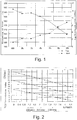
- Figure 2 refers to the evolution of the orientation index according to the PMMA concentration in the molten mass for different spinning speeds. In it, one can observe that the addition of 3.2% of PMMA to the molten mass when spinning at 3490 m/min. results in yarn with the same orientation index (I 100 ) as when spinning at 3000 m/min. in absence of PMMA, resulting in increased productivity.
- Figure 3 shows the residual stretching ratio (stretching in the texturisation operation) according to the orientation index (I 100 ) of the POY yarn for textured yarn with different elongation to breakage.
- I 100 orientation index
- Table 1 contains the values of the orientation index (I 100 ) when spinning at 3000 and 3500 m/min. according to the percentage of PMMA added to the polymer to be extruded. Examining them shows that incorporating 3.2% of PMMA (8% of the indicated "masterbatch") results in the same I 100 value, spinning at a speed of 3500 m/min. as when spinning at 3000 m/min. in absence of PMMA.
- Table 1 Masterbatch dosage (%) PMMA concentration (%) Orientation index (CN/Tex) 3000 m/min. 3500 m/min. 0 0 11.7 19.4 4 1.6 9.7 15.9 6 2.4 8.7 13.4 8 3.2 7.7 11.8
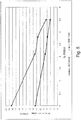
- Table 2 shows the value of the orientation index (I 100 ) when spinning at 3000 and 3500 m/min. according to the percentage of PMMA incorporated to the molten mass from the indicated "masterbatch". In it, one can see that the presence of 2.1% of PMMA spinning at 3500 m/min. leads to I 100 the same as when spinning at 3000 m/min. in absence of PMMA.
- the values of Table 2 are represented graphically in Figure 5 .
- Table 2 Masterbatch dosage (%) PMMA concentration (%) Orientation index (CN/Tex) 3000 m/min. 3500 m/min. 0 0 11.5 18.4 3 2.1 8.6 11.6 4 2.8 7.9 10.7 5 3.5 7.1 8.3
- This "masterbatch” enables the two main components to be combined and concentrated to the maximum, namely the pigment and PMMA, enabling a final product that offers all desired functionality at a perfectly viable dosage.
- Both “masterbatches” contained a weight ratio of 70% support polymer (PMMA or PBT) and 30% carbon black, and were dosed at 4% with regard to the molten polymer to be extruded.
- Curves 1-3 in Figure 6 correspond to the "masterbatch” that contained a weight ratio of 70% PBT / 30% carbon black
- curves 4-6 correspond to the "masterbatch” containing a weight ratio of 70% PMMA / 30% carbon black.
- the POY 210/48 dtex polyester yarn was prepared at a spinning speed of 3500 m/min., one of them without addition and the other with additivation of a "masterbatch" with a weight content of 85% PMMA / 15% TiO 2 , and another with a "masterbatch” with a weight content of 70% PMMA / 30% carbon black.
- the two additivated yarns contained in both cases 2.8% by weight of PMMA with regard to the polymer forming the fibre.
- Another yarn was additivated with PBT / carbon black with a weight content of 70% PBT / 30% carbon black.
- the conditions of the spinning process were the same as in example 1.
- the results in Table 5 correspond to parameters of the load/elongation curve of polyester POY 210 dtex yarn prepared in the same extrusion conditions, maintaining the same spinning speed of 3500 m/min.
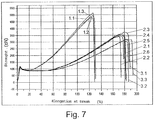
- the results have come from the load/elongation curves of Figure 7 that correspond to a non-additivated yarn (RT20) (curves 1.1)-1.3, and two additivated yarns with a 70% PMMA / 30% pigment "masterbatch".
- the pigment used in one case was Titanium dioxide ( Figure 7 , curves 2.1-2.6) and in the other case Carbon Black ( Figure 7 , curves 3.1-3.3), and both additivated yarns contained 2.8% PMMA with regard to the polymer forming the fibre.
- Table 5 confirms the decrease in orientation of the fibres (I 100 decrease) when using PMMA as "masterbatch” support, both when the additive used is carbon black as well as when it is titanium dioxide. This proves the effectiveness of using PMMA as support for an additive, as it enables increased elongation at breakage of the polyester POY yarn and therefore enables increased spinning speed, meaning improved performance in this operation.
- Polyester POY 290 dtex were prepared at a spinning speed of 3500 m/min. additivated with different doses of a "masterbatch" of 85% PMMA / 15% TiO 2 .
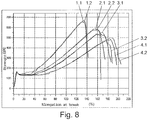
- Figure 8 contains the load-elongation curves of the POY yarn obtained, in which curves 1.1 and 1.2 correspond to POY yarn of PES Standard (RT20), curves 2.1 and 2.2 correspond to a 2% "masterbatch" dosage with a weight content of 85% PMMA / 15% TiO 2 , curves 3.1 and 3.2 correspond to 3% dosing of the same "masterbatch”, and curves 4.1 and 4.2 correspond to 4% dosing of the same "masterbatch”.
- curves 1.1 and 1.2 correspond to POY yarn of PES Standard (RT20)
- curves 2.1 and 2.2 correspond to a 2% "masterbatch" dosage with a weight content of 85% PMMA / 15% TiO 2
- curves 3.1 and 3.2 correspond to 3% dosing of the same "masterbatch”
- curves 4.1 and 4.2 correspond to 4% dosing of the same "masterbatch”.
- Table 6 indicates the doses applied to the molten polyester masses to be extruded and parameters of these curves.
- Figure 9 represents the elongation at break and the orientation index of these POY yarn according to the dosage masterbatch in the molten polymer. In it one can see clearly that the elongation at break increases and the orientation index decreases as the concentration of PMMA increases in the molten mass.
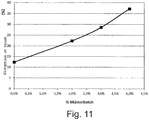
- the POY yarn prepared was textured by applying an elongation of 1,8, resulting in doubled textured yarn of 340 dtex. Traction tests were carried out to obtain the load-elongation curves of these textured yarns, which are shown in figure 10 , and where curves 1-3 correspond to additivated yarns with a 2% dosage of the aforementioned "masterbatch" (with a weight content of 85% PMMA / 15% TiO 2 ), curves 4-6 correspond to 3% dosing of said "masterbatch”, and curves 7-9 correspond to 4% dosing of this "masterbatch”. From this, the tenacity and the elongation at break was calculated, shown in Table 7. Table 7 Masterbatch dosage Average tenacity (CN/Tex) Average elongation at break (%) 0% -------- 12.3 2% 35.9 22.3 3% 33.7 28.6 4% 28.6 37.2
- Figure 11 shows the elongation at break of textured yarn according to the dosage of masterbatch in the molten mass, revealing that the elongation increases as the dose increases.
- the non-additivated polyester yarn after texturing applying an elongation ratio of 1.8 has an elongation at break of 12.3%, if the yarn has 2.5% (3% "masterbatch") PMMA, its elongation at break is 28.6%, a value considered normal in textured polyester yarn.
- the non-additivated textured yarn to display an elongation at break of 28.6%, it would be necessary to texture it with an elongation ratio of 1.57, which would lead to a final of 390 dtex.
- the possibility of applying an elongation ratio of 1.8 in the texturisation instead of 1.57 implies a 15% increase in productivity.
- polyester POY yarn was produced from the polymers additivated with different concentrations of a "masterbatch” with a content of 70% PMMA / 30% by weight of carbon black.
- the POY yarn was prepared with spinning speeds of 3000 and 3500 m/min., the molten polymer was additivated with 3% and 5% of this "masterbatch” and the POY yarn obtained had 290 dtex.
- Figure 12 shows the load/elongation curves of POY yarn resulting from spinning at a speed of 3500m/min.
- curves 1-3 correspond to a yarn additivated with a "masterbatch” with a content of 70% PMMA / 30% by weight of carbon black and dosed at 3% by weight in the polymer forming the yarn
- curves 4-6 correspond to a yarn additivated with the same "masterbatch” but dosed at 5% in the polymer forming the yarns.
- the traction parameters are summarised in Table 10.
Landscapes
- Chemical & Material Sciences (AREA)
- Chemical Kinetics & Catalysis (AREA)
- Engineering & Computer Science (AREA)
- Health & Medical Sciences (AREA)
- Medicinal Chemistry (AREA)
- Polymers & Plastics (AREA)
- Organic Chemistry (AREA)
- General Chemical & Material Sciences (AREA)
- Textile Engineering (AREA)
- Manufacturing & Machinery (AREA)
- Artificial Filaments (AREA)
- Processes Of Treating Macromolecular Substances (AREA)
Claims (14)
- Polyestersynthesegarn und -fasern des Typs von vorverstreckten Garnen, erhalten durch ein Schmelzspinnverfahren, wobei das Verfahren die Hinzufügung einer Masterbatch-Zusammensetzung zu den geschmolzenen Polyesterpolymeren, die das Garn und die Fasern bilden, während des Extrusionsprozesses aufweist, dadurch gekennzeichnet, dass die Masterbatch-Zusammensetzung Folgendes aufweist:- 30 bis 99 Gew.-% eines Polymethylmethacrylats "PMMA" als ein Träger; und- 1 bis 70 Gew.-% eines Pigments, das aus Kohleschwarz und Titandioxid dispergiert in dem Träger ausgewählt ist, wobei das PMMA bis zu 10 Gew.-% der geschmolzenen Polyesterpolymere vorliegt, die das Garn und die Fasern bilden.
- Polyestersynthesegarn und -fasern gemäß Anspruch 1, wobei die Masterbatch-Zusammensetzung 30-90 Gew.-% PMMA und 10-70 Gew.-% des Pigments aufweist, das aus Kohleschwarz und Titandioxid ausgewählt ist.
- Polyestersynthesegarn und -fasern gemäß einem der vorhergehenden Ansprüche, wobei die Masterbatch-Zusammensetzung zwischen 60-80 Gew.-% PMMA und zwischen 20-40 Gew.-% Kohleschwarz aufweist, wobei die Masterbatch-Zusammensetzung von 2 bis 8 Gew.-% der geschmolzenen Masse der Polyesterpolymere vorliegt, die das Garn und Fasern bilden, was in der geschmolzenen Masse zu einer Konzentration von PMMA von 1,4 bis 5,6 Gew.-% führt.
- Polyestersynthesegarn und -fasern gemäß Anspruch 3, wobei das vorverstreckte POY 290 dtex Polyestergarn einen Streckungsindex aufweist, der zwischen 11,7 (CN/tex) und 8,1 (CN/tex) bei einer Spinngeschwindigkeit von 2000-4500 m/min liegt, und eine Bruchdehnung, die zwischen 152% und 186% liegt, wobei der Streckungsindex der Last- oder Kraftwert ist, der eine 100%-Dehnung eines vorverstreckten Garns in der Lastdehnungskurve des vorverstreckten Garns verursacht.
- Polyestersynthesegarn und -fasern gemäß einem der Ansprüche 1 bis 2, wobei die Masterbatch-Zusammensetzung zwischen 50- 95 Gew.-% PMMA und zwischen 5-50 Gew.-% Titandioxid aufweist, wobei die Masterbatch-Zusammensetzung von 2 bis 8 Gew.-% der geschmolzenen Masse der Polyesterpolymere vorliegt, die das Garn und die Fasern bilden, was in der geschmolzenen Masse zu einer Konzentration von PMMA von 1,7 bis 6,8 Gew.-% führt.
- Polyestersynthesegarn und -fasern gemäß Anspruch 5, wobei das vorverstreckte Garn einen Streckungsindex aufweist, der zwischen 12,1 (CN/tex) und 7,9 (CN/tex) bei einer Spinngeschwindigkeit von 2000-4000 m/min liegt, und eine Bruchdehnung, die zwischen 152% und 185% liegt, wobei der Streckungsindex der Last- oder Kraftwert ist, der eine 100%-Dehnung eines vorverstreckten Garns in der Lastdehnungskurve des vorverstreckten Garns bewirkt.
- Herstellungsverfahren für Polyestersynthesegarn und -fasern des Typs von vorverstreckten Garnen gemäß einem der vorhergehenden Ansprüche durch ein Schmelzspinnverfahren, wobei das Verfahren die Hinzufügung einer Masterbatch-Zusammensetzung zu den geschmolzenen Polyesterpolymeren, die das Garn und die Faser bilden, während des Extrusionsprozesses aufweist, dadurch gekennzeichnet, dass die Masterbatch-Zusammensetzung 30 bis 99 Gew.-% Polymethylmethacrylat "PMMA" als einen Träger aufweist und 1 bis 70 Gew.-% eines Pigments, das aus Kohleschwarz und Titandioxid ausgewählt ist, die in dem Träger dispergiert sind, in die geschmolzenen Polyesterpolymere, die das Garn und die Fasern bilden, in der Extrusionsphase hinzugefügt wird, oder optional in einer vorhergehenden Vormischphase, wobei das PMMA bis zu 10 Gew.-% der geschmolzenen Polyesterpolymere vorliegt, die das Garn und die Fasern bilden.
- Verfahren gemäß Anspruch 7, bei dem die Masterbatch-Zusammensetzung 30 bis 90 Gew.-% PMMA und 10 bis 70 Gew.-% des Pigments aufweist, das aus Kohleschwarz und Titandioxid ausgewählt ist.
- Verfahren gemäß einem der Ansprüche 7 und 8, bei dem die Masterbatch-Zusammensetzung 60-80 Gew.-% PMMA und 20-40 Gew.-% Kohleschwarz aufweist, wobei die Masterbatch-Zusammensetzung von 2 bis 8 Gew.-% der geschmolzenen Masse der Polyesterpolymere vorliegt, die Fasern und Garne bilden, was in der geschmolzenen Masse zu einer Konzentration von PMMA von 1,4 bis 5,6 Gew.-% führt.
- Verfahren gemäß einem der Ansprüche 7 und 8, bei dem die Masterbatch-Zusammensetzung, die 50-95 Gew.-% PMMA und 5-50 Gew.-% Titandioxid aufweist, in die geschmolzenen Polyesterpolymere hinzugefügt wird, die das Garn und die Fasern bilden, wobei die Masterbatch-Zusammensetzung von 2 bis 8 Gew.-% der geschmolzenen Masse des Polyesterpolymers vorliegt, das Fasern und Garne bildet, was in der geschmolzenen Masse zu einer Konzentration von PMMA von 1,7 bis 6,8 Gew.-% führt.
- Verfahren gemäß einem der Ansprüche 7 bis 10, bei dem die Masterbatch-Zusammensetzung in der Form von festen Pellets hinzugefügt wird durch ein gravimetrisches System in dem Extrusionsbereich des geschmolzenen Polyesterpolymers, das das Garn und die Fasern bildet.
- Verfahren gemäß einem der Ansprüche 7 bis 10, bei dem die Masterbatch-Zusammensetzung in geschmolzener Form durch einen Quer-Extruder in dem Extrusionsbereich des geschmolzenen Polyesterpolymers hinzugefügt wird, das das Garn und die Fasern bildet.
- Verwendung des Polyestersynthesegarns und der -fasern gemäß einem der Ansprüche 1 bis 6 zum Herstellen von Texturgarn.
- Ein Texturgarn, das aus Polyestersynthesegarn und -fasern gemäß einem der Ansprüche 1 bis 6 hergestellt ist.
Applications Claiming Priority (2)
| Application Number | Priority Date | Filing Date | Title |
|---|---|---|---|
| ES201230366A ES2425471B1 (es) | 2012-03-12 | 2012-03-12 | Composición polimérica concentrada ("masterbatch"), su procedimiento de fabricación, y su uso para la aditivicación de fibras y filamentos de poliéster |
| PCT/ES2013/070043 WO2013135926A1 (es) | 2012-03-12 | 2013-01-30 | Composición polimérica concentrada ("masterbatch"), su procedimiento de fabricación, y su uso para la aditivicación de fibras y filamentos de poliéster" |
Publications (3)
| Publication Number | Publication Date |
|---|---|
| EP2826808A1 EP2826808A1 (de) | 2015-01-21 |
| EP2826808A4 EP2826808A4 (de) | 2015-11-18 |
| EP2826808B1 true EP2826808B1 (de) | 2018-09-26 |
Family
ID=49160291
Family Applications (1)
| Application Number | Title | Priority Date | Filing Date |
|---|---|---|---|
| EP13760463.3A Active EP2826808B1 (de) | 2012-03-12 | 2013-01-30 | Polyesterfasern und filamente, hergestellt durch verwendung von pmma pigment masterbatch, herstellungsverfahren und verwendung |
Country Status (6)
| Country | Link |
|---|---|
| US (1) | US20150025175A1 (de) |
| EP (1) | EP2826808B1 (de) |
| CN (1) | CN104271644B (de) |
| ES (2) | ES2425471B1 (de) |
| IN (1) | IN2014DN07564A (de) |
| WO (1) | WO2013135926A1 (de) |
Families Citing this family (6)
| Publication number | Priority date | Publication date | Assignee | Title |
|---|---|---|---|---|
| CN105200591A (zh) * | 2015-08-06 | 2015-12-30 | 太仓市雄瑞化纺有限公司 | 一种吸油弹力丝 |
| CN105401243A (zh) * | 2015-10-26 | 2016-03-16 | 安徽泛博纺织科技有限公司 | 延缓纺织品强度损失的汽车用有色涤纶长丝及制备方法 |
| US10590577B2 (en) | 2016-08-02 | 2020-03-17 | Fitesa Germany Gmbh | System and process for preparing polylactic acid nonwoven fabrics |
| US11441251B2 (en) | 2016-08-16 | 2022-09-13 | Fitesa Germany Gmbh | Nonwoven fabrics comprising polylactic acid having improved strength and toughness |
| EP3771754A1 (de) * | 2019-07-29 | 2021-02-03 | Iqap Masterbatch Group, S.L. | Verfahren zum ändern des farbtons von farbigen synthetischen fäden und filamenten sowie system zur durchführung des verfahrens |
| CN110527264A (zh) * | 2019-09-16 | 2019-12-03 | 苏州宝丽迪材料科技股份有限公司 | 光致变色pla纤维母粒的制备方法 |
Citations (2)
| Publication number | Priority date | Publication date | Assignee | Title |
|---|---|---|---|---|
| US4585818A (en) * | 1983-03-31 | 1986-04-29 | Rohm Gmbh | Flame retardant polymethyl methacrylate molding compound |
| WO2011152449A1 (ja) * | 2010-06-01 | 2011-12-08 | 株式会社カネカ | 樹脂組成物及びその成形体 |
Family Cites Families (14)
| Publication number | Priority date | Publication date | Assignee | Title |
|---|---|---|---|---|
| JPS5747912A (en) * | 1980-09-03 | 1982-03-19 | Teijin Ltd | Undrawn polyester yarn and its production |
| DE3613257A1 (de) * | 1986-04-19 | 1987-10-22 | Basf Lacke & Farben | Neue pigmentpraeparationen, enthaltend ein organisches pigment, ein verfahren zu ihrer herstellung und ihre verwendung zur einfaerbung von thermoplastischen kunststoffen |
| JPS638458A (ja) * | 1986-06-27 | 1988-01-14 | Sumitomo Chem Co Ltd | 着色用樹脂組成物 |
| JPH0693201A (ja) * | 1992-09-09 | 1994-04-05 | Tokyo Ink Kk | カラーマスターバッチと加工顔料 |
| US5484837A (en) * | 1994-10-25 | 1996-01-16 | Far Eastern Textile, Ltd. | Black masterbatch |
| JPH09227768A (ja) * | 1995-12-18 | 1997-09-02 | Toyo Ink Mfg Co Ltd | 着色剤組成物およびその着色剤組成物を用いて成る成形物 |
| EP0827980B1 (de) * | 1996-09-10 | 2003-05-21 | Daicel Chemical Industries, Ltd. | Harzzusammenstellung zur Erzeugung weisser Markierungen |
| JP3464385B2 (ja) | 1998-06-09 | 2003-11-10 | 帝人ファイバー株式会社 | ポリエステル多様性混繊糸 |
| EP0987353B1 (de) | 1998-09-16 | 2003-11-05 | Röhm GmbH & Co. KG | Polyesterfasern und -filamente sowie Verfahren zu deren Herstellung |
| JP3862996B2 (ja) | 2001-10-31 | 2006-12-27 | 帝人ファイバー株式会社 | ポリトリメチレンテレフタレートフィラメント糸およびその製造方法 |
| ES2246167A1 (es) * | 2004-07-27 | 2006-02-01 | Iqap Colorpoint, S.A. | Preparcion pigmentaria para la coloracion de polimeros. |
| DE102004045639A1 (de) * | 2004-09-21 | 2006-04-06 | Clariant Masterbatch Gmbh & Co. Ohg | Polyester-Farbmittelkonzentrat |
| FR2925060B1 (fr) * | 2007-12-13 | 2012-12-21 | Essilor Int | Procede de preparation d'un materiau polymere transparent comprenant un polycarbonate thermoplastique et des nanoparticules minerales. |
| EP2473265A4 (de) * | 2009-09-04 | 2014-03-19 | Carolina Color Corp | Masterbatchzusammensetzung mit hochpolymerem verarbeitungshilfsstoff |
-
2012
- 2012-03-12 ES ES201230366A patent/ES2425471B1/es not_active Expired - Fee Related
-
2013
- 2013-01-30 CN CN201380014197.8A patent/CN104271644B/zh not_active Expired - Fee Related
- 2013-01-30 WO PCT/ES2013/070043 patent/WO2013135926A1/es not_active Ceased
- 2013-01-30 US US14/383,351 patent/US20150025175A1/en not_active Abandoned
- 2013-01-30 EP EP13760463.3A patent/EP2826808B1/de active Active
- 2013-01-30 ES ES13760463T patent/ES2699816T3/es active Active
-
2014
- 2014-09-09 IN IN7564DEN2014 patent/IN2014DN07564A/en unknown
Patent Citations (2)
| Publication number | Priority date | Publication date | Assignee | Title |
|---|---|---|---|---|
| US4585818A (en) * | 1983-03-31 | 1986-04-29 | Rohm Gmbh | Flame retardant polymethyl methacrylate molding compound |
| WO2011152449A1 (ja) * | 2010-06-01 | 2011-12-08 | 株式会社カネカ | 樹脂組成物及びその成形体 |
Also Published As
| Publication number | Publication date |
|---|---|
| ES2699816T3 (es) | 2019-02-12 |
| CN104271644A (zh) | 2015-01-07 |
| US20150025175A1 (en) | 2015-01-22 |
| IN2014DN07564A (de) | 2015-04-24 |
| EP2826808A1 (de) | 2015-01-21 |
| ES2425471A1 (es) | 2013-10-15 |
| CN104271644B (zh) | 2016-08-24 |
| HK1200858A1 (en) | 2015-08-14 |
| ES2425471B1 (es) | 2014-07-25 |
| WO2013135926A1 (es) | 2013-09-19 |
| EP2826808A4 (de) | 2015-11-18 |
Similar Documents
| Publication | Publication Date | Title |
|---|---|---|
| EP2245077B1 (de) | Monofilamentfasern mit gemahlenem calciumcarbonat | |
| EP2826808A1 (de) | Konzentrierte polymerzusammensetzung (»masterbatch), herstellungsverfahren dafür und verwendung davon als zusatz für polyesterfasern und -filamente | |
| JP6708813B2 (ja) | ポリ乳酸樹脂繊維、ポリ乳酸長繊維、ポリ乳酸短繊維およびポリ乳酸繊維 | |
| AU2005305076A1 (en) | Melt-spun multifilament polyolefin yarn formation processes and yarns formed therefrom | |
| EP2933361B1 (de) | Monofilamente mit hoher abrieb- und formbeständigkeit, geringer gleitreibung und anschmutzneigung, textile flächengebilde enthaltend diese und deren verwendung | |
| CN1738932A (zh) | 生产高丹尼尔聚丙烯纤维和纱线的高速纺纱工艺 | |
| CN100350084C (zh) | 纳米复合抗菌涤纶poy共混高速纺丝法 | |
| CN101139748A (zh) | 一种细旦或超细旦尼龙纤维及其生产方法 | |
| JP5565971B2 (ja) | ポリ乳酸樹脂とポリエチレンテレフタレート樹脂からなるポリマーアロイおよびその製造方法 | |
| EP1637633A1 (de) | Polyesterfasern, Verfahren zu deren Herstellung und deren Verwendung | |
| US20110159762A1 (en) | Paper machine clothing with monofilaments having carbon nanotubes | |
| KR100609801B1 (ko) | 섬유의 고속 용융 방사 | |
| EP2499283B1 (de) | Spinngefärbte hmls-monofilamente, deren herstellung und anwendung | |
| EP1516016B1 (de) | Ploymerzusammensetzung und ihre verwendung | |
| KR20180075148A (ko) | 형광 폴리프로필렌 원착사의 제조방법 및 그 원착사 | |
| HK1200858B (en) | Concentrated polymer composition ("masterbatch"), production method thereof and use of same for adding to polyester fibres and filaments | |
| US20250223731A1 (en) | Melt spinning of blended polylactic acid fibers | |
| EP1743963A1 (de) | Polyesterfasern, Verfahren zu deren Herstellung und deren Verwendung | |
| CN117402486A (zh) | 一种可纺性高的无机杂化聚酰胺复合物及其制备方法和应用 | |
| US20250243607A1 (en) | Melt spinning of blended cellulose acetate butyrate fibers | |
| JP2011106060A (ja) | ポリアリーレンスルフィド繊維 | |
| KR100575377B1 (ko) | 나노 입자를 포함하는 셀룰로오스 섬유의 제조 방법 | |
| JP2004360140A (ja) | ポリエステル繊維及びその製造方法 | |
| JPH11279832A (ja) | 繊維用ポリプロピレン系樹脂組成物及び繊維 | |
| CN116676685A (zh) | 一种稳定的两相聚合物有限界面复合纤维、应用及其制造方法 |
Legal Events
| Date | Code | Title | Description |
|---|---|---|---|
| PUAI | Public reference made under article 153(3) epc to a published international application that has entered the european phase |
Free format text: ORIGINAL CODE: 0009012 |
|
| 17P | Request for examination filed |
Effective date: 20140918 |
|
| AK | Designated contracting states |
Kind code of ref document: A1 Designated state(s): AL AT BE BG CH CY CZ DE DK EE ES FI FR GB GR HR HU IE IS IT LI LT LU LV MC MK MT NL NO PL PT RO RS SE SI SK SM TR |
|
| AX | Request for extension of the european patent |
Extension state: BA ME |
|
| DAX | Request for extension of the european patent (deleted) | ||
| RA4 | Supplementary search report drawn up and despatched (corrected) |
Effective date: 20151021 |
|
| RIC1 | Information provided on ipc code assigned before grant |
Ipc: D01F 6/62 20060101ALI20151015BHEP Ipc: C08J 3/22 20060101AFI20151015BHEP Ipc: D01F 1/02 20060101ALI20151015BHEP Ipc: C08L 33/10 20060101ALI20151015BHEP |
|
| STAA | Information on the status of an ep patent application or granted ep patent |
Free format text: STATUS: EXAMINATION IS IN PROGRESS |
|
| 17Q | First examination report despatched |
Effective date: 20170428 |
|
| REG | Reference to a national code |
Ref country code: DE Ref legal event code: R079 Ref document number: 602013044211 Country of ref document: DE Free format text: PREVIOUS MAIN CLASS: C08J0003220000 Ipc: D01F0006620000 |
|
| GRAP | Despatch of communication of intention to grant a patent |
Free format text: ORIGINAL CODE: EPIDOSNIGR1 |
|
| STAA | Information on the status of an ep patent application or granted ep patent |
Free format text: STATUS: GRANT OF PATENT IS INTENDED |
|
| RIC1 | Information provided on ipc code assigned before grant |
Ipc: C08J 3/22 20060101ALI20180424BHEP Ipc: D01F 6/62 20060101AFI20180424BHEP Ipc: D01F 1/04 20060101ALI20180424BHEP |
|
| INTG | Intention to grant announced |
Effective date: 20180518 |
|
| GRAS | Grant fee paid |
Free format text: ORIGINAL CODE: EPIDOSNIGR3 |
|
| GRAA | (expected) grant |
Free format text: ORIGINAL CODE: 0009210 |
|
| STAA | Information on the status of an ep patent application or granted ep patent |
Free format text: STATUS: THE PATENT HAS BEEN GRANTED |
|
| AK | Designated contracting states |
Kind code of ref document: B1 Designated state(s): AL AT BE BG CH CY CZ DE DK EE ES FI FR GB GR HR HU IE IS IT LI LT LU LV MC MK MT NL NO PL PT RO RS SE SI SK SM TR |
|
| REG | Reference to a national code |
Ref country code: GB Ref legal event code: FG4D |
|
| REG | Reference to a national code |
Ref country code: CH Ref legal event code: EP |
|
| REG | Reference to a national code |
Ref country code: AT Ref legal event code: REF Ref document number: 1046157 Country of ref document: AT Kind code of ref document: T Effective date: 20181015 |
|
| REG | Reference to a national code |
Ref country code: IE Ref legal event code: FG4D |
|
| REG | Reference to a national code |
Ref country code: DE Ref legal event code: R096 Ref document number: 602013044211 Country of ref document: DE |
|
| REG | Reference to a national code |
Ref country code: NL Ref legal event code: MP Effective date: 20180926 |
|
| PG25 | Lapsed in a contracting state [announced via postgrant information from national office to epo] |
Ref country code: FI Free format text: LAPSE BECAUSE OF FAILURE TO SUBMIT A TRANSLATION OF THE DESCRIPTION OR TO PAY THE FEE WITHIN THE PRESCRIBED TIME-LIMIT Effective date: 20180926 Ref country code: LT Free format text: LAPSE BECAUSE OF FAILURE TO SUBMIT A TRANSLATION OF THE DESCRIPTION OR TO PAY THE FEE WITHIN THE PRESCRIBED TIME-LIMIT Effective date: 20180926 Ref country code: NO Free format text: LAPSE BECAUSE OF FAILURE TO SUBMIT A TRANSLATION OF THE DESCRIPTION OR TO PAY THE FEE WITHIN THE PRESCRIBED TIME-LIMIT Effective date: 20181226 Ref country code: SE Free format text: LAPSE BECAUSE OF FAILURE TO SUBMIT A TRANSLATION OF THE DESCRIPTION OR TO PAY THE FEE WITHIN THE PRESCRIBED TIME-LIMIT Effective date: 20180926 Ref country code: BG Free format text: LAPSE BECAUSE OF FAILURE TO SUBMIT A TRANSLATION OF THE DESCRIPTION OR TO PAY THE FEE WITHIN THE PRESCRIBED TIME-LIMIT Effective date: 20181226 Ref country code: RS Free format text: LAPSE BECAUSE OF FAILURE TO SUBMIT A TRANSLATION OF THE DESCRIPTION OR TO PAY THE FEE WITHIN THE PRESCRIBED TIME-LIMIT Effective date: 20180926 Ref country code: GR Free format text: LAPSE BECAUSE OF FAILURE TO SUBMIT A TRANSLATION OF THE DESCRIPTION OR TO PAY THE FEE WITHIN THE PRESCRIBED TIME-LIMIT Effective date: 20181227 |
|
| REG | Reference to a national code |
Ref country code: LT Ref legal event code: MG4D |
|
| REG | Reference to a national code |
Ref country code: ES Ref legal event code: FG2A Ref document number: 2699816 Country of ref document: ES Kind code of ref document: T3 Effective date: 20190212 |
|
| PG25 | Lapsed in a contracting state [announced via postgrant information from national office to epo] |
Ref country code: HR Free format text: LAPSE BECAUSE OF FAILURE TO SUBMIT A TRANSLATION OF THE DESCRIPTION OR TO PAY THE FEE WITHIN THE PRESCRIBED TIME-LIMIT Effective date: 20180926 Ref country code: LV Free format text: LAPSE BECAUSE OF FAILURE TO SUBMIT A TRANSLATION OF THE DESCRIPTION OR TO PAY THE FEE WITHIN THE PRESCRIBED TIME-LIMIT Effective date: 20180926 Ref country code: AL Free format text: LAPSE BECAUSE OF FAILURE TO SUBMIT A TRANSLATION OF THE DESCRIPTION OR TO PAY THE FEE WITHIN THE PRESCRIBED TIME-LIMIT Effective date: 20180926 |
|
| REG | Reference to a national code |
Ref country code: AT Ref legal event code: MK05 Ref document number: 1046157 Country of ref document: AT Kind code of ref document: T Effective date: 20180926 |
|
| PG25 | Lapsed in a contracting state [announced via postgrant information from national office to epo] |
Ref country code: AT Free format text: LAPSE BECAUSE OF FAILURE TO SUBMIT A TRANSLATION OF THE DESCRIPTION OR TO PAY THE FEE WITHIN THE PRESCRIBED TIME-LIMIT Effective date: 20180926 Ref country code: EE Free format text: LAPSE BECAUSE OF FAILURE TO SUBMIT A TRANSLATION OF THE DESCRIPTION OR TO PAY THE FEE WITHIN THE PRESCRIBED TIME-LIMIT Effective date: 20180926 Ref country code: RO Free format text: LAPSE BECAUSE OF FAILURE TO SUBMIT A TRANSLATION OF THE DESCRIPTION OR TO PAY THE FEE WITHIN THE PRESCRIBED TIME-LIMIT Effective date: 20180926 Ref country code: NL Free format text: LAPSE BECAUSE OF FAILURE TO SUBMIT A TRANSLATION OF THE DESCRIPTION OR TO PAY THE FEE WITHIN THE PRESCRIBED TIME-LIMIT Effective date: 20180926 Ref country code: IS Free format text: LAPSE BECAUSE OF FAILURE TO SUBMIT A TRANSLATION OF THE DESCRIPTION OR TO PAY THE FEE WITHIN THE PRESCRIBED TIME-LIMIT Effective date: 20190126 Ref country code: PL Free format text: LAPSE BECAUSE OF FAILURE TO SUBMIT A TRANSLATION OF THE DESCRIPTION OR TO PAY THE FEE WITHIN THE PRESCRIBED TIME-LIMIT Effective date: 20180926 |
|
| PG25 | Lapsed in a contracting state [announced via postgrant information from national office to epo] |
Ref country code: PT Free format text: LAPSE BECAUSE OF FAILURE TO SUBMIT A TRANSLATION OF THE DESCRIPTION OR TO PAY THE FEE WITHIN THE PRESCRIBED TIME-LIMIT Effective date: 20190126 Ref country code: SK Free format text: LAPSE BECAUSE OF FAILURE TO SUBMIT A TRANSLATION OF THE DESCRIPTION OR TO PAY THE FEE WITHIN THE PRESCRIBED TIME-LIMIT Effective date: 20180926 Ref country code: SM Free format text: LAPSE BECAUSE OF FAILURE TO SUBMIT A TRANSLATION OF THE DESCRIPTION OR TO PAY THE FEE WITHIN THE PRESCRIBED TIME-LIMIT Effective date: 20180926 |
|
| REG | Reference to a national code |
Ref country code: DE Ref legal event code: R097 Ref document number: 602013044211 Country of ref document: DE |
|
| PG25 | Lapsed in a contracting state [announced via postgrant information from national office to epo] |
Ref country code: DK Free format text: LAPSE BECAUSE OF FAILURE TO SUBMIT A TRANSLATION OF THE DESCRIPTION OR TO PAY THE FEE WITHIN THE PRESCRIBED TIME-LIMIT Effective date: 20180926 |
|
| PLBE | No opposition filed within time limit |
Free format text: ORIGINAL CODE: 0009261 |
|
| STAA | Information on the status of an ep patent application or granted ep patent |
Free format text: STATUS: NO OPPOSITION FILED WITHIN TIME LIMIT |
|
| PG25 | Lapsed in a contracting state [announced via postgrant information from national office to epo] |
Ref country code: MC Free format text: LAPSE BECAUSE OF FAILURE TO SUBMIT A TRANSLATION OF THE DESCRIPTION OR TO PAY THE FEE WITHIN THE PRESCRIBED TIME-LIMIT Effective date: 20180926 |
|
| REG | Reference to a national code |
Ref country code: CH Ref legal event code: PL |
|
| 26N | No opposition filed |
Effective date: 20190627 |
|
| PG25 | Lapsed in a contracting state [announced via postgrant information from national office to epo] |
Ref country code: LU Free format text: LAPSE BECAUSE OF NON-PAYMENT OF DUE FEES Effective date: 20190130 |
|
| REG | Reference to a national code |
Ref country code: BE Ref legal event code: MM Effective date: 20190131 |
|
| PG25 | Lapsed in a contracting state [announced via postgrant information from national office to epo] |
Ref country code: SI Free format text: LAPSE BECAUSE OF FAILURE TO SUBMIT A TRANSLATION OF THE DESCRIPTION OR TO PAY THE FEE WITHIN THE PRESCRIBED TIME-LIMIT Effective date: 20180926 |
|
| PG25 | Lapsed in a contracting state [announced via postgrant information from national office to epo] |
Ref country code: BE Free format text: LAPSE BECAUSE OF NON-PAYMENT OF DUE FEES Effective date: 20190131 |
|
| PG25 | Lapsed in a contracting state [announced via postgrant information from national office to epo] |
Ref country code: LI Free format text: LAPSE BECAUSE OF NON-PAYMENT OF DUE FEES Effective date: 20190131 Ref country code: CH Free format text: LAPSE BECAUSE OF NON-PAYMENT OF DUE FEES Effective date: 20190131 |
|
| PG25 | Lapsed in a contracting state [announced via postgrant information from national office to epo] |
Ref country code: TR Free format text: LAPSE BECAUSE OF FAILURE TO SUBMIT A TRANSLATION OF THE DESCRIPTION OR TO PAY THE FEE WITHIN THE PRESCRIBED TIME-LIMIT Effective date: 20180926 |
|
| PG25 | Lapsed in a contracting state [announced via postgrant information from national office to epo] |
Ref country code: MT Free format text: LAPSE BECAUSE OF NON-PAYMENT OF DUE FEES Effective date: 20190130 |
|
| PG25 | Lapsed in a contracting state [announced via postgrant information from national office to epo] |
Ref country code: CY Free format text: LAPSE BECAUSE OF FAILURE TO SUBMIT A TRANSLATION OF THE DESCRIPTION OR TO PAY THE FEE WITHIN THE PRESCRIBED TIME-LIMIT Effective date: 20180926 |
|
| PG25 | Lapsed in a contracting state [announced via postgrant information from national office to epo] |
Ref country code: HU Free format text: LAPSE BECAUSE OF FAILURE TO SUBMIT A TRANSLATION OF THE DESCRIPTION OR TO PAY THE FEE WITHIN THE PRESCRIBED TIME-LIMIT; INVALID AB INITIO Effective date: 20130130 |
|
| PG25 | Lapsed in a contracting state [announced via postgrant information from national office to epo] |
Ref country code: MK Free format text: LAPSE BECAUSE OF FAILURE TO SUBMIT A TRANSLATION OF THE DESCRIPTION OR TO PAY THE FEE WITHIN THE PRESCRIBED TIME-LIMIT Effective date: 20180926 |
|
| P01 | Opt-out of the competence of the unified patent court (upc) registered |
Effective date: 20230413 |
|
| PGFP | Annual fee paid to national office [announced via postgrant information from national office to epo] |
Ref country code: GB Payment date: 20231207 Year of fee payment: 12 |
|
| PGFP | Annual fee paid to national office [announced via postgrant information from national office to epo] |
Ref country code: IE Payment date: 20231211 Year of fee payment: 12 Ref country code: FR Payment date: 20231212 Year of fee payment: 12 |
|
| PGFP | Annual fee paid to national office [announced via postgrant information from national office to epo] |
Ref country code: ES Payment date: 20240208 Year of fee payment: 12 |
|
| PGFP | Annual fee paid to national office [announced via postgrant information from national office to epo] |
Ref country code: CZ Payment date: 20240118 Year of fee payment: 12 |
|
| PGFP | Annual fee paid to national office [announced via postgrant information from national office to epo] |
Ref country code: IT Payment date: 20231212 Year of fee payment: 12 |
|
| PGFP | Annual fee paid to national office [announced via postgrant information from national office to epo] |
Ref country code: DE Payment date: 20241203 Year of fee payment: 13 |
|
| GBPC | Gb: european patent ceased through non-payment of renewal fee |
Effective date: 20250130 |
|
| PG25 | Lapsed in a contracting state [announced via postgrant information from national office to epo] |
Ref country code: GB Free format text: LAPSE BECAUSE OF NON-PAYMENT OF DUE FEES Effective date: 20250130 |
|
| PG25 | Lapsed in a contracting state [announced via postgrant information from national office to epo] |
Ref country code: FR Free format text: LAPSE BECAUSE OF NON-PAYMENT OF DUE FEES Effective date: 20250131 |
|
| PG25 | Lapsed in a contracting state [announced via postgrant information from national office to epo] |
Ref country code: CZ Free format text: LAPSE BECAUSE OF NON-PAYMENT OF DUE FEES Effective date: 20250130 |
|
| PG25 | Lapsed in a contracting state [announced via postgrant information from national office to epo] |
Ref country code: IE Free format text: LAPSE BECAUSE OF NON-PAYMENT OF DUE FEES Effective date: 20250130 |
|
| REG | Reference to a national code |
Ref country code: ES Ref legal event code: FD2A Effective date: 20260304 |
|
| PG25 | Lapsed in a contracting state [announced via postgrant information from national office to epo] |
Ref country code: ES Free format text: LAPSE BECAUSE OF NON-PAYMENT OF DUE FEES Effective date: 20250131 |