EP2814876B1 - Verfahren zum recycling von bodenbelägen - Google Patents
Verfahren zum recycling von bodenbelägen Download PDFInfo
- Publication number
- EP2814876B1 EP2814876B1 EP13702343.8A EP13702343A EP2814876B1 EP 2814876 B1 EP2814876 B1 EP 2814876B1 EP 13702343 A EP13702343 A EP 13702343A EP 2814876 B1 EP2814876 B1 EP 2814876B1
- Authority
- EP
- European Patent Office
- Prior art keywords
- polyolefin wax
- mpa
- component materials
- solvent
- recycling
- Prior art date
- Legal status (The legal status is an assumption and is not a legal conclusion. Google has not performed a legal analysis and makes no representation as to the accuracy of the status listed.)
- Active
Links
Images
Classifications
-
- C—CHEMISTRY; METALLURGY
- C08—ORGANIC MACROMOLECULAR COMPOUNDS; THEIR PREPARATION OR CHEMICAL WORKING-UP; COMPOSITIONS BASED THEREON
- C08J—WORKING-UP; GENERAL PROCESSES OF COMPOUNDING; AFTER-TREATMENT NOT COVERED BY SUBCLASSES C08B, C08C, C08F, C08G or C08H
- C08J11/00—Recovery or working-up of waste materials
- C08J11/04—Recovery or working-up of waste materials of polymers
- C08J11/06—Recovery or working-up of waste materials of polymers without chemical reactions
- C08J11/08—Recovery or working-up of waste materials of polymers without chemical reactions using selective solvents for polymer components
-
- B—PERFORMING OPERATIONS; TRANSPORTING
- B29—WORKING OF PLASTICS; WORKING OF SUBSTANCES IN A PLASTIC STATE IN GENERAL
- B29B—PREPARATION OR PRETREATMENT OF THE MATERIAL TO BE SHAPED; MAKING GRANULES OR PREFORMS; RECOVERY OF PLASTICS OR OTHER CONSTITUENTS OF WASTE MATERIAL CONTAINING PLASTICS
- B29B17/00—Recovery of plastics or other constituents of waste material containing plastics
- B29B17/02—Separating plastics from other materials
- B29B2017/0213—Specific separating techniques
- B29B2017/0293—Dissolving the materials in gases or liquids
-
- B—PERFORMING OPERATIONS; TRANSPORTING
- B29—WORKING OF PLASTICS; WORKING OF SUBSTANCES IN A PLASTIC STATE IN GENERAL
- B29K—INDEXING SCHEME ASSOCIATED WITH SUBCLASSES B29B, B29C OR B29D, RELATING TO MOULDING MATERIALS OR TO MATERIALS FOR MOULDS, REINFORCEMENTS, FILLERS OR PREFORMED PARTS, e.g. INSERTS
- B29K2023/00—Use of polyalkenes or derivatives thereof as moulding material
- B29K2023/04—Polymers of ethylene
- B29K2023/06—PE, i.e. polyethylene
-
- B—PERFORMING OPERATIONS; TRANSPORTING
- B29—WORKING OF PLASTICS; WORKING OF SUBSTANCES IN A PLASTIC STATE IN GENERAL
- B29K—INDEXING SCHEME ASSOCIATED WITH SUBCLASSES B29B, B29C OR B29D, RELATING TO MOULDING MATERIALS OR TO MATERIALS FOR MOULDS, REINFORCEMENTS, FILLERS OR PREFORMED PARTS, e.g. INSERTS
- B29K2023/00—Use of polyalkenes or derivatives thereof as moulding material
- B29K2023/10—Polymers of propylene
- B29K2023/12—PP, i.e. polypropylene
-
- C—CHEMISTRY; METALLURGY
- C08—ORGANIC MACROMOLECULAR COMPOUNDS; THEIR PREPARATION OR CHEMICAL WORKING-UP; COMPOSITIONS BASED THEREON
- C08J—WORKING-UP; GENERAL PROCESSES OF COMPOUNDING; AFTER-TREATMENT NOT COVERED BY SUBCLASSES C08B, C08C, C08F, C08G or C08H
- C08J2323/00—Characterised by the use of homopolymers or copolymers of unsaturated aliphatic hydrocarbons having only one carbon-to-carbon double bond; Derivatives of such polymers
- C08J2323/02—Characterised by the use of homopolymers or copolymers of unsaturated aliphatic hydrocarbons having only one carbon-to-carbon double bond; Derivatives of such polymers not modified by chemical after treatment
- C08J2323/04—Homopolymers or copolymers of ethene
- C08J2323/06—Polyethene
-
- C—CHEMISTRY; METALLURGY
- C08—ORGANIC MACROMOLECULAR COMPOUNDS; THEIR PREPARATION OR CHEMICAL WORKING-UP; COMPOSITIONS BASED THEREON
- C08J—WORKING-UP; GENERAL PROCESSES OF COMPOUNDING; AFTER-TREATMENT NOT COVERED BY SUBCLASSES C08B, C08C, C08F, C08G or C08H
- C08J2391/00—Characterised by the use of oils, fats or waxes; Derivatives thereof
- C08J2391/06—Waxes
-
- C—CHEMISTRY; METALLURGY
- C08—ORGANIC MACROMOLECULAR COMPOUNDS; THEIR PREPARATION OR CHEMICAL WORKING-UP; COMPOSITIONS BASED THEREON
- C08J—WORKING-UP; GENERAL PROCESSES OF COMPOUNDING; AFTER-TREATMENT NOT COVERED BY SUBCLASSES C08B, C08C, C08F, C08G or C08H
- C08J2423/00—Characterised by the use of homopolymers or copolymers of unsaturated aliphatic hydrocarbons having only one carbon-to-carbon double bond; Derivatives of such polymers
- C08J2423/02—Characterised by the use of homopolymers or copolymers of unsaturated aliphatic hydrocarbons having only one carbon-to-carbon double bond; Derivatives of such polymers not modified by chemical after treatment
- C08J2423/10—Homopolymers or copolymers of propene
- C08J2423/12—Polypropene
-
- Y—GENERAL TAGGING OF NEW TECHNOLOGICAL DEVELOPMENTS; GENERAL TAGGING OF CROSS-SECTIONAL TECHNOLOGIES SPANNING OVER SEVERAL SECTIONS OF THE IPC; TECHNICAL SUBJECTS COVERED BY FORMER USPC CROSS-REFERENCE ART COLLECTIONS [XRACs] AND DIGESTS
- Y02—TECHNOLOGIES OR APPLICATIONS FOR MITIGATION OR ADAPTATION AGAINST CLIMATE CHANGE
- Y02W—CLIMATE CHANGE MITIGATION TECHNOLOGIES RELATED TO WASTEWATER TREATMENT OR WASTE MANAGEMENT
- Y02W30/00—Technologies for solid waste management
- Y02W30/50—Reuse, recycling or recovery technologies
- Y02W30/62—Plastics recycling; Rubber recycling
Definitions
- the invention relates to a recycling process for floor coverings of any kind for the recovery of the raw materials used.
- a solvent-based recycling process makes it possible to recycle the various raw materials used at the end of the life cycle of the floor coverings or synthetic turf.
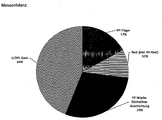
- Carpets and artificial turf are flooring constructions consisting of a backing, a yarn, a backing, and often a secondary backing such as carpet. As a fleece, fabric, foam or a heavy layer. A typical distribution of the percentage mass fractions is shown in drawing 1. Different plastics are used for the different components. In the case of carpets, the yarn used is predominantly polypropylene, polyamide or even polyester. Artificial grass mainly uses polyethylene and polypropylene. Polypropylene and polyester are most commonly used to make the backing. In order for the yarn to be incorporated into the carrier, an additional coating is required.
- aqueous latex and acrylates as coating material for carpets (nonwoven, woven fabric and tuftste) and, in the case of artificial turf, in addition to aqueous latex, also polyurethane.
- the use of latex and polyurethane as a coating material results from the non-reversible curing of the back coating to an only incomplete material or raw material recyclable end product.
- EP-A-2236671 and EP-A-2236672 described as a special form of mechanical recycling ever a method in which old artificial turf is comminuted by regranulation as a polymer blend, and the regranulate is used by admixing new plastics for the production of so-called "infill”.
- An "infill” is a granulate which is scattered loosely on the actual artificial grass, for example for damping.
- downcycling in which the materials are not produced in a pure type and thus can not be used in their original form, also referred to by so-called "downcycling".
- WO-A-2008/64012 discloses a similar process but not the catalysts, softening point and viscosity.
- raw material recycling in which the plastics are recycled by hydrogenation, gasification, cracking and / or pyrolysis processes into their starting materials - oil or gas.
- the process technologies for raw material recycling have been very well developed in the 90s. So is for example in WO 95/03375 presented a recycling process, which splits plastic waste into a liquid product and subsequent to olefins such.
- the process is particularly suitable for recycling very large quantities of polyolefin-rich plastics (PE, PP).
- the material efficiency of the process is particularly high at over 93%.
- thermoplastic polymers such as plastics and waxes
- organic solvents By a suitable choice of temperature, pressure and type of solvent can be gradually obtained pure polymer solutions and obtained after removal of the solvent by evaporation unmixed plastics.
- the advantages of this process are, on the one hand, the extraordinarily high product quality that can be achieved and, on the other hand, the possibility of being able to remove additives which often drastically reduce the possible uses for regranulates.
- EP-A-0491836 A process for recycling plastic mixtures by means of "selective dissolution" is described.
- the recycling process described is based on a selected solvent and its solvent capacity for different plastics at different temperatures. Precipitants and other solvents are dispensed with in this process.
- polymer waxes and higher molecular weight homo- and copolymers each based on propylene, ethylene, or higher ⁇ -olefins (C 4 -C 20 ), not previously described.
- Such waxes differ from the chemically related polymer in particular in their lower molecular weight and, correlatingly, in their lower melt viscosity.
- polyolefin waxes are meant here in contrast to plastics such polyolefins whose melt viscosity at 170 ° C below 40,000 mPa ⁇ s.
- the invention therefore provides a solvent-based separation process for recovering material used in nonwoven, woven and tufted goods, in particular in artificial turf, carpets and woven carpets Materials in their qualitatively single-grade material components, wherein at least one material component contains a polyolefin wax and being used as a solvent and / or swelling agent halogen-free aliphatic hydrocarbons and / or aromatic hydrocarbons.
- It is preferably a polyolefin wax which has been prepared with the aid of metallocene catalysts.
- the solvent-based separation process according to the invention relates to the recycling of flooring constructions such as nonwoven, woven and tufted goods, for.
- flooring constructions such as nonwoven, woven and tufted goods, for.
- artificial turf carpets and woven carpets for partial, preferably complete recovery of the individual unmixed material components.
- the material components are considered to be single-grade if the cross-contamination with another material component is not more than 10% by weight, preferably not more than 5% by weight, more preferably not more than 1% by weight, and if this results in the mechanical properties the material component (such as tensile strength, elongation at break, modulus of elasticity, etc.) compared to the original properties of the material component prior to recycling by not more than 20%, preferably not more than 10% change.
- the material components are at least one polymer soluble in a suitable organic solvent and at least one soluble polyolefin wax and that at most one insoluble material component is present.
- the dissolution temperatures are sufficiently far apart (at least 15 K) to ensure “selective dissolution” or "selective swelling”.
- Solvent-based separation processes are known in the art, but not for the recycling of carpets or artificial turf.
- the methods of "selective dissolution” as in EP-A-0491836 or in H. Martens, Recyclingtechnik, Spektrum Heidelberg 2011, 171ff, "selective swelling” as in WO 2011/082802 as well as the “selective fractionation” implies.
- the separation principle is based on the control of the viscosity over the degree of swelling and aims at the separation of solid undissolved material components of viscous polymer gels by filtration or sedimentation under suitable shearing.
- the solvent used can be separated and recycled to the process. Possibly. Remaining solvent residues can also be removed by extrusion with suitable degassing.
- Halogen-free aliphatic hydrocarbons such as n-heptane or decalin, aromatic hydrocarbons such as toluene, xylene, tetralin, or mixtures of one or more of these solvents are used according to the invention as the solvent or swelling agent.
- the use according to the invention of a solvent-based separation method for floor covering constructions requires that at least one of the material components, preferably that used for back side bonding, consists of a polyolefin wax.
- the polyolefin waxes according to the invention comprise homopolymers based on ethylene or propylene and copolymers based on polypropylene and 0.1 to 30% by weight of ethylene and / or 0.1 to 50% by weight of a branched or unbranched C 4 -C 20 ⁇ -olefin.
- These polyolefin waxes can be prepared in a known manner by polymerization z.
- Example be prepared by an insertion mechanism using Ziegler or metallocene catalysts or by a high-pressure radical process or by thermal degradation of plastic-like polyolefins. Corresponding production processes are described, for example, in Ullmann's Encyclopedia of Industrial Chemistry, 2000. Waxes and in Ullmann's Encyclopedia of Industrial Chemistry, 2006, Metallocenees.
- the invention also includes amorphous polyalphaolefins (APAO). Preference according to the invention is given to polyolefin waxes prepared using metallocene catalysts. Surprisingly, it has been found that such waxes can be separated in a more pure manner than, for example, waxes from the Ziegler process.
- APAO amorphous polyalphaolefins
- polyolefin waxes and their recyclates having a number average molecular weight M n of between 500 and 25,000 g / mol and a weight average molecular weight M w of between 1,000 and 40,000 g / mol and a polydispersity M w / M n of less than 5, preferably less than 2.5, more preferably less than 1.8.
- the molecular weight is determined by gel permeation chromatography.
- the polyolefin waxes are characterized by a dropping or softening point ring / ball between 70 ° C. and 165 ° C. and a melt viscosity measured at 170 ° C. of not more than 40,000 mPa ⁇ s, preferably not more than 30,000 mPa ⁇ s, particularly preferably not more than 20,000 mPa ⁇ s, off.
- the inventive application of a solvent-based separation process on flooring constructions determines the use of unmixed recyclates as material components again in their respective previous function in nonwoven, woven and Tuftware, z. B. artificial turf.
- the typical structure of flooring constructions is shown in drawing 1 using the example of an artificial turf.
- Typical materials for the filaments can natural fibers such.
- Typical materials for the carrier are z.
- the back side bonding according to the invention consists of a polyolefin wax.
- the application of a solvent-based separation process to flooring constructions also encompasses the use of fillers such as As calcium carbonate or auxiliaries such.
- fillers such as As calcium carbonate or auxiliaries such.
- flame retardants antistatic agents, waxes, resins, plasticizers, pigments and antioxidants.
- the melting behavior was determined by means of the "differential scanning calorimetry" DSC according to DIN 11357.
- the melt viscosities of the waxes were determined according to DIN 53019 with a rotational viscometer, the dropping points according to ASTM D3954, the softening points ring / ball according to ASTM D3104.
- the molecular weight average M w and the molecular weight average M n were determined by gel permeation chromatography at a temperature of 135 ° C in 1,2-dichlorobenzene when calibrated against a corresponding PP or PE standard.
- the synthetic turf pattern used for the example consisted of a LLDPE (Linear Low Density Polyethylene) yarn, a back made of PP and a Back coating based on a prepared with metallocene catalyst as PP-polyolefin wax whose original properties in the form of its dropping point, its molecular weight, its melt viscosity and its mechanical properties are given in the table below.
- LLDPE Linear Low Density Polyethylene
- the extraction of the PP polyolefin wax and the LLDPE were carried out in each case in two stages; the separation of PP proceeded in one stage.
- the dissolved in the solvent material components were precipitated by lowering the temperature, pressed and dried in vacuo at 40 ° C. The solvent recovered thereby was returned to the process.
Landscapes
- Chemical & Material Sciences (AREA)
- Life Sciences & Earth Sciences (AREA)
- Sustainable Development (AREA)
- Health & Medical Sciences (AREA)
- Chemical Kinetics & Catalysis (AREA)
- Medicinal Chemistry (AREA)
- Polymers & Plastics (AREA)
- Organic Chemistry (AREA)
- Engineering & Computer Science (AREA)
- Mechanical Engineering (AREA)
- Environmental & Geological Engineering (AREA)
- Separation, Recovery Or Treatment Of Waste Materials Containing Plastics (AREA)
- Road Paving Structures (AREA)
Applications Claiming Priority (2)
| Application Number | Priority Date | Filing Date | Title |
|---|---|---|---|
| DE201210002704 DE102012002704A1 (de) | 2012-02-14 | 2012-02-14 | Recycling von Bodenbelägen |
| PCT/EP2013/000319 WO2013120586A1 (de) | 2012-02-14 | 2013-02-01 | Verfahren zum recycling von bodenbelägen |
Publications (2)
| Publication Number | Publication Date |
|---|---|
| EP2814876A1 EP2814876A1 (de) | 2014-12-24 |
| EP2814876B1 true EP2814876B1 (de) | 2016-04-20 |
Family
ID=47632973
Family Applications (1)
| Application Number | Title | Priority Date | Filing Date |
|---|---|---|---|
| EP13702343.8A Active EP2814876B1 (de) | 2012-02-14 | 2013-02-01 | Verfahren zum recycling von bodenbelägen |
Country Status (11)
| Country | Link |
|---|---|
| US (1) | US9284431B2 (enExample) |
| EP (1) | EP2814876B1 (enExample) |
| JP (1) | JP6257532B2 (enExample) |
| CN (1) | CN104159953B (enExample) |
| BR (1) | BR112014019508B1 (enExample) |
| CO (1) | CO7141465A2 (enExample) |
| DE (1) | DE102012002704A1 (enExample) |
| ES (1) | ES2572268T3 (enExample) |
| MX (1) | MX346049B (enExample) |
| PT (1) | PT2814876E (enExample) |
| WO (1) | WO2013120586A1 (enExample) |
Families Citing this family (5)
| Publication number | Priority date | Publication date | Assignee | Title |
|---|---|---|---|---|
| JP6662997B2 (ja) * | 2015-06-30 | 2020-03-11 | ザ プロクター アンド ギャンブル カンパニーThe Procter & Gamble Company | 混入物を含むポリマーの精製方法 |
| US11408098B2 (en) | 2019-03-22 | 2022-08-09 | Global Materials Development, LLC | Methods for producing polymer fibers and polymer fiber products from multicomponent fibers |
| EP4074769A1 (en) * | 2021-04-15 | 2022-10-19 | Borealis AG | A process for separating polyolefin fractions from solid polymer material mixtures by molar mass fractionation |
| WO2024050216A1 (en) * | 2022-09-02 | 2024-03-07 | Exxonmobil Chemical Patents Inc. | Chemical recycling of artificial turf |
| WO2024063639A1 (en) | 2022-09-21 | 2024-03-28 | New Wave By Innovations B.V. | An apparatus for processing waste objects and a method of processing waste objects |
Family Cites Families (26)
| Publication number | Priority date | Publication date | Assignee | Title |
|---|---|---|---|---|
| US3119801A (en) * | 1964-01-28 | Recovery of olefin polymers fkom | ||
| DE296931C (enExample) | 1915-11-05 | 1917-03-06 | ||
| US3755484A (en) | 1970-10-30 | 1973-08-28 | Exxon Research Engineering Co | Process for making synthetic waxes |
| JPS4932977A (enExample) * | 1972-07-25 | 1974-03-26 | ||
| JPS6041180Y2 (ja) * | 1980-10-29 | 1985-12-13 | 帝人株式会社 | カ−ペツト |
| US5198471A (en) | 1989-09-11 | 1993-03-30 | Rensselaer Polytechnic Institute | Polymer recycling by selective dissolution |
| DE4110136A1 (de) | 1991-03-27 | 1992-10-01 | Angyal Paul V | Lacksystem und verfahren zum erzeugen von folienartig abziehbaren, filmfoermigen beschichtungen mit unvernetzten polymeren |
| US5240530A (en) * | 1992-02-10 | 1993-08-31 | Tennessee Valley Performance Products, Inc. | Carpet and techniques for making and recycling same |
| US5396333A (en) * | 1992-05-21 | 1995-03-07 | General Electric Company | Device and method for observing and analyzing a stream of material |
| AU6970794A (en) | 1993-07-20 | 1995-02-20 | Basf Aktiengesellschaft | Process for recycling plastics in a steam cracker |
| JP2690677B2 (ja) * | 1993-10-22 | 1997-12-10 | 萬藏 寺田 | ポリ塩化ビニル回収方法 |
| BE1009547A3 (nl) * | 1995-08-23 | 1997-05-06 | Dsm Nv | Werkwijze voor het herverwerken van polyamidehoudend tapijtafval. |
| DE19732673A1 (de) * | 1997-07-29 | 1999-02-04 | Fraunhofer Ges Forschung | Verfahren zur Wiedergewinnung von löslichen Polymeren oder Polymerengemischen aus kunststoffhaltigen Materialien |
| DE19822234A1 (de) * | 1998-05-07 | 1999-11-18 | Stefan Bosewitz | Verfahren zur Trennung von Kunststoffen und deren Mischungen durch selektives Fällen aus Lösungen |
| DE19927523A1 (de) * | 1999-06-16 | 2000-12-21 | Wolfgang Lindner | Verfahren zur Trennung von polyolefinischen Kunststoffgemischen |
| JP4674946B2 (ja) * | 2000-09-25 | 2011-04-20 | Sabicイノベーティブプラスチックスジャパン合同会社 | 自動車用プラスチック天井材のリサイクル方法 |
| DE10062437A1 (de) * | 2000-12-15 | 2002-06-20 | Der Gruene Punkt Duales Syst | Verfahren zum Aufbereiten eines Kunststoffgemisches |
| JP2002264130A (ja) * | 2001-03-07 | 2002-09-18 | Kanegafuchi Chem Ind Co Ltd | 自動車内装材のリサイクル方法 |
| DE10127875A1 (de) * | 2001-06-08 | 2003-01-30 | Der Gruene Punkt Duales Syst | Verfahren zur Gewinnung von LDPE aus gebrauchten Kunststofffolien |
| ATE348855T1 (de) | 2001-10-24 | 2007-01-15 | Fraunhofer Ges Forschung | Recycling von abfällen expandierter polymerschäume zu erneut expandierbaren produkten |
| DE102005026451A1 (de) | 2005-06-08 | 2006-12-14 | Fraunhofer-Gesellschaft zur Förderung der angewandten Forschung e.V. | Verfahren zum Recycling von Kunststoffen und dessen Verwendung |
| DE102006049089A1 (de) * | 2006-10-18 | 2008-04-30 | Clariant International Limited | Heißschmelzklebemasse |
| EP2087166B1 (en) * | 2006-11-13 | 2012-07-25 | Shaw Industries Group, Inc. | Methods and systems for recycling carpet and carpets manufactured from recycled material |
| JP4386457B2 (ja) | 2007-12-14 | 2009-12-16 | 住友ゴム工業株式会社 | 人工芝構造体および同人工芝構造体を用いた人工芝施設並びに人工芝構造体のリサイクル方法 |
| JP4502400B2 (ja) | 2007-12-27 | 2010-07-14 | 住友ゴム工業株式会社 | 人工芝充填用粒状物および同人工芝充填用粒状物を充填してなる人工芝構造体 |
| PL2513212T3 (pl) | 2009-12-17 | 2021-12-13 | Fraunhofer-Gesellschaft zur Förderung der angewandten Forschung e.V. | Sposób przetwarzania odpadów zawierających tworzywa sztuczne |
-
2012
- 2012-01-24 US US14/377,131 patent/US9284431B2/en active Active
- 2012-02-14 DE DE201210002704 patent/DE102012002704A1/de not_active Withdrawn
-
2013
- 2013-02-01 BR BR112014019508-0A patent/BR112014019508B1/pt not_active IP Right Cessation
- 2013-02-01 CN CN201380009346.1A patent/CN104159953B/zh active Active
- 2013-02-01 PT PT137023438T patent/PT2814876E/pt unknown
- 2013-02-01 EP EP13702343.8A patent/EP2814876B1/de active Active
- 2013-02-01 WO PCT/EP2013/000319 patent/WO2013120586A1/de not_active Ceased
- 2013-02-01 ES ES13702343T patent/ES2572268T3/es active Active
- 2013-02-01 JP JP2014555970A patent/JP6257532B2/ja active Active
- 2013-02-01 MX MX2014009792A patent/MX346049B/es active IP Right Grant
-
2014
- 2014-09-05 CO CO14196549A patent/CO7141465A2/es not_active Application Discontinuation
Also Published As
| Publication number | Publication date |
|---|---|
| JP6257532B2 (ja) | 2018-01-10 |
| EP2814876A1 (de) | 2014-12-24 |
| US20150005401A1 (en) | 2015-01-01 |
| MX346049B (es) | 2017-03-02 |
| CO7141465A2 (es) | 2014-12-12 |
| BR112014019508A8 (pt) | 2017-07-11 |
| CN104159953A (zh) | 2014-11-19 |
| WO2013120586A1 (de) | 2013-08-22 |
| BR112014019508A2 (enExample) | 2017-06-20 |
| MX2014009792A (es) | 2014-09-12 |
| PT2814876E (pt) | 2016-06-20 |
| BR112014019508B1 (pt) | 2020-12-15 |
| DE102012002704A1 (de) | 2013-08-14 |
| JP2015508110A (ja) | 2015-03-16 |
| CN104159953B (zh) | 2018-08-07 |
| US9284431B2 (en) | 2016-03-15 |
| ES2572268T3 (es) | 2016-05-31 |
Similar Documents
| Publication | Publication Date | Title |
|---|---|---|
| EP0681896B1 (de) | Trennverfahren für Teppichböden | |
| AU2011277957B2 (en) | Composite material from waste and at least one element of vulcanized rubber and tire cords | |
| CN101631911B (zh) | 回收地毯的方法和系统以及由回收材料制造的地毯 | |
| EP2885362B1 (de) | Schwerentflammbare teppichrückseitenbeschichtung | |
| US7887726B1 (en) | Self-reinforced composite made of recycled materials and process of making the same | |
| DE69409956T2 (de) | Teppichrückenbeschichtung aus blockcopolymerzusammensetzungen | |
| US11046839B2 (en) | Plastic compositions | |
| EP2814876A1 (de) | Verfahren zum recycling von bodenbelägen | |
| DE102011089510A1 (de) | Polymermodifizierte Bitumenmasse für eine bituminöse Deckschicht einer Dachbahn, bituminöse Dachbahn und vollständig recycelbare Dachbahn | |
| DE4117275A1 (de) | Verformbare bodenteppiche | |
| DE102011101650A1 (de) | Verfahren zur Herstellung eines Formgegenstands eines organischen faserverstärkten Polyolefinharzes | |
| WO2023094456A1 (de) | Flächengebilde aus einer polymermatrix und darin eingebetteten textilpartikeln | |
| DE3521596A1 (de) | Bituminoese masse und ihre verwendung | |
| DE4311708A1 (de) | Verfahren zum Recycling von kunststoffhaltigen Textilverbundstoffen, sowie das dadurch erhältliche Recyclat und dessen Verwendung | |
| EP4560088A2 (de) | Bahnförmiges produkt sowie herstellung eines solchen | |
| DE2226671A1 (de) | Verbundstruktur und verfahren zu ihrer herstellung | |
| DE19540366A1 (de) | Verfahren zum Recycling von Kunststoffteppichen | |
| EP3047060B1 (de) | Verfahren zur herstellung eines formkörpers | |
| EP4015180B1 (de) | Verfahren zur herstellung einer kunststoffschicht | |
| JP3678698B2 (ja) | 繊維内装材廃材を原料とした再生樹脂の製造方法 | |
| JP2004257163A (ja) | 人工芝用基布及びそれを用いた人工芝 | |
| CH722278B1 (de) | Verfahren zur herstellung eines polymerblends umfassend polypropylen random copolymer und vorzugsweise propylen-basiertes elastomer aus recyclierten materialien | |
| DE2021305A1 (de) | Thermoplastische Polymere mit Faserstruktur | |
| JP2004256967A (ja) | 人工芝用基布及びそれを用いた人工芝 |
Legal Events
| Date | Code | Title | Description |
|---|---|---|---|
| PUAI | Public reference made under article 153(3) epc to a published international application that has entered the european phase |
Free format text: ORIGINAL CODE: 0009012 |
|
| 17P | Request for examination filed |
Effective date: 20140915 |
|
| AK | Designated contracting states |
Kind code of ref document: A1 Designated state(s): AL AT BE BG CH CY CZ DE DK EE ES FI FR GB GR HR HU IE IS IT LI LT LU LV MC MK MT NL NO PL PT RO RS SE SI SK SM TR |
|
| AX | Request for extension of the european patent |
Extension state: BA ME |
|
| RIN1 | Information on inventor provided before grant (corrected) |
Inventor name: STEIB, CHRISTIAN Inventor name: HERRLICH, TIMO Inventor name: HOHNER, GERD |
|
| DAX | Request for extension of the european patent (deleted) | ||
| RAP1 | Party data changed (applicant data changed or rights of an application transferred) |
Owner name: CLARIANT INTERNATIONAL LTD |
|
| GRAP | Despatch of communication of intention to grant a patent |
Free format text: ORIGINAL CODE: EPIDOSNIGR1 |
|
| INTG | Intention to grant announced |
Effective date: 20151012 |
|
| GRAS | Grant fee paid |
Free format text: ORIGINAL CODE: EPIDOSNIGR3 |
|
| GRAA | (expected) grant |
Free format text: ORIGINAL CODE: 0009210 |
|
| RBV | Designated contracting states (corrected) |
Designated state(s): BE CZ DE ES FR GB IT NL PT TR |
|
| AK | Designated contracting states |
Kind code of ref document: B1 Designated state(s): BE CZ DE ES FR GB IT NL PT TR |
|
| REG | Reference to a national code |
Ref country code: GB Ref legal event code: FG4D Free format text: NOT ENGLISH |
|
| REG | Reference to a national code |
Ref country code: ES Ref legal event code: FG2A Ref document number: 2572268 Country of ref document: ES Kind code of ref document: T3 Effective date: 20160531 |
|
| REG | Reference to a national code |
Ref country code: DE Ref legal event code: R096 Ref document number: 502013002645 Country of ref document: DE |
|
| REG | Reference to a national code |
Ref country code: PT Ref legal event code: SC4A Free format text: AVAILABILITY OF NATIONAL TRANSLATION Effective date: 20160614 |
|
| REG | Reference to a national code |
Ref country code: NL Ref legal event code: FP |
|
| RAP2 | Party data changed (patent owner data changed or rights of a patent transferred) |
Owner name: CLARIANT INTERNATIONAL LTD |
|
| REG | Reference to a national code |
Ref country code: FR Ref legal event code: PLFP Year of fee payment: 5 |
|
| REG | Reference to a national code |
Ref country code: DE Ref legal event code: R097 Ref document number: 502013002645 Country of ref document: DE |
|
| PLBE | No opposition filed within time limit |
Free format text: ORIGINAL CODE: 0009261 |
|
| STAA | Information on the status of an ep patent application or granted ep patent |
Free format text: STATUS: NO OPPOSITION FILED WITHIN TIME LIMIT |
|
| 26N | No opposition filed |
Effective date: 20170123 |
|
| REG | Reference to a national code |
Ref country code: FR Ref legal event code: PLFP Year of fee payment: 6 |
|
| P01 | Opt-out of the competence of the unified patent court (upc) registered |
Effective date: 20230510 |
|
| PGFP | Annual fee paid to national office [announced via postgrant information from national office to epo] |
Ref country code: CZ Payment date: 20240119 Year of fee payment: 12 Ref country code: PT Payment date: 20240118 Year of fee payment: 12 |
|
| PG25 | Lapsed in a contracting state [announced via postgrant information from national office to epo] |
Ref country code: PT Free format text: LAPSE BECAUSE OF NON-PAYMENT OF DUE FEES Effective date: 20250801 |
|
| PG25 | Lapsed in a contracting state [announced via postgrant information from national office to epo] |
Ref country code: CZ Free format text: LAPSE BECAUSE OF NON-PAYMENT OF DUE FEES Effective date: 20250201 |
|
| PGFP | Annual fee paid to national office [announced via postgrant information from national office to epo] |
Ref country code: NL Payment date: 20260220 Year of fee payment: 14 |
|
| PGFP | Annual fee paid to national office [announced via postgrant information from national office to epo] |
Ref country code: GB Payment date: 20260223 Year of fee payment: 14 |
|
| PGFP | Annual fee paid to national office [announced via postgrant information from national office to epo] |
Ref country code: ES Payment date: 20260317 Year of fee payment: 14 |
|
| PGFP | Annual fee paid to national office [announced via postgrant information from national office to epo] |
Ref country code: DE Payment date: 20260220 Year of fee payment: 14 |
|
| PGFP | Annual fee paid to national office [announced via postgrant information from national office to epo] |
Ref country code: IT Payment date: 20260220 Year of fee payment: 14 Ref country code: BE Payment date: 20260220 Year of fee payment: 14 |
|
| PGFP | Annual fee paid to national office [announced via postgrant information from national office to epo] |
Ref country code: FR Payment date: 20260224 Year of fee payment: 14 |
|
| PGFP | Annual fee paid to national office [announced via postgrant information from national office to epo] |
Ref country code: TR Payment date: 20260121 Year of fee payment: 14 |