EP2803666B1 - Cyclische Acetale und Ketale sowie deren Verwendung als Riechstoff - Google Patents
Cyclische Acetale und Ketale sowie deren Verwendung als Riechstoff Download PDFInfo
- Publication number
- EP2803666B1 EP2803666B1 EP13168230.4A EP13168230A EP2803666B1 EP 2803666 B1 EP2803666 B1 EP 2803666B1 EP 13168230 A EP13168230 A EP 13168230A EP 2803666 B1 EP2803666 B1 EP 2803666B1
- Authority
- EP
- European Patent Office
- Prior art keywords
- formula
- compound
- fragrance
- iii
- methyl
- Prior art date
- Legal status (The legal status is an assumption and is not a legal conclusion. Google has not performed a legal analysis and makes no representation as to the accuracy of the status listed.)
- Active
Links
- 0 C[C@@](CC1)(C1C1)[C@]11OC(*)(*)OC(*)(*)C1 Chemical compound C[C@@](CC1)(C1C1)[C@]11OC(*)(*)OC(*)(*)C1 0.000 description 2
Classifications
-
- C—CHEMISTRY; METALLURGY
- C11—ANIMAL OR VEGETABLE OILS, FATS, FATTY SUBSTANCES OR WAXES; FATTY ACIDS THEREFROM; DETERGENTS; CANDLES
- C11B—PRODUCING, e.g. BY PRESSING RAW MATERIALS OR BY EXTRACTION FROM WASTE MATERIALS, REFINING OR PRESERVING FATS, FATTY SUBSTANCES, e.g. LANOLIN, FATTY OILS OR WAXES; ESSENTIAL OILS; PERFUMES
- C11B9/00—Essential oils; Perfumes
- C11B9/0069—Heterocyclic compounds
- C11B9/0073—Heterocyclic compounds containing only O or S as heteroatoms
- C11B9/0076—Heterocyclic compounds containing only O or S as heteroatoms the hetero rings containing less than six atoms
-
- A—HUMAN NECESSITIES
- A61—MEDICAL OR VETERINARY SCIENCE; HYGIENE
- A61K—PREPARATIONS FOR MEDICAL, DENTAL OR TOILETRY PURPOSES
- A61K8/00—Cosmetics or similar toiletry preparations
- A61K8/18—Cosmetics or similar toiletry preparations characterised by the composition
- A61K8/30—Cosmetics or similar toiletry preparations characterised by the composition containing organic compounds
- A61K8/49—Cosmetics or similar toiletry preparations characterised by the composition containing organic compounds containing heterocyclic compounds
- A61K8/4973—Cosmetics or similar toiletry preparations characterised by the composition containing organic compounds containing heterocyclic compounds with oxygen as the only hetero atom
-
- A—HUMAN NECESSITIES
- A61—MEDICAL OR VETERINARY SCIENCE; HYGIENE
- A61K—PREPARATIONS FOR MEDICAL, DENTAL OR TOILETRY PURPOSES
- A61K8/00—Cosmetics or similar toiletry preparations
- A61K8/18—Cosmetics or similar toiletry preparations characterised by the composition
- A61K8/30—Cosmetics or similar toiletry preparations characterised by the composition containing organic compounds
- A61K8/49—Cosmetics or similar toiletry preparations characterised by the composition containing organic compounds containing heterocyclic compounds
- A61K8/4973—Cosmetics or similar toiletry preparations characterised by the composition containing organic compounds containing heterocyclic compounds with oxygen as the only hetero atom
- A61K8/498—Cosmetics or similar toiletry preparations characterised by the composition containing organic compounds containing heterocyclic compounds with oxygen as the only hetero atom having 6-membered rings or their condensed derivatives, e.g. coumarin
-
- A—HUMAN NECESSITIES
- A61—MEDICAL OR VETERINARY SCIENCE; HYGIENE
- A61Q—SPECIFIC USE OF COSMETICS OR SIMILAR TOILETRY PREPARATIONS
- A61Q13/00—Formulations or additives for perfume preparations
-
- A—HUMAN NECESSITIES
- A61—MEDICAL OR VETERINARY SCIENCE; HYGIENE
- A61Q—SPECIFIC USE OF COSMETICS OR SIMILAR TOILETRY PREPARATIONS
- A61Q19/00—Preparations for care of the skin
- A61Q19/10—Washing or bathing preparations
-
- A—HUMAN NECESSITIES
- A61—MEDICAL OR VETERINARY SCIENCE; HYGIENE
- A61Q—SPECIFIC USE OF COSMETICS OR SIMILAR TOILETRY PREPARATIONS
- A61Q5/00—Preparations for care of the hair
- A61Q5/02—Preparations for cleaning the hair
-
- C—CHEMISTRY; METALLURGY
- C07—ORGANIC CHEMISTRY
- C07D—HETEROCYCLIC COMPOUNDS
- C07D317/00—Heterocyclic compounds containing five-membered rings having two oxygen atoms as the only ring hetero atoms
- C07D317/08—Heterocyclic compounds containing five-membered rings having two oxygen atoms as the only ring hetero atoms having the hetero atoms in positions 1 and 3
- C07D317/44—Heterocyclic compounds containing five-membered rings having two oxygen atoms as the only ring hetero atoms having the hetero atoms in positions 1 and 3 ortho- or peri-condensed with carbocyclic rings or ring systems
- C07D317/70—Heterocyclic compounds containing five-membered rings having two oxygen atoms as the only ring hetero atoms having the hetero atoms in positions 1 and 3 ortho- or peri-condensed with carbocyclic rings or ring systems condensed with ring systems containing two or more relevant rings
-
- C—CHEMISTRY; METALLURGY
- C07—ORGANIC CHEMISTRY
- C07D—HETEROCYCLIC COMPOUNDS
- C07D319/00—Heterocyclic compounds containing six-membered rings having two oxygen atoms as the only ring hetero atoms
- C07D319/04—1,3-Dioxanes; Hydrogenated 1,3-dioxanes
- C07D319/08—1,3-Dioxanes; Hydrogenated 1,3-dioxanes condensed with carbocyclic rings or ring systems
-
- C—CHEMISTRY; METALLURGY
- C11—ANIMAL OR VEGETABLE OILS, FATS, FATTY SUBSTANCES OR WAXES; FATTY ACIDS THEREFROM; DETERGENTS; CANDLES
- C11B—PRODUCING, e.g. BY PRESSING RAW MATERIALS OR BY EXTRACTION FROM WASTE MATERIALS, REFINING OR PRESERVING FATS, FATTY SUBSTANCES, e.g. LANOLIN, FATTY OILS OR WAXES; ESSENTIAL OILS; PERFUMES
- C11B9/00—Essential oils; Perfumes
- C11B9/0069—Heterocyclic compounds
- C11B9/0073—Heterocyclic compounds containing only O or S as heteroatoms
- C11B9/0084—Heterocyclic compounds containing only O or S as heteroatoms the hetero rings containing more than six atoms
-
- C—CHEMISTRY; METALLURGY
- C11—ANIMAL OR VEGETABLE OILS, FATS, FATTY SUBSTANCES OR WAXES; FATTY ACIDS THEREFROM; DETERGENTS; CANDLES
- C11B—PRODUCING, e.g. BY PRESSING RAW MATERIALS OR BY EXTRACTION FROM WASTE MATERIALS, REFINING OR PRESERVING FATS, FATTY SUBSTANCES, e.g. LANOLIN, FATTY OILS OR WAXES; ESSENTIAL OILS; PERFUMES
- C11B9/00—Essential oils; Perfumes
- C11B9/0069—Heterocyclic compounds
- C11B9/0073—Heterocyclic compounds containing only O or S as heteroatoms
- C11B9/0088—Spiro compounds
-
- C—CHEMISTRY; METALLURGY
- C11—ANIMAL OR VEGETABLE OILS, FATS, FATTY SUBSTANCES OR WAXES; FATTY ACIDS THEREFROM; DETERGENTS; CANDLES
- C11D—DETERGENT COMPOSITIONS; USE OF SINGLE SUBSTANCES AS DETERGENTS; SOAP OR SOAP-MAKING; RESIN SOAPS; RECOVERY OF GLYCEROL
- C11D3/00—Other compounding ingredients of detergent compositions covered in group C11D1/00
- C11D3/50—Perfumes
-
- D—TEXTILES; PAPER
- D06—TREATMENT OF TEXTILES OR THE LIKE; LAUNDERING; FLEXIBLE MATERIALS NOT OTHERWISE PROVIDED FOR
- D06M—TREATMENT, NOT PROVIDED FOR ELSEWHERE IN CLASS D06, OF FIBRES, THREADS, YARNS, FABRICS, FEATHERS OR FIBROUS GOODS MADE FROM SUCH MATERIALS
- D06M13/00—Treating fibres, threads, yarns, fabrics or fibrous goods made from such materials, with non-macromolecular organic compounds; Such treatment combined with mechanical treatment
- D06M13/005—Compositions containing perfumes; Compositions containing deodorants
Definitions
- the present invention relates to compounds of formula (I) as defined below, and in particular to their use as fragrance.
- the present invention relates to compositions and perfume mixtures containing compounds of the formula (I) defined below and to the products perfumed with these compositions and perfume mixtures.
- the present invention relates to a method for enhancing an odor or odors selected from the group consisting of fruity, floral, spicy, woody, musky and amber, and a method of providing hair or textile fibers with one, several or all of the notes selected from the group consisting of fruity, floral, spicy, woody, musky and amber using one or more compounds of formula (I) defined below.
- fragrances already present, there is still a general need in the perfume industry for new fragrances, especially those which have additional positive secondary properties beyond their primary, namely, odoriferous properties, such as e.g. a higher stability under certain conditions of use, a high yield, a high radiation power, good diffusivity (i.e., a good spatial effect), fullness, power and / or naturalness, odor-enhancing properties or even better dermatological properties compared to fragrances with comparable primary odor properties.
- odoriferous properties such as e.g. a higher stability under certain conditions of use, a high yield, a high radiation power, good diffusivity (i.e., a good spatial effect), fullness, power and / or naturalness, odor-enhancing properties or even better dermatological properties compared to fragrances with comparable primary odor properties.
- fragrances which, due to the abovementioned technical properties, lead to an increased use of fragrance compositions and perfume oils.
- Cedran derivatives of the formula (V) are described in EP 857 723 A1 and in EP 2 287158 A1 described. According to this, compounds of this class have an amber-type odor and at the same time give a radiant, strong effect, which intensifies very different perfume notes and prolongs their fragrance effect.
- a commercially available compound of the formula (V) is the compound [(4aR, 5R, 7aS, 9R) octahydro-2,2,5,8,8,9a-hexamethyl-4H-4a, 9-methanoazuleno (5,6 -d) -1,3-dioxole, CAS No. 211299-54-6; hereinafter: Ambrocenide ® ], which are also available in EP 0 857 723 A1 is described. Its structure corresponds to the following formula (V '):
- ambrocenide ® of the formula (V ') may comprise one, two, three or all of the following diastereoisomers:
- EP 0 761 664 A1 discloses the synthesis of camphor derivatives of the formula below and their use as perfumes.
- EP 1 496 055 A1 is the synthesis and application as a fragrance of 4H-indeno [4,5-D] -1,3-dioxole, 3A, 5,6,7,8,8B-hexahydro-2,2,6,6,7,8 , 8-heptamethyl.
- amber fragrances with a strong self-adhesion.
- the smell of white ambergris (“white amber”) is particularly in demand.
- white amber one understands perfumistically the smell of aged natural amber, which represents a very valuable smell note.
- the amber fragrances should have good biodegradability or bioaccumulation.
- the dotted line indicates that the compound may be saturated or unsaturated.
- the bond is saturated, five- and six-membered rings are linked by a common single bond; if the compound is unsaturated, five- and six-membered rings are linked by a common double bond.
- the stereoisomer of formula (IV) is characterized by a strong smell of amber and wood and advantageously has a better biodegradability or better bioaccumulation compared to in EP 857 723 A1 and EP 2 287158 A1 mentioned compounds.
- all of the advantages of compounds according to the invention mentioned herein apply in principle to the entirety of the compounds according to the invention described herein, but especially to the compounds designated herein as preferred.
- the compounds of the formulas VIII and IX according to the invention can be synthesized, for example, by reacting cis-cedrandiol (compound of the formula (VI) which can be prepared from ⁇ -cedrene) with 1-methoxy-propan-2-one (compound of the formula (VII)) getting produced.
- the compounds of the formulas (X) and (XI) according to the invention can be obtained by reacting cis-cedrandiol with methoxyacetaldehyde dimethyl acetal.
- the compounds according to the invention of the formulas VIII and IX or X and XI are preferably prepared by reacting cis-cedrandiol (formula VI) with 1-methoxy-propan-2-one or methoxyacetaldehyde dimethyl acetal in the presence of one or more water-binding substances and one or more acids ,
- the present invention also relates to corresponding production methods (as described above).
- the present invention relates to a process for the preparation of particularly preferred compounds of the formula (I) according to the invention (see above, compounds of the formulas (VIII) to (XI)) with the following step: Reaction of a compound of the formula (VI) (as shown above) with a compound of the formula (VII) (as shown above) or with methoxyacetaldehyde dimethyl acetal, preferably in the presence of one or more water-binding substances and one or more acids.
- other compounds of the invention as described herein can be prepared.
- Preferred water-binding substances are selected from the group consisting of orthoformic acid esters (preferably trimethyl orthoformate or triethyl orthoformate) and 2,2-dialkoxypentanes (preferably 2,2-dimethoxypentane or 2,2-diethoxypentane).
- the optionally used acids are preferably selected from the group consisting of inorganic protic acids, organic protic acids and acidic fixed bed catalysts.
- reaction of cis-Cedrandiol (formula (VI) with 1-methoxy-2-propane or Methoxyacetaldehyddimethylacetal to the compounds of the formula VIII and IX or X and XI according to the invention at a reaction temperature in the range of 0 to 70 ° C.
- the compounds of formula (I) according to the invention are advantageously characterized by a high MauziehFE (ie inherent adhesion to a substrate) and a high substantivity (ie ability to grow out of a, usually aqueous phase out on a substrate or after a washing or Rinse on a substrate to remain) off. This effect is particularly evident on substrates such as skin, hair and textile fibers (eg wool, cotton, linen, synthetic fibers).
- substrates such as skin, hair and textile fibers (eg wool, cotton, linen, synthetic fibers).
- substantially and “retention” are used eg in EP 1 201 738 A1 described in detail (compare sections [0004] - [0005]).
- a further aspect of the present invention relates to the use of the compounds according to the invention or of a composition according to the invention (as described above) as agents for increasing the substantivity and / or retention of a fragrance mixture (in particular with respect to or on hair or textile fibers), preferably a fragrance mixture with a fruity, floral, and / or spicy note.
- the compounds of the formula (I) according to the invention are also distinguished by their fixing properties, i. they act advantageously as a fixator.
- the compounds of the present invention increase the adhesive strength of other fragrances, whether by lowering their vapor pressure or adding odor (e.g., lowering the threshold).
- a further aspect of the present invention therefore also relates to the use of the compounds according to the invention (as described above) or a composition according to the invention (as described above) as a fixator.
- a preferred fragrance mixture or a preferred perfume oil is characterized in that the amount of the compound (s) of the formula (II), (II '), (III) or (IV), preferably of the formula (IV), in the range of 0 , 0001 to 25 wt .-%, preferably in the range of 0.001 to 15 wt .-%, based on the total weight of the perfume mixture.
- the compounds according to the invention or a composition according to the invention influence the sensory properties of perfume mixtures in various ways (see also the comparative examples below).
- the musk fragrance (s) of ingredient (ii) are fragrances that have a musk odor. Such fragrances are known to the person skilled in the art, since “musk” (musk) represents an important odor direction in perfumery.
- the musk fragrance (s) is / are selected from the group consisting of polycyclic and macrocyclic musk fragrances, preferably from the group consisting of macrocyclic C 14 -C 18 ketones and macrocyclic C 14 -C 18 lactones ,
- Moisturizing agents advantageously used in the context of the present invention are listed in Table 1.
- Table 1 ⁇ / u> TYPE Product / Brand Name Name / CAS name
- MACRO EXALTENON 4-cyclopentadecen-1-one (4Z) -; 4 Cyclopentadecen-1-one MACRO Civeton 9-Cycloheptadecen-1-one, (9Z) - MACRO CYCLOHEXADECANOLIDE, DIHYDROAMBRETTOLIDE Oxacycloheptadecan-2-one, ⁇ -hexadecanolide MACRO Ethylene Dodecanedioate 1,4-Dioxacyclohexadecane-5,16-dione MACRO GLOBALIDE® Oxacyclohexadecen-2-one; 15 Pentadec- (11/12) -enolide MACRO Ethylene 1,4-Dioxacycloheptade
- the weight ratio of musk fragrances to the compound (s) of formula (II), or (IV), preferably of formula (IV), is equal to or greater than 10: 1, preferably in the range of 10: 1 to 100,000: 1, more preferably in the range of 50: 1 to 100,000: 1, particularly preferably in the range of 100: 1 to 100,000: 1.
- Fragrance mixtures according to the invention which are particularly preferred are 3-methylcyclopentadecenone (Muscenone), 15-pentadec (11/12) -enolide (Globalide )®, ethylene brassylate, oxacyclohexadecan-2-one (Macrolide®), cyclohexadecanone (Isomuscone®), 8- Cyclohexadecanone (Globanone®), (7/8) - cyclohexadecanone (Aurelione®) and / or mixtures thereof.
- Muscenone 3-methylcyclopentadecenone
- Globalide ethylene brassylate
- oxacyclohexadecan-2-one Macrolide®
- cyclohexadecanone Isomuscone®
- 8- Cyclohexadecanone Globanone®
- the compounds according to the invention are particularly suitable for use in perfume mixtures and in particular perfume oils.
- the compounds can be used alone or in mixtures in corresponding fragrance mixtures with other individual fragrances or a variety of other fragrances together.
- the compounds of the invention with other fragrances, preferably selected from the already above or below mentioned fragrances, combine in different proportions to novel fragrance mixtures or perfumes.
- compositions according to the invention or fragrance mixtures according to the invention are preferably used for the production of perfumed products (perfumed articles).
- the sensory properties as well as the material properties (such as solubility in common solvents and compatibility with common other constituents of such products) and the toxicological safety of the compound according to the invention emphasize their particular suitability for the stated purposes.
- the present invention thus also provides perfumed products comprising one or more compounds (II), (II '), (III) or (IV) according to the invention, in particular one or more compounds of the formula (IV) Composition or perfume mixture according to the invention, preferably in a sensory effective amount.
- Fragrance mixtures according to the invention comprising the compounds according to the invention or a composition according to the invention as defined above can be used in general (for example in concentrated form, in solutions or in modified form described below) for the production of, for example, perfume extracts, Eau de perfumes, Eau de Toilettes, shaving waters , Eau de Colognes, pre-shave products, splash colognes and scented refreshing wipes, as well as the perfuming of acidic, alkaline and neutral detergents, such as floor cleaners, window glass cleaners, dishwashing detergents, bath and sanitary cleaners, scouring cream, solid and liquid toilet cleaners, powder and foam carpet cleaners, liquid detergents, powdered detergents, laundry pre-treatment agents such as bleach, soak and stain removers, laundry conditioners, laundry soap, washing tablets, disinfectants, surface disinfectants and Gutv in liquid, gel-like or solid-supported forms, aerosol sprays, waxes and polishes such as furniture polishes, floor waxes, shoe polishes and personal care
- fragrance mixtures according to the invention or the fragrance mixtures to be used according to the invention in the corresponding products can be used in liquid form, undiluted or diluted with a solvent for perfuming.
- Suitable solvents for this are e.g. Ethanol, isopropanol, diethylene glycol monoethyl ether, glycerol, propylene glycol, 1,2-butylene glycol, dipropylene glycol, diethyl phthalate, triethyl citrate, isopropyl myristate, etc.
- solvents mentioned that in the context of the present text in the presence of its own olfactory properties exclusively the component "solvent "and not the" fragrances "are assigned.
- the compounds according to the invention contained in the perfumed products according to the invention, a composition according to the invention as described above or a fragrance mixture according to the invention as described above can be absorbed in a preferred embodiment of a carrier, which is responsible both for a fine distribution of the fragrances in the product and for a controlled Release during use ensures.
- a carrier can be porous inorganic materials such as light sulfate, silica gels, zeolites, gypsum, clays, clay granules, aerated concrete, etc., or organic materials such as woods and cellulosic based materials.
- compositions or a fragrance mixture according to the invention as defined above can also be microencapsulated, spray-dried, present as inclusion complexes or as extrusion products and added in this form to the product or article to be perfumed.
- the properties of the perfume mixtures modified in this way can be further optimized by so-called “coating” with suitable materials with a view to a more targeted release of fragrance, to which end preferably wax-like plastics, such as e.g. Polyvinyl alcohol can be used.
- the microencapsulation of the perfume mixtures can be carried out, for example, by the so-called coacervation method with the aid of capsule materials, e.g. made of polyurethane-like substances or soft gelatin.
- the spray-dried perfume oils can be prepared, for example, by spray-drying an emulsion or dispersion containing the perfume oil, it being possible to use as excipients modified starches, proteins, dextrin and vegetable gums.
- Inclusion complexes can be e.g. by incorporating dispersions of the perfume mixture and cyclodextrins or urea derivatives into a suitable solvent, e.g. Water, to be produced.
- Extrusion products can be made by fusing the fragrance mixture with a suitable waxy substance and by extrusion with subsequent solidification, optionally in a suitable solvent, e.g. Isopropanol, done.
- fragrance mixtures according to the invention can therefore, as already mentioned, be used in concentrated form, in solutions or in modified form described above for the preparation of the corresponding perfumed articles according to the invention
- ingredients with which the compounds according to the invention, a composition according to the invention or a fragrance mixture according to the invention as described above can preferably be combined are, for example: preservatives, abrasives, anti-acne agents, anti-aging agents, antibacterial agents, anti-cellulite agents, anti-dandruff -Means, anti-inflammatory agents, anti-irritant Anti-irritants, anti-microbial agents, anti-oxidants, astringents, antiperspirants, antiseptics, antistatic agents, binders, buffers, carrier materials, chelating agents, cell stimulants, cleansing agents, skin care agents, depilatories, surface-active agents, deodorants, antiperspirants, emollients, emulsifiers, Enzymes, essential oils, fibers, film formers, fixatives, foaming agents, foam stabilizers, foaming inhibitors, foam boosters, fungicides, gelling agents, gelling agents, hair care products, hair styling agents, hair straighteners,
- the compounds of the invention or a composition of the invention (as described above) containing fragrance mixtures (as described above) are characterized by a high substantivity. This effect is particularly evident on substrates such as skin, hair and textile fibers (e.g., wool, cotton, linen, synthetic fibers).
- the present invention thus also provides a perfumed product (as described above) which contains one or more surfactants.
- the described positive properties contribute to the fact that the compounds according to the invention, a mixture according to the invention (as defined above) or a fragrance mixture according to the invention (as defined above) are particularly preferably used in detergents and cleaners, hygiene or care products, in particular in the field of body and body care. and hair care, cosmetics and household are employed.
- perfumed products according to the invention are therefore washing and cleaning agents, hygiene or care products, in particular in the field of body and hair care, cosmetics and household.
- a perfume mixture according to the invention is preferably prepared by mixing the compound according to the invention or a mixture according to the invention as defined above with the odorant (s) and optionally other constituents of the perfume mixture.
- a perfume mixture according to the invention is prepared as described above, wherein the compounds of the invention is used in an amount sufficient to mediate, modify and / or reinforce in the fragrance mixture one or preferably both of the scents Ambra and wood.
- the compounds according to the invention can be used as a means for providing hair and / or textile fibers of one or both scents amber and / or wood.
- DPG Dipropylene glycol
- DEP diethyl phthalate
- TEC triethyl citrate
- Cis -Cedrandiol was used, which was obtained by epoxidation and subsequent ring opening from (-) - ⁇ -cedrene. According to NMR investigation, the following structure is present for the diol:
- the stereoisomeric compounds of the formula (VIII) and (IX) were separated from the crude product by means of liquid chromatography on silica gel 60 (0.04-0.063 mm) with the eluent cyclohexane / ethyl acetate (60/1).
- the compound of formula (VIII) was obtained with a purity of 99.4% and the compound of formula (IX) with a purity of 96.9%.
- Odor very strong amber, wood, pronounced of white amber, very long adhesion compound of formula (IX):
- the stereoisomeric compounds of the formula (X) and (XI) were separated from the crude product by means of liquid chromatography on silica gel 60 (0.04-0.063 mm) with the eluent cyclohexane / ethyl acetate (60/1).
- the compound of formula (X) was obtained with a purity of 99.4% and the compound of formula (XI) with a purity of 96.9%.
- Perfume oil example P1 according to the invention:
- the comparative example (Ref-1) with Ambrocenide® smells fresh, fruity and transparent.
- the compound of formula (VIII) gives the composition an elegance and more pronounced fruitiness.
- the comparative example (Ref-2) with Ambrocenide® smells flowery-spicy with dry woody accents.
- perfume oil P2 the spicy note is supported by the compound of the formula (VIII), so that the entire composition appears more peppery and full of character.
- the comparative example (Ref-3) with Ambrocenide® impresses with its transparent freshness:
- the compound of the formula (X) ensures that the composition is perceived as more cosmetically nourishing with more volume.
- the comparative example (Ref-4) with Ambrocenide® impresses with a beautiful wood note.
- the compound of formula (X) imparts more volume to the composition and the tobacco note is enhanced.
- the comparative example (Ref-5) with Ambrocenide® has a very radiant and intense lavender-like effect.
- the compound of formula (VIII) makes the entire composition naturally lavender-like, thereby appearing higher quality with more volume.
- the Comparative Example (Ref-6) with Ambrocenide® has a cool transparency coupled with a dry woodiness.
- the compound of formula (VIII) imparts a pronounced harmony and warmth to the entire composition, whereby the fruitiness is enhanced (pushed) towards a beautiful plum note paired with tobacco effects.
- Ref-8 P8 ethylacetoacetate 60
- Cyclohexene, 2,4-dimethyl-1-formyl-3- (E / Z) 15 15 Hexenol Cis-3 130 130 Carbonic acid-3Z-hexenylmethylester 20
- Cyclohexyloxyessigkladreallylester 25
- the comparative example Ref-8 with Ambrocenide® is characterized by the contradiction between fresh woody notes and sweet balsamic aspects.
- the replacement of Ambrocenide® by the compound of formula (X) gives the entire composition more impact, volume, character coupled with velvety-powdery aspects.
- the Comparative Example Ref-9 with Ambrocenide® is a modern Fougere type with an aqueous citrus top note and a woody base. By replacing Ambrocenide® with the compound of formula (X), the white wood, cedar and sandalwood aspect is enhanced.
- the comparative example Ref-10 with Ambrocenide® is a floral chypre type with an aldehydic top note, paired with floral heart notes and rounded off by patchouli and musk.
- the replacement of Ambrocenide® against the compound of formula (VIII) gives the whole composition a more nourishing, warmer and voluminous character, in addition, the adhesion is improved.
- perfume oils P1, P2, P3, P4, P5, P6, P7, P8, P9 and P10 from the above perfume oil examples were each incorporated separately into the following formulations.
- Example F11 Liquid detergent concentrate
- the compound of the formula (VIII) shows a significantly longer adhesion to the scent strip than Ambrocenide®.
- the fragrance to be examined is incorporated in an amount of 0.6% by weight as a 50% strength solution in DPG into a shampoo formulation analogous to Example F8 instead of the perfume oil used there.
- a shampoo formulation analogous to Example F8 instead of the perfume oil used there.
- a hair strand pair is washed with the unperfumed shampoo formulation of Example F8 for reference.
- All hair strands are washed together in a 2 liter beaker with neutral shampoo (soak for at least 2 hours). Then the strands are rinsed well under running water and then dried at room temperature (about 23 ° C). Each shampoo makes 100 ml of a 20% aqueous solution (also unscented mass). Now each shampoo a pair of strands together for 2 min. washed in the solution. Subsequently, these two strands are rinsed together under flowing, lukewarm water for 20 sec. Both strands of hair are combed. A strand of hair is wet wrapped in aluminum foil. The second strand of hair is dried with a hairdryer (hair dryer).
- the intensity value of the compound of formula (VIII) on dry hair is more than a factor of 3 higher compared to Ambrocenide®.
- the fragrance to be examined is incorporated in an amount of 0.5% by weight as a 50% strength solution in DPG into a fabric softener formulation analogous to Example F5 instead of the perfume oil used there.
- Cotton cloths are washed neutral at 95 ° C in a washing machine and dried open at room temperature.
- a panel of volunteers evaluates the prepared samples by smelling them.
- the subjects rate the intensity of the samples on a scale from 0 (odorless) to 6 (very strong)
- Each one begins with the unperfumed sample and then the samples.
- the intensity value of the compound of the formula (VIII) on dry laundry is higher by a factor of 2 compared with Ambrocenide®, and also the intensity of wet laundry is rated higher for the compound of the formula (VIII).
- the intensity of the compound of formula (VIII) is still judged to be significantly stronger even after a period of 18 days compared with Ambrocenide®.
Landscapes
- Chemical & Material Sciences (AREA)
- Life Sciences & Earth Sciences (AREA)
- Organic Chemistry (AREA)
- Health & Medical Sciences (AREA)
- Animal Behavior & Ethology (AREA)
- General Health & Medical Sciences (AREA)
- Public Health (AREA)
- Veterinary Medicine (AREA)
- Engineering & Computer Science (AREA)
- Chemical Kinetics & Catalysis (AREA)
- Oil, Petroleum & Natural Gas (AREA)
- Wood Science & Technology (AREA)
- Epidemiology (AREA)
- Birds (AREA)
- Dermatology (AREA)
- Textile Engineering (AREA)
- Fats And Perfumes (AREA)
- Organic Low-Molecular-Weight Compounds And Preparation Thereof (AREA)
- Cosmetics (AREA)
Description
- In einem ersten Aspekt betrifft die vorliegende Erfindung Verbindungen der nachfolgend definierten Formel (I) sowie insbesondere deren Verwendung als Riechstoff. In einem weiteren Aspekt betrifft die vorliegende Erfindung Zusammensetzungen und Riechstoffmischungen enthaltend Verbindungen der nachfolgend definierten Formel (I) sowie die mit diesen Zusammensetzungen und Riechstoffmischungen parfümierten Produkte.
- Ferner betrifft die vorliegende Erfindung ein Verfahren zum Verstärken eines Geruchs oder mehrerer Gerüche ausgewählt aus der Gruppe bestehend aus fruchtig, blumig, würzig, holzig, moschus und ambriert sowie ein Verfahren zum Versehen von Haaren oder textilen Fasern mit einer, mehrerer oder sämtlichen der Noten ausgewählt aus der Gruppe bestehend aus fruchtig, blumig, würzig, holzig, moschus und ambriert unter Verwendung einer oder mehrerer Verbindungen der nachfolgend definierten Formel (I).
- Wegen der im Allgemeinen unzureichenden Verfügbarkeit vieler natürlicher Riechstoffkomponenten, der notwendigen Anpassung an wechselnde modische Geschmacksrichtungen sowie dem ständig steigenden Bedarf an neuen Riechstoffen, die allein oder in Form von Kompositionen wertvolle Duftstoffe bzw. Parfüms mit interessanten Duftnoten darstellen, besteht auch weiterhin ein Bedürfnis nach Verbindungen mit interessanten Riechstoffqualitäten.
- Darüber hinaus besteht in der Parfümindustrie wegen der steigenden Nachfrage der Verbraucher nach neuen Duftnoten ein ständiger Bedarf an Riechstoffen, mit denen sich in Parfüms neuartige Effekte erzielen und auf diese Art neue Modetrends kreieren lassen.
- Trotz einer Vielzahl bereits vorhandener Riechstoffe besteht in der Parfümindustrie auch weiterhin ein genereller Bedarf an neuen Riechstoffen, insbesondere an solchen, die über Ihre primären, nämlich geruchlichen, Eigenschaften hinaus zusätzliche positive Sekundäreigenschaften besitzen, wie z.B. eine höhere Stabilität unter bestimmten Anwendungsbedingungen, eine hohe Ausgiebigkeit, eine große Strahlungskraft, gute Diffusivität (d.h. eine gute Raumwirkung), Fülle, Kraft und/oder Natürlichkeit, geruchsverstärkende Eigenschaften oder aber auch bessere dermatologische Eigenschaften gegenüber Riechstoffen mit vergleichbaren primären geruchlichen Eigenschaften.
- Es besteht daher in der Parfümindustrie grundsätzlich ein Bedarf an weiteren Riechstoffen, die sich zur Herstellung von Riechstoffkompositionen oder parfümierten Artikeln eignen. Insbesondere besteht ein Bedarf an Riechstoffen, die durch die oben erwähnten technischen Eigenschaften zu einem erhöhten Nutzen von Riechstoffkompositionen und Parfümölen führen.
- Cedran-Derivate der Formel (V) werden in
EP 857 723 A1 EP 2 287158 A1 beschrieben. Danach besitzen Verbindungen dieser Stoffklasse einen Geruch vom Ambratyp und vermitteln gleichzeitig einen strahlenden, starken Effekt, der ganz unterschiedliche Parfümnoten verstärkt und ihre Duftwirkung verlängert.
- Eine kommerziell erhältliche Verbindung der Formel (V) ist die Verbindung [(4aR,5R,7aS,9R)-Octahydro-2,2,5,8,8,9a-hexamethyl-4H-4a,9-Methanoazuleno(5,6-d)-1,3-dioxol, CAS Nr. 211299-54-6; nachfolgend: Ambrocenide®], welche ebenfalls in
EP 0 857 723 A1 beschrieben ist. Ihre Struktur entspricht der nachfolgenden Formel (V'):
- Die geschlängelten Linien in Formel (V') weisen auf die mögliche alpha- und beta-Konfiguration der Verbindung hin. D.h., Ambrocenide® der Formel (V') kann ein, zwei, drei oder sämtliche der folgenden Diastereoisomere umfassen:


- Die Folgenden Schriften offenbaren Verbindungen, die ähnlich zu den Verbindungen der vorliegenden Anmeldung sind, jedoch nicht unter den Schutzbereich der Formel (I) der vorliegenden Anmeldung fallen
- In
EP 0 761 664 A1 wird die Synthese von Campher-Derivaten der unten stehende Formel und ihre Anwendung als Riechstoffe offenbart.
- Die
EP 0 266 648 A2 offenbart Verbindungen der allgemeinen Formel:
- In der
EP 1 496 055 A1 wird die Synthese und Anwendung als Riechstoff von 4H-indeno[4,5-D]-1,3-dioxol, 3A,5,6,7,8,8B-hexahydro-2,2,6,6,7,8,8-heptamethyl beschrieben.
- Für die Verwendung einer Substanz als Riechstoff sind neben einem interessanten Geruchsprofil aber auch noch andere Eigenschaften wichtig, wie z.B. die Stabilität, die Kompatibilität mit anderen Riechstoffen, die Löslichkeit, sowie die toxikologische Unbedenklichkeit.
- Weitere wichtige Eigenschaften sind ferner das Haftvermögen bzw. die Substantivität eines Riechstoffes, insbesondere auf Fasern und/oder Haaren. Von besonderer Bedeutung ist diese Eigenschaft für tensidhaltige Produkte wie Shampoos, Waschmittel und Weichspüler.
- Für die Parfümierung von tensidhaltigen Formulierungen von besonderem Interesse sind Ambra-Riechstoffe mit einer starken Eigenhaftung. In diesem Zusammenhang besonders gefragt ist die Geruchsnote von weißer Ambra ("white amber"). Unter "white amber" versteht man parfümistisch den Geruch von gealterter natürlicher Ambra, die eine sehr wertvolle Geruchsnote darstellt. Außerdem sollen die Ambra-Riechstoffe eine gute Bioabbaubarkeit bzw. Bioakkumulation aufweisen.
- Eine primäre Aufgabe der vorliegenden Erfindung ist es daher, Verbindungen bereitzustellen, die möglichst viele der zuvor definierten Anforderungen erfüllen.
- Insbesondere ist es Aufgabe der vorliegenden Erfindung, eine Substanz (Mischung oder Einzelverbindung) mit Ambra-Geruch und besonders starker Eigenhaftung bereitzustellen, die vorzugsweise eine Geruchsnote von weißer Ambra hat und zusätzlich ein verbessertes toxikologisches Profil aufweist.
- Diese Aufgaben werden erfindungsgemäß gelöst durch

Verbindung der Formel (II) oder (II')
der Formel (III)
der Formel (IV) oder (IV')
- Von der oben angegebenen Formel (II) umfasst sind auch alle Stereoisomere, die sich durch asymmetrische Substitution des zentralen Kohlenstoffatoms ergeben. D.h., die hierin beschriebenen Verbindungen der Formel (II) können jeweils in Form eines bestimmten Stereosimers oder in Form einer beliebigen Mischung verschiedener Stereoisomere vorliegen.
- In der oben angegebenen Formel (III) deutet die gepunktete Linie an, dass die Verbindung gesättigt oder ungesättigt sein kann. Ist die Verbindung gesättigt, sind Fünf- und Sechsring über eine gemeinsame Einfachbindung verknüpft; ist die Verbindung ungesättigt, sind Fünf- und Sechsring über eine gemeinsame Doppelbindung verknüpft.
- Insbesondere das Stereoisomer der Formel (IV) zeichnet sich durch einen starken Geruch nach Ambra und Holz aus und verfügt vorteilhafterweise über eine bessere Bioabbaubarkeit bzw. bessere Bioakkumulation gegenüber in
EP 857 723 A1 EP 2 287158 A1 genannten Verbindungen. Generell ist an dieser Stelle anzumerken, dass sämtliche der hierin genannten Vorteile erfindungsgemäßer Verbindungen grundsätzlich für die Gesamtheit der hierin beschriebenen erfindungsgemäßen Verbindungen gilt, ganz besonders aber für die hierin als bevorzugt bezeichneten Verbindungen. - Bei der geruchlichen Evaluierung erfindungsgemäßer Verbindungen (wie hierin beschrieben) erwiesen sich diese, insbesondere solche wie oben als bevorzugt beschrieben, nicht nur als geruchlich interessant. Es zeigte sich ferner, dass diese Verbindungen über eine außergewöhnlich lange Haftung verfügt, die sogar die von Ambrocenide® (
EP 857 723 A1 - Die erfindungsgemäßen Verbindungen der Formeln VIII und IX können beispielsweise mittels Umsetzung von cis-Cedrandiol (Verbindung der Formel (VI), welche aus α-Cedren herstellbar ist) mit 1-Methoxy-propan-2-on (Verbindung der Formel (VII)) hergestellt werden.

- In analoger Weise können durch Umsetzung von cis-Cedrandiol mit Methoxyacetaldehyddimethylacetal die erfindungsgemäßen Verbindungen der Formeln (X) und (XI) erhalten werden.

- Bevorzugt werden die erfindungsgemäßen Verbindungen der Formeln VIII und IX bzw. X und XI hergestellt durch Umsetzung von cis-Cedrandiol (Formel VI) mit 1-Methoxy-propan-2-on oder Methoxyacetaldehyddimethylacetal in Gegenwart einer oder mehrerer wasserbindender Substanzen und einer oder mehrerer Säuren.
- Dementsprechend betrifft die vorliegende Erfindung auch entsprechende Herstellverfahren (wie oben beschrieben). Insbesondere betrifft die vorliegende Erfindung ein Verfahren zur Herstellung erfindungsgemäß besonders bevorzugter Verbindungen der Formel (I) (siehe oben, Verbindungen der Formeln (VIII) bis (XI)) mit folgendem Schritt: Umsetzen einer Verbindung der Formel (VI) (wie oben gezeigt) mit einer Verbindung der Formel (VII) (wie oben gezeigt) oder mit Methoxyacetaldehyddimethylacetal, vorzugsweise in Gegenwart einer oder mehrerer wasserbindender Substanzen und einer oder mehrerer Säuren. In entsprechender Weise lassen sich auch weitere erfindungsgemäße Verbindungen (wie hierin beschrieben) herstellen.
- Bevorzugte wasserbindende Substanzen sind ausgewählt aus der Gruppe bestehend aus Orthoameisensäureestern (vorzugsweise Orthoameisensäuretrimethylester oder Orthoameisensäuretriethylester) und 2,2-Dialkoxypentanen (vorzugsweise 2,2-Dimethoxypentan oder 2,2-Diethoxypentan).
- Die gegebenenfalls eingesetzten Säuren sind vorzugsweise ausgewählt aus der Gruppe bestehend aus anorganischen Protonensäuren, organischen Protonensäuren und sauren Festbettkatalysatoren.
- Vorzugsweise erfolgt die Umsetzung von cis-Cedrandiol (Formel (VI) mit 1-Methoxy-propan-2-on bzw. Methoxyacetaldehyddimethylacetal zu den erfindungsgemäßen Verbindungen der Formeln VIII und IX bzw. X und XI bei einer Reaktionstemperatur im Bereich von 0 bis 70°C.
- Die Verbindungen der Formeln (VIII) bis (XI) sind für die Zwecke der hierin beschriebenen Erfindung besonders bevorzugt.
- Ein weiterer Aspekt der vorliegenden Erfindung betrifft Zusammensetzungen umfassend oder bestehend aus
- (i) ein(em) oder mehrere(n) 3,6,8,8-Tetramethyl-octahydro-3a,7-methano-azulen-5,6-diolketal(en) und
- (ii) eine(r) oder mehrere(n) Verbindung(en) der Formel (11), (II'),(III), (IV) und/oder (IV'), bevorzugt eine(r) oder mehrere(n) Verbindung(en) der Formel (IV) sowie eine(r) oder mehrere(n) Verbindung(en) der Formel (IV'),
- der Gesamtanteil der Verbindungen der Formel (II), (II'),(III), (IV) und/oder (IV') bzw. der Verbindungen der Formeln (IV) und (IV') größer als 40 Gew.-%, vorzugsweise größer als 55 Gew.-%, bevorzugt größer als 70 Gew.-%, weiter bevorzugt größer als 85 Gew.-%, besonders bevorzugt größer als 95 Gew.-%, bezogen auf die Gesamtmenge der in der Zusammensetzung enthaltenen 3,6,8,8-Tetramethyl-octahydro-3a,7-methano-azulen-5,6-diolketale ist,
- das Gewichtsverhältnis der Verbindung(en) der Formel (IV) zu der/den Verbindung(en) der Formel (IV'), sofern vorhanden, im Bereich von 4 : 1 bis 1 : 10, vorzugsweise im Bereich von 2 : 1 bis 1 : 6, besonders bevorzugt im Bereich von 1 : 1 bis 1 : 3 liegt.
- Für bevorzugt auszuwählende Verbindungen der Formel (I) (II), (II'), (III), (IV) und/oder (IV') gilt dabei das oben Gesagte entsprechend.
- Die erfindungsgemäßen Verbindungen der Formel (I) zeichnen sich vorteilhafterweise durch ein hohes Aufziehvermögen (d.h. Eigenhaftung auf einem Substrat) und eine hohe Substantivität (d.h. Fähigkeit, aus einer, meist wässrigen, Phase heraus auf ein Substrat aufzuziehen bzw. auch nach einem Wasch- oder Spülvorgang auf einem Substrat zu verbleiben) aus. Dieser Effekt zeigt sich insbesondere auf Substraten wie Haut, Haar und textilen Fasern (z.B. Wolle, Baumwolle, Leinen, synthetische Fasern). Die Begriffe "Substantivität" und "Retention" werden z.B. in
EP 1 201 738 A1 ausführlich beschrieben (vergleiche dort die Abschnitte [0004]-[0005]). - Diesen Erkenntnissen entsprechend betrifft ein weiterer Aspekt der vorliegenden Erfindung die Verwendung der erfindungsgemäßen Verbindungen bzw. einer erfindungsgemäßen Zusammensetzung (wie oben beschrieben) als Mittel zum Erhöhen der Substantivität und/oder Retention einer Riechstoffmischung (insbesondere gegenüber bzw. auf Haaren bzw. textilen Fasern), vorzugsweise einer Riechstoffmischung mit fruchtiger, blumiger, und/oder würziger Note.
- Neben ihrem hohen Aufziehvermögen zeichnen sich die erfindungsgemäßen Verbindungen der Formel (I) auch durch ihre fixierenden Eigenschaften aus, d.h. sie fungieren vorteilhafterweise als Fixateur. Als Fixateur erhöhen die erfindungsgemäßen Verbindungen die Haftfestigkeit von anderen Riechstoffen, sei es durch deren Dampfdruckerniedrigung oder geruchliche Verstärkung (z.B. Absenkung des Schwellenwertes).
- Ein weiterer Aspekt der vorliegenden Erfindung betrifft daher auch die Verwendung der erfindungsgemäßen Verbindungen (wie oben beschrieben) oder einer erfindungsgemäßen Zusammensetzung (wie oben beschrieben) als Fixateur.
- Gegenstand der vorliegenden Erfindung ist somit auch die Verwendung einer erfindungsgemäßen Verbindung (wie oben beschrieben) oder einer erfindungsgemäßen Zusammensetzung (wie oben beschrieben) als
- Riechstoff bzw. Riechstoffmischung, vorzugsweise als Riechstoff bzw. Riechstoffmischung mit den Geruchsnoten Ambra und/oder Holz,
- Mittel zum Erhöhen der Substantivität und/oder der Retention einer Riechstoffmischung, oder
- Fixateur.
- ein(em) oder mehrere(n) Verbindung(en) der Formel (II), (II'),(III) oder (IV), vorzugsweise der Formel (IV), oder eine(r) erfindungsgemäßen Zusammensetzung
sowie - einen/m oder mehrere(n) (weiteren) nicht der Formel (II), oder (IV), entsprechenden Riechstoff(en),
- (i) die Menge der Verbindung(en) der Formel (II), oder (IV), vorzugsweise der Formel (IV), ausreicht, eine Ambranote und/oder Holznote, insbesondere eine weiße Ambranote ("white amber"), zu vermitteln,
- (ii) der/die (weiteren) nicht der Formel (II), oder (IV) entsprechenden Riechstoff(e) eine, mehrere oder sämtliche der Noten fruchtig, blumig, würzig, holzig, moschus und ambriert vermitteln und die Menge der Verbindung(en) der Formel (II), (II'),(III) oder (IV), vorzugsweise der Formel (IV), ausreicht, eine, mehrere oder sämtliche der Noten fruchtig, blumig, würzig, holzig, moschus und ambriert zu modifizieren und/oder zu verstärken,
- (iii) die Menge der Verbindung(en) der Formel (I) (II), (II'),(III) oder (IV), vorzugsweise der Formel (IV), ausreicht, der Riechstoffmischung einen Eindruck von Volumen, Komplexität, Eleganz und/oder Natürlichkeit zu verleihen, und/oder dass
- (iv) die Menge der Verbindung(en) der Formel (II), (II'),(III) oder (IV), vorzugsweise der Formel (IV), ausreicht, um im Vergleich zu einer ansonsten identisch zusammengesetzten Riechstoffmischung ohne Verbindung(en) der Formel (II), (II'),(III) oder (IV) einen pflegenderen, harmonischeren, hochwertigeren und/oder natürlicheren Geruchseindruck zu bewirken.
- Für bevorzugt auszuwählende Verbindungen der Formel (II), (II'),(III) oder (IV) gilt dabei das oben Gesagte entsprechend.
- Eine bevorzugte Riechstoffmischung bzw. ein bevorzugtes Parfümöl ist dadurch gekennzeichnet, dass die Menge der Verbindung(en) der Formel (II), (II'),(III) oder (IV), vorzugsweise der Formel (IV), im Bereich von 0,0001 bis 25 Gew.-%, vorzugsweise im Bereich von 0,001 bis 15 Gew.-%, bezogen auf das Gesamtgewicht der Riechstoffmischung liegt.
- Erfindungsgemäße Riechstoffmischungen, insbesondere Parfümöle, umfassen vorzugsweise zwei, drei, vier, fünf, sechs, sieben, acht, neun, zehn oder mehr Riechstoffe, bevorzugt ausgewählt aus den nachfolgend genannten Stoffen:
- Riechstoffe, die in Steffen Arctander, Perfume and Flavor Chemicals, Eigenverlag, Montclair, N. J. 1969; H. Surburg, J. Panten, Common Fragrance and Flavor Materials, 5th Edition, Wiley-VCH, Weinheim 2006 genannt sind.
- Als mit den erfindungsgemäßen Verbindungen und Zusammensetzungen bevorzugt kombinierbare Riechstoffe bzw. Riechstoff enthaltende Substanzen seien insbesondere genannt:
- Extrakte aus natürlichen Rohstoffen wie Etherische Öle, Concretes, Absolues, Resine, Resinoide, Balsame, Tinkturen wie z. B. Ambratinktur; Amyrisöl; Angelicasamenöl; Angelicawurzelöl; Anisöl; Baldrianöl; Basilikumöl; Baummoos-Absolue; Bayöl; Beifußöl; Benzoeresin; Bergamotteöl; Bienenwachs-Absolue; Birkenteeröl; Bittermandelöl; Bohnenkrautöl; Buccoblätteröl; Cabreuvaöl; Cadeöl; Calmusöl; Campheröl; Canangaöl; Cardamomenöl; Cascarillaöl; Cassiaöl; Cassie-Absolue; Castoreum-Absolue; Cedernblätteröl; Cedernholzöl; Cistusöl; Citronellöl; Citronenöl; Copaivabalsam; Copaivabalsamöl; Corianderöl; Costuswurzelöl; Cuminöl; Cypressenöl; Davanaöl; Dillkrautöl; Dillsamenöl; Eau de brouts-Absolue; Eichenmoos-Absolue; Elemiöl; Estragonöl; Eucalyptus-Citriodora-Öl; Eucalyptusöl; Fenchelöl; Fichtennadelöl; Galbanumöl; Galbanumresin; Geraniumöl; Grapefruitöl; Guajakholzöl; Gurjunbalsam; Gurjunbalsamöl, Helichrysum-Absolue; Helichrysumöl; Ingweröl; Iriswurzel-Absolue; Iriswurzelöl; Jasmin-Absolue; Kalmusöl; Kamillenöl blau; Kamillenöl römisch; Karottensamenöl; Kaskarillaöl; Kiefernadelöl; Krauseminzöl; Kümmelöl; Labdanumöl; Labdanum-Absolue; Labdanumresin; Lavandin-Absolue; Lavandinöl; Lavendel-Absolue; Lavendelöl; Lemongrasöl; Liebstocköl; Limetteöl destilliert; Limetteöl gepresst; Linaloeöl; Litsea-Cubeba-Öl; Lorbeerblätteröl; Macisöl; Majoranöl; Mandarinenöl; Massoirindenöl; Mimosa-Absolue; Moschuskörneröl; Moschustinktur; Muskateller-Salbei-Öl; Muskatnussöl; Myrrhen-Absolue; Myrrhenöl; Myrtenöl; Nelkenblätteröl; Nelkenblütenöl; Neroliöl; Olibanum-Absolue; Olibanumöl; Opopanaxöl; Orangenblüten-Absolue; Orangenöl; Origanumöl; Palmarosaöl; Patchouliöl; Perillaöl; Perubalsamöl; Petersilienblätteröl; Petersiliensamenöl; Petitgrainöl; Pfefferminzöl; Pfefferöl; Pimentöl; Pineöl; Poleyöl; Rosen-Absolue; Rosenholzöl; Rosenöl; Rosmarinöl; Salbeiöl dalmatinisch; Salbeiöl spanisch; Sandelholzöl; Selleriesamenöl; Spiklavendelöl; Sternanisöl; Styraxöl; Tagetesöl; Tannennadelöl; Tea-Tree-Öl; Terpentinöl; Thymianöl; Tolubalsam; Tonka-Absolue; Tuberosen-Absolue; Vanilleextrakt; Veilchenblätter-Absolue; Verbenaöl; Vetiveröl; Wacholderbeeröl; Weinhefenöl; Wermutöl; Wintergrünöl; Ylangöl; Ysopöl; Zibet-Absolue; Zimtblätteröl; Zimtrindenöl; sowie Fraktionen davon bzw. daraus isolierte Inhaltsstoffe;
- einzelne Riechstoffe aus der Gruppe der Kohlenwasserstoffe, wie z. B. 3-Caren; α-Pinen; β-Pinen; α-Terpinen; γ-Terpinen; p-Cymol; Bisabolen; Camphen; Caryophyllen; Cedren; Farnesen; Limonen; Longifolen; Myrcen; Ocimen; Valencen; (E,Z)-1,3,5-Undecatrien;
- aus der Gruppe der aliphatischen Alkohole, wie z. B. Hexanol; Octanol; 3-Octanol; 2,6-Dimethylheptanol; 2-Methylheptanol, 2-Methyloctanol; (E)-2-Hexenol; (E)- und (Z)-3-Hexenol; 1-Octen-3-ol; Gemisch von 3,4,5,6,6-Pentamethyl-3/4-hepten-2-ol und 3;5,6,6-Tetramethyl-4-methyleneheptan-2-ol; (E,Z)-2,6-Nonadienol; 3,7-Dimethyl-7-methoxyoctan-2-ol; 9-Decenol; 10-Undecenol; 4-Methyl-3-decen-5-ol;
- aus der Gruppe der aliphatischen Aldehyde und deren Acetale wie z. B. Hexanal; Heptanal; Octanal; Nonanal; Decanal; Undecanal; Dodecanal; Tridecanal; 2-Methyloctanal; 2-Methylnonanal; (E)-2-Hexenal; (Z)-4-Heptenal; 2,6-Dimethyl-5-heptenal; 10-Undecenal; (E)-4-Decenal; 2-Dodecenal; 2,6,10-Trimethyl-5,9-undecadienal; Heptanal-diethylacetal; 1,1-Dimethoxy-2,2,5-trimethyl-4-hexen; Citronellyloxyacetaldehyd;
- aus der Gruppe der aliphatischen Ketone und deren Oxime wie z. B. 2-Heptanon; 2-Octanon; 3-Octanon; 2-Nonanon; 5-Methyl-3-heptanon; 5-Methyl-3-heptanonoxim; 2,4,4,7-Tetramethyl-6-octen-3-on;
- aus der Gruppe der aliphatischen schwefelhaltigen Verbindungen wie z. B. 3-Methylthiohexanol; 3-Methylthiohexylacetat; 3-Mercaptohexanol; 3-Mercaptohexylacetat; 3-Mercaptohexylbutyrat; 3-Acetylthiohexylacetat; 1-Menthen-8-thiol;
- aus der Gruppe der aliphatischen Nitrile wie z. B. 2-Nonensäurenitril; 2-Tridecensäurenitril; 2,12-Tridecensäurenitril; 3,7-Dimethyl-2,6-octadien-säurenitril; 3,7-Dimethyl-6-octensäurenitril;
- aus der Gruppe der aliphatischen Carbonsäuren und deren Ester wie z. B. (E)- und (Z)-3-Hexenylformiat; Ethylacetoacetat; Isoamylacetat; Hexylacetat; 3,5,5-Trimethylhexylacetat; 3-Methyl-2-butenylacetat; (E)-2-Hexenylacetat; (E)- und (Z)-3-Hexenylacetat; Octylacetat; 3-Octylacetat; 1-Octen-3-ylacetat; Ethylbutyrat; Butylbutyrat; Isoamylbutyrat; Hexylbutyrat; (E)- und (Z)-3-Hexenylisobutyrat; Hexylcrotonat; Ethylisovalerianat; Ethyl-2-methylpentanoat; Ethylhexanoat; Allylhexanoat; Ethylheptanoat; Allylheptanoat; Ethyloctanoat; Ethyl-(E,Z)-2,4-decadienoat; Methyl-2-octinat; Methyl-2-noninat; Allyl-2-isoamyloxyacetat; Methyl-3,7-dimethyl-2,6-octadienoat;
- aus der Gruppe der acyclischen Terpenalkohole wie z. B. Citronellol; Geraniol; Nerol; Linalool; Lavadulol; Nerolidol; Farnesol; Tetrahydrolinalool; Tetrahydrogeraniol; 2,6-Dimethyl-7-octen-2-ol; 2,6-Dimethyloctan-2-ol; 2-Methyl-6-methylen-7-octen-2-ol; 2,6-Dimethyl-5,7-octadien-2-ol; 2,6-Dimethyl-3,5-octadien-2-ol; 3,7-Dimethyl-4,6-octadien-3-ol; 3,7-Dimethyl-1,5,7-octatrien-3-ol; 2,6-Dimethyl-2,5,7-octatrien-1-ol; sowie deren Formiate, Acetate, Propionate, Isobutyrate, Butyrate, Isovalerianate, Pentanoate, Hexanoate, Crotonate, Tiglinate, 3-Methyl-2-butenoate;
- aus der Gruppe der acyclischen Terpenaldehyde und -ketone wie z. B. Geranial; Neral; Citronellal; 7-Hydroxy-3,7-dimethyloctanal; 7-Methoxy-3,7-dimethyloctanal; 2,6,10-Trimethyl-9-undecenal; Geranylaceton; sowie die Dimethyl- und Diethylacetale von Geranial, Neral, 7-Hydroxy-3,7-dimethyloctanal;
- aus der Gruppe der cyclischen Terpenalkohole wie z. B. Menthol; Isopulegol, α-Terpineol; Terpinenol-4; Menthan-8-ol; Menthan-1-ol; Menthan-7-ol; Borneol; Isoborneol; Linalooloxid; Nopol; Cedrol; Ambrinol; Vetiverol; Guajol; sowie deren Formiate, Acetate, Propionate, Isobutyrate, Butyrate, Isovalerianate, Pentanoate, Hexanoate, Crotonate, Tiglinate, 3-Methyl-2-butenoate;
- aus der Gruppe der cyclischen Terpenaldehyde und -ketone wie z. B. Menthon; Isomenthon; 8-Mercaptomenthan-3-on; Carvon; Campher; Fenchon; α-lonon; β-Ionon; α-n-Methylionon; β-n-Methylionon; α-Isomethylionon; β-Isomethylionon; α-Iron; α-Damascon; β-Damascon; β-Damascenon; γ-Damascon; δ-Damascon; 1-(2,4,4-Trimethyl-2-cyclohexen-1-yl)-2-buten-1-on; 1,3,4,6,7,8a-Hexahydro-1,1,5,5-tetramethyl-2H-2,4a-methanonaphthalen-8(5H)-on; Nootkaton; Dihydronootkaton; α-Sinensal; β-Sinensal; acetyliertes Cedernholzöl (Methylcedrylketon);
- aus der Gruppe der cyclischen Alkohole wie z. B. 4-tert-Butylcyclohexanol; 3,3,5-Trimethylcyclohexanol; 3-lsocamphylcyclohexanol; 2,6,9-Trimethyl-(Z2,Z5,E9)-cyclododecatrien-1-ol; 2-lsobutyl-4-methyltetrahydro-2H-pyran-4-ol;
- aus der Gruppe der cycloaliphatischen Alkohole wie z. B. α,3,3-Trimethyl-cyclohexylmethanol; 2-Methyl-4-(2,2,3-trimethyl-3-cyclopent-1-yl)butanol; 2-Methyl-4-(2,2,3-trimethyl-3-cyclopent-1-yl)-2-buten-1-ol; 2-Ethyl-4-(2,2,3-trimethyl-3-cyclopent-1-yl)-2-buten-1-ol; 3-Methyl-5-(2,2,3-trimethyl-3-cyclopent-1-yl)-pentan-2-ol; 3-Methyl-5-(2,2,3-trimethyl-3-cyclopent-1-yl)-4-penten-2-ol; 3,3-Dimethyl-5-(2,2,3-trimethyl-3-cyclopent-1-yl)-4-penten-2-ol; 1-(2,2,6-Trimethylcyclohexyl)pentan-3-ol; 1-(2,2,6-Trimethylcyclohexyl)hexan-3-ol;
- aus der Gruppe der cyclischen und cycloaliphatischen Ether wie z. B. Cineol; Cedrylmethylether; Cyclododecylmethylether; (Ethoxymethoxy)cyclododecan; α-Cedrenepoxid; 3a,6,6,9a-Tetramethyldodecahydronaphtho[2,1-b]furan; 3a-Ethyl-6,6,9a-trimethyldodecahydronaphtho[2,1-b]furan; 1,5,9-Trimethyl-13-oxabicyclo[10.1.0]trideca-4,8-dien; Rosenoxid; 2-(2,4-Dimethyl-3-cyclohexen-1-yl)-5-methyl-5-(1-methylpropyl)-1,3-dioxan;
- aus der Gruppe der cyclischen Ketone wie z. B. 4-tert-Butylcyclohexanon; 2,2,5-Trimethyl-5-pentylcyclopentanon; 2-Heptylcyclopentanon; 2-Pentylcyclopentanon; 2-Hydroxy-3-methyl-2-cyclopenten-1-on; 3-Methyl-cis-2-penten-1-yl-2-cyclopenten-1-on; 3-Methyl-2-pentyl-2-cyclopenten-1-on; 3-Methyl-4-cyclopentadecenon; 3-Methyl-5-cyclopentadecenon; 3-Methylcyclopentadecanon; 4-(1-Ethoxyvinyl)-3,3,5,5-tetramethylcyclohexanon; 4-tert-Pentylcyclohexanon; 5-Cyclohexadecen-1-on; 6,7-Dihydro-1,1,2,3,3-pentamethyl-4(5H)-indanon; 9-Cycloheptadecen-1-on; Cyclopentadecanon; Cyclohexadecanon;
- aus der Gruppe der cycloaliphatischen Aldehyde wie z. B. 2,4-Dimethyl-3-cyclohexencarbaldehyd; 2-Methyl-4-(2,2,6-trimethyl-cyclohexen-1-yl)-2-butenal; 4-(4-Hydroxy-4-methylpentyl)-3-cyclohexencarbaldehyd; 4-(4-Methyl-3-penten-1-yl)-3-cyclohexencarbaldehyd;
- aus der Gruppe der cycloaliphatischen Ketone wie z. B. 1-(3,3-Dimethylcyclohexyl)-4-penten-1-on; 1-(5,5-Dimethyl-1-cyclohexen-1-yl)-4-penten-1-on; 2,3,8,8-Tetramethyl-1,2,3,4,5,6,7,8-octahydro-2-naphtalenylmethylketon; Methyl-2,6,10-trimethyl-2,5,9-cyclododecatrienylketon; tert-Butyl-(2,4-dimethyl-3-cyclohexen-1-yl)keton;
- aus der Gruppe der Ester cyclischer Alkohole wie z.B. 2-tert-Butylcyclohexylacetat; 4-tert-Butylcyclohexylacetat; 2-tert-Pentylcyclohexyl-acetat; 4-tert-Pentylcyclohexylacetat; Decahydro-2-naphthylacetat; 3-Pentyl-tetrahydro-2H-pyran-4-ylacetat; Decahydro-2,5,5,8a-tetramethyl-2-naphthyl-acetat; 4,7-Methano-3a,4,5,6,7,7a-hexahydro-5- bzw. -6-indenylacetat; 4,7-Methano-3a,4,5,6,7,7a-hexahydro-5- bzw. -6-indenylpropionat; 4,7-Methano-3a,4,5,6,7,7a-hexahydro-5- bzw. -6-indenylisobutyrat; 4,7-Methanooctahydro-5- bzw. -6-indenylacetat;
- aus der Gruppe der Ester cycloaliphatischer Carbonsäuren wie z. B. Allyl-3-cyclohexylpropionat; Allylcyclohexyloxyacetat; Methyldihydrojasmonat; Methyljasmonat; Methyl-2-hexyl-3-oxocyclopentancarboxylat; Ethyl-2-ethyl-6,6-dimethyl-2-cyclohexencarboxylat; Ethyl-2,3,6,6-tetramethyl-2-cyclohexen-carboxylat; Ethyl-2-methyl-1,3-Dioxolan-2-acetat;
- aus der Gruppe der aromatischen Kohlenwasserstoffe wie z. B. Styrol und Diphenylmethan;
- aus der Gruppe der araliphatischen Alkohole wie z. B. Benzylalkohol; 1-Phenylethylalkohol; 2-Phenylethylalkohol; 3-Phenylpropanol; 2-Phenylpropanol; 2-Phenoxyethanol; 2,2-Dimethyl-3-phenylpropanol; 2,2-Dimethyl-3-(3-methylphenyl)propanol; 1,1-Dimethyl-2-phenylethylalkohol; 1,1-Dimethyl-3-phenylpropanol; 1-Ethyl-1-methyl-3-phenylpropanol; 2-Methyl-5-phenylpentanol; 3-Methyl-5-phenylpentanol; 3-Phenyl-2-propen-1-ol; 4-Methoxybenzylalkohol; 1-(4-Isopropylphenyl)ethanol;
- aus der Gruppe der Ester von araliphatischen Alkoholen und aliphatischen Carbonsäuren wie z. B. Benzylacetat; Benzylpropionat; Benzylisobutyrat; Benzylisovalerianat; 2-Phenylethylacetat; 2-Phenylethylpropionat; 2-Phenylethylisobutyrat; 2-Phenylethylisovalerianat; 1-Phenylethylacetat; α-Trichlormethylbenzylacetat; α,α-Dimethylphenylethylacetat; α,α-Dimethylphenylethylbutyrat; Cinnamylacetat; 2-Phenoxyethylisobutyrat; 4-Methoxybenzylacetat;
- aus der Gruppe der araliphatischen Ether wie z. B. 2-Phenylethylmethylether; 2-Phenylethylisoamylether; 2-Phenylethyl-1-ethoxyethylether; Phenylacetaldehyd-dimethylacetal; Phenylacetaldehyd-diethylacetal; Hydratropaaldehyddimethylacetal; Phenylacetaldehyd-glycerinacetal; 2,4,6-Trimethyl-4-phenyl-1,3-dioxane; 4,4a,5,9b-Tetrahydroindeno[1,2-d]-m-dioxin; 4,4a,5,9b-Tetrahydro-2,4-dimethylindeno[1,2-d]-m-dioxin;
- aus der Gruppe der aromatischen und araliphatischen Aldehyde wie z. B. Benzaldehyd; Phenylacetaldehyd; 3-Phenylpropanal; Hydratropaaldehyd; 4-Methylbenzaldehyd; 4-Methylphenylacetaldehyd; 3-(4-Ethylphenyl)-2,2-dimethylpropanal; 2-Methyl-3-(4-isopropylphenyl)propanal; 2-Methyl-3-(4-tert-butylphenyl)propanal; 3-(4-tert-Butylphenyl)propanal; Zimtaldehyd; α-Butylzimtaldehyd; α-Amylzimtaldehyd; α-Hexylzimtaldehyd; 3-Methyl-5-phenyl-pentanal; 4-Methoxybenzaldehyd; 4-Hydroxy-3-methoxybenzaldehyd; 4-Hydroxy-3-ethoxybenzaldehyd; 3,4-Methylendioxybenzaldehyd; 3,4-Dimethoxybenzaldehyd; 2-Methyl-3-(4-methoxyphenyl)propanal; 2-Methyl-3-(4-methylendioxyphenyl)propanal;
- aus der Gruppe der aromatischen und araliphatischen Ketone wie z. B. Acetophenon; 4-Methylacetophenon; 4-Methoxyacetophenon; 4-tert-Butyl-2,6-dimethylacetophenon; 4-Phenyl-2-butanon; 4-(4-Hydroxyphenyl)-2-butanon; 1-(2-Naphthalenyl)ethanon; Benzophenon; 1,1,2,3,3,6-Hexamethyl-5-indanyl-methylketon; 6-tert-Butyl-1,1-dimethyl-4-indanylmethylketon; 1-[2,3-dihydro-1,1,2,6-tetramethyl-3-(1-methylethyl)-1H-5-indenyl]ethanon; 5',6',7',8'-Tetrahydro-3',5',5',6',8',8'-hexamethyl-2-acetonaphthon;
- aus der Gruppe der aromatischen und araliphatischen Carbonsäuren und deren Ester wie z. B. Benzoesäure; Phenylessigsäure; Methylbenzoat; Ethylbenzoat; Hexylbenzoat; Benzylbenzoat; Methylphenylacetat; Ethylphenylacetat; Geranylphenylacetat; Phenylethyl-phenylacetat; Methylcinnamat; Ethylcinnamat; Benzylcinnamat; Phenylethylcinnamat; Cinnamylcinnamat; Allylphenoxyacetat; Methylsalicylat; Isoamylsalicylat; Hexylsalicylat; Cyclohexylsalicylat; cis-3-Hexenylsalicylat; Benzylsalicylat; Phenylethylsalicylat; Methyl-2,4-dihydroxy-3,6-dimethylbenzoat; Ethyl-3-phenylglycidat; Ethyl-3-methyl-3-phenylglycidat;
- aus der Gruppe der stickstoffhaltigen aromatischen Verbindungen wie z. B. 2,4,6-Trinitro-1,3-dimethyl-5-tert-butylbenzol; 3,5-Dinitro-2,6-dimethyl-4-tert-butylacetophenon; Zimtsäurenitril; 5-Phenyl-3-methyl-2-pentensäurenitril; 5-Phenyl-3-methylpentansäurenitril; Methylanthranilat; Methy-N-methyl-anthranilat; Schiff'sche Basen von Methylanthranilat mit 7-Hydroxy-3,7-dimethyloctanal, 2-Methyl-3-(4-tert-butylphenyl)propanal oder 2,4-Dimethyl-3-cyclohexencarbaldehyd; 6-lsopropylchinolin; 6-lsobutylchinolin; 6-sec-Butylchinolin; Indol; Skatol; 2-Methoxy-3-isopropylpyrazin; 2-Isobutyl-3-methoxypyrazin; 4-(4,8-Dimethyl-3,7-nonadienyl)-pyridin;
- aus der Gruppe der Phenole, Phenylether und Phenylester wie z. B. Estragol; Anethol; Eugenol; Eugenylmethylether; Isoeugenol; Isoeugenylmethylether; Thymol; Carvacrol; Diphenylether; β-Naphthylmethylether; β-Naphthylethylether; β-Naphthylisobutylether; 1,4-Dimethoxybenzol; Eugenylacetat; 2-Methoxy-4-methylphenol; 2-Ethoxy-5-(1-propenyl)phenol; p-Kresylphenylacetat;
- aus der Gruppe der heterocyclischen Verbindungen wie z. B. 2,5-Dimethyl-4-hydroxy-2H-furan-3-on; 2-Ethyl-4-hydroxy-5-methyl-2H-furan-3-on; 3-Hydroxy-2-methyl-4H-pyran-4-on; 2-Ethyl-3-hydroxy-4H-pyran-4-on;
- aus der Gruppe der Lactone wie z. B. 1,4-Octanolid; 3-Methyl-1,4-octanolid; 1,4-Nonanolid; 1,4-Decanolid; 8-Decen-1,4-olid; 1,4-Undecanolid; 1,4-Dodecanolid; 1,5-Decanolid; 1,5-Dodecanolid; 1,15-Pentadecanolid; cis- und trans-11-Pentadecen-1,15-olid; cis- und trans-12-Pentadecen-1,15-olid; 1,16-Hexadecanolid; 9-Hexadecen-1,16-olid; 10-Oxa-1,16-hexadecanolid; 11-Oxa-1,16-hexadecanolid; 12-Oxa-1,16-hexadecanolid; Ethylen-1,12-dodecandioat; Ethylen-1,13-tridecandioat; Cumarin; 2,3-Dihydrocumarin; Octahydrocumarin.
- Die erfindungsgemäßen Verbindungen oder eine erfindungsgemäße Zusammensetzung (wie oben beschrieben) beeinflussen die sensorischen Eigenschaften von Riechstoffmischungen auf diverse Art und Weise (siehe dazu auch die untenstehenden Vergleichsbeispiele).
- Eine bevorzugte erfindungsgemäße Riechstoffmischung bzw. ein bevorzugtes erfindungsgemäßes Parfümöl ist dadurch gekennzeichnet, dass die Riechstoffmischung bzw. das Parfümöl
- (i) (zudem) einen oder mehrere nicht der Formel (II), (II'),(III) oder (IV) entsprechende(n) Holz- und/oder Ambra-Riechstoff(e) und/oder
- (ii) einen oder mehrere Moschusriechstoff(e) enthält.
- Der oder die Moschusriechstoffe des Bestandteils (ii) sind Riechstoffe, die einen Moschusgeruch aufweisen. Solche Riechstoffe sind dem Fachmann bekannt, da "Moschus" (musk) eine wichtige Geruchsrichtung in der Parfümerie darstellt.
- Es ist erfindungsgemäß bevorzugt, dass der/die Moschusriechstoff(e) ausgewählt ist/sind aus der Gruppe bestehend aus polycyclischen und macrocyclischen Moschusriechstoffen, vorzugsweise aus der Gruppe bestehend aus macrocyclischen C14-C18-Ketonen und macrocyclischen C14-C18-Lactonen.
- Im Rahmen der vorliegenden Erfindung vorteilhaft eingesetzte Moschusriechstoffe sind in Tabelle 1 aufgeführt.
Tabelle 1: TYP Produkt / Markenname Name / CAS-Name MACRO EXALTENON 4-Cyclopentadecen-1-one (4Z)- ; 4-Cyclopentadecen-1-on MACRO CIVETON 9-Cycloheptadecen-1-on, (9Z)- MACRO CYCLOHEXADECANOLID, DIHYDROAMBRETTOLID Oxacycloheptadecan-2-on, ω-Hexadecanolid MACRO ETHYLENDODECANDIOAT 1,4-Dioxacyclohexadecane-5,16-dion MACRO GLOBALIDE® Oxacyclohexadecen-2-on; 15-Pentadec-(11/12)-enolid MACRO ETHYLENBRASSYLAT 1,4-Dioxacycloheptadecane-5,17-dion MACRO MUSCON 3-Methy-cyclopentadecanon MACRO AMBRETTOLID Oxacycloheptadec-10-en-2-on MACRO MUSCENON 3-Methyl-cyclopentadecenon MACRO VELVIONE®, AMBRETONE 5-Cyclohexadecen-1-on MACRO AURELIONE® 7/8-Cyclohexadecen-1-on MACRO GLOBANONE® 8-Cyclohexadecen-1-on MACRO ISOMUSCONE® Cyclohexadecanon MACRO EXALTOLID, MACROLIDE® Oxacyclohexadecan-2-on MACRO COSMONE® 3-Methyl-(5E/Z)-cyclotetradecen-1-on POLY TRASEOLIDE® 1-[2,3-Dihydro-1,1,2,6-tetramethyl-3-(1-methylethyl)-1 H-inden-5- yl]-ethanon POLY PHANTOLIDE® 1-(2,3-Dihydro-1,1,2,3,3,6-hexamethyl-1H-inden-5-yl)-ethanon POLY TONALIDE® 1-(5,6,7,8-Tetrahydro-3,5,5,6,8,8-hexamethyl-2-naphthalenyl)-ethanon POLY CRYSOLIDE 1-[6-(1,1-Dimethylethyl)-2,3-dihydro-1,1-dimethyl-1H-inden-4-yl]-ethanon POLY CHROMANOLIDE® Tetradecansäure, 1-methylethyl ester; Cyclopenta[g]-2-benzopyran, 1,3,4,6,7,8-hexahydro-4,6,6,7,8,8-hexamethyl- POLY GALAXOLIDE® Cyclopenta[g]-2-benzopyran, 1,3,4,6,7,8-hexahydro-4,6,6,7,8,8-hexamethyl- ALICYC HELVETOLIDE® 1-Propanol, 2-[1-(3,3-dimethylcyclohexyl)ethoxy]-2-methyl-, 1-propanoat NITRO MOSKENE 2,3-Dihydro-1,1,3,3,5-pentamethyl-4,6-dinitro-1H-Inden NITRO MUSK TIBETENE 1-(1,1-Dimethylethyl)-3,4,5-trimethyl-2,6-dinitrobenzol NITRO ORINOX 1-[4-(1,1-Dimethylethyl)-2,6-dimethylphenyl]-ethanon NITRO MUSK XYLOL 1-(1,1-Dimethylethyl)-3,5-dimethyl-2,4,6-trinitrobenzol NITRO MUSK KETONE 1-[4-(1,1-Dimethylethyl)-2,6-dimethyl-3,5-dinitrophenyl]-ethanon NITRO MUSK ALPHA 1,3-Dibromo-2-methoxy-4-methyl-5-nitrobenzol MACRO = macrocyclische Moschusriechstoffe
NITRO = Nitro-Mochusriechstoffe
POLY = polycyclische Mochusriechstoffe
ALICYC = alicyclischer Mochusriechstoff - Weiterhin ist es erfindungsgemäß bevorzugt, dass das Gewichtsverhältnis an Moschusriechstoffen zu der/den Verbindung(en) der Formel (II), oder (IV), vorzugsweise der Formel (IV), gleich oder größer als 10 : 1 ist, vorzugsweise im Bereich von 10 : 1 bis 100.000 : 1, weiter bevorzugt im Bereich von 50 : 1 bis 100.000 : 1, besonders bevorzugt im Bereich von 100 : 1 bis 100.000 : 1 liegt.
- Besonders bevorzugt sind erfindungsgemäße Riechstoffmischungen, die 3-Methylcyclopentadecenon (Muscenon), 15-Pentadec-(11/12)-enolid (Globalide)®, Ethylenbrassylat, Oxacyclohexadecan-2-on (Macrolide®), Cyclohexadecanon (Isomuscone®), 8-Cyclohexadecanon (Globanone®), (7/8)- Cyclohexadecanon (Aurelione®) und/oder Mischungen davon enthalten.
- Wie bereits erwähnt, eignen sich die erfindungsgemäßen Verbindungen wegen ihrer olfaktorischen Eigenschaften besonders gut für den Einsatz in Riechstoffmischungen und insbesondere Parfümölen. Die Verbindungen können dabei alleine oder in Mischungen in entsprechenden Riechstoffmischungen mit weiteren Einzelriechstoffen oder aber einer Vielzahl weiterer Riechstoffe zusammen eingesetzt werden. Besonders vorteilhaft lassen sich die erfindungsgemäßen Verbindungen mit anderen Riechstoffen, vorzugsweise ausgewählt aus den bereits oben bzw. weiter unten genannten Riechstoffen, in unterschiedlichen Mengenverhältnissen zu neuartigen Riechstoffmischungen bzw. Parfümen kombinieren.
- Ein weiterer Aspekt der vorliegenden Erfindung betrifft daher ein Verfahren zum Verstärken eines Geruchs oder mehrerer Gerüche ausgewählt aus der Gruppe bestehend aus fruchtig, blumig, würzig, holzig, moschus und ambriert, umfassend den folgenden Schritt:
- (i) Vermischen von einem oder mehreren Riechstoff/en mit einer, mehreren oder sämtlichen der Noten ausgewählt aus der Gruppe bestehend aus fruchtig, blumig, würzig, holzig, moschus und ambriert mit einer oder mehreren Verbindung(en) der Formel (II), (II'),(III) oder (IV), vorzugsweise der Formel (IV), einer erfindungsgemäßen Zusammensetzung oder Riechstoffmischung, vorzugsweise einem Parfümöl, in einer Menge, die ausreicht, den bzw. die Geruchseindruck bzw. Geruchseindrücke der/des Riechstoffe(s) zu verstärken.
- Die erfindungsgemäßen Verbindungen, erfindungsgemäße Zusammensetzungen bzw. erfindungsgemäße Riechstoffmischungen werden vorzugsweise zur Herstellung parfümierter Produkte (parfümierte Artikel) eingesetzt. Die sensorischen Eigenschaften ebenso wie die stofflichen Eigenschaften (wie Löslichkeit in gängigen Lösungsmitteln und Kompatibilität mit gängigen weiteren Bestandteilen derartiger Produkte) sowie die toxikologische Unbedenklichkeit der erfindungsgemäßen Verbindung unterstreichen ihre besondere Eignung für die genannten Einsatzzwecke.
- Gegenstand der vorliegenden Erfindung sind somit auch parfümierte Produkte enthaltend eine oder mehrere erfindungsgemäße Verbindung(en) (II), (II'),(III) oder (IV), insbesondere eine oder mehrere Verbindung(en) der Formel (IV), eine erfindungsgemäße Zusammensetzung oder Riechstoffmischung, vorzugsweise in einer sensorisch wirksamen Menge.
- Bevorzugte erfindungsgemäße parfümierte Produkte sind ausgewählt aus der Gruppe bestehend aus:
- Parfüm-Extraits, Eau de Parfums, Eau de Toilettes, Rasierwässer, Eau de Colognes, Pre-shave-Produkte, Splash-Colognes, parfümierte Erfrischungstücher, Parfüms für saure, alkalische und neutrale Reinigungsmittel, Waschmittel, Waschtabletten, Desinfektionsmitteln, sowie von Luftverbesserern, Aerosolsprays, Wachse und Polituren, sowie Körperpflegemitteln, Badeölen, kosmetischen Emulsionen, wie z.B. Hautcremes- und -lotionen, Sonnenschutzcremes- und -lotionen, After-sun-cremes und -lotionen, Handcremes und -lotionen, Fußcremes und -lotionen, Enthaarungscremes und -lotionen, After-shave-Cremes und -lotionen, Bräunungscremes und -lotionen, Haarpflegeprodukten wie z.B. Haarsprays, Haargelen, festigende Haarlotionen, Haarspülungen, Haarfärbemitteln, Haarverformungsmitteln und Haarglättungsmitteln, Haarwässern, Haarcremes und -lotionen, Deodorantien und Antiperspirantiens, Produkten der dekorativen Kosmetik wie z.B. Lidschatten, Nagellacke, Make-ups, Lippenstifte, Mascara sowie von Kerzen, Lampenölen, Räucherstäbchen, Insektiziden, Repel-lentien, Treibstoffen.
- Erfindungsgemäße Riechstoffmischungen enthaltend die erfindungsgemäßen Verbindungen oder eine wie oben definierte erfindungsgemäße Zusammensetzung können allgemein (z.B. in konzentrierter Form, in Lösungen oder in unten beschriebener modifizierter Form) verwendet werden für die Herstellung von z.B. Parfüm-Extraits, Eau de Parfums, Eau de Toilettes, Rasierwässer, Eau de Colognes, Pre-shave-Produkte, Splash-Colognes und parfümierten Erfrischungstüchern sowie die Parfümierung von sauren, alkalischen und neutralen Reinigungsmitteln, wie z.B. Fußbodenreinigern, Fensterglasreinigern, Geschirrspülmittel, Bad- und Sanitärreinigern, Scheuermilch, festen und flüssigen WC-Reinigern, pulver- und schaumförmigen Teppichreinigern, flüssigen Waschmitteln, pulverförmigen Waschmitteln, Wäschevorbehandlungsmitteln wie Bleichmittel, Einweichmittel und Fleckenentfernern, Wäscheweichspülern, Waschseifen, Waschtabletten, Desinfektionsmitteln, Oberflächendesinfektionsmitteln sowie von Luftverbesserern in flüssiger, gelartiger oder auf einem festen Träger aufgebrachter Form, Aerosolsprays, Wachsen und Polituren wie Möbelpolituren, Fußbodenwachsen, Schuhcremes sowie Körperpflegemitteln wie z.B. festen und flüssigen Seifen, Duschgelen, Shampoos, Rasierseifen, Rasierschäumen, Badeölen, kosmetischen Emulsionen vom Öl-in-Wasser-, vom Wasser-in-ÖI- und vom Wasser-in-Öl-in-Wasser-Typ wie z.B. Hautcremes- und -lotionen, Gesichtscremes und -lotionen, Sonnenschutzcremes und -lotionen, After-sun-cremes und -lotionen, Handcremes und -lotionen, Fußcremes und -lotionen, Enthaarungscremes und -lotionen, After-shave-Cremes und -lotionen, Bräunungscremes und -lotionen, Haarpflegeprodukten wie z.B. Haarsprays, Haargelen, festigen Haarlotionen, Haarspülungen, permanenten und semipermanenten Haarfärbemitteln, Haarverformungsmitteln wie Kaltwellen und Haarglättungsmitteln, Haarwässern, Haarcremes und -lotionen, Deodorantien und Antiperspirantien wie z.B. Achselsprays, Roll-ons, Deosticks, Deocremes, Produkten der dekorativen Kosmetik wie z.B. Lidschatten, Nagellacke, Make-ups, Lippenstifte, Mascara sowie von Kerzen, Lampenölen, Räucherstäbchen, Insektiziden, Repellentien, Treibstoffen.
- Die erfindungsgemäßen zuvor genannten Riechstoffmischungen bzw. die erfindungsgemäß in den entsprechenden Produkten einzusetzenden Riechstoffmischungen können in flüssiger Form, unverdünnt oder mit einem Lösungsmittel verdünnt für Parfümierungen eingesetzt werden. Geeignete Lösungsmittel hierfür sind z.B. Ethanol, Isopropanol, Diethylenglycolmonoethylether, Glycerin, Propylenglycol, 1,2-Butylenglycol, Dipropylenglycol, Diethylphthalat, Triethylcitrat, Isopropylmyristat usw. Für die genannten Lösungsmittel gilt, dass diese im Rahmen des vorliegenden Textes im Falle des Vorhandenseins eigener olfaktorischer Eigenschaften ausschließlich dem Bestandteil "Lösungsmittel" und nicht den "Riechstoffen" zuzuordnen sind.
- Die in den erfindungsgemäßen parfümierten Produkten enthaltenen erfindungsgemäßen Verbindungen, eine wie oben beschriebene erfindungsgemäße Zusammensetzung oder eine wie oben beschriebene erfindungsgemäße Riechstoffmischung können dabei in einer bevorzugten Ausführungsform an einem Trägerstoff absorbiert sein, der sowohl für eine feine Verteilung der Riechstoffe im Produkt als auch für eine kontrollierte Freisetzung bei der Anwendung sorgt. Derartige Träger können poröse anorganische Materialien wie Leichtsulfat, Kieselgele, Zeolithe, Gipse, Tone, Tongranulate, Gasbeton usw. oder organische Materialien wie Hölzer und Cellulose-basierende Stoffe sein.
- Die in den erfindungsgemäßen parfümierten Produkten enthaltenen erfindungsgemäßen Verbindungen, eine wie oben beschriebene erfindungsgemäße Zusammensetzung oder eine wie oben definierte erfindungsgemäße Riechstoffmischung können auch mikroverkapselt, sprühgetrocknet, als Einschluss-Komplexe oder als Extrusions-Produkte vorliegen und in dieser Form dem zu parfümierenden Produkt, bzw. Artikel, hinzugefügt werden.
- Gegebenenfalls können die Eigenschaften der derart modifizierten Riechstoffmischungen durch sogenanntes "Coaten" mit geeigneten Materialien im Hinblick auf eine gezieltere Duftfreisetzung weiter optimiert werden, wozu vorzugsweise wachsartige Kunststoffe wie z.B. Polyvinylalkohol verwendet werden.
- Die Mikroverkapselung der Riechstoffmischungen kann beispielsweise durch das sogenannte Koazervationsverfahren mit Hilfe von Kapselmaterialien, z.B. aus polyurethan-artigen Stoffen oder Weichgelatine, erfolgen. Die sprühgetrockneten Parfümöle können beispielsweise durch Sprühtrocknung einer das Parfümöl enthaltenden Emulsion bzw. Dispersion hergestellt werden, wobei als Trägerstoffe modifizierte Stärken, Proteine, Dextrin und pflanzliche Gummen verwendet werden können. Einschluss-Komplexe können z.B. durch Eintragen von Dispersionen von der Riechstoffmischung und Cyclodextrinen oder Harnstoffderivaten in ein geeignetes Lösungsmittel, z.B. Wasser, hergestellt werden. Extrusions-Produkte können durch Verschmelzen der Riechstoffmischung mit einem geeigneten wachsartigen Stoff und durch Extrusion mit nach-folgender Erstarrung, ggf. in einem geeigneten Lösungsmittel, z.B. Isopropanol, erfolgen.
- Die erfindungsgemäßen Riechstoffmischungen können demnach, wie bereits erwähnt, in konzentrierter Form, in Lösungen oder in oben beschriebener modifizierter Form für die Herstellung der entsprechenden erfindungsgemäßen parfümierten Artikel verwendet werden
- Zutaten, mit denen die erfindungsgemäßen Verbindungen, eine wie oben beschriebene erfindungsgemäße Zusammensetzung oder eine wie oben beschriebene erfindungsgemäße Riechstoffmischung, vorzugsweise kombiniert werden können, sind beispielsweise: Konservierungsmittel, Abrasiva, Antiakne-Mittel, Mittel gegen Hautalterung, antibakterielle Mittel, Anticellulitis-Mittel, Antischuppen-Mittel, entzündungshemmende Mittel, irritationsverhindernde Mittel, irritationshemmende Mittel, antimikrobielle Mittel, Antioxidantien, Adstringentien, schweißhemmende Mittel, antiseptische Mittel, Antistatika, Binder, Puffer, Trägermaterialien, Chelatbildnder, Zellstimulantien, reinigende Mittel, pflegende Mittel, Enthaarungsmittel, oberflächenaktive Substanzen, deodorierende Mittel, Antiperspirantien, Weichmacher, Emulgatoren, Enzyme, ätherische Öle, Fasern, Filmbildner, Fixateure, Schaumbildner, Schaumstabilisatoren, Substanzen zum Verhindern des Schäumens, Schaumbooster, Fungizide, gelierende Mittel, gelbildende Mittel, Haarpflegemittel, Haarverformungsmittel, Haarglättungsmittel, feuchtigkeitsspendende Mittel, anfeuchtende Substanzen, feuchthaltende Substanzen, bleichende Mittel, stärkende Mittel, fleckenentfernende Mittel, optisch aufhellende Mittel, imprägnierende Mittel, schmutzabweisende Mittel, reibungsverringernde Mittel, Gleitmittel, Feuchtigkeitscremes, Salben, Trübungsmittel, plastifizierende Mittel, deckfähige Mittel, Politur, Glanzmittel, Polymere, Pulver, Proteine, rückfettende Mittel, abschleifende Mittel, Silicone, hautberuhigende Mittel, hautreinigende Mittel, hautpflegende Mittel, hautheilende Mittel, Hautaufhellungsmittel, hautschützende Mittel, hauterweichende Mittel, kühlende Mittel, hautkühlende Mittel, wärmende Mittel, hautwärmende Mittel, Stabilisatoren, UV-absorbierende Mittel, UV-Filter, Waschmittel, Weichspüler, suspendierende Mittel, Hautbräunungsmittel, Verdickungsmittel, Vitamine, Öle, Wachse, Fette, Phospholipide, gesättigte Fettsäuren, ein- oder mehrfach ungesättigte Fettsäuren, α-Hydroxysäuren, Polyhydroxyfettsäuren, Verflüssiger, Farbstoffe, farbschützende Mittel, Pigmente, Antikorrosiva, Aromen, Geschmackstoffe, Polyole, Tenside, Elektrolyte, organische Lösungsmittel oder Silikonderivate.
- Im Folgenden werden weitere erfindungsgemäße Aspekte im Zusammenhang mit erfindungsgemäßen Verbindungen, einer erfindungsgemäßen Zusammensetzung (wie oben beschrieben) bzw. einer erfindungsgemäßen Riechstoffmischung (wie oben beschriebene) erläutert.
- Wie oben bereits ausgeführt, ist für tensidhaltige parfümierte Produkte die Substantivität eines Riechstoffs bzw. einer Riechstoffmischung gegenüber den bzw. deren Retention am Substrat, insbesondere Haaren oder textilen Fasern, eine weitere wichtige anwendungstechnische Anforderung.
- Durch Zusatz der erfindungsgemäßen Verbindungen bzw. einer erfindungsgemäßen Zusammensetzung (wie oben beschrieben) zu einer vorgegebenen Riechstoffmischung nur geringer Substantivität und/oder Retention werden diese Eigenschaften in besonders vorteilhafter Weise verbessert. So lässt sich beispielsweise eine zwar fruchtig, blumig, und/oder würzig duftende, aber aufgrund nur mangelhafter Substantivität der enthaltenen Duftstoffe nicht zum Weitergeben eines fruchtigen, blumigen und/oder würzigen Geruchs an Wäsche (textile Fasern) oder Haare geeignete wässrige Waschlösung (bzw. ein entsprechendes Waschmittel oder Shampoo oder dergleichen) durch Zusatz der erfindungsgemäßen Verbindungen bzw. einer erfindungsgemäßen Zusammensetzung (wie oben beschrieben) in eine Lösung überführen, die einen fruchtigen, blumigen und/oder würzigen Geruch hervorragend weitergibt. An den behandelten Substraten (Haare bzw. textile Fasern) haftet der fruchtige, blumige und/oder würzige Geruch lange an.
- Die erfindungsgemäßen Verbindungen bzw. eine erfindungsgemäße Zusammensetzung (wie oben beschrieben) enthaltende Riechstoffmischungen (wie oben beschrieben) zeichnen sich durch eine hohe Substantivität aus. Dieser Effekt zeigt sich insbesondere auf Substraten wie Haut, Haar und textilen Fasern (z.B. Wolle, Baumwolle, Leinen, synthetische Fasern).
- Dieser Effekt wird weiter unten im Rahmen der anwendungstechnischen Beispiele näher erläutert.
- Gegenstand der vorliegenden Erfindung ist somit auch ein parfümiertes Produkt (wie oben beschrieben), welches ein oder mehrere Tenside enthält.
- Beispielsweise ist ein erfindungsgemäßes parfümiertes Produkt ein schwach saures, alkalisches oder neutrales Reinigungsmittel, das insbesondere aus der Gruppe ausgewählt ist bestehend aus
- Allzweckreinigern, Fußbodenreinigern, Fensterglasreinigern, Geschirrspülmittel, Bad- und Sanitärreinigern, Scheuermilch, festen und flüssigen WC-Reinigern, pulver- und schaumförmigen Teppichreinigern, flüssigen Waschmitteln, pulverförmigen Waschmitteln, Wäschevorbehandlungsmitteln wie Bleichmittel, Einweichmittel und Fleckenentfernern, Wäscheweichspülern, Waschseifen, Waschtabletten, Desinfektionsmitteln, Oberflächendesinfektionsmitteln,
- Luftverbesserern in flüssiger, gelartiger oder auf einem festen Träger aufgebrachter Form oder als Aerosolspray,
- Wachsen oder eine Polituren, die insbesondere aus der Gruppe ausgewählt ist bestehend aus Möbelpolituren, Fußbodenwachsen und Schuhcremes
- Körperpflegemitteln, das insbesondere aus der Gruppe ausgewählt ist bestehend aus Duschgelen und Shampoos.
- Die beschriebenen positiven Eigenschaften tragen dazu bei, dass die erfindungsgemäßen Verbindungen, eine erfindungsgemäße Mischung (wie oben definiert) bzw. eine erfindungsgemäße Riechstoffmischung (wie oben definiert) besonders bevorzugt in Wasch- und Reinigungsmitteln, Hygiene- oder Pflegeprodukten, insbesondere im Bereich der Körper- und Haarpflege, der Kosmetik und des Haushalts eingesetzt werden.
- Besonders bevorzugte erfindungsgemäße parfümierte Produkte sind daher Wasch- und Reinigungsmittel, Hygiene- oder Pflegeprodukte, insbesondere im Bereich der Körper- und Haarpflege, der Kosmetik und des Haushalts.
- Eine erfindungsgemäße Riechstoffmischung wird erfindungsgemäß vorzugsweise hergestellt, indem die erfindungsgemäßen Verbindung oder eine wie oben definierte erfindungsgemäße Mischung mit dem oder den weiteren Riechstoffen sowie gegebenenfalls weiteren Bestandteilen der Riechstoffmischung vermischt werden.
- Gemäß einer bevorzugten Ausführungsform wird eine erfindungsgemäße Riechstoffmischung wie oben beschrieben hergestellt, wobei die erfindungsgemäßen Verbindungen in einer Menge eingesetzt wird, die ausreicht, um in der Riechstoffmischung eine oder vorzugsweise beide der Geruchsnoten Ambra und Holz zu vermitteln, zu modifizieren und/oder zu verstärken.
- Wie bereits erwähnt, können die erfindungsgemäßen Verbindungen als Mittel zum Versehen von Haaren und/oder textilen Fasern einer oder beider Geruchsnoten Ambra und/oder Holz verwendet werden.
- Dementsprechend betrifft ein weiterer Aspekt der vorliegenden Erfindung ein Verfahren zum Versehen von Haaren oder textilen Fasern mit einer, mehrerer oder sämtlichen der Noten ausgewählt aus der Gruppe bestehend aus fruchtig, blumig, würzig, holzig, moschus und ambriert, umfassend die folgenden Schritte:
- (i) Bereitstellen einer erfindungsgemäßen Riechstoffmischung, wobei der/die (weiteren) nicht der Formel (II), (II'),(III) oder (IV), entsprechenden Riechstoff(e) eine, mehrere oder sämtliche der Noten fruchtig, blumig, würzig, holzig, moschus und ambriert vermitteln und die Menge der Verbindung(en) der Formel (II), (II'),(III) oder (IV), vorzugsweise der Formel (IV), ausreicht, um eine, mehrere oder sämtliche der Noten fruchtig, blumig, würzig, holzig, moschus und ambriert zu modifizieren und/oder zu verstärken, und
- (ii) Applizieren der Riechstoffmischung auf das Haar oder die textilen Fasern.
- Für bevorzugte Bestandteile einer hierbei zu verwendenden Riechstoffmischung gilt dabei das oben Gesagte entsprechend.
- Die vorliegende Erfindung soll im Folgenden anhand ausgewählter Beispiele näher erläutert werden.
- Sofern nicht anders angegeben beziehen sich Anteile und Prozente auf das jeweilige Gewicht.
- Dipropylenglycol (DPG), Diethylphthalat (DEP), Triethylcitrat (TEC).
- Für Erläuterungen der Produktnamen der Riechstoffe siehe z.B. S. Arctander, Perfume and Flavor Materials, Vol. I und II, Montclair, N. J., 1969, Selbstverlag oder H. Surburg, J. Panten, "Common Fragrance and Flavor Materials", 5th. Ed., Wiley-VCH, Weinheim 2006.
- Verwendet wurde cis-Cedrandiol, das durch Epoxidation und anschließende Ringöffnung aus (-)-α-Cedren erhalten wurde. Laut NMR-Untersuchung liegt folgende Struktur für das Diol vor:
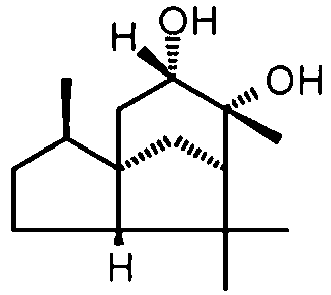
- 24 g (0,1 Mol) cis-Cedrandiol (eingesetzt wurden 26 g mit einem GC-Gehalt von 92%), 127,6 g (1,45 mol) 1-Methoxy-propan-2-on, 31,8 g (0,3 mol) Orthoameisensäuretrimethylester und 0,4 g konzentrierte Schwefelsäure wurden 24 Stunden bei 10°C gerührt. Nach dem Reaktionsende wurde Methyl-tert.-butylether zugegeben, mit einer 5%-igen Natriumhydrogencarbonat-Lösung gewaschen und die Leichtsieder abdestilliert. Nach Hinzufügen von n-Hexan kristallisierte nicht umgesetztes cis-Cedrandiol aus, das durch Filtration abgetrennt wurde. Nach Einengen des Filtrats wurden 30,4 g Rohprodukt erhalten. Gemäß GC-Analyse lag der Gehalt der Verbindungen der Formeln (VIII) und (IX) in dem erhaltenen Produkt bei insgesamt 51% (entsprechend 50% Ausbeute der Theorie). Durch Lösen des Rohproduktes in Dipropylenglykol (DPG) wurde hieraus eine Lösung mit einem Gehalt von 10 Gew.-% an Verbindungen der Formel (VIII) und (IX) (mit einem Verhältnis von (VIII) : (IX) = 1 : 2,3) hergestellt.
- Für analytische Untersuchungen wurden aus dem Rohprodukt die stereoisomeren Verbindungen der Formel (VIII) und (IX) mittels Flüssigkeitschromatographie an Kieselgel 60 (0,04-0,063 mm) mit dem Elutionsmittel Cyclohexan/Essigsäureethylester (60/1) voneinander getrennt. Die Verbindung der Formel (VIII) wurde mit einer Reinheit von 99,4% und die Verbindung der Formel (IX) mit einer Reinheit von 96,9% erhalten.
-

- 1H-NMR (400 MHz, C6D6): 3.95 (dd, J=8.5, 7.2 Hz,1H), 3.58 (dq, J= 10.3, 0.5 Hz, 1 H), 3.51 (dq, J = 10.3, 0.5 Hz, 1 H), 3.28 (s, 3H), 2.23 (dt, J = 12.1, 1.0 Hz, 1 H), 1.98 (d, J = 4.5 Hz, 1 H), 1.86-1.76 (m, 2H), 1.754 (q, J = 0.3 Hz, 3H), 1.75-1.69 (m, 1 H), 1.62 (h, J = 6.9 Hz, 1 H), 1.49 (s, 3H), 1.44 (ddd, J = 12.3, 4.8, 2.0 Hz, 1 H), 1.42-1.35 (m,1 H), 1.36-1.25 (m, 2H), 1.23-1.11 (m, 1 H), 0.96 (s, 3H), 0.89 (s, 3H), 0.76 (d, J= 7.1 Hz, 3H) ppm.
13C-NMR (C6D6): 109.86, 85.13, 80.02, 78.58, 59.15, 58.70, 57.83, 52.53, 42.36, 42.23, 41.65, 38.91, 36.17, 31.17, 28.79, 28.19, 25.61, 25.19, 15.59 ppm. - Geruch: sehr stark Ambra, Holz, erinnert an weiße Ambra, sehr lange Haftung Verbindung der Formel (IX):
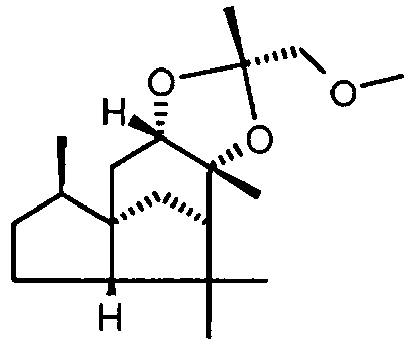
- 1H-NMR (400 MHz, C6D6): 3.99 (dd, J = 8.9, 6.8 Hz,1H), 3.60 (d, J = 10.2 Hz, 1 H), 3.57 (d, J = 10.2 Hz, 1 H), 3.26 (d, J = 0.5, 3H), 2.23 (d, J = 11.9 Hz, 1 H), 1.99 (d, J = 4.5 Hz, 1 H), 1.81 (ddd, J = 13.5, 8.9, 2.5 Hz, 1 H), 1.74 (s, 3H), 1.78-1.68 (m, 2H), 1.64 (h, J = 6.8 Hz, 1 H), 1.52 (s, 3H), 1.42 (ddd, J = 12.0, 4.6, 2.6 Hz, 1H), 1.41-1.35 (m,1 H), 1.35-1.24 (m, 2H), 1.23-1.11 (m, 1H), 0.96 (s, 3H), 0.88 (s, 3H), 0.78 (d, J = 7.1 Hz, 3H) ppm.
13C-NMR (C6D6): 109.85, 84.90, 79.33, 78.73, 59.15, 58.73, 57.86, 52.52, 42.38, 42.32, 41.99, 38.74, 36.24, 31.14, 28.76, 28.11, 25.93, 25.63, 15.63 ppm. - 24 g (0,1 Mol) cis-Cedrandiol (eingesetzt wurden 26 g mit einem GC-Gehalt von 92%), 127,6 g (1,45 mol) Methoxyacetaldehyddimethylacetal und 0,4 g konzentrierte Schwefelsäure wurden 24 Stunden bei 10°C gerührt. Nach dem Reaktionsende wurde Methyl-tert.-butylether zugegeben, mit einer 5%-igen Natriumhydrogencarbonat-Lösung gewaschen und die Leichtsieder abdestilliert. Nach Hinzufügen von n-Hexan kristallisierte nicht umgesetztes cis-Cedrandiol aus, das durch Filtration abgetrennt wurde. Nach Einengen des Filtrats wurden 30,4 g Rohprodukt erhalten. Gemäß GC-Analyse lag der Gehalt der Verbindungen der Formeln (X) und (XI) in dem erhaltenen Produkt bei insgesamt 51% (entsprechend 50% Ausbeute der Theorie). Durch Lösen des Rohproduktes in Dipropylenglykol (DPG) wurde hieraus eine Lösung mit einem Gehalt von 10 Gew.-% an Verbindungen der Formel (X) und (XI) (mit einem Verhältnis von (X) : (XI) = 1 : 6,2) hergestellt.
- Für analytische Untersuchungen wurden aus dem Rohprodukt die stereoisomeren Verbindungen der Formel (X) und (XI) mittels Flüssigkeitschromatographie an Kieselgel 60 (0,04-0,063 mm) mit dem Elutionsmittel Cyclohexan/Essigsäureethylester (60/1) voneinander getrennt. Die Verbindung der Formel (X) wurde mit einer Reinheit von 99,4% und die Verbindung der Formel (XI) mit einer Reinheit von 96,9% erhalten.
- MS: m/z: 41 (24), 43 (20), 45 (16), 55 (21), 69 (64), 93 (17), 95 (17), 105 (50), 119 (100), 133 (58), 147 (26), 203 (86), 249 (25)

- MS: m/z: 41 (23), 43 (19), 45 (16), 55 (23), 69 (60), 93 (17), 95 (17), 105 (49), 119 (100), 133 (57), 147 (24), 203 (83), 249 (26)

- In den nachfolgenden Parfümölrezepturen und Anwendungsbeispielen wurden jeweils Lösungen mit dem angegebenen Gehalt eingesetzt, wobei das Gewichtsverhältnis von der Verbindung der Formel (VIII) zu der Verbindung der Formel (IX)) bei 3 : 8 und das Gewichtsverhältnis von (X) zu (XI) bei 3 : 8 lag.
-
Ref-1 P1 HEXENALDIMETHYLACETAL, 2,2,5-TRIMETHYL-4- 10 10 HEXADECEN-1,16-OLID, 7(9)Z- 15 15 CYCLOHEXADECENON, (8E/Z)- + CYCLOHEXADECENON, (7E)- 140 140 BUT-2-EN-1-ON, 1-(2,6,6-TRIMETHYL-CYCLOHEX-3-ENYL)- (E) 10%DPG 10 10 BRASSYLSAEUREETHANDIOLESTER 120 120 NONADIEN-3-OL, 3,7-DIMETHYL-1,6- 30 30 PYRANOL, 2-ISOBUTYL-4-METHYL-4-TETRAHYDRO- (E/Z) 40 40 BUTTERSAEURE-5-HEXENYLESTER, 2-METHYL- 5 5 ESSIGSAEUREGERANYLESTER 40 40 METHYL-DIHYDROJASMONAT 400 400 PROPIONSAEURE-2-(1-(3,3-DIMETHYLCYCLOHEXYL)-ETHOXY-2-METHYLPROPYLESTER 30 30 ESSIGSAEURE-3Z-HEXENYLESTER 5 5 SALICYLSAEURE-3Z-HEXENYLESTER 20 20 BICYCLO[4.4.0]DECEN, 3,4,10,10-TETRAMETHYL-3-HYDROXYETHYL-1 (6) 50 50 CYCLOHEXANON, 3,3,5,5-TETRAMETHYL-4-(1-ETHOXYVINYL)- 10 10 KOHLENSAEURE-3Z-HEXENYLMETHYLESTER, 10% in DPG 10 10 MANDARINENOEL 20 20 2(3H)-FURANON, 5-HEXYL-DIHYDRO-4-METHYL-(E/Z) 5 5 ESSIGSAEUREPRENYLESTER 5 5 TRICYCLO(5.2.1.0)DECAN, 8-FORMYL- 15 15 DIOXOL, 4H-4A,9-METHANOAZULENO(5,6-D)-OCTAHYDRO-2,2,5,8,8,9A-HEXAMETHYL-, 1,3-(Ambrocenide®), 0,1% in DPG 20 0 (Verbindung der Formel (VIII)), 0,1% in DPG 0 20 TOTAL 1000 1000 - Das Vergleichsbeispiel (Ref-1) mit Ambrocenide® riecht frisch, fruchtig und transparent. In Parfümöl P1 verleiht die Verbindung der Formel (VIII) der Komposition eine Eleganz und ausgeprägtere Fruchtigkeit.
-
Ref-2 P2 UNDECALACTON, GAMMA- 2 2 HEXADECEN-1,16-OLID, 7(9)Z- 10 10 CYCLOHEXADECENON, (8E/Z)- + CYCLOHEXADECENON, 100 100 (7E)- CARDAMOMENOEL CEYLON 2 2 INDAN-4-ON, 1,1,2,3,3-PENTAMETHYL-TETRAHYDRO- 15 15 CEDERNHOLZOEL VIRGINIA 100 100 DAMASCON, -BETA-, 10% in DPG 2 2 METHYL-DIHYDROJASMONAT 210 210 BICYCLO[4.4.0]DECEN, 3,4,10,10-TETRAMETHYL-3-HYDROXYETHYL-1 (6) 300 300 IRALDEIN, GAMMA- 60 60 CYCLOHEXANON, 3,3,5,5-TETRAMETHYL-4-(1-ETHOXYVINYL)- 10 10 CYCLOPENTADECENON, 3-METHYL-5E- 20 20 PATCHOULI OEL 5 5 PENTEN-2-OL, 3,3-DIMETHYL-5-(2,2,3-TRIMETHYL-3-CYCLOPENTENYL)-4- 20 20 PENTANOL, 3-METHYL-5-(2,2,3-TRIMETHYL-3-CYCLOPENTENYL)-2- + HEXANOL, 6-(2,2,3-TRIME-3-CYCLOPENTENYL)-3- 80 80 VANILLIN 2 2 ISOLONGIFOLANONETHANDIOLKETAL 30 30 ZIMTRINDENOEL CEYLON 2 2 DIOXOL, 4H-4A,9-METHANOAZULENO(5,6-D)-OCTAHYDRO-2,2,5,8,8,9A-HEXAMETHYL-, 1,3- (Ambrocenide®), 0,1% in DPG 30 0 (Verbindung der Formel (VIII)), 0,1% in DPG 0 30 TOTAL 1000 1000 - Das Vergleichsbeispiel (Ref-2) mit Ambrocenide® riecht blumig-würzig mit trockenen holzigen Akzenten. In Parfümöl P2 wird durch die Verbindung der Formel (VIII) die würzige Note unterstützt, so dass die gesamte Komposition pfeffriger und charaktervoller erscheint.
-
Ref-3 P3 HEXENALDIMETHYLACETAL, 2,2,5-TRIMETHYL-4- 10 10 BENZODIOXEPINON, 7-METHYL-3,4-DIHYDRO-3- 10 10 PROPANAL, 2-METHYL-3-(4-METHOXYPHENYL)- 5 5 CITRONELLOL, BETA- 20 20 CITRONENOEL 15 15 CYCLOHEXYLOXYESSIGSAEUREALLYLESTER, 10% in DPG 10 10 DAMASCON, TRANS-ALPHA-, 1% in DPG 20 20 BUT-2-EN-1-ON, 1-(2,6,6-TRIMETHYL-CYCLOHEX-3-ENYL)-(E), 10% in DPG 5 5 DECALACTON GAMMA, 10% in DPG 15 15 BRASSYLSAEUREETHANDIOLESTER 80 80 NONADIEN-3-OL, 3,7-DIMETHYL-1,6- 70 70 PHENOL, 2-METHOXY-4-(2-PROPENYL)- 5 5 PYRANOL, 2-ISOBUTYL-4-METHYL-4-TETRAHYDRO- (E/Z) 80 80 BUTTERSAEURE-5-HEXENYLESTER, 2-METHYL- 15 15 METHYL-DIHYDROJASMONAT 250 250 PROPANAL, 2-PIPERONYL- 30 30 SALICYLSAEURE-3Z-HEXENYLESTER 5 5 INDOL, 10% in DPG 10 10 IRALDEIN, GAMMA- 30 30 BICYCLO[4.4.0]DECEN, 3,4,10,10-TETRAMETHYL-3-HYDROXYETHYL-1 (6) 80 80 PENTADECANOLID, 1,15- 20 20 HEPTENAL, 2,6-DIMETHYL-5-, 10% in DPG 3 3 PYRIDIN, 4-DECYL-, 1% in DPG 2 2 CYCLOHEXEN, 2,4-DIMETHYL-1-FORMYL-3-, 10% in DPG 10 10 DIOXOL, 4H-4A,9-METHANOAZULENO(5,6-D)-OCTAHYDRO-2,2,5,8,8,9A-HEXAMETHYL-, 1,3- (Ambrocenide®), 0,1% in DPG 5 0 (Verbindung der Formel (X)), 0,1% in DPG 0 5 TOTAL 805 805 - Das Vergleichsbeispiel (Ref-3) mit Ambrocenide® besticht durch seine transparente Frische: In Parfümöl P3 wird durch die Verbindung der Formel (X) erreicht, dass die Komposition kosmetischer-pflegender mit mehr Volumen wahrgenommen wird.
-
Ref-4 P4 NAPHTHO[2.1-B]FURAN, DODECAHYDRO-3A.6.6.9A-TETRAMETHYL- 5 5 BENZOE SIAM ABS., 50% in DPG 10 10 SALICYLSAEUREBENZYLESTER 20 20 BERGAMOTTOEL 50 50 CEDRYLMETHYLETHER 40 40 CISTUS LABDANUM 35 35 CISTUSOEL SPAN., 10% in DPG 10 10 DAMASCON, TRANS-ALPHA-, 1 % in DPG 20 20 MYRCENOL, DIHYDRO- 30 30 BRASSYLSAEUREETHANDIOLESTER 120 120 BENZOESAEUREMETHYLESTER, 2,4-DIHYDROXY-3,6-DIMETHYL-, 1% in DPG 20 20 PYRANOL, 2-ISOBUTYL-4-METHYL-4-TETRAHDRO- (E/Z) 20 20 PENTADECEN-1,15-OLID, (11E/Z)-+ PENTADECEN-1,15-OLID, 12E- 30 30 METHYL-DIHYDROJASMONAT 300 300 BICYCLO[4.4.0]DECEN, 3,4,10,10-TETRAMETHYL-3-HYDROXYETHYL-1 (6) 75 75 ISOBUTYLCHINOLIN, 10% in DPG 3 3 CYCLOHEXANON, 3,3,5,5-TETRAMETHYL-4-(1-ETHOXYVINYL)- 30 30 LABDANUM ABSOLUE 20 20 ESSIGSAEURELINALYLESTER 50 50 MANDARINENOEL 10 10 CYCLOPENTADECENON, 3-METHYL-5E- 10 10 MUSKATELLER SALBEIOEL 10 10 OLIBANUM COEUR, 50% in TEC 5 5 PATCHOULIOEL 20 20 PYRIDIN, 4-DECYL-, 1% in DPG 2 2 BUTENOL, 2-ETHYL-4-(2,2,3-TRIMETHYL-3-CYCLOPENTENYL)-2E- 5 5 VANILLIN 30 30 DIOXOL, 4H-4A,9-METHANOAZULENO(5,6-D)-OCTAHYDRO-2,2,5,8,8,9A-HEXAMETHYL-, 1,3- (Ambrocenide®), 0,1% in DPG 20 0 (Verbindung der Formel (X)), 0,1% in DPG 0 20 TOTAL 1000 1000 - Das Vergleichsbeispiel (Ref-4) mit Ambrocenide® besticht durch eine schöne Holznote. In Parfümöl P4 verleiht die Verbindung der Formel (X) der Komposition mehr Volumen und die Tabaknote wird verstärkt.
-
Ref-5 P5 CYCLOHEXADECENON, (8E/Z)- + CYCLOHEXADECENON, (7E)- 200 200 BEIFUSSOEL 10 10 BERGAMOTTOEL 60 60 CEDRYLMETHYLETHER 40 40 CISTUSOEL SPAN., 10% in DPG 10 10 CITRONENOEL 20 20 CUMARIN 40 40 CYCLOHEXYLOXYESSIGSAEUREALLYLESTER, 10% in DPG 5 5 MYRCENOL, DIHYDRO- 50 50 BRASSYLSAEUREETHANDIOLESTER 120 120 BENZOESAEUREMETHYLESTER, 2,4-DIHYDROXY-3,6-DIMETHYL-, 10% in DPG 20 20 METHYL-DIHYDROJASMONAT 30 30 IRALDEIN, GAMMA- 20 20 BICYCLO[4.4.0]DECEN, 3,4,10,10-TETRAMETHYL-3-HYDROXYETHYL-1 (6) 120 120 KRAUSEMINZOEL, 10% in DPG 10 10 LAVENDELOEL 10 10 LINALOOL 20 20 ESSIGSAEURELINALYLESTER 20 20 INDENO[1.2-D]-M-DIOXIN, 2,4-DIMETHYL-TETRAHYDRO- 90 90 MUSKATELLER SALBEI ABSOLUE 5 5 NELKENBLUETENOEL 10 10 VANILLIN 20 20 DIOXOL, 4H-4A,9-METHANOAZULENO(5,6-D)-OCTAHYDRO-2,2,5,8,8,9A-HEXAMETHYL-, 1,3- (Ambrocenide®), 0,1% in DPG 20 0 (Verbindung der Formel (VIII)), 0,1% in DPG 0 20 TOTAL 950 950 - Das Vergleichsbeispiel (Ref-5) mit Ambrocenide® wirkt sehr strahlend und intensiv lavendelartig. In Parfümöl P5 wird durch die Verbindung der Formel (VIII) die gesamte Komposition natürlicher lavendelartig, und erscheint dadurch hochwertiger mit mehr Volumen.
-
Ref-6 P6 HEXADECEN-1,16-OLID, 7(9)Z- 20 20 CYCLOHEXADECENON, (8E/Z)- + CYCLOHEXADECENON, (7E)- 200 200 INDAN-4-ON, 1,1,2,3,3-PENTAMETHYL-TETRAHYDRO- 20 20 BRASSYLSAEUREETHANDIOLESTER 150 150 BUTTERSAEURE-5-HEXENYLESTER, 2-METHYL- 5 5 PENTADECEN-1,15-OLID, (11E/Z)-+ PENTADECEN-1,15-OLID, 12E- 90 90 METHYL-DIHYDROJASMONAT 210 210 BICYCLO[4.4.0]DECEN, 3,4,10,10-TETRAMETHYL-3-HYDROXYETHYL-1 (6) 200 200 CYCLOHEXANON, 3,3,5,5-TETRAMETHYL-4-(1-ETHOXYVINYL)- 20 20 PENTEN-2-OL, 3,3-DIMETHYL-5-(2,2,3-TRIMETHYL-3-CYCLOPENTENYL)-4- 5 5 ISOLONGIFOLANONETHANDIOLKETAL 70 70 DIOXOL, 4H-4A,9-METHANOAZULENO(5,6-D)-OCTAHYDRO-2,2,5,8,8,9A-HEXAMETHYL-, 1,3- (Ambrocenide®), 0,1% in DPG 10 0 (Verbindung der Formel (VIII)), 0,1% in DPG 0 10 TOTAL 1000 1000 - Das Vergleichsbeispiel (Ref-6) mit Ambrocenide® besitzt eine kühle Transparenz gepaart mit einer trockenen Holzigkeit. In Parfümöl P6 verleiht die Verbindung der Formel (VIII) der gesamten Komposition eine ausgeprägte Harmonie und Wärme, wobei die Fruchtigkeit verstärkt (gepusht) wird hin zu einer schönen Pflaumennote gepaart mit Tabakeffekten.
-
Ref-7 P7 NAPHTHO[2.1-B]FURAN, DODECAHYDRO-3A.6.6.9A-TETRAMETHYL- 5 5 SALICYLSAEUREBENZYLESTER 50 50 BERGAMOTTOEL 50 50 CUMARIN 5 5 DAMASCON, TRANS-ALPHA-, 1% in DPG 20 20 DECALACTON GAMMA, 10% in DPG 15 15 BRASSYLSAEUREETHANDIOLESTER 30 30 NONADIEN-3-OL, 3,7-DIMETHYL-1,6- 60 60 ESSIGSAEURE-3,7-DIME-1,6-NONADIEN-3-YLESTER 50 50 PYRANOL, 2-ISOBUTYL-4-METHYL-4-TETRAHYDRO- (E/Z) 70 70 BUTTERSAEURE-5-HEXENYLESTER, 2-METHYL- 5 5 BICYCLO[2.2.2]OCTEN, 6-ME-8-ISOPROPYL-2(3)-(1,3-DIOXOLAN-2-YL 5 5 METHYL-DIHYDROJASMONAT 280 280 PROPANAL, 2-PIPERONYL- 20 20 BENZALDEHYD, 3,4-METHYLENDIOXY- 10 10 PROPIONSAEURE-2-(1-(3,3-DIMETHYLCYCLOHEXYL)- 60 60 ETHOXY-2-METHYLPROPYLESTER SALICYLSAEURE-3Z-HEXENYLESTER 5 5 BICYCLO[4.4.0]DECEN, 3,4,10,10-TETRAME-3-HYDROXYETHYL-1(6) 120 120 PENTADECANOLID, 1,15- 30 30 MANDARINENOEL 20 20 CYCLOPENTADECENON, 3-METHYL-5E- 3 3 BUTANOL, 2-METHYL-4-PHENYL-2- 10 10 PYRIDIN, 4-DECYL-, 1% in DPG 2 2 PENTEN-2-OL,3,3-DIMETHYL-5-(2,2,3-TRIMETHYL-3-CYCLOPENTENYL)-4- 20 20 CYCLOHEXANOL, 4-(3-METHYL-BUTYL)- (E/Z) 15 15 VANILLIN 20 20 DIOXOL, 4H-4A,9-METHANOAZULENO(5,6-D)-OCTAHYDRO-2,2,5,8,8,9A-HEXAMETHYL-, 1,3- (Ambrocenide®), 0,1% in DPG 5 0 (Verbindung der Formel (VIII)), 0,1% in DPG 0 5 DIPROPYLENGLYKOL 15 15 TOTAL 1000 1000 - Durch den Austausch von Ambrocenide® des Vergleichsbeispiel (Ref-7) durch die Verbindung der Formel (VIII) wirkt die gesamte Komposition P7 voluminöser, eleganter und somit auch hochwertiger, Parfümöl P7 wirkt komplexer und die Coumarin Note wird sehr schön harmonisiert.
-
Ref-8 P8 Ethylacetoacetat 60 60 Propanal, 2-Methyl-2-(4-ethylbenzyl)- 25 25 Cyclohexen, 2,4-Dimethyl-1-formyl-3- (E/Z) 15 15 Hexenol Cis-3 130 130 Kohlensäure-3Z-hexenylmethylester 20 20 Cyclohexyloxyessigsäureallylester 25 25 Benzenmethanol, .alpha.-methyl-, 1-acetat 40 40 Linalylacetat 80 80 Myrcenol, Dihydro- 650 650 Mandarinenöl 260 260 Grapefruitöl 260 260 Hexenaldimethylacetal, 2,2,5-Trimethyl-4- 170 170 Methylanthranilat, 10% DPG 155 155 Cardamomöl 5 5 Red Berry Extract 25 25 Muskatnussöl 20 20 Ethylbutyrat, 10% DPG 10 10 Undecalacton, gamma- 65 65 Pentansäureethylester, 2-Methyl-, 10% DPG 15 15 Heptansäure, 2-propen-1-yl ester 40 40 Ethylmaltol 15 15 Benzenepropanal, alpha-Methyl-4-(1.1-dimethylethyl)- 250 250 1.3-Benzodioxol-5-propanal, alpha-Methyl- 200 200 Hydroxycitronellal 200 200 4-Methyl-2-(2-methylpropyl)oxan-4-ol 260 260 1.6-Octadien-3-ol, 3.7-Dimethyl- 40 40 Nonadien-3-ol, 3,7-Dimethyl-1,6- 130 130 Buttersäure, 1,1-dimethyl-2-phenylethylester 65 65 Phenylethylalkohol 40 40 Propionsäure-2-phenoxyethylester, 2-Methyl- 40 40 2-Buten-1-on, 1-(2.6.6-Trimethyl-2-cyclohexen-1-yl)- (E) 40 40 2-Buten-1-on, 1-(2.6.6-Trimethyl-1.3-cyclohexadien-1-yl)- 5 5 Methyl-dihydrojasmonat 390 390 3-Buten-2-on, 3-Methyl-4-(2.6.6-trimethyl-2-cyclohexen-1-yl)- 220 220 Vanillin 230 230 Cinnamon Bark Oil 15 15 2H-1-Benzopyran-2-on 200 200 Cyclohexanolacetat, 4-(1.1-Dimethylethyl)- (Z) 50 50 Cedarwood Oil 15 15 Bicyclo[4.4.0]decen, 3,4,10,10-Tetramethyl-3-hydroxyethyl-1(6) 1.500 1.500 Cyclododecan, (Ethoxymethoxy)- 300 300 2-Buten-1-ol, 2-Ethyl-4-(2.2.3-trimethyl-3-cyclopenten-1-yl)- (2E) 130 130 Dioxol, 4H-4a,9-Methanoazuleno(5,6-d)-octahydro-2,2,5,8,8,9a-hexamethyl-, 1,3- (Ambrocenide®), 10,0% in DPG 30 0 (Verbindung der Formel (X)), 10,0% in DPG 0 30 5H-3.5a-Epoxynaphth[2.1-c]oxepin, Dodecahydro-3.8.8.11a-tetramethyl- 1.200 1.200 Naphtho[2.1-b]furan, Dodecahydro-3a.6.6.9a-tetramethyl- 220 220 Dipropylenglykol 175 175 TOTAL 8.030 8.030 - Das Vergleichsbeispiel Ref-8 mit Ambrocenide® zeichnet sich durch den Widerspruch zwischen frischen holzigen Noten und süßen balsamischen Aspekten aus. Der Austausch von Ambrocenide® durch die Verbindung der Formel (X) verleiht der gesamten Komposition mehr Impact, Volumen, Charakter gepaart mit samtigen-pudrigen Aspekten.
-
Ref-9 P9 Undecenal, 2,6,10-Trimethyl-9- 15,00 15,00 Propanal, 2-Methyl-2-(4-ethylbenzyl)- 3,00 3,00 Cis-3 Hexenylacetat 3,00 3,00 Cyclohexen, 2,4-Dimethyl-1-formyl-3- (E/Z) 2,00 2,00 Tricyclo(5.2.1.0)decan, 8-Formyl- 2,00 2,00 Cyclohexyloxyessigsäureallylester 4,00 4,00 Heptenal, 2,6-Dimethyl-5- 2,00 2,00 Identoil® Bergamot 45,00 45,00 Myrcenol, Dihydro- 90,00 90,00 2.6-Octadienal, 3.7-Dimethyl- (2E/Z) 10,00 10,00 2-Pentennitril, 3-Methyl-5-phenyl- (2E/Z) 3,00 3,00 Orangenöl 30,00 30,00 Hexenaldimethylacetal, 2,2,5-Trimethyl-4- 2,00 2,00 Lavandinöl 10,00 10,00 Cardamomöl 1,00 1,00 Pentansäureethylester, 2-Methyl- , 10% DPG 10,00 10,00 Benzenepropanal, alpha-Methyl-4-(1.1-dimethylethyl)- 40,00 40,00 2H-1.5-Benzodioxepin-3(4H)-on, 7-Methyl- 20,00 20,00 Benzenepropanol, beta.beta.3-Trimethyl- 40,00 40,00 Geraniumöl 2,00 2,00 3-Buten-2-on, 1-(2.4.4-Trimethyl-2-cyclohexen-1-yl)- (2E) 10,00 10,00 alpha-Hexylcin namaldehyd 60,00 60,00 Cyclopentanessigsäuremethylester, 3-Oxo-2-pentyl- (E) 90,00 90,00 Propannitril, 3-(3-Hexenyloxy)- (Z) 2,00 2,00 3-Buten-2-on, 4-(2.6.6-Trimethyl-1-cyclohexen-1-yl)- 5,00 5,00 Benzol, 1-Methoxy-4-(1-propenyl)- (E) 10,00 10,00 Ethanon, 1-(2-Benzofuranyl)- 2,00 2,00 Cyclohexanolacetat, 4-(1.1-Dimethylethyl)- (Z) 30,00 30,00 Cedarwood Oil (Zedernholzöl) 15,00 15,00 Cyclohexanpropanol, alpha-Ethyl-2.2.6-trimethyl- (E/Z) 30,00 30,00 Bicyclo[4.4.0]decen, 3,4,10,10-Tetramethyl-3-hydroxyethyl-1(6) 100,00 100,00 Cyclododecan, (Ethoxymethoxy)- 30,00 30,00 Patchouliöl 10,00 10,00 2-Buten-1-ol, 2-Ethyl-4-(2.2.3-trimethyl-3-cyclopenten-1-yl)- (2E) 30,00 30,00 Benzoesäuremethylester, 2,4-Dihydroxy-3,6-dimethyl- 3,00 3,00 Tetramethyl dodecahydro-3a,6,6,9a-naphtho(2,1-b)furan 12,00 12,00 Isolongifolanonethandiolketal 50,00 50,00 Dioxol, 4H-4a,9-Methanoazuleno(5,6-d)-octahydro-2,2,5,8,8,9a- 2,00 0 hexamethyl-, 1,3- (Ambrocenide®), 10,0% in DPG (Verbindung der Formel (X)), 10,0% in DPG 0 2,00 Pentadecanolid, 1,15- 30,00 30,00 Cyclohexadecenon, 8E/Z- 120,00 120,00 Dipropylenglykol 25,00 25,00 TOTAL 1.000,00 1.000,00 - Das Vergleichsbeispiel Ref-9 mit Ambrocenide® ist ein moderner Fougere Typ mit einer wässrigen Citrus Kopfnote und einem holzigen Fond. Durch den Austausch von Ambrocenide® gegen die Verbindung der Formel (X) wird der weiße Holz, sowie Zedern- und Sandelholzaspekt verstärkt.
-
Ref-10 P10 Undecenal, 2,6,10-Trimethyl-9- 8 8 10-Undecenal 8 8 Cyclohexen, 2,4-Dimethyl-1-formyl-3- (E/Z) 5 5 Kohlensäure-3Z-hexenylmethylester 8 8 Indeno[1.2-d]-1.3-dioxin, 4.4a.5.9b-Tetrahydro-2.4-Dimethyl- 70 70 Cyclohexanolacetat, 3.3.5-Trimethyl- 20 20 Orangenöl 20 20 Methyl Naphthyl Ketone Beta 5 5 Ethanon, 1-(3-Methyl-2-benzofuranyl)- 2 2 2-Butanon, 4-(4-Hydroxyphenyl)- 1 1 Peach Base 8 8 Pyranol, 2-Isobutyl-4-methyl-4-tetrahydro-(E/Z) 10 10 1.6-Octadien-3-ol, 3.7-Dimethyl- 90 90 2H-Pyran, Tetrahydro-2-methyl-2-(2-methyl-1-propenyl)-(E/Z) 3 3 2-Phenylethanol 70 70 Benzenpentanol, beta-Methyl- 25 25 2.6-Octadien-1-olacetat, 3.7-Dimethyl- (2E/Z) 30 30 But-2-en-1-on, 1-(2,6,6-Trimethyl-cyclohex-3-enyl)- (E) 3 3 Benzoesäu repropylester 10 10 Methyl-dihydrojasmonat (E) 70 70 Amyl Salicylat N/Iso 17 17 Salicylsäurebenzylester 80 80 Cis-3 Hexenylsalicylat 10 10 Benzoesäurehexylester, 2-Hydroxy- 33 33 3-Decen-5-ol, 4-Methyl- 5 5 Orris Base 5 5 3-Buten-2-on, 3-Methyl-4-(2.6.6-trimethyl-2-cyclohexen-1-yl)- 80 80 Benzaldehyd, 3,4-Methylendioxy- 10 10 Vanillin 4 4 Zimtalkohol 4 4 2H-1-Benzopyran-2-on 8 8 Acetylcedren 70 70 Cyclododecan, (Ethoxymethoxy)- 40 40 2-Pentanon, 4-Cyclohexyl-4-methyl- 8 8 Patchouli Base 37 37 Patchouliöl 33 33 Dioxol, 4H-4a,9-Methanoazuleno(5,6-d)-octahydro-2,2,5,8,8,9a-hexamethyl-, 1,3- (Ambrocenide®), 1,0% in DPG 20 0 Verbindung der Formel (VIII) 10,0% in DPG 2 Pentadecen-1,15-olid, (11 E/Z)- + Pentadecen-1,15-olid, 12E- 40 40 Triethylcitrat 30 48 TOTAL 1000 1000 - Das Vergleichsbeispiel Ref-10 mit Ambrocenide® ist ein floraler Chypre Typ mit einer aldehydigen Kopfnote, gepaart mit floralen Herznoten und abgerundet durch Patchouli und Moschus. Der Austausch von Ambrocenide® gegen die Verbindung der Formel (VIII) verleiht der gesamten Komposition einen pflegenderen, wärmeren und voluminöseren Charakter, zusätzlich wird die Haftung verbessert.
- Die Parfümöle P1, P2, P3, P4, P5, P6, P7, P8, P9 und P10 aus den obigen Parfümöl-Beispielen wurden jeweils separat in die nachfolgenden Formulierungen eingearbeitet.
- Die oben bei dem jeweiligen Parfümöl beschriebenen geruchlichen Effekte wurden jeweils auch in den nachfolgenden Formulierungen beobachtet.
-
Material Chemischer Name Funktion Gew.-% Gew.-% Natrium Metasilicat Pentahydrat Sodium Metasilicate Pentahydrate Ad 100 Ad 100 Natrium hydrogencarbonat Sodium hydrogen carbonate Alkali 15,0 15,0 Natriumpercarbonat Sodium carbonate peroxyhydrate Bleichmittel 15,0 15,0 Peractive AC Blue TAED / Na-Carboxymethylcellulose Aktivator 5,00 5,00 Genapol OA-080 Oxoalkohol C14-15, 8EO Nichtionisches Tensid 3,00 3,00 Texapon K12 Pulver Sodium Lauryl Sulphate C12 Anionisches Tensid 7,00 7,00 Tinopal CBS-X Aufheller 0,50 0,50 Savinase 6.0 T, Type W Protease Enzym 0,40 0,40 Termamyl 120 T Alpha-Amylase Enzym 0,30 0,30 Natriumsulfat Sodium Sulphate Füllstoff 5,50 5,50 Parfumöl P1, P2, P3, P4, P5, P6, P7, P8, P9 bzw. Parfum (Fragrance) 0,30 0,50 P10 -
Material Chemischer Name Funktion Gew.-% Gew.-% Entionisiertes Wasser Water Lösungsmittel Ad 100 Ad 100 Mergal K9N 5-Chloro-2-methyl-3-(2H)-isothiazolone und 2-methyl-3-(2H)-isothiazolone Konservierungsmittel 0,1 0,1 Trinatriumcitrat Dihydrat Tri Sodium Citrate Dihydrate Komplexbildner 3,0 3,0 Zetesol NL-2 Fatty alcohol C12-14-sulfate, Sodium Anionisches Tensid 30,0 30,0 Imbentin C/125/055 Fatty alcohol C12-C15, 8EO Nichtionisches Tensid 5,0 5,0 Ethanol Ethanol Lösungsmittel 2,0 2,0 Parfumöl P1, P2, P3, P4, P5, P6, P7, P8, P9 bzw. P10 Parfums (Fragrance) 0,3 0,5 -
Material INCI-Name Gew.-% Gew.-% Entionisiertes Wasser Water Ad 100 Ad 100 Plantacare PS 10 Sodium Laureth Sulfate, Lauryl Glucoside 20,0 20,0 Euperlan PK 771 Glycol Distearate, Sodium Lauryl Sulfate, Cocamide MEA, Laureth-10 6,0 6,0 Dragocid Liquid Phenoxyethanol, Methylparaben, Ethylparaben, Butylparaben, Propylparaben, Isobutylparaben 0,5 0,5 Natrium Chlorid Sodium Chloride 1,4 1,4 Citronensäure Monohydrat kristallin Citric Acid 0,1 0,1 Parfumöl P1, P2, P3, P4, P5, P6, P7, P8, P9 bzw. P10 Parfum (Fragrance) 0,5 0,8 -
Material INCI-Name Gew.-% Gew.-% Entionisiertes Wasser Wasser Ad 100 Ad 100 Plantacare PS 10 Sodium Laureth Sulfate, Lauryl Glucoside 20,0 20,0 Dragocid Liquid Phenoxyethanol, Methyl-paraben, Ethylparaben, Butylparaben, Propylparaben, Isobutylparaben 0,5 0,5 Natriumchlorid Sodium Chloride 1,4 1,4 Citronensäure Monohydrat kristallin Citric Acid 1,3 1,3 Parfumöl P1, P2, P3, P4, P5, P6, P7, P8, P9 bzw. P10 Parfum (Fragrance) 0,5 0,7 -
Material Chemischer Name Funktion Gew.-% Gew.-% Entionisiertes Wasser Wasser Lösungsmittel Ad 100 Ad 100 Rewoquat WE 18 Dialkylesterammoniumethosulfate Kationisches Tensid 16,6 16,6 Mergal K9N 5-Chloro-2-methyl-3-(2H)-isothiazolone und 2-methyl-3-(2H)-isothiazolone Konservierungsmittel 0,10 0,10 Dow Corning 1520 Antifoam Polydimethyl-siloxane Entschäumer 0,30 0,30 Magnesium Chlorid 1 %ige Lösung Magnesium Chlorid Lösung Konsistenzgeber 10,00 10,00 Parfumöl P1, P2, P3, P4, P5, P6, P7, P8, P9 bzw. P10 Fragrance 0,55 0,75 -
Inhaltsstoffe Gew.-% Gew.-% Parfumöl P1, P2, P3, P4, P5, P6, P7, P8, P9 bzw. P10 5 10 Ethanol Ad 100 Ad 100 Wasser 18 10 -
Inhaltsstoffe Gew.-% Gew.-% Parfumöl P1, P2, P3, P4, P5, P6, P7, P8, P9 bzw. P10 1,0 1,5 Ethanol Ad 100 Ad 100 Wasser 5,0 8,0 Alpha-Tocopherol 0,20 0,20 Hydroxypropylcellulose 0,20 - Rosmarinextrakt, in Ethanol löslich 0,22 - Cetylalkohol 1,00 0,50 -
Inhaltsstoffe Gew.-% Gew.-% Gew.-% Natriumlaurylethersulfat (z.B. Texapon NSO, Fa. Cognis Deutschland GmbH) 12 12 12 Cocamidopropylbetain (z.B. Dehyton K, Fa. Cognis Deutschland GmbH) 2 2 2 Natriumchlorid 1,4 1,4 1,4 Citronensäure 1,3 1,3 1,3 Phenoxyethanol, Methyl-, Ethyl-, Butyl- und Propylparaben 0,5 0,5 0,5 Parfumöl P1, P2, P3, P4, P5, P6, P7, P8, P9 bzw. P10 0,3 0,5 0,7 Wasser Ad 100 Ad 100 Ad 100 -
Inhaltsstoffe Gew.-% Gew.-% Gew.-% Lineares Na-Alkylbenzolsulfonat 8,8 8,8 8,8 Ethoxylierter Fettalkohol C12-18 (7 EO) 4,7 4,7 4,7 Na-Seife 3,2 3,2 3,2 Entschäumer DOW CORNING(R) 2-4248S POWDERED ANTIFOAM, Silikonöl auf Zeolith als Trägermaterial 3,9 3,9 3,9 Zeolith 4A Zeolith 4A Ad 100 Ad 100 Ad 100 Na-Carbonat 11,6 11,6 11,6 Na-Salz eines Copolymers aus Acryl- und Maleinsäure (Sokalan CP5) 2,4 2,4 2,4 Na-Silicat 3,0 3,0 3,0 Carboxymethylcellulose 1,2 1,2 1,2 Dequest 2066([[(Phosphonomethyl)imino]bis[(ethylennitrilo)bis (methylen)]]tetrakis-phosphonsäure, Natriumsalz) 2,8 2,8 2,8 Optischer Aufheller 0,2 0,2 0,2 Na-Sulfat 6,5 6,5 6,5 Protease 0,4 0,4 0,4 Natriumperborat tetrahydrat 21,7 21,7 21,7 Parfumöl P1, P2, P3, P4, P5, P6, P7, P8, P9 bzw. P10 0,25 0,35 0,5 EDTA 1,0 1,0 1,0 -
Inhaltsstoffe Gew.-% Entionisiertes Wasser 39,9 Optischer Aufheller 0,10 Kokos Fettsäuren (C12-C18) 7,5 Kaliumhydroxid 50%ige Lösung 4,3 Propan-1,2-diol 5,00 Fettalkohole C12-C15, 8 EO 12,0 Na-Salz sekundärer Alkylsulfonate (C13-C17) 17,0 Triethanolamin 2,0 Trinatriumcitrat Dihydrat 5,0 Dequest 2066([[(Phosphonomethyl)imino]bis[(ethylennitrilo)bis (methylen)]]tetrakis-phosphonsäure, Natriumsalz) 3,0 Ethanol 3,0 Enzyme 0,7 Parfumöl P1, P2, P3, P4, P5, P6, P7, P8, P9 bzw. P10 0,5 -
Inhaltsstoffe Gew.-% Entionisiertes Wasser 13,4 Kokos Fettsäuren (C12-C18) 10,0 Fettalkohole C12-C15, 8 EO 26,0 Na-Salz sekundärer Alkylsulfonate (C13-C17) 26,5 Triethanolamin 8,5 Na-Salz von Fettalkoholsulfaten C12-C14 3,0 Ethanol 5,5 Harnstoff 4,5 Enzyme 0,9 Citronensäure 1,0 Parfumöl P1, P2, P3, P4, P5, P6, P7, P8, P9 bzw. P10 0,7 - Der jeweils zu untersuchende Riechstoff wird als 10%ige Lösung in DPG auf codierte Riechstreifen getaucht, d.h. der zu untersuchende Riechstoff wird durch Eintauchen des jeweiligen Riechstreifens in die jeweilige Lösung des zu untersuchenden Riechstoffs auf den Riechstreifen aufgebracht, und unmittelbar anschließend in folgenden zeitlichen Abständen geruchlich bewertet:
- 1 Stunde; 3 Stunden; 10 Stunden; 1 Tag; 3 Tage; 10 Tage; 1 Monat; 3 Monate. Die Probanden bewerten die Geruchsintensität auf einer Skala von 1 = geruchlos bis 9 = sehr stark.
- Getestet wird solange bis der Intensitäts-Mittelwert der Prüfer unter den Wert 1,5 (sehr schwach) fällt. Vergeben 50 % der Probanden eine Intensität von 1, und machen damit deutlich, dass der auf dem Riechstreifen getauchte Riechstoff nicht mehr wahrgenommen wird, wird der Test für beendet erklärt. Längstenfalls wird für 3 Monate getestet.
Verbindung der Formel (VIII), 10% in DPG Ambrocenide®, 10 % in DPG Eigenhaftung mehr als 3 Monate 10 Tage - Die Verbindung der Formel (VIII) zeigt eine deutlich längere Haftung am Riechstreifen als Ambrocenide®.
- Der zu untersuchende Riechstoff wird in einer Menge von 0,6 Gew.-% als 50%ige Lösung in DPG in eine Shampoo-Formulierung analog zu Beispiel F8 anstelle des dort eingesetzten Parfümöls eingearbeitet. Für jeden zu untersuchenden Riechstoff werden zwei Haarsträhnen benötigt. Außerdem wird als Referenz jeweils ein Haarsträhnenpärchen mit der unparfümierten Shampoo-Formulierung von Beispiel F8 gewaschen.
- Alle Haarsträhnen werden zusammen in einem 2 I Becherglas mit Neutralshampoo gewaschen (mind. 2 h einweichen). Dann werden die Strähnen unter fließendem Wasser gut ausgespült und dann bei Raumtemperatur (ca. 23°C) getrocknet. Es werden von jedem Shampoo 100 ml einer 20 %igen wässrigen Lösung hergestellt (ebenso unparfümierte Masse). Nun wird je Shampoo ein Strähnenpaar gemeinsam für 2 min. in der Lösung gewaschen. Anschließend werden diese zwei Strähnen gemeinsam 20 sec. unter fließendem, handwarmem Wasser gespült. Beide Haarsträhnen werden gekämmt. Eine Haarsträhne wird nass in Alufolie eingewickelt. Die zweite Haarsträhne wird mit einem Haartrockner (Fön) getrocknet.
- Ein Probandenpanel bewertet die vorbereiteten Haarsträhnen durch Riechen. Die Probanden bewerten die Intensität der Proben auf einer Skala von 0 (geruchlos) bis 6 (sehr stark).
-
a) frisch gewaschenes, trockenes Haar
b) frisch gewaschenes Haar, nassSubstantivität auf Haar Verbindung der Formel (VIII) Ambrocenide® Nasses Haar 1,4 1,2 Trockenes Haar 1,7 0,5 - Der Intensitätswert der Verbindung der Formel (VIII) ist auf trockenem Haar um mehr als den Faktor 3 höher verglichen mit Ambrocenide®.
- Der zu untersuchende Riechstoff wird in einer Menge von 0,5 Gew.-% als 50%ige Lösung in DPG in eine Weichspüler-Formulierung analog zu Beispiel F5 anstelle des dort eingesetzten Parfümöls eingearbeitet.
- Baumwolllappen werden bei 95 °C in einer Waschmaschine neutral gewaschen und bei Raumtemperatur offen getrocknet.
- Jeweils zwei gleich codierte Baumwolllappen werden mit 370 g einer 1%igen wässrigen Weichspülerlauge enthaltend den jeweils zu untersuchenden Riechstoff in einem Topf der Linitest - Maschine im Weichspülprogramm gespült. Anschließend wird die Lauge der einzelnen Töpfe abgegossen, die Lappen pro Topf ausgewrungen und alle Lappenpaare als Paar 20 sec. ausgeschleudert. Dann wird von jedem Lappenpaar ein Lappen nass eingeschweißt, und einer zum Trocknen aufgehängt.
- Ein Probandenpanel bewertet die vorbereiteten Proben durch Riechen.
- Die Probanden bewerten die Intensität der Proben auf einer Skala von 0 (geruchlos) bis 6 (sehr stark)
- Begonnen wird jeweils mit dem unparfümierten Muster und dann die Proben.
-
a) trockene Wäsche
b) nasse WäscheSubstantivität auf Baumwolle Verbindung der Formel (VIII) Ambrocenide® Nasse Wäsche 1,6 1,2 Trockene Wäsche 1,5 0,8 - Der Intensitätswert der Verbindung der Formel (VIII) ist auf trockener Wäsche um den Faktor 2 höher verglichen mit Ambrocenide®, und auch die Intensität von nasser Wäsche wird für die Verbindung der Formel (VIII) höher bewertet.
- Darüber hinaus wurden die trockenen Baumwolllappen über einen längeren Zeitraum gelagert und jeweils nach mehreren Tagen wie oben beschrieben bewertet.
Tag 3 Verbindung der Formel (VIII) 2,00 Ambrocenide® 1,20 Tag 8 Verbindung der Formel (VIII) 1,79 Ambrocenide® 0,93 Tag 10 Verbindung der Formel (VIII) 1,80 Ambrocenide® 1,10 Tag 14 Verbindung der Formel (VIII) 1,69 Ambrocenide® 0,92 Tag 18 Verbindung der Formel (VIII) 1,80 Ambrocenide® 0,50 - Die Intensität der Verbindung der Formel (VIII) wird auch nach einem Zeitraum von 18 Tagen immer noch als deutlich stärker beurteilt verglichen mit Ambrocenide®.
Claims (12)
- Verbindung der Formel (II) oder (II')


der Formel (IV) oder (IV')
- Zusammensetzung umfassend oder bestehend aus(i) ein(em) oder mehrere(n) 3,6,8,8-Tetramethyl-octahydro-3a,7-methanoazulen-5,6-diolketal(en) und(ii) eine(r) oder mehrere(n) Verbindung(en) der Formel (II), (II'),(III), (IV) und/oder (IV') gemäß Anspruch 1,dadurch gekennzeichnet, dass- der Gesamtanteil der Verbindungen der Formel (II), (II'), (III), (IV) und/oder (IV') größer als 40 Gew bezogen auf die Gesamtmenge der in der Zusammensetzung enthaltenen 3,6,8,8-Tetramethyl-octahydro-3a,7-methano-azulen-5,6-diolketale ist,und/oder dass- das Gewichtsverhältnis der Verbindung(en) der Formel (IV) zu der/den Verbindung(en) der Formel (IV'), sofern vorhanden, im Bereich von 4 : 1 bis 1 : 10 liegt.
- Verwendung einer Verbindung der Formel (II), (II'), (III) oder (IV) gemäß Anspruch 1 oder einer Zusammensetzung gemäß Anspruch 2 als- Riechstoff bzw. Riechstoffmischung, mit den Geruchsnoten Ambra und/oder Holz,- Mittel zum Erhöhen der Substantivität und/oder der Retention einer Riechstoffmischung, oder- Fixateur.
- Riechstoffmischung, umfassend oder bestehend aus- ein(em) oder mehrere(n) Verbindung(en) der Formel (II), (II'), (III) oder (IV) gemäß Anspruch 1, oder eine(r) Zusammensetzung gemäß Anspruch 2
sowie- einen/m oder mehrere(n) (weiteren) nicht der Formel (II), (II'), (III) oder (IV) entsprechenden Riechstoff(en),dadurch gekennzeichnet, dass(i) die Menge der Verbindung(en) der Formel (II), (II'), (III) oder (IV), ausreicht, eine Ambranote und/oder Holznote, zu vermitteln,und/oder dass(ii) der/die (weiteren) nicht der Formel (II), (II`), (III) oder (IV) entsprechenden Riechstoff(e) eine, mehrere oder sämtliche der Noten fruchtig, blumig, würzig, holzig, moschus und ambriert vermitteln und die Menge der Verbindung(en) der Formel (II), (II'), (III) oder (IV), ausreicht, eine, mehrere oder sämtliche der Noten fruchtig, blumig, würzig, holzig, moschus und ambriert zu modifizieren und/oder zu verstärken,und/oder dass(iii) die Menge der Verbindung(en) der Formel (II), (II'), (III) oder (IV), ausreicht, der Riechstoffmischung einen Eindruck von Volumen, Komplexität, Eleganz und/oder Natürlichkeit zu verleihen,und/oder dass(iv) die Menge der Verbindung(en) der Formel (II), (II'), (III) oder (IV), ausreicht, um im Vergleich zu einer ansonsten identisch zusammengesetzten Riechstoffmischung ohne Verbindung(en) der Formel (II), (II'), (III) oder (IV) einen pflegenderen, harmonischeren, hochwertigeren und/oder natürlicheren Geruchseindruck zu bewirken. - Riechstoffmischung, gemäß Anspruch 4, dadurch gekennzeichnet, dass die Menge der Verbindung(en) der Formel (II), (II'), (III) oder (IV), im Bereich von 0,0001 bis 25 Gew.-%, bezogen auf das Gesamtgewicht der Riechstoffmischung liegt.
- Riechstoffmischung, gemäß Anspruch 4 oder 5, dadurch gekennzeichnet, dass die Riechstoffmischung(i) zudem einen oder mehrere nicht der Formel (II), (II'), (III) oder (IV) entsprechende(n) Holz- und/oder Ambra-Riechstoff(e) und/oder(ii) einen oder mehrere Moschusriechstoff(e) enthält.
- Riechstoffmischung, gemäß Anspruch 6, dadurch gekennzeichnet, dass der/die Moschusriechstoff(e) ausgewählt ist/sind aus der Gruppe bestehend aus macrocyclischen Moschusriechstoffen, Nitro-Moschusriechstoffen, polycyclischen Moschusriechstoffen, alicyclischen Moschusriechstoffen und Kombinationen derselben.
- Riechstoffmischung, gemäß einem oder mehreren der Ansprüche 6 bis 7, dadurch gekennzeichnet, dass das Gewichtsverhältnis an Moschusriechstoffen zu der/den Verbindung(en) der Formel (II), (II'), (III) oder (IV) im Bereich von 100 : 1 bis 100.000 : 1 liegt.
- Verfahren zum Verstärken eines Geruchs oder mehrerer Gerüche ausgewählt aus der Gruppe bestehend aus fruchtig, blumig, würzig, holzig, moschus und ambriert, umfassend den folgenden Schritt:(i) Vermischen von einem oder mehreren Riechstoff/en mit einer, mehreren oder sämtlichen der Noten ausgewählt aus der Gruppe bestehend aus fruchtig, blumig, würzig, holzig, moschus und ambriert mit einer oder mehreren Verbindung(en) der Formel (II), (II'), (III) oder (IV) gemäß Anspruch 1, einer Zusammensetzung gemäß Anspruch 2 oder einer Riechstoffmischung, gemäß einem oder mehreren der Ansprüche 4 bis 8, in einer Menge, die ausreicht, den Geruchseindruck der/des Riechstoffe(s) zu verstärken.
- Parfümiertes Produkt enthaltend eine oder mehrere Verbindung(en) der Formel (II), (II'), (III) oder (IV) gemäß Anspruch 1, eine Zusammensetzung gemäß Anspruch 2 oder eine Riechstoffmischung gemäß einem oder mehreren der Ansprüche 4 bis 8, in einer sensorisch wirksamen Menge, wobei das Produkt ein oder mehrere Tenside enthält.
- Parfümiertes Produkt gemäß Anspruch 10, dadurch gekennzeichnet, dass das Produkt ausgewählt ist aus der Gruppe bestehend aus Waschmitteln, Reinigungsmitteln, Hygienemitteln und Pflegemitteln, zur Anwendung im Bereich der Körperpflege, der Haarpflege, der Kosmetik oder des Haushalts.
- Verfahren zum Versehen von Haaren oder textilen Fasern mit einer, mehrerer oder sämtlichen der Noten ausgewählt aus der Gruppe bestehend aus fruchtig, blumig, würzig, holzig, moschus und ambriert, umfassend die folgenden Schritte:(i) Bereitstellen einer Riechstoffmischung gemäß einem der Ansprüche 4 bis 8, wobei der/die (weiteren) nicht der Formel (II), (II'), (III) oder (IV) entsprechenden Riechstoff(e) eine, mehrere oder sämtliche der Noten fruchtig, blumig, würzig, holzig, moschus und ambriert vermitteln und die Menge der Verbindung(en) der Formel (II), (II'), (III) oder (IV), ausreicht, um eine, mehrere oder sämtliche der Noten fruchtig, blumig, würzig, holzig, moschus und ambriert zu modifizieren und/oder zu verstärken, und(ii) Applizieren der Riechstoffmischung auf das Haar oder die textilen Fasern.
Priority Applications (4)
| Application Number | Priority Date | Filing Date | Title |
|---|---|---|---|
| EP13168230.4A EP2803666B1 (de) | 2013-05-17 | 2013-05-17 | Cyclische Acetale und Ketale sowie deren Verwendung als Riechstoff |
| US14/891,848 US9644171B2 (en) | 2013-05-17 | 2014-02-18 | Cyclic acetals and ketals and use thereof as fragrance |
| CN201480028655.8A CN105228993B (zh) | 2013-05-17 | 2014-02-18 | 化合物及其作为香料的用途 |
| PCT/EP2014/053121 WO2014183883A1 (de) | 2013-05-17 | 2014-02-18 | Cyclische acetale und ketale sowie deren verwendung als riechstoff |
Applications Claiming Priority (1)
| Application Number | Priority Date | Filing Date | Title |
|---|---|---|---|
| EP13168230.4A EP2803666B1 (de) | 2013-05-17 | 2013-05-17 | Cyclische Acetale und Ketale sowie deren Verwendung als Riechstoff |
Publications (2)
| Publication Number | Publication Date |
|---|---|
| EP2803666A1 EP2803666A1 (de) | 2014-11-19 |
| EP2803666B1 true EP2803666B1 (de) | 2016-04-27 |
Family
ID=48430580
Family Applications (1)
| Application Number | Title | Priority Date | Filing Date |
|---|---|---|---|
| EP13168230.4A Active EP2803666B1 (de) | 2013-05-17 | 2013-05-17 | Cyclische Acetale und Ketale sowie deren Verwendung als Riechstoff |
Country Status (4)
| Country | Link |
|---|---|
| US (1) | US9644171B2 (de) |
| EP (1) | EP2803666B1 (de) |
| CN (1) | CN105228993B (de) |
| WO (1) | WO2014183883A1 (de) |
Families Citing this family (12)
| Publication number | Priority date | Publication date | Assignee | Title |
|---|---|---|---|---|
| DE102015217983A1 (de) * | 2015-09-18 | 2017-03-23 | Henkel Ag & Co. Kgaa | Freisetzung von Riechstoffen aus Mikrokapseln |
| DE102016223412A1 (de) | 2016-11-25 | 2018-05-30 | Henkel Ag & Co. Kgaa | Cyclische Ketale als Duftstoffvorläuferverbindungen |
| JP6985409B2 (ja) * | 2017-03-21 | 2021-12-22 | シムライズ アーゲー | 着香剤および/またはフレーバリング剤としての5−ビシクロ[2.2.1]ヘプタ−2−エニル−アセテート |
| WO2017174827A1 (de) * | 2017-08-09 | 2017-10-12 | Symrise Ag | Verwendung von ambrocenide® zur verstärkung einer maiglöckchen-note |
| MX2020003261A (es) * | 2017-11-28 | 2020-07-20 | Firmenich & Cie | Odorizante ambar. |
| AU2020272127B2 (en) | 2019-04-12 | 2022-12-08 | Ecolab Usa Inc. | Antimicrobial multi-purpose cleaner and methods of making and using the same |
| CN110219178A (zh) * | 2019-05-08 | 2019-09-10 | 广州市浩立生物科技有限公司 | 一种沉香缓释微胶囊及其制备方法和应用 |
| CN113423700A (zh) * | 2019-05-27 | 2021-09-21 | 弗门尼舍有限公司 | 琥珀香气味剂 |
| WO2021128348A1 (zh) * | 2019-12-27 | 2021-07-01 | 深圳雾芯科技有限公司 | 风味组合物及包含所述风味组合物的电子烟液 |
| CN116018346B (zh) * | 2020-09-18 | 2025-08-29 | 西姆莱斯有限公司 | Seco-龙涎缩醛 |
| WO2022223117A1 (de) * | 2021-04-22 | 2022-10-27 | Symrise Ag | Verfahren zur herstellung von cedrendiol |
| CN115885869B (zh) * | 2022-11-03 | 2024-07-30 | 上海弗艾柏生物科技有限公司 | 猫砂消臭香珠及其制备方法 |
Family Cites Families (13)
| Publication number | Priority date | Publication date | Assignee | Title |
|---|---|---|---|---|
| US3034648A (en) * | 1958-05-09 | 1962-05-15 | Nat Chem Prod Ltd | Promoting froth flotation |
| DE3539467A1 (de) * | 1985-11-07 | 1987-05-14 | Basf Ag | Substituierte 4-methyl-4,7-dihydro-1,3-dioxepine, deren herstellung und verwendung als riechstoffe |
| DE3603661A1 (de) * | 1986-02-06 | 1987-08-13 | Basf Ag | 2-substituierte 4,4,7,7-tetramethyl-1,3-dioxacycloheptane, deren herstellung und verwendung als riechstoffe |
| EP0266648B1 (de) * | 1986-11-03 | 1993-01-20 | Roure S.A. | Polysubstituierte Norkarane |
| DE3826303A1 (de) * | 1988-08-03 | 1990-02-08 | Basf Ag | Verfahren zur herstellung cyclischer 6- bis 8-gliedriger vinylen-1,2-dioxyverbindungen |
| EP0761664B1 (de) * | 1995-09-11 | 2001-03-14 | Givaudan SA | Campherderivate als Duftmittel |
| DE19704484A1 (de) | 1997-02-06 | 1998-09-03 | Dragoco Gerberding Co Ag | Cyclische Cedren-Acetale, ihre Herstellung und ihre Verwendung |
| EP1201738A1 (de) | 2000-10-30 | 2002-05-02 | Pfw Aroma Chemicals B.V. | Parfümzusammensetzung die Cyclohexadecanone enthalten |
| US7115553B2 (en) * | 2003-07-10 | 2006-10-03 | International Flavors & Fragrances Inc. | Acetonide fragrance compound |
| EP1679311A1 (de) * | 2003-10-31 | 2006-07-12 | Asahi Glass Company Ltd. | Neue fluorverbindung und fluorpolymer |
| US20070015782A1 (en) * | 2005-04-15 | 2007-01-18 | Eisai Co., Ltd. | Benzimidazole compound |
| EP2287158B1 (de) | 2010-09-29 | 2012-11-14 | Symrise AG | Ambra-Riechstoff auf Basis von 9-Methanoazuleno(5,6-d)-1,3-dioxolen |
| EP2524959B1 (de) * | 2011-05-17 | 2014-01-22 | Symrise AG | Riech- und/oder Aromastoffkompositionen enthaltend Dioxolane |
-
2013
- 2013-05-17 EP EP13168230.4A patent/EP2803666B1/de active Active
-
2014
- 2014-02-18 CN CN201480028655.8A patent/CN105228993B/zh active Active
- 2014-02-18 WO PCT/EP2014/053121 patent/WO2014183883A1/de not_active Ceased
- 2014-02-18 US US14/891,848 patent/US9644171B2/en active Active
Also Published As
| Publication number | Publication date |
|---|---|
| EP2803666A1 (de) | 2014-11-19 |
| US20160090548A1 (en) | 2016-03-31 |
| US9644171B2 (en) | 2017-05-09 |
| CN105228993A (zh) | 2016-01-06 |
| CN105228993B (zh) | 2018-02-13 |
| WO2014183883A1 (de) | 2014-11-20 |
Similar Documents
| Publication | Publication Date | Title |
|---|---|---|
| EP2803666B1 (de) | Cyclische Acetale und Ketale sowie deren Verwendung als Riechstoff | |
| EP2578671B1 (de) | Riechstoffe mit Maiglöckchennote | |
| EP3206756B1 (de) | Verwendung von hexadeca-8,15-dienal als aromachemikalie | |
| EP2100589B1 (de) | 4-Alkylsubstituierte Pyridine als Riechstoffe | |
| DE102006043587A1 (de) | 2-Methyl-2-alkenyl-substituierte 1,3-Dioxane als Riechstoffe | |
| EP2662098B1 (de) | Verwendung bestimmter Verbindungen zum Verändern von Gerüchen | |
| EP2287158B1 (de) | Ambra-Riechstoff auf Basis von 9-Methanoazuleno(5,6-d)-1,3-dioxolen | |
| DE102006046249A1 (de) | Mischungen umfassend alpha-Ambrinolalkylether und 2-Alkoxy-9-methylen-2,6,6-trimethylbicyclo[3.3.1]nonane als Riech- und Aromastoffe | |
| DE112007000301B4 (de) | Mischungen ungesättigter makrocyclischer Epoxide als Riechstoffe | |
| US20120077722A1 (en) | Ambergris fragrance | |
| EP2072083B1 (de) | Verwendung von 2,4'-Dimethyl-propiophenon als Riechstoff | |
| WO2018233804A1 (de) | Neue ambra- und/oder indolartige riechstoffkompositionen | |
| EP3826986B1 (de) | Neue riechstoffe mit rosengeruch | |
| DE102007055124A1 (de) | 7-(3-Methylbut-2-en-1-yl)-2H-1,5-benzodioxepin-3(4H)-on als Riechstoff | |
| EP3612620B1 (de) | 4-ethyl-octen-2/3-nitril als riechstoff | |
| EP4045490B1 (de) | Neue aromatische monothioketale als riechstoffe | |
| EP1797025B1 (de) | 4-isoamylcyclohexanol als riechstoff | |
| EP3026048B1 (de) | Hexahydrobenzofurane und Hexahydrochromene - Verfahren zur Herstellung und ihre Verwendung als Duftstoffe | |
| EP3853199B1 (de) | 2-(5-isopropyl-2-methyl-cyclohex-2-en-1-yl-) acetaldehyd und 2-(6-isopropyl-3-methyl-cyclohex-2-en-1-yl-) acetaldehyd als neue riechstoffe | |
| WO2019037862A1 (de) | Organoschwefelverbindungen als riech- und geschmackstoffe | |
| EP1923389A1 (de) | 2-Isopropyl-5-methyloxepan und dessen Verwendung als Riechstoff | |
| WO2007009982A1 (de) | 4-isoamylcyclohexanon als riechstoff | |
| WO2018192652A1 (de) | 1,1-dimeth/ethoxynon-3-in als riechstoff | |
| EP1631247A1 (de) | 2-methyl-5-phenylpentanal als rosenriechstoff | |
| WO2018196988A1 (de) | Ethyl-2-acetyl-2,4-dimethyl-pent-4-enoat als riechstoff |
Legal Events
| Date | Code | Title | Description |
|---|---|---|---|
| PUAI | Public reference made under article 153(3) epc to a published international application that has entered the european phase |
Free format text: ORIGINAL CODE: 0009012 |
|
| 17P | Request for examination filed |
Effective date: 20130517 |
|
| AK | Designated contracting states |
Kind code of ref document: A1 Designated state(s): AL AT BE BG CH CY CZ DE DK EE ES FI FR GB GR HR HU IE IS IT LI LT LU LV MC MK MT NL NO PL PT RO RS SE SI SK SM TR |
|
| AX | Request for extension of the european patent |
Extension state: BA ME |
|
| R17P | Request for examination filed (corrected) |
Effective date: 20150519 |
|
| RBV | Designated contracting states (corrected) |
Designated state(s): AL AT BE BG CH CY CZ DE DK EE ES FI FR GB GR HR HU IE IS IT LI LT LU LV MC MK MT NL NO PL PT RO RS SE SI SK SM TR |
|
| 17Q | First examination report despatched |
Effective date: 20150605 |
|
| REG | Reference to a national code |
Ref country code: DE Ref legal event code: R079 Ref document number: 502013002726 Country of ref document: DE Free format text: PREVIOUS MAIN CLASS: C07D0317700000 Ipc: A61K0008490000 |
|
| RIC1 | Information provided on ipc code assigned before grant |
Ipc: C11B 9/00 20060101ALI20151005BHEP Ipc: A61Q 19/10 20060101ALI20151005BHEP Ipc: A61K 8/49 20060101AFI20151005BHEP Ipc: A61Q 5/02 20060101ALI20151005BHEP |
|
| GRAP | Despatch of communication of intention to grant a patent |
Free format text: ORIGINAL CODE: EPIDOSNIGR1 |
|
| INTG | Intention to grant announced |
Effective date: 20151116 |
|
| GRAS | Grant fee paid |
Free format text: ORIGINAL CODE: EPIDOSNIGR3 |
|
| GRAA | (expected) grant |
Free format text: ORIGINAL CODE: 0009210 |
|
| AK | Designated contracting states |
Kind code of ref document: B1 Designated state(s): AL AT BE BG CH CY CZ DE DK EE ES FI FR GB GR HR HU IE IS IT LI LT LU LV MC MK MT NL NO PL PT RO RS SE SI SK SM TR |
|
| REG | Reference to a national code |
Ref country code: GB Ref legal event code: FG4D Free format text: NOT ENGLISH |
|
| REG | Reference to a national code |
Ref country code: CH Ref legal event code: EP |
|
| REG | Reference to a national code |
Ref country code: AT Ref legal event code: REF Ref document number: 793973 Country of ref document: AT Kind code of ref document: T Effective date: 20160515 |
|
| REG | Reference to a national code |
Ref country code: IE Ref legal event code: FG4D Free format text: LANGUAGE OF EP DOCUMENT: GERMAN |
|
| REG | Reference to a national code |
Ref country code: DE Ref legal event code: R096 Ref document number: 502013002726 Country of ref document: DE |
|
| REG | Reference to a national code |
Ref country code: FR Ref legal event code: PLFP Year of fee payment: 4 |
|
| REG | Reference to a national code |
Ref country code: LT Ref legal event code: MG4D |
|
| PG25 | Lapsed in a contracting state [announced via postgrant information from national office to epo] |
Ref country code: BE Free format text: LAPSE BECAUSE OF NON-PAYMENT OF DUE FEES Effective date: 20160531 |
|
| REG | Reference to a national code |
Ref country code: NL Ref legal event code: MP Effective date: 20160427 |
|
| PG25 | Lapsed in a contracting state [announced via postgrant information from national office to epo] |
Ref country code: NL Free format text: LAPSE BECAUSE OF FAILURE TO SUBMIT A TRANSLATION OF THE DESCRIPTION OR TO PAY THE FEE WITHIN THE PRESCRIBED TIME-LIMIT Effective date: 20160427 |
|
| PG25 | Lapsed in a contracting state [announced via postgrant information from national office to epo] |
Ref country code: PL Free format text: LAPSE BECAUSE OF FAILURE TO SUBMIT A TRANSLATION OF THE DESCRIPTION OR TO PAY THE FEE WITHIN THE PRESCRIBED TIME-LIMIT Effective date: 20160427 Ref country code: NO Free format text: LAPSE BECAUSE OF FAILURE TO SUBMIT A TRANSLATION OF THE DESCRIPTION OR TO PAY THE FEE WITHIN THE PRESCRIBED TIME-LIMIT Effective date: 20160727 Ref country code: LT Free format text: LAPSE BECAUSE OF FAILURE TO SUBMIT A TRANSLATION OF THE DESCRIPTION OR TO PAY THE FEE WITHIN THE PRESCRIBED TIME-LIMIT Effective date: 20160427 Ref country code: FI Free format text: LAPSE BECAUSE OF FAILURE TO SUBMIT A TRANSLATION OF THE DESCRIPTION OR TO PAY THE FEE WITHIN THE PRESCRIBED TIME-LIMIT Effective date: 20160427 |
|
| PG25 | Lapsed in a contracting state [announced via postgrant information from national office to epo] |
Ref country code: ES Free format text: LAPSE BECAUSE OF FAILURE TO SUBMIT A TRANSLATION OF THE DESCRIPTION OR TO PAY THE FEE WITHIN THE PRESCRIBED TIME-LIMIT Effective date: 20160427 Ref country code: PT Free format text: LAPSE BECAUSE OF FAILURE TO SUBMIT A TRANSLATION OF THE DESCRIPTION OR TO PAY THE FEE WITHIN THE PRESCRIBED TIME-LIMIT Effective date: 20160829 Ref country code: LV Free format text: LAPSE BECAUSE OF FAILURE TO SUBMIT A TRANSLATION OF THE DESCRIPTION OR TO PAY THE FEE WITHIN THE PRESCRIBED TIME-LIMIT Effective date: 20160427 Ref country code: RS Free format text: LAPSE BECAUSE OF FAILURE TO SUBMIT A TRANSLATION OF THE DESCRIPTION OR TO PAY THE FEE WITHIN THE PRESCRIBED TIME-LIMIT Effective date: 20160427 Ref country code: HR Free format text: LAPSE BECAUSE OF FAILURE TO SUBMIT A TRANSLATION OF THE DESCRIPTION OR TO PAY THE FEE WITHIN THE PRESCRIBED TIME-LIMIT Effective date: 20160427 Ref country code: GR Free format text: LAPSE BECAUSE OF FAILURE TO SUBMIT A TRANSLATION OF THE DESCRIPTION OR TO PAY THE FEE WITHIN THE PRESCRIBED TIME-LIMIT Effective date: 20160728 Ref country code: SE Free format text: LAPSE BECAUSE OF FAILURE TO SUBMIT A TRANSLATION OF THE DESCRIPTION OR TO PAY THE FEE WITHIN THE PRESCRIBED TIME-LIMIT Effective date: 20160427 |
|
| PG25 | Lapsed in a contracting state [announced via postgrant information from national office to epo] |
Ref country code: IT Free format text: LAPSE BECAUSE OF FAILURE TO SUBMIT A TRANSLATION OF THE DESCRIPTION OR TO PAY THE FEE WITHIN THE PRESCRIBED TIME-LIMIT Effective date: 20160427 |
|
| REG | Reference to a national code |
Ref country code: CH Ref legal event code: PL |
|
| REG | Reference to a national code |
Ref country code: DE Ref legal event code: R097 Ref document number: 502013002726 Country of ref document: DE |
|
| PG25 | Lapsed in a contracting state [announced via postgrant information from national office to epo] |
Ref country code: CZ Free format text: LAPSE BECAUSE OF FAILURE TO SUBMIT A TRANSLATION OF THE DESCRIPTION OR TO PAY THE FEE WITHIN THE PRESCRIBED TIME-LIMIT Effective date: 20160427 Ref country code: LI Free format text: LAPSE BECAUSE OF NON-PAYMENT OF DUE FEES Effective date: 20160531 Ref country code: RO Free format text: LAPSE BECAUSE OF FAILURE TO SUBMIT A TRANSLATION OF THE DESCRIPTION OR TO PAY THE FEE WITHIN THE PRESCRIBED TIME-LIMIT Effective date: 20160427 Ref country code: MC Free format text: LAPSE BECAUSE OF FAILURE TO SUBMIT A TRANSLATION OF THE DESCRIPTION OR TO PAY THE FEE WITHIN THE PRESCRIBED TIME-LIMIT Effective date: 20160427 Ref country code: SK Free format text: LAPSE BECAUSE OF FAILURE TO SUBMIT A TRANSLATION OF THE DESCRIPTION OR TO PAY THE FEE WITHIN THE PRESCRIBED TIME-LIMIT Effective date: 20160427 Ref country code: CH Free format text: LAPSE BECAUSE OF NON-PAYMENT OF DUE FEES Effective date: 20160531 Ref country code: DK Free format text: LAPSE BECAUSE OF FAILURE TO SUBMIT A TRANSLATION OF THE DESCRIPTION OR TO PAY THE FEE WITHIN THE PRESCRIBED TIME-LIMIT Effective date: 20160427 Ref country code: EE Free format text: LAPSE BECAUSE OF FAILURE TO SUBMIT A TRANSLATION OF THE DESCRIPTION OR TO PAY THE FEE WITHIN THE PRESCRIBED TIME-LIMIT Effective date: 20160427 |
|
| REG | Reference to a national code |
Ref country code: IE Ref legal event code: MM4A |
|
| PG25 | Lapsed in a contracting state [announced via postgrant information from national office to epo] |
Ref country code: SM Free format text: LAPSE BECAUSE OF FAILURE TO SUBMIT A TRANSLATION OF THE DESCRIPTION OR TO PAY THE FEE WITHIN THE PRESCRIBED TIME-LIMIT Effective date: 20160427 |
|
| PLBE | No opposition filed within time limit |
Free format text: ORIGINAL CODE: 0009261 |
|
| STAA | Information on the status of an ep patent application or granted ep patent |
Free format text: STATUS: NO OPPOSITION FILED WITHIN TIME LIMIT |
|
| 26N | No opposition filed |
Effective date: 20170130 |
|
| REG | Reference to a national code |
Ref country code: FR Ref legal event code: PLFP Year of fee payment: 5 |
|
| PG25 | Lapsed in a contracting state [announced via postgrant information from national office to epo] |
Ref country code: IE Free format text: LAPSE BECAUSE OF NON-PAYMENT OF DUE FEES Effective date: 20160517 Ref country code: SI Free format text: LAPSE BECAUSE OF FAILURE TO SUBMIT A TRANSLATION OF THE DESCRIPTION OR TO PAY THE FEE WITHIN THE PRESCRIBED TIME-LIMIT Effective date: 20160427 |
|
| REG | Reference to a national code |
Ref country code: FR Ref legal event code: PLFP Year of fee payment: 6 |
|
| PG25 | Lapsed in a contracting state [announced via postgrant information from national office to epo] |
Ref country code: HU Free format text: LAPSE BECAUSE OF FAILURE TO SUBMIT A TRANSLATION OF THE DESCRIPTION OR TO PAY THE FEE WITHIN THE PRESCRIBED TIME-LIMIT; INVALID AB INITIO Effective date: 20130517 |
|
| PG25 | Lapsed in a contracting state [announced via postgrant information from national office to epo] |
Ref country code: MT Free format text: LAPSE BECAUSE OF FAILURE TO SUBMIT A TRANSLATION OF THE DESCRIPTION OR TO PAY THE FEE WITHIN THE PRESCRIBED TIME-LIMIT Effective date: 20160427 Ref country code: IS Free format text: LAPSE BECAUSE OF FAILURE TO SUBMIT A TRANSLATION OF THE DESCRIPTION OR TO PAY THE FEE WITHIN THE PRESCRIBED TIME-LIMIT Effective date: 20160427 Ref country code: MK Free format text: LAPSE BECAUSE OF FAILURE TO SUBMIT A TRANSLATION OF THE DESCRIPTION OR TO PAY THE FEE WITHIN THE PRESCRIBED TIME-LIMIT Effective date: 20160427 Ref country code: CY Free format text: LAPSE BECAUSE OF FAILURE TO SUBMIT A TRANSLATION OF THE DESCRIPTION OR TO PAY THE FEE WITHIN THE PRESCRIBED TIME-LIMIT Effective date: 20160427 Ref country code: LU Free format text: LAPSE BECAUSE OF NON-PAYMENT OF DUE FEES Effective date: 20160517 |
|
| PG25 | Lapsed in a contracting state [announced via postgrant information from national office to epo] |
Ref country code: BG Free format text: LAPSE BECAUSE OF FAILURE TO SUBMIT A TRANSLATION OF THE DESCRIPTION OR TO PAY THE FEE WITHIN THE PRESCRIBED TIME-LIMIT Effective date: 20160427 |
|
| PG25 | Lapsed in a contracting state [announced via postgrant information from national office to epo] |
Ref country code: AL Free format text: LAPSE BECAUSE OF FAILURE TO SUBMIT A TRANSLATION OF THE DESCRIPTION OR TO PAY THE FEE WITHIN THE PRESCRIBED TIME-LIMIT Effective date: 20160427 Ref country code: TR Free format text: LAPSE BECAUSE OF FAILURE TO SUBMIT A TRANSLATION OF THE DESCRIPTION OR TO PAY THE FEE WITHIN THE PRESCRIBED TIME-LIMIT Effective date: 20160427 |
|
| REG | Reference to a national code |
Ref country code: AT Ref legal event code: MM01 Ref document number: 793973 Country of ref document: AT Kind code of ref document: T Effective date: 20180517 |
|
| PG25 | Lapsed in a contracting state [announced via postgrant information from national office to epo] |
Ref country code: AT Free format text: LAPSE BECAUSE OF NON-PAYMENT OF DUE FEES Effective date: 20180517 |
|
| PGFP | Annual fee paid to national office [announced via postgrant information from national office to epo] |
Ref country code: DE Payment date: 20250519 Year of fee payment: 13 |
|
| PGFP | Annual fee paid to national office [announced via postgrant information from national office to epo] |
Ref country code: GB Payment date: 20250522 Year of fee payment: 13 |
|
| PGFP | Annual fee paid to national office [announced via postgrant information from national office to epo] |
Ref country code: FR Payment date: 20250523 Year of fee payment: 13 |