EP2794547B1 - Verfahren zur herstellung von estern aus formiaten und olefinisch ungesättigten verbindungen - Google Patents
Verfahren zur herstellung von estern aus formiaten und olefinisch ungesättigten verbindungen Download PDFInfo
- Publication number
- EP2794547B1 EP2794547B1 EP12801740.7A EP12801740A EP2794547B1 EP 2794547 B1 EP2794547 B1 EP 2794547B1 EP 12801740 A EP12801740 A EP 12801740A EP 2794547 B1 EP2794547 B1 EP 2794547B1
- Authority
- EP
- European Patent Office
- Prior art keywords
- palladium
- formate
- methyl
- mol
- und
- Prior art date
- Legal status (The legal status is an assumption and is not a legal conclusion. Google has not performed a legal analysis and makes no representation as to the accuracy of the status listed.)
- Active
Links
Classifications
-
- C—CHEMISTRY; METALLURGY
- C07—ORGANIC CHEMISTRY
- C07C—ACYCLIC OR CARBOCYCLIC COMPOUNDS
- C07C69/00—Esters of carboxylic acids; Esters of carbonic or haloformic acids
- C07C69/02—Esters of acyclic saturated monocarboxylic acids having the carboxyl group bound to an acyclic carbon atom or to hydrogen
- C07C69/22—Esters of acyclic saturated monocarboxylic acids having the carboxyl group bound to an acyclic carbon atom or to hydrogen having three or more carbon atoms in the acid moiety
-
- C—CHEMISTRY; METALLURGY
- C07—ORGANIC CHEMISTRY
- C07C—ACYCLIC OR CARBOCYCLIC COMPOUNDS
- C07C67/00—Preparation of carboxylic acid esters
- C07C67/36—Preparation of carboxylic acid esters by reaction with carbon monoxide or formates
- C07C67/38—Preparation of carboxylic acid esters by reaction with carbon monoxide or formates by addition to an unsaturated carbon-to-carbon bond
-
- C—CHEMISTRY; METALLURGY
- C07—ORGANIC CHEMISTRY
- C07C—ACYCLIC OR CARBOCYCLIC COMPOUNDS
- C07C69/00—Esters of carboxylic acids; Esters of carbonic or haloformic acids
- C07C69/34—Esters of acyclic saturated polycarboxylic acids having an esterified carboxyl group bound to an acyclic carbon atom
-
- C—CHEMISTRY; METALLURGY
- C07—ORGANIC CHEMISTRY
- C07C—ACYCLIC OR CARBOCYCLIC COMPOUNDS
- C07C69/00—Esters of carboxylic acids; Esters of carbonic or haloformic acids
- C07C69/612—Esters of carboxylic acids having a carboxyl group bound to an acyclic carbon atom and having a six-membered aromatic ring in the acid moiety
-
- C—CHEMISTRY; METALLURGY
- C07—ORGANIC CHEMISTRY
- C07D—HETEROCYCLIC COMPOUNDS
- C07D209/00—Heterocyclic compounds containing five-membered rings, condensed with other rings, with one nitrogen atom as the only ring hetero atom
- C07D209/02—Heterocyclic compounds containing five-membered rings, condensed with other rings, with one nitrogen atom as the only ring hetero atom condensed with one carbocyclic ring
- C07D209/44—Iso-indoles; Hydrogenated iso-indoles
- C07D209/48—Iso-indoles; Hydrogenated iso-indoles with oxygen atoms in positions 1 and 3, e.g. phthalimide
Definitions
- the present invention relates to a process for the preparation of esters from formates and olefinically unsaturated compounds by carbonylation with catalysts based on palladium-containing compounds.
- Esters in particular those which carry linear radicals of preferably 8, 9 and 10 carbon atoms, have technical significance as plasticizers.
- linear and branched esters are produced for a variety of applications as specialty and fine chemicals such as pharmaceuticals, fragrances and insecticides.
- the most important techniques used industrially for the preparation of linear esters are the esterification of carboxylic acids or the direct methoxycarbonylation of olefins in the presence of carbon monoxide and a palladium catalyst; s.
- Figure 1 For a review of the methodology of carbonylation with formates, see Appl. Catal. A 1995 pp. 25-44 , In total, more than 120,000 tonnes of ester are produced per year by means of carbonylation.
- Catalysts which have been commonly used in this context include ruthenium, iridium or palladium in the presence of various additives such as promoters, ligands or acids. All known reactions almost exclusively use ethylene as the source of olefins. As the C atoms in the olefin increase, all processes undergo an enormous reduction in activity, accompanied by enormous loss of chemoselectivity. Since most known carbonylation systems with formates are ligand-free systems, in addition to poor activity and chemoselectivity in higher olefins, there are also still poor regioselectivities.
- esters of carbon monoxide and methanol are well-studied analogous processes.
- a disadvantage is the need for expensive high-pressure equipment, the use of pure carbon monoxide, which is rather expensive, highly toxic and is made from fossil resources.
- esters of carbon monoxide and methanol In contrast to the well-studied preparation of esters of carbon monoxide and methanol, the process presented here requires only one substrate which is in the liquid state of aggregation.
- This substrate the formate, is an adduct of carbon monoxide and alcohol. It can be obtained from the hydrogenation of CO 2 and thus represents a chemical process that helps to reduce greenhouse gases.
- the production of esters of carbon monoxide and methanol derives its raw material carbon monoxide mainly from fossil resources, such as coal gasification.
- the palladium-containing catalyst comprises a phosphorus-containing ligand and an acid in the ratio palladium: ligand in the range of 1: 1.1 to 1: 100 and palladium: acid in the range of 1: 1 to 1: 1000 and all ratios are molar ratios.
- the target reaction preferably proceeds at temperatures of 60 to 180 ° C; more preferably at 80 to 120 ° C.
- Solvents for the catalyst can also be used for the process according to the invention.
- the solvents used are generally polar inert organic solvents, water or the alcohol corresponding to the respective formate, e.g. Methanol in methyl formate, ethanol in ethyl formate used.
- Examples include dipolar aprotic solvents, aliphatic ethers, amides, aromatic compounds, alcohols and esters and mixtures thereof.
- Particularly preferred are the corresponding formate corresponding alcohols
- palladium source all palladium-containing salts and complexes can be used as a precursor which form palladium hydride complexes under the reaction conditions.
- exemplary are Pd (II) halides (eg Pd (II) Cl 2 ), Pd (II) complexes Pd (0) complexes (eg Pd (0) [PPh 3 ] 4 ).
- the palladium compounds can exist in different oxidation states from 0 to + II, which react with the acid and the formate to form the corresponding active palladium hydride complex.
- a particularly preferred precursor is palladium acetylacetonate.
- this ligand is used in excess of the palladium.
- the ratio of palladium to ligand is preferably between 1: 2 to 1:50.
- any, trivalent phosphorus-containing ligands can be used, which can form a coordinate bond to the palladium center.
- examples include ⁇ , ⁇ '-bis (di-t-butylphosphino) -o-xylene, represented by formula 1 , abbreviated later with BuPoX.
- the ligands can bind both monodentate and multidentate. Preference is given to bidentate ligands.
- a particularly preferred ligand is ⁇ , ⁇ '-bis (di-t-butylphosphino) -o-xylene represented by Formula 1.
- Particularly preferred are from the group of sulfonic acids methanesulfonic acid, p-toluenesulfonic acid.
- Unsaturated compounds which can be selectively reacted with said catalyst systems are the class of olefins. Particularly preferred are terminal alkenes and aromatic olefins having a carbon number between 2 and 20 and mixtures thereof. Particularly preferred are olefins having 6 to 12 carbon atoms as well as their mixtures. Branched and internal olefins can also be reacted.
- the process according to the invention has proved particularly suitable for the preparation of esters having 3 to 21 carbon atoms.
- the preparation of esters having 7 to 13 carbon atoms is preferred.
- the olefins may be functionalized and, in addition to carbon and hydrogen, further heteroatoms, e.g. Have nitrogen and / or oxygen.
- unsaturated alcohols, ethers, amines, esters, carboxylic acids, amides, urethanes, halides, aldehydes, ketones and epoxides may be mentioned here as substrates.
- the process according to the invention is particularly surprising and novel in that in the past no longer-chain and highly stereo- and regioselective esters of olefins with sufficient activity have been described.
- the process described here shows for the first time that good yields and n-selectivities on n-terminal esters are possible under the conditions according to the invention.
- the particular advantages of the new method are that no gases, especially carbon monoxide, are more needed as starting material to carry out a carbonylation.
- esters according to the invention can be used inter alia as intermediates for plasticizer alcohols and as precursors for pharmaceuticals and agrochemicals and building blocks for polymers.
- an olefin-containing mixture having internal carbon-carbon double bonds is used as the olefinically unsaturated compound.
- the performance of the presented system is demonstrated in Figure 2 on such a technical mix; s.a. Example 16.
- the reaction (2) indicates the general course.
- R 1 , R 2 and R 3 correspond to the groups or parts of the compounds which can be seen in the following Examples 15 to 23 from the columns “olefin” and "product”.
Landscapes
- Chemical & Material Sciences (AREA)
- Organic Chemistry (AREA)
- Chemical Kinetics & Catalysis (AREA)
- Organic Low-Molecular-Weight Compounds And Preparation Thereof (AREA)
- Low-Molecular Organic Synthesis Reactions Using Catalysts (AREA)
- Indole Compounds (AREA)
- Catalysts (AREA)
Description
- Die vorliegende Erfindung betrifft ein Verfahren zur Herstellung von Estern aus Formiaten und olefinisch ungesättigten Verbindungen durch Carbonylierung mit Katalysatoren auf Basis von palladiumhaltigen Verbindungen.
- Ester, insbesondere solche die lineare Reste von vorzugsweise 8, 9 und 10 Kohlenstoffatomen tragen, haben technische Bedeutung als Weichmacher. Daneben werden lineare und verzweigte Ester für eine Vielzahl von Anwendungen als Spezial- und Feinchemikalien wie Arzneimittel, Duftstoffe und Insektiziden hergestellt. Die wichtigsten technisch angewandten Methoden zur Herstellung von linearen Estern sind die Veresterung von Carbonsäuren oder die direkte Methoxycarbonylierung von Olefinen in Gegenwart von Kohlenstoffmonoxid und einem Palladiumkatalysator; s. Abbildung 1. Einen Übersichtsartikel über die Methodik der Carbonylierung mit Formiaten findet man in Appl. Catal. A 1995 S. 25-44. Insgesamt werden pro Jahr mehr als 120.000 Tonnen Ester mittels Carbonylierung produziert.
- In der Literatur gibt es sehr wenige Forschungsergebnisse in der Carbonylierung mit Formiaten. Katalysatoren, die in diesem Rahmen allgemein verwendet wurden, enthalten Ruthenium, Iridium oder Palladium in Gegenwart von verschiedensten Zusätzen, wie Promotern, Liganden oder Säuren. Alle bekannten Reaktionen setzen fast ausschließlich Ethylen als Olefinquelle um. Mit Zunahme der C-Atome im Olefin tritt bei allen Prozessen eine enorme Aktivitätsreduktion ein, begleitet von enormen Chemoselektivitätsverlusten. Da die meisten bekannten Systeme zur Carbonylierung mit Formiaten ligandfreie Systeme sind, ergeben sich hier neben schlechter Aktivität und Chemoselektivität bei höheren Olefinen auch noch schlechte Regioselektivitäten.
- Die Herstellung von Estern aus Kohlenmonoxid und Methanol ist ein gut untersuchtes analoges Verfahren. Nachteilig sind jedoch die Notwendigkeit von teuren Hochdruck-Apparaturen, die Nutzung von reinem Kohlenmonoxid, welches ziemlich teuer, hochgiftig ist und aus fossilen Ressourcen hergestellt wird.
- In CHUL WOO LEE ET AL, "Hydroesterification of Olefins Catalyzed by Pd(OAc)2 Immobilized on Montmorillonite", THE JOURNAL OF ORGANIC CHEMISTRY, (19950101), Bd. 60, Nr. 1, Seiten 250 - 252, wird ein Verfahren zur Herstellung von Estern aus Olefinen beschrieben. Hierbei kommen MeOH, CO und Pd(OAc)2 zum Einsatz.
- In YUKO KATAFUCHI ET AL, "Palladium-Catalyzed Hydroesterification of Alkynes Employing Aryl Formates without the Use of External Carbon Monoxide", ADVANCED SYNTHESIS & CATALYSIS, (20110211), Bd. 353, Nr. 2-3, Seiten 475 - 482, wird ein Verfahren zur Herstellung von Estern aus Alkinen beschrieben. Als CO-Quelle dienen hierbei Aryl-Fromiate.
- In IVAN J. B. LIN ET AL, "Regiochemical control in palladium(0) and palladium(II) catalysed alkeneformate ester carbonylation reactions", JOURNAL OF THE CHEMICAL SOCIETY, CHEMICAL COMMUNICATIONS, (19890101), Nr. 4, Seiten 248 - 449, wird ein Verfahren zur Herstellung von Estern aus Olefinen beschrieben. Hierbei kommen Pd(PPh3)4 oder Pd(dba)2 zum Einsatz.
- Zusammenfassend kann festgestellt werden, dass kein Verfahren zur Hydroesterifizierung bekannt ist, welches auch höhere Olefine als Ethylen, insbesondere olefinhaltige Gemische, mit guten Chemoselektivitäten (>95%), guten Regioselektivitäten (>90%), guten Aktivitäten (TOF>100h-1) und bei der Verwendung von olefinhaltigen Gemischen, welche innenständige Kohlenstoff-Kohlenstoff-Doppelbindungen aufweisen, unter isomerisierenden Bedingungen umsetzen kann, wobei kein Kohlenmonoxid als Edukt verwendet wird. Das Erreichen dieser Kennzahlen ist nötig, um industrielle Umsetzungen zu erreichen.
- Aus den oben genannten Gründen besteht ein großer Bedarf nach neuen verbesserten Verfahren zur Carbonylierung von olefinisch ungesättigten Verbindungen, insbesondere olefinhaltigen Gemischen, die auch innenständige Kohlenstoff-Kohlenstoff-Doppelbindungen aufweisen, mit Formiaten. Ein besonderes Ziel liegt darin, auch langkettige Olefine mit mehr als 2 C-Atomen der Carbonylierung mit Formiaten, d.h. keine Verwendung von Kohlenmonoxid als Edukt, zugänglich zu machen. Zu berücksichtigen ist hierbei ebenfalls das Erreichen hoher n-Selektivitäten, d.h. die Bildung von n-terminalen Estern auch aus olefinhaltigen Gemischen, und entsprechenden Aktivitäten, die für eine technische Anwendung erforderlich sind.
- Im Gegensatz zur gut untersuchten Herstellung von Estern aus Kohlenmonoxid und Methanol wird in dem hier präsentierten Verfahren lediglich ein Substrat benötigt, welches sich im flüssigen Aggregatszustand befindet. Dieses Substrat, das Formiat, ist ein Addukt aus Kohlenmonoxid und Alkohol. Es kann aus der Hydrierung von CO2 gewonnen werden und stellt somit einen chemischen Prozess dar, der hilft Klimagase zu reduzieren. Die Herstellung von Estern aus Kohlenmonoxid und Methanol hingegen bezieht ihren Rohstoff Kohlenmonoxid hauptsächlich aus fossilen Ressourcen, wie der Kohlevergasung.
- Die Erfindung betrifft ein Verfahren zur Herstellung von Estern durch Carbonylierung, dadurch gekennzeichnet, dass es
- i) unter Verwendung mindestens einer palladiumhaltigen Verbindung,
- ii) mindestens einer olefinisch ungesättigten Verbindung,
- iii) mindestens eines phosphorhaltigen Liganden,
- iv) mindestens eines Formiates,
- v) mindestens eines Alkohols,
- vi) mindestens einer Säure,
- vii) in einem Temperaturbereich von 80° bis 120°C,
- viii) bei einem Reaktionsdruck von 0,1 bis 0,6 MPa, durchgeführt wird,
- Der palladiumhaltige Katalysator umfaßt einen Phosphor enthaltenden Liganden und eine Säure im Verhältnis Palladium : Ligand im Bereich von 1 : 1,1 bis 1 : 100 und Palladium : Säure im Bereich von 1 : 1bis 1 : 1000 und alle Verhältnisse sind Molverhältnisse.
Die Zielreaktion läuft vorzugsweise bei Temperaturen von 60 bis 180°C ab; besonders bevorzugt bei 80 bis 120°C. - Für das erfindungsgemäße Verfahren können auch Lösungsmittel für den Katalysator eingesetzt werden. Als Lösungsmittel werden im Allgemeinen polare inerte organische Lösungsmittel, Wasser oder der dem jeweiligen Formiat entsprechende Alkohol, wie z.B. Methanol bei Methylformiat, Ethanol bei Ethylformiat, verwendet. Beispielhaft genannt werden dipolar aprotische Lösungsmittel, aliphatische Ether, Amide, aromatische Verbindungen, Alkohole und Ester sowie deren Gemische. Besonders bevorzugt sind die dem jeweiligen Formiat entsprechende Alkohole
- Als Palladiumquelle können alle Palladium-enthaltende Salze und Komplexe als Vorstufe verwendet werden, die unter den Reaktionsbedingungen Palladiumhydrid-Komplexe bilden. Beispielhaft genannt werden Pd(II)-Halogenide (z. B. Pd(II)Cl2), Pd(II)-Komplexe (z. B. Pd(II)acetylacetonat, Pd(II)acetat, Pd(II)-Dibenzylidenaceton), Pd(0)- Komplexe (z.B. Pd(0)[PPh3]4). Die Palladiumverbindungen können in unterschiedlichen Oxidationsstufen von 0 bis +II vorliegen, die mit der Säure und dem Formiat zu den entsprechenden aktiven Palladium-Hydrid-Komplex reagieren.
- Eine besonders bevorzugte Vorstufe ist Palladium-acetylacetonat.
- Um die gewünschten Katalysatorselektivitäten und Katalysatoraktivitäten zu erreichen, ist es notwendig einen Phosphor-enthaltenden Liganden zuzusetzen. Im vorliegenden Verfahren wird dieser Ligand im Überschuß zum Palladium eingesetzt. Das Verhältnis Palladium zu Ligand beträgt vorzugsweise zwischen 1:2 bis 1:50.
- Als Liganden können beliebige, dreiwertige Phosphor enthaltende Liganden eingesetzt werden, die eine koordinative Bindung zum Palladiumzentrum ausbilden können. Beispielhaft sei hier genannt α,α'-bis(di-t-butylphosphino)-o-Xylol, dargestellt durch Formel 1, später mit BuPoX abgekürzt. Die Liganden können dabei sowohl monodentat als auch multidentat binden. Bevorzugt sind bidentate Liganden.
- Ein besonders bevorzugter Ligand ist α,α'-bis(di-t-butylphosphino)-o-Xylol, dargestellt durch Formel 1.

- Ungesättigte Verbindungen, die mit den genannten Katalysatorsystemen selektiv umgesetzt werden können sind die Klasse der Olefine. Besonders bevorzugt sind terminale Alkene und aromatische Olefine mit einer Kohlenstoffanzahl zwischen 2 und 20 und deren Gemische. Besonders bevorzugt sind Olefine mit 6 bis 12 Kohlenstoffatomen sowie deren Gemische. Verzweigte und interne Olefine können ebenfalls umgesetzt werden.
- Das erfindungsgemäße Verfahren hat sich besonders für die Herstellung von Estern mit 3 bis 21 Kohlenstoffatomen bewährt. Insbesondere ist die Herstellung von Estern mit 7 bis 13 Kohlenstoffatomen bevorzugt.
- Die Olefine können funktionalisiert sein und neben Kohlenstoff sowie Wasserstoff weitere Heteroatome, wie z.B. Stickstoff und/oder Sauerstoff aufweisen. Ohne Anspruch auf Vollständigkeit seien hier als Substrate ungesättigte Alkohole, Ether, Amine, Ester, Carbonsäuren, Amide, Urethane, Halogenide, Aldehyde, Ketone und Epoxide genannt.
- Bei dem erfindungsgemäßen Verfahren können im batch-Versuch Turnover-Werte [(TON) = Produkt (mol) / Palladium (mol)] der Katalysatoren in der Größenordnung von 3.400 und mehr realisiert werden. Daher werden typischerweise zwischen 0,038 mol% Palladium (bezogen auf Olefinsubstrat) eingesetzt.
- Aufgrund der guten Katalysatoraktivitäten ist es bei dem erfindungsgemäßen Verfahren möglich, sehr kleine Mengen an Katalysator zu verwenden.
- Das erfindungsgemäße Verfahren ist insofern besonders überraschend und neu, da in der Vergangenheit keine längerkettigen und hoch stereo- und regioselektiven Ester von Olefinen mit ausreichender Aktivität beschrieben wurden. Das beschriebene Verfahren zeigt hier erstmals, daß unter den erfindungsgemäßen Bedingungen gute Ausbeuten und n-Selektivitäten an n-terminalen Estern möglich sind. Die besonderen Vorteile des neuen Verfahrens bestehen darin, daß keine Gase, insbesondere Kohlenmonoxid, als Edukt mehr benötigt werden, um eine Carbonylierung durchzuführen.
- Zusätzlich ist es möglich die Formiate aus dem Klimagas CO2 herzustellen. Somit erhält man die Möglichkeit bei der Herstellung von Estern einen umweltfreundlichen und weniger komplexen Prozeß zu betreiben.
- Für eine technische Anwendung ist es ebenfalls notwendig, daß hohe Katalysatoraktivitäten erzielt werden. Dies gelingt durch das erfindungsgemäße Verfahren. So wird beispielsweise 1-Octen mit einer Katalysatorfrequenz bzw. Reaktionsgeschwindigkeitskonstante von über 209h-1 und einer Umsatzzahl im Batchversuch von 3400. Es ergab sich somit eine Raumzeitausbeute von 16.2 g/(l*h) bzw.0.016 t/(m3*h).
- Die erfindungsgemäß hergestellten Ester können unter anderem als Zwischenprodukte für Weichmacheralkohole eingesetzt werden und als Vorprodukte für Pharmazeutika und Agrochemikalien sowie Bausteine für Polymere.
- Die nachstehenden Beispiele dienen zur Erläuterung des erfindungsgemäßen Verfahrens.
- Allgemeine Arbeitsvorschrift zur Herstellung von Estern aus Formiat und olefinisch ungesättigten Verbindungen mittels eines Palladium/Phosphin/Säure-Katalysators:
Es werden 54.5 mmol 1-Octen (8,5mL), Pd(acac)2 0,038 mol% (6,3 mg), 0,13 mol% 1 = BuPoX (28,4 mg), 10 ml Methylformiat, 10ml Methanol und 20µl Methansulfonsäure unter Schutzgas (z. B. Argon oder Stickstoff) in einen 100 ml Edelstahlautoklav überführt. Der Autoklav wird auf 100 °C erwärmt, wobei ein Enddruck von 0,51 MPa erreicht und bei dieser Temperatur 20 h gerührt wird. Anschließend wird der Autoklav auf Raumtemperatur abgekühlt und der Restdruck abgelassen. Es werden 5 ml Isooctan zur Reaktionslösung als interner Standard zugesetzt und das Gemisch wird gaschromatografisch untersucht. - Allgemeine Angaben siehe Anmerkung [a] der Tabelle 1.
- In der nachfolgenden Tabelle 1 werden Änderungen einiger Reaktionsparameter, wie z.B. die Variation von Liganden der folgenden Strukturen dargestellt:

- Das mögliche Produktspektrum des erfindungsgemäßen Verfahrens bei Verwendung von 1-Octen und Methylformiat ergibt sich gemäß der Reaktion (1):

Tabelle 1 Pd-katalysierte Methoxycarbonylierung von 1-Octen. Beispiel Ligand Säure T [°C] MeOH/MF [mL/mL] Ausb eute [%][b] n-Sel. [%] 1 1 Me-SO3H 100 10/10 46[c] 95 2 1 pTsO H 100 10/10 36[c] 95 3 1 HOAc 100 10/10 0 - 4 1 - 100 10/10 0 - 5 1 Me-SO3H 80 10/10 34 95 6 1 Me-SO3H 100 10/10 98 94 7 1 Me-SO3H 120 10/10 79 93 8 1 Me-SO3H 100 0/10 28 95 9 1 Me-SO3H 100 10/10 98 94 10 2 Me-SO3H 100 10/10 0 - 11 3 Me-SO3H 100 10/10 0 - 12 4 Me-SO3H 100 10/10 0 - 13 5 Me-SO3H 100 10/10 0 - 14 6 Me-SO3H 100 10/10 0 - [a] soweit nicht anders beschrieben wurden die Reaktionen bei 100°C mit 0.038 mol%, Pd(acac)2, L/Pd = 4 (L = BuPoX = 1),10 mL Methylformiat, 10mL Methanol, Säure/L = 4 (= 20 µl MeSO3H), 54 mmol Olefin durchgeführt.
[b] mit gaschromatografischer Methode unter Verwendung eines internen Standards bestimmt.
[c] Ausbeuten nach einer Reaktionszeit von 5.5h. - Beispiel 1: Es werden 54.5 mmol 1-Octen(8,5mL), Pd(acac)2 0,038 mol% (6,3 mg), 0,13 mol% BuPoX (28,4 mg), 10 mL Methylformiat, 10mL Methanol und 20µL Methansulfonsäure unter Schutzgas (z. B. Argon oder Stickstoff) in einen 100 mL Edelstahlautoklav überführt. Der Autoklav wird auf 100 °C erwärmt, wobeiein Enddruck von 5,1bar erreicht,und bei dieser Temperatur 5.5 h gerührt wird. Anschließend wird der Autoklav abgekühlt auf Raumtemperatur und der Restdruck abgelassen. Es werden 5 mL Isooctan zur Reaktionslösung als interner Standard zugesetzt und das Gemisch wird gaschromatografisch untersucht. Die Ausbeute an n-Produkt, dem Nonansäuremethylester beträgt 43,7 %. Die Ausbeute der verzweigten Produkte (2-Methyl-octansäure-methylester, 2-Ethyl-heptansäure-methylester und 2-Propyl-hexansäure-methylester) beträgt zusammen 2,3%. Somit Ergibt sich eine Gesamtausbeute an Methylestern von 46% mit einem n: iso Verhältnis von 95 : 5.
- Beispiel 2: Es werden 54.5 mmol 1-Octen(8,5mL), Pd(acac)2 0,038 mol% (6,3 mg), 0,13 mol% BuPoX (28,4 mg), 10 mL Methylformiat, 10mL Methanol und 58mg p-Toluolsulfonsäure unter Schutzgas (z. B. Argon oder Stickstoff) in einen 100 mL Edelstahlautoklav überführt. Der Autoklav wird auf 100 °C erwärmt, wobei ein Enddruck von 5,1bar erreicht und bei dieser Temperatur 5.5 h gerührt wird. Anschließend wird der Autoklav abgekühlt auf Raumtemperatur und der Restdruck abgelassen. Es werden 5 mL Isooctan zur Reaktionslösung als interner Standard zugesetzt und das Gemisch wird gaschromatografisch untersucht. Die Ausbeute der verzweigten Produkte (2-Methyl-octansäure-methylester, 2-Ethyl-heptansäure-methylester und 2-Propyl-hexansäure-methylester) beträgt zusammen 1,8%. Somit Ergibt sich eine Gesamtausbeute an Methylestern von 36% mit einem n: iso Verhältnis von 95 : 5.
- Beispiel 3 (Vergleichsbeispiel): Es werden 54.5 mmol 1-Octen(8,5mL), Pd(acac)2 0,038 mol% (6,3 mg), 0,13 mol% BuPoX (28,4 mg), 10 mL Methylformiat, 10mL Methanol und 17.6 µL Essigsäure unter Schutzgas (z. B. Argon oder Stickstoff) in einen 100 mL Edelstahlautoklav überführt. Der Autoklav wird auf 100 °C erwärmt, wobei ein Enddruck von 5,1bar erreicht und bei dieser Temperatur 5.5 h gerührt wird. Anschließend wird der Autoklav abgekühlt auf Raumtemperatur und der Restdruck abgelassen. Es werden 5 mL Isooctan zur Reaktionslösung als interner Standard zugesetzt und das Gemisch wird gaschromatografisch untersucht. Die Ausbeute an Nonansäuremethylester beträgt 0 %.
- Beispiel 4 (Vergleichsbeispiel): Es werden 54.5 mmol 1-Octen(8,5mL), Pd(acac)2 0,038 mol% (6,3 mg), 0,13 mol% BuPoX (28,4 mg), 10 mL Methylformiat, 10mL Methanol und ohne Säure unter Schutzgas (z. B. Argon oder Stickstoff) in einen 100 mL Edelstahlautoklav überführt. Der Autoklav wird auf 100 °C erwärmt, wobei ein Enddruck von 5,1bar erreicht und bei dieser Temperatur 20 h gerührt wird. Anschließend wird der Autoklav abgekühlt auf Raumtemperatur und der Restdruck abgelassen. Es werden 5 mL Isooctan zur Reaktionslösung als interner Standard zugesetzt und das Gemisch wird gaschromatografisch untersucht. Die Ausbeute an Nonansäuremethylester beträgt 0 %.
- Beispiel 5: Es werden 54.5 mmol 1-Octen(8,5mL), Pd(acac)2 0,038 mol% (6,3 mg), 0,13 mol% BuPoX (28,4 mg), 10 mL Methylformiat, 10mL Methanol und 20µL Methansulfonsäure unter Schutzgas (z. B. Argon oder Stickstoff) in einen 100 mL Edelstahlautoklav überführt. Der Autoklav wird auf 80 °C erwärmt und bei dieser Temperatur 20 h gerührt. Anschließend wird der Autoklav abgekühlt auf Raumtemperatur und der Restdruck abgelassen. Es werden 5 mL Isooctan zur Reaktionslösung als interner Standard zugesetzt und das Gemisch wird gaschromatografisch untersucht. Die Ausbeute an n-Produkt, dem Nonansäuremethylester beträgt 32,3 %. Die Ausbeute der verzweigten Produkte (2-Methyl-octansäure-methylester, 2-Ethyl-heptansäure-methylester und 2-Propyl-hexansäure-methylester) beträgt zusammen 1,7%. Somit Ergibt sich eine Gesamtausbeute an Methylestern von 34% mit einem n: iso Verhältnis von 95 : 5.
- Beispiel 6: Es werden 54.5 mmol 1-Octen(8,5mL), Pd(acac)2 0,038 mol% (6,3 mg), 0,13 mol% BuPoX (28,4 mg), 10 mL Methylformiat, 10mL Methanol und 20µL Methansulfonsäure unter Schutzgas (z. B. Argon oder Stickstoff) in einen 100 mL Edelstahlautoklav überführt. Der Autoklav wird auf 100 °C erwärmt, wobei ein Enddruck von 5,1bar erreicht und bei dieser Temperatur 20 h gerührt wird. Anschließend wird der Autoklav abgekühlt auf Raumtemperatur und der Restdruck abgelassen. Es werden 5 mL Isooctan zur Reaktionslösung als interner Standard zugesetzt und das Gemisch wird gaschromatografisch untersucht. Die Ausbeute an n-Produkt, dem Nonansäuremethylester beträgt 92,1 %. Die Ausbeute der verzweigten Produkte (2-Methyl-octansäure-methylester, 2-Ethyl-heptansäure-methylester und 2-Propyl-hexansäure-methylester) beträgt zusammen 5,9 %. Somit Ergibt sich eine Gesamtausbeute an Methylestern von 98% mit einem n: iso Verhältnis von 94 : 6.
- Beispiel 7: Es werden 54.5 mmol 1-Octen(8,5mL), Pd(acac)2 0,038 mol% (6,3 mg), 0,13 mol% BuPoX (28,4 mg), 10 mL Methylformiat, 10mL Methanol und 20µL Methansulfonsäure unter Schutzgas (z. B. Argon oder Stickstoff) in einen 100 mL Edelstahlautoklav überführt. Der Autoklav wird auf 120 °C erwärmt, wobei ein Enddruck von 5,1bar erreicht und bei dieser Temperatur 20 h gerührt wird. Anschließend wird der Autoklav abgekühlt auf Raumtemperatur und der Restdruck abgelassen. Es werden 5 mL Isooctan zur Reaktionslösung als interner Standard zugesetzt und das Gemisch wird gaschromatografisch untersucht. Die Ausbeute an n-Produkt, dem Nonansäuremethylester beträgt 73,5 %. Die Ausbeute der verzweigten Produkte (2-Methyl-octansäure-methylester, 2-Ethyl-heptansäure-methylester und 2-Propyl-hexansäure-methylester) beträgt zusammen 5,5 %. Somit Ergibt sich eine Gesamtausbeute an Methylestern von 79 % mit einem n: iso Verhältnis von 93 : 7.
- Beispiel 8: Es werden 54.5 mmol 1-Octen(8,5mL), Pd(acac)2 0,038 mol% (6,3 mg), 0,13 mol% BuPoX (28,4 mg), 10 mL Methylformiat und 20µL Methansulfonsäure unter Schutzgas (z. B. Argon oder Stickstoff) in einen 100 mL Edelstahlautoklav überführt. Der Autoklav wird auf 100 °C erwärmt und bei dieser Temperatur 20 h gerührt. Anschließend wird der Autoklav abgekühlt auf Raumtemperatur und der Restdruck abgelassen. Es werden 5 mL Isooctan zur Reaktionslösung als interner Standard zugesetzt und das Gemisch wird gaschromatografisch untersucht. Die Ausbeute an Nonansäuremethylester beträgt 28 % mit einem n: iso Verhältnis von 95 : 5.
- Beispiel 9: entspricht Beispiel 6
- Beispiel 10-14: Es werden 54.5 mmol 1-Octen(8,5mL), Pd(acac)2 0,038 mol% (6,3 mg), Ligand (Beispiel 10: 55 mg Ligand 2; Beispiel 11: 116 mg Ligand 3; Beispiel 12: 163 mg Ligand 4; Beispiel 13: 44.6 mg Ligand 5; Beispiel 14: 39.2mg Ligand 6), 10 mL Methylformiat, 10mL Methanol und 20µL Methansulfonsäure unter Schutzgas (z. B. Argon oder Stickstoff) in einen 100 mL Edelstahlautoklav überführt. Der Autoklav wird auf 100 °C erwärmt, wobei ein Enddruck von 5,1bar erreicht und bei dieser Temperatur 20 h gerührt wird. Anschließend wird der Autoklav abgekühlt auf Raumtemperatur und der Restdruck abgelassen. Es werden 5 mL Isooctan zur Reaktionslösung als interner Standard zugesetzt und das Gemisch wird gaschromatografisch untersucht. Die Ausbeute an Nonansäuremethylester beträgt in allen Fällen 0%.
- Da in der Industrie häufig Olefingemische Verwendung finden, ist eine Kernkompetenz eines industriell nutzbaren Katalysators die gute Isomerisierung von Olefinen unter gleichzeitiger hochselektiver n-terminaler Funktionalisierung.
- In einer besonderen Ausführungsform der Erfindung wird ein olefinhaltiges Gemisch, welches innenständige Kohlenstoff-Kohlenstoff-Doppelbindungen aufweist, als olefinisch ungesättigte Verbindung verwendet. Die Leistungsfähigkeit des vorgestellten Systems wird in Abbildung 2 an einer solchen technischen Mischung demonstriert; s.a. Beispiel 16.
- Die Reaktion (2) gibt den allgemeinen Verlauf an.
- Die Substituenten R1, R2 und R3 entsprechen den Gruppen oder Teilen der Verbindungen, die in den nachfolgenden Beispielen 15 bis 23 aus den Spalten "Olefin" und "Produkt" zu entnehmen sind.

- In den Beispielen der Tabelle 2 sind die ungesättigten Ausgangsverbindungen (Olefin und Formiat) und die erhaltenen Produkte aufgeführt. Die Spalte n-Selektivität gibt die Anteile Produkt mit n-terminaler Estergruppe an.
Tabelle 2 Beispiel Olefin Formates ter Ausb eute [%][b] n-Selektivität Produkt 15 

98 94 
16 

80 94 
17 

99 95 
18 

86 92 
19 

46 93 
20 

86 95 
21[e] 

82 88 
22[c] 

98 89 
23[c] 

81 >99 
24[c] 

56 >99 
[a] Reaktionen wurden bei 100°C mit 6.3 mg (0.038 mol% bei Verwendung von 54mmol Olefin) Pd(acac)2, L/Pd = 4 (L = 1 = BuPoX),10 mL Formiat, 10mL Alkohol (entsprechender Alkohol zum verwendeten Formiat), Säure/L = 4 (= 20 µl MeSO3H), 54 mmol Olefin.
[b] mit gaschromatografischer Methode unter Verwendung eines internen Standards bestimmt.
[c] 27 mmol olefin [d] Bedingungen Formiatscreening [e] 10mmol Methyloleate, 0.3 mol% Pd(acac)2 Reaktionszeit 166h. - Beispiel 15: entspricht Beispiel 6
- Beispiel 16: Es werden 54.5 mmol Octen-gemisch (8,5mL bestehend aus: 2% 1-Octen 11% 2-Octen 28% 3-Octen 59% 4-Octen), Pd(acac)2 0,038 mol% (6,3 mg), 0,13 mol% BuPoX (28,4 mg), 10 ml Methylformiat, 10ml Methanol und 20µl Methansulfonsäure unter Schutzgas (z. B. Argon oder Stickstoff) in einen 100 ml Edelstahlautoklav überführt. Der Autoklav wird auf 100 °C erwärmt, wobei ein Enddruck von 5,1bar erreicht und bei dieser Temperatur 20 h gerührt wird. Anschließend wird der Autoklav abgekühlt auf Raumtemperatur und der Restdruck abgelassen. Es werden 5 ml Isooctan zur Reaktionslösung als interner Standard zugesetzt und das Gemisch wird gaschromatografisch untersucht. Die Ausbeute an n-Produkt, dem Nonansäuremethylester beträgt 75,2 %. Die Ausbeute der verzweigten Produkte (2-Methyl-octansäure-methylester, 2-Ethyl-heptansäure-methylester und 2-Propyl-hexansäure-methylester) beträgt zusammen 4,8 %. Somit ergibt sich eine Gesamtausbeute an Methylestern von 80% mit einem n: iso Verhältnis von 94 : 6.
- Beispiel 17: Es werden 19.3 mmol 1-Octen(3mL), Pd(acac)2 0,16 mol% (9,4 mg), 124µmol BuPoX (49 mg), 10 mL Ethylformiat, 10mL Ethanol und 28µL Methansulfonsäure unter Schutzgas (z. B. Argon oder Stickstoff) in einen 100 mL Edelstahlautoklav überführt. Der Autoklav wird auf 120 °C erwärmt und bei dieser Temperatur 20 h gerührt. Anschließend wird der Autoklav abgekühlt auf Raumtemperatur und der Restdruck abgelassen. Es werden 5 mL Isooctan zur Reaktionslösung als interner Standard zugesetzt und das Gemisch wird gaschromatografisch untersucht. Die Ausbeute an n-Produkt, dem Nonansäureethylester beträgt 94,1 %. Die Ausbeute der verzweigten Produkte (2-Methyl-octansäure-ethylester, 2-Ethyl-heptansäure-ethylester und 2-Propyl-hexansäure-ethylester) beträgt zusammen 4,9 %. Somit Ergibt sich eine Gesamtausbeute an Ethylestern von 99 % mit einem n: iso Verhältnis von 95 : 5.
- Beispiel 18 : Es werden 19.3 mmol 1-Octen(3mL), Pd(acac)2 0,16 mol% (9,4 mg), 124µmol BuPoX (49 mg), 10 mL Benzylformiat, 10mL Benzylakohol und 28µL Methansulfonsäure unter Schutzgas (z. B. Argon oder Stickstoff) in einen 100 mL Edelstahlautoklav überführt. Der Autoklav wird auf 120 °C erwärmt und bei dieser Temperatur 20 h gerührt. Anschließend wird der Autoklav abgekühlt auf Raumtemperatur und der Restdruck abgelassen. Es werden 5 mL Isooctan zur Reaktionslösung als interner Standard zugesetzt und das Gemisch wird gaschromatografisch untersucht. Die Ausbeute der verzweigten Produkte (2-Methyl-octansäure-benzylester, 2-Ethyl-heptansäurebenzylester und 2-Propyl-hexansäure-benzylester) beträgt zusammen 6,9 %. Somit Ergibt sich eine Gesamtausbeute an Benzylestern von 86 % mit einem n: iso Verhältnis von 92 : 8.
- Beispiel 19 : Es werden 19.3 mmol 1-Octen(3mL), Pd(acac)2 0,16 mol% (9,4 mg), 124µmol BuPoX (49 mg), 10 mL Phenylformiat, 10mL Phenol und 28µL Methansulfonsäure unter Schutzgas (z. B. Argon oder Stickstoff) in einen 100 mL Edelstahlautoklav überführt. Der Autoklav wird auf 90 °C und bei dieser Temperatur 20 h gerührt. Anschließend wird der Autoklav abgekühlt auf Raumtemperatur und der Restdruck abgelassen. Es werden 5 mL Isooctan zur Reaktionslösung als interner Standard zugesetzt und das Gemisch wird gaschromatografisch untersucht. Die Ausbeute an n-Produkt, dem Nonansäurephenylester beträgt 42,8 %. Die Ausbeute der verzweigten Produkte (2-Methyl-octansäure-phenylester, 2-Ethyl-heptansäure-phenylester und 2-Propyl-hexansäure-phenylester) beträgt zusammen 3,2 %. Somit ergibt sich eine Gesamtausbeute an Phenylestern von 46 % mit einem n: iso Verhältnis von 93 : 7.
- Beispiel 20: Es werden 54.8 mmol 1-Hexen(6.8mL), Pd(acac)2 0,038 mol% (6,3 mg), 0,13 mol% BuPoX (28,4 mg), 10 mL Methylformiat, 10mL Methanol und 20µL Methansulfonsäure unter Schutzgas (z. B. Argon oder Stickstoff) in einen 100 mL Edelstahlautoklav überführt. Der Autoklav wird auf 100 °C erwärmt und bei dieser Temperatur 20 h gerührt. Anschließend wird der Autoklav abgekühlt auf Raumtemperatur und der Restdruck abgelassen. Es werden 5 mL Isooctan zur Reaktionslösung als interner Standard zugesetzt und das Gemisch wird gaschromatografisch untersucht. Die Ausbeute an n-Produkt, dem Heptansäuremethylester beträgt 81,7 %. Die Ausbeute der verzweigten Produkte (2-Methyl-hexansäure-methylester und 2-Ethyl-pentansäure-methylester) beträgt zusammen 4,3 %. Somit ergibt sich eine Gesamtausbeute an Methylestern von 86 % mit einem n: iso Verhältnis von 95 : 5.
- Beispiel 21: Es werden 10 mmol Methyloleat(3.4mL), 9,4 mg Pd(acac)2, 124µmol BuPoX (49 mg) 10 mL Methylformiat, 10mL Methanol und 26µL Methansulfonsäure unter Schutzgas (z. B. Argon oder Stickstoff) in einen 100 mL Edelstahlautoklav überführt. Der Autoklav wird auf 100 °C erwärmt und bei dieser Temperatur 166 h gerührt. Anschließend wird der Autoklav abgekühlt auf Raumtemperatur und der Restdruck abgelassen. Das Produkt ist als Feststoff ausgefallen. Es werden 5 mL Isooctan zur Reaktionslösung als interner Standard zugesetzt und soviel Methanol zugefügt, bis alles gelöst ist. Das Gemisch wird nun gaschromatografisch untersucht. Die Ausbeute an n-Produkt, dem Eicosandisäure-dimethylester beträgt 72,2 %. Die Ausbeute der verzweigten Produkte (beispielhaft 2-Methyl-nonadecandisäure-dimethylester, 2-Ethyloctadecandisäure-dimethylester) beträgt zusammen 9,8 %. Somit ergibt sich eine Gesamtausbeute an Methylestern von 82 % mit einem n: iso Verhältnis von 88 : 12.
- Beispiel 22: Es werden 27 mmol Styrol(3.1 mL), Pd(acac)2 0,08 mol% (6,3 mg), 28,4 mg BuPoX, 10 mL Methylformiat, 10mL Methanol und 20µL Methansulfonsäure unter Schutzgas (z. B. Argon oder Stickstoff) in einen 100 mL Edelstahlautoklav überführt. Der Autoklav wird auf 100 °C erwärmt und bei dieser Temperatur 20 h gerührt. Anschließend wird der Autoklav abgekühlt auf Raumtemperatur und der Restdruck abgelassen. Es werden 5 mL Isooctan zur Reaktionslösung als interner Standard zugesetzt und das Gemisch wird gaschromatografisch untersucht. Die Ausbeute an n-Produkt, dem 3-Phenyl-propionsäuremethylester beträgt 87,2 %. Die Ausbeute des verzweigten Produktes 2-Phenyl-propionsäuremethylester beträgt 10,8 %. Somit ergibt sich eine Gesamtausbeute an Methylestern von 98 % mit einem n: iso Verhältnis von 89 : 11.
- Beispiel 23: Es werden 27.2 mmol Methyl-methacrylat(2.9mL), Pd(acac)2 0,08 mol% (6,3 mg), 28,4 mg BuPoX, 10 mL Methylformiat, 10mL Methanol und 20µL Methansulfonsäure unter Schutzgas (z. B. Argon oder Stickstoff) in einen 100 mL Edelstahlautoklav überführt. Der Autoklav wird auf 100 °C erwärmt und bei dieser Temperatur 20 h gerührt. Anschließend wird der Autoklav abgekühlt auf Raumtemperatur und der Restdruck abgelassen. Es werden 5 mL Isooctan zur Reaktionslösung als interner Standard zugesetzt und das Gemisch wird gaschromatografisch untersucht. Die Ausbeute an n-Produkt, dem 2-methyl-succinsäuredimethylester beträgt 81 %. Verzweigte Produkte waren nicht festzustellen. Somit ergibt sich eine Gesamtausbeute an Methylestern von 81 % mit einem n: iso Verhältnis von 100 : 0.
- Beispiel 24: Es werden 27 mmol N-Vinylphtalimid, Pd(acac)2 0,08 mol% (6,3 mg), 28,4 mg BuPoX, 10 mL Methylformiat, 10mL Methanol und 20µL Methansulfonsäure unter Schutzgas (z. B. Argon oder Stickstoff) in einen 100 mL Edelstahlautoklav überführt. Der Autoklav wird auf 100 °C erwärmt und bei dieser Temperatur 20 h gerührt. Anschließend wird der Autoklav abgekühlt auf Raumtemperatur und der Restdruck abgelassen. Es werden 5 mL Isooctan zur Reaktionslösung als interner Standard zugesetzt und das Gemisch wird gaschromatografisch untersucht. Die Ausbeute an n-Produkt, dem N-Phthaloyl-β-alanine methylester beträgt 56 %. Verzweigte Produkte waren nicht festzustellen. Somit ergibt sich eine Gesamtausbeute an Methylestern von 56 % mit einem n: iso Verhältnis von 100 : 0.
- Aus den Beispielen sind die sehr guten Ausbeuten und Selektivitäten für das erfindungsgemäße Verfahren deutlich erkennbar.
Claims (11)
- Verfahren zur Herstellung von Estern durch Carbonylierung, dadurch gekennzeichnet dass, esi) unter Verwendung mindestens einer palladium-haltigen Verbindung,ii) mindestens einer olefinisch ungesättigten Verbindung,iii) mindestens eines phosphor-haltigen Liganden,iv) mindestens eines Formiates,v) mindestens eines Alkohols,vi) mindestens einer Säure,vii) in einem Temperaturbereich von 80° bis 120°C,viii) bei einem Reaktionsdruck von 0,1 bis 0,6 MPa, durchgeführt wird,wobei die Säure ausgewählt ist aus der Gruppe der Sulfonsäuren.
- Verfahren nach Anspruch 1 dadurch gekennzeichnet, dass der Phosphor-haltige Ligand dreiwertigen Phosphor aufweist.
- Verfahren nach Anspruch 2 dadurch gekennzeichnet, dass der Phosphor-haltige Ligand eine bidentate Struktur aufweist.
- Verfahren nach Anspruch 3 dadurch gekennzeichnet, dass der Phosphor-haltige Ligand mit bidentater Struktur der Formel 1 entspricht.

- Verfahren nach Anspruch 1 dadurch gekennzeichnet, dass das Formiat ausgewählt ist unter Methylformiat, Ethylformiat, Benzylformiat, Phenylformiat.
- Verfahren nach Anspruch 5 dadurch gekennzeichnet, dass der entsprechende Alkohol mit dem jeweils verwendeten Formiat korrespondiert.
- Verfahren nach Anspruch 1 dadurch gekennzeichnet, dass die Sulfonsäuren ausgewählt sind aus Methansulfonsäure, p-Toluolsulfonsäure.
- Verfahren nach Anspruch 1 dadurch gekennzeichnet, dass als olefinsich ungesättigte Verbindung olefinhaltige Gemische verwendet werden.
- Verfahren nach Anspruch 8, dadurch gekennzeichnet, dass die Carbonylierung unter Isomerisierung zum n-terminalen Ester erfolgt.
- Verfahren nach Anspruch 1 dadurch gekennzeichnet, dass die olefinisch ungesättigten Verbindungen Stickstoff und/oder Sauerstoff aufweisen.
- Verfahren nach Anspruch 1 dadurch gekennzeichnet, dass die Palladium-haltige Verbindung mit Palladium in den Oxidationsstufen 0 bis +II ausgewählt ist aus der Gruppe enthaltend:Pd-Halogenide,Pd-Acetylacetonat,Pd-Acetat,Pd-Dibenzylidenaceton,Pd-Triphenylphophin.Abbildung 1:
 Abbildung 2: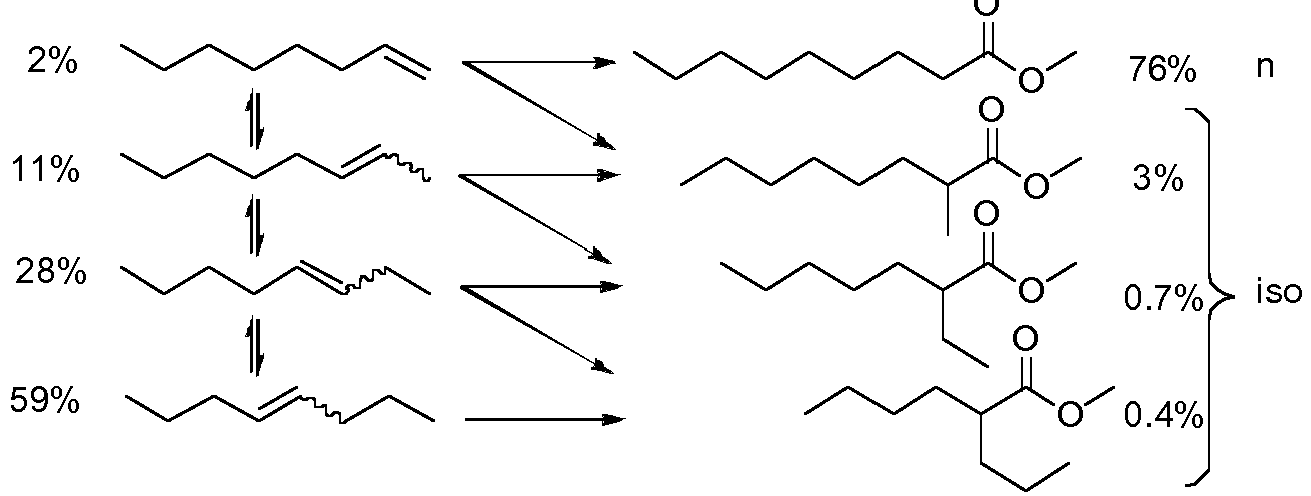
Applications Claiming Priority (2)
| Application Number | Priority Date | Filing Date | Title |
|---|---|---|---|
| DE102011089008.4A DE102011089008B4 (de) | 2011-12-19 | 2011-12-19 | Verfahren zur Herstellung von Estern aus Formiaten und olefinisch ungesättigten Verbindungen |
| PCT/EP2012/075766 WO2013092478A1 (de) | 2011-12-19 | 2012-12-17 | Verfahren zur herstellung von estern aus formiaten und olefinisch ungesättigten verbindungen |
Publications (2)
| Publication Number | Publication Date |
|---|---|
| EP2794547A1 EP2794547A1 (de) | 2014-10-29 |
| EP2794547B1 true EP2794547B1 (de) | 2019-02-06 |
Family
ID=47358470
Family Applications (1)
| Application Number | Title | Priority Date | Filing Date |
|---|---|---|---|
| EP12801740.7A Active EP2794547B1 (de) | 2011-12-19 | 2012-12-17 | Verfahren zur herstellung von estern aus formiaten und olefinisch ungesättigten verbindungen |
Country Status (12)
| Country | Link |
|---|---|
| US (1) | US9340485B2 (de) |
| EP (1) | EP2794547B1 (de) |
| JP (1) | JP5930348B2 (de) |
| KR (1) | KR101978009B1 (de) |
| CN (1) | CN103987690B (de) |
| AR (1) | AR089293A1 (de) |
| DE (1) | DE102011089008B4 (de) |
| ES (1) | ES2720480T3 (de) |
| RU (1) | RU2014129618A (de) |
| SG (1) | SG11201403435XA (de) |
| TW (1) | TWI543966B (de) |
| WO (1) | WO2013092478A1 (de) |
Families Citing this family (5)
| Publication number | Priority date | Publication date | Assignee | Title |
|---|---|---|---|---|
| GB2529007A (en) * | 2014-02-28 | 2016-02-10 | Dow Global Technologies Inc | Process for making esters |
| ES2702924T3 (es) | 2015-07-23 | 2019-03-06 | Evonik Degussa Gmbh | Ligandos difosfina con puente butilo para la alcoxicarbonilación |
| EP3441383B1 (de) * | 2017-08-08 | 2019-12-25 | Evonik Operations GmbH | Methoxycarbonylierung mit ameisensäure als co-quelle |
| EP3441137B1 (de) * | 2017-08-08 | 2019-12-25 | Evonik Operations GmbH | Pd-katalysierten zersetzung von ameisensäure |
| EP3441384B1 (de) * | 2017-08-08 | 2019-12-25 | Evonik Operations GmbH | Methoxycarbonylierung mit ameisensäure und methanol |
Family Cites Families (15)
| Publication number | Priority date | Publication date | Assignee | Title |
|---|---|---|---|---|
| CA1239937A (en) * | 1982-04-12 | 1988-08-02 | Exxon Research And Engineering Company | Process for converting olefins to carboxylic acids or esters using soluble iridium compounds |
| DE3366317D1 (en) * | 1982-10-20 | 1986-10-23 | Bp Chem Int Ltd | Preparation of carboxylic acids and esters thereof |
| ZA837590B (en) | 1982-10-20 | 1985-05-29 | Bp Chem Int Ltd | Preparation of carboxylic acids and esters thereof |
| GB8521547D0 (en) * | 1985-08-29 | 1985-10-02 | British Petroleum Co Plc | Production of esters |
| FR2659965B1 (fr) * | 1990-03-26 | 1992-06-05 | Norsolor Sa | Catalyseur et procede pour la synthese d'esters carboxyliques satures. |
| JP3456491B2 (ja) * | 1993-09-09 | 2003-10-14 | 三菱瓦斯化学株式会社 | ジカルボン酸エステルの製造方法 |
| DE19904200A1 (de) * | 1999-02-03 | 2000-08-10 | Basf Ag | Verfahren zur Herstellung von 3-Alkensäureestern und ein Katalysator zur Durchführung des Verfahrens |
| MY127358A (en) * | 2000-03-14 | 2006-11-30 | Shell Int Research | Process for the carbonylation of ethylenically unsaturated compounds |
| DE10037961A1 (de) | 2000-07-27 | 2002-02-07 | Aventis Res & Tech Gmbh & Co | Neue Phosphanliganden, deren Herstellung und ihre Verwendung in katalytischen Reaktionen |
| DE10100708A1 (de) | 2001-01-10 | 2002-07-11 | Oxeno Olefinchemie Gmbh | Neue N-Phenylpyrrolbisphosphanverbindungen und deren Metallkomplexe |
| JP2005508390A (ja) * | 2001-11-09 | 2005-03-31 | シエル・インターナシヨナル・リサーチ・マートスハツペイ・ベー・ヴエー | 不飽和化合物のカルボニル化のための二座配位子 |
| GB0228018D0 (en) * | 2002-11-30 | 2003-01-08 | Lucite Int Uk Ltd | Carbonylation of ester |
| GB0218613D0 (en) * | 2002-08-10 | 2002-09-18 | Lucite Int Uk Ltd | Process for the carbonylation of ethylenically unsaturated compounds |
| DE10322408A1 (de) | 2003-05-16 | 2004-12-02 | Degussa Ag | Stickstoffhaltige monodentate Phosphine und deren Verwendung in der Katalyse |
| DE102005042464A1 (de) | 2005-09-07 | 2007-03-08 | Oxeno Olefinchemie Gmbh | Carbonylierungsverfahren unter Zusatz von sterisch gehinderten sekundären Aminen |
-
2011
- 2011-12-19 DE DE102011089008.4A patent/DE102011089008B4/de not_active Expired - Fee Related
-
2012
- 2012-12-05 TW TW101145633A patent/TWI543966B/zh not_active IP Right Cessation
- 2012-12-17 CN CN201280062841.4A patent/CN103987690B/zh active Active
- 2012-12-17 SG SG11201403435XA patent/SG11201403435XA/en unknown
- 2012-12-17 EP EP12801740.7A patent/EP2794547B1/de active Active
- 2012-12-17 ES ES12801740T patent/ES2720480T3/es active Active
- 2012-12-17 RU RU2014129618A patent/RU2014129618A/ru not_active Application Discontinuation
- 2012-12-17 KR KR1020147016290A patent/KR101978009B1/ko active Active
- 2012-12-17 US US14/366,965 patent/US9340485B2/en active Active
- 2012-12-17 WO PCT/EP2012/075766 patent/WO2013092478A1/de not_active Ceased
- 2012-12-17 JP JP2014547889A patent/JP5930348B2/ja active Active
- 2012-12-18 AR ARP120104785A patent/AR089293A1/es unknown
Non-Patent Citations (1)
| Title |
|---|
| None * |
Also Published As
| Publication number | Publication date |
|---|---|
| SG11201403435XA (en) | 2014-10-30 |
| ES2720480T3 (es) | 2019-07-22 |
| US20140309435A1 (en) | 2014-10-16 |
| JP2015505858A (ja) | 2015-02-26 |
| DE102011089008B4 (de) | 2017-08-24 |
| CN103987690B (zh) | 2016-08-24 |
| WO2013092478A1 (de) | 2013-06-27 |
| JP5930348B2 (ja) | 2016-06-08 |
| KR20140105471A (ko) | 2014-09-01 |
| EP2794547A1 (de) | 2014-10-29 |
| TW201335134A (zh) | 2013-09-01 |
| TWI543966B (zh) | 2016-08-01 |
| AR089293A1 (es) | 2014-08-13 |
| KR101978009B1 (ko) | 2019-05-13 |
| US9340485B2 (en) | 2016-05-17 |
| CN103987690A (zh) | 2014-08-13 |
| DE102011089008A1 (de) | 2013-06-20 |
| RU2014129618A (ru) | 2016-02-10 |
Similar Documents
| Publication | Publication Date | Title |
|---|---|---|
| EP3750866B1 (de) | Verfahren zur herstellung eines alkohols aus kohlenwasserstoffen | |
| DE102010002809A1 (de) | Verfahren zur Herstellung von linearen alpha,omega-Dicarbonsäurediestern | |
| EP1674441B1 (de) | Verfahren zur Hydroformylierung von Olefinen | |
| EP4103571B1 (de) | Niederdruckhydroformylierung von diisobuten | |
| EP1749572B1 (de) | Verfahren zur hydrierung von oxo-aldehyden mit hohen estergehalten | |
| EP3750865A1 (de) | Verfahren zur herstellung von carbonsäuren oder deren salzen aus kohlenwasserstoffen | |
| DE10009207A1 (de) | Verbessertes Verfahren zur Hydroformylierung von Olefinen durch Reduzierung der Ameisensäurekonzentration | |
| EP3750620A1 (de) | Verfahren zur herstellung eines esters durch alkoxycarbonylierung | |
| DE102011089008B4 (de) | Verfahren zur Herstellung von Estern aus Formiaten und olefinisch ungesättigten Verbindungen | |
| EP0770052B1 (de) | Verfahren zur carbonylierung von olefinen | |
| DE102013215705A1 (de) | Verfahren zur Synthese von gesättigten Carbonsäureestern | |
| DE3917894A1 (de) | Verfahren zur herstellung von c(pfeil abwaerts)2(pfeil abwaerts)+ alkanolen | |
| EP0970034A1 (de) | Verfahren zur herstellung von carbonsäuren oder deren estern durch carbonylierung von olefinen | |
| DE60207853T2 (de) | Einstufige herstellung von 1,3-propandiol aus ethylenoxid und syngas mit einem katalysator mit einem phospholanoalkanliganden | |
| EP2977373B1 (de) | Verfahren zur katalytischen herstellung von estern | |
| EP0931046B1 (de) | VERFAHREN ZUR HERSTELLUNG VON n-BUTYLALKYLETHERN | |
| DD200466A5 (de) | Verfahren zur herstellung von estern mittels carbonylierung von monoolefinischen verbindungen | |
| DE3034019C2 (de) | Verfahren zur gleichzeitigen Herstellung von Estern von Alkanolen und vicinalen Glykolen | |
| EP2951143B1 (de) | Verfahren zur carbonylierung von olefinen | |
| DE102020106009A1 (de) | Verfahren und anlage zur herstellung einer zielverbindung | |
| EP4155288B1 (de) | Verfahren zur verbesserten steuerung der isomerenverhältnisse in hydroformylierungen | |
| DE112024000211T5 (de) | Katalysator, Herstellungsverfahren und Verwendung bei der Synthese von hochkohlenstoffhaltigen Ketonen durch Acyloinkondensation von α-H-haltigen Ketonen und Alkoholen davon | |
| DE102013107421A1 (de) | Verfahren zum asymmetrischen Hydrieren von Enolestern | |
| DE102013113724A1 (de) | Verfahren zur Herstellung von Pentanderivaten und Derivaten alpha, beta-ungesättigter Decenale aus Propylen | |
| EP0381040A2 (de) | Verfahren zur Herstellung von 2,2-Dialkylpropionaldehyden |
Legal Events
| Date | Code | Title | Description |
|---|---|---|---|
| PUAI | Public reference made under article 153(3) epc to a published international application that has entered the european phase |
Free format text: ORIGINAL CODE: 0009012 |
|
| 17P | Request for examination filed |
Effective date: 20140519 |
|
| AK | Designated contracting states |
Kind code of ref document: A1 Designated state(s): AL AT BE BG CH CY CZ DE DK EE ES FI FR GB GR HR HU IE IS IT LI LT LU LV MC MK MT NL NO PL PT RO RS SE SI SK SM TR |
|
| DAX | Request for extension of the european patent (deleted) | ||
| RAP1 | Party data changed (applicant data changed or rights of an application transferred) |
Owner name: EVONIK DEGUSSA GMBH |
|
| STAA | Information on the status of an ep patent application or granted ep patent |
Free format text: STATUS: EXAMINATION IS IN PROGRESS |
|
| 17Q | First examination report despatched |
Effective date: 20180222 |
|
| GRAP | Despatch of communication of intention to grant a patent |
Free format text: ORIGINAL CODE: EPIDOSNIGR1 |
|
| STAA | Information on the status of an ep patent application or granted ep patent |
Free format text: STATUS: GRANT OF PATENT IS INTENDED |
|
| INTG | Intention to grant announced |
Effective date: 20180809 |
|
| GRAS | Grant fee paid |
Free format text: ORIGINAL CODE: EPIDOSNIGR3 |
|
| GRAA | (expected) grant |
Free format text: ORIGINAL CODE: 0009210 |
|
| STAA | Information on the status of an ep patent application or granted ep patent |
Free format text: STATUS: THE PATENT HAS BEEN GRANTED |
|
| AK | Designated contracting states |
Kind code of ref document: B1 Designated state(s): AL AT BE BG CH CY CZ DE DK EE ES FI FR GB GR HR HU IE IS IT LI LT LU LV MC MK MT NL NO PL PT RO RS SE SI SK SM TR |
|
| REG | Reference to a national code |
Ref country code: GB Ref legal event code: FG4D Free format text: NOT ENGLISH |
|
| REG | Reference to a national code |
Ref country code: CH Ref legal event code: EP Ref country code: AT Ref legal event code: REF Ref document number: 1094812 Country of ref document: AT Kind code of ref document: T Effective date: 20190215 |
|
| REG | Reference to a national code |
Ref country code: DE Ref legal event code: R096 Ref document number: 502012014242 Country of ref document: DE |
|
| REG | Reference to a national code |
Ref country code: IE Ref legal event code: FG4D Free format text: LANGUAGE OF EP DOCUMENT: GERMAN |
|
| REG | Reference to a national code |
Ref country code: SE Ref legal event code: TRGR |
|
| REG | Reference to a national code |
Ref country code: NL Ref legal event code: FP |
|
| REG | Reference to a national code |
Ref country code: LT Ref legal event code: MG4D |
|
| REG | Reference to a national code |
Ref country code: ES Ref legal event code: FG2A Ref document number: 2720480 Country of ref document: ES Kind code of ref document: T3 Effective date: 20190722 |
|
| PG25 | Lapsed in a contracting state [announced via postgrant information from national office to epo] |
Ref country code: PT Free format text: LAPSE BECAUSE OF FAILURE TO SUBMIT A TRANSLATION OF THE DESCRIPTION OR TO PAY THE FEE WITHIN THE PRESCRIBED TIME-LIMIT Effective date: 20190606 Ref country code: LT Free format text: LAPSE BECAUSE OF FAILURE TO SUBMIT A TRANSLATION OF THE DESCRIPTION OR TO PAY THE FEE WITHIN THE PRESCRIBED TIME-LIMIT Effective date: 20190206 Ref country code: FI Free format text: LAPSE BECAUSE OF FAILURE TO SUBMIT A TRANSLATION OF THE DESCRIPTION OR TO PAY THE FEE WITHIN THE PRESCRIBED TIME-LIMIT Effective date: 20190206 Ref country code: NO Free format text: LAPSE BECAUSE OF FAILURE TO SUBMIT A TRANSLATION OF THE DESCRIPTION OR TO PAY THE FEE WITHIN THE PRESCRIBED TIME-LIMIT Effective date: 20190506 |
|
| PG25 | Lapsed in a contracting state [announced via postgrant information from national office to epo] |
Ref country code: IS Free format text: LAPSE BECAUSE OF FAILURE TO SUBMIT A TRANSLATION OF THE DESCRIPTION OR TO PAY THE FEE WITHIN THE PRESCRIBED TIME-LIMIT Effective date: 20190606 Ref country code: BG Free format text: LAPSE BECAUSE OF FAILURE TO SUBMIT A TRANSLATION OF THE DESCRIPTION OR TO PAY THE FEE WITHIN THE PRESCRIBED TIME-LIMIT Effective date: 20190506 Ref country code: RS Free format text: LAPSE BECAUSE OF FAILURE TO SUBMIT A TRANSLATION OF THE DESCRIPTION OR TO PAY THE FEE WITHIN THE PRESCRIBED TIME-LIMIT Effective date: 20190206 Ref country code: LV Free format text: LAPSE BECAUSE OF FAILURE TO SUBMIT A TRANSLATION OF THE DESCRIPTION OR TO PAY THE FEE WITHIN THE PRESCRIBED TIME-LIMIT Effective date: 20190206 Ref country code: GR Free format text: LAPSE BECAUSE OF FAILURE TO SUBMIT A TRANSLATION OF THE DESCRIPTION OR TO PAY THE FEE WITHIN THE PRESCRIBED TIME-LIMIT Effective date: 20190507 Ref country code: HR Free format text: LAPSE BECAUSE OF FAILURE TO SUBMIT A TRANSLATION OF THE DESCRIPTION OR TO PAY THE FEE WITHIN THE PRESCRIBED TIME-LIMIT Effective date: 20190206 |
|
| PG25 | Lapsed in a contracting state [announced via postgrant information from national office to epo] |
Ref country code: CZ Free format text: LAPSE BECAUSE OF FAILURE TO SUBMIT A TRANSLATION OF THE DESCRIPTION OR TO PAY THE FEE WITHIN THE PRESCRIBED TIME-LIMIT Effective date: 20190206 Ref country code: AL Free format text: LAPSE BECAUSE OF FAILURE TO SUBMIT A TRANSLATION OF THE DESCRIPTION OR TO PAY THE FEE WITHIN THE PRESCRIBED TIME-LIMIT Effective date: 20190206 Ref country code: SK Free format text: LAPSE BECAUSE OF FAILURE TO SUBMIT A TRANSLATION OF THE DESCRIPTION OR TO PAY THE FEE WITHIN THE PRESCRIBED TIME-LIMIT Effective date: 20190206 Ref country code: EE Free format text: LAPSE BECAUSE OF FAILURE TO SUBMIT A TRANSLATION OF THE DESCRIPTION OR TO PAY THE FEE WITHIN THE PRESCRIBED TIME-LIMIT Effective date: 20190206 Ref country code: DK Free format text: LAPSE BECAUSE OF FAILURE TO SUBMIT A TRANSLATION OF THE DESCRIPTION OR TO PAY THE FEE WITHIN THE PRESCRIBED TIME-LIMIT Effective date: 20190206 Ref country code: RO Free format text: LAPSE BECAUSE OF FAILURE TO SUBMIT A TRANSLATION OF THE DESCRIPTION OR TO PAY THE FEE WITHIN THE PRESCRIBED TIME-LIMIT Effective date: 20190206 |
|
| REG | Reference to a national code |
Ref country code: DE Ref legal event code: R097 Ref document number: 502012014242 Country of ref document: DE |
|
| PG25 | Lapsed in a contracting state [announced via postgrant information from national office to epo] |
Ref country code: SM Free format text: LAPSE BECAUSE OF FAILURE TO SUBMIT A TRANSLATION OF THE DESCRIPTION OR TO PAY THE FEE WITHIN THE PRESCRIBED TIME-LIMIT Effective date: 20190206 Ref country code: PL Free format text: LAPSE BECAUSE OF FAILURE TO SUBMIT A TRANSLATION OF THE DESCRIPTION OR TO PAY THE FEE WITHIN THE PRESCRIBED TIME-LIMIT Effective date: 20190206 |
|
| RAP2 | Party data changed (patent owner data changed or rights of a patent transferred) |
Owner name: EVONIK OPERATIONS GMBH |
|
| PLBE | No opposition filed within time limit |
Free format text: ORIGINAL CODE: 0009261 |
|
| STAA | Information on the status of an ep patent application or granted ep patent |
Free format text: STATUS: NO OPPOSITION FILED WITHIN TIME LIMIT |
|
| REG | Reference to a national code |
Ref country code: DE Ref legal event code: R081 Ref document number: 502012014242 Country of ref document: DE Owner name: EVONIK OXENO GMBH & CO. KG, DE Free format text: FORMER OWNER: EVONIK DEGUSSA GMBH, 45128 ESSEN, DE Ref country code: DE Ref legal event code: R081 Ref document number: 502012014242 Country of ref document: DE Owner name: EVONIK OPERATIONS GMBH, DE Free format text: FORMER OWNER: EVONIK DEGUSSA GMBH, 45128 ESSEN, DE |
|
| 26N | No opposition filed |
Effective date: 20191107 |
|
| PG25 | Lapsed in a contracting state [announced via postgrant information from national office to epo] |
Ref country code: SI Free format text: LAPSE BECAUSE OF FAILURE TO SUBMIT A TRANSLATION OF THE DESCRIPTION OR TO PAY THE FEE WITHIN THE PRESCRIBED TIME-LIMIT Effective date: 20190206 |
|
| PG25 | Lapsed in a contracting state [announced via postgrant information from national office to epo] |
Ref country code: TR Free format text: LAPSE BECAUSE OF FAILURE TO SUBMIT A TRANSLATION OF THE DESCRIPTION OR TO PAY THE FEE WITHIN THE PRESCRIBED TIME-LIMIT Effective date: 20190206 |
|
| REG | Reference to a national code |
Ref country code: CH Ref legal event code: PL |
|
| REG | Reference to a national code |
Ref country code: BE Ref legal event code: HC Owner name: EVONIK OPERATIONS GMBH; DE Free format text: DETAILS ASSIGNMENT: CHANGE OF OWNER(S), CHANGEMENT DE NOM DU PROPRIETAIRE; FORMER OWNER NAME: EVONIK DEGUSSA GMBH Effective date: 20200403 |
|
| PG25 | Lapsed in a contracting state [announced via postgrant information from national office to epo] |
Ref country code: MC Free format text: LAPSE BECAUSE OF FAILURE TO SUBMIT A TRANSLATION OF THE DESCRIPTION OR TO PAY THE FEE WITHIN THE PRESCRIBED TIME-LIMIT Effective date: 20190206 |
|
| REG | Reference to a national code |
Ref country code: NL Ref legal event code: HC Owner name: EVONIK OPERATIONS GMBH; DE Free format text: DETAILS ASSIGNMENT: CHANGE OF OWNER(S), CHANGE OF OWNER(S) NAME; FORMER OWNER NAME: EVONIK DEGUSSA GMBH Effective date: 20200928 |
|
| PG25 | Lapsed in a contracting state [announced via postgrant information from national office to epo] |
Ref country code: LU Free format text: LAPSE BECAUSE OF NON-PAYMENT OF DUE FEES Effective date: 20191217 Ref country code: IE Free format text: LAPSE BECAUSE OF NON-PAYMENT OF DUE FEES Effective date: 20191217 |
|
| PG25 | Lapsed in a contracting state [announced via postgrant information from national office to epo] |
Ref country code: CH Free format text: LAPSE BECAUSE OF NON-PAYMENT OF DUE FEES Effective date: 20191231 Ref country code: LI Free format text: LAPSE BECAUSE OF NON-PAYMENT OF DUE FEES Effective date: 20191231 |
|
| REG | Reference to a national code |
Ref country code: AT Ref legal event code: MM01 Ref document number: 1094812 Country of ref document: AT Kind code of ref document: T Effective date: 20191217 |
|
| PG25 | Lapsed in a contracting state [announced via postgrant information from national office to epo] |
Ref country code: CY Free format text: LAPSE BECAUSE OF FAILURE TO SUBMIT A TRANSLATION OF THE DESCRIPTION OR TO PAY THE FEE WITHIN THE PRESCRIBED TIME-LIMIT Effective date: 20190206 Ref country code: AT Free format text: LAPSE BECAUSE OF NON-PAYMENT OF DUE FEES Effective date: 20191217 |
|
| PG25 | Lapsed in a contracting state [announced via postgrant information from national office to epo] |
Ref country code: MT Free format text: LAPSE BECAUSE OF FAILURE TO SUBMIT A TRANSLATION OF THE DESCRIPTION OR TO PAY THE FEE WITHIN THE PRESCRIBED TIME-LIMIT Effective date: 20190206 Ref country code: HU Free format text: LAPSE BECAUSE OF FAILURE TO SUBMIT A TRANSLATION OF THE DESCRIPTION OR TO PAY THE FEE WITHIN THE PRESCRIBED TIME-LIMIT; INVALID AB INITIO Effective date: 20121217 |
|
| PG25 | Lapsed in a contracting state [announced via postgrant information from national office to epo] |
Ref country code: MK Free format text: LAPSE BECAUSE OF FAILURE TO SUBMIT A TRANSLATION OF THE DESCRIPTION OR TO PAY THE FEE WITHIN THE PRESCRIBED TIME-LIMIT Effective date: 20190206 |
|
| P01 | Opt-out of the competence of the unified patent court (upc) registered |
Effective date: 20230524 |
|
| REG | Reference to a national code |
Ref country code: DE Ref legal event code: R081 Ref document number: 502012014242 Country of ref document: DE Owner name: EVONIK OXENO GMBH & CO. KG, DE Free format text: FORMER OWNER: EVONIK OPERATIONS GMBH, 45128 ESSEN, DE |
|
| REG | Reference to a national code |
Ref country code: GB Ref legal event code: 732E Free format text: REGISTERED BETWEEN 20231026 AND 20231101 |
|
| REG | Reference to a national code |
Ref country code: NL Ref legal event code: PD Owner name: EVONIK OXENO GMBH & CO. KG; DE Free format text: DETAILS ASSIGNMENT: CHANGE OF OWNER(S), ASSIGNMENT; FORMER OWNER NAME: EVONIK OPERATIONS GMBH Effective date: 20231218 |
|
| REG | Reference to a national code |
Ref country code: BE Ref legal event code: PD Owner name: EVONIK OXENO GMBH & CO. KG; DE Free format text: DETAILS ASSIGNMENT: CHANGE OF OWNER(S), ASSIGNMENT; FORMER OWNER NAME: EVONIK OPERATIONS GMBH Effective date: 20231129 |
|
| REG | Reference to a national code |
Ref country code: ES Ref legal event code: PC2A Owner name: EVONIK OXENO GMBH & CO. KG Effective date: 20240702 |
|
| PGFP | Annual fee paid to national office [announced via postgrant information from national office to epo] |
Ref country code: DE Payment date: 20241210 Year of fee payment: 13 |
|
| PGFP | Annual fee paid to national office [announced via postgrant information from national office to epo] |
Ref country code: BE Payment date: 20241219 Year of fee payment: 13 Ref country code: NL Payment date: 20241219 Year of fee payment: 13 |
|
| PGFP | Annual fee paid to national office [announced via postgrant information from national office to epo] |
Ref country code: GB Payment date: 20241224 Year of fee payment: 13 |
|
| PGFP | Annual fee paid to national office [announced via postgrant information from national office to epo] |
Ref country code: FR Payment date: 20241223 Year of fee payment: 13 |
|
| PGFP | Annual fee paid to national office [announced via postgrant information from national office to epo] |
Ref country code: SE Payment date: 20241219 Year of fee payment: 13 |
|
| PGFP | Annual fee paid to national office [announced via postgrant information from national office to epo] |
Ref country code: ES Payment date: 20250131 Year of fee payment: 13 |
|
| PGFP | Annual fee paid to national office [announced via postgrant information from national office to epo] |
Ref country code: IT Payment date: 20241227 Year of fee payment: 13 |
|
| REG | Reference to a national code |
Ref country code: NL Ref legal event code: MM Effective date: 20260101 |