EP2787635A1 - Mehrbandiges niedrigrauschband mit wählbarer frequenz und einer phasenregelschleife - Google Patents
Mehrbandiges niedrigrauschband mit wählbarer frequenz und einer phasenregelschleife Download PDFInfo
- Publication number
- EP2787635A1 EP2787635A1 EP20110876774 EP11876774A EP2787635A1 EP 2787635 A1 EP2787635 A1 EP 2787635A1 EP 20110876774 EP20110876774 EP 20110876774 EP 11876774 A EP11876774 A EP 11876774A EP 2787635 A1 EP2787635 A1 EP 2787635A1
- Authority
- EP
- European Patent Office
- Prior art keywords
- signal
- frequency
- control signal
- local
- low noise
- Prior art date
- Legal status (The legal status is an assumption and is not a legal conclusion. Google has not performed a legal analysis and makes no representation as to the accuracy of the status listed.)
- Withdrawn
Links
Images


Classifications
-
- H—ELECTRICITY
- H04—ELECTRIC COMMUNICATION TECHNIQUE
- H04L—TRANSMISSION OF DIGITAL INFORMATION, e.g. TELEGRAPHIC COMMUNICATION
- H04L25/00—Baseband systems
- H04L25/02—Details ; arrangements for supplying electrical power along data transmission lines
-
- H—ELECTRICITY
- H03—ELECTRONIC CIRCUITRY
- H03L—AUTOMATIC CONTROL, STARTING, SYNCHRONISATION OR STABILISATION OF GENERATORS OF ELECTRONIC OSCILLATIONS OR PULSES
- H03L7/00—Automatic control of frequency or phase; Synchronisation
- H03L7/06—Automatic control of frequency or phase; Synchronisation using a reference signal applied to a frequency- or phase-locked loop
- H03L7/16—Indirect frequency synthesis, i.e. generating a desired one of a number of predetermined frequencies using a frequency- or phase-locked loop
- H03L7/18—Indirect frequency synthesis, i.e. generating a desired one of a number of predetermined frequencies using a frequency- or phase-locked loop using a frequency divider or counter in the loop
-
- H—ELECTRICITY
- H03—ELECTRONIC CIRCUITRY
- H03J—TUNING RESONANT CIRCUITS; SELECTING RESONANT CIRCUITS
- H03J1/00—Details of adjusting, driving, indicating, or mechanical control arrangements for resonant circuits in general
- H03J1/0008—Details of adjusting, driving, indicating, or mechanical control arrangements for resonant circuits in general using a central processing unit, e.g. a microprocessor
- H03J1/0041—Details of adjusting, driving, indicating, or mechanical control arrangements for resonant circuits in general using a central processing unit, e.g. a microprocessor for frequency synthesis with counters or frequency dividers
- H03J1/005—Details of adjusting, driving, indicating, or mechanical control arrangements for resonant circuits in general using a central processing unit, e.g. a microprocessor for frequency synthesis with counters or frequency dividers in a loop
Definitions
- the present invention relates to an apparatus for converting a frequency, and more particularly, to a frequency conversion apparatus for conveniently converting a frequency without location restrictions by generating various frequencies based on a selection of a user.
- a broadcast and communication system may transmit and receive data using a high frequency signal.
- a broadcast and communication apparatus that transmits data may modulate data of a base band to be in a high frequency band, and transmit the modulated data.
- a broadcast and communication apparatus that receives data may convert a high frequency signal into an intermediate frequency band signal using a local signal, and decode the converted signal.
- Each country may use a different frequency band.
- a broadcast and communication apparatus that receives only one frequency band may not receive a broadcast and communication signal transmitted from another country.
- ships and travelers moving through various countries need to prepare a plurality of broadcast and communication apparatuses for each country to receive the broadcast and communication signal from a corresponding country.
- the ships and travelers prepare a plurality of low noise frequency converters appropriate for various countries and change the low noise frequency converter included in a broadcast and communication apparatus when moving to another country.
- Preparing the plurality of broadcast and communication systems or the plurality of frequency converters for various countries is a major inconvenience to the ships and travelers. Accordingly, there is a desire for a broadcast and communication apparatus or a low noise frequency converter that may change a frequency band to receive a broadcast and communication signal based on a selection of a user.
- An aspect of the present invention provides an apparatus for generating a local signal based on a selection of a user.
- Another aspect of the present invention also provides an apparatus for converting a frequency using a local signal appropriate for a local frequency environment without location restrictions.
- a low noise frequency converter including a control signal receiver to receive a control signal determined based on a region in which the low noise frequency converter operates, a frequency determiner to determine a frequency of a local signal in response to the control signal, and a wideband phase-locked loop (PLL) local signal generator to generate the local signal corresponding to the determined frequency.
- PLL phase-locked loop
- a low noise frequency conversion method including receiving a control signal determined based on a region in which a low frequency converter operates, determining a frequency of a local signal in response to the control signal, and generating the local signal corresponding to the determined frequency.
- FIG. 1 is a block diagram illustrating a configuration of a low noise frequency converter according to an embodiment of the present invention.
- a low noise frequency converter 100 may include a control signal receiver 110, a frequency determiner 120, a wideband phase-locked loop (PLL) local signal generator 130, a high frequency signal receiver 140, and a frequency demodulator 150.
- PLL phase-locked loop
- the control signal receiver 110 may receive a control signal determined based on a region in which the low noise frequency converter 100 operates.
- the low nose frequency converter 100 may convert a satellite signal of a high frequency band into a satellite signal of an intermediate frequency band.
- the control signal may include information on a frequency of the high frequency band received by the low noise frequency converter 100.
- a user may determine a local signal to be generated by the low noise frequency converter 100, and directly input a control signal corresponding to the determined local frequency using a user interface such as a button, a touch screen, and the like.
- the control signal receiver 170 may receive, from another device, the control signal using a digital communication method, an analog communication method, a digital satellite equipment control (DiSEqC) communication method and the like.
- DISEqC digital satellite equipment control
- the DiSEqC communication method indicating the digital satellite equipment control communication method may be a communication method of controlling digital satellite equipment.
- the DiSEqC communication method may be used to control a peripheral device connected to a coaxial cable in a satellite set-top box of a general satellite broadcast and communication system.
- a frequency converter may receive two control signals of 13 volts (V)/18 V and thus, select two local bands.
- V 13 volts
- kHz 22 kilohertz
- the frequency converter may receive four control signals of 13 V/18 V/13 V- DiSEqC/18 V- DisEqC and thus, select four local signals.
- the frequency determiner 120 may determine a frequency of the local signal in response to the control signal.
- a frequency of a satellite signal may vary based on the region in which the low noise frequency converter 100 operates.
- a frequency of the intermediate frequency band may not pertain to a region.
- the local signal may be determined based on a difference between a value of the frequency of the high frequency band and a value of the frequency of the intermediate frequency band.
- the wideband PLL local signal generator 130 may generate the local signal corresponding to the frequency determined by the frequency determiner 120. Descriptions about a configuration for generating the local signal will be provided with reference to FIG. 2 .
- the high frequency signal receiver 140 may receive a broadcast and communication signal transmitted through a modulation into a high frequency signal.
- the high frequency signal received by the high frequency signal receiver 140 may be a broadcast signal received from a satellite.
- the frequency demodulator 150 may demodulate the broadcast and communication signal to be an intermediate frequency band signal using the local signal.
- FIG. 2 is a block diagram illustrating a configuration of a wideband PLL local signal generator according to an embodiment of the present invention.
- the wideband PLL local signal generator 130 may include a temperature compensated crystal oscillator (TCXO) 210, a phase detector 220, a charge pump 230, a wideband loop filter 240, a wideband voltage control oscillator 250, and a divider 260.
- TCXO temperature compensated crystal oscillator
- the TCXO 210 may also refer to a temperature compensated X-tal oscillator.
- the TCXO 210 may generate a predetermined reference signal irrespective of a change in an ambient temperature.
- the TCXO 210 may generate a reference signal having a low frequency, for example, approximately 10 megahertz (MHz).
- a crystal oscillator having a high phase noise characteristic may be used as the TCXO 210.
- the phase detector 220 may compare a phase of the reference signal and a phase of a feedback signal, and generate a differential signal corresponding to a difference between the two signals.
- a frequency of the reference signal may differ from a frequency of the feedback signal.
- the phase detector 220 may divide the reference signal and the feedback signal, convert each of the reference signal and the feedback signal to be positioned in a similar frequency band and then, compare a phase of the converted reference signal and a phase of the converted feedback signal.
- a degree of a change in the phase of the reference signal may differ from a degree of a change in the phase of the feedback signal in a process of time.
- the phase detector 220 may observe whether the phase of the reference signal is identical to the phase of the feedback signal, and identical phases are maintained, to generate a differential signal.
- the phase detector 220 may generate a pulse having a width proportional to the difference in the phases of the two signals, as the differential signal.
- a pulse having a large width may be generated as the differential signal.
- a pulse having a small width may be generated as the differential signal.
- the phase detector 220 may change the differential signal in response to a control signal input by a user. For example, the phase detector 220 may arbitrarily adjust a width of a pulse by adjusting a divisor value fed back using a divider. In this case, the divisor value fed back to adjust the width of the pulse may be determined in response to the control signal.
- the charge pump 230 may pump an analog current proportional to the width of the pulse generated by the phase detector 220. For example, when the difference between the phases of the two signals is relatively large, the width of the pulse may be large, and an amount of charge accumulated in the charge pump may also be large such that an analog voltage value is correspondingly large.
- the wideband loop filter 240 may generate an oscillator control signal based on the analog voltage value output from the charge pump. Thus, a voltage of the oscillator control signal generated by the wideband loop filter 240 may be proportional to the difference between the phases of the two signals. Also, the voltage of the oscillator control signal generated by the wideband loop filter 240 may be determined in response to the control signal input by the user.
- the wideband loop filter 240 may be implemented to be a low pass filter so as to remove noise occurring in a process of an operation.
- the wideband loop filter may be implemented using an operational amplifier (OP-Amp).
- the wideband voltage control oscillator 250 may generate a local signal of a frequency proportional to the voltage of the oscillator control signal generated by the wideband loop filter 240.
- an increase in the frequency of the local signal may be linearly proportional to the voltage of the oscillator control signal.
- the divider 260 may divide the generated local signal. A portion of the divided local signal may be input to the phase detector 220 as the feedback signal. Another portion of the divided local signal may be used to convert a frequency of a high frequency band. In an aspect, the other portion of the divided local signal may be divided based on a predetermined multiple so as to multiply a frequency thereof. The multiplied local signal may be used to convert a frequency of a high frequency signal.
- the user may directly input, from an external area, a signal corresponding to a local signal of a frequency of a corresponding region, the signal may be converted into a control signal using, for example, a digital communication method, an analog communication method, and a DiSEqC communication method and received by the low noise frequency converter, and in response to the received control signal, the local signal generator may be controlled to generate a local signal of a user desiring frequency. Since the user may generate a wideband PLL local signal that may receive a broadcast and communication signal using the single low noise frequency converter without restrictions on a location, the user may conveniently receive the high frequency signal without a need to change the low noise frequency converter for each region.
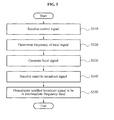
- FIG. 3 is a flowchart illustrating a low noise frequency conversion method in a stepwise manner according to an embodiment of the present invention.
- a low noise frequency converter may receive a control signal.
- the low noise frequency converter may receive a broadcast and communication signal of a high frequency band to convert a frequency of the broadcast and communication signal to be an intermediate band frequency.
- the frequency of the broadcast and communication signal may vary for each region. For example, a frequency of a broadcast and communication signal used in a North American region may differ from frequency of a broadcast and communication signal used in European or Asian regions.
- the control signal may include information on a high frequency band to be converted by the low noise frequency converter.
- the user may determine a local signal to be generated by the low noise frequency converter 100.
- the low noise frequency converter may directly receive a control signal corresponding to a local frequency determined by the user, using a user interface such as a button, a touch screen, and the like.
- the low noise frequency converter may receive, from another device, the control signal using a digital communication method, an analog communication method, a DiSEqC communication method, and the like.
- the low noise frequency converter may determine the frequency of the local signal in response to the control signal.
- the frequency of the local signal may correspond to a difference between the received frequency of the high frequency band and the frequency of the intermediate frequency band.
- the frequency of the intermediate band may be uniform irrespective of a region in which the low noise frequency converter operates, the frequency of the local signal may be determined based on the region in which the low noise frequency converter operates.
- the low noise frequency converter may generate a local signal corresponding to the determined frequency. Descriptions about a configuration for generating the local signal will be provided with reference to FIG. 4 .
- the low noise frequency converter may receive the broadcast and communication signal.
- the broadcast and communication signal received by the low noise frequency converter may be a broadcast signal of a high frequency band received from a satellite.
- the low noise frequency converter may demodulate the broadcast signal to be an intermediate frequency band signal.
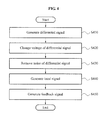
- FIG. 4 is a flowchart illustrating a local signal generation method in a stepwise manner according to an embodiment of the present invention.
- a low noise frequency converter may generate a differential signal.
- the low noise frequency converter may generate the differential signal by comparing a phase of a reference signal and a phase of a feedback signal.
- the reference signal may be a signal of a predetermined frequency generated irrespective of a change in an ambient temperature, and generated using a temperature compensated crystal oscillator.
- the feedback signal may be a signal generated by dividing a local signal.
- a frequency of the reference signal may differ from a frequency of the feedback signal.
- the low noise frequency converter may divide the reference signal and the feedback signal to convert each of the two signals to be positioned in a similar frequency band, and compare the converted phase of the reference signal and the converted phase of the feedback signal.
- a degree of a change in the phase of the reference signal may differ from a degree of a change in the phase of the feedback signal in a process of time.
- the low noise frequency converter may observe whether the phase of the reference signal is identical to the phase of the feedback signal, and identical phases are maintained, to generate a differential signal.
- the low noise frequency converter may generate a pulse having a width proportional to the difference in the phases of the two signals, as the differential signal.
- a pulse having a large width may be generated as the differential signal.
- a pulse having a small width may be generated as the differential signal.
- the low noise frequency converter may change the differential signal in response to a control signal input by a user.
- the low noise frequency converter may arbitrarily adjust a width of a pulse by adjusting a divisor value of the feedback signal.
- the divisor value of the feedback signal may be determined in response to the control signal.
- the low noise frequency converter may pump an analog current proportional to the width of the generated pulse. For example, when the difference between the phases of the two signals is relatively large, the width of the pulse may be large, and an amount of charge accumulated in the charge pump may also be large such that an analog voltage value is correspondingly large.
- the low noise frequency converter may generate an oscillator control signal by removing noise from an analog voltage.
- the low noise frequency converter may remove the noise from the analog voltage using a wideband loop filter.
- the low noise frequency converter may generate the oscillator control signal to be proportional to the difference between the phase of the reference signal and the phase of the feedback signal.
- the low noise frequency converter may generate a local signal of a frequency proportional to the voltage of the oscillator control signal.
- an increase in the frequency of the local signal may be linearly proportional to the voltage of the oscillator control signal.
- the low noise frequency converter may generate the feedback signal.
- the low noise frequency converter may divide the feedback signal by dividing a portion of the generated local signal.
- the generated feedback signal may be used to generate the differential signal in operation S410.
- Another portion of the divided local signal may be used to convert frequencies of the broadcast and communication signal of the high frequency band.
- the other portion of the local signal may be divided based on a predetermined multiple so as to multiply a frequency thereof.
- the multiplied local signal may be used to convert a frequency of a high frequency signal.
- a local signal of a user desiring a frequency may be automatically generated in response to a control signal input by the user from an external area. Since the user may generate the local signal using the single low noise frequency converter without restrictions on a location, the user may conveniently receive a high frequency signal without a need to change the low noise frequency converter for each region.
Landscapes
- Engineering & Computer Science (AREA)
- Computer Hardware Design (AREA)
- Microelectronics & Electronic Packaging (AREA)
- Power Engineering (AREA)
- Computer Networks & Wireless Communication (AREA)
- Signal Processing (AREA)
- Stabilization Of Oscillater, Synchronisation, Frequency Synthesizers (AREA)
- Superheterodyne Receivers (AREA)
Applications Claiming Priority (1)
| Application Number | Priority Date | Filing Date | Title |
|---|---|---|---|
| PCT/KR2011/009122 WO2013081197A1 (ko) | 2011-11-28 | 2011-11-28 | Pll을 이용한 다중 대역 lo 선택이 가능한 광대역 lnb |
Publications (2)
| Publication Number | Publication Date |
|---|---|
| EP2787635A1 true EP2787635A1 (de) | 2014-10-08 |
| EP2787635A4 EP2787635A4 (de) | 2015-07-29 |
Family
ID=48535632
Family Applications (1)
| Application Number | Title | Priority Date | Filing Date |
|---|---|---|---|
| EP11876774.8A Withdrawn EP2787635A4 (de) | 2011-11-28 | 2011-11-28 | Mehrbandiges niedrigrauschband mit wählbarer frequenz und einer phasenregelschleife |
Country Status (3)
| Country | Link |
|---|---|
| US (1) | US20140269997A1 (de) |
| EP (1) | EP2787635A4 (de) |
| WO (1) | WO2013081197A1 (de) |
Family Cites Families (10)
| Publication number | Priority date | Publication date | Assignee | Title |
|---|---|---|---|---|
| KR100442833B1 (ko) * | 2002-07-12 | 2004-08-02 | 삼성전자주식회사 | 이동통신시스템에 있어서 다중대역 무선주파수 수신방법및 장치 |
| US7336706B2 (en) * | 2002-08-08 | 2008-02-26 | Broadcom Corporation | Programmable integrated DiSEqC transceiver |
| US7062240B2 (en) * | 2003-04-22 | 2006-06-13 | Motorola, Inc. | Automatic frequency control processing in multi-channel receivers |
| US20090115525A1 (en) * | 2004-10-22 | 2009-05-07 | University Of Florida Research Foundation, Inc. | Frequency tunable low noise amplifier |
| JP2007235433A (ja) * | 2006-02-28 | 2007-09-13 | Alps Electric Co Ltd | ローノイズブロックコンバータ |
| KR100824783B1 (ko) * | 2006-10-17 | 2008-04-24 | 삼성전자주식회사 | 다중 대역용 저잡음 증폭기 및 다중 대역용 무선 신호수신기 |
| JP2009010826A (ja) * | 2007-06-29 | 2009-01-15 | Sony Corp | マルチバンド低雑音増幅器および無線通信装置 |
| US20090088124A1 (en) * | 2007-09-27 | 2009-04-02 | Nanoamp Solutions, Inc. (Cayman) | Radio Frequency Receiver Architecture |
| JP2009105859A (ja) * | 2007-10-25 | 2009-05-14 | Sharp Corp | デジタル衛星放送受信チューナ及びそれを有する衛星放送受信機 |
| JP4981649B2 (ja) * | 2007-12-21 | 2012-07-25 | ルネサスエレクトロニクス株式会社 | ラジオ受信装置、オーディオシステム、及びラジオ受信装置の製造方法 |
-
2011
- 2011-11-28 EP EP11876774.8A patent/EP2787635A4/de not_active Withdrawn
- 2011-11-28 WO PCT/KR2011/009122 patent/WO2013081197A1/ko not_active Ceased
- 2011-11-28 US US14/353,329 patent/US20140269997A1/en not_active Abandoned
Also Published As
| Publication number | Publication date |
|---|---|
| WO2013081197A1 (ko) | 2013-06-06 |
| EP2787635A4 (de) | 2015-07-29 |
| US20140269997A1 (en) | 2014-09-18 |
Similar Documents
| Publication | Publication Date | Title |
|---|---|---|
| US8280330B2 (en) | Crystal-less clock generation for radio frequency receivers | |
| CN104639475A (zh) | 杂散消除系统及其相关方法 | |
| JP2009296482A (ja) | ダイバーシチ受信装置 | |
| CN102752038B (zh) | 一种卫星应答机 | |
| KR20190134474A (ko) | 가변 듀티 사이클을 갖는 기준 발진기, 기준 발진기를 갖는 주파수 합성기 및 신호 수신기 | |
| US10088379B2 (en) | Data transmitting device capable of configuring different operating frequencies for use by tire pressure monitoring detector | |
| KR100895886B1 (ko) | 이중 대역 gps/galileo 위성 신호 수신기 | |
| JP2005167536A5 (de) | ||
| JP2007088657A (ja) | Fmトランスミッタ | |
| EP0645882A1 (de) | Demodulation eines frequenzmodulierten Tonträgers | |
| US4194151A (en) | Multifrequency generator | |
| JP2007096694A (ja) | Fmトランスミッタ | |
| US20140269997A1 (en) | Multi-band lo selectable wideband lnb using pll | |
| CN1968246B (zh) | 无线通信电路及传输信息的方法 | |
| KR101298621B1 (ko) | Fmcw 주파수 합성기 및 그것의 제어 방법 | |
| US8125255B2 (en) | PLL circuit | |
| KR101230708B1 (ko) | Pll을 이용한 다중 대역 lo 선택이 가능한 광대역 lnb | |
| JP2007037123A (ja) | 自動周波数制御ループ回路 | |
| JP2013017037A (ja) | レベル調整装置 | |
| KR20170023190A (ko) | 무선 통신 장치 및 전원 장치 | |
| EP2579454A2 (de) | Vorrichtung zur Erzeugung eines Unterträgersignals zur Übertragung zwischen Ultrahochfrequenzkanälen und Verfahren zu deren Erzeugung | |
| JP2002198924A (ja) | ステレオ副搬送波およびrds搬送波取得回路 | |
| EP1768266A2 (de) | Hochfrequenzempfänger mit Steuerung des Vorspannungsstroms und Verfahren dieser Steuerung | |
| JP2008147788A (ja) | 位相同期回路、同期検波回路および放送受信装置 | |
| CN101807916A (zh) | 锁相环系统和方法 |
Legal Events
| Date | Code | Title | Description |
|---|---|---|---|
| PUAI | Public reference made under article 153(3) epc to a published international application that has entered the european phase |
Free format text: ORIGINAL CODE: 0009012 |
|
| 17P | Request for examination filed |
Effective date: 20140516 |
|
| AK | Designated contracting states |
Kind code of ref document: A1 Designated state(s): AL AT BE BG CH CY CZ DE DK EE ES FI FR GB GR HR HU IE IS IT LI LT LU LV MC MK MT NL NO PL PT RO RS SE SI SK SM TR |
|
| DAX | Request for extension of the european patent (deleted) | ||
| RA4 | Supplementary search report drawn up and despatched (corrected) |
Effective date: 20150701 |
|
| RIC1 | Information provided on ipc code assigned before grant |
Ipc: H03D 7/00 20060101AFI20150625BHEP Ipc: H03J 5/02 20060101ALI20150625BHEP |
|
| STAA | Information on the status of an ep patent application or granted ep patent |
Free format text: STATUS: THE APPLICATION IS DEEMED TO BE WITHDRAWN |
|
| 18D | Application deemed to be withdrawn |
Effective date: 20160128 |