EP2780280B1 - Segmented graphene nanoribbons - Google Patents
Segmented graphene nanoribbons Download PDFInfo
- Publication number
- EP2780280B1 EP2780280B1 EP12787698.5A EP12787698A EP2780280B1 EP 2780280 B1 EP2780280 B1 EP 2780280B1 EP 12787698 A EP12787698 A EP 12787698A EP 2780280 B1 EP2780280 B1 EP 2780280B1
- Authority
- EP
- European Patent Office
- Prior art keywords
- graphene nanoribbon
- segmented
- segments
- graphene
- substituted
- Prior art date
- Legal status (The legal status is an assumption and is not a legal conclusion. Google has not performed a legal analysis and makes no representation as to the accuracy of the status listed.)
- Active
Links
Images


Classifications
-
- C—CHEMISTRY; METALLURGY
- C01—INORGANIC CHEMISTRY
- C01B—NON-METALLIC ELEMENTS; COMPOUNDS THEREOF; METALLOIDS OR COMPOUNDS THEREOF NOT COVERED BY SUBCLASS C01C
- C01B32/00—Carbon; Compounds thereof
- C01B32/15—Nano-sized carbon materials
- C01B32/182—Graphene
-
- C—CHEMISTRY; METALLURGY
- C01—INORGANIC CHEMISTRY
- C01B—NON-METALLIC ELEMENTS; COMPOUNDS THEREOF; METALLOIDS OR COMPOUNDS THEREOF NOT COVERED BY SUBCLASS C01C
- C01B32/00—Carbon; Compounds thereof
- C01B32/15—Nano-sized carbon materials
- C01B32/182—Graphene
- C01B32/184—Preparation
-
- B—PERFORMING OPERATIONS; TRANSPORTING
- B82—NANOTECHNOLOGY
- B82Y—SPECIFIC USES OR APPLICATIONS OF NANOSTRUCTURES; MEASUREMENT OR ANALYSIS OF NANOSTRUCTURES; MANUFACTURE OR TREATMENT OF NANOSTRUCTURES
- B82Y30/00—Nanotechnology for materials or surface science, e.g. nanocomposites
-
- B—PERFORMING OPERATIONS; TRANSPORTING
- B82—NANOTECHNOLOGY
- B82Y—SPECIFIC USES OR APPLICATIONS OF NANOSTRUCTURES; MEASUREMENT OR ANALYSIS OF NANOSTRUCTURES; MANUFACTURE OR TREATMENT OF NANOSTRUCTURES
- B82Y40/00—Manufacture or treatment of nanostructures
-
- C—CHEMISTRY; METALLURGY
- C01—INORGANIC CHEMISTRY
- C01B—NON-METALLIC ELEMENTS; COMPOUNDS THEREOF; METALLOIDS OR COMPOUNDS THEREOF NOT COVERED BY SUBCLASS C01C
- C01B32/00—Carbon; Compounds thereof
-
- C—CHEMISTRY; METALLURGY
- C01—INORGANIC CHEMISTRY
- C01B—NON-METALLIC ELEMENTS; COMPOUNDS THEREOF; METALLOIDS OR COMPOUNDS THEREOF NOT COVERED BY SUBCLASS C01C
- C01B32/00—Carbon; Compounds thereof
- C01B32/15—Nano-sized carbon materials
- C01B32/182—Graphene
- C01B32/194—After-treatment
-
- C—CHEMISTRY; METALLURGY
- C08—ORGANIC MACROMOLECULAR COMPOUNDS; THEIR PREPARATION OR CHEMICAL WORKING-UP; COMPOSITIONS BASED THEREON
- C08G—MACROMOLECULAR COMPOUNDS OBTAINED OTHERWISE THAN BY REACTIONS ONLY INVOLVING UNSATURATED CARBON-TO-CARBON BONDS
- C08G61/00—Macromolecular compounds obtained by reactions forming a carbon-to-carbon link in the main chain of the macromolecule
- C08G61/02—Macromolecular compounds containing only carbon atoms in the main chain of the macromolecule, e.g. polyxylylenes
- C08G61/10—Macromolecular compounds containing only carbon atoms in the main chain of the macromolecule, e.g. polyxylylenes only aromatic carbon atoms, e.g. polyphenylenes
-
- C—CHEMISTRY; METALLURGY
- C01—INORGANIC CHEMISTRY
- C01B—NON-METALLIC ELEMENTS; COMPOUNDS THEREOF; METALLOIDS OR COMPOUNDS THEREOF NOT COVERED BY SUBCLASS C01C
- C01B2204/00—Structure or properties of graphene
- C01B2204/06—Graphene nanoribbons
-
- C—CHEMISTRY; METALLURGY
- C01—INORGANIC CHEMISTRY
- C01B—NON-METALLIC ELEMENTS; COMPOUNDS THEREOF; METALLOIDS OR COMPOUNDS THEREOF NOT COVERED BY SUBCLASS C01C
- C01B2204/00—Structure or properties of graphene
- C01B2204/06—Graphene nanoribbons
- C01B2204/065—Graphene nanoribbons characterized by their width or by their aspect ratio
-
- C—CHEMISTRY; METALLURGY
- C08—ORGANIC MACROMOLECULAR COMPOUNDS; THEIR PREPARATION OR CHEMICAL WORKING-UP; COMPOSITIONS BASED THEREON
- C08G—MACROMOLECULAR COMPOUNDS OBTAINED OTHERWISE THAN BY REACTIONS ONLY INVOLVING UNSATURATED CARBON-TO-CARBON BONDS
- C08G2261/00—Macromolecular compounds obtained by reactions forming a carbon-to-carbon link in the main chain of the macromolecule
- C08G2261/10—Definition of the polymer structure
- C08G2261/14—Side-groups
- C08G2261/148—Side-chains having aromatic units
-
- C—CHEMISTRY; METALLURGY
- C08—ORGANIC MACROMOLECULAR COMPOUNDS; THEIR PREPARATION OR CHEMICAL WORKING-UP; COMPOSITIONS BASED THEREON
- C08G—MACROMOLECULAR COMPOUNDS OBTAINED OTHERWISE THAN BY REACTIONS ONLY INVOLVING UNSATURATED CARBON-TO-CARBON BONDS
- C08G2261/00—Macromolecular compounds obtained by reactions forming a carbon-to-carbon link in the main chain of the macromolecule
- C08G2261/30—Monomer units or repeat units incorporating structural elements in the main chain
- C08G2261/31—Monomer units or repeat units incorporating structural elements in the main chain incorporating aromatic structural elements in the main chain
- C08G2261/312—Non-condensed aromatic systems, e.g. benzene
-
- C—CHEMISTRY; METALLURGY
- C08—ORGANIC MACROMOLECULAR COMPOUNDS; THEIR PREPARATION OR CHEMICAL WORKING-UP; COMPOSITIONS BASED THEREON
- C08G—MACROMOLECULAR COMPOUNDS OBTAINED OTHERWISE THAN BY REACTIONS ONLY INVOLVING UNSATURATED CARBON-TO-CARBON BONDS
- C08G2261/00—Macromolecular compounds obtained by reactions forming a carbon-to-carbon link in the main chain of the macromolecule
- C08G2261/30—Monomer units or repeat units incorporating structural elements in the main chain
- C08G2261/31—Monomer units or repeat units incorporating structural elements in the main chain incorporating aromatic structural elements in the main chain
- C08G2261/314—Condensed aromatic systems, e.g. perylene, anthracene or pyrene
-
- Y—GENERAL TAGGING OF NEW TECHNOLOGICAL DEVELOPMENTS; GENERAL TAGGING OF CROSS-SECTIONAL TECHNOLOGIES SPANNING OVER SEVERAL SECTIONS OF THE IPC; TECHNICAL SUBJECTS COVERED BY FORMER USPC CROSS-REFERENCE ART COLLECTIONS [XRACs] AND DIGESTS
- Y10—TECHNICAL SUBJECTS COVERED BY FORMER USPC
- Y10S—TECHNICAL SUBJECTS COVERED BY FORMER USPC CROSS-REFERENCE ART COLLECTIONS [XRACs] AND DIGESTS
- Y10S977/00—Nanotechnology
- Y10S977/70—Nanostructure
- Y10S977/734—Fullerenes, i.e. graphene-based structures, such as nanohorns, nanococoons, nanoscrolls or fullerene-like structures, e.g. WS2 or MoS2 chalcogenide nanotubes, planar C3N4, etc.
-
- Y—GENERAL TAGGING OF NEW TECHNOLOGICAL DEVELOPMENTS; GENERAL TAGGING OF CROSS-SECTIONAL TECHNOLOGIES SPANNING OVER SEVERAL SECTIONS OF THE IPC; TECHNICAL SUBJECTS COVERED BY FORMER USPC CROSS-REFERENCE ART COLLECTIONS [XRACs] AND DIGESTS
- Y10—TECHNICAL SUBJECTS COVERED BY FORMER USPC
- Y10S—TECHNICAL SUBJECTS COVERED BY FORMER USPC CROSS-REFERENCE ART COLLECTIONS [XRACs] AND DIGESTS
- Y10S977/00—Nanotechnology
- Y10S977/84—Manufacture, treatment, or detection of nanostructure
- Y10S977/842—Manufacture, treatment, or detection of nanostructure for carbon nanotubes or fullerenes
-
- Y—GENERAL TAGGING OF NEW TECHNOLOGICAL DEVELOPMENTS; GENERAL TAGGING OF CROSS-SECTIONAL TECHNOLOGIES SPANNING OVER SEVERAL SECTIONS OF THE IPC; TECHNICAL SUBJECTS COVERED BY FORMER USPC CROSS-REFERENCE ART COLLECTIONS [XRACs] AND DIGESTS
- Y10—TECHNICAL SUBJECTS COVERED BY FORMER USPC
- Y10S—TECHNICAL SUBJECTS COVERED BY FORMER USPC CROSS-REFERENCE ART COLLECTIONS [XRACs] AND DIGESTS
- Y10S977/00—Nanotechnology
- Y10S977/84—Manufacture, treatment, or detection of nanostructure
- Y10S977/895—Manufacture, treatment, or detection of nanostructure having step or means utilizing chemical property
- Y10S977/896—Chemical synthesis, e.g. chemical bonding or breaking
-
- Y—GENERAL TAGGING OF NEW TECHNOLOGICAL DEVELOPMENTS; GENERAL TAGGING OF CROSS-SECTIONAL TECHNOLOGIES SPANNING OVER SEVERAL SECTIONS OF THE IPC; TECHNICAL SUBJECTS COVERED BY FORMER USPC CROSS-REFERENCE ART COLLECTIONS [XRACs] AND DIGESTS
- Y10—TECHNICAL SUBJECTS COVERED BY FORMER USPC
- Y10S—TECHNICAL SUBJECTS COVERED BY FORMER USPC CROSS-REFERENCE ART COLLECTIONS [XRACs] AND DIGESTS
- Y10S977/00—Nanotechnology
- Y10S977/902—Specified use of nanostructure
- Y10S977/932—Specified use of nanostructure for electronic or optoelectronic application
-
- Y—GENERAL TAGGING OF NEW TECHNOLOGICAL DEVELOPMENTS; GENERAL TAGGING OF CROSS-SECTIONAL TECHNOLOGIES SPANNING OVER SEVERAL SECTIONS OF THE IPC; TECHNICAL SUBJECTS COVERED BY FORMER USPC CROSS-REFERENCE ART COLLECTIONS [XRACs] AND DIGESTS
- Y10—TECHNICAL SUBJECTS COVERED BY FORMER USPC
- Y10T—TECHNICAL SUBJECTS COVERED BY FORMER US CLASSIFICATION
- Y10T428/00—Stock material or miscellaneous articles
- Y10T428/29—Coated or structually defined flake, particle, cell, strand, strand portion, rod, filament, macroscopic fiber or mass thereof
- Y10T428/2913—Rod, strand, filament or fiber
- Y10T428/298—Physical dimension
-
- Y—GENERAL TAGGING OF NEW TECHNOLOGICAL DEVELOPMENTS; GENERAL TAGGING OF CROSS-SECTIONAL TECHNOLOGIES SPANNING OVER SEVERAL SECTIONS OF THE IPC; TECHNICAL SUBJECTS COVERED BY FORMER USPC CROSS-REFERENCE ART COLLECTIONS [XRACs] AND DIGESTS
- Y10—TECHNICAL SUBJECTS COVERED BY FORMER USPC
- Y10T—TECHNICAL SUBJECTS COVERED BY FORMER US CLASSIFICATION
- Y10T428/00—Stock material or miscellaneous articles
- Y10T428/29—Coated or structually defined flake, particle, cell, strand, strand portion, rod, filament, macroscopic fiber or mass thereof
- Y10T428/2982—Particulate matter [e.g., sphere, flake, etc.]
Definitions
- GNRs Graphene nanoribbons
- Their characteristic feature is high shape-anisotropy due to the increased ratio of length over width.
- armchair-type GNRs exhibit an electronic band gap that is strongly dependent on their width.
- edge structure of the GNRs has a strong impact on the electronic properties.
- GNRs Graphene nanoribbons
- ZGNR electrically conducting zig-zag edge
- AGNR semiconducting armchair edge ribbons
- more general variations of the geometry of a GNR allow for gap tuning through one-dimensional (1D) quantum confinement.
- increasing the ribbon width leads to an overall decrease of the band gap, with superimposed oscillation features that are maximized for armchair GNRs (AGNRs).
- intra-GNR heterostructures might provide a completely new concept for the realization of (opto-)electronic devices.
- GNRs as building blocks rather than semiconducting crystalline thin films, the unique quantum properties of the constituents can be fully exploited, and the interface between different GNRs can potentially be realized without defects.
- Band gap tuning between different components of the heterojunction can then simply be achieved by varying the width of the components rather than their chemical composition, potentially allowing for "allcarbon" device components.
- a variety of electronic components for integrated circuits and other devices that can be made out of GNR heterojunctions are e.g. described in patent application US2009/0174435 .
- heterojunctions and heterostructures reports the preparation of graphene nanoribbons with width below 10 nanometers by exfoliation of graphite.
- the strong interest in heterojunctions and heterostructures derives from the fact that they are the fundamental building blocks of modern high-speed- and opto-electronics.
- Semiconductor heterostructures are usually manufactured by stacking crystalline materials exhibiting different electronic band gaps, which requires the use of molecular beam epitaxy or chemical vapor deposition technologies in order to precisely control the 2D interface. Lateral heterojunctions represent an even harder challenge.
- a polymer is typically prepared in a first step which is subsequently converted into the graphitic structure by Scholl-type oxidative cyclodehydrogenation.
- the design of the parent monomer must be carefully adjusted in order to guarantee for a suitable arrangement of the aromatic units upon the chemistry-assisted graphitization into the final GNR structure.
- GNR graphene nanoribbon
- the segment width is measured with scanning tunneling microscopy (STM).
- STM scanning tunneling microscopy
- the apparent width is corrected for the finite tip radius by STM simulation as explained in J. Cai et al., Nature 466, pp. 470-473 (2010 ).
- the STM images are simulated according to the Tersoff-Hamann approach with an additional rolling ball algorithm to include tip effects on the apparent ribbon width.
- the integrated density of states between the Fermi energy and the Fermi energy plus a given sample bias are extracted from a Gaussian and plane waves approach for the given geometries.
- each graphene segment of the segmented graphene nanoribbon has a monodisperse segment width of 4 nm or less, more preferably 3 nm or less, even more preferably 2 nm or less.
- neighbouring graphene segments preferably differ in their monodisperse segment width.
- two or more neighbouring graphene segments have the same monodisperse segment width, but differ in at least one other property.
- Each graphene segment has a repeating unit which is derived from at least one substituted or unsubstituted polycyclic aromatic monomer compound, preferably at least one substituted or unsubstituted polycyclic aromatic hydrocarbon monomer compound, and/or from at least one substituted or unsubstituted oligo phenylene aromatic hydrocarbon monomer compound.
- Substituted or unsubstituted oligo phenylene aromatic hydrocarbon monomer compounds from which the repeating unit of a segment can be derived include e.g.
- biphenyl triphenyl, tetraphenyl, pentaphenyl, hexaphenyl, heptaphenyl, octaphenyl, all of which can be substituted or unsubstituted.
- segment width of an armchair graphene segment can also be expressed by the number N of dimer lines or carbon atom pairs across the segment width ( K. Wakabayashi et al., Sci. Technol. Adv. Mater. 11 (2010) 054504 ).
- N dimer lines or carbon atom pairs across the segment width
- the repeating units of the different graphene segments can have a number N of dimer lines across the segment width of from 3 to 38, more preferably of from 3 to 21, or of from 5 to 20.
- the degree of annelation indicates to what extent neighbouring polycyclic aromatic and/or oligo phenylene aromatic groups are fused together by cyclodehydrogenation. As will be discussed in further detail below, if there is full cyclodehydrogenation in a specific region of the graphene nanoribbon, this region will represent a segment with a maximum degree of annelation, whereas the neighbouring segment preferably has a lower degree of annelation due to partial cyclodehydrogenation in this area.
- the repeating units of the different segments differ in the substituents attached thereto, whereas the degree of cyclodehydrogenation can be the same or may be different. This can be accomplished by using polycyclic aromatic monomer compounds and/or oligo phenylene aromatic hydrocarbon monomer compounds which have different substituents attached to the aromatic ring(s).
- all segments of the segmented graphene nanoribbon are in a linear arrangement.
- each segment of the segmented graphene nanoribbon can be covalently linked to up to two neighbouring segments.
- At least one segment of the segmented graphene nanoribbon is covalently linked to at least three neighbouring segments. Exemplary embodiments are described below in further detail, see e.g. the structure shown in Formula XI.
- the two or more different segments have repeating units which are derived from substituted or unsubstituted anthracene monomer compounds.
- the segmented graphene nanoribbon comprising the two or more graphene segments having anthracene-based repeating units has the following structure la:
- a is preferably 1 to 50. More preferably, a is 1 to 10, even more preferably 1 to 5. If 2 ⁇ a ⁇ 1 (wherein 1 is preferably 50, more preferably 10, even more preferably 5, as indicated above), the segmented graphene nanoribbon comprises 1 structural parts a 1 , a 2 , . «, a 1 .
- segmented graphene nanoribbon comprising the two or more segments having anthracene-based repeating units has the following structure Ib:
- a is preferably 1 to 50. More preferably, a is 1 to 10, even more preferably 1 to 5. If 2 ⁇ a ⁇ 1 (wherein 1 is preferably 50, more preferably 10, even more preferably 5, as indicated above), the segmented graphene nanoribbon comprises 1 structural parts a 1 , a 2 , . «, a 1 .
- segmented graphene nanoribbon comprising the two or more segments having anthracene-based repeating units has the following structure Ic:
- a is preferably 1 to 50. More preferably, a is 1 to 10, even more preferably 1 to 5. If 2 ⁇ a ⁇ 1 (wherein 1 is preferably 50, more preferably 10, even more preferably 5, as indicated above), the segmented graphene nanoribbon comprises 1 structural parts a 1 , a 2 , . «, a 1 .
- a is preferably 1 to 50. More preferably, a is 1 to 10, even more preferably 1 to 5. If 2 ⁇ a ⁇ 1 (wherein 1 is preferably 50, more preferably 10, even more preferably 5, as indicated above), the segmented graphene nanoribbon comprises 1 structural parts a 1 , a 2 , . «, a 1 .
- segmented graphene nanoribbon comprising the two or more segments having anthracene-based repeating units has the following structure Ie:
- a is preferably 1 to 50. More preferably, a is 1 to 10, even more preferably 1 to 5. If 2 ⁇ a ⁇ 1 (wherein 1 is preferably 50, more preferably 10, even more preferably 5, as indicated above), the segmented graphene nanoribbon comprises 1 structural parts a 1 , a 2 , . «, a 1 .
- the segmented graphene nanoribbon comprising the two or more segments having anthracene-based repeating units has the following structure Ih: wherein
- a is preferably 1 to 50. More preferably, a is 1 to 10, even more preferably 1 to 5. If 2 ⁇ a ⁇ 1 (wherein 1 is preferably 50, more preferably 10, even more preferably 5, as indicated above), the segmented graphene nanoribbon comprises 1 structural parts a 1 , a 2 , . «, a 1 .
- the two or more different graphene segments may also have repeating units which are derived from substituted or unsubstituted pentacene monomer compounds.
- the segmented graphene nanoribbon comprising the two or more different segments having repeating units derived from pentacene monomer compounds has the following structure II:
- the segmented graphene nanoribbon comprising the two or more different segments having repeating units derived from pentacene monomer compounds has the following structure III: wherein
- a is preferably 1 to 50. More preferably, a is 1 to 10, even more preferably 1 to 5. If 2 ⁇ a ⁇ 1 (wherein 1 is preferably 50, more preferably 10, even more preferably 5, as indicated above), the segmented graphene nanoribbon comprises 1 structural parts a 1 , a 2 , . «, a 1 .
- the two or more different graphene segments have repeating units which are derived from substituted or unsubstituted anthracene and substituted or unsubstituted pentacene monomer compounds.
- the segmented graphene nanoribbon comprising the two or more different segments having repeating units derived from anthracene and pentacene monomer compounds has the following structure IV: wherein
- the two or more different graphene segments can also have repeating units derived from substituted and/or unsubstituted naphthalene monomer compounds.
- the segmented graphene nanoribbon comprising the two or more different segments having repeating units which are derived from naphthalene monomer compounds has the following structure V:
- a is preferably 1 to 50. More preferably, a is 1 to 10, even more preferably 1 to 5. If 2 ⁇ a ⁇ 1 (wherein 1 is preferably 50, more preferably 10, even more preferably 5, as indicated above), the segmented graphene nanoribbon comprises 1 structural parts a 1 , a 2 , . «, a 1 .
- segmented graphene nanoribbon comprising the two or more different segments having repeating units which are derived from naphthalene monomer compounds has the following structure VI:
- segmented graphene nanoribbon comprising the two or more different segments having repeating units which are derived from naphthalene monomer compounds has the following structure VII:
- a is preferably 1 to 50. More preferably, a is 1 to 10, even more preferably 1 to 5. If 2 ⁇ a ⁇ 1 (wherein 1 is preferably 50, more preferably 10, even more preferably 5, as indicated above), the segmented graphene nanoribbon comprises 1 structural parts a 1 , a 2 , . «, a 1 .
- a is preferably 1 to 50. More preferably, a is 1 to 10, even more preferably 1 to 5. If 2 ⁇ a ⁇ 1 (wherein 1 is preferably 50, more preferably 10, even more preferably 5, as indicated above), the segmented graphene nanoribbon comprises 1 structural parts a 1 , a 2 , . «, a 1 .
- segmented graphene nanoribbon comprising the two or more different segments having repeating units which are derived from naphthalene monomer compounds has the following structure IX:
- a is preferably 1 to 50. More preferably, a is 1 to 10, even more preferably 1 to 5. If 2 ⁇ a ⁇ 1 (wherein 1 is preferably 50, more preferably 10, even more preferably 5, as indicated above), the segmented graphene nanoribbon comprises 1 structural parts a 1 , a 2 , . «, a 1 .
- segmented graphene nanoribbon comprising the two or more different segments having repeating units which are derived from naphthalene monomer compounds has the following structure X:
- a is preferably 1 to 50. More preferably, a is 1 to 10, even more preferably 1 to 5. If 2 ⁇ a ⁇ 1 (wherein 1 is preferably 50, more preferably 10, even more preferably 5, as indicated above), the segmented graphene nanoribbon comprises 1 structural parts a 1 , a 2 , . «, a 1 .
- a is preferably 1 to 50. More preferably, a is 1 to 10, even more preferably 1 to 5. If 2 ⁇ a ⁇ 1 (wherein 1 is preferably 50, more preferably 10, even more preferably 5, as indicated above), the segmented graphene nanoribbon comprises 1 structural parts a 1 , a 2 , . «, a 1 .
- a is preferably 1 to 50. More preferably, a is 1 to 10, even more preferably 1 to 5. If 2 ⁇ a ⁇ 1 (wherein 1 is preferably 50, more preferably 10, even more preferably 5, as indicated above), the segmented graphene nanoribbon comprises 1 structural parts a 1 , a 2 , . «, a 1 .
- a is preferably 1 to 50. More preferably, a is 1 to 10, even more preferably 1 to 5. If 2 ⁇ a ⁇ 1 (wherein 1 is preferably 50, more preferably 10, even more preferably 5, as indicated above), the segmented graphene nanoribbon comprises 1 structural parts a 1 , a 2 , . «, a 1 .
- a is preferably 1 to 50. More preferably, a is 1 to 10, even more preferably 1 to 5. If 2 ⁇ a ⁇ 1 (wherein 1 is preferably 50, more preferably 10, even more preferably 5, as indicated above), the segmented graphene nanoribbon comprises 1 structural parts a 1 , a 2 , . «, a 1 .
- a heterojunction is generated at the interface of two covalently linked graphene segments which differ in their electronic properties (e.g. different band gaps).
- the polycyclic aromatic monomer compound, preferably polycyclic aromatic hydrocarbon monomer compound, and/or the oligo phenylene aromatic hydrocarbon monomer compound of step (a) can be any compound which undergoes polymerization to a polymer (preferably a linear polymer) under appropriate reaction conditions.
- a polymer preferably a linear polymer
- Such polycyclic aromatic monomer or oligo phenylene aromatic hydrocarbon monomer compounds that can be reacted to a polymer are generally known to the skilled person.
- the polycyclic aromatic monomer compound can for instance be an anthracene based compound such as those of formulae 1-3 shown below, a bisanthene based compound such as the one of formula 4 shown below, or a trisanthene based compound such as the one of formula 5 shown below.
- an anthracene based compound such as those of formulae 1-3 shown below
- a bisanthene based compound such as the one of formula 4 shown below
- a trisanthene based compound such as the one of formula 5 shown below.
- a variety of such compounds is commercially available or can be prepared according to literature procedures by those skilled in the art. Reference can also be made to those polycyclic aromatic monomer compounds already mentioned above when discussing compounds from which the graphene segment repeating units are derived.
- the monomer compound can also be a pentacene based compound such as the compounds of formula 6 and 7. This type of compound can be prepared according to literature procedures by those skilled in the art.
- the monomer compound can also be a phenanthrene based compound such as the compounds of formulae 8 and 9. This type of monomer is described e.g. in US 7,968,872 .
- the monomer compound can also be a tetracene based compound such as those of formulae 10 -13.
- This type of compound can be prepared according to literature procedures by those skilled in the art.
- the monomer compound can also be a naphthalene based compound such as those of formulae 14 to 22.
- This type of compound can be prepared according to literature procedures by those skilled in the art.
- step (a) includes depositing the at least one polycyclic aromatic monomer or oligo phenylene aromatic hydrocarbon monomer compound on a solid substrate.
- any solid substrate enabling the deposition of the polycyclic aromatic monomer or oligo phenylene aromatic hydrocarbon monomer compound and subsequent polymerization to a linear polymer on its surface can be used.
- the solid substrate has a flat surface.
- the flat surface on which the monomer compound is deposited can be a metal surface such as a Au, Ag, Cu, Al, W, Ni, Pt, or a Pd surface (which may be reconstructed or vicinal), or the surface can be an alloy of these metals.
- the surface can be completely flat or patterned or stepped. Such patterned or stepped surfaces and manufacturing methods thereof are known to the skilled person. On patterned surfaces the growth of graphene nanoribbons may be directed by the surface pattern.
- the surface may also be a material such as boron nitride, sodium chloride, or calcite.
- the surface may be electrically conducting, semiconducting, or insulating.
- the deposition on the surface may be done by any process suitable for deposition of organic compounds on a surface.
- the process may e.g. be a vacuum deposition (sublimation) process, a solution based process such as spin coating, spray coating, dip coating, printing, or a laser induced desorption process.
- the deposition is done by a vacuum deposition process.
- it is a vacuum sublimation process.
- the vacuum may be in the range of 10 -3 to 10 -11 mbar.
- step (b) of the process of the present invention includes polymerization of the polycyclic aromatic monomer and/or oligo phenylene aromatic hydrocarbon monomer compound so as to form at least one polymer, which is preferably linear, on the surface of the solid substrate.
- the polymerization in step (b) is induced by thermal activation.
- any other energy input which induces polymerization of the polycyclic aromatic monomer and/or oligo phenylene aromatic hydrocarbon monomer compound such as radiation can be used as well.
- step (a) and/or step (b) can be repeated at least once before carrying out partial or complete cyclodehydrogenation in step (c).
- step (a) and (b) the same monomer compound or a different polycyclic aromatic monomer and/or oligo phenylene aromatic hydrocarbon monomer compound can be used.
- step (c) of the process of the present invention includes at least partially cyclodehydrogenating the one or more polymers of step (b).
- the polymer of step (b) is subjected to partial cyclodehydrogenation.
- reaction conditions are chosen such that complete cyclodehydrogenation is avoided. If there was complete cyclodehydrogenation, each polycyclic aromatic repeating unit would be fully annelated to its neighbouring unit. However, partial cyclodehydrogenation of the polymer of step (b) results in segments within the final graphene nanoribbon which differ in the degree of annelation between neighbouring units. Each segment within the segmented graphene nanoribbon has its specific degree of annelation between neighbouring polycyclic aromatic repeating units.
- a segmented graphene nanoribbon can be obtained even if just one polycyclic aromatic monomer or oligo phenylene aromatic hydrocarbon monomer compound has been deposited on the solid substrate in step (a).
- the partial cyclodehydrogenation reaction is induced by thermal activation.
- the activation temperature is preferably higher than the temperature in the first activation step for inducing polymerisation.
- the activation temperature for partial cyclodehydrogenation is dependent on the employed surface and polymer precursor and may be in the range of 50-600 °C.
- partial cyvlodehydrogenation can be achieved by keeping the temperature around 327°C (600 K) for around 5 minutes. If the same cyclodehydrogenation on gold is e.g. conducted at 397°C (670 K) for 10 minutes, complete cyclodehydrogenation is achieved.
- At least two polymers of step (b) are subjected to complete cyclodehydrogenation so as to form a first and second precursor graphene nanoribbons, followed by annelating at least one repeating unit of the first precursor graphene nanoribbon to at least one repeating unit of the second precursor graphene nanoribbon so as to form the segmented graphene nanoribbon.
- At least two different polycyclic aromatic monomer or oligo phenylene aromatic hydrocarbon monomer compounds are deposited on the solid substrate in step (a).
- two or more different monomer compounds are deposited on the surface of the solid substrate, followed by inducing polymerization to form a co-polymer, preferably a linear co-polymer. Subsequently, a partial or complete cyclodehydrogenation reaction is carried out leading to a segmented graphene nanoribbon.
- a first polycyclic aromatic monomer or oligo phenylene aromatic hydrocarbon monomer compound is deposited on the surface of the solid substrate, followed by inducing polymerization to form a polymer, preferably a linear polymer.
- a second monomer is then deposited on the same substrate surface, followed by inducing polymerization to form a block co-polymer, preferably a linear block co-polymer.
- This step may optionally be repeated several times, either with identical or different monomer compounds to yield a multi block copolymer.
- the block co-polymer is subjected to a partial or complete cyclodehydrogenation reaction leading to a segmented graphene nanoribbon.
- the external stimulus may be an electrical current, heat, an ion beam, oxidative plasma, microwave, light or electromagnetic radiation in general or it may be an oxidative chemical reagent.
- the spatial control of the activation may be done using a highly focused activation stimulus whose position versus the substrate can be controlled.
- the spatially confined activation stimulus may originate from a nano sized electrode, such as e.g. a tip of a tunneling microscope or from highly focused electromagnetic radiation such as e.g. a focused laser beam, or from a highly focused electron beam such as in an electron microscope.
- the spatial control of the activation may also be done using a nanostructured mask to direct the impact of the activation stimulus, such as e.g. a photomask.
- the resulting segmented graphene nanoribbons may be used directly on the substrate on which they are prepared or they may be transferred to another substrate.
- the molecular precursor 10,10'-dibromo-9,9'-bianthryl was sublimated at a rate of 1 ⁇ /min for 100 seconds onto a clean Au(111) single crystal substrate which was cleaned by repeated cycles of argon ion bombardment and annealing to 750 K.
- the substrate was maintained at room temperature during deposition and then immediately annealed to 480 K to induce dehalogenation and radical addition. Then the sample was post-annealed at 600 K for 5 min to partially cyclodehydrogenate the polymers.
- Example 1 Preparation of Segmented Graphene Nanoribbons from the molecular precursor 10,10'-dibromo-9,9'-bianthryl by thermally activated cyclodehydrogenation
- the key step of the bottom-up GNR fabrication method is the surface-assisted thermally induced cyclodehydrogenation of linear polyphenylenes on Au or Ag templates.
- the method which does not need a Lewis acid or other catalyst than the supporting metal substrate, is highly selective and efficient.
- Scanning tunneling microscopy (STM) experiments demonstrate that polyanthrylene chains adsorbed on Au or Ag substrates undergo cyclodehydrogenation upon annealing at 670 K: The ends of the anthryl units alternately pointing "up” and “down” couple with each other and transform the buckled polymer chain into a fully planar 7-AGNR (graphene nanoribbon with armchair configuration and 7 dimer lines across the segment width).
- Figures 1a and 1b illustrates the realization of graphene nanoribbon heterojunctions by partial cyclodehydrogenation of polyanthrylene oligomers.
- Figure 1a shows STM measurements and corresponding atomistic models demonstrating the synthesis of AGNRs starting from polyanthrylene chains assembled on a Au(111) substrate. Deposition of the molecular precursor on a substrate held at 470 K results in polyanthrylene oligomers (left) via surface-promoted monomer dehalogenation and intermolecular colligation of the resulting biradical intermediates. Annealing at 670 K triggers cyclodehydrogenation resulting in 7-AGNRs (right).
- Example 2 Preparation of Segmented Graphene Nanoribbons from the molecular precursor 10,10'-dibromo-9,9'-bianthryl by STM tip induced cyclodehydrogenation
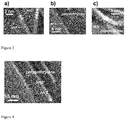
- Figures 2a-c illustrate an example of a 7-GNR with a 5+-AGNR region, where the 5+-AGNR region is shortened by one unit via electron activated dehydrogenation.
- Figure 2b bottom left shows STM image and corresponding atomistic model of the previous heterojunction after tip induced dehydrogenation of one additional unit.
- the circle in Fig. 2a marks the lateral tip position during the electron activated dehydrogenation process.
- Figure 2c (right) shows I-V curve revealing the activation of the reaction at - 2.5V.
Landscapes
- Chemical & Material Sciences (AREA)
- Organic Chemistry (AREA)
- Engineering & Computer Science (AREA)
- Nanotechnology (AREA)
- Inorganic Chemistry (AREA)
- Materials Engineering (AREA)
- General Physics & Mathematics (AREA)
- Physics & Mathematics (AREA)
- Condensed Matter Physics & Semiconductors (AREA)
- Crystallography & Structural Chemistry (AREA)
- Polymers & Plastics (AREA)
- Medicinal Chemistry (AREA)
- Chemical Kinetics & Catalysis (AREA)
- Health & Medical Sciences (AREA)
- Manufacturing & Machinery (AREA)
- Composite Materials (AREA)
- Carbon And Carbon Compounds (AREA)
- Compositions Of Macromolecular Compounds (AREA)
Priority Applications (1)
| Application Number | Priority Date | Filing Date | Title |
|---|---|---|---|
| EP12787698.5A EP2780280B1 (en) | 2011-11-14 | 2012-11-13 | Segmented graphene nanoribbons |
Applications Claiming Priority (4)
| Application Number | Priority Date | Filing Date | Title |
|---|---|---|---|
| US201161559161P | 2011-11-14 | 2011-11-14 | |
| EP11188978 | 2011-11-14 | ||
| EP12787698.5A EP2780280B1 (en) | 2011-11-14 | 2012-11-13 | Segmented graphene nanoribbons |
| PCT/EP2012/072445 WO2013072292A1 (en) | 2011-11-14 | 2012-11-13 | Segmented graphene nanoribbons |
Publications (2)
| Publication Number | Publication Date |
|---|---|
| EP2780280A1 EP2780280A1 (en) | 2014-09-24 |
| EP2780280B1 true EP2780280B1 (en) | 2018-01-10 |
Family
ID=48429001
Family Applications (1)
| Application Number | Title | Priority Date | Filing Date |
|---|---|---|---|
| EP12787698.5A Active EP2780280B1 (en) | 2011-11-14 | 2012-11-13 | Segmented graphene nanoribbons |
Country Status (11)
| Country | Link |
|---|---|
| US (1) | US9975777B2 (https=) |
| EP (1) | EP2780280B1 (https=) |
| JP (1) | JP5955398B2 (https=) |
| KR (1) | KR101653076B1 (https=) |
| CN (1) | CN104039694B (https=) |
| IL (1) | IL232227A0 (https=) |
| IN (1) | IN2014CN04260A (https=) |
| RU (1) | RU2014123396A (https=) |
| SG (1) | SG11201401590QA (https=) |
| TW (1) | TWI562960B (https=) |
| WO (1) | WO2013072292A1 (https=) |
Cited By (1)
| Publication number | Priority date | Publication date | Assignee | Title |
|---|---|---|---|---|
| US11618681B2 (en) | 2021-06-28 | 2023-04-04 | Wisconsin Alumni Research Foundation | Graphene nanoribbons grown from aromatic molecular seeds |
Families Citing this family (16)
| Publication number | Priority date | Publication date | Assignee | Title |
|---|---|---|---|---|
| WO2013175342A1 (en) | 2012-05-24 | 2013-11-28 | Basf Se | Graphene nanoribbons with controlled modifications |
| JP6195266B2 (ja) | 2013-05-01 | 2017-09-13 | 富士通株式会社 | 電子装置の製造方法 |
| EP2845838A1 (en) | 2013-09-04 | 2015-03-11 | Basf Se | Purification process for graphene nanoribbons |
| JP6267524B2 (ja) * | 2014-01-27 | 2018-01-24 | 積水化学工業株式会社 | 機能性膜及びその製造方法 |
| EP2907791A1 (en) * | 2014-02-13 | 2015-08-19 | Basf Se | Graphene nanoribbons with controlled zig-zag edge and cove edge configuration |
| JP6923288B2 (ja) * | 2015-08-24 | 2021-08-18 | 富士通株式会社 | 共鳴トンネルダイオードの製造方法 |
| JP2022121449A (ja) * | 2017-09-12 | 2022-08-19 | 富士通株式会社 | 化合物の製造方法及びグラフェンナノリボンの製造方法 |
| CN108285139B (zh) * | 2017-12-11 | 2021-06-18 | 昆明理工大学 | 一种氮掺杂石墨烯碳材料的制备方法和应用 |
| WO2019158694A1 (en) | 2018-02-15 | 2019-08-22 | Fundació Institut Català De Nanociència I Nanotecnologia | A nanoporous graphene structure and method for preparation thereof |
| JP6973208B2 (ja) * | 2018-03-15 | 2021-11-24 | 富士通株式会社 | グラフェンナノリボン前駆体、グラフェンナノリボン及び電子装置、グラフェンナノリボン前駆体の製造方法及びグラフェンナノリボンの製造方法 |
| EP3940013A4 (en) * | 2019-03-12 | 2023-01-18 | Taoka Chemical Co., Ltd. | GRAPHENE NANOTAPE AND METHOD OF PRODUCTION THEREOF |
| US20220282029A1 (en) * | 2019-05-31 | 2022-09-08 | The Regents Of The University Of California | Low band gap graphene nanoribbon electronic devices |
| WO2021138665A1 (en) * | 2020-01-03 | 2021-07-08 | Board Of Regents Of The University Of Nebraska | Systems and methods for low temperature growth of pristine, doped and nanoporous graphene films |
| CN111039284A (zh) * | 2020-01-17 | 2020-04-21 | 中山大学 | 一种超窄石墨烯纳米带的制备方法 |
| WO2023203125A1 (en) * | 2022-04-20 | 2023-10-26 | Uniwersytet Jagiellonski | A method for producing graphene nanostructures |
| CN115676812A (zh) * | 2022-07-04 | 2023-02-03 | 昆明理工大学 | 一种在Au(111)基底上制备手性石墨烯纳米带的方法 |
Citations (1)
| Publication number | Priority date | Publication date | Assignee | Title |
|---|---|---|---|---|
| WO2013061256A1 (en) * | 2011-10-26 | 2013-05-02 | Basf Se | Oligophenylene monomers and polymeric precursors for producing graphene nanoribbons |
Family Cites Families (14)
| Publication number | Priority date | Publication date | Assignee | Title |
|---|---|---|---|---|
| US5672491A (en) | 1993-09-20 | 1997-09-30 | The Leland Stanford Junior University | Recombinant production of novel polyketides |
| EP1118671A1 (de) | 2000-01-18 | 2001-07-25 | Rebholz, Erich, Dr. med. | Verfahren und Vorrichtung zum Erzeugen von methanhaltigem Biogas aus organischen Stoffen |
| JP3787680B2 (ja) * | 2001-03-27 | 2006-06-21 | 大阪瓦斯株式会社 | グラファイトリボンおよびその製造方法 |
| BRPI0517533B1 (pt) | 2004-10-04 | 2016-09-20 | Hexion Inc | método para determinar a geometria de fratura de uma fratura subterrânea |
| WO2008012250A1 (en) | 2006-07-28 | 2008-01-31 | Ciba Holding Inc. | Novel polymers |
| US20090174435A1 (en) | 2007-10-01 | 2009-07-09 | University Of Virginia | Monolithically-Integrated Graphene-Nano-Ribbon (GNR) Devices, Interconnects and Circuits |
| US9991391B2 (en) | 2008-07-25 | 2018-06-05 | The Board Of Trustees Of The Leland Stanford Junior University | Pristine and functionalized graphene materials |
| KR101040967B1 (ko) | 2008-08-22 | 2011-06-16 | 한국과학기술연구원 | 그라핀 리본의 제조 방법 |
| EP2221874A1 (en) * | 2009-02-24 | 2010-08-25 | S.a.r.l. FIRMUS | Method for manufacturing nano electronic devices made from 2D carbon crystals like graphene and devices obtained with this method |
| KR101121164B1 (ko) | 2009-07-10 | 2012-03-19 | 연세대학교 산학협력단 | 그래핀 나노리본의 제조방법 |
| KR101096518B1 (ko) | 2009-10-23 | 2011-12-20 | 한국과학기술연구원 | 구조제어된 그라핀 리본의 제조 방법 |
| US8808810B2 (en) * | 2009-12-15 | 2014-08-19 | Guardian Industries Corp. | Large area deposition of graphene on substrates, and products including the same |
| US8456902B2 (en) | 2010-04-27 | 2013-06-04 | The University Corporation Inc. at California State University Northridge | Graphene-based switching elements using a diamond-shaped nano-patch and interconnecting nano-ribbons |
| DE102011054103A1 (de) * | 2011-09-30 | 2013-04-04 | MAX-PLANCK-Gesellschaft zur Förderung der Wissenschaften e.V. | Verfahren zum Herstellen von Graphen-Nanobändern |
-
2012
- 2012-11-12 TW TW101142097A patent/TWI562960B/zh active
- 2012-11-13 IN IN4260CHN2014 patent/IN2014CN04260A/en unknown
- 2012-11-13 JP JP2014540510A patent/JP5955398B2/ja active Active
- 2012-11-13 EP EP12787698.5A patent/EP2780280B1/en active Active
- 2012-11-13 KR KR1020147015131A patent/KR101653076B1/ko active Active
- 2012-11-13 SG SG11201401590QA patent/SG11201401590QA/en unknown
- 2012-11-13 CN CN201280054201.9A patent/CN104039694B/zh active Active
- 2012-11-13 RU RU2014123396/05A patent/RU2014123396A/ru not_active Application Discontinuation
- 2012-11-13 US US14/357,300 patent/US9975777B2/en active Active
- 2012-11-13 WO PCT/EP2012/072445 patent/WO2013072292A1/en not_active Ceased
-
2014
- 2014-04-24 IL IL232227A patent/IL232227A0/en unknown
Patent Citations (1)
| Publication number | Priority date | Publication date | Assignee | Title |
|---|---|---|---|---|
| WO2013061256A1 (en) * | 2011-10-26 | 2013-05-02 | Basf Se | Oligophenylene monomers and polymeric precursors for producing graphene nanoribbons |
Cited By (1)
| Publication number | Priority date | Publication date | Assignee | Title |
|---|---|---|---|---|
| US11618681B2 (en) | 2021-06-28 | 2023-04-04 | Wisconsin Alumni Research Foundation | Graphene nanoribbons grown from aromatic molecular seeds |
Also Published As
| Publication number | Publication date |
|---|---|
| CN104039694A (zh) | 2014-09-10 |
| JP2014534157A (ja) | 2014-12-18 |
| JP5955398B2 (ja) | 2016-07-20 |
| WO2013072292A1 (en) | 2013-05-23 |
| TW201328972A (zh) | 2013-07-16 |
| SG11201401590QA (en) | 2014-07-30 |
| US9975777B2 (en) | 2018-05-22 |
| IN2014CN04260A (https=) | 2015-07-17 |
| KR101653076B1 (ko) | 2016-08-31 |
| TWI562960B (en) | 2016-12-21 |
| US20140315023A1 (en) | 2014-10-23 |
| CN104039694B (zh) | 2016-11-02 |
| IL232227A0 (en) | 2014-06-30 |
| EP2780280A1 (en) | 2014-09-24 |
| KR20140107234A (ko) | 2014-09-04 |
| RU2014123396A (ru) | 2015-12-27 |
Similar Documents
| Publication | Publication Date | Title |
|---|---|---|
| EP2780280B1 (en) | Segmented graphene nanoribbons | |
| KR102134716B1 (ko) | 조절된 변형을 갖는 그래핀 나노리본 | |
| US9527743B2 (en) | Process for preparing graphene nanoribbons | |
| Zhang et al. | Two dimensional hexagonal boron nitride (2D-hBN): synthesis, properties and applications | |
| Xiao et al. | Metastable Copper‐Phthalocyanine Single‐Crystal Nanowires and Their Use in Fabricating High‐Performance Field‐Effect Transistors | |
| KR102333861B1 (ko) | 제어된 지그-재그 에지 및 코브 에지 배열을 갖는 그래핀 나노리본 | |
| Latu-Romain et al. | Silicon carbide based one-dimensional nanostructure growth: towards electronics and biology perspectives | |
| Sekhavati et al. | Solution-phase synthesis of graphene nanoribbons: a review on polymerization strategies | |
| JP6923288B2 (ja) | 共鳴トンネルダイオードの製造方法 | |
| Qu et al. | On‐Surface Precise Synthesis of Non‐Hexagonal Ring‐Embedded Graphene Nanoribbons | |
| JP6658121B2 (ja) | グラフェンナノリボン及びその製造方法、デバイス | |
| EP3843109A1 (en) | Periacene biradical polymers | |
| Hayashi et al. | On‐Surface Synthesis of Polyacenes and Narrow Band‐Gap Graphene Nanoribbons | |
| Yang | Bottom-up synthesis of graphene nanoribbons and nanographene molecules with new types of periphery | |
| Vo | Solution-Based Synthesis of Atomically Precise Graphene Nanoribbons |
Legal Events
| Date | Code | Title | Description |
|---|---|---|---|
| PUAI | Public reference made under article 153(3) epc to a published international application that has entered the european phase |
Free format text: ORIGINAL CODE: 0009012 |
|
| 17P | Request for examination filed |
Effective date: 20140616 |
|
| AK | Designated contracting states |
Kind code of ref document: A1 Designated state(s): AL AT BE BG CH CY CZ DE DK EE ES FI FR GB GR HR HU IE IS IT LI LT LU LV MC MK MT NL NO PL PT RO RS SE SI SK SM TR |
|
| DAX | Request for extension of the european patent (deleted) | ||
| 17Q | First examination report despatched |
Effective date: 20150709 |
|
| REG | Reference to a national code |
Ref country code: DE Ref legal event code: R079 Ref document number: 602012041979 Country of ref document: DE Free format text: PREVIOUS MAIN CLASS: C01B0031040000 Ipc: C08G0061100000 |
|
| GRAP | Despatch of communication of intention to grant a patent |
Free format text: ORIGINAL CODE: EPIDOSNIGR1 |
|
| STAA | Information on the status of an ep patent application or granted ep patent |
Free format text: STATUS: GRANT OF PATENT IS INTENDED |
|
| RIC1 | Information provided on ipc code assigned before grant |
Ipc: B82Y 40/00 20110101ALI20170704BHEP Ipc: C08G 61/10 20060101AFI20170704BHEP Ipc: B82Y 30/00 20110101ALI20170704BHEP Ipc: C01B 32/20 20170101ALI20170704BHEP |
|
| INTG | Intention to grant announced |
Effective date: 20170721 |
|
| GRAS | Grant fee paid |
Free format text: ORIGINAL CODE: EPIDOSNIGR3 |
|
| GRAA | (expected) grant |
Free format text: ORIGINAL CODE: 0009210 |
|
| STAA | Information on the status of an ep patent application or granted ep patent |
Free format text: STATUS: THE PATENT HAS BEEN GRANTED |
|
| AK | Designated contracting states |
Kind code of ref document: B1 Designated state(s): AL AT BE BG CH CY CZ DE DK EE ES FI FR GB GR HR HU IE IS IT LI LT LU LV MC MK MT NL NO PL PT RO RS SE SI SK SM TR |
|
| REG | Reference to a national code |
Ref country code: CH Ref legal event code: EP Ref country code: AT Ref legal event code: REF Ref document number: 962340 Country of ref document: AT Kind code of ref document: T Effective date: 20180115 |
|
| REG | Reference to a national code |
Ref country code: IE Ref legal event code: FG4D |
|
| REG | Reference to a national code |
Ref country code: DE Ref legal event code: R096 Ref document number: 602012041979 Country of ref document: DE |
|
| REG | Reference to a national code |
Ref country code: NL Ref legal event code: MP Effective date: 20180110 |
|
| REG | Reference to a national code |
Ref country code: AT Ref legal event code: MK05 Ref document number: 962340 Country of ref document: AT Kind code of ref document: T Effective date: 20180110 |
|
| PG25 | Lapsed in a contracting state [announced via postgrant information from national office to epo] |
Ref country code: NL Free format text: LAPSE BECAUSE OF FAILURE TO SUBMIT A TRANSLATION OF THE DESCRIPTION OR TO PAY THE FEE WITHIN THE PRESCRIBED TIME-LIMIT Effective date: 20180110 |
|
| PG25 | Lapsed in a contracting state [announced via postgrant information from national office to epo] |
Ref country code: ES Free format text: LAPSE BECAUSE OF FAILURE TO SUBMIT A TRANSLATION OF THE DESCRIPTION OR TO PAY THE FEE WITHIN THE PRESCRIBED TIME-LIMIT Effective date: 20180110 Ref country code: LT Free format text: LAPSE BECAUSE OF FAILURE TO SUBMIT A TRANSLATION OF THE DESCRIPTION OR TO PAY THE FEE WITHIN THE PRESCRIBED TIME-LIMIT Effective date: 20180110 Ref country code: HR Free format text: LAPSE BECAUSE OF FAILURE TO SUBMIT A TRANSLATION OF THE DESCRIPTION OR TO PAY THE FEE WITHIN THE PRESCRIBED TIME-LIMIT Effective date: 20180110 Ref country code: CY Free format text: LAPSE BECAUSE OF FAILURE TO SUBMIT A TRANSLATION OF THE DESCRIPTION OR TO PAY THE FEE WITHIN THE PRESCRIBED TIME-LIMIT Effective date: 20180110 Ref country code: NO Free format text: LAPSE BECAUSE OF FAILURE TO SUBMIT A TRANSLATION OF THE DESCRIPTION OR TO PAY THE FEE WITHIN THE PRESCRIBED TIME-LIMIT Effective date: 20180410 Ref country code: FI Free format text: LAPSE BECAUSE OF FAILURE TO SUBMIT A TRANSLATION OF THE DESCRIPTION OR TO PAY THE FEE WITHIN THE PRESCRIBED TIME-LIMIT Effective date: 20180110 |
|
| PG25 | Lapsed in a contracting state [announced via postgrant information from national office to epo] |
Ref country code: IS Free format text: LAPSE BECAUSE OF FAILURE TO SUBMIT A TRANSLATION OF THE DESCRIPTION OR TO PAY THE FEE WITHIN THE PRESCRIBED TIME-LIMIT Effective date: 20180510 Ref country code: GR Free format text: LAPSE BECAUSE OF FAILURE TO SUBMIT A TRANSLATION OF THE DESCRIPTION OR TO PAY THE FEE WITHIN THE PRESCRIBED TIME-LIMIT Effective date: 20180411 Ref country code: PL Free format text: LAPSE BECAUSE OF FAILURE TO SUBMIT A TRANSLATION OF THE DESCRIPTION OR TO PAY THE FEE WITHIN THE PRESCRIBED TIME-LIMIT Effective date: 20180110 Ref country code: LV Free format text: LAPSE BECAUSE OF FAILURE TO SUBMIT A TRANSLATION OF THE DESCRIPTION OR TO PAY THE FEE WITHIN THE PRESCRIBED TIME-LIMIT Effective date: 20180110 Ref country code: SE Free format text: LAPSE BECAUSE OF FAILURE TO SUBMIT A TRANSLATION OF THE DESCRIPTION OR TO PAY THE FEE WITHIN THE PRESCRIBED TIME-LIMIT Effective date: 20180110 Ref country code: AT Free format text: LAPSE BECAUSE OF FAILURE TO SUBMIT A TRANSLATION OF THE DESCRIPTION OR TO PAY THE FEE WITHIN THE PRESCRIBED TIME-LIMIT Effective date: 20180110 Ref country code: RS Free format text: LAPSE BECAUSE OF FAILURE TO SUBMIT A TRANSLATION OF THE DESCRIPTION OR TO PAY THE FEE WITHIN THE PRESCRIBED TIME-LIMIT Effective date: 20180110 Ref country code: BG Free format text: LAPSE BECAUSE OF FAILURE TO SUBMIT A TRANSLATION OF THE DESCRIPTION OR TO PAY THE FEE WITHIN THE PRESCRIBED TIME-LIMIT Effective date: 20180410 |
|
| REG | Reference to a national code |
Ref country code: DE Ref legal event code: R097 Ref document number: 602012041979 Country of ref document: DE |
|
| PG25 | Lapsed in a contracting state [announced via postgrant information from national office to epo] |
Ref country code: AL Free format text: LAPSE BECAUSE OF FAILURE TO SUBMIT A TRANSLATION OF THE DESCRIPTION OR TO PAY THE FEE WITHIN THE PRESCRIBED TIME-LIMIT Effective date: 20180110 Ref country code: RO Free format text: LAPSE BECAUSE OF FAILURE TO SUBMIT A TRANSLATION OF THE DESCRIPTION OR TO PAY THE FEE WITHIN THE PRESCRIBED TIME-LIMIT Effective date: 20180110 Ref country code: IT Free format text: LAPSE BECAUSE OF FAILURE TO SUBMIT A TRANSLATION OF THE DESCRIPTION OR TO PAY THE FEE WITHIN THE PRESCRIBED TIME-LIMIT Effective date: 20180110 Ref country code: EE Free format text: LAPSE BECAUSE OF FAILURE TO SUBMIT A TRANSLATION OF THE DESCRIPTION OR TO PAY THE FEE WITHIN THE PRESCRIBED TIME-LIMIT Effective date: 20180110 |
|
| PLBE | No opposition filed within time limit |
Free format text: ORIGINAL CODE: 0009261 |
|
| STAA | Information on the status of an ep patent application or granted ep patent |
Free format text: STATUS: NO OPPOSITION FILED WITHIN TIME LIMIT |
|
| PG25 | Lapsed in a contracting state [announced via postgrant information from national office to epo] |
Ref country code: DK Free format text: LAPSE BECAUSE OF FAILURE TO SUBMIT A TRANSLATION OF THE DESCRIPTION OR TO PAY THE FEE WITHIN THE PRESCRIBED TIME-LIMIT Effective date: 20180110 Ref country code: CZ Free format text: LAPSE BECAUSE OF FAILURE TO SUBMIT A TRANSLATION OF THE DESCRIPTION OR TO PAY THE FEE WITHIN THE PRESCRIBED TIME-LIMIT Effective date: 20180110 Ref country code: SM Free format text: LAPSE BECAUSE OF FAILURE TO SUBMIT A TRANSLATION OF THE DESCRIPTION OR TO PAY THE FEE WITHIN THE PRESCRIBED TIME-LIMIT Effective date: 20180110 Ref country code: SK Free format text: LAPSE BECAUSE OF FAILURE TO SUBMIT A TRANSLATION OF THE DESCRIPTION OR TO PAY THE FEE WITHIN THE PRESCRIBED TIME-LIMIT Effective date: 20180110 |
|
| 26N | No opposition filed |
Effective date: 20181011 |
|
| PG25 | Lapsed in a contracting state [announced via postgrant information from national office to epo] |
Ref country code: SI Free format text: LAPSE BECAUSE OF FAILURE TO SUBMIT A TRANSLATION OF THE DESCRIPTION OR TO PAY THE FEE WITHIN THE PRESCRIBED TIME-LIMIT Effective date: 20180110 |
|
| REG | Reference to a national code |
Ref country code: DE Ref legal event code: R082 Ref document number: 602012041979 Country of ref document: DE Representative=s name: MAIWALD PATENTANWALTS- UND RECHTSANWALTSGESELL, DE Ref country code: DE Ref legal event code: R081 Ref document number: 602012041979 Country of ref document: DE Owner name: EMPA MATERIALS SCIENCE AND TECHNOLOGY, CH Free format text: FORMER OWNERS: BASF SE, 67063 LUDWIGSHAFEN, DE; EMPA MATERIALS SCIENCE AND TECHNOLOGY, DUEBENDORF, CH Ref country code: DE Ref legal event code: R081 Ref document number: 602012041979 Country of ref document: DE Owner name: MAX-PLANCK-GESELLSCHAFT ZUR FOERDERUNG DER WIS, DE Free format text: FORMER OWNERS: BASF SE, 67063 LUDWIGSHAFEN, DE; EMPA MATERIALS SCIENCE AND TECHNOLOGY, DUEBENDORF, CH |
|
| REG | Reference to a national code |
Ref country code: CH Ref legal event code: PL |
|
| PG25 | Lapsed in a contracting state [announced via postgrant information from national office to epo] |
Ref country code: LU Free format text: LAPSE BECAUSE OF NON-PAYMENT OF DUE FEES Effective date: 20181113 Ref country code: MC Free format text: LAPSE BECAUSE OF FAILURE TO SUBMIT A TRANSLATION OF THE DESCRIPTION OR TO PAY THE FEE WITHIN THE PRESCRIBED TIME-LIMIT Effective date: 20180110 |
|
| REG | Reference to a national code |
Ref country code: BE Ref legal event code: MM Effective date: 20181130 |
|
| REG | Reference to a national code |
Ref country code: IE Ref legal event code: MM4A |
|
| PG25 | Lapsed in a contracting state [announced via postgrant information from national office to epo] |
Ref country code: LI Free format text: LAPSE BECAUSE OF NON-PAYMENT OF DUE FEES Effective date: 20181130 Ref country code: CH Free format text: LAPSE BECAUSE OF NON-PAYMENT OF DUE FEES Effective date: 20181130 |
|
| PG25 | Lapsed in a contracting state [announced via postgrant information from national office to epo] |
Ref country code: IE Free format text: LAPSE BECAUSE OF NON-PAYMENT OF DUE FEES Effective date: 20181113 |
|
| PG25 | Lapsed in a contracting state [announced via postgrant information from national office to epo] |
Ref country code: BE Free format text: LAPSE BECAUSE OF NON-PAYMENT OF DUE FEES Effective date: 20181130 |
|
| PG25 | Lapsed in a contracting state [announced via postgrant information from national office to epo] |
Ref country code: MT Free format text: LAPSE BECAUSE OF NON-PAYMENT OF DUE FEES Effective date: 20181113 |
|
| PG25 | Lapsed in a contracting state [announced via postgrant information from national office to epo] |
Ref country code: TR Free format text: LAPSE BECAUSE OF FAILURE TO SUBMIT A TRANSLATION OF THE DESCRIPTION OR TO PAY THE FEE WITHIN THE PRESCRIBED TIME-LIMIT Effective date: 20180110 |
|
| PG25 | Lapsed in a contracting state [announced via postgrant information from national office to epo] |
Ref country code: PT Free format text: LAPSE BECAUSE OF FAILURE TO SUBMIT A TRANSLATION OF THE DESCRIPTION OR TO PAY THE FEE WITHIN THE PRESCRIBED TIME-LIMIT Effective date: 20180110 |
|
| PG25 | Lapsed in a contracting state [announced via postgrant information from national office to epo] |
Ref country code: HU Free format text: LAPSE BECAUSE OF FAILURE TO SUBMIT A TRANSLATION OF THE DESCRIPTION OR TO PAY THE FEE WITHIN THE PRESCRIBED TIME-LIMIT; INVALID AB INITIO Effective date: 20121113 Ref country code: MK Free format text: LAPSE BECAUSE OF NON-PAYMENT OF DUE FEES Effective date: 20180110 |
|
| PGFP | Annual fee paid to national office [announced via postgrant information from national office to epo] |
Ref country code: DE Payment date: 20251126 Year of fee payment: 14 |
|
| PGFP | Annual fee paid to national office [announced via postgrant information from national office to epo] |
Ref country code: GB Payment date: 20251120 Year of fee payment: 14 |
|
| PGFP | Annual fee paid to national office [announced via postgrant information from national office to epo] |
Ref country code: FR Payment date: 20251125 Year of fee payment: 14 |