EP2777076B1 - Composition, feuilles multicouches faites avec elle, et procédés de fabrication et d'utilisation de ladite composition - Google Patents
Composition, feuilles multicouches faites avec elle, et procédés de fabrication et d'utilisation de ladite composition Download PDFInfo
- Publication number
- EP2777076B1 EP2777076B1 EP12787260.4A EP12787260A EP2777076B1 EP 2777076 B1 EP2777076 B1 EP 2777076B1 EP 12787260 A EP12787260 A EP 12787260A EP 2777076 B1 EP2777076 B1 EP 2777076B1
- Authority
- EP
- European Patent Office
- Prior art keywords
- polycarbonate
- cap layer
- carbonate
- composition
- layer
- Prior art date
- Legal status (The legal status is an assumption and is not a legal conclusion. Google has not performed a legal analysis and makes no representation as to the accuracy of the status listed.)
- Not-in-force
Links
Images

Classifications
-
- B—PERFORMING OPERATIONS; TRANSPORTING
- B32—LAYERED PRODUCTS
- B32B—LAYERED PRODUCTS, i.e. PRODUCTS BUILT-UP OF STRATA OF FLAT OR NON-FLAT, e.g. CELLULAR OR HONEYCOMB, FORM
- B32B27/00—Layered products comprising a layer of synthetic resin
- B32B27/06—Layered products comprising a layer of synthetic resin as the main or only constituent of a layer, which is next to another layer of the same or of a different material
- B32B27/08—Layered products comprising a layer of synthetic resin as the main or only constituent of a layer, which is next to another layer of the same or of a different material of synthetic resin
-
- B—PERFORMING OPERATIONS; TRANSPORTING
- B32—LAYERED PRODUCTS
- B32B—LAYERED PRODUCTS, i.e. PRODUCTS BUILT-UP OF STRATA OF FLAT OR NON-FLAT, e.g. CELLULAR OR HONEYCOMB, FORM
- B32B27/00—Layered products comprising a layer of synthetic resin
- B32B27/36—Layered products comprising a layer of synthetic resin comprising polyesters
- B32B27/365—Layered products comprising a layer of synthetic resin comprising polyesters comprising polycarbonates
-
- C—CHEMISTRY; METALLURGY
- C08—ORGANIC MACROMOLECULAR COMPOUNDS; THEIR PREPARATION OR CHEMICAL WORKING-UP; COMPOSITIONS BASED THEREON
- C08L—COMPOSITIONS OF MACROMOLECULAR COMPOUNDS
- C08L69/00—Compositions of polycarbonates; Compositions of derivatives of polycarbonates
-
- H—ELECTRICITY
- H10—SEMICONDUCTOR DEVICES; ELECTRIC SOLID-STATE DEVICES NOT OTHERWISE PROVIDED FOR
- H10F—INORGANIC SEMICONDUCTOR DEVICES SENSITIVE TO INFRARED RADIATION, LIGHT, ELECTROMAGNETIC RADIATION OF SHORTER WAVELENGTH OR CORPUSCULAR RADIATION
- H10F19/00—Integrated devices, or assemblies of multiple devices, comprising at least one photovoltaic cell covered by group H10F10/00, e.g. photovoltaic modules
- H10F19/80—Encapsulations or containers for integrated devices, or assemblies of multiple devices, having photovoltaic cells
- H10F19/85—Protective back sheets
-
- B—PERFORMING OPERATIONS; TRANSPORTING
- B32—LAYERED PRODUCTS
- B32B—LAYERED PRODUCTS, i.e. PRODUCTS BUILT-UP OF STRATA OF FLAT OR NON-FLAT, e.g. CELLULAR OR HONEYCOMB, FORM
- B32B2270/00—Resin or rubber layer containing a blend of at least two different polymers
-
- B—PERFORMING OPERATIONS; TRANSPORTING
- B32—LAYERED PRODUCTS
- B32B—LAYERED PRODUCTS, i.e. PRODUCTS BUILT-UP OF STRATA OF FLAT OR NON-FLAT, e.g. CELLULAR OR HONEYCOMB, FORM
- B32B2307/00—Properties of the layers or laminate
- B32B2307/40—Properties of the layers or laminate having particular optical properties
- B32B2307/412—Transparent
-
- B—PERFORMING OPERATIONS; TRANSPORTING
- B32—LAYERED PRODUCTS
- B32B—LAYERED PRODUCTS, i.e. PRODUCTS BUILT-UP OF STRATA OF FLAT OR NON-FLAT, e.g. CELLULAR OR HONEYCOMB, FORM
- B32B2457/00—Electrical equipment
- B32B2457/12—Photovoltaic modules
-
- C—CHEMISTRY; METALLURGY
- C08—ORGANIC MACROMOLECULAR COMPOUNDS; THEIR PREPARATION OR CHEMICAL WORKING-UP; COMPOSITIONS BASED THEREON
- C08L—COMPOSITIONS OF MACROMOLECULAR COMPOUNDS
- C08L2205/00—Polymer mixtures characterised by other features
- C08L2205/02—Polymer mixtures characterised by other features containing two or more polymers of the same C08L -group
-
- Y—GENERAL TAGGING OF NEW TECHNOLOGICAL DEVELOPMENTS; GENERAL TAGGING OF CROSS-SECTIONAL TECHNOLOGIES SPANNING OVER SEVERAL SECTIONS OF THE IPC; TECHNICAL SUBJECTS COVERED BY FORMER USPC CROSS-REFERENCE ART COLLECTIONS [XRACs] AND DIGESTS
- Y02—TECHNOLOGIES OR APPLICATIONS FOR MITIGATION OR ADAPTATION AGAINST CLIMATE CHANGE
- Y02B—CLIMATE CHANGE MITIGATION TECHNOLOGIES RELATED TO BUILDINGS, e.g. HOUSING, HOUSE APPLIANCES OR RELATED END-USER APPLICATIONS
- Y02B10/00—Integration of renewable energy sources in buildings
- Y02B10/10—Photovoltaic [PV]
-
- Y—GENERAL TAGGING OF NEW TECHNOLOGICAL DEVELOPMENTS; GENERAL TAGGING OF CROSS-SECTIONAL TECHNOLOGIES SPANNING OVER SEVERAL SECTIONS OF THE IPC; TECHNICAL SUBJECTS COVERED BY FORMER USPC CROSS-REFERENCE ART COLLECTIONS [XRACs] AND DIGESTS
- Y02—TECHNOLOGIES OR APPLICATIONS FOR MITIGATION OR ADAPTATION AGAINST CLIMATE CHANGE
- Y02E—REDUCTION OF GREENHOUSE GAS [GHG] EMISSIONS, RELATED TO ENERGY GENERATION, TRANSMISSION OR DISTRIBUTION
- Y02E10/00—Energy generation through renewable energy sources
- Y02E10/50—Photovoltaic [PV] energy
-
- Y—GENERAL TAGGING OF NEW TECHNOLOGICAL DEVELOPMENTS; GENERAL TAGGING OF CROSS-SECTIONAL TECHNOLOGIES SPANNING OVER SEVERAL SECTIONS OF THE IPC; TECHNICAL SUBJECTS COVERED BY FORMER USPC CROSS-REFERENCE ART COLLECTIONS [XRACs] AND DIGESTS
- Y10—TECHNICAL SUBJECTS COVERED BY FORMER USPC
- Y10T—TECHNICAL SUBJECTS COVERED BY FORMER US CLASSIFICATION
- Y10T428/00—Stock material or miscellaneous articles
- Y10T428/31504—Composite [nonstructural laminate]
- Y10T428/31507—Of polycarbonate
Definitions
- the present disclosure relates to a polycarbonate composition, a polycarbonate sheet, and a photovoltaic module.
- PV modules generally contain solar cells sealed by an encapsulant which are laminated to a superstrate and a backsheet.
- the backsheet for PV modules generally consists of a tri-layer laminate structure such as polyvinyl fluoride (PVF; e.g., Tedlar*)-polyethylene terephthalate (PET)-PVF laminate (i.e., TPT laminate).
- PVF layers provide weathering resistance, while PET provides mechanical strength, dielectric insulation, and water vapor resistance, all desired properties of a PV module backsheet.
- PVF is a fluoropolymer that is not only expensive but is also not friendly to the environment, and difficult to manufacture.
- PET can typically form low cost plastic films with good mechanical, electrical and water vapor barrier properties, but PET film is susceptible to hydrolysis when exposed to high humidity and hot environments during long term use. Therefore, the performance of the entire backsheet may deteriorate during the lifetime of the PV module.
- manufacturing the TPT laminate requires separate adhesive layers to bond the PET and PVF layers together. Such adhesive bonding is typically not of sufficient strength for PV module applications to last the useful life of the module, and the bonding strength can also deteriorate during long-term outdoor exposure of the backsheet, which can lead to interlayer delamination issues.
- the backsheet can have a TPE structure that comprises a fluoropolymer layer (T), a PET layer (P), and a polyethylene layer (E).
- TPE backsheet can be utilized to reduce the usage of fluoropolymer in the entire backsheet structure.
- a backsheet can still require steps to make the individual layers and an additional layer-to-layer lamination process using adhesive layers between the PET layer and the fluoropolymer layer and between the PET layer and the polyethylene layer.
- the overall manufacturing cost can be relatively high and the product can also suffer interlayer delamination risk due to insufficient adhesive bonding between the layers during long-term outdoor use.
- Polycarbonate based sheets can improve some of the properties that are lacking in a PVF-PET-PVF backsheet.
- 1,1 bis(4-hydroxy-3-methylphenyl) cyclohexane (dimethyl bisphenol cyclohexane, DMBPC) based polycarbonate copolymer e.g. Lexan* DMX resins, commercially available from SABIC Innovative Plastics
- DMBPC dimethyl bisphenol cyclohexane
- BPA bisphenol-A
- PC polycarbonate
- 2009/0176946 discloses a blend of a DMBPC polycarbonate copolymer and BPA polycarbonate to balance pencil hardness and impact resistance.
- U.S. Patent Application No. 2008/0254299 discloses a composite comprising a DMBPC polycarbonate containing top layer and a BPA polycarbonate based second layer where the formulations therein were optimized for achieving a better pencil hardness of the DMBPC polycarbonate containing top layer.
- U.S. Patent No. 7,521,119 discloses DMBPC based polycarbonate copolymers that exhibit better polymer degradation resistance than BPA polycarbonate when both are exposed to ammonia-rich environments such as would be found in rural areas utilizing PV energy systems.
- EP 2 199 076 A1 discloses a multilayer thermoplastic film comprising a first polycarbonate layer and a second layer, adjacent to the first layer and coextruded therewith, comprising another polycarbonate that is not the same as a polycarbonate in the first layer.
- the first layer provides improved properties, for example hardness, impact, and/or scratch resistance. Methods for the manufacture of the polycarbonate and compositions comprising the polycarbonate are also described.
- PV modules A common environmental condition that many PV modules can be subject to is the combination of ambient heat and high humidity, for which hydrothermal resistance of the PV packaging materials is desired.
- ambient heat and high humidity for which hydrothermal resistance of the PV packaging materials is desired.
- polycarbonate compositions and polycarbonate sheets Disclosed, in various embodiments, are polycarbonate compositions and polycarbonate sheets, and methods for making and using the same.
- a photovoltaic module comprises: a transparent superstrate; a backsheet, wherein the backsheet comprises a core layer comprising a core composition formed from a first polycarbonate comprising dimethyl bisphenol cyclohexane carbonate repeat units and bisphenol-A repeat units, wherein the first polycarbonate has the structure wherein the dimethyl bisphenol cyclohexane carbonate repeat units are present in an amount of 10 wt.% to 50 wt.%, based on the total repeat units in the core composition; and a second polycarbonate selected from the group consisting of a bisphenol-A polycarbonate homopolymer, a polyphthalate carbonate copolymer, a polycarbonate copolymer comprising 2-phenyl-3,3-bis(4-hydroxyphenyl) phthalimidine carbonate and bisphenol-A carbonate repeat units, a polycarbonate copolymer comprising bisphenol-A carbonate and tetrabromobisphenol A carbonate repeat units, and combinations comprising of
- a multilayer sheet comprises: a core layer formed from a core composition comprising a first polycarbonate comprising dimethyl bisphenol cyclohexane carbonate repeat units and bisphenol-A repeat units, wherein the first polycarbonate has the structure wherein the dimethyl bisphenol cyclohexane carbonate repeat units are present in an amount of 10 wt.% to 50 wt.%, based on the total repeat units in the core compositions; a second polycarbonate comprising a polyphthalate carbonate copolymer having the structure and a third polycarbonate comprising bisphenol-A polycarbonate homopolymer; and a first cap layer disposed on a surface of the core layer.
- a composition comprises: a first polycarbonate comprising dimethyl bisphenol cyclohexane carbonate repeat units and bisphenol-A repeat units, wherein the first polycarbonate has the structure wherein the dimethyl bisphenol cyclohexane carbonate repeat units are present in an amount of 10 wt.% to 50 wt.%, based on the total repeat units in the composition; and a second polycarbonate comprising a polyphthalate carbonate copolymer having the structure and a third polycarbonate comprising a bisphenol-A polycarbonate homopolymer.
- a method of making a multilayer sheet comprises: co-extruding a core layer and a first cap layer, wherein the core layer comprises a core composition comprising a first polycarbonate composition comprising dimethyl bisphenol cyclohexane carbonate repeat units and bisphenol-A repeat units, wherein the first polycarbonate has the structure wherein the dimethyl bisphenol cyclohexane carbonate repeat units are present in an amount of 10 wt.% to 50 wt.%, based on the total repeat units in the core composition; a second polycarbonate comprising a polyphthalate carbonate copolymer having the structure and a third polycarbonate comprising a bisphenol-A polycarbonate homopolymer; and wherein the first cap layer comprises a member selected from the group consisting of polycarbonate and a UV light absorbing stabilizer, a resorcinol polyarylate carbonate copolymer, and combinations comprising at least one of the foregoing.
- a multilayer sheet (film and sheet are used interchangeably herein) comprising a core layer and, a cap layer (e.g., a weathering protection layer that can be joined with the core layer).
- the multilayer sheets can be used in various electronic applications, including, but not limited to, PV modules and can provide hydrothermally stable sheets with a retention of puncture resistance of greater than or equal to 30% and thermal shrinkage in the machine direction and/or transverse direction of less than or equal to 1%.
- the core layer can be formed from a core composition comprising a first polycarbonate comprising DMBPC carbonate homopolymer or a copolymer comprising DMBPC carbonate and BPA carbonate (e.g., DMBPC carbonate repeat units and BPA carbonate repeat units), wherein the repeat units of DMBPC carbonate are present in an amount of 10 weight percent (wt.%) to 50 wt.%, based on the total repeat units in the core composition and a second polycarbonate selected from the group consisting of a BPA polycarbonate homopolymer; a polyphthalate carbonate (PPC) copolymer comprising BPA phthalate ester blocks and BPA carbonate blocks; a high heat polycarbonate copolymer comprising 2-phenyl-3,3-bis(4-hydroxyphenyl) phthalimidine (p,p-PPPBP) carbonate and BPA carbonate as repeat units (e.g., Lexan* XHT resins, commercially available from SABIC Innovative Plastics); a poly
- the core composition can comprise a first polycarbonate comprising DMBPC carbonate repeat units, where the repeat units are present in an amount of 10 wt.% to 50 wt.%, based on the total repeat units in the core composition; a second polycarbonate comprising a PPC copolymer; and a third polycarbonate comprising a BPA polycarbonate homopolymer.
- the solar cells 48 are generally held in place with connectors 52 and also are surrounded by a transparent encapsulant 46 and laminated to a transparent superstrate 42 and a backsheet 44 at both sides as illustrated in Figure 4 .
- the PV module is also surrounded by a sealant 50.
- a superstrate 42, encapsulant 46, solar cells 48, and a backsheet 44 are put in direct contact from layer to layer (as illustrated in Figure 4 ) and then laminated under heat and presssure in order to achieve complete encapsulation of the solar cells 48 and sufficient bonding strength between the layers.
- the superstrate 42 and the backsheet 44 can provide mechanical protection, weathering protection, and electrical insulation to the solar module during long-term outdoor use. It can be desirable for the superstrate 42 to possess good UV weathering protection capabilities since it is exposed to direct sun light. Generally, the backsheet 44 is not subjected to direct sun exposure in most PV module applications, but it can still be desirable for the backsheet 44 to be protected from UV exposure due to indirect light, such as reflected or scattered UV light from the surrounding enviroment.
- hydrothermal resistance of the backsheet and superstrate can ensure that the backsheet and the superstrate survive long-term use without degradation under such harsh conditions.
- IEC61730-2 requires that PV modules pass a minimum of 1,000 hours of a damp heat test at conditions of 85°C and 85% relative humidity.
- a water vapor barrier can also be desirable for the superstrate and the backsheet, since it can help reduce the chances of cell corrosion and potential delamination of the superstrate and the backsheet from the encapsulant due to the ingression of moisture from the enviroment.
- Poly (ethylene-co-vinyl acetate) (EVA) resin with vinyl acetate content of 25 wt.% to 35 wt.%, along with an additive package comprising an organic peroxide as a crosslinking agent, light stabilizer, and/or adhesion promoter, can be used as the solar cell encapsulant.
- a PV module assembly process using EVA as the encapsulant can comprise heating the assembly to 135°C to 150°C and applying vacuum and pressure for a few minutes to achieve sufficient curing of the EVA material to encapsulate the solar cells and also bond the superstrate and the backsheet to the assembly. In such cases, low thermal shrinkage of the backsheet and superstrate can be important to avoid disruption of cell-to-cell spacing of the solar cell array due to thermal shrinkage of the backsheet or the superstrate during the PV module assembly process.
- the polycarbonate composition and sheets comprising the composition disclosed herein are able to provide good hydrothermal resistance and good puncture resistance, meaning that the sheets can pass the requirements set forth in IEC61730-2 (i.e., pass a minimum of 1,000 hours of a damp heat test at conditions of 85°C and 85% relative humidity; low thermal shrinkage (e.g., less than or equal to 3%, specifically, less than or equal to 1%), low water vapor transmission rate (WVTR) (e.g., less than or equal to 15 g/m 2 -24 hour), UV weathering resistance, a low cost manufacturing process if both a core layer and a weatherable cap layer can be produced and bonded together in a single step co-extrusion process; and environmental friendliness if the cap layer (e.g., weathering protection layer) optionally comprises a halogen free polymer.
- the cap layer e.g., weathering protection layer
- the sheets disclosed herein can provide a retention of puncture resistance after environmental exposure of greater than or equal to 30%, specifically, greater than or equal to 40%, more specifically, greater than or equal to 50%, even more specifically, greater than or equal to 60%, and still more specifically greater than or equal to 70%.
- a multilayer sheet comprising a core layer and a cap layer (e.g., a weatherable cap layer).
- the core layer can comprise a core composition comprising a first polycarbonate comprising DMBPC carbonate homopolymer or a copolymer comprising DMBPC carbonate and BPA carbonate, wherein the repeat units of DMBPC carbonate are present in an amount of 10 wt.% to 50 wt.% based on the total number of repeat units in the core composition; and a second polycarbonate selected from the group consisting of a BPA polycarbonate homopolymer; a PPC copolymer; a polycarbonate copolymer comprising p,p-PPPBP carbonate and BPA carbonate; and a polycarbonate copolymer comprising BPA carbonate and TBBPA carbonate, and combinations comprising at least one of the foregoing.
- Such a multilayer sheet is capable of having good hydrothermal resistance, low thermal shrinkage, good impact resistance, low WVTR and UV weathering resistance.
- the multilayer sheet can be used in a PV module as a backsheet and/or a superstrate (if the multilayer sheet is transparent) wherein the PV module comprises a superstrate, a backsheet, and a solar cell between the superstrate and the backsheet.
- the second polycarbonate comprises a PPC copolymer, a polycarbonate copolymer comprising p,p-PPPBP carbonate and BPA carbonate, or a polycarbonate copolymer comprising TBBPA carbonate and BPA carbonate
- a third polycarbonate comprising a BPA polycarbonate can also, optionally, be present in the core composition.
- the inclusion of a third polycarbonate into the core composition can function to increase the compatibility of the first polycarbonate comprising DMBPC carbonate repeat units and the second polycarbonate comprising a PPC copolymer, a p,p-PPPBP carbonate copolymer, or a TBBPA carbonate copolymer and to adjust the melt flow of the core composition (e.g., lower the viscosity of the core composition).
- the inclusion of PPC into the core composition can help to decrease the thermal shrinkage of the multilayer sheet.
- the second polycarbonate comprises a PPC copolymer, and/or a p,p-PPPBP carbonate copolymer, and/or a TBBPA carbonate copolymer
- the second polycarbonate can be present in an amount of 20 wt.% to 50 wt.%
- the third polycarbonate can be present in an amount of 0 wt.% to 40 wt.%, based on a total weight of the composition of 100 wt.%.
- the second polycarbonate can be present in an amount of 40 wt.% to 50 wt.%
- the third polycarbonate can be present in an amount of 10 wt.% to 25 wt.%, based on a total weight of the composition of 100 wt.%.
- the second polycarbonate comprises BPA polycarbonate
- it can be present in an amount of 20 wt.% to 90 wt.%, specifically, 30 wt.% to 80 wt.%, and more specifically, 45 wt.% to 75 wt.% of the second polycarbonate.
- polycarbonate means compositions having repeating structural carbonate units of formula (1) in which at least 60 percent of the total number of R 1 groups contain aromatic moieties and the balance thereof are aliphatic, alicyclic, or aromatic.
- each R 1 is a C 6-30 aromatic group, that is, contains at least one aromatic moiety.
- R 1 can be derived from a dihydroxy compound of the formula HO-R 1 -OH, in particular of formula (2) HO-A 1 -Y 1 -A 2 -OH (2) wherein each of A 1 and A 2 is a monocyclic divalent aromatic group and Y 1 is a single bond or a bridging group having one or more atoms that separate A 1 from A 2 .
- each R 1 can be derived from a dihydroxy aromatic compound of formula (3) wherein R a and R b each represent a halogen or C 1-12 alkyl group and can be the same or different; and p and q are each independently integers of 0 to 4. It will be understood that R a is hydrogen when p is 0, and likewise R b is hydrogen when q is 0. Also in formula (3), X a represents a bridging group connecting the two hydroxy-substituted aromatic groups, where the bridging group and the hydroxy substituent of each C 6 arylene group are disposed ortho, meta, or para (specifically para) to each other on the C 6 arylene group.
- the bridging group X a is single bond, -O-, -S-, -S(O)-, -S(O) 2 -, -C(O)-, or a C 1-18 organic group.
- the C 1-18 organic bridging group can be cyclic or acyclic, aromatic or non-aromatic, and can further comprise heteroatoms such as halogens, oxygen, nitrogen, sulfur, silicon, or phosphorous.
- the C 1-18 organic group can be disposed such that the C 6 arylene groups connected thereto are each connected to a common alkylidene carbon or to different carbons of the C 1-18 organic bridging group.
- p and q are each 1
- R a and R b are each a C 1-3 alkyl group, specifically methyl, disposed meta to the hydroxy group on each arylene group.
- Exemplary groups of this type include methylene, cyclohexylmethylene, ethylidene, neopentylidene, and isopropylidene, as well as 2-[2.2.1]-bicycloheptylidene, cyclohexylidene, cyclopentylidene, cyclododecylidene, and adamantylidene.
- X a is a substituted cycloalkylidene is the cyclohexylidene-bridged, alkylsubstituted bisphenol of formula (4) wherein R a' and R b' are each independently C 1-12 alkyl, R g is C 1-12 alkyl or halogen, r and s are each independently 1 to 4, and t is 0 to 10.
- R a' and R b' are disposed meta to the cyclohexylidene bridging group.
- R a' , R b' , and R g can, when comprising an appropriate number of carbon atoms, be straight chain, cyclic, bicyclic, branched, saturated, or unsaturated.
- R a' and R b' are each independently C 1-4 alkyl
- R g is C 1-4 alkyl
- r and s are each 1, and t is 0 to 5.
- R a' , R b' and R g are each methyl, r and s are each 1, and t is 0 or 3.
- the cyclohexylidene-bridged bisphenol can be the reaction product of two moles of o-cresol with one mole of cyclohexanone.
- the cyclohexylidene-bridged bisphenol is the reaction product of two moles of a cresol with one mole of a hydrogenated isophorone (e.g., 1,1,3-trimethyl-3-cyclohexane-5-one).
- a hydrogenated isophorone e.g., 1,1,3-trimethyl-3-cyclohexane-5-one.
- Such cyclohexane-containing bisphenols for example the reaction product of two moles of a phenol with one mole of a hydrogenated isophorone, are useful for making polycarbonate polymers with high glass transition temperatures and high heat distortion temperatures.
- X a is a C 1-18 alkylene group, a C 3-18 cycloalkylene group, a fused C 6-18 cycloalkylene group, or a group of the formula -B 1 -W-B 2 - wherein B 1 and B 2 are the same or different C 1-6 alkylene group and W is a C 3-12 cycloalkylidene group or a C 6-16 arylene group.
- X a can also be a substituted C 3-18 cycloalkylidene of formula (5) wherein R r , R p , R q , and R t are independently hydrogen, halogen, oxygen, or C 1-12 organic groups; I is a direct bond, a carbon, or a divalent oxygen, sulfur, or -N(Z)- where Z is hydrogen, halogen, hydroxy, C 1-12 alkyl, C 1-12 alkoxy, or C 1-12 acyl; h is 0 to 2, j is 1 or 2, i is an integer of 0 or 1, and k is an integer of 0 to 3, with the proviso that at least two of R r , R p , R q , and R t taken together are a fused cycloaliphatic, aromatic, or heteroaromatic ring.
- the ring as shown in formula (5) will have an unsaturated carbon-carbon linkage where the ring is fused.
- the ring as shown in formula (5) contains 4 carbon atoms
- the ring as shown in formula (5) contains 5 carbon atoms
- the ring contains 6 carbon atoms.
- two adjacent groups e.g., R q and R t taken together
- R q and R t taken together form one aromatic group
- R r and R p taken together form a second aromatic group.
- R p can be a double-bonded oxygen atom, i.e., a ketone.
- R h is independently a halogen atom, a C 1-10 hydrocarbyl such as a C 1-10 alkyl group, a halogen-substituted C 1-10 alkyl group, a C 6-10 aryl group, or a halogen-substituted C 6-10 aryl group, and n is 0 to 4.
- the halogen is usually bromine.
- aromatic dihydroxy compounds include the following: 4,4'-dihydroxybiphenyl, 1,6-dihydroxynaphthalene, 2,6-dihydroxynaphthalene, bis(4-hydroxyphenyl)methane, bis(4-hydroxyphenyl)diphenylmethane, bis(4-hydroxyphenyl)-1-naphthylmethane, 1,2-bis(4-hydroxyphenyl)ethane, 1,1-bis(4-hydroxyphenyl)-1-phenylethane, 2-(4-hydroxyphenyl)-2-(3-hydroxyphenyl)propane, bis(4-hydroxyphenyl)phenylmethane, 2,2-bis(4-hydroxy-3-bromophenyl)propane, 1,1-bis (hydroxyphenyl)cyclopentane, 1,1-bis(4-hydroxyphenyl)cyclohexane, 1,1-bis(4-hydroxyphenyl)isobutene, 1,1
- bisphenol compounds of formula (3) include 1,1-bis(4-hydroxyphenyl) methane, 1,1-bis(4-hydroxyphenyl) ethane, 2,2-bis(4-hydroxyphenyl) propane (hereinafter "bisphenol A” or "BPA”), 2,2-bis(4-hydroxyphenyl) butane, 2,2-bis(4-hydroxyphenyl) octane, 1,1-bis(4-hydroxyphenyl) propane, 1,1-bis(4-hydroxyphenyl) n-butane, 2,2-bis(4-hydroxy-2-methylphenyl) propane, 1,1-bis(4-hydroxy-t-butylphenyl) propane, 3,3-bis(4-hydroxyphenyl) phthalimidine, 2-phenyl-3,3-bis(4-hydroxyphenyl) phthalimidine (p,p-PPPBP), and 1,1-bis(4-hydroxy-3-methylphenyl)cyclohexane (DMBPC).
- BPA bisphenol A
- BPA
- the polycarbonate is a linear homopolymer derived from bisphenol A, in which each of A 1 and A 2 is p-phenylene and Y 1 is isopropylidene in formula (3).
- the homopolymer of DMBPC carbonate which is represented by the x portion of formula (7) or its copolymer with BPA carbonate has an overall chemical structure represented by formula (7)
- DMBPC carbonate can be co-polymerized with BPA carbonate to form a DMBPC BPA co-polycarbonate.
- DMBPC based polycarbonate as a copolymer or homopolymer can comprise 10 to 100 mol% DMBPC carbonate and 90 to 0 mol% BPA carbonate, specifically, 25 mol% DMBPC carbonate and 75 mol% BPA carbonate, more specifically, 50 mol% DMBPC carbonate and 50 mol% BPA carbonate.
- the method of making any of the polycarbonates herein described is not particularly limited. It may be produced by any known method of producing polycarbonate including the interfacial process using phosgene and/or the melt process using a diaryl carbonate, such as diphenyl carbonate or bismethyl salicyl carbonate, as the carbonate source.
- the second polycarbonate can comprise a PPC polymer comprising a BPA carbonate block and an aromatic ester block (e.g., isophthalate and terephthalate) as shown in formula (8)
- the PPC polymer can comprise 10 mol% to 50 mol% BPA carbonate blocks and 50 mol% to 90 mol% aromatic ester blocks, specifically, 20 mol% BPA blocks and 80 mol% aromatic ester blocks, with an isophthalate to terephthalate ratio of 93:7.
- dihydroxy compounds of formula (2) can be the following formula (9): (also known as 3,3-bis(4-hydroxyphenyl)-2-phenylisoindolin-1-one (PPPBP)) also known as 2-phenyl-3,3-bis(4-hydroxyphenyl)phthalimidine.
- PPPBP 3,3-bis(4-hydroxyphenyl)-2-phenylisoindolin-1-one
- the dihydroxy compounds of formula (2) can also be the following formula (10): wherein R 3 and R 5 are each independently a halogen or a C 1-6 alkyl group, R 4 is a C 1-6 alkyl, phenyl, or phenyl substituted with up to five halogens or C 1-6 alkyl groups, and c is 0 to 4. In a specific embodiment, R 4 is a C 1-6 alkyl or phenyl group. In still another embodiment, R 4 is a methyl or phenyl group. In another specific embodiment, each c is 0.
- the second polycarbonate can comprise a copolymer of p,p-PPPBP carbonate as described with respect to formulas (9) and (10) and BPA carbonate, where the copolymer has the structure illustrated in formula (11).
- the copolymer of p,p-PPPBP carbonate and BPA carbonate can comprise 25 mol% to 75 mol% p,p-PPPBP carbonate and 75 mol% to 25 mol% BPA carbonate, specifically, 35 mol% p,p-PPPBP carbonate and 65 mol% BPA carbonate.
- the second polycarbonate can be a brominated polycarbonate, i.e., a polycarbonate containing brominated carbonate units derived from 2,2',6,6'-tetrabromo-4,4'-isopropylidenediphenol (TBBPA) and carbonate units derived from at least one dihydroxy aromatic compound that is not TBBPA.
- TBBPA 2,2',6,6'-tetrabromo-4,4'-isopropylidenediphenol
- the dihydroxy aromatic compound can be one of formula (5) and (6).
- the relative ratio of TBBPA to the dihydroxy aromatic compound used to manufacture the TBBPA copolymer will depend in some embodiments on the amount of the TBBPA copolymer used and the amount of bromine desired in the polycarbonate composition.
- the TBBPA copolymer is manufactured from a composition having 30 to 70 wt% of TBBPA and 30 to 70 wt% of the dihydroxy aromatic compound, specifically bisphenol-A, or specifically 45 to 55 wt% of TBBPA and 45 to 55 wt% of the dihydroxy aromatic compound, specifically bisphenol-A.
- no other monomers are present in the TBBPA copolymer.
- TBBPA copolymers can be used having phenol endcaps.
- a TBBPA carbonate can be used having 2,4,6-tribromophenol endcaps can be used.
- the TBBPA copolymers can have an Mw from 18,000 to 30,000 Daltons, specifically 20,000 to 30,000 Daltons as measured by gel permeation chromatography (GPC) using polycarbonate standards.
- the structure of the copolymer of TBBPA carbonate and BPA carbonate is illustrated by formula (12)
- the copolymer of TBBPA carbonate and BPA carbonate can comprise 25 mol% to 75 mol% TBBPA and 75 mol% to 25 mol% BPA, specifically, 35 mol% TBBPA and 65 mol% BPA.
- Polycarbonates as used herein further include homopolycarbonates, (wherein each R 1 in the polymer is the same), copolymers comprising different R 1 moieties in the carbonate (referred to herein as “copolycarbonates”), copolymers comprising carbonate units and other types of polymer units, such as ester units, and combinations comprising at least one of homopolycarbonates and/or copolycarbonates.
- a “combination” is inclusive of blends, mixtures, alloys, reaction products, and the like.
- the polycarbonate composition can further include impact modifier(s).
- impact modifiers include natural rubber, fluoroelastomers, ethylene-propylene rubber (EPR), ethylene-butene rubber, ethylene-propylene-diene monomer rubber (EPDM), acrylate rubbers, hydrogenated nitrile rubber (HNBR) silicone elastomers, and elastomer-modified graft copolymers such as styrene-butadiene-styrene (SBS), styrene-butadiene rubber (SBR), styrene-ethylene-butadiene-styrene (SEBS), acrylonitrile-butadiene-styrene (ABS), acrylonitrile-ethylene-propylene-diene-styrene (AES), styrene-isoprene-styrene (SIS), methyl methacrylate-butadiene-styrene (MBS),
- the composition can include various additives ordinarily incorporated into polymer compositions of this type, with the proviso that the additive(s) are selected so as to not significantly adversely affect the desired properties of the thermoplastic composition, in particular hydrothermal resistance, water vapor transmission resistance, puncture resistance, and thermal shrinkage.
- additives can be mixed at a suitable time during the mixing of the components for forming the composition.
- Exemplary additives include fillers, reinforcing agents, antioxidants, heat stabilizers, light stabilizers, ultraviolet (UV) light stabilizers, plasticizers, lubricants, mold release agents, antistatic agents, colorants such as such as titanium dioxide, carbon black, and organic dyes, surface effect additives, radiation stabilizers, flame retardants, and anti-drip agents.
- a combination of additives can be used, for example a combination of a heat stabilizer, mold release agent, and ultraviolet light stabilizer.
- the additives are used in the amounts generally known to be effective.
- the total amount of additives is generally 0.01 to 5 wt.%, based on the total weight of the composition.
- Light stabilizers and/or ultraviolet light (UV) absorbing stabilizers can also be used.
- Exemplary light stabilizer additives include benzotriazoles such as 2-(2-hydroxy-5-methylphenyl)benzotriazole, 2-(2-hydroxy-5-tert-octylphenyl)-benzotriazole and 2-hydroxy-4-n-octoxy benzophenone, or combinations comprising at least one of the foregoing light stabilizers.
- Light stabilizers are used in amounts of 0.01 to 5 parts by weight, based on 100 parts by weight of the total composition, excluding any filler.
- UV absorbing stabilizer is dibenzoylresorcinol: where R 9 , R 10 , R 11 , R 12 are independently H, aliphatic C 1 -C 12 , cycloaliphatic C 3 -C 12 , or aromatic.
- stable UV absorbing stabilizers are 4,6-dibenzoylresorcinol, silylated 4,6-dibenzoylresorcinols such as described in U.S. Patent No.'s 5,391,795 and 5,679,820 , and 2,4-diphenyl-6-(2'-hydroxy-4'alkoxyphenyl)-1,3,5-triazines (such as Tinuvin* 1577 commercially available from BASF and ADK STAB LA-46 commercially available from Asahi Denka).
- a stable UV absorbing stabilizer is characterized by a loss rate of less than 0.15 absorbance units at 330 nm per year of extreme weathering as estimated by exposure to 3 MJ/m 2 (measured at 340 nm) of filtered xenon arc accelerated weathering. Mixtures of UV absorbing stabilizers can be used to improve compatibility.
- the UV absorbing stabilizer has a loss rate less than 0.15 absorbance units per year resulting in an estimated erosion rate of less than 4 micrometers per year as measured by xenon arc accelerated weathering.
- Exemplary UV absorbers are 2,4-diphenyl-6-(2'-hydroxy-4'alkoxyphenyl)-1,3,5-triazines (such as Tinuvin* 1577 commercially available from BASF Corporation, Florham Park, NJ 07932 and ADK STAB LA-46 commercially available from Adeka Corporation, Tokyo, Japan), resorcinols (such as 4,6-dibenzoylresorcinols and/or coupled 4,6-dibenzoylresorcinols as described in U.S. Patent No. 5,763,674 ), as well as combinations comprising at least one of the foregoing
- UV light absorbing stabilizers include hydroxybenzophenones; hydroxybenzotriazoles; hydroxyphenyl triazines (e.g., 2-hydroxyphenyl triazine); hydroxybenzotriazines; cyanoacrylates; oxanilides; benzoxazinones; 2-(2H-benzotriazol-2-yl)-4-(1,1,3,3-tetramethylbutyl)-phenol (CYASORB* 5411); 2-hydroxy-4-n-octyloxybenzophenone (CYASORB* 531); 2-[4,6-bis(2,4-dimethylphenyl)-1,3,5-triazin-2-yl]-5-(octyloxy)-phenol (CYASORB* 1164); 2,2'-(1,4-phenylene)bis(4H-3,1-benzoxazin-4-one) (CYASORB* UV-3638); 1,3-bis[(2-cyano-3,3-diphen
- FIG. are merely schematic representations based on convenience and the ease of demonstrating the present disclosure, and are, therefore, not intended to indicate relative size and dimensions of the devices or components thereof and/or to define or limit the scope of the exemplary embodiments.
- FIG. 1 illustrates a multilayer sheet 10 comprising a core layer 12 and a first cap layer 14.
- the core layer 12 at the cell side of the multilayer sheet 10 can be formed from a core composition comprising a first polycarbonate comprising DMBPC carbonate repeat unit as shown in the formula (7) where the DMBPC carbonate repeat units are present in an amount of 10 wt.% to 50 wt.%, based on the total number of repeat units in the core composition, specifically, 25 wt.% to 50 wt.%, more specifically, 35 wt.% to 40 wt.%, and even more specifically, 40 wt.%; and a second polycarbonate that is selected from the group consisting of a BPA polycarbonate homopolymer, a PPC copolymer, a polycarbonate copolymer comprising repeat units of p,p-PPPBP carbonate and BPA carbonate, a polycarbonate copolymer comprising BPA carbonate and TBBPA carbonate, and combinations comprising at least one of the foregoing.
- the second polycarbonate comprises a PPC copoly
- the first cap layer 14 can function as a weathering protection layer.
- the first cap layer 14 can comprise a weatherable polycarbonate, an acrylic-based resin or coating, or a fluoropolymer based resin or coating, as well as combinations comprising at least one of the foregoing.
- the weatherable polycarbonate composition can include, but is not limited to, a BPA polycarbonate and a UV light absorbing stabilizer as previously described, a resorcinol polyarylate and carbonate copolymer, and combinations comprising at least one of the foregoing. If the first cap layer 14 comprises a weatherable polycarbonate composition, the multilayer sheet 10 illustrated in Figure 1 can be produced using a co-extrusion process.
- first cap layer 14 comprises a fluoropolymer resin
- an optional adhesive layer can be employed between the core layer 12 and the first cap layer 14 to help bond the layers together.
- the fluoropolymer resin can be selected from the group consisting of polyvinylfluoride (PVF), polyvinylidene fluoride (PVDF), polytetrafluoroethylene (PTFE), ethylene-tetrafluoroethylene copolymer (ETFE), polychlorotrifluoroethylene (PCTFE or CTFE), ethylene-chlorotrifluoroethylene copolymer (ECTFE), tetrafluoroethylene hexafluoropropylene vinylidenefluoride (THV), and combinations comprising at least one of the foregoing.
- PVDF polyvinylfluoride
- PVDF polyvinylidene fluoride
- PTFE polytetrafluoroethylene
- ETFE ethylene-tetrafluoroethylene copolymer
- the core layer 12 of the multilayer sheet 10 as illustrated in Figure 1 can be directly adhered to an EVA encapsulant, providing good adhesion to the EVA (e.g., greater than or equal to 4 Newtons per millimeter (N/mm) adhesion strength).
- Figure 2 and Figure 3 illustrate similar embodiments to the multilayer sheet 10 of FIG. 1 , with the addition of optional layers 22 and/or 32 to the multilayer sheets 20 and 30, respectively.
- the core layer 12 and first cap layer 14 are as previously described.
- a second cap layer 22, if present, is disposed on the cell side of the multilayer sheet 10.
- An adhesive layer 32 can be, optionally, employed to facilitate bonding between the core layer 12 and the second cap layer 22 as illustrated by Figure 3 .
- the second cap layer 22 can comprise a polycarbonate composition, a polyolefin resin, a fluoropolymer resin or a fluoropolymer coating comprising a fluoropolymer resin, as well as combinations comprising at least one of the foregoing.
- the polycarbonate composition can include, but is not limited to, a BPA carbonate.
- the polyolefin resin utilized for the second cap layer 22 can include, but is not limited to, EVA copolymer with vinyl acetate content from 2 wt% to 10 wt%, low density polyethylene (LDPE), high density polyethylene (HDPE), polypropylene, cyclic olefin copolymer (COC), as well as combinations comprising at least one of the foregoing.
- the second cap layer 22 comprises a polycarbonate composition
- a co-extrusion process can be used to make both the second layer 22 and the core layer 12 in one step without the use of an adhesive layer (see e.g., Figure 2 ).
- an adhesive layer 32 can be employed between the second cap layer 22 and the core layer 12 to facilitate a bond between the layers (see e.g., Figure 3 ).
- the second cap layer 22 comprises a polyolefin, it can also provide additional water vapor barrier properties to the multilayer sheet 30 when used in PV module assemblies.
- the first cap layer 14 and the second cap layer 22, if both present, are the outermost layers of the multilayer sheet 20, 30.
- the first cap layer 14 and the core layer 12 can be the outermost layers of the multilayer sheet 10.
- both the side of the multilayer sheet facing the cells and the opposite side of the multilayer sheet facing air can, optionally, have a non-flat surface. It can be advantageous to have a matte finish on the cell side surface of the multilayer sheet to aid the elimination of air entrapment during the module lamination process and hence promote adhesion of the multilayer sheet to the encapsulant (e.g., EVA). It can also be advantageous to have an engineered surface texture on the air side of the multilayer sheet. For example, if the multilayer sheet disclosed herein is used as a transparent superstrate for a PV module, the engineered surface texture can enhance the transmission of solar light through the superstrate into the PV module.
- the enhanced transmission can translate to enhanced power output of the PV module thereby improving the efficiency of the PV module.
- Engineered surface textures that can achieve this function include, but are not limited to, surface textures comprising a plurality of lenses, microlenses, linear prisms, prisms, pyramids, lenticular structures, as well as combinations comprising at least one of the foregoing.
- a multilayer sheet with engineered surface texture can be made via several methods such as those described in U.S. Patent No. 4,280,978 , U.S. Patent No. 7,092,163 , and U.S. Patent Publication No. 2003/0108710 .
- These methods include a hot-embossing or stamping process, a melt calendaring extrusion process, an injection molding process, or a micro-replication coating process using radiation-curable coating material.
- the particular method of making a surface textured plastic sheet is not limited, and is a matter of choice based on economics, availability, and additional application requirements.
- Sheets comprising the compositions described herein were prepared and tested for various properties.
- Water vapor barrier is characterized by the water vapor transmission rate (WVTR) and was measured according to ASTM F1249. All WVTR data reported was measured at a temperature of 38°C and at a relative humidity of 100% and measured in grams per square meter per 24 hours (g/m 2 -24hr). Thermal shrinkage was measured according to ASTM D1204 with a thermal treatment of the sheet at 150°C for 30 minutes.
- Tensile properties were measured according to ASTM D882, where tensile strength at break is measured in megaPascals (MPa); multi-axial impact (MAI) properties were measured in term of the total energy to break according to ASTM D3763 and reported in Joules (J); and peel strength of the multilayer sheet to the encapsulant sheet (e.g., EVA) were measured by the T-peel method according to ISO 11339.
- a UV weathering test was performed using an Atlas Xenon arc (Xe-arc) Ci4000 weather-o-meter.
- the Xe-arc lamp comprising a Xe-arc burner, a quartz inner filter with a coated infrared absorbing layer (CIRA) and a soda lime glass outer filter was constantly on, and the irradiance level at the sample surface was 0.75 Watts per square meter (W/m 2 ) at 340 nm.
- the chamber conditions of the weather-o-meter were set to 35°C air temperature and 55°C black panel temperature when the water spray is off.
- Each test sample was also subjected to 30 water sprays per week, where the water sprays were uniformly distributed throughout each week and each spray lasted for 18 minutes. When the water spray is on, the chamber conditions were set at 30°C for both air temperature and black panel temperature.
- the Xe-arc test of each sample lasted for at least 2,000 hours. Color of the opaque samples was measured using reflection mode on an Xrite Color-Eye 7000A colorimeter and the color of transparent samples was measured using the transmission mode of the same instrument. The light source was D65 and a 10° observer angle was used for both reflection and transmission modes.
- Table 1 demonstrates compositions for the second cap layer 22 in Figure 2 or Figure 3 (e.g., the film layer directly adhered to an EVA encapsulant) and their peel strength values to an EVA encapsulant sheet.
- the first film comprised a BPA based polycarbonate homopolymer and showed a peel strength value of 4.5 N/mm.
- the second film comprised a polymer blend made of 40 wt% of DMBPC carbonate homopolymer and 60 wt% of BPA carbonate homopolymer and showed a peel strength of 4.0 N/mm.
- a film comprising EVA copolymer with a vinyl acetate (VA) content of 6.5 wt.% showed a peel strength of 4.0 N/mm.
- Table 1 demonstrates that a film layer made from a blend of DMBPC carbonate and BPA carbonate has as good peel strength to an EVA encapsulant as a BPA carbonate film layer or a film layer based on EVA with a vinyl acetate contact of 6.5%.
- Samples 1 to 5 and Comparative Samples 1 to 4 were tested for initial tensile strength and elongation at break, multi-axial impact (MAI), WVTR, and thermal shrinkage properties.
- the sheets for Samples 1 to 3 and C1 to C3 were 0.18 mm thick, while Samples 4 and 5 were 0.25 mm thick, and C4 was 0.125 mm thick.
- Table 2 lists the materials used to make the sheets tested in this example.
- Weight-average molecular weight was determined by a gel permeation chromatography (GPC) method using standard polycarbonate samples having a known molecular weight.
- Homopolymer of DMBPC carbonate refers to DMBPC carbonate repeat units as shown in the formula (7) being present in 100 mol%.
- Table 3 displays the sheet compositions for C1 to C4 and Samples 1 to 5 along with the physical properties tested and results before and after hydrothermal treatment, while Table 4 contains more results from the physical tests.
- a pressure cooker test with the conditions of a temperature of 121°C, saturated water steam pressure of 1.2 bars, and 100% relative humidity for 72 hours was used to treat the films as an accelerated hydrothermal aging process.
- the sheets after PCT treatment were tested in the same manner for MAI and WVTR properties as shown in Tables 3 and 4.
- the comparative samples also include tests with two different grades of polyethylene terephthalate (PET). Sample sizes for the Retention of Puncture Resistance and WTVR tests were 4 inches by 4 inches (102 mm by 102 mm).
- Table 2 Material Descriptions DMBPC100 Homopolymer of DMBPC carbonate with a weight-average Mw of 25,000 BPA-PC1 Homopolymer of BPA carbonate with a weight-average Mw of 30,000 BPA-PC2 Homopolymer of BPA carbonate with a weight-average Mw of 21,000 PPC Copolymer comprising 20 mol% BPA carbonate blocks and 80 mol% BPA terephthalate and isophthalate blocks with an isophthalate to terephthalate ratio of 93:7; Weight-average Mw is 28,500.
- High-heat PC1 Polycarbonate copolymer comprising 35 mol% p,p-PPPBP carbonate units and 65 mol% BPA carbonate units with a weight-average Mw of 23,000 Tinuvin 1577 2-hydroxyphenyl triazine type UV absorber supplied by BASF, (2,4-diphenyl-6-(2-hydroxy-4-n-hexyloxyphenyl)-1,3,5-triazine) Table 3 Sample # Core Layer Formulation Thickness Initial tensile properties Tensile properties after PCT (mm) Tensile strength at break (MPa) Elongation at break (%) Tensile strength at break (MPa) Elongation at break (%) C1 Single layer made of BPAPC1 0.18 51 102 62 4 1 Single layer with 25 wt% DMBPC100 and 75 wt% BPA-PC1 0.18 60 66 68 4 2 Single layer with 35 wt% DMBPC100 and 65 wt% BPA-PC1 0.18 62 21 64 4 3 Single
- the presence of DMBPC carbonate repeat units in an amount of 10 wt.% to 50 wt.%, specifically, 25 wt.% to 50 wt., more specifically, 35 wt.% to 40 wt.%, and even more specifically, 40 wt.% among the total weight of the core layer gives a good balance of properties for tensile strength at break, elongation at break, MAI, retention of puncture resistance, thermal shrinkage, and WVTR.
- Comparative Sample 2 demonstrates that too much DMBPC carbonate (e.g., 70 wt%) in the composition can have an adverse effect on the properties where the tensile strength at break and elongation a break both decreased and the MAI was 0 after PCT and the puncture resistance retention was 0%.
- Tables 3 and 4 further demonstrate that PET based sheets, although they can provide high tensile strength at break values before and after PCT (Comparative Sample 4), have poor retention of puncture resistance. Comparative Sample 3 had a value of 0 for tensile strength at break and elongation at break after PCT.
- the sheets disclosed herein can have a retention of puncture resistance of greater than or equal to 30%, specifically, greater than or equal to 40%, more specifically, greater than or equal to 50%, and even more specifically, greater than or equal to 60%.
- multilayer sheets having several different formulations were made with a core layer and a weatherable protective cap layer using a co-extrusion process with a multi-manifold die and calendaring nip roller set up.
- the formulations and thicknesses of the core layer and weathering protective layer of each multilayer sample are listed in Table 5.
- the multilayer sheets were tested for initial tensile properties, MAI, WVTR, thermal shrinkage, and optical properties (color and transmission).
- the sheets were additionally tested for MAI and WVTR properties after the PCT treatment.
- the results are summarized in Table 6 where TS refers to tensile strength and TE refers to tensile elongation.
- the multilayer sheets, after 2,000 hours of UV exposure on the weathering protective cap layer side were also tested for color variation and light transmission (if the sample was transparent). The results are summarized in Table 7.
- Sample 6 was an opaque two layer sheet that was 0.35 mm thick made via the above described co-extrusion process.
- the sheet comprised a 0.25 mm thick core layer comprising a blend of 40 wt.% DMBPC 100 and 60 wt.% BPA-PC1 as the resin matrix and 9.9 parts per hundred (pph) of TiCh with respect to the weight of the resin matrix and a 0.10 mm thick cap layer comprising BPA-PC1 as the resin matrix with 10.5 pph TiO 2 pigment and 5.8 pph Tinuvin 1577 as UV light absorbing stabilizers.
- Sample 7 was an opaque two layer sheet that was 0.26 mm thick made via the above described co-extrusion process.
- the sheet comprised a 0.185 mm thick core layer comprising a blend of 40 wt.% DMBPC100, 40 wt.% PPC, and 20 wt.% BPA-PC2 as the resin matrix and 9.9 pph TiO 2 pigment with respect to the weight of the blend and a 0.075 mm thick cap layer having the same formulation as Sample 6.
- Sample 8 comprised the same structure and formulation as Sample 7, except that the resin matrix comprised a blend of 40 wt.% DMBPC100, 40 wt.% PPC, 10 wt.% high-heat PC1, and 10 wt.% BPA-PC2.
- Sample 9 comprised the same structure and formulation as Sample 6, except that Sample 9 was transparent, instead of being opaque.
- the formulations of the cap layer and the core layer were the same as Sample 6, except that no TiO 2 pigment was used.
- Such a formulation can be used in applications where transparency is desired, for example, in PV superstrate applications.
- Samples 7 and 8 demonstrate that the addition of PPC to the core layer improved the WVTR properties of the sheet, which is illustrated by the WVTR values for Samples 7 and 8, which remained the same after PCT.
- Sample 7 also demonstrates the greatest retention of puncture resistance (i.e., retention of MAI-total energy) of 74%.
- the Samples demonstrate that the sheets disclosed herein can have a retention of puncture resistance of greater than or equal to 70% and a thermal shrinkage in the machine direction and/or transverse direction of less than or equal to 1%.
- Sample 9 demonstrates that the sheet is able to remain transparent after 2,000 hours of UV exposure, while C5, which contained no UV light stabilizing absorbers, had a decrease in the percent light transmission.
- Transparent as described herein generally refers to a light transmission of greater than or equal to 80%, while opaque refers to a light transmission of less than or equal 30%.
- Light transmission is measured according to ASTM D1003 Procedure B with instrument Macbeth (Xrite) 7000A, D65 illuminant, 10° observed, and with the specular component included and the UV component excluded. If the multilayer sheet has an engineered surface texture on its air side (i.e., the side of the multilayer sheet not adhered to the solar module), then the textured surface needs to be oriented facing to the light detector of the Macbeth instrument when being measured for light transmission. If the multilayer sheet has a flat surface on both sides, the orientation of the sheets does not matter when being measured for light transmission.
- the sheets disclosed herein comprising a core layer and first cap layers, can provide desired properties for the sheet to be used in various electronic applications, including PV modules.
- the sheets have improved hydrolytic stability compared to backsheets comprising PET and potentially cost less to manufacture since the core layer and the cap layer can be formed and bonded in a one step co-extrusion process.
- compositions and sheets disclosed herein are also provided.
- the compositions can be molded into useful shaped articles by a variety of means such as injection molding, rotational molding, blow molding, and thermoforming to form articles such as, for example, computer and business machine housings such as housings for monitors, handheld electronic device housings such as housings for cell phones, insulation films, electrical connectors, and components of lighting fixtures, ornaments, home appliances, roofs, greenhouses, sun rooms, swimming pool enclosures, and so forth.
- a photovoltaic module comprises: a transparent superstrate; a backsheet, wherein the backsheet comprises a core layer comprising a core composition formed from a first polycarbonate comprising dimethyl bisphenol cyclohexane carbonate repeat units and bisphenol-A repeat units, wherein the first polycarbonate has the structure wherein the dimethyl bisphenol cyclohexane carbonate repeat units are present in an amount of 10 wt.% to 50 wt.%, based on the total repeat units in the core composition; and a second polycarbonate selected from the group consisting of a bisphenol-A polycarbonate homopolymer, a polyphthalate carbonate copolymer, a polycarbonate copolymer comprising 2-phenyl-3,3-bis(4-hydroxyphenyl) phthalimidine carbonate and bisphenol-A carbonate repeat units, a polycarbonate copolymer comprising bisphenol-A carbonate and tetrabromobisphenol A carbonate repeat units, and combinations comprising of
- a multilayer sheet comprises: a core layer formed from a core composition comprising a first polycarbonate comprising dimethyl bisphenol cyclohexane carbonate repeat units and bisphenol-A repeat units, wherein the first polycarbonate has the structure wherein the dimethyl bisphenol cyclohexane carbonate repeat units are present in an amount of 10 wt.% to 50 wt.%, based on the total repeat units in the core compositions; a second polycarbonate comprising a polyphthalate carbonate copolymer having the structure and a third polycarbonate comprising bisphenol-A polycarbonate homopolymer; and a first cap layer disposed on a surface of the core layer.
- a composition comprises: a first polycarbonate comprising dimethyl bisphenol cyclohexane carbonate repeat units and bisphenol-A repeat units, wherein the first polycarbonate has the structure wherein the dimethyl bisphenol cyclohexane carbonate repeat units are present in an amount of 10 wt.% to 50 wt.%, based on the total repeat units in the composition; and a second polycarbonate comprising a polyphthalate carbonate copolymer having the structure and a third polycarbonate comprising a bisphenol-A polycarbonate homopolymer.
- a method of making a multilayer sheet comprises: co-extruding a core layer and a first cap layer, wherein the core layer comprises a core composition comprising a first polycarbonate composition comprising dimethyl bisphenol cyclohexane carbonate repeat units and bisphenol-A repeat units, wherein the first polycarbonate has the structure wherein the dimethyl bisphenol cyclohexane carbonate repeat units are present in an amount of 10 wt.% to 50 wt.%, based on the total repeat units in the core composition; a second polycarbonate comprising a polyphthalate carbonate copolymer having the structure and a third polycarbonate comprising a bisphenol-A polycarbonate homopolymer; and wherein the first cap layer comprises a member selected from the group consisting of polycarbonate and a UV light absorbing stabilizer, a resorcinol polyarylate carbonate copolymer, and combinations comprising at least one of the foregoing.
- a first cap layer disposed on a surface of the core layer wherein the first cap layer comprises polycarbonate and a UV light absorbing stabilizer is present; and/or (ii) the first cap layer comprises a resorcinol polyarylate carbonate copolymer; and/or (iii) a second cap layer is present, wherein the second cap layer comprises a member selected from the group consisting of polycarbonate, ethyl vinyl acetate copolymer with a vinyl acetate content of 2 wt.% to 10 wt.%, polyethylene, polypropylene, cyclic olefin copolymer, and combinations comprising at least one of the foregoing; and/or (iv) the second cap layer comprises a cyclic olefin copolymer and wherein an adhesive layer is disposed between the second cap layer and the core layer; and/or (v) wherein the second polycarbonate is present in an amount of 20 wt.% to
Landscapes
- Chemical & Material Sciences (AREA)
- Health & Medical Sciences (AREA)
- Chemical Kinetics & Catalysis (AREA)
- Medicinal Chemistry (AREA)
- Polymers & Plastics (AREA)
- Organic Chemistry (AREA)
- Laminated Bodies (AREA)
- Compositions Of Macromolecular Compounds (AREA)
- Photovoltaic Devices (AREA)
Claims (15)
- Composition comprenant :un premier polycarbonate comprenant des motifs répétitifs de carbonate de cyclohexane diméthyl-bisphénol et des motifs répétitifs de bisphénol A, lequel premier polycarbonate répond à la structure
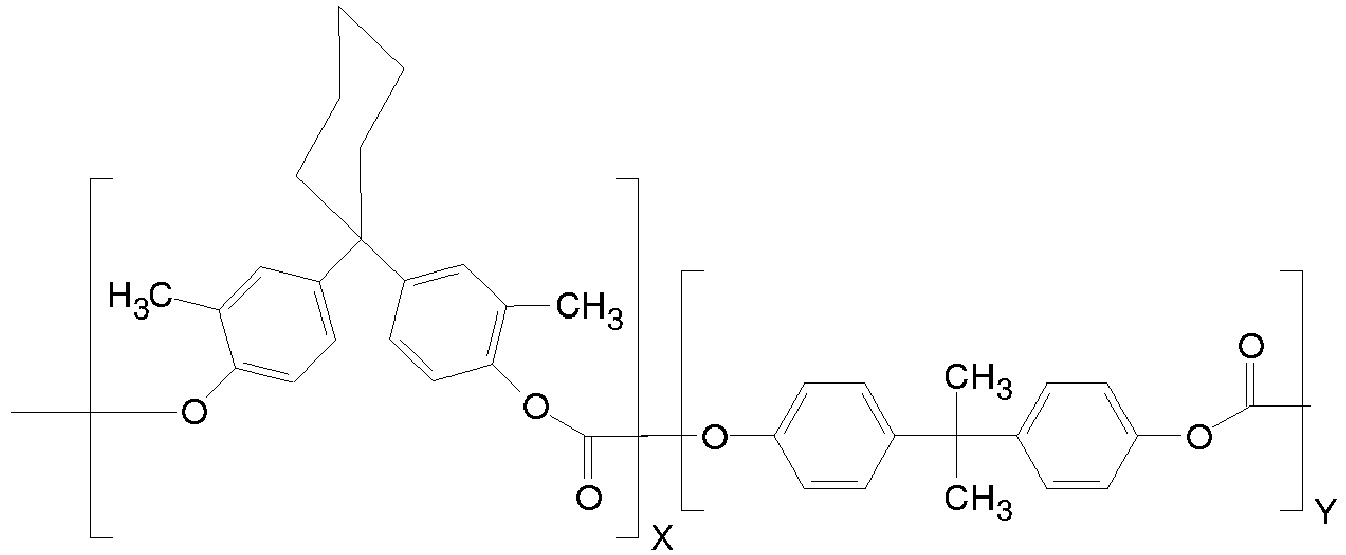 un deuxième polycarbonate comprenant un copolymère de polyphtalate et de carbonate répondant à la structure
 un troisième polycarbonate comprenant un homopolymère de polycarbonate de bisphénol A.
 - Composition selon la revendication 1, dans laquelle le deuxième polycarbonate est présent en une quantité de 20 % en poids à 50 % en poids, et le troisième polycarbonate est présent en une quantité de 0 % en poids à 40 % en poids par rapport au poids total de la composition qui est de 100 % en poids.
- Composition selon la revendication 2, dans laquelle le deuxième polycarbonate est présent en une quantité de 40 % en poids à 50 % en poids et le troisième polycarbonate est présent en une quantité de 10 % en poids à 25 % en poids par rapport au poids total de la composition qui est de 100 % en poids.
- Module photovoltaïque comprenant :un superstrat transparent ;une feuille de fond, laquelle feuille de fond comprend une couche de coeur comprenant une composition de coeur formée à partir d'un premier polycarbonate comprenant la composition du premier polycarbonate de la revendication 1 ; etun deuxième polycarbonate choisi dans le groupe constitué par un homopolymère de polycarbonate de bisphénol A, un copolymère de polyphtalate et de carbonate, un copolymère de polycarbonate comprenant des motifs répétitifs de carbonate de 2-phényl-3,3-bis(4-hydroxyphényl)phtalimidine et de carbonate de bisphénol A, un copolymère de polycarbonate comprenant des motifs répétitifs de carbonate de bisphénol A et de carbonate de tétrabromobisphénol A, et des combinaisons comprenant au moins l'un des précédents ; etune cellule photovoltaïque entre le superstrat et la feuille de fond.
- Module photovoltaïque selon la revendication 4, comprenant en outre une première couche de couverture disposée sur une surface de la couche de coeur, dans lequel la première couche de couverture comprend un polycarbonate et un stabilisant absorbant la lumière UV.
- Module photovoltaïque selon l'une quelconque des revendications 4 et 5, comprenant en outre une deuxième couche de couverture, dans lequel la couche de coeur est disposée entre la première couche de couverture et la deuxième couche de couverture, dans lequel la deuxième couche de couverture comprend un membre choisi dans le groupe constitué par un polycarbonate, un copolymère d'éthylène et d'acétate de vinyle ayant une teneur en acétate de vinyle comprise entre 2 % en poids et 10 % en poids, un polyéthylène, un polypropylène, un copolymère d'oléfine cyclique, et des combinaisons comprenant au moins l'un des précédents.
- Module photovoltaïque selon la revendication 6, dans lequel la deuxième couche de couverture comprend un polymère d'oléfine cyclique et dans lequel une couche adhésive est disposée entre la deuxième couche de couverture et la couche de coeur.
- Feuille multicouche comprenant :
une couche de coeur formée à partir d'une composition de coeur comprenant la composition de polycarbonate de la revendication 1 ; et une première couche de couverture disposée sur la surface de la couche de coeur. - Feuille multicouche selon la revendication 8, dans laquelle le retrait thermique est inférieur à 1 % dans le sens machine et dans le sens transversal après un traitement thermique à 150 °C pendant 30 minutes, et dans laquelle la feuille a une rétention de résistance à la perforation égale ou supérieure à 30 % après un test en autocuiseur à une température de 121 °C, sous une pression de vapeur d'eau saturée de 1,2 bars, et sous 100 % d'humidité relative pendant 72 heures.
- Feuille multicouche selon la revendication 8 ou la revendication 9, dans laquelle la première couche de couverture comprend un membre choisi dans le groupe constitué par un polycarbonate et un stabilisant absorbant la lumière UV, un copolymère de carbonate et de polyarylate de résorcinol, et des combinaisons comprenant au moins l'un des précédents.
- Feuille multicouche selon l'une quelconque des revendications 8 à 10, comprenant en outre une deuxième couche de couverture, dans laquelle la couche de coeur est disposée entre la première couche de couverture et la deuxième couche de couverture, dans laquelle la deuxième couche de couverture comprend un matériau choisi dans le groupe constitué par un polycarbonate de bisphénol A, les copolymères de polycarbonate, un polyéthylène, un polypropylène, et des combinaisons comprenant au moins l'un des précédents.
- Méthode de préparation d'une feuille multicouche, comprenant :la coextrusion d'une couche de coeur et d'une première couche de couverture, laquelle couche de coeur comprend une composition de coeur comprenantun premier polycarbonate comprenant des motifs répétitifs de carbonate de cyclohexane diméthyl-bisphénol et des motifs répétitifs de bisphénol A, lequel premier polycarbonate répond à la structure
 dans lequel les motifs répétitifs de carbonate de cyclohexane diméthyl-bisphénol sont présents en une quantité de 10 % en poids à 50 % en poids par rapport au total des motifs répétitifs dans la composition de coeur;un deuxième polycarbonate comprenant un copolymère de polyphtalate et de carbonate répondant à la structure
un troisième polycarbonate comprenant un homopolymère de polycarbonate de bisphénol A ; etdans laquelle la première couche de couverture comprend un membre choisi dans le groupe constitué par un polycarbonate et un stabilisant absorbant la lumière UV, un copolymère de carbonate et de polyarylate de résorcinol, et des combinaisons comprenant au moins l'un des précédents. - Méthode selon la revendication 12, comprenant en outre la coextrusion d'une deuxième couche de couverture comprenant un polycarbonate, dans laquelle la couche de coeur est disposée entre la première couche de couverture et la deuxième couche de couverture.
- Méthode selon l'une quelconque des revendications 12 et 13, comprenant en outre la stratification à la couche de coeur d'une deuxième couche de couverture comprenant une polyoléfine, dans laquelle une couche adhésive est disposée entre la couche de coeur et la deuxième couche de couverture, et dans laquelle la couche de coeur est disposée entre la première couche de couverture et la couche adhésive.
- Article produit à partir de la composition de l'une quelconque des revendications 1 à 14, lequel article est choisi dans le groupe constitué par les boîtiers d'écrans, les boîtiers de téléphones cellulaires, les films isolants, les connecteurs électriques, les composants d'appareils d'éclairage, les ornements, les appareils ménagers, les toits, les serres, les solariums, et les enceintes de piscine.
Applications Claiming Priority (2)
| Application Number | Priority Date | Filing Date | Title |
|---|---|---|---|
| US13/294,523 US9441106B2 (en) | 2011-11-11 | 2011-11-11 | Composition, multilayer sheets made therefrom, and methods for making and using the same |
| PCT/US2012/062111 WO2013070447A2 (fr) | 2011-11-11 | 2012-10-26 | Composition, feuilles multicouches faites avec elle, et procédés de fabrication et d'utilisation de ladite composition |
Publications (2)
| Publication Number | Publication Date |
|---|---|
| EP2777076A2 EP2777076A2 (fr) | 2014-09-17 |
| EP2777076B1 true EP2777076B1 (fr) | 2018-07-18 |
Family
ID=47178945
Family Applications (1)
| Application Number | Title | Priority Date | Filing Date |
|---|---|---|---|
| EP12787260.4A Not-in-force EP2777076B1 (fr) | 2011-11-11 | 2012-10-26 | Composition, feuilles multicouches faites avec elle, et procédés de fabrication et d'utilisation de ladite composition |
Country Status (5)
| Country | Link |
|---|---|
| US (1) | US9441106B2 (fr) |
| EP (1) | EP2777076B1 (fr) |
| JP (1) | JP2015504597A (fr) |
| CN (1) | CN103931001B (fr) |
| WO (1) | WO2013070447A2 (fr) |
Families Citing this family (10)
| Publication number | Priority date | Publication date | Assignee | Title |
|---|---|---|---|---|
| JP2014513196A (ja) | 2011-05-12 | 2014-05-29 | サビック・イノベーティブ・プラスチックス・アイピー・ベスローテン・フェンノートシャップ | コンデンサ用非晶性ポリカーボネートフィルム、その製造方法およびそれから製造される物品 |
| WO2012174179A1 (fr) * | 2011-06-15 | 2012-12-20 | Dow Global Technologies Llc | Articles photovoltaïques souples |
| EP3131967B1 (fr) | 2014-04-15 | 2021-04-14 | SHPP Global Technologies B.V. | Compositions de polycarbonates haute température |
| EP3131966B1 (fr) | 2014-04-15 | 2020-07-08 | SABIC Global Technologies B.V. | Compositions de polycarbonates haute température |
| EP3166787B1 (fr) | 2014-07-09 | 2020-06-03 | SABIC Global Technologies B.V. | Composites à paroi mince de boîtiers électroniques et d'autres dispositifs |
| EP3455286B8 (fr) | 2016-05-12 | 2021-03-10 | SHPP Global Technologies B.V. | Films de condensateur performants à haute température, procédés de fabrication et articles associés |
| US10487077B1 (en) | 2018-06-14 | 2019-11-26 | Sabic Global Technologies B.V. | Bis(benzoxazinyl)phthalimidine and associated curable composition and composite |
| EP4217195A4 (fr) * | 2020-09-22 | 2024-10-09 | Truvian Sciences, Inc. | Procédés de liaison de matières plastiques et composants fabriqués à l'aide de ceux-ci |
| KR102705627B1 (ko) | 2022-01-20 | 2024-09-11 | 한국화학연구원 | 비스페놀-z를 이용한 폴리올과 폴리우레탄합성 및 물성연구 |
| EP4605473B1 (fr) * | 2022-10-18 | 2026-04-01 | SHPP Global Technologies B.V. | Composition de polycarbonate, son procédé de fabrication et articles comprenant la composition de polycarbonate |
Family Cites Families (60)
| Publication number | Priority date | Publication date | Assignee | Title |
|---|---|---|---|---|
| JPS5027061B1 (fr) * | 1971-03-08 | 1975-09-04 | ||
| JPS4854158A (fr) | 1971-11-09 | 1973-07-30 | ||
| US4140730A (en) | 1973-10-31 | 1979-02-20 | Bayer Aktiengesellschaft | Polycarbonate film |
| US4304899A (en) | 1978-07-31 | 1981-12-08 | General Electric Company | Polycarbonate compositions having improved barrier properties |
| US4280978A (en) | 1979-05-23 | 1981-07-28 | Monsanto Company | Process of embossing and perforating thermoplastic film |
| DE3837589A1 (de) | 1988-11-05 | 1990-05-10 | Roehm Gmbh | Uv-absorber-haltige methacrylatschutzschicht fuer polycarbonat |
| US5391795A (en) | 1994-02-18 | 1995-02-21 | General Electric Company | Silylated agents useful for absorbing ultraviolet light |
| US5759689A (en) | 1996-06-13 | 1998-06-02 | General Electric Company | Coextruded polycarbonate sheet with improved weathering |
| US5763674A (en) | 1996-12-09 | 1998-06-09 | General Electric Company | High molecular weight dibenzoylresorcinol UV absorbers |
| US5679820A (en) | 1996-12-16 | 1997-10-21 | General Electric Company | Silylated ultraviolet light absorbers having resistance to humidity |
| WO1999063002A1 (fr) | 1998-05-29 | 1999-12-09 | General Electric Company | Composition a mouler a base de resines de polyester et de polycarbonate presentant de bonnes caracteristiques de resistance aux chocs |
| JP2003531943A (ja) * | 2000-05-01 | 2003-10-28 | ゼネラル・エレクトリック・カンパニイ | 透明ポリカーボネートブレンド |
| DE10135465A1 (de) | 2001-07-20 | 2003-02-06 | Bayer Ag | Polycarbonat-Blends |
| US20030108710A1 (en) | 2001-12-07 | 2003-06-12 | General Electric Company | Articles bearing patterned microstructures and method of making |
| DE10230983A1 (de) * | 2002-07-10 | 2004-01-22 | Bayer Ag | Mehrschichtiges Erzeugnis enthaltend Polycarbonat |
| US7092163B2 (en) | 2004-07-22 | 2006-08-15 | General Electric Company | Light collimating and diffusing film and system for making the film |
| US7718733B2 (en) | 2004-12-20 | 2010-05-18 | Sabic Innovative Plastics Ip B.V. | Optically clear polycarbonate polyester compositions |
| US7521119B2 (en) * | 2005-07-07 | 2009-04-21 | Sabic Innovative Plastics Ip B.V. | Windows and other articles made from DMBPC polycarbonate homopolymer and copolymer |
| US20070065615A1 (en) | 2005-09-16 | 2007-03-22 | Odle Roy R | Annular or tubular shaped articles of novel polymer blends |
| US20070066741A1 (en) | 2005-09-16 | 2007-03-22 | Donovan Michael S | High glass transition temperature thermoplastic articles |
| US20070066740A1 (en) | 2005-09-16 | 2007-03-22 | Odle Roy R | Annular or tubular shaped articles of novel polymer blends |
| US20070066739A1 (en) | 2005-09-16 | 2007-03-22 | General Electric Company | Coated articles of manufacture made of high Tg polymer blends |
| JP4839056B2 (ja) | 2005-10-17 | 2011-12-14 | 帝人化成株式会社 | 赤外線吸収フィルターおよび赤外線吸収パネル |
| US7524562B2 (en) | 2005-10-18 | 2009-04-28 | Sabic Innovative Plastics Ip B.V. | Method of improving abrasion resistance of plastic article using functionalized polymers and article produced thereby |
| US20070142569A1 (en) | 2005-12-16 | 2007-06-21 | Michael Stephen Donovan | Food service articles of manufacture comprising high temperature polymers |
| US20070149629A1 (en) | 2005-12-22 | 2007-06-28 | Michael Stephen Donovan | Expanded and expandable high glass transition temperature polymers |
| US20070167544A1 (en) | 2006-01-18 | 2007-07-19 | General Electric Company | Ignition resistant polycarbonate polyester composition |
| US20070173618A1 (en) | 2006-01-20 | 2007-07-26 | Shaikh Abbas A G | Miscible polycarbonate polyester blends |
| US20070191519A1 (en) | 2006-02-14 | 2007-08-16 | General Electric Company | Halogen-free polycarbonate compositions and articles formed therefrom |
| US7491788B1 (en) | 2006-05-19 | 2009-02-17 | Sabic Innovative Plastics Ip B.V. | High heat polycarbonate compositions, methods for the preparation thereof, and articles derived therefrom |
| US7495064B2 (en) | 2006-06-26 | 2009-02-24 | Sabic Innovative Plastics Ip Bv | Manufacture of polycarbonates |
| US7700696B2 (en) | 2006-06-28 | 2010-04-20 | Sabic Innovative Plastics Ip B.V. | Polycarbonate composition having improved scratch resistance, and articles formed therefrom |
| US7759456B2 (en) | 2006-06-30 | 2010-07-20 | Sabic Innovative Plastics Ip B.V. | Branched polycarbonate resins and processes to prepare the same |
| US20080015292A1 (en) | 2006-07-12 | 2008-01-17 | General Electric Company | Flame retardant and scratch resistant thermoplastic polycarbonate compositions |
| US8674007B2 (en) | 2006-07-12 | 2014-03-18 | Sabic Innovative Plastics Ip B.V. | Flame retardant and scratch resistant thermoplastic polycarbonate compositions |
| US20080015289A1 (en) | 2006-07-12 | 2008-01-17 | General Electric Company | Flame retardant and chemical resistant thermoplastic polycarbonate compositions |
| US20080015291A1 (en) | 2006-07-12 | 2008-01-17 | General Electric Company | Flame retardant and scratch resistant thermoplastic polycarbonate compositions |
| US8309656B2 (en) | 2006-07-26 | 2012-11-13 | Sabic Innovative Plastics Ip B.V. | Elastomer blends containing polycarbonates and copolyetheresters derived from polyethylene terephthalate, method of manufacture, and articles therefrom |
| DE102006046330A1 (de) | 2006-09-28 | 2008-04-03 | Bayer Materialscience Ag | Polycarbonate und Copolycarbonate mit verbesserter Metallhaftung |
| US7709581B2 (en) | 2006-09-29 | 2010-05-04 | Sabic Innovative Plastics Ip B.V. | Polycarbonate-polysiloxane copolymer compositions and articles formed therefrom |
| US7524919B2 (en) | 2006-09-29 | 2009-04-28 | Sabic Innovative Plastics Ip B.V. | Polycarbonate-polysiloxane copolymers, method of making, and articles formed therefrom |
| US20080081895A1 (en) | 2006-09-29 | 2008-04-03 | General Electric Company | Polycarbonate-polysiloxane copolymers, method of making, and articles formed therefrom |
| US7655737B2 (en) | 2006-11-16 | 2010-02-02 | Sabic Innovative Plastics Ip B.V. | Polycarbonate-polyester blends, methods of manufacture, and methods of use |
| JP4861807B2 (ja) | 2006-12-20 | 2012-01-25 | 京セラミタ株式会社 | 電子写真感光体及び画像形成装置 |
| US20080161507A1 (en) | 2006-12-28 | 2008-07-03 | Shreyas Chakravarti | Polyester-polycarbonate blends |
| WO2008088336A1 (fr) | 2007-01-18 | 2008-07-24 | Sabic Innovative Plastics Ip B.V. | Articles de fabrication revetus a base de melanges de polymeres a temperature de transition vitreuse elevee |
| WO2008091253A1 (fr) | 2007-01-25 | 2008-07-31 | Sabic Innovative Plastics Ip B.V. | Connecteurs électriques résistants à la chaleur |
| DE102007015948A1 (de) | 2007-04-03 | 2008-10-09 | Bayer Materialscience Ag | Modifizierte Polycarbonate, Polyestercarbonate und Polyester mit verbessertem Dehnverhalten und Flammwidrigkeit |
| US20080254299A1 (en) | 2007-04-13 | 2008-10-16 | General Electric Company | Scratch-resistant Layered Composite and Articles |
| US7691950B2 (en) | 2007-04-30 | 2010-04-06 | Sabic Innovative Plastics Ip B.V. | Polyester polycarbonate compositions, methods of making, and articles formed therefrom |
| US7687583B2 (en) | 2007-04-30 | 2010-03-30 | Sabic Innovative Plastics Ip B.V. | Polyester polycarbonate compositions, methods of making, and articles formed therefrom |
| US7829632B2 (en) | 2007-04-30 | 2010-11-09 | Sabic Innovative Plastics Ip B.V. | Polyester polycarbonate compositions, methods of making, and articles formed therefrom |
| WO2008157328A1 (fr) | 2007-06-15 | 2008-12-24 | Sabic Innovative Plastics Ip B.V. | Compositions de copolymère polycarbonate-poly(oxyde d'alkylène) et objets formés à partir de celles-ci |
| US7649073B2 (en) | 2007-06-15 | 2010-01-19 | Sabic Innovative Plastics Ip B.V. | Polycarbonate-poly(alkylene oxide) copolymer compositions and articles formed therefrom |
| US20090030128A1 (en) | 2007-07-25 | 2009-01-29 | Shreyas Chakravarti | New polyester-polycarbonate compositions |
| US8222347B2 (en) | 2007-07-25 | 2012-07-17 | Sabic Innovative Plastics Ip B.V. | Polyester-polycarbonate compositions |
| US20090176946A1 (en) | 2008-01-03 | 2009-07-09 | Sabic Innovative Plastics Ip B.V. | Polycarbonate blends with high scratch resistance and ductility |
| EP2199076B1 (fr) | 2008-12-18 | 2013-02-20 | SABIC Innovative Plastics IP B.V. | Procédés pour la fabrication de compositions de polycarbonate, compositions ainsi formées et articles correspondants |
| TW201219210A (en) | 2010-11-08 | 2012-05-16 | Eternal Chemical Co Ltd | Film used for solar cell module and module thereof |
| JP4734468B1 (ja) * | 2010-09-13 | 2011-07-27 | 日本発條株式会社 | 太陽電池モジュール用基材及びその製造方法 |
-
2011
- 2011-11-11 US US13/294,523 patent/US9441106B2/en active Active
-
2012
- 2012-10-26 CN CN201280054991.0A patent/CN103931001B/zh not_active Expired - Fee Related
- 2012-10-26 EP EP12787260.4A patent/EP2777076B1/fr not_active Not-in-force
- 2012-10-26 WO PCT/US2012/062111 patent/WO2013070447A2/fr not_active Ceased
- 2012-10-26 JP JP2014541094A patent/JP2015504597A/ja active Pending
Also Published As
| Publication number | Publication date |
|---|---|
| WO2013070447A2 (fr) | 2013-05-16 |
| JP2015504597A (ja) | 2015-02-12 |
| CN103931001A (zh) | 2014-07-16 |
| EP2777076A2 (fr) | 2014-09-17 |
| US20130118581A1 (en) | 2013-05-16 |
| CN103931001B (zh) | 2016-09-21 |
| US9441106B2 (en) | 2016-09-13 |
| WO2013070447A3 (fr) | 2013-09-19 |
Similar Documents
| Publication | Publication Date | Title |
|---|---|---|
| US9441106B2 (en) | Composition, multilayer sheets made therefrom, and methods for making and using the same | |
| US8525191B2 (en) | Optoelectronic devices and coatings therefore | |
| JP5762621B2 (ja) | 光電子デバイスおよびそれらのための被膜、ならびにそれらの作製および使用方法 | |
| US20120298195A1 (en) | Moisture-resistant film, made of fluorinated polymer and inorganic oxide, for photovoltaic use | |
| JP5594959B2 (ja) | 太陽電池素子封止材 | |
| KR102009136B1 (ko) | 불화비닐리덴계 수지 조성물, 수지 필름, 태양전지용 백시트 및 태양전지 모듈 | |
| CN103068575A (zh) | 基于聚烯烃的太阳能背板 | |
| KR20130080843A (ko) | 내자외선 투명 적층체 | |
| WO2010087085A1 (fr) | Feuille de doublage pour batterie solaire, et module de batterie solaire la comportant | |
| WO2010071032A1 (fr) | Feuille arrière de cellules solaires, et module de cellules solaires la comportant | |
| JP5974835B2 (ja) | 太陽電池モジュール用裏面保護シート | |
| JP4992530B2 (ja) | 太陽電池用裏面保護シート | |
| JP2010278428A (ja) | 太陽電池用シート及び太陽電池モジュール | |
| JP2006159497A (ja) | 積層体及びその用途 | |
| US20230203288A1 (en) | Multilayer assembly comprising silane-grafted polyolefin | |
| JP5920338B2 (ja) | 積層シートおよびそれを用いた太陽電池 | |
| JP2011056701A (ja) | 太陽電池用シート及び太陽電池モジュール | |
| CN103765611A (zh) | 太阳能电池模块的制造方法、太阳能电池背面密封片和太阳能电池模块 | |
| JP5639798B2 (ja) | 太陽電池モジュール | |
| JP2013055270A (ja) | 積層シートおよびそれを用いた太陽電池 | |
| JP2017118074A (ja) | 太陽電池モジュール用の封止材シート、及びそれを用いた太陽電池モジュール | |
| WO2025205974A1 (fr) | Encapsulant de cellule photovoltaïque à pérovskites et cellule photovoltaïque à pérovskites | |
| JP2013052635A (ja) | 積層シートおよびそれを用いた太陽電池 | |
| JP2015149331A (ja) | 太陽電池モジュール |
Legal Events
| Date | Code | Title | Description |
|---|---|---|---|
| PUAI | Public reference made under article 153(3) epc to a published international application that has entered the european phase |
Free format text: ORIGINAL CODE: 0009012 |
|
| 17P | Request for examination filed |
Effective date: 20140130 |
|
| AK | Designated contracting states |
Kind code of ref document: A2 Designated state(s): AL AT BE BG CH CY CZ DE DK EE ES FI FR GB GR HR HU IE IS IT LI LT LU LV MC MK MT NL NO PL PT RO RS SE SI SK SM TR |
|
| DAX | Request for extension of the european patent (deleted) | ||
| RAP1 | Party data changed (applicant data changed or rights of an application transferred) |
Owner name: SABIC GLOBAL TECHNOLOGIES B.V. |
|
| 17Q | First examination report despatched |
Effective date: 20160908 |
|
| GRAP | Despatch of communication of intention to grant a patent |
Free format text: ORIGINAL CODE: EPIDOSNIGR1 |
|
| INTG | Intention to grant announced |
Effective date: 20180201 |
|
| RAP3 | Party data changed (applicant data changed or rights of an application transferred) |
Owner name: SABIC GLOBAL TECHNOLOGIES B.V. |
|
| GRAS | Grant fee paid |
Free format text: ORIGINAL CODE: EPIDOSNIGR3 |
|
| GRAA | (expected) grant |
Free format text: ORIGINAL CODE: 0009210 |
|
| AK | Designated contracting states |
Kind code of ref document: B1 Designated state(s): AL AT BE BG CH CY CZ DE DK EE ES FI FR GB GR HR HU IE IS IT LI LT LU LV MC MK MT NL NO PL PT RO RS SE SI SK SM TR |
|
| REG | Reference to a national code |
Ref country code: GB Ref legal event code: FG4D |
|
| REG | Reference to a national code |
Ref country code: CH Ref legal event code: EP |
|
| REG | Reference to a national code |
Ref country code: IE Ref legal event code: FG4D |
|
| REG | Reference to a national code |
Ref country code: AT Ref legal event code: REF Ref document number: 1020276 Country of ref document: AT Kind code of ref document: T Effective date: 20180815 |
|
| REG | Reference to a national code |
Ref country code: DE Ref legal event code: R096 Ref document number: 602012048656 Country of ref document: DE |
|
| REG | Reference to a national code |
Ref country code: FR Ref legal event code: PLFP Year of fee payment: 7 |
|
| REG | Reference to a national code |
Ref country code: NL Ref legal event code: MP Effective date: 20180718 |
|
| REG | Reference to a national code |
Ref country code: LT Ref legal event code: MG4D |
|
| REG | Reference to a national code |
Ref country code: AT Ref legal event code: MK05 Ref document number: 1020276 Country of ref document: AT Kind code of ref document: T Effective date: 20180718 |
|
| PG25 | Lapsed in a contracting state [announced via postgrant information from national office to epo] |
Ref country code: NL Free format text: LAPSE BECAUSE OF FAILURE TO SUBMIT A TRANSLATION OF THE DESCRIPTION OR TO PAY THE FEE WITHIN THE PRESCRIBED TIME-LIMIT Effective date: 20180718 |
|
| PG25 | Lapsed in a contracting state [announced via postgrant information from national office to epo] |
Ref country code: PL Free format text: LAPSE BECAUSE OF FAILURE TO SUBMIT A TRANSLATION OF THE DESCRIPTION OR TO PAY THE FEE WITHIN THE PRESCRIBED TIME-LIMIT Effective date: 20180718 Ref country code: IS Free format text: LAPSE BECAUSE OF FAILURE TO SUBMIT A TRANSLATION OF THE DESCRIPTION OR TO PAY THE FEE WITHIN THE PRESCRIBED TIME-LIMIT Effective date: 20181118 Ref country code: SE Free format text: LAPSE BECAUSE OF FAILURE TO SUBMIT A TRANSLATION OF THE DESCRIPTION OR TO PAY THE FEE WITHIN THE PRESCRIBED TIME-LIMIT Effective date: 20180718 Ref country code: AT Free format text: LAPSE BECAUSE OF FAILURE TO SUBMIT A TRANSLATION OF THE DESCRIPTION OR TO PAY THE FEE WITHIN THE PRESCRIBED TIME-LIMIT Effective date: 20180718 Ref country code: NO Free format text: LAPSE BECAUSE OF FAILURE TO SUBMIT A TRANSLATION OF THE DESCRIPTION OR TO PAY THE FEE WITHIN THE PRESCRIBED TIME-LIMIT Effective date: 20181018 Ref country code: RS Free format text: LAPSE BECAUSE OF FAILURE TO SUBMIT A TRANSLATION OF THE DESCRIPTION OR TO PAY THE FEE WITHIN THE PRESCRIBED TIME-LIMIT Effective date: 20180718 Ref country code: FI Free format text: LAPSE BECAUSE OF FAILURE TO SUBMIT A TRANSLATION OF THE DESCRIPTION OR TO PAY THE FEE WITHIN THE PRESCRIBED TIME-LIMIT Effective date: 20180718 Ref country code: GR Free format text: LAPSE BECAUSE OF FAILURE TO SUBMIT A TRANSLATION OF THE DESCRIPTION OR TO PAY THE FEE WITHIN THE PRESCRIBED TIME-LIMIT Effective date: 20181019 Ref country code: BG Free format text: LAPSE BECAUSE OF FAILURE TO SUBMIT A TRANSLATION OF THE DESCRIPTION OR TO PAY THE FEE WITHIN THE PRESCRIBED TIME-LIMIT Effective date: 20181018 Ref country code: LT Free format text: LAPSE BECAUSE OF FAILURE TO SUBMIT A TRANSLATION OF THE DESCRIPTION OR TO PAY THE FEE WITHIN THE PRESCRIBED TIME-LIMIT Effective date: 20180718 |
|
| PG25 | Lapsed in a contracting state [announced via postgrant information from national office to epo] |
Ref country code: HR Free format text: LAPSE BECAUSE OF FAILURE TO SUBMIT A TRANSLATION OF THE DESCRIPTION OR TO PAY THE FEE WITHIN THE PRESCRIBED TIME-LIMIT Effective date: 20180718 Ref country code: AL Free format text: LAPSE BECAUSE OF FAILURE TO SUBMIT A TRANSLATION OF THE DESCRIPTION OR TO PAY THE FEE WITHIN THE PRESCRIBED TIME-LIMIT Effective date: 20180718 Ref country code: LV Free format text: LAPSE BECAUSE OF FAILURE TO SUBMIT A TRANSLATION OF THE DESCRIPTION OR TO PAY THE FEE WITHIN THE PRESCRIBED TIME-LIMIT Effective date: 20180718 |
|
| REG | Reference to a national code |
Ref country code: DE Ref legal event code: R097 Ref document number: 602012048656 Country of ref document: DE |
|
| PG25 | Lapsed in a contracting state [announced via postgrant information from national office to epo] |
Ref country code: CZ Free format text: LAPSE BECAUSE OF FAILURE TO SUBMIT A TRANSLATION OF THE DESCRIPTION OR TO PAY THE FEE WITHIN THE PRESCRIBED TIME-LIMIT Effective date: 20180718 Ref country code: RO Free format text: LAPSE BECAUSE OF FAILURE TO SUBMIT A TRANSLATION OF THE DESCRIPTION OR TO PAY THE FEE WITHIN THE PRESCRIBED TIME-LIMIT Effective date: 20180718 Ref country code: ES Free format text: LAPSE BECAUSE OF FAILURE TO SUBMIT A TRANSLATION OF THE DESCRIPTION OR TO PAY THE FEE WITHIN THE PRESCRIBED TIME-LIMIT Effective date: 20180718 Ref country code: EE Free format text: LAPSE BECAUSE OF FAILURE TO SUBMIT A TRANSLATION OF THE DESCRIPTION OR TO PAY THE FEE WITHIN THE PRESCRIBED TIME-LIMIT Effective date: 20180718 Ref country code: IT Free format text: LAPSE BECAUSE OF FAILURE TO SUBMIT A TRANSLATION OF THE DESCRIPTION OR TO PAY THE FEE WITHIN THE PRESCRIBED TIME-LIMIT Effective date: 20180718 |
|
| PLBE | No opposition filed within time limit |
Free format text: ORIGINAL CODE: 0009261 |
|
| STAA | Information on the status of an ep patent application or granted ep patent |
Free format text: STATUS: NO OPPOSITION FILED WITHIN TIME LIMIT |
|
| PG25 | Lapsed in a contracting state [announced via postgrant information from national office to epo] |
Ref country code: DK Free format text: LAPSE BECAUSE OF FAILURE TO SUBMIT A TRANSLATION OF THE DESCRIPTION OR TO PAY THE FEE WITHIN THE PRESCRIBED TIME-LIMIT Effective date: 20180718 Ref country code: SM Free format text: LAPSE BECAUSE OF FAILURE TO SUBMIT A TRANSLATION OF THE DESCRIPTION OR TO PAY THE FEE WITHIN THE PRESCRIBED TIME-LIMIT Effective date: 20180718 Ref country code: SK Free format text: LAPSE BECAUSE OF FAILURE TO SUBMIT A TRANSLATION OF THE DESCRIPTION OR TO PAY THE FEE WITHIN THE PRESCRIBED TIME-LIMIT Effective date: 20180718 |
|
| REG | Reference to a national code |
Ref country code: CH Ref legal event code: PL |
|
| 26N | No opposition filed |
Effective date: 20190423 |
|
| GBPC | Gb: european patent ceased through non-payment of renewal fee |
Effective date: 20181026 |
|
| REG | Reference to a national code |
Ref country code: BE Ref legal event code: MM Effective date: 20181031 |
|
| PG25 | Lapsed in a contracting state [announced via postgrant information from national office to epo] |
Ref country code: MC Free format text: LAPSE BECAUSE OF FAILURE TO SUBMIT A TRANSLATION OF THE DESCRIPTION OR TO PAY THE FEE WITHIN THE PRESCRIBED TIME-LIMIT Effective date: 20180718 Ref country code: LU Free format text: LAPSE BECAUSE OF NON-PAYMENT OF DUE FEES Effective date: 20181026 |
|
| REG | Reference to a national code |
Ref country code: IE Ref legal event code: MM4A |
|
| PG25 | Lapsed in a contracting state [announced via postgrant information from national office to epo] |
Ref country code: CH Free format text: LAPSE BECAUSE OF NON-PAYMENT OF DUE FEES Effective date: 20181031 Ref country code: BE Free format text: LAPSE BECAUSE OF NON-PAYMENT OF DUE FEES Effective date: 20181031 Ref country code: SI Free format text: LAPSE BECAUSE OF FAILURE TO SUBMIT A TRANSLATION OF THE DESCRIPTION OR TO PAY THE FEE WITHIN THE PRESCRIBED TIME-LIMIT Effective date: 20180718 Ref country code: LI Free format text: LAPSE BECAUSE OF NON-PAYMENT OF DUE FEES Effective date: 20181031 |
|
| PG25 | Lapsed in a contracting state [announced via postgrant information from national office to epo] |
Ref country code: IE Free format text: LAPSE BECAUSE OF NON-PAYMENT OF DUE FEES Effective date: 20181026 Ref country code: GB Free format text: LAPSE BECAUSE OF NON-PAYMENT OF DUE FEES Effective date: 20181026 |
|
| PGFP | Annual fee paid to national office [announced via postgrant information from national office to epo] |
Ref country code: FR Payment date: 20190913 Year of fee payment: 8 |
|
| PG25 | Lapsed in a contracting state [announced via postgrant information from national office to epo] |
Ref country code: MT Free format text: LAPSE BECAUSE OF NON-PAYMENT OF DUE FEES Effective date: 20181026 |
|
| PGFP | Annual fee paid to national office [announced via postgrant information from national office to epo] |
Ref country code: DE Payment date: 20191015 Year of fee payment: 8 |
|
| PG25 | Lapsed in a contracting state [announced via postgrant information from national office to epo] |
Ref country code: TR Free format text: LAPSE BECAUSE OF FAILURE TO SUBMIT A TRANSLATION OF THE DESCRIPTION OR TO PAY THE FEE WITHIN THE PRESCRIBED TIME-LIMIT Effective date: 20180718 |
|
| PG25 | Lapsed in a contracting state [announced via postgrant information from national office to epo] |
Ref country code: PT Free format text: LAPSE BECAUSE OF FAILURE TO SUBMIT A TRANSLATION OF THE DESCRIPTION OR TO PAY THE FEE WITHIN THE PRESCRIBED TIME-LIMIT Effective date: 20180718 |
|
| PG25 | Lapsed in a contracting state [announced via postgrant information from national office to epo] |
Ref country code: HU Free format text: LAPSE BECAUSE OF FAILURE TO SUBMIT A TRANSLATION OF THE DESCRIPTION OR TO PAY THE FEE WITHIN THE PRESCRIBED TIME-LIMIT; INVALID AB INITIO Effective date: 20121026 Ref country code: MK Free format text: LAPSE BECAUSE OF NON-PAYMENT OF DUE FEES Effective date: 20180718 Ref country code: CY Free format text: LAPSE BECAUSE OF FAILURE TO SUBMIT A TRANSLATION OF THE DESCRIPTION OR TO PAY THE FEE WITHIN THE PRESCRIBED TIME-LIMIT Effective date: 20180718 |
|
| REG | Reference to a national code |
Ref country code: DE Ref legal event code: R119 Ref document number: 602012048656 Country of ref document: DE |
|
| PG25 | Lapsed in a contracting state [announced via postgrant information from national office to epo] |
Ref country code: DE Free format text: LAPSE BECAUSE OF NON-PAYMENT OF DUE FEES Effective date: 20210501 Ref country code: FR Free format text: LAPSE BECAUSE OF NON-PAYMENT OF DUE FEES Effective date: 20201031 |