EP2763934B1 - Method for the condensed phase production of trisilylamine - Google Patents
Method for the condensed phase production of trisilylamine Download PDFInfo
- Publication number
- EP2763934B1 EP2763934B1 EP12838215.7A EP12838215A EP2763934B1 EP 2763934 B1 EP2763934 B1 EP 2763934B1 EP 12838215 A EP12838215 A EP 12838215A EP 2763934 B1 EP2763934 B1 EP 2763934B1
- Authority
- EP
- European Patent Office
- Prior art keywords
- solvent
- reaction
- tsa
- reactor
- pressure
- Prior art date
- Legal status (The legal status is an assumption and is not a legal conclusion. Google has not performed a legal analysis and makes no representation as to the accuracy of the status listed.)
- Active
Links
Images



Classifications
-
- C—CHEMISTRY; METALLURGY
- C01—INORGANIC CHEMISTRY
- C01B—NON-METALLIC ELEMENTS; COMPOUNDS THEREOF; METALLOIDS OR COMPOUNDS THEREOF NOT COVERED BY SUBCLASS C01C
- C01B21/00—Nitrogen; Compounds thereof
- C01B21/082—Compounds containing nitrogen and non-metals and optionally metals
- C01B21/087—Compounds containing nitrogen and non-metals and optionally metals containing one or more hydrogen atoms
Definitions
- This invention relates to a batch method for synthesizing silylamines, particularly trisilylamine in anisole as solvent.
- the invention relates to a process that promotes reaction conditions suitable for a high efficiency synthesis of silylamines.
- the primary silylamine of interest is trisilylamine. Production of disilylamine in commercial quantities is also within the scope of the present invention.
- Trisilylamine (“TSA”) is a useful molecule for use in semiconductor manufacturing. It is stable once produced, but is susceptible to decomposition from excessive reaction conditions and synthesis by-products. Dussarrat, et al. US 7,192,626 demonstrated that a stable Silicon nitride film is formed on a substrate by feeding trisilylamine and ammonia into a CVD reaction chamber that contains a substrate.
- Wells and Schaeffer J. Am. Chem. Soc., 88:1, 37 (1996 ) discuss a batch method of preparing trisilylamine by the reaction of silyl chloride with ammonia. They report the yield of trisilylamine varied depending on the method of mixing and the purity of the reactants. Wells and Schaeffer allowed the reactants to mix in the gas phase by introducing the ammonia from below into a 1 liter bulb containing silylchloride. After introducing the gaseous ammonia very slowly, the reaction bulb and contents were allowed to remain at room temperature for 15 min. Copious amounts of white solid were precipitated on the walls of the bulb as soon as mixing occurred. The product was removed and the trisilylamine recovered. The process yield was about 77% of the theoretical amount of trisilylamine.
- US 2010/0310443 is directed to a tubular flow gas phase reactor and a process for the synthesis of silylamines which have been found to produce high volumes, at high yield efficiencies of silylamines.
- the reactor has a combination of characteristics found in plug flow and laminar flow devices. This combination of properties results in a high volume high efficiency synthesis of silylamines.
- the primary silylamine of interest is trisilylamine. Production of disilylamines in commercial quantities is also within the scope of the present invention. This process produces high volumes of ammonium halide requiring the reaction tube to be opened and cleaned after each production batch is produced. This is a labor intensive process leading to significant down time.
- Hachiuma et al., JP S 54-134098 describe a process for the preparation of highly pure silicon nitride by reacting a halogenated inorganic silicon compound, e.g. monochlorosilane, and ammonia in the presence of a halogenated non-polar solvent at a temperature in the range of 5 to 50 degrees C.
- TSA is formed as an intermediate product, before the reaction mixture is heated to a range of 900 to 1700 degrees C to obtain silicon nitride.
- US 2011/136347 and US 4,397,828 also concern processes for the preparation of TSA from monochlorosilane and ammonia. Addition of an organic solvent like toluene reduces or prevents the formation of oligomers.
- the present invention is directed to a process for preparing trisilylamine as defined in claim 1. Preferred embodiments of the process are defined in the dependent claims.
- Condensed phase reactions of excess monohalosilanes, such as monochlorosilane (“MCS”) with ammonia, are beneficial since the formation of TSA occurs rapidly concomitantly producing ammonium halide salt which in the case of MCS is ammonium chloride (“NH 4 Cl”) salt.
- MCS monochlorosilane
- NH 4 Cl ammonium chloride
- Such salts are localized in the reaction zone as a slurry with the solvent.
- This approach utilizes anisole as a high boiling point solvent to act as a heat-transfer medium in which the ammonium chloride salt is dispersed and downstream product removal is devoid of salt formation.
- the general benefit of this approach is the formation of TSA in the condensed phase followed by vacuum stripping of the product from the reaction slurry and discharge of the waste salt/solvent slurry from the reactor vessel after which the reactor can be re-charged with solvent and excess, liquefied monohalosilane for another batch synthesis.
- the reactor does not have to be cleaned before the next batch run as the ammonium chloride salt byproduct of the reaction is removed as a slurry in the solvent.
- silylamines of the present invention are produced in accord with the following reaction sequence: 2NH 3 + SiH 3 X ⁇ NH 4 X + SiH 3 NH 2 2SiH 3 NH 2 ⁇ NH 3 + (SiH 3 ) 2 NH 3(SiH 3 ) 2 NH ⁇ NH 3 + 2(SiH 3 ) 3 N
- the general method of this invention includes the following:
- Preferred methods of separation include vacuum stripping or distilling the product mixture, which may be preceded by filtration, at reduced pressure once all of the ammonia has been added and collecting the distillates which contain the product(s) in a low temperature cryotrap.
- the temperature of the reaction mixture may be raised during vacuum stripping. In pilot scale batches the reaction mixture temperature has be raised to about 100 degrees C during vacuum stripping.
- Purifying the product to obtain pure TSA preferred purification processes are fractionation or distillation.
- the reactor can then be re-charged for another batch synthesis).
- excess of about 20 to about 50 mole % monohalosilane to ammonia is used and a reaction temperature of about 10 degrees C to about 60 degrees C.
- the monohalosilane is MCS.
- the preferred ammonia addition process is to react the ammonia and MCS in the solution and limit any gas-phase reactions in the headspace above the solution thereby avoiding ammonium chloride build up on the exposed surface of the reactor vessel and down stream of the reaction vessel such as in the cryogenic traps.
- Ammonium chloride salt found in the downstream storage vessels is referred to as "down stream salt.”
- the solvent aspect ratio is defined as the relationship of the height of solvent (liquid level) divided by the internal diameter of the reactor and is important relative to the path the ammonia or intermediate disilylamine DSA product has to travel to break through the surface of the liquid at the solvent-headspace interface.
- the lower limit value for the aspect ratio is not critical but is an experienced based guide for setting an anhydrous ammonia gas flow/feed rate in a particular reactor in light of the following parameters; solvent, MCS concentration, temperature and pressure.
- Preferred operation of the reactor is achieved when the feed rate of the ammonia gas is adjusted such that all of the ammonia is reacted with MCS in solution and none of ammonia gas escapes the solution to enter the headspace above the solvent surface.
- Better gas dispersion methods, better mixing and a higher solvent aspect ratio are process methods that will support a higher ammonia gas flow rate thereby speeding processing time.
- the preferred temperature range of the process is about -55 degrees C to about 60 degrees C.
- the lower limit of the operating temperature of the reaction process is the melting point of MCS in anisole and the upper temperature limit is determined by engineering conditions such as to avoid product decomposition and reduced efficiency of the process.
- the upper temperature limit is determined by engineering conditions such as to avoid product decomposition and reduced efficiency of the process.
- anisole depending on how much MCS is added, there is a considerable melting point depression below the anisole melting point of -37.3 degrees C.
- the melting point of a given concentration of MCS in a particular solvent is easily determined by one skilled in the art without undue experimentation.
- the solvent of the present invention acts as a heat transport medium and as a medium for dispersing ammonium chloride formed during the formation of TSA.
- the solvent must have all of the following characteristics:
- the ratio of the vapor pressure of anisole to the vapor pressure of TSA at a given temperature is about 1:5, preferably about 1:10 or less to facilitate vacuum stripping of the reaction products from the solvent.
- a ratio of vapor pressure of 1:10 will be considered less than a vapor pressure ratio of 1:5.
- a vapor pressure ratio of 100:1 will be considered greater than a ration of 10:1.
- the anisole solvent is at a temperature of about 20 to about 40 degrees C the ratio of vapor pressure for anisole to TSA is 3.5:315 which equals about 1:90.
- the vapor pressure ratio is an important indicator of the separation efficiency for removing TSA and DSA from the solvent by vacuum stripping or distillation.
- the low vapor pressure of anisole with respect to the vapor pressure of DSA and TSA will facilitate vacuum stripping of the DSA and TSA from the reaction solvent and collecting the DSA and TSA products.
- the high vapor pressure of anisole with respect to DSA and TSA will also facilitate removal of the solvent from the DSA and TSA leaving a concentrated DSA and TSA product in a storage vessel that will not collect the lower boiling higher vapor pressure solvent.
- the DSA and TSA products collected may then be further purified by standard techniques such as those disclosed herein and in the literature.
- TSA has a vapor pressure of 315 torr at 25 degrees C, whereas anisole has a vapor pressure of 3.5 at the same temperature.
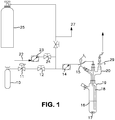
- a 250 mL Schlenk tube 19, fitted with an internal thermocouple probe (1 ⁇ 8" o.d. stainless steel, T-type) 15, 1 ⁇ 8" o.d. stainless steel ammonia sparge tube 18, and 1 ⁇ 4" o.d. HDPE tubing was charged with 100 mL of anhydrous anisole under nitrogen. The tube was placed in a temperature controlled bath. The end of the sparge tube was raised above the liquid level and the solvent was cooled to -35 °C (freezing point of anisole is - 37 °C). The head space nitrogen was then removed in vacuo from the Schlenk tube, with agitation of the solvent with magnetic stir bar 17, to a final pressure of less than 1 torr.
- a 7.8L (internal volume) carbon steel cylinder, which contained 900 torr pressure MCS (26.4 g, 397 mmoles) 25 was then condensed (through tube 27 ) into the adjacent U-trap (not shown) with the reaction tube closed.
- the valve adapter (see Figure 1 ) 29 on the Schlenk tube was then opened and the MCS in the U-trap was allowed to warm to ambient temperature, upon which it condensed into the reaction tube 19.
- the tube was cooled further to -60 °C and the internal pressure dropped to approximately 63 torr.
- the inert gas purge was reduced by adjusting the rotameter ( 14, Cole-Parmer 65-mm correlated flow meter, Aluminum with SS float; PN: EW-32044-06) to a lower setting (approximately 80% flow reduction).
- the anhydrous ammonia feed was then started by closing 24 and opening 12; the ammonia pressure and flow rate were adjusted by manipulating 11 and 14 (FM setting at 50).
- the sparge tube was quickly submerged into the MCS/anisole solution 16 and a white precipitate was immediately formed.
- the entire addition process was uneventful except for the formation of a mass of NH 4 Cl salt at the mid point of the solvent level in which no vortex was observed. Some gas breakthrough was observed toward the end of the addition. Very little salt formation was observed in the headspace and virtually no salt was observed at the top of the Claisen adapter 20.
- the Schlenk tube was periodically removed from the bath (not shown) and shaken to break up the ammonium chloride in the reaction zone. The ammonia feed rate was reduced (FM setting at 10) whenever this was done.
- the volatile components i.e.
- the yield of TSA based on the amount of ammonia "consumed” in the reaction, is 74.4% (98.8% purity checked by GC-MS analysis) with a total hydride recovery of 90+% (based on silicon content). No evidence of solvent fragmentation contamination was observed in the analysis of purified TSA.
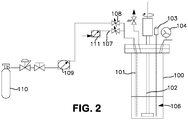
- Example 2 Synthesis using a 600 cc Parr reactor ( Figure 2 ).
- a 600 cc Parr 100 reactor was charged with 200 mL of anhydrous anisole 106 under nitrogen. (The reaction apparatus is shown in Figure 2 ) .
- the reactor was then cooled in an ice bath (not shown) and the nitrogen removed in vacuo.
- Monochlorosilane (65.7 g, 987 mmol., 200 mole % excess) was charged into the reactor through a dip tube 101.
- the internal pressure of the reactor was approximately 900 Torr at 0 °C.
- the dip tube was then purged with nitrogen delivered through flow meter 111 and tube 107 to clear the line and dip tube.
- Anhydrous ammonia was immediately added to the reactor through the dip tube.
- the reactor was stirred with a stirring rod 102 throughout the entire reagent loading and reaction time at a rate of 250 rpm.
- the temperature and pressure was monitored via an internal K-type thermocouple 103 and a 0-60 psig pressure gauge 104.
- Anhydrous ammonia (7.5 g, 440 mmol.) was added to the reactor at a rate of 140 mg/min. over the course of 54 minutes from the ammonia cylinder (440 cc sslb containing 6.7 g NH 3 , 393 mmoles; internal pressure approximately 100 psig) 110 through flow meter 109 and valve 108.
- the reaction mixture was stirred at 0 °C for an additional 45 minutes and the volatiles removed under dynamic vacuum.
- the product gas was collected in a U-trap (not shown) held at -196 °C downstream from a solvent trap (U-trap) cooled to -35 °C. Less than 2 mL of solvent was collected in the solvent trap.
- the product mixture was transferred to a 440 cc stainless steel lecture bottle and the contents were purified via fractional condensation using two U-traps cooled to -78 and -196 °C.
- the contents of the -78 °trap contained 9.84 g TSA (92 mmol., 83% yield) and the -196 °C trap contained excess MCS and trace silane.
- Examples 3 to 7 were prepared by the procedure of Example 2 under the conditions described in Table 1. The yield of each example is reported in Table 1.
- the first run was performed in glass, the rest in a 600 cc stirred Parr reactor.
- the gray boxes indicate product yields that may have contained a significant amount of solvent (toluene).
- the yield and mole percent hydrides recovered results may contain residual solvent contamination.
- the "% salt downstream” indicates a weight percentage of ammonium chloride that is collected in the cryo-trap from the maximum amount calculated (theoretical amount) for each experiment.
- the reactants are contacted in a manner that optimizes reaction conditions thereby avoiding excessive reaction conditions such as heat build up from the exothermic reaction which can result in product decomposition and the formation of synthesis byproducts, notably silane and silazane polymers.
- the process causes the ammonium halide by product of the reaction to stay in the reactor while the gaseous products such as disilylamine and trisilylamine are vacuum stripped from the solvent mixture and flow out of the reactor and are collected in a cold trap vessel substantially free of ammonium halide and solvent which can cause decomposition of the hydride products.
- ammonium halide byproduct of the synthesis is crystalline under reaction conditions, therefore it remains in the solvent in the reactor while the gaseous products continue to travel up the reactor and out of the reactor.
- the boiling point of trisilylamine is 52 degrees C at one atmosphere.
- the reactor is run at reduced pressure or at pressures up to about 2000 Torr.
- the reactor is kept at pressure of about equal to or lower than the vapor pressure of the monohalosilane at any given reaction temperature.
- the reactor pressure will drop as the monohalosilane is depleted.
- Preferably maintaining the reactor internal pressure at about 100 torr to about 1500 torr.
- a preferred operating pressure would be about two atmospheres or less.
- Maximum operating pressure is about 80 psig.
- the temperature of the solvent may optionally be adjusted prior to condensing monochlorosilane into the solvent to form a solution.
- the temperature of the solvent may be adjusted from about 70 degrees C to about - 78 degrees C, preferably about 60 degrees C to about - 20 degrees C, and most preferably from about 50 degrees C to about -20 degrees C.
- Monohalosilanes useful in the present invention include monofluorosilane, monochlorosilane, monobromosilane and monoiodosilane. Monochlorosilane is preferred.
- TSA was synthesized in a 4L Autoclave stirred-tank reactor with anisole as the solvent media. A total of six runs were conducted with varying target reaction temperatures, excess MCS amounts and the solvent to NH 3 ratio. Based on the results of the runs the following reaction conditions are recommended:
- TSA results are reported as a percent of theoritical yield.
- Solvent to NH 3 mass ratio equals about 25: 1 to about 30: 1. Solvent to NH 3 mass ration will be expressed as a whole number throughout this specification.
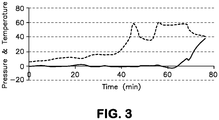
- FIG. 3 The temperature and pressure profile in the reactor as a function of time is shown in FIG. 3 .
- the top broken line in FIG. 3 represents temperature (degrees C) and the bottom solid line represents pressure (psig)
- the temperature and pressure profile as a function of time is shown in FIG. 4 .
- the top line in FIG. 4 represents temperature (degrees C) and the bottom line represents pressure (psig).
- the TSA Yield was 85.4 %
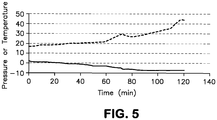
- the pressure and temperature profile during the run is given in FIG. 5 .
- the top line in FIG. 5 represents temperature (degrees C) and the bottom line represents pressure (psig).
- the TSA Yield was 94.3 %
- the reactor vapor phase was analyzed at different times during the run and the vapor phase concentration profile is given below.
- the above results indicate that as the MCS in the lqiuid phase is consumed, the reaction shifts to the vapor phase with the formation of TSA increasing with time, with a corresponding decrease of MCS.
- the increase of SiH 4 amount can either be (i) SiH 4 in the MCS feed or (ii) decomposition of TSA in anisole due to the presence of salts.
- the pressure and temperature profile during the run is as follows in FIG. 6 .
- the top line in FIG. 6 represents temperature (degrees C) and the bottom line represents pressure (psig).
- the TSA Yield was 81.9. %
- the reactor pressure was steady at about 5 psig for most of the run but after about 120 minutes the pressure increased rapidly. Samples of vapor phase in the reactor were taken at different times during the run.
- An analysis of the MCS feed showed that it contained about 1% silane and so based on the amount of MCS added it can be estimated that 1.08 gms of SiH 4 was added in the feed.
- An overall mass balance of silane showed that about 50% of the silane in the feed MCS is in the vapor phase and so the remaining should be solubilized in anisole.
- An independet set of tests conducted with MCS and anisole showed that about 66% of the SiH 4 in the MCS feed can be accounted for in the vapor phase.
- Partial pressure of the different species as a function of reaction time was calculated (see table below). Partial Pressure as a function of Time Time (min) SiH 4 (psia) MCS (psia) DSA (psia) TSA (psia) SiH 4 amt (grams) 0 2.89 17.11 0.06 0.03 0.52 5 3.73 16.64 0.23 0.06 0.68 38 4.47 11.13 1.29 0.74 0.81 75 5.19 10.59 0.40 1.98 0.94 123 15.00 0.05 4.75 8.05 2.72
- the differential partial pressure increases as a function of time. This is true even with a correction for an increase in reaction temperature as time progresses. This indicates that (i) there is some decomposition of TSA as more salt is formed or (ii) the silane dissolved in the solvent is slowly desobring as the reaction proceeds. Given that at the end of the NH 3 addition, the amount of silane in the vapor phase exceeded that amount added via the MCS feed, the decomposition of TSA in the presence of salt with SiH 4 evolving has been demonstrated.
- the pressure and temperature profile during the run is as follows in FIG. 6 .
- the top line in FIG. 7 represents temperature (degrees C) and the bottom line represents pressure (psig).
- the TSA Yield was 50.9 %
- Partial pressure of different species as a function of time is given in the following table. Partial Pressure as a function of Time Time (min) SiH 4 (psia) MCS (psia) DSA (psia) TSA (psia) NH 3 (psia) 0 1.84 17.49 0.03 0.03 0 5 1.94 16.48 0.02 0.03 0 36 2.18 15.08 0.16 0.17 0 73 2.80 13.66 0.17 0.88 0 153 15.88 0.06 5.98 12.89 3.19 183 12.20 0.04 2.56 3.19 8.11
- TSA in was analyzed by a gas chromatographic procedure. The analysis conditions are indicated below.
- Product to be analyzed TSA Impurities to be analyzed: purity Carrier Helium Column / Mesh RTX-1 Length 105m, 0.53mm i.d. Sampling condition Gas phase 100 Torr static Liquid phase - see NOTE 1 100 Torr static Reference - see NOTE 2 Varies Oven * Initial Temp (°C) / Time (min) 35/4.5 Ramp (°C / min) 25 Final Temp. (°C) / Time (min) 100/3.0 Standby (overnight) Temp. (°C) 35 Detector TCD Flow A (For TCD) 20 +/- 2 ml. / min Flow B (For Ref.
Landscapes
- Chemical & Material Sciences (AREA)
- Organic Chemistry (AREA)
- Inorganic Chemistry (AREA)
- Organic Low-Molecular-Weight Compounds And Preparation Thereof (AREA)
Priority Applications (1)
| Application Number | Priority Date | Filing Date | Title |
|---|---|---|---|
| EP19187693.7A EP3590888B1 (en) | 2011-10-07 | 2012-10-04 | Apparatus and method for the condensed phase production of trisilylamine |
Applications Claiming Priority (2)
| Application Number | Priority Date | Filing Date | Title |
|---|---|---|---|
| US201161544468P | 2011-10-07 | 2011-10-07 | |
| PCT/US2012/058764 WO2013052673A2 (en) | 2011-10-07 | 2012-10-04 | Apparatus and method for the condensed phase production of trisilylamine |
Related Child Applications (2)
| Application Number | Title | Priority Date | Filing Date |
|---|---|---|---|
| EP19187693.7A Division-Into EP3590888B1 (en) | 2011-10-07 | 2012-10-04 | Apparatus and method for the condensed phase production of trisilylamine |
| EP19187693.7A Division EP3590888B1 (en) | 2011-10-07 | 2012-10-04 | Apparatus and method for the condensed phase production of trisilylamine |
Publications (3)
| Publication Number | Publication Date |
|---|---|
| EP2763934A2 EP2763934A2 (en) | 2014-08-13 |
| EP2763934A4 EP2763934A4 (en) | 2015-04-22 |
| EP2763934B1 true EP2763934B1 (en) | 2019-09-04 |
Family
ID=48042206
Family Applications (2)
| Application Number | Title | Priority Date | Filing Date |
|---|---|---|---|
| EP12838215.7A Active EP2763934B1 (en) | 2011-10-07 | 2012-10-04 | Method for the condensed phase production of trisilylamine |
| EP19187693.7A Active EP3590888B1 (en) | 2011-10-07 | 2012-10-04 | Apparatus and method for the condensed phase production of trisilylamine |
Family Applications After (1)
| Application Number | Title | Priority Date | Filing Date |
|---|---|---|---|
| EP19187693.7A Active EP3590888B1 (en) | 2011-10-07 | 2012-10-04 | Apparatus and method for the condensed phase production of trisilylamine |
Country Status (9)
| Country | Link |
|---|---|
| US (1) | US8568682B2 (enExample) |
| EP (2) | EP2763934B1 (enExample) |
| JP (1) | JP6175439B2 (enExample) |
| KR (1) | KR101970850B1 (enExample) |
| CN (1) | CN103958401B (enExample) |
| CA (1) | CA2851242C (enExample) |
| SG (1) | SG11201401185VA (enExample) |
| TW (2) | TW201731765A (enExample) |
| WO (1) | WO2013052673A2 (enExample) |
Families Citing this family (21)
| Publication number | Priority date | Publication date | Assignee | Title |
|---|---|---|---|---|
| US9701540B2 (en) | 2011-10-07 | 2017-07-11 | L'Air Liquide, Société Anonyme pour l'Etude et l'Exploitation des Procédés Georges Claude | Apparatus and method for the condensed phase production of trisilylamine |
| US9446958B2 (en) | 2011-10-07 | 2016-09-20 | L'Air Liquide Societe Anonyme L'Etude Et L'Exploitation Des Procedes Georges Claude | Apparatus and method for the condensed phase production of trisilylamine |
| JP5877702B2 (ja) * | 2011-12-14 | 2016-03-08 | 株式会社ニューフレアテクノロジー | 成膜装置および成膜方法 |
| US20130209343A1 (en) * | 2012-02-10 | 2013-08-15 | American Air Liquide, Inc. | Liquid phase synthesis of trisilylamine |
| WO2014181194A2 (en) * | 2013-03-28 | 2014-11-13 | L'air Liquide Societe Anonyme Pour I'etude Et L'exploitation Des Procedes Georges Claude | Apparatus and method for the condensed phase production of trisilylamine |
| DE102013209802A1 (de) * | 2013-05-27 | 2014-11-27 | Evonik Industries Ag | Verfahren zur gekoppelten Herstellung von Trisilylamin und Polysilazanen mit einer Molmasse bis 500 g/mol |
| US9284198B2 (en) | 2013-06-28 | 2016-03-15 | Air Products And Chemicals, Inc. | Process for making trisilylamine |
| CN105849221B (zh) * | 2013-09-27 | 2019-06-18 | 乔治洛德方法研究和开发液化空气有限公司 | 胺取代的三甲硅烷基胺和三-二甲硅烷基胺化合物 |
| DE102014204785A1 (de) * | 2014-03-14 | 2015-09-17 | Evonik Degussa Gmbh | Verfahren zur Herstellung von reinem Trisilylamin |
| US11124876B2 (en) | 2015-03-30 | 2021-09-21 | L'Air Liquide, Société Anonyme pour l'Etude et l'Exploitation des Procédés Georges Claude | Si-containing film forming precursors and methods of using the same |
| US9777025B2 (en) | 2015-03-30 | 2017-10-03 | L'Air Liquide, Société pour l'Etude et l'Exploitation des Procédés Georges Claude | Si-containing film forming precursors and methods of using the same |
| EP3390411B1 (en) * | 2015-12-18 | 2020-09-30 | DDP Specialty Electronic Materials US 9, LLC | Method for making an organoaminosilane; a method for making a silylamine from the organoaminosilane |
| US10192734B2 (en) | 2016-12-11 | 2019-01-29 | L'Air Liquide, Société Anonyme pour l'Etude et l'Exploration des Procédés Georges Claude | Short inorganic trisilylamine-based polysilazanes for thin film deposition |
| CN108394876B (zh) * | 2017-02-07 | 2021-04-02 | 新疆晶硕新材料有限公司 | 氮硅烷及其生产方法、氮化硅及其生产方法 |
| CN108147378B (zh) * | 2018-02-07 | 2019-08-20 | 浙江博瑞电子科技有限公司 | 一种三甲基硅烷基胺的精制方法 |
| US12410056B2 (en) | 2019-10-22 | 2025-09-09 | Linde Gmbh | Systems and processes for production of trisilylamine |
| KR102435330B1 (ko) * | 2020-08-21 | 2022-08-23 | 에스케이스페셜티 주식회사 | 트리실릴아민의 제조 장치 및 제조 방법 |
| CN113912029B (zh) * | 2021-10-18 | 2023-02-21 | 浙江博瑞电子科技有限公司 | 一种超低温制备三甲硅烷基胺的方法 |
| CN114409547A (zh) * | 2022-01-27 | 2022-04-29 | 浙江普洛康裕制药有限公司 | 一种金刚烷胺的连续化生产方法及装置 |
| CN115947317A (zh) * | 2022-10-18 | 2023-04-11 | 洛阳中硅高科技有限公司 | 制备三甲硅烷基胺的系统及方法 |
| CN115591259B (zh) * | 2022-12-12 | 2023-04-07 | 天津绿菱气体有限公司 | 一种利用副产物再生三甲硅烷基胺的反应装置及方法 |
Family Cites Families (14)
| Publication number | Priority date | Publication date | Assignee | Title |
|---|---|---|---|---|
| US3809713A (en) | 1973-03-01 | 1974-05-07 | Union Carbide Corp | Process for producing silazane compounds |
| JPS5112608B2 (enExample) * | 1973-05-29 | 1976-04-21 | ||
| JPS54135098A (en) * | 1978-04-06 | 1979-10-19 | Youngu Yun Sun | Cylinder lock |
| JPS608967B2 (ja) * | 1978-04-11 | 1985-03-07 | 旭硝子株式会社 | 窒化珪素を製造する方法 |
| US4397828A (en) * | 1981-11-16 | 1983-08-09 | Massachusetts Institute Of Technology | Stable liquid polymeric precursor to silicon nitride and process |
| US5132354A (en) * | 1990-06-15 | 1992-07-21 | Ethyl Corporation | Silicon nitride precursor polymer |
| US5968611A (en) | 1997-11-26 | 1999-10-19 | The Research Foundation Of State University Of New York | Silicon nitrogen-based films and method of making the same |
| JP4358492B2 (ja) * | 2002-09-25 | 2009-11-04 | レール・リキード−ソシエテ・アノニム・プール・レテュード・エ・レクスプロワタシオン・デ・プロセデ・ジョルジュ・クロード | 熱化学気相成長法によるシリコン窒化物膜またはシリコンオキシ窒化物膜の製造方法 |
| JP4622350B2 (ja) * | 2004-04-30 | 2011-02-02 | 住友化学株式会社 | 改質された粒子およびその製造方法、担体、付加重合用触媒成分、付加重合用触媒および付加重合体の製造方法 |
| US7592402B2 (en) * | 2004-04-30 | 2009-09-22 | Sumitomo Chemical Company, Limited | Process for producing modified particle; carrier; catalyst component for addition polymerization; process for producing catalyst for addition polymerization; and process for producing addition polymer |
| JP5589295B2 (ja) * | 2009-03-30 | 2014-09-17 | 宇部興産株式会社 | 含窒素シラン化合物粉末及びその製造方法 |
| US8409513B2 (en) * | 2009-06-04 | 2013-04-02 | Voltaix, Inc. | Apparatus and method for the production of trisilylamine |
| US20110136347A1 (en) * | 2009-10-21 | 2011-06-09 | Applied Materials, Inc. | Point-of-use silylamine generation |
| US8461367B2 (en) | 2010-01-15 | 2013-06-11 | Shin-Etsu Chemical Co., Ltd. | Preparation process of trisilylamine |
-
2012
- 2012-10-04 KR KR1020147012279A patent/KR101970850B1/ko active Active
- 2012-10-04 WO PCT/US2012/058764 patent/WO2013052673A2/en not_active Ceased
- 2012-10-04 US US13/645,184 patent/US8568682B2/en active Active
- 2012-10-04 CA CA2851242A patent/CA2851242C/en active Active
- 2012-10-04 EP EP12838215.7A patent/EP2763934B1/en active Active
- 2012-10-04 EP EP19187693.7A patent/EP3590888B1/en active Active
- 2012-10-04 SG SG11201401185VA patent/SG11201401185VA/en unknown
- 2012-10-04 JP JP2014534723A patent/JP6175439B2/ja active Active
- 2012-10-04 CN CN201280049320.5A patent/CN103958401B/zh active Active
- 2012-10-08 TW TW106101260A patent/TW201731765A/zh unknown
- 2012-10-08 TW TW101137127A patent/TWI579235B/zh active
Non-Patent Citations (1)
| Title |
|---|
| None * |
Also Published As
| Publication number | Publication date |
|---|---|
| SG11201401185VA (en) | 2014-04-28 |
| TW201731765A (zh) | 2017-09-16 |
| CN103958401B (zh) | 2015-09-02 |
| WO2013052673A2 (en) | 2013-04-11 |
| CA2851242C (en) | 2021-02-23 |
| JP6175439B2 (ja) | 2017-08-02 |
| CA2851242A1 (en) | 2013-04-11 |
| KR101970850B1 (ko) | 2019-04-19 |
| CN103958401A (zh) | 2014-07-30 |
| WO2013052673A3 (en) | 2013-07-11 |
| KR20140098071A (ko) | 2014-08-07 |
| JP2014528898A (ja) | 2014-10-30 |
| TWI579235B (zh) | 2017-04-21 |
| US8568682B2 (en) | 2013-10-29 |
| TW201326042A (zh) | 2013-07-01 |
| EP2763934A2 (en) | 2014-08-13 |
| US20130089487A1 (en) | 2013-04-11 |
| EP3590888A1 (en) | 2020-01-08 |
| EP2763934A4 (en) | 2015-04-22 |
| EP3590888B1 (en) | 2022-02-16 |
Similar Documents
| Publication | Publication Date | Title |
|---|---|---|
| EP3590888B1 (en) | Apparatus and method for the condensed phase production of trisilylamine | |
| EP2437880B1 (en) | Method for the production of silylamines | |
| US7632478B2 (en) | Process for producing silicon | |
| CN104250007B (zh) | 制备三甲硅烷基胺的方法 | |
| JP5623296B2 (ja) | トリシリルアミンの製造方法 | |
| EP2812279A1 (en) | Liquid phase synthesis of trisilylamine | |
| EP0083374B1 (en) | Novel process for producing silicon hydride | |
| US9701540B2 (en) | Apparatus and method for the condensed phase production of trisilylamine | |
| WO2014181194A2 (en) | Apparatus and method for the condensed phase production of trisilylamine | |
| EP3418254B1 (en) | Method of making aluminum-free neopentasilane | |
| CN102286016A (zh) | 一种甲基氯硅烷的制备方法 | |
| US9446958B2 (en) | Apparatus and method for the condensed phase production of trisilylamine | |
| EP0112151B1 (en) | Process for production of silane | |
| JPH01197489A (ja) | 高純度水素化ジメチルアルミニウムの合成 | |
| JPS60260418A (ja) | 水素化ケイ素の製造方法 | |
| JPH0470247B2 (enExample) | ||
| JPH0480847B2 (enExample) |
Legal Events
| Date | Code | Title | Description |
|---|---|---|---|
| PUAI | Public reference made under article 153(3) epc to a published international application that has entered the european phase |
Free format text: ORIGINAL CODE: 0009012 |
|
| 17P | Request for examination filed |
Effective date: 20140328 |
|
| AK | Designated contracting states |
Kind code of ref document: A2 Designated state(s): AL AT BE BG CH CY CZ DE DK EE ES FI FR GB GR HR HU IE IS IT LI LT LU LV MC MK MT NL NO PL PT RO RS SE SI SK SM TR |
|
| DAX | Request for extension of the european patent (deleted) | ||
| A4 | Supplementary search report drawn up and despatched |
Effective date: 20150324 |
|
| RIC1 | Information provided on ipc code assigned before grant |
Ipc: C01B 21/087 20060101AFI20150313BHEP Ipc: B01J 19/18 20060101ALI20150313BHEP Ipc: B01J 8/00 20060101ALI20150313BHEP |
|
| RAP1 | Party data changed (applicant data changed or rights of an application transferred) |
Owner name: AIR LIQUIDE ADVANCED MATERIALS LLC |
|
| STAA | Information on the status of an ep patent application or granted ep patent |
Free format text: STATUS: EXAMINATION IS IN PROGRESS |
|
| 17Q | First examination report despatched |
Effective date: 20180727 |
|
| GRAP | Despatch of communication of intention to grant a patent |
Free format text: ORIGINAL CODE: EPIDOSNIGR1 |
|
| STAA | Information on the status of an ep patent application or granted ep patent |
Free format text: STATUS: GRANT OF PATENT IS INTENDED |
|
| INTG | Intention to grant announced |
Effective date: 20190403 |
|
| GRAS | Grant fee paid |
Free format text: ORIGINAL CODE: EPIDOSNIGR3 |
|
| GRAA | (expected) grant |
Free format text: ORIGINAL CODE: 0009210 |
|
| STAA | Information on the status of an ep patent application or granted ep patent |
Free format text: STATUS: THE PATENT HAS BEEN GRANTED |
|
| AK | Designated contracting states |
Kind code of ref document: B1 Designated state(s): AL AT BE BG CH CY CZ DE DK EE ES FI FR GB GR HR HU IE IS IT LI LT LU LV MC MK MT NL NO PL PT RO RS SE SI SK SM TR |
|
| REG | Reference to a national code |
Ref country code: GB Ref legal event code: FG4D |
|
| REG | Reference to a national code |
Ref country code: CH Ref legal event code: EP |
|
| REG | Reference to a national code |
Ref country code: AT Ref legal event code: REF Ref document number: 1175068 Country of ref document: AT Kind code of ref document: T Effective date: 20190915 |
|
| REG | Reference to a national code |
Ref country code: DE Ref legal event code: R096 Ref document number: 602012063725 Country of ref document: DE |
|
| REG | Reference to a national code |
Ref country code: IE Ref legal event code: FG4D |
|
| REG | Reference to a national code |
Ref country code: NL Ref legal event code: MP Effective date: 20190904 |
|
| REG | Reference to a national code |
Ref country code: LT Ref legal event code: MG4D |
|
| PG25 | Lapsed in a contracting state [announced via postgrant information from national office to epo] |
Ref country code: SE Free format text: LAPSE BECAUSE OF FAILURE TO SUBMIT A TRANSLATION OF THE DESCRIPTION OR TO PAY THE FEE WITHIN THE PRESCRIBED TIME-LIMIT Effective date: 20190904 Ref country code: HR Free format text: LAPSE BECAUSE OF FAILURE TO SUBMIT A TRANSLATION OF THE DESCRIPTION OR TO PAY THE FEE WITHIN THE PRESCRIBED TIME-LIMIT Effective date: 20190904 Ref country code: FI Free format text: LAPSE BECAUSE OF FAILURE TO SUBMIT A TRANSLATION OF THE DESCRIPTION OR TO PAY THE FEE WITHIN THE PRESCRIBED TIME-LIMIT Effective date: 20190904 Ref country code: LT Free format text: LAPSE BECAUSE OF FAILURE TO SUBMIT A TRANSLATION OF THE DESCRIPTION OR TO PAY THE FEE WITHIN THE PRESCRIBED TIME-LIMIT Effective date: 20190904 Ref country code: NO Free format text: LAPSE BECAUSE OF FAILURE TO SUBMIT A TRANSLATION OF THE DESCRIPTION OR TO PAY THE FEE WITHIN THE PRESCRIBED TIME-LIMIT Effective date: 20191204 Ref country code: BG Free format text: LAPSE BECAUSE OF FAILURE TO SUBMIT A TRANSLATION OF THE DESCRIPTION OR TO PAY THE FEE WITHIN THE PRESCRIBED TIME-LIMIT Effective date: 20191204 |
|
| PG25 | Lapsed in a contracting state [announced via postgrant information from national office to epo] |
Ref country code: AL Free format text: LAPSE BECAUSE OF FAILURE TO SUBMIT A TRANSLATION OF THE DESCRIPTION OR TO PAY THE FEE WITHIN THE PRESCRIBED TIME-LIMIT Effective date: 20190904 Ref country code: ES Free format text: LAPSE BECAUSE OF FAILURE TO SUBMIT A TRANSLATION OF THE DESCRIPTION OR TO PAY THE FEE WITHIN THE PRESCRIBED TIME-LIMIT Effective date: 20190904 Ref country code: RS Free format text: LAPSE BECAUSE OF FAILURE TO SUBMIT A TRANSLATION OF THE DESCRIPTION OR TO PAY THE FEE WITHIN THE PRESCRIBED TIME-LIMIT Effective date: 20190904 Ref country code: LV Free format text: LAPSE BECAUSE OF FAILURE TO SUBMIT A TRANSLATION OF THE DESCRIPTION OR TO PAY THE FEE WITHIN THE PRESCRIBED TIME-LIMIT Effective date: 20190904 Ref country code: GR Free format text: LAPSE BECAUSE OF FAILURE TO SUBMIT A TRANSLATION OF THE DESCRIPTION OR TO PAY THE FEE WITHIN THE PRESCRIBED TIME-LIMIT Effective date: 20191205 |
|
| REG | Reference to a national code |
Ref country code: AT Ref legal event code: MK05 Ref document number: 1175068 Country of ref document: AT Kind code of ref document: T Effective date: 20190904 |
|
| PG25 | Lapsed in a contracting state [announced via postgrant information from national office to epo] |
Ref country code: RO Free format text: LAPSE BECAUSE OF FAILURE TO SUBMIT A TRANSLATION OF THE DESCRIPTION OR TO PAY THE FEE WITHIN THE PRESCRIBED TIME-LIMIT Effective date: 20190904 Ref country code: IT Free format text: LAPSE BECAUSE OF FAILURE TO SUBMIT A TRANSLATION OF THE DESCRIPTION OR TO PAY THE FEE WITHIN THE PRESCRIBED TIME-LIMIT Effective date: 20190904 Ref country code: PT Free format text: LAPSE BECAUSE OF FAILURE TO SUBMIT A TRANSLATION OF THE DESCRIPTION OR TO PAY THE FEE WITHIN THE PRESCRIBED TIME-LIMIT Effective date: 20200106 Ref country code: NL Free format text: LAPSE BECAUSE OF FAILURE TO SUBMIT A TRANSLATION OF THE DESCRIPTION OR TO PAY THE FEE WITHIN THE PRESCRIBED TIME-LIMIT Effective date: 20190904 Ref country code: EE Free format text: LAPSE BECAUSE OF FAILURE TO SUBMIT A TRANSLATION OF THE DESCRIPTION OR TO PAY THE FEE WITHIN THE PRESCRIBED TIME-LIMIT Effective date: 20190904 Ref country code: PL Free format text: LAPSE BECAUSE OF FAILURE TO SUBMIT A TRANSLATION OF THE DESCRIPTION OR TO PAY THE FEE WITHIN THE PRESCRIBED TIME-LIMIT Effective date: 20190904 Ref country code: AT Free format text: LAPSE BECAUSE OF FAILURE TO SUBMIT A TRANSLATION OF THE DESCRIPTION OR TO PAY THE FEE WITHIN THE PRESCRIBED TIME-LIMIT Effective date: 20190904 |
|
| PG25 | Lapsed in a contracting state [announced via postgrant information from national office to epo] |
Ref country code: CZ Free format text: LAPSE BECAUSE OF FAILURE TO SUBMIT A TRANSLATION OF THE DESCRIPTION OR TO PAY THE FEE WITHIN THE PRESCRIBED TIME-LIMIT Effective date: 20190904 Ref country code: IS Free format text: LAPSE BECAUSE OF FAILURE TO SUBMIT A TRANSLATION OF THE DESCRIPTION OR TO PAY THE FEE WITHIN THE PRESCRIBED TIME-LIMIT Effective date: 20200224 Ref country code: SM Free format text: LAPSE BECAUSE OF FAILURE TO SUBMIT A TRANSLATION OF THE DESCRIPTION OR TO PAY THE FEE WITHIN THE PRESCRIBED TIME-LIMIT Effective date: 20190904 Ref country code: SK Free format text: LAPSE BECAUSE OF FAILURE TO SUBMIT A TRANSLATION OF THE DESCRIPTION OR TO PAY THE FEE WITHIN THE PRESCRIBED TIME-LIMIT Effective date: 20190904 |
|
| REG | Reference to a national code |
Ref country code: CH Ref legal event code: PL |
|
| REG | Reference to a national code |
Ref country code: DE Ref legal event code: R097 Ref document number: 602012063725 Country of ref document: DE |
|
| PLBE | No opposition filed within time limit |
Free format text: ORIGINAL CODE: 0009261 |
|
| STAA | Information on the status of an ep patent application or granted ep patent |
Free format text: STATUS: NO OPPOSITION FILED WITHIN TIME LIMIT |
|
| PG2D | Information on lapse in contracting state deleted |
Ref country code: IS |
|
| PG25 | Lapsed in a contracting state [announced via postgrant information from national office to epo] |
Ref country code: DK Free format text: LAPSE BECAUSE OF FAILURE TO SUBMIT A TRANSLATION OF THE DESCRIPTION OR TO PAY THE FEE WITHIN THE PRESCRIBED TIME-LIMIT Effective date: 20190904 Ref country code: LI Free format text: LAPSE BECAUSE OF NON-PAYMENT OF DUE FEES Effective date: 20191031 Ref country code: CH Free format text: LAPSE BECAUSE OF NON-PAYMENT OF DUE FEES Effective date: 20191031 Ref country code: LU Free format text: LAPSE BECAUSE OF NON-PAYMENT OF DUE FEES Effective date: 20191004 Ref country code: IS Free format text: LAPSE BECAUSE OF FAILURE TO SUBMIT A TRANSLATION OF THE DESCRIPTION OR TO PAY THE FEE WITHIN THE PRESCRIBED TIME-LIMIT Effective date: 20200105 |
|
| 26N | No opposition filed |
Effective date: 20200605 |
|
| REG | Reference to a national code |
Ref country code: BE Ref legal event code: MM Effective date: 20191031 |
|
| PG25 | Lapsed in a contracting state [announced via postgrant information from national office to epo] |
Ref country code: BE Free format text: LAPSE BECAUSE OF NON-PAYMENT OF DUE FEES Effective date: 20191031 Ref country code: MC Free format text: LAPSE BECAUSE OF FAILURE TO SUBMIT A TRANSLATION OF THE DESCRIPTION OR TO PAY THE FEE WITHIN THE PRESCRIBED TIME-LIMIT Effective date: 20190904 Ref country code: SI Free format text: LAPSE BECAUSE OF FAILURE TO SUBMIT A TRANSLATION OF THE DESCRIPTION OR TO PAY THE FEE WITHIN THE PRESCRIBED TIME-LIMIT Effective date: 20190904 |
|
| GBPC | Gb: european patent ceased through non-payment of renewal fee |
Effective date: 20191204 |
|
| PG25 | Lapsed in a contracting state [announced via postgrant information from national office to epo] |
Ref country code: FR Free format text: LAPSE BECAUSE OF NON-PAYMENT OF DUE FEES Effective date: 20191104 Ref country code: IE Free format text: LAPSE BECAUSE OF NON-PAYMENT OF DUE FEES Effective date: 20191004 Ref country code: GB Free format text: LAPSE BECAUSE OF NON-PAYMENT OF DUE FEES Effective date: 20191204 |
|
| PG25 | Lapsed in a contracting state [announced via postgrant information from national office to epo] |
Ref country code: CY Free format text: LAPSE BECAUSE OF FAILURE TO SUBMIT A TRANSLATION OF THE DESCRIPTION OR TO PAY THE FEE WITHIN THE PRESCRIBED TIME-LIMIT Effective date: 20190904 |
|
| PG25 | Lapsed in a contracting state [announced via postgrant information from national office to epo] |
Ref country code: HU Free format text: LAPSE BECAUSE OF FAILURE TO SUBMIT A TRANSLATION OF THE DESCRIPTION OR TO PAY THE FEE WITHIN THE PRESCRIBED TIME-LIMIT; INVALID AB INITIO Effective date: 20121004 Ref country code: MT Free format text: LAPSE BECAUSE OF FAILURE TO SUBMIT A TRANSLATION OF THE DESCRIPTION OR TO PAY THE FEE WITHIN THE PRESCRIBED TIME-LIMIT Effective date: 20190904 |
|
| PG25 | Lapsed in a contracting state [announced via postgrant information from national office to epo] |
Ref country code: TR Free format text: LAPSE BECAUSE OF FAILURE TO SUBMIT A TRANSLATION OF THE DESCRIPTION OR TO PAY THE FEE WITHIN THE PRESCRIBED TIME-LIMIT Effective date: 20190904 |
|
| PG25 | Lapsed in a contracting state [announced via postgrant information from national office to epo] |
Ref country code: MK Free format text: LAPSE BECAUSE OF FAILURE TO SUBMIT A TRANSLATION OF THE DESCRIPTION OR TO PAY THE FEE WITHIN THE PRESCRIBED TIME-LIMIT Effective date: 20190904 |
|
| PGFP | Annual fee paid to national office [announced via postgrant information from national office to epo] |
Ref country code: DE Payment date: 20251021 Year of fee payment: 14 |