EP2761688B1 - Graphene oxide as a sulfur immobilizer in high performance lithium/sulfur cells - Google Patents
Graphene oxide as a sulfur immobilizer in high performance lithium/sulfur cells Download PDFInfo
- Publication number
- EP2761688B1 EP2761688B1 EP12835530.2A EP12835530A EP2761688B1 EP 2761688 B1 EP2761688 B1 EP 2761688B1 EP 12835530 A EP12835530 A EP 12835530A EP 2761688 B1 EP2761688 B1 EP 2761688B1
- Authority
- EP
- European Patent Office
- Prior art keywords
- sulfur
- nanocomposite
- graphene oxide
- solution
- group
- Prior art date
- Legal status (The legal status is an assumption and is not a legal conclusion. Google has not performed a legal analysis and makes no representation as to the accuracy of the status listed.)
- Active
Links
Images






Classifications
-
- H—ELECTRICITY
- H01—ELECTRIC ELEMENTS
- H01M—PROCESSES OR MEANS, e.g. BATTERIES, FOR THE DIRECT CONVERSION OF CHEMICAL ENERGY INTO ELECTRICAL ENERGY
- H01M4/00—Electrodes
- H01M4/02—Electrodes composed of, or comprising, active material
- H01M4/36—Selection of substances as active materials, active masses, active liquids
- H01M4/58—Selection of substances as active materials, active masses, active liquids of inorganic compounds other than oxides or hydroxides, e.g. sulfides, selenides, tellurides, halogenides or LiCoFy; of polyanionic structures, e.g. phosphates, silicates or borates
- H01M4/583—Carbonaceous material, e.g. graphite-intercalation compounds or CFx
-
- H—ELECTRICITY
- H01—ELECTRIC ELEMENTS
- H01M—PROCESSES OR MEANS, e.g. BATTERIES, FOR THE DIRECT CONVERSION OF CHEMICAL ENERGY INTO ELECTRICAL ENERGY
- H01M4/00—Electrodes
- H01M4/02—Electrodes composed of, or comprising, active material
- H01M4/36—Selection of substances as active materials, active masses, active liquids
- H01M4/362—Composites
- H01M4/364—Composites as mixtures
-
- C—CHEMISTRY; METALLURGY
- C01—INORGANIC CHEMISTRY
- C01B—NON-METALLIC ELEMENTS; COMPOUNDS THEREOF; METALLOIDS OR COMPOUNDS THEREOF NOT COVERED BY SUBCLASS C01C
- C01B32/00—Carbon; Compounds thereof
- C01B32/70—Compounds containing carbon and sulfur, e.g. thiophosgene
-
- C—CHEMISTRY; METALLURGY
- C01—INORGANIC CHEMISTRY
- C01B—NON-METALLIC ELEMENTS; COMPOUNDS THEREOF; METALLOIDS OR COMPOUNDS THEREOF NOT COVERED BY SUBCLASS C01C
- C01B32/00—Carbon; Compounds thereof
- C01B32/20—Graphite
- C01B32/21—After-treatment
- C01B32/23—Oxidation
-
- C—CHEMISTRY; METALLURGY
- C07—ORGANIC CHEMISTRY
- C07D—HETEROCYCLIC COMPOUNDS
- C07D303/00—Compounds containing three-membered rings having one oxygen atom as the only ring hetero atom
- C07D303/02—Compounds containing oxirane rings
- C07D303/38—Compounds containing oxirane rings with hydrocarbon radicals, substituted by carbon atoms having three bonds to hetero atoms with at the most one bond to halogen, e.g. ester or nitrile radicals
-
- H—ELECTRICITY
- H01—ELECTRIC ELEMENTS
- H01M—PROCESSES OR MEANS, e.g. BATTERIES, FOR THE DIRECT CONVERSION OF CHEMICAL ENERGY INTO ELECTRICAL ENERGY
- H01M10/00—Secondary cells; Manufacture thereof
- H01M10/05—Accumulators with non-aqueous electrolyte
- H01M10/052—Li-accumulators
- H01M10/0525—Rocking-chair batteries, i.e. batteries with lithium insertion or intercalation in both electrodes; Lithium-ion batteries
-
- H—ELECTRICITY
- H01—ELECTRIC ELEMENTS
- H01M—PROCESSES OR MEANS, e.g. BATTERIES, FOR THE DIRECT CONVERSION OF CHEMICAL ENERGY INTO ELECTRICAL ENERGY
- H01M10/00—Secondary cells; Manufacture thereof
- H01M10/05—Accumulators with non-aqueous electrolyte
- H01M10/056—Accumulators with non-aqueous electrolyte characterised by the materials used as electrolytes, e.g. mixed inorganic/organic electrolytes
- H01M10/0564—Accumulators with non-aqueous electrolyte characterised by the materials used as electrolytes, e.g. mixed inorganic/organic electrolytes the electrolyte being constituted of organic materials only
- H01M10/0566—Liquid materials
-
- H—ELECTRICITY
- H01—ELECTRIC ELEMENTS
- H01M—PROCESSES OR MEANS, e.g. BATTERIES, FOR THE DIRECT CONVERSION OF CHEMICAL ENERGY INTO ELECTRICAL ENERGY
- H01M4/00—Electrodes
- H01M4/02—Electrodes composed of, or comprising, active material
- H01M4/36—Selection of substances as active materials, active masses, active liquids
- H01M4/38—Selection of substances as active materials, active masses, active liquids of elements or alloys
- H01M4/381—Alkaline or alkaline earth metals elements
- H01M4/382—Lithium
-
- H—ELECTRICITY
- H01—ELECTRIC ELEMENTS
- H01M—PROCESSES OR MEANS, e.g. BATTERIES, FOR THE DIRECT CONVERSION OF CHEMICAL ENERGY INTO ELECTRICAL ENERGY
- H01M4/00—Electrodes
- H01M4/02—Electrodes composed of, or comprising, active material
- H01M4/36—Selection of substances as active materials, active masses, active liquids
- H01M4/58—Selection of substances as active materials, active masses, active liquids of inorganic compounds other than oxides or hydroxides, e.g. sulfides, selenides, tellurides, halogenides or LiCoFy; of polyanionic structures, e.g. phosphates, silicates or borates
- H01M4/583—Carbonaceous material, e.g. graphite-intercalation compounds or CFx
- H01M4/587—Carbonaceous material, e.g. graphite-intercalation compounds or CFx for inserting or intercalating light metals
-
- H—ELECTRICITY
- H01—ELECTRIC ELEMENTS
- H01M—PROCESSES OR MEANS, e.g. BATTERIES, FOR THE DIRECT CONVERSION OF CHEMICAL ENERGY INTO ELECTRICAL ENERGY
- H01M50/00—Constructional details or processes of manufacture of the non-active parts of electrochemical cells other than fuel cells, e.g. hybrid cells
- H01M50/40—Separators; Membranes; Diaphragms; Spacing elements inside cells
- H01M50/409—Separators, membranes or diaphragms characterised by the material
- H01M50/411—Organic material
- H01M50/414—Synthetic resins, e.g. thermoplastics or thermosetting resins
- H01M50/417—Polyolefins
-
- C—CHEMISTRY; METALLURGY
- C01—INORGANIC CHEMISTRY
- C01P—INDEXING SCHEME RELATING TO STRUCTURAL AND PHYSICAL ASPECTS OF SOLID INORGANIC COMPOUNDS
- C01P2002/00—Crystal-structural characteristics
- C01P2002/70—Crystal-structural characteristics defined by measured X-ray, neutron or electron diffraction data
- C01P2002/72—Crystal-structural characteristics defined by measured X-ray, neutron or electron diffraction data by d-values or two theta-values, e.g. as X-ray diagram
-
- C—CHEMISTRY; METALLURGY
- C01—INORGANIC CHEMISTRY
- C01P—INDEXING SCHEME RELATING TO STRUCTURAL AND PHYSICAL ASPECTS OF SOLID INORGANIC COMPOUNDS
- C01P2002/00—Crystal-structural characteristics
- C01P2002/80—Crystal-structural characteristics defined by measured data other than those specified in group C01P2002/70
- C01P2002/82—Crystal-structural characteristics defined by measured data other than those specified in group C01P2002/70 by IR- or Raman-data
-
- C—CHEMISTRY; METALLURGY
- C01—INORGANIC CHEMISTRY
- C01P—INDEXING SCHEME RELATING TO STRUCTURAL AND PHYSICAL ASPECTS OF SOLID INORGANIC COMPOUNDS
- C01P2002/00—Crystal-structural characteristics
- C01P2002/80—Crystal-structural characteristics defined by measured data other than those specified in group C01P2002/70
- C01P2002/85—Crystal-structural characteristics defined by measured data other than those specified in group C01P2002/70 by XPS, EDX or EDAX data
-
- C—CHEMISTRY; METALLURGY
- C01—INORGANIC CHEMISTRY
- C01P—INDEXING SCHEME RELATING TO STRUCTURAL AND PHYSICAL ASPECTS OF SOLID INORGANIC COMPOUNDS
- C01P2002/00—Crystal-structural characteristics
- C01P2002/80—Crystal-structural characteristics defined by measured data other than those specified in group C01P2002/70
- C01P2002/88—Crystal-structural characteristics defined by measured data other than those specified in group C01P2002/70 by thermal analysis data, e.g. TGA, DTA, DSC
-
- C—CHEMISTRY; METALLURGY
- C01—INORGANIC CHEMISTRY
- C01P—INDEXING SCHEME RELATING TO STRUCTURAL AND PHYSICAL ASPECTS OF SOLID INORGANIC COMPOUNDS
- C01P2004/00—Particle morphology
- C01P2004/01—Particle morphology depicted by an image
- C01P2004/03—Particle morphology depicted by an image obtained by SEM
-
- C—CHEMISTRY; METALLURGY
- C01—INORGANIC CHEMISTRY
- C01P—INDEXING SCHEME RELATING TO STRUCTURAL AND PHYSICAL ASPECTS OF SOLID INORGANIC COMPOUNDS
- C01P2004/00—Particle morphology
- C01P2004/01—Particle morphology depicted by an image
- C01P2004/04—Particle morphology depicted by an image obtained by TEM, STEM, STM or AFM
-
- C—CHEMISTRY; METALLURGY
- C01—INORGANIC CHEMISTRY
- C01P—INDEXING SCHEME RELATING TO STRUCTURAL AND PHYSICAL ASPECTS OF SOLID INORGANIC COMPOUNDS
- C01P2006/00—Physical properties of inorganic compounds
- C01P2006/40—Electric properties
-
- H—ELECTRICITY
- H01—ELECTRIC ELEMENTS
- H01M—PROCESSES OR MEANS, e.g. BATTERIES, FOR THE DIRECT CONVERSION OF CHEMICAL ENERGY INTO ELECTRICAL ENERGY
- H01M2300/00—Electrolytes
- H01M2300/0017—Non-aqueous electrolytes
- H01M2300/0025—Organic electrolyte
- H01M2300/0045—Room temperature molten salts comprising at least one organic ion
-
- H—ELECTRICITY
- H01—ELECTRIC ELEMENTS
- H01M—PROCESSES OR MEANS, e.g. BATTERIES, FOR THE DIRECT CONVERSION OF CHEMICAL ENERGY INTO ELECTRICAL ENERGY
- H01M4/00—Electrodes
- H01M4/02—Electrodes composed of, or comprising, active material
- H01M4/62—Selection of inactive substances as ingredients for active masses, e.g. binders, fillers
- H01M4/624—Electric conductive fillers
- H01M4/625—Carbon or graphite
-
- Y—GENERAL TAGGING OF NEW TECHNOLOGICAL DEVELOPMENTS; GENERAL TAGGING OF CROSS-SECTIONAL TECHNOLOGIES SPANNING OVER SEVERAL SECTIONS OF THE IPC; TECHNICAL SUBJECTS COVERED BY FORMER USPC CROSS-REFERENCE ART COLLECTIONS [XRACs] AND DIGESTS
- Y02—TECHNOLOGIES OR APPLICATIONS FOR MITIGATION OR ADAPTATION AGAINST CLIMATE CHANGE
- Y02E—REDUCTION OF GREENHOUSE GAS [GHG] EMISSIONS, RELATED TO ENERGY GENERATION, TRANSMISSION OR DISTRIBUTION
- Y02E60/00—Enabling technologies; Technologies with a potential or indirect contribution to GHG emissions mitigation
- Y02E60/10—Energy storage using batteries
-
- Y—GENERAL TAGGING OF NEW TECHNOLOGICAL DEVELOPMENTS; GENERAL TAGGING OF CROSS-SECTIONAL TECHNOLOGIES SPANNING OVER SEVERAL SECTIONS OF THE IPC; TECHNICAL SUBJECTS COVERED BY FORMER USPC CROSS-REFERENCE ART COLLECTIONS [XRACs] AND DIGESTS
- Y02—TECHNOLOGIES OR APPLICATIONS FOR MITIGATION OR ADAPTATION AGAINST CLIMATE CHANGE
- Y02P—CLIMATE CHANGE MITIGATION TECHNOLOGIES IN THE PRODUCTION OR PROCESSING OF GOODS
- Y02P70/00—Climate change mitigation technologies in the production process for final industrial or consumer products
- Y02P70/50—Manufacturing or production processes characterised by the final manufactured product
Definitions
- Elemental sulfur (S) is very attractive as a cathode material for high-specific-energy rechargeable lithium batteries, because a battery based on the lithium/sulfur (Li/S) couple would yield a theoretical specific capacity of about 1675 mAh g -1 with a theoretical specific energy of 2600 Wh kg -1 on the assumption of the complete reaction of Li with S to form Li 2 S.
- Li/S lithium/sulfur
- S is also inexpensive, abundant and nontoxic. Therefore, S is a promising cathode material for high-energy-density Li/S batteries.
- the first one is the high electrical resistivity of elemental S.
- the second one is the high solubility (in organic solvent electrolytes) of the polysulfide ions that are formed during the discharge/charge processes.
- the soluble intermediate Li polysulfides can diffuse through the electrolyte to the Li anode where they are reduced to form solid precipitates (such as Li 2 S or Li 2 S 2 ). These reduced products can also diffuse back to the cathode during recharging. These issues can lead to low active materials utilization, low coulombic efficiency, and short cycle life of the S electrode.
- various carbon and conductive polymer materials have been used to accommodate S and so to overcome its insulating property and reduce the dissolution of Li polysulfides, as reported by Nazar, et al. and others.
- US2011/052813 refers to functionalised graphene oxide
- US2010/317790 refers to graphene composite nanofibers and a preparation method thereof and the article " Graphene-Wrapped Sulfur Particles as a Rechargeable Lithium-Sulfur Battery Cathode Material with High Capacity and Cycling Stability" in the Nano Letters of the American Chemical Society published 2011-06-24 of Hailiang Wang ; Yuan Yang et al. refers to graphene - sulfur composites for lithium sulfur batteries.
- the present invention is a composition for high performance lithium-sulfur cells according to claim 1 and a method for preparing such a composition according to claim 6.
- various process steps may or may not be described using certain types of manufacturing equipment, along with certain process parameters. It is to be appreciated that other types of equipment can be used, with different process parameters employed, and that some of the steps may be performed in other manufacturing equipment without departing from the scope of the claims. Furthermore, different process parameters or manufacturing equipment could be substituted for those described herein without departing from the scope of the claims.
- FIG. 1a shows a scanning electron microscope (SEM) image of a GO-S nanocomposite.
- Figure 1b illustrates the structure and properties of graphene oxide (GO) which may depend on a particular synthesis method and degree of oxidation.
- the illustrated GO structure comprises functional groups including a) epoxy bridges, b) hydroxyl groups, and c) pairwise carboxyl groups.
- GO typically preserves the layer structure of the parent graphite, but the layers are buckled and the interlayer spacing is about two times larger (-0.7 nm) than that of graphite.
- nano-S was deposited onto graphene oxide (GO) sheets by a chemical reaction-deposition method (see below experimental details section for further details). Then, the as-synthesized samples were heat treated in an argon (Ar) environment at low temperature (155°C) for 12 hours in order to remove some of the bulk S which is not directly attached to the GO layers.
- Ar argon
- the bulk S on the external surface of the GO melted and diffused into the pores of the GO due to the strong adsorption effects derived from both the high surface area and the functional groups on the surface of the GO.
- this low-temperature heat treatment process can partially remove and/or chemically modify some of the functional groups on the GO surface and improve the electronic conductivity of the as-prepared GO-S nanocomposites (See Table 1 below, wherein these materials were heat treated in Ar environment at 155°C for 12 hour). Table 1. Conductivities of the prepared materials. Sample name GO Heat treated GO Heat treated GO-S nanocomposites Conductivity (S cm -1 ) 0.00129 0.316 0.105
- Figure 1a shows the SEM image of the as-prepared GO-S nanocomposite after heat treatment.
- the layer-like extremely conjugated nanostructures with a highly developed porous structure are clearly illustrated.
- the energy-dispersive X-ray (EDX) microanalysis in Figure 1c confirms the existence of S in the composites.
- TGA thermo gravimetric analysis
- Figure 5 illustrates a TGA curve of GO-S nanocomposite recorded in N 2 with a heating rate of 10 °C min -1 before (a) and after (b) heat treatment in Ar environment at 155°C for 12 hours; (c) Pure GO after heat treatment in Ar environment at 155°C for 12 hours.
- TEM transmission electron microscope
- EELS electron energy-loss spectrum
- the unique structure of the GO-S nanocomposite can improve the overall electrochemical performance when it is used as a cathode material for Li/S batteries. Firstly, it can accommodate the significant volume changes of the S as it is converted to Li 2 S on discharge, and back to elemental S on recharge. In addition, the partially reduced GO with its large surface area along with ubiquitous cavities can establish more intimate electronic contact with the S and avoid their aggregation and loss of electrical contact with the current collector. Secondly, the low-temperature heat-treated GO still contains various types of functional groups.
- Figure 9 illustrates ATR-FTIR spectra of GO.
- the GO was heat treated in Ar at 155 °C for 12 hours. These functional groups can have strong adsorbing ability to anchor S atoms and to effectively prevent the subsequently formed Li polysulfides from dissolving in the electrolyte during cycling.
- Figure 4 (a) shows the cyclic voltammetry (CV) profile of one electrode.
- the measurement was conducted at a scan rate of 0.05 mVs -1 in the voltage range of 1.0 to 3.6V vs Li/Li + .
- three main reduction peaks at around 2.4, 2.1, and 1.8 V were clearly shown.
- the peak at around 2.4V can be assigned to the reduction of elemental S to higher-order Li polysulfides (Li 2 S n , n ⁇ 8).
- the peak at about 2.1V probably corresponds to the reduction of higher-order Li polysulfides to lower-order Li polysulfides (such as Li 2 S 6 , Li 2 S 4 ) from Li 2 S 8 .
- the peak at 1.8V is related to the reduction of polysulfide species to form Li 2 S.
- the GO-S nanocomposite delivers a high initial discharge capacity of about 1320 mAh g -1 at 0.02C.
- the corresponding coulombic efficiency in the first discharge/charge cycle is 96.4%.
- Figure 4 (c) shows the cycling performance of the same cell cycled at a rate of 0.1 C after the initial 2 cycles at 0.02C.
- the discharge capacity of the first cycle at 0.1C remains at around 1000 mAh g -1 .
- this value decreases to about 950 mAh g -1 .
- the reversible capacity remains at 954 mAh g -1 (with a coulombic efficiency of about 96.7%), indicating very stable reversibility of the electrochemical reactions and excellent capacity retention.
- the cycle performance of another coin cell is further illustrated in Figure 14 .
- the GO-S nanocomposite was heat treated in Ar at 155 °C for 12 hours.
- the S content of the GO-S nanocomposite was 66 wt%, and the S content of the cathode (including carbon black and binder) was 46.2 wt%.
- the GO-S nanocomposites display improved coulombic efficiencies compared to former reports.
- Figure 15 illustrates a typical discharge/charge profiles (potential vs. capacity) at various C rates for GO-S nanocomposite cathode.
- the GO-S nanocomposites were heat treated in Ar at 155 °C for 12 hours.
- the S content of the GO-S nanocomposite was 66 wt%, and the S content of the cathode (including carbon black and binder) was 46.2 wt%.
- the GO clearly performs very well as a means to stabilize the S electrode.
- the GO provides highly reactive functional groups on its surface that can serve as immobilizers to hold the S. Also by limiting the concentration of the polysulfide anions in the electrolyte, the redox shuttle phenomenon is largely avoided.
- the intimate contact of the S provided by the large surface area and the functional groups on GO is favorable to good electron/ion accessibility, leading to enhanced cycle performance and rate capability.
- the optimized ionic liquid-based electrolytes which have suitable viscosities and wetting properties influence the penetration of electrolyte into the S electrode structure, while increasing the ionic conductivity within the electrodes at the same time.
- the GO-S nanocomposite cathode has a very high initial reversible capacity of about 1304 mAh g -1 at 0.02C with the corresponding coulombic efficiency of about 94.7% in the LiTFSI-PEGDME electrolyte.
- a large discharge capacity of about 1014 mAh g -1 still can be delivered at the first cycle at 0.1C with a corresponding coulombic efficiency of about 100%.
- the capacity is about 736 mAh g -1 , and the corresponding coulombic efficiency is only about 69.7%.
- a novel chemical reaction-deposition method is employed to synthesize a GO-S nanocomposite to immobilize S in the cathode material of Li/S cells.
- the GO-S nanocomposite cathodes display good reversibility, excellent capacity stability of about 1000 mAh g -1 , and rate capability of up to 2C in ionic liquid-based electrolyte.
- the GO in the heat-treated composites have good conductivity, extremely high surface-area, and provide a robust electron transport network.
- the functional groups on the GO surface play the role of immobilizers that keep intimate contact of the conducting matrix with S species, and effectively confine any polysulfides from dissolving.
- the GO network also accommodates the volume change of the electrode during the Li-S electrochemical reaction. As a result, reversibility and high rate discharge capability were obtained. The same strategy could be helpful to explore and develop new porous carbon, or conductive polymer based S nanocomposite cathodes for advanced Li/S cells.
- the graphene oxide used in an embodiment of the invention is exfoliated from graphite oxide prepared using the following method.
- Graphite oxide was prepared using a modified Hummers method. Firstly, 0.2 g of natural graphite powder and 0.175 g of NaNO 3 were placed in a three-necked flask with a stirrer chip. Then 15ml of 98 % H 2 SO 4 was slowly added. The mixture was stirred in an ice water bath environment for about 2 hours followed by gradually adding 0.9 grams of KMnO 4 (purity 99%) over about 2 hours under slow stirring conditions. The as-formed mixture was allowed to react for five days at room temperature.
- the novel graphene oxide-sulfur (GO-S) composite was prepared by a chemical deposition method in an aqueous solution. 180 mg of graphite oxide was suspended in 180 ml ultrapure water (Millipore, 18.2 M ⁇ cm), and then sonicated at 50 °C for 5 hours to form a stable graphene oxide (GO) dispersion.
- 180 mg of graphite oxide was suspended in 180 ml ultrapure water (Millipore, 18.2 M ⁇ cm), and then sonicated at 50 °C for 5 hours to form a stable graphene oxide (GO) dispersion.
- CR2032-type coin cells were fabricated by sandwiching a porous polypropylene separator (Celgard 3501, Hoechst Celanese) between the heat treated GO-S nanocomposite electrode and a lithium metal foil (Cyprus Foote Mineral, 99.98%, USA) in a high-purity argon-filled glove box. 1mol/kg LiTFSI in PYR 14 TFSI/PEGDME (1:1, by weight) solution was used as the electrolyte.
- the GO-S working electrodes were prepared by mixing the GO-S nanocomposite, carbon black, and polyvinylidene difluoride (PVDF) at a weight ratio of 70:20:10 in NMP solvent to form a slurry.
- PVDF polyvinylidene difluoride
- the resultant slurry was uniformly spread via doctor blade on pure aluminum foil and dried at 50 °C for 72 hours.
- the final S content of the cathode material is 46.2 w/o.
- Cyclic voltammogram (CV) measurements were performed on an AQ4 Gamry Reference 600 electrochemical workstation with a voltage range from 1.0 to 3.6 V at a scan rate of 0.05 mV s -1 .
- Galvanostatic discharge and charge experiments of the coin cells were conducted using an Arbin automatic battery cycler (BT-2000) at several different rates between cut-off potentials of 1.0 and 3.0 V. All of the electrochemical performance measurements were obtained at a constant temperature of 25 °C.
- the samples were characterized using scanning electron microscopy (SEM: Zeiss Gemini Ultra-55) coupled with an energy dispersive X-ray spectrometer (EDX), transition electron microscope (TEM: 200kV FEI monochromated F20 UT Tecnai), thermogravimetric analysis (TGA), X-ray diffraction (XRD) (Diffraktometer D500/501, Siemens), Hall effect measurement system (HMS-5000), Attenuated total reflection Fourier transform infrared spectroscopy (ATR-FTIR) (Nicolet Avatar 360 with an Omni-Sampler ATR accessory), and X-ray photoelectron spectroscopy (XPS) (Surface Science Instruments S-probe spectrometer).
- SEM scanning electron microscopy
- EDX energy dispersive X-ray spectrometer
- TEM 200kV FEI monochromated F20 UT Tecnai
- TGA thermogravimetric analysis
- XRD X
- the soft X-ray absorption spectroscopy (XAS) measurements were performed on Beamline 7.0.1 at the Advanced Light Source of Lawrence Berkeley National Laboratory.
- the energy resolution of monochromator was set to 0.1 eV for the C K-edge and S L-edge XAS.
- VASP Vienna ab-initio simulation package
- PBE Perdew-Burke- Ernzerhof
- PAW projector-augmented wave
- Figure 8 illustrates XRD patterns of GO-S nanocomposites before (a) and after heat treatment in Ar environment for 12h at different temperatures of (b) 155 °C, and (c) 160 °C.
- the crystallized S nanoparticles were observed under the high-resolution TEM (HRTEM) imaging mode, as shown below in Figure 17d .
- HRTEM high-resolution TEM
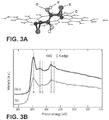
- Figure 10 illustrates calculated results (yellow, red and white balls denote S, O and H atoms, respectively, while the others, blue, are carbon atoms):
- S atoms adsorption on graphene separately Figure 10(a) and in pair Figure 10(b) .
- the binding energies are 1.64 and 2.08 eV, respectively, which can be viewed as the lower and higher bounds of S adsorption.
- S adsorption can be significantly enhanced by epoxy groups, depending on the distance between the functional group and S atom.
- the binding energies are 1.82 eV and 2.03 eV for the adsorption configurations shown in Figure 10(c) and Figure 10(d) .
- the locations of S atoms are the same as that in Figure 10(a) , where the binding energy is 1.64 eV.
- the enhancement effect of the epoxy decreases with increasing distance between S and the epoxy group. Additional calculations show that the hydroxyl group exhibits a similar trend.
- Figure 10(e) and Figure 10(f) give the binding energy of 1.66 and 2.84 eV, indicating that the effect of hydroxyl group is more local than that of the epoxy.
- a surprising result is that S atoms can also insert into the O-H bond (g), with a much larger binding energy of 4.05 eV. However, the dynamic factor may hinder its formation.
- Figure 11 illustrates S L-edge XAS spectrum of GO-S nanocomposites after heat treatment in Ar at 155°C for 12 hours. It confirms the existence of S in the composites.
- the soft X-ray absorption spectroscopy (XAS) measurements were performed on Beamline 7.0.1 at the Advanced Light Source. The energy resolution of monochromator was set to 0.1 eV for the S L-edge XAS.
- Figure 12 illustrates FTIR spectra of (a) GO, and (b) GO-S nanocomposites. These materials were heat treated in Ar at 155°C for 12 hours.
- the 1220 cm -1 indicates the C-OH stretching vibrations
- the ⁇ 1200 cm -1 can be assigned to C-O stretch
- the characteristic feature at ⁇ 1204.5 cm -1 in GO-S nanocomposites may indicate the existence of C-S bond in the as-synthesized GO-S nanocomposites after thermal treatment.
- Figure 13 illustrates XPS spectra of (a) GO, (b) S element, and (c) GO-S.
- the GO and GO-S were heat treated in Ar at 155°C for 12 hours.
- XPS of GO-S nanocomposites show one peak at S 2p 3/2 binding energy of about 164.0 eV with a slight wider full widths at half maximum intensities (FWHM) than that of elemental S.
- FWHM half maximum intensities
- XPS of GO-S nanocomposites show one peak at S1s binding energy of about 228.0 eV with a slight wider full widths at half maximum intensities (FWHM) than that of elemental S.
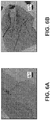
- Figure 17 illustrates SEM (a, b) and TEM (c, d) images of the as-synthesized GO-S nanocomposites after heat treatment in Ar at 160 °C for 12 hours.
- HRTEM high-resolution TEM
- Figure 18 illustrates an electrochemical evaluation of GO-S nanocomposite cathodes made by a different process from that in the description above.
- the GO-S nanocomposites were heat treated in Ar at 160 °C for 12 hours.
- the S content in the GO-S nanocomposite was about 40 wt%, and the S content in the cathode (including carbon black and binder) was about 28 wt%.
- the capacity values are normalized to the initial discharge capacity.
- the first discharge capacity curve is in abnormal shape (b).
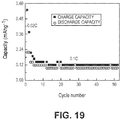
- Figure 19 illustrates cycling performance of a pure GO cathode at a constant rate of 0.1C after an initial activation processes at 0.02C for 2 cycles.
- the GO was heat treated in Ar at 155 °C for 12 hours before assembling coin cell. The result indicates that the GO phase contributes essentially nothing to the capacity, because at the potentials of the S electrode, GO does not intercalate lithium at all.
Landscapes
- Chemical & Material Sciences (AREA)
- Organic Chemistry (AREA)
- Chemical Kinetics & Catalysis (AREA)
- Electrochemistry (AREA)
- General Chemical & Material Sciences (AREA)
- Inorganic Chemistry (AREA)
- Engineering & Computer Science (AREA)
- Manufacturing & Machinery (AREA)
- Composite Materials (AREA)
- Materials Engineering (AREA)
- Physics & Mathematics (AREA)
- Condensed Matter Physics & Semiconductors (AREA)
- General Physics & Mathematics (AREA)
- Geology (AREA)
- General Life Sciences & Earth Sciences (AREA)
- Life Sciences & Earth Sciences (AREA)
- Battery Electrode And Active Subsutance (AREA)
- Secondary Cells (AREA)
Applications Claiming Priority (2)
| Application Number | Priority Date | Filing Date | Title |
|---|---|---|---|
| US201161541374P | 2011-09-30 | 2011-09-30 | |
| PCT/US2012/058047 WO2013049663A1 (en) | 2011-09-30 | 2012-09-28 | Graphene oxide as a sulfur immobilizer in high performance lithium/sulfur cells |
Publications (3)
| Publication Number | Publication Date |
|---|---|
| EP2761688A1 EP2761688A1 (en) | 2014-08-06 |
| EP2761688A4 EP2761688A4 (en) | 2015-06-17 |
| EP2761688B1 true EP2761688B1 (en) | 2018-11-28 |
Family
ID=47996462
Family Applications (1)
| Application Number | Title | Priority Date | Filing Date |
|---|---|---|---|
| EP12835530.2A Active EP2761688B1 (en) | 2011-09-30 | 2012-09-28 | Graphene oxide as a sulfur immobilizer in high performance lithium/sulfur cells |
Country Status (6)
| Country | Link |
|---|---|
| US (3) | US9673452B2 (https=) |
| EP (1) | EP2761688B1 (https=) |
| KR (1) | KR101947353B1 (https=) |
| CN (1) | CN104094457B (https=) |
| IN (1) | IN2014CN02561A (https=) |
| WO (1) | WO2013049663A1 (https=) |
Families Citing this family (118)
| Publication number | Priority date | Publication date | Assignee | Title |
|---|---|---|---|---|
| US20160054253A1 (en) * | 2013-04-12 | 2016-02-25 | Cornell University | Carbon-Sulfur Based Core-Shell Materials Compositions, Methods, and Applications |
| US20160141620A1 (en) * | 2013-06-21 | 2016-05-19 | The Regents Of The University Of California | A long-life, high-rate lithium/sulfur cell utilizing a holistic approach to enhancing cell performance |
| GB2516932B (en) | 2013-08-07 | 2018-12-26 | Nokia Technologies Oy | An apparatus and associated methods for water detection |
| US9455447B2 (en) * | 2013-09-26 | 2016-09-27 | Eaglepicher Technologies, Llc | Lithium-sulfur battery and methods of preventing insoluble solid lithium-polysulfide deposition |
| US9991558B2 (en) * | 2014-04-18 | 2018-06-05 | Sb Solar | Rechargeable electrochemical metal ion cell and accumulator containing said cell |
| CN105304882A (zh) * | 2014-07-25 | 2016-02-03 | 中国科学院物理研究所 | 锂硫电池正极材料的制备方法、锂硫电池正极材料和电池 |
| WO2016025552A1 (en) * | 2014-08-12 | 2016-02-18 | The Regents Of The University Of California | Lithium sulfide-graphene oxide composite material for li/s cells |
| CN104218226B (zh) * | 2014-09-18 | 2017-01-18 | 厦门大学 | 一种电池正极及其制备方法与应用 |
| CN104201339B (zh) * | 2014-09-18 | 2016-08-17 | 厦门大学 | 电池正极及其制备方法与在锂硫电池中的应用 |
| DE102014221046A1 (de) | 2014-10-16 | 2016-05-19 | Bayerische Motoren Werke Aktiengesellschaft | Lithium-Schwefel-Akkumulator |
| CN104362394A (zh) * | 2014-10-23 | 2015-02-18 | 清华大学 | 一种锂硫二次电池 |
| CN104600247B (zh) * | 2014-12-31 | 2017-05-03 | 山东玉皇新能源科技有限公司 | 一种锂硫电池用硫‑碳复合正极材料及其制备方法 |
| US11258059B2 (en) | 2015-02-18 | 2022-02-22 | Global Graphene Group, Inc. | Pre-sulfurized cathode for alkali metal-sulfur secondary battery and production process |
| US10461321B2 (en) | 2015-02-18 | 2019-10-29 | Nanotek Instruments, Inc. | Alkali metal-sulfur secondary battery containing a pre-sulfurized cathode and production process |
| US9666899B2 (en) * | 2015-03-30 | 2017-05-30 | Nanotek Instruments, Inc. | Active cathode layer for metal-sulfur secondary battery |
| US9666865B2 (en) * | 2015-04-17 | 2017-05-30 | Nanotek Instruments, Inc. | Magnesium-sulfur secondary battery containing a metal polysulfide-preloaded active cathode layer |
| EP3096389A1 (en) * | 2015-05-18 | 2016-11-23 | Nokia Technologies Oy | An apparatus and associated methods for electrical storage |
| CN104900846B (zh) * | 2015-05-21 | 2019-04-09 | 张涉 | 一种锂-硫可充电电池的制备方法 |
| US11749831B2 (en) | 2015-09-02 | 2023-09-05 | Sceye Sa | Li—S battery with carbon coated separator |
| DE102015224335A1 (de) * | 2015-12-04 | 2017-06-08 | Robert Bosch Gmbh | Feststoffelektrode mit elektrolytgetränkten Aktivmaterialpartikeln |
| US10707535B2 (en) | 2016-01-15 | 2020-07-07 | Global Graphene Group, Inc. | Production process for alkali metal-sulfur batteries having high volumetric and gravimetric energy densities |
| US10026995B2 (en) | 2016-01-15 | 2018-07-17 | Nanotek Instruments, Inc. | Method of producing alkali metal or alkali-ion batteries having high volumetric and gravimetric energy densities |
| US11152639B2 (en) | 2016-01-15 | 2021-10-19 | Global Graphene Group, Inc. | Alkali metal-sulfur batteries having high volumetric and gravimetric energy densities |
| US10147941B2 (en) * | 2016-03-15 | 2018-12-04 | The Hong Kong Polytechnic University | Synthesis method for cathode material in lithium-sulfur battery |
| US10683419B2 (en) | 2016-03-23 | 2020-06-16 | The Regents Of The University Of California | Redox-active supramolecular polymer binders derived from perylene bisimide nanowires enable high-rate lithium-sulfur batteries |
| US10734642B2 (en) | 2016-03-30 | 2020-08-04 | Global Graphene Group, Inc. | Elastomer-encapsulated particles of high-capacity anode active materials for lithium batteries |
| CA3019132A1 (en) | 2016-04-01 | 2017-10-05 | NOHMs Technologies, Inc. | Modified ionic liquids containing phosphorus |
| US11254616B2 (en) | 2016-08-04 | 2022-02-22 | Global Graphene Group, Inc. | Method of producing integral 3D humic acid-carbon hybrid foam |
| US9878303B1 (en) | 2016-08-04 | 2018-01-30 | Nanotek Instruments, Inc. | Integral 3D humic acid-carbon hybrid foam and devices containing same |
| KR20180017796A (ko) * | 2016-08-11 | 2018-02-21 | 주식회사 엘지화학 | 황-탄소 복합체, 이의 제조방법 및 이를 포함하는 리튬-황 전지 |
| US10731931B2 (en) | 2016-08-18 | 2020-08-04 | Global Graphene Group, Inc. | Highly oriented humic acid films and highly conducting graphitic films derived therefrom and devices containing same |
| US10597389B2 (en) | 2016-08-22 | 2020-03-24 | Global Graphene Group, Inc. | Humic acid-bonded metal foil film current collector and battery and supercapacitor containing same |
| US10647595B2 (en) | 2016-08-30 | 2020-05-12 | Global Graphene Group, Inc. | Humic acid-derived conductive foams and devices |
| US10593932B2 (en) | 2016-09-20 | 2020-03-17 | Global Graphene Group, Inc. | Process for metal-sulfur battery cathode containing humic acid-derived conductive foam |
| US10003078B2 (en) | 2016-09-20 | 2018-06-19 | Nanotek Instruments, Inc. | Metal-sulfur battery cathode containing humic acid-derived conductive foam impregnated with sulfur or sulfide |
| KR101993371B1 (ko) | 2017-02-08 | 2019-06-26 | 한국과학기술원 | 황 코팅된 폴리도파민 개질 그래핀 산화물 복합체, 이를 이용한 리튬-황 이차전지, 및 이의 제조방법 |
| US10651464B2 (en) | 2017-02-13 | 2020-05-12 | Global Graphene Group, Inc. | Alkali metal-sulfur secondary battery containing a nano sulfur-loaded cathode and manufacturing method |
| US11495792B2 (en) | 2017-02-16 | 2022-11-08 | Global Graphene Group, Inc. | Method of manufacturing a lithium secondary battery having a protected high-capacity anode active material |
| US10211455B2 (en) | 2017-02-20 | 2019-02-19 | Nanotek Instruments, Inc. | Lithium secondary batteries containing protected particles of anode active materials and method of manufacturing |
| US10084182B2 (en) | 2017-02-23 | 2018-09-25 | Nanotek Instruments, Inc. | Alkali metal-sulfur secondary battery containing a protected sulfur cathode and manufacturing method |
| US11978904B2 (en) | 2017-02-24 | 2024-05-07 | Honeycomb Battery Company | Polymer binder for lithium battery and method of manufacturing |
| US10840502B2 (en) | 2017-02-24 | 2020-11-17 | Global Graphene Group, Inc. | Polymer binder for lithium battery and method of manufacturing |
| US10985373B2 (en) | 2017-02-27 | 2021-04-20 | Global Graphene Group, Inc. | Lithium battery cathode and method of manufacturing |
| US10411264B2 (en) | 2017-02-27 | 2019-09-10 | Global Graphene Group, Inc. | Cathode active material layer for lithium secondary battery and method of manufacturing |
| KR102062550B1 (ko) | 2017-02-28 | 2020-01-06 | 한국과학기술원 | 유연성 탄소 포켓 복합 구조체, 이의 제조방법, 이를 포함하는 전극 및 상기 전극을 포함하는 에너지 저장 디바이스 |
| KR102126250B1 (ko) | 2017-03-07 | 2020-06-24 | 주식회사 엘지화학 | 탄소-황 복합체, 이의 제조방법, 이를 포함하는 양극 및 리튬-황 전지 |
| US11742475B2 (en) | 2017-04-03 | 2023-08-29 | Global Graphene Group, Inc. | Encapsulated anode active material particles, lithium secondary batteries containing same, and method of manufacturing |
| US10916766B2 (en) | 2017-04-10 | 2021-02-09 | Global Graphene Group, Inc. | Alkali metal-sulfur secondary battery containing a polymer-encapsulated sulfur cathode and manufacturing method |
| US10770721B2 (en) | 2017-04-10 | 2020-09-08 | Global Graphene Group, Inc. | Lithium metal secondary battery containing anode-protecting polymer layer and manufacturing method |
| US10483533B2 (en) | 2017-04-10 | 2019-11-19 | Global Graphene Group, Inc. | Encapsulated cathode active material particles, lithium secondary batteries containing same, and method of manufacturing |
| US10862129B2 (en) | 2017-04-12 | 2020-12-08 | Global Graphene Group, Inc. | Lithium anode-protecting polymer layer for a lithium metal secondary battery and manufacturing method |
| US10243217B2 (en) | 2017-05-24 | 2019-03-26 | Nanotek Instruments, Inc. | Alkali metal battery having a deformable quasi-solid electrode material |
| US10535892B2 (en) | 2017-05-30 | 2020-01-14 | Global Graphene Group, Inc. | Shape-conformable alkali metal battery having a conductive and deformable quasi-solid polymer electrode |
| US10170789B2 (en) | 2017-05-31 | 2019-01-01 | Nanotek Instruments, Inc. | Method of producing a shape-conformable alkali metal battery having a conductive and deformable quasi-solid polymer electrode |
| US11394058B2 (en) | 2017-06-02 | 2022-07-19 | Global Graphene Group, Inc. | Method of producing shape-conformable alkali metal-sulfur battery |
| US11335946B2 (en) | 2017-06-02 | 2022-05-17 | Global Graphene Group, Inc. | Shape-conformable alkali metal-sulfur battery |
| US10454141B2 (en) | 2017-06-30 | 2019-10-22 | Global Graphene Group, Inc. | Method of producing shape-conformable alkali metal-sulfur battery having a deformable and conductive quasi-solid electrode |
| US10651512B2 (en) | 2017-06-30 | 2020-05-12 | Global Graphene Group, Inc. | Shape-conformable alkali metal-sulfur battery having a deformable and conductive quasi-solid electrode |
| CN107331845B (zh) * | 2017-07-05 | 2020-01-14 | 湖南泰和美新能源科技有限公司 | 一种石墨烯电池正极复合材料 |
| WO2019018432A1 (en) | 2017-07-17 | 2019-01-24 | NOHMs Technologies, Inc. | ELECTROLYTES CONTAINING PHOSPHORUS |
| US10700357B2 (en) | 2017-08-14 | 2020-06-30 | Global Graphene Group, Inc. | Alkali metal-sulfur secondary battery containing a protected sulfur cathode material and manufacturing method |
| US10804537B2 (en) | 2017-08-14 | 2020-10-13 | Global Graphene Group, Inc. | Protected particles of anode active materials, lithium secondary batteries containing same and method of manufacturing |
| US10964951B2 (en) | 2017-08-14 | 2021-03-30 | Global Graphene Group, Inc. | Anode-protecting layer for a lithium metal secondary battery and manufacturing method |
| CN107591523A (zh) * | 2017-08-22 | 2018-01-16 | 桂林电子科技大学 | 一种铁、镍掺杂活性炭‑硫材料及其制备方法和应用 |
| US10873083B2 (en) | 2017-11-30 | 2020-12-22 | Global Graphene Group, Inc. | Anode particulates or cathode particulates and alkali metal batteries |
| US10637043B2 (en) | 2017-11-30 | 2020-04-28 | Global Graphene Group, Inc. | Anode particulates or cathode particulates and alkali metal batteries containing same |
| CN108400290B (zh) * | 2018-01-03 | 2021-09-17 | 浙江衡远新能源科技有限公司 | 一种高倍率锂硫电池正极材料制备方法 |
| US10424782B2 (en) | 2018-01-09 | 2019-09-24 | Saudi Arabian Oil Company | Nanocomposite electrode materials for use in high temperature and high pressure rechargeable batteries |
| US11239466B2 (en) | 2018-01-09 | 2022-02-01 | Saudi Arabian Oil Company | Nanocomposite cathode materials for use in batteries |
| US10573894B2 (en) | 2018-02-21 | 2020-02-25 | Global Graphene Group, Inc. | Protected particles of anode active materials for lithium batteries |
| US10601034B2 (en) | 2018-02-21 | 2020-03-24 | Global Graphene Group, Inc. | Method of producing protected particles of anode active materials for lithium batteries |
| US11721832B2 (en) | 2018-02-23 | 2023-08-08 | Global Graphene Group, Inc. | Elastomer composite-encapsulated particles of anode active materials for lithium batteries |
| US10964936B2 (en) | 2018-03-02 | 2021-03-30 | Global Graphene Group, Inc. | Conducting elastomer composite-encapsulated particles of anode active materials for lithium batteries |
| US10971722B2 (en) | 2018-03-02 | 2021-04-06 | Global Graphene Group, Inc. | Method of manufacturing conducting elastomer composite-encapsulated particles of anode active materials for lithium batteries |
| US11005094B2 (en) | 2018-03-07 | 2021-05-11 | Global Graphene Group, Inc. | Electrochemically stable elastomer-encapsulated particles of anode active materials for lithium batteries |
| US10818926B2 (en) | 2018-03-07 | 2020-10-27 | Global Graphene Group, Inc. | Method of producing electrochemically stable elastomer-encapsulated particles of anode active materials for lithium batteries |
| US11043694B2 (en) | 2018-04-16 | 2021-06-22 | Global Graphene Group, Inc. | Alkali metal-selenium secondary battery containing a cathode of encapsulated selenium particles |
| US10971723B2 (en) | 2018-04-16 | 2021-04-06 | Global Graphene Group, Inc. | Process for alkali metal-selenium secondary battery containing a cathode of encapsulated selenium particles |
| US10978698B2 (en) | 2018-06-15 | 2021-04-13 | Global Graphene Group, Inc. | Method of protecting sulfur cathode materials for alkali metal-sulfur secondary battery |
| US11121398B2 (en) | 2018-06-15 | 2021-09-14 | Global Graphene Group, Inc. | Alkali metal-sulfur secondary battery containing cathode material particulates |
| US10985365B2 (en) | 2018-06-18 | 2021-04-20 | Global Graphene Group, Inc. | Lithium-sulfur battery containing two anode-protecting layers |
| US10978744B2 (en) | 2018-06-18 | 2021-04-13 | Global Graphene Group, Inc. | Method of protecting anode of a lithium-sulfur battery |
| US10985376B2 (en) | 2018-06-18 | 2021-04-20 | Global Graphene Group, Inc. | Lithium-sulfur battery containing an electrode-protecting layer |
| US10862157B2 (en) | 2018-06-18 | 2020-12-08 | Global Graphene Group, Inc. | Alkali metal-sulfur secondary battery containing a conductive electrode-protecting layer |
| US10957912B2 (en) | 2018-06-18 | 2021-03-23 | Global Graphene Group, Inc. | Method of extending cycle-life of a lithium-sulfur battery |
| US10854927B2 (en) | 2018-06-18 | 2020-12-01 | Global Graphene Group, Inc. | Method of improving cycle-life of alkali metal-sulfur secondary battery |
| US11276852B2 (en) | 2018-06-21 | 2022-03-15 | Global Graphene Group, Inc. | Lithium metal secondary battery containing an elastic anode-protecting layer |
| US12609344B2 (en) | 2018-06-21 | 2026-04-21 | Honeycomb Battery Company | Method of improving the cycle stability and energy density of a lithium metal secondary battery |
| US10777810B2 (en) | 2018-06-21 | 2020-09-15 | Global Graphene Group, Inc. | Lithium metal secondary battery containing a protected lithium anode |
| US10727531B2 (en) | 2018-06-21 | 2020-07-28 | Global Graphene Group, Inc. | Lithium metal secondary battery featuring an anode-protecting layer |
| US10784509B2 (en) | 2018-06-21 | 2020-09-22 | Global Graphene Group, Inc. | Lithium metal secondary battery containing two anode-protecting layers |
| US10734646B2 (en) | 2018-06-21 | 2020-08-04 | Global Graphene Group, Inc. | Lithium metal secondary battery containing an electrochemically stable anode-protecting layer |
| US12288883B2 (en) | 2018-06-21 | 2025-04-29 | Honeycomb Battery Company | Method of improving cycle-life of a lithium metal secondary battery |
| US12218346B2 (en) | 2018-06-21 | 2025-02-04 | Honeycomb Battery Company | Method of extending cycle-life of a lithium metal secondary battery |
| US10770748B2 (en) | 2018-06-25 | 2020-09-08 | Global Graphene Group, Inc. | Lithium-selenium battery containing an electrode-protecting layer and method for improving cycle-life |
| US10873088B2 (en) | 2018-06-25 | 2020-12-22 | Global Graphene Group, Inc. | Lithium-selenium battery containing an electrode-protecting layer and method of improving cycle-life |
| US11043662B2 (en) | 2018-08-22 | 2021-06-22 | Global Graphene Group, Inc. | Electrochemically stable elastomer-encapsulated particles of cathode active materials for lithium batteries |
| US11239460B2 (en) | 2018-08-22 | 2022-02-01 | Global Graphene Group, Inc. | Method of producing electrochemically stable elastomer-encapsulated particles of cathode active materials for lithium batteries |
| US10886528B2 (en) | 2018-08-24 | 2021-01-05 | Global Graphene Group, Inc. | Protected particles of cathode active materials for lithium batteries |
| KR102246154B1 (ko) * | 2018-08-24 | 2021-04-29 | 한국과학기술원 | 유연성 포켓 복합 구조체, 이의 제조방법, 이를 포함하는 전극 및 상기 전극을 포함하는 에너지 저장 디바이스 |
| US11223049B2 (en) | 2018-08-24 | 2022-01-11 | Global Graphene Group, Inc. | Method of producing protected particles of cathode active materials for lithium batteries |
| KR102293892B1 (ko) * | 2018-09-19 | 2021-08-24 | 주식회사 엘지화학 | 황-탄소 복합체의 제조방법, 그에 의해 제조된 황-탄소 복합체, 상기 황-탄소 복합체를 포함하는 양극, 및 상기 양극을 포함하는 리튬 이차 전지 |
| WO2020060084A1 (ko) * | 2018-09-20 | 2020-03-26 | 주식회사 엘지화학 | 황-탄소 복합체, 이의 제조방법, 이를 포함하는 리튬 이차전지용 양극 및 리튬 이차전지 |
| KR102854271B1 (ko) | 2018-09-20 | 2025-09-03 | 주식회사 엘지에너지솔루션 | 황-탄소 복합체, 이의 제조방법, 이를 포함하는 리튬 이차전지용 양극 및 리튬 이차전지 |
| US12444744B2 (en) | 2018-10-15 | 2025-10-14 | Honeycomb Battery Company | Electrochemically stable anode particulates for lithium secondary batteries |
| US10629899B1 (en) | 2018-10-15 | 2020-04-21 | Global Graphene Group, Inc. | Production method for electrochemically stable anode particulates for lithium secondary batteries |
| US10971724B2 (en) | 2018-10-15 | 2021-04-06 | Global Graphene Group, Inc. | Method of producing electrochemically stable anode particulates for lithium secondary batteries |
| SG11202104855VA (en) | 2018-11-12 | 2021-06-29 | Univ Monash | Method of producing thick sulphur cathodes for li-s batteries |
| US11791450B2 (en) | 2019-01-24 | 2023-10-17 | Global Graphene Group, Inc. | Method of improving cycle life of a rechargeable lithium metal battery |
| US10971725B2 (en) | 2019-01-24 | 2021-04-06 | Global Graphene Group, Inc. | Lithium metal secondary battery containing elastic polymer foam as an anode-protecting layer |
| US11998988B2 (en) | 2019-07-09 | 2024-06-04 | Saudi Arabian Oil Company | Methods for the production of nanocomposites for high temperature electrochemical energy storage devices |
| US11605817B2 (en) | 2019-09-24 | 2023-03-14 | William Marsh Rice University | Sulfurized carbon cathodes |
| CN110854340B (zh) * | 2019-11-12 | 2021-12-21 | 常州大学 | 一种具有自修复功能隔膜涂层材料的制备方法 |
| EP4128395A4 (en) | 2020-03-26 | 2024-11-06 | Zeta Energy Corp. | SULFURIZED CARBON CATHODE WITH CONDUCTIVE CARBON FRAME |
| KR102864159B1 (ko) * | 2020-08-10 | 2025-09-24 | 주식회사 엘지에너지솔루션 | 리튬 이차전지용 양극 코팅재, 이의 제조방법, 상기 코팅재를 포함하는 양극 및 리튬 이차전지 |
| KR102893452B1 (ko) * | 2020-08-11 | 2025-12-02 | 주식회사 엘지에너지솔루션 | 리튬 이차전지용 양극, 이의 제조방법 및 상기 양극을 포함하는 리튬 이차전지 |
| WO2022186151A1 (ja) * | 2021-03-01 | 2022-09-09 | 株式会社Gsユアサ | 非水電解質蓄電素子及びその製造方法 |
| KR102477618B1 (ko) * | 2022-04-07 | 2022-12-14 | 주식회사 일진그라텍 | 친환경 라미네이트용 무용제 이액형 접착제 조성물을 이용한 포장필름의 제조방법 및 이로부터 제조되는 포장필름 |
Family Cites Families (8)
| Publication number | Priority date | Publication date | Assignee | Title |
|---|---|---|---|---|
| US9156701B2 (en) | 2008-01-03 | 2015-10-13 | National University Of Singapore | Functionalised graphene oxide |
| WO2010074918A1 (en) * | 2008-12-23 | 2010-07-01 | The Trustees Of The University Of Pennsylvania | High yield preparation of macroscopic graphene oxide membranes |
| KR101074027B1 (ko) * | 2009-03-03 | 2011-10-17 | 한국과학기술연구원 | 그래펜 복합 나노섬유 및 그 제조 방법 |
| SG10201402481PA (en) * | 2009-05-22 | 2014-07-30 | Univ Rice William M | Highly oxidized graphene oxide and methods for production thereof |
| US20110219607A1 (en) | 2010-03-12 | 2011-09-15 | Nanjundaswamy Kirakodu S | Cathode active materials and method of making thereof |
| JP5856609B2 (ja) * | 2010-05-28 | 2016-02-10 | ビーエーエスエフ ソシエタス・ヨーロピアBasf Se | リチウム硫黄電流生成セルの正極に使用される固体複合材料及びその製造方法並びにリチウム硫黄電流生成セル |
| KR20120033722A (ko) * | 2010-09-30 | 2012-04-09 | 한국전자통신연구원 | 그래핀 산화물 메모리 소자 및 그 제조 방법 |
| US8753772B2 (en) * | 2010-10-07 | 2014-06-17 | Battelle Memorial Institute | Graphene-sulfur nanocomposites for rechargeable lithium-sulfur battery electrodes |
-
2012
- 2012-09-28 WO PCT/US2012/058047 patent/WO2013049663A1/en not_active Ceased
- 2012-09-28 US US14/347,600 patent/US9673452B2/en active Active
- 2012-09-28 IN IN2561CHN2014 patent/IN2014CN02561A/en unknown
- 2012-09-28 EP EP12835530.2A patent/EP2761688B1/en active Active
- 2012-09-28 KR KR1020147011660A patent/KR101947353B1/ko active Active
- 2012-09-28 CN CN201280054690.8A patent/CN104094457B/zh active Active
-
2017
- 2017-04-26 US US15/498,113 patent/US9853284B2/en active Active
- 2017-11-17 US US15/817,051 patent/US10044031B2/en active Active
Non-Patent Citations (1)
| Title |
|---|
| None * |
Also Published As
| Publication number | Publication date |
|---|---|
| KR20140082994A (ko) | 2014-07-03 |
| WO2013049663A1 (en) | 2013-04-04 |
| CN104094457A (zh) | 2014-10-08 |
| US10044031B2 (en) | 2018-08-07 |
| KR101947353B1 (ko) | 2019-02-12 |
| EP2761688A4 (en) | 2015-06-17 |
| IN2014CN02561A (https=) | 2015-08-07 |
| EP2761688A1 (en) | 2014-08-06 |
| US9673452B2 (en) | 2017-06-06 |
| US9853284B2 (en) | 2017-12-26 |
| CN104094457B (zh) | 2017-06-23 |
| US20170294646A1 (en) | 2017-10-12 |
| US20180138504A1 (en) | 2018-05-17 |
| US20140234702A1 (en) | 2014-08-21 |
Similar Documents
| Publication | Publication Date | Title |
|---|---|---|
| EP2761688B1 (en) | Graphene oxide as a sulfur immobilizer in high performance lithium/sulfur cells | |
| Wang et al. | rGO/SnS 2/TiO 2 heterostructured composite with dual-confinement for enhanced lithium-ion storage | |
| Hwang et al. | Ultrafast sodium storage in anatase TiO2 nanoparticles embedded on carbon nanotubes | |
| Naresh et al. | Dendrite-free Zn anodes enabled by a hierarchical zincophilic TiO2 layer for rechargeable aqueous zinc-ion batteries | |
| Li et al. | 2D hybrid anode based on SnS nanosheet bonded with graphene to enhance electrochemical performance for lithium-ion batteries | |
| Li et al. | Glucose-assisted synthesis of the hierarchical TiO 2 nanowire@ MoS 2 nanosheet nanocomposite and its synergistic lithium storage performance | |
| Ji et al. | SnS 2 nanoparticle loaded graphene nanocomposites for superior energy storage | |
| Wang et al. | Improved cyclability of lithium-ion battery anode using encapsulated V 2 O 3 nanostructures in well-graphitized carbon fiber | |
| Chen et al. | A chemical reaction controlled mechanochemical route to construction of CuO nanoribbons for high performance lithium-ion batteries | |
| Das et al. | Cobalt phosphide (Co 2 P) encapsulated in nitrogen-rich hollow carbon nanocages with fast rate potassium ion storage | |
| Liu et al. | Formation of uniform nitrogen-doped C/Ni/TiO 2 hollow spindles toward long cycle life lithium-ion batteries | |
| Park et al. | FeOF ellipsoidal nanoparticles anchored on reduced graphene oxides as a cathode material for sodium-ion batteries | |
| Wang et al. | Nitrogen-enriched carbon-coated flower-like bismuth sulfide architectures towards high-performance lithium-ion battery anodes | |
| Yan et al. | Fabrication of a reversible SnS 2/RGO nanocomposite for high performance lithium storage | |
| Shuang et al. | Rational design of Co embedded N, S-codoped carbon nanoplates as anode materials for high performance lithium-ion batteries | |
| Tiwari et al. | Prevention of sulfur diffusion using MoS 2-intercalated 3D-nanostructured graphite for high-performance lithium-ion batteries | |
| Liu et al. | Approaching theoretical specific capacity of iron-rich lithium iron silicate using graphene-incorporation and fluorine-doping | |
| Choi et al. | Facile phosphorus-embedding into SnS2 using a high-energy ball mill to improve the surface kinetics of P-SnS2 anodes for a Li-ion battery | |
| Gull et al. | Operando synchrotron X-ray studies of MnVOH@ SWCNT nanocomposites as cathodes for high-performance aqueous zinc-ion batteries | |
| Park et al. | Facile synthesis of cobalt fluoride (CoF 2)/multi-walled carbon nanotube (MWCNT) nanocomposites and improvement of their electrochemical performance as cathode materials for Li-ion batteries | |
| Zeng et al. | Hierarchical LiZnVO 4@ C nanostructures with enhanced cycling stability for lithium-ion batteries | |
| Cui et al. | Order-disorder structural engineering of vanadium oxide anode: Balancing ionic and electronic dynamic for fast-charging aqueous Li-ion battery | |
| Park et al. | Effect of silicon doping on the electrochemical properties of MoP2 nano-cluster anode for lithium ion batteries | |
| Kidanu et al. | Tunable vanadium oxide microflowers as high-capacity cathode materials for aqueous rechargeable zinc-ion batteries | |
| Lee et al. | Superior electrochemical performance of N-doped nanocrystalline FeF 3/C with a single-step solid-state process |
Legal Events
| Date | Code | Title | Description |
|---|---|---|---|
| PUAI | Public reference made under article 153(3) epc to a published international application that has entered the european phase |
Free format text: ORIGINAL CODE: 0009012 |
|
| 17P | Request for examination filed |
Effective date: 20140328 |
|
| AK | Designated contracting states |
Kind code of ref document: A1 Designated state(s): AL AT BE BG CH CY CZ DE DK EE ES FI FR GB GR HR HU IE IS IT LI LT LU LV MC MK MT NL NO PL PT RO RS SE SI SK SM TR |
|
| DAX | Request for extension of the european patent (deleted) | ||
| RA4 | Supplementary search report drawn up and despatched (corrected) |
Effective date: 20150515 |
|
| RIC1 | Information provided on ipc code assigned before grant |
Ipc: H01M 4/583 20100101AFI20150508BHEP Ipc: H01M 2/16 20060101ALI20150508BHEP Ipc: H01M 4/62 20060101ALI20150508BHEP Ipc: H01M 10/0566 20100101ALI20150508BHEP Ipc: C01B 31/26 20060101ALI20150508BHEP Ipc: C07D 303/38 20060101ALI20150508BHEP |
|
| RIC1 | Information provided on ipc code assigned before grant |
Ipc: C07D 303/38 20060101ALI20180509BHEP Ipc: H01M 4/38 20060101ALI20180509BHEP Ipc: H01M 10/0566 20100101ALI20180509BHEP Ipc: H01M 10/0525 20100101ALI20180509BHEP Ipc: H01M 2/16 20060101ALI20180509BHEP Ipc: H01M 4/587 20100101ALI20180509BHEP Ipc: H01M 4/583 20100101AFI20180509BHEP Ipc: C01B 32/70 20170101ALI20180509BHEP Ipc: H01M 4/36 20060101ALI20180509BHEP Ipc: C01B 32/23 20170101ALI20180509BHEP Ipc: H01M 4/62 20060101ALI20180509BHEP |
|
| INTG | Intention to grant announced |
Effective date: 20180611 |
|
| GRAP | Despatch of communication of intention to grant a patent |
Free format text: ORIGINAL CODE: EPIDOSNIGR1 |
|
| STAA | Information on the status of an ep patent application or granted ep patent |
Free format text: STATUS: GRANT OF PATENT IS INTENDED |
|
| GRAS | Grant fee paid |
Free format text: ORIGINAL CODE: EPIDOSNIGR3 |
|
| GRAA | (expected) grant |
Free format text: ORIGINAL CODE: 0009210 |
|
| STAA | Information on the status of an ep patent application or granted ep patent |
Free format text: STATUS: THE PATENT HAS BEEN GRANTED |
|
| AK | Designated contracting states |
Kind code of ref document: B1 Designated state(s): AL AT BE BG CH CY CZ DE DK EE ES FI FR GB GR HR HU IE IS IT LI LT LU LV MC MK MT NL NO PL PT RO RS SE SI SK SM TR |
|
| REG | Reference to a national code |
Ref country code: GB Ref legal event code: FG4D |
|
| REG | Reference to a national code |
Ref country code: CH Ref legal event code: EP |
|
| REG | Reference to a national code |
Ref country code: AT Ref legal event code: REF Ref document number: 1071286 Country of ref document: AT Kind code of ref document: T Effective date: 20181215 |
|
| REG | Reference to a national code |
Ref country code: DE Ref legal event code: R096 Ref document number: 602012054177 Country of ref document: DE |
|
| REG | Reference to a national code |
Ref country code: IE Ref legal event code: FG4D |
|
| REG | Reference to a national code |
Ref country code: NL Ref legal event code: MP Effective date: 20181128 |
|
| REG | Reference to a national code |
Ref country code: LT Ref legal event code: MG4D |
|
| REG | Reference to a national code |
Ref country code: AT Ref legal event code: MK05 Ref document number: 1071286 Country of ref document: AT Kind code of ref document: T Effective date: 20181128 |
|
| PG25 | Lapsed in a contracting state [announced via postgrant information from national office to epo] |
Ref country code: HR Free format text: LAPSE BECAUSE OF FAILURE TO SUBMIT A TRANSLATION OF THE DESCRIPTION OR TO PAY THE FEE WITHIN THE PRESCRIBED TIME-LIMIT Effective date: 20181128 Ref country code: NO Free format text: LAPSE BECAUSE OF FAILURE TO SUBMIT A TRANSLATION OF THE DESCRIPTION OR TO PAY THE FEE WITHIN THE PRESCRIBED TIME-LIMIT Effective date: 20190228 Ref country code: LV Free format text: LAPSE BECAUSE OF FAILURE TO SUBMIT A TRANSLATION OF THE DESCRIPTION OR TO PAY THE FEE WITHIN THE PRESCRIBED TIME-LIMIT Effective date: 20181128 Ref country code: AT Free format text: LAPSE BECAUSE OF FAILURE TO SUBMIT A TRANSLATION OF THE DESCRIPTION OR TO PAY THE FEE WITHIN THE PRESCRIBED TIME-LIMIT Effective date: 20181128 Ref country code: ES Free format text: LAPSE BECAUSE OF FAILURE TO SUBMIT A TRANSLATION OF THE DESCRIPTION OR TO PAY THE FEE WITHIN THE PRESCRIBED TIME-LIMIT Effective date: 20181128 Ref country code: BG Free format text: LAPSE BECAUSE OF FAILURE TO SUBMIT A TRANSLATION OF THE DESCRIPTION OR TO PAY THE FEE WITHIN THE PRESCRIBED TIME-LIMIT Effective date: 20190228 Ref country code: IS Free format text: LAPSE BECAUSE OF FAILURE TO SUBMIT A TRANSLATION OF THE DESCRIPTION OR TO PAY THE FEE WITHIN THE PRESCRIBED TIME-LIMIT Effective date: 20190328 Ref country code: LT Free format text: LAPSE BECAUSE OF FAILURE TO SUBMIT A TRANSLATION OF THE DESCRIPTION OR TO PAY THE FEE WITHIN THE PRESCRIBED TIME-LIMIT Effective date: 20181128 Ref country code: FI Free format text: LAPSE BECAUSE OF FAILURE TO SUBMIT A TRANSLATION OF THE DESCRIPTION OR TO PAY THE FEE WITHIN THE PRESCRIBED TIME-LIMIT Effective date: 20181128 |
|
| PG25 | Lapsed in a contracting state [announced via postgrant information from national office to epo] |
Ref country code: RS Free format text: LAPSE BECAUSE OF FAILURE TO SUBMIT A TRANSLATION OF THE DESCRIPTION OR TO PAY THE FEE WITHIN THE PRESCRIBED TIME-LIMIT Effective date: 20181128 Ref country code: GR Free format text: LAPSE BECAUSE OF FAILURE TO SUBMIT A TRANSLATION OF THE DESCRIPTION OR TO PAY THE FEE WITHIN THE PRESCRIBED TIME-LIMIT Effective date: 20190301 Ref country code: SE Free format text: LAPSE BECAUSE OF FAILURE TO SUBMIT A TRANSLATION OF THE DESCRIPTION OR TO PAY THE FEE WITHIN THE PRESCRIBED TIME-LIMIT Effective date: 20181128 Ref country code: AL Free format text: LAPSE BECAUSE OF FAILURE TO SUBMIT A TRANSLATION OF THE DESCRIPTION OR TO PAY THE FEE WITHIN THE PRESCRIBED TIME-LIMIT Effective date: 20181128 Ref country code: PT Free format text: LAPSE BECAUSE OF FAILURE TO SUBMIT A TRANSLATION OF THE DESCRIPTION OR TO PAY THE FEE WITHIN THE PRESCRIBED TIME-LIMIT Effective date: 20190328 |
|
| PG25 | Lapsed in a contracting state [announced via postgrant information from national office to epo] |
Ref country code: NL Free format text: LAPSE BECAUSE OF FAILURE TO SUBMIT A TRANSLATION OF THE DESCRIPTION OR TO PAY THE FEE WITHIN THE PRESCRIBED TIME-LIMIT Effective date: 20181128 |
|
| PG25 | Lapsed in a contracting state [announced via postgrant information from national office to epo] |
Ref country code: PL Free format text: LAPSE BECAUSE OF FAILURE TO SUBMIT A TRANSLATION OF THE DESCRIPTION OR TO PAY THE FEE WITHIN THE PRESCRIBED TIME-LIMIT Effective date: 20181128 Ref country code: DK Free format text: LAPSE BECAUSE OF FAILURE TO SUBMIT A TRANSLATION OF THE DESCRIPTION OR TO PAY THE FEE WITHIN THE PRESCRIBED TIME-LIMIT Effective date: 20181128 Ref country code: IT Free format text: LAPSE BECAUSE OF FAILURE TO SUBMIT A TRANSLATION OF THE DESCRIPTION OR TO PAY THE FEE WITHIN THE PRESCRIBED TIME-LIMIT Effective date: 20181128 Ref country code: CZ Free format text: LAPSE BECAUSE OF FAILURE TO SUBMIT A TRANSLATION OF THE DESCRIPTION OR TO PAY THE FEE WITHIN THE PRESCRIBED TIME-LIMIT Effective date: 20181128 |
|
| REG | Reference to a national code |
Ref country code: DE Ref legal event code: R097 Ref document number: 602012054177 Country of ref document: DE |
|
| PG25 | Lapsed in a contracting state [announced via postgrant information from national office to epo] |
Ref country code: RO Free format text: LAPSE BECAUSE OF FAILURE TO SUBMIT A TRANSLATION OF THE DESCRIPTION OR TO PAY THE FEE WITHIN THE PRESCRIBED TIME-LIMIT Effective date: 20181128 Ref country code: EE Free format text: LAPSE BECAUSE OF FAILURE TO SUBMIT A TRANSLATION OF THE DESCRIPTION OR TO PAY THE FEE WITHIN THE PRESCRIBED TIME-LIMIT Effective date: 20181128 Ref country code: SM Free format text: LAPSE BECAUSE OF FAILURE TO SUBMIT A TRANSLATION OF THE DESCRIPTION OR TO PAY THE FEE WITHIN THE PRESCRIBED TIME-LIMIT Effective date: 20181128 Ref country code: SK Free format text: LAPSE BECAUSE OF FAILURE TO SUBMIT A TRANSLATION OF THE DESCRIPTION OR TO PAY THE FEE WITHIN THE PRESCRIBED TIME-LIMIT Effective date: 20181128 |
|
| PLBE | No opposition filed within time limit |
Free format text: ORIGINAL CODE: 0009261 |
|
| STAA | Information on the status of an ep patent application or granted ep patent |
Free format text: STATUS: NO OPPOSITION FILED WITHIN TIME LIMIT |
|
| PG25 | Lapsed in a contracting state [announced via postgrant information from national office to epo] |
Ref country code: SI Free format text: LAPSE BECAUSE OF FAILURE TO SUBMIT A TRANSLATION OF THE DESCRIPTION OR TO PAY THE FEE WITHIN THE PRESCRIBED TIME-LIMIT Effective date: 20181128 |
|
| 26N | No opposition filed |
Effective date: 20190829 |
|
| PG25 | Lapsed in a contracting state [announced via postgrant information from national office to epo] |
Ref country code: TR Free format text: LAPSE BECAUSE OF FAILURE TO SUBMIT A TRANSLATION OF THE DESCRIPTION OR TO PAY THE FEE WITHIN THE PRESCRIBED TIME-LIMIT Effective date: 20181128 |
|
| PG25 | Lapsed in a contracting state [announced via postgrant information from national office to epo] |
Ref country code: MC Free format text: LAPSE BECAUSE OF FAILURE TO SUBMIT A TRANSLATION OF THE DESCRIPTION OR TO PAY THE FEE WITHIN THE PRESCRIBED TIME-LIMIT Effective date: 20181128 |
|
| REG | Reference to a national code |
Ref country code: CH Ref legal event code: PL |
|
| PG25 | Lapsed in a contracting state [announced via postgrant information from national office to epo] |
Ref country code: LI Free format text: LAPSE BECAUSE OF NON-PAYMENT OF DUE FEES Effective date: 20190930 Ref country code: CH Free format text: LAPSE BECAUSE OF NON-PAYMENT OF DUE FEES Effective date: 20190930 Ref country code: IE Free format text: LAPSE BECAUSE OF NON-PAYMENT OF DUE FEES Effective date: 20190928 Ref country code: LU Free format text: LAPSE BECAUSE OF NON-PAYMENT OF DUE FEES Effective date: 20190928 |
|
| REG | Reference to a national code |
Ref country code: BE Ref legal event code: MM Effective date: 20190930 |
|
| PG25 | Lapsed in a contracting state [announced via postgrant information from national office to epo] |
Ref country code: BE Free format text: LAPSE BECAUSE OF NON-PAYMENT OF DUE FEES Effective date: 20190930 |
|
| PG25 | Lapsed in a contracting state [announced via postgrant information from national office to epo] |
Ref country code: CY Free format text: LAPSE BECAUSE OF FAILURE TO SUBMIT A TRANSLATION OF THE DESCRIPTION OR TO PAY THE FEE WITHIN THE PRESCRIBED TIME-LIMIT Effective date: 20181128 |
|
| PG25 | Lapsed in a contracting state [announced via postgrant information from national office to epo] |
Ref country code: MT Free format text: LAPSE BECAUSE OF FAILURE TO SUBMIT A TRANSLATION OF THE DESCRIPTION OR TO PAY THE FEE WITHIN THE PRESCRIBED TIME-LIMIT Effective date: 20181128 Ref country code: HU Free format text: LAPSE BECAUSE OF FAILURE TO SUBMIT A TRANSLATION OF THE DESCRIPTION OR TO PAY THE FEE WITHIN THE PRESCRIBED TIME-LIMIT; INVALID AB INITIO Effective date: 20120928 |
|
| PG25 | Lapsed in a contracting state [announced via postgrant information from national office to epo] |
Ref country code: MK Free format text: LAPSE BECAUSE OF FAILURE TO SUBMIT A TRANSLATION OF THE DESCRIPTION OR TO PAY THE FEE WITHIN THE PRESCRIBED TIME-LIMIT Effective date: 20181128 |
|
| PGFP | Annual fee paid to national office [announced via postgrant information from national office to epo] |
Ref country code: DE Payment date: 20250929 Year of fee payment: 14 |
|
| PGFP | Annual fee paid to national office [announced via postgrant information from national office to epo] |
Ref country code: GB Payment date: 20250929 Year of fee payment: 14 |
|
| PGFP | Annual fee paid to national office [announced via postgrant information from national office to epo] |
Ref country code: FR Payment date: 20250925 Year of fee payment: 14 |