EP2697828B1 - Cellules de mémoire, procédés de formation de cellules de mémoire et procédés de formation de matrices de mémoire - Google Patents
Cellules de mémoire, procédés de formation de cellules de mémoire et procédés de formation de matrices de mémoire Download PDFInfo
- Publication number
- EP2697828B1 EP2697828B1 EP12771127.3A EP12771127A EP2697828B1 EP 2697828 B1 EP2697828 B1 EP 2697828B1 EP 12771127 A EP12771127 A EP 12771127A EP 2697828 B1 EP2697828 B1 EP 2697828B1
- Authority
- EP
- European Patent Office
- Prior art keywords
- along
- blocks
- programmable material
- programmable
- lines
- Prior art date
- Legal status (The legal status is an assumption and is not a legal conclusion. Google has not performed a legal analysis and makes no representation as to the accuracy of the status listed.)
- Active
Links
- 230000015654 memory Effects 0.000 title claims description 125
- 238000000034 method Methods 0.000 title claims description 26
- 238000003491 array Methods 0.000 title description 5
- 239000000463 material Substances 0.000 claims description 281
- 230000000873 masking effect Effects 0.000 claims description 25
- 239000012782 phase change material Substances 0.000 claims description 24
- 239000007772 electrode material Substances 0.000 claims description 18
- 238000000059 patterning Methods 0.000 claims description 12
- 150000004770 chalcogenides Chemical class 0.000 claims description 11
- 239000000203 mixture Substances 0.000 description 56
- 238000012545 processing Methods 0.000 description 53
- 239000004065 semiconductor Substances 0.000 description 48
- 238000010276 construction Methods 0.000 description 47
- 239000003989 dielectric material Substances 0.000 description 26
- VYPSYNLAJGMNEJ-UHFFFAOYSA-N Silicium dioxide Chemical compound O=[Si]=O VYPSYNLAJGMNEJ-UHFFFAOYSA-N 0.000 description 25
- 229910052581 Si3N4 Inorganic materials 0.000 description 13
- HQVNEWCFYHHQES-UHFFFAOYSA-N silicon nitride Chemical compound N12[Si]34N5[Si]62N3[Si]51N64 HQVNEWCFYHHQES-UHFFFAOYSA-N 0.000 description 13
- 125000006850 spacer group Chemical group 0.000 description 13
- 235000012239 silicon dioxide Nutrition 0.000 description 12
- 239000000377 silicon dioxide Substances 0.000 description 12
- 239000002019 doping agent Substances 0.000 description 10
- 230000004888 barrier function Effects 0.000 description 9
- 238000004519 manufacturing process Methods 0.000 description 9
- 229920002120 photoresistant polymer Polymers 0.000 description 9
- 239000000758 substrate Substances 0.000 description 8
- 239000004020 conductor Substances 0.000 description 7
- 238000005530 etching Methods 0.000 description 7
- 230000007704 transition Effects 0.000 description 7
- 239000002184 metal Substances 0.000 description 6
- 229910052751 metal Inorganic materials 0.000 description 6
- XUIMIQQOPSSXEZ-UHFFFAOYSA-N Silicon Chemical compound [Si] XUIMIQQOPSSXEZ-UHFFFAOYSA-N 0.000 description 5
- 229910052787 antimony Inorganic materials 0.000 description 5
- WATWJIUSRGPENY-UHFFFAOYSA-N antimony atom Chemical compound [Sb] WATWJIUSRGPENY-UHFFFAOYSA-N 0.000 description 5
- 230000008859 change Effects 0.000 description 5
- -1 for example Substances 0.000 description 5
- 229910052732 germanium Inorganic materials 0.000 description 5
- GNPVGFCGXDBREM-UHFFFAOYSA-N germanium atom Chemical compound [Ge] GNPVGFCGXDBREM-UHFFFAOYSA-N 0.000 description 5
- 229910052710 silicon Inorganic materials 0.000 description 5
- 239000010703 silicon Substances 0.000 description 5
- 229910052714 tellurium Inorganic materials 0.000 description 5
- PORWMNRCUJJQNO-UHFFFAOYSA-N tellurium atom Chemical compound [Te] PORWMNRCUJJQNO-UHFFFAOYSA-N 0.000 description 5
- 239000010941 cobalt Substances 0.000 description 4
- 229910017052 cobalt Inorganic materials 0.000 description 4
- GUTLYIVDDKVIGB-UHFFFAOYSA-N cobalt atom Chemical compound [Co] GUTLYIVDDKVIGB-UHFFFAOYSA-N 0.000 description 4
- 239000011521 glass Substances 0.000 description 4
- 229910021332 silicide Inorganic materials 0.000 description 4
- FVBUAEGBCNSCDD-UHFFFAOYSA-N silicide(4-) Chemical compound [Si-4] FVBUAEGBCNSCDD-UHFFFAOYSA-N 0.000 description 4
- 238000000231 atomic layer deposition Methods 0.000 description 3
- 238000005229 chemical vapour deposition Methods 0.000 description 3
- 150000002739 metals Chemical class 0.000 description 3
- 229910021421 monocrystalline silicon Inorganic materials 0.000 description 3
- 238000005240 physical vapour deposition Methods 0.000 description 3
- 230000008569 process Effects 0.000 description 3
- 230000001681 protective effect Effects 0.000 description 3
- 238000000429 assembly Methods 0.000 description 2
- 230000000712 assembly Effects 0.000 description 2
- 230000008901 benefit Effects 0.000 description 2
- 238000000151 deposition Methods 0.000 description 2
- 230000005669 field effect Effects 0.000 description 2
- 230000008014 freezing Effects 0.000 description 2
- 238000007710 freezing Methods 0.000 description 2
- 238000010438 heat treatment Methods 0.000 description 2
- 230000008018 melting Effects 0.000 description 2
- 238000002844 melting Methods 0.000 description 2
- 238000000206 photolithography Methods 0.000 description 2
- 238000002791 soaking Methods 0.000 description 2
- 238000012546 transfer Methods 0.000 description 2
- NRTOMJZYCJJWKI-UHFFFAOYSA-N Titanium nitride Chemical compound [Ti]#N NRTOMJZYCJJWKI-UHFFFAOYSA-N 0.000 description 1
- 229910002056 binary alloy Inorganic materials 0.000 description 1
- 230000015572 biosynthetic process Effects 0.000 description 1
- 239000005380 borophosphosilicate glass Substances 0.000 description 1
- 238000004891 communication Methods 0.000 description 1
- 238000005520 cutting process Methods 0.000 description 1
- 230000001627 detrimental effect Effects 0.000 description 1
- 238000009792 diffusion process Methods 0.000 description 1
- 229940104869 fluorosilicate Drugs 0.000 description 1
- 230000006870 function Effects 0.000 description 1
- 230000017525 heat dissipation Effects 0.000 description 1
- 239000007943 implant Substances 0.000 description 1
- 230000001939 inductive effect Effects 0.000 description 1
- 239000012212 insulator Substances 0.000 description 1
- 238000002955 isolation Methods 0.000 description 1
- 238000005259 measurement Methods 0.000 description 1
- 150000004767 nitrides Chemical class 0.000 description 1
- 239000005360 phosphosilicate glass Substances 0.000 description 1
- 238000005498 polishing Methods 0.000 description 1
- 239000003870 refractory metal Substances 0.000 description 1
- 229910052814 silicon oxide Inorganic materials 0.000 description 1
- 230000003068 static effect Effects 0.000 description 1
- WFKWXMTUELFFGS-UHFFFAOYSA-N tungsten Chemical compound [W] WFKWXMTUELFFGS-UHFFFAOYSA-N 0.000 description 1
- 239000010937 tungsten Substances 0.000 description 1
- 229910052721 tungsten Inorganic materials 0.000 description 1
Images





















Classifications
-
- H—ELECTRICITY
- H10—SEMICONDUCTOR DEVICES; ELECTRIC SOLID-STATE DEVICES NOT OTHERWISE PROVIDED FOR
- H10B—ELECTRONIC MEMORY DEVICES
- H10B63/00—Resistance change memory devices, e.g. resistive RAM [ReRAM] devices
- H10B63/20—Resistance change memory devices, e.g. resistive RAM [ReRAM] devices comprising selection components having two electrodes, e.g. diodes
-
- H—ELECTRICITY
- H10—SEMICONDUCTOR DEVICES; ELECTRIC SOLID-STATE DEVICES NOT OTHERWISE PROVIDED FOR
- H10B—ELECTRONIC MEMORY DEVICES
- H10B43/00—EEPROM devices comprising charge-trapping gate insulators
-
- H—ELECTRICITY
- H10—SEMICONDUCTOR DEVICES; ELECTRIC SOLID-STATE DEVICES NOT OTHERWISE PROVIDED FOR
- H10B—ELECTRONIC MEMORY DEVICES
- H10B63/00—Resistance change memory devices, e.g. resistive RAM [ReRAM] devices
- H10B63/30—Resistance change memory devices, e.g. resistive RAM [ReRAM] devices comprising selection components having three or more electrodes, e.g. transistors
-
- H—ELECTRICITY
- H10—SEMICONDUCTOR DEVICES; ELECTRIC SOLID-STATE DEVICES NOT OTHERWISE PROVIDED FOR
- H10B—ELECTRONIC MEMORY DEVICES
- H10B63/00—Resistance change memory devices, e.g. resistive RAM [ReRAM] devices
- H10B63/30—Resistance change memory devices, e.g. resistive RAM [ReRAM] devices comprising selection components having three or more electrodes, e.g. transistors
- H10B63/34—Resistance change memory devices, e.g. resistive RAM [ReRAM] devices comprising selection components having three or more electrodes, e.g. transistors of the vertical channel field-effect transistor type
-
- H—ELECTRICITY
- H10—SEMICONDUCTOR DEVICES; ELECTRIC SOLID-STATE DEVICES NOT OTHERWISE PROVIDED FOR
- H10B—ELECTRONIC MEMORY DEVICES
- H10B63/00—Resistance change memory devices, e.g. resistive RAM [ReRAM] devices
- H10B63/80—Arrangements comprising multiple bistable or multi-stable switching components of the same type on a plane parallel to the substrate, e.g. cross-point arrays
-
- H—ELECTRICITY
- H10—SEMICONDUCTOR DEVICES; ELECTRIC SOLID-STATE DEVICES NOT OTHERWISE PROVIDED FOR
- H10N—ELECTRIC SOLID-STATE DEVICES NOT OTHERWISE PROVIDED FOR
- H10N70/00—Solid-state devices having no potential barriers, and specially adapted for rectifying, amplifying, oscillating or switching
- H10N70/011—Manufacture or treatment of multistable switching devices
- H10N70/021—Formation of switching materials, e.g. deposition of layers
-
- H—ELECTRICITY
- H10—SEMICONDUCTOR DEVICES; ELECTRIC SOLID-STATE DEVICES NOT OTHERWISE PROVIDED FOR
- H10N—ELECTRIC SOLID-STATE DEVICES NOT OTHERWISE PROVIDED FOR
- H10N70/00—Solid-state devices having no potential barriers, and specially adapted for rectifying, amplifying, oscillating or switching
- H10N70/011—Manufacture or treatment of multistable switching devices
- H10N70/061—Shaping switching materials
- H10N70/066—Shaping switching materials by filling of openings, e.g. damascene method
-
- H—ELECTRICITY
- H10—SEMICONDUCTOR DEVICES; ELECTRIC SOLID-STATE DEVICES NOT OTHERWISE PROVIDED FOR
- H10N—ELECTRIC SOLID-STATE DEVICES NOT OTHERWISE PROVIDED FOR
- H10N70/00—Solid-state devices having no potential barriers, and specially adapted for rectifying, amplifying, oscillating or switching
- H10N70/20—Multistable switching devices, e.g. memristors
- H10N70/231—Multistable switching devices, e.g. memristors based on solid-state phase change, e.g. between amorphous and crystalline phases, Ovshinsky effect
-
- H—ELECTRICITY
- H10—SEMICONDUCTOR DEVICES; ELECTRIC SOLID-STATE DEVICES NOT OTHERWISE PROVIDED FOR
- H10N—ELECTRIC SOLID-STATE DEVICES NOT OTHERWISE PROVIDED FOR
- H10N70/00—Solid-state devices having no potential barriers, and specially adapted for rectifying, amplifying, oscillating or switching
- H10N70/801—Constructional details of multistable switching devices
- H10N70/821—Device geometry
- H10N70/826—Device geometry adapted for essentially vertical current flow, e.g. sandwich or pillar type devices
-
- H—ELECTRICITY
- H10—SEMICONDUCTOR DEVICES; ELECTRIC SOLID-STATE DEVICES NOT OTHERWISE PROVIDED FOR
- H10N—ELECTRIC SOLID-STATE DEVICES NOT OTHERWISE PROVIDED FOR
- H10N70/00—Solid-state devices having no potential barriers, and specially adapted for rectifying, amplifying, oscillating or switching
- H10N70/801—Constructional details of multistable switching devices
- H10N70/821—Device geometry
- H10N70/828—Current flow limiting means within the switching material region, e.g. constrictions
-
- H—ELECTRICITY
- H10—SEMICONDUCTOR DEVICES; ELECTRIC SOLID-STATE DEVICES NOT OTHERWISE PROVIDED FOR
- H10N—ELECTRIC SOLID-STATE DEVICES NOT OTHERWISE PROVIDED FOR
- H10N70/00—Solid-state devices having no potential barriers, and specially adapted for rectifying, amplifying, oscillating or switching
- H10N70/801—Constructional details of multistable switching devices
- H10N70/841—Electrodes
-
- H—ELECTRICITY
- H10—SEMICONDUCTOR DEVICES; ELECTRIC SOLID-STATE DEVICES NOT OTHERWISE PROVIDED FOR
- H10N—ELECTRIC SOLID-STATE DEVICES NOT OTHERWISE PROVIDED FOR
- H10N70/00—Solid-state devices having no potential barriers, and specially adapted for rectifying, amplifying, oscillating or switching
- H10N70/801—Constructional details of multistable switching devices
- H10N70/881—Switching materials
- H10N70/882—Compounds of sulfur, selenium or tellurium, e.g. chalcogenides
- H10N70/8828—Tellurides, e.g. GeSbTe
Definitions
- Memory cells methods of forming memory cells and methods of forming memory arrays.
- Memory is one type of integrated circuitry, and is used in computer systems for storing data.
- Integrated memory is usually fabricated in one or more arrays of individual memory cells.
- the memory cells are configured to retain or store memory in at least two different selectable states. In a binary system, the states are considered as either a "0" or a "1". In other systems, at least some individual memory cells may be configured to store more than two levels or states of information.
- phase change random access memory Such memory utilizes phase change material as a programmable material.
- phase change material that may be utilized in PCRAM are ovonic materials, such as various chalcogenides.
- phase change materials reversibly transform from one phase to another through application of appropriate electrical stimulus.
- Each phase may be utilized as a memory state, and thus an individual PCRAM cell may have two selectable memory states that correspond to two inducible phases of the phase change material.
- a PCRAM cell may comprise a volume of phase change material between a pair of electrodes.
- a portion of the volume will change phase during operation of the cell, and such portion may be referred to as a switching volume.
- the switching volume is often a small fraction of the overall volume of the phase change material, and thus the majority of the phase change material within a memory cell may remain in a static phase during operation of the cell.
- US2008/0121859A1 discloses non-volatile memory devices with two stacked layers of chalcogenide materials comprising the active memory device for use as phase change memories.
- WO2007/016169A1 discloses a phase change memory element comprising a first electrode, a chalcogenide layer, a metal-chalcogenide layer and a second electrode.
- US2008/0083916A1 discloses a non-volatile memory device, and method of fabrication, which ensures uniform operating characteristics of ReRAM.
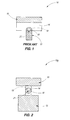
- FIG. 1 shows a prior art memory cell 10 comprising a phase change material 14 between a pair of electrodes 12 and 16.
- the phase change material has a switching volume 18 therein, and such switching volume is directly over and against the bottom electrode 12.
- An outer boundary of the switching volume is diagrammatically illustrated with a dashed line 19.
- the bottom electrode may function as a heater to elevate a temperature within the switching volume which, in combination with self-heating within the phase change material, may induce a phase change.
- a region 21 corresponds to a part of the switching volume that is directly against the bottom electrode. Such region may be the highest temperature region of the switching volume material during operation of the memory cell in ideal prior art situations in which heat is not lost through the bottom electrode.
- a problem with the configuration of FIG. 1 is that there are may be heat loss from the switching volume through the bottom electrode. Such heat loss reduces operational efficiency of the memory cell.
- Another problem is that the highest temperature region of the switching volume may be shifted away from the bottom electrode due to heat loss through the electrode, which can lead to higher temperature requirements and programming current requirements.
- Some prior art constructions may have a highest temperature region of the phase change material which is much hotter than a melting point of the phase change material, which may be detrimental to the memory cell over time and/or may lead to excessive power consumption.
- the prior art memory configuration of FIG. 1 may require a large switching volume cross-sectional area to fully cover an electrode surface, which may lead to high programming current requirements. It would be desirable to develop new memory cells that alleviate or prevent the problems associated the prior art memory cell of FIG. 1 .
- Some embodiments include PCRAM cells in which a switching volume occurs within a region of phase change material between a pair of electrodes, but is not directly against either of the electrodes.
- Such memory cells may be referred to as "confined" cells, to indicate that the switching volume is confined in a region of a programmable material which is not in direct contact with either of the electrodes of a PCRAM cell.
- FIG. 2 shows an example embodiment "confined" PCRAM cell 10a.
- the memory cell 10a of FIG. 2 like the above-discussed memory cell 10 of FIG. 1 , has phase change material 14 provided between a pair of electrodes 12 and 16.
- the memory cell of FIG. 2 is configured to have the switching volume 18 centrally located within the phase change material, rather than being directly against either of the electrodes.
- the configuration of FIG. 2 may avoid the problematic prior art problem of heat dissipation from the switching region into an adjacent electrode (such problem was discussed above with reference to the prior art memory cell of FIG. 1 ). Also, the configuration of FIG.
- phase change material 2 may advantageously have the highest temperature region 21 of the phase change material be centrally located within the switching volume during operation of the memory cell, and be only slightly hotter than a melting point of the phase change material, rather than having the prior art problems discussed above with reference to the prior art memory cell of FIG. 1 .
- the switching volume may be confined to a designated region of the programmable material by configuring the programmable material to have a specific region that will heat faster than the other regions.
- Such faster heating region of the programmable material may be, for example, a region of the programmable material having relatively high resistance or current density relative to other regions of the programmable material, and/or may be a region having less heat loss than other regions of the programmable material.
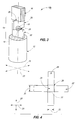
- FIG. 3 shows an example embodiment "confined" PCRAM cell 10b in which the programmable material 14 is configured to include a pair of separate programmable material structures 22 and 24 that are directly against one another.
- the illustrated structures are plates that are oriented edgewise between electrodes 12 and 16; with one of the plates extending primarily along a first axis 23, and the other extending primarily along a second axis 25.
- the plates are indicated to extend "primarily" along the first and second axes to indicate that there may be curvature or other variation of planarity along the individual plates, but the overall dimensions of the plates are such that the plates may be understood to be oriented along the first and second axes.
- the axes 23 and 25 are approximately orthogonal to one another; or, in other words, intersect one another at about a 90° angle. In other embodiments, the axes may intersect one another at other angles.
- the structures 22 and 24 may be referred to as a first programmable material structure and a second programmable material structure, respectively; and in the shown embodiment may be referred to as a first plate and a second plate, respectively.
- the first plate has an upper edge in direct contact with a lower edge of the second plate, and the switching volume 18 is shown to be along an interface 26 where the two plates meet.
- the switching volume extends about equally into both plates.
- the switching volume may be primarily within one plate or the other, depending on, for example, the compositions and configurations of the plates.
- the first plate has a bottom edge that is directly against an upper surface of the bottom electrode 12, but which contacts only a portion of such upper surface.
- the prior art memory cell of FIG. 1 has programmable material 14 contacting an entirety of an upper surface of the bottom electrode 12.
- the plates 22 and 24 may both comprise any suitable phase change material.
- the plates may comprise chalcogenide; and may, for example, comprise one or more of germanium, antimony and tellurium (for instance Ge 2 Sb 2 Te 5 ).
- the plates 22 and 24 may be the same composition as one another in some embodiments, and may be different compositions from one another in other embodiments.
- the plates may be primarily crystalline in some embodiments, or may be primarily amorphous in some embodiments.
- the plates may be primarily a same phase as one another in some embodiments, or may be primarily different phases from one another in some embodiments.
- FIG. 4 diagrammatically illustrates the interface 26, and shows that the upper edge of plate 22 has a region 29 that is directly against the lower edge of the plate 24.
- a dashed line 27 is provided around the region 29 to help illustrate the region.
- the region 29 may be referred to as a contact area of plate 22, and specifically as an area along the upper edge of plate 22 that directly contacts plate 24.
- the plate 22 has a width 30, and the plate 24 has a width 32.
- the region 29 has an area proportional to the widths of plates 22 and 24 (specifically, the area is the width of plate 22 multiplied by the width of plate 24 in the shown orientation in which the plates are orthogonal to one another).
- the widths of plates may be very thin in some embodiments (with example methods for fabricating thin plates being described below with reference to FIGS. 10-91 ); and in some embodiments may be less than or equal to about 5 nanometers (nm), less than or equal to about 4 nm, or even less than or equal to about 3 nm.
- the area of region 29 may be less than or equal to about 25 nm 2 , less than or equal to about 20 nm 2 , less than or equal to about 16 nm 2 , less than or equal to about 10 nm 2 , or even less than or equal to about 9 nm 2 in some embodiments.
- FIG. 3 utilizes two intersecting plates of programmable material to form a single switching volume. Such switching volume may be reversibly transitioned between a pair of memory states, and accordingly the memory cell of FIG. 3 may be utilized as a single level cell (SLC). Other embodiments may utilize additional plates of programmable material to form additional switching volumes. Accordingly, individual memory cells may comprise more than two memory states, and may be utilized as multilevel cells (MLCs).
- MLCs multilevel cells
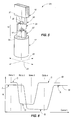
- FIG. 5 shows a memory cell 10c in which the programmable material 14 is configured as three separate programmable material plates 22, 24 and 34.
- the plates may comprise any suitable phase change material.
- the plates comprise chalcogenide; and may, for example, comprise one or more of germanium, antimony and tellurium (for instance Ge 2 Sb 2 Te 5 ).
- the plates 22, 24 and 34 may all be the same composition as one another in some embodiments.
- at least one of the plates may be of a different composition than at least one other of the plates.
- the first plate 22 may be of a different composition than the third plate 34.
- FIG. 5 has the first plate 22 supported edgewise over bottom electrode 12, and extending primarily along the first axis 23; has the second plate 24 supported edgewise over the first plate and extending primarily along the second axis 25; and has the third plate 34 supported edgewise over the second plate and extending primarily along the first axis 23.
- the shown embodiment has the first and third plates 22 and 34 extending primarily along the common axis 23, in other embodiments the first and third plates may extend primarily along different axes relative to one another.
- the second plate 24 may be considered to comprise an upper edge and a lower edge in opposing relation to one another; with the upper edge being directly against a bottom edge of the third plate 34, and with the lower edge being directly against a top edge of the first plate 22.
- the memory cell 10c comprises two switching volumes 18 and 36. Dashed-lines 19 and 37 are provided around the switching volumes 18 and 36, respectively, to diagrammatically illustrate approximate boundaries of the switching volumes.
- switching volume 18 extends about equally across both of the adjacent plates 22 and 24, and switching volume 36 extends about equally across both of the adjacent plates 24 and 34.
- the switching volume 18 may be primarily, or entirely, within only one of the plates 22 and 24; and similarly the switching volume 36 may be primarily, or entirely, within only one of the plates 24 and 34.
- switching volume 18 may have different programming characteristics than switching volume 36 due to a different geometry of switching volume 18 than switching volume 36 (i.e., due to a different amount of contact area between plates 22 and 24 than between plates 24 and 34). Such different geometry may be created by having plate 22 be of a different thickness than plate 34 (in the embodiment of FIG. 5 , plate 22 is illustrated to be thinner than plate 34).
- switching volume 18 may have different programming characteristics than switching volume 36 due to a different composition within switching volume 18 than within switching volume 36. Such difference in composition may result from having plate 22 be of a different composition than plate 34.
- switching volume 18 may have different programming characteristics than switching volume 36 due to both a different composition and a different geometry within switching volume 18 than within switching volume 36.
- Memory cell 10c may be utilized as a multilevel cell by taking advantage of the different programming characteristics of the switching volumes 18 and 36.
- FIG. 6 diagrammatically illustrates an example relationship between resistance (R) and current through the memory cell, and shows two curves 38 and 40 that represent memory states of the individual switching volumes in various operational modes. Specifically, curve 38 shows that one of the switching volumes reversibly transitions between a first memory state "A” and a second memory state "B”; and curve 40 shows that the other switching volume reversibly transitions between a first memory state "C” and a second memory state "D".
- the transition from the "A" state to the "B” state occurs under first programming conditions, from the “B” state to the “A” state under second programming conditions, from the "C” state to the “D” state under third programming conditions, and from the "D” state to the "C” state under fourth programming conditions.
- the first, second, third and fourth programming conditions all differ from one another so that the memory cell has four selectable memory states "A/C”, “A/D”, "B/D” and "B/C”; which are designated as States 1-4 in FIG. 6 .
- analogous memory cells may be configured to comprise more than three plates and accordingly more than two switching regions. Such analogous memory cells could thus have more selectable memory states than the four states shown in FIG. 6 .
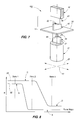
- FIG. 7 shows an example memory cell 10d configured to utilize different switching rates between two switching regions to attain a multilevel cell.
- the memory cell 10d comprises programmable material 14 configured to include four separate programmable material plates 42, 44, 46 and 48; with such plates being oriented edgewise between electrodes 12 and 16.
- the plates may comprise any suitable phase change material.
- the plates may comprise chalcogenide; and may, for example, comprise one or more of germanium, antimony and tellurium (for instance Ge 2 Sb 2 Te 5 ).
- each of the plates 42, 44, 46 and 48 may be considered to have an upper edge and a lower edge.
- the lower edge of plate 44 may be considered to be against the upper edge of plate 42; and similarly the lower edge of plate 48 may be considered to be against the upper edge of plate 46.
- plates 42 and 48 extend primarily along a first axis 23, and plates 44 and 46 extend primarily along a second axis 25. In other embodiments, the plates may extend in other directions, provided that the adjacent edges of plates 42 and 44 overlap and directly contact one another, and that the adjacent the edges of plates 46 and 48 overlap and directly contact one another.
- barrier material 54 is shown provided between plates 44 and 46.
- Such barrier material may comprise any suitable composition; and in some embodiments may comprise a conductive material, such as, for example, tungsten.
- the barrier material can simplify fabrication in embodiments in which plates 44 and 46 are of different compositions relative to one another since it provides more surface to support plate 46 than does the upper edge of plate 44. However, in other embodiments (discussed below with reference to FIG. 9 ) the barrier may be omitted. If barrier 54 is utilized, such barrier may be kept very thin (for instance, the thickness may be less than or equal to about 10 angstroms) so that it does not significantly impact operational performance of the memory cell.
- the memory cell 10d comprises two switching volumes 50 and 52.
- switching volume 50 is entirely in plate 44, and switching volume 52 is entirely in plate 46.
- the switching volume 50 may extend partially or entirely into plate 42; and/or the switching volume 52 may extend partially or entirely into plate 48.
- the two switching volumes have different switching rates relative to one another so that the switching volumes may be independently operated by controlling a duration or slope of a programming pulse.
- Switching volume 50 may have a different switching rate than switching volume 52 due to a different composition within switching volume 50 than within switching volume 52. Such difference in composition may result from having plate 44 be of a different composition than plate 46, and/or having plate 42 be of a different composition than plate 48.
- FIG. 8 diagrammatically illustrates an example relationship between resistance (R) and programming pulse duration or slope (labeled as "pulse slope” along the x-axis) through the memory cell, and shows two curves 56 and 58 that represent memory states of the individual switching volumes in various operational modes. Specifically, curve 56 shows that one of the switching volumes reversibly transitions between a first memory state "A” and a second memory state “B”; and curve 58 shows that the other switching volume reversibly transitions between a first memory state "C” and a second memory state "D".
- FIG. 8 shows the cell starting in the state "A/C”.
- a pulse may be utilized which is of appropriate duration or slope to switch only the faster switching volume, and thus form the memory state "B/C”.
- a pulse may then be utilized which is of sufficient duration or slope to switch the slower switching volume, and thus form the memory state "B/D”.
- the cell may then be returned to the memory state "A/C” by utilizing a pulse of sufficient duration or slope to switch both switching volumes.
- the memory cell only has three selectable memory states "A/C", “B/C” and “B/D” (which are designated as States 1-3 in FIG. 6 ), because there is no pulse which can switch the slower switching volume without also switching the faster switching volume.
- analogous memory cells may be configured to comprise more than four plates and accordingly more than three memory states.
- FIG. 9 shows a memory cell 10e analogous to that of FIG. 7 , but lacking the barrier material 54. According, the third plate 46 is formed directly along an upper edge of the second plate 44.
- the memory cell 10e may be operated identically to the memory cell 10d discussed above with reference to FIGS. 7 and 8 .
- FIG. 9 shows switching volumes 50 and 52 within plates 42 and 48, respectively, to illustrate an alternative operational configuration to that of FIG. 7 (where the switching volumes 50 and 52 are shown within plates 44 and 46, respectively).
- the various memory cells described above can be formed utilizing any suitable methodology. Some example methods are described with reference to FIGS. 10-91 .
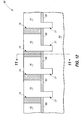
- the semiconductor construction includes a plurality of planar field effect transistors 62 supported by a base 64.
- Base 64 may comprise, consist essentially of, or consist of monocrystalline silicon, and may be referred to as a semiconductor substrate, or as a portion of a semiconductor substrate.
- semiconductor substrate semiconductor substrate
- semiconductor construction semiconductor substrate
- semiconductor substrate semiconductor substrate
- semiconductor substrate semiconductor substrate
- semiconductor substrate semiconductor substrate
- semiconductor substrate semiconductor substrate
- semiconductor substrate semiconductor substrate
- semiconductor substrate semiconductor substrate
- semiconductor substrate semiconductor substrate
- semiconductor material layers semiconductive material layers
- substrate refers to any supporting structure, including, but not limited to, the semiconductive substrates described above.
- base 64 is shown to be homogenous, the base may comprise numerous materials in some embodiments.
- base 64 may correspond to a semiconductor substrate containing one or more materials associated with integrated circuit fabrication. In such embodiments, the materials may correspond to one or more of refractory metal materials, barrier materials, diffusion materials, insulator materials, etc.
- Each of the transistors comprises a gate stack 65, and a pair of source/drain regions 67 and 69 on opposing sides of the gate stack.
- the gate stacks include gate dielectric 66, electrically conductive gate material 68 and electrically insulative capping material 70.
- the gate dielectric may comprise any suitable composition or combination of compositions, such as, for example, silicon dioxide.
- the gate material may comprise any suitable composition or combination of compositions, such as, for example, one or more of various metals, metal-containing materials and conductively-doped semiconductor materials.
- the insulative capping material 70 may comprise any suitable composition or combination of compositions, such as, for example, one or more of silicon dioxide, silicon nitride and silicon oxynitride.
- sidewall spacers 71 are on opposing sides of the gate stacks.
- Such sidewall spacers may comprise any suitable composition or combination of compositions, and in some embodiments may comprise or more of silicon oxide, silicon oxynitride and silicon nitride.
- the gate stacks may correspond to access lines (i.e. wordlines) that extend in and out of the page relative to the cross-section of FIG. 11 .
- a pair of electrically conductive contacts 72 and 74 are adjacent each of the transistor gate stacks, with the contacts 72 being electrically coupled to the source/drain regions 67 and with the contacts 74 being electrically coupled to the source/drain regions 69.
- the contacts 72 may be ultimately connected to sense lines (i.e., bit lines), which are not shown.
- the contacts 74 may be ultimately utilized as bottom electrodes of memory cells through processing described below with reference to FIGS. 13-43 , and the transistors may be utilized as select devices for such memory cells. In the shown embodiment, the contacts 74 are in one-to-one correspondence with the transistors.
- the contacts 72 and 74 may comprise any suitable composition or combination of compositions, such as, for example, one or more of various metals, metal-containing materials and conductively-doped semiconductor materials.
- Dielectric material 76 is shown extending between the contacts 74, over the transistors 62 and contacts 72, and within isolation trenches 77 that extend into base 64.
- Dielectric material 76 may comprise any suitable composition or combination of compositions. Although the dielectric material is shown to be homogeneous, in some embodiments multiple dielectric materials may be utilized. For instance, the dielectric material within the trenches may comprise one or both of silicon dioxide and silicon nitride, and the dielectric material over the trenches may comprise one or more of various glasses, such as, for example, borophosphosilicate glass, phosphosilicate glass, fluorosilicate glass, etc.
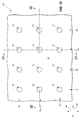
- the construction 60 is shown having a planarized upper surface that extends across dielectric material 76 and contacts 74 (shown in FIGS. 11 and 12 ).
- Such planarized upper surface may be formed by any suitable processing, including, for example, chemical-mechanical polishing (CMP).
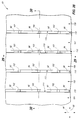
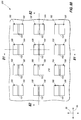
- the contacts 74 may be considered to be arranged as an array of rows 78-80 and columns 81-84 (shown in FIG. 10 ); with the rows extending along a first axis 85 and the columns extending along a second axis 86 which intersects the first axis.
- the second axis is approximately orthogonal to the first axis. In other embodiments, the first and second axes may intersect at other angles.
- the contacts 74 are utilized as bottom electrodes of memory cells, and accordingly programmable material is formed directly on the contacts 74. In other embodiments, one or more additional conductive materials may be formed over the contacts to create bottom electrodes of the memory cells. In some embodiments, the planar transistors may be replaced by vertical transistors, bipolar junction transistors or diodes.
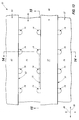
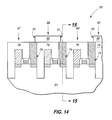
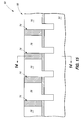
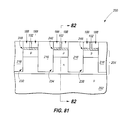
- blocks 88 and 90 are formed over contacts 74.
- the blocks are configured as strips that extend primarily along the first axis 85.
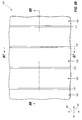
- the blocks 88 and 90 extend across alternating spaces between adjacent rows of the bottom electrodes, and partially cover the bottom electrodes. Since the blocks only cover alternating spaces between the rows, some spaces between the rows remain after formation of the blocks. Such spaces are labeled as spaces 87 and 89 in FIG. 13 .
- the blocks 88 and 90 have outer sidewall edges 91 and 93, respectively. Portions of such edges are directly over the underlying contacts 74, and thus may be considered to extend upwardly from upper surfaces of such contacts.
- the blocks 88 and 90 comprise a material 92.
- Such material may comprise any suitable composition or combination of compositions, and in some embodiments may comprise one or both of silicon dioxide and silicon nitride.
- the material 92 may be patterned into blocks 88 and 90 by any suitable process. For instance, material 92 may be formed entirely across an upper surface of construction 60, and then a photolithographically-patterned photoresist mask (not shown) may be formed over material 92 to define a pattern of blocks 88 and 90. Such pattern may be transferred from the patterned photoresist mask into material 92 with one or more suitable etches, and then the photoresist mask may be removed to leave the construction shown in FIGS. 13-15 .
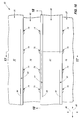
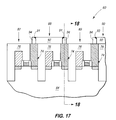
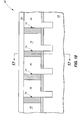
- sacrificial spacer material 94 is formed along the sidewalls 91 and 93 of blocks 88 and 90, respectively.
- the sacrificial spacer material may comprise any suitable composition or combination of compositions, and is a material which may be selectively removed relative to the material 92 of blocks 88 and 90.
- the sacrificial spacer material may comprise material known in the art as low temperature silicon nitride.
- the sacrificial spacer material may be formed along the sidewalls be any suitable process. For instance, in some embodiments a layer of the sacrificial spacer material may be formed across the blocks 88 and 90, along the sidewalls 91 and 93, and across the spaces 87 and 89 between the blocks. Subsequently, such layer may be subjected to anisotropic etching to remove portions of the layer along horizontal surfaces, while leaving the layer along the vertical sidewall surfaces to form the configuration shown in FIGS. 16-18 .
- a material 96 is provided within the spaces 87 and 89 ( FIG. 16 ), and patterned into blocks 97 and 99.
- materials 92 and 96 may be referred to as first and second materials, respectively; and blocks 88 and 90 may be referred to as first blocks, while blocks 97 and 99 are referred to as second blocks.
- the material 96 may be patterned into blocks 97 and 99 utilizing any suitable processing.
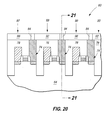
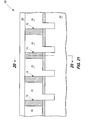
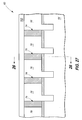
- material 96 is provided within spaces 87 and 89 ( FIG. 16 ) and over blocks 92, and is then removed from over blocks 92 utilizing planarization (such as, for example, CMP) to form the construction of FIGS. 19-21 .
- planarization such as, for example, CMP
- Material 96 may comprise any suitable composition or combination of compositions, and in some embodiments may comprise, consist essentially of, or consist of silicon dioxide.
- material 94 ( FIGS. 19-21 ) is selectively removed relative to materials 92 and 96 to form gaps 100 between the blocks 97, 88, 99 and 90.
- a first material is considered to be selectively removed relative to a second material if the first material is removed at a faster rate than the second material; which can include, but is not limited to, processes which are 100 percent selective for the first material relative to the second material.
- material 94 may comprise low temperature silicon nitride, while materials 92 and 96 comprise silicon dioxide, and the selective removal of material 94 may utilize a wet etch.
- the gaps 100 are along the sidewalls 91 and 93 ( FIG. 16 ) of blocks 88 and 90, and the upper surfaces of contacts 74 are exposed within such gaps.
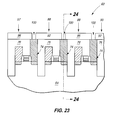
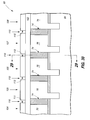
- the gaps 100 are filled with programmable material 102.
- the programmable material may comprise phase change material; and in some embodiments may comprise chalcogenide.
- the programmable material may be a chalcogenide comprising one or more of germanium, antimony and tellurium (such as, for example, Ge 2 Sb 2 Te 5 ).
- the programmable material may be initially formed over blocks 97, 88, 99 and 90, as well is within the gaps between the blocks, and may then be removed from over the blocks by planarization (for instance, CMP) to leave the construction shown in FIGS. 25-27 .
- the programmable material 102 may be considered to be patterned as first programmable material lines that are along the sidewalls 91 and 93 ( FIG. 16 ) of blocks 88 and 90.
- the programmable material is directly against upper surfaces of contacts 74.
- the contacts may correspond to bottom electrodes in such embodiments, and the programmable material 102 may correspond to a first programmable material plate supported edgewise over the bottom electrodes.
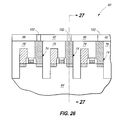
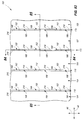
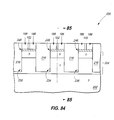
- blocks 104-108 are formed over the materials 92, 96 and 102, and along the second axis 86.
- the blocks 104-108 are spaced from one another by gaps 110.
- blocks 104-108 and gaps 110 may be formed utilizing any suitable processing.
- blocks 104-108 may be formed utilizing processing analogous to that described above for forming the blocks 97, 88, 99 and 90, and gaps 100, of FIGS. 22-24 .
- blocks 104, 106 and 108 may be initially formed from a material patterned as strips extending orthogonal to the material blocks 88, 90, 97 and 99 ( FIG. 25 ); a layer of sacrificial material (not shown) may be formed along sidewalls of such strips; blocks 105 and 107 may be formed from another material provided within spaces between the blocks 104, 106 and 108; and finally the sacrificial material may be removed to leave the construction of FIGS.
- the sacrificial material utilized during fabrication of gaps 110 may be identical to the sacrificial material 94 described above with reference to FIGS. 16-18 , and in some embodiments may be referred to as a second sacrificial material to distinguish it from the first sacrificial material 94.
- the blocks 104-108 may be formed from a single dielectric material provided entirely across an upper surface of the shown construction, and the slots 110 may be formed by etching through such dielectric material while utilizing a photoresist mask to pattern locations of the gaps.
- the photoresist mask may have been subjected to soaking and/or freezing to reduce a width of the patterned slots to a dimension less than could be achieved with photolithography alone.
- the blocks 104, 106 and 108 have edges 111, 113 and 115 that are directly over the bottom electrodes corresponding to contacts 74, as can be seen in FIGS. 28 and 30 .
- programmable material 112 is formed within the gaps 110 ( FIGS. 28-30 ).
- the programmable material 112 may comprise phase change material; and in some embodiments may comprise chalcogenide.
- the programmable material may be a chalcogenide comprising one or more of germanium, antimony and tellurium (such as, for example, Ge 2 Sb 2 Te 5 ).
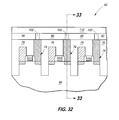
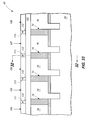
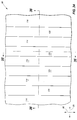
- the programmable material may be initially formed over blocks 104-108, as well is within the gaps between the blocks, and may then be removed from over the blocks by planarization (for instance, CMP) to leave the construction shown in FIGS. 31-33 .
- the programmable material 112 may be referred to as a second programmable material, to distinguish it from the first programmable material 102.
- the first and second programmable materials 102 and 112 may comprise the same compositions as one another in some embodiments, and may comprise different compositions from one another in other embodiments.
- the second programmable material 112 may be considered to be patterned as second programmable material lines that are along the sidewalls 111, 113 and 115 of blocks 104, 106 and 108.
- the second programmable material lines are directly over, and directly against, the lines of the first programmable material 102; and in the shown embodiment extend approximately orthogonally to the lines of the first programmable material.
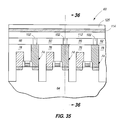
- top electrode material 114 is provided across the second programmable material 112, and the blocks 104-108.
- the top electrode material may comprise any suitable composition or combination of compositions, and in some embodiments may comprise one or more of various metals, metal-containing materials, and conductively-doped semiconductor materials.
- the top electrode material may be formed utilizing any suitable processing, including, for example, one or more of atomic layer deposition (ALD), chemical vapor deposition (CVD), and physical vapor deposition (PVD).
- Patterned masking material 125 is formed over the top electrode material.
- the patterned masking material may comprise, for example, photolithographically-patterned photoresist.
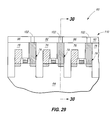
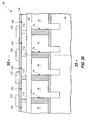
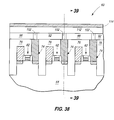
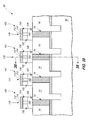
- FIGS. 37-39 one or more etches are utilized to transfer a pattern from the patterned masking material 125 ( FIGS. 34-36 ) through materials beneath the masking material, and to an upper surface of dielectric material 76 (or into material 76 in some embodiments), and then the patterned masking material is removed.
- FIG. 39 illustrates that block 104 ( FIG. 31 ) is patterned into a line 130 under the top electrode line 116; block 105 ( FIG.
- FIG. 31 is patterned into a line 131 under the top electrode line 116 and a line 133 under the top electrode line 117; block 106 ( FIG. 31 ) is patterned into a line 134 under the top electrode line 117 and a line 135 under the top electrode line 118; block 107 ( FIG. 31 ) is patterned into a line 136 under the top electrode line 118 and a line 137 under the top electrode line 119; and the block 108 ( FIG. 31 ) is patterned into a line 138 under the top electrode line 119.
- the bottom electrodes 74, segments of programmable material 102, lines of programmable material 112, and lines of conductive material 114 together form an array of memory cells; with example memory cells being shown in FIG. 39 as memory cells 140-143.
- Each memory cell has a first programmable material segment (for instance, the segment 126 within memory cell 140) that has an upper surface extending along a first axis (with such axis being along the cross-section of FIG. 39 in the illustrated embodiment).
- the adjacent segments of the first programmable material 102 are electrically isolated from one another by a gap in the shown embodiment. In subsequent processing, such gaps may be filled with dielectric material.
- the individual memory cells may also be considered to comprise segments of the second programmable material 112 that are directly between the top and bottom electrodes. Such segments of the second material extends along a second axis that is in and out of the page relative to the cross-section of FIG. 39 . Unlike the segments of the first programmable material 102 that are separated from one another, the segments of the second programmable material 112 are connected to one another, and form lines that extend continuously along the bottom surfaces of the top electrode lines in the shown embodiment.
- the individual memory cells are in one-to-one correspondence with the planar field effect transistors 62 (as shown in FIG. 38 ), and such transistors may be utilized as select devices during programming and/or reading of the individual memory cells.
- FIGS. 37-39 illustrate a method of segregating the lines of the first programmable material 102 present at the processing stage of FIGS. 34-36 into electrically isolated segments which comprises cutting such lines into spaced-apart segments. Another method for segregating the lines into electrically isolated segments is to implant dopant within the lines in intervening regions between the desired segments. An example embodiment of such method is described with reference to FIGS. 40 and 41 .
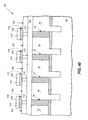
- a region of construction 60 is shown at a processing stage subsequent to that of FIG. 36 .
- Etching has been conducted to transfer a pattern from the patterned masking material 125 through the top electrode material 114, and to thereby pattern the top electrode material 114 into the lines 116-119.
- the etching has not been utilized to penetrate through the programmable material 102.
- the etching has also not been utilized to penetrate through the blocks 104-108; but in other examples (not shown) the etching could penetrate through the blocks 104-108 to expose an upper surface of programmable material 102.
- dopant 144 is implanted into programmable material 102 while utilizing the patterned materials 114 and 125 as a mask. Such forms doped intervening regions 145 within programmable material 102, with the doped intervening regions being between the memory cell segments 126-129. Such doped intervening regions 145 may electrically isolate memory cell segments 126-129 from one another. Alternatively considered, the doping into the line of programmable material 102 at the processing stage of FIG. 41 segregates such line into the memory cell segments 126-129, and into the doped intervening regions 145 between such memory cell segments.
- Dopant 144 may comprise any suitable dopant which increases electrically insulative properties of programmable material 102. Different dopants may be desired for different compositions of programmable material 102, and persons of ordinary skill in the art can choose the appropriate dopant for the particular programmable material 102 being utilized.
- FIG. 41 shows the dopant 144 being implanted through blocks 104-108.
- the blocks may be patterned during the patterning of conductive material 114, so that the dopant may be implanted directly into material 102, rather than through such blocks.
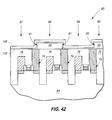
- FIG. 22 forms narrow trenches (or gaps) 100 which may be subsequently utilized for patterning the lines of first programmable material 102 (as shown at the processing stage of FIG. 25 ). Another method of forming lines of programmable material 102 is described with reference to FIGS. 42 and 43 .
- FIG. 42 which is not covered by the claims, shows a region of construction 60 at a processing stage subsequent to that of FIG. 14 .
- a layer of first programmable material 102 is deposited to extend over blocks 88 and 90, along the sidewalls 91 and 93 of the blocks, and within the spaces 87 and 89 adjacent the blocks.
- Such layer may be formed utilizing any suitable processing, including, for example, one or more of ALD, CVD and PVD.
- a layer of protective material 146 is deposited over programmable material 102.
- the protective material is provided to protect material 102 during a subsequent anisotropic etch, and may comprise any suitable composition or combination of compositions.
- the protective material may comprise one or both of silicon dioxide and silicon nitride.
- materials 102 and 146 are subjected to an anisotropic etch to form lines of the programmable material 102 along the sidewalls 91 and 93 of blocks 88 and 90 (such lines would extend in and out of the page relative to the cross-section of FIG. 40 , and would extend linearly along the axis 85 shown in FIG. 13 ).
- Subsequent processing analogous to that of FIGS. 28-39 may be utilized to incorporate the programmable material 102 of FIG. 43 into memory cells.
- Such memory cells may be analogous to those described with reference to FIGS. 37-39 .
- the programmable material 102 of the memory cells of FIGS. 37-38 forms plates which are rectangular-shaped along the cross-section of FIG. 38
- the programmable material 102 of the example of FIG. 43 forms plates which are "L-shaped" along the same cross-section.
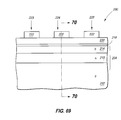
- a semiconductor construction 150 is illustrated at a processing stage associated with another example method for fabrication of a memory array.
- the semiconductor construction includes a plurality of substantially vertical transistor pillars 154 supported by a base 152.
- the base 152 may comprise monocrystalline silicon, and/or any of the compositions described above relative to base 64 ( FIGS. 10-12 ).
- the transistor pillars 154 are referred to as being “substantially vertical” pillars to indicate that they extend substantially orthogonally to a primary upper surface of the base 152.
- the term “vertical” is used herein to define a relative orientation of an element or structure with respect to a major plane or surface of a wafer or substrate.
- a structure may be referred to as being “substantially vertical” to indicate that the structure is vertical to within reasonable tolerances of fabrication and measurement.
- Each transistor pillar comprises semiconductor material extending upwardly from base 152, and comprises a conductively-doped source/drain region 156 within the semiconductor material.
- the pillars are spaced-apart from one another, and dielectric material 158 is provided within the spaces between the pillars.
- the dielectric material may comprise any suitable composition or combination of compositions; and in some embodiments may include one or more of silicon dioxide, silicon nitride and any of various glasses.
- the pillars 154 are capped by patterned masking materials 160 and 162.
- patterned masking materials may correspond to pad oxide 160 and silicon nitride 162.
- the pad oxide material may comprise silicon dioxide.
- the patterned masking materials may be utilized for patterning the transistor pillars 154 from the semiconductor material of base 152.
- the pad oxide may have a thickness of about 95 ⁇ , and the silicon nitride may have a thickness of about 1000 ⁇ .
- a planarized surface extends across dielectric material 158 and masking material 162.
- Such planarized surface may be formed by, for example, CMP.
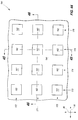
- the vertical transistor pillars are shown to be square-shaped along the top-view of FIG. 44 , in other embodiments the vertical transistor pillars may have any other suitable shape.
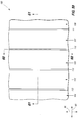
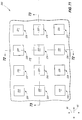
- the vertical transistor pillars may be considered to be arranged as an array of rows 170-172 and columns 173-176; with the rows extending along the first axis 85 and the columns extending along the second axis 86.
- the second axis is approximately orthogonal the first axis. In other embodiments, the first and second axes may intersect at other angles.
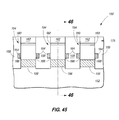
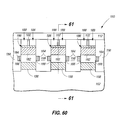
- FIG. 45 shows access lines (i.e. wordlines) 164 extending along sidewalls of the vertical transistor pillars.
- Such access lines may comprise any suitable electrically conductive material (for instance, titanium nitride), and may be formed with any suitable processing.
- the access lines are spaced from semiconductor material of the pillars by gate dielectric 166.
- Such gate dielectric may comprise any suitable composition (for instance, silicon dioxide), and any suitable configuration. In some embodiments the gate dielectric may extend the full height of the vertical transistor pillars, rather than being a same vertical dimension as the access lines.
- An access line 164 is illustrated in dashed-line view in FIG. 46 . Such access line would be out of the plane of the cross-section of FIG. 46 , but is diagrammatically illustrated to assist the reader in understanding the relative orientation of the access line to the illustrated row of vertical transistor pillars.
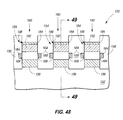
- Source/drain regions 182 are formed at the tops of the vertical transistor pillars by implanting dopant into the semiconductor material of the vertical pillars.
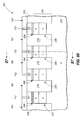
- Electrically conductive bottom electrode material 184 is formed within the openings and directly against the top source/drain regions 182.
- the bottom electrode material may comprise any suitable composition or combination of compositions, and in some embodiments may comprise cobalt silicide. Such cobalt silicide may be formed by silicidation of silicon exposed at the tops of pillars 154 within the openings 180.
- the bottom electrode material 184 of FIGS. 47-49 may be considered to form an array of bottom electrodes 186 that are across a supporting base of semiconductor material.
- the array comprises rows along the axis 85, and columns along the axis 86.
- Such bottom electrodes may be considered to be exposed at the bottoms of the container-shaped openings 180 that extend into dielectric material 158.
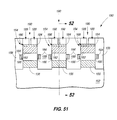
- spacers 188 are formed within the openings 180 ( FIGS. 47-49 ) to narrow the openings, and thereby form slots 190 over the bottom electrodes 186.
- the spacers 188 may comprise any suitable composition or combination of compositions, and in some examples may comprise one or both of silicon dioxide and silicon 10 nitride.
- the slots 190 may be formed utilizing any suitable methodology. For instance, the slots may be formed by an etch into material of spacers 188 while patterning the locations of the slots with a photolithographically-patterned photoresist mask (not shown).
- resist soaking and/or freezing methodology may be used to form the photoresist mask to be suitable to pattern features having dimensions less than can be achieved by photolithography alone.
- the slots 190 may be formed utilizing a sacrificial spacer with methodology analogous to that described above with reference to FIGS. 14-24 for fabrication of the slots 100.
- the slots 190 extend along the direction of axis 85 in the shown example.
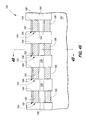
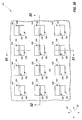
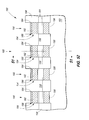
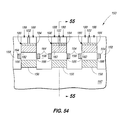
- first programmable material 102 is formed within the slots 90 ( FIGS. 50-52 ).
- the first programmable material may be formed within the slots by depositing a layer of first programmable material which extends within the slots and over upper surfaces of dielectric materials 158 and 188, and then utilizing CMP to remove the programmable material from over the dielectric materials while leaving the programmable material within the slots.
- the first programmable material 102 forms a plurality of separated segments (or plates) which are supported edgewise over the bottom electrodes 186.
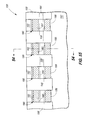
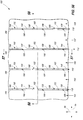
- blocks 104-108 are formed over the materials 158, 188 and 102, and along the second axis 86.
- the blocks 104-108 are spaced from one another by gaps 110.
- the blocks 104-108 and gaps 110 are identical to those discussed above relative to FIGS. 28-30 , and may be formed with the same processing.
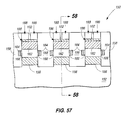
- lines of second programmable material 112 are formed within the gaps 110 ( FIGS. 56-58 ).
- the programmable material 112 may comprise the same materials discussed above with reference to FIGS. 31-33 , and may be formed by the same methodology discussed above with reference to such figures.
- the lines of the second programmable material 112 are directly over, and directly against, the segments of the first programmable material 102; and in the shown embodiment extend approximately orthogonally to such segments of the first programmable material.
- top electrode material 114 is provided across the second programmable material 112 and the blocks 104-108, and is then patterned into lines 116-119. Such patterning may be accomplished with processing analogous to that discussed above with reference to FIGS. 34-39 .
- the bottom electrodes 186, segments of programmable material 102, lines of programmable material 112, and lines of conductive material 114 together form an array of memory cells; with example memory cells being shown in FIG. 64 as memory cells 191-194.
- Each memory cell has a segment (or plate) of first programmable material 102 having an upper surface extending along a first axis (with such axis being along the cross-section of FIG. 64 in the illustrated embodiment), and has a region of the second programmable material 112 that has a bottom edge directly against the upper edge of material 102.
- the material 112 is configured as a plurality of lines that directly contact multiple separate plates of material 102; with an example line of material 112 being shown in FIG. 63 to contact a plurality of underlying plates of material 102.
- the individual memory cells 191-194 of FIG. 65 are in one-to-one correspondence with substantially vertical transistors underlying the memory cells, and such transistors may be utilized as select devices during programming and/or reading of the individual memory cells.
- the semiconductor construction 200 is illustrated at a processing stage associated with another example method for fabrication of a memory array.
- the semiconductor construction includes a plurality of diode stacks 204 supported by a base 202.
- the base 202 may comprise p-type doped monocrystalline silicon.
- the diode stacks are arranged as a plurality of lines 206-209 extending along the axis 86.
- Each diode stack comprises semiconductor material extending upwardly from base 202, and comprises an n-type doped region 210 between a pair of p-type doped regions (212 and 214).
- the diode stacks are spaced-apart from one another, and dielectric material 216 is provided within the spaces between the stacks.
- the dielectric material may comprise any suitable composition or combination of compositions; and in some embodiments may include one or more of silicon dioxide, silicon nitride and any of various doped glasses.
- the stacks 204 are capped by patterned masking materials 218 and 220.
- patterned masking materials may correspond to pad oxide 218 and silicon nitride 220.
- the pad oxide may have a thickness of about 95 ⁇
- the silicon nitride may have a thickness of about 1000 ⁇ .
- the patterned masking materials 218 and 220 may be utilized for patterning the diode stacks 204 from the semiconductor material of base 202. Such patterning of the diode stacks may be conducted after implanting the dopants within regions 210, 212 and 214, in some embodiments.
- a planarized surface extends across dielectric material 216 and masking material 220.
- Such planarized surface may be formed by, for example, CMP.
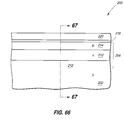
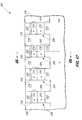
- patterned masking material 222 is provided across materials 216 and 220.
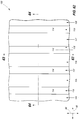
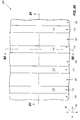
- the masking material 222 is patterned as a plurality of spaced apart lines 223-225 that extend along the axis 85; and thus extend substantially orthogonally to the lines 206-209 of the diode stacks.
- Masking material 222 may comprise any suitable composition or combination of compositions, and in some embodiments may correspond to photolithographically-patterned photoresist.
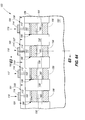
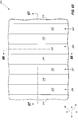
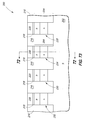
- a pattern is transferred from the patterned masking material 222 ( FIGS. 68-70 ) into regions of diode stacks 204, material 220 and material 216 with one or more suitable etches, and subsequently the patterned masking material is removed.
- the etching into the diode stacks 204, material 220 and material 216 forms trenches 226 (labeled in FIG. 72 ), and such trenches are subsequently filled with dielectric material 216.
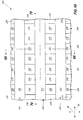
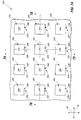
- an array of diodes 228-239 are formed from the lines 206-209 ( FIGS. 68-70 ) of the diode stacks 204.
- Each diode is capped by the masking materials 218 and 220 at the processing stage of FIGS. 71-73 .
- the diodes are shown to be square-shaped along the top-view of FIG. 71 , in other embodiments the diodes may be formed to comprise any other suitable shape.
- a planarized surface extends across dielectric material 216 and masking material 220 after forming the dielectric material 216 within the trenches 226 ( FIG. 72 ).
- Such planarized surface may be formed by, for example, CMP after filling the trenches with the dielectric material.
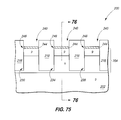
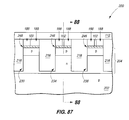
- bottom electrode material 244 is formed within the openings and directly against the top p-type doped region of the diode stacks 204.
- the bottom electrode material may comprise any suitable composition or combination of compositions, and in some embodiments may comprise cobalt silicide. Such cobalt silicide may be formed by silicidation of silicon exposed at the tops of diode stacks 204 within the openings 240.
- the bottom electrode material 244 of FIGS. 74-76 may be considered to form an array of bottom electrodes 246.
- the array comprises rows along the axis 85, and columns along the axis 86.
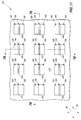
- spacers 188 are formed within the openings 240 ( FIGS. 74-76 ) to narrow the openings, and to thereby form slots 190 over the bottom electrodes 186.
- the spacers 188 may comprise any of the compositions discussed above with reference to FIGS. 50-52 , and may be formed with any of the methods discussed above with reference to such figures.
- the slots 190 extend along the direction of axis 85 in the shown embodiment.
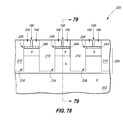
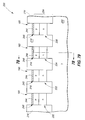
- first programmable material 102 is formed within the slots 90 ( FIGS. 77-79 ).
- the first programmable material may be formed within the slots by depositing a layer of first programmable material which extends within the slots and over upper surfaces of dielectric materials 216 and 188, and then utilizing CMP to remove the programmable material from over the dielectric materials while leaving the programmable material within the slots.
- the first programmable material 102 forms a plurality of separated segments (or plates) which are supported edgewise over the bottom electrodes 246.
- blocks 104-108 are formed over the materials 216, 188 and 102, and along the second axis 86.
- the blocks 104-108 are spaced from one another by gaps 110.
- the blocks 104-108 and gaps 110 are identical to those discussed above relative to FIGS. 28-30 , and may be formed with the same processing.
- lines of second programmable material 112 are formed within the gaps 110 ( FIGS. 83-85 ).
- the programmable material 112 may comprise the same materials discussed above with reference to FIGS. 31-33 , and may be formed by the same methodology discussed above with reference to such figures.
- the lines of the second programmable material 112 are directly over, and directly against, the segments of the first programmable material 102; and in the shown embodiment extend approximately orthogonally to such segments of the first programmable material.
- top electrode material 114 is provided across the second programmable material 112 and the blocks 104-108, and is then patterned into lines 116-119. Such patterning may be accomplished with processing analogous to that discussed above with reference to FIGS. 34-39 .
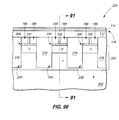
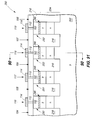
- the bottom electrodes 246, segments of programmable material 102, lines of programmable material 112, and lines of conductive material 114 together form an array of memory cells; with example memory cells being shown in FIG. 91 as memory cells 250-253.
- Each memory cell has a segment (or plate) of first programmable material 102 having an upper surface extending along a first axis (with such axis being along the cross-section of FIG. 91 in the illustrated embodiment), and has a region of the second programmable material 112 that has a bottom edge directly against the upper edge of material 102.
- the material 112 is configured as a plurality of lines that directly contact multiple separate plates of material 102; with an example line of material 112 being shown in FIG. 90 to contact a plurality of underlying plates of material 102.
- the individual memory cells 250-253 of FIG. 91 are in one-to-one correspondence with substantially vertical diodes underlying the memory cells, and such diodes may be utilized as select devices during programming and/or reading of the individual memory cells.
- the memory cells and arrays discussed above may be used in, for example, memory modules, device drivers, power modules, communication modems, processor modules, and application-specific modules.
- the memory cells and arrays may be incorporated into electronic systems; such as, for example, clocks, televisions, cell phones, personal computers, automobiles, industrial control systems, aircraft, etc.
Landscapes
- Engineering & Computer Science (AREA)
- Manufacturing & Machinery (AREA)
- Semiconductor Memories (AREA)
Claims (6)
- Cellule de mémoire, comprenant :une électrode de sole (12) présentant une surface supérieure avec une zone de surface supérieure ;des première et deuxième plaques de matériau programmable (22, 24) présentant des dimensions de longueur, de largeur et d'épaisseur (30, 32) ; les dimensions d'épaisseur (30, 32) étant inférieures aux dimensions de longueur et de largeur ; les plaques de matériau programmable (22, 24) présentant des bords fins le long des dimensions d'épaisseur (30, 32) ;la première plaque de matériau programmable (22) étant supportée par les bords sur l'électrode de sole (12) ; la première plaque de matériau programmable (22) présentant un bord fin inférieur et un bord fin supérieur ; seul le bord fin inférieur de la première plaque de matériau programmable (22) se trouvant contre l'électrode de sole (12), et étant directement contre une partie seulement de la zone de surface supérieure de l'électrode de sole (12) ;la deuxième plaque de matériau programmable (24) étant supportée par les bords sur la première plaque de matériau programmable (22) ; la deuxième plaque de matériau programmable (24) présentant un bord fin inférieur et un bord fin supérieur ; le bord fin inférieur de la deuxième plaque de matériau programmable (24) étant directement contre le bord fin supérieur de la première plaque de matériau programmable (22) ; etune électrode supérieure (16) au-dessus du bord fin supérieur de la deuxième plaque de matériau programmable (24).
- Cellule de mémoire selon la revendication 1, dans laquelle la première plaque de matériau programmable (22) s'étend de manière linéaire le long d'un premier axe (23), et dans laquelle la deuxième plaque de matériau programmable (24) s'étend de manière linéaire le long d'un deuxième axe (25) qui coupe le premier axe (23).
- Cellule de mémoire selon la revendication 2, dans laquelle la deuxième plaque de matériau programmable (24) est directement contre une région de chevauchement (29) de la première plaque de matériau programmable (22), et dans laquelle ladite région de chevauchement présente une surface inférieure ou égale à environ 10 nm2.
- Cellule de mémoire selon la revendication 1, dans laquelle les première et deuxième plaques de matériau programmable (22, 24) comprennent toutes deux un matériau à changement de phase.
- Cellule de mémoire selon la revendication 1, dans laquelle les première et deuxième plaques de matériau programmable (22, 24) comprennent toutes deux un chalcogénure.
- Procédé de formation d'un réseau de cellules de mémoire, comprenant les étapes consistant à :fournir un réseau d'électrodes de sole (74) sur une base de support (64), le réseau comprenant des rangées (78 à 80) et des colonnes (81 à 84) ; les rangées (78 à 80) s'étendant principalement le long d'un premier axe (85), et les colonnes (81 à 84) s'étendant principalement le long d'un deuxième axe (86) qui coupe le premier axe (85) ;former des premiers blocs (88, 90) qui s'étendent principalement le long du premier axe (85) ; les premiers blocs (88, 90) s'étendant sur des espaces alternés entre des rangées (78 à 80) adjacentes des électrodes de sole (74) et recouvrant partiellement les électrodes de sole (74), les premiers blocs (88, 90) présentant des bords (91, 93) s'étendant vers le haut à partir de surfaces supérieures des électrodes de sole (74) ;structurer des premières lignes de matériau programmable (102) le long des bords (91, 93) des premiers blocs (88, 90) ;former des deuxièmes blocs (104 à 108) qui s'étendent principalement le long du deuxième axe ; les deuxièmes blocs (104 à 108) s'étendant sur des espaces alternés entre des colonnes (81 à 84) adjacentes des électrodes de sole (74) et recouvrant partiellement les électrodes de sole (74), les deuxièmes blocs (104 à 108) présentant des bords (111, 113, 115) situés directement au-dessus des surfaces supérieures des électrodes de sole (74) ;structurer des deuxièmes lignes de matériau programmable (112) le long des bords (111, 113, 115) des deuxièmes blocs (104 à 108) ;former un matériau d'électrode supérieure (114) par-dessus les deuxièmes lignes de matériau programmable (112) ;former des lignes de matériau de masquage (125) par-dessus le matériau d'électrode supérieure (114), et par-dessus les deuxièmes lignes de matériau programmable (112) ;transférer un motif à partir du matériau de masquage (125), à travers le matériau d'électrode supérieure (114), et à travers les premières lignes de matériau programmable (102) grâce à une ou plusieurs gravure(s) ;les première et deuxième lignes de matériau programmable (102, 112) présentant des dimensions de largeur et d'épaisseur ; les dimensions d'épaisseur étant inférieures aux dimensions de largeur ; les lignes de matériau programmable (102, 112) présentant des bords fins le long des dimensions d'épaisseur ;les première et deuxième lignes de matériau programmable (102, 112) présentant un bord fin inférieur et un bord fin supérieur ; le bord fin inférieur de la deuxième ligne de matériau programmable (112) étant directement contre le bord fin supérieur de la première ligne de matériau programmable (102) ;dans lequel la structuration des premières lignes de matériau programmable (102) le long des bords (91, 93) des premiers blocs (88, 90) comprend les étapes consistant à :former une couche de matériau sacrificiel (94) le long des bords (91, 93) des premiers blocs (88, 90) ;former un deuxième matériau (96) le long du matériau sacrificiel (94) et au sein d'espaces situés entre les premiers blocs (88, 90) ;retirer le matériau sacrificiel (94) afin de laisser des espaces vides (100) entre les premiers blocs (88, 90) et le deuxième matériau (96), et le long des bords (91, 93) des premiers blocs ; etremplir les espaces vides (100) avec le premier matériau programmable (102) ;dans lequel la couche de matériau sacrificiel (94) est une première couche de matériau sacrificiel, et dans lequel la structuration des deuxièmes lignes de matériau programmable (112) le long des bords (111, 113, 115) des deuxièmes blocs (104 à 108) comprend les étapes consistant à :former une deuxième couche de matériau sacrificiel le long des bords (111, 113, 115) des deuxièmes blocs (104 à 108) ;former un troisième matériau le long de la deuxième couche de matériau sacrificiel et au sein d'espaces situés entre les deuxièmes blocs (104 à 108) ;retirer la deuxième couche de matériau sacrificiel afin de laisser des espaces vides entre les deuxièmes blocs (104 à 108) et le troisième matériau, et le long des bords (111, 113, 115) des deuxièmes blocs (104 à 108) ; etremplir les espaces vides entre les deuxièmes blocs (104 à 108) et le troisième matériau avec le deuxième matériau programmable (112).
Applications Claiming Priority (2)
| Application Number | Priority Date | Filing Date | Title |
|---|---|---|---|
| US13/084,011 US8735862B2 (en) | 2011-04-11 | 2011-04-11 | Memory cells, methods of forming memory cells and methods of forming memory arrays |
| PCT/US2012/027818 WO2012141823A2 (fr) | 2011-04-11 | 2012-03-06 | Cellules de mémoire, procédés de formation de cellules de mémoire et procédés de formation de matrices de mémoire |
Publications (3)
| Publication Number | Publication Date |
|---|---|
| EP2697828A2 EP2697828A2 (fr) | 2014-02-19 |
| EP2697828A4 EP2697828A4 (fr) | 2014-09-10 |
| EP2697828B1 true EP2697828B1 (fr) | 2016-09-21 |
Family
ID=46965377
Family Applications (1)
| Application Number | Title | Priority Date | Filing Date |
|---|---|---|---|
| EP12771127.3A Active EP2697828B1 (fr) | 2011-04-11 | 2012-03-06 | Cellules de mémoire, procédés de formation de cellules de mémoire et procédés de formation de matrices de mémoire |
Country Status (6)
| Country | Link |
|---|---|
| US (3) | US8735862B2 (fr) |
| EP (1) | EP2697828B1 (fr) |
| KR (1) | KR101484876B1 (fr) |
| CN (1) | CN103503142B (fr) |
| TW (1) | TWI483252B (fr) |
| WO (1) | WO2012141823A2 (fr) |
Families Citing this family (14)
| Publication number | Priority date | Publication date | Assignee | Title |
|---|---|---|---|---|
| US8486743B2 (en) | 2011-03-23 | 2013-07-16 | Micron Technology, Inc. | Methods of forming memory cells |
| US8735862B2 (en) | 2011-04-11 | 2014-05-27 | Micron Technology, Inc. | Memory cells, methods of forming memory cells and methods of forming memory arrays |
| KR20130042975A (ko) * | 2011-10-19 | 2013-04-29 | 삼성전자주식회사 | 작은 콘택을 갖는 비-휘발성 메모리소자 형성 방법 및 관련된 소자 |
| US8994489B2 (en) | 2011-10-19 | 2015-03-31 | Micron Technology, Inc. | Fuses, and methods of forming and using fuses |
| US9252188B2 (en) | 2011-11-17 | 2016-02-02 | Micron Technology, Inc. | Methods of forming memory cells |
| US8723155B2 (en) | 2011-11-17 | 2014-05-13 | Micron Technology, Inc. | Memory cells and integrated devices |
| US8759807B2 (en) | 2012-03-22 | 2014-06-24 | Micron Technology, Inc. | Memory cells |
| US9136467B2 (en) | 2012-04-30 | 2015-09-15 | Micron Technology, Inc. | Phase change memory cells and methods of forming phase change memory cells |
| US9627611B2 (en) * | 2012-11-21 | 2017-04-18 | Micron Technology, Inc. | Methods for forming narrow vertical pillars and integrated circuit devices having the same |
| US9553262B2 (en) | 2013-02-07 | 2017-01-24 | Micron Technology, Inc. | Arrays of memory cells and methods of forming an array of memory cells |
| US9881971B2 (en) | 2014-04-01 | 2018-01-30 | Micron Technology, Inc. | Memory arrays |
| US9362494B2 (en) | 2014-06-02 | 2016-06-07 | Micron Technology, Inc. | Array of cross point memory cells and methods of forming an array of cross point memory cells |
| US9343506B2 (en) | 2014-06-04 | 2016-05-17 | Micron Technology, Inc. | Memory arrays with polygonal memory cells having specific sidewall orientations |
| EP3315399B1 (fr) * | 2016-10-28 | 2020-06-10 | Airbus Operations GmbH | Aile d'aéronef avec corps d'hypersustention et avec joint flexible pour fente |
Family Cites Families (21)
| Publication number | Priority date | Publication date | Assignee | Title |
|---|---|---|---|---|
| US3271591A (en) * | 1963-09-20 | 1966-09-06 | Energy Conversion Devices Inc | Symmetrical current controlling device |
| US7161167B2 (en) * | 2003-08-04 | 2007-01-09 | Intel Corporation | Lateral phase change memory |
| KR100564608B1 (ko) * | 2004-01-29 | 2006-03-28 | 삼성전자주식회사 | 상변화 메모리 소자 |
| KR100546406B1 (ko) | 2004-04-10 | 2006-01-26 | 삼성전자주식회사 | 상변화 메모리 소자 제조 방법 |
| KR100695682B1 (ko) | 2004-12-31 | 2007-03-15 | 재단법인서울대학교산학협력재단 | 가변 저항 구조물, 이의 제조 방법, 이를 포함하는 상변화메모리 장치 및 그 제조 방법 |
| US7317200B2 (en) * | 2005-02-23 | 2008-01-08 | Micron Technology, Inc. | SnSe-based limited reprogrammable cell |
| ATE420440T1 (de) * | 2005-05-19 | 2009-01-15 | Koninkl Philips Electronics Nv | Verfahren zum regeln des zuerst schmelzenden bereiches einer pcm-zelle und damit hergestellte vorrichtungen |
| KR100682946B1 (ko) | 2005-05-31 | 2007-02-15 | 삼성전자주식회사 | 상전이 램 및 그 동작 방법 |
| US8237140B2 (en) * | 2005-06-17 | 2012-08-07 | Macronix International Co., Ltd. | Self-aligned, embedded phase change RAM |
| US7332735B2 (en) * | 2005-08-02 | 2008-02-19 | Micron Technology, Inc. | Phase change memory cell and method of formation |
| US7473921B2 (en) * | 2006-06-07 | 2009-01-06 | International Business Machines Corporation | Nonvolatile memory cell with concentric phase change material formed around a pillar arrangement |
| US7442603B2 (en) | 2006-08-16 | 2008-10-28 | Macronix International Co., Ltd. | Self-aligned structure and method for confining a melting point in a resistor random access memory |
| KR100855855B1 (ko) * | 2006-10-04 | 2008-09-01 | 주식회사 하이닉스반도체 | 비휘발성 메모리 소자 및 그 제조방법 |
| WO2008088599A2 (fr) * | 2006-10-19 | 2008-07-24 | Boise State University | Migration d'ions forcée pour dispositif de mémoire à changement de phase à base de chalcogénure |
| KR100846506B1 (ko) | 2006-12-19 | 2008-07-17 | 삼성전자주식회사 | Pn 다이오드를 포함하는 상변화 메모리 소자와 그 제조및 동작 방법 |
| US7463512B2 (en) | 2007-02-08 | 2008-12-09 | Macronix International Co., Ltd. | Memory element with reduced-current phase change element |
| US7642125B2 (en) | 2007-09-14 | 2010-01-05 | Macronix International Co., Ltd. | Phase change memory cell in via array with self-aligned, self-converged bottom electrode and method for manufacturing |
| US7646631B2 (en) | 2007-12-07 | 2010-01-12 | Macronix International Co., Ltd. | Phase change memory cell having interface structures with essentially equal thermal impedances and manufacturing methods |
| KR20090061509A (ko) * | 2007-12-11 | 2009-06-16 | 주식회사 동부하이텍 | 멀티비트 메모리 셀 구조 및 제조방법 |
| KR101486984B1 (ko) | 2008-10-30 | 2015-01-30 | 삼성전자주식회사 | 가변 저항 메모리 소자 및 그 형성방법 |
| US8735862B2 (en) | 2011-04-11 | 2014-05-27 | Micron Technology, Inc. | Memory cells, methods of forming memory cells and methods of forming memory arrays |
-
2011
- 2011-04-11 US US13/084,011 patent/US8735862B2/en active Active
-
2012
- 2012-03-06 KR KR20137029281A patent/KR101484876B1/ko active Active
- 2012-03-06 CN CN201280017915.2A patent/CN103503142B/zh active Active
- 2012-03-06 EP EP12771127.3A patent/EP2697828B1/fr active Active
- 2012-03-06 WO PCT/US2012/027818 patent/WO2012141823A2/fr not_active Ceased
- 2012-03-21 TW TW101109730A patent/TWI483252B/zh active
-
2014
- 2014-04-11 US US14/251,421 patent/US9166156B2/en active Active
-
2015
- 2015-09-15 US US14/854,212 patent/US9412936B2/en active Active
Also Published As
| Publication number | Publication date |
|---|---|
| CN103503142A (zh) | 2014-01-08 |
| TW201243847A (en) | 2012-11-01 |
| US20120256151A1 (en) | 2012-10-11 |
| US9166156B2 (en) | 2015-10-20 |
| CN103503142B (zh) | 2016-08-17 |
| WO2012141823A2 (fr) | 2012-10-18 |
| WO2012141823A3 (fr) | 2012-12-06 |
| US20160005962A1 (en) | 2016-01-07 |
| US9412936B2 (en) | 2016-08-09 |
| US20140217352A1 (en) | 2014-08-07 |
| TWI483252B (zh) | 2015-05-01 |
| US8735862B2 (en) | 2014-05-27 |
| EP2697828A4 (fr) | 2014-09-10 |
| KR20140013047A (ko) | 2014-02-04 |
| EP2697828A2 (fr) | 2014-02-19 |
| KR101484876B1 (ko) | 2015-01-20 |
Similar Documents
| Publication | Publication Date | Title |
|---|---|---|
| EP2697828B1 (fr) | Cellules de mémoire, procédés de formation de cellules de mémoire et procédés de formation de matrices de mémoire | |
| US10964752B2 (en) | Three-dimensional memory device including laterally constricted current paths and methods of manufacturing the same | |
| US11043537B2 (en) | Three-dimensional phase change memory device including vertically constricted current paths and methods of manufacturing the same | |
| US11251369B2 (en) | Semiconductor constructions | |
| US9613689B1 (en) | Self-selecting local bit line for a three-dimensional memory array | |
| US9735203B2 (en) | 3-dimensional (3D) non-volatile memory device and method of fabricating the same | |
| US20080272355A1 (en) | Phase change memory device and method for forming the same | |
| US9118003B2 (en) | Variable resistance memory devices and method of forming the same | |
| KR102641772B1 (ko) | 반도체 메모리 디바이스들 및 제조 방법들 | |
| US10964751B2 (en) | Semiconductor device having plural dummy memory cells | |
| WO2020251637A1 (fr) | Dispositif de mémoire tridimensionnel comprenant des trajets de courant rétrécis et leurs procédés de fabrication | |
| US9577188B2 (en) | Semiconductor constructions and methods of forming memory cells | |
| KR20240149616A (ko) | 반도체 장치 및 그 제조 방법 | |
| KR20110084791A (ko) | 하부 전극 콘택의 접촉 면적 조절이 가능한 상변화 메모리 장치의 제조 방법 | |
| TW202434036A (zh) | 半導體裝置以及用於製造該半導體裝置的方法 | |
| KR20250112592A (ko) | 가변 저항 메모리 소자 및 그 제조 방법 | |
| KR20120012095A (ko) | 상변화 메모리 장치 및 그 제조 방법 |
Legal Events
| Date | Code | Title | Description |
|---|---|---|---|
| PUAI | Public reference made under article 153(3) epc to a published international application that has entered the european phase |
Free format text: ORIGINAL CODE: 0009012 |
|
| 17P | Request for examination filed |
Effective date: 20131008 |
|
| AK | Designated contracting states |
Kind code of ref document: A2 Designated state(s): AL AT BE BG CH CY CZ DE DK EE ES FI FR GB GR HR HU IE IS IT LI LT LU LV MC MK MT NL NO PL PT RO RS SE SI SK SM TR |
|
| DAX | Request for extension of the european patent (deleted) | ||
| A4 | Supplementary search report drawn up and despatched |
Effective date: 20140811 |
|
| RIC1 | Information provided on ipc code assigned before grant |
Ipc: H01L 45/00 20060101AFI20140805BHEP |
|
| REG | Reference to a national code |
Ref country code: DE Ref legal event code: R079 Ref document number: 602012023312 Country of ref document: DE Free format text: PREVIOUS MAIN CLASS: H01L0027115000 Ipc: H01L0045000000 |
|
| GRAP | Despatch of communication of intention to grant a patent |
Free format text: ORIGINAL CODE: EPIDOSNIGR1 |
|
| RIC1 | Information provided on ipc code assigned before grant |
Ipc: H01L 45/00 20060101AFI20160322BHEP Ipc: H01L 27/24 20060101ALI20160322BHEP |
|
| INTG | Intention to grant announced |
Effective date: 20160412 |
|
| GRAS | Grant fee paid |
Free format text: ORIGINAL CODE: EPIDOSNIGR3 |
|
| GRAA | (expected) grant |
Free format text: ORIGINAL CODE: 0009210 |
|
| AK | Designated contracting states |
Kind code of ref document: B1 Designated state(s): AL AT BE BG CH CY CZ DE DK EE ES FI FR GB GR HR HU IE IS IT LI LT LU LV MC MK MT NL NO PL PT RO RS SE SI SK SM TR |
|
| REG | Reference to a national code |
Ref country code: GB Ref legal event code: FG4D |
|
| REG | Reference to a national code |
Ref country code: CH Ref legal event code: EP |
|
| REG | Reference to a national code |
Ref country code: AT Ref legal event code: REF Ref document number: 831667 Country of ref document: AT Kind code of ref document: T Effective date: 20161015 |
|
| REG | Reference to a national code |
Ref country code: IE Ref legal event code: FG4D |
|
| REG | Reference to a national code |
Ref country code: DE Ref legal event code: R096 Ref document number: 602012023312 Country of ref document: DE |
|
| REG | Reference to a national code |
Ref country code: LT Ref legal event code: MG4D Ref country code: NL Ref legal event code: MP Effective date: 20160921 |
|
| PG25 | Lapsed in a contracting state [announced via postgrant information from national office to epo] |
Ref country code: NO Free format text: LAPSE BECAUSE OF FAILURE TO SUBMIT A TRANSLATION OF THE DESCRIPTION OR TO PAY THE FEE WITHIN THE PRESCRIBED TIME-LIMIT Effective date: 20161221 Ref country code: LT Free format text: LAPSE BECAUSE OF FAILURE TO SUBMIT A TRANSLATION OF THE DESCRIPTION OR TO PAY THE FEE WITHIN THE PRESCRIBED TIME-LIMIT Effective date: 20160921 Ref country code: RS Free format text: LAPSE BECAUSE OF FAILURE TO SUBMIT A TRANSLATION OF THE DESCRIPTION OR TO PAY THE FEE WITHIN THE PRESCRIBED TIME-LIMIT Effective date: 20160921 Ref country code: FI Free format text: LAPSE BECAUSE OF FAILURE TO SUBMIT A TRANSLATION OF THE DESCRIPTION OR TO PAY THE FEE WITHIN THE PRESCRIBED TIME-LIMIT Effective date: 20160921 |
|
| REG | Reference to a national code |
Ref country code: AT Ref legal event code: MK05 Ref document number: 831667 Country of ref document: AT Kind code of ref document: T Effective date: 20160921 |
|
| PG25 | Lapsed in a contracting state [announced via postgrant information from national office to epo] |
Ref country code: GR Free format text: LAPSE BECAUSE OF FAILURE TO SUBMIT A TRANSLATION OF THE DESCRIPTION OR TO PAY THE FEE WITHIN THE PRESCRIBED TIME-LIMIT Effective date: 20161222 Ref country code: NL Free format text: LAPSE BECAUSE OF FAILURE TO SUBMIT A TRANSLATION OF THE DESCRIPTION OR TO PAY THE FEE WITHIN THE PRESCRIBED TIME-LIMIT Effective date: 20160921 Ref country code: LV Free format text: LAPSE BECAUSE OF FAILURE TO SUBMIT A TRANSLATION OF THE DESCRIPTION OR TO PAY THE FEE WITHIN THE PRESCRIBED TIME-LIMIT Effective date: 20160921 Ref country code: SE Free format text: LAPSE BECAUSE OF FAILURE TO SUBMIT A TRANSLATION OF THE DESCRIPTION OR TO PAY THE FEE WITHIN THE PRESCRIBED TIME-LIMIT Effective date: 20160921 |
|
| PG25 | Lapsed in a contracting state [announced via postgrant information from national office to epo] |
Ref country code: RO Free format text: LAPSE BECAUSE OF FAILURE TO SUBMIT A TRANSLATION OF THE DESCRIPTION OR TO PAY THE FEE WITHIN THE PRESCRIBED TIME-LIMIT Effective date: 20160921 Ref country code: EE Free format text: LAPSE BECAUSE OF FAILURE TO SUBMIT A TRANSLATION OF THE DESCRIPTION OR TO PAY THE FEE WITHIN THE PRESCRIBED TIME-LIMIT Effective date: 20160921 |
|
| PG25 | Lapsed in a contracting state [announced via postgrant information from national office to epo] |
Ref country code: SK Free format text: LAPSE BECAUSE OF FAILURE TO SUBMIT A TRANSLATION OF THE DESCRIPTION OR TO PAY THE FEE WITHIN THE PRESCRIBED TIME-LIMIT Effective date: 20160921 Ref country code: PL Free format text: LAPSE BECAUSE OF FAILURE TO SUBMIT A TRANSLATION OF THE DESCRIPTION OR TO PAY THE FEE WITHIN THE PRESCRIBED TIME-LIMIT Effective date: 20160921 Ref country code: IS Free format text: LAPSE BECAUSE OF FAILURE TO SUBMIT A TRANSLATION OF THE DESCRIPTION OR TO PAY THE FEE WITHIN THE PRESCRIBED TIME-LIMIT Effective date: 20170121 Ref country code: PT Free format text: LAPSE BECAUSE OF FAILURE TO SUBMIT A TRANSLATION OF THE DESCRIPTION OR TO PAY THE FEE WITHIN THE PRESCRIBED TIME-LIMIT Effective date: 20170123 Ref country code: BE Free format text: LAPSE BECAUSE OF FAILURE TO SUBMIT A TRANSLATION OF THE DESCRIPTION OR TO PAY THE FEE WITHIN THE PRESCRIBED TIME-LIMIT Effective date: 20160921 Ref country code: SM Free format text: LAPSE BECAUSE OF FAILURE TO SUBMIT A TRANSLATION OF THE DESCRIPTION OR TO PAY THE FEE WITHIN THE PRESCRIBED TIME-LIMIT Effective date: 20160921 Ref country code: ES Free format text: LAPSE BECAUSE OF FAILURE TO SUBMIT A TRANSLATION OF THE DESCRIPTION OR TO PAY THE FEE WITHIN THE PRESCRIBED TIME-LIMIT Effective date: 20160921 Ref country code: CZ Free format text: LAPSE BECAUSE OF FAILURE TO SUBMIT A TRANSLATION OF THE DESCRIPTION OR TO PAY THE FEE WITHIN THE PRESCRIBED TIME-LIMIT Effective date: 20160921 Ref country code: BG Free format text: LAPSE BECAUSE OF FAILURE TO SUBMIT A TRANSLATION OF THE DESCRIPTION OR TO PAY THE FEE WITHIN THE PRESCRIBED TIME-LIMIT Effective date: 20161221 Ref country code: AT Free format text: LAPSE BECAUSE OF FAILURE TO SUBMIT A TRANSLATION OF THE DESCRIPTION OR TO PAY THE FEE WITHIN THE PRESCRIBED TIME-LIMIT Effective date: 20160921 |
|
| REG | Reference to a national code |
Ref country code: DE Ref legal event code: R097 Ref document number: 602012023312 Country of ref document: DE |
|
| PG25 | Lapsed in a contracting state [announced via postgrant information from national office to epo] |
Ref country code: IT Free format text: LAPSE BECAUSE OF FAILURE TO SUBMIT A TRANSLATION OF THE DESCRIPTION OR TO PAY THE FEE WITHIN THE PRESCRIBED TIME-LIMIT Effective date: 20160921 |
|
| PLBE | No opposition filed within time limit |
Free format text: ORIGINAL CODE: 0009261 |
|
| STAA | Information on the status of an ep patent application or granted ep patent |
Free format text: STATUS: NO OPPOSITION FILED WITHIN TIME LIMIT |
|
| PG25 | Lapsed in a contracting state [announced via postgrant information from national office to epo] |
Ref country code: DK Free format text: LAPSE BECAUSE OF FAILURE TO SUBMIT A TRANSLATION OF THE DESCRIPTION OR TO PAY THE FEE WITHIN THE PRESCRIBED TIME-LIMIT Effective date: 20160921 |
|
| 26N | No opposition filed |
Effective date: 20170622 |
|
| REG | Reference to a national code |
Ref country code: CH Ref legal event code: PL |
|
| PG25 | Lapsed in a contracting state [announced via postgrant information from national office to epo] |
Ref country code: SI Free format text: LAPSE BECAUSE OF FAILURE TO SUBMIT A TRANSLATION OF THE DESCRIPTION OR TO PAY THE FEE WITHIN THE PRESCRIBED TIME-LIMIT Effective date: 20160921 Ref country code: MC Free format text: LAPSE BECAUSE OF FAILURE TO SUBMIT A TRANSLATION OF THE DESCRIPTION OR TO PAY THE FEE WITHIN THE PRESCRIBED TIME-LIMIT Effective date: 20160921 |
|
| REG | Reference to a national code |
Ref country code: IE Ref legal event code: MM4A |
|
| REG | Reference to a national code |
Ref country code: FR Ref legal event code: ST Effective date: 20171130 |
|
| PG25 | Lapsed in a contracting state [announced via postgrant information from national office to epo] |
Ref country code: LU Free format text: LAPSE BECAUSE OF NON-PAYMENT OF DUE FEES Effective date: 20170306 Ref country code: FR Free format text: LAPSE BECAUSE OF NON-PAYMENT OF DUE FEES Effective date: 20170331 |
|
| PG25 | Lapsed in a contracting state [announced via postgrant information from national office to epo] |
Ref country code: IE Free format text: LAPSE BECAUSE OF NON-PAYMENT OF DUE FEES Effective date: 20170306 Ref country code: LI Free format text: LAPSE BECAUSE OF NON-PAYMENT OF DUE FEES Effective date: 20170331 Ref country code: CH Free format text: LAPSE BECAUSE OF NON-PAYMENT OF DUE FEES Effective date: 20170331 |
|
| PG25 | Lapsed in a contracting state [announced via postgrant information from national office to epo] |
Ref country code: MT Free format text: LAPSE BECAUSE OF NON-PAYMENT OF DUE FEES Effective date: 20170306 |
|
| PG25 | Lapsed in a contracting state [announced via postgrant information from national office to epo] |
Ref country code: AL Free format text: LAPSE BECAUSE OF FAILURE TO SUBMIT A TRANSLATION OF THE DESCRIPTION OR TO PAY THE FEE WITHIN THE PRESCRIBED TIME-LIMIT Effective date: 20160921 |
|
| PG25 | Lapsed in a contracting state [announced via postgrant information from national office to epo] |
Ref country code: HU Free format text: LAPSE BECAUSE OF FAILURE TO SUBMIT A TRANSLATION OF THE DESCRIPTION OR TO PAY THE FEE WITHIN THE PRESCRIBED TIME-LIMIT; INVALID AB INITIO Effective date: 20120306 |
|
| PG25 | Lapsed in a contracting state [announced via postgrant information from national office to epo] |
Ref country code: CY Free format text: LAPSE BECAUSE OF NON-PAYMENT OF DUE FEES Effective date: 20160921 |
|
| PG25 | Lapsed in a contracting state [announced via postgrant information from national office to epo] |
Ref country code: MK Free format text: LAPSE BECAUSE OF FAILURE TO SUBMIT A TRANSLATION OF THE DESCRIPTION OR TO PAY THE FEE WITHIN THE PRESCRIBED TIME-LIMIT Effective date: 20160921 |
|
| PG25 | Lapsed in a contracting state [announced via postgrant information from national office to epo] |
Ref country code: TR Free format text: LAPSE BECAUSE OF FAILURE TO SUBMIT A TRANSLATION OF THE DESCRIPTION OR TO PAY THE FEE WITHIN THE PRESCRIBED TIME-LIMIT Effective date: 20160921 |
|
| PG25 | Lapsed in a contracting state [announced via postgrant information from national office to epo] |
Ref country code: HR Free format text: LAPSE BECAUSE OF FAILURE TO SUBMIT A TRANSLATION OF THE DESCRIPTION OR TO PAY THE FEE WITHIN THE PRESCRIBED TIME-LIMIT Effective date: 20160921 |
|
| REG | Reference to a national code |
Ref country code: DE Ref legal event code: R079 Ref document number: 602012023312 Country of ref document: DE Free format text: PREVIOUS MAIN CLASS: H01L0045000000 Ipc: H10N0070000000 |
|
| PGFP | Annual fee paid to national office [announced via postgrant information from national office to epo] |
Ref country code: DE Payment date: 20250327 Year of fee payment: 14 |
|
| PGFP | Annual fee paid to national office [announced via postgrant information from national office to epo] |
Ref country code: GB Payment date: 20250325 Year of fee payment: 14 |