EP2659535B1 - Vacuum chamber method to form polymer coatings on porous support - Google Patents
Vacuum chamber method to form polymer coatings on porous support Download PDFInfo
- Publication number
- EP2659535B1 EP2659535B1 EP10861403.3A EP10861403A EP2659535B1 EP 2659535 B1 EP2659535 B1 EP 2659535B1 EP 10861403 A EP10861403 A EP 10861403A EP 2659535 B1 EP2659535 B1 EP 2659535B1
- Authority
- EP
- European Patent Office
- Prior art keywords
- polymerizable monomer
- group
- electrode substrate
- monomer mixture
- face
- Prior art date
- Legal status (The legal status is an assumption and is not a legal conclusion. Google has not performed a legal analysis and makes no representation as to the accuracy of the status listed.)
- Active
Links
Images
Classifications
-
- H—ELECTRICITY
- H01—ELECTRIC ELEMENTS
- H01M—PROCESSES OR MEANS, e.g. BATTERIES, FOR THE DIRECT CONVERSION OF CHEMICAL ENERGY INTO ELECTRICAL ENERGY
- H01M4/00—Electrodes
- H01M4/02—Electrodes composed of, or comprising, active material
- H01M4/04—Processes of manufacture in general
- H01M4/0402—Methods of deposition of the material
-
- H—ELECTRICITY
- H01—ELECTRIC ELEMENTS
- H01M—PROCESSES OR MEANS, e.g. BATTERIES, FOR THE DIRECT CONVERSION OF CHEMICAL ENERGY INTO ELECTRICAL ENERGY
- H01M4/00—Electrodes
- H01M4/86—Inert electrodes with catalytic activity, e.g. for fuel cells
- H01M4/88—Processes of manufacture
-
- C—CHEMISTRY; METALLURGY
- C02—TREATMENT OF WATER, WASTE WATER, SEWAGE, OR SLUDGE
- C02F—TREATMENT OF WATER, WASTE WATER, SEWAGE, OR SLUDGE
- C02F1/00—Treatment of water, waste water, or sewage
- C02F1/46—Treatment of water, waste water, or sewage by electrochemical methods
- C02F1/469—Treatment of water, waste water, or sewage by electrochemical methods by electrochemical separation, e.g. by electro-osmosis, electrodialysis, electrophoresis
- C02F1/4693—Treatment of water, waste water, or sewage by electrochemical methods by electrochemical separation, e.g. by electro-osmosis, electrodialysis, electrophoresis electrodialysis
- C02F1/4695—Treatment of water, waste water, or sewage by electrochemical methods by electrochemical separation, e.g. by electro-osmosis, electrodialysis, electrophoresis electrodialysis electrodeionisation
-
- H—ELECTRICITY
- H01—ELECTRIC ELEMENTS
- H01M—PROCESSES OR MEANS, e.g. BATTERIES, FOR THE DIRECT CONVERSION OF CHEMICAL ENERGY INTO ELECTRICAL ENERGY
- H01M4/00—Electrodes
- H01M4/86—Inert electrodes with catalytic activity, e.g. for fuel cells
- H01M4/8605—Porous electrodes
- H01M4/8626—Porous electrodes characterised by the form
- H01M4/8631—Bipolar electrodes
-
- H—ELECTRICITY
- H01—ELECTRIC ELEMENTS
- H01M—PROCESSES OR MEANS, e.g. BATTERIES, FOR THE DIRECT CONVERSION OF CHEMICAL ENERGY INTO ELECTRICAL ENERGY
- H01M4/00—Electrodes
- H01M4/86—Inert electrodes with catalytic activity, e.g. for fuel cells
- H01M4/8647—Inert electrodes with catalytic activity, e.g. for fuel cells consisting of more than one material, e.g. consisting of composites
- H01M4/8657—Inert electrodes with catalytic activity, e.g. for fuel cells consisting of more than one material, e.g. consisting of composites layered
-
- H—ELECTRICITY
- H01—ELECTRIC ELEMENTS
- H01M—PROCESSES OR MEANS, e.g. BATTERIES, FOR THE DIRECT CONVERSION OF CHEMICAL ENERGY INTO ELECTRICAL ENERGY
- H01M4/00—Electrodes
- H01M4/86—Inert electrodes with catalytic activity, e.g. for fuel cells
- H01M4/88—Processes of manufacture
- H01M4/8803—Supports for the deposition of the catalytic active composition
- H01M4/881—Electrolytic membranes
-
- H—ELECTRICITY
- H01—ELECTRIC ELEMENTS
- H01M—PROCESSES OR MEANS, e.g. BATTERIES, FOR THE DIRECT CONVERSION OF CHEMICAL ENERGY INTO ELECTRICAL ENERGY
- H01M4/00—Electrodes
- H01M4/86—Inert electrodes with catalytic activity, e.g. for fuel cells
- H01M4/88—Processes of manufacture
- H01M4/8878—Treatment steps after deposition of the catalytic active composition or after shaping of the electrode being free-standing body
- H01M4/8892—Impregnation or coating of the catalyst layer, e.g. by an ionomer
-
- H—ELECTRICITY
- H01—ELECTRIC ELEMENTS
- H01M—PROCESSES OR MEANS, e.g. BATTERIES, FOR THE DIRECT CONVERSION OF CHEMICAL ENERGY INTO ELECTRICAL ENERGY
- H01M4/00—Electrodes
- H01M4/86—Inert electrodes with catalytic activity, e.g. for fuel cells
- H01M4/90—Selection of catalytic material
- H01M4/9075—Catalytic material supported on carriers, e.g. powder carriers
- H01M4/9083—Catalytic material supported on carriers, e.g. powder carriers on carbon or graphite
-
- H—ELECTRICITY
- H01—ELECTRIC ELEMENTS
- H01M—PROCESSES OR MEANS, e.g. BATTERIES, FOR THE DIRECT CONVERSION OF CHEMICAL ENERGY INTO ELECTRICAL ENERGY
- H01M4/00—Electrodes
- H01M4/86—Inert electrodes with catalytic activity, e.g. for fuel cells
- H01M4/96—Carbon-based electrodes
-
- H—ELECTRICITY
- H01—ELECTRIC ELEMENTS
- H01M—PROCESSES OR MEANS, e.g. BATTERIES, FOR THE DIRECT CONVERSION OF CHEMICAL ENERGY INTO ELECTRICAL ENERGY
- H01M8/00—Fuel cells; Manufacture thereof
- H01M8/02—Details
- H01M8/0202—Collectors; Separators, e.g. bipolar separators; Interconnectors
- H01M8/023—Porous and characterised by the material
- H01M8/0234—Carbonaceous material
-
- B—PERFORMING OPERATIONS; TRANSPORTING
- B05—SPRAYING OR ATOMISING IN GENERAL; APPLYING FLUENT MATERIALS TO SURFACES, IN GENERAL
- B05D—PROCESSES FOR APPLYING FLUENT MATERIALS TO SURFACES, IN GENERAL
- B05D1/00—Processes for applying liquids or other fluent materials
- B05D1/32—Processes for applying liquids or other fluent materials using means for protecting parts of a surface not to be coated, e.g. using stencils, resists
-
- B—PERFORMING OPERATIONS; TRANSPORTING
- B05—SPRAYING OR ATOMISING IN GENERAL; APPLYING FLUENT MATERIALS TO SURFACES, IN GENERAL
- B05D—PROCESSES FOR APPLYING FLUENT MATERIALS TO SURFACES, IN GENERAL
- B05D5/00—Processes for applying liquids or other fluent materials to surfaces to obtain special surface effects, finishes or structures
- B05D5/12—Processes for applying liquids or other fluent materials to surfaces to obtain special surface effects, finishes or structures to obtain a coating with specific electrical properties
-
- C—CHEMISTRY; METALLURGY
- C02—TREATMENT OF WATER, WASTE WATER, SEWAGE, OR SLUDGE
- C02F—TREATMENT OF WATER, WASTE WATER, SEWAGE, OR SLUDGE
- C02F1/00—Treatment of water, waste water, or sewage
- C02F1/46—Treatment of water, waste water, or sewage by electrochemical methods
- C02F1/469—Treatment of water, waste water, or sewage by electrochemical methods by electrochemical separation, e.g. by electro-osmosis, electrodialysis, electrophoresis
- C02F1/4693—Treatment of water, waste water, or sewage by electrochemical methods by electrochemical separation, e.g. by electro-osmosis, electrodialysis, electrophoresis electrodialysis
-
- C—CHEMISTRY; METALLURGY
- C02—TREATMENT OF WATER, WASTE WATER, SEWAGE, OR SLUDGE
- C02F—TREATMENT OF WATER, WASTE WATER, SEWAGE, OR SLUDGE
- C02F1/00—Treatment of water, waste water, or sewage
- C02F1/46—Treatment of water, waste water, or sewage by electrochemical methods
- C02F1/461—Treatment of water, waste water, or sewage by electrochemical methods by electrolysis
- C02F1/46104—Devices therefor; Their operating or servicing
- C02F1/46109—Electrodes
- C02F2001/46128—Bipolar electrodes
-
- C—CHEMISTRY; METALLURGY
- C23—COATING METALLIC MATERIAL; COATING MATERIAL WITH METALLIC MATERIAL; CHEMICAL SURFACE TREATMENT; DIFFUSION TREATMENT OF METALLIC MATERIAL; COATING BY VACUUM EVAPORATION, BY SPUTTERING, BY ION IMPLANTATION OR BY CHEMICAL VAPOUR DEPOSITION, IN GENERAL; INHIBITING CORROSION OF METALLIC MATERIAL OR INCRUSTATION IN GENERAL
- C23C—COATING METALLIC MATERIAL; COATING MATERIAL WITH METALLIC MATERIAL; SURFACE TREATMENT OF METALLIC MATERIAL BY DIFFUSION INTO THE SURFACE, BY CHEMICAL CONVERSION OR SUBSTITUTION; COATING BY VACUUM EVAPORATION, BY SPUTTERING, BY ION IMPLANTATION OR BY CHEMICAL VAPOUR DEPOSITION, IN GENERAL
- C23C18/00—Chemical coating by decomposition of either liquid compounds or solutions of the coating forming compounds, without leaving reaction products of surface material in the coating; Contact plating
- C23C18/02—Chemical coating by decomposition of either liquid compounds or solutions of the coating forming compounds, without leaving reaction products of surface material in the coating; Contact plating by thermal decomposition
- C23C18/06—Coating on selected surface areas, e.g. using masks
-
- H—ELECTRICITY
- H01—ELECTRIC ELEMENTS
- H01M—PROCESSES OR MEANS, e.g. BATTERIES, FOR THE DIRECT CONVERSION OF CHEMICAL ENERGY INTO ELECTRICAL ENERGY
- H01M4/00—Electrodes
- H01M4/86—Inert electrodes with catalytic activity, e.g. for fuel cells
- H01M2004/8678—Inert electrodes with catalytic activity, e.g. for fuel cells characterised by the polarity
- H01M2004/8694—Bipolar electrodes
-
- Y—GENERAL TAGGING OF NEW TECHNOLOGICAL DEVELOPMENTS; GENERAL TAGGING OF CROSS-SECTIONAL TECHNOLOGIES SPANNING OVER SEVERAL SECTIONS OF THE IPC; TECHNICAL SUBJECTS COVERED BY FORMER USPC CROSS-REFERENCE ART COLLECTIONS [XRACs] AND DIGESTS
- Y02—TECHNOLOGIES OR APPLICATIONS FOR MITIGATION OR ADAPTATION AGAINST CLIMATE CHANGE
- Y02E—REDUCTION OF GREENHOUSE GAS [GHG] EMISSIONS, RELATED TO ENERGY GENERATION, TRANSMISSION OR DISTRIBUTION
- Y02E60/00—Enabling technologies; Technologies with a potential or indirect contribution to GHG emissions mitigation
- Y02E60/10—Energy storage using batteries
-
- Y—GENERAL TAGGING OF NEW TECHNOLOGICAL DEVELOPMENTS; GENERAL TAGGING OF CROSS-SECTIONAL TECHNOLOGIES SPANNING OVER SEVERAL SECTIONS OF THE IPC; TECHNICAL SUBJECTS COVERED BY FORMER USPC CROSS-REFERENCE ART COLLECTIONS [XRACs] AND DIGESTS
- Y02—TECHNOLOGIES OR APPLICATIONS FOR MITIGATION OR ADAPTATION AGAINST CLIMATE CHANGE
- Y02E—REDUCTION OF GREENHOUSE GAS [GHG] EMISSIONS, RELATED TO ENERGY GENERATION, TRANSMISSION OR DISTRIBUTION
- Y02E60/00—Enabling technologies; Technologies with a potential or indirect contribution to GHG emissions mitigation
- Y02E60/30—Hydrogen technology
- Y02E60/50—Fuel cells
Definitions
- the invention relates bi-polar electrodes, and more particularly, to a method of simultaneous applying two dissimilar ion exchange polymers to opposite faces of the electrode substrate.
- Passive deionization uses bi-polar electrodes, e.g., two sheets having a first side or face formed of material with cation-exchange functionality, and a second side or face with anion-exchange functionality.
- Each of the two different layers of ion exchange material is porous or otherwise somewhat permeable to a neutral fluid by virtue of its chemistry, physical structure and degree of cross-linking, and each layer possesses ion exchange functionality that operates to transport one type of ion across the material in an electric field, while substantially or effectively blocking most ions of the opposite polarity.
- WO 01/03213 A1 represents the state of the art and discloses a method of forming a bi-polar electrode having ion exchange polymers on opposite faces of a porous substrate.
- the invention is directed to a method of forming a bi-polar electrode having ion exchange polymers on opposite faces of a porous substrate.
- the method includes providing an electrode substrate with activated carbon layers on opposite faces of the electrode substrate, wherein said faces have an outer perimeter band void of the activated carbon layers. Gaskets are placed against the outer perimeter band of the electrode substrate void of activated carbon and the electrode substrate is clamped between two rigid plates to form a first airtight chamber on one side of the electrode substrate and a second airtight chamber on the opposite side of the electrode substrate.
- a first polymerizable monomer mixture comprised of a polymerizable monomer having an anion exchange group is added into the first chamber and a second polymerizable monomer mixture comprised of a polymerizable monomer having a cation exchange group is added into the second chamber.
- the first and second polymerizable monomer mixtures are then polymerized in an oven.
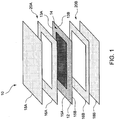
- a bi-polar electrode 10 comprising a substantially flat electrode substrate 12 with different ion exchange polymer coatings on its opposite sides.
- the electrode substrate 12 is a porous support with an intermediate conductive film.
- the electrode substrate is made of a thermoplastic polyethylene film to which activated carbon layers are bonded to each face 13A, 13B of the film to form the porous support.
- the opposite faces 13A, 13B of the electrode substrate are coated with different ion exchange polymers.
- the opposite faces 13A, 13B of the electrode substrate are coated with two polymerizable monomer mixtures and undergo simultaneous polymerization.
- the method described below is particularly suited for simultaneous formation of two dissimilar ion exchange polymer coatings on opposite faces 13A, 13B of the electrode substrate 12.
- the electrode substrate 12 is made of a thermoplastic film to which an activated carbon layer is bonded on each face 13A, 13B of the film.
- the electrode substrate can also be constructed using other materials without departing from the scope of the invention, including, activated carbon containing fillers such as resins, and binding agents such as TFE and PVDF.
- the substrate is generally rectangular-shaped with sides about 10 inches by 21.5 inches in length. However, one skilled in the art will understand that these dimensions are for example purposes only, and other dimensions may be used without departing from the scope of the invention.
- An outer perimeter of the substrate 12 has a band 14 that is left void of the activated carbon layer.
- the first side 15A of electrode substrate 12 has a first face 13A and the second side 15B of electrode substrate 12 has a second face 13B.
- the first face 13A and second face 13B of the electrode substrate 12 are coated with the ion exchange polymers by placing first and second gaskets 16A, 16B around the outer perimeter of the respective faces 13A, 13B of the electrode substrate 12 against the carbon free band 14.
- gaskets 16A, 16B are made of rubber. However, it is contemplated a person having ordinary skill in the art could choose to use another material for gaskets 16A and 16B.
- a first rigid plate 18A is placed adjacent the first face 13A of the electrode substrate 12 against the first gasket 16A, thereby forming a first chamber 20A around the activated carbon on the first side 15A of the electrode substrate 12.
- a second rigid plate 18B is placed adjacent the second face 13B of the electrode substrate 12 against the second gasket 16B, thereby forming and a second chamber 20B on the opposite side of the electrode substrate 12.
- the rigid plates 18A, 18B may be made of glass or other substantially rigid, impervious material. The plates 18A, 18B are clamped together to create a substantially airtight seal around the two faces 13A, 13B of the electrode substrate 12.
- a vacuum is drawn in the first and second chambers 20A, 20B to remove air from the activated carbon.
- a first needle is inserted into the first chamber 20A through the first gasket 16A and a second needle is inserted into the second chamber 20B through the second gasket 16B.
- the needles are connected to a conventional vacuum pump with suitable hose connectors. The vacuum pump draws a vacuum in the first and second chambers 20A, 20B to remove air entrapped in the activated carbon.
- a first polymerizable monomer mixture is added to the first chamber 20A formed on the first face 13A of the electrode substrate 12 and a second polymerizable monomer mixture is added to the second chamber 20B formed around the second face 13B of the electrode substrate 12.
- the first and second monomer solutions are non-identical.
- the liquid monomers displace the air in the activated carbon.
- the first chamber 20A is filled with a first polymerizable monomer mixture comprising a polymerizable monomer having an anion exchange group or a group that can be converted to an anion exchange group.
- Means for inserting the first polymerizable monomer mixture into the first chamber 20A is inserted through the first gasket 16A.
- a first transfer syringe is used to insert the first polymerizable monomer mixture into the first chamber 20A.
- the first polymerizable monomer mixture includes a crosslinking agent and a polymerization initiator.
- the first polymerizable monomer mixture is infiltrated or embedded into the voids of the porous substrate film, and the polymerizable monomer mixture infiltrated is polymerized. Any known polymerizable monomer having an anion exchange group or a group that can be converted to an anion exchange group can be used with no restriction in the first polymerizable monomer mixture.
- polymerizable monomer having an anion exchange group examples include Trimethylammoniumethylmethacrylate chloride, Methacryloxypropyltrimethylammonium chloride, Vinylbenzyltrimethylammonium chloride, Diallyldimethylammonium chloride, and the like, and salts and derivatives thereof.
- the second chamber 20B is filled with a second polymerizable monomer mixture comprising a polymerizable monomer having a cation exchange group or a group that can be converted to a cation exchange group.
- Means for inserting the second polymerizable monomer mixture into the second chamber 20B is inserted through the second gasket 16B.
- a second syringe similar to the one used with the first chamber 20A may be used to insert the second polymerizable monomer mixture into the second chamber 20B.
- the second polymerizable monomer mixture includes a crosslinking agent and a polymerization initiator.
- the second polymerizable monomer mixture is infiltrated or imbedded into the voids of the porous substrate film, and the second polymerizable monomer mixture infiltrated is polymerized.
- the first and second polymerizable monomer mixtures are simultaneously polymerized. Any known polymerizable monomer having a cation exchange group or a group that can be converted to the cation exchange group can be used with no restriction in the second polymerizable monomer mixture.
- polymerizable monomer having a cation exchange group examples include sulfoethylmethacrylate, acrylamidomethylpropane sulfonic acid, sodiumstyrenesulfonate, sulfopropylmethacrylate, potassium salt, and the like, and salts and derivatives thereof.
- crosslinking agent added to the first or second polymerizable monomer mixtures there is no particular restriction.
- divinyl compounds such as divinylbenzene, divinylsulfone, butadiene, chloroprene, divinylbiphenyl, trivinylbenzene, divinylnaphthalene, diallylamine, divinylpyridine, ethyleneglycol dimethacrylate, other di or multi acrylates or di or multi methacrylates of polyols.
- Latent crosslinking systems such as hydroymethylacrylamide plus acrylamide or hydroymethylacrylamide plus phenol can also be employed.
- organic peroxides such as octanoyl peroxide, lauroyl peroxide, tert-butyl peroxy-2-ethylhexanoate, benzoyl peroxide, tert-butyl peroxyisobutylate, tert-butyl peroxylaurate, tert-hexyl peroxybenzoate, di-tert-butyl peroxide, organic azo compounds such as azobis isobutyronitrile and the like.
- the proportions of the polymerizable monomer having the anion or cation exchange groups or groups which can be converted to the anion or cation exchange groups, the crosslinking agent and the polymerization initiator may be in wide ranges as long as each component is present in an amount necessary for the polymerization.
- the proportion of the crosslinking agent is preferably about 0.4 to 60 mol %, more preferably about 1 to 50 mol %, most preferably about 1 to 40 mol %, of the total amount of the polymerizable monomer having an anion exchange group or a group which can be converted to an anion exchange group and the crosslinking agent.
- a crosslinking agent In the case of a polymerizable monomer that is a crosslinking monomer and also has anion or cation exchange groups or groups which can be converted to the anion or cation exchange groups, it is not necessary for a crosslinking agent to be present in the mix. However, a crosslinking agent, or a non crosslinking monomer could be used to dilute the amount of ion exchange group density.
- the polymerization initiator is used in an amount of generally about 0.1 to 20 mass parts, preferably about 0.5 to 10 parts by mass relative to 100 mass parts of the polymerizable monomer having an exchange group or a group which can be converted to an exchange group.
- the first and second polymerizable monomer mixtures are allowed to stand for a selected duration of time. Suitable durations are generally between about 1 and 20 minutes, more preferably between about 5 and 15 minutes, and in one embodiment, about 10 minutes. After standing, the excessive portions of the polymerizable monomer mixtures may then be removed before the polymerizable mixtures are polymerized.
- the first and second polymerizable monomer mixtures are contacted with the porous substrate formed by the activated carbon layer on the electrode substrate 12, as described previously.
- a known polymerization method is employed with no restriction.
- the envelope containing the electrode substrate is placed in an oven and the vinyl monomers are polymerized onto the faces of the substrate.
- Thermal polymerization using a polymerization initiator is preferred generally because the operation is easy and polymerization can be conducted relatively uniformly.
- the temperature of the thermal polymerization is not particularly restricted and a known temperature condition may be selected appropriately.
- Suitable temperatures are generally between about 50 and 150 °C, more preferably between about 60 and 120 °C, and in one embodiment, about 85 °C.
- the duration of the thermal polymerization is also not particularly restricted and known duration conditions may be selected appropriately. Suitable durations are generally between about 10 and 120 minutes, more preferably between about 45 and 90 minutes, and in one embodiment, about 60 minutes.
- Polymerization of the first and second polymerizable monomer mixtures may also be by any known chemical catalytic procedure or using ultraviolet light without departing from the scope of the invention.
- the electrode was made by cutting the electrode substrate with activated carbon layers to a size of 10 inches (25.4 cm) by 21.5 inches (54.6 cm). The outer perimeter of the electrode substrate was maintained free of activated carbon, leaving 1.5 inches (3.8 cm) of trim around the two long side edges and the short bottom edge of the electrode substrate. The top edge was cut to 2 inches. Rubber gaskets were placed against the electrode substrate in the area void of carbon around the perimeter of the substrate. The electrode substrate was then sandwiched between glass plates and the electrode/glass plate sandwich was clamped together, thereby forming airtight chambers on each side of the electrode substrate around the activated carbon. A vacuum was formed in the first and second chambers by inserting needles connected to a vacuum pump into the first and second chambers through the first and second gaskets with suitable hose connectors.
- Monomer-addition syringes were then inserted into the first and second chambers through the first and second gaskets.
- 140 grams of the first polymerizable monomer mixture comprised of a polymerizing monomer having an anion exchange group was inserted into the first chamber using a first syringe and 140 grams of the second polymerizable monomer mixture comprised of a polymerizing monomer having a cation exchange group was inserted into the second chamber using a second syringe.
- the electrode substrate/glass plate assembly was then placed horizontally into a preheated 85 °C oven for 1 hour.
- the electrode substrate/glass plate assembly was removed from the oven and was allowed to cool for 1 ⁇ 2hour.
- the clips were then removed and the electrode substrate was separated from the glass plates.
- pressure can be applied to the chambers pressing the polymerizing AIX and CIX materials into a flat or planar disposition within their respective chambers.
Landscapes
- Chemical & Material Sciences (AREA)
- Chemical Kinetics & Catalysis (AREA)
- Electrochemistry (AREA)
- General Chemical & Material Sciences (AREA)
- Engineering & Computer Science (AREA)
- Manufacturing & Machinery (AREA)
- Composite Materials (AREA)
- Life Sciences & Earth Sciences (AREA)
- Analytical Chemistry (AREA)
- Environmental & Geological Engineering (AREA)
- Sustainable Energy (AREA)
- Health & Medical Sciences (AREA)
- Materials Engineering (AREA)
- Molecular Biology (AREA)
- Hydrology & Water Resources (AREA)
- Sustainable Development (AREA)
- Water Supply & Treatment (AREA)
- Organic Chemistry (AREA)
- Polymerisation Methods In General (AREA)
- Water Treatment By Electricity Or Magnetism (AREA)
- Manufacture Of Porous Articles, And Recovery And Treatment Of Waste Products (AREA)
- Physical Vapour Deposition (AREA)
- Fuel Cell (AREA)
- Addition Polymer Or Copolymer, Post-Treatments, Or Chemical Modifications (AREA)
Applications Claiming Priority (1)
| Application Number | Priority Date | Filing Date | Title |
|---|---|---|---|
| PCT/CN2010/002227 WO2012088643A1 (en) | 2010-12-31 | 2010-12-31 | Vacuum chamber method to form polymer coatings on porous support |
Publications (3)
| Publication Number | Publication Date |
|---|---|
| EP2659535A1 EP2659535A1 (en) | 2013-11-06 |
| EP2659535A4 EP2659535A4 (en) | 2017-03-22 |
| EP2659535B1 true EP2659535B1 (en) | 2018-02-28 |
Family
ID=46382162
Family Applications (1)
| Application Number | Title | Priority Date | Filing Date |
|---|---|---|---|
| EP10861403.3A Active EP2659535B1 (en) | 2010-12-31 | 2010-12-31 | Vacuum chamber method to form polymer coatings on porous support |
Country Status (11)
| Country | Link |
|---|---|
| US (1) | US9048464B2 (https=) |
| EP (1) | EP2659535B1 (https=) |
| JP (1) | JP5600811B2 (https=) |
| KR (1) | KR101655510B1 (https=) |
| CN (1) | CN103262319B (https=) |
| BR (1) | BR112013014777A2 (https=) |
| CA (1) | CA2822195C (https=) |
| ES (1) | ES2664321T3 (https=) |
| SG (1) | SG191415A1 (https=) |
| TW (1) | TWI501798B (https=) |
| WO (1) | WO2012088643A1 (https=) |
Families Citing this family (11)
| Publication number | Priority date | Publication date | Assignee | Title |
|---|---|---|---|---|
| KR101470554B1 (ko) | 2013-04-29 | 2014-12-10 | 주식회사 엘지화학 | 케이블형 이차전지용 패키징 및 그를 포함하는 케이블형 이차전지 |
| KR101465166B1 (ko) | 2013-05-07 | 2014-11-25 | 주식회사 엘지화학 | 케이블형 이차전지 및 그의 제조방법 |
| KR101465164B1 (ko) | 2013-05-07 | 2014-11-25 | 주식회사 엘지화학 | 케이블형 이차전지 |
| KR101470556B1 (ko) | 2013-05-07 | 2014-12-10 | 주식회사 엘지화학 | 이차전지용 전극, 그의 제조방법, 그를 포함하는 이차전지 및 케이블형 이차전지 |
| WO2014182063A1 (ko) | 2013-05-07 | 2014-11-13 | 주식회사 엘지화학 | 이차전지용 전극, 그의 제조방법, 그를 포함하는 이차전지 및 케이블형 이차전지 |
| WO2014182064A1 (ko) * | 2013-05-07 | 2014-11-13 | 주식회사 엘지화학 | 이차전지용 전극, 그의 제조방법, 그를 포함하는 이차전지 및 케이블형 이차전지 |
| CN204441379U (zh) | 2013-05-07 | 2015-07-01 | 株式会社Lg化学 | 二次电池用电极以及包含其的二次电池和线缆型二次电池 |
| BR112014017443B8 (pt) | 2013-05-07 | 2023-03-21 | Lg Chemical Ltd | Bateria secundária do tipo cabo |
| JP6154370B2 (ja) * | 2014-12-26 | 2017-06-28 | 住友ゴム工業株式会社 | 表面改質金属及び金属表面の改質方法 |
| KR102033437B1 (ko) * | 2017-11-16 | 2019-10-17 | 주식회사 원준하이테크 | 유무기 융합 단열재 제조용 진공함침장치 및 이를 이용한 유무기 융합 단열재 제조방법 |
| CN113929188A (zh) * | 2020-06-29 | 2022-01-14 | 佛山市顺德区美的饮水机制造有限公司 | 电极结构、净化结构和电极制备方法 |
Family Cites Families (16)
| Publication number | Priority date | Publication date | Assignee | Title |
|---|---|---|---|---|
| US3533852A (en) * | 1966-12-28 | 1970-10-13 | Bernard S Baker | Fuel cell matrix and method of impregnating periphery of matrix with chlorotrifluoro-ethylene polymer |
| US5470932A (en) | 1993-10-18 | 1995-11-28 | Alcon Laboratories, Inc. | Polymerizable yellow dyes and their use in opthalmic lenses |
| JPH07328394A (ja) | 1994-06-06 | 1995-12-19 | Asahi Glass Co Ltd | 電気透析方法および電気透析装置 |
| EP1114482B1 (en) * | 1999-07-01 | 2003-05-28 | Squirrel Holdings Ltd. | Bipolar electrode for electrochemical redox reactions |
| JP3542550B2 (ja) * | 2000-07-19 | 2004-07-14 | 本田技研工業株式会社 | 燃料電池用シールの成形方法 |
| US20020127474A1 (en) * | 2001-01-09 | 2002-09-12 | E.C.R.-Electro-Chemical Research Ltd. | Proton-selective conducting membranes |
| JP2003200166A (ja) | 2002-01-08 | 2003-07-15 | Kurita Water Ind Ltd | 通液型電気二重層コンデンサ脱塩装置の運転方法 |
| DE10218193B4 (de) * | 2002-04-24 | 2005-09-08 | Dechema Gesellschaft Für Chemische Technik Und Biotechnologie E.V. | Ionenaustauscherzelle zur kontinuierlichen, elektrochemischen Wasseraufbereitung und Verfahren zur Aubereitung von Wasser |
| CN100468837C (zh) * | 2003-09-08 | 2009-03-11 | 中国科学院大连化学物理研究所 | 多硫化钠/溴储能电池的多孔碳基电极制备方法 |
| US7300719B2 (en) * | 2004-08-05 | 2007-11-27 | General Motors Corporation | Porous diffusion media and bipolar plate assembly with anion exchange resin and devices incorporating same |
| JP2008546210A (ja) | 2005-06-10 | 2008-12-18 | 日本ケミコン株式会社 | 電気化学素子用電極の製造方法及びそれを有する電気化学素子の製造方法 |
| US7722979B2 (en) * | 2005-10-14 | 2010-05-25 | Gm Global Technology Operations, Inc. | Fuel cells with hydrophobic diffusion medium |
| JP5205749B2 (ja) * | 2006-12-08 | 2013-06-05 | 日産自動車株式会社 | バイポーラ電池の製造方法 |
| US7813106B2 (en) * | 2006-12-19 | 2010-10-12 | General Electric Company | High current efficiency supercapacitor desalination devices and methods of making the same |
| US9469554B2 (en) * | 2009-07-29 | 2016-10-18 | General Electric Company | Bipolar electrode and supercapacitor desalination device, and methods of manufacture |
| US8658241B2 (en) * | 2010-12-30 | 2014-02-25 | General Electric Company | Simultaneous polymerization of two vinyl monomer mixtures to opposite faces of a flat porous substrate |
-
2010
- 2010-12-31 KR KR1020137016716A patent/KR101655510B1/ko active Active
- 2010-12-31 US US13/996,721 patent/US9048464B2/en active Active
- 2010-12-31 CN CN201080071012.3A patent/CN103262319B/zh active Active
- 2010-12-31 WO PCT/CN2010/002227 patent/WO2012088643A1/en not_active Ceased
- 2010-12-31 SG SG2013050372A patent/SG191415A1/en unknown
- 2010-12-31 EP EP10861403.3A patent/EP2659535B1/en active Active
- 2010-12-31 ES ES10861403.3T patent/ES2664321T3/es active Active
- 2010-12-31 CA CA2822195A patent/CA2822195C/en active Active
- 2010-12-31 JP JP2013546544A patent/JP5600811B2/ja active Active
- 2010-12-31 BR BR112013014777A patent/BR112013014777A2/pt active Search and Examination
-
2011
- 2011-12-27 TW TW100148989A patent/TWI501798B/zh active
Non-Patent Citations (1)
| Title |
|---|
| None * |
Also Published As
| Publication number | Publication date |
|---|---|
| CA2822195C (en) | 2017-04-18 |
| US20130280415A1 (en) | 2013-10-24 |
| US9048464B2 (en) | 2015-06-02 |
| ES2664321T3 (es) | 2018-04-19 |
| TW201236731A (en) | 2012-09-16 |
| CA2822195A1 (en) | 2012-07-05 |
| TWI501798B (zh) | 2015-10-01 |
| KR20140012038A (ko) | 2014-01-29 |
| CN103262319B (zh) | 2015-07-22 |
| KR101655510B1 (ko) | 2016-09-07 |
| EP2659535A1 (en) | 2013-11-06 |
| CN103262319A (zh) | 2013-08-21 |
| WO2012088643A1 (en) | 2012-07-05 |
| BR112013014777A2 (pt) | 2016-09-27 |
| EP2659535A4 (en) | 2017-03-22 |
| JP2014503660A (ja) | 2014-02-13 |
| SG191415A1 (en) | 2013-08-30 |
| JP5600811B2 (ja) | 2014-10-01 |
Similar Documents
| Publication | Publication Date | Title |
|---|---|---|
| EP2659535B1 (en) | Vacuum chamber method to form polymer coatings on porous support | |
| JP7461933B2 (ja) | Uv開始重合によるイオン交換膜 | |
| CN102753253B (zh) | 离子交换膜 | |
| EP1384746A1 (en) | Composite porous ion-exchanger, method of manufacturing the ion-exchanger, deionization module using the ion- exchanger, and electric deionized water manufacturing device | |
| EP2903737A1 (en) | High-performance anion exchange membranes and methods of making same | |
| JP2014503660A5 (https=) | ||
| CN103357451A (zh) | 离子交换剂、其制法及离子交换过滤设备和电去离子设备 | |
| CN107406994A (zh) | 具有多层支撑基材的离子交换膜 | |
| CA2822226C (en) | Simultaneous polymerization of two vinyl monomer mixtures to opposite faces of a flat porous subtrate | |
| JP2018127506A (ja) | 水電解用イオン交換膜、及び該イオン交換膜の製造方法 | |
| US20250332546A1 (en) | Ion exchange membrane, method for manufacturing ion exchange membrane, and ion exchange membrane cell | |
| JP2008189864A (ja) | 機能性膜の製造方法 | |
| KR20240133087A (ko) | 바이폴라막 및 이를 포함하는 축전식 탈염장치 | |
| WO2024135590A1 (ja) | イオン交換膜とその製造方法 |
Legal Events
| Date | Code | Title | Description |
|---|---|---|---|
| PUAI | Public reference made under article 153(3) epc to a published international application that has entered the european phase |
Free format text: ORIGINAL CODE: 0009012 |
|
| 17P | Request for examination filed |
Effective date: 20130731 |
|
| AK | Designated contracting states |
Kind code of ref document: A1 Designated state(s): AL AT BE BG CH CY CZ DE DK EE ES FI FR GB GR HR HU IE IS IT LI LT LU LV MC MK MT NL NO PL PT RO RS SE SI SK SM TR |
|
| DAX | Request for extension of the european patent (deleted) | ||
| RA4 | Supplementary search report drawn up and despatched (corrected) |
Effective date: 20170221 |
|
| RIC1 | Information provided on ipc code assigned before grant |
Ipc: H01M 4/86 20060101ALI20170215BHEP Ipc: H01M 4/88 20060101AFI20170215BHEP Ipc: C02F 1/469 20060101ALI20170215BHEP Ipc: B05D 1/32 20060101ALI20170215BHEP Ipc: C23C 18/06 20060101ALI20170215BHEP Ipc: B05D 5/12 20060101ALI20170215BHEP Ipc: H01M 4/96 20060101ALI20170215BHEP |
|
| GRAP | Despatch of communication of intention to grant a patent |
Free format text: ORIGINAL CODE: EPIDOSNIGR1 |
|
| RIC1 | Information provided on ipc code assigned before grant |
Ipc: H01M 4/86 20060101ALI20170920BHEP Ipc: H01M 4/88 20060101AFI20170920BHEP Ipc: H01M 4/96 20060101ALI20170920BHEP |
|
| INTG | Intention to grant announced |
Effective date: 20171005 |
|
| GRAS | Grant fee paid |
Free format text: ORIGINAL CODE: EPIDOSNIGR3 |
|
| GRAA | (expected) grant |
Free format text: ORIGINAL CODE: 0009210 |
|
| AK | Designated contracting states |
Kind code of ref document: B1 Designated state(s): AL AT BE BG CH CY CZ DE DK EE ES FI FR GB GR HR HU IE IS IT LI LT LU LV MC MK MT NL NO PL PT RO RS SE SI SK SM TR |
|
| REG | Reference to a national code |
Ref country code: GB Ref legal event code: FG4D Ref country code: CH Ref legal event code: EP |
|
| REG | Reference to a national code |
Ref country code: AT Ref legal event code: REF Ref document number: 975062 Country of ref document: AT Kind code of ref document: T Effective date: 20180315 |
|
| REG | Reference to a national code |
Ref country code: IE Ref legal event code: FG4D |
|
| REG | Reference to a national code |
Ref country code: DE Ref legal event code: R096 Ref document number: 602010048926 Country of ref document: DE |
|
| REG | Reference to a national code |
Ref country code: ES Ref legal event code: FG2A Ref document number: 2664321 Country of ref document: ES Kind code of ref document: T3 Effective date: 20180419 |
|
| REG | Reference to a national code |
Ref country code: NL Ref legal event code: MP Effective date: 20180228 |
|
| REG | Reference to a national code |
Ref country code: LT Ref legal event code: MG4D |
|
| REG | Reference to a national code |
Ref country code: AT Ref legal event code: MK05 Ref document number: 975062 Country of ref document: AT Kind code of ref document: T Effective date: 20180228 |
|
| PG25 | Lapsed in a contracting state [announced via postgrant information from national office to epo] |
Ref country code: NL Free format text: LAPSE BECAUSE OF FAILURE TO SUBMIT A TRANSLATION OF THE DESCRIPTION OR TO PAY THE FEE WITHIN THE PRESCRIBED TIME-LIMIT Effective date: 20180228 Ref country code: HR Free format text: LAPSE BECAUSE OF FAILURE TO SUBMIT A TRANSLATION OF THE DESCRIPTION OR TO PAY THE FEE WITHIN THE PRESCRIBED TIME-LIMIT Effective date: 20180228 Ref country code: CY Free format text: LAPSE BECAUSE OF FAILURE TO SUBMIT A TRANSLATION OF THE DESCRIPTION OR TO PAY THE FEE WITHIN THE PRESCRIBED TIME-LIMIT Effective date: 20180228 Ref country code: FI Free format text: LAPSE BECAUSE OF FAILURE TO SUBMIT A TRANSLATION OF THE DESCRIPTION OR TO PAY THE FEE WITHIN THE PRESCRIBED TIME-LIMIT Effective date: 20180228 Ref country code: NO Free format text: LAPSE BECAUSE OF FAILURE TO SUBMIT A TRANSLATION OF THE DESCRIPTION OR TO PAY THE FEE WITHIN THE PRESCRIBED TIME-LIMIT Effective date: 20180528 Ref country code: LT Free format text: LAPSE BECAUSE OF FAILURE TO SUBMIT A TRANSLATION OF THE DESCRIPTION OR TO PAY THE FEE WITHIN THE PRESCRIBED TIME-LIMIT Effective date: 20180228 |
|
| PG25 | Lapsed in a contracting state [announced via postgrant information from national office to epo] |
Ref country code: AT Free format text: LAPSE BECAUSE OF FAILURE TO SUBMIT A TRANSLATION OF THE DESCRIPTION OR TO PAY THE FEE WITHIN THE PRESCRIBED TIME-LIMIT Effective date: 20180228 Ref country code: SE Free format text: LAPSE BECAUSE OF FAILURE TO SUBMIT A TRANSLATION OF THE DESCRIPTION OR TO PAY THE FEE WITHIN THE PRESCRIBED TIME-LIMIT Effective date: 20180228 Ref country code: LV Free format text: LAPSE BECAUSE OF FAILURE TO SUBMIT A TRANSLATION OF THE DESCRIPTION OR TO PAY THE FEE WITHIN THE PRESCRIBED TIME-LIMIT Effective date: 20180228 Ref country code: RS Free format text: LAPSE BECAUSE OF FAILURE TO SUBMIT A TRANSLATION OF THE DESCRIPTION OR TO PAY THE FEE WITHIN THE PRESCRIBED TIME-LIMIT Effective date: 20180228 Ref country code: BG Free format text: LAPSE BECAUSE OF FAILURE TO SUBMIT A TRANSLATION OF THE DESCRIPTION OR TO PAY THE FEE WITHIN THE PRESCRIBED TIME-LIMIT Effective date: 20180528 Ref country code: GR Free format text: LAPSE BECAUSE OF FAILURE TO SUBMIT A TRANSLATION OF THE DESCRIPTION OR TO PAY THE FEE WITHIN THE PRESCRIBED TIME-LIMIT Effective date: 20180529 |
|
| PG25 | Lapsed in a contracting state [announced via postgrant information from national office to epo] |
Ref country code: RO Free format text: LAPSE BECAUSE OF FAILURE TO SUBMIT A TRANSLATION OF THE DESCRIPTION OR TO PAY THE FEE WITHIN THE PRESCRIBED TIME-LIMIT Effective date: 20180228 Ref country code: PL Free format text: LAPSE BECAUSE OF FAILURE TO SUBMIT A TRANSLATION OF THE DESCRIPTION OR TO PAY THE FEE WITHIN THE PRESCRIBED TIME-LIMIT Effective date: 20180228 Ref country code: EE Free format text: LAPSE BECAUSE OF FAILURE TO SUBMIT A TRANSLATION OF THE DESCRIPTION OR TO PAY THE FEE WITHIN THE PRESCRIBED TIME-LIMIT Effective date: 20180228 Ref country code: AL Free format text: LAPSE BECAUSE OF FAILURE TO SUBMIT A TRANSLATION OF THE DESCRIPTION OR TO PAY THE FEE WITHIN THE PRESCRIBED TIME-LIMIT Effective date: 20180228 |
|
| REG | Reference to a national code |
Ref country code: DE Ref legal event code: R097 Ref document number: 602010048926 Country of ref document: DE |
|
| PG25 | Lapsed in a contracting state [announced via postgrant information from national office to epo] |
Ref country code: SM Free format text: LAPSE BECAUSE OF FAILURE TO SUBMIT A TRANSLATION OF THE DESCRIPTION OR TO PAY THE FEE WITHIN THE PRESCRIBED TIME-LIMIT Effective date: 20180228 Ref country code: DK Free format text: LAPSE BECAUSE OF FAILURE TO SUBMIT A TRANSLATION OF THE DESCRIPTION OR TO PAY THE FEE WITHIN THE PRESCRIBED TIME-LIMIT Effective date: 20180228 Ref country code: SK Free format text: LAPSE BECAUSE OF FAILURE TO SUBMIT A TRANSLATION OF THE DESCRIPTION OR TO PAY THE FEE WITHIN THE PRESCRIBED TIME-LIMIT Effective date: 20180228 |
|
| PLBE | No opposition filed within time limit |
Free format text: ORIGINAL CODE: 0009261 |
|
| STAA | Information on the status of an ep patent application or granted ep patent |
Free format text: STATUS: NO OPPOSITION FILED WITHIN TIME LIMIT |
|
| RAP2 | Party data changed (patent owner data changed or rights of a patent transferred) |
Owner name: BL TECHNOLOGIES, INC. |
|
| 26N | No opposition filed |
Effective date: 20181129 |
|
| PG25 | Lapsed in a contracting state [announced via postgrant information from national office to epo] |
Ref country code: SI Free format text: LAPSE BECAUSE OF FAILURE TO SUBMIT A TRANSLATION OF THE DESCRIPTION OR TO PAY THE FEE WITHIN THE PRESCRIBED TIME-LIMIT Effective date: 20180228 |
|
| REG | Reference to a national code |
Ref country code: CH Ref legal event code: PL |
|
| PG25 | Lapsed in a contracting state [announced via postgrant information from national office to epo] |
Ref country code: LU Free format text: LAPSE BECAUSE OF NON-PAYMENT OF DUE FEES Effective date: 20181231 Ref country code: MC Free format text: LAPSE BECAUSE OF FAILURE TO SUBMIT A TRANSLATION OF THE DESCRIPTION OR TO PAY THE FEE WITHIN THE PRESCRIBED TIME-LIMIT Effective date: 20180228 |
|
| REG | Reference to a national code |
Ref country code: IE Ref legal event code: MM4A |
|
| REG | Reference to a national code |
Ref country code: BE Ref legal event code: MM Effective date: 20181231 |
|
| PG25 | Lapsed in a contracting state [announced via postgrant information from national office to epo] |
Ref country code: IE Free format text: LAPSE BECAUSE OF NON-PAYMENT OF DUE FEES Effective date: 20181231 |
|
| PG25 | Lapsed in a contracting state [announced via postgrant information from national office to epo] |
Ref country code: BE Free format text: LAPSE BECAUSE OF NON-PAYMENT OF DUE FEES Effective date: 20181231 |
|
| PG25 | Lapsed in a contracting state [announced via postgrant information from national office to epo] |
Ref country code: LI Free format text: LAPSE BECAUSE OF NON-PAYMENT OF DUE FEES Effective date: 20181231 Ref country code: CH Free format text: LAPSE BECAUSE OF NON-PAYMENT OF DUE FEES Effective date: 20181231 |
|
| PG25 | Lapsed in a contracting state [announced via postgrant information from national office to epo] |
Ref country code: MT Free format text: LAPSE BECAUSE OF NON-PAYMENT OF DUE FEES Effective date: 20181231 |
|
| PG25 | Lapsed in a contracting state [announced via postgrant information from national office to epo] |
Ref country code: TR Free format text: LAPSE BECAUSE OF FAILURE TO SUBMIT A TRANSLATION OF THE DESCRIPTION OR TO PAY THE FEE WITHIN THE PRESCRIBED TIME-LIMIT Effective date: 20180228 |
|
| PG25 | Lapsed in a contracting state [announced via postgrant information from national office to epo] |
Ref country code: PT Free format text: LAPSE BECAUSE OF FAILURE TO SUBMIT A TRANSLATION OF THE DESCRIPTION OR TO PAY THE FEE WITHIN THE PRESCRIBED TIME-LIMIT Effective date: 20180228 |
|
| PG25 | Lapsed in a contracting state [announced via postgrant information from national office to epo] |
Ref country code: MK Free format text: LAPSE BECAUSE OF NON-PAYMENT OF DUE FEES Effective date: 20180228 Ref country code: HU Free format text: LAPSE BECAUSE OF FAILURE TO SUBMIT A TRANSLATION OF THE DESCRIPTION OR TO PAY THE FEE WITHIN THE PRESCRIBED TIME-LIMIT; INVALID AB INITIO Effective date: 20101231 |
|
| PG25 | Lapsed in a contracting state [announced via postgrant information from national office to epo] |
Ref country code: IS Free format text: LAPSE BECAUSE OF FAILURE TO SUBMIT A TRANSLATION OF THE DESCRIPTION OR TO PAY THE FEE WITHIN THE PRESCRIBED TIME-LIMIT Effective date: 20180628 |
|
| P01 | Opt-out of the competence of the unified patent court (upc) registered |
Effective date: 20230521 |
|
| PGFP | Annual fee paid to national office [announced via postgrant information from national office to epo] |
Ref country code: GB Payment date: 20251229 Year of fee payment: 16 |
|
| PGFP | Annual fee paid to national office [announced via postgrant information from national office to epo] |
Ref country code: IT Payment date: 20251219 Year of fee payment: 16 |
|
| PGFP | Annual fee paid to national office [announced via postgrant information from national office to epo] |
Ref country code: FR Payment date: 20251226 Year of fee payment: 16 |
|
| PGFP | Annual fee paid to national office [announced via postgrant information from national office to epo] |
Ref country code: CZ Payment date: 20251208 Year of fee payment: 16 |
|
| PGFP | Annual fee paid to national office [announced via postgrant information from national office to epo] |
Ref country code: ES Payment date: 20260102 Year of fee payment: 16 |
|
| PGFP | Annual fee paid to national office [announced via postgrant information from national office to epo] |
Ref country code: DE Payment date: 20251229 Year of fee payment: 16 |