EP2585535B2 - Verpackungselement - Google Patents
Verpackungselement Download PDFInfo
- Publication number
- EP2585535B2 EP2585535B2 EP11743763.2A EP11743763A EP2585535B2 EP 2585535 B2 EP2585535 B2 EP 2585535B2 EP 11743763 A EP11743763 A EP 11743763A EP 2585535 B2 EP2585535 B2 EP 2585535B2
- Authority
- EP
- European Patent Office
- Prior art keywords
- styrene
- copolymer
- acrylonitrile
- polyester
- butadiene
- Prior art date
- Legal status (The legal status is an assumption and is not a legal conclusion. Google has not performed a legal analysis and makes no representation as to the accuracy of the status listed.)
- Active
Links
Images

Classifications
-
- C—CHEMISTRY; METALLURGY
- C09—DYES; PAINTS; POLISHES; NATURAL RESINS; ADHESIVES; COMPOSITIONS NOT OTHERWISE PROVIDED FOR; APPLICATIONS OF MATERIALS NOT OTHERWISE PROVIDED FOR
- C09J—ADHESIVES; NON-MECHANICAL ASPECTS OF ADHESIVE PROCESSES IN GENERAL; ADHESIVE PROCESSES NOT PROVIDED FOR ELSEWHERE; USE OF MATERIALS AS ADHESIVES
- C09J167/00—Adhesives based on polyesters obtained by reactions forming a carboxylic ester link in the main chain; Adhesives based on derivatives of such polymers
- C09J167/02—Polyesters derived from dicarboxylic acids and dihydroxy compounds
- C09J167/03—Polyesters derived from dicarboxylic acids and dihydroxy compounds the dicarboxylic acids and dihydroxy compounds having the carboxyl - and the hydroxy groups directly linked to aromatic rings
-
- B—PERFORMING OPERATIONS; TRANSPORTING
- B65—CONVEYING; PACKING; STORING; HANDLING THIN OR FILAMENTARY MATERIAL
- B65D—CONTAINERS FOR STORAGE OR TRANSPORT OF ARTICLES OR MATERIALS, e.g. BAGS, BARRELS, BOTTLES, BOXES, CANS, CARTONS, CRATES, DRUMS, JARS, TANKS, HOPPERS, FORWARDING CONTAINERS; ACCESSORIES, CLOSURES, OR FITTINGS THEREFOR; PACKAGING ELEMENTS; PACKAGES
- B65D63/00—Flexible elongated elements, e.g. straps, for bundling or supporting articles
- B65D63/10—Non-metallic straps, tapes, or bands; Filamentary elements, e.g. strings, threads or wires; Joints between ends thereof
-
- C—CHEMISTRY; METALLURGY
- C08—ORGANIC MACROMOLECULAR COMPOUNDS; THEIR PREPARATION OR CHEMICAL WORKING-UP; COMPOSITIONS BASED THEREON
- C08L—COMPOSITIONS OF MACROMOLECULAR COMPOUNDS
- C08L67/00—Compositions of polyesters obtained by reactions forming a carboxylic ester link in the main chain; Compositions of derivatives of such polymers
- C08L67/02—Polyesters derived from dicarboxylic acids and dihydroxy compounds
-
- C—CHEMISTRY; METALLURGY
- C08—ORGANIC MACROMOLECULAR COMPOUNDS; THEIR PREPARATION OR CHEMICAL WORKING-UP; COMPOSITIONS BASED THEREON
- C08L—COMPOSITIONS OF MACROMOLECULAR COMPOUNDS
- C08L69/00—Compositions of polycarbonates; Compositions of derivatives of polycarbonates
-
- C—CHEMISTRY; METALLURGY
- C09—DYES; PAINTS; POLISHES; NATURAL RESINS; ADHESIVES; COMPOSITIONS NOT OTHERWISE PROVIDED FOR; APPLICATIONS OF MATERIALS NOT OTHERWISE PROVIDED FOR
- C09J—ADHESIVES; NON-MECHANICAL ASPECTS OF ADHESIVE PROCESSES IN GENERAL; ADHESIVE PROCESSES NOT PROVIDED FOR ELSEWHERE; USE OF MATERIALS AS ADHESIVES
- C09J11/00—Features of adhesives not provided for in group C09J9/00, e.g. additives
- C09J11/08—Macromolecular additives
-
- Y—GENERAL TAGGING OF NEW TECHNOLOGICAL DEVELOPMENTS; GENERAL TAGGING OF CROSS-SECTIONAL TECHNOLOGIES SPANNING OVER SEVERAL SECTIONS OF THE IPC; TECHNICAL SUBJECTS COVERED BY FORMER USPC CROSS-REFERENCE ART COLLECTIONS [XRACs] AND DIGESTS
- Y10—TECHNICAL SUBJECTS COVERED BY FORMER USPC
- Y10T—TECHNICAL SUBJECTS COVERED BY FORMER US CLASSIFICATION
- Y10T428/00—Stock material or miscellaneous articles
- Y10T428/24—Structurally defined web or sheet [e.g., overall dimension, etc.]
- Y10T428/24479—Structurally defined web or sheet [e.g., overall dimension, etc.] including variation in thickness
-
- Y—GENERAL TAGGING OF NEW TECHNOLOGICAL DEVELOPMENTS; GENERAL TAGGING OF CROSS-SECTIONAL TECHNOLOGIES SPANNING OVER SEVERAL SECTIONS OF THE IPC; TECHNICAL SUBJECTS COVERED BY FORMER USPC CROSS-REFERENCE ART COLLECTIONS [XRACs] AND DIGESTS
- Y10—TECHNICAL SUBJECTS COVERED BY FORMER USPC
- Y10T—TECHNICAL SUBJECTS COVERED BY FORMER US CLASSIFICATION
- Y10T428/00—Stock material or miscellaneous articles
- Y10T428/26—Web or sheet containing structurally defined element or component, the element or component having a specified physical dimension
- Y10T428/269—Web or sheet containing structurally defined element or component, the element or component having a specified physical dimension including synthetic resin or polymer layer or component
-
- Y—GENERAL TAGGING OF NEW TECHNOLOGICAL DEVELOPMENTS; GENERAL TAGGING OF CROSS-SECTIONAL TECHNOLOGIES SPANNING OVER SEVERAL SECTIONS OF THE IPC; TECHNICAL SUBJECTS COVERED BY FORMER USPC CROSS-REFERENCE ART COLLECTIONS [XRACs] AND DIGESTS
- Y10—TECHNICAL SUBJECTS COVERED BY FORMER USPC
- Y10T—TECHNICAL SUBJECTS COVERED BY FORMER US CLASSIFICATION
- Y10T428/00—Stock material or miscellaneous articles
- Y10T428/28—Web or sheet containing structurally defined element or component and having an adhesive outermost layer
- Y10T428/2852—Adhesive compositions
- Y10T428/2878—Adhesive compositions including addition polymer from unsaturated monomer
-
- Y—GENERAL TAGGING OF NEW TECHNOLOGICAL DEVELOPMENTS; GENERAL TAGGING OF CROSS-SECTIONAL TECHNOLOGIES SPANNING OVER SEVERAL SECTIONS OF THE IPC; TECHNICAL SUBJECTS COVERED BY FORMER USPC CROSS-REFERENCE ART COLLECTIONS [XRACs] AND DIGESTS
- Y10—TECHNICAL SUBJECTS COVERED BY FORMER USPC
- Y10T—TECHNICAL SUBJECTS COVERED BY FORMER US CLASSIFICATION
- Y10T428/00—Stock material or miscellaneous articles
- Y10T428/31504—Composite [nonstructural laminate]
- Y10T428/31786—Of polyester [e.g., alkyd, etc.]
- Y10T428/31797—Next to addition polymer from unsaturated monomers
Definitions
- the invention relates to a method for splicing inhibition of a band-shaped packaging element, in particular a strapping band or a harvest binding yarn, made of a polyester-based plastic band, a PET being used as the polyester, the PET being compounded with at least one styrene-based polymer as a splice inhibitor in the extrusion process.
- Strapping tapes are usually made from polyester or polyolefins using an extrusion process with subsequent stretching. Due to the alignment of the molecules during the stretching process, they tend to splice, i.e. to form cracks in the direction of the tape. The brittleness of plastics at low temperatures, especially below 5°C, increases the tendency to splice.
- splice inhibitors are usually added to the compounds used to produce strapping. However, the splicing inhibitors used so far do not provide sufficient help against embrittlement at low temperatures.
- a packaging tape which consists of more than 92% by weight of a polyester and a total of less than 8% by weight of a polyolefin-based additive and other additives, the polyolefin additive content being less than 3% by weight.
- Other additives mentioned include polystyrene-based elastomers in a proportion of between 0.5% by weight and 2% by weight.
- the addition of polyolefin is intended to reduce the tendency to splice longitudinally.
- the styrene elastomers should also contribute to reducing this tendency to splice.
- the DE 27 27 356 A1 describes a binding tape formed from a thermosetting and a thermoplastic resin, the resins being derived from the same monomers so that the two resins have a chemical affinity for each other, and the thermosetting Resin is an unsaturated polyester resin cross-linked with styrene.
- the thermoplastic resin may be an acrylonitrile-butadiene-styrene copolymer or an acrylonitrile-styrene copolymer.
- the aim is to provide a binding band of sufficient strength, comparable to a steel band, which shows high tensile strength and low elongation as well as low creep behavior, and which can be easily and firmly connected to one another at the ends.
- the thermoplastic resin forms the outer layer of the binding tape and the thermosetting resin forms the core.
- the object of the present invention is to create a band-shaped packaging element which has reduced splicing even at low temperatures.
- thermoplastic, non-elastomeric, styrene-based polymer is added as the splice inhibitor, and the compounding is processed at a temperature between 250 ° C and 310 ° C, so that the splice inhibitor is unbound in the plastic tape is present, and independently of this through the use of a non-elatomeric styrene-based polymer in an extrusion process as a splice inhibitor for a polyester-based strapping or harvest twine, the polyester being a PET.
- thermoplastic styrene polymers i.e. non-elastomeric polymers
- embrittlement inhibitors to reduce the splicing sensitivity of packaging tapes, in particular strapping tapes or harvest binding twines
- low application temperature means a temperature of below 5 °C, although there is naturally a limit to low temperatures due to the material.
- polymers or copolymers have proven to be particularly suitable as splicing inhibitors, which are selected from a group comprising or consisting of polystyrene homopolymer, acrylonitrile-butadiene-styrene copolymer (ABS), methyl methacrylate-acrylonitrile-butadiene-styrene.
- Copolymer MABS
- Styrene-Acrylonitrile Copolymer SAN
- Acrylonitrile-Styrene-Acrylate Copolymer ASA
- SMA Styrene-Maleic Anhydride Copolymer
- MFS methyl methacrylate butadiene styrene
- the proportion of styrene-based polymer in the plastic tape is preferably selected from a range with a lower limit of 0.2% by weight and an upper limit of 20% by weight, in particular 5% by weight. Below 0.2% by weight, the reduction in splicing is too low. Above 20% by weight, the proportion of the base polymer is reduced to such an extent that the packaging tape has poorer tensile strength properties.
- the packaging element contains at least one further different splice inhibitor in the plastic tape, which is in particular selected from a group comprising or consisting of olefin-acrylate copolymers, thermoplastic polymers (TPE), low density polyethylene (LDPE), linear LDPE (LLDPE), polyethylene, polypropylene, butadiene rubber (BR), and mixtures thereof.
- TPE thermoplastic polymers
- LDPE low density polyethylene
- LLDPE linear LDPE
- polyethylene polypropylene
- BR butadiene rubber
- the further splicing inhibitor is contained in a proportion such that the quantitative ratio of the styrene-based splicing inhibitor to the further splicing inhibitor is selected from a range of 80:20 to 20:80, in particular 60:40 to 40:60. This avoids a reduction in the effect of the styrene-based splice inhibitor with a high degree of certainty, which is particularly important with regard to the manufacturing process of the band-shaped packaging element under changing production conditions.
- the styrene-based polymer is unbound in the plastic tape, in particular in the shape of a domain, it being preferred if the domains are designed to be stretched in at least one spatial direction and, in particular, have an at least approximately elliptical cross section in at least one spatial direction.
- the binding forces between the domain and the surrounding matrix are weaker than the binding forces within the matrix and within the domain.
- the strip-shaped packaging element according to the invention is a plastic band and in particular a strapping band or a harvest twine.
- the packaging element is preferably made from polyester.
- polyester-based means that the strapping band or the harvest binding twine or the packaging element consists of a base material or matrix material made of at least one polyester, i.e. the polyester is contained as the main component in a proportion of at least 50% by weight in the packaging element .
- the band-shaped packaging element preferably contains a polyester content of at least 75% by weight, in particular at least 85% by weight or at least 90% by weight.
- the polyester used is polyethylene terephthalate (PET).
- the packaging element can also contain other additives, such as colorants, as are known from the prior art, and/or inorganic fillers, such as talc or chalk.
- the polyester-based packaging element does not contain any other ingredients or additives apart from the polyester, the thermoplastic, styrene-based polymer and a colorant.
- the band-shaped packaging element made of the polyester base material preferably contains no polyolefins.
- the respective base material contains at least one thermoplastic, styrene-based polymer as a splice inhibitor.
- a styrene-based polymer is understood to mean a polymer that is either a homopolymer or a copolymer or a copolymer, in which case a styrene monomer was used to produce it.
- the styrene-based polymer used is preferably a polymer which is selected from a group comprising or consisting of polystyrene homopolymer, acrylonitrile-butadiene-styrene copolymer (ABS), methyl methacrylate-acrylonitrile-butadiene-styrene copolymer (MABS), styrene -Acrylonitrile copolymer (SAN), acrylonitrile-styrene-acrylate copolymer (ASA), styrene-maleic anhydride copolymer (SMA), methyl methacrylate-butadiene-styrene (MBS) and mixtures thereof.
- ABS acrylonitrile-butadiene-styrene copolymer
- MABS methyl methacrylate-acrylonitrile-butadiene-styrene copolymer
- SAN styrene -Acrylon
- the proportion of the styrene-based polymer in the plastic tape is selected from a range with a lower limit of 0.2% by weight, preferably 0.5% by weight, and an upper limit of 20% by weight, preferably 15% by weight. -%, in particular 3.5% by weight.
- this styrene-based polymer can also be replaced by a further splice inhibitor that has previously been commonly used as a splice inhibitor in such band-shaped packaging elements, which is different to the styrene-based splice inhibitor.
- this further splicing inhibitor is selected from a group comprising or consisting of olefin-acrylate copolymers, thermoplastic polymers (TPE), low density polyethylene (LDPE), linear LDPE (LLDPE), polyethylene, polypropylene, butadiene rubber (BR), and mixtures from it.
- the further splicing inhibitor is preferably contained in a proportion such that the quantitative ratio of the styrene-based splicing inhibitor to the further splicing inhibitor is selected from a range of 80:20 to 20:80, in particular 60:40 to 40:60.
- compositions were processed into tapes or yarns using the extrusion process, with the tapes having a bandwidth of 9 mm to 19 mm and the yarns having a running length of 400 m/kg. Since the manufacturing process for such band-shaped packaging elements is known from the prior art, the person skilled in the art is referred to the relevant literature.
- styrene polymer Std. additive ... a common additive corresponding to the state of the art, as stated in the introduction, [%] ....% by weight.
- SP additive Share SP [%] yarn 400 P.S 1 yarn 400 P.S 2 yarn 400 P.S 5
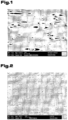
- At least a proportion of 90%, in particular 95%, preferably 99%, of the total proportion of the styrene-based splice inhibitor, preferably at least approximately 100%, is unbound in the plastic tape and, according to one embodiment variant, in a domain shape, as shown Fig. 1 It can be seen that a strapping band with the composition 98% by weight of PET and 2% by weight of PS is shown. This is achieved by processing the compounding to produce the packaging element at a temperature between 250 °C and 310 °C, in particular between 270 °C and 300 °C.
- FIG. 2 A scanning electron microscope image of a PET tape without the addition of a thermoplastic, styrene-based splice inhibitor. This is intended to clarify the difference to the packaging element according to the invention. It can be seen that in this case domains are also formed (white dots), but these are due to semi-crystalline areas of the PET.
- the domains are designed to be stretched in one direction, as shown Fig. 1 is visible.
- the stretching in at least one spatial direction of the domains was achieved by stretching using stretching units and a stretching oven.
- the domains are preferably stretched in a spatial direction to an at least approximately elliptical cross section.
- Fig. 4 shows that at the very low temperature of -15°C for this application, the tendency to splice can be significantly reduced with 2% by weight of PS. The state of the art additive, however, no longer has any effect under these conditions.
Landscapes
- Chemical & Material Sciences (AREA)
- Organic Chemistry (AREA)
- Chemical Kinetics & Catalysis (AREA)
- Health & Medical Sciences (AREA)
- Medicinal Chemistry (AREA)
- Polymers & Plastics (AREA)
- Engineering & Computer Science (AREA)
- Mechanical Engineering (AREA)
- Compositions Of Macromolecular Compounds (AREA)
- Package Frames And Binding Bands (AREA)
- Wrappers (AREA)
- Laminated Bodies (AREA)
- Manufacture Of Macromolecular Shaped Articles (AREA)
Description
- Die Erfindung betrifft ein Verfahren zur Spleißhemmung eines bandförmigen Verpackungselementes, insbesondere ein Umreifungsbandes oder ein Erntebindegarns, aus einem Kunststoffband auf Polyesterbasis, wobei als Polyester ein PET eingesetzt wird, wobei das PET mit zumindest einem styrolbasierten Polymer als Spleißhemmer im Extrusionsverfahren compoundiert wird.
- Umreifungsbänder werden üblicherweise aus Polyester oder Polyolefinen im Extrusionsverfahren mit anschließender Verstreckung hergestellt. Aufgrund der Ausrichtung der Moleküle beim Verstreckungsprozeß neigen sie daher zu Spleiß, d.h. zur Rißbildung in Bandrichtung. Durch die Versprödung von Kunststoffen bei niederen Temperaturen, insbesondere unter 5°C, wird die Spleißneigung noch verstärkt. Zur Verringerung der Spleißneigung werden den Compoundierungen zur Herstellung von Umreifungsbändern normalerweise Spleißhemmer zugesetzt. Die bisher verwendeten Spleißhemmer helfen aber nicht in ausreichendem Maße gegen die Versprödung bei niedrigen Temperaturen.
- Aus der
US 2005/238897 A1 ist ein Verpackungsband bekannt, das zu mehr als 92 Gew.-% aus einem Polyester und zu weniger als in Summe 8 Gew.-% aus einem Additiv auf Polyolefinbasis und weiteren Additiven besteht, wobei der Polyolefinadditivanteil weniger als 3 Gew.-% beträgt. Als weitere Additive werden untere anderem Elastomere auf Polystyrolbasis genannt in einem Anteil zwischen 0,5 Gew.-% und 2 Gew.-%. Durch den Polyolefinzusatz soll die longitudinale Spleißneigung reduziert werden. Ebenso sollen die Styrolelastomere zur Reduzierung dieser Spleißneigung beitragen. - Die Verwendung von Styrol-Butadien-Kautschuk in Anteilen von bis zu 25 Gew.-% in einem Polyethylenband ist auch aus der
DE 20 37 398 A1 bekannt, wenngleich in diesem Dokument der Zweck des Zusatzes nicht angegeben ist. - Die
DE 27 27 356 A1 beschreibt ein Bindeband, das aus einem wärmehärtbaren und einem thermoplastischen Harz gebildet ist, wobei sich die Harze von den gleichen Monomeren ableiten, sodass die beiden Harze eine chemische Affinität zueinander haben, und wobei das wärmehärtbare Harz ein mit Styrol quervernetztes ungesättigtes Polyesterharz ist. Das thermoplastische Harz kann ein Acrylnitril-Butadien-Styrol-Mischpolymerisat oder ein Acrylnitril-Styrol-Mischpolymerisat sein. Es soll damit ein Bindeband ausreichender Festigkeit, vergleichbar mit einem Stahlband, zur Verfügung gestellt werden, das eine hohe Zugfestigkeit und eine niedrige Dehnung sowie ein geringes Kriechverhalten zeigt, und das an den Enden leicht und fest miteinander verbunden werden kann. Dazu bildet das thermoplastische Harz die Aussenschicht des Bindebandes, und das wärmehärtbare Harz den Kern. - Die Aufgabe vorliegender Erfindung besteht darin, ein bandförmiges Verpackungselement zu schaffen, das auch bei niederen Temperaturen eine verringerte Spleißbildung aufweist.
- Gelöst wird diese Aufgabe einerseits durch mit dem eingangs genannten Verfahren, wobei als Spleißhemmer ein thermoplastisches, nicht elastomeres, styrolbasiertes Polymer zugesetzt wird, und die Compoundierung bei einer Temperatur zwischen 250 °C und 310 °C verarbeitet wird, sodass der Spleißhemmer in dem Kunststoffband ungebunden vorliegt, sowie unabhängig hiervon durch die Verwendung eines nicht elatomeren styrolbasierten Polymers in einem Extrusionsverfahren als Spleißhemmer für ein Umreifungsband oder Erntebindegarn auf Polyesterbasis, wobei der Polyester einer PET ist.
- Überraschenderweise wurde festgestellt, dass durch die Anwendung von thermoplastischen Styrol-Polymeren, also nicht elastomeren Polymeren, als Versprödungshemmer zur Reduktion der Spleißempfindlichkeit von Verpackungsbändern, insbesondere von Umreifungsbändern oder von Erntebindegarnen, nicht nur diese Eigenschaft reduziert wird, sondern damit auch deren Verwendung bei niederen Anwendungstemperaturen durch die Reduktion der Sprödbruchneigung des bandförmigen Verpackungselementes verbessert wird. Unter dem Begriff "niedere Anwendungstemperature" wird dabei eine Temperatur von unter 5 °C verstanden, wobei naturgemäß zu tiefen Temperaturen werkstoffbedingt eine Grenze gesetzt ist.
- Als Spleißhemmer besonders geeignet haben sich in diesem Zusammenhang Polymere bzw. Mischpolymerisate herausgestellt, die ausgewählt sind aus einer Gruppe umfassend oder bestehend aus Polystyrol-Homopolymer, Acrylnitril-Butadien-Styrol-Copolymer (ABS), Methyl-Methacrylat-Acrylnitril-Butadien-Styrol-Copolymer (MABS), Styrol-Acrylnitril-Copolymer (SAN), Acrylnitril-Styrol-Acrylat-Copolymer (ASA), Styrol-Maleinsäureanhydrid-Copolymer (SMA), Methyl-Methacrylat-Butadien-Styrol (MBS) sowie Mischungen daraus. Der Grund für deren besondere Eignung konnte bislang nur anhand von Versuchen verifiziert werden. Eine Erklärung auf molekularer Ebene liegt noch nicht vor.
- Bevorzugt ist der Anteil des styrolbasierten Polymers in dem Kunststoffband ausgewählt aus einem Bereich mit einer unteren Grenze von 0,2 Gew.-% und einer oberen Grenze von 20 Gew.-%, insbesondere 5 Gew.-%. Unterhalb von 0,2 Gew.-% ist die Spleißminderung zu gering. Oberhalb von 20 Gew.-% wird der Anteil des Basispolymers so weit reduziert, dass das Verpackungsband schlechtere Eigenschaften in Hinblick auf die Zugfestigkeit aufweist.
- Gemäß einer Ausführungsvariante des Verfahrens ist vorgesehen, dass dieses vollständig polyolefinfrei ist oder weniger als 0,2 Gew.-% Polyolefin(e) enthält. Es wird damit ebenfalls eine Reduktion der Zugfestigkeit und der Härte des Kunststoffbandes vermieden.
- Es kann auch vorgesehen werden, dass das Verpackungselement neben dem styrolbasierenden Spleißhemmer zumindest einen weiteren dazu unterschiedlichen Spleißhemmer im Kunststoffband enthält, der insbesondere ausgewählt ist aus einer Gruppe umfassend oder bestehend aus Olefin-Acrylat-Copolymere, thermoplastische Polymere (TPE), Low Density Polyethylen (LDPE), lineares LDPE (LLDPE), Polyethylen, Polypropylen, Butadien Kautschuk (BR), sowie Mischungen daraus. Es kann damit das Eigenschaftsprofil des Verpackungselementes besser und feiner auf den jeweiligen Anwendungsbereich abgestimmt werden.
- Dabei hat es sich als vorteilhaft herausgestellt, wenn der weitere Spleißhemmer in einem Anteil enthalten ist, dass das Mengenverhältnis des styrolbasierten Spleißhemmers zum weiteren Spleißhemmer ausgewählt ist aus einem Bereich von 80 : 20 bis 20 : 80, insbesondere 60 : 40 bis 40 : 60. Es wird damit eine Reduktion der Wirkung des styrolbasierten Spleißhemmers mit hoher Sicherheit vermieden, was insbesondere in Hinblick auf das Fertigungsverfahren des bandförmigen Verpackungselementes unter wechselnden Produktionsbedingungen von Bedeutung ist.
- In Hinblick auf die Reduktion des Sprödbruches liegt das styrolbasierte Polymer in dem Kunststoffband ungebunden vor, insbesondere domänenförmig, wobei bevorzugt wird, wenn die Domänen in zumindest eine Raumrichtung gestreckt ausgebildet sind, diese insbesondere in zumindest einer Raumrichtung einen zumindest annähernd elliptischen Querschnitt aufweisen. Insbesondere sind gemäß einer Ausführungsvarainte dazu die Bindungskräfte zwischen der Domäne und der umgebenden Matrix schwächer als die Bindungskräfte innherhalb der Matrix und innerhalb der Domäne. Durch die Vermeidung der chemischen Vernetzung des Basispolymers mit den Molekülen des Spleißhemmers, wodurch diese im Sinne der Erfindung ungebunden vorliegen, wird eine Veränderung in der Zugfestigkeit vermieden, wobei die domänenförmige Ausführung als Bereich wirkt, in dem sich Risse "totlaufen". Die gestreckte, insbesondere zumindest annähernd elliptische, Ausgestaltung der Domänen wirkt sich positiv in Hinblick auf die Erhaltung der anistropen Eigenschaften des Kunststoffbandes aus. Unter dem Begriff "Domäne" wird dabei ein diskreter, abgegrenzter Bereich im Kunststoffband verstanden.
- Zum besseren Verständnis der Erfindung wird diese anhand der nachfolgenden Figuren näher erläutert.
- Es zeigen:
- Fig. 1
- eine Rasterelektronenmikroskopaufnahme eines Querschnittes durch ein Umreifungsband auf Polyesterbasis mit 2 Gew.-% Polystyrol;
- Fig. 2
- eine Rasterelektronenmikroskopaufnahme eines Querschnittes durch ein Umreifungsband auf Polyesterbasis ohne erfindungsgemäßen Zusatz eines thermoplastischen Styrolpolymers ;
- Fig. 3
- eine grafische Darstellung der Spleißneigung von verschiedenen Umreifungsbändem bei - 5 °C;
- Fig. 4
- eine grafische Darstellung der Spleißneigung von verschiedenen Umreifungsbändem bei - 15 °C.
- Einführend sei festgehalten, dass Einzelmerkmale oder Merkmalskombinationen aus den beschriebenen unterschiedlichen Ausführungsbeispielen für sich eigenständige, erfindungsgemäße Lösungen darstellen können.
- Das streifenförmige Verpackungselement nach der Erfindung ist ein Kunststoffband und insbesondere ein Umreifungsband oder ein Erntebindegarn.
- Das Verpackungselement wird bevorzugt polyesterbasierend hergestellt. Mit polyesterbasierend ist im Sinne der Erfindung gemeint, dass das Umreifungsband oder das Erntebindegarn bzw. das Verpackungselement aus einem Basiswerkstoff bzw. Matrixwerkstoff aus zumindest einem Polyester besteht, also der Polyester als Hauptbestanteil in einem Mengenanteil von zumindest 50 Gew.-% im Verpackungselement enthalten ist. Vorzugsweise enthält das bandförmige Verpackungselement einen Polyesteranteil von zumindest 75 Gew.-%, insbesondere zumindest 85 Gew.-% bzw. zumindest 90 Gew.-%.
- Der verwendete Polyester ist Polyethylenterephthalat (PET).
- Neben dem Polyesterbasismaterial kann das Verpackungselement noch weitere Additive enthalten, wie z.B. Farbmittel, wie diese aus dem Stand der Technik bekannt sind, und/oder anorganische Füllstoffe, wie z.B. Talkum oder Kreide. In der bevorzugten Ausführung der Erfindung enthält das polyesterbasierende Verpackungselement neben dem Polyester, dem thermoplastischen, styrolbasierten Polymer sowie einem Farbmittel keine weiteren Inhaltsstoffe bzw. Additive.
- Bevorzugt enthält das bandförmige Verpackungselement aus dem Polyesterbasismaterial keine Polyolefine.
- In den beiden Ausführungsvarianten des bandförmigen Verpackungselementes als Umreifungsband bzw. als Erntebindegarn enthält das jeweilige Basismaterial zumindest ein thermoplastisches, styrolbasiertes Polymer als Spleißhemmer. Unter einem styrolbasierten Polymer wird dabei ein Polymer verstanden, das entweder ein Homopolymer oder eine Copolymer oder ein Mischpolymerisat ist, wobei jedenfalls ein Styrolmonomer zu dessen Herstellung verwendet wurde.
- Bevorzugt wird als styrolbasiertes Polymer ein Polymer verwendet, das ausgewählt ist aus einer Gruppe umfassend oder bestehend aus Polystyrol-Homopolymer, Acrylnitril-Butadien-Styrol-Copolymer (ABS), Methyl-Methacrylat-Acrylnitril-Butadien-Styrol-Copolymer (MABS), Styrol-Acrylnitril-Copolymer (SAN), Acrylnitril-Styrol-Acrylat-Copolymer (ASA), Styrol-Maleinsäureanhydrid-Copolymer (SMA), Methyl-Methacrylat-Butadien-Styrol (MBS) sowie Mischungen daraus.
- Es handelt sich hierbei vorzugsweise, genauso wie bei den Polyestern und den Polyolefinen sowie den weiteren Inhaltsstoffen des Verpackungselementes, um handelsübliche Produkte.
- Der Anteil des styrolbasierten Polymers in dem Kunststoffband ist ausgewählt aus einem Bereich mit einer unteren Grenze von 0,2 Gew.-%, vorzugsweise 0,5 Gew.-%, und einer oberen Grenze von 20 Gew.-%, vorzugsweise 15 Gew.-%, insbesondere 3,5 Gew.-%.
- Ein Anteil von bis zu einschließlich 80 Gew.-%, insbesondere 50 Gew.-%, vorzugsweise 20 Gew.-%, dieses styrolbasierten Polymers kann allerdings auch durch einen bislang als Spleißhemmer in derartigen bandförmigen Verpackungselementen üblicherweise verwendeten weiteren Spleißhemmer ersetzt werden, der unterschiedlich zu dem styrolbasierten Spleißhemmer ist. Insbesondere ist dieser weitere Spleißhemmer ausgewählt aus einer Gruppe umfassend oder bestehend aus Olefin-Acrylat-Copolymere, thermoplastische Polymere (TPE), Low Density Polyethylen (LDPE), lineares LDPE (LLDPE), Polyethylen, Polypropylen, Butadien Kautschuk (BR), sowie Mischungen daraus. Vorzugsweise ist der weitere Spleißhemmer in einem Anteil enthalten, dass das Mengenverhältnis des styrolbasierten Spleißhemmers zum weiteren Spleißhemmer ausgewählt ist aus einem Bereich von 80 : 20 bis 20 : 80, insbesondere 60 : 40 bis 40 : 60.
- Zu Versuchszwecken wurden folgende Zusammensetzungen im Extrusionsverfahren zu Bändern bzw. Garnen verarbeitet, wobei die Bänder eine Bandbreite von 9 mm bis 19 mm und die Garne eine Lauflänge von 400 m/kg aufwiesen. Da das Herstellungsverfahren derartiger bandförmiger Verpackungselemente an sich aus dem Stand der Technik bekannt ist, sei der Fachmann dazu an die einschlägige Literatur verwiesen.
- In den Tabellen bedeuten:
Versuch Dimension [mm] SP-Additiv Anteil SP [%] Std-Additiv [%] Band 9x0,55 PS 2,5 0 Band 15x0,55 PS 0,5 0 Band 15x1 PS 0,01 0 Band 15x1 PS 0,02 0 Band 15x1 PS 0,04 0 Band 15x1 PS 1 0 Band 15x1 PS 2 0 Band 16x0,9 PS 2 0 Band 16x1,0 PS 2 0 Band 16x1,0 ABS 0,5 0 Band 16x1,0 ABS 1 0 Band 16x1,0 ABS 1,5 0 Band 16x1,0 ABS 2 0 Band 16x1,0 ABS 2,5 0 Band 16x1,0 SAN 0,5 0 Band 16x1,0 SAN 1 0 Band 16x1,0 SAN 1,5 0 Band 16x1,0 SAN 2 0 Band 16x1,0 SAN 2,5 0 Band 19x1,0 PS 0,5 0 Band 19x1,0 PS 2 0 Band 19x1,27 PS 1 0 Band 19x1,27 PS 2 0 Band 19x1,27 PS 3,5 0 Band 19x1,27 PS 1 1 Band 19x1,27 PS 1,5 0,5 Band 19x1,27 PS 2,25 0,75 SP ... Styrolpolymer,
Std.-Additiv ... ein übliches dem Stand der Technik entsprechendes Additiv, wie einleitend ausgeführt,
[%] .... Gew.-%.Versuch Laufmeter [m/kg] SP-Additiv Anteil SP [%] Garn 400 PS 1 Garn 400 PS 2 Garn 400 PS 5 - Zumindest ein Anteil von 90 %, insbesondere 95 %, vorzugsweise 99 %, vom Gesamtanteil des styrolbasierten Spleißhemmers, bevorzugt zumindest annähernd 100 %, liegt in dem Kunststoffband ungebunden und gemäß einer Ausführungsvariante domänenförmig vor, wie dies aus
Fig. 1 ersichtlich ist, das ein Umreifungsband mit der Zusammensetzung 98 Gew.-% PET und 2 Gew.-% PS zeigt. Erreicht wird dies, indem die Compoundierung zur Herstellung des Verpackungselementes bei einer Temperatur zwischen 250 °C und 310 °C, insbesondere zwischen 270 °C und 300 °C, verarbeitet wird. - Zum Unterschied dazu zeigt
Fig. 2 eine Rasterelektronenmikroskopaufnahme eines PET-Bandes ohne den Zusatz eines thermoplastischen, styrolbasierten Spleißhemmers. Es soll damit der Unterschied zum erfindungsgemäßen Verpackungselement verdeutlicht werden. Zu sehen ist, dass in diesem Fall zwar auch Domänen ausgebildet sind (weiße Punkte), die allerdings auf teilkristalline Bereiche des PET zurückgehen. - Insbesondere bevorzugt ist eine Ausführung, bei der die Domänen in eine Richtung gestreckt ausgebildet sind, wie dies aus
Fig. 1 ersichtlich ist. Es wurde dazu die Streckung in zumindest eine Raumrichtung der Domänen erreicht durch Verstrecken mittels Reckwerken und Reckofen. Vorzugsweise erfolgt dabei die Streckung der Domänen in eine Raumrichtung zu einem zumindest annähernd elliptischen Querschnitt. - Für die Darstellungen in den
Fig. 3 und 4 wurde an verschiedenen Umreifungsbändern auf Polyesterbasis mit unterschiedlichen Anteilen Polystyrol bzw. ohne derartige Spleißhemmer bzw. mit marktüblichen Standardadditiven (die Angaben unterhalb der Balken auf der Abszisse sind wieder als Gew.-% zu verstehen, wobei die Abkürzungen "Std" für ein marktübliches Standardadditiv und "Sty" für Polystyrol stehen) durch mechanische Druckbelastung quer zur Verstreckungsrichtung Spleiß bei einer Temperatur von -5 °C (Fig. 3 ) bzw. - 15 °C (Fig. 4 ) provoziert. Dies wurde an jedem Band mehrfach durchgeführt (40-60mal). Der Anteil jener Belastungsfälle, bei denen tatsächlich Spleiß aufgetreten ist, wurde als "schlecht" bewertet. - In
Fig. 3 wurden dabei dem PET neben sortenreinen Additiven auch Kombinationen aus marktüblichen Spleißhemmern und PS zugesetzt, inFig. 4 ausschließlich sortenreine Additive. - Wie aus
Fig.3 ersichtlich ist, bewirkt ein Zusatz von 1 Gew.-% PS eine deutlich bessere spleißhemmende Wirkung als 2 Gew.-% Zusatz des Stand der Technik Spleißhemmers. In den Bändern mit Kombinationen aus Stand der Technik Additiv und PS steigt die Beständigkeit gegen Spleiß bei diesen Umgebungsbedingungen mit zunehmendem PS-Anteil. -
Fig. 4 zeigt, dass bei der für diese Anwendung sehr tiefen Temperatur von -15°C mit 2 Gew.-% PS die Spleißneigung deutlich reduziert werden kann. Das Stand der Technik Additiv zeigt hingegen bei diesen Bedingungen keinerlei Wirkung mehr.
Claims (14)
- Verfahren zur Spleißhemmung eines bandförmigen Verpackungselementes, insbesondere eines Umreifungsbandes oder eines Erntebindegarns, aus einem Kunststoffband auf Polyesterbasis, wobei als Polyester ein PET eingesetzt wird, wobei das PET mit zumindest einem styrolbasierten Polymer als Spleißhemmer im Extrusionsverfahren compoundiert wird, dadurch gekennzeichnet, dass als Spleißhemmer ein thermoplastisches, nicht elastomeres, styrolbasiertes Polymer zugesetzt wird, und die Compoundierung bei einer Temperatur zwischen 250 °C und 310 °C verarbeitet wird, sodass der Spleißhemmer in dem Kunststoffband ungebunden vorliegt.
- Verfahren nach Anspruch 1, dadurch gekennzeichnet, dass der Spleißhemmer ausgewählt wird aus einer Gruppe umfassend oder bestehend aus Polystyrol-Homopolymer, Acrylnitril-Butadien-Styrol-Copolymer (ABS), Methyl-Methacrylat-Acrylnitril-Butadien-Styrol-Copolymer (MABS), Styrol-Acrylnitril-Copolymer (SAN), Acrylnitril-Styrol-Acrylat-Copolymer (ASA), Styrol-Maleinsäureanhydrid-Copolymer (SMA), Methyl-Methacrylat-Butadien-Styrol (MBS) sowie Mischungen daraus.
- Verfahren nach Anspruch 1 oder 2, dadurch gekennzeichnet, dass der Anteil des styrolbasierten Polymers in dem Kunststoffband ausgewählt wird aus einem Bereich mit einer unteren Grenze von 0,2 Gew.-% und einer oberen Grenze von 20 Gew.-%, insbesondere 5 Gew.-%.
- Verfahren nach einem der Ansprüche 1 bis 3, dadurch gekennzeichnet, dass das Kunststoffband auf Polyesterbasis vollständig polyolefinfrei oder mit weniger als 0,2 Gew.-% Polyolefin(en) hergestellt wird.
- Verfahren nach einem der Ansprüche 1 bis 4, dadurch gekennzeichnet, dass das Kunststoffband mit einem Anteil an dem Polyester von mindestens 50 Gew.-% hergestellt wird.
- Verfahren nach einem der Ansprüche 1 bis 5, dadurch gekennzeichnet, dass neben dem styrolbasierenden Spleißhemmer zumindest ein weiterer dazu unterschiedlicher Spleißhemmer zugesetzt wird.
- Verfahren nach Anspruch 6, dadurch gekennzeichnet, dass der weitere Spleißhemmer ausgewählt wird aus einer Gruppe umfassend oder bestehend aus Olefin-Acrylat-Copolymere, thermoplastische Polymere (TPE), Low Density Polyethylen (LDPE), lineares LDPE (LLDPE), Polyethylen, Polypropylen, Butadien Kautschuk (BR), sowie Mischungen daraus.
- Verfahren nach Anspruch 6 oder 7, dadurch gekennzeichnet, dass der weitere Spleißhemmer in einem Anteil enthalten zugesetzt wird, dass das Mengenverhältnis des styrolbasierten Spleißhemmers zum weiteren Spleißhemmer ausgewählt ist aus einem Bereich von 80 : 20 bis 20 : 80.
- Verfahren nach einem der Ansprüche 1 bis 8, dadurch gekennzeichnet, dass das styrolbasierte Polymer domänenförmig ausgebildet wird.
- Verfahren nach Anspruch 9, dadurch gekennzeichnet, dass die Bindungskräfte zwischen der Domäne und der umgebenden Matrix schwächer sind als die Bindungskräfte innherhalb der Matrix und innerhalb der Domäne.
- Verfahren nach Anspruch 9 oder 10, dadurch gekennzeichnet, dass die Domänen in zumindest eine Raumrichtung gestreckt ausgebildet werden.
- Verfahren nach Anspruch 9 bis 11, dadurch gekennzeichnet, dass die Domänen mit in zumindest einer Raumrichtung mit zumindest annähernd elliptischem Querschnitt hergestellt werden.
- Verwendung eines nicht elastomeren, styrolbasierten Polymers in einem Extrusionsverfahren als Spleißhemmer für ein Umreifungsband oder ein Erntebindegarn auf Polyesterbasis, wobei der Polyester einer PET ist.
- Verwendung nach Anspruch 13, dadurch gekennzeichnet, dass das styrolbasierte Polymer ausgewählt ist aus einer Gruppe umfassend oder bestehend aus Polystyrol-Homopolymer, Acrylnitril-Butadien-Styrol-Copolymer (ABS), Methyl-Methacrylat-Acrylnitril-Butadien-Styrol-Copolymer (MABS), Styrol-Acrylnitril-Copolymer (SAN), Acrylnitril-Styrol-Acrylat-Copolymer (ASA), Styrol-Maleinsäureanhydrid-Copolymer (SMA), Methyl-Methacrylat-Butadien-Styrol (MBS) sowie Mischungen daraus.
Priority Applications (1)
| Application Number | Priority Date | Filing Date | Title |
|---|---|---|---|
| PL11743763.2T PL2585535T5 (pl) | 2010-06-25 | 2011-06-22 | Element opakowaniowy |
Applications Claiming Priority (2)
| Application Number | Priority Date | Filing Date | Title |
|---|---|---|---|
| ATA1083/2010A AT510131B1 (de) | 2010-06-25 | 2010-06-25 | Verpackungselement |
| PCT/AT2011/000280 WO2011160154A2 (de) | 2010-06-25 | 2011-06-22 | Verpackungselement |
Publications (3)
| Publication Number | Publication Date |
|---|---|
| EP2585535A2 EP2585535A2 (de) | 2013-05-01 |
| EP2585535B1 EP2585535B1 (de) | 2015-08-26 |
| EP2585535B2 true EP2585535B2 (de) | 2023-11-29 |
Family
ID=44630306
Family Applications (1)
| Application Number | Title | Priority Date | Filing Date |
|---|---|---|---|
| EP11743763.2A Active EP2585535B2 (de) | 2010-06-25 | 2011-06-22 | Verpackungselement |
Country Status (8)
| Country | Link |
|---|---|
| US (2) | US8859682B2 (de) |
| EP (1) | EP2585535B2 (de) |
| AT (1) | AT510131B1 (de) |
| DK (1) | DK2585535T3 (de) |
| ES (1) | ES2550665T5 (de) |
| PL (1) | PL2585535T5 (de) |
| PT (1) | PT2585535E (de) |
| WO (1) | WO2011160154A2 (de) |
Families Citing this family (4)
| Publication number | Priority date | Publication date | Assignee | Title |
|---|---|---|---|---|
| CN103554820A (zh) * | 2013-10-31 | 2014-02-05 | 合肥得润电子器件有限公司 | 一种汽车线束用改性苯乙烯系热塑性绝缘料 |
| JP2015229703A (ja) * | 2014-06-04 | 2015-12-21 | 東レ・デュポン株式会社 | 熱可塑性エラストマ樹脂組成物 |
| DE102014108363B4 (de) | 2014-06-13 | 2026-04-02 | Titan Umreifungstechnik Gmbh & Co. Kg | Kunststoff-Umreifungsband zum Umschlingen von einem oder mehreren Gegenständen |
| WO2025049468A1 (en) | 2023-09-01 | 2025-03-06 | Eam-Mosca Corporation | Polyester straps useful in binding applications, methods of manufacture, systems and uses thereof |
Family Cites Families (11)
| Publication number | Priority date | Publication date | Assignee | Title |
|---|---|---|---|---|
| US3248359A (en) | 1961-04-27 | 1966-04-26 | Du Pont | Polyolefin compositions |
| DE1694173A1 (de) | 1967-07-22 | 1971-06-09 | Hoechst Ag | Thermoplastische Polyesterformmassen |
| CA889808A (en) | 1969-04-01 | 1972-01-04 | Thomas J. Karass | Strapping |
| DE2029105A1 (en) * | 1969-04-01 | 1971-12-16 | Karass, Thomas John, Town of Mount Royal, Quebec (Kanada) | Flexible weftless ribbon for binding pack- |
| US3651196A (en) * | 1969-07-29 | 1972-03-21 | Du Pont | Preparation of oriented polymeric strapping |
| JPS607166Y2 (ja) * | 1976-06-17 | 1985-03-09 | 宇部日東化成株式会社 | 帯状梱包用結束材 |
| DE3624921A1 (de) | 1986-07-23 | 1988-01-28 | Beiersdorf Ag | Klebeband |
| CA2244051C (en) * | 1997-07-28 | 2007-05-01 | Sekisui Jushi Corporation | Band-shaped article and production process therefor |
| US6984694B2 (en) * | 2002-02-01 | 2006-01-10 | Johnson Polymer, Llc | Oligomeric chain extenders for processing, post-processing and recycling of condensation polymers, synthesis, compositions and applications |
| US7625628B2 (en) | 2002-04-09 | 2009-12-01 | Illinois Tool Works Inc. | High integrity polyester strapping |
| EP1756211A1 (de) * | 2004-06-17 | 2007-02-28 | Ciba Specialty Chemicals Holding Inc. | Polystyrol enthaltende masterbatchzusammensetzung für die modifizierung von polyester |
-
2010
- 2010-06-25 AT ATA1083/2010A patent/AT510131B1/de not_active IP Right Cessation
-
2011
- 2011-06-22 ES ES11743763T patent/ES2550665T5/es active Active
- 2011-06-22 PL PL11743763.2T patent/PL2585535T5/pl unknown
- 2011-06-22 EP EP11743763.2A patent/EP2585535B2/de active Active
- 2011-06-22 WO PCT/AT2011/000280 patent/WO2011160154A2/de not_active Ceased
- 2011-06-22 DK DK11743763.2T patent/DK2585535T3/en active
- 2011-06-22 PT PT117437632T patent/PT2585535E/pt unknown
- 2011-06-24 US US13/135,101 patent/US8859682B2/en active Active
-
2014
- 2014-09-02 US US14/474,565 patent/US9315700B2/en active Active
Also Published As
| Publication number | Publication date |
|---|---|
| US20140371393A1 (en) | 2014-12-18 |
| EP2585535A2 (de) | 2013-05-01 |
| US9315700B2 (en) | 2016-04-19 |
| PL2585535T5 (pl) | 2024-04-08 |
| ES2550665T3 (es) | 2015-11-11 |
| AT510131B1 (de) | 2012-10-15 |
| PT2585535E (pt) | 2015-11-04 |
| US8859682B2 (en) | 2014-10-14 |
| US20110319565A1 (en) | 2011-12-29 |
| ES2550665T5 (es) | 2024-06-27 |
| WO2011160154A2 (de) | 2011-12-29 |
| PL2585535T3 (pl) | 2016-01-29 |
| DK2585535T3 (en) | 2015-11-30 |
| WO2011160154A3 (de) | 2012-03-08 |
| EP2585535B1 (de) | 2015-08-26 |
| AT510131A1 (de) | 2012-01-15 |
Similar Documents
| Publication | Publication Date | Title |
|---|---|---|
| DE1569387C3 (de) | Formmassen aus Olefinpolymerisaten | |
| DE102013227126B4 (de) | Polypropylen-Harzzusammensetzung, Formteil mit derselben und Verwendung derselben zum Erhöhen der Taktilität und der Beständigkeit eines Formteils gegen Kratzer | |
| EP2274379B1 (de) | Kunststoffmischungen umfassend ein thermoplastisches polyurethan (tpu) und ein schlagzähes poly(meth)acrylat | |
| DE102007050769A1 (de) | Polymeres Material und Verfahren zu dessen Herstellung | |
| DE1928369B2 (de) | Verfahren zur Herstellung von glasfaserverstärkten, thermoplastischen Harzformpräparaten | |
| DE2104271C3 (de) | Verfahren zum kontinuierlichen Ummanteln von Stahldraht | |
| DE102015225443A1 (de) | Kohlenstofffaser-verstärkte thermoplastische Harzzusammensetzung und damit hergestellter Formgegenstand | |
| EP2585535B1 (de) | Verpackungselement | |
| DE112012005884B4 (de) | Herstellungsverfahren für eine Fünfschicht-Polyolefin-Streckfolie | |
| DE3012805A1 (de) | Ternaere thermoplastische formmasse enthaltend polypropylen-homopolymer | |
| DE2156681A1 (de) | Polymere Massen auf der Basis von Polypropylen | |
| DE19823626B4 (de) | Teilvernetzter, thermoplastischer Polymerwerkstoff | |
| DE3012804C2 (de) | Ternäre thermoplastische Formmasse enthaltend Polypropylen-Copolymere | |
| DE112019006408B4 (de) | Polycarbonatharzzusammensetzung, Verfahren zu ihrer Herstellung, Masterbatch-Pellet und Formkörper | |
| EP1448687A1 (de) | Metallic-farbene thermoplastische formmasse | |
| DE3882313T2 (de) | Polymerzusammensetzung. | |
| DE102017002070A1 (de) | Kunststoffzusammensetzung zur Herstellung von Versteifungsmatherialien | |
| DE112022003678T5 (de) | Mehrschichtschlauch | |
| EP2886588B1 (de) | Elastische Monofolie sowie Verfahren zur Herstellung eines Laminates für Einweg-Hygieneprodukte | |
| EP3608080B1 (de) | Verbundwerkstoff, extrudat und extrusionsverfahren | |
| DE69625794T2 (de) | Verfahren zur herstellung einer thermoplastischen harzzusammensetzung | |
| EP4389818B1 (de) | Kunststoffzusammensetzung, verwendung der kunststoffzusammensetzung und verfahren zur herstellung eines formkörpers | |
| DE3624560C2 (de) | Verfahren zur Herstellung gereckter Foliefäden | |
| DE202017001020U1 (de) | Antimonfreies Garn | |
| DE69510760T2 (de) | Kunststoffstruktur aus, mit langen Fasern verstärktem, hochschlagfestem Polystyrolharz und daraus hergestelltes Formteil |
Legal Events
| Date | Code | Title | Description |
|---|---|---|---|
| PUAI | Public reference made under article 153(3) epc to a published international application that has entered the european phase |
Free format text: ORIGINAL CODE: 0009012 |
|
| 17P | Request for examination filed |
Effective date: 20130124 |
|
| AK | Designated contracting states |
Kind code of ref document: A2 Designated state(s): AL AT BE BG CH CY CZ DE DK EE ES FI FR GB GR HR HU IE IS IT LI LT LU LV MC MK MT NL NO PL PT RO RS SE SI SK SM TR |
|
| DAX | Request for extension of the european patent (deleted) | ||
| 17Q | First examination report despatched |
Effective date: 20140221 |
|
| REG | Reference to a national code |
Ref country code: DE Ref legal event code: R079 Ref document number: 502011007707 Country of ref document: DE Free format text: PREVIOUS MAIN CLASS: C08L0067020000 Ipc: C09J0011080000 |
|
| GRAP | Despatch of communication of intention to grant a patent |
Free format text: ORIGINAL CODE: EPIDOSNIGR1 |
|
| RIC1 | Information provided on ipc code assigned before grant |
Ipc: C08L 67/02 20060101ALI20150320BHEP Ipc: C09J 167/03 20060101ALI20150320BHEP Ipc: C09J 11/08 20060101AFI20150320BHEP Ipc: B65D 63/10 20060101ALI20150320BHEP |
|
| INTG | Intention to grant announced |
Effective date: 20150420 |
|
| GRAS | Grant fee paid |
Free format text: ORIGINAL CODE: EPIDOSNIGR3 |
|
| GRAA | (expected) grant |
Free format text: ORIGINAL CODE: 0009210 |
|
| AK | Designated contracting states |
Kind code of ref document: B1 Designated state(s): AL AT BE BG CH CY CZ DE DK EE ES FI FR GB GR HR HU IE IS IT LI LT LU LV MC MK MT NL NO PL PT RO RS SE SI SK SM TR |
|
| REG | Reference to a national code |
Ref country code: GB Ref legal event code: FG4D Free format text: NOT ENGLISH |
|
| REG | Reference to a national code |
Ref country code: CH Ref legal event code: EP |
|
| REG | Reference to a national code |
Ref country code: AT Ref legal event code: REF Ref document number: 745195 Country of ref document: AT Kind code of ref document: T Effective date: 20150915 |
|
| RAP2 | Party data changed (patent owner data changed or rights of a patent transferred) |
Owner name: TEUFELBERGER GESELLSCHAFT M.B.H. |
|
| REG | Reference to a national code |
Ref country code: IE Ref legal event code: FG4D Free format text: LANGUAGE OF EP DOCUMENT: GERMAN |
|
| REG | Reference to a national code |
Ref country code: DE Ref legal event code: R096 Ref document number: 502011007707 Country of ref document: DE |
|
| REG | Reference to a national code |
Ref country code: CH Ref legal event code: NV Representative=s name: ABP PATENT NETWORK AG, CH |
|
| REG | Reference to a national code |
Ref country code: PT Ref legal event code: SC4A Free format text: AVAILABILITY OF NATIONAL TRANSLATION Effective date: 20151020 |
|
| REG | Reference to a national code |
Ref country code: ES Ref legal event code: FG2A Ref document number: 2550665 Country of ref document: ES Kind code of ref document: T3 Effective date: 20151111 |
|
| REG | Reference to a national code |
Ref country code: RO Ref legal event code: EPE |
|
| REG | Reference to a national code |
Ref country code: DK Ref legal event code: T3 Effective date: 20151124 |
|
| REG | Reference to a national code |
Ref country code: SE Ref legal event code: TRGR |
|
| REG | Reference to a national code |
Ref country code: NL Ref legal event code: FP |
|
| PG25 | Lapsed in a contracting state [announced via postgrant information from national office to epo] |
Ref country code: LV Free format text: LAPSE BECAUSE OF FAILURE TO SUBMIT A TRANSLATION OF THE DESCRIPTION OR TO PAY THE FEE WITHIN THE PRESCRIBED TIME-LIMIT Effective date: 20150826 Ref country code: NO Free format text: LAPSE BECAUSE OF FAILURE TO SUBMIT A TRANSLATION OF THE DESCRIPTION OR TO PAY THE FEE WITHIN THE PRESCRIBED TIME-LIMIT Effective date: 20151126 |
|
| PG25 | Lapsed in a contracting state [announced via postgrant information from national office to epo] |
Ref country code: IS Free format text: LAPSE BECAUSE OF FAILURE TO SUBMIT A TRANSLATION OF THE DESCRIPTION OR TO PAY THE FEE WITHIN THE PRESCRIBED TIME-LIMIT Effective date: 20151226 Ref country code: RS Free format text: LAPSE BECAUSE OF FAILURE TO SUBMIT A TRANSLATION OF THE DESCRIPTION OR TO PAY THE FEE WITHIN THE PRESCRIBED TIME-LIMIT Effective date: 20150826 Ref country code: HR Free format text: LAPSE BECAUSE OF FAILURE TO SUBMIT A TRANSLATION OF THE DESCRIPTION OR TO PAY THE FEE WITHIN THE PRESCRIBED TIME-LIMIT Effective date: 20150826 |
|
| REG | Reference to a national code |
Ref country code: SK Ref legal event code: T3 Ref document number: E 19833 Country of ref document: SK |
|
| PG25 | Lapsed in a contracting state [announced via postgrant information from national office to epo] |
Ref country code: EE Free format text: LAPSE BECAUSE OF FAILURE TO SUBMIT A TRANSLATION OF THE DESCRIPTION OR TO PAY THE FEE WITHIN THE PRESCRIBED TIME-LIMIT Effective date: 20150826 |
|
| REG | Reference to a national code |
Ref country code: DE Ref legal event code: R026 Ref document number: 502011007707 Country of ref document: DE |
|
| PLBI | Opposition filed |
Free format text: ORIGINAL CODE: 0009260 |
|
| REG | Reference to a national code |
Ref country code: FR Ref legal event code: PLFP Year of fee payment: 6 |
|
| 26 | Opposition filed |
Opponent name: TITAN UMREIFUNGSTECHNIK GMBH & CO. KG Effective date: 20160429 |
|
| REG | Reference to a national code |
Ref country code: GR Ref legal event code: EP Ref document number: 20150402388 Country of ref document: GR Effective date: 20160201 |
|
| PLAX | Notice of opposition and request to file observation + time limit sent |
Free format text: ORIGINAL CODE: EPIDOSNOBS2 |
|
| PG25 | Lapsed in a contracting state [announced via postgrant information from national office to epo] |
Ref country code: SI Free format text: LAPSE BECAUSE OF FAILURE TO SUBMIT A TRANSLATION OF THE DESCRIPTION OR TO PAY THE FEE WITHIN THE PRESCRIBED TIME-LIMIT Effective date: 20150826 |
|
| PLBB | Reply of patent proprietor to notice(s) of opposition received |
Free format text: ORIGINAL CODE: EPIDOSNOBS3 |
|
| PG25 | Lapsed in a contracting state [announced via postgrant information from national office to epo] |
Ref country code: MC Free format text: LAPSE BECAUSE OF FAILURE TO SUBMIT A TRANSLATION OF THE DESCRIPTION OR TO PAY THE FEE WITHIN THE PRESCRIBED TIME-LIMIT Effective date: 20150826 |
|
| REG | Reference to a national code |
Ref country code: FR Ref legal event code: PLFP Year of fee payment: 7 |
|
| RDAF | Communication despatched that patent is revoked |
Free format text: ORIGINAL CODE: EPIDOSNREV1 |
|
| STAA | Information on the status of an ep patent application or granted ep patent |
Free format text: STATUS: THE PATENT HAS BEEN GRANTED |
|
| APAH | Appeal reference modified |
Free format text: ORIGINAL CODE: EPIDOSCREFNO |
|
| APAJ | Date of receipt of notice of appeal modified |
Free format text: ORIGINAL CODE: EPIDOSCNOA2O |
|
| APBM | Appeal reference recorded |
Free format text: ORIGINAL CODE: EPIDOSNREFNO |
|
| APBP | Date of receipt of notice of appeal recorded |
Free format text: ORIGINAL CODE: EPIDOSNNOA2O |
|
| APBQ | Date of receipt of statement of grounds of appeal recorded |
Free format text: ORIGINAL CODE: EPIDOSNNOA3O |
|
| REG | Reference to a national code |
Ref country code: FR Ref legal event code: PLFP Year of fee payment: 8 |
|
| PG25 | Lapsed in a contracting state [announced via postgrant information from national office to epo] |
Ref country code: HU Free format text: LAPSE BECAUSE OF FAILURE TO SUBMIT A TRANSLATION OF THE DESCRIPTION OR TO PAY THE FEE WITHIN THE PRESCRIBED TIME-LIMIT; INVALID AB INITIO Effective date: 20110622 Ref country code: CY Free format text: LAPSE BECAUSE OF FAILURE TO SUBMIT A TRANSLATION OF THE DESCRIPTION OR TO PAY THE FEE WITHIN THE PRESCRIBED TIME-LIMIT Effective date: 20150826 Ref country code: SM Free format text: LAPSE BECAUSE OF FAILURE TO SUBMIT A TRANSLATION OF THE DESCRIPTION OR TO PAY THE FEE WITHIN THE PRESCRIBED TIME-LIMIT Effective date: 20150826 |
|
| PG25 | Lapsed in a contracting state [announced via postgrant information from national office to epo] |
Ref country code: MT Free format text: LAPSE BECAUSE OF FAILURE TO SUBMIT A TRANSLATION OF THE DESCRIPTION OR TO PAY THE FEE WITHIN THE PRESCRIBED TIME-LIMIT Effective date: 20150826 Ref country code: MK Free format text: LAPSE BECAUSE OF FAILURE TO SUBMIT A TRANSLATION OF THE DESCRIPTION OR TO PAY THE FEE WITHIN THE PRESCRIBED TIME-LIMIT Effective date: 20150826 Ref country code: LU Free format text: LAPSE BECAUSE OF NON-PAYMENT OF DUE FEES Effective date: 20160622 |
|
| REG | Reference to a national code |
Ref country code: DE Ref legal event code: R082 Ref document number: 502011007707 Country of ref document: DE Representative=s name: ABP BURGER RECHTSANWALTSGESELLSCHAFT MBH, DE |
|
| PG25 | Lapsed in a contracting state [announced via postgrant information from national office to epo] |
Ref country code: BG Free format text: LAPSE BECAUSE OF FAILURE TO SUBMIT A TRANSLATION OF THE DESCRIPTION OR TO PAY THE FEE WITHIN THE PRESCRIBED TIME-LIMIT Effective date: 20150826 |
|
| PG25 | Lapsed in a contracting state [announced via postgrant information from national office to epo] |
Ref country code: AL Free format text: LAPSE BECAUSE OF FAILURE TO SUBMIT A TRANSLATION OF THE DESCRIPTION OR TO PAY THE FEE WITHIN THE PRESCRIBED TIME-LIMIT Effective date: 20150826 |
|
| PLAB | Opposition data, opponent's data or that of the opponent's representative modified |
Free format text: ORIGINAL CODE: 0009299OPPO |
|
| R26 | Opposition filed (corrected) |
Opponent name: TITAN UMREIFUNGSTECHNIK GMBH & CO. KG Effective date: 20160429 |
|
| APAH | Appeal reference modified |
Free format text: ORIGINAL CODE: EPIDOSCREFNO |
|
| PGFP | Annual fee paid to national office [announced via postgrant information from national office to epo] |
Ref country code: GR Payment date: 20210623 Year of fee payment: 11 Ref country code: FI Payment date: 20210601 Year of fee payment: 11 Ref country code: CZ Payment date: 20210602 Year of fee payment: 11 Ref country code: PT Payment date: 20210602 Year of fee payment: 11 |
|
| PGFP | Annual fee paid to national office [announced via postgrant information from national office to epo] |
Ref country code: DK Payment date: 20210602 Year of fee payment: 11 Ref country code: CH Payment date: 20210609 Year of fee payment: 11 Ref country code: SE Payment date: 20210531 Year of fee payment: 11 |
|
| APBY | Invitation to file observations in appeal sent |
Free format text: ORIGINAL CODE: EPIDOSNOBA2O |
|
| PLBP | Opposition withdrawn |
Free format text: ORIGINAL CODE: 0009264 |
|
| APAT | Information on receipt of observation in appeal modified |
Free format text: ORIGINAL CODE: EPIDOSCOBA4O |
|
| APCA | Receipt of observations in appeal recorded |
Free format text: ORIGINAL CODE: EPIDOSNOBA4O |
|
| PGFP | Annual fee paid to national office [announced via postgrant information from national office to epo] |
Ref country code: SK Payment date: 20210701 Year of fee payment: 11 |
|
| PGFP | Annual fee paid to national office [announced via postgrant information from national office to epo] |
Ref country code: IE Payment date: 20220325 Year of fee payment: 12 |
|
| APBU | Appeal procedure closed |
Free format text: ORIGINAL CODE: EPIDOSNNOA9O |
|
| REG | Reference to a national code |
Ref country code: FI Ref legal event code: MAE |
|
| REG | Reference to a national code |
Ref country code: DK Ref legal event code: EBP Effective date: 20220630 |
|
| PG25 | Lapsed in a contracting state [announced via postgrant information from national office to epo] |
Ref country code: PT Free format text: LAPSE BECAUSE OF NON-PAYMENT OF DUE FEES Effective date: 20221222 Ref country code: FI Free format text: LAPSE BECAUSE OF NON-PAYMENT OF DUE FEES Effective date: 20220622 Ref country code: CZ Free format text: LAPSE BECAUSE OF NON-PAYMENT OF DUE FEES Effective date: 20220622 |
|
| REG | Reference to a national code |
Ref country code: CH Ref legal event code: PL Ref country code: SE Ref legal event code: EUG |
|
| REG | Reference to a national code |
Ref country code: SK Ref legal event code: MM4A Ref document number: E 19833 Country of ref document: SK Effective date: 20220622 |
|
| PG25 | Lapsed in a contracting state [announced via postgrant information from national office to epo] |
Ref country code: SE Free format text: LAPSE BECAUSE OF NON-PAYMENT OF DUE FEES Effective date: 20220623 Ref country code: LI Free format text: LAPSE BECAUSE OF NON-PAYMENT OF DUE FEES Effective date: 20220630 Ref country code: CH Free format text: LAPSE BECAUSE OF NON-PAYMENT OF DUE FEES Effective date: 20220630 |
|
| PG25 | Lapsed in a contracting state [announced via postgrant information from national office to epo] |
Ref country code: SK Free format text: LAPSE BECAUSE OF NON-PAYMENT OF DUE FEES Effective date: 20220622 Ref country code: GR Free format text: LAPSE BECAUSE OF NON-PAYMENT OF DUE FEES Effective date: 20230109 |
|
| P01 | Opt-out of the competence of the unified patent court (upc) registered |
Effective date: 20230529 |
|
| PG25 | Lapsed in a contracting state [announced via postgrant information from national office to epo] |
Ref country code: DK Free format text: LAPSE BECAUSE OF NON-PAYMENT OF DUE FEES Effective date: 20220630 |
|
| PUAH | Patent maintained in amended form |
Free format text: ORIGINAL CODE: 0009272 |
|
| STAA | Information on the status of an ep patent application or granted ep patent |
Free format text: STATUS: PATENT MAINTAINED AS AMENDED |
|
| 27A | Patent maintained in amended form |
Effective date: 20231129 |
|
| AK | Designated contracting states |
Kind code of ref document: B2 Designated state(s): AL AT BE BG CH CY CZ DE DK EE ES FI FR GB GR HR HU IE IS IT LI LT LU LV MC MK MT NL NO PL PT RO RS SE SI SK SM TR |
|
| REG | Reference to a national code |
Ref country code: DE Ref legal event code: R102 Ref document number: 502011007707 Country of ref document: DE |
|
| REG | Reference to a national code |
Ref country code: NL Ref legal event code: FP |
|
| REG | Reference to a national code |
Ref country code: IE Ref legal event code: MM4A |
|
| PG25 | Lapsed in a contracting state [announced via postgrant information from national office to epo] |
Ref country code: GR Free format text: LAPSE BECAUSE OF FAILURE TO SUBMIT A TRANSLATION OF THE DESCRIPTION OR TO PAY THE FEE WITHIN THE PRESCRIBED TIME-LIMIT Effective date: 20240301 |
|
| PG25 | Lapsed in a contracting state [announced via postgrant information from national office to epo] |
Ref country code: IE Free format text: LAPSE BECAUSE OF NON-PAYMENT OF DUE FEES Effective date: 20230622 |
|
| PG25 | Lapsed in a contracting state [announced via postgrant information from national office to epo] |
Ref country code: IE Free format text: LAPSE BECAUSE OF NON-PAYMENT OF DUE FEES Effective date: 20230622 Ref country code: GR Free format text: LAPSE BECAUSE OF FAILURE TO SUBMIT A TRANSLATION OF THE DESCRIPTION OR TO PAY THE FEE WITHIN THE PRESCRIBED TIME-LIMIT Effective date: 20240301 |
|
| REG | Reference to a national code |
Ref country code: ES Ref legal event code: DC2A Ref document number: 2550665 Country of ref document: ES Kind code of ref document: T5 Effective date: 20240627 |
|
| PG25 | Lapsed in a contracting state [announced via postgrant information from national office to epo] |
Ref country code: GR Free format text: LAPSE BECAUSE OF NON-PAYMENT OF DUE FEES Effective date: 20230109 |
|
| PG25 | Lapsed in a contracting state [announced via postgrant information from national office to epo] |
Ref country code: GR Free format text: LAPSE BECAUSE OF NON-PAYMENT OF DUE FEES Effective date: 20230109 |
|
| PG25 | Lapsed in a contracting state [announced via postgrant information from national office to epo] |
Ref country code: GR Free format text: LAPSE BECAUSE OF NON-PAYMENT OF DUE FEES Effective date: 20150826 |
|
| PG25 | Lapsed in a contracting state [announced via postgrant information from national office to epo] |
Ref country code: GR Free format text: LAPSE BECAUSE OF NON-PAYMENT OF DUE FEES Effective date: 20150826 |
|
| PGFP | Annual fee paid to national office [announced via postgrant information from national office to epo] |
Ref country code: ES Payment date: 20250707 Year of fee payment: 15 |
|
| PGFP | Annual fee paid to national office [announced via postgrant information from national office to epo] |
Ref country code: GB Payment date: 20260626 Year of fee payment: 16 Ref country code: PL Payment date: 20260505 Year of fee payment: 16 |
|
| PGFP | Annual fee paid to national office [announced via postgrant information from national office to epo] |
Ref country code: IT Payment date: 20260616 Year of fee payment: 16 |
|
| PGFP | Annual fee paid to national office [announced via postgrant information from national office to epo] |
Ref country code: LT Payment date: 20260427 Year of fee payment: 16 Ref country code: DE Payment date: 20260626 Year of fee payment: 16 |
|
| PGFP | Annual fee paid to national office [announced via postgrant information from national office to epo] |
Ref country code: AT Payment date: 20260622 Year of fee payment: 16 |
|
| PGFP | Annual fee paid to national office [announced via postgrant information from national office to epo] |
Ref country code: RO Payment date: 20260622 Year of fee payment: 16 Ref country code: BE Payment date: 20260618 Year of fee payment: 16 |
|
| PGFP | Annual fee paid to national office [announced via postgrant information from national office to epo] |
Ref country code: TR Payment date: 20260507 Year of fee payment: 16 Ref country code: NL Payment date: 20260618 Year of fee payment: 16 |
|
| PGFP | Annual fee paid to national office [announced via postgrant information from national office to epo] |
Ref country code: FR Payment date: 20260626 Year of fee payment: 16 |