EP2585490B1 - Zusammensetzungen und verfahren zur hemmung der polymerisierung von vinylaryl-monomeren - Google Patents
Zusammensetzungen und verfahren zur hemmung der polymerisierung von vinylaryl-monomeren Download PDFInfo
- Publication number
- EP2585490B1 EP2585490B1 EP11745631.9A EP11745631A EP2585490B1 EP 2585490 B1 EP2585490 B1 EP 2585490B1 EP 11745631 A EP11745631 A EP 11745631A EP 2585490 B1 EP2585490 B1 EP 2585490B1
- Authority
- EP
- European Patent Office
- Prior art keywords
- formula
- compound
- vinyl
- polymerization
- inhibitor composition
- Prior art date
- Legal status (The legal status is an assumption and is not a legal conclusion. Google has not performed a legal analysis and makes no representation as to the accuracy of the status listed.)
- Not-in-force
Links
- 239000000203 mixture Substances 0.000 title claims description 129
- 238000006116 polymerization reaction Methods 0.000 title claims description 111
- 239000000178 monomer Substances 0.000 title claims description 103
- 230000002401 inhibitory effect Effects 0.000 title claims description 54
- 238000000034 method Methods 0.000 title claims description 41
- PPBRXRYQALVLMV-UHFFFAOYSA-N Styrene Natural products C=CC1=CC=CC=C1 PPBRXRYQALVLMV-UHFFFAOYSA-N 0.000 claims description 99
- 150000001875 compounds Chemical class 0.000 claims description 86
- 150000001409 amidines Chemical class 0.000 claims description 77
- -1 heterohydrocarbylene Chemical group 0.000 claims description 70
- 239000003112 inhibitor Substances 0.000 claims description 70
- MYRTYDVEIRVNKP-UHFFFAOYSA-N 1,2-Divinylbenzene Chemical compound C=CC1=CC=CC=C1C=C MYRTYDVEIRVNKP-UHFFFAOYSA-N 0.000 claims description 39
- 125000004432 carbon atom Chemical group C* 0.000 claims description 31
- 125000003118 aryl group Chemical group 0.000 claims description 26
- 125000002947 alkylene group Chemical group 0.000 claims description 23
- 125000004435 hydrogen atom Chemical group [H]* 0.000 claims description 16
- 125000000743 hydrocarbylene group Chemical group 0.000 claims description 15
- 125000000008 (C1-C10) alkyl group Chemical group 0.000 claims description 9
- 125000006376 (C3-C10) cycloalkyl group Chemical group 0.000 claims description 9
- 125000005842 heteroatom Chemical group 0.000 claims description 9
- 229910052799 carbon Inorganic materials 0.000 claims description 8
- 125000005549 heteroarylene group Chemical group 0.000 claims description 7
- 230000005764 inhibitory process Effects 0.000 claims description 6
- 125000001183 hydrocarbyl group Chemical group 0.000 claims description 5
- 125000005605 benzo group Chemical group 0.000 claims description 4
- 229910052760 oxygen Inorganic materials 0.000 claims description 4
- 125000003011 styrenyl group Chemical group [H]\C(*)=C(/[H])C1=C([H])C([H])=C([H])C([H])=C1[H] 0.000 claims description 4
- 229910052717 sulfur Inorganic materials 0.000 claims description 4
- 229910020008 S(O) Inorganic materials 0.000 claims description 3
- 125000001424 substituent group Chemical group 0.000 claims description 3
- 125000006659 (C1-C20) hydrocarbyl group Chemical group 0.000 claims description 2
- 229910052731 fluorine Inorganic materials 0.000 claims description 2
- 125000001153 fluoro group Chemical group F* 0.000 claims description 2
- 239000004793 Polystyrene Substances 0.000 description 38
- 229920002223 polystyrene Polymers 0.000 description 38
- 238000006243 chemical reaction Methods 0.000 description 17
- 229920000642 polymer Polymers 0.000 description 17
- YXFVVABEGXRONW-UHFFFAOYSA-N Toluene Chemical compound CC1=CC=CC=C1 YXFVVABEGXRONW-UHFFFAOYSA-N 0.000 description 15
- XLYOFNOQVPJJNP-UHFFFAOYSA-N water Substances O XLYOFNOQVPJJNP-UHFFFAOYSA-N 0.000 description 15
- MYMOFIZGZYHOMD-UHFFFAOYSA-N Dioxygen Chemical compound O=O MYMOFIZGZYHOMD-UHFFFAOYSA-N 0.000 description 14
- 125000004404 heteroalkyl group Chemical group 0.000 description 14
- 238000012360 testing method Methods 0.000 description 14
- OWZPCEFYPSAJFR-UHFFFAOYSA-N 2-(butan-2-yl)-4,6-dinitrophenol Chemical compound CCC(C)C1=CC([N+]([O-])=O)=CC([N+]([O-])=O)=C1O OWZPCEFYPSAJFR-UHFFFAOYSA-N 0.000 description 13
- 229910001882 dioxygen Inorganic materials 0.000 description 13
- 125000000217 alkyl group Chemical group 0.000 description 12
- 239000000126 substance Substances 0.000 description 12
- 230000015572 biosynthetic process Effects 0.000 description 11
- 125000004474 heteroalkylene group Chemical group 0.000 description 11
- GDOPTJXRTPNYNR-UHFFFAOYSA-N methyl-cyclopentane Natural products CC1CCCC1 GDOPTJXRTPNYNR-UHFFFAOYSA-N 0.000 description 11
- WSGDRFHJFJRSFY-UHFFFAOYSA-N 4-oxo-TEMPO Chemical group CC1(C)CC(=O)CC(C)(C)N1[O] WSGDRFHJFJRSFY-UHFFFAOYSA-N 0.000 description 10
- 230000001965 increasing effect Effects 0.000 description 10
- 125000006239 protecting group Chemical group 0.000 description 10
- 150000003254 radicals Chemical class 0.000 description 10
- WEVYAHXRMPXWCK-UHFFFAOYSA-N Acetonitrile Chemical compound CC#N WEVYAHXRMPXWCK-UHFFFAOYSA-N 0.000 description 9
- YMWUJEATGCHHMB-UHFFFAOYSA-N Dichloromethane Chemical compound ClCCl YMWUJEATGCHHMB-UHFFFAOYSA-N 0.000 description 9
- 238000005160 1H NMR spectroscopy Methods 0.000 description 8
- 239000004342 Benzoyl peroxide Substances 0.000 description 8
- OMPJBNCRMGITSC-UHFFFAOYSA-N Benzoylperoxide Chemical compound C=1C=CC=CC=1C(=O)OOC(=O)C1=CC=CC=C1 OMPJBNCRMGITSC-UHFFFAOYSA-N 0.000 description 8
- 235000019400 benzoyl peroxide Nutrition 0.000 description 8
- 125000000592 heterocycloalkyl group Chemical group 0.000 description 8
- 229910052757 nitrogen Inorganic materials 0.000 description 8
- 125000004433 nitrogen atom Chemical group N* 0.000 description 8
- 229920006395 saturated elastomer Polymers 0.000 description 8
- 238000003786 synthesis reaction Methods 0.000 description 8
- IJGRMHOSHXDMSA-UHFFFAOYSA-N Atomic nitrogen Chemical compound N#N IJGRMHOSHXDMSA-UHFFFAOYSA-N 0.000 description 7
- QYTDEUPAUMOIOP-UHFFFAOYSA-N TEMPO Chemical group CC1(C)CCCC(C)(C)N1[O] QYTDEUPAUMOIOP-UHFFFAOYSA-N 0.000 description 7
- 238000004821 distillation Methods 0.000 description 7
- 238000004519 manufacturing process Methods 0.000 description 7
- 239000000463 material Substances 0.000 description 7
- 125000004169 (C1-C6) alkyl group Chemical group 0.000 description 6
- 125000006747 (C2-C10) heterocycloalkyl group Chemical group 0.000 description 6
- WYURNTSHIVDZCO-UHFFFAOYSA-N Tetrahydrofuran Chemical compound C1CCOC1 WYURNTSHIVDZCO-UHFFFAOYSA-N 0.000 description 6
- 125000000524 functional group Chemical group 0.000 description 6
- 238000001879 gelation Methods 0.000 description 6
- 239000004615 ingredient Substances 0.000 description 6
- 238000010526 radical polymerization reaction Methods 0.000 description 6
- FVKFHMNJTHKMRX-UHFFFAOYSA-N 3,4,6,7,8,9-hexahydro-2H-pyrimido[1,2-a]pyrimidine Chemical compound C1CCN2CCCNC2=N1 FVKFHMNJTHKMRX-UHFFFAOYSA-N 0.000 description 5
- ZMGMDXCADSRNCX-UHFFFAOYSA-N 5,6-dihydroxy-1,3-diazepan-2-one Chemical compound OC1CNC(=O)NCC1O ZMGMDXCADSRNCX-UHFFFAOYSA-N 0.000 description 5
- 230000000269 nucleophilic effect Effects 0.000 description 5
- 230000008520 organization Effects 0.000 description 5
- 125000003837 (C1-C20) alkyl group Chemical group 0.000 description 4
- CSCPPACGZOOCGX-UHFFFAOYSA-N Acetone Chemical compound CC(C)=O CSCPPACGZOOCGX-UHFFFAOYSA-N 0.000 description 4
- LFQSCWFLJHTTHZ-UHFFFAOYSA-N Ethanol Chemical compound CCO LFQSCWFLJHTTHZ-UHFFFAOYSA-N 0.000 description 4
- YNQLUTRBYVCPMQ-UHFFFAOYSA-N Ethylbenzene Chemical compound CCC1=CC=CC=C1 YNQLUTRBYVCPMQ-UHFFFAOYSA-N 0.000 description 4
- HEDRZPFGACZZDS-MICDWDOJSA-N Trichloro(2H)methane Chemical compound [2H]C(Cl)(Cl)Cl HEDRZPFGACZZDS-MICDWDOJSA-N 0.000 description 4
- XSQUKJJJFZCRTK-UHFFFAOYSA-N Urea Chemical compound NC(N)=O XSQUKJJJFZCRTK-UHFFFAOYSA-N 0.000 description 4
- 125000004429 atom Chemical group 0.000 description 4
- 239000011248 coating agent Substances 0.000 description 4
- 238000000576 coating method Methods 0.000 description 4
- 125000004122 cyclic group Chemical group 0.000 description 4
- 125000000753 cycloalkyl group Chemical group 0.000 description 4
- 150000004985 diamines Chemical class 0.000 description 4
- 229920001971 elastomer Polymers 0.000 description 4
- 230000001976 improved effect Effects 0.000 description 4
- 230000001939 inductive effect Effects 0.000 description 4
- 238000012544 monitoring process Methods 0.000 description 4
- 238000002360 preparation method Methods 0.000 description 4
- 239000005060 rubber Substances 0.000 description 4
- 238000003860 storage Methods 0.000 description 4
- 125000000391 vinyl group Chemical group [H]C([*])=C([H])[H] 0.000 description 4
- 229920002554 vinyl polymer Polymers 0.000 description 4
- 125000006651 (C3-C20) cycloalkyl group Chemical group 0.000 description 3
- PRJNEUBECVAVAG-UHFFFAOYSA-N 1,3-bis(ethenyl)benzene Chemical compound C=CC1=CC=CC(C=C)=C1 PRJNEUBECVAVAG-UHFFFAOYSA-N 0.000 description 3
- WEERVPDNCOGWJF-UHFFFAOYSA-N 1,4-bis(ethenyl)benzene Chemical compound C=CC1=CC=C(C=C)C=C1 WEERVPDNCOGWJF-UHFFFAOYSA-N 0.000 description 3
- UZFMOKQJFYMBGY-UHFFFAOYSA-N 4-hydroxy-TEMPO Chemical group CC1(C)CC(O)CC(C)(C)N1[O] UZFMOKQJFYMBGY-UHFFFAOYSA-N 0.000 description 3
- JGLMVXWAHNTPRF-CMDGGOBGSA-N CCN1N=C(C)C=C1C(=O)NC1=NC2=CC(=CC(OC)=C2N1C\C=C\CN1C(NC(=O)C2=CC(C)=NN2CC)=NC2=CC(=CC(OCCCN3CCOCC3)=C12)C(N)=O)C(N)=O Chemical compound CCN1N=C(C)C=C1C(=O)NC1=NC2=CC(=CC(OC)=C2N1C\C=C\CN1C(NC(=O)C2=CC(C)=NN2CC)=NC2=CC(=CC(OCCCN3CCOCC3)=C12)C(N)=O)C(N)=O JGLMVXWAHNTPRF-CMDGGOBGSA-N 0.000 description 3
- ZMANZCXQSJIPKH-UHFFFAOYSA-N Triethylamine Chemical compound CCN(CC)CC ZMANZCXQSJIPKH-UHFFFAOYSA-N 0.000 description 3
- 150000001721 carbon Chemical group 0.000 description 3
- 150000003857 carboxamides Chemical class 0.000 description 3
- 229910001873 dinitrogen Inorganic materials 0.000 description 3
- 238000002474 experimental method Methods 0.000 description 3
- 238000005227 gel permeation chromatography Methods 0.000 description 3
- 125000001072 heteroaryl group Chemical group 0.000 description 3
- 150000003951 lactams Chemical class 0.000 description 3
- 125000004184 methoxymethyl group Chemical group [H]C([H])([H])OC([H])([H])* 0.000 description 3
- 125000002496 methyl group Chemical group [H]C([H])([H])* 0.000 description 3
- 230000000737 periodic effect Effects 0.000 description 3
- 125000006413 ring segment Chemical group 0.000 description 3
- 238000003419 tautomerization reaction Methods 0.000 description 3
- YLQBMQCUIZJEEH-UHFFFAOYSA-N tetrahydrofuran Natural products C=1C=COC=1 YLQBMQCUIZJEEH-UHFFFAOYSA-N 0.000 description 3
- 125000006735 (C1-C20) heteroalkyl group Chemical group 0.000 description 2
- 125000006552 (C3-C8) cycloalkyl group Chemical group 0.000 description 2
- OZAIFHULBGXAKX-UHFFFAOYSA-N 2-(2-cyanopropan-2-yldiazenyl)-2-methylpropanenitrile Chemical compound N#CC(C)(C)N=NC(C)(C)C#N OZAIFHULBGXAKX-UHFFFAOYSA-N 0.000 description 2
- VPVZSRIIAONGMU-UHFFFAOYSA-N 5,6-dihydro-4h-1,3-oxazin-2-amine Chemical compound N=C1NCCCO1 VPVZSRIIAONGMU-UHFFFAOYSA-N 0.000 description 2
- KXDHJXZQYSOELW-UHFFFAOYSA-M Carbamate Chemical compound NC([O-])=O KXDHJXZQYSOELW-UHFFFAOYSA-M 0.000 description 2
- 239000004215 Carbon black (E152) Substances 0.000 description 2
- KDLHZDBZIXYQEI-UHFFFAOYSA-N Palladium Chemical compound [Pd] KDLHZDBZIXYQEI-UHFFFAOYSA-N 0.000 description 2
- 239000002253 acid Substances 0.000 description 2
- 239000000654 additive Substances 0.000 description 2
- 230000000996 additive effect Effects 0.000 description 2
- 150000001412 amines Chemical class 0.000 description 2
- 150000001414 amino alcohols Chemical class 0.000 description 2
- 125000000732 arylene group Chemical group 0.000 description 2
- 230000008901 benefit Effects 0.000 description 2
- 230000005587 bubbling Effects 0.000 description 2
- 239000004202 carbamide Substances 0.000 description 2
- 239000011203 carbon fibre reinforced carbon Substances 0.000 description 2
- 150000001879 copper Chemical class 0.000 description 2
- USIUVYZYUHIAEV-UHFFFAOYSA-N diphenyl ether Chemical compound C=1C=CC=CC=1OC1=CC=CC=C1 USIUVYZYUHIAEV-UHFFFAOYSA-N 0.000 description 2
- 238000010494 dissociation reaction Methods 0.000 description 2
- 230000005593 dissociations Effects 0.000 description 2
- 230000007613 environmental effect Effects 0.000 description 2
- 238000000605 extraction Methods 0.000 description 2
- 239000011152 fibreglass Substances 0.000 description 2
- 238000010438 heat treatment Methods 0.000 description 2
- 229930195733 hydrocarbon Natural products 0.000 description 2
- 238000009413 insulation Methods 0.000 description 2
- 230000010354 integration Effects 0.000 description 2
- 239000000543 intermediate Substances 0.000 description 2
- 239000003456 ion exchange resin Substances 0.000 description 2
- 229920003303 ion-exchange polymer Polymers 0.000 description 2
- 125000000956 methoxy group Chemical group [H]C([H])([H])O* 0.000 description 2
- OZNYZQOTXQSUJM-UHFFFAOYSA-N n,n'-dicyclohexylmorpholine-4-carboximidamide Chemical compound C1CCCCC1NC(N1CCOCC1)=NC1CCCCC1 OZNYZQOTXQSUJM-UHFFFAOYSA-N 0.000 description 2
- CZFVRCHLRHKXOV-UHFFFAOYSA-N n-methyl-5,6-dihydro-4h-1,3-oxazin-2-amine Chemical compound CNC1=NCCCO1 CZFVRCHLRHKXOV-UHFFFAOYSA-N 0.000 description 2
- 238000012705 nitroxide-mediated radical polymerization Methods 0.000 description 2
- 229920000620 organic polymer Polymers 0.000 description 2
- 230000002028 premature Effects 0.000 description 2
- 238000000746 purification Methods 0.000 description 2
- 239000002904 solvent Substances 0.000 description 2
- 239000007858 starting material Substances 0.000 description 2
- 229920003051 synthetic elastomer Polymers 0.000 description 2
- 239000005061 synthetic rubber Substances 0.000 description 2
- 229920001169 thermoplastic Polymers 0.000 description 2
- 239000004416 thermosoftening plastic Substances 0.000 description 2
- 125000002221 trityl group Chemical group [H]C1=C([H])C([H])=C([H])C([H])=C1C([*])(C1=C(C(=C(C(=C1[H])[H])[H])[H])[H])C1=C([H])C([H])=C([H])C([H])=C1[H] 0.000 description 2
- 125000006716 (C1-C6) heteroalkyl group Chemical group 0.000 description 1
- 125000004209 (C1-C8) alkyl group Chemical group 0.000 description 1
- 125000006529 (C3-C6) alkyl group Chemical group 0.000 description 1
- ZILBOLGGDPHJSW-UHFFFAOYSA-N 1,2,3,4,4a,5,6,7-octahydro-1,8-naphthyridine Chemical compound C1CCC2CCCNC2=N1 ZILBOLGGDPHJSW-UHFFFAOYSA-N 0.000 description 1
- SYENRPHLJLKTED-UHFFFAOYSA-N 1,3,5-tris(ethenyl)benzene Chemical compound C=CC1=CC(C=C)=CC(C=C)=C1 SYENRPHLJLKTED-UHFFFAOYSA-N 0.000 description 1
- PLLPPBVLUFXOSI-UHFFFAOYSA-N 1,3-bis(ethenyl)-2-fluorobenzene Chemical compound FC1=C(C=C)C=CC=C1C=C PLLPPBVLUFXOSI-UHFFFAOYSA-N 0.000 description 1
- DKYBVKMIZODYKL-UHFFFAOYSA-N 1,3-diazinane Chemical class C1CNCNC1 DKYBVKMIZODYKL-UHFFFAOYSA-N 0.000 description 1
- TVGNPEBZZVKWGS-UHFFFAOYSA-N 1-cyclohexyl-4-ethenylnaphthalene Chemical compound C12=CC=CC=C2C(C=C)=CC=C1C1CCCCC1 TVGNPEBZZVKWGS-UHFFFAOYSA-N 0.000 description 1
- XFQGAYBWNGHBHC-UHFFFAOYSA-N 1-methyl-5,6-dihydro-4h-pyrimidin-2-amine Chemical compound CN1CCCN=C1N XFQGAYBWNGHBHC-UHFFFAOYSA-N 0.000 description 1
- 125000004214 1-pyrrolidinyl group Chemical group [H]C1([H])N(*)C([H])([H])C([H])([H])C1([H])[H] 0.000 description 1
- IGGDKDTUCAWDAN-UHFFFAOYSA-N 1-vinylnaphthalene Chemical compound C1=CC=C2C(C=C)=CC=CC2=C1 IGGDKDTUCAWDAN-UHFFFAOYSA-N 0.000 description 1
- DHGUMNJVFYRSIG-UHFFFAOYSA-N 2,3,4,5-tetrahydropyridin-6-amine Chemical compound NC1=NCCCC1 DHGUMNJVFYRSIG-UHFFFAOYSA-N 0.000 description 1
- MABDATSVSXSDEV-UHFFFAOYSA-N 3,3,7,7-tetrafluoro-4,6,8,9-tetrahydro-2h-pyrimido[1,2-a]pyrimidine Chemical compound C1C(F)(F)CN2CC(F)(F)CNC2=N1 MABDATSVSXSDEV-UHFFFAOYSA-N 0.000 description 1
- HMWZPUGIBJYLLO-UHFFFAOYSA-N 3,3,7,7-tetramethyl-4,6,8,9-tetrahydro-2h-pyrimido[1,2-a]pyrimidine Chemical compound C1C(C)(C)CN2CC(C)(C)CNC2=N1 HMWZPUGIBJYLLO-UHFFFAOYSA-N 0.000 description 1
- DJFQARVJJHZHEL-UHFFFAOYSA-N 3,6-difluoro-1,2,3,4,4a,5,6,7-octahydro-1,8-naphthyridine Chemical compound C1C(F)CC2CC(F)CNC2=N1 DJFQARVJJHZHEL-UHFFFAOYSA-N 0.000 description 1
- MRQOCFJQMMWOJT-UHFFFAOYSA-N 3,6-dimethyl-1,2,3,4,4a,5,6,7-octahydro-1,8-naphthyridine Chemical compound C1C(C)CC2CC(C)CNC2=N1 MRQOCFJQMMWOJT-UHFFFAOYSA-N 0.000 description 1
- COSGPXSBYAGIMO-UHFFFAOYSA-N 4,6,8,9-tetrahydro-2h-pyrimido[1,2-a]pyrimidine-3,7-dione Chemical compound C1C(=O)CN2CC(=O)CNC2=N1 COSGPXSBYAGIMO-UHFFFAOYSA-N 0.000 description 1
- JLBJTVDPSNHSKJ-UHFFFAOYSA-N 4-Methylstyrene Chemical compound CC1=CC=C(C=C)C=C1 JLBJTVDPSNHSKJ-UHFFFAOYSA-N 0.000 description 1
- ULCBYLHADBICIA-UHFFFAOYSA-N C(C1)CN=C2C1CCCCCC2 Chemical compound C(C1)CN=C2C1CCCCCC2 ULCBYLHADBICIA-UHFFFAOYSA-N 0.000 description 1
- 125000000041 C6-C10 aryl group Chemical group 0.000 description 1
- 125000005915 C6-C14 aryl group Chemical group 0.000 description 1
- OKTJSMMVPCPJKN-UHFFFAOYSA-N Carbon Chemical compound [C] OKTJSMMVPCPJKN-UHFFFAOYSA-N 0.000 description 1
- 238000005698 Diels-Alder reaction Methods 0.000 description 1
- VEXZGXHMUGYJMC-UHFFFAOYSA-N Hydrochloric acid Chemical compound Cl VEXZGXHMUGYJMC-UHFFFAOYSA-N 0.000 description 1
- UFHFLCQGNIYNRP-UHFFFAOYSA-N Hydrogen Chemical compound [H][H] UFHFLCQGNIYNRP-UHFFFAOYSA-N 0.000 description 1
- 241001465754 Metazoa Species 0.000 description 1
- YGYAWVDWMABLBF-UHFFFAOYSA-N Phosgene Chemical compound ClC(Cl)=O YGYAWVDWMABLBF-UHFFFAOYSA-N 0.000 description 1
- KEAYESYHFKHZAL-UHFFFAOYSA-N Sodium Chemical compound [Na] KEAYESYHFKHZAL-UHFFFAOYSA-N 0.000 description 1
- HCHKCACWOHOZIP-UHFFFAOYSA-N Zinc Chemical compound [Zn] HCHKCACWOHOZIP-UHFFFAOYSA-N 0.000 description 1
- 238000010521 absorption reaction Methods 0.000 description 1
- 125000002777 acetyl group Chemical group [H]C([H])([H])C(*)=O 0.000 description 1
- NIXOWILDQLNWCW-UHFFFAOYSA-N acrylic acid group Chemical group C(C=C)(=O)O NIXOWILDQLNWCW-UHFFFAOYSA-N 0.000 description 1
- 230000003213 activating effect Effects 0.000 description 1
- 125000004453 alkoxycarbonyl group Chemical group 0.000 description 1
- 125000002877 alkyl aryl group Chemical group 0.000 description 1
- 125000006242 amine protecting group Chemical group 0.000 description 1
- 238000013459 approach Methods 0.000 description 1
- 239000000010 aprotic solvent Substances 0.000 description 1
- 125000005098 aryl alkoxy carbonyl group Chemical group 0.000 description 1
- 125000003710 aryl alkyl group Chemical group 0.000 description 1
- 150000005840 aryl radicals Chemical class 0.000 description 1
- 125000004266 aziridin-1-yl group Chemical group [H]C1([H])N(*)C1([H])[H] 0.000 description 1
- 125000001797 benzyl group Chemical group [H]C1=C([H])C([H])=C(C([H])=C1[H])C([H])([H])* 0.000 description 1
- 125000001584 benzyloxycarbonyl group Chemical group C(=O)(OCC1=CC=CC=C1)* 0.000 description 1
- 125000001589 carboacyl group Chemical group 0.000 description 1
- CREMABGTGYGIQB-UHFFFAOYSA-N carbon carbon Chemical group C.C CREMABGTGYGIQB-UHFFFAOYSA-N 0.000 description 1
- 239000003054 catalyst Substances 0.000 description 1
- 239000007795 chemical reaction product Substances 0.000 description 1
- 239000003795 chemical substances by application Substances 0.000 description 1
- 238000010960 commercial process Methods 0.000 description 1
- 125000002993 cycloalkylene group Chemical group 0.000 description 1
- 125000001995 cyclobutyl group Chemical group [H]C1([H])C([H])([H])C([H])(*)C1([H])[H] 0.000 description 1
- 125000000582 cycloheptyl group Chemical group [H]C1([H])C([H])([H])C([H])([H])C([H])([H])C([H])(*)C([H])([H])C1([H])[H] 0.000 description 1
- 125000000113 cyclohexyl group Chemical group [H]C1([H])C([H])([H])C([H])([H])C([H])(*)C([H])([H])C1([H])[H] 0.000 description 1
- 125000006547 cyclononyl group Chemical group [H]C1([H])C([H])([H])C([H])([H])C([H])([H])C([H])([H])C([H])(*)C([H])([H])C([H])([H])C1([H])[H] 0.000 description 1
- 125000000640 cyclooctyl group Chemical group [H]C1([H])C([H])([H])C([H])([H])C([H])([H])C([H])(*)C([H])([H])C([H])([H])C1([H])[H] 0.000 description 1
- 125000001511 cyclopentyl group Chemical group [H]C1([H])C([H])([H])C([H])([H])C([H])(*)C1([H])[H] 0.000 description 1
- 125000001559 cyclopropyl group Chemical group [H]C1([H])C([H])([H])C1([H])* 0.000 description 1
- 125000001664 diethylamino group Chemical group [H]C([H])([H])C([H])([H])N(*)C([H])([H])C([H])([H])[H] 0.000 description 1
- 230000003467 diminishing effect Effects 0.000 description 1
- 230000000694 effects Effects 0.000 description 1
- 239000003480 eluent Substances 0.000 description 1
- 125000003754 ethoxycarbonyl group Chemical group C(=O)(OCC)* 0.000 description 1
- 125000001495 ethyl group Chemical group [H]C([H])([H])C([H])([H])* 0.000 description 1
- 125000000031 ethylamino group Chemical group [H]C([H])([H])C([H])([H])N([H])[*] 0.000 description 1
- 125000002485 formyl group Chemical group [H]C(*)=O 0.000 description 1
- 239000007789 gas Substances 0.000 description 1
- 238000004817 gas chromatography Methods 0.000 description 1
- 125000006588 heterocycloalkylene group Chemical group 0.000 description 1
- IXCSERBJSXMMFS-UHFFFAOYSA-N hydrogen chloride Substances Cl.Cl IXCSERBJSXMMFS-UHFFFAOYSA-N 0.000 description 1
- 229910000041 hydrogen chloride Inorganic materials 0.000 description 1
- 238000005984 hydrogenation reaction Methods 0.000 description 1
- 238000007327 hydrogenolysis reaction Methods 0.000 description 1
- 230000000977 initiatory effect Effects 0.000 description 1
- INQOMBQAUSQDDS-UHFFFAOYSA-N iodomethane Chemical compound IC INQOMBQAUSQDDS-UHFFFAOYSA-N 0.000 description 1
- 125000000959 isobutyl group Chemical group [H]C([H])([H])C([H])(C([H])([H])[H])C([H])([H])* 0.000 description 1
- 125000001449 isopropyl group Chemical group [H]C([H])([H])C([H])(*)C([H])([H])[H] 0.000 description 1
- 229920000126 latex Polymers 0.000 description 1
- 239000004816 latex Substances 0.000 description 1
- 230000000670 limiting effect Effects 0.000 description 1
- 239000007788 liquid Substances 0.000 description 1
- 239000007791 liquid phase Substances 0.000 description 1
- 229910052751 metal Inorganic materials 0.000 description 1
- 239000002184 metal Substances 0.000 description 1
- 125000004170 methylsulfonyl group Chemical group [H]C([H])([H])S(*)(=O)=O 0.000 description 1
- 125000004573 morpholin-4-yl group Chemical group N1(CCOCC1)* 0.000 description 1
- KLXWQNVJWICLKR-UHFFFAOYSA-N n,1-dimethyl-5,6-dihydro-4h-pyrimidin-2-amine Chemical compound CNC1=NCCCN1C KLXWQNVJWICLKR-UHFFFAOYSA-N 0.000 description 1
- 125000004108 n-butyl group Chemical group [H]C([H])([H])C([H])([H])C([H])([H])C([H])([H])* 0.000 description 1
- 125000001280 n-hexyl group Chemical group C(CCCCC)* 0.000 description 1
- GIYPCBPERKKRML-UHFFFAOYSA-N n-methyl-1,4,5,6-tetrahydropyrimidin-2-amine Chemical compound CN=C1NCCCN1 GIYPCBPERKKRML-UHFFFAOYSA-N 0.000 description 1
- COYBWDBKVQRBJX-UHFFFAOYSA-N n-methyl-2,3,4,5-tetrahydropyridin-6-amine Chemical compound CN=C1CCCCN1 COYBWDBKVQRBJX-UHFFFAOYSA-N 0.000 description 1
- 125000000740 n-pentyl group Chemical group [H]C([H])([H])C([H])([H])C([H])([H])C([H])([H])C([H])([H])* 0.000 description 1
- 125000004123 n-propyl group Chemical group [H]C([H])([H])C([H])([H])C([H])([H])* 0.000 description 1
- 125000004274 oxetan-2-yl group Chemical group [H]C1([H])OC([H])(*)C1([H])[H] 0.000 description 1
- 125000004430 oxygen atom Chemical group O* 0.000 description 1
- UYWQUFXKFGHYNT-UHFFFAOYSA-N phenylmethyl ester of formic acid Natural products O=COCC1=CC=CC=C1 UYWQUFXKFGHYNT-UHFFFAOYSA-N 0.000 description 1
- 150000003053 piperidines Chemical class 0.000 description 1
- 229920000779 poly(divinylbenzene) Polymers 0.000 description 1
- 229920000728 polyester Polymers 0.000 description 1
- 239000000047 product Substances 0.000 description 1
- 238000010926 purge Methods 0.000 description 1
- 150000003222 pyridines Chemical class 0.000 description 1
- 150000003230 pyrimidines Chemical class 0.000 description 1
- 239000000376 reactant Substances 0.000 description 1
- 238000006894 reductive elimination reaction Methods 0.000 description 1
- 125000002914 sec-butyl group Chemical group [H]C([H])([H])C([H])([H])C([H])(*)C([H])([H])[H] 0.000 description 1
- 238000007086 side reaction Methods 0.000 description 1
- 125000003808 silyl group Chemical group [H][Si]([H])([H])[*] 0.000 description 1
- 229910000104 sodium hydride Inorganic materials 0.000 description 1
- 239000012312 sodium hydride Substances 0.000 description 1
- 238000001256 steam distillation Methods 0.000 description 1
- 239000011550 stock solution Substances 0.000 description 1
- 230000002194 synthesizing effect Effects 0.000 description 1
- 238000010189 synthetic method Methods 0.000 description 1
- 125000000999 tert-butyl group Chemical group [H]C([H])([H])C(*)(C([H])([H])[H])C([H])([H])[H] 0.000 description 1
- ILMRJRBKQSSXGY-UHFFFAOYSA-N tert-butyl(dimethyl)silicon Chemical compound C[Si](C)C(C)(C)C ILMRJRBKQSSXGY-UHFFFAOYSA-N 0.000 description 1
- 125000001981 tert-butyldimethylsilyl group Chemical group [H]C([H])([H])[Si]([H])(C([H])([H])[H])[*]C(C([H])([H])[H])(C([H])([H])[H])C([H])([H])[H] 0.000 description 1
- 125000005931 tert-butyloxycarbonyl group Chemical group [H]C([H])([H])C(OC(*)=O)(C([H])([H])[H])C([H])([H])[H] 0.000 description 1
- 125000001412 tetrahydropyranyl group Chemical group 0.000 description 1
- WROMPOXWARCANT-UHFFFAOYSA-N tfa trifluoroacetic acid Chemical compound OC(=O)C(F)(F)F.OC(=O)C(F)(F)F WROMPOXWARCANT-UHFFFAOYSA-N 0.000 description 1
- 125000005424 tosyloxy group Chemical group S(=O)(=O)(C1=CC=C(C)C=C1)O* 0.000 description 1
- 231100000331 toxic Toxicity 0.000 description 1
- 230000002588 toxic effect Effects 0.000 description 1
- 125000004665 trialkylsilyl group Chemical group 0.000 description 1
- 125000004044 trifluoroacetyl group Chemical group FC(C(=O)*)(F)F 0.000 description 1
- GRGCWBWNLSTIEN-UHFFFAOYSA-N trifluoromethanesulfonyl chloride Chemical compound FC(F)(F)S(Cl)(=O)=O GRGCWBWNLSTIEN-UHFFFAOYSA-N 0.000 description 1
- 125000001889 triflyl group Chemical group FC(F)(F)S(*)(=O)=O 0.000 description 1
- 239000002699 waste material Substances 0.000 description 1
- 239000003643 water by type Substances 0.000 description 1
- 229910052725 zinc Inorganic materials 0.000 description 1
- 239000011701 zinc Substances 0.000 description 1
Images

Classifications
-
- C—CHEMISTRY; METALLURGY
- C07—ORGANIC CHEMISTRY
- C07C—ACYCLIC OR CARBOCYCLIC COMPOUNDS
- C07C7/00—Purification; Separation; Use of additives
- C07C7/20—Use of additives, e.g. for stabilisation
-
- C—CHEMISTRY; METALLURGY
- C08—ORGANIC MACROMOLECULAR COMPOUNDS; THEIR PREPARATION OR CHEMICAL WORKING-UP; COMPOSITIONS BASED THEREON
- C08F—MACROMOLECULAR COMPOUNDS OBTAINED BY REACTIONS ONLY INVOLVING CARBON-TO-CARBON UNSATURATED BONDS
- C08F12/00—Homopolymers and copolymers of compounds having one or more unsaturated aliphatic radicals, each having only one carbon-to-carbon double bond, and at least one being terminated by an aromatic carbocyclic ring
- C08F12/02—Monomers containing only one unsaturated aliphatic radical
- C08F12/04—Monomers containing only one unsaturated aliphatic radical containing one ring
- C08F12/06—Hydrocarbons
- C08F12/08—Styrene
-
- C—CHEMISTRY; METALLURGY
- C08—ORGANIC MACROMOLECULAR COMPOUNDS; THEIR PREPARATION OR CHEMICAL WORKING-UP; COMPOSITIONS BASED THEREON
- C08F—MACROMOLECULAR COMPOUNDS OBTAINED BY REACTIONS ONLY INVOLVING CARBON-TO-CARBON UNSATURATED BONDS
- C08F12/00—Homopolymers and copolymers of compounds having one or more unsaturated aliphatic radicals, each having only one carbon-to-carbon double bond, and at least one being terminated by an aromatic carbocyclic ring
- C08F12/34—Monomers containing two or more unsaturated aliphatic radicals
- C08F12/36—Divinylbenzene
-
- C—CHEMISTRY; METALLURGY
- C08—ORGANIC MACROMOLECULAR COMPOUNDS; THEIR PREPARATION OR CHEMICAL WORKING-UP; COMPOSITIONS BASED THEREON
- C08F—MACROMOLECULAR COMPOUNDS OBTAINED BY REACTIONS ONLY INVOLVING CARBON-TO-CARBON UNSATURATED BONDS
- C08F2/00—Processes of polymerisation
Definitions
- the invention generally relates to a method of inhibiting polymerization of vinyl-aryl monomers, a process for increasing number average molecular weight of a polystyrene, and to an inhibitor composition useful therein.
- Vinyl-aryl monomers can be polymerized to prepare aryl-containing polymers, which contain repeat units comprising residuals of the vinyl-aryl monomers.
- the vinyl-aryl monomers are styrene and divinylbenzenes.
- the aryl-containing polymers that can be prepared therefrom are polystyrene, poly(acrylonitrile-butadiene-styrene), poly(styrene-butadiene) rubber, poly(styrene-butadiene) latex, poly(styrene-isoprene-styrene), poly(styrene-divinylbenzene), polydivinylbenzene, and poly(styrene-divinylbenzene)-containing polyesters.
- aryl-containing polymers have found a wide variety of commercial uses. Examples of such commercial uses are building insulation, synthetic rubber, thermoplastics, fiberglass, piping, automobile and boat parts, food containers, carpet backing, and ion exchange resins.
- the vinyl-aryl monomers prematurely polymerize before they can be properly used to prepare the aryl-containing polymers.
- This premature or unwanted polymerization can occur throughout the lifetimes of the vinyl-aryl monomers starting from a time just after their synthesis and continuing through their subsequent purification, storage, and transportation.
- the unwanted polymerization prematurely consumes the vinyl-aryl monomers and leads to polymer and gel formation and fouling of equipment such as distillation columns.
- the fouling of equipment has been a major problem in the chemicals and polymer industries. This is because manufacturing downtime caused by the fouling of equipment increases waste and manufacturing costs and can decrease product quality.
- DNBP 2-( secondary -butyl)-4,6-dinitrophenol
- CAS no. 88-85-7 2-( secondary -butyl)-4,6-dinitrophenol
- the DNBP is used in liquid phases, but is toxic to humans and animals.
- the premature polymerization of styrene in particular has also meant that it has been difficult to prepare high molecular weight polystyrene by a radical polymerization process.
- polymerization of styrene would be initiated by generating few styrene radicals, and then the few styrene radicals would propagate by consuming remaining styrene monomer to form a small number polystyrene chains until a high molecular weight polystyrene is formed.
- heating styrene monomer causes too many styrene radicals to spontaneously form. It is believed that these many styrene-derived radicals lead to a substantial increase in numbers of polystyrene chains, thereby undesirably leading to low molecular weight polystyrene.
- the invention generally relates to an improved method of inhibiting polymerization of vinyl-aryl monomers until such time that polymerization thereof is desired, and to an inhibitor composition useful therein.
- the invention also generally relates to a process for preparing high molecular weight polystyrene via a radical polymerization process.
- the present invention provides an inhibitor composition comprising a mixture of a vinyl-aryl monomer and a polymerization-inhibiting effective amount of a substituted amidine of formula (I): or a prototropic tautomer thereof,
- Z is 1,3-(C 3 or C 7 )hydrocarbylene or 1,3-(C 2 -C 6 )heterohydrocarbylene such that ring (r) is a six-membered ring; benzo-fused six-membered ring wherein Z comprises a 3-atom linker portion having 2 contiguous ring carbon atoms that are fused to the benzo; or 5-membered or 6-membered heteroarylene-fused six-membered ring wherein Z comprises a 3-atom linker portion having 2 contiguous ring carbon atoms that are fused to the 5-membered or 6-membered heteroarylene, wherein when Z is unsubstituted, ring (r) is non-aromatic and when Z
- the present invention provides a method of inhibiting polymerization of a vinyl-aryl monomer, the method comprising contacting a vinyl-aryl monomer in need of polymerization inhibition treatment with a polymerization-inhibiting effective amount of the substituted amidine of formula (I) as described in the first embodiment, or the prototropic tautomer thereof, wherein the contacting is performed in such a way that polymerization of the vinyl-aryl monomer is inhibited.
- the present invention provides a process for building molecular weight of a polystyrene, the process comprising contacting a first polystyrene with a nitroxide radical source and a polymerization-inhibiting effective amount of the substituted amidine of formula (I) as described in the first embodiment, or the prototropic tautomer thereof, wherein the contacting is performed in such a way that the styrene monomer reacts with the first polystyrene so as to form a second polystyrene such that number average molecular weight of the second polystyrene is greater than number average molecular weight of the first polystyrene.
- the substituted amidine of formula (I) as described in the first embodiment, and the prototropic tautomer thereof, are effective inhibitors of polymerization of vinyl-aryl monomers, including under conditions (e.g., distillation) wherein the vinyl-aryl monomers are susceptible to polymerization.
- the substituted amidine of formula (I) and prototropic tautomer thereof and the invention inhibitor composition are useful in the invention method.
- the invention inhibitor composition is useful for inhibiting polymerization of the vinyl-aryl monomer until such a time that polymerization of the vinyl-aryl monomer is desired.
- the substituted amidine of formula (I) and invention inhibitor composition are useful in the invention process for increasing number average molecular weight of a polystyrene.
- the invention is valuable to the chemical and polymer industries, especially where inhibiting unwanted polymerization of the vinyl-aryl monomers is desired.
- Examples of ways such industries could employ the invention are in production, purification, storage, and transportation of vinyl-aryl monomers and in production of higher number average molecular weight polystyrene.
- prototropic tautomer means an isomer that can readily interconvert with another isomer by exchanging a proton as illustrated for formula (I) by the following equilibrium:
- polymerization-inhibiting effective amount means a quantity of a substance that is sufficient to delay onset of, reduce degree of, or, preferably prevent polymerization. More preferred is any combination thereof.
- reduce degree of typically means lessen a quantity of any oligomer or polymer (e.g., gel) produced by one of such reactions compared to a quantity of oligomer or polymer produced by a reaction lacking the substance.
- the polymerization-inhibiting effective amount can be expressed as an absolute weight (e.g., in grams) or relative weight (e.g., expressed in parts per million (ppm) or weight percent (wt%)). For example, 1 ppm equals 1 milligram per 1000 grams (or 1 gram per 1000 kilograms) or 0.0001 wt%.
- (C 6 -C 18 )aryl and other chemical terms are defined later.
- Figure ( Fig.) 1 shows a general synthesis of the substituted amidine of formula (II) and the prototropic tautomer thereof.
- the invention relates to the method of inhibiting polymerization of vinyl-aryl monomers, process for increasing number average molecular weight of a polystyrene, and to the inhibitor composition useful therein, as summarized previously.
- any lower limit of a range of numbers, or any preferred lower limit of the range may be combined with any upper limit of the range, or any preferred upper limit of the range, to define a preferred aspect or embodiment of the range.
- each range of numbers includes all numbers, both rational and irrational numbers, subsumed within that range (e.g., the range from about 1 to about 5 includes, for example, 1, 1.5, 2, 2.75, 3, 3.80, 4, and 5).
- first means capable of being distinguished, if desired.
- the acronym "ANSI” stands for American National Standards Institute, the name of an organization headquartered in Washington, D.C., USA.
- the acronym “ASTM” stands for ASTM International, the name of an organization headquartered in West Conshohocken, Pennsylvania, USA; ASTM International was previously known as the American Society for Testing and Materials.
- the acronym “DIN” stands for Irishs Institut fur Normung e. V., the name of an organization headquartered in Berlin, Germany.
- the acronym “ISO” stands for International Organization for Standardization, the name of an organization headquartered in Geneva 20, Switzerland.
- Periodic Table of the Elements refers to the official periodic table, version dated June 22, 2007, published by the International Union of Pure and Applied Chemistry (IUPAC). Also any references to a Group or Groups shall be to the Group or Groups reflected in this Periodic Table of the Elements.
- hydrocarbyl means an alkyl, cycloalkyl, or aryl radical of at least 1, 3, or 6 carbon atoms, respectively, or a combination thereof (e.g., aryl-alkyl and alkyl-aryl).
- Preferred alkyl, cycloalkyl, and aryl is (C 1 -C 10 )alkyl, (C 3 -C 10 )cycloalkyl, and (C 6 -C 18 )aryl respectively.
- hydrocarbylene means a diradical version of hydrocarbyl, i.e., an alkylene, cycloalkylene, or arylene, respectively, or a combination thereof (e.g., arylene-alkyl).
- 1,3- as in “1,3-hydrocarbylene” means the diradical version of hydrocarbyl is a 1,3-diradical wherein at least one of the radicals is on a non-aromatic carbon atom.
- heterohydrocarbyl means a heteroalkyl, heterocycloalkyl, or heteroaryl of at least 1, 2, or 1 carbon atoms, respectively.
- heteroalkyl, heterocycloalkyl, and heteroaryl is (C 1 -C 10 )heteroalkyl, (C 2 -C 10 )heterocycloalkyl, and (C 1 -C 4 )heteroaryl respectively.
- heterohydrocarbylene means a diradical version of heterohydrocarbyl, i.e., a heteroalkylene, heterocycloalkylene, or heteroarylene, or a combination thereof (e.g., heteroarylene-alkyl).
- 1,3- as in "1,3-heterohydrocarbylene" means the diradical version of heterohydrocarbyl is a 1,3-diradical wherein at least one of the radicals is on a non-aromatic atom.
- (C 1 -C 10 )alkyl means a saturated straight or branched hydrocarbon radical of from 1 to 10 carbon atoms.
- the hydrocarbon radical is unsubstituted or substituted by one or more R S .
- Other alkyl groups e.g., (C 1 -C 6 )alkyl)
- (C 1 -C 10 )alkyl has a maximum of 8 carbon atoms (i.e., (C 1 -C 8 )alkyl), more preferably 6 carbon atoms, and still more preferably 5 carbon atoms.
- Examples of unsubstituted (C 1 -C 10 )alkyl are unsubstituted (C 1 -C 6 )alkyl; unsubstituted (C 1 -C 5 )alkyl; methyl; ethyl; 1-propyl; 2-propyl; 1-butyl; 2-butyl; 2-methylpropyl; 1,1-dimethylethyl; 1-pentyl; 1-hexyl; 1-heptyl; 1-nonyl; and 1-decyl.
- Examples of substituted (C 1 -C 10 )alkyl are substituted (C 1 -C 6 )alkyl and (C 15 )alkyl.
- the (C 15 )alkyl is, for example, a (C 10 )alkyl substituted by one R S that is a (C 5 )alkyl.
- each (C 1 -C 10 )alkyl is methyl.
- (C 2 -C 4 )alkylene means a saturated straight chain or branched chain diradical (i.e., the radicals are not on ring atoms and not on a same carbon atom) of from 2 to 4 carbon atoms.
- the chain diradical is unsubstituted or substituted by one or more R S .
- Other alkylene groups e.g., (C 3 )alkylene) are defined in an analogous manner.
- Examples of unsubstituted (C 2 -C 4 )alkylene are unsubstituted 1,3-(C 3 )alkylene; unsubstituted 1,2-(C 2 -C 4 )alkylene; 1,3-(C 3 -C 4 )alkylene; 1,4-(C 4 )alkylene; -CH 2 CH 2 -, -(CH 2 ) 3 -, -CH 2 CHCH 3 , and -(CH 2 ) 4 -.
- Examples of substituted (C 2 -C 4 )alkylene are substituted (C 2 -C 3 )alkylene, -CF 2 CH 2 CH 2 -, and -CH 2 C(CH 3 ) 2 CH 2 -.
- Preferably (C 2 -C 4 )alkylene is -CH 2 CH 2 CH 2 -.
- (C 3 -C 10 )cycloalkyl mean a saturated or unsaturated (but not aromatic) cyclic hydrocarbon radical of from 3 to 10 carbon atoms.
- the cyclic hydrocarbon radical is unsubstituted or substituted by one or more R S .
- Other cycloalkyl groups e.g., (C 3 -C 6 )alkyl) are defined in an analogous manner.
- (C 3 -C 10 )cycloalkyl is unsaturated it is mono- unsaturated (i.e., contains 1 carbon-carbon double bond).
- (C 3 -C 10 )cycloalkyl is saturated.
- (C 3 -C 10 )cycloalkyl has a maximum of 8 carbon atoms (i.e., (C 3 -C 8 )cycloalkyl), more preferably 6 carbon atoms, and still more preferably 5 carbon atoms.
- unsubstituted (C 3 -C 10 )cycloalkyl are unsubstituted (C 3 -C 80 )cycloalkyl, cyclopropyl, cyclobutyl, cyclopentyl, cyclohexyl, cycloheptyl, cyclooctyl, cyclononyl, and cyclodecyl.
- Examples of substituted (C 3 -C 10 )cycloalkyl are substituted (C 3 -C 8 )cycloalkyl, 2-methylcyclopentyl, and 1-fluorocyclohexyl.
- (C 1 -C 10 )heteroalkyl means a saturated straight or branched heterohydrocarbon radical of from 1 to 10 carbon and 1 or 2 heteroatoms.
- the heterohydrocarbon radical is unsubstituted or substituted by one or more R S .
- Other heteroalkyl groups e.g., (C 1 -C 6 )heteroalkyl) are defined in an analogous manner.
- Examples of unsubstituted (C 1 -C 10 )heteroalkyl are unsubstituted (C 1 -C 8 )heteroalkyl; unsubstituted (C 1 -C 5 )heteroalkyl; methoxy; ethylamino; and diethylamino.
- Examples of substituted (C 1 -C 10 )heteroalkyl are substituted (C 1 -C 8 )heteroalkyl and (C 15 )heteroalkyl.
- the (C 15 )heteroalkyl is, for example, a (C 10 )heteroalkyl substituted by one R S , which is a (C 5 )alkyl.
- each (C 1 -C 10 )heteroalkyl is methoxy.
- (C 1 -C 3 )heteroalkylene means a saturated straight chain or branched chain diradical (i.e., the radicals are not on ring atoms) of from 1 to 3 carbon atoms and 1 heteroatom.
- the chain diradical is unsubstituted or substituted by one or more R S .
- Other heteroalkylene groups e.g., (C 2 )alkylene) are defined in an analogous manner.
- Examples of unsubstituted (C 1 -C 3 )heteroalkylene are -O-CH 2 CH 2 CH 2 -, -CH 2 CH 2 -N(H)CH 2 -, -CH 2 -S-CH 2 -, and -S(O) 2 (CH 2 ) 4 -.
- Examples of substituted (C 1 -C 3 )heteroalkylene are substituted (C 2 )heteroalkylene, -O-CF 2 CH 2 CH 2 -, and -CH 2 -S-CH 2 C(CH 3 ) 2 CH 2 -.
- (C 2 -C 10 )heterocycloalkyl means a saturated or unsaturated (but not aromatic) cyclic heterohydrocarbon radical of from 2 to 10 carbon atoms and 1 or 2 heteroatoms.
- the cyclic heterohydrocarbon radical is unsubstituted or substituted by one or more R S .
- Other heterocycloalkyl groups e.g., (C 2 -C 5 )heterocycloalkyl) are defined in an analogous manner.
- (C 2 -C 10 )heterocycloalkyl is unsaturated, it is mono-unsaturated (i.e., contains 1 carbon-carbon or carbon-nitrogen double bond).
- (C 2 -C 10 )heterocycloalkyl is saturated.
- (C 2 -C 10 )heterocycloalkyl has a maximum of 6 carbon atoms (i.e., (C 2 -C 6 )heterocycloalkyl), more preferably 5 carbon atoms, and still more preferably 4 carbon atoms.
- Examples of (C 2 -C 10 )heterocycloalkyl are unsubstituted (C 2 -C 6 )heterocycloalkyl, aziridin-1-yl, oxetan-2-yl, tetrahydrofuran-3-yl, pyrrolidin-1-yl, tetrahydrothiophen-S,S-dioxide-2-yl, morpholin-4-yl, 1,4-dioxan-2-yl, hexahydroazepin-4-yl, 3-oxa-cyclooctyl, 5-thia-cyclononyl, and 2-aza-cyclodecyl.
- 5-membered heteroarylene means a cyclic aromatic heterohydrocarbon 1,2-diradical of 3 or 4 carbon atoms and 2 or 1 heteroatoms O, S, or N(R N ), respectively.
- 6-membered heteroarylene means a cyclic aromatic heterohydrocarbon 1,2-diradical of 4 or 5 carbon atoms and 2 or 1 nitrogen (N) atoms, respectively.
- heteroatom means O, S, S(O), S(O) 2 , or N(R N ), wherein independently each R N is a hydrogen atom, unsubstituted (C 1 -C 20 )alkyl, or (C 3 -C 20 )cycloalkyl.
- R N is a hydrogen atom or methyl.
- the invention employs a vinyl-aryl monomer.
- (C 6 -C 18 )aryl means a mono-, bi- or tricyclic aromatic hydrocarbon radical of from 6 to 18 carbon atoms, of which at least from 6 to 14 of the carbon atoms are aromatic ring carbon atoms, and the mono-, bi- or tricyclic radical comprises 1, 2 or 3 rings, respectively; wherein the 1 ring is aromatic and the 2 or 3 rings independently are fused or non-fused and at least one of the 2 or 3 rings is aromatic.
- the aromatic hydrocarbon radical is unsubstituted substituted by one or more R S .
- (C 6 -C 18 )aryl of the vinyl-aryl monomer there can be 3 R S when q is 3, 4 R S when q is 2, and 5 R S when q is 1.
- the terms "(C 6 -C 18 )arylene” and "[(C 6 -C 18 )aromatic-triradical]” respectively mean a diradical and triradical analog of (C 6 -C 18 )aryl.
- Other aryl groups e.g., (C 6 -C 10 )aryl) are defined in an analogous manner.
- (C 6 -C 18 )aryl has a maximum of 14 carbon atoms (i.e., (C 6 -C 14 )aryl), more preferably 10 carbon atoms, still more preferably 9 carbon atoms, and even more preferably 6 carbon atoms.
- the vinyl-aryl monomer is a divinylbenzene, styrene, or a mixture of any two or three thereof.
- vinyl-aryl monomer is styrene.
- vinyl-aryl monomer is a mixture of 1,3- and 1,4-divinylbenzenes.
- vinyl-aryl monomer is a mixture of styrene and at least one divinylbenzene.
- Z is the 1,3-(C 3 or C 7 )hydrocarbylene, 1,3-(C 3 or C 7 )hydrocarbylene is (C 3 )alkylene, and X is -NR 2a R 2b such that the substituted amidine of formula (I) is a compound of formula (II): or a prototropic tautomer thereof, wherein m is an integer of from 0 to 3 and R 1 and R 2a are as defined in (a) or (b) of the first embodiment.
- R 1 and R 2a are taken together to form a (C 2 -C 4 )alkylene or (C 1 -C 3 )heteroalkylene.
- R 1 and R 2a are taken together to form Z A , wherein Z A independently is as defined for Z.
- Z A is 1,3-(C 3 or C 7 )hydrocarbylene;
- 1,3-(C 3 or C 7 )hydrocarbylene of Z A is a 1,3-(C 3 )alkylene such that the compound of formula (II) is a compound of formula (IIa): or a prototropic tautomer thereof, wherein (s) is a six-membered ring and n is an integer of form 0 to 3.
- each of m and n independently is 0 or 1.
- m and n are each 0 such that the compound of formula (IIa) is compound (g1): or the prototropic tautomer thereof.
- Compound (g1) is named 1,5,7-triazabicyclo[4.4.0]dec-5-ene, and is also known as 2,3,4,6,7,8-hexahydro-1H-pyrimido[1,2-a]pyrimidine.
- Compound (g1) has a pKa of 26.
- each of m and n is 2 such that the compound of formula (IIa) is compound (g2), (g3), or (g7): (g7), or the prototropic tautomer thereof.
- Compound (g2) is named 3,3,7,7-tetrafluoro-2,3,4,6,7,8-hexahydro-1H-pyrimido[1,2-a]pyrimidine.
- Compound (g3) is named 3,3,7,7-tetramethyl-2,3,4,6,7,8-hexahydro-1H-pyrimido[1,2-a]pyrimidine.
- Compound (g7) is named 6,8-dihydro-1H-pyrimido[1,2-a]pyrimidine-3,7(2H,4H)-dione.
- R 1 is a hydrogen atom, (C 1 -C 20 )alkyl, (C 1 -C 20 )heteroalkyl, (C 3 -C 20 )cycloalkyl, or (C 2 -C 20 )heterocycloalkyl; and R 2a is a hydrogen atom, (C 1 -C 20 )alkyl, (C 1 -C 20 )heteroalkyl, (C 3 -C 20 )cycloalkyl, or (C 2 -C 20 )heterocycloalkyl.
- R 1 is a hydrogen atom and R 2a is (C 1 -C 6 )alkyl. More preferably, the compound of formula (II) is compound (g4): or the prototropic tautomer thereof.
- Compound (g4) is named 1-methyl-1,4,5,6-tetrahydropyrimidin-2-amine.
- R 1 is (C 1 -C 6 )alkyl and R 2a is a hydrogen atom.
- the compound of formula (II) is compound (g5): or the prototropic tautomer thereof.
- Compound (g5) is named N-(tetrahydropyrimidin-2(1H)-ylidene)methanamine.
- R 1 is (C 1 -C 6 )alkyl and R 2a is C 1 -C 6 )alkyl. More preferably, the compound of formula (II) is compound (g6): or the prototropic tautomer thereof.
- Compound (g6) is named N,1-dimethyl-1,4,5,6-tetrahydropyrimidin-2-amine.
- X is O such that the substituted amidine of formula (I) is a compound of formula (III): or a prototropic tautomer thereof, wherein m is an integer of from 0 to 3. More preferably, the compound of formula (II) is compound (i1) or (i2): or the prototropic tautomer thereof.
- Compound (i1) is named (Z)-N-(1,3-oxazinan-2-ylidene)methanamine.
- Compound (i2) is named 5,6-dihydro-4H-1,3-oxazin-2-amine.
- X is C(H)R 2b such that the substituted amidine of formula (I) is a compound of formula (IV): or a prototropic tautomer thereof, wherein m is an integer of from 0 to 3 and R 1 and R 2b are as defined in (a) or (c) of the first embodiment.
- R 1 and R 2b are taken together to form Z A , wherein Z A independently is as defined for Z.
- Z A is 1,3-(C 3 or C 7 )hydrocarbylene; 1,3-(C 3 or C 7 )hydrocarbylene is a 1,3-(C 3 )alkylene such that the compound of formula (IV) is a compound of formula (IV a): or a prototropic tautomer thereof, wherein (s) is a six-membered ring and n is an integer of form 0 to 3. More preferably, the compound of formula (IVa) is any one of compounds (c1) to (c3): or the prototropic tautomer thereof.
- Compound (c1) is named 1,2,3,4,4a,5,6,7-octahydro-1,8-naphthyridine.
- Compound (c2) is named 3,6-dimethyl-1,2,3,4,4a,5,6,7-octahydro-1,8-naphthyridine.
- Compound (c3) is named 3,6-difluoro-1,2,3,4,4a,5,6,7-octahydro-1,8-naphthyridine.
- the compound of formula (IV) is compound (c4) or (c5): or the prototropic tautomer thereof.
- Compound (c4) is named 3,4,5,6-tetrahydropyridin-2-amine.
- Compound (c5) is named (E)-N-(piperidin-2-ylidene)methanamine.
- the invention employs the polymerization-inhibiting effective amount of the substituted amidine of formula (I).
- the invention contemplates employing any amount sufficient to achieve a desired degree of inhibition of polymerization of the vinyl-aryl monomer. From a material cost perspective, it can be desirable to employ a minimum inhibiting amount, or near the minimum inhibiting amount, of the substituted amidine of formula (I) necessary to achieve inhibition of polymerization of the vinyl-aryl monomer. In some embodiments, however, it may be desirable to employ substantially more than the minimum inhibiting amount, especially where economic factors like equipment downtime costs, process interruption costs, and the like can outweigh material costs. In some embodiments employing the substantially more amounts might also be desirable where polymerization inhibition effectiveness of the invention inhibitor composition might decrease over time (e.g., due to the substituted amidine of formula (I) being consumed in the invention method).
- the invention contemplates improved inhibition of polymerization of the vinyl-aryl monomer when the NH in the substituted amidine of formula (I), or the prototropic tautomer thereof, is characterizable by a pKa of from 25 to 27 compared to when pKa of the NH is less than 25. Accordingly in some embodiments the substituted amidine of formula (I), or the prototropic tautomer thereof, is characterizable by a pKa of from 25 to 27, and more preferably a pKa of 26 ⁇ 0.4.
- pKa means a negative logarithm (in base 10) of an acid dissociation constant K a .
- the acid dissociation constant is also known as acidity constant and acid-ionization constant.
- pKa of the substituted amidine of formula (I) refers to K a for the hydrogen atom shown in formula (I) (i.e., the hydrogen atom that is shown bonded to the right-most nitrogen atom in formula (I)).
- the polymerization-inhibiting effective amount of the substituted amidine of formula (I) and the prototropic tautomer thereof is 40 parts per million (ppm) or higher of the substituted amidine of formula (I) relative to (based on) the vinyl-aryl monomer (i.e., greater than or equal to 40 parts of the substituted amidine of formula (I) per million parts of the vinyl-aryl monomer).
- such polymerization-inhibiting effective amount is 50 ppm or higher, in still other embodiments 500 ppm or higher, in still other embodiments 1000 ppm or higher, and even in other embodiments 5,000 ppm or higher.
- the polymerization-inhibiting effective amount of the substituted amidine of formula (I) and the prototropic tautomer thereof relative to the vinyl-aryl monomer is 20,000 ppm or lower, in still other embodiments 10,000 ppm or lower, in still other embodiments 5,000 ppm or lower, and even in other embodiments 100 ppm or lower.
- the mixture of the inhibitor composition further comprises one or more vinyl-aryl monomer polymerization inhibitors other than the substituted amidine of formula (I) or prototropic tautomer thereof.
- vinyl-aryl monomer polymerization inhibitor means a molecule that is capable of delaying onset of the aforementioned reaction between one vinyl-aryl monomer molecule and another vinyl-aryl monomer molecule, diminishing the quantity of any oligomer or polymer (e.g., gel) produced by the reaction, increasing the period of time to produce a given quantity of the oligomer or polymer, or any combination thereof.
- Examples of the vinyl-aryl monomer polymerization inhibitor are the substituted amidine of formula (I), the prototropic tautomer thereof, and the one or more vinyl-aryl monomer polymerization inhibitors other than the substituted amidine of formula (I) or prototropic tautomer thereof.
- Preferred examples of the one or more vinyl-aryl monomer polymerization inhibitors other than the substituted amidine of formula (I) or prototropic tautomer thereof are 2,2,6,6-tetramethylpiperidine-1-oxyl (TEMPO), a 4-monosubstituted 2,2,6,6-tetramethylpiperidine-1-oxyl (i.e., a 4-monosubstituted TEMPO), and molecular oxygen (e.g., as air).
- TEMPO 2,2,6,6-tetramethylpiperidine-1-oxyl
- 4-monosubstituted 2,2,6,6-tetramethylpiperidine-1-oxyl i.e., a 4-monosubstitute
- additional vinyl-aryl monomer polymerization inhibitors other than the substituted amidine of formula (I) or prototropic tautomer thereof for economic reasons or technical reasons.
- additional vinyl-aryl monomer polymerization inhibitor(s) might be less expensive than the substituted amidine of formula (I) or prototropic tautomer thereof, and thus employing the less expensive former may allow use of less of the more expensive latter.
- Some of the one or more additional vinyl-aryl monomer polymerization inhibitors other than the substituted amidine of formula (I) or prototropic tautomer thereof can be promiscuous, that is can be capable of inhibiting polymerization of the vinyl-aryl monomers, vinyl monomers other than the vinyl-aryl monomers (e.g., acrylic monomers), or both.
- the invention inhibitor composition further comprises the vinyl monomer other than vinyl-aryl monomers.
- the one or more vinyl-aryl monomer polymerization inhibitors other than the substituted amidine of formula (I) or prototropic tautomer thereof comprises the aforementioned molecular oxygen, 2,2,6,6-tetramethylpiperidine-1-oxyl (TEMPO), the 4-monosubstituted 2,2,6,6-tetramethylpiperidine-1-oxyl, or a combination thereof.
- TEMPO 2,2,6,6-tetramethylpiperidine-1-oxyl
- the one or more vinyl-aryl monomer polymerization inhibitors other than the substituted amidine of formula (I) or prototropic tautomer thereof is TEMPO.
- the one or more vinyl-aryl monomer polymerization inhibitors other than the substituted amidine of formula (I) or prototropic tautomer thereof comprises the 4-monosubstituted 2,2,6,6-tetramethylpiperidine-1-oxyl.
- the 4-monosubstituted 2,2,6,6-tetramethylpiperidine-1-oxyl is 4-butoxy-2,2,6,6-tetramethylpiperidine-1-oxyl (4-butoxy-TEMPO), and more preferably 4-hydroxy-2,2,6,6-tetramethylpiperidine-1-oxyl (4-hydroxy-TEMPO) or 4-oxo-2,2,6,6-tetramethylpiperidine-1-oxyl (4-oxo-TEMPO).
- the TEMPO or 4-monosubstituted-TEMPO is employed in polymerization-inhibiting effective amount relative to the vinyl-aryl monomer that is approximately the same as (i.e., within ⁇ 50% of, preferably within ⁇ 20% of, and more preferably within ⁇ 10% of) the polymerization-inhibiting effective amount of the substituted amidine of formula (I) or prototropic tautomer thereof.
- the one or more vinyl-aryl monomer polymerization inhibitors comprises molecular oxygen. More preferably, the invention inhibitor composition further comprises molecular oxygen, wherein the molecular oxygen functions in such a way so as to increase vinyl-aryl polymerization-inhibiting effectiveness of the inhibitor composition compared to vinyl-aryl polymerization-inhibiting effectiveness of the inhibitor composition lacking molecular oxygen.
- the molecular oxygen can be introduced into the mixture of the inhibitor composition by any effective means. Examples of such introducing means are bubbling air or oxygen gas through the inhibitor composition, adding a liquid (e.g., water) containing molecular oxygen dissolved therein to the inhibitor composition, or a combination thereof.
- the polymerization-inhibiting effectiveness can be determined by measuring time to gel formation of test mixtures of the invention composition according to a procedure as described in the Examples later. A longer time to gel formation means a greater polymerization-inhibiting effectiveness.
- the invention also contemplates employing mixtures of two or more such preferred vinyl-aryl monomer polymerization inhibitors other than the substituted amidine of formula (I) or prototropic tautomer thereof.
- the invention inhibitor composition further comprises molecular oxygen and either 4-hydroxy-TEMPO or 4-oxo-TEMPO.
- the invention anticipates that 4,6-dinitro-2-(1-methylpropyl)-phenol, copper salts, or both can reduce polymerization-inhibiting effectiveness of the substituted amidine of formula (I). Accordingly, it is preferred in some embodiments that the invention inhibitor composition substantially lacks 4,6-dinitro-2-(1-methylpropyl)-phenol, copper salts, or, more preferably, both.
- the invention anticipates that it can be desirable to employ the invention inhibitor composition in a setting where the vinyl-aryl monomer is in contact with water.
- a setting is a steam distillation of the vinyl-aryl monomer or an aqueous extraction of the mixture containing the vinyl-aryl monomer, where the aqueous extraction deposits a residual amount of water in contact with the mixture.
- the inhibitor composition further comprises water.
- the invention inhibitor composition can be employed with, and are useful for inhibiting polymerization of, any vinyl-aryl monomer.
- vinyl-aryl monomers such as styrene and divinylbenzenes are more commonly used in commercial processes than other vinyl-aryl monomers. Accordingly, it is preferred in some embodiments that the vinyl-aryl monomer is styrene, a divinylbenzene, or a mixture of two or more thereof.
- the invention contemplates employing the substituted amidine of formula (I) and the prototropic tautomer thereof. While prototropic tautomerism is well known it might be helpful to illustrate aspects of it here. As shown in formula (I), there are two nitrogen atoms, a right-most one and a left-most one. The right-most nitrogen atom is shown bonded to a hydrogen atom and the left-most one is shown as comprising a nitrogen-carbon double bond. Naturally, each of the left- and right-most nitrogen atoms has a lone pair of electrons (not shown).
- the prototropic tautomer of the substituted amidine of formula (I) is a substituted amidine of formula (It):
- the prototropic tautomerism is naturally done in such a way that a general syn orientation is maintained in both formula (I) and formula (It). That is, the hydrogen atom bonded to the right-most nitrogen atom in formula (I), or left-most atom in formula (It), and the nitrogen lone pair of electrons (not shown) on the left-most nitrogen atom in formula (I), or right-most atom in formula (It), are oriented in a same general direction, i.e., are generally syn oriented, not anti oriented.
- the invention employs the substituted amidine of formula (I) and the prototropic tautomer thereof as shown in formula (It), which formulas interconvert between, and are in equilibrium with, each other in the embodiments.
- formula (It) there might be no equilibrium or a rate of conversion from formula (I) form to formula (It) form might be substantially slow compared to a rate of inhibiting polymerization of the vinyl-aryl monomer (e.g., due to different affects of temperature of the invention inhibitor composition on said rates).
- the invention contemplates employing the substituted amidine of formula (I), but not the prototropic tautomer thereof, or employing the prototropic tautomer of formula (It), but not the substituted amidine of formula (I).
- the invention inhibitor composition is as described later in any one of the Examples thereof.
- the substituted amidine of formula (I) can be prepared by any synthetic method, including by conventional means.
- Fig. 1 shows a general synthesis of the substituted amidine of formula (II) and the prototropic tautomer thereof.
- a diamine (1a) or amino alcohol (1b) is reacted with phosgene or an equivalent in presence of a non-nucleophilic base (e.g., triethylamine or sodium hydride) in an aprotic solvent (e.g., toluene, methylene chloride, or acetonitrile) at a temperature of from -78 °C to 100 °C to give cyclic urea (4a) or cyclic carbamate (4b), respectively.
- a non-nucleophilic base e.g., triethylamine or sodium hydride
- an aprotic solvent e.g., toluene, methylene chloride, or acetonitrile
- a difunctional compound (2) wherein LG is a leaving group such as bromo, iodo, trifluoroacetoxy, or tosyloxy
- LG is a leaving group such as bromo, iodo, trifluoroacetoxy, or tosyloxy
- a urea (3a) or carboxamide (3b) in a protic or aprotic, non-nucleophilic solvent (e.g., ethanol, acetone, or acetonitrile), optionally in presence of a non-nucleophilic base, at a temperature of from -20 °C to 200 °C to give cyclic urea (4a) or lactam (4c).
- cyclic urea (4a), cyclic carbamate (4b), or lactam (4c) is then reacted with an activating group such as methyl iodide, trifluoromethanesulfonyl chloride, or the like to prepare compound (5), wherein compound (5) wherein X is as defined for (4a) to (4c), respectively.
- Compound (5) is then reacted with amine (6) in a protic or aprotic, non-nucleophilic solvent (e.g., ethanol, acetone, or acetonitrile), optionally in presence of a non-nucleophilic base, at a temperature of from -20 °C to 200 °C to give the substituted amidine of formula (II).
- a protic or aprotic, non-nucleophilic solvent e.g., ethanol, acetone, or acetonitrile
- the substituted amidine of formula (II) when X is NR R 2a or CH R 2b can be prepared by partially hydrogenating a corresponding pyrimidine analog or pyridine analog or partially dehydrogenating a corresponding piperidine analog or hexahydropyrimidine analog.
- Syntheses of some of the substituted amidine of formula (I) may utilize starting materials, intermediates, or reaction products that contain more than one reactive functional group.
- a reactive functional group may be protected from unwanted side reactions by a protecting group that renders the reactive functional group substantially inert to the reaction conditions employed.
- a protecting group is selectively introduced onto a starting material or intermediate prior to carrying out the reaction step for which the protecting group is needed. Once the protecting group is no longer needed, the protecting group can be removed. It is well within the ordinary skill in the art to introduce protecting groups during a synthesis and then later remove them. Procedures for introducing and removing protecting groups are known, for example, in Protective Groups in Organic Synthesis, 3rd ed., Greene T. W.
- moieties are examples of protecting groups that may be utilized to protect amino, hydroxy), or other reactive functional groups: carboxylic acyl groups such as, for example, formyl, acetyl, and trifluoroacetyl; alkoxycarbonyl groups such as, for example, ethoxycarbonyl, tert-butoxycarbonyl (BOC), ⁇ , ⁇ , ⁇ -trichloroethoxycarbonyl (TCEC), and ⁇ -iodoethoxycarbonyl; aralkyloxycarbonyl groups such as, for example, benzyloxycarbonyl (CBZ), para-methoxybenzyloxycarbonyl, and 9-fiuorenylmethyloxycarbonyl (FMOC); trialkylsilyl groups such as, for example, trimethylsilyl (TMS) and tert-butyldimethylsilyl (TBDMS); and other reactive functional groups: carboxylic acyl groups such as, for example, formyl,
- Examples of procedures for removing protecting groups include hydrogenolysis of CBZ groups using, for example, hydrogen gas at about 3.4 atmospheres in the presence of a hydrogenation catalyst such as 10% palladium on carbon, acidolysis of BOC or MOM groups using, for example, hydrogen chloride in dichloromethane or trifluoroacetic acid (TFA) in dichloromethane, reaction of silyl groups with fluoride ions, and reductive cleavage of TCEC groups with zinc metal.
- a hydrogenation catalyst such as 10% palladium on carbon
- the invention contemplates the method of inhibiting polymerization of the vinyl-aryl monomer.
- the invention method employs the substituted amidine of formula (I), invention inhibitor composition, or both.
- the invention method contemplates employing the substituted amidine of formula (I), the invention inhibitor composition or both in any environmental conditions.
- the invention method contemplates employing the substituted amidine of formula (I) or the invention inhibitor composition at ambient temperature or lower during transportation or storage of the vinyl-aryl monomer or, preferably, at elevated temperature when purifying the vinyl-aryl monomer (e.g., by distillation) or employing the vinyl-aryl monomer in a reaction process (e.g., a reaction process for synthesizing the vinyl-aryl monomer or for reacting a reactant in presence of the vinyl-aryl monomer).
- the invention method preferably employs one of the preferred embodiments of the substituted amidine of formula (I) or the invention inhibitor composition as described herein.
- the invention method is as described later in any one of the Examples thereof.
- each of the substituted amidine of formula (I) and the invention inhibitor composition independently is useful for inhibiting polymerization of the vinyl-aryl monomer until such a time that polymerization of the vinyl-aryl monomer is desired.
- the polymerization of the vinyl-aryl monomer can be performed by any one of a number of ways.
- One way for example, comprises exposing the inhibitor composition to vinyl-aryl monomer polymerization inducing conditions, thereby effecting polymerization of the vinyl-aryl monomer in presence of the substituted amidine of formula (I).
- Another way comprises first separating the vinyl-aryl monomer from the substituted amidine of formula (I) such as by distillation of the vinyl-aryl monomer therefrom. Distillation of the vinyl-aryl monomer preferably gives a distillate comprising distilled vinyl-aryl monomer and substantially lacking the substituted amidine of formula (I). The distillate can then be exposed to the vinyl-aryl monomer polymerization inducing conditions, thereby effecting polymerization of the vinyl-aryl monomer in absence of all or substantially all of the substituted amidine of formula (I).
- the invention contemplates employing any polymerization inducing conditions.
- the vinyl-aryl monomer polymerization inducing conditions comprise, for example, elevated temperature (e.g., 100 degrees Celsius (°C) or higher), contacting with a vinyl-aryl monomer polymerization initiating agent (e.g., benzoyl peroxide or azobisisobutyronitrile)
- a vinyl-aryl monomer polymerization initiating agent e.g., benzoyl peroxide or azobisisobutyronitrile
- the substituted amidine of formula (I), the invention inhibitor composition, or both can be employed in the invention process to build (i.e., increase) molecular weight of a polystyrene.
- the invention process effects a radical polymerization of styrene monomer to the polystyrene.
- the polystyrene employed in the invention process is one that is in need of increased molecular weight (e.g., first polystyrene).
- the polystyrene in need thereof comprises repeat units derived from styrene monomer and is capable of being further reacted with styrene monomer via a controlled radical polymerization so as to add styrene repeat units thereto, thereby building the molecular weight thereof.
- NMP nitroxide-mediated polymerization
- CPP controlled radical polymerization
- the molecular weight being increased is number average molecular weight (M n ). That is, the process produces the second polystyrene wherein the M n of the second polystyrene is greater than the M n of the first polystyrene.
- M n number average molecular weight
- the invention process is as described later in any one of the Examples thereof.
- the invention is a novel polystyrene produced by the invention process, that is the second polystyrene having increased M n .
- the second polystyrene having increased M n is useful in applications that include, but are not limited to, building insulation, synthetic rubber, thermoplastics, fiberglass, piping, automobile and boat parts, food containers, carpet backing, and ion exchange resins.
- polymers prepared from one or more of the vinyl-aryl monomers are also useful in the foregoing applications.
- the invention also contemplates an article of chemical equipment comprising an inhibitor-functionalized coating comprising a derivative of the substituted amidine of formula (I) that is covalently bonded to an organic polymer coating of a coated internal element of the article of chemical equipment (e.g., reactor, distillation column, pipe, chemical storage tank, and the like).
- the covalent bond would be from an atom (e.g., C or N or O, if any) of the organic polymer and to a carbon atom, or nitrogen atom or oxygen atom, if any, of the substituted amidine of formula (I) other than the two nitrogen atoms shown in formula (I).
- the inhibitor-functionalized coating would contain a polymerization-inhibiting effective amount of the derivative such that the derivative would be capable of inhibiting polymerization of vinyl-aryl monomers in contact with the inhibitor-functionalized coating (e.g., vinyl-aryl monomer being distilled through a coated distillation column).
- the inhibitor-functionalized coating e.g., vinyl-aryl monomer being distilled through a coated distillation column.
- Divinylbenzenes Mixture A used in the Preparations and Examples is a mixture of an approximately 2:1 molar ratio of 1,3-divinylbenzene to 1,4-divinylbenene.
- N,N'-Dicyclohexyl-morpholine-4-carboxamidine has CAS Registry Number 4975-73-9 (Compound (g5)).
- 1,5,7-Triazabicyclo[4.4.0]dec-5-ene has CAS Registry Number 5807-14-7 (Compound (g1)); pKa 26.0. Commercially available from the Aldrich Chemical Company, St. Louis, Missouri, USA.
- test conversion by taking timed samples, dissolving in CDCl 3 , and analyzing by 1 H NMR as a comparison of integration of vinyl peaks ( ⁇ 5.8-5.2) to alkyl peaks of toluene and ethylbenzene ( ⁇ 2.6-2.7). Also visually observe test compositions for signs of gelation, and record time when gelation is first observed. The longer a period from a Time 0 to time of gelation, the better the test substance or compound is as an inhibitor or polymerization of the vinyl-aryl monomer(s).
- Non-limiting examples of the present invention are described below that illustrate some specific embodiments and aforementioned advantages of the present invention.
- Preferred embodiments of the present invention incorporate one limitation, and more preferably any two, limitations of the Examples, which limitations thereby serve as a basis for amending claims.
- Examples 1 to 8 compositions comprising mixtures of substituted amidine and Divinylbenzenes
- Divinylbenzenes Mixture A a polymerization inhibiting effective amount, expressed in parts per million (ppm) by mass, of the substituted amidine of formula (I), and any optional ingredient(s) together to form compositions of Examples 1 to 8 as described below in Table 1.
- Degas test tubes by 20 minutes of nitrogen gas bubbling. Then place the tubes in an oil bath thermostated at 115 °C, and note the time at which a gel has formed for each tube.
- compositions of Examples 1 to 7 are useful, and the compositions of Examples 1 to 5 are particularly useful, for inhibiting polymerization of divinylbenzenes.
- Example 9 composition comprising a mixture of substituted amidine compound (g1) and styrene and its use to inhibit polymerization of styrene
- Examples 10 to 13 compositions comprising mixtures of substituted amidine and divinylbenzenes and their use to inhibit polymerization of styrene.
- Table 2 compositions of substituted amidine and divinylbenzenes and their use to inhibit polymerization of divinylbenzenes
- Example Number Substituted amidine Compound Number and mol% water content Amount of (g1) (ppm) Additional ingredient(s) (Amounts in ppm) Time to gelation 10 (g1) with 12.2 mol% H 2 O 5000 None 7.7 hours 11 (g1) with 15 mol% H 2 O 5000 None 7.5 hours 12 (g1) with 18.3 mol% H 2 O 5000 None 8 hours 13 (g1) with 20.6 mol% H 2 O 5000 None 6.5 hours *N/a means not applicable.
- Examples 14 to 17 compositions comprising mixtures of substituted amidine and styrene and their use to increase molecular weight of polystyrene.
- Table 3 compositions of substituted amidine and styrene and their use to increase molecular weight of polystyrene
- Example Number Substituted amidine Compound Number and mol% water content Amount of (g1) (ppm) Additional ingredient(s) (Amounts in ppm) Number average molecular weight (M n ) of polystyrene (g/mol) 14 (g1) 50 TEMPO, BPO 72,500 at 1.5 hours; 117,000 at 3.3 hours; 131,000 at 8.7 hours 15 (g1) 500 TEMPO, BPO 104,000 at 18 hours; 114,000 at 22 hours; 180,000 at 46 hours 16 (g1) 5000 TEMPO, BPO 123,000 at 28 hours 17 (g1) 1000 TEMPO, BPO 264,000 at 18 hours** *N/a means not applicable; **weight average molecular weight (M w ) for Ex. 17 is 502,000 g/mol.
- Examples 18s to 22s and 18v to 22v compositions comprising mixtures of styrene or divinylbenzene and 4000 ppm of any one of compounds (g2) to (g6), respectively.
- styrene and a styrene polymerization inhibiting amount of 0.040g of one of the aforementioned compounds (g2) to (g6), respectively can be mixed together to produce the compositions of Examples 18s to 22s, respectively.
- Divinylbenzenes Mixture A 10.0 g of Divinylbenzenes Mixture A and a divinylbenzene polymerization inhibiting amount of 0.040g of one of the aforementioned compounds (g2) to (g6), respectively, can be mixed together to produce the compositions of Examples 18v to 22v, respectively.
- Examples 23s, 24s, 23v , and 24v compositions comprising mixtures of styrene or divinylbenzene and 6000 ppm of any one of compounds (i1) and (i2), respectively.
- styrene and a styrene polymerization inhibiting amount of 0.060g of one of the aforementioned compounds (i1) and (i2), respectively can be mixed together to produce the compositions of Examples 23s and 24s, respectively.
- Divinylbenzenes Mixture A 10.0 g of Divinylbenzenes Mixture A and a divinylbenzene polymerization inhibiting amount of 0.060g of one of the aforementioned compounds (i1) and (i2), respectively, can be mixed together to produce the of Examples 23v and 24v, respectively.
- Examples 25s to 29s and 25v to 29v compositions comprising mixtures of styrene or divinylbenzene and 5000 ppm of any one of compounds (c1) to (c5), respectively.
- styrene and a styrene polymerization inhibiting amount of 0.050g of one of the aforementioned compounds (c1) to (c5), respectively can be mixed together to produce the compositions of Examples 25s to 29s, respectively.
- Divinylbenzenes Mixture A 10.0 g of Divinylbenzenes Mixture A and a divinylbenzene polymerization inhibiting amount of 0.050g of one of the aforementioned compounds (c1) to (c5), respectively, can be mixed together to produce the compositions of Examples 25v to 29v, respectively.
- Example 30 composition comprising a mixture of molecular oxygen, substituted amidine compound (g1), and styrene and its use to inhibit polymerization of styrene
- Examples 31a and 31b compositions comprising (a) a mixture of molecular oxygen, substituted amidine compound (g1), and styrene or (b) a mixture of molecular oxygen, 4-oxo-TEMPO, substituted amidine compound (g1), and styrene, and their use to inhibit polymerization of styrene
- test tubes mix under air atmosphere styrene and either (a) a 100 ppm polymerization inhibiting effective amount of compound (g1) or (b) 50 ppm polymerization inhibiting effective amount of compound (g1) and 50 ppm polymerization inhibiting effective amount of 4-oxo-TEMPO together to form invention composition of Example 31a or 31b, respectively.
- stopper the test tubes with rubber septa and heat the compositions of Examples 31a and 31b at 115 °C for 1440 minutes, while monitoring same by 1 H-NMR, so as to inhibit polymerization of styrene therewith. Results are reported later in Table 4.
- Example 31b For baseline comparison purposes, repeat the procedure of Example 31b two times except a first time omit both compound (g1) and 4-oxo-TEMPO and a second time omit compound (g1) and employ 100 ppm of 4-oxo-TEMPO. Results are reported below in Table 4. Table 4: compositions of substituted amidine and styrene and their use to inhibit polymerization of styrene with and without 4-oxo-TEMPO compared to baseline compositions.
- Example Number Substituted amidine Compound Number Atmosphere Amount of (g1) (ppm) Additional ingredient(s) (Amounts in ppm) Time (min) Conversion by 1 H NMR (%) 80 5.6 160 10.2 240 13.0 360 25.7 Baseline None air N/a None 1440 N/a 4-oxo-TEMPO, (100) 80 N/d 160 N/d 240 N/d 360 8.15 Baseline None air N/a 1440 N/a 80 N/d 160 2.9 240 8.7 360 18.4 31a (g1) air 100 None 1440 N/a 4-oxo-TEMPO, (50) 80 N/d 160 N/d 240 N/d 360 traces 31b (g1) air 50 1440 22.7 N/a means not applicable; and N/d means not detected.
- the substituted amidine of formula (I), the invention inhibitor composition, or both independently are useful for inhibiting polymerization of the vinyl-aryl monomer therein until such a time that polymerization of the vinyl-aryl monomer is desired.
- the substituted amidine of formula (I), invention inhibitor composition, or both is also useful for building molecular weight of a polystyrene as described herein.
Landscapes
- Chemical & Material Sciences (AREA)
- Organic Chemistry (AREA)
- Health & Medical Sciences (AREA)
- Chemical Kinetics & Catalysis (AREA)
- Medicinal Chemistry (AREA)
- Polymers & Plastics (AREA)
- Oil, Petroleum & Natural Gas (AREA)
- Analytical Chemistry (AREA)
- Engineering & Computer Science (AREA)
- Water Supply & Treatment (AREA)
- Nitrogen Condensed Heterocyclic Rings (AREA)
- Addition Polymer Or Copolymer, Post-Treatments, Or Chemical Modifications (AREA)
- Hydrogenated Pyridines (AREA)
- Heterocyclic Carbon Compounds Containing A Hetero Ring Having Nitrogen And Oxygen As The Only Ring Hetero Atoms (AREA)
- Polymerisation Methods In General (AREA)
- Pharmaceuticals Containing Other Organic And Inorganic Compounds (AREA)
Claims (15)
- Eine Inhibitorzusammensetzung, beinhaltend eine Mischung von einem Vinylarylmonomer und einer polymerisationsinhibierenden wirksamen Menge eines substituierten Amidins der Formel (I):

wobei:Z 1,3-(C3 oder C7)Hydrocarbylen oder 1,3-(C2-C6)Heterohydrocarbylen ist, so dass Ring (r) Folgendes ist: ein sechsgliedriger Ring; ein benzokondensierter substituierter sechsgliedriger Ring, wobei Z einen 3-Atom-Verknüpferanteil mit 2 benachbarten RingKohlenstoffatomen, die an das Benzo kondensiert sind, beinhaltet; oder ein an 5-gliedriges oder 6-gliedriges Heteroarylen kondensierter substituierter sechsgliedriger Ring, wobei Z einen 3-Atom-Verknüpferanteil mit 2 benachbarten RingKohlenstoffatomen, die an das 5-gliedrige oder 6-gliedrige Heteroarylen kondensiert sind, beinhaltet, wobei, wenn Z nichtsubstituiert ist, Ring (r) nichtaromatisch ist, und wenn Z substituiert ist, Ring (r) nichtaromatisch oder aromatisch ist;und (a), (b) oder (c):wobei jedes Heterohydrocarbylen und Heterohydrocarbyl unabhängig Kohlenstoffatome, Wasserstoffatome und 1 oder 2 Heteroatome beinhaltet, wobei jedes Heteroatom unabhängig O, S, S(O), S(O2) oder N(RN) ist;(a) X NR2a, C(H)R2b oder O ist; und
jeder von R1, R2a und R2b unabhängig ein Wasserstoffatom, (C1-C20)Hydrocarbyl oder (C1-C20)Heterohydrocarbyl ist;(b) X NR2a ist; und
R1 und R2a zusammengenommen werden, um ZA zu bilden, wobei ZA unabhängig wie für Z definiert ist; oder(c) X C(H)R2b ist; und
R1 und R2b unabhängig zusammengenommen werden, um ZA zu bilden, wobei ZA unabhängig wie für Z definiert ist;
wobei jeder RN unabhängig ein Wasserstoffatom oder nichtsubstituiertes (C1-C10)Alkyl ist;
wobei jedes Benzo, Heteroarylen, Hydrocarbylen, Heterohydrocarbylen, Hydrocarbyl und Heterohydrocarbyl unabhängig nichtsubstituiert oder mit von 1 bis 3 Substituenten RS substituiert ist; und
wobei jeder RS unabhängig an ein Kohlenstoffatom gebunden ist und nichtsubstituiertes (C1-C10)Alkyl, nichtsubstituiertes (C3-C10)Cycloalkyl, nichtsubstituiertes (C1-C10)Alkyl-O-, -OH, Oxo (d. h. =O) oder Fluoratom ist. - Inhibitorzusammensetzung gemäß Anspruch 1, wobei Z 1,3-(C3 oder C7)Hydrocarbylen ist, 1,3-(C3 oder C7)Hydrocarbylen 1,3-(C3)Alkylen ist und X -NR2aR2b ist, so dass das substituierte Amidin der Formel (I) eine Verbindung der Formel (II):

- Inhibitorzusammensetzung gemäß Anspruch 2, wobei R1 und R2a zusammengenommen werden, um ein ZA zu bilden, ZA 1,3-(C3 oder C7)Hydrocarbylen ist; 1,3-(C3 oder C7)Hydrocarbylen von ZA ein 1,3-(C3)Alkylen ist, so dass die Verbindung der Formel (II) eine Verbindung der Formel (IIa):

wobei n eine ganze Zahl von 0 bis 3 ist. - Inhibitorzusammensetzung gemäß Anspruch 3, wobei m und n jeweils 0 sind, so dass die Verbindung der Formel (IIa) die Verbindung (g1):

- Inhibitorzusammensetzung gemäß Anspruch 3, wobei m und n jeweils 2 sind, so dass die Verbindung der Formel (IIa) die Verbindung (g2), (g3) oder (g7):
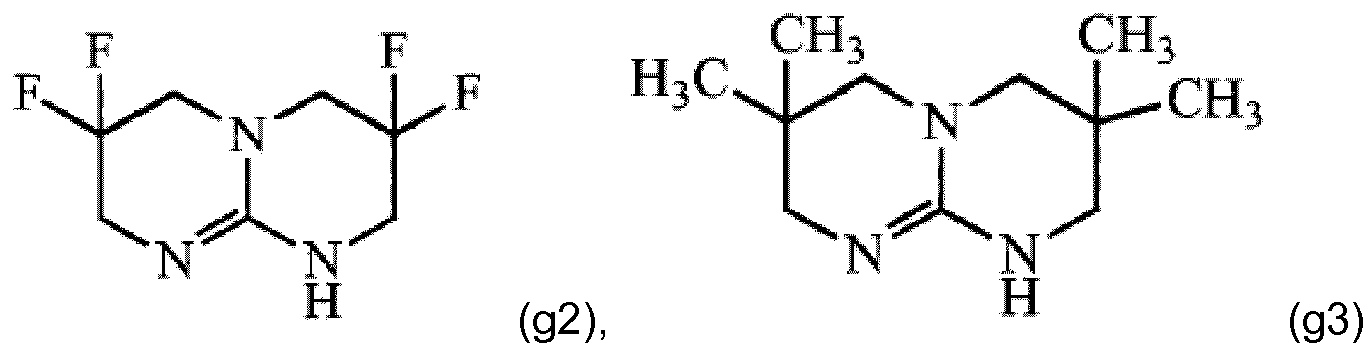

- Inhibitorzusammensetzung gemäß Anspruch 2, wobei die Verbindung der Formel (II) eine beliebige der Verbindungen (g4) bis (g6):

- Inhibitorzusammensetzung gemäß Anspruch 1, wobei X O ist, so dass das substituierte Amidin der Formel (I) eine Verbindung der Formel (III):

- Inhibitorzusammensetzung gemäß Anspruch 7, wobei die Verbindung der Formel (III) die Verbindung (i1) oder (i2):

- Inhibitorzusammensetzung gemäß Anspruch 1, wobei X C(H)R2b ist, so dass das substituierte Amidin der Formel (I) eine Verbindung der Formel (IV):

- Inhibitorzusammensetzung gemäß Anspruch 9, wobei die Verbindung der Formel (IV) eine beliebige der Verbindungen (c1) bis (c3):

- Inhibitorzusammensetzung gemäß Anspruch 9, wobei die Verbindung der Formel (IV) die Verbindung (c4) oder (c5):

- Inhibitorzusammensetzung gemäß einem der vorhergehenden Ansprüche, wobei das NH in dem substituierten Amidin der Formel (I) durch einen pKs von 25 bis 27 charakterisiert werden kann.
- Inhibitorzusammensetzung gemäß einem der vorhergehenden Ansprüche, wobei die Mischung der Inhibitorzusammensetzung ferner einen oder mehrere andere Polymerisationsinhibitoren von Vinylarylmonomeren als das substituierte Amidin der Formel (I) oder prototropische Tautomer davon beinhaltet.
- Inhibitorzusammensetzung gemäß einem der vorhergehenden Ansprüche oder das prototropische Tautomer davon, wobei das Vinylarylmonomer Styren, ein Divinylbenzen oder eine Mischung von zwei oder mehr davon ist.
- Ein Verfahren zum Inhibieren der Polymerisation eines Vinylarylmonomers, wobei das Verfahren Folgendes beinhaltet: In-Kontakt-Bringen eines Vinylarylmonomers, das eine Polymerisationsinhibitionsbehandlung benötigt, mit einer polymerisationsinhibierenden wirksamen Menge des substituierten Amidins der Formel (I), wie in einem beliebigen der Ansprüche 1 bis 18 beschrieben, oder dem prototropischen Tautomer davon, wobei das In-Kontakt-Bringen auf eine derartige Weise durchgeführt wird, dass die Polymerisation des Vinylarylmonomers inhibiert wird.
Applications Claiming Priority (2)
| Application Number | Priority Date | Filing Date | Title |
|---|---|---|---|
| US36985410P | 2010-08-02 | 2010-08-02 | |
| PCT/US2011/045469 WO2012018650A1 (en) | 2010-08-02 | 2011-07-27 | Compositions and method of inhibiting polymerization of vinyl-aryl monomers |
Publications (2)
| Publication Number | Publication Date |
|---|---|
| EP2585490A1 EP2585490A1 (de) | 2013-05-01 |
| EP2585490B1 true EP2585490B1 (de) | 2014-07-02 |
Family
ID=44504222
Family Applications (1)
| Application Number | Title | Priority Date | Filing Date |
|---|---|---|---|
| EP11745631.9A Not-in-force EP2585490B1 (de) | 2010-08-02 | 2011-07-27 | Zusammensetzungen und verfahren zur hemmung der polymerisierung von vinylaryl-monomeren |
Country Status (5)
| Country | Link |
|---|---|
| US (1) | US8969498B2 (de) |
| EP (1) | EP2585490B1 (de) |
| JP (1) | JP5833652B2 (de) |
| CN (1) | CN103124745B (de) |
| WO (1) | WO2012018650A1 (de) |
Families Citing this family (4)
| Publication number | Priority date | Publication date | Assignee | Title |
|---|---|---|---|---|
| JP6272842B2 (ja) * | 2012-06-11 | 2018-01-31 | キャボット マイクロエレクトロニクス コーポレイション | モリブデン研磨のための組成物および方法 |
| EP2971248B1 (de) * | 2013-03-15 | 2021-10-13 | CMC Materials, Inc. | Wässrige reinigungszusammensetzung für post-cu-cmp |
| US20200317955A1 (en) * | 2017-12-22 | 2020-10-08 | Nissan Chemical Corporation | Composition for polishing for use in eliminating protrusion in periphery of laser mark |
| BR112021010980B1 (pt) * | 2019-03-06 | 2024-01-09 | Fina Technology, Inc | Método para reduzir a contaminação em um processo para produção de estireno, e sistema para produção de estireno através de desidrogenação de etil benzeno |
Family Cites Families (11)
| Publication number | Priority date | Publication date | Assignee | Title |
|---|---|---|---|---|
| US3524894A (en) | 1968-05-13 | 1970-08-18 | Pennsalt Chemicals Corp | Inhibiting popcorn polymer formation with tertiary amino naphthol compound |
| US3520943A (en) | 1968-05-13 | 1970-07-21 | Pennwalt Corp | Inhibiting popcorn polymer formation with hydroxy benzene tertiary amine oxide compound |
| EP0467850B1 (de) | 1990-07-20 | 1995-09-06 | Ciba-Geigy Ag | Stabilisierte Monomerenzusammensetzungen |
| US5258138A (en) * | 1990-07-20 | 1993-11-02 | Ciba-Geigy Corporation | Process for stabilizing ethylenically unsaturated compounds and stabilized monomer compositions |
| CN1077886C (zh) * | 1993-10-21 | 2002-01-16 | G·D·瑟尔公司 | 用作一氧化一氮合酶抑制剂的脒基衍生物 |
| DE69904660T2 (de) * | 1998-02-26 | 2005-05-19 | Wako Pure Chemical Industries, Ltd. | Azoamidinverbindung |
| KR20030036653A (ko) * | 2000-08-02 | 2003-05-09 | 유니로얄 캐미칼 캄파니, 인크. | 저온에서 니트록실을 함유하는 스트림을 재순환하는 방법 |
| US6458472B1 (en) * | 2001-01-08 | 2002-10-01 | Henkel Loctite Corporation | Fluxing underfill compositions |
| US6960279B2 (en) | 2002-05-06 | 2005-11-01 | Fina Technology, Inc. | Method for stabilizing vinyl aromatic monomers using selected polymerization inhibitors and polymers prepared therewith |
| DE102005023607A1 (de) * | 2005-05-18 | 2006-11-23 | Basf Ag | Aromatische Heterocyclen als Stabilisatoren polymerisationsfähiger Verbindungen |
| US8492542B2 (en) | 2008-05-15 | 2013-07-23 | Ppg Industries Ohio, Inc. | Method for producing bicyclic guanidines by use of a cyclic thiourea |
-
2011
- 2011-07-27 EP EP11745631.9A patent/EP2585490B1/de not_active Not-in-force
- 2011-07-27 JP JP2013523199A patent/JP5833652B2/ja not_active Expired - Fee Related
- 2011-07-27 US US13/811,574 patent/US8969498B2/en not_active Expired - Fee Related
- 2011-07-27 CN CN201180043578.XA patent/CN103124745B/zh not_active Expired - Fee Related
- 2011-07-27 WO PCT/US2011/045469 patent/WO2012018650A1/en not_active Ceased
Also Published As
| Publication number | Publication date |
|---|---|
| JP2013535553A (ja) | 2013-09-12 |
| WO2012018650A1 (en) | 2012-02-09 |
| US8969498B2 (en) | 2015-03-03 |
| CN103124745A (zh) | 2013-05-29 |
| JP5833652B2 (ja) | 2015-12-16 |
| US20130158203A1 (en) | 2013-06-20 |
| EP2585490A1 (de) | 2013-05-01 |
| CN103124745B (zh) | 2014-10-29 |
Similar Documents
| Publication | Publication Date | Title |
|---|---|---|
| EP2585490B1 (de) | Zusammensetzungen und verfahren zur hemmung der polymerisierung von vinylaryl-monomeren | |
| JP2017527667A (ja) | 1つ以上の1,1−二置換アルケン化合物を含む溶液ポリマー、溶液重合方法、及びポリマー組成物 | |
| EP2398832B1 (de) | Polymerisationsinhibitorzusammensetzung und verfahren zur inhibierung der polymerisation von destillierbaren monomeren | |
| KR102845617B1 (ko) | 에틸렌 및 미르센 공중합체의 합성 방법 | |
| Reining et al. | Chloro-telechelic poly (ethylene oxide) s as initiators for the atom transfer radical polymerization (ATRP) of styrene and methyl methacrylate: structural features that affect the initiation efficiency | |
| KR102583199B1 (ko) | 비닐 단량체의 중합을 억제하기 위한 안정적인 친지성 하이드록실아민 화합물의 용도 | |
| JP5805006B2 (ja) | ビニルエステルとビニルエーテルの共重合体、およびその製造方法 | |
| Wang et al. | The effect of initiators and reaction conditions on the polymer syntheses by atom transfer radical polymerization | |
| Huber et al. | [AlCp2]+: structure, properties and isobutene polymerization | |
| Miura et al. | ‘Living’radical polymerization of styrene mediated by spiro ring-substituted piperidinyl-N-oxyl radicals. The effect of the spiro rings on the control of polymerization | |
| US8835580B2 (en) | Catalyst for norbornene monomer polymerization and method for producing norbornene polymer | |
| Chang et al. | A New Sterically Highly Hindered 7‐Membered Cyclic Nitroxide for the Controlled Living Radical Polymerization | |
| SU469256A3 (ru) | Способ получени сополимеров изобутилена | |
| EP2738187A1 (de) | Verfahren zur Herstellung von vinylchloridhaltigen Copolymeren | |
| KR20140012122A (ko) | 상승효과적인 중합 억제제 조성물 및 방법 | |
| WO2012053535A1 (ja) | ノルボルネン系モノマー重合用触媒及びノルボルネン系重合体の製造方法 | |
| JPH0578480A (ja) | ジフエニルアミンとジヒドロキシアルキルベンゼンから製造される重合物系化合物 | |
| Zamoiskaya et al. | Study of the reaction of styryl aluminium with benzoyl peroxide and its use for the synthesis of block copolymers | |
| EP3702379B1 (de) | Statistisches propylen-copolymer | |
| WO2019027574A1 (en) | CIS-POLYCYCLOOLEFINS AND METHODS OF FORMING CIS-POLYCYCLOOLEFINS | |
| JP2003055420A (ja) | ブロック共重合体の製造法 | |
| Kuanr | Catalytic synthetic designs of aminated polyolefins with tunable dynamic interactions and material applications | |
| WO2026058058A1 (en) | Preparation method of polymuconate salts and polymuconic acid derivatives | |
| JP6099907B2 (ja) | 極性基含有ノルボルネン系共重合体の製造方法 | |
| KR20080076940A (ko) | 무수물-함유 비닐 방향족-비닐 시아니드 공중합체의 제조방법 |
Legal Events
| Date | Code | Title | Description |
|---|---|---|---|
| PUAI | Public reference made under article 153(3) epc to a published international application that has entered the european phase |
Free format text: ORIGINAL CODE: 0009012 |
|
| 17P | Request for examination filed |
Effective date: 20130124 |
|
| AK | Designated contracting states |
Kind code of ref document: A1 Designated state(s): AL AT BE BG CH CY CZ DE DK EE ES FI FR GB GR HR HU IE IS IT LI LT LU LV MC MK MT NL NO PL PT RO RS SE SI SK SM TR |
|
| DAX | Request for extension of the european patent (deleted) | ||
| GRAP | Despatch of communication of intention to grant a patent |
Free format text: ORIGINAL CODE: EPIDOSNIGR1 |
|
| INTG | Intention to grant announced |
Effective date: 20140228 |
|
| GRAS | Grant fee paid |
Free format text: ORIGINAL CODE: EPIDOSNIGR3 |
|
| GRAA | (expected) grant |
Free format text: ORIGINAL CODE: 0009210 |
|
| AK | Designated contracting states |
Kind code of ref document: B1 Designated state(s): AL AT BE BG CH CY CZ DE DK EE ES FI FR GB GR HR HU IE IS IT LI LT LU LV MC MK MT NL NO PL PT RO RS SE SI SK SM TR |
|
| REG | Reference to a national code |
Ref country code: GB Ref legal event code: FG4D |
|
| REG | Reference to a national code |
Ref country code: AT Ref legal event code: REF Ref document number: 675890 Country of ref document: AT Kind code of ref document: T Effective date: 20140715 Ref country code: CH Ref legal event code: EP |
|
| REG | Reference to a national code |
Ref country code: IE Ref legal event code: FG4D |
|
| REG | Reference to a national code |
Ref country code: DE Ref legal event code: R096 Ref document number: 602011008160 Country of ref document: DE Effective date: 20140814 |
|
| REG | Reference to a national code |
Ref country code: AT Ref legal event code: MK05 Ref document number: 675890 Country of ref document: AT Kind code of ref document: T Effective date: 20140702 |
|
| REG | Reference to a national code |
Ref country code: NL Ref legal event code: VDEP Effective date: 20140702 |
|
| REG | Reference to a national code |
Ref country code: LT Ref legal event code: MG4D |
|
| PG25 | Lapsed in a contracting state [announced via postgrant information from national office to epo] |
Ref country code: BG Free format text: LAPSE BECAUSE OF FAILURE TO SUBMIT A TRANSLATION OF THE DESCRIPTION OR TO PAY THE FEE WITHIN THE PRESCRIBED TIME-LIMIT Effective date: 20141002 Ref country code: LT Free format text: LAPSE BECAUSE OF FAILURE TO SUBMIT A TRANSLATION OF THE DESCRIPTION OR TO PAY THE FEE WITHIN THE PRESCRIBED TIME-LIMIT Effective date: 20140702 Ref country code: ES Free format text: LAPSE BECAUSE OF FAILURE TO SUBMIT A TRANSLATION OF THE DESCRIPTION OR TO PAY THE FEE WITHIN THE PRESCRIBED TIME-LIMIT Effective date: 20140702 Ref country code: GR Free format text: LAPSE BECAUSE OF FAILURE TO SUBMIT A TRANSLATION OF THE DESCRIPTION OR TO PAY THE FEE WITHIN THE PRESCRIBED TIME-LIMIT Effective date: 20141003 Ref country code: PT Free format text: LAPSE BECAUSE OF FAILURE TO SUBMIT A TRANSLATION OF THE DESCRIPTION OR TO PAY THE FEE WITHIN THE PRESCRIBED TIME-LIMIT Effective date: 20141103 Ref country code: SE Free format text: LAPSE BECAUSE OF FAILURE TO SUBMIT A TRANSLATION OF THE DESCRIPTION OR TO PAY THE FEE WITHIN THE PRESCRIBED TIME-LIMIT Effective date: 20140702 Ref country code: CZ Free format text: LAPSE BECAUSE OF FAILURE TO SUBMIT A TRANSLATION OF THE DESCRIPTION OR TO PAY THE FEE WITHIN THE PRESCRIBED TIME-LIMIT Effective date: 20140702 Ref country code: FI Free format text: LAPSE BECAUSE OF FAILURE TO SUBMIT A TRANSLATION OF THE DESCRIPTION OR TO PAY THE FEE WITHIN THE PRESCRIBED TIME-LIMIT Effective date: 20140702 Ref country code: NO Free format text: LAPSE BECAUSE OF FAILURE TO SUBMIT A TRANSLATION OF THE DESCRIPTION OR TO PAY THE FEE WITHIN THE PRESCRIBED TIME-LIMIT Effective date: 20141002 |
|
| PG25 | Lapsed in a contracting state [announced via postgrant information from national office to epo] |
Ref country code: CY Free format text: LAPSE BECAUSE OF FAILURE TO SUBMIT A TRANSLATION OF THE DESCRIPTION OR TO PAY THE FEE WITHIN THE PRESCRIBED TIME-LIMIT Effective date: 20140702 Ref country code: LV Free format text: LAPSE BECAUSE OF FAILURE TO SUBMIT A TRANSLATION OF THE DESCRIPTION OR TO PAY THE FEE WITHIN THE PRESCRIBED TIME-LIMIT Effective date: 20140702 Ref country code: HR Free format text: LAPSE BECAUSE OF FAILURE TO SUBMIT A TRANSLATION OF THE DESCRIPTION OR TO PAY THE FEE WITHIN THE PRESCRIBED TIME-LIMIT Effective date: 20140702 Ref country code: RS Free format text: LAPSE BECAUSE OF FAILURE TO SUBMIT A TRANSLATION OF THE DESCRIPTION OR TO PAY THE FEE WITHIN THE PRESCRIBED TIME-LIMIT Effective date: 20140702 Ref country code: NL Free format text: LAPSE BECAUSE OF FAILURE TO SUBMIT A TRANSLATION OF THE DESCRIPTION OR TO PAY THE FEE WITHIN THE PRESCRIBED TIME-LIMIT Effective date: 20140702 Ref country code: IS Free format text: LAPSE BECAUSE OF FAILURE TO SUBMIT A TRANSLATION OF THE DESCRIPTION OR TO PAY THE FEE WITHIN THE PRESCRIBED TIME-LIMIT Effective date: 20141102 Ref country code: AT Free format text: LAPSE BECAUSE OF FAILURE TO SUBMIT A TRANSLATION OF THE DESCRIPTION OR TO PAY THE FEE WITHIN THE PRESCRIBED TIME-LIMIT Effective date: 20140702 Ref country code: PL Free format text: LAPSE BECAUSE OF FAILURE TO SUBMIT A TRANSLATION OF THE DESCRIPTION OR TO PAY THE FEE WITHIN THE PRESCRIBED TIME-LIMIT Effective date: 20140702 |
|
| REG | Reference to a national code |
Ref country code: CH Ref legal event code: PL |
|
| REG | Reference to a national code |
Ref country code: DE Ref legal event code: R097 Ref document number: 602011008160 Country of ref document: DE |
|
| REG | Reference to a national code |
Ref country code: IE Ref legal event code: MM4A |
|
| PG25 | Lapsed in a contracting state [announced via postgrant information from national office to epo] |
Ref country code: DK Free format text: LAPSE BECAUSE OF FAILURE TO SUBMIT A TRANSLATION OF THE DESCRIPTION OR TO PAY THE FEE WITHIN THE PRESCRIBED TIME-LIMIT Effective date: 20140702 Ref country code: MC Free format text: LAPSE BECAUSE OF FAILURE TO SUBMIT A TRANSLATION OF THE DESCRIPTION OR TO PAY THE FEE WITHIN THE PRESCRIBED TIME-LIMIT Effective date: 20140702 Ref country code: RO Free format text: LAPSE BECAUSE OF FAILURE TO SUBMIT A TRANSLATION OF THE DESCRIPTION OR TO PAY THE FEE WITHIN THE PRESCRIBED TIME-LIMIT Effective date: 20140702 Ref country code: LI Free format text: LAPSE BECAUSE OF NON-PAYMENT OF DUE FEES Effective date: 20140731 Ref country code: CH Free format text: LAPSE BECAUSE OF NON-PAYMENT OF DUE FEES Effective date: 20140731 Ref country code: EE Free format text: LAPSE BECAUSE OF FAILURE TO SUBMIT A TRANSLATION OF THE DESCRIPTION OR TO PAY THE FEE WITHIN THE PRESCRIBED TIME-LIMIT Effective date: 20140702 Ref country code: SK Free format text: LAPSE BECAUSE OF FAILURE TO SUBMIT A TRANSLATION OF THE DESCRIPTION OR TO PAY THE FEE WITHIN THE PRESCRIBED TIME-LIMIT Effective date: 20140702 Ref country code: IT Free format text: LAPSE BECAUSE OF FAILURE TO SUBMIT A TRANSLATION OF THE DESCRIPTION OR TO PAY THE FEE WITHIN THE PRESCRIBED TIME-LIMIT Effective date: 20140702 |
|
| PLBE | No opposition filed within time limit |
Free format text: ORIGINAL CODE: 0009261 |
|
| STAA | Information on the status of an ep patent application or granted ep patent |
Free format text: STATUS: NO OPPOSITION FILED WITHIN TIME LIMIT |
|
| 26N | No opposition filed |
Effective date: 20150407 |
|
| PG25 | Lapsed in a contracting state [announced via postgrant information from national office to epo] |
Ref country code: IE Free format text: LAPSE BECAUSE OF NON-PAYMENT OF DUE FEES Effective date: 20140727 |
|
| PG25 | Lapsed in a contracting state [announced via postgrant information from national office to epo] |
Ref country code: SI Free format text: LAPSE BECAUSE OF FAILURE TO SUBMIT A TRANSLATION OF THE DESCRIPTION OR TO PAY THE FEE WITHIN THE PRESCRIBED TIME-LIMIT Effective date: 20140702 |
|
| PG25 | Lapsed in a contracting state [announced via postgrant information from national office to epo] |
Ref country code: SM Free format text: LAPSE BECAUSE OF FAILURE TO SUBMIT A TRANSLATION OF THE DESCRIPTION OR TO PAY THE FEE WITHIN THE PRESCRIBED TIME-LIMIT Effective date: 20140702 |
|
| REG | Reference to a national code |
Ref country code: FR Ref legal event code: PLFP Year of fee payment: 6 |
|
| PG25 | Lapsed in a contracting state [announced via postgrant information from national office to epo] |
Ref country code: MT Free format text: LAPSE BECAUSE OF FAILURE TO SUBMIT A TRANSLATION OF THE DESCRIPTION OR TO PAY THE FEE WITHIN THE PRESCRIBED TIME-LIMIT Effective date: 20140702 |
|
| PG25 | Lapsed in a contracting state [announced via postgrant information from national office to epo] |
Ref country code: LU Free format text: LAPSE BECAUSE OF NON-PAYMENT OF DUE FEES Effective date: 20140727 Ref country code: BE Free format text: LAPSE BECAUSE OF FAILURE TO SUBMIT A TRANSLATION OF THE DESCRIPTION OR TO PAY THE FEE WITHIN THE PRESCRIBED TIME-LIMIT Effective date: 20140702 Ref country code: TR Free format text: LAPSE BECAUSE OF FAILURE TO SUBMIT A TRANSLATION OF THE DESCRIPTION OR TO PAY THE FEE WITHIN THE PRESCRIBED TIME-LIMIT Effective date: 20140702 Ref country code: HU Free format text: LAPSE BECAUSE OF FAILURE TO SUBMIT A TRANSLATION OF THE DESCRIPTION OR TO PAY THE FEE WITHIN THE PRESCRIBED TIME-LIMIT; INVALID AB INITIO Effective date: 20110727 |
|
| REG | Reference to a national code |
Ref country code: FR Ref legal event code: PLFP Year of fee payment: 7 |
|
| REG | Reference to a national code |
Ref country code: FR Ref legal event code: PLFP Year of fee payment: 8 |
|
| PG25 | Lapsed in a contracting state [announced via postgrant information from national office to epo] |
Ref country code: MK Free format text: LAPSE BECAUSE OF FAILURE TO SUBMIT A TRANSLATION OF THE DESCRIPTION OR TO PAY THE FEE WITHIN THE PRESCRIBED TIME-LIMIT Effective date: 20140702 |
|
| PG25 | Lapsed in a contracting state [announced via postgrant information from national office to epo] |
Ref country code: AL Free format text: LAPSE BECAUSE OF FAILURE TO SUBMIT A TRANSLATION OF THE DESCRIPTION OR TO PAY THE FEE WITHIN THE PRESCRIBED TIME-LIMIT Effective date: 20140702 |
|
| PGFP | Annual fee paid to national office [announced via postgrant information from national office to epo] |
Ref country code: DE Payment date: 20200714 Year of fee payment: 10 Ref country code: GB Payment date: 20200716 Year of fee payment: 10 |
|
| PGFP | Annual fee paid to national office [announced via postgrant information from national office to epo] |
Ref country code: FR Payment date: 20210611 Year of fee payment: 11 |
|
| REG | Reference to a national code |
Ref country code: DE Ref legal event code: R119 Ref document number: 602011008160 Country of ref document: DE |
|
| GBPC | Gb: european patent ceased through non-payment of renewal fee |
Effective date: 20210727 |
|
| PG25 | Lapsed in a contracting state [announced via postgrant information from national office to epo] |
Ref country code: GB Free format text: LAPSE BECAUSE OF NON-PAYMENT OF DUE FEES Effective date: 20210727 Ref country code: DE Free format text: LAPSE BECAUSE OF NON-PAYMENT OF DUE FEES Effective date: 20220201 |
|
| PG25 | Lapsed in a contracting state [announced via postgrant information from national office to epo] |
Ref country code: FR Free format text: LAPSE BECAUSE OF NON-PAYMENT OF DUE FEES Effective date: 20220731 |