EP2578671A1 - Riechstoffe mit Maiglöckchennote - Google Patents
Riechstoffe mit Maiglöckchennote Download PDFInfo
- Publication number
- EP2578671A1 EP2578671A1 EP20110184441 EP11184441A EP2578671A1 EP 2578671 A1 EP2578671 A1 EP 2578671A1 EP 20110184441 EP20110184441 EP 20110184441 EP 11184441 A EP11184441 A EP 11184441A EP 2578671 A1 EP2578671 A1 EP 2578671A1
- Authority
- EP
- European Patent Office
- Prior art keywords
- formula
- compound
- fragrance
- lily
- odor
- Prior art date
- Legal status (The legal status is an assumption and is not a legal conclusion. Google has not performed a legal analysis and makes no representation as to the accuracy of the status listed.)
- Granted
Links
- 0 CC[C@](C)CC(CCCC(C)(C)C)*C*N(*)C=O Chemical compound CC[C@](C)CC(CCCC(C)(C)C)*C*N(*)C=O 0.000 description 2
Images

Classifications
-
- C—CHEMISTRY; METALLURGY
- C11—ANIMAL OR VEGETABLE OILS, FATS, FATTY SUBSTANCES OR WAXES; FATTY ACIDS THEREFROM; DETERGENTS; CANDLES
- C11B—PRODUCING, e.g. BY PRESSING RAW MATERIALS OR BY EXTRACTION FROM WASTE MATERIALS, REFINING OR PRESERVING FATS, FATTY SUBSTANCES, e.g. LANOLIN, FATTY OILS OR WAXES; ESSENTIAL OILS; PERFUMES
- C11B9/00—Essential oils; Perfumes
- C11B9/0026—Essential oils; Perfumes compounds containing an alicyclic ring not condensed with another ring
- C11B9/0034—Essential oils; Perfumes compounds containing an alicyclic ring not condensed with another ring the ring containing six carbon atoms
-
- A—HUMAN NECESSITIES
- A61—MEDICAL OR VETERINARY SCIENCE; HYGIENE
- A61K—PREPARATIONS FOR MEDICAL, DENTAL OR TOILETRY PURPOSES
- A61K8/00—Cosmetics or similar toiletry preparations
- A61K8/18—Cosmetics or similar toiletry preparations characterised by the composition
- A61K8/30—Cosmetics or similar toiletry preparations characterised by the composition containing organic compounds
- A61K8/33—Cosmetics or similar toiletry preparations characterised by the composition containing organic compounds containing oxygen
- A61K8/35—Ketones, e.g. benzophenone
-
- A—HUMAN NECESSITIES
- A61—MEDICAL OR VETERINARY SCIENCE; HYGIENE
- A61Q—SPECIFIC USE OF COSMETICS OR SIMILAR TOILETRY PREPARATIONS
- A61Q13/00—Formulations or additives for perfume preparations
-
- C—CHEMISTRY; METALLURGY
- C07—ORGANIC CHEMISTRY
- C07C—ACYCLIC OR CARBOCYCLIC COMPOUNDS
- C07C47/00—Compounds having —CHO groups
- C07C47/20—Unsaturated compounds having —CHO groups bound to acyclic carbon atoms
- C07C47/225—Unsaturated compounds having —CHO groups bound to acyclic carbon atoms containing rings other than six-membered aromatic rings
-
- C—CHEMISTRY; METALLURGY
- C11—ANIMAL OR VEGETABLE OILS, FATS, FATTY SUBSTANCES OR WAXES; FATTY ACIDS THEREFROM; DETERGENTS; CANDLES
- C11C—FATTY ACIDS FROM FATS, OILS OR WAXES; CANDLES; FATS, OILS OR FATTY ACIDS BY CHEMICAL MODIFICATION OF FATS, OILS, OR FATTY ACIDS OBTAINED THEREFROM
- C11C5/00—Candles
- C11C5/002—Ingredients
- C11C5/004—Ingredients dyes, pigments; products giving a coloured flame
-
- C—CHEMISTRY; METALLURGY
- C11—ANIMAL OR VEGETABLE OILS, FATS, FATTY SUBSTANCES OR WAXES; FATTY ACIDS THEREFROM; DETERGENTS; CANDLES
- C11D—DETERGENT COMPOSITIONS; USE OF SINGLE SUBSTANCES AS DETERGENTS; SOAP OR SOAP-MAKING; RESIN SOAPS; RECOVERY OF GLYCEROL
- C11D3/00—Other compounding ingredients of detergent compositions covered in group C11D1/00
- C11D3/50—Perfumes
-
- A—HUMAN NECESSITIES
- A61—MEDICAL OR VETERINARY SCIENCE; HYGIENE
- A61Q—SPECIFIC USE OF COSMETICS OR SIMILAR TOILETRY PREPARATIONS
- A61Q15/00—Anti-perspirants or body deodorants
-
- A—HUMAN NECESSITIES
- A61—MEDICAL OR VETERINARY SCIENCE; HYGIENE
- A61Q—SPECIFIC USE OF COSMETICS OR SIMILAR TOILETRY PREPARATIONS
- A61Q17/00—Barrier preparations; Preparations brought into direct contact with the skin for affording protection against external influences, e.g. sunlight, X-rays or other harmful rays, corrosive materials, bacteria or insect stings
- A61Q17/04—Topical preparations for affording protection against sunlight or other radiation; Topical sun tanning preparations
-
- A—HUMAN NECESSITIES
- A61—MEDICAL OR VETERINARY SCIENCE; HYGIENE
- A61Q—SPECIFIC USE OF COSMETICS OR SIMILAR TOILETRY PREPARATIONS
- A61Q19/00—Preparations for care of the skin
-
- A—HUMAN NECESSITIES
- A61—MEDICAL OR VETERINARY SCIENCE; HYGIENE
- A61Q—SPECIFIC USE OF COSMETICS OR SIMILAR TOILETRY PREPARATIONS
- A61Q19/00—Preparations for care of the skin
- A61Q19/10—Washing or bathing preparations
-
- A—HUMAN NECESSITIES
- A61—MEDICAL OR VETERINARY SCIENCE; HYGIENE
- A61Q—SPECIFIC USE OF COSMETICS OR SIMILAR TOILETRY PREPARATIONS
- A61Q5/00—Preparations for care of the hair
- A61Q5/02—Preparations for cleaning the hair
-
- A—HUMAN NECESSITIES
- A61—MEDICAL OR VETERINARY SCIENCE; HYGIENE
- A61Q—SPECIFIC USE OF COSMETICS OR SIMILAR TOILETRY PREPARATIONS
- A61Q5/00—Preparations for care of the hair
- A61Q5/06—Preparations for styling the hair, e.g. by temporary shaping or colouring
- A61Q5/065—Preparations for temporary colouring the hair, e.g. direct dyes
-
- A—HUMAN NECESSITIES
- A61—MEDICAL OR VETERINARY SCIENCE; HYGIENE
- A61Q—SPECIFIC USE OF COSMETICS OR SIMILAR TOILETRY PREPARATIONS
- A61Q5/00—Preparations for care of the hair
- A61Q5/10—Preparations for permanently dyeing the hair
-
- A—HUMAN NECESSITIES
- A61—MEDICAL OR VETERINARY SCIENCE; HYGIENE
- A61Q—SPECIFIC USE OF COSMETICS OR SIMILAR TOILETRY PREPARATIONS
- A61Q5/00—Preparations for care of the hair
- A61Q5/12—Preparations containing hair conditioners
-
- C—CHEMISTRY; METALLURGY
- C07—ORGANIC CHEMISTRY
- C07C—ACYCLIC OR CARBOCYCLIC COMPOUNDS
- C07C2601/00—Systems containing only non-condensed rings
- C07C2601/12—Systems containing only non-condensed rings with a six-membered ring
- C07C2601/16—Systems containing only non-condensed rings with a six-membered ring the ring being unsaturated
Definitions
- the present invention relates primarily to novel compounds selected from the group consisting of the compound of the formula (Ia) and the compound of formula (Ib) and mixtures comprising the compound of the formula (Ia) as defined above and the compound of the formula (Ib) as defined above or consisting of the compound of the formula (Ia) and the compound of the formula (Ib) as defined above.
- the invention relates to the use of a compound of the formula (I) as a fragrance, in particular as a lily-of-the-valley fragrance, and fragrance preparations and perfumed products comprising an (preferably sensory effective) amount of the compound of the formula (I) as defined above and to a process for preparing a compound of the formula (I) as defined above.
- Flowery odor compounds are an indispensable component in the fragrance industry as well as in the manufacture of cosmetics, personal care products and detergents and cleaners.
- a particularly valuable class of these floral fragrances are compounds with a lily-of-the-valley odor note.
- Some members of this class of fragrances have a structure comprising a 4-alkyl-phenylpropanal as a backbone, such as 3- (4-tert-butylphenyl) -2-methylpropanal (formula (A); Lilial®, manufacturer: Givaudan SA); (4-tert-butylphenyl) propanal (formula (B); Bourgeonal®, manufacturer: Quest), 3- (4-isopropylphenyl) -2-methylpropanal (formula (C), Cyclamal®, manufacturer: Givaudan SA) and 3- (3 -Isopropylphenyl) -butanal (formula (D), Florhydral®, manufacturer: Givaudan SA).
- 3- (4-tert-butylphenyl) -2-methylpropanal (A) a synthetic fragrance
- 3- (4-tert-butylphenyl) -2-methylpropanal has long been one of the most important industrially used fragrances for floral fragrance compositions, particularly with a lily-of-the-valley odor note, and has become abundant in the cosmetics and soap industries used.
- animal studies showed that 3- (4-tert-butylphenyl) -2-methylpropanal could be reprotoxic. It has also been found that this compound may be an allergen and could cause contact dermatitis in sensitive individuals.
- the endocyclic dotted line means a single bond or a double bond
- the group R is a methyl group or a hydrogen atom.
- the odor notes in the US 7,834,219 disclosed compounds of formula (F) have a strong floral note and a lily of the valley on.
- the compounds differ from the compounds (A) to (D) in that they include a cyclohexyl group instead of a phenyl group.
- the group R represents an ethyl, isopropyl, or sec-butyl group.
- the odor of this molecule is described as persistent, very fresh, pungent, flowery, woody and ozone.
- fragrances that have additional positive secondary properties beyond their primary, namely, odoriferous, properties, such as e.g. a higher stability under certain conditions of use, a higher substantivity and / or diffusivity or a better adhesion, or by synergy with other fragrances lead to better sensory profiles.
- Fragrances that are characterized by the above-mentioned positive secondary properties allow for increased effectiveness in the production of fragrance preparations and perfumed products. For example, through the use of fragrances With a better sensory profile, a higher substantivity and / or a better adhesion, the number and the amounts of fragrances in corresponding formulations can be optimized and / or minimized, which leads to a sustainable conservation of resources in the production of perfumed products.
- the primary object of the present invention was to provide a fragrance with a floral, especially lily-of-the-valley odor note whose odor properties are comparable to 3- (4-tert-butylphenyl) -2-methylpropanal (Lilial®), that is, the fragrance should have an odor impression which largely corresponds to the complexity of the natural odor of the lily-of-the-valley blossom.
- this fragrance should preferably be superior to the lily-of-the-valley fragrances known from the prior art in terms of the sum of its secondary properties or at least some of its secondary properties.
- a fragrance in the context of the present text is any substance which is suitable for use in producing an odor impression, i. to mediate an odor impression, or to modify (modify or amplify) the odor perception of another substance.
- this substance so that it can be used for perfumery purposes, preferably no undesirable side effects, e.g. adverse effects on health or the environment, or the adverse effects of the intended use of a product containing that fragrance.
- a compound of the formula (I) imparts an odor impression which comes very close to the complexity of the natural odor of the lily-of-the-valley blossom. That is, the odor impression imparted by the compound of the formula (I) is distinguished by an outstanding naturalness and complexity, in particular with regard to the lily of the valley odor note.
- the natural smell of Maiglöckenblüte largely corresponding odor impression has not been achieved with the known from the prior art fragrances with lily of the valley odor note.
- the compound of the formula (I) to be used according to the invention is distinguished by high absorption capacity (inherent adhesion to a substrate) and high substantivity (ability to grow from a, usually aqueous, phase onto a substrate or even after a washing or rinsing process a substrate to remain) from. This effect is particularly evident on substrates such as skin, hair and textile fibers (e.g., wool, cotton, linen, synthetic fibers).
- fragrances and fragrance preparations are their substantivity to or retention on the substrate, in particular hair or textile fibers.
- substantially and retention are used eg in EP 1 201 738 A1 set out in detail, compare sections [0004] - [0005]. Fragrances with high substantivity and / or retention are generally sought.
- a further aspect of the invention relates in particular to the use of the compound of the formula (I) to be used according to the invention as an agent for increasing the substantivity and / or retention of a fragrance preparation (in particular over or on hair or textile fibers), preferably a fragrance preparation with lily-of-the-valley odor note, preferably an odoriferous preparation according to the invention as described below.
- a fragrance preparation in particular over or on hair or textile fibers
- a fragrance preparation with lily-of-the-valley odor note preferably an odoriferous preparation according to the invention as described below.
- the compound of the formula (I) to be used according to the invention is distinguished by its fixing properties, i. she is a fixator.
- the compound of formula (I) according to the invention increases the adhesion of other fragrances, whether by lowering their vapor pressure or adding odor (e.g., lowering the threshold).
- the invention therefore also relates - as already mentioned - the use of the compound of formula (I) as a fixative.
- ⁇ -pinene exists in two enantiomeric forms: (-) - ⁇ -pinene and (+) - ⁇ -pinene.
- the above-mentioned prior art documents merely disclose that ⁇ -pinene is used as the starting material. It is therefore not disclosed in which proportions the ⁇ -pinene used as starting material contains the two enantiomers of (-) - ⁇ -pinene or (+) - ⁇ -pinene.
- the present invention also relates to a compound selected from the group consisting of the compound of the formula (Ia) and the compound of formula (Ib) and a mixture comprising (i) the compound of the formula (Ia) as defined above and (ii) the compound of the formula (Ib) as defined above or consisting of the compound of the formula (Ia) as defined above and the compound of the formula ( Ib) as defined above.
- the compound of the formula (Ia) or formula (Ib) is understood to mean the corresponding particular enantiomer (as defined above), while the "Compound of formula (I)” means both the individual compounds selected from the group consisting of the compound of formula (Ia) and the compound of formula (Ib) as well as all mixtures (enantiomeric mixtures) consisting of these two compounds (in any Mixing ratio). That is, statements concerning the "compound of the formula (I)” always hold for both the compound of the formula (Ia) and the compound of the formula (Ib) and for mixtures consisting of the compound of the formula (Ia) and the compound of Formula (Ib) in any mixing ratio.
- the mass ratio of the compound of the formula (Ia) to the compound of the formula (Ib) is preferably selected such that the rotational value of the mixture not -54.2 °.
- the mass ratio of the compound of the formula (Ia) to the compound of the formula (Ib) is preferably selected such that a rotation value greater than -54.2 ° results, more preferably greater than -54 °, even more preferably greater than -50 °.
- the odor profile of the compound of formula (Ia) as defined above is described as follows: lily-of-the-valley nose note, flowery, sweet, watery, powdery and ozone, natural, nourishing, complex and radiant.
- the complex the natural Smell of the lily of the valley blossom largely corresponding odor impression remarkable.
- the compound of formula (Ia) is thus similar to 3- (4-tert-butylphenyl) -2-methylpropanal (formula (A)).
- the odor profile of the compound of formula (Ib) as defined above is described as follows: lily-of-the-valley odor note, fruity, green, watery and aldehydic.
- the compound of formula (Ia) is particularly suitable for imparting, modifying or enhancing a lily-of-the-valley odor note and optionally one, more or all odor notes selected from the group consisting of flowery, sweet, watery, powdery and ozone and / or one of its odor profile , several or all impressions selected from the group consisting of natural, nurturing, complex and radiant.
- the compound of the formula (Ia) in combination with one or more other fragrances is capable of producing or enhancing other odor notes desired for perfumery purposes, in particular the odor notes creamy (see Examples 10 and 14 ), cosmetically (see Example 10), approximately aldehydically (see Example 12), green (see Example 13) and aqueous-fruity (see Example 15).
- the compound of formula (Ib) is particularly suitable for imparting, modifying or enhancing a lily-of-the-valley odor note and optionally one, several or all odor notes selected from the group consisting of fruity, green, aqueous and aldehydic.
- the compound of formula (Ia) as defined above is preferably used in accordance with the invention for imparting, modifying or enhancing a lily-of-the-valley odor note and optionally one, several or all odor notes selected from the group consisting of flowery, sweet, watery, powdery and ozone and / or or one, several or all impressions selected from the group consisting of natural, nurturing, complex and radiant.
- the compound of the formula (Ib) as defined above is preferably used according to the invention for imparting, modifying or enhancing one Lilies of the valley odor and optionally one, several or all odor notes selected from the group consisting of fruity, green, watery and aldehydic.
- a further aspect of the present invention relates to fragrance preparations, in particular perfume oils, wherein, according to the invention, perfume oils with a lily-of-the-valley odor note are of particular interest due to the above-described odor profiles of the compound of the formula (Ia) and the compound of the formula (Ib).
- a fragrance preparation is a mixture of different substances which is produced from the corresponding substances according to a recipe or a recipe according to a predetermined method. Such preparations are specifically prepared and used for the purpose of imparting, modifying or enhancing a desired odor impression, which is usually perceived as pleasant or otherwise positive. Preparations as used in preparative organic chemistry, in particular the preparations known from the prior art described above for the radical addition to ⁇ -pinene, are therefore not fragrance preparations in the sense of the present invention.
- the optionally in the publications Zhurnal Organicheskoi Khimii 1974, 10, 1153-1157 . Comptes Rendus of the University of Sciences, Series C: Sciences Chimiques 1967, 264, 1083-1086 respectively. Bulletin de la describes Chimique de France 1973, 4, 1368-1372 described mixtures comprising the compound of formula (I), are not the subject of the present invention and are in particular no fragrance preparations according to the invention.
- the fragrance preparation of the invention is not a mixture containing the compound of formula (I) as defined above and one or more substances selected from the group consisting of heptane, acetic acid, ⁇ -pinene, ethanal, manganese salts, copper salts, compound of formula (Ia ) from the publication Zhurnal Organicheskoi Khimii 1974, 10, 1153-1157 (as defined therein), compound of formula (IIa) from the publication Zhurnal Organicheskoi Khimii 1974, 10, 1153-1157 (as defined therein), compound of formula (IIIa) from the publication Zhurnal Organicheskoi Khimii 1974, 10, 1153-1157 (as defined therein), dimethylsulfoxide, tosylate of (p-menthen-1-yl-7) -2-ethanol, di-tert-butyl peroxide, benzoyl peroxide, described in U.S. Pat Bulletin de la Sammlung Chimique de France 1973, 4, 1368-1372 described compound (4
- fragrances preferably with one, several or all odor notes selected from the group consisting of flowery, sweet, aqueous, ozone, woody, amber, musk, fruity, animal
- Fragrances which are suitable in the sense of the above definition as further fragrances for use in an inventive fragrance preparation, are found, for. In S. Arctander, Perfume and Flavor Materials, Vol. I and II, Montclair, NJ 1969, self-published , or K. Bauer et al., Common Fragrance and Flavor Materials, 4th Edition, Wiley-VCH, Weinheim 2001 ,
- Extracts from natural raw materials such as essential oils, concretes, absolues, resines, resinoids, balsams, tinctures such.
- Citronellal Citronellal; 7-methoxy-3,7-dimethyloctanal; 2,6,10-trimethyl-9-undecenal; geranyl acetone; and the dimethyl and diethyl acetals of Geranial, Neral, the cyclic terpene alcohols such.
- allyl-3-cyclohexylpropionate Allylcyclohexyloxyacetat; cis- and trans-methyldihydrojasmonate; cis- and trans-methyl jasmonate; Methyl-2-hexyl-3-oxocyclopentanecarboxylate; Ethyl 2-ethyl-6,6-dimethyl-2-cyclohexenecarboxylate; Ethyl 2,3,6,6-tetramethyl-2-cyclohexene-carboxylate; Ethyl-2-methyl-1,3-dioxolan-2-acetate; the araliphatic alcohols such as benzyl alcohol; 1-phenylethyl; 3-phenylpropanol; 2-phenylpropanol; 2-phenoxyethanol; 2,2-dimethyl-3-phenylpropanol; 2,2-dimethyl-3- (3-methylphenyl) propanol; 1,1-dimethyl-2-phen
- the amount of the compound of the formula (Ia) as defined above and / or the compound of the formula (Ib) as defined above is preferably in the range from 0.0001 to 40% by weight. is, preferably in the range of 0.001 to 25 wt .-%, each based on the total weight of the fragrance preparation.
- a fragrance preparation according to the invention optionally contains further constituents which themselves are not fragrances as defined above, such as e.g. Solvents, solubilizers, emulsifiers, stabilizers, radical scavengers.
- an odoriferous preparation according to the invention in particular in the form of a perfume oil, comprises one, 2, 3 or more further fragrances with a lily-of-the-valley odor note and optionally one, several or all odor notes selected from the group consisting of flowery, sweet, aqueous, ozone , woody, amber, musk, fruity, animalistic.
- odor notes selected from the group consisting of flowery, sweet, aqueous, ozone , woody, amber, musk, fruity, animalistic.
- Corresponding fragrances are known to the person skilled in the art.
- the compound of the formula (I) to be used according to the invention as fragrance, mixtures according to the invention as defined above and fragrance preparations according to the invention as defined above are used in particular for the production of perfumed products (perfumed articles).
- a perfumed product according to the invention comprises the compound of formula (I) as defined above, preferably in a sensory effective amount.
- a perfumed product comprises a mixture or fragrance preparation according to the invention, as well as a carrier or a substrate, wherein the carrier or the substrate is in direct contact with this mixture or fragrance preparation.
- the substrate is for example a solid or the carrier is for example a solid carrier.
- Preferred perfumed products according to the invention are detergents and cleaners, hygiene or care products, in particular products from the field of body and hair care, cosmetics and household.
- a perfumed product according to the invention in which the amount of the compound of the formula (Ia) as defined above and / or the compound of the formula (Ib) as defined above is in the range from 0.0001 to 5% by weight. is, preferably in the range of 0.001 to 2.5 wt .-%, each based on the total weight of the product.
- Preferred perfumed products according to the invention are selected from the group consisting of:
- Perfume Extracts Eau de perfumes, Eau de Toilettes, Shaving Waters, Eau de Colognes, Pre-shave Products, Splash C perfumes, Perfumed Refreshing Towels, Perfumes for Acid, Alkaline and Neutral Detergents, Detergents, Wash Tablets, Disinfectants, and Air Fresheners, Aerosol sprays, waxes and polishes, as well as personal care products, bath oils, cosmetic emulsions, such as Skin creams and lotions, sunscreen creams and lotions, after-sun creams and lotions, hand creams and lotions, foot creams and lotions, depilatory creams and lotions, after-shave creams and lotions, tanning creams and lotions, Hair care products such as Hair sprays, hair gels, hair setting lotions, hair lotions, hair colorants, hair styling and hair straightening agents, hair lotions, hair creams and lotions, deodorants and antiperspirants, decorative cosmetics, e.g.
- Fragrance preparations according to the invention comprising the compound of the formula (I) or a mixture according to the invention as defined above can be used in general (for example in concentrated form, in solutions or in modified form described below) for the preparation of, for example, perfume extracts, Eau de perfumes, Eau de Toilettes, shaving waters, Eau de Colognes, pre-shave products, splash colognes and scented refreshing wipes and the perfuming of acidic, alkaline and neutral detergents, such as floor cleaners, window glass cleaners, dishwashing detergents, bath and sanitary cleaners, scouring cream, solid and liquid Toilet cleaners, powder and foam carpet cleaners, liquid detergents, powdered detergents, laundry pretreatment agents such as bleach, soak and stain removers, fabric softeners, laundry soaps, washing tablets, disinfectants, surface disinfectants and air fresheners in liquid, gel-like or solid-applied form, aerosol sprays, waxes and polishes such as furniture polishes, floor waxes, shoe polishes and
- Preferred perfumed products according to the invention are products selected from the group consisting of detergents and cleaners, hygiene or care products, in particular from the field of body and hair care, cosmetics and household, fine fragrance (perfume), air care (especially candles) , Air freshener.
- fragrance preparations according to the invention or the fragrance preparations to be used according to the invention in the corresponding products can be used in liquid form, undiluted or diluted with a solvent for perfuming.
- Suitable solvents for this are e.g. Ethanol, isopropanol, diethylene glycol monoethyl ether, glycerol, propylene glycol, 1,2-butylene glycol, dipropylene glycol, diethyl phthalate, triethyl citrate, isopropyl myristate, etc.
- solvents mentioned explicitly in the context of the present text, in the case of the presence of intrinsic olfactory properties, these are exclusively the component " Solvent "and not the" fragrances "are assigned.
- the compound of the formula (I) present in the perfumed products according to the invention, a mixture according to the invention as defined above or a fragrance preparation according to the invention as defined above may in a preferred embodiment be absorbed on a carrier which is responsible both for a fine distribution of the fragrances in the product also ensures a controlled release during use.
- a carrier which is responsible both for a fine distribution of the fragrances in the product also ensures a controlled release during use.
- Such carriers can be porous inorganic materials such as light sulfate, silica gels, zeolites, gypsum, clays, clay granules, aerated concrete, etc., or organic materials such as woods and cellulosic based materials.
- the compound of the formula (I) present in the perfumed products according to the invention, a mixture according to the invention as defined above or a fragrance preparation according to the invention as defined above can also be microencapsulated, spray-dried, present as inclusion complexes or as extrusion products and in this form to be perfumed Product, or article, to be added.
- the properties of the perfume formulations modified in this way can be further optimized by so-called “coating” with suitable materials with a view to a more targeted release of fragrance, to which end preferably wax-like plastics such as e.g. Polyvinyl alcohol can be used.
- the microencapsulation of the fragrance preparations can be carried out, for example, by the so-called coacervation method with the aid of capsule materials, e.g. made of polyurethane-like substances or soft gelatin.
- the spray-dried perfume oils can be prepared, for example, by spray-drying an emulsion or dispersion containing the perfume oil, it being possible to use as excipients modified starches, proteins, dextrin and vegetable gums.
- Inclusion complexes can be e.g. by incorporating dispersions of the fragrance preparation and cyclodextrins or urea derivatives into a suitable solvent, e.g. Water, to be produced.
- Extrusion products can be made by fusing the fragrance preparation with a suitable waxy substance and by extrusion followed by solidification, optionally in a suitable solvent, e.g. Isopropanol, done.
- fragrance preparations according to the invention can therefore, as already mentioned, be used in concentrated form, in solutions or in modified form as described above for the preparation of the corresponding perfumed articles according to the invention
- ingredients with which the compound of the formula (I) according to the invention, a mixture according to the invention as defined above or a fragrance preparation according to the invention as defined above can preferably be combined are, for example: preservatives, abrasives, anti-acne agents, anti-aging agents, antibacterial agents, anti-cellulites Anti-dandruff agents, anti-inflammatory agents, anti-inflammatory agents, anti-irritants, anti-irritants, antimicrobials, antioxidants, astringents, antiperspirants, antiseptics, antistatic agents, Binders, buffers, carrier materials, chelating agents, cell stimulants, cleansing agents, nourishing agents, depilatory agents, surfactants, deodorizing agents, antiperspirants, emollients, emulsifiers, enzymes, essential oils, fibers, film formers, fixatives, foaming agents, foam stabilizers, foaming inhibitors , Foaming boosters, fungicides, gelling agents, gelling agents, hair care products,
- the perfumed product according to the invention is very particularly preferably not a mixture containing the compound of the formula (I) as defined above and one or more substances selected from the group consisting of heptane, acetic acid, ⁇ -pinene, ethanal, manganese salts, copper salts, compound of the formula ( la) from the publication Zhurnal Organicheskoi Khimii 1974, 10, 1153-1157 (as defined therein), compound of formula (IIa) from the publication Zhurnal Organicheskoi Khimii 1974, 10, 1153-1157 (as defined therein), compound of formula (IIIa) from the publication Zhurnal Organicheskoi Khimii 1974, 10, 1153-1157 (as defined therein), dimethylsulfoxide, tosylate of (p-menthen-1-yl-7) -2-ethanol, di-tert-butyl peroxide, benzoyl peroxide, described in U.S. Pat Bulletin de la describes Chimique de France 1973, 4, 1368-1372
- the high substantivity of the compounds (Ia) and (Ib) according to the invention proves advantageous, because the higher the Substance of a fragrance, the lower the amount of fragrance needed to maintain an odor over a given time.
- the fragrance preparation may be part of a perfumed product according to the invention, for example a body, hair or textile care product.
- the compound of the formula (I) to be used as the fragrance according to the invention is i.a. obtainable by radical addition of ethanal to (+) - ⁇ -pinene.
- the compounds of the invention selected from the group consisting of the compound of formula (Ia) and the compound of formula (Ib) are i.a. obtainable by radical addition of ethanal to (+) - ⁇ -pinene or (-) - ⁇ -pinene, respectively.
- a further object of the present invention was to provide novel processes for preparing the compound of the formula (I) to be used according to the invention as a fragrance and the compounds according to the invention selected from the group consisting of the compound of the formula (Ia).
- a method according to the invention for preparing the compound of the formula (I) as defined above comprises the step acid-catalyzed reaction of an acetal of formula (II) to form the compound of formula (I) wherein the group R in the acetal of the formula (II) is a branched or unbranched, saturated or unsaturated alkyl group having 1 to 10 carbon atoms, preferably a butyl group.
- acetal of the formula (II) used in the process according to the invention wherein the group R in the acetal of the formula (II) is a branched or unbranched, saturated or unsaturated alkyl group having 1 to 10 carbon atoms, preferably a butyl group, is novel and also the subject of the present invention.
- the term "acetal of the formula (II)” encompasses both the individual enantiomers (acetal of the formula (IIa) as defined below and acetal of the formula (IIb) as defined below) and also all mixtures (enantiomer mixtures) consisting of these two Compounds (in any mixing ratio).
- the advantage of the use according to the invention of d - (+) - limonene and / or I - (-) limonene as educt is that it is readily available, ie commercially available, and inexpensive educts from renewable raw materials ,
- the compound of the formula (Ia) or of the formula (Ib) are each selectively accessible by the selective use of d - (+) or I - (-) - limonene.
- the educt limonene (VI) (d - (+) - limonene and / or I - (-) - limonene) is first catalytically monohydrated in a manner known per se to form p-menth-1-ene (formula (V)). This is epoxidized with a peracid in a conventional manner. The resulting epoxide of the formula (IV) is heated in the presence of aluminum isopropylate, so that a ring opening to the allyl alcohol of the formula (III) takes place.
- the first step of the synthetic route (i) according to the invention the selective hydrogenation of the exocyclic double bond of limonene (formula (VIa), (VIb)), has often been described in the literature.
- Typical reagents for this reaction are platinum (IV) oxide as in the publication J. Chem. Soc., Chem. Commun. 1994, 24, 2759-2760 or W-4 Raney Nickel as in J. Org. Chem. 1982, 10, 1824-1831 published.
- platinum (IV) oxide platinum oxide as in the publication J. Chem. Soc., Chem. Commun. 1994, 24, 2759-2760 or W-4 Raney Nickel as in J. Org. Chem. 1982, 10, 1824-1831 published.
- the use of ruthenium on carbon is easier to handle than the flammable Raney nickel and cheaper than platinum (IV) oxide.
- the next step is the selective ring opening of the epoxide of formula (IVa), (VIb) to the allyl alcohol of formula (IIIa), (IIIb).
- Various products can be formed in this reaction, namely the desired allyl alcohol having the exocyclic double bond and the corresponding allyl alcohol having an endocyclic double bond.
- Lithium-diisopropylamide or tert- butoxide are described in the literature as base for this reaction [ Roczniki Chemii Ann. Soc. Chim. Polonorum 1976, 50, 1709-1717 and Helv. Chim. Acta 1984, 67, 1249-1253 ].
- a disadvantage of all these methods is that relatively high equivalent amounts of base must be used, and the sometimes difficult handling of bases such as lithium diisopropylamide and the low selectivity and / or yield.
- bases such as lithium diisopropylamide and the low selectivity and / or yield.
- the further implementation is then carried out in two stages, such as in US 3,716,498 for the preparation of Pinoacetaldehyd explained.
- the acetal of the formula (IIa), (IIb) is prepared by reaction of the allyl alcohol of the formula (IIIa), (IIIb) with an alkyl vinyl ether such as butyl vinyl ether in the presence of a protic acid such as phosphoric acid.
- limonene (formula (VIa), (VIb)) is first hydrogenated to p-menth-1-ene (formula (Va), (Vb)) as described above.
- p-Menth-1-ene (formula (Va), (Vb)) is then subjected to photooxidation in a solvent, eg methanol, in the presence of a sensitizer, eg rose bengal, at room temperature and the hydroperoxides formed thereby (not shown in the following scheme) are reduced with a suitable reducing agent, for example sodium sulphite, to the corresponding isomeric allylic alcohols (formulas (IIIa), (IIIa '), (III'a'), (IIIb), (IIIb '), (IIIb ")) above for synthesis route (i) described by reaction of the allyl alcohol of the formula (IIIa), (IIIb) with an alkyl vinyl ether such as butyl
- An alternative method according to the invention for preparing the compound of formula (I) as defined above comprises the step
- decan-2-one is obtainable by a radical reaction of 4-isopropylcyclohexanol (Formula (IX)) with methyl acrylate in the presence of di-tert-butyl peroxide.
- 4-Isopropylcyclohexanol (formula (IX)) in turn is obtainable by hydrogenation of 4-isopropylphenol (formula (X)):
- WO 2004/089861 describes the pyrolysis of a spirolactone of the general formula wherein the group R6 is a hydrogen atom or an alkyl group having 1 to 4 carbon atoms, in the presence of a reducing agent and a catalyst.
- WO 2004/089861 does not disclose either the compound of formula (VIII) or its pyrolysis product (I).
- a similar procedure describes the publication Helv. Chim. Acta 2004, 87, 1697-1703 ,
- a mixture of 2 g of 8-isopropyl-4-oxaspiro [4.5] decan-3-one (93%, 9.5 mmol, formula (VIII) as defined above) and 18 g of formic acid is at 440 ° C and over 2 hours with an N 2 flow of 16 L / h metered into the system with the catalyst described above.
- the pyrolysis product is collected in a cold trap, then diluted with MTBE and neutralized with saturated sodium bicarbonate solution. The phases are separated, and after removal of the solvent gives 1.5 g of crude product in a purity of 32%. This corresponds to a crude yield of 28%.
- composition of the perfume oil B1 or B2 is a composition of the perfume oil B1 or B2:
- the body lotion containing the perfume oil B2 has a more natural and stronger flowery note than the body lotion containing perfume oil B1 (without 3 - [(4R) -4-isopropylcyclohexen-1-yl] propanal). Furthermore, the body lotion with the perfume oil B2 shows a more cosmetic top note and a creamier after-odor than the body lotion with the perfume oil B1.
- Composition of the perfume oil C1 or C2 fragrances parts by weight Perfume oil C1 Perfume oil C2 (Comparison) (Invention) ALDEHYDE C10 0.5 0.5 ALDEHYDE C11 ISO 2.0 2.0 ALDEHYDE C11 UNDECYLENIC 12.0 12.0 ALDEHYDE C12 MNA 6.0 6.0 FARENAL® 1.0 1.0 VERTOCITRAL 8.0 8.0 ALLYL AMYL GLYCOLATE 1.0 1.0 STYRALYL ACETATE 1.5 1.5 DIHYDRO MYRCENOL 65.0 65.0 AGRUNITRIL 1.0 1.0 PEONILE 15.0 15.0 METHYL ANTHRANILATE 10.0 10.0 NEROLIONE 10% DPG 1.5 1.5 ROSEMARY OIL BM 7.0 7.0 SAGE OFFICINAL OIL DALM.
- the fabric softener containing the perfume oil C2 has one more natural, fresher floral note than the fabric softener containing perfume oil C1 (without 3 - [(4R) -4-isopropylcyclohexen-1-yl] propanal).
- composition of the perfume oil D1 or D2 fragrances parts by weight Perfume oil D1 Perfume oil D2 (Comparison) (Invention) ALDEHYDE C 8 10.0 10.0 ALDEHYDE C10 14.0 14.0 ALDEHYDE C11 UNDECYLIC 5.0 5.0 ALDEHYDE C12 MNA 4.0 4.0 ISOAMYL ALCOHOL 6.0 6.0 VERTOCITRAL 4.0 4.0 ALLYL-AMYL GLYCOLATE 4.0 4.0 DIHYDRO MYRCENOL 120.0 120.0 CITRAL 95 30.0 30.0 AGRUNITRIL 80.0 80.0 CITRONITRILE 40.0 40.0 CITRYLAL 4.0 4.0 ORANGE OIL TERPENES 250.0 250.0 METHYL ANTHRANILATE 1.5 1.5 TERPINEOL HEAD FRACTION 10.0 10.0 EUCALYPTOL NAT.
- the soap containing the perfume oil D2 has a round aldehydic note, in contrast to the soap containing perfume oil D1 (without 3 - [(4R) -4-isopropylcyclohexen-1-yl] propanal). Furthermore, the soap with the perfume oil D2 radiates more naturalness and fullness than the soap with the perfume oil D1.
- Composition of the perfume oil E1 or E2 fragrances parts by weight Perfume oil E1 Perfume oil E2 (Comparison) (Invention) ALDEHYDE C 8 0.5 0.5 HEXENOL CIS-3 3.5 3.5 VERTOCITRAL 15.0 15.0 STYRALYL ACETATE 3.0 3.0 MELONAL® 2.0 2.0 DIHYDRO MYRCENOL 60.0 60.0 CITRAL 95 6.0 6.0 ORANGE OIL TERPENES 20.0 20.0 EUCALYPTUS OIL GLOBULUS 80/85% 10.0 10.0 MENTHONE UISOMENTHONE D 82/18 1.5 1.5 HEXYL ACETATE 10% DPG 5.0 5.0 ISOPENTYRATE 4.0 4.0 METHYL CAPROATE 1.0 1.0 ETHYL METHYL BUTYRATE-2 6.0 6.0 LINALOOL 10.0 10.0 DIMETHYL BENZYL CARBINYL BUTYRATE 15.0 15.0 PHENYLETHYL ALCOHOL 15.0
- the proportion of 3 - [(4R) -4-isopropylcyclohexen-1-yl] propanal causes the perfume oil in the latter E2 containing washing powder, an enhancement of the green notes compared to the washing powder containing the perfume oil E1 (without 3 - [(4R) -4-isopropylcyclohexen-1-yl] propanal).
- the composition of the washing powder with the perfume oil E2 exudes overall more freshness than that of the washing powder with the perfume oil E1.
- composition of perfume oil F1 or F2 fragrances parts by weight Perfume oil F1 Perfume oil F2 (Comparison) (Invention) ALDEHYDE C10 0.5 0.5 ALCOHOL C10 6.0 6.0 HEXENOL CIS-3 1.0 1.0 limonenal 4.0 4.0 VERTOCITRAL 8.0 8.0 PHENYLACETALDEHYDE 50% DPG 1.0 1.0 MINTONAT 15.5 15.5 METHYL ANTHRANILATE 1.0 1.0 HEXYL ACETATE 20.0 20.0 ALLYL HEPTOATE 1.0 1.0 LINALOOL 30.0 30.0 DIMETHYL BENZYL CARBINYL ACETATE 2.0 2.0 PHENYLETHYL ALCOHOL 150.0 150.0 CITRONELLOL 950 130.0 130.0 GERANIOL SUPER 35.0 35.0 GERANYL ACETATE PURE 10.0 10.0 BENZYL ACETATE 55.0 55.0 HEDIONE 15.0 15.0 HEXYL C
- the proportion of 3 - [(4R) -4-isopropylcyclohexen-1-yl) propanal causes the perfume oil F2-containing all-purpose cleaner one Reinforcing the floral note over the all-purpose cleaner containing perfume oil F1 (without 3 - [(4R) -4-isopropylcyclohexen-1-yl] propanal).
- the composition of the all-purpose cleaner with the perfume oil F2 appears much creamier and fresher than that of the all-purpose cleaner with the perfume oil F1.
- Composition of the perfume oil G1 or G2 fragrances parts by weight Perfume oil G1 Perfume oil G2 (Comparison) (Invention) FARENAL® 3.0 3.0 FLORAZON 0.5 0.5 HEXENYL ACETATE CIS-3 3.0 3.0 VERTOCITRAL 1.0 1.0 DYNASCONE 10% DPG 2.0 2.0 CYCLOGALBANAT® 2.0 2.0 STYRALYL ACETATE 1.5 1.5 DIHYDRO MYRCENOL 6.0 6.0 OXANTHIA 50% IN TEC 10% DPG 10.0 10.0 LEMON OIL ITAL.
- Example 17 Transparent deodorant sticks (formulations A and B) or deodorant cream sticks (formulations C and D)
- Perfume oil H1 Comparative Perfume oil H2 (according to the invention)
- Perfume oil H1 Comparative Perfume oil H2 (according to the invention)
- ALDEHYDE C10 0.5 0.5 ALDEHYDE C12 MNA 10% DPG 2.0 2.0 MINTONAT 40.0 40.0 MELOZONE 0.5 0.5 VERTOCITRAL 6.0
- ALDEHYDE C14 SO-CALLED 1.0 1.0 TETRAHYDRO LINALOOL 40.0 40.0 DIMETHYL BENZYL CARBINYL BUTYRATE 5.0 5.0 ORANGE FLOWER ETHER 5.0 5.0 PHENYLETHYL ACETATE 6.5 6.5 PHENY
- the mixture obtained after mixing together the specified components is filled with a propane-butane mixture (2: 7) in a weight ratio of 2: 3 in an aerosol container.
- Example 21 hair conditioner with UV protection
- part raw materials INCI name Wt .-% A Water, demineralized Water (aqua) 69,50 glycerin glycerin 4.00 1,3 butylene glycol Butylene glycol 5.00 D-panthenol panthenol 0.50 Lara Care A-200 Galactoarabinan 0.25 B Baysilone oil M 10 Dimethicone 1.00 Edeta BD Disodium EDTA 0.10 Copherol 1250 Tocopheryl acetate 0.50 Cetiol OE Dicaprylyl ether 3.00 Neo Heliopan ® HMS Homosalate 5.00 Neo Heliopan ® AV Ethylhexyl methoxycinnamate 6.00 Neo Heliopan ® 357 Butyl methoxydibenzoylmethane 1.00 Corapan TQ Diethylhexylnaphthalate 2.00 Alpha bisabolol bisabolol 0.10 Pemulen TR-2 Acrylates / C10-30 Alkyl Acrylate
- Method of preparation Dissolve Lara Care A-200 with stirring in the other components of Part A. Weigh all raw materials of part B (without pemulen) and dissolve the crystalline substances by heating. Disperse pemulen. Add part B to part A and homogenize for 1 minute. Add parts C-E and homogenize with the Ultra Turrax for another 1-2 minutes.
- the hair coloring base (part A) according to the invention and the developer according to the invention (part B) are stirred together in a weight ratio of 1: 1 ratio and applied to the hair.
- Example 26 Hair coloring cream for a blonde tint
- Example 27 Air Freshener Aerosol Spray, Water Based (w / o Alcohol)
- Method of preparation Mix all raw materials together in the order listed.
- Method of preparation Mix all raw materials together in the order listed. Adjust pH.
- Example 29 deodorizing air freshener pump / wick 5% fragrance
- Method of preparation Mix together the materials of Part A in the order listed. Mix materials of part B together. If part A is clear, add part B. Then add part C and stir until the mixture is homogeneous.
- Method of production Melt the candle wax and stir. Add the perfume oil, stir well. Pour into the desired shape.
- Method of preparation let part A melt. Mix part B using a mixing mixer. Form in the extruder at 35-40 ° C to a toilet block.
- the aldehyde 3 - [(4 S) -4-Isopropylcyclohexen-1-yl] propanal (formula (Ib) as defined above) on the basis of I is - (-) - limonene ((79.5% ee, formula VIb) as defined above ) analogous to the synthesis of 3 - prepared [(4 R) -4-Isopropylcyclohexen-1-yl] propanal (Ia) (Examples 4 to 8).
- the product is obtained with a purity of 97% and with 78% ee.
- the substantivity test is a test for determining the sensory adhesion of a substance to smelling strips.
- the fragrances to be investigated (compound of the formula (Ia), compound of the formula (Ib) and Lilial® as a benchmark) are immersed in a form of a 10% solution in triethyl citrate (TEC) in each case on a coded smelling strip and evaluated at defined time intervals of 15 examiners with respect to the intensity.
- the results (odor intensity I as a function of the time t since the immersion of the scent strip in days d) are in FIG. 1 shown.
- the odor intensity is evaluated at the following intervals after immersion of the smelling strips: 1 hour or less (in FIG. 1 as time "0 days”); 1 day; 2 days; 3 days; 4 days; 7 days; 8 days; 9 days. To ensure that the subjects are not affected, the coded smelling strips are not arranged in a chronological order on the smelling strip stand.
- the odor intensity of the compound of formula (Ia) (black bar) is at least comparable to the subjects compared to Lilial® (black hatched bar) when fresh and over a period of up to 3 days, and at least after 4 to 7 days rated with Lilial®. After 9 days even a higher odor intensity of the compound of formula (Ia) is observed again compared to Lilial®.
- the odor intensity of the compound (Ib) (black dotted bars) in the fresh state is stronger than that of Lilial® (black hatched bar) and after one day comparable to Lilial®. Thereafter, the odor intensity of the compound of formula (Ib) initially decreases more than in Lilial® and the compound of formula (Ia), but after 7 to 9 days, the values are comparable or slightly higher than in Lilial®.
Landscapes
- Chemical & Material Sciences (AREA)
- Life Sciences & Earth Sciences (AREA)
- Organic Chemistry (AREA)
- Health & Medical Sciences (AREA)
- Engineering & Computer Science (AREA)
- Chemical Kinetics & Catalysis (AREA)
- Oil, Petroleum & Natural Gas (AREA)
- Wood Science & Technology (AREA)
- General Health & Medical Sciences (AREA)
- Animal Behavior & Ethology (AREA)
- Public Health (AREA)
- Veterinary Medicine (AREA)
- Birds (AREA)
- Epidemiology (AREA)
- Emergency Medicine (AREA)
- General Chemical & Material Sciences (AREA)
- Fats And Perfumes (AREA)
- Organic Low-Molecular-Weight Compounds And Preparation Thereof (AREA)
- Cosmetics (AREA)
Abstract
Description
- Die vorliegende Erfindung betrifft primär neue Verbindungen ausgewählt aus der Gruppe bestehend aus der Verbindung der Formel (la)


- Verbindungen mit blumigem Geruch sind eine unverzichtbare Komponente in der Riechstoffindustrie sowie bei der Herstellung von Kosmetika, Körperpflegemitteln sowie Wasch- und Reinigungsmitteln. Eine besonders wertvolle Klasse dieser blumigen Riechstoffe sind Verbindungen mit einer Maiglöckchen-Geruchsnote.
- Einige Vertreter dieser Klasse von Riechstoffen weisen eine Struktur auf umfassend ein 4-Alkyl-Phenylpropanal als Grundgerüst, wie z.B. 3-(4-tertbutylphenyl)-2-methylpropanal (Formel (A); Lilial®, Hersteller: Givaudan S.A.), 3-(4-tertbutylphenyl)propanal (Formel (B); Bourgeonal®, Hersteller: Quest), 3-(4-Isopropylphenyl)-2-methylpropanal (Formel (C), Cyclamal®, Hersteller: Givaudan S.A.) und 3-(3-Isopropylphenyl)-butanal (Formel (D), Florhydral®, Hersteller: Givaudan S.A.).


- Das Auftreten eines Geruchs mit einer Maiglöckchennote ist jedoch nicht an das oben beschriebene strukturelle Grundgerüst gebunden.
- So offenbart die Patentschrift
US 6,376,458 Verbindungen, die unter folgende allgemeine Formel (E) fallen, die im Gegensatz zu den oben beschriebenen Verbindungen der Formeln (A) bis (D) anstelle einer Phenylgruppe eine gesättigte oder ungesättigte Cyclohexylgruppe aufweisen:
- In der Formel (E) bedeutet die endocyclische gestrichelte Linie eine Einfachbindung oder eine Doppelbindung, und die Gruppe R ist eine Methylgruppe oder ein Wasserstoffatom.
- Die in der Patentschrift
US 6,376,458 spezifisch offenbarte Verbindung 3-(4-tertbutyl-1-cyclohexen-1-yl)-2-methylpropanal weist einen Geruch umfassend die Geruchsnoten Maiglöckchen, fast weiße Blüten und Freesien auf. Die gemäßUS 6,376,458 bevorzugte Verbindung 3-(4-tertbutyl-1-cyclohexen-1-yl)propanal zeigt einen Geruch vom aldehydigen, blumig-maiglöckchenartigen, fettigen Typ mit einer Beinote von Lilial®/Bourgeonal®, wobei dieser Duft jedoch blumiger und die Note der weißen Blüten ausgeprägter ist als bei Lilial®. - Die Geruchsnoten der in der
US 7,834,219 offenbarten Verbindungen der Formel (F) weisen eine starke blumige Note und eine Maiglöckchennote auf. Die Verbindungen unterscheiden sich von den Verbindungen (A) bis (D) dadurch, dass sie statt einer Phenylgruppe eine Cyclohexylgruppe umfassen. In der Formel (F) bedeutet die Gruppe R eine Ethyl-, Isopropyl-, oder sec-Butylgruppe.
- Jedoch ist keine dieser aus dem Stand der Technik bekannten Verbindungen (B) bis (F) in der Lage, den Geruchseindruck der natürlichen Maiglöckchenblüte in seiner gesamten Komplexität wiederzugeben
- Andererseits sind auch Verbindungen bekannt, die trotz struktureller Ähnlichkeit zu den oben beschriebenen Verbindungen keine Maiglöckchen-Geruchsnote aufweisen, wie zum Beispiel die in der Patentschrift
US 3,716,498 beschriebene Verbindung Pinoacetaldehyd der Formel (G):
- Der Geruch dieses Moleküls wird als anhaltend, sehr frisch, stechend, blumig, holzig und ozonig beschrieben.
- Auch die Verbindung 3-(4-isopropyl-1-cyclohexen-1-yl)-2-methylpropanal (Formel (H) zeigt trotz struktureller Ähnlichkeit zu den Verbindungen (A) bis (F) keine Maiglöckchen-Geruchsnote. Vielmehr ist das Geruchsprofil diese Verbindung aldehydisch, süß, wässrig und blumig (Richtung Cyclamen).

- Trotz einer Vielzahl bereits vorhandener Riechstoffe besteht in der Parfümindustrie zudem auch weiterhin ein genereller Bedarf an neuen Riechstoffen, welche über ihre primären, nämlich geruchlichen, Eigenschaften hinaus zusätzliche positive Sekundäreigenschaften besitzen, wie z.B. eine höhere Stabilität unter bestimmten Anwendungsbedingungen, eine höhere Substantivität und/oder Diffusivität oder ein besseres Haftungsvermögen, oder durch Synergieeffekte mit anderen Riechstoffen zu besseren sensorischen Profilen führen.
- Riechstoffe, die sich durch die oben erwähnten positiven Sekundäreigenschaften auszeichnen, ermöglichen eine erhöhte Effektivität bei der Herstellung von Riechstoffzubereitungen und parfümierten Produkten. So können z.B. durch den Einsatz von Riechstoffen mit einem besseren sensorischen Profil, einer höheren Substantivität und/oder einem besseren Haftungsvermögen die Anzahl und die Einsatzmengen von Riechstoffen in entsprechenden Formulierungen optimiert und/oder minimiert werden, was zu einer nachhaltigen Ressourcenschonung bei der Herstellung parfümierter Produkte führt.
- Daher besteht in der Parfümindustrie insbesondere ein Bedarf an weiteren Riechstoffen mit verbesserten sensorischen Profilen und/oder Sekundäreigenschaften.
- Primäre Aufgabe der vorliegenden Erfindung war es, einen Riechstoff mit einer blumigen, insbesondere Maiglöckchen-Geruchsnote anzugeben, dessen geruchliche Eigenschaften vergleichbar mit 3-(4-tertbutylphenyl)-2-methylpropanal (Lilial®) sind, das heißt, der Riechstoff sollte einen Geruchseindruck vermitteln, der der Komplexität des natürlichen Geruchs der Maiglöckchenblüte weitgehend entspricht. Darüber hinaus sollte dieser Riechstoff vorzugsweise hinsichtlich der Summe seiner Sekundäreigenschaften bzw. zumindest einiger seiner Sekundäreigenschaften den aus dem Stand der Technik bekannten Maiglöckchen-Riechstoffen überlegen sein.
- Ein Riechstoff ist im Rahmen des vorliegenden Textes jede Substanz, die dazu geeignet ist, zum Hervorrufen eines geruchlichen Eindrucks verwendet zu werden, d.h. zum Vermitteln eines geruchlichen Eindrucks, oder zum Verändern (Modifizieren oder Verstärken) der geruchlichen Wahrnehmung einer anderen Substanz. Dabei soll diese Substanz, damit sie für parfümistische Zwecke eingesetzt werden kann, vorzugsweise keine unerwünschten Nebenwirkungen, z.B. die Gesundheit oder die Umwelt schädigende Wirkungen, oder den bestimmungsgemäßen Gebrauch eines Produkts, das diesen Riechstoff enthält, beeinträchtigende Wirkungen haben darf.
- Die gestellte Aufgabe wird erfindungsgemäß gelöst durch die Verwendung einer Verbindung der Formel (I)
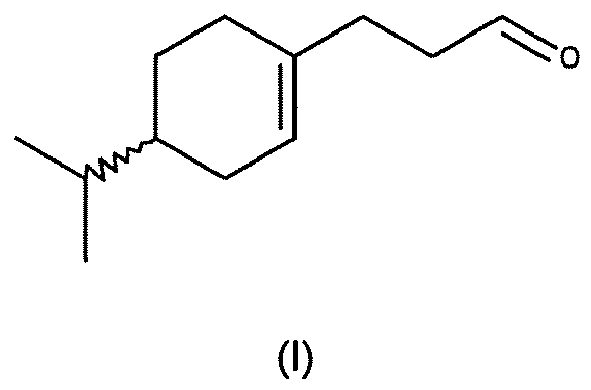
- als Riechstoff, insbesondere als Maiglöckchen-Riechstoff
und/oder - als Mittel zum Erhöhen der Substantivität und/oder der Retention einer Riechstoffzubereitung;
und/oder - als Fixateur.
- In der obenstehenden Formel (I) und allen weiteren Formeln in diesem Text bedeuten geschlängelte Linien eine Bindung, die sich (je nach vorliegendem Enantiomer) aus der Zeichenebene heraus oder hinter die Zeichenebene erstreckt.
- Weitere Aspekte der Erfindung ergeben sich aus der nachfolgenden Beschreibung, den Ausführungsbeispielen, der Figur und den beigefügten Patentansprüchen.
- Die Figur zeigt:
-
Figur 1 Bewertung des Substantivität der Verbindung der Formel (Ia) und der Verbindung der Formel (Ib) im Vergleich zu Lilial® (A) in Anhängigkeit von der Zeit - Überraschenderweise hat sich gezeigt, dass eine Verbindung der Formel (I) einen Geruchseindruck vermittelt, der der Komplexität des natürlichen Geruchs der Maiglöckchenblüte sehr nahe kommt. Das heißt, der von der Verbindung der Formel (I) vermittelte Geruchseindruck zeichnet sich durch eine herausragende Natürlichkeit und Komplexität aus, insbesondere hinsichtlich der Maiglöckchen-Geruchsnote. Ein derartig komplexer, dem natürlichen Geruch der Maiglöckenblüte weitgehend entsprechender Geruchseindruck ist mit den aus dem Stand der Technik bekannten Riechstoffen mit Maiglöckchen-Geruchsnote bisher nicht erreicht worden.
- Die Suche nach geeigneten Stoffen mit Maiglöckchen-Geruchsnote, die zur vorliegenden Erfindung führte, wurde durch folgende Sachverhalte erschwert:
- die Mechanismen der Geruchswahrnehmung sind nicht ausreichend bekannt;
- die Zusammenhänge zwischen der speziellen Geruchswahrnehmung einerseits und der chemischen Struktur des zugehörigen Riechstoffs andererseits sind nicht hinreichend erforscht;
- häufig bewirken bereits geringfügige Änderungen am strukturellen Aufbau eines bekannten Riechstoffs starke Änderungen der sensorischen Eigenschaften und beeinträchtigen die Verträglichkeit für den menschlichen Organismus.
- Der Erfolg der Suche nach geeigneten Riechstoffen hängt deshalb stark von der Intuition des Suchenden ab.
- Dass das Geruchsprofil der erfindungsgemäß einzusetzenden Verbindung der Formel (I) dem Geruchsprofil von 3-(4-tertbutylphenyl)-2-methylpropanal sehr ähnlich ist, war nicht zu erwarten, da sich die Verbindung der Formel (I) strukturell in mehrfacher Hinsicht von 3-(4-tertbutylphenyl)-2-methylpropanal (obige Formel (A)) unterscheidet; die Phenylgruppe der Formel (A) ist in der Formel (I) durch eine Cyclohexenylgruppe ersetzt, die tert-Butylgruppe der Formel (A) durch eine Isopropylgruppe, und die Aldehyd-Seitenkette weist in der Formel (I) im Gegensatz zu Formel (A) keine Methylgruppe am zweiten Kohlenstoffatom auf.
- Die erfindungsgemäß einzusetzende Verbindung der Formel (I) zeichnet sich durch ein hohes Aufziehvermögen (Eigenhaftung auf einem Substrat) und eine hohe Substantivität (Fähigkeit, aus einer, meist wässrigen, Phase heraus auf ein Substrat aufzuziehen bzw. auch nach einem Wasch- oder Spülvorgang auf einem Substrat zu verbleiben) aus. Dieser Effekt zeigt sich insbesondere auf Substraten wie Haut, Haar und textilen Fasern (z.B. Wolle, Baumwolle, Leinen, synthetische Fasern).
- Eine weitere wichtige anwendungstechnische Anforderung an Riechstoffe und Riechstoffzubereitungen, insbesondere für tensidhaltige Produkte, ist deren Substantivität gegenüber dem bzw. Retention am Substrat, insbesondere Haaren oder textilen Fasern. Die Begriffe "Substantivität" und "Retention" werden z.B. in
EP 1 201 738 A1 ausführlich dargelegt, vergleiche dort die Abschnitte [0004]-[0005]. Gesucht werden generell Riechstoffe mit hoher Substantivität und/oder Retention. - Diesen Erkenntnissen entsprechend betrifft ein weiterer Aspekt der Erfindung insbesondere die Verwendung der erfindungsgemäß zu verwendenden Verbindung der Formel (I) als Mittel zum Erhöhen der Substantivität und/oder Retention einer Riechstoffzubereitung (insbesondere gegenüber bzw. auf Haaren bzw. textilen Fasern), bevorzugt einer Riechstoffzubereitung mit Maiglöckchen-Geruchsnote, vorzugsweise einer erfindungsgemäßen Riechstoffzubereitung wie weiter unten beschrieben.
- Neben ihrem hohen Aufziehvermögen zeichnet sich die erfindungsgemäß zu verwendende Verbindung der Formel (I) durch ihre fixierenden Eigenschaften aus, d.h. sie ist ein Fixateur. Als Fixateur erhöht die erfindungsgemäße Verbindung der Formel (I) die Haftfestigkeit von anderen Riechstoffen, sei es durch deren Dampfdruckerniedrigung oder geruchliche Verstärkung (z.B. Absenkung des Schwellenwertes). Die Erfindung betrifft daher auch - wie bereits erwähnt - die Verwendung der Verbindung der Formel (I) als Fixateur.
- Die Verbindung der Formel (I) wurde zwar im Stand der Technik bereits erwähnt, jedoch wurde ihre Eignung als Riechstoff, insbesondere ihre besondere Eignung zum Vermitteln einer Maiglöckchen-Geruchsnote, dabei nicht erkannt.
- Die Publikation Comptes Rendus des Séances de l'Academie des Sciences, Serie C: Sciences Chimiques 1967, 264, 1083-1086 berichtet über Untersuchungen der radikal-. ischen Addition von Ethanol bzw. Ethanal an ß-Pinen. Die Verbindung p-menthen-1-yl-7-ethanal wird als ein Minderbestandteil (weniger als 5 %) des Rohprodukts der radikalischen Addition von Ethanal an β-Pinen mit Hilfe von Benzoylperoxid erhalten. Für diese Verbindung wird ein negativer Drehwert (-54,2 °) angegeben.
- Die Publikation Zhurnal Organicheskoi Khimii 1974, 10, 1153-1157 berichtet über Untersuchungen der radikalischen Addition aliphatischer Aldehyde der Formel R-CH2-CHO (R= H, Methyl oder Ethyl) an ß-Pinen mit Mn(III)-Acetat als Initiator, optional in Gegenwart katalytischer Mengen von Kupfer (II)-Acetat. Dabei wurde festgestellt, dass die Reaktion je nach Reaktionsbedingungen (Polarität des Lösungsmittels und Einsatzmenge des Katalysators) zu einem Aldehyd der Struktur


- Die beiden letzteren Verbindungen werden in der Veröffentlichung Zhurnal Organicheskoi Khimii 1974, 10, 1153-1157 als neu eingeschätzt und ausführlich charakterisiert. Ausschließlich zu diesen Verbindungen wird in der genannten Veröffentlichung festgestellt, dass sie als Duftstoffe interessant sein können. Dies gelte insbesondere im Falle des Dienaldehyds mit R=Ethyl, da diese Verbindung ein strukturelles Analogon des Cyclamenaldehyds sei.
- In der Publikation Bulletin de la Société Chimique de France 1973, 4, 1368-1372 wird eine Verbindung der Formel R-CH2-CHO, worin

- Der vorstehend beschriebene Stand der Technik enthält keinerlei Angaben zu den geruchlichen Eigenschaften der Verbindung der Formel (I).
- In den oben erwähnten Dokumenten aus dem Stand der Technik wird nicht zwischen den beiden Enantiomeren (Verbindung der Formel (la) wie oben definiert und Verbindung der Formel (Ib) wie oben definiert) unterschieden. Es ist daher nicht offenbart, ob und in welchen Anteilen die jeweils im Stand der Technik offenbarte Verbindung die Verbindung der Formel (la) wie oben definiert und/oder die Verbindung der Formel (Ib) wie oben definiert enthält. Der relative Anteil der beiden verschiedenen Enantiomeren wird durch die Enantiomerenzusammensetzung des jeweiligen Edukts ß-Pinen bestimmt, denn bei der radikalischen Addition eines Aldehyds an ß-Pinen bleibt die Stereochemie unverändert. ß-Pinen existiert in zwei enantiomeren Formen: (-)-ß-Pinen und (+)-ß-Pinen. In den oben erwähnten Dokumenten aus dem Stand der Technik wird lediglich offenbart, dass ß-Pinen als Edukt eingesetzt wird. Es ist daher nicht offenbart, in welchen Anteilen das als Edukt eingesetzte ß-Pinen die beiden Enantiomeren (-)-ß-Pinen bzw. (+)-β-Pinen enthält.
- Daher betrifft die vorliegende Erfindung auch eine Verbindung ausgewählt aus der Gruppe bestehend aus der Verbindung der Formel (la)


- Im vorliegenden Text wird unter der Verbindung der Formel (la) bzw. Formel (Ib) jeweils das entsprechende spezielle Enantiomer (wie oben definiert) verstanden, während die Bezeichnung "Verbindung der Formel (I)" sowohl die einzelnen Verbindungen ausgewählt aus der Gruppe bestehend aus der Verbindung der Formel (Ia) und der Verbindung der Formel (Ib) als auch sämtliche Mischungen (Enantiomerenmischungen) bestehend aus diesen beiden Verbindungen (in jedem beliebigen Mischungsverhältnis) umfasst. Das heißt, Ausführungen betreffend die "Verbindung der Formel (I)" gelten stets sowohl für die Verbindung der Formel (Ia) und die Verbindung der Formel (Ib) als auch für Mischungen bestehend aus der Verbindung der Formel (Ia) und der Verbindung der Formel (Ib) in jedem beliebigen Mischungsverhältnis.
- In einer erfindungsgemäße Mischung bestehend aus der Verbindung der Formel (Ia) wie oben definiert und der Verbindung der Formel (Ib) ist das Massenverhältnis der Verbindung der Formel (Ia) zur Verbindung der Formel (Ib) bevorzugt so gewählt, dass der Drehwert der Mischung nicht -54,2 ° beträgt. Bevorzugt ist in einer solchen Mischung das Massenverhältnis der Verbindung der Formel (Ia) zur Verbindung der Formel (Ib) so gewählt, dass ein Drehwert größer als -54.2 ° resultiert, weiter bevorzugt größer als -54 °, noch weiter bevorzugt größer als -50 °.
- Unter den Mischungen, die die Verbindungen der Formel (Ia) wie oben definiert und (ii) die Verbindung der Formel (Ib) wie oben definiert umfassen oder aus diesen beiden Verbindungen bestehen, sind erfindungsgemäß Mischungen bevorzugt mit
- einem Massenverhältnis der Verbindung der Formel (Ia) zu der Verbindung der Formel (Ib) im Bereich von 0.01 bis 99.99, vorzugsweise im Bereich von 0.1 bis 99.9, bevorzugt im Bereich von 0.5 bis 99.5, bevorzugt im Bereich von 1.0 bis 99.0, bevorzugt im Bereich von 1.5 bis 98.5, bevorzugt im Bereich von 2.0 bis 98.0
und/oder - einem Gesamtanteil der Verbindungen der Formeln (Ia) und (Ib) größer als 0.01 Gew.-%, vorzugsweise größer als 1 Gew.-%, bevorzugt größer als 10 Gew.-%, weiter bevorzugt größer als 50 Gew.-%, besonders bevorzugt größer als 90 Gew.-%, bezogen auf das Gesamtgewicht der Mischung umfassend Verbindung (la) und/oder (Ib)
- Das Geruchsprofil der Verbindung der Formel (Ia) wie oben definiert wird wie folgt beschrieben: Maiglöckchen-Geruchsnote, blumig, süß, wässrig, pudrig und ozonig, natürlich, pflegend, komplex und strahlend. Dabei ist insbesondere der komplexe, dem natürlichen Geruch der Maiglöckchenblüte weitgehend entsprechende Geruchseindruck bemerkenswert. Hinsichtlich der geruchlichen Eigenschaften ist die Verbindung der Formel (la) somit ähnlich zu 3-(4-tertbutylphenyl)-2-methylpropanal (Formel (A)).
- Das Geruchsprofil der Verbindung der Formel (Ib) wie oben definiert wird wie folgt beschrieben: Maiglöckchen-Geruchsnote, fruchtig, grün, wässrig und aldehydig.
- Die Verbindung der Formel (la) ist aufgrund ihres Geruchsprofils besonders geeignet zum Vermitteln, Modifizieren oder Verstärken einer Maiglöckchen-Geruchsnote und optional einer, mehrerer oder sämtlicher Geruchsnoten ausgewählt aus der Gruppe bestehend aus blumig, süß, wässrig, pudrig und ozonig und/oder eines, mehrerer oder sämtlicher Eindrücke ausgewählt aus der Gruppe bestehend aus natürlich, pflegend, komplex und strahlend.
- Darüber hinaus hat sich gezeigt, dass die Verbindung der Formel (la) im Zusammenwirken mit einem oder mehreren weiteren Riechstoffen in der Lage ist, weitere für parfümistische Zwecke erwünschte Geruchsnoten hervorzurufen bzw. zu verstärken, insbesondere die Geruchsnoten cremig (siehe dazu Beispiele 10 und 14), kosmetisch (siehe Beispiel 10), rund aldehydisch (siehe Beispiel 12), grün (siehe Beispiel 13) und wässrig-fruchtig (siehe Beispiel 15).
- Die Verbindung der Formel (Ib) ist aufgrund ihres Geruchsprofils besonders geeignet zum Vermitteln, Modifizieren oder Verstärken einer Maiglöckchen-Geruchsnote und optional einer, mehrerer oder sämtlicher Geruchsnoten ausgewählt aus der Gruppe bestehend aus fruchtig, grün, wässrig und aldehydig.
- Daher wird die Verbindung der Formel (la) wie oben definiert erfindungsgemäß bevorzugt verwendet zum Vermitteln, Modifizieren oder Verstärken einer Maiglöckchen-Geruchsnote und optional einer, mehrerer oder sämtlicher Geruchsnoten ausgewählt aus der Gruppe bestehend aus blumig, süß, wässrig, pudrig und ozonig und/oder eines, mehrerer oder sämtlicher Eindrücke ausgewählt aus der Gruppe bestehend aus natürlich, pflegend, komplex und strahlend.
- Alternativ oder zusätzlich wird die Verbindung der Formel (Ib) wie oben definiert erfindungsgemäß bevorzugt verwendet zum Vermitteln, Modifizieren oder Verstärken einer Maiglöckchen-Geruchsnote und optional einer, mehrerer oder sämtlicher Geruchsnoten ausgewählt aus der Gruppe bestehend aus fruchtig, grün, wässrig und aldehydig.
- Ein weiterer Aspekt der vorliegenden Erfindung betrifft Riechstoffzubereitungen, insbesondere Parfümöle, wobei erfindungsgemäß aufgrund der oben beschriebenen Geruchsprofile der Verbindung der Formel (Ia) und der Verbindung der Formel (Ib) insbesondere Riechstoffzubereitungen bzw. Parfümöle mit einer Maiglöckchen-Geruchsnote von Interesse sind.
- Eine Riechstoffzubereitung ist im Rahmen des vorliegenden Textes eine Mischung verschiedener Stoffe, welche gemäß einem Rezept oder einer Rezeptur nach einem vorgegebenen Verfahren aus den entsprechenden Stoffen erzeugt wird. Solche Zubereitungen werden gezielt zu dem Zweck hergestellt und eingesetzt, einen gewünschten, üblicherweise als angenehm oder in einer sonstigen Weise positiv empfundenen Geruchseindruck zu vermitteln, zu modifizieren oder zu verstärken. Zubereitungen, wie sie in der präparativen organischen Chemie eingesetzt werden, insbesondere die aus dem oben beschriebenen Stand der Technik bekannten Zubereitungen für die radikalische Addition an ß-Pinen, sind daher keine Riechstoffzubereitungen im Sinne der vorliegenden Erfindung. Die gegebenenfalls in den Veröffentlichungen Zhurnal Organicheskoi Khimii 1974, 10, 1153-1157, Comptes Rendus des Séances de l'Academie des Sciences, Serie C: Sciences Chimiques 1967, 264, 1083-1086 bzw. Bulletin de la Société Chimique de France 1973, 4, 1368-1372 beschriebenen Mischungen, die die Verbindung der Formel (I) umfassen, sind nicht Gegenstand der vorliegenden Erfindung und sind insbesondere keine erfindungsgemäßen Riechstoffzubereitungen.
- Die folgenden Mischungen bzw. Kombinationen sind daher vorzugsweise ebenfalls keine erfindungsgemäßen Riechstoffzubereitungen:
- eine Mischung enthaltend die Verbindung der Formel (I) wie oben definiert, Dimethylsulfoxid sowie gegebenenfalls Tosylat von (p-Menthen-1-yl-7)-2-ethanol wie in Comptes Rendus des Séances de l'Academie des Sciences, Serie C: Sciences Chimiques 1967, 264, 1083-1086 beschrieben,
- eine Mischung enthaltend die Verbindung der Formel (I) wie oben definiert, die in Comptes Rendus des Séances de l'Academie des Sciences, Serie C: Sciences Chimiques 1967, 264, 1083-1086 beschriebene Verbindung der Formel (IV) (wie dort definiert) sowie gegebenenfalls β-Pinen und gegebenenfalls Ethanal und gegebenenfalls Di-tert.-butylperoxid,
- eine Mischung enthaltend die Verbindung der Formel (I) wie oben definiert, die in Bulletin de la Société Chimique de France 1973, 4, 1368-1372 beschriebene Verbindung der Formel (4b) (wie dort definiert) und/oder die in Bulletin de la Société Chimique de France 1973, 4, 1368-1372 beschriebene Verbindung der Formel (1b) (wie dort definiert) sowie gegebenenfalls β-Pinen und gegebenenfalls Ethanol und gegebenenfalls Di-tert.-butylperoxid und/oder Benzoylperoxid,
- eine Mischung enthaltend die Verbindung der Formel (I) wie oben definiert und Heptan, Essigsäure, Kupfer(II)-acetat, Mangan(III)-Acetat und/oder Mangan(II)-Acetat, die in Zhurnal Organicheskoi Khimii 1974, 10, 1153-1157 beschriebene Verbindung der Formel (Ia) (wie dort definiert) und/oder die in Zhurnal Organicheskoi Khimii 1974, 10, 1153-1157 beschriebene Verbindung der Formel (IIa) (wie dort definiert) und/oder die in Zhurnal Organicheskoi Khimii 1974, 10, 1153-1157 beschriebene Verbindung der Formel (IIIa) (wie dort definiert) sowie gegebenenfalls ß-Pinen und gegebenenfalls Ethanal.
- Eine erfindungsgemäße Riechstoffzubereitung ist bevorzugt keine Mischung enthaltend
- die Verbindung der Formel (I) wie oben definiert und Heptan, Essigsäure, Mangan(III)-Acetat und/oder Mangan(II)-Acetat, die in Zhurnal Organicheskoi Khimii 1974, 10, 1153-1157 beschriebene Verbindung der Formel (Ia) (wie dort definiert) und/oder die in Zhurnal Organicheskoi Khimii 1974, 10, 1153-1157 beschriebene Verbindung der Formel (IIa) (wie dort definiert) und/oder die in Zhurnal Organicheskoi Khimii 1974, 10, 1153-1157 beschriebene Verbindung der Formel (IIIa) (wie dort definiert), sowie gegebenenfalls ß-Pinen und gegebenenfalls Ethanal.
bzw. - die Verbindung der Formel (I) wie oben definiert und Heptan, Essigsäure, Kupfer(II)-acetat, Mangan(III)-acetat und/oder Mangan(II)-Acetat, sowie gegebenenfalls ß-Pinen und gegebenenfalls Ethanal.
bzw. - die Verbindung der Formel (I) wie oben definiert, gegebenenfalls β-Pinen und gegebenenfalls Ethanal und gegebenenfalls Di-tert.-butylperoxid
bzw. - die Verbindung der Formel (I) wie oben definiert, die in Bulletin de la Société Chimique de France 1973, 4, 1368-1372 beschriebene Verbindung der Formel (1 b) (wie dort definiert) sowie gegebenenfalls β-Pinen und gegebenenfalls Ethanol und gegebenenfalls Di-tert.-butylperoxid und/oder Benzoylperoxid.
- Noch weiter bevorzugt ist eine erfindungsgemäße Riechstoffzubereitung keine Mischung enthaltend
- die Verbindung der Formel (I) wie oben definiert und Heptan, Essigsäure, Mangan(III)-acetat und/oder Mangan(II)-Acetat sowie gegebenenfalls ß-Pinen und gegebenenfalls Ethanal
bzw. - die Verbindung der Formel (I) wie oben definiert, die in Bulletin de la Société Chimique de France 1973, 4, 1368-1372 beschriebene Verbindung der Formel (1b) (wie dort definiert) und gegebenenfalls Di-tert.-butylperoxid und/oder Benzoylperoxid.
- Ganz besonders bevorzugt ist die erfindungsgemäße Riechstoffzubereitung keine Mischung enthaltend die Verbindung der Formel (I) wie oben definiert und eine oder mehrere Substanzen ausgewählt aus der Gruppe bestehend aus Heptan, Essigsäure, β-Pinen, Ethanal, Mangansalze, Kupfersalze, Verbindung der Formel (Ia) aus der Veröffentlichung Zhurnal Organicheskoi Khimii 1974, 10, 1153-1157 (wie dort definiert), Verbindung der Formel (IIa) aus der Veröffentlichung Zhurnal Organicheskoi Khimii 1974, 10, 1153-1157 (wie dort definiert), Verbindung der Formel (IIIa) aus der Veröffentlichung Zhurnal Organicheskoi Khimii 1974, 10, 1153-1157 (wie dort definiert), Dimethylsulfoxid, Tosylat von (p-Menthen-1-yl-7)-2-ethanol, Di-tert.-butylperoxid, Benzoylperoxid, die in Bulletin de la Société Chimique de France 1973, 4, 1368-1372 beschriebene Verbindung (4b) (wie dort definiert) und die in Bulletin de la Société Chimique de France 1973, 4, 1368-1372 beschriebene Verbindung (1 b) (wie dort definiert).
- Eine erfindungsgemäße Riechstoffzubereitung, insbesondere in Form eines Parfümöls, vorzugsweise mit einer Maiglöckchen-Geruchsnote, besteht aus oder umfasst
- Verbindung der Formel (I) wie oben definiert,
und - einen, 2, 3, 4, 5, 6, 7, 8, 9, 10 oder mehr weitere Riechstoffe, die keine Verbindung der Formel (I) sind.
- Insbesondere durch Kombination der Verbindungen der Formel (I) wie oben definiert, vorzugsweise in einer der als bevorzugt angegebenen Ausgestaltungen, mit einem oder mehren weiteren Riechstoffen (vorzugsweise mit einer , mehreren oder sämtlichen Geruchsnoten ausgewählt aus der Gruppe bestehend aus blumig, süß, wässrig, ozonig, holzig, ambriert, Moschus, fruchtig, animalisch) lassen sich interessante neue Riechstoffzubereitungen herstellen. Auf diese Weise lassen sich Mischungen mit besonders interessanten, natürlichen, neuen und originellen Noten kreieren. Riechstoffe, die im Sinne der obigen Definition als weitere Riechstoffe für den Einsatz in einer erfindungsgemäßem Riechstoffzubereitung geeignet sind, finden sich z. B. in S. Arctander, Perfume and Flavor Materials, Vol. I und II, Montclair, N. J. 1969, Eigenverlag, oder K. Bauer et al., Common Fragrance and Flavor Materials, 4th Edition, Wiley-VCH, Weinheim 2001.
- Im Einzelnen seien genannt: Extrakte aus natürlichen Rohstoffen wie Etherische Öle, Concretes, Absolues, Resine, Resinoide, Balsame, Tinkturen wie z. B.
- Ambratinktur; Amyrisöl; Angelicasamenöl; Angelicawurzelöl; Anisöl; Baldrianöl; Basilikumöl; Baummoos-Absolue; Bayöl; Beifußöl; Benzoeresin; Bergamotteöl; Bienenwachs-Absolue; Birkenteeröl; Bittermandelöl; Bohnenkrautöl; Buccoblätteröl; Cabreuvaöl; Cadeöl; Calmusöl; Campheröl; Canangaöl; Cardamomenöl; Cascarillaöl; Cassiaöl; Cassie-Absolue; Castoreum-absolue; Cedernblätteröl; Cedernholzöl; Cistusöl; Citronellöl; Citronenöl; Copaivabalsam; Copaivabalsamöl; Corianderöl; Costuswurzelöl; Cuminöl; Cypressenöl; Davanaöl; Dillkrautöl; Dillsamenöl; Eau de brouts-Absolue; Eichenmoos-Absolue; Elemiöl; Estragonöl; Eucalyptus-citriodora-Öl; Eucalyptusöl; Fenchelöl; Fichtennadelöl; Galbanumöl; Galbanumresin; Geraniumöl; Grapefruitöl; Guajakholzöl; Gurjunbalsam; Gurjunbalsamöl; Helichrysum-Absolue; Helichrysumöl; Ingweröl; Iriswurzel-Absolue; Iriswurzelöl; Jasmin-Absolue; Kalmusöl; Kamillenöl blau; Kamillenöl römisch; Karottensamenöl; Kaskarillaöl; Kiefernnadelöl; Krauseminzöl; Kümmelöl; Labdanumöl; Labdanum-Absolue; Labdanumresin; Lavandin-Absolue; Lavandinöl; Lavendel-Absolue; Lavendelöl; Lemongrasöl; Liebstocköl; Limetteöl destilliert; Limetteöl gepresst; Linaloeöl; Litsea-cubeba-Öl; Lorbeerblätteröl; Macisöl; Majoranöl; Mandarinenöl; Massoirindenöl; Mimosa-Absolue; Moschuskörneröt; Moschustinktur; Muskateller-Salbei-Öl; Muskatnussöl; Myrrhen-Absolue; Myrrhenöl; Myrtenöl; Nelkenblätteröl; Nelkenblütenöl; Neroliöl; Olibanum-Absolue; Olibanumöl; Opopanaxöl; Orangenblüten-Absolue; Orangenöl; Origanumöl; Palmarosaöl; Patchouliöl; Perillaöl; Perubalsamöl; Petersilienblätteröl; Petersiliensamenöl; Petitgrainöl; Pfefferminzöl; Pfefferöl; Pimentöl; Pineöl; Poleyöl; Rosen-Absolue; Rosenholzöl; Rosenöl; Rosmarinöl; Salbeiöl dalmatinisch; Salbeiöl spanisch; Sandelholzöl; Selleriesamenöl; Spiklavendelöl; Sternanisöl; Styraxöl; Tagetesöl; Tannennadelöl; Tea-tree-Öl; Terpentinöl; Thymianöl; Tolubalsam; Tonka-Absolue; Tuberosen-Absolue; Vanilleextrakt; Veilchenblätter-Absolue; Verbenaöl; Vetiveröl; Wacholderbeeröl; Weinhefenöl; Wermutöl; Wintergrünöl; Ylangöl; Ysopöl; Zibet-Absolue; Zimtblätteröl; Zimtrindenöl sowie Fraktionen davon, bzw. daraus isolierten Inhaltsstoffen;
Einzel-Riechstoffe aus der Gruppe der Kohlenwasserstoffe, wie z.B. 3-Caren; α-Pinen; β-Pinen; α-Terpinen; γ-Terpinen; p-Cymol; Bisabolen; Camphen; Caryophyllen; Cedren; Farnesen; Limonen; Longifolen; Myrcen; Ocimen; Valencen; (E,Z)-1,3,5-Undecatrien; Styrol; Diphenylmethan;
der aliphatischen Alkohole wie z.B. Hexanol; Octanol; 3-Octanol; 2,6-Dimethylheptanol; 2-Methyl-2-heptanol; 2-Methyl-2-octanol; (E)-2-Hexenol; 1-Octen-3-ol; Gemisch von 3,4,5,6,6-Pentamethyl-3/4-hepten-2-ol und 3,5,6,6-Tetramethyl-4-methyleneheptan-2-ol; (E,Z)-2,6-Nonadienol; 3,7-Dimethyl-7-methoxyoctan-2-ol; 9-Decenol; 10-Undecenol; 4-Methyl-3-decen-5-ol;
der aliphatischen Aldehyde und deren Acetale wie z.B. Hexanal; Heptanal; Octanal; Nonanal; Decanal; Undecanal; Dodecanal; 2-Methyloctanal; 2-Methylnonanal; (E)-2-Hexenal; (Z)-4-Heptenal; 2,6-Dimethyl-5-heptenal; 10-Undecenal; (E)-4-Decenal; 2-Dodecenal;2,6,10-Trimethyl-9-undecenal; 2,6,10-Trimethyl-5,9-undecadienal; Heptanaldiethylacetal; 1,1-Dimethoxy-2,2,5-trimethyl-4-hexen; Citronellyloxyacetaldehyd; 1-(1-Methoxy-propoxy)-(E/Z)-3-hexen;
der aliphatischen Ketone und deren Oxime wie z.B. 2-Heptanon; 2-Octanon; 3-Octanon; 2-Nonanon; 5-Methyl-3-heptanon; 5-Methyl-3-heptanonoxim; 2,4,4,7-Tetramethyl-6-octen-3-on; 6-Methyl-5-hepten-2-on;
der aliphatischen schwefelhaltigen Verbindungen wie z.B. 3-Methylthio-hexanol; 3-Methylthiohexylacetat; 3-Mercaptohexanol; 3-Mercaptohexylacetat; 3-Mercapto hexylbutyrat; 3-Acetylthiohexylacetat; 1-Menthen-8-thiol;
der aliphatischen Nitrile wie z.B. 2-Nonensäurenitril; 2-Undecensäurenitril; 2-Tridecensäurenitril; 3,12-Tridecadiensäurenitril; 3,7-Dimethyl-2,6-octadien-säurenitril; 3,7-Dimethyl-6-octensäurenitril;
der Ester von aliphatischen Carbonsäuren wie z.B. (E)- und (Z)-3-Hexenylformiat; Ethylacetoacetat; Isoamylacetat; 3,5,5-Trimethylhexylacetat; 3-Methyl-2-butenylacetat; (E)-2-Hexenylacetat; (E)- und (Z)-3-Hexenylacetat; Octylacetat; 3-Octylacetat; 1-Octen-3-ylacetat; Ethylbutyrat; Butylbutyrat; Isoamylbutyrat; Hexylbutyrat; (E)- und (Z)-3-Hexenyl-isobutyrat; Hexylcrotonat; Ethylisovalerianat; Ethyl-2-methylpentanoat; Ethylhexanoat; Allylhexanoat; Ethylheptanoat; Allylheptanoat; Ethyloctanoat; Ethyl-(E,Z)-2,4-decadienoat; Methyl-2-octinat; Methyl-2-noninat; Allyl-2-isoamyloxyacetat; Methyl-3,7-dimethyl-2,6-octadien-oat;4-Methyl-2-pentyl-crotonat;
der acyclischen Terpenalkohole wie z. B. Geraniol; Nerol; Lavadulol; Nerolidol; Farnesol; Tetrahydrolinalool; Tetrahydrogeraniol; 2,6-Dimethyl-7-octen-2-ol; 2,6-Dimethyloctan-2-ol; 2-Methyl-6-methylen-7-octen-2-ol; 2,6-Dimethyl-5,7-octadien-2-ol; 2,6-Dimethyl-3,5-octadien-2-ol; 3,7-Dimethyl-4,6-octadien-3-ol; 3,7-Dimethyl-1,5,7-octatrien-3-ol 2,6-Dimethyl-2,5,7-octatrien-1-ol; sowie deren Formiate, Acetate, Propionate, Isobutyrate, Butyrate, Isovalerianate, Pentanoate, Hexanoate, Crotonate, Tiglinate und 3-Methyl-2-butenoate;
der acyclischen Terpenaldehyde und -ketone wie z. B. Citronellal;; 7-Methoxy-3,7-dimethyloctanal; 2,6,10-Trimethyl-9-undecenal; Geranylaceton; sowie die Dimethyl- und Diethylacetale von Geranial, Neral,
der cyclischen Terpenalkohole wie z. B. Menthol; Isopulegol; alpha-Terpineol; Terpinenol-4; Menthan-8-ol; Menthan-1-ol; Menthan-7-ol; Borneol; Isoborneol; Linalooloxid; Nopol; Cedrol; Ambrinol; Vetiverol; Guajol; sowie deren Formiate, Acetate, Propionate, Isobutyrate, Butyrate, Isovalerianate, Pentanoate, Hexanoate, Crotonate, Tiglinate und 3-Methyl-2-butenoate;
der cyclischen Terpenaldehyde und -ketone wie z. B. Menthon; Isomenthon; 8-Mercaptomenthan-3-on; Carvon; Campher; Fenchon; alpha-Ionon; beta-Ionon; alpha-n-Methylionon; beta-n-Methylionon; alpha-Isomethylionon; beta-Isomethyl-ionon; alpha-Iron; beta-Damascenon; 1-(2,4,4-Trimethyl-2-cyclohexen-1-yl)-2-buten-1-on; 1,3,4,6,7,8a-Hexahydro-1,1,5,5-tetramethyl-2H-2,4a-methano-naphthalen-8(5H)-on;2-Methyl-4-(2,6,6-trimethyl-1-cyclohexen-1-yl)-2-butenal; Nootkaton; Dihydronootkaton; 4,6,8-Megastigmatrien-3-on; alpha-Sinensal; beta-Sinensal; acetyliertes Cedernholzöl (Methylcedrylketon);
der cyclischen Alkohole wie z.B. 4-tert.-Butylcyclohexanol; 3,3,5-Trimethylcyclohexanol; 3-Isocamphylcyclohexanol; 2,6,9-Trimethyl-Z2,Z5,E9-cyclododecatrien-1-ol; 2-Isobutyl-4-methyltetrahydro-2H-pyran-4-ol;
der cycloaliphatischen Alkohole wie z.B. alpha,3,3-Trimethylcyclohexylmethanol;1-(4-Isopropylcyclohexyl)ethanol; 2-Methyl-4-(2,2,3-trimethyl-3-cyclopent-1-yl)butanol; 2-Methyl-4-(2,2,3-trimethyl-3-cyclopent-1-yl)-2-buten-1-ol; 3-Methyl-5-(2,2,3-trimethyl-3-cyclopent-1-yl)-pentan-2-ol; 3-Methyl-5-(2,2,3-trimethyl-3-cyclopent-1-yl)-4-penten-2-ol; 3,3-Dimethyl-5-(2,2,3-trimethyl-3-cyclopent-1-yl)-4-penten-2-ol; 1-(2,2,6-Trimethylcyclohexyl)pentan-3-ol; 1-(2,2,6-Trimethylcyclohexyl)hexan-3-ol;
der cyclischen und cycloaliphatischen Ether wie z.B. Cineol; Cedrylmethylether; Cyclododecylmethylether; 1,1-Dimethoxycyclododecan; (Ethoxymethoxy)cyclo-dodecan; alpha-Cedrenepoxid; 3a,6,6,9a-Tetramethyldodecahydro-naphtho[2,1-b]furan; 3a-Ethyl-6,6,9a-trimethyldodecahydronaphtho[2,1 b]furan; 1,5,9-Tri-methyl-13-oxabicyclo[10.1.0]trideca-4,8-dien; Rosenoxid; 2-(2,4-Dimethyl-3-cyclohexen-1-yl)-5-methyl-5-(1-methylpropyl)-1,3-dioxan;
der cyclischen und makrocyclischen Ketone wie z.B. 4-tert.-Butylcyclohexanon; 2,2,5-Trimethyl-5-pentylcyclopentanon; 2-Heptylcyclopentanon; 2-Pentyl-cyclopentanon; 2-Hydroxy-3-methyl-2-cyclopenten-1-on; 3-Methyl-cis-2-penten-1-yl-2-cyclopenten-1-on; 3-Methyl-2-pentyl-2-cyclopenten-1-on; 3-Methyl-4-cyclopentadecenon; 3-Methyl-5-cyclopentadecenon; 3-Methylcyclopenta-decanon; 4-(1-Ethoxyvinyl)-3,3,5,5-tetramethylcyclohexanon; 4-tert.-Pentylcyclo-hexanon; 5-Cyclohexadecen-1-on; 6,7-Dihydro-1,1,2,3,3-pentamethyl-4(5H)-indanon; 8-Cyclohexadecen-1-on; 9-Cycloheptadecen-1-on; Cyclopentadecanon; Cyclohexadecanon;
der cycloaliphatischen Aldehyde wie z.B. 2-Methyl-4-(2,2,6-trimethyl-cyclohexen-1-yl)-2-butenal; 4-(4-Hydroxy-4-methylpentyl)-3-cyclohexencarbaldehyd; 4-(4-Methyl-3-penten-1-yl)-3-cyclohexencarbaldehyd;
der cycloaliphatischen Ketone wie z. B. 1-(3,3-Dimethylcyclohexyl)-4-penten-1-on; 2,2-Dimethyl-1-(2,4-dimethyl-3-cyclohexen-1-yl)-1-propanon; 1-(5,5-Dimethyl-1-cyclohexen-1-yl)-4-penten-1-on; 2,3,8,8-Tetramethyl-1,2,3,4,5,6,7,8-octahydro-2-naphtalenylmethylketon; Methyl-2,6,10-trimethyl-2,5,9-cyclododecatrienylketon; tert.-Butyl-(2,4-dimethyl-3-cyclohexen-1-yl)keton;
der Ester cyclischer Alkohole wie z.B. 2-tert-Butylcyclohexylacetat; 4-tert-Butylcyclohexylacetat; 2-tert-Pentylcyclohexylacetat; 4-tert-Pentyl-cyclo-hexyl-acetat; 3,3,5-Trimethylcyclohexylacetat; Decahydro-2-naphthylacetat;2-Cyclo-pentylcyclopentylcrotonat; 3-Pentyltetrahydro-2H-pyran-4-ylacetat; Decahydro-2,5,5,8a-tetramethyl-2-naphthylacetat; 4,7-Methano-3a,4,5,6,7,7a-hexa-hydro-5, bzw. 6-indenylacetat; 4,7-Methano-3a,4,5,6,7,7a-hexahydro-5, bzw. 6-indenyl-propionat; 4,7-Methano-3a,4,5,6,7,7a-hexahydro-5, bzw. 6-inden-ylisobutyrat; 4,7-Methanooctahydro-5, bzw. 6-indenylacetat;
der Ester cycloaliphatischer Alkohole wie z.B.1-Cyclohexylethylcrotonat;
der Ester cycloaliphatischer Carbonsäuren wie z. B. Allyl-3-cyclohexylpropionat; Allylcyclohexyloxyacetat; cis- und trans-Methyldihydrojasmonat; cis- und trans-Methyljasmonat; Methyl-2-hexyl-3-oxocyclopentancarboxylat; Ethyl-2-ethyl-6,6-dimethyl-2-cyclohexencarboxylat; Ethyl-2,3,6,6-tetramethyl-2-cyclohexen-carboxylat; Ethyl-2-methyl-1,3-dioxolan-2-acetat;
der araliphatischen Alkohole wie z.B. Benzylalkohol; 1-Phenylethylalkohol; 3-Phenylpropanol; 2-Phenylpropanol; 2-Phenoxyethanol; 2,2-Dimethyl-3-phenylpropanol; 2,2-Dimethyl-3-(3-methylphenyl)propanol; 1,1-Dimethyl-2-phenylethylalkohol; 1,1-Dimethyl-3-phenylpropanol; 1-Ethyl-1-methyl-3-phenyl-propanol; 2-Methyl-5-phenylpentanol; 3-Methyl-5-phenylpentanol; 3-Phenyl-2-propen-1-ol; 4-Methoxybenzylalkohol; 1-(4-Isopropylphenyl)ethanol;
der Ester von araliphatischen Alkoholen und aliphatischen Carbonsäuren wie z.B. Benzylacetat; Benzylpropionat; Benzylisobutyrat; Benzylisovalerianat; 2-Phenylethylacetat; 2-Phenylethylpropionat; 2-Phenylethylisobutyrat; 2-Phenylethylisovalerianat; 1-Phenylethylacetat; alpha-Trichlormethylbenzylacetat; alpha
,alpha-Dimethylphenylethylacetat; alpha,alpha-Dimethylphenylethylbutyrat; Cinnamylacetat; 2-Phenoxyethylisobutyrat; 4-Methoxybenzylacetat;
der araliphatischen Ether wie z.B. 2-Phenylethylmethylether; 2-Phenylethyl-isoamylether; 2-Phenylethyl-1-ethoxyethylether; Phenylacetaldehyddimethylacetal; Phenylacetaldehyddiethylacetal; Hydratropaaldehyddimethylacetal; Phenylacetaldehydglycerinacetal; 2,4,6-Trimethyl-4-phenyl-1,3-dioxan; 4,4a,5,9b-Tetra-hydroindeno[1,2-d]-m-dioxin; 4,4a,5,9b-Tetrahydro-2,4-dimethylindeno[1,2-d]-m-dioxin;
der aromatischen und araliphatischen Aldehyde wie z. B. Benzaldehyd; Phenylacetaldehyd; 3-Phenylpropanal; Hydratropaaldehyd; 4-Methylbenzaldehyd; 4-Methylphenylacetaldehyd; 3-(4-Ethylphenyl)-2,2-dimethylpropanal; 2-Methyl-3-(4-isopropylphenyl)propanal; 2-Methyl-3-(4-isobutylphenyl)propanal; 3-(4-tert.-Butylphenyl)propanal; Zimtaldehyd; alpha-Butylzimtaldehyd; alpha-Hexylzimtaldehyd; 3-Methyl-5-phenylpentanal; 4-Methoxybenzaldehyd; 4-Hydroxy-3-methoxybenz-aldehyd; 4-Hydroxy-3-ethoxybenzaldehyd; 3,4-Methylendioxybenzaldehyd; 3,4-Dimethoxybenzaldehyd; 2-Methyl-3-(4-methoxyphenyl)propanal; 2-Methyl-3-(4-methylendioxyphenyl)propanal;
der aromatischen und araliphatischen Ketone wie z.B. Acetophenon; 4-Methylacetophenon; 4-Methoxyacetophenon; 4-tert.-Butyl-2,6-dimethylaceto-phenon; 4-Phenyl-2-butanon; 4-(4-Hydroxyphenyl)-2-butanon; 1-(2-Naphtha-lenyl)ethanon;2-Benzofuranylethanon;(3-Methyl-2-benzofuranyl)ethanon; Benzophenon; 1,1,2,3,3,6-Hexamethyl-5-indanylmethylketon; 6-tert.-Butyl-1,1-di-methyl-4-indanylmethylketon; 1-[2,3-dihydro-1,1,2,6-tetramethyl-3-(1-methylethyl) -1H-5-indenyl]ethanon; 5',6',7',8'-Tetrahydro-3',5',5',6',8',8'-hexamethyl-2-aceto-naphthon;
der aromatischen und araliphatischen Carbonsäuren und deren Ester wie z.B. Benzoesäure; Phenylessigsäure; Methylbenzoat; Ethylbenzoat; Hexylbenzoat; Benzyl-benzoat; Methylphenylacetat; Ethylphenylacetat; Geranylphenylacetat; Phenylethyl-phenylacetat; Methylcinnmat; Ethylcinnamat; Benzylcinnamat; Phenylethylcinnamat; Cinnamylcinnamat; Allylphenoxyacetat; Methylsalicylat; Hexylsalicylat; Cyclohexylsalicylat; Cis-3-Hexenylsalicylat; Benzylsalicylat; Phenylethylsalicylat; Methyl-2,4-dihydroxy-3,6-dimethylbenzoat; Ethyl-3-phenylglycidat; Ethyl-3-methyl-3-phenylglycidat;
der stickstoffhaltigen aromatischen Verbindungen wie z.B. 2,4,6-Trinitro-1,3-dimethyl-5-tert.-butylbenzol; 3,5-Dinitro-2,6-dimethyl-4-tert.-butylacetophenon; Zimtsäurenitril; 3-Methyl-5-phenyl-2-pentensäurenitril; 3-Methyl-5-phenylpentan-säurenitril; Methylanthranilat; Methy-N-methylanthranilat; Schif'sche Basen von Methylanthranilat mit 7-Hydroxy-3,7-dimethyloctanal, 2-Methyl-3-(4-tert.-butyl-phenyl)propanal oder 2,4-Dimethyl-3-cyclohexencarbaldehyd; 6-Isopropyl-chinolin; 6-Isobutylchinolin; 6-sec.-Butylchinolin;2-(3-Phenylpropyl)pyridin; Indol; Skatol; 2-Methoxy-3-isopropylpyrazin; 2-Isobutyl-3-methoxypyrazin;
der Phenole, Phenylether und Phenylester wie z.B. Estragol; Anethol; Eugenylmethylether; Isoeugenol; Isoeugenylmethylether; Thymol; Carvacrol; Diphenylether; beta-Naphthylmethylether; beta-Naphthylethylether; beta-Naphthylisobutylether; 1,4-Dimethoxybenzol; Eugenylacetat; 2-Methoxy-4-methylphenol; 2-Ethoxy-5-(1-propenyl)phenol; p-Kresylphenylacetat;
der heterocyclischen Verbindungen wie z.B. 2,5-Dimethyl-4-hydroxy-2H-furan-3-on; 2-Ethyl-4-hydroxy-5-methyl-2H-furan-3-on; 3-Hydroxy-2-methyl-4H-pyran-4-on; 2-Ethyl-3-hydroxy-4H-pyran-4-on;
der Lactone wie z.B. 1,4-Octanolid; 3-Methyl-1,4-octanolid; 1,4-Nonanolid; 1,4-Decanolid; 8-Decen-1,4-olid; 1,4-Undecanolid; 1,4-Dodecanolid; 1,5-Decanolid; 1,5-Dodecanolid;4-Methyl-1,4-decanolid; 1,15-Pentadecanolid; 1,16-Hexadeca-nolid; 9-Hexadecen-1,16-olid; 10-Oxa-1,16-hexadecanolid; 11-Oxa-1,16-hexa-decanolid; 12-Oxa-1,16-hexadecanolid; Ethylen-1,12-dodecandioat; Ethylen-1,13-tridecandioat; 2,3-Dihydrocumarin; Octahydrocumarin. - In einer erfindungsgemäßen Riechstoffzubereitung, insbesondere in Form eines Parfümöls, liegt die Menge der Verbindung der Formel (la) wie oben definiert und/oder der Verbindung der Formel (Ib) wie oben definiert vorzugsweise im Bereich von 0,0001 bis 40 Gew.-% liegt, vorzugsweise im Bereich von 0,001 bis 25 Gew.-%, jeweils bezogen auf das Gesamtgewicht der Riechstoffzubereitung.
- Hinsichtlich des bevorzugten Massenverhältnisse der Verbindung der Formel (la) zu der Verbindung der Formel (Ib) gilt dasselbe wie für erfindungsgemäße Mischungen umfassend die oder bestehend aus den Verbindungen der Formel (la) und der Formel (Ib) (siehe oben).
- Neben den oben genannten Riechstoffen enthält eine erfindungsgemäße Riechstoffzubereitung gegebenenfalls weitere Bestandteile, die selbst keine Riechstoffe im Sinne der obenstehenden Definition sind wie z.B. Lösungsmittel, Lösungsvermittler, Emulgatoren, Stabilisatoren, Radikalfänger.
- In einer bevorzugten Ausführungsform umfasst eine erfindungsgemäße Riechstoffzubereitung, insbesondere in Form eines Parfümöls, einen, 2, 3 oder mehr weitere Riechstoffe mit einer Maiglöckchen-Geruchsnote und optional einer, mehreren oder sämtlichen Geruchsnoten ausgewählt aus der Gruppe bestehend aus blumig, süß, wässrig, ozonig, holzig, ambriert, Moschus, fruchtig, animalisch. Entsprechende Riechstoffe sind dem Fachmann bekannt.
- Besonders bevorzugt ist eine erfindungsgemäße Riechstoffzubereitung, in welcher
- (i) die Menge der Verbindung der Formel (la) ausreicht, um der Riechstoffzubereitung eine Maiglöckchen-Geruchsnote und optional eine, mehrere oder sämtliche Geruchsnoten ausgewählt aus der Gruppe bestehend aus blumig, süß, wässrig, pudrig und ozonig zu vermitteln,
und/oder - (ii) ein, mehrere oder sämtliche weiteren Riechstoffe der Riechstoffzubereitung eine Maiglöckchen-Geruchsnote und optional eine, mehrere oder sämtliche Geruchsnoten ausgewählt aus der Gruppe bestehend aus blumig, süß, wässrig, pudrig und ozonig vermitteln, wobei die Menge der Verbindung der Formel (Ia) ausreicht, um im Vergleich zu einer ansonsten identisch zusammengesetzten Vergleichs-Riechstoffzubereitung ohne die Verbindung der Formel (Ia) die Maiglöckchen-Geruchsnote und optional eine, mehrere oder sämtliche der Geruchsnoten blumig, süß, wässrig, pudrig und ozonig zu modifizieren und/oder zu verstärken,
und/oder - (iii) die Menge der Verbindung der Formel (Ia) ausreicht, um der Riechstoffzubereitung einen, mehrere oder sämtliche Eindrücke ausgewählt aus der Gruppe bestehend aus natürlich, pflegend, komplex und strahlend zu vermitteln
und/oder - (iv) die Menge der Verbindung der Formel (la) ausreicht, um einen, mehrere oder sämtliche Eindrücke ausgewählt aus der Gruppe bestehend aus natürlich, pflegend, komplex und strahlend im Vergleich zu einer ansonsten identisch zusammengesetzten Vergleichs-Riechstoffzubereitung ohne die Verbindung der Formel (la) zu modifizieren und/oder zu verstärken
und/oder - (v) die Menge der Verbindung der Formel (Ib) ausreicht, um der Riechstoffzubereitung eine Maiglöckchen-Geruchsnote und optional eine, mehrere oder sämtliche Geruchsnoten ausgewählt aus der Gruppe bestehend aus fruchtig, grün, wässrig und aldehydig zu vermitteln,
und/oder - (vi) ein, mehrere oder sämtliche weiteren Riechstoffe der Riechstoffzubereitung eine Maiglöckchen-Geruchsnote und optional eine, mehrere oder sämtliche Geruchsnoten ausgewählt aus der Gruppe bestehend aus fruchtig, grün, wässrig und aldehydig vermitteln und die Menge der Verbindung der Formel (Ib) ausreicht, um im Vergleich zu einer ansonsten identisch zusammengesetzten Vergleichs-Riechstoffzubereitung ohne die Verbindung der Formel (Ib) die Maiglöckchen-Geruchsnote und optional eine, mehrere oder sämtliche der Geruchsnoten ausgewählt aus der Gruppe bestehend aus fruchtig, grün, wässrig und aldehydig zu modifizieren und/oder zu verstärken.
- Erfindungsgemäße Riechstoffzubereitungen sind z.B. erhältlich durch ein Verfahren umfassend den Schritt des Mischens von
- Verbindung der Formel (I) wie oben definiert
und - einem, 2, 3, 4, 5, 6, 7, 8, 9, 10 oder mehren weiteren Riechstoffen, die keine Verbindung der Formel (I) sind,
- sowie gegebenenfalls weiteren Bestandteilen, die keine Riechstoffe sind.
- Die erfindungsgemäß als Riechstoff zu verwendende Verbindung der Formel (I), erfindungsgemäße Mischungen wie oben definiert sowie erfindungsgemäße Riechstoffzubereitungen wie oben definiert werden insbesondere zur Herstellung parfümierter Produkte (parfümierte Artikel) eingesetzt.
- Dementsprechend betrifft ein weiterer Aspekt der vorliegenden Erfindung ein parfümiertes Produkt. Ein erfindungsgemäßes parfümiertes Produkt umfasst die Verbindung der Formel (I) wie oben definiert, vorzugsweise in einer sensorisch wirksamen Menge.
- Dabei ist die Verbindung der Formel (I) vorzugsweise Bestandteil einer erfindungsgemäßen Mischung bzw. Riechstoffzubereitung. Ein parfümiertes Produkt umfasst daher in einer bevorzugten Ausführungsform eine erfindungsgemäße Mischung bzw. Riechstoffzubereitung, sowie einen Träger oder ein Substrat, wobei der Träger bzw. das Substrat in direktem Kontakt mit dieser mischung bzw. Riechstoffzubereitung steht. Das Substrat ist beispielsweise ein festes bzw. der Träger ist beispielsweise ein fester Träger.
- Bevorzugte erfindungsgemäße parfümierte Produkte sind Wasch- und Reinigungsmittel, Hygiene- oder Pflegeprodukte, insbesondere Produkte aus dem Bereich der Körper- und Haarpflege, der Kosmetik und des Haushalts.
- Hinsichtlich bevorzugter Ausgestaltungen gelten die obigen Ausführungen entsprechend.
- In diesem Zusammenhang besonders bevorzugt ist ein erfindungsgemäßes parfümiertes Produkt, in welchem die Menge der Verbindung der Formel (la) wie oben definiert und/oder der Verbindung der Formel (Ib) wie oben definiert im Bereich von 0,0001 bis 5 Gew.-% liegt, vorzugsweise im Bereich von 0,001 bis 2,5 Gew.-%, jeweils bezogen auf das Gesamtgewicht des Produkts.
- Hinsichtlich des bevorzugten Massenverhältnisses der Verbindung der Formel (la) zu der Verbindung der Formel (Ib) gilt dasselbe wie für erfindungsgemäße Mischungen umfassend die oder bestehend aus den Verbindungen der Formel (Ia) und der Formel (Ib).
- Bevorzugte erfindungsgemäße parfümierte Produkte sind ausgewählt aus der Gruppe bestehend aus:
- Parfüm-Extraits, Eau de Parfums, Eau de Toilettes, Rasierwässer, Eau de Colognes, Pre-shave-Produkte, Splash-Colognes, parfümierte Erfrischungstücher, Parfüms für saure, alkalische und neutrale Reinigungsmittel, Waschmittel, Waschtabletten, Desinfektionsmitteln, sowie von Luftverbesserern, Aerosolsprays, Wachse und Polituren, sowie Körperpflegemitteln, Badeölen, kosmetischen Emulsionen, wie z.B. Hautcremes- und - lotionen, Sonnenschutzcremes- und -lotionen, After-sun-cremes und -lotionen, Handcremes und -lotionen, Fußcremes und -lotionen, Enthaarungscremes und -lotionen, After-shave-Cremes und -lotionen, Bräunungscremes und -lotionen, Haarpflegeprodukten wie z.B. Haarsprays, Haargelen, festigende Haarlotionen, Haarspülungen, Haarfärbemitteln, Haarverformungsmitteln und Haarglättungsmitteln, Haarwässern, Haarcremes und - lotionen, Deodorantien und Antiperspirantiens, Produkten der dekorativen Kosmetik wie z.B. Lidschatten, Nagellacke, Make-ups, Lippenstifte, Mascara sowie von Kerzen, Lampenölen, Räucherstäbchen, Insektiziden, Repellentien, Treibstoffen.
- Erfindungsgemäße Riechstoffzubereitungen enthaltend die Verbindung der Formel (I) oder eine wie oben definierte erfindungsgemäße Mischung können allgemein (z.B. in konzentrierter Form, in Lösungen oder in unten beschriebener modifizierter Form) verwendet werden für die Herstellung von z.B. Parfüm-Extraits, Eau de Parfums, Eau de Toilettes, Rasierwässer, Eau de Colognes, Pre-shave-Produkte, Splash-Colognes und parfümierten Erfrischungstüchern sowie die Parfümierung von sauren, alkalischen und neutralen Reinigungsmitteln, wie z.B. Fußbodenreinigern, Fensterglasreinigern, Geschirrspülmittel, Bad- und Sanitärreinigern, Scheuermilch, festen und flüssigen WC-Reinigern, pulver- und schaumförmigen Teppichreinigern, flüssigen Waschmitteln, pulverförmigen Waschmitteln, Wäschevorbehandlungsmitteln wie Bleichmittel, Einweichmittel und Fleckenentfernern, Wäscheweichspülern, Waschseifen, Waschtabletten, Desinfektionsmitteln, Oberflächendesinfektionsmitteln sowie von Luftverbesserern in flüssiger, gelartiger oder auf einem festen Träger aufgebrachter Form, Aerosolsprays, Wachsen und Polituren wie Möbelpolituren, Fußbodenwachsen, Schuhcremes sowie Körperpflegemitteln wie z.B. festen und flüssigen Seifen, Duschgelen, Shampoos, Rasierseifen, Rasierschäumen, Badeölen, kosmetischen Emulsionen vom Öl-in-Wasser-, vom Wasser-in-Öl- und vom Wasser-in-Öl-in-Wasser-Typ wie z.B. Hautcremes- und -lotionen, Gesichtscremes und -lotionen, Sonnenschutzcremes und -lotionen, After-sun-cremes und - lotionen, Handcremes und -lotionen, Fußcremes und -lotionen, Enthaarungscremes und - lotionen, After-shave-Cremes und -lotionen, Bräunungscremes und -lotionen, Haarpflegeprodukten wie z.B. Haarsprays, Haargelen, festigen Haarlotionen, Haarspülungen, permanenten und semipermanenten Haarfärbemitteln, Haarverformungsmitteln wie Kaltwellen und Haarglättungsmitteln, Haarwässern, Haarcremes und -lotionen, Deodorantien und Antiperspirantien wie z.B. Achselsprays, Roll-ons, Deosticks, Deocremes, Produkten der dekorativen Kosmetik wie z.B. Lidschatten, Nagellacke, Make-ups, Lippenstifte, Mascara sowie von Kerzen, Lampenölen, Räucherstäbchen, Insektiziden, Repellentien, Treibstoffen.
- Bevorzugte erfindungsgemäße parfümiertes Produkte sind Produkte ausgewählt aus der Gruppe bestehend aus Wasch- und Reinigungsmitteln, Hygiene- oder Pflegeprodukten, insbesondere aus dem Bereich der Körper- und Haarpflege, der Kosmetik und des Haushalt, Fine Fragrance (Parfüm), Air Care (insbesondere Kerzen), Lufterfrischer.
- Die erfindungsgemäßen zuvor genannten Riechstoffzubereitungen bzw. die erfindungsgemäß in den entsprechenden Produkten einzusetzenden Riechstoffzubereitungen können in flüssiger Form, unverdünnt oder mit einem Lösungsmittel verdünnt für Parfümierungen eingesetzt werden. Geeignete Lösungsmittel hierfür sind z.B. Ethanol, Isopropanol, Diethylenglycolmonoethylether, Glycerin, Propylenglycol, 1,2-Butylenglycol, Dipropylenglycol, Diethylphthalat, Triethylcitrat, Isopropylmyristat usw. Für die explizit genannten Lösungsmittel gilt, dass diese im Rahmen des vorliegenden Textes im Falle des Vorhandenseins eigener olfaktorischer Eigenschaften ausschließlich dem Bestandteil "Lösungsmittel" und nicht den "Riechstoffen" zuzuordnen sind.
- Die in den erfindungsgemäßen parfümierten Produkten enthaltene Verbindung der Formel (I), eine wie oben definierte erfindungsgemäße Mischung oder eine wie oben definierte erfindungsgemäße Riechstoffzubereitung können dabei in einer bevorzugten Ausführungsform an einem Trägerstoff absorbiert sein, der sowohl für eine feine Verteilung der Riechstoffe im Produkt als auch für eine kontrollierte Freisetzung bei der Anwendung sorgt. Derartige Träger können poröse anorganische Materialien wie Leichtsulfat, Kieselgele, Zeolithe, Gipse, Tone, Tongranulate, Gasbeton usw. oder organische Materialien wie Hölzer und Cellulose-basierende Stoffe sein.
- Die in den erfindungsgemäßen parfümierten Produkten enthaltene Verbindung der Formel (I), eine wie oben definierte erfindungsgemäße Mischung oder eine wie oben definierte erfindungsgemäße Riechstoffzubereitung können auch mikroverkapselt, sprühgetrocknet, als Einschluss-Komplexe oder als Extrusions-Produkte vorliegen und in dieser Form dem zu parfümierenden Produkt, bzw. Artikel, hinzugefügt werden.
- Gegebenenfalls können die Eigenschaften der derart modifizierten Riechstoffzubereitungen durch sogenanntes "Coaten" mit geeigneten Materialien im Hinblick auf eine gezieltere Duftfreisetzung weiter optimiert werden, wozu vorzugsweise wachsartige Kunststoffe wie z.B. Polyvinylalkohol verwendet werden.
- Die Mikroverkapselung der Riechstoffzubereitungen kann beispielsweise durch das sogenannte Koazervationsverfahren mit Hilfe von Kapselmaterialien, z.B. aus polyurethan-artigen Stoffen oder Weichgelatine, erfolgen. Die sprühgetrockneten Parfümöle können beispielsweise durch Sprühtrocknung einer das Parfümöl enthaltenden Emulsion bzw. Dispersion hergestellt werden, wobei als Trägerstoffe modifizierte Stärken, Proteine, Dextrin und pflanzliche Gummen verwendet werden können. Einschluss-Komplexe können z.B. durch Eintragen von Dispersionen von der Riechstoffzubereitung und Cyclodextrinen oder Harnstoffderivaten in ein geeignetes Lösungsmittel, z.B. Wasser, hergestellt werden. Extrusions-Produkte können durch Verschmelzen der Riechstoffzubereitung mit einem geeigneten wachsartigen Stoff und durch Extrusion mit nachfolgender Erstarrung, ggf. in einem geeigneten Lösungsmittel, z.B. Isopropanol, erfolgen.
- Die erfindungsgemäßen Riechstoffzubereitungen können demnach, wie bereits erwähnt, in konzentrierter Form, in Lösungen oder in oben beschriebener modifizierter Form für die Herstellung der entsprechenden erfindungsgemäßen parfümierten Artikel verwendet werden
- Zutaten, mit denen die erfindungsgemäße Verbindung der Formel (I), eine wie oben definierte erfindungsgemäße Mischung oder eine wie oben definierte erfindungsgemäße Riechstoffzubereitung vorzugsweise kombiniert werden kann, sind beispielsweise: Konservierungsmittel, Abrasiva, Antiakne-Mittel, Mittel gegen Hautalterung, antibakterielle Mittel, Anticellulitis-Mittel, Antischuppen-Mittel, entzündungshemmende Mittel, irritationsverhindernde Mittel, irritationshemmende Mittel, antimikrobielle Mittel, Antioxidantien, Adstringentien, schweißhemmende Mittel, antiseptische Mittel, Antistatika, Binder, Puffer, Trägermaterialien, Chelatbildnder, Zellstimulantien, reinigende Mittel, pflegende Mittel, Enthaarungsmittel, oberflächenaktive Substanzen, deodorierende Mittel, Antiperspirantien, Weichmacher, Emulgatoren, Enzyme, ätherische Öle, Fasern, Filmbildner, Fixateure, Schaumbildner, Schaumstabilisatoren, Substanzen zum Verhindern des Schäumens, Schaumbooster, Fungizide, gelierende Mittel, gelbildende Mittel, Haarpflegemittel, Haarverformungsmittel, Haarglättungsmittel, feuchtigkeitsspendende Mittel, anfeuchtende Substanzen, feuchthaltende Substanzen, bleichende Mittel, stärkende Mittel, fleckenentfernende Mittel, optisch aufhellende Mittel, imprägnierende Mittel, schmutzabweisende Mittel, reibungsverringernde Mittel, Gleitmittel, Feuchtigkeitscremes, Salben, Trübungsmittel, plastifizierende Mittel, deckfähige Mittel, Politur, Glanzmittel, Polymere, Pulver, Proteine, rückfettende Mittel, abschleifende Mittel, Silicone, hautberuhigende Mittel, hautreinigende Mittel, hautpflegende Mittel, hautheilende Mittel, Hautaufhellungsmittel, hautschützende Mittel, hauterweichende Mittel, kühlende Mittel, hautkühlende Mittel, wärmende Mittel, hautwärmende Mittel, Stabilisatoren, UV-absorbierende Mittel, UV-Filter, Waschmittel, Weichspüler, suspendierende Mittel, Hautbräunungsmittel, Verdickungsmittel, Vitamine, Öle, Wachse, Fette, Phospholipide, gesättigte Fettsäuren, ein- oder mehrfach ungesättigte Fettsäuren, α-Hydroxysäuren, Polyhydroxyfettsäuren, Verflüssiger, Farbstoffe, farbschützende Mittel, Pigmente, Antikorrosiva, Aromen, Geschmackstoffe, Polyole, Tenside, Elektrolyte, organische Lösungsmittel oder Silikonderivate.
- Mischungen, wie sie in der präparativen organischen Chemie eingesetzt werden, insbesondere die aus dem oben beschriebenen Stand der Technik bekannten Zubereitungen für die radikalische Addition an ß-Pinen, sind keine parfümierten Produkte im Sinne der vorliegenden Erfindung. Die gegebenenfalls in den Veröffentlichungen Zhurnal Organicheskoi Khimii 1974, 10, 1153-1157, Comptes Rendus des Séances de l'Academie des Sciences, Serie C: Sciences Chimiques 1967, 264, 1083-1086 bzw. Bulletin de la Société Chimique de France 1973, 4, 1368-1372 beschriebenen Mischungen, die die Verbindung der Formel (I) umfassen, sind nicht Gegenstand der vorliegenden Erfindung und sind insbesondere keine erfindungsgemäßen parfümierten Produkte.
- Die folgenden Mischungen bzw. Kombinationen sind daher vorzugsweise ebenfalls keine erfindungsgemäßen parfümierten Produkte:
- eine Mischung enthaltend die Verbindung der Formel (I) wie oben definiert, Dimethylsulfoxid sowie gegebenenfalls Tosylat von (p-Menthen-1-yl-7)-2-ethanol wie in Comptes Rendus des Séances de l'Academie des Sciences, Serie C: Sciences Chimiques 1967, 264, 1083-1086 beschrieben,
- eine Mischung enthaltend die Verbindung der Formel (I) wie oben definiert, die in Comptes Rendus des Séances de l'Academie des Sciences, Serie C: Sciences Chimiques 1967, 264, 1083-1086 beschriebene Verbindung der Formel (IV) (wie dort definiert) sowie gegebenenfalls β-Pinen und gegebenenfalls Ethanal und gegebenenfalls Di-tert.-butylperoxid,
- eine Mischung enthaltend die Verbindung der Formel (I) wie oben definiert, die in Bulletin de la Société Chimique de France 1973, 4, 1368-1372 beschriebene Verbindung der Formel (4b) (wie dort definiert) und/oder die in Bulletin de la Société Chimique de France 1973, 4, 1368-1372 beschriebene Verbindung der Formel (1 b) (wie dort definiert) sowie gegebenenfalls β-Pinen und gegebenenfalls Ethanol und gegebenenfalls Di-tert.-butylperoxid und/oder Benzoylperoxid,
- eine Mischung enthaltend die Verbindung der Formel (I) wie oben definiert und Heptan, Essigsäure, Kupfer(II)-acetat, Mangan(III)-Acetat und/oder Mangan(II)-Acetat, die in Zhurnal Organicheskoi Khimii 1974, 10, 1153-1157 beschriebene Verbindung der Formel (la) (wie dort definiert) und/oder die in Zhurnal Organicheskoi Khimii 1974, 10, 1153-1157 beschriebene Verbindung der Formel (IIa) (wie dort definiert) und/oder die in Zhurnal Organicheskoi Khimii 1974, 10, 1153-1157 beschriebene Verbindung der Formel (IIIa) (wie dort definiert) sowie gegebenenfalls ß-Pinen und gegebenenfalls Ethanal.
- Ein erfindungsgemäßes parfümiertes Produkt ist bevorzugt keine Mischung enthaltend
- die Verbindung der Formel (I) wie oben definiert und Heptan, Essigsäure, Mangan(III)-Acetat und/oder Mangan(II)-Acetat, die in Zhurnal Organicheskoi Khimii 1974, 10, 1153-1157 beschriebene Verbindung der Formel (la) (wie dort definiert) und/oder die in Zhurnal Organicheskoi Khimii 1974, 10, 1153-1157 beschriebene Verbindung der Formel (IIa) (wie dort definiert) und/oder die in Zhurnal Organicheskoi Khimii 1974, 10, 1153-1157 beschriebene Verbindung der Formel (IIIa) (wie dort definiert), sowie gegebenenfalls ß-Pinen und gegebenenfalls Ethanal
bzw. - die Verbindung der Formel (I) wie oben definiert und Heptan, Essigsäure, Kupfer(II)-acetat, Mangan(III)-acetat und/oder Mangan(II)-Acetat, sowie gegebenenfalls ß-Pinen und gegebenenfalls Ethanal
bzw. - die Verbindung der Formel (I) wie oben definiert, gegebenenfalls β-Pinen und gegebenenfalls Ethanal und gegebenenfalls Di-tert.-butylperoxid
bzw. - die Verbindung der Formel (I) wie oben definiert, die in Bulletin de la Société Chimique de France 1973, 4, 1368-1372 beschriebene Verbindung der Formel (1b) (wie dort definiert) sowie gegebenenfalls β-Pinen und gegebenenfalls Ethanol und gegebenenfalls Di-tert.-butylperoxid und/oder Benzoylperoxid.
Noch weiter bevorzugt ist ein erfindungsgemäßes parfümiertes Produkt keine Mischung enthaltend - die Verbindung der Formel (I) wie oben definiert und Heptan, Essigsäure, Mangan(III)-acetat und/oder Mangan(II)-Acetat sowie gegebenenfalls ß-Pinen und gegebenenfalls Ethanal
bzw. - die Verbindung der Formel (I) wie oben definiert, die in Bulletin de la Société Chimique de France 1973, 4, 1368-1372 beschriebene Verbindung der Formel (1b) (wie dort definiert) und gegebenenfalls Di-tert.-butylperoxid und/oder Benzoylperoxid.
- Ganz besonders bevorzugt ist das erfindungsgemäße parfümierte Produkt keine Mischung enthaltend die Verbindung der Formel (I) wie oben definiert und eine oder mehrere Substanzen ausgewählt aus der Gruppe bestehend aus Heptan, Essigsäure, ß-Pinen, Ethanal, Mangansalze, Kupfersalze, Verbindung der Formel (la) aus der Veröffentlichung Zhurnal Organicheskoi Khimii 1974, 10, 1153-1157 (wie dort definiert), Verbindung der Formel (IIa) aus der Veröffentlichung Zhurnal Organicheskoi Khimii 1974, 10, 1153-1157 (wie dort definiert), Verbindung der Formel (IIIa) aus der Veröffentlichung Zhurnal Organicheskoi Khimii 1974, 10, 1153-1157 (wie dort definiert), Dimethylsulfoxid, Tosylat von (p-Menthen-1-yl-7)-2-ethanol, Di-tert.-butylperoxid, Benzoylperoxid, die in Bulletin de la Société Chimique de France 1973, 4, 1368-1372 beschriebene Verbindung (4b) (wie dort definiert) und die in Bulletin de la Société Chimique de France 1973, 4, 1368-1372 beschriebene Verbindung (1 b) (wie dort definiert).
- Ein weiterer Aspekt der vorliegenden Erfindung betrifft ein Verfahren zum Vermitteln, Verstärken und/oder Modifizieren von Geruchsnoten, insbesondere einer Maiglöckchen-Geruchsnote. Ein erfindungsgemäßes Verfahren zum Vermitteln, Verstärken und/oder Modifizieren von Geruchsnoten, insbesondere einer Maiglöckchen-Geruchsnote und optional einer, mehrerer oder sämtlicher Geruchsnoten ausgewählt aus der Gruppe bestehend aus blumig, süß, wässrig, pudrig und ozonig umfassend den folgenden Schritt:
- Mischen oder in Kontakt bringen
- der Verbindung der Formel (I) wie oben definiert, oder
- einer erfindungsgemäßen Mischung wie oben definiert, oder
- einer erfindungsgemäßen Riechstoffzubereitung wie oben definiert vorzugsweise in einer sensorisch wirksamen Menge mit einem Erzeugnis:
- Hinsichtlich bevorzugter Ausgestaltungen gelten die obigen Ausführungen entsprechend.
- Das vorstehend-beschriebene erfindungsgemäße Verfahren ist auch geeignet im Rahmen der Herstellung eines erfindungsgemäßen parfümierten Produkts, wobei als Ergebnis des Schrittes Mischen oder in Kontakt bringen
- der Verbindung der Formel (I) wie oben definiert, oder
- einer erfindungsgemäßen Mischung wie oben definiert, oder
- einer erfindungsgemäßen Riechstoffzubereitung wie oben definiert vorzugsweise in einer sensorisch wirksamen Menge mit einem Erzeugnis das erfindungsgemäße parfümierte Produkt gebildet wird. Unter "Erzeugnis" ist in diesem Fall die Gesamtheit der Bestandteile des erfindungsgemäßen parfümierten Produkts zu verstehen mit Ausnahme der eingesetzten Verbindung der Formel (I), der eingesetzten erfindungsgemäßen Mischung bzw. der eingesetzten erfindungsgemäßen Riechstoffzubereitung.
- Bei dem erfindungsgemäßen Verfahren erweist sich die hohe Substantivität der erfindungsgemäßen Verbindungen (la) und (Ib) als vorteilhaft, denn je höher die Substantivität eines Riechstoffs, desto geringer ist die zum Aufrechterhalten eines Geruchs über eine bestimmte Zeit benötigte Einsatzmenge des Riechstoffs.
- Ein weiterer Aspekt der vorliegenden Erfindung betrifft ein Verfahren zum Versehen von Haut, Haaren, Oberflächen oder textilen Fasern mit einer Geruchsnote, insbesondere einer Maiglöckchen-Geruchsnote. Ein erfindungsgemäßes Verfahren zum Versehen von Haut, Haaren, Oberflächen oder textilen Fasern mit einer Geruchsnote, insbesondere einer Maiglöckchen-Geruchsnote umfasst folgende Schritte:
- Bereitstellen einer Riechstoffzubereitung umfassend
- (a) Verbindung der Formel (I) wie in oben definiert und
- (b) einen oder mehrere weitere Riechstoffe, die keine Verbindung der Formel (I) sind
wobei in der Riechstoffzubereitung die Menge der Verbindung der Formel (I) ausreicht, um eine Maiglöckchen-Geruchsnote zu vermitteln, zu modifizieren und/oder zu verstärken;
- Applizieren der Riechstoffzubereitung auf Haut, Haare oder textile Fasern.
- Dabei kann die Riechstoffzubereitung Bestandteil eines erfindungsgemäßen parfümierten Produkts sein, beispielsweise eines Körper-, Haar- oder Textilpflegeprodukts.
- Hinsichtlich bevorzugter Ausgestaltungen gelten die obigen Ausführungen entsprechend.
- Die erfindungsgemäß als Riechstoff zu verwendende Verbindung der Formel (I) ist u.a. erhältlich durch radikalische Addition von Ethanal an (+)-ß-Pinen. Die erfindungsgemäßen Verbindungen ausgewählt aus der Gruppe bestehend aus der Verbindung der Formel (la) und der Verbindung der Formel (Ib) sind u.a. erhältlich durch radikalische Addition von Ethanal an (+)-β-Pinen bzw. (-)-β-Pinen.
- Eine weitere Aufgabe der vorliegenden Erfindung bestand darin, neue Verfahren anzugeben zur Herstellung der erfindungsgemäß als Riechstoff zu verwendenden Verbindung der Formel (I) und der erfindungsgemäßen Verbindungen ausgewählt aus der Gruppe bestehend aus der Verbindung der Formel (la).
- Ein erfindungsgemäßes Verfahren zum Herstellen der Verbindung der Formel (I) wie oben definiert umfasst den Schritt
säurekatalysiertes Umsetzen eines Acetals der Formel (II), so dass die Verbindung der Formel (I) gebildet wird
- Das in dem erfindungsgemäßen Verfahren eingesetzte Acetal der Formel (II)

- Das Acetal der Formel (II) ist auf verschiedenen Wegen (siehe unten) erhältlich, wobei das Edukt jeweils vorzugsweise Limonen ist. Dabei bestimmt die Stereochemie des eingesetzten Edukts die Stereochemie der erhaltenen Verbindung der Formel (I). Wird d-(+)-Limonen als Edukt eingesetzt, so resultiert die Verbindung der Formel (la), wird I-(-)-Limonen als Edukt eingesetzt, so resultiert die Verbindung der Formel (Ib). Ein weiterer Gegenstand der vorliegenden Erfindung ist somit die Verwendung
- von d-(+) Limonen als Edukt zur Herstellung der Verbindung der Formel (la) wie oben definiert,
- von I-(-) Limonen als Edukt zur Herstellung der Verbindung der Formel (Ib) wie oben definiert, oder
- einer Mischung enthaltend d-(+) Limonen und I-(-) Limonen als Edukt zur Herstellung einer Mischung enthaltend die Verbindung der Formel (la) wie oben definiert und die Verbindung der Formel (Ib) wie oben definiert.
- Der Vorteil der erfindungsgemäßen Verwendung von d-(+)-Limonen und/oder I-(-)-Limonen als Edukt besteht darin, dass es sich dabei um leicht zugängliche, das heißt im -Handel erhältliche, und preiswerte Edukte aus nachwachsenden Rohstoffen handelt. Dabei sind durch den selektiven Einsatz von d-(+) bzw. I-(-)-Limonen die Verbindung der Formel (la) bzw. der Formel (Ib) jeweils selektiv zugänglich.
- Zwei erfindungsgemäße Synthesewege, die jeweils ausgehend von Limonen zu der Verbindung der Formel (I) führen, werden nachstehend beschrieben.
- Das Edukt Limonen (VI) (d-(+)-Limonen und/oder I-(-)-Limonen) wird zunächst an sich bekannter Weise katalytisch zu p-Menth-1-en (Formel (V)) monohydriert. Dieses wird mit einer Persäure in an sich bekannter Weise epoxidiert. Das erhaltene Epoxid der Formel (IV) wird in Gegenwart von Aluminiumisopropylat erhitzt, so dass eine Ringöffnung zum Allylalkohol der Formel (III) erfolgt. Durch Reaktion des Allylalkohols der Formel (III) mit einem Alkylvinylether wie z.B. Butylvinylether in Gegenwart einer protischen Säure wie z.B. Phosphorsäure wird das Acetal der Formel (II) hergestellt. Anschließend wird das Acetal der Formel (II) mit katalytischen Mengen an Säure wie z.B. Hexansäure in einem hochsiedende Lösungsmittel wie z.B. Malotherm S über das Zwischenprodukt 4-Isopropyl-1-methylen-2-vinyloxy-cyclohexan zu der erfindungsgemäß zu verwendenden Verbindung der Formel (I) umgesetzt (siehe unten Reaktionsschema (i)).
-

-

- Die erste Stufe des erfindungsgemäßen Synthesewegs (i), die selektive Hydrierung der exozyklischen Doppelbindung von Limonen (Formel (VIa), (VIb)), wurde oft in der Literatur beschrieben. Typische Reagenzien für diese Reaktion sind Platin(IV)oxid wie z.B. in der Publikation J. Chem. Soc., Chem. Commun. 1994, 24, 2759-2760 oder W-4 Raney-Nickel wie in J. Org. Chem. 1982, 10, 1824-1831 publiziert. Allerdings ist die Verwendung von Ruthenium auf Kohle leichter zu handeln als das brennbare Raney-Nickel und preiswerter als Platin(IV)oxid.
- Die Epoxidierung von p-Menth-1-en (Formel (Va), (Vb)) wird mit Persäuren wie Perbenzoesäure wie z.B. in der Veröffentlichung Helv. Chim. Acta 1984, 67, 1248-1253 vorgenommen, vorzugsweise jedoch mit Peressigsäure in Dichlormethan, Chloroform oder Benzen nach den üblichen, in der Literatur, z.B. in der JACS 1981, 103, 1813-1821, beschriebenen Verfahren, durchgeführt. Das Lösungsmittel Benzol wird aufgrund seiner Toxizität mit Toluol ersetzt.
- Die nächste Stufe ist die selektive Ringöffnung des Epoxids der Formel (IVa), (VIb) zum Allylalkohol der Formel (IIIa), (IIIb). Bei dieser Reaktion können verschiedene Produkte entstehen, nämlich der gewünschte Allylalkohol mit der exocyclischen Doppelbindung und der entsprechende Allylalkohol mit endocyclischer Doppelbindung. In der Literatur werden für diese Reaktion als Base u.a. Lithiumdiisopropylamid oder tertButanolat beschrieben [Roczniki Chemii Ann. Soc. Chim. Polonorum 1976, 50, 1709-1717 und Helv. Chim. Acta 1984, 67, 1249-1253]. Nachteilig bei allen diesen Verfahren ist, dass relativ hohe Äquivalentmengen an Base eingesetzt werden müssen, sowie die teilweise schwierige Handhabbarkeit von Basen wie z.B. Lithiumdiisopropylamid und die geringe Selektivität und/oder Ausbeute. Beispielweise entsteht bei Verwendung von tertButanolat in Pyridin unter in der obigen Literatur angegebenen Bedingungen eine Mischung aus Produkt (65%), Edukt (28%) und einer unbekannten Nebenverbindung (7%).
- In Zusammenhang mit der vorliegenden Erfindung war daher ein Verfahren bereitzustellen, bei dem der Allylalkohol der Formel (IIIa), (IIIb) ausgehend von dem Epoxid der Formel (IVa), (IVb) mit hoher Selektivität und Ausbeute erhältlich ist. Es wurde gefunden, dass dies unerwarteterweise möglich ist, wenn man die Reaktion mit katalytischen Mengen von Aluminiumisopropylat in Xylol durchführt, analog zu der Herstellung von Pinocarveol in
DE 31 432 27 und Methylcyclododecatri-2,5,9-en-1-ol inUS 4,853,368 . Durch Erhitzen des Epoxidierungsproduktes in Gegenwart einer katalytischen Menge von Aluminiumisopropylat wird eine selektive Öffnung des Epoxyringes durch Umlagerung erreicht. - Die weitere Umsetzung wird dann in zwei Stufen durchgeführt, wie z.B. in
US 3,716,498 für die Herstellung von Pinoacetaldehyd erläutert. Zunächst wird durch Reaktion des Allylalkohols der Formel (IIIa), (IIIb) mit einem Alkylvinylether wie z.B. Butylvinylether in Gegenwart einer protischen Säure wie z.B. Phosphorsäure das Acetal der Formel (IIa), (IIb) hergestellt. Anschließend wird das Acetal der Formel (IIa), (IIb) mit katalytischen Mengen an Säure wie z.B. Hexansäure in einem hochsiedende Lösungsmittel wie z.B. Malotherm S über das Zwischenprodukt 4-Isopropyl-1-methylen-2-vinyloxy-cyclohexan zu der erfindungsgemäß zu verwendenden Verbindung der Formel (Ia), (Ib) umgesetzt. Alternativ kann man das Zwischenprodukt 4-Isopropyl-1-methylen-2-vinyloxy-cyclohexan, wie dem Fachmann bekannt ist, aus dem Allylalkohol der Formel (IIIa) bzw. (IIIb) und Acetylen gezielt herstellen. - Ein erfindungsgemäß bevorzugtes Verfahren zum Herstellen der Verbindung der Formel (la) wie oben und/oder der Verbindung der Formel (Ib) wie oben definiert umfasst demnach folgende Schritte
- Bereitstellen von d-(+) Limonen (VIa) und/oder I-(-) Limonen (Vlb)

- Hydrieren des bereitgestellten Edukts (VIa, VIb), so dass ausgehend von
- d-(+) Limonen (VIa) die Verbindung der Formel (Va) gebildet wird,

- I-(-) Limonen (Vlb) die Verbindung der Formel (Vb) gebildet wird,

- d-(+) Limonen (VIa) die Verbindung der Formel (Va) gebildet wird,
- Epoxidieren der durch Hydrieren des Edukts (VIa, Vlb) gebildeten Verbindung (Va, Vb), so dass ausgehend von
- der Verbindung der Formel (Va) das Epoxid der Formel (IVa) gebildet wird,

- der Verbindung der Formel (Vb) das Epoxid der Formel (IVb) gebildet wird,

- der Verbindung der Formel (Va) das Epoxid der Formel (IVa) gebildet wird,
- Ringöffnung des durch Epoxidieren der Verbindung (Va, Vb) gebildeten Epoxids (IVa, IVb), so dass ausgehend von
- dem Epoxid der Formel (IVa) der Allylalkohol der Formel (IIIIa) gebildet wird,

- dem Epoxid der Formel (IVb) der Allylalkohol der Formel (IIIb) gebildet wird,

- dem Epoxid der Formel (IVa) der Allylalkohol der Formel (IIIIa) gebildet wird,
- Addition der bei der Ringöffnung des Epoxids (IVa, IVb) gebildeten Allylalkohols (IIIa, IIIb) an einen Alkylvinylether, vorzugsweise Butylvinylether, so dass ausgehend von
- dem Allylalkohol der Formel (IIIa) das Acetal der Formel (IIa) gebildet wird,

- dem Allylalkohol der Formel (IIIb) das Acetal der Formel (IIb) gebildet wird,

- dem Allylalkohol der Formel (IIIa) das Acetal der Formel (IIa) gebildet wird,
- säurekatalysierte Umsetzung der bei der Addition des Allylalkohols (IIIa, IIIb) an einen Alkylvinylether, vorzugsweise Butylvinylether gebildeten Acetals (IIa, IIb) so dass ausgehend von
- dem Acetal der Formel (IIa) die Verbindung der Formel (la) gebildet wird,

- dem Acetal der Formel (IIb) die Verbindung der Formel (Ib) gebildet wird

- dem Acetal der Formel (IIa) die Verbindung der Formel (la) gebildet wird,
- Für diesen Syntheseweg (siehe nachfolgendes Reaktionsschema (ii)) wird Limonen (Formel (VIa), (VIb)) zunächst wie oben beschrieben zu p-Menth-1-en (Formel (Va), (Vb)) hydriert. p-Menth-1-en (Formel (Va), (Vb)) wird dann in einem Lösungsmittel, z.B. Methanol, in Gegenwart eines Sensibilisators, z.B. Bengalrosa bei Raumtemperatur einer Photooxidation unterzogen und die dabei gebildeten Hydroperoxyde (im nachfolgenden Schema nicht dargestellt) werden mit einem geeigneten Reduktionsmittel, z.B. Natriumsulfit zu den entsprechenden isomeren Allyalkoholen (Formeln (IIIa), (IIIa'), (III'a'), (IIIb), (IIIb'), (IIIb")) reduziert. Dann wird wie oben für Syntheseweg (i) beschrieben durch Reaktion des Allylalkohols der Formel (IIIa), (IIIb) mit einem Alkylvinylether wie z.B. Butylvinylether in Gegenwart einer protischen Säure wie z.B. Phosphorsäure das Acetal der Formel (IIa), (IIb) hergestellt. Anschließend wird das Acetal der Formel (IIa), (IIb) mit katalytischen Mengen an Säure wie z.B. Hexansäure in einem hochsiedende Lösungsmittel wie z.B. Malotherm S über das Zwischenprodukt 4-Isopropyl-1-methylen-2-vinyloxy-cyclohexan zu der erfindungsgemäß zu verwendenden Verbindung der Formel (Ia), (Ib) umgesetzt.
-

-

- Ein auf dem obigen Reaktionsschema (ii) basierendes Verfahren zum Herstellen der Verbindung der Formel (la) wie oben definiert und/oder der Verbindung der Formel (Ib) wie oben definiert umfasst demnach die folgenden Schritte:
- Bereitstellen von d-(+) Limonen (Via) und/oder I-(-) Limonen (VIb)

- Hydrieren des bereitgestellten Edukts (VIa, VIb), so dass ausgehend von
- d-(+) Limonen (VIa) die Verbindung der Formel (Va) gebildet wird,

- I-(-) Limonen (Vlb) die Verbindung der Formel (Vb) gebildet wird,

- d-(+) Limonen (VIa) die Verbindung der Formel (Va) gebildet wird,
- Photooxidation der durch Hydrierung des Edukts (VIa, VIb) gebildeten Verbindung (Va, Vb) und Reduktion der dabei entstandenen Hydroperoxide, so dass ausgehend von
- der Verbindung (Va) der Allylalkohol (IIIa) und dessen Isomere (IIIa', IIIa") gebildet werden

- der Verbindung (Vb) der Allylalkohol (IIIb) und dessen Isomere (IIIb', IIIb") gebildet werden

- der Verbindung (Va) der Allylalkohol (IIIa) und dessen Isomere (IIIa', IIIa") gebildet werden
- Addition der bei der Photooxidation des Verbindung (Va, Vb) gebildeten Allylalkohols (IIIa, IIIb) an einen Alkylvinylether, vorzugsweise Butylvinylether, so dass ausgehend von
- dem Allylalkohol der Formel (IIIa) das Acetal der Formel (IIa) gebildet wird,

- dem Allylalkohol der Formel (IIIb) das Acetal der Formel (IIb) gebildet wird,

- dem Allylalkohol der Formel (IIIa) das Acetal der Formel (IIa) gebildet wird,
- säurekatalysierte Umsetzung des bei der Addition des Allylalkohols (IIIa, IIIb) an einen Alkylvinylether, vorzugsweise Butylvinylether, gebildeten Acetals (IIa, IIb), so dass ausgehend von
- dem Acetal der Formel (IIa) die Verbindung der Formel (la) gebildet wird,

- dem Acetal der Formel (IIb) die Verbindung der Formel (Ib) gebildet wird


- optional Abtrennen der Verbindung der Formel (la) und/oder der Formel (Ib) von den Isomeren.
- dem Acetal der Formel (IIa) die Verbindung der Formel (la) gebildet wird,
- Dieses Verfahren ist wegen der Notwendigkeit, die bei der Photooxidation und anschließenden Reduktion gebildeten isomeren Allylalkohole der Formeln (III') und (III") bzw. deren Folgeprodukte abzutrennen, erfindungsgemäß etwas weniger bevorzugt.
- Ein alternatives erfindungsgemäßes Verfahren zum Herstellen der Verbindung der Formel (I) wie oben definiert umfasst den Schritt
- Pyrolysieren des Spirolactons der Formel (VIII) (8-Isopropyl-1-oxaspiro[4.5]decan-2-on) unter Bildung der Verbindung der Formel (I)

- 8-Isopropyl-1-oxaspiro[4.5]decan-2-on ist durch eine radikalische Reaktion von 4-Isopropylcyclohexanol (Formel (IX)) mit Acrylsäuremethylester in Gegenwart von Ditert-butylperoxid erhältlich. 4-Isopropylcyclohexanol (Formel (IX)) wiederum ist durch Hydrierung von 4-Isopropylphenol (Formel (X)) erhältlich:

- Die Herstellung des 8-Isopropyl-1-oxaspiro[4.5]decan-2-on wird in
EP 0 105 157 beschrieben. Dieses Dokument offenbart jedoch nicht die Pyrolyse derartiger Spirolactone; Spirolactone sind das Zielprodukt des inEP 0 105 157 beschriebenen Verfahrens. - Das Dokument
WO 2004/089861 beschreibt die Pyrolyse eines Spirolactons der allgemeinen Formel
WO 2004/089861 offenbart aber weder die Verbindung der Formel (VIII) noch deren Pyrolyseprodukt (I). Ein ähnliches Verfahren beschreibt die Veröffentlichung Helv. Chim. Acta 2004, 87, 1697-1703. - Ein bevorzugtes erfindungsgemäßes Verfahren zur Herstellung der erfindungsgemäß als Riechstoff zu verwendenden Verbindung der Formel (I) wie oben definiert bzw. der erfindungsgemäßen Verbindung der Formel (la) wie oben definiert und/oder der erfindungsgemäßen Verbindung der Formel (Ib) wie oben definiert umfasst die oder besteht aus den folgenden Schritten
- (a) Bereitstellen von 4-Isopropyl-Phenol (X) als Edukt


- (b) Hydrieren des bereitgestellten Edukts (X) zu 4-Isopropyl-Hydroxycyclohexan (IX)
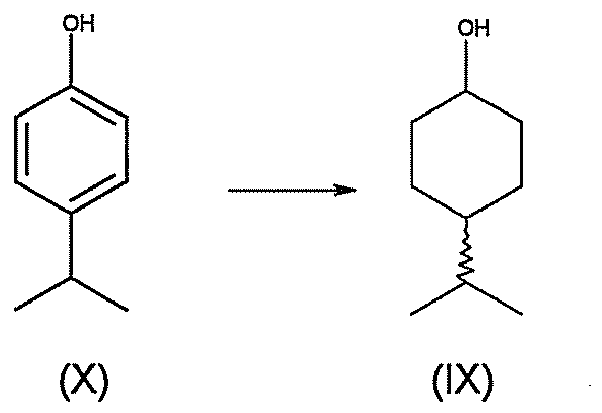
- (c) Umsetzen von 4-Isopropyl-Hydroxycyclohexan (IX) mit Acrylsäuremethylester unter Bildung der Spirolactons der Formel (VIII)

- (d) Pyrolysieren der Spirolactons der Formel (VIII) unter Bildung der Verbindung der Formel (I)
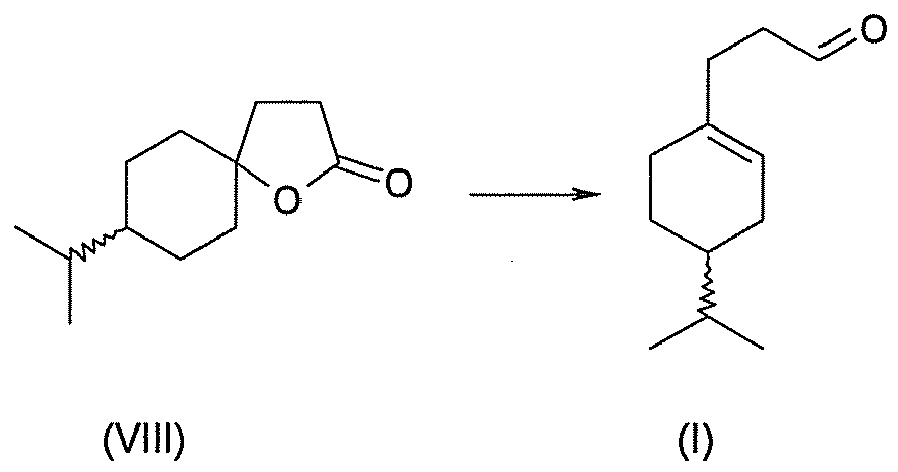
- (e) optional Abtrennen des Enantiomeren der Formel (la) wie oben definiert und/oder des Enantiomeren der Formel (Ib) wie oben definiert.
- In eigenen Untersuchungen wurde festgestellt, dass der Einsatz von auf Bimssteinen aufgezogenem Cerium(III)acetat-Hydrat als Katalysator beim Schritt der Pyrolyse (d) die besten Ergebnisse liefert. Es wurde eine Rohausbeute von 28% erreicht, wobei das Produkt ein Racemat ist.
- Ein Verfahren zur Herstellung der erfindungsgemäßen Verbindung der Formel (la) wie oben definiert und/oder der erfindungsgemäßen Verbindung der Formel (Ib) wie oben definiert umfasst die folgenden Schritte oder besteht aus den folgenden Schritten
- Schritte (a) und (b) wie oben beschrieben
- nach Schritt (b) Trennen der cis und trans Isomeren (IXa, IXb)

- separates Umsetzen des Enantiomers der Formel (IXa) und/oder des Enantiomers der Formel (IXb) entsprechend den Schritten (c) und (d) des oben definierten Verfahrens zur Verbindung der Formel (la) bzw. (Ib).
-

- In einem Autoklav werden 1 kg 4-Isopropylphenol (Formel (X) wie oben definiert), 20 g Ruthenium auf Kohle und 2.5 L Ethanol vorgelegt. Das 4-Isopropylphenol wird 6 Stunden bei 140 °C und einem Wasserstoffdruck von 40 bar hydriert. Nach Filtration und Entfernung des Lösungsmittels erhält man 1.04 kg Rohprodukt in einer Reinheit von 99.8 % (cis/trans Isomere im Verhältnis 1:1, quantitative Ausbeute).
-

- Eine Mischung aus 768 g 4-Isopropylcyclohexanol (5.40 mol, 4.50 Äquiv., Formel (IX) wie oben definiert) und 1.90 g Ditert-butylperoxid (13.0 mmol, 0.01 Äquiv.) wird auf 140 °C erwärmt. Bei dieser Temperatur wird eine Mischung aus 257 g 4-Isopropylcyclohexanol (1.80 mol, 1.50 Äquiv.) und 103 g Methylacrylat (1.20 mol, 1.00 Äquiv.) über 6 Stunden dazu getropft. Dabei werden die entstehenden Leichtsieder abgenommen. Anschließend werden 6.5 g Di-tert.-butylperoxid (44.0 mmol, 0.04 Äquiv.) zugegeben, und es wird 2 Stunden bei 160 °C nachgerührt. Nach Abkühlung wird der Ansatz mit 150 g 10 %iger Natriumsulfit Lösung versetzt und eine Stunde bei 60°C gerührt. Die Phasen werden getrennt, die organische Phase mit 100 g Wasser gewaschen. Nach Entfernung des Lösungsmittels wird das Rohprodukt durch eine Destillation gereinigt. Es werden 102 g (3R)-3-Isopropyl-6-methyl-7-oxabicyclo[4.1.0]heptan in einer Reinheit von 90 % isoliert (cis/trans Isomere im Verhältnis 40:60). Dies entspricht einer Ausbeute von 43 % der Theorie. Der Siedepunkt des Endproduktes beträgt 90°C bei 0.1 mbar.
- trans-8-Isopropyl-4-oxaspiro[4.5]decan-3-on: MS: m/z (%) = 196 (M+, 5), 181 (6), 167 (3), 153 (10), 136 (24), 123 (23), 111 (100), 98 (30), 85 (27), 67 (16), 55 (29), 43 (31), 28 (10).- 1H NMR (400 MHz, CDCl3): □ (ppm) = 0.87 (d, J = 6.8 Hz, 6 H), 1.02-1.14 (m, 1 H), 1.36-1.52 (m, 5 H), 1.57-1.64 (m, 2 H), 1.89-1.94 (m, 2 H), 1.97 (t, J = 8.3 Hz, 2 H), 2.58 (t, J = 8.3 Hz, 2 H).- 13C NMR (100 MHz, CDCl3): □ (ppm) = 20.0 (2 x CH3), 26.3 (2 x CH2), 28.7 (CH2), 30.4 (CH2), 32.0 (CH), 36.4 (2 x CH2), 42.6 (CH), 87.3 (Cquart.), 176.7 (Cquart.).
- cis-8-Isopropyl-4-oxaspiro[4.5]decan-3-on: MS: m/z (%) = 196 (M+., 3), 181 (5), 167 (3), 153 (7), 136 (19), 123 (23), 111 (100), 98 (27), 85 (25), 67 (17), 55 (28), 43 (30), 28 (10).- 1H NMR (400 MHz, CDCl3): □ (ppm) = 0.88 (d, J = 6.8 Hz, 6 H), 1.02-1.14 (m, 3 H), 1.36-1.52 (m, 1 H), 1.68-1.82 (m, 6 H), 2.06 (t, J = 8.3 Hz, 2 H), 2.58 (t, J = 8.3 Hz, 2 H).-13C NMR (100 MHz, CDCl3): □ (ppm) = 19.8 (2 x CH3), 25.4 (2 x CH2), 28.7 (CH2), 32.5 (CH), 34.2 (CH2), 37.2 (2 x CH2), 43.0 (CH), 85.9 (Cquart.), 177.0 (Cquart.).
-

- Zu einer Mischung aus 34 g Cerium(III)acetat Hydrat und 87 g Bimssteinen werden 450 g Wasser zugegeben. Die Mischung wird eine Stunde bei 50 °C gerührt, und anschließend wird das Wasser am Rotationsverdampfer entfernt. Das Rohr der Pyrolyseanlage wird mit 35 g der vorbereiteten Bimssteine gefüllt (11 cm hoch) und eine Stunde bei 440 °C geheizt.
- Eine Mischung aus 2 g 8-Isopropyl-4-oxaspiro[4.5]decan-3-on (93%ig, 9.5 mmol, Formel (VIII) wie oben definiert) und 18 g Ameisensäure wird bei 440 °C und über 2 Stunden mit einem N2-Fluss von 16 L/h in die Anlage mit dem oben beschriebenen Katalysator eindosiert. Das Pyrolyseprodukt wird in einer Kühlfalle aufgefangen, anschließend mit MTBE verdünnt und mit gesättigter Natriumhydrogencarbonat-Lösung neutralisiert. Die Phasen werden getrennt, und nach Entfernung des Lösungsmittels erhält man 1.5 g Rohprodukt in einer Reinheit von 32 %. Dies entspricht eine Rohausbeute von 28%.
- Die NMR- und MS-Daten des erhaltenen Produkts entsprechen den in Beispiel 8 angegebenen Daten.
-

- Eine Mischung aus 1.5 kg d-(+)-Limonen (98,7% ee, Formel (VIa) wie oben definiert), 3.0 L Methanol und 4.5 g Raney-Nickel wird in einem Autoklav bei Raumtemperatur unter einem Druck von 50 bar hydriert. Nach Ende der Reaktion wird die Reaktionsmischung filtriert und anschließend destilliert. Es werden 1.3 kg (+)-pMenth-1-en (Formel (Va) wie oben definiert) in einer Reinheit von 91 % isoliert. Dies entspricht einer Ausbeute von 78 % der Theorie.
- Siedepunkt: 102 °C / 110 mbar. - MS: m/z (%) = 138 (M+., 32), 123 (13), 109 (5), 95 (100), 81 (23), 68 (50), 55 (19), 53 (9), 43 (7), 41 (20), 39 (10), 27 (10).- 1H NMR (200 MHz, CDCl3): ω (ppm) = 0.87 (d, J = 6.8 Hz, 3 H), 0.89 (d, J = 6.8 Hz, 3 H), 1.15-1.26 (m, 2 H), 1.41-1.50 (m, 1 H), 1.62-1.65 (m, 3 H), 1.72-1.78 (m, 2 H), 1.87-2.04 (m, 3 H), 5.35-5.40 (m, 1 H).- 13C NMR (50 MHz, CDCl3): ω (ppm) = 19.7 (CH3), 20.0 (CH3), 23.5 (CH3), 26.6 (CH2), 29.0 (CH2), 30.9 (CH2), 32.4 (CH), 40.1 (CH), 121.1 (CH), 133.8 (Cquart.).
-

- In einer Mischung aus 152 g (+)-p-Menth-1-en (91 %ig, 1.00 mol, 1.00 Äquiv., Formel (Va) wie oben definiert) und 53.0 g Natriumcarbonat (0.50 mol, 0.50 Äquiv.) in 500 mL Toluol bei 0 °C werden 238 g Peressigsäure (40 %ig, 1.25 mol, 1.25 Äquiv.) zugetropft. Anschließend wird die Reaktionsmischung auf Raumtemperatur erwärmt und für 3 Stunden gerührt. Die Reaktionsmischung wird mit Wasser versetzt, die organische Phase abgetrennt und mit einer 20 %igen Lösung von Natriumsulfit für 2 Stunden bei 60 °C gerührt. Danach werden die Phasen wieder getrennt und die organische Phase zweimal mit Wasser gewaschen. Nach Entfernung des Lösungsmittels wird das Rohprodukt durch eine Destillation gereinigt. Es werden 133 g (3R)-3-Isopropyl-6-methyl-7-oxabicyclo[4.1.0]heptan (Formel (IVa) wie oben definiert) in einer Reinheit von 96 % isoliert (cis/trans Isomere im Verhältnis ca. 1:1). Dies entspricht einer Ausbeute von 83 % der Theorie. Der Siedepunkt des Endproduktes beträgt 102 °C bei 40 mbar.
- (1R, 3R, 6S)-3-Isopropyl-6-methyl-7-oxabicyclo[4.1.0]heptan: MS: m/z (%) = 154 (M+., 2), 139 (20), 125 (14), 111 (62), 95 (17), 83 (25), 69 (47), 55 (49), 43 (100), 27 (14). - 1H NMR (400 MHz, CDCl3): δ (ppm) = 0.83 (d, J = 6.8 Hz, 6 H), 0.92-1.07 (m, 1 H), 1.11 (dd, J = 12.4, 4.1 Hz, 1 H), 1.30 (s, 3 H), 1.31-1.47 (m, 3 H), 1.62 (ddd, J = 14.5, 12.2, 4.9 Hz, 1 H), 1.95 (dddd, J = 15.2, 6.0, 5.5, 2.0 Hz, 1 H), 1.93 (ddd, J = 14.6, 3.8, 2.4 Hz, 1 H), 2.97 (d, J = 5.3 Hz, 1 H). - 13C NMR (100 MHz, CDCl3): δ (ppm) = 19.4 (CH3), 19.7 (CH3), 22.5 (CH2), 23.1 (CH3), 27.9 (CH2), 31.0 (CH2), 32.3 (CH), 39.3 (CH), 57.8 (Cquart.), 59.7 (CH).
- (1S, 3R, 6R)-3-Isopropyl-6-methyl-7-oxabicyclo[4.1.0]heptan: MS: m/z (%) = 154 (M+., 2), 139 (18), 125 (14), 111 (57), 93 (18), 83 (29), 69 (47), 55 (54), 43 (100), 27 (15). - 1H NMR (400 MHz, CDCl3): δ (ppm) = 0.84 (d, J = 6.7 Hz, 3 H), 0.85 (d, J = 6.7 Hz, 3 H), 0.89-0.96 (m, 1 H), 1.30 (s, 3 H), 1.20-1.28 (m, 1 H), 1.31-1.47 (m, 3 H), 1.79-1.85 (m, 2 H), 2.08 (ddd, J = 14.6, 4.3, 2.0 Hz, 1 H), 3.02 (t, J = 2.1 Hz, 1 H). -13C NMR (100 MHz, CDCl3): δ (ppm) = 19.7 (2 x CH3), 24.5 (CH3), 24.9 (CH2), 29.2 (CH2), 29.3 (CH3), 31.7 (CH), 35.1 (CH), 37.6 (Cquart.), 61.0 (CH).
-

- Zu einer Mischung aus 401 g (3R)-3-Isopropyl-6-methyl-7-oxabicyclo[4.1.0]heptan (96 %ig, 2.48 mol, 1.00 Äquiv., Formel (IVa) wie oben definiert) in 1.4 L Xylol werden 49.0 g Aluminiumisopropylat (0.24 mol, 0.10 Äquiv.) vorsichtig zugetropft. Anschließend wird der Ansatz 4 Stunden am Rückfluss gekocht. Die Reaktionsmischung wird auf Raumtemperatur abgekühlt, mit einer 10 %igen Salzsäurelösung versetzt und die Phasen getrennt. Die wässrige Phase wird mit Xylol extrahiert und die vereinigten organischen Phasen werden mit Wasser gewaschen. Das Rohprodukt wird durch eine Destillation gereinigt. Es werden 327 g (5R)-5-Isopropyl-2-methylencyclohexanol (Formel (IIIa) wie oben definiert) in einer Reinheit von 71 % isoliert (enthält 62 g von (5R)-5-Isopropyl-2-methylcyclohex-2-en-l-ol). Dies entspricht einer Ausbeute von 60% der Theorie. Der Siedepunkt des Endproduktes beträgt 75 °C bei 25 mbar.
- (1R, 5R)-5-Isopropyl-2-methylencyclohexanol: MS: m/z (%) = 154 (M+., 14), 139 (7), 121 (13), 111 (51), 97 (18), 93 (48), 82 (60), 69 (63), 55 (100), 53 (20), 41 (83), 27 (27). - 1H NMR (400 MHz, CDCl3): δ (ppm) = 0.88 (2d, J = 6.8 Hz, 6 H), 0.96-1.07 (m, 2 H), 1.33-1.42 (m, 1 H), 1.46-1.54 (m, 1 H), 1.71-1.78 (m, 1 H), 1.93-2.03 (m, 1 H), 2.11 (dddd, J = 11.8, 5.2, 2.9, 2.2 Hz, 1 H), 2.42 (ddd, J = 13.5, 4.2, 2.6 Hz, 1 H), 4.01-4.09 (m, 1 H), 4.75 (q, J = 1.8 Hz, 1 H), 4.91 (dd, J = 1.8, 1.5 Hz, 1 H). - 13C NMR (100 MHz, CDCl3): δ (ppm) = 19.7 (CH3), 19.9 (CH3), 30.7 (CH2), 32.3 (CH), 33.8 (CH2), 40.5 (CH2), 42.9 (CH), 72.5 (CH), 103.3 (CH2), 152.0 (Cquart.).
- (1S, 5R)-5-Isopropyl-2-methylencyclohexanol: MS: m/z (%) = 154 (M+., 9), 136 (7), 125 (4), 121 (18), 111 (56), 97 (18), 93 (72), 83 (61), 77 (30), 67 (64), 55 (100), 53 (23), 41 (91), 27 (39). - 1H NMR (400 MHz, CDCl3): δ (ppm) = 0.87 (d, J = 6.8 Hz, 3 H), 0.88 (d, J = 6.8 Hz, 3 H), 1.09 (tdd, J = 12.7, 11.5, 4.1 Hz, 1 H), 1.34 (ddd, J = 13.6, 12.1, 3.1 Hz, 1 H), 1.42-1.51 (m, 1 H), 1.64-1.74 (m, 1 H), 1.75-1.81 (m, 1 H), 1.90 (ddd, J = 13.6, 3.5, 2.3 Hz, 1 H), 2.18 (ddd, J =13.5, 4.0, 3.5 Hz, 1 H), 2.36-2.45 (m, 1 H), 4.33 (t, J = 3.4 Hz, 1 H), 4.74 (dd, J = 2.0, 0.6 Hz, 1 H), 4.82 (dd, J = 2.1, 1.5 Hz, 1 H). - 13C NMR (100 MHz, CDCl3): δ (ppm) = 19.7 (CH3), 19.9 (CH3), 30.0 (CH2), 30.5 (CH2), 31.9 (CH), 36.9 (CH), 37.5 (CH2), 72.6 (CH), 109.2 (CH2), 150.6 (Cquart.).
-

- Zu einer Mischung aus 42.9 g (5R)-5-Isopropyl-2-methylencyclohexanol (70 %ig, 195 mmol, 1.00 Äquiv., Formel (IIIa) wie oben definiert)) und 55.7 g Butylvinylether (556 mmol, 2.90 Äquiv.) bei 0 °C werden portionsweise 317 mg p-Toluolsulfonsäuremonohydrat (1.70 mmol, 0.6 mol%.) zugegeben. Die Reaktion ist exotherm und die freigesetzte Wärme wird mittels eines Eisbades bei 17 °C abgefangen. Anschließend wird 2 Stunden bei 0 bis 10 °C nachgerührt. Die Reaktionsmischung wird mit MTBE versetzt, dreimal mit einer 5 %igne Na2CO3 Lösung und einmal mit Wasser gewaschen. Die organische Phase wird dann abgetrennt und über Na2CO3 destilliert. Es werden 58.4 g (4R)-2-(1-butoxyethoxy)-4-isopropyl-1-methylencyclohexan in einer Reinheit von 71 % isoliert (4 Isomere im Verhältnis ca. 1: 1: 1.5: 1.3). Dies entspricht einer Ausbeute von 83% der Theorie.
- MS: m/z (%) = 137 (23), 101 (78), 81 (32), 67 (8), 57 (52), 45 (100), 41 (24), 29 (13).
-

- Eine Mischung aus 24 g (4R)-2-(1-Butoxyethoxy)-4-isopropyl-1-methylencyclohexan (77 %ig, 72 mmol, 1.00 Äquiv., Formel (IIa) wie oben definiert) und 2.5 g Capronsäure (21 mmol, 0.30 Äquiv.) in 25 g Malotherm S wird bei 200 °C für 2 Stunden geheizt. Dabei werden die Leichtsieder abdestilliert. Anschließend wird der Ansatz bei Raumtemperatur gekühlt und über Soda destilliert. Es werden 14.7 g 3-[(4R)-4-Isopropylcyclohexen-1-yl]-propanal (Formel (la) wie oben definiert) in einer Reinheit von 52 % und mit 96.6 % ee isoliert. Dies entspricht einer Ausbeute von 58 % der Theorie. Ein Teil des Produktes wird über eine Säule gereinigt (Cyclohexan : Essigester 100:3, 3.34 g, Reinheit 96,5 %).
- [α]D 22 = +108 °(c = 0.07 in Ethanol). - GC mit chiraler stationärer Phase (Hydrodex-b-TBADc, 25 m x 0.25 mm, 40 °C - 1 °C/ min. - 180 °C): Rt = 79.08 (98.3%), 79.30 (1.7%). - MS: m/z (%) = 180 (M+., 10), 162 (7), 147 (7), 136 (34), 119 (24), 109 (18), 93 (100), 79 (41), 67 (56), 55 (34), 41 (69), 27 (33). - 1H NMR (400 MHz, CDCl3): δ (ppm) = 0.87 (d, J = 6.8 Hz, 3 H), 0.88 (d, J = 0.88 Hz, 3 H), 1.16-1.28 (m, 2 H), 1.42-1.50 (m, 1 H), 1.66-1.80 (m, 2 H), 1.94-2.06 (m, 3 H), 2.28 (t, J = 7.5 Hz, 2 H), 2.49-2.54 (m, 2 H), 5.39-5.43 (m, 1 H), 9.75 (t, J = 1.9 Hz, 1 H). - 13C NMR (100 MHz, CDCl3): δ (ppm) = 19.6 (CH3), 19.9 (CH3), 26.3 (CH2), 28.8 (CH2), 29.2 (CH2), 29.7 (CH2), 32.2 (CH), 40.0 (CH), 41.9 (CH2), 121.8 (CH), 135.5 (Cquart.), 202.8 (CHO).
-
Riechstoffe Gewichtsteile Parfümöl A1 Parfümöl A2 (Vergleich) (erfindungsgemäß) ETHYL ACETOACETATE 4,0 4,0 HEXENOL CIS-3 10% DPG 3,0 3,0 HEXENYL ACETATE CIS-3 10% DPG 3,0 3,0 HEXENYL BENZOATE CIS-3 10% DPG 3,0 3,0 VERTOCITRAL 10% DPG 5,0 5,0 CYCLOGALBANAT® 10% DPG 3,0 3,0 STYRALYL ACETATE 10% DPG 6,0 6,0 BERGAMOT OIL BERGAPTEN FREE FF 6,0 6,0 MANDARIN OIL DIST. DECOL. 15,0 15,0 METHYL ANTHRANILATE 10% DPG 5,0 5,0 RED BERRY EXTR. 2,0 2,0 DECALACTONE GAMMA 2,0 2,0 ALLYL CAPROATE 10% DPG 5,0 5,0 PRUNELLA TYPE BASE 6,0 6,0 HELIONAL 20,0 20,0 MUGETANOL 10,0 10,0 ETHYL LINALOOL 35,0 35,0 CITRONELLOL 950 10,0 10,0 GERANIOL SUPER 3,0 3,0 ROSAPHEN® 8,0 8,0 CITRONELLYL ACETATE EXTRA 2,0 2,0 DAMASCONE BETA 10% DPG 6,0 6,0 BENZYL ACETATE 10,0 10,0 HEDION HC/30 30,0 30,0 HEDIONE 140,0 140,0 HEXYL CINNAMIC ALDEHYDE ALPHA 30,0 30,0 LACTOJASMONE 3,0 3,0 BENZYL SALICYLATE 80,0 80,0 HEXENYL SALICYLATE CIS-3 30,0 30,0 METHYL IONONE GAMMA COEUR 3,0 3,0 CLOVE BUD OIL 1,0 1,0 VANILLIN 1,5 1,5 COUMARIN 1,0 1,0 AMBERWOOD® F 5,0 5,0 CASHMERAN 8,0 8,0 CEDRENE 15,0 15,0 ISO E SUPER NON DISCOLORING 50,0 50,0 BRAHMANOL® 25,0 25,0 SANDALORE 5,0 5,0 AMBROXIDE 2,0 2,0 AMBRETTOLIDE 5,0 5,0 AURELIONE® 16,0 16,0 GLOBALlDE® 24,0 24,0 MACROLIDE® SUPRA 16,0 16,0 INDOLE FF 10% DPG 5,0 5,0 3-[(4R)-4-Isopropylcyclohexen-1-yl]propanal 50,0 DIPROPYLENE GLYCOL 332,5 282,5 1.000,0 1.000,0 - Bei einer Dosierung von 6 Gew.-% des Parfümöls A1 bzw. A2 in Ethanol ergibt sich folgender Befund: Durch den Zusatz von 3-[(4R)-4-Isopropylcyclohexen-1-yl]propanal im Parfümöl A2 wird die blumige Note gegenüber dem Parfümöl A1 (ohne 3-[(4R)-4-Isopropylcyclohexen-1-yl]propanal) verstärkt. Weiterhin verleiht 3-[(4R)-4-Isopropylcyclohexen-1-yl]propanal der Komposition mit dem Parfümöl A2 mehr Kraft und Fülle als der Komposition mit dem Parfümöl A1.
-
Komponente Gew.-% Gew.-% Paraffinöl 5,00 5,00 Isopropylpalmitat 5,00 5,00 Cetylalkohol 2,00 2,00 Bienenwachs 2,00 2,00 Ceteareth-20 2,00 2,00 PEG-20-Glycerylstearat 1,50 1,50 Glycerin 3,00 3,00 Phenoxyethanol 0,50 - Parabene (Mischung aus Methyl-, Ethyl-, Propyl-, Butyl-, Isobutylparaben) - 0,50 Parfümöl B1 bzw. B2 0,50 0,50 Wasser Ad 100 Ad 100 -
Riechstoffe Gewichtsteile Parfümöl B1 Parfümöl B2 (Vergleich) (erfindungsgemäß) NONADIENAL TRANS,CIS-2,6 5% TEC 20% DPG 2,0 2,0 ETHYL ACETOACETATE 3,0 3,0 FARENAL® 10% DPG 5,0 5,0 VERTOCITRAL 3,0 3,0 CYCLOGALBANAT® 10% DPG 2,0 2,0 STYRALYL ACETATE 3,0 3,0 MELONAL® 0,5 0,5 DIHYDRO MYRCENOL 15,0 15,0 LINALYL ACETATE 20,0 20,0 LEMON OIL TERPENES FLAVOR WONF 8,0 8,0 EUCALYPTOL NAT. 10% DPG 0,5 0,5 HEXYL ACETATE 1,5 1,5 ISOAMYL ACETATE 10% DPG 4,0 4,0 PRENYL ACETATE 10% DPG 4,0 4,0 ALDEHYDE C14 SO-CALLED 2,0 2,0 ETHYL METHYL BUTYRATE-2 1,0 1,0 ALLYL CYCLOHEXYL PROPIONATE 2,0 2,0 ALDEHYDE C16 SO-CALLED 1,0 1,0 FRAGOLANE® 0,5 0,5 MAJANTOL® 25,0 25,0 LINALOOL 40,0 40,0 DIMETHYL BENZYL CARBINOL 10,0 10,0 TERPINEOL PURE 10,0 10,0 PHENIRAT® 30,0 30,0 CITRONELLOL 950 15,0 15,0 GERANIOL 60 10,0 10,0 CITRONELLYL ACETATE EXTRA 2,0 2,0 HEDIONE 90,0 90,0 HEXYL CINNAMIC ALDEHYDE ALPHA 35,0 35,0 HEXYL SALICYLATE 160,0 160,0 METHYL OCTIN CARBONATE 10% DPG 2,0 2,0 CALONE 1951 10% DPG 1,0 1,0 GALAXOLIDE 50% IN IPM 20,0 20,0 ANETHOL SUPRA 21,5 CELSIUS 2,0 2,0 AGRUMEXHC 15,0 15,0 ORYCLON SPECIAL 40,0 40,0 3-[(4R)-4-Isopropylcyclohexen-1-yl]propanal 15,0 DIPROPYLENE GLYCOL 415,0 400,0 1.000,0 1.000,0 - Bei einer Dosierung von 0.5 Gew.-% des Parfümöls B1 bzw. B2 in der Bodylotion ergibt sich folgender Befund: Aufgrund des Anteils von 3-[(4R)-4-Isopropylcyclohexen-1-yl]propanal weist die das Parfümöl B2 enthaltende Bodylotion eine natürlichere und stärkere blumige Note auf als die Bodylotion, die das Parfümöl B1 (ohne 3-[(4R)-4-Isopropylcyclohexen-1-yl] propanal) enthält. Weiterhin zeigt die Bodylotion mit dem Parfümöl B2 eine kosmetischere Topnote und einen cremigeren Nachgeruch als die Bodylotion mit dem Parfümöl B1.
-
Material Hersteller Chemischer Name Funktion Gew.-% Entionisiertes Wasser Wasser Lösungsmittel 72,4 Rewoquat WE 18 Evonic Goldschmidt GmbH Dialkylesterammoniumethosulfat Kationisches Tensid 16,6 Mergal K9N Honeywell Austria GmbH 5-Chloro-2-methyl-3-(2H)-isothiazolon und 2-methyl-3-(2H)-isothiazolon Konservierungs-mittel 0,10 Dow Corning 1520 Antifoam Dow Corning GmbH, Polydimethylsiloxan Entschäumer 0,30 Magnesium Chlorid 1%ige Lösung Magnesiumchlorid-Lösung Konsistenzgeber 10,00 Parfumöl C1 bzw. C2 Symrise Parfum (Fragrance) 0,60 - Zusammensetzung des Parfümöls C1 bzw. C2:
Riechstoffe Gewichtsteile Parfümöl C1 Parfümöl C2 (Vergleich) (erfindungsgemäß) ALDEHYDE C10 0,5 0,5 ALDEHYDE C11 ISO 2,0 2,0 ALDEHYDE C11 UNDECYLENIC 12,0 12,0 ALDEHYDE C12 MNA 6,0 6,0 FARENAL® 1,0 1,0 VERTOCITRAL 8,0 8,0 ALLYL AMYL GLYCOLATE 1,0 1,0 STYRALYL ACETATE 1,5 1,5 DIHYDRO MYRCENOL 65,0 65,0 AGRUNITRIL 1,0 1,0 PEONILE 15,0 15,0 METHYL ANTHRANILATE 10,0 10,0 NEROLIONE 10% DPG 1,5 1,5 ROSEMARY OIL BM 7,0 7,0 SAGE OFFICINALE OIL DALM. 3,0 3,0 ISOBORNYL ACETATE 40,0 40,0 PRENYL ACETATE 0,5 0,5 ISOAMYL BUTYRATE 0,5 0,5 ALDEHYDE C14 SO-CALLED 5,0 5,0 MANZANATE 0,5 0,5 MUGETANOL 5,0 5,0 DIMETHYL BENZYL CARBINYL ACETATE 2,5 2,5 ROSE OXIDE D 3,0 3,0 ANTHER 0,5 0,5 PHENYLETHYL ALCOHOL 35,0 35,0 CITRONELLOL 950 15,0 15,0 GERANIOL 60 10,0 10,0 ISODAMASCON® 2,0 2,0 ROSACETATE 35,0 35,0 CRESYL METHYL ETHER PARA 0,5 0,5 BENZYL ACETATE 20,0 20,0 HEXYL CINNAMIC ALDEHYDE ALPHA 40,0 40,0 METHYL BENZOATE 1,0 1,0 AMYL SALICYLATE N/ISO 10,0 10,0 BENZYL SALICYLATE 70,0 70,0 MYSORE ACETATE 15,0 15,0 PARMANYL® 0,5 0,5 EUGENOL 10,0 10,0 ETHYL VANILLIN 0,5 0,5 COUMARIN 3,0 3,0 AGRUMEX HC 45,0 45,0 HERBAFLORAT 25,0 25,0 AMBERWOOD® F 5,0 5,0 ISO E SUPER 170,0 170,0 PATCHOULI OIL DECOL. 2,5 2,5 SANDRANOL® 10,0 10,0 ISOBUTYL QUINOLINE 1,0 1,0 EVERNYL 0,5 0,5 AMBROXIDE 1,0 1,0 GALAXOLIDE 50% IN IPM 120,0 120,0 INDOFLOR® CRYST. 0,5 0,5 3-[(4R)-4-Isopropylcyclohexen-1-yl]propanal 60,0 DIPROPYLENE GLYCOL 220,0 160,0 1.000,0 1.000,0 - Bei einer Dosierung von 0.6 Gew.-% des Parfümöls C1 bzw. C2 im Weichspüler ergibt sich folgender Befund: Aufgrund des Anteils von 3-[(4R)-4-Isopropylcyclohexen-1-yl]propanal weist der das Parfümöl C2 enthaltende Weichspüler eine natürlichere, frischere blumige Note auf als der Weichspüler, der das Parfümöl C1 (ohne 3-[(4R)-4-Isopropylcyclohexen-1-yl] propanal) enthält.
-
Material Hersteller Chemischer Name Funktion Gew.-% Entionisiertes Wasser Water Lösungsmittel 2,0 Seifen Basen Mix Verschiedene Sodium tallowates / palmitates Tenside 95,8 Titan Dioxid Kronos Titan GmbH, Deutschland Titanium Dioxide Farbstoff / Aufheller 1,0 Parfumöl D1 bzw. D2 Symrise Parfum (Fragrance) 1,2 - Zusammensetzung des Parfümöls D1 bzw. D2:
Riechstoffe Gewichtsteile Parfümöl D1 Parfümöl D2 (Vergleich) (erfindungsgemäß) ALDEHYDE C 8 10,0 10,0 ALDEHYDE C10 14,0 14,0 ALDEHYDE C11 UNDECYLIC 5,0 5,0 ALDEHYDE C12 MNA 4,0 4,0 ISOAMYL ALCOHOL 6,0 6,0 VERTOCITRAL 4,0 4,0 ALLYL-AMYL GLYCOLATE 4,0 4,0 DIHYDRO MYRCENOL 120,0 120,0 CITRAL 95 30,0 30,0 AGRUNITRIL 80,0 80,0 CITRONITRILE 40,0 40,0 CITRYLAL 4,0 4,0 ORANGE OIL TERPENES 250,0 250,0 METHYL ANTHRANILATE 1,5 1,5 TERPINEOL HEAD FRACTION 10,0 10,0 EUCALYPTOL NAT. 10,0 10,0 THYMOL CRYST 6,0 6,0 BORNYL ACETATE L CRYST. 82,5 82,5 CAMPHOR DL 20,0 20,0 JASMAPRUNAT 5,0 5,0 ALDEHYDE C14 SO-CALLED 2,0 2,0 MANZANATE 0,5 0,5 ALLYL HEPTOATE 2,5 2,5 ROSE OXIDE L 0,5 0,5 DAMASCONE ALPHA 0,5 0,5 HEDIONE 10,0 10,0 AMYL SALICYLATE N/ISO 60,0 60,0 HEXYL SALICYLATE 35,0 35,0 COUMARIN 2,5 2,5 AGRUMEXHC 30,0 30,0 ORYCLON SPECIAL 55,0 55,0 PATCHOULI OIL DECOL. 2,0 2,0 SANDRANOL® 1,5 1,5 TONALIDE 2,0 2,0 3-[(4R)-4-Isopropylcyclohexen-1-yl]propanal 40,0 DIPROPYLENE GLYCOL 130,0 90,0 1.000,0 1.000,0 - Bei einer Dosierung von 1.2 Gew.-% des Parfümöls D1 bzw. D2 in der Seife ergibt sich folgender Befund: Aufgrund des Anteils von 3-[(4R)-4-Isopropylcyclohexen-1-yl]propanal weist die das Parfümöl D2 enthaltende Seife eine runde aldehydische Note auf im Gegensatz zu der Seife, die das Parfümöl D1 (ohne 3-[(4R)-4-Isopropylcyclohexen-1-yl] propanal) enthält. Weiterhin strahlt die Seife mit dem Parfümöl D2 mehr Natürlichkeit und Fülle aus als die Seife mit dem Parfümöl D1.
-
Material Hersteller Chemischer Name Funktion Gew.-% Natrium Metasilicat Pentahydrat Akzo Nobel Chemicals, Deutschland Sodium Metasilicate Pentahydrate 48,0 Natriumhydrogencarbonat Verschiedene Sodium hydrogen carbonate Alkali 15,0 Natrium-percarbonat Verschiedene Sodium carbonate peroxyhydrate Bleichmittel 15,0 Peractive AC Blue Clariant GmbH, Deutschland TAED / Na-Carboxymethylcellulose Aktivator 5,00 Genapol OA-080 Clariant GmbH, Deutschland Oxoalkohol C14-15, 8EO Nichtionisches Tensid 3,00 Texapon K12 Pulver Cognis Deutschland GmbH Sodium Lauryl Sulphate C12 Anionisches Tensid 7,00 Tinopal CBS-X Ciba, Deutschland Aufheller 0,50 Savinase 6.0 T, Type W Novozymes Protease Enzym 0,40 Termamyl 120 T Novozymes Alpha-Amylase Enzym 0,30 Natriumsulfat Verschiedene Sodium Sulphate Füllstoff 5,50 Parfumöl E1 bzw. E2 Symrise Parfum (Fragrance) 0,30 - Zusammensetzung des Parfümöls E1 bzw. E2:
Riechstoffe Gewichtsteile Parfümöl E1 Parfümöl E2 (Vergleich) (erfindungsgemäß) ALDEHYDE C 8 0,5 0,5 HEXENOL CIS-3 3,5 3,5 VERTOCITRAL 15,0 15,0 STYRALYL ACETATE 3,0 3,0 MELONAL® 2,0 2,0 DIHYDRO MYRCENOL 60,0 60,0 CITRAL 95 6,0 6,0 ORANGE OIL TERPENES 20,0 20,0 EUCALYPTUS OIL GLOBULUS 80/85% 10,0 10,0 MENTHONE UISOMENTHONE D 82/18 1,5 1,5 HEXYL ACETATE 10% DPG 5,0 5,0 ISOPENTYRATE 4,0 4,0 METHYL CAPROATE 1,0 1,0 ETHYL METHYL BUTYRATE-2 6,0 6,0 LINALOOL 10,0 10,0 DIMETHYL BENZYL CARBINYL BUTYRAT 15,0 15,0 PHENYLETHYL ALCOHOL 15,0 15,0 CITRONELLOL 950 20,0 20,0 GERANIOL 60 20,0 20,0 ISODAMASCON® 10,0 10,0 CRESYL METHYL ETHER PARA 1,0 1,0 BENZYL ACETON 50,0 50,0 HEXYL CINNAMIC ALDEHYDE ALPHA 60,0 60,0 DIHYDRO JASMONE 1,0 1,0 METHYLBENZOAT 0,5 0,5 HEXYL SALICYLATE 10,0 10,0 LEGUMINAL 6,0 6,0 IONONE BETA 20,0 20,0 ISORALDEINE 70 45,0 45,0 EUGENOL 2,0 2,0 ACETOPHENONE 1% DPG 5,0 5,0 AGRUMEX HC 60,0 60,0 ORYCLON SPECIAL 40,0 40,0 HERBAFLORAT 10,0 10,0 HERBYL PROPIONATE 20,0 20,0 KOAVONE 20,0 20,0 VERTOFIX 40,0 40,0 ISO E SUPER 150,0 150,0 SANDRANOL® 20,0 20,0 AMBROXIDE 2,0 2,0 3-[(4R)-4-Isopropylcyclohexen-1-yl]propanal 60,0 DIPROPYLENE GLYCOL 270,0 210,0 1.000,0 1.000,0 - Bei einer Dosierung von 0.3 Gew.-% des Parfümöls E1 bzw. E2 im Waschpulver (powder detergent) ergibt sich folgender Befund: der Anteil von 3-[(4R)-4-Isopropylcyclohexen-1-yl]propanal bewirkt in dem das Parfümöl E2 enthaltenden Waschpulver eine Verstärkung der grünen Noten gegenüber dem Waschpulver, das das Parfümöl E1 (ohne 3-[(4R)-4-Isopropylcyclohexen-1-yl]propanal) enthält. Weiterhin strahlt die Komposition des Waschpulvers mit dem Parfümöl E2 insgesamt mehr Frische aus als die des Waschpulvers mit dem Parfümöl E1.
-
Material Hersteller Chemischer Name Funktion Gew.-% Entionisiertes Wasser Water Lösungsmittel 59,6 Mergal K9N Troy Chemie, Seelze 5-Chloro-2-methyl-3-(2H)-isothiazolone und 2-methyl-3-(2H)-isothiazolone Konservierungs-mittel 0,1 Trinatriumcitrat Dihydrat Verschiedene Tri Sodium Citrate Dihydrate Komplexbildner 3,0 Zetesol NL-2 Zschimmer & Schwarz, Deutschland Fatty alcohol C12-14-sulfate, Sodium Anionisches Tensid 30,0 Imbentin C/125/055 Dr. W. Kolb AG Chem. Fatty alcohol C12-C15, 8EO Nichtionisches Tensid 5,0 Ethanol 96% Verschiedene Ethanol Lösungsmittel 2,0 Parfumöl F1 bzw. F2 Symrise Parfum (Fragrance) 0,3 - Zusammensetzung des Parfümöls F1 bzw. F2:
Riechstoffe Gewichtsteile Parfümöl F1 Parfümöl F2 (Vergleich) (erfindungsgemäß) ALDEHYDE C10 0,5 0,5 ALCOHOL C10 6,0 6,0 HEXENOL CIS-3 1,0 1,0 LIMONENAL 4,0 4,0 VERTOCITRAL 8,0 8,0 PHENYLACETALDEHYDE 50% DPG 1,0 1,0 MINTONAT 15,5 15,5 METHYL ANTHRANILATE 1,0 1,0 HEXYL ACETATE 20,0 20,0 ALLYL HEPTOATE 1,0 1,0 LINALOOL 30,0 30,0 DIMETHYL BENZYL CARBINYL ACETATE 2,0 2,0 PHENYLETHYL ALCOHOL 150,0 150,0 CITRONELLOL 950 130,0 130,0 GERANIOL SUPER 35,0 35,0 GERANYL ACETATE PURE 10,0 10,0 BENZYL ACETATE 55,0 55,0 HEDIONE 15,0 15,0 HEXYL CINNAMIC ALDEHYDE ALPHA 130,0 130,0 CINNAMIC ALCOHOL 6,0 6,0 ACETOPHENONE 10% DPG 1,0 1,0 JACINTHAFLOR® 4,0 4,0 ISO E SUPER 20,0 20,0 GALAXOLIDE 50% IN IPM 35,0 35,0 INDOFLOR® CRYST. 1,0 1,0 BHT IONOL 8,0 8,0 3-[(4R)-4-Isopropylcyclohexen-1-yl]propanal 60,0 DIPROPYLENE GLYCOL 370,0 310,0 1.000,0 1.000,0 - Bei einer Dosierung von 0.3 Gew.-% des Parfümöls F1 bzw. F2 im Allzweckreiniger ergibt sich folgender Befund: der Anteil von 3-[(4R)-4-Isopropylcyclohexen-1-yl)propanal bewirkt in dem das Parfümöl F2 enthaltenden Allzweckreiniger eine Verstärkung der blumigen Note gegenüber dem Allzweckreiniger, der das Parfümöl F1 (ohne 3-[(4R)-4-Isopropylcyclohexen-1-yl]propanal) enthält. Ferner erscheint die Komposition des Allzweckreinigers mit dem Parfümöl F2 viel cremiger und frischer als die des Allzweckreinigers mit dem Parfümöl F1.
-
Material Hersteller INCI-Name Gew.-% Entionisiertes Wasser Water 71,5 Plantacare PS 10 Cognis Deutschland GmbH Sodium Laureth Sulfate, Lauryl Glucoside 20,0 Euperlan PK 771 Cognis Deutschland GmbH Glycol Distearate, Sodium Lauryl Sulfate, Cocamide MEA, Laureth-1 0 6,0 Dragocid Liquid Symrise Phenoxyethanol, Methylparaben, Ethylparaben, Butylparaben, Propylparaben, Isobutylparaben 0,5 Natrium Chlorid Sodium Chloride 1,4 Citronensäure Monohydrat kristallin Citric Acid 0,1 Parfumöl G1 bzw. G2 Symrise Parfum (Fragrance) 0,5 - Zusammensetzung des Parfümöls G1 bzw. G2:
Riechstoffe Gewichtsteile Parfümöl G1 Parfümöl G2 (Vergleich) (erfindungsgemäß) FARENAL® 3,0 3,0 FLORAZON 0,5 0,5 HEXENYL ACETATE CIS-3 3,0 3,0 VERTOCITRAL 1,0 1,0 DYNASCONE 10% DPG 2,0 2,0 CYCLOGALBANAT® 2,0 2,0 STYRALYL ACETATE 1,5 1,5 DIHYDRO MYRCENOL 6,0 6,0 OXANTHIA 50% IN TEC 10% DPG 10,0 10,0 LEMON OIL ITAL. 10,0 10,0 ORANGE OIL BRASIL 50,0 50,0 HEXYL ACETATE 2,0 2,0 ISOAMYL ACETATE 0,5 0,5 PRENYLACETATE 0,5 0,5 ETHYL BUTYRATE 10% DPG 2,0 2,0 ALDEHYDE C14 SO-CALLED 25,0 25,0 DECALACTONE GAMMA 5,0 5,0 ETHYL METHYL BUTYRATE-2 1,0 1,0 ALLYL CAPROATE 1,5 1,5 ALLYL CYCLOHEXYL PROPIONATE 3,0 3,0 ALLYL HEPTOATE 2,5 2,5 MELOZONE 2,0 2,0 CALONE 1951 0,5 0,5 MUGETANOL 10,0 10,0 LINALOOL 25,0 25,0 DIMETHYL BENZYL CARBINYL ACETATE 6,0 6,0 DIMETHYL BENZYL CARBINYL BUTYRAT 4,0 4,0 PHENYLETHYL ACETATE 1,5 1,5 PHENYLETHYL ALCOHOL 15,0 15,0 CITRONELLOL 950 10,0 10,0 GERANIOL SUPER 5,0 5,0 GERANYL ACETATE PURE 15,0 15,0 ISODAMASCON® 2,0 2,0 BENZYL ACETATE 15,0 15,0 HEDIONE 90,0 90,0 HEXYL CINNAMIC ALDEHYDE ALPHA 35,0 35,0 JASMONE CIS 0,5 0,5 BENZYL SALICYLATE 80,0 80,0 HEXENYL SALICYLATE CIS-3 30,0 30,0 ISORALDEINE 70 35,0 35,0 HERBAFLORAT 15,0 15,0 ISO E SUPER 15,0 15,0 ISOBORNYL CYCLOHEXANOL 30,0 30,0 BRAHMANOL® 10,0 10,0 AMBROXIDE 1,5 1,5 GLOBALIDE® 5,0 5,0 GALAXOLIDE 50% IN DPG 120,0 120,0 3-[(4R)-4-Isopropylcyclohexen-1-yl]propanal 65,0 DIPROPYLENE GLYCOL 290,0 225,0 1.000,0 1.000,0 - Bei einer Dosierung von 0.5 Gew.-% des Parfümöls G1 bzw. G2 im Shampoo ergibt sich folgender Befund: der Zusatz 3-[(4R)-4-Isopropylcyclohexen-1-yl]propanal verstärkt in dem das Parfümöl G2 enthaltenden Shampoo den wässrigen-fruchtigen Charakter gegenüber dem Shampoo, welches das Parfümöl G1 (ohne 3-[(4R)-4-Isopropylcyclohexen-1-yl]propanal) enthält. Zudem ist in dem Shampoo mit dem Parfümöl G2 die Diffusivität erhöht gegenüber dem Shampoo mit der Parfümöl G1.
-
Material Hersteller INCI-Name Gew.-% Entionisiertes Wasser Wasser 76,3 Plantacare PS 10 Cognis Deutschland GmbH Sodium Laureth Sulfate, Lauryl Glucoside 20,0 Dragocid Liquid Symrise Phenoxyethanol, Methylparaben, Ethylparaben, Butylparaben, Propylparaben, Isobutylparaben 0,5 Natriumchlorid Sodium Chloride 1,4 Citronensäure Monohydrat kristallin Citric Acid 1,3 Parfumöl G1 bzw. G2 aus Beispiel 15 Symrise Parfum (Fragrance) 0,5 - Bei einer Dosierung von 0.5 Gew.-% des Parfümöls G1 bzw. G2 im Duschgel ergibt sich folgender Befund: der Zusatz von 3-[(4R)-4-Isopropylcyclohexen-1-yl]propanal verleiht dem das Parfümöl G2 enthaltenden Duschgel eine natürlichere und pflegendere Note gegenüber dem Duschgel, welches das Parfümöl G1 (ohne 3-[(4R)-4-Isopropylcyclohexen-1-yl]propanal) enthält.
-
Komponente A B C D Gew.-% Gew.-% Gew.-% Gew.-% Aluminium Zirconium Tetrachlorohydrat - Glycin Komplex 25,00 20,00 25,00 20,00 Dimethicon (10 Cst) - - 5,00 5,00 Cyclopentasiloxan - 0,50 1,00 0,50 Petrolatum 5,00 4,70 5,00 5,00 Ozokerit 1,00 1,50 - - Stearylalkohol 12,00 12,00 - - 2-Butyloctansäure 0,50 - 0,50 - Wachs - - 1,25 1,25 PPG-14 Butylether 9,00 9,00 - - Gehärtetes Rapsöl - - 5,00 5,00 Siliciumdioxid - - 1,00 - Farnesol 0,25 - 0,25 - Paraffinöl 0,50 0,50 - - Hydriertes Rizinusöl (castor wax) 3,50 3,50 - - Talk 4,00 4,00 - - Behenylalkohol 0,20 0,20 - - d-Panthenyltriacetat 1,00 1,00 - - Konservierungsmittel q.s. q.s. q.s. q.s. Parfümöl H1 bzw. H2 1,50 - 1,15 - Parfümöl G2 aus Beispiel 15 0,90 - 0,75 Wasser Ad 100 Ad 100 Ad 100 Ad 100 - Zusammensetzung des Parfümöls H1 bzw. H2
Riechstoffe Gewichtsteile Parfümöl H1 (Vergleich) Parfümöl H2 (erfindungsgemäß) ALDEHYDE C10 0,5 0,5 ALDEHYDE C12 MNA 10% DPG 2,0 2,0 MINTONAT 40,0 40,0 MELOZONE 0,5 0,5 VERTOCITRAL 6,0 6,0 DIHYDRO MYRCENOL 120,0 120,0 TETRAHYDRO MYRCENOL 10,0 10,0 AGRUNITRIL 1,0 1,0 ORANGE OIL BRASIL 10,0 10,0 TAMARINE TYPE BASE 10,0 10,0 HEXYL ACETATE 6,0 6,0 ALDEHYDE C14 SO-CALLED 1,0 1,0 TETRAHYDRO LINALOOL 40,0 40,0 DIMETHYL BENZYL CARBINYL BUTYRAT 5,0 5,0 ORANGE FLOWER ETHER 5,0 5,0 PHENYLETHYL ACETATE 6,5 6,5 PHENYLETHYL ALCOHOL 15,0 15,0 GERANIOL SUPER 30,0 30,0 ROSAPHEN® 25,0 25,0 ISODAMASCON® 0,5 0,5 HEDIONE 300,0 300,0 UNDECAVERTOL 0,5 0,5 ALLYL IONONE 2,5 2,5 IONONE BETA 10,0 10,0 EUGENOL 4,0 4,0 ISO E SUPER 30,0 30,0 BRAHMANOL® 2,0 2,0 AMBROXIDE 2,0 2,0 GLOBALIDE® 12,0 12,0 GLOBANONE® 8,0 8,0 MACROLIDE® SUPRA 45,0 45,0 3-[(4R)-4-Isopropylcyclohexen-1-yl]propanal 50,0 DIPROPYLENE GLYCOL 300,0 250,0 1.000,0 1.000,0 -
Komponente Gew.-% Gew.-% Caprylyl Trimethicon (SilCare TM Silicone 31 M 50) 0,30 0,30 Steareth-20 (GENAPOL TM HS 200) 3,00 3,00 Steareth-2 (GENAPOL TM HS 020) 1,50 1,50 Dicaprylyl Ether (Cetiol TM OE) 2,00 2,00 Coco Caprylat/Caprat (Cetiol TM LC) 2,00 2,00 Glycerin 2,00 2,00 Glyceryl Stearat (Cutina TM GMS) 2,00 2,00 Octyldodecanol (Eutanol TM G) 1,00 1,00 Stearyl alkohol 2,50 2,50 Aluminiumchlorohydrat gemäß Beispiel 1 der EP 1321431 10,00 10,00 Avocado Extract Persea Gratissima 0,30 0,20 Parfümöl G2 aus Beispiel 15 0,50 - Parfümöl H2 aus Beispiel 17 - 0,60 Wasser Ad 100 Ad 100 -
Komponente Gew.-% Gew.-% Phenyl Trimethicon (SilCare TM Silicone 15 M 50) 13,50 13,50 Cetearyl Alkohol Ad 100 Ad 100 Cetiol CC (Dicaprylyl Carbonat) 13,50 13,50 Stearinsäure 3,50 3,50 PEG-40-Hydriertes Rizinusöl (Emulsogen TM HCO 040) 4,10 4,10 PEG-8 Distearate (Cithrol 4 DS) 4,10 4,10 Petrolatum 6,90 6,90 Aluminiumchlorohydrat 13,80 13,80 Aluminium Zirconium Trichlorohydrex Gly 19,50 20,00 Ethylhexylglycerin (Octoxyglycerin) 0,30 0,20 4-Methyl-4-phenyl-2-pentanol (Vetikol) 0,25 0,10 Parfümöl A2 aus Beispiel 9 1,00 - Parfümöl G2 aus Beispiel 15 - 0,80 -
Komponente Gew.-% Gew.-% Gew.-% Octyldodecanol 0,50 - 0,50 Phenoxyethanol - - 0,30 1,2-Pentandiol 1,00 1,00 0,50 1,2-Hexandiol 0,25 0,15 0,25 1,2-Octandiol 0,25 0,25 0,25 Farnesol - 0,25 0,15 Ethylhexylglycerin (Octoxyglycerin) 0,50 0,30 0,50 Parfümöl A2 aus Beispiel 9 0,80 - 0,50 Parfümöl H2 aus Beispiel 17 - 1,15 0,50 Ethanol Ad 100 Ad 100 Ad 100 - Die nach Zusammenmischen der jeweils angegebenen Komponenten erhaltene Mischung wird mit einem Propan-Butan-Gemisch (2:7) im Gewichtsverhältnis 2 : 3 in einen Aerosolbehälter abgefüllt.
-
Komponente INCI Name Gew.-% Gew.-% Lanette O Cetearyl Alcohol 4,00 4,00 Dragoxat 89 Ethylhexyl Isononanoate 4,00 4,00 Emulsiphos Potassium Cetyl Phosphate, Hydrogenated Palm Glycerides 0,50 0,50 Natrosol 250 HR Hydroxyethylcellulose 0,25 0,25 Neo Heliopan Hydro Phenylbenzimidazole Sulfonic Acid 2,00 2,00 L- Arginin Arginine 1,20 1,20 Benzophenon-4 Benzophenone-4 0,50 0,50 Neo Heliopan AP Disodium Phenyl Dibenzimidazole Tetrasulfonate 0,50 1,00 Edeta BD Disodium EDTA 0,05 0,05 Dragocide Liquid Phenoxyethanol (and) Methylparaben (and) Butyparaben (and) Ethyparaben (and) Propylparaben 0,80 0,80 Dow Corning 949 Cationic Emulsion Amodimethicone, Cetrimonium Chloride, Trideceth-12 2,00 2,00 Dow Corning 5200 Laurylmethicone Copolyol 0,50 0,50 Parfümöl B2 aus Beispiel 10 Parfum 0,95 - Parfümöl H2 aus Beispiel 17 Parfum 1,25 Wasser Water (Aqua) Ad 100 Ad 100 -
Teil Rohstoffe INCI Bezeichnung Gew.-% A Wasser, demineralisiert Water (Aqua) 69,50 Glycerin Glycerin 4,00 1,3 Butylenglykol Butylene Glycol 5,00 D-Panthenol Panthenol 0,50 Lara Care A-200 Galactoarabinan 0,25 B Baysiloneöl M 10 Dimethicone 1,00 Edeta BD Disodium EDTA 0,10 Copherol 1250 Tocopheryl Acetate 0,50 Cetiol OE Dicaprylyl Ether 3,00 Neo Heliopan® HMS Homosalate 5,00 Neo Heliopan® AV Ethylhexyl Methoxycinnamate 6,00 Neo Heliopan® 357 Butyl Methoxydibenzoylmethane 1,00 Corapan TQ Diethylhexylnaphthalate 2,00 Alpha Bisabolol Bisabolol 0,10 Pemulen TR-2 Acrylates/C10-30 Alkyl Acrylate Crosspolymer 0,25 C Phenoxyethanol Phenoxyethanol 0,70 Solbrol M Methylparaben 0,20 Solbrol P Propylparaben 0,10 D NaOH, 10 %ig Sodium Hydroxide 0,60 E Parfümöl B2 aus Beispiel 10 Fragrance (Parfum) 0,20 - Herstellungsverfahren: Lara Care A-200 unter Rühren in den anderen Bestandteilen von Teil A lösen. Alle Rohstoffe des Teils B (ohne Pemulen) einwiegen und die kristallinen Substanzen unter Erwärmen lösen. Pemulen eindispergieren. Teil B zu Teil A geben und 1 Minute homogenisieren. Teile C-E zugeben und nochmals 1-2 Minuten mit dem Ultra Turrax homogenisieren.
-
Teil Rohstoffe INCI Bezeichnung Gew.-% A Dehymuls PGPH Polyglyceryl-2 Dipolyhydroxystearate 5,00 Copherol 1250 Tocopheryl acetate 0,50 Permulgin 3220 Ozokerite 0,50 Zinkstearat Zinc Stearate 0,50 Tegosoft TN C12-15 Alkyl Benzoate 10,00 Neo Heliopan® E1000 Isoamyl-p-Methoxycinnamate 2,00 Neo Heliopan® 303 Octocrylene 5,00 Neo Heliopan® MBC 4-Methylbenzylidene Camphor 3,00 Zinkoxid neutral Zinc Oxide 5,00 B Wasser, destilliert Water (Aqua) Ad 100 EDETA BD Disodium EDTA 0,10 Glycerin Glycerin 4,00 Phenoxyethanol Phenoxyethanol 0,70 Solbrol M Methylparaben 0,20 Solbrol P Propylparaben 0,10 Magnesiumsulfat Magnesium Sulfate 0,50 C Parfümöl B2 aus Beispiel 10 Parfum (Fragrance) 0,30 - Herstellungsverfahren: Teil A auf ca. 85 °C erhitzen. Teil B (ohne Zinkoxid) auf ca. 85 °C erhitzen; Zinkoxid mit dem Ultra Turrax eindispergieren. B zu A geben. Unter Rühren abkühlen lassen. Teil C zugeben und anschließend homogenisieren.
-
Teil Rohstoffe INCI Bezeichnung Gew.-% A Dehymuls PGPH Polyglyceryl-2 Dipolyhydroxystearate 3,00 Bienenwachs 8100 Beeswax 1,00 Monomuls 90-0-18 Glyceryl Oleate 1,00 Zinkstearate Zinc stearate 1,00 Cetiol SN Cetearyl Isononanoate 5,00 Cetiol OE Dicaprylyl Ether 5,00 Tegosoft TN C12-15 Alkyl Benzoate 4,00 Vitamin E Tocopherol 0,50 Solbrol P Propylparaben 0,10 Neo Heliopan® OS Ethylhexyl Salicylate 5,00 Neo Heliopan® AV Ethylhexyl Methoxycinnamate 7,50 Uvinul® T150 Ethylhexyl Triazone 1,50 B Wasser, destilliert Water (Aqua) Ad 100 Trilon BD Disodium EDTA 0,10 Glycerin Glycerin 5,00 Solbrol M Methylparaben 0,20 Phenoxyethanol Phenoxyethanol 0,70 Neo Heliopan® AP 10%ige Lösung, neutralisiert mit NaOH Disodium Phenyl Dibenzimidazole Tetrasulfonate 15,00 C Parfümöl G2 aus Beispiel 15 Parfum (Fragrance) 0,25 Alpha Bisabolol Bisabolol 0,10 - Herstellungsverfahren: Teil A auf ca. 85 °C erhitzen. Teil B auf ca. 85 °C erhitzen. B zu A geben. Unter Rühren abkühlen lassen. Teil C zugeben und anschließend homogenisieren.
-
Rohstoffe Gew.-% Natrium Myreth Sulfat (z. B. Texapon K14 S/K, Cognis) 2,80 Linoleamidopropyl PG-dimonium chlorid phosphat (Arlasilk Phospholipid EFA, Uniqema) 1,00 Caprylyl- / Capryl glucosid (Plantacare 810 UP, Cognis) 2,00 Natrium Laureth-6 Carboxylat (Akypo Soft 45 NV, Kao) 10,00 Cetearylalkohol 8,00 Octyldodecanol 1,00 Ceteareth-12 0,50 Ceteareth-20 0,50 KOH, 50%ig in Wasser 0,70 Toluol-2,5-diamine sulfat (oxidierende Farbstoff) 0,90 Resorcin 0,20 m-aminophenol 0,06 4-chlororesorcin 0,15 Ascorbinsäure 0,10 Natriumsulfit 0,15 Ammoniak, 25% in Wasser 6,00 Etidronsäure 0,20 Polyquaternium-2 (Mirapol A15, Rhodia) 0,20 Parfümöl G2 aus Beispiel 15 0,30 Wasser 65,24 -
Rohstoffe Gew.-% Cetostearylalkohol 8.00 Ceteareth-20 2.50 Steartrimonium Chlorid (Dehyquart B, Cognis) 1.00 2,6-dicarboxypyridin 0.10 Paraffinöl 0.30 Etidronsäure 0.40 Propylenglykol 0.40 Natriumbenzoat 0.04 Wasserstoffperoxid, 50% in Wasser 12.00 KOH, 50% in Water, zugegeben bis pH = 3.5 q.s. Wasser To 100 - Anwendung: Die erfindungsgemäße Haarfärbungsbasis (Teil A) und der erfindungsgemäße Entwickler (Teil B) werden in einem Gewichtsverhältnis von 1:1 Verhältnis zusammen gerührt und auf die Haare aufgetragen.
-
Teil Material Hersteller INCI-Name Gew.-% A Oxowax LCW, Frankreich Cethyl alcohol, Oleyl alcohol, Cetearyl alcohol, Stearic acid 21,00 Volpo CS 25 Croda GmbH, Deutschland Ceteareth25 4,00 Berol 175 Brenntag Eurochem GmbH, Deutschland Laureth-8 10,00 Lanette® E Cognis Deutschland GmbH Sodium Cetearyl Sulfate 1,00 Covaquat 16 LCW, Frankreich Polyquaternium-6 4,00 Wasser Water (Aqua) 49,30 B Ammoniak (20% in Wasser) Merk Eurolab Ammonia 10,20 C Parfümöl G2 aus Beispiel 15 Symrise Parfum 0,50 - Teil A, B und C außer Covaquat 16 zusammen mischen und 20 Minuten bei 80 °C erhitzen. Nachdem das Produkt homogen ist, abkühlen lassen. Covaquat 16 bei 50 °C dazugeben. Wenn das Produkt anfängt zu verdicken die Rührung stoppen. Bei Raumtemperatur NH4OH dazugegeben und die Mischung bis zur Homogenisierung rühren.
-
Material Hersteller INCI-Name Gew.-% Imbentin C/125/030 Symrise C12-15 pareth-3 0,25 Imbentin AG/100/080 Symrise deceth-8, Ziegler alcohol 1,00 Parfümöl H2 aus Beispiel 17 Symrise Parfum 1,25 Wasser, demineralisiert Aqua 22,50 Treibgas 4,2 bar 75,00 - Herstellungsverfahren: Alle Rohstoffe in der angegebenen Reihenfolge zusammenmischen.
-
Material Hersteller INCI-Name Gew.-% Wasser, demineralisiert Aqua 90,70 Ethanol 96% Symrise Ethanol 4,00 Empilan KCL 11/90 Stockmeier Chemie GmbH &Co. KG Alcohol C12-15 11EO 3,00 Isopropanol Symrise Propan-2-ol 1,00 Natriumhydrogencarbonat p.A.. Symrise Sodiumbicarbonat 0,20 Parmetol A 26 Hoesch Julius Mixture of 5-Chloro-2-methyl-2H-isothiazol-3-one and 2-Methyl-2H-isothiazol-3-one 0,10 Parfümöl F2 aus Beispiel 14 Symrise Parfum 1,00 - Herstellungsverfahren: Alle Rohstoffe in der angegebenen Reihenfolge zusammen mischen. pH-Wert anpassen.
-
Teil Material Hersteller INCI-Name Gew.-% A Wasser, demineralisiert Aqua 67,32 Sequion 40 NA 32 Polygon Chemie 1,25 Triethanolamin pur C Symrise Triethanolamine 0,30 Rewoderm S 1333 Goldschmidt AG DiNa-Ricinoleamido MEA-Sulfosuccinat 2,33 Tego Sorb Conc. 50 Evonik Alcohol C12-14, ethoxylated (2-5 EO) + Zn-Ricinoleat 0,50 Ethanol 96% Symrise Ethanol 20,00 B Parfümöl E2 aus Beispiel 13 Symrise Parfum 5,00 Lösungsvermittler Symrise 3,00 C Milchsäure Symrise Propanoic acid, 2-hydroxypropionic acid, Lactol 0,30 - Herstellungsverfahren: Materialien des Teils A in der angegebenen Reihenfolge zusammen mischen. Materialien des Teil B zusammen mischen. Wenn Teil A klar ist, Teil B dazugeben. Anschließend Teil C zugeben und rühren bis die Mischung homogen ist.
-
Material Gew.-% Kerzenwachs 95,00 Parfümöl D2 aus Beispiel 12 5,00 - Herstellungsverfahren: Das Kerzenwachs schmelzen lassen und rühren. Das Parfümöl dazugeben, gut rühren. In die gewünschte Form gießen.
-
Teil Material Hersteller INCI-Name Gew.-% A Imbentin C/125/200 Dr. W. Kolb AG C12/15 pareth-20 4,00 Rewomid C 212 Goldschmidt AG Cocamide MEA 6,00 Marion ARL Sasol GmbH C10-13, ABS-Na, Pulver 42,00 B Natriumsulfat pharm. (E514) Symrise Sodium sulfate 42,00 Parfümöl F2 aus Beispiel 14 Symrise Parfum 6,00 - Herstellungsverfahren: Teil A schmelzen lassen. Teil B dazumischen mit Hilfe eines Mischkneters. Im Extruder bei 35-40 °C zu einem WC-Stein formen.
-

- Der Aldehyd 3-[(4S)-4-Isopropylcyclohexen-1-yl]propanal (Formel (Ib) wie oben definiert) wird ausgehend von I-(-)-Limonen (79.5% ee, Formel (Vlb) wie oben definiert) analog zu der Synthese von 3-[(4R)-4-Isopropylcyclohexen-1-yl] propanal (Ia) (Beispiele 4 bis 8) hergestellt. Das Produkt wird mit einer Reinheit von 97 % und mit 78% ee erhalten.
- Der Substantivitätstest ist ein Test zur Bestimmung der sensorischen Haftung eines Stoffes auf Riechstreifen. Die zu untersuchenden Riechstoffe (Verbindung der Formel (Ia), Verbindung der Formel (Ib) und Lilial® als Benchmark) werden in Form einer 10 %igen Lösung in Triethylcitrat (TEC) jeweils auf einen codierten Riechstreifen getaucht und in definierten zeitlichen Abständen von 15 Prüfern bezüglich der Intensität beurteilt. Die 15 Probanden bewerten die Geruchsintensität auf einer Skala von 1 = geruchlos bis 9 = sehr stark. Die Ergebnisse (Geruchsintensität I in Abhängigkeit von der seit dem Eintauchen des Riechstreifen vergangenen Zeit t in Tagen d) sind in
Figur 1 dargestellt. - Die Geruchsintensität wird in folgenden zeitlichen Abständen nach dem Eintauchen der Riechstreifen bewertet: 1 Stunde oder weniger (in
Figur 1 als Zeitpunkt "0 Tage" bezeichnet); 1 Tag; 2 Tage; 3 Tage; 4 Tage; 7 Tage; 8 Tage; 9 Tage. Um sicherzustellen, dass die Probanden nicht beeinflusst werden, sind die codierten Riechstreifen nicht in einer chronologischen Reihenfolge auf dem Riechstreifenständer angeordnet. - Die Geruchsintensität der Verbindung der Formel (Ia) (schwarz ausgefüllter Balken) wird im frischen Zustand und über einen Zeitraum bis zu 3 Tagen von den Probanden im Vergleich zu Lilial® (schwarz schraffierter Balken) als stärker, und nach 4 bis 7 Tagen zumindest vergleichbar mit Lilial® eingeschätzt. Nach 9 Tagen wird sogar erneut eine im Vergleich zu Lilial® höhere Geruchsintensität der Verbindung der Formel (Ia) beobachtet.
- Auch die Geruchsintensität der Verbindung (Ib) (schwarz gepunkteter Balken) ist im frischen Zustand stärker als die von Lilial® (schwarz schraffierter Balken) und nach einem Tag vergleichbar mit Lilial®. Danach nimmt die Geruchsintensität der Verbindung der Formel (Ib) zunächst stärker ab als bei Lilial® und der Verbindung der Formel (la), nach 7 bis 9 Tagen sind die Werte jedoch vergleichbar oder leicht höher als bei Lilial®.
Claims (18)
- Verbindung ausgewählt aus der Gruppe bestehend aus Verbindung der Formel (la)

Verbindung der Formel (Ib)
- Mischung, umfassend-oder bestehend aus(i) Verbindung der Formel (la) wie in Anspruch 1 definiert
und(ii) Verbindung der Formel (Ib) wie in Anspruch 1 definiert. - Mischung nach Anspruch 2, dadurch gekennzeichnet, dass- das Massenverhältnis der Verbindung der Formel (Ia) zu der Verbindung der Formel (Ib) im Bereich von 0.01 bis 99.99 liegt, vorzugsweise im Bereich von 0.1 bis 99.9, bevorzugt im Bereich von 0.5 bis 99.5, bevorzugt im Bereich von 1.0 bis 99.0, bevorzugt im Bereich von 1.5 bis 98.5, bevorzugt im Bereich von 2.0 bis 98.0
und/oder- der Gesamtanteil der Verbindungen der Formeln (Ia) und (Ib) größer ist als 0.01 Gew.-%, vorzugsweise größer als 1 Gew.-%, bevorzugt größer als 10 Gew.-%, weiter bevorzugt größer als 50 Gew.-%, besonders bevorzugt grö-βer als 90 Gew.-%, bezogen auf das Gesamtgewicht der Mischung umfassend Verbindungen (la) und/oder (Ib). - Verwendung einer Verbindung der Formel (I)
 - als Riechstoff, insbesondere als Maiglöckchen-Riechstoff und/oder- als Mittel zum Erhöhen der Substantivität und/oder der Retention einer Riechstoffzubereitung;
und/oder- als Fixateur. - Verwendung nach Anspruch 4, wobei- die Verbindung der Formel (la) wie in Anspruch 1 definiert verwendet wird zum Vermitteln, Modifizieren oder Verstärken einer Maiglöckchen-Geruchsnote und optional einer, mehrerer oder sämtlicher Geruchsnoten ausgewählt aus der Gruppe bestehend aus blumig, süß, wässrig, pudrig und ozonig und/oder eines, mehrerer oder sämtlicher Eindrücke ausgewählt aus der Gruppe bestehend aus natürlich, pflegend, komplex und strahlend;
und/oder- die Verbindung der Formel (Ib) wie in Anspruch 1 definiert verwendet wird zum Vermitteln, Modifizieren oder Verstärken einer Maiglöckchen-Geruchsnote und optional einer, mehrerer oder sämtlicher Geruchsnoten ausgewählt aus der Gruppe bestehend aus fruchtig, grün, wässrig und aldehydig. - Riechstoffzubereitung, insbesondere Parfümöl, vorzugsweise mit einer Maiglöckchen-Geruchsnote, bestehend aus oder umfassend- Verbindung der Formel (I) wie in Anspruch 4 definiert, und- einen, 2, 3, 4, 5, 6, 7, 8, 9, 10 oder mehr weitere Riechstoffe, die keine Verbindung der Formel (I) sind.
- Riechstoffzubereitung, insbesondere Parfümöl, nach Anspruch 6 dadurch gekennzeichnet, dass die Menge der Verbindung der Formel (la) wie in Anspruch 1 definiert und/oder der Verbindung der Formel (Ib) wie in Anspruch 1 definiert im Bereich von 0,0001 bis 40 Gew.-% liegt, vorzugsweise im Bereich von 0,001 bis 25 Gew.-%, jeweils bezogen auf das Gesamtgewicht der Riechstoffzubereitung.
- Riechstoffzubereitung, insbesondere Parfümöl, nach einem der Ansprüche 6 oder 7, umfassend
einen, 2, 3 oder mehr weitere Riechstoffe mit einer Maiglöckchen-Geruchsnote und optional einer, mehreren oder sämtlichen Geruchsnoten ausgewählt aus der Gruppe bestehend aus blumig, süß, wässrig, ozonig, holzig, ambriert, Moschus, fruchtig, animalisch. - Riechstoffzubereitung, insbesondere Parfümöl, nach einem der Ansprüche 6 bis 8, wobei(i) die Menge der Verbindung der Formel (Ia) ausreicht, um der Riechstoffzubereitung eine Maiglöckchen-Geruchsnote und optional eine, mehrere oder sämtliche Geruchsnoten ausgewählt aus der Gruppe bestehend aus blumig, süß, wässrig, pudrig und ozonig zu vermitteln,
und/oder(ii) ein, mehrere oder sämtliche weiteren Riechstoffe der Riechstoffzubereitung eine Maiglöckchen-Geruchsnote und optional eine, mehrere oder sämtliche Geruchsnoten ausgewählt aus der Gruppe bestehend aus blumig, süß, wässrig, pudrig und ozonig vermitteln und die Menge der Verbindung der Formel (la) ausreicht, um im Vergleich zu einer ansonsten identisch zusammengesetzten Vergleichs-Riechstoffzubereitung ohne die Verbindung der Formel (Ia) die Maiglöckchen-Geruchsnote und optional eine, mehrere oder sämtliche der Geruchsnoten blumig, süß, wässrig, pudrig und ozonig zu modifizieren und/oder zu verstärken,
und/oder(iii) die Menge der Verbindung der Formel (la) ausreicht, um der Riechstoffzubereitung einen, mehrere oder sämtliche Eindrücke ausgewählt aus der Gruppe bestehend aus natürlich, pflegend, komplex und strahlend zu vermitteln
und/oder(iv) die Menge der Verbindung der Formel (la) ausreicht, um einen, mehrere oder sämtliche Eindrücke ausgewählt aus der Gruppe bestehend aus natürlich, pflegend, komplex und strahlend im Vergleich zu einer ansonsten identisch zusammengesetzten Vergleichs-Riechstoffzubereitung ohne die Verbindung der Formel (Ia) zu modifizieren und/oder zu verstärken
und/oder(v) die Menge der Verbindung der Formel (Ib) ausreicht, um der Riechstoffzubereitung eine Maiglöckchen-Geruchsnote und optional eine, mehrere oder sämtliche Geruchsnoten ausgewählt aus der Gruppe bestehend aus fruchtig, grün, wässrig und aldehydig zu vermitteln,
und/oder(vi) ein, mehrere oder sämtliche weiteren Riechstoffe der Riechstoffzubereitung eine Maiglöckchen-Geruchsnote und optional eine, mehrere oder sämtliche Geruchsnoten ausgewählt aus der Gruppe bestehend aus fruchtig, grün, wässrig und aldehydig vermitteln und die Menge der Verbindung der Formel (Ib) ausreicht, um im Vergleich zu einer ansonsten identisch zusammengesetzten Vergleichs-Riechstoffzubereitung ohne die Verbindung der Formel (Ib) die Maiglöckchen-Geruchsnote und optional eine, mehrere oder sämtliche der Geruchsnoten ausgewählt aus der Gruppe bestehend aus fruchtig, grün, wässrig und aldehydig zu modifizieren und/oder zu verstärken. - Parfümiertes Produkt umfassend- Verbindung der Formel (I) wie in Anspruch 4 definiert, vorzugsweise in einer sensorisch wirksamen Menge.
- Parfümiertes Produkt nach Anspruch 10, dadurch gekennzeichnet, dass die Menge der Verbindung der Formel (la) wie in Anspruch 1 definiert und/oder der Verbindung der Formel (Ib) wie in Anspruch 1 definiert im Bereich von 0,0001 bis 5 Gew.-% liegt, vorzugsweise im Bereich von 0,001 bis 2,5 Gew.-%, jeweils bezogen auf das Gesamtgewicht des Produkts.
- Parfümiertes Produkt nach Anspruch 10 oder 11, ausgewählt aus der Gruppe bestehend aus Wasch- und Reinigungsmitteln, Hygiene- oder Pflegeprodukten, insbesondere aus dem Bereich der Körper- und Haarpflege, der Kosmetik und des Haushalt, Fine Fragrance (Parfüm), Air Care (insbesondere Kerzen), Lufterfrischer.
- Verfahren zum Versehen von Haut, Haaren, Oberflächen oder textilen Fasern mit einer Maiglöckchen-Geruchsnote mit folgenden Schritten:- Bereitstellen einer Riechstoffzubereitung, vorzugsweise nach einem der Ansprüche 6 bis 9, umfassend(a) Verbindung der Formel (I) wie in Anspruch 4 definiert und(b) einen oder mehrere weitere Riechstoffe, die keine Verbindung der Formel (I) sind
wobei in der Riechstoffzubereitung die Menge der Verbindung der Formel (I) ausreicht, um eine Maiglöckchen-Geruchsnote zu vermitteln, zu modifizieren und/oder zu verstärken;- Applizieren der Riechstoffzubereitung auf Haut, Haare oder textile Fasern. - Verfahren zum Herstellen der Verbindung der Formel (I) wie in Anspruch 4 definiert
umfassend den Schritt
säurekatalysiertes Umsetzen eines Acetals der Formel (II), so dass die Verbindung der Formel (I) gebildet wird
- Acetal der Formel (II)

- Verwendung- von d-(+) Limonen als Edukt zur Herstellung der Verbindung der Formel (la) wie in Anspruch 1 definiert,- von I-(-) Limonen als Edukt zur Herstellung der Verbindung der Formel (Ib) wie in Anspruch 1 definiert, oder- einer Mischung enthaltend d-(+) Limonen und I-(-) Limonen als Edukt zur Herstellung einer Mischung enthaltend die Verbindung der Formel (la) wie in Anspruch 1 definiert und die Verbindung der Formel (Ib) wie in Anspruch 1 definiert.
- Verfahren zum Herstellen der Verbindung der Formel (I) wie in Anspruch 4 definiert
umfassend den Schritt
Pyrolysieren des Spirolactons der Formel (VIII) unter Bildung der Verbindung der Formel (I)
- Verfahren zum Vermitteln, Verstärken und/oder Modifizieren einer Maiglöckchen-Geruchsnote und optional einer, mehrerer oder sämtlicher Geruchsnoten ausgewählt aus der Gruppe bestehend aus blumig, süß, wässrig, pudrig und ozonig umfassend den folgenden Schritt:Mischen oder in Kontakt bringen- der Verbindung der Formel (I) wie in Anspruch 4 definiert, oder- einer Mischung nach einem der Ansprüche 2 oder 3, oder- einer Riechstoffzubereitung nach einem der Ansprüche 6 bis 9vorzugsweise in einer sensorisch wirksamen Menge mit einem Erzeugnis.
Priority Applications (4)
| Application Number | Priority Date | Filing Date | Title |
|---|---|---|---|
| EP11184441.1A EP2578671B1 (de) | 2011-10-07 | 2011-10-07 | Riechstoffe mit Maiglöckchennote |
| US13/645,871 US20130090390A1 (en) | 2011-10-07 | 2012-10-05 | Fragrances with note of lily of the valley |
| CN201210378065.0A CN103030538B (zh) | 2011-10-07 | 2012-10-08 | 具有铃兰香调的香料 |
| US18/231,957 US12545851B2 (en) | 2011-10-07 | 2023-08-09 | Fragrances with note of lily of the valley |
Applications Claiming Priority (1)
| Application Number | Priority Date | Filing Date | Title |
|---|---|---|---|
| EP11184441.1A EP2578671B1 (de) | 2011-10-07 | 2011-10-07 | Riechstoffe mit Maiglöckchennote |
Publications (2)
| Publication Number | Publication Date |
|---|---|
| EP2578671A1 true EP2578671A1 (de) | 2013-04-10 |
| EP2578671B1 EP2578671B1 (de) | 2015-12-30 |
Family
ID=44759551
Family Applications (1)
| Application Number | Title | Priority Date | Filing Date |
|---|---|---|---|
| EP11184441.1A Active EP2578671B1 (de) | 2011-10-07 | 2011-10-07 | Riechstoffe mit Maiglöckchennote |
Country Status (3)
| Country | Link |
|---|---|
| US (2) | US20130090390A1 (de) |
| EP (1) | EP2578671B1 (de) |
| CN (1) | CN103030538B (de) |
Cited By (10)
| Publication number | Priority date | Publication date | Assignee | Title |
|---|---|---|---|---|
| EP2662434A1 (de) * | 2012-05-10 | 2013-11-13 | Symrise AG | Verwendung bestimmter Verbindungen zum Verstärken von Gerüchen |
| WO2019238568A1 (en) | 2018-06-14 | 2019-12-19 | Givaudan Sa | Improvements in or relating to organic compounds |
| WO2020002212A1 (en) * | 2018-06-26 | 2020-01-02 | Firmenich Sa | Cyclohexene propanal derivatives as perfuming ingredients |
| WO2020057741A1 (de) | 2018-09-19 | 2020-03-26 | Symrise Ag | 2-(5-isopropyl-2-methyl-cyclohex-2-en-1-yl-) acetaldehyd und 2-(6-isopropyl-3-methyl-cyclohex-2-en-1-yl-) acetaldehyd als neue riechstoffe |
| EP3659578A1 (de) * | 2018-11-28 | 2020-06-03 | Revlon | Zusammensetzungen zum färben keratinischen fasern |
| CN112969774A (zh) * | 2018-11-13 | 2021-06-15 | 西姆莱斯有限公司 | 具有铃兰香味的加香成分 |
| US11319272B2 (en) | 2017-04-18 | 2022-05-03 | Firmenich Sa | Alpha alkylation of aldehyde with a polycyclic olefin |
| WO2023031003A1 (de) * | 2021-09-01 | 2023-03-09 | Miltitz Aromatics Gmbh | Neuartige cyclische verbindungen und deren verwendung als riechstoffe |
| EP4293094A1 (de) * | 2022-06-17 | 2023-12-20 | Basf Se | Verwendung von limonen-dialdehydgemischen als aroma-inhaltsstoff |
| WO2024002503A1 (de) | 2022-06-30 | 2024-01-04 | Symrise Ag | Verfahren zur herstellung von riech- und duftstoffen am dünnschichtverdampfer |
Families Citing this family (23)
| Publication number | Priority date | Publication date | Assignee | Title |
|---|---|---|---|---|
| CN105324135A (zh) * | 2013-06-19 | 2016-02-10 | 宝洁公司 | 包含复合或包封的活性化合物的吸收制品 |
| EP2907913B1 (de) * | 2014-02-12 | 2016-09-14 | Sanflor S.r.l. | Beduftungselement für Kleidungsstücke zur Verwendung in der chemischen Reinigung und zugehöriges chemisches Reinigungsverfahren |
| GB2528467A (en) * | 2014-07-22 | 2016-01-27 | Givaudan Sa | Organic compounds |
| EP3265052B1 (de) * | 2015-03-04 | 2019-04-24 | Symrise AG | Zusammensetzungen mit menthol verbindungen als linderungsmittel |
| BR112018004991B1 (pt) * | 2015-09-16 | 2021-06-22 | Firmenich S.A. | Ingrediente aromatizante de lírio verde do vale |
| EP3474906B1 (de) | 2016-06-24 | 2020-10-21 | The Procter and Gamble Company | Saugfähiger artikel mit cyclodextrinkomplexen |
| KR101877624B1 (ko) * | 2016-09-21 | 2018-07-11 | 주식회사 엘지생활건강 | 셀로지네 니티다 꽃의 향취를 재현한 향료 조성물 |
| EP3558213B1 (de) * | 2016-12-21 | 2021-06-09 | Firmenich SA | Maiglöckchen-odoriermittel |
| US10934240B2 (en) | 2017-03-15 | 2021-03-02 | Firmenich Sa | Cyclohexene derivatives as perfuming ingredients |
| WO2018192923A1 (en) | 2017-04-18 | 2018-10-25 | Firmenich Sa | Alpha alkylation of aldehyde with a polycyclic olefin |
| WO2018213551A1 (en) * | 2017-05-18 | 2018-11-22 | Agilex Flavors & Fragrances, Inc. | Malodor reduction in air care applications |
| EP3655513A1 (de) * | 2017-07-18 | 2020-05-27 | Firmenich SA | Zyklamengeruchsstoff |
| CN109400493B (zh) * | 2017-08-15 | 2021-07-09 | 成都博腾药业有限公司 | 沙库比曲及其中间体的制备方法 |
| SG11202001226PA (en) | 2017-12-21 | 2020-03-30 | Firmenich & Cie | Method for identifying positive allosteric modulators for odorant receptors |
| CN111587284B (zh) * | 2018-03-27 | 2024-05-17 | 弗门尼舍有限公司 | 醛香气味剂 |
| US11479740B2 (en) | 2018-06-21 | 2022-10-25 | Firmenich Sa | Cyclohexene propanal derivatives as perfuming ingredients |
| BR112021008699A2 (pt) | 2018-12-19 | 2021-08-10 | Firmenich S/A | uso de compostos voláteis para modular a percepção de floral muguet |
| US10544076B1 (en) * | 2019-09-04 | 2020-01-28 | Eastman Chemical Company | Method of making a dialdeyhde |
| IL293600B2 (en) * | 2020-01-24 | 2024-05-01 | Firmenich & Cie | green fragrance |
| JP2023538721A (ja) * | 2020-09-01 | 2023-09-11 | フイルメニツヒ ソシエテ アノニム | 3-(シクロヘクス-1-エン-1-イル)プロパナール誘導体を製造するための方法および中間体 |
| WO2022265935A1 (en) * | 2021-06-14 | 2022-12-22 | Genomatica, Inc. | 1,3-butylene glycol compositions and methods of use thereof |
| EP4433565A1 (de) * | 2021-11-17 | 2024-09-25 | Symrise AG | Duftstoff- und duftstoffmischungen |
| US20250171390A1 (en) | 2022-03-01 | 2025-05-29 | Firmenich Sa | Process for preparing unsaturated aldehydes |
Citations (11)
| Publication number | Priority date | Publication date | Assignee | Title |
|---|---|---|---|---|
| US3716498A (en) | 1971-04-02 | 1973-02-13 | Int Flavors & Fragrances Inc | Novel fragrance compositions |
| JPS5094143A (de) * | 1973-12-22 | 1975-07-26 | ||
| DE3143227A1 (de) | 1981-10-31 | 1983-05-11 | Hoechst Ag, 6230 Frankfurt | Verfahren zur herstellung von pinocarveol |
| EP0105157A1 (de) | 1982-08-25 | 1984-04-11 | L. GIVAUDAN & CIE Société Anonyme | Riechstoffkompositionen mit einem Gehalt an Spirolactonen |
| US4853368A (en) | 1987-04-02 | 1989-08-01 | Haarmann & Reimer Gmbh | Methylcyclododecatri-2,5,9-en-1-ols, a process for their preparation, and their use |
| US6376458B1 (en) | 1999-05-19 | 2002-04-23 | Firmewich Sa | Utilization of cyclic compounds as perfuming ingredients |
| EP1201738A1 (de) | 2000-10-30 | 2002-05-02 | Pfw Aroma Chemicals B.V. | Parfümzusammensetzung die Cyclohexadecanone enthalten |
| WO2004089861A1 (en) | 2003-04-10 | 2004-10-21 | Firmenich Sa | Process for the direct conversion of lactones into unsaturated ketones or aldehydes |
| EP1529770A1 (de) * | 2003-11-06 | 2005-05-11 | Firmenich Sa | Aldehyde als Parfüm- oder Geschmackstoffbestandteile |
| US7834219B1 (en) | 2009-11-16 | 2010-11-16 | International Flavors & Fragrances Inc. | 4-alkyl cyclohexanepropanal compounds and their use in perfume compositions |
| EP2333038A1 (de) * | 2009-11-16 | 2011-06-15 | International Flavors & Fragrances Inc. | Neue 4-Alkyl-Cyclohexanpropanalverbindungen und deren Verwendung in Parfümzusammensetzungen |
Family Cites Families (3)
| Publication number | Priority date | Publication date | Assignee | Title |
|---|---|---|---|---|
| US4910346A (en) * | 1988-11-10 | 1990-03-20 | Givaudan Corporation | 3-(3-propan-2-ylphenyl)butanal and 3-(3-propen-2-ylphenyl)butanal |
| WO2011029743A1 (en) * | 2009-09-09 | 2011-03-17 | Basf Se | Lily of the valley-type fragrance compositions comprising 2,5,7,7-tetramethyloctanal |
| CN113396595A (zh) | 2019-02-12 | 2021-09-14 | 松下电器(美国)知识产权公司 | 三维数据复用方法、三维数据逆复用方法、三维数据复用装置及三维数据逆复用装置 |
-
2011
- 2011-10-07 EP EP11184441.1A patent/EP2578671B1/de active Active
-
2012
- 2012-10-05 US US13/645,871 patent/US20130090390A1/en not_active Abandoned
- 2012-10-08 CN CN201210378065.0A patent/CN103030538B/zh active Active
-
2023
- 2023-08-09 US US18/231,957 patent/US12545851B2/en active Active
Patent Citations (11)
| Publication number | Priority date | Publication date | Assignee | Title |
|---|---|---|---|---|
| US3716498A (en) | 1971-04-02 | 1973-02-13 | Int Flavors & Fragrances Inc | Novel fragrance compositions |
| JPS5094143A (de) * | 1973-12-22 | 1975-07-26 | ||
| DE3143227A1 (de) | 1981-10-31 | 1983-05-11 | Hoechst Ag, 6230 Frankfurt | Verfahren zur herstellung von pinocarveol |
| EP0105157A1 (de) | 1982-08-25 | 1984-04-11 | L. GIVAUDAN & CIE Société Anonyme | Riechstoffkompositionen mit einem Gehalt an Spirolactonen |
| US4853368A (en) | 1987-04-02 | 1989-08-01 | Haarmann & Reimer Gmbh | Methylcyclododecatri-2,5,9-en-1-ols, a process for their preparation, and their use |
| US6376458B1 (en) | 1999-05-19 | 2002-04-23 | Firmewich Sa | Utilization of cyclic compounds as perfuming ingredients |
| EP1201738A1 (de) | 2000-10-30 | 2002-05-02 | Pfw Aroma Chemicals B.V. | Parfümzusammensetzung die Cyclohexadecanone enthalten |
| WO2004089861A1 (en) | 2003-04-10 | 2004-10-21 | Firmenich Sa | Process for the direct conversion of lactones into unsaturated ketones or aldehydes |
| EP1529770A1 (de) * | 2003-11-06 | 2005-05-11 | Firmenich Sa | Aldehyde als Parfüm- oder Geschmackstoffbestandteile |
| US7834219B1 (en) | 2009-11-16 | 2010-11-16 | International Flavors & Fragrances Inc. | 4-alkyl cyclohexanepropanal compounds and their use in perfume compositions |
| EP2333038A1 (de) * | 2009-11-16 | 2011-06-15 | International Flavors & Fragrances Inc. | Neue 4-Alkyl-Cyclohexanpropanalverbindungen und deren Verwendung in Parfümzusammensetzungen |
Non-Patent Citations (18)
| Title |
|---|
| BULLETIN DE LA SOCIÄTÄ CHIMIQUE DE FRANCE, vol. 4, 1973, pages 1368 - 1372 |
| BULLETIN DE LA SOCIETE CHIMIQUE DE FRANCE, vol. 4, 1973, pages 1368 - 1372 |
| BULLETIN DE LA SOCIÉTÉ CHIMIQUE DE FRANCE, vol. 4, 1973, pages 1368 - 1372 |
| COMPTES RENDUS DES SÄANCES DE L'ACADEMIE DES SCIENCES, SERIE C: SCIENCES CHIMIQUES, vol. 264, 1967, pages 1083 - 1086 |
| COMPTES RENDUS DES SÉANCES DE L'ACADEMIE DES SCIENCES, SERIE C: SCIENCES CHIMIQUES, vol. 264, 1967, pages 1083 - 1086 |
| HELV. CHIM. ACTA, vol. 67, 1984, pages 1248 - 1253 |
| HELV. CHIM. ACTA, vol. 67, 1984, pages 1249 - 1253 |
| HELV. CHIM. ACTA, vol. 87, 2004, pages 1697 - 1703 |
| J. CHEM. SOC., CHEM. COMMUN., vol. 24, 1994, pages 2759 - 2760 |
| J. ORG. CHEM., vol. 10, 1982, pages 1824 - 1831 |
| JACS, vol. 103, 1981, pages 1813 - 1821 |
| K. BAUER ET AL.: "Common Fragrance and Flavor Materials", 2001, WILEY-VCH |
| LALANDE R ET AL: "ADDITION RADICALAIRE DE L'ETHANOL ET DE L'ETHANAL SUR LE BETA-PINENE", COMPTES RENDUS HEBDOMADAIRES DES SEANCES DE L'ACADEMIE DESSCIENCES, SERIE C: SCIENCES CHIMIQUES, GAUTHIER-VILLARS. MONTREUIL, FR, vol. 264, no. 12, 20 March 1967 (1967-03-20), pages 1083 - 1086, XP009041185 * |
| MAILLARD B ET AL: "ADDITIONS RADICALAIRES. XI. - ADDITIONS DE DIOXOLANNES AU BETA-PINENE", BULLETIN DE LA SOCIETE CHIMIQUE DE FRANCE. 1 PARTIE -CHIMIE ANALYTIQUE, MINERALE ET PHYSIQUE, SOCIETE FRANCAISE DE CHIMIE. PARIS, FR, no. 4, PART 02, 1 January 1973 (1973-01-01), pages 1368 - 1372, XP009041186 * |
| ROCZNIKI CHEMII ANN. SOC. CHIM. POLONORUM, vol. 50, 1976, pages 1709 - 1717 |
| S. ARCTANDER: "Perfume and Flavor Materials", vol. I, II, 1969, EIGENVERLAG |
| ZHUMAL ORGANICHESKOI KHIMII, vol. 10, 1974, pages 1153 - 1157 |
| ZHURNAL ORGANICHESKOI KHIMII, vol. 10, 1974, pages 1153 - 1157 |
Cited By (15)
| Publication number | Priority date | Publication date | Assignee | Title |
|---|---|---|---|---|
| EP2662434A1 (de) * | 2012-05-10 | 2013-11-13 | Symrise AG | Verwendung bestimmter Verbindungen zum Verstärken von Gerüchen |
| US11319272B2 (en) | 2017-04-18 | 2022-05-03 | Firmenich Sa | Alpha alkylation of aldehyde with a polycyclic olefin |
| WO2019238568A1 (en) | 2018-06-14 | 2019-12-19 | Givaudan Sa | Improvements in or relating to organic compounds |
| US11396489B2 (en) | 2018-06-26 | 2022-07-26 | Firmenich Sa | Cyclohexene propanal derivatives as perfuming ingredients |
| CN111788172A (zh) * | 2018-06-26 | 2020-10-16 | 弗门尼舍有限公司 | 作为加香成分的环己烯丙醛衍生物 |
| WO2020002212A1 (en) * | 2018-06-26 | 2020-01-02 | Firmenich Sa | Cyclohexene propanal derivatives as perfuming ingredients |
| WO2020057741A1 (de) | 2018-09-19 | 2020-03-26 | Symrise Ag | 2-(5-isopropyl-2-methyl-cyclohex-2-en-1-yl-) acetaldehyd und 2-(6-isopropyl-3-methyl-cyclohex-2-en-1-yl-) acetaldehyd als neue riechstoffe |
| US11420921B2 (en) | 2018-09-19 | 2022-08-23 | Symrise Ag | 2-(5-isopropyl-2-methyl-cyclohex-2-en-1-yl-)acetaldehyde and 2-(6-isopropyl-3-methyl-cyclohex-2-en-1-yl-) acetaldehyde as new odorants |
| CN112969774A (zh) * | 2018-11-13 | 2021-06-15 | 西姆莱斯有限公司 | 具有铃兰香味的加香成分 |
| EP3659578A1 (de) * | 2018-11-28 | 2020-06-03 | Revlon | Zusammensetzungen zum färben keratinischen fasern |
| WO2020109859A1 (en) * | 2018-11-28 | 2020-06-04 | Revlon Consumer Products Corporation | Compositions for dyeing keratin fibers |
| US12605313B2 (en) | 2018-11-28 | 2026-04-21 | Revlon Consumer Products Corporation | Compositions for dyeing keratin fibers |
| WO2023031003A1 (de) * | 2021-09-01 | 2023-03-09 | Miltitz Aromatics Gmbh | Neuartige cyclische verbindungen und deren verwendung als riechstoffe |
| EP4293094A1 (de) * | 2022-06-17 | 2023-12-20 | Basf Se | Verwendung von limonen-dialdehydgemischen als aroma-inhaltsstoff |
| WO2024002503A1 (de) | 2022-06-30 | 2024-01-04 | Symrise Ag | Verfahren zur herstellung von riech- und duftstoffen am dünnschichtverdampfer |
Also Published As
| Publication number | Publication date |
|---|---|
| CN103030538B (zh) | 2017-03-01 |
| CN103030538A (zh) | 2013-04-10 |
| US20130090390A1 (en) | 2013-04-11 |
| EP2578671B1 (de) | 2015-12-30 |
| US12545851B2 (en) | 2026-02-10 |
| US20240084216A1 (en) | 2024-03-14 |
Similar Documents
| Publication | Publication Date | Title |
|---|---|---|
| US12545851B2 (en) | Fragrances with note of lily of the valley | |
| EP2100589B1 (de) | 4-Alkylsubstituierte Pyridine als Riechstoffe | |
| EP3197987B1 (de) | Verwendung von isomerenreinem oder hoch isomerenangereichertem cis- oder trans-(2-isobutyl-4-methyl-tetrahydropyran-4-yl)acetat | |
| DE102006043587A1 (de) | 2-Methyl-2-alkenyl-substituierte 1,3-Dioxane als Riechstoffe | |
| EP2803666B1 (de) | Cyclische Acetale und Ketale sowie deren Verwendung als Riechstoff | |
| EP2662434B1 (de) | Verwendung bestimmter Verbindungen zum Verstärken von Gerüchen | |
| EP3359517B1 (de) | Verfahren zur reinigung von cyclohexadec-8-en-1-on | |
| EP1682230A1 (de) | 4,8-dimethyl-7-nonen-2-on und 4,8-dimethylnonan-2-on als riechstoffe | |
| EP2848611B1 (de) | Octahydrobenzofurane und Octahydrochromene - Verfahren zur Herstellung und ihre Verwendung als Duftstoffe | |
| DE112007000301B4 (de) | Mischungen ungesättigter makrocyclischer Epoxide als Riechstoffe | |
| EP2594626B1 (de) | Verwendung von Oxyacetaldehyden als Maiglöckchen-Riechstoffe | |
| WO2018233804A1 (de) | Neue ambra- und/oder indolartige riechstoffkompositionen | |
| EP2072083A1 (de) | Verwendung von 2,4'-Dimethyl-propiophenon als Riechstoff | |
| DE102007055124A1 (de) | 7-(3-Methylbut-2-en-1-yl)-2H-1,5-benzodioxepin-3(4H)-on als Riechstoff | |
| EP1797025B1 (de) | 4-isoamylcyclohexanol als riechstoff | |
| DE102008000275A1 (de) | Alkenacetale und ihre Verwendung als Riechstoffe | |
| EP3026048B1 (de) | Hexahydrobenzofurane und Hexahydrochromene - Verfahren zur Herstellung und ihre Verwendung als Duftstoffe | |
| EP3853199B1 (de) | 2-(5-isopropyl-2-methyl-cyclohex-2-en-1-yl-) acetaldehyd und 2-(6-isopropyl-3-methyl-cyclohex-2-en-1-yl-) acetaldehyd als neue riechstoffe | |
| WO2019037862A1 (de) | Organoschwefelverbindungen als riech- und geschmackstoffe | |
| EP3153494A1 (de) | Verwendung neuartiger gemische von (e/z)-cyclopentadecenon-isomeren, deren herstellung und deren verwendung als aromastoff | |
| EP1923389A1 (de) | 2-Isopropyl-5-methyloxepan und dessen Verwendung als Riechstoff | |
| DE102005033642A1 (de) | 4-Isomaylcyclohexanon als Riechstoff | |
| EP3670488A1 (de) | Bi- und tricyclische ketone zur verwendung als aromachemikalien | |
| EP3572487A1 (de) | 2-furyl- und 2-thienyl-substituierte di- und tetrahydropyrane zur verwendung als aromachemikalien | |
| WO2018192652A1 (de) | 1,1-dimeth/ethoxynon-3-in als riechstoff |
Legal Events
| Date | Code | Title | Description |
|---|---|---|---|
| PUAI | Public reference made under article 153(3) epc to a published international application that has entered the european phase |
Free format text: ORIGINAL CODE: 0009012 |
|
| AK | Designated contracting states |
Kind code of ref document: A1 Designated state(s): AL AT BE BG CH CY CZ DE DK EE ES FI FR GB GR HR HU IE IS IT LI LT LU LV MC MK MT NL NO PL PT RO RS SE SI SK SM TR |
|
| AX | Request for extension of the european patent |
Extension state: BA ME |
|
| 17P | Request for examination filed |
Effective date: 20131010 |
|
| RBV | Designated contracting states (corrected) |
Designated state(s): AL AT BE BG CH CY CZ DE DK EE ES FI FR GB GR HR HU IE IS IT LI LT LU LV MC MK MT NL NO PL PT RO RS SE SI SK SM TR |
|
| 17Q | First examination report despatched |
Effective date: 20140428 |
|
| GRAP | Despatch of communication of intention to grant a patent |
Free format text: ORIGINAL CODE: EPIDOSNIGR1 |
|
| RIC1 | Information provided on ipc code assigned before grant |
Ipc: A61K 8/35 20060101ALI20150421BHEP Ipc: A61Q 15/00 20060101ALI20150421BHEP Ipc: C11D 3/50 20060101ALI20150421BHEP Ipc: A61Q 5/02 20060101ALI20150421BHEP Ipc: A61Q 5/06 20060101ALI20150421BHEP Ipc: A61Q 13/00 20060101ALI20150421BHEP Ipc: A61Q 19/00 20060101ALI20150421BHEP Ipc: A61Q 17/04 20060101ALI20150421BHEP Ipc: C07C 47/11 20060101ALI20150421BHEP Ipc: C07C 43/305 20060101ALI20150421BHEP Ipc: A61Q 19/10 20060101ALI20150421BHEP Ipc: C11C 5/00 20060101ALI20150421BHEP Ipc: C11B 9/00 20060101AFI20150421BHEP Ipc: A61Q 5/12 20060101ALI20150421BHEP Ipc: C07C 47/225 20060101ALI20150421BHEP Ipc: A61Q 5/10 20060101ALI20150421BHEP |
|
| INTG | Intention to grant announced |
Effective date: 20150515 |
|
| RIN1 | Information on inventor provided before grant (corrected) |
Inventor name: HOELSCHER, BERND Inventor name: SINGER, EMILIE |
|
| GRAS | Grant fee paid |
Free format text: ORIGINAL CODE: EPIDOSNIGR3 |
|
| GRAA | (expected) grant |
Free format text: ORIGINAL CODE: 0009210 |
|
| AK | Designated contracting states |
Kind code of ref document: B1 Designated state(s): AL AT BE BG CH CY CZ DE DK EE ES FI FR GB GR HR HU IE IS IT LI LT LU LV MC MK MT NL NO PL PT RO RS SE SI SK SM TR |
|
| REG | Reference to a national code |
Ref country code: GB Ref legal event code: FG4D Free format text: NOT ENGLISH |
|
| REG | Reference to a national code |
Ref country code: CH Ref legal event code: EP |
|
| REG | Reference to a national code |
Ref country code: AT Ref legal event code: REF Ref document number: 767493 Country of ref document: AT Kind code of ref document: T Effective date: 20160115 |
|
| REG | Reference to a national code |
Ref country code: IE Ref legal event code: FG4D Free format text: LANGUAGE OF EP DOCUMENT: GERMAN |
|
| REG | Reference to a national code |
Ref country code: DE Ref legal event code: R096 Ref document number: 502011008560 Country of ref document: DE |
|
| REG | Reference to a national code |
Ref country code: LT Ref legal event code: MG4D |
|
| PG25 | Lapsed in a contracting state [announced via postgrant information from national office to epo] |
Ref country code: NO Free format text: LAPSE BECAUSE OF FAILURE TO SUBMIT A TRANSLATION OF THE DESCRIPTION OR TO PAY THE FEE WITHIN THE PRESCRIBED TIME-LIMIT Effective date: 20160330 Ref country code: HR Free format text: LAPSE BECAUSE OF FAILURE TO SUBMIT A TRANSLATION OF THE DESCRIPTION OR TO PAY THE FEE WITHIN THE PRESCRIBED TIME-LIMIT Effective date: 20151230 Ref country code: LT Free format text: LAPSE BECAUSE OF FAILURE TO SUBMIT A TRANSLATION OF THE DESCRIPTION OR TO PAY THE FEE WITHIN THE PRESCRIBED TIME-LIMIT Effective date: 20151230 |
|
| REG | Reference to a national code |
Ref country code: NL Ref legal event code: MP Effective date: 20151230 |
|
| PG25 | Lapsed in a contracting state [announced via postgrant information from national office to epo] |
Ref country code: FI Free format text: LAPSE BECAUSE OF FAILURE TO SUBMIT A TRANSLATION OF THE DESCRIPTION OR TO PAY THE FEE WITHIN THE PRESCRIBED TIME-LIMIT Effective date: 20151230 Ref country code: GR Free format text: LAPSE BECAUSE OF FAILURE TO SUBMIT A TRANSLATION OF THE DESCRIPTION OR TO PAY THE FEE WITHIN THE PRESCRIBED TIME-LIMIT Effective date: 20160331 Ref country code: LV Free format text: LAPSE BECAUSE OF FAILURE TO SUBMIT A TRANSLATION OF THE DESCRIPTION OR TO PAY THE FEE WITHIN THE PRESCRIBED TIME-LIMIT Effective date: 20151230 Ref country code: SE Free format text: LAPSE BECAUSE OF FAILURE TO SUBMIT A TRANSLATION OF THE DESCRIPTION OR TO PAY THE FEE WITHIN THE PRESCRIBED TIME-LIMIT Effective date: 20151230 Ref country code: RS Free format text: LAPSE BECAUSE OF FAILURE TO SUBMIT A TRANSLATION OF THE DESCRIPTION OR TO PAY THE FEE WITHIN THE PRESCRIBED TIME-LIMIT Effective date: 20151230 |
|
| PG25 | Lapsed in a contracting state [announced via postgrant information from national office to epo] |
Ref country code: NL Free format text: LAPSE BECAUSE OF FAILURE TO SUBMIT A TRANSLATION OF THE DESCRIPTION OR TO PAY THE FEE WITHIN THE PRESCRIBED TIME-LIMIT Effective date: 20151230 |
|
| PG25 | Lapsed in a contracting state [announced via postgrant information from national office to epo] |
Ref country code: IT Free format text: LAPSE BECAUSE OF FAILURE TO SUBMIT A TRANSLATION OF THE DESCRIPTION OR TO PAY THE FEE WITHIN THE PRESCRIBED TIME-LIMIT Effective date: 20151230 Ref country code: CZ Free format text: LAPSE BECAUSE OF FAILURE TO SUBMIT A TRANSLATION OF THE DESCRIPTION OR TO PAY THE FEE WITHIN THE PRESCRIBED TIME-LIMIT Effective date: 20151230 Ref country code: ES Free format text: LAPSE BECAUSE OF FAILURE TO SUBMIT A TRANSLATION OF THE DESCRIPTION OR TO PAY THE FEE WITHIN THE PRESCRIBED TIME-LIMIT Effective date: 20151230 |
|
| PG25 | Lapsed in a contracting state [announced via postgrant information from national office to epo] |
Ref country code: IS Free format text: LAPSE BECAUSE OF FAILURE TO SUBMIT A TRANSLATION OF THE DESCRIPTION OR TO PAY THE FEE WITHIN THE PRESCRIBED TIME-LIMIT Effective date: 20160430 Ref country code: SM Free format text: LAPSE BECAUSE OF FAILURE TO SUBMIT A TRANSLATION OF THE DESCRIPTION OR TO PAY THE FEE WITHIN THE PRESCRIBED TIME-LIMIT Effective date: 20151230 Ref country code: PT Free format text: LAPSE BECAUSE OF FAILURE TO SUBMIT A TRANSLATION OF THE DESCRIPTION OR TO PAY THE FEE WITHIN THE PRESCRIBED TIME-LIMIT Effective date: 20160502 Ref country code: SK Free format text: LAPSE BECAUSE OF FAILURE TO SUBMIT A TRANSLATION OF THE DESCRIPTION OR TO PAY THE FEE WITHIN THE PRESCRIBED TIME-LIMIT Effective date: 20151230 Ref country code: PL Free format text: LAPSE BECAUSE OF FAILURE TO SUBMIT A TRANSLATION OF THE DESCRIPTION OR TO PAY THE FEE WITHIN THE PRESCRIBED TIME-LIMIT Effective date: 20151230 Ref country code: EE Free format text: LAPSE BECAUSE OF FAILURE TO SUBMIT A TRANSLATION OF THE DESCRIPTION OR TO PAY THE FEE WITHIN THE PRESCRIBED TIME-LIMIT Effective date: 20151230 Ref country code: RO Free format text: LAPSE BECAUSE OF FAILURE TO SUBMIT A TRANSLATION OF THE DESCRIPTION OR TO PAY THE FEE WITHIN THE PRESCRIBED TIME-LIMIT Effective date: 20151230 |
|
| REG | Reference to a national code |
Ref country code: DE Ref legal event code: R097 Ref document number: 502011008560 Country of ref document: DE |
|
| REG | Reference to a national code |
Ref country code: FR Ref legal event code: PLFP Year of fee payment: 6 |
|
| PG25 | Lapsed in a contracting state [announced via postgrant information from national office to epo] |
Ref country code: DK Free format text: LAPSE BECAUSE OF FAILURE TO SUBMIT A TRANSLATION OF THE DESCRIPTION OR TO PAY THE FEE WITHIN THE PRESCRIBED TIME-LIMIT Effective date: 20151230 |
|
| PLBE | No opposition filed within time limit |
Free format text: ORIGINAL CODE: 0009261 |
|
| STAA | Information on the status of an ep patent application or granted ep patent |
Free format text: STATUS: NO OPPOSITION FILED WITHIN TIME LIMIT |
|
| 26N | No opposition filed |
Effective date: 20161003 |
|
| PG25 | Lapsed in a contracting state [announced via postgrant information from national office to epo] |
Ref country code: BE Free format text: LAPSE BECAUSE OF NON-PAYMENT OF DUE FEES Effective date: 20161031 Ref country code: SI Free format text: LAPSE BECAUSE OF FAILURE TO SUBMIT A TRANSLATION OF THE DESCRIPTION OR TO PAY THE FEE WITHIN THE PRESCRIBED TIME-LIMIT Effective date: 20151230 |
|
| REG | Reference to a national code |
Ref country code: IE Ref legal event code: MM4A |
|
| PG25 | Lapsed in a contracting state [announced via postgrant information from national office to epo] |
Ref country code: LU Free format text: LAPSE BECAUSE OF NON-PAYMENT OF DUE FEES Effective date: 20161007 |
|
| REG | Reference to a national code |
Ref country code: FR Ref legal event code: PLFP Year of fee payment: 7 |
|
| PG25 | Lapsed in a contracting state [announced via postgrant information from national office to epo] |
Ref country code: IE Free format text: LAPSE BECAUSE OF NON-PAYMENT OF DUE FEES Effective date: 20161007 |
|
| REG | Reference to a national code |
Ref country code: BE Ref legal event code: MM Effective date: 20161031 |
|
| REG | Reference to a national code |
Ref country code: AT Ref legal event code: MM01 Ref document number: 767493 Country of ref document: AT Kind code of ref document: T Effective date: 20161007 |
|
| PG25 | Lapsed in a contracting state [announced via postgrant information from national office to epo] |
Ref country code: AT Free format text: LAPSE BECAUSE OF NON-PAYMENT OF DUE FEES Effective date: 20161007 |
|
| PG25 | Lapsed in a contracting state [announced via postgrant information from national office to epo] |
Ref country code: CY Free format text: LAPSE BECAUSE OF FAILURE TO SUBMIT A TRANSLATION OF THE DESCRIPTION OR TO PAY THE FEE WITHIN THE PRESCRIBED TIME-LIMIT Effective date: 20151230 Ref country code: HU Free format text: LAPSE BECAUSE OF FAILURE TO SUBMIT A TRANSLATION OF THE DESCRIPTION OR TO PAY THE FEE WITHIN THE PRESCRIBED TIME-LIMIT; INVALID AB INITIO Effective date: 20111007 |
|
| PG25 | Lapsed in a contracting state [announced via postgrant information from national office to epo] |
Ref country code: TR Free format text: LAPSE BECAUSE OF FAILURE TO SUBMIT A TRANSLATION OF THE DESCRIPTION OR TO PAY THE FEE WITHIN THE PRESCRIBED TIME-LIMIT Effective date: 20151230 Ref country code: MK Free format text: LAPSE BECAUSE OF FAILURE TO SUBMIT A TRANSLATION OF THE DESCRIPTION OR TO PAY THE FEE WITHIN THE PRESCRIBED TIME-LIMIT Effective date: 20151230 Ref country code: MC Free format text: LAPSE BECAUSE OF FAILURE TO SUBMIT A TRANSLATION OF THE DESCRIPTION OR TO PAY THE FEE WITHIN THE PRESCRIBED TIME-LIMIT Effective date: 20151230 Ref country code: MT Free format text: LAPSE BECAUSE OF FAILURE TO SUBMIT A TRANSLATION OF THE DESCRIPTION OR TO PAY THE FEE WITHIN THE PRESCRIBED TIME-LIMIT Effective date: 20151230 |
|
| PG25 | Lapsed in a contracting state [announced via postgrant information from national office to epo] |
Ref country code: BG Free format text: LAPSE BECAUSE OF FAILURE TO SUBMIT A TRANSLATION OF THE DESCRIPTION OR TO PAY THE FEE WITHIN THE PRESCRIBED TIME-LIMIT Effective date: 20151230 |
|
| REG | Reference to a national code |
Ref country code: FR Ref legal event code: PLFP Year of fee payment: 8 |
|
| PG25 | Lapsed in a contracting state [announced via postgrant information from national office to epo] |
Ref country code: AL Free format text: LAPSE BECAUSE OF FAILURE TO SUBMIT A TRANSLATION OF THE DESCRIPTION OR TO PAY THE FEE WITHIN THE PRESCRIBED TIME-LIMIT Effective date: 20151230 |
|
| REG | Reference to a national code |
Ref country code: CH Ref legal event code: U11 Free format text: ST27 STATUS EVENT CODE: U-0-0-U10-U11 (AS PROVIDED BY THE NATIONAL OFFICE) Effective date: 20251101 |
|
| PGFP | Annual fee paid to national office [announced via postgrant information from national office to epo] |
Ref country code: DE Payment date: 20251020 Year of fee payment: 15 |
|
| PGFP | Annual fee paid to national office [announced via postgrant information from national office to epo] |
Ref country code: GB Payment date: 20251024 Year of fee payment: 15 |
|
| PGFP | Annual fee paid to national office [announced via postgrant information from national office to epo] |
Ref country code: FR Payment date: 20251029 Year of fee payment: 15 |
|
| PGFP | Annual fee paid to national office [announced via postgrant information from national office to epo] |
Ref country code: CH Payment date: 20251101 Year of fee payment: 15 |