EP2576894B1 - Renfort filaire composite pour pneumatique, enrobe d'un caoutchouc a propriete de barriere a l'eau amelioree - Google Patents
Renfort filaire composite pour pneumatique, enrobe d'un caoutchouc a propriete de barriere a l'eau amelioree Download PDFInfo
- Publication number
- EP2576894B1 EP2576894B1 EP11719578.4A EP11719578A EP2576894B1 EP 2576894 B1 EP2576894 B1 EP 2576894B1 EP 11719578 A EP11719578 A EP 11719578A EP 2576894 B1 EP2576894 B1 EP 2576894B1
- Authority
- EP
- European Patent Office
- Prior art keywords
- rubber
- reinforcement according
- phr
- filler
- reinforcing
- Prior art date
- Legal status (The legal status is an assumption and is not a legal conclusion. Google has not performed a legal analysis and makes no representation as to the accuracy of the status listed.)
- Not-in-force
Links
Images

Classifications
-
- D—TEXTILES; PAPER
- D07—ROPES; CABLES OTHER THAN ELECTRIC
- D07B—ROPES OR CABLES IN GENERAL
- D07B1/00—Constructional features of ropes or cables
- D07B1/06—Ropes or cables built-up from metal wires, e.g. of section wires around a hemp core
- D07B1/0606—Reinforcing cords for rubber or plastic articles
- D07B1/0666—Reinforcing cords for rubber or plastic articles the wires being characterised by an anti-corrosive or adhesion promoting coating
-
- C—CHEMISTRY; METALLURGY
- C08—ORGANIC MACROMOLECULAR COMPOUNDS; THEIR PREPARATION OR CHEMICAL WORKING-UP; COMPOSITIONS BASED THEREON
- C08K—Use of inorganic or non-macromolecular organic substances as compounding ingredients
- C08K3/00—Use of inorganic substances as compounding ingredients
- C08K3/02—Elements
- C08K3/04—Carbon
-
- C—CHEMISTRY; METALLURGY
- C08—ORGANIC MACROMOLECULAR COMPOUNDS; THEIR PREPARATION OR CHEMICAL WORKING-UP; COMPOSITIONS BASED THEREON
- C08L—COMPOSITIONS OF MACROMOLECULAR COMPOUNDS
- C08L7/00—Compositions of natural rubber
-
- C—CHEMISTRY; METALLURGY
- C08—ORGANIC MACROMOLECULAR COMPOUNDS; THEIR PREPARATION OR CHEMICAL WORKING-UP; COMPOSITIONS BASED THEREON
- C08L—COMPOSITIONS OF MACROMOLECULAR COMPOUNDS
- C08L9/00—Compositions of homopolymers or copolymers of conjugated diene hydrocarbons
- C08L9/06—Copolymers with styrene
-
- D—TEXTILES; PAPER
- D02—YARNS; MECHANICAL FINISHING OF YARNS OR ROPES; WARPING OR BEAMING
- D02G—CRIMPING OR CURLING FIBRES, FILAMENTS, THREADS, OR YARNS; YARNS OR THREADS
- D02G3/00—Yarns or threads, e.g. fancy yarns; Processes or apparatus for the production thereof, not otherwise provided for
- D02G3/44—Yarns or threads characterised by the purpose for which they are designed
- D02G3/48—Tyre cords
-
- B—PERFORMING OPERATIONS; TRANSPORTING
- B60—VEHICLES IN GENERAL
- B60C—VEHICLE TYRES; TYRE INFLATION; TYRE CHANGING; CONNECTING VALVES TO INFLATABLE ELASTIC BODIES IN GENERAL; DEVICES OR ARRANGEMENTS RELATED TO TYRES
- B60C1/00—Tyres characterised by the chemical composition or the physical arrangement or mixture of the composition
- B60C2001/0066—Compositions of the belt layers
-
- B—PERFORMING OPERATIONS; TRANSPORTING
- B60—VEHICLES IN GENERAL
- B60C—VEHICLE TYRES; TYRE INFLATION; TYRE CHANGING; CONNECTING VALVES TO INFLATABLE ELASTIC BODIES IN GENERAL; DEVICES OR ARRANGEMENTS RELATED TO TYRES
- B60C9/00—Reinforcements or ply arrangement of pneumatic tyres
- B60C9/0007—Reinforcements made of metallic elements, e.g. cords, yarns, filaments or fibres made from metal
-
- C—CHEMISTRY; METALLURGY
- C08—ORGANIC MACROMOLECULAR COMPOUNDS; THEIR PREPARATION OR CHEMICAL WORKING-UP; COMPOSITIONS BASED THEREON
- C08K—Use of inorganic or non-macromolecular organic substances as compounding ingredients
- C08K9/00—Use of pretreated ingredients
- C08K9/08—Ingredients agglomerated by treatment with a binding agent
-
- D—TEXTILES; PAPER
- D07—ROPES; CABLES OTHER THAN ELECTRIC
- D07B—ROPES OR CABLES IN GENERAL
- D07B2201/00—Ropes or cables
- D07B2201/20—Rope or cable components
- D07B2201/2001—Wires or filaments
- D07B2201/201—Wires or filaments characterised by a coating
- D07B2201/2012—Wires or filaments characterised by a coating comprising polymers
-
- D—TEXTILES; PAPER
- D07—ROPES; CABLES OTHER THAN ELECTRIC
- D07B—ROPES OR CABLES IN GENERAL
- D07B2201/00—Ropes or cables
- D07B2201/20—Rope or cable components
- D07B2201/2015—Strands
- D07B2201/2042—Strands characterised by a coating
- D07B2201/2044—Strands characterised by a coating comprising polymers
-
- D—TEXTILES; PAPER
- D07—ROPES; CABLES OTHER THAN ELECTRIC
- D07B—ROPES OR CABLES IN GENERAL
- D07B2201/00—Ropes or cables
- D07B2201/20—Rope or cable components
- D07B2201/2015—Strands
- D07B2201/2046—Strands comprising fillers
-
- D—TEXTILES; PAPER
- D07—ROPES; CABLES OTHER THAN ELECTRIC
- D07B—ROPES OR CABLES IN GENERAL
- D07B2201/00—Ropes or cables
- D07B2201/20—Rope or cable components
- D07B2201/2047—Cores
- D07B2201/2052—Cores characterised by their structure
- D07B2201/2065—Cores characterised by their structure comprising a coating
-
- D—TEXTILES; PAPER
- D07—ROPES; CABLES OTHER THAN ELECTRIC
- D07B—ROPES OR CABLES IN GENERAL
- D07B2201/00—Ropes or cables
- D07B2201/20—Rope or cable components
- D07B2201/2075—Fillers
- D07B2201/2082—Fillers characterised by the materials used
-
- Y—GENERAL TAGGING OF NEW TECHNOLOGICAL DEVELOPMENTS; GENERAL TAGGING OF CROSS-SECTIONAL TECHNOLOGIES SPANNING OVER SEVERAL SECTIONS OF THE IPC; TECHNICAL SUBJECTS COVERED BY FORMER USPC CROSS-REFERENCE ART COLLECTIONS [XRACs] AND DIGESTS
- Y10—TECHNICAL SUBJECTS COVERED BY FORMER USPC
- Y10T—TECHNICAL SUBJECTS COVERED BY FORMER US CLASSIFICATION
- Y10T152/00—Resilient tires and wheels
- Y10T152/10—Tires, resilient
- Y10T152/10495—Pneumatic tire or inner tube
- Y10T152/10765—Characterized by belt or breaker structure
Definitions
- the field of the present invention is that of reinforcing elements or "reinforcements", metal or textile, coated or sheathed with rubber, used in particular for reinforcing finished articles or semi-finished products of rubber such as for example tires for motor vehicles .
- a tire with a radial carcass reinforcement in known manner, comprises a tread, two inextensible beads, two flanks connecting the beads to the tread and a belt circumferentially disposed between the carcass reinforcement and the tread, this belt consisting of various plies (or "layers") of rubber reinforced by reinforcing elements or reinforcements such as cords or monofilaments, of the metal or textile type.
- a tire belt generally consists of at least two superposed belt plies, sometimes called “working” or “crossed” plies, whose reinforcements, textile or metal are arranged substantially parallel to each other at the same time. interior of a web, but crossed from one web to another, that is to say inclined, symmetrically or otherwise, with respect to the median circumferential plane, of an angle which is generally between 10 ° and 45 ° depending on the type of tire considered.
- Each of these two crossed plies consists of a rubber matrix or "calendering rubber" coating the reinforcements.
- the crossed plies may be supplemented by various other plies or layers of auxiliary rubber, of varying widths depending on the case, with or without reinforcements;
- examples of simple rubber cushions include so-called “protection” plies intended to protect the rest of the belt from external aggression, perforations, or so-called “hooping” plies comprising reinforcements oriented substantially along the circumferential direction (so-called “zero degree” plies), whether radially external or internal with respect to the crossed plies.
- steel cords steel cables
- textile cords textile cords
- these steel cables or textiles must meet a very large number of technical criteria, sometimes contradictory, such as high compression endurance, high tensile, wear and corrosion resistance, high adhesion to the surrounding rubber, and be able to maintain such performance at a very high level for as long as possible.
- a rubber-coated composite wire reinforcement which can be used for reinforcing a finished rubber article such as a tire, comprising a plurality of metal reinforcing threads, and a rubber compound known as a coating gum covering each yarn, this eraser coating comprising at least one diene elastomer, a reinforcing filler, between 10 and 150 phr of a filler and a crosslinking system is known from WO03 / 066353 A1 .
- a first object of the invention relates to a rubber-coated composite wire reinforcement, usable in particular for the reinforcement of a finished rubber article such as a tire, comprising one or more reinforcing threads, textile ( s) or metal (s), and a rubber compound called coating gum coating each wire, this composite wire reinforcement being characterized in that the coating gum comprises at least one diene elastomer, a reinforcing filler, between 10 and 150 phr of a lamellar filler and a crosslinking system.
- the present invention also relates to the use of the wire reinforcement of the invention as a reinforcement element for finished articles or semi-finished products made of rubber, particularly tires, in particular tires intended for equipping tourism-type motor vehicles, SUVs.
- Sports Vehicles Two wheels (including bicycles, motorcycles), aircraft, such as industrial vehicles chosen from light trucks, "heavy vehicles” ie subway, bus, road transport equipment (trucks, tractors, trailers), off-the-road vehicles such as agricultural or civil engineering machinery, other transport or handling vehicles.
- the invention also relates per se to any finished article or semi-finished product of rubber, in particular a tire, in the green state as in the crosslinked state, which comprises a wire reinforcement according to the invention.
- pce (usually " phr " in English) means parts by weight per hundred parts of elastomer or rubber (of the total elastomers if several elastomers are present).
- any range of values designated by the expression "between a and b" represents the range of values from more than a to less than b (i.e. terminals a and b excluded) while any range of values designated by the term “from a to b” means the range from a to b (i.e., including the strict limits a and b).
- the composite reinforcement of the invention also known as "wire reinforcement” (ie, reinforcement element comprising one or more threads) is therefore a reinforcement coated with rubber, in the raw or cooked state. (reticle). It has the essential feature of comprising at least one (that is to say one or more) reinforcing wire (s), textile (s) or metal (s), and a specific rubber composition called gum d coating, which covers, coats said wire individually or collectively several wires.
- wire reinforcement ie, reinforcement element comprising one or more threads
- reticle a specific rubber composition called gum d coating
- the term "reinforcing thread” is generally understood to mean any elongate element of great length relative to its cross section, whatever the shape of the latter, for example circular, oblong, rectangular or square. , or even flat, this wire may be rectilinear as non-rectilinear, for example twisted or corrugated. When it is circular in shape, its diameter is preferably less than 5 mm, more preferably in a range of 0.1 to 2 mm.
- This reinforcing thread may take any known shape, it may be for example an elementary monofilament of large diameter (for example and preferably equal to or greater than 50 ⁇ m), an elementary ribbon, a film, a multifilament fiber (consisting of a plurality of elementary filaments of small diameter, typically less than 30 ⁇ m), a textile twine formed of several fibers twisted together, a textile or metal cable formed of several fibers or monofilaments Wired or twisted together, or an assembly, a row of threads comprising several of these monofilaments, fibers, twisted or ropes grouped together.
- an elementary monofilament of large diameter for example and preferably equal to or greater than 50 ⁇ m
- an elementary ribbon for example and preferably equal to or greater than 50 ⁇ m
- a film a multifilament fiber (consisting of a plurality of elementary filaments of small diameter, typically less than 30 ⁇ m)
- a textile twine formed of several fibers twisted together
- the wire reinforcement of the invention can therefore be in the form of a single reinforcing wire, sheathed in its coating gum, to constitute a unitary composite wire sheathed by its specific rubber composition .
- the wire reinforcement of the invention may also be in the form of several reinforcing threads (monofilaments, ribbons, films, fibers, twisted fibers or cables) grouped together, for example aligned in a main direction , rectilinear or not, these reinforcing son then being collectively sheathed in their coating gum, to form for example a strip, strip, a composite rubber fabric of various shapes such as those usually encountered in the tire structure.
- these reinforcing son then being collectively sheathed in their coating gum, to form for example a strip, strip, a composite rubber fabric of various shapes such as those usually encountered in the tire structure.
- the reinforcing wire is a metal reinforcing wire, in particular carbon steel as usually used in the "steel cords " type cables for tires; but it is of course possible to use other steels, for example stainless steels.
- carbon steel When carbon steel is used, its carbon content is preferably between 0.4% and 1.2%, especially between 0.5% and 1.1%.
- the invention applies in particular to any steel of the steel cord type with standard resistance (called “NT” for “Normal Tensile"), with high resistance (called “HT” for “High Tensile "), with very high resistance ( said “SHT” for " Super High Tensile ”) as ultra-high resistance (so-called “UHT” for "Ultra High Tensile ").
- the steel may be coated with an adhesive layer such as brass or zinc.
- the reinforcing yarn is a textile yarn, consisting of a synthetic or natural polymeric material, or even a mineral material.
- reinforcement yarns made of polyvinyl alcohol (PVA), aliphatic polyamide (eg polyamides 4-6, 6, 6-6, 11 or 12), aromatic polyamide (or “aramid”), polyamide-imide, polyimide, polyester (eg PET, PEN), aromatic polyester, polyethylene, polypropylene, polyketone, cellulose, rayon, viscose, polyphenylene benzobisoxazole (PBO), glass, carbon or ceramic.
- PVA polyvinyl alcohol
- aliphatic polyamide eg polyamides 4-6, 6, 6-6, 11 or 12
- aromatic polyamide or "aramid”
- polyamide-imide polyimide
- polyester eg PET, PEN
- aromatic polyester polyethylene, polypropylene, polyketone, cellulose, rayon, viscose, polyphenylene benzobisoxazole (PBO), glass, carbon
- the specific coating gum used is a rubber composition comprising at least one diene elastomer, a reinforcing filler, between 10 and 150 phr of a lamellar filler and a crosslinking system.
- elastomer or rubber, the two terms being synonymous
- dienes monomers carrying two double bonds carbon -carbon, conjugated or not
- the diene elastomers can be classified in known manner into two categories: those known as “essentially unsaturated” and those known as “essentially saturated”.
- Butyl rubbers such as, for example, copolymers of dienes and alpha-olefins of the EPDM type, fall into the category of essentially saturated diene elastomers, with a level of units of diene origin which is low or very low, always less than 15. % (mole%).
- essentially unsaturated diene elastomer is understood to mean a diene elastomer derived at least in part from conjugated diene monomers having a proportion of units or units of diene origin (conjugated dienes) which is greater than 15% (mol%). .
- substantially unsaturated diene means, in particular, a “highly unsaturated” diene elastomer, a diene elastomer having a content of units of diene origin (conjugated dienes) which is greater than 50%.
- At least one diene elastomer of the highly unsaturated type in particular a diene elastomer chosen from the group consisting of natural rubber (NR), synthetic polyisoprenes (IR), polybutadienes (BR) and butadiene copolymers, copolymers of isoprene and mixtures of these elastomers.
- a diene elastomer chosen from the group consisting of natural rubber (NR), synthetic polyisoprenes (IR), polybutadienes (BR) and butadiene copolymers, copolymers of isoprene and mixtures of these elastomers.
- Such copolymers are more preferably selected from the group consisting of butadiene-styrene copolymers (SBR), isoprene-butadiene copolymers (BIR), isoprene-styrene copolymers (SIR), isoprene-copolymers of butadiene-styrene (SBIR) and mixtures of such copolymers.
- SBR butadiene-styrene copolymers
- BIR isoprene-butadiene copolymers
- SIR isoprene-styrene copolymers
- SBIR isoprene-copolymers of butadiene-styrene
- the elastomers can be for example block, statistical, sequenced, microsequenced, and be prepared in dispersion or in solution; they may be coupled and / or starred or functionalized with a coupling agent and / or starring or functionalization.
- Polybutadienes and in particular those having a 1,2-unit content of between 4% and 80%, or those having a cis-1,4 content of greater than 80%, polyisoprenes and copolymers of butadiene- styrene and in particular those having a styrene content of between 5% and 50% by weight and more particularly between 20% and 40%, a 1,2-butadiene content of the butadiene part of between 4% and 65%, a content of trans-1,4 bonds of between 20% and 80%, butadiene-isoprene copolymers and in particular those having an isoprene content of between 5% and 90% by weight and a glass transition temperature ("Tg") from -40 ° C to -80 ° C, the isoprene-styrene copolymers and especially those having a styrene content of between 5% and 50% by weight and a Tg between -25 ° C and -50 ° C.
- Tg glass transition temperature
- butadiene-styrene-isoprene copolymers are especially suitable those having a styrene content of between 5% and 50% by weight and more particularly of between 10% and 40%, an isoprene content of between 15% and 60%.
- a butadiene content of between 5% and 50% by weight and more particularly between 20% and 40% in weight and more particularly between 20% and 50%, a butadiene content of between 5% and 50% by weight and more particularly between 20% and 40%, a 1,2-butadiene content of the butadiene part of between 4% and 85%, a trans-1,4 units content of the butadiene part of between 6% and 80%, a content of -1,2 units plus -3,4 of the isoprenic part of between 5% and 70% and a trans-1,4-unit content of the isoprenic portion of between 10% and 50%, and more generally any butadiene-styrene-isoprene copolymer having a Tg of between -20 ° C and -70 ° C.
- the diene elastomer is chosen from the group consisting of natural rubber, synthetic polyisoprenes and polybutadienes having a cis-1,4 bond ratio of greater than 90%, copolymers of butadiene-styrene and mixtures of these elastomers.
- the rubber composition comprises 50 to 100 phr of a copolymer based on styrene and butadiene, that is to say a copolymer of at least one styrene monomer and at least one butadiene monomer.
- said copolymer based on styrene and butadiene comprises by definition at least units derived from styrene and units derived from butadiene, said copolymer can be used with at most 50 phr of another diene elastomer, in polybutadiene or more preferably natural rubber or synthetic polyisoprene.
- butadiene monomers 1,3-butadiene, 2-methyl-1,3-butadiene, 2,3-di (C 1 -C 5 alkyl) -1,3-butadienes, for example 2,3-dimethyl-1,3-butadiene, 2,3-diethyl-1,3-butadiene, 2-methyl-3-ethyl-1,3-butadiene, 2-methyl-3-isopropyl- 1,3-butadiene, an aryl-1,3-butadiene.
- styrene monomers are especially suitable styrene, methylstyrenes, para-tert-butylstyrene, methoxystyrenes, chlorostyrenes.
- this copolymer based on styrene and butadiene is selected from the group consisting of styrene-butadiene copolymers (abbreviated as SBR), styrene-butadiene-isoprene copolymers (abbreviated as SBIR) and mixtures of such copolymers.
- SBR styrene-butadiene copolymers
- SBIR styrene-butadiene-isoprene copolymers
- SBIR copolymers mention may in particular be made of those having a styrene content of between 5% and 50% by weight and more particularly of between 10% and 40%, an isoprene content of between 15% and 60% by weight and more. particularly between 20% and 50%, a butadiene content of between 5% and 50% by weight and more particularly between 20% and 40%, a content (mol%) in -1,2 units of the butadiene part between 4% and 85%, a content (mol%) in trans units -1,4 of the butadiene part of between 6% and 80%, a content (mol%) in units -1,2 plus -3,4 of the isoprenic portion of between 5% and 70% and a content (mol%) in trans -1,4 units of the isoprenic portion of between 10% and 50%.
- an SBR copolymer is used.
- SBR copolymers there may be mentioned especially those having a styrene content of between 5% and 60% by weight and more particularly between 20% and 50%, a content (mol%) in -1,2 bonds of the butadiene part. between 4% and 75%, a content (mol%) in trans-1,4 bonds of between 10% and 80%.
- the Tg of the copolymer based on styrene and butadiene is greater than -40 ° C., in particular between -40 ° C. and 0 ° C. more preferably still, its Tg is greater than -35 ° C, especially between -35 ° C and 0 ° C, in particular greater than -30 ° C, especially between -30 ° C and 0 ° C (for example in a range of -25 ° C to -5 ° C).
- the preferential Tg domain may also include positive values (ie greater than 0 ° C), for example being in a range of -30 ° C to +30 ° C (especially from -25 ° C to + 25 ° C).
- the person skilled in the art knows how to modify the microstructure of a copolymer based on styrene and butadiene, in particular on an SBR, to increase and adjust its Tg, in particular by modifying the styrene contents in -1-bonds. 2 or in trans-1,4 bonds of the butadiene part. It is more preferable to use an SBR (solution or emulsion) having a styrene content (mol%) which is greater than 35%, more preferably between 35% and 60%, in particular in a range of 38% to 50%. SBR relative to high Tg are well known to those skilled in the art, they have been used in particular in tire treads to improve some of their properties of use.
- the rubber composition comprises 50 to 100 phr of natural rubber or of synthetic polyisoprene, said natural rubber or synthetic polyisoprene which can be used in particular in blending (mixing) with at most 50 phr.
- another diene elastomer in particular a polybutadiene or more preferably a copolymer based on styrene and butadiene as described above.
- diene elastomers of the treads according to the invention could be associated, in a minor amount, synthetic elastomers other than diene, or even polymers other than elastomers, for example thermoplastic polymers.
- Tg of the elastomers described here is measured conventionally, well known to those skilled in the art, on an elastomer in the dry state (ie, without extension oil) and by DSC (for example according to ASTM D3418 - 1999). .
- the composition of the invention comprises any type of so-called reinforcing filler known for its ability to reinforce a rubber composition that can be used for the manufacture of tires, for example an organic filler such as carbon black, a reinforcing inorganic filler such as silica to which is associated in a known manner a coupling agent, or a mixture of these two types of filler.
- an organic filler such as carbon black
- a reinforcing inorganic filler such as silica to which is associated in a known manner a coupling agent, or a mixture of these two types of filler.
- Such a reinforcing filler preferably consists of nanoparticles whose average size (in mass) is less than one micrometer, generally less than 500 nm, most often between 20 and 200 nm, in particular and more preferably between 20 and 150 nm.
- the content of total reinforcing filler is greater than 20 phr, in particular between 20 and 100 phr. Above 100 phr, there is a risk of increasing the hysteresis and therefore the rolling resistance of the tires. For this reason, the total reinforcing filler content is more preferably within a range of 30 to 90 phr.
- Suitable carbon blacks are all carbon blacks, especially blacks conventionally used in tires or their treads (so-called pneumatic grade blacks).
- carbon blacks of the 100, 200, 300, 600 or 700 series for example blacks N115, N134, N234, N326, N330, N339, N347, N375, N550, are particularly suitable.
- the carbon blacks could for example already be incorporated into the diene elastomer, in particular isoprene in the form of a masterbatch (see, for example, applications WO 97/36724 or WO 99/16600 ).
- organic fillers other than carbon blacks
- Reinforcing inorganic filler means any inorganic or mineral filler, irrespective of its color and origin (natural or synthetic), also called “white” filler or sometimes “clear” filler as opposed to carbon black. capable of reinforcing on its own, with no other means than an intermediate coupling agent, a rubber composition intended for the manufacture of tires, in other words able to replace, in its reinforcing function, a conventional carbon black pneumatic grade; such a filler is generally characterized, in known manner, by the presence of hydroxyl groups (-OH) on its surface.
- -OH hydroxyl groups
- Suitable reinforcing inorganic fillers are in particular mineral fillers of the siliceous type, preferentially silica (SiO 2 ).
- the silica used may be any reinforcing silica known to those skilled in the art, in particular any precipitated or fumed silica having a BET surface and a CTAB specific surface both less than 450 m 2 / g, preferably from 30 to 400 m 2 / g, especially between 60 and 300 m 2 / g.
- HDS highly dispersible precipitated silicas
- an at least bifunctional coupling agent (or bonding agent) is used in a well-known manner to ensure a sufficient chemical and / or physical connection between the inorganic filler (surface of its particles) and the diene elastomer.
- organosilanes or at least bifunctional polyorganosiloxanes are used.
- Polysulphurized silanes called “symmetrical” or “asymmetrical” silanes according to their particular structure, are used, as described, for example, in the applications WO03 / 002648 (or US 2005/016651 ) and WO03 / 002649 (or US 2005/016650 ).
- polysulphurized silanes mention may be made more particularly of polysulfides (especially disulfides, trisulphides or tetrasulfides) of bis- (C 1 -C 4 alkoxyl) -alkyl (C 1 -C 4 ) silyl-alkyl (C 1 -C 4 )), such as, for example, bis (3-trimethoxysilylpropyl) or bis (3-triethoxysilylpropyl) polysulfides.
- polysulfides especially disulfides, trisulphides or tetrasulfides of bis- (C 1 -C 4 alkoxyl) -alkyl (C 1 -C 4 ) silyl-alkyl (C 1 -C 4 )
- bis- (C 1 -C 4 alkoxyl) -alkyl (C 1 -C 4 ) silyl-alkyl (C 1 -C 4 ) such as, for example, bis (3-
- TESPT bis (3-triethoxysilylpropyl) tetrasulfide
- TESPD bis (3-triethoxysilylpropyl) tetrasulfide
- TESPD bis-disulfide ( triethoxysilylpropyl)
- silanes carrying at least one thiol function (-SH) (called mercaptosilanes) and / or of at least one blocked thiol function, as described for example in patents or patent applications US 6,849,754 , WO 99/09036 , WO 2006/023815 , WO 2007/098080 .
- the content of coupling agent is preferably between 2 and 15 phr, more preferably between 3 and 12 phr.
- Another essential feature of the coating gum is that it comprises between 10 and 150 phr of a lamellar filler.
- a platelet filler content preferably of between 20 and 100 phr, more preferably still within a range of 25 to 80 phr, is used.
- the filler level is preferably less than 30%, more preferably less than 25%, in particular less than 20% (% by volume of elastomeric composition or coating gum).
- lamellar charges in English “platy fi llers ” are well known to those skilled in the art. In particular, they have been used in pneumatic tires to reduce the permeability of conventional butyl rubber " inner liners ". In these butyl-based layers, they are generally used at relatively low levels, usually not exceeding 10 to 25 phr (see, for example, patent documents US 2004/0194863 , WO 2006/047509 ).
- aspects ratio L / E (or “aspect ratio”) is generally greater than 2, more often greater than 3 or 5, where L is the median length (or greater dimension) and E is the median thickness of these lamellar charges, these averages being calculated in number.
- this aspect ratio is between 2 and 200, in particular between 3 and 150, more preferably still in a range from 5 to 100, in particular from 5 to 50.
- lamellar fillers are preferably of micrometric size, that is to say they are in the form of microparticles whose median size or length (L) is greater than 1 ⁇ m, typically between a few ⁇ m (for example 5 ⁇ m). or 10 ⁇ m) and a few hundred ⁇ m (for example 500 or even 800 ⁇ m).
- the median length (L) of the particles is between 5 and 500 ⁇ m, more preferably between 50 and 250 ⁇ m.
- the median thickness (E) of the particles is for its part between 0.5 and 50 microns, especially between 2 and 30 microns.
- the lamellar fillers used in accordance with the invention are chosen from the group consisting of graphites, phyllosilicates and mixtures of such fillers.
- phyllosilicates there may be mentioned clays, talcs, micas, kaolins, these phyllosilicates may or may not be modified for example by a surface treatment; examples of such modified phyllosilicates include micas coated with titanium oxide, clays modified with surfactants ("organo clays").
- Lamellar fillers with a low surface energy are preferably used, such as those chosen from the group consisting of graphites, talcs, micas and mixtures of such fillers, the latter being able to be modified or not, more preferably still in the group consisting of graphites, talcs and mixtures of such fillers.
- the graphites can be used natural graphites such as synthetic graphites.
- micas examples include micas marketed by CMMP (Mica-MU®, Mica-Soft®, Briomica® for example), vermiculites (including Shawatec® vermiculite marketed by CMMP or vermiculite Microlite® marketed by WRGrace), modified or processed micas (for example, the Iriodin® range marketed by Merck).
- CMMP Mica-MU®, Mica-Soft®, Briomica® for example
- vermiculites including Shawatec® vermiculite marketed by CMMP or vermiculite Microlite® marketed by WRGrace
- modified or processed micas for example, the Iriodin® range marketed by Merck.
- graphites mention may be made of graphites marketed by Timcal (Timrex® range).
- talcs mention may be made of talcs marketed by Luzenac.
- glass flakes are the "RCF600" products marketed by Nippon Glass Sheet.
- the introduction of the lamellar fillers into the elastomeric composition can be carried out according to various known methods, for example by mixing in solution, by mass mixing in an internal mixer, or by extrusion mixing.
- the operation consists in sieving a defined quantity of sample (for example 200 g) on a vibrating table for 30 min with different sieve diameters (for example, according to a reason for progression, with meshes (in ⁇ m) of 75 , 105, 150, 180, etc.); the refusals collected on each sieve are weighed on a precision scale; we deduce the% of refusal for each mesh diameter with respect to the total weight of product; the median size (or median diameter) is finally calculated in a known manner from the histogram of the particle size distribution.
- a defined quantity of sample for example 200 g
- different sieve diameters for example, according to a reason for progression, with meshes (in ⁇ m) of 75 , 105, 150, 180, etc.
- the refusals collected on each sieve are weighed on a precision scale; we deduce the% of refusal for each mesh diameter with respect to the total weight of product; the median size (or median diameter) is finally calculated in a known manner from the histogram of the particle size distribution
- the crosslinking system is preferably a vulcanization system, that is to say a system based on sulfur (or a sulfur-donor agent) and a primary vulcanization accelerator.
- a vulcanization system that is to say a system based on sulfur (or a sulfur-donor agent) and a primary vulcanization accelerator.
- various known secondary accelerators or vulcanization activators such as zinc oxide.
- Sulfur is used at a preferential rate of between 0.5 and 12 phr, in particular between 1 and 10 phr.
- the primary vulcanization accelerator is used at a preferred level of between 0.5 and 10 phr, more preferably between 0.5 and 5.0 phr.
- Any compound that can act as an accelerator for vulcanizing diene elastomers in the presence of sulfur especially thiazole accelerators and their derivatives, accelerators of the thiuram type, zinc dithiocarbamates, may be used as accelerator.
- These primary accelerators are more preferably selected from the group consisting of 2-mercaptobenzothiazyl disulfide (abbreviated "MBTS”), N-cyclohexyl-2-benzothiazyl sulfenamide (abbreviated “CBS”), N, N-dicyclohexyl-2-benzothiazyl sulphenamide (abbreviated "DCBS”), N-tert-butyl-2-benzothiazyl sulphenamide (abbreviated "TBBS”), N-tert-butyl-2-benzothiazyl sulphenimide (abbreviated "TBSI”) and mixtures of these compounds .
- MBTS 2-mercaptobenzothiazy
- the rubber composition constituting the coating gum may also comprise all or part of the usual additives normally used in tire rubber compositions, such as, for example, protective agents such as chemical antioxidants, anti-oxidants, plasticizing agents. or extension oils, whether the latter are of aromatic or non-aromatic nature, especially very low or non-aromatic oils, for example of the naphthenic or paraffinic type, with high or preferably low viscosity, MES or TDAE oils.
- protective agents such as chemical antioxidants, anti-oxidants, plasticizing agents.
- extension oils whether the latter are of aromatic or non-aromatic nature, especially very low or non-aromatic oils, for example of the naphthenic or paraffinic type, with high or preferably low viscosity, MES or TDAE oils.
- high-Tg hydrocarbon plasticizing resins such as resorcinol or bismaleimide
- tackifying resins agents facilitating the implementation (processability) of the compositions in the green state
- reinforcing resins such as resorcinol or bismaleimide
- acceptors or donors of methylene such as hexamethylenetetramine or hexamethoxymethylmelamine
- known adhesion promoter systems of the salt type metal for example salts (e.g. acetylacetonates, abietates, naphthenates, talates) of cobalt, nickel or lanthanide such as neodymium.
- hydrocarbon plasticizing resins with a high Tg preferably greater than 20 ° C., more preferably greater than 30 ° C. (according to ASTM D 3418 of 1999), are advantageously usable because they can make it possible to improve still the technical effect of "water barrier" provided by the protective elastomeric underlayer described above.
- Hydrocarbon resins are polymers well known to those skilled in the art, which can be used in particular as plasticizers or tackifying agents in matrices. polymer. They have been described for example in the book entitled “ Hydrocarbon Resins “by R. Mildenberg, M. Zander and G. Collin (New York, VCH, 1997, ISBN 3-527-28617-9 ) of which chapter 5 is devoted to their applications, in particular in pneumatic rubber (5.5 “Rubber Tires and Mechanical Goods” ).
- They can be aliphatic, aromatic, aliphatic / aromatic type that is to say based on aliphatic and / or aromatic monomers, hydrogenated or not. They may be natural or synthetic, whether or not based on petroleum (if so, also known as petroleum resins). They are preferably exclusively hydrocarbon-based, that is to say they contain only carbon and hydrogen atoms.
- the macrostructure (Mw, Mn and Ip) of the resin hydrocarbon is determined by steric exclusion chromatography ("SEC"): solvent tetrahydrofuran; temperature 35 ° C; concentration 1 g / l flow 1 ml / min; filtered solution on 0.45 ⁇ m porosity filter before injection; Moore calibration with polystyrene standards; set of 3 "WATERS” columns in series (“STYRAGEL” HR4E, HR1 and HR0.5); differential refractometer detection (“WATERS 2410”) and its associated operating software (“WATERS EMPOWER”).
- SEC steric exclusion chromatography
- hydrocarbon plasticizing resins By way of examples of above-mentioned hydrocarbon plasticizing resins, mention may be made in particular of homopolymer or copolymer resins of cyclopentadiene or dicyclopentadiene, terpene homopolymer or copolymer resins (eg alphapinene, betapinene, dipentene or polylimonene), resins of homopolymers or copolymers of C5 or C9 cut, for example C5 / styrene cut copolymer or C5 cut / C9 cut copolymer.
- terpene homopolymer or copolymer resins eg alphapinene, betapinene, dipentene or polylimonene
- resins of homopolymers or copolymers of C5 or C9 cut for example C5 / styrene cut copolymer or C5 cut / C9 cut copolymer.
- the content of hydrocarbon resin is preferably between 5 and 60 phr, especially between 5 and 50 phr, more preferably still within a range of 10 to 40 phr.
- the coating gum may also contain coupling enhancers when a coupling agent is used, inorganic filler recovery agents when an inorganic filler is used, or more generally, blending agents.
- these agents are for example hydroxysilanes or hydrolysable silanes such as alkyl-alkoxysilanes, polyols, polyethers, amines, hydroxylated or hydrolysable polyorganosiloxanes.
- the rubber compositions forming the coating gum are manufactured in suitable mixers, for example using two successive preparation phases according to a general procedure well known to those skilled in the art: a first thermomechanical working or mixing phase (sometimes qualified of "non-productive" phase) at a high temperature, up to a maximum temperature of between 130 ° C and 200 ° C, preferably between 145 ° C and 185 ° C, followed by a second phase of mechanical work (sometimes described as a "productive" phase) at a lower temperature, typically less than 120 ° C., for example between 60 ° C. and 100 ° C., a finishing phase during which the crosslinking or vulcanization system is incorporated.
- a first thermomechanical working or mixing phase sometimes qualified of "non-productive" phase
- a second phase of mechanical work sometimes described as a "productive” phase
- a finishing phase during which the crosslinking or vulcanization system is incorporated.
- the first (non-productive) phase is carried out in a single thermomechanical step during which all the necessary constituents, the possible coating agents, are introduced into a suitable mixer such as a conventional internal mixer. or of complementary implementation and other various additives, with the exception of the crosslinking system.
- a suitable mixer such as a conventional internal mixer. or of complementary implementation and other various additives, with the exception of the crosslinking system.
- the low temperature crosslinking system is then incorporated, generally in an external mixer such as a roll mill; the whole is then mixed (productive phase) for a few minutes, for example between 5 and 15 min.
- the final composition thus obtained is then calendered, for example in the form of a sheet or a plate, in particular for a characterization in the laboratory, or else extruded in the form of a rubber profile that can be used directly as a coating gum ( or calendering) of one or more reinforcing yarn (s), textile (s) or metal (s), as described above.
- the vulcanization (or cooking) is conducted in a known manner at a temperature generally between 130 ° C and 200 ° C, for a sufficient time which may vary for example between 5 and 90 min depending in particular on the cooking temperature, the system of vulcanization adopted and the kinetics of vulcanization of the composition under consideration.
- the minimum thickness (denoted Em on the Figures 1 and 2 commented below) of the coating gum surrounding the reinforcing wire (s) is typically between 0.1 and 2 mm, especially in a range of 0.2 to 1.5 mm.
- the coating gum has, in the vulcanized state (ie, after curing), a secant modulus in extension E10 which is less than 30 MPa, more preferably between 2 and 25 MPa, in particular between 5 and 20 MPa.
- the "secant modulus in extension” (denoted E10) is the tensile modulus measured in second elongation (ie, after a cycle of accommodation) at 10% elongation (according to ASTM D412-1998, specimen "C”). modulus being the secant module "true” that is to say, brought back to the actual section of the specimen (normal temperature and humidity conditions according to ASTM D1349-1999).
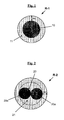
- FIG 1 appended represents very schematically (without respecting a specific scale), in cross section, a first example of a composite wire reinforcement according to the invention.
- This composite reinforcement denoted R-1 consists of a reinforcing thread (10) consisting of a unitary filament or monofilament of relatively high diameter (for example between 0.10 and 0.50 mm), for example made of carbon steel.
- polyester, Nylon® or aramid which is coated with a layer (11) of natural rubber-based coating gum, carbon black as a reinforcing filler, graphite as a filler and a vulcanization system; its minimum thickness is noted E m on the figure 1 .
- the figure 2 schematizes in cross section a second example of a composite wire reinforcement according to the invention.
- This composite reinforcement R-2 is constituted by a reinforcing thread (20) consisting for example of two monofilaments (20a, 20b) of carbon steel cabled together, or two multifilament textile fibers (20a, 20b) twisted together for example polyester, Nylon® or aramid; the reinforcement yarn (20) is covered with a layer (21) of natural rubber-based coating gum and an SBR copolymer whose Tg is between -30 ° C and + 30 ° C, of black carbon and silica as a reinforcing filler, talc as a filler and a vulcanization system; its minimum thickness is noted E m on the figure 2 .
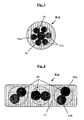
- This reinforcement R-3 comprises a reinforcing thread (30) here consisting of a 1 + 6 steel wire rope, with a core wire or core wire (31a) and six filaments (31b) of the same diameter wound together in a helix around the central wire.
- This reinforcing wire or wire (30) is covered with a layer (32) of natural rubber-based coating gum, silica as a reinforcing filler, mica as a lamellar filler, and a coating system. vulcanization.
- Examples of composite wire reinforcements according to the invention of these Figures 1 to 3 can be prepared in a manner well known per se, for example by passing the reinforcing wire through a die of suitable diameter, in an extrusion head heated to a suitable temperature, which delivers the necessary amount of gum coating.
- FIG 4 schematically in cross section another example according to the invention, this time in the form of a reinforced rubber strip, wherein a group of several son (here, three son for simplification) of reinforcement are collectively embedded in a rubber gum coating provided in a known manner for example by a calendering operation.
- a group of several son here, three son for simplification
- This composite reinforcement denoted R-4 consists of three reinforcing threads (40) each consisting of multifilament textile strands (40a, 40b) twisted together, for example Nylon®, polyester or aramid, or metal ropes (40) made up each of two carbon steel monofilaments (40a, 40b); the assembly constituted by the three aligned reinforcing threads (40) is embedded in a layer (41) of natural rubber-based coating gum and an SBR copolymer whose Tg is between -30 ° C and + 30 ° C, carbon black as a reinforcing filler, graphite as a filler and a vulcanization system.
- SBR copolymer whose Tg is between -30 ° C and + 30 ° C, carbon black as a reinforcing filler, graphite as a filler and a vulcanization system.
- the composite wire reinforcement of the invention described above can especially be used for the manufacture of any finished article or semi-finished product made of rubber, in particular for the reinforcement of pneumatic tires of all types of vehicles, in particular passenger vehicles or industrial vehicles such as than Heavyweight.
- this wire reinforcement of the invention can be in various forms, in a unitary form (with a single reinforcing wire) or in the form of a sheet, strip, strip or block of rubber in which are incorporated, for example by calendering, several textile reinforcement son (s) and / or metal (s).
- the final adhesion between the metal or the textile and the coating gum can be obtained after firing, preferably under pressure, the finished article which is intended for the wire reinforcement of the invention.
- the figure 5 annexed very schematically shows a radial section of a radial carcass reinforcement tire 1 according to the invention, intended for example for a heavy-duty vehicle or a passenger vehicle in this general representation.
- This tire 1 comprises a crown 2, two sidewalls 3, two beads 4, a carcass reinforcement 7 extending from one bead to the other.
- the top 2 surmounted by a tread (not shown in this schematic figure, for simplification), is in a manner known per se reinforced by a crown reinforcement 6 constituted for example by at least two superimposed crossed vertex plies (plies so-called "working" top), for example covered with at least one protective ply or with a zero degree hooping ply.
- the carcass reinforcement 7 is wrapped around the two rods 5 in each bead 4, the reversal 8 of this armature 7 being for example disposed towards the outside of the tire 1 which is shown here mounted on its rim 9.
- the carcass reinforcement 7 consists of at least one ply reinforced by so-called "radial” cables, that is, these cables are arranged substantially parallel to each other and extend from one bead to the other so as to form an angle of between 80 ° and 90 ° with the median circumferential plane (plane perpendicular to the axis of rotation of the tire which is located midway between the two beads 4 and passes through the middle of the crown reinforcement 6).
- this tire 1 also comprises, in a known manner, a rubber or elastomer layer 10, commonly known as a rubber or sealing layer, which defines the radially inner face of the tire and which is intended to protect the carcass ply from the diffusion air from the interior space to the tire.
- the tire according to the invention has the essential feature of comprising in its structure at least one composite wire reinforcement according to the invention.
- This wire reinforcement may form, for example, all or part of the carcass reinforcement 7, the armature 5 (rod) of the bead zone, or according to a particularly preferred embodiment of the crown reinforcement 6, whether it be as fretted top ply, protective top ply or as working top ply.
- the wire reinforcement constitutes, in the belt of the tire of the invention, a hooping sheet (in particular comprising textile cables) or a protective layer (comprising metal or textile cords), arranged circumferentially between the tread and the two working plies, whose coating gum, thanks to its water barrier properties, effectively protects against corrosion or wet aging the two working crown plies (including in particular cables metal) that this crown hoop or protection ply covers radially.
- a hooping sheet in particular comprising textile cables
- a protective layer comprising metal or textile cords
- the reinforcing filler carbon black
- the lamellar filler were introduced successively into an internal mixer, the initial batch temperature of which was approximately 60 ° C. (comprising graphite particles) for the compositions according to the invention, the diene elastomer, as well as the various other ingredients with the exception of the vulcanization system; the mixer was thus filled to about 70% (% by volume).
- thermomechanical work phase non-productive in one step of about 2 to 4 min, until reaching a maximum temperature of "fall" of 165 ° C.
- the mixture thus obtained was recovered, cooled, and sulfur and a sulfenamide type accelerator were incorporated on an external mixer (homo-finisher) at 30 ° C, mixing the whole (productive phase) for a few minutes.
- the composition thus obtained was then calendered in the form of plates (thickness equal to 1 mm) that can be used as coating gum in the wire reinforcements of the invention.
- compositions were compared with two control compositions (denoted respectively hereinafter C-1 and C-4) of the same formulation and prepared identically, but without lamellar filler.
- a "skim" layer of thickness equal to about 2 mm
- CR composition said receiving rubber
- 150 mm by 150 mm in size was sandwiched in a mold of appropriate dimensions between two layers (thickness of about 0.7 mm) of composites textile / rubber (whether or not conforming to the invention) consisting of a series (no laying of about 0.5 mm) of nylon textile twists (2 strands of 94 tex twisted together) embedded in a coating gum constituted by the "barrier" compositions to be tested (C-1 to C-6) of Table 1.
- the final assembly thus molded constituted a rubber block in the form of a parallelepiped of dimensions 150 mm by 150 mm and with a total thickness equal to 4 mm.
- the C-R composition used was a known rubber composition, conventionally used as a plywood crown calendering gum in a tire belt, based on natural rubber (peptized) and N326 carbon black (55 phr).
- Tables 2 and 3 express the water intake, that is to say the increase in the water content observed in the CR receiver composition, for the six barrier compositions tested in which the receptor composition was molded.
- a water intake of +1.6% expressed for example for the barrier composition C-1 after a treatment of 14 days means that the amount of water (% by weight of the receiving composition) present in the CR receptor composition has increased from 0.5% (initial state) to 2.1% (final state) after treatment.
- the barrier compositions C-2 and C-3 on the one hand, C-5 and C-6, on the other hand, can be used as coating gum in the wired reinforcements of the The invention has a water barrier property which is significantly improved over control compositions C-1 and C-4 without lamellar filler.
- the increase in the amount of water (parasite) collected in the CR composition after thermal and wet treatment is 40% to 50% lower compared to control compositions, respectively C-1 and C-4.
- the coating gum used in the composite wire reinforcement of the invention has significantly increased water barrier properties, giving for example to the belt of a tire a protection which is significantly improved against the risks of penetration d water through the tread.
Landscapes
- Chemical & Material Sciences (AREA)
- Health & Medical Sciences (AREA)
- Chemical Kinetics & Catalysis (AREA)
- Medicinal Chemistry (AREA)
- Polymers & Plastics (AREA)
- Organic Chemistry (AREA)
- Engineering & Computer Science (AREA)
- Mechanical Engineering (AREA)
- Textile Engineering (AREA)
- Compositions Of Macromolecular Compounds (AREA)
- Ropes Or Cables (AREA)
- Yarns And Mechanical Finishing Of Yarns Or Ropes (AREA)
Applications Claiming Priority (2)
| Application Number | Priority Date | Filing Date | Title |
|---|---|---|---|
| FR1054094A FR2960567B1 (fr) | 2010-05-27 | 2010-05-27 | Renfort filaire composite pour pneumatique, enrobe d'un caoutchouc a propriete de barriere a l'eau amelioree |
| PCT/EP2011/057921 WO2011147710A1 (fr) | 2010-05-27 | 2011-05-17 | Renfort filaire composite pour pneumatique, enrobe d'un caoutchouc a propriete de barriere a l'eau amelioree |
Publications (2)
| Publication Number | Publication Date |
|---|---|
| EP2576894A1 EP2576894A1 (fr) | 2013-04-10 |
| EP2576894B1 true EP2576894B1 (fr) | 2015-03-25 |
Family
ID=43085672
Family Applications (1)
| Application Number | Title | Priority Date | Filing Date |
|---|---|---|---|
| EP11719578.4A Not-in-force EP2576894B1 (fr) | 2010-05-27 | 2011-05-17 | Renfort filaire composite pour pneumatique, enrobe d'un caoutchouc a propriete de barriere a l'eau amelioree |
Country Status (6)
| Country | Link |
|---|---|
| US (1) | US20130146198A1 (enExample) |
| EP (1) | EP2576894B1 (enExample) |
| JP (1) | JP2013533927A (enExample) |
| CN (1) | CN102906328B (enExample) |
| FR (1) | FR2960567B1 (enExample) |
| WO (1) | WO2011147710A1 (enExample) |
Families Citing this family (14)
| Publication number | Priority date | Publication date | Assignee | Title |
|---|---|---|---|---|
| FR2997410B1 (fr) * | 2012-10-30 | 2016-01-01 | Michelin & Cie | Cable gomme in situ comprenant une composition comprenant un copolymere de styrene-butadiene. |
| RU2570447C2 (ru) * | 2013-10-29 | 2015-12-10 | Федеральное государственное бюджетное образовательное учреждение высшего профессионального образования Кабардино-Балкарский государственный университет им. Х.М. Бербекова (КБГУ) | Полимерная композиция на основе полиэтилентерефталата |
| CN104044973A (zh) * | 2014-05-23 | 2014-09-17 | 苏州市东沪电缆有限公司 | 扁形随行电梯平衡补偿链 |
| FR3027025B1 (fr) * | 2014-10-13 | 2016-12-09 | Michelin & Cie | Produit renforce comprenant une composition a faible taux de soufre et pneumatique comprenant ledit produit renforce |
| FR3027028B1 (fr) * | 2014-10-13 | 2016-12-09 | Michelin & Cie | Produit renforce comprenant une composition a faible taux de soufre et pneumatique comprenant ledit produit renforce |
| FR3027026B1 (fr) * | 2014-10-13 | 2016-12-09 | Michelin & Cie | Produit renforce comprenant une composition comprenant un accelerateur de vulcanisation rapide et pneumatique comprenant ledit produit renforce |
| FR3027027B1 (fr) * | 2014-10-13 | 2016-12-09 | Michelin & Cie | Produit renforce comprenant une composition comprenant un systeme oxyde metallique et derive d'acide stearique equilibre et pneumatique comprenant ledit produit renforce |
| FR3063081A1 (fr) | 2017-02-20 | 2018-08-24 | Compagnie Generale Des Etablissements Michelin | Composition de caoutchouc presentant des proprietes ameliorees a cru et a cuit |
| KR102739357B1 (ko) * | 2017-11-17 | 2024-12-05 | 주식회사 쿠라레 | 자전거 타이어용의 보강 부재 및 자전거 타이어 |
| CN111801220B (zh) * | 2017-12-22 | 2022-10-21 | 米其林集团总公司 | 生产丝状增强元件的方法 |
| WO2020128261A1 (fr) * | 2018-12-21 | 2020-06-25 | Compagnie Generale Des Etablissements Michelin | Produit renforce comprenant une composition comportant un compose polysulfuré |
| FR3090644A3 (fr) * | 2018-12-21 | 2020-06-26 | Michelin & Cie | Produit renforce comprenant une composition comportant un compose polysulfuré |
| CN113480860B (zh) * | 2021-07-22 | 2022-11-18 | 泰特耐特新材料科技有限公司 | 一种轮胎用钛酸盐片晶增强纤维材料及其制备方法 |
| US20240384466A1 (en) * | 2023-05-17 | 2024-11-21 | The Goodyear Tire & Rubber Company | Cobalt-free steel cord-rubber composite |
Family Cites Families (48)
| Publication number | Priority date | Publication date | Assignee | Title |
|---|---|---|---|---|
| NL299306A (enExample) * | 1963-10-14 | |||
| GB8305229D0 (en) * | 1983-02-25 | 1983-03-30 | Bekaert Sa Nv | Steel fibre reinforced rubber article |
| JPS61192598A (ja) * | 1985-02-22 | 1986-08-27 | Ube Ind Ltd | 平版印刷板用基材 |
| JPH0737630B2 (ja) * | 1989-02-10 | 1995-04-26 | 邦夫 森 | スチールワイヤの表面処理方法 |
| ES2248820T3 (es) | 1995-05-22 | 2006-03-16 | Cabot Corporation | Compuestos elastomericos que incorporan negros de humo tratados con silicio. |
| FR2740778A1 (fr) | 1995-11-07 | 1997-05-09 | Michelin & Cie | Composition de caoutchouc a base de silice et de polymere dienique fonctionalise ayant une fonction silanol terminale |
| DE69739057D1 (de) | 1996-04-01 | 2008-12-04 | Cabot Corp | Neue elastomere verbundwerkstoffe, verfahren und vorrichtung zur herstellung derselben |
| JPH1086604A (ja) * | 1996-09-13 | 1998-04-07 | Bridgestone Corp | 空気入りラジアルタイヤ |
| FR2765882B1 (fr) | 1997-07-11 | 1999-09-03 | Michelin & Cie | Composition de caoutchouc a base de noir de carbone ayant de la silice fixee a sa surface et de polymere dienique fonctionnalise alcoxysilane |
| ATE239737T1 (de) | 1997-08-21 | 2003-05-15 | Crompton Corp | Blockierte merkaptosilane als kupplungsmittel für gefüllte kautschukzusammensetzung |
| CN100473684C (zh) | 1997-09-30 | 2009-04-01 | 卡伯特公司 | 弹性体复合共混料及其制备方法 |
| BR9814910A (pt) | 1997-11-28 | 2000-10-03 | Michelin & Cie | Composição de borracha vulcanizável com enxofre, utilização da mesma, artigo de borracha, pneumático, e, banda de rodagem. |
| JP3172486B2 (ja) * | 1998-01-09 | 2001-06-04 | 黒沢建設株式会社 | Pc鋼より線の二重被膜形成方法、二重被膜pc鋼より線およびpc鋼より線の二重被膜形成装置 |
| JP2000079807A (ja) * | 1998-07-08 | 2000-03-21 | Bridgestone Corp | スチ―ルコ―ド補強空気入りタイヤ |
| DE60109224T2 (de) | 2000-02-24 | 2006-01-19 | Société de Technologie Michelin | Vulkanisierbare Kautschukmischung zur Herstellung eines Luftreifens und Luft- reifens und Luftreifen, der eine solche Zusammensetzung enthält. |
| CN1140570C (zh) | 2000-05-26 | 2004-03-03 | 米其林技术公司 | 可用作轮胎胎面的橡胶组合物 |
| JP2002013083A (ja) * | 2000-06-29 | 2002-01-18 | Bridgestone Corp | ゴム−スチールコード複合体 |
| US6598645B1 (en) * | 2000-09-27 | 2003-07-29 | The Goodyear Tire & Rubber Company | Tire with at least one of rubber/cord laminate, sidewall insert and apex of a rubber composition which contains oriented intercalated and/or exfoliated clay reinforcement |
| RU2272042C2 (ru) | 2000-10-13 | 2006-03-20 | Сосьете Де Текноложи Мишлен | Полифункциональный органосилан, пригодный для использования в качестве связующего агента, и способ его получения |
| CA2425330A1 (fr) | 2000-10-13 | 2002-04-18 | Jean-Claude Tardivat | Composition de caoutchouc comportant a titre d'agent de couplage un organosilane polyfonctionnel |
| FR2823215B1 (fr) | 2001-04-10 | 2005-04-08 | Michelin Soc Tech | Pneumatique et bande de roulement de pneumatique comportant a titre d'agent de couplage un tetrasulfure de bis-alkoxysilane |
| EP1258338A3 (en) * | 2001-05-15 | 2003-07-02 | Sumitomo Rubber Industries, Ltd. | Composite of steel cord and rubber composition and tire using the same |
| US20040194863A1 (en) | 2001-06-14 | 2004-10-07 | Grah Michael D. | Tire with improved inner liner |
| ATE465208T1 (de) | 2001-06-28 | 2010-05-15 | Michelin Soc Tech | Reifenlauffläche verstärkt durch kieselsäure mit niedriger spezifischer oberfläche |
| JP4536375B2 (ja) | 2001-06-28 | 2010-09-01 | ソシエテ ド テクノロジー ミシュラン | 極めて低い比表面積のシリカで強化されたタイヤトレッド |
| ES2252606T3 (es) | 2001-08-06 | 2006-05-16 | Degussa Ag | Compuestos de organosilicio. |
| WO2003066353A1 (en) * | 2002-02-04 | 2003-08-14 | Bridgestone Corporation | Belt for a pneumatic tire belt made of differente rubber compositions |
| JP2004137431A (ja) * | 2002-10-21 | 2004-05-13 | Sumitomo Rubber Ind Ltd | カーカスコード用ゴム組成物およびそれを用いた空気入りタイヤ |
| JP2004256015A (ja) * | 2003-02-26 | 2004-09-16 | Bridgestone Corp | 空気入りタイヤ |
| FR2854404B1 (fr) | 2003-04-29 | 2005-07-01 | Michelin Soc Tech | Procede d'obtention d'un elastomere greffe a groupes fonctionnels le long de la chaine et compositions de caoutchouc |
| JP2005113015A (ja) * | 2003-10-08 | 2005-04-28 | Sumitomo Rubber Ind Ltd | スチールコードコーティング用ゴム組成物およびその製造方法、ならびにこれを用いたスチールコード/ゴム複合体 |
| FR2870164B1 (fr) * | 2004-05-12 | 2006-07-14 | Michelin Soc Tech | Pneumatique et composite metal/caoutchouc pour pneumatique |
| US7928258B2 (en) | 2004-08-20 | 2011-04-19 | Momentive Performance Materials Inc. | Cyclic diol-derived blocked mercaptofunctional silane compositions |
| RU2369620C2 (ru) | 2004-10-22 | 2009-10-10 | Сосьете Де Текноложи Мишлен | Барьерный слой для эластомерных изделий |
| FR2880354B1 (fr) | 2004-12-31 | 2007-03-02 | Michelin Soc Tech | Composition elastomerique renforcee d'une charge de polyvinylaromatique fonctionnalise |
| FR2880349B1 (fr) | 2004-12-31 | 2009-03-06 | Michelin Soc Tech | Nanoparticules de polyvinylaromatique fonctionnalise |
| US20060229404A1 (en) * | 2005-04-07 | 2006-10-12 | Annette Lechtenboehmer | Pneumatic tire having a rubber component containing exfoliated graphite |
| FR2886306B1 (fr) | 2005-05-26 | 2007-07-06 | Michelin Soc Tech | Composition de caoutchouc pour pneumatique comportant un agent de couplage organosiloxane |
| FR2886304B1 (fr) | 2005-05-26 | 2007-08-10 | Michelin Soc Tech | Composition de caoutchouc pour pneumatique comportant un systeme de couplage organosilicique |
| FR2886305B1 (fr) | 2005-05-26 | 2007-08-10 | Michelin Soc Tech | Composition de caoutchouc pour pneumatique comportant un agent de couplage organosilicique et un agent de recouvrement de charge inorganique |
| US7658901B2 (en) * | 2005-10-14 | 2010-02-09 | The Trustees Of Princeton University | Thermally exfoliated graphite oxide |
| EP1948668A1 (en) | 2005-11-16 | 2008-07-30 | Dow Corning Corporation | Organosilanes and their preparation and use in elastomer compositions |
| JP5068017B2 (ja) * | 2005-12-02 | 2012-11-07 | 住友ゴム工業株式会社 | 空気入りラジアルタイヤ |
| JP4895602B2 (ja) * | 2005-12-22 | 2012-03-14 | 住友ゴム工業株式会社 | 水分保持層を有する空気入りタイヤ |
| US7510670B2 (en) | 2006-02-21 | 2009-03-31 | Momentive Performance Materials Inc. | Free flowing filler composition based on organofunctional silane |
| FR2903411B1 (fr) | 2006-07-06 | 2012-11-02 | Soc Tech Michelin | Nanoparticules de polymere vinylique fonctionnalise |
| FR2903416B1 (fr) | 2006-07-06 | 2008-09-05 | Michelin Soc Tech | Composition elastomerique renforcee d'une charge de polymere vinylique non aromatique fonctionnalise |
| FR2938791B1 (fr) * | 2008-11-27 | 2011-12-02 | Michelin Soc Tech | Bandage pneumatique dont le sommet est pourvu d'une couche barriere a eau |
-
2010
- 2010-05-27 FR FR1054094A patent/FR2960567B1/fr not_active Expired - Fee Related
-
2011
- 2011-05-17 EP EP11719578.4A patent/EP2576894B1/fr not_active Not-in-force
- 2011-05-17 US US13/700,012 patent/US20130146198A1/en not_active Abandoned
- 2011-05-17 JP JP2013511607A patent/JP2013533927A/ja active Pending
- 2011-05-17 CN CN201180025852.0A patent/CN102906328B/zh not_active Expired - Fee Related
- 2011-05-17 WO PCT/EP2011/057921 patent/WO2011147710A1/fr not_active Ceased
Also Published As
| Publication number | Publication date |
|---|---|
| EP2576894A1 (fr) | 2013-04-10 |
| US20130146198A1 (en) | 2013-06-13 |
| FR2960567A1 (fr) | 2011-12-02 |
| CN102906328B (zh) | 2015-03-18 |
| JP2013533927A (ja) | 2013-08-29 |
| CN102906328A (zh) | 2013-01-30 |
| FR2960567B1 (fr) | 2012-06-22 |
| WO2011147710A1 (fr) | 2011-12-01 |
Similar Documents
| Publication | Publication Date | Title |
|---|---|---|
| EP2576894A1 (fr) | Renfort filaire composite pour pneumatique, enrobe d'un caoutchouc a propriete de barriere a l'eau amelioree | |
| EP2370271B1 (fr) | Bandage pneumatique dont la zone sommet est pourvue d'une couche barriere a eau | |
| EP3206890B1 (fr) | Produit renforce comprenant une composition a faible taux de soufre et pneumatique comprenant ledit produit renforce | |
| EP3532304B1 (fr) | Composition de caoutchouc comprenant une charge renforcante specifique | |
| EP3206889B1 (fr) | Produit renforce comprenant une composition a faible taux de soufre et pneumatique comprenant ledit produit renforce | |
| EP3207080B1 (fr) | Produit renforce comprenant une composition comprenant un systeme oxyde metallique et derive d'acide stearique equilibre et pneumatique comprenant ledit produit renforce | |
| EP3532305B1 (fr) | Composition de caoutchouc comprenant une charge renforcante specifique | |
| EP3532306B1 (fr) | Composition de caoutchouc comprenant une charge renforcante specifique | |
| EP3206891B1 (fr) | Produit renforce comprenant une composition comprenant un accelerateur de vulcanisation rapide et pneumatique comprenant ledit produit renforce | |
| EP4313625B1 (fr) | Composite comprenant un élément de renfort métallique et une composition élastomérique comprenant une résine promotrice d'adhésion | |
| WO2022207997A1 (fr) | Composite comprenant un élément de renfort métallique et une composition élastomérique comprenant une résine promotrice d'adhésion | |
| WO2010149580A1 (fr) | Composition de caoutchouc pour pneumatique comportant un composé acétylacétonate | |
| EP3898788B1 (fr) | Produit renforce comprenant une composition comportant un compose polysulfuré | |
| WO2022207996A1 (fr) | Composite comprenant une composition élastomérique et un élément de renfort métallique | |
| WO2020128261A1 (fr) | Produit renforce comprenant une composition comportant un compose polysulfuré |
Legal Events
| Date | Code | Title | Description |
|---|---|---|---|
| PUAI | Public reference made under article 153(3) epc to a published international application that has entered the european phase |
Free format text: ORIGINAL CODE: 0009012 |
|
| 17P | Request for examination filed |
Effective date: 20130102 |
|
| AK | Designated contracting states |
Kind code of ref document: A1 Designated state(s): AL AT BE BG CH CY CZ DE DK EE ES FI FR GB GR HR HU IE IS IT LI LT LU LV MC MK MT NL NO PL PT RO RS SE SI SK SM TR |
|
| DAX | Request for extension of the european patent (deleted) | ||
| GRAP | Despatch of communication of intention to grant a patent |
Free format text: ORIGINAL CODE: EPIDOSNIGR1 |
|
| INTG | Intention to grant announced |
Effective date: 20141015 |
|
| GRAS | Grant fee paid |
Free format text: ORIGINAL CODE: EPIDOSNIGR3 |
|
| GRAA | (expected) grant |
Free format text: ORIGINAL CODE: 0009210 |
|
| AK | Designated contracting states |
Kind code of ref document: B1 Designated state(s): AL AT BE BG CH CY CZ DE DK EE ES FI FR GB GR HR HU IE IS IT LI LT LU LV MC MK MT NL NO PL PT RO RS SE SI SK SM TR |
|
| REG | Reference to a national code |
Ref country code: GB Ref legal event code: FG4D Free format text: NOT ENGLISH |
|
| REG | Reference to a national code |
Ref country code: CH Ref legal event code: EP |
|
| REG | Reference to a national code |
Ref country code: IE Ref legal event code: FG4D Free format text: LANGUAGE OF EP DOCUMENT: FRENCH |
|
| REG | Reference to a national code |
Ref country code: DE Ref legal event code: R096 Ref document number: 602011015022 Country of ref document: DE Effective date: 20150507 |
|
| REG | Reference to a national code |
Ref country code: AT Ref legal event code: REF Ref document number: 717966 Country of ref document: AT Kind code of ref document: T Effective date: 20150515 |
|
| REG | Reference to a national code |
Ref country code: FR Ref legal event code: PLFP Year of fee payment: 5 |
|
| PG25 | Lapsed in a contracting state [announced via postgrant information from national office to epo] |
Ref country code: SE Free format text: LAPSE BECAUSE OF FAILURE TO SUBMIT A TRANSLATION OF THE DESCRIPTION OR TO PAY THE FEE WITHIN THE PRESCRIBED TIME-LIMIT Effective date: 20150325 Ref country code: HR Free format text: LAPSE BECAUSE OF FAILURE TO SUBMIT A TRANSLATION OF THE DESCRIPTION OR TO PAY THE FEE WITHIN THE PRESCRIBED TIME-LIMIT Effective date: 20150325 Ref country code: LT Free format text: LAPSE BECAUSE OF FAILURE TO SUBMIT A TRANSLATION OF THE DESCRIPTION OR TO PAY THE FEE WITHIN THE PRESCRIBED TIME-LIMIT Effective date: 20150325 Ref country code: FI Free format text: LAPSE BECAUSE OF FAILURE TO SUBMIT A TRANSLATION OF THE DESCRIPTION OR TO PAY THE FEE WITHIN THE PRESCRIBED TIME-LIMIT Effective date: 20150325 |
|
| PGFP | Annual fee paid to national office [announced via postgrant information from national office to epo] |
Ref country code: DE Payment date: 20150521 Year of fee payment: 5 |
|
| REG | Reference to a national code |
Ref country code: AT Ref legal event code: MK05 Ref document number: 717966 Country of ref document: AT Kind code of ref document: T Effective date: 20150325 |
|
| REG | Reference to a national code |
Ref country code: LT Ref legal event code: MG4D |
|
| PG25 | Lapsed in a contracting state [announced via postgrant information from national office to epo] |
Ref country code: RS Free format text: LAPSE BECAUSE OF FAILURE TO SUBMIT A TRANSLATION OF THE DESCRIPTION OR TO PAY THE FEE WITHIN THE PRESCRIBED TIME-LIMIT Effective date: 20150325 Ref country code: LV Free format text: LAPSE BECAUSE OF FAILURE TO SUBMIT A TRANSLATION OF THE DESCRIPTION OR TO PAY THE FEE WITHIN THE PRESCRIBED TIME-LIMIT Effective date: 20150325 Ref country code: GR Free format text: LAPSE BECAUSE OF FAILURE TO SUBMIT A TRANSLATION OF THE DESCRIPTION OR TO PAY THE FEE WITHIN THE PRESCRIBED TIME-LIMIT Effective date: 20150626 |
|
| PGFP | Annual fee paid to national office [announced via postgrant information from national office to epo] |
Ref country code: FR Payment date: 20150521 Year of fee payment: 5 |
|
| PG25 | Lapsed in a contracting state [announced via postgrant information from national office to epo] |
Ref country code: NL Free format text: LAPSE BECAUSE OF FAILURE TO SUBMIT A TRANSLATION OF THE DESCRIPTION OR TO PAY THE FEE WITHIN THE PRESCRIBED TIME-LIMIT Effective date: 20150325 |
|
| PG25 | Lapsed in a contracting state [announced via postgrant information from national office to epo] |
Ref country code: ES Free format text: LAPSE BECAUSE OF FAILURE TO SUBMIT A TRANSLATION OF THE DESCRIPTION OR TO PAY THE FEE WITHIN THE PRESCRIBED TIME-LIMIT Effective date: 20150325 Ref country code: CZ Free format text: LAPSE BECAUSE OF FAILURE TO SUBMIT A TRANSLATION OF THE DESCRIPTION OR TO PAY THE FEE WITHIN THE PRESCRIBED TIME-LIMIT Effective date: 20150325 Ref country code: EE Free format text: LAPSE BECAUSE OF FAILURE TO SUBMIT A TRANSLATION OF THE DESCRIPTION OR TO PAY THE FEE WITHIN THE PRESCRIBED TIME-LIMIT Effective date: 20150325 Ref country code: PT Free format text: LAPSE BECAUSE OF FAILURE TO SUBMIT A TRANSLATION OF THE DESCRIPTION OR TO PAY THE FEE WITHIN THE PRESCRIBED TIME-LIMIT Effective date: 20150727 Ref country code: RO Free format text: LAPSE BECAUSE OF FAILURE TO SUBMIT A TRANSLATION OF THE DESCRIPTION OR TO PAY THE FEE WITHIN THE PRESCRIBED TIME-LIMIT Effective date: 20150325 Ref country code: SK Free format text: LAPSE BECAUSE OF FAILURE TO SUBMIT A TRANSLATION OF THE DESCRIPTION OR TO PAY THE FEE WITHIN THE PRESCRIBED TIME-LIMIT Effective date: 20150325 |
|
| PG25 | Lapsed in a contracting state [announced via postgrant information from national office to epo] |
Ref country code: IS Free format text: LAPSE BECAUSE OF FAILURE TO SUBMIT A TRANSLATION OF THE DESCRIPTION OR TO PAY THE FEE WITHIN THE PRESCRIBED TIME-LIMIT Effective date: 20150725 Ref country code: AT Free format text: LAPSE BECAUSE OF FAILURE TO SUBMIT A TRANSLATION OF THE DESCRIPTION OR TO PAY THE FEE WITHIN THE PRESCRIBED TIME-LIMIT Effective date: 20150325 Ref country code: PL Free format text: LAPSE BECAUSE OF FAILURE TO SUBMIT A TRANSLATION OF THE DESCRIPTION OR TO PAY THE FEE WITHIN THE PRESCRIBED TIME-LIMIT Effective date: 20150325 |
|
| REG | Reference to a national code |
Ref country code: CH Ref legal event code: PL |
|
| REG | Reference to a national code |
Ref country code: DE Ref legal event code: R097 Ref document number: 602011015022 Country of ref document: DE |
|
| PG25 | Lapsed in a contracting state [announced via postgrant information from national office to epo] |
Ref country code: CH Free format text: LAPSE BECAUSE OF NON-PAYMENT OF DUE FEES Effective date: 20150531 Ref country code: LU Free format text: LAPSE BECAUSE OF FAILURE TO SUBMIT A TRANSLATION OF THE DESCRIPTION OR TO PAY THE FEE WITHIN THE PRESCRIBED TIME-LIMIT Effective date: 20150517 Ref country code: DK Free format text: LAPSE BECAUSE OF FAILURE TO SUBMIT A TRANSLATION OF THE DESCRIPTION OR TO PAY THE FEE WITHIN THE PRESCRIBED TIME-LIMIT Effective date: 20150325 Ref country code: LI Free format text: LAPSE BECAUSE OF NON-PAYMENT OF DUE FEES Effective date: 20150531 Ref country code: IT Free format text: LAPSE BECAUSE OF FAILURE TO SUBMIT A TRANSLATION OF THE DESCRIPTION OR TO PAY THE FEE WITHIN THE PRESCRIBED TIME-LIMIT Effective date: 20150325 Ref country code: MC Free format text: LAPSE BECAUSE OF FAILURE TO SUBMIT A TRANSLATION OF THE DESCRIPTION OR TO PAY THE FEE WITHIN THE PRESCRIBED TIME-LIMIT Effective date: 20150325 |
|
| PLBE | No opposition filed within time limit |
Free format text: ORIGINAL CODE: 0009261 |
|
| STAA | Information on the status of an ep patent application or granted ep patent |
Free format text: STATUS: NO OPPOSITION FILED WITHIN TIME LIMIT |
|
| GBPC | Gb: european patent ceased through non-payment of renewal fee |
Effective date: 20150625 |
|
| REG | Reference to a national code |
Ref country code: IE Ref legal event code: MM4A |
|
| 26N | No opposition filed |
Effective date: 20160105 |
|
| PG25 | Lapsed in a contracting state [announced via postgrant information from national office to epo] |
Ref country code: IE Free format text: LAPSE BECAUSE OF NON-PAYMENT OF DUE FEES Effective date: 20150517 Ref country code: GB Free format text: LAPSE BECAUSE OF NON-PAYMENT OF DUE FEES Effective date: 20150625 |
|
| PG25 | Lapsed in a contracting state [announced via postgrant information from national office to epo] |
Ref country code: SI Free format text: LAPSE BECAUSE OF FAILURE TO SUBMIT A TRANSLATION OF THE DESCRIPTION OR TO PAY THE FEE WITHIN THE PRESCRIBED TIME-LIMIT Effective date: 20150325 |
|
| REG | Reference to a national code |
Ref country code: DE Ref legal event code: R119 Ref document number: 602011015022 Country of ref document: DE |
|
| PG25 | Lapsed in a contracting state [announced via postgrant information from national office to epo] |
Ref country code: MT Free format text: LAPSE BECAUSE OF FAILURE TO SUBMIT A TRANSLATION OF THE DESCRIPTION OR TO PAY THE FEE WITHIN THE PRESCRIBED TIME-LIMIT Effective date: 20150325 |
|
| REG | Reference to a national code |
Ref country code: FR Ref legal event code: ST Effective date: 20170131 |
|
| PG25 | Lapsed in a contracting state [announced via postgrant information from national office to epo] |
Ref country code: FR Free format text: LAPSE BECAUSE OF NON-PAYMENT OF DUE FEES Effective date: 20160531 Ref country code: DE Free format text: LAPSE BECAUSE OF NON-PAYMENT OF DUE FEES Effective date: 20161201 |
|
| PG25 | Lapsed in a contracting state [announced via postgrant information from national office to epo] |
Ref country code: NO Free format text: LAPSE BECAUSE OF FAILURE TO SUBMIT A TRANSLATION OF THE DESCRIPTION OR TO PAY THE FEE WITHIN THE PRESCRIBED TIME-LIMIT Effective date: 20150625 Ref country code: BG Free format text: LAPSE BECAUSE OF FAILURE TO SUBMIT A TRANSLATION OF THE DESCRIPTION OR TO PAY THE FEE WITHIN THE PRESCRIBED TIME-LIMIT Effective date: 20150325 Ref country code: SM Free format text: LAPSE BECAUSE OF FAILURE TO SUBMIT A TRANSLATION OF THE DESCRIPTION OR TO PAY THE FEE WITHIN THE PRESCRIBED TIME-LIMIT Effective date: 20150325 Ref country code: HU Free format text: LAPSE BECAUSE OF FAILURE TO SUBMIT A TRANSLATION OF THE DESCRIPTION OR TO PAY THE FEE WITHIN THE PRESCRIBED TIME-LIMIT; INVALID AB INITIO Effective date: 20110517 |
|
| PG25 | Lapsed in a contracting state [announced via postgrant information from national office to epo] |
Ref country code: CY Free format text: LAPSE BECAUSE OF FAILURE TO SUBMIT A TRANSLATION OF THE DESCRIPTION OR TO PAY THE FEE WITHIN THE PRESCRIBED TIME-LIMIT Effective date: 20150325 |
|
| PG25 | Lapsed in a contracting state [announced via postgrant information from national office to epo] |
Ref country code: BE Free format text: LAPSE BECAUSE OF NON-PAYMENT OF DUE FEES Effective date: 20150531 |
|
| PG25 | Lapsed in a contracting state [announced via postgrant information from national office to epo] |
Ref country code: TR Free format text: LAPSE BECAUSE OF FAILURE TO SUBMIT A TRANSLATION OF THE DESCRIPTION OR TO PAY THE FEE WITHIN THE PRESCRIBED TIME-LIMIT Effective date: 20150325 |
|
| PG25 | Lapsed in a contracting state [announced via postgrant information from national office to epo] |
Ref country code: MK Free format text: LAPSE BECAUSE OF FAILURE TO SUBMIT A TRANSLATION OF THE DESCRIPTION OR TO PAY THE FEE WITHIN THE PRESCRIBED TIME-LIMIT Effective date: 20150325 |
|
| PG25 | Lapsed in a contracting state [announced via postgrant information from national office to epo] |
Ref country code: AL Free format text: LAPSE BECAUSE OF FAILURE TO SUBMIT A TRANSLATION OF THE DESCRIPTION OR TO PAY THE FEE WITHIN THE PRESCRIBED TIME-LIMIT Effective date: 20150325 |