EP2575463B1 - Agents inducteurs d'apoptose pour le traitement du cancer et de maladies immunitaires et auto-immunes - Google Patents
Agents inducteurs d'apoptose pour le traitement du cancer et de maladies immunitaires et auto-immunes Download PDFInfo
- Publication number
- EP2575463B1 EP2575463B1 EP11787299.4A EP11787299A EP2575463B1 EP 2575463 B1 EP2575463 B1 EP 2575463B1 EP 11787299 A EP11787299 A EP 11787299A EP 2575463 B1 EP2575463 B1 EP 2575463B1
- Authority
- EP
- European Patent Office
- Prior art keywords
- nhr
- cancer
- formula
- compounds
- nhc
- Prior art date
- Legal status (The legal status is an assumption and is not a legal conclusion. Google has not performed a legal analysis and makes no representation as to the accuracy of the status listed.)
- Active
Links
- 0 CBC(C(*C)=C(*C)C(S(Cl)(=O)=O)=C(*C)I)=I Chemical compound CBC(C(*C)=C(*C)C(S(Cl)(=O)=O)=C(*C)I)=I 0.000 description 3
Classifications
-
- C—CHEMISTRY; METALLURGY
- C07—ORGANIC CHEMISTRY
- C07D—HETEROCYCLIC COMPOUNDS
- C07D471/00—Heterocyclic compounds containing nitrogen atoms as the only ring hetero atoms in the condensed system, at least one ring being a six-membered ring with one nitrogen atom, not provided for by groups C07D451/00 - C07D463/00
- C07D471/02—Heterocyclic compounds containing nitrogen atoms as the only ring hetero atoms in the condensed system, at least one ring being a six-membered ring with one nitrogen atom, not provided for by groups C07D451/00 - C07D463/00 in which the condensed system contains two hetero rings
- C07D471/04—Ortho-condensed systems
-
- A—HUMAN NECESSITIES
- A01—AGRICULTURE; FORESTRY; ANIMAL HUSBANDRY; HUNTING; TRAPPING; FISHING
- A01N—PRESERVATION OF BODIES OF HUMANS OR ANIMALS OR PLANTS OR PARTS THEREOF; BIOCIDES, e.g. AS DISINFECTANTS, AS PESTICIDES OR AS HERBICIDES; PEST REPELLANTS OR ATTRACTANTS; PLANT GROWTH REGULATORS
- A01N43/00—Biocides, pest repellants or attractants, or plant growth regulators containing heterocyclic compounds
- A01N43/34—Biocides, pest repellants or attractants, or plant growth regulators containing heterocyclic compounds having rings with one nitrogen atom as the only ring hetero atom
- A01N43/36—Biocides, pest repellants or attractants, or plant growth regulators containing heterocyclic compounds having rings with one nitrogen atom as the only ring hetero atom five-membered rings
- A01N43/38—Biocides, pest repellants or attractants, or plant growth regulators containing heterocyclic compounds having rings with one nitrogen atom as the only ring hetero atom five-membered rings condensed with carbocyclic rings
-
- A—HUMAN NECESSITIES
- A01—AGRICULTURE; FORESTRY; ANIMAL HUSBANDRY; HUNTING; TRAPPING; FISHING
- A01N—PRESERVATION OF BODIES OF HUMANS OR ANIMALS OR PLANTS OR PARTS THEREOF; BIOCIDES, e.g. AS DISINFECTANTS, AS PESTICIDES OR AS HERBICIDES; PEST REPELLANTS OR ATTRACTANTS; PLANT GROWTH REGULATORS
- A01N43/00—Biocides, pest repellants or attractants, or plant growth regulators containing heterocyclic compounds
- A01N43/34—Biocides, pest repellants or attractants, or plant growth regulators containing heterocyclic compounds having rings with one nitrogen atom as the only ring hetero atom
- A01N43/40—Biocides, pest repellants or attractants, or plant growth regulators containing heterocyclic compounds having rings with one nitrogen atom as the only ring hetero atom six-membered rings
-
- A—HUMAN NECESSITIES
- A01—AGRICULTURE; FORESTRY; ANIMAL HUSBANDRY; HUNTING; TRAPPING; FISHING
- A01N—PRESERVATION OF BODIES OF HUMANS OR ANIMALS OR PLANTS OR PARTS THEREOF; BIOCIDES, e.g. AS DISINFECTANTS, AS PESTICIDES OR AS HERBICIDES; PEST REPELLANTS OR ATTRACTANTS; PLANT GROWTH REGULATORS
- A01N43/00—Biocides, pest repellants or attractants, or plant growth regulators containing heterocyclic compounds
- A01N43/34—Biocides, pest repellants or attractants, or plant growth regulators containing heterocyclic compounds having rings with one nitrogen atom as the only ring hetero atom
- A01N43/40—Biocides, pest repellants or attractants, or plant growth regulators containing heterocyclic compounds having rings with one nitrogen atom as the only ring hetero atom six-membered rings
- A01N43/42—Biocides, pest repellants or attractants, or plant growth regulators containing heterocyclic compounds having rings with one nitrogen atom as the only ring hetero atom six-membered rings condensed with carbocyclic rings
-
- A—HUMAN NECESSITIES
- A61—MEDICAL OR VETERINARY SCIENCE; HYGIENE
- A61K—PREPARATIONS FOR MEDICAL, DENTAL OR TOILETRY PURPOSES
- A61K31/00—Medicinal preparations containing organic active ingredients
- A61K31/16—Amides, e.g. hydroxamic acids
- A61K31/18—Sulfonamides
-
- A—HUMAN NECESSITIES
- A61—MEDICAL OR VETERINARY SCIENCE; HYGIENE
- A61K—PREPARATIONS FOR MEDICAL, DENTAL OR TOILETRY PURPOSES
- A61K31/00—Medicinal preparations containing organic active ingredients
- A61K31/33—Heterocyclic compounds
- A61K31/395—Heterocyclic compounds having nitrogen as a ring hetero atom, e.g. guanethidine or rifamycins
- A61K31/435—Heterocyclic compounds having nitrogen as a ring hetero atom, e.g. guanethidine or rifamycins having six-membered rings with one nitrogen as the only ring hetero atom
- A61K31/4353—Heterocyclic compounds having nitrogen as a ring hetero atom, e.g. guanethidine or rifamycins having six-membered rings with one nitrogen as the only ring hetero atom ortho- or peri-condensed with heterocyclic ring systems
- A61K31/437—Heterocyclic compounds having nitrogen as a ring hetero atom, e.g. guanethidine or rifamycins having six-membered rings with one nitrogen as the only ring hetero atom ortho- or peri-condensed with heterocyclic ring systems the heterocyclic ring system containing a five-membered ring having nitrogen as a ring hetero atom, e.g. indolizine, beta-carboline
-
- A—HUMAN NECESSITIES
- A61—MEDICAL OR VETERINARY SCIENCE; HYGIENE
- A61K—PREPARATIONS FOR MEDICAL, DENTAL OR TOILETRY PURPOSES
- A61K31/00—Medicinal preparations containing organic active ingredients
- A61K31/33—Heterocyclic compounds
- A61K31/395—Heterocyclic compounds having nitrogen as a ring hetero atom, e.g. guanethidine or rifamycins
- A61K31/435—Heterocyclic compounds having nitrogen as a ring hetero atom, e.g. guanethidine or rifamycins having six-membered rings with one nitrogen as the only ring hetero atom
- A61K31/44—Non condensed pyridines; Hydrogenated derivatives thereof
-
- A—HUMAN NECESSITIES
- A61—MEDICAL OR VETERINARY SCIENCE; HYGIENE
- A61K—PREPARATIONS FOR MEDICAL, DENTAL OR TOILETRY PURPOSES
- A61K31/00—Medicinal preparations containing organic active ingredients
- A61K31/33—Heterocyclic compounds
- A61K31/395—Heterocyclic compounds having nitrogen as a ring hetero atom, e.g. guanethidine or rifamycins
- A61K31/495—Heterocyclic compounds having nitrogen as a ring hetero atom, e.g. guanethidine or rifamycins having six-membered rings with two or more nitrogen atoms as the only ring heteroatoms, e.g. piperazine or tetrazines
- A61K31/496—Non-condensed piperazines containing further heterocyclic rings, e.g. rifampin, thiothixene or sparfloxacin
-
- A—HUMAN NECESSITIES
- A61—MEDICAL OR VETERINARY SCIENCE; HYGIENE
- A61P—SPECIFIC THERAPEUTIC ACTIVITY OF CHEMICAL COMPOUNDS OR MEDICINAL PREPARATIONS
- A61P35/00—Antineoplastic agents
-
- C—CHEMISTRY; METALLURGY
- C07—ORGANIC CHEMISTRY
- C07F—ACYCLIC, CARBOCYCLIC OR HETEROCYCLIC COMPOUNDS CONTAINING ELEMENTS OTHER THAN CARBON, HYDROGEN, HALOGEN, OXYGEN, NITROGEN, SULFUR, SELENIUM OR TELLURIUM
- C07F9/00—Compounds containing elements of Groups 5 or 15 of the Periodic Table
- C07F9/02—Phosphorus compounds
- C07F9/547—Heterocyclic compounds, e.g. containing phosphorus as a ring hetero atom
- C07F9/6561—Heterocyclic compounds, e.g. containing phosphorus as a ring hetero atom containing systems of two or more relevant hetero rings condensed among themselves or condensed with a common carbocyclic ring or ring system, with or without other non-condensed hetero rings
- C07F9/65616—Heterocyclic compounds, e.g. containing phosphorus as a ring hetero atom containing systems of two or more relevant hetero rings condensed among themselves or condensed with a common carbocyclic ring or ring system, with or without other non-condensed hetero rings containing the ring system having three or more than three double bonds between ring members or between ring members and non-ring members, e.g. purine or analogs
-
- Y—GENERAL TAGGING OF NEW TECHNOLOGICAL DEVELOPMENTS; GENERAL TAGGING OF CROSS-SECTIONAL TECHNOLOGIES SPANNING OVER SEVERAL SECTIONS OF THE IPC; TECHNICAL SUBJECTS COVERED BY FORMER USPC CROSS-REFERENCE ART COLLECTIONS [XRACs] AND DIGESTS
- Y02—TECHNOLOGIES OR APPLICATIONS FOR MITIGATION OR ADAPTATION AGAINST CLIMATE CHANGE
- Y02A—TECHNOLOGIES FOR ADAPTATION TO CLIMATE CHANGE
- Y02A50/00—TECHNOLOGIES FOR ADAPTATION TO CLIMATE CHANGE in human health protection, e.g. against extreme weather
- Y02A50/30—Against vector-borne diseases, e.g. mosquito-borne, fly-borne, tick-borne or waterborne diseases whose impact is exacerbated by climate change
Definitions
- This invention pertains to water soluble compounds which inhibit the activity of Bcl-2 anti-apoptotic proteins, compositions containing the compounds, and such compounds for use in methods of treating diseases during which anti-apoptotic Bcl-2 proteins are expressed.
- Anti-apoptotic Bcl-2 proteins are associated with a number of diseases. There is therefore an existing need in the therapeutic arts for compounds which inhibit the activity of anti-apoptotic Bcl-2 proteins.
- Bcl-2 proteins correlates with resistance to chemotherapy, clinical outcome, disease progression, overall prognosis or a combination thereof in various cancers and disorders of the immune system.
- Bcl-2 proteins in bladder cancer brain cancer, breast cancer, bone marrow cancer, cervical cancer, chronic lymphocytic leukemia, colorectal cancer, esophageal cancer, hepatocellular cancer, lymphoblastic leukemia, follicular lymphoma, lymphoid malignancies of T-cell or B-cell origin, melanoma, myelogenous leukemia, myeloma, oral cancer, ovarian cancer, non-small cell lung cancer, prostate cancer, small cell lung cancer, spleen cancer, and the like is described in commonly-owned PCT US 2004/36770 , published as WO 2005/049593 , and PCT US 2004/37911 , published as WO 2005/024636 .
- the principal embodiment of this invention pertains to compounds or therapeutically acceptable salts, which are useful as selective inhibitors of one or more than one anti-apoptotic protein family member, the compounds having Formula (IIIa) or a therapeutically acceptable salt thereof, wherein
- Another embodiment pertains to a composition for treating bladder cancer, brain cancer, breast cancer, bone marrow cancer, cervical cancer, chronic lymphocytic leukemia, colorectal cancer, esophageal cancer, hepatocellular cancer, lymphoblastic leukemia, follicular lymphoma, lymphoid malignancies of T-cell or B-cell origin, melanoma, myelogenous leukemia, myeloma, oral cancer, ovarian cancer, non-small cell lung cancer, chronic lymphocytic leukemia, myeloma, prostate cancer, small cell lung cancer or spleen cancer, said composition comprising an excipient and a therapeutically effective amount of any of the above compounds.
- Another embodiment pertains to any of the above compounds for use in a method of treating bladder cancer, brain cancer, breast cancer, bone marrow cancer, cervical cancer, chronic lymphocytic leukemia, colorectal cancer, esophageal cancer, hepatocellular cancer, lymphoblastic leukemia, follicular lymphoma, lymphoid malignancies of T-cell or B-cell origin, melanoma, myelogenous leukemia, myeloma, oral cancer, ovarian cancer, non-small cell lung cancer, chronic lymphocytic leukemia, myeloma, prostate cancer, small cell lung cancer or spleen cancer in a patient, said method comprising administering to the patient a therapeutically effective amount of any of the above compounds.
- Another embodiment pertains to any of the above compounds for use in a method of treating bladder cancer, brain cancer, breast cancer, bone marrow cancer, cervical cancer, chronic lymphocytic leukemia, colorectal cancer, esophageal cancer, hepatocellular cancer, lymphoblastic leukemia, follicular lymphoma, lymphoid malignancies of T-cell or B-cell origin, melanoma, myelogenous leukemia, myeloma, oral cancer, ovarian cancer, non-small cell lung cancer, chronic lymphocytic leukemia, myeloma, prostate cancer, small cell lung cancer or spleen cancer in a patient, said method comprising administering to the patient therapeutically effective amount of any of the above compounds and a therapeutically effective amount of one additional therapeutic agent or more than one additional therapeutic agent.
- Variable moieties herein are represented by identifiers (capital letters with numerical and/or alphabetical superscripts) and may be specifically embodied.
- variable moiety herein may be the same or different as another specific embodiment having the same identifier.
- alkenyl as used herein, means a straight or branched hydrocarbon chain containing from 2 to 10 carbons and containing at least ne carbon-carbon double bond.
- C x -C y alkyl means a straight or branched hydrocarbon chain containing at least one carbon-carbon double bond containing x to y carbon atoms.
- C 3 -C 6 alkenyl means an alkenyl group containing 3-6 carbon atoms.
- alkenyl include, but are not limited to, buta-2,3-dienyl, ethenyl, 2-propenyl, 2-methyl-2-propenyl, 3-butenyl, 4-pentenyl, 5-hexenyl, 2-heptenyl, 2-methyl-1-heptenyl, and 3-decenyl.
- alkenylene means a divalent group derived from a straight or branched chain hydrocarbon of 2 to 4 carbon atoms and contains at least one carbon-carbon double bond.
- C x -C y alkylene means a divalent group derived from a straight or branched hydrocarbon chain containing at least one carbon-carbon double bond and containing x to y carbon atoms.
- alkyl as used herein, means a straight or branched, saturated hydrocarbon chain containing from 1 to 10 carbon atoms.
- C x -C y alkyl means a straight or branched chain, saturated hydrocarbon containing x to y carbon atoms.
- C 1 -C 6 alkyl means a straight or branched chain, saturated hydrocarbon containing 2 to 6 carbon atoms.
- alkyl include, but are not limited to, methyl, ethyl, n-propyl, iso-propyl, n-butyl, sec-butyl, iso-butyl, tert-butyl, n-pentyl, isopentyl, neopentyl, n-hexyl, 3-methylhexyl, 2,2-dimethylpentyl, 2,3-dimethylpentyl, n-heptyl, n-octyl, n-nonyl, and n-decyl.
- alkylene means a divalent group derived from a straight or branched, saturated hydrocarbon chain of 1 to 10 carbon atoms, for example, of 1 to 4 carbon atoms.
- C x -C y alkylene means a divalent group derived from a straight or branched chain, saturated hydrocarbon containing x to y carbon atoms.
- C 2 -C 6 alkylene means a straight or branched chain, saturated hydrocarbon containing 2 to 6 carbon atoms.
- alkylene examples include, but are not limited to, -CH 2 -, -CH 2 CH 2 -, -CH 2 CH 2 CH 2 -, -CH 2 CH 2 CH 2 CH 2 -, and -CH 2 CH(CH 3 )CH 2 -.
- alkynyl as used herein, means a straight or branched chain hydrocarbon group containing from 2 to 10 carbon atoms and containing at least one carbon-carbon triple bond.
- C x -C y alkynyl means a straight or branched chain hydrocarbon group containing from x to y carbon atoms.
- C 3 -C 6 alkynyl means a straight or branched chain hydrocarbon group containing from 3 to 6 carbon atoms and containing at least one carbon-carbon triple bond.
- Representative examples of alkynyl include, but are not limited to, acetylenyl, 1-propynyl, 2-propynyl, 3-butynyl, 2-pentynyl, and 1-butynyl.
- alkynylene means a divalent radical derived from a straight or branched chain hydrocarbon group containing from 2 to 10 carbon atoms and containing at least one carbon-carbon triple bond.
- aryl as used herein, means phenyl.
- cyclic moiety means benzene, phenyl, phenylene, cycloalkane, cycloalkyl, cycloalkylene, cycloalkene, cycloalkenyl, cycloalkenylene, cycloalkyne, cycloalkynyl, cycloalkynylene, heteroarene, heteroaryl, heterocycloalkane, heterocycloalkyl, heterocycloalkene, heterocycloalkenyl and spiroalkyl.
- cycloalkylene or cycloalkyl or “cycloalkane” as used herein, means a monocyclic or bridged hydrocarbon ring system.
- the monocyclic cycloalkyl is a carbocyclic ring system containing three to ten carbon atoms, zero heteroatoms and zero double bonds. Examples of monocyclic ring systems include cyclopropyl, cyclobutyl, cyclopentyl, cyclohexyl, cycloheptyl, and cyclooctyl.
- the monocyclic ring may contain one or two alkylene bridges, each consisting of one, two, or three carbon atoms, each linking two non-adjacent carbon atoms of the ring system.
- bridged cycloalkyl ring systems include, but are not limited to, bicyclo[3.1.1]heptane, bicyclo[2.2.1]heptane, bicyclo[2.2.2]octane, bicyclo[3.2.1]octane, bicyclo[3.2.2]nonane, bicyclo[3.3.1]nonane, bicyclo[4.2.1]nonane, tricyclo[3.3.1.0 3,7 ]nonane (octahydro-2,5-methanopentalene or noradamantane), and tricyclo[3.3.1.1 3,7 ]decane (adamantane).
- the monocyclic and bridged cycloalkyl can be attached to the parent molecular moiety through any substitutable atom contained within the ring system.
- cycloalkenylene or "cycloalkenyl” or “cycloalkene” as used herein, means a monocyclic or a bridged hydrocarbon ring system.
- the monocyclic cycloalkenyl has four to ten carbon atoms and zero heteroatoms.
- the four-membered ring systems have one double bond, the five-or six-membered ring systems have one or two double bonds, the seven- or eight-membered ring systems have one, two, or three double bonds, and the nine- or ten-membered rings have one, two, three, or four double bonds.
- monocyclic cycloalkenyl groups include, but are not limited to, cyclobutenyl, cyclopentenyl, cyclohexenyl, cycloheptenyl, and cyclooctenyl.
- the monocyclic cycloalkenyl ring may contain one or two alkylene bridges, each consisting of one, two, or three carbon atoms, each linking two non-adjacent carbon atoms of the ring system.
- bridged cycloalkenyl groups include, but are not limited to, bicyclo[2.2.1]hept-2-ene, 4,5,6,7-tetrahydro-3aH-indene, octahydronaphthalenyl, and 1,6-dihydro-pentalene.
- the monocyclic and bridged cycloalkenyl can be attached to the parent molecular moiety through any substitutable atom contained within the ring systems.
- cycloalkyne or "cycloalkynyl,” or “cycloalkynylene,” as used herein, means a monocyclic or a bridged hydrocarbon ring system.
- the monocyclic cycloalkynyl has eight or more carbon atoms, zero heteroatoms, and one or more triple bonds.
- the monocyclic cycloalkynyl ring may contain one or two alkylene bridges, each consisting of one, two, or three carbon atoms, each linking two non-adjacent carbon atoms of the ring system.
- the monocyclic and bridged cycloalkynyl can be attached to the parent molecular moiety through any substitutable atom contained within the ring systems.
- heteroaryl or “heteroarylene,” as used herein, means a five-membered or six-membered aromatic ring having at least one carbon atom and one or more than one independently selected nitrogen, oxygen or sulfur atom.
- the heteroarenes of this disclosure are connected through any adjacent atoms in the ring, provided that proper valences are maintained.
- heteroaryl include, but are not limited to, furanyl (including, but not limited thereto, furan-2-yl), imidazolyl (including, but not limited thereto, 1H-imidazol-1-yl), isoxazolyl, isothiazolyl, oxadiazolyl, 1,3-oxazolyl, pyridinyl (e.g.
- pyridin-4-yl pyridin-2-yl, pyridin-3-yl
- pyridazinyl pyrimidinyl
- pyrazinyl pyrazolyl
- pyrrolyl tetrazolyl
- thiadiazolyl 1,3-thiazolyl
- thienyl including, but not limited thereto, thien-2-yl, thien-3-yl
- triazolyl including, but not limited thereto, thien-2-yl, thien-3-yl
- triazolyl triazinyl.
- heterocycloalkane or “heterocycloalkyl,” or “heterocycloalkylene,” as used herein, means monocyclic or bridged three-, four-, five-, six-, seven-, or eight-membered ring containing at least one heteroatom independently selected from the group consisting of O, N, and S and zero double bonds.
- the monocyclic and bridged heterocycloalkane are connected to the parent molecular moiety through any substitutable carbon atom or any substitutable nitrogen atom contained within the rings.
- the nitrogen and sulfur heteroatoms in the heterocycle rings may optionally be oxidized and the nitrogen atoms may optionally be quarternized.
- heterocycloalkane groups include, but are not limited to, 8-azabicyclo[3.2.1]octane, 3-azabicyclo[3.2.2]nonane, morpholinyl, tetrahydropyranyl, pyrrolidinyl, piperidinyl, dioxolanyl, tetrahydrofuranyl, thiomorpholinyl, 1,4-dioxanyl, tetrahydrothienyl, tetrahydrothiopyranyl, oxetanyl, piperazinyl, imidazolidinyl, azetidine, azepanyl, aziridinyl, diazepanyl, dithiolanyl, dithianyl, isoxazolidinyl, isothiazolidinyl, oxadiazolidinyl, oxazolidinyl, pyrazolidinyl, tetrahydrothienyl, thi
- heterocycloalkene or “heterocycloalkenyl,” or “heterocycloalkenylene,” as used herein, means monocyclic or bridged three-, four-, five-, six-, seven-, or eight-membered ring containing at least one heteroatom independently selected from the group consisting of O, N, and S and one or more double bonds.
- the monocyclic and bridged heterocycloalkene are connected to the parent molecular moiety through any substitutable carbon atom or any substitutable nitrogen atom contained within the rings.
- the nitrogen and sulfur heteroatoms in the heterocycle rings may optionally be oxidized and the nitrogen atoms may optionally be quarternized.
- heterocycloalkene groups include, but are not limited to, 1,4,5,6-tetrahydropyridazinyl, 1,2,3,6-tetrahydropyridinyl, dihydropyranyl, imidazolinyl, isothiazolinyl, oxadiazolinyl, isoxazolinyl, oxazolinyl, pyranyl, pyrazolinyl, pyrrolinyl, thiadiazolinyl, thiazolinyl, and thiopyranyl.
- phenylene as used herein, means a divalent radical formed by removal of a hydrogen atom from phenyl.
- spiroalkyl means alkylene, both ends of which are attached to the same carbon atom and is exemplified by C 2 -spiroalkyl, C 3 -spiroalkyl, C 4 -spiroalkyl, C 5 -spiroalkyl, C 6 -spiroalkyl, C 7 -spiroalkyl, C 8 -spiroalkyl, C 9 -spiroalkyl and the like.
- spiroheteroalkyl means spiroalkyl having one or two CH 2 moieties replaced with independently selected O, C(O), CNOH, CNOCH 3 , S, S(O), SO 2 or NH and one or two CH moieties unreplaced or replaced with N.
- spiroheteroalkenyl means spiroalkenyl having one or two CH 2 moieties replaced with independently selected O, C(O), CNOH, CNOCH 3 , S, S(O), SO 2 or NH and one or two CH moieties unreplaced or replaced with N and also means spiroalkenyl having one or two CH 2 moieties unreplaced or replaced with independently selected O, C(O), CNOH, CNOCH 3 , S, S(O), SO 2 or NH and one or two CH moieties replaced with N.
- spirocyclo means two substituents on the same carbon atom, that, together with the carbon atom to which they are attached, form a cycloalkane, heterocycloalkane, cycloalkene, or heterocycloalkene ring.
- C 2 -C 5 -spiroalkyl means C 2 -spiroalkyl, C 3 -spiroalkyl, C 4 -spiroalkyl, and C 5 -spiroalkyl.
- C 2 -spiroalkyl means eth-1,2-ylene, both ends of which replace hydrogen atoms of the same CH 2 moiety.
- C 3 -spiroalkyl means prop-1,3-ylene, both ends of which replace hydrogen atoms of the same CH 2 moiety.
- C 4 -spiroalkyl means but-1,4-ylene, both ends of which replace hydrogen atoms of the same CH 2 moiety.
- C 5 -spiroalkyl means pent-1,5-ylene, both ends of which replace hydrogen atoms of the same CH 2 moiety.
- C 6 -spiroalkyl as used herein, means hex-1,6-ylene, both ends of which replace hydrogen atoms of the same CH 2 moiety.
- NH protecting group means trichloroethoxycarbonyl, tribromoethoxycarbonyl, benzyloxycarbonyl, para-nitrobenzylcarbonyl, ortho-bromobenzyloxycarbonyl, chloroacetyl, dichloroacetyl, trichloroacetyl, trifluoroacetyl, phenylacetyl, formyl, acetyl, benzoyl, tert-amyloxycarbonyl, tert-butoxycarbonyl, para-methoxybenzyloxycarbonyl, 3,4-dimethoxybenzyl-oxycarbonyl, 4-(phenylazo)benzyloxycarbonyl, 2-furfuryl-oxycarbonyl, diphenylmethoxycarbonyl, 1,1-dimethylpropoxy-carbonyl, isopropoxycarbonyl, phthaloyl, succinyl, alanyl, leucyl,
- C(O)OH protecting group means methyl, ethyl, n-propyl, isopropyl, 1,1-dimethylpropyl, n-butyl, tert-butyl, phenyl, naphthyl, benzyl, diphenylmethyl, triphenylmethyl, para-nitrobenzyl, para-methoxybenzyl, bis(para-methoxyphenyl)methyl, acetylmethyl, benzoylmethyl, para-nitrobenzoylmethyl, para-bromobenzoylmethyl, para-methanesulfonylbenzoylmethyl, 2-tetrahydropyranyl 2-tetrahydrofuranyl, 2,2,2-trichloro-ethyl, 2-(trimethylsilyl)ethyl, acetoxymethyl, propionyloxymethyl, pivaloyloxymethyl, phthalimidomethyl, succinimidomethyl, cyclopropyl
- OH or SH protecting group means benzyloxycarbonyl, 4-nitrobenzyloxycarbonyl, 4-bromobenzyloxycarbonyl, 4-methoxybenzyloxycarbonyl, 3,4-dimethoxybenzyloxycarbonyl, methoxycarbonyl, ethoxycarbonyl, tert-butoxycarbonyl, 1,1 -dimethylpropoxycarbonyl, isopropoxycarbonyl, isobutyloxycarbonyl, diphenylmethoxycarbonyl, 2,2,2-trichloroethoxycarbonyl, 2,2,2-tribromoethoxycarbonyl, 2-(trimethylsilyl)ethoxycarbonyl, 2-(phenylsulfonyl)ethoxycarbonyl, 2-(triphenylphosphonio)ethoxycarbonyl, 2-furfuryloxycarbonyl, 1-adamantyloxycarbonyl, vinyloxycarbonyl, allyloxycarbonyl,
- Geometric isomers may exist in the present compounds.
- Compounds of this disclosure may contain carbon-carbon double bonds or carbon-nitrogen double bonds in the E or Z configuration, wherein the term “E” represents higher order substituents on opposite sides of the carbon-carbon or carbon-nitrogen double bond and the term “Z” represents higher order substituents on the same side of the carbon-carbon or carbon-nitrogen double bond as determined by the Cahn-Ingold-Prelog Priority Rules.
- the compounds of this disclosure may also exist as a mixture of "E” and "Z” isomers. Substituents around a cycloalkyl or heterocycloalkyl are designated as being of cis or trans configuration.
- the disclosure contemplates the various isomers and mixtures thereof resulting from the disposal of substituents around an adamantane ring system.
- Two substituents around a single ring within an adamantane ring system are designated as being of Z or E relative configuration.
- prodrug-forming moieties may have attached thereto prodrug-forming moieties.
- the prodrug-forming moieties are removed by metabolic processes and release the compounds having the freed hydroxyl, amino or carboxylic acid in vivo.
- Prodrugs are useful for adjusting such pharmacokinetic properties of the compounds as solubility and/or hydrophobicity, absorption in the gastrointestinal tract, bioavailability, tissue penetration, and rate of clearance.
- Compounds of the invention can exist in isotope-labeled or -enriched form containing one or more atoms having an atomic mass or mass number different from the atomic mass or mass number most abundantly found in nature.
- Isotopes can be radioactive or non-radioactive isotopes.
- Isotopes of atoms such as hydrogen, carbon, phosphorous, sulfur, fluorine, chlorine, and iodine include, but are not limited to 2 H, 3 H, 13 C, 14 C, 15 N, 18 O, 32 P, 35 S, 18 F, 36 Cl, and 125 I.
- Compounds that contain other isotopes of these and/or other atoms are within the scope of this invention.
- the isotope-labeled compounds contain deuterium ( 2 H), tritium ( 3 H) or 14 C isotopes.
- Isotope-labeled compounds of this invention can be prepared by the general methods well known to persons having ordinary skill in the art. Such isotope-labeled compounds can be conveniently prepared by carrying out the procedures disclosed in the Examples disclosed herein and Schemes by substituting a readily available isotope-labeled reagent for a non-labeled reagent.
- compounds may be treated with isotope-labeled reagents to exchange a normal atom with its isotope, for example, hydrogen for deuterium can be exchanged by the action of a deuteric acid such as D 2 SO 4 /D 2 O.
- a deuteric acid such as D 2 SO 4 /D 2 O.
- the isotope-labeled compounds of the invention may be used as standards to determine the effectiveness of Bcl-2 inhibitors in binding assays.
- Isotope containing compounds have been used in pharmaceutical research to investigate the in vivo metabolic fate of the compounds by evaluation of the mechanism of action and metabolic pathway of the nonisotope-labeled parent compound ( Blake et al. J. Pharm. Sci. 64, 3, 367-391 (1975 )).
- Such metabolic studies are important in the design of safe, effective therapeutic drugs, either because the in vivo active compound administered to the patient or because the metabolites produced from the parent compound prove to be toxic or carcinogenic ( Foster et al., Advances in Drug Research Vol. 14, pp.
- non-radio active isotope containing drugs such as deuterated drugs called “heavy drugs”
- Increasing the amount of an isotope present in a compound above its natural abundance is called enrichment.
- Examples of the amount of enrichment include from about 0.5, 1, 2, 3, 4, 5, 6, 7, 8, 9, 10, 12, 16, 21, 25, 29, 33, 37, 42, 46, 50, 54, 58, 63, 67, 71, 75, 79, 84, 88, 92, 96, to about 100 mol %.
- Stable isotope labeling of a drug can alter its physico-chemical properties such as pKa and lipid solubility. These effects and alterations can affect the pharmacodynamic response of the drug molecule if the isotopic substitution affects a region involved in a ligand-receptor interaction. While some of the physical properties of a stable isotope-labeled molecule are different from those of the unlabeled one, the chemical and biological properties are the same, with one important exception: because of the increased mass of the heavy isotope, any bond involving the heavy isotope and another atom will be stronger than the same bond between the light isotope and that atom. Accordingly, the incorporation of an isotope at a site of metabolism or enzymatic transformation will slow said reactions potentially altering the pharmcokinetic profile or efficacy relative to the non-istopic compound.
- a 1 is C(A 2 ); and A 2 is H.
- a 1 is C(A 2 ); A 2 is H; and B 1 is OR 1 , or NHR 1 .
- a 1 is C(A 2 ); A 2 is H; B 1 is OR 1 , or NHR 1 ; and D 1 is H.
- a 1 is C(A 2 ); A 2 is H; B 1 is OR 1 , or NHR 1 ; D 1 is H; and E 1 is H.
- a 1 is C(A 2 ); A 2 is H; B 1 is OR 1 , or NHR 1 ; D 1 is H; and E 1 is H.
- a 1 is C(A 2 ); A 2 is H; B 1 is OR 1 , or NHR 1 ; D 1 is H; E 1 is H; and Y 1 is NO 2 .
- G 1 is R 1B , OR 1B , or NHR 1B .
- a 1 is C(A 2 ); A 2 is H; B 1 is OR 1 , or NHR 1 ; D 1 is H; E 1 is H; Y 1 is NO 2 ; and G 1 is R 1B , OR 1B , or NHR 1B .
- G 1 is R 1B , OR 1B , or NHR 1B ; wherein the R 1B , or a substituent on R 1B is substituted or further substituted with OP(O)(OH)(OH).
- a 1 is C(A 2 ); A 2 is H; B 1 is OR 1 or NHR 1 ; D 1 is H; E 1 is H; Y 1 is NO 2 ; and G 1 is R 1B , OR 1B , or NHR 1B ; wherein the R 1B , or a substituent on R 1B , is substituted or further substituted with OP(O)(OH)(OH).
- Still another embodiment pertains to compounds having Formula (I), (II) or (III) which are
- One embodiment of this disclosure pertains to compounds or therapeutically acceptable salts, which are useful as selective inhibitors of one or more than one anti-apoptotic protein family member, the compounds having Formula (I) wherein
- a 1 is C(A 2 ); and A 2 is H. In another embodiment of Formula (I); A 1 is C(A 2 ); A 2 is H; and D 1 is H. In another embodiment of Formula (I); A 1 is C(A 2 ); A 2 is H; D 1 is H; and E 1 is H. In another embodiment of Formula (I); A 1 is C(A 2 ); A 2 is H; D 1 is H; E 1 is H; and Y 1 is NO 2 .
- G 1 is R 1B , OR 1B , or NHR 1B .
- a 1 is C(A 2 ); A 2 is H; D 1 is H; E 1 is H; Y 1 is NO 2 ; and G 1 is R 1B , OR 1B , or NHR 1B .
- G 1 is R 1B , OR 1B , or NHR 1B ; wherein the R 1B , or a substituent on R 1B , is substituted or further substituted with OP(O)(OH)(OH).
- a 1 is C(A 2 ); A 2 is H; D 1 is H; E 1 is H; Y 1 is NO 2 ; and G 1 is R 1B , OR 1B , or NHR 1B ; wherein the R 1B , or a substituent on R 1B , is substituted or further substituted with OP(O)(OH)(OH).
- Still another embodiment pertains to compounds having Formula (I) which are
- One embodiment of this disclosure pertains to compounds or therapeutically acceptable salts, which are useful as selective inhibitors of one or more than one anti-apoptotic protein family member, the compounds having Formula (II) wherein
- a 1 is C(A 2 ); and A 2 is H.
- a 1 is C(A 2 ); A 2 is H; and B 1 is OR', or NHR 1 .
- a 1 is C(A 2 ); A 2 is H; B 1 is OR', or NHR 1 ; and D 1 is H.
- a 1 is C(A 2 ); A 2 is H; B 1 is OR', or NHR 1 ; D 1 is H; and E 1 is H.
- a 1 is C(A 2 ); A 2 is H; B 1 is OR', or NHR 1 ; D 1 is H; and E 1 is H.
- a 1 is C(A 2 ); A 2 is H; B 1 is OR', or NHR 1 ; D 1 is H; E 1 is H; and Y 1 is NO 2 .
- G 1 is R 1B , OR 1B , or NHR 1B .
- a 1 is C(A 2 ); A 2 is H; B 1 is OR', or NHR 1 ; D 1 is H; E 1 is H; Y 1 is NO 2 ; and G 1 is R 1B , OR 1B , or NHR 1B .
- G 1 is R 1B , OR 1B , or NHR 1B ; wherein the R 1B , or a substituent on R 1B , is substituted or further substituted with OP(O)(OH)(OH).
- a 1 is C(A 2 ); A 2 is H; B 1 is OR 1 or NHR 1 ; D 1 is H; E 1 is H; Y 1 is NO 2 ; and G 1 is R 1B , OR 1B , or NHR 1B ; wherein the R 18 , or a substituent on R 1B , is substituted or further substituted with OP(O)(OH)(OH).
- One embodiment of this disclosure pertains to compounds or therapeutically acceptable salts, which are useful as selective inhibitors of one or more than one anti-apoptotic protein family member, the compounds having Formula (III) wherein
- a 1 is C(A 2 ); and A 2 is H.
- a 1 is C(A 2 ); A 2 is H; and B 1 is OR 1 , or NHR 1 .
- a 1 is C(A 2 ); A 2 is H; B 1 is OR 1 , or NHR 1 ; and D 1 is H.
- a 1 is C(A 2 ); A 2 is H; B 1 is OR 1 , or NHR 1 ; D 1 is H; and E 1 is H.
- a 1 is C(A 2 ); A 2 is H; B 1 is OR 1 , or NHR 1 ; D 1 is H; and E 1 is H.
- a 1 is C(A 2 ); A 2 is H; B 1 is OR 1 , or NHR 1 ; D 1 is H; E 1 is H; and Y 1 is NO 2 .
- G 1 is R 1B , OR 1B , or NHR 1B .
- a 1 is C(A 2 ); A 2 is H; B 1 is OR 1 , or NHR 1 ; D 1 is H; E 1 is H; Y 1 is NO 2 ; and G 1 is R 1B , OR 1B , or NHR 1B .
- G 1 is R 1B , OR 1B , or NHR 1B ; wherein the R 1B , or a substituent on R 1B , is substituted or further substituted with OP(O)(OH)(OH).
- a 1 is C(A 2 ); A 2 is H; B 1 is OR 1 or NHR 1 ; D 1 is H; E 1 is H; Y 1 is NO 2 ; and G 1 is R 1B , OR 1B , or NHR 1B ; wherein the R 1B , or a substituent on R 1B , is substituted or further substituted with OP(O)(OH)(OH).
- Still another embodiment pertains to compounds having Formula (III) which are
- One embodiment of this disclosure pertains to compounds or therapeutically acceptable salts, which are useful as selective inhibitors of one or more than one anti-apoptotic protein family member, the compounds having Formula (Ia), (IIa), or (IIIa) wherein
- a 1 is C(A 2 ); and A 2 is H.
- a 1 is C(A 2 ); A 2 is H; and B 1 is OR 1 , or NHR 1 .
- a 1 is C(A 2 ); A 2 is H; B 1 is OR 1 , or NHR 1 ; and D 1 is H.
- a 1 is C(A 2 ); A 2 is H; B 1 is OR 1 , or NHR 1 ; D 1 is H; and E 1 is H.
- a 1 is C(A 2 ); A 2 is H; B 1 is OR 1 , or NHR 1 ; D 1 is H; E 1 is H; and Y 1 is NO 2 .
- G 1 is R 1B , OR 1B , or NHR 1B .
- a 1 is C(A 2 ); A 2 is H; B 1 is OR 1 , or NHR 1 ; D 1 is H; E 1 is H; Y 1 is NO 2 ; and G 1 is R 1B , OR 1B , or NHR 1B .
- G 1 is R 1B , OR 1B , or NHR 1B ; wherein the R 1B , or a substituent on R 1B , is substituted or further substituted with OP(O)(OH)(OH).
- a 1 is C(A 2 ); A 2 is H; B 1 is OR 1 or NHR 1 ; D 1 is H; E 1 is H; Y 1 is NO 2 ; and G 1 is R 1B , OR 1B , or NHR 1B ; wherein the R 1B , or a substituent on R 1B , is substituted or further substituted with OP(O)(OH)(OH).
- Still another embodiment pertains to compounds having Formula (Ia), (IIa) or (IIIa) which are
- Another embodiment comprises pharmaceutical compositions comprising a compound having Formula (I) and an excipient.
- Still another embodiment comprises a compound having Formula (I) for use in methods of treating cancer in a mammal comprising administering thereto a therapeutically acceptable amount of a compound having Formula (I).
- Still another embodiment comprises a compound having Formula (I) for use in methods of treating autoimmune disease in a mammal comprising administering thereto a therapeutically acceptable amount of a compound having Formula (I).
- compositions for treating diseases during which anti-apoptotic Bcl-2 proteins are expressed comprising an excipient and a therapeutically effective amount of the compound having Formula (I).
- Still another embodiment pertains to a compound of Formula (I) for use in methods of treating disease in a patient during which anti-apoptotic Bcl-2 proteins are expressed, said methods comprising administering to the patient a therapeutically effective amount of a compound having Formula (I).
- Still another embodiment pertains to compositions for treating bladder cancer, brain cancer, breast cancer, bone marrow cancer, cervical cancer, chronic lymphocytic leukemia, colorectal cancer, esophageal cancer, hepatocellular cancer, lymphoblastic leukemia, follicular lymphoma, lymphoid malignancies of T-cell or B-cell origin, melanoma, myelogenous leukemia, myeloma, oral cancer, ovarian cancer, non-small cell lung cancer, prostate cancer, small cell lung cancer or spleen cancer, said compositions comprising an excipient and a therapeutically effective amount of the compound having Formula (I).
- Still another embodiment pertains to a compound having Formula (I) for use in methods of treating bladder cancer, brain cancer, breast cancer, bone marrow cancer, cervical cancer, chronic lymphocytic leukemia, colorectal cancer, esophageal cancer, hepatocellular cancer, lymphoblastic leukemia, follicular lymphoma, lymphoid malignancies of T-cell or B-cell origin, melanoma, myelogenous leukemia, myeloma, oral cancer, ovarian cancer, non-small cell lung cancer, prostate cancer, small cell lung cancer or spleen cancer in a patient, said methods comprising administering to the patient a therapeutically effective amount of a compound having Formula (I).
- compositions for treating diseases during which are expressed anti-apoptotic Bcl-2 proteins comprising an excipient and a therapeutically effective amount of the compound having Formula (I) and a therapeutically effective amount of one additional therapeutic agent or more than one additional therapeutic agent.
- Still another embodiment pertains to a compound having Formula (I) for use in methods of treating disease in a patient during which are expressed anti-apoptotic Bcl-2 proteins, said methods comprising administering to the patient a therapeutically effective amount of a compound having Formula (I) and a therapeutically effective amount of one additional therapeutic agent or more than one additional therapeutic agent.
- Still another embodiment pertains to compositions for treating bladder cancer, brain cancer, breast cancer, bone marrow cancer, cervical cancer, chronic lymphocytic leukemia, colorectal cancer, esophageal cancer, hepatocellular cancer, lymphoblastic leukemia, follicular lymphoma, lymphoid malignancies of T-cell or B-cell origin, melanoma, myelogenous leukemia, myeloma, oral cancer, ovarian cancer, non-small cell lung cancer, chronic lymphocytic leukemia, myeloma, prostate cancer, small cell lung cancer or spleen cancer, said compositions comprising an excipient and a therapeutically effective amount of the compound having Formula (I) and a therapeutically effective amount of one additional therapeutic agent or more than one additional therapeutic agent.
- Still another embodiment pertains to a compound having Formula (I) for use in methods of treating bladder cancer, brain cancer, breast cancer, bone marrow cancer, cervical cancer, chronic lymphocytic leukemia, colorectal cancer, esophageal cancer, hepatocellular cancer, lymphoblastic leukemia, follicular lymphoma, lymphoid malignancies of T-cell or B-cell origin, melanoma, myelogenous leukemia, myeloma, oral cancer, ovarian cancer, non-small cell lung cancer, chronic lymphocytic leukemia, myeloma, prostate cancer, small cell lung cancer or spleen cancer in a patient, said methods comprising administering to the patient a therapeutically effective amount of the compound having Formula (I) and a therapeutically effective amount of one additional therapeutic agent or more than one additional therapeutic agent.
- Metabolites of compounds having Formula (I), produced by in vitro or in vivo metabolic processes, may also have utility for treating diseases associated with anti-apoptotic Bcl-2 proteins.
- Certain precursor compounds which may be metabolized in vitro or in vivo to form compounds having Formula (I) may also have utility for treating diseases associated with expression of anti-apoptotic Bcl-2 proteins.
- Compounds having Formula (I) may exist as acid addition salts, basic addition salts or zwitterions. Salts of the compounds are prepared during isolation or following purification of the compounds. Acid addition salts of the compounds are those derived from the reaction of the compounds with an acid.
- the compounds having Formula (I) may be administered, for example, bucally, ophthalmically, orally, osmotically, parenterally (intramuscularly, intraperitoneally intrasternally, intravenously, subcutaneously), rectally, topically, transdermally or vaginally.
- Therapeutically effective amounts of compounds having Formula (I) depend on the recipient of the treatment, the disorder being treated and the severity thereof, the composition containing the compound, the time of administration, the route of administration, the duration of treatment, the compound potency, its rate of clearance and whether or not another drug is co-administered.
- the amount of a compound of this disclosure having Formula (I) used to make a composition to be administered daily to a patient in a single dose or in divided doses is from about 0.03 to about 200 mg/kg body weight.
- Single dose compositions contain these amounts or a combination of submultiples thereof.
- Compounds having Formula (I) may be administered with or without an excipient.
- Excipients include, for example, encapsulating materials or additives such as absorption accelerators, antioxidants, binders, buffers, coating agents, coloring agents, diluents, disintegrating agents, emulsifiers, extenders, fillers, flavoring agents, humectants, lubricants, perfumes, preservatives, propellants, releasing agents, sterilizing agents, sweeteners, solubilizers, wetting agents and mixtures thereof.
- encapsulating materials or additives such as absorption accelerators, antioxidants, binders, buffers, coating agents, coloring agents, diluents, disintegrating agents, emulsifiers, extenders, fillers, flavoring agents, humectants, lubricants, perfumes, preservatives, propellants, releasing agents, sterilizing agents, sweeteners, solubilizers, wetting agents and mixtures thereof.
- Excipients for preparation of compositions comprising a compound having Formula (I) to be administered orally in solid dosage form include, for example, agar, alginic acid, aluminum hydroxide, benzyl alcohol, benzyl benzoate, 1,3-butylene glycol, carbomers, castor oil, cellulose, cellulose acetate, cocoa butter, corn starch, corn oil, cottonseed oil, cross-povidone, diglycerides, ethanol, ethyl cellulose, ethyl laureate, ethyl oleate, fatty acid esters, gelatin, germ oil, glucose, glycerol, groundnut oil, hydroxypropylmethyl cellulose, isopropanol, isotonic saline, lactose, magnesium hydroxide, magnesium stearate, malt, mannitol, monoglycerides, olive oil, peanut oil, potassium phosphate salts, potato starch, povidone, propylene glycol, Ring
- Excipients for preparation of compositions comprising a compound of this disclosure having Formula (I) to be administered ophthalmically or orally in liquid dosage forms include, for example, 1,3-butylene glycol, castor oil, corn oil, cottonseed oil, ethanol, fatty acid esters of sorbitan, germ oil, groundnut oil, glycerol, isopropanol, olive oil, polyethylene glycols, propylene glycol, sesame oil, water and mixtures thereof.
- Excipients for preparation of compositions comprising a compound of this disclosure having Formula (I) to be administered osmotically include, for example, chlorofluorohydrocarbons, ethanol, water and mixtures thereof.
- Excipients for preparation of compositions comprising a compound of this disclosure having Formula (I) to be administered parenterally include, for example, 1,3-butanediol, castor oil, corn oil, cottonseed oil, dextrose, germ oil, groundnut oil, liposomes, oleic acid, olive oil, peanut oil, Ringer's solution, safflower oil, sesame oil, soybean oil, U.S.P. or isotonic sodium chloride solution, water and mixtures thereof.
- Excipients for preparation of compositions comprising a compound of this disclosure having Formula (I) to be administered rectally or vaginally include, for example, cocoa butter, polyethylene glycol, wax and mixtures thereof.
- Compounds having Formula (I) are expected to be useful when used with alkylating agents, angiogenesis inhibitors, antibodies, antimetabolites, antimitotics, antiproliferatives, antivirals, aurora kinase inhibitors, other apoptosis promoters (for example, Bcl-xL, Bcl-w and Bfl-1) inhibitors, activators of death receptor pathway, Bcr-Abl kinase inhibitors, BiTE (Bi-Specific T cell Engager) antibodies, antibody drug conjugates, biologic response modifiers, cyclin-dependent kinase inhibitors, cell cycle inhibitors, cyclooxygenase-2 inhibitors, DVDs, leukemia viral oncogene homolog (ErbB2) receptor inhibitors, growth factor inhibitors, heat shock protein (HSP)-90 inhibitors, histone deacetylase (HDAC) inhibitors, hormonal therapies, immunologicals, inhibitors of inhibitors of apoptosis proteins (IAPs), intercalating antibiotics
- BiTE antibodies are bi-specific antibodies that direct T-cells to attack cancer cells by simultaneously binding the two cells. The T-cell then attacks the target cancer cell.
- Examples of BiTE antibodies include adecatumumab (Micromet MT201), blinatumomab (Micromet MT103) and the like.
- adecatumumab Movable MT201
- blinatumomab Micromet MT103
- one of the mechanisms by which T-cells elicit apoptosis of the target cancer cell is by exocytosis of cytolytic granule components, which include perforin and granzyme B.
- Bcl-2 has been shown to attenuate the induction of apoptosis by both perforin and granzyme B.
- SiRNAs are molecules having endogenous RNA bases or chemically modified nucleotides. The modifications do not abolish cellular activity, but rather impart increased stability and/or increased cellular potency. Examples of chemical modifications include phosphorothioate groups, 2'-deoxynucleotide, 2'-OCH 3 -containing ribonucleotides, 2'-F-ribonucleotides, 2'-methoxyethyl ribonucleotides, combinations thereof and the like.
- the siRNA can have varying lengths (e.g., 10-200 bps) and structures (e.g., hairpins, single/double strands, bulges, nicks/gaps, mismatches) and are processed in cells to provide active gene silencing.
- a double-stranded siRNA can have the same number of nucleotides on each strand (blunt ends) or asymmetric ends (overhangs). The overhang of 1-2 nucleotides can be present on the sense and/or the antisense strand, as well as present on the 5'- and/ or the 3'-ends of a given strand.
- siRNAs targeting Mcl-1 have been shown to enhance the activity of ABT-263, (i.e., N-(4-(4-((2-(4-chlorophenyl)-5,5-dimethyl-1-cyclohex-1-en-1-yl)methyl)piperazin-1-yl)benzoyl)-4-(((1R)-3-(morpholin-4-yl)-1-((phenylsulfanyl)methyl)propyl)amino)-3-((trifluoromethyl)sulfonyl)benzenesulfonamide) or ABT-737 (i.e., N-(4-(4-((4'-chloro(1,1'-biphenyl)-2-yl)methyl)piperazin-1-yl)benzoyl)-4-(((1R)-3-(dimethylamino)-1-((phenylsulfanyl)methyl)propyl)amino)-3-nitro
- Multivalent binding proteins are binding proteins comprising two or more antigen binding sites. Multivalent binding proteins are engineered to have the three or more antigen binding sites and are generally not naturally occurring antibodies.
- the term "multispecific binding protein” means a binding protein capable of binding two or more related or unrelated targets.
- Dual variable domain (DVD) binding proteins are tetravalent or multivalent binding proteins binding proteins comprising two or more antigen binding sites. Such DVDs may be monospecific (i.e., capable of binding one antigen) or multispecific (i.e., capable of binding two or more antigens). DVD binding proteins comprising two heavy chain DVD polypeptides and two light chain DVD polypeptides are referred to as DVD Ig's.
- Each half of a DVD Ig comprises a heavy chain DVD polypeptide, a light chain DVD polypeptide, and two antigen binding sites.
- Each binding site comprises a heavy chain variable domain and a light chain variable domain with a total of 6 CDRs involved in antigen binding per antigen binding site.
- Multispecific DVDs include DVD binding proteins that bind DLL4 and VEGF, or C-met and EFGR or ErbB3 and EGFR.
- Alkylating agents include altretamine, AMD-473, AP-5280, apaziquone, bendamustine, brostallicin, busulfan, carboquone, carmustine (BCNU), chlorambucil, CLORETAZINE ® (laromustine, VNP 40101M), cyclophosphamide, decarbazine, estramustine, fotemustine, glufosfamide, ifosfamide, KW-2170, lomustine (CCNU), mafosfamide, melphalan, mitobronitol, mitolactol, nimustine, nitrogen mustard N-oxide, ranimustine, temozolomide, thiotepa, TREANDA ® (bendamustine), treosulfan, rofosfamide and the like.
- Angiogenesis inhibitors include endothelial-specific receptor tyrosine kinase (Tie-2) inhibitors, epidermal growth factor receptor (EGFR) inhibitors, insulin growth factor-2 receptor (IGFR-2) inhibitors, matrix metalloproteinase-2 (MMP-2) inhibitors, matrix metalloproteinase-9 (MMP-9) inhibitors, platelet-derived growth factor receptor (PDGFR) inhibitors, thrombospondin analogs, vascular endothelial growth factor receptor tyrosine kinase (VEGFR) inhibitors and the like.
- Tie-2 endothelial-specific receptor tyrosine kinase
- EGFR epidermal growth factor receptor
- IGFR-2 insulin growth factor-2 receptor
- MMP-2 matrix metalloproteinase-2
- MMP-9 matrix metalloproteinase-9
- PDGFR platelet-derived growth factor receptor
- VEGFR vascular endothelial growth factor receptor tyrosine
- Antimetabolites include ALIMTA ® (pemetrexed disodium, LY231514, MTA), 5-azacitidine, XELODA ® (capecitabine), cannofur, LEUSTAT ® (cladribine), clofarabine, cytarabine, cytarabine ocfosfate, cytosine arabinoside, decitabine, deferoxamine, doxifluridine, eflornithine, EICAR (5-ethynyl-1- ⁇ -D-ribofuranosylimidazole-4-carboxamide), enocitabine, ethnylcytidine, fludarabine, 5-fluorouracil alone or in combination with leucovorin, GEMZAR ® (gemcitabine), hydroxyurea, ALKERAN ® (melphalan), mercaptopurine, 6-mercaptopurine riboside, methotrexate, mycophenolic acid
- Antivirals include ritonavir, hydroxychloroquine and the like.
- Aurora kinase inhibitors include ABT-348, AZD-1152, MLN-8054, VX-680, Aurora A-specific kinase inhibitors, Aurora B-specific kinase inhibitors and pan-Aurora kinase inhibitors and the like.
- Bcl-2 protein inhibitors include AT-101 ((-)gossypol), GENASENSE ® (G3139 or oblimersen (Bcl-2-targeting antisense oligonucleotide)), IPI-194, IPI-565, N-(4-(4-((4'-chloro(1,1'-biphenyl)-2-yl)methyl)piperazin-1-yl)benzoyl)-4-((1R)-3-(dimethylamino)-1-((phenylsulfanyl)methyl)propyl)amino)-3-nitrobenzenesulfonamide) (ABT-737), N-(4-(4-((2-(4-chlorophenyl)-5,5-dimethyl-1-cyclohex-1-en-1-yl)methyl)piperazin-1-yl)benzoyl)-4-(((R)-3-(morpholin-4-yl)-1-((phenyl
- Bcr-Abl kinase inhibitors include DASATINIB ® (BMS-354825), GLEEVEC ® (imatinib) and the like.
- CDK inhibitors include AZD-5438, BMI-1040, BMS-032, BMS-387, CVT-2584, flavopyridol, GPC-286199, MCS-5A, PD0332991, PHA-690509, seliciclib (CYC-202, R-roscovitine), ZK-304709 and the like.
- COX-2 inhibitors include ABT-963, ARCOXIA ® (etoricoxib), BEXTRA ® (valdecoxib), BMS347070, CELEBREX ® (celecoxib), COX-189 (lumiracoxib), CT-3, DERAMAXX ® (deracoxib), JTE-522, 4-methyl-2-(3,4-dimethylphenyl)-1-(4-sulfamoylphenyl-1H-pyrrole), MK-663 (etoricoxib), NS-398, parecoxib, RS-57067, SC-58125, SD-8381, SVT-2016, S-2474, T-614, VIOXX ® (rofecoxib) and the like.
- EGFR inhibitors include ABX-EGF, anti-EGFR immunoliposomes, EGF-vaccine, EMD-7200, ERBITUX ® (cetuximab), HR3, IgA antibodies, IRESSA ® (gefitinib), TARCEVA ® (erlotinib or OSI-774), TP-38, EGFR fusion protein, TYKERB ® (lapatinib) and the like.
- ErbB2 receptor inhibitors include CP-724-714, CI-1033 (canertinib), HERCEPTIN ® (trastuzumab), TYKERB ® (lapatinib), OMNITARG ® (2C4, petuzumab), TAK-165, GW-572016 (ionafarnib), GW-282974, EKB-569, PI-166, dHER2 (HER2 vaccine), APC-8024 (HER-2 vaccine), anti-HER/2neu bispecific antibody, B7.her2IgG3, AS HER2 trifunctional bispecfic antibodies, mAB AR-209, mAB 2B-1 and the like.
- Histone deacetylase inhibitors include depsipeptide, LAQ-824, MS-275, trapoxin, suberoylanilide hydroxamic acid (SAHA), TSA, valproic acid and the like.
- HSP-90 inhibitors include 17-AAG-nab, 17-AAG, CNF-101, CNF-1010, CNF-2024, 17-DMAG, geldanamycin, IPI-504, KOS-953, MYCOGRAB ® (human recombinant antibody to HSP-90), NCS-683664, PU24FCl, PU-3, radicicol, SNX-2112, STA-9090 VER49009 and the like.
- Inhibitors of inhibitors of apoptosis proteins include HGS1029, GDC-0145, GDC-0152, LCL-161, LBW-242 and the like.
- Antibody drug conjugates include anti-CD22-MC-MMAF, anti-CD22-MC-MMAE, anti-CD22-MCC-DM1, CR-011-vcMMAE, PSMA-ADC, MEDI-547, SGN-19Am SGN-35, SGN-75 and the like
- Activators of death receptor pathway include TRAIL, antibodies or other agents that target TRAIL or death receptors (e.g., DR4 and DR5) such as Apomab, conatumumab, ETR2-ST01, GDC0145, (lexatumumab), HGS-1029, LBY-135, PRO-1762 and trastuzumab.
- Kinesin inhibitors include Eg5 inhibitors such as AZD4877, ARRY-520; CENPE inhibitors such as GSK923295A and the like.
- JAK-2 inhibitors include CEP-701 (lesaurtinib), XL019 and INCB018424 and the like.
- MEK inhibitors include ARRY-142886, ARRY-438162 PD-325901, PD-98059 and the like.
- mTOR inhibitors include AP-23573, CCI-779, everolimus, RAD-001, rapamycin, temsirolimus, ATP-competitive TORC1/TORC2 inhibitors, including PI-103, PP242, PP30, Torin 1 and the like.
- Non-steroidal anti-inflammatory drugs include AMIGESIC ® (salsalate), DOLOBID ® (diflunisal), MOTRIN ® (ibuprofen), ORUDIS ® (ketoprofen), RELAFEN ® (nabumetone), FELDENE ® (piroxicam), ibuprofen cream, ALEVE ® (naproxen) and NAPROSYN ® (naproxen), VOLTAREN ® (diclofenac), INDOCIN ® (indomethacin), CLINORIL ® (sulindac), TOLECTIN ® (tolmetin), LODINE ® (etodolac), TORADOL ® (ketorolac), DAYPRO ® (oxaprozin) and the like.
- PDGFR inhibitors include C-451, CP-673, CP-868596 and the like.
- Platinum chemotherapeutics include cisplatin, ELOXATIN ® (oxaliplatin) eptaplatin, lobaplatin, nedaplatin, PARAPLATIN ® (carboplatin), satraplatin, picoplatin and the like.
- Polo-like kinase inhibitors include BI-2536 and the like.
- Phosphoinositide-3 kinase (PI3K) inhibitors include wortmannin, LY294002, XL-147, CAL-120, ONC-21, AEZS-127, ETP-45658, PX-866, GDC-0941, BGT226, BEZ235, XL765 and the like.
- Thrombospondin analogs include ABT-510, ABT-567, ABT-898, TSP-1 and the like.
- VEGFR inhibitors include AVASTIN ® (bevacizumab), ABT-869, AEE-788, ANGIOZYMETM (a ribozyme that inhibits angiogenesis (Ribozyme Pharmaceuticals (Boulder, CO.) and Chiron, (Emeryville, CA)), axitinib (AG-13736), AZD-2171, CP-547,632, IM-862, MACUGEN (pegaptamib), NEXAVAR ® (sorafenib, BAY43-9006), pazopanib (GW-786034), vatalanib (PTK-787, ZK-222584), SUTENT ® (sunitinib, SU-11248), VEGF trap, ZACTIMATM (vandetanib, ZD-6474), and the like.
- AVASTIN ® bevacizumab
- ABT-869 ABT-869
- AEE-788 ANGIOZYMETM
- Antibiotics include intercalating antibiotics aclarubicin, actinomycin D, amrubicin, annamycin, adriamycin, BLENOXANE ® (bleomycin), daunorubicin, CAELYX ® or MYOCET ® (liposomal doxorubicin), elsamitrucin, epirbucin, glarbuicin, ZAVEDOS ® (idarubicin), mitomycin C, nemorubicin, neocarzinostatin, peplomycin, pirarubicin, rebeccamycin, stimalamer, streptozocin, VALSTAR ® (valrubicin), zinostatin and the like.
- Topoisomerase inhibitors include aclarubicin, 9-aminocamptothecin, amonafide, amsacrine, becatecarin, belotecan, BN-80915, CAMPTOSAR ® (irinotecan hydrochloride), camptothecin, CARDIOXANE ® (dexrazoxine), diflomotecan, edotecarin, ELLENCE ® or PHARMORUBICIN ® (epirubicin), etoposide, exatecan, 10-hydroxycamptothecin, gimatecan, lurtotecan, mitoxantrone, orathecin, pirarbucin, pixantrone, rubitecan, sobuzoxane, SN-38, tafluposide, topotecan and the like.
- Antibodies include AVASTIN ® (bevacizumab), CD40-specific antibodies, chTNT-1/B, denosumab, ERBITUX ® (cetuximab), HUMAX-CD4 ® (zanolimumab), IGF1R-specific antibodies, lintuzumab, PANOREX ® (edrecolomab), RENCAREX ® (WX G250), RITUXAN ® (rituximab), ticilimumab, trastuzimab, CD20 antibodies types I and II, GA101, ofatumumab, ABT-806 (mAb-806), ErbB3 specific antibodies, BSG2 specific antibodies, DLL4 specific antibodies and C-met specific antibodies, and the like.
- Hormonal therapies include ARIMIDEX ® (anastrozole), AROMASIN ® (exemestane), arzoxifene, CASODEX ® (bicalutamide), CETROTIDE ® (cetrorelix), degarelix, deslorelin, DESOPAN ® (trilostane), dexamethasone, DROGENIL ® (flutamide), EVISTA ® (raloxifene), AFEMATM (fadrozole), FARESTON ® (toremifene), FASLODEX ® (fulvestrant), FEMARA ® (letrozole), formestane, glucocorticoids, HECTOROL ® (doxercalciferol), RENAGEL ® (sevelamer carbonate), lasofoxifene, leuprolide acetate, MEGACE ® (megesterol), MIFEPREX ® (mifepristone), NILANDRONTM (nilut
- Deltoids andretinoids include seocalcitol (EB1089, CB1093), lexacalcitrol (KH1060), fenretinide, PANRETIN ® (aliretinoin), ATRAGEN ® (liposomal tretinoin), TARGRETIN ® (bexarotene), LGD-1550 and the like.
- PARP inhibitors include ABT-888 (veliparib), olaparib, KU-59436, AZD-2281, AG-014699, BSI-201, BGP-15, INO-1001, ONO-2231 and the like.
- Plant alkaloids include, but are not limited to, vincristine, vinblastine, vindesine, vinorelbine and the like.
- Proteasome inhibitors include VELCADE ® (bortezomib), MG132, NPI-0052, PR-171 and the like.
- immunologicals include interferons and other immune-enhancing agents.
- Interferons include interferon alpha, interferon alpha-2a, interferon alpha-2b, interferon beta, interferon gamma-la, ACTIMMUNE ® (interferon gamma-1b) or interferon gamma-nl, combinations thereof and the like.
- agents include ALFAFERONE ® ,(IFN- ⁇ ), BAM-002 (oxidized glutathione), BEROMUN ® (tasonennin), BEXXAR ® (tositumomab), CAMPATH ® (alemtuzumab), CTLA4 (cytotoxic lymphocyte antigen 4), decarbazine, denileukin, epratuzumab, GRANOCYTE ® (lenograstim), lentinan, leukocyte alpha interferon, imiquimod, MDX-010 (anti-CTLA-4), melanoma vaccine, mitumomab, molgramostim, MYLOTARGTM (gemtuzumab ozogamicin), NEUPOGEN ® (filgrastim), OncoVAC-CL, OVAREX ® (oregovomab), pemtumomab (Y-muHMFG1), PROVENGE ® (sipuleucel-T),
- Biological response modifiers are agents that modify defense mechanisms of living organisms or biological responses, such as survival, growth or differentiation of tissue cells to direct them to have anti-tumor activity and include krestin, lentinan, sizofiran, picibanil PF-3512676 (CpG-8954), ubenimex and the like.
- Pyrimidine analogs include cytarabine (ara C or Arabinoside C), cytosine arabinoside, doxifluridine, FLUDARA ® (fludarabine), 5-FU (5-fluorouracil), floxuridine, GEMZAR ® (gemcitabine), TOMUDEX ® (ratitrexed), TROXATYLTM (triacetyluridine troxacitabine) and the like.
- Purine analogs include LANVIS ® (thioguanine) and PURI-NETHOL ® (mercaptopurine).
- Antimitotic agents include batabulin, epothilone D (KOS-862), N-(2-((4-hydroxyphenyl)amino)pyridin-3-yl)-4-methoxybenzenesulfonamide, ixabepilone (BMS 247550), paclitaxel, TAXOTERE ® (docetaxel), PNU100940 (109881), patupilone, XRP-9881 (larotaxel), vinflunine, ZK-EPO (synthetic epothilone) and the like.
- Ubiquitin ligase inhibitors include MDM2 inhibitors, such as nutlins, NEDD8 inhibitors such as MLN4924 and the like.
- Radiosensitizers that enhance the efficacy of radiotherapy.
- radiotherapy include external beam radiotherapy, teletherapy, brachytherapy and sealed, unsealed source radiotherapy and the like.
- compounds having Formula (I) may be combined with other chemotherapeutic agents such as ABRAXANETM (ABI-007), ABT-100 (farnesyl transferase inhibitor), ADVEXIN ® (Ad5CMV-p53 vaccine), ALTOCOR ® or MEVACOR ® (lovastatin), AMPLIGEN ® (poly I:poly C12U, a synthetic RNA), APTOSYN ® (exisulind), AREDIA ® (pamidronic acid), arglabin, L-asparaginase, atamestane (1-methyl-3,17-dione-androsta-1,4-diene), AVAGE ® (tazarotene), AVE-8062 (combreastatin derivative) BEC2 (mitumomab), cachectin or cachexin (tumor necrosis factor), canvaxin (vaccine), CEAVAC ® (cancer vaccine), CELEUK ® (celmoleukin),
- Tb-anti-GST antibody was purchased from Invitrogen (Catalog No. PV4216).
- reagents were used as obtained from the vendor unless otherwise specified.
- Peptide synthesis reagents including diisopropylethylamine (DIEA), dichloromethane (DCM), N-methylpyrrolidone (NMP), 2-(1H-benzotriazole-1-yl)-1,1,3,3-tetramethyluronium hexafluorophosphate (HBTU), N-hydroxybenzotriazole (HOBt) and piperidine were obtained from Applied Biosystems, Inc. (ABI), Foster City, CA or American Bioanalytical, Natick, MA.
- DIEA diisopropylethylamine
- DCM dichloromethane
- NMP N-methylpyrrolidone
- HBTU 2-(1H-benzotriazole-1-yl)-1,1,3,3-tetramethyluronium hexafluorophosphate
- HOBt N-hydroxybenzotriazole
- piperidine were obtained from
- the peptide synthesis resin (Fmoc-Rink amide MBHA resin) and Fmoc-Lys(Mtt)-OH were obtained from Novabiochem, San Diego, CA. Single-isomer 6-carboxyfluorescein succinimidyl ester (6-FAM-NHS) was obtained from Anaspec. Trifluoroacetic acid (TFA) was obtained from Oakwood Products, West Columbia, SC. Thioanisole, phenol, triisopropylsilane (TIS), 3,6-dioxa-1,8-octanedithiol (DODT) and isopropanol were obtained from Aldrich Chemical Co., Milwaukee, WI.
- MALDI-MS Matrix-assisted laser desorption ionization mass-spectra
- ESI-MS Electrospray mass-spectra
- SPPS Solid-Phase Peptide Synthesis
- Peptides were synthesized with, at most, 250 ⁇ mol preloaded Wang resin/vessel on an ABI 433A peptide synthesizer using 250 ⁇ mol scale FastmocTM coupling cycles.
- the resin from the synthesizer was washed thrice with dichloromethane and kept wet.
- 150 mL of 95:4:1 dichloromethane:triisopropylsilane:trifluoroacetic acid was flowed through the resin bed over 30 minutes.
- the mixture turned deep yellow then faded to pale yellow.
- 100 mL of N,N-dimethylformamide was flowed through the bed over 15 minutes.
- the resin was then washed thrice with N,N-dimethylformamide and filtered. Ninhydrin tests showed a strong signal for primary amine.
- the resin was treated with 2 equivalents 6-FAM-NHS in 1% DIEA/N,N-dimethylformamide and stirred or shaken at ambient temperature overnight. When complete, the resin was drained, washed thrice with N,N-dimethylformamide, thrice with (1 ⁇ DCM and 1 ⁇ methanol) and dried to provide an orange resin that was negative by ninhydrin test.
- Peptides were cleaved from the resin by shaking for 3 hours at ambient temperature in a cleavage cocktail consisting of 80% TFA, 5% water, 5% thioanisole, 5% phenol, 2.5% TIS, and 2.5% EDT (1 mL)/0.1 g resin).
- the resin was removed by filtration and rinsing twice with TFA.
- the TFA was evaporated from the filtrates, and product was precipitated with ether (10 mL/0.1 g resin), recovered by centrifugation, washed twice with ether (10 mL/0.1 g resin) and dried to give the crude peptide.
- the crude peptides were purified on a Gilson preparative HPLC system running Unipoint® analysis software (Gilson, Inc., Middleton, WI) on a radial compression column containing two 25 ⁇ 100 mm segments packed with Delta-PakTM C18 ⁇ m particles with 100 ⁇ pore size and eluted with one of the gradient methods listed below.
- Unipoint® analysis software Gilson, Inc., Middleton, WI
- One to two milliliters of crude peptide solution (10 mg/mL in 90% DMSO/water) was purified per injection.
- the peaks containing the product(s) from each run were pooled and lyophilized. All preparative runs were run at 20 mL/min with eluents as buffer A: 0.1 % TFA-water and buffer B: acetonitrile.
- Analytical HPLC was performed on a Hewlett-Packard 1200 series system with a diode-array detector and a Hewlett-Packard 1046A fluorescence detector running HPLC 3D ChemStation software version A.03.04 (Hewlett-Packard. Palo Alto, CA) on a 4.6 ⁇ 250 mm YMC column packed with ODS-AQ 5 ⁇ m particles with a 120 ⁇ pore size and eluted with one of the gradient methods listed below after preequilibrating at the starting conditions for 7 minutes. Eluents were buffer A: 0.1% TFA-water and buffer B: acetonitrile. The flow rate for all gradients was 1 mL/min.
- Fmoc-Rink amide MBHA resin was extended using the general peptide synthesis procedure to provide the protected resin-bound peptide (1.020 g).
- the Mtt group was removed, labeled with 6-FAM-NHS and cleaved and deprotected as described hereinabove to provide the crude product as an orange solid (0.37 g).
- Acetyl-GQVGRQLAIIGDK(6-FAM)INR-NH 2 SEQ ID NO: 1
- the protected peptide was assembled on 0.25 mmol Fmoc-Rink amide MBHA resin (Novabiochem) on an Applied Biosystems 433A automated peptide synthesizer running FastmocTM coupling cycles using pre-loaded 1 mmol amino acid cartridges, except for the fluorescein(6-FAM)-labeled lysine, where 1 mmol Fmoc-Lys(4-methyltrityl) was weighed into the cartridge.
- the N-terminal acetyl group was incorporated by putting 1 mmol acetic acid in a cartridge and coupling as described hereinabove.
- the peptide was cleaved from the resin and side-chains deprotected by treating with 80:5:5:5:2.5:2.5 TFA/water/phenol/ thioanisole/triisopropylsilane: 3,6-dioxa-1,8-octanedithiol (v/v/v/v/v/v), and the crude peptide was recovered by precipitation with diethyl ether.
- TR-FRET Time Resolved-Fluorescence Resonance Energy Transfer
- DMSO dimethyl sulfoxide
- Representative compounds were serially diluted in dimethyl sulfoxide (DMSO) starting at 50 ⁇ M (2 ⁇ starting concentration; 10% DMSO) and 10 ⁇ L were transferred into a 384-well plate. Then 10 ⁇ L of a protein/probe/antibody mix was added to each well at final concentrations listed in TABLE 1. The samples are then mixed on a shaker for 1 minute and incubated for an additional 3 hours at room temperature. For each assay, the probe/antibody and protein/probe/antibody were included on each assay plate as negative and positive controls, respectively.
- DMSO dimethyl sulfoxide
- Inhibition constants (K i ) for compounds according to the invention are shown in TABLE 2 below. Where the K i for a compound is represented as ">" (greater than) a certain numerical value, it is intended to mean that the binding affinity value is greater than the limits of detection of the assay used. Where the K i for a compound is represented as " ⁇ " (less than) a certain numerical value, it is intended to mean that the binding affinity value is lower than the limit of detection of the assay used. TABLE 2.
- TR-FRET Bcl-2 Binding Ki ( ⁇ M) Example No. TR-FRET Binding: Bcl-2 Ki ( ⁇ M) 1 * ⁇ 0.000010 2 * ⁇ 0.000010 3 * ⁇ 0.000010 4 ⁇ 0.000010 5 ⁇ 0.000010 *compounds of the invention
- the inhibition constant (K i ) is the dissociation constant of an enzyme-inhibitor complex or a protein/small molecule complex, wherein the small molecule is inhibiting binding of one protein to another protein. So a large K i value indicates a low binding affinity and a small K i value indicates a high binding affinity.
- the data in TABLE 2 shows inhibition constants for the inhibition of a Bak BH3 peptide probe to Bcl-2 protein and indicate that compounds according to the invention have high binding affinities for anti-apoptotic Bcl-2 protein. The compounds are therefore expected to have utility in treatment of diseases during which anti-apoptotic Bcl-2 protein is expressed.
- the acute lymphoblastic leukemia (ALL) cell line RS4;11 was used as the primary human cell line to assess the cellular activity of Bcl-2 selective agents in vitro and their efficacy in vivo.
- ALL acute lymphoblastic leukemia
- Previous studies have shown by BH3 profiling, a mitochondrial assay that classifies blocks in the intrinsic apoptotic pathway, that RS4;11 cells were highly dependant on BCL-2 for survival and sensitive to the Bcl-2 family member inhibitor ABT-737 ( Blood, 2008, Vol. 111, 2300-2309 ).
- RS4;11 cells were cultured in RPMI-1640 supplemented with 2 mM L-glutamine, 10% FBS, 1 mM sodium pyruvate, 2 mM HEPES, 1% penicillin/streptomycin (Invitrogen), 4.5 g/L glucose and maintained at 37 C containing 5% CO 2 .
- cells were treated at 50,000 cells per well in 96-well microtiter plates in the presence of 10% human serum for 48 hours in a humidified chamber with 5% CO 2 .
- Cell cytotoxicity EC 50 values were assessed using CellTiter Glo (Promega) according to the manufacturer's recommendations.
- the EC 50 values were determined as a percentage of viable cells following treatment compared to the untreated control cells. Table 3. RS4;11 EC 50 Values ( ⁇ M) EXAMPLE # EC 50 1 * 0.31 2 * 0.18 3 * 0.041 4 >1 5 0.042 *compounds of the invention
- TABLE 3 shows the utility of compounds having Formula I to functionally inhibit anti-apoptotic Bcl-2 protein in a cellular context.
- the acute lymphoblastic leukemia (ALL) cell line RS4;11 has been shown by BH3 profiling, a mitochondrial assay that classifies blocks in the intrinsic apoptotic pathway, to be highly dependant on Bcl-2 for survival and is sensitive to the Bcl-2 family member inhibitor ABT-737 ( Blood, 2008, Vol. 111, 2300-2309 ).
- the ability of compounds to kill RS4;11 cells is a direct measure of the compounds ability to inhibit anti-apoptotic Bcl-2 protein function.
- Compounds of Formula I are very effective in killing RS4;11 cells as demonstrated by low EC 50 values.
- the neutral form of compounds are generally and considerably more permeable than the charged form ( Chakrabarti, A.C.; Clark-Lewis, I.; Harrigan, P.R.; Cullis, P.R. Biophysical Journal. 1992, 61, 228-234 ). Furthermore, the presence of a charged residue can result in a permeability rate of up to 10 10 times slower than that observed for the corresponding neutral species ( Ellens, H.; Eddy, E.P.; Lee, C.; Dougherty, P.; Lago, A.; Xiang, J.; Elliot, J.D.; Cheng, H.; Ohlstein, E.; Smith, P. Advanced Drug Delivery Reviews. 1997, 23, 99-109 ).
- Compounds of this invention contain a phosphate group, which is expected to be negatively charged at physiological pH, in addition to an acylsufonamide moiety, which is also expected to be negatively charged at physiological pH. It is therefore expected that compounds of the invention, which contain multiple negative charges at physiological pH, would not be able to penetrate the cell membrane of RS4;11 cells and induce apoptosis, or programmed cell death. As demonstrated in Table 3, compounds of this invention are unexpectedly capable of penetrating the cell membrane and inducing programmed cell death.
- Equipment/Instruments used included balance: Mettler Toledo, UMX2, LC805269; Rainin Pipette: 1000 ⁇ L RF09683 ⁇ L, 200 ⁇ L RF20783; water bath: Vankel, LC 954896, set at 25°C and 25 RPM, Thermometer: TB085699); and water bath: Vankel, LC 127535, set at 37°C and 25 RPM, Thermometer: TB096544).
- Examples were tested in aqueous media at 25°C or 37°C. Excess amount of the bulk drug was weighed out and mixed with an aliquot of target media in a clear glass vial. The vial was sealed with cap and wrapped with aluminum foil, then tumbled in a 25°C or 37°C water bath as appropriate. When equilibration was completed, the samples were removed from the water bath and the final pH's were measured. The suspensions were filtered through 4mm, 0.2 ⁇ m Millex-LG syringe filters (hydrophilic PTFE membrane, Millipore, Lot N9JN70696). Each filter was used only for one sample and the first three droplets were discarded.
- Millex-LG syringe filters hydrophilic PTFE membrane, Millipore, Lot N9JN70696
- Bcl-2 proteins in bladder cancer brain cancer, breast cancer, bone marrow cancer, cervical cancer, chronic lymphocytic leukemia, colorectal cancer, esophageal cancer, hepatocellular cancer, lymphoblastic leukemia, follicular lymphoma, lymphoid malignancies of T-cell or B-cell origin, melanoma, myelogenous leukemia, myeloma, oral cancer, ovarian cancer, non-small cell lung cancer, prostate cancer, small cell lung cancer, chronic lymphocytic leukemia, myeloma, prostate cancer spleen cancer, and the like is described in commonly-owned PCT US 2004/36770 , published as WO 2005/049593 , and PCT US 2004/37911 , published as WO 2005/024636 .
- Cancers include, but are not limited to, hematologic and solid tumor types such as acoustic neuroma, acute leukemia, acute lymphoblastic leukemia, acute myelogenous leukemia (monocytic, myeloblastic, adenocarcinoma, angiosarcoma, astrocytoma, myelomonocytic and promyelocytic), acute t-cell leukemia, basal cell carcinoma, bile duct carcinoma, bladder cancer, brain cancer, breast cancer (including estrogen-receptor positive breast cancer), bronchogenic carcinoma, Burkitt's lymphoma, cervical cancer, chondrosarcoma, chordoma, choriocarcinoma, chronic leukemia, chronic lymphocytic leukemia, chronic myelocytic (granulocytic)
- hematologic and solid tumor types such as acoustic neuroma, acute leukemia, acute lymphoblastic leukemia, acute myelogenous
- compounds having Formula (I) would inhibit growth of cells expressing Bcl-2 proteins derived from a pediatric cancer or neoplasm including embryonal rhabdomyosarcoma, pediatric acute lymphoblastic leukemia, pediatric acute myelogenous leukemia, pediatric alveolar rhabdomyosarcoma, pediatric anaplastic ependymoma, pediatric anaplastic large cell lymphoma, pediatric anaplastic medulloblastoma, pediatric atypical teratoid/rhabdoid tumor of the central nervous system, pediatric biphenotypic acute leukemia, pediatric Burkitts lymphoma, pediatric cancers of Ewing's family of tumors such as primitive neuroectodermal rumors, pediatric diffuse anaplastic Wilm's tumor, pediatric favorable histology Wilm's tumor, pediatric glioblastoma, pediatric medulloblastoma, pediatric neuroblastoma, pediatric neuroblastoma-derived myelocytomatos
- Autoimmune disorders include acquired immunodeficiency disease syndrome (AIDS), autoimmune lymphoproliferative syndrome, hemolytic anemia, inflammatory diseases, and thrombocytopenia, acute or chronic immune disease associated with organ transplantation, Addison's disease, allergic diseases, alopecia, alopecia areata, atheromatous disease/arteriosclerosis, atherosclerosis, arthritis (including osteoarthritis, juvenile chronic arthritis, septic arthritis, Lyme arthritis, psoriatic arthritis and reactive arthritis), autoimmune bullous disease, abetalipoprotemia, acquired immunodeficiency-related diseases, acute immune disease associated with organ transplantation, acquired acrocyanosis, acute and chronic parasitic or infectious processes, acute pancreatitis, acute renal failure, acute rheumatic fever, acute transverse myelitis, adenocarcinomas, aerial ectopic beats, adult (acute) respiratory distress syndrome, AIDS dementia complex, alcoholic cirrhosis, alcohol-induced liver injury, alcohol-induced hepatitis
- ADDP means 1,1'-(azodicarbonyl)dipiperidine
- AD-mix- ⁇ means a mixture of (DHQD) 2 PHAL, K 3 Fe(CN) 6 , K 2 CO 3 , and K 2 SO 4
- 9-BBN means 9-borabicyclo(3.3.1)nonane
- Boc means tert-butoxycarbonyl
- (DHQD) 2 PHAL means hydroquinidine 1,4-phthalazinediyl diethyl ether
- DBU means 1,8-diazabicyclo[5.4.0]undec-7-ene
- DIBAL means diisobutylaluminum hydride
- DIEA means diisopropylethylamine
- DMAP means N,N-dimethylaminopyridine
- DMF means N,N-dimethylformamide
- dmpe means 1,2-bis(dimethylphosphino)ethane
- DMSO means dimethylsulfoxide
- Compounds of Formula (4) can be prepared as shown in SCHEME 1, and can be used as described in SCHEME 7 to prepare compounds of Formula (I), which are representative of the compounds of the present invention.
- Compounds of Formula (1) wherein R is alkyl can be converted to compounds of Formula (2) using R 37 CH 2 MgX 1 , wherein X 1 is a halide, in a solvent such as but not limited to ether or tetrahydrofuran.
- Compounds of Formula (3) can be prepared from compounds of Formula (2) using a strong base such as NaH and R 50 X 2 , wherein X 2 is a halide and R 50 is as described herein.
- Compounds of Formula (3), when treated with aqueous NaOH or LiOH will provide compounds of Formula (4).
- compounds of Formula (5) can be reacted with compounds of Formula (6) and a reducing agent to provide compounds of Formula (7).
- reducing agents include sodium borohydride, sodium cyanoborohydride, sodium triacetoxyborohydride, polymer supported cyanoborohydride, and the like.
- the reaction is typically performed in a solvent such as but not limited to methanol, tetrahydrofuran, and dichloromethane or mixtures thereof.
- Compounds of Formula (8) can be prepared from compounds of Formula (7) as described in SCHEME 1, and can be used as described in SCHEME 7 to prepare compounds of Formula (I).
- compounds of Formula (17) can be prepared from compounds of Formula (15) and compounds of Formula (16), wherein R is alkyl and R 41 is as described herein, using Suzuki coupling conditions known to those skilled in the art and readily available in the literature.
- Compounds of Formula (17) can be reduced to compounds of Formula (18) using a reducing agent such as LiAlH 4 in a solvent such as but not limited to diethyl ether or THF.
- Compounds of Formula (19) can be prepared from compounds of Formula (18) using Dess-Martin periodinane or Swern oxidation conditions known to those skilled in the art and readily available in the literature.
- Compounds of Formula (19) can be reacted with a compound of Formula (5) and a reducing agent to provide compounds of Formula (20).
- reducing agents include sodium borohydride, sodium cyanoborohydride, sodium triacetoxyborohydride, polymer supported cyanoborohydride, and the like.
- the reaction is typically performed in a solvent such as but not limited to methanol, tetrahydrofuran, 1,2-dichloroethane, and dichloromethane or mixtures thereof.
- Compounds of Formula (21) can be prepared from compounds of Formula (20) as described in SCHEME 1, and can be used as described in SCHEME 7to prepare compounds of Formula (I).
- compounds of Formula (22), wherein Ris alkyl may be converted to compounds of Formula (23) by reacting the former, wherein X 1 is Cl, Br, I, or CF 3 SO 3 -, and compounds of Formula R 50A -OH, wherein R 50A is 1H-pyrrolo[2,3-b]pyridinyl, and a catalyst, with or without a first base.
- catalysts include copper(I) trifluoromethanesulfonate toluene complex, PdCl 2 , Pd(OAc) 2 , and Pd 2 (dba) 3 .
- first bases include triethylamine, N,N-diisopropylethylamine, Cs 2 CO 3 , Na 2 CO 3 , K 3 PO 4 , and mixtures thereof.
- Compounds of Formula (22) may also be converted to compounds of Formula (23) by reacting the former, when X 1 is Cl, F, or NO 2 , and compounds of Formula R 50A -OH with a first base.
- first bases include triethylamine, N,N-diisopropylethylamine, Cs 2 CO 3 , Na 2 CO 3 , K 3 PO 4 , and mixtures thereof.
- Compounds of Formula (18) can be reacted with mesyl chloride and a base such as but not limited to triethylamine, followed by N-t-butoxycarbonylpiperazine, to provide compounds of Formula (24).
- Compounds of Formula (25) can be prepared by reacting compounds of Formula (24) with triethylsilane and trifluoroacetic acid.
- Compounds of Formula (25) can be reacted with compounds of Formula (26) and HK 2 PO 4 to provide compounds of Formula (27) in a solvent such as but not limited to dimethylsulfoxide.
- Compounds of Formula (28) can be prepared from compounds of Formula (27) as described in SCHEME 1, and can be used as described in SCHEME 7 to prepare compounds of Formula (I).
- compounds of Formula (32), which can be prepared as described herein, may be converted to compounds of Formula (33) by reacting the former with ammonia.
- Compounds of Formula (33) may be converted to compounds of Formula (I) by reacting the former and compounds of Formula (4), (8), (14), (21), (23), (28), or (38) and a coupling agent, with or without a first base.
- coupling agents include 1-ethyl-3-[3-(dimethylamino)propyl]-carbodiimide hydrochloride, 1,1'-carbonyldiimidazole, and benzotriazol-1-yl-oxytripyrrolidinophosphonium hexafluorophosphate.
- first bases include triethylamine, N,N-diisopropylethylamine, 4-(dimethylamino)pyridine, and mixtures thereof.
- Compounds of Formula (33), prepared as described in SCHEME 7, can also be converted to compounds of Formula (I) by reacting the former and compounds of Formula (34) and a first base.
- first bases include but are not limited to sodium hydride, triethylamine, N,N-diisopropylethylamine, 4-(dimethylamino)pyridine, and mixtures thereof.
- compounds of Formula (35), wherein L is O can be reacted with compounds of Formula (36), to provide compounds of Formula (37).
- the reaction is typically performed at elevated temperatures in a solvent such as but not limited to dimethylsulfoxide, and may require the use of a base such as but not limited to potassium phosphate, potassium carbonate, and the like.
- Compounds of Formula (38) can be prepared from compounds of Formula (37) as described in SCHEME 1, and can be used as described in SCHEME 7 to prepare compounds of Formula (I).
- Compounds of Formula (39), wherein Y is as described herein for substituents on R 37 can be prepared from compounds of Formula (39A) wherein X is a halide or triflate, and Y-B(OH) 2 using Suzuki coupling conditions known to those skilled in the art and readily available in the literature.
- Compounds of Formula (39) can be reacted with tert-butyl piperazine-1-carboxylate and a reducing agent such as sodium triacetoxyborohydride to provide compounds of Formula (40).
- the reaction is typically performed in a solvent such as but not limited to methylene chloride.
- Compounds of Formula (41) can be prepared from compounds of Formula (40) by reacting the latter with R 50 X, wherein X is a halide, and NaH in a solvent such as N,N-dimethylformamide, and then the resulting material can be treated with triethylsilane and trifluoroacetic acid in dichloromethane.
- Compounds of Formula (41) can be used as described in Scheme 9 wherein CH 2 R 37 is as shown in Formula (41).
- substituted piperazin-2-ones wherein R 50 is alkyl can be reacted with compounds of Formula (6a) and a reducing agent such as sodium triacetoxyborohydride in dichloromethane to provide compounds of Formula (42).
- a reducing agent such as sodium triacetoxyborohydride in dichloromethane
- Compounds of Formula (42) can be reduced to compounds of Formula (43) using a reducing agent such as but not limited to lithium aluminum hydride in a solvent such as but not limited to tetrahydrofuran.
- Compounds of Formula (43) can be used as described in Scheme 9 wherein CH 2 R 37 is as shown in Formula (43).
- Compounds of Formula (43), which are representative of compounds of Formula (I), can be prepared as shown in SCHEME 12.
- Compounds of Formula (39), wherein L is R 1 , OR 1 , or NHR 1 ; and A 1 , E 1 , Y 1 , and D 1 are as described herein, can be reacted with di-tert-butyl diisopropylphosphoramidite and tetrazole to provide compounds of Formula (40).
- the reaction is typically performed in a solvent such as but not limited to tetrahydrofuran, at a low temperature before warning to room temperature.
- Hydrogen peroxide can be added directly to the reaction mixture to provide compounds of Formula (41).
- the reaction is typically performed at room temperature.
- Compounds of Formula (41) can be coupled with compounds of Formula (41A), wherein R 30 is as described herein, using coupling conditions known by those skilled in the art and widely available in the literature to provide compounds of Formula (42).
- Compounds of Formula (42) can be reacted with an acid, such as but not limited to trifluoroacetic acid, to provide compounds of Formula (43), which are representative of compounds of this invention.
- the reaction is typically performed in a solvent such as but not limited to dichloromethane.
- Compounds of Formula (46), which are representative of compounds of Formula (III), can be prepared as shown in SCHEME 13.
- Compounds of Formula (44), wherein A 1 , B 1 , E 1 , Y 1 , D 1 , and R 30 are as described herein, can be treated with di-tert-butyl chloromethyl phosphate in the presence of a base such as but not limited to N,N -diisopropylethylamine, to provide compounds of Formula (45) and Formula (45A).
- the reaction is typically performed at elevated temperatures, optionally using a microwave oven, in a solvent such as but not limited to dichloromethane.
- Compounds of Formula (45) can be reacted with an acid, such as but not limited to trifluoroacetic acid, to provide compounds of Formula (46), which are representative of compounds of this invention.
- the reaction is typically performed in a solvent such as but not limited to dichloromethane.
- EXAMPLE 1A (62.15 g), 4-chlorophenylboronic acid (32.24 g), CsF (64 g) and tetrakis(triphenylphosphine)palladium(0) (2 g) in 2:1 dimethoxyethane /methanol (600 mL) were heated to 70 °C for 24 hours. The mixture was concentrated. Ether (4x 200 mL) was added and the mixture was filtered. The combined ether solution was concentrated to give the product.
- Methanesulfonyl chloride (7.5 mL) was added via syringe to EXAMPLE 1C (29.3 g) and triethylamine (30 mL) in CH 2 Cl 2 (500 mL) at 0 °C, and the mixture was stirred for 1 minute.
- N-t-butoxycarbonylpiperazine (25 g) was added and the mixture was stirred at room temperature for 24 hours. The suspension was washed with brine, dried, (Na 2 SO 4 ), filtered, and concentrated. The residue was purified by flash chromatography, eluting with 10-20% ethyl acetate in hexanes to provide the title compound.
- EXAMPLE 1D 200 mg and triethylsilane (1 mL) were stirred in dichloromethane (15 mL) and trifluoroacetic acid (15 mL) for 1 hour. The mixture was concentrated, taken up in ethyl acetate, washed twice with aqueous NaH 2 PO 4 , and brine, and dried (Na 2 SO 4 ), filtered and concentrated to provide the title compound.
- EXAMPLE 1J (3.39 g), EXAMPLE 2A (1.87 g), 1-ethyl-3-[3-(dimethylamino)propyl]-carbodiimide hydrochloride (2.39 g), and 4-dimethylaminopyridine (1.09 g) were stirred in CH 2 Cl 2 (40 mL) for 24 hours. The residue was purified by flash chromatography, eluting with 25-100% ethyl acetate in hexanes, then 10% methanol in ethyl acetate with 1% acetic acid to give the product as a white solid.
- EXAMPLE 3A (11.5 g) in dichloromethane (40 mL) in a polypropylene bottle was treated with 70% hydrogen fluoride-pyridine (10.4 mL) dropwise at 0 °C. The solution was allowed to warm to room temperature over 3 hours, and stirred for an additional 1.5 hours. The reaction mixture was diluted with ethyl acetate (200 mL) and poured into saturated aqueous NaHCO 3 . Additional solid NaHCO 3 was used carefully until bubbling ceased.
- EXAMPLE 3B (11.7 g, 74 mmol) in 2-propanol (150 mL) and water (37.5 mL) was cooled to 0 °C. To this solution was added NaBH 4 (4.20 g, 111 mmol). The solution was stirred and allowed to warm to room temperature over 3 hours. It was quenched with acetone, and stirred for another 1 hour. The clear liquid was separated from solid by decanting. Additional ethyl acetate (2x 100 mL) was used to wash the solid, and the mixture was decanted. The combined organic solutions were concentrated. The residue was purified by flash chomatography, eluting with 1:1 ethyl acetate:hexanes to provide the title compound.
- EXAMPLE 4C 250 mg in dichloromethane (25 ml) at 0 °C was treated with trifluoroacetic acid (4 ml). The mixture was stirred at 0 °C for 30 minutes and at room temperature for 1 hour and concentrated. The residue was dissolved in acetonitrile and saturated NaHCO 3 was added until pH 9, followed by the addition of saturated Na 2 CO 3 (0.5 ml). The mixture was concentrated, and the residue was purified by HPLC, and eluted with 30% - 70% methanol in water to provide the title compound.
Landscapes
- Health & Medical Sciences (AREA)
- Chemical & Material Sciences (AREA)
- Life Sciences & Earth Sciences (AREA)
- General Health & Medical Sciences (AREA)
- Organic Chemistry (AREA)
- Public Health (AREA)
- Medicinal Chemistry (AREA)
- Veterinary Medicine (AREA)
- Pharmacology & Pharmacy (AREA)
- Animal Behavior & Ethology (AREA)
- Epidemiology (AREA)
- Wood Science & Technology (AREA)
- Dentistry (AREA)
- Environmental Sciences (AREA)
- Zoology (AREA)
- Engineering & Computer Science (AREA)
- Agronomy & Crop Science (AREA)
- Pest Control & Pesticides (AREA)
- Plant Pathology (AREA)
- Molecular Biology (AREA)
- Biochemistry (AREA)
- General Chemical & Material Sciences (AREA)
- Nuclear Medicine, Radiotherapy & Molecular Imaging (AREA)
- Chemical Kinetics & Catalysis (AREA)
- Pharmaceuticals Containing Other Organic And Inorganic Compounds (AREA)
- Medicines That Contain Protein Lipid Enzymes And Other Medicines (AREA)
- Nitrogen Condensed Heterocyclic Rings (AREA)
- Acyclic And Carbocyclic Compounds In Medicinal Compositions (AREA)
Claims (4)
- Composé répondant à la Formule (IIIa) :
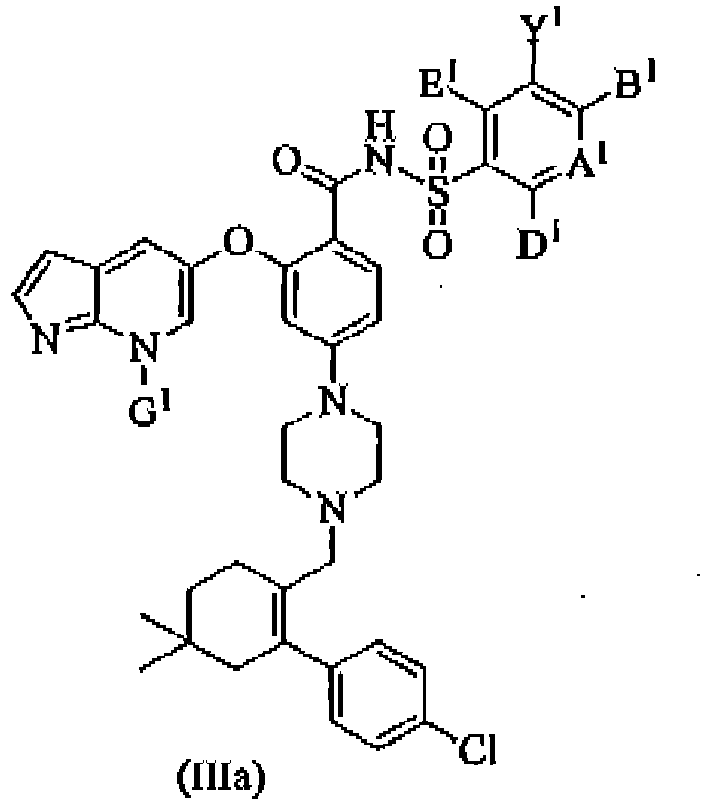 A1 représente un groupe C(A2) ;A2 représente un atome d'H ;B1 représente un groupe OR1 ou un groupe NHR1, formules dans lesquelles R1 représente un groupe alkyle en C1 à C10 substitué par R10 ;D1 représente un atome d'H ;E1 représente un atome d'H ;Y1 représente un groupe NO2 ;G1 représente un groupe alkyle substitué par OP(O)(OH)(OH) ;R10 représente un groupe cycloalkyle en C3 à C10, chacun comportant un ou deux groupements CH2 non remplacés ou remplacés par un atome d'O;le groupement représenté par R10 étant non substitué ou substitué par un ou deux ou trois ou quatre ou cinq substituants indépendamment choisis dans le groupe constitué de R50, OR50, F, Cl, Br et I ; etR50 représente un groupe alkyle en C1 à C10.
 - Composé ou sel thérapeutiquement acceptable selon la revendication 1, lequel composé est choisi dans le groupe constitué de :dihydrogénophosphate de (5-{5-(4-{[2-(4-chiorophenyl)-4,4-diméthylcyclohex-1-én-1-yl]méthyl}pipérazin-1-yl)-2-[({3-nitro-4-[(tétrahydro-2H-pyran-4-ylméthyl)amino]phényl}sulfonyl)carbamoyl]phénoxy}-7H-pyrrolo[2,3-b]pyridin-7-yl)méthyle ;dihydrogénophosphate de {5-[5-(4-{[2-(4-chlorophényl)-4,4-diméthylcyclohex-1-én-1-yl]méthyl}plpérazin-1-yl)-2-{[(4-{[(trans-4-méthoxycyclohexyl)méthyl]amino}-3-nltrophényl)sulfonyl]carbamoyl}phénoxy]-7H-pyrrolo[2,3-b]pyridin-7-yl}méthyle ; etdihydrogénophosphate de (5-{-5-(4-{[2-(4-chlorophényl)-4,4-diméthylcyclohex-1-én-1-yl]méthyl}pipérazin-1-yl)-2-[({4-[(4-fluorotétrahydro-2H-pyran-4-yl)méthoxy]-3-nitrophényl}sulfanyl)carbamoyl]phénoxy}-7H-pyrrolo[2,3-b]pyridin-7-yl)méthyle.
- Composition pharmaceutique comprenant un excipient et une quantité thérapeutiquement efficace du composé ou du sel thérapeutiquement acceptable selon la revendication 1 ou la revendication 2.
- Composé ou sel thérapeutiquement acceptable selon la revendication 1 ou la revendication 2 pour utilisation dans le traitement du cancer de la vessie, du cancer du cerveau, du cancer du sein, du cancer de la moelle osseuse, du cancer du col de l'utérus, de la leucémie lymphoïde chronique, du cancer colorectal, du cancer de l'oesophage, du cancer hépatocellulaire, de la leucémie lymphoblastique, du lymphome folliculaire, d'une malignité lymphoïde associée aux lymphocytes T ou aux lymphocytes B, du mélanome, de la leucémie myélogène, du myélome, du cancer buccal du cancer ovarien, du cancer du poumon non à petites cellules, du cancer de la prostate, du cancer du poumon à petites cellules ou du cancer de la rate chez un patient, par administration au patient d'une quantité thérapeutiquement efficace dudit composé ou sel thérapeutiquement acceptable de celui-ci.
Priority Applications (6)
| Application Number | Priority Date | Filing Date | Title |
|---|---|---|---|
| EP17199100.3A EP3312178A1 (fr) | 2010-05-26 | 2011-05-25 | Agents induisant l'apoptose pour le traitement du cancer et de maladies immunes et auto-immunes |
| MEP-2016-126A ME02452B (fr) | 2010-05-26 | 2011-05-25 | Agents inducteurs d'apoptose pour le traitement du cancer et de maladies immunitaires et auto-immunes |
| HRP20160714TT HRP20160714T1 (hr) | 2010-05-26 | 2011-05-25 | Sredstva za induciranje apoptoze namijenjena liječenju raka i imunih i autoimunih bolesti |
| SI201130872A SI2575463T1 (sl) | 2010-05-26 | 2011-05-25 | Sredstva, ki inducirajo apoptozo, za zdravljenje raka in imunskih ter avtoimunskih bolezni |
| EP16161558.8A EP3091017B1 (fr) | 2010-05-26 | 2011-05-25 | Agents induisant l'apoptose pour le traitement du cancer et de maladies immunes et auto-immunes |
| RS20160487A RS54892B1 (sr) | 2010-05-26 | 2011-05-25 | Agensi za indukciju apoptoze za lečenje karcinoma i imunskih i autoimunskih bolesti |
Applications Claiming Priority (2)
| Application Number | Priority Date | Filing Date | Title |
|---|---|---|---|
| US34842210P | 2010-05-26 | 2010-05-26 | |
| PCT/US2011/037849 WO2011150016A1 (fr) | 2010-05-26 | 2011-05-25 | Agents inducteurs d'apoptose pour le traitement du cancer et de maladies immunitaires et auto-immunes |
Related Child Applications (2)
| Application Number | Title | Priority Date | Filing Date |
|---|---|---|---|
| EP17199100.3A Division EP3312178A1 (fr) | 2010-05-26 | 2011-05-25 | Agents induisant l'apoptose pour le traitement du cancer et de maladies immunes et auto-immunes |
| EP16161558.8A Division EP3091017B1 (fr) | 2010-05-26 | 2011-05-25 | Agents induisant l'apoptose pour le traitement du cancer et de maladies immunes et auto-immunes |
Publications (3)
| Publication Number | Publication Date |
|---|---|
| EP2575463A1 EP2575463A1 (fr) | 2013-04-10 |
| EP2575463A4 EP2575463A4 (fr) | 2013-11-27 |
| EP2575463B1 true EP2575463B1 (fr) | 2016-03-30 |
Family
ID=45004346
Family Applications (3)
| Application Number | Title | Priority Date | Filing Date |
|---|---|---|---|
| EP16161558.8A Active EP3091017B1 (fr) | 2010-05-26 | 2011-05-25 | Agents induisant l'apoptose pour le traitement du cancer et de maladies immunes et auto-immunes |
| EP17199100.3A Withdrawn EP3312178A1 (fr) | 2010-05-26 | 2011-05-25 | Agents induisant l'apoptose pour le traitement du cancer et de maladies immunes et auto-immunes |
| EP11787299.4A Active EP2575463B1 (fr) | 2010-05-26 | 2011-05-25 | Agents inducteurs d'apoptose pour le traitement du cancer et de maladies immunitaires et auto-immunes |
Family Applications Before (2)
| Application Number | Title | Priority Date | Filing Date |
|---|---|---|---|
| EP16161558.8A Active EP3091017B1 (fr) | 2010-05-26 | 2011-05-25 | Agents induisant l'apoptose pour le traitement du cancer et de maladies immunes et auto-immunes |
| EP17199100.3A Withdrawn EP3312178A1 (fr) | 2010-05-26 | 2011-05-25 | Agents induisant l'apoptose pour le traitement du cancer et de maladies immunes et auto-immunes |
Country Status (38)
| Country | Link |
|---|---|
| US (5) | US9006247B2 (fr) |
| EP (3) | EP3091017B1 (fr) |
| JP (1) | JP5782508B2 (fr) |
| KR (2) | KR101850679B1 (fr) |
| CN (2) | CN102939009B (fr) |
| AR (1) | AR081552A1 (fr) |
| AU (1) | AU2011258350B2 (fr) |
| BR (1) | BR112012029733B1 (fr) |
| CA (1) | CA2798765C (fr) |
| CL (1) | CL2012003285A1 (fr) |
| CO (1) | CO6640275A2 (fr) |
| CR (2) | CR20180222A (fr) |
| CY (1) | CY1117655T1 (fr) |
| DK (1) | DK2575463T3 (fr) |
| DO (3) | DOP2012000298A (fr) |
| EC (1) | ECSP12012348A (fr) |
| ES (2) | ES2574855T3 (fr) |
| GT (1) | GT201200315A (fr) |
| HR (1) | HRP20160714T1 (fr) |
| HU (1) | HUE029231T2 (fr) |
| IL (2) | IL222831A (fr) |
| ME (1) | ME02452B (fr) |
| MX (1) | MX337104B (fr) |
| MY (1) | MY165427A (fr) |
| NZ (1) | NZ603284A (fr) |
| PE (2) | PE20170465A1 (fr) |
| PH (3) | PH12012502277A1 (fr) |
| PL (1) | PL2575463T3 (fr) |
| PT (1) | PT2575463T (fr) |
| RS (1) | RS54892B1 (fr) |
| RU (1) | RU2567857C2 (fr) |
| SG (3) | SG10201700115RA (fr) |
| SI (1) | SI2575463T1 (fr) |
| TW (1) | TWI520960B (fr) |
| UA (1) | UA109278C2 (fr) |
| UY (1) | UY33408A (fr) |
| WO (1) | WO2011150016A1 (fr) |
| ZA (1) | ZA201208727B (fr) |
Families Citing this family (64)
| Publication number | Priority date | Publication date | Assignee | Title |
|---|---|---|---|---|
| US20120156134A1 (en) | 2007-12-20 | 2012-06-21 | Shayne Squires | Compositions and methods for detecting or eliminating senescent cells to diagnose or treat disease |
| US8563735B2 (en) | 2008-12-05 | 2013-10-22 | Abbvie Inc. | Bcl-2-selective apoptosis-inducing agents for the treatment of cancer and immune diseases |
| US20220315555A1 (en) | 2009-05-26 | 2022-10-06 | Abbvie Inc. | Apoptosis inducing agents for the treatment of cancer and immune and autoimmune diseases |
| CA2929347A1 (fr) * | 2009-05-26 | 2010-12-02 | Milan Bruncko | Composes de benzamide sulfonyl-2-(1h-pyrrolo[2,3-b]pyridine-5-oxy) (hetero)aryle substitue et leur utilisation comme agents induisant l'apoptose pour le traitement de cancer et demaladies immunes et autoimmunes |
| US8546399B2 (en) * | 2009-05-26 | 2013-10-01 | Abbvie Inc. | Apoptosis inducing agents for the treatment of cancer and immune and autoimmune diseases |
| SG10201801794WA (en) | 2010-10-29 | 2018-04-27 | Abbvie Inc | Solid dispersions containing an apoptosis-inducing agent |
| UA113500C2 (xx) | 2010-10-29 | 2017-02-10 | Одержані екструзією розплаву тверді дисперсії, що містять індукуючий апоптоз засіб | |
| MY165884A (en) | 2010-11-23 | 2018-05-18 | Abbvie Ireland Unlimited Co | Methods of treatment using selective bcl-2 inhibitors |
| WO2012177927A1 (fr) | 2011-06-21 | 2012-12-27 | Mayo Foundation For Medical Education And Research | Animaux transgéniques pouvant être induits pour éliminer des cellules sénescentes |
| JP2015502366A (ja) | 2011-12-13 | 2015-01-22 | バック インスティテュート フォー リサーチ オン エイジング | 薬物療法を改善するための方法 |
| WO2013158664A2 (fr) | 2012-04-17 | 2013-10-24 | Kythera Biopharmaceuticals, Inc. | Utilisation de virus modifiés pour tuer spécifiquement les cellules sénescentes |
| ES2677480T3 (es) * | 2012-08-13 | 2018-08-02 | Abbvie Inc. | Agentes que inducen apoptosis |
| US9901081B2 (en) | 2012-08-23 | 2018-02-27 | Buck Institute For Research On Aging | Transgenic mouse for determining the role of senescent cells in cancer |
| US9901080B2 (en) | 2012-08-23 | 2018-02-27 | Buck Institute For Research On Aging | Transgenic mouse having a transgene that converts a prodrug into a cytotoxic compound in senescent cells |
| MX2015002947A (es) | 2012-09-07 | 2015-09-23 | Genentech Inc | Terapia de combinacion de un anticuerpo ant-cd20 tipo ii con un inhibidor blc-2 selectivo. |
| KR102229478B1 (ko) | 2012-11-01 | 2021-03-18 | 인피니티 파마슈티칼스, 인코포레이티드 | Pi3 키나아제 동형단백질 조절인자를 사용하는 암의 치료 |
| PE20191685A1 (es) * | 2013-03-13 | 2019-11-19 | Abbvie Inc | Procesos para la preparacion de un agente inductor de la apoptosis |
| AR095265A1 (es) | 2013-03-13 | 2015-09-30 | Abbvie Inc | Procesos para la preparación de un agente inductor de la apoptosis |
| FR3008979B1 (fr) * | 2013-07-23 | 2015-07-24 | Servier Lab | Nouveaux derives phosphates, leur procede de preparation et les compositions pharmaceutiques qui les contiennent |
| WO2015116735A1 (fr) | 2014-01-28 | 2015-08-06 | Mayo Foundation For Medical Education And Research | Procédés et combinaisons pour tuer des cellules sénescentes et traiter des maladies et troubles associés à une sénescence |
| US10328058B2 (en) | 2014-01-28 | 2019-06-25 | Mayo Foundation For Medical Education And Research | Treating atherosclerosis by removing senescent foam cell macrophages from atherosclerotic plaques |
| US20190269675A1 (en) | 2014-01-28 | 2019-09-05 | Buck Institute for Research and Aging | Treatment of parkinson's disease and other conditions caused or mediated by senescent astrocytes using small molecule senolytic agents |
| SG11201606239UA (en) | 2014-01-28 | 2016-08-30 | Buck Inst For Res On Aging | Methods and compositions for killing senescent cells and for treating senescence-associated diseases and disorders |
| US9238652B2 (en) | 2014-03-04 | 2016-01-19 | Abbvie Inc. | Processes for the preparation of an apoptosis-inducing agent |
| RS60906B1 (sr) | 2014-10-06 | 2020-11-30 | Vertex Pharma | Modulatori regulatora transmembranske provodljivosti za cističnu fibrozu |
| US10195213B2 (en) | 2015-03-13 | 2019-02-05 | Unity Biotechnology, Inc. | Chemical entities that kill senescent cells for use in treating age-related disease |
| WO2017063572A1 (fr) * | 2015-10-13 | 2017-04-20 | 苏州晶云药物科技有限公司 | Nouvelle forme cristalline d'agent induisant l'apoptose de cellules et son procédé de préparation |
| CN106957315B (zh) * | 2016-01-08 | 2019-08-13 | 中国人民解放军第二军医大学 | N-取代苯磺酰基-氮杂吲哚氧基苯甲酰胺类化合物及其制备药物的用途 |
| ES2946970T3 (es) | 2016-03-31 | 2023-07-28 | Vertex Pharma | Regulador de conductancia transmembrana de moduladores de fibrosis quística |
| US20170300968A1 (en) * | 2016-04-14 | 2017-10-19 | Nb Portals, Llc | Method and system for disseminating information over a communication network |
| RU2744358C2 (ru) | 2016-08-05 | 2021-03-05 | Дзе Риджентс Оф Дзе Юниверсити Оф Мичиган | N-(фенилсульфонил) бензамиды и родственные соединения в качестве ингибиторов bcl-2 |
| LT3519401T (lt) | 2016-09-30 | 2021-11-25 | Vertex Pharmaceuticals Incorporated | Cistinės fibrozės transmembraninio laidumo reguliavimo moduliatorius, farmacinės kompozicijos, gydymo būdai ir moduliatoriaus gamybos būdas |
| PT3551622T (pt) | 2016-12-09 | 2020-11-12 | Vertex Pharma | Modulador do regulador da condutância transmembrana da fibrose quística, composições farmacêuticas, métodos de tratamento e processo de fabrico do modulador |
| WO2018127130A1 (fr) | 2017-01-07 | 2018-07-12 | Shanghai Fochon Pharmaceutical Co., Ltd. | Composés en tant qu'agents induisant l'apoptose sélective de bcl-2 |
| WO2018157803A1 (fr) * | 2017-02-28 | 2018-09-07 | 苏州科睿思制药有限公司 | Formes cristallines de vénétoclax et leur procédé de préparation |
| MX391501B (es) | 2017-04-18 | 2025-03-21 | Fochon Pharmaceuticals Ltd | Agentes inductores de apoptosis |
| CN108794358B (zh) * | 2017-04-27 | 2022-08-12 | 中国人民解放军第二军医大学 | 取代苯磺酰基类化合物及其制备药物的用途 |
| US11253509B2 (en) | 2017-06-08 | 2022-02-22 | Vertex Pharmaceuticals Incorporated | Methods of treatment for cystic fibrosis |
| WO2019018395A1 (fr) | 2017-07-17 | 2019-01-24 | Vertex Pharmaceuticals Incorporated | Méthodes de traitement de la fibrose kystique |
| TWI799435B (zh) | 2017-08-02 | 2023-04-21 | 美商維泰克斯製藥公司 | 製備化合物之製程 |
| CN107501260B (zh) * | 2017-08-14 | 2019-08-13 | 郑州大学第一附属医院 | 一种Bcl-2抑制剂venetoclax以及中间体的制备方法 |
| SG11202001553UA (en) | 2017-08-23 | 2020-03-30 | Newave Pharmaceutical Inc | Condensed heterocyclic derivatives as bcl-2 inhibitors for the treatment of neoplastic diseases |
| CN107445958A (zh) * | 2017-09-19 | 2017-12-08 | 上海泓博智源医药股份有限公司 | 一种abt‑199中间体的制备方法 |
| US10654829B2 (en) | 2017-10-19 | 2020-05-19 | Vertex Pharmaceuticals Incorporated | Crystalline forms and compositions of CFTR modulators |
| CA3085006A1 (fr) | 2017-12-08 | 2019-06-13 | Vertex Pharmaceuticals Incorporated | Procedes pour preparer des modulateurs du regulateur de la conductance transmembranaire de la mucoviscidose |
| CA3087261A1 (fr) | 2018-01-10 | 2019-07-18 | Recurium Ip Holdings, Llc | Composes benzamide |
| TWI810243B (zh) | 2018-02-05 | 2023-08-01 | 美商維泰克斯製藥公司 | 用於治療囊腫纖化症之醫藥組合物 |
| CN112135631A (zh) * | 2018-02-16 | 2020-12-25 | 艾伯维公司 | 用于癌症治疗的选择性bcl-2抑制剂与抗pd-1或抗pd-l1抗体的组合 |
| US11414439B2 (en) | 2018-04-13 | 2022-08-16 | Vertex Pharmaceuticals Incorporated | Modulators of cystic fibrosis transmembrane conductance regulator, pharmaceutical compositions, methods of treatment, and process for making the modulator |
| CN112437772B (zh) | 2018-04-29 | 2023-11-21 | 百济神州有限公司 | Bcl-2抑制剂 |
| EA202091963A1 (ru) | 2018-07-31 | 2021-05-13 | Эсентейдж Фарма (Сучжоу) Ко., Лтд. | СИНЕРГИЧЕСКИЙ ПРОТИВООПУХОЛЕВЫЙ ЭФФЕКТ ИНГИБИТОРА Bcl-2 В СОЧЕТАНИИ С РИТУКСИМАБОМ И/ИЛИ БЕНДАМУСТИНОМ ИЛИ ИНГИБИТОРА Bcl-2 В СОЧЕТАНИИ С CHOP |
| TWI725488B (zh) | 2018-07-31 | 2021-04-21 | 大陸商蘇州亞盛藥業有限公司 | Bcl-2抑制劑與化療藥的組合產品及其在預防及/或治療疾病中的用途 |
| CN114522167A (zh) | 2018-07-31 | 2022-05-24 | 苏州亚盛药业有限公司 | Bcl-2抑制剂或Bcl-2/Bcl-xL抑制剂与BTK抑制剂的组合产品及其用途 |
| TWI752335B (zh) | 2018-07-31 | 2022-01-11 | 大陸商蘇州亞盛藥業有限公司 | Bcl-2抑制劑與MDM2抑制劑的組合產品及其在預防及/或治療疾病中的用途 |
| US12220419B2 (en) | 2018-08-22 | 2025-02-11 | Newave Pharmaceutical Inc. | BCL-2 inhibitors |
| WO2020140005A2 (fr) | 2018-12-29 | 2020-07-02 | Newave Pharmaceutical Inc. | Inhibiteurs de bcl-2 |
| CN112661751B (zh) * | 2019-10-16 | 2024-06-14 | 南京天印健华医药科技有限公司 | 作为bcl-2抑制剂的杂环化合物 |
| CN114929689B (zh) | 2019-10-28 | 2024-08-27 | 百济神州有限公司 | Bcl-2抑制剂 |
| WO2021110102A1 (fr) * | 2019-12-02 | 2021-06-10 | Beigene, Ltd. | Procédés de traitement du cancer utilisant un inhibiteur de bcl-2 |
| US12552784B2 (en) | 2019-12-27 | 2026-02-17 | Newave Pharmaceutical Inc. | 1H-pyrrolo[2,3-b]pyridine derivatives as BCL-2 inhibitors for the treatment of neoplastic and autoimmune diseases |
| US12286430B2 (en) | 2020-04-15 | 2025-04-29 | Beigene, Ltd. | Bcl-2 inhibitor |
| WO2021231486A1 (fr) * | 2020-05-13 | 2021-11-18 | Unity Biotechnology, Inc. | Traitement du cancer par l'induction de sénescence suivie d'un sénolytique |
| CN114736203A (zh) * | 2021-01-07 | 2022-07-12 | 南京天印健华医药科技有限公司 | 作为bcl-2抑制剂的杂环化合物 |
| CN117377672A (zh) * | 2021-06-04 | 2024-01-09 | 正大天晴药业集团股份有限公司 | 三氟甲基取代的磺酰胺类化合物的磷酸酯 |
Family Cites Families (40)
| Publication number | Priority date | Publication date | Assignee | Title |
|---|---|---|---|---|
| MY115155A (en) | 1993-09-09 | 2003-04-30 | Upjohn Co | Substituted oxazine and thiazine oxazolidinone antimicrobials. |
| PT1019385E (pt) | 1995-09-15 | 2004-06-30 | Upjohn Co | N-oxidos de aminoaril-oxazolidinona |
| US20030220234A1 (en) | 1998-11-02 | 2003-11-27 | Selvaraj Naicker | Deuterated cyclosporine analogs and their use as immunodulating agents |
| DE19830430A1 (de) * | 1998-07-08 | 2000-01-13 | Hoechst Marion Roussel De Gmbh | Schwefelsubstituierte Sulfonylamino-carbonsäure-N-arylamide, ihre Herstellung, ihre Verwendung und sie enthaltende pharmazeutische Präparate |
| GB9918037D0 (en) | 1999-07-30 | 1999-09-29 | Biochemie Gmbh | Organic compounds |
| US6720338B2 (en) | 2000-09-20 | 2004-04-13 | Abbott Laboratories | N-acylsulfonamide apoptosis promoters |
| AR031130A1 (es) | 2000-09-20 | 2003-09-10 | Abbott Lab | N-acilsulfonamidas promotoras de la apoptosis |
| WO2005024636A1 (fr) | 2003-09-04 | 2005-03-17 | Hitachi Ulsi Systems Co., Ltd. | Dispositif a semi-conducteur |
| WO2005049593A2 (fr) | 2003-11-13 | 2005-06-02 | Abbott Laboratories | Promoteurs de l'apoptose contenant n-acylsulfonamide |
| US7973161B2 (en) | 2003-11-13 | 2011-07-05 | Abbott Laboratories | Apoptosis promoters |
| US8614318B2 (en) | 2003-11-13 | 2013-12-24 | Abbvie Inc. | Apoptosis promoters |
| PL1737850T3 (pl) | 2004-04-19 | 2008-02-29 | Symed Labs Ltd | Nowy sposób wytwarzania linezolidu i związków pokrewnych |
| WO2006008754A1 (fr) | 2004-07-20 | 2006-01-26 | Symed Labs Limited | Nouveaux intermediaires pour linezolide et composes correspondants |
| EP1804823A4 (fr) | 2004-09-29 | 2010-06-09 | Amr Technology Inc | Nouveaux analogues de la cyclosporine et leurs utilisations pharmaceutiques |
| EP2757099B1 (fr) | 2005-05-12 | 2017-08-23 | AbbVie Bahamas Limited | Promoteurs d'apoptose |
| TW200716636A (en) | 2005-05-31 | 2007-05-01 | Speedel Experimenta Ag | Heterocyclic spiro-compounds |
| US7514068B2 (en) | 2005-09-14 | 2009-04-07 | Concert Pharmaceuticals Inc. | Biphenyl-pyrazolecarboxamide compounds |
| CN101534904B (zh) | 2006-09-05 | 2013-11-06 | Abbvie公司 | 治疗血小板过量的bcl抑制剂 |
| US8796267B2 (en) | 2006-10-23 | 2014-08-05 | Concert Pharmaceuticals, Inc. | Oxazolidinone derivatives and methods of use |
| WO2008064116A2 (fr) | 2006-11-16 | 2008-05-29 | Abbott Laboratories | Procédé pour éviter ou traiter les rejets lors de transplantations d'organes, de cellules souches hématopoïétiques ou de moelle osseuse |
| MX2009008465A (es) | 2007-02-15 | 2009-08-20 | Hoffmann La Roche | Nuevas 2-aminooxazolinas como ligandos de taar1. |
| US8536157B2 (en) | 2007-04-13 | 2013-09-17 | The University Of Melbourne | Non-steroidal compounds |
| KR20100105802A (ko) | 2007-04-19 | 2010-09-29 | 콘서트 파마슈티컬즈, 인크. | 중수소화된 모르폴리닐 화합물 |
| US7531685B2 (en) | 2007-06-01 | 2009-05-12 | Protia, Llc | Deuterium-enriched oxybutynin |
| WO2009035598A1 (fr) | 2007-09-10 | 2009-03-19 | Concert Pharmaceuticals, Inc. | Pirfénidone déutérée |
| US20090118238A1 (en) | 2007-09-17 | 2009-05-07 | Protia, Llc | Deuterium-enriched alendronate |
| US20090088416A1 (en) | 2007-09-26 | 2009-04-02 | Protia, Llc | Deuterium-enriched lapaquistat |
| US20090082471A1 (en) | 2007-09-26 | 2009-03-26 | Protia, Llc | Deuterium-enriched fingolimod |
| US20090137457A1 (en) | 2007-10-02 | 2009-05-28 | Concert Pharmaceuticals, Inc. | Pyrimidinedione derivatives |
| EP2212298B1 (fr) | 2007-10-18 | 2013-03-27 | Concert Pharmaceuticals Inc. | Étravirine deutérée |
| US20090105338A1 (en) | 2007-10-18 | 2009-04-23 | Protia, Llc | Deuterium-enriched gabexate mesylate |
| AU2008317375B2 (en) | 2007-10-26 | 2013-02-28 | Concert Pharmaceuticals, Inc. | Deuterated darunavir |
| RU2472509C2 (ru) | 2007-11-16 | 2013-01-20 | Эбботт Лэборетриз | Способ лечения артрита |
| UA108193C2 (uk) * | 2008-12-04 | 2015-04-10 | Апоптозіндукуючий засіб для лікування раку і імунних і аутоімунних захворювань | |
| US20100160322A1 (en) * | 2008-12-04 | 2010-06-24 | Abbott Laboratories | Apoptosis-inducing agents for the treatment of cancer and immune and autoimmune diseases |
| US8563735B2 (en) * | 2008-12-05 | 2013-10-22 | Abbvie Inc. | Bcl-2-selective apoptosis-inducing agents for the treatment of cancer and immune diseases |
| DK2376480T3 (en) * | 2008-12-05 | 2016-09-12 | Abbvie Inc | Sulfonamide derivatives AS BCL-2-selective apoptosis inducing agents for the treatment of cancer and immune diseases |
| SG172391A1 (en) * | 2009-01-19 | 2011-07-28 | Abbott Lab | Apoptosis-inducing agents for the treatment of cancer and immune and autoimmune diseases |
| US8546399B2 (en) * | 2009-05-26 | 2013-10-01 | Abbvie Inc. | Apoptosis inducing agents for the treatment of cancer and immune and autoimmune diseases |
| CA2929347A1 (fr) * | 2009-05-26 | 2010-12-02 | Milan Bruncko | Composes de benzamide sulfonyl-2-(1h-pyrrolo[2,3-b]pyridine-5-oxy) (hetero)aryle substitue et leur utilisation comme agents induisant l'apoptose pour le traitement de cancer et demaladies immunes et autoimmunes |
-
2011
- 2011-05-09 TW TW100116213A patent/TWI520960B/zh not_active IP Right Cessation
- 2011-05-25 PE PE2017000244A patent/PE20170465A1/es unknown
- 2011-05-25 UA UAA201214905A patent/UA109278C2/ru unknown
- 2011-05-25 JP JP2013512188A patent/JP5782508B2/ja not_active Expired - Fee Related
- 2011-05-25 HR HRP20160714TT patent/HRP20160714T1/hr unknown
- 2011-05-25 PT PT117872994T patent/PT2575463T/pt unknown
- 2011-05-25 CN CN201180025920.3A patent/CN102939009B/zh not_active Expired - Fee Related
- 2011-05-25 KR KR1020177018800A patent/KR101850679B1/ko not_active Expired - Fee Related
- 2011-05-25 WO PCT/US2011/037849 patent/WO2011150016A1/fr not_active Ceased
- 2011-05-25 KR KR1020127033740A patent/KR101800167B1/ko not_active Expired - Fee Related
- 2011-05-25 ES ES11787299.4T patent/ES2574855T3/es active Active
- 2011-05-25 ES ES16161558.8T patent/ES2666181T3/es active Active
- 2011-05-25 SG SG10201700115RA patent/SG10201700115RA/en unknown
- 2011-05-25 SI SI201130872A patent/SI2575463T1/sl unknown
- 2011-05-25 DK DK11787299.4T patent/DK2575463T3/en active
- 2011-05-25 AU AU2011258350A patent/AU2011258350B2/en not_active Ceased
- 2011-05-25 RS RS20160487A patent/RS54892B1/sr unknown
- 2011-05-25 CA CA2798765A patent/CA2798765C/fr not_active Expired - Fee Related
- 2011-05-25 RU RU2012156940/04A patent/RU2567857C2/ru active
- 2011-05-25 PL PL11787299.4T patent/PL2575463T3/pl unknown
- 2011-05-25 UY UY33408A patent/UY33408A/es not_active Application Discontinuation
- 2011-05-25 CN CN201510086898.3A patent/CN104961771B/zh not_active Expired - Fee Related
- 2011-05-25 PH PH1/2012/502277A patent/PH12012502277A1/en unknown
- 2011-05-25 NZ NZ603284A patent/NZ603284A/en not_active IP Right Cessation
- 2011-05-25 HU HUE11787299A patent/HUE029231T2/en unknown
- 2011-05-25 MX MX2012013704A patent/MX337104B/es active IP Right Grant
- 2011-05-25 SG SG2012081824A patent/SG185447A1/en unknown
- 2011-05-25 ME MEP-2016-126A patent/ME02452B/fr unknown
- 2011-05-25 US US13/115,376 patent/US9006247B2/en active Active
- 2011-05-25 PE PE2012002219A patent/PE20130221A1/es active IP Right Grant
- 2011-05-25 CR CR20180222A patent/CR20180222A/es unknown
- 2011-05-25 EP EP16161558.8A patent/EP3091017B1/fr active Active
- 2011-05-25 EP EP17199100.3A patent/EP3312178A1/fr not_active Withdrawn
- 2011-05-25 EP EP11787299.4A patent/EP2575463B1/fr active Active
- 2011-05-25 SG SG10201700112VA patent/SG10201700112VA/en unknown
- 2011-05-25 MY MYPI2012700921A patent/MY165427A/en unknown
- 2011-05-25 BR BR112012029733-3A patent/BR112012029733B1/pt not_active IP Right Cessation
- 2011-05-26 AR ARP110101806 patent/AR081552A1/es active IP Right Grant
-
2012
- 2012-11-01 IL IL222831A patent/IL222831A/en active IP Right Grant
- 2012-11-20 ZA ZA2012/08727A patent/ZA201208727B/en unknown
- 2012-11-22 DO DO2012000298A patent/DOP2012000298A/es unknown
- 2012-11-23 GT GT201200315A patent/GT201200315A/es unknown
- 2012-11-23 CL CL2012003285A patent/CL2012003285A1/es unknown
- 2012-12-13 CO CO12226070A patent/CO6640275A2/es active IP Right Grant
- 2012-12-18 CR CR20120648A patent/CR20120648A/es unknown
- 2012-12-20 EC ECSP12012348 patent/ECSP12012348A/es unknown
-
2014
- 2014-07-28 IL IL233832A patent/IL233832B/en active IP Right Grant
-
2015
- 2015-03-11 US US14/645,378 patent/US9403822B2/en active Active
-
2016
- 2016-05-04 DO DO2016000100A patent/DOP2016000100A/es unknown
- 2016-06-10 PH PH12016501126A patent/PH12016501126A1/en unknown
- 2016-06-15 CY CY20161100529T patent/CY1117655T1/el unknown
- 2016-06-30 US US15/199,782 patent/US20170096424A1/en not_active Abandoned
-
2017
- 2017-08-09 DO DO2017000186A patent/DOP2017000186A/es unknown
-
2018
- 2018-06-13 PH PH12018501264A patent/PH12018501264A1/en unknown
- 2018-11-28 US US16/203,509 patent/US20190315737A1/en not_active Abandoned
-
2019
- 2019-10-24 US US16/663,285 patent/US20200277291A1/en not_active Abandoned
Also Published As
Similar Documents
| Publication | Publication Date | Title |
|---|---|---|
| EP3091017B1 (fr) | Agents induisant l'apoptose pour le traitement du cancer et de maladies immunes et auto-immunes | |
| US8426422B2 (en) | Apoptosis-inducing agents for the treatment of cancer and immune and autoimmune diseases | |
| US9493431B2 (en) | Apoptosis-inducing agent for the treatment of cancer and immune and autoimmune diseases | |
| CA2799280A1 (fr) | Agents induisant l'apoptose pour le traitement du cancer et de maladies immunes et auto-immunes | |
| HK1231047A (en) | Apoptosis-inducing agents for the treatment of cancer and immune and autoimmune diseases | |
| HK1231047A1 (en) | Apoptosis-inducing agents for the treatment of cancer and immune and autoimmune diseases | |
| HK1182593B (en) | Apoptosis-inducing agents for the treatment of cancer and immune and autoimmune diseases | |
| HK1177206B (en) | Apoptosis-inducing agents for the treatment of cancer and immune and autoimmune diseases |
Legal Events
| Date | Code | Title | Description |
|---|---|---|---|
| PUAI | Public reference made under article 153(3) epc to a published international application that has entered the european phase |
Free format text: ORIGINAL CODE: 0009012 |
|
| 17P | Request for examination filed |
Effective date: 20121126 |
|
| AK | Designated contracting states |
Kind code of ref document: A1 Designated state(s): AL AT BE BG CH CY CZ DE DK EE ES FI FR GB GR HR HU IE IS IT LI LT LU LV MC MK MT NL NO PL PT RO RS SE SI SK SM TR |
|
| AX | Request for extension of the european patent |
Extension state: BA ME |
|
| A4 | Supplementary search report drawn up and despatched |
Effective date: 20131029 |
|
| RIC1 | Information provided on ipc code assigned before grant |
Ipc: A61K 31/44 20060101ALI20131023BHEP Ipc: A01N 43/38 20060101ALI20131023BHEP Ipc: A01N 43/42 20060101AFI20131023BHEP Ipc: A01N 43/40 20060101ALI20131023BHEP Ipc: A61K 31/18 20060101ALI20131023BHEP Ipc: C07D 471/04 20060101ALI20131023BHEP |
|
| REG | Reference to a national code |
Ref country code: HK Ref legal event code: DE Ref document number: 1182593 Country of ref document: HK |
|
| 17Q | First examination report despatched |
Effective date: 20150401 |
|
| GRAP | Despatch of communication of intention to grant a patent |
Free format text: ORIGINAL CODE: EPIDOSNIGR1 |
|
| INTG | Intention to grant announced |
Effective date: 20150921 |
|
| GRAS | Grant fee paid |
Free format text: ORIGINAL CODE: EPIDOSNIGR3 |
|
| GRAA | (expected) grant |
Free format text: ORIGINAL CODE: 0009210 |
|
| AK | Designated contracting states |
Kind code of ref document: B1 Designated state(s): AL AT BE BG CH CY CZ DE DK EE ES FI FR GB GR HR HU IE IS IT LI LT LU LV MC MK MT NL NO PL PT RO RS SE SI SK SM TR |
|
| AX | Request for extension of the european patent |
Extension state: BA ME |
|
| REG | Reference to a national code |
Ref country code: GB Ref legal event code: FG4D |
|
| REG | Reference to a national code |
Ref country code: CH Ref legal event code: EP |
|
| REG | Reference to a national code |
Ref country code: AT Ref legal event code: REF Ref document number: 784291 Country of ref document: AT Kind code of ref document: T Effective date: 20160415 |
|
| REG | Reference to a national code |
Ref country code: IE Ref legal event code: FG4D |
|
| REG | Reference to a national code |
Ref country code: FR Ref legal event code: PLFP Year of fee payment: 6 |
|
| REG | Reference to a national code |
Ref country code: DE Ref legal event code: R096 Ref document number: 602011024691 Country of ref document: DE |
|
| REG | Reference to a national code |
Ref country code: CH Ref legal event code: NV Representative=s name: BOHEST AG, CH |
|
| REG | Reference to a national code |
Ref country code: HR Ref legal event code: TUEP Ref document number: P20160714 Country of ref document: HR |
|
| REG | Reference to a national code |
Ref country code: ES Ref legal event code: FG2A Ref document number: 2574855 Country of ref document: ES Kind code of ref document: T3 Effective date: 20160622 |
|
| REG | Reference to a national code |
Ref country code: SE Ref legal event code: TRGR |
|
| REG | Reference to a national code |
Ref country code: RO Ref legal event code: EPE |
|
| REG | Reference to a national code |
Ref country code: PT Ref legal event code: SC4A Ref document number: 2575463 Country of ref document: PT Date of ref document: 20160713 Kind code of ref document: T Free format text: AVAILABILITY OF NATIONAL TRANSLATION Effective date: 20160629 |
|
| REG | Reference to a national code |
Ref country code: HR Ref legal event code: T1PR Ref document number: P20160714 Country of ref document: HR |
|
| REG | Reference to a national code |
Ref country code: NO Ref legal event code: T2 Effective date: 20160330 |
|
| REG | Reference to a national code |
Ref country code: NL Ref legal event code: FP |
|
| REG | Reference to a national code |
Ref country code: DK Ref legal event code: T3 Effective date: 20160714 |
|
| REG | Reference to a national code |
Ref country code: EE Ref legal event code: FG4A Ref document number: E011997 Country of ref document: EE Effective date: 20160621 |
|
| REG | Reference to a national code |
Ref country code: GR Ref legal event code: EP Ref document number: 20160401145 Country of ref document: GR Effective date: 20160729 |
|
| REG | Reference to a national code |
Ref country code: SK Ref legal event code: T3 Ref document number: E 21316 Country of ref document: SK |
|
| REG | Reference to a national code |
Ref country code: HK Ref legal event code: GR Ref document number: 1182593 Country of ref document: HK |
|
| PG25 | Lapsed in a contracting state [announced via postgrant information from national office to epo] |
Ref country code: SM Free format text: LAPSE BECAUSE OF FAILURE TO SUBMIT A TRANSLATION OF THE DESCRIPTION OR TO PAY THE FEE WITHIN THE PRESCRIBED TIME-LIMIT Effective date: 20160330 |
|
| REG | Reference to a national code |
Ref country code: DE Ref legal event code: R097 Ref document number: 602011024691 Country of ref document: DE |
|
| PLBE | No opposition filed within time limit |
Free format text: ORIGINAL CODE: 0009261 |
|
| STAA | Information on the status of an ep patent application or granted ep patent |
Free format text: STATUS: NO OPPOSITION FILED WITHIN TIME LIMIT |
|
| REG | Reference to a national code |
Ref country code: HU Ref legal event code: AG4A Ref document number: E029231 Country of ref document: HU |
|
| 26N | No opposition filed |
Effective date: 20170103 |
|
| REG | Reference to a national code |
Ref country code: FR Ref legal event code: PLFP Year of fee payment: 7 |
|
| REG | Reference to a national code |
Ref country code: FR Ref legal event code: PLFP Year of fee payment: 8 |
|
| REG | Reference to a national code |
Ref country code: AT Ref legal event code: UEP Ref document number: 784291 Country of ref document: AT Kind code of ref document: T Effective date: 20160330 |
|
| REG | Reference to a national code |
Ref country code: HR Ref legal event code: ODRP Ref document number: P20160714 Country of ref document: HR Payment date: 20190507 Year of fee payment: 9 |
|
| PGFP | Annual fee paid to national office [announced via postgrant information from national office to epo] |
Ref country code: PL Payment date: 20200319 Year of fee payment: 10 Ref country code: BG Payment date: 20200323 Year of fee payment: 10 |
|
| PGFP | Annual fee paid to national office [announced via postgrant information from national office to epo] |
Ref country code: LU Payment date: 20200320 Year of fee payment: 10 Ref country code: RS Payment date: 20200331 Year of fee payment: 10 |
|
| REG | Reference to a national code |
Ref country code: HR Ref legal event code: ODRP Ref document number: P20160714 Country of ref document: HR Payment date: 20200506 Year of fee payment: 10 |
|
| PGFP | Annual fee paid to national office [announced via postgrant information from national office to epo] |
Ref country code: MT Payment date: 20200324 Year of fee payment: 10 |
|
| PGFP | Annual fee paid to national office [announced via postgrant information from national office to epo] |
Ref country code: CZ Payment date: 20200423 Year of fee payment: 10 Ref country code: LT Payment date: 20200512 Year of fee payment: 10 Ref country code: PT Payment date: 20200428 Year of fee payment: 10 Ref country code: EE Payment date: 20200421 Year of fee payment: 10 Ref country code: DK Payment date: 20200428 Year of fee payment: 10 Ref country code: GR Payment date: 20200428 Year of fee payment: 10 Ref country code: TR Payment date: 20200520 Year of fee payment: 10 Ref country code: RO Payment date: 20200423 Year of fee payment: 10 Ref country code: IE Payment date: 20200429 Year of fee payment: 10 Ref country code: CY Payment date: 20200423 Year of fee payment: 10 Ref country code: FI Payment date: 20200428 Year of fee payment: 10 Ref country code: NO Payment date: 20200428 Year of fee payment: 10 Ref country code: NL Payment date: 20200421 Year of fee payment: 10 |
|
| PGFP | Annual fee paid to national office [announced via postgrant information from national office to epo] |
Ref country code: HR Payment date: 20200506 Year of fee payment: 10 Ref country code: HU Payment date: 20200502 Year of fee payment: 10 Ref country code: IS Payment date: 20200414 Year of fee payment: 10 Ref country code: LV Payment date: 20200512 Year of fee payment: 10 Ref country code: SE Payment date: 20200508 Year of fee payment: 10 Ref country code: BE Payment date: 20200421 Year of fee payment: 10 Ref country code: SK Payment date: 20200421 Year of fee payment: 10 Ref country code: SI Payment date: 20200511 Year of fee payment: 10 |
|
| PGFP | Annual fee paid to national office [announced via postgrant information from national office to epo] |
Ref country code: MK Payment date: 20200421 Year of fee payment: 10 Ref country code: AT Payment date: 20200428 Year of fee payment: 10 |
|
| PGFP | Annual fee paid to national office [announced via postgrant information from national office to epo] |
Ref country code: MC Payment date: 20200701 Year of fee payment: 10 |
|
| PGFP | Annual fee paid to national office [announced via postgrant information from national office to epo] |
Ref country code: AL Payment date: 20200507 Year of fee payment: 10 |
|
| REG | Reference to a national code |
Ref country code: HR Ref legal event code: PBON Ref document number: P20160714 Country of ref document: HR Effective date: 20210525 |
|
| REG | Reference to a national code |
Ref country code: FI Ref legal event code: MAE |
|
| REG | Reference to a national code |
Ref country code: EE Ref legal event code: MM4A Ref document number: E011997 Country of ref document: EE Effective date: 20210531 |
|
| REG | Reference to a national code |
Ref country code: DK Ref legal event code: EBP Effective date: 20210531 |
|
| REG | Reference to a national code |
Ref country code: NO Ref legal event code: MMEP Ref country code: LT Ref legal event code: MM4D Effective date: 20210525 |
|
| REG | Reference to a national code |
Ref country code: SE Ref legal event code: EUG |
|
| REG | Reference to a national code |
Ref country code: NL Ref legal event code: MM Effective date: 20210601 |
|
| REG | Reference to a national code |
Ref country code: AT Ref legal event code: MM01 Ref document number: 784291 Country of ref document: AT Kind code of ref document: T Effective date: 20210525 |
|
| REG | Reference to a national code |
Ref country code: SK Ref legal event code: MM4A Ref document number: E 21316 Country of ref document: SK Effective date: 20210525 |
|
| PG25 | Lapsed in a contracting state [announced via postgrant information from national office to epo] |
Ref country code: HU Free format text: LAPSE BECAUSE OF NON-PAYMENT OF DUE FEES Effective date: 20210526 Ref country code: HR Free format text: LAPSE BECAUSE OF NON-PAYMENT OF DUE FEES Effective date: 20210525 Ref country code: SK Free format text: LAPSE BECAUSE OF NON-PAYMENT OF DUE FEES Effective date: 20210525 Ref country code: SE Free format text: LAPSE BECAUSE OF NON-PAYMENT OF DUE FEES Effective date: 20210526 Ref country code: EE Free format text: LAPSE BECAUSE OF NON-PAYMENT OF DUE FEES Effective date: 20210531 Ref country code: CY Free format text: LAPSE BECAUSE OF NON-PAYMENT OF DUE FEES Effective date: 20210525 Ref country code: CZ Free format text: LAPSE BECAUSE OF NON-PAYMENT OF DUE FEES Effective date: 20210525 Ref country code: FI Free format text: LAPSE BECAUSE OF NON-PAYMENT OF DUE FEES Effective date: 20210525 Ref country code: RO Free format text: LAPSE BECAUSE OF NON-PAYMENT OF DUE FEES Effective date: 20210525 Ref country code: NO Free format text: LAPSE BECAUSE OF NON-PAYMENT OF DUE FEES Effective date: 20210531 Ref country code: PT Free format text: LAPSE BECAUSE OF NON-PAYMENT OF DUE FEES Effective date: 20211125 Ref country code: RS Free format text: LAPSE BECAUSE OF NON-PAYMENT OF DUE FEES Effective date: 20210525 Ref country code: AT Free format text: LAPSE BECAUSE OF NON-PAYMENT OF DUE FEES Effective date: 20210525 Ref country code: BG Free format text: LAPSE BECAUSE OF NON-PAYMENT OF DUE FEES Effective date: 20211130 Ref country code: LT Free format text: LAPSE BECAUSE OF NON-PAYMENT OF DUE FEES Effective date: 20210525 Ref country code: MC Free format text: LAPSE BECAUSE OF NON-PAYMENT OF DUE FEES Effective date: 20210531 Ref country code: LU Free format text: LAPSE BECAUSE OF NON-PAYMENT OF DUE FEES Effective date: 20210525 |
|
| REG | Reference to a national code |
Ref country code: BE Ref legal event code: MM Effective date: 20210531 |
|
| PG25 | Lapsed in a contracting state [announced via postgrant information from national office to epo] |
Ref country code: SI Free format text: LAPSE BECAUSE OF NON-PAYMENT OF DUE FEES Effective date: 20210526 Ref country code: LV Free format text: LAPSE BECAUSE OF NON-PAYMENT OF DUE FEES Effective date: 20210525 Ref country code: GR Free format text: LAPSE BECAUSE OF NON-PAYMENT OF DUE FEES Effective date: 20211207 |
|
| REG | Reference to a national code |
Ref country code: SI Ref legal event code: KO00 Effective date: 20220126 |
|
| PG25 | Lapsed in a contracting state [announced via postgrant information from national office to epo] |
Ref country code: IE Free format text: LAPSE BECAUSE OF NON-PAYMENT OF DUE FEES Effective date: 20210525 Ref country code: DK Free format text: LAPSE BECAUSE OF NON-PAYMENT OF DUE FEES Effective date: 20210531 |
|
| PG25 | Lapsed in a contracting state [announced via postgrant information from national office to epo] |
Ref country code: NL Free format text: LAPSE BECAUSE OF NON-PAYMENT OF DUE FEES Effective date: 20210601 |
|
| PG25 | Lapsed in a contracting state [announced via postgrant information from national office to epo] |
Ref country code: TR Free format text: LAPSE BECAUSE OF NON-PAYMENT OF DUE FEES Effective date: 20210525 Ref country code: MT Free format text: LAPSE BECAUSE OF NON-PAYMENT OF DUE FEES Effective date: 20200525 |
|
| REG | Reference to a national code |
Ref country code: DE Ref legal event code: R082 Ref document number: 602011024691 Country of ref document: DE Representative=s name: SCHIEBER - FARAGO PATENTANWAELTE, DE Ref country code: DE Ref legal event code: R082 Ref document number: 602011024691 Country of ref document: DE Representative=s name: FARAGO PATENTANWALTSGESELLSCHAFT MBH, DE |
|
| PG25 | Lapsed in a contracting state [announced via postgrant information from national office to epo] |
Ref country code: BE Free format text: LAPSE BECAUSE OF NON-PAYMENT OF DUE FEES Effective date: 20210531 |
|
| REG | Reference to a national code |
Ref country code: DE Ref legal event code: R082 Ref document number: 602011024691 Country of ref document: DE Representative=s name: SCHIEBER - FARAGO PATENTANWAELTE, DE |
|
| REG | Reference to a national code |
Ref country code: FR Ref legal event code: PLFP Year of fee payment: 13 |
|
| PG25 | Lapsed in a contracting state [announced via postgrant information from national office to epo] |
Ref country code: PL Free format text: LAPSE BECAUSE OF NON-PAYMENT OF DUE FEES Effective date: 20210525 |
|
| P01 | Opt-out of the competence of the unified patent court (upc) registered |
Effective date: 20230518 |
|
| PGFP | Annual fee paid to national office [announced via postgrant information from national office to epo] |
Ref country code: GB Payment date: 20240411 Year of fee payment: 14 |
|
| PGFP | Annual fee paid to national office [announced via postgrant information from national office to epo] |
Ref country code: DE Payment date: 20240411 Year of fee payment: 14 |
|
| PGFP | Annual fee paid to national office [announced via postgrant information from national office to epo] |
Ref country code: CH Payment date: 20240602 Year of fee payment: 14 |
|
| PGFP | Annual fee paid to national office [announced via postgrant information from national office to epo] |
Ref country code: ES Payment date: 20240611 Year of fee payment: 14 |
|
| PGFP | Annual fee paid to national office [announced via postgrant information from national office to epo] |
Ref country code: IT Payment date: 20240514 Year of fee payment: 14 Ref country code: FR Payment date: 20240415 Year of fee payment: 14 |
|
| PG25 | Lapsed in a contracting state [announced via postgrant information from national office to epo] |
Ref country code: IS Free format text: LAPSE BECAUSE OF NON-PAYMENT OF DUE FEES Effective date: 20211206 |
|
| REG | Reference to a national code |
Ref country code: DE Ref legal event code: R119 Ref document number: 602011024691 Country of ref document: DE |
|
| REG | Reference to a national code |
Ref country code: CH Ref legal event code: H13 Free format text: ST27 STATUS EVENT CODE: U-0-0-H10-H13 (AS PROVIDED BY THE NATIONAL OFFICE) Effective date: 20251223 |
|
| PG25 | Lapsed in a contracting state [announced via postgrant information from national office to epo] |
Ref country code: CH Free format text: LAPSE BECAUSE OF NON-PAYMENT OF DUE FEES Effective date: 20250531 |
|
| GBPC | Gb: european patent ceased through non-payment of renewal fee |
Effective date: 20250525 |
|
| PG25 | Lapsed in a contracting state [announced via postgrant information from national office to epo] |
Ref country code: GB Free format text: LAPSE BECAUSE OF NON-PAYMENT OF DUE FEES Effective date: 20250525 |
|
| PG25 | Lapsed in a contracting state [announced via postgrant information from national office to epo] |
Ref country code: DE Free format text: LAPSE BECAUSE OF NON-PAYMENT OF DUE FEES Effective date: 20251202 |
|
| PG25 | Lapsed in a contracting state [announced via postgrant information from national office to epo] |
Ref country code: IT Free format text: LAPSE BECAUSE OF NON-PAYMENT OF DUE FEES Effective date: 20250525 |
|
| PG25 | Lapsed in a contracting state [announced via postgrant information from national office to epo] |
Ref country code: FR Free format text: LAPSE BECAUSE OF NON-PAYMENT OF DUE FEES Effective date: 20250531 |