EP2574319A1 - Verwendung eines Polyurethanschaumstoffs als Wundauflage in der Unterdrucktherapie - Google Patents
Verwendung eines Polyurethanschaumstoffs als Wundauflage in der Unterdrucktherapie Download PDFInfo
- Publication number
- EP2574319A1 EP2574319A1 EP12008496A EP12008496A EP2574319A1 EP 2574319 A1 EP2574319 A1 EP 2574319A1 EP 12008496 A EP12008496 A EP 12008496A EP 12008496 A EP12008496 A EP 12008496A EP 2574319 A1 EP2574319 A1 EP 2574319A1
- Authority
- EP
- European Patent Office
- Prior art keywords
- polyurethane foam
- open
- wounds
- wound
- din
- Prior art date
- Legal status (The legal status is an assumption and is not a legal conclusion. Google has not performed a legal analysis and makes no representation as to the accuracy of the status listed.)
- Withdrawn
Links
Images


Classifications
-
- A—HUMAN NECESSITIES
- A61—MEDICAL OR VETERINARY SCIENCE; HYGIENE
- A61F—FILTERS IMPLANTABLE INTO BLOOD VESSELS; PROSTHESES; DEVICES PROVIDING PATENCY TO, OR PREVENTING COLLAPSING OF, TUBULAR STRUCTURES OF THE BODY, e.g. STENTS; ORTHOPAEDIC, NURSING OR CONTRACEPTIVE DEVICES; FOMENTATION; TREATMENT OR PROTECTION OF EYES OR EARS; BANDAGES, DRESSINGS OR ABSORBENT PADS; FIRST-AID KITS
- A61F13/00—Bandages or dressings; Absorbent pads
- A61F13/02—Adhesive bandages or dressings
- A61F13/0203—Adhesive bandages or dressings with fluid retention members
-
- A—HUMAN NECESSITIES
- A61—MEDICAL OR VETERINARY SCIENCE; HYGIENE
- A61L—METHODS OR APPARATUS FOR STERILISING MATERIALS OR OBJECTS IN GENERAL; DISINFECTION, STERILISATION OR DEODORISATION OF AIR; CHEMICAL ASPECTS OF BANDAGES, DRESSINGS, ABSORBENT PADS OR SURGICAL ARTICLES; MATERIALS FOR BANDAGES, DRESSINGS, ABSORBENT PADS OR SURGICAL ARTICLES
- A61L15/00—Chemical aspects of, or use of materials for, bandages, dressings or absorbent pads
- A61L15/16—Bandages, dressings or absorbent pads for physiological fluids such as urine or blood, e.g. sanitary towels, tampons
- A61L15/22—Bandages, dressings or absorbent pads for physiological fluids such as urine or blood, e.g. sanitary towels, tampons containing macromolecular materials
- A61L15/26—Macromolecular compounds obtained otherwise than by reactions only involving carbon-to-carbon unsaturated bonds; Derivatives thereof
-
- A—HUMAN NECESSITIES
- A61—MEDICAL OR VETERINARY SCIENCE; HYGIENE
- A61L—METHODS OR APPARATUS FOR STERILISING MATERIALS OR OBJECTS IN GENERAL; DISINFECTION, STERILISATION OR DEODORISATION OF AIR; CHEMICAL ASPECTS OF BANDAGES, DRESSINGS, ABSORBENT PADS OR SURGICAL ARTICLES; MATERIALS FOR BANDAGES, DRESSINGS, ABSORBENT PADS OR SURGICAL ARTICLES
- A61L15/00—Chemical aspects of, or use of materials for, bandages, dressings or absorbent pads
- A61L15/16—Bandages, dressings or absorbent pads for physiological fluids such as urine or blood, e.g. sanitary towels, tampons
- A61L15/42—Use of materials characterised by their function or physical properties
- A61L15/425—Porous materials, e.g. foams or sponges
-
- A—HUMAN NECESSITIES
- A61—MEDICAL OR VETERINARY SCIENCE; HYGIENE
- A61M—DEVICES FOR INTRODUCING MEDIA INTO, OR ONTO, THE BODY; DEVICES FOR TRANSDUCING BODY MEDIA OR FOR TAKING MEDIA FROM THE BODY; DEVICES FOR PRODUCING OR ENDING SLEEP OR STUPOR
- A61M1/00—Suction or pumping devices for medical purposes; Devices for carrying-off, for treatment of, or for carrying-over, body-liquids; Drainage systems
- A61M1/90—Negative pressure wound therapy devices, i.e. devices for applying suction to a wound to promote healing, e.g. including a vacuum dressing
- A61M1/91—Suction aspects of the dressing
- A61M1/915—Constructional details of the pressure distribution manifold
-
- C—CHEMISTRY; METALLURGY
- C08—ORGANIC MACROMOLECULAR COMPOUNDS; THEIR PREPARATION OR CHEMICAL WORKING-UP; COMPOSITIONS BASED THEREON
- C08G—MACROMOLECULAR COMPOUNDS OBTAINED OTHERWISE THAN BY REACTIONS ONLY INVOLVING UNSATURATED CARBON-TO-CARBON BONDS
- C08G18/00—Polymeric products of isocyanates or isothiocyanates
- C08G18/06—Polymeric products of isocyanates or isothiocyanates with compounds having active hydrogen
- C08G18/28—Polymeric products of isocyanates or isothiocyanates with compounds having active hydrogen characterised by the compounds used containing active hydrogen
- C08G18/40—High-molecular-weight compounds
- C08G18/42—Polycondensates having carboxylic or carbonic ester groups in the main chain
- C08G18/4236—Polycondensates having carboxylic or carbonic ester groups in the main chain containing only aliphatic groups
- C08G18/4238—Polycondensates having carboxylic or carbonic ester groups in the main chain containing only aliphatic groups derived from dicarboxylic acids and dialcohols
-
- C—CHEMISTRY; METALLURGY
- C08—ORGANIC MACROMOLECULAR COMPOUNDS; THEIR PREPARATION OR CHEMICAL WORKING-UP; COMPOSITIONS BASED THEREON
- C08G—MACROMOLECULAR COMPOUNDS OBTAINED OTHERWISE THAN BY REACTIONS ONLY INVOLVING UNSATURATED CARBON-TO-CARBON BONDS
- C08G18/00—Polymeric products of isocyanates or isothiocyanates
- C08G18/06—Polymeric products of isocyanates or isothiocyanates with compounds having active hydrogen
- C08G18/70—Polymeric products of isocyanates or isothiocyanates with compounds having active hydrogen characterised by the isocyanates or isothiocyanates used
- C08G18/72—Polyisocyanates or polyisothiocyanates
- C08G18/74—Polyisocyanates or polyisothiocyanates cyclic
- C08G18/76—Polyisocyanates or polyisothiocyanates cyclic aromatic
-
- C—CHEMISTRY; METALLURGY
- C08—ORGANIC MACROMOLECULAR COMPOUNDS; THEIR PREPARATION OR CHEMICAL WORKING-UP; COMPOSITIONS BASED THEREON
- C08G—MACROMOLECULAR COMPOUNDS OBTAINED OTHERWISE THAN BY REACTIONS ONLY INVOLVING UNSATURATED CARBON-TO-CARBON BONDS
- C08G2110/00—Foam properties
- C08G2110/0008—Foam properties flexible
-
- C—CHEMISTRY; METALLURGY
- C08—ORGANIC MACROMOLECULAR COMPOUNDS; THEIR PREPARATION OR CHEMICAL WORKING-UP; COMPOSITIONS BASED THEREON
- C08G—MACROMOLECULAR COMPOUNDS OBTAINED OTHERWISE THAN BY REACTIONS ONLY INVOLVING UNSATURATED CARBON-TO-CARBON BONDS
- C08G2110/00—Foam properties
- C08G2110/0041—Foam properties having specified density
- C08G2110/005—< 50kg/m3
Definitions
- the invention relates to a device for negative pressure therapy of wounds comprising, (a) a covering material for the airtight sealing of a wound space; (b) optionally, means for connecting a vacuum source; and (c) a wound dressing containing an open-celled polyurethane foam, wherein the open-cell polyurethane foam has specific properties, in particular a tensile strength after storage in bovine serum for three days, measured according to DIN 53571, between 80 kPa and 300 kPa. Furthermore, the invention relates to the use of such an open-cell polyurethane foam for use as a wound dressing in the negative pressure therapy of wounds.
- a wound is understood to mean the separation of the connection between tissues of the body shell in humans or animals. It can be associated with a loss of substance.
- WO 1993/009727 A1 a device for promoting wound healing by the application of negative pressure on the skin area having the wound and surrounding the wound.
- the device according to WO 1993/009727 A1 comprises a vacuum device for generating the negative pressure, an airtight cover of the wound, which is in a functional connection with the vacuum device, and a wound dressing for positioning on the wound inside the airtight cover.
- VAC ® Devices for negative pressure therapy of wounds are commercially available, for example the VAC ® device from KCI.
- a wound dressing is often used which contains an open-cell polymer foam, such as, for example, polyvinyl alcohol (PVA) or polyurethane (PU).
- PVA polyvinyl alcohol
- PU polyurethane
- the commercially customary foam overlays are compressed to different degrees depending on the applied vacuum. This can cause a narrowing of the necessary for the removal of Wundexsudats passages. Furthermore, adhesion of the foam to the wound base can occur. Newly formed tissue can grow into the foam. This problem is a known complication in wound wound therapy (FDA complaint data base). To this problem To solve, additional wound contact layers between foam and wound base are often introduced, for example, a film (see, eg WO2001 / 85248 ). These additional wound contact layers, however, reduce the flow of exudate.
- Glued foam must also be removed consuming when changing the bandage, for example, by rinsing with Ringer's solution. In the foam ingrowth tissue can lead to a tissue traumatization and thus to the disruption of wound healing when dressing.
- the present invention has the object to further improve the negative pressure treatment of wounds and to overcome the disadvantages of the prior art. It should be provided with the present invention, devices and methods for the negative pressure treatment of wounds with which a treatment can be performed as effectively and as gently as possible. In particular, the present invention is intended to prevent the deposition of foam particles in the wound.
- the tasks could be solved unexpectedly by using a wound dressing made of a special polyurethane foam. It was found in particular that the storage of the polyurethane foam in bovine serum is able to simulate the conditions in the negative pressure therapy. If the polyurethane foam is chosen so that it has an advantageous tensile strength after storage in bovine serum for three days, this leads to a surprisingly high reduction of unwanted foam particles in the wound. Furthermore, it has been found that polyurethane foams which solve the abovementioned objects unexpectedly advantageously can be obtained by certain further physical parameters and by the suitable choice of the starting components.
- the invention comprises any combination of the mentioned aspects.
- the invention further relates to the use of the open-cell polyurethane foams (c) described above in the three aspects, e.g. the use of an open-celled polyurethane foam having a tensile strength after three days of storage in bovine serum, measured according to DIN 53571, between 80 kPa and 300 kPa, as wound dressing for or in the negative pressure therapy of wounds.
- the new device according to the invention or the use of the wound dressing according to the invention is distinguished by several unexpected advantages.
- the number of particles which undesirably enter the wound could advantageously be reduced.
- wound dressing according to the invention also improved the atraumatic properties, so that a vacuum treatment was also made possible without additional wound contact layers.
- the wound dressing according to the invention allows a sufficient passage of wound exudate, feels relatively pleasant and thus contributes to an increase in patient compliance (compliance of the therapy instruction by the patient).
- the device according to the invention comprises a covering material (a) for airtight sealing of the wound space.
- the wound space is understood to mean the wound and possibly the surrounding wound environment.
- Airtight sealing is not to be understood here as meaning that no gas exchange takes place between the wound space and its surroundings. Rather, “airtight closing” in this context means that, taking into account the vacuum pump used, the vacuum necessary for the negative pressure therapy of wounds can be maintained. It is therefore also possible to use cover materials which have a slight gas permeability, as long as the negative pressure necessary for the negative pressure therapy can be maintained.
- the covering material for airtight sealing of the wound comprises a water-insoluble polymer or a metal foil.
- the cover material preferably has a thickness of 10 .mu.m to 10,000 .mu.m, in particular from 25 .mu.m to 100 .mu.m.
- the covering material (a) is a water-insoluble polymer.
- the water-insoluble polymer preferably has a solubility of 10 mg / l or less, more preferably of 1 mg / ml or less, in particular of 0.0001 to 1 mg / ml (determined according to column elution method according to EU guideline RL67-548-EWG, Annex V, Chapter A6).
- Examples are polyurethane, polyester, polypropylene, polyethylene, polyamide or polyvinyl chloride, polyorganosiloxane (silicone) or a mixture thereof.
- the polymers mentioned are preferably present in non-cellular form.
- the cover material has a water vapor permeability of 100 to 2500 g / m 2 x 24h, more preferably from 500 to 2000 g / m 2 x 24h, even more preferably from 800 to 1600 g / m 2 x 24h, especially of 1050 to 1450 g / m 2 x 24 h, determined according to DIN EN 13726-2 at 23 ° C and 85% relative humidity, on.
- a cover sheet (a) having the above-mentioned water vapor permeability with an open-celled polyurethane foam having physical properties described below is particularly advantageous.
- the device according to the invention for negative pressure therapy optionally comprises a means (b) for connecting a negative pressure source, ie a means for producing negative pressure in the wound space.
- negative pressure in the wound space in the context of the invention means a reduced air pressure within the wound dressing compared to the ambient air pressure (atmospheric air pressure).
- within the wound dressing is meant the space formed by the covering material and the wound.
- the negative pressure ie the pressure difference between the air pressure within the wound dressing and the ambient air pressure, is given as a positive numerical value in mm Hg.
- the negative pressure is a negative pressure of at least 25 mm Hg and at most 250 mm Hg, preferably at least 50 mm Hg and at most 150 mm Hg. This negative pressure range has proven to be advantageous for wound healing.
- the negative pressure is a negative pressure of at least 80 mm Hg and at most 140 mm Hg, more preferably at least 120 mm Hg and at most 130 mm Hg.
- the wound wound negative pressure device preferably comprises means (b) for connecting a source of negative pressure, i. a means for the functional connection of the wound space with a vacuum source located outside the covering material.
- the functional connection can be made for example with a connecting line or with a vacuum fitting.
- Vacuum fittings are known in the art as "port”.
- the means (b) is a connecting line, preferably a tube, in particular a silicone drainage tube.
- the connecting line can be passed through the covering material.
- the at least one connecting line can be carried out under the edge of the covering material. In both cases, the passage point must be hermetically sealed, so that the desired negative pressure in the dressing can be maintained.
- the means (b) is a vacuum fitting (port) which can be mounted on one of the inner or outer sides of the covering material, the covering material having suitable openings. Also in this embodiment, attention must be paid to an airtight seal either the passage opening (port inside) or the support surface (port outside).
- the seal can be made for example with an adhesive film, with an adhesive, or with an adhesive strip.
- the device according to the invention also comprises component (c).
- the wound dressing (c) used in the device according to the invention will be described in more detail below. All explanations on wound dressing (c) concern not only the device according to the invention, but also the method according to the invention for producing the wound dressing and the use according to the invention of the wound dressing in the negative pressure therapy of wounds.
- the wound dressing (c) contains an open-celled polyurethane foam (PUR foam). Foams are usually understood as materials with cells distributed over the entire mass (open, closed or both). Such materials thus usually have a bulk density (according to DIN EN ISO 845) which is lower than the density of the framework substance.
- a cell is the single cavity formed in the manufacture of foams that is partially or fully enclosed by cell walls and / or cell stems.
- a closed cell is usually a cell that is completely enclosed by its walls and therefore not communicating with other cells via the gas phase.
- An open cell is usually a cell that communicates with other cells via the gas phase.
- the term open-celled means that the polyurethane foam contains at least 60% open cells, preferably at least 90% open cells, more preferably at least 98% open cells, in particular essentially 100% open cells, based on the total number of cells .
- the open celledness of the polyurethane foam is usually determined according to ASTM D 2856-87, Method B).
- cell wall Under cell wall is usually understood the cell enclosing wall.
- the cell wall can also be called a cell membrane.
- a cell ridge is usually understood as the region of the cell wall which separates more than two cells from one another.
- Cell webs preferably have at least 1.5 times the thickness, more preferably at least 2 times the thickness of the remainder of the cell wall.
- the open-celled polyurethane foam may be a reticulated or non-reticulated foam.
- a reticulated foam is understood as meaning a foam which essentially has only cell webs. In a reticulated foam, the cell walls are thus substantially removed.
- the reticulation is usually carried out in a pressure chamber, e.g. carried out a steel chamber. After introduction of the foam into the steel chamber, the air is sucked off (preferably at 50 to 100 wt .-%, more preferably 70 to 99 wt .-%) and by a fuel gas mixture, preferably by a mixture containing hydrogen and oxygen, in particular in molar Ratio of 2: 1 replaced. When igniting the gas mixture, the cell membranes rupture due to the resulting heat and pressure wave. Optionally, there is also an at least partial melting of the cell webs, so that they are reinforced.
- the cell number is preferably determined microscopically.
- the open-cell polyurethane foam should meet certain physical requirements. It has been found that the abovementioned objects can be achieved unexpectedly advantageously if the polyurethane foam has a specific tensile strength, a specific elongation at break and / or a specific hardness.
- the polyurethane foam usually has a tensile strength after storage in bovine serum for three days between 80 kPa and 300 kPa, preferably between 110 kPa to 250 kPa, more preferably between 120 kPa to 230 kPa, even more preferably from 130 to 220 kPa, more preferably from 140 to 200 kPa, most preferably from 155 to 190 kPa and in particular from 160 to 185 kPa, on.
- Bovine serum is known per se in the art. This is a serum derived from bovine blood. The product sold under the trade name HyClone ® "Standard Fetal Bovine Serum" bovine serum from Thermo Scientific is preferably used.
- the bovine serum used has essentially the following composition or properties: Protein content and other values albumin 1.9 gm / dl Alkaline phosphatase 213 mU / ml Blood urea nitrogen 12 mg / dl creatinine 2.77 mg / dl gamma globulin 1.7 % tp Blood sugar (glucose) 107 mg / dl Glutamate Oxaloacetate Transaminase (SGOT) 152 mU / ml Glutamate pyruvate transaminase (SGPT) 37 mU / ml IgG nephelometer 0.14 mg / ml lactate dehydrogenase 2479
- the sample to be measured is placed for 3 days at 23 ° C in bovine serum and submerged. Subsequently, the tensile strength is determined according to DIN 53571.
- the expression "in accordance with DIN 53571” means that the determination of the tensile strength always takes place in accordance with this standard, but in deviation from the standard, the sample stored in bovine serum for 3 days is not completely dried. Instead, the sample is removed from the bovine serum and dipped in 1 liter of water for rinsing. Subsequently, the specimen is expressed with pulp paper. In addition, in deviation from the standard, a rectangular test piece with the dimensions 10 x 12.5 x 75 is used.
- the tensile strength is measured using a tensile tester according to EN ISO 527-1 [April 1996] from Zwick (Ulm). The following test parameters are used: Test speed: 500 mm / min clamping: 50 mm Pre-load: 0.1N Sample width b0: 12.5 mm.
- the polyurethane foam (c) preferably has an elongation at break of 150% to 700%, more preferably from 200% to 650%, even more preferably from 240% to 340%, in particular 260 to 320%, measured according to DIN 53571 (process 1, Sample A), on.
- the polyurethane foam preferably has a hardness of from 20 to 70 Shore A, more preferably from 30 to 60 Shore A, even more preferably from 40 to 50 Shore A, measured according to DIN 53505, the measurement being carried out at 23 ° C was carried out on a plate-shaped, flat and smooth specimen of a thickness of 6 mm.
- the polyurethane foam has a special air permeability.
- the polyurethane foam has an air permeability of 1000 to 8000 l / (m 2 sec), more preferably from 1500 to 6000 l / (m 2 sec), even more preferably from 2000 to 5000 l / (m 2 sec), particularly preferably from 2300 to 4000 l / (m 2 sec) and in particular from 2400 to 3300 l / (m 2 sec), measured according to DIN EN ISO 9237 (20 mm test thickness, 20 cm 2 test area, 200 Pa differential pressure).
- the abovementioned objects can be achieved unexpectedly advantageously if the polyurethane foam exhibits viscoelastic behavior.
- the behavior of the polyurethane foam on stress looks like the combination of an elastic solid and a viscous liquid.
- the viscoelastic behavior can be characterized by a torsional vibration test according to DIN 53445, method A. It is preferred that the foam in the determination according to DIN 53445, Method A at 23 ° C, a mechanical loss factor of 0.1 to 1.0, more preferably from 0.15 to 0.8, even more preferably from 0.2 to 0.6.
- the foam (c) has a bulk density between 15 and 55 kg / m 3 , more preferably between 20 and 35 kg / m 3 , even more preferably between 22 and 30 kg / m 3 , in particular between 24 and 28 kg / m 3 , measured in accordance with DIN EN ISO 845 (test specimen with dimensions 100 mm ⁇ 100 mm ⁇ 50 mm, conditioning for 24 h under standard conditions (23 ° C., 50%) relative humidity, 1013 mbar)).
- test methods are generally carried out at 23 ° C, 50% rel. Humidity and 1013 mbar pressure.
- isocyanates As isocyanates (i-PUR) it is possible to use generally known aliphatic, cycloaliphatic and / or especially aromatic polyisocyanates.
- MDI diphenylmethane diisocyanate
- 4,4'-diphenylmethane diisocyanate (4,4'-MDI) 4,4'-diphenylmethane diisocyanate
- PMDI diphenylmethane diisocyanate
- TMDI tetramethylene diisocyanate
- HDI hexamethylene diisocyanate
- TDI Tolylene diisocyanate
- MDI in particular 4,4'-MDI and / or HDI.
- the particularly preferred 4,4'-MDI may contain minor amounts, up to about 10% by weight, of allophanate- or uretonimine-modified polyisocyanates. It is also possible to use small amounts of polyphenylene polymethylene polyisocyanate (PMDI). The total amount of this PMDI should not exceed 5% by weight of the isocyanate used.
- PMDI polyphenylene polymethylene polyisocyanate
- the polyisocyanate component (i-PUR) is preferably used in the form of polyisocyanate prepolymers. These polyisocyanate prepolymers are obtainable by reacting polyisocyanates (i-PUR) described above, for example at temperatures of 30 to 100 ° C., preferably at about 80 ° C., with a deficit of polyols (ii-PUR) described below to give the prepolymer.
- the polyol-polyisocyanate ratio is in this case selected so that the NCO content of the prepolymer is 8 to 28% by weight, preferably 14 to 26% by weight, particularly preferably 17 to 23% by weight.
- polyols such as polyetherols and / or polyesterols are usually used.
- polyether polyols having an OH functionality of 1.9 to 8.0, a hydroxyl number of 50 to 1000 mg KOH / g and optionally 10 to 100% primary hydroxyl groups.
- polyether polyols are known, commercially available, and are based, for example, on starter compounds containing alkylene oxides, for example, propylene oxide and / or ethylene oxide, under generally known conditions be implemented.
- the content of primary hydroxyl groups can be achieved by finally reacting the polyols with ethylene oxide.
- no polyether polyols are used in the preparation of the open-cell foam (c).
- Polyester polyols are preferably used in the component (ii-PUR).
- the polyesterols (II-PUR) used are generally prepared by condensation of polyfunctional alcohols, preferably diols, having 2 to 12 carbon atoms, preferably 2 to 6 carbon atoms, with polyfunctional carboxylic acids having 2 to 12 carbon atoms, preferably 4 to 8 carbon atoms.
- suitable acids are succinic, glutaric, adipic, phthalic, isophthalic and / or terephthalic acid and mixtures thereof.
- Adipic acid is particularly preferred.
- dihydric and polyhydric alcohols examples include ethanediol, diethylene glycol, 1,4-butanediol, 1,5-pentanediol, and / or 1,6-hexanediol and mixtures thereof. 1,4-butanediol is particularly preferred.
- the reaction conditions of carboxylic acid and alcohol are usually chosen so that the resulting polyesterols have no free acid groups.
- the resulting polyesterols generally have a weight average molecular weight (determined by gel permeation chromatography) of from 500 to 3500 g / mol, preferably from more than 1000 g / mol to 3000 g / mol, in particular from 1500 to 2500 g / mol.
- the polyesterols used have an average theoretical functionality of 2.0 to 4, optionally more than 2 to less than 3, on.
- the polyesterols used have an average OH number of from 20 to 150, preferably from 30 to 80.
- the polyesterols used have a viscosity of 150 mPa ⁇ s to 600 mPa ⁇ s, preferably from 200 mPa ⁇ s to 550 mPa ⁇ s, more preferably from 220 mPa ⁇ s to 500 mPa ⁇ s, particularly preferably from 250 mPa • s to 450 mPa • s and in particular from 270 mPa • s to 350 mPa • s, measured according to DIN 53 015 at 75 ° C, on.
- the compounds (ii-PUR) may be used in admixture with chain extenders and / or crosslinkers.
- the chain extenders are predominantly 2-functional alcohols having molecular weights of 60 to 499, for example ethylene glycol, propylene glycol, 1,4-butanediol, 1,5-pentanediol, dipropylene glycol and / or tripropylene glycol.
- the crosslinking agents are compounds having molecular weights of 60 to 499 and 3 or more active H atoms, preferably amines, and particularly preferably alcohols, for example glycerol, trimethylolpropane and / or pentaerythritol.
- the component (ii-PUR) contains (or consists of) 0-25% by weight, preferably 1 to 20% by weight, chain extenders and / or crosslinking agents and 75 to 100% by weight, preferably 80 to 99% by weight of polyols, in particular polyester polyols, based on the total weight of component (II-PUR)
- catalysts (iii-PUR) it is possible to use compounds which accelerate the reaction of component (i-PUR) with component (ii-PUR).
- tertiary amines and / or organic metal compounds in particular tin compounds.
- the following compounds can be used as catalysts: triethylenediamine, aminoalkyl and / or aminophenylimidazoles and / or tin (II) salts of organic carboxylic acids.
- Catalysts are generally used in an amount of 0.1 to 5 wt .-% based on the weight of component (ii-PUR).
- propellant iv-PUR
- chemical blowing agent can preferably be used water which forms by reaction with the isocyanate groups carbon dioxide.
- physical blowing agents are (cyclo) aliphatic hydrocarbons, preferably those having 4 to 8, more preferably 4 to 6 and especially 5 carbon atoms, partially halogenated hydrocarbons or ethers, ketones or acetates. The amount of blowing agent used depends on the desired density of the foams. The different blowing agents can be used individually or in any mixtures with each other.
- blowing agent generally in an amount of 0.1 to 5 wt .-%, in particular from 2.5 to 4 wt .-%, based on the weight of component (ii-PUR).
- Physical blowing agents are preferably used in an amount of ⁇ 0.5% by weight, based on the weight of component (II-PUR).
- the reaction is optionally carried out in the presence of (v-PUR) auxiliaries and / or additives, such as.
- auxiliaries such as.
- the components (i-PUR) and (ii-PUR) are generally reacted in amounts such that the equivalence ratio of NCO groups to the sum of the reactive Hydrogen atoms (in particular to the sum of the OH groups) 1: 0.8 to 1: 1.25, preferably 1: 0.9 to 1: 1.15, is.
- a ratio of 1: 1 corresponds to an NCO index of 100.
- the desired open-celledness of the polyurethane foam is generally ensured by a suitable choice of the components (i-PUR) to (v-PUR) known to the person skilled in the art. If necessary, the resulting polyurethane foam is reticulated after curing. For this purpose, reference is made to the above explanations.
- the polyurethane foam (c) contains silver in the form of silver ions or in the form of atomic silver.
- a silver coating is applied after the preparation of the polyurethane foam.
- the silver may already be incorporated into the curable composition.
- the polyurethane foam contains from 0.000001 to 0.1% by weight, more preferably from 0.0001 to 0.01% by weight of silver, based on the total weight of the polyurethane foam.
- the polyurethane foam (c) has an aromatic content of from 5 to 50%, more preferably from 10 to 45%, in particular from 15 to 40%.
- the aromatic content is determined by the ratio of weight of aromatic rings to total weight of the foam.
- the open-cell polyurethane foam has a thickness of 1 to 50 mm, in particular 15 mm to 35 mm.
- the foam is e.g. not soaked in an activating solution (such as Ringer's solution). It is also preferred that the open celled polyurethane foam not be coated with a silicone gel, e.g. a hydrophobic silicone gel, coated or impregnated.
- an activating solution such as Ringer's solution
- the polyurethane foam may also contain organic substances having antimicrobial activity.
- the substance with antimicrobial action may be, for example, substances with amino or imino groups.
- the substance with antimicrobial action may be antimicrobially active metal cations, in particular silver cations, for example a complex of 1-vinyl-2-pyrrolidones with silver cations.
- Particularly suitable substances with antimicrobial action are furthermore biguanide derivatives such as chlorhexidine or polybiguanides, such as polyethylene biguanide (PEB), polytetramethylene biguanide (PTMB) or polyethylene hexamethylene biguanide (PEHMB).
- a particularly preferred polybiguanide is polyhexamethylene biguanide (PHMB or polyhexanide).
- suitable antimicrobial agents include polyguanidines such as polyhexamethyleneguanidines (PHMG), N-octyl-1- [10- (4-octyliminopyridin-1-yl) decyl] pyridin-4-imine (octenidine), quaternary ammonium compounds such as Example, benzalkonium chloride or cetylpyridinium chloride, triazines such as 1- (3-chloroallyl) -3,5,7-triaza-1-azonia-adamantane chloride or the ammonium compound taurolidine.
- the open-cell polyurethane foam is impregnated or coated with the substances described above with antimicrobial action.
- Substances with antimicrobial activity are usually contained in the polyurethane foam in an amount of 0 to 30 wt .-%, preferably from 0.1 to 15 wt .-%, based on the total weight of the polyurethane foam.
- all explanations on preferred embodiments of individual parameters of the polyurethane foam (c) are not to be considered in isolation, but also apply in combination with the explanations on preferred embodiments of other parameters or on the compositions of matter.
- the device according to the invention and the use according to the invention may be an open-cell foam (c), after three days of storage in bovine serum has a tensile strength of from 80 kPa to 300 kPa, preferably from 110 kPa to 250 kPa, more preferably from 120 kPa to 230 kPa, even more preferably from 130 kPa to 220 kPa, more preferably from 140 kPa to 200 kPa , most preferably from 155 kPa to 190 kPa and especially from 160 kPa to 185 kPa; an elongation at break of 150% to 500%, more preferably from 200% to 380%, even more preferably from 240% to 340%, in particular 260% to 320%; a mechanical loss factor of from 0.1 to 1.0, more preferably from 0.15 to 0.8, even more preferably from 0.2 to 0.6; a hardness of from 20 to 70 Shore A, more preferably from 30 to 60
- a particularly preferred foam for example after storage in bovine serum for three days, has a tensile strength of 155 kPa and 190 kPa; an elongation at break of 260% to 320%; a cell number of 8 to 15 cm -1 ; a bulk density between 24 and 28 kg / m 3 ; and / or an air permeability of 2400 to 3300 l / (m 2 sec).
- This foam is preferably obtainable by reacting a polyisocyanate (i) selected from MDI, PMDI and / or TDI with a (ii) polyester polyol, which is preferably obtainable by reacting a dicarboxylic acid having 4 to 8 carbon atoms with a dialcohol having 2 to 6 Carbon atoms, wherein the (ii) polyester polyol preferably has a weight-average molecular weight of 500 to 4000 g / mol.
- a polyisocyanate (i) selected from MDI, PMDI and / or TDI with a (ii) polyester polyol, which is preferably obtainable by reacting a dicarboxylic acid having 4 to 8 carbon atoms with a dialcohol having 2 to 6 Carbon atoms, wherein the (ii) polyester polyol preferably has a weight-average molecular weight of 500 to 4000 g / mol.
- the invention provides a ready-to-use set for negative pressure wound treatment comprising the device according to the invention, wherein the polyurethane foam is suitable as a wound dressing and is ready for use packaged.
- the packaged wound dressing (c) encompassed by the kit is preferably packaged moisture-proof.
- the ready-to-use wound dressing is in sterile form, the sterilization taking place in particular by radiation sterilization and / or ethylene oxide.
- the kit may contain other optional ingredients such as adhesives to fix the dressing, sealants to make a dressing air-impermeable seal of the dressing, pressure sensors, pressure sensor connectors, additional hoses, hoses, disinfectants, skincare, pharmaceutical preparations or instructions for use.
- the set according to the invention preferably also contains scissors, swabs and / or tweezers, in particular in sterile form.
- the kit further comprises a ready-to-use vacuum unit.
- Another object of the invention is the use of the wound dressing (c) described above for or in the negative pressure therapy of wounds.
- the invention thus also relates to the use of the special open-cell polyurethane foam described above for the negative-pressure therapy of wounds, in particular as a wound dressing.
- the invention relates to the use of an open-cell polyurethane foam having a tensile strength after three days of storage in bovine serum, measured according to DIN 53571, between 80 kPa and 300 kPa, for the negative pressure therapy of wounds, in particular as wound dressing (c). All the above explanations on preferred embodiments of component (c), i. to the open-cell polyurethane foam find application not only for the device according to the invention, but also for the inventive use.
- the wound dressing (c) is provided for use in negative pressure therapy in the treatment of a wound resulting from a skin graft.
- the application includes the treatment of split-skin grafts and wounds resulting from full-thickness skin transplants by means of negative pressure therapy.
- Advantageous effects result from the structure of the special open-cell polyurethane foam, which preferably has a tensile strength after three days of storage measured in bovine serum, according to DIN 53571, between 80 kPa and 300 kPa, and by the uniform pressure distribution.
- BMI body mass through body length squared
- Example 1 Determination of tensile strength
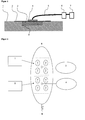
- FIG. 2 shows a view of a pig's back.
- S1 - S8 are the foam-covered wounds, 1 and 2 represent a wound dressing of foams A or B, each covering four wounds.
- 3 and 4 are openings for connection to the vacuum system.
- 5 is the pig's head, 6 the tail.
- Example 2 As shown in Example 2, a foam A according to the invention and a comparative foam B were used as wound dressings.
- the granulation tissues were examined histologically.
- FIG. 5 there are more areas of inflammatory activity in the granulation tissue of a wound treated with the comparative foam B, as in FIG. 5 shown.
- the inflammatory foci consist of foreign body giant cells, neutrophilic granulocytes and lymphoid cells, as in FIG. 6 shown. Consequently, the use of a foam according to the invention is associated with less inflammatory activity.
Landscapes
- Health & Medical Sciences (AREA)
- Chemical & Material Sciences (AREA)
- General Health & Medical Sciences (AREA)
- Engineering & Computer Science (AREA)
- Heart & Thoracic Surgery (AREA)
- Life Sciences & Earth Sciences (AREA)
- Animal Behavior & Ethology (AREA)
- Public Health (AREA)
- Veterinary Medicine (AREA)
- Hematology (AREA)
- Vascular Medicine (AREA)
- Biomedical Technology (AREA)
- Chemical Kinetics & Catalysis (AREA)
- Materials Engineering (AREA)
- Polymers & Plastics (AREA)
- Organic Chemistry (AREA)
- Medicinal Chemistry (AREA)
- Epidemiology (AREA)
- Anesthesiology (AREA)
- Dispersion Chemistry (AREA)
- Materials For Medical Uses (AREA)
- Polyurethanes Or Polyureas (AREA)
- Media Introduction/Drainage Providing Device (AREA)
Applications Claiming Priority (2)
| Application Number | Priority Date | Filing Date | Title |
|---|---|---|---|
| DE102010034819A DE102010034819A1 (de) | 2010-08-19 | 2010-08-19 | Verwendung eines Polyurethanschaumstoffs als Wundauflage in der Unterdrucktherapie |
| EP11754831.3A EP2515812B1 (de) | 2010-08-19 | 2011-08-18 | Verwendung eines polyurethanschaumstoffs als wundauflage in der unterdrucktherapie |
Related Parent Applications (1)
| Application Number | Title | Priority Date | Filing Date |
|---|---|---|---|
| EP11754831.3 Division | 2011-08-18 |
Publications (1)
| Publication Number | Publication Date |
|---|---|
| EP2574319A1 true EP2574319A1 (de) | 2013-04-03 |
Family
ID=44587761
Family Applications (2)
| Application Number | Title | Priority Date | Filing Date |
|---|---|---|---|
| EP12008496A Withdrawn EP2574319A1 (de) | 2010-08-19 | 2011-08-18 | Verwendung eines Polyurethanschaumstoffs als Wundauflage in der Unterdrucktherapie |
| EP11754831.3A Active EP2515812B1 (de) | 2010-08-19 | 2011-08-18 | Verwendung eines polyurethanschaumstoffs als wundauflage in der unterdrucktherapie |
Family Applications After (1)
| Application Number | Title | Priority Date | Filing Date |
|---|---|---|---|
| EP11754831.3A Active EP2515812B1 (de) | 2010-08-19 | 2011-08-18 | Verwendung eines polyurethanschaumstoffs als wundauflage in der unterdrucktherapie |
Country Status (12)
| Country | Link |
|---|---|
| EP (2) | EP2574319A1 (https=) |
| JP (1) | JP6062856B2 (https=) |
| CN (1) | CN103189026B (https=) |
| AU (1) | AU2011291032B2 (https=) |
| BR (1) | BR112013003882A2 (https=) |
| CA (1) | CA2808263A1 (https=) |
| DE (2) | DE102010034819A1 (https=) |
| ES (1) | ES2423660T3 (https=) |
| PL (1) | PL2515812T3 (https=) |
| RU (1) | RU2545787C2 (https=) |
| WO (1) | WO2012022485A1 (https=) |
| ZA (1) | ZA201301977B (https=) |
Families Citing this family (28)
| Publication number | Priority date | Publication date | Assignee | Title |
|---|---|---|---|---|
| DE102010052336A1 (de) | 2010-11-25 | 2012-05-31 | Paul Hartmann Ag | Wundauflage für die Unterdrucktherapie |
| EP2567682B2 (de) | 2011-09-09 | 2017-12-27 | Paul Hartmann AG | Abdominal-Wundauflage mit Applikationshilfe |
| EP2567681B1 (de) | 2011-09-09 | 2014-11-12 | Paul Hartmann AG | Wundauflage für den Abdominalbereich |
| EP2711033A1 (de) * | 2012-09-25 | 2014-03-26 | Paul Hartmann AG | System für die Wundtherapie |
| DE102013008964A1 (de) | 2013-05-22 | 2014-11-27 | Gmbu E.V., Fachsektion Dresden | Vorrichtung zur Behandlung von Problemwunden |
| EP2837369B1 (de) | 2013-08-16 | 2018-06-13 | Paul Hartmann AG | Abdichtelement für einen Wundverband zur Unterdrucktherapie |
| DE102013223657A1 (de) | 2013-11-20 | 2015-05-21 | Schülke & Mayr GmbH | Kit für die Erzeugung von Bispyridiniumalkan enthaltenden Schäumen |
| WO2015091697A1 (de) * | 2013-12-17 | 2015-06-25 | Birgit Riesinger | Wundpflegeartikel aufweisend ein material mit hoher rückstellkraft |
| DE102014106518A1 (de) | 2014-05-09 | 2015-11-12 | Paul Hartmann Ag | Schaumwundauflage für die Unterdrucktherapie |
| CN106456826B (zh) * | 2014-05-16 | 2020-11-27 | 3M创新有限公司 | 包括带有结合的弹性体材料的多孔弹性体材料的制品及其制备方法 |
| DE102014116910A1 (de) | 2014-11-19 | 2016-05-19 | Paul Hartmann Ag | Elektronischer Flüssigkeitssensor für Unterdrucktherapie-Vorrichtung |
| DE102014116912A1 (de) | 2014-11-19 | 2016-05-19 | Paul Hartmann Ag | Flüssigkeitsindikator für Unterdrucktherapie-Vorrichtung |
| TWI597075B (zh) * | 2015-05-12 | 2017-09-01 | Hydrophilic polyurethane, hydrophilic polyurethane foam and its preparation Wet wound dressing | |
| US10076594B2 (en) | 2015-05-18 | 2018-09-18 | Smith & Nephew Plc | Fluidic connector for negative pressure wound therapy |
| DE102015110432A1 (de) | 2015-06-29 | 2016-12-29 | Paul Hartmann Ag | Instillationsadapter für ein Unterdruckwundbehandlungssystem |
| CN106310497A (zh) * | 2015-07-01 | 2017-01-11 | 泰升国际科技股份有限公司 | 负压治疗装置 |
| EP3120817B1 (de) * | 2015-07-22 | 2020-07-01 | Lohmann & Rauscher GmbH | Wundversorgungsanordnung |
| EP3124060B1 (de) | 2015-07-28 | 2019-09-11 | Paul Hartmann AG | Schalldämpfer für eine unterdrucktherapieeinheit |
| EP3124059B1 (de) | 2015-07-28 | 2018-12-05 | Paul Hartmann AG | Schalldämpfer für eine unterdrucktherapieeinheit |
| DE102016202847B4 (de) | 2016-02-24 | 2024-08-08 | Siemens Healthineers Ag | Röntgeneinrichtung und Verfahren zur medizinischen Bildgebung |
| DE102016114786A1 (de) | 2016-08-10 | 2018-02-15 | Paul Hartmann Ag | Fassschlaufe für Saugkörper zur endoluminalen Unterdrucktherapie |
| DE102016114819A1 (de) | 2016-08-10 | 2018-02-15 | Paul Hartmann Ag | Saugkörper zur endoluminalen Unterdrucktherapie |
| DE102016114817A1 (de) | 2016-08-10 | 2018-02-15 | Paul Hartmann Ag | Medizinisches Kit zur Verwendung bei der Unterdrucktherapie von endoluminalen Wundstellen im Bereich des Gastrointestinaltraktes |
| WO2018129062A1 (en) * | 2017-01-09 | 2018-07-12 | Kci Licensing, Inc. | Wound dressing layer for improved fluid removal |
| CN113041388A (zh) * | 2021-04-02 | 2021-06-29 | 南昌智产科技有限公司 | 一种护理皮肤溃疡的泡沫敷料及其制备工艺 |
| CN113367891A (zh) * | 2021-04-27 | 2021-09-10 | 苏州元禾医疗器械有限公司 | 一种辅助创面愈合的多层敷料 |
| CN116999227B (zh) * | 2023-07-13 | 2026-01-06 | 中国人民解放军陆军军医大学第一附属医院 | 一种乳腺术后上肢锻炼伤口防裂装置 |
| EP4574114A1 (de) | 2023-12-20 | 2025-06-25 | Paul Hartmann AG | Inselverband für eine wundbehandlung mit einem acrylatklebstoff im randbereich und einem silikongel im wundkontaktierenden bereich |
Citations (6)
| Publication number | Priority date | Publication date | Assignee | Title |
|---|---|---|---|---|
| US3572340A (en) * | 1968-01-11 | 1971-03-23 | Kendall & Co | Suction drainage device |
| WO1993009727A1 (en) | 1991-11-14 | 1993-05-27 | Wake Forest University | Method and apparatus for treating tissue damage |
| US6071267A (en) * | 1998-02-06 | 2000-06-06 | Kinetic Concepts, Inc. | Medical patient fluid management interface system and method |
| WO2001085248A1 (en) | 2000-05-09 | 2001-11-15 | Kci Licensing, Inc. | Abdominal wound dressing |
| WO2009126102A1 (en) * | 2008-04-09 | 2009-10-15 | Mölnlycke Health Care Ab | A device for treatment of wounds and a method for manufacturing of wound pads |
| WO2011049522A1 (en) * | 2009-10-20 | 2011-04-28 | Mölnlycke Health Care Ab | Green article for use in wound treatment |
Family Cites Families (19)
| Publication number | Priority date | Publication date | Assignee | Title |
|---|---|---|---|---|
| US3610238A (en) * | 1970-04-28 | 1971-10-05 | Us Health Education & Welfare | Wound infection prevention device |
| US4373519A (en) * | 1981-06-26 | 1983-02-15 | Minnesota Mining And Manufacturing Company | Composite wound dressing |
| US5636643A (en) * | 1991-11-14 | 1997-06-10 | Wake Forest University | Wound treatment employing reduced pressure |
| JPH0780020A (ja) * | 1993-09-17 | 1995-03-28 | Nippon Zeon Co Ltd | 創傷被覆材 |
| SE519008C2 (sv) * | 2000-01-07 | 2002-12-23 | Volvo Personvagnar Ab | Anordning för löstagbar montering av bord vid ett fordon |
| US6719987B2 (en) * | 2000-04-17 | 2004-04-13 | Nucryst Pharmaceuticals Corp. | Antimicrobial bioabsorbable materials |
| US6803495B2 (en) * | 2000-06-28 | 2004-10-12 | World Properties, Inc. | Polyurethane foam composition and method of manufacture thereof |
| DE10105791A1 (de) * | 2001-02-07 | 2002-08-08 | Basf Ag | Federelement |
| US7004915B2 (en) * | 2001-08-24 | 2006-02-28 | Kci Licensing, Inc. | Negative pressure assisted tissue treatment system |
| DE10222888A1 (de) * | 2002-05-23 | 2003-12-11 | Bayer Ag | Polymermodifikatoren enthaltende Polyisocyanate und Polyurethane sowie ihre Verwendung |
| JP2005034483A (ja) * | 2003-07-17 | 2005-02-10 | Unitika Ltd | 減圧治療用創傷被覆パッドおよび減圧治療装置 |
| GB2410748A (en) * | 2004-02-03 | 2005-08-10 | Johnson & Johnson Medical Ltd | Medicated polyurethane foams |
| JP4922919B2 (ja) * | 2004-03-31 | 2012-04-25 | ダウ グローバル テクノロジーズ エルエルシー | ウレタン変性イソシアネート組成物及びそれらからのポリウレタン製品 |
| US7996950B2 (en) * | 2006-07-19 | 2011-08-16 | Armaly Sponge Company | Sponge product |
| MX2007008738A (es) * | 2006-07-19 | 2008-10-29 | John W Armaly Jr | Producto de esponja. |
| ES2361025T3 (es) * | 2006-11-07 | 2011-06-13 | Paul Hartmann Ag | Apósito absorbente de múltiples capas con una capa hidrófila de contacto con la herida. |
| KR100777908B1 (ko) * | 2006-12-19 | 2007-11-28 | 주식회사 바이오폴 | 보수율이 향상된 폴리우레탄 폼 드레싱재 |
| CN101265323A (zh) * | 2007-03-16 | 2008-09-17 | 张鹏飞 | 聚酯多元醇 |
| GB0813542D0 (en) * | 2008-07-24 | 2008-08-27 | Brightwake Ltd | Material for use as a wound packing element in particulary negative pressure wound therapy (NPWT) |
-
2010
- 2010-08-19 DE DE102010034819A patent/DE102010034819A1/de not_active Withdrawn
-
2011
- 2011-08-18 WO PCT/EP2011/004164 patent/WO2012022485A1/de not_active Ceased
- 2011-08-18 EP EP12008496A patent/EP2574319A1/de not_active Withdrawn
- 2011-08-18 BR BR112013003882A patent/BR112013003882A2/pt not_active IP Right Cessation
- 2011-08-18 JP JP2013524380A patent/JP6062856B2/ja not_active Expired - Fee Related
- 2011-08-18 RU RU2013111996/15A patent/RU2545787C2/ru active
- 2011-08-18 CA CA2808263A patent/CA2808263A1/en not_active Abandoned
- 2011-08-18 DE DE202011110497.8U patent/DE202011110497U1/de not_active Expired - Lifetime
- 2011-08-18 AU AU2011291032A patent/AU2011291032B2/en not_active Ceased
- 2011-08-18 ES ES11754831T patent/ES2423660T3/es active Active
- 2011-08-18 CN CN201180050124.5A patent/CN103189026B/zh active Active
- 2011-08-18 EP EP11754831.3A patent/EP2515812B1/de active Active
- 2011-08-18 PL PL11754831T patent/PL2515812T3/pl unknown
-
2013
- 2013-03-15 ZA ZA2013/01977A patent/ZA201301977B/en unknown
Patent Citations (6)
| Publication number | Priority date | Publication date | Assignee | Title |
|---|---|---|---|---|
| US3572340A (en) * | 1968-01-11 | 1971-03-23 | Kendall & Co | Suction drainage device |
| WO1993009727A1 (en) | 1991-11-14 | 1993-05-27 | Wake Forest University | Method and apparatus for treating tissue damage |
| US6071267A (en) * | 1998-02-06 | 2000-06-06 | Kinetic Concepts, Inc. | Medical patient fluid management interface system and method |
| WO2001085248A1 (en) | 2000-05-09 | 2001-11-15 | Kci Licensing, Inc. | Abdominal wound dressing |
| WO2009126102A1 (en) * | 2008-04-09 | 2009-10-15 | Mölnlycke Health Care Ab | A device for treatment of wounds and a method for manufacturing of wound pads |
| WO2011049522A1 (en) * | 2009-10-20 | 2011-04-28 | Mölnlycke Health Care Ab | Green article for use in wound treatment |
Also Published As
| Publication number | Publication date |
|---|---|
| RU2545787C2 (ru) | 2015-04-10 |
| BR112013003882A2 (pt) | 2016-07-05 |
| EP2515812A1 (de) | 2012-10-31 |
| JP6062856B2 (ja) | 2017-01-18 |
| DE102010034819A1 (de) | 2012-02-23 |
| CN103189026B (zh) | 2015-11-25 |
| EP2515812B1 (de) | 2013-05-08 |
| JP2013539380A (ja) | 2013-10-24 |
| ES2423660T3 (es) | 2013-09-23 |
| PL2515812T3 (pl) | 2013-10-31 |
| CA2808263A1 (en) | 2012-02-23 |
| DE202011110497U1 (de) | 2014-04-25 |
| WO2012022485A1 (de) | 2012-02-23 |
| AU2011291032A8 (en) | 2013-04-18 |
| CN103189026A (zh) | 2013-07-03 |
| HK1177416A1 (en) | 2013-08-23 |
| AU2011291032A1 (en) | 2013-03-28 |
| AU2011291032B2 (en) | 2013-11-07 |
| RU2013111996A (ru) | 2014-09-27 |
| ZA201301977B (en) | 2013-11-27 |
Similar Documents
| Publication | Publication Date | Title |
|---|---|---|
| EP2515812B1 (de) | Verwendung eines polyurethanschaumstoffs als wundauflage in der unterdrucktherapie | |
| EP2420214B1 (de) | Wundauflage, enthaltend Schaumstoff und Salbengrundlage zur Unterdrucktherapie | |
| EP2753374B1 (de) | Wundauflage zur verwendung bei der unterdruckbehandlung von wunden | |
| EP3139877B2 (de) | Schaumwundauflage für die unterdrucktherapie | |
| US8772567B2 (en) | Use of a polyurethane foam as a wound dressing in negative pressure therapy | |
| DE69517876T2 (de) | Wundverbände | |
| EP2532325B1 (de) | Wundauflage, enhaltend Schaumstoff und Salbengrundlage und Quellstoff, zur Unterdrucktherapie | |
| EP0580599B1 (de) | Hydrophile schäume und verfahren zu deren herstellung | |
| EP2726113B2 (de) | Wundversorgungsprodukt | |
| EP3558400B1 (de) | Wasserhaltige hydrogele zur wundversorgung | |
| WO2011072840A1 (de) | Vorrichtung zur unterdrucktherapie von wunden | |
| EP2711033A1 (de) | System für die Wundtherapie | |
| DE2845686C2 (https=) | ||
| DE102015007622A1 (de) | Vorrichtung zur Unterdrucktherapie von Wunden enthaltend siliconhaltigen Polyurethanschaumstoff | |
| EP3842075B1 (de) | Siloxan enthaltende wundauflage | |
| HK1177416B (en) | Use of polyurethan foam in negative pressure wound treatment |
Legal Events
| Date | Code | Title | Description |
|---|---|---|---|
| PUAI | Public reference made under article 153(3) epc to a published international application that has entered the european phase |
Free format text: ORIGINAL CODE: 0009012 |
|
| AC | Divisional application: reference to earlier application |
Ref document number: 2515812 Country of ref document: EP Kind code of ref document: P |
|
| AK | Designated contracting states |
Kind code of ref document: A1 Designated state(s): AL AT BE BG CH CY CZ DE DK EE ES FI FR GB GR HR HU IE IS IT LI LT LU LV MC MK MT NL NO PL PT RO RS SE SI SK SM TR |
|
| AX | Request for extension of the european patent |
Extension state: BA ME |
|
| 17P | Request for examination filed |
Effective date: 20131002 |
|
| RBV | Designated contracting states (corrected) |
Designated state(s): AL AT BE BG CH CY CZ DE DK EE ES FI FR GB GR HR HU IE IS IT LI LT LU LV MC MK MT NL NO PL PT RO RS SE SI SK SM TR |
|
| 17Q | First examination report despatched |
Effective date: 20141211 |
|
| STAA | Information on the status of an ep patent application or granted ep patent |
Free format text: STATUS: THE APPLICATION IS DEEMED TO BE WITHDRAWN |
|
| 18D | Application deemed to be withdrawn |
Effective date: 20160315 |