EP2573077A1 - Verfahren zur Herstellung von 3,4-Dichlor-N-(2-cyano-phenyl)-5-isothiazolcarboxamid - Google Patents
Verfahren zur Herstellung von 3,4-Dichlor-N-(2-cyano-phenyl)-5-isothiazolcarboxamid Download PDFInfo
- Publication number
- EP2573077A1 EP2573077A1 EP12197983A EP12197983A EP2573077A1 EP 2573077 A1 EP2573077 A1 EP 2573077A1 EP 12197983 A EP12197983 A EP 12197983A EP 12197983 A EP12197983 A EP 12197983A EP 2573077 A1 EP2573077 A1 EP 2573077A1
- Authority
- EP
- European Patent Office
- Prior art keywords
- phenyl
- dichloro
- aminocarbonyl
- isothiazolecarboxamide
- dichlor
- Prior art date
- Legal status (The legal status is an assumption and is not a legal conclusion. Google has not performed a legal analysis and makes no representation as to the accuracy of the status listed.)
- Granted
Links
Classifications
-
- C—CHEMISTRY; METALLURGY
- C07—ORGANIC CHEMISTRY
- C07D—HETEROCYCLIC COMPOUNDS
- C07D275/00—Heterocyclic compounds containing 1,2-thiazole or hydrogenated 1,2-thiazole rings
- C07D275/02—Heterocyclic compounds containing 1,2-thiazole or hydrogenated 1,2-thiazole rings not condensed with other rings
- C07D275/03—Heterocyclic compounds containing 1,2-thiazole or hydrogenated 1,2-thiazole rings not condensed with other rings with hetero atoms or with carbon atoms having three bonds to hetero atoms with at the most one bond to halogen, e.g. ester or nitrile radicals, directly attached to ring carbon atoms
Definitions
- the present invention relates to a novel process for the preparation and isolation of 3,4-dichloro-N- (2-cyano-phenyl) -5-isothiazolecarboxamide which is useful as an active ingredient having microbicidal properties.
- a disadvantage of this method is that the required as starting material 2-cyano-aniline is accessible only by complex syntheses: So it is for example necessary to first implement anthranilic in the presence of dimethylformamide with phosgene and the resulting N-2-cyano-phenyl N ', N'-dimethyl-formamidinium hydrochloride then in a second step with sodium acetate in aqueous medium to treat (see. DE-A 2115 624 and DE-A 2115 625 ).
- suitable diluents in carrying out both stages of the WO 2004/002968 known method are preferably optionally halogenated aromatic hydrocarbons such as toluene or chlorobenzene, further chlorinated hydrocarbons such as dichloromethane, chloroform, carbon tetrachloride, dichloroethane or trichloroethane, and further amides such as dimethylformamide and dimethylacetamide called. As particularly preferred dimethylformamide is given.
- chlorinated hydrocarbons such as dichloromethane, chloroform, carbon tetrachloride, dichloroethane or trichloroethane because of their toxic potential only with increased technical effort manageable solvent.
- optionally halogenated aromatic hydrocarbons such as toluene or chlorobenzene
- the formation of N- [2- (N'-formylamino-carbonyl) -phenyl] -3,4-dichloro-5-isothiazolecarboxamide of the formula (V) is increasingly increased. observed as an undesirable minor component which contaminates the product.
- the reaction in these diluents requires increased amounts of dehydrating agent.
- dialkylamides such as dimethylformamide or dibutylformamide are disadvantageous because of the relatively high price of these solvents. This requires an at least partial recovery of the dialkylamide solvents for an economical process, which is difficult due to the properties of the dialkylamide solvents (such as complete or partial miscibility with water, high boiling point) and requires a considerable costly additional technical effort.
- methyl acetate is used as diluent.
- the process according to the invention can be carried out as a one-pot reaction, i. the process steps a) and b) are carried out immediately after one another without isolation of the intermediate (IV).
- the diluent provided according to the invention from methyl acetate, ethyl acetate or a mixture thereof is also already used when carrying out process step a).
- the process according to the invention can also be carried out as a two-stage process, i. the intermediate (IV) is first isolated after process step a) and then process step b) is carried out.
- process step b) is carried out in the presence of the diluents provided according to the invention from methyl acetate, ethyl acetate or a mixture thereof.
- the use of the inventively provided diluent in both process steps a) and b) is possible.
- the process step (a) of the process according to the invention is optionally carried out in the presence of an acid acceptor.
- tertiary amines preference is given to tertiary amines.
- examples include trimethylamine, triethylamine, tributylamine, N, N-dimethyl-benzylamine, pyridine, N-methylpiperidine, N-methylmorpholine, N, N-dimethylaminopyridine, diazabicyclooctane (DABCO), diazabicyclononene (DBN) or diazabicycloundecene (DBU).
- the amount of acid acceptor is generally 0.5 to 1.5 moles per mole of 3,4-dichloro-isothiazole-5-carboxylic acid chloride.
- 1 mole of 3,4-dichloro-isothiazole-5-carbonyl chloride of the formula (II) generally between 1 and 1.5 moles of Anthranilklareamid of formula (III) ,
- the temperatures may vary within a substantial range when carrying out the process according to the invention.
- the temperatures in carrying out the process according to the invention are generally in the range between -20 and 160 ° C. Preference is given to working between -10 and 40 ° C, more preferably between 0 and 25 ° C, most preferably at room temperature.
- both process steps a) and b) of the process according to the invention are carried out at the same temperature.
- process step a) at a temperature of -20 to 160 ° C can be performed.
- Process step b) is then preferably carried out at a temperature of -10 to 30 ° C.
- Process step (b) is carried out in the presence of a dehydrating agent.
- Suitable dehydrating agents are preferably reagents which are selected from the group consisting of mixtures of dialkylformamide, in particular dimethylformamide and dibutylformamide, with thionyl chloride, phosphorus oxychloride, phosgene and / or chloromethylene-dimethylammonium chloride. Very particular preference is given to the use of a mixture of dimethylformamide or dibutylformamide and thionyl chloride or phosgene as dehydrating agent.
- the amounts of phosgene or thionyl chloride used in carrying out the process according to the invention are generally between 1 and 6 moles per 1 mole of 3,4-dichloro-isothiazole-5-carbonyl chloride. Preference is given to using between 2 and 4 moles per 1 mole of 3,4-dichloro-isothiazole-5-carbonyl chloride.
- dialkylformamide used in carrying out the process according to the invention are between 1 and 4 moles per 1 mole of 3,4-dichloro-isothiazole-5-carbonyl chloride. Preference is given to using between 2 and 3 moles per 1 mole of 3,4-dichloro-isothiazole-5-carbonyl chloride.
- the reaction according to the first and / or second process stage can be carried out in the presence of a further diluent.
- Further diluents which may be used in carrying out the process according to the invention are all customary aprotic organic solvents. Preference is given to using optionally halogenated aromatic hydrocarbons such as toluene or chlorobenzene, furthermore chlorinated hydrocarbons such as dichloromethane, chloroform, carbon tetrachloride, dichloroethane or trichloroethane and also amides such as dialkylformamide and dialkylacetamide.
- dimethylformamide, diethylformamide, dipropylformamide, dibutylformamide or N-formylmorpholine can be used as the dialkylformamide.
- dimethylacetamide is preferably used as the dialkylacetamide.
- both the reaction in the first stage and in the second stage are generally carried out under atmospheric pressure. However, it is also possible to work under increased pressure.
- reaction times when carrying out the process according to the invention are generally between 1 and 24 hours and are essentially dependent on the reaction temperature and the choice and the amount of each acid acceptor and dehydrating agent used. Preferred reaction times are between 2 and 8 hours.
- Suitable alcohols for this embodiment of the process according to the invention are in principle monohydric alcohols as well as diols. For reasons of availability and price, preference will be given to using monohydric C 1 to C 6 alcohols. Particularly preferred are methanol and ethanol.
- This method of working up with an alcohol can be carried out in various ways. For example, it is possible to filter the reaction mixture and to wash the solid obtained first with an alcohol and then with water. However, it is also possible to give the alcohol after the reaction in the reaction mixture, then to be mixed with water and then sucked off.
- the execution of the work-up method according to the inventive method according to the second embodiment is carried out at -10 to 30 ° C; preferably at 0 to 20 ° C.
- the work-up method according to the method of the invention is carried out within a short period of time.
- the reaction mixture is brought into contact with the alcohol for 10 minutes to 4 hours; preferred is a time of 30 minutes to 2 hours.
- the inventive method is characterized by a number of advantages. It allows the production of 3,4-dichloro-N- (2-cyano-phenyl) -5-isothiazolecarboxamide in very good yield and very high purity.
- the process of the invention can be easily transferred to the industrial scale.
- reaction mixture After 5 hours at 0-5 ° C and 1 hour at 20 ° C, the reaction mixture is mixed with 100 ml of water and stirred for 15 minutes. The solid is filtered off, washed twice with 20 ml of isopropanol and dried.
Landscapes
- Chemical & Material Sciences (AREA)
- Organic Chemistry (AREA)
- Thiazole And Isothizaole Compounds (AREA)
- Plural Heterocyclic Compounds (AREA)
- Organic Low-Molecular-Weight Compounds And Preparation Thereof (AREA)
- Heterocyclic Carbon Compounds Containing A Hetero Ring Having Nitrogen And Oxygen As The Only Ring Hetero Atoms (AREA)
Abstract
Description
- Die vorliegende Erfindung betrifft ein neues Verfahren zur Herstellung und Isolierung von 3,4-Dichlor-N-(2-cyano-phenyl)-5-isothiazolcarboxamid, das als Wirkstoff mit mikrobiziden Eigenschaften verwendbar ist.
- Es ist bekannt, dass man 3,4-Dichlor-N-(2-cyano-phenyl)-5-isothiazolcarboxamid der allgemeinen Formel (I)

WO 99/24413 DE-A 2115 624 undDE-A 2115 625 ). - Nachteilig an dem in der
WO 99/24413 WO 99/24413 - Weiterhin ist bekannt, dass man 3,4-Dichlor-N-(2-cyano-phenyl)-5-isothiazolcarboxamid erhält, indem man
- a) 3,4-Dichlorisothiazol-5-carbonsäurechlorid der Formel (II)


- b) dann das entstandene N-[2-(Aminocarbonyl)-phenyl]-3,4-dichlor-5-isothiazolcarboxamid der Formel (IV)

- Als geeignete Verdünnungsmittel bei der Durchführung beider Stufen des aus der
WO 2004/002968 bekannten Verfahrens werden vorzugsweise gegebenenfalls halogenierte aromatische Kohlenwasserstoffe wie Toluol oder Chlorbenzol, ferner chlorierte Kohlenwasserstoffe wie Dichlormethan, Chloroform, Tetrachlorkohlenstoff, Dichlorethan oder Trichlorethan, und weiterhin Amide wie Dimethylformamid und Dimethylacetamid genannt. Als besonders bevorzugt wird Dimethylformamid angegeben. - Durch die Verwendung der genannten Verdünnungsmittel resultieren allerdings auch verschiedene Nachteile. So sind chlorierte Kohlenwasserstoffe wie Dichlormethan, Chloroform, Tetrachlorkohlenstoff, Dichlorethan oder Trichlorethan wegen ihres toxischen Potentials nur mit erhöhtem technischen Aufwand handhabbare Lösungsmittel. Wird die Reaktion in gegebenenfalls halogenierten aromatischen Kohlenwasserstoffen wie Toluol oder Chlorbenzol durchgeführt, wird vermehrt die Bildung von N-[2-(N'-Formyl-aminocarbonyl)-phenyl]-3,4-dichlor-5-isothiazolcarboxamid der Formel (V)

- Bei der Verwendung von Dimethylformamid als Verdünnungsmittel entsteht diese Nebenkomponente in deutlich geringerer Menge, kann aber auch hier nicht völlig verhindert werden. Außerdem ist die Verwendung von Dialkylamiden wie Dimethylformamid oder Dibutylformamid wegen des relativ hohen Preises dieser Lösungsmittel nachteilig. Dieser macht für ein ökonomisches Verfahren eine zumindest teilweise Rückgewinnung der Dialkylamid-Lösungsmittel erforderlich, was infolge der Eigenschaften der Dialkylamid-Lösungsmittel (wie völlige oder teilweise Mischbarkeit mit Wasser; hoher Siedepunkt) schwierig ist und einen erheblichen kostenintensiven zusätzlichen technischen Aufwand erfordert.
- Es bestand daher Bedarf an einem verbesserten Verfahren, durch das 3,4-Dichlor-N-(2-cyano-phenyl)-5-isothiazolcarboxamid in guten Ausbeuten mit wesentlich verringerten Anteilen der Verunreinigung N-[2-(N'-Formyl-aminocarbonyl)-phenyl]-3,4-dichlor-5-isothiazolcarboxamid der Formel (V) ohne Verwendung eines großen Überschusses an Dialkylamid als Verdünnungsmittel hergestellt werden kann.
- Erfindungsgemäß wurde gefunden, dass man 3,4-Dichlor-N-(2-cyano-phenyl)-5-isothiazolcarboxamid in sehr guten Ausbeuten und deutlich verbesserter Reinheit erhält, wenn man in dem Verfahren Essigsäuremethylester, Essigsäureethylester oder Mischungen davon als Verdünnungsmittel verwendet.
- Demgemäß betrifft die vorliegende Erfindung in einer ersten Ausführungsform ein Verfahren zur Herstellung von 3,4-Dichlor-N-(2-cyano-phenyl)-5-isothiazolcarboxamid der Formel (I)

- a) 3,4-Dichlorisothiazol-5-carbonsäurechlorid der Formel (II)


- b) dann das entstandene N-[2-(Aminocarbonyl)-phenyl]-3,4-dichlor-5-isothiazolcarboxamid der Formel (IV)

- Besonders bevorzugt ist es, wenn als Verdünnungsmittel Essigsäuremethylester verwendet wird.
- Das erfindungsgemäße Verfahren kann als Eintopf-Reaktion durchgeführt werden, d.h. die Verfahrensschritte a) und b) werden unmittelbar hintereinander ohne Isolierung des Zwischenprodukts (IV) durchgeführt. Bei dieser Verfahrensweise, die besonders bevorzugt ist, wird das erfindungsgemäß vorgesehene Verdünnungsmittel aus Essigsäuremethylester, Essigsäureethylester oder einer Mischung davon auch schon bei der Durchführung von Verfahrensschritt a) verwendet.
- Das erfindungsgemäße Verfahren kann auch als zweistufiges Verfahren durchgeführt werden, d.h. dass das Zwischenprodukt (IV) nach dem Verfahrensschritt a) zunächst isoliert und dann der Verfahrensschritt b) durchgeführt wird. Bei dieser Verfahrensweise wird zumindest der Verfahrensschritt b) in Gegenwart der erfindungsgemäß vorgesehenen Verdünnungsmittel aus Essigsäuremethylester, Essigsäureethylester oder einer Mischung davon durchgeführt. Alternativ ist bei dieser zweistufigen Verfahrensweise auch die Verwendung der erfindungsgemäß vorgesehenen Verdünnungsmittel in beiden Verfahrensschritten a) und b) möglich.
- Der Verfahrensschritt (a) des erfindungsgemäßen Verfahrens wird gegebenenfalls in Gegenwart eines Säureakzeptors durchgeführt.
- Wenn ein Säureakzeptor in Verfahrensschritt a) verwendet wird, kommen vorzugsweise tertiäre Amine in Frage. Beispielhaft genannt seien Trimethylamin, Triethylamin, Tributylamin, N,N-Dimethyl-benzylamin, Pyridin, N-Methylpiperidin, N-Methylmorpholin, N,N-Dimethylaminopyridin, Diazabicyclooctan (DABCO), Diazabicyclononen (DBN) oder Diazabicycloundecen (DBU).
- Wenn ein Säureakzeptor bei der Durchführung des erfindungsgemäßen Verfahrens verwendet wird, beträgt die Menge in Säureakzeptor im allgemeinen 0,5 bis 1,5 Mol pro Mol an 3,4-Dichlor-isothiazol-5-carbonsäurechlorid. Darüber hinaus setzt man bei der Durchführung der ersten Stufe des erfindungsgemäßen Verfahrens auf 1 Mol an 3,4-Dichlor-isothiazol-5-carbonsäurechlorid der Formel (II) im allgemeinen zwischen 1 und 1,5 Mol an Anthranilsäureamid der Formel (III) ein.
- Die Temperaturen können bei der Durchführung des erfindungsgemäßen Verfahrens innerhalb eines größeren Bereiches variieren. Die Temperaturen bei der Durchführung des erfindungsgemäßen Verfahrens liegen im allgemeinen im Bereich zwischen -20 und 160 °C. Vorzugsweise arbeitet man zwischen -10 und 40 °C, besonders bevorzugt zwischen 0 und 25 °C, ganz besonders bevorzugt bei Raumtemperatur.
- Es ist bevorzugt, wenn beide Verfahrensstufen a) und b) des erfindungsgemäßen Verfahrens bei gleicher Temperatur durchgeführt werden. Alternativ ist es aber auch möglich, die beiden Verfahrenschritte a) und b) des erfindungsgemäßen Verfahrens bei unterschiedlichen Temperaturen durchzuführen. Dabei kann Verfahrensschritt a) bei einer Temperatur von -20 bis 160 °C durchgeführt werden. Verfahrensschritt b) wird dann vorzugsweise bei einer Temperatur von -10 bis 30 °C durchgeführt.
- Verfahrensschritt (b) wird in Gegenwart eines Dehydratisierungsmittels durchgeführt.
- Als Dehydratisierungsmittel kommen vorzugsweise Reagenzien in Frage, die ausgewählt sind aus der Gruppe, bestehend aus Mischungen von Dialkylformamid, insbesondere Dimethylformamid und Dibutylformamid, mit Thionylchlorid, Phosphoroxychlorid, Phosgen und/oder Chlormethylen-dimethylammoniumchlorid. Ganz besonders bevorzugt ist die Verwendung eines Gemisches aus Dimethylformamid oder Dibutylformamid und Thionylchlorid oder Phosgen als Dehydratisierungsmittel.
- Die bei der Durchführung des erfindungsgemäßen Verfahrens eingesetzten Mengen an Phosgen oder Thionylchlorid liegen im allgemeinen zwischen 1 und 6 Mol je 1 Mol 3,4-Dichlor-isothiazol-5-carbonsäurechlorid. Bevorzugt verwendet man zwischen 2 und 4 Mol je 1 Mol 3,4-Dichlor-isothiazol-5-carbonsäurechlorid.
- Die bei der Durchführung des erfindungsgemäßen Verfahrens eingesetzten Mengen an Dialkylformamid liegen zwischen 1 und 4 Mol je 1 Mol 3,4-Dichlor-isothiazol-5-carbonsäurechlorid. Bevorzugt verwendet man zwischen 2 und 3 Mol je 1 Mol 3,4-Dichlor-isothiazol-5-carbonsäurechlorid.
- Darüber hinaus kann in dem erfindungsgemäßen Verfahren die Umsetzung gemäß erster und/oder zweiter Verfahrensstufe in Gegenwart eines weiteren Verdünnungsmittels durchgeführt werden. Als weitere Verdünnungsmittel können bei der Durchführung des erfindungsgemäßen Verfahrens alle üblichen aprotischen, organischen Solventien eingesetzt werden. Vorzugsweise verwendbar sind gegebenenfalls halogenierte aromatische Kohlenwasserstoffe wie Toluol oder Chlorbenzol, ferner chlorierte Kohlenwasserstoffe wie Dichlormethan, Chloroform, Tetrachlorkohlenstoff, Dichlorethan oder Trichlorethan und weiterhin Amide wie Dialkylformamid und Dialkylacetamid. Als Dialkylformamid können beispielsweise Dimethylformamid, Diethylformamid, Dipropylformamid, Dibutylformamid oder N-Formyl-morpholin eingesetzt werden. Bevorzugt sind Dimethylformamid und Dibutylformamid, besonders bevorzugt Dimethylformamid. Als Dialkylacetamid wird vorzugsweise Dimethylacetamid verwendet.
- Bei der Durchführung des erfindungsgemäßen Verfahrens arbeitet man sowohl bei der Umsetzung in der ersten Stufe als auch in der zweiten Stufe im allgemeinen unter Atmosphärendruck. Es ist jedoch auch möglich, unter erhöhtem Druck zu arbeiten.
- Die Reaktionszeiten bei der Durchführung des erfindungsgemäßen Verfahrens liegen im allgemeinen zwischen 1 und 24 Stunden und sind im Wesentlichen von der Reaktionstemperatur sowie der Wahl und der Menge an jeweils verwendetem Säureakzeptor und Dehydratisierungsmittel abhängig. Bevorzugte Reaktionszeiten liegen zwischen 2 und 8 Stunden.
- Erfindungsgemäß wurde zusätzlich gefunden, dass man 3,4-Dichlor-N-(2-cyano-phenyl)-5-isothiazolcarboxamid in sehr guten Ausbeuten und deutlich verbesserter Reinheit erhält, wenn man bei der Aufarbeitung und Isolierung des Produkts einen Alkohol verwendet.
- Demgemäß betrifft die vorliegende Erfindung in einer zweiten Ausführungsform ein Verfahren zur Herstellung von 3,4-Dichlor-N-(2-cyano-phenyl)-5-isothiazolcarboxamid der Formel (I)

- a) 3,4-Dichlorisothiazol-5-carbonsäurechlorid der Formel (II)


- b) dann das entstandene N-[2-(Aminocarbonyl)-phenyl]-3,4-dichlor-5-isothiazolcarboxamid der Formel (IV)

- Ohne hiermit eine end- oder alleingültige Erklärung der Entstehungsweise von N-[2-(N'-Formylaminocarbonyl)-phenyl]-3,4-dichlor-5-isothiazolcarboxamid der Formel (V) geben zu wollen, scheint es jedoch möglich zu sein, dass diese Nebenkomponente erst bei der wässrigen Aufarbeitung des Reaktionsgemisches aus einer entsprechenden Vorstufe entsteht (vgl. dazu auch: J. Liebscher und A. Rumler, J. prakt. Chem. 326 (1984) 311-319). Es hat sich daher als vorteilhaft herausgestellt, das rohe 3,4-Dichlor-N-(2-cyano-phenyl)-5-isothiazolcarboxamid vor der wässrigen Aufarbeitung mit einem Alkohol zu vermischen und so die Vorstufe zum N-[2-(N'-Formyl-aminocarbonyl)-phenyl]-3,4-dichlor-5-isothiazolcarboxamid in ein alkohollöslisches Produkt zu überführen.
- Als Alkohole für diese Ausführungsform des erfindungsgemäßen Verfahrens kommen grundsätzlich einwertige Alkohole sowie auch Diole in Frage. Aus Gründen der Verfügbarkeit und des Preises wird man bevorzugt einwertige C1- bis C6-Alkohole verwenden. Besonders bevorzugt sind Methanol und Ethanol.
- Die Durchführung dieser Aufarbeitungsmethode mit einem Alkohol kann auf verschiedene Weise erfolgen. So ist es beispielsweise möglich, das Reaktionsgemisch zu filtrieren und den erhaltenen Feststoff zuerst mit einem Alkohol und dann mit Wasser zu waschen. Es ist jedoch auch möglich, den Alkohol nach erfolgter Umsetzung in das Reaktionsgemisch zu geben, anschließend mit Wasser zu versetzen und dann abzusaugen.
- Da grundsätzlich unter den sauren Bedingungen des Reaktionsgemisches auch unerwünschte Nebenreaktionen des Produktes mit einem Alkohol möglich sind, so z.B. eine Pinner-Reaktion (siehe beispielsweise: R. Roger und D. G. Neilson, Chem. Rev. 61 (1961) 179-211), erfolgt die Durchführung der Aufarbeitungsmethode nach dem erfindungsgemäßen Verfahren gemäß zweiter Ausführungsform bei -10 bis 30°C; bevorzugt bei 0 bis 20°C.
- Aus dem gleichen Grund erfolgt die Durchführung der Aufarbeitungsmethode nach dem erfindungsgemäßen Verfahren innerhalb einer kurzen Zeitspanne. Üblicherweise bringt man das Reaktionsgemisch für 10 Minuten bis 4 Stunden mit dem Alkohol in Kontakt; bevorzugt ist eine Zeit von 30 Minuten bis 2 Stunden.
- Für weitere Ausführungen zum erfindungsgemäßen Verfahren gemäß zweiter Ausführungsform, beispielsweise hinsichtlich Temperatur, Druck, Stöchiometrie und Verfahrensdauer der Verfahrensschritte a) und b), wird auf obige Ausführungen zur ersten Ausführungsform verwiesen.
- Erfindungsgemäß wurde zusätzlich gefunden, dass man 3,4-Dichlor-N-(2-cyano-phenyl)-5-isothiazol-carboxamid in sehr guten Ausbeuten und deutlich verbesserter Reinheit erhält, wenn man in dem Verfahren Essigsäuremethylester, Essigsäureethylester oder Mischungen davon als Verdünnungsmittel verwendet und bei der Aufarbeitung und Isolierung des Produkts einen Alkohol verwendet.
- Demgemäß betrifft die vorliegende Erfindung in einer dritten Ausführungsform ein Verfahren zur Herstellung von 3,4-Dichlor-N-(2-cyano-phenyl)-5-isothiazolcarboxamid der Formel (I)

- a) 3,4-Dichlorisothiazol-5-carbonsäurechlorid der Formel (II)

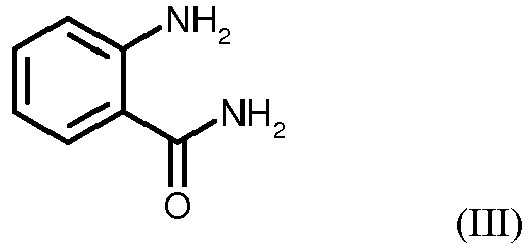
- b) dann das entstandene N-[2-(Aminocarbonyl)-phenyl]-3,4-dichlor-5-isothiazolcarboxamid der Formel (IV)

- Für diese dritte Ausführungsform gelten entsprechend die Ausführungen zur ersten bzw. zweiten Ausführungsform des erfindungsgemäßen Verfahrens.
- Das erfindungsgemäße Verfahren zeichnet sich durch eine Reihe von Vorteilen aus. Es ermöglicht die Herstellung von 3,4-Dichlor-N-(2-cyano-phenyl)-5-isothiazolcarboxamid in sehr guter Ausbeute und sehr hoher Reinheit. Das erfindungsgemäße Verfahren lässt sich problemlos in den technischen Maßstab übertragen.
- Die vorliegende Erfindung wird anhand der nachfolgend beschriebenen Beispiele näher erläutert, welche jedoch die vorliegende Erfindung nicht beschränken. Die Ausbeuteangaben verstehen sich dabei als Gesamtausbeute über beide Verfahrensstufen.
- In 1280 ml Essigsäuremethylester werden 119,8 g [0,88 mol] Anthranilsäureamid, 89,1 g [0,88 mol] Triethylamin und 175,4 g [2,4 mol] N,N-Dimethylformamid (DMF) vorgelegt. Bei 10-20°C wird eine Lösung von 163,7 g [0,756 mol] 3,4-Dichlorisothiazol-5-carbonsäurechlorid in 320 ml Essigsäuremethylester zugetropft. Man rührt 1 Stunde bei 10-20°C und tropft dann bei gleicher Temperatur 380,7 g [3,2 mol] Thionylchlorid innerhalb von 30 Minuten zu. Nach 2 Stunden bei 20°C wird das Reaktionsgemisch filtriert und der Feststoff auf der Nutsche nacheinander mit 200 ml Essigsäuremethylester, zweimal je 200 ml Methanol, dreimal je 400 ml Wasser und nochmals 200 ml Methanol gewaschen. Nach Trocknung erhält man 198,8 g beigen Feststoff folgender Zusammensetzung:
- 97,4% 3,4-Dichlor-N-(2-cyano-phenyl)-5-isothiazolcarboxamid (85,9% d.Th.)
- 0,43% N-[2-(Aminocarbonyl)-phenyl]-3,4-dichlor-5-isothiazolcarboxamid
- 0,42% N-[2-(N'-Formyl-aminocarbonyl)-phenyl]-3,4-dichlor-5-isothiazol-carboxamid
- In 80 ml Essigsäuremethylester werden 7,49 g [55 mmol] Anthranilsäureamid, 5,57 g [55 mmol] Triethylamin und 11 g [150 mmol] DMF vorgelegt. Bei 10-20°C wird eine Lösung von 10,2 g [47,2 mmol] 3,4-Dichlorisothiazol-5-carbonsäurechlorid in 20 ml Essigsäuremethylester zugetropft. Man rührt 1 Stunde bei 10-20°C und tropft danach bei gleicher Temperatur 23,8 g [200 mmol] Thionylchlorid innerhalb von 15 Minuten zu. Nach 2 Stunden bei 20°C gibt man unter Kühlung 50 ml Methanol zum Reaktionsgemisch, rührt 30 Minuten, saugt den Feststoff ab und wäscht ihn auf der Nutsche nacheinander mit zweimal je 20 ml Wasser und einmal 20 ml Methanol. Nach Trocknung erhält man 12,34 g beigen Feststoff folgender Zusammensetzung:
- 97,5% 3,4-Dichlor-N-(2-cyano-phenyl)-5-isothiazolcarboxamid (85,5% d.Th.)
- 0,46% N-[2-(Aminocarbonyl)-phenyl]-3,4-dichlor-5-isothiazolcarboxamid
- 0,37% N-[2-(N'-Formyl-aminocarbonyl)-phenyl]-3,4-dichlor-5-isothiazol-carboxamid
- In 320 ml Essigsäuremethylester werden 29,95 g [220 mmol] Anthranilsäureamid, 22,26 g [220 mmol] Triethylamin und 43,86 g [600 mmol] DMF vorgelegt. Bei 10-20°C wird eine Lösung von 43,3 g [200 mmol] 3,4-Dichlorisothiazol-5-carbonsäurechlorid in 80 ml Essigsäuremethylester zugetropft. Man rührt 1 Stunde bei 10-20°C und tropft dann bei gleicher Temperatur 95,2g [800 mmol] Thionylchlorid innerhalb von 2 Stunden zu. Anschließend rührt man noch 30 Minuten bei 20°C und gibt dann unter Kühlung 200 ml Methanol zum Reaktionsgemisch. Nach 30 Minuten Rühren versetzt man unter Kühlung mit 200 ml Wasser und verrührt das Gemisch für weitere 2 Stunden. Dann saugt man den Feststoff ab und wäscht ihn auf der Nutsche nacheinander mit 50 ml Wasser und zweimal 50 ml Methanol. Nach Trocknung erhält man 54,8 g beigen Feststoff folgender Zusammensetzung:
- 96,75% 3,4-Dichlor-N-(2-cyano-phenyl)-5-isothiazolcarboxamid (88,9% d.Th.)
- 0,45% N-[2-(Aminocarbonyl)-phenyl]-3,4-dichlor-5-isothiazolcarboxamid
- 0,44% N-[2-(N'-Formyl-aminocarbonyl)-phenyl]-3,4-dichlor-5-isothiazol-carboxamid
- In 320 ml Essigsäuremethylester werden 29,95 g [220 mmol] Anthranilsäureamid, 22,26 g [220 mmol] Triethylamin und 43,86 g [600 mmol] DMF vorgelegt. Bei 10-20°C wird eine Lösung von 43,3 g [200 mmol] 3,4-Dichlorisothiazol-5-carbonsäurechlorid in 80 ml Essigsäuremethylester zugetropft. Man rührt 1 Stunde bei 10-20°C und tropft anschließend bei gleicher Temperatur 95,2 g [800 mmol] Thionylchlorid innerhalb von 2 Stunden zu. Danach rührt man noch für 2 Stunden bei 20°C und gibt dann unter Kühlung 200 ml Methanol zum Reaktionsgemisch. Nach 30 Minuten Rühren versetzt man unter Kühlung mit 200 ml Wasser und verrührt das Gemisch für weitere 2 Stunden. Man saugt den Feststoff ab und wäscht ihn auf der Nutsche nacheinander mit 50 ml Wasser und zweimal 50 ml Methanol. Nach Trocknung resultieren 54,4 g beiger Feststoff folgender Zusammensetzung:
- 96,6% 3,4-Dichlor-N-(2-cyano-phenyl)-5-isothiazolcarboxamid (88,1% d.Th.)
- 0,54% N-[2-(Aminocarbonyl)-phenyl]-3,4-dichlor-5-isothiazolcarboxamid
- 0,35% N-[2-(N'-Formyl-aminocarbonyl)-phenyl]-3,4-dichlor-5-isothiazol-carboxamid
- In 80 ml Essigsäuremethylester werden 7,49 g [55 mmol] Anthranilsäureamid, 5,57 g [55 mmol] Triethylamin und 11 g [150 mmol] DMF vorgelegt. Bei 10-20°C wird eine Lösung von 10,83 g [50 mmol] 3,4-Dichlorisothiazol-5-carbonsäurechlorid in 20 ml Essigsäuremethylester zugetropft. Man rührt 1 Stunde bei 10-20°C und tropft dann bei gleicher Temperatur 23,8 g [200 mmol] Thionylchlorid innerhalb von 15 Minuten zu. Nach 4 Stunden bei 20°C versetzt man das Reaktionsgemisch unter Kühlung bei 0-5°C mit 100 ml Wasser, verrührt für 15 Minuten, saugt den Feststoff ab und wäscht ihn auf der Nutsche zweimal mit je 20 ml Isopropanol. Nach Trocknung erhält man 13,39 g beigen Feststoff mit folgender Zusammensetzung:
- 98,1% 3,4-Dichlor-N-(2-cyano-phenyl)-5-isothiazolcarboxamid (88,1% d.Th.)
- 0,2% N-[2-(Aminocarbonyl)-phenyl]-3,4-dichlor-5-isothiazolcarboxamid
- 0,4% N-[2-(N'-Formyl-aminocarbonyl)-phenyl]-3,4-dichlor-5-isothiazolcarboxamid
- In 80 ml Essigsäuremethylester werden 7,49 g [55 mmol] Anthranilsäureamid, 5,57 g [55 mmol] Triethylamin und 7,31 g [100 mmol] DMF vorgelegt. Bei 10-20°C wird eine Lösung von 10,83 g [50 mmol] 3,4-Dichlorisothiazol-5-carbonsäurechlorid in 20 ml Essigsäuremethylester zugetropft. Man rührt 1 Stunde bei 10-20°C und tropft danach bei gleicher Temperatur 11,9 g [100 mmol] Thionylchlorid innerhalb von 15 Minuten zu. Nach 4 Stunden bei 20°C versetzt man das Reaktionsgemisch unter Kühlung mit 100 ml Wasser, verrührt für 15 Minuten, saugt den Feststoff ab und wäscht ihn auf der Nutsche mit 50 ml Wasser und zweimal je 20 ml Isopropanol. Nach Trocknung erhält man 13,35 g beigen Feststoff mit folgender Zusammensetzung:
- 98,1% 3,4-Dichlor-N-(2-cyano-phenyl)-5-isothiazolcarboxamid (87,9% d.Th.)
- 0,4% N-[2-(Aminocarbonyl)-phenyl]-3,4-dichlor-5-isothiazolcarboxamid
- < 0,05% N-[2-(N'-Formyl-aminocarbonyl)-phenyl]-3,4-dichlor-5-isothiazol-carboxamid
- In 8 ml Essigsäure-ethylester werden 0,749 g [5,5 mmol] Anthranilsäureamid, 0,557 g [5,5 mmol] Triethylamin und 1,1 g [15 mmol] DMF vorgelegt. Bei 0°C wird eine Lösung von 1,08 g [5 mmol] 3,4-Dichlorisothiazol-5-carbonsäurechlorid in 2 ml Essigsäureethylester zugetropft. Man rührt 1 Stunde bei 0°C und tropft danach bei gleicher Temperatur 2,38 g [20 mmol] Thionylchlorid innerhalb von 15 Minuten zu. Nach 2 Stunden bei 0°C und 2 Stunden bei 20°C versetzt man das Reaktionsgemisch unter Kühlung bei 0°C mit 10 ml Wasser, verrührt für 15 Minuten, saugt den Feststoff ab und wäscht ihn auf der Nutsche mit 20 ml Wasser. Nach Trocknung erhält man 1,34 g beigen Feststoff mit folgender Zusammensetzung:
- 97,2% 3,4-Dichlor-N-(2-cyano-phenyl)-5-isothiazolcarboxamid (87,2% d.Th.)
- 0,2% N-[2-(Aminocarbonyl)-phenyl]-3,4-dichlor-5-isothiazolcarboxamid
- 0,4% N-[2-(N'-Formyl-aminocarbonyl)-phenyl]-3,4-dichlor-5-isothiazol-carboxamid
- Es wird vorgegangen wie in Beispiel 4 beschrieben, mit dem Unterschied, dass Essigsäure-ethylester als Verdünnungsmittel verwendet wird. Man erhält 50,9 g beigen Feststoff folgender Zusammensetzung:
- 97,0% 3,4-Dichlor-N-(2-cyano-phenyl)-5-isothiazolcarboxamid (82,8% d.Th.)
- 0,30% N-[2-(Aminocarbonyl)-phenyl]-3,4-dichlor-5-isothiazolcarboxamid
- 0,51% N-[2-(N'-Formyl-aminocarbonyl)-phenyl]-3,4-dichlor-5-isothiazol-carboxamid
- In 80 ml Essigsäuremethylester werden 7,49 g [55 mmol] Anthranilsäureamid, 5,57 g [55 mmol] Triethylamin und 11 g [150 mmol] DMF vorgelegt. Bei 10-20°C wird eine Lösung von 10,22 g [47,2 mmol] 3,4-Dichlorisothiazol-5-carbonsäurechlorid in 20 ml Essigsäure-ethylester zugetropft. Man rührt 1 Stunde bei 20°C und tropft danach bei 10-20°C 23,8 g [200 mmol] Thionylchlorid innerhalb von 15 Minuten zu. Es wird 16 Stunden bei 20°C gerührt. Danach wird der Feststoff durch Filtration isoliert und in 2 Hälften geteilt. Die 1. Hälfte des Feststoffes wird auf dem Filter mit zweimal je 10 ml Ethanol, dann dreimal je 15 ml Wasser und noch einmal 10 ml Ethanol gewaschen. Nach Trocknen erhält man 4,8 beigen Feststoff folgender Zusammensetzung:
- 97,2% 3,4-Dichlor-N-(2-cyano-phenyl)-5-isothiazolcarboxamid
- 0,34% N-[2-(Aminocarbonyl)-phenyl]-3,4-dichlor-5-isothiazolcarboxamid
- 0,31% N-[2-(N'-Formyl-aminocarbonyl)-phenyl]-3,4-dichlor-5-isothiazol-carboxamid
- Die 2. Hälfte des Feststoffes wird entsprechend mit n-Butanol behandelt. Es resultieren 4 g Feststoff folgender Zusammensetzung:
- 97,4% 3,4-Dichlor-N-(2-cyano-phenyl)-5-isothiazolcarboxamid
- 0,35% N-[2-(Aminocarbonyl)-phenyl]-3,4-dichlor-5-isothiazolcarboxamid
- 0,36% N-[2-(N'-Formyl-aminocarbonyl)-phenyl]-3,4-dichlor-5-isothiazol-carboxamid
- Man geht vor wie in Beispiel 5 beschrieben, mit dem Unterschied, dass anstelle von Essigsäuremethylester Essigsäureisopropylester verwendet wird. Man erhält 15 g beigen Feststoff mit folgender Zusammensetzung:
- 81,5% 3,4-Dichlor-N-(2-cyano-phenyl)-5-isothiazolcarboxamid (82% d.Th.)
- 0,3% N-[2-(Aminocarbonyl)-phenyl]-3,4-dichlor-5-isothiazolcarboxamid
- 13,2% N-[2-(N'-Formyl-aminocarbonyl)-phenyl]-3,4-dichlor-5-isothiazol-carboxamid
- Es wird vorgegangen wie in Beispiel 5 beschrieben, mit dem Unterschied, dass die Reaktion in Propionsäureethylester durchgeführt wird.
- Man erhält 14,5 g beigen Feststoff folgender Zusammensetzung:
- 83,5% 3,4-Dichlor-N-(2-cyano-phenyl)-5-isothiazolcarboxamid (81,2% d.Th.)
- 0,3% N-[2-(Aminocarbonyl)-phenyl]-3,4-dichlor-5-isothiazolcarboxamid
- 13,4% N-[2-(N'-Formyl-aminocarbonyl)-phenyl]-3,4-dichlor-5-isothiazol-carboxamid
- Es wird vorgegangen wie in Beispiel 4 beschrieben, mit dem Unterschied, dass die Reaktion in Ameisensäuremethylester durchgeführt wird.
- Man erhält 7,6 g beigen Feststoff mit nach NMR folgender Zusammensetzung:
- 98% 3,4-Dichlor-N-(2-cyano-phenyl)-5-isothiazolcarboxamid (50% d.Th.)
- 2% N-[2-(Aminocarbonyl)-phenyl]-3,4-dichlor-5-isothiazolcarboxamid
- In 30 g Dimethylformamid (DMF) werden 7,49 g [50 mmol] Anthranilsäureamid und 5,57 g [55 mmol] Triethylamin vorgelegt. Bei 0-5°C wird eine Lösung von 10,83 g [50 mmol] 3,4-Dichlorisothiazol-5-carbonsäurechlorid in 25 g DMF zugetropft. Man rührt 1 Stunde bei 0-5°C und tropft dann bei gleicher Temperatur 8,63 g [72,5 mmol] Thionylchlorid innerhalb von 15 Minuten zu. Nach 4 Stunden bei 0-5°C wird das Reaktionsgemisch mit 100 ml Wasser versetzt und weitere 4 Stunden gerührt. Dann wird der Feststoff abgesaugt, einmal mit 20 ml Wasser und zweimal mit je 20 ml Isopropanol gewaschen und getrocknet.
- Man erhält 14,05 g beigen Feststoff folgender Zusammensetzung:
- 96,2% 3,4-Dichlor-N-(2-cyano-phenyl)-5-isothiazolcarboxamid (90,7% d.Th.)
- 0,5% N-[2-(Aminocarbonyl)-phenyl]-3,4-dichlor-5-isothiazolcarboxamid
- 2,1% N-[2-(N'-Formyl-aminocarbonyl)-phenyl]-3,4-dichlor-5-isothiazolcarboxamid
- In 80 ml Chlorbenzol werden 7,49 g [50 mmol] Anthranilsäureamid, 5,57 g [55 mmol] Triethylamin und 14,62 g [200 mmol] DMF vorgelegt. Bei 20°C wird eine Lösung von 10,83 g [50 mmol] 3,4-Dichlorisothiazol-5-carbonsäurechlorid in 20 ml Chlorbenzol zugetropft. Man rührt 1 Stunde bei 20°C, kühlt das Reaktionsgemisch dann auf 0°C ab und tropft bei gleicher Temperatur 23,79 g [200 mmol] Thionylchlorid innerhalb von 20 Minuten zu. Nach 6 Stunden bei 0-5°C wird das Reaktionsgemisch mit 100 ml Wasser versetzt und 15 Minuten verrührt. Der Feststoff wird abgesaugt, zweimal mit je 20 ml Isopropanol gewaschen und getrocknet.
- Man erhält 14,45 g beigen Feststoff mit n. NMR folgender Zusammensetzung:
- 48% 3,4-Dichlor-N-(2-cyano-phenyl)-5-isothiazolcarboxamid (46% d.Th.)
- 52% N-[2-(Aminocarbonyl)-phenyl]-3,4-dichlor-5-isothiazolcarboxamid
- <0,5% N-[2-(N'-Formyl-aminocarbonyl)-phenyl]-3,4-dichlor-5-isothiazol-carboxamid
- In 80 ml Chlorbenzol werden 7,49 g [50 mmol] Anthranilsäureamid, 5,57 g [55 mmol] Triethylamin und 14,62 g [200 mmol] DMF vorgelegt. Bei 20°C wird eine Lösung von 10,83 g [50 mmol] 3,4-Dichlorisothiazol-5-carbonsäurechlorid in 20 ml Chlorbenzol zugetropft. Man rührt 1 Stunde bei 20°C, kühlt das Reaktionsgemisch dann auf 10°C ab und tropft bei gleicher Temperatur 23,79 g [200 mmol] Thionylchlorid innerhalb von 20 Minuten zu. Nach 6 Stunden bei 10°C wird das Reaktionsgemisch mit 100 ml Wasser versetzt und 15 Minuten verrührt. Der Feststoff wird abgesaugt, zweimal mit je 20 ml Isopropanol gewaschen und getrocknet.
- Man erhält 13,56 g beigen Feststoff mit n. NMR folgender Zusammensetzung:
- 92% 3,4-Dichlor-N-(2-cyano-phenyl)-5-isothiazolcarboxamid (84% d.Th.)
- 2% N-[2-(Aminocarbonyl)-phenyl]-3,4-dichlor-5-isothiazolcarboxamid
- 6% N-[2-(N'-Formyl-aminocarbonyl)-phenyl]-3,4-dichlor-5-isothiazolcarboxamid
- In 40 ml Butyronitril werden 7,49 g [50 mmol] Anthranilsäureamid, 5,57 g [55 mmol] Triethylamin und 11 g [150 mmol] DMF vorgelegt. Bei 0-5°C wird eine Lösung von 10,83 g [50 mmol] 3,4-Dichlorisothiazol-5-carbonsäurechlorid in 10 ml Butyronitril zugetropft. Man rührt 1 Stunde bei 0-5°C und tropft bei gleicher Temperatur 23,79 g [200 mmol] Thionylchlorid innerhalb von 20 Minuten zu. Nach 5 Stunden bei 0-5°C und 1 Stunde bei 20°C wird das Reaktionsgemisch mit 100 ml Wasser versetzt und 15 Minuten verrührt. Der Feststoff wird abgesaugt, zweimal mit je 20 ml Isopropanol gewaschen und getrocknet.
- Man erhält 12,25 g beigen Feststoff mit n. NMR folgender Zusammensetzung:
- 96% 3,4-Dichlor-N-(2-cyano-phenyl)-5-isothiazolcarboxamid (79% d.Th.)
- 1% N-[2-(Aminocarbonyl)-phenyl]-3,4-dichlor-5-isothiazolcarboxamid
- 0,4% N-[2-(N'-Formyl-aminocarbonyl)-phenyl]-3,4-dichlor-5-isothiazolcarboxamid
wobei zumindest der Verfahrensschritt b) in Gegenwart von Essigsäuremethylester, Essigsäureethylester oder einer Mischung davon als Verdünnungsmittel durchgeführt wird.
wobei das in Verfahrensschritt b) erhaltene Produkt in Gegenwart eines Alkohols aufgearbeitet und isoliert wird.
Claims (9)
- Verfahren zur Herstellung von 3,4-Dichlor-N-(2-cyano-phenyl)-5-isothiazolcarboxamid der Formel (I)
 a) 3,4-Dichlorisothiazol-5-carbonsäurechlorid der Formel (II)
 b) dann das entstandene N-[2-(Aminocarbonyl)-phenyl]-3,4-dichlor-5-isothiazolcarboxamid der Formel (IV)
dadurch gekennzeichnet, dass das in Verfahrensschritt b) erhaltene Produkt in Gegenwart eines Alkohols aufgearbeitet und isoliert wird. - Verfahren nach Anspruch 1, dadurch gekennzeichnet, dass zumindest der Verfahrensschritt b) in Gegenwart von Essigsäuremethylester, Essigsäureethylester oder einer Mischung davon als Verdünnungsmittel durchgeführt wird.
- Verfahren nach Anspruch 1 oder 2, dadurch gekennzeichnet, dass das Verfahren ohne Isolierung des Zwischenprodukts (IV) durchgeführt wird und der als Verdünnungsmittel verwendete Essigsäuremethylester, Essigsäureethylester oder die Mischung davon in beiden Verfahrensstufen verwendet wird.
- Verfahren nach einem der Ansprüche 1 bis 3, dadurch gekennzeichnet, dass man die Aufarbeitung und Isolierung in Gegenwart des Alkohols bei einer Temperatur zwischen -10 und 30°C und/oder in einer Zeitspanne von 10 Minuten bis 2 Stunden durchführt.
- Verfahren nach einem der Ansprüche 1 bis 4, dadurch gekennzeichnet, dass man die Aufarbeitung und Isolierung mit einem C1- bis C6-Alkohol durchführt.
- Verfahren nach einem der Ansprüche 1 bis 5, dadurch gekennzeichnet, dass man bei der Durchführung der zweiten Verfahrensstufe ein Reagenz als Dehydratisierungsmittel einsetzt, dass ausgewählt ist aus der Gruppe, bestehend aus Mischungen von Dialkylformamid mit Thionylchlorid, Phosphoroxychlorid, Phosgen und/oder Chlormethylen-dimethylammoniumchlorid.
- Verfahren nach einem der Ansprüche 1 bis 6, dadurch gekennzeichnet, dass man die Umsetzung gemäß Verfahrensstufe a) und b) bei einer Temperatur von -20 bis 60 °C durchgeführt wird.
- Verfahren nach einem der Ansprüche 1 bis 7, dadurch gekennzeichnet, dass die eingesetzten Mengen an Phosgen oder Thionylchlorid in Verfahrensschritt b) zwischen 1 und 6 Mol je Mol 3,4-Dichlor-isothiazol-5-carbonsäurechlorid liegen.
- Verfahren nach einem der Ansprüche 1 bis 8, dadurch gekennzeichnet, dass die eingesetzten Mengen an Dialkylformamid in Verfahrensschritt b) zwischen 2 und 4 Mol je 1 Mol 3,4-Dichlor-isothiazol-5-carbonsäurechlorid liegen.
Applications Claiming Priority (2)
| Application Number | Priority Date | Filing Date | Title |
|---|---|---|---|
| DE102005035617A DE102005035617A1 (de) | 2005-07-29 | 2005-07-29 | Verfahren zur Herstellung von 3,4-Dichlor-N-(2-cyano-phenyl)-5-isothiazolcarboxamid |
| EP06828798A EP1926717B1 (de) | 2005-07-29 | 2006-07-21 | Verfahren zur Herstellung von 3,4-Dichlor-N-(2-cyano-phenyl)-5-isothiazolcarboxamid |
Related Parent Applications (2)
| Application Number | Title | Priority Date | Filing Date |
|---|---|---|---|
| EP06828798A Division EP1926717B1 (de) | 2005-07-29 | 2006-07-21 | Verfahren zur Herstellung von 3,4-Dichlor-N-(2-cyano-phenyl)-5-isothiazolcarboxamid |
| EP06828798.6 Division | 2006-07-21 |
Publications (2)
| Publication Number | Publication Date |
|---|---|
| EP2573077A1 true EP2573077A1 (de) | 2013-03-27 |
| EP2573077B1 EP2573077B1 (de) | 2017-10-04 |
Family
ID=37603483
Family Applications (2)
| Application Number | Title | Priority Date | Filing Date |
|---|---|---|---|
| EP12197983.5A Expired - Lifetime EP2573077B1 (de) | 2005-07-29 | 2006-07-21 | Verfahren zur herstellung von 3,4-dichlor-n-(2-cyano-phenyl)- 5-isothiazolcarboxamid |
| EP06828798A Expired - Lifetime EP1926717B1 (de) | 2005-07-29 | 2006-07-21 | Verfahren zur Herstellung von 3,4-Dichlor-N-(2-cyano-phenyl)-5-isothiazolcarboxamid |
Family Applications After (1)
| Application Number | Title | Priority Date | Filing Date |
|---|---|---|---|
| EP06828798A Expired - Lifetime EP1926717B1 (de) | 2005-07-29 | 2006-07-21 | Verfahren zur Herstellung von 3,4-Dichlor-N-(2-cyano-phenyl)-5-isothiazolcarboxamid |
Country Status (9)
| Country | Link |
|---|---|
| EP (2) | EP2573077B1 (de) |
| JP (2) | JP5159623B2 (de) |
| KR (1) | KR101332310B1 (de) |
| CN (4) | CN103087003A (de) |
| DE (1) | DE102005035617A1 (de) |
| DK (2) | DK2573077T3 (de) |
| ES (2) | ES2402304T3 (de) |
| TW (2) | TWI392669B (de) |
| WO (1) | WO2007031146A1 (de) |
Families Citing this family (3)
| Publication number | Priority date | Publication date | Assignee | Title |
|---|---|---|---|---|
| DE102005035617A1 (de) * | 2005-07-29 | 2007-02-15 | Bayer Cropscience Ag | Verfahren zur Herstellung von 3,4-Dichlor-N-(2-cyano-phenyl)-5-isothiazolcarboxamid |
| CN103483287B (zh) * | 2013-10-12 | 2015-07-08 | 南开大学 | 一类含3,4-二氯异噻唑的双酰胺类化合物及其制备方法和用途 |
| KR102587542B1 (ko) * | 2017-06-14 | 2023-10-11 | 바이엘 악티엔게젤샤프트 | 3,4-디클로로-n-(2-시아노페닐)-5-이소티아졸카르복스아미드의 제조 방법 |
Citations (4)
| Publication number | Priority date | Publication date | Assignee | Title |
|---|---|---|---|---|
| DE2115625A1 (de) | 1971-03-31 | 1972-10-12 | ||
| DE2115624A1 (de) | 1971-03-31 | 1972-10-12 | Badische Anilin & Soda Fabrik AG, 6700 Ludwigshafen | Verfahren zur Herstellung von o Amino benzonitrilen |
| WO1999024413A2 (de) | 1997-11-12 | 1999-05-20 | Bayer Aktiengesellschaft | Isothiazolcarbonsäureamide und deren verwendung zum schutz von pflanzen |
| WO2004002968A1 (de) | 2002-06-27 | 2004-01-08 | Bayer Cropscience Aktiengesellschaft | Verfahren zur herstellung von 3,4-dichlor-n-(2-cyano-phenyl)-5-isothiazolcarboxamid |
Family Cites Families (2)
| Publication number | Priority date | Publication date | Assignee | Title |
|---|---|---|---|---|
| DE10228731A1 (de) * | 2002-06-27 | 2004-01-22 | Bayer Cropscience Ag | Verfahren zur Herstellung von 3,4-Dichlor-N-(2-cyanophenyl)-5-isothiazolcarboxamid |
| DE102005035617A1 (de) * | 2005-07-29 | 2007-02-15 | Bayer Cropscience Ag | Verfahren zur Herstellung von 3,4-Dichlor-N-(2-cyano-phenyl)-5-isothiazolcarboxamid |
-
2005
- 2005-07-29 DE DE102005035617A patent/DE102005035617A1/de not_active Withdrawn
-
2006
- 2006-07-21 CN CN2013100338047A patent/CN103087003A/zh active Pending
- 2006-07-21 ES ES06828798T patent/ES2402304T3/es not_active Expired - Lifetime
- 2006-07-21 CN CN201510569831.5A patent/CN105254582B/zh not_active Expired - Lifetime
- 2006-07-21 DK DK12197983.5T patent/DK2573077T3/en active
- 2006-07-21 JP JP2008523196A patent/JP5159623B2/ja not_active Expired - Lifetime
- 2006-07-21 EP EP12197983.5A patent/EP2573077B1/de not_active Expired - Lifetime
- 2006-07-21 ES ES12197983.5T patent/ES2653153T3/es not_active Expired - Lifetime
- 2006-07-21 CN CN2013100346310A patent/CN103102323A/zh active Pending
- 2006-07-21 CN CNA200680027786XA patent/CN101233120A/zh active Pending
- 2006-07-21 WO PCT/EP2006/007202 patent/WO2007031146A1/de not_active Ceased
- 2006-07-21 EP EP06828798A patent/EP1926717B1/de not_active Expired - Lifetime
- 2006-07-21 KR KR1020087003764A patent/KR101332310B1/ko not_active Expired - Lifetime
- 2006-07-21 DK DK06828798.6T patent/DK1926717T3/da active
- 2006-07-27 TW TW095127411A patent/TWI392669B/zh active
- 2006-07-27 TW TW101131205A patent/TWI391379B/zh active
-
2012
- 2012-09-10 JP JP2012198133A patent/JP5778103B2/ja not_active Expired - Lifetime
Patent Citations (4)
| Publication number | Priority date | Publication date | Assignee | Title |
|---|---|---|---|---|
| DE2115625A1 (de) | 1971-03-31 | 1972-10-12 | ||
| DE2115624A1 (de) | 1971-03-31 | 1972-10-12 | Badische Anilin & Soda Fabrik AG, 6700 Ludwigshafen | Verfahren zur Herstellung von o Amino benzonitrilen |
| WO1999024413A2 (de) | 1997-11-12 | 1999-05-20 | Bayer Aktiengesellschaft | Isothiazolcarbonsäureamide und deren verwendung zum schutz von pflanzen |
| WO2004002968A1 (de) | 2002-06-27 | 2004-01-08 | Bayer Cropscience Aktiengesellschaft | Verfahren zur herstellung von 3,4-dichlor-n-(2-cyano-phenyl)-5-isothiazolcarboxamid |
Non-Patent Citations (2)
| Title |
|---|
| J. LIEBSCHER; A. RUMLER, J. PRAKT. CHEM., vol. 326, 1984, pages 311 - 319 |
| R. ROGER; D. G. NEILSON, CHEM. REV., vol. 61, 1961, pages 179 - 211 |
Also Published As
| Publication number | Publication date |
|---|---|
| KR20080033415A (ko) | 2008-04-16 |
| TW200740780A (en) | 2007-11-01 |
| JP5778103B2 (ja) | 2015-09-16 |
| TWI391379B (zh) | 2013-04-01 |
| CN103102323A (zh) | 2013-05-15 |
| CN101233120A (zh) | 2008-07-30 |
| ES2402304T3 (es) | 2013-04-30 |
| TWI392669B (zh) | 2013-04-11 |
| JP2013035846A (ja) | 2013-02-21 |
| WO2007031146A1 (de) | 2007-03-22 |
| TW201300364A (zh) | 2013-01-01 |
| DK1926717T3 (da) | 2013-05-21 |
| ES2653153T3 (es) | 2018-02-06 |
| DE102005035617A1 (de) | 2007-02-15 |
| CN105254582B (zh) | 2017-12-26 |
| JP5159623B2 (ja) | 2013-03-06 |
| CN103087003A (zh) | 2013-05-08 |
| DK2573077T3 (en) | 2018-01-08 |
| JP2009502831A (ja) | 2009-01-29 |
| EP1926717B1 (de) | 2013-02-27 |
| EP1926717A1 (de) | 2008-06-04 |
| CN105254582A (zh) | 2016-01-20 |
| KR101332310B1 (ko) | 2013-11-22 |
| EP2573077B1 (de) | 2017-10-04 |
Similar Documents
| Publication | Publication Date | Title |
|---|---|---|
| EP2537829B1 (de) | Aminobenzoylsulfonsäureamide und deren Herstellung | |
| EP0776889B1 (de) | Verfahren zur Herstellung von 1,3-Dimethyl-5-fluor-pyrazol-4-carboxaniliden | |
| EP1444205A1 (de) | Verfahren zur herstellung von 2-halogenpyridincarbonsäureamiden | |
| EP0678502B1 (de) | Verfahren zur Herstellung von Glykoloylaniliden | |
| DE19548417A1 (de) | Verfahren zur Herstellung von 2-Chlor-5-chlormethylthiazol | |
| EP2573077B1 (de) | Verfahren zur herstellung von 3,4-dichlor-n-(2-cyano-phenyl)- 5-isothiazolcarboxamid | |
| DE69429224T2 (de) | Zwischenprodukte für die Synthese von Cephalosporinen | |
| EP1519926B1 (de) | Verfahren zur herstellung von 3,4-dichlor-n-(2-cyano-phenyl)-5-isothiazolcarboxamid | |
| EP1669346A1 (de) | Verfahren zur Herstellung von Carbaminsäureester-Derivaten | |
| EP1519927B1 (de) | Verfahren zur herstellung von 3,4-dichlor-n-(2-cyano-phenyl)-5-isothiazol-carboxamid | |
| DE3528033A1 (de) | Verfahren zur herstellung von 2-aminophenyl-thioethern | |
| WO2001036405A1 (de) | Verfahren zur herstellung von benzofuranonoximen | |
| EP4107149A1 (de) | Verfahren zur herstellung von 2-(phenylimino)-3-alkyl-1,3-thiazolidin-4-onen | |
| DE10017882A1 (de) | Verfahren zur Herstellung von 4-Brom-und 4-Chlor-2-nitro-1-trifluormethoxy-benzol | |
| DE4309365C2 (de) | Verfahren zum Herstellen von Halogenphenoxyfettsäurederivaten durch selektive Halogenierung und Halogenphenoxyfettsäurederivate | |
| EP0011773B1 (de) | Verfahren zur Herstellung von Amidosulfonsäuren | |
| EP1250318B1 (de) | Verfahren zur herstellung von aryl-iminomethyl-carbaminsäureestern | |
| EP0221494A1 (de) | Verfahren zur Herstellung von Glykolsäureamiden | |
| EP0150411A1 (de) | Verfahren zur Herstellung substituierter Chinazolin-2.4(1H.3H)-dione | |
| DE19800531A1 (de) | Verfahren zur Herstellung von N-(3-Amino-4-fluor-phenyl)-sulfonsäureamiden, N-(3-Amino-4-fluor-phenyl)-carbonsäureamiden und N-(3-Amino-4-fluor-phenyl)-carbamaten | |
| EP2167467A1 (de) | Verfahren zur herstellung von dioxazin-derivaten | |
| DE19535242A1 (de) | Verfahren zur Herstellung von 1-Aryl-4-carbamoyl-tetrazolinonen | |
| EP0111581A1 (de) | Verfahren zur Herstellung von 5-(2,6-Dichlor-4-trifluor-methyl-phenoxy)-2-nitro-alpha-phenoxy-propionsäure-(hydroxyessigsäureethylester)-ester | |
| DE3333447A1 (de) | Verfahren zur herstellung von 1-amino-1,3,5-triazin-2,4 (1h, 3h)-dionen | |
| DE3127225A1 (de) | Verfahren zur herstellung von 5-(2,6-dichlor-4-trifluormethyl-phenoxy)-2-nitro-(alpha)-phenoxy-propionsaeure-(hydroxyessigsaeureethylester)-ester |
Legal Events
| Date | Code | Title | Description |
|---|---|---|---|
| PUAI | Public reference made under article 153(3) epc to a published international application that has entered the european phase |
Free format text: ORIGINAL CODE: 0009012 |
|
| AC | Divisional application: reference to earlier application |
Ref document number: 1926717 Country of ref document: EP Kind code of ref document: P |
|
| AK | Designated contracting states |
Kind code of ref document: A1 Designated state(s): AT BE BG CH CY CZ DE DK EE ES FI FR GB GR HU IE IS IT LI LT LU LV MC NL PL PT RO SE SI SK TR |
|
| RIN1 | Information on inventor provided before grant (corrected) |
Inventor name: HIMMLER, THOMAS, DR. |
|
| 17P | Request for examination filed |
Effective date: 20130927 |
|
| RBV | Designated contracting states (corrected) |
Designated state(s): AT BE BG CH CY CZ DE DK EE ES FI FR GB GR HU IE IS IT LI LT LU LV MC NL PL PT RO SE SI SK TR |
|
| GRAP | Despatch of communication of intention to grant a patent |
Free format text: ORIGINAL CODE: EPIDOSNIGR1 |
|
| INTG | Intention to grant announced |
Effective date: 20170503 |
|
| RIN1 | Information on inventor provided before grant (corrected) |
Inventor name: HIMMLER, THOMAS |
|
| GRAA | (expected) grant |
Free format text: ORIGINAL CODE: 0009210 |
|
| GRAS | Grant fee paid |
Free format text: ORIGINAL CODE: EPIDOSNIGR3 |
|
| AC | Divisional application: reference to earlier application |
Ref document number: 1926717 Country of ref document: EP Kind code of ref document: P |
|
| AK | Designated contracting states |
Kind code of ref document: B1 Designated state(s): AT BE BG CH CY CZ DE DK EE ES FI FR GB GR HU IE IS IT LI LT LU LV MC NL PL PT RO SE SI SK TR |
|
| REG | Reference to a national code |
Ref country code: GB Ref legal event code: FG4D Free format text: NOT ENGLISH |
|
| REG | Reference to a national code |
Ref country code: CH Ref legal event code: EP |
|
| REG | Reference to a national code |
Ref country code: AT Ref legal event code: REF Ref document number: 933879 Country of ref document: AT Kind code of ref document: T Effective date: 20171015 |
|
| REG | Reference to a national code |
Ref country code: IE Ref legal event code: FG4D Free format text: LANGUAGE OF EP DOCUMENT: GERMAN |
|
| REG | Reference to a national code |
Ref country code: DE Ref legal event code: R096 Ref document number: 502006015695 Country of ref document: DE |
|
| REG | Reference to a national code |
Ref country code: DK Ref legal event code: T3 Effective date: 20180104 |
|
| REG | Reference to a national code |
Ref country code: NL Ref legal event code: FP |
|
| REG | Reference to a national code |
Ref country code: ES Ref legal event code: FG2A Ref document number: 2653153 Country of ref document: ES Kind code of ref document: T3 Effective date: 20180206 |
|
| REG | Reference to a national code |
Ref country code: LT Ref legal event code: MG4D |
|
| PG25 | Lapsed in a contracting state [announced via postgrant information from national office to epo] |
Ref country code: LT Free format text: LAPSE BECAUSE OF FAILURE TO SUBMIT A TRANSLATION OF THE DESCRIPTION OR TO PAY THE FEE WITHIN THE PRESCRIBED TIME-LIMIT Effective date: 20171004 Ref country code: SE Free format text: LAPSE BECAUSE OF FAILURE TO SUBMIT A TRANSLATION OF THE DESCRIPTION OR TO PAY THE FEE WITHIN THE PRESCRIBED TIME-LIMIT Effective date: 20171004 |
|
| PG25 | Lapsed in a contracting state [announced via postgrant information from national office to epo] |
Ref country code: GR Free format text: LAPSE BECAUSE OF FAILURE TO SUBMIT A TRANSLATION OF THE DESCRIPTION OR TO PAY THE FEE WITHIN THE PRESCRIBED TIME-LIMIT Effective date: 20180105 Ref country code: LV Free format text: LAPSE BECAUSE OF FAILURE TO SUBMIT A TRANSLATION OF THE DESCRIPTION OR TO PAY THE FEE WITHIN THE PRESCRIBED TIME-LIMIT Effective date: 20171004 Ref country code: BG Free format text: LAPSE BECAUSE OF FAILURE TO SUBMIT A TRANSLATION OF THE DESCRIPTION OR TO PAY THE FEE WITHIN THE PRESCRIBED TIME-LIMIT Effective date: 20180104 Ref country code: IS Free format text: LAPSE BECAUSE OF FAILURE TO SUBMIT A TRANSLATION OF THE DESCRIPTION OR TO PAY THE FEE WITHIN THE PRESCRIBED TIME-LIMIT Effective date: 20180204 |
|
| REG | Reference to a national code |
Ref country code: FR Ref legal event code: PLFP Year of fee payment: 13 |
|
| REG | Reference to a national code |
Ref country code: DE Ref legal event code: R097 Ref document number: 502006015695 Country of ref document: DE |
|
| PG25 | Lapsed in a contracting state [announced via postgrant information from national office to epo] |
Ref country code: SK Free format text: LAPSE BECAUSE OF FAILURE TO SUBMIT A TRANSLATION OF THE DESCRIPTION OR TO PAY THE FEE WITHIN THE PRESCRIBED TIME-LIMIT Effective date: 20171004 Ref country code: EE Free format text: LAPSE BECAUSE OF FAILURE TO SUBMIT A TRANSLATION OF THE DESCRIPTION OR TO PAY THE FEE WITHIN THE PRESCRIBED TIME-LIMIT Effective date: 20171004 Ref country code: CZ Free format text: LAPSE BECAUSE OF FAILURE TO SUBMIT A TRANSLATION OF THE DESCRIPTION OR TO PAY THE FEE WITHIN THE PRESCRIBED TIME-LIMIT Effective date: 20171004 |
|
| PLBE | No opposition filed within time limit |
Free format text: ORIGINAL CODE: 0009261 |
|
| STAA | Information on the status of an ep patent application or granted ep patent |
Free format text: STATUS: NO OPPOSITION FILED WITHIN TIME LIMIT |
|
| PG25 | Lapsed in a contracting state [announced via postgrant information from national office to epo] |
Ref country code: PL Free format text: LAPSE BECAUSE OF FAILURE TO SUBMIT A TRANSLATION OF THE DESCRIPTION OR TO PAY THE FEE WITHIN THE PRESCRIBED TIME-LIMIT Effective date: 20171004 Ref country code: RO Free format text: LAPSE BECAUSE OF FAILURE TO SUBMIT A TRANSLATION OF THE DESCRIPTION OR TO PAY THE FEE WITHIN THE PRESCRIBED TIME-LIMIT Effective date: 20171004 |
|
| 26N | No opposition filed |
Effective date: 20180705 |
|
| PG25 | Lapsed in a contracting state [announced via postgrant information from national office to epo] |
Ref country code: SI Free format text: LAPSE BECAUSE OF FAILURE TO SUBMIT A TRANSLATION OF THE DESCRIPTION OR TO PAY THE FEE WITHIN THE PRESCRIBED TIME-LIMIT Effective date: 20171004 |
|
| PG25 | Lapsed in a contracting state [announced via postgrant information from national office to epo] |
Ref country code: LU Free format text: LAPSE BECAUSE OF NON-PAYMENT OF DUE FEES Effective date: 20180721 Ref country code: MC Free format text: LAPSE BECAUSE OF FAILURE TO SUBMIT A TRANSLATION OF THE DESCRIPTION OR TO PAY THE FEE WITHIN THE PRESCRIBED TIME-LIMIT Effective date: 20171004 |
|
| REG | Reference to a national code |
Ref country code: IE Ref legal event code: MM4A |
|
| PG25 | Lapsed in a contracting state [announced via postgrant information from national office to epo] |
Ref country code: IE Free format text: LAPSE BECAUSE OF NON-PAYMENT OF DUE FEES Effective date: 20180721 |
|
| PG25 | Lapsed in a contracting state [announced via postgrant information from national office to epo] |
Ref country code: TR Free format text: LAPSE BECAUSE OF FAILURE TO SUBMIT A TRANSLATION OF THE DESCRIPTION OR TO PAY THE FEE WITHIN THE PRESCRIBED TIME-LIMIT Effective date: 20171004 |
|
| PG25 | Lapsed in a contracting state [announced via postgrant information from national office to epo] |
Ref country code: PT Free format text: LAPSE BECAUSE OF FAILURE TO SUBMIT A TRANSLATION OF THE DESCRIPTION OR TO PAY THE FEE WITHIN THE PRESCRIBED TIME-LIMIT Effective date: 20171004 Ref country code: HU Free format text: LAPSE BECAUSE OF FAILURE TO SUBMIT A TRANSLATION OF THE DESCRIPTION OR TO PAY THE FEE WITHIN THE PRESCRIBED TIME-LIMIT; INVALID AB INITIO Effective date: 20060721 |
|
| PG25 | Lapsed in a contracting state [announced via postgrant information from national office to epo] |
Ref country code: CY Free format text: LAPSE BECAUSE OF FAILURE TO SUBMIT A TRANSLATION OF THE DESCRIPTION OR TO PAY THE FEE WITHIN THE PRESCRIBED TIME-LIMIT Effective date: 20171004 |
|
| P01 | Opt-out of the competence of the unified patent court (upc) registered |
Effective date: 20230507 |
|
| PGFP | Annual fee paid to national office [announced via postgrant information from national office to epo] |
Ref country code: GB Payment date: 20250619 Year of fee payment: 20 |
|
| PGFP | Annual fee paid to national office [announced via postgrant information from national office to epo] |
Ref country code: NL Payment date: 20250627 Year of fee payment: 20 Ref country code: BE Payment date: 20250626 Year of fee payment: 20 |
|
| PGFP | Annual fee paid to national office [announced via postgrant information from national office to epo] |
Ref country code: FR Payment date: 20250623 Year of fee payment: 20 |
|
| PGFP | Annual fee paid to national office [announced via postgrant information from national office to epo] |
Ref country code: ES Payment date: 20250804 Year of fee payment: 20 Ref country code: FI Payment date: 20250715 Year of fee payment: 20 |
|
| PGFP | Annual fee paid to national office [announced via postgrant information from national office to epo] |
Ref country code: DE Payment date: 20250618 Year of fee payment: 20 Ref country code: DK Payment date: 20250714 Year of fee payment: 20 |
|
| PGFP | Annual fee paid to national office [announced via postgrant information from national office to epo] |
Ref country code: IT Payment date: 20250626 Year of fee payment: 20 |
|
| PGFP | Annual fee paid to national office [announced via postgrant information from national office to epo] |
Ref country code: AT Payment date: 20250625 Year of fee payment: 20 |
|
| PGFP | Annual fee paid to national office [announced via postgrant information from national office to epo] |
Ref country code: CH Payment date: 20250801 Year of fee payment: 20 |
|
| REG | Reference to a national code |
Ref country code: CH Ref legal event code: H14 Free format text: ST27 STATUS EVENT CODE: U-0-0-H10-H14 (AS PROVIDED BY THE NATIONAL OFFICE) Effective date: 20260721 Ref country code: DE Ref legal event code: R071 Ref document number: 502006015695 Country of ref document: DE |
|
| REG | Reference to a national code |
Ref country code: NL Ref legal event code: MK Effective date: 20260720 |
|
| REG | Reference to a national code |
Ref country code: DK Ref legal event code: EUP Expiry date: 20260721 |
|
| REG | Reference to a national code |
Ref country code: GB Ref legal event code: PE20 Expiry date: 20260720 |