EP1519927B1 - Verfahren zur herstellung von 3,4-dichlor-n-(2-cyano-phenyl)-5-isothiazol-carboxamid - Google Patents
Verfahren zur herstellung von 3,4-dichlor-n-(2-cyano-phenyl)-5-isothiazol-carboxamid Download PDFInfo
- Publication number
- EP1519927B1 EP1519927B1 EP03732579A EP03732579A EP1519927B1 EP 1519927 B1 EP1519927 B1 EP 1519927B1 EP 03732579 A EP03732579 A EP 03732579A EP 03732579 A EP03732579 A EP 03732579A EP 1519927 B1 EP1519927 B1 EP 1519927B1
- Authority
- EP
- European Patent Office
- Prior art keywords
- dichloro
- dimethylformamide
- formula
- phenyl
- chloride
- Prior art date
- Legal status (The legal status is an assumption and is not a legal conclusion. Google has not performed a legal analysis and makes no representation as to the accuracy of the status listed.)
- Expired - Lifetime
Links
- WLPCAERCXQSYLQ-UHFFFAOYSA-N isotianil Chemical compound ClC1=NSC(C(=O)NC=2C(=CC=CC=2)C#N)=C1Cl WLPCAERCXQSYLQ-UHFFFAOYSA-N 0.000 title claims abstract description 13
- 238000004519 manufacturing process Methods 0.000 title claims abstract description 4
- ZMXDDKWLCZADIW-UHFFFAOYSA-N N,N-Dimethylformamide Chemical compound CN(C)C=O ZMXDDKWLCZADIW-UHFFFAOYSA-N 0.000 claims abstract description 57
- 238000000034 method Methods 0.000 claims abstract description 24
- FYSNRJHAOHDILO-UHFFFAOYSA-N thionyl chloride Chemical compound ClS(Cl)=O FYSNRJHAOHDILO-UHFFFAOYSA-N 0.000 claims abstract description 15
- XHXFXVLFKHQFAL-UHFFFAOYSA-N phosphoryl trichloride Chemical compound ClP(Cl)(Cl)=O XHXFXVLFKHQFAL-UHFFFAOYSA-N 0.000 claims abstract description 9
- LMZWCNIRDVGDMH-UHFFFAOYSA-N 3,4-dichloro-2h-1,2-thiazole-3-carbonyl chloride Chemical compound ClC(=O)C1(Cl)NSC=C1Cl LMZWCNIRDVGDMH-UHFFFAOYSA-N 0.000 claims abstract description 8
- PXBFMLJZNCDSMP-UHFFFAOYSA-N 2-Aminobenzamide Chemical compound NC(=O)C1=CC=CC=C1N PXBFMLJZNCDSMP-UHFFFAOYSA-N 0.000 claims abstract description 6
- YGYAWVDWMABLBF-UHFFFAOYSA-N Phosgene Chemical compound ClC(Cl)=O YGYAWVDWMABLBF-UHFFFAOYSA-N 0.000 claims abstract description 6
- 239000002253 acid Substances 0.000 claims abstract description 6
- QQVDYSUDFZZPSU-UHFFFAOYSA-M chloromethylidene(dimethyl)azanium;chloride Chemical compound [Cl-].C[N+](C)=CCl QQVDYSUDFZZPSU-UHFFFAOYSA-M 0.000 claims abstract description 5
- 238000005580 one pot reaction Methods 0.000 claims abstract description 3
- VYFOAVADNIHPTR-UHFFFAOYSA-N isatoic anhydride Chemical compound NC1=CC=CC=C1CO VYFOAVADNIHPTR-UHFFFAOYSA-N 0.000 claims description 7
- 238000002955 isolation Methods 0.000 claims description 5
- 239000000203 mixture Substances 0.000 claims description 5
- 239000012024 dehydrating agents Substances 0.000 claims description 4
- QGZKDVFQNNGYKY-UHFFFAOYSA-O Ammonium Chemical compound [NH4+] QGZKDVFQNNGYKY-UHFFFAOYSA-O 0.000 claims 1
- 125000001997 phenyl group Chemical group [H]C1=C([H])C([H])=C(*)C([H])=C1[H] 0.000 claims 1
- QGZKDVFQNNGYKY-UHFFFAOYSA-N Ammonia Chemical compound N QGZKDVFQNNGYKY-UHFFFAOYSA-N 0.000 abstract description 13
- KDUUVCKHJZFVCQ-UHFFFAOYSA-N n-(2-carbamoylphenyl)-3,4-dichloro-2h-1,2-thiazole-3-carboxamide Chemical compound NC(=O)C1=CC=CC=C1NC(=O)C1(Cl)C(Cl)=CSN1 KDUUVCKHJZFVCQ-UHFFFAOYSA-N 0.000 abstract description 4
- TXJUTRJFNRYTHH-UHFFFAOYSA-N 1h-3,1-benzoxazine-2,4-dione Chemical compound C1=CC=C2C(=O)OC(=O)NC2=C1 TXJUTRJFNRYTHH-UHFFFAOYSA-N 0.000 abstract 1
- XEKOWRVHYACXOJ-UHFFFAOYSA-N Ethyl acetate Chemical compound CCOC(C)=O XEKOWRVHYACXOJ-UHFFFAOYSA-N 0.000 description 15
- ZMANZCXQSJIPKH-UHFFFAOYSA-N Triethylamine Chemical compound CCN(CC)CC ZMANZCXQSJIPKH-UHFFFAOYSA-N 0.000 description 9
- 238000006243 chemical reaction Methods 0.000 description 9
- 239000011541 reaction mixture Substances 0.000 description 8
- JUJWROOIHBZHMG-UHFFFAOYSA-N Pyridine Chemical compound C1=CC=NC=C1 JUJWROOIHBZHMG-UHFFFAOYSA-N 0.000 description 6
- 239000007787 solid Substances 0.000 description 5
- 238000003756 stirring Methods 0.000 description 5
- XLYOFNOQVPJJNP-UHFFFAOYSA-N water Substances O XLYOFNOQVPJJNP-UHFFFAOYSA-N 0.000 description 5
- 239000000370 acceptor Substances 0.000 description 4
- 229910021529 ammonia Inorganic materials 0.000 description 4
- HLCPWBZNUKCSBN-UHFFFAOYSA-N 2-aminobenzonitrile Chemical compound NC1=CC=CC=C1C#N HLCPWBZNUKCSBN-UHFFFAOYSA-N 0.000 description 3
- SJRJJKPEHAURKC-UHFFFAOYSA-N N-Methylmorpholine Chemical compound CN1CCOCC1 SJRJJKPEHAURKC-UHFFFAOYSA-N 0.000 description 3
- UMJSCPRVCHMLSP-UHFFFAOYSA-N pyridine Natural products COC1=CC=CN=C1 UMJSCPRVCHMLSP-UHFFFAOYSA-N 0.000 description 3
- NFDXQGNDWIPXQL-UHFFFAOYSA-N 1-cyclooctyldiazocane Chemical compound C1CCCCCCC1N1NCCCCCC1 NFDXQGNDWIPXQL-UHFFFAOYSA-N 0.000 description 2
- PAMIQIKDUOTOBW-UHFFFAOYSA-N 1-methylpiperidine Chemical compound CN1CCCCC1 PAMIQIKDUOTOBW-UHFFFAOYSA-N 0.000 description 2
- AVRPFRMDMNDIDH-UHFFFAOYSA-N 1h-quinazolin-2-one Chemical class C1=CC=CC2=NC(O)=NC=C21 AVRPFRMDMNDIDH-UHFFFAOYSA-N 0.000 description 2
- QDFXRVAOBHEBGJ-UHFFFAOYSA-N 3-(cyclononen-1-yl)-4,5,6,7,8,9-hexahydro-1h-diazonine Chemical compound C1CCCCCCC=C1C1=NNCCCCCC1 QDFXRVAOBHEBGJ-UHFFFAOYSA-N 0.000 description 2
- WADSJYLPJPTMLN-UHFFFAOYSA-N 3-(cycloundecen-1-yl)-1,2-diazacycloundec-2-ene Chemical compound C1CCCCCCCCC=C1C1=NNCCCCCCCC1 WADSJYLPJPTMLN-UHFFFAOYSA-N 0.000 description 2
- XKRFYHLGVUSROY-UHFFFAOYSA-N Argon Chemical compound [Ar] XKRFYHLGVUSROY-UHFFFAOYSA-N 0.000 description 2
- RTZKZFJDLAIYFH-UHFFFAOYSA-N Diethyl ether Chemical compound CCOCC RTZKZFJDLAIYFH-UHFFFAOYSA-N 0.000 description 2
- JLTDJTHDQAWBAV-UHFFFAOYSA-N N,N-dimethylaniline Chemical compound CN(C)C1=CC=CC=C1 JLTDJTHDQAWBAV-UHFFFAOYSA-N 0.000 description 2
- WYURNTSHIVDZCO-UHFFFAOYSA-N Tetrahydrofuran Chemical compound C1CCOC1 WYURNTSHIVDZCO-UHFFFAOYSA-N 0.000 description 2
- 230000015572 biosynthetic process Effects 0.000 description 2
- 239000012973 diazabicyclooctane Substances 0.000 description 2
- 238000002844 melting Methods 0.000 description 2
- 230000008018 melting Effects 0.000 description 2
- 239000012071 phase Substances 0.000 description 2
- 239000007858 starting material Substances 0.000 description 2
- 238000003786 synthesis reaction Methods 0.000 description 2
- GETQZCLCWQTVFV-UHFFFAOYSA-N trimethylamine Chemical compound CN(C)C GETQZCLCWQTVFV-UHFFFAOYSA-N 0.000 description 2
- DRJAJMCZPUXJRO-UHFFFAOYSA-O (2-cyanoanilino)methylidene-dimethylazanium;hydrochloride Chemical compound Cl.C[N+](C)=CNC1=CC=CC=C1C#N DRJAJMCZPUXJRO-UHFFFAOYSA-O 0.000 description 1
- NGNBDVOYPDDBFK-UHFFFAOYSA-N 2-[2,4-di(pentan-2-yl)phenoxy]acetyl chloride Chemical compound CCCC(C)C1=CC=C(OCC(Cl)=O)C(C(C)CCC)=C1 NGNBDVOYPDDBFK-UHFFFAOYSA-N 0.000 description 1
- KYOUKUFLSLXHNL-UHFFFAOYSA-N 3,4-dichloro-1,2-thiazole Chemical compound ClC1=CSN=C1Cl KYOUKUFLSLXHNL-UHFFFAOYSA-N 0.000 description 1
- MSSXWKAJMRSAGF-UHFFFAOYSA-N 3,4-dichloro-1,2-thiazole-5-carbonyl chloride Chemical compound ClC(=O)C=1SN=C(Cl)C=1Cl MSSXWKAJMRSAGF-UHFFFAOYSA-N 0.000 description 1
- HQQTZCPKNZVLFF-UHFFFAOYSA-N 4h-1,2-benzoxazin-3-one Chemical class C1=CC=C2ONC(=O)CC2=C1 HQQTZCPKNZVLFF-UHFFFAOYSA-N 0.000 description 1
- PMZURENOXWZQFD-UHFFFAOYSA-L Sodium Sulfate Chemical compound [Na+].[Na+].[O-]S([O-])(=O)=O PMZURENOXWZQFD-UHFFFAOYSA-L 0.000 description 1
- VMHLLURERBWHNL-UHFFFAOYSA-M Sodium acetate Chemical compound [Na+].CC([O-])=O VMHLLURERBWHNL-UHFFFAOYSA-M 0.000 description 1
- 230000002378 acidificating effect Effects 0.000 description 1
- 239000004480 active ingredient Substances 0.000 description 1
- 239000012736 aqueous medium Substances 0.000 description 1
- 239000008346 aqueous phase Substances 0.000 description 1
- 229910052786 argon Inorganic materials 0.000 description 1
- 230000009286 beneficial effect Effects 0.000 description 1
- 239000007795 chemical reaction product Substances 0.000 description 1
- 238000004587 chromatography analysis Methods 0.000 description 1
- 230000000052 comparative effect Effects 0.000 description 1
- 238000009833 condensation Methods 0.000 description 1
- 230000005494 condensation Effects 0.000 description 1
- 238000007796 conventional method Methods 0.000 description 1
- 239000003085 diluting agent Substances 0.000 description 1
- XXBDWLFCJWSEKW-UHFFFAOYSA-N dimethylbenzylamine Chemical compound CN(C)CC1=CC=CC=C1 XXBDWLFCJWSEKW-UHFFFAOYSA-N 0.000 description 1
- 230000008030 elimination Effects 0.000 description 1
- 238000003379 elimination reaction Methods 0.000 description 1
- 239000000706 filtrate Substances 0.000 description 1
- 230000001771 impaired effect Effects 0.000 description 1
- 239000011261 inert gas Substances 0.000 description 1
- 230000002452 interceptive effect Effects 0.000 description 1
- 230000003641 microbiacidal effect Effects 0.000 description 1
- 244000005700 microbiome Species 0.000 description 1
- PSHKMPUSSFXUIA-UHFFFAOYSA-N n,n-dimethylpyridin-2-amine Chemical compound CN(C)C1=CC=CC=N1 PSHKMPUSSFXUIA-UHFFFAOYSA-N 0.000 description 1
- 230000007935 neutral effect Effects 0.000 description 1
- 239000012074 organic phase Substances 0.000 description 1
- 239000003208 petroleum Substances 0.000 description 1
- 239000002244 precipitate Substances 0.000 description 1
- 238000002360 preparation method Methods 0.000 description 1
- 239000000047 product Substances 0.000 description 1
- 238000000425 proton nuclear magnetic resonance spectrum Methods 0.000 description 1
- 238000000746 purification Methods 0.000 description 1
- 238000001953 recrystallisation Methods 0.000 description 1
- 238000007086 side reaction Methods 0.000 description 1
- 235000017281 sodium acetate Nutrition 0.000 description 1
- 239000001632 sodium acetate Substances 0.000 description 1
- 229910052938 sodium sulfate Inorganic materials 0.000 description 1
- 235000011152 sodium sulphate Nutrition 0.000 description 1
- 239000000126 substance Substances 0.000 description 1
- 150000003512 tertiary amines Chemical class 0.000 description 1
- YLQBMQCUIZJEEH-UHFFFAOYSA-N tetrahydrofuran Natural products C=1C=COC=1 YLQBMQCUIZJEEH-UHFFFAOYSA-N 0.000 description 1
- IMFACGCPASFAPR-UHFFFAOYSA-N tributylamine Chemical compound CCCCN(CCCC)CCCC IMFACGCPASFAPR-UHFFFAOYSA-N 0.000 description 1
- 238000010626 work up procedure Methods 0.000 description 1
Classifications
-
- C—CHEMISTRY; METALLURGY
- C07—ORGANIC CHEMISTRY
- C07D—HETEROCYCLIC COMPOUNDS
- C07D275/00—Heterocyclic compounds containing 1,2-thiazole or hydrogenated 1,2-thiazole rings
- C07D275/02—Heterocyclic compounds containing 1,2-thiazole or hydrogenated 1,2-thiazole rings not condensed with other rings
- C07D275/03—Heterocyclic compounds containing 1,2-thiazole or hydrogenated 1,2-thiazole rings not condensed with other rings with hetero atoms or with carbon atoms having three bonds to hetero atoms with at the most one bond to halogen, e.g. ester or nitrile radicals, directly attached to ring carbon atoms
Definitions
- the present invention relates to a novel process for the preparation of the known 3,4-dichloro-N- (2-cyano-phenyl) -5-isothiazolecarboxamide, which is useful as an active ingredient having microbicidal properties.
- the inventive method is characterized by a number of advantages.
- the isatoic anhydride of the formula (II) required as starting material for carrying out the process according to the invention is already known (cf., DE-A 26 28 055).
- N- [2- (aminocarbonyl) -phenyl] -3,4-dichloroisothiazolecarboxamide of the formula (V) which is used as starting substance in the third step of the process according to the invention is novel.
- ammonia serves as the reaction component. It is introduced into the reaction mixture in a dry state.
- Suitable acid acceptors for carrying out the second stage of the process according to the invention are preferably tertiary amines.
- Examples include trimethylamine, triethylamine, tributylamine, N, N-dimethylaniline, N, N-dimethyl-benzylamine, pyridine, N-methylpiperidine, N-methylmorpholine, N, N-dimethylaminopyridine, diazabicyclooctane (DABCO), diazabicyclononene (DBN) or diazabicycloundecene (DBU).
- DABCO diazabicyclooctane
- DBN diazabicyclononene
- DBU diazabicycloundecene
- a mixture of dimethylformamide and thionyl chloride, phosphorus oxychloride, phosgene or chloromethylene-dimethylammonium chloride acts as a dehydrating agent.
- dimethylformamide is used in such an excess that it serves not only as a reaction component but also as a diluent
- reaction in the first stage as well as the second and third stage is generally carried out under atmospheric pressure in each case. However, it is also possible to work under increased pressure.
- the procedure is generally followed by first introducing dry ammonia gas into a solution of isatoic anhydride of the formula (II) in dimethylformamide in the first stage and then removing the excess ammonia with the aid of an inert gas stream. Thereafter, in the second stage, a solution of 3,4-dichloro-isothiazolecarbonyl chloride of the formula (IV) in dimethylformamide is added dropwise to the reaction mixture and then the respective acid chloride is added in the third stage.
- the workup is carried out by conventional methods. In general, the procedure is such that water is added to the reaction mixture and the resulting solid is suctioned off, washed and dried. Any necessary purification may be carried out by customary methods, for example by chromatography or recrystallization.
- the aqueous phase is separated and extracted twice with 150 ml of ethyl acetate.
- the combined organic phases are dried over sodium sulfate and then concentrated under reduced pressure.
- the remaining residue is stirred with 100 ml of petroleum ether and 25 ml of ethyl acetate.
- the resulting solid is filtered off with suction, washed with ethyl acetate and dried.
Landscapes
- Chemical & Material Sciences (AREA)
- Organic Chemistry (AREA)
- Thiazole And Isothizaole Compounds (AREA)
- Agricultural Chemicals And Associated Chemicals (AREA)
- Plural Heterocyclic Compounds (AREA)
- Low-Molecular Organic Synthesis Reactions Using Catalysts (AREA)
- Catalysts (AREA)
- Pharmaceuticals Containing Other Organic And Inorganic Compounds (AREA)
- Organic Low-Molecular-Weight Compounds And Preparation Thereof (AREA)
Description
- Die vorliegende Erfindung betrifft ein neues Verfahren zur Herstellung des bekannten 3,4-Dichlor-N-(2-cyano-phenyl)-5-isothiazolcarboxamids, das als Wirkstoff mit mikrobiziden Eigenschaften verwendbar ist.
- Es ist bereits bekannt geworden, dass man 3,4-Dichlor-N-(2-cyano-phenyl)-5-isothiazolcarboxamid erhält, wenn man 3,4-Dichlor-isothiazol-5-carbonsäurechlorid mit 2-Cyano-anilin umsetzt (vgl. WO 99-24 413). Die Ausbeute bei dieser Herstellungsmethode ist hoch. Nachteilig ist aber, dass das als Ausgangsprodukt benötigte 2-Cyano-anilin nur durch eine aufwendige Synthese zugänglich ist (vgl. DE-A 2 115 624 und DE-A 2 115 625). So ist es erforderlich, zunächst Anthranilsäureamid in Gegenwart von Dimethylformamid mit Phosgen umzusetzen und das dabei entstehende N-2-Cyano-phenyl-N',N'-dimethyl-formamidinium-Hydrochlorid dann in einem zweiten Schritt mit Natriumacetat in wässrigem Medium zu behandeln.
- Es wurde nun gefunden, dass man 3,4-Dichlor-N-(2-cyano-phenyl)-5-isothiazolcarboxamid der Formel
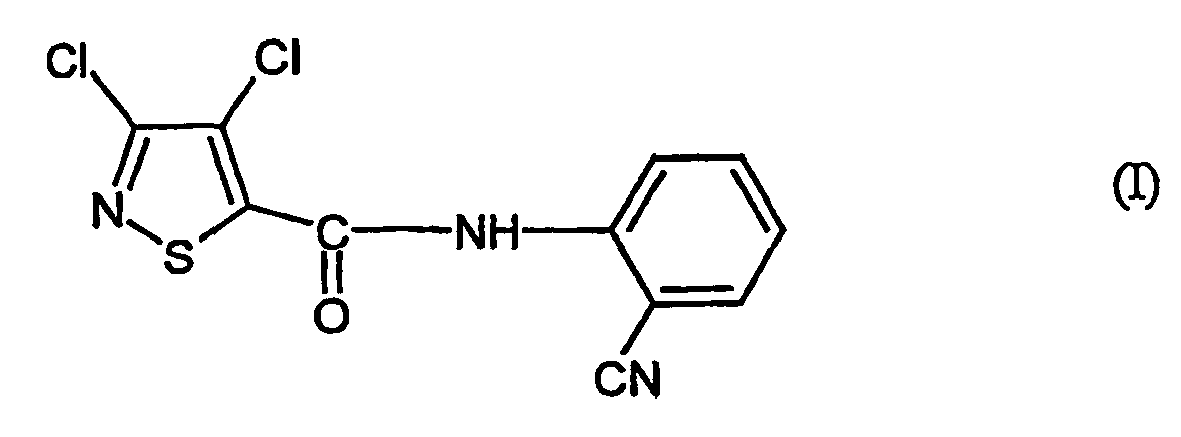
- a) zunächst Isatosäureanhydrid der Formel

- b) dann das dabei entstandene Anthranilsäureamid der Formel


- c) anschließend das dabei entstandene N-[2-(Aminocarbonyl)-phenyl]-3,4-dichlor-isothiazolcarboxamid der Formel

- Es ist als ausgesprochen überraschend zu bezeichnen, dass sich 3,4-Dichlor-N-(2-Cyano-phenyl)-5-isothiazolcarboxamid der Formel (I) nach dem erfindungsgemäßen Verfahren in glatter Reaktion ohne störende Nebenreaktionen herstellen lässt. So musste aufgrund des vorbekannten Standes der Technik damit gerechnet werden, dass N-acylierte Anthranilsäurederivate unter sauren, basischen oder neutralen Bedingungen unter Abspaltung von Wasser leicht zu Benzoxazinonen beziehungsweise Chinazolinolen oder Chinazolinonen cyclisiert werden (vgl. Farmaco Ed. Sci. 39 (1984), 120; J. Heterocycl. Chem. 16 (1979) 711; J. prakt Chem. 111 (1925) 48 und Egypt. J. Chem 31 (1988) 241). Im Gegensatz zu den Erwartungen wird die erfindungsgemäße Umsetzung aber nicht durch derartige unerwünschte Kondensationen beeinträchtigt.
- Das erfindungsgemäße Verfahren zeichnet sich durch eine Reihe von Vorteilen aus. So ermöglicht es die Synthese des 3,4-Dichlor-N-(2-cyanophenyl)-5-isothiazolcarboxamids der Formel (I) in hoher Ausbeute und hervorragender Reinheit. Günstig ist auch, dass die Durchführung der Umsetzung und die Isolierung des Reaktionsproduktes keinerlei Schwierigkeiten bereitet. Außerdem lässt sich das erfindungsgemäße Verfahren problemlos in den technischen Maßstab übertragen.
- Verwendet man bei der Durchführung des erfindungsgemäßen Verfahrens in der zweiten Stufe Triethylamin als Säureakzeptor und in der dritten Stufe Thionylchlorid im Gemisch mit Dimethylformamid als Dehydratisierungsmittel, so kann der Verlauf der Umsetzungen durch das folgende Formelschema veranschaulicht werden.

- Das bei der Durchführung des erfindungsgemäßen Verfahrens als Ausgangsprodukt benötigte Isatosäureanhydrid der Formel (II) ist bereits bekannt (vgl. DE-A 26 28 055).
- Ebenso ist das als Reaktionskomponente in der zweiten Stufe eingesetzte 3,4-Dichlor-isothiazolcarbonsäurechlorid der Formel (IV) schon bekannt (vgl. US-A 5 240 951). Gleiches gilt für das intermediär auftretende Anthranilsäureamid der Formel (III).
- Neu hingegen ist das in der dritten Stufe des erfindungsgemäßen Verfahrens als Ausgangssubstanz dienende N-[2-(Aminocarbonyl)-phenyl]-3,4-dichlor-isothiazolcarboxamid der Formel (V).
- Bei der Durchführung der ersten Stufe des erfindungsgemäßen Verfahrens dient Ammoniak als Reaktionskomponente. Es wird in trockenem Zustand in das Reaktionsgemisch eingeleitet.
- Als Säureakzeptoren kommen bei der Durchführung der zweiten Stufe des erfindungsgemäßen Verfahrens vorzugsweise tertiäre Amine in Frage. Beispielhaft genannt seien Trimethylamin, Triethylamin, Tributylamin, N,N-Dimethylanilin, N,N-Dimethyl-benzylamin, Pyridin, N-Methylpiperidin, N-Methylmorpholin, N,N-Dimethylaminopyridin, Diazabicyclooctan (DABCO), Diazabicyclononen (DBN) oder Diazabicycloundecen (DBU).
- Bei der Durchführung der dritten Stufe des erfindungsgemäßen Verfahrens fungiert ein Gemisch aus Dimethylformamid und Thionylchlorid, Phosphoroxychlorid, Phosgen oder Chlormethylen-dimethylammoniumchlorid als Dehydratisierungsmittel.
- Bei der Durchführung der dritten Stufe des erfindungsgemäßen Verfahrens setzt man Dimethylformamid in einem solchen Überschuss ein, dass es nicht nur als Reaktionskomponente, sondern auch als Verdünnungsmittel dient
- Die Reaktionstemperaturen können bei der Durchführung des erfindungsgemäßen Verfahrens innerhalb eines größeren Bereiches variiert werden. Im Allgemeinen arbeitet man bei der Durchführung
- der ersten Stufe bei Temperaturen zwischen 0°C und 1.00°C, vorzugsweise zwischen 0°C und 70°C,
- der zweiten Stufe bei Temperaturen zwischen 0°C und 120°C, vorzugsweise zwischen 0°C und 80°C, und
- der dritten Stufe bei Temperaturen zwischen -20°C und +80°C, vorzugsweise zwischen 0°C und 60°C.
- Bei der Durchführung des erfindungsgemäßen Verfahrens arbeitet man sowohl bei der Umsetzung in der ersten Stufe als auch der zweiten und dritten Stufe jeweils im Allgemeinen unter Atmosphärendruck. Es ist jedoch auch möglich, jeweils unter erhöhtem Druck zu arbeiten.
- Bei der Durchführung des erfindungsgemäßen Verfahrens setzt man im Allgemeinen in der ersten Stufe auf 1 mol an Isatosäureanhydrid der Formel (II) einen hohen Überschuss an gasförmigem Ammoniak ein, fügt dann in der zweiten Stufe zwischen 0,8 und 1,0 mol an 3,4-Dichlor-isothiazolcarbonsäurechlorid der Formel (IV) sowie eine äquivalente Menge oder auch einen Überschuss an Säureakzeptor hinzu und setzt schließlich in der dritten Stufe mit 1 bis 2 mol an Dehydratisierungsmittel um.
- Im Einzelnen verfährt man im Allgemeinen in der Weise, dass man in der ersten Stufe zunächst trockenes Ammoniakgas in eine Lösung von Isatosäureanhydrid der Formel (II) in Dimethylformamid einleitet und dann mit Hilfe eines Inertgasstromes das überschüssige Ammoniak entfernt. Danach tropft man in der zweiten Stufe eine Lösung aus 3,4-Dichlor-isothiazolcarbonsäurechlorid der Formel (IV) in Dimethylformamid in das Reaktionsgemisch und fügt anschließend in der dritten Stufe das jeweilige Säurechlorid hinzu. Die Aufarbeitung erfolgt nach üblichen Methoden. Im Allgemeinen geht man in der Weise vor, dass man das Reaktionsgemisch mit Wasser versetzt und den dabei anfallenden Feststoff absaugt, wäscht und trocknet Eine eventuell noch erforderliche Reinigung kann nach üblichen Methoden vorgenommen werden, also zum Beispiel durch Chromatographie oder Umkristallisation.
- Das nach dem erfindungsgemäßen Verfahren erhältliche 3,4-Dichlor-N-(2-cyanophenyl)-5-isothiazolcarboxamid der Formel (I) und dessen Verwendung zur Bekämpfung von unerwünschten Mikroorganismen sind bekannt (vgl. WO 99-24 413).
- Das erfindungsgemäße Verfahren wird durch die folgenden Beispiele veranschaulicht.
-

- In eine Lösung von 3,59 g (22 mmol) Isatosäureanhydrid in 15 g Dimethylformamid werden bei 60°C unter intensivem Rühren innerhalb von einer Stunde 7 g trockenes Ammoniakgas eingeleitet. Danach entfernt man überschüssiges Ammoniak, indem man 30 Minuten lang Argon durch das auf 60°C erwärmte Reaktionsgemisch leitet. Das Reaktionsgemisch wird dann bei 60°C unter Rühren zunächst mit 2,23 g (22 mmol) Triethylamin und danach tropfenweise mit einer Lösung von 4,33 g (20 mmol) 3,4-Dichlor-isothiazolcarbonsäurechlorid in 10 ml Dimethylformamid versetzt. Nach beendeter Zugabe wird eine Stunde bei 60°C nachgerührt. Anschließend werden bei 60°C unter Rühren 3,33 g (28 mmol) Thionylchlorid zugetropft. Man rührt eine weitere Stunde bei 60°C, kühlt dann auf Raumtemperatur ab, versetzt das Reaktionsgemisch mit 40 ml Wasser und rührt 15 Minuten lang nach. Der anfallende Feststoff wird abgesaugt, zweimal mit je 20 ml Wasser gewaschen und getrocknet. Man erhält auf diese Weise 4,44 g eines Feststoffes, der gemäß 1H-NMR Spektrum zu 92 % aus 3,4-Dichlor-N-(2-cyano-phenyl)-5-isothiazol-carboxamid besteht. Die Ausbeute errechnet sich danach zu 68,4 % der Theorie, bezogen auf eingesetztes Isatosäureanhydrid. Das entspricht einer Ausbeute von 88 % der Theorie pro Stufe.
-

- In ein Gemisch aus 20,8 g (0,1725 mol) 2-Cyano-anilin und 250 ml Pyridin werden bei 5 bis 10°C unter Rühren 38,1 g (0,15 mol) 3,4-Dichlor-isothiazol-5-carbonsäurechlorid innerhalb von 10 Minuten eingetropft. Nach beendeter Zugabe versetzt man das Reaktionsgemisch mit 70 ml absolutem Tetrahydrofuran und 30 ml Pyridin, lässt auf Raumtemperatur erwärmen und rührt dann 75 Minuten bei Raumtemperatur. Anschließend wird das Reaktionsgemisch unter vermindertem Druck eingeengt. Der verbleibende Rückstand wird mit 800 ml Wasser und 800 ml Essigsäureethylester verrührt. Der in dem Zweiphasen-Gemisch enthaltene Niederschlag wird abfiltriert, mit Essigsäureethylester gewaschen und getrocknet Man erhält auf diese Weise 31,7 g eines kristallinen Produktes vom Schmelzpunkt 191 bis 193°C.
- Aus dem zweiphasigen Filtrat wird die wässrige Phase abgetrennt und zweimal mit je 150 ml Essigsäureethylester extrahiert. Die vereinigten organischen Phasen werden über Natriumsulfat getrocknet und dann unter vermindertem Druck eingeengt. Der verbleibende Rückstand wird mit 100 ml Petrolether und 25 ml Essigsäureethylester verrührt. Der anfallende Feststoff wird abgesaugt, mit Essigsäureethylester nachgewaschen und getrocknet.
- Man erhält auf diese Weise insgesamt 40 g (89 % der Theorie) an 3,4-Dichlor-N-(2-cyano-phenyl)-5-isothiazolcarboxamid in Form einer Festsubstanz vom Schmelzpunkt 191 bis 193°C.
Claims (5)
- Verfahren zur Herstellung von 3,4-Dichlor-N-(2-cyano-phenyl)-5-isothiazolcarboxamid der Formel
 a) zunächst Isatosäureanhydrid der Formel
 b) dann das dabei entstandene Anthranilsäureamid der Formel
 c) anschließend das dabei entstandene N-[2-(Aminocarbonyl)-phenyl]-3,4-dichlor-isothiazolcarboxamid der Formel
- Verfahren gemäß Anspruch 1, dadurch gekennzeichnet, dass man bei der Durchführung der dritten Stufe Dimethylformamid im Gemisch mit Thionylchlorid als Dehydratisierungsmittel einsetzt.
- Verfahren gemäß Anspruch 1, dadurch gekennzeichnet, dass man bei der Durchführung der ersten Stufe bei Temperaturen zwischen 0°C und 70°C arbeitet
- Verfahren gemäß Anspruch 1, dadurch gekennzeichnet, dass man bei der Durchführung der zweiten Stufe bei Temperaturen zwischen 0°C und 120°C arbeitet.
- Verfahren gemäß Anspruch 1, dadurch gekennzeichnet, dass man bei der Durchführung der dritten Stufe bei Temperaturen zwischen -20°C und +80°C arbeitet.
Applications Claiming Priority (3)
| Application Number | Priority Date | Filing Date | Title |
|---|---|---|---|
| DE10228731A DE10228731A1 (de) | 2002-06-27 | 2002-06-27 | Verfahren zur Herstellung von 3,4-Dichlor-N-(2-cyanophenyl)-5-isothiazolcarboxamid |
| DE10228731 | 2002-06-27 | ||
| PCT/EP2003/006361 WO2004002969A1 (de) | 2002-06-27 | 2003-06-17 | Verfahren zur herstellung von 3,4-dichlor-n-(2-cyano-phenyl)-5-isothiazol-carboxamid |
Publications (2)
| Publication Number | Publication Date |
|---|---|
| EP1519927A1 EP1519927A1 (de) | 2005-04-06 |
| EP1519927B1 true EP1519927B1 (de) | 2006-04-05 |
Family
ID=29761481
Family Applications (1)
| Application Number | Title | Priority Date | Filing Date |
|---|---|---|---|
| EP03732579A Expired - Lifetime EP1519927B1 (de) | 2002-06-27 | 2003-06-17 | Verfahren zur herstellung von 3,4-dichlor-n-(2-cyano-phenyl)-5-isothiazol-carboxamid |
Country Status (10)
| Country | Link |
|---|---|
| EP (1) | EP1519927B1 (de) |
| JP (1) | JP4551763B2 (de) |
| KR (1) | KR101069226B1 (de) |
| CN (1) | CN1303075C (de) |
| AT (1) | ATE322486T1 (de) |
| AU (1) | AU2003238512A1 (de) |
| BR (1) | BR0312029A (de) |
| DE (2) | DE10228731A1 (de) |
| TW (1) | TWI271401B (de) |
| WO (1) | WO2004002969A1 (de) |
Families Citing this family (3)
| Publication number | Priority date | Publication date | Assignee | Title |
|---|---|---|---|---|
| DE102005035617A1 (de) * | 2005-07-29 | 2007-02-15 | Bayer Cropscience Ag | Verfahren zur Herstellung von 3,4-Dichlor-N-(2-cyano-phenyl)-5-isothiazolcarboxamid |
| CN103483287B (zh) * | 2013-10-12 | 2015-07-08 | 南开大学 | 一类含3,4-二氯异噻唑的双酰胺类化合物及其制备方法和用途 |
| KR102587542B1 (ko) * | 2017-06-14 | 2023-10-11 | 바이엘 악티엔게젤샤프트 | 3,4-디클로로-n-(2-시아노페닐)-5-이소티아졸카르복스아미드의 제조 방법 |
Family Cites Families (4)
| Publication number | Priority date | Publication date | Assignee | Title |
|---|---|---|---|---|
| DE2115625B2 (de) * | 1971-03-31 | 1978-07-06 | Basf Ag, 6700 Ludwigshafen | Verfahren zur Herstellung von N-o-Cyanophenyl-N', N'-disubstituierten Formamidinen und deren Salzen |
| DE2115624A1 (de) * | 1971-03-31 | 1972-10-12 | Badische Anilin & Soda Fabrik AG, 6700 Ludwigshafen | Verfahren zur Herstellung von o Amino benzonitrilen |
| JPH069313A (ja) * | 1992-06-29 | 1994-01-18 | Mitsui Toatsu Chem Inc | イソチアゾールカルボン酸アニリド誘導体を有効成分とするイネいもち病防除剤 |
| DE19750012A1 (de) * | 1997-11-12 | 1999-05-20 | Bayer Ag | Isothiazolcarbonsäureamide |
-
2002
- 2002-06-27 DE DE10228731A patent/DE10228731A1/de not_active Withdrawn
-
2003
- 2003-06-17 DE DE50302900T patent/DE50302900D1/de not_active Expired - Lifetime
- 2003-06-17 CN CNB038149672A patent/CN1303075C/zh not_active Expired - Lifetime
- 2003-06-17 AU AU2003238512A patent/AU2003238512A1/en not_active Abandoned
- 2003-06-17 BR BR0312029-5A patent/BR0312029A/pt not_active Application Discontinuation
- 2003-06-17 KR KR1020047020418A patent/KR101069226B1/ko not_active Expired - Lifetime
- 2003-06-17 JP JP2004516610A patent/JP4551763B2/ja not_active Expired - Lifetime
- 2003-06-17 AT AT03732579T patent/ATE322486T1/de not_active IP Right Cessation
- 2003-06-17 EP EP03732579A patent/EP1519927B1/de not_active Expired - Lifetime
- 2003-06-17 WO PCT/EP2003/006361 patent/WO2004002969A1/de not_active Ceased
- 2003-06-26 TW TW092117355A patent/TWI271401B/zh not_active IP Right Cessation
Also Published As
| Publication number | Publication date |
|---|---|
| TW200410950A (en) | 2004-07-01 |
| JP4551763B2 (ja) | 2010-09-29 |
| TWI271401B (en) | 2007-01-21 |
| AU2003238512A1 (en) | 2004-01-19 |
| CN1303075C (zh) | 2007-03-07 |
| JP2005530848A (ja) | 2005-10-13 |
| DE50302900D1 (de) | 2006-05-18 |
| ATE322486T1 (de) | 2006-04-15 |
| DE10228731A1 (de) | 2004-01-22 |
| BR0312029A (pt) | 2005-03-22 |
| CN1662512A (zh) | 2005-08-31 |
| KR20050010516A (ko) | 2005-01-27 |
| EP1519927A1 (de) | 2005-04-06 |
| WO2004002969A1 (de) | 2004-01-08 |
| KR101069226B1 (ko) | 2011-09-30 |
Similar Documents
| Publication | Publication Date | Title |
|---|---|---|
| EP0776889B1 (de) | Verfahren zur Herstellung von 1,3-Dimethyl-5-fluor-pyrazol-4-carboxaniliden | |
| DE2655009C2 (de) | ||
| EP1519926B1 (de) | Verfahren zur herstellung von 3,4-dichlor-n-(2-cyano-phenyl)-5-isothiazolcarboxamid | |
| EP0187285B1 (de) | Verfahren zur Herstellung von substituierten Phenylhydrazinen | |
| EP1519927A1 (de) | Verfahren zur herstellung von 3,4-dichlor-n-(2-cyano-phenyl)-5-isothiazol-carboxamid | |
| DE3308909A1 (de) | Bakterizide mittel auf chinoloncarbonsaeure-basis | |
| DE3002553C2 (de) | ||
| EP0091044B1 (de) | Verfahren zur Herstellung von 4-Hydroxy-3-(heterocyclocarbamoyl)-2H-1,2-benzothiazin-1,1-dioxiden | |
| EP1926717B1 (de) | Verfahren zur Herstellung von 3,4-Dichlor-N-(2-cyano-phenyl)-5-isothiazolcarboxamid | |
| DE2640616C3 (de) | Verfahren zur Herstellung von N-Acyl-2-aiylglycinen | |
| EP0224849B1 (de) | Verfahren zur Herstellung von 4-Mercaptobenzonitrilen und neue 4-Mercaptobenzonitrile | |
| EP1232151A1 (de) | Verfahren zur herstellung von benzofuranonoximen | |
| EP0011773B1 (de) | Verfahren zur Herstellung von Amidosulfonsäuren | |
| DE10017882A1 (de) | Verfahren zur Herstellung von 4-Brom-und 4-Chlor-2-nitro-1-trifluormethoxy-benzol | |
| DE3323510A1 (de) | 2-ketosulfonamide und verfahren zu deren herstellung | |
| EP0221494A1 (de) | Verfahren zur Herstellung von Glykolsäureamiden | |
| EP0662474B1 (de) | Verfahren zur herstellung von chlorpyridinen | |
| CH655930A5 (de) | Verfahren zur herstellung von 3-hydroxybenzdiazepinonen. | |
| DE2606855C2 (de) | Verfahren zur Herstellung von Propionsäure-3,4-dichloranilid | |
| DE1595952A1 (de) | Verfahren zur Herstellung von 5-Chlor-3-aminopyrazinoaten | |
| DE10005278A1 (de) | Verfahren zur Herstellung von Sulfonyl-imidazol-Derivaten | |
| DE2448061A1 (de) | Verfahren zur herstellung von 2-cyano-4-trifluormethyl-6-nitro-n,n-di-n-propyl-anilin | |
| DE2246097A1 (de) | Verfahren zur herstellung von n(diaethylaminoaethyl)-4-amino-5-chlor-2methoxybenzamid | |
| EP0561421A1 (de) | Verfahren zur Herstellung von Carbonsäurechloriden aromatischer Stickstoff-Heterocyclen | |
| DE19535242A1 (de) | Verfahren zur Herstellung von 1-Aryl-4-carbamoyl-tetrazolinonen |
Legal Events
| Date | Code | Title | Description |
|---|---|---|---|
| PUAI | Public reference made under article 153(3) epc to a published international application that has entered the european phase |
Free format text: ORIGINAL CODE: 0009012 |
|
| 17P | Request for examination filed |
Effective date: 20050127 |
|
| AK | Designated contracting states |
Kind code of ref document: A1 Designated state(s): AT BE BG CH CY CZ DE DK EE ES FI FR GB GR HU IE IT LI LU MC NL PT RO SE SI SK TR |
|
| AX | Request for extension of the european patent |
Extension state: AL LT LV MK |
|
| GRAP | Despatch of communication of intention to grant a patent |
Free format text: ORIGINAL CODE: EPIDOSNIGR1 |
|
| DAX | Request for extension of the european patent (deleted) | ||
| GRAS | Grant fee paid |
Free format text: ORIGINAL CODE: EPIDOSNIGR3 |
|
| GRAA | (expected) grant |
Free format text: ORIGINAL CODE: 0009210 |
|
| AK | Designated contracting states |
Kind code of ref document: B1 Designated state(s): AT BE BG CH CY CZ DE DK EE ES FI FR GB GR HU IE IT LI LU MC NL PT RO SE SI SK TR |
|
| PG25 | Lapsed in a contracting state [announced via postgrant information from national office to epo] |
Ref country code: CZ Free format text: LAPSE BECAUSE OF FAILURE TO SUBMIT A TRANSLATION OF THE DESCRIPTION OR TO PAY THE FEE WITHIN THE PRESCRIBED TIME-LIMIT Effective date: 20060405 Ref country code: SK Free format text: LAPSE BECAUSE OF FAILURE TO SUBMIT A TRANSLATION OF THE DESCRIPTION OR TO PAY THE FEE WITHIN THE PRESCRIBED TIME-LIMIT Effective date: 20060405 Ref country code: SI Free format text: LAPSE BECAUSE OF FAILURE TO SUBMIT A TRANSLATION OF THE DESCRIPTION OR TO PAY THE FEE WITHIN THE PRESCRIBED TIME-LIMIT Effective date: 20060405 Ref country code: NL Free format text: LAPSE BECAUSE OF FAILURE TO SUBMIT A TRANSLATION OF THE DESCRIPTION OR TO PAY THE FEE WITHIN THE PRESCRIBED TIME-LIMIT Effective date: 20060405 Ref country code: IE Free format text: LAPSE BECAUSE OF FAILURE TO SUBMIT A TRANSLATION OF THE DESCRIPTION OR TO PAY THE FEE WITHIN THE PRESCRIBED TIME-LIMIT Effective date: 20060405 Ref country code: GB Free format text: LAPSE BECAUSE OF FAILURE TO SUBMIT A TRANSLATION OF THE DESCRIPTION OR TO PAY THE FEE WITHIN THE PRESCRIBED TIME-LIMIT Effective date: 20060405 Ref country code: FI Free format text: LAPSE BECAUSE OF FAILURE TO SUBMIT A TRANSLATION OF THE DESCRIPTION OR TO PAY THE FEE WITHIN THE PRESCRIBED TIME-LIMIT Effective date: 20060405 Ref country code: IT Free format text: LAPSE BECAUSE OF FAILURE TO SUBMIT A TRANSLATION OF THE DESCRIPTION OR TO PAY THE FEE WITHIN THE PRESCRIBED TIME-LIMIT;WARNING: LAPSES OF ITALIAN PATENTS WITH EFFECTIVE DATE BEFORE 2007 MAY HAVE OCCURRED AT ANY TIME BEFORE 2007. THE CORRECT EFFECTIVE DATE MAY BE DIFFERENT FROM THE ONE RECORDED. Effective date: 20060405 Ref country code: RO Free format text: LAPSE BECAUSE OF FAILURE TO SUBMIT A TRANSLATION OF THE DESCRIPTION OR TO PAY THE FEE WITHIN THE PRESCRIBED TIME-LIMIT Effective date: 20060405 |
|
| REG | Reference to a national code |
Ref country code: GB Ref legal event code: FG4D Free format text: NOT ENGLISH |
|
| REG | Reference to a national code |
Ref country code: CH Ref legal event code: NV Representative=s name: E. BLUM & CO. PATENTANWAELTE Ref country code: CH Ref legal event code: EP |
|
| REG | Reference to a national code |
Ref country code: IE Ref legal event code: FG4D Free format text: LANGUAGE OF EP DOCUMENT: GERMAN |
|
| REF | Corresponds to: |
Ref document number: 50302900 Country of ref document: DE Date of ref document: 20060518 Kind code of ref document: P |
|
| PG25 | Lapsed in a contracting state [announced via postgrant information from national office to epo] |
Ref country code: MC Free format text: LAPSE BECAUSE OF NON-PAYMENT OF DUE FEES Effective date: 20060630 Ref country code: BE Free format text: LAPSE BECAUSE OF NON-PAYMENT OF DUE FEES Effective date: 20060630 |
|
| PG25 | Lapsed in a contracting state [announced via postgrant information from national office to epo] |
Ref country code: DK Free format text: LAPSE BECAUSE OF FAILURE TO SUBMIT A TRANSLATION OF THE DESCRIPTION OR TO PAY THE FEE WITHIN THE PRESCRIBED TIME-LIMIT Effective date: 20060705 Ref country code: SE Free format text: LAPSE BECAUSE OF FAILURE TO SUBMIT A TRANSLATION OF THE DESCRIPTION OR TO PAY THE FEE WITHIN THE PRESCRIBED TIME-LIMIT Effective date: 20060705 |
|
| PG25 | Lapsed in a contracting state [announced via postgrant information from national office to epo] |
Ref country code: ES Free format text: LAPSE BECAUSE OF FAILURE TO SUBMIT A TRANSLATION OF THE DESCRIPTION OR TO PAY THE FEE WITHIN THE PRESCRIBED TIME-LIMIT Effective date: 20060716 |
|
| PG25 | Lapsed in a contracting state [announced via postgrant information from national office to epo] |
Ref country code: PT Free format text: LAPSE BECAUSE OF FAILURE TO SUBMIT A TRANSLATION OF THE DESCRIPTION OR TO PAY THE FEE WITHIN THE PRESCRIBED TIME-LIMIT Effective date: 20060905 |
|
| NLV1 | Nl: lapsed or annulled due to failure to fulfill the requirements of art. 29p and 29m of the patents act | ||
| GBV | Gb: ep patent (uk) treated as always having been void in accordance with gb section 77(7)/1977 [no translation filed] |
Effective date: 20060405 |
|
| REG | Reference to a national code |
Ref country code: IE Ref legal event code: FD4D |
|
| PLBE | No opposition filed within time limit |
Free format text: ORIGINAL CODE: 0009261 |
|
| STAA | Information on the status of an ep patent application or granted ep patent |
Free format text: STATUS: NO OPPOSITION FILED WITHIN TIME LIMIT |
|
| 26N | No opposition filed |
Effective date: 20070108 |
|
| EN | Fr: translation not filed | ||
| REG | Reference to a national code |
Ref country code: CH Ref legal event code: PFA Owner name: BAYER CROPSCIENCE AG Free format text: BAYER CROPSCIENCE AG#ALFRED-NOBEL-STRASSE 50#40789 MONHEIM (DE) -TRANSFER TO- BAYER CROPSCIENCE AG#ALFRED-NOBEL-STRASSE 50#40789 MONHEIM (DE) |
|
| PG25 | Lapsed in a contracting state [announced via postgrant information from national office to epo] |
Ref country code: AT Free format text: LAPSE BECAUSE OF NON-PAYMENT OF DUE FEES Effective date: 20060617 |
|
| BERE | Be: lapsed |
Owner name: BAYER CROPSCIENCE A.G. Effective date: 20060630 |
|
| REG | Reference to a national code |
Ref country code: CH Ref legal event code: PL |
|
| PG25 | Lapsed in a contracting state [announced via postgrant information from national office to epo] |
Ref country code: GR Free format text: LAPSE BECAUSE OF FAILURE TO SUBMIT A TRANSLATION OF THE DESCRIPTION OR TO PAY THE FEE WITHIN THE PRESCRIBED TIME-LIMIT Effective date: 20060706 Ref country code: LI Free format text: LAPSE BECAUSE OF NON-PAYMENT OF DUE FEES Effective date: 20070630 Ref country code: CH Free format text: LAPSE BECAUSE OF NON-PAYMENT OF DUE FEES Effective date: 20070630 Ref country code: FR Free format text: LAPSE BECAUSE OF FAILURE TO SUBMIT A TRANSLATION OF THE DESCRIPTION OR TO PAY THE FEE WITHIN THE PRESCRIBED TIME-LIMIT Effective date: 20070309 |
|
| PG25 | Lapsed in a contracting state [announced via postgrant information from national office to epo] |
Ref country code: EE Free format text: LAPSE BECAUSE OF FAILURE TO SUBMIT A TRANSLATION OF THE DESCRIPTION OR TO PAY THE FEE WITHIN THE PRESCRIBED TIME-LIMIT Effective date: 20060405 Ref country code: BG Free format text: LAPSE BECAUSE OF FAILURE TO SUBMIT A TRANSLATION OF THE DESCRIPTION OR TO PAY THE FEE WITHIN THE PRESCRIBED TIME-LIMIT Effective date: 20060705 |
|
| PG25 | Lapsed in a contracting state [announced via postgrant information from national office to epo] |
Ref country code: TR Free format text: LAPSE BECAUSE OF FAILURE TO SUBMIT A TRANSLATION OF THE DESCRIPTION OR TO PAY THE FEE WITHIN THE PRESCRIBED TIME-LIMIT Effective date: 20060405 Ref country code: HU Free format text: LAPSE BECAUSE OF FAILURE TO SUBMIT A TRANSLATION OF THE DESCRIPTION OR TO PAY THE FEE WITHIN THE PRESCRIBED TIME-LIMIT Effective date: 20061006 Ref country code: LU Free format text: LAPSE BECAUSE OF NON-PAYMENT OF DUE FEES Effective date: 20060617 |
|
| PG25 | Lapsed in a contracting state [announced via postgrant information from national office to epo] |
Ref country code: CY Free format text: LAPSE BECAUSE OF FAILURE TO SUBMIT A TRANSLATION OF THE DESCRIPTION OR TO PAY THE FEE WITHIN THE PRESCRIBED TIME-LIMIT Effective date: 20060405 Ref country code: FR Free format text: LAPSE BECAUSE OF FAILURE TO SUBMIT A TRANSLATION OF THE DESCRIPTION OR TO PAY THE FEE WITHIN THE PRESCRIBED TIME-LIMIT Effective date: 20060405 |
|
| REG | Reference to a national code |
Ref country code: DE Ref legal event code: R081 Ref document number: 50302900 Country of ref document: DE Owner name: BAYER INTELLECTUAL PROPERTY GMBH, DE Free format text: FORMER OWNER: BAYER CROPSCIENCE AG, 40789 MONHEIM, DE Effective date: 20141023 Ref country code: DE Ref legal event code: R081 Ref document number: 50302900 Country of ref document: DE Owner name: BAYER CROPSCIENCE AKTIENGESELLSCHAFT, DE Free format text: FORMER OWNER: BAYER CROPSCIENCE AG, 40789 MONHEIM, DE Effective date: 20141023 |
|
| REG | Reference to a national code |
Ref country code: DE Ref legal event code: R081 Ref document number: 50302900 Country of ref document: DE Owner name: BAYER CROPSCIENCE AKTIENGESELLSCHAFT, DE Free format text: FORMER OWNER: BAYER INTELLECTUAL PROPERTY GMBH, 40789 MONHEIM, DE |
|
| PGFP | Annual fee paid to national office [announced via postgrant information from national office to epo] |
Ref country code: DE Payment date: 20220517 Year of fee payment: 20 |
|
| REG | Reference to a national code |
Ref country code: DE Ref legal event code: R071 Ref document number: 50302900 Country of ref document: DE |