EP2554715B1 - Cathode carbon block for aluminum smelting and process for production thereof - Google Patents
Cathode carbon block for aluminum smelting and process for production thereof Download PDFInfo
- Publication number
- EP2554715B1 EP2554715B1 EP11762246.4A EP11762246A EP2554715B1 EP 2554715 B1 EP2554715 B1 EP 2554715B1 EP 11762246 A EP11762246 A EP 11762246A EP 2554715 B1 EP2554715 B1 EP 2554715B1
- Authority
- EP
- European Patent Office
- Prior art keywords
- titanium carbide
- carbon block
- cathode carbon
- raw material
- cathode
- Prior art date
- Legal status (The legal status is an assumption and is not a legal conclusion. Google has not performed a legal analysis and makes no representation as to the accuracy of the status listed.)
- Active
Links
Images

Classifications
-
- C—CHEMISTRY; METALLURGY
- C25—ELECTROLYTIC OR ELECTROPHORETIC PROCESSES; APPARATUS THEREFOR
- C25C—PROCESSES FOR THE ELECTROLYTIC PRODUCTION, RECOVERY OR REFINING OF METALS; APPARATUS THEREFOR
- C25C3/00—Electrolytic production, recovery or refining of metals by electrolysis of melts
- C25C3/06—Electrolytic production, recovery or refining of metals by electrolysis of melts of aluminium
- C25C3/08—Cell construction, e.g. bottoms, walls, cathodes
-
- C—CHEMISTRY; METALLURGY
- C01—INORGANIC CHEMISTRY
- C01B—NON-METALLIC ELEMENTS; COMPOUNDS THEREOF; METALLOIDS OR COMPOUNDS THEREOF NOT COVERED BY SUBCLASS C01C
- C01B32/00—Carbon; Compounds thereof
- C01B32/20—Graphite
-
- C—CHEMISTRY; METALLURGY
- C01—INORGANIC CHEMISTRY
- C01B—NON-METALLIC ELEMENTS; COMPOUNDS THEREOF; METALLOIDS OR COMPOUNDS THEREOF NOT COVERED BY SUBCLASS C01C
- C01B32/00—Carbon; Compounds thereof
- C01B32/90—Carbides
-
- C—CHEMISTRY; METALLURGY
- C01—INORGANIC CHEMISTRY
- C01B—NON-METALLIC ELEMENTS; COMPOUNDS THEREOF; METALLOIDS OR COMPOUNDS THEREOF NOT COVERED BY SUBCLASS C01C
- C01B32/00—Carbon; Compounds thereof
- C01B32/90—Carbides
- C01B32/914—Carbides of single elements
- C01B32/921—Titanium carbide
-
- C—CHEMISTRY; METALLURGY
- C04—CEMENTS; CONCRETE; ARTIFICIAL STONE; CERAMICS; REFRACTORIES
- C04B—LIME, MAGNESIA; SLAG; CEMENTS; COMPOSITIONS THEREOF, e.g. MORTARS, CONCRETE OR LIKE BUILDING MATERIALS; ARTIFICIAL STONE; CERAMICS; REFRACTORIES; TREATMENT OF NATURAL STONE
- C04B35/00—Shaped ceramic products characterised by their composition; Ceramics compositions; Processing powders of inorganic compounds preparatory to the manufacturing of ceramic products
- C04B35/515—Shaped ceramic products characterised by their composition; Ceramics compositions; Processing powders of inorganic compounds preparatory to the manufacturing of ceramic products based on non-oxide ceramics
- C04B35/52—Shaped ceramic products characterised by their composition; Ceramics compositions; Processing powders of inorganic compounds preparatory to the manufacturing of ceramic products based on non-oxide ceramics based on carbon, e.g. graphite
- C04B35/522—Graphite
-
- C—CHEMISTRY; METALLURGY
- C04—CEMENTS; CONCRETE; ARTIFICIAL STONE; CERAMICS; REFRACTORIES
- C04B—LIME, MAGNESIA; SLAG; CEMENTS; COMPOSITIONS THEREOF, e.g. MORTARS, CONCRETE OR LIKE BUILDING MATERIALS; ARTIFICIAL STONE; CERAMICS; REFRACTORIES; TREATMENT OF NATURAL STONE
- C04B2235/00—Aspects relating to ceramic starting mixtures or sintered ceramic products
- C04B2235/02—Composition of constituents of the starting material or of secondary phases of the final product
- C04B2235/30—Constituents and secondary phases not being of a fibrous nature
- C04B2235/38—Non-oxide ceramic constituents or additives
- C04B2235/3817—Carbides
- C04B2235/3839—Refractory metal carbides
- C04B2235/3843—Titanium carbides
-
- C—CHEMISTRY; METALLURGY
- C04—CEMENTS; CONCRETE; ARTIFICIAL STONE; CERAMICS; REFRACTORIES
- C04B—LIME, MAGNESIA; SLAG; CEMENTS; COMPOSITIONS THEREOF, e.g. MORTARS, CONCRETE OR LIKE BUILDING MATERIALS; ARTIFICIAL STONE; CERAMICS; REFRACTORIES; TREATMENT OF NATURAL STONE
- C04B2235/00—Aspects relating to ceramic starting mixtures or sintered ceramic products
- C04B2235/02—Composition of constituents of the starting material or of secondary phases of the final product
- C04B2235/30—Constituents and secondary phases not being of a fibrous nature
- C04B2235/42—Non metallic elements added as constituents or additives, e.g. sulfur, phosphor, selenium or tellurium
- C04B2235/422—Carbon
-
- C—CHEMISTRY; METALLURGY
- C04—CEMENTS; CONCRETE; ARTIFICIAL STONE; CERAMICS; REFRACTORIES
- C04B—LIME, MAGNESIA; SLAG; CEMENTS; COMPOSITIONS THEREOF, e.g. MORTARS, CONCRETE OR LIKE BUILDING MATERIALS; ARTIFICIAL STONE; CERAMICS; REFRACTORIES; TREATMENT OF NATURAL STONE
- C04B2235/00—Aspects relating to ceramic starting mixtures or sintered ceramic products
- C04B2235/02—Composition of constituents of the starting material or of secondary phases of the final product
- C04B2235/30—Constituents and secondary phases not being of a fibrous nature
- C04B2235/42—Non metallic elements added as constituents or additives, e.g. sulfur, phosphor, selenium or tellurium
- C04B2235/422—Carbon
- C04B2235/425—Graphite
-
- C—CHEMISTRY; METALLURGY
- C04—CEMENTS; CONCRETE; ARTIFICIAL STONE; CERAMICS; REFRACTORIES
- C04B—LIME, MAGNESIA; SLAG; CEMENTS; COMPOSITIONS THEREOF, e.g. MORTARS, CONCRETE OR LIKE BUILDING MATERIALS; ARTIFICIAL STONE; CERAMICS; REFRACTORIES; TREATMENT OF NATURAL STONE
- C04B2235/00—Aspects relating to ceramic starting mixtures or sintered ceramic products
- C04B2235/02—Composition of constituents of the starting material or of secondary phases of the final product
- C04B2235/50—Constituents or additives of the starting mixture chosen for their shape or used because of their shape or their physical appearance
- C04B2235/54—Particle size related information
- C04B2235/5418—Particle size related information expressed by the size of the particles or aggregates thereof
- C04B2235/5427—Particle size related information expressed by the size of the particles or aggregates thereof millimeter or submillimeter sized, i.e. larger than 0,1 mm
-
- C—CHEMISTRY; METALLURGY
- C04—CEMENTS; CONCRETE; ARTIFICIAL STONE; CERAMICS; REFRACTORIES
- C04B—LIME, MAGNESIA; SLAG; CEMENTS; COMPOSITIONS THEREOF, e.g. MORTARS, CONCRETE OR LIKE BUILDING MATERIALS; ARTIFICIAL STONE; CERAMICS; REFRACTORIES; TREATMENT OF NATURAL STONE
- C04B2235/00—Aspects relating to ceramic starting mixtures or sintered ceramic products
- C04B2235/02—Composition of constituents of the starting material or of secondary phases of the final product
- C04B2235/50—Constituents or additives of the starting mixture chosen for their shape or used because of their shape or their physical appearance
- C04B2235/54—Particle size related information
- C04B2235/5418—Particle size related information expressed by the size of the particles or aggregates thereof
- C04B2235/5436—Particle size related information expressed by the size of the particles or aggregates thereof micrometer sized, i.e. from 1 to 100 micron
-
- C—CHEMISTRY; METALLURGY
- C04—CEMENTS; CONCRETE; ARTIFICIAL STONE; CERAMICS; REFRACTORIES
- C04B—LIME, MAGNESIA; SLAG; CEMENTS; COMPOSITIONS THEREOF, e.g. MORTARS, CONCRETE OR LIKE BUILDING MATERIALS; ARTIFICIAL STONE; CERAMICS; REFRACTORIES; TREATMENT OF NATURAL STONE
- C04B2235/00—Aspects relating to ceramic starting mixtures or sintered ceramic products
- C04B2235/02—Composition of constituents of the starting material or of secondary phases of the final product
- C04B2235/50—Constituents or additives of the starting mixture chosen for their shape or used because of their shape or their physical appearance
- C04B2235/54—Particle size related information
- C04B2235/5463—Particle size distributions
- C04B2235/5472—Bimodal, multi-modal or multi-fraction
-
- C—CHEMISTRY; METALLURGY
- C04—CEMENTS; CONCRETE; ARTIFICIAL STONE; CERAMICS; REFRACTORIES
- C04B—LIME, MAGNESIA; SLAG; CEMENTS; COMPOSITIONS THEREOF, e.g. MORTARS, CONCRETE OR LIKE BUILDING MATERIALS; ARTIFICIAL STONE; CERAMICS; REFRACTORIES; TREATMENT OF NATURAL STONE
- C04B2235/00—Aspects relating to ceramic starting mixtures or sintered ceramic products
- C04B2235/70—Aspects relating to sintered or melt-casted ceramic products
- C04B2235/96—Properties of ceramic products, e.g. mechanical properties such as strength, toughness, wear resistance
- C04B2235/9607—Thermal properties, e.g. thermal expansion coefficient
-
- C—CHEMISTRY; METALLURGY
- C04—CEMENTS; CONCRETE; ARTIFICIAL STONE; CERAMICS; REFRACTORIES
- C04B—LIME, MAGNESIA; SLAG; CEMENTS; COMPOSITIONS THEREOF, e.g. MORTARS, CONCRETE OR LIKE BUILDING MATERIALS; ARTIFICIAL STONE; CERAMICS; REFRACTORIES; TREATMENT OF NATURAL STONE
- C04B2235/00—Aspects relating to ceramic starting mixtures or sintered ceramic products
- C04B2235/70—Aspects relating to sintered or melt-casted ceramic products
- C04B2235/96—Properties of ceramic products, e.g. mechanical properties such as strength, toughness, wear resistance
- C04B2235/9669—Resistance against chemicals, e.g. against molten glass or molten salts
- C04B2235/9676—Resistance against chemicals, e.g. against molten glass or molten salts against molten metals such as steel or aluminium
-
- Y—GENERAL TAGGING OF NEW TECHNOLOGICAL DEVELOPMENTS; GENERAL TAGGING OF CROSS-SECTIONAL TECHNOLOGIES SPANNING OVER SEVERAL SECTIONS OF THE IPC; TECHNICAL SUBJECTS COVERED BY FORMER USPC CROSS-REFERENCE ART COLLECTIONS [XRACs] AND DIGESTS
- Y02—TECHNOLOGIES OR APPLICATIONS FOR MITIGATION OR ADAPTATION AGAINST CLIMATE CHANGE
- Y02P—CLIMATE CHANGE MITIGATION TECHNOLOGIES IN THE PRODUCTION OR PROCESSING OF GOODS
- Y02P20/00—Technologies relating to chemical industry
- Y02P20/10—Process efficiency
Definitions
- the present invention relates to a process for producing a cathode carbon block used as a cathode for a reduction cell for aluminum smelting, involving the use of a mixture of carbon raw material particles and titanium carbide particles and a cathode carbon block obtained by the process.
- Carbon block (cathode carbon block) is used as a cathode for a reduction cell for aluminum smelting (aluminum reduction cell).
- This cathode carbon block is an important lining material that constitutes the bottom of the aluminum reduction cell, but also has a role as a cathode. Electric power supplied through the cathode supplies electrons to an electrolytic bath in the aluminum reduction cell for reducing aluminum ions to metal aluminum.
- a method wherein an organic binder is added to a particle size controlled mixture of calcined coke, kneaded, formed , baked in a non-oxidative atmosphere, and then graphitized at a temperature of 2000°C or higher to obtain a cathode carbon block (see e.g. Patent Document 1).
- the cathode carbon block obtained in this method shows e.g. superior resistance against thermal stress or Na intercalation, and thus shutdown of the aluminum reduction cell due to cracks and damage deterioration caused in the cathode carbon block is prevented. Since this graphitized cathode carbon block has low electrical resistivity thereby allowing high current operation, use of this cathode carbon block has become the mainstream for recent large-scale aluminum reduction cell.
- This graphitized cathode carbon block is a material having superior property.
- energy conservation in aluminum production is demanded due to further upsizing trend for aluminum reduction cell or increase in consciousness for global warming countermeasures in the background. Therefore, a cathode carbon block having even lower electrical resistivity and higher thermal conductivity is desired.
- cathode carbon block is also an important lining material that constitutes the bottom of the aluminum reduction cell, though it is subject to physical and electrochemical erosion by an electrolytic bath during operation and thus consumed.
- the electrochemical erosion which is one cause of the consumption, is a phenomenon which progresses by the production and dissolution of Al 4 C 3 . Since this reaction is a chemical reaction between carbon and aluminum, it cannot be avoided as long as carbon block is used as the cathode for aluminum reduction cell.
- Patent Document 2 As a cathode for aluminum smelting, a method of adding TiB 2 in an amount of 10% by weight relative to TiC in a mixture of TiC and TiB 2 as a material that shows superior electric conductivity and low solubility against aluminum melt has long been known (see e.g. Patent Document 2).
- Patent Document 2 it is disclosed that the solubility against aluminum melt at 970°C is reduced to about 1/3, and considering the balance between cost and performance (service life) as a cathode material, a mixture of 75 to 95% of TiC and 5 to 25% of TiB 2 is suitable.
- Patent Document 3 A method is also known wherein refractory hard substances as stated above (borides and carbides such as TiB 2 and TiC) are mixed into the cathode carbon block in order to improve the wettability between the cathode carbon block and aluminum melt, as well as to prevent electrochemical erosion by the aluminum electrolytic bath (see e.g. Patent Document 3).
- refractory hard substances as stated above (borides and carbides such as TiB 2 and TiC) are mixed into the cathode carbon block in order to improve the wettability between the cathode carbon block and aluminum melt, as well as to prevent electrochemical erosion by the aluminum electrolytic bath.
- a structure of aluminum reduction cell is proposed where the cathode electrode is slanted using a cathode carbon block containing refractory hard substances, and a so-called drain cathode is disclosed where the aluminum melt deposited on top of the cathode electrode is recovered to a drain installed at the bottom of the aluminum reduction cell .
- TiB 2 which has particularly superior electric conductivity and extremely low solubility in metal or electrolytic bath has played a major role in the research and development of non-consumable electrodes.
- a large factor in preventing the practical application of non-consumable electrodes was that the raw material, TiB 2 powder, is expensive as well as requires high purity in order to keep the content of impurities such as oxygen low.
- the present invention solves the above problems, the object of which is to provide a cathode carbon block for aluminum smelting having low electrical resistivity and high thermal conductivity to improve the energy efficiency in an aluminum reduction cell and a process for production thereof. It is a further object to provide a cathode carbon block for aluminum smelting having improved wettability with aluminum melt and reduced the rate of electrochemical erosion by an electrolytic bath to enable accomplishment of prolonged service life, as well as a process for production thereof.
- the present invention provides a process for producing a cathode carbon block for aluminium smelting according to claim 1, a cathode carbon block according to claim 4 and the use of a mixture according to claim 7.
- a cathode carbon block for aluminum smelting having the properties of low electrical resistivity and high thermal conductivity as well as a process for production thereof can be provided, and the energy efficiency in aluminum production can be improved. Moreover, with a cathode carbon block for aluminum smelting having easy wettability to aluminum melt and a process for production thereof, the current efficiency of aluminum smelting is improved and the service life of aluminum reduction cell can be extended.
- materials are mixed at a mixing proportion of 64 to 97% of the carbon raw material to 3 to 36% of titanium carbide.
- the proportion of titanium carbide is 5 to 100% in the raw material composition having a particle size of 1 mm or less.
- calcined coke For the carbon raw material, crashed and particle size controlled calcined coke, graphite, or a mixture thereof is used.
- One or more of calcined petroleum coke, calcined coal-tar pitch coke etc. can be used alone or mixed together as this calcined coke.
- natural graphite, artificial graphite etc can be used as the graphite.
- Titanium carbide may comprise, in addition to TiC, trace amounts of titanium carbonitride or titanium oxide, carbon, etc. These substances are secondary products from the production process due to the cell atmosphere or temperature or unreacted residues from the production of titanium carbide. Accordingly, in the invention of the present application, titanium carbide means a powder or aggregated substance consisting substantially of TiC, but also comprises unavoidable impurities such as titanium carbonitride or titanium oxide, carbon, etc.
- titanium carbide has the effects of acting as a catalyst to promote the graphitization of carbon raw material, as well as improving the wettability between the cathode carbon block and aluminum melt in the aluminum reduction cell, and reducing the erosion rate of the cathode carbon block to extend the service life of the aluminum reduction cell.
- titanium carbide having an average particle size greater than 1 mm the effect of action as a catalyst is reduced in the graphitization of cathode carbon block production, and the effect of reducing the erosion rate of cathode carbon block in the aluminum reduction cell will be reduced. It is not economical to attempt to gain the effect of reducing the erosion rate with titanium carbide greater than 1 mm, because more titanium carbide than necessary will be required.
- the preferred average particle size of titanium carbide is in the range of 1 ⁇ m to 1 mm.
- a further preferred average particle size of titanium carbide is in the range of 7 ⁇ m to 50 ⁇ m.
- the average particle size herein means D50.
- the graphitization of carbon is promoted by the catalytic effect of titanium carbide upon graphitization, and a cathode carbon block having low electrical resistivity can be produced.
- graphitization temperature can be lowered, the cost necessary for graphitization can be reduced, and productivity is improved.
- the mixing proportion of titanium carbide in the cathode carbon block in the invention of the present application is preferably 3 to 36% by mass. Further by also considering the economic efficiency such as the cost of raw material, the preferred mixing proportion of titanium carbide is 3 to 10% by mass, and a further preferred mixing proportion of titanium carbide is 3 to 5% by mass.
- titanium carbide By adding 3 to 36% by mass of titanium carbide to the cathode carbon block, the wettability between the cathode carbon block and aluminum melt is improved upon aluminum smelting. In order to attempt improvement of wettability and realize longer life, it is desirable to add titanium carbide at 10% or more by mass relative to the cathode carbon. If greater than 36% by mass of titanium carbide is added, it becomes difficult to gain a further effect of reducing the erosion rate, and also the mixing proportion of the carbon material is reduced, and thus the thermal/mechanical property of the cathode carbon block may be deteriorated.
- the mixing proportion of titanium carbide in the cathode carbon block in the invention of the present application is also preferably in the range of 3 to 36% by mass. Further by considering the substantial service life extension of the cathode carbon block, the preferred mixing proportion of titanium carbide is 10 to 30% by mass.
- titanium carbide in the mixture of carbon raw material and titanium carbide is 5 to 100% by mass.
- Titanium carbide having relatively fine particles (particle size 0.001 to 0.030 mm), along with the carbon raw material having a particle size of 1 mm or less, surrounds the carbon raw material particles greater than 1 mm in the cathode carbon block and constitutes a microstructure.
- the particle size is controlled so that the proportion of titanium carbide in the mixture of carbon raw material and titanium carbide in the raw material composition having a particle size of 1 mm or less is 5 to 100% by mass. Further by considering the substantial service life extension of the cathode carbon block, it is further preferred that the particle size is controlled so that the proportion of titanium carbide in the mixture of carbon raw material and titanium carbide in the raw material composition having a particle size of 1 mm or less is 20 to 55% by mass.
- an organic binder is added to the mixture after the mixing step and kneaded.
- One or more of coal-tar pitch, coal-tar, or resin etc. which are typically used for the production of carbon material can be used alone or mixed together as this organic binder.
- the kneading method is not particularly limited, and for example a kneader is used typically at a temperature of 120 to 150°C.
- the forming method is not particularly limited, and extrusion molding or press molding or vibration molding can be employed. The size and shape of the formed product may be determined according to the format of the aluminum reduction cell used.
- the binder In order to obtain a good formed product, the binder must blend well with the carbon raw material, allow uniform packing, and enable forming at an appropriate pressure. A function as an adhesive is also demanded of the binder because the formed product before baking will require a certain amount of strength. If the amount of this binder is too small, adhesion or packing upon forming will be insufficient, and if the amount is too large, deformation will occur upon baking and space within the microstructure will also increase.
- the optimal amount of organic binder used will be determined depending on the nature of the raw material and the binder, and typically, proportion to the above mixture is suitably in the range of 10 to 30% by weight.
- the formed product after the kneading/forming step is baked in a non-oxidative atmosphere.
- the baking step is to carbonize the binder and to unite it with the carbon raw material, and a temperature of up to 800 to 1300°C will allow sufficient carbonization. Accordingly, baking may be under a non-oxidative atmosphere at a temperature of 800 to 1300°C, wherein the non-oxidative atmosphere may be carried out in a coke breeze, in a vacuum chamber, or in an inert atmosphere such as N 2 or Ar.
- the baked product is graphitized.
- Graphitization is carried out in a graphitization furnace at a temperature of 2400 to 3000°C.
- the graphitization furnace is not particularly limited, and representative furnaces include indirect current type (Acheson furnace) and direct current type (LWG furnace).
- a graphitization temperature of 2400°C or higher is necessary in order to enable the graphitization of calcined coke which is the raw material and produce a cathode carbon block having low electrical resistivity and high thermal conductivity. This is a thermodynamic demand accompanying phase transformation. At a graphitization temperature of lower than 2400°C, graphitization will not proceed and a cathode carbon block having low electrical resistivity and high thermal conductivity cannot be obtained. At a graphitization temperature of higher than 3000°C, more than necessary caloric or electric energy will be added, and the aging of the graphitization furnace will proceed which may lead to increased cost. Accordingly, the preferred graphitization temperature is in the range of 2400 to 3000°C. A more preferred graphitization temperature is in the range of 2600 to 3000°C, and a further preferred graphitization temperature is in the range of 2800 to 3000°C.
- the thermal conductivity of the cathode carbon block produced by the production process as described above is preferably 115 W/(m ⁇ K) or higher. More preferably, the thermal conductivity is 120 W/(m ⁇ K) or higher. Further preferably, the thermal conductivity is 130 W/(m ⁇ K) or higher.
- the value of electrical resistivity of the cathode carbon block is preferably 11 ⁇ m or less. More preferably, the value of electrical resistivity is 10 ⁇ m or less, and further preferably the value of electrical resistivity is 9 ⁇ m or less.
- titanium carbide acts as a catalyst during the graphitization of the carbon material.
- the carbon material as the main raw material and allowing a cathode carbon block comprising titanium carbide having an appropriate particle size added as a catalyst, the graphitization of the carbon material during graphitization at a high temperature can be promoted.
- a cathode carbon block having low electrical resistivity and high thermal conductivity is thereby provided, the energy efficiency of the aluminum reduction cell operation is increased, and the thermal balance of the aluminum reduction cell is appropriately retained.
- this carbon material as the main raw material and adding titanium carbide, it became possible to obtain a cathode carbon block having low electrical resistivity and high thermal conductivity even when the graphitization temperature is relatively low.
- titanium carbide that is easily wettable to aluminum melt is contained in the cathode carbon block so that the cathode carbon block surface is easily covered by the aluminum melt.
- the erosion rate is thereby reduced in the aluminum reduction cell. Since this rate of electrochemical erosion depends on the rate of production and dissolution of Al 4 C 3 , if the rate of Al 4 C 3 dissolution can be reduced, the erosion rate can be reduced.
- the cathode carbon block has higher wettability to the electrolytic bath than the aluminum melt, the electrolytic bath often exists on the surface of the cathode carbon block.
- Al 4 C 3 produced in the actual cell is exposed to a state of high dissolution rate.
- the carbon material is a raw material that is superior in thermal/electrical/mechanical property, chemically stable, and easily utilized as a resource.
- this carbon material as the main raw material and adding titanium carbide, the characteristics of the carbon material can be maintained while reducing the erosion rate of the cathode carbon block during operation of the aluminum reduction cell.
- the present invention although consumption of the cathode carbon block by erosion cannot be reduced to zero, the effect of reducing the erosion rate can be sustained because titanium carbide is dispersed in the entire cathode carbon block.
- electrolysis was carried out at current of 80 A using the test strip 5 as the cathode and the graphite crucible 3 as the anode. Electrolysis was carried out for 48 hours, and then the sample was taken out and cooled. The erosion rate was determined from the change in sample volume before and after electrolysis.
- This test method is different from a typical aluminum reduction cell in that the cathode is hanged in the electrolytic bath so that the sample is very easily contacted with the electrolytic bath and exposed to a very severe condition as a cathode carbon block, thereby the erosion rate will be faster than that used in the actual aluminum reduction cell.
- Examples 1 to 7 and Comparative Examples 1 to 3 for comparison of the first property the amount of titanium carbide added to be mixed with the carbon raw material was varied to produce cathode carbon blocks, and the property of carbon blocks having different titanium carbide contents was compared. Calcined pitch coke and artificial graphite were mixed and used as the carbon raw material used in this comparison of property.
- coal-tar pitch at an amount of outer percentage of 19% relative to the total of the carbon raw material and titanium carbide was added as the organic binder according to the formulation shown in Table 1, kneaded, press molded at a molding pressure of 20 MPa to obtain a molded product of about 110 ⁇ 65 ⁇ 230 mm.
- This molded product was further embedded in coke breeze, baked under a non-oxidative atmosphere at a temperature of 1000°C, and graphitized at 2800°C in an indirect current type graphitization furnace (Acheson furnace).
- the results of the electrical resistivity, the thermal conductivity, and erosion test for the cathode carbon block obtained are also shown in Table 1.
- Example Comparative Example 1 2 3 4 5 6 7 1 2 3 Carbon raw materia (% by mass) Greater than 1 mm 51 51 51 51 51 45 45 51 51 39 1 mm or less 46 44 39 34 29 49 43 49 47 55 TiC 7 ⁇ m 3 5 10 15 20 - - - 2 - 105 ⁇ m to 1 mm - - - - - 6 12 - - - 1 to 3 mm - - - - - - - 6 (Raw material subtotal) 100 100 100 100 100 100 100 100 100 100 100 100 100 100 100 100 100 100 100 100 100 100 100 100 100 100 100 100 100 100 100 100 100 100 100 100 100 100 100 100 100 100 100 100 100 100 100 100 100 100 100 100 100 100 100 100 100 100 100 100 100 100 100 100 100 100 100 100 100 100 100 100 100 100 100 100 100 100 100 100 100 100 100 100 100 100 100 100 100 100 100 100 100 100 100 100 100 100 100 100 100 100 100 100 100 100 100 100 100 100 100 100 100 100 100 100 100 100 100 100 100 100 100 100 100
- Comparative Example 1 which does not contain titanium carbide and Comparative Example 2 having a titanium carbide content of 2% are similar.
- the electrical resistivity is lower and thermal conductivity is higher with increasing titanium carbide content, rendering superior electrical/thermal property.
- the erosion rate is also decreased with increased titanium carbide content (the mixing proportion of titanium carbide in the raw material composition having a particle size of 1 mm or less), showing superior erosion resistance.
- the erosion rate is also sufficiently reduced in Example 11 having a titanium carbide content of 36% (the mixing proportion of titanium carbide in the raw material composition having a particle size of 1 mm or less is 55%) in the comparison of the second property described below.
- Comparative Example 2 having a titanium carbide content of 2% (the mixing proportion of titanium carbide in the raw material composition having a particle size of 1 mm or less is 4%).
- Comparative Example 3 the erosion rate is not sufficiently reduced because the particle size of the titanium carbide used is 1 mm or more.
- Examples 8 to 11 and Comparative Example 4 for comparison of the second property the mixing proportion of titanium carbide in the raw material composition having a particle size of 1 mm or less was varied to produce cathode carbon blocks, and the property of cathode carbon block having different mixing proportions was compared.
- Calcined petroleum coke and artificial graphite were used in Example 8 and Comparative Example 4, and calcined pitch coke and artificial graphite were used in Examples 9 to 11 as the carbon raw material used in this comparison of property.
- coal-tar pitch at an amount of outer percentage of 17 to 20% relative to the total of the carbon raw material and titanium carbide was added as the organic binder according to the formulation shown in Table 2, kneaded, and extrusion-molded so as to obtain a molded product of about 700 ⁇ 600 ⁇ 3600 mm.
- This molded product was further baked in a non-oxidative atmosphere at a temperature of 1250°C in a Riedhammer type continuous baking furnace, graphitized at 2800°C in an indirect current type graphitization furnace (Acheson furnace), and the result of erosion test for the cathode carbon block obtained is also shown in Table 2.
- Example Comparative Example 8 9 10 11 4 Carbon raw materia (% by mass) Greater than 1 mm 45 40 40 35 45 1 mm or less 49 48 36 29 55 TiC 7 ⁇ m 6 12 24 36 - (Raw material subtotal) 100 100 100 100 100 100 Proportion of titanium carbide in raw material having particle size of 1 mm or less (% by mass) 11 20 40 55 0 Erosion rate (cc/hr) 0.25 0.23 0.12 0.09 0.37
- FIG. 2 is a graph showing the relationship between the proportion of titanium carbide in a mixture of carbon raw material and titanium carbide in the raw material composition having a particle size of 1 mm or less with the erosion rate. From Figure 2 , it is apparent that the erosion rate decreases with the increase in the proportion of titanium carbide (%) in the mixture of carbon raw material and titanium carbide in the raw material composition having a particle size of 1 mm or less. In other words, the effect of reducing the erosion rate is sufficiently exerted when the proportion of titanium carbide is 5% or more, and it is obvious that an effect of reducing the erosion rate can similarly be further obtained when the proportion of titanium carbide is 55% or more.
- the proportion of titanium carbide in the mixture of carbon raw material and titanium carbide having a particle size of 1 mm or less is less than 5% by mass, the wettability of the microstructure itself with aluminum melt will not be improved, and the effect of reducing the erosion rate therefore cannot be sufficiently exerted.
- a cathode carbon block having reduced erosion rate and superior erosion resistance as well as a process for production thereof can be provided.
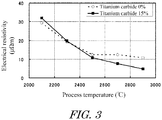
- process temperature in the graphitization step was varied to produce cathode carbon blocks as Examples 12 to 14, which are not according to the invention, and Comparative Examples 5 to 11, and the property of carbon blocks from different graphitization temperatures was compared.
- Calcined pitch coke was used as the carbon raw material used in this comparison of property.
- cathode carbon blocks having different titanium carbide contents were obtained with the production procedure described below.
- coal-tar pitch at an amount of outer percentage of 18% relative to the total of the carbon raw material and titanium carbide was added as the organic binder according to the formulation shown in Table 3, kneaded, press molded at a molding pressure of 20 MPa to obtain a molded product of about 100 ⁇ ⁇ 130 mm.
- This molded product was further embedded in coke breeze, baked under a non-oxidative atmosphere at a temperature of 1000°C, and graphitized in an indirect current type graphitization furnace (Acheson furnace) at different temperatures.
- the result of the electrical resistivity measured for the cathode carbon block obtained is shown in Table 3.
- Figure 3 is a graph showing the relationship between the process temperature and the electrical resistivity when the titanium carbide content in the cathode carbon is 0% and 15%.
- Example Comparative Example 12 13 14 5 6 7 8 9 10 11 Carbon raw material (% by mass) Greater than 1 mm - - - - - - - - - 1 mm or less 85 85 85 100 100 100 100 100 85 85 TiC 7 ⁇ m 15 15 15 - - - - - 15 15 (Raw material subtotal) 100 100 100 100 100 100 100 100 100 100 100 100 100 100 100 100 100 100 100 100 100 100 100 100 100 100 100 100 100 100 100 100 100 100 100 100 100 100 100 100 100 100 100 100 100 100 100 100 100 100 100 100 100 100 100 100 100 100 100 100 100 100 100 100 100 100 100 100 100 100 100 100 100 100 100 100 100 100 100 100 100 100 100 100 100 100 100 100 100 100 100 100 100 100 100 100 100 100 100 100 100 100 100 100 100 100 100 100 100 100 100 100 100 100 100 100 100 100 100 100 100 100 100 100
- a graphitization temperature of cathode carbon block at 2400°C or higher enables the graphitization of calcined coke which is the raw material and reduces the electrical resistivity. Further, at a graphitization temperature greater than 3000°C, more than necessary caloric or electric energy will be added, and the aging of the graphitization furnace will proceed which may lead to increased cost. Accordingly, by adding titanium carbide and employing a graphitization temperature of 2400 to 3000°C, a cathode carbon block having low electrical and high thermal conductivity as well as a process for production thereof can be provided.
Landscapes
- Chemical & Material Sciences (AREA)
- Organic Chemistry (AREA)
- Engineering & Computer Science (AREA)
- Inorganic Chemistry (AREA)
- Materials Engineering (AREA)
- General Life Sciences & Earth Sciences (AREA)
- Metallurgy (AREA)
- Life Sciences & Earth Sciences (AREA)
- Electrochemistry (AREA)
- Geology (AREA)
- Chemical Kinetics & Catalysis (AREA)
- Ceramic Engineering (AREA)
- Manufacturing & Machinery (AREA)
- Structural Engineering (AREA)
- Electrolytic Production Of Metals (AREA)
- Carbon And Carbon Compounds (AREA)
Priority Applications (1)
| Application Number | Priority Date | Filing Date | Title |
|---|---|---|---|
| PL11762246T PL2554715T3 (pl) | 2010-03-30 | 2011-03-29 | Węglowy blok katodowy do wytapiania aluminium i sposób jego wytwarzania |
Applications Claiming Priority (2)
| Application Number | Priority Date | Filing Date | Title |
|---|---|---|---|
| JP2010078759A JP5554117B2 (ja) | 2010-03-30 | 2010-03-30 | アルミニウム精錬用カソードカーボンブロック及びその製造方法 |
| PCT/JP2011/001861 WO2011121998A1 (ja) | 2010-03-30 | 2011-03-29 | アルミニウム精錬用カソードカーボンブロック及びその製造方法 |
Publications (3)
| Publication Number | Publication Date |
|---|---|
| EP2554715A1 EP2554715A1 (en) | 2013-02-06 |
| EP2554715A4 EP2554715A4 (en) | 2015-03-11 |
| EP2554715B1 true EP2554715B1 (en) | 2018-10-31 |
Family
ID=44711760
Family Applications (1)
| Application Number | Title | Priority Date | Filing Date |
|---|---|---|---|
| EP11762246.4A Active EP2554715B1 (en) | 2010-03-30 | 2011-03-29 | Cathode carbon block for aluminum smelting and process for production thereof |
Country Status (7)
| Country | Link |
|---|---|
| EP (1) | EP2554715B1 (pl) |
| JP (1) | JP5554117B2 (pl) |
| CN (1) | CN102822392B (pl) |
| MY (1) | MY153829A (pl) |
| PL (1) | PL2554715T3 (pl) |
| UA (1) | UA109656C2 (pl) |
| WO (1) | WO2011121998A1 (pl) |
Families Citing this family (6)
| Publication number | Priority date | Publication date | Assignee | Title |
|---|---|---|---|---|
| DE102012201468A1 (de) * | 2012-02-01 | 2013-08-01 | Sgl Carbon Se | Verfahren zur Herstellung eines Kathodenblocks für eine Aluminium-Elektrolysezelle und einen Kathodenblock |
| DE112013003030T5 (de) * | 2012-06-29 | 2015-04-09 | Showa Denko K.K. | Kohlenstoffmaterial, kohlenstoffhaltiges Material für Batterieelektrode, und Batterie |
| EP2931945A1 (de) * | 2012-12-13 | 2015-10-21 | SGL Carbon SE | Seitenstein für eine wand in einer elektrolysezelle zur reduzierung von aluminum |
| DE102013202437A1 (de) * | 2013-02-14 | 2014-08-14 | Sgl Carbon Se | Kathodenblock mit einer benetzbaren und abrasionsbeständigen Oberfläche |
| CN105408248A (zh) * | 2013-07-29 | 2016-03-16 | 昭和电工株式会社 | 碳材料、电池电极用材料以及电池 |
| CN115974071B (zh) * | 2022-12-27 | 2025-03-25 | 矿冶科技集团有限公司 | 铝电解废阴极水浸-加压提纯综合回收利用的方法 |
Family Cites Families (15)
| Publication number | Priority date | Publication date | Assignee | Title |
|---|---|---|---|---|
| US3028324A (en) | 1957-05-01 | 1962-04-03 | British Aluminium Co Ltd | Producing or refining aluminum |
| DE1251962B (de) * | 1963-11-21 | 1967-10-12 | The British Aluminium Company Limited, London | Kathode fur eine Elektrolysezelle zur Herstellung von Aluminium und Verfahren zur Herstellung derselben |
| DE1904408A1 (de) * | 1969-01-30 | 1970-08-06 | Conradty Fa C | Hoechstleistungselektrode mit stabilisiertem Lichtbogen |
| US3661736A (en) * | 1969-05-07 | 1972-05-09 | Olin Mathieson | Refractory hard metal composite cathode aluminum reduction cell |
| JPS5849483B2 (ja) | 1976-04-02 | 1983-11-04 | 東洋カ−ボン株式会社 | アルミニウム電解槽用陰極炭素ブロック製造法 |
| JPS58501173A (ja) * | 1981-07-27 | 1983-07-21 | グレ−ト レ−クス カ−ボン コ−ポレ−シヨン | TiB↓2−グラフアイト複合体 |
| CA1256232A (en) * | 1982-07-22 | 1989-06-20 | Larry G. Boxall | Cell for the electrolytic production of aluminum |
| CH654031A5 (de) * | 1983-02-10 | 1986-01-31 | Alusuisse | Verfahren zur herstellung von festkoerperkathoden. |
| US4582553A (en) * | 1984-02-03 | 1986-04-15 | Commonwealth Aluminum Corporation | Process for manufacture of refractory hard metal containing plates for aluminum cell cathodes |
| US5374342A (en) * | 1993-03-22 | 1994-12-20 | Moltech Invent S.A. | Production of carbon-based composite materials as components of aluminium production cells |
| US5492604A (en) * | 1994-12-28 | 1996-02-20 | Aluminum Company Of America | Coating composition for carbon electrodes |
| DE19714432C2 (de) | 1997-04-08 | 2000-07-13 | Aventis Res & Tech Gmbh & Co | Trägerkörper mit einer Schutzbeschichtung und Verwendung des beschichteten Trägerkörpers |
| JP4385583B2 (ja) * | 2002-10-07 | 2009-12-16 | 三菱化学株式会社 | アルミニウム精錬用カソードブロック及びその製造方法 |
| CN1252207C (zh) * | 2003-05-27 | 2006-04-19 | 中南大学 | 一种铝电解用高温导电粘结材料 |
| US7462271B2 (en) * | 2003-11-26 | 2008-12-09 | Alcan International Limited | Stabilizers for titanium diboride-containing cathode structures |
-
2010
- 2010-03-30 JP JP2010078759A patent/JP5554117B2/ja active Active
-
2011
- 2011-03-29 UA UAA201212291A patent/UA109656C2/ru unknown
- 2011-03-29 EP EP11762246.4A patent/EP2554715B1/en active Active
- 2011-03-29 MY MYPI2012700650A patent/MY153829A/en unknown
- 2011-03-29 WO PCT/JP2011/001861 patent/WO2011121998A1/ja not_active Ceased
- 2011-03-29 CN CN201180015665.4A patent/CN102822392B/zh active Active
- 2011-03-29 PL PL11762246T patent/PL2554715T3/pl unknown
Non-Patent Citations (1)
| Title |
|---|
| None * |
Also Published As
| Publication number | Publication date |
|---|---|
| EP2554715A1 (en) | 2013-02-06 |
| UA109656C2 (uk) | 2015-09-25 |
| EP2554715A4 (en) | 2015-03-11 |
| CN102822392A (zh) | 2012-12-12 |
| WO2011121998A1 (ja) | 2011-10-06 |
| MY153829A (en) | 2015-03-24 |
| CN102822392B (zh) | 2015-07-08 |
| PL2554715T3 (pl) | 2019-04-30 |
| JP2011208252A (ja) | 2011-10-20 |
| JP5554117B2 (ja) | 2014-07-23 |
Similar Documents
| Publication | Publication Date | Title |
|---|---|---|
| EP2554715A1 (en) | Cathode carbon block for aluminum smelting and process for production thereof | |
| US4308114A (en) | Electrolytic production of aluminum using a composite cathode | |
| CN101949034B (zh) | 铝电解用阴极石墨化阻流块 | |
| CN101717969A (zh) | 一种适用于金属熔盐电解槽惰性阳极的合金材料 | |
| Li et al. | Research progress in TiB2 wettable cathode for aluminum reduction | |
| CN109267098B (zh) | 制氟阳极及其制备方法 | |
| EP0378584A1 (en) | Cermet anode with continuously dispersed alloy phase and process for making | |
| CN101876079A (zh) | 一种铝电解用硼化钛阴极材料及其制备方法 | |
| SK281012B6 (sk) | Spôsob výroby komponentu elektrolyzéra na výrobu hliníka, komponent a elektrolyzér | |
| RU2371523C1 (ru) | Композиционный материал для смачиваемого катода алюминиевого электролизера | |
| CN104451758A (zh) | 一种熔盐电解高钛渣制备碳化钛的方法 | |
| US4396482A (en) | Composite cathode | |
| Chen et al. | Research Progress on Inert Anode Materials for Aluminum Electrolysis | |
| CN103998654A (zh) | 用于电解铝生产电池的二硼化钛-碳化硅复合材料及其生产方法 | |
| Dai et al. | In-situ synthesis of MoSi2 coating on molybdenum substrate by electro-deoxidation of a SiO2 layer in molten salt | |
| JP2002538293A (ja) | アルミニウム電気分解用黒鉛陰極 | |
| CA2826599A1 (en) | Graphitized cathode block having an abrasion-resistant surface | |
| CN101008093A (zh) | 一种抗氧化性强的铝用预焙阳极制备方法 | |
| CN101694003A (zh) | 一种硬质石墨化阴极炭块的组分及其制造方法 | |
| NO20241131A1 (en) | Titanium diboride wettable cathode | |
| CN114990634B (zh) | 一种铝电解质中电泳沉积在线制备TiB2阴极涂层的方法 | |
| CN110526714B (zh) | 一种铝电解槽阴极用碳化硅捣打糊及其制备方法 | |
| CN1273284A (zh) | 硼化钛─碳复合层阴极碳块及其制备方法 | |
| RU2412284C1 (ru) | Материал смачиваемого катода алюминиевого электролизера | |
| CN115948805A (zh) | 一种板状超粗单晶碳化钨及其制备方法 |
Legal Events
| Date | Code | Title | Description |
|---|---|---|---|
| PUAI | Public reference made under article 153(3) epc to a published international application that has entered the european phase |
Free format text: ORIGINAL CODE: 0009012 |
|
| 17P | Request for examination filed |
Effective date: 20121030 |
|
| AK | Designated contracting states |
Kind code of ref document: A1 Designated state(s): AL AT BE BG CH CY CZ DE DK EE ES FI FR GB GR HR HU IE IS IT LI LT LU LV MC MK MT NL NO PL PT RO RS SE SI SK SM TR |
|
| DAX | Request for extension of the european patent (deleted) | ||
| A4 | Supplementary search report drawn up and despatched |
Effective date: 20150210 |
|
| RIC1 | Information provided on ipc code assigned before grant |
Ipc: C01B 31/30 20060101ALI20150204BHEP Ipc: C04B 35/52 20060101ALI20150204BHEP Ipc: C01B 31/04 20060101ALI20150204BHEP Ipc: C25C 3/08 20060101AFI20150204BHEP |
|
| STAA | Information on the status of an ep patent application or granted ep patent |
Free format text: STATUS: EXAMINATION IS IN PROGRESS |
|
| 17Q | First examination report despatched |
Effective date: 20170413 |
|
| GRAP | Despatch of communication of intention to grant a patent |
Free format text: ORIGINAL CODE: EPIDOSNIGR1 |
|
| STAA | Information on the status of an ep patent application or granted ep patent |
Free format text: STATUS: GRANT OF PATENT IS INTENDED |
|
| RIC1 | Information provided on ipc code assigned before grant |
Ipc: C04B 35/52 20060101ALI20180430BHEP Ipc: C25C 3/08 20060101AFI20180430BHEP Ipc: C01B 32/90 20170101ALI20180430BHEP Ipc: C01B 32/921 20170101ALI20180430BHEP Ipc: C01B 32/20 20170101ALI20180430BHEP |
|
| INTG | Intention to grant announced |
Effective date: 20180529 |
|
| GRAS | Grant fee paid |
Free format text: ORIGINAL CODE: EPIDOSNIGR3 |
|
| GRAA | (expected) grant |
Free format text: ORIGINAL CODE: 0009210 |
|
| STAA | Information on the status of an ep patent application or granted ep patent |
Free format text: STATUS: THE PATENT HAS BEEN GRANTED |
|
| AK | Designated contracting states |
Kind code of ref document: B1 Designated state(s): AL AT BE BG CH CY CZ DE DK EE ES FI FR GB GR HR HU IE IS IT LI LT LU LV MC MK MT NL NO PL PT RO RS SE SI SK SM TR |
|
| REG | Reference to a national code |
Ref country code: CH Ref legal event code: EP Ref country code: GB Ref legal event code: FG4D |
|
| REG | Reference to a national code |
Ref country code: AT Ref legal event code: REF Ref document number: 1059493 Country of ref document: AT Kind code of ref document: T Effective date: 20181115 |
|
| REG | Reference to a national code |
Ref country code: DE Ref legal event code: R096 Ref document number: 602011053443 Country of ref document: DE |
|
| REG | Reference to a national code |
Ref country code: IE Ref legal event code: FG4D |
|
| REG | Reference to a national code |
Ref country code: NL Ref legal event code: MP Effective date: 20181031 |
|
| REG | Reference to a national code |
Ref country code: LT Ref legal event code: MG4D |
|
| REG | Reference to a national code |
Ref country code: AT Ref legal event code: MK05 Ref document number: 1059493 Country of ref document: AT Kind code of ref document: T Effective date: 20181031 |
|
| PG25 | Lapsed in a contracting state [announced via postgrant information from national office to epo] |
Ref country code: FI Free format text: LAPSE BECAUSE OF FAILURE TO SUBMIT A TRANSLATION OF THE DESCRIPTION OR TO PAY THE FEE WITHIN THE PRESCRIBED TIME-LIMIT Effective date: 20181031 Ref country code: AT Free format text: LAPSE BECAUSE OF FAILURE TO SUBMIT A TRANSLATION OF THE DESCRIPTION OR TO PAY THE FEE WITHIN THE PRESCRIBED TIME-LIMIT Effective date: 20181031 Ref country code: IS Free format text: LAPSE BECAUSE OF FAILURE TO SUBMIT A TRANSLATION OF THE DESCRIPTION OR TO PAY THE FEE WITHIN THE PRESCRIBED TIME-LIMIT Effective date: 20190228 Ref country code: HR Free format text: LAPSE BECAUSE OF FAILURE TO SUBMIT A TRANSLATION OF THE DESCRIPTION OR TO PAY THE FEE WITHIN THE PRESCRIBED TIME-LIMIT Effective date: 20181031 Ref country code: NO Free format text: LAPSE BECAUSE OF FAILURE TO SUBMIT A TRANSLATION OF THE DESCRIPTION OR TO PAY THE FEE WITHIN THE PRESCRIBED TIME-LIMIT Effective date: 20190131 Ref country code: LV Free format text: LAPSE BECAUSE OF FAILURE TO SUBMIT A TRANSLATION OF THE DESCRIPTION OR TO PAY THE FEE WITHIN THE PRESCRIBED TIME-LIMIT Effective date: 20181031 Ref country code: BG Free format text: LAPSE BECAUSE OF FAILURE TO SUBMIT A TRANSLATION OF THE DESCRIPTION OR TO PAY THE FEE WITHIN THE PRESCRIBED TIME-LIMIT Effective date: 20190131 Ref country code: ES Free format text: LAPSE BECAUSE OF FAILURE TO SUBMIT A TRANSLATION OF THE DESCRIPTION OR TO PAY THE FEE WITHIN THE PRESCRIBED TIME-LIMIT Effective date: 20181031 Ref country code: LT Free format text: LAPSE BECAUSE OF FAILURE TO SUBMIT A TRANSLATION OF THE DESCRIPTION OR TO PAY THE FEE WITHIN THE PRESCRIBED TIME-LIMIT Effective date: 20181031 |
|
| PG25 | Lapsed in a contracting state [announced via postgrant information from national office to epo] |
Ref country code: AL Free format text: LAPSE BECAUSE OF FAILURE TO SUBMIT A TRANSLATION OF THE DESCRIPTION OR TO PAY THE FEE WITHIN THE PRESCRIBED TIME-LIMIT Effective date: 20181031 Ref country code: NL Free format text: LAPSE BECAUSE OF FAILURE TO SUBMIT A TRANSLATION OF THE DESCRIPTION OR TO PAY THE FEE WITHIN THE PRESCRIBED TIME-LIMIT Effective date: 20181031 Ref country code: PT Free format text: LAPSE BECAUSE OF FAILURE TO SUBMIT A TRANSLATION OF THE DESCRIPTION OR TO PAY THE FEE WITHIN THE PRESCRIBED TIME-LIMIT Effective date: 20190301 Ref country code: SE Free format text: LAPSE BECAUSE OF FAILURE TO SUBMIT A TRANSLATION OF THE DESCRIPTION OR TO PAY THE FEE WITHIN THE PRESCRIBED TIME-LIMIT Effective date: 20181031 Ref country code: GR Free format text: LAPSE BECAUSE OF FAILURE TO SUBMIT A TRANSLATION OF THE DESCRIPTION OR TO PAY THE FEE WITHIN THE PRESCRIBED TIME-LIMIT Effective date: 20190201 Ref country code: RS Free format text: LAPSE BECAUSE OF FAILURE TO SUBMIT A TRANSLATION OF THE DESCRIPTION OR TO PAY THE FEE WITHIN THE PRESCRIBED TIME-LIMIT Effective date: 20181031 |
|
| PG25 | Lapsed in a contracting state [announced via postgrant information from national office to epo] |
Ref country code: IT Free format text: LAPSE BECAUSE OF FAILURE TO SUBMIT A TRANSLATION OF THE DESCRIPTION OR TO PAY THE FEE WITHIN THE PRESCRIBED TIME-LIMIT Effective date: 20181031 Ref country code: CZ Free format text: LAPSE BECAUSE OF FAILURE TO SUBMIT A TRANSLATION OF THE DESCRIPTION OR TO PAY THE FEE WITHIN THE PRESCRIBED TIME-LIMIT Effective date: 20181031 Ref country code: DK Free format text: LAPSE BECAUSE OF FAILURE TO SUBMIT A TRANSLATION OF THE DESCRIPTION OR TO PAY THE FEE WITHIN THE PRESCRIBED TIME-LIMIT Effective date: 20181031 |
|
| REG | Reference to a national code |
Ref country code: DE Ref legal event code: R097 Ref document number: 602011053443 Country of ref document: DE |
|
| PG25 | Lapsed in a contracting state [announced via postgrant information from national office to epo] |
Ref country code: EE Free format text: LAPSE BECAUSE OF FAILURE TO SUBMIT A TRANSLATION OF THE DESCRIPTION OR TO PAY THE FEE WITHIN THE PRESCRIBED TIME-LIMIT Effective date: 20181031 Ref country code: SM Free format text: LAPSE BECAUSE OF FAILURE TO SUBMIT A TRANSLATION OF THE DESCRIPTION OR TO PAY THE FEE WITHIN THE PRESCRIBED TIME-LIMIT Effective date: 20181031 Ref country code: RO Free format text: LAPSE BECAUSE OF FAILURE TO SUBMIT A TRANSLATION OF THE DESCRIPTION OR TO PAY THE FEE WITHIN THE PRESCRIBED TIME-LIMIT Effective date: 20181031 Ref country code: SK Free format text: LAPSE BECAUSE OF FAILURE TO SUBMIT A TRANSLATION OF THE DESCRIPTION OR TO PAY THE FEE WITHIN THE PRESCRIBED TIME-LIMIT Effective date: 20181031 |
|
| PLBE | No opposition filed within time limit |
Free format text: ORIGINAL CODE: 0009261 |
|
| STAA | Information on the status of an ep patent application or granted ep patent |
Free format text: STATUS: NO OPPOSITION FILED WITHIN TIME LIMIT |
|
| 26N | No opposition filed |
Effective date: 20190801 |
|
| PG25 | Lapsed in a contracting state [announced via postgrant information from national office to epo] |
Ref country code: MC Free format text: LAPSE BECAUSE OF FAILURE TO SUBMIT A TRANSLATION OF THE DESCRIPTION OR TO PAY THE FEE WITHIN THE PRESCRIBED TIME-LIMIT Effective date: 20181031 Ref country code: SI Free format text: LAPSE BECAUSE OF FAILURE TO SUBMIT A TRANSLATION OF THE DESCRIPTION OR TO PAY THE FEE WITHIN THE PRESCRIBED TIME-LIMIT Effective date: 20181031 |
|
| REG | Reference to a national code |
Ref country code: CH Ref legal event code: PL |
|
| PG25 | Lapsed in a contracting state [announced via postgrant information from national office to epo] |
Ref country code: LU Free format text: LAPSE BECAUSE OF NON-PAYMENT OF DUE FEES Effective date: 20190329 |
|
| REG | Reference to a national code |
Ref country code: BE Ref legal event code: MM Effective date: 20190331 |
|
| PG25 | Lapsed in a contracting state [announced via postgrant information from national office to epo] |
Ref country code: LI Free format text: LAPSE BECAUSE OF NON-PAYMENT OF DUE FEES Effective date: 20190331 Ref country code: CH Free format text: LAPSE BECAUSE OF NON-PAYMENT OF DUE FEES Effective date: 20190331 Ref country code: IE Free format text: LAPSE BECAUSE OF NON-PAYMENT OF DUE FEES Effective date: 20190329 |
|
| PG25 | Lapsed in a contracting state [announced via postgrant information from national office to epo] |
Ref country code: BE Free format text: LAPSE BECAUSE OF NON-PAYMENT OF DUE FEES Effective date: 20190331 |
|
| PG25 | Lapsed in a contracting state [announced via postgrant information from national office to epo] |
Ref country code: TR Free format text: LAPSE BECAUSE OF FAILURE TO SUBMIT A TRANSLATION OF THE DESCRIPTION OR TO PAY THE FEE WITHIN THE PRESCRIBED TIME-LIMIT Effective date: 20181031 |
|
| PG25 | Lapsed in a contracting state [announced via postgrant information from national office to epo] |
Ref country code: MT Free format text: LAPSE BECAUSE OF NON-PAYMENT OF DUE FEES Effective date: 20190329 |
|
| PG25 | Lapsed in a contracting state [announced via postgrant information from national office to epo] |
Ref country code: CY Free format text: LAPSE BECAUSE OF FAILURE TO SUBMIT A TRANSLATION OF THE DESCRIPTION OR TO PAY THE FEE WITHIN THE PRESCRIBED TIME-LIMIT Effective date: 20181031 |
|
| PG25 | Lapsed in a contracting state [announced via postgrant information from national office to epo] |
Ref country code: HU Free format text: LAPSE BECAUSE OF FAILURE TO SUBMIT A TRANSLATION OF THE DESCRIPTION OR TO PAY THE FEE WITHIN THE PRESCRIBED TIME-LIMIT; INVALID AB INITIO Effective date: 20110329 |
|
| PG25 | Lapsed in a contracting state [announced via postgrant information from national office to epo] |
Ref country code: MK Free format text: LAPSE BECAUSE OF FAILURE TO SUBMIT A TRANSLATION OF THE DESCRIPTION OR TO PAY THE FEE WITHIN THE PRESCRIBED TIME-LIMIT Effective date: 20181031 |
|
| P01 | Opt-out of the competence of the unified patent court (upc) registered |
Effective date: 20230601 |
|
| PGFP | Annual fee paid to national office [announced via postgrant information from national office to epo] |
Ref country code: DE Payment date: 20250409 Year of fee payment: 15 |
|
| PGFP | Annual fee paid to national office [announced via postgrant information from national office to epo] |
Ref country code: GB Payment date: 20260324 Year of fee payment: 16 |
|
| PGFP | Annual fee paid to national office [announced via postgrant information from national office to epo] |
Ref country code: FR Payment date: 20260324 Year of fee payment: 16 |
|
| PGFP | Annual fee paid to national office [announced via postgrant information from national office to epo] |
Ref country code: PL Payment date: 20260218 Year of fee payment: 16 |