EP2554558A1 - Verfahren zur Herstellung von Nitrilkautschuken in organischen Lösungsmitteln - Google Patents
Verfahren zur Herstellung von Nitrilkautschuken in organischen Lösungsmitteln Download PDFInfo
- Publication number
- EP2554558A1 EP2554558A1 EP11290355A EP11290355A EP2554558A1 EP 2554558 A1 EP2554558 A1 EP 2554558A1 EP 11290355 A EP11290355 A EP 11290355A EP 11290355 A EP11290355 A EP 11290355A EP 2554558 A1 EP2554558 A1 EP 2554558A1
- Authority
- EP
- European Patent Office
- Prior art keywords
- oder
- radical
- general formula
- butyl
- acid
- Prior art date
- Legal status (The legal status is an assumption and is not a legal conclusion. Google has not performed a legal analysis and makes no representation as to the accuracy of the status listed.)
- Withdrawn
Links
- 229920000459 Nitrile rubber Polymers 0.000 title claims abstract description 124
- 238000004519 manufacturing process Methods 0.000 title description 11
- 239000003960 organic solvent Substances 0.000 title description 6
- 238000000034 method Methods 0.000 claims abstract description 67
- 230000008569 process Effects 0.000 claims abstract description 45
- 238000005984 hydrogenation reaction Methods 0.000 claims abstract description 23
- 238000002360 preparation method Methods 0.000 claims abstract description 13
- 238000010526 radical polymerization reaction Methods 0.000 claims abstract description 11
- -1 polyunsaturated alkyl radical Chemical class 0.000 claims description 202
- 239000002904 solvent Substances 0.000 claims description 75
- 150000003254 radicals Chemical class 0.000 claims description 65
- 238000010505 homolytic fission reaction Methods 0.000 claims description 38
- 239000003999 initiator Substances 0.000 claims description 35
- 239000000178 monomer Substances 0.000 claims description 33
- 150000001875 compounds Chemical class 0.000 claims description 32
- 239000000203 mixture Substances 0.000 claims description 32
- 229920000642 polymer Polymers 0.000 claims description 32
- 229920006395 saturated elastomer Polymers 0.000 claims description 31
- YXFVVABEGXRONW-UHFFFAOYSA-N Toluene Chemical compound CC1=CC=CC=C1 YXFVVABEGXRONW-UHFFFAOYSA-N 0.000 claims description 30
- 125000002915 carbonyl group Chemical group [*:2]C([*:1])=O 0.000 claims description 28
- 239000004593 Epoxy Substances 0.000 claims description 27
- 125000005300 thiocarboxy group Chemical group C(=S)(O)* 0.000 claims description 27
- 229910052717 sulfur Inorganic materials 0.000 claims description 25
- 125000003118 aryl group Chemical group 0.000 claims description 24
- 238000004132 cross linking Methods 0.000 claims description 24
- 150000001993 dienes Chemical class 0.000 claims description 20
- 125000003545 alkoxy group Chemical group 0.000 claims description 18
- 125000004104 aryloxy group Chemical group 0.000 claims description 18
- WEVYAHXRMPXWCK-UHFFFAOYSA-N Acetonitrile Chemical compound CC#N WEVYAHXRMPXWCK-UHFFFAOYSA-N 0.000 claims description 17
- 239000004971 Cross linker Substances 0.000 claims description 16
- LFQSCWFLJHTTHZ-UHFFFAOYSA-N Ethanol Chemical compound CCO LFQSCWFLJHTTHZ-UHFFFAOYSA-N 0.000 claims description 15
- KFZMGEQAYNKOFK-UHFFFAOYSA-N Isopropanol Chemical compound CC(C)O KFZMGEQAYNKOFK-UHFFFAOYSA-N 0.000 claims description 15
- OKKJLVBELUTLKV-UHFFFAOYSA-N Methanol Chemical compound OC OKKJLVBELUTLKV-UHFFFAOYSA-N 0.000 claims description 15
- ZMXDDKWLCZADIW-UHFFFAOYSA-N N,N-Dimethylformamide Chemical compound CN(C)C=O ZMXDDKWLCZADIW-UHFFFAOYSA-N 0.000 claims description 15
- LRHPLDYGYMQRHN-UHFFFAOYSA-N N-Butanol Chemical compound CCCCO LRHPLDYGYMQRHN-UHFFFAOYSA-N 0.000 claims description 15
- MTHSVFCYNBDYFN-UHFFFAOYSA-N diethylene glycol Chemical compound OCCOCCO MTHSVFCYNBDYFN-UHFFFAOYSA-N 0.000 claims description 15
- 150000002825 nitriles Chemical class 0.000 claims description 15
- BDERNNFJNOPAEC-UHFFFAOYSA-N propan-1-ol Chemical compound CCCO BDERNNFJNOPAEC-UHFFFAOYSA-N 0.000 claims description 15
- SYBYTAAJFKOIEJ-UHFFFAOYSA-N 3-Methylbutan-2-one Chemical compound CC(C)C(C)=O SYBYTAAJFKOIEJ-UHFFFAOYSA-N 0.000 claims description 14
- 239000000654 additive Substances 0.000 claims description 14
- 125000002924 primary amino group Chemical group [H]N([H])* 0.000 claims description 14
- 125000004414 alkyl thio group Chemical group 0.000 claims description 13
- 125000003368 amide group Chemical group 0.000 claims description 13
- 125000003710 aryl alkyl group Chemical group 0.000 claims description 13
- 125000005110 aryl thio group Chemical group 0.000 claims description 13
- 239000012948 isocyanate Substances 0.000 claims description 12
- 150000002513 isocyanates Chemical class 0.000 claims description 12
- NONOKGVFTBWRLD-UHFFFAOYSA-N thioisocyanate group Chemical group S(N=C=O)N=C=O NONOKGVFTBWRLD-UHFFFAOYSA-N 0.000 claims description 12
- DKGAVHZHDRPRBM-UHFFFAOYSA-N Tert-Butanol Chemical compound CC(C)(C)O DKGAVHZHDRPRBM-UHFFFAOYSA-N 0.000 claims description 11
- 125000001072 heteroaryl group Chemical group 0.000 claims description 11
- 125000004446 heteroarylalkyl group Chemical group 0.000 claims description 11
- 125000004043 oxo group Chemical group O=* 0.000 claims description 11
- CYFLXLSBHQBMFT-UHFFFAOYSA-N sulfamoxole Chemical group O1C(C)=C(C)N=C1NS(=O)(=O)C1=CC=C(N)C=C1 CYFLXLSBHQBMFT-UHFFFAOYSA-N 0.000 claims description 11
- UMGDCJDMYOKAJW-UHFFFAOYSA-N thiourea Chemical compound NC(N)=S UMGDCJDMYOKAJW-UHFFFAOYSA-N 0.000 claims description 11
- 125000000464 thioxo group Chemical group S=* 0.000 claims description 11
- PUPZLCDOIYMWBV-UHFFFAOYSA-N (+/-)-1,3-Butanediol Chemical compound CC(O)CCO PUPZLCDOIYMWBV-UHFFFAOYSA-N 0.000 claims description 10
- BZLVMXJERCGZMT-UHFFFAOYSA-N Methyl tert-butyl ether Chemical compound COC(C)(C)C BZLVMXJERCGZMT-UHFFFAOYSA-N 0.000 claims description 10
- 125000004397 aminosulfonyl group Chemical group NS(=O)(=O)* 0.000 claims description 10
- 125000005553 heteroaryloxy group Chemical group 0.000 claims description 10
- WWZKQHOCKIZLMA-UHFFFAOYSA-N octanoic acid Chemical compound CCCCCCCC(O)=O WWZKQHOCKIZLMA-UHFFFAOYSA-N 0.000 claims description 10
- 125000003396 thiol group Chemical group [H]S* 0.000 claims description 10
- 229910052794 bromium Inorganic materials 0.000 claims description 9
- 229910052801 chlorine Inorganic materials 0.000 claims description 9
- MVPPADPHJFYWMZ-UHFFFAOYSA-N chlorobenzene Chemical compound ClC1=CC=CC=C1 MVPPADPHJFYWMZ-UHFFFAOYSA-N 0.000 claims description 9
- 229910052731 fluorine Inorganic materials 0.000 claims description 9
- XLYOFNOQVPJJNP-UHFFFAOYSA-N water Substances O XLYOFNOQVPJJNP-UHFFFAOYSA-N 0.000 claims description 9
- FXHOOIRPVKKKFG-UHFFFAOYSA-N N,N-Dimethylacetamide Chemical compound CN(C)C(C)=O FXHOOIRPVKKKFG-UHFFFAOYSA-N 0.000 claims description 8
- 125000003917 carbamoyl group Chemical group [H]N([H])C(*)=O 0.000 claims description 8
- RWSOTUBLDIXVET-UHFFFAOYSA-N Dihydrogen sulfide Chemical class S RWSOTUBLDIXVET-UHFFFAOYSA-N 0.000 claims description 7
- XBDQKXXYIPTUBI-UHFFFAOYSA-M Propionate Chemical compound CCC([O-])=O XBDQKXXYIPTUBI-UHFFFAOYSA-M 0.000 claims description 7
- XSQUKJJJFZCRTK-UHFFFAOYSA-N Urea Natural products NC(N)=O XSQUKJJJFZCRTK-UHFFFAOYSA-N 0.000 claims description 7
- KXKVLQRXCPHEJC-UHFFFAOYSA-N acetic acid trimethyl ester Natural products COC(C)=O KXKVLQRXCPHEJC-UHFFFAOYSA-N 0.000 claims description 7
- IEJIGPNLZYLLBP-UHFFFAOYSA-N dimethyl carbonate Chemical compound COC(=O)OC IEJIGPNLZYLLBP-UHFFFAOYSA-N 0.000 claims description 7
- 229910052740 iodine Inorganic materials 0.000 claims description 7
- LRDFRRGEGBBSRN-UHFFFAOYSA-N isobutyronitrile Chemical compound CC(C)C#N LRDFRRGEGBBSRN-UHFFFAOYSA-N 0.000 claims description 7
- 150000002527 isonitriles Chemical class 0.000 claims description 7
- JAMNHZBIQDNHMM-UHFFFAOYSA-N pivalonitrile Chemical compound CC(C)(C)C#N JAMNHZBIQDNHMM-UHFFFAOYSA-N 0.000 claims description 7
- 229920000728 polyester Polymers 0.000 claims description 7
- 229920001296 polysiloxane Polymers 0.000 claims description 7
- RVEZZJVBDQCTEF-UHFFFAOYSA-N sulfenic acid Chemical class SO RVEZZJVBDQCTEF-UHFFFAOYSA-N 0.000 claims description 7
- 125000000475 sulfinyl group Chemical group [*:2]S([*:1])=O 0.000 claims description 7
- 150000003567 thiocyanates Chemical class 0.000 claims description 7
- 125000000391 vinyl group Chemical group [H]C([*])=C([H])[H] 0.000 claims description 7
- CSCPPACGZOOCGX-UHFFFAOYSA-N Acetone Chemical compound CC(C)=O CSCPPACGZOOCGX-UHFFFAOYSA-N 0.000 claims description 6
- XEKOWRVHYACXOJ-UHFFFAOYSA-N Ethyl acetate Chemical compound CCOC(C)=O XEKOWRVHYACXOJ-UHFFFAOYSA-N 0.000 claims description 6
- 239000004952 Polyamide Substances 0.000 claims description 6
- NNBZRMINUVCKKA-UHFFFAOYSA-N S(=O)(O)OSS(=O)(=O)O Chemical class S(=O)(O)OSS(=O)(=O)O NNBZRMINUVCKKA-UHFFFAOYSA-N 0.000 claims description 6
- HDFRDWFLWVCOGP-UHFFFAOYSA-N carbonothioic O,S-acid Chemical class OC(S)=O HDFRDWFLWVCOGP-UHFFFAOYSA-N 0.000 claims description 6
- 125000003178 carboxy group Chemical group [H]OC(*)=O 0.000 claims description 6
- 150000001913 cyanates Chemical class 0.000 claims description 6
- 150000004676 glycans Chemical class 0.000 claims description 6
- 229910052760 oxygen Inorganic materials 0.000 claims description 6
- 229920002647 polyamide Polymers 0.000 claims description 6
- 229920000515 polycarbonate Polymers 0.000 claims description 6
- 239000004417 polycarbonate Substances 0.000 claims description 6
- 229920000570 polyether Polymers 0.000 claims description 6
- 239000005056 polyisocyanate Substances 0.000 claims description 6
- 229920001228 polyisocyanate Polymers 0.000 claims description 6
- 229920001282 polysaccharide Polymers 0.000 claims description 6
- 239000005017 polysaccharide Substances 0.000 claims description 6
- 239000004814 polyurethane Substances 0.000 claims description 6
- 229920002635 polyurethane Polymers 0.000 claims description 6
- 125000003808 silyl group Chemical group [H][Si]([H])([H])[*] 0.000 claims description 6
- VZGDMQKNWNREIO-UHFFFAOYSA-N tetrachloromethane Chemical compound ClC(Cl)(Cl)Cl VZGDMQKNWNREIO-UHFFFAOYSA-N 0.000 claims description 6
- RYHBNJHYFVUHQT-UHFFFAOYSA-N 1,4-Dioxane Chemical compound C1COCCO1 RYHBNJHYFVUHQT-UHFFFAOYSA-N 0.000 claims description 5
- 229940044613 1-propanol Drugs 0.000 claims description 5
- ZNQVEEAIQZEUHB-UHFFFAOYSA-N 2-ethoxyethanol Chemical compound CCOCCO ZNQVEEAIQZEUHB-UHFFFAOYSA-N 0.000 claims description 5
- 229940093475 2-ethoxyethanol Drugs 0.000 claims description 5
- QCDWFXQBSFUVSP-UHFFFAOYSA-N 2-phenoxyethanol Chemical compound OCCOC1=CC=CC=C1 QCDWFXQBSFUVSP-UHFFFAOYSA-N 0.000 claims description 5
- DKPFZGUDAPQIHT-UHFFFAOYSA-N Butyl acetate Natural products CCCCOC(C)=O DKPFZGUDAPQIHT-UHFFFAOYSA-N 0.000 claims description 5
- OIFBSDVPJOWBCH-UHFFFAOYSA-N Diethyl carbonate Chemical compound CCOC(=O)OCC OIFBSDVPJOWBCH-UHFFFAOYSA-N 0.000 claims description 5
- ZAFNJMIOTHYJRJ-UHFFFAOYSA-N Diisopropyl ether Chemical compound CC(C)OC(C)C ZAFNJMIOTHYJRJ-UHFFFAOYSA-N 0.000 claims description 5
- 150000001345 alkine derivatives Chemical class 0.000 claims description 5
- 125000004453 alkoxycarbonyl group Chemical group 0.000 claims description 5
- OBETXYAYXDNJHR-UHFFFAOYSA-N alpha-ethylcaproic acid Natural products CCCCC(CC)C(O)=O OBETXYAYXDNJHR-UHFFFAOYSA-N 0.000 claims description 5
- 235000019437 butane-1,3-diol Nutrition 0.000 claims description 5
- 229940043232 butyl acetate Drugs 0.000 claims description 5
- POLCUAVZOMRGSN-UHFFFAOYSA-N dipropyl ether Chemical compound CCCOCCC POLCUAVZOMRGSN-UHFFFAOYSA-N 0.000 claims description 5
- 150000008282 halocarbons Chemical class 0.000 claims description 5
- FUZZWVXGSFPDMH-UHFFFAOYSA-N hexanoic acid Chemical compound CCCCCC(O)=O FUZZWVXGSFPDMH-UHFFFAOYSA-N 0.000 claims description 5
- 229960004592 isopropanol Drugs 0.000 claims description 5
- JMMWKPVZQRWMSS-UHFFFAOYSA-N isopropanol acetate Natural products CC(C)OC(C)=O JMMWKPVZQRWMSS-UHFFFAOYSA-N 0.000 claims description 5
- 229940011051 isopropyl acetate Drugs 0.000 claims description 5
- YKYONYBAUNKHLG-UHFFFAOYSA-N n-Propyl acetate Natural products CCCOC(C)=O YKYONYBAUNKHLG-UHFFFAOYSA-N 0.000 claims description 5
- 229960002446 octanoic acid Drugs 0.000 claims description 5
- 229960005323 phenoxyethanol Drugs 0.000 claims description 5
- WVDDGKGOMKODPV-ZQBYOMGUSA-N phenyl(114C)methanol Chemical compound O[14CH2]C1=CC=CC=C1 WVDDGKGOMKODPV-ZQBYOMGUSA-N 0.000 claims description 5
- 229920005862 polyol Polymers 0.000 claims description 5
- 150000003077 polyols Chemical class 0.000 claims description 5
- 229940090181 propyl acetate Drugs 0.000 claims description 5
- 125000004469 siloxy group Chemical group [SiH3]O* 0.000 claims description 5
- 150000003566 thiocarboxylic acids Chemical class 0.000 claims description 5
- CWERGRDVMFNCDR-UHFFFAOYSA-N thioglycolic acid Chemical compound OC(=O)CS CWERGRDVMFNCDR-UHFFFAOYSA-N 0.000 claims description 5
- NQPDZGIKBAWPEJ-UHFFFAOYSA-N valeric acid Chemical compound CCCCC(O)=O NQPDZGIKBAWPEJ-UHFFFAOYSA-N 0.000 claims description 5
- PMBXCGGQNSVESQ-UHFFFAOYSA-N 1-Hexanethiol Chemical compound CCCCCCS PMBXCGGQNSVESQ-UHFFFAOYSA-N 0.000 claims description 4
- QLOMMFARVWCHAZ-UHFFFAOYSA-N 2-phenylpropan-2-yl 2-phenylethanedithioate Chemical compound C=1C=CC=CC=1C(C)(C)SC(=S)CC1=CC=CC=C1 QLOMMFARVWCHAZ-UHFFFAOYSA-N 0.000 claims description 4
- 125000003903 2-propenyl group Chemical group [H]C([*])([H])C([H])=C([H])[H] 0.000 claims description 4
- SHLSSLVZXJBVHE-UHFFFAOYSA-N 3-sulfanylpropan-1-ol Chemical compound OCCCS SHLSSLVZXJBVHE-UHFFFAOYSA-N 0.000 claims description 4
- HEDRZPFGACZZDS-UHFFFAOYSA-N Chloroform Chemical compound ClC(Cl)Cl HEDRZPFGACZZDS-UHFFFAOYSA-N 0.000 claims description 4
- LSDPWZHWYPCBBB-UHFFFAOYSA-N Methanethiol Chemical compound SC LSDPWZHWYPCBBB-UHFFFAOYSA-N 0.000 claims description 4
- XXROGKLTLUQVRX-UHFFFAOYSA-N allyl alcohol Chemical compound OCC=C XXROGKLTLUQVRX-UHFFFAOYSA-N 0.000 claims description 4
- 150000001642 boronic acid derivatives Chemical class 0.000 claims description 4
- WQAQPCDUOCURKW-UHFFFAOYSA-N butanethiol Chemical compound CCCCS WQAQPCDUOCURKW-UHFFFAOYSA-N 0.000 claims description 4
- WNAHIZMDSQCWRP-UHFFFAOYSA-N dodecane-1-thiol Chemical compound CCCCCCCCCCCCS WNAHIZMDSQCWRP-UHFFFAOYSA-N 0.000 claims description 4
- DNJIEGIFACGWOD-UHFFFAOYSA-N ethanethiol Chemical compound CCS DNJIEGIFACGWOD-UHFFFAOYSA-N 0.000 claims description 4
- 125000002887 hydroxy group Chemical group [H]O* 0.000 claims description 4
- OKJPEAGHQZHRQV-UHFFFAOYSA-N iodoform Chemical compound IC(I)I OKJPEAGHQZHRQV-UHFFFAOYSA-N 0.000 claims description 4
- 229920000233 poly(alkylene oxides) Polymers 0.000 claims description 4
- 229920001521 polyalkylene glycol ether Polymers 0.000 claims description 4
- 239000005077 polysulfide Substances 0.000 claims description 4
- 229920001021 polysulfide Polymers 0.000 claims description 4
- 150000008117 polysulfides Polymers 0.000 claims description 4
- CVHZOJJKTDOEJC-UHFFFAOYSA-N saccharin Chemical compound C1=CC=C2C(=O)NS(=O)(=O)C2=C1 CVHZOJJKTDOEJC-UHFFFAOYSA-N 0.000 claims description 4
- 229940081974 saccharin Drugs 0.000 claims description 4
- 235000019204 saccharin Nutrition 0.000 claims description 4
- 239000000901 saccharin and its Na,K and Ca salt Substances 0.000 claims description 4
- QYHFIVBSNOWOCQ-UHFFFAOYSA-N selenic acid Chemical class O[Se](O)(=O)=O QYHFIVBSNOWOCQ-UHFFFAOYSA-N 0.000 claims description 4
- IDSLBLWCPSAZBL-UHFFFAOYSA-N 2-cyanopropan-2-yl benzenecarbodithioate Chemical compound N#CC(C)(C)SC(=S)C1=CC=CC=C1 IDSLBLWCPSAZBL-UHFFFAOYSA-N 0.000 claims description 3
- 150000001299 aldehydes Chemical class 0.000 claims description 3
- 150000002019 disulfides Chemical class 0.000 claims description 3
- 125000003700 epoxy group Chemical group 0.000 claims description 3
- PJUIMOJAAPLTRJ-UHFFFAOYSA-N monothioglycerol Chemical compound OCC(O)CS PJUIMOJAAPLTRJ-UHFFFAOYSA-N 0.000 claims description 3
- 229920000647 polyepoxide Polymers 0.000 claims description 3
- NJRXVEJTAYWCQJ-UHFFFAOYSA-N thiomalic acid Chemical compound OC(=O)CC(S)C(O)=O NJRXVEJTAYWCQJ-UHFFFAOYSA-N 0.000 claims description 3
- DDMIPSIJHHJYOM-UHFFFAOYSA-N 2-cyanoethyl benzenecarbodithioate Chemical compound N#CCCSC(=S)C1=CC=CC=C1 DDMIPSIJHHJYOM-UHFFFAOYSA-N 0.000 claims description 2
- JXPLECNKPVHWMG-UHFFFAOYSA-N 2-phenylethyl benzenecarbodithioate Chemical compound C=1C=CC=CC=1C(=S)SCCC1=CC=CC=C1 JXPLECNKPVHWMG-UHFFFAOYSA-N 0.000 claims description 2
- KOBJYYDWSKDEGY-UHFFFAOYSA-N 2-phenylpropan-2-yl benzenecarbodithioate Chemical compound C=1C=CC=CC=1C(C)(C)SC(=S)C1=CC=CC=C1 KOBJYYDWSKDEGY-UHFFFAOYSA-N 0.000 claims description 2
- KPJQEIHXBJFQDP-UHFFFAOYSA-N 2-sulfanylcyclohexan-1-ol Chemical compound OC1CCCCC1S KPJQEIHXBJFQDP-UHFFFAOYSA-N 0.000 claims description 2
- XWXZOFCMZBTLHT-UHFFFAOYSA-N 3-cyano-2-propan-2-ylbenzenecarbodithioic acid Chemical compound CC(C)C1=C(C#N)C=CC=C1C(S)=S XWXZOFCMZBTLHT-UHFFFAOYSA-N 0.000 claims description 2
- DKIDEFUBRARXTE-UHFFFAOYSA-N 3-mercaptopropanoic acid Chemical compound OC(=O)CCS DKIDEFUBRARXTE-UHFFFAOYSA-N 0.000 claims description 2
- NEJMTSWXTZREOC-UHFFFAOYSA-N 4-sulfanylbutan-1-ol Chemical compound OCCCCS NEJMTSWXTZREOC-UHFFFAOYSA-N 0.000 claims description 2
- OSDWBNJEKMUWAV-UHFFFAOYSA-N Allyl chloride Chemical compound ClCC=C OSDWBNJEKMUWAV-UHFFFAOYSA-N 0.000 claims description 2
- DXQDCOPSBIDHMP-UHFFFAOYSA-N CCCCCCCCCCCC(CC(C)C#N)[SH2]C(S)=S Chemical compound CCCCCCCCCCCC(CC(C)C#N)[SH2]C(S)=S DXQDCOPSBIDHMP-UHFFFAOYSA-N 0.000 claims description 2
- XUJNEKJLAYXESH-REOHCLBHSA-N L-Cysteine Chemical compound SC[C@H](N)C(O)=O XUJNEKJLAYXESH-REOHCLBHSA-N 0.000 claims description 2
- PWKSKIMOESPYIA-BYPYZUCNSA-N L-N-acetyl-Cysteine Chemical compound CC(=O)N[C@@H](CS)C(O)=O PWKSKIMOESPYIA-BYPYZUCNSA-N 0.000 claims description 2
- 229960004308 acetylcysteine Drugs 0.000 claims description 2
- 230000004913 activation Effects 0.000 claims description 2
- AGEZXYOZHKGVCM-UHFFFAOYSA-N benzyl bromide Chemical compound BrCC1=CC=CC=C1 AGEZXYOZHKGVCM-UHFFFAOYSA-N 0.000 claims description 2
- PCJOWTXKIHRMGA-UHFFFAOYSA-N carbonotrithioic acid;2-methyltetradecanoic acid Chemical compound SC(S)=S.CCCCCCCCCCCCC(C)C(O)=O PCJOWTXKIHRMGA-UHFFFAOYSA-N 0.000 claims description 2
- 125000003262 carboxylic acid ester group Chemical group [H]C([H])([*:2])OC(=O)C([H])([H])[*:1] 0.000 claims description 2
- MLUCVPSAIODCQM-NSCUHMNNSA-N crotonaldehyde Chemical compound C\C=C\C=O MLUCVPSAIODCQM-NSCUHMNNSA-N 0.000 claims description 2
- MLUCVPSAIODCQM-UHFFFAOYSA-N crotonaldehyde Natural products CC=CC=O MLUCVPSAIODCQM-UHFFFAOYSA-N 0.000 claims description 2
- XUJNEKJLAYXESH-UHFFFAOYSA-N cysteine Natural products SCC(N)C(O)=O XUJNEKJLAYXESH-UHFFFAOYSA-N 0.000 claims description 2
- 235000018417 cysteine Nutrition 0.000 claims description 2
- ZWWQICJTBOCQLA-UHFFFAOYSA-N o-propan-2-yl (propan-2-yloxycarbothioyldisulfanyl)methanethioate Chemical compound CC(C)OC(=S)SSC(=S)OC(C)C ZWWQICJTBOCQLA-UHFFFAOYSA-N 0.000 claims description 2
- QUWPKSVNVOPLKX-UHFFFAOYSA-N octan-3-yl 2-sulfanylacetate Chemical compound CCCCCC(CC)OC(=O)CS QUWPKSVNVOPLKX-UHFFFAOYSA-N 0.000 claims description 2
- KZCOBXFFBQJQHH-UHFFFAOYSA-N octane-1-thiol Chemical compound CCCCCCCCS KZCOBXFFBQJQHH-UHFFFAOYSA-N 0.000 claims description 2
- KOUKXHPPRFNWPP-UHFFFAOYSA-N pyrazine-2,5-dicarboxylic acid;hydrate Chemical compound O.OC(=O)C1=CN=C(C(O)=O)C=N1 KOUKXHPPRFNWPP-UHFFFAOYSA-N 0.000 claims description 2
- KSYJPKPGLJRYJV-UHFFFAOYSA-N s-benzoylsulfanylcarbothioyl benzenecarbothioate Chemical compound C=1C=CC=CC=1C(=O)SC(=S)SC(=O)C1=CC=CC=C1 KSYJPKPGLJRYJV-UHFFFAOYSA-N 0.000 claims description 2
- DGVVWUTYPXICAM-UHFFFAOYSA-N β‐Mercaptoethanol Chemical compound OCCS DGVVWUTYPXICAM-UHFFFAOYSA-N 0.000 claims description 2
- GWYFCOCPABKNJV-UHFFFAOYSA-N isovaleric acid Chemical compound CC(C)CC(O)=O GWYFCOCPABKNJV-UHFFFAOYSA-N 0.000 claims 2
- 230000008020 evaporation Effects 0.000 claims 1
- 238000001704 evaporation Methods 0.000 claims 1
- 125000005740 oxycarbonyl group Chemical group [*:1]OC([*:2])=O 0.000 claims 1
- 239000011877 solvent mixture Substances 0.000 abstract description 4
- 125000005842 heteroatom Chemical group 0.000 description 37
- 238000006116 polymerization reaction Methods 0.000 description 31
- KAKZBPTYRLMSJV-UHFFFAOYSA-N Butadiene Chemical compound C=CC=C KAKZBPTYRLMSJV-UHFFFAOYSA-N 0.000 description 28
- 238000006243 chemical reaction Methods 0.000 description 27
- NIXOWILDQLNWCW-UHFFFAOYSA-M Acrylate Chemical compound [O-]C(=O)C=C NIXOWILDQLNWCW-UHFFFAOYSA-M 0.000 description 23
- 125000004429 atom Chemical group 0.000 description 19
- 125000001797 benzyl group Chemical group [H]C1=C([H])C([H])=C(C([H])=C1[H])C([H])([H])* 0.000 description 19
- 150000002148 esters Chemical class 0.000 description 19
- NINIDFKCEFEMDL-UHFFFAOYSA-N Sulfur Chemical compound [S] NINIDFKCEFEMDL-UHFFFAOYSA-N 0.000 description 18
- 125000000113 cyclohexyl group Chemical group [H]C1([H])C([H])([H])C([H])([H])C([H])(*)C([H])([H])C1([H])[H] 0.000 description 17
- 125000001449 isopropyl group Chemical group [H]C([H])([H])C([H])(*)C([H])([H])[H] 0.000 description 17
- 125000002178 anthracenyl group Chemical group C1(=CC=CC2=CC3=CC=CC=C3C=C12)* 0.000 description 16
- 125000001997 phenyl group Chemical group [H]C1=C([H])C([H])=C(*)C([H])=C1[H] 0.000 description 16
- 125000000286 phenylethyl group Chemical group [H]C1=C([H])C([H])=C(C([H])=C1[H])C([H])([H])C([H])([H])* 0.000 description 16
- 125000004076 pyridyl group Chemical group 0.000 description 16
- 125000001424 substituent group Chemical group 0.000 description 16
- 150000005840 aryl radicals Chemical class 0.000 description 15
- 150000003839 salts Chemical class 0.000 description 15
- 239000011593 sulfur Substances 0.000 description 15
- 239000003054 catalyst Substances 0.000 description 14
- 239000000243 solution Substances 0.000 description 12
- SFLRURCEBYIKSS-UHFFFAOYSA-N n-butyl-2-[[1-(butylamino)-2-methyl-1-oxopropan-2-yl]diazenyl]-2-methylpropanamide Chemical compound CCCCNC(=O)C(C)(C)N=NC(C)(C)C(=O)NCCCC SFLRURCEBYIKSS-UHFFFAOYSA-N 0.000 description 11
- 239000000126 substance Substances 0.000 description 11
- NLHHRLWOUZZQLW-UHFFFAOYSA-N Acrylonitrile Chemical compound C=CC#N NLHHRLWOUZZQLW-UHFFFAOYSA-N 0.000 description 10
- 229920006168 hydrated nitrile rubber Polymers 0.000 description 10
- 150000002763 monocarboxylic acids Chemical class 0.000 description 10
- 229910052757 nitrogen Inorganic materials 0.000 description 10
- 125000000999 tert-butyl group Chemical group [H]C([H])([H])C(*)(C([H])([H])[H])C([H])([H])[H] 0.000 description 10
- 229920001971 elastomer Polymers 0.000 description 9
- 229920000768 polyamine Polymers 0.000 description 9
- 125000002914 sec-butyl group Chemical group [H]C([H])([H])C([H])([H])C([H])(*)C([H])([H])[H] 0.000 description 9
- KDLHZDBZIXYQEI-UHFFFAOYSA-N Palladium Chemical compound [Pd] KDLHZDBZIXYQEI-UHFFFAOYSA-N 0.000 description 8
- KJTLSVCANCCWHF-UHFFFAOYSA-N Ruthenium Chemical compound [Ru] KJTLSVCANCCWHF-UHFFFAOYSA-N 0.000 description 8
- PPBRXRYQALVLMV-UHFFFAOYSA-N Styrene Chemical compound C=CC1=CC=CC=C1 PPBRXRYQALVLMV-UHFFFAOYSA-N 0.000 description 8
- 239000000460 chlorine Substances 0.000 description 8
- 229940018560 citraconate Drugs 0.000 description 8
- 239000005060 rubber Substances 0.000 description 8
- 229910052707 ruthenium Inorganic materials 0.000 description 8
- VYPSYNLAJGMNEJ-UHFFFAOYSA-N Silicium dioxide Chemical compound O=[Si]=O VYPSYNLAJGMNEJ-UHFFFAOYSA-N 0.000 description 7
- 238000007792 addition Methods 0.000 description 7
- 125000004183 alkoxy alkyl group Chemical group 0.000 description 7
- 239000003795 chemical substances by application Substances 0.000 description 7
- 239000003426 co-catalyst Substances 0.000 description 7
- NAQMVNRVTILPCV-UHFFFAOYSA-N hexane-1,6-diamine Chemical compound NCCCCCCN NAQMVNRVTILPCV-UHFFFAOYSA-N 0.000 description 7
- LVHBHZANLOWSRM-UHFFFAOYSA-N methylenebutanedioic acid Natural products OC(=O)CC(=C)C(O)=O LVHBHZANLOWSRM-UHFFFAOYSA-N 0.000 description 7
- 229920002239 polyacrylonitrile Polymers 0.000 description 7
- YXIWHUQXZSMYRE-UHFFFAOYSA-N 1,3-benzothiazole-2-thiol Chemical compound C1=CC=C2SC(S)=NC2=C1 YXIWHUQXZSMYRE-UHFFFAOYSA-N 0.000 description 6
- IJGRMHOSHXDMSA-UHFFFAOYSA-N Atomic nitrogen Chemical compound N#N IJGRMHOSHXDMSA-UHFFFAOYSA-N 0.000 description 6
- VZCYOOQTPOCHFL-OWOJBTEDSA-N Fumaric acid Chemical compound OC(=O)\C=C\C(O)=O VZCYOOQTPOCHFL-OWOJBTEDSA-N 0.000 description 6
- UFHFLCQGNIYNRP-UHFFFAOYSA-N Hydrogen Chemical compound [H][H] UFHFLCQGNIYNRP-UHFFFAOYSA-N 0.000 description 6
- 125000005907 alkyl ester group Chemical group 0.000 description 6
- HNEGQIOMVPPMNR-IHWYPQMZSA-N citraconic acid Chemical compound OC(=O)C(/C)=C\C(O)=O HNEGQIOMVPPMNR-IHWYPQMZSA-N 0.000 description 6
- 150000005690 diesters Chemical class 0.000 description 6
- 238000007720 emulsion polymerization reaction Methods 0.000 description 6
- 239000000945 filler Substances 0.000 description 6
- 125000004356 hydroxy functional group Chemical group O* 0.000 description 6
- 230000000977 initiatory effect Effects 0.000 description 6
- BASFCYQUMIYNBI-UHFFFAOYSA-N platinum Chemical compound [Pt] BASFCYQUMIYNBI-UHFFFAOYSA-N 0.000 description 6
- 229910052703 rhodium Inorganic materials 0.000 description 6
- 239000010948 rhodium Substances 0.000 description 6
- MHOVAHRLVXNVSD-UHFFFAOYSA-N rhodium atom Chemical compound [Rh] MHOVAHRLVXNVSD-UHFFFAOYSA-N 0.000 description 6
- VZCYOOQTPOCHFL-UHFFFAOYSA-N trans-butenedioic acid Natural products OC(=O)C=CC(O)=O VZCYOOQTPOCHFL-UHFFFAOYSA-N 0.000 description 6
- 238000004073 vulcanization Methods 0.000 description 6
- OPNUROKCUBTKLF-UHFFFAOYSA-N 1,2-bis(2-methylphenyl)guanidine Chemical compound CC1=CC=CC=C1N\C(N)=N\C1=CC=CC=C1C OPNUROKCUBTKLF-UHFFFAOYSA-N 0.000 description 5
- SMZOUWXMTYCWNB-UHFFFAOYSA-N 2-(2-methoxy-5-methylphenyl)ethanamine Chemical compound COC1=CC=C(C)C=C1CCN SMZOUWXMTYCWNB-UHFFFAOYSA-N 0.000 description 5
- JAHNSTQSQJOJLO-UHFFFAOYSA-N 2-(3-fluorophenyl)-1h-imidazole Chemical compound FC1=CC=CC(C=2NC=CN=2)=C1 JAHNSTQSQJOJLO-UHFFFAOYSA-N 0.000 description 5
- NIXOWILDQLNWCW-UHFFFAOYSA-N 2-Propenoic acid Natural products OC(=O)C=C NIXOWILDQLNWCW-UHFFFAOYSA-N 0.000 description 5
- 241001136792 Alle Species 0.000 description 5
- XFXPMWWXUTWYJX-UHFFFAOYSA-N Cyanide Chemical compound N#[C-] XFXPMWWXUTWYJX-UHFFFAOYSA-N 0.000 description 5
- CERQOIWHTDAKMF-UHFFFAOYSA-N Methacrylic acid Chemical compound CC(=C)C(O)=O CERQOIWHTDAKMF-UHFFFAOYSA-N 0.000 description 5
- ZMZDMBWJUHKJPS-UHFFFAOYSA-M Thiocyanate anion Chemical compound [S-]C#N ZMZDMBWJUHKJPS-UHFFFAOYSA-M 0.000 description 5
- 239000012190 activator Substances 0.000 description 5
- 125000001931 aliphatic group Chemical group 0.000 description 5
- 230000003712 anti-aging effect Effects 0.000 description 5
- 229920001577 copolymer Polymers 0.000 description 5
- 238000009826 distribution Methods 0.000 description 5
- 238000005516 engineering process Methods 0.000 description 5
- 238000009472 formulation Methods 0.000 description 5
- 239000001257 hydrogen Substances 0.000 description 5
- 229910052739 hydrogen Inorganic materials 0.000 description 5
- ZMZDMBWJUHKJPS-UHFFFAOYSA-N hydrogen thiocyanate Natural products SC#N ZMZDMBWJUHKJPS-UHFFFAOYSA-N 0.000 description 5
- KUAZQDVKQLNFPE-UHFFFAOYSA-N thiram Chemical compound CN(C)C(=S)SSC(=S)N(C)C KUAZQDVKQLNFPE-UHFFFAOYSA-N 0.000 description 5
- 229960002447 thiram Drugs 0.000 description 5
- 239000012989 trithiocarbonate Substances 0.000 description 5
- 229910052725 zinc Inorganic materials 0.000 description 5
- 239000011701 zinc Substances 0.000 description 5
- BOXSVZNGTQTENJ-UHFFFAOYSA-L zinc dibutyldithiocarbamate Chemical compound [Zn+2].CCCCN(C([S-])=S)CCCC.CCCCN(C([S-])=S)CCCC BOXSVZNGTQTENJ-UHFFFAOYSA-L 0.000 description 5
- OEBXWWBYZJNKRK-UHFFFAOYSA-N 1-methyl-2,3,4,6,7,8-hexahydropyrimido[1,2-a]pyrimidine Chemical compound C1CCN=C2N(C)CCCN21 OEBXWWBYZJNKRK-UHFFFAOYSA-N 0.000 description 4
- GQHTUMJGOHRCHB-UHFFFAOYSA-N 2,3,4,6,7,8,9,10-octahydropyrimido[1,2-a]azepine Chemical compound C1CCCCN2CCCN=C21 GQHTUMJGOHRCHB-UHFFFAOYSA-N 0.000 description 4
- CPGFMWPQXUXQRX-UHFFFAOYSA-N 3-amino-3-(4-fluorophenyl)propanoic acid Chemical compound OC(=O)CC(N)C1=CC=C(F)C=C1 CPGFMWPQXUXQRX-UHFFFAOYSA-N 0.000 description 4
- LUJMEECXHPYQOF-UHFFFAOYSA-N 3-hydroxyacetophenone Chemical compound CC(=O)C1=CC=CC(O)=C1 LUJMEECXHPYQOF-UHFFFAOYSA-N 0.000 description 4
- TXFPEBPIARQUIG-UHFFFAOYSA-N 4'-hydroxyacetophenone Chemical compound CC(=O)C1=CC=C(O)C=C1 TXFPEBPIARQUIG-UHFFFAOYSA-N 0.000 description 4
- VVBLNCFGVYUYGU-UHFFFAOYSA-N 4,4'-Bis(dimethylamino)benzophenone Chemical compound C1=CC(N(C)C)=CC=C1C(=O)C1=CC=C(N(C)C)C=C1 VVBLNCFGVYUYGU-UHFFFAOYSA-N 0.000 description 4
- NPFYZDNDJHZQKY-UHFFFAOYSA-N 4-Hydroxybenzophenone Chemical compound C1=CC(O)=CC=C1C(=O)C1=CC=CC=C1 NPFYZDNDJHZQKY-UHFFFAOYSA-N 0.000 description 4
- KWOLFJPFCHCOCG-UHFFFAOYSA-N Acetophenone Chemical compound CC(=O)C1=CC=CC=C1 KWOLFJPFCHCOCG-UHFFFAOYSA-N 0.000 description 4
- VTYYLEPIZMXCLO-UHFFFAOYSA-L Calcium carbonate Chemical compound [Ca+2].[O-]C([O-])=O VTYYLEPIZMXCLO-UHFFFAOYSA-L 0.000 description 4
- RYGMFSIKBFXOCR-UHFFFAOYSA-N Copper Chemical compound [Cu] RYGMFSIKBFXOCR-UHFFFAOYSA-N 0.000 description 4
- XEEYBQQBJWHFJM-UHFFFAOYSA-N Iron Chemical compound [Fe] XEEYBQQBJWHFJM-UHFFFAOYSA-N 0.000 description 4
- RRHGJUQNOFWUDK-UHFFFAOYSA-N Isoprene Chemical compound CC(=C)C=C RRHGJUQNOFWUDK-UHFFFAOYSA-N 0.000 description 4
- BAPJBEWLBFYGME-UHFFFAOYSA-N Methyl acrylate Chemical compound COC(=O)C=C BAPJBEWLBFYGME-UHFFFAOYSA-N 0.000 description 4
- GSEJCLTVZPLZKY-UHFFFAOYSA-N Triethanolamine Chemical compound OCCN(CCO)CCO GSEJCLTVZPLZKY-UHFFFAOYSA-N 0.000 description 4
- HCHKCACWOHOZIP-UHFFFAOYSA-N Zinc Chemical compound [Zn] HCHKCACWOHOZIP-UHFFFAOYSA-N 0.000 description 4
- XLOMVQKBTHCTTD-UHFFFAOYSA-N Zinc monoxide Chemical compound [Zn]=O XLOMVQKBTHCTTD-UHFFFAOYSA-N 0.000 description 4
- TZCXTZWJZNENPQ-UHFFFAOYSA-L barium sulfate Chemical compound [Ba+2].[O-]S([O-])(=O)=O TZCXTZWJZNENPQ-UHFFFAOYSA-L 0.000 description 4
- ISAOCJYIOMOJEB-UHFFFAOYSA-N benzoin Chemical compound C=1C=CC=CC=1C(O)C(=O)C1=CC=CC=C1 ISAOCJYIOMOJEB-UHFFFAOYSA-N 0.000 description 4
- 239000003638 chemical reducing agent Substances 0.000 description 4
- 229910017052 cobalt Inorganic materials 0.000 description 4
- 239000010941 cobalt Substances 0.000 description 4
- GUTLYIVDDKVIGB-UHFFFAOYSA-N cobalt atom Chemical compound [Co] GUTLYIVDDKVIGB-UHFFFAOYSA-N 0.000 description 4
- 229910052802 copper Inorganic materials 0.000 description 4
- 239000010949 copper Substances 0.000 description 4
- 239000003431 cross linking reagent Substances 0.000 description 4
- UEZWYKZHXASYJN-UHFFFAOYSA-N cyclohexylthiophthalimide Chemical compound O=C1C2=CC=CC=C2C(=O)N1SC1CCCCC1 UEZWYKZHXASYJN-UHFFFAOYSA-N 0.000 description 4
- 235000014113 dietary fatty acids Nutrition 0.000 description 4
- LMBWSYZSUOEYSN-UHFFFAOYSA-N diethyldithiocarbamic acid Chemical compound CCN(CC)C(S)=S LMBWSYZSUOEYSN-UHFFFAOYSA-N 0.000 description 4
- 125000001495 ethyl group Chemical group [H]C([H])([H])C([H])([H])* 0.000 description 4
- 239000000194 fatty acid Substances 0.000 description 4
- 229930195729 fatty acid Natural products 0.000 description 4
- IQPQWNKOIGAROB-UHFFFAOYSA-N isocyanate Chemical compound [N-]=C=O IQPQWNKOIGAROB-UHFFFAOYSA-N 0.000 description 4
- 239000007800 oxidant agent Substances 0.000 description 4
- 229910052763 palladium Inorganic materials 0.000 description 4
- 150000002978 peroxides Chemical class 0.000 description 4
- ISWSIDIOOBJBQZ-UHFFFAOYSA-N phenol group Chemical group C1(=CC=CC=C1)O ISWSIDIOOBJBQZ-UHFFFAOYSA-N 0.000 description 4
- 150000002989 phenols Chemical class 0.000 description 4
- 229920001223 polyethylene glycol Polymers 0.000 description 4
- 229920001897 terpolymer Polymers 0.000 description 4
- RIOQSEWOXXDEQQ-UHFFFAOYSA-N triphenylphosphine Chemical compound C1=CC=CC=C1P(C=1C=CC=CC=1)C1=CC=CC=C1 RIOQSEWOXXDEQQ-UHFFFAOYSA-N 0.000 description 4
- QKUGKZFASYQCGO-VOTSOKGWSA-N (e)-4-oxo-4-phenylmethoxybut-2-enoic acid Chemical compound OC(=O)\C=C\C(=O)OCC1=CC=CC=C1 QKUGKZFASYQCGO-VOTSOKGWSA-N 0.000 description 3
- QKUGKZFASYQCGO-SREVYHEPSA-N (z)-4-oxo-4-phenylmethoxybut-2-enoic acid Chemical compound OC(=O)\C=C/C(=O)OCC1=CC=CC=C1 QKUGKZFASYQCGO-SREVYHEPSA-N 0.000 description 3
- YHMYGUUIMTVXNW-UHFFFAOYSA-N 1,3-dihydrobenzimidazole-2-thione Chemical compound C1=CC=C2NC(S)=NC2=C1 YHMYGUUIMTVXNW-UHFFFAOYSA-N 0.000 description 3
- OWRCNXZUPFZXOS-UHFFFAOYSA-N 1,3-diphenylguanidine Chemical compound C=1C=CC=CC=1NC(=N)NC1=CC=CC=C1 OWRCNXZUPFZXOS-UHFFFAOYSA-N 0.000 description 3
- CBCKQZAAMUWICA-UHFFFAOYSA-N 1,4-phenylenediamine Chemical compound NC1=CC=C(N)C=C1 CBCKQZAAMUWICA-UHFFFAOYSA-N 0.000 description 3
- BUZICZZQJDLXJN-UHFFFAOYSA-N 3-azaniumyl-4-hydroxybutanoate Chemical compound OCC(N)CC(O)=O BUZICZZQJDLXJN-UHFFFAOYSA-N 0.000 description 3
- QUEPLWQMCBQXGI-UHFFFAOYSA-N 3-phenylmethoxycarbonylbut-3-enoic acid Chemical compound OC(=O)CC(=C)C(=O)OCC1=CC=CC=C1 QUEPLWQMCBQXGI-UHFFFAOYSA-N 0.000 description 3
- DBCAQXHNJOFNGC-UHFFFAOYSA-N 4-bromo-1,1,1-trifluorobutane Chemical compound FC(F)(F)CCCBr DBCAQXHNJOFNGC-UHFFFAOYSA-N 0.000 description 3
- UDQCDDZBBZNIFA-UHFFFAOYSA-N 4-methyl-1,3-dihydrobenzimidazole-2-thione Chemical compound CC1=CC=CC2=C1NC(=S)N2 UDQCDDZBBZNIFA-UHFFFAOYSA-N 0.000 description 3
- PEDCQBHIVMGVHV-UHFFFAOYSA-N Glycerine Chemical compound OCC(O)CO PEDCQBHIVMGVHV-UHFFFAOYSA-N 0.000 description 3
- 241001441571 Hiodontidae Species 0.000 description 3
- DGAQECJNVWCQMB-PUAWFVPOSA-M Ilexoside XXIX Chemical compound C[C@@H]1CC[C@@]2(CC[C@@]3(C(=CC[C@H]4[C@]3(CC[C@@H]5[C@@]4(CC[C@@H](C5(C)C)OS(=O)(=O)[O-])C)C)[C@@H]2[C@]1(C)O)C)C(=O)O[C@H]6[C@@H]([C@H]([C@@H]([C@H](O6)CO)O)O)O.[Na+] DGAQECJNVWCQMB-PUAWFVPOSA-M 0.000 description 3
- CERQOIWHTDAKMF-UHFFFAOYSA-M Methacrylate Chemical compound CC(=C)C([O-])=O CERQOIWHTDAKMF-UHFFFAOYSA-M 0.000 description 3
- 239000002202 Polyethylene glycol Substances 0.000 description 3
- 239000004793 Polystyrene Substances 0.000 description 3
- OFOBLEOULBTSOW-UHFFFAOYSA-N Propanedioic acid Natural products OC(=O)CC(O)=O OFOBLEOULBTSOW-UHFFFAOYSA-N 0.000 description 3
- RTAQQCXQSZGOHL-UHFFFAOYSA-N Titanium Chemical compound [Ti] RTAQQCXQSZGOHL-UHFFFAOYSA-N 0.000 description 3
- OKKRPWIIYQTPQF-UHFFFAOYSA-N Trimethylolpropane trimethacrylate Chemical compound CC(=C)C(=O)OCC(CC)(COC(=O)C(C)=C)COC(=O)C(C)=C OKKRPWIIYQTPQF-UHFFFAOYSA-N 0.000 description 3
- 239000002253 acid Substances 0.000 description 3
- 150000001252 acrylic acid derivatives Chemical class 0.000 description 3
- 230000032683 aging Effects 0.000 description 3
- 125000000217 alkyl group Chemical group 0.000 description 3
- 150000001412 amines Chemical class 0.000 description 3
- 125000003277 amino group Chemical group 0.000 description 3
- 230000015572 biosynthetic process Effects 0.000 description 3
- CQEYYJKEWSMYFG-UHFFFAOYSA-N butyl acrylate Chemical compound CCCCOC(=O)C=C CQEYYJKEWSMYFG-UHFFFAOYSA-N 0.000 description 3
- 125000000484 butyl group Chemical group [H]C([*])([H])C([H])([H])C([H])([H])C([H])([H])[H] 0.000 description 3
- 229910052799 carbon Inorganic materials 0.000 description 3
- 125000004432 carbon atom Chemical group C* 0.000 description 3
- 230000000052 comparative effect Effects 0.000 description 3
- 125000000753 cycloalkyl group Chemical group 0.000 description 3
- 150000001990 dicarboxylic acid derivatives Chemical class 0.000 description 3
- 150000001991 dicarboxylic acids Chemical class 0.000 description 3
- 239000012990 dithiocarbamate Substances 0.000 description 3
- STVZJERGLQHEKB-UHFFFAOYSA-N ethylene glycol dimethacrylate Substances CC(=C)C(=O)OCCOC(=O)C(C)=C STVZJERGLQHEKB-UHFFFAOYSA-N 0.000 description 3
- 239000000835 fiber Substances 0.000 description 3
- 239000001530 fumaric acid Substances 0.000 description 3
- 125000004435 hydrogen atom Chemical group [H]* 0.000 description 3
- 239000003112 inhibitor Substances 0.000 description 3
- 229910052741 iridium Inorganic materials 0.000 description 3
- GKOZUEZYRPOHIO-UHFFFAOYSA-N iridium atom Chemical compound [Ir] GKOZUEZYRPOHIO-UHFFFAOYSA-N 0.000 description 3
- GWYFCOCPABKNJV-UHFFFAOYSA-M isovalerate Chemical compound CC(C)CC([O-])=O GWYFCOCPABKNJV-UHFFFAOYSA-M 0.000 description 3
- 239000003446 ligand Substances 0.000 description 3
- VZCYOOQTPOCHFL-UPHRSURJSA-N maleic acid Chemical compound OC(=O)\C=C/C(O)=O VZCYOOQTPOCHFL-UPHRSURJSA-N 0.000 description 3
- 239000011976 maleic acid Substances 0.000 description 3
- 150000002734 metacrylic acid derivatives Chemical class 0.000 description 3
- 229910052751 metal Inorganic materials 0.000 description 3
- 239000002184 metal Substances 0.000 description 3
- 238000005649 metathesis reaction Methods 0.000 description 3
- 125000002496 methyl group Chemical group [H]C([H])([H])* 0.000 description 3
- 239000003921 oil Substances 0.000 description 3
- 125000002524 organometallic group Chemical group 0.000 description 3
- 229910052762 osmium Inorganic materials 0.000 description 3
- SYQBFIAQOQZEGI-UHFFFAOYSA-N osmium atom Chemical compound [Os] SYQBFIAQOQZEGI-UHFFFAOYSA-N 0.000 description 3
- 229910052697 platinum Inorganic materials 0.000 description 3
- 229920002223 polystyrene Polymers 0.000 description 3
- 230000035484 reaction time Effects 0.000 description 3
- 230000009467 reduction Effects 0.000 description 3
- 229910052702 rhenium Inorganic materials 0.000 description 3
- WUAPFZMCVAUBPE-UHFFFAOYSA-N rhenium atom Chemical compound [Re] WUAPFZMCVAUBPE-UHFFFAOYSA-N 0.000 description 3
- 239000000377 silicon dioxide Substances 0.000 description 3
- 239000011734 sodium Substances 0.000 description 3
- 229910052708 sodium Inorganic materials 0.000 description 3
- 239000007790 solid phase Substances 0.000 description 3
- 238000006467 substitution reaction Methods 0.000 description 3
- QAZLUNIWYYOJPC-UHFFFAOYSA-M sulfenamide Chemical class [Cl-].COC1=C(C)C=[N+]2C3=NC4=CC=C(OC)C=C4N3SCC2=C1C QAZLUNIWYYOJPC-UHFFFAOYSA-M 0.000 description 3
- 238000003786 synthesis reaction Methods 0.000 description 3
- 229910052719 titanium Inorganic materials 0.000 description 3
- 239000010936 titanium Substances 0.000 description 3
- AUMBZPPBWALQRO-UHFFFAOYSA-L zinc;n,n-dibenzylcarbamodithioate Chemical compound [Zn+2].C=1C=CC=CC=1CN(C(=S)[S-])CC1=CC=CC=C1.C=1C=CC=CC=1CN(C(=S)[S-])CC1=CC=CC=C1 AUMBZPPBWALQRO-UHFFFAOYSA-L 0.000 description 3
- DUBNHZYBDBBJHD-UHFFFAOYSA-L ziram Chemical compound [Zn+2].CN(C)C([S-])=S.CN(C)C([S-])=S DUBNHZYBDBBJHD-UHFFFAOYSA-L 0.000 description 3
- CKGKXGQVRVAKEA-UHFFFAOYSA-N (2-methylphenyl)-phenylmethanone Chemical compound CC1=CC=CC=C1C(=O)C1=CC=CC=C1 CKGKXGQVRVAKEA-UHFFFAOYSA-N 0.000 description 2
- JENOLWCGNVWTJN-UHFFFAOYSA-N (3,4-dimethylphenyl)-phenylmethanone Chemical compound C1=C(C)C(C)=CC=C1C(=O)C1=CC=CC=C1 JENOLWCGNVWTJN-UHFFFAOYSA-N 0.000 description 2
- URBLVRAVOIVZFJ-UHFFFAOYSA-N (3-methylphenyl)-phenylmethanone Chemical compound CC1=CC=CC(C(=O)C=2C=CC=CC=2)=C1 URBLVRAVOIVZFJ-UHFFFAOYSA-N 0.000 description 2
- WXPWZZHELZEVPO-UHFFFAOYSA-N (4-methylphenyl)-phenylmethanone Chemical compound C1=CC(C)=CC=C1C(=O)C1=CC=CC=C1 WXPWZZHELZEVPO-UHFFFAOYSA-N 0.000 description 2
- BVCYGKIVZPIAMH-BQYQJAHWSA-N (e)-4-cycloheptyloxy-4-oxobut-2-enoic acid Chemical compound OC(=O)\C=C\C(=O)OC1CCCCCC1 BVCYGKIVZPIAMH-BQYQJAHWSA-N 0.000 description 2
- QCAHYQPONLPBNQ-AATRIKPKSA-N (e)-4-cyclopentyloxy-4-oxobut-2-enoic acid Chemical compound OC(=O)\C=C\C(=O)OC1CCCC1 QCAHYQPONLPBNQ-AATRIKPKSA-N 0.000 description 2
- XLYMOEINVGRTEX-ONEGZZNKSA-N (e)-4-ethoxy-4-oxobut-2-enoic acid Chemical compound CCOC(=O)\C=C\C(O)=O XLYMOEINVGRTEX-ONEGZZNKSA-N 0.000 description 2
- GPTNZCCQHNGXMS-VOTSOKGWSA-N (e)-4-oxo-4-phenoxybut-2-enoic acid Chemical compound OC(=O)\C=C\C(=O)OC1=CC=CC=C1 GPTNZCCQHNGXMS-VOTSOKGWSA-N 0.000 description 2
- KLQUBJNPMISOLG-CLFYSBASSA-N (z)-3-methyl-4-oxo-4-phenylmethoxybut-2-enoic acid Chemical compound OC(=O)/C=C(/C)C(=O)OCC1=CC=CC=C1 KLQUBJNPMISOLG-CLFYSBASSA-N 0.000 description 2
- BVCYGKIVZPIAMH-FPLPWBNLSA-N (z)-4-cycloheptyloxy-4-oxobut-2-enoic acid Chemical compound OC(=O)\C=C/C(=O)OC1CCCCCC1 BVCYGKIVZPIAMH-FPLPWBNLSA-N 0.000 description 2
- ZMQWRASVUXJXGM-SREVYHEPSA-N (z)-4-cyclohexyloxy-4-oxobut-2-enoic acid Chemical compound OC(=O)\C=C/C(=O)OC1CCCCC1 ZMQWRASVUXJXGM-SREVYHEPSA-N 0.000 description 2
- QCAHYQPONLPBNQ-WAYWQWQTSA-N (z)-4-cyclopentyloxy-4-oxobut-2-enoic acid Chemical compound OC(=O)\C=C/C(=O)OC1CCCC1 QCAHYQPONLPBNQ-WAYWQWQTSA-N 0.000 description 2
- GPTNZCCQHNGXMS-SREVYHEPSA-N (z)-4-oxo-4-phenoxybut-2-enoic acid Chemical compound OC(=O)\C=C/C(=O)OC1=CC=CC=C1 GPTNZCCQHNGXMS-SREVYHEPSA-N 0.000 description 2
- AYAUWVRAUCDBFR-ARJAWSKDSA-N (z)-4-oxo-4-propoxybut-2-enoic acid Chemical compound CCCOC(=O)\C=C/C(O)=O AYAUWVRAUCDBFR-ARJAWSKDSA-N 0.000 description 2
- MYRTYDVEIRVNKP-UHFFFAOYSA-N 1,2-Divinylbenzene Chemical compound C=CC1=CC=CC=C1C=C MYRTYDVEIRVNKP-UHFFFAOYSA-N 0.000 description 2
- BCWCEHMHCDCJAD-UHFFFAOYSA-N 1,2-bis(4-methylphenyl)ethane-1,2-dione Chemical compound C1=CC(C)=CC=C1C(=O)C(=O)C1=CC=C(C)C=C1 BCWCEHMHCDCJAD-UHFFFAOYSA-N 0.000 description 2
- MSAHTMIQULFMRG-UHFFFAOYSA-N 1,2-diphenyl-2-propan-2-yloxyethanone Chemical compound C=1C=CC=CC=1C(OC(C)C)C(=O)C1=CC=CC=C1 MSAHTMIQULFMRG-UHFFFAOYSA-N 0.000 description 2
- KOMNUTZXSVSERR-UHFFFAOYSA-N 1,3,5-tris(prop-2-enyl)-1,3,5-triazinane-2,4,6-trione Chemical compound C=CCN1C(=O)N(CC=C)C(=O)N(CC=C)C1=O KOMNUTZXSVSERR-UHFFFAOYSA-N 0.000 description 2
- WZCQRUWWHSTZEM-UHFFFAOYSA-N 1,3-phenylenediamine Chemical compound NC1=CC=CC(N)=C1 WZCQRUWWHSTZEM-UHFFFAOYSA-N 0.000 description 2
- DKEGCUDAFWNSSO-UHFFFAOYSA-N 1,8-dibromooctane Chemical compound BrCCCCCCCCBr DKEGCUDAFWNSSO-UHFFFAOYSA-N 0.000 description 2
- XSZYESUNPWGWFQ-UHFFFAOYSA-N 1-(2-hydroperoxypropan-2-yl)-4-methylcyclohexane Chemical compound CC1CCC(C(C)(C)OO)CC1 XSZYESUNPWGWFQ-UHFFFAOYSA-N 0.000 description 2
- YJFNFQHMQJCPRG-UHFFFAOYSA-N 1-(4-ethoxyphenyl)ethanone Chemical compound CCOC1=CC=C(C(C)=O)C=C1 YJFNFQHMQJCPRG-UHFFFAOYSA-N 0.000 description 2
- DJNIFZYQFLFGDT-UHFFFAOYSA-N 1-(4-phenoxyphenyl)ethanone Chemical compound C1=CC(C(=O)C)=CC=C1OC1=CC=CC=C1 DJNIFZYQFLFGDT-UHFFFAOYSA-N 0.000 description 2
- JNHLHPMTMTYLCP-UHFFFAOYSA-N 1-(4-tert-butyl-2,6-dimethylphenyl)ethanone Chemical compound CC(=O)C1=C(C)C=C(C(C)(C)C)C=C1C JNHLHPMTMTYLCP-UHFFFAOYSA-N 0.000 description 2
- SQZCAOHYQSOZCE-UHFFFAOYSA-N 1-(diaminomethylidene)-2-(2-methylphenyl)guanidine Chemical compound CC1=CC=CC=C1N=C(N)N=C(N)N SQZCAOHYQSOZCE-UHFFFAOYSA-N 0.000 description 2
- 239000012956 1-hydroxycyclohexylphenyl-ketone Substances 0.000 description 2
- ZNRLMGFXSPUZNR-UHFFFAOYSA-N 2,2,4-trimethyl-1h-quinoline Chemical compound C1=CC=C2C(C)=CC(C)(C)NC2=C1 ZNRLMGFXSPUZNR-UHFFFAOYSA-N 0.000 description 2
- PIZHFBODNLEQBL-UHFFFAOYSA-N 2,2-diethoxy-1-phenylethanone Chemical compound CCOC(OCC)C(=O)C1=CC=CC=C1 PIZHFBODNLEQBL-UHFFFAOYSA-N 0.000 description 2
- KWVGIHKZDCUPEU-UHFFFAOYSA-N 2,2-dimethoxy-2-phenylacetophenone Chemical compound C=1C=CC=CC=1C(OC)(OC)C(=O)C1=CC=CC=C1 KWVGIHKZDCUPEU-UHFFFAOYSA-N 0.000 description 2
- XSQHUYDRSDBCHN-UHFFFAOYSA-N 2,3-dimethyl-2-propan-2-ylbutanenitrile Chemical compound CC(C)C(C)(C#N)C(C)C XSQHUYDRSDBCHN-UHFFFAOYSA-N 0.000 description 2
- SDJHPPZKZZWAKF-UHFFFAOYSA-N 2,3-dimethylbuta-1,3-diene Chemical compound CC(=C)C(C)=C SDJHPPZKZZWAKF-UHFFFAOYSA-N 0.000 description 2
- XMNIXWIUMCBBBL-UHFFFAOYSA-N 2-(2-phenylpropan-2-ylperoxy)propan-2-ylbenzene Chemical compound C=1C=CC=CC=1C(C)(C)OOC(C)(C)C1=CC=CC=C1 XMNIXWIUMCBBBL-UHFFFAOYSA-N 0.000 description 2
- GJKGAPPUXSSCFI-UHFFFAOYSA-N 2-Hydroxy-4'-(2-hydroxyethoxy)-2-methylpropiophenone Chemical compound CC(C)(O)C(=O)C1=CC=C(OCCO)C=C1 GJKGAPPUXSSCFI-UHFFFAOYSA-N 0.000 description 2
- LIZVXGBYTGTTTI-UHFFFAOYSA-N 2-[(4-methylphenyl)sulfonylamino]-2-phenylacetic acid Chemical compound C1=CC(C)=CC=C1S(=O)(=O)NC(C(O)=O)C1=CC=CC=C1 LIZVXGBYTGTTTI-UHFFFAOYSA-N 0.000 description 2
- XFCMNSHQOZQILR-UHFFFAOYSA-N 2-[2-(2-methylprop-2-enoyloxy)ethoxy]ethyl 2-methylprop-2-enoate Chemical compound CC(=C)C(=O)OCCOCCOC(=O)C(C)=C XFCMNSHQOZQILR-UHFFFAOYSA-N 0.000 description 2
- INQDDHNZXOAFFD-UHFFFAOYSA-N 2-[2-(2-prop-2-enoyloxyethoxy)ethoxy]ethyl prop-2-enoate Chemical compound C=CC(=O)OCCOCCOCCOC(=O)C=C INQDDHNZXOAFFD-UHFFFAOYSA-N 0.000 description 2
- UHFFVFAKEGKNAQ-UHFFFAOYSA-N 2-benzyl-2-(dimethylamino)-1-(4-morpholin-4-ylphenyl)butan-1-one Chemical compound C=1C=C(N2CCOCC2)C=CC=1C(=O)C(CC)(N(C)C)CC1=CC=CC=C1 UHFFVFAKEGKNAQ-UHFFFAOYSA-N 0.000 description 2
- 125000004974 2-butenyl group Chemical group C(C=CC)* 0.000 description 2
- XNMQEEKYCVKGBD-UHFFFAOYSA-N 2-butyne Chemical compound CC#CC XNMQEEKYCVKGBD-UHFFFAOYSA-N 0.000 description 2
- AKCRQHGQIJBRMN-UHFFFAOYSA-N 2-chloroaniline Chemical compound NC1=CC=CC=C1Cl AKCRQHGQIJBRMN-UHFFFAOYSA-N 0.000 description 2
- KMNCBSZOIQAUFX-UHFFFAOYSA-N 2-ethoxy-1,2-diphenylethanone Chemical compound C=1C=CC=CC=1C(OCC)C(=O)C1=CC=CC=C1 KMNCBSZOIQAUFX-UHFFFAOYSA-N 0.000 description 2
- LRRQSCPPOIUNGX-UHFFFAOYSA-N 2-hydroxy-1,2-bis(4-methoxyphenyl)ethanone Chemical compound C1=CC(OC)=CC=C1C(O)C(=O)C1=CC=C(OC)C=C1 LRRQSCPPOIUNGX-UHFFFAOYSA-N 0.000 description 2
- XMLYCEVDHLAQEL-UHFFFAOYSA-N 2-hydroxy-2-methyl-1-phenylpropan-1-one Chemical compound CC(C)(O)C(=O)C1=CC=CC=C1 XMLYCEVDHLAQEL-UHFFFAOYSA-N 0.000 description 2
- BQZJOQXSCSZQPS-UHFFFAOYSA-N 2-methoxy-1,2-diphenylethanone Chemical compound C=1C=CC=CC=1C(OC)C(=O)C1=CC=CC=C1 BQZJOQXSCSZQPS-UHFFFAOYSA-N 0.000 description 2
- LWRBVKNFOYUCNP-UHFFFAOYSA-N 2-methyl-1-(4-methylsulfanylphenyl)-2-morpholin-4-ylpropan-1-one Chemical compound C1=CC(SC)=CC=C1C(=O)C(C)(C)N1CCOCC1 LWRBVKNFOYUCNP-UHFFFAOYSA-N 0.000 description 2
- KUDUQBURMYMBIJ-UHFFFAOYSA-N 2-prop-2-enoyloxyethyl prop-2-enoate Chemical compound C=CC(=O)OCCOC(=O)C=C KUDUQBURMYMBIJ-UHFFFAOYSA-N 0.000 description 2
- FRIBMENBGGCKPD-UHFFFAOYSA-N 3-(2,3-dimethoxyphenyl)prop-2-enal Chemical compound COC1=CC=CC(C=CC=O)=C1OC FRIBMENBGGCKPD-UHFFFAOYSA-N 0.000 description 2
- MZKAPEHLYVLVSW-UHFFFAOYSA-N 3-cycloheptyloxycarbonylbut-3-enoic acid Chemical compound OC(=O)CC(=C)C(=O)OC1CCCCCC1 MZKAPEHLYVLVSW-UHFFFAOYSA-N 0.000 description 2
- SSXZBUGTRRPNGB-UHFFFAOYSA-N 3-cyclopentyloxycarbonylbut-3-enoic acid Chemical compound OC(=O)CC(=C)C(=O)OC1CCCC1 SSXZBUGTRRPNGB-UHFFFAOYSA-N 0.000 description 2
- AYKYXWQEBUNJCN-UHFFFAOYSA-N 3-methylfuran-2,5-dione Chemical compound CC1=CC(=O)OC1=O AYKYXWQEBUNJCN-UHFFFAOYSA-N 0.000 description 2
- PGZYFKWYHCLTIX-UHFFFAOYSA-N 3-phenoxycarbonylbut-3-enoic acid Chemical compound OC(=O)CC(=C)C(=O)OC1=CC=CC=C1 PGZYFKWYHCLTIX-UHFFFAOYSA-N 0.000 description 2
- RXNYJUSEXLAVNQ-UHFFFAOYSA-N 4,4'-Dihydroxybenzophenone Chemical compound C1=CC(O)=CC=C1C(=O)C1=CC=C(O)C=C1 RXNYJUSEXLAVNQ-UHFFFAOYSA-N 0.000 description 2
- YBRVSVVVWCFQMG-UHFFFAOYSA-N 4,4'-diaminodiphenylmethane Chemical compound C1=CC(N)=CC=C1CC1=CC=C(N)C=C1 YBRVSVVVWCFQMG-UHFFFAOYSA-N 0.000 description 2
- VQVIHDPBMFABCQ-UHFFFAOYSA-N 5-(1,3-dioxo-2-benzofuran-5-carbonyl)-2-benzofuran-1,3-dione Chemical compound C1=C2C(=O)OC(=O)C2=CC(C(C=2C=C3C(=O)OC(=O)C3=CC=2)=O)=C1 VQVIHDPBMFABCQ-UHFFFAOYSA-N 0.000 description 2
- FIHBHSQYSYVZQE-UHFFFAOYSA-N 6-prop-2-enoyloxyhexyl prop-2-enoate Chemical compound C=CC(=O)OCCCCCCOC(=O)C=C FIHBHSQYSYVZQE-UHFFFAOYSA-N 0.000 description 2
- PAYRUJLWNCNPSJ-UHFFFAOYSA-N Aniline Chemical compound NC1=CC=CC=C1 PAYRUJLWNCNPSJ-UHFFFAOYSA-N 0.000 description 2
- CIWBSHSKHKDKBQ-JLAZNSOCSA-N Ascorbic acid Chemical compound OC[C@H](O)[C@H]1OC(=O)C(O)=C1O CIWBSHSKHKDKBQ-JLAZNSOCSA-N 0.000 description 2
- OMPJBNCRMGITSC-UHFFFAOYSA-N Benzoylperoxide Chemical compound C=1C=CC=CC=1C(=O)OOC(=O)C1=CC=CC=C1 OMPJBNCRMGITSC-UHFFFAOYSA-N 0.000 description 2
- BTBUEUYNUDRHOZ-UHFFFAOYSA-N Borate Chemical compound [O-]B([O-])[O-] BTBUEUYNUDRHOZ-UHFFFAOYSA-N 0.000 description 2
- WKBOTKDWSSQWDR-UHFFFAOYSA-N Bromine atom Chemical compound [Br] WKBOTKDWSSQWDR-UHFFFAOYSA-N 0.000 description 2
- SOGAXMICEFXMKE-UHFFFAOYSA-N Butylmethacrylate Chemical compound CCCCOC(=O)C(C)=C SOGAXMICEFXMKE-UHFFFAOYSA-N 0.000 description 2
- DHDOJCCHQODKFS-UHFFFAOYSA-N C(=O)(O)S(=O)(OC#N)OC#N Chemical compound C(=O)(O)S(=O)(OC#N)OC#N DHDOJCCHQODKFS-UHFFFAOYSA-N 0.000 description 2
- 0 CC(C)(*N*)C(SC)=S Chemical compound CC(C)(*N*)C(SC)=S 0.000 description 2
- UESBDWLYVVSWAG-LUAWRHEFSA-N CCOC(/C(\CC1CCCCC1)=C\C(O)=O)=O Chemical compound CCOC(/C(\CC1CCCCC1)=C\C(O)=O)=O UESBDWLYVVSWAG-LUAWRHEFSA-N 0.000 description 2
- PLWYTWJTOKFNOO-CLFYSBASSA-N COC(\C(\CC1CCCC1)=C/C(=O)O)=O Chemical compound COC(\C(\CC1CCCC1)=C/C(=O)O)=O PLWYTWJTOKFNOO-CLFYSBASSA-N 0.000 description 2
- OKTJSMMVPCPJKN-UHFFFAOYSA-N Carbon Chemical compound [C] OKTJSMMVPCPJKN-UHFFFAOYSA-N 0.000 description 2
- ZAMOUSCENKQFHK-UHFFFAOYSA-N Chlorine atom Chemical compound [Cl] ZAMOUSCENKQFHK-UHFFFAOYSA-N 0.000 description 2
- FBPFZTCFMRRESA-FSIIMWSLSA-N D-Glucitol Natural products OC[C@H](O)[C@H](O)[C@@H](O)[C@H](O)CO FBPFZTCFMRRESA-FSIIMWSLSA-N 0.000 description 2
- FBPFZTCFMRRESA-JGWLITMVSA-N D-glucitol Chemical compound OC[C@H](O)[C@@H](O)[C@H](O)[C@H](O)CO FBPFZTCFMRRESA-JGWLITMVSA-N 0.000 description 2
- IAZDPXIOMUYVGZ-UHFFFAOYSA-N Dimethylsulphoxide Chemical compound CS(C)=O IAZDPXIOMUYVGZ-UHFFFAOYSA-N 0.000 description 2
- MWRWFPQBGSZWNV-UHFFFAOYSA-N Dinitrosopentamethylenetetramine Chemical compound C1N2CN(N=O)CN1CN(N=O)C2 MWRWFPQBGSZWNV-UHFFFAOYSA-N 0.000 description 2
- 239000012988 Dithioester Substances 0.000 description 2
- JIGUQPWFLRLWPJ-UHFFFAOYSA-N Ethyl acrylate Chemical compound CCOC(=O)C=C JIGUQPWFLRLWPJ-UHFFFAOYSA-N 0.000 description 2
- XLYMOEINVGRTEX-ARJAWSKDSA-N Ethyl hydrogen fumarate Chemical compound CCOC(=O)\C=C/C(O)=O XLYMOEINVGRTEX-ARJAWSKDSA-N 0.000 description 2
- YCKRFDGAMUMZLT-UHFFFAOYSA-N Fluorine atom Chemical compound [F] YCKRFDGAMUMZLT-UHFFFAOYSA-N 0.000 description 2
- MHAJPDPJQMAIIY-UHFFFAOYSA-N Hydrogen peroxide Chemical compound OO MHAJPDPJQMAIIY-UHFFFAOYSA-N 0.000 description 2
- UQSXHKLRYXJYBZ-UHFFFAOYSA-N Iron oxide Chemical compound [Fe]=O UQSXHKLRYXJYBZ-UHFFFAOYSA-N 0.000 description 2
- VQTUBCCKSQIDNK-UHFFFAOYSA-N Isobutene Chemical compound CC(C)=C VQTUBCCKSQIDNK-UHFFFAOYSA-N 0.000 description 2
- VVQNEPGJFQJSBK-UHFFFAOYSA-N Methyl methacrylate Chemical compound COC(=O)C(C)=C VVQNEPGJFQJSBK-UHFFFAOYSA-N 0.000 description 2
- FLVIGYVXZHLUHP-UHFFFAOYSA-N N,N'-diethylthiourea Chemical compound CCNC(=S)NCC FLVIGYVXZHLUHP-UHFFFAOYSA-N 0.000 description 2
- FCSHMCFRCYZTRQ-UHFFFAOYSA-N N,N'-diphenylthiourea Chemical compound C=1C=CC=CC=1NC(=S)NC1=CC=CC=C1 FCSHMCFRCYZTRQ-UHFFFAOYSA-N 0.000 description 2
- XQVWYOYUZDUNRW-UHFFFAOYSA-N N-Phenyl-1-naphthylamine Chemical compound C=1C=CC2=CC=CC=C2C=1NC1=CC=CC=C1 XQVWYOYUZDUNRW-UHFFFAOYSA-N 0.000 description 2
- 101100156282 Neurospora crassa (strain ATCC 24698 / 74-OR23-1A / CBS 708.71 / DSM 1257 / FGSC 987) vib-1 gene Proteins 0.000 description 2
- PXHVJJICTQNCMI-UHFFFAOYSA-N Nickel Chemical compound [Ni] PXHVJJICTQNCMI-UHFFFAOYSA-N 0.000 description 2
- IWFAGAJVQCABOH-FPLPWBNLSA-N OC(=O)/C=C(/C)C(=O)OC1=CC=CC=C1 Chemical compound OC(=O)/C=C(/C)C(=O)OC1=CC=CC=C1 IWFAGAJVQCABOH-FPLPWBNLSA-N 0.000 description 2
- OAICVXFJPJFONN-UHFFFAOYSA-N Phosphorus Chemical group [P] OAICVXFJPJFONN-UHFFFAOYSA-N 0.000 description 2
- LGRFSURHDFAFJT-UHFFFAOYSA-N Phthalic anhydride Natural products C1=CC=C2C(=O)OC(=O)C2=C1 LGRFSURHDFAFJT-UHFFFAOYSA-N 0.000 description 2
- 239000004721 Polyphenylene oxide Substances 0.000 description 2
- QQONPFPTGQHPMA-UHFFFAOYSA-N Propene Chemical compound CC=C QQONPFPTGQHPMA-UHFFFAOYSA-N 0.000 description 2
- 239000012987 RAFT agent Substances 0.000 description 2
- BUGBHKTXTAQXES-UHFFFAOYSA-N Selenium Chemical compound [Se] BUGBHKTXTAQXES-UHFFFAOYSA-N 0.000 description 2
- 244000028419 Styrax benzoin Species 0.000 description 2
- 235000000126 Styrax benzoin Nutrition 0.000 description 2
- 235000008411 Sumatra benzointree Nutrition 0.000 description 2
- GWEVSGVZZGPLCZ-UHFFFAOYSA-N Titan oxide Chemical compound O=[Ti]=O GWEVSGVZZGPLCZ-UHFFFAOYSA-N 0.000 description 2
- ZJCCRDAZUWHFQH-UHFFFAOYSA-N Trimethylolpropane Chemical compound CCC(CO)(CO)CO ZJCCRDAZUWHFQH-UHFFFAOYSA-N 0.000 description 2
- IDLJKTNBZKSHIY-UHFFFAOYSA-N [4-(diethylamino)phenyl]-phenylmethanone Chemical compound C1=CC(N(CC)CC)=CC=C1C(=O)C1=CC=CC=C1 IDLJKTNBZKSHIY-UHFFFAOYSA-N 0.000 description 2
- BEUGBYXJXMVRFO-UHFFFAOYSA-N [4-(dimethylamino)phenyl]-phenylmethanone Chemical compound C1=CC(N(C)C)=CC=C1C(=O)C1=CC=CC=C1 BEUGBYXJXMVRFO-UHFFFAOYSA-N 0.000 description 2
- 150000003926 acrylamides Chemical class 0.000 description 2
- 150000001337 aliphatic alkines Chemical class 0.000 description 2
- 150000001336 alkenes Chemical class 0.000 description 2
- 229910052782 aluminium Inorganic materials 0.000 description 2
- 150000003863 ammonium salts Chemical class 0.000 description 2
- 239000004760 aramid Substances 0.000 description 2
- 229920003235 aromatic polyamide Polymers 0.000 description 2
- 239000002585 base Substances 0.000 description 2
- 229960002130 benzoin Drugs 0.000 description 2
- RWCCWEUUXYIKHB-UHFFFAOYSA-N benzophenone Chemical compound C=1C=CC=CC=1C(=O)C1=CC=CC=C1 RWCCWEUUXYIKHB-UHFFFAOYSA-N 0.000 description 2
- 239000012965 benzophenone Substances 0.000 description 2
- 235000019400 benzoyl peroxide Nutrition 0.000 description 2
- MQDJYUACMFCOFT-UHFFFAOYSA-N bis[2-(1-hydroxycyclohexyl)phenyl]methanone Chemical compound C=1C=CC=C(C(=O)C=2C(=CC=CC=2)C2(O)CCCCC2)C=1C1(O)CCCCC1 MQDJYUACMFCOFT-UHFFFAOYSA-N 0.000 description 2
- VYHBFRJRBHMIQZ-UHFFFAOYSA-N bis[4-(diethylamino)phenyl]methanone Chemical compound C1=CC(N(CC)CC)=CC=C1C(=O)C1=CC=C(N(CC)CC)C=C1 VYHBFRJRBHMIQZ-UHFFFAOYSA-N 0.000 description 2
- JRZSSQRNBKDVDD-LQIBPGRFSA-N bis[4-[2-[(e)-prop-1-enyl]phenoxy]phenyl]methanone Chemical compound C\C=C\C1=CC=CC=C1OC1=CC=C(C(=O)C=2C=CC(OC=3C(=CC=CC=3)\C=C\C)=CC=2)C=C1 JRZSSQRNBKDVDD-LQIBPGRFSA-N 0.000 description 2
- IISBACLAFKSPIT-UHFFFAOYSA-N bisphenol A Chemical compound C=1C=C(O)C=CC=1C(C)(C)C1=CC=C(O)C=C1 IISBACLAFKSPIT-UHFFFAOYSA-N 0.000 description 2
- GDTBXPJZTBHREO-UHFFFAOYSA-N bromine Substances BrBr GDTBXPJZTBHREO-UHFFFAOYSA-N 0.000 description 2
- JHIWVOJDXOSYLW-UHFFFAOYSA-N butyl 2,2-difluorocyclopropane-1-carboxylate Chemical compound CCCCOC(=O)C1CC1(F)F JHIWVOJDXOSYLW-UHFFFAOYSA-N 0.000 description 2
- UTOVMEACOLCUCK-PLNGDYQASA-N butyl maleate Chemical compound CCCCOC(=O)\C=C/C(O)=O UTOVMEACOLCUCK-PLNGDYQASA-N 0.000 description 2
- 229910000019 calcium carbonate Inorganic materials 0.000 description 2
- BRPQOXSCLDDYGP-UHFFFAOYSA-N calcium oxide Chemical compound [O-2].[Ca+2] BRPQOXSCLDDYGP-UHFFFAOYSA-N 0.000 description 2
- 239000000292 calcium oxide Substances 0.000 description 2
- ODINCKMPIJJUCX-UHFFFAOYSA-N calcium oxide Inorganic materials [Ca]=O ODINCKMPIJJUCX-UHFFFAOYSA-N 0.000 description 2
- 238000010276 construction Methods 0.000 description 2
- 238000007334 copolymerization reaction Methods 0.000 description 2
- AFZSMODLJJCVPP-UHFFFAOYSA-N dibenzothiazol-2-yl disulfide Chemical compound C1=CC=C2SC(SSC=3SC4=CC=CC=C4N=3)=NC2=C1 AFZSMODLJJCVPP-UHFFFAOYSA-N 0.000 description 2
- JQVDAXLFBXTEQA-UHFFFAOYSA-N dibutylamine Chemical compound CCCCNCCCC JQVDAXLFBXTEQA-UHFFFAOYSA-N 0.000 description 2
- 229940116901 diethyldithiocarbamate Drugs 0.000 description 2
- DMBHHRLKUKUOEG-UHFFFAOYSA-N diphenylamine Chemical compound C=1C=CC=CC=1NC1=CC=CC=C1 DMBHHRLKUKUOEG-UHFFFAOYSA-N 0.000 description 2
- WBZKQQHYRPRKNJ-UHFFFAOYSA-L disulfite Chemical compound [O-]S(=O)S([O-])(=O)=O WBZKQQHYRPRKNJ-UHFFFAOYSA-L 0.000 description 2
- 150000004659 dithiocarbamates Chemical class 0.000 description 2
- 125000005022 dithioester group Chemical group 0.000 description 2
- 229950004394 ditiocarb Drugs 0.000 description 2
- 230000000694 effects Effects 0.000 description 2
- 239000000839 emulsion Substances 0.000 description 2
- JBKVHLHDHHXQEQ-UHFFFAOYSA-N epsilon-caprolactam Chemical compound O=C1CCCCCN1 JBKVHLHDHHXQEQ-UHFFFAOYSA-N 0.000 description 2
- 125000004185 ester group Chemical group 0.000 description 2
- 125000005448 ethoxyethyl group Chemical group [H]C([H])([H])C([H])([H])OC([H])([H])C([H])([H])* 0.000 description 2
- 150000004665 fatty acids Chemical class 0.000 description 2
- 239000011737 fluorine Substances 0.000 description 2
- XLYMOEINVGRTEX-UHFFFAOYSA-N fumaric acid monoethyl ester Natural products CCOC(=O)C=CC(O)=O XLYMOEINVGRTEX-UHFFFAOYSA-N 0.000 description 2
- NKHAVTQWNUWKEO-UHFFFAOYSA-N fumaric acid monomethyl ester Natural products COC(=O)C=CC(O)=O NKHAVTQWNUWKEO-UHFFFAOYSA-N 0.000 description 2
- 125000000524 functional group Chemical group 0.000 description 2
- 238000005227 gel permeation chromatography Methods 0.000 description 2
- 150000002357 guanidines Chemical class 0.000 description 2
- 229940083094 guanine derivative acting on arteriolar smooth muscle Drugs 0.000 description 2
- 235000019382 gum benzoic Nutrition 0.000 description 2
- 229910052736 halogen Inorganic materials 0.000 description 2
- 150000002367 halogens Chemical class 0.000 description 2
- 238000009904 heterogeneous catalytic hydrogenation reaction Methods 0.000 description 2
- VUNCWTMEJYMOOR-UHFFFAOYSA-N hexachlorocyclopentadiene Chemical class ClC1=C(Cl)C(Cl)(Cl)C(Cl)=C1Cl VUNCWTMEJYMOOR-UHFFFAOYSA-N 0.000 description 2
- VKYKSIONXSXAKP-UHFFFAOYSA-N hexamethylenetetramine Chemical compound C1N(C2)CN3CN1CN2C3 VKYKSIONXSXAKP-UHFFFAOYSA-N 0.000 description 2
- 238000009905 homogeneous catalytic hydrogenation reaction Methods 0.000 description 2
- 229920001519 homopolymer Polymers 0.000 description 2
- 150000002432 hydroperoxides Chemical class 0.000 description 2
- 125000002768 hydroxyalkyl group Chemical group 0.000 description 2
- 238000011065 in-situ storage Methods 0.000 description 2
- 229910052742 iron Inorganic materials 0.000 description 2
- 229920000126 latex Polymers 0.000 description 2
- 229920002521 macromolecule Polymers 0.000 description 2
- 239000000395 magnesium oxide Substances 0.000 description 2
- CPLXHLVBOLITMK-UHFFFAOYSA-N magnesium oxide Inorganic materials [Mg]=O CPLXHLVBOLITMK-UHFFFAOYSA-N 0.000 description 2
- AXZKOIWUVFPNLO-UHFFFAOYSA-N magnesium;oxygen(2-) Chemical compound [O-2].[Mg+2] AXZKOIWUVFPNLO-UHFFFAOYSA-N 0.000 description 2
- 150000002736 metal compounds Chemical class 0.000 description 2
- 125000004184 methoxymethyl group Chemical group [H]C([H])([H])OC([H])([H])* 0.000 description 2
- NKHAVTQWNUWKEO-IHWYPQMZSA-N methyl hydrogen fumarate Chemical compound COC(=O)\C=C/C(O)=O NKHAVTQWNUWKEO-IHWYPQMZSA-N 0.000 description 2
- YLHXLHGIAMFFBU-UHFFFAOYSA-N methyl phenylglyoxalate Chemical compound COC(=O)C(=O)C1=CC=CC=C1 YLHXLHGIAMFFBU-UHFFFAOYSA-N 0.000 description 2
- 238000012986 modification Methods 0.000 description 2
- 230000004048 modification Effects 0.000 description 2
- 239000006082 mold release agent Substances 0.000 description 2
- NKHAVTQWNUWKEO-NSCUHMNNSA-N monomethyl fumarate Chemical compound COC(=O)\C=C\C(O)=O NKHAVTQWNUWKEO-NSCUHMNNSA-N 0.000 description 2
- 238000000465 moulding Methods 0.000 description 2
- DEQZTKGFXNUBJL-UHFFFAOYSA-N n-(1,3-benzothiazol-2-ylsulfanyl)cyclohexanamine Chemical compound C1CCCCC1NSC1=NC2=CC=CC=C2S1 DEQZTKGFXNUBJL-UHFFFAOYSA-N 0.000 description 2
- 125000004108 n-butyl group Chemical group [H]C([H])([H])C([H])([H])C([H])([H])C([H])([H])* 0.000 description 2
- PNJWIWWMYCMZRO-UHFFFAOYSA-N pent‐4‐en‐2‐one Natural products CC(=O)CC=C PNJWIWWMYCMZRO-UHFFFAOYSA-N 0.000 description 2
- 239000012071 phase Substances 0.000 description 2
- LYXOWKPVTCPORE-UHFFFAOYSA-N phenyl-(4-phenylphenyl)methanone Chemical group C=1C=C(C=2C=CC=CC=2)C=CC=1C(=O)C1=CC=CC=C1 LYXOWKPVTCPORE-UHFFFAOYSA-N 0.000 description 2
- 150000004986 phenylenediamines Chemical class 0.000 description 2
- AQSJGOWTSHOLKH-UHFFFAOYSA-N phosphite(3-) Chemical class [O-]P([O-])[O-] AQSJGOWTSHOLKH-UHFFFAOYSA-N 0.000 description 2
- 229910052698 phosphorus Inorganic materials 0.000 description 2
- 239000011574 phosphorus Substances 0.000 description 2
- 229920002401 polyacrylamide Polymers 0.000 description 2
- 229940080818 propionamide Drugs 0.000 description 2
- 125000001436 propyl group Chemical group [H]C([*])([H])C([H])([H])C([H])([H])[H] 0.000 description 2
- 238000010926 purge Methods 0.000 description 2
- 230000002787 reinforcement Effects 0.000 description 2
- QBERHIJABFXGRZ-UHFFFAOYSA-M rhodium;triphenylphosphane;chloride Chemical compound [Cl-].[Rh].C1=CC=CC=C1P(C=1C=CC=CC=1)C1=CC=CC=C1.C1=CC=CC=C1P(C=1C=CC=CC=1)C1=CC=CC=C1.C1=CC=CC=C1P(C=1C=CC=CC=1)C1=CC=CC=C1 QBERHIJABFXGRZ-UHFFFAOYSA-M 0.000 description 2
- XWGJFPHUCFXLBL-UHFFFAOYSA-M rongalite Chemical compound [Na+].OCS([O-])=O XWGJFPHUCFXLBL-UHFFFAOYSA-M 0.000 description 2
- 238000007789 sealing Methods 0.000 description 2
- 239000000600 sorbitol Substances 0.000 description 2
- 239000007858 starting material Substances 0.000 description 2
- 235000000346 sugar Nutrition 0.000 description 2
- 229910052714 tellurium Inorganic materials 0.000 description 2
- PORWMNRCUJJQNO-UHFFFAOYSA-N tellurium atom Chemical compound [Te] PORWMNRCUJJQNO-UHFFFAOYSA-N 0.000 description 2
- GJBRNHKUVLOCEB-UHFFFAOYSA-N tert-butyl benzenecarboperoxoate Chemical compound CC(C)(C)OOC(=O)C1=CC=CC=C1 GJBRNHKUVLOCEB-UHFFFAOYSA-N 0.000 description 2
- 150000003557 thiazoles Chemical class 0.000 description 2
- 150000003585 thioureas Chemical class 0.000 description 2
- 238000006276 transfer reaction Methods 0.000 description 2
- 230000007306 turnover Effects 0.000 description 2
- 229920002554 vinyl polymer Polymers 0.000 description 2
- 239000012991 xanthate Substances 0.000 description 2
- RKQOSDAEEGPRER-UHFFFAOYSA-L zinc diethyldithiocarbamate Chemical compound [Zn+2].CCN(CC)C([S-])=S.CCN(CC)C([S-])=S RKQOSDAEEGPRER-UHFFFAOYSA-L 0.000 description 2
- 239000011787 zinc oxide Substances 0.000 description 2
- PGNWIWKMXVDXHP-UHFFFAOYSA-L zinc;1,3-benzothiazole-2-thiolate Chemical compound [Zn+2].C1=CC=C2SC([S-])=NC2=C1.C1=CC=C2SC([S-])=NC2=C1 PGNWIWKMXVDXHP-UHFFFAOYSA-L 0.000 description 2
- KMNUDJAXRXUZQS-UHFFFAOYSA-L zinc;n-ethyl-n-phenylcarbamodithioate Chemical compound [Zn+2].CCN(C([S-])=S)C1=CC=CC=C1.CCN(C([S-])=S)C1=CC=CC=C1 KMNUDJAXRXUZQS-UHFFFAOYSA-L 0.000 description 2
- YBKBEKGVHFHCRI-UHFFFAOYSA-L zinc;piperidine-1-carbodithioate Chemical compound [Zn+2].[S-]C(=S)N1CCCCC1.[S-]C(=S)N1CCCCC1 YBKBEKGVHFHCRI-UHFFFAOYSA-L 0.000 description 2
- XKMZOFXGLBYJLS-UHFFFAOYSA-L zinc;prop-2-enoate Chemical compound [Zn+2].[O-]C(=O)C=C.[O-]C(=O)C=C XKMZOFXGLBYJLS-UHFFFAOYSA-L 0.000 description 2
- WRXCBRHBHGNNQA-UHFFFAOYSA-N (2,4-dichlorobenzoyl) 2,4-dichlorobenzenecarboperoxoate Chemical compound ClC1=CC(Cl)=CC=C1C(=O)OOC(=O)C1=CC=C(Cl)C=C1Cl WRXCBRHBHGNNQA-UHFFFAOYSA-N 0.000 description 1
- OXYKVVLTXXXVRT-UHFFFAOYSA-N (4-chlorobenzoyl) 4-chlorobenzenecarboperoxoate Chemical compound C1=CC(Cl)=CC=C1C(=O)OOC(=O)C1=CC=C(Cl)C=C1 OXYKVVLTXXXVRT-UHFFFAOYSA-N 0.000 description 1
- 125000004209 (C1-C8) alkyl group Chemical group 0.000 description 1
- PMJHHCWVYXUKFD-SNAWJCMRSA-N (E)-1,3-pentadiene Chemical group C\C=C\C=C PMJHHCWVYXUKFD-SNAWJCMRSA-N 0.000 description 1
- IFPUNCJUPWJHCB-SOFGYWHQSA-N (E)-3-cyclopentyl-4-methoxy-4-oxobut-2-enoic acid Chemical compound COC(\C(=C\C(=O)O)\C1CCCC1)=O IFPUNCJUPWJHCB-SOFGYWHQSA-N 0.000 description 1
- KJPRLNWUNMBNBZ-QPJJXVBHSA-N (E)-cinnamaldehyde Chemical compound O=C\C=C\C1=CC=CC=C1 KJPRLNWUNMBNBZ-QPJJXVBHSA-N 0.000 description 1
- IFPUNCJUPWJHCB-VURMDHGXSA-N (Z)-3-cyclopentyl-4-methoxy-4-oxobut-2-enoic acid Chemical compound COC(\C(=C/C(=O)O)\C1CCCC1)=O IFPUNCJUPWJHCB-VURMDHGXSA-N 0.000 description 1
- ZJYCLOLEIIBKBW-SREVYHEPSA-N (Z)-4-(1-ethylcyclohexyl)oxy-4-oxobut-2-enoic acid Chemical compound OC(=O)\C=C/C(=O)OC1(CC)CCCCC1 ZJYCLOLEIIBKBW-SREVYHEPSA-N 0.000 description 1
- YXVCXHNQDCQCPE-PLNGDYQASA-N (Z)-4-(1-methylcyclopentyl)oxy-4-oxobut-2-enoic acid Chemical compound OC(=O)\C=C/C(=O)OC1(C)CCCC1 YXVCXHNQDCQCPE-PLNGDYQASA-N 0.000 description 1
- CQTWKJBRSAUYDS-HJWRWDBZSA-N (Z)-4-cycloheptyloxy-3-methyl-4-oxobut-2-enoic acid Chemical compound C1(CCCCCC1)OC(\C(\C)=C/C(=O)O)=O CQTWKJBRSAUYDS-HJWRWDBZSA-N 0.000 description 1
- ZXRHETJGWHMBRM-SREVYHEPSA-N (Z)-4-cyclopentyloxy-3-methyl-4-oxobut-2-enoic acid Chemical compound C1(CCCC1)OC(\C(\C)=C/C(=O)O)=O ZXRHETJGWHMBRM-SREVYHEPSA-N 0.000 description 1
- VMEZXMFPKOMWHR-UHFFFAOYSA-N (dimethylamino)methyl prop-2-enoate Chemical compound CN(C)COC(=O)C=C VMEZXMFPKOMWHR-UHFFFAOYSA-N 0.000 description 1
- ZJYCLOLEIIBKBW-VOTSOKGWSA-N (e)-4-(1-ethylcyclohexyl)oxy-4-oxobut-2-enoic acid Chemical compound OC(=O)/C=C/C(=O)OC1(CC)CCCCC1 ZJYCLOLEIIBKBW-VOTSOKGWSA-N 0.000 description 1
- YXVCXHNQDCQCPE-SNAWJCMRSA-N (e)-4-(1-methylcyclopentyl)oxy-4-oxobut-2-enoic acid Chemical compound OC(=O)/C=C/C(=O)OC1(C)CCCC1 YXVCXHNQDCQCPE-SNAWJCMRSA-N 0.000 description 1
- UTOVMEACOLCUCK-SNAWJCMRSA-N (e)-4-butoxy-4-oxobut-2-enoic acid Chemical compound CCCCOC(=O)\C=C\C(O)=O UTOVMEACOLCUCK-SNAWJCMRSA-N 0.000 description 1
- ZMQWRASVUXJXGM-VOTSOKGWSA-N (e)-4-cyclohexyloxy-4-oxobut-2-enoic acid Chemical compound OC(=O)\C=C\C(=O)OC1CCCCC1 ZMQWRASVUXJXGM-VOTSOKGWSA-N 0.000 description 1
- AYAUWVRAUCDBFR-ONEGZZNKSA-N (e)-4-oxo-4-propoxybut-2-enoic acid Chemical compound CCCOC(=O)\C=C\C(O)=O AYAUWVRAUCDBFR-ONEGZZNKSA-N 0.000 description 1
- YZUIBMVKWXNSHB-WAYWQWQTSA-N (z)-3-methyl-4-oxo-4-propoxybut-2-enoic acid Chemical compound CCCOC(=O)C(\C)=C/C(O)=O YZUIBMVKWXNSHB-WAYWQWQTSA-N 0.000 description 1
- HWQBUJSWKVPMFY-PLNGDYQASA-N (z)-4-ethoxy-3-methyl-4-oxobut-2-enoic acid Chemical compound CCOC(=O)C(\C)=C/C(O)=O HWQBUJSWKVPMFY-PLNGDYQASA-N 0.000 description 1
- BGMFJTUTJOZHHZ-ARJAWSKDSA-N (z)-4-methoxy-3-methyl-4-oxobut-2-enoic acid Chemical compound COC(=O)C(\C)=C/C(O)=O BGMFJTUTJOZHHZ-ARJAWSKDSA-N 0.000 description 1
- GWYSWOQRJGLJPA-UHFFFAOYSA-N 1,1,2,2-tetrafluoropropyl 2-methylprop-2-enoate Chemical compound CC(=C)C(=O)OC(F)(F)C(C)(F)F GWYSWOQRJGLJPA-UHFFFAOYSA-N 0.000 description 1
- JNROUINNEHNBIZ-UHFFFAOYSA-N 1,1,3,3-tetraethylguanidine Chemical compound CCN(CC)C(=N)N(CC)CC JNROUINNEHNBIZ-UHFFFAOYSA-N 0.000 description 1
- KYVBNYUBXIEUFW-UHFFFAOYSA-N 1,1,3,3-tetramethylguanidine Chemical compound CN(C)C(=N)N(C)C KYVBNYUBXIEUFW-UHFFFAOYSA-N 0.000 description 1
- NALFRYPTRXKZPN-UHFFFAOYSA-N 1,1-bis(tert-butylperoxy)-3,3,5-trimethylcyclohexane Chemical compound CC1CC(C)(C)CC(OOC(C)(C)C)(OOC(C)(C)C)C1 NALFRYPTRXKZPN-UHFFFAOYSA-N 0.000 description 1
- CCNDOQHYOIISTA-UHFFFAOYSA-N 1,2-bis(2-tert-butylperoxypropan-2-yl)benzene Chemical compound CC(C)(C)OOC(C)(C)C1=CC=CC=C1C(C)(C)OOC(C)(C)C CCNDOQHYOIISTA-UHFFFAOYSA-N 0.000 description 1
- ZXHDVRATSGZISC-UHFFFAOYSA-N 1,2-bis(ethenoxy)ethane Chemical compound C=COCCOC=C ZXHDVRATSGZISC-UHFFFAOYSA-N 0.000 description 1
- WFLOTYSKFUPZQB-UHFFFAOYSA-N 1,2-difluoroethene Chemical group FC=CF WFLOTYSKFUPZQB-UHFFFAOYSA-N 0.000 description 1
- GEYOCULIXLDCMW-UHFFFAOYSA-N 1,2-phenylenediamine Chemical compound NC1=CC=CC=C1N GEYOCULIXLDCMW-UHFFFAOYSA-N 0.000 description 1
- BZJTUOGZUKFLQT-UHFFFAOYSA-N 1,3,5,7-tetramethylcyclooctane Chemical group CC1CC(C)CC(C)CC(C)C1 BZJTUOGZUKFLQT-UHFFFAOYSA-N 0.000 description 1
- VDYWHVQKENANGY-UHFFFAOYSA-N 1,3-Butyleneglycol dimethacrylate Chemical compound CC(=C)C(=O)OC(C)CCOC(=O)C(C)=C VDYWHVQKENANGY-UHFFFAOYSA-N 0.000 description 1
- UBRWPVTUQDJKCC-UHFFFAOYSA-N 1,3-bis(2-tert-butylperoxypropan-2-yl)benzene Chemical compound CC(C)(C)OOC(C)(C)C1=CC=CC(C(C)(C)OOC(C)(C)C)=C1 UBRWPVTUQDJKCC-UHFFFAOYSA-N 0.000 description 1
- SGUVLZREKBPKCE-UHFFFAOYSA-N 1,5-diazabicyclo[4.3.0]-non-5-ene Chemical compound C1CCN=C2CCCN21 SGUVLZREKBPKCE-UHFFFAOYSA-N 0.000 description 1
- HSOOIVBINKDISP-UHFFFAOYSA-N 1-(2-methylprop-2-enoyloxy)butyl 2-methylprop-2-enoate Chemical compound CC(=C)C(=O)OC(CCC)OC(=O)C(C)=C HSOOIVBINKDISP-UHFFFAOYSA-N 0.000 description 1
- FGKIZAATMHLTKO-UHFFFAOYSA-N 1-(diaminomethylideneamino)-2-(2-methylphenyl)guanidine Chemical compound CC1=CC=CC=C1NC(=N)NNC(N)=N FGKIZAATMHLTKO-UHFFFAOYSA-N 0.000 description 1
- NCWSYEUMCNBLPU-UHFFFAOYSA-N 1-(oxiran-2-yl)propyl 2-methylprop-2-enoate Chemical compound CC(=C)C(=O)OC(CC)C1CO1 NCWSYEUMCNBLPU-UHFFFAOYSA-N 0.000 description 1
- HPRNPSLJNKWKCO-UHFFFAOYSA-N 1-(oxiran-2-yl)propyl prop-2-enoate Chemical compound C=CC(=O)OC(CC)C1CO1 HPRNPSLJNKWKCO-UHFFFAOYSA-N 0.000 description 1
- VXNZUUAINFGPBY-UHFFFAOYSA-N 1-Butene Chemical compound CCC=C VXNZUUAINFGPBY-UHFFFAOYSA-N 0.000 description 1
- LGBYJXBCVZKJBL-UHFFFAOYSA-N 1-[(2-oxoazepan-1-yl)disulfanyl]azepan-2-one Chemical compound O=C1CCCCCN1SSN1C(=O)CCCCC1 LGBYJXBCVZKJBL-UHFFFAOYSA-N 0.000 description 1
- IPJGAEWUPXWFPL-UHFFFAOYSA-N 1-[3-(2,5-dioxopyrrol-1-yl)phenyl]pyrrole-2,5-dione Chemical compound O=C1C=CC(=O)N1C1=CC=CC(N2C(C=CC2=O)=O)=C1 IPJGAEWUPXWFPL-UHFFFAOYSA-N 0.000 description 1
- CQDDDLREQHQBRR-UHFFFAOYSA-N 1-cyanoethyl prop-2-enoate Chemical compound N#CC(C)OC(=O)C=C CQDDDLREQHQBRR-UHFFFAOYSA-N 0.000 description 1
- FPFVPEGEWVRCGK-UHFFFAOYSA-N 1-ethenoxy-2-fluoroethane Chemical compound FCCOC=C FPFVPEGEWVRCGK-UHFFFAOYSA-N 0.000 description 1
- CFMTUIKADIKXIQ-UHFFFAOYSA-N 1-ethenoxy-3-fluoropropane Chemical compound FCCCOC=C CFMTUIKADIKXIQ-UHFFFAOYSA-N 0.000 description 1
- GLIWMVHZVCUEHQ-UHFFFAOYSA-N 1-ethenyl-2-(fluoromethyl)benzene Chemical compound FCC1=CC=CC=C1C=C GLIWMVHZVCUEHQ-UHFFFAOYSA-N 0.000 description 1
- LIKMAJRDDDTEIG-UHFFFAOYSA-N 1-hexene Chemical compound CCCCC=C LIKMAJRDDDTEIG-UHFFFAOYSA-N 0.000 description 1
- PIBIAJQNHWMGTD-UHFFFAOYSA-N 1-n,3-n-bis(4-methylphenyl)benzene-1,3-diamine Chemical compound C1=CC(C)=CC=C1NC1=CC=CC(NC=2C=CC(C)=CC=2)=C1 PIBIAJQNHWMGTD-UHFFFAOYSA-N 0.000 description 1
- KGRVJHAUYBGFFP-UHFFFAOYSA-N 2,2'-Methylenebis(4-methyl-6-tert-butylphenol) Chemical compound CC(C)(C)C1=CC(C)=CC(CC=2C(=C(C=C(C)C=2)C(C)(C)C)O)=C1O KGRVJHAUYBGFFP-UHFFFAOYSA-N 0.000 description 1
- VBHXIMACZBQHPX-UHFFFAOYSA-N 2,2,2-trifluoroethyl prop-2-enoate Chemical compound FC(F)(F)COC(=O)C=C VBHXIMACZBQHPX-UHFFFAOYSA-N 0.000 description 1
- YAJYJWXEWKRTPO-UHFFFAOYSA-N 2,3,3,4,4,5-hexamethylhexane-2-thiol Chemical compound CC(C)C(C)(C)C(C)(C)C(C)(C)S YAJYJWXEWKRTPO-UHFFFAOYSA-N 0.000 description 1
- DRHABPMHZRIRAH-UHFFFAOYSA-N 2,4,4,6,6-pentamethylhept-2-ene Chemical group CC(C)=CC(C)(C)CC(C)(C)C DRHABPMHZRIRAH-UHFFFAOYSA-N 0.000 description 1
- BJELTSYBAHKXRW-UHFFFAOYSA-N 2,4,6-triallyloxy-1,3,5-triazine Chemical compound C=CCOC1=NC(OCC=C)=NC(OCC=C)=N1 BJELTSYBAHKXRW-UHFFFAOYSA-N 0.000 description 1
- VLEHKYDBUSECFA-UHFFFAOYSA-N 2,4-dichloro-1-[(2,4-dichlorophenyl)methylperoxymethyl]benzene Chemical compound ClC1=CC(Cl)=CC=C1COOCC1=CC=C(Cl)C=C1Cl VLEHKYDBUSECFA-UHFFFAOYSA-N 0.000 description 1
- DMWVYCCGCQPJEA-UHFFFAOYSA-N 2,5-bis(tert-butylperoxy)-2,5-dimethylhexane Chemical compound CC(C)(C)OOC(C)(C)CCC(C)(C)OOC(C)(C)C DMWVYCCGCQPJEA-UHFFFAOYSA-N 0.000 description 1
- DKCPKDPYUFEZCP-UHFFFAOYSA-N 2,6-di-tert-butylphenol Chemical compound CC(C)(C)C1=CC=CC(C(C)(C)C)=C1O DKCPKDPYUFEZCP-UHFFFAOYSA-N 0.000 description 1
- OZAIFHULBGXAKX-UHFFFAOYSA-N 2-(2-cyanopropan-2-yldiazenyl)-2-methylpropanenitrile Chemical compound N#CC(C)(C)N=NC(C)(C)C#N OZAIFHULBGXAKX-UHFFFAOYSA-N 0.000 description 1
- QHVBLSNVXDSMEB-UHFFFAOYSA-N 2-(diethylamino)ethyl prop-2-enoate Chemical compound CCN(CC)CCOC(=O)C=C QHVBLSNVXDSMEB-UHFFFAOYSA-N 0.000 description 1
- BMFMTNROJASFBW-UHFFFAOYSA-N 2-(furan-2-ylmethylsulfinyl)acetic acid Chemical compound OC(=O)CS(=O)CC1=CC=CO1 BMFMTNROJASFBW-UHFFFAOYSA-N 0.000 description 1
- RGADKZXRWFOTFV-UHFFFAOYSA-N 2-(hydroxymethyl)-2-methylpropane-1,3-diol;prop-2-enoic acid Chemical compound OC(=O)C=C.OC(=O)C=C.OCC(C)(CO)CO RGADKZXRWFOTFV-UHFFFAOYSA-N 0.000 description 1
- PTBAHIRKWPUZAM-UHFFFAOYSA-N 2-(oxiran-2-yl)ethyl 2-methylprop-2-enoate Chemical compound CC(=C)C(=O)OCCC1CO1 PTBAHIRKWPUZAM-UHFFFAOYSA-N 0.000 description 1
- CBKJLMZJKHOGEQ-UHFFFAOYSA-N 2-(oxiran-2-yl)ethyl prop-2-enoate Chemical compound C=CC(=O)OCCC1CO1 CBKJLMZJKHOGEQ-UHFFFAOYSA-N 0.000 description 1
- WHYNPZNWIJZXHX-UHFFFAOYSA-N 2-(prop-2-enoylamino)ethyl prop-2-enoate Chemical compound C=CC(=O)NCCOC(=O)C=C WHYNPZNWIJZXHX-UHFFFAOYSA-N 0.000 description 1
- PYKCEDJHRUUDRK-UHFFFAOYSA-N 2-(tert-butyldiazenyl)-2-methylpropanenitrile Chemical compound CC(C)(C)N=NC(C)(C)C#N PYKCEDJHRUUDRK-UHFFFAOYSA-N 0.000 description 1
- HZAXFHJVJLSVMW-UHFFFAOYSA-N 2-Aminoethan-1-ol Chemical compound NCCO HZAXFHJVJLSVMW-UHFFFAOYSA-N 0.000 description 1
- GOXQRTZXKQZDDN-UHFFFAOYSA-N 2-Ethylhexyl acrylate Chemical compound CCCCC(CC)COC(=O)C=C GOXQRTZXKQZDDN-UHFFFAOYSA-N 0.000 description 1
- TXBCBTDQIULDIA-UHFFFAOYSA-N 2-[[3-hydroxy-2,2-bis(hydroxymethyl)propoxy]methyl]-2-(hydroxymethyl)propane-1,3-diol Chemical compound OCC(CO)(CO)COCC(CO)(CO)CO TXBCBTDQIULDIA-UHFFFAOYSA-N 0.000 description 1
- DAKZLOJXUDPQIL-UHFFFAOYSA-N 2-butyl-4-ethylphenol Chemical compound CCCCC1=CC(CC)=CC=C1O DAKZLOJXUDPQIL-UHFFFAOYSA-N 0.000 description 1
- AEPWOCLBLLCOGZ-UHFFFAOYSA-N 2-cyanoethyl prop-2-enoate Chemical compound C=CC(=O)OCCC#N AEPWOCLBLLCOGZ-UHFFFAOYSA-N 0.000 description 1
- AMEXFSCNSLCWPN-UHFFFAOYSA-N 2-cyanopropan-2-yl 2,2-dithiophen-2-ylacetate Chemical compound C=1C=CSC=1C(C(=O)OC(C)(C)C#N)C1=CC=CS1 AMEXFSCNSLCWPN-UHFFFAOYSA-N 0.000 description 1
- CKSAKVMRQYOFBC-UHFFFAOYSA-N 2-cyanopropan-2-yliminourea Chemical compound N#CC(C)(C)N=NC(N)=O CKSAKVMRQYOFBC-UHFFFAOYSA-N 0.000 description 1
- KRDXTHSSNCTAGY-UHFFFAOYSA-N 2-cyclohexylpyrrolidine Chemical compound C1CCNC1C1CCCCC1 KRDXTHSSNCTAGY-UHFFFAOYSA-N 0.000 description 1
- WDQMWEYDKDCEHT-UHFFFAOYSA-N 2-ethylhexyl 2-methylprop-2-enoate Chemical compound CCCCC(CC)COC(=O)C(C)=C WDQMWEYDKDCEHT-UHFFFAOYSA-N 0.000 description 1
- AISZNMCRXZWVAT-UHFFFAOYSA-N 2-ethylsulfanylcarbothioylsulfanyl-2-methylpropanenitrile Chemical compound CCSC(=S)SC(C)(C)C#N AISZNMCRXZWVAT-UHFFFAOYSA-N 0.000 description 1
- OMIGHNLMNHATMP-UHFFFAOYSA-N 2-hydroxyethyl prop-2-enoate Chemical compound OCCOC(=O)C=C OMIGHNLMNHATMP-UHFFFAOYSA-N 0.000 description 1
- HFCUBKYHMMPGBY-UHFFFAOYSA-N 2-methoxyethyl prop-2-enoate Chemical compound COCCOC(=O)C=C HFCUBKYHMMPGBY-UHFFFAOYSA-N 0.000 description 1
- LYPGJGCIPQYQBW-UHFFFAOYSA-N 2-methyl-2-[[2-methyl-1-oxo-1-(prop-2-enylamino)propan-2-yl]diazenyl]-n-prop-2-enylpropanamide Chemical compound C=CCNC(=O)C(C)(C)N=NC(C)(C)C(=O)NCC=C LYPGJGCIPQYQBW-UHFFFAOYSA-N 0.000 description 1
- UFFYQSOLZWNGSO-UHFFFAOYSA-N 2-methyl-n-[3-[1-[3-(2-methylprop-2-enoylamino)propoxy]ethoxy]propyl]prop-2-enamide Chemical compound CC(=C)C(=O)NCCCOC(C)OCCCNC(=O)C(C)=C UFFYQSOLZWNGSO-UHFFFAOYSA-N 0.000 description 1
- TVONJMOVBKMLOM-UHFFFAOYSA-N 2-methylidenebutanenitrile Chemical compound CCC(=C)C#N TVONJMOVBKMLOM-UHFFFAOYSA-N 0.000 description 1
- PDYXVZHOLWKKTM-UHFFFAOYSA-N 2-methylpropanamide;dihydrate Chemical compound O.O.CC(C)C(N)=O PDYXVZHOLWKKTM-UHFFFAOYSA-N 0.000 description 1
- BQMRDZKGDWXTSA-UHFFFAOYSA-N 2-methylsulfanyl-1h-benzimidazole;zinc Chemical compound [Zn].C1=CC=C2NC(SC)=NC2=C1 BQMRDZKGDWXTSA-UHFFFAOYSA-N 0.000 description 1
- RXBOCDZLKBPILN-UHFFFAOYSA-N 2-propylheptyl prop-2-enoate Chemical compound CCCCCC(CCC)COC(=O)C=C RXBOCDZLKBPILN-UHFFFAOYSA-N 0.000 description 1
- BIISIZOQPWZPPS-UHFFFAOYSA-N 2-tert-butylperoxypropan-2-ylbenzene Chemical compound CC(C)(C)OOC(C)(C)C1=CC=CC=C1 BIISIZOQPWZPPS-UHFFFAOYSA-N 0.000 description 1
- KGIGUEBEKRSTEW-UHFFFAOYSA-N 2-vinylpyridine Chemical compound C=CC1=CC=CC=N1 KGIGUEBEKRSTEW-UHFFFAOYSA-N 0.000 description 1
- MBRFPVDRWWZMQS-UHFFFAOYSA-N 3,3-bis(tert-butylperoxy)but-1-ene Chemical compound CC(C)(C)OOC(C)(C=C)OOC(C)(C)C MBRFPVDRWWZMQS-UHFFFAOYSA-N 0.000 description 1
- FVKFHMNJTHKMRX-UHFFFAOYSA-N 3,4,6,7,8,9-hexahydro-2H-pyrimido[1,2-a]pyrimidine Chemical compound C1CCN2CCCNC2=N1 FVKFHMNJTHKMRX-UHFFFAOYSA-N 0.000 description 1
- LYJULXSXXSDOJA-UHFFFAOYSA-N 3-(1-ethylcyclohexyl)oxycarbonylbut-3-enoic acid Chemical compound OC(=O)CC(=C)C(=O)OC1(CC)CCCCC1 LYJULXSXXSDOJA-UHFFFAOYSA-N 0.000 description 1
- NGDAEKXSRNRFQY-UHFFFAOYSA-N 3-(1-methylcyclopentyl)oxycarbonylbut-3-enoic acid Chemical compound OC(=O)CC(=C)C(=O)OC1(C)CCCC1 NGDAEKXSRNRFQY-UHFFFAOYSA-N 0.000 description 1
- IDMSGQYWHMZBEM-UHFFFAOYSA-N 3-cyano-3-methyl-2,2-dithiophen-2-ylbutanoic acid Chemical compound C=1C=CSC=1C(C(O)=O)(C(C)(C#N)C)C1=CC=CS1 IDMSGQYWHMZBEM-UHFFFAOYSA-N 0.000 description 1
- NQHWGQCRGNOLOD-UHFFFAOYSA-N 3-cyclohexyloxycarbonylbut-3-enoic acid Chemical compound OC(=O)CC(=C)C(=O)OC1CCCCC1 NQHWGQCRGNOLOD-UHFFFAOYSA-N 0.000 description 1
- IZUVGRMMRWJVKU-UHFFFAOYSA-N 3-ethoxycarbonylbut-3-enoic acid Chemical compound CCOC(=O)C(=C)CC(O)=O IZUVGRMMRWJVKU-UHFFFAOYSA-N 0.000 description 1
- QZPSOSOOLFHYRR-UHFFFAOYSA-N 3-hydroxypropyl prop-2-enoate Chemical compound OCCCOC(=O)C=C QZPSOSOOLFHYRR-UHFFFAOYSA-N 0.000 description 1
- KBFJHOCTSIMQKL-UHFFFAOYSA-N 3-methoxycarbonylbut-3-enoic acid Chemical compound COC(=O)C(=C)CC(O)=O KBFJHOCTSIMQKL-UHFFFAOYSA-N 0.000 description 1
- MIIBUHIQXLFJFP-UHFFFAOYSA-N 3-methyl-1-[[3-[(3-methyl-2,5-dioxopyrrol-1-yl)methyl]phenyl]methyl]pyrrole-2,5-dione Chemical compound O=C1C(C)=CC(=O)N1CC1=CC=CC(CN2C(C(C)=CC2=O)=O)=C1 MIIBUHIQXLFJFP-UHFFFAOYSA-N 0.000 description 1
- OFNISBHGPNMTMS-UHFFFAOYSA-N 3-methylideneoxolane-2,5-dione Chemical compound C=C1CC(=O)OC1=O OFNISBHGPNMTMS-UHFFFAOYSA-N 0.000 description 1
- NEAHVGRDHLQWPP-UHFFFAOYSA-N 3-propoxycarbonylbut-3-enoic acid Chemical compound CCCOC(=O)C(=C)CC(O)=O NEAHVGRDHLQWPP-UHFFFAOYSA-N 0.000 description 1
- SJECZPVISLOESU-UHFFFAOYSA-N 3-trimethoxysilylpropan-1-amine Chemical compound CO[Si](OC)(OC)CCCN SJECZPVISLOESU-UHFFFAOYSA-N 0.000 description 1
- HXFZHDVPBWJOPB-UHFFFAOYSA-N 3h-1,3-benzothiazole-2-thione;copper Chemical compound [Cu].C1=CC=C2SC(=S)NC2=C1 HXFZHDVPBWJOPB-UHFFFAOYSA-N 0.000 description 1
- VFXXTYGQYWRHJP-UHFFFAOYSA-N 4,4'-azobis(4-cyanopentanoic acid) Chemical compound OC(=O)CCC(C)(C#N)N=NC(C)(CCC(O)=O)C#N VFXXTYGQYWRHJP-UHFFFAOYSA-N 0.000 description 1
- QRYFCNPYGUORTK-UHFFFAOYSA-N 4-(1,3-benzothiazol-2-yldisulfanyl)morpholine Chemical compound C1COCCN1SSC1=NC2=CC=CC=C2S1 QRYFCNPYGUORTK-UHFFFAOYSA-N 0.000 description 1
- MHKLKWCYGIBEQF-UHFFFAOYSA-N 4-(1,3-benzothiazol-2-ylsulfanyl)morpholine Chemical compound C1COCCN1SC1=NC2=CC=CC=C2S1 MHKLKWCYGIBEQF-UHFFFAOYSA-N 0.000 description 1
- JLBJTVDPSNHSKJ-UHFFFAOYSA-N 4-Methylstyrene Chemical compound CC1=CC=C(C=C)C=C1 JLBJTVDPSNHSKJ-UHFFFAOYSA-N 0.000 description 1
- BBDKZWKEPDTENS-UHFFFAOYSA-N 4-Vinylcyclohexene Chemical compound C=CC1CCC=CC1 BBDKZWKEPDTENS-UHFFFAOYSA-N 0.000 description 1
- YSIUOTWIDXMASD-UHFFFAOYSA-N 4-[(3-ethenylphenyl)methoxy]-n-phenylaniline Chemical compound C=CC1=CC=CC(COC=2C=CC(NC=3C=CC=CC=3)=CC=2)=C1 YSIUOTWIDXMASD-UHFFFAOYSA-N 0.000 description 1
- LJMUXWGJPFMVAL-UHFFFAOYSA-N 4-[(4-ethenylphenyl)methoxy]-n-phenylaniline Chemical compound C1=CC(C=C)=CC=C1COC(C=C1)=CC=C1NC1=CC=CC=C1 LJMUXWGJPFMVAL-UHFFFAOYSA-N 0.000 description 1
- KMKWGXGSGPYISJ-UHFFFAOYSA-N 4-[4-[2-[4-(4-aminophenoxy)phenyl]propan-2-yl]phenoxy]aniline Chemical compound C=1C=C(OC=2C=CC(N)=CC=2)C=CC=1C(C)(C)C(C=C1)=CC=C1OC1=CC=C(N)C=C1 KMKWGXGSGPYISJ-UHFFFAOYSA-N 0.000 description 1
- VVAAYFMMXYRORI-UHFFFAOYSA-N 4-butoxy-2-methylidene-4-oxobutanoic acid Chemical compound CCCCOC(=O)CC(=C)C(O)=O VVAAYFMMXYRORI-UHFFFAOYSA-N 0.000 description 1
- DENHXEKPORGHGI-UHFFFAOYSA-N 4-cyanobutyl 2-methylprop-2-enoate Chemical compound CC(=C)C(=O)OCCCCC#N DENHXEKPORGHGI-UHFFFAOYSA-N 0.000 description 1
- NCUIENNBLKSXPV-UHFFFAOYSA-N 4-cyclohexyl-3-ethoxycarbonylbut-3-enoic acid Chemical compound CCOC(=O)C(CC(O)=O)=CC1CCCCC1 NCUIENNBLKSXPV-UHFFFAOYSA-N 0.000 description 1
- AFACWZNKSRYDTD-UHFFFAOYSA-N 4-cyclopentyl-3-methoxycarbonylbut-3-enoic acid Chemical compound COC(=O)C(CC(O)=O)=CC1CCCC1 AFACWZNKSRYDTD-UHFFFAOYSA-N 0.000 description 1
- RTTAGBVNSDJDTE-UHFFFAOYSA-N 4-ethoxy-2-methylidene-4-oxobutanoic acid Chemical compound CCOC(=O)CC(=C)C(O)=O RTTAGBVNSDJDTE-UHFFFAOYSA-N 0.000 description 1
- OIYTYGOUZOARSH-UHFFFAOYSA-N 4-methoxy-2-methylidene-4-oxobutanoic acid Chemical compound COC(=O)CC(=C)C(O)=O OIYTYGOUZOARSH-UHFFFAOYSA-N 0.000 description 1
- ZZMVLMVFYMGSMY-UHFFFAOYSA-N 4-n-(4-methylpentan-2-yl)-1-n-phenylbenzene-1,4-diamine Chemical compound C1=CC(NC(C)CC(C)C)=CC=C1NC1=CC=CC=C1 ZZMVLMVFYMGSMY-UHFFFAOYSA-N 0.000 description 1
- UHJVLUYSDYOULM-UHFFFAOYSA-N 4-n-(5-methylhexan-2-yl)-1-n-phenylbenzene-1,4-diamine Chemical compound C1=CC(NC(C)CCC(C)C)=CC=C1NC1=CC=CC=C1 UHJVLUYSDYOULM-UHFFFAOYSA-N 0.000 description 1
- TXLINXBIWJYFNR-UHFFFAOYSA-N 4-phenylpyridine-2-carbonitrile Chemical compound C1=NC(C#N)=CC(C=2C=CC=CC=2)=C1 TXLINXBIWJYFNR-UHFFFAOYSA-N 0.000 description 1
- SAPGBCWOQLHKKZ-UHFFFAOYSA-N 6-(2-methylprop-2-enoyloxy)hexyl 2-methylprop-2-enoate Chemical compound CC(=C)C(=O)OCCCCCCOC(=O)C(C)=C SAPGBCWOQLHKKZ-UHFFFAOYSA-N 0.000 description 1
- HRPVXLWXLXDGHG-UHFFFAOYSA-N Acrylamide Chemical compound NC(=O)C=C HRPVXLWXLXDGHG-UHFFFAOYSA-N 0.000 description 1
- 239000004953 Aliphatic polyamide Substances 0.000 description 1
- 239000004604 Blowing Agent Substances 0.000 description 1
- ZOXJGFHDIHLPTG-UHFFFAOYSA-N Boron Chemical compound [B] ZOXJGFHDIHLPTG-UHFFFAOYSA-N 0.000 description 1
- NLZUEZXRPGMBCV-UHFFFAOYSA-N Butylhydroxytoluene Chemical compound CC1=CC(C(C)(C)C)=C(O)C(C(C)(C)C)=C1 NLZUEZXRPGMBCV-UHFFFAOYSA-N 0.000 description 1
- DNLAOJSEJDVLHC-NTMALXAHSA-N C(C)OC(\C(=C/C(=O)O)\C1CCCCC1)=O Chemical compound C(C)OC(\C(=C/C(=O)O)\C1CCCCC1)=O DNLAOJSEJDVLHC-NTMALXAHSA-N 0.000 description 1
- RKGCQUCVYMUYKE-UHFFFAOYSA-N CC(=C)C(=O)OCC(C)(CO)COC(=O)C(C)=C Chemical compound CC(=C)C(=O)OCC(C)(CO)COC(=O)C(C)=C RKGCQUCVYMUYKE-UHFFFAOYSA-N 0.000 description 1
- BJOHTXJTPYROBA-ISLYRVAYSA-N CC(C)(C(NCC=C)=O)/N=N/C(C)(C)C(NC(C)=C)=O Chemical compound CC(C)(C(NCC=C)=O)/N=N/C(C)(C)C(NC(C)=C)=O BJOHTXJTPYROBA-ISLYRVAYSA-N 0.000 description 1
- DNLAOJSEJDVLHC-UHFFFAOYSA-N CCOC(=O)C(=CC(O)=O)C1CCCCC1 Chemical compound CCOC(=O)C(=CC(O)=O)C1CCCCC1 DNLAOJSEJDVLHC-UHFFFAOYSA-N 0.000 description 1
- GAWIXWVDTYZWAW-UHFFFAOYSA-N C[CH]O Chemical group C[CH]O GAWIXWVDTYZWAW-UHFFFAOYSA-N 0.000 description 1
- XVZXOLOFWKSDSR-UHFFFAOYSA-N Cc1cc(C)c([C]=O)c(C)c1 Chemical group Cc1cc(C)c([C]=O)c(C)c1 XVZXOLOFWKSDSR-UHFFFAOYSA-N 0.000 description 1
- 229920000742 Cotton Polymers 0.000 description 1
- 239000004641 Diallyl-phthalate Substances 0.000 description 1
- XBPCUCUWBYBCDP-UHFFFAOYSA-N Dicyclohexylamine Chemical compound C1CCCCC1NC1CCCCC1 XBPCUCUWBYBCDP-UHFFFAOYSA-N 0.000 description 1
- RPNUMPOLZDHAAY-UHFFFAOYSA-N Diethylenetriamine Chemical compound NCCNCCN RPNUMPOLZDHAAY-UHFFFAOYSA-N 0.000 description 1
- BWGNESOTFCXPMA-UHFFFAOYSA-N Dihydrogen disulfide Chemical compound SS BWGNESOTFCXPMA-UHFFFAOYSA-N 0.000 description 1
- JOYRKODLDBILNP-UHFFFAOYSA-N Ethyl urethane Chemical compound CCOC(N)=O JOYRKODLDBILNP-UHFFFAOYSA-N 0.000 description 1
- LYCAIKOWRPUZTN-UHFFFAOYSA-N Ethylene glycol Chemical class OCCO LYCAIKOWRPUZTN-UHFFFAOYSA-N 0.000 description 1
- PDQAZBWRQCGBEV-UHFFFAOYSA-N Ethylenethiourea Chemical compound S=C1NCCN1 PDQAZBWRQCGBEV-UHFFFAOYSA-N 0.000 description 1
- 239000004606 Fillers/Extenders Substances 0.000 description 1
- 101000801643 Homo sapiens Retinal-specific phospholipid-transporting ATPase ABCA4 Proteins 0.000 description 1
- OAKJQQAXSVQMHS-UHFFFAOYSA-N Hydrazine Chemical class NN OAKJQQAXSVQMHS-UHFFFAOYSA-N 0.000 description 1
- WOBHKFSMXKNTIM-UHFFFAOYSA-N Hydroxyethyl methacrylate Chemical compound CC(=C)C(=O)OCCO WOBHKFSMXKNTIM-UHFFFAOYSA-N 0.000 description 1
- 239000005909 Kieselgur Substances 0.000 description 1
- WHXSMMKQMYFTQS-UHFFFAOYSA-N Lithium Chemical compound [Li] WHXSMMKQMYFTQS-UHFFFAOYSA-N 0.000 description 1
- GYCMBHHDWRMZGG-UHFFFAOYSA-N Methylacrylonitrile Chemical compound CC(=C)C#N GYCMBHHDWRMZGG-UHFFFAOYSA-N 0.000 description 1
- NTLFNDXTKRNRAU-UHFFFAOYSA-N N(=NC(C)(C)C)C(C)(C)C.CC(C)(CC(C)C)C Chemical compound N(=NC(C)(C)C)C(C)(C)C.CC(C)(CC(C)C)C NTLFNDXTKRNRAU-UHFFFAOYSA-N 0.000 description 1
- JLTDJTHDQAWBAV-UHFFFAOYSA-N N,N-dimethylaniline Chemical compound CN(C)C1=CC=CC=C1 JLTDJTHDQAWBAV-UHFFFAOYSA-N 0.000 description 1
- UBUCNCOMADRQHX-UHFFFAOYSA-N N-Nitrosodiphenylamine Chemical compound C=1C=CC=CC=1N(N=O)C1=CC=CC=C1 UBUCNCOMADRQHX-UHFFFAOYSA-N 0.000 description 1
- OUBMGJOQLXMSNT-UHFFFAOYSA-N N-isopropyl-N'-phenyl-p-phenylenediamine Chemical compound C1=CC(NC(C)C)=CC=C1NC1=CC=CC=C1 OUBMGJOQLXMSNT-UHFFFAOYSA-N 0.000 description 1
- 239000006057 Non-nutritive feed additive Substances 0.000 description 1
- CBENFWSGALASAD-UHFFFAOYSA-N Ozone Chemical compound [O-][O+]=O CBENFWSGALASAD-UHFFFAOYSA-N 0.000 description 1
- QSBINWBNXWAVAK-PSXMRANNSA-N PE-NMe(16:0/16:0) Chemical compound CCCCCCCCCCCCCCCC(=O)OC[C@H](COP(O)(=O)OCCNC)OC(=O)CCCCCCCCCCCCCCC QSBINWBNXWAVAK-PSXMRANNSA-N 0.000 description 1
- 229920002845 Poly(methacrylic acid) Polymers 0.000 description 1
- 239000005062 Polybutadiene Substances 0.000 description 1
- 239000004698 Polyethylene Substances 0.000 description 1
- ZLMJMSJWJFRBEC-UHFFFAOYSA-N Potassium Chemical compound [K] ZLMJMSJWJFRBEC-UHFFFAOYSA-N 0.000 description 1
- 102100033617 Retinal-specific phospholipid-transporting ATPase ABCA4 Human genes 0.000 description 1
- 229910021604 Rhodium(III) chloride Inorganic materials 0.000 description 1
- LSNNMFCWUKXFEE-UHFFFAOYSA-N Sulfurous acid Chemical compound OS(O)=O LSNNMFCWUKXFEE-UHFFFAOYSA-N 0.000 description 1
- 239000004809 Teflon Substances 0.000 description 1
- 229920006362 Teflon® Polymers 0.000 description 1
- ATJFFYVFTNAWJD-UHFFFAOYSA-N Tin Chemical compound [Sn] ATJFFYVFTNAWJD-UHFFFAOYSA-N 0.000 description 1
- DAKWPKUUDNSNPN-UHFFFAOYSA-N Trimethylolpropane triacrylate Chemical compound C=CC(=O)OCC(CC)(COC(=O)C=C)COC(=O)C=C DAKWPKUUDNSNPN-UHFFFAOYSA-N 0.000 description 1
- 239000007983 Tris buffer Substances 0.000 description 1
- FMRLDPWIRHBCCC-UHFFFAOYSA-L Zinc carbonate Chemical compound [Zn+2].[O-]C([O-])=O FMRLDPWIRHBCCC-UHFFFAOYSA-L 0.000 description 1
- GCNKJQRMNYNDBI-UHFFFAOYSA-N [2-(hydroxymethyl)-2-(2-methylprop-2-enoyloxymethyl)butyl] 2-methylprop-2-enoate Chemical compound CC(=C)C(=O)OCC(CO)(CC)COC(=O)C(C)=C GCNKJQRMNYNDBI-UHFFFAOYSA-N 0.000 description 1
- TUOBEAZXHLTYLF-UHFFFAOYSA-N [2-(hydroxymethyl)-2-(prop-2-enoyloxymethyl)butyl] prop-2-enoate Chemical compound C=CC(=O)OCC(CO)(CC)COC(=O)C=C TUOBEAZXHLTYLF-UHFFFAOYSA-N 0.000 description 1
- LXEKPEMOWBOYRF-UHFFFAOYSA-N [2-[(1-azaniumyl-1-imino-2-methylpropan-2-yl)diazenyl]-2-methylpropanimidoyl]azanium;dichloride Chemical compound Cl.Cl.NC(=N)C(C)(C)N=NC(C)(C)C(N)=N LXEKPEMOWBOYRF-UHFFFAOYSA-N 0.000 description 1
- YIMQCDZDWXUDCA-UHFFFAOYSA-N [4-(hydroxymethyl)cyclohexyl]methanol Chemical compound OCC1CCC(CO)CC1 YIMQCDZDWXUDCA-UHFFFAOYSA-N 0.000 description 1
- LYEZAEXHLSEXON-UHFFFAOYSA-N [RhH3].C1(=CC=CC=C1)P(C1=CC=CC=C1)C1=CC=CC=C1.C1(=CC=CC=C1)P(C1=CC=CC=C1)C1=CC=CC=C1.C1(=CC=CC=C1)P(C1=CC=CC=C1)C1=CC=CC=C1.C1(=CC=CC=C1)P(C1=CC=CC=C1)C1=CC=CC=C1 Chemical compound [RhH3].C1(=CC=CC=C1)P(C1=CC=CC=C1)C1=CC=CC=C1.C1(=CC=CC=C1)P(C1=CC=CC=C1)C1=CC=CC=C1.C1(=CC=CC=C1)P(C1=CC=CC=C1)C1=CC=CC=C1.C1(=CC=CC=C1)P(C1=CC=CC=C1)C1=CC=CC=C1 LYEZAEXHLSEXON-UHFFFAOYSA-N 0.000 description 1
- QORKUXJCVRDNFL-UHFFFAOYSA-N [fluoro(phenyl)methyl] 2-methylprop-2-enoate Chemical compound CC(=C)C(=O)OC(F)C1=CC=CC=C1 QORKUXJCVRDNFL-UHFFFAOYSA-N 0.000 description 1
- GUCYFKSBFREPBC-UHFFFAOYSA-N [phenyl-(2,4,6-trimethylbenzoyl)phosphoryl]-(2,4,6-trimethylphenyl)methanone Chemical compound CC1=CC(C)=CC(C)=C1C(=O)P(=O)(C=1C=CC=CC=1)C(=O)C1=C(C)C=C(C)C=C1C GUCYFKSBFREPBC-UHFFFAOYSA-N 0.000 description 1
- KYIKRXIYLAGAKQ-UHFFFAOYSA-N abcn Chemical compound C1CCCCC1(C#N)N=NC1(C#N)CCCCC1 KYIKRXIYLAGAKQ-UHFFFAOYSA-N 0.000 description 1
- 229920006322 acrylamide copolymer Polymers 0.000 description 1
- 239000013543 active substance Substances 0.000 description 1
- 230000000996 additive effect Effects 0.000 description 1
- IBVAQQYNSHJXBV-UHFFFAOYSA-N adipic acid dihydrazide Chemical compound NNC(=O)CCCCC(=O)NN IBVAQQYNSHJXBV-UHFFFAOYSA-N 0.000 description 1
- 230000002411 adverse Effects 0.000 description 1
- 150000001338 aliphatic hydrocarbons Chemical class 0.000 description 1
- 229920003231 aliphatic polyamide Polymers 0.000 description 1
- 229910052783 alkali metal Inorganic materials 0.000 description 1
- 229910052784 alkaline earth metal Inorganic materials 0.000 description 1
- 125000005119 alkyl cycloalkyl group Chemical group 0.000 description 1
- XYLMUPLGERFSHI-UHFFFAOYSA-N alpha-Methylstyrene Chemical compound CC(=C)C1=CC=CC=C1 XYLMUPLGERFSHI-UHFFFAOYSA-N 0.000 description 1
- AZDRQVAHHNSJOQ-UHFFFAOYSA-N alumane Chemical class [AlH3] AZDRQVAHHNSJOQ-UHFFFAOYSA-N 0.000 description 1
- XAGFODPZIPBFFR-UHFFFAOYSA-N aluminium Chemical compound [Al] XAGFODPZIPBFFR-UHFFFAOYSA-N 0.000 description 1
- WNROFYMDJYEPJX-UHFFFAOYSA-K aluminium hydroxide Chemical compound [OH-].[OH-].[OH-].[Al+3] WNROFYMDJYEPJX-UHFFFAOYSA-K 0.000 description 1
- 235000012211 aluminium silicate Nutrition 0.000 description 1
- 150000001408 amides Chemical class 0.000 description 1
- 150000001414 amino alcohols Chemical class 0.000 description 1
- 150000008064 anhydrides Chemical class 0.000 description 1
- 150000001450 anions Chemical group 0.000 description 1
- 238000013459 approach Methods 0.000 description 1
- 150000004945 aromatic hydrocarbons Chemical class 0.000 description 1
- 229910052785 arsenic Inorganic materials 0.000 description 1
- RQNWIZPPADIBDY-UHFFFAOYSA-N arsenic atom Chemical group [As] RQNWIZPPADIBDY-UHFFFAOYSA-N 0.000 description 1
- 235000010323 ascorbic acid Nutrition 0.000 description 1
- 229960005070 ascorbic acid Drugs 0.000 description 1
- 239000011668 ascorbic acid Substances 0.000 description 1
- QVGXLLKOCUKJST-UHFFFAOYSA-N atomic oxygen Chemical compound [O] QVGXLLKOCUKJST-UHFFFAOYSA-N 0.000 description 1
- MTCQXZCDHOPYSZ-UHFFFAOYSA-N azanium;n,n-dimethylcarbamodithioate Chemical compound [NH4+].CN(C)C([S-])=S MTCQXZCDHOPYSZ-UHFFFAOYSA-N 0.000 description 1
- 235000012216 bentonite Nutrition 0.000 description 1
- LWGLGSPYKZTZBM-UHFFFAOYSA-N benzenecarbonothioylsulfanyl benzenecarbodithioate Chemical compound C=1C=CC=CC=1C(=S)SSC(=S)C1=CC=CC=C1 LWGLGSPYKZTZBM-UHFFFAOYSA-N 0.000 description 1
- YRBZGRNHVLUISF-UHFFFAOYSA-N benzoic acid;hexane-1,6-diamine Chemical compound NCCCCCCN.OC(=O)C1=CC=CC=C1.OC(=O)C1=CC=CC=C1 YRBZGRNHVLUISF-UHFFFAOYSA-N 0.000 description 1
- WPKWPKDNOPEODE-UHFFFAOYSA-N bis(2,4,4-trimethylpentan-2-yl)diazene Chemical compound CC(C)(C)CC(C)(C)N=NC(C)(C)CC(C)(C)C WPKWPKDNOPEODE-UHFFFAOYSA-N 0.000 description 1
- LAKYXBYUROTWBI-UHFFFAOYSA-N bis(benzylsulfanyl)methanethione Chemical class C=1C=CC=CC=1CSC(=S)SCC1=CC=CC=C1 LAKYXBYUROTWBI-UHFFFAOYSA-N 0.000 description 1
- ZPOLOEWJWXZUSP-WAYWQWQTSA-N bis(prop-2-enyl) (z)-but-2-enedioate Chemical compound C=CCOC(=O)\C=C/C(=O)OCC=C ZPOLOEWJWXZUSP-WAYWQWQTSA-N 0.000 description 1
- QUDWYFHPNIMBFC-UHFFFAOYSA-N bis(prop-2-enyl) benzene-1,2-dicarboxylate Chemical compound C=CCOC(=O)C1=CC=CC=C1C(=O)OCC=C QUDWYFHPNIMBFC-UHFFFAOYSA-N 0.000 description 1
- 229920001400 block copolymer Polymers 0.000 description 1
- 229910052796 boron Inorganic materials 0.000 description 1
- QNRMTGGDHLBXQZ-UHFFFAOYSA-N buta-1,2-diene Chemical compound CC=C=C QNRMTGGDHLBXQZ-UHFFFAOYSA-N 0.000 description 1
- 239000001273 butane Substances 0.000 description 1
- CDQSJQSWAWPGKG-UHFFFAOYSA-N butane-1,1-diol Chemical compound CCCC(O)O CDQSJQSWAWPGKG-UHFFFAOYSA-N 0.000 description 1
- JXXZKEBTQSQDJX-UHFFFAOYSA-N carbamic acid;hexane-1,6-diamine Chemical compound NC(O)=O.NCCCCCCN JXXZKEBTQSQDJX-UHFFFAOYSA-N 0.000 description 1
- 239000004202 carbamide Substances 0.000 description 1
- 125000004452 carbocyclyl group Chemical group 0.000 description 1
- 239000006229 carbon black Substances 0.000 description 1
- 239000002041 carbon nanotube Substances 0.000 description 1
- 229910021393 carbon nanotube Inorganic materials 0.000 description 1
- 150000001733 carboxylic acid esters Chemical class 0.000 description 1
- 239000000969 carrier Substances 0.000 description 1
- 230000015556 catabolic process Effects 0.000 description 1
- 239000001913 cellulose Substances 0.000 description 1
- 229920002678 cellulose Polymers 0.000 description 1
- PBAYDYUZOSNJGU-UHFFFAOYSA-N chelidonic acid Natural products OC(=O)C1=CC(=O)C=C(C(O)=O)O1 PBAYDYUZOSNJGU-UHFFFAOYSA-N 0.000 description 1
- 238000002144 chemical decomposition reaction Methods 0.000 description 1
- 229940117916 cinnamic aldehyde Drugs 0.000 description 1
- KJPRLNWUNMBNBZ-UHFFFAOYSA-N cinnamic aldehyde Natural products O=CC=CC1=CC=CC=C1 KJPRLNWUNMBNBZ-UHFFFAOYSA-N 0.000 description 1
- PMMYEEVYMWASQN-IMJSIDKUSA-N cis-4-Hydroxy-L-proline Chemical compound O[C@@H]1CN[C@H](C(O)=O)C1 PMMYEEVYMWASQN-IMJSIDKUSA-N 0.000 description 1
- 229940018557 citraconic acid Drugs 0.000 description 1
- 230000015271 coagulation Effects 0.000 description 1
- 238000005345 coagulation Methods 0.000 description 1
- 239000008139 complexing agent Substances 0.000 description 1
- 239000005289 controlled pore glass Substances 0.000 description 1
- 238000001816 cooling Methods 0.000 description 1
- LDHQCZJRKDOVOX-NSCUHMNNSA-N crotonic acid Chemical compound C\C=C\C(O)=O LDHQCZJRKDOVOX-NSCUHMNNSA-N 0.000 description 1
- 125000004966 cyanoalkyl group Chemical group 0.000 description 1
- 125000004122 cyclic group Chemical group 0.000 description 1
- GYBNBQFUPDFFQX-UHFFFAOYSA-N cyclohex-3-ene-1-carbonitrile Chemical compound N#CC1CCC=CC1 GYBNBQFUPDFFQX-UHFFFAOYSA-N 0.000 description 1
- 238000013016 damping Methods 0.000 description 1
- ZWLIYXJBOIDXLL-UHFFFAOYSA-N decanedihydrazide Chemical compound NNC(=O)CCCCCCCCC(=O)NN ZWLIYXJBOIDXLL-UHFFFAOYSA-N 0.000 description 1
- 238000000354 decomposition reaction Methods 0.000 description 1
- 238000006731 degradation reaction Methods 0.000 description 1
- LSXWFXONGKSEMY-UHFFFAOYSA-N di-tert-butyl peroxide Chemical compound CC(C)(C)OOC(C)(C)C LSXWFXONGKSEMY-UHFFFAOYSA-N 0.000 description 1
- 125000004386 diacrylate group Chemical group 0.000 description 1
- WITDFSFZHZYQHB-UHFFFAOYSA-N dibenzylcarbamothioylsulfanyl n,n-dibenzylcarbamodithioate Chemical compound C=1C=CC=CC=1CN(CC=1C=CC=CC=1)C(=S)SSC(=S)N(CC=1C=CC=CC=1)CC1=CC=CC=C1 WITDFSFZHZYQHB-UHFFFAOYSA-N 0.000 description 1
- ZBCBWPMODOFKDW-UHFFFAOYSA-N diethanolamine Chemical compound OCCNCCO ZBCBWPMODOFKDW-UHFFFAOYSA-N 0.000 description 1
- HRKQOINLCJTGBK-UHFFFAOYSA-N dihydroxidosulfur Chemical class OSO HRKQOINLCJTGBK-UHFFFAOYSA-N 0.000 description 1
- JJQZDUKDJDQPMQ-UHFFFAOYSA-N dimethoxy(dimethyl)silane Chemical compound CO[Si](C)(C)OC JJQZDUKDJDQPMQ-UHFFFAOYSA-N 0.000 description 1
- UBCPEZPOCJYHPM-UHFFFAOYSA-N dimethoxy-methyl-octadecylsilane Chemical compound CCCCCCCCCCCCCCCCCC[Si](C)(OC)OC UBCPEZPOCJYHPM-UHFFFAOYSA-N 0.000 description 1
- ORHSGYTWJUDWKU-UHFFFAOYSA-N dimethoxymethyl(ethenyl)silane Chemical compound COC(OC)[SiH2]C=C ORHSGYTWJUDWKU-UHFFFAOYSA-N 0.000 description 1
- YYLGKUPAFFKGRQ-UHFFFAOYSA-N dimethyldiethoxysilane Chemical compound CCO[Si](C)(C)OCC YYLGKUPAFFKGRQ-UHFFFAOYSA-N 0.000 description 1
- VFHVQBAGLAREND-UHFFFAOYSA-N diphenylphosphoryl-(2,4,6-trimethylphenyl)methanone Chemical compound CC1=CC(C)=CC(C)=C1C(=O)P(=O)(C=1C=CC=CC=1)C1=CC=CC=C1 VFHVQBAGLAREND-UHFFFAOYSA-N 0.000 description 1
- 239000001177 diphosphate Substances 0.000 description 1
- 238000002845 discoloration Methods 0.000 description 1
- GRWZHXKQBITJKP-UHFFFAOYSA-L dithionite(2-) Chemical compound [O-]S(=O)S([O-])=O GRWZHXKQBITJKP-UHFFFAOYSA-L 0.000 description 1
- 125000003438 dodecyl group Chemical group [H]C([H])([H])C([H])([H])C([H])([H])C([H])([H])C([H])([H])C([H])([H])C([H])([H])C([H])([H])C([H])([H])C([H])([H])C([H])([H])C([H])([H])* 0.000 description 1
- 239000000428 dust Substances 0.000 description 1
- 239000000975 dye Substances 0.000 description 1
- 239000000806 elastomer Substances 0.000 description 1
- QRGLHPKCXDINKY-UHFFFAOYSA-N ethenyl 2,3,4,5,6-pentafluorobenzoate Chemical compound FC1=C(F)C(F)=C(C(=O)OC=C)C(F)=C1F QRGLHPKCXDINKY-UHFFFAOYSA-N 0.000 description 1
- FWDBOZPQNFPOLF-UHFFFAOYSA-N ethenyl(triethoxy)silane Chemical compound CCO[Si](OCC)(OCC)C=C FWDBOZPQNFPOLF-UHFFFAOYSA-N 0.000 description 1
- NKSJNEHGWDZZQF-UHFFFAOYSA-N ethenyl(trimethoxy)silane Chemical compound CO[Si](OC)(OC)C=C NKSJNEHGWDZZQF-UHFFFAOYSA-N 0.000 description 1
- WOXXJEVNDJOOLV-UHFFFAOYSA-N ethenyl-tris(2-methoxyethoxy)silane Chemical compound COCCO[Si](OCCOC)(OCCOC)C=C WOXXJEVNDJOOLV-UHFFFAOYSA-N 0.000 description 1
- RSIHJDGMBDPTIM-UHFFFAOYSA-N ethoxy(trimethyl)silane Chemical compound CCO[Si](C)(C)C RSIHJDGMBDPTIM-UHFFFAOYSA-N 0.000 description 1
- SUPCQIBBMFXVTL-UHFFFAOYSA-N ethyl 2-methylprop-2-enoate Chemical compound CCOC(=O)C(C)=C SUPCQIBBMFXVTL-UHFFFAOYSA-N 0.000 description 1
- KDKYADYSIPSCCQ-UHFFFAOYSA-N ethyl acetylene Natural products CCC#C KDKYADYSIPSCCQ-UHFFFAOYSA-N 0.000 description 1
- 238000002474 experimental method Methods 0.000 description 1
- 239000004744 fabric Substances 0.000 description 1
- 150000002191 fatty alcohols Chemical class 0.000 description 1
- 125000003709 fluoroalkyl group Chemical group 0.000 description 1
- 229920002313 fluoropolymer Polymers 0.000 description 1
- 239000004811 fluoropolymer Substances 0.000 description 1
- 239000012634 fragment Substances 0.000 description 1
- 238000013467 fragmentation Methods 0.000 description 1
- 238000006062 fragmentation reaction Methods 0.000 description 1
- 238000010528 free radical solution polymerization reaction Methods 0.000 description 1
- 238000007306 functionalization reaction Methods 0.000 description 1
- 239000007789 gas Substances 0.000 description 1
- 239000011521 glass Substances 0.000 description 1
- 230000009477 glass transition Effects 0.000 description 1
- VOZRXNHHFUQHIL-UHFFFAOYSA-N glycidyl methacrylate Chemical compound CC(=C)C(=O)OCC1CO1 VOZRXNHHFUQHIL-UHFFFAOYSA-N 0.000 description 1
- 229940093915 gynecological organic acid Drugs 0.000 description 1
- 238000010438 heat treatment Methods 0.000 description 1
- 125000000623 heterocyclic group Chemical group 0.000 description 1
- 239000002638 heterogeneous catalyst Substances 0.000 description 1
- RSKGMYDENCAJEN-UHFFFAOYSA-N hexadecyl(trimethoxy)silane Chemical compound CCCCCCCCCCCCCCCC[Si](OC)(OC)OC RSKGMYDENCAJEN-UHFFFAOYSA-N 0.000 description 1
- 235000010299 hexamethylene tetramine Nutrition 0.000 description 1
- 239000004312 hexamethylene tetramine Substances 0.000 description 1
- TZMQHOJDDMFGQX-UHFFFAOYSA-N hexane-1,1,1-triol Chemical compound CCCCCC(O)(O)O TZMQHOJDDMFGQX-UHFFFAOYSA-N 0.000 description 1
- 125000004051 hexyl group Chemical group [H]C([H])([H])C([H])([H])C([H])([H])C([H])([H])C([H])([H])C([H])([H])* 0.000 description 1
- 229910000037 hydrogen sulfide Inorganic materials 0.000 description 1
- 125000004029 hydroxymethyl group Chemical group [H]OC([H])([H])* 0.000 description 1
- 238000001746 injection moulding Methods 0.000 description 1
- 238000011835 investigation Methods 0.000 description 1
- 239000003456 ion exchange resin Substances 0.000 description 1
- 229920003303 ion-exchange polymer Polymers 0.000 description 1
- 125000000959 isobutyl group Chemical group [H]C([H])([H])C([H])(C([H])([H])[H])C([H])([H])* 0.000 description 1
- 238000002955 isolation Methods 0.000 description 1
- QQVIHTHCMHWDBS-UHFFFAOYSA-N isophthalic acid Chemical compound OC(=O)C1=CC=CC(C(O)=O)=C1 QQVIHTHCMHWDBS-UHFFFAOYSA-N 0.000 description 1
- CGTGVSBVWWZIDT-UHFFFAOYSA-N isoquinolin-6-yl(trimethyl)stannane Chemical compound C1=NC=CC2=CC([Sn](C)(C)C)=CC=C21 CGTGVSBVWWZIDT-UHFFFAOYSA-N 0.000 description 1
- 239000004816 latex Substances 0.000 description 1
- PBOSTUDLECTMNL-UHFFFAOYSA-N lauryl acrylate Chemical compound CCCCCCCCCCCCOC(=O)C=C PBOSTUDLECTMNL-UHFFFAOYSA-N 0.000 description 1
- 229910000464 lead oxide Inorganic materials 0.000 description 1
- 239000004611 light stabiliser Substances 0.000 description 1
- 229910052744 lithium Inorganic materials 0.000 description 1
- 229940018564 m-phenylenediamine Drugs 0.000 description 1
- VTHJTEIRLNZDEV-UHFFFAOYSA-L magnesium dihydroxide Chemical compound [OH-].[OH-].[Mg+2] VTHJTEIRLNZDEV-UHFFFAOYSA-L 0.000 description 1
- 239000000347 magnesium hydroxide Substances 0.000 description 1
- 229910001862 magnesium hydroxide Inorganic materials 0.000 description 1
- FPYJFEHAWHCUMM-UHFFFAOYSA-N maleic anhydride Chemical compound O=C1OC(=O)C=C1 FPYJFEHAWHCUMM-UHFFFAOYSA-N 0.000 description 1
- 238000010077 mastication Methods 0.000 description 1
- 230000018984 mastication Effects 0.000 description 1
- 239000012528 membrane Substances 0.000 description 1
- HNEGQIOMVPPMNR-NSCUHMNNSA-N mesaconic acid Chemical compound OC(=O)C(/C)=C/C(O)=O HNEGQIOMVPPMNR-NSCUHMNNSA-N 0.000 description 1
- 229910044991 metal oxide Inorganic materials 0.000 description 1
- 150000004706 metal oxides Chemical class 0.000 description 1
- 150000002739 metals Chemical class 0.000 description 1
- SINFYWWJOCXYFD-UHFFFAOYSA-N methoxymethyl prop-2-enoate Chemical compound COCOC(=O)C=C SINFYWWJOCXYFD-UHFFFAOYSA-N 0.000 description 1
- YDKNBNOOCSNPNS-UHFFFAOYSA-N methyl 1,3-benzoxazole-2-carboxylate Chemical compound C1=CC=C2OC(C(=O)OC)=NC2=C1 YDKNBNOOCSNPNS-UHFFFAOYSA-N 0.000 description 1
- HNEGQIOMVPPMNR-UHFFFAOYSA-N methylfumaric acid Natural products OC(=O)C(C)=CC(O)=O HNEGQIOMVPPMNR-UHFFFAOYSA-N 0.000 description 1
- BFXIKLCIZHOAAZ-UHFFFAOYSA-N methyltrimethoxysilane Chemical compound CO[Si](C)(OC)OC BFXIKLCIZHOAAZ-UHFFFAOYSA-N 0.000 description 1
- 239000002480 mineral oil Substances 0.000 description 1
- 238000002156 mixing Methods 0.000 description 1
- 229940074369 monoethyl fumarate Drugs 0.000 description 1
- 229940005650 monomethyl fumarate Drugs 0.000 description 1
- 229910052901 montmorillonite Inorganic materials 0.000 description 1
- ZIUHHBKFKCYYJD-UHFFFAOYSA-N n,n'-methylenebisacrylamide Chemical compound C=CC(=O)NCNC(=O)C=C ZIUHHBKFKCYYJD-UHFFFAOYSA-N 0.000 description 1
- BLCKKNLGFULNRC-UHFFFAOYSA-L n,n-dimethylcarbamodithioate;nickel(2+) Chemical compound [Ni+2].CN(C)C([S-])=S.CN(C)C([S-])=S BLCKKNLGFULNRC-UHFFFAOYSA-L 0.000 description 1
- CMAUJSNXENPPOF-UHFFFAOYSA-N n-(1,3-benzothiazol-2-ylsulfanyl)-n-cyclohexylcyclohexanamine Chemical compound C1CCCCC1N(C1CCCCC1)SC1=NC2=CC=CC=C2S1 CMAUJSNXENPPOF-UHFFFAOYSA-N 0.000 description 1
- WVFLGSMUPMVNTQ-UHFFFAOYSA-N n-(2-hydroxyethyl)-2-[[1-(2-hydroxyethylamino)-2-methyl-1-oxopropan-2-yl]diazenyl]-2-methylpropanamide Chemical compound OCCNC(=O)C(C)(C)N=NC(C)(C)C(=O)NCCO WVFLGSMUPMVNTQ-UHFFFAOYSA-N 0.000 description 1
- UUORTJUPDJJXST-UHFFFAOYSA-N n-(2-hydroxyethyl)prop-2-enamide Chemical class OCCNC(=O)C=C UUORTJUPDJJXST-UHFFFAOYSA-N 0.000 description 1
- KGNDVXPHQJMHLX-UHFFFAOYSA-N n-(3-trimethoxysilylpropyl)cyclohexanamine Chemical compound CO[Si](OC)(OC)CCCNC1CCCCC1 KGNDVXPHQJMHLX-UHFFFAOYSA-N 0.000 description 1
- GFSJJVJWCAMZEV-UHFFFAOYSA-N n-(4-anilinophenyl)-2-methylprop-2-enamide Chemical compound C1=CC(NC(=O)C(=C)C)=CC=C1NC1=CC=CC=C1 GFSJJVJWCAMZEV-UHFFFAOYSA-N 0.000 description 1
- HKLPOBRVSAUJSG-UHFFFAOYSA-N n-(4-anilinophenyl)prop-2-enamide Chemical compound C1=CC(NC(=O)C=C)=CC=C1NC1=CC=CC=C1 HKLPOBRVSAUJSG-UHFFFAOYSA-N 0.000 description 1
- BUGISVZCMXHOHO-UHFFFAOYSA-N n-[1,3-dihydroxy-2-(hydroxymethyl)propan-2-yl]-2-[[1-[[1,3-dihydroxy-2-(hydroxymethyl)propan-2-yl]amino]-2-methyl-1-oxopropan-2-yl]diazenyl]-2-methylpropanamide Chemical compound OCC(CO)(CO)NC(=O)C(C)(C)N=NC(C)(C)C(=O)NC(CO)(CO)CO BUGISVZCMXHOHO-UHFFFAOYSA-N 0.000 description 1
- NPFIXJIFUHTLRP-UHFFFAOYSA-N n-cyclohexyl-2-methylpropanamide Chemical compound CC(C)C(=O)NC1CCCCC1 NPFIXJIFUHTLRP-UHFFFAOYSA-N 0.000 description 1
- AGVKXDPPPSLISR-UHFFFAOYSA-N n-ethylcyclohexanamine Chemical compound CCNC1CCCCC1 AGVKXDPPPSLISR-UHFFFAOYSA-N 0.000 description 1
- 125000001280 n-hexyl group Chemical group C(CCCCC)* 0.000 description 1
- 125000000740 n-pentyl group Chemical group [H]C([H])([H])C([H])([H])C([H])([H])C([H])([H])C([H])([H])* 0.000 description 1
- 125000004123 n-propyl group Chemical group [H]C([H])([H])C([H])([H])C([H])([H])* 0.000 description 1
- 229910052759 nickel Inorganic materials 0.000 description 1
- 229920001778 nylon Polymers 0.000 description 1
- 125000002347 octyl group Chemical group [H]C([*])([H])C([H])([H])C([H])([H])C([H])([H])C([H])([H])C([H])([H])C([H])([H])C([H])([H])[H] 0.000 description 1
- JRZJOMJEPLMPRA-UHFFFAOYSA-N olefin Natural products CCCCCCCC=C JRZJOMJEPLMPRA-UHFFFAOYSA-N 0.000 description 1
- 235000021313 oleic acid Nutrition 0.000 description 1
- 150000002889 oleic acids Chemical class 0.000 description 1
- 229920002601 oligoester Polymers 0.000 description 1
- 150000007524 organic acids Chemical class 0.000 description 1
- 235000005985 organic acids Nutrition 0.000 description 1
- 230000003647 oxidation Effects 0.000 description 1
- 238000007254 oxidation reaction Methods 0.000 description 1
- 230000001590 oxidative effect Effects 0.000 description 1
- RPQRDASANLAFCM-UHFFFAOYSA-N oxiran-2-ylmethyl prop-2-enoate Chemical compound C=CC(=O)OCC1CO1 RPQRDASANLAFCM-UHFFFAOYSA-N 0.000 description 1
- TWNQGVIAIRXVLR-UHFFFAOYSA-N oxo(oxoalumanyloxy)alumane Chemical compound O=[Al]O[Al]=O TWNQGVIAIRXVLR-UHFFFAOYSA-N 0.000 description 1
- YEXPOXQUZXUXJW-UHFFFAOYSA-N oxolead Chemical compound [Pb]=O YEXPOXQUZXUXJW-UHFFFAOYSA-N 0.000 description 1
- 239000001301 oxygen Substances 0.000 description 1
- WXZMFSXDPGVJKK-UHFFFAOYSA-N pentaerythritol Chemical compound OCC(CO)(CO)CO WXZMFSXDPGVJKK-UHFFFAOYSA-N 0.000 description 1
- 238000010060 peroxide vulcanization Methods 0.000 description 1
- 125000005385 peroxodisulfate group Chemical group 0.000 description 1
- 150000004965 peroxy acids Chemical class 0.000 description 1
- JRKICGRDRMAZLK-UHFFFAOYSA-N peroxydisulfuric acid Chemical class OS(=O)(=O)OOS(O)(=O)=O JRKICGRDRMAZLK-UHFFFAOYSA-N 0.000 description 1
- 229920001568 phenolic resin Polymers 0.000 description 1
- 239000005011 phenolic resin Substances 0.000 description 1
- 230000000704 physical effect Effects 0.000 description 1
- 239000000049 pigment Substances 0.000 description 1
- PMJHHCWVYXUKFD-UHFFFAOYSA-N piperylene Natural products CC=CC=C PMJHHCWVYXUKFD-UHFFFAOYSA-N 0.000 description 1
- 239000004014 plasticizer Substances 0.000 description 1
- 229920002589 poly(vinylethylene) polymer Polymers 0.000 description 1
- 229920002857 polybutadiene Polymers 0.000 description 1
- 229920000573 polyethylene Polymers 0.000 description 1
- 229920000193 polymethacrylate Polymers 0.000 description 1
- 229920001451 polypropylene glycol Polymers 0.000 description 1
- 239000005373 porous glass Substances 0.000 description 1
- 239000011591 potassium Substances 0.000 description 1
- 229910052700 potassium Inorganic materials 0.000 description 1
- 239000000843 powder Substances 0.000 description 1
- 238000001556 precipitation Methods 0.000 description 1
- 239000002243 precursor Substances 0.000 description 1
- 230000002035 prolonged effect Effects 0.000 description 1
- FBCQUCJYYPMKRO-UHFFFAOYSA-N prop-2-enyl 2-methylprop-2-enoate Chemical compound CC(=C)C(=O)OCC=C FBCQUCJYYPMKRO-UHFFFAOYSA-N 0.000 description 1
- QLNJFJADRCOGBJ-UHFFFAOYSA-N propionamide Chemical compound CCC(N)=O QLNJFJADRCOGBJ-UHFFFAOYSA-N 0.000 description 1
- PNXMTCDJUBJHQJ-UHFFFAOYSA-N propyl prop-2-enoate Chemical compound CCCOC(=O)C=C PNXMTCDJUBJHQJ-UHFFFAOYSA-N 0.000 description 1
- 230000001681 protective effect Effects 0.000 description 1
- 238000000746 purification Methods 0.000 description 1
- 229920005604 random copolymer Polymers 0.000 description 1
- 239000011541 reaction mixture Substances 0.000 description 1
- 229920005989 resin Polymers 0.000 description 1
- 239000011347 resin Substances 0.000 description 1
- 238000012712 reversible addition−fragmentation chain-transfer polymerization Methods 0.000 description 1
- FCQRKDSALKMOGU-UHFFFAOYSA-K rhodium(3+);triphenylphosphane;trichloride Chemical compound Cl[Rh](Cl)Cl.C1=CC=CC=C1P(C=1C=CC=CC=1)C1=CC=CC=C1.C1=CC=CC=C1P(C=1C=CC=CC=1)C1=CC=CC=C1.C1=CC=CC=C1P(C=1C=CC=CC=1)C1=CC=CC=C1 FCQRKDSALKMOGU-UHFFFAOYSA-K 0.000 description 1
- SONJTKJMTWTJCT-UHFFFAOYSA-K rhodium(iii) chloride Chemical compound [Cl-].[Cl-].[Cl-].[Rh+3] SONJTKJMTWTJCT-UHFFFAOYSA-K 0.000 description 1
- RCCJWGADSUVVHZ-UHFFFAOYSA-N s-(2-thiophen-2-ylacetyl)sulfanyl 2-thiophen-2-ylethanethioate Chemical compound C=1C=CSC=1CC(=O)SSC(=O)CC1=CC=CS1 RCCJWGADSUVVHZ-UHFFFAOYSA-N 0.000 description 1
- 238000010517 secondary reaction Methods 0.000 description 1
- 238000007493 shaping process Methods 0.000 description 1
- 150000004756 silanes Chemical class 0.000 description 1
- 150000004760 silicates Chemical class 0.000 description 1
- DZCAZXAJPZCSCU-UHFFFAOYSA-K sodium nitrilotriacetate Chemical compound [Na+].[Na+].[Na+].[O-]C(=O)CN(CC([O-])=O)CC([O-])=O DZCAZXAJPZCSCU-UHFFFAOYSA-K 0.000 description 1
- 239000001488 sodium phosphate Substances 0.000 description 1
- 239000007787 solid Substances 0.000 description 1
- 241000894007 species Species 0.000 description 1
- 229920003048 styrene butadiene rubber Polymers 0.000 description 1
- 150000005846 sugar alcohols Polymers 0.000 description 1
- 150000008163 sugars Chemical class 0.000 description 1
- 125000003375 sulfoxide group Chemical group 0.000 description 1
- 238000010059 sulfur vulcanization Methods 0.000 description 1
- 239000004094 surface-active agent Substances 0.000 description 1
- 239000000454 talc Substances 0.000 description 1
- 229910052623 talc Inorganic materials 0.000 description 1
- 235000012222 talc Nutrition 0.000 description 1
- SWAXTRYEYUTSAP-UHFFFAOYSA-N tert-butyl ethaneperoxoate Chemical compound CC(=O)OOC(C)(C)C SWAXTRYEYUTSAP-UHFFFAOYSA-N 0.000 description 1
- BEKDZRXUWYOOPU-UHFFFAOYSA-N tert-butyl n-(4-chlorobutyl)carbamate Chemical compound CC(C)(C)OC(=O)NCCCCCl BEKDZRXUWYOOPU-UHFFFAOYSA-N 0.000 description 1
- ISXSCDLOGDJUNJ-UHFFFAOYSA-N tert-butyl prop-2-enoate Chemical compound CC(C)(C)OC(=O)C=C ISXSCDLOGDJUNJ-UHFFFAOYSA-N 0.000 description 1
- MDDUHVRJJAFRAU-YZNNVMRBSA-N tert-butyl-[(1r,3s,5z)-3-[tert-butyl(dimethyl)silyl]oxy-5-(2-diphenylphosphorylethylidene)-4-methylidenecyclohexyl]oxy-dimethylsilane Chemical compound C1[C@@H](O[Si](C)(C)C(C)(C)C)C[C@H](O[Si](C)(C)C(C)(C)C)C(=C)\C1=C/CP(=O)(C=1C=CC=CC=1)C1=CC=CC=C1 MDDUHVRJJAFRAU-YZNNVMRBSA-N 0.000 description 1
- CIHOLLKRGTVIJN-UHFFFAOYSA-N tert‐butyl hydroperoxide Chemical compound CC(C)(C)OO CIHOLLKRGTVIJN-UHFFFAOYSA-N 0.000 description 1
- 238000012360 testing method Methods 0.000 description 1
- BFKJFAAPBSQJPD-UHFFFAOYSA-N tetrafluoroethene Chemical group FC(F)=C(F)F BFKJFAAPBSQJPD-UHFFFAOYSA-N 0.000 description 1
- WHRNULOCNSKMGB-UHFFFAOYSA-N tetrahydrofuran thf Chemical compound C1CCOC1.C1CCOC1 WHRNULOCNSKMGB-UHFFFAOYSA-N 0.000 description 1
- 235000019817 tetrapotassium diphosphate Nutrition 0.000 description 1
- RYCLIXPGLDDLTM-UHFFFAOYSA-J tetrapotassium;phosphonato phosphate Chemical compound [K+].[K+].[K+].[K+].[O-]P([O-])(=O)OP([O-])([O-])=O RYCLIXPGLDDLTM-UHFFFAOYSA-J 0.000 description 1
- UEUXEKPTXMALOB-UHFFFAOYSA-J tetrasodium;2-[2-[bis(carboxylatomethyl)amino]ethyl-(carboxylatomethyl)amino]acetate Chemical compound [Na+].[Na+].[Na+].[Na+].[O-]C(=O)CN(CC([O-])=O)CCN(CC([O-])=O)CC([O-])=O UEUXEKPTXMALOB-UHFFFAOYSA-J 0.000 description 1
- 150000003568 thioethers Chemical class 0.000 description 1
- 229940035024 thioglycerol Drugs 0.000 description 1
- 150000003573 thiols Chemical class 0.000 description 1
- 229910052718 tin Inorganic materials 0.000 description 1
- 239000004408 titanium dioxide Substances 0.000 description 1
- APEJMQOBVMLION-VOTSOKGWSA-N trans-cinnamamide Chemical compound NC(=O)\C=C\C1=CC=CC=C1 APEJMQOBVMLION-VOTSOKGWSA-N 0.000 description 1
- LDHQCZJRKDOVOX-UHFFFAOYSA-N trans-crotonic acid Natural products CC=CC(O)=O LDHQCZJRKDOVOX-UHFFFAOYSA-N 0.000 description 1
- 238000012546 transfer Methods 0.000 description 1
- 150000003623 transition metal compounds Chemical class 0.000 description 1
- WLPUWLXVBWGYMZ-UHFFFAOYSA-N tricyclohexylphosphine Chemical compound C1CCCCC1P(C1CCCCC1)C1CCCCC1 WLPUWLXVBWGYMZ-UHFFFAOYSA-N 0.000 description 1
- HXOGQBSDPSMHJK-UHFFFAOYSA-N triethoxy(6-methylheptyl)silane Chemical compound CCO[Si](OCC)(OCC)CCCCCC(C)C HXOGQBSDPSMHJK-UHFFFAOYSA-N 0.000 description 1
- CPUDPFPXCZDNGI-UHFFFAOYSA-N triethoxy(methyl)silane Chemical compound CCO[Si](C)(OCC)OCC CPUDPFPXCZDNGI-UHFFFAOYSA-N 0.000 description 1
- IMNIMPAHZVJRPE-UHFFFAOYSA-N triethylenediamine Chemical compound C1CN2CCN1CC2 IMNIMPAHZVJRPE-UHFFFAOYSA-N 0.000 description 1
- UWSYCPWEBZRZNJ-UHFFFAOYSA-N trimethoxy(2,4,4-trimethylpentyl)silane Chemical compound CO[Si](OC)(OC)CC(C)CC(C)(C)C UWSYCPWEBZRZNJ-UHFFFAOYSA-N 0.000 description 1
- NOYPYLRCIDNJJB-UHFFFAOYSA-N trimetrexate Chemical compound COC1=C(OC)C(OC)=CC(NCC=2C(=C3C(N)=NC(N)=NC3=CC=2)C)=C1 NOYPYLRCIDNJJB-UHFFFAOYSA-N 0.000 description 1
- WGKLOLBTFWFKOD-UHFFFAOYSA-N tris(2-nonylphenyl) phosphite Chemical compound CCCCCCCCCC1=CC=CC=C1OP(OC=1C(=CC=CC=1)CCCCCCCCC)OC1=CC=CC=C1CCCCCCCCC WGKLOLBTFWFKOD-UHFFFAOYSA-N 0.000 description 1
- GRPURDFRFHUDSP-UHFFFAOYSA-N tris(prop-2-enyl) benzene-1,2,4-tricarboxylate Chemical compound C=CCOC(=O)C1=CC=C(C(=O)OCC=C)C(C(=O)OCC=C)=C1 GRPURDFRFHUDSP-UHFFFAOYSA-N 0.000 description 1
- XHGIFBQQEGRTPB-UHFFFAOYSA-N tris(prop-2-enyl) phosphate Chemical compound C=CCOP(=O)(OCC=C)OCC=C XHGIFBQQEGRTPB-UHFFFAOYSA-N 0.000 description 1
- RYFMWSXOAZQYPI-UHFFFAOYSA-K trisodium phosphate Chemical compound [Na+].[Na+].[Na+].[O-]P([O-])([O-])=O RYFMWSXOAZQYPI-UHFFFAOYSA-K 0.000 description 1
- 229910000406 trisodium phosphate Inorganic materials 0.000 description 1
- 235000019801 trisodium phosphate Nutrition 0.000 description 1
- HIZCIEIDIFGZSS-UHFFFAOYSA-L trithiocarbonate Chemical compound [S-]C([S-])=S HIZCIEIDIFGZSS-UHFFFAOYSA-L 0.000 description 1
- 235000021122 unsaturated fatty acids Nutrition 0.000 description 1
- 150000004670 unsaturated fatty acids Chemical class 0.000 description 1
- 238000009834 vaporization Methods 0.000 description 1
- 230000008016 vaporization Effects 0.000 description 1
- 238000013022 venting Methods 0.000 description 1
- 239000001993 wax Substances 0.000 description 1
- 239000013585 weight reducing agent Substances 0.000 description 1
- 239000011995 wilkinson's catalyst Substances 0.000 description 1
- 150000003751 zinc Chemical class 0.000 description 1
- 239000011667 zinc carbonate Substances 0.000 description 1
- 229910000010 zinc carbonate Inorganic materials 0.000 description 1
- 235000004416 zinc carbonate Nutrition 0.000 description 1
- PIMBTRGLTHJJRV-UHFFFAOYSA-L zinc;2-methylprop-2-enoate Chemical compound [Zn+2].CC(=C)C([O-])=O.CC(=C)C([O-])=O PIMBTRGLTHJJRV-UHFFFAOYSA-L 0.000 description 1
- DRKOTOCDZAUOFY-UHFFFAOYSA-L zinc;n,n-bis(7-methyloctyl)carbamodithioate Chemical compound [Zn+2].CC(C)CCCCCCN(C([S-])=S)CCCCCCC(C)C.CC(C)CCCCCCN(C([S-])=S)CCCCCCC(C)C DRKOTOCDZAUOFY-UHFFFAOYSA-L 0.000 description 1
Classifications
-
- C—CHEMISTRY; METALLURGY
- C08—ORGANIC MACROMOLECULAR COMPOUNDS; THEIR PREPARATION OR CHEMICAL WORKING-UP; COMPOSITIONS BASED THEREON
- C08F—MACROMOLECULAR COMPOUNDS OBTAINED BY REACTIONS ONLY INVOLVING CARBON-TO-CARBON UNSATURATED BONDS
- C08F2/00—Processes of polymerisation
- C08F2/38—Polymerisation using regulators, e.g. chain terminating agents, e.g. telomerisation
-
- C—CHEMISTRY; METALLURGY
- C08—ORGANIC MACROMOLECULAR COMPOUNDS; THEIR PREPARATION OR CHEMICAL WORKING-UP; COMPOSITIONS BASED THEREON
- C08C—TREATMENT OR CHEMICAL MODIFICATION OF RUBBERS
- C08C19/00—Chemical modification of rubber
- C08C19/02—Hydrogenation
-
- C—CHEMISTRY; METALLURGY
- C08—ORGANIC MACROMOLECULAR COMPOUNDS; THEIR PREPARATION OR CHEMICAL WORKING-UP; COMPOSITIONS BASED THEREON
- C08F—MACROMOLECULAR COMPOUNDS OBTAINED BY REACTIONS ONLY INVOLVING CARBON-TO-CARBON UNSATURATED BONDS
- C08F2/00—Processes of polymerisation
- C08F2/04—Polymerisation in solution
- C08F2/06—Organic solvent
-
- C—CHEMISTRY; METALLURGY
- C08—ORGANIC MACROMOLECULAR COMPOUNDS; THEIR PREPARATION OR CHEMICAL WORKING-UP; COMPOSITIONS BASED THEREON
- C08F—MACROMOLECULAR COMPOUNDS OBTAINED BY REACTIONS ONLY INVOLVING CARBON-TO-CARBON UNSATURATED BONDS
- C08F236/00—Copolymers of compounds having one or more unsaturated aliphatic radicals, at least one having two or more carbon-to-carbon double bonds
- C08F236/02—Copolymers of compounds having one or more unsaturated aliphatic radicals, at least one having two or more carbon-to-carbon double bonds the radical having only two carbon-to-carbon double bonds
-
- C—CHEMISTRY; METALLURGY
- C08—ORGANIC MACROMOLECULAR COMPOUNDS; THEIR PREPARATION OR CHEMICAL WORKING-UP; COMPOSITIONS BASED THEREON
- C08F—MACROMOLECULAR COMPOUNDS OBTAINED BY REACTIONS ONLY INVOLVING CARBON-TO-CARBON UNSATURATED BONDS
- C08F236/00—Copolymers of compounds having one or more unsaturated aliphatic radicals, at least one having two or more carbon-to-carbon double bonds
- C08F236/02—Copolymers of compounds having one or more unsaturated aliphatic radicals, at least one having two or more carbon-to-carbon double bonds the radical having only two carbon-to-carbon double bonds
- C08F236/04—Copolymers of compounds having one or more unsaturated aliphatic radicals, at least one having two or more carbon-to-carbon double bonds the radical having only two carbon-to-carbon double bonds conjugated
- C08F236/12—Copolymers of compounds having one or more unsaturated aliphatic radicals, at least one having two or more carbon-to-carbon double bonds the radical having only two carbon-to-carbon double bonds conjugated with nitriles
Definitions
- the present invention relates to a process for the preparation of nitrile rubbers by radical polymerization, which is carried out in solution with the combination of certain solvents, a process for hydrogenating the nitrile rubbers thereby obtained.
- Nitrile rubbers also abbreviated to "NBR” are understood to mean rubbers which are copolymers or terpolymers of at least one ⁇ , ⁇ -unsaturated nitrile, at least one conjugated diene and optionally one or more further copolymerizable monomers.
- NBR and HNBR have been firmly established in the field of specialty elastomers for many years. They have an excellent property profile in terms of excellent oil resistance, good heat resistance and excellent resistance to ozone and chemicals, the latter being even more pronounced in the case of HNBR than NBR. NBR and HNBR also have very good mechanical and performance properties. For this reason, they are widely used in a variety of applications and are used, for example, for the production of seals, hoses, belts and damping elements in the automotive sector, also for stators, borehole seals and valve seals in the field of oil production and also for many parts of the electrical industry, the machine industry. and shipbuilding.
- nitrile rubbers are produced almost exclusively by so-called emulsion polymerization.
- dodecylmercaptans in particular tertiary dodecylmercaptans ("TDDM” or "TDM” for short) are usually used.
- TDDM tertiary dodecylmercaptans
- TDM tertiary dodecylmercaptans
- the NBR latex obtained is coagulated in a first step and the NBR solid is isolated therefrom. If further hydrogenation of the nitrile rubber to HNBR is desired, this hydrogenation is likewise carried out by known methods of the prior art, for example using homogeneous or heterogeneous hydrogenation catalysts.
- the catalysts are usually based on rhodium, ruthenium or titanium. However, it is also possible to use platinum, iridium, palladium, rhenium, ruthenium, osmium, cobalt or copper either as metal or else preferably in the form of metal compounds.
- nitrile rubbers may need to undergo molecular weight degradation (e.g., by metathesis) prior to hydrogenation in a further step to ultimately obtain a hydrogenated nitrile rubber of not too high molecular weight or too high viscosity.
- MIR Mooney Increase Ratio
- Time reduction to 18 hours could only be achieved by reducing the required turnover Increase of the temperature to 353 K a combination of Pn ⁇ 1400 and turnover greater than 40% not in the range of the possible ".
- a restriction of the achievable conversion to a good 40% within a reaction time of 40 hours make the process of organic solution polymerization described therein technically and economically unsuitable.
- homopolymers for example, poly (meth) acrylates, poly (meth) acrylic acid, polyacrylamides and polystyrene are synthesized.
- Suitable block copolymers are poly (methyl acrylate block ethyl acrylate), poly (n-butyl acrylate block acrylic acid), poly (4-methylstyrene block styrene), poly (styrene block acrylamide), poly (methyl methacrylate block) styrene), poly (acrylonitrile-co-styrene) (Example 67), poly (styrene-co-butadiene) (Example 69), and others.
- RAFT technology high molecular weight polyacrylonitrile (Mn> 200,000 g / mol) and a low polydispersity index (PDI ⁇ 1.7) in solution using bis (thiobenzoyl) disulfide or bis (thiophenylacetoyl) disulfide, as precursors for the 2-cyanoprop-2-yldithiobenzoate and 2-cyanoprop-2-yl-dithiophenylacetate prepared in situ.
- Mn molecular weight polyacrylonitrile
- PDI ⁇ 1.7 low polydispersity index
- the object of the present invention was thus to provide an improved process for the preparation of nitrile rubbers in organic solution.
- nitrile rubber (s) is to be interpreted broadly and includes both the nitrile rubbers and hydrogenated nitrile rubbers.
- substituted in this application, this means that a hydrogen atom on a given radical or atom is replaced by one of the specified groups, with the proviso that the valency of the specified atom is not exceeded and always only on the condition that this substitution leads to a stable compound.
- the invention thus provides a process for the preparation of nitrile rubbers by radical polymerization of at least one conjugated diene, at least one ⁇ , ⁇ -unsaturated nitrile and optionally one or more further copolymerizable monomers, which is characterized in that at least two solvents are used, wherein a Solvent is used in an amount ranging from 70 to 99.9 vol%, based on the sum of all solvents used.
- the method according to the invention it is possible by the use of at least two solvents, to achieve a significant increase in sales over the use of only one solvent at the same reaction times. This means that it is possible to achieve similar conversions as when using only one solvent in a shorter reaction time.
- the use of a solvent mixture has no negative influence on the molecular weights obtained. It is thus possible to achieve technically acceptable molecular weights (Mn> 50,000 g / mol), with - compared to conventional emulsion NBR - very low polydispersities of significantly less than 2.0.
- the free-radical polymerization of the process according to the invention is followed by hydrogenation of the nitrile rubber to completely or partially hydrogenated nitrile rubber.
- step (a) at least one regulator of the abovementioned general formula (VI) is used in step (a).
- radicals Z and R of the general formula (VI) may each be monosubstituted or polysubstituted.
- the following radicals have a single or multiple substitution: alkyl, carbocyclyl, heterocyclyl, aryl, heteroaryl, arylalkyl, heteroarylalkyl, alkoxy, aryloxy, alkylthio, arylthio, amino, amido, carbamoyl, phosphonato, phosphinato, sulfanyl, thiocarboxy, sulfinyl , Sulfono, sulfino, sulfeno, sulfamoyl, silyl, silyloxy, carbonyl, carboxy, oxycarbonyl, oxysulfonyl, oxo, thioxo, borates, selenates and epoxy.
- substituents in turn, as far as chemically stable compounds result, all meanings in question, which Z can assume.
- Particularly suitable substituents are halogen, preferably fluorine, chlorine, bromine or iodine, nitrile (CN) and carboxy.
- Z and R in the general formula (VI) also explicitly include salts of the radicals mentioned, provided that they are chemically possible and stable. These may be, for example, ammonium salts, alkali metal salts, alkaline earth metal salts, aluminum salts or protonated forms of the regulators of the general formula (VI).
- Z and R in the general formula (VI) also include organometallic radicals, for example those which give the regulator a Grignard function.
- Z and R may further represent a carbanion with lithium, zinc, tin, aluminum, lead and boron as the counterion.
- the regulator is coupled via the radical R via a linker to a solid phase or carrier substance.
- the linker may be Wang, Sasrin, Rink acid, 2-chlorotrityl, Mannich, Safety-Catch, Traceless or photolabile linker known to those skilled in the art.
- solid phases or carriers are silica, ion exchange resins, clays, montmorillonites, crosslinked polystyrene, polyethylene glycol grafted onto polystyrene, polyacrylamides (“pepsyn"), polyethylene glycol-acrylamide copolymers (PEGA), cellulose, cotton and granular porous glass (CPG , controlled pore glass) in question.
- regulators of general formula (VI) act as ligands for organometallic complex compounds, e.g. for those based on the central metals rhodium, ruthenium, titanium, platinum, iridium, palladium, rhenium, ruthenium, osmium, cobalt, iron or copper.
- M may be monosubstituted or polysubstituted.
- M may be repeating units of one or more mono- or polyunsaturated monomers, preferably optionally mono- or polysubstituted conjugated or non-conjugated dienes, optionally mono- or polysubstituted alkynes or optionally mono- or polysubstituted vinyl compounds, for example, fluorinated mono- or polyunsaturated vinyl compounds, or else a divalent structural element which is derived from substituted or unsubstituted polymers comprising polyethers, in particular polyalkylene glycol ethers and polyalkylene oxides, polysiloxanes, polyols, polycarbonates, polyurethanes, polyisocyanates, polysaccharides, polyesters and polyamides. Behind these residues "M” can thus hide a monomeric or polymeric residue.
- This preferred regulator thus has the general structure (VIa): in which the radicals Z and R may have all the meanings given above for the general formula (VI).
- radicals R and Z which lead to homolytic cleavage of the RS (or ZS) bond to a radical to be called "tertiary" are, for example, tert. Butyl, cyclohexane-1-nitril-1-yl and 2-methylpropanenitril-2-yl.
- radicals R and Z which upon homolytic cleavage of the R-S (or Z-S) bond lead to a radical which is to be termed "secondary", are e.g. sec-butyl, iso-propyl and cycloalkyl, preferably cyclohexyl.
- radicals Z which, on homolytic cleavage of the ZS bond, lead to a radical which is to be termed "primary" are thus, for example, H, straight-chain C 1 -C 20 -alkyl radicals, OH, SH, SR and C 2 -C 20 -alkyl radicals having branchings beyond the C atom that binds to S.
- Particularly suitable as regulators in embodiment (2) of the process according to the invention are dodecylpropanoic acid trithiocarbonate (DoPAT), dibenzoyltrithiocarbonate (DiBenT), cumylphenyldithioacetate (CPDA), cumyldithiobenzoate, phenylethyldithiobenzoate, cyanoisopropyldithiobenzoate (CPDB), 2-cyanopropyldodecyltrithiocarbonate, 2-cyanoethyldithiobenzoate, 2-cyanopropane 2-yl-dithiophenylacetate, 2-cyanoprop-2-yl-dithiobenzoate, S-thiobenzoyl-1H, 1H, 2-keto-3-oxa-4H, 4H, 5H, 5H-perfluoroundecanethiol and S-thiobenzoyl-1-phenyl- 2-keto-3-oxa-4H,
- step (a) at least one compound selected from the group consisting of the abovementioned compounds (i) to (xii) is used.
- Preferred mercaptans (i) are alkyl mercaptans, particularly preferred are C 1 -C 16 alkyl mercaptans, which may be branched or unbranched. Very particular preference is given to methylmercaptan, ethylmercaptan, n-butylmercaptan, n-hexylmercaptan, n-octylmercaptan, n-dodecylmercaptan and tert-dodecylmercaptans.
- Tert.-Dodecyl-mercaptans can be used both in the form of individual isomers and in the form of mixtures of two or more isomers.
- Preferred mercaptoalcohols (ii) are aliphatic or cycloaliphatic mercaptoalcohols, in particular 2-mercapto-1-ethanol, 3-mercapto-1-propanol, 3-mercaptopropane-1,2-diol (also known as thioglycerol), 4-mercapto-1 butanol and 2-mercaptocyclohexanol.
- Preferred mercaptocarboxylic acids (iii) are mercaptoacetic acid (also referred to as sulfanylacetic acid), 3-mercaptopropionic acid, mercaptobutanedioic acid (also known as mercaptosuccinic acid), cysteine and N-acetylcysteine.
- Preferred mercaptocarboxylic esters (iii) are alkyl thioglycolates, in particular ethylhexyl thioglycolate.
- a preferred thiocarboxylic acid (iv) is thioacetic acid.
- Preferred disulphides (v) are xanthogen disulphides , particularly preferred is diisopropylxanthogen disulphide.
- Preferred allyl compounds (vii) are allyl alcohol or allyl chloride.
- a preferred aldehyde (viii) is crotonaldehyde.
- Preferred aliphatic or araliphatic halogenated hydrocarbons are chloroform, carbon tetrachloride, iodoform or benzyl bromide.
- Molecular weight regulators are characterized in that they accelerate chain transfer reactions in the context of the polymerization reaction and thus cause the reduction of the degree of polymerization of the resulting polymers.
- the aforementioned regulators comprise mono-, bi- or polyfunctional regulators, depending on the number of functional groups in the molecule which can lead to one or more chain transfer reactions.
- the molecular weight regulator to be used in the process according to the invention is particularly preferably tert-dodecylmercaptans, both in the form of individual isomers and in the form of mixtures of two or more isomers.
- Tertiary dodecymecaptans are often prepared by the acid-catalyzed addition of hydrogen sulfide to olefins with 12 carbons.
- C 12 olefin starting material also referred to as "C 12 feedstock” predominantly oligomer mixtures based on tetramerized propene (also called “tetrapropene” or “tetrapropylene”), trimerized isobutene (also called “triisobutene” or “triisobutylene “called), trimerized n-butene and dimerized hexene used.
- tert-dodecylmercaptans selected from the group consisting of 2,2,4,6,6-pentamethylheptanethiol-4,2,4,4,6,6-pentamethylheptanethiol-2,2 , 3,4,6,6-Pentamethylheptanthiol-2, 2,3,4,6,6-pentamethylheptanethiol-3 and any mixtures of two or more of the aforementioned isomers.
- a mixture which comprises 2,2,4,6,6-penta-methylheptanethiol-4, 2,4,4,6,6-pentamethylheptanethiol-2,3,3,4 , 6,6-pentamethylheptanethiol-2 and 2,3,4,6,6-pentamethylheptanethiol-3.
- the preparation of this mixture is in EP-A-2,162,430 described.
- the process according to the invention is a free-radical polymerization. In which way this is initiated, is not critical, so far an initiation comes through peroxidic initiators, azo initiators, redox systems or by photochemical route in question. Among these initiators, the azo initiators are preferred.
- azo initiators for example, the following compounds can be used: 2,2'-azobis (isobutyronitrile), 2,2'-azobis (2-cyano-2-butane), dimethyl-2,2'-azobisdimethyl-isobutyrate, 4 , 4'-azobis (4-cyanopentanoic acid), 2- (t-butylazo) -2-cyanopropane, 2,2'-azobis [2-methyl-N- (1,1) -bis (hydroxymethyl) -2-hydroxyethyl ] propionamide, 2,2'-azobis [2-methyl-N-hydroxyethyl] -propionamide, 2,2'-azobis (N, N-dimethyleneisobutyr-amidine) dihydrochloride, 2,2'-azobis (2-amidinopropane) dihydrochloride , 2,2'-azobis (N, N'-dimethyleneisobutyramine), 2,2'-azobis (2-methyl-N- [1,1-bis (hydroxy)-
- the azo initiators are used in an amount of 10 -4 to 10 -1 mol / l, preferably in an amount of 10 -3 to 10 -2 mol / l.
- the ratio of the amount of initiator used to the amount of regulator used it is possible to influence both the reaction kinetics and the molecular structure (molecular weight, polydispersity) in a targeted manner.
- peroxidic initiators which can be used are the following peroxo compounds which have an OOO unit: hydrogen peroxide, peroxodisulfates, peroxodiphosphates, hydroperoxides, peracids, peracid esters, peracid anhydrides and peroxides with two organic radicals.
- As salts of peroxodisulfuric acid and peroxodiphosphoric acid sodium, potassium and ammonium salts can be used.
- Suitable hydroperoxides include t-butyl hydroperoxide, cumene hydroperoxide, pinane hydroperoxide and p-menthane hydroperoxide.
- Suitable peroxides having two organic radicals are dibenzoyl peroxide, 2,4-dichlorobenzoyl peroxide, 2,5-dimethylhexane-2,5-di-tert-butyl peroxide, bis (t-butylperoxy-isopropyl) benzene, t-butyl cumyl peroxide, di-tert-butyl butyl peroxide, dicumyl peroxide, t-butyl perbenzoate, t-butyl peracetate, 2,5-dimethylhexane-2,5-diperbenzoate, t-butyl-per-3,5,5-trimethylhexanoate.
- azo or peroxide initiators having a prolonged disintegration time are used. It has proven useful to choose the azo initiator or the peroxidic initiator so that at a temperature of 70 ° C to 200 ° C, preferably 80 ° C to 175 ° C, more preferably 85 ° C to 160 ° C and especially 90 ° C to 150 ° C, the half-life of the respective initiator in the chosen solvent is 10 hours or more than 10 hours.
- Azoinitators which have a half-life at a temperature of from 70 ° C. to 200 ° C., preferably from 80 ° C.
- Azoinitators of the following structural formulas (Ini-1) - (Ini-6) are particularly preferably used:
- the aforementioned azo initiators of the structural formulas (Ini-1) - (Ini-6) are commercially available, for example, from Wako Pure Chemical Industries, Ltd.
- half-life is familiar to the skilled person in connection with initiators.
- a half-life of 10 hours in a solvent at a certain temperature means concretely that under these conditions half of the initiator has decomposed after 10 hours.
- oxidizing agent As redox systems , the following systems of an oxidizing agent and a reducing agent can be used.
- the choice of suitable amounts of oxidizing and reducing agents is sufficiently familiar to the person skilled in the art.
- salts of transition metal compounds such as iron, cobalt or nickel are frequently used in addition in combination with suitable complexing agents such as sodium ethylenediaminetetraacetate, sodium nitrilotriacetate and trisodium phosphate or tetrapotassium diphosphate.
- all peroxo compounds which have been mentioned above for the peroxidic initiators can be used as the oxidizing agent .
- reducing agents which may be used in the process according to the invention are sodium formaldehyde sulfoxylate, sodium benzaldehydesulfoxylate, reducing sugars, ascorbic acid, sulfenates, sulfinates, sulfoxylates, dithionite, sulfite, metabisulfite, disulfite, sugar, urea, thiourea, xanthates, thioxanthogenates, hydrazinium salts, amines and amine derivatives such as aniline, dimethylaniline, monoethanolamine, diethanolamine or triethanolamine. Preference is given to using sodium formaldehyde sulfoxylate.
- the initiation of the radical polymerization can also be carried out photochemically as described below:
- a photoinitiator is added to the reaction mixture, which is excited by irradiation by means of light of suitable wavelength and initiates a free-radical polymerization.
- the irradiation time depends on the power of the radiator, on the distance between the radiator and the reaction vessel and on the irradiation surface.
- the choice of the appropriate amount of initiation is possible for the skilled person without any problems and serves to influence the time-turnover behavior of the polymerization.
- photochemical initiators for example, the following may be used: benzophenone, 2-methylbenzophenone, 3,4-dimethylbenzophenone, 3-methylbenzophenone, 4,4'-bis (diethylamino) benzophenone, 4,4'-dihydroxybenzophenone, 4,4 '-Bis [2- (1-propenyl) phenoxy] benzophenone, 4- (diethylamino) benzophenone, 4- (dimethylamino) benzophenone, 4-benzoylbiphenyl, 4-hydroxybenzophenone, 4-methylbenzophenone, benzophenone-3,3', 4, 4'-tetracarboxylic dianhydride, 4,4'-bis (dimethylamino) benzophenone, acetophenone, 1-hydroxycyclohexylphenyl ketone, 2,2-diethoxyacetophenone, 2,2-dimethoxy-2-phenylacetophenone, 2-benzyl-2- (dimethylamino
- the inventive method is carried out in a mixture of at least two solvents, wherein the first solvent in an amount in the range of 70 to 99.9% by volume, based on the sum of all solvents used.
- This first solvent is also referred to below as the "main solvent”.
- the second (and optionally one or more further) solvents used (hereinafter also referred to collectively as “additional solvent”) are therefore used together in an amount in the range of 0.01 to 30% by volume based on the sum of all solvents used.
- the main solvent is used in an amount in the range from 75 to 99.9% by volume, more preferably from 85 to 99.5% by volume, based on the sum of all solvents used, and the additional solvent (s) preferably together in an amount of 0, 1 to 25% by volume, more preferably from 0.5 to 15% by volume, again based on the sum of all solvents used.
- Suitable main solvents are, for example, dimethylacetamide, monochlorobenzene, toluene, ethyl acetate, 1,4-dioxane, acetonitrile, tert-butanol, tert-butylnitrile, dimethyl carbonate, methyl acetate, isobutyronitrile and acetone.
- Suitable additional solvents are, for example, all solvents mentioned above, provided that the main solvent is other than the additional solvent.
- Also suitable as additional solvents are: water, diisopropyl ether, di-n-propyl ether, diethyl carbonate, isopropyl methyl ketone, butyl acetate, octanoic acid, isopropyl acetate, propyl acetate, pivalonitrile, toluene, methyl tert-butyl ether, 1-butanol, 2-ethoxyethanol, phenoxyethanol, 2-propanol, benzyl alcohol, 1-propanol, 2-methoxymethanol, N, N-dimethylformamide, ethanol, 1,3-butanediol, diethylene glycol, methanol.
- the determining factor for the suitability of a solvent is that the nitrile rubber produced remains completely in solution at the reaction temperature, which is usually in the range specified below.
- Solvents which interfere with the reaction as transfer agents, e.g. Carbon tetrachloride, thiols and other solvents known to those skilled in the art of this type.
- monochlorobenzene as the main solvent in combination with one or more, preferably one further solvent selected from the group consisting of water, di-isopropyl ether, di-n-propyl ether, diethyl carbonate, isopropyl methyl ketone, butyl acetate, Octanoic acid, isopropyl acetate, propyl acetate, pivalonitrile, toluene, methyl tert-butyl ether, 1-butanol, 2-ethoxyethanol, phenoxyethanol, 2-propanol, benzyl alcohol, 1-propanol, 2-methoxymethanol, N, N-dimethylformamide, ethanol, 1, 3-butanediol, diethylene glycol, methanol, isobutyronitrile, dimethyl carbonate, trimethylactononitrile, methyl acetate.
- Particularly preferred is the combination of monochlorobenzene as the main solvent and N, N-dimethyl
- a main solvent in combination with one or more, preferably one further solvent are: tert-butanol, 1,4-dioxane, acetonitrile, toulol, isobutyronitrile, isopropyl methyl ketone, N, N-dimethylacetamide, dimethyl carbonate, trimethylactononitrile, methyl acetate as the main solvent with another solvent selected from the group other than the main solvent consisting of water, di-isopropyl ether, di-n-propyl ether, diethyl carbonate, isopropyl methyl ketone, butyl acetate, octanoic acid, isopropyl acetate, propyl acetate, pivalonitrile, toluene, methyl tert-butyl ether, 1-butanol , 2-ethoxyethanol, phenoxyethanol, 2-propanol, benzyl alcohol, 1-propanol, 2-meth
- the inventive method is usually carried out at a temperature in a range of 5 ° C to 150 ° C, preferably in a range of 8 ° C to 130 ° C, more preferably in a range of 9 ° C to 120 ° C and in particular in a range of 10 ° C to 110 ° C. If the temperature is chosen even lower, the polymerization is slowed down accordingly. At even higher temperatures, it is not excluded that the initiator used decomposes too fast or the RAFT agent is decomposed. In particular, when using peroxidic initiators, it is not excluded that it u.U. comes to the oxidation of the regulator.
- the process according to the invention is usually carried out in such a way that the ⁇ , ⁇ -unsaturated nitrile and the optionally used further copolymerizable monomers, the solvent, the initiator and the regulator (s) are initially charged to a reaction vessel and then the one or more conjugated dienes is / are added. The polymerization is then started by increasing the temperature.
- the oxidizing agent is typically metered into the reaction vessel together with one of the monomers.
- the polymerization is then started by addition of the reducing agent.
- the resulting nitrile rubbers are characterized by the presence of one or more structural elements of the general formulas (I), (II), (III), (IV) or (V) either in the polymer backbone or as end groups.
- structural elements / end groups such optionally hydrogenated nitrile rubbers can be subjected to secondary reactions with other polymerizable monomers, since the structural elements / end groups can function as RAFT agents via further fragmentation. In this way, the targeted construction of various polymer architectures is possible.
- these optionally hydrogenated nitrile rubbers according to the invention can also be crosslinked more easily than conventional nitrile rubbers, since the structural elements / end groups are structurally similar to the customary crosslinking agents, especially those based on sulfur. In this respect, a sufficient crosslinking density can be achieved with the optionally hydrogenated nitrile rubbers according to the invention even with a smaller amount of crosslinker. In addition, crosslinking via the end groups reduces the number of loose polymer chain ends in the vulcanizate, which leads to improved properties, such as dynamic properties.
- radicals Z and R can each be mono- or polysubstituted.
- the remarks made on the general formula (VI) with regard to the inclusion of some meanings for Z and R apply identically for Z and R in the general structural elements (I) - (V).
- the explanations given with regard to the general formula (VI) with regard to the optional substitution of the meanings concealing the M below also apply identically to the general structural element (I), (II), (IV) and (V).
- the nitrile rubbers obtained, as well as the hydrogenated nitrile rubbers obtained therefrom optionally by hydrogenation are distinguished by the fact that, in contrast to corresponding rubbers obtained via the emulsion polymerization according to the prior art are completely emulsifier-free and also contain no salts, as they are usually used for coagulation of the latices after the emulsion polymerization in order to precipitate the nitrile rubber.
- the conjugated diene in nitrile rubber can be of any nature. Preference is given to using (C 4 -C 6 ) conjugated dienes. Particular preference is given to 1,2-butadiene, 1,3-butadiene, isoprene, 2,3-dimethylbutadiene, piperylene or mixtures thereof. Particular preference is given to 1,3-butadiene and isoprene or mixtures thereof. Very particular preference is given to 1,3-butadiene.
- any known ⁇ , ⁇ -unsaturated nitrile can be used, preferred are (C 3 -C 5 ) - ⁇ , ⁇ -unsaturated nitriles such as acrylonitrile, methacrylonitrile, ethacrylonitrile or mixtures thereof. Particularly preferred is acrylonitrile.
- a particularly preferred nitrile rubber is a copolymer of acrylonitrile and 1,3-butadiene.
- aromatic vinyl monomers preferably styrene, ⁇ -methylstyrene and vinylpyridine
- fluorine-containing vinyl monomers preferably fluoroethylvinylether, fluoropropylvinylether, o-fluoromethylstyrene, vinylpentafluorobenzoate, difluoroethylene and tetrafluoroethylene
- copolymerizable antiageing monomers preferably N- (4-anilinophenyl) acrylamide, N- (4-anilinophenyl) methacrylamide, N- (4-anilinophenyl) cinnamide, N- (4-anilinophenyl) crotonamide, N-phenyl-4- (3-vinylbenzyloxy) aniline and N-phenyl-4- (4 vinylbenzyloxy) aniline and non-conjugated dienes , such as 4-cyanocyclo
- carboxy-containing, copolymerizable termonomers can be used as further copolymerizable termonomers, for example ⁇ , ⁇ -unsaturated monocarboxylic acids, their esters, ⁇ , ⁇ -unsaturated dicarboxylic acids, their mono- or diesters or their corresponding anhydrides or amides.
- Acrylic acid and methacrylic acid may preferably be used as ⁇ , ⁇ -unsaturated monocarboxylic acids .
- esters of ⁇ , ⁇ -unsaturated monocarboxylic acids preferably their alkyl esters and alkoxyalkyl esters. Preference is given to the alkyl esters, in particular C 1 -C 18 alkyl esters of ⁇ , ⁇ -unsaturated monocarboxylic acids.
- alkyl esters in particular C 1 -C 18 -alkyl esters of acrylic acid or methacrylic acid, in particular methyl acrylate, ethyl acrylate, propyl acrylate, n-butyl acrylate, tert-butyl acrylate, 2-ethylhexyl acrylate, n-dodecyl acrylate, Methyl methacrylate, ethyl methacrylate, butyl methacrylate and 2-ethylhexyl methacrylate.
- alkyl esters in particular C 1 -C 18 -alkyl esters of acrylic acid or methacrylic acid, in particular methyl acrylate, ethyl acrylate, propyl acrylate, n-butyl acrylate, tert-butyl acrylate, 2-ethylhexyl acrylate, n-dodecyl acrylate, Methyl methacrylate,
- alkoxyalkyl esters of the ⁇ , ⁇ -unsaturated monocarboxylic acids particularly preferably alkoxyalkyl esters of acrylic acid or of methacrylic acid, in particular C 2 -C 12 -alkoxyalkyl esters of acrylic acid or of methacrylic acid, very particularly preferably methoxymethyl acrylate, methoxyethyl (meth) acrylate, ethoxyethyl (meth) acrylate and methoxymethyl (meth) acrylate.
- alkyl esters such as those mentioned above, with alkoxyalkyl esters, for example in the form of the abovementioned.
- cyanoalkyl acrylates and cyanoalkyl methacrylates in which the C atom number of the cyanoalkyl group is 2-12, preferably ⁇ -cyanoethyl acrylate, ⁇ -cyanoethyl acrylate and cyanobutyl methacrylate.
- hydroxyalkyl acrylates and hydroxyalkyl methacrylates in which the C atom number of the hydroxyalkyl groups is 1-12, preferably 2-hydroxyethyl acrylate, 2-hydroxyethyl methacrylate and 3-hydroxypropyl acrylate; It is also possible to use fluorine-substituted benzyl-containing acrylates or methacrylates, preferably fluorobenzyl acrylates, and fluorobenzyl methacrylate. It is also possible to use fluoroalkyl-containing acrylates and methacrylates, preferably trifluoroethyl acrylate and tetrafluoropropyl methacrylate. It is also possible to use amino-containing ⁇ -unsaturated carboxylic acid esters, such as dimethylaminomethyl acrylate and diethylaminoethyl acrylate.
- copolymerizable monomers which can also be used are ⁇ , ⁇ -unsaturated dicarboxylic acids, preferably maleic acid, fumaric acid, crotonic acid, itaconic acid, citraconic acid and mesaconic acid.
- ⁇ , ⁇ -unsaturated dicarboxylic acid anhydrides preferably maleic anhydride, itaconic anhydride, citraconic anhydride and mesaconic anhydride.
- ⁇ , ⁇ -unsaturated dicarboxylic acid mono- or diesters may be, for example, alkyl , preferably C 1 -C 10 -alkyl, in particular ethyl, n-propyl, iso-propyl, n-butyl, tert.
- alkoxyalkyl preferably C 2 -C 12 alkoxyalkyl, particularly preferably C 3 -C 8 -alkoxyalkyl, hydroarylalkyl , preferably C 1 -C 12 -hydroxyalkyl , particularly preferably C 2 - C 8 - hydroxyalkyl, epoxyalkyl , preferably C 3 -C 12 epoxyalkyl, cycloalkyl , preferably C 5 -C 12 -cycloalkyl, particularly preferably C 6 -C 12 -cycloalkyl, alkylcycloalkyl , preferably C 6 -C 12 -alkylcycloalkyl- , Particularly preferably C 7 -C 10 -alkylcycloalkyl, aryl , preferably C 6 -C 14 -aryl mono- or diesters, which in the case of the diesters can each also be mixed esters.
- alkyl esters of ⁇ , ⁇ -unsaturated monocarboxylic acids are methyl (meth) acrylate, ethyl (meth) acrylate, propyl (meth) acrylate, n-butyl (meth) acrylate, t-butyl (meth) acrylate, hexyl (meth) acrylate , 2-ethylhexyl (meth) acrylate, octyl (meth) acrylate, 2-propylheptyl acrylate and lauryl (meth) acrylate.
- n-butyl acrylate is used.
- alkoxyalkyl esters of the ⁇ , ⁇ -unsaturated monocarboxylic acids are methoxyethyl (meth) acrylate, ethoxyethyl (meth) acrylate and methoxymethyl (meth) acrylate.
- methoxyethyl acrylate is used.
- Particularly preferred hydroxyalkyl esters of the ⁇ , ⁇ -unsaturated monocarboxylic acids are hydroxyethyl (meth) acrylate, hydroxypropyl (meth) acrylate and hydroxybutyl (meth) acrylate.
- Particularly preferred epoxyalkyl esters of the ⁇ , ⁇ -unsaturated monocarboxylic acids are 2- ethylglycidyl acrylate , 2- ethylglycidyl methacrylate , 2- (n-propyl) glycidyl acrylate, 2- (n-propyl) glycidyl methacrylate, 2- (n-butyl) glycidyl acrylate, 2- (n Butyl) glycidyl methacrylate, glycidylmethyl acrylate, glycidylmethyl methacrylate, glycidyl acrylate, (3 ', 4'-epoxyheptyl) -2-ethylacrylate, (3', 4'-epoxyheptyl) -2-ethylmethacrylate, (6 ', 7'-epoxyheptyl) acrylate, (6 ', 7'-epoxyheptyl) meth
- esters of ⁇ for example, polyethylene glycol (meth) acrylate, polypropylene glycol (meth) acrylate, N- (2-hydroxyethyl) acrylamides, N- (2-hydroxymethyl) acrylamides and urethane (meth) acrylate are used.
- the analog diesters can be used based on the aforementioned monoester groups, wherein the ester groups may also be chemically different.
- di- or polyunsaturated compounds are di- or polyunsaturated acrylates, methacrylates or itaconates of polyols such as 1,6-hexanediol diacrylate (HDODA), 1,6-hexanediol dimethacrylate, ethylene glycol diacrylate, ethylene glycol dimethacrylate (EGDMA), diethylene glycol dimethacrylate, triethylene glycol diacrylate, butanediol 1,4-diacrylate, 1,2-di-propanediol, 1,3-butanediol dimethacrylate, neopentyl glycol diacrylate, trimethylolpropane diacrylate, trimethylolpropane dimethacrylate, Trimethylolethane diacrylate, trimethylolethane dime
- polyunsaturated monomers it is also possible to use acrylamides such as, for example, methylenebisacrylamide, hexamethylene-1,6-bisacrylamide, diethylenetriamine-tris-methacrylamide, bis (methacrylamido-propoxy) ethane or 2-acrylamido-ethyl acrylate.
- acrylamides such as, for example, methylenebisacrylamide, hexamethylene-1,6-bisacrylamide, diethylenetriamine-tris-methacrylamide, bis (methacrylamido-propoxy) ethane or 2-acrylamido-ethyl acrylate.
- polyunsaturated vinyl and allyl compounds are divinylbenzene, ethylene glycol divinyl ether, diallyl phthalate, allyl methacrylate, diallyl maleate, triallyl isocyanurate or triallyl phosphate.
- the proportions of conjugated diene and ⁇ , ⁇ -unsaturated nitrile in the obtained NBR polymers can vary widely.
- the proportion of or the sum of the conjugated dienes is usually in the range of 40 to 90 wt .-%, preferably in the range of 50 to 85 wt.%, Based on the total polymer.
- the proportion of or the sum of the ⁇ , ⁇ -unsaturated nitriles is usually from 10 to 60 wt .-%, preferably from 15 to 50 wt .-%, based on the total polymer.
- the proportions of the monomers in each case add up to 100% by weight.
- the additional monomers may be present in amounts of from 0 to 40% by weight, based on the total polymer.
- proportions of the conjugated dienes and / or of the ⁇ , ⁇ -unsaturated nitriles are replaced by the proportions of the additional monomers, the proportions of all monomers adding up to 100% by weight in each case.
- tertiary radicals e.g., methacrylic acid
- the glass transition temperatures of the optionally hydrogenated nitrile rubbers are in the range from -70 ° C to + 20 ° C, preferably in the range -60 ° C to 10 °.
- Nitrile rubbers having a polydispersity index in the range from 1.1 to 6.0, preferably in a range from 1.3 to 5.0, particularly preferably in a range from 1.4 to 4.5, can be produced by means of the process according to the invention.
- Embodiment (2) because of the living nature of the polymerization, it is possible to obtain nitrile rubbers having a narrow molecular weight distribution. It is then possible to prepare nitrile rubbers having a polydispersity index in the range from 1.1 to 2.5, preferably in a range from 1.3 to 2.4, more preferably in a range from 1.4 to 2.2, in particular in one range from 1.5 to 2.0, most preferably in a range of from 1.5 to less than 2.
- the free-radical polymerization of the process according to the invention is followed by hydrogenation of the nitrile rubber to completely or partially hydrogenated nitrile rubber.
- Another object of the present invention is to provide hydrogenated nitrile rubbers by the first polymerization step a) directly followed by the hydrogenation b), with no previous isolation of the nitrile rubber is necessary as in the previously State of the art employed NBR emulsion polymerization.
- the hydrogenation can be carried out immediately after the polymerization, if desired even in the same reactor. This leads to a substantial simplification and thus to economic advantages in the production of HNBR.
- the hydrogenation can be carried out using homogeneous or heterogeneous hydrogenation catalysts.
- the catalysts used are usually based on rhodium, ruthenium or titanium, but it is also possible to use platinum, iridium, palladium, rhenium, ruthenium, osmium, cobalt or copper either as metal or preferably in the form of metal compounds (see, for example, US Pat US-A-3,700,637 . DE-A-25 39 132 . EP-A-0 134 023 . DE-OS 35 41 689 . DE-OS 35 40 918 . EP-A-0 298 386 . DE-OS 35 29 252 . DE-OS 34 33 392 . US-A-4,464,515 and US-A-4,503,196 ).
- the selective hydrogenation can be achieved, for example, in the presence of a rhodium or ruthenium-containing catalyst. It is possible, for example, to use a catalyst of the general formula (R 1 m B) 1 MX n , wherein M is ruthenium or rhodium, R 1 are the same or different and represent a C 1 -C 8 alkyl group, a C 4 -C 8 cycloalkyl group, a C 6 -C 15 aryl group or a C 7 -C 15 aralkyl group.
- X is hydrogen or an anion, preferably halogen and more preferably chlorine or bromine
- 1 is 2,3 or 4
- m is 2 or 3
- n is 1, 2 or 3, preferably 1 or 3.
- Preferred catalysts are tris (triphenylphosphine) rhodium ( I ) chloride, tris (triphenylphosphine) rhodium (III) chloride and tris (dimethyl sulfoxide) rhodium (III) chloride and tetrakis ( triphenylphosphine) rhodium hydride of the formula (C 6 H 5 ) 3 P) 4 RhH and the corresponding compounds in which the triphenylphosphine has been wholly or partly replaced by tricyclohexylphosphine.
- the catalyst can be used in small quantities. An amount in the range of 0.01-1% by weight, preferably in the range of 0.03-0.5% by weight, and more preferably in the range of 0.1-0.3% by weight based on the weight of the polymer are suitable.
- co-catalyst which is a ligand of the formula R 1 m B, where R 1 , m and B have the meanings given above for the catalyst.
- R 1 , m and B have the meanings given above for the catalyst.
- m is equal to 3
- B is phosphorus and the radicals R 1 can be the same or different.
- co-catalysts with trialkyl, tricycloalkyl, triaryl, triaralkyl, diaryl-monoalkyl, diaryl-monocycloalkyl, dialkyl-monoaryl, dialkyl-monocycloalkyl, dicycloalkyl-monoaryl or dicyclalkyl-monoaryl radicals.
- co-catalysts can be found, for example, in US-A-4,631,315 , Preferred co-catalyst is triphenylphosphine.
- the co-catalyst is preferably used in amounts in a range of 0.3-5 wt.%, Preferably in the range of 0.5-4 wt.%, Based on the weight of the nitrile rubber to be hydrogenated.
- the weight ratio of the rhodium-containing catalyst to the cocatalyst is preferably in the range from 1: 3 to 1:55, particularly preferably in the range from 1: 5 to 1:45.
- the co-catalyst Based on 100 parts by weight of the nitrile rubber to be hydrogenated, suitably 0.1 to 33 parts by weight of the co-catalyst, preferably 0.5 to 20 and most preferably 1 to 5 parts by weight, especially more than 2 but less than 5 parts by weight of co-catalyst based 100 parts by weight of the nitrile rubber to be hydrogenated.
- hydrogenation is understood as meaning a conversion of the double bonds present in the starting nitrile rubber to at least 50%, preferably 70-100%, particularly preferably 80-100% and in particular 90 to 100%.
- heterogeneous catalysts are usually supported catalysts based on palladium, z. B. supported on carbon, silica, calcium carbonate or barium sulfate.
- vulcanizable mixtures comprising the optionally hydrogenated nitrile rubber, at least one crosslinker and optionally at least one filler can be prepared on the basis of the nitrile rubbers or the corresponding optionally hydrogenated nitrile rubbers obtained by the process according to the invention.
- such vulcanizable mixtures may also contain one or more additives known to the person skilled in the rubber art.
- additives include anti-aging agents, anti-reversion agents, light stabilizers, antiozonants, processing aids, plasticizers, mineral oils, tackifiers, blowing agents, dyes, pigments, waxes, resins, extenders, organic acids, vulcanization retarders, metal oxides, and other filler activators, such as triethanolamine, trimethylolpropane, polyethylene glycol, hexanetriol , aliphatic trialkoxysilanes or other additives known in the rubber industry ( Ullmann's Encyclopedia of Industrial Chemistry, VCH Verlagsgesellschaft mbH, D-69451 Weinheim, 1993, vol. A 23 "Chemicals and Additives", pp. 366-417 ).
- Suitable crosslinkers are, for example, peroxidic crosslinkers such as bis (2,4-dichlorobenzyl) peroxide, dibenzoyl peroxide, bis (4-chlorobenzoyl) peroxide, 1,1-bis (t-butylperoxy) -3,3,5-trimethylcyclohexane, tert Butyl perbenzoate, 2,2-bis (t-butylperoxy) butene, 4,4-di-tert-butyl peroxynonylvalerate, dicumyl peroxide, 2,5-dimethyl-2,5-di (t-butylperoxy) hexane, tert-butylcumyl peroxide, 1,3-bis (t-butylperoxy isopropyl) benzene, di-t-butyl peroxide and 2,5-dimethyl-2,5-di (t-butylperoxy) hexyn-3.
- triallyl isocyanurate triallyl cyanurate, trimethylolpropane tri (meth) acrylate, triallyl trimellitate, ethylene glycol dimethacrylate, butanediol dimethacrylate, trimethylolpropane trimethacrylate, zinc acrylate, zinc diacrylate , Zinc methacrylate, zinc dimethacrylate, 1,2-polybutadiene or N, N'-m-phenylene-dimaleinimide suitable.
- the total amount of crosslinker (s) is usually in the range of 1 to 20 phr, preferably in the range of 1.5 to 15 phr and more preferably in the range of 2 to 10 phr, based on the optionally hydrogenated nitrile rubber.
- crosslinkers it is also possible to use sulfur in elementary soluble or insoluble form or sulfur donors.
- Suitable sulfur donors are, for example, dimorpholyl disulfide (DTDM), 2-morpholinodithiobenzothiazole (MBSS), caprolactam disulfide, dipentamethylene thiuram tetrasulfide (DPTT), and tetramethyl thiuram disulfide (TMTD).
- DTDM dimorpholyl disulfide
- MBSS 2-morpholinodithiobenzothiazole
- caprolactam disulfide caprolactam disulfide
- DPTT dipentamethylene thiuram tetrasulfide
- TMTD tetramethyl thiuram disulfide
- crosslinking of the optionally hydrogenated nitrile rubber according to the invention can also be carried out only in the presence of the abovementioned additives, i. without the addition of elemental sulfur or sulfur donors.
- additives with the aid of which the crosslinking yield can be increased e.g. Dithiocarbamates, thiurams, thiazoles, sulfenamides, xanthogenates, guanidine derivatives, caprolactams and thiourea derivatives.
- dithiocarbamates can be used, for example: ammonium dimethyldithiocarbamate, sodium diethyldithiocarbamate (SDEC), Natriumdibutyl-dithiocarbamate (SDBC), zinc dimethyldithiocarbamate (ZDMC), zinc diethyldithiocarbamate (ZDEC), zinc dibutyldithiocarbamate (ZDBC), zinc ethylphenyldithiocarbamate (ZEPC), zinc dibenzyldithiocarbamate (ZBEC), zinc pentamethylenedithiocarbamate (Z5MC) , Tellurium diethyldithio-carbamate, nickel dibutyldithiocarbamate, nickel dimethyldithiocarbamate and zinc diisononyldithio-carbamate.
- SDEC sodium diethyldithiocarbamate
- SDBC Natriumdibutyl-dithio
- thiurams there may be used, for example, tetramethylthiuram disulfide (TMTD), tetramethylthiuram monosulfide (TMTM), dimethyldiphenylthiuram disulfide, tetrabenzylthiuram disulfide, dipentamethylenethiuram tetrasulfide and tetraethylthiuram disulfide (TETD).
- TMTD tetramethylthiuram disulfide
- TMTMTM tetramethylthiuram monosulfide
- TMTMTM dimethyldiphenylthiuram disulfide
- TMTMTM tetrabenzylthiuram disulfide
- TETD dipentamethylenethiuram tetrasulfide
- TETD tetraethylthiuram disulfide
- thiazoles there may be used, for example, 2-mercaptobenzothiazole (MBT), dibenzothiazyl disulfide (MBTS), zinc mercaptobenzothiazole (ZMBT) and copper 2-mercaptobenzothiazole.
- MBT 2-mercaptobenzothiazole
- MBTS dibenzothiazyl disulfide
- ZMBT zinc mercaptobenzothiazole
- copper 2-mercaptobenzothiazole copper 2-mercaptobenzothiazole.
- sulfenamide derivatives which can be used are: N-cyclohexyl-2-benzothiazyl sulfenamide (CBS), N-tert-butyl-2-benzthiazyl sulfenamide (TBBS), N, N'-dicyclohexyl-2-benzthiazyl sulfenamide (DCBS), 2-morpholinothiobenzothiazole (MBS), N-oxydiethylenethiocarbamyl-N-tert-butylsulfenamide and oxydiethylenethiocarbamyl-N-oxyethylenesulfenamide.
- CBS N-cyclohexyl-2-benzothiazyl sulfenamide
- TBBS N-tert-butyl-2-benzthiazyl sulfenamide
- DCBS N'-dicyclohexyl-2-benzthiazyl sulfenamide
- MFS 2-morpholinothiobenzothiazole
- xanthates there may be used, for example, sodium dibutylxanthogenate, zinc isopropyldibutylxanthogenate and zinc dibutylxanthogenate.
- guanidine derivatives can be used, for example: diphenylguanidine (DPG), di-o-tolylguanidine (DOTG) and o-tolylbiguanide (OTBG).
- DPG diphenylguanidine
- DDG di-o-tolylguanidine
- OTBG o-tolylbiguanide
- dithiophosphates which can be used are zinc dialkydithiophosphates (chain length of the alkyl radicals C2 to C16), copper dialkyldithiophosphates (chain length of the alkyl radicals C 2 to C 16 ) and dithiophosphoryl polysulfide.
- caprolactam for example, dithio-bis-caprolactam can be used.
- thiourea derivatives for example, N, N'-diphenylthiourea (DPTU), diethylthiourea (DETU) and ethylene thiourea (ETU) can be used.
- DPTU N, N'-diphenylthiourea
- DETU diethylthiourea
- ETU ethylene thiourea
- additives are, for example: zinc diamine diisocyanate, hexamethylenetetramine, 1,3-bis (citraconimidomethyl) benzene and cyclic disulfanes.
- the additives mentioned as well as the crosslinking agents can be used both individually and in mixtures.
- the following substances for crosslinking the nitrile rubbers are preferably used: sulfur, 2-mercaptobenzothiazole, tetramethylthiuram disulfide, tetramethylthiuram monosulfide, zinc dibenzyldithiocarbamate, dipentamethylenethiuram tetrasulfide, Zinkdialkydithiophosphat, dimorpholyl, tellurium diethyldithiocarbamate, nickel dibutyldithiocarbamate, zinc dibutyldithiocarbamate, zinc dimethyldithiocarbamate and Dithiobiscaprolactam.
- crosslinking agents and the abovementioned additives can each be used in amounts of about 0.05 to 10 phr, preferably 0.1 to 8 phr, in particular 0.5 to 5 phr (single metering, in each case based on the active substance) based on the optionally hydrogenated nitrile rubber be used.
- sulfur crosslinking in addition to the crosslinking agents and the abovementioned additives, also further inorganic or organic substances, for example: zinc oxide, zinc carbonate, lead oxide, magnesium oxide, Calcium oxide, saturated or unsaturated organic fatty acids and their zinc salts, polyalcohols, amino alcohols such as triethanolamine and amines such as dibutylamine, dicyclohexylamine, cyclohexylethylamine and polyetheramines.
- inorganic or organic substances for example: zinc oxide, zinc carbonate, lead oxide, magnesium oxide, Calcium oxide, saturated or unsaturated organic fatty acids and their zinc salts, polyalcohols, amino alcohols such as triethanolamine and amines such as dibutylamine, dicyclohexylamine, cyclohexylethylamine and polyetheramines.
- crosslinking can also take place via the use of a polyamine crosslinker, preferably in the presence of a crosslinking accelerator.
- the polyamine crosslinker is not limited so long as it is (1) a compound containing either two or more amino groups (optionally also in salt form) or (2) a species which is present during the crosslinking reaction in -situ forms a compound that forms two or more amino groups.
- hexamethylenediamine and hexamethylenediamine carbamate are particularly preferred.
- the amount of the polyamine crosslinker in the vulcanizable mixture is usually in the range of 0.2 to 20 parts by weight, preferably in the range of 1 to 15 parts by weight, and more preferably in the range of 1.5 to 10 weight. Parts based on 100 parts by weight of the optionally hydrogenated nitrile rubber.
- crosslinking accelerator any known to those skilled in the art may be used in combination with the polyamine crosslinker, preferably a basic crosslinking accelerator. It is possible to use, for example, tetramethylguanidine, tetraethylguanidine, diphenylguanidine, di-o-tolylguanidine (DOTG), o-tolylbiguanidine and di-o-tolylguanidine salt of dicathecolboronic acid. It is also possible to use aldehyde-amine crosslinking accelerators, such as, for example, n-butylaldehydoaniline. We particularly prefer as crosslinking accelerator at least one bi- or polycyclic amine base. These are known to the person skilled in the art.
- DBU 1,8-diazabicyclo [5.4.0] undec-7-ene
- DBN 1,5-diazabicyclo [4.3.0] -5-nonene
- DABCO 1,4-diazabicyclo [2.2.2] octane
- TBD 1,5,7-triazabicyclo [4.4.0] dec-5-ene
- MTBD 7-methyl-1,5,7-triazabicyclo [4.4.0] dec-5-ene
- the amount of the crosslinking accelerator in this case is usually in a range of 0.5 to 10 parts by weight, preferably 1 to 7.5 parts by weight, especially 2 to 5 parts by weight, based on 100 parts by weight.
- Parts of the optionally hydrogenated nitrile rubber are usually in a range of 0.5 to 10 parts by weight, preferably 1 to 7.5 parts by weight, especially 2 to 5 parts by weight, based on 100 parts by weight.
- the vulcanizable mixture based on the optionally hydrogenated nitrile rubber according to the invention may in principle also contain scorch retarders. These include cyclohexylthiophthalimide (CTP), N, N'-dinitrosopentamethylenetetramine (DNPT), phthalic anhydride (PTA) and diphenylnitrosamine. Cyclohexylthiophthalimide (CTP) is preferred.
- the optionally hydrogenated nitrile rubber according to the invention may also be mixed with other customary rubber additives.
- suitable fillers are carbon black, silica, barium sulfate, titanium dioxide, zinc oxide, calcium oxide, calcium carbonate, magnesium oxide, aluminum oxide, iron oxide, aluminum hydroxide, magnesium hydroxide, aluminum silicates, diatomaceous earth, talc, kaolins, bentonites, carbon nanotubes, teflon (the latter preferably in powder form) or silicates be used.
- Suitable filler activators are, in particular, organic silanes, for example vinyltrimethyloxysilane, vinyldimethoxymethylsilane, vinyltriethoxysilane, vinyltris (2-methoxyethoxy) silane, N-cyclohexyl-3-aminopropyltrimethoxysilane, 3-aminopropyltrimethoxysilane, methyltrimethoxysilane, methyltriethoxysilane, dimethyldimethoxysilane, dimethyldiethoxysilane, trimethylethoxysilane, isooctyltrimethoxysilane Isooctyltriethoxysilane, hexadecyltrimethoxysilane or (octadecyl) methyldimethoxysilane into consideration.
- organic silanes for example vinyltrimethyloxysilane, vinyldimethoxymethylsilane, vinyltriethoxysilane, vinyltris (2
- filler activators are, for example, surfactants such as triethanolamine and ethylene glycols having molecular weights of 74 to 10,000 g / mol.
- the amount of filler activators is usually 0 to 10 phr based on 100 phr of the optionally hydrogenated nitrile rubber.
- aging inhibitors known from the literature may be added to the vulcanizable mixtures. They are usually used in amounts of about 0 to 5 phr, preferably 0.5 to 3 phr, based on 100 phr of the optionally hydrogenated nitrile rubber.
- Suitable phenolic aging inhibitors are alkylated phenols, styrenized phenol, sterically hindered phenols such as 2,6-di-tert-butylphenol, 2,6-di-tert-butyl p -cresol (BHT), 2,6-di-tert.
- a discoloration of the nitrile rubber is of no importance, also aminic aging inhibitor z.
- DTPD diaryl-p-phenylenediamines
- ODPA octylated diphenylamine
- PAN phenyl- ⁇ -naphthylamine
- PBN phenyl-i-naphthylamine
- phenylenediamines are N-isopropyl-N 'phenyl-p-phenylenediamine, N-1,3-dimethylbutyl N'-phenyl-p-phenylenediamine (6PPD), N-1,4-dimethylpentyl N' -phenyl- p- phenylenediamine (7PPD) and N, N'-bis-1,4- (1,4-dimethylpentyl) -p- phenylenediamine (77PD).
- anti-aging agents include phosphites such as tris (nonylphenyl) phosphite, polymerized 2,2,4-trimethyl-1,2-dihydroquinoline (TMQ), 2-mercaptobenzimidazole (MBI), methyl 2-mercaptobenzimidazole (MMBI), zinc methylmercaptobenzimidazole ( ZMMBI).
- TMQ 2,2,4-trimethyl-1,2-dihydroquinoline
- MBI 2-mercaptobenzimidazole
- MMBI methyl 2-mercaptobenzimidazole
- ZMMBI zinc methylmercaptobenzimidazole
- TMQ, MBI and MMBI are mainly used when peroxide vulcanization.
- Suitable mold release agents are, for example: saturated and partially unsaturated fatty and oleic acids and derivatives thereof (fatty acid esters, fatty acid salts, fatty alcohols, fatty acid amides) which are preferably used as a mixing component, furthermore products which can be applied to the mold surface, for example products based on low molecular weight silicone compounds , Products based on fluoropolymers and products based on phenolic resins.
- the mold release agents are used as a blend component in amounts of about 0 to 10 phr, preferably 0.5 to 5 phr, based on 100 phr of the optionally hydrogenated nitrile rubber.
- fibers made of glass, according to the doctrine of US Patent No. 4,826,721 is possible as well as the reinforcement by cords, fabrics, fibers of aliphatic and aromatic polyamides (Nylon®, Aramid®), polyesters and natural fiber products.
- vulcanizates can be prepared in the next step by subjecting the vulcanizable mixture to crosslinking.
- the Crosslinking is typically induced by either at least one crosslinker or by photochemical activation.
- UV activators may be those which are known to those skilled in the art, for example benzophenone, 2-methylbenzophenone, 3,4-dimethylbenzophenone, 3-methylbenzophenone, 4,4'-bis (diethylamino) benzophenone, 4,4 '-Di-hydroxybenzophenone, 4,4'-bis [2- (1-propenyl) phenoxy] benzophenone, 4- (diethylamino) benzophenone, 4- (dimethylamino) benzophenone, 4-benzoylbiphenyl, 4-hydroxybenzo-phenone, 4- Methylbenzophenone, benzophenone-3,3 ', 4,4'-tetracarboxylic dianhydride, 4,4'-bis (dimethylamino) benzophenone, acetophenone, 1-hydroxycyclohexylphenyl ketone, 2,2-diethoxyacetophenone, 2,2-dimeth
- the vulcanization is carried out as part of a shaping process, preferably using an injection molding process.
- the invention thus also relates to the special molding which is obtainable by the aforementioned vulcanization process. It is possible to produce a variety of moldings, such as seals, caps, hoses or membranes. For example, O-ring seals, flat gaskets, shaft seals, sealing gaskets, sealing caps, dust caps, plug seals, heat-insulating hoses (with and without PVC additive), oil cooler hoses, air intake hoses, power steering hoses or pump diaphragms can be produced.
- Example 1-13 (according to the invention and comparative examples):
- NBR nitrile rubbers
- nitrile rubbers NBR # 1 to # 13 used in the following examples was carried out according to the base formulation given in Table 1, all starting materials in parts by weight based on 100 parts by weight of the monomer mixture being indicated. Table 1 also lists the respective polymerization conditions.
- All equipment is made oxygen free by three evacuating and purging with nitrogen prior to contact with 1,3-butadiene.
- Examples 2 to 10 were carried out analogously with variation of the amount of the regulator and the initiator and the type of solvent (see Table 1).
- Examples 8-11 and Example 13 are comparative examples in which the polymerization was carried out in a pure solvent. Insofar as the polymerization conditions deviated from those in Example 1, this is likewise listed in Table 1.
Landscapes
- Chemical & Material Sciences (AREA)
- Health & Medical Sciences (AREA)
- Chemical Kinetics & Catalysis (AREA)
- Medicinal Chemistry (AREA)
- Polymers & Plastics (AREA)
- Organic Chemistry (AREA)
- General Chemical & Material Sciences (AREA)
- Polymerisation Methods In General (AREA)
- Addition Polymer Or Copolymer, Post-Treatments, Or Chemical Modifications (AREA)
- Organic Low-Molecular-Weight Compounds And Preparation Thereof (AREA)
Abstract
Bereitgestellt wird ein neues und verbessertes Verfahren zur Herstellung von Nitrilkautschuken durch radikalische Polymerisation in speziellen Lösungsmittelgemischen. Die erhaltenen Nitrilkautschuke können anschließend einer Hydrierung unterzogen werden. Das Verfahren zeichnet sich durch exzellente Zeit-Umsatz Kurven aus.
Description
- Die vorliegende Erfindung betrifft ein Verfahren zur Herstellung von Nitrilkautschuken durch radikalische Polymerisation, die in Lösung unter Kombination bestimmter Lösungsmitteln durchgeführt wird, ein Verfahren zur Hydrierung der dabei erhaltenen Nitrilkautschuke.
- Unter Nitrilkautschuken, abgekürzt auch als "NBR" bezeichnet, werden Kautschuke verstanden, bei denen es sich um Co- oder Terpolymere aus mindestens einem α,β-ungesättigten Nitril, mindestens einem konjugierten Dien und gegebenenfalls einem oder mehreren weiteren copolymerisierbaren Monomeren handelt. Unter hydrierten Nitrilkautschuken ("HNBR") werden entsprechende Co- oder Terpolymere verstanden, bei denen die C=C-Doppelbindungen der einpolymerisierten Dien-Einheiten ganz oder teilweise hydriert sind.
- Sowohl NBR als auch HNBR nehmen seit vielen Jahren einen festen Platz im Bereich der Spezialelastomere ein. Sie verfügen über ein ausgezeichnetes Eigenschaftsprofil in Form einer ausgezeichneten Ölbeständigkeit, einer guten Hitzebeständigkeit und einer hervorragenden Beständigkeit gegen Ozon und Chemikalien, wobei letztere im Fall des HNBR noch ausgeprägter als beim NBR ist. NBR und HNBR weisen ferner sehr gute mechanische sowie anwendungstechnische Eigenschaften auf. Aus diesem Grund finden sie breite Verwendung in den verschiedensten Anwendungsgebieten und werden beispielsweise eingesetzt zur Herstellung von Dichtungen, Schläuchen, Riemen und Dämpfungselementen im Automobilsektor, ferner für Statoren, Bohrlochdichtungen und Ventildichtungen im Bereich der Ölförderung sowie auch für zahlreiche Teile der Elektroindustrie, des Maschinen- und Schiffsbaus. Kommerziell erhältlich sind eine Vielzahl unterschiedlicher Typen, die sich je nach Anwendungsbereich durch unterschiedliche Monomere, Molekulargewichte, Polydispersitäten sowie mechanische und physikalische Eigenschaften auszeichnen. Neben den Standardtypen werden vor allem Spezialtypen, die sich durch Gehalte spezieller Termonomere oder besondere Funktionalisierungen auszeichnen, zunehmend nachgefragt.
- Im praktischen Einsatz der (H)NBR Kautschuke kommt dabei auch der Vulkanisation der Kautschuke, d.h. insbesondere dem Vernetzersystem und den Vulkanisationsbedingungen, eine wachsende Bedeutung zu. So wurden neben den bereits seit vielen Jahrzehnten existierenden klassischen Kautschuk-Vernetzungssystemen auf Basis von Peroxiden bzw. Schwefel in den letzten Jahren diverse neue Konzepte zur alternativen Vernetzung entwickelt. Derartige Vernetzungskonzepte beziehen auch Polymere mit ein, die aufgrund funktioneller Gruppen nicht allen Vernetzungsformen und -agentien zugänglich sind und daher eine besondere Herausforderung darstellen.
- Großtechnisch werden Nitrilkautschuke fast ausschließlich durch sogenannte Emulsionspolymerisation hergestellt. Zur Regelung des Molekulargewichts und damit auch der Viskosität des entstehenden Nitrilkautschuks werden dabei üblicherweise Dodecylmercaptane, insbesondere Tertiärdodecylmercaptane ("TDDM" oder auch "TDM" abgekürzt) eingesetzt. Nach der Polymerisation wird der erhaltene NBR-Latex in einem ersten Schritt koaguliert und daraus der NBR-Feststoff isoliert. Sofern eine weiterführende Hydrierung des Nitrilkautschuks zum HNBR gewünscht ist, erfolgt diese Hydrierung ebenfalls nach bekannten Methoden des Standes der Technik, beispielsweise unter Einsatz homogener oder auch heterogener Hydrierkatalysatoren. Die Katalysatoren basieren üblicherweise auf Rhodium, Ruthenium oder Titan. Es können aber auch Platin, Iridium, Palladium, Rhenium, Ruthenium, Osmium, Kobalt oder Kupfer entweder als Metall oder aber bevorzugt in Form von Metallverbindungen eingesetzt werden.
- In großtechnischem Maßstab werden derartige Hydrierreaktionen von NBR zum HNBR üblicher Weise in homogener Phase, d.h. in einem organischen Lösungsmittel durchgeführt. Geeignete Katalysatoren und Lösungsmittel hierfür sind beispielsweise aus
DE-A 25 39 132 undEP-A 0 471 250 bekannt. Insbesondere der sogenannte Wilkinson-Katalysator hat sich für eine selektive Hydrierung der Nitrilkautschuke in Monochlorbenzol als organischem Lösungsmittel bewährt. Um diese Hydrierung in einem organischem Medium durchzuführen, muss somit der nach der Polymerisation in wässriger Emulsion erhaltene Nitrilkautschuk zunächst isoliert werden. Dies ist verfahrenstechnisch und apparativ aufwändig und damit auch wirtschaftlich nicht uneingeschränkt attraktiv. - Hinzukommt, dass im Verlauf der Hydrierung von Nitrilkautschuken ein ganz erheblicher Anstieg der Viskosität (üblicherweise um einen Faktor von 2 oder mehr) zu beobachten ist (der sogenannte Mooney-Sprung, in der Literatur oft auch als Mooney Increase Ratio ("MIR") bezeichnet). Aus diesem Grund müssen Nitrilkautschuke unter Umständen vor der Hydrierung in einem weiteren Schritt einem Molekulargewichtsabbau (z.B. durch Metathese) unterzogen werden, um letztendlich einen hydrierten Nitrilkautschuk mit nicht zu hohem Molekulargewicht, respektive nicht zu hoher Viskosität erhalten zu können. Auf den bisher bekannten und großtechnisch umsetzbaren Synthesewegen sind auch den Möglichkeiten zur Beeinflussung der Polydispersität in gewissem Maß Grenzen gesetzt.
- Es gab daher bereits verschiedenste Ansätze zur Optimierung der Herstellungsverfahren von NBR sowie HNBR. So wurde versucht, die Polymerisation zum Nitrilkautschuk in organischer Lösung durchzuführen. Diese Arbeiten waren jedoch bisher wenig Erfolg versprechend, und eine tatsächliche technische Umsetzung derartiger Verfahren ist bisher weder aus der Literatur noch aus der Praxis bekannt. In der Zusammenfassung der Dissertation von C. Hollbeck, Universität-Gesamthochschule Essen, 1995, Seite II, wird für die Copolymerisation von Acrylnitril und 1,3-Butadien in organischer Lösung folgendes festgestellt (Zitat): "Mit einem Zahlenmittel des Polymerisationsgrades Pn von 1589 (Molekulargewicht (Mn)= ~85.800 g/mol) und einem Umsatz von 40,5% konnten die gesteckten Ziele bei einer Reaktionstemperatur von 343 K in 40 Stunden realisiert werden. Eine Zeitverkürzung auf 18 Stunden ließ sich nur unter Reduzierung des geforderten Umsatzes erreichen. Wie Testversuche zeigten, ist unter den gegebenen Bedingungen auch bei einer Erhöhung der Temperatur auf 353 K eine Kombination von Pn ≥ 1400 und Umsatz größer als 40% nicht im Bereich des Möglichen". Eine Beschränkung des erreichbaren Umsatzes auf gut 40 % innerhalb einer Reaktionszeit von 40 Stunden machen das dort beschriebene Verfahren der organischen Lösungspolymerisation für die Praxis technisch und wirtschaftlich untauglich.
- Zur Synthese verschiedener Polymere wurde im Stand der Technik bereits die sogenannte RAFT-Technologie eingesetzt (
WO-A-01/60792 US 7,230,063 B1 ,WO-A-2007/003782 ,US-A-2008/0153982 ,WO-A-2005/061555 ). - In
WO-A-98/01478 WO-A-98/01478 - Bekannt ist es bereits, reines Polyacrylnitril (PAN) durch RAFT Technologie herzustellen. Aus Macromolecules 2003, 36, 8537 sind erste Versuche bekannt, bei denen Polyacrylnitril mit nur geringen Molmassen von bis zu 16.000 gm/mol und engen Molekulargewichtsverteilungen nahe 1,1 erhalten wurde. Seitdem wurden weitere Arbeiten durchgeführt, wodurch es gelang Polyacrylnitril durch RAFT Polymerisation mit vernünftigen Ergebnissen herzustellen. Dieses Verfahren wird unter anderem in European Polymer Journal (2008), 44(4), 1200-1208 (Xiao-hui Liu, Gui-bao Zhang, Bai-xiang Li, Yun-gang Bai, Ding Pan und Yue-sheng Li) beschrieben. Hier konnte mittels RAFT-Technologie Polyacrylnitril mit hohem Molekulargewicht (Mn >200.000 g/mol) und einem geringen Polydispersitätsindex (PDI ~ 1,7) in Lösung unter Einsatz von Bis(thiobenzoyl)disulfid oder Bis(thiophenylacetoyl)disulfid, als Vorstufen für die in-situ erzeugten Regler 2-Cyanoprop-2-yldithiobenzoat und 2-Cyanoprop-2-yl-dithiophenylacetat, erhalten werden. Wie in Journal of Polymer Science, Part A: Polymer Chemistry (2005), 44(1), 490-498 beschrieben, führt die Verwendung von Dibenzyltrithiocarbonaten als RAFT-Regler für die Homopolymerisation von Acrylnitril dagegen nur zu Polymeren mit geringen Molekularmassen (Mn) von < 30.000 g/mol, selbst wenn die Polydispersitäten zwischen 1,02 und 2,35 liegen. Aus Macromolecular Chemistry and Physics (2002), 203(3), 522-537 ist es ferner bekannt, dass die Homopolymerisation von 1,3-Butadien durch RAFT-Technologie nur Polymere mit geringen Molekulargewichten liefert: Die erzielten Molekulargewichte (Mn) liegen noch niedriger als bei der o.g. Herstellung von Polyacrylnitril mit Dibenzyltrithiocarbonaten als RAFT-Regler und betragen maximal 10.500 g/mol bei einer gleichzeitig hohen Polydispersität von 3,40. Es können hier zwar auch deutlich niedrigere Polydispersitäten von bis zu 1,24 erhalten werden, dies jedoch nur unter substanzieller Einbuße beim Molekulargewicht (Mn) auf nur noch 1.300 g/mol.
- In der
WO-A-2011/032832 wurde erstmals ein Verfahren zur Herstellung von Nitrilkautschuken durch Polymerisation in organischer Lösung beschrieben. Dieses Verfahren wird in Gegenwart spezieller sogenannter RAFT Regler durchgeführt. In noch nicht offengelegten Anmeldungen ist ferner die Herstellung von Nitrilkautschuken in organischer Lösung in Abwesenheit jeglicher Regler bzw. in Anwesenheit spezieller Regler, wie z.B. Mercaptanen, Mercaptoalkoholen, Mercaptocarbonsäuren, Thiocarbonsäuren, Disulfiden, Polysulfiden, Thioharnstoff und anderen beschrieben. Dass der Einsatz sogenannter RAFT-Regler bei der NBR Polymerisation zum Erfolg führen würde, war unerwartet, insbesondere vor dem Hintergrund der oben beschriebenen Untersuchungen zur Herstellung von Polybutadien ( Macromolecular Chemistry and Physics (2002), 203(3), 522-537 ), welche lediglich Molekulargewichte in technisch uninteressanten Größenordnungen ergeben (technisch verwertbare Polymere auf Butadien-Basis erfordern im Allgemeinen ein Molekulargewicht Mn > 50.000 g/mol, gleiches gilt für statistische Copolymere auf Basis Acrylnitril und Butadien). Das in derWO-A-2011/032832 beschriebene Verfahren ist jedoch im Hinblick auf das Zeit-Umsatz Verhalten der Polymerisation zum Nitrilkautschuk noch nicht optimal. - Vor dem oben geschilderten Hintergrund bestand die Aufgabe der vorliegenden Erfindung somit darin, ein verbessertes Verfahren zur Herstellung von Nitrilkautschuken in organischer Lösung bereitzustellen.
- Überraschenderweise wurde gefunden, dass unter Verwendung bestimmter Lösemittelgemische in bestimmten Mengenverhältnissen bei der Herstellung eines Nitrilkautschukes eine Steigerung des Monomerumsatzes mit der Zeit gegenüber einem reinen Lösemitteln erzielt werden kann Im Sinne dieser Anmeldung ist der Begriff "Nitrilkautschuk(e)" breit zu interpretieren und umfasst sowohl die Nitrilkautschuke als auch hydrierte Nitrilkautschuke. Sofern es sich um hydrierte Nitrilkautschuke handelt, bedeutet die oben genannte Formulierung "Nitrilkautschuke enthaltend Wiederholungseinheiten abgeleitet von" somit, dass es sich bei den Wiederholungseinheiten, die auf das konjugierte Dien zurückgehen, um solche handelt, in denen die nach der Polymerisation im Polymer zunächst vorhandenen C=C Doppelbindungen ganz oder teilweise hydriert sind.
- Soweit in dieser Anmeldung der Begriff "substituiert" verwendet wird, so bedeutet dies, dass ein Wasserstoff-Atom an einem angegebenen Rest oder Atom durch eine der angegebenen Gruppen ersetzt ist, mit der Maßgabe, dass die Wertigkeit des angegebenen Atoms nicht überschritten wird und immer nur unter der Bedingung, dass diese Substitution zu einer stabilen Verbindung führt.
- Gegenstand der Erfindung ist somit ein Verfahren zur Herstellung von Nitrilkautschuken durch radikalische Polymerisation mindestens eines konjugierten Diens, mindestens eines α,β-ungesättigten Nitrils und gegebenenfalls eines oder mehrerer weiterer copolymerisierbarer Monomere, welches dadurch gekennzeichnet ist, dass mindestens zwei Lösungsmittel eingesetzt werden, wobei ein Lösungsmittel in einer Menge im Bereich von 70 bis 99,9 Vol%, bezogen auf die Summe aller verwendeten Lösungsmittel eingesetzt wird.
- Das erfindungsgemäße Verfahren kann in verschiedenen Ausführungsformen durchgeführt werden,
- (1) in Abwesenheit jeglicher Molekulargewichtsregler,
- (2) in Anwesenheit einer Verbindung der allgemeinen Strukturformel (VI)

- Z
- für H, einen linearen oder verzweigten, gesättigten, ein- oder mehrfach ungesättigten Alkylrest, einen gesättigten, ein- oder mehrfach ungesättigten Carbo- oder Heterocyclylrest, Aryl, Heteroaryl, Arylalkyl, Heteroarylalkyl, Alkoxy, Aryloxy, Heteroaryloxy, Amino, Amido, Hydroxyimino, Carbamoyl, Alkoxycarbonyl, F, Cl, Br, I, Hydroxy, Phosphonato, Phosphinato, Alkylthio, Arylthio, Sulfanyl, Thiocarboxy, Sulfinyl, Sulfono, Sulfino, Sulfeno, Sulfonsäuren, Sulfamoyl, Silyl, Silyloxy, Nitril, Carbonyl, Carboxy, Oxycarbonyl, Oxysulfonyl, Oxo, Thioxo, Borate, Selenate, Epoxy, Cyanate, Thiocyanate, Isocyanate, Thioisocyanate und Isocyanide,
- R
-
- (a) für den Fall, dass m ≠ 0 ist, die gleichen Bedeutungen besitzt wie der Rest Z und
- (b) für den Fall, dass m = 0 ist, für H, einen linearen oder verzweigten, gesättigten, ein-oder mehrfach ungesättigten Alkylrest, einen gesättigten, ein- oder mehrfach ungesättigten Carbo- oder Heterocyclylrest, Aryl, Heteroaryl, Arylalkyl, Heteroarylalkyl, Alkoxy, Aryloxy, Heteroaryloxy, Amino, Amido, Carbamoyl, Alkoxy, Aryloxy, Alkylthio, Arylthio, Sulfanyl, Thiocarboxy, Sulfmyl, Sulfono, Sulfino, Sulfeno, Sulfonsäuren, Sulfamoyl, Carbonyl, Carboxy, Oxycarbonyl, Oxysulfonyl, Oxo, Thioxo, Epoxy, Cyanate, Thiocyanate, Isocyanate, Thioisocyanate oder Isocyanide steht,
- M
- für Wiederholungseinheiten eines oder mehrerer, ein- oder mehrfach ungesättigter Monomeren steht, umfassend konjugierte oder nicht-konjugierte Diene, Alkine und Vinylverbindungen, oder für ein Strukturelement, welches sich ableitet Polymeren umfassend Polyether, insbesondere Polyalkylenglykolether und Polyalkylenoxide, Polysiloxane, Polyole, Polycarbonate, Polyurethane, Polyisocyanate, Polysaccharide, Polyester und Polyamide,
- n und m
- gleich oder verschieden sind und jeweils im Bereich von 0 bis 10.000 liegen,
- t
- 0 oder 1 ist, sofern n= 0, und gleich 1 ist, sofern n ≠ 0, und
- X
- für C(Z2), N(Z), P(Z), P(=O)(Z), O, S, S(=O) oder S(=O)2 steht, wobei Z in diesen Resten die gleiche Bedeutungen besitzen kann, wie zuvor für die Formel (VI) ausgeführt,
- (3) in Anwesenheit einer Verbindung ausgewählt aus der Gruppe bestehend aus
- (i) Mercaptanen, die mindestens eine SH-Gruppe enthalten,
- (ii) Mercaptoalkoholen, die mindestens eine SH-Gruppe und mindestens eine OH-Gruppe enthalten,
- (iii) Mercaptocarbonsäuren, die mindestens eine SH-Gruppe und mindestens eine Carboxylgruppe enthalten, und Mercaptocarbonsäureester, die mindestens eine SH-Gruppe und mindestens eine Carbonsäureestergruppe enthalten,
- (iv) Thiocarbonsäuren,
- (v) Disulfiden, Polysulfiden,
- (vi) Thioharnstoff,
- (vii) Allylverbindungen,
- (viii) Aldehyden,
- (ix) aliphatischen Halogenkohlenwasserstoffen, araliphatischen Halogenkohlenwasserstoffen und
- (x) Saccharin sowie
- (xi) beliebigen Mischungen von zwei oder mehr der vorgenannten Molekulargewichtsregler (i)-(x).
- Mit dem erfindungsgemäßen Verfahren gelingt es durch die Verwendung von mindestens zwei Lösungsmitteln, bei gleichen Reaktionszeiten eine signifikante Umsatzsteigerung gegenüber dem Einsatz nur eines Lösungsmittel zu erreichen. Dies bedeutet entsprechend, dass man ähnliche Umsätze wie beim Einsatz nur eines Lösungsmittels nun in einer geringeren Reaktionszeit erzielen kann. Der Einsatz eines Lösungsmittelgemischs hat keinen negativen Einfluss auf die erhaltenen Molekulargewichte. Es gelingt somit technisch akzeptable Molekulargewichte (Mn > 50.000 g/mol) zu erreichen, mit - im Vergleich zu herkömmlichem Emulsions-NBR - sehr niedrigen Polydispersitäten von deutlich kleiner 2.0.
Optional schließt sich an die radikalische Polymerisation des erfindungsgemäßen Verfahrens eine Hydrierung des Nitrilkautschuks zu ganz oder teilweise hydriertem Nitrilkautschuk an. - In der Ausführungsvariante (2) des erfindungsgemäßen Verfahrens wird in Schritt (a) mindestens ein Regler der zuvor genannten allgemeinen Formel (VI) eingesetzt.
- Die in den Resten Z und R der allgemeinen Formel (VI) genannten Bedeutungen können jeweils ein-oder mehrfach substituiert sein. Bevorzugt weisen die folgenden Reste eine ein- oder mehrfache Substitution auf: Alkyl, Carbocyclyl, Heterocyclyl, Aryl, Heteroaryl, Arylalkyl, Heteroarylalkyl, Alkoxy, Aryloxy, Alkylthio, Arylthio, Amino, Amido, Carbamoyl, Phosphonato, Phosphinato, Sulfanyl, Thiocarboxy, Sulfinyl, Sulfono, Sulfino, Sulfeno, Sulfamoyl, Silyl, Silyloxy, Carbonyl, Carboxy, Oxycarbonyl, Oxysulfonyl, Oxo, Thioxo, Borate, Selenate und Epoxy.
- Als Substituenten kommen wiederum - soweit sich chemisch stabile Verbindungen ergeben - alle Bedeutungen in Frage, die Z annehmen kann. Besonders geeignet als Substituenten sind Halogen, bevorzugt Fluor, Chlor, Brom oder Iod, Nitril (CN) und Carboxy.
- Die für Z und R in der allgemeinen Formel (VI) genannten Bedeutungen schließen explizit auch Salze der genannten Reste ein, soweit diese chemisch möglich und stabil sind. Hierbei kann es sich beispielsweise um Ammonium-Salze, Alkali-Salze, Erdalkali-Salze, Aluminium-Salze oder um protonierte Formen der Regler der allgemeinen Formel (VI) handeln.
- Die für Z und R in der allgemeinen Formel (VI) genannten Bedeutungen schließen auch organometallische Reste ein, beispielsweise solche, die dem Regler eine Grignard Funktion verleihen. Z und R können ferner ein Carbanion darstellen bzw. aufweisen mit Lithium, Zink, Zinn, Aluminium, Blei und Bor als Gegenion.
- Es ist ferner möglich, dass der Regler über den Rest R über einen Linker an eine Festphase oder Trägersubstanz angekoppelt ist. Bei dem Linker kann es sich um dem Fachmann bekannten Wang-, Sasrin-, Rink-Säure-, 2-Chlortrityl-, Mannich-, Safety-Catch-, Traceless- oder photolabile Linker handeln. Als Festphasen oder Trägersubstanzen kommen beispielsweise Silica, Ionenaustauscherharze, Tone (Clay), Montmorillonite, vernetztes Polystyrol, Polyethylenglykol gepfropft auf Polystyrol, Polyacrylamide ("Pepsyn"), Polyethylenglykol-Acrylamid-Copolymere (PEGA), Cellulose, Baumwolle und gekörntes poröses Glas (CPG, controlled pore glass) in Frage.
- Es ist ferner möglich, dass die Regler der allgemeinen Formel (VI) als Liganden für metallorganische Komplexverbindungen fungieren, z.B. für solche auf Basis der Zentralmetalle Rhodium, Ruthenium, Titan, Platin, Iridium, Palladium, Rhenium, Ruthenium, Osmium, Kobalt, Eisen oder Kupfer.
- Die in der oben genannten allgemeinen Formel (VI) für den Rest "M" aufgeführten Bedeutungen können ein- oder mehrfach substituiert sein. Somit kann es sich bei M um Wiederholungseinheiten eines oder mehrerer, einfach oder mehrfach ungesättigter Monomere handeln, bevorzugt um optional ein- oder mehrfach substituierte konjugierte oder nicht-konjugierte Diene, optional ein- oder mehrfach substituierte Alkine oder optional ein- oder mehrfach substituierte Vinylverbindungen, beispielsweise fluorierte ein- oder mehrfach ungesättigte Vinylverbindungen, oder aber um ein divalentes Strukturelement, welches sich ableitet von substituierten oder unsubstituierten Polymeren umfassend Polyether, insbesondere Polyalkylenglykolether und Polyalkylenoxide, Polysiloxane, Polyole, Polycarbonate, Polyurethane, Polyisocyanate, Polysaccharide, Polyester und Polyamide. Hinter diesen Resten "M" kann sich somit ein monomerer oder polymerer Rest verbergen.
- Bevorzugt wird ein Regler der allgemeinen Formel (VI) eingesetzt, bei dem
- Z und R
- die zuvor für die allgemeine Formel (VI) genannten Bedeutungen besitzen und
- n, m und t
- alle gleich Null sind.
- Dieser bevorzugte Regler besitzt somit die allgemeine Struktur (VIa):

- Als weiterer bevorzugter Regler kann ein Regler der allgemeinen Formel (VIb) eingesetzt werden,

- Z
- die zuvor für die allgemeine Formel (VI) genannten Bedeutungen besitzt,
- R
- die zuvor für die allgemeine Formel (VI) für die Variante b) mit m=0 genannten Bedeutungen besitzt, allerdings mit der Einschränkung, dass R nach homolytischer Spaltung der S-R Bindung entweder ein sekundäres, tertiäres oder aromatisch stabilisiertes Radikal ausbildet.
- Dieser besonders bevorzugte Regler der allgemeinen Formel (VIb) ergibt sich aus dem Regler der allgemeinen Formel (VI), indem
n und m jeweils = 0 sind, - t
- gleich 1 ist,
- X
- für Schwefel steht,
- Z
- die zuvor für die allgemeine Formel (VI) genannten Bedeutungen besitzt und
- R
- die zuvor für die allgemeine Formel (VI) für die Variante b) mit m=0 genannten Bedeutungen besitzt, allerdings mit der Einschränkung, dass R nach homolytischer Spaltung der S-R Bindung entweder ein sekundäres, tertiäres oder aromatisch stabilisiertes Radikal ausbildet.
- Bei diesen besonders bevorzugten Reglern der allgemeinen Formel (VIb) handelt es sich somit in Abhängigkeit davon, ob Z und R im Rahmen der vorgegebenen Bedeutungen identisch sind oder nicht, um symmetrische oder asymmetrische Trithiocarbonate.
- Besonders bevorzugt wird ein Regler der allgemeinen Formel (VIb) eingesetzt, bei dem
- Z
- die zuvor für die allgemeine Formel (VI) genannten Bedeutungen besitzt und
- R
- mit der Maßgabe, dass R nach homolytischer Spaltung der S-R Bindung entweder ein sekundäres, tertiäres oder aromatisch stabilisiertes Radikal ausbildet,
- für einen linearen oder verzeigten, gesättigten oder ein- oder mehrfach ungesättigten, optional ein- oder mehrfach substituierten Alkylrest steht, bevorzugt für einen entsprechenden C3-C20-Alkylrest, insbesondere für sec.-Butyl, tert.-Butyl, iso-Propyl, 1- Buten-3-yl, 2-Chloro-1-buten-2-yl, Propionsaeure-2-yl, Propionitril-2-yl, 2-Methylpropannitril-2-yl, 2-Methylpropionsaeure-2-yl oder 1H,1H,2-Keto-3-oxo-4H,4H,5H,5H-perfluorundecanyl, oder
- für einen gesättigten oder ein- oder mehrfach ungesättigten, optional ein- oder mehrfach substituierten Carbo- oder Heterocyclylrest steht, inbesondere für Cyclohexyl, Cumyl oder Cyclohexan-1-nitril-1-yl,
- für einen (Hetero)Arylrest steht, ganz besonders bevorzugt für einen C6-C24-(Hetero)arylrest, inbesondere für Phenyl, Pyridinyl oder Anthracenyl,
- für einen (Hetero)Aralkylrest steht, ganz besonders bevorzugt für Benzyl, Phenylethyl oder 1-Methyl-1-phenyleth-2-yl, oder
- für Thiocarboxy, Carbonyl, Carboxy, Oxo, Thioxo, Epoxy, sowie Salze der zuvor genannten Verbindungen steht.
- Insbesondere bevorzugt wird ferner ein Regler der allgemeinen Formel (VIb) eingesetzt, bei dem
- Z
- die zuvor für die allgemeine Formel (VI) genannten Bedeutungen besitzt, allerdings ebenfalls mit der zusätzlichen Einschränkung auf solche Bedeutungen, dass Z nach homolytischer Spaltung der Z-S Bindung entweder ein sekundäres, tertiäres oder aromatisch stabilisiertes Radikal ausbildet.
- Hierbei handelt es sich dann um einen Trithiocarbonat-Regler, bei dem beide Reste R und Z polymerisationsinitiierend wirken.
- Ganz besonders bevorzugt wird ferner ein Regler der allgemeinen Formel (VIb) eingesetzt, bei dem R und Z gleich oder verschieden sind und mit der Maßgabe, dass R und Z nach homolytischer Spaltung der R-S bzw. Z-S Bindung jeweils ein sekundäres, tertiäres oder aromatisch stabilisiertes Radikal ausbilden,
- für einen linearen oder verzeigten, gesättigten oder ein- oder mehrfach ungesättigten, optional ein- oder mehrfach substituierten Alkylrest steht, bevorzugt für einen entsprechenden C3-C20-Alkylrest, insbesondere für sec.-Butyl, tert.-Butyl, iso-Propyl, 1-Buten-3-yl, 2-Chloro-1-buten-2-yl, Propionsaeure-2-yl, Propionitril-2-yl, 2-Methylpropannitril-2-yl, 2-Methylpropionsaeure-2-yl oder 1H,1H,2-Keto-3-oxo-4H,4H,5H,5H-perfluorundecanyl, oder
- für einen gesättigten oder ein- oder mehrfach ungesättigten, optional ein- oder mehrfach substituierten Carbo- oder Heterocyclylrest steht, inbesondere für Cyclohexyl, Cumyl oder Cyclohexan-1-nitril-1-yl,
- für einen (Hetero)Arylrest steht, ganz besonders bevorzugt für einen C6-C24-(Hetero)arylrest, inbesondere für Phenyl, Pyridinyl oder Anthracenyl,
- für einen (Hetero)Aralkylrest steht, ganz besonders bevorzugt für Benzyl, Phenylethyl oder 1-Methyl-1-phenyleth-2-yl, oder
- für Thiocarboxy, Carbonyl, Carboxy, Oxo, Thioxo, Epoxy, sowie Salze der zuvor genannten Verbindungen stehen.
- Bezüglich der für die allgemeine Formel (VIb) und nachfolgend für die allgemeinen Formeln (VIc), (VId) und (VIe) verwendeten Formulierungen, "dass R nach homolytischer Spaltung der R-S-Bindung ein sekundäres oder tertiäres Radikal bildet", gelten die nachfolgenden Definitionen. Diese gelten ebenfalls in analoger Form für die entsprechenden Formulierung "dass Z nach homolytischer Spaltung der Z-S-Bindung ein sekundäres oder tertiäres Radikal bildet", soweit diese im Rahmen der Anmeldung im Zusammenhang mit Z verwendet wird.
- Das Atom im Rest R, welches die Bindung an S in der allgemeinen Formel (VIb) bewirkt (bzw. den noch folgenden allgemeinen Formeln (VIc), (VId) und (VIe)), führt bei homolytischer Spaltung der R-S Bindung dann zu einem als "tertiär" zu bezeichnenden Radikal, wenn an dieses Atom (die Bindung zum Schwefel ausgenommen) mindestens
- (i) über Einfachbindungen drei Substituenten oder
- (ii) über eine Einfachbindung ein Substituent und über eine Doppelbindung ein weiterer Substituent gebunden sind oder
- (iii) über eine Dreifachbindung ein Substituent gebunden ist,
- Das Atom im Rest R, welches die Bindung an S in den allgemeinen Formeln (VIb), (VIc), (VId) und (VIe) bewirkt, führt bei homolytischer Spaltung der R-S Bindung dann zu einem als "sekundär" zu bezeichnenden Radikal, wenn an dieses Atom
- (i) über Einfachbindungen zwei Substituenten gebunden sind oder
- (ii) über eine Doppelbindung ein Substituent gebunden ist,
- Beispiele für Reste R bzw. Z, die bei homolytischer Spaltung der R-S (bzw. Z-S) Bindung zu einem als "tertiär" zu bezeichnenden Radikal führen, sind z.B. tert. Butyl, Cyclohexan-1-nitril-1-yl und 2-Methylpropannitril-2-yl.
- Beispiele für Reste R bzw. Z, die bei homolytischer Spaltung der R-S (bzw. Z-S) Bindung zu einem als "sekundär" zu bezeichnenden Radikal führen, sind z.B. sek-Butyl, iso-Propyl und Cycloalkyl, bevorzugt Cyclohexyl.
- Bezüglich der nachfolgend für die Formel (VId) verwendeten Maßgabe, "dass Z nach homolytischer Spaltung der Z-S-Bindung ein primäres Radikal bildet", gilt folgende Definition: Das Atom im Rest Z, welches die Bindung an S in der allgemeinen Formel (VId) bewirkt, führt bei homolytischer Spaltung der Z-S Bindung dann zu einem als "primär" zu bezeichnenden Radikal, wenn an dieses Atom über eine Einfachbindung kein oder maximal ein Substituent gebunden ist, der nicht Wasserstoff ist. Für Z = H gilt die og. Maßgabe per Definition als erfüllt.
- Beispiele für Reste Z, die bei homolytischer Spaltung der Z-S Bindung zu einem als "primär" zu bezeichnenden Radikal führen, sind somit z.B. H, geradkettige C1-C20 Alkylreste, OH, SH, SR und C2-C20 Alkylreste mit Verzweigungen jenseits des C-Atoms, das die Bindung an S bewirkt.
- Als weiterer bevorzugter Regler kann ein Regler der allgemeinen Formel (VIc) eingesetzt werden,

- Z
- die zuvor für die allgemeine Formel (VI) genannten Bedeutungen besitzt,
- R
- die zuvor für die allgemeine Formel (VI) für die Variante b) mit m=0 genannten Bedeutungen besitzt, allerdings mit der Einschränkung, dass R nach homolytischer Spaltung der S-R Bindung entweder ein sekundäres, tertiäres oder aromatisch stabilisiertes Radikal ausbildet.
- Dieser besonders bevorzugte Regler der allgemeinen Formel (VIc) ergibt sich aus dem Regler der allgemeinen Formel (VI), wobei
n und m jeweils = 0 sind, - t
- gleich 1 ist,
- X
- für C(Z)2 steht,
- Z
- die zuvor für die allgemeine Formel (VI) genannten Bedeutungen besitzt und
- R
- die zuvor für die allgemeine Formel (VI) für die Variante b) mit m=0 genannten Bedeutungen besitzt, allerdings mit der Einschränkung, dass R nach homolytischer Spaltung der S-R Bindung entweder ein sekundäres, tertiäres oder aromatisch stabilisiertes Radikal ausbildet.
- Besonders bevorzugt wird ein Regler der allgemeinen Formel (VIc) eingesetzt, bei dem
- R
- mit der Maßgabe, dass R nach homolytischer Spaltung der S-R Bindung entweder ein sekundäres, tertiäres oder aromatisch stabilisiertes Radikal ausbildet,
- für einen linearen oder verzeigten, gesättigten oder ein- oder mehrfach ungesättigten, optional ein- oder mehrfach substituierten Alkylrest steht, bevorzugt einen entsprechenden C3-C20-Alkylrest, insbesondere für sec.-Butyl, tert.-Butyl, iso-Propyl, 1-Buten-3-yl, 2-Chloro-1-buten-2-yl, Propionsaeure-2-yl, Propionitril-2-yl, 2-Methylpropannitril-2-yl, 2-Methylpropionsaeure-2-yl oder 1H,1H,2-Keto-3-oxo-4H,4H,5H,5H-perfluorundecanyl, oder
- für einen gesättigten oder ungesättigten, optional ein- oder mehrfach substituierten Carbo-oder Heterocyclylrest steht, inbesondere für Cyclohexyl, Cumyl oder Cyclohexan-1-nitril-1-yl,
- für einen (Hetero)Arylrest steht, ganz besonders bevorzugt für einen C6-C24-(Hetero)Arylrest, inbesondere Phenyl, Pyridinyl oder Anthracenyl,
- für einen (Hetero)Arylalkylrest steht, ganz besonders bevorzugt für einen C7-C25-(Hetero)Arylalkylrest, insbesondere für Benzyl, Phenylethyl oder 1-Methyl-1-phenyleth-2-yl, oder
- für Thiocarboxy, Carbonyl, Carboxy, Oxo, Thioxo, Epoxy, sowie Salze der genannten Verbindungen steht.
- In einer weiteren bevorzugten Ausführungsform wird mindestens ein Regler der allgemeinen Formel (VId) eingesetzt,

- Z
- die zuvor für die allgemeine Formel (VI) genannten Bedeutungen besitzt, allerdings mit der Einschränkung, dass Z nach homolytischer Spaltung der S-Z Bindung ein primäres Radikal ausbildet, und
- R
- die gleichen Bedeutungen wie Z in der allgemeinen Formel (VI) besitzen kann, allerdings mit der Einschränkung, dass R nach homolytischer Spaltung der S-R Bindung entweder ein sekundäres, tertiäres oder aromatisch stabilisiertes Radikal ausbildet, und
- Dieser bevorzugte Regler der allgemeinen Formel (VId) ergibt sich aus dem Regler der allgemeinen Formel (VI) wobei
- n und m
- jeweils = 0 sind,
- t
- gleich 1 ist,
- X
- für Schwefel steht,
- Z
- die zuvor für die allgemeine Formel (VI) genannten Bedeutungen besitzt, allerdings mit der Einschränkung, dass Z nach homolytischer Spaltung der S-Z Bindung ein primäres Radikal ausbildet, und
- R
- die gleichen Bedeutungen wie Z in der allgemeinen Formel (VI) besitzen kann, allerdings mit der Einschränkung, dass R nach homolytischer Spaltung der S-R Bindung entweder ein sekundäres, tertiäres oder aromatisch stabilisiertes Radikal ausbildet.
- Bei diesen besonders bevorzugten Reglern der allgemeinen Formel (VId) handelt es sich somit um asymmetrische Trithiocarbonate.
- Besonders bevorzugt wird ein Regler der oben genannten allgemeinen Formel (VId), worin
- Z
- mit der Maßgabe, dass Z nach homolytischer Spaltung der S-Z Bindung ein primäres Radikal bildet, H, einen linearen oder verzeigten, gesättigten oder ein- oder mehrfach ungesättigten, optional ein- oder mehrfach substituierten Alkylrest, ganz besonders bevorzugt einen entsprechenden C1-C16 Alkylrest, insbesondere Methyl, Ethyl, n-Prop-1-yl, But-2-en-1-yl, n-Pent-1-yl, n-Hex-1-yl oder n-Dodecan-1-yl, Aralkyl, ganz besonders bevorzugt C7-C25-Aralkyl, insbesondere Benzyl, Amino, Amido, Carbamoyl, Hydroxyimino, Alkoxy, Aryloxy, F, Cl, Br, I, Hydroxy, Alkylthio, Arylthio, Carbonyl, Carboxy, Oxo, Thioxo, Cyanate, Thiocyanate, Isocyanate, Thioisocyanate, Isocyanide oder Salze der genannten Verbindungen bedeutet und
- R
- mit der Maßgabe, dass R nach homolytischer Spaltung der S-R Bindung entweder ein sekundäres, tertiäres oder aromatisch stabilisiertes Radikal ausbildet,
- für einen linearen, verzeigten oder cyclischen, gesättigten oder ein- oder mehrfach ungesättigten, optional ein- oder mehrfach substituierten Alkylrest steht, bevorzugt einen entsprechenden C3-C20-Alkylrest, insbesondere für sec.-Butyl, tert.-Butyl, iso-Propyl, 1-Buten-3-yl, 2-Chloro-1-buten-2-yl, Propionsaeure-2-yl, Propionitril-2-yl, 2-Methylpropannitril-2-yl, 2-Methylpropionsaeure-2-yl oder 1H,1H,2-Keto-3-oxo-4H,4H,5H,5H-perfluorundecanyl, oder
- für einen gesättigten oder ungesättigten, optional ein- oder mehrfach substituierten Carbo-oder Heterocyclylrest steht, inbesondere für Cyclohexyl, Cumyl oder Cyclohexan-1-nitril-1-yl,
- für einen Arylrest oder Heteroarylrest steht, ganz besonders bevorzugt für einen C6-C24-Arylrest, inbesondere Phenyl, Pyridinyl oder Anthracenyl,
- für einen Aralkylrest steht, ganz besonders bevorzugt für Benzyl, Phenylethyl oder 1-Methyl-1-phenyleth-2-yl, oder
- für Thiocarboxy, Carbonyl, Carboxy, Oxo, Thioxo, Epoxy, sowie Salze der zuvor genannten Verbindungen steht.
- In einer weiteren bevorzugten Ausführungsform wird mindestens ein Regler der allgemeinen Formel (VIe) eingesetzt,

- Z
- alle für die allgemeine Formel (VI) gennanten Bedeutungen besitzen kann und
- R
- die gleichen Bedeutungen wie Z in der allgemeinen Formel (VI) besitzen kann, allerdings mit der Einschränkung, dass R nach homolytischer Spaltung der S-R Bindung entweder ein sekundäres, tertiäres oder aromatisch stabilisiertes Radikal ausbildet.
- Dieser bevorzugte Regler der allgemeinen Formel (VIe) ergibt sich aus dem Regler der allgemeinen Formel (VI), wobei
- n und m
- jeweils = 0 sind,
- t
- gleich 1 ist,
- X
- für CH2 steht,
- Z
- die zuvor für die allgemeine Formel (VI) genannten Bedeutungen besitzt und
- R
- die gleichen Bedeutungen wie Z in der allgemeinen Formel (VI) besitzen kann, allerdings mit der Einschränkung, dass R nach homolytischer Spaltung der S-R Bindung entweder ein sekundäres, tertiäres oder aromatisch stabilisiertes Radikal ausbildet.
- Besonders bevorzugt wird ein Regler der oben genannten allgemeinen Formel (VIe), worin
- R
- mit der Maßgabe, dass R nach homolytischer Spaltung der S-R Bindung entweder ein sekundäres, tertiäres oder aromatisch stabilisiertes Radikal ausbildet,
- für einen linearen oder verzeigten, gesättigten oder ein- oder mehrfach ungesättigten, optional ein- oder mehrfach substituierten Alkylrest steht, bevorzugt einen entsprechenden C3-C20-Alkylrest, insbesondere für sec.-Butyl, tert.-Butyl, iso-Propyl, 1-Buten-3-yl, 2-Chloro-1-buten-2-yl, Propionsaeure-2-yl, Propionitril-2-yl, 2- Methylpropannitril-2-yl, 2-Methylpropionsaeure-2-yl oder 1H,1H,2-Keto-3-oxo-4H,4H,5H,5H-perfluorundecanyl, oder
- für einen gesättigten oder ungesättigten, optional ein- oder mehrfach substituierten Carbo-oder Heterocyclylrest steht, inbesondere für Cyclohexyl, Cumyl oder Cyclohexan-1-nitril-1-yl,
- für einen (Hetero)Arylrest steht, ganz besonders bevorzugt für einen C6-C24-(Hetero)Arylrest, inbesondere Phenyl, Pyridinyl oder Anthracenyl,
- für einen (Hetero)Arylalkylrest steht, ganz besonders bevorzugt für einen C7-C25-(Hetero)Arylalkylrest, insbesondere für Benzyl, Phenylethyl oder 1-Methyl-1-phenyleth-2-yl, oder
- für Thiocarboxy, Carbonyl, Carboxy, Oxo, Thioxo, Epoxy, sowie Salze der genannten Verbindungen steht.
- Alle vorgenannten Regler sind nach Methoden, die dem Fachmann aus dem Stand der Technik geläufig sind, synthetisierbar. Synthesevorschriften und weitere Verweise für Herstellvorschriften können beispielsweise aus Polymer 49 (2008) 1079-1131 sowie allen in dieser Anmeldung als Stand der Technik bereits genannten Schutzrechten und Literaturstellen entnommen werden. Eine Reihe der Regler sind auch bereits käuflich erhältlich.
- Besonders geeignet sind als Regler in der Ausführungsform (2) des erfindungsgemäße Verfahrens Dodecylpropansäuretrithiocarbonat (DoPAT), Dibenzoyltrithiocarbonat (DiBenT), Cumylphenyldithioacetat (CPDA), Cumyldithiobenzoat, Phenylethyldithiobenzoat, Cyanoisopropyldithiobenzoat (CPDB), 2-Cyanopropyldodecyltrithiocarbonat, 2-Cyanoethyldithiobenzoat, 2-Cyanoprop-2-yl-dithiophenylacetat, 2-Cyanoprop-2-yl-dithiobenzoat, S-Thiobenzoyl-1H,1H, 2-Keto-3-oxa-4H,4H,5H,5H-perfluoroundecanthiol und S-Thiobenzoyl-1-phenyl-2-keto-3-oxa-4H,4H,5H,5H-perfluoroundecanthiol.
- Üblicherweise werden in Ausführungsvariante (2) des erfindungsgemäßen Verfahrens 5 bis 2000 mol% des Reglers bezogen auf 1 mol des Initiators eingesetzt. Bevorzugt werden 20 bis 1000 mol% des Reglers bezogen auf 1 mol des Initiators eingesetzt.
- Die in Ausführungsform (2) des erfindungsgemäßen Verfahrens einsetzbaren Verbindungen der allgemeinen Formel (VIb) sind aus der sogenannten RAFT-Technologie bekannt, siehe die oben dazu bereits zitierten Literaturstellen.
- In Ausführungsvariante (3) des erfindungsgemäßen Verfahrens wird in Schritt (a) mindestens eine Verbindung ausgewählt aus der Gruppe bestehend aus den oben genannten Verbindungen (i) bis (xii) eingesetzt.
Bevorzugte Mercaptane (i) sind Alkylmercaptane, besonders bevorzugt sind C1-C16-Alkylmercaptane, die verzweigt oder unverzweigt sein können. Ganz besonders bevorzugt sind Methylmercaptan, Ethylmercaptan, n-Butylmercaptan, n-Hexylmercaptan, n-Octylmercaptan, n-Dodecylmercaptan und tert.-Dodecylmercaptane. Tert.-Dodecyl-mercaptane können sowohl in Form einzelner Isomere als auch in Form von Gemischen zweier oder mehr Isomere eingesetzt werden. - Bevorzugte Mercaptoalkohole (ii) sind aliphatische oder cycloaliphatische Mercaptoalkohole, insbesondere 2-Mercapto-1-ethanol, 3-Mercapto-1-propanol, 3-Mercaptopropan-1,2-diol (auch als Thioglycerin bekannt), 4-Mercapto-1-butanol und 2-Mercaptocyclohexanol.
- Bevorzugte Mercaptocarbonsäuren (iii) sind Mercaptoessigsäure (auch als Sulfanylessigsäure bezeichnet), 3-Mercaptopropionsäure, Mercaptobutandisäure (auch als Mercaptobernsteinsäure bekannt), Cystein und N-Acetylcystein. Bevorzugte Mercaptocarbonsäureester (iii) sind Alkylthioglycolate, insbesondere Ethylhexylthioglycolat.
- Eine bevorzugte Thiocarbonsäure (iv) ist Thioessigsäure.
- Bevorzugte Disulfide (v) sind Xanthogendisulfide, besonders bevorzugt ist Diisopropylxanthogendisulfid.
- Bevorzugte Allylverbindungen (vii) sind Allylalkohol oder Allylchlorid.
- Ein bevorzugter Aldehyd (viii) ist Crotonaldehyd.
- Bevorzugte aliphatische oder araliphatische Halogenkohlenwasserstoffe (ix) sind Chloroform, Tetrachlorkohlenstoff, Iodoform oder Benzylbromid.
- Die vorgenannten Molekulargewichtsregler sind prinzipiell literaturbekannt (siehe K. C. Berger und G. Brandrup in J. Brandrup, E. H. Immergut, Polymer Handbook, 3. Aufl., John Wiley & Sons, New York, 1989, S. II/81 - II/141) und käuflich erhältlich oder können alternativ nach dem Fachmann aus der Literatur bekannten Verfahren hergestellt werden (siehe z.B. Chimie & Industrie, Vol 90 (1963), No 4, 358-368,
US-A-2,531,602 ,DD 137 307 DD 160 222 US-A-3,137,735 ,WO-A-2005/082846 ,GB 823,824 GB 823,823 JP 07-316126 JP 07-316127 JP 07-316128 - Molekulargewichtsregler zeichnen sich dadurch aus, dass sie im Rahmen der Polymerisationsreaktion Kettenübertragungsreaktionen beschleunigen und damit die Herabsetzung des Polymerisationsgrades der resultierenden Polymeren bewirken. Die zuvor genannten Regler umfassen mono-, bi- oder polyfunktionale Regler, je nach Anzahl der funktionellen Gruppen im Molekül, die zu einer oder mehreren Kettenübertragungsreaktionen führen können.
- Besonders bevorzugt handelt es sich bei dem im erfindungsgemäßen Verfahren einzusetzenden Molekulargewichtsregler um tert.-Dodecylmercaptane, sowohl in Form einzelner Isomere als auch in Form von Gemischen von zwei oder mehr Isomeren.
- Tert.-Dodecymercaptane werden oft durch sauer katalysierte Addition von Schwefelwasserstoff an Olefine mit 12 Kohlenstoffen hergestellt. Als C12-Olefin Ausgangsmaterial (auch als "C12-Feed-stock" bezeichnet) werden überwiegend Oligomerengemische auf der Basis von tetramerisiertem Propen (auch "Tetrapropen" oder "Tetrapropylen" genannt), trimerisiertem Isobuten (auch "Triisobuten" oder "Triisobutylen" genannt), trimerisiertem n-Buten und dimerisiertem Hexen verwendet.
- Ganz besonders bevorzugt werden im erfindungsgemäßen Verfahren als Molekulargewichtsregler ein oder mehrere tert-Dodecylmercaptane ausgewählt aus der Gruppe bestehend aus 2,2,4,6,6-Pentamethylheptanthiol-4, 2,4,4,6,6-Pentamethylheptanthiol-2, 2,3,4,6,6-Pentamethylheptanthiol-2, 2,3,4,6,6-Pentamethylheptanthiol-3 und beliebigen Mischungen von zwei oder mehr der vorgenannten Isomere eingesetzt.
- Insbesondere wird in Variante (3) des erfindungsgemäßen Verfahrens ein Gemisch eingesetzt, das 2,2,4,6,6-Penta-methylheptanthiol-4, 2,4,4,6,6-Pentamethylheptanthiol-2, 2,3,4,6,6-Pentamethylheptanthiol-2 und 2,3,4,6,6-Pentamethylheptanthiol-3 enthält. Die Herstellung dieses Gemischs ist in
EP-A-2 162 430 beschrieben. - Üblicher Weise werden in Variante (3) des erfindungsgemäßen Verfahrens 1 bis 5000 mol% des Molekulargewichtsreglers (i) bis (ix) bezogen auf 1 mol Initiator eingesetzt. Bevorzugt werden 5 bis 2000 mol% des Molekulargewichtsreglers bezogen auf 1 mol des Initiator eingesetzt.
- Bei dem erfindungsgemäßen Verfahren handelt es sich um eine radikalische Polymerisation. Auf welche Weise diese initiiert wird, ist dabei nicht kritisch, insofern kommt eine Initiierung durch peroxidische Initiatoren, Azo-Initiatoren, Redox-Systeme oder auf photochemischem Weg in Frage. Unter diesen Initiatoren sind die Azo-Initiatoren bevorzugt.
- Als Azo-Initiatoren können beispielsweise die folgenden Verbindungen eingesetzt werden: 2,2'-Azobis(isobutyronitril), 2,2'-Azobis(2-cyano-2-butan), Dimethyl-2,2'-azobisdimethyl-isobutyrat, 4,4'-Azobis(4-cyanopentansäure), 2-(t-Butylazo)-2-cyanopropan, 2,2'-Azobis[2-methyl-N-(1,1)-bis(hydroxymethyl)-2-hydroxyethyl] propionamid, 2,2'-Azobis[2-methyl-N-hydroxyethyl]-propionamid, 2,2'-Azobis(N,N-dimethylenisobutyr-amidine) dihydrochlorid, 2,2'-Azobis(2-amidinopropan)dihydrochlorid, 2,2'-Azobis(N,N'-dimethylenisobutyramin), 2,2'-Azobis(2-methyl-N-[1,1-bis(hydroxymethyl)-2-hydroxyethyl] propionamid), 2,2'-Azo-bis(2-methyl-N-[1,1-bis(hydroxymethyl)ethyl]propionamid), 2,2'-Azobis[2-methyl-N-(2-hydroxyethyl) propionamid], 2,2'-Azobis(isobutyramid)dihydrat, 2,2'-Azobis(2,2,4-trimethylpentan) 2,2'-Azobis(2-methylpropan), 1,1'-Azobis(cyclohexan-1-carbonitril), 2,2'-Azobis[N-(2-propenyl)-2-methylpropionamid], 1-[(1-Cyano-1-methylethyl)azo]formamid, 2,2'-Azobis(N-butyl-2-methylpropionamid), 2,2'-Azobis-(N-cyclohexyl-2-methylpropionamid) und 2,2'-Azobis(2,4,4-trimethylpentan).
- Üblicherweise werden die Azo-Initiatoren in einer Menge 10-4 bis 10-1 mol/l, bevorzugt in einer Menge von 10-3 bis 10-2 mol/l eingesetzt. Durch Abstimmung des Verhältnisses der eingesetzten Initiatormenge zur Menge des verwendeten Reglers gelingt es, sowohl die Reaktionskinetik als auch die Molekularstruktur (Molekulargewicht, Polydispersität) gezielt zu beeinflussen.
- Als peroxidische Initiatoren können beispielsweise die folgenden Peroxo-Verbindungen, die eine -O-O-Einheit aufweisen, eingesetzt werden: Wasserstoffperoxid, Peroxodisulfate, Peroxodiphosphate, Hydroperoxide, Persäuren, Persäureester, Persäureanhydride und Peroxide mit zwei organischen Resten. Als Salze der Peroxodischwefelsäure und der Peroxodiphosphorsäure können Natrium-, Kalium- und Ammoniumsalze eingesetzt werden. Geeignete Hydroperoxide sind z.B. t-Butylhydroperoxid, Cumolhydroperoxid, Pinanhydroperoxid und p-Menthanhydroperoxid. Geeignete Peroxide mit zwei organischen Resten sind Dibenzoylperoxid, 2,4-Dichlorbenzoylperoxid, 2,5-Dimethylhexan-2,5-di-t.butylperoxid, Bis-(t-butylperoxy-isopropyl)benzol, t-Butylcumylperoxid, Di-t-butylperoxid, Dicumylperoxid, t-Butylperbenzoat, t-Butylperacetat, 2,5-Dimethylhexan-2,5-diperbenzoat, t-Butyl-per-3,5,5-trimethylhexanoat. Bevorzugt wird p-Menthanhydroperoxid, Cumolhydroperoxid oder Pinanhydroperoxid eingesetzt. In einer alternativen Ausführungsform werden Azo- oder peroxidische Initiatoren mit einer verlängerten Zerfallszeit eingesetzt. Hierbei hat es sich bewährt, den Azoinitiator bzw. den peroxidischen Initiator so zu wählen, dass bei einer Temperatur von 70°C bis 200 °C, bevorzugt 80°C bis 175°C, besonders bevorzugt 85°C bis 160°C und insbesondere 90°C bis 150°C, die Halbwertszeit des jeweiligen Initiators im gewählten Lösungsmittel 10 Stunden oder mehr als 10 Stunden beträgt. Bevorzugt sind dabei Azoinitatoren, die bei einer Temperatur von 70°C bis 200 °C, bevorzugt 80°C bis 175°C, besonders bevorzugt 85°C bis 160°C und ganz besonders bevorzugt 90°C bis 150°C, eine Halbwertszeit von 10 Stunden oder mehr als 10 Stunden im gewählten Lösungsmittel besitzen. Besonders bevorzugt werden Azoinitatoren der folgenden Strukturformeln (Ini-1)- (Ini-6) eingesetzt:


- Die vorgenannten Azoinitiatoren der Strukturformeln (Ini-1) - (Ini-6) sind käuflich erhältlich, beispielsweise von Wako Pure Chemical Industries, Ltd..
- Der Begriff der Halbwertszeit ist dem Fachmann im Zusammenhang mit Initiatoren geläufig. Nur als Beispiel: Eine Halbwertszeit von 10 Stunden in einem Lösungsmittel bei einer bestimmten Temperatur bedeutet konkret, dass sich unter diesen Bedingungen nach 10 Stunden die Hälfte des Initiators zersetzt hat.
- Bei Einsatz der vorgenannten bevorzugten Initiatoren mit einer höheren Zerfallstemperatur, insbesondere der genannten Azoinitiatoren lassen sich Nitrilkautschuke mit vergleichsweise höheren mittleren Molekulargewichten Mw (Gewichtsmittel des Molekulargewichts) und Mn (Zahlenmittel des Molekulargewichts) synthetisieren, die sich gleichzeitig weiterhin durch eine hohe Linearität auszeichnen. Dies kommt zum Ausdruck durch entsprechend niedrige Werte der Mooney-Relaxation, gemessen durch ISO 289 Teil 1 & 2 oder alternativ nach ASTM D1646.
- Als Redox-Systeme können die folgenden Systeme aus einem Oxidationsmittel und einem Reduktionsmittel eingesetzt werden. Die Wahl geeigneter Mengen an Oxidations- und Reduktionsmittel ist dem Fachmann hinreichend geläufig.
- Bei der Verwendung von Redoxsystemen verwendet man häufig zusätzlich Salze von Übergangsmetallverbindungen wie Eisen, Cobalt oder Nickel in Kombination mit geeigneten Komplexbildnern wie Natrium-Ethylendiamintetraacetat, Natrium-Nitrilotriacetat sowie Trinatriumphosphat oder Tetrakaliumdiphosphat.
- Als Oxidationsmittel können dabei beispielsweise alle Peroxoverbindungen, die zuvor für die peroxidischen Initiatoren genannt wurden, eingesetzt werden.
- Als Reduktionsmittel können im erfindungsgemäßen Verfahren beispielsweise die folgenden eingesetzt werden: Natriumformaldehydsulfoxylat, Natriumbenzaldehydsulfoxylat, reduzierende Zucker, Ascorbinsäure, Sulfenate, Sulfinate, Sulfoxylate, Dithionit, Sulfit, Metabisulfit, Disulfit, Zucker, Harnstoff, Thioharnstoff, Xanthogenate, Thioxanthogenate, Hydraziniumsalzen, Amine und Aminderivate wie Anilin, Dimethylanilin, Monoethanolamin, Diethanolamin oder Triethanolamin. Bevorzugt wird Natriumformaldehydsulfoxylat eingesetzt.
- Die Initiierung der radikalischen Polymerisation kann auch photochemisch wie im Folgenden beschrieben erfolgen: Hierzu wird dem Reaktionsgemisch ein Photoinitiator zugesetzt, welcher durch Bestrahlung mittels Licht geeigneter Wellenlänge angeregt wird und eine radikalische Polymerisation initiiert. Es ist hierbei anzumerken, dass für die optimale Initiierung der radikalischen Polymerisation die Bestrahlungsdauer von der Leistung des Strahlers, von dem Abstand zwischen dem Strahler und dem Reaktionsgefäß sowie von der Bestrahlungsfläche abhängig ist. Es ist jedoch für den Fachmann ohne weiteres durch verschiedene Testreihen möglich, die optimale Bestrahlungsdauer herauszufinden. Auch die Wahl der geeigneten Inititatormenge ist für den Fachmann ohne Probleme möglich und dient zur Beeinflussung des Zeit-Umsatz-Verhaltens der Polymerisation.
- Als photochemische-Initiatoren können beispielsweise die Folgenden eingesetzt werden: Benzophenon, 2-Methylbenzophenon, 3,4-Dimethylbenzophenon, 3-Methylbenzophenon, 4,4'-Bis(diethylamino)benzophenon, 4,4'-Di-hydroxybenzophenon, 4,4'-Bis[2-(1-propenyl)phenoxy]benzophenon, 4-(Diethylamino)benzophenon, 4-(Dimethylamino)benzophenon, 4-Benzoylbiphenyl, 4-Hydroxybenzophenon, 4-Methylbenzophenon, Benzophenon-3,3',4,4'-tetracarboxyldianhydrid, 4,4'-Bis(dimethylamino)benzophenon, Acetophenon, 1-Hydroxycyclohexylphenylketon, 2,2-Diethoxyacetophenon, 2,2-Dimethoxy-2-phenylacetophenon, 2-Benzyl-2-(dimethylamino)-4'-morpholino-butyrophenon, 2-Hydroxy-2-methylpropiophenon, 2-Hydroxy-4'-(2-hydroxyethoxy)-2-methylpropiophenon, 3'-Hydroxyacetophenon, 4'-Ethoxyacetophenon, 4'-Hydroxyacetophenon, 4'-Phenoxyacetophenon, 4'-tert-Butyl-2',6'-dimethylacetophenon, 2-Methyl-4'-(methylthio)-2-morpholinopropiophenon, Diphenyl-(2,4,6-trimethylbenzoyl)-phosphinoxid, Phenylbis(2,4,6-trimethylbenzoyl)phosphinoxid, Methylbenzoylformat, Benzoin, 4,4'-Dimethoxybenzoin, Benzoinmethylether, Benzoinethylether, Benzoinisopropylether, Benzoinisobutylether, 4,4'-Dimethylbenzil, Hexachlorocyclopentadiene oder Kombinationen daraus.
- Das erfindungsgemäße Verfahren wird in einem Gemisch von mindestens zwei Lösungsmitteln durchgeführt, wobei das erste Lösungsmittel in einer Menge im Bereich von 70 bis 99,9 Vol%, bezogen auf die Summe aller eingesetzten Lösungsmittel eingesetzt wird. Dieses erste Lösungsmittel wird im Folgenden auch als "Hauptlösungsmittel" bezeichnet. Das zweite (und optional ein oder mehrere weitere) Lösungsmittel eingesetzt (im Folgenden in Summe auch als "Zusatzlösungsmittel" bezeichnet) werden zusammen demzufolge in einer Menge im Bereich von 0,01 bis 30 Vol% bezogen auf die Summe aller eingesetzten Lösungsmittel eingesetzt.
- Bevorzugt wird das Hauptlösungsmittel in einer Menge im Bereich von 75 bis 99,9 Vol%, besonders bevorzugt von 85 bis 99,5 Vol%, bezogen auf die Summe aller eingesetzten Lösungsmittel eingesetzt und das oder die Zusatzlösungsmittel bevorzugt zusammen in einer Menge von 0,1 bis 25 Vol%, besonders bevorzugt von 0,5 bis 15 Vol% eingesetzt, wiederum bezogen auf die Summe aller eingesetzten Lösungsmittel.
- Als Hauptlösungsmittel geeignet sind beispielsweise Dimethylacetamid, Monochlorbenzol, Toluol, Ethylacetat, 1,4-Dioxan, Acetonitril, tert.-Butanol, tert.-Butylnitril, Dimethylcarbonat, Methylacetat, Isobutyronitril und Aceton.
- Bevorzugt sind Hauptlösungsmittel, welche einen Hildebrand'schen Lösungsparameter δ (δ = ((ΔHv-RT)/Vm)½ [(MPa)½]) (Vm = molares Volumen; ΔHv = Verdampfungsenthalpie; R = ideale Gaskonstante)) in einem Bereich zwischen 15,5 und 26 (MPa) ½besitzen. Bevorzugt werden solche Lösungsmittel eingesetzt, die einen Lösungsparameter zwischen 16 und 25 (MPa)½ besitzen.
- Als Zusatzlösungsmittel geeignet sind beispielsweise alle oben genannten Lösemittel, sofern es sich bei dem Hauptlösungsmittel um ein anderes als das Zusatzlösungsmittel handelt. Weiterhin als Zusatzlösungsmittel geeignet sind: Wasser, Di-isopropylether, Di-n-propylether, Diethylcarbonat, Isopropylmethylketon, Butylacetat, Octansäure, Isopropylacetat, Propylacetat, Pivalonitril, Toluol, Methyl-tert-butylether, 1-Butanol, 2-Ethoxyethanol, Phenoxyethanol, 2-Propanol, Benzylalkohol, 1-Propanol, 2-Methoxymethanol, N,N-Dimethylformamid, Ethanol, 1,3-Butandiol, Diethylenglycol, Methanol.
- Große Mengen Wasser, wie im Fall der Emulsionspolymerisation sind im erfindungsgemäßen Verfahren nicht im Reaktionssystem vorhanden. Geringere Mengen Wasser in der Größenordnung von bis zu 5 Gew.%, bevorzugt bis 1 Gew.% (bezogen auf die Menge des organischen Lösungsmittels) können durchaus im Reaktionssystem zugegen sein. Wird Wasser zusätzlich als Zusatzlösungsmittel verwendet, ist es wichtig, dass die gesamte Menge des anwesenden Wassers so gehalten werden muss, dass es nicht zu einer Ausfällung des sich bildenden NBR-Polymers kommt. Es sei an dieser Stelle klar gestellt, dass es sich bei dem erfindungsgemäßen Verfahren nicht um eine Emulsionspolymerisation handelt.
- Ausschlaggebend für die Eignung eines Lösungsmittels ist, dass der hergestellte Nitrilkautschuk bei der Reaktionstemperatur, die sich üblicher Weise im unten angegebenen Bereich bewegt, vollständig in Lösung bleibt. Nicht eingesetzt werden können Lösungsmittel, die als Transferreagenzien in die Reaktion eingreifen, z.B. Tetrachlorkohlenstoff, Thiole und weitere dem Fachmann als solche bekannte Solventien dieser Art.
- Bevorzugt werden wird Monochlorbenzol als Hauptlösungsmittel in Kombination mit einem oder mehreren, bevorzugt einem weiteren Lösungsmittel ausgewählt aus der Gruppe bestehend aus Wasser, Di-isopropylether, Di-n-propylether, Diethylcarbonat, Isopropylmethylketon, Butylacetat, Octansäure, Isopropylacetat, Propylacetat, Pivalonitril, Toluol, Methyl-tert-butylether, 1-Butanol, 2-Ethoxyethanol, Phenoxyethanol, 2-Propanol, Benzylalkohol, 1-Propanol, 2-Methoxymethanol, N,N-Dimethylformamid, Ethanol, 1,3-Butandiol, Diethylenglycol, Methanol, Isobutyronitril, Dimethylcarbonat, Trimethylacteonitril, Methylacetat. Besonders bevorzugt ist die Kombination aus Monochlorbenzol als Hauptlösungsmittel und N,N-Dimethylacetamid als Zusatzlösungsmittel.
- Weitere bevorzugte Kombinationen eines Hauptlösungsmittel in Kombination mit einem oder mehreren, bevorzugt einem weiteren Lösungsmittel sind: tert.-Butanol, 1,4-Dioxan, Acetonitril, Toulol, Isobutyronitril, Isopropylmethylketon, N,N-Dimethylacetamid, Dimethylcarbonat, Trimethylacteonitril, Methylacetat als Hauptlösungsmittel mit einem weiteren Lösungsmittel ausgewählt aus der Gruppe ungleich des Hauptlösungsmittels bestehend aus Wasser, Di-isopropylether, Di-n-propylether, Diethylcarbonat, Isopropylmethylketon, Butylacetat, Octansäure, Isopropylacetat, Propylacetat, Pivalonitril, Toluol, Methyl-tert-butylether, 1-Butanol, 2-Ethoxyethanol, Phenoxyethanol, 2-Propanol, Benzylalkohol, 1-Propanol, 2-Methoxymethanol, N,N-Dimethylformamid, Ethanol, 1,3-Butandiol, Diethylenglycol, Methanol, Isobutyronitril, Dimethylcarbonat, Trimethylacteonitril und Methylacetat.
- Das erfindungsgemäße Verfahren wird üblicher Weise bei einer Temperatur in einem Bereich von 5°C bis 150°C durchgeführt, bevorzugt in einem Bereich von 8°C bis 130°C, besonders bevorzugt in einem Bereich von 9°C bis 120°C und insbesondere in einem Bereich von 10°C bis 110°C. Wird die Temperatur noch tiefer gewählt, ist die Polymerisation entsprechend verlangsamt. Bei noch deutlich höheren Temperaturen ist es nicht ausgeschlossen, dass der eingesetzte Initiator zu schnell zerfällt bzw. das RAFT-Agens zersetzt wird. Insbesondere beim Einsatz peroxidischer Initiatoren ist es nicht ausgeschlossen, dass es u.U. zur Oxidation des Reglers kommt.
- Im Fall der Initiierung durch Peroxoverbindungen oder Azo-Initiatoren erfolgt die Durchführung des erfindungsgemäßen Verfahrens üblicherweise so, dass das α,β-ungesättigte Nitril und die optional eingesetzten weiteren copolymerisierbaren Monomere, das Lösungsmittel, der Initiator sowie der/die Regle rin einem Reaktionsgefäß vorgelegt werden und anschließend das oder die konjugierte Diene zudosiert wird/werden. Die Polymerisation wird im Anschluss durch Temperaturerhöhung gestartet.
- Im Falle einer Initiierung mittels eines Redox-Systems wird typischerweise das Oxidationsmittel zusammen mit einem der Monomeren in das Reaktionsgefäß dosiert. Die Polymerisation wird im Anschluss durch Zusatz des Reduktionsmittels gestartet.
- Um spezielle Verhältnisse der jeweiligen Monomeren im Co-/Terpolymer zu erhalten, ist es sinnvoll und dem Fachmann durchweg geläufig, entsprechende Modifikationen bezüglich der Dosierung vorzunehmen (z.B. durch Nachdosieren des jeweiligen Monomers, von Initiator-Mengen, ReglerMengen oder Lösungsmittel). Diese Nachdosierungen können dabei entweder kontinuierlich oder aber auch in einzelnen Portionen diskontinuierlich erfolgen. Auch die Nachdosierung der Monomere oder aber die Nachdosierung von Initiator kann entweder kontinuierlich oder aber auch in einzelnen Portionen diskontinuierlich erfolgen.
- Zur Einstellung eines geeigneten Molekulargewichts sowie zwecks Erreichen des gewünschten Umsatzes hat es sich in einer Ausführungsform des erfindungsgemäßen Verfahrens bewährt, sowohl den Initiator als auch Lösungsmittel im Verlauf der Polymerisationsreaktion ein- oder mehrmals nachzudosieren.
- Bei Ausführungsvariante (2) des erfindungsgemäßen Verfahrens zeichnen sich die erhaltenen Nitrilkautschuke (ebenso wie die daraus durch Hydrierung hervorgehenden hydrierten Nitrilkautschuke) durch die Anwesenheit von ein oder mehreren Strukturelementen der allgemeinen Formeln (I), (II), (III), (IV) oder (V) entweder in der Polymerhauptkette oder als Endgruppen aus. Derartige optional hydrierte Nitrilkautschuke können aufgrund dieser Strukturelemente/Endgruppen Folgeumsetzungen mit anderen polymerisierbaren Monomeren unterworfen werden, da die Strukturelemente/Endgruppen über eine weitere Fragmentierung als RAFT Agenzien fungieren können. Auf diesem Weg wird der gezielte Aufbau verschiedenster Polymerarchitekturen möglich. Darüberhinaus lassen sich diese erfindungsgemäßen optional hydrierten Nitrilkautschuke auch einfacher vernetzen als herkömmliche Nitrilkautschuke, da die Strukturelemente/Endgruppen den üblichen Vernetzungsagenzien, insbesondere denen auf Schwefelbasis strukturell ähnlich sind. Insofern kann eine ausreichende Vernetzungsdichte mit den erfindungsgemäßen optional hydrierten Nitrilkautschuken bereits mit einer geringeren Menge an Vernetzer erreicht werden. Zudem wird durch die Vernetzung über die Endgruppen die Zahl loser Polymerkettenenden im Vulkanisat verringert, wodurch es zu verbesserten Eigenschaften wie z.B. den dynamischen Eigenschaften kommt.
- Diese Nitrilkautschuke, die gegebenenfalls hydriert sind, enthaltend
- (i) Wiederholungseinheiten abgeleitet von mindestens einem konjugierten Dien, mindestens einem α,β-ungesättigten Nitril und gegebenenfalls einem oder mehreren weiteren copolymerisierbaren Monomeren sowie
- (ii) ein oder mehrere Strukturelemente der allgemeinen Formeln (I), (II), (III), (IV) oder (V)


- Z
- für H, einen linearen oder verzweigten, gesättigten, ein- oder mehrfach ungesättigten Alkylrest, einen gesättigten, ein- oder mehrfach ungesättigten Carbo- oder Heterocyclylrest, Aryl, Heteroaryl, Arylalkyl, Heteroarylalkyl, Alkoxy, Aryloxy, Heteroaryloxy, Amino, Amido, Hydroxyimino, Carbamoyl, Alkoxycarbonyl, F, Cl, Br, I, Hydroxy, Phosphonato, Phosphinato, Alkylthio, Arylthio, Sulfanyl, Thiocarboxy, Sulfinyl, Sulfono, Sulfino, Sulfeno, Sulfonsäuren, Sulfamoyl, Silyl, Silyloxy, Nitril, Carbonyl, Carboxy, Oxycarbonyl, Oxysulfonyl, Oxo, Thioxo, Borate, Selenate, Epoxy, Cyanate, Thiocyanate, Isocyanate, Thioisocyanate und Isocyanide,
- M
- für Wiederholungseinheiten eines oder mehrerer, ein- oder mehrfach ungesättigter Monomeren steht, umfassend konjugierte oder nicht-konjugierte Diene, Alkine und Vinylverbindungen, oder für ein Strukturelement, welches sich ableitet Polymeren umfassend Polyether, insbesondere Polyalkylenglykolether und Polyalkylenoxide, Polysiloxane, Polyole, Polycarbonate, Polyurethane, Polyisocyanate, Polysaccharide, Polyester und Polyamide,
- n und m
- gleich oder verschieden sind und jeweils im Bereich von 0 bis 10.000 liegen,
- t
- 0 oder 1 ist, sofern n= 0, und gleich 1 ist, sofern n ≠ 0,
- X
- für C(Z2), N(Z), P(Z), P(=O)(Z), O, S, S(=O) oder S(=O)2 steht, wobei Z in diesen Resten die gleiche Bedeutungen besitzen kann, wie zuvor ausgeführt und
- R
-
- (a) für den Fall, dass m ≠ 0 ist, die gleichen Bedeutungen besitzen kann wie der Rest Z und
- (b) für den Fall, dass m = 0 ist, für H, einen linearen oder verzweigten, gesättigten, ein- oder mehrfach ungesättigten Alkylrest, einen gesättigten, ein- oder mehrfach ungesättigten Carbo-oder Heterocyclylrest, Aryl, Heteroaryl, Arylalkyl, Heteroarylalkyl, Alkoxy, Aryloxy, Heteroaryloxy, Amino, Amido, Carbamoyl, Alkoxy, Aryloxy, Alkylthio, Arylthio, Sulfanyl, Thiocarboxy, Sulfmyl, Sulfono, Sulfino, Sulfeno, Sulfonsäuren, Sulfamoyl, Carbonyl, Carboxy, Oxycarbonyl, Oxysulfonyl, Oxo, Thioxo, Epoxy, Cyanate, Thiocyanate, Isocyanate, Thioisocyanate oder Isocyanide steht.
- Die in den vorgenannten Resten Z und R genannten Bedeutungen können jeweils ein- oder mehrfach substituiert sein. Hier gilt identisch das bereits für die allgemeine Formel (VI) zu Z und R ausgeführte. Auch die zur allgemeinen Formel (VI) gemachten Ausführungen bezüglich des Einschluss einiger Bedeutungen für Z und R (in Form von Salzen der genannten Reste, von organometallischen Salzen, als Liganden für metallorganische Komplexverbindungen sowie die Anbindung über Linker an Festphasen bzw. Trägersubstanzen) gelten identisch für Z und R in den allgemeinen Strukturelementen (I)-(V). Auch die zur allgemeinen Formel (VI) gemachten Ausführungen bezüglich der optionalen Substitution der sich hinter M verbergenden Bedeutungen gilt identisch für das allgemeine Strukturelement (I), (II), (IV) und (V).
- Bevorzugt lassen sich über Ausführungsvariante (2) des erfindungsgemäßen Verfahren gegebenenfalls hydrierte Nitrilkautschuke erhalten, die Strukturelemente (ii) der allgemeinen Formeln (VIb-1) und (VIb-2) aufweisen,

- R (VIb-2)
worin - Z
- die zuvor für die allgemeine Formel (I) genannten Bedeutungen besitzt und
- R
- die zuvor für die allgemeine Formel (I) genannten Bedeutungen besitzt, allerdings mit der Einschränkung, dass R nach homolytischer Spaltung der Bindung zum nächsten gebundenen Atom im Nitrilkautschuk entweder ein sekundäres, tertiäres oder aromatisch stabilisiertes Radikal ausbildet.
- Es hat sich insbesondere bewährt, dass Z und R hierbei verschieden sind.
Diese Strukturelemente sind in den Nitrilkautschuken als Endgruppen enthalten und ergeben sich bei Einsatz der bevorzugten Regler der allgemeinen Formel (VIb). - In einer bevorzugten Ausführungsform des erfindungsgemäßen Verfahrens nach Variante (2) werden Nitrilkautschuke erhalten, die als allgemeine Strukturelemente (ii) die Endgruppe n(VIb-1) und (VIb-2) enthalten, worin R mit der Maßgabe, dass R nach homolytischer Spaltung der Bindung zum nächsten gebundenen Atom entweder ein sekundäres, tertiäres oder aromatisch stabilisiertes Radikal ausbildet,
- für einen linearen oder verzweigten, gesättigten oder ein- oder mehrfach ungesättigten, optional ein- oder mehrfach substituierten Alkylrest steht, bevorzugt für einen entsprechenden C3-C20-Alkylrest, insbesondere für sec.-Butyl, tert.-Butyl, iso-Propyl, 1-Buten-3-yl, 2-Chloro-1-buten-2-yl, Propionsaeure-2-yl, Propionitril-2-yl, 2-Methylpropannitril-2-yl, 2-Methylpropionsaeure-2-yl oder 1H,1H,2-Keto-3-oxo-4H,4H,5H,5H-perfluorundecanyl, oder
- für einen gesättigten oder ein- oder mehrfach ungesättigten, optional ein- oder mehrfach substituierten Carbo- oder Heterocyclylrest steht, inbesondere für Cyclohexyl, Cumyl oder Cyclohexan-1-nitril-1-yl,
- für einen (Hetero)Arylrest steht, ganz besonders bevorzugt für einen C6-C24-(Hetero)arylrest, inbesondere für Phenyl, Pyridinyl oder Anthracenyl,
- für einen (Hetero)Aralkylrest steht, ganz besonders bevorzugt für Benzyl, Phenylethyl oder 1-Methyl-1-phenyleth-2-yl, oder
- für Thiocarboxy, Carbonyl, Carboxy, Oxo, Thioxo, Epoxy, sowie Salze der zuvor genannten Verbindungen steht.
- In einer besonders bevorzugten Ausführungsform des erfindungsgemäßen Verfahrens nach Variante (2) werden gegebenenfalls hydrierte Nitrilkautschuke erhalten, die als allgemeine Strukturelemente (ii)

- Z
- die gleichen Bedeutungen aufweisen kann wie in der allgemeinen Formel (I) und
- R
- die gleichen Bedeutungen aufweisen kann wie in der allgemeinen Formel (II) für m=0, und
- R und Z
- gleich oder verschieden sind, allerdings jeweils mit der Maßgabe, dass R und Z nach homolytischer Spaltung ihrer Bindung zum jeweils nächsten Atom im optional hydrierten Nitrilkautschuk jeweils ein sekundäres, tertiäres oder aromatisch stabilisiertes Radikal ausbilden.
- Gegebenenfalls hydrierte Nitrilkautschuke mit den vorgenannten allgemeinen Strukturelementen (ii) werden erhalten, wenn als Regler eine Verbindung der allgemeinen Strukturformel (VIb) eingesetzt wird, worin Z die gleichen Bedeutungen besitzt wie in der allgemeinen Formel (VI) und R die gleichen Bedeutungen besitzt wie in der allgemeinen Formel (VI) für die Variante b) mit m=0, und R und Z gleich oder verschieden sind, allerdings jeweils mit der Maßgabe, dass R und Z nach homolytischer Spaltung ihrer Bindung zum nächstgelegenen Schwefel im Regler jeweils ein sekundäres, tertiäres oder aromatisch stabilisiertes Radikal ausbilden.
- In einer weiteren besonders bevorzugten Ausführungsform des erfindungsgemäßen Verfahrens nach Variante (2) werden gegebenenfalls hydrierte Nitrilkautschuke erhalten, die als allgemeinen Strukturelemente (ii) die Elemente (III) und (II') und/oder (I') enthalten, worin
- R und Z
- gleich oder verschieden sind und mit der Maßgabe, dass R und Z nach homolytischer Spaltung der Bindung zum jeweils nächsten gebundenen Atom jeweils ein sekundäres, tertiäres oder aromatisch stabilisiertes Radikal ausbilden,
- für einen linearen oder verzweigten, gesättigten oder ein- oder mehrfach ungesättigten, optional ein- oder mehrfach substituierten Alkylrest stehen, bevorzugt für einen entsprechenden C3-C20-Alkylrest, insbesondere für sec.-Butyl, tert.-Butyl, iso-Propyl, 1-Buten-3-yl, 2-Chloro-1-buten-2-yl, Propionsaeure-2-yl, Propionitril-2-yl, 2-Methylpropannitril-2-yl, 2-Methylpropionsaeure-2-yl oder 1H,1H,2-Keto-3-oxo-4H,4H,5H,5H-perfluorundecanyl, oder
- für einen gesättigten oder ein- oder mehrfach ungesättigten, optional ein- oder mehrfach substituierten Carbo- oder Heterocyclylrest stehen, inbesondere für Cyclohexyl, Cumyl oder Cyclohexan-1-nitril-1-yl,
- für einen (Hetero)Arylrest stehen, ganz besonders bevorzugt für einen C6-C24-(Hetero)arylrest, inbesondere für Phenyl, Pyridinyl oder Anthracenyl,
- für einen (Hetero)Aralkylrest stehen, ganz besonders bevorzugt für Benzyl, Phenylethyl oder 1-Methyl-1-phenyleth-2-yl, oder
- für Thiocarboxy, Carbonyl, Carboxy, Oxo, Thioxo, Epoxy, sowie Salze der zuvor genannten Verbindungen stehen.
- In einer weiteren besonders bevorzugten Ausführungsform des erfindungsgemäßen Verfahrens nach Variante (2) werden gegebenenfalls hydrierte Nitrilkautschuke erhalten, die als allgemeine Strukturelemente (ii)

- Z
- die zuvor für die allgemeine Formel (I) genannten Bedeutungen besitzt,
- R
- die zuvor für die allgemeine Formel (II) genannten Bedeutungen besitzt, allerdings mit der Einschränkung, dass R nach homolytischer Spaltung der Bindung zum nächsten Atom im gegebenenfalls hydrierten Nitrilkautschuk ein sekundäres, tertiäres oder aromatisch stabilisiertes Radikal ausbildet.
- Diese Strukturelemente sind in den optional hydrierten Nitrilkautschuken als Endgruppen enthalten und ergeben sich bei Einsatz der bevorzugten Regler der allgemeinen Formel (VIc).
- In einer weiteren besonders bevorzugten Ausführungsform des erfindungsgemäßen Verfahrens nach Variante (2) werden gegebenenfalls hydrierte Nitrilkautschuke erhalten, die als allgemeine Strukturelemente (ii) die Strukturelemente (VIc-1) und (VIc-2) enthalten, worin
- R
- mit der Maßgabe, dass R nach homolytischer Spaltung der Bindung zum nächsten Atom im gegebenenfalls hydrierten Nitrilkautschuk ein sekundäres, tertiäres oder aromatisch stabilisiertes Radikal ausbildet.,
- für einen linearen oder verzweigten, gesättigten oder ein- oder mehrfach ungesättigten, optional ein- oder mehrfach substituierten Alkylrest steht, bevorzugt für einen entsprechenden C3-C20-Alkylrest, insbesondere für sec.-Butyl, tert.-Butyl, iso-Propyl, 1-Buten-3-yl, 2-Chloro-1-buten-2-yl, Propionsaeure-2-yl, Propionitril-2-yl, 2-Methylpropannitril-2-yl, 2-Methylpropionsaeure-2-yl oder 1H,1H,2-Keto-3-oxo-4H,4H,5H,5H-perfluorundecanyl, oder
- für einen gesättigten oder ein- oder mehrfach ungesättigten, optional ein- oder mehrfach substituierten Carbo- oder Heterocyclylrest steht, inbesondere für Cyclohexyl, Cumyl oder Cyclohexan-1-nitril-1-yl,
- für einen (Hetero)Arylrest steht, ganz besonders bevorzugt für einen C6-C24-(Hetero)arylrest, inbesondere für Phenyl, Pyridinyl oder Anthracenyl,
- für einen (Hetero)Aralkylrest steht, ganz besonders bevorzugt für Benzyl, Phenylethyl oder 1-Methyl-1-phenyleth-2-yl, oder
- für Thiocarboxy, Carbonyl, Carboxy, Oxo, Thioxo, Epoxy, sowie Salze der zuvor genannten Verbindungen steht.
- Bei allen drei Ausführungsvarianten (1) - (3) des erfindungsgemäßen Verfahrens zeichnen sich die erhaltenen Nitrilkautschuke ebenso wie die daraus optional durch Hydrierung erhaltenen hydrierten Nitrilkautschuke dadurch aus, dass sie im Gegensatz zu entsprechenden Kautschuken, die über die Emulsionspolymerisation gemäß dem Stand der Technik erhalten werden, vollkommen emulgatorfrei sind und auch keine Salze enthalten, wie sie üblicherweise zur Koagulation der Latices nach der Emulsionspolymerisation zwecks Ausfällung des Nitrilkautschuks eingesetzt werden.
- Über das erfindungsgemäße Verfahren lassen sich in allen drei Varianten die folgenden Monomere co- bzw. terpolymerisieren:
- Das konjugierte Dien im Nitrilkautschuk kann von jeder Natur sein. Bevorzugt werden (C4-C6) konjugierte Diene eingesetzt. Besonders bevorzugt sind 1,2-Butadien, 1,3-Butadien, Isopren, 2,3-Dimethylbutadien, Piperylen oder Gemische daraus. Insbesondere bevorzugt sind 1,3-Butadien und Isopren oder Gemische daraus. Ganz besonders bevorzugt ist 1,3-Butadien.
- Als α,β-ungesättigtes Nitril kann jedes bekannte α,β-ungesättigte Nitril eingesetzt werden, bevorzugt sind (C3-C5)-α,β-ungesättigte Nitrile wie Acrylnitril, Methacrylnitril, Ethacrylnitril oder Mischungen davon. Besonders bevorzugt ist Acrylnitril.
- Ein besonders bevorzugter Nitrilkautschuk ist ein Copolymer aus Acrylnitril und 1,3-Butadien.
- Als weitere copolymerisierbare Termonomere können beispielsweise aromatische Vinylmonomere, bevorzugt Styrol, α-Methylstyrol und Vinylpyridin, fluorhaltige Vinylmonomere, bevorzugt Fluorethylvinylether, Fluorpropylvinylether, o-Fluormethylstyrol, Vinylpentafluorbenzoat, Difluoroethylen und Tetrafluoroethylen, oder auch copolymerisierbare Antiageing Monomere, bevorzugt N-(4-anilinophenyl) acrylamid, N-(4-anilinophenyl) methacrylamid, N-(4-anilinphenyl) cinnamide, N-(4-anilinophenyl) crotonamid, N-phenyl-4-(3-vinylbenzyloxy) anilin und N-phenyl-4-(4-vinylbenzyloxy) anilin eingesetzt werden sowie nicht-konjugierte Diene, wie 4-Cyanocyclohexen und 4-Vinylcyclohexen, oder auch Alkine, wie 1- oder 2-Butin.
- Alternativ können als weitere copolymerisierbare Termonomere carboxygruppenhaltige, copolymerisierbare Termonomere eingesetzt werden, beispielsweise α,β-ungesättigte Monocarbonsäuren, deren Ester, α,β-ungesättigte Dicarbonsäuren, deren Mono- oder -Diester oder um deren entsprechenden Anhydride oder Amide.
- Als α,β-ungesättigte Monocarbonsäuren können bevorzugt Acrylsäure und Methacrylsäure eingesetzt werden.
- Einsetzbar sind auch Ester der α,β-ungesättigten Monocarbonsäuren, bevorzugt deren Alkylester und Alkoxyalkylester. Bevorzugt sind die Alkylester, insbesondere C1-C18 Alkylester der α,β-ungesättigten Monocarbonsäuren. Besonders bevorzugt sind Alkylester, insbesondere C1-C18 Alkylester der Acrylsäure oder der Methacrylsäure, insbesondere Methylacrylat, Ethylacrylat, Propylacrylat, n-Butylacrylat, tert.-Butylacrylat, 2-Ethylhexylacrylat, n-Dodecylacrylat, Methylmethacrylat, Ethylmethacrylat, Butylmethacrylat und 2-Ethylhexyl-methacrylat. Bevorzugt sind auch Alkoxyalkylester der α,β-ungesättigten Monocarbonsäuren, besonders bevorzugt Alkoxyalkylester der Acrylsäure oder der Methacrylsäure, insbesondere C2-C12-Alkoxyalkylester der Acrylsäure oder der Methacrylsäure, ganz besonders bevorzugt Methoxymethylacrylat, Methoxyethyl(meth)acrylat, Ethoxyethyl(meth)acrylat und Methoxymethyl-(meth)acrylat. Einsetzbar sind auch Mischungen von Alkylestern, wie z.B. den vorgenannten, mit Alkoxyalkylestern, z.B. in Form der vorgenannten. Einsetzbar sind auch Cyanoalkylacrylate and Cyanoalkylmethacrylate, in denen die C-Atom-Zahl der Cyanoalkylgruppe 2-12 beträgt, vorzugsweise α-Cyanoethylacrylat, β-Cyanoethylacrylat und Cyanobutylmethacrylat. Einsetzbar sind auch Hydroxyalkylacrylate and Hydroxyalkylmethacrylate, in denen die C-Atom-Zahl der Hydroxyalkylgruppen 1-12 beträgt, vorzugsweise 2-Hydroxyethylacrylat, 2-Hydroxyethylmethacrylat und 3-Hydroxypropylacrylat; Einseztbar sind auch Fluor-substituierte Benzylgruppenhaltige Acrylate oder Methacrylate, vorzugsweise Fluorobenzylacrylate, und Fluorobenzylmethacrylat. Einsetzbar sind auch Fluoroalkylgruppen haltige Acrylate und -Methacrylate, vorzugsweise Trifluoroethylacrylat und Tetrafluoropropylmethacrylat. Einsetzbar sind auch Aminogruppenhaltige αβ-ungesättigte Carbonsäureester wie Dimethylaminomethylacrylat und Diethylaminoethylacrylat.
- Als weitere copolymerisierbare Monomere können ferner α,β-ungesättigte Dicarbonsäuren, bevorzugt Maleinsäure, Fumarsäure, Crotonsäure, Itaconsäure, Citraconsäure und Mesaconsäure, eingesetzt werden.
- Eingesetzt werden können ferner α,β-ungesättigte Dicarbonsäureanhydride, bevorzugt Maleinsäureanhydrid, Itaconsäureanhydrid, Citraconsäureanhydrid und Mesaconsäureanhydrid.
- Eingesetzt werden können ferner Mono- oder Diester von α,β-ungesättigten Dicarbonsäuren.
- Bei diesen α,β-ungesättigten Dicarbonsäuremono- oder diestern kann es sich beispielsweise handeln um Alkyl-, bevorzugt C1-C10-Alkyl, insbesondere Ethyl-, n-Propyl-, iso-Propyl, n-Butyl-, tert.-Butyl, n-Pentyl- oder n-Hexyl-, Alkoxyalkyl-, bevorzugt C2-C12 Alkoxyalkyl-, besonders bevorzugt C3-C8- Alkoxyalkyl, Hydroaryalkyl, bevorzugt C1-C12 Hydroxyalkyl-, besonders bevorzugt C2-C8- Hydroxyalkyl, Epoxyalkyl, bevorzugt C3-C12 Epoxyalkyl, Cycloalkyl-, bevorzugt C5-C12-Cycloalkyl-, besonders bevorzugt C6-C12-Cycloalkyl, Alkylcycloalkyl-, bevorzugt C6-C12-Alkylcycloalkyl-, besonders bevorzugt C7-C10-Alkylcycloalkyl, Aryl-, bevorzugt C6-C14-Aryl-Mono- oder -Diester, wobei es sich im Fall der Diester jeweils auch um gemischte Ester handeln kann.
- Besonders bevorzugte Alkylester von α,β-ungesättigten Monocarbonsäuren sind Methyl(meth)acrylat, Ethyl(meth)acrylat, Propyl(meth)acrylat, n-Butyl(meth)acrylat, t-Butyl(meth)acrylat, Hexyl(meth)acrylat, 2-Ethylhexyl(meth)acrylat, Octyl(meth)acrylat, 2-Propylheptylacrylat und Lauryl(meth)acrylat. Insbesondere wird n-Butylacrylat eingesetzt.
- Besonders bevorzugte Alkoxyalkylester der α,β-ungesättigten Monocarbonsäuren sind Methoxyethyl(meth)acrylat, Ethoxyethyl(meth)acrylat und Methoxymethyl(meth)acrylat. Insbesondere wird Methoxyethylacrylat eingesetzt.
- Besonders bevorzugte Hydroxyalkylester der α,β-ungesättigten Monocarbonsäuren sind Hydroxyethyl(meth)acrylat, Hydroxypropyl-(meth)acrylat und Hydroxybutyl(meth)acrylat.
- Besonders bevorzugte Epoxyalkylester der α,β-ungesättigten Monocarbonsäuren sind 2-Ethylglycidylacrylat, 2-Ethylglycidylmethacrylat, 2-(n-Propyl)glycidylacrylat, 2-(n-Propyl)glycidylmethacrylat, 2-(n-Butyl)glycidylacrylat, 2-(n-Butyl)glycidylmethacrylat, Glycidylmethylacrylat, Glycidylmethyl-methacrylat, Glycidylacrylat, (3',4'-Epoxyheptyl)-2-ethylacrylat, (3',4'-Epoxyheptyl)-2-ethylmethacrylat, (6',7'-Epoxyheptyl)acrylat, (6',7'-Epoxyheptyl)methacrylat.
- Als sonstige Ester der α,β-ungesättigten Monocarbonsäuren werden ferner beispielsweise Polyethylenglykol(meth)acrylat, Polypropylenglykol(meth)acrylat, N-(2-Hydroxyethyl)acrylamide, N-(2-Hydroxymethyl)acrylamide und Urethan(meth)acrylat eingesetzt.
- Beispiele von α,β-ungesättigten Dicarbonsäuremonoestern umfassen
- Maleinsäuremonoalkylester, bevorzugt Monomethylmaleat, Monoethylmaleat, Monopropyl maleat und Mono-n-butylmaleat;
- Maleinsäuremonocycloalkylester, bevorzugt Monocyclopentylmaleat, Monocyclohexyl maleat und Monocycloheptylmaleat;
- Maleinsäuremonoalkylcycloalkylester, bevorzugt Monomethylcyclopentylmaleat und Monoethylcyclohexylmaleat;
- Maleinsäuremonoarylester, bevorzugt Monophenylmaleat;
- Maleinsäuremonobenzylester, bevorzugt Monobenzylmaleat;
- Fumarsäuremonoalkylester, bevorzugt Monomethylfumarat, Monoethylfumarat, Monopropyl fumarat und Mono-n-butyl fumarat;
- Fumarsäuremonocycloalkylester, bevorzugt Monocyclopentylfumarat, Monocyclohexyl fumarat und Monocycloheptylfumarat;
- Fumarsäuremonoalkylcycloalkylester, bevorzugt Monomethylcyclopentylfumarat und Monoethylcyclohexylfumarat;
- Fumarsäuremonoarylester, bevorzugt Monophenylfumarat;
- Fumarsäuremonobenzylester, bevorzugt Monobenzylfumarat;
- Citraconsäuremonoalkylester, bevorzugt Monomethylcitraconat, Monoethylcitraconat, Monopropylcitraconat und Mono-n-butyl citraconat;
- Citraconsäuremonocycloalkylester, bevorzugt Monocyclopentylcitraconat, Monocyclohexyl citraconat und Monocycloheptylcitraconat;
- Citraconsäuremonoalkylcycloalkylester, bevorzugt Monomethylcyclopentylcitraconat und Monoethylcyclohexylcitraconat;
- Citraconsäuremonoarylester, bevorzugt Monophenylcitraconat;
- Citraconsäuremonobenzylester, bevorzgut Monobenzylcitraconat;
- Itaconsäuremonoalkylester, bevorzugt Monomethylitaconat, Monoethylitaconat, Monopropyl itaconat und Mono-n-butyl itaconat;
- Itaconsäuremonocycloalkylester, bevorzugt Monocyclopentylitaconat, Monocyclohexyl itaconat und Monocycloheptylitaconat;
- Itaconsäuremonoalkylcycloalkylester, bevorzugt Monomethylcyclopentylitaconat und Monoethylcyclohexylitaconat;
- Itaconsäuremonoarylester, bevorzugt Monophenylitaconat;
- Itaconsäuremonobenzylester, bevorzugt Monobenzylitaconat.
- Mesaconsäuremonoalkylester, bevorzugt Mesaconsäuremonoethylester;
- Als α,β-ungesättigte Dicarbonsäurediester können die analogen Diester basierend auf den zuvor genannten Monoestergruppen eingesetzt werden, wobei es sich bei den Estergruppen auch um chemisch verschiedene handeln kann.
- Es ist ferner möglich, als weitere copolymerisierbare Monomere radikalisch polymerisierbare Verbindungen einzusetzen, die pro Molekül zwei oder mehr olefinische Doppelbindungen enthalten. Beispiele solcher zwei- oder mehrfach ungesättigter Verbindungen sind zwei- oder mehrfach ungesättigte Acrylate, Methacrylate oder Itaconate von Polyolen wie z.B. 1,6-Hexandioldiacrylat (HDODA), 1,6-Hexandioldimethacrylat, Ethylenglykoldiacrylat, Ethylenglykoldimethacrylat (EGDMA), Diethylenglykoldimethacrylat, Triethylenglykoldiacrylat, Butandiol-1,4-diacrylat, Propandiol-1,2-diacrylat, Butandiol-1,3-dimethacrylat, Neopentylglykoldiacrylat, Trimethylolpropandiacrylat, Trimethylolpropandimethacrylat, Trimethylolethandiacrylat, Trimethylolethandimethacrylat, Trimethylolpropantriacrylat, Trimethylolpropantrimethacrylat (TMPTMA), Glycerindi- und -triacrylat, Pentaerythritdi-, -tri-und tetraacrylat oder -methacrylat, Dipentaerythrittetra, -penta- und -hexaacrylat oder -methacrylat oder -itaconat, Sorbittetraacrylat, Sorbithexamethacrylat, Diacrylate oder Dimethacrylate von 1,4-Cyclohexandiol, 1,4-Dimethylolcyclohexan, 2,2-Bis(4-hydroxyphenyl)propan, von Polyethylenglykolen oder von Oligoestern oder Oligourethanen mit endständigen Hydroxylgruppen. Als mehrfach ungesättigte Monomere können auch Acrylamide verwendet werden wie z.B. Methylenbisacrylamid, Hexamethylen-1,6-bisacrylamid, Diethylentriamin-tris-methacrylamid, Bis(methacrylamido-propoxy)ethan oder 2-Acrylamido-ethylacrylat. Beispiele für mehrfach ungesättigte Vinyl- und Allylverbindungen sind Divinylbenzol, Ethylenglykoldivinylether, Diallylphthalat, Allylmethacrylat, Diallylmaleat, Triallylisocyanurat oder Triallylphosphat.
- Bei Einsatz derartiger Termonomere gelingt es vorteilhafterweise, die Polymerisation bis zu hohen Umsätzen zu führen und dabei Nitrilkautschuke herzustellen, die ein vergleichsweise höheres mittleres Molekulargewicht Mw (Gewichtsmittel) bzw. Mn (Zahlenmittel) aufweisen, jedoch trotzdem gelfrei sind.
- Die Anteile an konjugiertem Dien und α,β-ungesättigtem Nitril in den erhaltenen NBR-Polymeren können in weiten Bereichen schwanken. Der Anteil des oder der Summe der konjugierten Diene liegt üblicherweise im Bereich von 40 bis 90 Gew.-%, bevorzugt im Bereich von 50 bis 85 Gew. %, bezogen auf das Gesamtpolymer. Der Anteil des oder der Summe der α,β-ungesättigten Nitrile liegt üblicherweise bei 10 bis 60 Gew.-%, bevorzugt bei 15 bis 50 Gew.-%, bezogen auf das Gesamtpolymer. Die Anteile der Monomere summieren sich jeweils zu 100 Gew.-% auf. Die zusätzlichen Monomere können je nach Art des/der Termonomere in Mengen von 0 bis 40 Gew.%, bezogen auf das Gesamtpolymer, vorliegen. In diesem Fall werden entsprechende Anteile des oder der konjugierten Diene und/oder des oder der α,β-ungesättigten Nitrile durch die Anteile der zusätzlichen Monomere ersetzt, wobei sich die Anteile aller Monomere jeweils zu 100 Gew.% aufsummieren.
- Soweit es sich bei den Termonomeren um solche Monomere handelt, die tertiäre Radikale bilden (z.B. Methacrylsäure), hat es sich bewährt, diese in Mengen von 0 bis 10 Gew.% einzusetzen.
- Es ist anzumerken, dass die zuvor genannte Begrenzung der zusätzlichen Monomere auf max. 40% nur für die Konstellation gilt, dass die Gesamtmenge an Monomeren dem Polymerisationsansatz zu Beginn bzw. während der Reaktion zudosiert werden (also zur Erzeugung statistischer Terpolymersysteme). Bei Ausführungsvariante (2) ist es natürlich möglich, einen erfindungsgemäß hergestellten optional hydrierten Nitrilkautschuk aufgrund der Tatsache, dass er in der Polymerhauptkette und/oder den Endgruppen Fragmente des oder der eingesetzten Regler aufweist, als Makro-Regler einzusetzen und durch Umsatz mit geeigneten Monomere in beliebiger Menge z.B. zur Generierung von Block-Systemen einzusetzen.
- Die Glastemperaturen der optional hydrierten Nitrilkautschuke liegen im Bereich von -70°C bis +20°C, vorzugsweise im Bereich -60°C bis 10°.
- Mittels des erfindungsgemäßen Verfahrens können Nitrilkautschuke mit einem Polydispersitätsindex im Bereich von 1,1 bis 6,0, bevorzugt in einem Bereich von 1,3 bis 5,0, besonders bevorzugt in einem Bereich von 1,4 bis 4,5 hergestellt werden. Im Fall von Ausführungsvariante (2) ist es aufgrund des lebenden Charakters der Polymerisation möglich, Nitrilkautschuke mit einer engen Molekulargewichtsverteilung zu erhalten. Hergestellt werden können dann Nitrilkautschuke mit einem Polydispersitätsindex im Bereich von 1,1 bis 2,5, bevorzugt in einem Bereich von 1,3 bis 2,4, besonders bevorzugt in einem Bereich von 1,4 bis 2,2, insbesondere in einem Bereich von 1,5 bis 2,0, ganz besonders bevorzugt in einem Bereich von 1,5 bis kleiner 2.
- Insbesondere bei Ausführungsvariante (2) erlaubt das erfindungsgemäße Verfahren durch Steuerung der Reglerkonzentration eine sehr genaue Einstellung des gewünschten Molekulargewichts und darüber hinaus durch Einsatz der Regler auch den Aufbau gezielter Polymer-Architekturen (z.B. Herstellung von Blöcken, Graften auf Polymerbackbones, Oberflächenanbindung, der Einsatz von Termonomeren mit mehr als einer C=C Doppelbindung, sowie weitere dem Fachmann bekannten Polymermodifikationen) sowie gezielter Molekulargewichtsverteilungen von extrem engen bis hin zu breiten Verteilungen, von mono- über bi- bis hin zu multimodalen Verteilungen. Die über diese Methoden gezielt aufgebauten Nitrilkautschuke können einen Polydispersitätsindex PDI = Mw/Mn, wobei Mw das Gewichtsmittel und Mn das Zahlenmittel des Molekulargewichts darstellt, im Bereich von 1,1 bis 8,0, bevorzugt im Bereich von 1,15 bis 7,0, besonders bevorzugt im Bereich von 1,2 bis 6,0 und insbesondere im Bereich von 1,3 bis 5,0 besitzen.
- Optional schließt sich an die radikalische Polymerisation des erfindungsgemäßen Verfahrens eine Hydrierung des Nitrilkautschuks zu ganz oder teilweise hydriertem Nitrilkautschuk an.
- Ein weiterer Gegenstand der vorliegenden Erfindung besteht in der Bereitstellung von hydrierten Nitrilkautschuken, indem sich an den ersten Polymerisationsschritt a) unmittelbar die Hydrierung b) anschließt, wobei keine vorhergehende Isolierung des Nitrilkautschuks nötig ist wie bei der bisher im Stand der Technik eingesetzen NBR Emulsionspolymerisation. Die Hydrierung kann unmittelbar im Anschluss an die Polymerisation, sofern gewünscht sogar im gleichen Reaktor durchgeführt werden. Dies führt zu einer substantiellen Vereinfachung und damit zu wirtschaftlichen Vorteilen bei der Herstellung des HNBR.
- Die Hydrierung kann unter Einsatz homogener oder heterogener Hydrierkatalysatoren durchgeführt werden. Die eingesetzten Katalysatoren basieren üblicherweise auf Rhodium, Ruthenium oder Titan, es können aber auch Platin, Iridium, Palladium, Rhenium, Ruthenium, Osmium, Kobalt oder Kupfer entweder als Metall, oder aber bevorzugt in Form von Metallverbindungen eingesetzt werden (siehe z.B.
US-A-3,700,637 ,DE-A-25 39 132 ,EP-A- 0 134 023 ,DE-OS- 35 41 689 DE-OS- 35 40 918 EP-A-0 298 386 ,DE-OS- 35 29 252 DE-OS- 34 33 392 US-A-4,464,515 undUS-A-4,503,196 ). - Geeignete Katalysatoren und Lösungsmittel für eine Hydrierung in homogener Phase werden im Folgenden beschrieben und sind auch aus
DE-A-25 39 132 und derEP-A-0 471 250 bekannt - Die selektive Hydrierung kann beispielsweise in Gegenwart eines Rhodium- oder Rutheniumhaltigen Katalysators erreicht werden. Einsetzbar ist beispielsweise ein Katalysator der allgemeinen Formel
(R1 mB)1 M Xn,
worin M Ruthenium oder Rhodium ist, R1 gleich oder verschieden sind und eine C1-C8 Alkylgruppe, eine C4-C8 Cycloalkylgruppe, eine C6-C15 Aryl-Gruppe oder eine C7-C15 Aralkylgruppe darstellen. B ist Phosphor, Arsen, Schwefel oder eine Sulfoxid-Gruppe S=O, X ist Wasserstoff oder ein Anion, vorzugsweise Halogen und besonders bevorzugt Chlor oder Brom, 1 ist 2,3 oder 4, m ist 2 oder 3 und n ist 1,2 oder 3, bevorzugt 1 oder 3. Bevorzugte Katalysatoren sind Tris(triphenylphosphin)-rhodium(I)-chlorid, Tris(triphenylphosphin)-rhodium(III)-chlorid und Tris(dimethylsulfoxid)-rhodium(III)-chlorid sowie Tetrakis(triphenylphosphin)-rhodium-hydrid der Formel (C6H5)3P)4RhH und die entsprechenden Verbindungen, in denen das Triphenylphosphin ganz oder teilweise durch Tricyclohexylphosphin ersetzt wurde. Der Katalysator kann in kleinen Mengen benutzt werden. Eine Menge im Bereich von 0,01-1 Gew.%, bevorzugt im Bereich von 0,03-0,5 Gew.% und besonders bevorzugt im Bereich von 0,1-0,3 Gew.% bezogen auf das Gewicht des Polymers sind geeignet. - Üblicherweise ist es sinnvoll, den Katalysator zusammen mit einem Co-Katalysator zu verwenden, der ein Ligand der Formel R1 mB ist, wobei R1, m und B die zuvor für den Katalysator genannten Bedeutungen besitzen. Bevorzugt ist m gleich 3, B gleich Phosphor und die Reste R1 können gleich oder verschieden sein. Bevorzugt handelt es sich um Co-Katalysatoren mit Trialkyl, Tricycloalkyl, Triaryl, Triaralkyl, Diaryl-monoalkyl, Diaryl-monocycloalkyl, Dialkyl-monoaryl, Dialkyl-monocycloalkyl, Dicycloalkyl-monoaryl oder Dicyclalkyl-monoaryl-Resten.
- Beispiele von Co-Katalysatoren finden sich beispielsweise in
US-A-4,631,315 . Bevorzugter Co-Katalysator ist Triphenylphosphin. Der Co-Katalysator wird bevorzugt in Mengen in einem Bereich von 0,3-5 Gew.%, bevorzugt im Bereich von 0,5-4 Gew.% eingesetzt, bezogen auf das Gewicht des zu hydrierenden Nitrilkautschuks. Bevorzugt liegt ferner das Gewichtsverhältnis des Rhodium-haltigen Katalysators zum Co-Katalysator im Bereich von 1:3 bis 1:55, besonders bevorzugt im Bereich von 1:5 bis 1:45. Bezogen auf 100 Gewichtsteile des zu hydrierenden Nitrilkautschuks werden geeigneterweise 0,1 bis 33 Gewichtsteile des Co-Katalyators, bevorzugt 0,5 bis 20 und ganz besonders bevorzugt 1 bis 5 Gewichtsteile, insbesondere mehr als 2 aber weniger als 5 Gewichtsteile Co-Katalysator bezogen auf 100 Gewichtsteile des zu hydrierenden Nitrilkautschuks eingesetzt. - Die praktische Durchführung dieser Hydrierung ist dem Fachmann aus
US-A-6,683,136 hinlänglich bekannt. Sie erfolgt üblicherweise, indem man den zu hydrierenden Nitrilkautschuk in einem Lösungsmittel wie Toluol oder Monochlorbenzol bei einer Temperatur im Bereich von 100 bis 150 °C und einem Druck im Bereich von 50 bis 150 bar für 2 bis 10 h mit Wasserstoff beaufschlagt. - Unter Hydrierung wird im Rahmen dieser Erfindung eine Umsetzung der im Ausgangs-Nitrilkautschuk vorhandenen Doppelbindungen zu mindestens 50 %, bevorzugt 70-100%, besonders bevorzugt 80-100% und insbesondere 90 bis 100%, verstanden.
- Bei Einsatz heterogener Katalysatoren handelt es sich üblicherweise um geträgerte Katalysatoren auf der Basis von Palladium, die z. B. auf Kohle, Kieselsäure, Calciumcarbonat oder Bariumsulfat geträgert sind.
- Insbesondere bei Ausführungvariante (2) des erfindungsgemäßen Verfahrens ist es aufgrund der guten Möglichkeit, durch den RAFT Regler das Molekulargewicht des entstehenden Polymers zu steuern, möglich, NBR-Typen (und entsprechend bei nachgelagerter zusätzlicher Hydrierung auch HNBR-Typen) mit niedrigem Molekulargewicht und niedriger Mooney Viskosität herzustellen, ohne dass es im Fall des HNBR vor der Hydrierung zwingend eines gezielten Abbaus des Molekulargewichts (z.B. durch Mastikation, chemischen Abbau oder Metathese) in einem weiteren Verfahrensschritt bedarf. Sofern gewünscht, kann natürlich ein solcher zusätzlicher Molekulargewichtsabbau erfolgen, insbesondere durch die dem Fachmann beispielsweise aus der
WO-A-02/100941 WO-A-02/100905 - Auf Grundlage der über das erfindungsgemäße Verfahren erhaltenen Nitrilkautschuken bzw. der entsprechenden optional hydrierten Nitrilkautschuke lassen sich ferner vulkanisierbare Mischungen enthaltend den optional hydrierten Nitrilkautschuk, mindestens einen Vernetzer und optional mindestens einen Füllstoff herstellen.
- Optional können derartige vulkanisierbare Mischungen auch noch ein oder mehrere dem Fachmann für Kautschuke geläufige Additive enthalten. Diese umfassen Alterungsschutzmittel, Reversionsschutzmittel, Lichtschutzmittel, Ozonschutzmittel, Verarbeitungshilfsmittel, Weichmacher, Mineralöle, Tackifier, Treibmittel, Farbstoffe, Pigmente, Wachse, Harze, Streckmittel, organische Säuren, Vulkanisationsverzögerer, Metalloxide, sowie weitere Füllstoffaktivatoren, wie beispielsweise Triethanolamin, Trimethylolpropan, Polyethylenglykol, Hexantriol, aliphatische Trialkoxysilane oder anderen Additive, die in der Gummiindustrie bekannt sind (Ullmann's Encyclopedia of Industrial Chemistry, VCH Verlagsgesellschaft mbH, D-69451 Weinheim, 1993, vol A 23 "Chemicals and Additives", S. 366-417).
- Als Vernetzer kommen beispielsweise peroxidische Vernetzer in Frage wie Bis(2,4-dichlorbenzyl)peroxid, Dibenzoylperoxid, Bis(4-chlorbenzoyl)peroxid, 1,1-Bis-(t-butylperoxy)-3,3,5-trimethylcyclohexan, tert-Butylperbenzoat, 2,2 Bis(t-butylperoxy) buten, 4,4-di-tert.Butyl peroxynonylvalerat, Dicumylperoxid, 2,5-Dimethyl-2,5-di(t-butylperoxy)-hexan, tert-Butylcumylperoxid, 1,3-Bis(t-butylperoxy isopropyl)-benzol, Di-t-butylperoxid und 2,5-Dimethyl-2,5-di(t-butylperoxy)-hexyn-3.
- Es kann vorteilhaft sein, neben diesen peroxidischen Vernetzern noch weitere Zusätze zu verwenden, mit deren Hilfe die Vernetzungsausbeute erhöht werden kann: Hierfür sind beispielsweise Triallylisocyanurat, Triallylcyanurat, Trimethylolpropan-tri(meth)acrylat, Triallyltrimellithat, Ethylenglycoldimethacrylat, Butandioldimethacrylat, Trimethylolpropantrimethacrylat, Zinkacrylat, Zinkdiacrylat, Zinkmethacrylat, Zinkdimethacrylat, 1,2-Polybutadien oder N,N'-m-phenylen-dimaleinimid geeignet.
- Die Gesamtmenge des oder der Vernetzer liegt üblicherweise im Bereich von 1 bis 20 phr, bevorzugt im Bereich von 1,5 bis 15 phr und besonders bevorzugt im Bereich von 2 bis 10 phr, bezogen auf den optional hydrierten Nitrilkautschuk.
- Als Vernetzer können auch Schwefel in elementarer löslicher oder unlöslicher Form oder Schwefelspender eingesetzt werden.
- Als Schwefelspender kommen beispielsweise Dimorpholyldisulfid (DTDM), 2-Morpholinodithiobenzothiazol (MBSS), Caprolactamdisulfid, Dipentamethylenthiuramtetrasulfid (DPTT), und Tetramethylthiuramdisulfid (TMTD) in Frage.
- Auch bei der Schwefelvulkanisation der erfindungsgemäßen Nitrilkautschuke ist es möglich, noch weitere Zusätze zu verwenden, mit deren Hilfe die Vernetzungsausbeute erhöht werden kann. Grundsätzlich kann die Vernetzung aber auch mit Schwefel oder Schwefelspendern allein erfolgen.
- Umgekehrt kann die Vernetzung der erfindungsgemäßen optional hydrierten Nitrilkautschuk aber auch nur in Gegenwart der oben genannten Zusätze erfolgen, d.h. ohne Zusatz von elementarem Schwefel oder Schwefelspendern.
- Als Zusätze, mit deren Hilfe die Vernetzungsausbeute erhöht werden kann, eignen sich z.B. Dithiocarbamate, Thiurame, Thiazole, Sulfenamide, Xanthogenate, Guanidinderivate, Caprolactame und Thioharnstoffderivate.
- Als Dithiocarbamate können beispielsweise eingesetzt werden: Ammoniumdimethyldithiocarbamat, Natriumdiethyldithiocarbamat (SDEC), Natriumdibutyl-dithiocarbamat (SDBC), Zinkdimethyldithiocarbamat (ZDMC), Zinkdiethyldithiocarbamat (ZDEC), Zinkdibutyldithiocarbamat (ZDBC), Zinkethylphenyldithiocarbamat (ZEPC), Zinkdibenzyldithiocarbamat (ZBEC), Zinkpentamethylendithiocarbamat (Z5MC), Tellurdiethyldithio-carbamat, Nickeldibutyldithiocarbamat, Nickeldimethyldithiocarbamat und Zinkdiisononyldithio-carbamat.
- Als Thiurame können zum Beispiel eingesetzt werden: Tetramethylthiuramdisulfid (TMTD), Tetramethylthiurammonosulfid (TMTM), Dimethyldiphenylthiuramdisulfid, Tetrabenzylthiuramdisulfid, Dipentamethylenthiuramtetrasulfid und Tetraethylthiuramdisulfid (TETD),
- Als Thiazole können zum Beispiel eingesetzt werden: 2-Mercaptobenzothiazol (MBT), Dibenzthiazyldisulfid (MBTS), Zinkmercaptobenzothiazol (ZMBT) und Kupfer-2-mercaptobenzo-thiazol.
- Als Sulfenamidderivate können zum Beispiel eingesetzt werden: N-Cyclohexyl-2-benzothiazylsulfenamid (CBS), N-tert.-Butyl-2-benzthiazylsulfenamid (TBBS), N,N'-Dicyclohexyl-2-benzthiazylsulfenamid (DCBS), 2-Morpholinothiobenzthiazol (MBS), N-Oxydiethylenthiocarbamyl-N-tert.butylsulfenamid und Oxydiethylenthiocarbamyl-N-oxyethylensulfenamid.
- Als Xanthogenate können zum Beispiel eingesetzt werden: Natriumdibutylxanthogenat, Zinkisopropyldibutylxanthogenat und Zinkdibutylxanthogenat.
- Als Guanidinderivate können zum Beispiel eingesetzt werden: Diphenylguanidin (DPG), Di-o-tolylguanidin (DOTG) und o-Tolylbiguanid (OTBG).
- Als Dithiophosphate können beispielsweise eingesetzt werden: Zinkdialkydithiophosphate (Kettenlänge der Alkylreste C2 bis C16), Kupferdialkyldithiophosphate (Kettenlänge der Alkylreste C2 bis C16) und Dithiophoshorylpolysulfid.
- Als Caprolactam kann beispielsweise Dithio-bis-caprolactam eingesetzt werden.
- Als Thioharnstoffderivate können beispielsweise N,N'-Diphenylthioharnstoff (DPTU), Diethylthioharnstoff (DETU) und Ethylenthioharnstoff (ETU) eingesetzt werden.
- Ebenso als Zusätze geeignet sind beispielsweise: Zinkdiamindiisocyanat, Hexamethylentetramin, 1,3-Bis(citraconimidomethyl)benzol sowie zyklische Disulfane.
- Die genannten Zusätze als auch die Vernetzungsmittel können sowohl einzeln als auch in Mischungen eingesetzt werden. Bevorzugt werden folgende Substanzen für die Vernetzung der Nitrilkautschuke eingesetzt: Schwefel, 2-Mercaptobenzthiazol, Tetramethylthiuramdisulfid, Tetramethylthiurammonosulfid, Zinkdibenzyldithiocarbamat, Dipentamethylenthiuramtetrasulfid, Zinkdialkydithiophosphat, Dimorpholyldisulfid, Tellurdiethyldithiocarbamat, Nickeldibutyldithiocarbamat, Zinkdibutyldithiocarbamat, Zinkdimethyldithiocarbamat und Dithiobiscaprolactam.
- Die Vernetzungsmittel und zuvor genannten Zusätze können jeweils in Mengen von ca. 0,05 bis 10 phr, vorzugsweise 0,1 bis 8 phr, insbesondere 0,5 bis 5 phr (Einzeldosierung, jeweils bezogen auf die Wirksubstanz) bezogen auf den optional hydrierten Nitrilkautschuk eingesetzt werden.
- Bei der erfindungsgemäßen Schwefelvernetzung ist es gegebenenfalls auch sinnvoll, zusätzlich zu den Vernetzungsmitteln und oben genannten Zusätzen auch weitere anorganische bzw. organische Substanzen mit zu verwenden, beispielsweise: Zinkoxid, Zinkcarbonat, Bleioxid, Magnesiumoxid, Calciumoxid, gesättigte oder ungesättigte organische Fettsäuren und deren Zinksalze, Polyalkohole, Aminoalkohole, wie zum Beispiel Triethanolamin sowie Amine wie zum Beispiel Dibutylamin, Dicyclohexylamin, Cyclohexylethylamin und Polyetheramine.
- Sofern es sich bei den erfindungsgemäßen optional hydrierten Nitrilkautschuken um solche handeln, die Wiederholungseinheiten eines oder mehrerer carboxygruppenhaltiger Termonomere beinhalten, so kann ein Vernetzung auch über den Einsatz eines Polyamin-Vernetzers erfolgen, bevorzugt in Gegenwart eines Vernetzungsbeschleunigers. Der Polyamin-Vernetzer ist nicht eingeschränkt, solange es sich (1) um eine Verbindung handelt, die entweder zwei oder mehr Amino-Gruppen enthält (ggf. auch in Salz-Form) oder (2) um eine Spezies, die während der Vernetzungsreaktion in-situ eine Verbindung ausbildet, die zwei oder mehr Amino-Gruppen ausbildet. Bevorzugt wird eine aliphatische oder aromatische Kohlenwasserstoffverbindung eingesetzt bei der mindestens zwei Wasserstoffatome entweder durch Aminogruppen ersetzt sind oder aber durch Hydrazid-Strukturen (letzteres eine Struktur "-C(=O)NHNH2")
- Beispiele für derartige Polyamin-Vernetzer (ii) sind:
- Aliphatische Polyamine, bevorzugt Hexamethylendiamin, Hexamethylendiamincarbamat, Tetramethylenpentamin, Hexamethylendiaminzimtaldehyd-Addukt oder Hexamethylendiamindibenzoat;
- Aromatische Polyamine, bevorzugt 2,2-Bis(4-(4-aminophenoxy)phenyl) propan, 4,4'-Methylendianilin, m-Phenylendiamin, p-Phenylendiamin oder 4,4'-Methylen-bis(o-chloroanilin;
- Verbindungen mit mindestens zwei Hydrazid-Strukturen, bevorzugt Isophthalsäure dihydrazid, Adipinsäuredihydrazid oder Sebacinsäuredihydrazid.
- Besonders bevorzugt sind Hexamethylendiamin und Hexamethylendiamincarbamat.
- Die Menge des Polyamin-Vernetzeres in der vulkanisierbaren Mischung liegt üblicher Weise im Bereich von 0,2 bis 20 Gew.-Teile, bevorzugt im Bereich von 1 bis 15 Gew.-Teile und besonders bevorzugt im Bereich von 1,5 bis 10 Gew.-Teile bezogen auf 100 Gew.-Teile des optional hydrierten Nitrilkautschuks.
- Als Vernetzungsbeschleuniger kann in Kombination mit dem Polyamin-Vernetzer jeder dem Fachmann bekannte eingesetzt werden, bevorzugt ein basischer Vernetzungsbeschleuniger. Einsetzbar sind z.B. Tetramethylguanidin, Tetraethylguanidin, Diphenylguanidin, Di-o-tolylguanidin (DOTG), o-Tolylbiguanidin und Di-o-tolylguanidin-Salz der Dicathecolborsäure. Einsetzbar sind ferner Aldehydeamin-Vernetzungsbeschleuniger wie z.B. n-Butylaldehydanilin. Besonders bevorzugt wir als Vernetzungsbeschleuniger mindestens eine bi- oder polycyclische aminische Base. Diese sind dem Fachmann bekannt. Insbesondere geeignet sind 1,8-diazabicyclo[5.4.0]undec-7-en (DBU), 1,5-diazabicyclo[4.3.0]-5-nonen (DBN), 1,4-diazabicyclo[2.2.2]octan (DABCO), 1,5,7-triazabicyclo[4.4.0]dec-5-en (TBD), 7-methyl-1,5,7-triazabicyclo[4.4.0]dec-5-en (MTBD).
- Die Menge des Vernetzungsbeschleunigers liegt in diesem Fall üblicher Weise in einem Bereich von 0,5 bis 10 Gew.-Teile, bevorzugt 1 bis 7,5 Gew.-Teile, insbesondere 2 bis 5 Gew.-Teile, bezogen auf 100 Gew.-Teile des optional hydrierten Nitrilkautschuks.
- Die vulkanisierbare Mischung basierend auf dem erfindungsgemäßen optional hydrierten Nitrilkautschuk kann prinzipiell auch Anvulkanisationsverzögerer enthalten. Hierzu gehören Cyclohexylthiophthalimid (CTP), N,N' Dinitrosopentamethlyentetramin (DNPT), Phthalsäureanhydrid (PTA) und Diphenylnitrosamin. Bevorzugt ist Cyclohexylthiophthalimid (CTP).
- Neben der Zugabe des oder der Vernetzer kann der erfindungsgemäße optional hydrierten Nitrilkautschuk auch mit weiteren üblichen Kautschukadditiven gemischt werden.
- Als Füllstoffe können z.B. Ruß, Kieselsäure, Bariumsulfat, Titandioxid, Zinkoxid, Calciumoxid, Calciumcarbonat, Magnesiumoxid, Aluminiumoxid, Eisenoxid, Aluminiumhydroxid, Magnesiumhydroxid, Aluminiumsilikate, Diatomeenerde, Talkum, Kaoline, Bentonite, Kohlenstoff Nanotubes, Teflon (letzteres bevorzugt in Pulverform) oder Silikate eingesetzt werden.
- Als Füllstoffaktivatoren kommen insbesondere organische Silane, wie beispielsweise Vinyltrimethyloxysilan, Vinyldimethoxymethylsilan, Vinyltriethoxysilan, Vinyltris(2-methoxy-ethoxy)silan, N-Cyclohexyl-3-aminopropyltrimethoxysilan, 3-Aminopropyl-trimethoxysilan, Methyltrimethoxysilan, Methyltlriethoxysilan, Dimethyldimethoxysilan, Dimethyldiethoxysilan, Trimethylethoxysilan, Isooctyltrimethoxysilan, Isooctyltriethoxysilan, Hexadecyltrimethoxysilan oder (Octadecyl)methyldimethoxysilan in Betracht. Weitere Füllstoffaktivatoren stellen zum Beispiel grenzflächenaktive Substanzen wie Triethanolamin und Ethylenglycole mit Molekulargewichten von 74 bis 10 000 g/mol dar. Die Menge an Füllstoffaktivatoren beträgt üblicherweise 0 bis 10 phr, bezogen auf 100 phr des optional hydrierten Nitrilkautschuks.
- Als Alterungsschutzmittel können den vulkanisierbaren Mischungen aus der Literatur bekannte Alterungsschutzmittel zugesetzt werden. Sie werden üblicherweise in Mengen von ca. 0 bis 5 phr, bevorzugt 0,5 bis 3 phr, bezogen auf 100 phr des optional hydrierten Nitrilkautschuks eingesetzt. Geeignete phenolische Alterungsschutzmittel sind alkylierte Phenole, styrolisiertes Phenol, sterisch gehinderte Phenole wie 2,6-Di-tert.-Butylphenol, 2,6-Di-tert-Butyl-p-Kresol (BHT), 2,6-Di-tert.-Butyl-4-Ethylphenol, estergruppenhaltige sterisch gehinderte Phenole, thioetherhaltige sterisch gehinderte Phenole, 2,2'-Methylen-bis-(4-Methyl-6-tert-Butylphenol) (BPH) sowie sterisch gehinderte Thiobisphenole.
- Falls eine Verfärbung des Nitrilkautschuks ohne Bedeutung ist, werden auch aminische Alterungsschutzmittel z. B. Mischungen aus Diaryl-p-phenylendiaminen (DTPD), octyliertes Diphenylamin (ODPA), Phenyl-α-Naphthylamin (PAN), Phenyl-i-Naphthylamin (PBN), vorzugsweise solche auf Phenylendiaminbasis eingesetzt. Beispiele für Phenylendiamine sind N-Isopropyl-N'-phenyl-p-Phenylendiamin, N-1,3-Dimethylbutyl-N'-Phenyl-p-Phenylendiamin (6PPD), N-1,4-Dimethylpentyl-N'-phenyl-p-Phenylendiamin (7PPD) und N,N'-bis-1,4-(1,4-Dimethylpentyl)-p-Phenylendiamin (77PD).
- Zu den sonstigen Alterungsschutzmitteln gehören Phosphite wie Tris-(nonylphenyl)phosphit, polymerisiertes 2,2,4-Trimethyl-1,2-dihydrochinolin (TMQ), 2-Mercaptobenzimidazol (MBI), Methyl-2-Mercaptobenzimidazol (MMBI), Zinkmethylmercaptobenzimidazol (ZMMBI). Die Phosphite werden im allgemeinen in Kombination mit phenolischen Alterungsschutzmitteln eingesetzt. TMQ, MBI und MMBI werden vor allem dann verwendet, wenn peroxidisch vulkanisiert wird.
- Als Formtrennmittel kommen beispielsweise in Betracht: Gesättigte und teilweise ungesättigte Fett- und Ölsäuren und deren Derivate (Fettsäureester, Fettsäuresalze, Fettalkohole, Fettsäureamide), die vorzugsweise als Mischungsbestandteil Verwendung finden, weiterhin auf die Formoberfläche applizierbare Produkte, wie beispielsweise Produkte auf Basis von niedermolekularen Silikonverbindungen, Produkte auf Basis von Fluorpolymeren sowie Produkte auf Basis von Phenolharzen.
- Die Formtrennmittel werden als Mischungsbestandteil in Mengen von ca. 0 bis 10 phr, bevorzugt 0,5 bis 5 phr, bezogen auf 100 phr des optional hydrierten Nitrilkautschuks eingesetzt.
- Auch die Verstärkung mit Festigkeitsträgern (Fasern) aus Glas, nach der Lehre von
US-A-4,826,721 ist möglich sowie die Verstärkung durch Corde, Gewebe, Fasern aus aliphatischen und aromatischen Polyamiden (Nylon®, Aramid®), Polyestern und Naturfaserprodukten. - Aus den vorgenannten vulkanisierbaren Mischungen können im nächsten Schritt Vulkanisate hergestellt werden, indem man die vulkanisierbare Mischung einer Vernetzung unterzieht. Die Vernetzung wird typischerweise entweder durch mindestens einen Vernetzer oder aber durch photochemische Aktivierung herbeigeführt.
- Im Fall der photochemisch aktivierten Vulkanisation können als UV-Aktivatoren die dem Fachmann üblicherweise bekannten eingesetzt werden, beispielsweise Benzophenon, 2-Methylbenzophenon, 3,4-Dimethylbenzophenon, 3-Methylbenzophenon, 4,4'-Bis(diethylamino)benzophenon, 4,4'-Di-hydroxybenzophenon, 4,4'-Bis[2-(1-propenyl)phenoxy]benzophenon, 4-(Diethylamino) benzophenon, 4-(Dimethylamino)benzophenon, 4-Benzoylbiphenyl, 4-Hydroxybenzo-phenon, 4-Methylbenzophenon, Benzophenon-3,3',4,4'-tetracarboxyldianhydrid, 4,4'-Bis(dimethylamino) benzophenon, Acetophenon, 1-Hydroxycyclohexylphenylketon, 2,2-Diethoxyacetophenon, 2,2-Dimethoxy-2-phenylacetophenon, 2-Benzyl-2-(dimethylamino)-4'-morpholino-butyrophenon, 2-Hydroxy-2-methylpropiophenon, 2-Hydroxy-4'-(2-hydroxyethoxy)-2-methylpropiophenon, 3'-Hydroxyacetophenon, 4'-Ethoxyacetophenon, 4'-Hydroxyacetophenon, 4'-Phenoxyacetophenon, 4'-tert-Butyl-2',6'-dimethylacetophenon, 2-Methyl-4'-(methylthio)-2-morpholinopropiophenon, Diphenyl-(2,4,6-trimethylbenzoyl)-phosphinoxid, Phenylbis(2,4,6-trimethylbenzoyl)phosphinoxid, Methylbenzoylformat, Benzoin, 4,4'-Dimethoxybenzoin, Benzoinmethylether, Benzoinethylether, Benzoinisopropylether, Benzoinisobutylether, 4,4'-Dimethylbenzil, Hexachlorocyclopentadiene oder Kombinationen daraus.
- Üblicherweise erfolgt die Vulkanisation im Rahmen eines formgebenden Verfahrens, bevorzugt unter Anwendung eines Spritzgussverfahrens.
- Gegenstand der Erfindung ist somit ebenso das spezielle Formteil, welches erhältlich ist durch das vorgenannte Vulkanisationsverfahren. Es ist möglich, eine Vielzahl von Formteilen herzustellen, wie z.B. Dichtungen, Kappen, Schläuche oder Membranen. Herstellbar sind z.B. O-Ringdichtungen, Flachdichtungen, Wellendichtringe, Dichtmanschetten, Dichtkappen, Staubschutzkappen, Steckerdichtungen, Thermoisolierschläuche (mit und ohne PVC-Zusatz), Ölkühlerschläuche, Luftansaugschläuche, Servolenkschläuche oder Pumpenmembranen.
- Im Rahmen der folgenden Beispiele konnte gezeigt werden, dass die Verwendung von Lösungsmittelgemischen im Vergleich zu reinen Lösungsmitteln eine Steigerung des Umsatzes ohne Einbußen des Molekulargewichtes in definierten Zeiten zur Folge haben. Die Umsätze der Polymersiationen wurden gravimetrisch festgestellt.
- Die zur Synthese eingesetzten Chemikalien verfügen über die im folgenden beschriebenen Reinheiten:
- Acrylnitril (+99%, Acros) und 1,3-Butadien (> 99.5%, Air Liquide), 2,2'-azobis(N-butyl-2-methylpropionamid) (Vam 110, Wako Pure Chemical Industries Ltd) wurden wie erhalten eingesetzt. Der Molekulargewichtsregler tert-Dodecylmercaptan stammte von der Lanxess Deutschland GmbH. 1,4-Dioxan, (> 99.8%) und Toluol (> 99.8%) wurden von VWR erhalten. N,N-Dimethylacetamid (DMAc, >99.5%), Monochlorobenzol (> 99%) und Acetonitril (> 99%) wurden von Acros Organics erhalten. tert-Butanol (99%) stammte von ABCR. Die verwendeten Lösungsmittel wurden direkt ohne weitere Aufreinigung eingesetzt.
- Die in den Tabellen aufgeführten Chemikalien, wenn nicht anders vermerkt, wurden über den Chemikalienhandel bzw. aus den Produktionsanlagen der Anmelder bezogen. Der eingesetzter Regler "DoPAT" (Dodecylpropansaeuretrithiocarbonat wie in der nachfolgenden Formel dargestellt) wurde im Labor nach dem in Macromolecules (2005), 38 (6), 2191-2204 beschriebenen Herstellungsverfahren synthetisiert.
- Die Bestimmung der Molekulargewichte in Form des Zahlenmittels des Molekulargewichts (Mn) und des Gewichtsmittels des Molekulargewichts (Mw) sowie des Polydispersitätsindex erfolgte mittels Gelpermeations-Chromatographie (GPC) nach DIN 55672-1 (Teil 1: Tetrahydrofuran THF als Lösungsmittel).
- Die Herstellung der in den folgenden Beispielserien eingesetzten Nitrilkautschuke NBR #1 bis #13 erfolgte nach der in Tabelle 1 angegebenen Basisrezeptur, wobei sämtliche Einsatzstoffe in Gew.-Teilen bezogen auf 100 Gew.-Teile der Monomermischung angegeben sind. Tabelle 1 nennt auch die jeweiligen Polymerisationsbedingungen.
- Sämtliche Apparaturen werden vor dem Kontakt mit 1,3-Butadien durch dreimaliges Evakuieren und Spülen mit Stickstoff sauerstofffrei gemacht.
- 273,7 mg Vam 110 (0,88 mmol entsprechend 0.38 phm) und 61,4 mg DoPAT (0,175 mmol entsprechend 0,086 phm) wurden in 90 ml (139 phm) Monochlorbenzol und 5 ml (6,6 phm) Dimethylacetamid gelöst, 31,7 ml Acrylnitril (481,5 mmol entsprechend 36 phm) zugesetzt und für 10 Minuten mit Stickstoff entgast. Die Monomer-/ Initiatorlösung wurde in den Reaktor überführt, dieser verschlossen und durch dreimaliges Evakuieren / Spülen mit Stickstoff sauerstofffrei gemacht. 70,5 ml 1,3-Butadien (847,2 mmol entsprechend 64 phm) werden über eine Druckbürette zudosiert und die Reaktion durch Erhitzen auf 100 °C gestartet. Der Polymerisationsverlauf wurde durch gravimetrische Umsatzbestimmungen verfolgt. Nach 22 Stunden wurde die Heizquelle entfernt, überschüssiges 1,3-Butadien nach Abkühlen des Reaktors durch Belüften entfernt und das Polymer durch Fällung in ethanolischer Lösung erhalten. Das Polymer wurde anschließend im Hochvakuum getrocknet.
- Die Polymerisationen der Beispiele 2 bis 10 wurden analog durchgeführt unter Variation der Menge des Reglers und des Initiators sowie der Art des Lösungsmittels (siehe Tabelle 1). Beispiele 8-11 sowie Beispiel 13 sind Vergleichsbeispiele, bei denen die Polymerisation in einem reinen Lösungsmittel durchgeführt wurde. Soweit die Polymerisationsbedingungen von denen in Beispiel 1 abwichen, ist dies ebenfalls in Tabelle 1 aufgeführt.
Tabelle 1: Beispiele 1-13 Rezepturen und Polymerisationsbedingungen Alle Angaben zu den Bestandteilen der Polymerisationsrezeptur sind in phm (parts per hundreds of monomer) Bezeichnung: NBR 1 NBR 2 NBR 3 NBR 4 NBR 5 NBR 6 NBR 7 NBR 8 NBR 9 NBR 10 NBR 11 NBR 12 NBR 13 Acrylnitril 36 36 36 36 36 36 36 36 36 36 35 35 36 Butadien 64 64 64 64 64 64 64 64 64 64 65 65 64 Monochlorbenzol 144 139 100 139 139 139 139 - 146 - 147 140 - Dimethylacetamid 2,6 6,6 39,4 - - - - - - 125 - 7 122 Toluol - - - 6,1 - - - - - - - - - 1,4-Dioxan - - - - 7,2 - - - - - - - - Acetonitril - - - - 5,5 - - - - - - - Tert-Butanol - - - - - 5,4 103 - - - - - VAm® 110 0,38 0,38 0,38 0,38 0,38 0,38 0,38 0,38 0,38 0,38 0,38 0,39 0,39 DoPAT 0,086 0,086 0,086 0,086 0,086 0,086 0,086 0,086 0,086 0,086 - - - TDM - - - - - - - - - - 0,23 0,23 0,23 Reaktionsbedingungen Polymerisationstemperatur (°C) 100 100 100 100 100 100 100 100 100 100 100 100 100 Polymerisationszeit (h) 22 22 22 22 22 22 22 22 22 22 22 22 22 wobei:
Vam® 110 : 2,2'-Azobis(N-butyl-2-methylpropionamid) (Wako)Tabelle 2: Analytische Ergebnisse für die Beispiele 1-13 Analytik: NBR NBR NBR NBR NBR NBR NBR NBR NBR NBR NBR NBR NBR 1 2 3 4 5 6 7 8 9 10 11 12 13 End-Umsatz (%) 21,2 22,7 25,0 20,1 22,5 19,8 22,3 21,2 18,4 28,3 18,0 20,9 32,8 Mn (kg/mol) 117 98 90 88 89 86 100 79 99 91 86 86 80 Mw (kg/mol) 240 181 169 165 168 156 197 138 181 175 174 173 168 PDI 2,06 1,86 1,87 1,86 1,90 1,81 1,96 1,74 1,83 1,93 2,01 2,03 2,10 Mit Mn = Gewichtsmittel des Molekulargewichtes
Mw = Zahlenmittel des Molekulargewichtes
PDI = Polydispersitätsindex als Quotient aus Mw und Mn - Den positiven, nicht linearen Einfluß eines Zusatzlösungsmittels auf den Polymerisationsumsatz ohne mögliche Nachteile im Molekulargewicht zu erhalten, kann man deutlich zwischen den Vergleichsbeispiielen 9 und 10, sowie den erfingsgemäßen Beispielen 1 - 3 erkennen. Hier erhält man durch den Zusatz eines zweiten Lösungsmittels einen deutlichen Anstieg des Umsatzes in gleichen Reaktionszeiträumen, ohne dass das Molekulargewicht oder die Polydispersität negativ beeinflusst wird. Diesen positiven überraschenden Effekt kann man unabhängig vom Molekulargewichtsregler beobachten, wie auch der Vergleich zwischen den Besipielen 11 und 13 mit dem erfindungsgemäßen Beispiel 12 zeigt.
Claims (12)
- Verfahren zur Herstellung von Nitrilkautschuken durch radikalische Polymerisation mindestens eines konjugierten Diens, mindestens eines α,β-ungesättigten Nitrils und gegebenenfalls eines oder mehrerer weiterer copolymerisierbarer Monomere, dadurch gekennzeichnet, dass mindestens zwei Lösungsmittel eingesetzt werden, wobei ein Lösungsmittel, das sogenannte Hauptlösungsmittel, in einer Menge im Bereich von 70 bis 99,9 Vol%, bezogen auf die Summe aller verwendeten Lösungsmittel eingesetzt wird.
- Verfahren nach Anspruch 1, dadurch gekennzeichnet, dass entweder(1) in Abwesenheit jeglicher Molekulargewichtsregler, oder(2) in Anwesenheit einer Verbindung der allgemeinen Strukturformel (VI)
 Z für H, einen linearen oder verzweigten, gesättigten, ein- oder mehrfach ungesättigten Alkylrest, einen gesättigten, ein- oder mehrfach ungesättigten Carbo- oder Heterocyclylrest, Aryl, Heteroaryl, Arylalkyl, Heteroarylalkyl, Alkoxy, Aryloxy, Heteroaryloxy, Amino, Amido, Hydroxyimino, Carbamoyl, Alkoxycarbonyl, F, Cl, Br, I, Hydroxy, Phosphonato, Phosphinato, Alkylthio, Arylthio, Sulfanyl, Thiocarboxy, Sulfinyl, Sulfono, Sulfino, Sulfeno, Sulfonsäuren, Sulfamoyl, Silyl, Silyloxy, Nitril, Carbonyl, Carboxy, Oxycarbonyl, Oxysulfonyl, Oxo, Thioxo, Borate, Selenate, Epoxy, Cyanate, Thiocyanate, Isocyanate, Thioisocyanate und Isocyanide,R(a) für den Fall, dass m ≠ 0 ist, die gleichen Bedeutungen besitzt wie der Rest Z und(b) für den Fall, dass m = 0 ist, für H, einen linearen oder verzweigten, gesättigten, ein- oder mehrfach ungesättigten Alkylrest, einen gesättigten, ein-oder mehrfach ungesättigten Carbo- oder Heterocyclylrest, Aryl, Heteroaryl, Arylalkyl, Heteroarylalkyl, Alkoxy, Aryloxy, Heteroaryloxy, Amino, Amido, Carbamoyl, Alkoxy, Aryloxy, Alkylthio, Arylthio, Sulfanyl, Thiocarboxy, Sulfinyl, Sulfono, Sulfino, Sulfeno, Sulfonsäuren, Sulfamoyl, Carbonyl, Carboxy,M Oxycarbonyl, Oxysulfonyl, Oxo, Thioxo, Epoxy, Cyanate, Thiocyanate, Isocyanate, Thioisocyanate oder Isocyanide steht, für Wiederholungseinheiten eines oder mehrerer, ein- oder mehrfach ungesättigter Monomeren steht, umfassend konjugierte oder nicht-konjugierte Diene, Alkine und Vinylverbindungen, oder für ein Strukturelement, welches sich ableitet Polymeren umfassend Polyether, insbesondere Polyalkylenglykolether und Polyalkylenoxide, Polysiloxane, Polyole, Polycarbonate, Polyurethane, Polyisocyanate, Polysaccharide, Polyester und Polyamide,n und m gleich oder verschieden sind und jeweils im Bereich von 0 bis 10.000 liegen,t 0 oder 1 ist, sofern n= 0, und gleich 1 ist, sofern n ≠ 0, undX für C(Z2), N(Z), P(Z), P(=O)(Z), O, S, S(=O) oder S(=O)2 steht, wobei Z in diesen Resten die gleiche Bedeutungen besitzen kann, wie zuvor für die Formel (VI) ausgeführt, oder(3) in Anwesenheit einer Verbindung ausgewählt aus der Gruppe bestehend aus(i) Mercaptanen, die mindestens eine SH-Gruppe enthalten,(ii) Mercaptoalkoholen, die mindestens eine SH-Gruppe und mindestens eine OH-Gruppe enthalten,(iii) Mercaptocarbonsäuren, die mindestens eine SH-Gruppe und mindestens eine Carboxylgruppe enthalten, und Mercaptocarbonsäureester, die mindestens eine SH-Gruppe und mindestens eine Carbonsäureestergruppe enthalten,(iv) Thiocarbonsäuren,(v) Disulfiden, Polysulfiden,(vi) Thioharnstoff,(vii) Allylverbindungen,(viii) Aldehyden,(ix) aliphatischen Halogenkohlenwasserstoffen, araliphatischen Halogenkohlenwasserstoffen(x) Saccharin und(xi) beliebigen Mischungen von zwei oder mehr der vorgenannten Molekulargewichtsregler (i)-(x).
 - Verfahren nach Anspruch 2, wobei in Schritt a) ein Regler eingesetzt wird ausgewählt aus der Gruppe bestehend aus(i) Reglern der allgemeinen Formel (VIa),
 (ii) Reglern der allgemeinen Formel (VIb)
 Z die zuvor für die allgemeine Formel (VI) in Anspruch 11 genannten Bedeutungen besitzt,R die zuvor für die allgemeine Formel (VI) in Anspruch 11 für die Variante b) mit m=0 genannten Bedeutungen besitzt, allerdings mit der Einschränkung, dass R nach homolytischer Spaltung der S-R Bindung entweder ein sekundäres, tertiäres oder aromatisch stabilisiertes Radikal ausbildet,(iii) Reglern der allgemeinen Formel (VIc)
 Z die für die allgemeine Formel (VI) in Anspruch 11 genannten Bedeutungen besitzt,R die für die allgemeine Formel (VI) in Anspruch 11 für die Variante b) mit m=0 genannten Bedeutungen besitzt, allerdings mit der Einschränkung, dass R nach homolytischer Spaltung der S-R Bindung entweder ein sekundäres, tertiäres oder aromatisch stabilisiertes Radikal ausbildet,(iv) Reglern der allgemeinen Formel (VId)
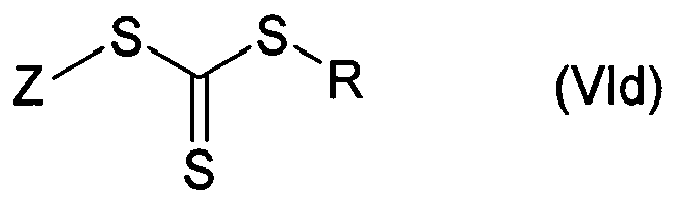 Z die in Anspruch 11 genannten Bedeutungen besitzt, allerdings mit der Einschränkung, dass Z nach homolytischer Spaltung der S-Z Bindung ein primäres Radikal ausbildet, undR die gleichen Bedeutungen wie Z in Anspruch 11 besitzt, allerdings mit der Einschränkung, dass R nach homolytischer Spaltung der S-R Bindung entweder ein sekundäres, tertiäres oder aromatisch stabilisiertes Radikal ausbildet, undmit der zusätzlichen Maßgabe, dass Z und R verschiedene Bedeutungen annehmen, und(v) Reglern der allgemeinen Formel (VIe)
 Z alle in Anspruch 11 genannten Bedeutungen besitzen kann undR die gleichen Bedeutungen wie Z in Anspruch 11 besitzt, allerdings mit der Einschränkung, dass R nach homolytischer Spaltung der S-R Bindung entweder ein sekundäres, tertiäres oder aromatisch stabilisiertes Radikal ausbildet.
 - Verfahren nach Anspruch 3, wobei als Regler in Schritt a) Dodecylpropansäuretrithiocarbonat (DoPAT), Dibenzoyltrithiocarbonat (DiBenT), Cumylphenyldithioacetat (CPDA), Cumyldithiobenzoat, Phenylethyldithiobenzoat, Cyanoisopropyldithiobenzoat (CPDB), 2-Cyanopropyldodecyltrithiocarbonat, 2-Cyanoethyldithiobenzoat, 2-Cyanoprop-2-yl-dithiophenylacetat, 2-Cyanoprop-2-yl-dithiobenzoat, S-Thiobenzoyl-1H,1H,2-Keto-3-oxa-4H,4H,5H,5H-perfluoroundecanthiol oder S-Thiobenzoyl-1-phenyl-2-keto-3-oxa-4H,4H, 5H,5H-perfluoroundecanthiol eingesetzt wird.
- Verfahren nach Anspruch 2, wobei der Molekulargewichtsregler ausgewählt ist aus der Gruppe bestehend aus(i) Alkylmercaptanen, bevorzugt C1-C16 Alkylmercaptanen, insbesondere Methylmercaptan, Ethylmercaptan, n-Butylmercaptan, n-Hexylmercaptan, n-Octylmercaptan, n-Dodecylmercaptan und tert.-Dodecyl-mercaptanen,(ii) aliphatischen Mercapatoalkoholen und cycloaliphatischen Mercaptoalkoholen, bevorzugt 2-Mercapto-1-ethanol, 3-Mercapto-1-propanol, 3-Mercaptopropan-1,2-diol, 4-Mercapto-1-butanol und 2-Mercaptocyclohexanol,(iii) Mercaptoessigsäure, 3-Mercaptopropionsäure, Mercaptobutandisäure, Cystein, N-Acetylcystein und Alkylthioglycolate, insbesondere Ethylhexylthioglycolat,(iv) Thioessigsäure,(v) Xanthogendisulfide, bevorzugt Diisopropylxanthogendisulfid,(vi) Thioharnstoff(vii) Allylalkohol, Allylchlorid,(viii) Crotonaldehyd,(ix) Chloroform, Tetrachlorkohlenstoff, Iodoform, Benzylbromid und(x) Saccharin.(xi) beliebigen Mischungen von zwei oder mehr der Molekulargewichtsregler (i)-(x).
- Verfahren nach einem der Ansprüche 1 bis 5, wobei Schritt a) unter Einsatz eines Azoinitators der folgenden Strukturformeln (Ini-1) bis (Ini-6) durchgeführt wird.


- Verfahren nach einem der Ansprüche 1 bis 6, dadurch gekennzeichnet, dass das Hauptlösungsmittel in einer Menge im Bereich von 75 bis 99,9 Vol%, besonders bevorzugt von 85 bis 99,5 Vol%, bezogen auf die Summe aller eingesetzten Lösungsmittel eingesetzt und das weitere bzw. die weiteren Lösungsmittel zusammen in einer Menge von 0,1 bis 25 Vol%, besonders bevorzugt von 0,5 bis 15 Vol% eingesetzt, wiederum bezogen auf die Summe aller eingesetzten Lösungsmittel.
- Verfahren nach einem der Ansprüche 1 bis 7, dadurch gekennzeichnet, dass als Hauptlösungsmittel solche eingesetzt werden, die einen Hildebrand'schen Lösungsparameter δ (δ = ((ΔHv-RT)/Vm)½ [(MPa)½]) (Vm = molares Volumen; ΔHv = Verdampfungsenthalpie; R = ideale Gaskonstante)) in einem Bereich von 15,5 bis 26 (MPa)½ besitzen, bevorzugt in einem Bereich von 16 bis 25 (MPa)½.
- Verfahren nach einem der Ansprüche 1 bis 8, dadurch gekennzeichnet, dass als Hauptlösungsmittel ein Lösungsmittel eingesetzt wird ausgewählt aus der Gruppe bestehend aus Dimethylacetamid, Monochlorbenzol, Toluol, Ethylacetat, 1,4-Dioxan, Acetonitril, tert.-Butanol, tert.-Butylnitril, Dimethylcarbonat, Methylacetat, Isobutyronitril und Aceton und ein oder mehrere weitere Lösungsmittel, die verschieden sind vom Hauptlösungsmittel, ausgewählt sind aus der Gruppe bestehend aus Wasser, Di-isopropylether, Di-n-propylether, Diethylcarbonat, Isopropylmethylketon, Butylacetat, Octansäure, Isopropylacetat, Propylacetat, Pivalonitril, Toluol, Methyl-tert-butylether, 1-Butanol, 2-Ethoxyethanol, Phenoxyethanol, 2-Propanol, Benzylalkohol, 1-Propanol, 2-Methoxymethanol, N,N-Dimethylformamid, Ethanol, 1,3-Butandiol, Diethylenglycol und Methanol.
- Verfahren nach einem der Ansprüche 1 bis 8 , dadurch gekennzeichnet, dass als Hauptlösungsmittel ein Lösungsmittel eingesetzt wird ausgewählt aus der Gruppe bestehend aus tert.-Butanol, 1,4-Dioxan, Acetonitril, Toulol, Isobutyronitril, Isopropylmethylketon, N,N-Dimethylacetamid, Dimethylcarbonat, Trimethylacteonitril, Methylacetat und ein Zusatzlösungsmittel ausgewählt aus der Gruppe ungleich des Hauptlösungsmittels bestehend aus Wasser, Di-isopropylether, Di-n-propylether, Diethylcarbonat, Isopropylmethylketon, Butylacetat, Octansäure, Isopropylacetat, Propylacetat, Pivalonitril, Toluol, Methyl-tert-butylether, 1-Butanol, 2-Ethoxyethanol, Phenoxyethanol, 2-Propanol, Benzylalkohol, 1-Propanol, 2-Methoxymethanol, N,N-Dimethylformamid, Ethanol, 1,3-Butandiol, Diethylenglycol, Methanol, Isobutyronitril, Dimethylcarbonat, Trimethylacteonitril und Methylacetat.
- Verfahren nach einem der Ansprüche 1 bis 10, dadurch gekennzeichnet, dass sich an die radikalische Polymerisation eine Hydrierung anschließt.
- Verfahren zur Herstellung von Vulkanisaten, dadurch gekennzeichnet, dass der optional hydrierte Nitrilkautschuk im Anschluss an das Verfahren seiner Herstellung gemäß einem der Ansprüche 1 bis 11 einer Vernetzung unterzogen wird, bevorzugt durch Zusatz mindestens eines Vernetzers oder durch photochemische Aktivierung, besonders bevorzugt unter Zugabe von einem oder mehreren weiteren Additiven.
Priority Applications (9)
| Application Number | Priority Date | Filing Date | Title |
|---|---|---|---|
| EP11290355A EP2554558A1 (de) | 2011-08-02 | 2011-08-02 | Verfahren zur Herstellung von Nitrilkautschuken in organischen Lösungsmitteln |
| JP2014523311A JP2014521799A (ja) | 2011-08-02 | 2012-08-01 | 有機溶媒中でニトリルゴムを製造するための方法 |
| EP12740995.1A EP2739661A1 (de) | 2011-08-02 | 2012-08-01 | Verfahren zur herstellung von nitrilkautschuken in organischen lösungsmitteln |
| KR1020147005027A KR20140041901A (ko) | 2011-08-02 | 2012-08-01 | 유기 용매에서의 니트릴 고무의 제조 방법 |
| TW101127678A TW201323460A (zh) | 2011-08-02 | 2012-08-01 | 於有機溶劑中製造丁腈橡膠之方法 |
| CA2843199A CA2843199A1 (en) | 2011-08-02 | 2012-08-01 | Process for producing nitrile rubbers in organic solvents |
| PCT/EP2012/064989 WO2013017610A1 (de) | 2011-08-02 | 2012-08-01 | Verfahren zur herstellung von nitrilkautschuken in organischen lösungsmitteln |
| US14/235,551 US20140235744A1 (en) | 2011-08-02 | 2012-08-01 | Process for producing nitrile rubbers in organic solvents |
| CN201280043806.8A CN104185645A (zh) | 2011-08-02 | 2012-08-01 | 用于在有机溶剂中生产丁腈橡胶的方法 |
Applications Claiming Priority (1)
| Application Number | Priority Date | Filing Date | Title |
|---|---|---|---|
| EP11290355A EP2554558A1 (de) | 2011-08-02 | 2011-08-02 | Verfahren zur Herstellung von Nitrilkautschuken in organischen Lösungsmitteln |
Publications (1)
| Publication Number | Publication Date |
|---|---|
| EP2554558A1 true EP2554558A1 (de) | 2013-02-06 |
Family
ID=46598540
Family Applications (2)
| Application Number | Title | Priority Date | Filing Date |
|---|---|---|---|
| EP11290355A Withdrawn EP2554558A1 (de) | 2011-08-02 | 2011-08-02 | Verfahren zur Herstellung von Nitrilkautschuken in organischen Lösungsmitteln |
| EP12740995.1A Withdrawn EP2739661A1 (de) | 2011-08-02 | 2012-08-01 | Verfahren zur herstellung von nitrilkautschuken in organischen lösungsmitteln |
Family Applications After (1)
| Application Number | Title | Priority Date | Filing Date |
|---|---|---|---|
| EP12740995.1A Withdrawn EP2739661A1 (de) | 2011-08-02 | 2012-08-01 | Verfahren zur herstellung von nitrilkautschuken in organischen lösungsmitteln |
Country Status (8)
| Country | Link |
|---|---|
| US (1) | US20140235744A1 (de) |
| EP (2) | EP2554558A1 (de) |
| JP (1) | JP2014521799A (de) |
| KR (1) | KR20140041901A (de) |
| CN (1) | CN104185645A (de) |
| CA (1) | CA2843199A1 (de) |
| TW (1) | TW201323460A (de) |
| WO (1) | WO2013017610A1 (de) |
Cited By (1)
| Publication number | Priority date | Publication date | Assignee | Title |
|---|---|---|---|---|
| EP2810956A1 (de) * | 2013-06-03 | 2014-12-10 | LANXESS Deutschland GmbH | Über Bisdihydropyrazol-Gruppen gekuppelte Nitrilkautschuke, deren Herstellung und Verwendung |
Families Citing this family (10)
| Publication number | Priority date | Publication date | Assignee | Title |
|---|---|---|---|---|
| US8741994B1 (en) * | 2012-12-13 | 2014-06-03 | Toyo Tire & Rubber Co., Ltd. | Alkoxysilyl group-containing azo compound and rubber composition using the same |
| MX2017013121A (es) * | 2015-04-13 | 2018-05-02 | Arlanxeo Deutschland Gmbh | Mezclas en forma de polvo que contienen cauchos de nitrilo de baja emision. |
| JP2018524437A (ja) | 2015-06-22 | 2018-08-30 | スリーエム イノベイティブ プロパティズ カンパニー | (メタ)アクリルポリマー及びアミノ酸架橋剤を含む感圧性接着剤 |
| AR106771A1 (es) * | 2015-11-23 | 2018-02-14 | Ecolab Usa Inc | Sistema de gel débil para recuperación de petróleo mejorada química |
| EP3555198B1 (de) * | 2016-12-15 | 2023-09-20 | Synthomer Sdn. Bhd. | Härtbare polymerlatexzusammensetzungen zur herstellung von kautschukartikeln |
| CN107559472B (zh) * | 2017-09-30 | 2019-06-25 | 南京晟强橡塑有限公司 | 一种阀盖体 |
| CN108360143B (zh) * | 2017-12-25 | 2019-06-18 | 江苏美翔体育用品有限公司 | 一种复合跳床网的加工方法 |
| CN115490806A (zh) * | 2021-06-18 | 2022-12-20 | 中国石油化工股份有限公司 | 一种溶聚丁(戊)腈橡胶及其溶液聚合方法 |
| CN115725020B (zh) * | 2021-08-30 | 2025-10-03 | 中国石油化工股份有限公司 | 一种溶液聚合制备丁腈橡胶的方法 |
| CN114539473B (zh) * | 2021-12-31 | 2023-09-29 | 中国科学院青岛生物能源与过程研究所 | 溶聚类交替丁腈橡胶及其制备方法和所得产品 |
Citations (35)
| Publication number | Priority date | Publication date | Assignee | Title |
|---|---|---|---|---|
| US2531602A (en) | 1946-12-28 | 1950-11-28 | Pure Oil Co | Production of thioethers and/or mercaptans |
| GB823824A (en) | 1957-07-05 | 1959-11-18 | Ici Ltd | Process for the preparation of mercaptans |
| GB823823A (en) | 1957-07-05 | 1959-11-18 | Ici Ltd | Process for the preparation of mercaptans |
| US3137735A (en) | 1961-10-20 | 1964-06-16 | Phillips Petroleum Co | Process for synthesis for mercaptans |
| GB1005988A (en) * | 1962-10-22 | 1965-09-29 | Goodyear Tire & Rubber | Polymerization process and product |
| US3700637A (en) | 1970-05-08 | 1972-10-24 | Shell Oil Co | Diene-nitrile rubbers |
| DE2539132A1 (de) | 1975-09-03 | 1977-03-17 | Bayer Ag | Hydrierung von polymeren |
| DD137307A3 (de) | 1970-04-07 | 1979-08-29 | Wolfgang Cleve | Verfahren zur herstellung von tertiaeren mercaptanen |
| DD160222A3 (de) | 1970-04-07 | 1983-05-18 | Wolfgang Cleve | Verfahren zur herstellung von tertiaeren mercaptanen |
| US4464515A (en) | 1982-12-08 | 1984-08-07 | Polysar Limited | Polymer hydrogenation process |
| US4503196A (en) | 1982-12-08 | 1985-03-05 | Polysar Limited | Polymer hydrogenation process |
| EP0134023A1 (de) | 1983-08-19 | 1985-03-13 | Bayer Ag | Herstellung von hydrierten Nitrilkautschuken |
| DE3433392A1 (de) | 1984-09-12 | 1986-03-20 | Bayer Ag, 5090 Leverkusen | Hydrierung nitrilgruppenhaltiger ungesaettigter polymerer |
| DE3529252A1 (de) | 1985-08-16 | 1987-02-19 | Bayer Ag | Verfahren zur selektiven hydrierung ungesaettigter verbindungen |
| DE3540918A1 (de) | 1985-11-19 | 1987-05-21 | Bayer Ag | Verfahren zur selektiven hydrierung ungesaettigter verbindungen |
| DE3541689A1 (de) | 1985-11-26 | 1987-05-27 | Bayer Ag | Verfahren zur selektiven hydrierung nitrilgruppenhaltiger ungesaettigter polymerer |
| EP0298386A2 (de) | 1987-07-06 | 1989-01-11 | University Of Waterloo | Verfahren zur Hydrierung von Polymeren |
| US4826721A (en) | 1986-06-05 | 1989-05-02 | Bayer Aktiengesellschaft | Laminated materials of pretreated fibre material and vulcanization products of hydrogenated nitrile rubber |
| EP0471250A1 (de) | 1990-08-15 | 1992-02-19 | Bayer Ag | Hydrierte Butadien/Isopren/(Meth-)Acrylnitril-Copolymerisate |
| JPH07316126A (ja) | 1993-12-29 | 1995-12-05 | Nippon Zeon Co Ltd | 2,2,4,6,6−ペンタメチルヘプタン−4−チオールの製造法 |
| JPH07316128A (ja) | 1994-03-31 | 1995-12-05 | Nippon Zeon Co Ltd | 2,2,4,6,6−ペンタメチルヘプタン−4−チオールの製法 |
| JPH07316127A (ja) | 1994-03-31 | 1995-12-05 | Nippon Zeon Co Ltd | 2,2,4,6,6−ペンタメチルヘプタン−4−チオールの製造方法 |
| WO1998001478A1 (en) | 1996-07-10 | 1998-01-15 | E.I. Du Pont De Nemours And Company | Polymerization with living characteristics |
| WO2001060792A1 (en) | 2000-02-16 | 2001-08-23 | Noveon Ip Holdings Corp. | S,S'-BIS-(α,α'-DISUBSTITUTED-α'-ACETIC ACID)-TRITHIOCARBONATES AND DERIVATIVES AS INITIATOR - CHAIN TRANSFER AGENT - TERMINATOR FOR CONTROLLED RADICAL POLYMERIZATIONS AND THE PROCESS FOR MAKING THE SAME |
| WO2002100905A1 (en) | 2001-06-12 | 2002-12-19 | Bayer Inc. | Process for the preparation of low molecular weight hydrogenated nitrile rubber |
| WO2002100941A1 (en) | 2001-06-12 | 2002-12-19 | Bayer Inc. | Low molecular weight hydrogenated nitrile rubber |
| US6683136B2 (en) | 2000-12-28 | 2004-01-27 | Bayer Inc. | Epoxidized soybean oil enhanced hydrogenation of nitrile copolymer |
| WO2005061555A1 (en) | 2003-12-23 | 2005-07-07 | The University Of Leeds | Polymerisation using chain transfer agents |
| WO2005082846A1 (fr) | 2004-02-06 | 2005-09-09 | Arkema France | Melange de dodecanethiols, son procede de fabrication et ses utilisations |
| WO2007003782A2 (fr) | 2005-07-04 | 2007-01-11 | Biomerieux S.A. | Nouveaux agents de transfert fonctionnalises pour polymerisation radicalaire controlee raft, procedes raft mettant en œuvre de tels agents de transfert et polymeres susceptibles d'etre obtenus par de tels procedes |
| US7230063B1 (en) | 2005-12-22 | 2007-06-12 | The Goodyear Tire & Rubber Company | Functional trithiocarbonate RAFT agents |
| US20080153982A1 (en) | 2006-12-20 | 2008-06-26 | John Ta-Yuan Lai | Vinyl-Thiocarbonate and Polyol Containing Block Copolymers |
| EP2162430A2 (de) | 2007-05-22 | 2010-03-17 | Lanxess Deutschland GmbH | Mercaptangemisch |
| EP2298824A1 (de) * | 2009-09-17 | 2011-03-23 | LANXESS Deutschland GmbH | Nitrilkautschuke und deren Herstellung in organischen Lösungsmitteln |
| WO2011032832A1 (de) | 2009-09-17 | 2011-03-24 | Lanxess Deutschland Gmbh | Nitrilkautschuke und deren herstellung in organischen lösungsmitteln |
Family Cites Families (3)
| Publication number | Priority date | Publication date | Assignee | Title |
|---|---|---|---|---|
| CN1865304A (zh) * | 2005-05-20 | 2006-11-22 | 中国石油天然气股份有限公司 | 丁腈橡胶的加氢方法 |
| EP2423235A1 (de) | 2010-08-31 | 2012-02-29 | LANXESS Deutschland GmbH | Verfahren zur Herstellung von Nitrilkautschuken in organischen Lösungsmitteln |
| EP2423238A1 (de) | 2010-08-31 | 2012-02-29 | LANXESS Deutschland GmbH | Verfahren zur Herstellung von Nitrilkautschuken in organischen Lösungsmitteln |
-
2011
- 2011-08-02 EP EP11290355A patent/EP2554558A1/de not_active Withdrawn
-
2012
- 2012-08-01 KR KR1020147005027A patent/KR20140041901A/ko not_active Withdrawn
- 2012-08-01 TW TW101127678A patent/TW201323460A/zh unknown
- 2012-08-01 US US14/235,551 patent/US20140235744A1/en not_active Abandoned
- 2012-08-01 WO PCT/EP2012/064989 patent/WO2013017610A1/de not_active Ceased
- 2012-08-01 JP JP2014523311A patent/JP2014521799A/ja not_active Withdrawn
- 2012-08-01 CN CN201280043806.8A patent/CN104185645A/zh active Pending
- 2012-08-01 CA CA2843199A patent/CA2843199A1/en not_active Abandoned
- 2012-08-01 EP EP12740995.1A patent/EP2739661A1/de not_active Withdrawn
Patent Citations (36)
| Publication number | Priority date | Publication date | Assignee | Title |
|---|---|---|---|---|
| US2531602A (en) | 1946-12-28 | 1950-11-28 | Pure Oil Co | Production of thioethers and/or mercaptans |
| GB823824A (en) | 1957-07-05 | 1959-11-18 | Ici Ltd | Process for the preparation of mercaptans |
| GB823823A (en) | 1957-07-05 | 1959-11-18 | Ici Ltd | Process for the preparation of mercaptans |
| US3137735A (en) | 1961-10-20 | 1964-06-16 | Phillips Petroleum Co | Process for synthesis for mercaptans |
| GB1005988A (en) * | 1962-10-22 | 1965-09-29 | Goodyear Tire & Rubber | Polymerization process and product |
| DD160222A3 (de) | 1970-04-07 | 1983-05-18 | Wolfgang Cleve | Verfahren zur herstellung von tertiaeren mercaptanen |
| DD137307A3 (de) | 1970-04-07 | 1979-08-29 | Wolfgang Cleve | Verfahren zur herstellung von tertiaeren mercaptanen |
| US3700637A (en) | 1970-05-08 | 1972-10-24 | Shell Oil Co | Diene-nitrile rubbers |
| DE2539132A1 (de) | 1975-09-03 | 1977-03-17 | Bayer Ag | Hydrierung von polymeren |
| US4464515A (en) | 1982-12-08 | 1984-08-07 | Polysar Limited | Polymer hydrogenation process |
| US4503196A (en) | 1982-12-08 | 1985-03-05 | Polysar Limited | Polymer hydrogenation process |
| EP0134023A1 (de) | 1983-08-19 | 1985-03-13 | Bayer Ag | Herstellung von hydrierten Nitrilkautschuken |
| DE3433392A1 (de) | 1984-09-12 | 1986-03-20 | Bayer Ag, 5090 Leverkusen | Hydrierung nitrilgruppenhaltiger ungesaettigter polymerer |
| US4631315A (en) | 1984-09-12 | 1986-12-23 | Bayer Aktiengesellschaft | Hydrogenation of nitrile group-containing unsaturated polymers |
| DE3529252A1 (de) | 1985-08-16 | 1987-02-19 | Bayer Ag | Verfahren zur selektiven hydrierung ungesaettigter verbindungen |
| DE3540918A1 (de) | 1985-11-19 | 1987-05-21 | Bayer Ag | Verfahren zur selektiven hydrierung ungesaettigter verbindungen |
| DE3541689A1 (de) | 1985-11-26 | 1987-05-27 | Bayer Ag | Verfahren zur selektiven hydrierung nitrilgruppenhaltiger ungesaettigter polymerer |
| US4826721A (en) | 1986-06-05 | 1989-05-02 | Bayer Aktiengesellschaft | Laminated materials of pretreated fibre material and vulcanization products of hydrogenated nitrile rubber |
| EP0298386A2 (de) | 1987-07-06 | 1989-01-11 | University Of Waterloo | Verfahren zur Hydrierung von Polymeren |
| EP0471250A1 (de) | 1990-08-15 | 1992-02-19 | Bayer Ag | Hydrierte Butadien/Isopren/(Meth-)Acrylnitril-Copolymerisate |
| JPH07316126A (ja) | 1993-12-29 | 1995-12-05 | Nippon Zeon Co Ltd | 2,2,4,6,6−ペンタメチルヘプタン−4−チオールの製造法 |
| JPH07316128A (ja) | 1994-03-31 | 1995-12-05 | Nippon Zeon Co Ltd | 2,2,4,6,6−ペンタメチルヘプタン−4−チオールの製法 |
| JPH07316127A (ja) | 1994-03-31 | 1995-12-05 | Nippon Zeon Co Ltd | 2,2,4,6,6−ペンタメチルヘプタン−4−チオールの製造方法 |
| WO1998001478A1 (en) | 1996-07-10 | 1998-01-15 | E.I. Du Pont De Nemours And Company | Polymerization with living characteristics |
| WO2001060792A1 (en) | 2000-02-16 | 2001-08-23 | Noveon Ip Holdings Corp. | S,S'-BIS-(α,α'-DISUBSTITUTED-α'-ACETIC ACID)-TRITHIOCARBONATES AND DERIVATIVES AS INITIATOR - CHAIN TRANSFER AGENT - TERMINATOR FOR CONTROLLED RADICAL POLYMERIZATIONS AND THE PROCESS FOR MAKING THE SAME |
| US6683136B2 (en) | 2000-12-28 | 2004-01-27 | Bayer Inc. | Epoxidized soybean oil enhanced hydrogenation of nitrile copolymer |
| WO2002100941A1 (en) | 2001-06-12 | 2002-12-19 | Bayer Inc. | Low molecular weight hydrogenated nitrile rubber |
| WO2002100905A1 (en) | 2001-06-12 | 2002-12-19 | Bayer Inc. | Process for the preparation of low molecular weight hydrogenated nitrile rubber |
| WO2005061555A1 (en) | 2003-12-23 | 2005-07-07 | The University Of Leeds | Polymerisation using chain transfer agents |
| WO2005082846A1 (fr) | 2004-02-06 | 2005-09-09 | Arkema France | Melange de dodecanethiols, son procede de fabrication et ses utilisations |
| WO2007003782A2 (fr) | 2005-07-04 | 2007-01-11 | Biomerieux S.A. | Nouveaux agents de transfert fonctionnalises pour polymerisation radicalaire controlee raft, procedes raft mettant en œuvre de tels agents de transfert et polymeres susceptibles d'etre obtenus par de tels procedes |
| US7230063B1 (en) | 2005-12-22 | 2007-06-12 | The Goodyear Tire & Rubber Company | Functional trithiocarbonate RAFT agents |
| US20080153982A1 (en) | 2006-12-20 | 2008-06-26 | John Ta-Yuan Lai | Vinyl-Thiocarbonate and Polyol Containing Block Copolymers |
| EP2162430A2 (de) | 2007-05-22 | 2010-03-17 | Lanxess Deutschland GmbH | Mercaptangemisch |
| EP2298824A1 (de) * | 2009-09-17 | 2011-03-23 | LANXESS Deutschland GmbH | Nitrilkautschuke und deren Herstellung in organischen Lösungsmitteln |
| WO2011032832A1 (de) | 2009-09-17 | 2011-03-24 | Lanxess Deutschland Gmbh | Nitrilkautschuke und deren herstellung in organischen lösungsmitteln |
Non-Patent Citations (10)
| Title |
|---|
| "Chimie & Industrie", vol. 90, 1963, pages: 358 - 368 |
| "Ullmann's Encyclopedia of Industrial Chemistry", vol. A 23, 1993, VCH VERLAGSGESELLSCHAFT MBH, article "Chemicals and Additives", pages: 366 - 417 |
| HOLLBECK C ET AL: "OPTIMAL DESIGN OF FREE-RADICAL BATCH POLYMERIZATIONS WITH ONE CHARGE OF MONOMERS AND INITIATOR", ANGEWANDTE MAKROMOLEKULARE CHEMIE. APPLIED MACROMOLECULARCHEMISTRY AND PHYSICS, WILEY VCH, WEINHEIM, DE, vol. 242, no. 1, 1 January 1996 (1996-01-01), pages 47 - 64, XP002616114, ISSN: 0003-3146, DOI: 10.1002/APMC.1996.052420103 * |
| JOURNAL OF POLYMER SCIENCE, PART A: POLYMER CHEMISTRY, vol. 44, no. 1, 2005, pages 490 - 498 |
| K. C. BERGER, G. BRANDRUP: "Polymer Handbook", 1989, JOHN WILEY & SONS, pages: II/81 - II/141 |
| MACROMOLECULAR CHEMISTRY AND PHYSICS, vol. 203, no. 3, 2002, pages 522 - 537 |
| MACROMOLECULES, vol. 36, 2003, pages 8537 |
| MACROMOLECULES, vol. 38, no. 6, 2005, pages 2191 - 2204 |
| POLYMER, vol. 49, 2008, pages 1079 - 1131 |
| XIAO-HUI LIU, GUI-BAO ZHANG, BAI-XIANG LI, YUN-GANG BAI, DING PAN, YUE-SHENG LI, EUROPEAN POLYMER JOURNAL, vol. 44, no. 4, 2008, pages 1200 - 1208 |
Cited By (2)
| Publication number | Priority date | Publication date | Assignee | Title |
|---|---|---|---|---|
| EP2810956A1 (de) * | 2013-06-03 | 2014-12-10 | LANXESS Deutschland GmbH | Über Bisdihydropyrazol-Gruppen gekuppelte Nitrilkautschuke, deren Herstellung und Verwendung |
| EP2810957A1 (de) * | 2013-06-03 | 2014-12-10 | LANXESS Deutschland GmbH | Über Bisdihydropyrazol-Gruppen gekuppelte Nitrilkautschuke, deren Herstellung und Verwendung |
Also Published As
| Publication number | Publication date |
|---|---|
| KR20140041901A (ko) | 2014-04-04 |
| US20140235744A1 (en) | 2014-08-21 |
| TW201323460A (zh) | 2013-06-16 |
| JP2014521799A (ja) | 2014-08-28 |
| CA2843199A1 (en) | 2013-02-07 |
| CN104185645A (zh) | 2014-12-03 |
| WO2013017610A1 (de) | 2013-02-07 |
| EP2739661A1 (de) | 2014-06-11 |
Similar Documents
| Publication | Publication Date | Title |
|---|---|---|
| EP2478021B1 (de) | Nitrilkautschuke und deren herstellung in organischen lösungsmitteln | |
| EP2611837B1 (de) | Verfahren zur herstellung von nitrilkautschuken in organischen lösungsmitteln | |
| EP2739661A1 (de) | Verfahren zur herstellung von nitrilkautschuken in organischen lösungsmitteln | |
| EP2316860B1 (de) | Nitrilkautschuke | |
| EP2860197B1 (de) | Nitrilkautschuke mit niedrigen Emissionswerten | |
| EP2798001A1 (de) | Verfahren zur herstellung von gereinigten nitrilkautschuken | |
| EP2611836A1 (de) | Kautschukblends aus verschiedenen nitrilkautschuken | |
| EP2611843A1 (de) | Verfahren zur herstellung von nitrilkautschuken in organischen lösungsmitteln | |
| EP2298824A1 (de) | Nitrilkautschuke und deren Herstellung in organischen Lösungsmitteln | |
| EP2810957A1 (de) | Über Bisdihydropyrazol-Gruppen gekuppelte Nitrilkautschuke, deren Herstellung und Verwendung | |
| EP2385074A1 (de) | Nitrilkautschuke und deren Herstellung in organischen Lösungsmitteln | |
| EP2623518A1 (de) | Über Bistriazolyl-Gruppen gekuppelte Nitrilkautschuke, deren Herstellung und Verwendung |
Legal Events
| Date | Code | Title | Description |
|---|---|---|---|
| PUAI | Public reference made under article 153(3) epc to a published international application that has entered the european phase |
Free format text: ORIGINAL CODE: 0009012 |
|
| AK | Designated contracting states |
Kind code of ref document: A1 Designated state(s): AL AT BE BG CH CY CZ DE DK EE ES FI FR GB GR HR HU IE IS IT LI LT LU LV MC MK MT NL NO PL PT RO RS SE SI SK SM TR |
|
| AX | Request for extension of the european patent |
Extension state: BA ME |
|
| RAP1 | Party data changed (applicant data changed or rights of an application transferred) |
Owner name: KARLSRUHER INSTITUT FUER TECHNOLOGIE (KIT) Owner name: LANXESS DEUTSCHLAND GMBH |
|
| STAA | Information on the status of an ep patent application or granted ep patent |
Free format text: STATUS: THE APPLICATION IS DEEMED TO BE WITHDRAWN |
|
| 18D | Application deemed to be withdrawn |
Effective date: 20130807 |