EP2534833B1 - Verfahren für synchronisierte inhaltsabspielung - Google Patents
Verfahren für synchronisierte inhaltsabspielung Download PDFInfo
- Publication number
- EP2534833B1 EP2534833B1 EP10845436.4A EP10845436A EP2534833B1 EP 2534833 B1 EP2534833 B1 EP 2534833B1 EP 10845436 A EP10845436 A EP 10845436A EP 2534833 B1 EP2534833 B1 EP 2534833B1
- Authority
- EP
- European Patent Office
- Prior art keywords
- content
- playback
- presented
- threshold value
- status messages
- Prior art date
- Legal status (The legal status is an assumption and is not a legal conclusion. Google has not performed a legal analysis and makes no representation as to the accuracy of the status listed.)
- Not-in-force
Links
Images
Classifications
-
- H—ELECTRICITY
- H04—ELECTRIC COMMUNICATION TECHNIQUE
- H04N—PICTORIAL COMMUNICATION, e.g. TELEVISION
- H04N21/00—Selective content distribution, e.g. interactive television or video on demand [VOD]
- H04N21/20—Servers specifically adapted for the distribution of content, e.g. VOD servers; Operations thereof
- H04N21/23—Processing of content or additional data; Elementary server operations; Server middleware
- H04N21/242—Synchronisation processes, e.g. processing of PCR [Programme Clock References]
-
- H—ELECTRICITY
- H04—ELECTRIC COMMUNICATION TECHNIQUE
- H04N—PICTORIAL COMMUNICATION, e.g. TELEVISION
- H04N21/00—Selective content distribution, e.g. interactive television or video on demand [VOD]
- H04N21/20—Servers specifically adapted for the distribution of content, e.g. VOD servers; Operations thereof
- H04N21/23—Processing of content or additional data; Elementary server operations; Server middleware
- H04N21/234—Processing of video elementary streams, e.g. splicing of video streams or manipulating encoded video stream scene graphs
- H04N21/23406—Processing of video elementary streams, e.g. splicing of video streams or manipulating encoded video stream scene graphs involving management of server-side video buffer
-
- H—ELECTRICITY
- H04—ELECTRIC COMMUNICATION TECHNIQUE
- H04N—PICTORIAL COMMUNICATION, e.g. TELEVISION
- H04N21/00—Selective content distribution, e.g. interactive television or video on demand [VOD]
- H04N21/20—Servers specifically adapted for the distribution of content, e.g. VOD servers; Operations thereof
- H04N21/23—Processing of content or additional data; Elementary server operations; Server middleware
- H04N21/24—Monitoring of processes or resources, e.g. monitoring of server load, available bandwidth, upstream requests
- H04N21/2401—Monitoring of the client buffer
-
- H—ELECTRICITY
- H04—ELECTRIC COMMUNICATION TECHNIQUE
- H04N—PICTORIAL COMMUNICATION, e.g. TELEVISION
- H04N21/00—Selective content distribution, e.g. interactive television or video on demand [VOD]
- H04N21/20—Servers specifically adapted for the distribution of content, e.g. VOD servers; Operations thereof
- H04N21/23—Processing of content or additional data; Elementary server operations; Server middleware
- H04N21/24—Monitoring of processes or resources, e.g. monitoring of server load, available bandwidth, upstream requests
- H04N21/2402—Monitoring of the downstream path of the transmission network, e.g. bandwidth available
-
- H—ELECTRICITY
- H04—ELECTRIC COMMUNICATION TECHNIQUE
- H04N—PICTORIAL COMMUNICATION, e.g. TELEVISION
- H04N21/00—Selective content distribution, e.g. interactive television or video on demand [VOD]
- H04N21/20—Servers specifically adapted for the distribution of content, e.g. VOD servers; Operations thereof
- H04N21/23—Processing of content or additional data; Elementary server operations; Server middleware
- H04N21/24—Monitoring of processes or resources, e.g. monitoring of server load, available bandwidth, upstream requests
- H04N21/2404—Monitoring of server processing errors or hardware failure
-
- H—ELECTRICITY
- H04—ELECTRIC COMMUNICATION TECHNIQUE
- H04N—PICTORIAL COMMUNICATION, e.g. TELEVISION
- H04N21/00—Selective content distribution, e.g. interactive television or video on demand [VOD]
- H04N21/20—Servers specifically adapted for the distribution of content, e.g. VOD servers; Operations thereof
- H04N21/23—Processing of content or additional data; Elementary server operations; Server middleware
- H04N21/24—Monitoring of processes or resources, e.g. monitoring of server load, available bandwidth, upstream requests
- H04N21/2405—Monitoring of the internal components or processes of the server, e.g. server load
-
- H—ELECTRICITY
- H04—ELECTRIC COMMUNICATION TECHNIQUE
- H04N—PICTORIAL COMMUNICATION, e.g. TELEVISION
- H04N21/00—Selective content distribution, e.g. interactive television or video on demand [VOD]
- H04N21/20—Servers specifically adapted for the distribution of content, e.g. VOD servers; Operations thereof
- H04N21/23—Processing of content or additional data; Elementary server operations; Server middleware
- H04N21/24—Monitoring of processes or resources, e.g. monitoring of server load, available bandwidth, upstream requests
- H04N21/2407—Monitoring of transmitted content, e.g. distribution time, number of downloads
-
- H—ELECTRICITY
- H04—ELECTRIC COMMUNICATION TECHNIQUE
- H04N—PICTORIAL COMMUNICATION, e.g. TELEVISION
- H04N21/00—Selective content distribution, e.g. interactive television or video on demand [VOD]
- H04N21/40—Client devices specifically adapted for the reception of or interaction with content, e.g. set-top-box [STB]; Operations thereof
- H04N21/41—Structure of client; Structure of client peripherals
- H04N21/4104—Peripherals receiving signals from specially adapted client devices
- H04N21/4122—Peripherals receiving signals from specially adapted client devices additional display device, e.g. video projector
-
- H—ELECTRICITY
- H04—ELECTRIC COMMUNICATION TECHNIQUE
- H04N—PICTORIAL COMMUNICATION, e.g. TELEVISION
- H04N21/00—Selective content distribution, e.g. interactive television or video on demand [VOD]
- H04N21/40—Client devices specifically adapted for the reception of or interaction with content, e.g. set-top-box [STB]; Operations thereof
- H04N21/43—Processing of content or additional data, e.g. demultiplexing additional data from a digital video stream; Elementary client operations, e.g. monitoring of home network or synchronising decoder's clock; Client middleware
- H04N21/4302—Content synchronisation processes, e.g. decoder synchronisation
- H04N21/4307—Synchronising the rendering of multiple content streams or additional data on devices, e.g. synchronisation of audio on a mobile phone with the video output on the TV screen
- H04N21/43076—Synchronising the rendering of multiple content streams or additional data on devices, e.g. synchronisation of audio on a mobile phone with the video output on the TV screen of the same content streams on multiple devices, e.g. when family members are watching the same movie on different devices
-
- H—ELECTRICITY
- H04—ELECTRIC COMMUNICATION TECHNIQUE
- H04N—PICTORIAL COMMUNICATION, e.g. TELEVISION
- H04N21/00—Selective content distribution, e.g. interactive television or video on demand [VOD]
- H04N21/40—Client devices specifically adapted for the reception of or interaction with content, e.g. set-top-box [STB]; Operations thereof
- H04N21/43—Processing of content or additional data, e.g. demultiplexing additional data from a digital video stream; Elementary client operations, e.g. monitoring of home network or synchronising decoder's clock; Client middleware
- H04N21/436—Interfacing a local distribution network, e.g. communicating with another STB or one or more peripheral devices inside the home
- H04N21/43615—Interfacing a Home Network, e.g. for connecting the client to a plurality of peripherals
-
- H—ELECTRICITY
- H04—ELECTRIC COMMUNICATION TECHNIQUE
- H04N—PICTORIAL COMMUNICATION, e.g. TELEVISION
- H04N21/00—Selective content distribution, e.g. interactive television or video on demand [VOD]
- H04N21/40—Client devices specifically adapted for the reception of or interaction with content, e.g. set-top-box [STB]; Operations thereof
- H04N21/43—Processing of content or additional data, e.g. demultiplexing additional data from a digital video stream; Elementary client operations, e.g. monitoring of home network or synchronising decoder's clock; Client middleware
- H04N21/44—Processing of video elementary streams, e.g. splicing a video clip retrieved from local storage with an incoming video stream or rendering scenes according to encoded video stream scene graphs
- H04N21/44004—Processing of video elementary streams, e.g. splicing a video clip retrieved from local storage with an incoming video stream or rendering scenes according to encoded video stream scene graphs involving video buffer management, e.g. video decoder buffer or video display buffer
-
- H—ELECTRICITY
- H04—ELECTRIC COMMUNICATION TECHNIQUE
- H04N—PICTORIAL COMMUNICATION, e.g. TELEVISION
- H04N21/00—Selective content distribution, e.g. interactive television or video on demand [VOD]
- H04N21/40—Client devices specifically adapted for the reception of or interaction with content, e.g. set-top-box [STB]; Operations thereof
- H04N21/43—Processing of content or additional data, e.g. demultiplexing additional data from a digital video stream; Elementary client operations, e.g. monitoring of home network or synchronising decoder's clock; Client middleware
- H04N21/442—Monitoring of processes or resources, e.g. detecting the failure of a recording device, monitoring the downstream bandwidth, the number of times a movie has been viewed, the storage space available from the internal hard disk
- H04N21/44227—Monitoring of local network, e.g. connection or bandwidth variations; Detecting new devices in the local network
-
- H—ELECTRICITY
- H04—ELECTRIC COMMUNICATION TECHNIQUE
- H04N—PICTORIAL COMMUNICATION, e.g. TELEVISION
- H04N21/00—Selective content distribution, e.g. interactive television or video on demand [VOD]
- H04N21/60—Network structure or processes for video distribution between server and client or between remote clients; Control signalling between clients, server and network components; Transmission of management data between server and client, e.g. sending from server to client commands for recording incoming content stream; Communication details between server and client
- H04N21/63—Control signaling related to video distribution between client, server and network components; Network processes for video distribution between server and clients or between remote clients, e.g. transmitting basic layer and enhancement layers over different transmission paths, setting up a peer-to-peer communication via Internet between remote STB's; Communication protocols; Addressing
- H04N21/637—Control signals issued by the client directed to the server or network components
- H04N21/6377—Control signals issued by the client directed to the server or network components directed to server
-
- H—ELECTRICITY
- H04—ELECTRIC COMMUNICATION TECHNIQUE
- H04N—PICTORIAL COMMUNICATION, e.g. TELEVISION
- H04N21/00—Selective content distribution, e.g. interactive television or video on demand [VOD]
- H04N21/60—Network structure or processes for video distribution between server and client or between remote clients; Control signalling between clients, server and network components; Transmission of management data between server and client, e.g. sending from server to client commands for recording incoming content stream; Communication details between server and client
- H04N21/65—Transmission of management data between client and server
- H04N21/658—Transmission by the client directed to the server
-
- H—ELECTRICITY
- H04—ELECTRIC COMMUNICATION TECHNIQUE
- H04N—PICTORIAL COMMUNICATION, e.g. TELEVISION
- H04N5/00—Details of television systems
- H04N5/76—Television signal recording
- H04N5/91—Television signal processing therefor
- H04N5/93—Regeneration of the television signal or of selected parts thereof
Definitions
- the present invention relates to data communication, and more particularly, relates to a method for synchronized content playback.
- Rich media applications become more and more popular as users enjoy active roles in the applications. With the convergence of TV network and Internet, this trend will move from computer to TV screen. Rich media applications enjoy much credit for its superiority in the aspect of user interaction: viewers are allowed not only to watch multiple types of collaborative media content such as video, audio, picture, animation, text, etc. simultaneously, but also to freely switch or transfer media flow among multiple devices. For example, a user can obtain an advertisement video about a car, wherein the car is being presented in a movie; a user can get into a virtual world of a museum in parallel to a video of that museum. In this vision of future TV programs, a single display device is not able to provide enough display space for several simultaneous media renderings.
- a common practice is to divide TV screen into multiple rendering space or simply switch between multiple media renderings.
- a rich media application is executed by a rich media player on a single device, for example, a flash player on a TV set-top-box (STB)/Tablet/ or other type of terminals.
- STB TV set-top-box
- the rich media player can interpret the interaction event, and make a response on another media based on a rule defined in the rich media format. If two or more pieces of media content are rendered on a single device, it is easier to synchronize them.
- Another synchronization method for a single device is to use SMIL (Synchronized Multimedia Integration Language), which is deployed widely in mobile multimedia message.
- SMIL Synchronet Markup Language
- SMIL allows integrating a set of independent multimedia objects into a synchronized multimedia presentation.
- an author can 1) describe the temporal behavior of the presentation; 2) describe the layout of the presentation on a screen; 3) associate hyperlinks with media objects.
- the above two methods do not provide a solution for synchronizing media flows of multiple collaborative media content inside a rich media set over multiple display devices.
- NTP network time protocol
- UTC Coordinated Universal Time
- NTPv4 can usually maintain time within 10 milliseconds (1/100 s) over the public Internet, and can achieve accuracies of 200 microseconds (1/5000 s) or better in local area networks under ideal conditions.
- NTP protocol can guarantee accurate physical layer synchronization, it cannot reflect the synchronization requirement of the media playing in application layer. In order to map the media playing time line with the physical time line, the terminal needs to check the system clock frequently, which will add the overhead and complexity of software implementation in the terminal.
- the second method is deployed for quality of service (QoS) guarantee, such as bandwidth guarantee or delay guarantee.
- QoS quality of service
- RTP media transmission QoS control protocol
- RTP carries the media streams (e.g., audio and video), and RTCP is used to monitor transmission statistics and QoS information.
- report packets are sent periodically to report transmission and reception statistics for all RTP packets sent during a time interval.
- This type of protocol can guarantee the synchronization at packet level from one sender to multiple receivers, but it still cannot guarantee the playback synchronization finally presented to the viewer because of the difference of packet processing, buffer control, audio/video decoding and player rendering in multiple display devices.
- the final subjective impression about synchronization from viewer's point of view totally depends on the media frames displayed on screens of display devices.
- a method for synchronized content playback at the level of content presentation on display devices is required in order not to give viewer impression of non-synchronization over multiple display devices.
- Rangan PV el al. Techniques for multimedia synchronization in network file systems B Computer Communications Vol.16. No. 3 March 1993 Elsevier Science Publishers BV Amsterdam NL pages 168-176 describes detecting asynchrony by comparing the RTSs of units being displayed by the slaves with the RTSs of media unit being displayed by the master, and synchrony can then be stored by having a slower slave skip the required amount of data to catch up with the master, or a faster slave pause to wait for the master.
- a method for synchronizing presentation of content playback comprising receiving status messages from the first device and the second device, wherein the status messages comprise information about playback positions of the first content and the second content currently being presented by the first device and the second device; and in response to a difference between the playback positions of the first content and the second content comprised in the status messages being above a first threshold value, performing an adjustment to maintain the difference of the playback positions of the first content and the second content being presented by the first device and the second device below the first threshold value, the method being characterized in that the step of performing adjustment comprises adjusting the transmission rate of at least one of the first content and the second content and sending a command to change the buffer size of at least one of the first device and the second device and/or a command, in the case where the difference is further greater than a second threshold value
- a device for synchronizing presentation of content playback at for a first content presented on a first device and a second content that is the same as or correlated with the first content and is presented on a second device comprising means for receiving status messages from the first device and the second device, wherein the status messages comprise information about playback positions of the first content and the second content currently being presented by the first device and the second device; and means for performing adjustment to maintain difference between playback positions of the first content and the second content being presented by the first device and the second device below a first threshold value in response to difference between playback positions of the first content and the second content comprised in the status messages being above the first threshold value
- the device being characterized in that the means for performing adjustment is configured to adjust the transmission rate of at least one of the first content and the second content and to send a command to change the buffer size of at least one of the first device and the second device and/or a command, in the case where the difference is greater than a second threshold value to change the play
- the aspects of present invention solves the synchronization problem at the presentation level, eliminates viewer's subjective feeling of out of synchronization, and consequently provides an acceptable QoE to the viewer.
- the principle of the invention intends to solve the problem that playbacks of multiple media content on two or more display devices make a viewer feel unsynchronized.
- the subjective feeling of viewer about synchronization and out-of-synchronization varies with the delay time between multiple media content rendered on two or more display devices and the visual rhythm of media content.
- specific examples of the visual rhythm of the media content comprise the cases of football match /movie prevue (which are a fast speed rhythm content), news program with announcer in the studio (which is low speed rhythm content), etc. More details about visual rhythm can be found in below description.
- the principle of the present invention resolves the problem by maintaining the time delay at the presentation level between videos (it can be other types of multimedia) presented on two or more display devices below a maximum tolerable time delay.
- the maximum tolerable time delay can be obtained by statistic method, e.g. collecting feedback/questionnaire from a group of viewer; and 3) the maximum tolerable time delay varies with the visual rhythm of video, e.g. the maximum tolerable time delay for a fast change video (e.g.
- the maximum tolerable time delay can be further classified based on combination of visual rhythm and other factors, such as view type, relationship exponent, which will be described below.
- the actual time delay can be obtained by firstly configuring/ requesting the display devices to report their current video frame number/ current time position of videos, and then calculating the actual time delay based on the report messages from the display devices. When the actual time delay exceeds the maximum tolerable time delay corresponding to this visual rhythm or combination of visual rhythm and other factors, adjustment is performed to make the actual time delay below the maximum tolerable time delay by adjusting the transmission data rates to display devices and buffer size of the display devices.
- a person skilled in the art shall note that other adjustment means are also possible, such as skipping a certain number of video frames so as to reduce the actual time delay at the presentation/ display level.
- all the control functions for synchronized content distribution in the gateway e.g. processing the report messages, calculating the actual time delay, instructing the gateway to adjust transmission data rate, and instructing the display devices to adjust their buffer size can be migrated from the gateway to an independent control device connecting to the network or any existing device connecting to the network. Therefore, by employing above adaptation mechanism to dynamically adjust the transmission rate in gateway and buffer size and/or rendering speed in display devices, acceptable quality of experience (QoE) in media synchronization is achieved.
- QoE quality of experience
- a delay lookup table indicating the relationship between mean option scores (MOS), time delay, and visual rhythm is prepared in advance. It shall note that other factors can also be added in the relationship, e.g. view type and relationship exponent etc., which will be described below:
- QoE represents the overall acceptability of an application service, as perceived subjectively by the end-user.
- QoE evaluation system for media synchronization over two screens for correlative content. Dual screens or two display devices are used to test plenty of test viewers when media flows are simultaneously displaying in both screens, so as to obtain the a statistic benchmark value for the subjective remark.
- MOS is a suitable index by subjectively using a controlled viewing experiment and participants who grade the quality using rating scales.
- the description of Sync-QoE is the synchronization judgment among contents displayed in multiple screens.
- Table 2 example of statistics result table delay(ms) Fast Speed Normal Speed Slow Speed 100 4.46 4.34 4.56 200 3.94 4.32 4.12 300 3.56 4.37 4.14 500 2.98 3.68 3.36 700 2.60 3.29 3.20
- the table shows the average scores for different delay between two videos with view type of one view presented on two display devices. According to the score definition table, the viewer may feel out of synchronization for fast speed videos if the delay between videos exceeds 500 ms.
- the view type indicates the camera's location during content creation.
- the view type comprises one view type, dual view type and multiple view type.
- the one view type means the content are captured from the same shooting point or a same content is used to display on display devices.
- the dual view type means two cameras are placed in left and right positions, top and bottom position or other positions of different angles.
- the multiple view type means multiple cameras are installed for content capture, and there is no fixed angle or lens relationship among them.
- the visual rhythm set includes fast speed, normal speed and slow speed in this example, which is used to reflect the subject feeling of content appearance variation or change in an interval.
- An example of method for determining the visual rhythm is provided for better understanding the principle of present invention, and should not be used to limit the present invention.
- Many parameters can be used to indicate the visual rhythm of a video, such as pixel/macro block variation between consecutive video frames.
- This example uses motion vector (MV) variation among video sequences in YUV format.
- the YUV model defines a color space in terms of one luma (Y) and two chrominance (UV) components.
- the YUV model is used in the NTSC, PAL, and SECAM composite color video standards.
- the package encapsulate format can be MPEG, AVI, RM etc.
- the frame rate (how many frames will be displayed in a second) and frame size (how many pixels in length and width) will be stored in the file header.
- 1 macro block 16 pixel * 16 pixel, thus if the video's frame size is 352 * 288, there will be 396 MB (macro block) in each frame.
- the visual rhythm of the media content can be determined based on a correspondence table between Mv_per_Macroblock and visual rhythm.
- a correspondence table for YUV format video with frame size of 352*288 is a correspondence table for visual rhythm.
- Mv_per Macroblock Visual Rhythm 0 ⁇ 1 Slow Speed 1 ⁇ 6 Normal Speed 6+ Fast Speed
- the relationship exponent set includes tight type and loose type.
- the tight type means the videos displayed on two or more display devices are tightly integrated with the same object, such as a same video, or a same scene/object is captured by cameras from different angles.
- the loose type stands for remaining circumstances.
- Table 4 delay lookup table Relationship Exponent View Type Visual Rhythm Delay (ms) MOS (1 to 5) 100 4.2 Tight One view Fast ... ... 500 3.6 ... ... 1000 2.5 100 4.5 Tight Dual View Normal ... ... 500 4 ... ... 1000 2.2 Tight Multiple view Slow 500 3 Loose Dual View Fast 1000 3 Loose Multiple view Normal 500 4 Loose ... ... Slow 300 5
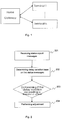
- Fig. 1 is a diagram schematically illustrating a system for content distribution according to an embodiment of present invention.
- the embodiment is described in a home environment.
- a person skilled in art shall note the invention shall not be limited to this embodiment.
- the system in a home environment comprises a home gateway and two or more terminals (i.e. display devices) named from terminal 1 to terminal N.
- the gateway is used to distribute data flows of media content to terminals, and performs adjustment based on status reports sent by the terminals so as to avoid the viewer's feeling of out-of-synchronization as much as possible.
- the terminal is used to display the received media content, send its status report to the gateway, and execute QoE (quality of experience) command sent by the gateway.
- QoE quality of experience
- Fig. 2 is a diagram illustrating a method for distribution of media content on the side of gateway in a system comprising two terminals according to present embodiment.
- the gateway receives status report messages from the two terminals.
- the status report message may include information about free buffer length, content playing status (play, pause, stop etc.), packet reception status etc.
- a person skilled in the art may add or remove one or more piece of information included in the status report message based on his implementation of the principle of present invention.
- An example of the data structure of the status report message is given below. As above described, this status report message is only an example, other data structure can also be designed by person skilled in the art.
- Table 5 status report message Item Value Comment ⁇ Message name Status Report Message type Source Tablet Source device Destination Gateway Destination device Session ID Storybook Media Type MPEG4 Video Media flow type Media ID http://192.168.1.4/Hello.mp4 Media flow ID Position 13551 The current position of video, in ms Action Play Playback status of player ⁇
- the two terminals can simultaneously send status report messages in a periodical way, e.g. starting from a same time point, and sending status report messages every ten seconds; or send status report messages in response to a request message sent by the gateway.
- the position field of the status report message is used to calculate the delay variation for the media content within a same session ID.
- the terminal can detect the playback position currently being displayed on the terminal, and fill the detected position in the position field of the status report message.
- the gateway determines delay variation based on the received status report messages.
- correlated videos use an identical SessionID.
- the delay variation is the difference between the values in position filed of the two status report messages.
- the gateway determines if the delay variation exceeds a predetermined threshold value. If not, the gateway will do nothing, or otherwise, it will go to step 204.
- the threshold value or called maximum tolerable time delay varies with visual rhythm, or with a combination of visual rhythm and other factors (as in above example, the combination includes visual rhythm, view type and relationship exponent).
- the gateway can automatically determine the threshold value for a received video by querying the delay lookup table.
- the gateway performs adjustment so as to eliminate viewer's feeling of out-of-synchronization at the presentation level of terminals.
- the adjustment can be performed by gateway's adjusting transmission data rates to terminals and sending commands to terminals to change buffer size and/or rendering speed of terminals.
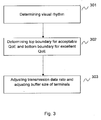
- the adjustment of transmission data rate for a video can be implemented by controlling buffer of the gateway. Specifically, this step can be further divided into following steps in this example as shown by Fig. 3 :
- the gateway determines the visual rhythm, view type and relationship exponent of the media content.
- the media content distributed by the gateway may be videos of two or more views for a same sport events, or a movie and its advertisement. It should note that the media content may comprise other types of combination of video, audio, flash, text etc.
- the visual rhythm can be determined based on either video.
- the visual rhythm is determined based on the main content, i.e. the movie.
- the information about view type and relationship exponent can be added within the media content and be able to be obtained by the gateway, or the gateway queries the content server for this information.
- the gateway determines top boundary for acceptable QoE and bottom boundary for excellent QoE by querying the delay lookup table with the visual rhythm, view type and relationship exponent.
- the gateway adjusts transmission data rate and adjusts buffer size of terminals by sending command to terminals.
- the buffer size of terminals if the delay variation is not large. If the delay variation is bigger than a threshold value defined by the developer, he can use the play speed command to make one terminal fast forward with 1.5x, 2x etc. In addition, he can also instruct the one terminal to skip some video frames.
- a data structure for the command and an algorithm for content synchronization are provided below, where more details can be found.
- steps 301 to 303 are one possible example for the present embodiment, and person skilled in the art may use a table with different fields and change the steps accordingly.
- the delay lookup table removes fields of view type and relationship, and consequently, the gateway needn't determine the view type and relationship exponent in step 301.
- ⁇ f , ⁇ n , ⁇ s the threshold values for fast/normal/slow change visual rhythm content.
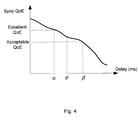
- Fig. 4 shows Sync-QoE and delay variation mapping sample. Assuming ⁇ f , ⁇ n , ⁇ s are the top boundary for acceptable QoE, ⁇ f , ⁇ n , ⁇ s is bottom boundary for excellent QoE.
- ⁇ t
- T req is the time interval for "Status Request" query cycle, its frequency is also determined by the delay variation ⁇ t value. If it is less than ⁇ , the frequency can be assigned as once per several seconds; if the ⁇ t locates inside ⁇ and ⁇ , the frequency is once per second; when the ⁇ t is larger than ⁇ , the frequency should be assigned in microsecond level for the repaid monitor for playing status.
- the buffer in the gateway can be increased so as to buffer more data, and consequently have sufficient data to transmit to terminal(s).
- other content distribution devices can be used to replace the gateway, such as a router with above mentioned functions.
Landscapes
- Engineering & Computer Science (AREA)
- Multimedia (AREA)
- Signal Processing (AREA)
- Computer Networks & Wireless Communication (AREA)
- Databases & Information Systems (AREA)
- General Engineering & Computer Science (AREA)
- Two-Way Televisions, Distribution Of Moving Picture Or The Like (AREA)
- Information Transfer Between Computers (AREA)
Claims (7)
- Verfahren zum Synchronisieren der Darstellung von Inhalt, der in einem Netz wiedergegeben wird, wobei ein erster Inhalt an eine erste Vorrichtung gesendet und auf ihr dargestellt wird und ein zweiter Inhalt, der derselbe wie der erste Inhalt oder mit ihm korreliert ist, an eine zweite Vorrichtung gesendet und auf ihr dargestellt wird, wobei das Verfahren umfasst:Empfangen von Statusnachrichten von der ersten Vorrichtung und von der zweiten Vorrichtung, wobei die Statusnachrichten Informationen über Wiedergabestellen des ersten Inhalts und des zweiten Inhalts, der durch die erste Vorrichtung und durch die zweite Vorrichtung gegenwärtig dargestellt wird, umfassen; undAusführen eines Einstellens (204), um die Differenz der Wiedergabestellen des ersten Inhalts und des zweiten Inhalts, die durch die erste Vorrichtung und durch die zweite Vorrichtung dargestellt werden, unter einem ersten Schwellenwert zu halten, in Reaktion darauf, dass eine Differenz zwischen den Wiedergabestellen des ersten Inhalts und des zweiten Inhalts, die in den Statusnachrichten enthalten sind, über dem ersten Schwellenwert liegt, wobei das Verfahren dadurch gekennzeichnet ist, dass der Schritt des Ausführen eines Einstellens Folgendes umfasst:Einstellen der Übertragungsrate des ersten Inhalts und/oder des zweiten Inhalts und Senden eines Befehls zum Ändern der Puffergröße der ersten Vorrichtung und/oder der zweiten Vorrichtung (303) und, falls die Differenz ferner größer als ein zweiter Schwellenwert ist, eines Befehls, um die Wiedergabegeschwindigkeit der ersten Vorrichtung oder der zweiten Vorrichtung zu ändern und um die erste Vorrichtung oder die zweite Vorrichtung optional anzuweisen, eine bestimmte Anzahl von Inhaltsrahmen zu überspringen.
- Verfahren nach Anspruch 1, dadurch gekennzeichnet, dass von der ersten Vorrichtung und von der zweiten Vorrichtung periodisch Statusnachrichten empfangen werden (201).
- Verfahren nach Anspruch 1, dadurch gekennzeichnet, dass das Verfahren vor dem Empfangen von Statusnachrichten das Senden einer Anforderungsnachricht, die das Senden von Statusberichtsnachrichten anweist, umfasst.
- Verfahren nach Anspruch 1, dadurch gekennzeichnet, dass es ferner umfasst:Bestimmen des ersten Schwellenwerts über eine Nachschlagetabelle, die die Beziehung zwischen Verzögerungswerten und mindestens einem der folgenden Parameter angibt: einem Ansichtstypparameter, der den Ort der Kamera während der Inhaltserzeugung angibt, einem Parameter des sichtbaren Rhythmus, der ein subjektives Maß der Geschwindigkeit der Veränderung des Aussehens des Inhalts oder der Änderung in einem Intervall widerspiegelt, undeinem Beziehungsexponentenparameter, der angibt, ob sich der erste Inhalt und der zweite Inhalt auf denselben Inhalt, dieselbe Szene oder dasselbe Objekt beziehen.
- Verfahren nach einem der Ansprüche 1 bis 4, dadurch gekennzeichnet, dass der Inhaltstyp Video, Audio und Text enthält.
- Netzvorrichtung zum Synchronisieren der Darstellung der Inhaltswiedergabe für einen ersten Inhalt, der an eine erste Vorrichtung gesendet und auf ihr dargestellt wird, und für einen zweiten Inhalt, der derselbe wie der erste Inhalt oder mit ihm korreliert ist und der an eine zweite Vorrichtung gesendet und auf ihr dargestellt wird, wobei die Vorrichtung umfasst:Mittel zum Empfangen von Statusnachrichten von der ersten Vorrichtung und von der zweiten Vorrichtung, wobei die Statusnachrichten Informationen über Wiedergabestellen des ersten Inhalts und des zweiten Inhalts, der durch die erste Vorrichtung und durch die zweite Vorrichtung gegenwärtig dargestellt wird, umfassen; undMittel zum Ausführen einer Einstellung, um eine Differenz zwischen den Wiedergabestellen des ersten Inhalts und des zweiten Inhalts, die durch die erste Vorrichtung und durch die zweite Vorrichtung dargestellt werden, unter einem ersten Schwellenwert zu halten, in Reaktion darauf, dass eine Differenz zwischen den Wiedergabestellen des ersten Inhalts und des zweiten Inhalts, die in den Statusnachrichten enthalten sind, über dem ersten Schwellenwert liegt, wobei die Vorrichtung dadurch gekennzeichnet ist, dass die Mittel zum Ausführen einer Einstellung dafür konfiguriert sind, die Übertragungsrate des ersten Inhalts und/oder des zweiten Inhalts einzustellen und einen Befehl zum Ändern der Puffergröße der ersten Vorrichtung und/oder der zweiten Vorrichtung und, falls die Differenz größer als ein zweiter Schwellenwert ist, einen Befehl, um die Wiedergabegeschwindigkeit der ersten Vorrichtung oder der zweiten Vorrichtung zu ändern und um die erste Vorrichtung oder die zweite Vorrichtung optional anzuweisen, eine bestimmte Anzahl von Inhaltsrahmen zu überspringen, zu senden.
- Vorrichtung nach Anspruch 6, dadurch gekennzeichnet, dass die Vorrichtung ferner umfasst: Mittel zum Bestimmen des ersten Schwellenwerts über eine Nachschlagetabelle, die die Beziehung zwischen Verzögerungswerten und mindestens einem der folgenden Parameter angibt: einem Ansichtstypparameter, der den Ort der Kamera während der Inhaltserzeugung angibt, einem Parameter des sichtbaren Rhythmus, der ein subjektives Maß der Geschwindigkeit der Veränderung des Aussehens des Inhalts oder der Änderung in einem Intervall widerspiegelt, und einem Beziehungsexponentenparameter, der angibt, ob sich der erste Inhalt und der zweite Inhalt auf denselben Inhalt, dieselbe Szene oder dasselbe Objekt beziehen.
Applications Claiming Priority (1)
| Application Number | Priority Date | Filing Date | Title |
|---|---|---|---|
| PCT/CN2010/000201 WO2011097762A1 (en) | 2010-02-12 | 2010-02-12 | Method for synchronized content playback |
Publications (3)
| Publication Number | Publication Date |
|---|---|
| EP2534833A1 EP2534833A1 (de) | 2012-12-19 |
| EP2534833A4 EP2534833A4 (de) | 2013-11-20 |
| EP2534833B1 true EP2534833B1 (de) | 2016-04-27 |
Family
ID=44367120
Family Applications (1)
| Application Number | Title | Priority Date | Filing Date |
|---|---|---|---|
| EP10845436.4A Not-in-force EP2534833B1 (de) | 2010-02-12 | 2010-02-12 | Verfahren für synchronisierte inhaltsabspielung |
Country Status (8)
| Country | Link |
|---|---|
| US (1) | US9686570B2 (de) |
| EP (1) | EP2534833B1 (de) |
| JP (1) | JP5587435B2 (de) |
| KR (1) | KR101687640B1 (de) |
| CN (1) | CN102714708B (de) |
| AU (1) | AU2010345675B2 (de) |
| BR (1) | BR112012017687A2 (de) |
| WO (1) | WO2011097762A1 (de) |
Families Citing this family (75)
| Publication number | Priority date | Publication date | Assignee | Title |
|---|---|---|---|---|
| GB0705329D0 (en) | 2007-03-20 | 2007-04-25 | Skype Ltd | Method of transmitting data in a communication system |
| JP5510000B2 (ja) * | 2010-03-31 | 2014-06-04 | ソニー株式会社 | コンテンツ送信装置、コンテンツ再生システム、コンテンツ送信方法、およびプログラム |
| US9131256B2 (en) * | 2010-09-30 | 2015-09-08 | Verizon Patent And Licensing Inc. | Method and apparatus for synchronizing content playback |
| JP5664229B2 (ja) * | 2010-12-28 | 2015-02-04 | ソニー株式会社 | 送信装置、送信方法、及びプログラム |
| US8930577B2 (en) * | 2011-09-13 | 2015-01-06 | Microsoft Corporation | Synchronizing streaming video between viewers over a network |
| US20130076980A1 (en) * | 2011-09-26 | 2013-03-28 | Amichay Oren | Systems and methods for synchronizing the presentation of a combined video program |
| GB2520867B (en) | 2011-10-25 | 2016-05-18 | Skype Ltd | Jitter buffer |
| GB2495929B (en) | 2011-10-25 | 2014-09-03 | Skype | Jitter buffer |
| GB2495928B (en) | 2011-10-25 | 2016-06-15 | Skype | Jitter buffer |
| EP2611051B1 (de) * | 2011-12-29 | 2014-06-04 | Thomson Licensing | Verfahren zur Synchronisierung von Mediendiensten |
| WO2013106841A1 (en) * | 2012-01-12 | 2013-07-18 | Huawei Technologies Co., Ltd. | System and Method for Quality of Service Control |
| WO2013141874A1 (en) * | 2012-03-23 | 2013-09-26 | Thomson Licensing | Method of buffer management for synchronization of correlated media presentations |
| US9167009B2 (en) * | 2012-05-08 | 2015-10-20 | International Business Machines Corporation | Presenting data to electronic meeting participants |
| US10210480B2 (en) * | 2012-05-31 | 2019-02-19 | Apple Inc. | Avoiding a redundant display of a notification on multiple user devices |
| CN103634621B (zh) * | 2012-08-27 | 2019-04-16 | 中兴通讯股份有限公司 | 一种视频推荐业务中播放同步控制方法及装置、系统 |
| CN102880888A (zh) * | 2012-08-28 | 2013-01-16 | 王令徽 | 商品内外两层包装之间的关联方法 |
| US20140096169A1 (en) * | 2012-09-28 | 2014-04-03 | Joseph Dodson | Playback synchronization in a group viewing a media title |
| US8978076B2 (en) * | 2012-11-05 | 2015-03-10 | Comcast Cable Communications, Llc | Methods and systems for content control |
| US9930082B2 (en) | 2012-11-20 | 2018-03-27 | Nvidia Corporation | Method and system for network driven automatic adaptive rendering impedance |
| CN103079088B (zh) * | 2012-12-14 | 2016-06-29 | 广东威创视讯科技股份有限公司 | 多屏视频预处理与同步播放方法和系统 |
| US10616086B2 (en) | 2012-12-27 | 2020-04-07 | Navidia Corporation | Network adaptive latency reduction through frame rate control |
| CN105791421B (zh) * | 2013-01-30 | 2019-01-04 | 恒鸿达科技有限公司 | 一种多台广告机同步播放的方法以及系统 |
| KR102037413B1 (ko) * | 2013-02-22 | 2019-11-26 | 삼성전자주식회사 | 스트리밍 서비스를 제공하기 위한 동적 버퍼링 방법 및 그 장치 |
| US20140280506A1 (en) | 2013-03-15 | 2014-09-18 | John Cronin | Virtual reality enhanced through browser connections |
| US20140280644A1 (en) | 2013-03-15 | 2014-09-18 | John Cronin | Real time unified communications interaction of a predefined location in a virtual reality location |
| US20140280503A1 (en) | 2013-03-15 | 2014-09-18 | John Cronin | System and methods for effective virtual reality visitor interface |
| US9838506B1 (en) * | 2013-03-15 | 2017-12-05 | Sony Interactive Entertainment America Llc | Virtual reality universe representation changes viewing based upon client side parameters |
| US20140280502A1 (en) | 2013-03-15 | 2014-09-18 | John Cronin | Crowd and cloud enabled virtual reality distributed location network |
| US20140280505A1 (en) | 2013-03-15 | 2014-09-18 | John Cronin | Virtual reality interaction with 3d printing |
| US20140282113A1 (en) | 2013-03-15 | 2014-09-18 | John Cronin | Personal digital assistance and virtual reality |
| WO2014157889A1 (en) * | 2013-03-25 | 2014-10-02 | Samsung Electronics Co., Ltd. | Method and apparatus for improving quality of experience in sharing screen among devices, and recording medium thereof |
| US9819604B2 (en) | 2013-07-31 | 2017-11-14 | Nvidia Corporation | Real time network adaptive low latency transport stream muxing of audio/video streams for miracast |
| US9826015B2 (en) * | 2013-09-04 | 2017-11-21 | Qualcomm Incorporated | Dynamic and automatic control of latency buffering for audio/video streaming |
| KR20150037372A (ko) * | 2013-09-30 | 2015-04-08 | 삼성전자주식회사 | 영상표시장치, 컨텐츠 동기화 서버 및 그 동작방법 |
| US9210204B2 (en) * | 2013-10-31 | 2015-12-08 | At&T Intellectual Property I, Lp | Synchronizing media presentation at multiple devices |
| JP6294062B2 (ja) | 2013-12-02 | 2018-03-14 | 三星電子株式会社Samsung Electronics Co.,Ltd. | コンテンツ受信装置およびコンテンツ配信システム |
| WO2015084000A1 (ko) * | 2013-12-02 | 2015-06-11 | 삼성전자 주식회사 | 콘텐츠 송수신 장치 및 방법 |
| US9323865B2 (en) * | 2013-12-24 | 2016-04-26 | TCL Research America Inc. | Content alignment method and system |
| US20150189012A1 (en) * | 2014-01-02 | 2015-07-02 | Nvidia Corporation | Wireless display synchronization for mobile devices using buffer locking |
| US9588343B2 (en) | 2014-01-25 | 2017-03-07 | Sony Interactive Entertainment America Llc | Menu navigation in a head-mounted display |
| US9437159B2 (en) | 2014-01-25 | 2016-09-06 | Sony Interactive Entertainment America Llc | Environmental interrupt in a head-mounted display and utilization of non field of view real estate |
| CN104243850B (zh) * | 2014-09-15 | 2018-04-17 | 苏州佳世达电通有限公司 | 资料同步播放的方法 |
| CN104332166B (zh) * | 2014-10-21 | 2017-06-20 | 福建歌航电子信息科技有限公司 | 可快速验证录音内容准确性、同步性的方法 |
| US9270563B1 (en) | 2014-11-24 | 2016-02-23 | Roku, Inc. | Apparatus and method for content playback utilizing crowd sourced statistics |
| CN105656616B (zh) * | 2014-12-03 | 2019-02-05 | 中国移动通信集团公司 | 多设备间数据同步的方法、装置、发送端及接收端 |
| CN104796584A (zh) * | 2015-04-23 | 2015-07-22 | 南京信息工程大学 | 具有语音识别功能的提词装置 |
| US10015370B2 (en) * | 2015-08-27 | 2018-07-03 | Htc Corporation | Method for synchronizing video and audio in virtual reality system |
| US9628839B1 (en) * | 2015-10-06 | 2017-04-18 | Arris Enterprises, Inc. | Gateway multi-view video stream processing for second-screen content overlay |
| WO2017119408A1 (ja) * | 2016-01-07 | 2017-07-13 | 日本電気株式会社 | 送信データ量制御装置、方法および記録媒体 |
| US20170251235A1 (en) * | 2016-02-29 | 2017-08-31 | Rovi Guides, Inc. | Systems and methods for synchronizing media asset playback on multiple devices |
| CN106057222B (zh) * | 2016-05-20 | 2020-10-27 | 联想(北京)有限公司 | 一种多媒体文件的播放方法及电子设备 |
| US10510317B2 (en) | 2016-06-03 | 2019-12-17 | Apple Inc. | Controlling display performance with target presentation times |
| US10388054B2 (en) | 2016-06-03 | 2019-08-20 | Apple Inc. | Controlling display performance using animation based refresh rates |
| KR101811366B1 (ko) * | 2016-06-08 | 2017-12-22 | 에스케이텔레콤 주식회사 | 미디어 재생 프로그램 |
| CN106454474B (zh) * | 2016-10-08 | 2019-08-06 | Oppo广东移动通信有限公司 | 多媒体同步播放方法、装置及系统 |
| CN106488289B (zh) * | 2016-10-08 | 2019-07-16 | Oppo广东移动通信有限公司 | 音频同步播放方法、装置及系统 |
| KR20180043112A (ko) * | 2016-10-19 | 2018-04-27 | 차성웅 | 가상 현실을 실현하는 사용자 장치가 컨텐츠를 제공하는 외부 장치와 연동하도록 하는 방법, 시스템 및 컴퓨터 판독 가능한 기록 매체 |
| CN106507202B (zh) | 2016-11-11 | 2019-12-17 | 传线网络科技(上海)有限公司 | 播放控制方法及装置 |
| CN108345436A (zh) * | 2017-01-25 | 2018-07-31 | 精英电脑股份有限公司 | 同步控制多个显示器的方法 |
| KR102341584B1 (ko) * | 2017-09-22 | 2021-12-20 | 엔티티 도꼬모 인코퍼레이티드 | 통신 품질 조정 시스템 |
| EP4510596A3 (de) * | 2018-04-24 | 2025-04-23 | Google Llc | Verfahren, systeme und medien zur synchronisierten wiedergabe von medieninhalt auf mehreren geräten |
| US11303947B2 (en) * | 2018-04-24 | 2022-04-12 | Google Llc | Methods, systems, and media for adjusting quality level during synchronized media content playback on multiple devices |
| EP3900373A4 (de) * | 2018-12-18 | 2022-08-10 | Intel Corporation | Auf anzeige basierte audioteilung in medienumgebungen |
| US10735825B1 (en) * | 2019-02-07 | 2020-08-04 | Disney Enterprises, Inc. | Coordination of media content delivery to multiple media players |
| CN109859643A (zh) * | 2019-02-28 | 2019-06-07 | 佛山星乔电子科技有限公司 | 一种应用于地铁屏蔽门的透明显示模组 |
| CN109887457A (zh) * | 2019-02-28 | 2019-06-14 | 佛山星乔电子科技有限公司 | 一种地铁半透显示装置的信号控制系统及其控制方法 |
| CN110430445B (zh) * | 2019-06-26 | 2021-12-10 | 深圳拙河科技有限公司 | 一种视频同步播放方法、装置、设备及介质 |
| CN110446084B (zh) * | 2019-07-09 | 2021-10-12 | 新华三技术有限公司合肥分公司 | 延时确定方法、显示设备、系统及计算机存储介质 |
| CA3177439A1 (en) | 2020-05-01 | 2021-11-04 | Scott R. EPSTEIN | Method and system for synchronized viewing of content over multiple remote media play devices |
| CN111970414A (zh) * | 2020-07-20 | 2020-11-20 | 北京百度网讯科技有限公司 | 基于实时测温系统的画面同步方法、装置及存储介质 |
| US12199784B2 (en) * | 2021-09-30 | 2025-01-14 | Snap Inc. | Configuring broadcast media quality within a virtual conferencing system |
| US12335558B2 (en) | 2022-04-07 | 2025-06-17 | Dazn Media Israel Ltd. | Synchronization of multiple content streams |
| US12447402B2 (en) | 2022-03-07 | 2025-10-21 | Dazn Media Israel Ltd. | Method of facilitating a synchronized play of content and system thereof |
| US11741933B1 (en) | 2022-03-14 | 2023-08-29 | Dazn Media Israel Ltd. | Acoustic signal cancelling |
| US11943276B2 (en) * | 2022-03-23 | 2024-03-26 | International Business Machines Corporation | Line-drawing video conferencing |
Family Cites Families (18)
| Publication number | Priority date | Publication date | Assignee | Title |
|---|---|---|---|---|
| JPH1063470A (ja) * | 1996-06-12 | 1998-03-06 | Nintendo Co Ltd | 画像表示に連動する音響発生装置 |
| JPH10262208A (ja) * | 1997-03-19 | 1998-09-29 | Sony Corp | 同期ずれ制御装置及び方法 |
| US20040125124A1 (en) * | 2000-07-24 | 2004-07-01 | Hyeokman Kim | Techniques for constructing and browsing a hierarchical video structure |
| US7657224B2 (en) | 2002-05-06 | 2010-02-02 | Syncronation, Inc. | Localized audio networks and associated digital accessories |
| JP2005244605A (ja) * | 2004-02-26 | 2005-09-08 | Nippon Telegr & Teleph Corp <Ntt> | ストリーミングコンテンツ配信制御システム、プログラム及び該プログラムを格納した記録媒体 |
| US7657829B2 (en) * | 2005-01-20 | 2010-02-02 | Microsoft Corporation | Audio and video buffer synchronization based on actual output feedback |
| JP4441874B2 (ja) | 2005-02-24 | 2010-03-31 | ソニー株式会社 | 情報処理システム、再生端末装置および再生方法、情報処理装置および方法、並びにプログラム |
| US7668914B2 (en) * | 2005-03-28 | 2010-02-23 | Alcatel Lucent | Milestone synchronization in broadcast multimedia streams |
| CN101119461B (zh) | 2006-08-02 | 2010-05-12 | 广达电脑股份有限公司 | 保持视频帧及音频帧同步播放的系统及方法 |
| JP4850041B2 (ja) | 2006-11-28 | 2012-01-11 | アルパイン株式会社 | 映像再生システム、映像再生の同期方法および映像再生端末 |
| US8054382B2 (en) * | 2007-05-21 | 2011-11-08 | International Business Machines Corporation | Apparatus, method and system for synchronizing a common broadcast signal among multiple television units |
| JP4986229B2 (ja) | 2007-06-27 | 2012-07-25 | Kddi株式会社 | 同期した異なる種類のストリーミングデータを受信し且つ同時に再生する受信システム、受信装置及びプログラム |
| JP2009164862A (ja) * | 2008-01-07 | 2009-07-23 | Hitachi Ltd | コンテンツ受信装置、コンテンツ送信装置、コンテンツ送受信装置 |
| US8190683B2 (en) * | 2008-02-29 | 2012-05-29 | Microsoft Corporation | Synchronizing multiple user remote content playback |
| US8549575B2 (en) * | 2008-04-30 | 2013-10-01 | At&T Intellectual Property I, L.P. | Dynamic synchronization of media streams within a social network |
| CN101290790B (zh) | 2008-06-16 | 2011-07-13 | 北京中星微电子有限公司 | 一种音视频同步播放的方法和装置 |
| CN101304351A (zh) | 2008-06-30 | 2008-11-12 | 湖南创智数码科技股份有限公司 | 基于点对点传输的流媒体直播系统同步播放方法 |
| KR101535827B1 (ko) * | 2008-12-05 | 2015-07-27 | 삼성전자주식회사 | 무선 통신 네트워크에서 오디오 및 비디오 동기화 장치 및 방법 |
-
2010
- 2010-02-12 EP EP10845436.4A patent/EP2534833B1/de not_active Not-in-force
- 2010-02-12 AU AU2010345675A patent/AU2010345675B2/en not_active Ceased
- 2010-02-12 BR BR112012017687A patent/BR112012017687A2/pt not_active IP Right Cessation
- 2010-02-12 CN CN201080061719.6A patent/CN102714708B/zh not_active Expired - Fee Related
- 2010-02-12 KR KR1020127020982A patent/KR101687640B1/ko not_active Expired - Fee Related
- 2010-02-12 WO PCT/CN2010/000201 patent/WO2011097762A1/en not_active Ceased
- 2010-02-12 US US13/577,541 patent/US9686570B2/en not_active Expired - Fee Related
- 2010-02-12 JP JP2012552221A patent/JP5587435B2/ja not_active Expired - Fee Related
Also Published As
| Publication number | Publication date |
|---|---|
| CN102714708B (zh) | 2016-06-01 |
| EP2534833A1 (de) | 2012-12-19 |
| KR101687640B1 (ko) | 2016-12-19 |
| JP2013520038A (ja) | 2013-05-30 |
| BR112012017687A2 (pt) | 2016-04-05 |
| AU2010345675A1 (en) | 2012-07-26 |
| US9686570B2 (en) | 2017-06-20 |
| AU2010345675B2 (en) | 2014-09-04 |
| KR20130008522A (ko) | 2013-01-22 |
| US20120311043A1 (en) | 2012-12-06 |
| WO2011097762A1 (en) | 2011-08-18 |
| CN102714708A (zh) | 2012-10-03 |
| HK1180152A1 (zh) | 2013-10-11 |
| JP5587435B2 (ja) | 2014-09-10 |
| EP2534833A4 (de) | 2013-11-20 |
Similar Documents
| Publication | Publication Date | Title |
|---|---|---|
| EP2534833B1 (de) | Verfahren für synchronisierte inhaltsabspielung | |
| KR101291990B1 (ko) | 변경된 스트림 동기화 | |
| JP6317872B2 (ja) | 異なるネットワークを介して受信したコンテンツのレンダリングを同期するデコーダ及びそれにおける方法 | |
| US9237179B2 (en) | Method and system for synchronizing the output of terminals | |
| CN110278474B (zh) | 接收方法、发送方法、接收装置及发送装置 | |
| EP4033770B1 (de) | Videoverteilungssynchronisation | |
| CN105491393A (zh) | 多人视频直播业务的实现方法 | |
| US20170006331A1 (en) | Synchronized rendering of split multimedia content on network clients | |
| EP3313083A1 (de) | Räumlich segmentierte inhaltsbereitstellung | |
| CA2691085A1 (en) | Method and arrangement for improved media session management | |
| Marfil et al. | Synchronization mechanisms for multi-user and multi-device hybrid broadcast and broadband distributed scenarios | |
| WO2009103351A1 (en) | Method and apparatus for obtaining media over a communications network | |
| Marfil et al. | IDMS solution for hybrid broadcast broadband delivery within the context of HbbTV standard | |
| HK1180152B (en) | Method for synchronized content playback | |
| CN103533005B (zh) | 基于播放状态信息同步的处理方法、系统及相关装置 | |
| KR20130008436A (ko) | Mmt 복합 전달 서비스에서 mmt 패킷 스트림 동기화를 위한 타이밍 정보 제공 방법 및 mmt 패킷 스트림 동기화 방법 | |
| CN107801103A (zh) | 异构网络下基于网络状况的多媒体资源自适应同步方法 | |
| Chen et al. | QoE based adaptation mechanism for media distribution in connected home | |
| CN121531168A (zh) | 一种高清视频多屏同步传输系统及方法 | |
| Sarni et al. | A novel scheme for a fast channel change in multicast IPTV system | |
| CN117221637A (zh) | 视频播放方法以及相关设备 | |
| George et al. | Internet-delivered Television using MPEG-DASH: Opportunities and Challenges | |
| WO2009080116A1 (en) | Method and apparatus for distributing media over a communications network |
Legal Events
| Date | Code | Title | Description |
|---|---|---|---|
| PUAI | Public reference made under article 153(3) epc to a published international application that has entered the european phase |
Free format text: ORIGINAL CODE: 0009012 |
|
| 17P | Request for examination filed |
Effective date: 20120703 |
|
| AK | Designated contracting states |
Kind code of ref document: A1 Designated state(s): AT BE BG CH CY CZ DE DK EE ES FI FR GB GR HR HU IE IS IT LI LT LU LV MC MK MT NL NO PL PT RO SE SI SK SM TR |
|
| DAX | Request for extension of the european patent (deleted) | ||
| REG | Reference to a national code |
Ref country code: HK Ref legal event code: DE Ref document number: 1180152 Country of ref document: HK |
|
| REG | Reference to a national code |
Ref country code: DE Ref legal event code: R079 Ref document number: 602010032944 Country of ref document: DE Free format text: PREVIOUS MAIN CLASS: H04N0005928000 Ipc: H04N0021430000 |
|
| A4 | Supplementary search report drawn up and despatched |
Effective date: 20131021 |
|
| RIC1 | Information provided on ipc code assigned before grant |
Ipc: H04N 21/658 20110101ALI20131015BHEP Ipc: H04N 21/442 20110101ALI20131015BHEP Ipc: H04N 21/436 20110101ALI20131015BHEP Ipc: H04N 21/43 20110101AFI20131015BHEP |
|
| 17Q | First examination report despatched |
Effective date: 20141118 |
|
| GRAP | Despatch of communication of intention to grant a patent |
Free format text: ORIGINAL CODE: EPIDOSNIGR1 |
|
| INTG | Intention to grant announced |
Effective date: 20151110 |
|
| GRAS | Grant fee paid |
Free format text: ORIGINAL CODE: EPIDOSNIGR3 |
|
| GRAA | (expected) grant |
Free format text: ORIGINAL CODE: 0009210 |
|
| AK | Designated contracting states |
Kind code of ref document: B1 Designated state(s): AT BE BG CH CY CZ DE DK EE ES FI FR GB GR HR HU IE IS IT LI LT LU LV MC MK MT NL NO PL PT RO SE SI SK SM TR |
|
| REG | Reference to a national code |
Ref country code: GB Ref legal event code: FG4D |
|
| REG | Reference to a national code |
Ref country code: CH Ref legal event code: EP |
|
| REG | Reference to a national code |
Ref country code: AT Ref legal event code: REF Ref document number: 795920 Country of ref document: AT Kind code of ref document: T Effective date: 20160515 |
|
| REG | Reference to a national code |
Ref country code: IE Ref legal event code: FG4D |
|
| REG | Reference to a national code |
Ref country code: DE Ref legal event code: R096 Ref document number: 602010032944 Country of ref document: DE |
|
| REG | Reference to a national code |
Ref country code: LT Ref legal event code: MG4D |
|
| REG | Reference to a national code |
Ref country code: NL Ref legal event code: MP Effective date: 20160427 |
|
| REG | Reference to a national code |
Ref country code: AT Ref legal event code: MK05 Ref document number: 795920 Country of ref document: AT Kind code of ref document: T Effective date: 20160427 |
|
| PG25 | Lapsed in a contracting state [announced via postgrant information from national office to epo] |
Ref country code: NL Free format text: LAPSE BECAUSE OF FAILURE TO SUBMIT A TRANSLATION OF THE DESCRIPTION OR TO PAY THE FEE WITHIN THE PRESCRIBED TIME-LIMIT Effective date: 20160427 |
|
| PG25 | Lapsed in a contracting state [announced via postgrant information from national office to epo] |
Ref country code: NO Free format text: LAPSE BECAUSE OF FAILURE TO SUBMIT A TRANSLATION OF THE DESCRIPTION OR TO PAY THE FEE WITHIN THE PRESCRIBED TIME-LIMIT Effective date: 20160727 Ref country code: PL Free format text: LAPSE BECAUSE OF FAILURE TO SUBMIT A TRANSLATION OF THE DESCRIPTION OR TO PAY THE FEE WITHIN THE PRESCRIBED TIME-LIMIT Effective date: 20160427 Ref country code: LT Free format text: LAPSE BECAUSE OF FAILURE TO SUBMIT A TRANSLATION OF THE DESCRIPTION OR TO PAY THE FEE WITHIN THE PRESCRIBED TIME-LIMIT Effective date: 20160427 Ref country code: FI Free format text: LAPSE BECAUSE OF FAILURE TO SUBMIT A TRANSLATION OF THE DESCRIPTION OR TO PAY THE FEE WITHIN THE PRESCRIBED TIME-LIMIT Effective date: 20160427 |
|
| REG | Reference to a national code |
Ref country code: DE Ref legal event code: R084 Ref document number: 602010032944 Country of ref document: DE |
|
| PG25 | Lapsed in a contracting state [announced via postgrant information from national office to epo] |
Ref country code: LV Free format text: LAPSE BECAUSE OF FAILURE TO SUBMIT A TRANSLATION OF THE DESCRIPTION OR TO PAY THE FEE WITHIN THE PRESCRIBED TIME-LIMIT Effective date: 20160427 Ref country code: SE Free format text: LAPSE BECAUSE OF FAILURE TO SUBMIT A TRANSLATION OF THE DESCRIPTION OR TO PAY THE FEE WITHIN THE PRESCRIBED TIME-LIMIT Effective date: 20160427 Ref country code: ES Free format text: LAPSE BECAUSE OF FAILURE TO SUBMIT A TRANSLATION OF THE DESCRIPTION OR TO PAY THE FEE WITHIN THE PRESCRIBED TIME-LIMIT Effective date: 20160427 Ref country code: PT Free format text: LAPSE BECAUSE OF FAILURE TO SUBMIT A TRANSLATION OF THE DESCRIPTION OR TO PAY THE FEE WITHIN THE PRESCRIBED TIME-LIMIT Effective date: 20160829 Ref country code: AT Free format text: LAPSE BECAUSE OF FAILURE TO SUBMIT A TRANSLATION OF THE DESCRIPTION OR TO PAY THE FEE WITHIN THE PRESCRIBED TIME-LIMIT Effective date: 20160427 Ref country code: HR Free format text: LAPSE BECAUSE OF FAILURE TO SUBMIT A TRANSLATION OF THE DESCRIPTION OR TO PAY THE FEE WITHIN THE PRESCRIBED TIME-LIMIT Effective date: 20160427 Ref country code: GR Free format text: LAPSE BECAUSE OF FAILURE TO SUBMIT A TRANSLATION OF THE DESCRIPTION OR TO PAY THE FEE WITHIN THE PRESCRIBED TIME-LIMIT Effective date: 20160728 |
|
| PG25 | Lapsed in a contracting state [announced via postgrant information from national office to epo] |
Ref country code: IT Free format text: LAPSE BECAUSE OF FAILURE TO SUBMIT A TRANSLATION OF THE DESCRIPTION OR TO PAY THE FEE WITHIN THE PRESCRIBED TIME-LIMIT Effective date: 20160427 Ref country code: BE Free format text: LAPSE BECAUSE OF FAILURE TO SUBMIT A TRANSLATION OF THE DESCRIPTION OR TO PAY THE FEE WITHIN THE PRESCRIBED TIME-LIMIT Effective date: 20160427 |
|
| REG | Reference to a national code |
Ref country code: DE Ref legal event code: R097 Ref document number: 602010032944 Country of ref document: DE |
|
| PG25 | Lapsed in a contracting state [announced via postgrant information from national office to epo] |
Ref country code: DK Free format text: LAPSE BECAUSE OF FAILURE TO SUBMIT A TRANSLATION OF THE DESCRIPTION OR TO PAY THE FEE WITHIN THE PRESCRIBED TIME-LIMIT Effective date: 20160427 Ref country code: SK Free format text: LAPSE BECAUSE OF FAILURE TO SUBMIT A TRANSLATION OF THE DESCRIPTION OR TO PAY THE FEE WITHIN THE PRESCRIBED TIME-LIMIT Effective date: 20160427 Ref country code: CZ Free format text: LAPSE BECAUSE OF FAILURE TO SUBMIT A TRANSLATION OF THE DESCRIPTION OR TO PAY THE FEE WITHIN THE PRESCRIBED TIME-LIMIT Effective date: 20160427 Ref country code: RO Free format text: LAPSE BECAUSE OF FAILURE TO SUBMIT A TRANSLATION OF THE DESCRIPTION OR TO PAY THE FEE WITHIN THE PRESCRIBED TIME-LIMIT Effective date: 20160427 Ref country code: EE Free format text: LAPSE BECAUSE OF FAILURE TO SUBMIT A TRANSLATION OF THE DESCRIPTION OR TO PAY THE FEE WITHIN THE PRESCRIBED TIME-LIMIT Effective date: 20160427 |
|
| REG | Reference to a national code |
Ref country code: FR Ref legal event code: PLFP Year of fee payment: 8 |
|
| PG25 | Lapsed in a contracting state [announced via postgrant information from national office to epo] |
Ref country code: SM Free format text: LAPSE BECAUSE OF FAILURE TO SUBMIT A TRANSLATION OF THE DESCRIPTION OR TO PAY THE FEE WITHIN THE PRESCRIBED TIME-LIMIT Effective date: 20160427 |
|
| PLBE | No opposition filed within time limit |
Free format text: ORIGINAL CODE: 0009261 |
|
| STAA | Information on the status of an ep patent application or granted ep patent |
Free format text: STATUS: NO OPPOSITION FILED WITHIN TIME LIMIT |
|
| 26N | No opposition filed |
Effective date: 20170130 |
|
| PG25 | Lapsed in a contracting state [announced via postgrant information from national office to epo] |
Ref country code: SI Free format text: LAPSE BECAUSE OF FAILURE TO SUBMIT A TRANSLATION OF THE DESCRIPTION OR TO PAY THE FEE WITHIN THE PRESCRIBED TIME-LIMIT Effective date: 20160427 |
|
| PG25 | Lapsed in a contracting state [announced via postgrant information from national office to epo] |
Ref country code: MC Free format text: LAPSE BECAUSE OF FAILURE TO SUBMIT A TRANSLATION OF THE DESCRIPTION OR TO PAY THE FEE WITHIN THE PRESCRIBED TIME-LIMIT Effective date: 20160427 |
|
| REG | Reference to a national code |
Ref country code: CH Ref legal event code: PL |
|
| GBPC | Gb: european patent ceased through non-payment of renewal fee |
Effective date: 20170212 |
|
| PG25 | Lapsed in a contracting state [announced via postgrant information from national office to epo] |
Ref country code: CH Free format text: LAPSE BECAUSE OF NON-PAYMENT OF DUE FEES Effective date: 20170228 Ref country code: LI Free format text: LAPSE BECAUSE OF NON-PAYMENT OF DUE FEES Effective date: 20170228 |
|
| REG | Reference to a national code |
Ref country code: IE Ref legal event code: MM4A |
|
| PG25 | Lapsed in a contracting state [announced via postgrant information from national office to epo] |
Ref country code: LU Free format text: LAPSE BECAUSE OF NON-PAYMENT OF DUE FEES Effective date: 20170212 |
|
| REG | Reference to a national code |
Ref country code: FR Ref legal event code: PLFP Year of fee payment: 9 |
|
| PG25 | Lapsed in a contracting state [announced via postgrant information from national office to epo] |
Ref country code: IE Free format text: LAPSE BECAUSE OF NON-PAYMENT OF DUE FEES Effective date: 20170212 Ref country code: GB Free format text: LAPSE BECAUSE OF NON-PAYMENT OF DUE FEES Effective date: 20170212 |
|
| PGFP | Annual fee paid to national office [announced via postgrant information from national office to epo] |
Ref country code: DE Payment date: 20180223 Year of fee payment: 9 |
|
| PGFP | Annual fee paid to national office [announced via postgrant information from national office to epo] |
Ref country code: FR Payment date: 20180216 Year of fee payment: 9 |
|
| PG25 | Lapsed in a contracting state [announced via postgrant information from national office to epo] |
Ref country code: MT Free format text: LAPSE BECAUSE OF NON-PAYMENT OF DUE FEES Effective date: 20170212 |
|
| PG25 | Lapsed in a contracting state [announced via postgrant information from national office to epo] |
Ref country code: HU Free format text: LAPSE BECAUSE OF FAILURE TO SUBMIT A TRANSLATION OF THE DESCRIPTION OR TO PAY THE FEE WITHIN THE PRESCRIBED TIME-LIMIT; INVALID AB INITIO Effective date: 20100212 |
|
| PG25 | Lapsed in a contracting state [announced via postgrant information from national office to epo] |
Ref country code: BG Free format text: LAPSE BECAUSE OF FAILURE TO SUBMIT A TRANSLATION OF THE DESCRIPTION OR TO PAY THE FEE WITHIN THE PRESCRIBED TIME-LIMIT Effective date: 20160427 |
|
| REG | Reference to a national code |
Ref country code: DE Ref legal event code: R119 Ref document number: 602010032944 Country of ref document: DE |
|
| PG25 | Lapsed in a contracting state [announced via postgrant information from national office to epo] |
Ref country code: CY Free format text: LAPSE BECAUSE OF NON-PAYMENT OF DUE FEES Effective date: 20160427 |
|
| PG25 | Lapsed in a contracting state [announced via postgrant information from national office to epo] |
Ref country code: MK Free format text: LAPSE BECAUSE OF FAILURE TO SUBMIT A TRANSLATION OF THE DESCRIPTION OR TO PAY THE FEE WITHIN THE PRESCRIBED TIME-LIMIT Effective date: 20160427 |
|
| PG25 | Lapsed in a contracting state [announced via postgrant information from national office to epo] |
Ref country code: DE Free format text: LAPSE BECAUSE OF NON-PAYMENT OF DUE FEES Effective date: 20190903 |
|
| PG25 | Lapsed in a contracting state [announced via postgrant information from national office to epo] |
Ref country code: FR Free format text: LAPSE BECAUSE OF NON-PAYMENT OF DUE FEES Effective date: 20190228 |
|
| PG25 | Lapsed in a contracting state [announced via postgrant information from national office to epo] |
Ref country code: TR Free format text: LAPSE BECAUSE OF FAILURE TO SUBMIT A TRANSLATION OF THE DESCRIPTION OR TO PAY THE FEE WITHIN THE PRESCRIBED TIME-LIMIT Effective date: 20160427 |
|
| PG25 | Lapsed in a contracting state [announced via postgrant information from national office to epo] |
Ref country code: IS Free format text: LAPSE BECAUSE OF FAILURE TO SUBMIT A TRANSLATION OF THE DESCRIPTION OR TO PAY THE FEE WITHIN THE PRESCRIBED TIME-LIMIT Effective date: 20160827 |