EP2504477B1 - Articles and methods using shape-memory polymers - Google Patents
Articles and methods using shape-memory polymers Download PDFInfo
- Publication number
- EP2504477B1 EP2504477B1 EP10784401.1A EP10784401A EP2504477B1 EP 2504477 B1 EP2504477 B1 EP 2504477B1 EP 10784401 A EP10784401 A EP 10784401A EP 2504477 B1 EP2504477 B1 EP 2504477B1
- Authority
- EP
- European Patent Office
- Prior art keywords
- strips
- shape
- fiber web
- strip
- nonwoven fiber
- Prior art date
- Legal status (The legal status is an assumption and is not a legal conclusion. Google has not performed a legal analysis and makes no representation as to the accuracy of the status listed.)
- Not-in-force
Links
- 229920000431 shape-memory polymer Polymers 0.000 title claims description 25
- 238000000034 method Methods 0.000 title claims description 11
- 239000000835 fiber Substances 0.000 claims description 81
- 230000007704 transition Effects 0.000 claims description 20
- 238000004519 manufacturing process Methods 0.000 claims description 9
- -1 polyethylene terephthalate Polymers 0.000 description 22
- 239000002131 composite material Substances 0.000 description 21
- 238000010438 heat treatment Methods 0.000 description 18
- YXFVVABEGXRONW-UHFFFAOYSA-N Toluene Chemical compound CC1=CC=CC=C1 YXFVVABEGXRONW-UHFFFAOYSA-N 0.000 description 15
- 229920000642 polymer Polymers 0.000 description 10
- 229910052782 aluminium Inorganic materials 0.000 description 8
- XAGFODPZIPBFFR-UHFFFAOYSA-N aluminium Chemical compound [Al] XAGFODPZIPBFFR-UHFFFAOYSA-N 0.000 description 8
- 239000000463 material Substances 0.000 description 8
- 239000004743 Polypropylene Substances 0.000 description 7
- 239000000853 adhesive Substances 0.000 description 7
- 230000001070 adhesive effect Effects 0.000 description 7
- 229920001577 copolymer Polymers 0.000 description 7
- 229920001155 polypropylene Polymers 0.000 description 7
- 239000012781 shape memory material Substances 0.000 description 7
- 239000000178 monomer Substances 0.000 description 6
- 229920006300 shrink film Polymers 0.000 description 6
- 239000000126 substance Substances 0.000 description 6
- 239000000203 mixture Substances 0.000 description 5
- 230000003014 reinforcing effect Effects 0.000 description 5
- 238000010586 diagram Methods 0.000 description 4
- 229920002635 polyurethane Polymers 0.000 description 4
- 239000004814 polyurethane Substances 0.000 description 4
- 230000008569 process Effects 0.000 description 4
- 238000012545 processing Methods 0.000 description 4
- HECLRDQVFMWTQS-RGOKHQFPSA-N 1755-01-7 Chemical compound C1[C@H]2[C@@H]3CC=C[C@@H]3[C@@H]1C=C2 HECLRDQVFMWTQS-RGOKHQFPSA-N 0.000 description 3
- 239000004698 Polyethylene Substances 0.000 description 3
- BGYHLZZASRKEJE-UHFFFAOYSA-N [3-[3-(3,5-ditert-butyl-4-hydroxyphenyl)propanoyloxy]-2,2-bis[3-(3,5-ditert-butyl-4-hydroxyphenyl)propanoyloxymethyl]propyl] 3-(3,5-ditert-butyl-4-hydroxyphenyl)propanoate Chemical compound CC(C)(C)C1=C(O)C(C(C)(C)C)=CC(CCC(=O)OCC(COC(=O)CCC=2C=C(C(O)=C(C=2)C(C)(C)C)C(C)(C)C)(COC(=O)CCC=2C=C(C(O)=C(C=2)C(C)(C)C)C(C)(C)C)COC(=O)CCC=2C=C(C(O)=C(C=2)C(C)(C)C)C(C)(C)C)=C1 BGYHLZZASRKEJE-UHFFFAOYSA-N 0.000 description 3
- 239000003963 antioxidant agent Substances 0.000 description 3
- 230000003078 antioxidant effect Effects 0.000 description 3
- FCDPQMAOJARMTG-UHFFFAOYSA-L benzylidene-[1,3-bis(2,4,6-trimethylphenyl)imidazolidin-2-ylidene]-dichlororuthenium;tricyclohexylphosphane Chemical compound C1CCCCC1P(C1CCCCC1)C1CCCCC1.CC1=CC(C)=CC(C)=C1N(CCN1C=2C(=CC(C)=CC=2C)C)C1=[Ru](Cl)(Cl)=CC1=CC=CC=C1 FCDPQMAOJARMTG-UHFFFAOYSA-L 0.000 description 3
- FCDPQMAOJARMTG-UHFFFAOYSA-M benzylidene-[1,3-bis(2,4,6-trimethylphenyl)imidazolidin-2-ylidene]-dichlororuthenium;tricyclohexylphosphanium Chemical compound C1CCCCC1[PH+](C1CCCCC1)C1CCCCC1.CC1=CC(C)=CC(C)=C1N(CCN1C=2C(=CC(C)=CC=2C)C)C1=[Ru](Cl)(Cl)=CC1=CC=CC=C1 FCDPQMAOJARMTG-UHFFFAOYSA-M 0.000 description 3
- URYYVOIYTNXXBN-UPHRSURJSA-N cyclooctene Chemical compound C1CCC\C=C/CC1 URYYVOIYTNXXBN-UPHRSURJSA-N 0.000 description 3
- 239000004913 cyclooctene Substances 0.000 description 3
- 238000005516 engineering process Methods 0.000 description 3
- 229910052751 metal Inorganic materials 0.000 description 3
- 239000002184 metal Substances 0.000 description 3
- 229920003023 plastic Polymers 0.000 description 3
- 239000004033 plastic Substances 0.000 description 3
- 229920003229 poly(methyl methacrylate) Polymers 0.000 description 3
- 229920000573 polyethylene Polymers 0.000 description 3
- 229920000139 polyethylene terephthalate Polymers 0.000 description 3
- 239000005020 polyethylene terephthalate Substances 0.000 description 3
- 239000011986 second-generation catalyst Substances 0.000 description 3
- OKTJSMMVPCPJKN-UHFFFAOYSA-N Carbon Chemical compound [C] OKTJSMMVPCPJKN-UHFFFAOYSA-N 0.000 description 2
- 229920002292 Nylon 6 Polymers 0.000 description 2
- 239000004952 Polyamide Substances 0.000 description 2
- 229920001400 block copolymer Polymers 0.000 description 2
- 238000010276 construction Methods 0.000 description 2
- 150000002148 esters Chemical class 0.000 description 2
- 238000003475 lamination Methods 0.000 description 2
- 238000003801 milling Methods 0.000 description 2
- 239000004745 nonwoven fabric Substances 0.000 description 2
- 229920000636 poly(norbornene) polymer Polymers 0.000 description 2
- 229920002647 polyamide Polymers 0.000 description 2
- 239000004417 polycarbonate Substances 0.000 description 2
- 229920000515 polycarbonate Polymers 0.000 description 2
- 229920000728 polyester Polymers 0.000 description 2
- 229920000570 polyether Polymers 0.000 description 2
- 238000006116 polymerization reaction Methods 0.000 description 2
- WLPUWLXVBWGYMZ-UHFFFAOYSA-N tricyclohexylphosphine Chemical compound C1CCCCC1P(C1CCCCC1)C1CCCCC1 WLPUWLXVBWGYMZ-UHFFFAOYSA-N 0.000 description 2
- NLHHRLWOUZZQLW-UHFFFAOYSA-N Acrylonitrile Chemical compound C=CC#N NLHHRLWOUZZQLW-UHFFFAOYSA-N 0.000 description 1
- 244000198134 Agave sisalana Species 0.000 description 1
- 244000025254 Cannabis sativa Species 0.000 description 1
- 235000012766 Cannabis sativa ssp. sativa var. sativa Nutrition 0.000 description 1
- 235000012765 Cannabis sativa ssp. sativa var. spontanea Nutrition 0.000 description 1
- 229920000049 Carbon (fiber) Polymers 0.000 description 1
- 240000000491 Corchorus aestuans Species 0.000 description 1
- 235000011777 Corchorus aestuans Nutrition 0.000 description 1
- 235000010862 Corchorus capsularis Nutrition 0.000 description 1
- 229920000742 Cotton Polymers 0.000 description 1
- VGGSQFUCUMXWEO-UHFFFAOYSA-N Ethene Chemical compound C=C VGGSQFUCUMXWEO-UHFFFAOYSA-N 0.000 description 1
- 239000005977 Ethylene Substances 0.000 description 1
- 240000006240 Linum usitatissimum Species 0.000 description 1
- 235000004431 Linum usitatissimum Nutrition 0.000 description 1
- 229920001410 Microfiber Polymers 0.000 description 1
- 229920002302 Nylon 6,6 Polymers 0.000 description 1
- 241001315609 Pittosporum crassifolium Species 0.000 description 1
- 229920002614 Polyether block amide Polymers 0.000 description 1
- 239000004721 Polyphenylene oxide Substances 0.000 description 1
- 239000004793 Polystyrene Substances 0.000 description 1
- 238000012356 Product development Methods 0.000 description 1
- 229920000297 Rayon Polymers 0.000 description 1
- 239000004433 Thermoplastic polyurethane Substances 0.000 description 1
- XTXRWKRVRITETP-UHFFFAOYSA-N Vinyl acetate Chemical compound CC(=O)OC=C XTXRWKRVRITETP-UHFFFAOYSA-N 0.000 description 1
- 229920006397 acrylic thermoplastic Polymers 0.000 description 1
- 239000004676 acrylonitrile butadiene styrene Substances 0.000 description 1
- 238000004026 adhesive bonding Methods 0.000 description 1
- 229920003235 aromatic polyamide Polymers 0.000 description 1
- FACXGONDLDSNOE-UHFFFAOYSA-N buta-1,3-diene;styrene Chemical compound C=CC=C.C=CC1=CC=CC=C1.C=CC1=CC=CC=C1 FACXGONDLDSNOE-UHFFFAOYSA-N 0.000 description 1
- 235000009120 camo Nutrition 0.000 description 1
- 239000004917 carbon fiber Substances 0.000 description 1
- 230000015556 catabolic process Effects 0.000 description 1
- 229920002301 cellulose acetate Polymers 0.000 description 1
- 239000000919 ceramic Substances 0.000 description 1
- 235000005607 chanvre indien Nutrition 0.000 description 1
- 239000003153 chemical reaction reagent Substances 0.000 description 1
- 229920006037 cross link polymer Polymers 0.000 description 1
- 229920003020 cross-linked polyethylene Polymers 0.000 description 1
- 238000005520 cutting process Methods 0.000 description 1
- 238000006731 degradation reaction Methods 0.000 description 1
- 238000011161 development Methods 0.000 description 1
- 229920001971 elastomer Polymers 0.000 description 1
- 239000000806 elastomer Substances 0.000 description 1
- 230000006355 external stress Effects 0.000 description 1
- 239000000945 filler Substances 0.000 description 1
- 239000003205 fragrance Substances 0.000 description 1
- 239000003365 glass fiber Substances 0.000 description 1
- 230000009477 glass transition Effects 0.000 description 1
- 239000003292 glue Substances 0.000 description 1
- 229920000578 graft copolymer Polymers 0.000 description 1
- 239000011487 hemp Substances 0.000 description 1
- 229920001903 high density polyethylene Polymers 0.000 description 1
- 239000004700 high-density polyethylene Substances 0.000 description 1
- 229920001519 homopolymer Polymers 0.000 description 1
- 230000006698 induction Effects 0.000 description 1
- 239000012784 inorganic fiber Substances 0.000 description 1
- 229920001684 low density polyethylene Polymers 0.000 description 1
- 239000004702 low-density polyethylene Substances 0.000 description 1
- 238000002844 melting Methods 0.000 description 1
- 230000008018 melting Effects 0.000 description 1
- 230000003446 memory effect Effects 0.000 description 1
- 239000011325 microbead Substances 0.000 description 1
- 239000003658 microfiber Substances 0.000 description 1
- 238000012986 modification Methods 0.000 description 1
- 230000004048 modification Effects 0.000 description 1
- 239000012768 molten material Substances 0.000 description 1
- 229920006030 multiblock copolymer Polymers 0.000 description 1
- 239000003348 petrochemical agent Substances 0.000 description 1
- 239000000049 pigment Substances 0.000 description 1
- 229920000773 poly(2-methyl-2-oxazoline) polymer Polymers 0.000 description 1
- 229920000058 polyacrylate Polymers 0.000 description 1
- 229920001610 polycaprolactone Polymers 0.000 description 1
- 239000004632 polycaprolactone Substances 0.000 description 1
- 229920001195 polyisoprene Polymers 0.000 description 1
- 229920006254 polymer film Polymers 0.000 description 1
- 239000004926 polymethyl methacrylate Substances 0.000 description 1
- 229920000306 polymethylpentene Polymers 0.000 description 1
- 239000011116 polymethylpentene Substances 0.000 description 1
- 229920000098 polyolefin Polymers 0.000 description 1
- 229920001296 polysiloxane Polymers 0.000 description 1
- 229920002223 polystyrene Polymers 0.000 description 1
- 229920000346 polystyrene-polyisoprene block-polystyrene Polymers 0.000 description 1
- 229920000909 polytetrahydrofuran Polymers 0.000 description 1
- 229920000131 polyvinylidene Polymers 0.000 description 1
- 239000000843 powder Substances 0.000 description 1
- 230000005855 radiation Effects 0.000 description 1
- 239000002964 rayon Substances 0.000 description 1
- 238000011160 research Methods 0.000 description 1
- 230000004044 response Effects 0.000 description 1
- 239000002904 solvent Substances 0.000 description 1
- 125000006850 spacer group Chemical group 0.000 description 1
- 238000003860 storage Methods 0.000 description 1
- 230000035882 stress Effects 0.000 description 1
- 229920003048 styrene butadiene rubber Polymers 0.000 description 1
- 229920000468 styrene butadiene styrene block copolymer Polymers 0.000 description 1
- 229920002994 synthetic fiber Polymers 0.000 description 1
- 239000012209 synthetic fiber Substances 0.000 description 1
- ISXSCDLOGDJUNJ-UHFFFAOYSA-N tert-butyl prop-2-enoate Chemical compound CC(C)(C)OC(=O)C=C ISXSCDLOGDJUNJ-UHFFFAOYSA-N 0.000 description 1
- 239000004753 textile Substances 0.000 description 1
- 230000010512 thermal transition Effects 0.000 description 1
- 229920001169 thermoplastic Polymers 0.000 description 1
- 229920002803 thermoplastic polyurethane Polymers 0.000 description 1
- 229920001187 thermosetting polymer Polymers 0.000 description 1
- 239000004416 thermosoftening plastic Substances 0.000 description 1
- 229920000428 triblock copolymer Polymers 0.000 description 1
- 229910052902 vermiculite Inorganic materials 0.000 description 1
- 235000019354 vermiculite Nutrition 0.000 description 1
- 239000010455 vermiculite Substances 0.000 description 1
- 239000002699 waste material Substances 0.000 description 1
- 238000003466 welding Methods 0.000 description 1
- 239000002023 wood Substances 0.000 description 1
- 210000002268 wool Anatomy 0.000 description 1
Images


Classifications
-
- D—TEXTILES; PAPER
- D04—BRAIDING; LACE-MAKING; KNITTING; TRIMMINGS; NON-WOVEN FABRICS
- D04H—MAKING TEXTILE FABRICS, e.g. FROM FIBRES OR FILAMENTARY MATERIAL; FABRICS MADE BY SUCH PROCESSES OR APPARATUS, e.g. FELTS, NON-WOVEN FABRICS; COTTON-WOOL; WADDING ; NON-WOVEN FABRICS FROM STAPLE FIBRES, FILAMENTS OR YARNS, BONDED WITH AT LEAST ONE WEB-LIKE MATERIAL DURING THEIR CONSOLIDATION
- D04H13/00—Other non-woven fabrics
-
- A—HUMAN NECESSITIES
- A61—MEDICAL OR VETERINARY SCIENCE; HYGIENE
- A61L—METHODS OR APPARATUS FOR STERILISING MATERIALS OR OBJECTS IN GENERAL; DISINFECTION, STERILISATION OR DEODORISATION OF AIR; CHEMICAL ASPECTS OF BANDAGES, DRESSINGS, ABSORBENT PADS OR SURGICAL ARTICLES; MATERIALS FOR BANDAGES, DRESSINGS, ABSORBENT PADS OR SURGICAL ARTICLES
- A61L27/00—Materials for grafts or prostheses or for coating grafts or prostheses
- A61L27/50—Materials characterised by their function or physical properties, e.g. injectable or lubricating compositions, shape-memory materials, surface modified materials
-
- A—HUMAN NECESSITIES
- A61—MEDICAL OR VETERINARY SCIENCE; HYGIENE
- A61L—METHODS OR APPARATUS FOR STERILISING MATERIALS OR OBJECTS IN GENERAL; DISINFECTION, STERILISATION OR DEODORISATION OF AIR; CHEMICAL ASPECTS OF BANDAGES, DRESSINGS, ABSORBENT PADS OR SURGICAL ARTICLES; MATERIALS FOR BANDAGES, DRESSINGS, ABSORBENT PADS OR SURGICAL ARTICLES
- A61L31/00—Materials for other surgical articles, e.g. stents, stent-grafts, shunts, surgical drapes, guide wires, materials for adhesion prevention, occluding devices, surgical gloves, tissue fixation devices
- A61L31/14—Materials characterised by their function or physical properties, e.g. injectable or lubricating compositions, shape-memory materials, surface modified materials
-
- A—HUMAN NECESSITIES
- A62—LIFE-SAVING; FIRE-FIGHTING
- A62B—DEVICES, APPARATUS OR METHODS FOR LIFE-SAVING
- A62B18/00—Breathing masks or helmets, e.g. affording protection against chemical agents or for use at high altitudes or incorporating a pump or compressor for reducing the inhalation effort
- A62B18/02—Masks
-
- B—PERFORMING OPERATIONS; TRANSPORTING
- B29—WORKING OF PLASTICS; WORKING OF SUBSTANCES IN A PLASTIC STATE IN GENERAL
- B29C—SHAPING OR JOINING OF PLASTICS; SHAPING OF MATERIAL IN A PLASTIC STATE, NOT OTHERWISE PROVIDED FOR; AFTER-TREATMENT OF THE SHAPED PRODUCTS, e.g. REPAIRING
- B29C61/00—Shaping by liberation of internal stresses; Making preforms having internal stresses; Apparatus therefor
- B29C61/02—Thermal shrinking
-
- B—PERFORMING OPERATIONS; TRANSPORTING
- B29—WORKING OF PLASTICS; WORKING OF SUBSTANCES IN A PLASTIC STATE IN GENERAL
- B29C—SHAPING OR JOINING OF PLASTICS; SHAPING OF MATERIAL IN A PLASTIC STATE, NOT OTHERWISE PROVIDED FOR; AFTER-TREATMENT OF THE SHAPED PRODUCTS, e.g. REPAIRING
- B29C61/00—Shaping by liberation of internal stresses; Making preforms having internal stresses; Apparatus therefor
- B29C61/06—Making preforms having internal stresses, e.g. plastic memory
- B29C61/0608—Making preforms having internal stresses, e.g. plastic memory characterised by the configuration or structure of the preforms
-
- B—PERFORMING OPERATIONS; TRANSPORTING
- B32—LAYERED PRODUCTS
- B32B—LAYERED PRODUCTS, i.e. PRODUCTS BUILT-UP OF STRATA OF FLAT OR NON-FLAT, e.g. CELLULAR OR HONEYCOMB, FORM
- B32B27/00—Layered products comprising a layer of synthetic resin
- B32B27/12—Layered products comprising a layer of synthetic resin next to a fibrous or filamentary layer
-
- B—PERFORMING OPERATIONS; TRANSPORTING
- B32—LAYERED PRODUCTS
- B32B—LAYERED PRODUCTS, i.e. PRODUCTS BUILT-UP OF STRATA OF FLAT OR NON-FLAT, e.g. CELLULAR OR HONEYCOMB, FORM
- B32B7/00—Layered products characterised by the relation between layers; Layered products characterised by the relative orientation of features between layers, or by the relative values of a measurable parameter between layers, i.e. products comprising layers having different physical, chemical or physicochemical properties; Layered products characterised by the interconnection of layers
- B32B7/02—Physical, chemical or physicochemical properties
-
- A—HUMAN NECESSITIES
- A61—MEDICAL OR VETERINARY SCIENCE; HYGIENE
- A61L—METHODS OR APPARATUS FOR STERILISING MATERIALS OR OBJECTS IN GENERAL; DISINFECTION, STERILISATION OR DEODORISATION OF AIR; CHEMICAL ASPECTS OF BANDAGES, DRESSINGS, ABSORBENT PADS OR SURGICAL ARTICLES; MATERIALS FOR BANDAGES, DRESSINGS, ABSORBENT PADS OR SURGICAL ARTICLES
- A61L2400/00—Materials characterised by their function or physical properties
- A61L2400/16—Materials with shape-memory or superelastic properties
-
- B—PERFORMING OPERATIONS; TRANSPORTING
- B29—WORKING OF PLASTICS; WORKING OF SUBSTANCES IN A PLASTIC STATE IN GENERAL
- B29C—SHAPING OR JOINING OF PLASTICS; SHAPING OF MATERIAL IN A PLASTIC STATE, NOT OTHERWISE PROVIDED FOR; AFTER-TREATMENT OF THE SHAPED PRODUCTS, e.g. REPAIRING
- B29C53/00—Shaping by bending, folding, twisting, straightening or flattening; Apparatus therefor
- B29C53/22—Corrugating
-
- B—PERFORMING OPERATIONS; TRANSPORTING
- B29—WORKING OF PLASTICS; WORKING OF SUBSTANCES IN A PLASTIC STATE IN GENERAL
- B29K—INDEXING SCHEME ASSOCIATED WITH SUBCLASSES B29B, B29C OR B29D, RELATING TO MOULDING MATERIALS OR TO MATERIALS FOR MOULDS, REINFORCEMENTS, FILLERS OR PREFORMED PARTS, e.g. INSERTS
- B29K2105/00—Condition, form or state of moulded material or of the material to be shaped
- B29K2105/06—Condition, form or state of moulded material or of the material to be shaped containing reinforcements, fillers or inserts
- B29K2105/08—Condition, form or state of moulded material or of the material to be shaped containing reinforcements, fillers or inserts of continuous length, e.g. cords, rovings, mats, fabrics, strands or yarns
- B29K2105/0854—Condition, form or state of moulded material or of the material to be shaped containing reinforcements, fillers or inserts of continuous length, e.g. cords, rovings, mats, fabrics, strands or yarns in the form of a non-woven mat
-
- Y—GENERAL TAGGING OF NEW TECHNOLOGICAL DEVELOPMENTS; GENERAL TAGGING OF CROSS-SECTIONAL TECHNOLOGIES SPANNING OVER SEVERAL SECTIONS OF THE IPC; TECHNICAL SUBJECTS COVERED BY FORMER USPC CROSS-REFERENCE ART COLLECTIONS [XRACs] AND DIGESTS
- Y10—TECHNICAL SUBJECTS COVERED BY FORMER USPC
- Y10T—TECHNICAL SUBJECTS COVERED BY FORMER US CLASSIFICATION
- Y10T442/00—Fabric [woven, knitted, or nonwoven textile or cloth, etc.]
- Y10T442/60—Nonwoven fabric [i.e., nonwoven strand or fiber material]
- Y10T442/601—Nonwoven fabric has an elastic quality
Definitions
- a shape-memory material When a shape-memory material is initially formed it adopts an intrinsic shape. If the shape-memory material is then heated at or above a transition temperature (T trans ) it softens and will deform in response to an applied external stress. If the shape-memory material is cooled in this state, it will retain its strained temporary shape indefinitely. If the strained shape-memory material is reheated to a sufficiently high temperature, higher than the transition temperature, the strained shape-memory material returns to its intrinsic shape.
- T trans transition temperature
- SMPs shape-memory polymers
- the physical crosslinks are formed by at least two separate phases.
- One phase with the highest thermal transition, T upper determines the temperature that must be exceeded to reestablish physical crosslinks responsible for the intrinsic shape.
- a second phase includes switching segments with the ability to soften above a certain transition temperature (T trans ) and is responsible for the temporary shape.
- T trans is near the glass transition temperature (T g ), and in other cases it is near the melting temperature (T m ) of the SMP.
- Exceeding T trans (while remaining below T upper ) softens the switching segments, allowing the SMP to resume its intrinsic shape. Below T trans , flexibility of the segments is at least partly limited.
- the polymer is chemically crosslinked. These chemical crosslinks are often covalent bonds. These chemical crosslinks can be formed as the polymer is initially cured, often by including a multifunctional monomer in the polymerization mixture. Alternatively, the chemical crosslinks can be formed after the initial polymerization, for example by radiation such as UV light or E-beam.
- the intrinsic shape of chemically crosslinked shape memory polymers is fixed as the crosslinks are formed, and this intrinsic shape of these chemically crosslinked polymers can usually not be changed even at extreme temperatures.
- the present disclosure provides an article comprising: a nonwoven fiber web; and a strip bonded to the nonwoven fiber web, wherein the strip comprises a shape-memory polymer, wherein the strip has a strained temporary shape and an intrinsic shape, and wherein if heated at or above a transition temperature, the strip at least partially converts from the strained temporary shape to the intrinsic shape, thereby causing at least one of folding, cupping, or puckering of the nonwoven fiber web.
- the present disclosure provides a method of making an article comprising bonding a strip to a nonwoven fiber web, wherein the strip comprises a shape-memory polymer, wherein the strip has a strained temporary shape and an intrinsic shape, and wherein if heated at or above a transition temperature, the strip at least partially converts from the strained temporary shape to the respective intrinsic shape, thereby causing at least one of folding or puckering of the nonwoven fiber web.
- the strip may be bonded to the nonwoven fiber web at discrete points along the strip.
- the strip may be bonded to the nonwoven fiber web continuously along the strip.
- the strip and the nonwoven fiber web may be flat.
- the strip may be curved.
- the present invention provides an article comprising: a nonwoven fiber web; and strips bonded to the nonwoven fiber web, wherein the strips comprise a shape-memory polymer, wherein each strip respectively has a strained temporary shape and an intrinsic shape, and wherein if heated at or above a transition temperature, the strips at least partially convert from their respective strained temporary shape to their respective intrinsic shape, thereby causing at least one of folding or puckering of the nonwoven fiber web, wherein at least a portion of the strips are interconnected.
- the present invention provides a method of making an article comprising bonding strips to a nonwoven fiber web, wherein the strips comprise a shape-memory polymer, wherein each strip respectively has a strained temporary shape and an intrinsic shape, and wherein if heated at or above a transition temperature, the strips at least partially convert from their respective strained temporary shape to their respective intrinsic shape, thereby causing at least one of folding, cupping, or puckering of the nonwoven fiber web, wherein at least some of the strips are interconnected.
- the strips have respective lengths, and wherein at least one of the strips is bonded to the nonwoven fiber web at discrete points. In some embodiments, the strips have respective lengths, and wherein at least one of the strips is continuously bonded to the nonwoven fiber web. In some embodiments, the strips and the nonwoven fiber web are flat. In some embodiments, the strips are linear. In some embodiments, the strips are disposed entirely on one major surface of the nonwoven fiber web. In some embodiments, the strips are disposed on opposed major surfaces of the nonwoven fiber web. In some embodiments, at least some of the strips are disposed in a parallel arrangement. In some embodiments, the strips comprise a mesh.
- methods according to the present disclosure further comprise heating the strip or strips at or above the transition temperature.
- the present disclosure provides an article prepared according to a method of the present disclosure.
- the article comprises a respirator mask or a pleated filter.
- articles and methods according to the present disclosure are useful for preparing various three-dimensional nonwoven articles, however in their present form they are substantially flat, and can be efficiently packaged, stored, and transported accordingly; for example, as stacked sheets or as a roll.
- Nonwoven fiber webs may be of any type; for example, carded and cross-lapped fiber webs, melt blown webs, meltspun webs, air-laid fiber webs, wet-laid fiber webs, and combinations thereof. Methods for forming such nonwoven fiber webs are widely known and practiced in the art.
- the nonwoven web may have any thickness, density, or basis weight, but is typically in the form of a lofty open nonwoven fiber web.
- the nonwoven fiber web may include continuous and/or staple fibers.
- the nonwoven fiber web may comprise a single fiber type, or it may comprise a blend of two or more fiber types.
- the nonwoven fiber web may be a blend of two or more fibers having different lengths and/or compositions.
- Individual fibers may include monocomponent fibers and polycomponent (typically bicomponent) fibers; for example, core-sheath fibers or splittable fibers. At least a portion of the fibers may be crimped.
- the nonwoven fiber web may be densified and otherwise strengthened; for example, by needletacking, stitchbonding, and/or a hot can or heated calender rolls which may bond the fibers together.
- polyesters e.g., polyethylene terephthalate (PET)
- co-polyesters polyolefins (e.g., polyethylene, polypropylene, poly(4-methyl-1-pentene)); polyamides (e.g., poly(hexamethylene adipamide), polycaprolactam, and aramids); acrylics (formed from a homopolymer or copolymer of acrylonitrile); rayon; polyvinylidene chloride-vinyl chloride copolymers; cellulosic esters (e.g., cellulose acetate); polycarbonates; polyurethanes; block copolymers such as, for example, styrene-butadiene-styrene and styrene-isoprene-styrene block copolymers; and combinations thereof.
- suitable natural fibers include cotton, wool, jute, coco, sisal, flax, and hemp.
- the fibers may include inorganic fibers such as glass fibers, carbon fibers, and ceramic fibers (e.g., as available under the trade designation NEXTEL from 3M Company of Saint Paul, MN).
- the fibers used may be virgin fibers or waste fibers reclaimed from garment cuttings, carpet manufacturing, fiber manufacturing, or textile processing, and so forth. The fineness or linear density of the fibers used may vary widely, depending upon the results desired.
- nonwoven fiber web may contain additional components such as, for example, fillers (e.g., activated charcoal or vermiculite), pigments, and fragrances.
- fillers e.g., activated charcoal or vermiculite
- pigments e.g., pigments, and fragrances.
- reinforcing strips are bonded to the nonwoven fiber web.
- Such reinforcing strips are typically flexible but substantially dimensionally stable at temperatures up to, and typically substantially above, T trans .
- suitable materials for the reinforcing strips include metal (e.g., aluminum), plastics, wood, and combinations thereof.
- Useful SMPs may be physically and/or chemically crosslinked. Suitable physically crosslinked SMPs include linear block copolymers such as thermoplastic polyurethane elastomers with hard segments and soft switching segments. Multiblock copolymers can also serve as SMPs such as, for example, polyurethanes with polystyrene and poly(1,4-butadiene) blocks; ABA triblock copolymers of poly(tetrahydrofuran) and poly(2- methyl-2-oxazoline); polyhedral oligomeric silsesquioxane (POSS)-modified polynorbornene; and polyethylene/Nylon-6 graft copolymers.
- linear block copolymers such as thermoplastic polyurethane elastomers with hard segments and soft switching segments.
- Multiblock copolymers can also serve as SMPs such as, for example, polyurethanes with polystyrene and poly(1,4-butadiene) blocks; ABA triblock copo
- shape-memory polymers include: polyurethanes, polynorbornenes, polyethers, polyacrylates, polyamides, polysiloxanes, polyether amides, polyether esters, trans-polyisoprenes, polymethyl methacrylates, cross-linked trans-polyoctylenes, cross-linked polyethylenes, cross-linked polycyclooctenes, inorganic-organic hybrid polymers, copolymer blends with polyethylene and styrene-butadiene co-polymers, urethane-butadiene co-polymers, polymethyl methacrylate, polycaprolactone, and oligocaprolactone copolymers.
- Suitable chemically crosslinked shape-memory polymers include, but are not limited to, crosslinked high density polyethylene, crosslinked low density polyethylene, and crosslinked copolymers of ethylene and vinyl acetate.
- Suitable shape-memory polymers also include those described in U.S. Pat. Nos. 5,506,300 (Ward et al. ); 5,145,935 (Hayashi ); 5,665,822 (Bitler et al. ); 6,160,084 (Langer ); 6,388,043 (Langer ); 5,155,199 (Hayashi ); 7,173,096 (Mather et al. ); 4,436,858 (Klosiewicz ); 6,423,421 (Banaszak ); and U.S. Pat. Appln. Publ. Nos. 2005/244353 (Lendlein et al. ), U.S. 2007/009465 (Lendlein et al. ), and 2006/041089 (Mather et al. ).
- thermoplastic SMPs examples include: polyurethanes available under the trade designation DIARY, including the MM, MP, MS, and MB (microbead powder) types series available from SMP Technologies, Inc. of Tokyo, Japan; elastic memory composites available under the trade designation EMC from Composite Technology Development, Inc. of Lafayette, CO; and polymers available under the trade designation VERIFLEX from Cornerstone Research Group, Inc. of Dayton, OH.
- the shape memory properties of acrylonitrile-butadiene-styrene (ABS) copolymers, polycarbonate, and polyethylene terephthalate are also disclosed by Hussein et al., in “New Technologies for Active Disassembly: Using the Shape Memory Effect in Engineering Polymers," Int. J. Product Development, 6:431-449 (2008 ).
- shape memory polymer films that can be converted into various shapes such as, for example, strips and/or meshes include those heat shrink films available under the trade designations CORTUFF, CRYOVAC, and OPTI from Sealed Air Inc. of Elmwood Park, NJ.
- the strip or strips which may be interconnected or not, are bonded to the fiber web in a strained (deformed) temporary shape.
- This temporary shape is obtained by first forming the strip(s) in a desired intrinsic shape from a curable material or molten material and letting the material harden without applied stress. Next, the strip(s) are stressed (typically stretched in length and/or width) while heating at or above their T trans , but below their T upper . Once strained to desired degree, the strained strip(s) are cooled to below T trans (typically to ambient temperature). The strip(s) now have a temporary shape.
- films of shape memory polymer(s) can be stressed (typically stretched in length and/or width) while heating at or above their T trans temperature, but below their T upper . Once strained to desired degree, the strained films are cooled to below T trans (typically to ambient temperature) and cut into strips with the desired dimensions.
- films or strips of shape memory polymer(s) can be stressed (typically stretched in length and/or width) at a temperature below their T trans temperature if sufficient force is applied.
- the strips with the temporary shape are then bonded to the nonwoven fiber web. They may be bonded to the nonwoven fiber web by any suitable method, including: heat point bonding, ultrasonic point bonding, adhesive bonding using adhesive means such as, for example, thermosetting adhesive and/or glue; and/or mechanical fastening means such as, for example, stitching, staples, hooks, and/or rivets.
- the strip(s) may be bonded to the nonwoven fiber web continuously along its/their length or at discrete separated points.
- the nonwoven fiber web is still essentially flat and can be stacked or rolled on a core, all convenient forms for storage, processing, and shipping.
- the nonwoven fiber web bonded to the strips may be converted at this stage or after thermal processing to restore the strip(s) to its/their intrinsic shape, which causes folding, cupping, and/or puckering of the nonwoven fiber web.
- Thermal processing to restore the intrinsic shape (which may not be a complete restoration of the intrinsic shape) of the strips is accomplished by heating them to at least their T trans temperature.
- the SMPs are chosen for specific applications such that their T trans is below any temperature where significant degradation of the SMPs or articles including them occurs.
- T trans and T upper are not generally too important as long as T upper is greater than T trans .
- T trans is at least 40°C, and typically the difference between T upper and T trans is at least about 20°C, however this is not a requirement.
- Heating to restore the intrinsic shape of the strips may be accomplished by any suitable means such as, for example, heat gun, oven, induction heating, infrared heating, heated roller, microwave heating, heated platen, steam, and combinations thereof.
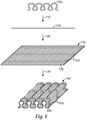
- Fig. 1 is a process flow diagram showing an exemplary method of making an article according to the present disclosure.
- a strip lOOp comprising a shape-memory polymer, formed in its intrinsic shape, is stressed 110 at a temperature above its T trans but below its T upper and cooled such that it forms an elongated strip 100t.
- Strips lOOt are bonded 120 (e.g., by lamination) to nonwoven fiber web 130 in a substantially parallel arrangement to form a composite web 140.
- the composite web 140 is then heated 170 above T trans and the strips lOOt revert at least partially to their intrinsic shape, thereby forming folds in web 150 and providing a pleated fiber web 160 that is suitable for use, for example in a filter.
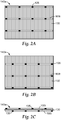
- Figs. 2A-2C show one exemplary composite web 140a. Strips lOOt are bonded to nonwoven fiber web 130 at bonded points 135.
- Fig. 2A is a top view
- Fig. 2B is a bottom view
- Fig. 2C is a side view of composite web 140a.
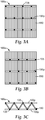
- Fig. 3A is a schematic top view
- Fig. 3B is a schematic bottom view
- Fig. 3C is a schematic side view of resultant pleated fiber web 160a.
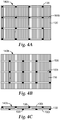
- Figs. 4A - 4C show another exemplary embodiment of composite web 140
- Fig. 4A is a schematic top view
- Fig. 4B is a schematic bottom view
- Fig. 4C is a schematic side view of composite web 140b.
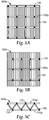
- Fig. 5A is a schematic top view
- Fig. 5B is a schematic bottom view
- Fig. 5C is a schematic side view of cupped and/or puckered fiber web 160b.
- Fig. 6 is a process flow diagram showing another exemplary method of making an article according to the present disclosure.
- a substantially circular strip 600p comprising a shape-memory polymer, formed in its intrinsic shape, is outwardly stressed 110 at a temperature above its T trans , but below its T upper , and cooled such that its size is enlarged forming strip 600t.
- Strip 600t is bonded 120 (e.g., by lamination) to nonwoven fiber web 130 to form a composite web 640.
- the composite web 640 is then heated 170 above T trans and the strip 600t reverts at least partially to its intrinsic shape, thereby forming a cupped and/or puckered fiber web 660 that is suitable for use, for example, in making a respirator mask.
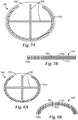
- Figs. 7A - 7B show another exemplary embodiment of composite web 740
- Fig. 7A is a cross-sectional back view
- Fig. 7B is a cross-sectional side view of composite web 740.
- reinforcing strips 780 and strip 700t are bonded between nonwoven fiber webs 730, 732.
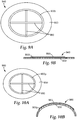
- strip 700t shrinks and reverts to strip 700p as shown in Figs. 8A-8B thereby forming a pucker in nonwoven fiber webs 730, 732 and providing cupped and/or puckered fiber web 760 that is suitable for use, for example, in making a respirator mask.
- Fig. 8A is a cut-away back view
- Fig. 8B is a cross-sectional side view of puckered fiber web 760.
- Figs. 9A - 9B show another exemplary embodiment of composite web 940
- Fig. 9A is a back view
- Fig. 9B is a cross-sectional side view of composite web 940.
- reinforcing strips 980 and temporary shaped strip 900t are bonded to nonwoven fiber web 930.
- strip 900t shrinks in thickness and expands in length and width, reverting to intrinsically shaped strip 900p as shown in Figs. 10A-10B .
- Fig. 10A is a back view
- Fig. 10B is a cross-sectional side view of fiber web 960.
- Figs. 11A - 11B show another exemplary embodiment of composite web 1140
- Fig. 11A is a back view
- Fig. 11B is a cross-sectional side view of composite web 1140.
- strained temporary strips 1100t are bonded to nonwoven fiber web 1130.
- temporary strips 1100t shrink in width and elongate in length, reverting to intrinsically shaped strips 1100p as shown in Figs. 12A-12B thereby forming a cup and/or pucker in nonwoven fiber web 1130 and providing cupped and/or puckered fiber web 1160 that is suitable for use, for example, in making a respirator mask.
- Fig. 12A is a back view
- Fig. 12B is a cross-sectional side view of fiber web 1160.
- CORTUFF heat shrink film with 0.003 inch (0.08 mm) thickness from Sealed Air Corp. of Elmwood, NJ, was cut into strips that were 0.5 inch (13 mm) wide and 12 inches (300 mm) long.
- One of these strips was positioned on the longer centerline of one face of a 10 inches (250 mm) by 12 inches (300 mm) piece of nonwoven filter media obtained by removal of the metal mesh from a 3M FILTRETE 9800 filter from 3M Company of Saint Paul, MN, and an additional two strips were positioned parallel to the first strip and 3 inches (76 mm) away from either side of the first strip.
- the three strips were attached to the media with staples at the end of each strip and on 2-inch (50-mm) intervals across the length of the strips.
- CORTUFF heat shrink film with 0.003 inch (0.08 mm) thickness from Sealed Air Corp. was placed in a 125°C oven for 15 minutes, during which time it shrank to 30 percent of its original length and width.
- a KARO IV Laboratory Stretching Machine from Bruckner Inc. of Greenville, SC was then used to stretch the film at 120°C to twice its original length while holding the width constant.
- This oriented film was cut into two 9 inches x 9 inches (230 mm x 230 mm) pieces. The films were die cut with 0.5 inch x 2.5 inches (13 mm x 64 mm) rectangular openings with 0.25 inch (6 mm) of material left between each opening.
- the openings were positioned in 3 x 14 array, and the longer dimension of the rectangular openings was parallel to the direction in which the film had been stretched.
- One of the resulting films was positioned over a 9 inches x 10.5 inches (23 cm x 26.7 cm) piece of nonwoven filter media obtained by removal of the metal mesh from a 3M FILTRETE 9800 filter with the longer dimension of the rectangular openings aligned with the longer dimension of the media.
- the film and the media were aligned on three of the four edges.
- the film was stapled to the nonwoven filter media at 2.75-inch (69.9-mm) intervals such that the staples passed through the film only at the ends of the rectangular openings.
- a second piece of the same film was positioned on the opposite face of the filter media and aligned on three of the four edges including the edge that was not affixed to the first film. It was similarly attached with staples only at the ends of the rectangular openings.
- the resulting flat assembly was placed in a 130°C oven for 10 min during which time the films shrank to 4.5-5.5 inches x 8.0 inches-8.5 inches (11-14 cm x 20 cm x 22 cm) and the filter media became pleated.
- a monomer solution was prepared from IRGANOX 1010 antioxidant (1.6 grams (g), available from Ciba Specialty Chemicals Corp. of Tarrytown, NY) in cyclooctene (40 milliliters (mL)) and dicyclopentadiene (120 mL). To this was added a solution of (1,3-bis(2,4,6-trimethylphenyl)-2-imidazolidinylidene)dichloro(phenylmethylene)-(tricyclohexylphosphine)ruthenium (Grubbs Second Generation Catalyst, 96 mg) in toluene (1.6 mL).
- the catalyzed solution was immediately transferred to a mold composed of two aluminum plates separated by a 0.015 inch (0.38 mm) thick spacer with a 6 inches ⁇ 11 inches (150 mm x 280 mm) rectangular opening. After one hour, the mold was placed in a 60°C oven for 30 min. The resulting polymer film was removed from the mold and returned to the oven for an additional 15 min. The film was then stretched at 80°C to 1.5 times its original length and width using a KARO IV laboratory stretching machine available from Bruckner Inc.
- This stretched film was cut into two curved strips 0.25 inch (6 mm) wide such that the strips could be positioned to form an arc of 310° that followed an ellipse with major and minor diameters of 6.8 inches (170 mm) and 5.4 inches (140 mm). The portion of the ellipse that was not covered by the arc was centered on the minor diameter. These strips were then adhered to a piece of nonwoven filter media in the shape of an ellipse with major and minor diameters of 7.8 inches (200 mm) and 6.4 inches (160 mm).
- the nonwoven filter media was a three-layer laminate construction, with a top layer consisting of a 50 grams per square meter (gsm) polypropylene spunbond coverweb available from BBA Nonwovens Simpsonville, Inc. of Simpsonville, SC; a middle layer consisting of a blown microfiber web made from polypropylene TOTAL 3960 from Total Petrochemicals of Houston, TX, that had been corona treated and hydrocharged as described in U.S. Pat. No. 5,496,507 (Angadjivand et al.
- the top layer was removed from a piece of the nonwoven filter media (three-layer laminate construction) used in Example 3 having an elliptical shape of major and minor diameters of 8.5 inches (22 cm) and 7.0 inches (18 cm).
- CORTUFF brand heat shrink film with 0.003 inch (0.08 mm) thickness was cut into a 0.25 inch (6.4 mm) wide strip in the shape of an arc of 310° that followed an ellipse with major and minor diameters of 7.5 inches (19 cm) and 6.0 inches (15 cm). The portion of the ellipse that was not covered by the arc was centered on the minor diameter.
- This strip was placed on the middle layer generally as shown in Fig. 7A .
- Adhesive available as SCOTCH MAXIMUM STRENGTH ADHESIVE 6047, from 3M Company was applied to the CORTUFF brand heat shrink film strip, polypropylene strips and media, and the top layer of the filter media was then replaced over this assembly. After one hour, the resulting flat assembly was heated in a 110°C oven for 2 min, during which time the CORTUFF heat shrink film strips contracted and forced the media in to a dome shape.
- a mold was made from a 1/2 inch (13 mm) thick aluminum plate by milling a 1/8 inch (3.2 mm) wide channel with a period of 1.06 inches (2.69 cm) all the way through the aluminum plate with a shape generally shown in lOOp of Fig. 1 .
- One face of the milled plate was bolted to a 1/8 inch (3.2 mm) thick aluminum plate to form an open-faced mold.
- a monomer solution was prepared from IRGANOX 1010 antioxidant (1.7 g) in cyclooctene (12.8 mL) and dicyclopentadiene (44.2 mL). To this monomer solution was added a solution of 10 percent tricyclohexylphosphine in toluene (0.7 mL). The resultant solution was cooled in an ice bath and degassed under vacuum.
- the shaped polymer was pressed in a Carver press from Carver, Inc. of Wabash, IN, at 100°F (38°C) for 10 min to give a flat 1/8 inch ⁇ 1/2 inch ⁇ 24 inches (3.2 mm x 13 mm x 61 cm) strip. The strip was then cut to give four strips of 1/8 inch ⁇ 1/4 inch ⁇ 12 inches (3.2 mm x 6.4 mm x 30 cm). These were glued to a 12 inches ⁇ 11 inches (30 cm x 28 cm) piece of nonwoven material (same as used in Example 1) using SCOTCH MAXIMUM STRENGTH ADHESIVE 6047 and allowed to cure overnight. The resulting flat assembly was then heated in a 65°C oven for 15 min, and it became a pleated filter. It was post-cured in a 110°C oven for 15 min more, and the pleats became nearly as narrow as the pattern in the original mold.
Landscapes
- Health & Medical Sciences (AREA)
- General Health & Medical Sciences (AREA)
- Life Sciences & Earth Sciences (AREA)
- Veterinary Medicine (AREA)
- Public Health (AREA)
- Epidemiology (AREA)
- Animal Behavior & Ethology (AREA)
- Chemical & Material Sciences (AREA)
- Medicinal Chemistry (AREA)
- Transplantation (AREA)
- Engineering & Computer Science (AREA)
- Textile Engineering (AREA)
- Oral & Maxillofacial Surgery (AREA)
- Dermatology (AREA)
- Heart & Thoracic Surgery (AREA)
- Vascular Medicine (AREA)
- Surgery (AREA)
- Physics & Mathematics (AREA)
- Thermal Sciences (AREA)
- Zoology (AREA)
- Pulmonology (AREA)
- Business, Economics & Management (AREA)
- Emergency Management (AREA)
- Laminated Bodies (AREA)
- Nonwoven Fabrics (AREA)
- Respiratory Apparatuses And Protective Means (AREA)
- Artificial Filaments (AREA)
Applications Claiming Priority (2)
| Application Number | Priority Date | Filing Date | Title |
|---|---|---|---|
| US26402409P | 2009-11-24 | 2009-11-24 | |
| PCT/US2010/057632 WO2011066224A2 (en) | 2009-11-24 | 2010-11-22 | Articles and methods using shape-memory polymers |
Publications (2)
| Publication Number | Publication Date |
|---|---|
| EP2504477A2 EP2504477A2 (en) | 2012-10-03 |
| EP2504477B1 true EP2504477B1 (en) | 2018-06-06 |
Family
ID=43927908
Family Applications (1)
| Application Number | Title | Priority Date | Filing Date |
|---|---|---|---|
| EP10784401.1A Not-in-force EP2504477B1 (en) | 2009-11-24 | 2010-11-22 | Articles and methods using shape-memory polymers |
Country Status (6)
| Country | Link |
|---|---|
| US (1) | US20120225600A1 (enExample) |
| EP (1) | EP2504477B1 (enExample) |
| JP (1) | JP5774020B2 (enExample) |
| KR (1) | KR101800906B1 (enExample) |
| CN (1) | CN102656306B (enExample) |
| WO (1) | WO2011066224A2 (enExample) |
Families Citing this family (35)
| Publication number | Priority date | Publication date | Assignee | Title |
|---|---|---|---|---|
| US20040260034A1 (en) | 2003-06-19 | 2004-12-23 | Haile William Alston | Water-dispersible fibers and fibrous articles |
| US8513147B2 (en) | 2003-06-19 | 2013-08-20 | Eastman Chemical Company | Nonwovens produced from multicomponent fibers |
| US7892993B2 (en) | 2003-06-19 | 2011-02-22 | Eastman Chemical Company | Water-dispersible and multicomponent fibers from sulfopolyesters |
| US8091145B2 (en) * | 2006-07-31 | 2012-01-10 | Bebe Au Lait, Llc | Nursing cover |
| US8512519B2 (en) | 2009-04-24 | 2013-08-20 | Eastman Chemical Company | Sulfopolyesters for paper strength and process |
| US9222203B2 (en) * | 2010-06-30 | 2015-12-29 | The Hong Kong Polytechnic University | Items of clothing having shape memory |
| US20120183861A1 (en) | 2010-10-21 | 2012-07-19 | Eastman Chemical Company | Sulfopolyester binders |
| US8882963B2 (en) | 2012-01-31 | 2014-11-11 | Eastman Chemical Company | Processes to produce short cut microfibers |
| WO2014035999A1 (en) * | 2012-08-27 | 2014-03-06 | Nike International Ltd. | Dynamic materials intergrated into articles for adjustable physical permeability characteristics |
| US20140263033A1 (en) * | 2013-03-13 | 2014-09-18 | 2266170 Ontario Inc. | Process For Forming A Three-Dimensional Non-Woven Structure |
| US9303357B2 (en) | 2013-04-19 | 2016-04-05 | Eastman Chemical Company | Paper and nonwoven articles comprising synthetic microfiber binders |
| US9174159B2 (en) | 2013-08-16 | 2015-11-03 | 3M Innovative Properties Company | Framed pleated air filter with upstream bridging filaments |
| US9278301B2 (en) | 2013-08-16 | 2016-03-08 | 3M Innovative Properties Company | Nestable framed pleated air filter and method of making |
| US9605126B2 (en) | 2013-12-17 | 2017-03-28 | Eastman Chemical Company | Ultrafiltration process for the recovery of concentrated sulfopolyester dispersion |
| US9598802B2 (en) | 2013-12-17 | 2017-03-21 | Eastman Chemical Company | Ultrafiltration process for producing a sulfopolyester concentrate |
| CN104208041B (zh) * | 2014-08-28 | 2018-12-21 | 上海赛琅医药科技有限公司 | 一种用于预防、干预疤痕以及疤痕增生的可塑性硅凝胶和其制作方法 |
| US10406472B2 (en) * | 2015-03-12 | 2019-09-10 | 3M Innovative Properties Company | Collapsible air filter |
| WO2017035356A1 (en) * | 2015-08-25 | 2017-03-02 | The Regents Of The University Of California | Transformable clothing |
| BR112018008915A2 (pt) | 2015-11-02 | 2018-11-27 | 3M Innovative Properties Co | aparelho ortodôntico com memória de formato contínuo |
| JP6742722B2 (ja) * | 2015-12-25 | 2020-08-19 | エルジー ディスプレイ カンパニー リミテッド | フレキシブルディスプレイ及びその使用方法 |
| JP6850541B2 (ja) * | 2016-03-03 | 2021-03-31 | エルジー ディスプレイ カンパニー リミテッド | フレキシブルディスプレイ及びその使用方法 |
| DE102017007596B4 (de) | 2017-08-13 | 2019-12-19 | Chr. Mayr Gmbh + Co. Kg | Formgedächtnisaktuatoranordnung und Verfahren für deren Herstellung |
| JP6980264B2 (ja) * | 2017-11-24 | 2021-12-15 | 学校法人 名城大学 | 展開構造物 |
| US11512417B2 (en) * | 2018-03-29 | 2022-11-29 | Syracuse University | Enzyme-responsive shape memory polymers |
| CN112004587B (zh) * | 2018-04-16 | 2022-11-01 | 奥斯龙-明士克公司 | 高破裂强度的湿法成网的非织造过滤介质及其生产方法 |
| CN109203436A (zh) * | 2018-07-27 | 2019-01-15 | 河海大学 | 一种宏观尺度上实现高聚物自折叠的设计方法 |
| DE102019100694B4 (de) | 2019-01-11 | 2021-05-20 | Chr. Mayr Gmbh + Co. Kg | Formgedächtnisaktuatoranordnung und Montageverfahren |
| CN110591189B (zh) * | 2019-08-26 | 2021-12-21 | 青岛科技大学 | 一种水热双重刺激响应形状记忆高分子材料及其制备方法 |
| US20220381524A1 (en) * | 2019-10-29 | 2022-12-01 | The Regents Of The University Of California | Systems and Methods for Spectrally Selective Thermal Radiators with Partial Exposures to Both the Sky and the Terrestrial Environment |
| US12607371B2 (en) | 2019-11-27 | 2026-04-21 | The Regents Of The University Of California | Systems and methods for tuning radiative heat flows between interior surfaces and human occupants |
| EP4153804B1 (en) * | 2020-06-26 | 2023-07-19 | Jabil Inc. | Improved melt blown articles and methods to form them |
| CN116348393A (zh) * | 2020-09-29 | 2023-06-27 | 安炳烈 | 袋泡茶 |
| KR102393327B1 (ko) * | 2020-12-28 | 2022-05-02 | 주식회사 건영글로텍 | 마스크클립용 스트립부재 제조장치 |
| KR102984045B1 (ko) * | 2021-08-26 | 2026-06-30 | 나이키 이노베이트 씨.브이. | 의복에 적합한 인쇄된 합성 부직 텍스타일용 디보싱 및 주름 마감 및 그 제조 방법 |
| CN115769920B (zh) * | 2022-11-22 | 2025-05-09 | 中国科学技术大学 | 一种力热双重功能的智能防护衣及制备方法 |
Citations (1)
| Publication number | Priority date | Publication date | Assignee | Title |
|---|---|---|---|---|
| JP2009225930A (ja) * | 2008-03-21 | 2009-10-08 | Tanaka Hidehiko | マスク及びグラフト重合体抽出液 |
Family Cites Families (29)
| Publication number | Priority date | Publication date | Assignee | Title |
|---|---|---|---|---|
| US4436858A (en) | 1982-05-14 | 1984-03-13 | Hercules Incorporated | Plasticized polydicyclopentadiene and a method for making the same |
| US5506300A (en) | 1985-01-04 | 1996-04-09 | Thoratec Laboratories Corporation | Compositions that soften at predetermined temperatures and the method of making same |
| JPS6422424U (enExample) * | 1987-07-29 | 1989-02-06 | ||
| JP2502132B2 (ja) | 1988-09-30 | 1996-05-29 | 三菱重工業株式会社 | 形状記憶ポリウレタンエラストマ―成形体 |
| JPH02118178A (ja) * | 1988-10-28 | 1990-05-02 | Mitsubishi Heavy Ind Ltd | 形状記憶性を有する繊維製シート及び繊維製シート製品への形状記憶性付与方法 |
| JPH02121907A (ja) | 1988-10-31 | 1990-05-09 | Mitsubishi Heavy Ind Ltd | 人用化粧料 |
| JPH03130147A (ja) * | 1989-10-17 | 1991-06-03 | Motohisa Yoshida | 特殊生地 |
| US5665822A (en) | 1991-10-07 | 1997-09-09 | Landec Corporation | Thermoplastic Elastomers |
| JPH0751158B2 (ja) * | 1992-06-05 | 1995-06-05 | 横井定株式会社 | 衛生マスク |
| JP2950700B2 (ja) * | 1993-02-15 | 1999-09-20 | マルコ株式会社 | 布状複合素材とその製造方法 |
| ES2128590T3 (es) | 1993-08-17 | 1999-05-16 | Minnesota Mining & Mfg | Metodo para cargar medios filtrantes con electretos. |
| ES2265186T3 (es) | 1998-02-23 | 2007-02-01 | Mnemoscience Gmbh | Polimeros con memoria de forma. |
| AU751861B2 (en) | 1998-02-23 | 2002-08-29 | Massachusetts Institute Of Technology | Biodegradable shape memory polymers |
| US6423421B1 (en) | 1999-08-11 | 2002-07-23 | Sealed Air Corporation | Heat shrinkable film with multicomponent interpenetrating network resin |
| US20020115977A1 (en) * | 2000-12-15 | 2002-08-22 | Topolkaraev Vasily A. | Disposable products having materials having shape-memory |
| AU2003224060A1 (en) | 2002-04-10 | 2003-10-20 | Mnemoscience Gmbh | Method for creating shape memory effects on hair by combining shape memory polymers with cationic active ingredients |
| US20040030062A1 (en) | 2002-05-02 | 2004-02-12 | Mather Patrick T. | Castable shape memory polymers |
| JP3719668B2 (ja) * | 2002-06-26 | 2005-11-24 | 積水化成品工業株式会社 | 布地製立体形状マスク |
| ATE534704T1 (de) | 2002-10-11 | 2011-12-15 | Univ Connecticut | Vernetztes polycycloocten |
| DE10334784A1 (de) | 2003-07-30 | 2005-03-03 | Mnemoscience Gmbh | Kosmetische Zusammensetzung mit Polyol/Polyester Blockpolymeren |
| FR2861752B1 (fr) * | 2003-10-29 | 2006-03-31 | Chabe Conception Process Ingen | Procede de fabrication d'un materiau complexe obtenu par lamination d'un film elastique pris en sandwich entre deux nappes de non-tisse. |
| WO2005045112A1 (en) * | 2003-11-07 | 2005-05-19 | Koninklijke Philips Electronics, N.V. | Controllable surface area fabric |
| US7309104B2 (en) * | 2004-03-12 | 2007-12-18 | Gm Global Technology Operations, Inc. | Shape memory polymer seat assemblies |
| CN1984770B (zh) * | 2004-06-18 | 2011-04-20 | 特克斯特龙尼克斯公司 | 功能性弹性纺织结构 |
| US8187984B2 (en) * | 2006-06-09 | 2012-05-29 | Malden Mills Industries, Inc. | Temperature responsive smart textile |
| CN101164770B (zh) * | 2006-10-20 | 2013-03-27 | 香港理工大学 | 双向形状记忆聚合物复合材料及其制备方法 |
| JP3133632U (ja) * | 2007-05-02 | 2007-07-19 | 正一 中村 | 室内装着用衛生用マスク |
| US8236129B2 (en) * | 2007-05-23 | 2012-08-07 | GM Global Technology Operations LLC | Attachment pad with thermal reversible adhesive and methods of making and using the same |
| GB2470185B (en) * | 2009-05-11 | 2015-07-29 | Univ Bolton | Pressure actuator |
-
2010
- 2010-11-22 WO PCT/US2010/057632 patent/WO2011066224A2/en not_active Ceased
- 2010-11-22 KR KR1020127015932A patent/KR101800906B1/ko not_active Expired - Fee Related
- 2010-11-22 US US13/503,596 patent/US20120225600A1/en not_active Abandoned
- 2010-11-22 EP EP10784401.1A patent/EP2504477B1/en not_active Not-in-force
- 2010-11-22 JP JP2012540130A patent/JP5774020B2/ja not_active Expired - Fee Related
- 2010-11-22 CN CN201080053299.7A patent/CN102656306B/zh not_active Expired - Fee Related
Patent Citations (1)
| Publication number | Priority date | Publication date | Assignee | Title |
|---|---|---|---|---|
| JP2009225930A (ja) * | 2008-03-21 | 2009-10-08 | Tanaka Hidehiko | マスク及びグラフト重合体抽出液 |
Also Published As
| Publication number | Publication date |
|---|---|
| US20120225600A1 (en) | 2012-09-06 |
| CN102656306A (zh) | 2012-09-05 |
| JP5774020B2 (ja) | 2015-09-02 |
| JP2013512119A (ja) | 2013-04-11 |
| WO2011066224A3 (en) | 2011-07-21 |
| CN102656306B (zh) | 2015-09-23 |
| KR20120085919A (ko) | 2012-08-01 |
| WO2011066224A2 (en) | 2011-06-03 |
| KR101800906B1 (ko) | 2017-11-23 |
| EP2504477A2 (en) | 2012-10-03 |
Similar Documents
| Publication | Publication Date | Title |
|---|---|---|
| US20120225600A1 (en) | Articles and Methods Using Shape-Memory Polymers | |
| JP4039809B2 (ja) | 三次元構造化された繊維平面形成物およびその製造方法 | |
| KR100270797B1 (ko) | 패턴 결합된 부직포 | |
| EP0515045B1 (en) | Process for manufacturing a self-supporting filter unit and self-supporting filter unit | |
| GB2442577A (en) | A filter medium | |
| EP0682557B1 (en) | Air filter and method of producing the same | |
| WO2013181082A1 (en) | Textured elements incorporating non-woven textile materials and methods for manufacturing the textured elements | |
| WO2007147062A2 (en) | Wave-like structures bonded to flat surfaces in unitized composites and methods for making same | |
| CA2450380A1 (en) | Loop materials for touch fastening | |
| JP2006525141A (ja) | 不織複合要素 | |
| RU2744182C1 (ru) | Слоистое изделие | |
| AU2008312987A1 (en) | Air filter and air filter assembly for cleaner made by using the filter | |
| PL205538B1 (pl) | Włókienny twór powierzchniowy o trójwymiarowej strukturze, sposób jego wytwarzania i zastosowanie | |
| CN106457097B (zh) | 过滤元件及其生产方法 | |
| JP3492017B2 (ja) | 繊維構造物およびそれを用いてなる繊維成型品の製造方法 | |
| JP5665210B2 (ja) | 一方向伸縮性積層不織布の製造方法 | |
| JP6815634B2 (ja) | 炭素繊維強化プラスチックの製造方法 | |
| JP4456938B2 (ja) | ポリプロピレン系樹脂構造板 | |
| JPH05263345A (ja) | 繊維層材及びその製造方法 | |
| JP5267809B2 (ja) | フィルター基材およびそれを用いたフィルター | |
| JP4195082B2 (ja) | 補強材料 | |
| CN122270375A (zh) | 点粘合挤出层压体 | |
| KR20210109586A (ko) | 복합 재료의 기계적 성형 | |
| JP2010018928A (ja) | 熱成型用不織布及びこれを用いた熱成型方法 | |
| JP6555777B2 (ja) | Frp製造用シート状半製品の製造方法 |
Legal Events
| Date | Code | Title | Description |
|---|---|---|---|
| PUAI | Public reference made under article 153(3) epc to a published international application that has entered the european phase |
Free format text: ORIGINAL CODE: 0009012 |
|
| 17P | Request for examination filed |
Effective date: 20120529 |
|
| AK | Designated contracting states |
Kind code of ref document: A2 Designated state(s): AL AT BE BG CH CY CZ DE DK EE ES FI FR GB GR HR HU IE IS IT LI LT LU LV MC MK MT NL NO PL PT RO RS SE SI SK SM TR |
|
| DAX | Request for extension of the european patent (deleted) | ||
| 17Q | First examination report despatched |
Effective date: 20160511 |
|
| STAA | Information on the status of an ep patent application or granted ep patent |
Free format text: STATUS: EXAMINATION IS IN PROGRESS |
|
| GRAP | Despatch of communication of intention to grant a patent |
Free format text: ORIGINAL CODE: EPIDOSNIGR1 |
|
| STAA | Information on the status of an ep patent application or granted ep patent |
Free format text: STATUS: GRANT OF PATENT IS INTENDED |
|
| INTG | Intention to grant announced |
Effective date: 20171218 |
|
| GRAS | Grant fee paid |
Free format text: ORIGINAL CODE: EPIDOSNIGR3 |
|
| GRAA | (expected) grant |
Free format text: ORIGINAL CODE: 0009210 |
|
| STAA | Information on the status of an ep patent application or granted ep patent |
Free format text: STATUS: THE PATENT HAS BEEN GRANTED |
|
| AK | Designated contracting states |
Kind code of ref document: B1 Designated state(s): AL AT BE BG CH CY CZ DE DK EE ES FI FR GB GR HR HU IE IS IT LI LT LU LV MC MK MT NL NO PL PT RO RS SE SI SK SM TR |
|
| REG | Reference to a national code |
Ref country code: GB Ref legal event code: FG4D |
|
| REG | Reference to a national code |
Ref country code: CH Ref legal event code: EP Ref country code: AT Ref legal event code: REF Ref document number: 1006190 Country of ref document: AT Kind code of ref document: T Effective date: 20180615 |
|
| REG | Reference to a national code |
Ref country code: IE Ref legal event code: FG4D |
|
| REG | Reference to a national code |
Ref country code: DE Ref legal event code: R096 Ref document number: 602010051142 Country of ref document: DE |
|
| REG | Reference to a national code |
Ref country code: NL Ref legal event code: MP Effective date: 20180606 |
|
| REG | Reference to a national code |
Ref country code: LT Ref legal event code: MG4D |
|
| PG25 | Lapsed in a contracting state [announced via postgrant information from national office to epo] |
Ref country code: LT Free format text: LAPSE BECAUSE OF FAILURE TO SUBMIT A TRANSLATION OF THE DESCRIPTION OR TO PAY THE FEE WITHIN THE PRESCRIBED TIME-LIMIT Effective date: 20180606 Ref country code: CY Free format text: LAPSE BECAUSE OF FAILURE TO SUBMIT A TRANSLATION OF THE DESCRIPTION OR TO PAY THE FEE WITHIN THE PRESCRIBED TIME-LIMIT Effective date: 20180606 Ref country code: FI Free format text: LAPSE BECAUSE OF FAILURE TO SUBMIT A TRANSLATION OF THE DESCRIPTION OR TO PAY THE FEE WITHIN THE PRESCRIBED TIME-LIMIT Effective date: 20180606 Ref country code: BG Free format text: LAPSE BECAUSE OF FAILURE TO SUBMIT A TRANSLATION OF THE DESCRIPTION OR TO PAY THE FEE WITHIN THE PRESCRIBED TIME-LIMIT Effective date: 20180906 Ref country code: SE Free format text: LAPSE BECAUSE OF FAILURE TO SUBMIT A TRANSLATION OF THE DESCRIPTION OR TO PAY THE FEE WITHIN THE PRESCRIBED TIME-LIMIT Effective date: 20180606 Ref country code: NO Free format text: LAPSE BECAUSE OF FAILURE TO SUBMIT A TRANSLATION OF THE DESCRIPTION OR TO PAY THE FEE WITHIN THE PRESCRIBED TIME-LIMIT Effective date: 20180906 Ref country code: ES Free format text: LAPSE BECAUSE OF FAILURE TO SUBMIT A TRANSLATION OF THE DESCRIPTION OR TO PAY THE FEE WITHIN THE PRESCRIBED TIME-LIMIT Effective date: 20180606 |
|
| PG25 | Lapsed in a contracting state [announced via postgrant information from national office to epo] |
Ref country code: GR Free format text: LAPSE BECAUSE OF FAILURE TO SUBMIT A TRANSLATION OF THE DESCRIPTION OR TO PAY THE FEE WITHIN THE PRESCRIBED TIME-LIMIT Effective date: 20180907 Ref country code: HR Free format text: LAPSE BECAUSE OF FAILURE TO SUBMIT A TRANSLATION OF THE DESCRIPTION OR TO PAY THE FEE WITHIN THE PRESCRIBED TIME-LIMIT Effective date: 20180606 Ref country code: RS Free format text: LAPSE BECAUSE OF FAILURE TO SUBMIT A TRANSLATION OF THE DESCRIPTION OR TO PAY THE FEE WITHIN THE PRESCRIBED TIME-LIMIT Effective date: 20180606 Ref country code: LV Free format text: LAPSE BECAUSE OF FAILURE TO SUBMIT A TRANSLATION OF THE DESCRIPTION OR TO PAY THE FEE WITHIN THE PRESCRIBED TIME-LIMIT Effective date: 20180606 |
|
| REG | Reference to a national code |
Ref country code: AT Ref legal event code: MK05 Ref document number: 1006190 Country of ref document: AT Kind code of ref document: T Effective date: 20180606 |
|
| PG25 | Lapsed in a contracting state [announced via postgrant information from national office to epo] |
Ref country code: NL Free format text: LAPSE BECAUSE OF FAILURE TO SUBMIT A TRANSLATION OF THE DESCRIPTION OR TO PAY THE FEE WITHIN THE PRESCRIBED TIME-LIMIT Effective date: 20180606 |
|
| PG25 | Lapsed in a contracting state [announced via postgrant information from national office to epo] |
Ref country code: AT Free format text: LAPSE BECAUSE OF FAILURE TO SUBMIT A TRANSLATION OF THE DESCRIPTION OR TO PAY THE FEE WITHIN THE PRESCRIBED TIME-LIMIT Effective date: 20180606 Ref country code: EE Free format text: LAPSE BECAUSE OF FAILURE TO SUBMIT A TRANSLATION OF THE DESCRIPTION OR TO PAY THE FEE WITHIN THE PRESCRIBED TIME-LIMIT Effective date: 20180606 Ref country code: IS Free format text: LAPSE BECAUSE OF FAILURE TO SUBMIT A TRANSLATION OF THE DESCRIPTION OR TO PAY THE FEE WITHIN THE PRESCRIBED TIME-LIMIT Effective date: 20181006 Ref country code: CZ Free format text: LAPSE BECAUSE OF FAILURE TO SUBMIT A TRANSLATION OF THE DESCRIPTION OR TO PAY THE FEE WITHIN THE PRESCRIBED TIME-LIMIT Effective date: 20180606 Ref country code: SK Free format text: LAPSE BECAUSE OF FAILURE TO SUBMIT A TRANSLATION OF THE DESCRIPTION OR TO PAY THE FEE WITHIN THE PRESCRIBED TIME-LIMIT Effective date: 20180606 Ref country code: RO Free format text: LAPSE BECAUSE OF FAILURE TO SUBMIT A TRANSLATION OF THE DESCRIPTION OR TO PAY THE FEE WITHIN THE PRESCRIBED TIME-LIMIT Effective date: 20180606 Ref country code: PL Free format text: LAPSE BECAUSE OF FAILURE TO SUBMIT A TRANSLATION OF THE DESCRIPTION OR TO PAY THE FEE WITHIN THE PRESCRIBED TIME-LIMIT Effective date: 20180606 |
|
| PGFP | Annual fee paid to national office [announced via postgrant information from national office to epo] |
Ref country code: DE Payment date: 20181106 Year of fee payment: 9 |
|
| PG25 | Lapsed in a contracting state [announced via postgrant information from national office to epo] |
Ref country code: IT Free format text: LAPSE BECAUSE OF FAILURE TO SUBMIT A TRANSLATION OF THE DESCRIPTION OR TO PAY THE FEE WITHIN THE PRESCRIBED TIME-LIMIT Effective date: 20180606 Ref country code: SM Free format text: LAPSE BECAUSE OF FAILURE TO SUBMIT A TRANSLATION OF THE DESCRIPTION OR TO PAY THE FEE WITHIN THE PRESCRIBED TIME-LIMIT Effective date: 20180606 |
|
| REG | Reference to a national code |
Ref country code: DE Ref legal event code: R097 Ref document number: 602010051142 Country of ref document: DE |
|
| PLBE | No opposition filed within time limit |
Free format text: ORIGINAL CODE: 0009261 |
|
| STAA | Information on the status of an ep patent application or granted ep patent |
Free format text: STATUS: NO OPPOSITION FILED WITHIN TIME LIMIT |
|
| 26N | No opposition filed |
Effective date: 20190307 |
|
| PG25 | Lapsed in a contracting state [announced via postgrant information from national office to epo] |
Ref country code: SI Free format text: LAPSE BECAUSE OF FAILURE TO SUBMIT A TRANSLATION OF THE DESCRIPTION OR TO PAY THE FEE WITHIN THE PRESCRIBED TIME-LIMIT Effective date: 20180606 Ref country code: DK Free format text: LAPSE BECAUSE OF FAILURE TO SUBMIT A TRANSLATION OF THE DESCRIPTION OR TO PAY THE FEE WITHIN THE PRESCRIBED TIME-LIMIT Effective date: 20180606 |
|
| REG | Reference to a national code |
Ref country code: CH Ref legal event code: PL |
|
| GBPC | Gb: european patent ceased through non-payment of renewal fee |
Effective date: 20181122 |
|
| PG25 | Lapsed in a contracting state [announced via postgrant information from national office to epo] |
Ref country code: MC Free format text: LAPSE BECAUSE OF FAILURE TO SUBMIT A TRANSLATION OF THE DESCRIPTION OR TO PAY THE FEE WITHIN THE PRESCRIBED TIME-LIMIT Effective date: 20180606 Ref country code: LU Free format text: LAPSE BECAUSE OF NON-PAYMENT OF DUE FEES Effective date: 20181122 |
|
| REG | Reference to a national code |
Ref country code: BE Ref legal event code: MM Effective date: 20181130 |
|
| REG | Reference to a national code |
Ref country code: IE Ref legal event code: MM4A |
|
| PG25 | Lapsed in a contracting state [announced via postgrant information from national office to epo] |
Ref country code: LI Free format text: LAPSE BECAUSE OF NON-PAYMENT OF DUE FEES Effective date: 20181130 Ref country code: CH Free format text: LAPSE BECAUSE OF NON-PAYMENT OF DUE FEES Effective date: 20181130 |
|
| PG25 | Lapsed in a contracting state [announced via postgrant information from national office to epo] |
Ref country code: FR Free format text: LAPSE BECAUSE OF NON-PAYMENT OF DUE FEES Effective date: 20181130 Ref country code: IE Free format text: LAPSE BECAUSE OF NON-PAYMENT OF DUE FEES Effective date: 20181122 |
|
| PG25 | Lapsed in a contracting state [announced via postgrant information from national office to epo] |
Ref country code: AL Free format text: LAPSE BECAUSE OF FAILURE TO SUBMIT A TRANSLATION OF THE DESCRIPTION OR TO PAY THE FEE WITHIN THE PRESCRIBED TIME-LIMIT Effective date: 20180606 Ref country code: BE Free format text: LAPSE BECAUSE OF NON-PAYMENT OF DUE FEES Effective date: 20181130 |
|
| PG25 | Lapsed in a contracting state [announced via postgrant information from national office to epo] |
Ref country code: GB Free format text: LAPSE BECAUSE OF NON-PAYMENT OF DUE FEES Effective date: 20181122 |
|
| PG25 | Lapsed in a contracting state [announced via postgrant information from national office to epo] |
Ref country code: MT Free format text: LAPSE BECAUSE OF NON-PAYMENT OF DUE FEES Effective date: 20181122 |
|
| PG25 | Lapsed in a contracting state [announced via postgrant information from national office to epo] |
Ref country code: TR Free format text: LAPSE BECAUSE OF FAILURE TO SUBMIT A TRANSLATION OF THE DESCRIPTION OR TO PAY THE FEE WITHIN THE PRESCRIBED TIME-LIMIT Effective date: 20180606 |
|
| PG25 | Lapsed in a contracting state [announced via postgrant information from national office to epo] |
Ref country code: PT Free format text: LAPSE BECAUSE OF FAILURE TO SUBMIT A TRANSLATION OF THE DESCRIPTION OR TO PAY THE FEE WITHIN THE PRESCRIBED TIME-LIMIT Effective date: 20180606 |
|
| REG | Reference to a national code |
Ref country code: DE Ref legal event code: R119 Ref document number: 602010051142 Country of ref document: DE |
|
| PG25 | Lapsed in a contracting state [announced via postgrant information from national office to epo] |
Ref country code: HU Free format text: LAPSE BECAUSE OF FAILURE TO SUBMIT A TRANSLATION OF THE DESCRIPTION OR TO PAY THE FEE WITHIN THE PRESCRIBED TIME-LIMIT; INVALID AB INITIO Effective date: 20101122 Ref country code: MK Free format text: LAPSE BECAUSE OF NON-PAYMENT OF DUE FEES Effective date: 20180606 |
|
| PG25 | Lapsed in a contracting state [announced via postgrant information from national office to epo] |
Ref country code: DE Free format text: LAPSE BECAUSE OF NON-PAYMENT OF DUE FEES Effective date: 20200603 |