EP2499204B1 - Thermoplastische beschichtung und deren entfernung mithilfe einer bindungsschnittstelle mit katalytischen nanopartikeln - Google Patents
Thermoplastische beschichtung und deren entfernung mithilfe einer bindungsschnittstelle mit katalytischen nanopartikeln Download PDFInfo
- Publication number
- EP2499204B1 EP2499204B1 EP10830395.9A EP10830395A EP2499204B1 EP 2499204 B1 EP2499204 B1 EP 2499204B1 EP 10830395 A EP10830395 A EP 10830395A EP 2499204 B1 EP2499204 B1 EP 2499204B1
- Authority
- EP
- European Patent Office
- Prior art keywords
- bonding interface
- thermoplastic
- article
- coating
- polymers
- Prior art date
- Legal status (The legal status is an assumption and is not a legal conclusion. Google has not performed a legal analysis and makes no representation as to the accuracy of the status listed.)
- Not-in-force
Links
- 229920001169 thermoplastic Polymers 0.000 title claims description 160
- 239000004416 thermosoftening plastic Substances 0.000 title claims description 160
- 238000000576 coating method Methods 0.000 title claims description 100
- 239000011248 coating agent Substances 0.000 title claims description 97
- 239000002105 nanoparticle Substances 0.000 title claims description 96
- 230000003197 catalytic effect Effects 0.000 title claims description 94
- 229920000642 polymer Polymers 0.000 claims description 168
- 239000010410 layer Substances 0.000 claims description 107
- 238000000034 method Methods 0.000 claims description 72
- 230000005865 ionizing radiation Effects 0.000 claims description 41
- 239000003054 catalyst Substances 0.000 claims description 39
- 230000015556 catabolic process Effects 0.000 claims description 32
- 238000006731 degradation reaction Methods 0.000 claims description 32
- 239000011247 coating layer Substances 0.000 claims description 26
- 239000012530 fluid Substances 0.000 claims description 17
- 230000008569 process Effects 0.000 claims description 17
- 238000004519 manufacturing process Methods 0.000 claims description 13
- 230000005855 radiation Effects 0.000 claims description 13
- 238000005507 spraying Methods 0.000 claims description 12
- 239000007787 solid Substances 0.000 claims description 11
- 229910044991 metal oxide Inorganic materials 0.000 claims description 10
- 150000004706 metal oxides Chemical class 0.000 claims description 10
- 229910052751 metal Inorganic materials 0.000 claims description 9
- -1 polypropylene Polymers 0.000 claims description 9
- 239000002184 metal Substances 0.000 claims description 8
- 239000004721 Polyphenylene oxide Substances 0.000 claims description 7
- 239000004743 Polypropylene Substances 0.000 claims description 7
- 239000004816 latex Substances 0.000 claims description 7
- 229920000126 latex Polymers 0.000 claims description 7
- 229920000570 polyether Polymers 0.000 claims description 7
- 229920001155 polypropylene Polymers 0.000 claims description 7
- 239000007800 oxidant agent Substances 0.000 claims description 6
- 239000008247 solid mixture Substances 0.000 claims description 3
- 238000010894 electron beam technology Methods 0.000 claims description 2
- 239000000126 substance Substances 0.000 description 21
- 239000000178 monomer Substances 0.000 description 18
- 239000002131 composite material Substances 0.000 description 16
- 238000003860 storage Methods 0.000 description 16
- 238000000926 separation method Methods 0.000 description 15
- 238000004891 communication Methods 0.000 description 14
- 229920001577 copolymer Polymers 0.000 description 14
- 238000003466 welding Methods 0.000 description 14
- GWEVSGVZZGPLCZ-UHFFFAOYSA-N Titan oxide Chemical compound O=[Ti]=O GWEVSGVZZGPLCZ-UHFFFAOYSA-N 0.000 description 13
- 239000007788 liquid Substances 0.000 description 8
- 230000003750 conditioning effect Effects 0.000 description 7
- 238000010586 diagram Methods 0.000 description 7
- 239000001301 oxygen Substances 0.000 description 7
- 229910052760 oxygen Inorganic materials 0.000 description 7
- 239000000725 suspension Substances 0.000 description 7
- IJGRMHOSHXDMSA-UHFFFAOYSA-N Atomic nitrogen Chemical compound N#N IJGRMHOSHXDMSA-UHFFFAOYSA-N 0.000 description 6
- QVGXLLKOCUKJST-UHFFFAOYSA-N atomic oxygen Chemical compound [O] QVGXLLKOCUKJST-UHFFFAOYSA-N 0.000 description 6
- 230000015572 biosynthetic process Effects 0.000 description 6
- 230000007613 environmental effect Effects 0.000 description 5
- 230000006870 function Effects 0.000 description 5
- 230000009477 glass transition Effects 0.000 description 5
- 238000010438 heat treatment Methods 0.000 description 5
- 239000000203 mixture Substances 0.000 description 5
- 230000003647 oxidation Effects 0.000 description 5
- 238000007254 oxidation reaction Methods 0.000 description 5
- 230000002093 peripheral effect Effects 0.000 description 5
- 238000004064 recycling Methods 0.000 description 5
- RTZKZFJDLAIYFH-UHFFFAOYSA-N Diethyl ether Chemical compound CCOCC RTZKZFJDLAIYFH-UHFFFAOYSA-N 0.000 description 4
- 238000001816 cooling Methods 0.000 description 4
- 239000000463 material Substances 0.000 description 4
- 238000002844 melting Methods 0.000 description 4
- 230000008018 melting Effects 0.000 description 4
- 238000000465 moulding Methods 0.000 description 4
- 239000004033 plastic Substances 0.000 description 4
- 229920003023 plastic Polymers 0.000 description 4
- 239000000843 powder Substances 0.000 description 4
- PXHVJJICTQNCMI-UHFFFAOYSA-N Nickel Chemical compound [Ni] PXHVJJICTQNCMI-UHFFFAOYSA-N 0.000 description 3
- KDLHZDBZIXYQEI-UHFFFAOYSA-N Palladium Chemical compound [Pd] KDLHZDBZIXYQEI-UHFFFAOYSA-N 0.000 description 3
- 238000010276 construction Methods 0.000 description 3
- 238000000354 decomposition reaction Methods 0.000 description 3
- 238000000151 deposition Methods 0.000 description 3
- 238000003618 dip coating Methods 0.000 description 3
- 238000005538 encapsulation Methods 0.000 description 3
- 230000001965 increasing effect Effects 0.000 description 3
- 230000001939 inductive effect Effects 0.000 description 3
- 238000001746 injection moulding Methods 0.000 description 3
- 229910052757 nitrogen Inorganic materials 0.000 description 3
- BASFCYQUMIYNBI-UHFFFAOYSA-N platinum Chemical compound [Pt] BASFCYQUMIYNBI-UHFFFAOYSA-N 0.000 description 3
- 125000004805 propylene group Chemical class [H]C([H])([H])C([H])([*:1])C([H])([H])[*:2] 0.000 description 3
- 239000002904 solvent Substances 0.000 description 3
- 238000000527 sonication Methods 0.000 description 3
- 239000004408 titanium dioxide Substances 0.000 description 3
- 239000000654 additive Substances 0.000 description 2
- 239000000853 adhesive Substances 0.000 description 2
- 230000001070 adhesive effect Effects 0.000 description 2
- 239000011575 calcium Substances 0.000 description 2
- 238000012668 chain scission Methods 0.000 description 2
- 238000006243 chemical reaction Methods 0.000 description 2
- 239000003795 chemical substances by application Substances 0.000 description 2
- 239000011651 chromium Substances 0.000 description 2
- 238000004140 cleaning Methods 0.000 description 2
- 150000001875 compounds Chemical class 0.000 description 2
- 239000010949 copper Substances 0.000 description 2
- 238000004132 cross linking Methods 0.000 description 2
- 238000013500 data storage Methods 0.000 description 2
- 239000000428 dust Substances 0.000 description 2
- 238000005516 engineering process Methods 0.000 description 2
- 239000000446 fuel Substances 0.000 description 2
- 239000010931 gold Substances 0.000 description 2
- 239000001257 hydrogen Substances 0.000 description 2
- 229910052739 hydrogen Inorganic materials 0.000 description 2
- 239000011777 magnesium Substances 0.000 description 2
- 239000011572 manganese Substances 0.000 description 2
- 230000004048 modification Effects 0.000 description 2
- 238000012986 modification Methods 0.000 description 2
- 239000010955 niobium Substances 0.000 description 2
- 230000003287 optical effect Effects 0.000 description 2
- 230000035699 permeability Effects 0.000 description 2
- 239000011941 photocatalyst Substances 0.000 description 2
- QQONPFPTGQHPMA-UHFFFAOYSA-N propylene Natural products CC=C QQONPFPTGQHPMA-UHFFFAOYSA-N 0.000 description 2
- 239000010948 rhodium Substances 0.000 description 2
- 238000007493 shaping process Methods 0.000 description 2
- 239000011734 sodium Substances 0.000 description 2
- 239000007921 spray Substances 0.000 description 2
- 229910052716 thallium Inorganic materials 0.000 description 2
- BKVIYDNLLOSFOA-UHFFFAOYSA-N thallium Chemical compound [Tl] BKVIYDNLLOSFOA-UHFFFAOYSA-N 0.000 description 2
- 239000010936 titanium Substances 0.000 description 2
- 150000003673 urethanes Chemical class 0.000 description 2
- ZSLUVFAKFWKJRC-IGMARMGPSA-N 232Th Chemical compound [232Th] ZSLUVFAKFWKJRC-IGMARMGPSA-N 0.000 description 1
- NLHHRLWOUZZQLW-UHFFFAOYSA-N Acrylonitrile Chemical compound C=CC#N NLHHRLWOUZZQLW-UHFFFAOYSA-N 0.000 description 1
- 229910052695 Americium Inorganic materials 0.000 description 1
- 229910052694 Berkelium Inorganic materials 0.000 description 1
- OYPRJOBELJOOCE-UHFFFAOYSA-N Calcium Chemical compound [Ca] OYPRJOBELJOOCE-UHFFFAOYSA-N 0.000 description 1
- 229910052686 Californium Inorganic materials 0.000 description 1
- 229910052684 Cerium Inorganic materials 0.000 description 1
- VYZAMTAEIAYCRO-UHFFFAOYSA-N Chromium Chemical compound [Cr] VYZAMTAEIAYCRO-UHFFFAOYSA-N 0.000 description 1
- RYGMFSIKBFXOCR-UHFFFAOYSA-N Copper Chemical compound [Cu] RYGMFSIKBFXOCR-UHFFFAOYSA-N 0.000 description 1
- 229910052685 Curium Inorganic materials 0.000 description 1
- 229910052692 Dysprosium Inorganic materials 0.000 description 1
- 229910052690 Einsteinium Inorganic materials 0.000 description 1
- 229910052691 Erbium Inorganic materials 0.000 description 1
- 229910052693 Europium Inorganic materials 0.000 description 1
- 229910052687 Fermium Inorganic materials 0.000 description 1
- 229910052688 Gadolinium Inorganic materials 0.000 description 1
- GYHNNYVSQQEPJS-UHFFFAOYSA-N Gallium Chemical compound [Ga] GYHNNYVSQQEPJS-UHFFFAOYSA-N 0.000 description 1
- 229910052689 Holmium Inorganic materials 0.000 description 1
- DGAQECJNVWCQMB-PUAWFVPOSA-M Ilexoside XXIX Chemical compound C[C@@H]1CC[C@@]2(CC[C@@]3(C(=CC[C@H]4[C@]3(CC[C@@H]5[C@@]4(CC[C@@H](C5(C)C)OS(=O)(=O)[O-])C)C)[C@@H]2[C@]1(C)O)C)C(=O)O[C@H]6[C@@H]([C@H]([C@@H]([C@H](O6)CO)O)O)O.[Na+] DGAQECJNVWCQMB-PUAWFVPOSA-M 0.000 description 1
- XEEYBQQBJWHFJM-UHFFFAOYSA-N Iron Chemical compound [Fe] XEEYBQQBJWHFJM-UHFFFAOYSA-N 0.000 description 1
- 229910052766 Lawrencium Inorganic materials 0.000 description 1
- WHXSMMKQMYFTQS-UHFFFAOYSA-N Lithium Chemical compound [Li] WHXSMMKQMYFTQS-UHFFFAOYSA-N 0.000 description 1
- 229910052765 Lutetium Inorganic materials 0.000 description 1
- FYYHWMGAXLPEAU-UHFFFAOYSA-N Magnesium Chemical compound [Mg] FYYHWMGAXLPEAU-UHFFFAOYSA-N 0.000 description 1
- PWHULOQIROXLJO-UHFFFAOYSA-N Manganese Chemical compound [Mn] PWHULOQIROXLJO-UHFFFAOYSA-N 0.000 description 1
- 229910052764 Mendelevium Inorganic materials 0.000 description 1
- VVQNEPGJFQJSBK-UHFFFAOYSA-N Methyl methacrylate Chemical class COC(=O)C(C)=C VVQNEPGJFQJSBK-UHFFFAOYSA-N 0.000 description 1
- ZOKXTWBITQBERF-UHFFFAOYSA-N Molybdenum Chemical compound [Mo] ZOKXTWBITQBERF-UHFFFAOYSA-N 0.000 description 1
- 229910052779 Neodymium Inorganic materials 0.000 description 1
- 229910052781 Neptunium Inorganic materials 0.000 description 1
- 229910052778 Plutonium Inorganic materials 0.000 description 1
- ZLMJMSJWJFRBEC-UHFFFAOYSA-N Potassium Chemical compound [K] ZLMJMSJWJFRBEC-UHFFFAOYSA-N 0.000 description 1
- 229910052777 Praseodymium Inorganic materials 0.000 description 1
- 229910052773 Promethium Inorganic materials 0.000 description 1
- GOOHAUXETOMSMM-UHFFFAOYSA-N Propylene oxide Chemical compound CC1CO1 GOOHAUXETOMSMM-UHFFFAOYSA-N 0.000 description 1
- 108091081062 Repeated sequence (DNA) Proteins 0.000 description 1
- KJTLSVCANCCWHF-UHFFFAOYSA-N Ruthenium Chemical compound [Ru] KJTLSVCANCCWHF-UHFFFAOYSA-N 0.000 description 1
- 229910052772 Samarium Inorganic materials 0.000 description 1
- BQCADISMDOOEFD-UHFFFAOYSA-N Silver Chemical compound [Ag] BQCADISMDOOEFD-UHFFFAOYSA-N 0.000 description 1
- 229910052771 Terbium Inorganic materials 0.000 description 1
- 229910052776 Thorium Inorganic materials 0.000 description 1
- 229910052775 Thulium Inorganic materials 0.000 description 1
- ATJFFYVFTNAWJD-UHFFFAOYSA-N Tin Chemical compound [Sn] ATJFFYVFTNAWJD-UHFFFAOYSA-N 0.000 description 1
- RTAQQCXQSZGOHL-UHFFFAOYSA-N Titanium Chemical compound [Ti] RTAQQCXQSZGOHL-UHFFFAOYSA-N 0.000 description 1
- 229910052770 Uranium Inorganic materials 0.000 description 1
- BZHJMEDXRYGGRV-UHFFFAOYSA-N Vinyl chloride Chemical class ClC=C BZHJMEDXRYGGRV-UHFFFAOYSA-N 0.000 description 1
- 229910052769 Ytterbium Inorganic materials 0.000 description 1
- 238000005299 abrasion Methods 0.000 description 1
- 150000001241 acetals Chemical class 0.000 description 1
- LZBCVRCTAYKYHR-UHFFFAOYSA-N acetic acid;chloroethene Chemical class ClC=C.CC(O)=O LZBCVRCTAYKYHR-UHFFFAOYSA-N 0.000 description 1
- 229920006397 acrylic thermoplastic Polymers 0.000 description 1
- 229910052767 actinium Inorganic materials 0.000 description 1
- QQINRWTZWGJFDB-UHFFFAOYSA-N actinium atom Chemical compound [Ac] QQINRWTZWGJFDB-UHFFFAOYSA-N 0.000 description 1
- 239000002318 adhesion promoter Substances 0.000 description 1
- 125000001931 aliphatic group Chemical group 0.000 description 1
- 229910052783 alkali metal Inorganic materials 0.000 description 1
- 150000001340 alkali metals Chemical class 0.000 description 1
- 229910052784 alkaline earth metal Inorganic materials 0.000 description 1
- 150000001342 alkaline earth metals Chemical class 0.000 description 1
- 150000001336 alkenes Chemical class 0.000 description 1
- 229910052782 aluminium Inorganic materials 0.000 description 1
- XAGFODPZIPBFFR-UHFFFAOYSA-N aluminium Chemical compound [Al] XAGFODPZIPBFFR-UHFFFAOYSA-N 0.000 description 1
- LXQXZNRPTYVCNG-UHFFFAOYSA-N americium atom Chemical compound [Am] LXQXZNRPTYVCNG-UHFFFAOYSA-N 0.000 description 1
- 150000001408 amides Chemical class 0.000 description 1
- 238000005280 amorphization Methods 0.000 description 1
- 239000003963 antioxidant agent Substances 0.000 description 1
- 230000003078 antioxidant effect Effects 0.000 description 1
- 125000004429 atom Chemical group 0.000 description 1
- 229910052788 barium Inorganic materials 0.000 description 1
- DSAJWYNOEDNPEQ-UHFFFAOYSA-N barium atom Chemical compound [Ba] DSAJWYNOEDNPEQ-UHFFFAOYSA-N 0.000 description 1
- 239000002585 base Substances 0.000 description 1
- PWVKJRSRVJTHTR-UHFFFAOYSA-N berkelium atom Chemical compound [Bk] PWVKJRSRVJTHTR-UHFFFAOYSA-N 0.000 description 1
- 229910052790 beryllium Inorganic materials 0.000 description 1
- ATBAMAFKBVZNFJ-UHFFFAOYSA-N beryllium atom Chemical compound [Be] ATBAMAFKBVZNFJ-UHFFFAOYSA-N 0.000 description 1
- 235000013361 beverage Nutrition 0.000 description 1
- 239000011230 binding agent Substances 0.000 description 1
- 229910052797 bismuth Inorganic materials 0.000 description 1
- JCXGWMGPZLAOME-UHFFFAOYSA-N bismuth atom Chemical compound [Bi] JCXGWMGPZLAOME-UHFFFAOYSA-N 0.000 description 1
- 229910021475 bohrium Inorganic materials 0.000 description 1
- 229910052793 cadmium Inorganic materials 0.000 description 1
- BDOSMKKIYDKNTQ-UHFFFAOYSA-N cadmium atom Chemical compound [Cd] BDOSMKKIYDKNTQ-UHFFFAOYSA-N 0.000 description 1
- 229910052792 caesium Inorganic materials 0.000 description 1
- TVFDJXOCXUVLDH-UHFFFAOYSA-N caesium atom Chemical compound [Cs] TVFDJXOCXUVLDH-UHFFFAOYSA-N 0.000 description 1
- 229910052791 calcium Inorganic materials 0.000 description 1
- HGLDOAKPQXAFKI-UHFFFAOYSA-N californium atom Chemical compound [Cf] HGLDOAKPQXAFKI-UHFFFAOYSA-N 0.000 description 1
- 150000004649 carbonic acid derivatives Chemical class 0.000 description 1
- 238000006555 catalytic reaction Methods 0.000 description 1
- 150000001768 cations Chemical class 0.000 description 1
- GWXLDORMOJMVQZ-UHFFFAOYSA-N cerium Chemical compound [Ce] GWXLDORMOJMVQZ-UHFFFAOYSA-N 0.000 description 1
- 238000002144 chemical decomposition reaction Methods 0.000 description 1
- 229910052804 chromium Inorganic materials 0.000 description 1
- 229910017052 cobalt Inorganic materials 0.000 description 1
- 239000010941 cobalt Substances 0.000 description 1
- GUTLYIVDDKVIGB-UHFFFAOYSA-N cobalt atom Chemical compound [Co] GUTLYIVDDKVIGB-UHFFFAOYSA-N 0.000 description 1
- 230000006835 compression Effects 0.000 description 1
- 238000007906 compression Methods 0.000 description 1
- 239000000356 contaminant Substances 0.000 description 1
- 229910052802 copper Inorganic materials 0.000 description 1
- RKTYLMNFRDHKIL-UHFFFAOYSA-N copper;5,10,15,20-tetraphenylporphyrin-22,24-diide Chemical compound [Cu+2].C1=CC(C(=C2C=CC([N-]2)=C(C=2C=CC=CC=2)C=2C=CC(N=2)=C(C=2C=CC=CC=2)C2=CC=C3[N-]2)C=2C=CC=CC=2)=NC1=C3C1=CC=CC=C1 RKTYLMNFRDHKIL-UHFFFAOYSA-N 0.000 description 1
- 239000013078 crystal Substances 0.000 description 1
- 238000002425 crystallisation Methods 0.000 description 1
- 230000008025 crystallization Effects 0.000 description 1
- 230000003247 decreasing effect Effects 0.000 description 1
- 230000001419 dependent effect Effects 0.000 description 1
- 238000002845 discoloration Methods 0.000 description 1
- 238000009826 distribution Methods 0.000 description 1
- 238000001035 drying Methods 0.000 description 1
- 229910021479 dubnium Inorganic materials 0.000 description 1
- KBQHZAAAGSGFKK-UHFFFAOYSA-N dysprosium atom Chemical compound [Dy] KBQHZAAAGSGFKK-UHFFFAOYSA-N 0.000 description 1
- CKBRQZNRCSJHFT-UHFFFAOYSA-N einsteinium atom Chemical compound [Es] CKBRQZNRCSJHFT-UHFFFAOYSA-N 0.000 description 1
- 230000002708 enhancing effect Effects 0.000 description 1
- UYAHIZSMUZPPFV-UHFFFAOYSA-N erbium Chemical compound [Er] UYAHIZSMUZPPFV-UHFFFAOYSA-N 0.000 description 1
- 150000002148 esters Chemical class 0.000 description 1
- HQQADJVZYDDRJT-UHFFFAOYSA-N ethene;prop-1-ene Chemical class C=C.CC=C HQQADJVZYDDRJT-UHFFFAOYSA-N 0.000 description 1
- 150000002170 ethers Chemical class 0.000 description 1
- 125000000816 ethylene group Chemical class [H]C([H])([*:1])C([H])([H])[*:2] 0.000 description 1
- OGPBJKLSAFTDLK-UHFFFAOYSA-N europium atom Chemical compound [Eu] OGPBJKLSAFTDLK-UHFFFAOYSA-N 0.000 description 1
- 230000005284 excitation Effects 0.000 description 1
- 230000007717 exclusion Effects 0.000 description 1
- 238000004299 exfoliation Methods 0.000 description 1
- 238000001125 extrusion Methods 0.000 description 1
- MIORUQGGZCBUGO-UHFFFAOYSA-N fermium Chemical compound [Fm] MIORUQGGZCBUGO-UHFFFAOYSA-N 0.000 description 1
- 239000000796 flavoring agent Substances 0.000 description 1
- 235000019634 flavors Nutrition 0.000 description 1
- 238000007667 floating Methods 0.000 description 1
- XUCNUKMRBVNAPB-UHFFFAOYSA-N fluoroethene Chemical class FC=C XUCNUKMRBVNAPB-UHFFFAOYSA-N 0.000 description 1
- 229910052730 francium Inorganic materials 0.000 description 1
- KLMCZVJOEAUDNE-UHFFFAOYSA-N francium atom Chemical compound [Fr] KLMCZVJOEAUDNE-UHFFFAOYSA-N 0.000 description 1
- UIWYJDYFSGRHKR-UHFFFAOYSA-N gadolinium atom Chemical compound [Gd] UIWYJDYFSGRHKR-UHFFFAOYSA-N 0.000 description 1
- 229910052733 gallium Inorganic materials 0.000 description 1
- 239000000499 gel Substances 0.000 description 1
- PCHJSUWPFVWCPO-UHFFFAOYSA-N gold Chemical compound [Au] PCHJSUWPFVWCPO-UHFFFAOYSA-N 0.000 description 1
- 229910052737 gold Inorganic materials 0.000 description 1
- 229910052735 hafnium Inorganic materials 0.000 description 1
- VBJZVLUMGGDVMO-UHFFFAOYSA-N hafnium atom Chemical compound [Hf] VBJZVLUMGGDVMO-UHFFFAOYSA-N 0.000 description 1
- 229910021473 hassium Inorganic materials 0.000 description 1
- RYPKRALMXUUNKS-UHFFFAOYSA-N hex-2-ene Chemical class CCCC=CC RYPKRALMXUUNKS-UHFFFAOYSA-N 0.000 description 1
- KJZYNXUDTRRSPN-UHFFFAOYSA-N holmium atom Chemical compound [Ho] KJZYNXUDTRRSPN-UHFFFAOYSA-N 0.000 description 1
- 238000000265 homogenisation Methods 0.000 description 1
- 125000004435 hydrogen atom Chemical class [H]* 0.000 description 1
- 150000003949 imides Chemical class 0.000 description 1
- 229910052738 indium Inorganic materials 0.000 description 1
- APFVFJFRJDLVQX-UHFFFAOYSA-N indium atom Chemical compound [In] APFVFJFRJDLVQX-UHFFFAOYSA-N 0.000 description 1
- 230000006698 induction Effects 0.000 description 1
- 230000003993 interaction Effects 0.000 description 1
- 150000002500 ions Chemical class 0.000 description 1
- 229910052741 iridium Inorganic materials 0.000 description 1
- GKOZUEZYRPOHIO-UHFFFAOYSA-N iridium atom Chemical compound [Ir] GKOZUEZYRPOHIO-UHFFFAOYSA-N 0.000 description 1
- 238000006317 isomerization reaction Methods 0.000 description 1
- 229910052746 lanthanum Inorganic materials 0.000 description 1
- FZLIPJUXYLNCLC-UHFFFAOYSA-N lanthanum atom Chemical compound [La] FZLIPJUXYLNCLC-UHFFFAOYSA-N 0.000 description 1
- CNQCVBJFEGMYDW-UHFFFAOYSA-N lawrencium atom Chemical compound [Lr] CNQCVBJFEGMYDW-UHFFFAOYSA-N 0.000 description 1
- 239000010985 leather Substances 0.000 description 1
- 229910052744 lithium Inorganic materials 0.000 description 1
- OHSVLFRHMCKCQY-UHFFFAOYSA-N lutetium atom Chemical compound [Lu] OHSVLFRHMCKCQY-UHFFFAOYSA-N 0.000 description 1
- 229910052749 magnesium Inorganic materials 0.000 description 1
- 229910052748 manganese Inorganic materials 0.000 description 1
- MQVSLOYRCXQRPM-UHFFFAOYSA-N mendelevium atom Chemical compound [Md] MQVSLOYRCXQRPM-UHFFFAOYSA-N 0.000 description 1
- QSHDDOUJBYECFT-UHFFFAOYSA-N mercury Chemical compound [Hg] QSHDDOUJBYECFT-UHFFFAOYSA-N 0.000 description 1
- 229910052753 mercury Inorganic materials 0.000 description 1
- 150000002739 metals Chemical class 0.000 description 1
- 230000000813 microbial effect Effects 0.000 description 1
- 239000003607 modifier Substances 0.000 description 1
- 229910052750 molybdenum Inorganic materials 0.000 description 1
- 239000011733 molybdenum Substances 0.000 description 1
- QEFYFXOXNSNQGX-UHFFFAOYSA-N neodymium atom Chemical compound [Nd] QEFYFXOXNSNQGX-UHFFFAOYSA-N 0.000 description 1
- LFNLGNPSGWYGGD-UHFFFAOYSA-N neptunium atom Chemical compound [Np] LFNLGNPSGWYGGD-UHFFFAOYSA-N 0.000 description 1
- 229910052759 nickel Inorganic materials 0.000 description 1
- 229910052758 niobium Inorganic materials 0.000 description 1
- GUCVJGMIXFAOAE-UHFFFAOYSA-N niobium atom Chemical compound [Nb] GUCVJGMIXFAOAE-UHFFFAOYSA-N 0.000 description 1
- MWUXSHHQAYIFBG-UHFFFAOYSA-N nitrogen oxide Inorganic materials O=[N] MWUXSHHQAYIFBG-UHFFFAOYSA-N 0.000 description 1
- ORQBXQOJMQIAOY-UHFFFAOYSA-N nobelium Chemical compound [No] ORQBXQOJMQIAOY-UHFFFAOYSA-N 0.000 description 1
- 229910052762 osmium Inorganic materials 0.000 description 1
- SYQBFIAQOQZEGI-UHFFFAOYSA-N osmium atom Chemical compound [Os] SYQBFIAQOQZEGI-UHFFFAOYSA-N 0.000 description 1
- 229910052763 palladium Inorganic materials 0.000 description 1
- 239000002245 particle Substances 0.000 description 1
- 239000006072 paste Substances 0.000 description 1
- 230000000737 periodic effect Effects 0.000 description 1
- 230000000704 physical effect Effects 0.000 description 1
- 238000009832 plasma treatment Methods 0.000 description 1
- 229910052697 platinum Inorganic materials 0.000 description 1
- OYEHPCDNVJXUIW-UHFFFAOYSA-N plutonium atom Chemical compound [Pu] OYEHPCDNVJXUIW-UHFFFAOYSA-N 0.000 description 1
- 229920003229 poly(methyl methacrylate) Polymers 0.000 description 1
- 239000004417 polycarbonate Substances 0.000 description 1
- 229920000515 polycarbonate Polymers 0.000 description 1
- 239000002685 polymerization catalyst Substances 0.000 description 1
- 229920001296 polysiloxane Polymers 0.000 description 1
- 229910052700 potassium Inorganic materials 0.000 description 1
- 239000011591 potassium Substances 0.000 description 1
- PUDIUYLPXJFUGB-UHFFFAOYSA-N praseodymium atom Chemical compound [Pr] PUDIUYLPXJFUGB-UHFFFAOYSA-N 0.000 description 1
- 238000001556 precipitation Methods 0.000 description 1
- 238000002360 preparation method Methods 0.000 description 1
- VQMWBBYLQSCNPO-UHFFFAOYSA-N promethium atom Chemical compound [Pm] VQMWBBYLQSCNPO-UHFFFAOYSA-N 0.000 description 1
- 229910052705 radium Inorganic materials 0.000 description 1
- HCWPIIXVSYCSAN-UHFFFAOYSA-N radium atom Chemical compound [Ra] HCWPIIXVSYCSAN-UHFFFAOYSA-N 0.000 description 1
- 229910052761 rare earth metal Inorganic materials 0.000 description 1
- 150000002910 rare earth metals Chemical class 0.000 description 1
- 230000009467 reduction Effects 0.000 description 1
- 230000003252 repetitive effect Effects 0.000 description 1
- 229910052702 rhenium Inorganic materials 0.000 description 1
- WUAPFZMCVAUBPE-UHFFFAOYSA-N rhenium atom Chemical compound [Re] WUAPFZMCVAUBPE-UHFFFAOYSA-N 0.000 description 1
- 229910052703 rhodium Inorganic materials 0.000 description 1
- MHOVAHRLVXNVSD-UHFFFAOYSA-N rhodium atom Chemical compound [Rh] MHOVAHRLVXNVSD-UHFFFAOYSA-N 0.000 description 1
- 238000007363 ring formation reaction Methods 0.000 description 1
- 229910052701 rubidium Inorganic materials 0.000 description 1
- IGLNJRXAVVLDKE-UHFFFAOYSA-N rubidium atom Chemical compound [Rb] IGLNJRXAVVLDKE-UHFFFAOYSA-N 0.000 description 1
- 229910052707 ruthenium Inorganic materials 0.000 description 1
- 229910021481 rutherfordium Inorganic materials 0.000 description 1
- YGPLJIIQQIDVFJ-UHFFFAOYSA-N rutherfordium atom Chemical compound [Rf] YGPLJIIQQIDVFJ-UHFFFAOYSA-N 0.000 description 1
- KZUNJOHGWZRPMI-UHFFFAOYSA-N samarium atom Chemical compound [Sm] KZUNJOHGWZRPMI-UHFFFAOYSA-N 0.000 description 1
- 229910052706 scandium Inorganic materials 0.000 description 1
- SIXSYDAISGFNSX-UHFFFAOYSA-N scandium atom Chemical compound [Sc] SIXSYDAISGFNSX-UHFFFAOYSA-N 0.000 description 1
- 229910021477 seaborgium Inorganic materials 0.000 description 1
- VSZWPYCFIRKVQL-UHFFFAOYSA-N selanylidenegallium;selenium Chemical compound [Se].[Se]=[Ga].[Se]=[Ga] VSZWPYCFIRKVQL-UHFFFAOYSA-N 0.000 description 1
- 229910052709 silver Inorganic materials 0.000 description 1
- 239000004332 silver Substances 0.000 description 1
- 239000002356 single layer Substances 0.000 description 1
- 229910052708 sodium Inorganic materials 0.000 description 1
- 239000007790 solid phase Substances 0.000 description 1
- 239000000243 solution Substances 0.000 description 1
- 229910052712 strontium Inorganic materials 0.000 description 1
- CIOAGBVUUVVLOB-UHFFFAOYSA-N strontium atom Chemical compound [Sr] CIOAGBVUUVVLOB-UHFFFAOYSA-N 0.000 description 1
- 229920000638 styrene acrylonitrile Polymers 0.000 description 1
- 229920001909 styrene-acrylic polymer Polymers 0.000 description 1
- 150000003440 styrenes Chemical class 0.000 description 1
- 239000000758 substrate Substances 0.000 description 1
- 150000003457 sulfones Chemical class 0.000 description 1
- 229910052715 tantalum Inorganic materials 0.000 description 1
- GUVRBAGPIYLISA-UHFFFAOYSA-N tantalum atom Chemical compound [Ta] GUVRBAGPIYLISA-UHFFFAOYSA-N 0.000 description 1
- 229910052713 technetium Inorganic materials 0.000 description 1
- GKLVYJBZJHMRIY-UHFFFAOYSA-N technetium atom Chemical compound [Tc] GKLVYJBZJHMRIY-UHFFFAOYSA-N 0.000 description 1
- JBQYATWDVHIOAR-UHFFFAOYSA-N tellanylidenegermanium Chemical compound [Te]=[Ge] JBQYATWDVHIOAR-UHFFFAOYSA-N 0.000 description 1
- GZCRRIHWUXGPOV-UHFFFAOYSA-N terbium atom Chemical compound [Tb] GZCRRIHWUXGPOV-UHFFFAOYSA-N 0.000 description 1
- 229920001897 terpolymer Polymers 0.000 description 1
- ISXSCDLOGDJUNJ-UHFFFAOYSA-N tert-butyl prop-2-enoate Chemical compound CC(C)(C)OC(=O)C=C ISXSCDLOGDJUNJ-UHFFFAOYSA-N 0.000 description 1
- FRNOGLGSGLTDKL-UHFFFAOYSA-N thulium atom Chemical compound [Tm] FRNOGLGSGLTDKL-UHFFFAOYSA-N 0.000 description 1
- 229910052719 titanium Inorganic materials 0.000 description 1
- 229910052723 transition metal Inorganic materials 0.000 description 1
- 150000003624 transition metals Chemical class 0.000 description 1
- 230000007723 transport mechanism Effects 0.000 description 1
- WFKWXMTUELFFGS-UHFFFAOYSA-N tungsten Chemical compound [W] WFKWXMTUELFFGS-UHFFFAOYSA-N 0.000 description 1
- 229910052721 tungsten Inorganic materials 0.000 description 1
- 239000010937 tungsten Substances 0.000 description 1
- JFALSRSLKYAFGM-UHFFFAOYSA-N uranium(0) Chemical compound [U] JFALSRSLKYAFGM-UHFFFAOYSA-N 0.000 description 1
- LEONUFNNVUYDNQ-UHFFFAOYSA-N vanadium atom Chemical compound [V] LEONUFNNVUYDNQ-UHFFFAOYSA-N 0.000 description 1
- XLYOFNOQVPJJNP-UHFFFAOYSA-N water Substances O XLYOFNOQVPJJNP-UHFFFAOYSA-N 0.000 description 1
- 239000002023 wood Substances 0.000 description 1
- NAWDYIZEMPQZHO-UHFFFAOYSA-N ytterbium Chemical compound [Yb] NAWDYIZEMPQZHO-UHFFFAOYSA-N 0.000 description 1
- 229910052727 yttrium Inorganic materials 0.000 description 1
- VWQVUPCCIRVNHF-UHFFFAOYSA-N yttrium atom Chemical compound [Y] VWQVUPCCIRVNHF-UHFFFAOYSA-N 0.000 description 1
Images




Classifications
-
- C—CHEMISTRY; METALLURGY
- C09—DYES; PAINTS; POLISHES; NATURAL RESINS; ADHESIVES; COMPOSITIONS NOT OTHERWISE PROVIDED FOR; APPLICATIONS OF MATERIALS NOT OTHERWISE PROVIDED FOR
- C09D—COATING COMPOSITIONS, e.g. PAINTS, VARNISHES OR LACQUERS; FILLING PASTES; CHEMICAL PAINT OR INK REMOVERS; INKS; CORRECTING FLUIDS; WOODSTAINS; PASTES OR SOLIDS FOR COLOURING OR PRINTING; USE OF MATERIALS THEREFOR
- C09D7/00—Features of coating compositions, not provided for in group C09D5/00; Processes for incorporating ingredients in coating compositions
- C09D7/40—Additives
- C09D7/60—Additives non-macromolecular
- C09D7/61—Additives non-macromolecular inorganic
- C09D7/62—Additives non-macromolecular inorganic modified by treatment with other compounds
-
- B—PERFORMING OPERATIONS; TRANSPORTING
- B32—LAYERED PRODUCTS
- B32B—LAYERED PRODUCTS, i.e. PRODUCTS BUILT-UP OF STRATA OF FLAT OR NON-FLAT, e.g. CELLULAR OR HONEYCOMB, FORM
- B32B43/00—Operations specially adapted for layered products and not otherwise provided for, e.g. repairing; Apparatus therefor
- B32B43/006—Delaminating
-
- C—CHEMISTRY; METALLURGY
- C08—ORGANIC MACROMOLECULAR COMPOUNDS; THEIR PREPARATION OR CHEMICAL WORKING-UP; COMPOSITIONS BASED THEREON
- C08J—WORKING-UP; GENERAL PROCESSES OF COMPOUNDING; AFTER-TREATMENT NOT COVERED BY SUBCLASSES C08B, C08C, C08F, C08G or C08H
- C08J7/00—Chemical treatment or coating of shaped articles made of macromolecular substances
- C08J7/04—Coating
- C08J7/042—Coating with two or more layers, where at least one layer of a composition contains a polymer binder
-
- C—CHEMISTRY; METALLURGY
- C08—ORGANIC MACROMOLECULAR COMPOUNDS; THEIR PREPARATION OR CHEMICAL WORKING-UP; COMPOSITIONS BASED THEREON
- C08J—WORKING-UP; GENERAL PROCESSES OF COMPOUNDING; AFTER-TREATMENT NOT COVERED BY SUBCLASSES C08B, C08C, C08F, C08G or C08H
- C08J7/00—Chemical treatment or coating of shaped articles made of macromolecular substances
- C08J7/04—Coating
- C08J7/042—Coating with two or more layers, where at least one layer of a composition contains a polymer binder
- C08J7/0423—Coating with two or more layers, where at least one layer of a composition contains a polymer binder with at least one layer of inorganic material and at least one layer of a composition containing a polymer binder
-
- C—CHEMISTRY; METALLURGY
- C08—ORGANIC MACROMOLECULAR COMPOUNDS; THEIR PREPARATION OR CHEMICAL WORKING-UP; COMPOSITIONS BASED THEREON
- C08J—WORKING-UP; GENERAL PROCESSES OF COMPOUNDING; AFTER-TREATMENT NOT COVERED BY SUBCLASSES C08B, C08C, C08F, C08G or C08H
- C08J7/00—Chemical treatment or coating of shaped articles made of macromolecular substances
- C08J7/04—Coating
- C08J7/043—Improving the adhesiveness of the coatings per se, e.g. forming primers
-
- C—CHEMISTRY; METALLURGY
- C08—ORGANIC MACROMOLECULAR COMPOUNDS; THEIR PREPARATION OR CHEMICAL WORKING-UP; COMPOSITIONS BASED THEREON
- C08J—WORKING-UP; GENERAL PROCESSES OF COMPOUNDING; AFTER-TREATMENT NOT COVERED BY SUBCLASSES C08B, C08C, C08F, C08G or C08H
- C08J7/00—Chemical treatment or coating of shaped articles made of macromolecular substances
- C08J7/12—Chemical modification
- C08J7/123—Treatment by wave energy or particle radiation
-
- C—CHEMISTRY; METALLURGY
- C08—ORGANIC MACROMOLECULAR COMPOUNDS; THEIR PREPARATION OR CHEMICAL WORKING-UP; COMPOSITIONS BASED THEREON
- C08L—COMPOSITIONS OF MACROMOLECULAR COMPOUNDS
- C08L23/00—Compositions of homopolymers or copolymers of unsaturated aliphatic hydrocarbons having only one carbon-to-carbon double bond; Compositions of derivatives of such polymers
- C08L23/02—Compositions of homopolymers or copolymers of unsaturated aliphatic hydrocarbons having only one carbon-to-carbon double bond; Compositions of derivatives of such polymers not modified by chemical after-treatment
- C08L23/10—Homopolymers or copolymers of propene
-
- C—CHEMISTRY; METALLURGY
- C09—DYES; PAINTS; POLISHES; NATURAL RESINS; ADHESIVES; COMPOSITIONS NOT OTHERWISE PROVIDED FOR; APPLICATIONS OF MATERIALS NOT OTHERWISE PROVIDED FOR
- C09D—COATING COMPOSITIONS, e.g. PAINTS, VARNISHES OR LACQUERS; FILLING PASTES; CHEMICAL PAINT OR INK REMOVERS; INKS; CORRECTING FLUIDS; WOODSTAINS; PASTES OR SOLIDS FOR COLOURING OR PRINTING; USE OF MATERIALS THEREFOR
- C09D123/00—Coating compositions based on homopolymers or copolymers of unsaturated aliphatic hydrocarbons having only one carbon-to-carbon double bond; Coating compositions based on derivatives of such polymers
- C09D123/02—Coating compositions based on homopolymers or copolymers of unsaturated aliphatic hydrocarbons having only one carbon-to-carbon double bond; Coating compositions based on derivatives of such polymers not modified by chemical after-treatment
- C09D123/10—Homopolymers or copolymers of propene
-
- C—CHEMISTRY; METALLURGY
- C09—DYES; PAINTS; POLISHES; NATURAL RESINS; ADHESIVES; COMPOSITIONS NOT OTHERWISE PROVIDED FOR; APPLICATIONS OF MATERIALS NOT OTHERWISE PROVIDED FOR
- C09D—COATING COMPOSITIONS, e.g. PAINTS, VARNISHES OR LACQUERS; FILLING PASTES; CHEMICAL PAINT OR INK REMOVERS; INKS; CORRECTING FLUIDS; WOODSTAINS; PASTES OR SOLIDS FOR COLOURING OR PRINTING; USE OF MATERIALS THEREFOR
- C09D5/00—Coating compositions, e.g. paints, varnishes or lacquers, characterised by their physical nature or the effects produced; Filling pastes
- C09D5/008—Temporary coatings
-
- C—CHEMISTRY; METALLURGY
- C09—DYES; PAINTS; POLISHES; NATURAL RESINS; ADHESIVES; COMPOSITIONS NOT OTHERWISE PROVIDED FOR; APPLICATIONS OF MATERIALS NOT OTHERWISE PROVIDED FOR
- C09D—COATING COMPOSITIONS, e.g. PAINTS, VARNISHES OR LACQUERS; FILLING PASTES; CHEMICAL PAINT OR INK REMOVERS; INKS; CORRECTING FLUIDS; WOODSTAINS; PASTES OR SOLIDS FOR COLOURING OR PRINTING; USE OF MATERIALS THEREFOR
- C09D5/00—Coating compositions, e.g. paints, varnishes or lacquers, characterised by their physical nature or the effects produced; Filling pastes
- C09D5/20—Coating compositions, e.g. paints, varnishes or lacquers, characterised by their physical nature or the effects produced; Filling pastes for coatings strippable as coherent films, e.g. temporary coatings strippable as coherent films
-
- C—CHEMISTRY; METALLURGY
- C09—DYES; PAINTS; POLISHES; NATURAL RESINS; ADHESIVES; COMPOSITIONS NOT OTHERWISE PROVIDED FOR; APPLICATIONS OF MATERIALS NOT OTHERWISE PROVIDED FOR
- C09D—COATING COMPOSITIONS, e.g. PAINTS, VARNISHES OR LACQUERS; FILLING PASTES; CHEMICAL PAINT OR INK REMOVERS; INKS; CORRECTING FLUIDS; WOODSTAINS; PASTES OR SOLIDS FOR COLOURING OR PRINTING; USE OF MATERIALS THEREFOR
- C09D7/00—Features of coating compositions, not provided for in group C09D5/00; Processes for incorporating ingredients in coating compositions
- C09D7/40—Additives
- C09D7/66—Additives characterised by particle size
- C09D7/67—Particle size smaller than 100 nm
-
- B—PERFORMING OPERATIONS; TRANSPORTING
- B32—LAYERED PRODUCTS
- B32B—LAYERED PRODUCTS, i.e. PRODUCTS BUILT-UP OF STRATA OF FLAT OR NON-FLAT, e.g. CELLULAR OR HONEYCOMB, FORM
- B32B38/00—Ancillary operations in connection with laminating processes
- B32B38/10—Removing layers, or parts of layers, mechanically or chemically
-
- C—CHEMISTRY; METALLURGY
- C08—ORGANIC MACROMOLECULAR COMPOUNDS; THEIR PREPARATION OR CHEMICAL WORKING-UP; COMPOSITIONS BASED THEREON
- C08K—Use of inorganic or non-macromolecular organic substances as compounding ingredients
- C08K3/00—Use of inorganic substances as compounding ingredients
- C08K3/18—Oxygen-containing compounds, e.g. metal carbonyls
- C08K3/20—Oxides; Hydroxides
- C08K3/22—Oxides; Hydroxides of metals
-
- C—CHEMISTRY; METALLURGY
- C08—ORGANIC MACROMOLECULAR COMPOUNDS; THEIR PREPARATION OR CHEMICAL WORKING-UP; COMPOSITIONS BASED THEREON
- C08K—Use of inorganic or non-macromolecular organic substances as compounding ingredients
- C08K9/00—Use of pretreated ingredients
- C08K9/08—Ingredients agglomerated by treatment with a binding agent
-
- Y—GENERAL TAGGING OF NEW TECHNOLOGICAL DEVELOPMENTS; GENERAL TAGGING OF CROSS-SECTIONAL TECHNOLOGIES SPANNING OVER SEVERAL SECTIONS OF THE IPC; TECHNICAL SUBJECTS COVERED BY FORMER USPC CROSS-REFERENCE ART COLLECTIONS [XRACs] AND DIGESTS
- Y10—TECHNICAL SUBJECTS COVERED BY FORMER USPC
- Y10T—TECHNICAL SUBJECTS COVERED BY FORMER US CLASSIFICATION
- Y10T156/00—Adhesive bonding and miscellaneous chemical manufacture
- Y10T156/11—Methods of delaminating, per se; i.e., separating at bonding face
- Y10T156/1121—Using vibration during delaminating
-
- Y—GENERAL TAGGING OF NEW TECHNOLOGICAL DEVELOPMENTS; GENERAL TAGGING OF CROSS-SECTIONAL TECHNOLOGIES SPANNING OVER SEVERAL SECTIONS OF THE IPC; TECHNICAL SUBJECTS COVERED BY FORMER USPC CROSS-REFERENCE ART COLLECTIONS [XRACs] AND DIGESTS
- Y10—TECHNICAL SUBJECTS COVERED BY FORMER USPC
- Y10T—TECHNICAL SUBJECTS COVERED BY FORMER US CLASSIFICATION
- Y10T156/00—Adhesive bonding and miscellaneous chemical manufacture
- Y10T156/11—Methods of delaminating, per se; i.e., separating at bonding face
- Y10T156/1126—Using direct fluid current against work during delaminating
-
- Y—GENERAL TAGGING OF NEW TECHNOLOGICAL DEVELOPMENTS; GENERAL TAGGING OF CROSS-SECTIONAL TECHNOLOGIES SPANNING OVER SEVERAL SECTIONS OF THE IPC; TECHNICAL SUBJECTS COVERED BY FORMER USPC CROSS-REFERENCE ART COLLECTIONS [XRACs] AND DIGESTS
- Y10—TECHNICAL SUBJECTS COVERED BY FORMER USPC
- Y10T—TECHNICAL SUBJECTS COVERED BY FORMER US CLASSIFICATION
- Y10T156/00—Adhesive bonding and miscellaneous chemical manufacture
- Y10T156/11—Methods of delaminating, per se; i.e., separating at bonding face
- Y10T156/1153—Temperature change for delamination [e.g., heating during delaminating, etc.]
-
- Y—GENERAL TAGGING OF NEW TECHNOLOGICAL DEVELOPMENTS; GENERAL TAGGING OF CROSS-SECTIONAL TECHNOLOGIES SPANNING OVER SEVERAL SECTIONS OF THE IPC; TECHNICAL SUBJECTS COVERED BY FORMER USPC CROSS-REFERENCE ART COLLECTIONS [XRACs] AND DIGESTS
- Y10—TECHNICAL SUBJECTS COVERED BY FORMER USPC
- Y10T—TECHNICAL SUBJECTS COVERED BY FORMER US CLASSIFICATION
- Y10T156/00—Adhesive bonding and miscellaneous chemical manufacture
- Y10T156/11—Methods of delaminating, per se; i.e., separating at bonding face
- Y10T156/1153—Temperature change for delamination [e.g., heating during delaminating, etc.]
- Y10T156/1158—Electromagnetic radiation applied to work for delamination [e.g., microwave, uv, ir, etc.]
-
- Y—GENERAL TAGGING OF NEW TECHNOLOGICAL DEVELOPMENTS; GENERAL TAGGING OF CROSS-SECTIONAL TECHNOLOGIES SPANNING OVER SEVERAL SECTIONS OF THE IPC; TECHNICAL SUBJECTS COVERED BY FORMER USPC CROSS-REFERENCE ART COLLECTIONS [XRACs] AND DIGESTS
- Y10—TECHNICAL SUBJECTS COVERED BY FORMER USPC
- Y10T—TECHNICAL SUBJECTS COVERED BY FORMER US CLASSIFICATION
- Y10T156/00—Adhesive bonding and miscellaneous chemical manufacture
- Y10T156/19—Delaminating means
- Y10T156/1911—Heating or cooling delaminating means [e.g., melting means, freezing means, etc.]
-
- Y—GENERAL TAGGING OF NEW TECHNOLOGICAL DEVELOPMENTS; GENERAL TAGGING OF CROSS-SECTIONAL TECHNOLOGIES SPANNING OVER SEVERAL SECTIONS OF THE IPC; TECHNICAL SUBJECTS COVERED BY FORMER USPC CROSS-REFERENCE ART COLLECTIONS [XRACs] AND DIGESTS
- Y10—TECHNICAL SUBJECTS COVERED BY FORMER USPC
- Y10T—TECHNICAL SUBJECTS COVERED BY FORMER US CLASSIFICATION
- Y10T156/00—Adhesive bonding and miscellaneous chemical manufacture
- Y10T156/19—Delaminating means
- Y10T156/1911—Heating or cooling delaminating means [e.g., melting means, freezing means, etc.]
- Y10T156/1917—Electromagnetic radiation delaminating means [e.g., microwave, uv, ir, etc.]
-
- Y—GENERAL TAGGING OF NEW TECHNOLOGICAL DEVELOPMENTS; GENERAL TAGGING OF CROSS-SECTIONAL TECHNOLOGIES SPANNING OVER SEVERAL SECTIONS OF THE IPC; TECHNICAL SUBJECTS COVERED BY FORMER USPC CROSS-REFERENCE ART COLLECTIONS [XRACs] AND DIGESTS
- Y10—TECHNICAL SUBJECTS COVERED BY FORMER USPC
- Y10T—TECHNICAL SUBJECTS COVERED BY FORMER US CLASSIFICATION
- Y10T156/00—Adhesive bonding and miscellaneous chemical manufacture
- Y10T156/19—Delaminating means
- Y10T156/1922—Vibrating delaminating means
-
- Y—GENERAL TAGGING OF NEW TECHNOLOGICAL DEVELOPMENTS; GENERAL TAGGING OF CROSS-SECTIONAL TECHNOLOGIES SPANNING OVER SEVERAL SECTIONS OF THE IPC; TECHNICAL SUBJECTS COVERED BY FORMER USPC CROSS-REFERENCE ART COLLECTIONS [XRACs] AND DIGESTS
- Y10—TECHNICAL SUBJECTS COVERED BY FORMER USPC
- Y10T—TECHNICAL SUBJECTS COVERED BY FORMER US CLASSIFICATION
- Y10T156/00—Adhesive bonding and miscellaneous chemical manufacture
- Y10T156/19—Delaminating means
- Y10T156/1928—Differential fluid pressure delaminating means
-
- Y—GENERAL TAGGING OF NEW TECHNOLOGICAL DEVELOPMENTS; GENERAL TAGGING OF CROSS-SECTIONAL TECHNOLOGIES SPANNING OVER SEVERAL SECTIONS OF THE IPC; TECHNICAL SUBJECTS COVERED BY FORMER USPC CROSS-REFERENCE ART COLLECTIONS [XRACs] AND DIGESTS
- Y10—TECHNICAL SUBJECTS COVERED BY FORMER USPC
- Y10T—TECHNICAL SUBJECTS COVERED BY FORMER US CLASSIFICATION
- Y10T428/00—Stock material or miscellaneous articles
- Y10T428/25—Web or sheet containing structurally defined element or component and including a second component containing structurally defined particles
-
- Y—GENERAL TAGGING OF NEW TECHNOLOGICAL DEVELOPMENTS; GENERAL TAGGING OF CROSS-SECTIONAL TECHNOLOGIES SPANNING OVER SEVERAL SECTIONS OF THE IPC; TECHNICAL SUBJECTS COVERED BY FORMER USPC CROSS-REFERENCE ART COLLECTIONS [XRACs] AND DIGESTS
- Y10—TECHNICAL SUBJECTS COVERED BY FORMER USPC
- Y10T—TECHNICAL SUBJECTS COVERED BY FORMER US CLASSIFICATION
- Y10T428/00—Stock material or miscellaneous articles
- Y10T428/31504—Composite [nonstructural laminate]
-
- Y—GENERAL TAGGING OF NEW TECHNOLOGICAL DEVELOPMENTS; GENERAL TAGGING OF CROSS-SECTIONAL TECHNOLOGIES SPANNING OVER SEVERAL SECTIONS OF THE IPC; TECHNICAL SUBJECTS COVERED BY FORMER USPC CROSS-REFERENCE ART COLLECTIONS [XRACs] AND DIGESTS
- Y10—TECHNICAL SUBJECTS COVERED BY FORMER USPC
- Y10T—TECHNICAL SUBJECTS COVERED BY FORMER US CLASSIFICATION
- Y10T428/00—Stock material or miscellaneous articles
- Y10T428/31504—Composite [nonstructural laminate]
- Y10T428/31678—Of metal
-
- Y—GENERAL TAGGING OF NEW TECHNOLOGICAL DEVELOPMENTS; GENERAL TAGGING OF CROSS-SECTIONAL TECHNOLOGIES SPANNING OVER SEVERAL SECTIONS OF THE IPC; TECHNICAL SUBJECTS COVERED BY FORMER USPC CROSS-REFERENCE ART COLLECTIONS [XRACs] AND DIGESTS
- Y10—TECHNICAL SUBJECTS COVERED BY FORMER USPC
- Y10T—TECHNICAL SUBJECTS COVERED BY FORMER US CLASSIFICATION
- Y10T428/00—Stock material or miscellaneous articles
- Y10T428/31504—Composite [nonstructural laminate]
- Y10T428/31855—Of addition polymer from unsaturated monomers
- Y10T428/31938—Polymer of monoethylenically unsaturated hydrocarbon
Definitions
- Engineered thermoplastics may be coated with another polymer to improve texture, color and/or longevity. Recycling coated thermoplastics may present a challenge since the coating typically has to be removed in order to obtain quality recyclable thermoplastics. When the coating is not removed, the coated thermoplastics to be recycled may have reduced commercial value, and possibly may be used in low-valued applications, such as synthetic wood products. Currently, decomposition of the entire substrate may be employed to recycle plastic.
- thermoplastics may be the auto and/or electronic industries.
- thermoplastics use may be increasing in recently years.
- polycarbonate glazings may be in high demands, as plastic windows may be increasingly sought after to improve fuel economy and stylistic features of vehicles.
- US2005/164169A1 discloses nanoparticles coated with a light sensitive polymer, wherein the nanoparticle is a metal or metal oxide such as titanium dioxide, having a thickness within the range of 0.1 nm to 200,000nm.
- JP2004253482A discloses an article comprising a transparent base, whereon a photocatalyst treatment layer is applied, comprising a photocatalyst such as TiO 2 having a particle size of 50mnm or less and optionally a binder such as an organopolysiloxane. Thereon is applied a decomposition removal adhesion agent layer, whereon a functional film is applied. Furthermore, the decomposition removal adhesion-agent layer decomposes upon UV radiation, which causes exfoliation.
- a method may include applying a bonding interface layer to the thermoplastic surface, and applying a coating to the bonding interface.
- the bonding interface may include polymers embedded with catalytic nanoparticles.
- the polymers may have an unstable radiative characteristic to facilitate removal of the coating through degradation of the bonding interface using at least in part a radiative process.
- the catalytic nanoparticles may be less than about 100nm in at least one dimension, and/or include one or more of: an oxidizing agent, a metal oxide, a catalyst, and/or a polymer.
- applying the bonding interface layer may include one of:
- applying the coating may include spraying the bonding interface layer with a fluid having at least one component of the coating.
- a method may include applying ionizing radiation to the article of manufacture, and applying one or more of heat and/or force to the article to enhance catalytic degradation of the bonding interface of the article. The method may further include uncoupling the coating layerfrom the thermoplastic surface of the article.
- Example articles may include a coating layer, a thermoplastic surface, and a bonding interface.
- the bonding interface may include radiatively unstable polymers and catalytic nanoparticles embedded within the radiatively unstable polymers. Further, application of ionizing radiation may facilitate release of the catalytic nanoparticles from the radiatively unstable polymers at the bonding interface of the article.
- Applying one or more of heat or force may include applying force to the article along a plane of the bonding interface of the article, or applying heat and force to the article. Further, applying ionizing radiation may include applying a selected one of gamma radiation or electron beam radiation to the article.
- thermoplastic article of manufacture with a removable coating is also generally disclosed.
- the article may include a thermoplastic surface having a first polymer, a coating layer having a second polymer, and a bonding interface layer having catalytic nanoparticles and one or more radiatively unstable polymers designed to facilitate removal of the coating layer.
- the bonding interface layer may be coupled to and disposed between the thermoplastic surface and the coating layer of the thermoplastic article.
- the catalytic nanoparticles may be embedded within the radiatively unstable polymers, or include a catalytic element encapsulated by one or more of the radiatively unstable polymers.
- the radiatively unstable polymers may include one or more of polypropylene and/or polyether.
- the catalyst may include one or more of: a metal, a metal oxide, and/or an oxidizing agent.
- thermoplastic can be any polymer that can be softened and remolded/reshaped after an initial molding/shaping.
- a thermoplastic can include any polymer that can be softened by heating and hardened by cooling.
- a thermoplastic can be a polymer that exhibits leather, rubbery of viscous flow at temperatures above the glass transition temperature of the polymer, or exhibits viscous flow at temperatures above a melting temperature (e.g. crystalline melting temperature) of the polymer.
- thermoplastic may be used in reference to a surface, a layer, a material, a component, or structure that comprises a thermoplastic (e.g. "thermoplastic layer”, “thermoplastic surface”, etc.).
- a “thermoplastic surface” can include a surface of a thermoplastic article/object, a surface of a thermoplastic coating on an article/object, a surface of a thermoplastic sheet/film, or any other surface that includes a thermoplastic.
- polymer can be any molecule comprising two or more structurally similar/identical monomers coupled by a chemical bond.
- Chemical bonds can be covalent bonds, ionic bonds, hydrogen bonds, van der Waals' interactions and/or any other chemical bond known in the art.
- “Monomer” as used herein can be any molecule capable of forming a chemical bond with at least two additional similar/identical molecules to form a sequence of repeating units.
- “Monomer” can encompass, but is not limited to, monomeric species known in the art such as olefins, propylenes, ethers, styrenes, ethylenes, fluoroethylenes, tetrafluoroethylenes, ethylene propylenes, esters, carbonates, urethanes, vinyl chlorides, vinyl chloride acetates, amides, imides, acetals, methylpentenes, methyl methacrylates, sulfones, urethanes, acrylics, styrene acrylics, acrylonitrile, and any other monomeric species known in the art.
- “Monomer” can also encompass monomeric species with structures that are based on, or are modifications of, one or more of any of the named or unnamed monomeric species above.
- Polymer as used herein can include any and all species of "copolymer,” which can be any polymer comprising at least two different monomeric species A and B (e.g. ether and propylene), which can be arranged in any way (e.g. alternating A and B monomers, alternating A and B polymers, repeated sequences, randomly disposed, block arrangements, etc.).
- copolymer can be any polymer comprising at least two different monomeric species A and B (e.g. ether and propylene), which can be arranged in any way (e.g. alternating A and B monomers, alternating A and B polymers, repeated sequences, randomly disposed, block arrangements, etc.).
- terpolymer which can be any polymer comprising at least three different monomeric species, and any molecule comprising four or more different monomer species in any arrangement.
- Polymer as used herein can encompass polymers with any and all secondary, tertiary, and/or quaternary structures, side groups.
- a "radiatively unstable polymer” can be any polymer with one or more physical or chemical characteristics, structures or properties modifiable by exposure to ionizing radiation, wherein the modification of the characteristic/ structure/property by the exposure can be associated with physical and/or structural degradation of the polymer. Degradation of a "radiatively unstable polymer" by exposure to ionizing radiation can occur as a result of chain scission and/or cross-linking caused by excitation/ionization of one or more atoms of the radiatively unstable polymer.
- an "unstable radiative characteristic” can be any physical or chemical characteristic of a polymer that enhances or promotes degradation of the polymer upon exposure to ionizing radiation.
- unstable radiative characteristics can include, but are not limited to, aliphatic or branched structure, low molecular weight, wide molecular weight distribution, high density, crystallinity/formation of a semi-crystalline solid phase, low antioxidant levels, lack of side groups, and oxygen permeability.
- a “metal” can be any metal element of the periodic table of elements, incorporated by reference herein.
- Metals can comprise one or more alkali metals, alkaline earth metals, transition metals, and/or rare earth metals, alone or in combination, and can include one or more of the following metal elements: hydrogen (H) in its metallic state, lithium (Li), sodium (Na), potassium (K), rubidium (Rb), cesium (Cs), francium (Fr), beryllium (Be), magnesium (Mg), calcium (Ca), strontium (Sr), barium (Ba), radium (Ra), aluminum (Al), gallium (Ga), indium (In), tin (Sn), thallium (TI), lead (Pb), bismuth (Bi), element 113 (Ununtrium)(Uut), element 114 (Ununquadium)(Uuq), element 115 (Ununpentium)(Uup), element 116 (Ununhexium
- a “catalyst” can be any substance that initiates a chemical reaction or increases the rate at which a chemical reaction occurs (e.g. oxidation of a polymer).
- Catalytic may be used to describe any element, compound, or substance that can act as a “catalyst.”
- a “nanoparticle” can be any molecule or discrete group of molecules that does not exceed approximately 100 nanometers (nm) in length in at least one dimension (e.g. length, width, height, diameter, etc.).
- a "catalytic nanoparticle” can comprise a catalyst.
- a catalytic nanoparticle can also comprise one or more polymers/copolymers, such as a radiatively unstable polymer/copolymer.
- a "composite nanoparticle” can comprise a catalyst at least partially encapsulated within one or more radiatively unstable polymers/copolymers.
- a catalytic nanoparticle can be an unencapsulated catalyst, a catalyst embedded within one or more polymers, or a composite nanoparticle. Therefore, where the phrase "catalytic nanoparticle” is used in the text and illustrated in the Figures, it may refer to any or all of these species.
- a "bonding interface” can be an interface at which two layers, objects or substances are physically/chemically bonded.
- a bonding interface can be a surface that forms a common boundary between two layers, objects or substances directly coupled at the common boundary by a chemical bond.
- a bonding interface can be an additional layer, object or substance that forms a boundary between two layers and is directly coupled to them.
- a bonding interface can also comprise each of those interface types. For example, a thermoplastic layer can be directly coupled to a coating along a bonding interface, with a bonding interface layer disposed intermittently between the thermoplastic layer and the coating.
- examples in this Detailed Description may refer to embodiments that include “polymers.” However, it is to be understood that in various embodiments, “polymers” may refer to one, two or more or more polymers/copolymers. Similarly, examples in this Detailed Description may refer to embodiments that include “thermoplastic.” However, it is to be understood that “thermoplastic” may refer to one, two or more or more polymers/copolymers that meet the requirements of a "thermoplastic” as defined above.
- An article may comprise a thermoplastic coupled to a bonding interface layer, with a coating layer applied to the surface of the bonding interface layer.
- a bonding interface layer may comprise catalytic nanoparticles embedded within and/or encapsulated by one or more radiatively unstable polymers.
- Application of ionizing radiation to the article may release a catalyst at the bonding interface.
- Application of heat and/or stress to the article may enhance catalytic degradation of the remaining bonding interface and uncoupling of the thermoplastic from the coating layer.
- Various embodiments may include methods, articles, processes and/or compositions adapted to facilitate coating and/or removal of a polymer coating from a thermoplastic.
- Articles may include a coated thermoplastic provided with a bonding interface layer, which may comprise catalytic nanoparticles, disposed between the thermoplastic and the coating.
- the catalytic nanoparticles may comprise a catalyst embedded within, or encapsulated within, a polymer/copolymer that is susceptible to degradation by ionizing radiation.
- the catalyst can include an oxidizing agent and/or a metal oxide.
- Application of ionizing radiation e.g.
- thermoplastic layer comprising a thermoplastic layer, a coating and a bonding interface layer
- articles may include one or more additional thermoplastic/coating layer and one or more additional bonding interface layers.
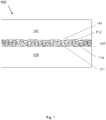
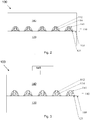
- Figs. 1 -5 illustrate block diagrams of an article with a bonding interface layer comprising polymers and catalytic nanoparticles, arranged in accordance with at least some embodiments of the present disclosure.
- an article 100 may include a thermoplastic 120 coupled to a bonding interface layer 1 10 (see e.g. Figs. 1 and 2 ).
- Bonding interface layer 1 10 may be coupled to a coating 140.
- Thermoplastic 120 may be a sheet of thermoplastic, an inner/outer wall of an article constituted with thermoplastic, or any object or article comprising a thermoplastic.
- thermoplastic 120 may comprise one or more polymers that exhibit leathery, rubbery or viscous flow at temperatures above a glass transition temperature or exhibit viscous flow at temperatures above a melting temperature and/or crystalline melting temperature.
- Thermoplastic 120 may comprise one or more polymers that can be re-melted and/or re-shaped after an initial molding/shaping.
- Thermoplastic 120 may comprise one or more polymers in a semi-crystalline and/or amorphous solid state.
- Thermoplastic 120 may include polypropylene and/or polyether.
- Thermoplastic 120 may be any shape and/or size, and may be configured as a component of an automotive/electronics device/apparatus.
- Bonding interface layer 1 10 may be coupled to thermoplastic 120 and may be further coupled to coating 140.
- the bonding interface layer 1 10 may be a layer of any thickness and may be continuous between thermoplastic 120 and coating 140 (see e.g. Fig. 1 ).
- the bonding interface layer is discontinuous or intermittent between thermoplastic 120 and coating 140 (see e.g. Fig. 2 ).
- thermoplastic 120 and coating 140 may be physically separated by bonding interface layer 1 10.
- thermoplastic 120 and coating 140 may be in direct physical contact and/or directly coupled along an interface 109 with other portions of their surfaces physically separated by bonding interface layer 1 10 and/or catalytic nanoparticles 1 12. Bonding interface layer 110 will be further described below.
- Coating 140 may comprise one or more polymers/copolymers. Coating 140 and/or thermoplastic 120 may further comprise one or more non-polymer chemicals/additives provided to prevent damage from sources such as sunlight/ultraviolet light, mechanical stress, oxidation, heat, etc, to impart a color, scent, flavor, and/or texture, to retard microbial growth, to increase/decrease elasticity, to promote/inhibit adhesion, or to influence any chemical or physical property of a polymer/thermoplastic.
- sources such as sunlight/ultraviolet light, mechanical stress, oxidation, heat, etc, to impart a color, scent, flavor, and/or texture, to retard microbial growth, to increase/decrease elasticity, to promote/inhibit adhesion, or to influence any chemical or physical property of a polymer/thermoplastic.
- thermoplastic 120 may be coupled to bonding interface layer 110 along a first surface 121, and bonding interface layer 110 may be coupled to coating 140 along a second surface 141 (see e.g. Figs. 1-3 ).
- Bonding interface layer 110 may include catalytic nanoparticles 112 embedded and/or encapsulated within polymers 114.
- bonding interface layer 110 may be applied to thermoplastic 120 as a semi-crystalline and/or amorphous solid, while in other embodiments, bonding interface layer 110 may be applied to thermoplastic 120 as a fluid/liquid/suspension/latex.
- coating 140 may be applied to bonding interface layer 110 and thermoplastic 120 as a solid and/or as a fluid/liquid/suspension/latex.
- Catalytic nanoparticles 112 may comprise a catalyst.
- catalytic nanoparticles 112 may be composite nanoparticles comprising a catalyst at least partially encapsulated by one or more polymers.
- a catalyst of catalytic nanoparticles 112 may comprise an oxidizing agent and/or oxidation catalyst, an oxide, a metal, a metal cation, an oxygen anion and/or a metal oxide.
- catalytic nanoparticles 112 may comprise catalysts embedded within one or more polymers.
- catalytic nanoparticles 112 may comprise a catalyst that is not encapsulated/embedded within polymers.
- Catalytic nanoparticles 112 may be partially or completely embedded within one or more polymers 114.
- polymers 114 may comprise one or more radiatively unstable polymers and/or may have one or more unstable radiative characteristics as described above. Polymers 114 may be at least partially degradable by exposure to ionizing radiation, as shown in Figs. 3 and 4 . In some examples, polymers may be at least partially degradable by an ionizing radiation dose of 5kGy or less. In other examples, polymers 114 may be at least partially degraded by an ionizing radiation dose of less than about 10 kGy, less than about 50 kGy, less than about 100 kGy, or less than about 1000 kGy.
- Degradation (in full or in part) of polymers 114 by a suitable ionizing radiation dose may expose catalytic nanoparticles 112 to oxygen, to a surface of thermoplastic 120 and/or to a surface of coating 140.
- Polymers 114 may be arranged on a surface of thermoplastic 120 and/or within bonding interface layer 110 to maximize oxygen permeability of bonding interface layer 110.
- Polymers 114 and/or catalytic nanoparticles 112 may comprise one or more of propylene, ether, polypropylene and/or polyether as one or more copolymers.
- Polymers 114 and/or catalytic nanoparticles 112 may comprise polymers similar to, identical to, and/or suitable for adhesion to both thermoplastic 120 and coating 140.
- each of thermoplastic 120 and coating 140 may comprise at least one of polypropylene and/or polyether, and polymers 114/catalytic nanoparticles 112 may comprise a copolymer that includes both propylene and ether.
- catalytic nanoparticles 112 may be shown in Figs. 1-5 disposed as a single discontinuous layer within bonding interface layer 110, this arrangement is merely an example, and catalytic nanoparticles 112 may also be disposed between thermoplastic 120 and coating 140 in other arrangements such as in a continuous layer, multiple layers, clusters, etc.
- polymers 114 may be shown in Fig. 1 disposed continuously throughout bonding interface layer 110 with catalytic nanoparticles 112 embedded therein, this arrangement is merely an example, and polymers 114 may also be disposed discontinuously within bonding interface layer 110 (see e.g. Figs. 2 and 3 ), in alternate chain orientations, in single or multiple layers, in clusters, etc.
- thermoplastic 120, coating 140 and bonding interface layer 110 may vary among embodiments, and one or more of these components may vary in one or more dimensions such as thickness.
- bonding interface layer 110, thermoplastic 120 and/or coating layer 140 may be less than 100nm thick, 100nm-200nm thick, 100-1000nm thick, etc. Bonding interface layer 110 may be thinner or thicker than bonding interface layer 110 and/or thermoplastic 120.
- catalytic nanoparticles 112 may comprise one or more elements or compounds that participate in oxidation catalysis.
- Catalytic nanoparticles 112 may comprise a metal oxide in one or more forms and/or structures.
- catalytic nanoparticles 112 may include titanium dioxide in one or more forms (e.g. rutile, anatase, brookite, etc.) and/or crystal structures (e.g. monoclinic, orthorhombic, tetragonal, cubic, etc.).
- catalytic nanoparticles 112 may include both anatase and rutile forms of titanium dioxide.
- Catalytic nanoparticles 112 may be spiked/doped with one or more ions, metal oxides or other additives known in the art to influence catalytic activity.
- catalytic nanoparticles 112 may be released from polymers 114 by degradation of polymers 114 as a result of ionizing radiation applied to interface layer 110. Exposure of article 100 to a radiation source 145 may cause degradation of polymers 114 by chain scission and/or other processes described above. Degradation of polymers 114 may release catalytic nanoparticles 112 in bonding interface layer 110.
- Fig. 3 shows partial degradation of polymers 114 from exposure ionizing radiation from a radiation source 145.
- Fig. 4 shows complete degradation of polymers 114 from exposure to ionizing radiation from radiation source 145. In some examples, release of catalytic nanoparticles 112 from polymers 114 may occur as a result of partial degradation of polymers 114.
- thermoplastic 120 and coating 140 may be exposed to heat from a heat source 147 and/or force from a mechanical stress device 149 to initiate or enhance catalytic degradation of bonding interface layer 110 and/or interface 109 (see also Fig. 4 ).
- Catalytic degradation of bonding interface 110 and/or interface 109 may cause or contribute to an adhesive failure between thermoplastic 120 and coating 140 (e.g. at interface 109). Adhesive failure may result in uncoupling/separation of thermoplastic 120 from coating 140.
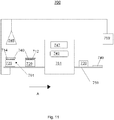
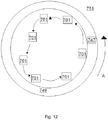
- Heat source 147 and/or mechanical stress device 149 may be components of a separating apparatus 151. Separating apparatus 151 may be a component of a system such as system 700, illustrated in Figs. 11 and 12 .
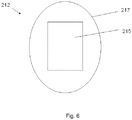
- Fig. 6 illustrates a block diagram of a composite nanoparticle arranged in accordance with at least some embodiments of the present disclosure.
- a composite nanoparticle 212 may include a catalyst 215 at least partially coated by, and/or encapsulated within, polymer 217.
- Polymer 217 may be a single polymer/copolymer or may include two or more polymers/copolymers. Coating/encapsulation of catalyst 215 may occur by any method, including (but not limited to) homogenization, sonication, precipitation, and/or spraying of catalyst 215 with a solution comprising polymer 217 and/or subunits of polymer 217.
- Polymer 217 may comprise one or more radiatively unstable polymers and/or may have one or more unstable radiative characteristics.
- a composite nanoparticle 212 may be at least partially degraded under the conditions described above with regard to polymer 114.
- Polymer 217 of a composite nanoparticle may be at least partially surrounded by polymers 114 as shown in Figs. 1 and 2 .
- Catalyst 215 may comprise any catalyst, metal oxide and/or other element described above in reference to nanoparticles 112.
- polymer 217 and polymers 114 may be degraded by ionizing radiation at the same rate, while in other embodiments polymer 217 and polymers 114 may be degraded by ionizing radiation at different rates.
- polymers 114 may be degraded more rapidly by ionizing radiation than polymer 217, while in another embodiment polymer 217 may be degraded more rapidly by ionizing radiation than polymers 114.
- Catalyst 215 may be a structure with one, two or three dimensions measuring about 100nm or less.
- a composite nanoparticle comprising a catalyst 215 and polymer 217 may be 100nm or less in one, two, or three dimensions.
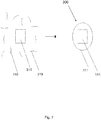
- Fig. 7 illustrates formation of a composite nanoparticle including a catalyst and one or more polymers, in accordance with at least some embodiments of the present disclosure.
- a catalyst 315 may be combined with polymers/monomers 319 to form a composite nanoparticle 300.
- Polymers/monomers 319 may form a polymer shell 317 that partially or fully surrounds/encapsulates catalyst 315, resulting in formation of composite nanoparticle 300.
- Formation of polymer shell 317 and/or encapsulation of catalyst 315 may occur through formation of chemical bonds among polymers/monomers 319 and/or mechanical entanglement of polymers/monomers 319.
- Polymers/monomers 319 may comprise one or more radiatively unstable polymers/copolymers, and polymer shell 317 may be a radiatively unstable polymer shell. Polymers/monomers 319 and/or polymer shell 317 may have one or more unstable radiative characteristics that influence the rate of degradation from exposure to ionizing radiation.
- Composite nanoparticle 300 may be formed by any suitable encapsulation method. Such methods are known in the art and are intended to be encompassed by this Disclosure.
- catalyst 315 may be added to polymers/monomers 319 that are in a fluid/liquid state.
- catalyst 315 and polymers/monomers 319 may be combined in fluid suspension.
- catalyst 315 may be sprayed with a fluid/liquid/suspension comprising polymers/monomers 319, or polymers/monomers 319 may be sprayed with catalyst 315.
- a polymer/monomer 319 may form one or more chemical bonds with, or become mechanically entangled with, another polymer/monomer 319 while in a fluid/liquid state, while in suspension, after addition of a polymerization catalyst, during loss of fluid/water from the fluid/liquid/suspension (e.g. after spraying), and/or through any suitable process known in the art.
- Fig. 8 illustrates a system for application of a coating to a thermoplastic over a bonding interface layer comprising polymers and catalytic nanoparticles, in accordance with at least some embodiments of the present disclosure.
- System 400 may be integrated with other components of a manufacturing system/facility (e.g. auto parts manufacturing facility, plastics manufacturing facility, food/beverage container manufacturing facility, etc.).
- system 400 may be a stand-alone system used for coating thermoplastics.
- a bonding interface layer 410 may be applied to a thermoplastic 420 by spraying.
- polymers 412 and/or catalytic nanoparticles 414 may be applied as a fluid, solid, liquid, suspension and/or latex by any deposition method, including spraying, dip coating, injection molding, powder coating, dip molding, spraying, and/or by any other suitable method known in the art for applying a polymer to a thermoplastic.
- Bonding interface layer 410 may comprise polymers, catalytic nanoparticles embedded within the polymers, and/or composite nanoparticles including a catalyst and polymers, as discussed above.
- One or more polymers of bonding interface layer 410 may be radiatively unstable polymers and/or may have one or more unstable radiative characteristics, as discussed above.
- a coating 440 may be applied over the surface of bonding interface layer 410.
- bonding interface layer 410 may be applied to coating 440 prior to application of bonding interface layer 410 to thermoplastic 420.
- thermoplastic 420 (such as an article, an object, a sheet of thermoplastic, etc.) may be conveyed along a conveyor 450 in the direction of Arrow A.
- thermoplastic 420 may be conveyed by other means or may remain in place during application of bonding interface layer 410 and/or coating 440.
- a conditioning device 460 may be used to prepare thermoplastic 420 for coating.
- Conditioning device 460 may be a cleaning device configured to remove dust or debris from a surface of thermoplastic 420 or an abrasion device configured to increase the surface area of thermoplastic 420 (e.g. for improved adhesion to a coating).
- Conditioning device 460 may comprise a heating/cooling device for bringing a surface of thermoplastic 420 to a temperature suitable for bonding or coating (e.g. heating to a temperature above the glass transition temperature).
- Polymers 412 and catalytic nanoparticles 414 may be applied to thermoplastic 420 by a first applicator 452 in one, two, three or more processes.
- First applicator 452 may be a sprayer, a roller, a dip coating apparatus, or any other device for depositing a substance onto thermoplastic 420.
- first applicator 452 may be a sprayer that sprays polymers 412 before and after spraying catalytic nanoparticles 414.
- first applicator 452 may spray, coat, or otherwise deposit a liquid, solid or semi-solid composition that comprises catalytic nanoparticles 414 and polymers 412 in a single step.
- Polymers 412 and catalytic nanoparticles 414 may form a binding interface layer 410 on a surface of thermoplastic 420.
- First applicator 452 may further comprise a component for curing or hardening binding interface layer 410, such as a UV light source or a heating/cooling device that controls the temperature of the air and/or binding interface 410.
- First applicator 452 may be housed in a separate chamber that may be environmentally controlled, such as for pressure (e.g. vacuum), temperature, dust/debris exclusion, etc.
- a second applicator 454 may be used to apply a coating 440 over binding interface 410.
- Second applicator 454 may be a sprayer, a roller, or any other device for depositing a coating onto a surface.
- second applicator 454 may be at least partially covered along its exterior by a coating substance. The coating substance may be transferred from the surface of the roller to a surface of binding interface 414 through physical contact and/or through gravitational flow of the coating substance down the exterior of the second applicator 454.
- second applicator 454 is shown as a roller, second applicator 454 may also be a dip apparatus, a sprayer, or other device.
- a bonding apparatus 456 may be used to induce or enhance bonding between layers and/or to cure, harden, or stabilize any of the layers.
- Bonding apparatus 456 may comprise a pressure device for applying downward pressure in the direction shown by Arrow B.
- Bonding apparatus 456 may comprise a heating/cooling device, a curing device such as a UV light source, a drying device such as a fan and/or exhaust, or any other suitable device.
- Auxiliary apparatus 462 may also be included within system 400 and may comprise one or more devices for environment control such as a sensor (e.g. temperature sensor, contaminant sensor, humidity sensor, pressure sensor, etc.), a temperature control, a solvent removal device, an air filter, etc.
- Auxiliary apparatus 462 may be in communication with one or more sensors of conveyor 450, conditioning device 460, first applicator 452, second applicator 454, bonding apparatus 456, and/or auxiliary apparatus 462.
- Auxiliary apparatus may comprise a manual control for stopping, starting, or otherwise adjusting operation of any or all components of system 400.
- a controller 458 may be operably coupled to any or all of conveyor 450, conditioning device 460, first applicator 452, second applicator 454, bonding apparatus 456, auxiliary apparatus 462, and/or one or more sensors of any of these components. Controller 458 may automatically control one or more operating conditions/processes automatically. Controller 458 may comprise a computing device (e.g. example computing device of Fig. 9 ) and may be endowed with instructions for controlling any/all components of system 400.
- a computing device e.g. example computing device of Fig. 9
- thermoplastic 420, bonding interface layer 410 and/or coating 440 may be applied to thermoplastic 420, bonding interface layer 410 and/or coating 440 to cause or enhance bonding between two or more layers.
- Suitable techniques may include, but are not limited to, applying heat and/or pressure, flame treatment, plasma treatment, solvent bonding, welding techniques, curing, and/or addition of an adhesion promoter.
- Welding techniques can include, but are not limited to, ultrasonic welding, friction welding, heated tool welding, spin welding, induction welding, radio frequency welding, microwave welding, resistance welding, extrusion welding, electrofusion welding, infrared welding, and/or laser welding.
- One or more layers may be applied and/or bonded to another layer by injection molding, dip coating, powder coating, dip molding, spraying, and/or by any other suitable technique.
- One or more layers may be bonded under environmental conditions such as sub-atmospheric pressure (e.g. vacuum) or high pressure, low humidity, low oxygen/high nitrogen, high/low temperature
- any device, apparatus or combination of devices/apparatuses known in the art for applying a coating to an article or object may be used to apply one or more components of bonding interface layer 410, coating 440 or thermoplastic 420 to any other component or article.
- Such devices/apparatuses may comprise a sprayer, a roller, a wheel applicator, a brush, an extruder, a dip/powder tank, a press, a mold and/or injection molding apparatus, a tumbler, a conveyor, a heat source, a radiation/light source, a welder, and/or any other device or apparatus for use in practicing any of the techniques listed above.
- Devices suitable for applying stress, pressure, force, and/or heat to an article may also be used for bonding one or more components of bonding interface layer 410, coating 440 or thermoplastic 420 to any of these layers.
- Fig. 9 illustrates a block diagram of a computing device configured in accordance with the present disclosure.
- a computing device may be used to control one or more components of system 400, illustrated in Fig. 8 , as further described below.
- Alternatively, such a computing device may be used to control one or more components of system 700, as shown in Fig. 11 .
- computing device 500 typically includes one or more processors 510 and system memory 520.
- a memory bus 530 may be used for communicating between the processor 510 and the system memory 520.
- processor 510 may be of any type including but not limited to a microprocessor ( ⁇ P), a microcontroller ( ⁇ C), a digital signal processor (DSP), or any combination thereof.
- Processor 510 may include one more levels of caching, such as a level one cache 511 and a level two cache 512, a processor core 513, and registers 514.
- An example processor core 513 may include an arithmetic logic unit (ALU), a floating point unit (FPU), a digital signal processing core (DSP Core), or any combination thereof.
- An example memory controller 515 may also be used with the processor 510, or in some implementations the memory controller 515 may be an internal part of the processor 510.
- system memory 520 may be of any type including but not limited to volatile memory (such as RAM), non-volatile memory (such as ROM, flash memory, etc.) or any combination thereof.
- System memory 520 may include an operating system 521, one or more applications 522, and program data 524.
- Application 522 may include control logic 523 to assist in practicing one or more aspects of one or more methods of the present disclosure for controlling, coordinating, and/or synchronizing components of a system for coating a thermoplastic (e.g. system 400, Fig. 8 ), such as conveyor 450, conditioning device 460, first applicator 452, second applicator 454, bonding apparatus 456, auxiliary apparatus 462, and/or one or more sensors of any of these components.
- a thermoplastic e.g. system 400, Fig. 8
- Application 522 may include control logic 523 configured to assist, but not limited to, in controlling environmental conditions such as air pressure, temperature, oxygen/nitrogen levels, humidity, etc.
- Program Data 524 may include control data 525.
- Control data 525 may comprise data created and/or otherwise used by control logic 523 to assist in practicing one or more aspects of one or more methods of the present disclosure.
- Computing device 500 may have additional features or functionality, and additional interfaces to facilitate communications between the basic configuration 501 and any required devices and interfaces.
- a bus/interface controller 540 may be used to facilitate communications between the basic configuration 501 and one or more data storage devices 550 via a storage interface bus 541.
- the data storage devices 550 may be removable storage devices 551, non-removable storage devices 552, or a combination thereof.
- Examples of removable storage and non-removable storage devices include magnetic disk devices such as flexible disk drives and hard-disk drives (HDD), optical disk drives such as compact disk (CD) drives or digital versatile disk (DVD) drives, solid state drives (SSD), and tape drives to name a few.
- Example computer storage media may include volatile and nonvolatile, removable and non-removable media implemented in any method or technology for storage of information, such as computer readable instructions, data structures, program modules, or other data.
- Computer storage media can include, but is not limited to, RAM, ROM, EEPROM, flash memory or other memory technology, CD-ROM, digital versatile disks (DVD) or other optical storage, magnetic cassettes, magnetic tape, magnetic disk storage or other magnetic storage devices, or any other medium which may be used to store the desired information and which may be accessed by computing device 500. Any such computer storage media may be part of device 500.
- Computing device 500 may also include an interface bus 542 for facilitating communication from various interface devices (e.g., output interfaces, peripheral interfaces, communication interfaces) to the basic configuration 501 via the bus/interface controller 540.
- Example output devices 560 include a graphics processing unit 561 and an audio processing unit 562, which may be configured to communicate to various external devices, such as a display or a speaker, via one or more A/V ports 563.
- Example peripheral interfaces 570 may include a serial interface controller 571 or a parallel interface controller 572, which may be configured to communicate with external devices such as input devices (e.g., keyboard, mouse, pen, voice input device, touch input device, etc.) or other peripheral devices (e.g., a printer, a scanner, conveyor 450, conditioning device 460, first applicator 452, second applicator 454, bonding apparatus 456, auxiliary apparatus 462, and/or one or more sensors of any of these components) via one or more I/O ports 573.
- An example communication device 580 may include a network controller 581, which may be arranged to facilitate communications with one or more other computing devices 590 over a network communication link via one or more communication ports 582.
- the network communication link may be one example of a communication media.
- Communication media may typically be embodied by computer readable instructions, data structures, program modules, or other data in a modulated data signal, such as a carrier wave or other transport mechanism, and may include any information delivery media.
- a "modulated data signal" may be a signal that has one or more of its characteristics set or changed in such a manner as to encode information in the signal.
- communication media may include wired media such as a wired network or direct-wired connection, and wireless media such as acoustic, radio frequency (RF), microwave, infrared (IR) and other wireless media.
- RF radio frequency
- IR infrared
- the term computer readable media as used herein may include both storage media and communication media.
- Computing device 500 may be implemented as a portion of, any of the above functions.
- Computing device 500 may also be implemented as a personal computer including both laptop computer and non-laptop computer configurations, an application specific device, and/or a hybrid device.
- Computing device 500 may include one or more functions of a small-form factor portable (or mobile) electronic device such as a cell phone, a personal data assistant (PDA), a personal media player device, a wireless web-watch device, or a personal headset device.
- PDA personal data assistant
- Fig. 10 illustrates a flow chart of a coating method including application of a bonding interface layer and a coating layer to a thermoplastic in accordance with at least some embodiments of the present disclosure.
- Devices, apparatuses, techniques, materials and processes shown in Figs. 1-9 and described in the accompanying text of the specification may be used to perform method 600.
- Method 600 illustrates one or more operations, functions, or actions as illustrated by one or more of blocks 601, 603, 605, 607 and/or 609. It will also be appreciated that in some examples various blocks may be eliminated, divided into additional blocks, and/or combined with other blocks. Processing for method 600 may start at block 601.
- processing may comprise "Prepare a thermoplastic for application of a bonding interface layer to a surface of the thermoplastic.”
- a thermoplastic may be prepared for application of a bonding interface layer as described above.
- a thermoplastic can include a thermoplastic article or object, a sheet of thermoplastic, an outer wall of an article where the outer wall is constituted with thermoplastic, or any other thermoplastic item.
- Preparing a thermoplastic may include applying heat and/or pressure, cleaning the thermoplastic, abrading a surface of the thermoplastic, applying a solvent, and/or altering one or more environmental conditions.
- method 600 may begin at block 603 without the preparation of block 601.
- method 600 may proceed to block 603, "Apply catalytic nanoparticles and polymers to the thermoplastic surface, wherein the polymers have an unstable radiative characteristic to facilitate removal of the coating through degradation of the bonding interface using at least in part a radiative process.”
- catalytic nanoparticles and polymers may be applied separately or as an integrated substance, and may be applied as one or more solids, fluidized solids or semi-solids (e.g. powders, gels, pastes) or fluid layers.
- Application of catalytic nanoparticles and polymers may proceed as a single process or as two, three or more sequential or simultaneous processes.
- Catalytic nanoparticles and polymers may be applied by spraying (see e.g. Fig.
- the catalytic nanoparticles may be embedded/encapsulated within the polymers on a surface of the thermoplastic, forming a bonding interface layer.
- Polymers applied with catalytic nanoparticles at block 603 may be susceptible to degradation through application of ionizing radiation, as illustrated in Figs. 3 and 4 .
- method 600 may proceed to block 605, "Prepare the bonding interface layer and/or thermoplastic for application of a coating to the bonding interface layer and/or thermoplastic.”
- the bonding interface layer and/or thermoplastic may be processed as described above with reference to Fig. 8 .
- method 600 may proceed from block 603 to block 607 without the processing of block 605.
- method 600 may proceed to block 607, "Apply the coating over the bonding interface layer.”
- a coating may be applied as described with reference to Fig. 8 .
- the coating may be applied to the surface of the bonding interface layer/thermoplastic to protect the thermoplastic, wherein the polymers have an unstable radiative characteristic to facilitate removal of the coating through breaking down of the bonding interface using at least in part a radiative process (see e.g. Figs. 3-5 ).
- Figs. 11-12 illustrate a system for removal of a coating from a thermoplastic, in accordance with at least some embodiments of the present disclosure.
- System 700 may be integrated with other components of a system/facility (e.g. recycling facility, plastics recycling facility, manufacturing facility, etc.).
- system 700 may be a stand-alone system for removing coatings from thermoplastics.
- an article 701 comprising thermoplastic 720, polymers 714, catalytic nanoparticles 712, and a coating 740 may be conveyed along a conveyor 750 in the direction indicated by Arrow A.
- Article 701 may be exposed to ionizing radiation from a radiation source 745.
- Polymers 714 may be radiatively unstable such that they may be degraded by application of ionizing radiation.
- article 701 may be exposed to ionizing radiation source 745, which may emit gamma radiation and/or e-beam radiation.
- Exposure of article 701 to ionizing radiation from ionizing radiation source 745 may cause degradation of polymers 714 that surround/encapsulate catalytic nanoparticles 712 (see e.g. Figs. 3 and 4 ). Degradation of polymers 714 may release catalytic nanoparticles 712 between coating 740 and thermoplastic 720. Emission of ionizing radiation from ionizing radiation source 745 and/or exposure time of an article to ionizing radiation source 745 may be increased, decreased, and/or adjusted based dimensions and/or composition of article 701.
- article 701 may be conveyed along conveyor 750 to engage a separation apparatus 751.
- Separation apparatus 751 may comprise one or more of a heat source 747 and/or mechanical stress device 749.
- Mechanical stress device 749 may apply mechanical stress to article 701 by inducing motion and/or vibration, applying force or pressure, tumbling, or otherwise physically manipulating article 701.
- separation apparatus 751 may apply a combination of heat and mechanical stress to thermoplastic 720 and/or coating 740 to promote/enhance catalytic degradation of an interface by catalytic nanoparticles 712, also shown in Fig. 5 .
- Thermoplastic 720 and/or coating 740 may be heated by heat source 747 to a temperature below the glass transition state temperature of the thermoplastic/coating.
- Mechanical force may be applied by separation apparatus 751 in the form of collisions between an article and a surface of mechanical stress device 749 and/or collisions between two or more articles within mechanical stress device 749. The collisions may push, pull, press, stretch, twist, bend, or otherwise manipulate the article, enhancing catalytic degradation of the interface between thermoplastic 720 and coating 740 by catalytic nanoparticles 712.
- Fig. 12 illustrates a block diagram of a separation apparatus 751 comprising a mechanical stress device 749 and a heat source 747, in accordance with some embodiments of the present disclosure.
- Mechanical stress device 749 may comprise a rotary drum or tumbler, a wet sonication device, a dry sonication device, a vibration-inducing device, a shaker, or an agitator.
- An article 701 comprising a thermoplastic, bonding interface layer and a coating may be tumbled in mechanical stress device 749 in a direction of rotation indicated by Arrow A. As article 701 is tumbled in mechanical stress device 749, article 701 collides with interior surfaces and/or other articles 701.
- Heat source 747 may heat an interior area of mechanical stress device 749 and/or article 701.
- mechanical stress device 749 may not include a heat source 747, or heat source 747 may apply heat before/after rotation of mechanical stress device 749.
- Mechanical stress device 749 may instead apply downward, lateral, upward, oblique, and/or shear forces to article 701, such as by repetitive applications of a movable part against article 701.
- mechanical stress device 749 may apply force against article 701 using sound waves, a pressurized fluid, sliding/rotating compression, or other means of inducing mechanical stress.
- Coating 740 and/or thermoplastic 720 may exit separation apparatus 751 individually after they are uncoupled, as shown. Uncoupled coating 740 and/or thermoplastic 720 may be sorted or removed from separation apparatus 751 according to weight, shape, size, or any other property. Coating 740 and/or thermoplastic 720 may exit separation apparatus 751 on conveyor 750. Coating 740 and/or thermoplastic 720 may be subsequently processed for recycling/reuse.
- a controller 759 may be operably coupled to any or all of ionizing radiation source 745, separation apparatus 751, heat source 747, mechanical stress device 749, conveyor 750, and/or one or more sensors of any of these components. Controller 759 may automatically control one or more of the described operations, conditions or processes automatically.
- Controller 759 may comprise a computing device and may be endowed with instructions for controlling any/all components of system 700.
- a controller 759 may comprise a computing device essentially as illustrated in Fig. 9 .
- a computing device 500 of a controller 759 may comprise a system memory 520 with an operating system 521, one or more applications 522, and program data 524.
- Application 522 may include control logic 523 to implement one or more algorithms for controlling, coordinating, and/or synchronizing components of system 700, such as ionizing radiation source 745, separation apparatus 751, heat source 747, mechanical stress device 749, conveyor 750, and/or one or more sensors of any of these components.
- Application 522 may include control logic 523 to implement one or more algorithms for controlling environmental conditions such as air pressure, temperature, oxygen/nitrogen levels, humidity, etc. Algorithms may include algorithms for implementing a separation method such as the method illustrated in Fig. 13 .
- Program Data 524 may include control data 525. Control data 525 may comprise data for implementing one or more of the algorithms described above.
- Example peripheral interfaces 570 may include a serial interface controller 571 or a parallel interface controller 572, which may be configured to communicate with external devices such as input devices (e.g., keyboard, mouse, pen, voice input device, touch input device, etc.) or other peripheral devices (e.g., a printer, a scanner, ionizing radiation source 745, separation apparatus 751, heat source 747, mechanical stress device 749, conveyor 750, and/or one or more sensors of any of these components) via one or more I/O ports 573.
- input devices e.g., keyboard, mouse, pen, voice input device, touch input device, etc.
- other peripheral devices e.g., a printer, a scanner, ionizing radiation source 745, separation apparatus 751, heat source 747, mechanical stress device 749, conveyor 750, and/or one or more sensors of any of these components
- I/O ports 573 e.g., printer, a scanner, ionizing radiation source 745, separation apparatus 751, heat source 747, mechanical
- Fig. 13 illustrates a flow chart of a coating removal method for removing a coating from a thermoplastic in accordance with at least some embodiments of the present disclosure.
- Devices, apparatuses, techniques, materials and processes shown in Figs. 1-5 , 9 , 11 and 12 and described in the accompanying text of the specification may be used to perform method 800.
- Method 800 illustrates one or more operations, functions, or actions as illustrated by one or more of blocks 801, 803, and/or 805. It will also be appreciated that in some examples various blocks may be eliminated, divided into additional blocks, and/or combined with other blocks. Processing for method 800 may start at block 801.
- processing may comprise "Apply ionizing radiation to an article comprising an interface layer disposed between a thermoplastic and a coating, the interface layer comprising catalytic nanoparticles and polymers, wherein the polymers have one or more radiatively unstable characteristics, and wherein the application of ionizing radiation to the interface layer causes degradation of the polymers and/or release of the catalytic nanoparticles.”
- ionizing radiation may be applied to an article comprising a coating layer, a bonding interface layer and a thermoplastic, the bonding interface layer being disposed between and coupled to the thermoplastic surface and the coating layer as shown in Figs. 3 , 4 and 11 .
- method 900 may proceed to block 803, "Apply at least one of heat and/or mechanical force to the article to enhance catalytic degradation of an interface between the thermoplastic and the coating by the catalytic nanoparticles, the catalytic degradation and application of heat and/or mechanical force causing separation of the thermoplastic and the coating.”
- heat and/or mechanical force may be applied to the article as described with reference to Figs. 5 , 11 and 12 .
- Mechanical force may be used at block 803 to push, pull, press, stretch, twist, bend, or otherwise physically manipulate an article in any suitable manner to promote/enhance catalytic degradation and/or to separate the coating layer from the thermoplastic surface.
- Heat may be applied to the thermoplastic surface, coating layer, and/or bonding interface layer to promote/enhance catalytic degradation and/or to separate the coating layer from the thermoplastic surface.
- Any or all of the components of the article, including the thermoplastic surface, coating layer and/or bonding interface layer, may be heated to a temperature that is below a glass transition temperature for the article/component(s).
- the thermoplastic layer may become uncoupled from the coating layer as shown in Fig. 11 .
- method 800 may proceed to block 805, "Process the thermoplastic and the coating separately"
- the coating layer may be processed separately from the thermoplastic surface, and the coating layer and the thermoplastic surface may be recycled and/or disposed of separately.
- a computing system may be employed to initiate, monitor, regulate and/or otherwise control performance of one or more steps of methods as disclosed herein.
- any two components so associated may also be viewed as being “operably connected”, or “operably coupled”, to each other to achieve the desired functionality, and any two components capable of being so associated may also be viewed as being “operably couplable”, to each other to achieve the desired functionality.
- operably couplable include but are not limited to physically mateable and/or physically interacting components and/or wirelessly interactable and/or wirelessly interacting components and/or logically interacting and/or logically interactable components.
Landscapes
- Chemical & Material Sciences (AREA)
- Organic Chemistry (AREA)
- Engineering & Computer Science (AREA)
- Wood Science & Technology (AREA)
- Materials Engineering (AREA)
- Life Sciences & Earth Sciences (AREA)
- Medicinal Chemistry (AREA)
- Polymers & Plastics (AREA)
- Chemical Kinetics & Catalysis (AREA)
- Health & Medical Sciences (AREA)
- Inorganic Chemistry (AREA)
- General Chemical & Material Sciences (AREA)
- Nanotechnology (AREA)
- Laminated Bodies (AREA)
- Application Of Or Painting With Fluid Materials (AREA)
- Coating Of Shaped Articles Made Of Macromolecular Substances (AREA)
- Treatments Of Macromolecular Shaped Articles (AREA)
- Paints Or Removers (AREA)
- Separation, Recovery Or Treatment Of Waste Materials Containing Plastics (AREA)
Claims (11)
- Verfahren zum Beschichten einer thermoplastischen Oberfläche eines Herstellungsgegenstandes, wobei das Verfahren umfasst:Aufbringen einer diskontinuierlichen Bindungszwischenschicht auf die thermoplastische Oberfläche, wobei die Bindungszwischenschicht Polymere umfasst, in die katalytische Nanopartikel eingebettet sind; undAufbringen einer Beschichtung auf die Bindungszwischenschicht, wobei die Polymere eine instabile Bestrahlungseigenschaft besitzen, um das Entfernen der Beschichtung durch Abbau der Bindungszwischenschicht durch Verwenden zumindest zum Teil eines Bestrahlungsprozesses zu ermöglichen.
- Das Verfahren nach Anspruch 1, wobei die katalytischen Nanopartikel 100 nm in mindestens einer Dimension nicht überschreiten.
- Das Verfahren nach Anspruch 1, wobei die katalytischen Nanopartikel mindestens eines der folgenden umfassen: ein Oxidationsmittel, ein Metalloxid, einen Katalysator.
- Das Verfahren nach Anspruch 1, wobei das Aufbringen der diskontinuierlichen Bindungszwischenschicht umfasst:Besprühen des Thermoplasten mit einer Flüssigkeit und/oder eines Latex, wobei die Flüssigkeit und/oder das Latex mindestens eines der folgenden umfassen: die Polymere und/oder die katalytischen Nanopartikel;Nachträgliches Auftragen der Polymere und der katalytischen Nanopartikel, wobei die katalytischen Nanopartikel einen Katalysator umfassen;Auftragen einer Polypropylen- oder Polyetherbindungszwischenschicht; oderAuftragen der diskontinuierlichen Bindungszwischenschicht als eine feste oder semifeste Zusammensetzung, umfassend mindestens eines der folgenden: die Polymere und/oder die katalytischen Nanopartikel.
- Das Verfahren nach Anspruch 1, wobei das Auftragen der Beschichtung das Besprühen der diskontinuierlichen Bindungszwischenschicht mit einer Flüssigkeit, umfassend mindestens eine Komponente der Beschichtung, umfasst.
- Verfahren zum Entfernen einer Beschichtung von einem Herstellungsgegenstand, wobei das Verfahren umfasst:Auftragen von ionisierender Strahlung auf den Herstellungsgegenstand, wobei der Gegenstand eine Beschichtungsschicht, eine thermoplastische Oberfläche und eine diskontinuierliche Bindungszwischenschicht umfasst, wobei die diskontinuierliche Bindungszwischenschicht zwischen der thermoplastischen Oberfläche und der Beschichtungsschicht angeordnet und daran gekoppelt ist, wobei die diskontinuierliche Bindungszwischenschicht strahlungsinstabile Polymere und katalytische Nanopartikel umfasst, die in den strahlungsinstabilen Polymeren eingebettet sind, und wobei die Auftragung der ionisierenden Strahlung die Freisetzung der katalytischen Nanopartikel aus den bestrahlungsinstabilen Polymeren an der Bindungszwischenschicht des Gegenstands ermöglicht; undAuftragen von einem oder mehr von Hitze und/oder Kraft auf den Gegenstand, um katalytischen Abbau der Bindungszwischenschicht des Gegenstands zu verbessern.
- Das Verfahren nach Anspruch 6, wobei das Auftragen von einem oder mehr von Hitze oder Kraft umfasst:Auftragen von Kraft auf den Gegenstand entlang einer Ebene der diskontinuierlichen Bindungszwischenschicht des Gegenstands;Auftragen von Hitze und Kraft auf den Gegenstand; und/oderwobei das Auftragen von ionisierender Strahlung das Auftragen von einem, ausgewählt aus Gammastrahlung oder Elektronenstrahlung, auf den Gegenstand umfasst.
- Das Verfahren nach Anspruch 6, weiter umfassend das Abkoppeln der Beschichtungsschicht von der thermoplastischen Oberfläche des Gegenstands.
- Thermoplastischer Herstellungsgegenstand mit einer entfernbaren Beschichtung, wobei der thermoplastische Gegenstand umfasst:eine thermoplastische Oberfläche, umfassend ein erstes Polymer;eine Beschichtungsschicht, umfassend ein zweites Polymer; undeine diskontinuierliche Bindungszwischenschicht, umfassend katalytische Nanopartikel und ein oder mehrere strahlungsinstabile Polymere, ausgebildet um das Entfernen der Beschichtungsschicht zu ermöglichen, wobei die diskontinuierliche Bindungszwischenschicht an der thermoplastischen Oberfläche und der Beschichtungsschicht des thermoplastischen Gegenstands gekoppelt und dazwischen angeordnet ist.
- Der Gegenstand nach Anspruch, wobei die katalytischen Nanopartikel in den strahlungsinstabilen Polymeren eingebettet sind, oder
wobei die katalytischen Nanopartikel ein katalytisches Element umfassen, eingekapselt in einem oder mehreren der strahlungsinstabilen Polymere und/oder
wobei die strahlungsinstabilen Polymere ein oder mehr von Polypropylen und/oder Polyether umfassen. - Der Gegenstand nach Anspruch 9, wobei der Katalysator eines oder mehr der folgenden umfasst: ein Metall, ein Metalloxid, und/oder ein Oxidationsmittel.
Applications Claiming Priority (2)
| Application Number | Priority Date | Filing Date | Title |
|---|---|---|---|
| US12/618,670 US8580337B2 (en) | 2009-11-13 | 2009-11-13 | Thermoplastic coating and removal using bonding interface with catalytic nanoparticles |
| PCT/US2010/052519 WO2011059625A1 (en) | 2009-11-13 | 2010-10-13 | Thermoplastic coating and removal using bonding interface with catalytic nanoparticles |
Publications (3)
| Publication Number | Publication Date |
|---|---|
| EP2499204A1 EP2499204A1 (de) | 2012-09-19 |
| EP2499204A4 EP2499204A4 (de) | 2013-12-25 |
| EP2499204B1 true EP2499204B1 (de) | 2017-11-22 |
Family
ID=43991935
Family Applications (1)
| Application Number | Title | Priority Date | Filing Date |
|---|---|---|---|
| EP10830395.9A Not-in-force EP2499204B1 (de) | 2009-11-13 | 2010-10-13 | Thermoplastische beschichtung und deren entfernung mithilfe einer bindungsschnittstelle mit katalytischen nanopartikeln |
Country Status (5)
| Country | Link |
|---|---|
| US (2) | US8580337B2 (de) |
| EP (1) | EP2499204B1 (de) |
| JP (1) | JP5793503B2 (de) |
| CN (1) | CN102666739B (de) |
| WO (1) | WO2011059625A1 (de) |
Cited By (1)
| Publication number | Priority date | Publication date | Assignee | Title |
|---|---|---|---|---|
| EP3666657B1 (de) * | 2018-12-16 | 2023-01-25 | Goodrich Corporation | Enteiser mit selektiv schmelzbarem klebstoff |
Families Citing this family (10)
| Publication number | Priority date | Publication date | Assignee | Title |
|---|---|---|---|---|
| US8580337B2 (en) | 2009-11-13 | 2013-11-12 | Empire Technology Development Llc | Thermoplastic coating and removal using bonding interface with catalytic nanoparticles |
| US9090114B1 (en) * | 2010-09-08 | 2015-07-28 | Brian A Stumm | Machine including LED-based UV radiation sources to process coatings |
| CN103702828B (zh) * | 2011-08-10 | 2016-01-27 | 英派尔科技开发有限公司 | 具有可去除涂层的涂布的热塑性制品 |
| WO2013147876A1 (en) * | 2012-03-30 | 2013-10-03 | Empire Technology Development Llc | Degradable polymers |
| US20150132592A1 (en) | 2013-11-08 | 2015-05-14 | Ppg Industries Ohio, Inc. | Curable film-forming compositions comprising catalyst associated with a carrier and methods for coating a substrate |
| US9587076B2 (en) | 2014-09-23 | 2017-03-07 | The Boeing Company | Polymer nanoparticles for controlling resin reaction rates |
| US10347667B2 (en) * | 2017-07-26 | 2019-07-09 | International Business Machines Corporation | Thin-film negative differential resistance and neuronal circuit |
| IL279604B2 (en) | 2018-06-22 | 2025-09-01 | Avava Inc | Selective tissue treatment device |
| CN110252399A (zh) * | 2019-06-11 | 2019-09-20 | 上海大学 | 聚合物载体负载型催化剂复合材料、其应用及制备方法 |
| CN113336927B (zh) * | 2021-06-21 | 2022-05-17 | 中国科学院大连化学物理研究所 | 一种聚酯的制备方法 |
Family Cites Families (18)
| Publication number | Priority date | Publication date | Assignee | Title |
|---|---|---|---|---|
| US3349018A (en) * | 1963-10-28 | 1967-10-24 | Union Carbide Corp | Controllable degradation of alpha-olefin polymers using irradiation |
| US3766031A (en) * | 1972-04-10 | 1973-10-16 | Garlock Inc | Process for non-destructive radiation degradation of polytetrafluoroethylene |
| US5248326A (en) * | 1991-03-28 | 1993-09-28 | Himont Incorporated | Method of treating propylene polymer-containing disposable products after use, and product of enhanced compostability made thereby |
| US7534498B2 (en) * | 2002-06-03 | 2009-05-19 | 3M Innovative Properties Company | Laminate body, method, and apparatus for manufacturing ultrathin substrate using the laminate body |
| US7474919B2 (en) * | 2002-08-29 | 2009-01-06 | The Regents Of The University Of Michigan | Laser-based method and system for enhancing optical breakdown |
| JP2004253482A (ja) | 2003-02-18 | 2004-09-09 | Dainippon Printing Co Ltd | 機能性素子の製造方法 |
| US7671109B2 (en) | 2003-06-24 | 2010-03-02 | Ppg Industries Ohio, Inc. | Tinted, abrasion resistant coating compositions and coated articles |
| US6984262B2 (en) | 2003-07-16 | 2006-01-10 | Transitions Optical, Inc. | Adhesion enhancing coating composition, process for using and articles produced |
| US7704754B2 (en) * | 2004-01-27 | 2010-04-27 | American Environmental Systems, Inc. | Method of plasmon-enhanced properties of materials and applications thereof |
| US20070062643A1 (en) * | 2003-09-12 | 2007-03-22 | Yoshihiko Watanabe | Method of separating adhesive-bonded body |
| US7174919B2 (en) | 2003-10-20 | 2007-02-13 | Metaldyne Company, Llc | Flow redirection member and method of manufacture |
| WO2006008518A1 (en) | 2004-07-23 | 2006-01-26 | Cpfilms Inc. | A film having an electrically conductive coating |
| JP4843234B2 (ja) * | 2005-03-14 | 2011-12-21 | 株式会社リコー | 被記録材の画像形成物質除去装置 |
| US20070141114A1 (en) | 2005-12-15 | 2007-06-21 | Essilor International Compagnie Generale D'optique | Article coated with an ultra high hydrophobic film and process for obtaining same |
| JP5276792B2 (ja) | 2006-03-03 | 2013-08-28 | 株式会社半導体エネルギー研究所 | 半導体装置の作製方法 |
| US8709141B2 (en) | 2007-03-02 | 2014-04-29 | Ppg Industries Ohio, Inc. | Heat releasable composite coatings and related methods |
| US20110111002A1 (en) * | 2009-11-12 | 2011-05-12 | Calin Viorel Pop | Transport and delivery of glutathione into human cells using gold nanoparticles |
| US8580337B2 (en) | 2009-11-13 | 2013-11-12 | Empire Technology Development Llc | Thermoplastic coating and removal using bonding interface with catalytic nanoparticles |
-
2009
- 2009-11-13 US US12/618,670 patent/US8580337B2/en not_active Expired - Fee Related
-
2010
- 2010-10-13 EP EP10830395.9A patent/EP2499204B1/de not_active Not-in-force
- 2010-10-13 JP JP2012538828A patent/JP5793503B2/ja not_active Expired - Fee Related
- 2010-10-13 WO PCT/US2010/052519 patent/WO2011059625A1/en not_active Ceased
- 2010-10-13 CN CN201080058899.2A patent/CN102666739B/zh not_active Expired - Fee Related
-
2013
- 2013-10-07 US US14/047,544 patent/US9481160B2/en not_active Expired - Fee Related
Non-Patent Citations (1)
| Title |
|---|
| None * |
Cited By (1)
| Publication number | Priority date | Publication date | Assignee | Title |
|---|---|---|---|---|
| EP3666657B1 (de) * | 2018-12-16 | 2023-01-25 | Goodrich Corporation | Enteiser mit selektiv schmelzbarem klebstoff |
Also Published As
| Publication number | Publication date |
|---|---|
| EP2499204A4 (de) | 2013-12-25 |
| CN102666739A (zh) | 2012-09-12 |
| US20110114260A1 (en) | 2011-05-19 |
| US20140034247A1 (en) | 2014-02-06 |
| CN102666739B (zh) | 2014-12-31 |
| US8580337B2 (en) | 2013-11-12 |
| EP2499204A1 (de) | 2012-09-19 |
| US9481160B2 (en) | 2016-11-01 |
| JP5793503B2 (ja) | 2015-10-14 |
| JP2013510708A (ja) | 2013-03-28 |
| WO2011059625A1 (en) | 2011-05-19 |
Similar Documents
| Publication | Publication Date | Title |
|---|---|---|
| EP2499204B1 (de) | Thermoplastische beschichtung und deren entfernung mithilfe einer bindungsschnittstelle mit katalytischen nanopartikeln | |
| JP6058783B2 (ja) | 電池電極又はセパレーターコーティング膜組成物、これを用いて得られるコーティング膜を有する電池電極又はセパレーター、及びこの電池電極又はセパレーターを有する電池 | |
| JP4365826B2 (ja) | ガスバリア性積層体および包装体ならびにガスバリア性積層体の製造方法 | |
| CN112739722B (zh) | 纳米纤维素及其生产方法 | |
| CN104093560B (zh) | 薄膜层叠体 | |
| CN113661046A (zh) | 零件的共反应性三维打印 | |
| CN100408184C (zh) | 光催化材料 | |
| CN101990495B (zh) | 阻气性积层体及其制备方法 | |
| EP2014730A1 (de) | Beschichtungsflüssigkeit, sie jeweils enthaltender gasbarrierefilm, gasbarriereverbund und gasbarrieremehrschichtfilm sowie deren herstellungsverfahren | |
| JP2011194653A (ja) | 防湿性積層体 | |
| JP2022168190A (ja) | 積層体 | |
| WO2013022448A1 (en) | Coated thermoplastic articles with removable coating | |
| JP2023168376A (ja) | 積層基材、包装材料用積層体および包装材料 | |
| JP7238297B2 (ja) | 包装材料用積層体及び包装材料 | |
| JP5832298B2 (ja) | ガスバリア性膜及び積層体 | |
| JP5845676B2 (ja) | ガスバリア性フィルムの製造方法 | |
| JP3590933B2 (ja) | 熱硬化性塗膜の剥離方法 | |
| KR20130124601A (ko) | 광촉매 코팅한 플라스틱 제조 방법 | |
| CN1886254A (zh) | 气体阻挡膜 | |
| JP5659538B2 (ja) | インキ組成物及びこれを用いた加飾シート | |
| JP2002298648A (ja) | 導電性光硬化性樹脂組成物、導電性光硬化性シートおよび導電性インサート成形品 | |
| JP4754383B2 (ja) | ラミネートチューブ容器 | |
| JP2013237271A (ja) | ガスバリア性積層フィルム | |
| EP3831601A1 (de) | Mehrschichtiger körper | |
| JP5375014B2 (ja) | ガスバリア性積層フィルム |
Legal Events
| Date | Code | Title | Description |
|---|---|---|---|
| PUAI | Public reference made under article 153(3) epc to a published international application that has entered the european phase |
Free format text: ORIGINAL CODE: 0009012 |
|
| 17P | Request for examination filed |
Effective date: 20120514 |
|
| AK | Designated contracting states |
Kind code of ref document: A1 Designated state(s): AL AT BE BG CH CY CZ DE DK EE ES FI FR GB GR HR HU IE IS IT LI LT LU LV MC MK MT NL NO PL PT RO RS SE SI SK SM TR |
|
| DAX | Request for extension of the european patent (deleted) | ||
| A4 | Supplementary search report drawn up and despatched |
Effective date: 20131127 |
|
| RIC1 | Information provided on ipc code assigned before grant |
Ipc: C08J 7/04 20060101ALI20131121BHEP Ipc: C09D 123/10 20060101ALI20131121BHEP Ipc: C08K 3/22 20060101ALN20131121BHEP Ipc: C09D 5/20 20060101AFI20131121BHEP Ipc: C08L 101/12 20060101ALI20131121BHEP Ipc: C08K 3/08 20060101ALI20131121BHEP Ipc: C09D 7/12 20060101ALI20131121BHEP Ipc: C08L 71/00 20060101ALI20131121BHEP Ipc: C08K 9/08 20060101ALN20131121BHEP Ipc: C08J 7/12 20060101ALI20131121BHEP Ipc: C08J 11/00 20060101ALI20131121BHEP Ipc: C08L 23/10 20060101ALI20131121BHEP Ipc: C09D 5/00 20060101ALI20131121BHEP |
|
| STAA | Information on the status of an ep patent application or granted ep patent |
Free format text: STATUS: EXAMINATION IS IN PROGRESS |
|
| 17Q | First examination report despatched |
Effective date: 20170227 |
|
| REG | Reference to a national code |
Ref country code: DE Ref legal event code: R079 Ref document number: 602010046948 Country of ref document: DE Free format text: PREVIOUS MAIN CLASS: C09D0005000000 Ipc: C09D0005200000 |
|
| RIC1 | Information provided on ipc code assigned before grant |
Ipc: C09D 5/00 20060101ALI20170412BHEP Ipc: C09D 7/12 20060101ALI20170412BHEP Ipc: C08J 11/00 20060101ALI20170412BHEP Ipc: C08L 23/10 20060101ALI20170412BHEP Ipc: C09D 5/20 20060101AFI20170412BHEP Ipc: C08J 7/04 20060101ALI20170412BHEP Ipc: C08L 71/00 20060101ALI20170412BHEP Ipc: C08L 101/12 20060101ALI20170412BHEP Ipc: C08K 9/08 20060101ALN20170412BHEP Ipc: C08K 3/22 20060101ALN20170412BHEP Ipc: C09D 123/10 20060101ALI20170412BHEP Ipc: C08K 3/08 20060101ALI20170412BHEP Ipc: C08J 7/12 20060101ALI20170412BHEP |
|
| GRAP | Despatch of communication of intention to grant a patent |
Free format text: ORIGINAL CODE: EPIDOSNIGR1 |
|
| STAA | Information on the status of an ep patent application or granted ep patent |
Free format text: STATUS: GRANT OF PATENT IS INTENDED |
|
| RIC1 | Information provided on ipc code assigned before grant |
Ipc: C09D 5/20 20060101AFI20170503BHEP Ipc: C08K 3/08 20060101ALI20170503BHEP Ipc: C09D 123/10 20060101ALI20170503BHEP Ipc: C08J 11/00 20060101ALI20170503BHEP Ipc: C08J 7/04 20060101ALI20170503BHEP Ipc: C08K 3/22 20060101ALN20170503BHEP Ipc: C09D 5/00 20060101ALI20170503BHEP Ipc: C08J 7/12 20060101ALI20170503BHEP Ipc: C08L 101/12 20060101ALI20170503BHEP Ipc: C08K 9/08 20060101ALN20170503BHEP Ipc: C09D 7/12 20060101ALI20170503BHEP Ipc: C08L 71/00 20060101ALI20170503BHEP Ipc: C08L 23/10 20060101ALI20170503BHEP |
|
| INTG | Intention to grant announced |
Effective date: 20170606 |
|
| GRAS | Grant fee paid |
Free format text: ORIGINAL CODE: EPIDOSNIGR3 |
|
| GRAA | (expected) grant |
Free format text: ORIGINAL CODE: 0009210 |
|
| STAA | Information on the status of an ep patent application or granted ep patent |
Free format text: STATUS: THE PATENT HAS BEEN GRANTED |
|
| AK | Designated contracting states |
Kind code of ref document: B1 Designated state(s): AL AT BE BG CH CY CZ DE DK EE ES FI FR GB GR HR HU IE IS IT LI LT LU LV MC MK MT NL NO PL PT RO RS SE SI SK SM TR |
|
| REG | Reference to a national code |
Ref country code: GB Ref legal event code: FG4D |
|
| REG | Reference to a national code |
Ref country code: CH Ref legal event code: EP |
|
| REG | Reference to a national code |
Ref country code: IE Ref legal event code: FG4D |
|
| REG | Reference to a national code |
Ref country code: AT Ref legal event code: REF Ref document number: 948343 Country of ref document: AT Kind code of ref document: T Effective date: 20171215 |
|
| REG | Reference to a national code |
Ref country code: DE Ref legal event code: R096 Ref document number: 602010046948 Country of ref document: DE |
|
| REG | Reference to a national code |
Ref country code: NL Ref legal event code: MP Effective date: 20171122 |
|
| REG | Reference to a national code |
Ref country code: LT Ref legal event code: MG4D |
|
| REG | Reference to a national code |
Ref country code: AT Ref legal event code: MK05 Ref document number: 948343 Country of ref document: AT Kind code of ref document: T Effective date: 20171122 |
|
| PG25 | Lapsed in a contracting state [announced via postgrant information from national office to epo] |
Ref country code: FI Free format text: LAPSE BECAUSE OF FAILURE TO SUBMIT A TRANSLATION OF THE DESCRIPTION OR TO PAY THE FEE WITHIN THE PRESCRIBED TIME-LIMIT Effective date: 20171122 Ref country code: ES Free format text: LAPSE BECAUSE OF FAILURE TO SUBMIT A TRANSLATION OF THE DESCRIPTION OR TO PAY THE FEE WITHIN THE PRESCRIBED TIME-LIMIT Effective date: 20171122 Ref country code: LT Free format text: LAPSE BECAUSE OF FAILURE TO SUBMIT A TRANSLATION OF THE DESCRIPTION OR TO PAY THE FEE WITHIN THE PRESCRIBED TIME-LIMIT Effective date: 20171122 Ref country code: NO Free format text: LAPSE BECAUSE OF FAILURE TO SUBMIT A TRANSLATION OF THE DESCRIPTION OR TO PAY THE FEE WITHIN THE PRESCRIBED TIME-LIMIT Effective date: 20180222 Ref country code: SE Free format text: LAPSE BECAUSE OF FAILURE TO SUBMIT A TRANSLATION OF THE DESCRIPTION OR TO PAY THE FEE WITHIN THE PRESCRIBED TIME-LIMIT Effective date: 20171122 Ref country code: NL Free format text: LAPSE BECAUSE OF FAILURE TO SUBMIT A TRANSLATION OF THE DESCRIPTION OR TO PAY THE FEE WITHIN THE PRESCRIBED TIME-LIMIT Effective date: 20171122 |
|
| PG25 | Lapsed in a contracting state [announced via postgrant information from national office to epo] |
Ref country code: AT Free format text: LAPSE BECAUSE OF FAILURE TO SUBMIT A TRANSLATION OF THE DESCRIPTION OR TO PAY THE FEE WITHIN THE PRESCRIBED TIME-LIMIT Effective date: 20171122 Ref country code: BG Free format text: LAPSE BECAUSE OF FAILURE TO SUBMIT A TRANSLATION OF THE DESCRIPTION OR TO PAY THE FEE WITHIN THE PRESCRIBED TIME-LIMIT Effective date: 20180222 Ref country code: RS Free format text: LAPSE BECAUSE OF FAILURE TO SUBMIT A TRANSLATION OF THE DESCRIPTION OR TO PAY THE FEE WITHIN THE PRESCRIBED TIME-LIMIT Effective date: 20171122 Ref country code: GR Free format text: LAPSE BECAUSE OF FAILURE TO SUBMIT A TRANSLATION OF THE DESCRIPTION OR TO PAY THE FEE WITHIN THE PRESCRIBED TIME-LIMIT Effective date: 20180223 Ref country code: LV Free format text: LAPSE BECAUSE OF FAILURE TO SUBMIT A TRANSLATION OF THE DESCRIPTION OR TO PAY THE FEE WITHIN THE PRESCRIBED TIME-LIMIT Effective date: 20171122 Ref country code: HR Free format text: LAPSE BECAUSE OF FAILURE TO SUBMIT A TRANSLATION OF THE DESCRIPTION OR TO PAY THE FEE WITHIN THE PRESCRIBED TIME-LIMIT Effective date: 20171122 |
|
| PG25 | Lapsed in a contracting state [announced via postgrant information from national office to epo] |
Ref country code: EE Free format text: LAPSE BECAUSE OF FAILURE TO SUBMIT A TRANSLATION OF THE DESCRIPTION OR TO PAY THE FEE WITHIN THE PRESCRIBED TIME-LIMIT Effective date: 20171122 Ref country code: DK Free format text: LAPSE BECAUSE OF FAILURE TO SUBMIT A TRANSLATION OF THE DESCRIPTION OR TO PAY THE FEE WITHIN THE PRESCRIBED TIME-LIMIT Effective date: 20171122 Ref country code: CY Free format text: LAPSE BECAUSE OF FAILURE TO SUBMIT A TRANSLATION OF THE DESCRIPTION OR TO PAY THE FEE WITHIN THE PRESCRIBED TIME-LIMIT Effective date: 20171122 Ref country code: CZ Free format text: LAPSE BECAUSE OF FAILURE TO SUBMIT A TRANSLATION OF THE DESCRIPTION OR TO PAY THE FEE WITHIN THE PRESCRIBED TIME-LIMIT Effective date: 20171122 Ref country code: SK Free format text: LAPSE BECAUSE OF FAILURE TO SUBMIT A TRANSLATION OF THE DESCRIPTION OR TO PAY THE FEE WITHIN THE PRESCRIBED TIME-LIMIT Effective date: 20171122 |
|
| REG | Reference to a national code |
Ref country code: DE Ref legal event code: R097 Ref document number: 602010046948 Country of ref document: DE |
|
| PG25 | Lapsed in a contracting state [announced via postgrant information from national office to epo] |
Ref country code: SM Free format text: LAPSE BECAUSE OF FAILURE TO SUBMIT A TRANSLATION OF THE DESCRIPTION OR TO PAY THE FEE WITHIN THE PRESCRIBED TIME-LIMIT Effective date: 20171122 Ref country code: RO Free format text: LAPSE BECAUSE OF FAILURE TO SUBMIT A TRANSLATION OF THE DESCRIPTION OR TO PAY THE FEE WITHIN THE PRESCRIBED TIME-LIMIT Effective date: 20171122 Ref country code: IT Free format text: LAPSE BECAUSE OF FAILURE TO SUBMIT A TRANSLATION OF THE DESCRIPTION OR TO PAY THE FEE WITHIN THE PRESCRIBED TIME-LIMIT Effective date: 20171122 Ref country code: PL Free format text: LAPSE BECAUSE OF FAILURE TO SUBMIT A TRANSLATION OF THE DESCRIPTION OR TO PAY THE FEE WITHIN THE PRESCRIBED TIME-LIMIT Effective date: 20171122 |
|
| PLBE | No opposition filed within time limit |
Free format text: ORIGINAL CODE: 0009261 |
|
| STAA | Information on the status of an ep patent application or granted ep patent |
Free format text: STATUS: NO OPPOSITION FILED WITHIN TIME LIMIT |
|
| 26N | No opposition filed |
Effective date: 20180823 |
|
| PG25 | Lapsed in a contracting state [announced via postgrant information from national office to epo] |
Ref country code: SI Free format text: LAPSE BECAUSE OF FAILURE TO SUBMIT A TRANSLATION OF THE DESCRIPTION OR TO PAY THE FEE WITHIN THE PRESCRIBED TIME-LIMIT Effective date: 20171122 |
|
| PGFP | Annual fee paid to national office [announced via postgrant information from national office to epo] |
Ref country code: DE Payment date: 20181127 Year of fee payment: 9 |
|
| PGFP | Annual fee paid to national office [announced via postgrant information from national office to epo] |
Ref country code: FR Payment date: 20181127 Year of fee payment: 10 Ref country code: GB Payment date: 20181128 Year of fee payment: 9 |
|
| REG | Reference to a national code |
Ref country code: CH Ref legal event code: PL |
|
| REG | Reference to a national code |
Ref country code: BE Ref legal event code: MM Effective date: 20181031 |
|
| PG25 | Lapsed in a contracting state [announced via postgrant information from national office to epo] |
Ref country code: LU Free format text: LAPSE BECAUSE OF NON-PAYMENT OF DUE FEES Effective date: 20181013 Ref country code: MC Free format text: LAPSE BECAUSE OF FAILURE TO SUBMIT A TRANSLATION OF THE DESCRIPTION OR TO PAY THE FEE WITHIN THE PRESCRIBED TIME-LIMIT Effective date: 20171122 |
|
| REG | Reference to a national code |
Ref country code: IE Ref legal event code: MM4A |
|
| PG25 | Lapsed in a contracting state [announced via postgrant information from national office to epo] |
Ref country code: LI Free format text: LAPSE BECAUSE OF NON-PAYMENT OF DUE FEES Effective date: 20181031 Ref country code: BE Free format text: LAPSE BECAUSE OF NON-PAYMENT OF DUE FEES Effective date: 20181031 Ref country code: CH Free format text: LAPSE BECAUSE OF NON-PAYMENT OF DUE FEES Effective date: 20181031 |
|
| PG25 | Lapsed in a contracting state [announced via postgrant information from national office to epo] |
Ref country code: IE Free format text: LAPSE BECAUSE OF NON-PAYMENT OF DUE FEES Effective date: 20181013 |
|
| PG25 | Lapsed in a contracting state [announced via postgrant information from national office to epo] |
Ref country code: MT Free format text: LAPSE BECAUSE OF NON-PAYMENT OF DUE FEES Effective date: 20181013 |
|
| PG25 | Lapsed in a contracting state [announced via postgrant information from national office to epo] |
Ref country code: TR Free format text: LAPSE BECAUSE OF FAILURE TO SUBMIT A TRANSLATION OF THE DESCRIPTION OR TO PAY THE FEE WITHIN THE PRESCRIBED TIME-LIMIT Effective date: 20171122 |
|
| REG | Reference to a national code |
Ref country code: DE Ref legal event code: R119 Ref document number: 602010046948 Country of ref document: DE |
|
| PG25 | Lapsed in a contracting state [announced via postgrant information from national office to epo] |
Ref country code: PT Free format text: LAPSE BECAUSE OF FAILURE TO SUBMIT A TRANSLATION OF THE DESCRIPTION OR TO PAY THE FEE WITHIN THE PRESCRIBED TIME-LIMIT Effective date: 20171122 |
|
| PG25 | Lapsed in a contracting state [announced via postgrant information from national office to epo] |
Ref country code: HU Free format text: LAPSE BECAUSE OF FAILURE TO SUBMIT A TRANSLATION OF THE DESCRIPTION OR TO PAY THE FEE WITHIN THE PRESCRIBED TIME-LIMIT; INVALID AB INITIO Effective date: 20101013 Ref country code: MK Free format text: LAPSE BECAUSE OF NON-PAYMENT OF DUE FEES Effective date: 20171122 |
|
| PG25 | Lapsed in a contracting state [announced via postgrant information from national office to epo] |
Ref country code: DE Free format text: LAPSE BECAUSE OF NON-PAYMENT OF DUE FEES Effective date: 20200501 Ref country code: AL Free format text: LAPSE BECAUSE OF FAILURE TO SUBMIT A TRANSLATION OF THE DESCRIPTION OR TO PAY THE FEE WITHIN THE PRESCRIBED TIME-LIMIT Effective date: 20171122 Ref country code: IS Free format text: LAPSE BECAUSE OF FAILURE TO SUBMIT A TRANSLATION OF THE DESCRIPTION OR TO PAY THE FEE WITHIN THE PRESCRIBED TIME-LIMIT Effective date: 20180322 |
|
| GBPC | Gb: european patent ceased through non-payment of renewal fee |
Effective date: 20191013 |
|
| PG25 | Lapsed in a contracting state [announced via postgrant information from national office to epo] |
Ref country code: GB Free format text: LAPSE BECAUSE OF NON-PAYMENT OF DUE FEES Effective date: 20191013 |
|
| PG25 | Lapsed in a contracting state [announced via postgrant information from national office to epo] |
Ref country code: FR Free format text: LAPSE BECAUSE OF NON-PAYMENT OF DUE FEES Effective date: 20201031 |