EP3666657B1 - Enteiser mit selektiv schmelzbarem klebstoff - Google Patents
Enteiser mit selektiv schmelzbarem klebstoff Download PDFInfo
- Publication number
- EP3666657B1 EP3666657B1 EP19216500.9A EP19216500A EP3666657B1 EP 3666657 B1 EP3666657 B1 EP 3666657B1 EP 19216500 A EP19216500 A EP 19216500A EP 3666657 B1 EP3666657 B1 EP 3666657B1
- Authority
- EP
- European Patent Office
- Prior art keywords
- adhesive
- nanoparticles
- pressure sensitive
- aircraft component
- ice protection
- Prior art date
- Legal status (The legal status is an assumption and is not a legal conclusion. Google has not performed a legal analysis and makes no representation as to the accuracy of the status listed.)
- Active
Links
Images
Classifications
-
- B—PERFORMING OPERATIONS; TRANSPORTING
- B64—AIRCRAFT; AVIATION; COSMONAUTICS
- B64D—EQUIPMENT FOR FITTING IN OR TO AIRCRAFT; FLIGHT SUITS; PARACHUTES; ARRANGEMENT OR MOUNTING OF POWER PLANTS OR PROPULSION TRANSMISSIONS IN AIRCRAFT
- B64D15/00—De-icing or preventing icing on exterior surfaces of aircraft
- B64D15/12—De-icing or preventing icing on exterior surfaces of aircraft by electric heating
-
- B—PERFORMING OPERATIONS; TRANSPORTING
- B64—AIRCRAFT; AVIATION; COSMONAUTICS
- B64D—EQUIPMENT FOR FITTING IN OR TO AIRCRAFT; FLIGHT SUITS; PARACHUTES; ARRANGEMENT OR MOUNTING OF POWER PLANTS OR PROPULSION TRANSMISSIONS IN AIRCRAFT
- B64D15/00—De-icing or preventing icing on exterior surfaces of aircraft
-
- C—CHEMISTRY; METALLURGY
- C08—ORGANIC MACROMOLECULAR COMPOUNDS; THEIR PREPARATION OR CHEMICAL WORKING-UP; COMPOSITIONS BASED THEREON
- C08K—Use of inorganic or non-macromolecular organic substances as compounding ingredients
- C08K3/00—Use of inorganic substances as compounding ingredients
- C08K3/02—Elements
- C08K3/08—Metals
-
- C—CHEMISTRY; METALLURGY
- C08—ORGANIC MACROMOLECULAR COMPOUNDS; THEIR PREPARATION OR CHEMICAL WORKING-UP; COMPOSITIONS BASED THEREON
- C08K—Use of inorganic or non-macromolecular organic substances as compounding ingredients
- C08K3/00—Use of inorganic substances as compounding ingredients
- C08K3/18—Oxygen-containing compounds, e.g. metal carbonyls
- C08K3/20—Oxides; Hydroxides
- C08K3/22—Oxides; Hydroxides of metals
-
- C—CHEMISTRY; METALLURGY
- C09—DYES; PAINTS; POLISHES; NATURAL RESINS; ADHESIVES; COMPOSITIONS NOT OTHERWISE PROVIDED FOR; APPLICATIONS OF MATERIALS NOT OTHERWISE PROVIDED FOR
- C09J—ADHESIVES; NON-MECHANICAL ASPECTS OF ADHESIVE PROCESSES IN GENERAL; ADHESIVE PROCESSES NOT PROVIDED FOR ELSEWHERE; USE OF MATERIALS AS ADHESIVES
- C09J11/00—Features of adhesives not provided for in group C09J9/00, e.g. additives
- C09J11/02—Non-macromolecular additives
- C09J11/04—Non-macromolecular additives inorganic
-
- C—CHEMISTRY; METALLURGY
- C09—DYES; PAINTS; POLISHES; NATURAL RESINS; ADHESIVES; COMPOSITIONS NOT OTHERWISE PROVIDED FOR; APPLICATIONS OF MATERIALS NOT OTHERWISE PROVIDED FOR
- C09J—ADHESIVES; NON-MECHANICAL ASPECTS OF ADHESIVE PROCESSES IN GENERAL; ADHESIVE PROCESSES NOT PROVIDED FOR ELSEWHERE; USE OF MATERIALS AS ADHESIVES
- C09J4/00—Adhesives based on organic non-macromolecular compounds having at least one polymerisable carbon-to-carbon unsaturated bond ; adhesives, based on monomers of macromolecular compounds of groups C09J183/00 - C09J183/16
- C09J4/06—Organic non-macromolecular compounds having at least one polymerisable carbon-to-carbon unsaturated bond in combination with a macromolecular compound other than an unsaturated polymer of groups C09J159/00 - C09J187/00
-
- C—CHEMISTRY; METALLURGY
- C09—DYES; PAINTS; POLISHES; NATURAL RESINS; ADHESIVES; COMPOSITIONS NOT OTHERWISE PROVIDED FOR; APPLICATIONS OF MATERIALS NOT OTHERWISE PROVIDED FOR
- C09J—ADHESIVES; NON-MECHANICAL ASPECTS OF ADHESIVE PROCESSES IN GENERAL; ADHESIVE PROCESSES NOT PROVIDED FOR ELSEWHERE; USE OF MATERIALS AS ADHESIVES
- C09J5/00—Adhesive processes in general; Adhesive processes not provided for elsewhere, e.g. relating to primers
- C09J5/06—Adhesive processes in general; Adhesive processes not provided for elsewhere, e.g. relating to primers involving heating of the applied adhesive
-
- C—CHEMISTRY; METALLURGY
- C09—DYES; PAINTS; POLISHES; NATURAL RESINS; ADHESIVES; COMPOSITIONS NOT OTHERWISE PROVIDED FOR; APPLICATIONS OF MATERIALS NOT OTHERWISE PROVIDED FOR
- C09J—ADHESIVES; NON-MECHANICAL ASPECTS OF ADHESIVE PROCESSES IN GENERAL; ADHESIVE PROCESSES NOT PROVIDED FOR ELSEWHERE; USE OF MATERIALS AS ADHESIVES
- C09J7/00—Adhesives in the form of films or foils
- C09J7/30—Adhesives in the form of films or foils characterised by the adhesive composition
- C09J7/38—Pressure-sensitive adhesives [PSA]
- C09J7/381—Pressure-sensitive adhesives [PSA] based on macromolecular compounds obtained by reactions involving only carbon-to-carbon unsaturated bonds
- C09J7/385—Acrylic polymers
-
- C—CHEMISTRY; METALLURGY
- C09—DYES; PAINTS; POLISHES; NATURAL RESINS; ADHESIVES; COMPOSITIONS NOT OTHERWISE PROVIDED FOR; APPLICATIONS OF MATERIALS NOT OTHERWISE PROVIDED FOR
- C09J—ADHESIVES; NON-MECHANICAL ASPECTS OF ADHESIVE PROCESSES IN GENERAL; ADHESIVE PROCESSES NOT PROVIDED FOR ELSEWHERE; USE OF MATERIALS AS ADHESIVES
- C09J9/00—Adhesives characterised by their physical nature or the effects produced, e.g. glue sticks
-
- C—CHEMISTRY; METALLURGY
- C09—DYES; PAINTS; POLISHES; NATURAL RESINS; ADHESIVES; COMPOSITIONS NOT OTHERWISE PROVIDED FOR; APPLICATIONS OF MATERIALS NOT OTHERWISE PROVIDED FOR
- C09J—ADHESIVES; NON-MECHANICAL ASPECTS OF ADHESIVE PROCESSES IN GENERAL; ADHESIVE PROCESSES NOT PROVIDED FOR ELSEWHERE; USE OF MATERIALS AS ADHESIVES
- C09J9/00—Adhesives characterised by their physical nature or the effects produced, e.g. glue sticks
- C09J9/02—Electrically-conducting adhesives
-
- B—PERFORMING OPERATIONS; TRANSPORTING
- B64—AIRCRAFT; AVIATION; COSMONAUTICS
- B64D—EQUIPMENT FOR FITTING IN OR TO AIRCRAFT; FLIGHT SUITS; PARACHUTES; ARRANGEMENT OR MOUNTING OF POWER PLANTS OR PROPULSION TRANSMISSIONS IN AIRCRAFT
- B64D33/00—Arrangement in aircraft of power plant parts or auxiliaries not otherwise provided for
- B64D33/02—Arrangement in aircraft of power plant parts or auxiliaries not otherwise provided for of combustion air intakes
- B64D2033/0233—Arrangement in aircraft of power plant parts or auxiliaries not otherwise provided for of combustion air intakes comprising de-icing means
-
- B—PERFORMING OPERATIONS; TRANSPORTING
- B82—NANOTECHNOLOGY
- B82Y—SPECIFIC USES OR APPLICATIONS OF NANOSTRUCTURES; MEASUREMENT OR ANALYSIS OF NANOSTRUCTURES; MANUFACTURE OR TREATMENT OF NANOSTRUCTURES
- B82Y30/00—Nanotechnology for materials or surface science, e.g. nanocomposites
-
- C—CHEMISTRY; METALLURGY
- C08—ORGANIC MACROMOLECULAR COMPOUNDS; THEIR PREPARATION OR CHEMICAL WORKING-UP; COMPOSITIONS BASED THEREON
- C08K—Use of inorganic or non-macromolecular organic substances as compounding ingredients
- C08K3/00—Use of inorganic substances as compounding ingredients
- C08K3/02—Elements
- C08K3/08—Metals
- C08K2003/0856—Iron
-
- C—CHEMISTRY; METALLURGY
- C08—ORGANIC MACROMOLECULAR COMPOUNDS; THEIR PREPARATION OR CHEMICAL WORKING-UP; COMPOSITIONS BASED THEREON
- C08K—Use of inorganic or non-macromolecular organic substances as compounding ingredients
- C08K3/00—Use of inorganic substances as compounding ingredients
- C08K3/18—Oxygen-containing compounds, e.g. metal carbonyls
- C08K3/20—Oxides; Hydroxides
- C08K3/22—Oxides; Hydroxides of metals
- C08K2003/2265—Oxides; Hydroxides of metals of iron
-
- C—CHEMISTRY; METALLURGY
- C08—ORGANIC MACROMOLECULAR COMPOUNDS; THEIR PREPARATION OR CHEMICAL WORKING-UP; COMPOSITIONS BASED THEREON
- C08K—Use of inorganic or non-macromolecular organic substances as compounding ingredients
- C08K2201/00—Specific properties of additives
- C08K2201/001—Conductive additives
-
- C—CHEMISTRY; METALLURGY
- C08—ORGANIC MACROMOLECULAR COMPOUNDS; THEIR PREPARATION OR CHEMICAL WORKING-UP; COMPOSITIONS BASED THEREON
- C08K—Use of inorganic or non-macromolecular organic substances as compounding ingredients
- C08K2201/00—Specific properties of additives
- C08K2201/011—Nanostructured additives
-
- C—CHEMISTRY; METALLURGY
- C08—ORGANIC MACROMOLECULAR COMPOUNDS; THEIR PREPARATION OR CHEMICAL WORKING-UP; COMPOSITIONS BASED THEREON
- C08K—Use of inorganic or non-macromolecular organic substances as compounding ingredients
- C08K7/00—Use of ingredients characterised by shape
- C08K7/02—Fibres or whiskers
- C08K7/04—Fibres or whiskers inorganic
-
- C—CHEMISTRY; METALLURGY
- C09—DYES; PAINTS; POLISHES; NATURAL RESINS; ADHESIVES; COMPOSITIONS NOT OTHERWISE PROVIDED FOR; APPLICATIONS OF MATERIALS NOT OTHERWISE PROVIDED FOR
- C09J—ADHESIVES; NON-MECHANICAL ASPECTS OF ADHESIVE PROCESSES IN GENERAL; ADHESIVE PROCESSES NOT PROVIDED FOR ELSEWHERE; USE OF MATERIALS AS ADHESIVES
- C09J109/00—Adhesives based on homopolymers or copolymers of conjugated diene hydrocarbons
- C09J109/02—Copolymers with acrylonitrile
-
- C—CHEMISTRY; METALLURGY
- C09—DYES; PAINTS; POLISHES; NATURAL RESINS; ADHESIVES; COMPOSITIONS NOT OTHERWISE PROVIDED FOR; APPLICATIONS OF MATERIALS NOT OTHERWISE PROVIDED FOR
- C09J—ADHESIVES; NON-MECHANICAL ASPECTS OF ADHESIVE PROCESSES IN GENERAL; ADHESIVE PROCESSES NOT PROVIDED FOR ELSEWHERE; USE OF MATERIALS AS ADHESIVES
- C09J123/00—Adhesives based on homopolymers or copolymers of unsaturated aliphatic hydrocarbons having only one carbon-to-carbon double bond; Adhesives based on derivatives of such polymers
- C09J123/02—Adhesives based on homopolymers or copolymers of unsaturated aliphatic hydrocarbons having only one carbon-to-carbon double bond; Adhesives based on derivatives of such polymers not modified by chemical after-treatment
- C09J123/04—Homopolymers or copolymers of ethene
- C09J123/08—Copolymers of ethene
- C09J123/0846—Copolymers of ethene with unsaturated hydrocarbons containing other atoms than carbon or hydrogen atoms
- C09J123/0853—Vinylacetate
-
- C—CHEMISTRY; METALLURGY
- C09—DYES; PAINTS; POLISHES; NATURAL RESINS; ADHESIVES; COMPOSITIONS NOT OTHERWISE PROVIDED FOR; APPLICATIONS OF MATERIALS NOT OTHERWISE PROVIDED FOR
- C09J—ADHESIVES; NON-MECHANICAL ASPECTS OF ADHESIVE PROCESSES IN GENERAL; ADHESIVE PROCESSES NOT PROVIDED FOR ELSEWHERE; USE OF MATERIALS AS ADHESIVES
- C09J175/00—Adhesives based on polyureas or polyurethanes; Adhesives based on derivatives of such polymers
- C09J175/04—Polyurethanes
-
- C—CHEMISTRY; METALLURGY
- C09—DYES; PAINTS; POLISHES; NATURAL RESINS; ADHESIVES; COMPOSITIONS NOT OTHERWISE PROVIDED FOR; APPLICATIONS OF MATERIALS NOT OTHERWISE PROVIDED FOR
- C09J—ADHESIVES; NON-MECHANICAL ASPECTS OF ADHESIVE PROCESSES IN GENERAL; ADHESIVE PROCESSES NOT PROVIDED FOR ELSEWHERE; USE OF MATERIALS AS ADHESIVES
- C09J2203/00—Applications of adhesives in processes or use of adhesives in the form of films or foils
- C09J2203/35—Applications of adhesives in processes or use of adhesives in the form of films or foils for aeronautic or naval applications
-
- C—CHEMISTRY; METALLURGY
- C09—DYES; PAINTS; POLISHES; NATURAL RESINS; ADHESIVES; COMPOSITIONS NOT OTHERWISE PROVIDED FOR; APPLICATIONS OF MATERIALS NOT OTHERWISE PROVIDED FOR
- C09J—ADHESIVES; NON-MECHANICAL ASPECTS OF ADHESIVE PROCESSES IN GENERAL; ADHESIVE PROCESSES NOT PROVIDED FOR ELSEWHERE; USE OF MATERIALS AS ADHESIVES
- C09J2301/00—Additional features of adhesives in the form of films or foils
- C09J2301/50—Additional features of adhesives in the form of films or foils characterized by process specific features
- C09J2301/502—Additional features of adhesives in the form of films or foils characterized by process specific features process for debonding adherents
-
- C—CHEMISTRY; METALLURGY
- C09—DYES; PAINTS; POLISHES; NATURAL RESINS; ADHESIVES; COMPOSITIONS NOT OTHERWISE PROVIDED FOR; APPLICATIONS OF MATERIALS NOT OTHERWISE PROVIDED FOR
- C09J—ADHESIVES; NON-MECHANICAL ASPECTS OF ADHESIVE PROCESSES IN GENERAL; ADHESIVE PROCESSES NOT PROVIDED FOR ELSEWHERE; USE OF MATERIALS AS ADHESIVES
- C09J7/00—Adhesives in the form of films or foils
- C09J7/30—Adhesives in the form of films or foils characterised by the adhesive composition
- C09J7/38—Pressure-sensitive adhesives [PSA]
Definitions
- This application relates generally to ice protection assemblies, and specifically to ice protection assembly adhesives.
- Ice protection assemblies such as pneumatic and electrothermal elastomeric ice protection devices, are often attached to wing leading edges or other aircraft components with adhesive.
- ice protection devices are attached to aircraft component with chemical adhesives that require extensive preparation, application, and drying time. De-bonding these chemical adhesives, or pressure sensitive adhesives used to secure ice protection devices to aircraft components for reapplying or repositioning ice protection assembly, is time consuming and can damage the ice protection device. Additionally, traditional "fast application” or “quick removal” adhesives lack the strength necessary to secure an ice protection device to an aircraft component surface.
- Adhesives are disclosed in EP 2499204 , US 2014/034231 , WO 2017/154885 , US 2017/347492 and CN 104 087224 .
- an ice protection assembly is provided as defined in claim 1.
- a method of removing an adhesive from a component is provided as defined in claim 7.
- an adhesive loaded with ferrous nanoparticles that allow for easier removal of that adhesive between an ice protection assembly and an aircraft component for reapplying or repositioning the ice protection assembly.
- An adhesive loaded with microwave responsive nanoparticles such as ferrous nanoparticles, will soften or melt when exposed to RF or microwave radiation.
- Nanoparticles can be readily loaded into thermoplastic adhesives including pressure sensitive adhesives, which can in turn be used to attach ice protection devices to aircraft components.
- the use of nanoparticles in an adhesive also enhances the strength of the adhesive; the nanoparticles act as a reinforcing phase in a composite while the adhesive is the matrix. This strengthens the bond between the ice protection assembly and the aircraft component, allowing lower strength materials to be used for the adhesive.
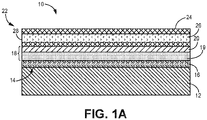
- FIG. 1A is a schematic diagram of ice protection assembly 10 attached to an aircraft component 12 with a nanoparticle loaded pressure sensitive adhesive.
- Assembly 10 includes aircraft component 12 with surface 14, primer 16, nanoparticle loaded adhesive 18 (with pressure sensitive adhesive 19 and nanoparticles 20), and heater 22.
- Heater 22 includes structural layers 24, heating element 26, and electrical connections 28.
- Aircraft component 12 with surface 14 is a component needing ice protection.
- Component 12 can be, for example, an airfoil, nacelle, nosecone, engine cowl, or other aircraft part.
- Surface 14 is the surface that requires ice protection, on which the ice protection assembly is attached through ferrous nanoparticle loaded adhesive 18.
- Nanoparticle loaded adhesive 18 has two components: pressure sensitive adhesive (PSA) 19 and ferrous nanoparticles 20.
- PSA 19 is an adhesive which forms a bond when pressure is applied to the adhesive and the components it is adhering.
- Pressure sensitive adhesives are frequently used with adhere ice protection devices to aircraft components, and typically have a thickness of about 254 ⁇ m (10 mils).
- suitable materials for PSA 19 include acrylates, silicones, nitriles, and styrenes, for instance, pn VHB 9473 by 3M.
- the pressure sensitive adhesive according to the invention is selected from the group consisting of acrylates, silicones, nitriles, and styrenes.
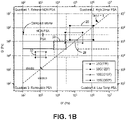
- FIG. 1B is a Chang plot of one non-limiting example of thermally switchable PSA 19.
- the Chang plot is constructed in accordance with the method described in Chang, E.P., (J. of Adhesion v. 34 (1-4) (1991) pp. 189-200 ) to establish PSA viscoelastic windows 26, 28, 30, 32.
- the viscoelastic windows are constructed from values of dynamic storage or elastic modulus G' and dynamic loss modulus G", both measured in pascal (Pa), at an angular frequency of 0.01 radians per second (rad/s) and 100 rad/s.
- the storage modulus G' represents the elastic deformation of the material and is a measure of the stored energy.
- the loss modulus G" represents the viscous portion of the material and is a measure of the energy dissipated as heat. Low frequency testing characterizes bond formation, while high frequency testing characterizes debonding behavior and peel strength.
- Each viscoelastic window is produced by plotting values of (1) G' at 0.01 rad/s, G" at 0.01 rad/s (lower left corner), (2) G' at 100 rad/s, G" at 0.01 rad/s (upper left corner), (3) G' at 0.01 rad/s, G" at 100 rad/s (lower right corner), and (4) G' at 100 rad/s, G" at 100 rad/s (upper right corner) on a logarithmic scale vertical ordinate of G' and a logarithmic scale horizontal ordinate of G".
- each viscoelastic window and particularly the locations of the low frequency storage and loss moduli G' and G" (lower left corner of the viscoelastic window) and the high frequency storage and loss moduli G' and G" (upper right corner of the viscoelastic window), can determine the adhesion performance of PSA 19.
- the position of the viscoelastic window within four defined quadrants can be used to identify non-PSA or release coatings (quadrant 1), high shear PSAs (quadrant 2), removable PSAs (quadrant 3), and quick stick and low temperature PSAs (quadrant 4), as described further herein.
- Quadrant 1 is defined to be above a horizontal line at a G' value of 30,000 Pa and to the left of a vertical line at a G" value of 32,000 Pa.
- PSAs in quadrant 1 have a high storage modulus G' and a low loss modulus G". If the viscoelastic window is within quadrant 1, the material is rubbery, has a high storage modulus and does not dissipate energy. The overall behavior material is rubbery, has a high storage modulus and does not dissipate energy. The overall behavior is that of a non-PSA or release film (i.e. the material will be unlikely to stick to a surface and will debond easily).
- Quadrant 2 is defined to be above a horizontal line at a G' value of 30,000 Pa and to the right of a vertical line at a G" value of 32,000 Pa.
- PSAs in quadrant 2 have high storage and loss moduli G' and G". If the viscoelastic window is within quadrant 2, the material will have high cohesive strength due to the high storage modulus G' and high dissipation due to high loss modulus G". The overall behavior is that of a strong high shear PSA. As long as the low frequency G' is below the Dahlquist criterion of 3 ⁇ 10 5 Pa at the temperature of application (usually about 25 °C), the PSA will be tacky and stick easily to the substrate surface.
- Quadrant 3 is defined to be below a horizontal line at a G' value of 30,000 Pa and to the left of a vertical line at a G" value of 32,000 Pa.
- PSAs in Quadrant 2 have low storage and loss moduli G' and G". If the viscoelastic window is within quadrant 3, the material is a soft, highly viscous fluid. The material will stick well to a surface because the storage modulus G' is well below the Dahlquist criterion, and will not have much strength. Because the loss modulus G" is also low, materials with a viscoelastic window in quadrant 3 will not dissipate much energy when peeled. The resulting behavior is an easily removable PSA.
- Quadrant 4 is defined to be below a horizontal line at a G' value of 30,000 Pa and to the right of a vertical line at a G" value of 32,000 Pa.
- PSAs in Quadrant 4 have a low storage modulus G' and a high loss modulus G". If the viscoelastic window is within quadrant 4, the material is a pressure sensitive adhesive capable of operating at very low temperatures. Because the loss modulus G" is high, materials with a viscoelastic window in quadrant 4 will have a high dissipation. Coupled with a low storage modulus G', the resulting behavior is a material that can stick with short contact time and at low temperatures.
- a central area is defined as a box bounded by an upper horizontal line at a G' value of 130,000 Pa, a lower horizontal line at a G' value of 8,000 Pa and a pair of vertical lines at G" values of 6,500 Pa and 150,000 Pa.
- the central area is characterized by medium storage and loss moduli G' and G". If the viscoelastic window is within this central area, the material behaves as a middle of the road or general purpose PSA.
- the Dahlquist criteria line is defined as a horizontal line at a G' value of 300,000 Pa as illustrated in FIG. 1B .
- the Dahlquist criteria indicates the ability of a material to adhere to a surface with contact.
- the lower left hand corner storage modulus G' of the viscoelastic window i.e., G' at 0.01 rad/s, corresponding to a timescale used to apply the PSA to a surface
- Tan ⁇ is defined as the ratio of G" to G'.
- PSA 19 the strength of the adhesive bond depends on the viscoelastic properties of the PSA.
- PSA 19 can be further designed to have high shear strength over a service temperature range, such that PSA 19 will not fail due a change in temperature within the service temperature range during operation.
- the service temperature can generally range from -40 °F to 160 °F (-40 °C to 71 °C).
- PSA 19 has high frequency storage and loss moduli G' and G" located in quadrant 2 of the Chang plot within a range of G' values greater than 30,000 Pa and G" values greater than 32,000 Pa across the service temperature range.
- the high frequency storage modulus G' will be above 130,000 Pa and the high frequency loss modulus G" will be above 32,000 Pa across the service temperature range.
- the lower left corner storage modulus G' (low frequency storage modulus G') is less than the Dahlquist criteria at 25 °C (temperature at which the PSA is applied).
- primer 16 is coated on surface 14 of component 12 to prepare surface 14 for application of ferrous nanoparticle loaded adhesive 18.
- Primer 16 promotes adhesion between component surface 14 and PSA 19.
- Primer 16 can be, for example, pn 94 available from 3M. Primer 16 is applied evenly throughout component surface 14, and can be applied by spraying, painting, wiping, or other appropriate methods.
- PSA 19 is "loaded” with nanoparticles.
- nanoparticles can be, for example, ferrous nanoparticles (also referred to as iron oxide nanoparticles).
- Ferrous nanoparticles are inorganic nanoparticles classified based on the size of the iron oxide. These particles can range from 50 microns to 5nm.
- Ferrous particles have superparamagnetic properties, a form of magnetism where magnetization can randomly flip direction under the influence of temperature. Associated properties of ferrous particles include controllable size, large surface area-to-volume ratio, and nontoxicity.
- Ferrous nanoparticles include both magnetite and maghemite forms.
- ferrous nanoparticles include catalysis, sensors, superparamagnetic relaxometry, and highsensitivity biomolecular magnetic resonance imaging for medical diagnosis and therpeutics.
- Ferrous nanoparticles can be supplied from Sigma Aldrich or similar chemical distributors.
- nanoparticles can be used to "load" PSA 19.
- PSA 19 silica core or steel nanoparticles.
- the nanoparticles have diameters of between 50 microns and 5 nanometers, and comprise between 5% to 25% by volume of the PSA 19 to prevent degradation of the PSA adhesive strength due to over saturation of nanoparticles.
- ferrous particles will respond to and align with an alternating electromagnetic radiation, such as radio frequency (RF) or microwaves,.
- RF radio frequency
- the particles' movement will heat up the adhesive, allowing the adhesive to soften or melt.
- Electrically conductive nanowires may be used instead of ferrous particles. Nanowires are several nanometers in diameter and several hundred nanometers to several millimeters long. Carbon nanotubes and steel nanowires are examples.
- the electrically conductive nanowires need to be subjected to an alternating electromagnetic field. The electromagnetic field will induce an electrical current in the nanowires, and the nanowires will heat because of their resistance.
- Nanoparticles will respond to electromagnetic radiation ⁇ between 1 mm and 10 km, although higher and lower wavelengths may be used at the tradeoff of lower efficiency or higher interference. Also, addition of nanoparticles to a composite does not substantially change the overall thickness of that composite. For example, if a standard 2549 ⁇ m (0.10") PSA layer is used as an adhesive, the addition of nanoparticles would not alter that thickness.
- Nanoparticle loaded adhesive 18 is prepared by infiltrating PSA 19 with nanoparticles 20. Typically, this can be done by mixing the nanoparticles into the PSA when the PSA is being manufactured or prepared. Particles should be comprise between 5% to 25% by volume of the PSA 19. More than 25% by volume of the nanoparticles could potentially make PSA 19 too stiff.
- Nanoparticles 20 When applied, nanoparticles 20 will micro-scale infiltrate PSA 19 at the micron scale (from a tenth to tens of microns). Nanoparticles should be evenly added to PSA 19 to avoid uneven melting when nanoparticle loaded adhesive 18 is later de-bonded for reapplication or repositioning of ice protection devices. Generally, particles should be less than 25% by volume of particle loaded adhesive 18 so as not to interfere with the integrity and adhesive strength of PSA 19.
- Heater 22 is an ice-protection device for an aircraft component.
- Heater 22 contains structural layers 24, heating element 26, and electrical connections 28. Heater 22 is designed to prevent ice formation on an aircraft component surface.
- heating element 26 can be a metallic or carbon nanotube heating element supported by structural layers 24 and connected to a power source via electrical connections 28.
- Heater 22 is one example of an ice protection device.
- heater 22 can be instead a pneumatic de-icer, a different version of an electrothermal de-icer, or other ice protection devices.
- Heater 22 is adhered to surface 14 via nanoparticle loaded adhesive 18. After adhesive 18 and heater 22 with aircraft component surface 14, adhesive 18 is wetted out as necessary to create the adhesive bond. This can be, for example, wetting out of the PSA 19 with a roller, by hand, or by other methods known to those in the art.
- nanoparticle loaded adhesive 18 When heater 22 needs to be removed from aircraft component 12 (for instance, for repair or inspection or reposition), nanoparticle loaded adhesive 18 can be melted and heater 22 can be peeled off from aircraft component 12.
- nanoparticle loaded adhesive 18 is placed in range of to a microwave or RF radiation source. Microwave or RF radiation is applied to nanoparticle loaded adhesive 18, and nanoparticles 20 make the adhesive 18 heat and subsequently soften or melt. This weakens the bond strength of PSA 19, allowing for nanoparticle loaded adhesive 18 to de-bonded and heater 22 to be separated from aircraft component 12.
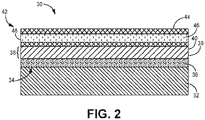
- FIG. 2 is a schematic diagram of a non claimed ice protection assembly 30 attached to aircraft component 32 with a nanoparticle loaded dry thermoplastic adhesive.
- Ice protection assembly 30 includes aircraft component 32 with surface 34, primer 36, nanoparticle loaded adhesive 38 (with dry thermoplastic adhesive 39 and ferrous nanoparticles 40), and heater 42. Assembly 30 is similar to assembly 10 in FIG. 1 . As such, only differing components will be discussed in depth.
- nanoparticle loaded adhesive 38 contains a thermoplastic adhesive 39 and nanoparticles 40.
- Thermoplastic adhesives are polymer-based adhesives that melt when they are heated. Examples of thermoplastic adhesives includes ethylene vinyl acetate (EVA), polyolefin, polycarbonate, acrylonitrile butadiene styrene (ABS), and polyurethane.
- Nanoparticles 40 can be mixed into thermoplastic adhesive 39 during initial preparation of thermoplastic adhesive 39. The nanoparticles 40 should not be more than 50% by weight of the adhesive 38 to maintain the integrity and strength of thermoplastic adhesive 39.
- a heater 42 with thermoplastic adhesive 38 is applied to the aircraft by using a RF or microwave radiation source to heat the adhesive.
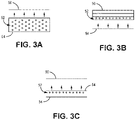
- FIGS. 3A-3C are schematic diagrams of nanoparticle infiltration of an adhesive.
- FIGS. 3A -3F show de-icer 50, nanoparticles 52, and adhesive 54.
- De-icer 50 is a pneumatic boot or propeller de-icer to which adhesive 54 will be applied.
- Nanoparticles 52, as described with reference to FIG. 1 are vertically aligned carbon nanotubes infiltrating adhesive 54.
- Adhesive 54 is a pressure sensitive adhesive as described with reference to FIG. 1 .
- FIG. 3A shows adhesive 54 pre-loaded with nanoparticles 52 prior to application onto de-icer 50.
- the nanoparticles 52 can be loaded into adhesive 54 by normal methods as known in the art.
- FIG. 3B shows an assembly where de-icer 50 is loaded with nanoparticles 52 instead of the adhesive 54.
- nanoparticles 52 are applied to deicer 50 on its outermost layer, so that after application of adhesive 54 the nanoparticles 52 can micro-infiltrate the adhesive 54.
- FIG. 3C shows a third embodiment, where nanoparticles 52 are located between two layers of adhesive 54 instead of on an outer surface.
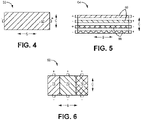
- FIGS. 4-6 are schematic diagrams of nanoparticle infiltrated adhesives in varying electrical configurations.
- FIG. 4 shows a particle infiltrated adhesive 60 having one large particle section 62.
- the adhesive is one piece, all of which is evenly infiltrated with nanoparticles.
- FIGS. 5 and 6 show adhesive with multiple sections or pieces, each section infiltrated with nanoparticles.
- FIG. 5 shows section 64 numerous spanwise (S) zones 66, each having adhesive and nanoparticles.
- the spanwise nanoparticle infiltrated adhesive 66 can all contain the same amount of nanoparticles, or differ depending on the typical needs for adhesive removal or replacement.
- FIG. 6 shows nanoparticle infiltrated adhesive 68 with chordwise (C) sections 70. Each section 70 can contain the same amount of nanoparticles, or differing amounts.
- an electrical current can be applied to the nanoparticle infiltrated adhesive at the terminals (+, -) to align the nanoparticles within the adhesive. Because nanoparticles are electrically conductive, application of current through the nanoparticle infiltrated adhesive heats the adhesive and allows for softening or melting.
- the zones of nanoparticles in FIGS. 4-6 can be smaller zones dependent on the power/voltage source used.
- the power/voltage source runs current through the nanoparticles via the + and - terminals, the nanoparticles conduct the current along the adhesive.
- the power/voltage source can allows for an increase in temperature along the adhesive. This in turn softens or melts the adhesive, allowing for easy removal of adhesive sections containing nanoparticles.
- each section of nanoparticle infiltrated adhesive would them be removed by peeling, pulling, or scraping. This additionally allows for tailoring to adhesive removal: only section which need to be removed for repair or replacement need to be heated and removed.
- the disclosed ice protection assembly requires less drying time compared to traditional liquid or chemical adhesives. Additionally, the microwave responsive particles or micron particles or nanoparticles or mix of both, such as ferrous nanoparticle filled adhesive is easier to de-bond when ice protection device is needed to removed or reposition. Overall, removal time and effort is reduced because of the meltable nature of ferrous nanoparticle filled adhesives. Solvents, or other adhesive removal steps, are avoided. Additionally, ferrous nanoparticles strengthen adhesives in which they are loaded.
Landscapes
- Chemical & Material Sciences (AREA)
- Organic Chemistry (AREA)
- Engineering & Computer Science (AREA)
- Aviation & Aerospace Engineering (AREA)
- Chemical Kinetics & Catalysis (AREA)
- Health & Medical Sciences (AREA)
- Medicinal Chemistry (AREA)
- Polymers & Plastics (AREA)
- Inorganic Chemistry (AREA)
- Adhesives Or Adhesive Processes (AREA)
Claims (8)
- Enteisungsanordnung, umfassend:eine Flugzeugkomponente (12), die eine Oberfläche (14) aufweist;einen druckempfindlichen Klebstoff (19) auf der Oberfläche der Flugzeugkomponente (12), wobei der druckempfindliche Klebstoff (19) mit Nanopartikeln (20) beladen ist, und dadurch gekennzeichnet, dass der druckempfindliche Klebstoff (19) einen dynamischen Speichermodul (G') bei 0,01 Radian/Sekunde von weniger als 300 kPa, einen dynamischen Speichermodul (G') größer als 30 kPa zwischen -40 °C und 71 °C und einen dynamischen Verlustmodul (G") größer als 32 kPa zwischen -40 °C und 71 °C aufweist, und der druckempfindliche Klebstoff (19) aus der Gruppe ausgewählt ist, die aus Acrylaten, Silikonen, Nitrilen und Styrolen besteht, und die Nanopartikel Durchmesser im Bereich von 50 µm bis 5 nm aufweisen und zwischen 5 Vol.-% und 25 Vol.-% des druckempfindlichen Klebstoffs (19) umfassen; und eine Heizvorrichtung (22), die an der Flugzeugkomponente (12) durch den druckempfindlichen Klebstoff (19) angebracht ist.
- Anordnung nach Anspruch 1, wobei die Nanopartikel aus der Gruppe von auf Mikrowellen ansprechenden Partikeln, Mikronpartikeln, Nanopartikeln und Kombinationen davon ausgewählt sind.
- Anordnung nach Anspruch 1 oder 2, wobei die Flugzeugkomponente aus der Gruppe ausgewählt ist, die aus Tragflächen, Gondeln, Nasenkegeln, Triebwerksverkleidungen und Vorderkanten besteht.
- Anordnung nach einem vorstehenden Anspruch, wobei die Nanopartikel eisenhaltige Partikel sind, oder wobei die Nanopartikel elektrisch leitende Nanodrähte sind.
- Anordnung nach einem vorstehenden Anspruch, die ferner eine Grundierung (16) auf der Oberfläche der Flugzeugkomponente umfasst, die dazu konfiguriert ist, die Haftung des Klebstoffs auf der Oberfläche zu erhöhen.
- Verfahren zum Entfernen des Klebstoffs von der Flugzeugkomponente einer Enteisungsanordnung nach einem vorstehenden Anspruch, wobei das Verfahren Folgendes umfasst:Durchleiten von Strahlung durch den Klebstoff derart, dass sich Nanopartikel in dem Klebstoff erhitzen und den Klebstoff erweichen, dadurch gekennzeichnet, dass der Klebstoff ein druckempfindlicher Klebstoff ist, der einen dynamischen Speichermodul (G') bei 0,01 Radian/Sekunde von weniger als 300 kPa, einen dynamischen Speichermodul (G') größer als 30 kPa zwischen -40 °C und 71 °C und einen dynamischen Verlustmodul (G") größer als 32 kPa zwischen -40 °C und 71 °C aufweist, und die Nanopartikel Durchmesser in dem Bereich von 50 µm bis 5 nm aufweisen; undanschließendes Entfernen des erweichten Klebstoffs.
- Verfahren nach Anspruch 7, wobei die Strahlung Hochfrequenz- (RF) oder Mikrowellenstrahlung umfasst.
- Verfahren nach Anspruch 7 oder 8, wobei das Entfernen des erweichten Klebstoffs das Abkratzen, Abziehen oder Abschälen des Klebstoffs von der Komponente umfasst.
Applications Claiming Priority (3)
| Application Number | Priority Date | Filing Date | Title |
|---|---|---|---|
| US201862780312P | 2018-12-16 | 2018-12-16 | |
| US201962790639P | 2019-01-10 | 2019-01-10 | |
| US16/595,771 US11623753B2 (en) | 2018-12-16 | 2019-10-08 | Selectively meltable adhesives for bonding of deicers |
Publications (2)
| Publication Number | Publication Date |
|---|---|
| EP3666657A1 EP3666657A1 (de) | 2020-06-17 |
| EP3666657B1 true EP3666657B1 (de) | 2023-01-25 |
Family
ID=68917586
Family Applications (1)
| Application Number | Title | Priority Date | Filing Date |
|---|---|---|---|
| EP19216500.9A Active EP3666657B1 (de) | 2018-12-16 | 2019-12-16 | Enteiser mit selektiv schmelzbarem klebstoff |
Country Status (6)
| Country | Link |
|---|---|
| US (2) | US11623753B2 (de) |
| EP (1) | EP3666657B1 (de) |
| JP (1) | JP2020100393A (de) |
| CN (1) | CN111319771A (de) |
| BR (1) | BR102019026369A2 (de) |
| CA (1) | CA3060759A1 (de) |
Families Citing this family (3)
| Publication number | Priority date | Publication date | Assignee | Title |
|---|---|---|---|---|
| GB2574184B (en) * | 2018-03-29 | 2020-12-02 | Gkn Aerospace Services Ltd | Ice removal system |
| US11623753B2 (en) * | 2018-12-16 | 2023-04-11 | Goodrich Corporation | Selectively meltable adhesives for bonding of deicers |
| CN115921442A (zh) * | 2022-12-30 | 2023-04-07 | 南通友拓新能源科技有限公司 | 一种去除循环料残胶的方法及装置 |
Citations (1)
| Publication number | Priority date | Publication date | Assignee | Title |
|---|---|---|---|---|
| EP2499204B1 (de) * | 2009-11-13 | 2017-11-22 | Empire Technology Development LLC | Thermoplastische beschichtung und deren entfernung mithilfe einer bindungsschnittstelle mit katalytischen nanopartikeln |
Family Cites Families (19)
| Publication number | Priority date | Publication date | Assignee | Title |
|---|---|---|---|---|
| DK0630396T3 (da) * | 1992-03-13 | 1998-04-27 | Allied Signal Inc | Varmsmelte-klæbesammensætninger omfattende ethylencopolymerer med lav molekylvægt |
| DE19951599A1 (de) * | 1999-10-27 | 2001-05-23 | Henkel Kgaa | Verfahren zur adhesiven Trennung von Klebeverbunden |
| DE102009010437A1 (de) * | 2009-02-26 | 2010-09-02 | Tesa Se | Beheiztes Flächenelement |
| US10377925B2 (en) | 2011-02-10 | 2019-08-13 | Futurecarbon Gmbh | Adhesive material with carbon material and method for its production and use |
| DE102011119844A1 (de) | 2011-05-26 | 2012-12-13 | Eads Deutschland Gmbh | Verbundstruktur mit Eisschutzvorrichtung sowie Herstellverfahren |
| US9193466B2 (en) * | 2012-07-13 | 2015-11-24 | Mra Systems, Inc. | Aircraft ice protection system and method |
| RO129561A2 (ro) * | 2012-12-06 | 2014-06-30 | Universitatea Tehnică ''gheorghe Asachi'' Din Iaşi | Tehnologie de asamblare/dezasamblare cu adezivi nanostructuraţi electro-activi cu aplicaţii în domeniul construcţiilor |
| DE102014207792A1 (de) * | 2014-04-25 | 2015-10-29 | Tesa Se | Dünnglasverbund und Verfahren zum Lagern einer Dünnglasfolie |
| CN104087224B (zh) | 2014-07-10 | 2016-06-22 | 北京中煤矿山工程有限公司 | 一种用于粘碳纤维加固的碳纳米管改性环氧树脂胶黏剂 |
| US10011699B2 (en) * | 2014-08-29 | 2018-07-03 | 3M Innovative Properties Company | Inductively curable composition |
| US10099458B2 (en) * | 2015-03-23 | 2018-10-16 | Board Of Trustees Of Michigan State University | Reversible adhesive compositions and related methods |
| JP2017031322A (ja) * | 2015-07-31 | 2017-02-09 | 富士フイルム株式会社 | 断熱塗料 |
| US10710880B2 (en) | 2016-03-09 | 2020-07-14 | Hitachi Zosen Corporation | Method for uplifting carbon nanotube structure, method for producing carbon nanotube structure, and carbon nanotube structure |
| US10791651B2 (en) | 2016-05-31 | 2020-09-29 | Carbice Corporation | Carbon nanotube-based thermal interface materials and methods of making and using thereof |
| EP3287276A1 (de) * | 2016-08-26 | 2018-02-28 | Sika Technology Ag | Reaktiver polyolefinschmelzklebstoff mit niedriger reaktivierungstemperatur und verwendung davon in tiefziehvakuumlaminierung |
| CN108928074A (zh) | 2017-09-22 | 2018-12-04 | 中国航空工业集团公司基础技术研究院 | 一种具有多功能表面的复合材料及制备方法 |
| US10717261B2 (en) | 2017-10-19 | 2020-07-21 | Bell Helicopter Textron Inc. | Selectively activated frangible bonding system |
| FR3084008B1 (fr) * | 2018-07-23 | 2020-07-10 | Universite Toulouse Iii - Paul Sabatier | Procede de soudage par induction mettant en œuvre un film polymere composite conducteur et/ou magnetique |
| US11623753B2 (en) * | 2018-12-16 | 2023-04-11 | Goodrich Corporation | Selectively meltable adhesives for bonding of deicers |
-
2019
- 2019-10-08 US US16/595,771 patent/US11623753B2/en active Active
- 2019-10-29 CA CA3060759A patent/CA3060759A1/en not_active Abandoned
- 2019-12-10 JP JP2019222600A patent/JP2020100393A/ja active Pending
- 2019-12-12 BR BR102019026369-5A patent/BR102019026369A2/pt not_active IP Right Cessation
- 2019-12-13 CN CN201911285899.5A patent/CN111319771A/zh active Pending
- 2019-12-16 EP EP19216500.9A patent/EP3666657B1/de active Active
-
2023
- 2023-03-06 US US18/178,810 patent/US12104090B2/en active Active
Patent Citations (1)
| Publication number | Priority date | Publication date | Assignee | Title |
|---|---|---|---|---|
| EP2499204B1 (de) * | 2009-11-13 | 2017-11-22 | Empire Technology Development LLC | Thermoplastische beschichtung und deren entfernung mithilfe einer bindungsschnittstelle mit katalytischen nanopartikeln |
Also Published As
| Publication number | Publication date |
|---|---|
| CA3060759A1 (en) | 2020-06-16 |
| BR102019026369A2 (pt) | 2020-07-07 |
| CN111319771A (zh) | 2020-06-23 |
| US12104090B2 (en) | 2024-10-01 |
| US20200189753A1 (en) | 2020-06-18 |
| US20230234712A1 (en) | 2023-07-27 |
| JP2020100393A (ja) | 2020-07-02 |
| EP3666657A1 (de) | 2020-06-17 |
| US11623753B2 (en) | 2023-04-11 |
Similar Documents
| Publication | Publication Date | Title |
|---|---|---|
| US12104090B2 (en) | Selectively meltable adhesives for bonding of deicers | |
| EP3657905B1 (de) | Gleichmässige wärmeverteilung in widerstandsheizern für frostschutz und enteisung | |
| EP0720946B1 (de) | Selbstklebende Abdeckung zur Verhinderung einer Vereisung | |
| US20110014356A1 (en) | Method for protecting a substrate from lightning strikes | |
| CN108538727A (zh) | 基于碳纳米管的热界面材料及其制造和使用方法 | |
| DE102005058259A1 (de) | Verfahren zur thermischen Freisetzung eines haftenden Körpers und Vorrichung zur thermischen Freisetzung des haftenden Körpers | |
| CN109233684B (zh) | 导电粘合剂 | |
| EP2810777A1 (de) | Heizschicht zum Entfernen von Belägen | |
| US20220289929A1 (en) | Compositions removable by thermal activation, uses and assemblies comprising such compositions | |
| EP3483068B1 (de) | Eisphobisches material zur reduzierung von runback-eis | |
| CN112776379B (zh) | 修复热塑性复合材料的组件和方法 | |
| WO2016200833A1 (en) | Adhesives for chemical mechanical planarization applications | |
| EP0980827B1 (de) | Druckempfindlicher Klebstoff fur einen Enteiser und Verfahren zur Montage | |
| Wang et al. | Study on interlayer properties of multilayer complex structures of graphene papers/harness satin weave glass fibers/epoxy reinforced composites with electric heating de‐icing | |
| US11919648B2 (en) | Z-CNT filled meltable adhesives for bonding of deicers | |
| US20230045928A1 (en) | Aircraft seeker windows and aircraft window systems including the same | |
| CN103782058A (zh) | 一种平衡重 | |
| US10487245B2 (en) | Electronically reversible adhesive methods | |
| EP3636721A1 (de) | Thermisch schaltbarer druckempfindlicher klebstoff mit hohen schereigenschaften | |
| WO2024033345A1 (en) | Artefact with heater film | |
| WO2012080830A2 (en) | Aircraft de-icer systems and methods |
Legal Events
| Date | Code | Title | Description |
|---|---|---|---|
| PUAI | Public reference made under article 153(3) epc to a published international application that has entered the european phase |
Free format text: ORIGINAL CODE: 0009012 |
|
| STAA | Information on the status of an ep patent application or granted ep patent |
Free format text: STATUS: THE APPLICATION HAS BEEN PUBLISHED |
|
| AK | Designated contracting states |
Kind code of ref document: A1 Designated state(s): AL AT BE BG CH CY CZ DE DK EE ES FI FR GB GR HR HU IE IS IT LI LT LU LV MC MK MT NL NO PL PT RO RS SE SI SK SM TR |
|
| AX | Request for extension of the european patent |
Extension state: BA ME |
|
| STAA | Information on the status of an ep patent application or granted ep patent |
Free format text: STATUS: REQUEST FOR EXAMINATION WAS MADE |
|
| 17P | Request for examination filed |
Effective date: 20201216 |
|
| RBV | Designated contracting states (corrected) |
Designated state(s): AL AT BE BG CH CY CZ DE DK EE ES FI FR GB GR HR HU IE IS IT LI LT LU LV MC MK MT NL NO PL PT RO RS SE SI SK SM TR |
|
| STAA | Information on the status of an ep patent application or granted ep patent |
Free format text: STATUS: EXAMINATION IS IN PROGRESS |
|
| 17Q | First examination report despatched |
Effective date: 20210512 |
|
| GRAP | Despatch of communication of intention to grant a patent |
Free format text: ORIGINAL CODE: EPIDOSNIGR1 |
|
| STAA | Information on the status of an ep patent application or granted ep patent |
Free format text: STATUS: GRANT OF PATENT IS INTENDED |
|
| RIC1 | Information provided on ipc code assigned before grant |
Ipc: B64D 33/02 20060101ALN20220714BHEP Ipc: B64C 1/06 20060101ALN20220714BHEP Ipc: B64D 15/02 20060101AFI20220714BHEP |
|
| RIC1 | Information provided on ipc code assigned before grant |
Ipc: B64D 33/02 20060101ALN20220718BHEP Ipc: B64C 1/06 20060101ALN20220718BHEP Ipc: B64D 15/02 20060101AFI20220718BHEP |
|
| INTG | Intention to grant announced |
Effective date: 20220808 |
|
| GRAS | Grant fee paid |
Free format text: ORIGINAL CODE: EPIDOSNIGR3 |
|
| GRAA | (expected) grant |
Free format text: ORIGINAL CODE: 0009210 |
|
| STAA | Information on the status of an ep patent application or granted ep patent |
Free format text: STATUS: THE PATENT HAS BEEN GRANTED |
|
| AK | Designated contracting states |
Kind code of ref document: B1 Designated state(s): AL AT BE BG CH CY CZ DE DK EE ES FI FR GB GR HR HU IE IS IT LI LT LU LV MC MK MT NL NO PL PT RO RS SE SI SK SM TR |
|
| REG | Reference to a national code |
Ref country code: GB Ref legal event code: FG4D |
|
| REG | Reference to a national code |
Ref country code: CH Ref legal event code: EP |
|
| REG | Reference to a national code |
Ref country code: AT Ref legal event code: REF Ref document number: 1545755 Country of ref document: AT Kind code of ref document: T Effective date: 20230215 Ref country code: IE Ref legal event code: FG4D |
|
| REG | Reference to a national code |
Ref country code: DE Ref legal event code: R096 Ref document number: 602019024759 Country of ref document: DE |
|
| REG | Reference to a national code |
Ref country code: LT Ref legal event code: MG9D |
|
| REG | Reference to a national code |
Ref country code: NL Ref legal event code: MP Effective date: 20230125 |
|
| REG | Reference to a national code |
Ref country code: AT Ref legal event code: MK05 Ref document number: 1545755 Country of ref document: AT Kind code of ref document: T Effective date: 20230125 |
|
| P01 | Opt-out of the competence of the unified patent court (upc) registered |
Effective date: 20230522 |
|
| PG25 | Lapsed in a contracting state [announced via postgrant information from national office to epo] |
Ref country code: NL Free format text: LAPSE BECAUSE OF FAILURE TO SUBMIT A TRANSLATION OF THE DESCRIPTION OR TO PAY THE FEE WITHIN THE PRESCRIBED TIME-LIMIT Effective date: 20230125 |
|
| PG25 | Lapsed in a contracting state [announced via postgrant information from national office to epo] |
Ref country code: RS Free format text: LAPSE BECAUSE OF FAILURE TO SUBMIT A TRANSLATION OF THE DESCRIPTION OR TO PAY THE FEE WITHIN THE PRESCRIBED TIME-LIMIT Effective date: 20230125 Ref country code: PT Free format text: LAPSE BECAUSE OF FAILURE TO SUBMIT A TRANSLATION OF THE DESCRIPTION OR TO PAY THE FEE WITHIN THE PRESCRIBED TIME-LIMIT Effective date: 20230525 Ref country code: NO Free format text: LAPSE BECAUSE OF FAILURE TO SUBMIT A TRANSLATION OF THE DESCRIPTION OR TO PAY THE FEE WITHIN THE PRESCRIBED TIME-LIMIT Effective date: 20230425 Ref country code: LV Free format text: LAPSE BECAUSE OF FAILURE TO SUBMIT A TRANSLATION OF THE DESCRIPTION OR TO PAY THE FEE WITHIN THE PRESCRIBED TIME-LIMIT Effective date: 20230125 Ref country code: LT Free format text: LAPSE BECAUSE OF FAILURE TO SUBMIT A TRANSLATION OF THE DESCRIPTION OR TO PAY THE FEE WITHIN THE PRESCRIBED TIME-LIMIT Effective date: 20230125 Ref country code: HR Free format text: LAPSE BECAUSE OF FAILURE TO SUBMIT A TRANSLATION OF THE DESCRIPTION OR TO PAY THE FEE WITHIN THE PRESCRIBED TIME-LIMIT Effective date: 20230125 Ref country code: ES Free format text: LAPSE BECAUSE OF FAILURE TO SUBMIT A TRANSLATION OF THE DESCRIPTION OR TO PAY THE FEE WITHIN THE PRESCRIBED TIME-LIMIT Effective date: 20230125 Ref country code: AT Free format text: LAPSE BECAUSE OF FAILURE TO SUBMIT A TRANSLATION OF THE DESCRIPTION OR TO PAY THE FEE WITHIN THE PRESCRIBED TIME-LIMIT Effective date: 20230125 |
|
| PG25 | Lapsed in a contracting state [announced via postgrant information from national office to epo] |
Ref country code: SE Free format text: LAPSE BECAUSE OF FAILURE TO SUBMIT A TRANSLATION OF THE DESCRIPTION OR TO PAY THE FEE WITHIN THE PRESCRIBED TIME-LIMIT Effective date: 20230125 Ref country code: PL Free format text: LAPSE BECAUSE OF FAILURE TO SUBMIT A TRANSLATION OF THE DESCRIPTION OR TO PAY THE FEE WITHIN THE PRESCRIBED TIME-LIMIT Effective date: 20230125 Ref country code: IS Free format text: LAPSE BECAUSE OF FAILURE TO SUBMIT A TRANSLATION OF THE DESCRIPTION OR TO PAY THE FEE WITHIN THE PRESCRIBED TIME-LIMIT Effective date: 20230525 Ref country code: GR Free format text: LAPSE BECAUSE OF FAILURE TO SUBMIT A TRANSLATION OF THE DESCRIPTION OR TO PAY THE FEE WITHIN THE PRESCRIBED TIME-LIMIT Effective date: 20230426 Ref country code: FI Free format text: LAPSE BECAUSE OF FAILURE TO SUBMIT A TRANSLATION OF THE DESCRIPTION OR TO PAY THE FEE WITHIN THE PRESCRIBED TIME-LIMIT Effective date: 20230125 |
|
| REG | Reference to a national code |
Ref country code: DE Ref legal event code: R097 Ref document number: 602019024759 Country of ref document: DE |
|
| PG25 | Lapsed in a contracting state [announced via postgrant information from national office to epo] |
Ref country code: SM Free format text: LAPSE BECAUSE OF FAILURE TO SUBMIT A TRANSLATION OF THE DESCRIPTION OR TO PAY THE FEE WITHIN THE PRESCRIBED TIME-LIMIT Effective date: 20230125 Ref country code: RO Free format text: LAPSE BECAUSE OF FAILURE TO SUBMIT A TRANSLATION OF THE DESCRIPTION OR TO PAY THE FEE WITHIN THE PRESCRIBED TIME-LIMIT Effective date: 20230125 Ref country code: EE Free format text: LAPSE BECAUSE OF FAILURE TO SUBMIT A TRANSLATION OF THE DESCRIPTION OR TO PAY THE FEE WITHIN THE PRESCRIBED TIME-LIMIT Effective date: 20230125 Ref country code: DK Free format text: LAPSE BECAUSE OF FAILURE TO SUBMIT A TRANSLATION OF THE DESCRIPTION OR TO PAY THE FEE WITHIN THE PRESCRIBED TIME-LIMIT Effective date: 20230125 Ref country code: CZ Free format text: LAPSE BECAUSE OF FAILURE TO SUBMIT A TRANSLATION OF THE DESCRIPTION OR TO PAY THE FEE WITHIN THE PRESCRIBED TIME-LIMIT Effective date: 20230125 |
|
| PG25 | Lapsed in a contracting state [announced via postgrant information from national office to epo] |
Ref country code: SK Free format text: LAPSE BECAUSE OF FAILURE TO SUBMIT A TRANSLATION OF THE DESCRIPTION OR TO PAY THE FEE WITHIN THE PRESCRIBED TIME-LIMIT Effective date: 20230125 |
|
| PLBE | No opposition filed within time limit |
Free format text: ORIGINAL CODE: 0009261 |
|
| STAA | Information on the status of an ep patent application or granted ep patent |
Free format text: STATUS: NO OPPOSITION FILED WITHIN TIME LIMIT |
|
| 26N | No opposition filed |
Effective date: 20231026 |
|
| PG25 | Lapsed in a contracting state [announced via postgrant information from national office to epo] |
Ref country code: SI Free format text: LAPSE BECAUSE OF FAILURE TO SUBMIT A TRANSLATION OF THE DESCRIPTION OR TO PAY THE FEE WITHIN THE PRESCRIBED TIME-LIMIT Effective date: 20230125 |
|
| PG25 | Lapsed in a contracting state [announced via postgrant information from national office to epo] |
Ref country code: IT Free format text: LAPSE BECAUSE OF FAILURE TO SUBMIT A TRANSLATION OF THE DESCRIPTION OR TO PAY THE FEE WITHIN THE PRESCRIBED TIME-LIMIT Effective date: 20230125 |
|
| REG | Reference to a national code |
Ref country code: CH Ref legal event code: PL |
|
| PG25 | Lapsed in a contracting state [announced via postgrant information from national office to epo] |
Ref country code: LU Free format text: LAPSE BECAUSE OF NON-PAYMENT OF DUE FEES Effective date: 20231216 |
|
| PG25 | Lapsed in a contracting state [announced via postgrant information from national office to epo] |
Ref country code: MC Free format text: LAPSE BECAUSE OF FAILURE TO SUBMIT A TRANSLATION OF THE DESCRIPTION OR TO PAY THE FEE WITHIN THE PRESCRIBED TIME-LIMIT Effective date: 20230125 |
|
| REG | Reference to a national code |
Ref country code: BE Ref legal event code: MM Effective date: 20231231 |
|
| PG25 | Lapsed in a contracting state [announced via postgrant information from national office to epo] |
Ref country code: MC Free format text: LAPSE BECAUSE OF FAILURE TO SUBMIT A TRANSLATION OF THE DESCRIPTION OR TO PAY THE FEE WITHIN THE PRESCRIBED TIME-LIMIT Effective date: 20230125 Ref country code: LU Free format text: LAPSE BECAUSE OF NON-PAYMENT OF DUE FEES Effective date: 20231216 |
|
| REG | Reference to a national code |
Ref country code: IE Ref legal event code: MM4A |
|
| PG25 | Lapsed in a contracting state [announced via postgrant information from national office to epo] |
Ref country code: IE Free format text: LAPSE BECAUSE OF NON-PAYMENT OF DUE FEES Effective date: 20231216 |
|
| PG25 | Lapsed in a contracting state [announced via postgrant information from national office to epo] |
Ref country code: BE Free format text: LAPSE BECAUSE OF NON-PAYMENT OF DUE FEES Effective date: 20231231 |
|
| PG25 | Lapsed in a contracting state [announced via postgrant information from national office to epo] |
Ref country code: CH Free format text: LAPSE BECAUSE OF NON-PAYMENT OF DUE FEES Effective date: 20231231 |
|
| PG25 | Lapsed in a contracting state [announced via postgrant information from national office to epo] |
Ref country code: IE Free format text: LAPSE BECAUSE OF NON-PAYMENT OF DUE FEES Effective date: 20231216 Ref country code: CH Free format text: LAPSE BECAUSE OF NON-PAYMENT OF DUE FEES Effective date: 20231231 Ref country code: BE Free format text: LAPSE BECAUSE OF NON-PAYMENT OF DUE FEES Effective date: 20231231 |
|
| PG25 | Lapsed in a contracting state [announced via postgrant information from national office to epo] |
Ref country code: BG Free format text: LAPSE BECAUSE OF FAILURE TO SUBMIT A TRANSLATION OF THE DESCRIPTION OR TO PAY THE FEE WITHIN THE PRESCRIBED TIME-LIMIT Effective date: 20230125 |
|
| PG25 | Lapsed in a contracting state [announced via postgrant information from national office to epo] |
Ref country code: BG Free format text: LAPSE BECAUSE OF FAILURE TO SUBMIT A TRANSLATION OF THE DESCRIPTION OR TO PAY THE FEE WITHIN THE PRESCRIBED TIME-LIMIT Effective date: 20230125 |
|
| PG25 | Lapsed in a contracting state [announced via postgrant information from national office to epo] |
Ref country code: CY Free format text: LAPSE BECAUSE OF FAILURE TO SUBMIT A TRANSLATION OF THE DESCRIPTION OR TO PAY THE FEE WITHIN THE PRESCRIBED TIME-LIMIT; INVALID AB INITIO Effective date: 20191216 |
|
| PG25 | Lapsed in a contracting state [announced via postgrant information from national office to epo] |
Ref country code: HU Free format text: LAPSE BECAUSE OF FAILURE TO SUBMIT A TRANSLATION OF THE DESCRIPTION OR TO PAY THE FEE WITHIN THE PRESCRIBED TIME-LIMIT; INVALID AB INITIO Effective date: 20191216 |
|
| PG25 | Lapsed in a contracting state [announced via postgrant information from national office to epo] |
Ref country code: TR Free format text: LAPSE BECAUSE OF FAILURE TO SUBMIT A TRANSLATION OF THE DESCRIPTION OR TO PAY THE FEE WITHIN THE PRESCRIBED TIME-LIMIT Effective date: 20230125 |
|
| PGFP | Annual fee paid to national office [announced via postgrant information from national office to epo] |
Ref country code: DE Payment date: 20251126 Year of fee payment: 7 |
|
| PGFP | Annual fee paid to national office [announced via postgrant information from national office to epo] |
Ref country code: GB Payment date: 20251119 Year of fee payment: 7 |
|
| PGFP | Annual fee paid to national office [announced via postgrant information from national office to epo] |
Ref country code: FR Payment date: 20251119 Year of fee payment: 7 |