EP2491069B1 - Herstellung von polyolen auf glycerolbasis - Google Patents
Herstellung von polyolen auf glycerolbasis Download PDFInfo
- Publication number
- EP2491069B1 EP2491069B1 EP10825389.9A EP10825389A EP2491069B1 EP 2491069 B1 EP2491069 B1 EP 2491069B1 EP 10825389 A EP10825389 A EP 10825389A EP 2491069 B1 EP2491069 B1 EP 2491069B1
- Authority
- EP
- European Patent Office
- Prior art keywords
- glycerol
- polyols
- product
- combination
- weight
- Prior art date
- Legal status (The legal status is an assumption and is not a legal conclusion. Google has not performed a legal analysis and makes no representation as to the accuracy of the status listed.)
- Active
Links
Images

Classifications
-
- C—CHEMISTRY; METALLURGY
- C08—ORGANIC MACROMOLECULAR COMPOUNDS; THEIR PREPARATION OR CHEMICAL WORKING-UP; COMPOSITIONS BASED THEREON
- C08G—MACROMOLECULAR COMPOUNDS OBTAINED OTHERWISE THAN BY REACTIONS ONLY INVOLVING UNSATURATED CARBON-TO-CARBON BONDS
- C08G65/00—Macromolecular compounds obtained by reactions forming an ether link in the main chain of the macromolecule
- C08G65/34—Macromolecular compounds obtained by reactions forming an ether link in the main chain of the macromolecule from hydroxy compounds or their metallic derivatives
-
- C—CHEMISTRY; METALLURGY
- C07—ORGANIC CHEMISTRY
- C07C—ACYCLIC OR CARBOCYCLIC COMPOUNDS
- C07C41/00—Preparation of ethers; Preparation of compounds having groups, groups or groups
- C07C41/01—Preparation of ethers
- C07C41/09—Preparation of ethers by dehydration of compounds containing hydroxy groups
-
- C—CHEMISTRY; METALLURGY
- C07—ORGANIC CHEMISTRY
- C07C—ACYCLIC OR CARBOCYCLIC COMPOUNDS
- C07C51/00—Preparation of carboxylic acids or their salts, halides or anhydrides
- C07C51/41—Preparation of salts of carboxylic acids
-
- C—CHEMISTRY; METALLURGY
- C08—ORGANIC MACROMOLECULAR COMPOUNDS; THEIR PREPARATION OR CHEMICAL WORKING-UP; COMPOSITIONS BASED THEREON
- C08G—MACROMOLECULAR COMPOUNDS OBTAINED OTHERWISE THAN BY REACTIONS ONLY INVOLVING UNSATURATED CARBON-TO-CARBON BONDS
- C08G65/00—Macromolecular compounds obtained by reactions forming an ether link in the main chain of the macromolecule
- C08G65/02—Macromolecular compounds obtained by reactions forming an ether link in the main chain of the macromolecule from cyclic ethers by opening of the heterocyclic ring
- C08G65/26—Macromolecular compounds obtained by reactions forming an ether link in the main chain of the macromolecule from cyclic ethers by opening of the heterocyclic ring from cyclic ethers and other compounds
-
- C—CHEMISTRY; METALLURGY
- C08—ORGANIC MACROMOLECULAR COMPOUNDS; THEIR PREPARATION OR CHEMICAL WORKING-UP; COMPOSITIONS BASED THEREON
- C08G—MACROMOLECULAR COMPOUNDS OBTAINED OTHERWISE THAN BY REACTIONS ONLY INVOLVING UNSATURATED CARBON-TO-CARBON BONDS
- C08G65/00—Macromolecular compounds obtained by reactions forming an ether link in the main chain of the macromolecule
- C08G65/02—Macromolecular compounds obtained by reactions forming an ether link in the main chain of the macromolecule from cyclic ethers by opening of the heterocyclic ring
- C08G65/26—Macromolecular compounds obtained by reactions forming an ether link in the main chain of the macromolecule from cyclic ethers by opening of the heterocyclic ring from cyclic ethers and other compounds
- C08G65/2603—Macromolecular compounds obtained by reactions forming an ether link in the main chain of the macromolecule from cyclic ethers by opening of the heterocyclic ring from cyclic ethers and other compounds the other compounds containing oxygen
- C08G65/2606—Macromolecular compounds obtained by reactions forming an ether link in the main chain of the macromolecule from cyclic ethers by opening of the heterocyclic ring from cyclic ethers and other compounds the other compounds containing oxygen containing hydroxyl groups
- C08G65/2609—Macromolecular compounds obtained by reactions forming an ether link in the main chain of the macromolecule from cyclic ethers by opening of the heterocyclic ring from cyclic ethers and other compounds the other compounds containing oxygen containing hydroxyl groups containing aliphatic hydroxyl groups
Definitions
- This invention relates to methods of producing a unique composition of glycerol-based polyol products.
- the unique glycerol-based polyol products include branched, cyclic polyols and a beneficial co-product lactic acid and/or lactate salt as an anti-biodegrading agent.
- Glycerol-based polyols include polyglycerols, polyglycerol derivatives and a polymer consisting of glycerol units and at least another monomer units to other multiple monomers units.
- the molecular weight of glycerol-based polyols produced through the improved methods can be preferentially high but also can be low as needed.
- Glycidol-based synthesis is particularly useful in producing structured or hyperbranched polyglycerols (HBPG) and high molecular weight HBPG, such as those described in US Patent 6,822,068 B2 and US Published Application 2008/282579 A1 .
- HBPG structured or hyperbranched polyglycerols
- HBPG high molecular weight polyglycerols
- Unfortunately these syntheses rely on expensive monomer glycidol which is often so expensive that in many cases their use on an industrial scale is cost prohibitive.
- At least one embodiment of the invention is directed towards a method of synthesizing glycerol-based polyol products.
- the method comprises the step of: reacting a reaction mass comprising at least glycerol monomer in the presence of a strong base catalyst of a concentration above 2%, in a low reactivity atmospheric environment at a temperature above 200 degrees C which produces a product comprising branched, cyclic polyols and a co-product comprising lactic acid, lactic salt, and any combination thereof.
- the method can further comprise the steps of providing a catalyst above 3%.
- the catalyst is selected from the group consisting of: NaOH, KOH, CsOH, a base stronger than NaOH, and any combination thereof.
- the strong base catalyst in the particular amount can be used with combining a base weaker than NaOH.
- the atmospheric environment is an atmospheric pressure of less than 760 mm Hg and/or may be a flow of an inert gas selected from the list of N 2 , CO 2 , He, other inert gases and any combination thereof and the flow is at a rate of 0.2 to 15 mol of inert gas per hour per mol of monomer.
- the particular atmospheric environment profile applied can be stead, gradual increase, gradual decrease or any combination thereof.
- the method may produce glycerol-based polyol products are selected from the group consisting of: polyglycerols, polyglycerol derivatives, a polyol having both glycerol monomer units and non-glycerol monomer units and any combination thereof.
- the glycerol-based polyols products have at least two hydroxyl groups. At least a portion of the produced polyols may have both at least a 0.1 degree of branching and at least a 0.01 degree of cyclization.
- the co-product may be at least 1% by weight.
- the glycerol-based polyol products may be at least 166 Daltons in molecular weight.
- the glycerol-based polyol products may have a polydispersity of at least 1.
- the method may make use of different forms of glycerol including pure, technical, crude, or any combination thereof.
- the method may further comprise other monomers selected from the group consisting of polyols such as pentaerythritol and glycols, amines, other monomers capable of reacting with glycerol or glycerol-based polyol intermediates and any combination thereof.
- the monomer(s) and/or catalyst (s) can be mixed at the very beginning of the reaction, at any time during the reaction and any combination thereof.
- the glycerol-based polyol products may be resistant to biological contamination for at least two years after synthesis.
- the method may further comprise the steps of pre-determining the desired molecular weight of the produced polyglycerol and adjusting the atmospheric environment to match the environment optimum for producing the desired molecular weight.
- the method may further comprise the steps of pre-determining the desired degree of branching and the desired degree of cyclization of the produced polyglycerol and the desired amount of co-product, and adjusting the atmospheric environment to match the environment optimum for producing the desired degree of branching, degree of cyclization and amount of co-product lactic acid and/or lactate salt.
- the branched, cyclic polyols may be in molecular weight range of 2,240 to 150,000 Daltons and have a polydispersity range of 1 to 30.
- Glycerol-based polyols means any polymers containing repeating glycerol monomer units such as polyglycerols, polyglycerol derivatives, and a polymer consisting of glycerol monomer units and at least another monomer units to other multiple monomers units regardless of the sequence of monomers unit arrangements. These polymers also comprise at least two or multiple free hydroxyl groups.
- “Degree of Branching” or DB means the mol fraction of monomer units at the base of a chain branching away from the main polymer chain relative to a perfectly branched dendrimer, determined by 13 C NMR based on known literature method described in Macromolecules, 1999, 32, 4240 . Cyclic units are not included in the degree of branching. In a perfect dendrimer the DB is 1 or 100%.
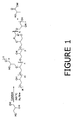
- FIG. 1 illustrates a compound with a DB of 1/7.
- “Hyperbranched” means a polymer, which is highly branched with three-dimensional tree-like structures or dendritic architecture.
- “Degree of cyclization” or DC means the mol fraction of cyclic structure units relative to the total monomer units in a polymer.
- the cyclic structure units can be formed by intramolecular cyclization of the polyols or any other ways to incorporate in the polyols.
- the cyclic structure units comprise basic structure units (V, VI and VII of FIG. 2 ) and the analogues thereof.
- the degree of cyclization may be determined by 13 C NMR.
- Low reactivity atmospheric environment is an atmospheric environment which is less reactive than the standard earth environment, which is achieved by substituting the atmospheric environment with an inert gas such as nitrogen, CO 2 , He, and any combination thereof, or by reducing the atmospheric pressure to less than 760 mm Hg.
- Solids means all starting materials used in the reaction except for solvents and water. Solids, includes but is not limited to products, co-products or by-products and any starting materials.
- FIG. 1 describes a glycerol-based polyol produced from glycerol.
- the polyol comprises a structure including at least two repeating units selecting from at least one of the structures listed in FIG. 2 including structures I and II, branched structures III, IV, and VIII, cyclic structures V, VI, VII and any combination thereof. Any structure in FIG. 2 can be combined with any structure or structures including itself through any free hydroxyl group functionality in the structure.
- the cyclic linkages of any basic cyclic structures in FIG. 2 may contain any structure or structures as a part or parts of linkages. In FIG. 1 and FIG.
- R and R' are (CH 2 ) n and n can independently be 1 or 0, and M can be H, metal or other counterion.
- a unique composition of glycerol-based polyol is produced from glycerol and at least one or more other monomers.
- Suitable monomers are any polyols or hydrogen active compounds such as those described in US 6,822,068 B2 , such as pentaerythrital, glycols, amines, etc. capable of reacting with glycerol or any polyglycerol structures.
- the glycerol-based polyol products produced by the present method comprise branched, cyclized structure units in the polyol and co-product lactic acid or lactate salt.
- the glycerol-based polyols have at least 0.1 of degree of branching, preferentially from 0.2 to 0.5, and a degree of cyclization at least 0.01, preferentially 0.02 to 0.19.
- the valuable co-product lactic acid or and lactate salt produced in the invention is at least 1%, preferentially 5% to 30%, by weight in the product solids.
- the produced lactic acid or lactic salt is particularly useful as it protects the glycerol-based polyols from bacterial and fungal spoilage. Biochallenge experimental tests show that the polyglycerols products are not susceptible to biological infestation such as from bacteria or fungi. Experimentally produced samples have gone for over 2 years without biological infestation or spoilage.
- Branching is particularly useful as it facilitates increased molecular weight of the glycerol-based polyols and constructs structured polyols thereof As described in US Published Application 2009/0130006 A1 branched glycerol-based polyols are capable of reducing scales in Bayer liquor during aluminum processing. As described in US patent application, application number 12/499, 916 , the glycerol-based polyols effectively increase brightness and whiteness of coated paper substrate without being frustrated by greening effect.
- the inventive method comprises particular concentration of a strong base as the catalyst under a particular distillation environment at high reaction temperature for a desired reaction time.
- the strong base is CsOH, KOH, NaOH, any other strong base stronger than NaOH or any combination thereof in the amount of above 2%, preferably above 3%.
- the particular distillation environment is inert gas flow rates of more than 0.2 mol of inert gas per hour per mol of monomer used.
- the inert gas is nitrogen, carbon dioxide, any other inert gas, or any combination thereof.
- the particular distillation environment is a vacuum pressure of less than 760 mmHg.
- the reaction temperature is above 200 and below 300 degrees Celsius. In at least one embodiment the reaction temperature is from 230 to 260 degrees Celsius. The reaction is conducted over 2 hours to a number of hours as desired.
- the reaction produced polyols have a polydispersity of at least 1. In at least one embodiment, the reaction produced polyols have a polydispersity within the range of 1 to 30.
- polydispersity is a term of art whose precise definition is provided in Principles of Polymerization, 4th Edition, by George Odion Wiley-InterScience (2004), Introduction pages 18-25 .
- the inventive method has a number of benefits.
- One advantage is the high proportion of valuable lactic acid or lactate salt present in the reaction product.
- the lactic acid has been observed to be as much as at least 11% to 22% by weight of the reaction product.
- the produced lactic acid is particularly useful as it protects the polyglycerol from bacterial and fungal spoilage. Experimentally produced samples have gone for over 2 years without biological infestation or spoilage.
- the degree of cyclization of the resulting polyol is 0.15 to 0.18.
- At least 30 to 35% of the produced polyglycerols are branched or hyperbranched polyglycerols. Branching or hyperbranching is particularly useful as it facilitates increased molecular weight of the polyglycerols. Furthermore as described in US Published Application 2009/0130006 A1 branched and hyperbranched polyglycerols are also capable of reducing scale in Bayer liquor during aluminum processing.
- the inventive process uses a higher amount of a strong base as the catalyst under a particular distillation environment to effectively produce the branched, cyclized glycerol-based polyols in a wide range of molecular weights with a beneficial co-product lactic acid or lactate as anti-biodegrading agent.
- the low reactivity atmospheric environment removes water that forms as a reaction byproduct, which prevents the water from inhibiting the polymerization reactions.
- a general procedure described here was followed by the examples.
- a reaction mixture of glycerol (500.0 parts) and a strong base in a particular amount (% by weight of active relative to the total weight of reaction solids) was stirred and gradually heated up to 230 to 260 degrees Celsius under particular inert gas flow rates.
- the reaction mixture was stirred at this temperature for a desired reaction time (in hours), and in-process samples were drawn after two or four hours and every one or two hours thereafter for product characterizations.
- Particular inert gas flow rates were applied starting from reaction time between 0 to 4 hours to the end of the reaction to remove water and possibly other volatiles from the reaction mixture and the condensation polymerization.
- Table 1 Molecular Weights of Polyglycerols Over Reaction Time* Rxn time, hours
- Example 3 CsOH, 12.3% Cpd MW Cpd MW Cpd MW 4 1 185 8 330 12 300 6 2 430 9 650 13 690 8 3 2,500 10 2,100 14 3,500 10 4 3,600 11 3,000 15 5,900 12 5 6,200 - - - - 14 6 7,800 - - - - 16 7 9,100 - - - - * Cpd is a sample's or a compound's identity, and consistently used in other Tables 2 and 3.
- Table 2 Composition Analysis by 13 C NMR for Polyglycerols* Cpd L% DB Cpd L% DB Cpd L% DB 1 2 0.15 8 8 0.21 12 7 0.21 2 6 0.24 9 12 0.29 13 12 0.29 3 10 0.30 10 14 0.31 14 15 0.33 4 14 0.32 11 14 0.32 15 16 0.34 5 15 0.34 - - - - - 6 13 0.34 - - - - - - 7 13 0.33 - - - - - * L%, determined as lactate (sodium) salt and calculated as lactic acid by weight; DB, degree of branching by mol fraction based on known literature method cited in the definition section.
- Turbid cell suspensions in TSB were prepared for bacterial cultures and 0.5 ml of this cell suspension was inoculated into 10 mL of the produced polyol solutions. Final cell density in the inoculated products were estimated at approximately 5x10 6 cfu/ml. A spore suspension in phosphate buffer was used for the fungal isolate and 0.5 mL of the spore suspension was inoculated into 10 mL of the product samples. Final spore density in the inoculated product sample was estimated at approximately 5x10 4 spores/mL. Viability of the test cultures was confirmed by inoculation of 0.5 mL of the cell/spore suspensions into 10 mL TSB.
Landscapes
- Chemical & Material Sciences (AREA)
- Organic Chemistry (AREA)
- Medicinal Chemistry (AREA)
- Polymers & Plastics (AREA)
- Health & Medical Sciences (AREA)
- Chemical Kinetics & Catalysis (AREA)
- Oil, Petroleum & Natural Gas (AREA)
- Engineering & Computer Science (AREA)
- Polyethers (AREA)
- Polyurethanes Or Polyureas (AREA)
- Organic Low-Molecular-Weight Compounds And Preparation Thereof (AREA)
- Polyesters Or Polycarbonates (AREA)
- Preparation Of Compounds By Using Micro-Organisms (AREA)
Claims (13)
- Verfahren zum Synthetisieren Glycerol-basierter Polyolprodukte, die folgenden Schritte umfassend:das Reagieren einer Reaktionsmasse, die mindestens Glycerolmonomer in Gegenwart eines Basiskatalysators umfasst, ausgewählt aus der Gruppe NaOH, KOH, CsOH, einer stärkeren Basis als NaOH oder eine beliebige Kombination dieser, mit einer Konzentration von mehr als 2 Gewichtsprozent (im Verhältnis zu dem Gesamtgewicht der Reaktionsfeststoffe, wobei Feststoffe alle Ausgangsstoffe sind, die in der Reaktion verwendet werden, mit Ausnahme von Lösemitteln und Wasser), in einer Umgebung auf atmosphärischem Druck von unter 760 mm Hg und/oder einer Inertgasatmosphäre, ausgewählt aus N2, CO2, He oder anderen Inertgasen, oder einer beliebigen Kombination dieser, auf einer Temperatur von über 200 °C und unter 300 °C, wobei ein Produkt erzeugt wird, das Glycerol-basierte Polyole umfasst, die verzweigte und cyclisierte Struktureinheiten in dem Polyol umfassen, und ein Nebenprodukt, das Milchsäure und/oder Laktatsalz umfasst.
- Verfahren nach Anspruch 1, wobei dieses ferner die Schritte des Bereitstellens des Katalysators mit mehr als 3 Gewichtsprozent umfasst.
- Verfahren nach Anspruch 1, wobei die atmosphärische Umgebung eine Strömung eines Inertgases darstellt, ausgewählt aus N2, CO2, He oder anderen Inertgasen, oder einer beliebigen Kombination dieser, und wobei die Strömungsrate des Inertgases bei 0,2 bis 15 mol pro Stunde pro Mol an Monomer(en) entspricht.
- Verfahren nach Anspruch 1, wobei die Glycerol-basierten Polyolprodukte aus der Gruppe ausgewählt werden, die Polyglycerole, Polyglycerolderivate, ein Polyol mit sowohl Glycerol-Monomereinheiten als auch Nicht-Glycerol-Monomereinheiten und jede Kombination dieser umfasst, wobei die Polyole mindestens zwei Hydroxylgruppen aufweisen.
- Verfahren nach Anspruch 1, wobei zumindest ein Teil der erzeugten Polyole sowohl mindestens einen Verzweigungsgrad von 0,1 als auch einen Cyclisierungsgrad von 0,01 aufweisen.
- Verfahren nach Anspruch 1, wobei das Nebenprodukt mindestens 1 Gewichtsprozent entspricht.
- Verfahren nach Anspruch 1, wobei die Glycerol-basierten Polyolprodukte ein Gewicht von mindestens 166 Dalton aufweisen.
- Verfahren nach Anspruch 1, wobei die Glycerol-basierten Polyolprodukte eine Polydispersität von mindestens 1 aufweisen.
- Verfahren nach Anspruch 1, wobei das Glycerol rein, technisch, roh oder eine beliebige Kombination dieser ist.
- Verfahren nach Anspruch 1, wobei dieses ferner weitere Monomere aufweist, die aus der Gruppe von Polyolen ausgewählt werden, wie etwa Pentaerythritol und Glykolwe, Amine, andere Monomere, die mit Glycerol- oder Glycerol-basierten Polyolintermediaten reagieren können und jede Kombination dieser.
- Verfahren nach Anspruch 1, wobei dieses ferner die Schritte des Vorbestimmens des gewünschten Molekulargewichts des erzeugten Polyglycerols und des Anpassens der atmosphärischen Umgebung umfasst, so dass diese der optimalen Umgebung für die Erzeugung des gewünschten Molekulargewichts entspricht.
- Verfahren nach Anspruch 1, wobei dieses ferner die Schritte des Vorbestimmens des gewünschten Verzweigungsgrads und des gewünschten Cyclisierungsgrads des erzeugten Polyglycerols sowie der gewünschten Menge des Nebenprodukts und des Anpassens der atmosphärischen Umgebung umfasst, so dass diese der optimalen Umgebung für die Erzeugung des gewünschten Verzweigungsgrads, des gewünschten Cyclisierungsgrads und der Menge an Nebenprodukt-Milchsäure und/oder -Laktatsalz entspricht.
- Verfahren nach Anspruch 1, wobei die verzweigten, zyklischen Polyole ein Molekulargewicht im Bereich von 2.240 bis 150.000 Dalton und einen Polydispersitätsbereich von 1 bis 30 aufweisen.
Applications Claiming Priority (2)
| Application Number | Priority Date | Filing Date | Title |
|---|---|---|---|
| US12/582,827 US9290620B2 (en) | 2009-10-21 | 2009-10-21 | Production and composition of glycerol based polyols |
| PCT/US2010/050807 WO2011049723A2 (en) | 2009-10-21 | 2010-09-30 | Production and composition of glycerol based polyols |
Publications (3)
| Publication Number | Publication Date |
|---|---|
| EP2491069A2 EP2491069A2 (de) | 2012-08-29 |
| EP2491069A4 EP2491069A4 (de) | 2013-07-03 |
| EP2491069B1 true EP2491069B1 (de) | 2014-05-21 |
Family
ID=43879810
Family Applications (1)
| Application Number | Title | Priority Date | Filing Date |
|---|---|---|---|
| EP10825389.9A Active EP2491069B1 (de) | 2009-10-21 | 2010-09-30 | Herstellung von polyolen auf glycerolbasis |
Country Status (8)
| Country | Link |
|---|---|
| US (1) | US9290620B2 (de) |
| EP (1) | EP2491069B1 (de) |
| KR (1) | KR101848937B1 (de) |
| CN (1) | CN102666650B (de) |
| BR (1) | BR112012009635B1 (de) |
| CA (1) | CA2777327C (de) |
| ES (1) | ES2471496T3 (de) |
| WO (1) | WO2011049723A2 (de) |
Families Citing this family (17)
| Publication number | Priority date | Publication date | Assignee | Title |
|---|---|---|---|---|
| US8884049B2 (en) | 2009-10-21 | 2014-11-11 | Nalco Company | Glycerol based polymer surface active chemistry and production |
| US8101045B2 (en) * | 2010-01-05 | 2012-01-24 | Nalco Company | Modifying agent for yankee coatings |
| US9416490B2 (en) | 2010-03-10 | 2016-08-16 | Nalco Company | Cross-linked glycerol based polymers as digestion aids for improving wood pulping processes |
| US8709209B2 (en) * | 2010-03-10 | 2014-04-29 | Nalco Company | Anionic lipophilic glycerol-based polymers for organic deposition control in papermaking processes |
| US8728275B2 (en) * | 2012-07-27 | 2014-05-20 | Ecolab Usa Inc. | Glycerol-based polymers for reducing deposition of organic contaminants in papermaking processes |
| US8366877B2 (en) * | 2010-03-10 | 2013-02-05 | Nalco Company | Lipohydrophilic glycerol based polymers as digestion aids for improving wood pulping processes |
| IN2014DN08895A (de) * | 2012-05-31 | 2015-05-22 | Nalco Co | |
| CA2892629C (en) * | 2012-12-28 | 2016-08-30 | Nalco Company | Anionic lipophilic glycerol-based polymers for organic deposition control in papermaking processes |
| US9353301B2 (en) | 2013-11-25 | 2016-05-31 | Ecolab Usa Inc. | Composition for dust control |
| EP3331962B1 (de) | 2015-08-07 | 2021-02-17 | Ecolab USA Inc. | Funktionelle carbonylinvertierungsmittel für wasser-in-öl-latizes und verfahren zur verwendung |
| MX2018001621A (es) | 2015-08-07 | 2018-05-28 | Ecolab Usa Inc | Agentes de inversion no ionicos para latex de agua en aceite y metodos de uso. |
| CA2994684A1 (en) | 2015-08-07 | 2017-02-16 | Xiaojin Harry Li | Phosphorus functional inversion agents for water-in-oil latices and methods of use |
| US10836665B2 (en) | 2015-09-10 | 2020-11-17 | Dow Global Technologies Llc | Scale inhibitor methods and compositions |
| WO2019221925A1 (en) * | 2018-05-18 | 2019-11-21 | Novomer, Inc. | Integrated systems and processes for chemical production |
| AR118538A1 (es) | 2019-03-28 | 2021-10-20 | Ecolab Usa Inc | Emulsiones de polímeros autoinvertidores |
| CN112174570B (zh) * | 2020-10-10 | 2022-05-03 | 江苏润天建材有限公司 | 一种环保型水泥助磨剂及制备方法 |
| AU2023314793A1 (en) | 2022-07-29 | 2025-02-20 | Championx Llc | Emulsion polymers and methods for improving pumpability |
Family Cites Families (20)
| Publication number | Priority date | Publication date | Assignee | Title |
|---|---|---|---|---|
| US2258892A (en) * | 1938-08-25 | 1941-10-14 | Benjamin R Harris | Ethers of polyglycerols |
| US3637774A (en) * | 1969-11-03 | 1972-01-25 | Vigen K Babayan | Process for preparation and purification of polyglycerols and esters thereof |
| DE3346097A1 (de) * | 1983-12-21 | 1985-07-04 | Hoechst Ag, 6230 Frankfurt | Verfahren zur herstellung von polyglycerinen |
| GB8427886D0 (en) * | 1984-11-03 | 1984-12-12 | Manchester Inst Science Tech | Formation of polyols |
| US5198532A (en) * | 1991-03-19 | 1993-03-30 | Shell Oil Company | Polycondensation of epihalohydrin and polyhydric alcohols and thermal condensation to form polyethercyclicpolyols |
| US5641816A (en) * | 1991-07-25 | 1997-06-24 | Henkel Kommanditgesellschaft Auf Aktien | Process for the production of polyol compounds |
| DE4124665A1 (de) * | 1991-07-25 | 1993-01-28 | Henkel Kgaa | Verfahren zur herstellung von polyolverbindungen |
| US5399371A (en) * | 1993-06-17 | 1995-03-21 | Henkel Corporation | Low calorie substitute for an edible oil |
| JP3717193B2 (ja) | 1994-05-20 | 2005-11-16 | 太陽化学株式会社 | ポリグリセリン分画物とその脂肪酸エステルおよびその製造方法 |
| FR2728896A1 (fr) | 1994-12-29 | 1996-07-05 | Inst Francais Du Petrole | Procede pour l'obtention de polyglycerols et d'esters de polyglycerols |
| US5756639A (en) * | 1995-07-28 | 1998-05-26 | Shell Oil Company | Copolymerization of polyetherpolyols with epoxy resins |
| US6822068B2 (en) * | 1998-12-22 | 2004-11-23 | Bayer Aktiengesellschaft | Method for producing highly-branched glycidol-based polyols |
| US6683222B2 (en) * | 1999-02-18 | 2004-01-27 | Taiyo Kagaku Co., Ltd. | Polyether-polyol compound |
| US6620904B2 (en) * | 2000-11-06 | 2003-09-16 | Lonza Inc. | Processes for preparing linear polyglycerols and polyglycerol esters |
| MY142392A (en) | 2005-10-26 | 2010-11-30 | Malaysian Palm Oil Board | A process for preparing polymers of polyhydric alcohols |
| CN101189996B (zh) | 2006-11-30 | 2012-05-02 | 四川宇妥藏药药业有限责任公司 | 一种保健茶及其制备方法 |
| US7845097B2 (en) * | 2006-12-07 | 2010-12-07 | Callaway Golf Company | Chemically-treated outsole assembly for a golf shoe |
| US20080306211A1 (en) * | 2007-02-06 | 2008-12-11 | Cargill, Incorporated | Process for prepapring polycerol and mixed ethers |
| US20090082483A1 (en) * | 2007-09-20 | 2009-03-26 | Petrovic Zoran S | Polyglycerol based polyols and polyurethanes and methods for producing polyols and polyurethanes |
| US9284625B2 (en) * | 2007-11-20 | 2016-03-15 | Nalco Company | Use of polyols as scale control reagents in the mining processes |
-
2009
- 2009-10-21 US US12/582,827 patent/US9290620B2/en active Active
-
2010
- 2010-09-30 ES ES10825389.9T patent/ES2471496T3/es active Active
- 2010-09-30 KR KR1020127011196A patent/KR101848937B1/ko active Active
- 2010-09-30 BR BR112012009635-4A patent/BR112012009635B1/pt active IP Right Grant
- 2010-09-30 EP EP10825389.9A patent/EP2491069B1/de active Active
- 2010-09-30 WO PCT/US2010/050807 patent/WO2011049723A2/en not_active Ceased
- 2010-09-30 CA CA2777327A patent/CA2777327C/en active Active
- 2010-09-30 CN CN201080047946.3A patent/CN102666650B/zh active Active
Also Published As
| Publication number | Publication date |
|---|---|
| WO2011049723A3 (en) | 2011-08-25 |
| WO2011049723A2 (en) | 2011-04-28 |
| CA2777327C (en) | 2017-07-04 |
| BR112012009635A2 (pt) | 2016-05-17 |
| EP2491069A2 (de) | 2012-08-29 |
| CN102666650B (zh) | 2014-10-29 |
| BR112012009635B1 (pt) | 2019-09-17 |
| CN102666650A (zh) | 2012-09-12 |
| US9290620B2 (en) | 2016-03-22 |
| EP2491069A4 (de) | 2013-07-03 |
| CA2777327A1 (en) | 2011-04-28 |
| AU2010308475A1 (en) | 2012-05-03 |
| US20110092743A1 (en) | 2011-04-21 |
| KR20120089702A (ko) | 2012-08-13 |
| KR101848937B1 (ko) | 2018-04-13 |
| ES2471496T3 (es) | 2014-06-26 |
Similar Documents
| Publication | Publication Date | Title |
|---|---|---|
| US9290620B2 (en) | Production and composition of glycerol based polyols | |
| CN103717640B (zh) | 支链聚醚碳酸酯的制备方法和其用途 | |
| US20230312815A1 (en) | Synthesis of polymers from cyclic diolides | |
| HU228388B1 (en) | Long-chain polyether polyols with a high proportion of primary oh groups process for producing thereof and their using | |
| EP1620489B1 (de) | Polytrimethylenetherglykol mit hervorragender qualität aus biochemisch gewonnenem 1,3-propandiol | |
| WO2011142259A1 (ja) | 脂肪族ポリカーボネートの製造方法 | |
| AU2007207522A1 (en) | Process for producing polytrimethylene ether glycol | |
| AU2010308475B2 (en) | Production and composition of glycerol based polyols | |
| US11965061B2 (en) | Catalyst for copolymerization of carbon dioxide and epoxy and method of manufacturing the same | |
| KR101230907B1 (ko) | 유산으로부터 락타이드의 제조 방법 | |
| KR102717144B1 (ko) | 하이드로젠 헥사시아노코발테이트와 아연 카복실레이트의 조합으로 제조된 더블메탈시아나이드 촉매 및 이를 이용한 프로필렌 옥사이드 중합 | |
| KR101439431B1 (ko) | 환원성 아민화 반응용 코발트-이트륨계 담지 촉매 및 이를 사용한 폴리에테르아민 화합물의 제조 방법 | |
| EP2855410B1 (de) | Glycerolbasiertes polymer mit oberflächenaktiver chemie und herstellung davon | |
| US7714097B2 (en) | Polymer synthesis from macrocycles | |
| CN106905524B (zh) | 一种双端烯基聚环氧丙烷的制备方法 | |
| WO2023121913A1 (en) | Semi-batch alkylene oxide polymerization process using a lewis acid catalyst | |
| KR101684640B1 (ko) | 글리세롤을 이용한 글리시돌의 제조방법 및 이에 따라 제조된 글리시돌 | |
| JP4474919B2 (ja) | グリセリンポリアルキレングリコールエーテル誘導体の製造方法 | |
| KR20120131851A (ko) | 유산으로부터 락타이드의 제조 방법 | |
| KR101293818B1 (ko) | C9-알데히드의 생성이 극대화된 α, β-불포화 알데히드의 제조방법 | |
| JP2010006759A (ja) | 環状カーボネートのアルキレンオキサイド付加物 | |
| KR101426409B1 (ko) | 환원성 아민화 반응용 코발트-이트륨계 촉매 및 이를 사용한 폴리에테르아민 화합물의 제조 방법 | |
| KR102119198B1 (ko) | 의료용 폴리옥시프로필렌 중합체의 제조방법 및 의료용 폴리옥시프로필렌/폴리옥시에틸렌 블록 공중합체의 제조방법 | |
| EP3333148B1 (de) | Ververfahren zur herstellung eines 2-acetoxyalkansäureesters | |
| JP3902921B2 (ja) | 脂肪族ポリエステルの製造方法、カプロン酸の製造方法、プロピオニバクテリウムアクネスcap103菌株 |
Legal Events
| Date | Code | Title | Description |
|---|---|---|---|
| PUAI | Public reference made under article 153(3) epc to a published international application that has entered the european phase |
Free format text: ORIGINAL CODE: 0009012 |
|
| 17P | Request for examination filed |
Effective date: 20120521 |
|
| AK | Designated contracting states |
Kind code of ref document: A2 Designated state(s): AL AT BE BG CH CY CZ DE DK EE ES FI FR GB GR HR HU IE IS IT LI LT LU LV MC MK MT NL NO PL PT RO SE SI SK SM TR |
|
| DAX | Request for extension of the european patent (deleted) | ||
| A4 | Supplementary search report drawn up and despatched |
Effective date: 20130603 |
|
| RIC1 | Information provided on ipc code assigned before grant |
Ipc: C07C 59/08 20060101ALI20130527BHEP Ipc: C07C 41/09 20060101ALI20130527BHEP Ipc: C07C 43/13 20060101ALI20130527BHEP Ipc: C08G 65/34 20060101AFI20130527BHEP |
|
| GRAP | Despatch of communication of intention to grant a patent |
Free format text: ORIGINAL CODE: EPIDOSNIGR1 |
|
| INTG | Intention to grant announced |
Effective date: 20140103 |
|
| GRAS | Grant fee paid |
Free format text: ORIGINAL CODE: EPIDOSNIGR3 |
|
| GRAA | (expected) grant |
Free format text: ORIGINAL CODE: 0009210 |
|
| AK | Designated contracting states |
Kind code of ref document: B1 Designated state(s): AL AT BE BG CH CY CZ DE DK EE ES FI FR GB GR HR HU IE IS IT LI LT LU LV MC MK MT NL NO PL PT RO SE SI SK SM TR |
|
| REG | Reference to a national code |
Ref country code: GB Ref legal event code: FG4D |
|
| REG | Reference to a national code |
Ref country code: CH Ref legal event code: EP |
|
| REG | Reference to a national code |
Ref country code: AT Ref legal event code: REF Ref document number: 669586 Country of ref document: AT Kind code of ref document: T Effective date: 20140615 |
|
| REG | Reference to a national code |
Ref country code: IE Ref legal event code: FG4D |
|
| REG | Reference to a national code |
Ref country code: ES Ref legal event code: FG2A Ref document number: 2471496 Country of ref document: ES Kind code of ref document: T3 Effective date: 20140626 |
|
| REG | Reference to a national code |
Ref country code: DE Ref legal event code: R096 Ref document number: 602010016322 Country of ref document: DE Effective date: 20140710 |
|
| REG | Reference to a national code |
Ref country code: AT Ref legal event code: MK05 Ref document number: 669586 Country of ref document: AT Kind code of ref document: T Effective date: 20140521 Ref country code: NL Ref legal event code: VDEP Effective date: 20140521 |
|
| REG | Reference to a national code |
Ref country code: LT Ref legal event code: MG4D |
|
| PG25 | Lapsed in a contracting state [announced via postgrant information from national office to epo] |
Ref country code: NO Free format text: LAPSE BECAUSE OF FAILURE TO SUBMIT A TRANSLATION OF THE DESCRIPTION OR TO PAY THE FEE WITHIN THE PRESCRIBED TIME-LIMIT Effective date: 20140821 Ref country code: FI Free format text: LAPSE BECAUSE OF FAILURE TO SUBMIT A TRANSLATION OF THE DESCRIPTION OR TO PAY THE FEE WITHIN THE PRESCRIBED TIME-LIMIT Effective date: 20140521 Ref country code: GR Free format text: LAPSE BECAUSE OF FAILURE TO SUBMIT A TRANSLATION OF THE DESCRIPTION OR TO PAY THE FEE WITHIN THE PRESCRIBED TIME-LIMIT Effective date: 20140822 Ref country code: LT Free format text: LAPSE BECAUSE OF FAILURE TO SUBMIT A TRANSLATION OF THE DESCRIPTION OR TO PAY THE FEE WITHIN THE PRESCRIBED TIME-LIMIT Effective date: 20140521 Ref country code: IS Free format text: LAPSE BECAUSE OF FAILURE TO SUBMIT A TRANSLATION OF THE DESCRIPTION OR TO PAY THE FEE WITHIN THE PRESCRIBED TIME-LIMIT Effective date: 20140921 |
|
| PG25 | Lapsed in a contracting state [announced via postgrant information from national office to epo] |
Ref country code: HR Free format text: LAPSE BECAUSE OF FAILURE TO SUBMIT A TRANSLATION OF THE DESCRIPTION OR TO PAY THE FEE WITHIN THE PRESCRIBED TIME-LIMIT Effective date: 20140521 Ref country code: SE Free format text: LAPSE BECAUSE OF FAILURE TO SUBMIT A TRANSLATION OF THE DESCRIPTION OR TO PAY THE FEE WITHIN THE PRESCRIBED TIME-LIMIT Effective date: 20140521 Ref country code: PL Free format text: LAPSE BECAUSE OF FAILURE TO SUBMIT A TRANSLATION OF THE DESCRIPTION OR TO PAY THE FEE WITHIN THE PRESCRIBED TIME-LIMIT Effective date: 20140521 Ref country code: LV Free format text: LAPSE BECAUSE OF FAILURE TO SUBMIT A TRANSLATION OF THE DESCRIPTION OR TO PAY THE FEE WITHIN THE PRESCRIBED TIME-LIMIT Effective date: 20140521 Ref country code: AT Free format text: LAPSE BECAUSE OF FAILURE TO SUBMIT A TRANSLATION OF THE DESCRIPTION OR TO PAY THE FEE WITHIN THE PRESCRIBED TIME-LIMIT Effective date: 20140521 |
|
| PG25 | Lapsed in a contracting state [announced via postgrant information from national office to epo] |
Ref country code: PT Free format text: LAPSE BECAUSE OF FAILURE TO SUBMIT A TRANSLATION OF THE DESCRIPTION OR TO PAY THE FEE WITHIN THE PRESCRIBED TIME-LIMIT Effective date: 20140922 |
|
| PG25 | Lapsed in a contracting state [announced via postgrant information from national office to epo] |
Ref country code: DK Free format text: LAPSE BECAUSE OF FAILURE TO SUBMIT A TRANSLATION OF THE DESCRIPTION OR TO PAY THE FEE WITHIN THE PRESCRIBED TIME-LIMIT Effective date: 20140521 Ref country code: EE Free format text: LAPSE BECAUSE OF FAILURE TO SUBMIT A TRANSLATION OF THE DESCRIPTION OR TO PAY THE FEE WITHIN THE PRESCRIBED TIME-LIMIT Effective date: 20140521 Ref country code: BE Free format text: LAPSE BECAUSE OF FAILURE TO SUBMIT A TRANSLATION OF THE DESCRIPTION OR TO PAY THE FEE WITHIN THE PRESCRIBED TIME-LIMIT Effective date: 20140521 Ref country code: CZ Free format text: LAPSE BECAUSE OF FAILURE TO SUBMIT A TRANSLATION OF THE DESCRIPTION OR TO PAY THE FEE WITHIN THE PRESCRIBED TIME-LIMIT Effective date: 20140521 Ref country code: SK Free format text: LAPSE BECAUSE OF FAILURE TO SUBMIT A TRANSLATION OF THE DESCRIPTION OR TO PAY THE FEE WITHIN THE PRESCRIBED TIME-LIMIT Effective date: 20140521 Ref country code: RO Free format text: LAPSE BECAUSE OF FAILURE TO SUBMIT A TRANSLATION OF THE DESCRIPTION OR TO PAY THE FEE WITHIN THE PRESCRIBED TIME-LIMIT Effective date: 20140521 |
|
| REG | Reference to a national code |
Ref country code: DE Ref legal event code: R097 Ref document number: 602010016322 Country of ref document: DE |
|
| PG25 | Lapsed in a contracting state [announced via postgrant information from national office to epo] |
Ref country code: NL Free format text: LAPSE BECAUSE OF FAILURE TO SUBMIT A TRANSLATION OF THE DESCRIPTION OR TO PAY THE FEE WITHIN THE PRESCRIBED TIME-LIMIT Effective date: 20140521 |
|
| PLBE | No opposition filed within time limit |
Free format text: ORIGINAL CODE: 0009261 |
|
| STAA | Information on the status of an ep patent application or granted ep patent |
Free format text: STATUS: NO OPPOSITION FILED WITHIN TIME LIMIT |
|
| 26N | No opposition filed |
Effective date: 20150224 |
|
| PG25 | Lapsed in a contracting state [announced via postgrant information from national office to epo] |
Ref country code: IT Free format text: LAPSE BECAUSE OF FAILURE TO SUBMIT A TRANSLATION OF THE DESCRIPTION OR TO PAY THE FEE WITHIN THE PRESCRIBED TIME-LIMIT Effective date: 20140521 Ref country code: LU Free format text: LAPSE BECAUSE OF FAILURE TO SUBMIT A TRANSLATION OF THE DESCRIPTION OR TO PAY THE FEE WITHIN THE PRESCRIBED TIME-LIMIT Effective date: 20140930 Ref country code: MC Free format text: LAPSE BECAUSE OF FAILURE TO SUBMIT A TRANSLATION OF THE DESCRIPTION OR TO PAY THE FEE WITHIN THE PRESCRIBED TIME-LIMIT Effective date: 20140521 |
|
| REG | Reference to a national code |
Ref country code: CH Ref legal event code: PL |
|
| REG | Reference to a national code |
Ref country code: DE Ref legal event code: R097 Ref document number: 602010016322 Country of ref document: DE Effective date: 20150224 |
|
| REG | Reference to a national code |
Ref country code: FR Ref legal event code: ST Effective date: 20150529 |
|
| PG25 | Lapsed in a contracting state [announced via postgrant information from national office to epo] |
Ref country code: LI Free format text: LAPSE BECAUSE OF NON-PAYMENT OF DUE FEES Effective date: 20140930 Ref country code: SI Free format text: LAPSE BECAUSE OF FAILURE TO SUBMIT A TRANSLATION OF THE DESCRIPTION OR TO PAY THE FEE WITHIN THE PRESCRIBED TIME-LIMIT Effective date: 20140521 Ref country code: CH Free format text: LAPSE BECAUSE OF NON-PAYMENT OF DUE FEES Effective date: 20140930 |
|
| PG25 | Lapsed in a contracting state [announced via postgrant information from national office to epo] |
Ref country code: FR Free format text: LAPSE BECAUSE OF NON-PAYMENT OF DUE FEES Effective date: 20140930 |
|
| PG25 | Lapsed in a contracting state [announced via postgrant information from national office to epo] |
Ref country code: SM Free format text: LAPSE BECAUSE OF FAILURE TO SUBMIT A TRANSLATION OF THE DESCRIPTION OR TO PAY THE FEE WITHIN THE PRESCRIBED TIME-LIMIT Effective date: 20140521 |
|
| PG25 | Lapsed in a contracting state [announced via postgrant information from national office to epo] |
Ref country code: MT Free format text: LAPSE BECAUSE OF FAILURE TO SUBMIT A TRANSLATION OF THE DESCRIPTION OR TO PAY THE FEE WITHIN THE PRESCRIBED TIME-LIMIT Effective date: 20140521 Ref country code: CY Free format text: LAPSE BECAUSE OF FAILURE TO SUBMIT A TRANSLATION OF THE DESCRIPTION OR TO PAY THE FEE WITHIN THE PRESCRIBED TIME-LIMIT Effective date: 20140521 Ref country code: BG Free format text: LAPSE BECAUSE OF FAILURE TO SUBMIT A TRANSLATION OF THE DESCRIPTION OR TO PAY THE FEE WITHIN THE PRESCRIBED TIME-LIMIT Effective date: 20140521 |
|
| PG25 | Lapsed in a contracting state [announced via postgrant information from national office to epo] |
Ref country code: HU Free format text: LAPSE BECAUSE OF FAILURE TO SUBMIT A TRANSLATION OF THE DESCRIPTION OR TO PAY THE FEE WITHIN THE PRESCRIBED TIME-LIMIT; INVALID AB INITIO Effective date: 20100930 Ref country code: TR Free format text: LAPSE BECAUSE OF FAILURE TO SUBMIT A TRANSLATION OF THE DESCRIPTION OR TO PAY THE FEE WITHIN THE PRESCRIBED TIME-LIMIT Effective date: 20140521 |
|
| PG25 | Lapsed in a contracting state [announced via postgrant information from national office to epo] |
Ref country code: MK Free format text: LAPSE BECAUSE OF FAILURE TO SUBMIT A TRANSLATION OF THE DESCRIPTION OR TO PAY THE FEE WITHIN THE PRESCRIBED TIME-LIMIT Effective date: 20140521 |
|
| PG25 | Lapsed in a contracting state [announced via postgrant information from national office to epo] |
Ref country code: AL Free format text: LAPSE BECAUSE OF FAILURE TO SUBMIT A TRANSLATION OF THE DESCRIPTION OR TO PAY THE FEE WITHIN THE PRESCRIBED TIME-LIMIT Effective date: 20140521 |
|
| PGFP | Annual fee paid to national office [announced via postgrant information from national office to epo] |
Ref country code: DE Payment date: 20250805 Year of fee payment: 16 |
|
| PGFP | Annual fee paid to national office [announced via postgrant information from national office to epo] |
Ref country code: GB Payment date: 20250807 Year of fee payment: 16 |
|
| PGFP | Annual fee paid to national office [announced via postgrant information from national office to epo] |
Ref country code: IE Payment date: 20250812 Year of fee payment: 16 |
|
| PGFP | Annual fee paid to national office [announced via postgrant information from national office to epo] |
Ref country code: ES Payment date: 20251014 Year of fee payment: 16 |