EP2490684B1 - Methods and nutritional formulations to increase the efficacy and reduce the side effects of cancer treatment - Google Patents
Methods and nutritional formulations to increase the efficacy and reduce the side effects of cancer treatment Download PDFInfo
- Publication number
- EP2490684B1 EP2490684B1 EP10825771.8A EP10825771A EP2490684B1 EP 2490684 B1 EP2490684 B1 EP 2490684B1 EP 10825771 A EP10825771 A EP 10825771A EP 2490684 B1 EP2490684 B1 EP 2490684B1
- Authority
- EP
- European Patent Office
- Prior art keywords
- patient
- meal
- fasting
- cancer
- chemotherapy
- Prior art date
- Legal status (The legal status is an assumption and is not a legal conclusion. Google has not performed a legal analysis and makes no representation as to the accuracy of the status listed.)
- Active
Links
Images



















Classifications
-
- G—PHYSICS
- G06—COMPUTING OR CALCULATING; COUNTING
- G06Q—INFORMATION AND COMMUNICATION TECHNOLOGY [ICT] SPECIALLY ADAPTED FOR ADMINISTRATIVE, COMMERCIAL, FINANCIAL, MANAGERIAL OR SUPERVISORY PURPOSES; SYSTEMS OR METHODS SPECIALLY ADAPTED FOR ADMINISTRATIVE, COMMERCIAL, FINANCIAL, MANAGERIAL OR SUPERVISORY PURPOSES, NOT OTHERWISE PROVIDED FOR
- G06Q10/00—Administration; Management
-
- A—HUMAN NECESSITIES
- A23—FOODS OR FOODSTUFFS; TREATMENT THEREOF, NOT COVERED BY OTHER CLASSES
- A23L—FOODS, FOODSTUFFS OR NON-ALCOHOLIC BEVERAGES, NOT OTHERWISE PROVIDED FOR; PREPARATION OR TREATMENT THEREOF
- A23L13/00—Meat products; Meat meal; Preparation or treatment thereof
- A23L13/60—Comminuted or emulsified meat products, e.g. sausages; Reformed meat from comminuted meat product
- A23L13/65—Sausages
-
- A—HUMAN NECESSITIES
- A23—FOODS OR FOODSTUFFS; TREATMENT THEREOF, NOT COVERED BY OTHER CLASSES
- A23P—SHAPING OR WORKING OF FOODSTUFFS, NOT FULLY COVERED BY A SINGLE OTHER SUBCLASS
- A23P20/00—Coating of foodstuffs; Coatings therefor; Making laminated, multi-layered, stuffed or hollow foodstuffs
- A23P20/20—Making of laminated, multi-layered, stuffed or hollow foodstuffs, e.g. by wrapping in preformed edible dough sheets or in edible food containers
-
- A—HUMAN NECESSITIES
- A61—MEDICAL OR VETERINARY SCIENCE; HYGIENE
- A61K—PREPARATIONS FOR MEDICAL, DENTAL OR TOILETRY PURPOSES
- A61K31/00—Medicinal preparations containing organic active ingredients
- A61K31/045—Hydroxy compounds, e.g. alcohols; Salts thereof, e.g. alcoholates
- A61K31/07—Retinol compounds, e.g. vitamin A
-
- A—HUMAN NECESSITIES
- A61—MEDICAL OR VETERINARY SCIENCE; HYGIENE
- A61K—PREPARATIONS FOR MEDICAL, DENTAL OR TOILETRY PURPOSES
- A61K31/00—Medicinal preparations containing organic active ingredients
- A61K31/185—Acids; Anhydrides, halides or salts thereof, e.g. sulfur acids, imidic, hydrazonic or hydroximic acids
- A61K31/19—Carboxylic acids, e.g. valproic acid
- A61K31/20—Carboxylic acids, e.g. valproic acid having a carboxyl group bound to a chain of seven or more carbon atoms, e.g. stearic, palmitic, arachidic acids
-
- A—HUMAN NECESSITIES
- A61—MEDICAL OR VETERINARY SCIENCE; HYGIENE
- A61K—PREPARATIONS FOR MEDICAL, DENTAL OR TOILETRY PURPOSES
- A61K31/00—Medicinal preparations containing organic active ingredients
- A61K31/185—Acids; Anhydrides, halides or salts thereof, e.g. sulfur acids, imidic, hydrazonic or hydroximic acids
- A61K31/19—Carboxylic acids, e.g. valproic acid
- A61K31/20—Carboxylic acids, e.g. valproic acid having a carboxyl group bound to a chain of seven or more carbon atoms, e.g. stearic, palmitic, arachidic acids
- A61K31/202—Carboxylic acids, e.g. valproic acid having a carboxyl group bound to a chain of seven or more carbon atoms, e.g. stearic, palmitic, arachidic acids having three or more double bonds, e.g. linolenic
-
- A—HUMAN NECESSITIES
- A61—MEDICAL OR VETERINARY SCIENCE; HYGIENE
- A61K—PREPARATIONS FOR MEDICAL, DENTAL OR TOILETRY PURPOSES
- A61K31/00—Medicinal preparations containing organic active ingredients
- A61K31/33—Heterocyclic compounds
- A61K31/335—Heterocyclic compounds having oxygen as the only ring hetero atom, e.g. fungichromin
- A61K31/365—Lactones
- A61K31/375—Ascorbic acid, i.e. vitamin C; Salts thereof
-
- A—HUMAN NECESSITIES
- A61—MEDICAL OR VETERINARY SCIENCE; HYGIENE
- A61K—PREPARATIONS FOR MEDICAL, DENTAL OR TOILETRY PURPOSES
- A61K31/00—Medicinal preparations containing organic active ingredients
- A61K31/59—Compounds containing 9, 10- seco- cyclopenta[a]hydrophenanthrene ring systems
-
- A—HUMAN NECESSITIES
- A61—MEDICAL OR VETERINARY SCIENCE; HYGIENE
- A61P—SPECIFIC THERAPEUTIC ACTIVITY OF CHEMICAL COMPOUNDS OR MEDICINAL PREPARATIONS
- A61P3/00—Drugs for disorders of the metabolism
- A61P3/02—Nutrients, e.g. vitamins, minerals
-
- A—HUMAN NECESSITIES
- A61—MEDICAL OR VETERINARY SCIENCE; HYGIENE
- A61P—SPECIFIC THERAPEUTIC ACTIVITY OF CHEMICAL COMPOUNDS OR MEDICINAL PREPARATIONS
- A61P35/00—Antineoplastic agents
-
- A—HUMAN NECESSITIES
- A61—MEDICAL OR VETERINARY SCIENCE; HYGIENE
- A61P—SPECIFIC THERAPEUTIC ACTIVITY OF CHEMICAL COMPOUNDS OR MEDICINAL PREPARATIONS
- A61P43/00—Drugs for specific purposes, not provided for in groups A61P1/00-A61P41/00
Definitions
- the present invention relates in general to diet and cancer treatment. More specifically, the invention provides methods that may be used to sensitize cancer cells to chemotherapy drugs, while protecting normal cells.
- Chemotherapy can extend survival in patients diagnosed with a wide range of malignancies.
- toxic side-effects to normal cells and tissues limits chemotherapy dose intensity, frequency, and efficacy.
- the cardiotoxicity and nephrotoxicity associated with the widely prescribed anti-cancer drugs, doxorubicin and cisplatin, respectively limit their full therapeutic potential ( Rajagopalan, S. Cancer Res. 1988 ; Hale, J.P. Arch. Dis. Child 1994 ; Dobyan, D.C., J. Pharmacol. E.T1980 ; Fillastre, J.P. Toxicology let 1989 ).
- reduction of undesired toxicity by selective protection of normal cells without compromising the killing of malignant cells represents a promising strategy to enhance cancer treatment.
- Calorie restriction is known to enhance stress resistance and extend life span in organisms ranging from yeast to mammals. Calorie restriction has also been shown to delay cancer growth, but its effect is small and it cannot be combined with chemotherapy nor can it be applied alone, since it requires a long-term weight loss which is detrimental to cancer patients and also very difficult to maintain.
- a method for alleviating cancer growth or a symptom of cancer includes a step in which a patient with cancer is identified and then provided with a first diet for a first predetermined period of time.
- the first diet provides the patient with at most 50% of the patient's normal caloric intake with at least 50% of the kilocalories being derived from fat, preferably monounsaturated.
- the patient is then provided with a second diet for a second predetermined period of time.
- the second diet provides the patient with at most 500 kcal/day.
- the patient is then provided with a third diet that optimizes weight regain and the replenishment of essential nutrients required for optimal recovery and health of normal cells and organs.
- the present embodiment provides a short-term modified diet protocol that is effective in protecting normal cells and impeding and retarding cancer cell growth.
- the protocol and modified diet will promote these effects without causing chronic weight loss in patients.
- the invention provides a therapeutic meal package for use in providing meals to a cancer patient that retards cancer growth and enhances efficacy of chemotherapy drugs, the therapeutic meal package comprising:
- the first meal component and the second meal component may each independently include vegetable extracts from a source selected from the group consisting of bokchoy, kale, lettuce, asparagus, carrot, butternut squash, alfalfa, green peas, tomato, cabbage, cauliflower, and beets.
- the first meal component and the second meal component may each independently include omega-3/6 essential fatty acids from sources selected from the group consisting of salmon, tuna, mackerel, and bluefish.
- the third predetermined period of time may be at least 5 days.
- the replenishing composition may include vegetable extracts from sources selected from the group consisting of bokchoy, kale, lettuce, asparagus, carrot, butternut squash, alfalfa, green peas tomato, cabbage cauliflower, and beets.
- the replenishing composition may include omega-3/6 essential fatty acids.
- the replenishing composition may include non-essential amino acids selected from the group consisting of histidine, serine, taurine, tyrosine, cysteine, glutamine, and combinations thereof.
- the replenishing composition may include a multi-mineral tablet including iron, zinc, copper, magnesium, and calcium.
- the multi-mineral tablet may include a vitamin B complex having vitamin B12.
- the first meal component may provide a male patient with about 1100 kcal/day or a female patient with about 900 kcal/day.
- the therapeutic meal package may further comprise instructions for administering the first meal component and the second meal component to the cancer patient.
- a method of sensitizing cancer to chemotherapy drugs includes a step in which a patient with cancer is identified and then provided with a first diet for a first predetermined period of time.
- the first diet provides the patient with at most 50% of the patient's normal caloric intake with at least 50% of the kilocalories being derived from fat.
- the patient is then provided with a second diet for a second predetermined period of time.
- the second diet provides the patient with at most 500 kcal/day.
- the patient is then provided with a third diet that optimizes weight regain and the replenishment of essential nutrients required for optimal recovery and health of normal cells and organs.
- a short-term modified diet protocol is provided that is effective in protecting normal cells and sensitizing cancer from/to chemotherapy (Differential Stress Resistance). The protocol and modified diet will promote these effects without causing chronic weight loss in patients.
- a method of sensitizing cancer to radiation therapy includes a step in which a patient with cancer is identified and then provided with a first diet for a first predetermined period of time.
- the first diet provides the patient with at most 50% of the patient's normal caloric intake with at least 50% of the kilocalories being derived from fat.
- the patient is then provided with a second diet for a second predetermined period of time.
- the second diet provides the patient with at most 500 kcal/day.
- the patient is then provided with a third diet that optimizes weight regain and the replenishment of essential nutrients required for optimal recovery and health of normal cells and organs.
- a short-term modified diet protocol is provided that is effective in protecting normal cells and sensitizing cancer from/to radiation therapy (Differential Stress Resistance). The protocol and modified diet will promote these effects without causing chronic weight loss in patients.
- Formulations containing specific ranges of proteins, essential amino acids, carbohydrates, fats, vitamins, minerals and essential fatty acids to delay cancer growth when administered alone or protect the host against chemotherapy and/or radiation therapy and sensitize cancer cells to chemotherapy and/or radiation therapy are also described.
- percent, "parts of,” and ratio values are by weight; the description of a group or class of materials as suitable or preferred for a given purpose in connection with the invention implies that mixtures of any two or more of the members of the group or class are equally suitable or preferred; description of constituents in chemical terms refers to the constituents at the time of addition to any combination specified in the description, and does not necessarily preclude chemical interactions among the constituents of a mixture once mixed; the first definition of an acronym or other abbreviation applies to all subsequent uses herein of the same abbreviation and applies mutatis mutandis to normal grammatical variations of the initially defined abbreviation; and, unless expressly stated to the contrary, measurement of a property is determined by the same technique as previously or later referenced for the same property.
- essential amino acid refers to amino acids that cannot be synthesized by an organism.
- essential amino acids include isoleucine, leucine, lysine, methionine, phenylalanine, threonine, tryptophan, valine.
- the following amino acids are also essential in humans under certain conditions - histidine, tyrosine, and selenocysteine.
- kcal kcal
- calorie refers to the so-called small calorie.
- patient refers to a human or animal, including all mammals such as primates (particularly higher primates), sheep, dog, rodents (e.g., mouse or rat), guinea pig, goat, pig, cat, rabbit, and cow.
- starving means subjecting a cell or patient to reduced or no nutrients.
- cancer refers to a disease or disorder characterized by uncontrolled division of cells and the ability of these cells to spread, either by direct growth into adjacent tissue through invasion, or by implantation into distant sites by metastasis.
- exemplary cancers include, but are not limited to, primary cancer, metastatic cancer, carcinoma, lymphoma, leukemia, sarcoma, mesothelioma, glioma, germinoma, choriocarcinoma, prostate cancer, lung cancer, breast cancer, colorectal cancer, gastrointestinal cancer, bladder cancer, pancreatic cancer, endometrial cancer, ovarian cancer, melanoma, brain cancer, testicular cancer, kidney cancer, skin cancer, thyroid cancer, head and neck cancer, liver cancer, esophageal cancer, gastric cancer, intestinal cancer, colon cancer, rectal cancer, myeloma, neuroblastoma, pheochromocytoma, and retinoblastoma.
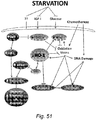
- short-term starvation selectively impedes the growth of tumors and protects normal cells from chemotherapy toxicity but sensitizes cancer cells to it.
- Specific embodiments of methods and compositions that achieve this goal are set forth below.
- the operation of the present invention is not limited to any particular mechanism, the protection observed in various embodiments of the present invention is due in part to modulation of the IGF-I pathway and glucose levels, without interfering with its effect on cancer cells (Differential Stress Resistance, DSR).
- DSR Different Stress Resistance
- long-term dietary restriction causes a much more modest reduction in IGF-I and glucose compared to fasting. Moreover, unlike fasting, long-term dietary restriction is not feasible for the great majority of cancer patients since it causes chronic weight loss and is very difficult to maintain. Instead, an average of about 62 hours of fasting prior to and 24 hours post-chemotherapy was well tolerated by cancer patients receiving a variety of toxic treatments.
- oncogenic mutations which are generally found in pathways associated with cellular growth and stress response, prevent the switch to the high protection mode in malignant cells and continue to promote growth or a growth-associated state even during fasting.
- Yeast and mammalian studies have suggested that the sensitization of malignant cells to toxins/oxidants may be largely independent of the type of oncogenic mutations owing to the redundancy in the pro-growth pathway in the inhibition of entry into the protected mode, indicating that the great majority of cancer cells and cancer types should not become protected in response to STS or low IGF-I.
- a method of alleviating cancer growth or a symptom of cancer is described herein.
- a patient with cancer is identified and then provided with a first diet for a first predetermined period of time.
- the first diet provides the patient with at most 50% of the patient's normal caloric intake with at least 50% of the kilocalories being derived from fat, preferably monounsaturated fats.
- the patient's normal caloric intake is the number of kcal that the patient consumes to maintain his/her weight.
- the patient's normal caloric intake may be estimated by interviewing the patient or by consideration of a patient's weight. As a rough guide, patient's normal caloric intake is on average 2600 kcal/day for men and 1850 kcal/day for women.
- the first diet provides the patient with from 700 to 1200 kcal/day.
- the first diet provides the male patient of average weight with about 1100 kcal/day and the female patient of average weight with 900 kcal/day.
- the first predetermined period of time is from about 1 to 5 days.
- the first predetermined period of time is 1 day.
- the U.S. Food and Drug Administration recommends the following nutritional breakdown for a typical 2000 kilocalorie a day diet: 65 gram fat (about 585 kilocalories), 50 grams protein (about 200 kilocalories), 300 grams total carbohydrates (about 1200 kilocalories). Therefore, in one version of the first diet, a majority of the calories from carbohydrates and proteins are eliminated.
- the first diet encompasses virtually any source of fat
- sources high in unsaturated fat including monounsaturated and polyunsaturated fat sources are particularly useful (e.g., omega-3/6 essential fatty acids).
- suitable examples of monounsaturated food sources include, but are not limited to, peanut butter, olives, nuts (e.g., almonds, pecans, pistachios, cashews), avocado, seeds (e.g., sesame), oils (e.g., olive, sesame, peanut, canola), etc.
- Suitable examples of polyunsaturated food sources include, but are not limited to, walnuts, seeds (e.g., pumpkin, sunflower), flaxseed, fish (e.g., salmon, tuna, mackerel), oils (e.g., safflower, soybean, corn).
- the first diet also includes a component selected from the group consisting of vegetable extracts, minerals, omega-3/6 essential fatty acids, and combinations thereof. In one refinement, such a vegetable extract provides the equivalent of 5 recommended daily servings of vegetable.
- Suitable sources for the vegetable extract include, but are not limited to, bokchoy, kale, lettuce, asparagus, carrot, butternut squash, alfalfa, green peas tomato, cabbage cauliflower, beets.
- Suitable sources for the omega-3/6 essential fatty acids include fish such as salmon, tuna, mackerel, bluefish, swordfish, and the like.
- the patient is then provided a second diet for a second predetermined period of time.
- the second diet provides the patient with at most 500 kcal/day.
- the second diet provides the patient with at most 200 kcal/day.
- the second predetermined period of time is from about 2 to 7 days.
- the second predetermined period of time is 3 days.
- the second diet includes a component selected from the group consisting of vegetable extracts, minerals, omega-3/6 essential fatty acids, and combinations thereof. In one refinement, such a vegetable extract provides the equivalent of 5 recommended daily servings of vegetable.
- Suitable sources for the vegetable extract include, but are not limited to, bokchoy, kale, lettuce, asparagus, carrot, butternut squash, alfalfa, green peas tomato, cabbage cauliflower, beets.
- Suitable sources for the omega-3/6 essential fatty acids include fish oils from salmon, tuna, mackerel, bluefish, swordfish, and the like.
- the effectiveness of the first and second diets is monitored by measurement of a number of patient parameters. For example, it is desirable that the patient's serum concentration of IGF-I be reduced by 25 - 90% by the end of the second diet period. It is also desirable that the blood glucose concentration in the patient be reduced by 25 - 75% by the end of the second diet period.
- the patient is provided with a third diet for a third predetermined period of time.
- the third diet is to supplement the normal diet of the patient.
- the replenishing composition includes essential amino acids, minerals, and essential fats.
- the third diet will allow the patient to regain the normal weight and maximize strength.
- the third predetermined period of time is at least 5 days.
- the replenishing composition will also optionally include a number of additional components.
- the replenishing composition may include a vegetable extract. In one refinement, such a vegetable extract provides the equivalent of 5 recommended daily servings of vegetable.
- Suitable sources for the vegetable extract include, but are not limited to, bokchoy, kale, lettuce, asparagus, carrot, butternut squash, alfalfa, green peas tomato, cabbage cauliflower, beets.
- the replenishing composition may also include omega-3/6 essential fatty acids, and non-essential amino acids. Examples of suitable non-essential amino acids include, but are not limited to, histidine, serine, taurine, tyrosine, cysteine, glutamine, and combinations thereof.
- the replenishing composition may also include a multi-mineral tablet containing iron, zinc, copper, magnesium, and calcium and may also contain a vitamin B complex including vitamin B12.
- a method of sensitizing cancer to chemotherapy drugs is described.
- a patient with cancer is identified and is then provided a first diet for a first predetermined period of time.
- cancers that are susceptible to the present method include but are not limited to, skin cancer, colon cancer, breast cancer, esophageal cancer, prostate cancer, lung cancer, uterus cancer, ovary cancer, prostate cancer, glioma, melanoma, neuroblastoma, and pheochromocytoma.
- the first diet provides the patient with at most 50% of the patient's normal caloric intake with at least 50% of the kilocalories being derived from fat.
- the first predetermined period of time is from about 1 to 5 days.
- the first predetermined period of time is 1 day.
- the first diet encompasses virtually any source of fat, with sources high in unsaturated fat, particularly monounsaturated fat sources, preferred.
- monounsaturated food sources include, but are not limited to, peanut butter, olives, nuts (e.g., almonds, pecans, pistachios, cashews), avocado, seeds (e.g., sesame), oils (e.g., olive, sesame, peanut, canola), etc.
- Suitable examples of polyunsaturated food sources include, but are not limited to, walnuts, seeds (e.g., pumpkin, sunflower), flaxseed, fish (e.g., salmon, tuna, mackerel), oils (e.g., safflower, soybean, corn). Additional details of the first diet are the same as those set forth above.
- a second diet is then provided to the patient for a second predetermined period of time.
- the second diet provides the patient with at most 500 kcal/day.
- the second diet provides the patient with at most 200 kcal/day.
- the second predetermined period of time is from about 2 to 7 days. In a particularly useful refinement, the second predetermined period of time is 3 days. Additional details of the second diet are the same as those set forth above.
- a chemotherapy agent is administered to the patient during or after the patient consumes the second diet. Typically, the chemotherapy agent is administered after 48-72 hours of the second diet. It is readily appreciated that the present method is effective with virtually any chemotherapy agent.
- useful chemotherapy agents include, but are not limited to, DNA alkylating agents, oxidants, topoisomerase inhibitors, and combinations thereof.
- useful chemotherapeutic agents include, but are not limited to, methyl methanesulfonate, cyclophosphamide, etoposide and other topoisomerase inhibitors, doxorubicin, cisplatin, carboplatin and other platinum based drugs, gemcitabine, docetaxel, or 5-FU.
- the patient is subsequently provided with a third diet for a third predetermined period of time.
- the third diet supplements the patient's normal caloric intake and includes a replenishing composition.
- the replenishing composition includes essential amino acids.
- the replenishing composition may also include natural sources of essential fatty acids, vitamins and minerals and a multi-mineral tablet containing iron, zinc, copper, magnesium, and calcium and may also contain a vitamin B complex including vitamin B12.
- the third diet together with the patient's normal diet will allow the patient to regain the normal weight and maximize strength.
- the third predetermined period of time is at least 5 days and may continue indefinitely. In a refinement, the third predetermined period of time is from about 4 days to about 14 days. A week is estimated to be nearly optimal for this purpose.
- the replenishing composition will also optionally include a number of additional components.
- the replenishing composition may include a vegetable extract. In one refinement, such a vegetable extract provides the equivalent of 5 recommended daily servings of vegetable.
- Suitable sources for the vegetable extract include, but are not limited to, bokchoy, kale, lettuce, asparagus, carrot, butternut squash, alfalfa, green peas tomato, cabbage cauliflower, beets.
- the replenishing composition may also include omega-3/6 essential fatty acids, and non-essential amino acids. Examples of suitable non-essential amino acids include, but are not limited to, histidine, serine, taurine, tyrosine, cysteine, glutamine, and combinations thereof. Additional details of the third diet are the same as those set forth above.
- the method of the present disclosure provides a number of therapeutic advantages.
- the method allows the chemotherapy agent to be provided to the patient for a longer period of time than is standard practice for the chemotherapy agent when the patient is not provided the first diet and the second diet.
- This increase in duration is a result of the first and second diets decreasing the toxic effects of the chemotherapy agents and/or rendering cancer cells more susceptible to the chemotherapy agents than normal (i.e., non-cancerous) cells.
- the host protecting first and second diets allow the chemotherapy agent to be administered in a greater amount than in treatment protocols not using the first and second diets.
- such agents can be administered in an amount that is at least 10 % greater than the amounts normally tolerated by the patient.
- doses of such agents in certain patients can increase from 10% to 40%.
- the cancer sensitizing first and second diets allow for a lower amount of chemotherapy agent than the normal amount to be provided to the patient while maintaining a near optimal or enhanced response.
- the chemotherapy agents can be administered in an amount that is at least 10% lower than the amounts normally administered. In some patients, doses of such agents may be lowered from 10% to 40% to reduce unwanted toxicity.
- the method also allows chemotherapeutic treatment of patients exhibiting unacceptable toxic side-effects to continue. In such situations, patients exhibiting a symptom of chemotherapeutic-related toxicity are identified and then provided the first, second and third diets in the manner and duration set forth above.
- the present method also allows the continued treatment of patients that have been identified as terminal and who would otherwise discontinue therapy.
- the first and second diets are administered during the chronic administration of chemotherapeutic agents, for example, 5 day treatment with 5-FU.
- a method of sensitizing cancer to radiation therapy is also disclosed.
- a patient with cancer is identified and is then provided a first diet for a first predetermined period of time.
- cancers that are susceptible to the present method include, but are not limited to, skin cancer, colon cancer, breast cancer, esophageal cancer, prostate cancer, lung cancer, uterus cancer, ovary cancer, prostate cancer, glioma, melanoma, neuroblastoma, and pheochromocytoma.
- the first diet provides the patient with at most 50% of the patient's normal caloric intake with at least 50% of the kilocalories being derived from fat.
- the first predetermined period of time is from about 1 to 5 days.
- the first predetermined period of time is 1 day.
- the first diet encompasses virtually any source of fat, with sources high in unsaturated fat, particularly monounsaturated fat sources, preferred.
- monounsaturated food sources include, but are not limited to, peanut butter, olives, nuts (e.g., almonds, pecans, pistachios, cashews), avocado, seeds (e.g., sesame), oils (e.g., olive, sesame, peanut, canola), etc.
- Suitable examples of polyunsaturated food sources include, but are not limited to, walnuts, seeds (e.g., pumpkin, sunflower), flaxseed, fish (e.g., salmon, tuna, mackerel), oils (e.g., safflower, soybean, corn). Additional details of the first diet are the same as those set forth above.
- a second diet is then provided to the patient for a second predetermined period of time.
- the second diet provides the patient with at most 500 kcal/day.
- the second diet provides the patient with at most 200 kcal/day.
- the second predetermined period of time is from about 2 to 7 days. In a particularly useful refinement, the second predetermined period of time is 3 days. Additional details of the second diet are the same as those set forth above.
- Radiation therapy is administered to the patient during or after the patient consumes the second diet. Typically, the radiation therapy is administered after 48-72 hours of the second diet.
- the patient is subsequently provided with a third diet for a third predetermined period of time.
- the third diet supplements the patient's normal caloric intake and includes a replenishing composition.
- the replenishing composition includes essential amino acids.
- the replenishing composition may also include natural sources of essential fatty acids, vitamins and minerals and a multi-mineral tablet containing iron, zinc, copper, magnesium, and calcium and may also contain a vitamin B complex including vitamin B12.
- the third diet together with the patient normal diet, will allow the patient to regain the normal weight and maximize strength.
- the third predetermined period of time is at least 5 days and may continue indefinitely. In a refinement, the third predetermined period of time is from about 4 days to about 14 days. A week is estimated to be nearly optimal for this purpose.
- the replenishing composition will also optionally include a number of additional components.
- the replenishing composition may include a vegetable extract. In one refinement, such a vegetable extract provides the equivalent of 5 recommended daily servings of vegetable.
- Suitable sources for the vegetable extract include, but are not limited to, bokchoy, kale, lettuce, asparagus, carrot, butternut squash, alfalfa, green peas tomato, cabbage cauliflower, beets.
- the replenishing composition may also include omega-3/6 essential fatty acids, and non-essential amino acids. Examples of suitable non-essential amino acids include, but are not limited to, histidine, serine, taurine, tyrosine, cysteine, glutamine, and combinations thereof. Additional details of the third diet are the same as those set forth above.
- a therapeutic meal package for providing meals to a cancer patient that retards cancer growth and enhances the efficacy of chemotherapy drugs is provided.
- the therapeutic meal package is designed to provide the appropriate nutritional and caloric requirements of the methods set forth above.
- the therapeutic meal package includes a first meal component, a second meal component and a replenishing composition.
- the first meal component provides the nutritional components of the first diet set forth above.
- the first meal component is portioned into meals that provide the cancer patient at most 50% of the patient's normal caloric intake with at least 50% of the kilocalories derived from fat.
- the first meal component is in a sufficient amount to provide meals for a first predetermined period of time.
- the first meal component also includes extracts equivalent to 5 serving of vegetables as well as omega-3/6 essential fatty acids.
- the second meal component provides the nutritional components of the second diet set forth above.
- the second meal component is portioned into meals that provide the cancer patient at most 500 kcal/day.
- the second meal component is in a sufficient amount to provide meals for a second predetermined period of time.
- the second meal component also includes extracts equivalent to 5 serving of vegetables as well as minerals and omega-3/6 essential fatty acids.
- the replenishing composition at least partially provides the nutritional components of the third diet set forth above.
- the replenishing composition is combined with the patient's normal diet in order to provide the patient with a somewhat normal caloric intake.
- the replenishing composition includes essential amino acids.
- the replenishing composition is in a sufficient amount to provide replenishment for a third predetermined period of time.
- the first meal component is high in fat.
- the first meal component encompasses virtually any source of fat, sources high in unsaturated fat, particularly monounsaturated fat sources, are preferred to minimize potentially detrimental cardiovascular side effects of fats, particularly in patients who will make frequent use of this diet.
- monounsaturated food sources include, but are not limited to, peanut butter, olives, nuts (e.g., almonds, pecans, pistachios, cashews), avocado, seeds (e.g., sesame), oils (e.g., olive, sesame, peanut, canola), etc.
- Suitable examples of polyunsaturated food sources include, but are not limited to, walnuts, seeds (e.g., pumpkin, sunflower), flaxseed, fish (e.g., salmon, tuna, mackerel), oils (e.g., safflower, soybean, corn).
- the first meal component also includes a component selected from the group consisting of vegetable extracts, minerals, omega-3/6 essential fatty acids, and combinations thereof. In one refinement, such a vegetable extract provides the equivalent of 5 recommended daily servings of vegetable.
- Suitable sources for the vegetable extract include, but are not limited to, bokchoy, kale, lettuce, asparagus, carrot, butternut squash, alfalfa, green peas tomato, cabbage cauliflower, beets.
- Suitable sources for the omega-3/6 essential fatty acids include fish such as salmon, tuna, mackerel, bluefish, swordfish, and the like.
- the second food component provides a very low kcal to the patient.
- the second food component includes a component selected from the group consisting of vegetable extracts, minerals, omega-3/6 essential fatty acids, and combinations thereof.
- a vegetable extract provides the equivalent of 5 recommended daily servings of vegetable.
- Suitable sources for the vegetable extract include, but are not limited to, bokchoy, kale, lettuce, asparagus, carrot, butternut squash, alfalfa, green peas tomato, cabbage cauliflower, beets.
- Suitable sources for the omega-3/6 essential fatty acids include fish such as salmon, tuna, mackerel, bluefish, swordfish, and the like.
- the replenishing composition is designed so that the patient's normal weight and strength are maintained (or re-established if there has been a weight lost).
- the replenishing composition further includes extracts equivalent to 5 servings of vegetables as well as minerals and omega-3/6 essential fatty acids. It should be appreciated that the replenishing composition is to be taken with a normal diet so that the weight and strength goals are achieved. Typically, the normal diet will provide about the patient's normal caloric intake as set forth above.
- the therapeutic meal package may also include instructions for administering the first meal component, the second meal component, and the replenishing composition to the cancer patient.
- the instruction will provide the details set forth above with respect to the methods.
- the instructions state that the first food component is to be provided to the patient over a first predefined period of time as set forth above. Typically, the first predetermined period of time is from about 1 to 2 days. In a refinement, the first predetermined period of time is 1 day.
- the instructions also state that the second food component is to be taken over a second predetermined period of time as set forth above. Typically, the second predetermined period of time is from about 2 to 7 days. In a particularly useful refinement, the second predetermined period of time is about 3 days.
- the instructions also state that the replenishing composition is to be taken with the normal diet, and in particular, a sufficient amount of additional food items that the patient's weight and strength is maintained or regained.
- the third predetermined period of time is at least 5 days. In a refinement, the third predetermined period of time is from about 4 days to about 14 days. A week is found to be nearly optimal for this purpose.
- the therapeutic food package is packaged in a container (e.g., a box).
- a container e.g., a box
- each of the first meal component and the second meal component are portioned into daily servings with labeling so indicating.
- each daily portion is further divided into three meals.
- each meal will be a combination of solid food, a shake and a soup (day 1) and only soups and shakes for days 2, 3, and 4 (3 meals/day).
- Each package will also contain pills with essential fatty acids, minerals and vitamins and/or vegetable extracts.
- the box will also contain 1 week supply of the replenishment diet which will be in the form of pills. Generally, non-natural sources of any item in all components of the diet are minimized.
- a 74-year-old Caucasian man who was diagnosed in July of 2000 with bilateral prostate adenocarcinoma, Gleason score 7 and PSA level of 5.8 ng/ml.
- a prostatectomy performed in September of 2000 led to undetectable levels of PSA until January 2003 when it rose to 1.4 ng/ml.
- Leuprolide acetate together with bicalutamide and finasteride were prescribed.
- administration of these drugs had to be suspended in April 2004 due to severe side effects related to testosterone deprivation.
- Different drugs including triptorelinpamoate, nilutamide, thalidomide, CP and ketoconazole were utilized to control the disease.
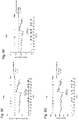
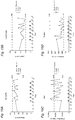
- Platelet nadir did reach a lower level compared to previous chemo-alone treatments, which could be explained by the additive effect of three chemotherapeutic agents ( Figure 9D ; Table 2). Nonetheless the zenith in platelet numbers and the time to recover to normal level were much pronounced and shortened, respectively, during the fasting-chemo treatments compared with chemo-alone ( Figure 9D ; Table 2). This significant improvement and faster recovery of platelets after multiple fasting/chemotherapy not only allowed the patient to complete her chemo-treatment, but also suggests that this strategy may have protective effects on blood cells precursors, allowing a quicker repopulation of thrombocytes and granulocytes.
- a CT scan insinuated a local progression of the disease. He started the second cycle with leuprolide acetate and also received High Dose Rate (HDR) brachytherapy and external beam radiation with Intensity Modulated Radiation Therapy (IMRT).
- HDR High Dose Rate
- IMRT Intensity Modulated Radiation Therapy
- Weight loss is a major concern in cancer patients. This can be due to cancer itself, reduced appetite following chemotherapy, or gastrointestinal damage. Notably, in this case report, weight loss during fasting was rapidly recovered in most of the patients. For the patients who received chemotherapy both with and without fasting, chemotoxic side effects appeared to be attenuated during fasting-chemo cycles. Symptoms which appeared to be ameliorated by this intervention were primarily gastrointestinal and constitutional.
- Normal cells would respond to these changes, whereas malignant cells would be unresponsive due to self-sufficiency in growth signals, ( Hanahan. Hallmarks of cancer. 2000 ). Thus, fasting would selectively protect normal cells against chemotherapy toxicity without compromising drug activity on cancer cells.
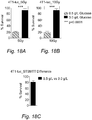
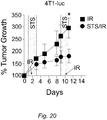
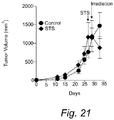
- Fig. 18 fasting sensitizes malignant cells to irradiation.
- Fig. 19 fasting sensitizes malignant cells to irradiation.
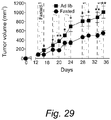
- STS fasting sensitizes murine breast cancer cells to irradiation and enhances tumor control in mice.
- STS fasting sensitizes murine glioma cancer cells to irradiation and enhances tumor control in mice.
- GL26 syngeneic glioma cancer cells
- IR irradiation
- 7.5Gy irradiation
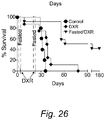
- Fasting in the glioma model was applied only once due to the unusually rapid tumor growth in the control ( ad lib, no chemotherapy) group.
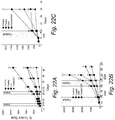
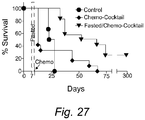
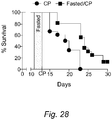
- the greatest therapeutic index was observed when fasting was combined with either of the commonly used chemotherapy drugs, doxorubicin (DXR) or cyclophosphamide (CP) ( Fig. 22 A-C ).
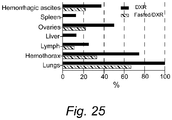
- lung metastases were found in 100% vs 65% of mice that received DXR under normal feeding and fasting, respectively.
- metastases were not detected in the liver or spleen of fasted mice ( Fig. 25 ).
- mice were incubated in media containing serum collected from mice either fed ad lib or fasted for 48 hours.
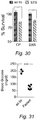
- breast cancer cells (4T1) cultured in medium supplemented with serum from fasted mice were sensitized to both DXR and CP compared to the effect of incubation in serum from mice fed ad lib ( Fig. 30 ).
- glucose and growth factor reduction e.g., the 75% reduction in the growth factor IGF-I
- IGF-I is a key change, and that IGF-I infusion can reverse the protection of mice to chemotherapy.
- IGF-I treatment of 4T1 and B16 cells also reverses the sensitization of cancer cells to DXR caused by glucose restriction, suggesting that STS sensitizes cancer cells, in part, by reducing IGF-I ( Fig. 35 ).
- Glucose which is the main energy source for metazoans, is particularly important to malignant cells, a phenomenon known as the Warburg effect, and elevated blood glucose promotes increased cancer growth.
- the effect of reduced glucose was instead additive with that of doxorubicin in the treatment of GL26 glioma cells ( Fig. 36C ).
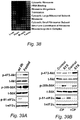
- Akt and S6K phosphorylation was elevated and eIF2 ⁇ phosphorylation was reduced in pre-starved cancer cells in autografted tumors ( Fig. 39A ), and also in vitro, particularly in combination with CP treatment ( Fig. 39B ).
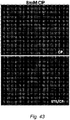
- cancer cell doubling was greatly reduced in vitro ( Fig. 40 ), consistent with the retardation of tumor progression by fasting in vivo ( Figs. 36 , 37 ).
- Translation is closely coupled with cell cycle progression and cell growth, and is a costly process that can consume 50 ⁇ 75% of the cellular energy in rapidly dividing cells. It is possible that the 4T1 tumor attempts to compensate for the lack of nutrients required for growth by increasing translation and as a result consume even more energy leading to cell death.
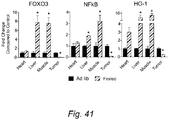
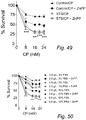
- heme oxygenase-1 (HO-1) is an evolutionarily conserved enzyme that is highly inducible in response to various stimuli including UVA and oxidative stress. It was found that fasting also repressed HO-1 expression in the tumors, but caused a major increase in tis expression in normal organs, consistent with those of FOXO3a and NFkB ( Fig. 41 ). Student's t-test; * P ⁇ 0.05, ** P ⁇ 0.01, *** P ⁇ 0.001.
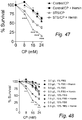
- HO-1 expression was induced during fasting using hemin and found that the sensitization could be partially reversed ( Figs. 47, 48 ).
- ZnPP zinc protoporphyrin
- 4T1-luc murine breast cancer cells were purchased from SibTech (Brookfield, CT). B16-fluc murine melanoma cells were provided by Essen Craft (UCLA). GL26 murine glioma, U87-MG human glioblastoma cells were provided by Thomas Chen (USC). PC3 and 22RV1 human prostate cancer cells were provided by Pinchas Cohen (UCLA). MCF-7 and C42B human breast cancer cells and HeLa human cervical cancer cells were provided by Amy Lee (USC). LOVO human colon cancer cells were provided by Darryl Shibata (USC).
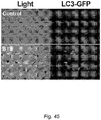
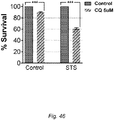
- NXS2 and Neuro-2a murine neuroblastoma, human ACN and SH-SY5Y neuroblastoma, OVCAR human ovarian carcinoma, MZ-MEL human melanoma, A431 epidermoid carcinoma cells were routinely cultured in the Laboratory of Oncology of Gaslini Institute. 4T1 cells were stably transfected with LC3-GFP, which was a kind gift from Jae Jung at USC, for autophagy studies. All cells were routinely maintained in DMEM 10% FBS at 37°C, 5% CO2. To inhibit autophagy cells were treated with 5 ⁇ M chloroquine (CQ) for 48 hours during in vitro STS. To modulate HO-1 activity, 4T1 cells were treated with 10 ⁇ M hemin (Sigma) or 20 ⁇ M zinc protoporphyrin (ZnPP; Sigma) for 24 hours prior to and 24 hours during chemotherapy treatment.
- CQ chloroquine
- Doxorubicin (DXR; Bedford Laboratories, USA) and cyclophosphamide (CP; Baxter, USA) were used in vitro and in vivo.
- In vitro chemotherapy was performed by treating cells in medium containing chemotherapy for 24 hours. Optimum drug doses were determined for each individual cell line.
- DXR was injected intravenously via lateral tail veins, and CP was injected intraperitoneally.
- 12-week-old female BALB/c, 12-week-old female and male C57BL/6 mice were injected intravenously via lateral tail veins with 2x10 5 4T1, B16, GL26 cells, respectively, and 6-week-old female A/J mice were injected via lateral tail veins with 2x10 5 NXS2, and 1x10 6 Neuro-2a cells.
- cells in log phase of growth were harvested and suspended in PBS at 2x10 6 cells/ml, and 100 uL (2x10 5 cells/mouse) were injected subcutaneously in the lower back region or intravenously via the lateral tail veins.
- Cellular fasting was done by glucose and/or serum restriction which was based on blood glucose measurements in fasted and normally fed mice; the lower level approximated to 0.5 g/L and the upper level to 2.0 g/L.
- normal glucose was considered as 1.0 g/L.
- Cells were washed twice with PBS before changing to fasting medium.
- mice were fasted for a total of 48-60 hours by complete deprivation of food but with free access to water. Mice were individually housed in a clean new cage to reduce cannibalism, coprophagy, and residual chow. Body weight was measured immediately before and after fasting.
- MTT methylthiazolyldiphenyl-tetrazolium bromide
- DHE dihydroethidine
- Cells were diluted to 10 5 /ml in culture medium (DMEM/F12 with 10% FBS), and treated with 50 ⁇ M DXR for 1 hour at 37°C. Cells were then washed once with ice cold PBS and subject to CometAssay (Trevigen, Inc, Gaithersburg, MD) according to the manufacturer's recommended procedure. Comet images were acquired with a Nikon Eclipse TE300 fluorescent microscope and analyzed with the Comet Score software (TriTek Corp., ver1.5). 100-300 cells were scored for each genotype/treatment group.
- mice were anesthetized with 2% inhalant isoflurane and blood was collected by left ventricular cardiac puncture. Blood was collected in tubes coated with K 2 -EDTA to process serum (BD, USA).Blood glucose was measured using the Precision Xtra blood glucose monitoring system (Abbott Laboratories, USA).
- RNA from tissues was isolated according the procedures described by the manufacturer using the RNeasy kit from Qiagen (cat #74106). Then, RNA was hybridized to BD-202-0202 chips from IlluminaBeadchips (San Diego, CA). Raw data were subjected to Z normalization as described previously. Parameterized significant analysis is finished according to the SAM protocol with ANOVA filtering (ANOVA p ⁇ 0.05). Significant genes are selected for each pairwise comparison. Gene set enrichment was tested using the PAGE method as previously described. Figures were selected based on the names and descriptions provided by Gene Ontology Database and Pathway Data Set. Further gene regularly relation and canonic pathway analysis is done by the Ingenuity Pathway Analysis System (Ingenuity Systems; Redwood City, CA).
- RNA from tissues was isolated according the procedures described by the manufacturer using the RNeasy kit from Qiagen (cat #74106).
- cDNA was synthesized using the High Capacity cDNA Reverse Transcription Kit (AB Applied Biosystems cat# 4368814) and RT-PCR was performed using the SYBR Green PCR master mix (AB Applied Biosystems cat# 4309159). GAPDH gene was used as calibrator gene.
- Each treatment analyzed was performed with three biological replicates and at least three reactions were used to calculate the expression. The expression ratio was calculated according to the 2 - ⁇ CP method.
- a variety of dietary formulations were tested in mouse models to validate a dietary regime for cancer patients undergoing chemotherapy.
- the target endpoint is a 20-75% reduction in serum glucose and/or IGF-1, which has been shown to be effective in the protection of the host and sensitization of a wide variety of cancer cells.
- the formulations are selected to provide a level of nutrients sufficient to maintain the normal body weight.
- Daily food intake, body weight along with general health (behavior and physical appearance) is monitored.
- blood is collected for glucose and IGF-1 determination.
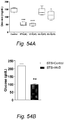
- a diet deficient in specific amino acids (AA-D) but with normal total calorie significantly reduces serum IGF-1 ( Fig. 52 ) and glucose ( Fig. 54A ) if fed for 5 days ( Fig. 52 ). This beneficial effect is increased if used in a re-feeding paradigm ( Figs. 53 and 54B ) where short-term starvation is followed by the AA-D formulation.
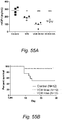
- a diet regime consisting of 2-days on a very-low caloric diet (VCM, 6% of normal caloric intake) followed by 1-day on an amino acid deficient formulation (AA) reduced serum IGF-1 levels significantly more than short-term starvation (STS) ( Fig. 55A ). Furthermore, this diet regime protected mice from the chemotherapy drug, doxorubicin (DXR) ( Fig. 55B ). Here, DXR is injected after 2-days of VCM upon initiation of re-feeding with the amino acid deficient formulation (AA).
- VCM very-low caloric diet
- AA amino acid deficient formulation
- STS short-term starvation
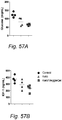
- a low-calorie VegeGel formulation (equivalent to recommended 5 servings of vegetables) reduces serum glucose and IGF-1 similarly to short-term starvation (STS) ( Fig. 56 A&B). Furthermore, it was demonstrated that a caloric-restricted ketogenic diet (90% of calories fat derived) for 3 days reduces serum IGF-1 and glucose ( Fig. 6A & B , green triangles). Importantly, 1 day of this ketogenic diet followed by 2 days on theVegeGel formulation shows a beneficial effect in reducing glucose and IGF-I over the ketogenic diet alone ( Fig. 57 A&B, red squares).
Landscapes
- Health & Medical Sciences (AREA)
- Life Sciences & Earth Sciences (AREA)
- Chemical & Material Sciences (AREA)
- Medicinal Chemistry (AREA)
- General Health & Medical Sciences (AREA)
- Veterinary Medicine (AREA)
- Public Health (AREA)
- Pharmacology & Pharmacy (AREA)
- Animal Behavior & Ethology (AREA)
- Epidemiology (AREA)
- Engineering & Computer Science (AREA)
- Business, Economics & Management (AREA)
- Food Science & Technology (AREA)
- Polymers & Plastics (AREA)
- Nutrition Science (AREA)
- General Chemical & Material Sciences (AREA)
- Organic Chemistry (AREA)
- Nuclear Medicine, Radiotherapy & Molecular Imaging (AREA)
- Chemical Kinetics & Catalysis (AREA)
- Tourism & Hospitality (AREA)
- Physics & Mathematics (AREA)
- Theoretical Computer Science (AREA)
- General Physics & Mathematics (AREA)
- Economics (AREA)
- Entrepreneurship & Innovation (AREA)
- Human Resources & Organizations (AREA)
- Marketing (AREA)
- Operations Research (AREA)
- Quality & Reliability (AREA)
- Strategic Management (AREA)
- General Business, Economics & Management (AREA)
- Bioinformatics & Cheminformatics (AREA)
- Hematology (AREA)
- Diabetes (AREA)
- Obesity (AREA)
- Acyclic And Carbocyclic Compounds In Medicinal Compositions (AREA)
- Pharmaceuticals Containing Other Organic And Inorganic Compounds (AREA)
- Coloring Foods And Improving Nutritive Qualities (AREA)
- Medicines That Contain Protein Lipid Enzymes And Other Medicines (AREA)
- Medicines Containing Material From Animals Or Micro-Organisms (AREA)
Priority Applications (1)
| Application Number | Priority Date | Filing Date | Title |
|---|---|---|---|
| PL10825771T PL2490684T3 (pl) | 2009-10-22 | 2010-10-22 | Sposoby i formulacje odżywcze dla zwiększenia skuteczności i zmniejszenia skutków ubocznych leczenia nowotworu |
Applications Claiming Priority (2)
| Application Number | Priority Date | Filing Date | Title |
|---|---|---|---|
| US25415409P | 2009-10-22 | 2009-10-22 | |
| PCT/US2010/053821 WO2011050302A2 (en) | 2009-10-22 | 2010-10-22 | Methods and nutritional formulations to increase the efficacy and reduce the side effects of cancer treatment |
Publications (3)
| Publication Number | Publication Date |
|---|---|
| EP2490684A2 EP2490684A2 (en) | 2012-08-29 |
| EP2490684A4 EP2490684A4 (en) | 2016-05-04 |
| EP2490684B1 true EP2490684B1 (en) | 2018-01-03 |
Family
ID=43900993
Family Applications (1)
| Application Number | Title | Priority Date | Filing Date |
|---|---|---|---|
| EP10825771.8A Active EP2490684B1 (en) | 2009-10-22 | 2010-10-22 | Methods and nutritional formulations to increase the efficacy and reduce the side effects of cancer treatment |
Country Status (13)
| Country | Link |
|---|---|
| US (2) | US20110118528A1 (pl) |
| EP (1) | EP2490684B1 (pl) |
| JP (1) | JP2013508411A (pl) |
| CN (1) | CN102753162A (pl) |
| AU (2) | AU2010310515B2 (pl) |
| BR (1) | BR112012009423A2 (pl) |
| CA (1) | CA2779282C (pl) |
| DK (1) | DK2490684T3 (pl) |
| ES (1) | ES2659353T3 (pl) |
| PL (1) | PL2490684T3 (pl) |
| PT (1) | PT2490684T (pl) |
| RU (1) | RU2549954C2 (pl) |
| WO (1) | WO2011050302A2 (pl) |
Families Citing this family (34)
| Publication number | Priority date | Publication date | Assignee | Title |
|---|---|---|---|---|
| ES2822178T3 (es) * | 2012-10-22 | 2021-04-29 | Univ Southern California | Formulaciones dietéticas que promueven la regeneración de tejidos/órganos |
| CN114236130A (zh) * | 2013-02-12 | 2022-03-25 | 南加利福尼亚大学 | 用于减轻年龄相关症状的膳食包装 |
| NZ715431A (en) | 2013-07-01 | 2022-02-25 | Univ Southern California | Fasting condition as dietary treatment of diabetes |
| CN106456631A (zh) * | 2014-03-06 | 2017-02-22 | 南加利福尼亚大学 | 利用短期饥饿方案结合激酶抑制剂来增强传统化学药物功效和可行性并逆转激酶在正常细胞和组织中的副作用 |
| US10172839B2 (en) | 2014-03-06 | 2019-01-08 | University Of Southern California | Use of short term starvation regimen in combination with kinase inhibitors to enhance traditional chemo-drug efficacy and feasibility and reverse side effects of kinases in normal cells and tissues |
| US10117872B2 (en) * | 2014-03-28 | 2018-11-06 | Università Degli Studi Di Genova | Tyrosine kinase inhibitors for use in a method of treating cancer in association with a reduced caloric intake |
| MX2016012896A (es) * | 2014-04-02 | 2017-05-12 | Univ Southern California | Autoinmunidad y tratamiento de la esclerosis multiple. |
| CA3108664A1 (en) * | 2015-04-16 | 2016-10-20 | University Of Southern California | Fasting mimicking diet (fmd) and glucose lowering drugs protect normal cells and generate cancer sensitizing conditions in response to standard and high glucose conditions induced by rapamycin and dexamethasone |
| CA2984891A1 (en) | 2015-05-06 | 2016-11-10 | University Of Southern California | Fasting mimicking and enhancing diet for treating hypertension and lipid disorders |
| AU2016328683A1 (en) * | 2015-09-21 | 2018-05-10 | Ifom Fondazione Istituto Firc Di Oncologia Molecolare | New therapeutic strategies against blood cancer |
| AU2017207370B2 (en) * | 2016-01-12 | 2021-09-23 | University Of Southern California | Use of long-term fasting mimicking as dietary treatment for multiple myeloma and other cancers |
| AU2017219732B2 (en) | 2016-02-15 | 2022-01-20 | University Of Southern California | Drug combinations and methods to stimulate embryonic-like regeneration to treat diabetes and other diseases |
| CN109069462A (zh) | 2016-02-23 | 2018-12-21 | 癌症研究科技有限公司 | 缺乏至少两种非必需氨基酸的膳食产品 |
| AU2017261723B2 (en) | 2016-05-11 | 2023-02-09 | University Of Southern California | Fasting mimicking diet (FMD) as an immunoregulatory treatment for gastrointestinal autoimmune/inflammatory diseases. |
| IT201700008499A1 (it) * | 2017-01-26 | 2018-07-26 | Univ Degli Studi Genova | Composizione dietetica per la prevenzione e/o il trattamento dell’iperplasia dell’endometrio |
| US11284640B2 (en) | 2017-02-14 | 2022-03-29 | University Of Southern California | Fasting mimicking diet |
| CN107951892A (zh) * | 2018-01-19 | 2018-04-24 | 丽水学院 | 锌原卟啉在制备增强人结直肠癌细胞对5-氟尿嘧啶化疗敏感性药物中的应用 |
| KR20200125966A (ko) | 2018-03-15 | 2020-11-05 | 유니버시티 오브 써던 캘리포니아 | 염증 및 ibd 병리의 역전을 촉진하는, 물만 섭취하는 금식이 아닌 금식 모방 식이요법 (fmd) |
| DE212018000421U1 (de) * | 2018-07-18 | 2021-03-01 | Andreas Michalsen | Auswirkungen einer kurzzeitigen Diät, die Fasten imitiert, auf die Lebensqualität und die Verträglichkeit einer Chemotherapie bei Patientinnen mit Krebs |
| AU2019376681B2 (en) | 2018-11-09 | 2025-07-24 | L-Nutra Inc. | Nutrition bar for intermittent fasting-mimicking |
| US12185747B2 (en) | 2019-04-30 | 2025-01-07 | University Of Southern California | Fasting-mimicking diet (FMD) as an intervention for Alzheimer's disease (AD) |
| JP6747702B1 (ja) * | 2019-05-10 | 2020-08-26 | 株式会社医療情報技術研究所 | 栄養処方管理システム |
| KR20220098682A (ko) * | 2019-05-14 | 2022-07-12 | 타임, 인크. | 암을 치료하기 위한 조성물 및 방법 |
| IT201900009954A1 (it) * | 2019-06-24 | 2020-12-24 | Fondazione Irccs Istituto Naz Dei Tumori | Preparazione alimentare a basso contenuto calorico per l’alimentazione di pazienti affetti da neoplasie |
| WO2021118324A1 (ko) * | 2019-12-13 | 2021-06-17 | 서울대학교산학협력단 | 암의 예방 또는 치료용 약학 조성물 |
| IT202000007153A1 (it) | 2020-04-03 | 2021-10-03 | Ifom Fondazione St Firc Di Oncologia Molecolare | Apporto calorico ridotto e immunoterapia per il trattamento del cancro |
| US10905698B1 (en) | 2020-05-14 | 2021-02-02 | Tyme, Inc. | Methods of treating SARS-COV-2 infections |
| JP2023530235A (ja) | 2020-06-03 | 2023-07-14 | フェス・セラピューティクス,インコーポレーテッド | 個別化された処置方法のための製剤 |
| CN116133653A (zh) | 2020-06-04 | 2023-05-16 | 菲思治疗公司 | 治疗癌症的个体化方法 |
| TW202227113A (zh) | 2020-12-01 | 2022-07-16 | 南加州州立大學 | 模擬禁食飲食提升急性淋巴母細胞白血病模型中的無癌存活 |
| US20240000125A1 (en) * | 2020-12-17 | 2024-01-04 | Fondazione Irccs Istituto Nazionale Dei Tumori | Diet preparation for the nutrition of cancer patients with a restricted calorie intake |
| EP4066823B1 (en) | 2021-03-30 | 2025-04-30 | IFOM - Istituto Fondazione di Oncologia Molecolare ETS | Reduced caloric intake and anticancer agents for the treatment of cancer |
| CN115590963A (zh) * | 2022-07-13 | 2023-01-13 | 复旦大学(Cn) | 酮体、酮体诱导剂和生酮组合物中的至少一种在治疗和/或预防血小板减少症药物中的应用 |
| EP4599826A1 (en) | 2024-02-06 | 2025-08-13 | IFOM - Istituto Fondazione di Oncologia Molecolare ETS | Leucine for use in the treatment of cancer |
Family Cites Families (11)
| Publication number | Priority date | Publication date | Assignee | Title |
|---|---|---|---|---|
| RU2074731C1 (ru) * | 1994-12-29 | 1997-03-10 | Игорь Александрович Бойко | Фитокомплекс, обладающий противоопухолевым действием, и способ лечения онкологических больных |
| RU2224510C2 (ru) * | 1997-03-17 | 2004-02-27 | Би Ти Джи Интернэшнл Лимитед | Терапевтические композиции |
| AU5319499A (en) * | 1999-07-22 | 2001-02-13 | Ivan L. Cameron | Fatty acids to minimize cancer therapy side effects |
| JP4625156B2 (ja) * | 2000-04-10 | 2011-02-02 | イーエヌ大塚製薬株式会社 | 癌化学療法に伴う副作用軽減剤 |
| WO2005117542A2 (en) * | 2004-05-10 | 2005-12-15 | Novacea, Inc. | Treatment of pancreatic cancer with active vitamin d compounds in combination with other treatments |
| AU2005296271A1 (en) * | 2004-10-15 | 2006-04-27 | University Of Tennessee Research Foundation | Methods for inducing apoptosis in adipocytes |
| US20070116802A1 (en) * | 2005-11-23 | 2007-05-24 | Carl Germano | High quality caloric composition |
| US20080038367A1 (en) * | 2006-08-11 | 2008-02-14 | Sal Saloum | Nutritional supplement compositions and methods of preparing |
| RU2354369C2 (ru) * | 2007-03-16 | 2009-05-10 | Михаил Владимирович Кутушов | Применение родамина 6ж в качестве лекарственного средства для лечения злокачественных новообразований и амилоидозов |
| ES2891733T3 (es) * | 2007-03-28 | 2022-01-31 | Univ Southern California | Inducción de la resistencia diferencial al estrés y usos de la misma |
| MX2010005768A (es) * | 2007-11-26 | 2010-06-11 | Nestec Sa | Composiciones y métodos para inhibir la activación del arnbc-dependiente de la proteina de la kinasa y la inhibición del crecimiento tumoral. |
-
2010
- 2010-10-22 CA CA2779282A patent/CA2779282C/en active Active
- 2010-10-22 WO PCT/US2010/053821 patent/WO2011050302A2/en not_active Ceased
- 2010-10-22 ES ES10825771.8T patent/ES2659353T3/es active Active
- 2010-10-22 RU RU2012118588/15A patent/RU2549954C2/ru active
- 2010-10-22 EP EP10825771.8A patent/EP2490684B1/en active Active
- 2010-10-22 US US12/910,508 patent/US20110118528A1/en not_active Abandoned
- 2010-10-22 CN CN2010800560747A patent/CN102753162A/zh active Pending
- 2010-10-22 PL PL10825771T patent/PL2490684T3/pl unknown
- 2010-10-22 JP JP2012535426A patent/JP2013508411A/ja active Pending
- 2010-10-22 PT PT108257718T patent/PT2490684T/pt unknown
- 2010-10-22 BR BR112012009423A patent/BR112012009423A2/pt not_active Application Discontinuation
- 2010-10-22 DK DK10825771.8T patent/DK2490684T3/en active
- 2010-10-22 AU AU2010310515A patent/AU2010310515B2/en active Active
-
2016
- 2016-03-11 AU AU2016201607A patent/AU2016201607B2/en active Active
-
2021
- 2021-03-17 US US17/204,419 patent/US20210209516A1/en active Pending
Non-Patent Citations (1)
| Title |
|---|
| None * |
Also Published As
| Publication number | Publication date |
|---|---|
| US20110118528A1 (en) | 2011-05-19 |
| CN102753162A (zh) | 2012-10-24 |
| PL2490684T3 (pl) | 2018-07-31 |
| EP2490684A2 (en) | 2012-08-29 |
| RU2549954C2 (ru) | 2015-05-10 |
| AU2016201607B2 (en) | 2017-11-30 |
| PT2490684T (pt) | 2018-04-02 |
| WO2011050302A2 (en) | 2011-04-28 |
| BR112012009423A2 (pt) | 2017-06-13 |
| US20210209516A1 (en) | 2021-07-08 |
| CA2779282C (en) | 2017-12-05 |
| RU2012118588A (ru) | 2013-11-27 |
| AU2010310515A1 (en) | 2012-05-17 |
| AU2010310515B2 (en) | 2016-01-07 |
| ES2659353T3 (es) | 2018-03-14 |
| CA2779282A1 (en) | 2011-04-28 |
| AU2016201607A1 (en) | 2016-03-31 |
| DK2490684T3 (en) | 2018-04-09 |
| EP2490684A4 (en) | 2016-05-04 |
| WO2011050302A3 (en) | 2011-08-25 |
| JP2013508411A (ja) | 2013-03-07 |
Similar Documents
| Publication | Publication Date | Title |
|---|---|---|
| US20210209516A1 (en) | Methods and Nutritional Formulations to Increase the Efficacy and Reduce the Side Effects of Cancer Treatment | |
| Safdie et al. | Fasting and cancer treatment in humans: A case series report | |
| Arends et al. | ESPEN guidelines on enteral nutrition: non-surgical oncology | |
| AU2020200726B2 (en) | Use of short term starvation regimen in combination with kinase inhibitors to enhance traditional chemo-drug efficacy and feasibility and reverse side effects of kinases in normal cells and tissues | |
| JP2021101721A (ja) | 癌における食事療法の開発 | |
| US10172839B2 (en) | Use of short term starvation regimen in combination with kinase inhibitors to enhance traditional chemo-drug efficacy and feasibility and reverse side effects of kinases in normal cells and tissues | |
| RU2734774C2 (ru) | Рацион, имитирующий воздержание от пищи (fmd), и лекарственные средства, снижающие уровень глюкозы, защищают нормальные клетки и создают условия сенсибилизации при раке в ответ на стандартные условия и условия с высоким содержанием глюкозы, индуцированные рапамицином и дексаметазоном | |
| KR102736425B1 (ko) | 암 화학요법을 강화시키기 위한 조성물 및 방법 | |
| WO2018170457A1 (en) | Compositions, methods, systems and/or kits for preventing and/or treating neoplasms | |
| HK1258621A1 (zh) | 长期禁食模仿作为多发性骨髓瘤和其他癌症的膳食治疗的用途 | |
| US20240358769A1 (en) | Compositions and Methods for Treating Inflammation Associated with IL-6 | |
| HK1233488B (en) | Use of short term starvation regimen in combination with kinase inhibitors to enhance traditional chemo-drug efficacy and feasibility and reverse side effects of kinases in normal cells and tissues | |
| Tan | Why Do Cancer Patients Take More Vitamins? | |
| Lee | Fasting-based differential stress resistance to enhance cancer treatment: A novel strategy to protect normal cells and sensitize cancer cells to chemotherapy | |
| Cipolla et al. | Effect of combination of a polyamine-free oral nutritional supplement and docetaxel in symptomatic, metastatic castration-resistant prostate cancer patients |
Legal Events
| Date | Code | Title | Description |
|---|---|---|---|
| PUAI | Public reference made under article 153(3) epc to a published international application that has entered the european phase |
Free format text: ORIGINAL CODE: 0009012 |
|
| 17P | Request for examination filed |
Effective date: 20120522 |
|
| AK | Designated contracting states |
Kind code of ref document: A2 Designated state(s): AL AT BE BG CH CY CZ DE DK EE ES FI FR GB GR HR HU IE IS IT LI LT LU LV MC MK MT NL NO PL PT RO RS SE SI SK SM TR |
|
| DAX | Request for extension of the european patent (deleted) | ||
| A4 | Supplementary search report drawn up and despatched |
Effective date: 20160406 |
|
| RIC1 | Information provided on ipc code assigned before grant |
Ipc: A61K 33/00 20060101ALI20160331BHEP Ipc: A61K 31/202 20060101ALI20160331BHEP Ipc: A61P 35/00 20060101ALI20160331BHEP Ipc: A61K 31/59 20060101ALI20160331BHEP Ipc: A61K 31/375 20060101ALI20160331BHEP Ipc: A61K 36/00 20060101ALI20160331BHEP Ipc: A61K 31/20 20060101AFI20160331BHEP Ipc: A61K 31/07 20060101ALI20160331BHEP |
|
| 17Q | First examination report despatched |
Effective date: 20161221 |
|
| GRAP | Despatch of communication of intention to grant a patent |
Free format text: ORIGINAL CODE: EPIDOSNIGR1 |
|
| INTG | Intention to grant announced |
Effective date: 20170717 |
|
| GRAS | Grant fee paid |
Free format text: ORIGINAL CODE: EPIDOSNIGR3 |
|
| GRAA | (expected) grant |
Free format text: ORIGINAL CODE: 0009210 |
|
| AK | Designated contracting states |
Kind code of ref document: B1 Designated state(s): AL AT BE BG CH CY CZ DE DK EE ES FI FR GB GR HR HU IE IS IT LI LT LU LV MC MK MT NL NO PL PT RO RS SE SI SK SM TR |
|
| REG | Reference to a national code |
Ref country code: GB Ref legal event code: FG4D |
|
| REG | Reference to a national code |
Ref country code: CH Ref legal event code: EP Ref country code: AT Ref legal event code: REF Ref document number: 959601 Country of ref document: AT Kind code of ref document: T Effective date: 20180115 |
|
| REG | Reference to a national code |
Ref country code: IE Ref legal event code: FG4D |
|
| REG | Reference to a national code |
Ref country code: DE Ref legal event code: R096 Ref document number: 602010047844 Country of ref document: DE |
|
| REG | Reference to a national code |
Ref country code: NL Ref legal event code: FP |
|
| REG | Reference to a national code |
Ref country code: ES Ref legal event code: FG2A Ref document number: 2659353 Country of ref document: ES Kind code of ref document: T3 Effective date: 20180314 |
|
| REG | Reference to a national code |
Ref country code: RO Ref legal event code: EPE Ref country code: SE Ref legal event code: TRGR |
|
| REG | Reference to a national code |
Ref country code: PT Ref legal event code: SC4A Ref document number: 2490684 Country of ref document: PT Date of ref document: 20180402 Kind code of ref document: T Free format text: AVAILABILITY OF NATIONAL TRANSLATION Effective date: 20180322 |
|
| REG | Reference to a national code |
Ref country code: DK Ref legal event code: T3 Effective date: 20180404 |
|
| REG | Reference to a national code |
Ref country code: LT Ref legal event code: MG4D |
|
| REG | Reference to a national code |
Ref country code: NO Ref legal event code: T2 Effective date: 20180103 |
|
| PG25 | Lapsed in a contracting state [announced via postgrant information from national office to epo] |
Ref country code: LT Free format text: LAPSE BECAUSE OF FAILURE TO SUBMIT A TRANSLATION OF THE DESCRIPTION OR TO PAY THE FEE WITHIN THE PRESCRIBED TIME-LIMIT Effective date: 20180103 Ref country code: CY Free format text: LAPSE BECAUSE OF FAILURE TO SUBMIT A TRANSLATION OF THE DESCRIPTION OR TO PAY THE FEE WITHIN THE PRESCRIBED TIME-LIMIT Effective date: 20180103 Ref country code: HR Free format text: LAPSE BECAUSE OF FAILURE TO SUBMIT A TRANSLATION OF THE DESCRIPTION OR TO PAY THE FEE WITHIN THE PRESCRIBED TIME-LIMIT Effective date: 20180103 |
|
| PG25 | Lapsed in a contracting state [announced via postgrant information from national office to epo] |
Ref country code: RS Free format text: LAPSE BECAUSE OF FAILURE TO SUBMIT A TRANSLATION OF THE DESCRIPTION OR TO PAY THE FEE WITHIN THE PRESCRIBED TIME-LIMIT Effective date: 20180103 Ref country code: BG Free format text: LAPSE BECAUSE OF FAILURE TO SUBMIT A TRANSLATION OF THE DESCRIPTION OR TO PAY THE FEE WITHIN THE PRESCRIBED TIME-LIMIT Effective date: 20180403 Ref country code: IS Free format text: LAPSE BECAUSE OF FAILURE TO SUBMIT A TRANSLATION OF THE DESCRIPTION OR TO PAY THE FEE WITHIN THE PRESCRIBED TIME-LIMIT Effective date: 20180503 Ref country code: LV Free format text: LAPSE BECAUSE OF FAILURE TO SUBMIT A TRANSLATION OF THE DESCRIPTION OR TO PAY THE FEE WITHIN THE PRESCRIBED TIME-LIMIT Effective date: 20180103 |
|
| REG | Reference to a national code |
Ref country code: GR Ref legal event code: EP Ref document number: 20180400892 Country of ref document: GR Effective date: 20180829 |
|
| REG | Reference to a national code |
Ref country code: DE Ref legal event code: R097 Ref document number: 602010047844 Country of ref document: DE |
|
| REG | Reference to a national code |
Ref country code: FR Ref legal event code: PLFP Year of fee payment: 9 |
|
| PG25 | Lapsed in a contracting state [announced via postgrant information from national office to epo] |
Ref country code: EE Free format text: LAPSE BECAUSE OF FAILURE TO SUBMIT A TRANSLATION OF THE DESCRIPTION OR TO PAY THE FEE WITHIN THE PRESCRIBED TIME-LIMIT Effective date: 20180103 Ref country code: AL Free format text: LAPSE BECAUSE OF FAILURE TO SUBMIT A TRANSLATION OF THE DESCRIPTION OR TO PAY THE FEE WITHIN THE PRESCRIBED TIME-LIMIT Effective date: 20180103 |
|
| PLBE | No opposition filed within time limit |
Free format text: ORIGINAL CODE: 0009261 |
|
| STAA | Information on the status of an ep patent application or granted ep patent |
Free format text: STATUS: NO OPPOSITION FILED WITHIN TIME LIMIT |
|
| PG25 | Lapsed in a contracting state [announced via postgrant information from national office to epo] |
Ref country code: SK Free format text: LAPSE BECAUSE OF FAILURE TO SUBMIT A TRANSLATION OF THE DESCRIPTION OR TO PAY THE FEE WITHIN THE PRESCRIBED TIME-LIMIT Effective date: 20180103 Ref country code: SM Free format text: LAPSE BECAUSE OF FAILURE TO SUBMIT A TRANSLATION OF THE DESCRIPTION OR TO PAY THE FEE WITHIN THE PRESCRIBED TIME-LIMIT Effective date: 20180103 Ref country code: CZ Free format text: LAPSE BECAUSE OF FAILURE TO SUBMIT A TRANSLATION OF THE DESCRIPTION OR TO PAY THE FEE WITHIN THE PRESCRIBED TIME-LIMIT Effective date: 20180103 |
|
| 26N | No opposition filed |
Effective date: 20181005 |
|
| PG25 | Lapsed in a contracting state [announced via postgrant information from national office to epo] |
Ref country code: SI Free format text: LAPSE BECAUSE OF FAILURE TO SUBMIT A TRANSLATION OF THE DESCRIPTION OR TO PAY THE FEE WITHIN THE PRESCRIBED TIME-LIMIT Effective date: 20180103 |
|
| PG25 | Lapsed in a contracting state [announced via postgrant information from national office to epo] |
Ref country code: MC Free format text: LAPSE BECAUSE OF FAILURE TO SUBMIT A TRANSLATION OF THE DESCRIPTION OR TO PAY THE FEE WITHIN THE PRESCRIBED TIME-LIMIT Effective date: 20180103 Ref country code: LU Free format text: LAPSE BECAUSE OF NON-PAYMENT OF DUE FEES Effective date: 20181022 |
|
| REG | Reference to a national code |
Ref country code: IE Ref legal event code: MM4A |
|
| REG | Reference to a national code |
Ref country code: AT Ref legal event code: UEP Ref document number: 959601 Country of ref document: AT Kind code of ref document: T Effective date: 20180103 |
|
| PG25 | Lapsed in a contracting state [announced via postgrant information from national office to epo] |
Ref country code: IE Free format text: LAPSE BECAUSE OF NON-PAYMENT OF DUE FEES Effective date: 20181022 |
|
| PG25 | Lapsed in a contracting state [announced via postgrant information from national office to epo] |
Ref country code: MT Free format text: LAPSE BECAUSE OF NON-PAYMENT OF DUE FEES Effective date: 20181022 |
|
| PG25 | Lapsed in a contracting state [announced via postgrant information from national office to epo] |
Ref country code: HU Free format text: LAPSE BECAUSE OF FAILURE TO SUBMIT A TRANSLATION OF THE DESCRIPTION OR TO PAY THE FEE WITHIN THE PRESCRIBED TIME-LIMIT; INVALID AB INITIO Effective date: 20101022 Ref country code: MK Free format text: LAPSE BECAUSE OF NON-PAYMENT OF DUE FEES Effective date: 20180103 |
|
| PGFP | Annual fee paid to national office [announced via postgrant information from national office to epo] |
Ref country code: NO Payment date: 20211028 Year of fee payment: 12 Ref country code: FI Payment date: 20211027 Year of fee payment: 12 Ref country code: SE Payment date: 20211027 Year of fee payment: 12 Ref country code: TR Payment date: 20211019 Year of fee payment: 12 Ref country code: PT Payment date: 20211023 Year of fee payment: 12 |
|
| PGFP | Annual fee paid to national office [announced via postgrant information from national office to epo] |
Ref country code: PL Payment date: 20211019 Year of fee payment: 12 |
|
| REG | Reference to a national code |
Ref country code: NO Ref legal event code: MMEP Ref country code: SE Ref legal event code: EUG |
|
| P01 | Opt-out of the competence of the unified patent court (upc) registered |
Effective date: 20230530 |
|
| PG25 | Lapsed in a contracting state [announced via postgrant information from national office to epo] |
Ref country code: PT Free format text: LAPSE BECAUSE OF NON-PAYMENT OF DUE FEES Effective date: 20230424 Ref country code: NO Free format text: LAPSE BECAUSE OF NON-PAYMENT OF DUE FEES Effective date: 20221031 |
|
| PG25 | Lapsed in a contracting state [announced via postgrant information from national office to epo] |
Ref country code: SE Free format text: LAPSE BECAUSE OF NON-PAYMENT OF DUE FEES Effective date: 20221023 |
|
| PG25 | Lapsed in a contracting state [announced via postgrant information from national office to epo] |
Ref country code: FI Free format text: LAPSE BECAUSE OF NON-PAYMENT OF DUE FEES Effective date: 20221022 |
|
| PG25 | Lapsed in a contracting state [announced via postgrant information from national office to epo] |
Ref country code: PL Free format text: LAPSE BECAUSE OF NON-PAYMENT OF DUE FEES Effective date: 20221022 |
|
| PG25 | Lapsed in a contracting state [announced via postgrant information from national office to epo] |
Ref country code: TR Free format text: LAPSE BECAUSE OF NON-PAYMENT OF DUE FEES Effective date: 20221022 |
|
| PGFP | Annual fee paid to national office [announced via postgrant information from national office to epo] |
Ref country code: DE Payment date: 20241029 Year of fee payment: 15 |
|
| PGFP | Annual fee paid to national office [announced via postgrant information from national office to epo] |
Ref country code: DK Payment date: 20241025 Year of fee payment: 15 |
|
| PGFP | Annual fee paid to national office [announced via postgrant information from national office to epo] |
Ref country code: BE Payment date: 20241028 Year of fee payment: 15 Ref country code: GR Payment date: 20241029 Year of fee payment: 15 |
|
| PGFP | Annual fee paid to national office [announced via postgrant information from national office to epo] |
Ref country code: GB Payment date: 20241028 Year of fee payment: 15 |
|
| PGFP | Annual fee paid to national office [announced via postgrant information from national office to epo] |
Ref country code: FR Payment date: 20241025 Year of fee payment: 15 Ref country code: AT Payment date: 20241002 Year of fee payment: 15 |
|
| PGFP | Annual fee paid to national office [announced via postgrant information from national office to epo] |
Ref country code: RO Payment date: 20241007 Year of fee payment: 15 |
|
| PGFP | Annual fee paid to national office [announced via postgrant information from national office to epo] |
Ref country code: IT Payment date: 20241021 Year of fee payment: 15 Ref country code: ES Payment date: 20241104 Year of fee payment: 15 |
|
| PGFP | Annual fee paid to national office [announced via postgrant information from national office to epo] |
Ref country code: CH Payment date: 20241101 Year of fee payment: 15 |
|
| REG | Reference to a national code |
Ref country code: CH Ref legal event code: U11 Free format text: ST27 STATUS EVENT CODE: U-0-0-U10-U11 (AS PROVIDED BY THE NATIONAL OFFICE) Effective date: 20251101 |
|
| PGFP | Annual fee paid to national office [announced via postgrant information from national office to epo] |
Ref country code: NL Payment date: 20251026 Year of fee payment: 16 |