EP2487451A2 - Hohlladungspenetrator - Google Patents
Hohlladungspenetrator Download PDFInfo
- Publication number
- EP2487451A2 EP2487451A2 EP12000643A EP12000643A EP2487451A2 EP 2487451 A2 EP2487451 A2 EP 2487451A2 EP 12000643 A EP12000643 A EP 12000643A EP 12000643 A EP12000643 A EP 12000643A EP 2487451 A2 EP2487451 A2 EP 2487451A2
- Authority
- EP
- European Patent Office
- Prior art keywords
- penetrator
- opening
- charge
- tip
- diameter
- Prior art date
- Legal status (The legal status is an assumption and is not a legal conclusion. Google has not performed a legal analysis and makes no representation as to the accuracy of the status listed.)
- Granted
Links
Images

Classifications
-
- F—MECHANICAL ENGINEERING; LIGHTING; HEATING; WEAPONS; BLASTING
- F42—AMMUNITION; BLASTING
- F42B—EXPLOSIVE CHARGES, e.g. FOR BLASTING, FIREWORKS, AMMUNITION
- F42B12/00—Projectiles, missiles or mines characterised by the warhead, the intended effect, or the material
- F42B12/02—Projectiles, missiles or mines characterised by the warhead, the intended effect, or the material characterised by the warhead or the intended effect
- F42B12/04—Projectiles, missiles or mines characterised by the warhead, the intended effect, or the material characterised by the warhead or the intended effect of armour-piercing type
- F42B12/10—Projectiles, missiles or mines characterised by the warhead, the intended effect, or the material characterised by the warhead or the intended effect of armour-piercing type with shaped or hollow charge
-
- F—MECHANICAL ENGINEERING; LIGHTING; HEATING; WEAPONS; BLASTING
- F42—AMMUNITION; BLASTING
- F42B—EXPLOSIVE CHARGES, e.g. FOR BLASTING, FIREWORKS, AMMUNITION
- F42B12/00—Projectiles, missiles or mines characterised by the warhead, the intended effect, or the material
- F42B12/02—Projectiles, missiles or mines characterised by the warhead, the intended effect, or the material characterised by the warhead or the intended effect
- F42B12/04—Projectiles, missiles or mines characterised by the warhead, the intended effect, or the material characterised by the warhead or the intended effect of armour-piercing type
- F42B12/10—Projectiles, missiles or mines characterised by the warhead, the intended effect, or the material characterised by the warhead or the intended effect of armour-piercing type with shaped or hollow charge
- F42B12/105—Protruding target distance or stand-off members therefor, e.g. slidably mounted
Definitions
- the invention relates to a penetrator with a reinforced at least in the tip shell, with a rear side arranged ignition system, which cooperates with a shaped charge explosive charge, the shaped charge explosive charge is completed on the bow side with a hollow charge insert whose diameter at the base of the caliber of the shaped charge determined and which is spaced by means of a cavity of the tip of the penetrator.
- a penetrator according to the preamble of the patent application has become known. Inside the envelope a shaped charge consisting of an ignition device, an explosive charge and an insert is arranged. Upon initiation of the explosive charge, the insert generates a spike, which can form in the cavity in front of the shaped charge, accelerates in the direction of the longitudinal axis of the penetrator and finally breaks through the tip of the sheath of the penetrator.
- the solution shown is suitable to allow for special hard impact and a no longer avoidable evasion of the liner still the initiation of the explosive charge.
- the DE 10 2008 023 678 A1 describes an aerial bomb with a standardized bomb shell, which carries a penetrator in the interior of the target.
- the bomb shell has a smaller bow opening, which can also be used for mounting a seeker head and a front steering device.
- the diameter of the bow opening is significantly smaller than the outer diameter of the penetrator, so that this must expand the target impact until the opening until it can escape from the bomb shell and penetrate into the target. This kinetic energy of the penetrator is consumed.
- the penetrator itself is completely filled with explosive and thus does not contain a shaped charge with a sting forming insert. Evidence of how the performance of the sting the hollow charge located in the penetrator can be obtained at the target contact, are not given in this document.
- the solution according to the invention consists in that an opening is arranged rotationally symmetrically in the tip of the penetrator with respect to the longitudinal axis of the penetrator, and that the diameter of the opening amounts to 10 to 40% of the caliber of the hollow charge. This prevents power loss due to spine erosion and interference. Furthermore, the advantage is achieved that as a side effect the insert is damaged in the target perforation by penetrating target material and thus can no longer form a proper sting. The sting can not leave the target structure again and can thus cause no collateral damage.
- a simple development of the invention is that the opening is closed during storage and transport of the penetrator by means of a removable plug and the plug consists of a material whose density is at least 1.5 times lower than the density of the material of the shell is, wherein the plug may consist of a plastic.
- the opening is designed as an outgoing from the cavity blind hole, the thin bottom of the blind hole can be penetrated by the sting much easier than the massive wall of the penetrator at the top.
- the aperture formed as a through hole is closed by a plastic plug surrounded by a metal cup whose bottom faces the insert. It is favorable, if the Diameter of the opening is extended by at least twice the wall thickness of the metal cup. Another advantage is achieved when the metal cup is releasably connected to the shell.
- the shaped charge spike loses a considerable part of its total length, which considerably reduces the shaped charge performance at the target, the achievable target crater depth, since this crater depth is directly proportional to the spike length.
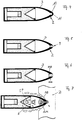
- an opening 8 having the diameter ⁇ L in the tip 2 of the penetrator 1 is proposed as shown in FIG. 1 is shown.
- the diameter ⁇ L of this opening 8 is based on the diameter ⁇ s of the produced sting S.
- the barbed diameters are in the same order of magnitude as the wall thickness of the hollow charge insert 6, which in turn is usually about 2-4% of the HL caliber (the funnel diameter at the base, ie at the largest point of the funnel diameter). Typical orders of magnitude are about 3 mm for a HL caliber of 100 mm. The barbed diameter is therefore about 3 - 5 mm in size for such a HL caliber in the final phase, and even slightly larger in the extension phase until the spiked particle is broken down (decomposition into individual particles).
- the posterior part of the spine is usually slightly thicker than the spiked tip.
- the opening 8 should therefore be sufficiently dimensioned to take account of all these barbed features and to further avoid potential spike disturbances when passing through the opening. In FIG. 2 this situation is shown with a too small opening 8 in the top 2.
- Sizes of the diameter of about 5 to 10 times the diameter of the spine S are considered sufficient - in the example, therefore, about 20 to 30 mm.
- This opening 8 prevents barbed parts are eroded or disturbed, the entire length of spikes L thus contributes to HL performance as in FIG. 3 is shown. If the perforation requirements on the penetrator (the target hardness and thickness in the target list) are not too high, then you can extend the safety margin a bit, in other words increase the opening 8 in the tip 2 a bit to be on the safe side lie, if it should also come to slight asymmetries of the spine S (spiky curvature) - what u. U. may occur in not exactly symmetrical shaped hollow charges, or here by the not completely symmetrical rupture of the shell in the detonation.
- blind hole 10 such as in FIG. 4 or closures 9 (screws, plugs and the like) made of low-density material such as plastic ( FIG. 5 ).
- closures 9 screws, plugs and the like
- low-density material such as plastic
- this blind hole bore u. U. may even be used to record sensors that can measure, for example, the delays in the impact of the penetrator.
- the hollow charge is needed and for the second, the penetrator, which on the one hand to penetrate and on the other then inside to act as pressure and splinter charge.
- the performance increase of the hollow charge due to the opening 8 in the penetrator tip 2 is therefore intended only for hard and semi-hard targets in open space.
- the hollow charge power is not needed, but only the pressure and splintering effect of the penetrator.
- the formation of the shaped charge spine S is usually even undesirable, since you have goals in structures (if any HL targets are present, which should not be the case) with the sting anyway, at most randomly - so very rarely - would meet.
- this sting would perforate building walls relatively easily and thus leave the building again, which u. It could cause things outside the building to be hit (collateral targets) - which is highly undesirable. This danger exists in particular in so-called MOUT scenarios (Military Operations in Urban Terrains), where non-military items are often packed tightly packed.
- a PELE rod P enetration with e rhöhtem l ateralem FFECT E
- a PELE rod consists of a metal cup MB (eg, aluminum) in the middle of a compressible Aufweitmaterial AWM (eg plastics such as PE, etc.) is integrated.
- the bottom of the metal cup is facing the insert 6.
- FIG. 7 is shown in the target perforation of this expansion medium AWM compressed by the target material and thereby exerts a compression pressure on the metal cup MB, which then widens and decomposed into chips. These now also have a velocity vector in the lateral direction.
- an opening 8 is sketched, which is closed with such a PELE plug.
- the diameter ⁇ L of the opening 8 should in this case be increased by twice the wall thickness of the Al shell (shell wall thickness approximately 1 to 2 mm) in order to prevent the sting S from coming into contact with the denser material on the shell 3.
- the plug must have sufficient friction in the opening 8 to allow sufficient compression pressure to build up. This can be achieved by measures such as gluing, roughening the surfaces, threads and the like.
- the successive lateral expansion in the target passage is in FIG. 7 in three time steps t 1 , t 2 , t 3 indicated.
- the PELE plug AWM, MB is accelerated into the interior 7 of the penetrator and the compression pressure of the AWM (here with plastic filling) widens the metal cup MB.
- this finally disassembles and thereby generates splinters SP, which fly laterally apart and large area - act together with the AWM plug - the shaped charge insert 6 and severely damage.
- the barbed power is reduced as desired in a controlled manner or completely suppressed.
- AWM thus combine two positive properties with each other: the barbed power is increased where needed and reduced / suppressed where not needed.
Landscapes
- Engineering & Computer Science (AREA)
- Chemical & Material Sciences (AREA)
- Combustion & Propulsion (AREA)
- General Engineering & Computer Science (AREA)
- Portable Nailing Machines And Staplers (AREA)
- Adjustment And Processing Of Grains (AREA)
Abstract
Description
- Die Erfindung betrifft einen Penetrator mit einer zumindest im Bereich der Spitze verstärkten Hülle, mit einem heckseitig angeordneten Zündsystem, das mit einer Hohlladungs-Sprengladung kooperiert, wobei die Hohlladungs-Sprengladung bugseitig mit einer Hohlladungseinlage abgeschlossen ist, deren Durchmesser an der Basis das Kaliber der Hohlladung bestimmt und die mittels eines Hohlraums von der Spitze des Penetrators beabstandet ist.
- Aus der
DE 202009015942 U1 ist ein Penetrator gemäß dem Oberbegriff der Patentanmeldung bekannt geworden. Im Inneren der Hülle ist eine Hohlladung bestehend aus einer Zündeinrichtung, einer Sprengladung und einer Einlage angeordnet. Bei Initiierung der Sprengladung erzeugt die Einlage einen Stachel, der sich im Hohlraum vor der Hohlladung ausbilden kann, sich in Richtung der Längsachse des Penetrators beschleunigt und schließlich die Spitze der Hülle des Penetrators durchbricht. Die aufgezeigte Lösung ist geeignet, bei besonderes hartem Aufprall und einem nicht mehr vermeidbaren Umstülpen der Einlage immer noch die Initiierung der Sprengladung zu ermöglichen. - Die
DE 10 2008 023 678 A1 beschreibt eine Fliegerbombe mit einer standardisierten Bombenhülle, welche im Innenraum einen Penetrator ins Ziel trägt. Die Bombenhülle weist eine kleinere Bugöffnung auf, die auch zur Montage eines Suchkopfes und einer vorderen Lenkeinrichtung verwendet werden kann. Der Durchmesser der Bugöffnung ist deutlich kleiner als der Außendurchmesser des Penetrators, so dass dieser beim Zielaufprall erst die Öffnung aufweiten muss bis er aus der Bombenhülle austreten und in das Ziel eindringen kann. Dabei wird kinetische Energie des Penetrators verbraucht. Der Penetrator selbst ist vollständig mit Sprengstoff gefüllt und enthält somitkeine Hohlladung mit einer einen Stachel bildenden Einlage. Hinweise darauf, wie die Leistung des Stachels der im Penetrator befindlichen Hohlladung beim Zielkontakt erhalten werden kann, werden in dieser Druckschrift nicht gegeben. - Es ist deshalb Aufgabe der Erfindung den Leistungsverlust des Hohlladungsstachels beim Durchtritt durch die Spitze des Penetrators deutlich zu vermindern.
- Die erfindungsgemäße Lösung besteht darin, dass in der Spitze des Penetrators rotationssymmetrisch zur Längsachse des Penetrators eine Öffnung angeordnet ist, und dass der Durchmesser der Öffnung 10 - 40 % des Kalibers der Hohlladung beträgt. Damit wird der Leistungsverlust durch Stachelerosion und-störung verhindert. Weiterhin wird der Vorteil erzielt, dass als Nebeneffekt die Einlage bei der Zielperforation durch eindringendes Zielmaterial beschädigt wird und somit keinen ordentlichen Stachel mehr bilden kann. Der Stachel kann also die Zielstruktur nicht wieder verlassen und kann somit keine Kollateralschäden verursachen.
- Eine einfache Weiterbildung der Erfindung besteht darin, dass die Öffnung während der Lagerung und des Transports des Penetrators mittels eines entfernbaren Stopfens verschlossen ist und der Stopfen aus einem Material besteht, dessen Dichte wenigstens um den Faktor 1,5 niedriger als die Dichte des Materials der Hülle ist, wobei der Stopfen aus einem Kunststoff bestehen kann.
- In vorteilhafter Weise ist die Öffnung als ein vom Hohlraum ausgehendes Sackloch ausgeführt, wobei der dünne Boden des Sacklochs vom Stachel viel leichter als die massive Wand der Penetratorhülle an der Spitze durchschlagen werden kann.
- Idealerweise ist die als Durchgangsloch ausgeführte Öffnung mittels eines Kunststoffpfropfens verschlossen, der von einem Metallbecher umgeben ist, dessen Boden der Einlage zugewandt ist. Dabei ist es günstig, wenn der Durchmesser der Öffnung um wenigstens die doppelte Wandstärke des Metallbechers erweitert ist. Ein weiterer Vorteil wird erzielt, wenn der Metallbecher mit der Hülle lösbar verbunden ist.
- Durch die geschlossene und in der Regel relativ massiv ausgeführte Spitze der Penetratorhülle wird bei Zündung der Hohlladung und der anschließenden Perforation der massiven Nase zum einen ein Teil des Stachels verbraucht und zum anderen der daran anschließende Stachelteil mehr oder weniger stark gestört, da das durch den Stachel in der Spitze erzeugte Loch nicht ausreichend groß ist. Dadurch büßt der Hohlladungsstachel einen erheblichen Teil seiner Gesamtlänge ein, wodurch sich die Hohlladungsleistung im Ziel, - die erreichbare Zielkratertiefe - beträchtlich reduziert, da diese Kratertiefe direkt proportional zur Stachellänge ist.
- Ein Ausführungsbeispiel der Erfindung ist in der Zeichnung schematisch vereinfacht dargestellt und wird im Folgenden näher beschrieben. Es zeigen:
- Fig. 1:
- einen Hohlladungspenetrator mit Öffnung in der Spitze,
- Fig. 2:
- den Leistungsverlust eines HL-Stachels bei Durchtritt durch die Spitze gemäß dem bisherigen Stand der Technik,
- Fig, 3:
- den voll ausgebildeten Stachel mittels der Öffnung in der Spitze,
- Fig. 4:
- ein Ausführungsbeispiel mit einem Sackloch in der Spitze.
- Fig. 5:
- ein Ausführungsbeispiel mit einem Kunststoffpfropfen in der Öffnung,
- Fig. 6:
- einen Verschluss der Öffnung mittels eines Metallbechers und einem Kunststoffpfropfen,
- Fig. 7:
- die Aufweitung und Zerlegung des Metallbechers beim Zielkontakt.
- Als Lösung für das oben genannte Problem wird eine Öffnung 8 mit dem Durchmesser ØL in der Spitze 2 des Penetrators 1 vorgeschlagen wie dies in
Figur 1 dargestellt ist. Der Durchmesser ØL dieser Öffnung 8 orientiert sich am Durchmesser Øs des erzeugten Stachels S. - Die Stacheldurchmesser sind in der gleichen Größenordnung wie die Wandstärke der Hohlladungs-Einlage 6, welche wiederum in der Regel ca. 2-4 % des HL-Kalibers (des Trichterdurchmessers an der Basis, also an der größten Stelle des Trichterdurchmessers) beträgt. Typische Größenordnungen sind etwa 3 mm für ein HL-Kaliber von 100 mm. Der Stacheldurchmesser ist also für ein solches HL-Kaliber in der Endphase etwa 3 - 5 mm groß, in der Streckungsphase bis zur Partikulation des Stachels (Zerlegung in Einzel-Partikel) noch etwas größer. Zudem ist der hintere Teil des Stachels in der Regel etwas dicker als die Stachelspitze.
- Die Öffnung 8 sollte also ausreichend dimensioniert sein, um all diesen Stacheleigenschaften Rechnung zu tragen und weiterhin um potenziell mögliche Stachelstörungen beim Passieren der Öffnung zu vermeiden. In
Figur 2 ist diese Situation bei einer zu kleinen Öffnung 8 in der Spitze 2 dargestellt. - Als ausreichend werden Größenordnungen des Durchmessers von ca. 5 - 10-mal des Durchmessers des Stachels S erachtet - im Beispiel also etwa 20 - 30 mm. Diese Öffnung 8 verhindert, dass Stachelteile erodiert bzw. gestört werden, die gesamte Stachellänge L trägt somit zur HL-Leistung bei wie dies in
Figur 3 dargestellt ist. Sind die Perforationsanforderungen an den Penetrator (die Zielhärte und -dicke in der Ziel-Liste) nicht zu hoch, so kann man die Sicherheitsmarge noch etwas erweitern, sprich die Öffnung 8 in der Spitze 2 noch etwas vergrößern, um so auf der sicheren Seite zu liegen, falls es überdies zu leichten Asymmetrien des Stachels S kommen sollte (Stachelkrümmung) - was u. U. bei nicht exakt symmetrisch gefertigten Hohlladungen, bzw. hier auch durch das nicht völlig symmetrische Aufreißen der Hülle bei der Detonation vorkommen kann. - Sowohl experimentelle Versuche, wie auch numerische Simulationen haben gezeigt, dass solche Öffnungen in der Spitze weder die Perforationsleistung im Ziel (Strukturen wie z.B. Gebäudewände), noch die Integrität der Penetrator-Hülle beim Zieldurchgang beeinträchtigen. Damit konnte demonstriert werden, dass neben der Leistungs-Steigerung der Hohlladung, keine unerwarteten Leistungs-Reduktionen beim Penetrator befürchtet werden müssen.
- Allerdings ist eine solche Öffnung 8 in der Penetratorspitze 2 für den operativen Einsatz (Lagerung, Transport etc.) einer solchen Penetrator-Hohlladung 1 eher nicht vorteilhaft, da dadurch in unerwünschter Weise Staub, Schmutz und andere Teile in den Hohlraum 7 der Hohlladung vor der Einlage 6 gelangen können. Diese wiederum können die Hohlladungs-Einlage 6 verschmutzen, beschädigen, oder den notwendigen Hohlraum 7 gar verstellen. All dies wäre für die HL-Leistung sehr abträglich.
- Gegen diese Problematik lässt sich jedoch relativ einfach Abhilfe schaffen. Vorgeschlagen werden beispielsweise Sackloch-Bohrungen 10, wie eine solche in
Figur 4 dargestellt ist, oder auch Verschlüsse 9 (Schrauben, Pfropfen und dergleichen mehr) aus niedrig-dichtem Material wie beispielsweise Kunststoff (Figur 5 ). Für die Leistung bedeuten diese Vorkehrungen eine relativ geringe Einbuße, solange der verbleibende Steg 11 in der Sacklochbohrung 10 nur dünn ist, bzw. solange die Materialdichten des Verschlusses 9 ausreichend niedrig sind. Alternativ könnte diese Sackloch-Bohrung u. U. sogar dazu genutzt werden, um Sensoren aufzunehmen, die beispielsweise die Verzögerungen beim Aufschlag des Penetrators messen können. - Die typische Ziel-Liste einer solchen Penetrator-Hohlladung ist in der Regel zweigeteilt:
- ● Harte und halbharte Ziele im offenen Raum (z.B. gepanzerte Fahrzeuge).
- ● Strukturen (Häuser, Bunker etc.) die es zu perforieren gilt und deren Inneres außer Funktion gesetzt werden soll.
- Für die erste Kategorie wird die Hohlladung benötigt und für die zweite der Penetrator, der zum einen eindringen und zum anderen anschließend im Inneren als Druck- und Splitterladung wirken soll.
- Die Leistungssteigerung der Hohlladung infolge der Öffnung 8 in der Penetratorspitze 2 ist also lediglich für harte und halbharte Ziele im offenen Raum gedacht. Innerhalb von Strukturen (Häuser, Bunker etc.) wird die HohlladungsLeistung nicht benötigt, sondern nur die Druck- und Splitterwirkung des Penetrators. Im Gegenteil, innerhalb von Strukturen ist die Ausbildung des Hohlladungs-Stachels S in der Regel sogar ungewünscht, da man Ziele in Strukturen (falls überhaupt HL-Ziele vorhanden sind, was eher nicht der Fall sein sollte) mit dem Stachel sowieso höchstens zufällig - also sehr selten - treffen würde. Andererseits aber dieser Stachel Gebäudewände relativ leicht perforieren und damit das Gebäude wieder verlassen würde, was u. U. dazu führen könnte, dass Dinge außerhalb des Gebäudes getroffen werden könnten (Kollateralziele) - was höchst unerwünscht ist. Diese Gefahr besteht insbesondere in so genannten MOUT-Szenarien (Military Operations in Urban Terrains), wo häufig nichtmilitärische Dinge dicht-an-dicht gepackt sind.
- Bei relativ harten Strukturen - wie beispielsweise dicken Betonwänden - wird bei dessen Perforation der HL-Trichter durch die Vorwärtsbewegung der Sprengladung automatisch sehr stark deformiert, wodurch die Ausbildung eines leistungsfähigen Stachels verhindert wird. Bei dünneren Strukturen - wie beispielsweise dünnen Ziegelwänden - ist dies nicht notwendigerweise der Fall, da der Hohlladungs-Trichter selbst eine gewisse Abstützwirkung für die Sprengladung hervorruft. Dann bestände aber die größte Gefahr, da die Stachel-Perforation solch dünner Wände überdies keine starke Stachel-Erosion und damit keine große Leistungsreduzierung erwirken würde.
- Dieser Gefahr wirkt aber nun die vorgeschlagene Öffnung 8 in der Spitze 2 des Penetrators 1 in vorteilhafter Weise entgegen. Beim Zielkontakt wird etwa der oben vorgeschlagene Kunststoff-Pfropfen 9 (vgl.
Figur 5 ) geringer Dichte, bei der Wand-Perforation in das Penetrator-Innere gedrückt und in dessen Zuge weiterhin zusätzlich weitere Wandteile und anderes Zielmaterial. Diese Verunreinigungen bewirken nun aber genau den Effekt, der im o. g. Transport- und Lagerbetrieb erfolgreich verhindert werden sollte: nämlich die Verschmutzung, Beschädigung etc. der Hohlladungs-Einlage und somit die Leistungsreduktion des Stachels, bzw. der völligen Unterdrückung dessen Ausbildung. - Der Verschluss kann aber auch gezielt daraufhin ausgelegt werden, die HL-Einlage in mehr kontrollierter Weise zu beschädigen und somit sicher zu stellen, dass die Stachelleistung ausreichend reduziert, bzw. die Ausbildung des Stachels S sicher unterdrückt wird. Hierzu wird gemäß
Figur 6 ein Pfropfen AWM, MB vorgeschlagen, der Aufbau und Funktion eines PELE-Stabes umfasst. Ein PELE-Stab (Penetration mit erhöhtem lateralem Effekt) besteht aus einem Metallbecher MB (z.B. aus Aluminium), in dessen Mitte ein kompressibles Aufweitmaterial AWM (z.B. Kunststoffe wie PE etc.) integriert ist. Der Boden des Metallbechers ist dabei der Einlage 6 zugewandt. Wie inFigur 7 dargestellt wird bei der Ziel-Perforation dieses Aufweitmedium AWM durch das Zielmaterial komprimiert und übt dadurch einen Kompressions-Druck auf den Metallbecher MB aus, welcher sich daraufhin aufweitet und in Splitter zerlegt. Diese weisen nun auch in lateraler Richtung einen Geschwindigkeitsvektor auf. - In
Figur 6 ist eine Öffnung 8 skizziert, die mit einem derartigen PELE-Pfropfen verschlossen ist. Der Durchmesser ØL der Öffnung 8 sollte hierbei um die doppelte Wandstärke der Al-Hülle (Hüllenwandstärke ca. 1 - 2 mm) vergrößert werden, um zu verhindern, dass der Stachel S mit dem dichteren Material an der Hülle 3 in Berührung kommt. Der Pfropfen muss eine ausreichende Reibung in der Öffnung 8 aufweisen, damit sich ausreichender Kompressionsdruck aufbauen kann. Dies kann durch Maßnahmen wie Einkleben, Aufrauen der Oberflächen, Gewinde und dergleichen mehr erreicht werden. - Das sukzessive laterale Aufweiten beim Zieldurchgang ist in
Figur 7 in drei Zeitschritten t1, t2, t3 angedeutet. Der PELE-Pfropfen AWM, MB wird in den Innenraum 7 des Penetrators beschleunigt und durch den Kompressionsdruck des AWM (hier mit Kunststofffüllung) weitet sich der Metallbecher MB auf. Im weiteren Verlauf zerlegt sich dieser schließlich und erzeugt dabei Splitter SP, die lateral auseinander fliegen und großflächig - gemeinsam mit dem AWM-Pfropfen - die Hohlladungs-Einlage 6 beaufschlagen und stark beschädigen. Die Stachelleistung wird so wie gewünscht in kontrollierter Weise reduziert oder gänzlich unterdrückt. - Die Öffnung 8 in der Spitze 2 des Penetrators 1 im Verbund mit dem VerschlussPfropfen 9, AWM kombinieren somit zwei positive Eigenschaften miteinander: die Stachelleistung wird erhöht wo benötigt und verringert / unterdrückt wo nicht benötigt.
-
- 1
- Penetrator
- 2
- Spitze der Hülle
- 3
- Hülle
- 4
- Zündsystem
- 5
- Sprengladung
- 6
- Einlage
- 7
- Hohlraum vor Einlage
- 8
- Öffnung
- 9
- Stopfen
- 10
- Sackloch-Bohrung
- 11
- Steg
- AWM
- Aufweitmedium
- L
- gesamte Länge des Stachels
- LN
- Verlust aufgrund Perforation der Spitze
- LS
- Verlust aufgrund Störung an der Außenwand der Perforation
- MB
- Metallbecher
- ØL
- Durchmesser der Öffnung
- S
- Stachel
- SP
- Splitter
- t1...3
- Zeitpunkte 1 ... 3
- Z
- Ziel
Claims (8)
- Penetrator (1) mit einer zumindest im Bereich der Spitze (2) verstärkten Hülle (3), mit einem heckseitig angeordneten Zündsystem (4), das mit einer Hohlladungs-Sprengladung (5) kooperiert, wobei die Hohlladungs-Sprengladung bugseitig mit einer Hohlladungseinlage (6) abgeschlossen ist, deren Durchmesser an der Basis das Kaliber der Hohlladung bestimmt und die mittels eines Hohlraums (7) von der Spitze (2) des Penetrators beabstandet ist,
dadurch gekennzeichnet,- dass in der Spitze (2) des Penetrators (1) rotationssymmetrisch zur Längsachse (L) des Penetrators eine Öffnung (8) angeordnet ist, und- dass der Durchmesser (ØL) der Öffnung 10 - 40 % des Kalibers der Hohlladung beträgt. - Penetrator nach Anspruch 1, dadurch gekennzeichnet, dass die Öffnung (8) während der Lagerung und des Transports des Penetrators mittels eines entfernbaren Stopfens (9) verschlossen ist.
- Penetrator nach Anspruch 2, dadurch gekennzeichnet, dass der Stopfen (9) aus einem Material besteht, dessen Dichte wenigstens um den Faktor 1,5 niedriger als die Dichte des Materials der Hülle (3) ist.
- Penetrator nach Anspruch 3, dadurch gekennzeichnet, dass der Stopfen (9) aus einem Kunststoff besteht.
- Penetrator nach Anspruch 1, dadurch gekennzeichnet, dass die Öffnung als ein vom Hohlraum ausgehendes Sackloch ausgeführt ist.
- Penetrator nach Anspruch 2 oder 3, dadurch gekennzeichnet, dass die Öffnung (8) mittels eines Kunststoffpfropfens (AWM) verschlossen ist, der von einem Metallbecher (MB) umgeben ist, dessen Boden der Einlage (6) zugewandt ist.
- Penetrator nach Anspruch 6, dadurch gekennzeichnet, dass Durchmesser (ØL) der Öffnung (8) um wenigstens die doppelte Wandstärke des Metallbechers (MB) erweitert ist.
- Penetrator nach Anspruch 6, dadurch gekennzeichnet, dass der Metallbecher (MB) mit der Hülle (3) lösbar verbunden ist.
Applications Claiming Priority (2)
| Application Number | Priority Date | Filing Date | Title |
|---|---|---|---|
| DE102011010977 | 2011-02-10 | ||
| DE102011012850A DE102011012850A1 (de) | 2011-02-10 | 2011-03-03 | Hohlladungspenetrator |
Publications (3)
| Publication Number | Publication Date |
|---|---|
| EP2487451A2 true EP2487451A2 (de) | 2012-08-15 |
| EP2487451A3 EP2487451A3 (de) | 2015-04-29 |
| EP2487451B1 EP2487451B1 (de) | 2018-01-17 |
Family
ID=45606940
Family Applications (1)
| Application Number | Title | Priority Date | Filing Date |
|---|---|---|---|
| EP12000643.2A Active EP2487451B1 (de) | 2011-02-10 | 2012-02-02 | Hohlladungspenetrator |
Country Status (3)
| Country | Link |
|---|---|
| EP (1) | EP2487451B1 (de) |
| DE (1) | DE102011012850A1 (de) |
| ES (1) | ES2662352T3 (de) |
Citations (2)
| Publication number | Priority date | Publication date | Assignee | Title |
|---|---|---|---|---|
| DE102008023678A1 (de) | 2008-05-15 | 2009-11-19 | Diehl Bgt Defence Gmbh & Co. Kg | Fliegerbombe |
| DE202009015942U1 (de) | 2009-11-21 | 2010-02-25 | TDW Gesellschaft für verteidigungstechnische Wirksysteme mbH | Zündvorrichtung für die Sprengladung eines Penetrators |
Family Cites Families (4)
| Publication number | Priority date | Publication date | Assignee | Title |
|---|---|---|---|---|
| NL272938A (de) * | 1961-01-05 | |||
| FR2310547A1 (fr) * | 1975-05-06 | 1976-12-03 | Realisa Et Applic Tech Et | Perfectionnements aux charges creuses |
| DE59907908D1 (de) * | 1998-04-18 | 2004-01-15 | Tdw Verteidigungstech Wirksys | Kombinationsgefechtskopf |
| US7418905B2 (en) * | 2003-12-19 | 2008-09-02 | Raytheon Company | Multi-mission payload system |
-
2011
- 2011-03-03 DE DE102011012850A patent/DE102011012850A1/de not_active Ceased
-
2012
- 2012-02-02 EP EP12000643.2A patent/EP2487451B1/de active Active
- 2012-02-02 ES ES12000643.2T patent/ES2662352T3/es active Active
Patent Citations (2)
| Publication number | Priority date | Publication date | Assignee | Title |
|---|---|---|---|---|
| DE102008023678A1 (de) | 2008-05-15 | 2009-11-19 | Diehl Bgt Defence Gmbh & Co. Kg | Fliegerbombe |
| DE202009015942U1 (de) | 2009-11-21 | 2010-02-25 | TDW Gesellschaft für verteidigungstechnische Wirksysteme mbH | Zündvorrichtung für die Sprengladung eines Penetrators |
Also Published As
| Publication number | Publication date |
|---|---|
| ES2662352T3 (es) | 2018-04-06 |
| EP2487451A3 (de) | 2015-04-29 |
| EP2487451B1 (de) | 2018-01-17 |
| DE102011012850A1 (de) | 2012-08-16 |
Similar Documents
| Publication | Publication Date | Title |
|---|---|---|
| EP1000311B1 (de) | Geschoss oder gefechtskopf | |
| DE3137855C2 (de) | ||
| DE3802002A1 (de) | Zuender- und sprengstoffloses geschoss fuer rohrwaffen | |
| EP0343389A1 (de) | Geschosskern für ein Treibspiegelgeschoss | |
| DE60037934T2 (de) | Mauerzerbrechender Gefechtskopf | |
| DE1910779C3 (de) | Hohlladung | |
| DE10045009A1 (de) | Jagdbüchsengeschoß mit zusätzlich gekapseltem Kern | |
| DE102004035385A1 (de) | Teilzerlegungsgeschoss mit massivem Kern und Kern aus gepresstem Pulver | |
| EP2024706A1 (de) | Geschoss, wirkkörper oder gefechtskopf zur bekämpfung massiver, strukturierter und flächenhafter ziele | |
| DE102014224715A1 (de) | Unterschallpatrone mit einem Geschoss sowie Geschoss für eine solche | |
| EP2487451B1 (de) | Hohlladungspenetrator | |
| DE3301148A1 (de) | Hohlladung | |
| DE4114145C1 (de) | Gefechtskopf zur Bekämpfung von reaktiven Panzerungen | |
| EP4028715A1 (de) | Unterwasserfahrzeug mit zwei hintereinander angeordneten hohlladungen | |
| DE102020104217A1 (de) | Penetrator und Verwendung eines Penetrators | |
| DE69611273T2 (de) | Asymmetrisches Penetratorgeschoss | |
| DE10201191B4 (de) | System zur Erzeugung der Reaktion einer Munition | |
| DE202012010484U1 (de) | Geschoss mit verringertem Penetrationsvermögen | |
| WO2018219686A1 (de) | Geschoss mit aufweitmedium | |
| DE19520136A1 (de) | Gefechtskopf zur Bekämpfung von Seeminen | |
| DE10129227B4 (de) | Hohlladung | |
| EP1656533A1 (de) | Teilzerlegungsgeschoss mit massivem kern und kern aus gepresstem pulver | |
| EP1936319B1 (de) | Penetrationsgeschoss und Verfahren zur Erzeugung eines solchen Geschosses | |
| DE102005044320B4 (de) | Ladung mit einer im wesentlichen zylindrischen Sprengstoffanordnung | |
| DE602005004548T2 (de) | Abschirmung und mit einer derartigen abschirmung ausgerüstetes geschoss wie eine granate |
Legal Events
| Date | Code | Title | Description |
|---|---|---|---|
| PUAI | Public reference made under article 153(3) epc to a published international application that has entered the european phase |
Free format text: ORIGINAL CODE: 0009012 |
|
| AK | Designated contracting states |
Kind code of ref document: A2 Designated state(s): AL AT BE BG CH CY CZ DE DK EE ES FI FR GB GR HR HU IE IS IT LI LT LU LV MC MK MT NL NO PL PT RO RS SE SI SK SM TR |
|
| AX | Request for extension of the european patent |
Extension state: BA ME |
|
| PUAL | Search report despatched |
Free format text: ORIGINAL CODE: 0009013 |
|
| AK | Designated contracting states |
Kind code of ref document: A3 Designated state(s): AL AT BE BG CH CY CZ DE DK EE ES FI FR GB GR HR HU IE IS IT LI LT LU LV MC MK MT NL NO PL PT RO RS SE SI SK SM TR |
|
| AX | Request for extension of the european patent |
Extension state: BA ME |
|
| RIC1 | Information provided on ipc code assigned before grant |
Ipc: F42B 12/10 20060101AFI20150325BHEP |
|
| 17P | Request for examination filed |
Effective date: 20150803 |
|
| STAA | Information on the status of an ep patent application or granted ep patent |
Free format text: STATUS: EXAMINATION IS IN PROGRESS |
|
| 17Q | First examination report despatched |
Effective date: 20161121 |
|
| GRAP | Despatch of communication of intention to grant a patent |
Free format text: ORIGINAL CODE: EPIDOSNIGR1 |
|
| STAA | Information on the status of an ep patent application or granted ep patent |
Free format text: STATUS: GRANT OF PATENT IS INTENDED |
|
| INTG | Intention to grant announced |
Effective date: 20171109 |
|
| GRAS | Grant fee paid |
Free format text: ORIGINAL CODE: EPIDOSNIGR3 |
|
| GRAA | (expected) grant |
Free format text: ORIGINAL CODE: 0009210 |
|
| STAA | Information on the status of an ep patent application or granted ep patent |
Free format text: STATUS: THE PATENT HAS BEEN GRANTED |
|
| AK | Designated contracting states |
Kind code of ref document: B1 Designated state(s): AL AT BE BG CH CY CZ DE DK EE ES FI FR GB GR HR HU IE IS IT LI LT LU LV MC MK MT NL NO PL PT RO RS SE SI SK SM TR |
|
| REG | Reference to a national code |
Ref country code: GB Ref legal event code: FG4D Free format text: NOT ENGLISH |
|
| REG | Reference to a national code |
Ref country code: CH Ref legal event code: EP |
|
| REG | Reference to a national code |
Ref country code: IE Ref legal event code: FG4D Free format text: LANGUAGE OF EP DOCUMENT: GERMAN |
|
| REG | Reference to a national code |
Ref country code: AT Ref legal event code: REF Ref document number: 964716 Country of ref document: AT Kind code of ref document: T Effective date: 20180215 |
|
| REG | Reference to a national code |
Ref country code: DE Ref legal event code: R096 Ref document number: 502012012009 Country of ref document: DE |
|
| REG | Reference to a national code |
Ref country code: FR Ref legal event code: PLFP Year of fee payment: 7 |
|
| REG | Reference to a national code |
Ref country code: ES Ref legal event code: FG2A Ref document number: 2662352 Country of ref document: ES Kind code of ref document: T3 Effective date: 20180406 |
|
| REG | Reference to a national code |
Ref country code: NL Ref legal event code: MP Effective date: 20180117 |
|
| REG | Reference to a national code |
Ref country code: LT Ref legal event code: MG4D |
|
| PG25 | Lapsed in a contracting state [announced via postgrant information from national office to epo] |
Ref country code: NL Free format text: LAPSE BECAUSE OF FAILURE TO SUBMIT A TRANSLATION OF THE DESCRIPTION OR TO PAY THE FEE WITHIN THE PRESCRIBED TIME-LIMIT Effective date: 20180117 |
|
| PG25 | Lapsed in a contracting state [announced via postgrant information from national office to epo] |
Ref country code: HR Free format text: LAPSE BECAUSE OF FAILURE TO SUBMIT A TRANSLATION OF THE DESCRIPTION OR TO PAY THE FEE WITHIN THE PRESCRIBED TIME-LIMIT Effective date: 20180117 Ref country code: CY Free format text: LAPSE BECAUSE OF FAILURE TO SUBMIT A TRANSLATION OF THE DESCRIPTION OR TO PAY THE FEE WITHIN THE PRESCRIBED TIME-LIMIT Effective date: 20180117 Ref country code: FI Free format text: LAPSE BECAUSE OF FAILURE TO SUBMIT A TRANSLATION OF THE DESCRIPTION OR TO PAY THE FEE WITHIN THE PRESCRIBED TIME-LIMIT Effective date: 20180117 Ref country code: NO Free format text: LAPSE BECAUSE OF FAILURE TO SUBMIT A TRANSLATION OF THE DESCRIPTION OR TO PAY THE FEE WITHIN THE PRESCRIBED TIME-LIMIT Effective date: 20180417 Ref country code: LT Free format text: LAPSE BECAUSE OF FAILURE TO SUBMIT A TRANSLATION OF THE DESCRIPTION OR TO PAY THE FEE WITHIN THE PRESCRIBED TIME-LIMIT Effective date: 20180117 |
|
| PG25 | Lapsed in a contracting state [announced via postgrant information from national office to epo] |
Ref country code: LV Free format text: LAPSE BECAUSE OF FAILURE TO SUBMIT A TRANSLATION OF THE DESCRIPTION OR TO PAY THE FEE WITHIN THE PRESCRIBED TIME-LIMIT Effective date: 20180117 Ref country code: SE Free format text: LAPSE BECAUSE OF FAILURE TO SUBMIT A TRANSLATION OF THE DESCRIPTION OR TO PAY THE FEE WITHIN THE PRESCRIBED TIME-LIMIT Effective date: 20180117 Ref country code: RS Free format text: LAPSE BECAUSE OF FAILURE TO SUBMIT A TRANSLATION OF THE DESCRIPTION OR TO PAY THE FEE WITHIN THE PRESCRIBED TIME-LIMIT Effective date: 20180117 Ref country code: BG Free format text: LAPSE BECAUSE OF FAILURE TO SUBMIT A TRANSLATION OF THE DESCRIPTION OR TO PAY THE FEE WITHIN THE PRESCRIBED TIME-LIMIT Effective date: 20180417 Ref country code: GR Free format text: LAPSE BECAUSE OF FAILURE TO SUBMIT A TRANSLATION OF THE DESCRIPTION OR TO PAY THE FEE WITHIN THE PRESCRIBED TIME-LIMIT Effective date: 20180418 Ref country code: IS Free format text: LAPSE BECAUSE OF FAILURE TO SUBMIT A TRANSLATION OF THE DESCRIPTION OR TO PAY THE FEE WITHIN THE PRESCRIBED TIME-LIMIT Effective date: 20180517 Ref country code: PL Free format text: LAPSE BECAUSE OF FAILURE TO SUBMIT A TRANSLATION OF THE DESCRIPTION OR TO PAY THE FEE WITHIN THE PRESCRIBED TIME-LIMIT Effective date: 20180117 |
|
| REG | Reference to a national code |
Ref country code: CH Ref legal event code: PL |
|
| PG25 | Lapsed in a contracting state [announced via postgrant information from national office to epo] |
Ref country code: MT Free format text: LAPSE BECAUSE OF FAILURE TO SUBMIT A TRANSLATION OF THE DESCRIPTION OR TO PAY THE FEE WITHIN THE PRESCRIBED TIME-LIMIT Effective date: 20180117 |
|
| REG | Reference to a national code |
Ref country code: DE Ref legal event code: R097 Ref document number: 502012012009 Country of ref document: DE |
|
| PG25 | Lapsed in a contracting state [announced via postgrant information from national office to epo] |
Ref country code: RO Free format text: LAPSE BECAUSE OF FAILURE TO SUBMIT A TRANSLATION OF THE DESCRIPTION OR TO PAY THE FEE WITHIN THE PRESCRIBED TIME-LIMIT Effective date: 20180117 Ref country code: EE Free format text: LAPSE BECAUSE OF FAILURE TO SUBMIT A TRANSLATION OF THE DESCRIPTION OR TO PAY THE FEE WITHIN THE PRESCRIBED TIME-LIMIT Effective date: 20180117 Ref country code: AL Free format text: LAPSE BECAUSE OF FAILURE TO SUBMIT A TRANSLATION OF THE DESCRIPTION OR TO PAY THE FEE WITHIN THE PRESCRIBED TIME-LIMIT Effective date: 20180117 Ref country code: MC Free format text: LAPSE BECAUSE OF FAILURE TO SUBMIT A TRANSLATION OF THE DESCRIPTION OR TO PAY THE FEE WITHIN THE PRESCRIBED TIME-LIMIT Effective date: 20180117 |
|
| PLBE | No opposition filed within time limit |
Free format text: ORIGINAL CODE: 0009261 |
|
| STAA | Information on the status of an ep patent application or granted ep patent |
Free format text: STATUS: NO OPPOSITION FILED WITHIN TIME LIMIT |
|
| REG | Reference to a national code |
Ref country code: IE Ref legal event code: MM4A |
|
| REG | Reference to a national code |
Ref country code: BE Ref legal event code: MM Effective date: 20180228 |
|
| PG25 | Lapsed in a contracting state [announced via postgrant information from national office to epo] |
Ref country code: CH Free format text: LAPSE BECAUSE OF NON-PAYMENT OF DUE FEES Effective date: 20180228 Ref country code: SM Free format text: LAPSE BECAUSE OF FAILURE TO SUBMIT A TRANSLATION OF THE DESCRIPTION OR TO PAY THE FEE WITHIN THE PRESCRIBED TIME-LIMIT Effective date: 20180117 Ref country code: DK Free format text: LAPSE BECAUSE OF FAILURE TO SUBMIT A TRANSLATION OF THE DESCRIPTION OR TO PAY THE FEE WITHIN THE PRESCRIBED TIME-LIMIT Effective date: 20180117 Ref country code: LU Free format text: LAPSE BECAUSE OF NON-PAYMENT OF DUE FEES Effective date: 20180202 Ref country code: SK Free format text: LAPSE BECAUSE OF FAILURE TO SUBMIT A TRANSLATION OF THE DESCRIPTION OR TO PAY THE FEE WITHIN THE PRESCRIBED TIME-LIMIT Effective date: 20180117 Ref country code: LI Free format text: LAPSE BECAUSE OF NON-PAYMENT OF DUE FEES Effective date: 20180228 Ref country code: CZ Free format text: LAPSE BECAUSE OF FAILURE TO SUBMIT A TRANSLATION OF THE DESCRIPTION OR TO PAY THE FEE WITHIN THE PRESCRIBED TIME-LIMIT Effective date: 20180117 |
|
| 26N | No opposition filed |
Effective date: 20181018 |
|
| PG25 | Lapsed in a contracting state [announced via postgrant information from national office to epo] |
Ref country code: IE Free format text: LAPSE BECAUSE OF NON-PAYMENT OF DUE FEES Effective date: 20180202 |
|
| PG25 | Lapsed in a contracting state [announced via postgrant information from national office to epo] |
Ref country code: SI Free format text: LAPSE BECAUSE OF FAILURE TO SUBMIT A TRANSLATION OF THE DESCRIPTION OR TO PAY THE FEE WITHIN THE PRESCRIBED TIME-LIMIT Effective date: 20180117 Ref country code: BE Free format text: LAPSE BECAUSE OF NON-PAYMENT OF DUE FEES Effective date: 20180228 |
|
| REG | Reference to a national code |
Ref country code: AT Ref legal event code: MM01 Ref document number: 964716 Country of ref document: AT Kind code of ref document: T Effective date: 20180202 |
|
| PG25 | Lapsed in a contracting state [announced via postgrant information from national office to epo] |
Ref country code: AT Free format text: LAPSE BECAUSE OF NON-PAYMENT OF DUE FEES Effective date: 20180202 |
|
| PG25 | Lapsed in a contracting state [announced via postgrant information from national office to epo] |
Ref country code: TR Free format text: LAPSE BECAUSE OF FAILURE TO SUBMIT A TRANSLATION OF THE DESCRIPTION OR TO PAY THE FEE WITHIN THE PRESCRIBED TIME-LIMIT Effective date: 20180117 |
|
| PGFP | Annual fee paid to national office [announced via postgrant information from national office to epo] |
Ref country code: ES Payment date: 20200322 Year of fee payment: 9 Ref country code: IT Payment date: 20200225 Year of fee payment: 9 |
|
| PG25 | Lapsed in a contracting state [announced via postgrant information from national office to epo] |
Ref country code: HU Free format text: LAPSE BECAUSE OF FAILURE TO SUBMIT A TRANSLATION OF THE DESCRIPTION OR TO PAY THE FEE WITHIN THE PRESCRIBED TIME-LIMIT; INVALID AB INITIO Effective date: 20120202 Ref country code: PT Free format text: LAPSE BECAUSE OF FAILURE TO SUBMIT A TRANSLATION OF THE DESCRIPTION OR TO PAY THE FEE WITHIN THE PRESCRIBED TIME-LIMIT Effective date: 20180117 |
|
| PG25 | Lapsed in a contracting state [announced via postgrant information from national office to epo] |
Ref country code: MK Free format text: LAPSE BECAUSE OF NON-PAYMENT OF DUE FEES Effective date: 20180117 |
|
| PG25 | Lapsed in a contracting state [announced via postgrant information from national office to epo] |
Ref country code: IT Free format text: LAPSE BECAUSE OF NON-PAYMENT OF DUE FEES Effective date: 20210202 |
|
| REG | Reference to a national code |
Ref country code: ES Ref legal event code: FD2A Effective date: 20220504 |
|
| PG25 | Lapsed in a contracting state [announced via postgrant information from national office to epo] |
Ref country code: ES Free format text: LAPSE BECAUSE OF NON-PAYMENT OF DUE FEES Effective date: 20210203 |
|
| PGFP | Annual fee paid to national office [announced via postgrant information from national office to epo] |
Ref country code: DE Payment date: 20250228 Year of fee payment: 14 |
|
| PGFP | Annual fee paid to national office [announced via postgrant information from national office to epo] |
Ref country code: FR Payment date: 20250221 Year of fee payment: 14 |
|
| PGFP | Annual fee paid to national office [announced via postgrant information from national office to epo] |
Ref country code: GB Payment date: 20250219 Year of fee payment: 14 |