EP2471943A1 - Process for production of l-amino acid - Google Patents
Process for production of l-amino acid Download PDFInfo
- Publication number
- EP2471943A1 EP2471943A1 EP10811634A EP10811634A EP2471943A1 EP 2471943 A1 EP2471943 A1 EP 2471943A1 EP 10811634 A EP10811634 A EP 10811634A EP 10811634 A EP10811634 A EP 10811634A EP 2471943 A1 EP2471943 A1 EP 2471943A1
- Authority
- EP
- European Patent Office
- Prior art keywords
- gene
- amino acid
- activity
- seq
- bacterium
- Prior art date
- Legal status (The legal status is an assumption and is not a legal conclusion. Google has not performed a legal analysis and makes no representation as to the accuracy of the status listed.)
- Granted
Links
Images

Classifications
-
- C—CHEMISTRY; METALLURGY
- C12—BIOCHEMISTRY; BEER; SPIRITS; WINE; VINEGAR; MICROBIOLOGY; ENZYMOLOGY; MUTATION OR GENETIC ENGINEERING
- C12P—FERMENTATION OR ENZYME-USING PROCESSES TO SYNTHESISE A DESIRED CHEMICAL COMPOUND OR COMPOSITION OR TO SEPARATE OPTICAL ISOMERS FROM A RACEMIC MIXTURE
- C12P13/00—Preparation of nitrogen-containing organic compounds
- C12P13/04—Alpha- or beta- amino acids
- C12P13/14—Glutamic acid; Glutamine
-
- C—CHEMISTRY; METALLURGY
- C12—BIOCHEMISTRY; BEER; SPIRITS; WINE; VINEGAR; MICROBIOLOGY; ENZYMOLOGY; MUTATION OR GENETIC ENGINEERING
- C12P—FERMENTATION OR ENZYME-USING PROCESSES TO SYNTHESISE A DESIRED CHEMICAL COMPOUND OR COMPOSITION OR TO SEPARATE OPTICAL ISOMERS FROM A RACEMIC MIXTURE
- C12P13/00—Preparation of nitrogen-containing organic compounds
- C12P13/04—Alpha- or beta- amino acids
- C12P13/06—Alanine; Leucine; Isoleucine; Serine; Homoserine
-
- C—CHEMISTRY; METALLURGY
- C12—BIOCHEMISTRY; BEER; SPIRITS; WINE; VINEGAR; MICROBIOLOGY; ENZYMOLOGY; MUTATION OR GENETIC ENGINEERING
- C12P—FERMENTATION OR ENZYME-USING PROCESSES TO SYNTHESISE A DESIRED CHEMICAL COMPOUND OR COMPOSITION OR TO SEPARATE OPTICAL ISOMERS FROM A RACEMIC MIXTURE
- C12P13/00—Preparation of nitrogen-containing organic compounds
- C12P13/04—Alpha- or beta- amino acids
- C12P13/10—Citrulline; Arginine; Ornithine
-
- C—CHEMISTRY; METALLURGY
- C12—BIOCHEMISTRY; BEER; SPIRITS; WINE; VINEGAR; MICROBIOLOGY; ENZYMOLOGY; MUTATION OR GENETIC ENGINEERING
- C12P—FERMENTATION OR ENZYME-USING PROCESSES TO SYNTHESISE A DESIRED CHEMICAL COMPOUND OR COMPOSITION OR TO SEPARATE OPTICAL ISOMERS FROM A RACEMIC MIXTURE
- C12P13/00—Preparation of nitrogen-containing organic compounds
- C12P13/04—Alpha- or beta- amino acids
- C12P13/12—Methionine; Cysteine; Cystine
-
- C—CHEMISTRY; METALLURGY
- C12—BIOCHEMISTRY; BEER; SPIRITS; WINE; VINEGAR; MICROBIOLOGY; ENZYMOLOGY; MUTATION OR GENETIC ENGINEERING
- C12P—FERMENTATION OR ENZYME-USING PROCESSES TO SYNTHESISE A DESIRED CHEMICAL COMPOUND OR COMPOSITION OR TO SEPARATE OPTICAL ISOMERS FROM A RACEMIC MIXTURE
- C12P13/00—Preparation of nitrogen-containing organic compounds
- C12P13/04—Alpha- or beta- amino acids
- C12P13/24—Proline; Hydroxyproline; Histidine
Definitions
- the present invention relates to a method for efficiently producing an L-amino acid such as L-glutamic acid, L-glutamine, L-proline, L-arginine, L-asparagine, L-aspartic acid, L-lysine, L-methionine, L-threonine and L-isoleucine by fermentation.
- L-amino acid such as L-glutamic acid, L-glutamine, L-proline, L-arginine, L-asparagine, L-aspartic acid, L-lysine, L-methionine, L-threonine and L-isoleucine by fermentation.
- L-Amino acids are industrially produced by fermentation mainly using L-amino acid-producing bacteria of the so-called coryneform bacteria belonging to the genus Brevibacterium, Corynebacterium or Microbacterium, or mutant strains thereof (refer to, for example, Non-patent document 1).
- Carbonic anhydrase is an enzyme involved in mutual conversion of carbon dioxide and bicarbonate radical. It has been reported that Escherichia coli has two kinds of carbonic anhydrases, i.e., Can (carbonic anhydrase 2) and CynT (carbonic anhydrase 1) (Non-patent documents 2 and 3). It has been elucidated that Can is a ⁇ type carbonic anhydrase, and is indispensable for growth of Escherichia coli under the usual atmospheric carbon dioxide partial pressure. Can and CynT are encoded by the yadF and cynT genes, respectively. It is also known that, in Corynebacterium glutamicum, ⁇ type and ⁇ type carbonic anhydrases have been found, and the ⁇ type one mainly functions (refer to Non-patent document 4).
- An object of the present invention is to provide a novel method for producing an L-amino acid, especially L-glutamic acid, L-glutamine, L-proline, L-arginine, L-asparagine, L-aspartic acid, L-lysine, L-methionine, L-threonine or L-isoleucine, by fermentation.
- L-amino acid especially L-glutamic acid, L-glutamine, L-proline, L-arginine, L-asparagine, L-aspartic acid, L-lysine, L-methionine, L-threonine or L-isoleucine
- the inventors of the present invention conducted various researches in order to achieve the aforementioned object. As a result, they found that by culturing a coryneform bacterium that has been imparted with an L-amino acid-producing ability and has been modified to enhance carbonic anhydrase (henceforth carbonic anhydrase refers to ⁇ -carbonic anhydrase unless specifically indicated) activity, an L-amino acid such as L-glutamic acid, L-glutamine, L-proline, L-arginine, L-asparagine, L-aspartic acid, L-lysine, L-methionine, L-threonine and L-isoleucine can be efficiently produced, and accomplished the present invention.
- an L-amino acid such as L-glutamic acid, L-glutamine, L-proline, L-arginine, L-asparagine, L-aspartic acid, L-lysine, L-methi
- the present invention thus relates to the followings.
- L-amino acids such as L-glutamic acid, L-glutamine, L-proline, L-arginine, L-asparagine, L-aspartic acid, L-lysine, L-methionine, L-threonine and L-isoleucine can be efficiently produced.
- Fig. 1 shows L-amino acid accumulation amount observed with a carbonic anhydrase (BCA)-enhanced strain.
- the coryneform bacterium used for the method of the present invention is a coryneform bacterium having an L-amino acid-producing ability and modified to enhance carbonic anhydrase activity.
- the coryneform bacterium used for the method of the present invention can be obtained by using a coryneform bacterium having an L-amino acid-producing ability as a parent strain, and modifying it so that carbonic anhydrase activity thereof is enhanced.
- the coryneform bacterium used for the method of the present invention may be a coryneform bacterium inherently having an L-amino acid-producing ability, or may be a coryneform bacterium imparted with an L-amino acid-producing ability by breeding utilizing a mutation method, recombinant DNA technique, or the like.
- the "coryneform bacteria” also include bacteria which have previously been classified into the genus Brevibacterium but are presently classified into the genus Corynebacterium ( Int. J. Syst. Bacteriol., 41:255-260, 1991 ), and bacteria belonging to the genus Brevibacterium, which are closely related to the genus Corynebacterium. Examples of such coryneform bacteria include the followings:
- strains are available from, for example, the American Type Culture Collection (Address: 12301 Parklawn Drive, Rockville; Maryland 20852, P.O. Box 1549, Manassas, VA 20108, United States of America). That is, registration numbers are given to each of the strains, and the strains can be ordered by using these registration numbers (refer to http://www.atcc.org/). The registration numbers of the strains are listed in the catalogue of the American Type Culture Collection.
- the AJ12340 strain was deposited on October 27, 1987 at National Institute of Bioscience and Human Technology, Agency of Industrial Science and Technology, Ministry of Economy, Trade and Industry (currently the independent administrative agency, National Institute of Advanced Industrial Science and Technology, International Patent Organism Depositary, Tsukuba Central 6, 1-1, Higashi 1-Chome, Tsukuba-shi, Ibaraki-ken, 305-5466, Japan) with an accession number of FERM BP-1539 under the provisions of Budapest Treaty.
- the "L-amino acid-producing ability” means an ability of the coryneform bacterium used for the method of the present invention to accumulate an L-amino acid in a medium, when the bacterium is cultured in the medium.
- This L-amino acid-producing ability may be a property that a wild-type strain of the coryneform bacterium has, or a property imparted or enhanced by breeding.
- L-amino acid examples include L-lysine, L-glutamic acid, L-threonine, L-valine, L-leucine, L-isoleucine, L-serine, L-aspartic acid, L-asparagine, L-glutamine,-L-arginine, L-cysteine (cystine), L-methionine, L-phenylalanine, L-tryptophan, L-tyrosine, L-glycine, L-alanne, L-proline, L-ornithine, L-citrulline, and L-homoserine.
- L-amino acids derived from oxaloacetic acid and acetyl-CoA are preferred, and L-glutamic acid, L-glutamine, L-proline, L-arginine, L-asparagine, L-aspartic acid, L-lysine, L-methionine, L-threonine, and L-isoleucine are especially preferred.
- Examples of the method for imparting or enhancing L-glutamic acid-producing ability by breeding include, for example, a method of modifying a bacterium so that expression of a gene encoding an enzyme involved in the L-glutamic acid biosynthesis is enhanced.
- Examples of such an enzyme involved in the L-glutamic acid biosynthesis include, for example, glutamate dehydrogenase, glutamine synthetase, glutamate synthase, isocitrate dehydrogenase, aconitate hydratase, citrate synthase, phosphoenolpyruvate carboxylase, pyruvate carboxylase, pyruvate dehydrogenase, pyruvate kinase, phosphoenolpyruvate synthase, enolase, phosphoglyceromutase, phosphoglycerate kinase, glyceraldehydes-3-phosphate dehydrogenase, triosephosphate isomerase, fructose bisphosphate aldolase, phosphofructokinase, glucose phosphate isomerase, and so forth.
- Examples of the method for enhancing expression of such genes as mentioned above include introduction of an amplification plasmid obtained by introducing a DNA fragment containing any of these genes into an appropriate plasmid, for example, a plasmid containing at least a gene responsible for replication and proliferation functions of the plasmid in a coryneform bacterium, increasing copy number of any of these genes on a chromosome by conjugation, gene transfer, or the like, and introduction of a mutation into a promoter region of any of these genes (refer to International Patent Publication WO95/34672 )
- the promoter for expressing these genes may be any kind of promoter so long as a promoter that functions in coryneform bacteria is chosen, and may be a promoter of the gene to be used. Expression amount of a gene can also be controlled by appropriately choosing a promoter. Examples of coryneform bacteria modified by such methods as mentioned above so that expression of a citrate synthase gene, phosphoenolpyruvate carboxylase gene and/or glutamate dehydrogenase gene is enhanced include the coryneform bacteria disclosed in WO00/18935 and so forth.
- the modification for imparting L-glutamic acid-producing ability may be attained by decreasing or eliminating activity of an enzyme that catalyzes a reaction branching off from the L-glutamic acid biosynthesis pathway and producing a compound other than L-glutamic acid.
- an enzyme that catalyzes a reaction branching off from the L-glutamic acid biosynthesis pathway and producing a compound other than L-glutamic acid include isocitrate lyase, ⁇ -ketoglutarate dehydrogenase, phosphate acetyltransferase, acetate kinase, acetohydroxy acid synthase, acetolactate synthase, formate acetyltransferase, lactate dehydrogenase, glutamate decarboxylase, 1-pyrroline dehydrogenase, and so forth.
- a mutation may be introduced into genes of the enzymes on a chromosome by a usual mutagenesis method so that intracellular activities of the enzymes are reduced or eliminated.
- introduction of a mutation can be achieved by, for example, using genetic recombination to eliminate the genes encoding the enzymes on the chromosome or modify an expression control sequence such as a promoter or the Shine-Dalgarno (SD) sequence. It can also be achieved by introducing a mutation for amino acid substitution (missense mutation), a stop codon (nonsense mutation), or a frame shift mutation for adding or deleting one or two nucleotides into regions encoding the enzymes on the chromosome, or partially deleting the genes ( J.
- the enzymatic activities can also be decreased or eliminated by constructing a gene encoding a mutant enzyme, of which coding region is deleted, and substituting it for a normal gene on a chromosome by homologous recombination or the like.
- modification may be performed by using the sucA ( odhA ) gene encoding the Elo subunit of the enzyme.
- the nucleotide sequence of the sucA gene and the amino acid sequence encoded thereby are shown as SEQ ID NOS: 9 and 10.
- strains with decreased a-ketoglutarate dehydrogenase activity include, for example, the following strains:
- Examples of other methods for imparting or enhancing L-glutamic acid-producing ability also include a method of imparting resistance to an organic acid analogue, a respiratory chain inhibitor, or the like, and a method of imparting sensitivity to a cell wall synthesis inhibitor.
- Examples of such methods include the method of imparting resistance to benzopyrones or naphthoquinones (Japanese Patent Laid-open No. 56-1889 ), the method of imparting resistance to HOQNO (Japanese Patent Laid-open No. 56-140895 ), the method of imparting resistance to ⁇ -ketomalonic acid (Japanese Patent Laid-open No.
- Such resistant strains include the following strains: Brevibacterium flavum AJ11355 (FERM P-5007, refer to Japanese Patent Laid-open No. 56-1889 ) Corynebacterium glutamicum AJ11368 (FERM P-5020, refer to japanese Patent Laid-open No. 56-1889 ) Brevibacterium flavum AJ11217 (FERM P-4318, refer to Japanese Patent Laid-open No.
- Corynebacterium glutamicum AJ11218 (FERM P-4319, refer to Japanese Patent Laid-open No. 57-2689 ) Brevibacterium flavum AJ11564 (FERM BP-5472, refer to Japanese Patent Laid-open No. 56-140895 ) Brevibacterium flavum AJ11439 (FERM BP-5136, refer to Japanese Patent Laid-open No. 56-35981 ) Corynebacterium glutamicum H7684 (FERM BP-3004, refer to Japanese Patent Laid-open No. 04-88994 )
- Examples of method for imparting L-glutamine-producing ability include, for example, a method of modifying a bacterium so that expression of a gene encoding an enzyme involved in the L-glutamine biosynthesis is enhanced.
- Examples of the enzyme involved in the L-glutamine biosynthesis include, for example, glutamine synthetase and glutamate dehydrogenase (Japanese Patent Laid-open No. 2002-300887).
- Modification for imparting L-glutamine-producing ability may also be attained by reducing or deleting activity of an enzyme that catalyzes a reaction branching off from the biosynthesis pathway of L-glutamine and producing another compound. For example, it is conceivable to reduce intracellular glutaminase activity (Japanese Patent Laid-open No. 2004-187684 ).
- Examples of methods for imparting or enhancing L-glutamine-producing ability also include imparting resistance to amino acid analogues and so forth. Specific examples include imparting 6-diazo-5-oxo-norleucine resistance (Japanese Patent Laid-open No. 3-232497 ), imparting purine analogue resistance and/or methionine sulfoxide resistance (Japanese Patent Laid-open No. 61-202694 ), imparting ⁇ -ketomalonic acid resistance (Japanese Patent Laid-open No. 56-151495 ), imparting resistance to a peptide containing glutamic acid (Japanese Patent Laid-open No. 2-186994 ), and so forth. Specific examples of coryneform bacteria having L-glutamine-producing ability include the following strains:
- Examples of method for imparting L-proline-producing ability include, for example, a method of modifying a bacterium so that expression of a gene encoding an enzyme involved in the L-proline biosynthesis is enhanced.
- Examples of the enzyme involved in the L-proline biosynthesis include, for example, glutamate-5-kinase, ⁇ -glutamylphosphate reductase, and pyroline-5-carboxylate reductase.
- Modification for imparting L-proline-producing ability may be performed by reducing or deleting an activity of an enzyme that catalyzes a reaction branching off from the biosynthesis pathway of L-proline to produce another compound.
- Examples include, for example, reducing intracellular ornithine aminotransferase activity.
- Examples of method for imparting L-arginine-producing ability include a method of modifying a bacterium so that expression of a gene encoding an enzyme involved in the L-arginine biosynthesis is enhanced.
- L-arginine biosynthetic enzymes include one or more chosen from N-acetylglutamyl phosphate reductase ( argC ) , ornithine acetyltransferase ( argJ ) , N-acetylglutamate kinase ( argB ), acetylornithine transaminase ( argD ), ornithine carbamoyl transferase ( argF ), argininosuccinate synthase ( argG ), argininosuccinate lyase ( argH ), and carbamoylphosphate synthase.
- Another method for imparting L-arginine-producing ability is a method of imparting resistance to an amino acid analogue or the like.
- bacteria obtained by such a method include coryneform bacteria exhibiting L-histidine, L-proline, L-threonine, L-isoleucine, L-methionine, or L-tryptophan auxotrophy in addition to the resistance to 2-thiazolealanine (Japanese Patent Laid-open No. 54-44096 ); coryneform bacteria resistant to ketomalonic acid, fluoromalonic acid, or monofluoroacetic acid (Japanese Patent Laid-open No.
- coryneform bacteria resistant to argininol Japanese Patent Publication No. 62-24075
- coryneform bacteria resistant to X-guanidine X represents a derivative of fatty acid or aliphatic chain, Japanese Patent Laid-open No. 2-186995
- coryneform bacteria resistant to arginine hydroxamate and 6-azauracil Japanese Patent Laid-open No. 57-150381 ), and so forth.
- L-arginine, L-glutamine and L-proline comprise L-glutamic acid as a basic structure
- a bacterium having ability to produce any of these amino acids may be bred by amplifying a gene encoding an enzyme that catalyses a reaction that generates any of the L-amino acids from L-glutamic acid in such L-glutamic acid-producing bacteria as mentioned above.
- L-citrulline and L-ornithine are common to that of L-arginine, and therefore abilities to produce them can be imparted by increasing enzymatic activities of N-acetylglutamate synthase ( argA ), N-acetylglutamyl phosphate reductase ( argC ), ornithine acetyltransferase ( argJ ), N-acetylglutamate kinase ( argB ), acetylornithine transaminase ( argD ) and acetylornithine deacetylase ( argE ).
- argA N-acetylglutamate synthase
- argC N-acetylglutamyl phosphate reductase
- argJ ornithine acetyltransferase
- argB N-acetylglutamate kinase
- coryneform bacteria having L-cysteine-producing ability there is known, for example, a coryneform bacterium of which intracellular serine acetyltransferase activity is increased by having a serine acetyltransferase desensitized to the feedback inhibition by L-cysteine (Japanese Patent Laid-open No. 2002-233384 ).
- Examples of method for imparting L-valine-producing ability include, for example, a method of modifying a bacterium so that expression of a gene encoding an enzyme involved in the L-valine biosynthesis is enhanced.
- Examples of the enzyme involved in the L-valine biosynthesis include enzymes encoded by the genes present on the ilvBNC operon, that is, acetohydroxy acid synthetase encoded by ilvBN and isomeroreductase encoded by ilvC ( WO00/50624 ). Since the ilvBNC operon is subject to expression regulation of the operon by L-valine and/or L-isoleucine and/or L-leucine, it is desirable to eliminate attenuation to avoid expression suppression by L-valine that is produced.
- a coryneform bacterium having L-valine-producing ability can also be obtained by decreasing or eliminating activity of at least one kind of enzyme involved in a metabolic pathway that decreases L-valine production. For example, decreasing the activity of threonine dehydratase involved in the L-leucine synthesis, or activity of an enzyme involved in the D-pantothenate synthesis is conceivable ( WO00/50624 ).
- Examples of methods for imparting L-valine-producing ability also include imparting resistance to an amino acid analogue or the like.
- bacteria obtained by such a method include, for example, mutant strains which are auxotrophic for L-isoleucine and L-methionine, and resistant to D-ribose, purine ribonucleoside or pyrimidine ribonucleoside, and have an ability to produce L-valine (FERM P-1841, FERM P-29, Japanese Patent Publication No. 53-025034 ), mutant strains resistant to polyketides (FERM P-1763, FERM P-1764, Japanese Patent Publication No.
- strains resistant to L-valine in a medium containing acetic acid as the sole carbon source and sensitive to pyruvic acid analogues ( ⁇ -fluoropyruvic acid etc.) in a medium containing glucose as the sole carbon source (FERM BP-3006, BP-3007, Japanese Patent No. 3006929 ).
- coryneform bacteria imparted with L-alanine-producing ability include, for example, coryneform bacteria lacking the H + -ATPase activity ( Appl. Microbiol. Biotechnol., 2001 Nov., 57(4):534-40 ), coryneform bacteria in which aspartate ⁇ -decarboxylase gene is amplified (Japanese Patent Laid-open No. 07-163383 ), and so forth.
- coryneform bacteria imparted with L-lysine-producing ability examples include lysine analogue resistant strains or metabolic regulation mutant strains having L-lysine-producing ability. Specific examples include S-(2-aminoethyl)-cysteine (henceforth abbreviated as "AEC”) resistant mutant strains ( Brevibacterium lactofermentum AJ11082 (NRRL B-11470) strain etc., refer to Japanese Patent Publication Nos.
- mutant strains requiring an amino acid such as L-homoserine for their growth (refer to Japanese Patent Publication Nos. 48-28078 and 56-6499 ); mutant strains showing resistance to AEC and further requiring an amino acid such as L-leucine, L-homoserine, L-proline, L-serine, L-arginine, L-alanine and L-valine (refer to U.S. Patent Nos.
- L-lysine-producing mutant strains showing resistance to DL-a-amino- ⁇ -caprolactam, ⁇ -amino-laurolactam, aspartic acid analogue, sulfa drug, quinoid and N-lauroylleucine; L-lysine-producing mutant strains showing resistance to oxaloacetate decarboxylase or a respiratory tract enzyme inhibitor (Japanese Patent Laid-open Nos. 50-53588 , 50-31093 , 52-102498 , 53-9394 , 53-86089 , 55-9783 , 55-9759 , 56-32995 , 56-39778 , Japanese Patent Publication Nos.
- a coryneform bacterium imparted with L-lysine-producing ability can also be obtained by increasing activity of an L-lysine biosynthetic enzyme. Increase of activity of such an enzyme can be attained by increasing copy number of a gene encoding the enzyme in cells, or by modifying an expression control sequence thereof.
- genes encoding L-lysine biosynthetic enzymes include genes encoding enzymes of the diaminopimelate pathway such as dihydrodipicolinate synthase gene ( dapA ), aspartokinase gene ( lysC ), dihydrodipicolinate reductase gene ( dapB ), diaminopimelate decarboxylase gene ( lysA ), diaminopimelate dehydrogenase gene ( ddh ) ( WO96/40934 for all the foregoing genes), phosphoenolpyrvate carboxylase gene ( ppc ) (Japanese Patent Laid-open No.
- lysC As the gene encoding aspartokinase III (lysC ), a gene modified so that the enzyme is desensitized to feedback inhibition by L-lysine is preferably used. Such a modified lysC gene for desensitization to the feedback inhibition can be obtained by the method described in U.S. Patent No. 5,932,453 .
- coryneform bacteria imparted with L-lysine-producing ability may have reduced activity of an enzyme that catalyzes a reaction producing a compound other than L-lysine or may be deficient in such an activity, or they may have reduced activity of an enzyme that negatively acts on L-lysine production, or may be deficient in such an activity.
- enzymes include homoserine dehydrogenase, lysine decarboxylase ( cadA, ldcC ), and malic enzyme, and strains in which activities of these enzymes are decreased or deleted are disclosed in WO95/23864 , and so forth.
- Preferred examples of coryneform bacteria imparted with L-tryptophan-producing ability are bacteria in which one or two or more activities among the anthranilate synthetase activity, phosphoglycerate dehydrogenase activity, and tryptophan synthase activity are enhanced. Since anthranilate synthetase and phosphoglycerate dehydrogenase suffer from feedback inhibition by L-tryptophan and L-serine, respectively, the enzymatic activities thereof can be enhanced by making a bacterium have a desensitized type mutant enzyme.
- L-tryptophan-producing ability can also be imparted by introducing a recombinant DNA containing the tryptophan operon. Moreover, L-tryptophan-producing ability may be improved or imparted by enhancing expression of a gene encoding tryptophan synthase in the tryptophan operon ( trpBA ). Tryptophan synthase consists of ⁇ and ⁇ subunits, which are encoded by the trpA and trpB genes, respectively. The nucleotide sequence of the tryptophan operon and the nucleotide sequences of trpA and trpB are registered as GenBank Accession No. J01714 ( WO2005/103275 ). Examples of coryneform bacteria imparted with L-tryptophan-producing ability include Brevibacterium flavum AJ11667 (refer to Japanese Patent Laid-open No. 57-174096 ).
- coryneform bacteria imparted with L-tyrosine-producing ability examples include Corynebacterium glutamicum AJ11655 (FERM P-5836, refer to Japanese Patent Publication No. 2-6517 ), and Brevibacterium lactofermentum AJ12081 (FERM P-7249, refer to Japanese Patent Laid-open No. 60-70093 ).
- coryneform bacteria having L-phenylalanine-producing ability examples include the strain showing tyrosine auxotrophy and L-phenylalanyl-L-tyrosine resistance (Japanese Patent Laid-open No. 5-49489 ) and Brevibacterium lactofermentum AJ12637 (FERM BP-4160, refer to the French Patent Laid-open No. 2,686,898 ).
- L-Tryptophan, L-phenylalanine, and L-tyrosine are all aromatic amino acids and share a common biosynthesis pathway.
- Examples of the genes encoding the biosynthetic enzymes for these aromatic amino acids include deoxyarabino-heptulosonate phosphate synthase ( aroG ), 3-dehydroquinate synthase ( aroB ), shikimic acid dehydratase, shikimate kinase ( aroL ), 5-enolpyruvylshikimate-3-phosphate synthase ( aroA ), and chorismate synthase ( aroC ) (European Patent Laid-open No. 763127 ).
- an ability to produce an aromatic amino acid can be improved by increasing copy number of a gene encoding any of these enzymes on a plasmid or genome. It is known that these genes are controlled by the tyrosine repressor ( tyrR) , and so activity of an aromatic amino acid biosynthetic enzyme may also be increased by deleting the tyrR gene (see European Patent Laid-open No. 763127 ).
- tyrR tyrosine repressor
- coryneform bacteria having L-threonine-producing ability examples include Corynebacterium acetoacidophilum AJ12318 (FERM BP-1172, refer to U.S. Patent No. 5,188,949 ), and so forth.
- coryneform bacteria imparted with L-leucine-producing ability examples include Brevibacterium lactofermentum AJ3718 (FERM P-2516, 2-thiazolealanine and ( ⁇ -hydroxyleucine resistant, and isoleucine and methionine auxotrophic).
- coryneform bacteria having L-isoleucine-producing ability examples include Brevibacterium flavum AJ12149 (FERM BP-759, refer to U.S. Patent No. 4,656,135 ), and so forth.
- coryneform bacteria used for the production method of the present invention can be obtained.
- the modification for enhancing the carbonic anhydrase activity or the impartation of an L-amino acid-producing ability may be performed first.
- the expression "has been modified to enhance carbonic anhydrase activity" include a state where the number of carbonic anhydrase molecules per cell has been increased, as well as a state where the activity per molecule of carbonic anhydrase has been increased, compared with a parent or wild-type strain, or the like.
- the wild-type strain used as the object of the comparison may be, for example, the Corynebacterium glutamicum ( Brevibacterium lactofermentum ) ATCC 13869 strain or ATCC 13032 strain.
- the enhancement of the carbonic anhydrase activity can be confirmed by comparing the carbonic anhydrase activity or amount of mRNA of a gene encoding the carbonic anhydrase with that of a wild-type or unmodified strain.
- Examples of method for confirming expression amount include Northern hybridization and RT-PCR ( Molecular Cloning, Cold Spring Harbor Laboratory Press, Cold Spring Harbor, USA, 2001 ).
- the enzyme activity or expression amount can be increased to any level so long as it is increased compared with that of a wild-type or unmodified strain, and for example, it is desirably increased not less than 1.5 times, more preferably not less than 2 times, still more preferably not less than 3 times, as compared with that of, for example, a wild-type or an unmodified strain.
- Carbonic anhydrase is an enzyme involved in the mutual conversion of carbon dioxide and bicarbonate radical (EC 4.2.1.1).
- the carbonic anhydrase activity can be measured by the method of Wilbur et al, ( Wilbur K.M., Anderson N.G., Electrometric and Colorimetric Determination of Carbonic Anhydrase, J. Biol. Chem., 176:147-154, 1948 ).
- NCg12579 of the C. glutamicum ATCC 13032 strain registered at GenBank can be used.
- the nucleotide sequence of the gene is shown as SEQ ID NO: 13 (coding region corresponds to the nucleotide numbers 1 to 621), and the amino acid sequence of the encoded protein is shown as SEQ ID NO: 14.
- the nucleotide sequence of the bca gene of the C. glutamicum ATCC 13869 strain is shown as the nucleotide numbers 562 to 1182 in SEQ ID NO: 11, and the amino acid sequence of the encoded protein is shown as SEQ ID NO: 12.
- a homologue of the ca gene derived from another microorganism may be used, so long as it can express a protein that shows the carbonic anhydrase activity in coryneform bacteria.
- Such a homologue of the ca gene can be searched for by using BLAST or the like with reference to the nucleotide sequence of the nucleotide numbers 562 to 1182 of SEQ ID NO: 11 or the nucleotide sequence of SEQ ID NO: 13 (http:/blast.genome.jp/).
- a region including bca and a control region of bca can be obtained by PCR using primers produced on the basis of the above nucleotide sequence, for example, the primers shown as SEQ ID NOS: 7 and 8, and a chromosomal DNA of a coryneform bacterium as a template. Homologues of bca of other microorganisms can also be obtained in a similar manner.
- the bca gene used for the present invention is not limited to the nucleotide sequence of nucleotide numbers 562 to 1182 of SEQ ID NO: 11 or the nucleotide sequence of SEQ ID NO: 13, but it can be a mutant or artificially modified gene that codes for a protein having the sequence of SEQ ID NO: 12 or 14, but which includes substitutions, deletions, insertions, additions, etc. of one or several amino acid residues at one or more positions so long as the protein has the carbonic anhydrase activity.
- the number meant by the term “one or several” can differ depending on positions in the three-dimensional structure of the protein or types of amino acid residues, specifically, it can be 1 to 20, preferably 1 to 10, more preferably 1 to 5.
- the substitutions, deletions, insertions, additions, inversions or the like of amino acid residues described above can also include those caused by a naturally occurring mutation based on individual differences, or differences in species of microorganisms that contain the bca gene (mutant or variant).
- the aforementioned substitution is preferably a conservative substitution that is a neutral substitution, that is, one that does not result in a functional change.
- the conservative mutation is a mutation wherein substitution takes place mutually among Phe, Trp and Tyr, if the substitution site is an aromatic amino acid; among Leu, Ile and Val, if the substitution site is a hydrophobic amino acid; between Gln and Asn, if it is a polar amino acid; among Lys, Arg and His, if it is a basic amino acid; between Asp and Glu, if it is an acidic amino acid; and between Ser and Thr, if it is an amino acid having hydroxyl group.
- conservative substitutions include: substitution of Ser or Thr for Ala; substitution of Gln, His or Lys for Arg; substitution of Glu, Gln, Lys, His or Asp for Asn; substitution of Asn, Glu or Gln for Asp; substitution of Ser or Ala for Cys; substitution of Asn, Glu, Lys, His, Asp or Arg for Gln; substitution of Gly, Asn, Gln, Lys or Asp for Glu; substitution of Pro for Gly; substitution of Asn, Lys, Gln, Arg or Tyr for His; substitution of Leu, Met, Val or Phe for Ile; substitution of Ile, Met, Val or Phe for Leu; substitution of Asn, Glu, Gln, His or Arg for Lys; substitution of Ile, Leu, Val or Phe for Met; substitution of Trp, Tyr, Met, Ile or Leu for Phe; substitution of Thr or Ala for Ser; substitution of Ser or Ala for Thr; substitution of Phe or
- the bca gene can include a nucleotide sequence encoding a protein having an identity not less than 80%, preferably not less than 90%, more preferably not less than 95%, particularly preferably not less than 97%, to the entire amino acid sequence of SEQ ID NO: 12 or 14, and having the carbonic anhydrase activity.
- the degree of degeneracy of the gene can vary depending on the host into which the bca gene is introduced, and therefore codons can be replaced with those which are favorable for the chosen host.
- the bca gene can code for a protein with an elongated or deleted Nor C-terminal sequence, so long as the protein has the carbonic anhydrase activity.
- the length of the amino acid sequence to be elongated or deleted can be 50 amino acid residues or less, preferably 20 or less, more preferably 10 or less, particularly preferably 5 or less. More specifically, the bca gene can encode a protein having the amino acid sequence of SEQ ID NO: 12 or 24, but wherein the sequence is elongated by 5 to 50 amino acid residues on the N-terminal or C-terminal side, or 5 to 50 residues are deleted on either side.
- genes homologous to the bca gene described above can be obtained by modifying the nucleotide sequence of nucleotide numbers 562 to 1182 of SEQ ID NO: 11 or the nucleotide sequence of SEQ ID NO: 13 so that the protein encoded by the gene includes substitutions, deletions, insertions, or additions of amino acid residues at a specific site(s), for example, by site-specific mutagenesis.
- homologous genes can also be obtained by conventionally known mutation treatments, such as those described below.
- the nucleotide sequence mentioned above can be treated with hydroxylamine or the like in vitro, or the microorganism, for example, coryneform bacteria, containing the gene can be treated with ultraviolet ray irradiation or a mutagen typically used for mutation, such as N-methyl-N'-nitro-N-nitrosoguanidine (NTG) or ethyl methanesulfonate (EMS), or a mutation can be artificially introduced into bca by genetic recombination based on error-prone PCR, DNA shuffling, or StEP-PCR, so that a highly active bca gene can be obtained ( Firth A.E., Patrick W.M., Bioinformatics, 2005 Jun 2, Statistics of Protein Library Construction ).
- Examples of the bca gene also include a DNA that hybridizes with a complement of the nucleotide sequence of nucleotide numbers 562 to 1182 of SEQ ID NO: 11 or the nucleotide sequence of SEQ ID NO: 13, or a probe that can be prepared from these sequences under stringent conditions and codes for a protein which has the carbonic anhydrase activity.
- the "stringent conditions” can be conditions under which a so-called specific hybrid is formed, and non-specific hybrid is not formed.
- Examples include, for example, conditions under which DNAs having high homology to each other, for example, DNAs having a homology of, for example, not less than 80%, not less than 90%, not less than 95%, or not less than 97%, hybridize with each other, and DNAs having homology lower than the above levels do not hybridize with each other.
- "Stringent conditions” can also include washing conditions which are typical in Southern hybridization, for example, washing once, or twice or three times, at salt concentrations and a temperature of 1 x SSC, 0.1% SDS at 60°C, preferably 0.1 x SSC, 0.1% SDS at 60°C, more preferably 0.1 x SSC, 0.1% SDS at 68°C.
- a partial sequence of the nucleotide sequence of the nucleotide numbers 562 to 1182 of SEQ ID NO: 11 or the nucleotide sequence of SEQ ID NO: 13 can also be used as the probe.
- Such a probe can be prepared by PCR using oligonucleotides prepared on the basis of either of these nucleotide sequences as primers and a DNA fragment containing any one of the nucleotide sequence of the nucleotide numbers 562 to 1182 of SEQ ID NO: 11 and the nucleotide sequence of SEQ ID NO: 13 as a template.
- the washing conditions after hybridization under the aforementioned conditions can be exemplified by 2 x SSC, 0.1% SDS at 50°C.
- Expression amount of the bca gene can be enhanced by increasing copy number of the bca gene.
- the copy number of the gene can be increased by ligating a fragment containing the bca gene to a vector, preferably a multi copy vector, that functions in coryneform bacteria, to prepare a recombinant DNA, and transforming such a microorganism having an L-amino acid-producing ability as mentioned above with the DNA.
- the ability to produce an L-amino acid can be imparted to the transformed bacterium.
- the copy number of the gene can also be increased by transferring a single copy or multiple copies of the bca gene to the bacterial chromosome. Transfer of the bca gene to the chromosome can be confirmed by Southern hybridization using a portion of the bca gene as a probe.
- Expression of the bca gene can also be enhanced by modifying an expression control sequence of the bca gene.
- the promoter sequence of the bca gene can be replaced with a stronger promoter, or by making a promoter sequence closer to a consensus sequence ( WO00/18935 ).
- Expression amount of the bca gene can be increased by increasing copy number of the bca gene, and the copy number can be increased by amplifying the bca gene using a plasmid as described below.
- the bca gene is cloned from chromosome of a coryneform bacterium.
- Chromosomal DNA can be prepared from a bacterium as a DNA donor, for example, by the method of Saito and Miura (see H. Saito and K. Miura, Biochem. Biophys.
- Oligonucleotides for use in PCR can be synthesized on the basis of the aforementioned known information, and for example, the synthetic oligonucleotides shown in SEQ ID NOS: 7 and 8 can be used to amplify the bca gene.
- a gene fragment including the bca gene amplified by PCR can be ligated to a vector DNA autonomously replicable in cells of Escherichia coli and/or coryneform bacteria to prepare a recombinant DNA, and this recombinant DNA can be introduced into Escherichia coli, which makes the operation thereafter easier.
- vectors autonomously replicable in a cell of Escherichia coli include pUC 19, pUC 18, pHSG299, pHSG399, pHSG398, RSF1010, pBR322, pACYC184, pMW219, and so forth.
- the aforementioned DNA is introduced into a vector that functions in coryneform bacteria.
- the vector that functions in coryneform bacteria is, for example, a plasmid autonomously replicable in coryneform bacteria.
- Specific examples of the plasmid that is autonomously replicable in coryneform bacteria include plasmid pCRY30 described in Japanese Patent Laid-open No. 3-210184 ; plasmids pCRY21, pCRY2KE, pCRY2KX, pCRY31, pCRY3KE, and pCRY3KX described in Japanese Patent Laid-open No. 2-72876 and U.S. Patent No.
- the vector is digested with a restriction enzyme suitable for the ends of the gene.
- a restriction enzyme site may be introduced in advance into a synthetic oligonucleotide to be used for amplifying the bca gene.
- Ligation is usually performed by using a ligase such as T4 DNA ligase.
- any known transformation method reported so far can be employed.
- recipient cells can be treated with calcium chloride so as to increase permeability for the DNA, which has been reported for Escherichia coli K-12 ( Mandel, M. and Higa, A., J. Mol. Biol., 53, 159, 1970 ).
- competent cells can be prepared from growing cells and DNA can be introduced into these cells, which has been reported for Bacillus subtilis ( Duncan, C.H., Wilson, GA. and Young, F.E., Gene, 1, 153, 1977 ).
- Another method is to make DNA recipient cells into protoplasts or spheroplasts which easily take up a recombinant DNA, and a recombinant DNA can be introduced into these cells, which are known for Bacillus subtilis, actinomycetes, and yeasts ( Chang, S. and Choen, S.N., Mol. Gen. Genet., 168, 111, 1979 ; Bibb, M.J., Ward, J.M. and Hopwood, O.A., Nature, 274, 398, 1978 ; Hinnen, A., Hicks, J.B. and Fink, GR., Proc. Natl. Acad. Sci. USA, 75, 1929, 1978 ).
- coryneform bacteria can also be transformed by the electric pulse method (Japanese Patent Laid-open No. 2-207791 ) or by the conjugal transfer method ( Biotechnology (NY). 1991 January; 9(1):84-7 ).
- the copy number of the bca gene can also be increased by integrating multiple copies of the bca gene into the chromosomal DNA of the coryneform bacterium, which can be accomplished by homologous recombination. This technique is performed by targeting a sequence which is present in multiple copies on the chromosomal DNA. Such sequences can include a repetitive DNA or inverted repeats present at the end of a transposable element.
- multiple copies of the bca gene can be introduced into a chromosomal DNA by incorporating them into a transposon, and transferring the transposon (Japanese Patent Laid-open Nos. 2-109985 , 7-107976 ; Mol. Gen. Genet., 245, 397-405, 1994 ; Plasmid, 2000 November; 44(3): 285-91 ).
- plasmids examples include pSUP301 ( Simo et al., Bio/Technology 1, 784-791, 1983 ), pK18mob or pKl9mob ( Schaefer et al., Gene, 145, 69-73, 1994 ), pGEM-T (Promega Corporation, Madison, WI, USA), PER2.1 -TOPS ( Shuman, Journal of Biological Chemistry, 269:32678-84, 1994 ; U.S. Patent No.
- a plasmid vector comprising the bca gene is transferred into a coryneform bacterium by conjugation or transformation to transfer the gene into a chromosome.
- the conjugation method is described by, for example, Schaefer et al.
- the activity of Bca can also be enhanced by replacing a native expression control sequence, such as a promoter, of the bca gene, on the chromosomal DNA or a plasmid with a stronger one.
- Other methods include modifying a factor involved in expression control of the bca gene, such as operator or repressor, or ligating a strong terminator ( Hamilton et al., Journal of Bacteriology 171:4617-4622 ).
- the lac promoter, trp promoter, trc promoter, PS2 promoter, and so forth are known as strong promoters. Methods for evaluating the strength of promoters and examples of strong promoters are described in the paper of Goldstein et al.
- strength of a promoter can be increased by making several nucleotide substitutions in the promoter region of a target gene so as to make the sequence closer to a consensus sequence.
- the -35 region can be replaced with TTGACA or TTGCCA
- the -10 region can be replaced with TATAAT or TATAAC.
- upstream region of the bca gene examples include, for example, the region of the nucleotide numbers 1 to 561 of SEQ ID NO: 11.
- An expression control sequence such as promoter upstream of the bca gene may also be identified by using a promoter search vector or gene analysis software such as GENETYX. By such substitution or modification of promoter as described above, expression of the bca gene is enhanced. Substitution of an expression control sequence can be attained by, for example, using a temperature sensitive plasmid. Modification of an expression control sequence may be combined with increase of copy number of the bca gene. Increase of expression amount can also be attained by extending the survival time of the mRNA or by preventing degradation of the encoded protein in the cells.
- yadF and cynT genes encoding two kinds of carbonic anhydrases, Can (carbonic anhydrase 2) and CynT (carbonic anhydrase 1), respectively, have been reported, and these can also be used instead of the aforementioned bca gene.
- yadF yadF of Escherichia coli registered at GenBank (Accession EG_12319) is exemplified.
- the nucleotide sequence of this gene is shown as SEQ ID NO: 27 (coding region: 201 to 860), and the encoded amino acid sequence is shown as SEQ ID NO: 28.
- cynT As the cynT gene, cynT of Escherichia coli (Accession EG_10176) is exemplified.
- the nucleotide sequence of this cynT gene is shown as SEQ ID NO: 29 (coding region: 201 to 857), and the encoded amino acid sequence is shown as SEQ ID NO: 30.
- a gene encoding a protein showing 80% or more, preferably 90% or more, more preferably 95% or more, particularly preferably 97% or more, of identity for the full length of any of these amino acid sequences, and having the carbonic anhydrase activity can also be used.
- the microorganism used for the production method of the present invention may be a microorganism modified to impart D-xylose-5-phosphate phosphoketolase activity and/or fructose-6-phosphate phosphoketolase activity in addition to enhancing the carbonic anhydrase activity.
- D-xylose-5-phosphate phosphoketolase activity Either one or both of the D-xylose-5-phosphate phosphoketolase activity and fructose-6-phosphate phosphoketolase activity may be imparted.
- D-xylose-5-phosphate phosphoketolase and fructose-6-phosphate phosphoketolase may be collectively referred to as phosphoketolase.
- the D-xylose-5-phosphate phosphoketolase activity means an activity for converting xylose-5-phosphate into glycelaldehyde-3-phosphate and acetyl phosphate with consuming phosphoric acid to release one molecule of H 2 O.
- This activity can be measured by the method described by Goldberg, M. et al. (Methods Enzymol., 9, 515-520, 1996 ) or by the method described by L. Meile (J. Bacteriol., 183:2929-2936, 2001 ).
- the fructose-6-phosphate phosphoketolase activity means an activity for converting fructose-6-phosphate into erythrose-4-phosphate and acetyl phosphate with consuming phosphoric acid to release one molecule of H 2 O. This activity can be determined by the method described by Racker, E. (Methods Enzymol., 5, 276-280, 1962 ) or by the method described by L. Meile (J. Bacteriol., 183:2929-2936, 2001 ).
- the phosphoketolase activity can be imparted by introducing a gene encoding a phosphoketolase into cells of a coryneform bacterium by using a plasmid, by incorporating such a gene into chromosome of a coryneform bacterium, or the like.
- Coryneform bacteria do not inherently have the phosphoketolase activity, but the phosphoketolase activity can be imparted by introducing a plasmid containing a gene encoding a phosphoketolase derived from another organism into cells of a coryneform bacterium, by incorporating a gene encoding a phosphoketolase derived from another organism into chromosome of a coryneform bacterium, or the like.
- a gene encoding D-xylose-5-phosphate phosphoketolase can be obtained by PCR using chromosomal DNA of a microorganism having the D-xylose-5-phosphate phosphoketolase activity as a template, or the like.
- microorganism examples include bacteria such as lactic acid bacteria, methanol-assimilating bacteria, methane-assimilating bacteria, bacteria belonging to the genus Streptococcus, Acetobacter, Bifidobacterium, Lactobacillus, Thiobacillus, Methylococcus, Butyrivibrio, Fibrobacter or the like; yeasts belong to the genus Candida, Rhodotorula, Rhodosporidium, Pichia, Yarrowia, Hansenula, Kluyveromyces, Saccharomyces, Trichosporon, Wingea, or the like, etc.
- bacteria such as lactic acid bacteria, methanol-assimilating bacteria, methane-assimilating bacteria, bacteria belonging to the genus Streptococcus, Acetobacter, Bifidobacterium, Lactobacillus, Thiobacillus, Methylococcus, Butyrivibrio, Fibrobacter or the like
- yeasts belong to the
- a gene encoding fructose-6-phosphate phosphoketolase can be obtained by PCR using chromosomal DNA of a microorganism having the fructose-6-phosphate phosphoketolase activity as a template, or the like.
- a microorganism include bacteria belonging to the genus Acetobacter, Bifidobacterium, Chlorobium, Brucella, Methylococcus, Gardnerella, or the like; yeasts belong to the genus Candida, Rhodotorula, Saccharomyces, or the like, etc.
- D-xylose-5-phosphate phosphoketolase examples include the xpkA gene encoding D-xylose-5-phosphate phosphoketolase of Lactobacillus pentosus MD363.
- the nucleotide sequence thereof is registered at the EMBL/GenBank database with an accession number of AJ309011 ( Posthuma, CC. et al, Appl. Environ. Microbiol., 68(2), 831-7, 2002 , SEQ ID NO: 15).
- the xpkl gene derived from Lactobacillus plantarum can also be used.
- nucleotide sequence thereof is registered at the EMBL/GenBank database with an accession number of NC 004567 Region: complement (2362936 to 2365302) ( Kleerebezem, M., et al, Proc. Natl. Acad. Sci. U.S.A. 100 (4), 1990-1995, 2003 , SEQ ID NO: 17).
- homologues of these genes include a gene of Lactobacillus plantarum as GenBank Accession No. NC_004567 complement (3169067 to 3171478), a gene of Streptococcus agalactiae encoding the amino acid sequence of GenBank Accession No. NP-736274, a gene of Lactococcus lactis subsp. Lactis encoding the amino acid sequence of GenBank Accession No. NP_267658, a gene of Lactobacillus johnsonii which is registered as GenBank Accession No. NC 005362 (696462 to 698867), a gene of Lactobacillus acidophilus encoding the amino acid sequence of GenBank Accession No. YP_193510, and so forth.
- a gene encoding a protein having the activities of both D-xylose-5-phosphate phosphoketolase and fructose-6-phosphate phosphoketolase can also be used.
- Examples of such a gene include the xfp gene of Bifidobacterium lactis. The nucleotide sequence thereof is registered at the EMBL/GenBank database as accession number ofAJ293946 ( Meile, L. et al, J. Bacteriol., 183(9), 2929-36, 2001 , SEQ ID NO: 19).
- homologues of the xfp gene there can also be used a gene of Bifidobacterium longum encoding the amino acid sequence of GenBank Accession No.
- the phosphoketolase gene may be a DNA hybridizable with a complement of any of the aforementioned nucleotide sequences or a probe that can be prepared from the complement under stringent conditions, and encoding a protein having the phosphoketolase activity.
- DNA encoding a protein showing 80% or more, preferably 90% or more, more preferably 95% or more, particularly preferably 97% or more, of identity to the full length of the amino acid sequence of SEQ ID NO: 16, 18, or 20, and having the phosphoketolase activity.
- the microorganism used for the production method of the present invention may be a microorganism modified to enhance phosphotransacetylase activity as compared with a wild-type strain, in addition to the enhancement of the carbonic anhydrase activity.
- the phosphotransacetylase is an enzyme involved in the acetic acid metabolism. In Escherichia coli, it is responsible for the reaction that generates acetyl phosphate from phosphoric acid and acetyl-CoA, which is a part of the main pathway of the acetic acid generation.
- the phosphotransacetylase activity can be enhanced by increasing copy number of a gene encoding phosphotransacetylase, modifying a promoter of a gene encoding phosphotransacetylase, or the like, as in the case of the enhancement of the phosphotransacetylase activity mentioned above. Further, the enhancement may also be attained by deleting the ramB gene mentioned above, or modifying the RamB protein-binding site located upstream of the gene encoding phosphotransacetylase.
- the gene encoding phosphotransacetylase ( pta gene) of a coryneform bacterium the nucleotide sequence NCg12657 of ATCC 13032 registered at Genbank (complementary strand of 2936506 to 2937891 of Accession NC 003450.3) can be used.
- the nucleotide sequence of this gene is shown as SEQ ID NO: 21, and the encoded amino acid sequence is shown as SEQ ID NO: 22, respectively.
- the nucleotide sequence of the pta gene of the C. glutamicum ATCC 13869 strain is shown as the nucleotide numbers 1214 to 2641 in SEQ ID NO: 23, and the amino acid sequence encoded by the gene is shown as SEQ ID NO: 24.
- a homologue gene of the pta gene derived from another microorganism may be used so long as it encodes a protein showing the phosphotransacetylase activity in coryneform bacteria.
- Such a homologue of the pta gene can be searched for by using BLAST (http://blast.genome.jp/) or the like with reference to the nucleotide sequence of the nucleotides numbers 1214 to 2641 of SEQ ID NO: 23.
- the nucleotide sequence of the pta gene that can be used for the present invention has already been elucidated.
- a region containing the pta gene and a expression control sequence thereof can be obtained by PCR (polymerase chain reaction, refer to White, T.J. et al., Trends Genet. 5, 185, 1989) using primers prepared on the basis of the known nucleotide sequence, for example, the primers of SEQ ID NOS: 25 and 26, and chromosomal DNA of a coryneform bacterium as a template.
- a homologue of the pta gene derived from another microorganism can also be obtained in the same manner.
- the nucleotide sequence of the pta gene can differ depending on the species or strain of coryneform bacteria, the pta gene used for the present invention is not limited to the nucleotide sequence of the nucleotide numbers 1214 to 2641 of SEQ ID NO: 23 or the nucleotide sequence of SEQ ID NO: 21, and it can be a mutant or artificially modified gene that codes for a protein having the sequence of SEQ ID NO: 24 or 22, but which includes substitutions, deletions, insertions, additions, etc. of one or several amino acid residues at one or more positions so long as the encoded protein has the function of the Pta protein, the phosphotransacetylase activity.
- amino acid residues described above can also include those caused by a naturally occurring mutation based on individual differences, differences in species of microorganisms that contain the pta gene (mutant or variant), or the like.
- a DNA encoding a protein showing an identity not less than 80%, preferably not less than 90%, more preferably not less than 95%, particularly preferably not less than 97%, to the entire amino acid sequence of SEQ ID NO: 24 or 22, and having the phosphotransacetylase activity can also be used.
- the coryneform bacterium used for the production method of the present invention may be a microorganism modified to enhance pyruvate carboxylase activity as compared with a wild-type strain, in addition to the aforementioned modifications.
- the pyruvate carboxylase gene for example, genes derived from coryneform bacteria and Bacillus bacteria can be used, and the pyc gene of the C. glutamicum ATCC 13032 strain (GenBank Accession No. NCg10659) and the pyc gene of B. subtilis (European Patent No. 1092776 ) can be used.
- the coryneform bacterium used for the production method of the present invention may be a bacterium modified to enhance phosphoenolpyruvate carboxylase activity as compared with a wild-type strain, in addition to the aforementioned modifications.
- the phosphoenolpyruvate carboxylase gene for example, genes derived from coryneform bacteria and Escherichia bacteria can be used, and the ppc gene of the C. glutamicum ATCC 13032 strain (GenBank Accession No. NCg11523) and the ppc gene derived from the E. coli MG1655 strain (GenBank Accession No. NP - 418391) can be used. Since the phosphoenolpyruvate carboxylase may suffer from feedback inhibition by aspartic acid, it is preferably modified so that it is desensitized to the feedback inhibition by aspartic acid (European Patent No. 0723011 ).
- An L-amino acid can be produced by culturing a coryneform bacterium obtained as described above in a medium to produce and accumulate the L-amino acid in the medium, and collecting the L-amino acid from the medium.
- a typical medium containing a carbon source, nitrogen source, and mineral salts as well as organic trace nutrients such as amino acids and vitamins as required may be used.
- Either a synthetic medium or a natural medium may be used. Any kind of carbon source and nitrogen source may be used for the medium so long as they can be utilized by the chosen strain to be cultured.
- carbon source sugars such as glucose, glycerol, fructose, sucrose, maltose, mannose, galactose, starch hydrolysates and molasses can be used.
- organic acids such as acetic acid and citric acid, and alcohols such as ethanol can also be used each alone or in combination with other carbon sources.
- nitrogen source ammonia, ammonium salts such as ammonium sulfate, ammonium carbonate, ammonium chloride, ammonium phosphate and ammonium acetate, nitric acid salts and so forth can be used.
- organic trace nutrients amino acids, vitamins, fatty acids, nucleic acids, those containing those substances such as peptone, casamino acid, yeast extract, and soybean protein decomposition product, and so forth can be used.
- the required nutrient is preferably supplemented.
- inorganic salts phosphoric acid salts, magnesium salts, calcium salts, iron salts, manganese salts and so forth can be used.
- the culture may be performed as an aerobic culture, while the fermentation temperature is preferably controlled to be 20 to 45°C, and pH to be 3 to 9.
- the pH decreases during the culture, calcium carbonate may be added, or culture is neutralized with an alkaline substance such as ammonia gas.
- the target L-amino acid such as L-glutamic acid is accumulated in a marked amount in the culture medium after, for example, 10 to 120 hours of the culture under such conditions as described above.
- the culture can be performed by precipitating L-glutamic acid in a medium by using, as the medium, a liquid medium adjusted to satisfy a condition under which L-glutamic acid is precipitated.
- the conditions under which L-glutamic acid is precipitated include, for example, pH of 5.0 to 4.0, preferably pH 4.5 to 4.0, more preferably pH 4.3 to 4.0, particularly preferably pH 4.0 (European Patent Laid-open No. 1078989 ).
- Collection of the L-amino acid from the culture medium after the culture may be performed by a known collection method.
- the L-amino acid can be collected by concentrating the medium to crystallize the L-amino acid, ion exchange chromatography, or the like.
- L-glutamic acid which precipitates in the medium can be collected by centrifugation or filtration.
- L-glutamic acid which dissolves in the medium may be crystallized and then separated together with already precipitated L-glutamic acid.
- sucA-deficient strain was used as a parent strain for bca gene amplification.
- a sucA-deficient strain can be constructed by the method described below.
- a sucA-deficient strain of ATCC 13869 (ATCC13869 ⁇ sucA) was constructed as follows.
- the sucA gene encoding the Elo subunit of ⁇ -ketoglutarate dehydrogenase was disrupted by using a plasmid pBS3 carrying the sacB gene encoding levansucrase.
- pBS3 described in International Patent Publications WO2005/1137 and WO2005/11374 was used.
- a gene fragment that includes sucA derived from the C. glutamicum ATCC 13869 strain, but lacking the ORF was obtained by overlap PCR using, as primers, synthetic DNAs designed with reference to the nucleotide sequence of that gene of C. glutamicum ATCC 13032 which has already been reported (SEQ ID NO: 9, GenBank Database Accession No.NC_003450). Specifically, PCR was performed in a conventional manner with the chromosomal DNA of the C. glutamicum ATCC 13869 strain as a template and the synthetic DNAs of SEQ ID NOS: 1 and 2 as primers to obtain an amplification product of the N-terminus side of the sucA gene.
- PCR was performed in a conventional manner with the genomic DNA of the C. glutamicum ATCC 13869 strain as a template and the synthetic DNAs of SEQ ID NOS: 3 and 4 as primers.
- the nucleotide sequences of SEQ ID NOS: 2 and 3 are complementary to each other, and have a structure that includes sucA lacking the entire sequence of the ORF.
- sucA gene fragment lacking the internal sequence
- equimolar amounts of the aforementioned gene products of the N- and C-terminus sides of sucA were mixed, and used as a template to perform PCR in a conventional manner with the synthetic DNAs of SEQ ID NOS: 5 and 6 as primers and thereby obtain a mutation-introduced sucA gene amplification product.
- the produced PCR product was purified in a conventional manner and then digested with BamHI, and the resultant was inserted into pBS3 mentioned above at the BamHI site.
- Competent cells of Escherichia coli JM109 were transformed with the obtained DNA, plated on an LB plate medium containing 100 ⁇ M of IPTG, 40 ⁇ g/ml of X-Gal and 25 ⁇ g/ml of Km, and cultured overnight, and the white colonies that appeared were picked up, and separated into single colonies to obtain transformants. Plasmids were extracted from the obtained transformants, and a plasmid into which the target PCR product was inserted was designated pBS3 ⁇ sucA.
- the pBS3 ⁇ sucA obtained in (1-1) mentioned above did not contain any region enabling autonomous replication of the plasmid in cells of coryneform bacteria. Therefore, when coryneform bacteria were transformed with this plasmid, a strain in which this plasmid was incorporated into chromosome by homologous recombination appeared as a transformant even though it occurred at low frequency. The C.
- glutamicum ATCC 13869 strain was transformed by the electric pulse method using the plasmid pBS3 ⁇ sucA at a high concentration, applied on the CM-Dex plate medium (5 g/L of glucose, 10 g/L of polypeptone, 10 g/L of yeast extract, 1 g/L of KH 2 PO 4 , 0.4 g/L of MgSO 4 ⁇ 7H 2 O, 0.01 g/L of FeSO 4 ⁇ 7H 2 O, 0.01 g/L of MnSO 4 ⁇ 7H 2 O, 3 g/L of urea, 1.2 g/L of soybean hydrolysate, 10 ⁇ g/L of biotin, 15 g/L of agar, adjusted to pH 7.5 with NaOH) containing 25 ⁇ g/ml of kanamycin, and cultured at 31.5°C for about 30 hours.
- CM-Dex plate medium 5 g/L of glucose, 10 g/L of polypeptone, 10 g/
- the strain grown on this medium was a strain in which the kanamycin resistance gene and the sacB gene originating in the plasmid were inserted into the genome as a result of homologous recombination between the sucA gene fragment of the plasmid and that gene on the genome of the ATCC 13869 strain.
- CM-Dex liquid medium prepared with the components of the CM-Dex plate medium except for agar
- the medium was appropriately diluted and applied to the 10% sucrose-containing Dex-S10 medium (100 g/L of sucrose, 10 g/L of polypeptone, 10 g/L of yeast extract, 1 g/L of KH 2 PO 4 , 0.4 g/L of MgSO 4 ⁇ 7H 2 O, 0.01 g/L of FeSO 4 ⁇ 7H 2 O, 0.01 g/L of MnSO 4 -4H 2 O, 3 g/L of urea, 1.2 g/L of soybean hydrolysate, 10 ⁇ g/L of biotin, 15 g/L of agar, adjusted to pH 7.5 with KOH) not containing kanamycin, and culture was performed at 31.5°C for about 30 hours.
- sucrose-containing Dex-S10 medium 100 g/L of sucrose, 10 g/L of polypeptone, 10 g/
- the strains obtained as described above included those in which the sucA gene was replaced with that of mutant type derived from pBS3 ⁇ sucA and those in which the sucA gene was reverted to wild type. Whether the sucA gene is that of mutant type or wild type can be easily determined by directly using the cells obtained by the culture on the Dex-S10 plate medium for PCR to detect the sucA gene. Strains that provided a PCR product smaller than that obtained with the chromosomal DNA of the ATCC 13869 strain used as a template in analysis using the primers for PCR amplification of the sucA gene (SEQ ID NOS: 5 and 6) were used as sucA-deficient strains in the following experiments.
- L-Glutamic acid-producing ability of the sucA-deficient strains was evaluated by the following method.
- the strains were cultured on the CM-Dex plate medium, and the grown strains were each cultured at 31.5°C with shaking in 20 ml of a medium containing 30 g of sucrose, 1 g of KH 2 PO 4 , 0.4 g of MgSO 4, 15 g of (NH 4 ) 2 SO 4 , 0.01 g of FeSO 4' 7H 2 O, 0.01 g of MnSO 4 -7H 2 O, 13.7 ml of soybean hydrolysate, 200 ⁇ g of thiamin hydrochloride, 300 ⁇ g of biotin, and 50 g of CaCO 3 in 1 L of pure water (pH was adjusted to 8.0 with KOH) contained in a Sakaguchi flask.
- the pVK9 shuttle vector was treated with Bam HI, the resultant was ligated with a DNA fragment encoding the enzyme (obtained by amplification by PCR using the sequences of SEQ ID NOS: 7 and 8 as primers and the chromosomal DNA of the C.
- the ligation product was used to transform competent cells of Escherichia coli JM109 (Takara Bio), and the cells were applied to the LB plate medium containing 100 ⁇ M of IPTG, 40 ⁇ g/ml of X-Gal and 25 ⁇ g/ml of Cm, and cultured overnight. Then, white colonies that appeared were picked up, and separated into single colonies to obtain transformants. Plasmids were extracted from the obtained transformants, and a plasmid in which the bca gene was ligated in the forward direction with respect to the lacZ gene was designated pVK9-bca.
- pVK9 is a shuttle vector obtained by blunt-ending the Ava II site of pHSG299 (Takara Bio) and inserting a fragment, which is obtained by excising a region of pHK4 (Japanese Patent Laid-open No. 05-007491 ) autonomously replicable in coryneform bacteria with BamHI and Kpn I , and blunt-ending the region, into the blunt-ended site of pHSG299.
- the synthetic DNAs of SEQ ID NOS: 7 and 8 can be designed with reference to the nucleotide sequence of the carbonic anhydrase gene of Corynebacterium glutamicum ATCC 13032 which have been previously reported (GenBank Database Accession No.NC_003450, SEQ ID NO: 13).
- Strains were obtained by transforming the ATCC13869 ⁇ sucA strain with pVK9 (plasmid for control) and pVK9-bca (plasmid for BCA amplification). The transformation was performed by the electric pulse method, and the cells were applied to the CM-Dex plate medium containing 25 ⁇ g/ml of kanamycin, and cultured at 31.5°C for about 30 hours to obtain transformants. Strains introduced with each of the aforementioned plasmids were designated ATCC13869 ⁇ sucA(pVK9) and ATCC13869 ⁇ sucA(pVK9-bca), respectively.
Landscapes
- Organic Chemistry (AREA)
- Chemical & Material Sciences (AREA)
- Engineering & Computer Science (AREA)
- Zoology (AREA)
- Life Sciences & Earth Sciences (AREA)
- Wood Science & Technology (AREA)
- Chemical Kinetics & Catalysis (AREA)
- Microbiology (AREA)
- General Chemical & Material Sciences (AREA)
- Biotechnology (AREA)
- Health & Medical Sciences (AREA)
- Biochemistry (AREA)
- Bioinformatics & Cheminformatics (AREA)
- General Engineering & Computer Science (AREA)
- General Health & Medical Sciences (AREA)
- Genetics & Genomics (AREA)
- Preparation Of Compounds By Using Micro-Organisms (AREA)
- Micro-Organisms Or Cultivation Processes Thereof (AREA)
- Enzymes And Modification Thereof (AREA)
Abstract
Description
- The present invention relates to a method for efficiently producing an L-amino acid such as L-glutamic acid, L-glutamine, L-proline, L-arginine, L-asparagine, L-aspartic acid, L-lysine, L-methionine, L-threonine and L-isoleucine by fermentation.
- L-Amino acids are industrially produced by fermentation mainly using L-amino acid-producing bacteria of the so-called coryneform bacteria belonging to the genus Brevibacterium, Corynebacterium or Microbacterium, or mutant strains thereof (refer to, for example, Non-patent document 1). As methods for producing an L-amino acid by fermentation using other bacterial strains, there are known methods of using a microorganism belonging to the genus Bacillus, Streptomyces, Penicillium or the like (refer to, for example, Patent document 1), methods of using a microorganism belonging to the genus Pseudomonas, Arthrobacter, Serratia, Candida or the like (refer to, for example, Patent document 2), methods of using a microorganism belonging to the genus Bacillus, Pseudomonas, or Serratia, Aerobacter aerogenes (currently referred to as Enterobacter aerogenes) or the like (refer to, for example, Patent document 3), methods of using a mutant strain of Escherichia coli (refer to, for example, Patent document 4), and so forth. In addition, methods for producing an L-amino acid using a microorganism belonging to the genus Klebsiella, Erwinia, Pantoea or Enterobacter have also been disclosed (refer to, for example, Patent documents 5 to 7).
- Further, there have been disclosed various techniques of increasing L-amino acid-producing ability by enhancing an activity of an enzyme for biosynthesis of L-amino acid using recombinant DNA techniques. For example, it has been reported that introduction of a gene encoding a citrate synthase derived from Escherichia coli or Corynebacterium glutamicum into a Corynebacterium or Brevibacterium bacterium is effective for enhancement of L-glutamic acid-producing ability of the coryneform bacterium (for example, refer to Patent document 8). Furthermore, it has also been reported that introduction of a citrate synthase gene derived from a coryneform bacterium into an enterobacterium belonging to the genus Enterobacter, Klebsiella, Serratia, Erwinia or Escherichia is effective for enhancement of L-glutamic acid-producing ability of the bacterium (refer to, for example, Patent document 9).
- Carbonic anhydrase is an enzyme involved in mutual conversion of carbon dioxide and bicarbonate radical. It has been reported that Escherichia coli has two kinds of carbonic anhydrases, i.e., Can (carbonic anhydrase 2) and CynT (carbonic anhydrase 1) (Non-patent documents 2 and 3). It has been elucidated that Can is a β type carbonic anhydrase, and is indispensable for growth of Escherichia coli under the usual atmospheric carbon dioxide partial pressure. Can and CynT are encoded by the yadF and cynT genes, respectively. It is also known that, in Corynebacterium glutamicum, β type and γ type carbonic anhydrases have been found, and the β type one mainly functions (refer to Non-patent document 4).
- As production of a useful substance using a carbonic anhydrase, there is known use thereof in the production of ethanol from a vegetable raw material containing lignocellulose for the step of a pretreatment of the raw material (refer to Patent document 10). Further, it was reported that, in the study of enhancement of (β-carbonic anhydrase of Corynebacterium bacteria, it did not increase production amount of lysine (refer to Non-patent document 4), and effectiveness of enhancement of β-carbonic anhydrase on production of a substance and relation between the β-carbonic anhydrase activity and L-amino acid productivity have still remained unknown.
-
- Patent document 1:
U.S. Patent No. 3,220,929 - Patent document 2:
U.S. Patent No. 3,563,857 - Patent document 3: Japanese Patent Publication (KOKOKU) No.
32-9393 - Patent document 4: Japanese Patent Laid-open (KOKAI) No.
5-244970 - Patent document 5: Japanese Patent Laid-open No.
2000-106869 - Patent document 6: Japanese Patent Laid-open No.
2000-189169 - Patent document 7: Japanese Patent Laid-open No.
2000-189175 - Patent document 8: Japanese Patent Publication No.
7-121228 - Patent document 9: Japanese Patent Laid-open No.
2000-189175 - Patent document 10:
U.S. Published Patent Application No. 2008/0171370 -
- Non-patent document 1: Akashi K. et al., Amino Acid Fermentation, Japan Scientific Societies Press, 195-215, 1986
- Non-patent document 2: J. Biol. Chem, 267, 3731-3734, 1992
- Non-patent document 3: Smith K.S., Ferry J.G., "Prokaryotic Carbonic Anhydrases", FEMS Microbiol. Rev., 24(4):335-66, 2000
- Non-patent document 4: Appl. Microbiol. Biotechnol., 63, 592-601, 2004
- An object of the present invention is to provide a novel method for producing an L-amino acid, especially L-glutamic acid, L-glutamine, L-proline, L-arginine, L-asparagine, L-aspartic acid, L-lysine, L-methionine, L-threonine or L-isoleucine, by fermentation.
- The inventors of the present invention conducted various researches in order to achieve the aforementioned object. As a result, they found that by culturing a coryneform bacterium that has been imparted with an L-amino acid-producing ability and has been modified to enhance carbonic anhydrase (henceforth carbonic anhydrase refers to β-carbonic anhydrase unless specifically indicated) activity, an L-amino acid such as L-glutamic acid, L-glutamine, L-proline, L-arginine, L-asparagine, L-aspartic acid, L-lysine, L-methionine, L-threonine and L-isoleucine can be efficiently produced, and accomplished the present invention.
- The present invention thus relates to the followings.
- (1) A method for producing an L-amino acid, which comprises culturing a coryneform bacterium having an L-amino acid-producing ability in a medium to produce and accumulate the L-amino acid in the medium or cells of the bacterium, and collecting the L-amino acid from the medium or cells, wherein said coryneform bacterium has been modified to enhance carbonic anhydrase activity.
- (2) The method according to (1), wherein said carbonic anhydrase activity is enhanced by increasing a copy number of a gene encoding carbonic anhydrase, or by modifying an expression control sequence of the gene.
- (3) The method according to (2), wherein the gene encoding the carbonic anhydrase is a DNA defined in the following (a) or (b):
- (a) a DNA comprising the nucleotide sequence of the nucleotide numbers 562 to 1182 of SEQ ID NO: 11, or the nucleotide sequence of SEQ ID NO: 13, or
- (b) a DNA that is able to hybridize with a complement of the nucleotide sequence of the nucleotide numbers 562 to 1182 of SEQ ID NO: 11, or the nucleotide sequence of SEQ ID NO: 13 under stringent conditions, and encoding a protein having carbonic anhydrase activity.
- (4) The method according to any one of (1)to (3), wherein the bacterium has been further modified to impart D-xylose-5-phosphate phosphoketolase activity and/or fructose-6-phosphte phosphoketolase activity.
- (5) The method according to any one of (1) to (4), wherein the bacterium has been further modified to enhance phosphotransacetylase activity.
- (6) The method according to any one of (1) to (5), wherein the bacterium has been further modified to enhance pyruvate carboxylase activity.
- (7) The method according to any one of (1) to (6), wherein the bacterium has been further modified to enhance phosphoenolpyruvate carboxylase activity.
- (8) The method according to any one of (1) to (7), wherein the L-amino acid is selected from the group consisting of L-glutamic acid, L-glutamine, L-proline, L-arginine, L-leucine and L-cysteine.
- According to the production method of the present invention, L-amino acids such as L-glutamic acid, L-glutamine, L-proline, L-arginine, L-asparagine, L-aspartic acid, L-lysine, L-methionine, L-threonine and L-isoleucine can be efficiently produced.
- [
Fig. 1] Fig. 1 shows L-amino acid accumulation amount observed with a carbonic anhydrase (BCA)-enhanced strain. - Hereafter, the present invention will be explained in detail.
- The coryneform bacterium used for the method of the present invention is a coryneform bacterium having an L-amino acid-producing ability and modified to enhance carbonic anhydrase activity. The coryneform bacterium used for the method of the present invention can be obtained by using a coryneform bacterium having an L-amino acid-producing ability as a parent strain, and modifying it so that carbonic anhydrase activity thereof is enhanced. The coryneform bacterium used for the method of the present invention may be a coryneform bacterium inherently having an L-amino acid-producing ability, or may be a coryneform bacterium imparted with an L-amino acid-producing ability by breeding utilizing a mutation method, recombinant DNA technique, or the like. In the present invention, the "coryneform bacteria" also include bacteria which have previously been classified into the genus Brevibacterium but are presently classified into the genus Corynebacterium (Int. J. Syst. Bacteriol., 41:255-260, 1991), and bacteria belonging to the genus Brevibacterium, which are closely related to the genus Corynebacterium. Examples of such coryneform bacteria include the followings:
-
- Corynebacterium acetoacidophilum
- Corynebacterium acetoglutamicum
- Corynebacterium alkanolyticum
- Corynebacterium callunae
- Corynebacterium glutamicum
- Corynebacterium lilium
- Corynebacterium lilium
- Corynebacterium melassecola
- Corynebacterium thermoaminogenes (Corynebacterium efficiens)
- Corynebacterium herculis
- Brevibacterium divaricatum
- Brevibacterium flavum
- Brevibacterium immariophilum
- Brevibacterium lactofermentum
- Brevibacterium roseum
- Brevibacterium saccharolyticum
- Brevibacterium thiogenitalis
- Corynebacterium ammoniagenes
- Brevibacterium album
- Brevibacterium cerinum
- Microbacterium ammoniaphilum
-
- Corynebacterium acetoacidophilum ATCC 13870
- Corynebacterium acetoglutamicum ATCC 15806
- Corynebacterium alkanolyticum ATCC 21511
- Corynebacterium callunae ATCC 15991
- Corynebacterium glutamicum ATCC 13020, ATCC 13032, ATCC 13060
- Corynebacterium lilium ATCC 15990
- Corynebacterium melassecola ATCC 17965
- Corynebacterium thermoaminogenes AJ12340 (FERM BP-1539)
- Corynebacterium herculis ATCC 13868
- Brevibacterium divaricatum ATCC 14020
- Brevibacteriumflavum ATCC 13826, ATCC 14067
- Brevibacterium immariophilum ATCC 14068
- Brevibacterium lactofermentum ATCC 13869
- Brevibacterium roseum ATCC 13825
- Brevibacterium saccharolyticum ATCC 14066
- Brevibacterium thiogenitalis ATCC 19240
- Corynebacterium ammoniagenes ATCC 6871, ATCC 6872
- Brevibacterium album ATCC 15111
- Brevibacterium cerinum ATCC 15112
- Microbacterium ammoniaphilum ATCC 15354
- These strains are available from, for example, the American Type Culture Collection (Address: 12301 Parklawn Drive, Rockville; Maryland 20852, P.O. Box 1549, Manassas, VA 20108, United States of America). That is, registration numbers are given to each of the strains, and the strains can be ordered by using these registration numbers (refer to http://www.atcc.org/). The registration numbers of the strains are listed in the catalogue of the American Type Culture Collection. The AJ12340 strain was deposited on October 27, 1987 at National Institute of Bioscience and Human Technology, Agency of Industrial Science and Technology, Ministry of Economy, Trade and Industry (currently the independent administrative agency, National Institute of Advanced Industrial Science and Technology, International Patent Organism Depositary, Tsukuba Central 6, 1-1, Higashi 1-Chome, Tsukuba-shi, Ibaraki-ken, 305-5466, Japan) with an accession number of FERM BP-1539 under the provisions of Budapest Treaty.
- In the present invention, the "L-amino acid-producing ability" means an ability of the coryneform bacterium used for the method of the present invention to accumulate an L-amino acid in a medium, when the bacterium is cultured in the medium. This L-amino acid-producing ability may be a property that a wild-type strain of the coryneform bacterium has, or a property imparted or enhanced by breeding.
Examples of the L-amino acid include L-lysine, L-glutamic acid, L-threonine, L-valine, L-leucine, L-isoleucine, L-serine, L-aspartic acid, L-asparagine, L-glutamine,-L-arginine, L-cysteine (cystine), L-methionine, L-phenylalanine, L-tryptophan, L-tyrosine, L-glycine, L-alanne, L-proline, L-ornithine, L-citrulline, and L-homoserine. However, L-amino acids derived from oxaloacetic acid and acetyl-CoA are preferred, and L-glutamic acid, L-glutamine, L-proline, L-arginine, L-asparagine, L-aspartic acid, L-lysine, L-methionine, L-threonine, and L-isoleucine are especially preferred. - Hereafter, methods for imparting an L-amino acid-producing ability to a coryneform bacterium and coryneform bacteria imparted with an L-amino acid-producing ability will be explained with reference to examples.
Examples of the method for imparting or enhancing L-glutamic acid-producing ability by breeding include, for example, a method of modifying a bacterium so that expression of a gene encoding an enzyme involved in the L-glutamic acid biosynthesis is enhanced. Examples of such an enzyme involved in the L-glutamic acid biosynthesis include, for example, glutamate dehydrogenase, glutamine synthetase, glutamate synthase, isocitrate dehydrogenase, aconitate hydratase, citrate synthase, phosphoenolpyruvate carboxylase, pyruvate carboxylase, pyruvate dehydrogenase, pyruvate kinase, phosphoenolpyruvate synthase, enolase, phosphoglyceromutase, phosphoglycerate kinase, glyceraldehydes-3-phosphate dehydrogenase, triosephosphate isomerase, fructose bisphosphate aldolase, phosphofructokinase, glucose phosphate isomerase, and so forth. - Examples of the method for enhancing expression of such genes as mentioned above include introduction of an amplification plasmid obtained by introducing a DNA fragment containing any of these genes into an appropriate plasmid, for example, a plasmid containing at least a gene responsible for replication and proliferation functions of the plasmid in a coryneform bacterium, increasing copy number of any of these genes on a chromosome by conjugation, gene transfer, or the like, and introduction of a mutation into a promoter region of any of these genes (refer to International Patent Publication
WO95/34672 - When the aforementioned amplification plasmid is used, or copy number is increased on a chromosome, the promoter for expressing these genes may be any kind of promoter so long as a promoter that functions in coryneform bacteria is chosen, and may be a promoter of the gene to be used. Expression amount of a gene can also be controlled by appropriately choosing a promoter. Examples of coryneform bacteria modified by such methods as mentioned above so that expression of a citrate synthase gene, phosphoenolpyruvate carboxylase gene and/or glutamate dehydrogenase gene is enhanced include the coryneform bacteria disclosed in
WO00/18935 - The modification for imparting L-glutamic acid-producing ability may be attained by decreasing or eliminating activity of an enzyme that catalyzes a reaction branching off from the L-glutamic acid biosynthesis pathway and producing a compound other than L-glutamic acid. Examples of such an enzyme that catalyzes a reaction branching off from the L-glutamic acid biosynthesis pathway and producing a compound other than L-glutamic acid include isocitrate lyase, α-ketoglutarate dehydrogenase, phosphate acetyltransferase, acetate kinase, acetohydroxy acid synthase, acetolactate synthase, formate acetyltransferase, lactate dehydrogenase, glutamate decarboxylase, 1-pyrroline dehydrogenase, and so forth.
In order to reduce or eliminate activities of these enzymes, a mutation may be introduced into genes of the enzymes on a chromosome by a usual mutagenesis method so that intracellular activities of the enzymes are reduced or eliminated. Such introduction of a mutation can be achieved by, for example, using genetic recombination to eliminate the genes encoding the enzymes on the chromosome or modify an expression control sequence such as a promoter or the Shine-Dalgarno (SD) sequence. It can also be achieved by introducing a mutation for amino acid substitution (missense mutation), a stop codon (nonsense mutation), or a frame shift mutation for adding or deleting one or two nucleotides into regions encoding the enzymes on the chromosome, or partially deleting the genes (J. Biol. Chem., 272:8611-8617, 1997). The enzymatic activities can also be decreased or eliminated by constructing a gene encoding a mutant enzyme, of which coding region is deleted, and substituting it for a normal gene on a chromosome by homologous recombination or the like.
For example, in order to decrease the α-ketoglutarate dehydrogenase activity, modification may be performed by using the sucA (odhA) gene encoding the Elo subunit of the enzyme.
The nucleotide sequence of the sucA gene and the amino acid sequence encoded thereby are shown as SEQ ID NOS: 9 and 10. For example, disruption of the sucA gene can be performed by the method described in the example described later using the primers of SEQ ID NOS: 1 to 6.
In addition, examples of strains with decreased a-ketoglutarate dehydrogenase activity include, for example, the following strains: - Brevibacterium lactofermentum ΔS strain (
WO95/34672 - Brevibacterium lactofermentum AJ12821 (FERM BP-4172, French Patent No.
9401748 - Brevibacterium flavum AJ12822 (FERM BP-4173, French Patent No.
9401748 - Corynebacterium glutamicum AJ12823 (FERM BP-4174, French Patent No.
9401748 - Examples of other methods for imparting or enhancing L-glutamic acid-producing ability also include a method of imparting resistance to an organic acid analogue, a respiratory chain inhibitor, or the like, and a method of imparting sensitivity to a cell wall synthesis inhibitor. Examples of such methods include the method of imparting resistance to benzopyrones or naphthoquinones (Japanese Patent Laid-open No.
56-1889 56-140895 57-2689 56-35981 4-88994
Specific examples of such resistant strains include the following strains:
Brevibacterium flavum AJ11355 (FERM P-5007, refer to Japanese Patent Laid-open No.56-1889
Corynebacterium glutamicum AJ11368 (FERM P-5020, refer to japanese Patent Laid-open No.56-1889
Brevibacterium flavum AJ11217 (FERM P-4318, refer to Japanese Patent Laid-open No.57-2689
Corynebacterium glutamicum AJ11218 (FERM P-4319, refer to Japanese Patent Laid-open No.57-2689
Brevibacterium flavum AJ11564 (FERM BP-5472, refer to Japanese Patent Laid-open No.56-140895
Brevibacterium flavum AJ11439 (FERM BP-5136, refer to Japanese Patent Laid-open No.56-35981
Corynebacterium glutamicum H7684 (FERM BP-3004, refer to Japanese Patent Laid-open No.04-88994 - Examples of method for imparting L-glutamine-producing ability include, for example, a method of modifying a bacterium so that expression of a gene encoding an enzyme involved in the L-glutamine biosynthesis is enhanced. Examples of the enzyme involved in the L-glutamine biosynthesis include, for example, glutamine synthetase and glutamate dehydrogenase (Japanese Patent Laid-open No. 2002-300887).
Modification for imparting L-glutamine-producing ability may also be attained by reducing or deleting activity of an enzyme that catalyzes a reaction branching off from the biosynthesis pathway of L-glutamine and producing another compound. For example, it is conceivable to reduce intracellular glutaminase activity (Japanese Patent Laid-open No.2004-187684 - Examples of methods for imparting or enhancing L-glutamine-producing ability also include imparting resistance to amino acid analogues and so forth. Specific examples include imparting 6-diazo-5-oxo-norleucine resistance (Japanese Patent Laid-open No.
3-232497 61-202694 56-151495 2-186994
Specific examples of coryneform bacteria having L-glutamine-producing ability include the following strains: - Brevibacterium flavum AJ11573 (FERM P-5492, Japanese Patent Laid-open No.
56-151495 - Brevibacterium flavum AJ12210 (FERM P-8123, Japanese Patent Laid-open No.
61-202694 - Brevibacterium flavum AJ12212 (FERM P-8125, Japanese Patent Laid-open No.
61-202694 - Brevibacterium flavum AJ12418 (FERM-BP2205, Japanese Patent Laid-open No.
2-186994 - Brevibacterium flavum DH18 (FERM P-11116, Japanese Patent Laid-open No.
3-232497 - Corynebacterium melassecola DH344 (FERM P-11117, Japanese Patent Laid-open No.
3-232497 - Corynebacterium glutamicum AJ11574 (FERM P-5493, Japanese Patent Laid-open No.
56-151495 - Examples of method for imparting L-proline-producing ability include, for example, a method of modifying a bacterium so that expression of a gene encoding an enzyme involved in the L-proline biosynthesis is enhanced. Examples of the enzyme involved in the L-proline biosynthesis include, for example, glutamate-5-kinase, γ-glutamylphosphate reductase, and pyroline-5-carboxylate reductase.
- Modification for imparting L-proline-producing ability may be performed by reducing or deleting an activity of an enzyme that catalyzes a reaction branching off from the biosynthesis pathway of L-proline to produce another compound. Examples include, for example, reducing intracellular ornithine aminotransferase activity.
- Examples of method for imparting L-arginine-producing ability include a method of modifying a bacterium so that expression of a gene encoding an enzyme involved in the L-arginine biosynthesis is enhanced. Examples of L-arginine biosynthetic enzymes include one or more chosen from N-acetylglutamyl phosphate reductase (argC), ornithine acetyltransferase (argJ), N-acetylglutamate kinase (argB), acetylornithine transaminase (argD), ornithine carbamoyl transferase (argF), argininosuccinate synthase (argG), argininosuccinate lyase (argH), and carbamoylphosphate synthase.
- Another method for imparting L-arginine-producing ability is a method of imparting resistance to an amino acid analogue or the like. Examples of bacteria obtained by such a method include coryneform bacteria exhibiting L-histidine, L-proline, L-threonine, L-isoleucine, L-methionine, or L-tryptophan auxotrophy in addition to the resistance to 2-thiazolealanine (Japanese Patent Laid-open No.
54-44096 57-18989 62-24075 2-186995 57-150381 - In addition, since L-arginine, L-glutamine and L-proline comprise L-glutamic acid as a basic structure, a bacterium having ability to produce any of these amino acids may be bred by amplifying a gene encoding an enzyme that catalyses a reaction that generates any of the L-amino acids from L-glutamic acid in such L-glutamic acid-producing bacteria as mentioned above.
- Further, the biosynthetic pathways of L-citrulline and L-ornithine are common to that of L-arginine, and therefore abilities to produce them can be imparted by increasing enzymatic activities of N-acetylglutamate synthase (argA), N-acetylglutamyl phosphate reductase (argC), ornithine acetyltransferase (argJ), N-acetylglutamate kinase (argB), acetylornithine transaminase (argD) and acetylornithine deacetylase (argE).
- As coryneform bacteria having L-cysteine-producing ability, there is known, for example, a coryneform bacterium of which intracellular serine acetyltransferase activity is increased by having a serine acetyltransferase desensitized to the feedback inhibition by L-cysteine (Japanese Patent Laid-open No.
2002-233384 - Examples of method for imparting L-valine-producing ability include, for example, a method of modifying a bacterium so that expression of a gene encoding an enzyme involved in the L-valine biosynthesis is enhanced. Examples of the enzyme involved in the L-valine biosynthesis include enzymes encoded by the genes present on the ilvBNC operon, that is, acetohydroxy acid synthetase encoded by ilvBN and isomeroreductase encoded by ilvC (
WO00/50624 - A coryneform bacterium having L-valine-producing ability can also be obtained by decreasing or eliminating activity of at least one kind of enzyme involved in a metabolic pathway that decreases L-valine production. For example, decreasing the activity of threonine dehydratase involved in the L-leucine synthesis, or activity of an enzyme involved in the D-pantothenate synthesis is conceivable (
WO00/50624 - Examples of methods for imparting L-valine-producing ability also include imparting resistance to an amino acid analogue or the like. Examples of bacteria obtained by such a method include, for example, mutant strains which are auxotrophic for L-isoleucine and L-methionine, and resistant to D-ribose, purine ribonucleoside or pyrimidine ribonucleoside, and have an ability to produce L-valine (FERM P-1841, FERM P-29, Japanese Patent Publication No.
53-025034 06-065314 3006929 - Examples of coryneform bacteria imparted with L-alanine-producing ability include, for example, coryneform bacteria lacking the H+-ATPase activity (Appl. Microbiol. Biotechnol., 2001 Nov., 57(4):534-40), coryneform bacteria in which aspartate β-decarboxylase gene is amplified (Japanese Patent Laid-open No.
07-163383 - Examples of coryneform bacteria imparted with L-lysine-producing ability include lysine analogue resistant strains or metabolic regulation mutant strains having L-lysine-producing ability. Specific examples include S-(2-aminoethyl)-cysteine (henceforth abbreviated as "AEC") resistant mutant strains (Brevibacterium lactofermentum AJ11082 (NRRL B-11470) strain etc., refer to Japanese Patent Publication Nos.
56-1914, 56-1915 57-14157 57-14158 57-30474 58-10075, 59-4993 61-35840 62-24074 62-36673 5-11958 7-112437 7-112438 48-28078 56-6499 U.S. Patent Nos. 3,708,395 and3,825,472 ); L-lysine-producing mutant strains showing resistance to DL-a-amino-ε-caprolactam, α-amino-laurolactam, aspartic acid analogue, sulfa drug, quinoid and N-lauroylleucine; L-lysine-producing mutant strains showing resistance to oxaloacetate decarboxylase or a respiratory tract enzyme inhibitor (Japanese Patent Laid-open Nos.50-53588 50-31093 52-102498 53-9394 53-86089 55-9783 55-9759 56-32995 56-39778 53-43591 53-1833 55-9784 56-8692 55-9783 53-86090 U.S. Patent No. 4,411,997 ), and so forth. - Furthermore, a coryneform bacterium imparted with L-lysine-producing ability can also be obtained by increasing activity of an L-lysine biosynthetic enzyme. Increase of activity of such an enzyme can be attained by increasing copy number of a gene encoding the enzyme in cells, or by modifying an expression control sequence thereof.
Examples of genes encoding L-lysine biosynthetic enzymes include genes encoding enzymes of the diaminopimelate pathway such as dihydrodipicolinate synthase gene (dapA), aspartokinase gene (lysC), dihydrodipicolinate reductase gene (dapB), diaminopimelate decarboxylase gene (lysA), diaminopimelate dehydrogenase gene (ddh) (WO96/40934 60-87788 6-102028 2003-135066 WO00/61723 2000-157276 10-215883 10-165180 WO96/40934 - As the gene encoding aspartokinase III (lysC), a gene modified so that the enzyme is desensitized to feedback inhibition by L-lysine is preferably used. Such a modified lysC gene for desensitization to the feedback inhibition can be obtained by the method described in
U.S. Patent No. 5,932,453 . - Furthermore, coryneform bacteria imparted with L-lysine-producing ability may have reduced activity of an enzyme that catalyzes a reaction producing a compound other than L-lysine or may be deficient in such an activity, or they may have reduced activity of an enzyme that negatively acts on L-lysine production, or may be deficient in such an activity. Examples of such enzymes include homoserine dehydrogenase, lysine decarboxylase (cadA, ldcC), and malic enzyme, and strains in which activities of these enzymes are decreased or deleted are disclosed in
WO95/23864 - Preferred examples of coryneform bacteria imparted with L-tryptophan-producing ability are bacteria in which one or two or more activities among the anthranilate synthetase activity, phosphoglycerate dehydrogenase activity, and tryptophan synthase activity are enhanced. Since anthranilate synthetase and phosphoglycerate dehydrogenase suffer from feedback inhibition by L-tryptophan and L-serine, respectively, the enzymatic activities thereof can be enhanced by making a bacterium have a desensitized type mutant enzyme.
- Further, L-tryptophan-producing ability can also be imparted by introducing a recombinant DNA containing the tryptophan operon. Moreover, L-tryptophan-producing ability may be improved or imparted by enhancing expression of a gene encoding tryptophan synthase in the tryptophan operon (trpBA). Tryptophan synthase consists of α and β subunits, which are encoded by the trpA and trpB genes, respectively. The nucleotide sequence of the tryptophan operon and the nucleotide sequences of trpA and trpB are registered as GenBank Accession No. J01714 (
WO2005/103275 ).
Examples of coryneform bacteria imparted with L-tryptophan-producing ability include Brevibacterium flavum AJ11667 (refer to Japanese Patent Laid-open No.57-174096 - Examples of coryneform bacteria imparted with L-tyrosine-producing ability include Corynebacterium glutamicum AJ11655 (FERM P-5836, refer to Japanese Patent Publication No.
2-6517 60-70093 - Examples of coryneform bacteria having L-phenylalanine-producing ability include the strain showing tyrosine auxotrophy and L-phenylalanyl-L-tyrosine resistance (Japanese Patent Laid-open No.
5-49489 2,686,898 - L-Tryptophan, L-phenylalanine, and L-tyrosine are all aromatic amino acids and share a common biosynthesis pathway. Examples of the genes encoding the biosynthetic enzymes for these aromatic amino acids include deoxyarabino-heptulosonate phosphate synthase (aroG), 3-dehydroquinate synthase (aroB), shikimic acid dehydratase, shikimate kinase (aroL), 5-enolpyruvylshikimate-3-phosphate synthase (aroA), and chorismate synthase (aroC) (European Patent Laid-open No.
763127 763127 - Further, examples of coryneform bacteria having L-threonine-producing ability include Corynebacterium acetoacidophilum AJ12318 (FERM BP-1172, refer to
U.S. Patent No. 5,188,949 ), and so forth. - Examples of coryneform bacteria imparted with L-leucine-producing ability include Brevibacterium lactofermentum AJ3718 (FERM P-2516, 2-thiazolealanine and (β-hydroxyleucine resistant, and isoleucine and methionine auxotrophic).
- Examples of coryneform bacteria having L-isoleucine-producing ability include Brevibacterium flavum AJ12149 (FERM BP-759, refer to
U.S. Patent No. 4,656,135 ), and so forth. - By modifying such coryneform bacteria imparted with an L-amino acid-producing ability as mentioned above so that carbonic anhydrase activity thereof is enhanced, coryneform bacteria used for the production method of the present invention can be obtained. However, either the modification for enhancing the carbonic anhydrase activity or the impartation of an L-amino acid-producing ability may be performed first.
The expression "has been modified to enhance carbonic anhydrase activity" include a state where the number of carbonic anhydrase molecules per cell has been increased, as well as a state where the activity per molecule of carbonic anhydrase has been increased, compared with a parent or wild-type strain, or the like. Further, the wild-type strain used as the object of the comparison may be, for example, the Corynebacterium glutamicum (Brevibacterium lactofermentum) ATCC 13869 strain or ATCC 13032 strain. - The enhancement of the carbonic anhydrase activity can be confirmed by comparing the carbonic anhydrase activity or amount of mRNA of a gene encoding the carbonic anhydrase with that of a wild-type or unmodified strain. Examples of method for confirming expression amount include Northern hybridization and RT-PCR (Molecular Cloning, Cold Spring Harbor Laboratory Press, Cold Spring Harbor, USA, 2001). The enzyme activity or expression amount can be increased to any level so long as it is increased compared with that of a wild-type or unmodified strain, and for example, it is desirably increased not less than 1.5 times, more preferably not less than 2 times, still more preferably not less than 3 times, as compared with that of, for example, a wild-type or an unmodified strain.
- Carbonic anhydrase is an enzyme involved in the mutual conversion of carbon dioxide and bicarbonate radical (EC 4.2.1.1). The carbonic anhydrase activity can be measured by the method of Wilbur et al, (Wilbur K.M., Anderson N.G., Electrometric and Colorimetric Determination of Carbonic Anhydrase, J. Biol. Chem., 176:147-154, 1948).
As genes encoding carbonic anhydrase (ca gene) of coryneform bacteria, two kinds of genes, the gene encoding β type carbonic anhydrase (bca) and gene encoding γ type carbonic anhydrase (gca), have been reported. More preferably, NCg12579 of the C. glutamicum ATCC 13032 strain registered at GenBank (corresponding to bca, complementary strand of 2837954 to 2838577 of Accession BA_000036.3) can be used. The nucleotide sequence of the gene is shown as SEQ ID NO: 13 (coding region corresponds to the nucleotide numbers 1 to 621), and the amino acid sequence of the encoded protein is shown as SEQ ID NO: 14. Further, the nucleotide sequence of the bca gene of the C. glutamicum ATCC 13869 strain is shown as the nucleotide numbers 562 to 1182 in SEQ ID NO: 11, and the amino acid sequence of the encoded protein is shown as SEQ ID NO: 12. - Further, as the gene that can be used for the present invention, a homologue of the ca gene derived from another microorganism may be used, so long as it can express a protein that shows the carbonic anhydrase activity in coryneform bacteria. Such a homologue of the ca gene can be searched for by using BLAST or the like with reference to the nucleotide sequence of the nucleotide numbers 562 to 1182 of SEQ ID NO: 11 or the nucleotide sequence of SEQ ID NO: 13 (http:/blast.genome.jp/).
- Since the sequence of the bca gene that can be used for the present invention has already been elucidated, a region including bca and a control region of bca can be obtained by PCR using primers produced on the basis of the above nucleotide sequence, for example, the primers shown as SEQ ID NOS: 7 and 8, and a chromosomal DNA of a coryneform bacterium as a template. Homologues of bca of other microorganisms can also be obtained in a similar manner.
- Further, since the nucleotide sequence of the bca gene can differ depending on the species or strain of coryneform bacteria, the bca gene used for the present invention is not limited to the nucleotide sequence of nucleotide numbers 562 to 1182 of SEQ ID NO: 11 or the nucleotide sequence of SEQ ID NO: 13, but it can be a mutant or artificially modified gene that codes for a protein having the sequence of SEQ ID NO: 12 or 14, but which includes substitutions, deletions, insertions, additions, etc. of one or several amino acid residues at one or more positions so long as the protein has the carbonic anhydrase activity. Although the number meant by the term "one or several" can differ depending on positions in the three-dimensional structure of the protein or types of amino acid residues, specifically, it can be 1 to 20, preferably 1 to 10, more preferably 1 to 5. The substitutions, deletions, insertions, additions, inversions or the like of amino acid residues described above can also include those caused by a naturally occurring mutation based on individual differences, or differences in species of microorganisms that contain the bca gene (mutant or variant).
- The aforementioned substitution is preferably a conservative substitution that is a neutral substitution, that is, one that does not result in a functional change. The conservative mutation is a mutation wherein substitution takes place mutually among Phe, Trp and Tyr, if the substitution site is an aromatic amino acid; among Leu, Ile and Val, if the substitution site is a hydrophobic amino acid; between Gln and Asn, if it is a polar amino acid; among Lys, Arg and His, if it is a basic amino acid; between Asp and Glu, if it is an acidic amino acid; and between Ser and Thr, if it is an amino acid having hydroxyl group. Specific examples of conservative substitutions include: substitution of Ser or Thr for Ala; substitution of Gln, His or Lys for Arg; substitution of Glu, Gln, Lys, His or Asp for Asn; substitution of Asn, Glu or Gln for Asp; substitution of Ser or Ala for Cys; substitution of Asn, Glu, Lys, His, Asp or Arg for Gln; substitution of Gly, Asn, Gln, Lys or Asp for Glu; substitution of Pro for Gly; substitution of Asn, Lys, Gln, Arg or Tyr for His; substitution of Leu, Met, Val or Phe for Ile; substitution of Ile, Met, Val or Phe for Leu; substitution of Asn, Glu, Gln, His or Arg for Lys; substitution of Ile, Leu, Val or Phe for Met; substitution of Trp, Tyr, Met, Ile or Leu for Phe; substitution of Thr or Ala for Ser; substitution of Ser or Ala for Thr; substitution of Phe or Tyr for Trp; substitution of His, Phe or Trp for Tyr; and substitution of Met, Ile or Leu for Val.
- Furthermore, the bca gene can include a nucleotide sequence encoding a protein having an identity not less than 80%, preferably not less than 90%, more preferably not less than 95%, particularly preferably not less than 97%, to the entire amino acid sequence of SEQ ID NO: 12 or 14, and having the carbonic anhydrase activity. Furthermore, the degree of degeneracy of the gene can vary depending on the host into which the bca gene is introduced, and therefore codons can be replaced with those which are favorable for the chosen host.
Moreover, the bca gene can code for a protein with an elongated or deleted Nor C-terminal sequence, so long as the protein has the carbonic anhydrase activity. The length of the amino acid sequence to be elongated or deleted can be 50 amino acid residues or less, preferably 20 or less, more preferably 10 or less, particularly preferably 5 or less. More specifically, the bca gene can encode a protein having the amino acid sequence of SEQ ID NO: 12 or 24, but wherein the sequence is elongated by 5 to 50 amino acid residues on the N-terminal or C-terminal side, or 5 to 50 residues are deleted on either side. - Such genes homologous to the bca gene described above can be obtained by modifying the nucleotide sequence of nucleotide numbers 562 to 1182 of SEQ ID NO: 11 or the nucleotide sequence of SEQ ID NO: 13 so that the protein encoded by the gene includes substitutions, deletions, insertions, or additions of amino acid residues at a specific site(s), for example, by site-specific mutagenesis. Furthermore, homologous genes can also be obtained by conventionally known mutation treatments, such as those described below. For example, the nucleotide sequence mentioned above can be treated with hydroxylamine or the like in vitro, or the microorganism, for example, coryneform bacteria, containing the gene can be treated with ultraviolet ray irradiation or a mutagen typically used for mutation, such as N-methyl-N'-nitro-N-nitrosoguanidine (NTG) or ethyl methanesulfonate (EMS), or a mutation can be artificially introduced into bca by genetic recombination based on error-prone PCR, DNA shuffling, or StEP-PCR, so that a highly active bca gene can be obtained (Firth A.E., Patrick W.M., Bioinformatics, 2005 Jun 2, Statistics of Protein Library Construction).
- Examples of the bca gene also include a DNA that hybridizes with a complement of the nucleotide sequence of nucleotide numbers 562 to 1182 of SEQ ID NO: 11 or the nucleotide sequence of SEQ ID NO: 13, or a probe that can be prepared from these sequences under stringent conditions and codes for a protein which has the carbonic anhydrase activity. The "stringent conditions" can be conditions under which a so-called specific hybrid is formed, and non-specific hybrid is not formed. Examples include, for example, conditions under which DNAs having high homology to each other, for example, DNAs having a homology of, for example, not less than 80%, not less than 90%, not less than 95%, or not less than 97%, hybridize with each other, and DNAs having homology lower than the above levels do not hybridize with each other. "Stringent conditions" can also include washing conditions which are typical in Southern hybridization, for example, washing once, or twice or three times, at salt concentrations and a temperature of 1 x SSC, 0.1% SDS at 60°C, preferably 0.1 x SSC, 0.1% SDS at 60°C, more preferably 0.1 x SSC, 0.1% SDS at 68°C.
- A partial sequence of the nucleotide sequence of the nucleotide numbers 562 to 1182 of SEQ ID NO: 11 or the nucleotide sequence of SEQ ID NO: 13 can also be used as the probe. Such a probe can be prepared by PCR using oligonucleotides prepared on the basis of either of these nucleotide sequences as primers and a DNA fragment containing any one of the nucleotide sequence of the nucleotide numbers 562 to 1182 of SEQ ID NO: 11 and the nucleotide sequence of SEQ ID NO: 13 as a template. When a DNA fragment having a length of about 300 bp is used as the probe, for example, the washing conditions after hybridization under the aforementioned conditions can be exemplified by 2 x SSC, 0.1% SDS at 50°C.
- Expression amount of the bca gene can be enhanced by increasing copy number of the bca gene. For example, the copy number of the gene can be increased by ligating a fragment containing the bca gene to a vector, preferably a multi copy vector, that functions in coryneform bacteria, to prepare a recombinant DNA, and transforming such a microorganism having an L-amino acid-producing ability as mentioned above with the DNA. Alternatively, after the transformation of a wild-type strain of a coryneform bacterium by introducing such a recombinant DNA as mentioned above, the ability to produce an L-amino acid can be imparted to the transformed bacterium. The copy number of the gene can also be increased by transferring a single copy or multiple copies of the bca gene to the bacterial chromosome. Transfer of the bca gene to the chromosome can be confirmed by Southern hybridization using a portion of the bca gene as a probe.
- Expression of the bca gene can also be enhanced by modifying an expression control sequence of the bca gene. For example, the promoter sequence of the bca gene can be replaced with a stronger promoter, or by making a promoter sequence closer to a consensus sequence (
WO00/18935 - Methods for modifying a coryneform bacterium to enhance carbonic anhydrase activity are explained below. These methods can be performed as described in a manual such as Molecular Cloning (Cold Spring Harbor Laboratory Press, Cold Spring Harbor (USA), 2001).
- Expression amount of the bca gene can be increased by increasing copy number of the bca gene, and the copy number can be increased by amplifying the bca gene using a plasmid as described below. First, the bca gene is cloned from chromosome of a coryneform bacterium. Chromosomal DNA can be prepared from a bacterium as a DNA donor, for example, by the method of Saito and Miura (see H. Saito and K. Miura, Biochem. Biophys. Acta, 72, 619, 1963; Text for Bioengineering Experiments, Edited by the Society for Bioscience and Bioengineering, Japan, 97-98, Baifukan Co., Ltd., 1992), or the like. Oligonucleotides for use in PCR can be synthesized on the basis of the aforementioned known information, and for example, the synthetic oligonucleotides shown in SEQ ID NOS: 7 and 8 can be used to amplify the bca gene.
- A gene fragment including the bca gene amplified by PCR can be ligated to a vector DNA autonomously replicable in cells of Escherichia coli and/or coryneform bacteria to prepare a recombinant DNA, and this recombinant DNA can be introduced into Escherichia coli, which makes the operation thereafter easier. Examples of vectors autonomously replicable in a cell of Escherichia coli include pUC 19, pUC 18, pHSG299, pHSG399, pHSG398, RSF1010, pBR322, pACYC184, pMW219, and so forth.
- The aforementioned DNA is introduced into a vector that functions in coryneform bacteria. The vector that functions in coryneform bacteria is, for example, a plasmid autonomously replicable in coryneform bacteria. Specific examples of the plasmid that is autonomously replicable in coryneform bacteria include plasmid pCRY30 described in Japanese Patent Laid-open No.
3-210184 2-72876 U.S. Patent No. 5,185,262 ; plasmids pCRY2 and pCRY3 described in Japanese Patent Laid-open No.1-191686 58-67679 58-77895 58-192900 57-134500 58-35197 57-183799 10-215883
Further, if a DNA fragment which enables a plasmid to autonomously replicate in coryneform bacteria is excised from any of those vectors and the fragment is inserted into any of the aforementioned vectors for Escherichia coli, the resultant can be used as a so-called shuttle vector which is autonomously replicable both in Escherichia coli and coryneform bacteria. - To prepare a recombinant DNA by ligation of the bca gene to a vector that functions in coryneform bacteria, the vector is digested with a restriction enzyme suitable for the ends of the gene. Such a restriction enzyme site may be introduced in advance into a synthetic oligonucleotide to be used for amplifying the bca gene. Ligation is usually performed by using a ligase such as T4 DNA ligase.
- In order to introduce a recombinant plasmid prepared as described above into a coryneform bacterium, any known transformation method reported so far can be employed. For example, recipient cells can be treated with calcium chloride so as to increase permeability for the DNA, which has been reported for Escherichia coli K-12 (Mandel, M. and Higa, A., J. Mol. Biol., 53, 159, 1970). Also, competent cells can be prepared from growing cells and DNA can be introduced into these cells, which has been reported for Bacillus subtilis (Duncan, C.H., Wilson, GA. and Young, F.E., Gene, 1, 153, 1977). Another method is to make DNA recipient cells into protoplasts or spheroplasts which easily take up a recombinant DNA, and a recombinant DNA can be introduced into these cells, which are known for Bacillus subtilis, actinomycetes, and yeasts (Chang, S. and Choen, S.N., Mol. Gen. Genet., 168, 111, 1979; Bibb, M.J., Ward, J.M. and Hopwood, O.A., Nature, 274, 398, 1978; Hinnen, A., Hicks, J.B. and Fink, GR., Proc. Natl. Acad. Sci. USA, 75, 1929, 1978). In addition, coryneform bacteria can also be transformed by the electric pulse method (Japanese Patent Laid-open No.
2-207791 - The copy number of the bca gene can also be increased by integrating multiple copies of the bca gene into the chromosomal DNA of the coryneform bacterium, which can be accomplished by homologous recombination. This technique is performed by targeting a sequence which is present in multiple copies on the chromosomal DNA. Such sequences can include a repetitive DNA or inverted repeats present at the end of a transposable element. Alternatively, as disclosed in Japanese Patent Laid-open No.
2-109985 2-109985 7-107976 - Also conceivable is a method of inserting the bca gene into a plasmid having a replication origin that cannot be replicated in a host, or a plasmid having a replication origin that cannot replicate in a host and an ability to cause conjugal transfer to a host, and introducing the obtained plasmid into the host to amplify the gene on a chromosome. Examples of such a plasmid include pSUP301 (Simo et al., Bio/Technology 1, 784-791, 1983), pK18mob or pKl9mob (Schaefer et al., Gene, 145, 69-73, 1994), pGEM-T (Promega Corporation, Madison, WI, USA), PER2.1 -TOPS (Shuman, Journal of Biological Chemistry, 269:32678-84, 1994;
U.S. Patent No. 5,487,993 ), pCR Blunt (Invitrogen, Groningen, Netherlands; Bernard et al., Journal of Molecular Biology, 234: 534-541, 1993), pEM1 (Schrumpf et al., Journal of Bacteriology, 173:4510-4516, 1991), pBGS8 (Spratt et al., Gene, 41:337-342, 1986), and so forth. A plasmid vector comprising the bca gene is transferred into a coryneform bacterium by conjugation or transformation to transfer the gene into a chromosome. The conjugation method is described by, for example, Schaefer et al. (Applied and Environmental Microbiology, 60, 756-759, 1994). The transformation method is described by, for example, Theirbach et al. (Applied Microbiology and Biotechnology, 29, 356-362, 1988), Dunican and Shivinan (Bio/Technology 7, 1067-1070, 1989), and Tauch et al. (FEMS Microbiological Letters, 123, 343-347, 1994). - The activity of Bca can also be enhanced by replacing a native expression control sequence, such as a promoter, of the bca gene, on the chromosomal DNA or a plasmid with a stronger one. Other methods include modifying a factor involved in expression control of the bca gene, such as operator or repressor, or ligating a strong terminator (Hamilton et al., Journal of Bacteriology 171:4617-4622). For example, the lac promoter, trp promoter, trc promoter, PS2 promoter, and so forth are known as strong promoters. Methods for evaluating the strength of promoters and examples of strong promoters are described in the paper of Goldstein et al. (Prokaryotic Promoters in Biotechnology, Biotechnol. Annu. Rev., 1, 105-128, 1995), and so forth. Furthermore, as disclosed in
WO00/18935 - Examples of the upstream region of the bca gene include, for example, the region of the nucleotide numbers 1 to 561 of SEQ ID NO: 11. An expression control sequence such as promoter upstream of the bca gene may also be identified by using a promoter search vector or gene analysis software such as GENETYX. By such substitution or modification of promoter as described above, expression of the bca gene is enhanced. Substitution of an expression control sequence can be attained by, for example, using a temperature sensitive plasmid. Modification of an expression control sequence may be combined with increase of copy number of the bca gene.
Increase of expression amount can also be attained by extending the survival time of the mRNA or by preventing degradation of the encoded protein in the cells. - As genes encoding carbonic anhydrase of Escherichia coli, yadF and cynT genes encoding two kinds of carbonic anhydrases, Can (carbonic anhydrase 2) and CynT (carbonic anhydrase 1), respectively, have been reported, and these can also be used instead of the aforementioned bca gene. As yadF, yadF of Escherichia coli registered at GenBank (Accession EG_12319) is exemplified. The nucleotide sequence of this gene is shown as SEQ ID NO: 27 (coding region: 201 to 860), and the encoded amino acid sequence is shown as SEQ ID NO: 28. As the cynT gene, cynT of Escherichia coli (Accession EG_10176) is exemplified. The nucleotide sequence of this cynT gene is shown as SEQ ID NO: 29 (coding region: 201 to 857), and the encoded amino acid sequence is shown as SEQ ID NO: 30. A gene encoding a protein showing 80% or more, preferably 90% or more, more preferably 95% or more, particularly preferably 97% or more, of identity for the full length of any of these amino acid sequences, and having the carbonic anhydrase activity can also be used.
- The microorganism used for the production method of the present invention may be a microorganism modified to impart D-xylose-5-phosphate phosphoketolase activity and/or fructose-6-phosphate phosphoketolase activity in addition to enhancing the carbonic anhydrase activity.
- Either one or both of the D-xylose-5-phosphate phosphoketolase activity and fructose-6-phosphate phosphoketolase activity may be imparted. In this specification, D-xylose-5-phosphate phosphoketolase and fructose-6-phosphate phosphoketolase may be collectively referred to as phosphoketolase.
- The D-xylose-5-phosphate phosphoketolase activity means an activity for converting xylose-5-phosphate into glycelaldehyde-3-phosphate and acetyl phosphate with consuming phosphoric acid to release one molecule of H2O. This activity can be measured by the method described by Goldberg, M. et al. (Methods Enzymol., 9, 515-520, 1996) or by the method described by L. Meile (J. Bacteriol., 183:2929-2936, 2001).
- The fructose-6-phosphate phosphoketolase activity means an activity for converting fructose-6-phosphate into erythrose-4-phosphate and acetyl phosphate with consuming phosphoric acid to release one molecule of H2O. This activity can be determined by the method described by Racker, E. (Methods Enzymol., 5, 276-280, 1962) or by the method described by L. Meile (J. Bacteriol., 183:2929-2936, 2001).
- The phosphoketolase activity can be imparted by introducing a gene encoding a phosphoketolase into cells of a coryneform bacterium by using a plasmid, by incorporating such a gene into chromosome of a coryneform bacterium, or the like.
- Coryneform bacteria do not inherently have the phosphoketolase activity, but the phosphoketolase activity can be imparted by introducing a plasmid containing a gene encoding a phosphoketolase derived from another organism into cells of a coryneform bacterium, by incorporating a gene encoding a phosphoketolase derived from another organism into chromosome of a coryneform bacterium, or the like.
A gene encoding D-xylose-5-phosphate phosphoketolase can be obtained by PCR using chromosomal DNA of a microorganism having the D-xylose-5-phosphate phosphoketolase activity as a template, or the like. Examples of such a microorganism include bacteria such as lactic acid bacteria, methanol-assimilating bacteria, methane-assimilating bacteria, bacteria belonging to the genus Streptococcus, Acetobacter, Bifidobacterium, Lactobacillus, Thiobacillus, Methylococcus, Butyrivibrio, Fibrobacter or the like; yeasts belong to the genus Candida, Rhodotorula, Rhodosporidium, Pichia, Yarrowia, Hansenula, Kluyveromyces, Saccharomyces, Trichosporon, Wingea, or the like, etc. - A gene encoding fructose-6-phosphate phosphoketolase can be obtained by PCR using chromosomal DNA of a microorganism having the fructose-6-phosphate phosphoketolase activity as a template, or the like. Examples of such a microorganism include bacteria belonging to the genus Acetobacter, Bifidobacterium, Chlorobium, Brucella, Methylococcus, Gardnerella, or the like; yeasts belong to the genus Candida, Rhodotorula, Saccharomyces, or the like, etc.
- Specific example of the gene encoding D-xylose-5-phosphate phosphoketolase include the xpkA gene encoding D-xylose-5-phosphate phosphoketolase of Lactobacillus pentosus MD363. The nucleotide sequence thereof is registered at the EMBL/GenBank database with an accession number of AJ309011 (Posthuma, CC. et al, Appl. Environ. Microbiol., 68(2), 831-7, 2002, SEQ ID NO: 15).
The xpkl gene derived from Lactobacillus plantarum can also be used. The nucleotide sequence thereof is registered at the EMBL/GenBank database with an accession number of NC 004567 Region: complement (2362936 to 2365302) (Kleerebezem, M., et al, Proc. Natl. Acad. Sci. U.S.A. 100 (4), 1990-1995, 2003, SEQ ID NO: 17). - In addition, examples of homologues of these genes include a gene of Lactobacillus plantarum as GenBank Accession No. NC_004567 complement (3169067 to 3171478), a gene of Streptococcus agalactiae encoding the amino acid sequence of GenBank Accession No. NP-736274, a gene of Lactococcus lactis subsp. Lactis encoding the amino acid sequence of GenBank Accession No. NP_267658, a gene of Lactobacillus johnsonii which is registered as GenBank Accession No. NC 005362 (696462 to 698867), a gene of Lactobacillus acidophilus encoding the amino acid sequence of GenBank Accession No. YP_193510, and so forth.
- A gene encoding a protein having the activities of both D-xylose-5-phosphate phosphoketolase and fructose-6-phosphate phosphoketolase can also be used. Examples of such a gene include the xfp gene of Bifidobacterium lactis. The nucleotide sequence thereof is registered at the EMBL/GenBank database as accession number ofAJ293946 (Meile, L. et al, J. Bacteriol., 183(9), 2929-36, 2001, SEQ ID NO: 19).
As homologues of the xfp gene, there can also be used a gene of Bifidobacterium longum encoding the amino acid sequence of GenBank Accession No. NP 696135, a gene of Chlorobium tepidum encoding the amino acid sequence of GenBank Accession No. NP_662409, a gene of Brucella suis encoding the amino acid sequence of GenBank Accession No. NP_699578, a gene of Brucella abortus encoding the amino acid sequence of GenBank Accession No. YP_223570, and so forth.
In addition, the phosphoketolase gene may be a DNA hybridizable with a complement of any of the aforementioned nucleotide sequences or a probe that can be prepared from the complement under stringent conditions, and encoding a protein having the phosphoketolase activity. Further, there may be also used a DNA encoding a protein showing 80% or more, preferably 90% or more, more preferably 95% or more, particularly preferably 97% or more, of identity to the full length of the amino acid sequence of SEQ ID NO: 16, 18, or 20, and having the phosphoketolase activity. - The microorganism used for the production method of the present invention may be a microorganism modified to enhance phosphotransacetylase activity as compared with a wild-type strain, in addition to the enhancement of the carbonic anhydrase activity. The phosphotransacetylase is an enzyme involved in the acetic acid metabolism. In Escherichia coli, it is responsible for the reaction that generates acetyl phosphate from phosphoric acid and acetyl-CoA, which is a part of the main pathway of the acetic acid generation. It is known that, on the other hand, in Corynebacterium glutamicum, the activity of phosphotransacetylase increases when acetic acid is assimilated, and acetyl-CoA is generated. Moreover, it is also known that RamB, which is a transcription factor, is involved in the negative control of the phosphotransacetylase activity (Microbiology, 145, 503-513, 1999; Journal of Bacteriology, 186, 9, 2798-2809, 2004). The phosphotransacetylase activity can be enhanced by increasing copy number of a gene encoding phosphotransacetylase, modifying a promoter of a gene encoding phosphotransacetylase, or the like, as in the case of the enhancement of the phosphotransacetylase activity mentioned above. Further, the enhancement may also be attained by deleting the ramB gene mentioned above, or modifying the RamB protein-binding site located upstream of the gene encoding phosphotransacetylase.
As the gene encoding phosphotransacetylase (pta gene) of a coryneform bacterium, the nucleotide sequence NCg12657 of ATCC 13032 registered at Genbank (complementary strand of 2936506 to 2937891 of Accession NC 003450.3) can be used. The nucleotide sequence of this gene is shown as SEQ ID NO: 21, and the encoded amino acid sequence is shown as SEQ ID NO: 22, respectively. Furthermore, the nucleotide sequence of the pta gene of the C. glutamicum ATCC 13869 strain is shown as the nucleotide numbers 1214 to 2641 in SEQ ID NO: 23, and the amino acid sequence encoded by the gene is shown as SEQ ID NO: 24. - Furthermore, as the gene of the present invention, a homologue gene of the pta gene derived from another microorganism may be used so long as it encodes a protein showing the phosphotransacetylase activity in coryneform bacteria. Such a homologue of the pta gene can be searched for by using BLAST (http://blast.genome.jp/) or the like with reference to the nucleotide sequence of the nucleotides numbers 1214 to 2641 of SEQ ID NO: 23.
The nucleotide sequence of the pta gene that can be used for the present invention has already been elucidated. Therefore, a region containing the pta gene and a expression control sequence thereof can be obtained by PCR (polymerase chain reaction, refer to White, T.J. et al., Trends Genet. 5, 185, 1989) using primers prepared on the basis of the known nucleotide sequence, for example, the primers of SEQ ID NOS: 25 and 26, and chromosomal DNA of a coryneform bacterium as a template. A homologue of the pta gene derived from another microorganism can also be obtained in the same manner. - The nucleotide sequence of the pta gene can differ depending on the species or strain of coryneform bacteria, the pta gene used for the present invention is not limited to the nucleotide sequence of the nucleotide numbers 1214 to 2641 of SEQ ID NO: 23 or the nucleotide sequence of SEQ ID NO: 21, and it can be a mutant or artificially modified gene that codes for a protein having the sequence of SEQ ID NO: 24 or 22, but which includes substitutions, deletions, insertions, additions, etc. of one or several amino acid residues at one or more positions so long as the encoded protein has the function of the Pta protein, the phosphotransacetylase activity. Although the number meant by the term "one or several" can differ depending on positions in the three-dimensional structure of the protein or types of amino acid residues, specifically, it can be 1 to 20, preferably 1 to 10, more preferably 1 to 5. The substitutions, deletions, insertions, additions, inversions or the like of amino acid residues described above can also include those caused by a naturally occurring mutation based on individual differences, differences in species of microorganisms that contain the pta gene (mutant or variant), or the like.
Further, a DNA encoding a protein showing an identity not less than 80%, preferably not less than 90%, more preferably not less than 95%, particularly preferably not less than 97%, to the entire amino acid sequence of SEQ ID NO: 24 or 22, and having the phosphotransacetylase activity can also be used. - The coryneform bacterium used for the production method of the present invention may be a microorganism modified to enhance pyruvate carboxylase activity as compared with a wild-type strain, in addition to the aforementioned modifications. As the pyruvate carboxylase gene, for example, genes derived from coryneform bacteria and Bacillus bacteria can be used, and the pyc gene of the C. glutamicum ATCC 13032 strain (GenBank Accession No. NCg10659) and the pyc gene of B. subtilis (European Patent No.
1092776 ) can be used. - The coryneform bacterium used for the production method of the present invention may be a bacterium modified to enhance phosphoenolpyruvate carboxylase activity as compared with a wild-type strain, in addition to the aforementioned modifications. As the phosphoenolpyruvate carboxylase gene, for example, genes derived from coryneform bacteria and Escherichia bacteria can be used, and the ppc gene of the C. glutamicum ATCC 13032 strain (GenBank Accession No. NCg11523) and the ppc gene derived from the E. coli MG1655 strain (GenBank Accession No. NP-418391) can be used.
Since the phosphoenolpyruvate carboxylase may suffer from feedback inhibition by aspartic acid, it is preferably modified so that it is desensitized to the feedback inhibition by aspartic acid (European Patent No.0723011 ). - An L-amino acid can be produced by culturing a coryneform bacterium obtained as described above in a medium to produce and accumulate the L-amino acid in the medium, and collecting the L-amino acid from the medium.
- As the medium used for the culture, a typical medium containing a carbon source, nitrogen source, and mineral salts as well as organic trace nutrients such as amino acids and vitamins as required may be used. Either a synthetic medium or a natural medium may be used. Any kind of carbon source and nitrogen source may be used for the medium so long as they can be utilized by the chosen strain to be cultured.
- As the carbon source, sugars such as glucose, glycerol, fructose, sucrose, maltose, mannose, galactose, starch hydrolysates and molasses can be used. In addition, organic acids such as acetic acid and citric acid, and alcohols such as ethanol can also be used each alone or in combination with other carbon sources. As the nitrogen source, ammonia, ammonium salts such as ammonium sulfate, ammonium carbonate, ammonium chloride, ammonium phosphate and ammonium acetate, nitric acid salts and so forth can be used. As the organic trace nutrients, amino acids, vitamins, fatty acids, nucleic acids, those containing those substances such as peptone, casamino acid, yeast extract, and soybean protein decomposition product, and so forth can be used. When an auxotrophic mutant strain that requires an amino acid or the like for its growth is used, the required nutrient is preferably supplemented. As the inorganic salts, phosphoric acid salts, magnesium salts, calcium salts, iron salts, manganese salts and so forth can be used.
- The culture may be performed as an aerobic culture, while the fermentation temperature is preferably controlled to be 20 to 45°C, and pH to be 3 to 9. When the pH decreases during the culture, calcium carbonate may be added, or culture is neutralized with an alkaline substance such as ammonia gas. The target L-amino acid such as L-glutamic acid is accumulated in a marked amount in the culture medium after, for example, 10 to 120 hours of the culture under such conditions as described above.
- Moreover, when L-glutamic acid is produced, the culture can be performed by precipitating L-glutamic acid in a medium by using, as the medium, a liquid medium adjusted to satisfy a condition under which L-glutamic acid is precipitated. Examples of the conditions under which L-glutamic acid is precipitated include, for example, pH of 5.0 to 4.0, preferably pH 4.5 to 4.0, more preferably pH 4.3 to 4.0, particularly preferably pH 4.0 (European Patent Laid-open No.
1078989 ). - Collection of the L-amino acid from the culture medium after the culture may be performed by a known collection method. For example, after the cells were removed from the culture medium, the L-amino acid can be collected by concentrating the medium to crystallize the L-amino acid, ion exchange chromatography, or the like. When the culture is performed under such conditions that L-glutamic acid is precipitated, L-glutamic acid which precipitates in the medium can be collected by centrifugation or filtration. In this case, L-glutamic acid which dissolves in the medium may be crystallized and then separated together with already precipitated L-glutamic acid.
- Hereafter, the present invention will be specifically explained with reference to an example. However, the present invention is not limited to the following example.
- A sucA-deficient strain was used as a parent strain for bca gene amplification. A sucA-deficient strain can be constructed by the method described below.
- A sucA-deficient strain of ATCC 13869 (ATCC13869ΔsucA) was constructed as follows.
The sucA gene encoding the Elo subunit of α-ketoglutarate dehydrogenase was disrupted by using a plasmid pBS3 carrying the sacB gene encoding levansucrase. For construction of a sacB-carrying vector for gene disruption, pBS3 described in International Patent PublicationsWO2005/1137 WO2005/11374 - A gene fragment that includes sucA derived from the C. glutamicum ATCC 13869 strain, but lacking the ORF was obtained by overlap PCR using, as primers, synthetic DNAs designed with reference to the nucleotide sequence of that gene of C. glutamicum ATCC 13032 which has already been reported (SEQ ID NO: 9, GenBank Database Accession No.NC_003450). Specifically, PCR was performed in a conventional manner with the chromosomal DNA of the C. glutamicum ATCC 13869 strain as a template and the synthetic DNAs of SEQ ID NOS: 1 and 2 as primers to obtain an amplification product of the N-terminus side of the sucA gene. Separately, in order to obtain an amplification product of the C-terminus side of the sucA gene, PCR was performed in a conventional manner with the genomic DNA of the C. glutamicum ATCC 13869 strain as a template and the synthetic DNAs of SEQ ID NOS: 3 and 4 as primers. The nucleotide sequences of SEQ ID NOS: 2 and 3 are complementary to each other, and have a structure that includes sucA lacking the entire sequence of the ORF.
- Then, in order to obtain a sucA gene fragment lacking the internal sequence, equimolar amounts of the aforementioned gene products of the N- and C-terminus sides of sucA were mixed, and used as a template to perform PCR in a conventional manner with the synthetic DNAs of SEQ ID NOS: 5 and 6 as primers and thereby obtain a mutation-introduced sucA gene amplification product. The produced PCR product was purified in a conventional manner and then digested with BamHI, and the resultant was inserted into pBS3 mentioned above at the BamHI site. Competent cells of Escherichia coli JM109 (Takara Bio) were transformed with the obtained DNA, plated on an LB plate medium containing 100 µM of IPTG, 40 µg/ml of X-Gal and 25 µg/ml of Km, and cultured overnight, and the white colonies that appeared were picked up, and separated into single colonies to obtain transformants. Plasmids were extracted from the obtained transformants, and a plasmid into which the target PCR product was inserted was designated pBS3ΔsucA.
- The pBS3ΔsucA obtained in (1-1) mentioned above did not contain any region enabling autonomous replication of the plasmid in cells of coryneform bacteria. Therefore, when coryneform bacteria were transformed with this plasmid, a strain in which this plasmid was incorporated into chromosome by homologous recombination appeared as a transformant even though it occurred at low frequency. The C. glutamicum ATCC 13869 strain was transformed by the electric pulse method using the plasmid pBS3ΔsucA at a high concentration, applied on the CM-Dex plate medium (5 g/L of glucose, 10 g/L of polypeptone, 10 g/L of yeast extract, 1 g/L of KH2PO4, 0.4 g/L of MgSO4·7H2O, 0.01 g/L of FeSO4·7H2O, 0.01 g/L of MnSO4·7H2O, 3 g/L of urea, 1.2 g/L of soybean hydrolysate, 10 µg/L of biotin, 15 g/L of agar, adjusted to pH 7.5 with NaOH) containing 25 µg/ml of kanamycin, and cultured at 31.5°C for about 30 hours. The strain grown on this medium was a strain in which the kanamycin resistance gene and the sacB gene originating in the plasmid were inserted into the genome as a result of homologous recombination between the sucA gene fragment of the plasmid and that gene on the genome of the ATCC 13869 strain.
Then, these first recombinants were cultured overnight at 31.5°C in the CM-Dex liquid medium (prepared with the components of the CM-Dex plate medium except for agar) not containing kanamycin, the medium was appropriately diluted and applied to the 10% sucrose-containing Dex-S10 medium (100 g/L of sucrose, 10 g/L of polypeptone, 10 g/L of yeast extract, 1 g/L of KH2PO4, 0.4 g/L of MgSO4·7H2O, 0.01 g/L of FeSO4·7H2O, 0.01 g/L of MnSO4-4H2O, 3 g/L of urea, 1.2 g/L of soybean hydrolysate, 10 µg/L of biotin, 15 g/L of agar, adjusted to pH 7.5 with KOH) not containing kanamycin, and culture was performed at 31.5°C for about 30 hours. As a result, strains were obtained that had become insensitive to sucrose due to elimination of the sacB gene resulting from the second homologous recombination. - The strains obtained as described above included those in which the sucA gene was replaced with that of mutant type derived from pBS3ΔsucA and those in which the sucA gene was reverted to wild type. Whether the sucA gene is that of mutant type or wild type can be easily determined by directly using the cells obtained by the culture on the Dex-S10 plate medium for PCR to detect the sucA gene. Strains that provided a PCR product smaller than that obtained with the chromosomal DNA of the ATCC 13869 strain used as a template in analysis using the primers for PCR amplification of the sucA gene (SEQ ID NOS: 5 and 6) were used as sucA-deficient strains in the following experiments.
- L-Glutamic acid-producing ability of the sucA-deficient strains was evaluated by the following method. The strains were cultured on the CM-Dex plate medium, and the grown strains were each cultured at 31.5°C with shaking in 20 ml of a medium containing 30 g of sucrose, 1 g of KH2PO4, 0.4 g of MgSO4, 15 g of (NH4)2SO4, 0.01 g of FeSO4'7H2O, 0.01 g of MnSO4-7H2O, 13.7 ml of soybean hydrolysate, 200 µg of thiamin hydrochloride, 300 µg of biotin, and 50 g of CaCO3 in 1 L of pure water (pH was adjusted to 8.0 with KOH) contained in a Sakaguchi flask. When all glucose in the medium was consumed, the culture was terminated. L-Glutamic acid concentration was measured for the culture supernatant appropriately diluted with water by using Biotech Analyzer (AS-210, Sakura SI). A strain that showed a high L-glutamic acid fermentation yield was selected and designated ATCC13869ΔsucA.
- In order to construct a strain in which expression of the carbonic anhydrase gene (bca) was enhanced, the pVK9 shuttle vector was treated with BamHI, the resultant was ligated with a DNA fragment encoding the enzyme (obtained by amplification by PCR using the sequences of SEQ ID NOS: 7 and 8 as primers and the chromosomal DNA of the C. glutamicum ATCC 13869 strain as a template, and treatment with BamHI), the ligation product was used to transform competent cells of Escherichia coli JM109 (Takara Bio), and the cells were applied to the LB plate medium containing 100 µM of IPTG, 40 µg/ml of X-Gal and 25 µg/ml of Cm, and cultured overnight. Then, white colonies that appeared were picked up, and separated into single colonies to obtain transformants. Plasmids were extracted from the obtained transformants, and a plasmid in which the bca gene was ligated in the forward direction with respect to the lacZ gene was designated pVK9-bca.
pVK9 is a shuttle vector obtained by blunt-ending the AvaII site of pHSG299 (Takara Bio) and inserting a fragment, which is obtained by excising a region of pHK4 (Japanese Patent Laid-open No.05-007491
The synthetic DNAs of SEQ ID NOS: 7 and 8 can be designed with reference to the nucleotide sequence of the carbonic anhydrase gene of Corynebacterium glutamicum ATCC 13032 which have been previously reported (GenBank Database Accession No.NC_003450, SEQ ID NO: 13). - Strains were obtained by transforming the ATCC13869ΔsucA strain with pVK9 (plasmid for control) and pVK9-bca (plasmid for BCA amplification). The transformation was performed by the electric pulse method, and the cells were applied to the CM-Dex plate medium containing 25 µg/ml of kanamycin, and cultured at 31.5°C for about 30 hours to obtain transformants. Strains introduced with each of the aforementioned plasmids were designated ATCC13869ΔsucA(pVK9) and ATCC13869ΔsucA(pVK9-bca), respectively.
- Effect of the bca amplification was evaluated by using the flask culture evaluation system mentioned in (1-2).
- Effect of the enhancement of BCA on improvement of L-glutamic acid accumulation was evaluated with the C. glutamicum ATCC13869ΔsucA(pVK9) strain and the ATCC13869ΔsucA(pVK9-bca) strain by culture in the same manner as that used for the evaluation of the sucA-deficient strain described in (1-2) mentioned above. The results obtained after the culture of 12 hours are shown in the following table. It became clear that the L-glutamic acid accumulation amount was higher for the BCA-enhanced strain compared with the control strain (n = 4).
-
[Table 1] L-Glutamic acid accumulation after culture for 12 hours (g/L, mean ± standard deviation % (n = sample number)) ATCC13869ΔsucA(pVK9) 7.1 ± 0.63 (n = 4) ATCC13869ΔsucA(pVK9-bca) 8.0 ± 0.78 (n = 4) - Effect of the enhancement of BCA on improvement of L-amino acid accumulation was evaluated with the C. glutamicum ATCC13869ΔsucA(pVK9) strain and the ATCC13869ΔsucA(pVK9-bca) strain by culture in the same manner as that used for the evaluation of the sucA-deficient strain described in (1-2) mentioned above. One sample for each of culture supernatants obtained after the culture of the two kinds of strains for 24 hours was diluted 51 times with 0.02 N hydrochloric acid, and various L-amino acids in the dilution were quantified with an amino acid analyzer (L-8500, Hitachi Co., Ltd.). The results are shown in
Fig. 1 . It became clear that accumulation amounts of L- aspartic acid and L-alanine were improved by the enhancement of BCA compared with the control strain (n = 2). -
- SEQ ID NO: 1: Nucleotide sequence of primer for disruption of C. glutamicum ATCC 13869 sucA gene
- SEQ ID NO: 2: Nucleotide sequence of primer for disruption of C. glutamicum ATCC 13869 sucA gene
- SEQ ID NO: 3: Nucleotide sequence of primer for disruption of C. glutamicum ATCC 13869 sucA gene
- SEQ ID NO: 4: Nucleotide sequence of primer for disruption of C. glutamicum ATCC 13869 sucA gene
- SEQ ID NO: 5: Nucleotide sequence of primer for amplification of C. glutamicum ATCC 13869 sucA gene
- SEQ ID NO: 6: Nucleotide sequence of primer for amplification of C. glutamicum ATCC 13869 sucA gene
- SEQ ID NO: 7: Nucleotide sequence of primer for amplification of C. glutamicum bca gene
- SEQ ID NO: 8: Nucleotide sequence of primer for amplification of C. glutamicum bca gene
- SEQ ID NO: 9: Nucleotide sequence of C. glutamicum ATCC 13869 sucA gene
- SEQ ID NO: 10: Amino acid sequence of C. glutamicum ATCC 13869 α-KGDH
- SEQ ID NO: 11: Nucleotide sequence of C. glutamicum ATCC 13869 bca gene
- SEQ ID NO: 12: Amino acid sequence of C. glutamicum ATCC 13869 Bca
- SEQ ID NO: 13: Nucleotide sequence of C. glutamicum ATCC 13032 bca gene
- SEQ ID NO: 14: Amino acid sequence of C. glutamicum ATCC 13032 Bca
- SEQ ID NO: 15: Nucleotide sequence of Lactobacillus pentosus MD363 xpkA gene
- SEQ ID NO: 16: Amino acid sequence of Lactobacillus pentosus MD363 XpkA
- SEQ ID NO: 17: Nucleotide sequence of Lactobacillus plantarum xpkl gene
- SEQ ID NO: 18: Amino acid sequence of Lactobacillus plantarum Xpk1
- SEQ ID NO: 19: Nucleotide sequence of Bifidobacterium lactis xfp gene
- SEQ ID NO: 20: Amino acid sequence of Bifidobacterium lactis Xfp
- SEQ ID NO: 21: Nucleotide sequence of C. glutamicum ATCC 13869 pta gene
- SEQ ID NO: 22: Amino acid sequence of C. glutamicum ATCC 13869 Pta SEQ ID NO: 23: Nucleotide sequence of C. glutamicum ATCC 13032 pta gene
- SEQ ID NO: 24: Amino acid sequence of C. glutamicum ATCC 13032 Pta
- SEQ ID NO: 25: Nucleotide sequence of primer for amplification of C. glutamicum pta gene
- SEQ ID NO: 26: Nucleotide sequence of primer for amplification of C. glutamicum pta gene
- SEQ ID NO: 27: Nucleotide sequence of E. coli MG1655 yadF gene
- SEQ ID NO: 28: Amino acid sequence of E. coli MG1655 YadF
- SEQ ID NO: 29: Nucleotide sequence of E. coli MG1655 cynT gene
- SEQ ID NO: 30: Amino acid sequence of E. coli MG1655 CynT


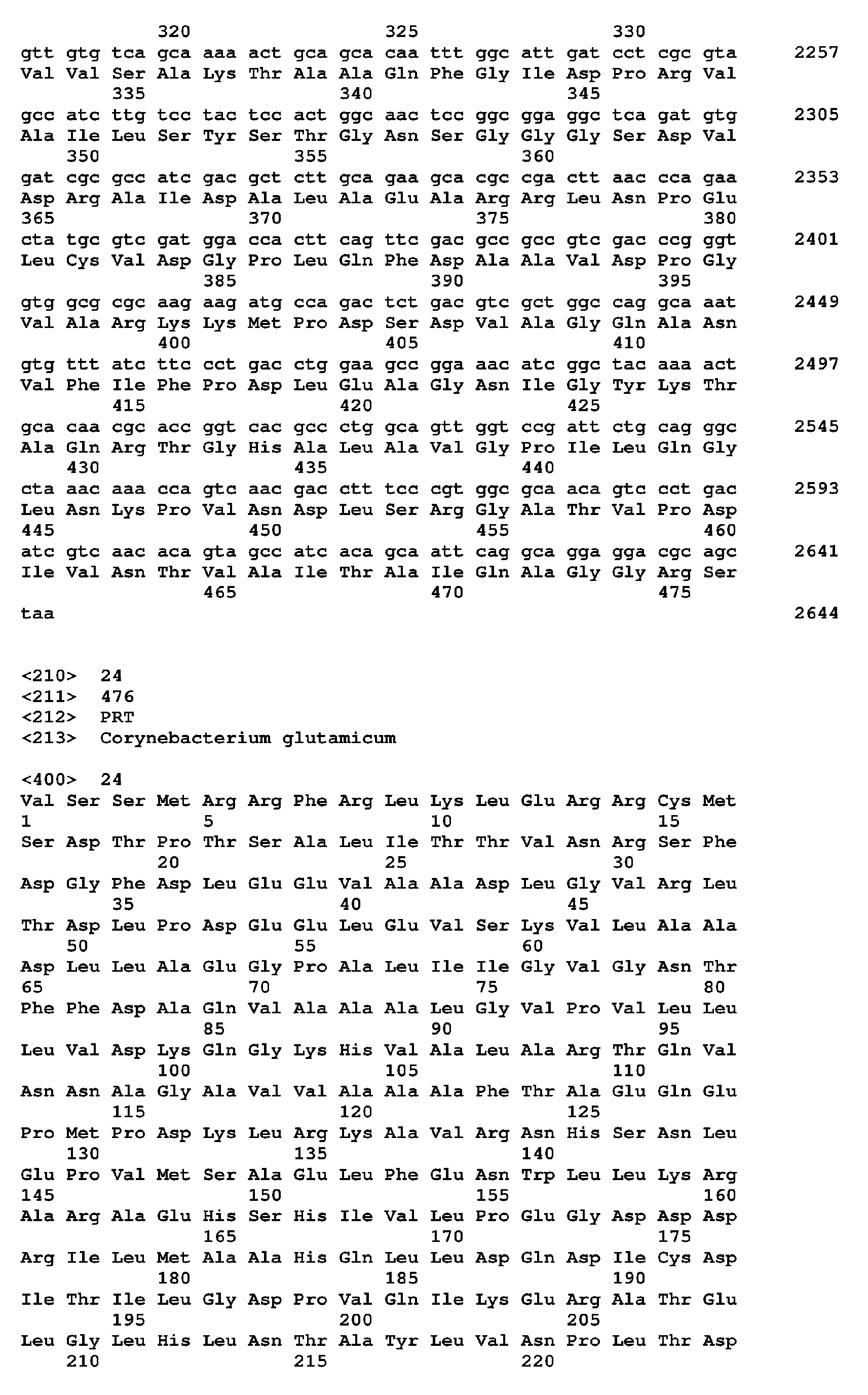


Claims (8)
- A method for producing an L-amino acid, which comprises culturing a coryneform bacterium having an L-amino acid-producing ability in a medium to produce and accumulate the L-amino acid in the medium or cells of the bacterium, and collecting the L-amino acid from the medium or cells, wherein said coryneform bacterium has been modified to enhance carbonic anhydrase activity.
- The method according to claim 1, wherein said carbonic anhydrase activity is enhanced by increasing a copy number of a gene encoding carbonic anhydrase, or by modifying an expression control sequence of the gene.
- The method according to claim 2, wherein the gene encoding the carbonic anhydrase is a DNA defined in the following (a) or (b):(a) a DNA comprising the nucleotide sequence of the nucleotide numbers 562 to 1182 of SEQ ID NO: 11, or the nucleotide sequence of SEQ ID NO: 13, or(b) a DNA that is able to hybridize with a complement of the nucleotide sequence of the nucleotide numbers 562 to 1182 of SEQ ID NO: 11, or the nucleotide sequence of SEQ ID NO: 13 under stringent conditions, and encoding a protein having carbonic anhydrase activity.
- The method according to any one of claims 1 to 3, wherein the bacterium has been further modified to impart D-xylose-5-phosphate phosphoketolase activity and/or fructose-6-phosphte phosphoketolase activity.
- The method according to any one of claims 1 to 4, wherein the bacterium has been further modified to enhance phosphotransacetylase activity.
- The method according to any one of claims 1 to 5, wherein the bacterium has been further modified to enhance pyruvate carboxylase activity.
- The method according to any one of claims 1 to 6, wherein the bacterium has been further modified to enhance phosphoenolpyruvate carboxylase activity.
- The method according to any one of claims 1 to 7, wherein the L-amino acid is selected from the group consisting of L-glutamic acid, L-glutamine, L-proline, L-arginine, L-leucine and L-cysteine.
Applications Claiming Priority (2)
| Application Number | Priority Date | Filing Date | Title |
|---|---|---|---|
| JP2009194636A JP2012223091A (en) | 2009-08-25 | 2009-08-25 | Method for producing l-amino acid |
| PCT/JP2010/062253 WO2011024583A1 (en) | 2009-08-25 | 2010-07-21 | Process for production of l-amino acid |
Publications (3)
| Publication Number | Publication Date |
|---|---|
| EP2471943A1 true EP2471943A1 (en) | 2012-07-04 |
| EP2471943A4 EP2471943A4 (en) | 2015-01-21 |
| EP2471943B1 EP2471943B1 (en) | 2021-08-25 |
Family
ID=43627693
Family Applications (1)
| Application Number | Title | Priority Date | Filing Date |
|---|---|---|---|
| EP10811634.4A Active EP2471943B1 (en) | 2009-08-25 | 2010-07-21 | Process for production of l-amino acid |
Country Status (6)
| Country | Link |
|---|---|
| US (1) | US20120237985A1 (en) |
| EP (1) | EP2471943B1 (en) |
| JP (1) | JP2012223091A (en) |
| CN (1) | CN102498216B (en) |
| PE (1) | PE20121533A1 (en) |
| WO (1) | WO2011024583A1 (en) |
Cited By (6)
| Publication number | Priority date | Publication date | Assignee | Title |
|---|---|---|---|---|
| US8497103B2 (en) | 2010-06-21 | 2013-07-30 | Novozymes, Inc. | Methods for C4-dicarboxylic acid production in filamentous fungi |
| US8518676B2 (en) | 2010-06-21 | 2013-08-27 | Novozymes, Inc. | Polypeptides having C4 dicarboxylic acid transporter activity and polynucleotides encoding same |
| US8617859B2 (en) | 2010-06-04 | 2013-12-31 | Novozymes, Inc. | C4 dicarboxylic acid production in filamentous fungi |
| US8663956B2 (en) | 2011-08-19 | 2014-03-04 | Novozymes, Inc. | Recombinant microorganisms for production C4-dicarboxylic acids |
| US8722387B2 (en) | 2011-02-28 | 2014-05-13 | Novozymes, Inc. | Microorganisms for C4-dicarboxylic acid production |
| US8741611B2 (en) | 2009-09-01 | 2014-06-03 | Novozymes, Inc. | Methods for improving malic acid production in filamentous fungi |
Families Citing this family (8)
| Publication number | Priority date | Publication date | Assignee | Title |
|---|---|---|---|---|
| KR101735935B1 (en) | 2015-07-20 | 2017-05-16 | 씨제이제일제당 (주) | Microorganisms for producing putrescine or ornithine and process for producing putrescine or ornithine using them |
| JP7066977B2 (en) * | 2017-04-03 | 2022-05-16 | 味の素株式会社 | Manufacturing method of L-amino acid |
| CN111040979B (en) * | 2018-10-11 | 2022-05-10 | 中国科学院天津工业生物技术研究所 | Method for high-yield production of L-cysteine by corynebacterium glutamicum through metabolic engineering transformation |
| CN112522175B (en) * | 2020-12-30 | 2023-08-18 | 内蒙古伊品生物科技有限公司 | A recombinant strain producing L-glutamic acid with modified gene BBD29_09525 and its construction method and application |
| KR102871331B1 (en) * | 2022-12-30 | 2025-10-14 | 씨제이제일제당 (주) | Microorganisms with enhanced L-alanine productivity and method for producing L-alanine using the same |
| CN116286759B (en) * | 2022-12-30 | 2026-04-07 | 内蒙古伊品生物科技有限公司 | amino acid production-related protein cynT and its biomaterials and applications |
| WO2025016203A1 (en) * | 2023-07-18 | 2025-01-23 | 宁夏伊品生物科技股份有限公司 | Method for producing l-arginine using recombinant escherichia coli, and recombinant bacterium used therein |
| KR20250078646A (en) * | 2023-11-23 | 2025-06-04 | 대상 주식회사 | A mutant microorganism having enhanced L-glutamic acid productivity and a method for producing L-glutamic acid using the same |
Family Cites Families (108)
| Publication number | Priority date | Publication date | Assignee | Title |
|---|---|---|---|---|
| US3220929A (en) | 1964-02-10 | 1965-11-30 | Kyowa Hakko Kogyo Kk | Microbiological production of amino acid by reductive amination |
| US3563857A (en) | 1967-03-20 | 1971-02-16 | Sanraku Ocean Co | Process for producing l-glutamic acid by fermentation |
| JPS5610036B1 (en) | 1969-07-23 | 1981-03-05 | ||
| JPS5028119B2 (en) | 1971-08-14 | 1975-09-12 | ||
| US3825472A (en) | 1972-04-27 | 1974-07-23 | Ajinomoto Kk | Method of producing l-lysine by fermentation |
| JPS5031093A (en) | 1973-07-26 | 1975-03-27 | ||
| JPS5123592B2 (en) | 1973-09-22 | 1976-07-17 | ||
| JPS52102498A (en) | 1976-02-20 | 1977-08-27 | Ajinomoto Co Inc | Preparation of l-lysine |
| JPS531833A (en) | 1976-06-28 | 1978-01-10 | Shin Kobe Electric Machinery | Method of producing battery separator |
| JPS539394A (en) | 1976-07-09 | 1978-01-27 | Kyowa Hakko Kogyo Co Ltd | Preparation of l-lysine by fermentation |
| JPS5325034A (en) | 1976-08-19 | 1978-03-08 | Fujii Denko | Anti precipitation device for horizontal movement |
| JPS5343591A (en) | 1976-10-01 | 1978-04-19 | Hitachi Ltd | Atomizing device for flameless atomic absorption analysis |
| JPS5386090A (en) | 1976-12-29 | 1978-07-29 | Ajinomoto Co Inc | Preparation of l-lysine by fermentation |
| JPS594993B2 (en) | 1976-12-29 | 1984-02-02 | 味の素株式会社 | Production method of L-lysine by fermentation method |
| JPS5444096A (en) | 1977-09-13 | 1979-04-07 | Ajinomoto Co Inc | Preparation of l-arginine by fermentation |
| JPS559759A (en) | 1978-07-07 | 1980-01-23 | Ajinomoto Co Inc | Preparation of l-lysine by fermentation |
| JPS559784A (en) | 1978-07-10 | 1980-01-23 | Ajinomoto Co Inc | Preparation of l-lysine |
| JPS559783A (en) | 1978-07-10 | 1980-01-23 | Ajinomoto Co Inc | Preparation of l-lysine by fermentation |
| DE2924053A1 (en) | 1979-06-15 | 1980-12-18 | Leitz Ernst Gmbh | ATTACHMENT CAMERA FOR MICROSCOPE |
| JPS561889A (en) | 1979-06-20 | 1981-01-10 | Ajinomoto Co Inc | Preparation of l-glutamic acid by fermentation |
| JPS561915A (en) | 1979-06-21 | 1981-01-10 | Nec Corp | Hologram and production of hologram and light beam scanner |
| JPS566499A (en) | 1979-06-26 | 1981-01-23 | Sanyo Electric Co | Hybrid integrated circuit unit |
| JPS568692A (en) | 1979-07-03 | 1981-01-29 | Kyowa Hakko Kogyo Co Ltd | Preparation of l-lysine by fermentation |
| JPS5632995A (en) | 1979-08-28 | 1981-04-02 | Ajinomoto Co Inc | Preparation of l-lysine by fermentation |
| JPS5810075B2 (en) | 1979-08-31 | 1983-02-24 | 味の素株式会社 | New mutant strain |
| JPS5639778A (en) | 1979-09-10 | 1981-04-15 | Ajinomoto Co Inc | Novel modified strain |
| JPS56140895A (en) | 1980-04-02 | 1981-11-04 | Ajinomoto Co Inc | Preparation of l-glutamic acid by fermentation |
| JPS56151495A (en) | 1980-04-25 | 1981-11-24 | Ajinomoto Co Inc | Production of l-glutamine through fermentation |
| JPS5714157A (en) | 1980-06-27 | 1982-01-25 | Matsushita Electric Industrial Co Ltd | Refrigerant flow rate control for airconditioner |
| JPS5714158A (en) | 1980-07-01 | 1982-01-25 | Nihon Radiator Co | Refrigeration cycle |
| JPS5718989A (en) | 1980-07-09 | 1982-01-30 | Ajinomoto Co Inc | Production of l-arginine through fermentation |
| JPS5730474A (en) | 1980-07-31 | 1982-02-18 | Victor Co Of Japan Ltd | Slow-motion reproduction system of magnetic reproducing device |
| JPS57115186A (en) | 1980-12-29 | 1982-07-17 | Ajinomoto Co Inc | Preparation of l-lysine by fermentation |
| JPS57134500A (en) | 1981-02-12 | 1982-08-19 | Kyowa Hakko Kogyo Co Ltd | Plasmid pcg1 |
| JPS572689A (en) | 1981-03-23 | 1982-01-08 | Ajinomoto Co Inc | Preparation of l-glutamic acid |
| JPS57183799A (en) | 1981-04-17 | 1982-11-12 | Kyowa Hakko Kogyo Co Ltd | Novel plasmid |
| JPS57174096A (en) | 1981-04-20 | 1982-10-26 | Ajinomoto Co Inc | Preparation of l-tryptophan by fermentation method |
| JPS5810075A (en) | 1981-07-09 | 1983-01-20 | 安藤 雅威 | Play tool applying dice |
| JPS5835197A (en) | 1981-08-26 | 1983-03-01 | Kyowa Hakko Kogyo Co Ltd | Plamid pcg 2 |
| JPS5867679A (en) | 1981-09-30 | 1983-04-22 | アメリカン・サイアナミド・カンパニ− | Manufacture of cyanuric acid by trimerizing isocyanic acid |
| JPS5877895A (en) | 1981-11-02 | 1983-05-11 | Ajinomoto Co Inc | Plasmid phm1519 |
| JPS5816872B2 (en) | 1982-02-12 | 1983-04-02 | 協和醗酵工業株式会社 | Corynebacterium glutamicum mutant strain |
| JPS58192900A (en) | 1982-05-04 | 1983-11-10 | Ajinomoto Co Inc | Complex plasmid |
| JPS594993A (en) | 1982-07-01 | 1984-01-11 | Nippon Kokan Kk <Nkk> | Welding method for tempered steel pipes |
| JPH0783714B2 (en) | 1983-08-29 | 1995-09-13 | 味の素株式会社 | Fermentation method for producing L-amino acid |
| JPH06102030B2 (en) | 1983-09-28 | 1994-12-14 | 味の素株式会社 | Fermentation method for producing L-tyrosine |
| EP0167132B1 (en) | 1984-06-29 | 1992-01-02 | Ajinomoto Co., Inc. | Process for producing l-isoleucine by fermentation |
| JPS6135840A (en) | 1984-07-30 | 1986-02-20 | Sofutaade Kogyo Kk | Replacement of catalyst |
| JPS61202694A (en) | 1985-03-07 | 1986-09-08 | Ajinomoto Co Inc | Production of l-glutamine by fermentation method |
| JPS6224075A (en) | 1985-07-25 | 1987-02-02 | Toyota Motor Corp | Driving device for vehicle |
| JPS6224074A (en) | 1985-07-25 | 1987-02-02 | Toyota Motor Corp | Lubricating device |
| JPS6236673A (en) | 1985-08-09 | 1987-02-17 | Konishiroku Photo Ind Co Ltd | Method for processing photosensitive lithographic printing plate |
| US5188949A (en) | 1986-09-29 | 1993-02-23 | Ajinomoto Co., Inc. | Method for producing L-threonine by fermentation |
| JPH01191686A (en) | 1988-01-26 | 1989-08-01 | Mitsubishi Petrochem Co Ltd | Composite plasmid |
| FR2627508B1 (en) | 1988-02-22 | 1990-10-05 | Eurolysine | PROCESS FOR THE INTEGRATION OF A SELECTED GENE ON THE CHROMOSOME OF A BACTERIA AND BACTERIA OBTAINED BY SAID METHOD |
| JPH026517A (en) | 1988-06-24 | 1990-01-10 | Toagosei Chem Ind Co Ltd | Preparation of polyester (meth)acrylate |
| JP2678995B2 (en) | 1988-09-08 | 1997-11-19 | 三菱化学株式会社 | Method for producing tryptophan synthase |
| US5185262A (en) | 1988-07-27 | 1993-02-09 | Mitsubishi Petrochemical Co., Ltd. | DNA fragment containing gene which encodes the function of stabilizing plasmid in host microorganism |
| JP2817155B2 (en) | 1989-01-12 | 1998-10-27 | 味の素株式会社 | Production method of L-arginine by fermentation method |
| JP2817157B2 (en) | 1989-01-13 | 1998-10-27 | 味の素株式会社 | Production method of L-amino acid by fermentation method |
| JPH02207791A (en) | 1989-02-07 | 1990-08-17 | Ajinomoto Co Inc | Transformation of bacterium |
| JP2973446B2 (en) | 1990-01-11 | 1999-11-08 | 三菱化学株式会社 | New plasmid vector |
| JPH03232497A (en) | 1990-02-08 | 1991-10-16 | Asahi Chem Ind Co Ltd | Production of l-glutamine by fermentation |
| JPH0488994A (en) | 1990-07-30 | 1992-03-23 | Kyowa Hakko Kogyo Co Ltd | Production of l-glutamine by fermentation |
| JP3006929B2 (en) | 1990-09-18 | 2000-02-07 | 協和醗酵工業株式会社 | Production method of L-valine by fermentation method |
| DE69133559T2 (en) | 1990-09-27 | 2007-11-22 | Invitrogen Corp., Carlsbad | Direct cloning of PCR amplified nucleic acids |
| JPH07108228B2 (en) | 1990-10-15 | 1995-11-22 | 味の素株式会社 | Temperature sensitive plasmid |
| JPH0511958A (en) | 1991-07-01 | 1993-01-22 | N T T Data Tsushin Kk | Server/client type window system |
| BR9203053A (en) | 1991-08-07 | 1993-03-30 | Ajinomoto Kk | PROCESS TO PRODUCE L-GLUTAMIC ACID PRO FERMENTATION |
| JPH0549489A (en) | 1991-08-22 | 1993-03-02 | Ajinomoto Co Inc | Method for producing l-phenylalanine by fermentation method |
| FR2686898B1 (en) | 1992-01-30 | 1996-09-20 | Ajinomoto Kk | PROCESS FOR THE PRODUCTION OF L-PHENYLALANINE. |
| IT1262934B (en) | 1992-01-31 | 1996-07-22 | Montecatini Tecnologie Srl | COMPONENTS AND CATALYSTS FOR THE POLYMERIZATION OF OLEFINE |
| JPH06102028A (en) | 1992-09-22 | 1994-04-12 | Nikon Corp | Optical non-contact distance measuring machine and measuring method |
| US5776736A (en) | 1992-12-21 | 1998-07-07 | Purdue Research Foundation | Deblocking the common pathway of aromatic amino acid synthesis |
| CA2169170C (en) | 1993-08-24 | 2007-01-09 | Masakazu Sugimoto | Mutant phosphoenolpyruvate carboxylase, its gene, and production method of amino acid |
| JP3449758B2 (en) | 1993-10-15 | 2003-09-22 | 三菱化学株式会社 | Insertion sequence |
| JPH07163383A (en) | 1993-10-18 | 1995-06-27 | Mitsubishi Chem Corp | Method for producing L-alanine |
| JP2558602B2 (en) | 1993-10-18 | 1996-11-27 | 日精樹脂工業株式会社 | Multiple types of molding material supply equipment |
| JP2512381B2 (en) | 1993-10-19 | 1996-07-03 | 株式会社タジリ | Plastic waste volume reduction machine |
| JPH07121228A (en) | 1993-10-22 | 1995-05-12 | Mazda Motor Corp | How to check the production information of production equipment |
| JP3783065B2 (en) | 1994-03-04 | 2006-06-07 | 味の素株式会社 | Method for producing L-lysine |
| CN1103819C (en) | 1994-06-14 | 2003-03-26 | 味之素株式会社 | α-ketoglutarate dehydrogenase gene |
| DK0841395T3 (en) | 1995-06-07 | 2012-01-09 | Ajinomoto Kk | Process for Preparing L-Lysine |
| JP3029393B2 (en) | 1995-11-24 | 2000-04-04 | 大建工業株式会社 | Exterior material mounting bracket and construction method |
| JP4088982B2 (en) | 1996-10-15 | 2008-05-21 | 味の素株式会社 | Method for producing L-amino acid by fermentation |
| JP4168463B2 (en) | 1996-12-05 | 2008-10-22 | 味の素株式会社 | Method for producing L-lysine |
| JP4075087B2 (en) | 1996-12-05 | 2008-04-16 | 味の素株式会社 | Method for producing L-lysine |
| JP3921866B2 (en) | 1998-03-18 | 2007-05-30 | 味の素株式会社 | L-glutamic acid-producing bacterium and method for producing L-glutamic acid |
| JP4144098B2 (en) | 1998-03-18 | 2008-09-03 | 味の素株式会社 | L-glutamic acid-producing bacterium and method for producing L-glutamic acid |
| ES2335828T3 (en) | 1998-09-25 | 2010-04-05 | Ajinomoto Co., Inc. | CORINEFORM BACTERIA TO PRODUCE L-GLU. |
| JP4144131B2 (en) | 1998-10-19 | 2008-09-03 | 味の素株式会社 | L-glutamic acid-producing bacterium and method for producing L-glutamic acid |
| JP2000157276A (en) | 1998-11-24 | 2000-06-13 | Ajinomoto Co Inc | L-Lysine biosynthesis gene of the genus Thermus |
| DE19907567B4 (en) | 1999-02-22 | 2007-08-09 | Forschungszentrum Jülich GmbH | Process for the microbial production of L-valine |
| JP2003135066A (en) | 1999-03-19 | 2003-05-13 | Ajinomoto Co Inc | Method for producing L-lysine |
| RU2368659C2 (en) | 1999-04-09 | 2009-09-27 | Адзиномото Ко., Инк. | Bacterium producing l-amino acid, and method for production of l-amino acid |
| JP4427878B2 (en) | 1999-08-20 | 2010-03-10 | 味の素株式会社 | Method for producing L-glutamic acid by fermentation method with precipitation |
| RU2207376C2 (en) | 1999-10-14 | 2003-06-27 | Закрытое акционерное общество "Научно-исследовательский институт Аджиномото-Генетика" | Method for preparing l-amino acid by fermentation method, strain of bacterium escherichia coli as producer of l-amino acid (variants) |
| JP4560998B2 (en) | 2001-02-05 | 2010-10-13 | 味の素株式会社 | Method for producing L-glutamine by fermentation and L-glutamine producing bacteria |
| JP4622111B2 (en) | 2001-02-09 | 2011-02-02 | 味の素株式会社 | L-cysteine producing bacterium and method for producing L-cysteine |
| JP2004187684A (en) | 2002-11-26 | 2004-07-08 | Ajinomoto Co Inc | Method for producing l-glutamine and l-glutamine producing bacterium |
| WO2005103275A1 (en) | 2004-04-26 | 2005-11-03 | Ajinomoto Co., Ltd. | Process for producing l-tryptophan according to fermentation process |
| JP5572279B2 (en) | 2004-05-20 | 2014-08-13 | 味の素株式会社 | Succinic acid-producing bacteria and method for producing succinic acid |
| JP5023701B2 (en) | 2004-05-20 | 2012-09-12 | 味の素株式会社 | Succinic acid-producing bacteria and method for producing succinic acid |
| WO2007086608A1 (en) * | 2006-01-27 | 2007-08-02 | Ajinomoto Co., Inc. | Method for producing l-amino acid |
| JP5157180B2 (en) * | 2006-01-27 | 2013-03-06 | 味の素株式会社 | Method for producing L-amino acid |
| RU2006143864A (en) * | 2006-12-12 | 2008-06-20 | Закрытое акционерное общество "Научно-исследовательский институт Аджиномото-Генетика" (ЗАО АГРИ) (RU) | METHOD FOR PRODUCING L-AMINO ACIDS USING THE BACTERIA OF THE ENTEROBACTERIACEAE FAMILY IN WHICH THE EXPRESSION OF GENES cynT, cynS, cynX, OR cynR, OR THEIR COMBINATION IS DECREASED |
| WO2008076738A2 (en) | 2006-12-18 | 2008-06-26 | Novozymes North America, Inc. | Detoxifying pre-treated lignocellulose-containing materials |
| DE102008002309A1 (en) * | 2008-06-09 | 2009-12-10 | Evonik Degussa Gmbh | Process for the preparation of L-amino acids using improved strains of the family Enterobacteriaceae |
-
2009
- 2009-08-25 JP JP2009194636A patent/JP2012223091A/en active Pending
-
2010
- 2010-07-21 CN CN201080037920.0A patent/CN102498216B/en active Active
- 2010-07-21 WO PCT/JP2010/062253 patent/WO2011024583A1/en not_active Ceased
- 2010-07-21 PE PE2012000256A patent/PE20121533A1/en not_active Application Discontinuation
- 2010-07-21 EP EP10811634.4A patent/EP2471943B1/en active Active
-
2012
- 2012-02-24 US US13/404,105 patent/US20120237985A1/en not_active Abandoned
Cited By (9)
| Publication number | Priority date | Publication date | Assignee | Title |
|---|---|---|---|---|
| US8741611B2 (en) | 2009-09-01 | 2014-06-03 | Novozymes, Inc. | Methods for improving malic acid production in filamentous fungi |
| US8999685B2 (en) | 2009-09-01 | 2015-04-07 | Novozymes, Inc. | Methods for improving malic acid production in filamentous fungi |
| US8617859B2 (en) | 2010-06-04 | 2013-12-31 | Novozymes, Inc. | C4 dicarboxylic acid production in filamentous fungi |
| US8497103B2 (en) | 2010-06-21 | 2013-07-30 | Novozymes, Inc. | Methods for C4-dicarboxylic acid production in filamentous fungi |
| US8518676B2 (en) | 2010-06-21 | 2013-08-27 | Novozymes, Inc. | Polypeptides having C4 dicarboxylic acid transporter activity and polynucleotides encoding same |
| US9303275B2 (en) | 2010-06-21 | 2016-04-05 | Novozymes, Inc. | Polypeptides having C4 dicarboxylic acid transporter activity and polynucleotides encoding same |
| US8722387B2 (en) | 2011-02-28 | 2014-05-13 | Novozymes, Inc. | Microorganisms for C4-dicarboxylic acid production |
| US9447440B2 (en) | 2011-02-28 | 2016-09-20 | Novozymes, Inc. | Microorganisms for C4-dicarboxylic acid production |
| US8663956B2 (en) | 2011-08-19 | 2014-03-04 | Novozymes, Inc. | Recombinant microorganisms for production C4-dicarboxylic acids |
Also Published As
| Publication number | Publication date |
|---|---|
| CN102498216B (en) | 2014-05-21 |
| WO2011024583A1 (en) | 2011-03-03 |
| EP2471943B1 (en) | 2021-08-25 |
| CN102498216A (en) | 2012-06-13 |
| PE20121533A1 (en) | 2012-11-27 |
| BR112012003958A2 (en) | 2015-09-22 |
| EP2471943A4 (en) | 2015-01-21 |
| JP2012223091A (en) | 2012-11-15 |
| US20120237985A1 (en) | 2012-09-20 |
Similar Documents
| Publication | Publication Date | Title |
|---|---|---|
| EP2471943B1 (en) | Process for production of l-amino acid | |
| US8628941B2 (en) | L-amino acid-producing bacterium and a method for producing L-amino acid | |
| US8012722B2 (en) | Method for producing L-amino acid | |
| US8404474B2 (en) | Use of phosphoketolase for producing useful metabolites | |
| EP1789547B1 (en) | The use of phosphoketolase for producing useful metabolites | |
| JP5157180B2 (en) | Method for producing L-amino acid | |
| EP4239070A1 (en) | Method of producing l-amino acid | |
| BR112012003958B1 (en) | METHOD FOR PRODUCING AN L-AMINO ACID |
Legal Events
| Date | Code | Title | Description |
|---|---|---|---|
| PUAI | Public reference made under article 153(3) epc to a published international application that has entered the european phase |
Free format text: ORIGINAL CODE: 0009012 |
|
| 17P | Request for examination filed |
Effective date: 20120321 |
|
| AK | Designated contracting states |
Kind code of ref document: A1 Designated state(s): AL AT BE BG CH CY CZ DE DK EE ES FI FR GB GR HR HU IE IS IT LI LT LU LV MC MK MT NL NO PL PT RO SE SI SK SM TR |
|
| DAX | Request for extension of the european patent (deleted) | ||
| A4 | Supplementary search report drawn up and despatched |
Effective date: 20141222 |
|
| RIC1 | Information provided on ipc code assigned before grant |
Ipc: C12N 15/09 20060101ALI20141216BHEP Ipc: C12P 13/04 20060101AFI20141216BHEP |
|
| 17Q | First examination report despatched |
Effective date: 20160926 |
|
| STAA | Information on the status of an ep patent application or granted ep patent |
Free format text: STATUS: EXAMINATION IS IN PROGRESS |
|
| REG | Reference to a national code |
Ref country code: DE Ref legal event code: R079 Ref document number: 602010067494 Country of ref document: DE Free format text: PREVIOUS MAIN CLASS: C12P0013040000 Ipc: C12P0013060000 |
|
| GRAP | Despatch of communication of intention to grant a patent |
Free format text: ORIGINAL CODE: EPIDOSNIGR1 |
|
| STAA | Information on the status of an ep patent application or granted ep patent |
Free format text: STATUS: GRANT OF PATENT IS INTENDED |
|
| RIC1 | Information provided on ipc code assigned before grant |
Ipc: C12P 13/24 20060101ALI20210316BHEP Ipc: C12P 13/14 20060101ALI20210316BHEP Ipc: C12P 13/12 20060101ALI20210316BHEP Ipc: C12P 13/10 20060101ALI20210316BHEP Ipc: C12P 13/06 20060101AFI20210316BHEP |
|
| INTG | Intention to grant announced |
Effective date: 20210415 |
|
| GRAS | Grant fee paid |
Free format text: ORIGINAL CODE: EPIDOSNIGR3 |
|
| GRAA | (expected) grant |
Free format text: ORIGINAL CODE: 0009210 |
|
| STAA | Information on the status of an ep patent application or granted ep patent |
Free format text: STATUS: THE PATENT HAS BEEN GRANTED |
|
| AK | Designated contracting states |
Kind code of ref document: B1 Designated state(s): AL AT BE BG CH CY CZ DE DK EE ES FI FR GB GR HR HU IE IS IT LI LT LU LV MC MK MT NL NO PL PT RO SE SI SK SM TR |
|
| REG | Reference to a national code |
Ref country code: GB Ref legal event code: FG4D |
|
| REG | Reference to a national code |
Ref country code: CH Ref legal event code: EP |
|
| REG | Reference to a national code |
Ref country code: IE Ref legal event code: FG4D Ref country code: AT Ref legal event code: REF Ref document number: 1423839 Country of ref document: AT Kind code of ref document: T Effective date: 20210915 |
|
| REG | Reference to a national code |
Ref country code: DE Ref legal event code: R096 Ref document number: 602010067494 Country of ref document: DE |
|
| REG | Reference to a national code |
Ref country code: LT Ref legal event code: MG9D |
|
| REG | Reference to a national code |
Ref country code: NL Ref legal event code: MP Effective date: 20210825 |
|
| REG | Reference to a national code |
Ref country code: AT Ref legal event code: MK05 Ref document number: 1423839 Country of ref document: AT Kind code of ref document: T Effective date: 20210825 |
|
| PG25 | Lapsed in a contracting state [announced via postgrant information from national office to epo] |
Ref country code: PT Free format text: LAPSE BECAUSE OF FAILURE TO SUBMIT A TRANSLATION OF THE DESCRIPTION OR TO PAY THE FEE WITHIN THE PRESCRIBED TIME-LIMIT Effective date: 20211227 Ref country code: NO Free format text: LAPSE BECAUSE OF FAILURE TO SUBMIT A TRANSLATION OF THE DESCRIPTION OR TO PAY THE FEE WITHIN THE PRESCRIBED TIME-LIMIT Effective date: 20211125 Ref country code: ES Free format text: LAPSE BECAUSE OF FAILURE TO SUBMIT A TRANSLATION OF THE DESCRIPTION OR TO PAY THE FEE WITHIN THE PRESCRIBED TIME-LIMIT Effective date: 20210825 Ref country code: FI Free format text: LAPSE BECAUSE OF FAILURE TO SUBMIT A TRANSLATION OF THE DESCRIPTION OR TO PAY THE FEE WITHIN THE PRESCRIBED TIME-LIMIT Effective date: 20210825 Ref country code: LT Free format text: LAPSE BECAUSE OF FAILURE TO SUBMIT A TRANSLATION OF THE DESCRIPTION OR TO PAY THE FEE WITHIN THE PRESCRIBED TIME-LIMIT Effective date: 20210825 Ref country code: AT Free format text: LAPSE BECAUSE OF FAILURE TO SUBMIT A TRANSLATION OF THE DESCRIPTION OR TO PAY THE FEE WITHIN THE PRESCRIBED TIME-LIMIT Effective date: 20210825 Ref country code: BG Free format text: LAPSE BECAUSE OF FAILURE TO SUBMIT A TRANSLATION OF THE DESCRIPTION OR TO PAY THE FEE WITHIN THE PRESCRIBED TIME-LIMIT Effective date: 20211125 Ref country code: HR Free format text: LAPSE BECAUSE OF FAILURE TO SUBMIT A TRANSLATION OF THE DESCRIPTION OR TO PAY THE FEE WITHIN THE PRESCRIBED TIME-LIMIT Effective date: 20210825 Ref country code: SE Free format text: LAPSE BECAUSE OF FAILURE TO SUBMIT A TRANSLATION OF THE DESCRIPTION OR TO PAY THE FEE WITHIN THE PRESCRIBED TIME-LIMIT Effective date: 20210825 |
|
| PG25 | Lapsed in a contracting state [announced via postgrant information from national office to epo] |
Ref country code: PL Free format text: LAPSE BECAUSE OF FAILURE TO SUBMIT A TRANSLATION OF THE DESCRIPTION OR TO PAY THE FEE WITHIN THE PRESCRIBED TIME-LIMIT Effective date: 20210825 Ref country code: LV Free format text: LAPSE BECAUSE OF FAILURE TO SUBMIT A TRANSLATION OF THE DESCRIPTION OR TO PAY THE FEE WITHIN THE PRESCRIBED TIME-LIMIT Effective date: 20210825 Ref country code: GR Free format text: LAPSE BECAUSE OF FAILURE TO SUBMIT A TRANSLATION OF THE DESCRIPTION OR TO PAY THE FEE WITHIN THE PRESCRIBED TIME-LIMIT Effective date: 20211126 |
|
| PG25 | Lapsed in a contracting state [announced via postgrant information from national office to epo] |
Ref country code: NL Free format text: LAPSE BECAUSE OF FAILURE TO SUBMIT A TRANSLATION OF THE DESCRIPTION OR TO PAY THE FEE WITHIN THE PRESCRIBED TIME-LIMIT Effective date: 20210825 |
|
| PG25 | Lapsed in a contracting state [announced via postgrant information from national office to epo] |
Ref country code: DK Free format text: LAPSE BECAUSE OF FAILURE TO SUBMIT A TRANSLATION OF THE DESCRIPTION OR TO PAY THE FEE WITHIN THE PRESCRIBED TIME-LIMIT Effective date: 20210825 |
|
| REG | Reference to a national code |
Ref country code: DE Ref legal event code: R097 Ref document number: 602010067494 Country of ref document: DE |
|
| PG25 | Lapsed in a contracting state [announced via postgrant information from national office to epo] |
Ref country code: SM Free format text: LAPSE BECAUSE OF FAILURE TO SUBMIT A TRANSLATION OF THE DESCRIPTION OR TO PAY THE FEE WITHIN THE PRESCRIBED TIME-LIMIT Effective date: 20210825 Ref country code: SK Free format text: LAPSE BECAUSE OF FAILURE TO SUBMIT A TRANSLATION OF THE DESCRIPTION OR TO PAY THE FEE WITHIN THE PRESCRIBED TIME-LIMIT Effective date: 20210825 Ref country code: RO Free format text: LAPSE BECAUSE OF FAILURE TO SUBMIT A TRANSLATION OF THE DESCRIPTION OR TO PAY THE FEE WITHIN THE PRESCRIBED TIME-LIMIT Effective date: 20210825 Ref country code: EE Free format text: LAPSE BECAUSE OF FAILURE TO SUBMIT A TRANSLATION OF THE DESCRIPTION OR TO PAY THE FEE WITHIN THE PRESCRIBED TIME-LIMIT Effective date: 20210825 Ref country code: CZ Free format text: LAPSE BECAUSE OF FAILURE TO SUBMIT A TRANSLATION OF THE DESCRIPTION OR TO PAY THE FEE WITHIN THE PRESCRIBED TIME-LIMIT Effective date: 20210825 Ref country code: AL Free format text: LAPSE BECAUSE OF FAILURE TO SUBMIT A TRANSLATION OF THE DESCRIPTION OR TO PAY THE FEE WITHIN THE PRESCRIBED TIME-LIMIT Effective date: 20210825 |
|
| PLBE | No opposition filed within time limit |
Free format text: ORIGINAL CODE: 0009261 |
|
| STAA | Information on the status of an ep patent application or granted ep patent |
Free format text: STATUS: NO OPPOSITION FILED WITHIN TIME LIMIT |
|
| PG25 | Lapsed in a contracting state [announced via postgrant information from national office to epo] |
Ref country code: IT Free format text: LAPSE BECAUSE OF FAILURE TO SUBMIT A TRANSLATION OF THE DESCRIPTION OR TO PAY THE FEE WITHIN THE PRESCRIBED TIME-LIMIT Effective date: 20210825 |
|
| 26N | No opposition filed |
Effective date: 20220527 |
|
| PG25 | Lapsed in a contracting state [announced via postgrant information from national office to epo] |
Ref country code: SI Free format text: LAPSE BECAUSE OF FAILURE TO SUBMIT A TRANSLATION OF THE DESCRIPTION OR TO PAY THE FEE WITHIN THE PRESCRIBED TIME-LIMIT Effective date: 20210825 |
|
| PGFP | Annual fee paid to national office [announced via postgrant information from national office to epo] |
Ref country code: GB Payment date: 20220727 Year of fee payment: 13 |
|
| REG | Reference to a national code |
Ref country code: DE Ref legal event code: R119 Ref document number: 602010067494 Country of ref document: DE |
|
| PG25 | Lapsed in a contracting state [announced via postgrant information from national office to epo] |
Ref country code: MC Free format text: LAPSE BECAUSE OF FAILURE TO SUBMIT A TRANSLATION OF THE DESCRIPTION OR TO PAY THE FEE WITHIN THE PRESCRIBED TIME-LIMIT Effective date: 20210825 |
|
| REG | Reference to a national code |
Ref country code: CH Ref legal event code: PL |
|
| REG | Reference to a national code |
Ref country code: BE Ref legal event code: MM Effective date: 20220731 |
|
| PG25 | Lapsed in a contracting state [announced via postgrant information from national office to epo] |
Ref country code: LU Free format text: LAPSE BECAUSE OF NON-PAYMENT OF DUE FEES Effective date: 20220721 Ref country code: LI Free format text: LAPSE BECAUSE OF NON-PAYMENT OF DUE FEES Effective date: 20220731 Ref country code: CH Free format text: LAPSE BECAUSE OF NON-PAYMENT OF DUE FEES Effective date: 20220731 |
|
| PG25 | Lapsed in a contracting state [announced via postgrant information from national office to epo] |
Ref country code: DE Free format text: LAPSE BECAUSE OF NON-PAYMENT OF DUE FEES Effective date: 20230201 Ref country code: BE Free format text: LAPSE BECAUSE OF NON-PAYMENT OF DUE FEES Effective date: 20220731 |
|
| P01 | Opt-out of the competence of the unified patent court (upc) registered |
Effective date: 20230512 |
|
| PG25 | Lapsed in a contracting state [announced via postgrant information from national office to epo] |
Ref country code: IE Free format text: LAPSE BECAUSE OF NON-PAYMENT OF DUE FEES Effective date: 20220721 |
|
| GBPC | Gb: european patent ceased through non-payment of renewal fee |
Effective date: 20230721 |
|
| PG25 | Lapsed in a contracting state [announced via postgrant information from national office to epo] |
Ref country code: HU Free format text: LAPSE BECAUSE OF FAILURE TO SUBMIT A TRANSLATION OF THE DESCRIPTION OR TO PAY THE FEE WITHIN THE PRESCRIBED TIME-LIMIT; INVALID AB INITIO Effective date: 20100721 |
|
| PG25 | Lapsed in a contracting state [announced via postgrant information from national office to epo] |
Ref country code: MK Free format text: LAPSE BECAUSE OF FAILURE TO SUBMIT A TRANSLATION OF THE DESCRIPTION OR TO PAY THE FEE WITHIN THE PRESCRIBED TIME-LIMIT Effective date: 20210825 Ref country code: CY Free format text: LAPSE BECAUSE OF FAILURE TO SUBMIT A TRANSLATION OF THE DESCRIPTION OR TO PAY THE FEE WITHIN THE PRESCRIBED TIME-LIMIT Effective date: 20210825 Ref country code: GB Free format text: LAPSE BECAUSE OF NON-PAYMENT OF DUE FEES Effective date: 20230721 |
|
| PG25 | Lapsed in a contracting state [announced via postgrant information from national office to epo] |
Ref country code: TR Free format text: LAPSE BECAUSE OF FAILURE TO SUBMIT A TRANSLATION OF THE DESCRIPTION OR TO PAY THE FEE WITHIN THE PRESCRIBED TIME-LIMIT Effective date: 20210825 |
|
| PG25 | Lapsed in a contracting state [announced via postgrant information from national office to epo] |
Ref country code: MT Free format text: LAPSE BECAUSE OF FAILURE TO SUBMIT A TRANSLATION OF THE DESCRIPTION OR TO PAY THE FEE WITHIN THE PRESCRIBED TIME-LIMIT Effective date: 20210825 |
|
| PGFP | Annual fee paid to national office [announced via postgrant information from national office to epo] |
Ref country code: FR Payment date: 20250610 Year of fee payment: 16 |