EP2470630B1 - Perlglanzkonzentrat und verfahren zur herstellung - Google Patents
Perlglanzkonzentrat und verfahren zur herstellung Download PDFInfo
- Publication number
- EP2470630B1 EP2470630B1 EP10747216.9A EP10747216A EP2470630B1 EP 2470630 B1 EP2470630 B1 EP 2470630B1 EP 10747216 A EP10747216 A EP 10747216A EP 2470630 B1 EP2470630 B1 EP 2470630B1
- Authority
- EP
- European Patent Office
- Prior art keywords
- pearlescent
- process according
- alkyl
- concentrate
- water
- Prior art date
- Legal status (The legal status is an assumption and is not a legal conclusion. Google has not performed a legal analysis and makes no representation as to the accuracy of the status listed.)
- Not-in-force
Links
Images

Classifications
-
- C—CHEMISTRY; METALLURGY
- C11—ANIMAL OR VEGETABLE OILS, FATS, FATTY SUBSTANCES OR WAXES; FATTY ACIDS THEREFROM; DETERGENTS; CANDLES
- C11D—DETERGENT COMPOSITIONS; USE OF SINGLE SUBSTANCES AS DETERGENTS; SOAP OR SOAP-MAKING; RESIN SOAPS; RECOVERY OF GLYCEROL
- C11D1/00—Detergent compositions based essentially on surface-active compounds; Use of these compounds as a detergent
- C11D1/38—Cationic compounds
- C11D1/65—Mixtures of anionic with cationic compounds
-
- A—HUMAN NECESSITIES
- A61—MEDICAL OR VETERINARY SCIENCE; HYGIENE
- A61K—PREPARATIONS FOR MEDICAL, DENTAL OR TOILETRY PURPOSES
- A61K8/00—Cosmetics or similar toiletry preparations
- A61K8/18—Cosmetics or similar toiletry preparations characterised by the composition
- A61K8/30—Cosmetics or similar toiletry preparations characterised by the composition containing organic compounds
- A61K8/33—Cosmetics or similar toiletry preparations characterised by the composition containing organic compounds containing oxygen
- A61K8/39—Derivatives containing from 2 to 10 oxyalkylene groups
-
- A—HUMAN NECESSITIES
- A61—MEDICAL OR VETERINARY SCIENCE; HYGIENE
- A61K—PREPARATIONS FOR MEDICAL, DENTAL OR TOILETRY PURPOSES
- A61K8/00—Cosmetics or similar toiletry preparations
- A61K8/18—Cosmetics or similar toiletry preparations characterised by the composition
- A61K8/30—Cosmetics or similar toiletry preparations characterised by the composition containing organic compounds
- A61K8/40—Cosmetics or similar toiletry preparations characterised by the composition containing organic compounds containing nitrogen
- A61K8/42—Amides
-
- A—HUMAN NECESSITIES
- A61—MEDICAL OR VETERINARY SCIENCE; HYGIENE
- A61K—PREPARATIONS FOR MEDICAL, DENTAL OR TOILETRY PURPOSES
- A61K8/00—Cosmetics or similar toiletry preparations
- A61K8/18—Cosmetics or similar toiletry preparations characterised by the composition
- A61K8/30—Cosmetics or similar toiletry preparations characterised by the composition containing organic compounds
- A61K8/40—Cosmetics or similar toiletry preparations characterised by the composition containing organic compounds containing nitrogen
- A61K8/45—Derivatives containing from 2 to 10 oxyalkylene groups
-
- A—HUMAN NECESSITIES
- A61—MEDICAL OR VETERINARY SCIENCE; HYGIENE
- A61Q—SPECIFIC USE OF COSMETICS OR SIMILAR TOILETRY PREPARATIONS
- A61Q19/00—Preparations for care of the skin
- A61Q19/10—Washing or bathing preparations
-
- A—HUMAN NECESSITIES
- A61—MEDICAL OR VETERINARY SCIENCE; HYGIENE
- A61Q—SPECIFIC USE OF COSMETICS OR SIMILAR TOILETRY PREPARATIONS
- A61Q5/00—Preparations for care of the hair
- A61Q5/02—Preparations for cleaning the hair
-
- C—CHEMISTRY; METALLURGY
- C11—ANIMAL OR VEGETABLE OILS, FATS, FATTY SUBSTANCES OR WAXES; FATTY ACIDS THEREFROM; DETERGENTS; CANDLES
- C11D—DETERGENT COMPOSITIONS; USE OF SINGLE SUBSTANCES AS DETERGENTS; SOAP OR SOAP-MAKING; RESIN SOAPS; RECOVERY OF GLYCEROL
- C11D1/00—Detergent compositions based essentially on surface-active compounds; Use of these compounds as a detergent
- C11D1/66—Non-ionic compounds
- C11D1/825—Mixtures of compounds all of which are non-ionic
-
- C—CHEMISTRY; METALLURGY
- C11—ANIMAL OR VEGETABLE OILS, FATS, FATTY SUBSTANCES OR WAXES; FATTY ACIDS THEREFROM; DETERGENTS; CANDLES
- C11D—DETERGENT COMPOSITIONS; USE OF SINGLE SUBSTANCES AS DETERGENTS; SOAP OR SOAP-MAKING; RESIN SOAPS; RECOVERY OF GLYCEROL
- C11D1/00—Detergent compositions based essentially on surface-active compounds; Use of these compounds as a detergent
- C11D1/66—Non-ionic compounds
- C11D1/83—Mixtures of non-ionic with anionic compounds
-
- C—CHEMISTRY; METALLURGY
- C11—ANIMAL OR VEGETABLE OILS, FATS, FATTY SUBSTANCES OR WAXES; FATTY ACIDS THEREFROM; DETERGENTS; CANDLES
- C11D—DETERGENT COMPOSITIONS; USE OF SINGLE SUBSTANCES AS DETERGENTS; SOAP OR SOAP-MAKING; RESIN SOAPS; RECOVERY OF GLYCEROL
- C11D1/00—Detergent compositions based essentially on surface-active compounds; Use of these compounds as a detergent
- C11D1/66—Non-ionic compounds
- C11D1/835—Mixtures of non-ionic with cationic compounds
-
- C—CHEMISTRY; METALLURGY
- C11—ANIMAL OR VEGETABLE OILS, FATS, FATTY SUBSTANCES OR WAXES; FATTY ACIDS THEREFROM; DETERGENTS; CANDLES
- C11D—DETERGENT COMPOSITIONS; USE OF SINGLE SUBSTANCES AS DETERGENTS; SOAP OR SOAP-MAKING; RESIN SOAPS; RECOVERY OF GLYCEROL
- C11D1/00—Detergent compositions based essentially on surface-active compounds; Use of these compounds as a detergent
- C11D1/88—Ampholytes; Electroneutral compounds
- C11D1/94—Mixtures with anionic, cationic or non-ionic compounds
-
- C—CHEMISTRY; METALLURGY
- C11—ANIMAL OR VEGETABLE OILS, FATS, FATTY SUBSTANCES OR WAXES; FATTY ACIDS THEREFROM; DETERGENTS; CANDLES
- C11D—DETERGENT COMPOSITIONS; USE OF SINGLE SUBSTANCES AS DETERGENTS; SOAP OR SOAP-MAKING; RESIN SOAPS; RECOVERY OF GLYCEROL
- C11D3/00—Other compounding ingredients of detergent compositions covered in group C11D1/00
- C11D3/0005—Other compounding ingredients characterised by their effect
- C11D3/0089—Pearlescent compositions; Opacifying agents
-
- A—HUMAN NECESSITIES
- A61—MEDICAL OR VETERINARY SCIENCE; HYGIENE
- A61K—PREPARATIONS FOR MEDICAL, DENTAL OR TOILETRY PURPOSES
- A61K2800/00—Properties of cosmetic compositions or active ingredients thereof or formulation aids used therein and process related aspects
- A61K2800/20—Chemical, physico-chemical or functional or structural properties of the composition as a whole
- A61K2800/26—Optical properties
-
- C—CHEMISTRY; METALLURGY
- C11—ANIMAL OR VEGETABLE OILS, FATS, FATTY SUBSTANCES OR WAXES; FATTY ACIDS THEREFROM; DETERGENTS; CANDLES
- C11D—DETERGENT COMPOSITIONS; USE OF SINGLE SUBSTANCES AS DETERGENTS; SOAP OR SOAP-MAKING; RESIN SOAPS; RECOVERY OF GLYCEROL
- C11D1/00—Detergent compositions based essentially on surface-active compounds; Use of these compounds as a detergent
- C11D1/02—Anionic compounds
- C11D1/04—Carboxylic acids or salts thereof
- C11D1/10—Amino carboxylic acids; Imino carboxylic acids; Fatty acid condensates thereof
-
- C—CHEMISTRY; METALLURGY
- C11—ANIMAL OR VEGETABLE OILS, FATS, FATTY SUBSTANCES OR WAXES; FATTY ACIDS THEREFROM; DETERGENTS; CANDLES
- C11D—DETERGENT COMPOSITIONS; USE OF SINGLE SUBSTANCES AS DETERGENTS; SOAP OR SOAP-MAKING; RESIN SOAPS; RECOVERY OF GLYCEROL
- C11D1/00—Detergent compositions based essentially on surface-active compounds; Use of these compounds as a detergent
- C11D1/02—Anionic compounds
- C11D1/12—Sulfonic acids or sulfuric acid esters; Salts thereof
- C11D1/14—Sulfonic acids or sulfuric acid esters; Salts thereof derived from aliphatic hydrocarbons or mono-alcohols
- C11D1/143—Sulfonic acid esters
-
- C—CHEMISTRY; METALLURGY
- C11—ANIMAL OR VEGETABLE OILS, FATS, FATTY SUBSTANCES OR WAXES; FATTY ACIDS THEREFROM; DETERGENTS; CANDLES
- C11D—DETERGENT COMPOSITIONS; USE OF SINGLE SUBSTANCES AS DETERGENTS; SOAP OR SOAP-MAKING; RESIN SOAPS; RECOVERY OF GLYCEROL
- C11D1/00—Detergent compositions based essentially on surface-active compounds; Use of these compounds as a detergent
- C11D1/02—Anionic compounds
- C11D1/12—Sulfonic acids or sulfuric acid esters; Salts thereof
- C11D1/14—Sulfonic acids or sulfuric acid esters; Salts thereof derived from aliphatic hydrocarbons or mono-alcohols
- C11D1/146—Sulfuric acid esters
-
- C—CHEMISTRY; METALLURGY
- C11—ANIMAL OR VEGETABLE OILS, FATS, FATTY SUBSTANCES OR WAXES; FATTY ACIDS THEREFROM; DETERGENTS; CANDLES
- C11D—DETERGENT COMPOSITIONS; USE OF SINGLE SUBSTANCES AS DETERGENTS; SOAP OR SOAP-MAKING; RESIN SOAPS; RECOVERY OF GLYCEROL
- C11D1/00—Detergent compositions based essentially on surface-active compounds; Use of these compounds as a detergent
- C11D1/02—Anionic compounds
- C11D1/12—Sulfonic acids or sulfuric acid esters; Salts thereof
- C11D1/29—Sulfates of polyoxyalkylene ethers
-
- C—CHEMISTRY; METALLURGY
- C11—ANIMAL OR VEGETABLE OILS, FATS, FATTY SUBSTANCES OR WAXES; FATTY ACIDS THEREFROM; DETERGENTS; CANDLES
- C11D—DETERGENT COMPOSITIONS; USE OF SINGLE SUBSTANCES AS DETERGENTS; SOAP OR SOAP-MAKING; RESIN SOAPS; RECOVERY OF GLYCEROL
- C11D1/00—Detergent compositions based essentially on surface-active compounds; Use of these compounds as a detergent
- C11D1/38—Cationic compounds
- C11D1/52—Carboxylic amides, alkylolamides or imides or their condensation products with alkylene oxides
- C11D1/521—Carboxylic amides (R1-CO-NR2R3), where R1, R2 and R3 are alkyl or alkenyl groups
-
- C—CHEMISTRY; METALLURGY
- C11—ANIMAL OR VEGETABLE OILS, FATS, FATTY SUBSTANCES OR WAXES; FATTY ACIDS THEREFROM; DETERGENTS; CANDLES
- C11D—DETERGENT COMPOSITIONS; USE OF SINGLE SUBSTANCES AS DETERGENTS; SOAP OR SOAP-MAKING; RESIN SOAPS; RECOVERY OF GLYCEROL
- C11D1/00—Detergent compositions based essentially on surface-active compounds; Use of these compounds as a detergent
- C11D1/38—Cationic compounds
- C11D1/52—Carboxylic amides, alkylolamides or imides or their condensation products with alkylene oxides
- C11D1/526—Carboxylic amides (R1-CO-NR2R3), where R1, R2 or R3 are polyalkoxylated
-
- C—CHEMISTRY; METALLURGY
- C11—ANIMAL OR VEGETABLE OILS, FATS, FATTY SUBSTANCES OR WAXES; FATTY ACIDS THEREFROM; DETERGENTS; CANDLES
- C11D—DETERGENT COMPOSITIONS; USE OF SINGLE SUBSTANCES AS DETERGENTS; SOAP OR SOAP-MAKING; RESIN SOAPS; RECOVERY OF GLYCEROL
- C11D1/00—Detergent compositions based essentially on surface-active compounds; Use of these compounds as a detergent
- C11D1/66—Non-ionic compounds
- C11D1/74—Carboxylates or sulfonates esters of polyoxyalkylene glycols
Definitions
- the invention relates to processes for the preparation of pumpable aqueous pearlescent concentrates with a high active content of alkyl ether sulfates and fatty acid glycol esters as pearlescing agents.
- surfactant compositions for example, liquid detergents and cleaners (ie floor cleaners, dishwashing or similar products) or liquid personal cleansers and personal care products, as well as hair treatment products (ie shampoos, bath salts, liquid soaps, shower gels or similar products), these become common aqueous pearlescent dispersions (pearlescent concentrates) are added, which gives the surfactant compositions a pearlescent and thus an aesthetically pleasing appearance.
- the known aqueous pearlescent dispersions consist essentially of at least one pearlescing compound (also called pearlescing component or pearlescing agent), at least one dispersant (also called solvent, wetting agent or emulsifier) and water.
- pearlescing compounds and compound mixtures are recommended in the prior art, for example fatty acids, fatty acid mono- or fatty acid dialkanolamides, monoesters or diesters of alkylene glycols such as ethylene glycol, propylene glycol or oligomers thereof with fatty acids (fatty acid glycol esters) and monoesters or polyesters of glycerol with higher fatty acids.
- dispersants for example alkyl sulfates, alkyl ether sulfates, alkyl sulfonates, amine oxides, betaines, addition products of ethylene oxide and / or propylene oxide with fatty alcohols, fatty acids or alkylphenols and glycerol mono- or glycerol diesters or sorbitan mono- or sorbitan diesters of fatty acids wherein the glycerol esters and sorbitan esters are optionally ethoxylated and / or propoxylated, alkyl mono or alkyl oligoglycosides and the like.
- the US patent US 7,268,107 discloses a pearlescent composition containing from about 30 to 55% by weight of a pearlescing wax, a nonionic dispersing agent, optionally a zwitterionic dispersing agent, from about 0.1% to 5% by weight of a polyol ester and water, wherein the active content (sum of the content of pearlescing component and dispersant) at least about 55 wt .-% based on the weight of Composition and the sum of the content of dispersing agent less than 25 wt .-% based on the weight of the composition and wherein the nonionic dispersant and the polyol ester in a weight ratio of about 5: 1 to 10: 1 are present.
- the US patent application US 2004/0086470 A1 relates to an aqueous pearlescent composition containing from about 30 to 60% by weight of a wax component comprising at least 15% by weight of the wax component of amorphous particles and at most 85% by weight of the wax component of crystalline Particles, and about 5 to 25 wt .-% of a surfactant selected from a nonionic surfactant, an amphoteric surfactant and mixtures thereof.
- the US patent US 6,727,217 B1 refers to a process for producing pearlescent surfactant compositions at a temperature of about 10 ° C to 45 ° C, wherein an aqueous surfactant solution is contacted with a composition of a pearlescing wax and a polyol ester.
- the US patent US Pat. No. 6,835,700 B1 discloses a flowable pearlescent concentrate comprising about 25 to 45% by weight of a pearlescing wax, about 35 to 40% by weight of a nonionic, amphoteric, zwitterionic and / or cationic dispersant, about 0.5 to 15% by weight of a polyol ester and water, wherein the sum of the content of wax, dispersant and polyol ester is at least 55% by weight.
- the US patent US 6,235,702 B1 refers to an aqueous pearlescent concentrate containing 1 to 99% by weight (based on the total weight) of an ester of a hydroxy-containing carboxylic acid with a fatty alcohol, 0.1 to 90% by weight (based on the total weight) of a dispersing agent selected from an anionic surfactant, a nonionic surfactant, a cationic surfactant, a zwitterionic surfactant, an esterquat and mixtures thereof, and up to 40% by weight (based on the total weight) of a polyol.
- a dispersing agent selected from an anionic surfactant, a nonionic surfactant, a cationic surfactant, a zwitterionic surfactant, an esterquat and mixtures thereof, and up to 40% by weight (based on the total weight) of a polyol.
- US 6,228,831 B1 discloses a pearlescent concentrate containing 1 to 99.9% by weight of a fat component selected from the group consisting of fatty alcohols, fatty ketones, Fatty ethers, fatty carbonates and mixtures thereof, 1 to 99.9% by weight of a dispersing agent selected from the group consisting of anionic, nonionic, cationic, ampholytic and zwitterionic surfactants and mixtures thereof, and up to 40% by weight of a polyol contains.
- a fat component selected from the group consisting of fatty alcohols, fatty ketones, Fatty ethers, fatty carbonates and mixtures thereof
- a dispersing agent selected from the group consisting of anionic, nonionic, cationic, ampholytic and zwitterionic surfactants and mixtures thereof, and up to 40% by weight of a polyol contains.
- US 5,711,899 relates to flowable pearlescent concentrates containing 15 to 40 wt .-% of a pearlescing component, 5 to 55 wt .-% of a nonionic, ampholytic and / or zwitterionic surfactant and 0.1 to 5 wt .-% of a low molecular weight polyol.
- the European patent application EP 0 568 848 A1 relates to flowable aqueous pearlescent dispersions consisting essentially of a fatty acid glycol ester as pearlescing component, of two specific surface-active compounds, namely a betaine and a fatty alcohol alkoxylate, and water in a particular amount.
- such pearlescent formulations also contain a number of auxiliaries, such as, for example, Amine oxides, betaines, addition products of ethylene oxide and / or propylene oxide onto fatty alcohols, fatty acids or alkylphenols, glycerol mono- or glycerol diesters or sorbitan mono- or sorbitan diesters of fatty acids, where the glycerol esters and sorbitan esters are optionally ethoxylated and / or propoxylated, alkylmono- or alkyloligoglycosides, Alcohols, polyols and the like.
- auxiliaries such as, for example, Amine oxides, betaines, addition products of ethylene oxide and / or propylene oxide onto fatty alcohols, fatty acids or alkylphenols, glycerol mono- or glycerol diesters or sorbitan mono- or sorbitan diesters of fatty acids, where the glycerol esters
- the concentration of the key substances used is generally less than 35 wt .-%.
- Such low-concentration pearlescent formulations have mainly economic disadvantages. In direct comparison with the highly concentrated pearlescing formulations, transport, packaging and storage costs are of particular importance.
- the production of pearlescent dispersions in the prior art is generally carried out batchwise in stirred reactors. The required amounts of the starting materials are metered into a mixing vessel, heated to 5 - 20 ° C above the melting temperature of the highest melting component and mixed. After mixing, the mixture is first cooled to 30 ° -40 ° C. without cooling while stirring. Only after reaching this temperature is cooled using cooling to room temperature.
- US 2005/0158270 A1 discloses an aqueous pearlescent concentrate comprising a pearlescing agent, an anionic surfactant and a cationic component having increased opacity and which is useful for modifying the appearance of aqueous personal care product compositions.
- DE 36 17 306 A1 describes a process for the preparation of a highly concentrated periparticle dispersion, which can be used to increase its commercial value, for example in shampoos, detergents, cosmetics and detergents and cleaners.
- the process is characterized in that 1. a highly concentrated aqueous solution, homogeneously made by heating, containing 6-45% by weight of a fatty acid glycol ester and 15-60% of a wetting agent to a low-concentration dispersion with -0.1% in the dispersed state 5% by weight of a fatty acid glycol ester is added and 2. the mixture is aged to grow or to increase the size of the liqueur contained in the low-concentration dispersion.
- WO 99/09944 A1 discloses aqueous pearlescent concentrates containing, based on the non-aqueous fraction, (a) 1 to 99% by weight of fatty acid polyglycol ester sulfates, (b) 0 to 90% by weight of anionic, nonionic, cationic, ampholytic and / or zwitterionic emulsifiers, (c ) 1 to 50 wt .-% pearlescent waxes and (d) 0 to 40 wt .-% of polyols, with the proviso that the amounts to complete 100 wt .-%.
- DE 197 05 862 C1 discloses a process for producing surfactant pearlescent gums having a solids content in the range of 60 to 90% by weight by blending aqueous anionic surfactants with pearlescent waxes using aqueous anionic surfactant concentrates present in the lamellar gel phase. By mixing the components in the gel phase concentrates are obtained, which are characterized by a brilliant pearlescent.
- the object of the invention is to provide a novel process for the preparation of a well-pumpable, aqueous pearlescent concentrate with a high proportion of active ingredients and excellent pearlescent character, which is suitable for processing highly concentrated conventionally used alkyl ether sulfates in detergents and cleaners using conventional mixing technology. cold processed and thus can be handled easily to provide.
- the object is achieved by the method according to claim 1.
- the dispersants or pearlescing agents used according to the invention may contain one or more different compounds from the respective groups.
- the sum of the pearlescing compound content and the dispersant content is defined as the active content of the pearlescent concentrate and is preferably> 60% by weight, preferably from 65 to 85% by weight, more preferably from 70 to 80% by weight. %.
- the sum of the content of the pearlescent concentrate of water and of additives is preferably less than 30% by weight, preferably 25% by weight, based on the total amount of pearlescent concentrate.
- the aqueous pearlescent concentrate produced according to the invention preferably has a content of 35 to 85 wt .-%, preferably 40 to 70 wt .-%, particularly preferably 50 to 60 wt .-% of one or more alkyl ether sulfates, alkyl sulfates, alkyl sulfonates, mono- and diesters of Sulfosuccinic acid (sulfosuccinates), alkyl glycinates, alkyl sarcosinates and / or alkyl taurates.
- alkyl ether sulfate, alkyl sulfate, alkyl sulfonate, sulfosuccinate, alkyl glycinate, alkyl sarcosinate and / or alkyl taurate acts as a dispersant which stabilizes the pearlescent dispersion according to the invention.
- Commercially available alkyl ether sulfates, alkyl sulfates, alkyl sulfonates, sulfosuccinates, alkyl glycinates, alkyl sarcosinates, and / or alkyl taurates are commonly sold and processed as aqueous solutions, with concentrations usually at 70% aqueous solutions or below.
- the total concentration of pearlescing component is 15 to 40 wt .-% based on the total weight of the concentrate.
- the total concentration of pearlescing component in the inventively prepared Pearlescent concentrate 15 to 30 wt .-%, particularly preferably 20 to 25 wt .-%, based on the total weight of the concentrate.
- the aqueous pearlescent concentrate prepared according to the invention can advantageously be incorporated into the customary surfactant compositions without difficulty. Particularly preferably, the incorporation into the Tensidkomposition done cold, d. H. preferably at a temperature below 25 ° C, more preferably at room temperature.
- a component of the invention is therefore also a surfactant composition comprising a pearlescent concentrate prepared according to the invention.
- even the use of a relatively small amount of pearlescent concentrate gives the surfactant composition a pearlescent appearance.
- Suitable proportions pearlescent concentrate in a Tensidkomposition are depending on the desired pearlescent effect between 0.5 and 10 wt .-%, preferably between 0.5 and 5 wt .-%, particularly preferably between 0.5 and 2 wt .-%.
- Pearlescent dispersions with the high concentration of active content according to the invention offer both ecological and economic advantages over conventionally available dispersions.
- the low water content significantly reduces both transport and storage costs. It is particularly advantageous that the pearlescent concentrates according to the invention can be provided preservative-free for further processing.
- the limitation of the dispersing agent to the alkyl sulfates, alkyl ether sulfates, alkyl sulfonates, mono- and diesters of sulfosuccinic acid (sulfosuccinates), alkyl glycinates, alkyl sarcosinates and / or alkyl taurates used anyway in detergents and cleaners also advantageously gives the formulator of detergents and cleaners much more freedom the final composition of his product.
- the invention is based on the surprising finding that aqueous alkyl ether sulfates, alkyl sulfates, alkyl sulfonates, mono- and diesters of sulfosuccinic acid (sulfosuccinates), alkyl glycinates, alkyl sarcosinates and / or alkyl taurates having a content of 40 to 90 wt .-% based on the total weight of the concentrate can be processed with pearlescing compounds such as Fettklarglycolestern and / or carboxylic acid amides to pumpable pearlescent concentrates whose active content is above 60 wt .-%, preferably 65 to 85 wt .-%, particularly preferably from 70 to 80 wt .-%.
- any organic and inorganic countercations can be used as long as the alkyl ether sulfates remain readily soluble or dispersible in water, and so long as the counterions are physically and chemically compatible with the pearlescent concentrate base components and do not adversely affect product properties such as pearlescent, stability, or processability.
- Preferred counterions are alkali metal ions such as sodium and / or potassium, alkaline earth metal ions such as calcium and / or magnesium, and substituted and unsubstituted ammonium ions such as monoethanolamine, diethanolamine, triethanolamine, triisopropanolamine.
- alkyl ether sulfates are preferably the sulfates of fatty alcohols having a chain length of 8 to 16 carbon atoms, for.
- sodium lauryl ether sulfate ammonium lauryl ether, Triethylaminlaurylethersulfat, Triethanolaminlaurylethersulfat, Magnesiumlaurylethersulfat, sodium C12-13 Pareth sulfate (sodium C12-13 Pareth Sulfate), and the Na salt of Laurylmyristylethersulfat used.
- the dispersants used are alkyl ether sulfates.
- R 1 is preferably a saturated or unsaturated alkyl radical having 12 to 18 C atoms
- R 2 is preferably -C 2 H 4
- R 3 is preferably R 1 -CO- and n is preferably a number from 1 to 3.
- Is the Alkyl radical R 1 is unsaturated, it preferably contains 1 to 3 double bonds.
- Particularly preferred pearlescing components are mono- and diesters of ethylene glycol, diethylene glycol or triethylene glycol with palmitic acid, stearic acid, oleic acid, tallow fatty acid, coconut fatty acid and / or other fatty acids, e.g. Ethylene glycol monostearate, ethylene glycol distearate, diethylene glycol distearate.
- the nacreous gloss of pearlescent dispersions is based on the presence of lamellar lyotropic liquid crystalline (also referred to as liquid crystal) structures.
- lamellar lyotropic liquid crystalline also referred to as liquid crystal
- an optimum ratio between emulsifier and pearlescing agent must exist, which depends on the geometry of the participating pearlescing agents and dispersants.
- the parameter for this is the so-called critical packing parameter.
- the critical packing parameter assumes values of ⁇ 1, an optimum composition has been found and optimum conditions for the formation of a lamellar phase prevail.
- the person skilled in the art knows ways of adjusting the critical packing parameters for a particular combination of pearlescing agent and dispersant by varying the amounts used.
- the pearlescent concentrates preferably contain no further surfactants than the abovementioned dispersants and pearlescing agents
- the pearlescent concentrates produced according to the invention require a certain amount of water, which is incorporated between the lamellar bilayers of the amphiphilic molecules contained (dispersants and pearlescing agents) in order to form the lamellar lyotropic liquid-crystalline structures.
- the minimum content of water is 5 wt .-%, particularly preferably 10 wt .-%, most preferably 15 wt .-%, based on the total weight of the concentrate.
- the lamellar system can absorb a certain amount of water, a process called swelling. When the point is reached where the concentrate is completely swollen and the swelling capacity of the surfactants contained in the concentrate is exceeded, the free water, which can no longer be bound, collects as so-called "bulk water”.
- the pearlescent concentrate produced according to the invention preferably has a high phase volume ratio, ie the amount of water in relation to the amphiphilic molecules contained is low. This ensures on the one hand the advantages associated with a high active content (see above), on the other hand, the formation of lyotropic liquid crystalline lamellar structures is favored.
- the pearlescent concentrates are preferably fully swollen. To ensure this, the proportion of water is preferably chosen to be slightly above the maximum that can be bound in the lamellar structures.
- the pearlescent concentrates according to the invention preferably have one Bulk water content of 0.5 to 15 wt .-%, preferably 1 to 10 wt .-%, based on the total amount of pearlescent concentrate on.
- the phase volume ratio can be determined by rheological test methods. It is well known that the viscosity increases exponentially with increasing internal phase. The viscosity maximum is reached at the point when no more bulk water phase exists and all water is interlamellar bound. Another test method for determining the phase volume ratio is the measurement of the conductivity. This decreases exponentially with increasing internal phase and reaches the zero value when all water is interlamellar bound.
- the pearlescent dispersions known from the prior art do not consist entirely of swollen lamellar liquid-crystalline structures, but contain large portions of unswollen structures of pearlescing agents and / or dispersants in which an insufficient amount of water is bound.
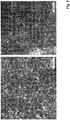
- Fig. 1 such a commercially available pearlescent dispersion is shown.
- the concentrate contains not only completely swollen areas, which have a uniform granular structure, but also large inhomogeneous areas, which visually stand out clearly and which are not completely swollen.
- pearlescent dispersions which are prepared by the processes known in the prior art have poor storage stability, in particular at elevated temperatures above about 35 ° C. If the pearlescent dispersions known from the prior art are heated to temperatures above this point, then the bulk water present begins to accumulate in the unswollen areas of the pearlescent dispersion, new lamellar structures are formed and the viscosity of the composition increases more than tenfold. The compositions can then no longer be processed well.
- the pearlescent compositions according to the invention are completely swollen.
- Fig. 2 an inventive pearlescent concentrate is shown, which is characterized by a high homogeneity and the absence of unswollen areas. Further storage of bulk water and a concomitant increase in viscosity is therefore not possible.
- a temperature increase to 35 ° C, preferably above 45 ° C the viscosity of the pearlescent concentrates according to the invention increases not more than 20%, preferably not more than 10%, more preferably not more than 5%.
- the pearlescent concentrates according to the invention are thus advantageously storage-stable and easy to process.
- the pearlescent concentrates prepared according to the invention can advantageously dispense with the use of polyols.
- the pearlescent concentrates according to the invention are therefore free of polyols.
- free of polyols is meant a polyol content of less than 0.5%, preferably less than 0.1%, preferably less than 0.05% of polyols, based on the total volume of pearlescent concentrate. Most preferably, no free polyols are detectable in the compositions.
- Polyols according to the present invention preferably have from two to twelve carbon atoms and two or more hydroxyl groups.
- the polyols may also comprise other functional groups.
- examples of polyols are glycerol, ethylene glycol, diethylene glycol, propylene glycol, butylene glycol, pentylene glycol, hexylene glycol, polyethylene glycol and sugar alcohols such.
- the present invention introduced dispersants or pearlescing agents may contain one or more different compounds from the respective groups.
- the production of pearlescent systems requires precise control of the process parameters (temperature, mixing time, duration and energy, flow course), since otherwise the pearlescent systems obtained vary greatly in their rheological but also in their pearlescent properties.
- the continuous production of pearlescent systems takes place z. B. using the in the patent WO 2004/082817 described device for the continuous production of emulsions and dispersions by a specific combination of stirring and cooling stages.
- step a) the pearlescing components and the dispersant are introduced via suitable pumps in the first stirring stage and mixed there at 55 ° C to 90 ° C, preferably 70 ° C to 80 ° C. If the components are fluid, a previous heating is not required.
- the component (s) are heated to a temperature of 5 - 20 ° C above their melting point.
- the mixing of the components in the first stirring step takes place in a lamellar flow flow at 55 ° C to 90 ° C, preferably 70 ° C to 80 ° C. Possibly. the addition of a portion or the entire amount of water provided in the formulation takes place already in the first stirring stage.
- the addition of water can also be omitted altogether.
- the pearlescing components and the dispersant are converted into a coherent lamellar liquid-crystalline phase.
- This lamellar phase consists of bilayers of surfactants (pearlescers and dispersants) in which the molecules are densely packed and arranged in parallel with the hydrophobic and hydrophilic portions of the amphiphilic compounds aligned respectively.
- Water molecules can be inserted between the hydrophilic parts, a process called swelling. The amount of water that can be absorbed by swelling varies depending on the dispersant and pearlescent agent used.
- the premixed mass is cooled in step b) via a cooling stage so that the pearlescing component crystallizes out in the form of a liquid-crystalline lamellar structure and adjusts the pearlescent effect.
- the temperature to which the mixture is cooled is preferably below 45.degree. C., preferably from 20.degree. C. to 42.degree. C., particularly preferably from 30.degree. C. to 40.degree.
- step c) in a further stirring step, the cooled mass is mixed intensively with moderate stirring and optionally diluted with the remaining amount of water.
- the temperature increase in the mixing is preferably controlled so that the temperature of the product ⁇ 45 ° C remains. This is preferably achieved either by reducing the stirring power and / or by intensive cooling of the stirring stage.
- the continuous processing of the components of the pearlescent concentrate enables the use of small-sized mixing chambers.
- the energy input is minimized by the agitator and maximizes the speed of mixing and emulsion formation.
- the cooling stage is advantageously dimensioned low, whereby the formation of temperature gradient is minimized without the mixture to be cooled must be stirred. This results in a rapid and satisfactory formation of a lamellar liquid crystalline phase in the pearlescent concentrate to be produced. Therefore, the mixture is therefore preferably not stirred in the cooling stage of the process according to the invention.
- the hitherto coherent lamellar liquid-crystalline phase is "torn" into small platelet-shaped particles which are dispersed in the proportion of water which is not interlamellar.
- the particles of the pearlescent concentrates according to the invention advantageously have a very homogeneous particle size distribution in the form of a Gaussian distribution.
- the resulting particle size can be adjusted by selecting the stirring speed and residence time between 0.2 and 20 microns targeted.
- the process according to the invention is preferably carried out at atmospheric pressure or at pressures of up to 10 bar, preferably up to 5 bar.
- Such useful additives may, for example, electrolytes, eg. For example, sodium chloride, potassium chloride and / or magnesium chloride, preservatives, eg. As formic acid, or buffer substances and the like.
- phase A and phase B are introduced separately into the first stirring stage, and the discharge is cooled via a cooling stage and fed into the second stirring stage.
- the percentages given are percent by weight.
- the amount produced per unit time can be controlled specifically.
- stage 1 - cooling stage - stage 2 of 20 s - 53 s - 20 s about 60 kg pearlescent concentrate per hour, at 16 s - 41 s - 16 s about 80 kg pearlescent concentrate per hour and at 10 s - 26 s - 10 s about 120 kg pearlescent concentrate are produced per hour.
- Phase A Sodium lauryl ether sulfate * Galaxy LES 70 80%
- Phase B Ethylene glycol Galaxy 610 10% Coconut fatty acid monoethanolamide Galaxy 100 10% Peripheral speed level 1 [m / s] 0.1 - 15 Peripheral speed level 2 [m / s] 0.1 - 15 Dwell time level 1 [s] 10 - 20 Residence time cooling stage [s] 30 - 60 Dwell time level 2 [s] 10 - 20
- compositions 1 and 2 exhibit a strong increase in viscosity under experimental conditions, whereas compositions 1 and 2 do not.
- the viscosity of the compositions was determined by means of a cone-plate rheometer.
Landscapes
- Life Sciences & Earth Sciences (AREA)
- Chemical & Material Sciences (AREA)
- Health & Medical Sciences (AREA)
- Oil, Petroleum & Natural Gas (AREA)
- Engineering & Computer Science (AREA)
- Wood Science & Technology (AREA)
- Organic Chemistry (AREA)
- Chemical Kinetics & Catalysis (AREA)
- Veterinary Medicine (AREA)
- Animal Behavior & Ethology (AREA)
- General Health & Medical Sciences (AREA)
- Public Health (AREA)
- Epidemiology (AREA)
- Birds (AREA)
- Dermatology (AREA)
- Emergency Medicine (AREA)
- Cosmetics (AREA)
- Detergent Compositions (AREA)
Description
- Die Erfindung betrifft Verfahren zur Herstellung pumpbarer wässriger Perlglanzkonzentrate mit hohem Aktivgehalt an Alkylethersulfaten sowie Fettsäureglycolestern als Perlglanzbildner. Zur Verbesserung der optischen Erscheinung von Tensidkompositionen, zum Beispiel flüssigen Wasch- und Reinigungsmitteln (d. h. Bodenreinigungsmittel, Geschirrspülmittel oder ähnliche Produkte) oder flüssigen Körperreinigungs- und Körperpflegemitteln sowie Haarbehandlungsmitteln (d. h. Shampoos, Badezusätze, Flüssige Seifen, Duschgele oder ähnliche Produkte), werden diesen häufig wässrige Perlglanzdispersionen (Perlglanzkonzentrate) zugesetzt, wodurch den Tensidkompositionen ein Perlglanz und damit ein ästhetisch ansprechendes Äußeres verliehen wird.
- Die bekannten wässrigen Perlglanzdispersionen bestehen im Wesentlichen aus mindestens einer perlglanzbildenden Verbindung (auch perlglanzbildende Komponente oder Perlglanzbildner genannt), mindestens einem Dispergiermittel (auch Lösemittel, Netzmittel oder Emulgator genannt) und Wasser. Im Stand der Technik werden zahlreiche perlglanzbildende Verbindungen und Verbindungsmischungen empfohlen, zum Beispiel Fettsäuren, Fettsäuremono- oder Fettsäuredialkanolamide, Monoester oder Diester von Alkylenglycolen wie Ethylenglycol, Propylenglycol oder Oligomeren davon mit Fettsäuren (Fettsäureglycolester) sowie Monoester oder Polyester von Glycerin mit höheren Fettsäuren. Noch zahlreicher sind die Verbindungen, die als Dispergiermittel beschrieben sind, zum Beispiel Alkylsulfate, Alkylethersulfate, Alkylsulfonate, Aminoxide, Betaine, Anlagerungsprodukte von Ethylenoxid und/oder Propylenoxid an Fettalkohole, Fettsäuren oder Alkylphenole sowie Glycerinmono- oder Glycerindiester bzw. Sorbitanmono- oder Sorbitandiester von Fettsäuren, wobei die Glycerinester und Sorbitanester gegebenenfalls ethoxyliert und/oder propoxyliert sind, Alkylmono- oder Alkyloligoglycoside und dergleichen.
- Der augenblickliche Stand der Technik wird recht gut in den folgenden Patenten und Patentanmeldungen wiedergegeben.
- Das US-Patent
US 7,268,107 offenbart eine Perlglanzzusammensetzung, die von ca. 30 bis 55 Gew.-% eines perlglanzbildenden Wachses, ein nichtionisches Dispergiermittel, ggf. ein zwitterionisches Dispergiermittel, ca. 0,1 Gew.-% bis 5 Gew.-% eines Polyolesters und Wasser enthält, wobei der Aktivgehalt (Summe des Gehalts an perlglanzbildender Komponente und Dispergiermittel) mindestens ca. 55 Gew.-% bezogen auf das Gewicht der Zusammensetzung und die Summe des Gehalts an Dispergiermitteln weniger als 25 Gew.-% bezogen auf das Gewicht der Zusammensetzung betragen und wobei das nichtionische Dispergiermittel und der Polyolester in einem Gewichtsverhältnis von ca. 5:1 bis 10:1 vorhanden sind. - Die US-Patentanmeldung
US 2004/0086470 A1 betrifft eine wässrige Perlglanzzusammensetzung, die etwa 30 bis 60 Gew.-% einer Wachskomponente, die zu mindestens 15 Gew.-% bezogen auf das Gewicht der Wachskomponente aus amorphen Partikeln und zu höchstens 85 Gew.-% bezogen auf das Gewicht der Wachskomponente aus kristallinen Partikeln besteht, und etwa 5 bis 25 Gew.-% eines Tensids, ausgewählt aus einem nichtionischen Tensid, einem amphoteren Tensid und Mischungen davon, enthält. - Das US-Patent
US 6,727,217 B1 bezieht sich auf ein Verfahren zur Herstellung von perlglänzenden Tensidzusammensetzungen bei einer Temperatur von etwa 10 °C bis 45 °C, wobei eine wässrige Tensidlösung mit einer Zusammensetzung aus einem perlglanzbildenden Wachs und einem Polyolester kontaktiert wird. - Das US-Patent
US 6,835,700 B1 offenbart ein fließfähiges Perlglanzkonzentrat, das etwa 25 bis 45 Gew.-% eines perlglanzbildenden Wachses, etwa 35 bis 40 Gew.-% eines nichtionischen, amphoteren, zwitterionischen und/oder kationischen Dispergiermittels, etwa 0,5 bis 15 Gew.-% eines Polyolesters und Wasser umfasst, wobei die Summe des Gehalts an Wachs, Dispergiermittel und Polyolester mindestens 55 Gew.-% beträgt. - Das US-Patent
US 6,147,124 A betrifft fließfähige, biologisch abbaubare Perlglanzkonzentrate, die 5 bis 50 Gew.-% eines Alkanolethers oder eines Alkanolamids als perlglanzbildende Komponente, 5 bis 55 Gew.-% eines Fettsäure-M-alkyl-polyhydroxy-Alkylamids als alleiniges nichtionisches Dispergiermittel und 0,1 bis 40 Gew.-% eines niedermolekularen Polyols enthalten. - Das US-Patent
US 6,235,702 B1 bezieht sich auf ein wässriges Perlglanzkonzentrat, das 1 bis 99 Gew.-% (bezogen auf das Gesamtgewicht) eines Esters einer Hydroxygruppentragenden Carbonsäure mit einem Fettalkohol, 0,1 bis 90 Gew.-% (bezogen auf das Gesamtgewicht) eines Dispergiermittels, ausgewählt aus einem anionischen Tensid, einem nichtionischen Tensid, einem kationischen Tensid, einem zwitterionischen Tensid, einem Esterquat und Mischungen aus diesen, und bis zu 40 Gew.-% (bezogen auf das Gesamtgewicht) eines Polyols enthält. -
US 6,228,831 B1 offenbart ein Perlglanzkonzentrat, das 1 bis 99,9 Gew.-% einer Fettkomponente, ausgewählt aus der Gruppe bestehend aus Fettalkoholen, Fettketonen, Fettethern, Fettcarbonaten und Mischungen aus diesen, 1 bis 99,9 Gew.-% eines Dispergiermittels ausgewählt aus der Gruppe bestehend aus anionischen, nichtionischen, kationischen, ampholytischen und zwitterionischen Tensiden und Mischungen aus diesen, und bis zu 40 Gew.-% eines Polyols enthält. -
US 5,711,899 betrifft fließfähige Perlglanzkonzentrate, die 15 bis 40 Gew.-% einer perlglanzbildenden Komponente, 5 bis 55 Gew.-% eines nichtionischen, ampholytischen und/oder zwitterionischen Tensids und 0,1 bis 5 Gew.-% eines niedermolekularen Polyols enthalten. -
US 6,165,955 bezieht sich auf ein Perlglanzkonzentrat mit hoher Temperaturstabilität, das aus einem auf einer Fettsäure basierenden Perlglanzbildner ausgewählt aus der Gruppe bestehend aus Hydroxylstearaten, Polyethylenglycol-Mono- und Distearaten, Ethylenglycol-Mono- und Distearaten, Stearinsäure-Monoethanolamid und Mischungen aus diesen, besteht, wobei mindestens 90 Gew.-% der Fettsäuren des besagten Fettsäurebestandteils aus Octadecansäure bestehen. - Die europäische Patentanmeldung
EP 0 568 848 A1 betrifft fließfähige wässrige Perlglanzdispersionen, die im wesentlichen aus einem Fettsäureglycolester als perlglanzgebende Komponente, aus zwei bestimmten tensidischen Verbindungen, nämlich einem Betain und einem Fettalkoholalkoxylat, und Wasser in einer jeweils bestimmten Menge bestehen. - Derartige Perlglanzformulierungen enthalten neben den in Tensidkompositionen als Schlüsselsubstanzen eingesetzten Alkylethersulfaten und/oder Alkylsulfaten und/oder Alkylsulfonaten noch eine Reihe von Hilfsstoffen wie z. B. Aminoxide, Betaine, Anlagerungsprodukte von Ethylenoxid und/oder Propylenoxid an Fettalkohole, Fettsäuren oder Alkylphenole, Glycerinmono- oder Glycerindiester oder Sorbitanmono- oder Sorbitandiester von Fettsäuren, wobei die Glycerinester und Sorbitanester gegebenenfalls ethoxyliert und/oder propoxyliert sind, Alkylmono- oder Alkyloligoglycoside, Alkohole, Polyole und dergleichen.
- Die Konzentration der eingesetzten Schlüsselsubstanzen ist dabei in der Regel kleiner als 35 Gew.-%. Solche niedrigkonzentrierten Perlglanzformulierungen haben vorwiegend ökonomische Nachteile. Im direkten Vergleich zu den hochkonzentrierten Perlglanzformulierungen fallen hier insbesondere Transport-, Verpackungs- und Lagerkosten ins Gewicht. Die Herstellung von Perlglanzdispersionen erfolgt im Stand der Technik in der Regel diskontinuierlich in Rührreaktoren. Dabei werden die erforderlichen Mengen der Einsatzstoffe in ein Mischgefäß dosiert, auf 5 - 20°C oberhalb der Schmelztemperatur der am höchsten schmelzenden Komponente erhitzt und vermischt. Nach der Vermischung wird zunächst ohne zu Kühlen unter Rühren auf 30 - 40°C gekühlt. Erst nach Erreichen dieser Temperatur wird unter Anwendung von Kühlung auf Raumtemperatur abgekühlt.
- Eine Kontrolle erfolgt in der Regel erst am fertigen Produkt der entsprechenden Mischungscharge. Eine kontinuierliche Überprüfung des Herstellungsprozesses ist in der Regel nicht möglich.
- Desweiteren können durch die herkömmlichen Verfahren in der Regel keine hochkonzentrierten Perlglanzdispersionen hergestellt werden, da bedingt durch die hohe Viskosität derartiger Zusammensetzungen Probleme bei der Durchmischung der Komponenten auftreten. Aufgrund des für die Durchmischung erforderlichen hohen Energieeintrags durch das Rührwerk sind solche Verfahren einerseits sehrenergie- und kostenintensiv und andererseits wird das Rührgut sehr stark erwärmt, was wiederum die Qualität des Produkts negativ beeinflusst.
- Darüber hinaus ist eine Variation der Produktmengen im Stand der Technik nur in sehr begrenztem Umfang möglich, da die mögliche Ansatzgröße bei einem Chargenmischer in einem eng begrenzten Bereich liegt. Die minimale Ansatzgröße darf in der Regel die Hälfte der maximalen Ansatzgröße nicht unterschreiten.
- Die Patentanmeldung
WO 2004/082817 A1 offenbart eine Vorrichtung und ein Verfahren zur kontinuierlichen Herstellung von Emulsionen oder Dispersionen. Die beschriebene Vorrichtung umfasst ein allseits geschlossenes Mischgefäß, das Zu- und Abführrohre zum Ein- und Austrag von fließfähigen Stoffen oder Stoffgemischen sowie ein Rührwerkzeug aufweist und das einen Rühreintrag in die Emulsion oder Dispersion ohne Erzeugung von Kavitationskräften und ohne Hochdruckhomogenisation erlaubt. -
US 2005/0158270 A1 offenbart ein wässriges Perlglanzkonzentrat, aufweisend eine Perlglanzmittel, eine anionisches Tensid und eine Kationische Komponente, welches eine erhöhte Opazität aufweist und welches zur Veränderung der Erscheinungsbildes von wässrigen Körperpflegeproduktzusammensetzungen geeignet ist. -
DE 36 17 306 A1 beschreibt ein Verfahren zur Herstellung einer hochkonzentrierten Perliermitteldispersion, die unter Erhöhung ihres Handelswerts beispielsweise in Shampoos, Spülmitteln, Kosmetika und Wasch-und Reinigungsmitteln Verwendung finden kann. - Das Verfahren ist dadurch gekennzeichnet, dass man 1. eine durch Erwärmen homogen gemachte hochkonzentrierte wässrige Lösung mit 6 - 45 Gew.-% eines Fettsäureglykolesters und 15 - 60% eines Netzmittels zu einer niedrigkonzentrierten Dispersion mit - in dispergiertem Zustand befindlichen -0,1 - 5 Gew.-% eines Fettsäureglykolesters zugibt und 2. das Gemisch zum Wachsen bzw. zur Vergrößerung des in der niedrigkonzentrierten Dispersion enthaltenen Perliermittels altert.
-
WO 99/09944 A1 -
DE 197 05 862 C1 offenbart ein Verfahren zur Herstellung tensidischer Perlglanzkanzentrate mit einem Feststoffgehalt im Bereich von 60 bis 90 Gew.-% durch Vermischung wässriger anionischer Tenside mit Perlglanzwachsen vorgeschlagen, bei dem man wässrige Aniontensidkonzentrate einsetzt, die in der lamellaren Gelphase vorliegen. Durch Vermischen der Komponenten in der Gelphase werden Konzentrate erhalten, die sich durch einen brillanten Perlglanz auszeichnen. - Die Aufgabe der Erfindung besteht darin, ein neues Verfahren zur Herstellung für ein gut pumpbares, wässriges Perlglanzkonzentrat mit hohem Anteil an Aktivstoffen und ausgezeichnetem Perlglanzcharakter, das mit konventioneller Mischtechnologie, die auch für die Verarbeitung hochkonzentrierter konventionell eingesetzter Alkylethersulfate in Wasch- und Reinigungsmitteln geeignet ist, kalt verarbeitet und damit leicht gehandhabt werden kann, zur Verfügung zu stellen.
- Die Aufgabe wird durch das Verfahren gemäß Anspruch 1 gelöst. Die erfindungsgemäß eingesetzten Dispergiermittel bzw. Perlglanzbildner können ein oder mehrere unterschiedliche Verbindungen aus den jeweiligen Gruppen enthalten.
- Die Summe aus dem Gehalt an der perlglanzgebenden Verbindung und dem Gehalt an Dispergiermittel wird als Aktivgehalt des Perlglanzkonzentrats definiert und liegt bevorzugt bei >60 Gew.-%, bevorzugt bei 65 bis 85 Gew.-%, besonders bevorzugt bei 70 bis 80 Gew.-%.
- Die Summe aus dem Gehalt des Perlglanzkonzentrats an Wasser und an Zusätzen ist vorzugsweise kleiner als 30 Gew.-%, bevorzugt 25 Gew.-%, bezogen auf die Gesamtmenge des Perlglanzkonzentrats.
- Das erfindungsgemäß hergestellte wässrige Perlglanzkonzentrat hat vorzugsweise einen Gehalt von 35 bis 85 Gew.-%, bevorzugt 40 bis 70 Gew.-%, besonders bevorzugt 50 bis 60 Gew.-% eines oder mehrerer Alkylethersulfate, Alkylsulfate, Alkylsulfonate, Mono- und Diester der Sulfobernsteinsäure (Sulfosuccinate), Alkylglycinate, Alkylsarkosinate und/oder Alkyltaurate. Das Alkylethersulfat, Alkylsulfat, Alkylsulfonat, Sulfosuccinat, Alkylglycinat, Alkylsarkosinat und/oder Alkyltaurat wirkt dabei als Dispergiermittel, welches die erfindungsgemäße Perlglanzdispersion stabilisiert. Kommerziell erhältliche Alkylethersulfate, Alkylsulfate, Alkylsulfonate, Sulfosuccinate, Alkylglycinate, Alkylsarkosinate und/oder Alkyltaurate werden üblicherweise als wässrige Lösungen vertrieben und verarbeitet, wobei die Konzentrationen üblicherweise bei 70% wässrigen Lösungen oder darunter liegen.
- Die Gesamtkonzentration an perlglanzbildender Komponente beträgt 15 bis 40 Gew.-% bezogen auf das Gesamtgewicht des Konzentrats. Bevorzugt beträgt die Gesamtkonzentration an perlglanzbildender Komponente in dem erfindungsgemäß hergestellten Perlglanzkonzentrat 15 bis 30 Gew.-%, besonders bevorzugt 20 bis 25 Gew.-%, bezogen auf das Gesamtgewicht des Konzentrats.
- Das erfindungsgemäß hergestellte wässrige Perlglanzkonzentrat kann vorteilhafterweise ohne Schwierigkeiten in die üblichen Tensidkompositionen inkorporiert werden. Besonders bevorzugt erfolgt die Einarbeitung in die Tensidkomposition kalt, d. h. bevorzugt bei einer Temperatur unter 25°C, besonders bevorzugt bei Raumtemperatur. Bestandteil der Erfindung ist daher auch eine Tensidkomposition enthaltend ein erfindungsgemäß hergestelltes Perlglanzkonzentrat. Vorteilhafterweise verleiht auch schon der Einsatz einer relativ geringen Menge an Perlglanzkonzentrat der Tensidkomposition ein perlglänzendes Aussehen. Geeignete Anteile Perlglanzkonzentrat in einer Tensidkomposition liegen je nach gewünschtem Perlglanzeffekt zwischen 0,5 und 10 Gew.-%, bevorzugt zwischen 0,5 und 5 Gew.-%, besonders bevorzugt zwischen 0,5 und 2 Gew.-%.
- Perlglanzdispersionen mit der erfindungsgemäßen hohen Konzentration an Aktivgehalt bieten sowohl ökologische als auch ökonomische Vorteile gegenüber konventionell verfügbaren Dispersionen. Der geringe Wassergehalt senkt sowohl die Transport- als auch die Lagerkosten beträchtlich. Besonders vorteilhaft ist, dass die erfindungsgemäßen Perlglanzkonzentrate konservierungsmittelfrei für die weitere Verarbeitung bereitgestellt werden können. Die Beschränkung des Dispergiermittels auf die ohnehin in Wasch- und Reinigungsmitteln eingesetzten Alkylsulfate, Alkylethersulfate, Alkylsulfonate, Mono- und Diester der Sulfobernsteinsäure (Sulfosuccinate), Alkylglycinate, Alkylsarkosinate und/oder Alkyltaurate lässt zudem dem Formulierer von Wasch- und Reinigungsmitteln vorteilhaft viel mehr Freiheiten in der endgültigen Zusammensetzung seines Produktes.
- Die Erfindung basiert auf der überraschenden Feststellung, dass wässrige Alkylethersulfate, Alkylsulfate, Alkylsulfonate, Mono- und Diester der Sulfobernsteinsäure (Sulfosuccinate), Alkylglycinate, Alkylsarkosinate und/oder Alkyltaurate mit einem Gehalt von 40 bis 90 Gew.-% bezogen auf das Gesamtgewicht des Konzentrats sich mit perlglanzgebenden Verbindungen wie Fettsäureglycolestern und/oder Carbonsäureamiden zu pumpbaren Perlglanzkonzentraten verarbeiten lassen, deren Aktivgehalt oberhalb von 60 Gew.-%, bevorzugt bei 65 bis 85 Gew.-%, besonders bevorzugt bei 70 bis 80 Gew.-% liegt.
- Als Gegenionen für die als Dispergiermittel verwendeten wässrigen Alkylethersulfate sind jegliche organische und anorganische Gegenkationen einsetzbar, so lange die Alkylethersulfate in Wasser leicht löslich oder dispergierbar bleiben und so lange die Gegenionen physikalisch und chemisch kompatibel mit den Grundbestandteilen des Perlglanzkonzentrats sind und die Produkteigenschaften wie Perlglanz, Stabilität oder Verarbeitbarkeit nicht nachteilig beeinflussen. Bevorzugt werden als Gegenionen Alkalimetallionen wie Natrium und/oder Kalium, Erdalkalimetallionen wie Calcium und/oder Magnesium sowie substituierte und nicht substituierte Ammoniumionen wie Monoethanolamin, Diethanolamin, Triethanolamin, Triisopropanolamin.
- Als Alkylethersulfate werden bevorzugt die Sulfate von Fettalkoholen mit einer Kettenlänge von 8 bis 16 C-Atomen, z. B. Natriumlaurylethersulfat, Ammoniumlaurylethersulfat, Triethylaminlaurylethersulfat, Triethanolaminlaurylethersulfat, Magnesiumlaurylethersulfat, Natrium C12-13 Pareth Sulfat (Sodium C12-13 Pareth Sulfate), sowie das Na-Salz von Laurylmyristylethersulfat eingesetzt. Als Dispergiermittel werden Alkylethersulfate eingesetzt. Die im erfindungsgemäßen Perlglanzkonzentrat als perlglanzbildende Komponente enthaltenen Fettsäureglycolester entsprechen der allgemeinen Formel (I), wobei R1 ein Alkylrest mit 12 bis 22 C-Atomen, R2 ein zweiwertiger Rest der Formel -C2H4- oder -C3H5-, R3 = H oder ein Rest der Formel

- R1 ist bevorzugt ein gesättigter oder ungesättigter Alkylrest mit 12 bis 18 C-Atomen, R2 ist bevorzugt -C2H4-, R3 ist bevorzugt R1-CO- und n ist bevorzugt eine Zahl von 1 bis 3. Ist der Alkylrest R1 ungesättigt, so enthält er vorzugsweise 1 bis 3 Doppelbindungen.
- Besonders bevorzugte perlglanzbildende Komponenten sind Mono- und Diester des Ethylenglycols, Diethylenglycols oder Triethylenglycols mit Palmitinsäure, Stearinsäure, Ölsäure, Talgfettsäure, Cocosfettsäure und/oder anderen Fettsäuren, z. B. Ethylenglycolmonostearat, Ethylenglycoldistearat, Diethylenglycoldistearat.
- Die im erfindungsgemäßen Perlglanzkonzentrat als perlglanzbildende Komponente enthaltenen Fettsäurealkanolamide entsprechen der allgemeinen Formel (II) wobei R5 ein Alkylrest mit 8 bis 22 C-Atomen, R6 = H, ein Alkylrest mit 1 bis 4 C-Atomen,


- Der perlmuttartige Glanz von Perlglanzdispersionen beruht auf dem Vorhandensein lamellarer lyotroper liquidkristalliner (auch als flüssigkristallin bezeichnet) Strukturen. Damit sich solche lamellaren Strukturen ausbilden können, muss ein optimales Verhältnis zwischen Emulgator und Perlglanzbildner bestehen, welches von der Geometrie der teilnehmenden Perlglanzbildner und Dispergiermittel abhängt. Der Parameter dafür ist der sogenannte kritische Packungsparameter (critical packing parameter). Wenn der kritische Packungsparameter Werte von ∼ 1 annimmt, hat man eine optimale Zusammensetzung gefunden und es herrschen optimale Bedingungen für die Bildung einer lamellaren Phase. Dem Fachmann sind Wege bekannt, den kritischen Packungsparameter für eine bestimmte Kombination von Perlglanzbildner und Dispergiermittel durch die Variation der eingesetzten Mengen einzustellen. Desweiteren sind dem Fachmann Mittel bekannt, mit welchen der kritische Packungsparameter gezielt geändert werden kann, wie z. B. die Zugabe eines langkettigen Alkohols, Amins oder eines anderen amphiphilen Moleküls oder die Zugabe eines Salzes. Bevorzugt enthalten die Perlglanzkonzentrate keine weiteren Tenside als die oben genannten Dispergiermittel und Perlglanzbildner
- Die erfindungsgemäß hergestellten Perlglanzkonzentrate benötigen zur Ausbildung der lamellaren lyotrop liquidkristallinen Strukturen eine gewisse Menge Wasser, welches zwischen den lamellaren Doppelschichten aus den enthaltenen amphiphilen Molekülen (Dispergiermittel und Perlglanzbildner) eingelagert wird. Bevorzugt ist der Mindestgehalt an Wasser 5 Gew.-%, besonders bevorzugt 10 Gew.-%, ganz besonders bevorzugt 15 Gew.-%, bezogen auf das Gesamtgewicht des Konzentrats. Das lamellare System kann dabei abhängig von den verwendeten amphiphilen Substanzen eine bestimmte Menge Wasser aufnehmen, ein Prozess der als Quellung bezeichnet wird. Ist der Punkt erreicht, an dem das Konzentrat völlig durchgequollen ist und die Quellfähigkeit der im Konzentrat enthaltenen oberflächenaktiven Stoffe überstiegen wird, sammelt sich das freie Wasser, das nicht mehr gebunden werden kann, als sogenanntes "Bulkwasser".
- Das erfindungsgemäß hergestellte Perlglanzkonzentrat verfügt vorzugsweise über ein hohes Phasenvolumenverhältnis, d. h. die Menge Wasser im Verhältnis zu den enthaltenen amphiphilen Molekülen ist gering. Dies gewährleistet zum einen die Vorteile, die mit einem hohen Aktivgehalt einhergehen (siehe oben), zum anderen ist die Ausbildung von lyotropen liquidkristallinen Lamellarstrukturen begünstigt. Dabei sind die Perlglanzkonzentrate vorzugsweise vollständig durchgequollen. Um dies sicherzustellen, ist der Wasseranteil bevorzugt so gewählt, dass er leicht über dem Maximum liegt, welches in den lamellaren Strukturen gebunden werden kann. Vorzugsweise weisen die erfindungsgemäßen Perlglanzkonzentrate einen Bulkwasseranteil von 0,5 bis 15 Gew.-%, bevorzugt 1 bis 10 Gew.-%, bezogen auf die Gesamtmenge des Perlglanzkonzentrats, auf.
- Das Phasenvolumenverhältnisses kann mittels rheologischer Testmethoden bestimmt werden. Es ist weithin bekannt, dass die Viskosität mit steigender interner Phase exponentiell zunimmt. Das Viskositätsmaximum wird an dem Punkt erreicht, wenn keine Bulkwasserphase mehr existiert und alles Wasser interlamellar gebunden ist. Eine andere Testmethode für die Bestimmung des Phasenvolumenverhältnisses ist die Messung der Leitfähigkeit. Diese nimmt mit steigender interner Phase exponentiell ab und erreicht den Nullwert, wenn alles Wasser interlamellar gebunden ist.
- Die aus dem Stand der Technik bekannten Perlglanzdispersionen bestehen nicht vollständig aus gequollenen lamellaren liquidkristallinen Strukturen, sondern enthalten große Teile an ungequollenen Strukturen aus Perlglanzbildner und/oder Dispergiermittel, in welchen eine nicht ausreichende Menge Wasser gebunden ist. In
Fig. 1 ist eine solche kommerziell erhältliche Perlglanzdispersion abgebildet. Wie leicht zu erkennen ist, enthält das Konzentrat neben vollkommen durchgequollenen Bereichen, welche eine einheitliche körnige Struktur aufweisen, auch große inhomogene Bereiche, welche sich optisch deutlich abheben und welche nicht vollständig durchgequollen sind. - Dies ist durch die im Stand der Technik üblicherweise eingesetzten Batch-Verfahren bedingt, während derer das Vorhandensein von Toträumen sowie die Entstehung von Temperaturgradienten während der Abkühlung kaum vermieden werden können.
- Dies führt dazu, dass Perlglanzdispersionen, die nach den im Stand der Technik bekannten Verfahren hergestellt werden, eine schlechte Lagerstabilität, insbesondere bei erhöhten Temperaturen ab ca. 35 °C, aufweisen. Werden die aus dem Stand der Technik bekannten Perlglanzdispersionen auf Temperaturen über diesem Punkt erwärmt, dann beginnt sich das vorhandene Bulkwasser in die ungequollenen Bereiche der Perlglanzdispersion einzulagern, es bilden sich neue lamellare Strukturen und die Viskosität der Zusammensetzung steigt bis um mehr als das 10fache. Die Zusammensetzungen können dann nicht mehr gut verarbeitet werden.
- Die erfindungsgemäßen Perlglanzzusammensetzungen hingegen sind vollkommen durchgequollen. In
Fig. 2 ist ein erfindungsgemäßes Perlglanzkonzentrat gezeigt, welches sich durch eine hohe Homogenität und das Fehlen von ungequollenen Bereichen auszeichnet. Eine weitere Einlagerung von Bulkwasser und eine damit einhergehende Viskositätszunahme ist also nicht möglich. Auch durch eine Temperaturerhöhung auf 35 °C, bevorzugt über 45 °C, nimmt die Viskosität der erfindungsgemäßen Perlglanzkonzentrate um nicht mehr als 20 %, bevorzugt nicht mehr als 10 %, besonders bevorzugt nicht mehr als 5 %, zu. Die erfindungsgemäßen Perlglanzkonzentrate sind damit vorteilhaft lagerstabil und gut verarbeitbar. - Zur Steuerung der Viskosität einer Perlglanzdispersion werden im Stand der Technik oftmals Polyole zugesetzt. Die erfindungsgemäß hergestellten Perlglanzkonzentrate können hingegen vorteilhaft auf den Einsatz von Polyolen verzichten. In einer Ausgestaltungsform sind die erfindungsgemäßen Perlglanzkonzentrate daher frei von Polyolen. Im Sinne der Erfindung ist mit "frei von Polyolen" ein Polyolgehalt von weniger als 0,5 %, vorzugsweise weniger als 0,1 %, bevorzugt weniger als 0,05 % Polyole, bezogen auf das Gesamtvolumen des Perlglanzkonzentrats, gemeint. Ganz bevorzugt sind in den Zusammensetzungen keine freien Polyole nachweisbar.
- Polyole im Sinne der vorliegenden Erfindung verfügen bevorzugt über zwei bis zwölf Kohlenstoffatome und zwei oder mehr Hydroxylgruppen. Daneben können die Polyole auch weitere funktionelle Gruppen umfassen. Beispiele für Polyole sind Glycerin, Ethylenglycol, Diethylenglycol, Propylenglycol, Butylenglycol, Pentylenglycol, Hexylenglycol, Polyethylenglycol sowie Zuckeralkohole wie z. B. Sorbitol oder Mannitol.
- Mit den herkömmlichen diskontinuierlichen Verfahren sind die erfindungsgemäßen Perlglanzkonzentrate nur mit hohem Aufwand zu erhalten. Bestandteil der Erfindung ist daher ein Verfahren zur Herstellung der erfindungsgemäßen Perlglanzkonzentrate, welches die folgenden Schritte umfasst:
- a) Einbringen eines Dispergiermittels ausgewählt aus Alkylethersulfaten und einer perlglanzbildenden Komponente ausgewählt aus einem oder mehreren Fettsäureglycolestern gemäß der allgemeinen Formel (I),

- wobei R1 ein Alkylrest mit 12 bis 22 C-Atomen
- R2 ein zweiwertiger Rest der Formel -C2H4- oder -C3H5-,
- R3 = H oder ein Rest der Formel ist

- b) Abkühlen der entstandenen Mischung über eine Kühlstufe auf eine Temperatur, bei der die perlglanzbildende Komponente in Form einer liquidkristallinen Lamellarstruktur auskristallisiert,
- c) Intensive Vermischung der abgekühlten Mischung in einer zweiten Rührstufe und ggf. Verdünnung mit der Restmenge Wasser, wobei die Temperatur durch Verringerung der Rührleistung und/oder Kühlung der Rührstufe unter 45°C gehalten wird,
- Die erfindungsgemäß eingebrachten Dispergiermittel bzw. Perlglanzbildner können ein oder mehrere unterschiedliche Verbindungen aus den jeweiligen Gruppen enthalten.
- Die Herstellung von Perlglanzsystemen verlangt eine genaue Kontrolle der Prozessparameter (Temperatur, Vermischungszeit, -dauer und -energie, Strömungsverlauf), da sonst die erhaltenen Perlglanzsysteme in ihren rheologischen, aber auch in ihren perlglänzenden Eigenschaften stark variieren. Die kontinuierliche Herstellung der Perlglanzsysteme erfolgt z. B. mithilfe der im Patent
WO 2004/082817 beschriebenen Vorrichtung zur kontinuierlichen Herstellung von Emulsionen und Dispersionen durch eine gezielte Kombination von Rühr- und Kühlstufen. - Im Schritt a) werden die perlglanzbildenden Komponenten und das Dispergiermittel über geeignete Pumpen in die erste Rührstufe eingebracht und dort bei 55 °C bis 90 °C, bevorzugt 70 °C bis 80 °C vermischt. Sofern die Komponenten fließfähig sind, ist ein vorheriges Erhitzen nicht erforderlich.
- Sind eine oder mehrere Komponenten nicht fließfähig, werden zur Erreichung einer homogenen Schmelze die Komponente(n) auf eine Temperatur von 5 - 20°C oberhalb ihres Schmelzpunktes erhitzt. Die Vermischung der Komponenten in der ersten Rührstufe erfolgt in einem lamellaren Strömungsfluss bei 55 °C bis 90 °C, bevorzugt 70 °C bis 80 °C. Ggf. erfolgt bereits in der ersten Rührstufe die Zugabe eines Teils oder der gesamten Menge des in der Rezeptur vorgesehenen Wassers. Liegen eine oder mehrere der in Schritt a) eingesetzten Komponenten als wässrige Lösung oder Suspension vor, kann die Zugabe von Wasser jedoch auch ganz entfallen.
- Im ersten Verfahrensschritt a) werden die perlglanzbildenden Komponenten und das Dispergiermittel in eine kohärente lamellare liquidkristalline Phase überführt. Diese lamellare Phase besteht aus Doppelschichten der oberflächenaktiven Stoffe (Perlglanzbildner und Dispersionsmittel), worin die Moleküle dicht gepackt und parallel angeordnet sind, wobei die hydrophoben und hydrophilen Anteile der amphiphilen Verbindungen jeweils gleich ausgerichtet sind. Zwischen den hydrophilen Anteilen können Wassermoleküle eingeschoben werden, ein Prozess, der als Quellung bezeichnet wird. Die Menge Wasser, die durch Quellung aufgenommen kann, variiert je nach verwendeten Dispergiermittel und Perlglanzmittel.
- Nach der Vermischung wird die vorgemischte Masse im Schritt b) über eine Kühlstufe so abgekühlt, dass die perlglanzgebende Komponente in Form einer flüssigkristallinen Lamellarstruktur auskristallisiert und sich der Perlglanzeffekt einstellt. Die Temperatur, auf welche die Mischung abgekühlt wird, beträgt dabei vorzugsweise unter 45 °C, bevorzugt 20 °C bis 42 °C, besonders bevorzugt 30 °C bis 40 °C.
- Abschließend wird im Schritt c) in einer weiteren Rührstufe die gekühlte Masse unter mäßigem Rühren intensiv vermischt und ggf. mit der Restmenge Wasser verdünnt. Dadurch wird die Viskosität des Konzentrats vorteilhaft soweit gesenkt, dass sich das Konzentrat gut weiterverarbeiten lässt. Dabei wird die Temperaturerhöhung bei der Vermischung bevorzugt so kontrolliert, dass die Temperatur der Produktes < 45°C bleibt. Dies wird vorzugsweise entweder durch Verringerung der Rührleistung und/oder durch intensives Kühlen der Rührstufe erreicht.
- Durch die kontinuierliche Verarbeitung der Komponenten des Perlglanzkonzentrats wird der Einsatz von klein dimensionierten Mischkammern ermöglicht. Vorteilhaft wird dadurch der Energieeintrag durch das Rührwerk minimiert und die Geschwindigkeit der Durchmischung und Emulsionsbildung maximiert.
- Ebenso ist auch die Kühlstufe vorteilhaft niedrig dimensioniert, wodurch die Bildung von Temperaturgradienten minimiert wird, ohne dass die zu kühlende Mischung gerührt werden muss. Dadurch kommt es zu einer raschen und zufriedenstellenden Bildung einer lamellaren liquidkristallinen Phase in dem herzustellenden Perlglanzkonzentrat. Bevorzugt wird die Mischung daher in der Kühlstufe des erfindungsgemäßen Verfahrens daher nicht gerührt.
- Durch das Nachrühren in der zweiten Rührstufe und/oder den Zusatz von Wasser wird im Schritt c) die bis dahin kohärente lamellare liquidkristalline Phase in kleine plättchenförmige Partikel "zerrissen", die in dem Anteil Wasser, der nicht interlamellar gebunden ist, dispergiert sind. Dabei weisen die Partikel der erfindungsgemäßen Perlglanzkonzentrate vorteilhaft eine sehr homogene Teilchengrößenverteilung in Form einer Gauß-Verteilung auf. Die sich daraus ergebende Partikelgröße kann durch Wahl der Rührgeschwindigkeit und Verweildauer zwischen 0,2 und 20 µm gezielt eingestellt werden.
- Vorzugsweise wird das erfindungsgemäße Verfahren bei Normaldruck oder bei Drücken bis 10 bar, bevorzugt bis 5 bar, durchgeführt.
- Sollen dem Perlglanzkonzentrat zweckmäßige Zusätze zugefügt werden, so können diese in die erste oder in die zweite Rührstufe eingebracht werden. Solche zweckmäßigen Zusätze können beispielsweise Elektrolyte, z. B. Natriumchlorid, Kaliumchlorid und/oder Magnesiumchlorid, Konservierungsmittel, z. B. Ameisensäure, oder auch Puffersubstanzen und dergleichen sein.
- Die Erfindung wird durch die folgenden Figuren und Ausführungsbeispiele näher erläutert, ohne auf diese beschränkt zu sein. Dabei zeigt
-
Fig. 1 eine lichtmikroskopische Aufnahme eines herkömmlichen Perlglanzdispersionen mit ungequollenen Bereichen (gekennzeichnet durch gestrichelte Linie) (Mess-Bedingung: linear polarisiertes Licht, 100fache Vergrößerung, Polfilter) und -
Fig. 2 lichtmikroskopische Aufnahmen erfindungsgemäßer Perlglanzkonzentrate, die vollständig durchgequollen sind und keine ungequollene Bereiche aufweisen (Mess-Bedingungen: linear polarisiertes Licht, 100fache Vergrößerung, Polfilter). -
Komponente Handelsbezeichnung Gew.-% 1 2 3 4 5 6 Natriumlaurylethersulfat* Galaxy LES 70 70 80 80 80 85 80 Ethylenglycoldistearat Galaxy 610 30 15 10 2,5 Kokosfettsäure-monoethanolamid Galaxy 100 5 10 17,5 15 20 * = 70 %ige wässrige Lösung - Das Verfahren wird in einer zweistufigen Vorrichtung durchgeführt, wobei Phase A und Phase B getrennt in die erste Rührstufe eingebracht werden, und der Austrag über eine Kühlstufe abgekühlt und in die zweite Rührstufe geführt wird. Die angegebenen Prozentangaben sind Gewichtsprozent.
- Durch die Variation der Verweilzeiten in den einzelnen Stufen kann die pro Zeiteinheit produzierte Menge gezielt gesteuert werden. Bei Verweilzeiten in Stufe 1 - Kühlstufe - Stufe 2 von 20 s - 53 s - 20 s können etwa 60 kg Perlglanzkonzentrat pro Stunde, bei 16 s - 41 s - 16 s etwa 80 kg Perlglanzkonzentrat pro Stunde und bei 10 s - 26 s - 10 s etwa 120 kg Perlglanzkonzentrat pro Stunde produziert werden.
Komponente Handelsbezeichnung Phase A: Natriumlaurylethersulfat* Galaxy LES 70 80 % Phase B: Ethylenglycoldistearat Galaxy 610 10 % Kokosfettsäure-monoethanolamid Galaxy 100 10 % Umfangsgeschwindigkeit Stufe 1 [m/s] 0,1 - 15 Umfangsgeschwindigkeit Stufe 2 [m/s] 0,1 - 15 Verweilzeit Stufe 1 [s] 10 - 20 Verweilzeit Kühlstufe [s] 30 - 60 Verweilzeit Stufe 2 [s] 10 - 20 - Es wurde das Viskositätsverhalten von Perlglanzdispersionen unter Schüttelbedingungen auf einem Orbitalschüttler (45°C bei 150 RPM) untersucht. Die Ergebnisse für zwei erfindungsgemäße Zusammensetzungen (1, 2; entsprechen den Zusammensetzungen 1 und 2 aus Ausführungsbeispiel 1) sowie fünf kommerziell erhältliche Vergleichszusammensetzungen (3 bis 7) sind in der folgenden Tabelle wiedergegeben. Die Viskositätszunahme ist in Prozent der Anfangsviskosität der jeweiligen Zusammensetzung wiedergegeben. Die Viskositätsachse ist aus Darstellungsgründen logarithmisch eingeteilt.
Zusammensetzung 6h 24h 1 0 0 2 0 0 3 50 135 4 1300 1330 5 129 344 6 88 182 7 0 33 - Es ist deutlich zu erkennen, dass die herkömmlichen Zusammensetzungen unter Versuchsbedingungen eine starke Viskositätszunahme aufweisen, die Zusammensetzungen 1 und 2 hingegen nicht. Die Viskosität der Zusammensetzungen wurde mittels eines Kegel-Platte-Rheometers bestimmt.
Claims (12)
- Verfahren zur Herstellung eines pumpbaren wässrigen Perlglanzkonzentrats, umfassend die Schrittea) Einbringen eines Dispergiermittels ausgewählt aus Alkylethersulfaten und
einer perlglanzbildenden Komponente ausgewählt aus einem oder mehreren Fettsäureglycoiestern gemäß der allgemeinen Formel (I), wobei R1 ein Alkylrest mit 12 bis 22 C-AtomenR2 ein zweiwertiger Rest der Formel -C2H4- oder -C3H5-,R3 = H oder ein Rest der Formel ist
 und n eine Zahl von 1 bis 10 ist,sowie ggf. Wasser in eine erste Rührstufe und Durchmischen bei 55 °C bis 90 °C in einem lamellaren Strömungsfluss, wobei die eingesetzte Wassermenge 35 Gew.-% bezogen auf die Konzentration der eingesetzten Dispergiermittel und Perlglanzbildner nicht überschreitet,b) Abkühlen der Mischung über eine Kühlstufe auf unter 45°C, wobei die perlglanzbildende Komponente in Form einer liquid kristallinen Lamellarstruktur auskristallisiert,c) Intensive Vermischung der abgekühlten Mischung in einer zweiten Rührstufe und ggf. Verdünnung mit der Restmenge Wasser, wobei die Temperatur durch Verringerung der Rührleistung und/oder Kühlung der Rührstufe unter 45°C gehalten wird,wobei Zusätze entweder in die erste oder die zweite Rührstufe eingebracht werden können.
 - Verfahren nach Anspruch 1, wobei im Schritt a) die Komponenten über geeignete Pumpen in die erste Rührstufe eingebracht werden und dort bei 70 °C bis 80 °C vermischt werden.
- Verfahren nach einem oder mehreren der Ansprüche 1 bis 2, wobei die Temperatur, auf welche die Mischung abgekühlt wird, dabei 20 °C bis 42 °C, bevorzugt 30 °C bis 40 °C beträgt.
- Verfahren nach einem oder mehreren der Ansprüche 1 bis 3, wobei das Verfahren bei Drucken bis 10 bar, bevorzugt bis 5 bar, durchgeführt wird.
- Verfahren nach einem oder mehreren der Ansprüche 1 bis 4, wobei die Zusätze ausgewählt aus Elektrolyten, Konservierungsmitteln und Puffersubstanzen sind.
- Verfahren nach einem oder mehreren der Ansprüche 1 bis 5, wobei als Alkylethersulfate die Sulfate von Fettalkoholen mit einer Kettenlänge von 8 bis 16 C-Atomen eingesetzt werden.
- Verfahren nach Anspruch 6, wobei die Alkylethersulfate aus Natriumlaurylethersulfat, Ammoniumlaurylethersulfat, Triethylaminlaurylethersulfat, Triethanolaminlaurylethersulfat, Magnesiumlaurylethersulfat, Natrium C12-13 Pareth Sulfat (Sodium C12-13 Pareth Sulfate), und das Na-Salz von Laurylmyristylethersulfat ausgewählt sind.
- Verfahren nach einem oder mehreren der Ansprüche 1 bis 7, wobei R1 ein gesättigter oder ungesättigter Alkylrest mit 12 bis 18 C-Atomen ist, R2 -C2H4 ist, R3 R1-CO- ist, und n eine Zahl von 1 bis 3 ist.
- Verfahren nach einem oder mehreren der Ansprüche 1 bis 8, wobei falls der Alkylrest R1 ungesättigt ist, enthält er 1 bis 3 Doppelbindungen.
- Verfahren nach einem oder mehreren der Ansprüche 1 bis 7, wobei die perlglanzbildende Komponenten Mono- und Diester des Ethylenglycols, Diethylenglycols oder Triethylenglycols mit Palmitinsäure, Stearinsäure, Ölsäure, Talgfettsäure, Cocosfettsäure und/oder anderen Fettsäuren sind.
- Verfahren nach einem oder mehreren der Ansprüche 1 bis 7, wobei die perlglanzbildende Komponenten aus Ethylenglycolmonostearat, Ethylenglycoldistearat, Diethylenglycoldistearat ausgewählt sind.
- Verfahren nach einem oder mehreren der Ansprüche 1 bis 11, wobei das pumpbare wässrige Perglanzkonzentrat frei von Polyolen ist.
Priority Applications (1)
| Application Number | Priority Date | Filing Date | Title |
|---|---|---|---|
| EP17195440.7A EP3284807A1 (de) | 2009-08-27 | 2010-08-27 | Perlglanzkonzentrat und verfahren zur herstellung |
Applications Claiming Priority (2)
| Application Number | Priority Date | Filing Date | Title |
|---|---|---|---|
| DE102009040455 | 2009-08-27 | ||
| PCT/EP2010/062576 WO2011023803A2 (de) | 2009-08-27 | 2010-08-27 | Perlglanzkonzentrat und verfahren zur herstellung |
Related Child Applications (1)
| Application Number | Title | Priority Date | Filing Date |
|---|---|---|---|
| EP17195440.7A Division EP3284807A1 (de) | 2009-08-27 | 2010-08-27 | Perlglanzkonzentrat und verfahren zur herstellung |
Publications (2)
| Publication Number | Publication Date |
|---|---|
| EP2470630A2 EP2470630A2 (de) | 2012-07-04 |
| EP2470630B1 true EP2470630B1 (de) | 2017-10-11 |
Family
ID=43063228
Family Applications (2)
| Application Number | Title | Priority Date | Filing Date |
|---|---|---|---|
| EP17195440.7A Withdrawn EP3284807A1 (de) | 2009-08-27 | 2010-08-27 | Perlglanzkonzentrat und verfahren zur herstellung |
| EP10747216.9A Not-in-force EP2470630B1 (de) | 2009-08-27 | 2010-08-27 | Perlglanzkonzentrat und verfahren zur herstellung |
Family Applications Before (1)
| Application Number | Title | Priority Date | Filing Date |
|---|---|---|---|
| EP17195440.7A Withdrawn EP3284807A1 (de) | 2009-08-27 | 2010-08-27 | Perlglanzkonzentrat und verfahren zur herstellung |
Country Status (8)
| Country | Link |
|---|---|
| US (1) | US8623809B2 (de) |
| EP (2) | EP3284807A1 (de) |
| JP (1) | JP5689468B2 (de) |
| KR (1) | KR101566535B1 (de) |
| CN (1) | CN102712873B (de) |
| BR (1) | BR112012004297A2 (de) |
| CA (1) | CA2772005C (de) |
| WO (1) | WO2011023803A2 (de) |
Families Citing this family (18)
| Publication number | Priority date | Publication date | Assignee | Title |
|---|---|---|---|---|
| JP2013067712A (ja) * | 2011-09-21 | 2013-04-18 | Kao Corp | パール光沢組成物の製造方法 |
| CN102925306A (zh) * | 2012-11-19 | 2013-02-13 | 上海制皂(集团)如皋有限公司 | 洗洁精连续配制加工工艺 |
| EP2740466A1 (de) * | 2012-12-10 | 2014-06-11 | OTC GmbH | Perlglänzende Haarpflegezusammensetzung |
| CN103054781A (zh) * | 2013-01-25 | 2013-04-24 | 李海祥 | 香茅生姜茶麸混合沐浴露 |
| US9668956B2 (en) * | 2014-05-21 | 2017-06-06 | Galaxy Surfactants, Ltd. | Low viscous, sulfate-free cold-dispersible pearlescent concentrate |
| US11680032B2 (en) | 2020-06-05 | 2023-06-20 | SCION Holdings LLC | Alcohols production |
| US12054455B2 (en) | 2020-06-05 | 2024-08-06 | SCION Holdings LLC | Branched alcohols |
| US12221404B2 (en) | 2020-06-05 | 2025-02-11 | SCION Holdings LLC | Composition comprising branched aldehydes |
| WO2022256272A1 (en) * | 2021-06-03 | 2022-12-08 | SCION Holdings LLC | Branched technologies |
| US12145904B2 (en) | 2020-12-17 | 2024-11-19 | SCION Holdings LLC | Branched products |
| CN113088406A (zh) * | 2021-03-05 | 2021-07-09 | 刘远志 | 一种具有珠光效果的复合表面活性剂 |
| GB202115485D0 (en) | 2021-10-28 | 2021-12-15 | Innospec Active Chemicals Llc | Compositions and methods |
| KR20240089226A (ko) | 2021-10-06 | 2024-06-20 | 이노스펙 액티브 케미칼즈 엘엘씨 | 조성물 및 방법 |
| WO2024227718A1 (en) | 2023-05-04 | 2024-11-07 | Unilever Ip Holdings B.V. | Lamellar wash composition with reduced palm kernel oil reliance |
| WO2025140884A1 (en) | 2023-12-28 | 2025-07-03 | Unilever Ip Holdings B.V. | Dilutable concentrate composition for lamellar wash compositions |
| WO2025247775A1 (en) | 2024-05-27 | 2025-12-04 | Unilever Ip Holdings B.V. | Wash concentrates and end use compositions with anionic surfactant comprising alpha olefin sulfonate |
| WO2025247827A1 (en) | 2024-05-30 | 2025-12-04 | Unilever Ip Holdings B.V. | Wash composition with anionics having reduced palm kernel oil reliance |
| WO2026002785A1 (en) | 2024-06-24 | 2026-01-02 | Unilever Ip Holdings B.V. | Dilutable concentrate composition |
Family Cites Families (23)
| Publication number | Priority date | Publication date | Assignee | Title |
|---|---|---|---|---|
| JPS57156409A (en) * | 1981-03-23 | 1982-09-27 | Lion Corp | Production of high-concentration pearlescent dispersion |
| JPS61268797A (ja) * | 1985-05-23 | 1986-11-28 | ライオン株式会社 | 高濃度真珠様光沢剤分散液の製造方法 |
| JP2534483B2 (ja) * | 1986-11-22 | 1996-09-18 | ライオン株式会社 | 高濃度真珠様光沢剤分散液の連続製造方法 |
| DE3843572A1 (de) * | 1988-12-23 | 1990-06-28 | Henkel Kgaa | Fliessfaehiges perlglanzkonzentrat |
| US5711899A (en) | 1988-12-23 | 1998-01-27 | Henkel Kommanditgesellschaft Auf Aktien | Free flowing pearlescent concentrate |
| JP2684213B2 (ja) * | 1989-04-26 | 1997-12-03 | 花王株式会社 | 真珠光沢剤分散液 |
| DE4213614A1 (de) | 1992-04-27 | 1993-10-28 | Hoechst Ag | Fließfähige wäßrige Perlglanzdispersionen |
| WO1995003782A1 (en) * | 1993-07-28 | 1995-02-09 | Ici Australia Operations Proprietary Limited | Pearlescent based concentrate for personal care products |
| DE19527120A1 (de) | 1995-07-25 | 1997-01-30 | Henkel Kgaa | Fließfähiges Perlglanzkonzentrat |
| DE19621681C2 (de) | 1996-05-30 | 1999-06-24 | Henkel Kgaa | Wäßrige Perlglanzkonzentrate |
| DE19622968C2 (de) | 1996-06-07 | 2000-08-17 | Cognis Deutschland Gmbh | Wäßrige Perlglanzkonzentrate |
| JPH10182343A (ja) * | 1996-12-25 | 1998-07-07 | Kao Corp | パール光沢組成物およびその製造法 |
| DE19705862C1 (de) | 1997-02-15 | 1998-06-25 | Henkel Kgaa | Verfahren zur Herstellung tensidischer Perlglanzkonzentrate |
| CA2282701A1 (en) | 1997-03-06 | 1998-09-11 | Rhodia Inc. | Mild cold pearlizing concentrates |
| WO1999009944A1 (de) * | 1997-08-25 | 1999-03-04 | Cognis Deutschland Gmbh | Wässrige perlglanzdispersionen |
| DE19921187C2 (de) | 1999-05-07 | 2001-06-28 | Cognis Deutschland Gmbh | Verfahren zur kalten Herstellung von perlglänzenden Tensidzubereitungen |
| DE19921186C2 (de) | 1999-05-07 | 2003-02-06 | Cognis Deutschland Gmbh | Hochkonzentriert fließfähige Perlglanzkonzentrate und Verfahren zu ihrer Herstellung |
| DE10102005A1 (de) | 2001-01-18 | 2002-07-25 | Cognis Deutschland Gmbh | Perlglanzmittel |
| DE10162026A1 (de) | 2001-12-18 | 2003-07-03 | Cognis Deutschland Gmbh | Hochkonzentriert fließfähige Perlglanzkonzentrate |
| DE10162024A1 (de) * | 2001-12-18 | 2003-07-03 | Cognis Deutschland Gmbh | Hochkonzentriert fließfähige Perlglanzkonzentrate |
| US7775704B2 (en) | 2003-03-21 | 2010-08-17 | Kemira Oyj | Device and method for continuously producing emulsions or dispersions |
| US20050158270A1 (en) * | 2004-01-15 | 2005-07-21 | Seren Frantz | Pearlizer concentrate and its use in personal care compositions |
| JP2008013581A (ja) * | 2007-10-03 | 2008-01-24 | Kao Corp | パール光沢組成物 |
-
2010
- 2010-08-27 JP JP2012526078A patent/JP5689468B2/ja not_active Expired - Fee Related
- 2010-08-27 BR BR112012004297A patent/BR112012004297A2/pt not_active IP Right Cessation
- 2010-08-27 CN CN201080048105.4A patent/CN102712873B/zh active Active
- 2010-08-27 WO PCT/EP2010/062576 patent/WO2011023803A2/de not_active Ceased
- 2010-08-27 EP EP17195440.7A patent/EP3284807A1/de not_active Withdrawn
- 2010-08-27 KR KR1020127007787A patent/KR101566535B1/ko not_active Expired - Fee Related
- 2010-08-27 US US13/392,242 patent/US8623809B2/en not_active Expired - Fee Related
- 2010-08-27 EP EP10747216.9A patent/EP2470630B1/de not_active Not-in-force
- 2010-08-27 CA CA2772005A patent/CA2772005C/en not_active Expired - Fee Related
Non-Patent Citations (1)
| Title |
|---|
| None * |
Also Published As
| Publication number | Publication date |
|---|---|
| CA2772005A1 (en) | 2011-03-03 |
| JP2013503229A (ja) | 2013-01-31 |
| EP2470630A2 (de) | 2012-07-04 |
| CN102712873B (zh) | 2015-02-18 |
| US20120149629A1 (en) | 2012-06-14 |
| KR20120091002A (ko) | 2012-08-17 |
| KR101566535B1 (ko) | 2015-11-05 |
| CN102712873A (zh) | 2012-10-03 |
| WO2011023803A3 (de) | 2011-06-03 |
| WO2011023803A2 (de) | 2011-03-03 |
| BR112012004297A2 (pt) | 2017-05-30 |
| US8623809B2 (en) | 2014-01-07 |
| JP5689468B2 (ja) | 2015-03-25 |
| EP3284807A1 (de) | 2018-02-21 |
| CA2772005C (en) | 2015-03-31 |
Similar Documents
| Publication | Publication Date | Title |
|---|---|---|
| EP3284807A1 (de) | Perlglanzkonzentrat und verfahren zur herstellung | |
| EP0569843B1 (de) | Nichtionische, fliessfähige Perlglanzdispersionen | |
| EP2858622B1 (de) | Verwendung von n-methyl-n-acylglucaminen als verdicker in tensidlösungen | |
| EP0376083B1 (de) | Fliessfähiges Perlglanzkonzentrat | |
| EP0570398B1 (de) | Fliessfähiges perlglanzkonzentrat | |
| EP0158174B1 (de) | Nichtionische, fliessfähige Perlglanzdispersionen | |
| EP1352628B1 (de) | Wässrige Perlglanzkonzentrate | |
| EP0581193B1 (de) | Verfahren zur Herstellung von konzentrierten fliessfähigen und konservierungsmittelfreien Perlglanzdispersionen | |
| EP0584692B1 (de) | Mittel zum Reinigen und Konditionieren der Haare, der Haut sowie von Textilien und harten Oberflächen | |
| EP0164058B1 (de) | Fliessfähige Perlglanzdispersion mit niedrigem Tensidanteil | |
| EP3324927B1 (de) | Stabilisierungsgemisch | |
| DE3724547A1 (de) | Alkanolamidfreies perlglanzkonzentrat | |
| EP0568848A1 (de) | Fliessfähige wässrige Perlglanzdispersionen | |
| DE4435495C2 (de) | Pumpfähige wäßrige Tensidkonzentrate | |
| DE60215662T2 (de) | Wässrige perlglanzkonzentrate enthaltend ethoxylierte glyceride | |
| EP0910328A1 (de) | Wässrige perlglanzkonzentrate | |
| EP2138153A1 (de) | Verfahren zur herstellung einer perlmuttartigen zusammensetzung | |
| DE3617306A1 (de) | Verfahren zur herstellung einer hochkonzentrierten perliermitteldispersion | |
| EP0846752A2 (de) | Fliessfähige, wässrige Perlglanzdispersion mit Behensäure als perlglanzgebender Komponente | |
| EP1516915A1 (de) | Hochkonzentrierte wässrige Lösung amphoterer Tenside | |
| WO1998020850A1 (de) | Verfahren zur herstellung einer fliessfähigen, wässrigen perlglanzdispersion mit fettsäure als perlglanzgebender komponente | |
| DE19641280C2 (de) | Verwendung von Monoglycerid(ether)sulfaten als Perlglanzwachse | |
| EP0670877A1 (de) | Viskose wässrige tensidzubereitungen. | |
| DE19512411A1 (de) | Verfahren zur Herstellung viskoser Zuckertenside | |
| DE102010002752A1 (de) | Emulgierende Zusammensetzungen basierend auf Alkylpolyglycosiden und Estern |
Legal Events
| Date | Code | Title | Description |
|---|---|---|---|
| PUAI | Public reference made under article 153(3) epc to a published international application that has entered the european phase |
Free format text: ORIGINAL CODE: 0009012 |
|
| 17P | Request for examination filed |
Effective date: 20120221 |
|
| AK | Designated contracting states |
Kind code of ref document: A2 Designated state(s): AL AT BE BG CH CY CZ DE DK EE ES FI FR GB GR HR HU IE IS IT LI LT LU LV MC MK MT NL NO PL PT RO SE SI SK SM TR |
|
| DAX | Request for extension of the european patent (deleted) | ||
| 17Q | First examination report despatched |
Effective date: 20150831 |
|
| RAP1 | Party data changed (applicant data changed or rights of an application transferred) |
Owner name: CLARIANT INTERNATIONAL AG |
|
| RAP1 | Party data changed (applicant data changed or rights of an application transferred) |
Owner name: CLARIANT INTERNATIONAL LTD |
|
| GRAP | Despatch of communication of intention to grant a patent |
Free format text: ORIGINAL CODE: EPIDOSNIGR1 |
|
| RIC1 | Information provided on ipc code assigned before grant |
Ipc: C11D 1/835 20060101ALI20170329BHEP Ipc: A61Q 19/10 20060101ALI20170329BHEP Ipc: C11D 1/65 20060101AFI20170329BHEP Ipc: C11D 1/14 20060101ALI20170329BHEP Ipc: A61K 8/39 20060101ALI20170329BHEP Ipc: C11D 1/83 20060101ALI20170329BHEP Ipc: A61K 8/42 20060101ALI20170329BHEP Ipc: C11D 1/94 20060101ALI20170329BHEP Ipc: C11D 1/825 20060101ALI20170329BHEP Ipc: C11D 1/74 20060101ALI20170329BHEP Ipc: C11D 1/52 20060101ALI20170329BHEP Ipc: C11D 1/10 20060101ALI20170329BHEP Ipc: C11D 1/29 20060101ALI20170329BHEP Ipc: C11D 3/00 20060101ALI20170329BHEP Ipc: A61Q 5/02 20060101ALI20170329BHEP Ipc: A61K 8/45 20060101ALI20170329BHEP |
|
| INTG | Intention to grant announced |
Effective date: 20170424 |
|
| GRAS | Grant fee paid |
Free format text: ORIGINAL CODE: EPIDOSNIGR3 |
|
| GRAA | (expected) grant |
Free format text: ORIGINAL CODE: 0009210 |
|
| AK | Designated contracting states |
Kind code of ref document: B1 Designated state(s): AL AT BE BG CH CY CZ DE DK EE ES FI FR GB GR HR HU IE IS IT LI LT LU LV MC MK MT NL NO PL PT RO SE SI SK SM TR |
|
| REG | Reference to a national code |
Ref country code: GB Ref legal event code: FG4D Free format text: NOT ENGLISH |
|
| REG | Reference to a national code |
Ref country code: CH Ref legal event code: EP |
|
| REG | Reference to a national code |
Ref country code: IE Ref legal event code: FG4D Free format text: LANGUAGE OF EP DOCUMENT: GERMAN |
|
| REG | Reference to a national code |
Ref country code: AT Ref legal event code: REF Ref document number: 936021 Country of ref document: AT Kind code of ref document: T Effective date: 20171115 |
|
| REG | Reference to a national code |
Ref country code: DE Ref legal event code: R096 Ref document number: 502010014251 Country of ref document: DE |
|
| REG | Reference to a national code |
Ref country code: NL Ref legal event code: MP Effective date: 20171011 |
|
| REG | Reference to a national code |
Ref country code: LT Ref legal event code: MG4D |
|
| PG25 | Lapsed in a contracting state [announced via postgrant information from national office to epo] |
Ref country code: NL Free format text: LAPSE BECAUSE OF FAILURE TO SUBMIT A TRANSLATION OF THE DESCRIPTION OR TO PAY THE FEE WITHIN THE PRESCRIBED TIME-LIMIT Effective date: 20171011 |
|
| PG25 | Lapsed in a contracting state [announced via postgrant information from national office to epo] |
Ref country code: SE Free format text: LAPSE BECAUSE OF FAILURE TO SUBMIT A TRANSLATION OF THE DESCRIPTION OR TO PAY THE FEE WITHIN THE PRESCRIBED TIME-LIMIT Effective date: 20171011 Ref country code: FI Free format text: LAPSE BECAUSE OF FAILURE TO SUBMIT A TRANSLATION OF THE DESCRIPTION OR TO PAY THE FEE WITHIN THE PRESCRIBED TIME-LIMIT Effective date: 20171011 Ref country code: ES Free format text: LAPSE BECAUSE OF FAILURE TO SUBMIT A TRANSLATION OF THE DESCRIPTION OR TO PAY THE FEE WITHIN THE PRESCRIBED TIME-LIMIT Effective date: 20171011 Ref country code: NO Free format text: LAPSE BECAUSE OF FAILURE TO SUBMIT A TRANSLATION OF THE DESCRIPTION OR TO PAY THE FEE WITHIN THE PRESCRIBED TIME-LIMIT Effective date: 20180111 Ref country code: LT Free format text: LAPSE BECAUSE OF FAILURE TO SUBMIT A TRANSLATION OF THE DESCRIPTION OR TO PAY THE FEE WITHIN THE PRESCRIBED TIME-LIMIT Effective date: 20171011 |
|
| PG25 | Lapsed in a contracting state [announced via postgrant information from national office to epo] |
Ref country code: GR Free format text: LAPSE BECAUSE OF FAILURE TO SUBMIT A TRANSLATION OF THE DESCRIPTION OR TO PAY THE FEE WITHIN THE PRESCRIBED TIME-LIMIT Effective date: 20180112 Ref country code: BG Free format text: LAPSE BECAUSE OF FAILURE TO SUBMIT A TRANSLATION OF THE DESCRIPTION OR TO PAY THE FEE WITHIN THE PRESCRIBED TIME-LIMIT Effective date: 20180111 Ref country code: HR Free format text: LAPSE BECAUSE OF FAILURE TO SUBMIT A TRANSLATION OF THE DESCRIPTION OR TO PAY THE FEE WITHIN THE PRESCRIBED TIME-LIMIT Effective date: 20171011 Ref country code: IS Free format text: LAPSE BECAUSE OF FAILURE TO SUBMIT A TRANSLATION OF THE DESCRIPTION OR TO PAY THE FEE WITHIN THE PRESCRIBED TIME-LIMIT Effective date: 20180211 Ref country code: LV Free format text: LAPSE BECAUSE OF FAILURE TO SUBMIT A TRANSLATION OF THE DESCRIPTION OR TO PAY THE FEE WITHIN THE PRESCRIBED TIME-LIMIT Effective date: 20171011 |
|
| REG | Reference to a national code |
Ref country code: DE Ref legal event code: R097 Ref document number: 502010014251 Country of ref document: DE |
|
| PG25 | Lapsed in a contracting state [announced via postgrant information from national office to epo] |
Ref country code: DK Free format text: LAPSE BECAUSE OF FAILURE TO SUBMIT A TRANSLATION OF THE DESCRIPTION OR TO PAY THE FEE WITHIN THE PRESCRIBED TIME-LIMIT Effective date: 20171011 Ref country code: SK Free format text: LAPSE BECAUSE OF FAILURE TO SUBMIT A TRANSLATION OF THE DESCRIPTION OR TO PAY THE FEE WITHIN THE PRESCRIBED TIME-LIMIT Effective date: 20171011 Ref country code: EE Free format text: LAPSE BECAUSE OF FAILURE TO SUBMIT A TRANSLATION OF THE DESCRIPTION OR TO PAY THE FEE WITHIN THE PRESCRIBED TIME-LIMIT Effective date: 20171011 Ref country code: CZ Free format text: LAPSE BECAUSE OF FAILURE TO SUBMIT A TRANSLATION OF THE DESCRIPTION OR TO PAY THE FEE WITHIN THE PRESCRIBED TIME-LIMIT Effective date: 20171011 |
|
| PLBE | No opposition filed within time limit |
Free format text: ORIGINAL CODE: 0009261 |
|
| STAA | Information on the status of an ep patent application or granted ep patent |
Free format text: STATUS: NO OPPOSITION FILED WITHIN TIME LIMIT |
|
| REG | Reference to a national code |
Ref country code: FR Ref legal event code: PLFP Year of fee payment: 9 |
|
| PG25 | Lapsed in a contracting state [announced via postgrant information from national office to epo] |
Ref country code: PL Free format text: LAPSE BECAUSE OF FAILURE TO SUBMIT A TRANSLATION OF THE DESCRIPTION OR TO PAY THE FEE WITHIN THE PRESCRIBED TIME-LIMIT Effective date: 20171011 Ref country code: SM Free format text: LAPSE BECAUSE OF FAILURE TO SUBMIT A TRANSLATION OF THE DESCRIPTION OR TO PAY THE FEE WITHIN THE PRESCRIBED TIME-LIMIT Effective date: 20171011 Ref country code: IT Free format text: LAPSE BECAUSE OF FAILURE TO SUBMIT A TRANSLATION OF THE DESCRIPTION OR TO PAY THE FEE WITHIN THE PRESCRIBED TIME-LIMIT Effective date: 20171011 Ref country code: RO Free format text: LAPSE BECAUSE OF FAILURE TO SUBMIT A TRANSLATION OF THE DESCRIPTION OR TO PAY THE FEE WITHIN THE PRESCRIBED TIME-LIMIT Effective date: 20171011 |
|
| 26N | No opposition filed |
Effective date: 20180712 |
|
| PG25 | Lapsed in a contracting state [announced via postgrant information from national office to epo] |
Ref country code: MT Free format text: LAPSE BECAUSE OF FAILURE TO SUBMIT A TRANSLATION OF THE DESCRIPTION OR TO PAY THE FEE WITHIN THE PRESCRIBED TIME-LIMIT Effective date: 20171011 |
|
| PG25 | Lapsed in a contracting state [announced via postgrant information from national office to epo] |
Ref country code: SI Free format text: LAPSE BECAUSE OF FAILURE TO SUBMIT A TRANSLATION OF THE DESCRIPTION OR TO PAY THE FEE WITHIN THE PRESCRIBED TIME-LIMIT Effective date: 20171011 |
|
| PG25 | Lapsed in a contracting state [announced via postgrant information from national office to epo] |
Ref country code: MC Free format text: LAPSE BECAUSE OF FAILURE TO SUBMIT A TRANSLATION OF THE DESCRIPTION OR TO PAY THE FEE WITHIN THE PRESCRIBED TIME-LIMIT Effective date: 20171011 |
|
| REG | Reference to a national code |
Ref country code: CH Ref legal event code: PL |
|
| PG25 | Lapsed in a contracting state [announced via postgrant information from national office to epo] |
Ref country code: LU Free format text: LAPSE BECAUSE OF NON-PAYMENT OF DUE FEES Effective date: 20180827 Ref country code: CH Free format text: LAPSE BECAUSE OF NON-PAYMENT OF DUE FEES Effective date: 20180831 Ref country code: LI Free format text: LAPSE BECAUSE OF NON-PAYMENT OF DUE FEES Effective date: 20180831 |
|
| REG | Reference to a national code |
Ref country code: BE Ref legal event code: MM Effective date: 20180831 |
|
| PG25 | Lapsed in a contracting state [announced via postgrant information from national office to epo] |
Ref country code: BE Free format text: LAPSE BECAUSE OF NON-PAYMENT OF DUE FEES Effective date: 20180831 |
|
| REG | Reference to a national code |
Ref country code: AT Ref legal event code: MM01 Ref document number: 936021 Country of ref document: AT Kind code of ref document: T Effective date: 20180827 |
|
| PG25 | Lapsed in a contracting state [announced via postgrant information from national office to epo] |
Ref country code: AT Free format text: LAPSE BECAUSE OF NON-PAYMENT OF DUE FEES Effective date: 20180827 |
|
| PG25 | Lapsed in a contracting state [announced via postgrant information from national office to epo] |
Ref country code: TR Free format text: LAPSE BECAUSE OF FAILURE TO SUBMIT A TRANSLATION OF THE DESCRIPTION OR TO PAY THE FEE WITHIN THE PRESCRIBED TIME-LIMIT Effective date: 20171011 |
|
| PG25 | Lapsed in a contracting state [announced via postgrant information from national office to epo] |
Ref country code: HU Free format text: LAPSE BECAUSE OF FAILURE TO SUBMIT A TRANSLATION OF THE DESCRIPTION OR TO PAY THE FEE WITHIN THE PRESCRIBED TIME-LIMIT; INVALID AB INITIO Effective date: 20100827 Ref country code: PT Free format text: LAPSE BECAUSE OF FAILURE TO SUBMIT A TRANSLATION OF THE DESCRIPTION OR TO PAY THE FEE WITHIN THE PRESCRIBED TIME-LIMIT Effective date: 20171011 |
|
| PG25 | Lapsed in a contracting state [announced via postgrant information from national office to epo] |
Ref country code: IE Free format text: LAPSE BECAUSE OF NON-PAYMENT OF DUE FEES Effective date: 20180827 Ref country code: MK Free format text: LAPSE BECAUSE OF NON-PAYMENT OF DUE FEES Effective date: 20171011 Ref country code: CY Free format text: LAPSE BECAUSE OF FAILURE TO SUBMIT A TRANSLATION OF THE DESCRIPTION OR TO PAY THE FEE WITHIN THE PRESCRIBED TIME-LIMIT Effective date: 20171011 |
|
| PG25 | Lapsed in a contracting state [announced via postgrant information from national office to epo] |
Ref country code: AL Free format text: LAPSE BECAUSE OF FAILURE TO SUBMIT A TRANSLATION OF THE DESCRIPTION OR TO PAY THE FEE WITHIN THE PRESCRIBED TIME-LIMIT Effective date: 20171011 |
|
| P01 | Opt-out of the competence of the unified patent court (upc) registered |
Effective date: 20230505 |
|
| PGFP | Annual fee paid to national office [announced via postgrant information from national office to epo] |
Ref country code: GB Payment date: 20230822 Year of fee payment: 14 |
|
| PGFP | Annual fee paid to national office [announced via postgrant information from national office to epo] |
Ref country code: FR Payment date: 20230824 Year of fee payment: 14 Ref country code: DE Payment date: 20230828 Year of fee payment: 14 |
|
| REG | Reference to a national code |
Ref country code: DE Ref legal event code: R119 Ref document number: 502010014251 Country of ref document: DE |
|
| GBPC | Gb: european patent ceased through non-payment of renewal fee |
Effective date: 20240827 |
|
| PG25 | Lapsed in a contracting state [announced via postgrant information from national office to epo] |
Ref country code: DE Free format text: LAPSE BECAUSE OF NON-PAYMENT OF DUE FEES Effective date: 20250301 |
|
| PG25 | Lapsed in a contracting state [announced via postgrant information from national office to epo] |
Ref country code: GB Free format text: LAPSE BECAUSE OF NON-PAYMENT OF DUE FEES Effective date: 20240827 |
|
| PG25 | Lapsed in a contracting state [announced via postgrant information from national office to epo] |
Ref country code: FR Free format text: LAPSE BECAUSE OF NON-PAYMENT OF DUE FEES Effective date: 20240831 |