EP2448034A2 - Organisches lichtemittierendes Gerät und Herstellungsverfahren dafür - Google Patents
Organisches lichtemittierendes Gerät und Herstellungsverfahren dafür Download PDFInfo
- Publication number
- EP2448034A2 EP2448034A2 EP11186648A EP11186648A EP2448034A2 EP 2448034 A2 EP2448034 A2 EP 2448034A2 EP 11186648 A EP11186648 A EP 11186648A EP 11186648 A EP11186648 A EP 11186648A EP 2448034 A2 EP2448034 A2 EP 2448034A2
- Authority
- EP
- European Patent Office
- Prior art keywords
- layer
- emission layer
- light emitting
- emitting device
- organic light
- Prior art date
- Legal status (The legal status is an assumption and is not a legal conclusion. Google has not performed a legal analysis and makes no representation as to the accuracy of the status listed.)
- Granted
Links
Images

Classifications
-
- H—ELECTRICITY
- H10—SEMICONDUCTOR DEVICES; ELECTRIC SOLID-STATE DEVICES NOT OTHERWISE PROVIDED FOR
- H10K—ORGANIC ELECTRIC SOLID-STATE DEVICES
- H10K50/00—Organic light-emitting devices
- H10K50/10—OLEDs or polymer light-emitting diodes [PLED]
- H10K50/11—OLEDs or polymer light-emitting diodes [PLED] characterised by the electroluminescent [EL] layers
- H10K50/125—OLEDs or polymer light-emitting diodes [PLED] characterised by the electroluminescent [EL] layers specially adapted for multicolour light emission, e.g. for emitting white light
- H10K50/13—OLEDs or polymer light-emitting diodes [PLED] characterised by the electroluminescent [EL] layers specially adapted for multicolour light emission, e.g. for emitting white light comprising stacked EL layers within one EL unit
-
- H—ELECTRICITY
- H10—SEMICONDUCTOR DEVICES; ELECTRIC SOLID-STATE DEVICES NOT OTHERWISE PROVIDED FOR
- H10K—ORGANIC ELECTRIC SOLID-STATE DEVICES
- H10K71/00—Manufacture or treatment specially adapted for the organic devices covered by this subclass
- H10K71/10—Deposition of organic active material
- H10K71/12—Deposition of organic active material using liquid deposition, e.g. spin coating
-
- H—ELECTRICITY
- H10—SEMICONDUCTOR DEVICES; ELECTRIC SOLID-STATE DEVICES NOT OTHERWISE PROVIDED FOR
- H10K—ORGANIC ELECTRIC SOLID-STATE DEVICES
- H10K50/00—Organic light-emitting devices
- H10K50/10—OLEDs or polymer light-emitting diodes [PLED]
- H10K50/11—OLEDs or polymer light-emitting diodes [PLED] characterised by the electroluminescent [EL] layers
-
- H—ELECTRICITY
- H10—SEMICONDUCTOR DEVICES; ELECTRIC SOLID-STATE DEVICES NOT OTHERWISE PROVIDED FOR
- H10K—ORGANIC ELECTRIC SOLID-STATE DEVICES
- H10K50/00—Organic light-emitting devices
- H10K50/10—OLEDs or polymer light-emitting diodes [PLED]
- H10K50/14—Carrier transporting layers
- H10K50/15—Hole transporting layers
-
- H—ELECTRICITY
- H10—SEMICONDUCTOR DEVICES; ELECTRIC SOLID-STATE DEVICES NOT OTHERWISE PROVIDED FOR
- H10K—ORGANIC ELECTRIC SOLID-STATE DEVICES
- H10K2101/00—Properties of the organic materials covered by group H10K85/00
- H10K2101/10—Triplet emission
-
- H—ELECTRICITY
- H10—SEMICONDUCTOR DEVICES; ELECTRIC SOLID-STATE DEVICES NOT OTHERWISE PROVIDED FOR
- H10K—ORGANIC ELECTRIC SOLID-STATE DEVICES
- H10K2102/00—Constructional details relating to the organic devices covered by this subclass
- H10K2102/301—Details of OLEDs
- H10K2102/361—Temperature
-
- H—ELECTRICITY
- H10—SEMICONDUCTOR DEVICES; ELECTRIC SOLID-STATE DEVICES NOT OTHERWISE PROVIDED FOR
- H10K—ORGANIC ELECTRIC SOLID-STATE DEVICES
- H10K50/00—Organic light-emitting devices
- H10K50/80—Constructional details
- H10K50/84—Passivation; Containers; Encapsulations
-
- H—ELECTRICITY
- H10—SEMICONDUCTOR DEVICES; ELECTRIC SOLID-STATE DEVICES NOT OTHERWISE PROVIDED FOR
- H10K—ORGANIC ELECTRIC SOLID-STATE DEVICES
- H10K50/00—Organic light-emitting devices
- H10K50/80—Constructional details
- H10K50/84—Passivation; Containers; Encapsulations
- H10K50/844—Encapsulations
-
- H—ELECTRICITY
- H10—SEMICONDUCTOR DEVICES; ELECTRIC SOLID-STATE DEVICES NOT OTHERWISE PROVIDED FOR
- H10K—ORGANIC ELECTRIC SOLID-STATE DEVICES
- H10K71/00—Manufacture or treatment specially adapted for the organic devices covered by this subclass
Definitions
- This document relates to an organic light emitting device and a method for manufacturing the same, and more particularly, to an organic light emitting device, which can improve interfacial characteristics between a first electrode and an organic layer or between organic layers, and a method for manufacturing the same.
- a flat panel display With the development of multimedia, a flat panel display (FPD) is recently becoming more important.
- FPD flat panel display
- LCD liquid crystal display
- PDP plasma display panel
- FED field emitting display
- organic light emitting device an organic light emitting device
- the OLED is a self-emitting type which has a high-speed response speed (i.e., a response speed of 1 ms or less) and low consumption power.
- the OLED is also advantageous as a motion image display medium irrespective of the size of the device because it has no problem in the viewing angle.
- the OLED is being in the spotlight as the next-generation FPD because the OLED can be fabricated at low temperature and has a simple manufacturing process based on the existing semiconductor process technology.
- the OLED comprises a first electrode, a second electrode, and a light emitting layer disposed between the first electrode and the second electrode. Holes supplied from the first electrode and electrons supplied from the second electrode bond together in the light emitting layer to form excitons, and the OLED emits light due to energy generated when the excitons return to the bottom level.
- An organic light emitting device comprises: a substrate; a first electrode disposed on the substrate; a hole function layer disposed on the first electrode; a first emission layer disposed on the hole function layer; a second emission layer disposed on the first emission layer; an electron function layer disposed on the second emission layer; and a second electrode disposed on the electron function layer, wherein the hole function layer and the first emission layer are melted.
- a method for manufacturing an organic light emitting device comprises: forming a first electrode disposed on a substrate; forming a hole function layer on the first electrode; forming a first emission layer on the hole function layer; melting the hole function layer and the first emission layer; forming a second emission layer on the first emission layer; forming an electron function layer on the second emission layer; and forming a second electrode on the electron function layer.
- FIG. 1 is a view showing an organic light emitting device according to an exemplary embodiment of the present invention.
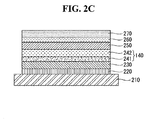
- FIGS. 2A to 2C are views showing the respective steps in a manufacturing method of the organic light emitting device according to an exemplary embodiment of the present invention.
- FIG. 1 is a view showing an organic light emitting device according to an exemplary embodiment of the present invention.
- the organic light emitting device 100 comprises a substrate 110, a first electrode 120, a hole function layer 130, an emission layer 140 comprising a first emission layer 141 and a second emission layer 142, an electron transportation layer 150, an electron injection layer 160, and a second electrode 170.
- the substrate 110 may be made of glass, plastic, or metal, and may further comprise a thin film transistor comprising a semiconductor layer, a gate electrode, a source electrode, and a drain electrode.
- the first electrode 120 may be transparent or reflective. If the first electrode 120 is transparent, it may be made of any one of indium tin oxide (ITO), indium zinc oxide (IZO), and zinc oxide (ZnO).
- ITO indium tin oxide
- IZO indium zinc oxide
- ZnO zinc oxide
- the first electrode 120 may further comprise a reflection layer, made of any one of aluminum (Al), silver (Ag), and nickel (Ni), placed under a layer made of any one of ITO, IZO and, ZnO, or further may comprise a reflection layer interposed between two layers made of any one of ITO, IZO and ZnO.
- a reflection layer made of any one of aluminum (Al), silver (Ag), and nickel (Ni) placed under a layer made of any one of ITO, IZO and, ZnO, or further may comprise a reflection layer interposed between two layers made of any one of ITO, IZO and ZnO.
- the hole function layer 130 functions to make smooth the injection and transportation of holes from the first electrode 120 to the emission layer 140, and may comprise a hole injection layer and a hole transportation layer.
- the hole injection layer may be made of at least one selected from the group consisting of CuPC (cupper phthalocyanine), PEDOT (poly(3,4)-ethylenedioxythiophene), PANI (polyalniline), and NPD (N,N-dinaphthyl-N,N'-diphenyl benzidine), but not limited thereto.
- CuPC cupper phthalocyanine
- PEDOT poly(3,4)-ethylenedioxythiophene
- PANI polyalniline
- NPD N,N-dinaphthyl-N,N'-diphenyl benzidine
- the hole transportation layer may be made of at least one selected from the group consisting of NPD (N,N-dinaphthyl-N,N'-diphenyl benzidine), TPD (N,N'-bis-(3-methylphenyl)-N,N'-bis-(phenyl)-benzidine), s-TAD and MTDATA (4,4',4"-Tris(N-3-methylphenyl-N-phenyl-amino)-triphenylamine), but not limited thereto.
- NPD N,N-dinaphthyl-N,N'-diphenyl benzidine
- TPD N,N'-bis-(3-methylphenyl)-N,N'-bis-(phenyl)-benzidine
- s-TAD and MTDATA (4,4',4"-Tris(N-3-methylphenyl-N-phenyl-amino)-triphenylamine
- the emission layer 140 may comprise a first emission layer 141 and a second emission layer 142.
- the first emission layer 141 is a layer contacting the hole function layer 130, and may comprise a single host material.
- the host material is determined according to the light emission color of the second emission layer 142, which will be described below.
- the second emission layer 142 disposed on the first emission layer 141 may comprise a host and a dopant.
- the second emission layer 142 may comprise a region comprising a light emitting dopant for directly emitting light.
- the second emission layer 142 may be made of a material emitting light of any one of red, green, and blue, or of a phosphorescent material or a fluorescent material.
- the second emission layer 142 is a red light emitting layer, it may be made of a phosphorescent material which comprises a host material comprising CBP (carbazole biphenyl) or mCP(1,3-bis(carbazol-9-yl) and a dopant comprising any one or more selected from the group consisting of PIQIr(acac)(bis(1-phenylisoquinoline)acetylacetonate iridium), PQIr(acac)(bis(1-phenylquinoline)acetylacetonate iridium), PQIr(tris(1-phenylquinoline)iridium), and PtOEP(octaethylporphyrin platinum).
- a fluorescent material comprising PBD:Eu(DBM)3(Phen) or Perylene, but not limited thereto.
- the second emission layer 142 is a green light emitting layer, it may be made of a phosphorescent material which comprises a host material comprising CBP or mCP and a dopant material comprising Ir(ppy)3(fac tris(2-phenylpyridine)iridium). Alternatively, it may be made of a fluorescent material comprising Alq3(tris(8-hydroxyquinolino)aluminum, but not limited thereto.
- the second emission layer 142 is a blue light emitting layer, it may be made of a phosphorescent material which comprises a host material comprising CBP or mCP and a dopant material comprising (4,6-F2 ppy)2Irpic. Alternatively, it may be made of a fluorescent material comprising at least one selected from the group consisting of spiro-DPVBi, spiro-6P, distyryl benzene (DSB), distyrylarylene (DSA), PFO series polymer, and PPV series polymer, but not limited thereto.
- a phosphorescent material which comprises a host material comprising CBP or mCP and a dopant material comprising (4,6-F2 ppy)2Irpic.
- a fluorescent material comprising at least one selected from the group consisting of spiro-DPVBi, spiro-6P, distyryl benzene (DSB), distyrylarylene (DSA), PFO series polymer,
- the above-described first emission layer 141 comprises the same host as the second emission layer 142, whose host is determined according to the light emission color of the second emission layer 142. This is to make it easy to transfer energy from the host to the dopant when light emission occurs in the second emission layer 142.
- the above-described hole function layer 130 may be obtained as the first emission layer 141 is melted by heat treatment.
- the hole function layer 130 directly contacting the first electrode 120 When the hole function layer 130 directly contacting the first electrode 120 is melted, the interfacial characteristics between the first electrode 120 and the hole function layer 130 can be improved, and moisture contained in the hole function layer 130 can be eliminated.
- the interfacial characteristics between the hole function layer 130 and the first emission layer 141 can be improved, and moisture contained in the first emission layer 141 can be eliminated.
- the present invention has the advantages of improving the characteristics of the interface between the first electrode 120 and the hole function layer 130 and the interface between the hole function layer 130 and the first emission layer 141 and eliminating moisture contained in the hole function layer 130 and the first emission layer 141, by melting the hole function layer 130 and the first emission layer 141.
- the electron transportation layer 150 disposed on the second emission layer 142 facilitates transportation of electrons and can be made of one or more selected from a group of Alq3(tris(8-hydroxyquinolino)aluminum), PBD, TAZ, spiro-PBD, BAlq, and SAlq, which is not limited to the above.
- the electron transportation layer 135 can prevent holes injected from the first electrode 120 from passing through the emission layer 140 to the second electrode 170. In other words, the electron transportation layer 135 performs the role of a hole blocking layer, facilitating efficient combination between holes and electrons in the emission layer.
- the electron injection layer 160 disposed on the electron transportation layer 150 facilitates injection of electrons and can use Alq3(tris(8-hydroxyquinolino)aluminum), PBD, TAZ, spiro-PBD, BAlq, or SAlq, but is not limited to the above.
- the electron injection layer can further comprise inorganic substance and the inorganic substance can further comprise metallic compound.
- the metallic compound can comprise alkali metal or alkali earth metal.
- Metallic compound comprising the alkali metal or alkali earth metal can be one or more selected from a group consisting of LiQ, LiF, NaF, KF, RbF, CsF, FrF, BeF2, MgF2, CaF2, SrF2, BaF2, and RaF2, but is not limited to the above.
- the second electrode 170 disposed on the electron injection layer 160 can be made of magnesium (Mg), calcium (Ca), aluminum (Al), or silver (Ag) with a low work function, or an alloy of the above metal.
- the second electrode 170 if an organic light emitting device has a front emitting or a double-sided light emitting structure, can be formed with a thickness as thinly as light can penetrate; if the organic light emitting device is a backward emitting structure, the second electrode 123 can be formed as thickly as light can be reflected.
- the organic light emitting device has the advantages of improving the characteristics of the interface between the first electrode and the hole function layer and the interface between the hole function layer and the first emission layer and eliminating moisture contained in the hole function layer and the first emission layer, by melting the hole function layer and the first emission layer.
- FIGS. 2A to 2C are views showing the respective steps in a manufacturing method of the organic light emitting device according to an exemplary embodiment of the present invention
- a first electrode 220 is formed on the substrate 210.
- the first substrate 220 can be formed by using sputtering, evaporation, vapor phase deposition, or electron beam deposition method.
- a thin film transistor comprising a gate electrode, a semiconductor layer, a source electrode, and a drain electrode may be further formed on the substrate 210.
- the hole function layer 230 may comprise at least one of a hole injection layer or hole transportation layer.
- the hole injection layer or the hole transportation layer may be formed by using evaporation or spin coating method; the thickness of the hole injection layer can range from about 5 nm to about 150 nm.
- the first emission layer 241 is formed on the hole function layer 230.
- the first emission layer 241 may be formed of the same material as the host material of the second emission layer 242 to be formed later, and can be formed by using evaporation or vapor deposition.
- the first emission layer 241 may be formed at 1 to 20% the thickness of the second emission layer 242 to be formed later, and may be formed at a thickness of about 5 to about 100 nm. More preferably, the first emission layer 241 may be formed at a thickness of about 10 to about 35 nm.
- the first emission layer 241 is formed at a thickness greater than about 1% the thickness of the second emission layer 242, the first emission layer 241 can be prevented from being damaged in a melting process. If the thickness of the first emission layer is formed at a thickness less than about 20% the thickness of the second emission layer 242, energy transfer to the dopant of the second emission layer 242 can easily occur.
- the hole function layer 230 and the first emission layer 241 are melted by applying heat thereto.
- the melting temperature of the hole function layer 230 and the first emission layer 241 may be higher than the glass transmission temperature Tg of the hole function layer 230 and the first emission layer 241, more particularly, about 100 to about 250 degrees.
- the melting indicates slight melting of the surfaces of the hole function layer 230 and the first emission layer 241, rather than complete phase transmission from solid to liquid.
- the hole function layer 230 When the hole function layer 230 is melted, the interfacial bonding force between the first electrode 220 and the hole function layer 230 can be improved, and accordingly the interface characteristics thereof can be improved. Also, as the hole function layer 230 is made of an organic substance, moisture contained the organic substance can be evaporated to the outside and eliminated.
- the interfacial bonding force between the hole function layer 230 and the first emission layer 241 can be improved, and accordingly the interface characteristics thereof can be improved.
- the second emission layer 242 is formed on the first emission layer 241.
- the second emission layer 242 may comprise a host and a dopant.
- the host of the second emission layer 242 may be formed of the same material as the host of the first emission layer 241.
- the dopant contained in the host may be doped at a concentration of about 5 to about 35%.
- the second emission layer 242 may be formed by evaporation or vapor deposition like the above-described first emission layer 241, and it may be formed by codeposition of the host and the dopant.
- the melting process is performed before the formation of the second emission layer 242 comprising the dopant. This is because the dopant is weak to heat, and therefore thermal denaturation of the dopant material occurs, thereby degrading the performance of the device.
- an electron transportation layer 250 is formed on the second emission layer 242.
- the electron transporting layer 250 may be formed by using evaporation or spin coating, and the electron transporting layer 250 may be formed at a thickness of about 1 to about 50 nm.
- an electron injection layer 260 is formed on the electron transportation layer 260.
- the electron transportation layer 260 may be formed by using evaporation or spin coating, and the electron transportation layer 260 may be formed at a thickness of about 1 to about 50 nm.
- a second electrode 270 is formed on the electron injection layer 260 to manufacture an organic light emitting device 200 according to an exemplary embodiment of the present invention.
- the OLED was fabricated as follows. A light emitting area with 3 mm by 3 mm in size was patterned and cleaned on a glass substrate. The anode of ITO was formed on the substrate at a thickness of 500 ⁇ , and the hole transportation layer of NPD was formed at a thickness of 70 nm, and the host of CBP as the first emission layer was formed at a thickness of 5 nm. After that, the substrate was heat-treated for 20 mins at 100°C under N2 atmospheric pressure, thereby melting the hole transportation layer and the first emission layer.
- the host of CBP and the dopant of Ir(PPY)3 (doping concentration of 4%) were formed as a second emission layer at a thickness of 30 nm.
- the electron transportation layer of spiro-PBD was formed at a thickness of 30 nm
- the electron injection layer of LiF was formed at a thickness of 1 nm
- the second electrode of Al was formed at a thickness of 100 nm, thereby fabricating an organic light emitting device.
- the first emission layer was not formed, and the heat treatment process was not performed.
- an organic light emitting device was fabricated under the same condition as the above-described Embodiment.
- the first emission layer was not formed.
- an organic light emitting device was fabricated under the same condition as the above-described Embodiment.
- the first emission layer was not formed, and the heat treatment process was performed after forming the second emission layer.
- an organic light emitting device was fabricated under the same condition as the above-described Embodiment.
- the driving voltage, luminous efficiency, color coordinates, and lifespan of the organic light emitting devices fabricated according to the Embodiment and Comparative Examples 1 to 3 were measured and shown in the following Table 1.
- the lifespan of the organic light emitting device according to Embodiment was improved by about 380 hrs compared to Comparative Example 2 in which heat treatment was performed without forming the first emission layer.
- the lifespan of the organic light emitting device according to Embodiment was improved by about 1480 hrs compared to Comparative Example 3 in which heat treatment was performed after forming the second emission layer without forming the first emission layer.
- the lifespan characteristics of the device of Comparative Example 3 was lowered due to thermal denaturation of the dopant material in the heat treatment process.
- the organic light emitting device of the present invention has the advantages of improving the characteristics of the interface between the first electrode and the hole function layer and the interface between the hole function layer and the first emission layer and eliminating moisture contained in the hole function layer and the first emission layer, by melting the hole function layer and the first emission layer. Accordingly, the lifespan of the organic light emitting device can be improved.
- the organic light emitting device can improve the lifespan and efficiency of the organic light emitting device due to direct transition of excitons from the buffer layer to the dopant of the emission layer by including the buffer layer between the emission layer and the electron transportation layer. Also, the injection of electrons to the emission layer was restricted by an energy barrier between the emission layer and the buffer layer, and this causes a light emitting area in the emission layer to be moved toward the electron transportation layer, thereby improving the lifespan and efficiency of the organic light emitting device.
Landscapes
- Physics & Mathematics (AREA)
- Optics & Photonics (AREA)
- Engineering & Computer Science (AREA)
- Manufacturing & Machinery (AREA)
- Electroluminescent Light Sources (AREA)
Applications Claiming Priority (1)
| Application Number | Priority Date | Filing Date | Title |
|---|---|---|---|
| KR1020100107040A KR20120045475A (ko) | 2010-10-29 | 2010-10-29 | 유기전계발광소자 및 그 제조방법 |
Publications (3)
| Publication Number | Publication Date |
|---|---|
| EP2448034A2 true EP2448034A2 (de) | 2012-05-02 |
| EP2448034A3 EP2448034A3 (de) | 2013-09-04 |
| EP2448034B1 EP2448034B1 (de) | 2018-04-11 |
Family
ID=44913204
Family Applications (1)
| Application Number | Title | Priority Date | Filing Date |
|---|---|---|---|
| EP11186648.9A Active EP2448034B1 (de) | 2010-10-29 | 2011-10-26 | Verfahren zur herstellung einer oranischen lichtemittierenden vorrichtung |
Country Status (4)
| Country | Link |
|---|---|
| US (1) | US8872216B2 (de) |
| EP (1) | EP2448034B1 (de) |
| KR (1) | KR20120045475A (de) |
| CN (1) | CN102456842B (de) |
Families Citing this family (8)
| Publication number | Priority date | Publication date | Assignee | Title |
|---|---|---|---|---|
| KR102016564B1 (ko) * | 2013-07-19 | 2019-09-02 | 엘지디스플레이 주식회사 | 유기전계발광소자 및 그 제조방법 |
| KR20150012584A (ko) * | 2013-07-25 | 2015-02-04 | 삼성디스플레이 주식회사 | 스퍼터링 타겟 제조 방법, 유기 발광 표시 장치 및 유기 발광 표시 장치 제조 방법 |
| KR101703451B1 (ko) * | 2014-11-06 | 2017-02-09 | 포항공과대학교 산학협력단 | 엑시톤 버퍼층을 포함하는 페로브스카이트 발광 소자 및 이의 제조방법 |
| WO2016072810A1 (ko) | 2014-11-06 | 2016-05-12 | 포항공과대학교 산학협력단 | 엑시톤 버퍼층을 포함하는 페로브스카이트 발광 소자 및 이의 제조방법 |
| KR20160056444A (ko) * | 2014-11-11 | 2016-05-20 | 삼성디스플레이 주식회사 | 유기 발광 표시 장치의 제조 방법 |
| KR101936035B1 (ko) * | 2014-12-03 | 2019-04-03 | 엘지디스플레이 주식회사 | 유기전계발광소자 |
| CN104716265B (zh) * | 2015-03-30 | 2017-03-15 | 京东方科技集团股份有限公司 | 蓝光有机电致发光器件及制备方法、显示面板和显示装置 |
| EP4002509A1 (de) * | 2020-11-20 | 2022-05-25 | Samsung Electronics Co., Ltd. | Lichtemittierende vorrichtung und elektronisches gerät damit |
Citations (1)
| Publication number | Priority date | Publication date | Assignee | Title |
|---|---|---|---|---|
| KR20100107040A (ko) | 2008-01-28 | 2010-10-04 | 산토니 에쎄.뻬.아. | 양말 편물기 등에서 스티치를 바늘 자체로부터 인접 바늘로 이송하기 위한 바늘 |
Family Cites Families (8)
| Publication number | Priority date | Publication date | Assignee | Title |
|---|---|---|---|---|
| JP2000091067A (ja) * | 1998-09-10 | 2000-03-31 | Pioneer Electronic Corp | 有機エレクトロルミネッセンス素子とその製造方法 |
| JP2001068272A (ja) * | 1999-08-24 | 2001-03-16 | Tdk Corp | 有機el素子 |
| JP2003229256A (ja) * | 2002-02-04 | 2003-08-15 | Seiko Epson Corp | 有機el装置の製造方法及び有機el装置用インク組成物 |
| US7799369B2 (en) * | 2002-11-19 | 2010-09-21 | Daniels John J | Organic and inorganic light active devices and methods for making the same |
| JP2005005149A (ja) * | 2003-06-12 | 2005-01-06 | Tohoku Pioneer Corp | 有機el素子及びその製造方法 |
| KR101100893B1 (ko) * | 2004-04-29 | 2012-01-02 | 삼성전자주식회사 | 유기전계 발광소자 및 그 형성방법 |
| JP4939284B2 (ja) * | 2007-04-05 | 2012-05-23 | 財団法人山形県産業技術振興機構 | 有機エレクトロルミネッセント素子 |
| KR100994118B1 (ko) * | 2009-01-13 | 2010-11-15 | 삼성모바일디스플레이주식회사 | 유기 발광 소자 및 그 제조 방법 |
-
2010
- 2010-10-29 KR KR1020100107040A patent/KR20120045475A/ko not_active Ceased
-
2011
- 2011-10-26 EP EP11186648.9A patent/EP2448034B1/de active Active
- 2011-10-27 US US13/283,090 patent/US8872216B2/en active Active
- 2011-10-28 CN CN201110339428.5A patent/CN102456842B/zh active Active
Patent Citations (1)
| Publication number | Priority date | Publication date | Assignee | Title |
|---|---|---|---|---|
| KR20100107040A (ko) | 2008-01-28 | 2010-10-04 | 산토니 에쎄.뻬.아. | 양말 편물기 등에서 스티치를 바늘 자체로부터 인접 바늘로 이송하기 위한 바늘 |
Also Published As
| Publication number | Publication date |
|---|---|
| EP2448034B1 (de) | 2018-04-11 |
| US8872216B2 (en) | 2014-10-28 |
| KR20120045475A (ko) | 2012-05-09 |
| CN102456842B (zh) | 2016-11-16 |
| EP2448034A3 (de) | 2013-09-04 |
| CN102456842A (zh) | 2012-05-16 |
| US20120104451A1 (en) | 2012-05-03 |
Similar Documents
| Publication | Publication Date | Title |
|---|---|---|
| KR102773047B1 (ko) | 유기 전계 발광 표시 장치 | |
| US8507314B2 (en) | Organic light emitting device and manufacturing method thereof | |
| KR101608234B1 (ko) | 유기 발광 소자 | |
| EP2448034B1 (de) | Verfahren zur herstellung einer oranischen lichtemittierenden vorrichtung | |
| KR102459818B1 (ko) | 유기 발광 표시 장치 | |
| KR20110032589A (ko) | 유기전계발광소자 | |
| CN102064278A (zh) | 有机发光设备的制造方法 | |
| KR20110027484A (ko) | 유기전계발광소자 | |
| US20090078933A1 (en) | Organic light emitting device | |
| KR101469486B1 (ko) | 유기 발광 표시 장치 | |
| KR101596969B1 (ko) | 유기전계발광소자 | |
| TWI473315B (zh) | 有機發光裝置 | |
| KR101398242B1 (ko) | 유기전계발광소자 | |
| KR20140142462A (ko) | 유기전계발광표시장치 및 이의 제조방법 | |
| KR20110056715A (ko) | 유기전계발광소자 | |
| EP3012864A1 (de) | Organische lichtemittierende Anzeigevorrichtung und Verfahren zur Herstellung davon | |
| KR102316200B1 (ko) | 유기 발광 소자 및 그의 제조 방법 | |
| KR101771253B1 (ko) | 유기전계발광소자 | |
| KR101773610B1 (ko) | 유기전계발광소자의 제조방법 | |
| KR101589744B1 (ko) | 유기전계발광소자 | |
| KR101291801B1 (ko) | 유기전계발광소자의 제조방법 | |
| KR101739131B1 (ko) | 유기전계발광소자 | |
| KR101696481B1 (ko) | 유기전계발광소자 및 그 제조방법 | |
| KR100894649B1 (ko) | 유기전계발광소자 | |
| KR101588895B1 (ko) | 유기전계발광표시장치 |
Legal Events
| Date | Code | Title | Description |
|---|---|---|---|
| PUAI | Public reference made under article 153(3) epc to a published international application that has entered the european phase |
Free format text: ORIGINAL CODE: 0009012 |
|
| 17P | Request for examination filed |
Effective date: 20111026 |
|
| AK | Designated contracting states |
Kind code of ref document: A2 Designated state(s): AL AT BE BG CH CY CZ DE DK EE ES FI FR GB GR HR HU IE IS IT LI LT LU LV MC MK MT NL NO PL PT RO RS SE SI SK SM TR |
|
| AX | Request for extension of the european patent |
Extension state: BA ME |
|
| PUAL | Search report despatched |
Free format text: ORIGINAL CODE: 0009013 |
|
| AK | Designated contracting states |
Kind code of ref document: A3 Designated state(s): AL AT BE BG CH CY CZ DE DK EE ES FI FR GB GR HR HU IE IS IT LI LT LU LV MC MK MT NL NO PL PT RO RS SE SI SK SM TR |
|
| AX | Request for extension of the european patent |
Extension state: BA ME |
|
| RIC1 | Information provided on ipc code assigned before grant |
Ipc: H01L 51/50 20060101AFI20130726BHEP Ipc: H01L 51/52 20060101ALN20130726BHEP Ipc: H01L 51/56 20060101ALI20130726BHEP |
|
| RBV | Designated contracting states (corrected) |
Designated state(s): AL AT BE BG CH CY CZ DE DK EE ES FI FR GB GR HR HU IE IS IT LI LT LU LV MC MK MT NL NO PL PT RO RS SE SI SK SM TR |
|
| 17Q | First examination report despatched |
Effective date: 20150911 |
|
| GRAP | Despatch of communication of intention to grant a patent |
Free format text: ORIGINAL CODE: EPIDOSNIGR1 |
|
| RIC1 | Information provided on ipc code assigned before grant |
Ipc: H01L 51/56 20060101ALI20171003BHEP Ipc: H01L 51/50 20060101AFI20171003BHEP Ipc: H01L 51/52 20060101ALN20171003BHEP |
|
| RIC1 | Information provided on ipc code assigned before grant |
Ipc: H01L 51/52 20060101ALN20171012BHEP Ipc: H01L 51/56 20060101ALI20171012BHEP Ipc: H01L 51/50 20060101AFI20171012BHEP |
|
| INTG | Intention to grant announced |
Effective date: 20171103 |
|
| GRAS | Grant fee paid |
Free format text: ORIGINAL CODE: EPIDOSNIGR3 |
|
| GRAA | (expected) grant |
Free format text: ORIGINAL CODE: 0009210 |
|
| AK | Designated contracting states |
Kind code of ref document: B1 Designated state(s): AL AT BE BG CH CY CZ DE DK EE ES FI FR GB GR HR HU IE IS IT LI LT LU LV MC MK MT NL NO PL PT RO RS SE SI SK SM TR |
|
| REG | Reference to a national code |
Ref country code: GB Ref legal event code: FG4D |
|
| REG | Reference to a national code |
Ref country code: CH Ref legal event code: EP |
|
| REG | Reference to a national code |
Ref country code: AT Ref legal event code: REF Ref document number: 988901 Country of ref document: AT Kind code of ref document: T Effective date: 20180415 |
|
| REG | Reference to a national code |
Ref country code: IE Ref legal event code: FG4D |
|
| REG | Reference to a national code |
Ref country code: DE Ref legal event code: R096 Ref document number: 602011047336 Country of ref document: DE |
|
| REG | Reference to a national code |
Ref country code: NL Ref legal event code: MP Effective date: 20180411 |
|
| REG | Reference to a national code |
Ref country code: LT Ref legal event code: MG4D |
|
| PG25 | Lapsed in a contracting state [announced via postgrant information from national office to epo] |
Ref country code: NL Free format text: LAPSE BECAUSE OF FAILURE TO SUBMIT A TRANSLATION OF THE DESCRIPTION OR TO PAY THE FEE WITHIN THE PRESCRIBED TIME-LIMIT Effective date: 20180411 |
|
| REG | Reference to a national code |
Ref country code: FR Ref legal event code: PLFP Year of fee payment: 8 |
|
| PG25 | Lapsed in a contracting state [announced via postgrant information from national office to epo] |
Ref country code: FI Free format text: LAPSE BECAUSE OF FAILURE TO SUBMIT A TRANSLATION OF THE DESCRIPTION OR TO PAY THE FEE WITHIN THE PRESCRIBED TIME-LIMIT Effective date: 20180411 Ref country code: LT Free format text: LAPSE BECAUSE OF FAILURE TO SUBMIT A TRANSLATION OF THE DESCRIPTION OR TO PAY THE FEE WITHIN THE PRESCRIBED TIME-LIMIT Effective date: 20180411 Ref country code: PL Free format text: LAPSE BECAUSE OF FAILURE TO SUBMIT A TRANSLATION OF THE DESCRIPTION OR TO PAY THE FEE WITHIN THE PRESCRIBED TIME-LIMIT Effective date: 20180411 Ref country code: BG Free format text: LAPSE BECAUSE OF FAILURE TO SUBMIT A TRANSLATION OF THE DESCRIPTION OR TO PAY THE FEE WITHIN THE PRESCRIBED TIME-LIMIT Effective date: 20180711 Ref country code: AL Free format text: LAPSE BECAUSE OF FAILURE TO SUBMIT A TRANSLATION OF THE DESCRIPTION OR TO PAY THE FEE WITHIN THE PRESCRIBED TIME-LIMIT Effective date: 20180411 Ref country code: ES Free format text: LAPSE BECAUSE OF FAILURE TO SUBMIT A TRANSLATION OF THE DESCRIPTION OR TO PAY THE FEE WITHIN THE PRESCRIBED TIME-LIMIT Effective date: 20180411 Ref country code: SE Free format text: LAPSE BECAUSE OF FAILURE TO SUBMIT A TRANSLATION OF THE DESCRIPTION OR TO PAY THE FEE WITHIN THE PRESCRIBED TIME-LIMIT Effective date: 20180411 Ref country code: NO Free format text: LAPSE BECAUSE OF FAILURE TO SUBMIT A TRANSLATION OF THE DESCRIPTION OR TO PAY THE FEE WITHIN THE PRESCRIBED TIME-LIMIT Effective date: 20180711 |
|
| PG25 | Lapsed in a contracting state [announced via postgrant information from national office to epo] |
Ref country code: RS Free format text: LAPSE BECAUSE OF FAILURE TO SUBMIT A TRANSLATION OF THE DESCRIPTION OR TO PAY THE FEE WITHIN THE PRESCRIBED TIME-LIMIT Effective date: 20180411 Ref country code: HR Free format text: LAPSE BECAUSE OF FAILURE TO SUBMIT A TRANSLATION OF THE DESCRIPTION OR TO PAY THE FEE WITHIN THE PRESCRIBED TIME-LIMIT Effective date: 20180411 Ref country code: LV Free format text: LAPSE BECAUSE OF FAILURE TO SUBMIT A TRANSLATION OF THE DESCRIPTION OR TO PAY THE FEE WITHIN THE PRESCRIBED TIME-LIMIT Effective date: 20180411 Ref country code: GR Free format text: LAPSE BECAUSE OF FAILURE TO SUBMIT A TRANSLATION OF THE DESCRIPTION OR TO PAY THE FEE WITHIN THE PRESCRIBED TIME-LIMIT Effective date: 20180712 |
|
| REG | Reference to a national code |
Ref country code: AT Ref legal event code: MK05 Ref document number: 988901 Country of ref document: AT Kind code of ref document: T Effective date: 20180411 |
|
| PG25 | Lapsed in a contracting state [announced via postgrant information from national office to epo] |
Ref country code: PT Free format text: LAPSE BECAUSE OF FAILURE TO SUBMIT A TRANSLATION OF THE DESCRIPTION OR TO PAY THE FEE WITHIN THE PRESCRIBED TIME-LIMIT Effective date: 20180813 |
|
| REG | Reference to a national code |
Ref country code: DE Ref legal event code: R097 Ref document number: 602011047336 Country of ref document: DE |
|
| PG25 | Lapsed in a contracting state [announced via postgrant information from national office to epo] |
Ref country code: AT Free format text: LAPSE BECAUSE OF FAILURE TO SUBMIT A TRANSLATION OF THE DESCRIPTION OR TO PAY THE FEE WITHIN THE PRESCRIBED TIME-LIMIT Effective date: 20180411 Ref country code: DK Free format text: LAPSE BECAUSE OF FAILURE TO SUBMIT A TRANSLATION OF THE DESCRIPTION OR TO PAY THE FEE WITHIN THE PRESCRIBED TIME-LIMIT Effective date: 20180411 Ref country code: CZ Free format text: LAPSE BECAUSE OF FAILURE TO SUBMIT A TRANSLATION OF THE DESCRIPTION OR TO PAY THE FEE WITHIN THE PRESCRIBED TIME-LIMIT Effective date: 20180411 Ref country code: SK Free format text: LAPSE BECAUSE OF FAILURE TO SUBMIT A TRANSLATION OF THE DESCRIPTION OR TO PAY THE FEE WITHIN THE PRESCRIBED TIME-LIMIT Effective date: 20180411 Ref country code: RO Free format text: LAPSE BECAUSE OF FAILURE TO SUBMIT A TRANSLATION OF THE DESCRIPTION OR TO PAY THE FEE WITHIN THE PRESCRIBED TIME-LIMIT Effective date: 20180411 Ref country code: EE Free format text: LAPSE BECAUSE OF FAILURE TO SUBMIT A TRANSLATION OF THE DESCRIPTION OR TO PAY THE FEE WITHIN THE PRESCRIBED TIME-LIMIT Effective date: 20180411 |
|
| PLBE | No opposition filed within time limit |
Free format text: ORIGINAL CODE: 0009261 |
|
| STAA | Information on the status of an ep patent application or granted ep patent |
Free format text: STATUS: NO OPPOSITION FILED WITHIN TIME LIMIT |
|
| PG25 | Lapsed in a contracting state [announced via postgrant information from national office to epo] |
Ref country code: SM Free format text: LAPSE BECAUSE OF FAILURE TO SUBMIT A TRANSLATION OF THE DESCRIPTION OR TO PAY THE FEE WITHIN THE PRESCRIBED TIME-LIMIT Effective date: 20180411 Ref country code: IT Free format text: LAPSE BECAUSE OF FAILURE TO SUBMIT A TRANSLATION OF THE DESCRIPTION OR TO PAY THE FEE WITHIN THE PRESCRIBED TIME-LIMIT Effective date: 20180411 |
|
| 26N | No opposition filed |
Effective date: 20190114 |
|
| PG25 | Lapsed in a contracting state [announced via postgrant information from national office to epo] |
Ref country code: SI Free format text: LAPSE BECAUSE OF FAILURE TO SUBMIT A TRANSLATION OF THE DESCRIPTION OR TO PAY THE FEE WITHIN THE PRESCRIBED TIME-LIMIT Effective date: 20180411 |
|
| REG | Reference to a national code |
Ref country code: CH Ref legal event code: PL |
|
| REG | Reference to a national code |
Ref country code: BE Ref legal event code: MM Effective date: 20181031 |
|
| PG25 | Lapsed in a contracting state [announced via postgrant information from national office to epo] |
Ref country code: MC Free format text: LAPSE BECAUSE OF FAILURE TO SUBMIT A TRANSLATION OF THE DESCRIPTION OR TO PAY THE FEE WITHIN THE PRESCRIBED TIME-LIMIT Effective date: 20180411 Ref country code: LU Free format text: LAPSE BECAUSE OF NON-PAYMENT OF DUE FEES Effective date: 20181026 |
|
| REG | Reference to a national code |
Ref country code: IE Ref legal event code: MM4A |
|
| PG25 | Lapsed in a contracting state [announced via postgrant information from national office to epo] |
Ref country code: LI Free format text: LAPSE BECAUSE OF NON-PAYMENT OF DUE FEES Effective date: 20181031 Ref country code: CH Free format text: LAPSE BECAUSE OF NON-PAYMENT OF DUE FEES Effective date: 20181031 Ref country code: BE Free format text: LAPSE BECAUSE OF NON-PAYMENT OF DUE FEES Effective date: 20181031 |
|
| PG25 | Lapsed in a contracting state [announced via postgrant information from national office to epo] |
Ref country code: IE Free format text: LAPSE BECAUSE OF NON-PAYMENT OF DUE FEES Effective date: 20181026 |
|
| PG25 | Lapsed in a contracting state [announced via postgrant information from national office to epo] |
Ref country code: MT Free format text: LAPSE BECAUSE OF NON-PAYMENT OF DUE FEES Effective date: 20181026 |
|
| PG25 | Lapsed in a contracting state [announced via postgrant information from national office to epo] |
Ref country code: TR Free format text: LAPSE BECAUSE OF FAILURE TO SUBMIT A TRANSLATION OF THE DESCRIPTION OR TO PAY THE FEE WITHIN THE PRESCRIBED TIME-LIMIT Effective date: 20180411 |
|
| PG25 | Lapsed in a contracting state [announced via postgrant information from national office to epo] |
Ref country code: HU Free format text: LAPSE BECAUSE OF FAILURE TO SUBMIT A TRANSLATION OF THE DESCRIPTION OR TO PAY THE FEE WITHIN THE PRESCRIBED TIME-LIMIT; INVALID AB INITIO Effective date: 20111026 Ref country code: MK Free format text: LAPSE BECAUSE OF NON-PAYMENT OF DUE FEES Effective date: 20180411 Ref country code: CY Free format text: LAPSE BECAUSE OF FAILURE TO SUBMIT A TRANSLATION OF THE DESCRIPTION OR TO PAY THE FEE WITHIN THE PRESCRIBED TIME-LIMIT Effective date: 20180411 |
|
| PG25 | Lapsed in a contracting state [announced via postgrant information from national office to epo] |
Ref country code: IS Free format text: LAPSE BECAUSE OF FAILURE TO SUBMIT A TRANSLATION OF THE DESCRIPTION OR TO PAY THE FEE WITHIN THE PRESCRIBED TIME-LIMIT Effective date: 20180811 |
|
| REG | Reference to a national code |
Ref country code: DE Ref legal event code: R079 Ref document number: 602011047336 Country of ref document: DE Free format text: PREVIOUS MAIN CLASS: H01L0051500000 Ipc: H10K0050000000 |
|
| PGFP | Annual fee paid to national office [announced via postgrant information from national office to epo] |
Ref country code: GB Payment date: 20250820 Year of fee payment: 15 |
|
| PGFP | Annual fee paid to national office [announced via postgrant information from national office to epo] |
Ref country code: FR Payment date: 20250821 Year of fee payment: 15 |
|
| PGFP | Annual fee paid to national office [announced via postgrant information from national office to epo] |
Ref country code: DE Payment date: 20250820 Year of fee payment: 15 |