EP2430091B1 - Composite of a polymer and surface modified hexagonal boron nitride particles - Google Patents
Composite of a polymer and surface modified hexagonal boron nitride particles Download PDFInfo
- Publication number
- EP2430091B1 EP2430091B1 EP10775443.4A EP10775443A EP2430091B1 EP 2430091 B1 EP2430091 B1 EP 2430091B1 EP 10775443 A EP10775443 A EP 10775443A EP 2430091 B1 EP2430091 B1 EP 2430091B1
- Authority
- EP
- European Patent Office
- Prior art keywords
- polymer
- smhbn
- composite
- boron nitride
- hexagonal boron
- Prior art date
- Legal status (The legal status is an assumption and is not a legal conclusion. Google has not performed a legal analysis and makes no representation as to the accuracy of the status listed.)
- Not-in-force
Links
- 229920000642 polymer Polymers 0.000 title claims description 68
- 239000002245 particle Substances 0.000 title claims description 37
- 229910052582 BN Inorganic materials 0.000 title claims description 26
- PZNSFCLAULLKQX-UHFFFAOYSA-N Boron nitride Chemical compound N#B PZNSFCLAULLKQX-UHFFFAOYSA-N 0.000 title claims description 26
- 239000002131 composite material Substances 0.000 title claims description 23
- 229920005575 poly(amic acid) Polymers 0.000 claims description 36
- 229920001721 polyimide Polymers 0.000 claims description 23
- 239000000203 mixture Substances 0.000 claims description 21
- 229920000647 polyepoxide Polymers 0.000 claims description 21
- CIUQDSCDWFSTQR-UHFFFAOYSA-N [C]1=CC=CC=C1 Chemical group [C]1=CC=CC=C1 CIUQDSCDWFSTQR-UHFFFAOYSA-N 0.000 claims description 20
- 125000000217 alkyl group Chemical group 0.000 claims description 19
- 238000000034 method Methods 0.000 claims description 19
- 229910052739 hydrogen Inorganic materials 0.000 claims description 18
- 239000001257 hydrogen Substances 0.000 claims description 18
- 239000004642 Polyimide Substances 0.000 claims description 17
- 239000003822 epoxy resin Substances 0.000 claims description 16
- 239000002904 solvent Substances 0.000 claims description 16
- 125000003118 aryl group Chemical group 0.000 claims description 12
- 230000008569 process Effects 0.000 claims description 11
- 125000003545 alkoxy group Chemical group 0.000 claims description 6
- 229910052736 halogen Inorganic materials 0.000 claims description 6
- 150000002367 halogens Chemical class 0.000 claims description 6
- 125000003107 substituted aryl group Chemical group 0.000 claims description 5
- 150000002431 hydrogen Chemical group 0.000 claims 8
- 239000006185 dispersion Substances 0.000 description 48
- 239000000243 solution Substances 0.000 description 44
- 239000007788 liquid Substances 0.000 description 27
- 239000004593 Epoxy Substances 0.000 description 26
- OKKJLVBELUTLKV-UHFFFAOYSA-N Methanol Chemical compound OC OKKJLVBELUTLKV-UHFFFAOYSA-N 0.000 description 15
- 230000000052 comparative effect Effects 0.000 description 14
- -1 aryl diazonium salts Chemical class 0.000 description 13
- XLYOFNOQVPJJNP-UHFFFAOYSA-N water Substances O XLYOFNOQVPJJNP-UHFFFAOYSA-N 0.000 description 12
- FXHOOIRPVKKKFG-UHFFFAOYSA-N N,N-Dimethylacetamide Chemical compound CN(C)C(C)=O FXHOOIRPVKKKFG-UHFFFAOYSA-N 0.000 description 11
- CBCKQZAAMUWICA-UHFFFAOYSA-N 1,4-phenylenediamine Chemical compound NC1=CC=C(N)C=C1 CBCKQZAAMUWICA-UHFFFAOYSA-N 0.000 description 10
- VEXZGXHMUGYJMC-UHFFFAOYSA-N Hydrochloric acid Chemical compound Cl VEXZGXHMUGYJMC-UHFFFAOYSA-N 0.000 description 10
- 238000003917 TEM image Methods 0.000 description 10
- 125000004435 hydrogen atom Chemical group [H]* 0.000 description 10
- 238000006243 chemical reaction Methods 0.000 description 9
- 239000007787 solid Substances 0.000 description 9
- QQGYZOYWNCKGEK-UHFFFAOYSA-N 5-[(1,3-dioxo-2-benzofuran-5-yl)oxy]-2-benzofuran-1,3-dione Chemical compound C1=C2C(=O)OC(=O)C2=CC(OC=2C=C3C(=O)OC(C3=CC=2)=O)=C1 QQGYZOYWNCKGEK-UHFFFAOYSA-N 0.000 description 8
- 230000009969 flowable effect Effects 0.000 description 8
- 238000002156 mixing Methods 0.000 description 8
- LNEPOXFFQSENCJ-UHFFFAOYSA-N haloperidol Chemical compound C1CC(O)(C=2C=CC(Cl)=CC=2)CCN1CCCC(=O)C1=CC=C(F)C=C1 LNEPOXFFQSENCJ-UHFFFAOYSA-N 0.000 description 7
- VLDPXPPHXDGHEW-UHFFFAOYSA-N 1-chloro-2-dichlorophosphoryloxybenzene Chemical compound ClC1=CC=CC=C1OP(Cl)(Cl)=O VLDPXPPHXDGHEW-UHFFFAOYSA-N 0.000 description 6
- ZWEHNKRNPOVVGH-UHFFFAOYSA-N 2-Butanone Chemical compound CCC(C)=O ZWEHNKRNPOVVGH-UHFFFAOYSA-N 0.000 description 6
- XEEYBQQBJWHFJM-UHFFFAOYSA-N Iron Chemical compound [Fe] XEEYBQQBJWHFJM-UHFFFAOYSA-N 0.000 description 6
- IISBACLAFKSPIT-UHFFFAOYSA-N bisphenol A Chemical compound C=1C=C(O)C=CC=1C(C)(C)C1=CC=C(O)C=C1 IISBACLAFKSPIT-UHFFFAOYSA-N 0.000 description 6
- 150000004985 diamines Chemical class 0.000 description 6
- LPXPTNMVRIOKMN-UHFFFAOYSA-M sodium nitrite Chemical compound [Na+].[O-]N=O LPXPTNMVRIOKMN-UHFFFAOYSA-M 0.000 description 6
- 239000000758 substrate Substances 0.000 description 6
- 239000004594 Masterbatch (MB) Substances 0.000 description 5
- GTDPSWPPOUPBNX-UHFFFAOYSA-N ac1mqpva Chemical compound CC12C(=O)OC(=O)C1(C)C1(C)C2(C)C(=O)OC1=O GTDPSWPPOUPBNX-UHFFFAOYSA-N 0.000 description 5
- 150000001412 amines Chemical class 0.000 description 5
- 150000008064 anhydrides Chemical group 0.000 description 5
- 239000003795 chemical substances by application Substances 0.000 description 5
- 239000012954 diazonium Substances 0.000 description 5
- 229940113088 dimethylacetamide Drugs 0.000 description 5
- 150000002500 ions Chemical class 0.000 description 5
- 150000003254 radicals Chemical group 0.000 description 5
- PLIKAWJENQZMHA-UHFFFAOYSA-N 4-aminophenol Chemical compound NC1=CC=C(O)C=C1 PLIKAWJENQZMHA-UHFFFAOYSA-N 0.000 description 4
- VHUUQVKOLVNVRT-UHFFFAOYSA-N Ammonium hydroxide Chemical compound [NH4+].[OH-] VHUUQVKOLVNVRT-UHFFFAOYSA-N 0.000 description 4
- IJGRMHOSHXDMSA-UHFFFAOYSA-N Atomic nitrogen Chemical compound N#N IJGRMHOSHXDMSA-UHFFFAOYSA-N 0.000 description 4
- RTZKZFJDLAIYFH-UHFFFAOYSA-N Diethyl ether Chemical compound CCOCC RTZKZFJDLAIYFH-UHFFFAOYSA-N 0.000 description 4
- 235000011114 ammonium hydroxide Nutrition 0.000 description 4
- 238000004458 analytical method Methods 0.000 description 4
- PXKLMJQFEQBVLD-UHFFFAOYSA-N bisphenol F Chemical compound C1=CC(O)=CC=C1CC1=CC=C(O)C=C1 PXKLMJQFEQBVLD-UHFFFAOYSA-N 0.000 description 4
- 238000005266 casting Methods 0.000 description 4
- 239000008367 deionised water Substances 0.000 description 4
- 229910021641 deionized water Inorganic materials 0.000 description 4
- 125000006159 dianhydride group Chemical group 0.000 description 4
- 125000003700 epoxy group Chemical group 0.000 description 4
- 238000010438 heat treatment Methods 0.000 description 4
- 125000004464 hydroxyphenyl group Chemical group 0.000 description 4
- 229910052757 nitrogen Inorganic materials 0.000 description 4
- 230000009257 reactivity Effects 0.000 description 4
- CSCPPACGZOOCGX-UHFFFAOYSA-N Acetone Chemical compound CC(C)=O CSCPPACGZOOCGX-UHFFFAOYSA-N 0.000 description 3
- NLXLAEXVIDQMFP-UHFFFAOYSA-N Ammonium chloride Substances [NH4+].[Cl-] NLXLAEXVIDQMFP-UHFFFAOYSA-N 0.000 description 3
- UHOVQNZJYSORNB-UHFFFAOYSA-N Benzene Chemical compound C1=CC=CC=C1 UHOVQNZJYSORNB-UHFFFAOYSA-N 0.000 description 3
- RYGMFSIKBFXOCR-UHFFFAOYSA-N Copper Chemical compound [Cu] RYGMFSIKBFXOCR-UHFFFAOYSA-N 0.000 description 3
- LYCAIKOWRPUZTN-UHFFFAOYSA-N Ethylene glycol Chemical compound OCCO LYCAIKOWRPUZTN-UHFFFAOYSA-N 0.000 description 3
- DNIAPMSPPWPWGF-UHFFFAOYSA-N Propylene glycol Chemical compound CC(O)CO DNIAPMSPPWPWGF-UHFFFAOYSA-N 0.000 description 3
- 239000004809 Teflon Substances 0.000 description 3
- 229920006362 Teflon® Polymers 0.000 description 3
- YXFVVABEGXRONW-UHFFFAOYSA-N Toluene Chemical compound CC1=CC=CC=C1 YXFVVABEGXRONW-UHFFFAOYSA-N 0.000 description 3
- 239000012141 concentrate Substances 0.000 description 3
- 239000011889 copper foil Substances 0.000 description 3
- 239000003431 cross linking reagent Substances 0.000 description 3
- 150000002118 epoxides Chemical class 0.000 description 3
- 238000000605 extraction Methods 0.000 description 3
- ISWSIDIOOBJBQZ-UHFFFAOYSA-N phenol group Chemical group C1(=CC=CC=C1)O ISWSIDIOOBJBQZ-UHFFFAOYSA-N 0.000 description 3
- 239000005011 phenolic resin Substances 0.000 description 3
- 229920006267 polyester film Polymers 0.000 description 3
- 235000010288 sodium nitrite Nutrition 0.000 description 3
- 229920001187 thermosetting polymer Polymers 0.000 description 3
- 238000005011 time of flight secondary ion mass spectroscopy Methods 0.000 description 3
- 238000002042 time-of-flight secondary ion mass spectrometry Methods 0.000 description 3
- HLBLWEWZXPIGSM-UHFFFAOYSA-N 4-Aminophenyl ether Chemical compound C1=CC(N)=CC=C1OC1=CC=C(N)C=C1 HLBLWEWZXPIGSM-UHFFFAOYSA-N 0.000 description 2
- LDFYRFKAYFZVNH-UHFFFAOYSA-N 4-[4-[4-(4-aminophenoxy)phenoxy]phenoxy]aniline Chemical compound C1=CC(N)=CC=C1OC(C=C1)=CC=C1OC(C=C1)=CC=C1OC1=CC=C(N)C=C1 LDFYRFKAYFZVNH-UHFFFAOYSA-N 0.000 description 2
- OKTJSMMVPCPJKN-UHFFFAOYSA-N Carbon Chemical compound [C] OKTJSMMVPCPJKN-UHFFFAOYSA-N 0.000 description 2
- VEXZGXHMUGYJMC-UHFFFAOYSA-M Chloride anion Chemical compound [Cl-] VEXZGXHMUGYJMC-UHFFFAOYSA-M 0.000 description 2
- IAZDPXIOMUYVGZ-UHFFFAOYSA-N Dimethylsulphoxide Chemical compound CS(C)=O IAZDPXIOMUYVGZ-UHFFFAOYSA-N 0.000 description 2
- ZRALSGWEFCBTJO-UHFFFAOYSA-N Guanidine Chemical class NC(N)=N ZRALSGWEFCBTJO-UHFFFAOYSA-N 0.000 description 2
- ZMXDDKWLCZADIW-UHFFFAOYSA-N N,N-Dimethylformamide Chemical compound CN(C)C=O ZMXDDKWLCZADIW-UHFFFAOYSA-N 0.000 description 2
- SECXISVLQFMRJM-UHFFFAOYSA-N N-Methylpyrrolidone Chemical compound CN1CCCC1=O SECXISVLQFMRJM-UHFFFAOYSA-N 0.000 description 2
- UFWIBTONFRDIAS-UHFFFAOYSA-N Naphthalene Chemical compound C1=CC=CC2=CC=CC=C21 UFWIBTONFRDIAS-UHFFFAOYSA-N 0.000 description 2
- 239000004952 Polyamide Chemical class 0.000 description 2
- 239000002253 acid Substances 0.000 description 2
- 229910052782 aluminium Inorganic materials 0.000 description 2
- XAGFODPZIPBFFR-UHFFFAOYSA-N aluminium Chemical compound [Al] XAGFODPZIPBFFR-UHFFFAOYSA-N 0.000 description 2
- 229920001577 copolymer Polymers 0.000 description 2
- 125000004122 cyclic group Chemical group 0.000 description 2
- JHIVVAPYMSGYDF-UHFFFAOYSA-N cyclohexanone Chemical compound O=C1CCCCC1 JHIVVAPYMSGYDF-UHFFFAOYSA-N 0.000 description 2
- 150000001989 diazonium salts Chemical class 0.000 description 2
- IJGRMHOSHXDMSA-UHFFFAOYSA-O diazynium Chemical compound [NH+]#N IJGRMHOSHXDMSA-UHFFFAOYSA-O 0.000 description 2
- GYZLOYUZLJXAJU-UHFFFAOYSA-N diglycidyl ether Chemical class C1OC1COCC1CO1 GYZLOYUZLJXAJU-UHFFFAOYSA-N 0.000 description 2
- 238000009826 distribution Methods 0.000 description 2
- 230000000694 effects Effects 0.000 description 2
- 238000005516 engineering process Methods 0.000 description 2
- 239000011888 foil Substances 0.000 description 2
- 239000011521 glass Substances 0.000 description 2
- 230000009477 glass transition Effects 0.000 description 2
- 239000010931 gold Substances 0.000 description 2
- 229910052737 gold Inorganic materials 0.000 description 2
- 238000010348 incorporation Methods 0.000 description 2
- 239000004850 liquid epoxy resins (LERs) Substances 0.000 description 2
- 238000005259 measurement Methods 0.000 description 2
- 238000012986 modification Methods 0.000 description 2
- 230000004048 modification Effects 0.000 description 2
- 239000002071 nanotube Substances 0.000 description 2
- 125000004433 nitrogen atom Chemical group N* 0.000 description 2
- 229920003986 novolac Polymers 0.000 description 2
- 239000013500 performance material Substances 0.000 description 2
- 229920001568 phenolic resin Polymers 0.000 description 2
- 125000000951 phenoxy group Chemical group [H]C1=C([H])C([H])=C(O*)C([H])=C1[H] 0.000 description 2
- 229920002647 polyamide Chemical class 0.000 description 2
- 239000002243 precursor Substances 0.000 description 2
- 238000003756 stirring Methods 0.000 description 2
- 230000003746 surface roughness Effects 0.000 description 2
- 238000004381 surface treatment Methods 0.000 description 2
- 238000010998 test method Methods 0.000 description 2
- 238000002411 thermogravimetry Methods 0.000 description 2
- 239000012745 toughening agent Substances 0.000 description 2
- RIOQSEWOXXDEQQ-UHFFFAOYSA-N triphenylphosphine Chemical class C1=CC=CC=C1P(C=1C=CC=CC=1)C1=CC=CC=C1 RIOQSEWOXXDEQQ-UHFFFAOYSA-N 0.000 description 2
- 230000004580 weight loss Effects 0.000 description 2
- AVQQQNCBBIEMEU-UHFFFAOYSA-N 1,1,3,3-tetramethylurea Chemical compound CN(C)C(=O)N(C)C AVQQQNCBBIEMEU-UHFFFAOYSA-N 0.000 description 1
- WZCQRUWWHSTZEM-UHFFFAOYSA-N 1,3-phenylenediamine Chemical compound NC1=CC=CC(N)=C1 WZCQRUWWHSTZEM-UHFFFAOYSA-N 0.000 description 1
- ALQLPWJFHRMHIU-UHFFFAOYSA-N 1,4-diisocyanatobenzene Chemical compound O=C=NC1=CC=C(N=C=O)C=C1 ALQLPWJFHRMHIU-UHFFFAOYSA-N 0.000 description 1
- HECLRDQVFMWTQS-RGOKHQFPSA-N 1755-01-7 Chemical compound C1[C@H]2[C@@H]3CC=C[C@@H]3[C@@H]1C=C2 HECLRDQVFMWTQS-RGOKHQFPSA-N 0.000 description 1
- STMDPCBYJCIZOD-UHFFFAOYSA-N 2-(2,4-dinitroanilino)-4-methylpentanoic acid Chemical compound CC(C)CC(C(O)=O)NC1=CC=C([N+]([O-])=O)C=C1[N+]([O-])=O STMDPCBYJCIZOD-UHFFFAOYSA-N 0.000 description 1
- OAYXUHPQHDHDDZ-UHFFFAOYSA-N 2-(2-butoxyethoxy)ethanol Chemical compound CCCCOCCOCCO OAYXUHPQHDHDDZ-UHFFFAOYSA-N 0.000 description 1
- KUBDPQJOLOUJRM-UHFFFAOYSA-N 2-(chloromethyl)oxirane;4-[2-(4-hydroxyphenyl)propan-2-yl]phenol Chemical compound ClCC1CO1.C=1C=C(O)C=CC=1C(C)(C)C1=CC=C(O)C=C1 KUBDPQJOLOUJRM-UHFFFAOYSA-N 0.000 description 1
- LJBWJFWNFUKAGS-UHFFFAOYSA-N 2-[bis(2-hydroxyphenyl)methyl]phenol Chemical compound OC1=CC=CC=C1C(C=1C(=CC=CC=1)O)C1=CC=CC=C1O LJBWJFWNFUKAGS-UHFFFAOYSA-N 0.000 description 1
- KXGFMDJXCMQABM-UHFFFAOYSA-N 2-methoxy-6-methylphenol Chemical compound [CH]OC1=CC=CC([CH])=C1O KXGFMDJXCMQABM-UHFFFAOYSA-N 0.000 description 1
- ZBMISJGHVWNWTE-UHFFFAOYSA-N 3-(4-aminophenoxy)aniline Chemical compound C1=CC(N)=CC=C1OC1=CC=CC(N)=C1 ZBMISJGHVWNWTE-UHFFFAOYSA-N 0.000 description 1
- DKKYOQYISDAQER-UHFFFAOYSA-N 3-[3-(3-aminophenoxy)phenoxy]aniline Chemical compound NC1=CC=CC(OC=2C=C(OC=3C=C(N)C=CC=3)C=CC=2)=C1 DKKYOQYISDAQER-UHFFFAOYSA-N 0.000 description 1
- VPWNQTHUCYMVMZ-UHFFFAOYSA-N 4,4'-sulfonyldiphenol Chemical compound C1=CC(O)=CC=C1S(=O)(=O)C1=CC=C(O)C=C1 VPWNQTHUCYMVMZ-UHFFFAOYSA-N 0.000 description 1
- WUPRYUDHUFLKFL-UHFFFAOYSA-N 4-[3-(4-aminophenoxy)phenoxy]aniline Chemical compound C1=CC(N)=CC=C1OC1=CC=CC(OC=2C=CC(N)=CC=2)=C1 WUPRYUDHUFLKFL-UHFFFAOYSA-N 0.000 description 1
- VQVIHDPBMFABCQ-UHFFFAOYSA-N 5-(1,3-dioxo-2-benzofuran-5-carbonyl)-2-benzofuran-1,3-dione Chemical compound C1=C2C(=O)OC(=O)C2=CC(C(C=2C=C3C(=O)OC(=O)C3=CC=2)=O)=C1 VQVIHDPBMFABCQ-UHFFFAOYSA-N 0.000 description 1
- ULKLGIFJWFIQFF-UHFFFAOYSA-N 5K8XI641G3 Chemical compound CCC1=NC=C(C)N1 ULKLGIFJWFIQFF-UHFFFAOYSA-N 0.000 description 1
- ZOXJGFHDIHLPTG-UHFFFAOYSA-N Boron Chemical group [B] ZOXJGFHDIHLPTG-UHFFFAOYSA-N 0.000 description 1
- LFQSCWFLJHTTHZ-UHFFFAOYSA-N Ethanol Chemical compound CCO LFQSCWFLJHTTHZ-UHFFFAOYSA-N 0.000 description 1
- 101100365384 Mus musculus Eefsec gene Proteins 0.000 description 1
- CHJJGSNFBQVOTG-UHFFFAOYSA-N N-methyl-guanidine Chemical class CNC(N)=N CHJJGSNFBQVOTG-UHFFFAOYSA-N 0.000 description 1
- CTQNGGLPUBDAKN-UHFFFAOYSA-N O-Xylene Chemical compound CC1=CC=CC=C1C CTQNGGLPUBDAKN-UHFFFAOYSA-N 0.000 description 1
- 229920001665 Poly-4-vinylphenol Polymers 0.000 description 1
- 238000010521 absorption reaction Methods 0.000 description 1
- 229920006397 acrylic thermoplastic Polymers 0.000 description 1
- 230000004913 activation Effects 0.000 description 1
- 238000013019 agitation Methods 0.000 description 1
- 150000001408 amides Chemical class 0.000 description 1
- 239000000908 ammonium hydroxide Substances 0.000 description 1
- 239000007864 aqueous solution Substances 0.000 description 1
- 239000012298 atmosphere Substances 0.000 description 1
- 238000009529 body temperature measurement Methods 0.000 description 1
- WKDNYTOXBCRNPV-UHFFFAOYSA-N bpda Chemical compound C1=C2C(=O)OC(=O)C2=CC(C=2C=C3C(=O)OC(C3=CC=2)=O)=C1 WKDNYTOXBCRNPV-UHFFFAOYSA-N 0.000 description 1
- 229910052799 carbon Inorganic materials 0.000 description 1
- 125000003178 carboxy group Chemical group [H]OC(*)=O 0.000 description 1
- 230000015556 catabolic process Effects 0.000 description 1
- 239000013626 chemical specie Substances 0.000 description 1
- 239000011248 coating agent Substances 0.000 description 1
- 238000000576 coating method Methods 0.000 description 1
- 238000009833 condensation Methods 0.000 description 1
- 230000005494 condensation Effects 0.000 description 1
- 238000001816 cooling Methods 0.000 description 1
- 238000004132 cross linking Methods 0.000 description 1
- 150000007973 cyanuric acids Chemical class 0.000 description 1
- 238000006731 degradation reaction Methods 0.000 description 1
- 238000000113 differential scanning calorimetry Methods 0.000 description 1
- 239000003085 diluting agent Substances 0.000 description 1
- SWSQBOPZIKWTGO-UHFFFAOYSA-N dimethylaminoamidine Chemical class CN(C)C(N)=N SWSQBOPZIKWTGO-UHFFFAOYSA-N 0.000 description 1
- ZZTCPWRAHWXWCH-UHFFFAOYSA-N diphenylmethanediamine Chemical compound C=1C=CC=CC=1C(N)(N)C1=CC=CC=C1 ZZTCPWRAHWXWCH-UHFFFAOYSA-N 0.000 description 1
- 229920001971 elastomer Polymers 0.000 description 1
- 238000010292 electrical insulation Methods 0.000 description 1
- 125000006575 electron-withdrawing group Chemical group 0.000 description 1
- 150000002148 esters Chemical class 0.000 description 1
- 238000001704 evaporation Methods 0.000 description 1
- 230000008020 evaporation Effects 0.000 description 1
- 239000011152 fibreglass Substances 0.000 description 1
- 125000000524 functional group Chemical group 0.000 description 1
- VOZRXNHHFUQHIL-UHFFFAOYSA-N glycidyl methacrylate Chemical compound CC(=C)C(=O)OCC1CO1 VOZRXNHHFUQHIL-UHFFFAOYSA-N 0.000 description 1
- PCHJSUWPFVWCPO-UHFFFAOYSA-N gold Chemical compound [Au] PCHJSUWPFVWCPO-UHFFFAOYSA-N 0.000 description 1
- 229910002804 graphite Inorganic materials 0.000 description 1
- 239000010439 graphite Substances 0.000 description 1
- 238000000227 grinding Methods 0.000 description 1
- GNOIPBMMFNIUFM-UHFFFAOYSA-N hexamethylphosphoric triamide Chemical compound CN(C)P(=O)(N(C)C)N(C)C GNOIPBMMFNIUFM-UHFFFAOYSA-N 0.000 description 1
- 229920001519 homopolymer Polymers 0.000 description 1
- 150000002460 imidazoles Chemical class 0.000 description 1
- 230000002687 intercalation Effects 0.000 description 1
- 238000009830 intercalation Methods 0.000 description 1
- 229910052742 iron Inorganic materials 0.000 description 1
- 238000011068 loading method Methods 0.000 description 1
- 229910052751 metal Inorganic materials 0.000 description 1
- 239000002184 metal Substances 0.000 description 1
- 238000006011 modification reaction Methods 0.000 description 1
- 239000003607 modifier Substances 0.000 description 1
- 239000000178 monomer Substances 0.000 description 1
- SLCVBVWXLSEKPL-UHFFFAOYSA-N neopentyl glycol Chemical compound OCC(C)(C)CO SLCVBVWXLSEKPL-UHFFFAOYSA-N 0.000 description 1
- 239000012299 nitrogen atmosphere Substances 0.000 description 1
- 229910000069 nitrogen hydride Inorganic materials 0.000 description 1
- 150000007524 organic acids Chemical class 0.000 description 1
- 235000005985 organic acids Nutrition 0.000 description 1
- 150000002989 phenols Chemical class 0.000 description 1
- 239000013034 phenoxy resin Substances 0.000 description 1
- 229920006287 phenoxy resin Polymers 0.000 description 1
- 229920003229 poly(methyl methacrylate) Polymers 0.000 description 1
- 229920000768 polyamine Chemical class 0.000 description 1
- 229920000728 polyester Polymers 0.000 description 1
- 229920006254 polymer film Polymers 0.000 description 1
- 239000012704 polymeric precursor Substances 0.000 description 1
- 238000006116 polymerization reaction Methods 0.000 description 1
- 230000000379 polymerizing effect Effects 0.000 description 1
- 229920001955 polyphenylene ether Polymers 0.000 description 1
- 229920001343 polytetrafluoroethylene Polymers 0.000 description 1
- 239000004810 polytetrafluoroethylene Substances 0.000 description 1
- 238000002360 preparation method Methods 0.000 description 1
- LLHKCFNBLRBOGN-UHFFFAOYSA-N propylene glycol methyl ether acetate Chemical compound COCC(C)OC(C)=O LLHKCFNBLRBOGN-UHFFFAOYSA-N 0.000 description 1
- 101150025733 pub2 gene Proteins 0.000 description 1
- 229920005604 random copolymer Polymers 0.000 description 1
- 239000000376 reactant Substances 0.000 description 1
- 229920005989 resin Polymers 0.000 description 1
- 239000011347 resin Substances 0.000 description 1
- 239000011435 rock Substances 0.000 description 1
- 239000000523 sample Substances 0.000 description 1
- 229910052594 sapphire Inorganic materials 0.000 description 1
- 239000010980 sapphire Substances 0.000 description 1
- 239000011734 sodium Substances 0.000 description 1
- 238000005507 spraying Methods 0.000 description 1
- 229910001220 stainless steel Inorganic materials 0.000 description 1
- 239000010935 stainless steel Substances 0.000 description 1
- 238000010561 standard procedure Methods 0.000 description 1
- 239000007858 starting material Substances 0.000 description 1
- 239000000126 substance Substances 0.000 description 1
- 150000005846 sugar alcohols Polymers 0.000 description 1
- 235000007586 terpenes Nutrition 0.000 description 1
- ISXSCDLOGDJUNJ-UHFFFAOYSA-N tert-butyl prop-2-enoate Chemical compound CC(C)(C)OC(=O)C=C ISXSCDLOGDJUNJ-UHFFFAOYSA-N 0.000 description 1
- 229920001169 thermoplastic Polymers 0.000 description 1
- 229910052719 titanium Inorganic materials 0.000 description 1
- 239000010936 titanium Substances 0.000 description 1
- 230000007704 transition Effects 0.000 description 1
- 125000002348 vinylic group Chemical group 0.000 description 1
- 229910052724 xenon Inorganic materials 0.000 description 1
- FHNFHKCVQCLJFQ-UHFFFAOYSA-N xenon atom Chemical compound [Xe] FHNFHKCVQCLJFQ-UHFFFAOYSA-N 0.000 description 1
- 239000008096 xylene Substances 0.000 description 1
- 229910052725 zinc Inorganic materials 0.000 description 1
- 239000011701 zinc Substances 0.000 description 1
Images


Classifications
-
- C—CHEMISTRY; METALLURGY
- C09—DYES; PAINTS; POLISHES; NATURAL RESINS; ADHESIVES; COMPOSITIONS NOT OTHERWISE PROVIDED FOR; APPLICATIONS OF MATERIALS NOT OTHERWISE PROVIDED FOR
- C09C—TREATMENT OF INORGANIC MATERIALS, OTHER THAN FIBROUS FILLERS, TO ENHANCE THEIR PIGMENTING OR FILLING PROPERTIES ; PREPARATION OF CARBON BLACK ; PREPARATION OF INORGANIC MATERIALS WHICH ARE NO SINGLE CHEMICAL COMPOUNDS AND WHICH ARE MAINLY USED AS PIGMENTS OR FILLERS
- C09C1/00—Treatment of specific inorganic materials other than fibrous fillers; Preparation of carbon black
-
- C—CHEMISTRY; METALLURGY
- C08—ORGANIC MACROMOLECULAR COMPOUNDS; THEIR PREPARATION OR CHEMICAL WORKING-UP; COMPOSITIONS BASED THEREON
- C08K—Use of inorganic or non-macromolecular organic substances as compounding ingredients
- C08K3/00—Use of inorganic substances as compounding ingredients
- C08K3/38—Boron-containing compounds
-
- C—CHEMISTRY; METALLURGY
- C08—ORGANIC MACROMOLECULAR COMPOUNDS; THEIR PREPARATION OR CHEMICAL WORKING-UP; COMPOSITIONS BASED THEREON
- C08K—Use of inorganic or non-macromolecular organic substances as compounding ingredients
- C08K9/00—Use of pretreated ingredients
- C08K9/04—Ingredients treated with organic substances
-
- C—CHEMISTRY; METALLURGY
- C08—ORGANIC MACROMOLECULAR COMPOUNDS; THEIR PREPARATION OR CHEMICAL WORKING-UP; COMPOSITIONS BASED THEREON
- C08L—COMPOSITIONS OF MACROMOLECULAR COMPOUNDS
- C08L63/00—Compositions of epoxy resins; Compositions of derivatives of epoxy resins
-
- C—CHEMISTRY; METALLURGY
- C08—ORGANIC MACROMOLECULAR COMPOUNDS; THEIR PREPARATION OR CHEMICAL WORKING-UP; COMPOSITIONS BASED THEREON
- C08L—COMPOSITIONS OF MACROMOLECULAR COMPOUNDS
- C08L79/00—Compositions of macromolecular compounds obtained by reactions forming in the main chain of the macromolecule a linkage containing nitrogen with or without oxygen or carbon only, not provided for in groups C08L61/00 - C08L77/00
- C08L79/04—Polycondensates having nitrogen-containing heterocyclic rings in the main chain; Polyhydrazides; Polyamide acids or similar polyimide precursors
- C08L79/08—Polyimides; Polyester-imides; Polyamide-imides; Polyamide acids or similar polyimide precursors
-
- C—CHEMISTRY; METALLURGY
- C01—INORGANIC CHEMISTRY
- C01P—INDEXING SCHEME RELATING TO STRUCTURAL AND PHYSICAL ASPECTS OF SOLID INORGANIC COMPOUNDS
- C01P2002/00—Crystal-structural characteristics
- C01P2002/70—Crystal-structural characteristics defined by measured X-ray, neutron or electron diffraction data
- C01P2002/77—Crystal-structural characteristics defined by measured X-ray, neutron or electron diffraction data by unit-cell parameters, atom positions or structure diagrams
-
- C—CHEMISTRY; METALLURGY
- C01—INORGANIC CHEMISTRY
- C01P—INDEXING SCHEME RELATING TO STRUCTURAL AND PHYSICAL ASPECTS OF SOLID INORGANIC COMPOUNDS
- C01P2004/00—Particle morphology
- C01P2004/01—Particle morphology depicted by an image
- C01P2004/04—Particle morphology depicted by an image obtained by TEM, STEM, STM or AFM
-
- C—CHEMISTRY; METALLURGY
- C01—INORGANIC CHEMISTRY
- C01P—INDEXING SCHEME RELATING TO STRUCTURAL AND PHYSICAL ASPECTS OF SOLID INORGANIC COMPOUNDS
- C01P2006/00—Physical properties of inorganic compounds
- C01P2006/12—Surface area
-
- Y—GENERAL TAGGING OF NEW TECHNOLOGICAL DEVELOPMENTS; GENERAL TAGGING OF CROSS-SECTIONAL TECHNOLOGIES SPANNING OVER SEVERAL SECTIONS OF THE IPC; TECHNICAL SUBJECTS COVERED BY FORMER USPC CROSS-REFERENCE ART COLLECTIONS [XRACs] AND DIGESTS
- Y10—TECHNICAL SUBJECTS COVERED BY FORMER USPC
- Y10T—TECHNICAL SUBJECTS COVERED BY FORMER US CLASSIFICATION
- Y10T428/00—Stock material or miscellaneous articles
- Y10T428/25—Web or sheet containing structurally defined element or component and including a second component containing structurally defined particles
Definitions
- the present invention deals with a polymer composite comprising a polymer and surface modified hexagonal boron nitride particles dispersed therewithin.
- the polymer composite is useful for forming films that are in turn useful as substrates for flexible printed circuit boards.
- a process for the preparation of the composite is also provided.
- Suitable polymers include polyimide and epoxy.
- Meneghetti et al. U.S. 2007/0041918 discloses hexagonal boron nitride treated with a zirconate and employed up to 75% by weight in polymers to prepare samples of improved thermal conductivity.
- Ishida U.S. 6,160,042 , discloses boron nitride surface-treated with 1,4 phenylene diisocyanate incorporated into epoxy resins.
- Epoxies and polyimides are commonly used as components in printed circuit boards. As the density of elements in electronic circuits increases, heat management is an ever increasing problem. Incorporation into polymers of 50 volume % and more of hexagonal boron nitride (hBN) particles imparts enhanced thermal conductivity without compromising electrical insulation. In general, surface treatment of the BN particles is required in order to achieve adequate dispersion and moldability.
- hBN hexagonal boron nitride
- the invention provides a composite comprising a polymer and a plurality of surface-modified hexagonal boron nitride particles dispersed therewithin, the surface modified hexagonal boron nitride particle comprising a hexagonal boron nitride particle having a surface and a substituted phenyl radical bonded to the surface, the substituted phenyl radical being represented by the structure: where X is a radical selected from NH 2 --, HO--, R 2 OC(O)--, R 2 C(O)O--, HSO 3 --, NH 2 CO--, halogens, alkyl and substituted or unsubstituted aryl; wherein R 1 is hydrogen, alkyl or alkoxy, and R 2 is hydrogen, alkyl, or substituted or unsubstituted aryl.
- the invention further provides a process comprising combining a plurality of surface-modified hexagonal boron nitride particles with a polymer solution comprising a solvent, and extracting the solvent, wherein the surface-modified hexagonal boron nitride particles comprise hexagonal boron nitride particles having a surface and a substituted phenyl radical bonded to the surface, the substituted phenyl radical being represented by the structure: wherein X is a radical selected from NH 2 --, HO--, R 2 OC(O)--, R 2 C(O)O--, HSO 3 --, NH 2 CO--, halogens, alkyl and substituted or unsubstituted aryl; wherein R 1 is hydrogen, alkyl or alkoxy, and R 2 is hydrogen, alkyl, or substituted or unsubstituted aryl.
- a novel treatment for hBN is provided that produces a new chemical species on the surface of hBN particles, making them highly compatible with thermo-set polymers such as epoxies and polyimides, and provides tough, flexible substrates for flexible printed circuit boards.
- the polymer is a thermoset polymer, or the uncured (or uncross-linked) thermosettable polymeric precursor corresponding thereto.
- the precursor polymer When the precursor polymer is subject to elevated temperature it undergoes a cross-linking reaction (or curing reaction) or imidization that converts a flowable and/or formable polymer into a non-flowable, non-formable polymer.
- Suitable thermoset polymers include but are not limited to polyimides and cured epoxy resins.
- Suitable thermosettable precursor polymers include polyamic acids and epoxide polymers.
- the curing process may or may not involve the addition of a cross-linking agent. Conversion of some polymers requires addition of a cross-linking agent.
- flowable refers to a viscous mass which is displaced upon the application of a shear force.
- formable refers to a viscous mass which can be formed into a shaped article and will hold the shape for sufficient time that it can be set in that shape, either by cooling, curing, or imidization. In general, all formable masses are flowable, but not all flowable masses are formable. Formable masses are generally of higher viscosity than non-formable but flowable masses.
- thermoset polymer encompasses polyimides
- thermosettable polymer encompasses polyamic acids
- the present invention provides films having a thickness less than 500 ⁇ m.
- Films are generally prepared, for example, by melt casting or solution casting onto a release surface.
- the films have a thickness in the range of 10 to 100 ⁇ m.
- the films have a thickness in the range of 15 to 80 ⁇ m. Films that are too thin may exhibit insufficient toughness for use as substrates for printed circuit boards. Films that are too thick may exhibit insufficient flexibility to be useful as substrates for flexible printed circuit boards.
- Viscosity as described herein is determined at room temperature according to ASTM D 2196 - 05, using a Brookefield viscometer, Model DV-II+, spindle #28.
- the present invention provides a composite comprising a polymer and a plurality of surface-modified hexagonal boron nitride particles dispersed therewithin, said surface modified hexagonal boron nitride (SMhBN) particle comprising hexagonal boron nitride particles having a surface and a substituted phenyl radical bonded to the surface, the substituted phenyl radical being represented by the structure: where X is a radical selected from NH 2 --, HO--, R 2 OC(O)--, R 2 C(O)O--, HSO 3 --, NH 2 CO--, halogens, alkyl and aryl, including substituted aryl; where R 1 is hydrogen, alkyl or alkoxy, and R 2 is hydrogen, alkyl or aryl, including substituted aryl.
- SMhBN surface modified hexagonal boron nitride
- R 1 is hydrogen.
- X is NH 2 -or HO--.
- X is NH 2 --.
- X is HO --.
- the substituted phenyl radical is bonded to the surface of the hBN.
- Hexagonal boron nitride particles are known to be represented by the structure shown in Figure 1 , consisting of multiple stacked, registered platelets, offering a high surface area for reaction.
- the white and black alternating circles represent nitrogen and boron atoms arranged in hexagonal lattices.
- Typical commercially available hBN particles fall in size range of about 0.7 micrometer, about 10 to 12 ⁇ m, and about 14 to 15 ⁇ m. As the particle size grows smaller, the particle is harder to disperse. On the other hand, as the particle size grows larger, the composite film may exhibit undesirable surface roughness.
- the SMhBN has a concentration of the substituted phenyl radical in the range 0.1 to 4.0% by weight on the basis of SMhBN.
- the amount of modifier residing on the surface of the hBN depends upon the surface area of the hBN and the reactivity of the phenyl radical.
- a phenyl radical containing an electron donating group such as amine or alkyl
- a phenyl radical containing an electron withdrawing group such as COOH or OH
- Table 1 Particle size (hBN) surface area (m2/g) Phenyl radical concentration NX1 (0.7um) 20 1.93% PT120 (12-13um) 2.0 0.42%
- reaction rate is governed by the reactivity and half life of the radical, and the susceptibility of the substrate to undergo reaction.
- the lower reactivity hydroxyphenyl radical results a smaller amount of substituted phenyl radical surface modification of hBN than does the higher reactivity aminophenyl radical when the starting materials are in the same ratio.
- a 50/50 mixture by volume of water and alcohol is employed as the solvent for the for the surface modification reaction.
- a mixture of 80 vol-% water and 20 vol-% methanol is employed.
- the polymer comprises polyamic acid. In a further embodiment, the polyamic acid is in solution. In another embodiment, the polymer is a polyimide. In another embodiment, the polymer is an epoxy-containing polymer either in the liquid state or in solution. In another embodiment, the polymer is a cured epoxy resin.
- Polyimide chemistry is very well-known in the art; see for example the article in the Encyclopedia of Polymer Science and Technology by Bryant , DOI 10.1002/0471440264.pst272.pub2.
- Condensation polyimides are normally prepared by imidization of a corresponding polyamic acid.
- Suitable polyamic acid compositions include the polymers prepared by the reaction of equimolar amounts of diamines and tetracarboxylic dianhydrides (or the dianhydride's acid ester or the acid halide ester derivative) in suitable solvents.
- the anhydride moiety is selected from the group consisting of pyromellitic dianhydride (PMDA), 4,4-oxydiphthalic dianhydride (ODPA), 3,3',4,4'-benzophenonetetracarboxylic dianhydride (BTDA), 3,3',4,4'-biphenyltetracarboxylic dianhydride (BPDA), 2,2'-bis(3,4-dicarboxyphenyl) 1,1,1,3,3,3,-hexafluoropropane dianhydride (FDA), and 2,3,6,7-naphthalene tetracarboxylic dianhydrides.
- Suitable diamines include 1,4-phenylene diamine (PPD), 1,3-phenylene diamine (MPD), 4,4'-diaminodiphenyl ether (4,4'-ODA), 3,4'-diaminodiphenyl ether (3,4'-ODA), 1,3-bis-(4-aminophenoxy)benzene (APB-134), 1,3-bis-(3-aminophenoxy)benzene (APB-133), 2,2'-bis-(4-aminophenyl)-1,1,1,3,3,3-hexafluoropropane (6F diamine), and bis[4-(4-aminophenoxy)phenyl] ether (BAPE).
- PPD 1,4-phenylene diamine
- MPD 1,3-phenylene diamine
- 4,4'-ODA 4,4'-diaminodiphenyl ether
- 3,4'-diaminodiphenyl ether 3,4'-d
- the polyamic acid formed may be either a homopolymer, or random copolymer if more than one diamine and/or dianhydrides are used for the polymerization.
- Segmented copolymers can be formed by polymerizing initially with an excess of a first diamine or first dianhydrides and then adding different dianhydrides or diamines respectively.
- Polyamic acids by virtue of their solubility in a variety of solvents, are more highly processible than the corresponding polyimide. It is common practice in the art to perform any mixing and forming operations on the polyamic acid composition followed by imidization. Polyimides are well-known to be highly inert to solvents and elevated temperatures.
- Epoxy chemistry is very well-known in the art; see for example the article in the Encyclopedia of Polymer Science and Technology by Pham and Marks , DOI 10.1002/0471440264.pst119.
- Epoxy resins is the term of art employed to refer to a cured epoxy.
- An uncured epoxy has a cyclic epoxide group along the polymer chain.
- a cured epoxy is one in which a preponderance of the cyclic epoxide groups have undergone reaction with a curing agent (also known as a cross-linking agent) to form cross-links among polymer chains thereby forming a rigid, substantially inert 3-D network of polymer chains.
- Suitable uncured epoxy compositions comprise one or more multifunctional or difunctional epoxy resins, an epoxy curing agent, a toughener and a curing accelerator.
- Suitable multifunctional epoxy resins include phenol-novolac epoxy, cresol-novolac epoxy, tetraglycidyl ether of diaminodiphenylmethane, triglycidyl tris(hydroxylphenyl) methane, trigylcidyl ether of p-aminophenol, naphthalene epoxy resin, the trigylcidyl derivative of cyanuric acid, the epoxy derivative of biphenol.
- Suitable difunctional epoxy resins include glycidyl ethers of bisphenol A, bisphenol F and bisphenol S, and reactive diluants such as aliphatic epoxies.
- Suitable curing agents for epoxies include amines, amides, anhydrides, polyamides, polyamine adducts, organic acids, phenols and phenolic resins. Phenolic curing agents are particularly preferred for their moderating effects on viscosity of the composition and moisture absorption, good electrical and high temperature mechanical properties. Suitable phenolic curing agents include bisphenol A, xylok type phenol resin, dicyclopentadiene type of phenol, terpene modified phenolic reisn, phenolic resin and polyvinylphenol.
- the epoxy composition also includes polymeric toughening agents having average molecular weight in the range 5000-100000, and being soluble in the the epoxy resin solution.
- polymeric tougheners include phenoxys, acrylics, polyamides, polycyanates, polyesters and polyphenylene ethers.
- the epoxy composition also contains a curing accelerator.
- Suitable curing accelerators include amines, guanidine, imidazoles, triphenyl phosphine, triphenyl phosphonium tetrafluoroborate, or epoxy adducts thereof.
- Uncured epoxies by virtue of their inherent liquidity at room temperature or solubility in a variety of solvents are more highly processible than the corresponding cured epoxy. It is common practice in the art to perform any mixing and forming operations on the uncured epoxy composition followed by curing. Cured epoxy polymers are well-known to be highly inert to solvents and elevated temperatures.
- the polymer composite comprises 30 - 70 % by weight of the SMhBN. In a further embodiment, the polymer composite comprises 40 - 65% by weight of the SMhBN. In one embodiment, the average equivalent spherical diameter of the SMhBN is in the range of 0.5 ⁇ m to 50 ⁇ m. In a further embodiment, the average equivalent spherical diameter of the SMhBN is in the range of 0.5 to 25 ⁇ m.
- SMhBN agglomerated SMhBN
- PT620 is sold as agglomerated hBN by the vendor.
- agglomerated SMhBN is preferred for improved thermal conductivity.
- Agglomerates of SMhBN can be soft or hard. Hard agglomerates form by surface modifying PT620 Agglomerates having sizes in the range 0.5 - 50 micrometer are suitable.
- the SMhBN dispersed in the polymer can be characterized by a plurality of particle size distribution peaks characteristic of a so-called multi-modal particle size distribution.
- Particles having a size of about 1/10 of the desired film thickness or less are desirable to make smooth-surfaced films having isotropically balanced mechanical and thermal properties. Increasing particle size introduces anisotropy and surface roughness.
- the invention provides a process comprising combining a plurality of surface-modified hexagonal boron nitride particles with a polymer solution comprising a solvent, and, extracting the solvent, wherein the surface-modified hexagonal boron nitride particles comprise hexagonal boron nitride particles having a surface and a substituted phenyl radical bonded to the surface, the substituted phenyl radical being represented by the structure: where X is a radical selected from NH 2 --, HO--, R 2 OC(O)--, R 2 C(O)O--, HSO 3 --, NH 2 CO--, halogens, alkyl and aryl, including substituted aryl; R 1 is hydrogen, alkyl or alkoxy, and R 2 is hydrogen, alkyl or aryl, including substituted aryl.
- R 1 is hydrogen.
- X is NH 2 - or HO--.
- X is NH 2 --, In another embodiment, X is HO--.
- the process further comprises combining a dispersion of SMhBN in a first organic liquid, with a solution of a polymer in a second organic liquid, with the proviso that the first and second organic liquids are miscible, and are both solvents for the polymer.
- suitable organic liquids include but are not limited to N,N'-dimethyl acetamide, N,N'-dimethyl formamide, N-methyl pyrrolidone, tetramethyl urea, dimethyl sulfoxide, and hexamethyl phosphoramid.
- suitable organic liquids include but are not limited to acetone, methyl ethyl ketone, cyclohexanone, propylene glycol mono methyl ether acetate, carbitol, butyl carbitol, toluene, and xylene.
- the SMhBN is dispersed within the first organic liquid at a solids content in the range of 20 to 70% by weight. In a further embodiment, solids content is in the range of 30-40 % by weight. The dispersion is readily achieved by simple mixing using any mechanical stirrer.
- the first and second organic liquids are both dimethylacetamide (DMAc), and the concentration of SMhBN is 30-40%.
- the dispersion viscosity is below 100 cp at room temperature. It has been found that viscosity below 100 cp is often insufficient to obtain homogeneous mixing of the dispersed SMhBN in the polymer solution.
- a masterbatch of 30-40% SMhBN in DMAc is prepared by adding about 5 - 20% by weight of polymer based upon the weight of the SMhBN.
- the presence of the polymer increases the viscosity above 100 cp, and allows good mutual dispersion of polymer and SMhBN, resulting in a masterbatch comprising a relative concentration of SMhBN/polymer in the range of 96/4 to 80/20.
- the masterbatch so produced can then be mixed with further polymer solution to produce the final desired concentration of SMhBN in the polymer, namely SMhBN in the range of 30-70% by weight on the basis of total solids, in one embodiment, 40-65% by weight of the total solids.
- the polymer is polyamic acid.
- the polymer is uncured epoxy resin.
- the polymeric dispersions are produced by high shear mixing.
- Suitable high shear mixers include but are not limited to homogenizers (available from Silverson Mechanics Inc, East Long Meadow, MA), blenders, ultrasonic agitators, or roller mills with grinding media.
- Suitable ranges for the viscosity of the dispersion, comprising organic liquid, SMhBN and polymer, for high shear mixing can be in the range of 100 to 2000cp, preferably in a viscosity range of 200 to 1500cp.
- the second organic liquid can be a liquid polymer, for example, a liquid epoxy resin having relatively low molecular weight and viscosity
- Liquid epoxy resins suitable for use in the process are made from bisphenol A, bisphenol F, epoxy modified liquid rubber, epoxy resins derived from polyhydric alcohols such as ethylene glycol, propylene glycol, neopentyl glycol and the like.
- Reactive diluents such as allylglycidyl ether, glycidyl methacrylate, and allylphenyl glycidyl ether can also be used to improve dispersion of the SMhBN. It has been found that the viscosity suitable for high shear mixture is in the range 200 to 1500cp. Solvents can be used to dilute the dispersion until it is within the above viscosity range.
- the second organic liquid is selected from N,N'-dimethyl acetamide, N,N'-dimethylformamide or N-methyl pyrrolidone and the polymer is dissolved therewithin at a concentration in the range of 10 to 30% by weight, preferably 15 to 25% by weight.
- the second organic liquid is a liquid polymer, to achieve miscibility with the first organic liquid, the liquid polymer is dissolved in the first organic liquid when they are combined.
- the first organic liquid and the second organic liquid are the same.
- the first and second organic liquids are dimethyl acetamide (DMAc).
- a dianhydride corresponding to the dianhydride moiety in the polyamic acid SMhBN/polyamic acid dispersions increasing the molecular weight of the imidized polymer may be desired to improve the mechanical properties of the film.
- a suitable method is to add the corresponding dianhydride (part of polyamic acid) in 10 to 25 milligram quantities, stir the dispersion for ten minutes until the anhydride completely dissolved in the dispersion and measure the viscosity of the dispersion.
- These viscosities are generally associated with polyamic acid solutions that are suitable for solution casting of films followed by imidization to tough, strong polyimide films.
- SMhBN/epoxy dispersions it is preferable to have a total solid content in the range 40 to 80% by weight, preferably in the range 50 to 70% by weight. Also, it is preferable to have the viscosity of the dispersion in the range 100 to 2000cp, preferably in the range 200 to 1500cp.
- the composite can be shaped into an article such as a film or sheet, a rod or other stock shape, followed by curing, imidization or other method for effecting the transition from a flowable or formable composite to a non-flowable, non-formable composite.
- an article such as a film or sheet, a rod or other stock shape
- curing, imidization or other method for effecting the transition from a flowable or formable composite to a non-flowable, non-formable composite.
- the second organic liquid is a liquid polymer, and only the first organic liquid is subject to extraction.
- the second organic liquid is a solvent for a polymer solution, and is also subject to extraction.
- the glass transition temperature (T g ) and the in-plane thermal expansion coefficient (CTE) of the cured film was determined using a Thermal Mechanical Analyzer by following IPC test method Number 2.4.24.5. CTE was determined in a single direction in the plane of the film. The glass transition, modulus and loss modulus of the film was determined using a Dynamic Mechanical Analyzer by following IPC test method Number 2.4.24.4.
- the specific heat (C p ) of the film was measured using differential scanning calorimetry (DSC) against a sapphire standard using standard methods. Values of thickness t and bulk density p (w/ ⁇ r 2 ⁇ t ⁇ ) are based on room temperature measurements.
- the thermal diffusivity was measured at 25 °C using a Netzsch LFA 447 NanoFlash ® Xenon Flash Apparatus, available from NETZSCH-Gedorfebau GmbH, Selb, Germany.
- Each 1 inch diameter (25.4 mm) die-cut specimen was sputter-coated with a layer of gold on both sides, followed by spraying on a layer of graphite.
- the specimen so prepared was mounted in a holder cooled by a circulating bath to maintain specimen temperature constant during the measurement. Flashlamp gain was set at 1260 in a range from 78 to 5000. Pulse widths of 10 and 66 ms were employed.
- the detector was a liquid nitrogen cooled IR detector. Each data point represents the average of four specimens.
- Thermogravimetric analysis (TGA--10 °C/min heating rate, air atmosphere) showed that the specimen so prepared contained 2.55 weight-% (wt-%)) of aminophenyl groups on the basis of the weight of the SMhBN based on weight loss between 250°C to 600°C.
- Time of Flight - Secondary Ion Mass Spectroscopy (ToF-SIMS) analysis of the SMhBN showed positive ion peaks at m/z 92 and 106.
- the positive ion peak at m/z at 92 confirmed the presence of-C 6 H 4 -NH 2 groups on the surface of the hBN.
- the m/z ion peak at 106 corresponded to the structure -N-C6H4-NH2, confirming that the aminophenyl group was attached to the N atom in the hBN through a covalent bond.
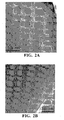
- Figure 2a is a transmission electron micrograph (TEM) of the platelet edges of hBN as received (Comparative Example A).
- Figure 2b is a TEM of the platelet edges of the SMhBN prepared according to Example 1. The virtually identical appearance of the two samples indicated little or no intercalation of the aminophenyl radical between the platelets of hBN.
- Figures 1 a and 1 b show a 'd' (0002) spacing of 3.55A and 3.46A respectively.
- Figure 3a is a TEM of the basal plane in the SMhBN of Example 1, a view from the platelet edges.
- Figure 3b is a TEM of the platelet edges in the SMhBN of Example 1, a view from the basal plane.
- Figures 3a and 3b showed an amorphous coating on the basal plane and none on the edges, thus showing that the surface modification took place only on the basal plane.
- Example 2 The procedures of Example 1 were followed but the amount of para-phenylene diamine (PPD) was varied. The amounts of sodium nitrite, the hydrochloric acid and the iron were changed proportionately with para-phenylene diamine on a molar basis. The weight loss data measured from TGA (between 250-600°C) was taken as the amount of aminophenyl grafting on the hBN surface. Results are shown in Table 2 Table 2 Reactant Amount Amount of aminophenyl grafting on the hBN surface (wt.%)
- Example PPD (g) Na(NO 2 ) (g) Fe (g) 2 1.0 0.638 0.75 0.38 3 2.0 1.275 1.5 1.02 4 4.0 2.55 3.0 1.93 5 8.0 5.10 6.0 2.55
- Example 1 The procedure of Example 1 was used to surface modify different grades of hBN. 4.0 g of PPD was dissolved in 50 ml of deionized water and 28.5 ml of 0.5 M hydrochloric acid at room temperature. 2.55 g of sodium nitrite dissolved in 50 ml of deionized water was added to this solution to make the corresponding diazonium chloride. This diazonium salt solution was added to dispersions each containing 25 g of a grade of hexagonal boron nitride (NX1, PT120 & PT620, Momentive Performance Materials, Strongsville, USA) in 100 ml of methanol and 400 ml of water.
- NX1, PT120 & PT620 hexagonal boron nitride
- Example 2 This same procedure reported in Example 1 was also used to make hydroxyphenyl grafting on an hBN surface.
- the PPD was replaced with the same amount of para-amino phenol.
- TGA showed that the SMhBN thus prepared contained about 0.51% by weight of hydroxy phenyl groups on the basis of the total weight of SMhBN.
- ToF-SIMS analysis of the SMhBN showed positive ion peaks at m/z 93 and 107.
- the positive ion peak at 93 confirmed-C 6 H 4 -OH groups on the surface of the hBN.
- the peak at 107 corresponded to-N-C6H4-OH, confirming that the hydroxyphenyl group was attached to the N atom in the hBN through a covalent bond.
- a polyamic acid solution was formed, by reacting 1.0 mole of 1,3-(4-aminophenoxy)benzene (134APB) with 0.8 mole of 4,4'-oxy-3,4,3',4'-diphthalic anhydride (ODPA) and 0.2 mole of pyromellitic dianhydride (PMDA) in dimethyl acetamide (DMAc) solvent at room temperature under a nitrogen atmosphere.
- ODPA 4,4'-oxy-3,4,3',4'-diphthalic anhydride
- PMDA pyromellitic dianhydride
- DMAc dimethyl acetamide
- Example 10 30 g of SMhBN prepared as in Example 1 was combined with 60 g of DMAc using a mechanical stirrer to form a dispersion. 51.3 g of the polyamic acid solution of Example 10 was added to the SMhBN dispersion and mixed thoroughly using a Silverson Homogenizer for four minutes at 75% speed to form a SMhBN/polyamic acid concentrate or masterbatch.
- SMhBN/polyamic acid masterbatch 56.51 g of the thus made SMhBN/polyamic acid masterbatch was mixed with an additional 29.84 g of the polyamic acid solution using a mechanical stirrer for about 20 min to make a SMhBN/polyamic acid dispersion/solution that corresponded to a concentration of 55% by weight of SMhBN in the cured film. 25 mg aliquots of ODPA were added to the SMhBN/polyamic acid dispersion/solution. After each addition, the dispersion/solution was mixed for about ten minutes until the solids dissolved completely.
- the viscosity of the dispersion/solution had increased to 77400 cp at 0.70s -1 shear rate.
- the thus prepared dispersion/solution was kept in a desiccator under vacuum for 30 minutes to remove the trapped air bubbles
- the resulting dispersion/solution was cast onto the surface of a polyester film using a doctor blade with a 0.010 inch (in) opening to make a film 12" in length and 8" in width..
- the two layer film thus formed was baked at 80 °C for thirty minutes in an air circulating oven.
- the two layers were separated, and the SMhBN/polyamic acid film was clamped into place in a metal frame and baked at 100 °C in an air circulating oven for fifteen minutes .
- the B-stage film so produced was then cured in a furnace by heating at 5 °C/min to 300 °C, holding at 300 °C for five minutes; then rapidly heated to 375 °C and held at 375 °C for five minutes. At the end of the five minute soak, the furnace was turned off and the thus treated specimen was allowed to cool, still in the furnace, to room temperature.
- the hBN concentrate was made by mixing 60 g of DMAc and 30 g of the as-received hBN (NX1 grade) using a mechanical stirrer. Then 51.3 g of the polyamic acid solution described in Example 10 was added to this dispersion and mixed thoroughly using a high shear Silverson Homogenizer for four minutes at 75% speed. 56.51 g of the thus made hBN concentrate was mixed with 29.84 g of the polyamic acid solution using a mechanical stirrer for about 20 min to make a dispersion/solution of polyamic acid containing 55% by weight of hBN in the cured film.
- ODPA in 25 milligram aliquots was added to the so-prepared dispersion/solution, and mixed for about ten minutes for each aliquot, until the solids dissolved completely in the dispersion.
- a total of two such aliquots of ODPA were added to the dispersion/solution such that the viscosity of the dispersion/solution increased to 79200 cp at 0.70s-1 shear rate.
- the resulting dispersion/solution was de-gassed, cast into a film, and post-treated in the manner described for the dispersion/solution of Example 11.
- a control polyimide film was made using the polyamic acid solution of Example 10. 100 g of the polyamic acid solution was mixed with 100 mg of ODPA using a mechanical stirrer for about 10 min until all the solids dissolved. The viscosity of the thus prepared polymer solution was 72200 cp at 0.70s-1. The same procedure reported in Example 11 was used to make and cure a film.
- Example 1 The SMhBN of Example 1 was combined with polyamic acid solution and converted to polyimide films as described in Example 1, but in different relative proportions, as indicated in Table 6.
- Table 6 shows the CTE of the films so-prespared.
- Table 6 Film Composition CTE (ppm/°C) SMhBN(%) Polyimide (%) 50-225°C 260-300°C Comp. Ex. D -- 100 62 2806 Ex. 12 40 60 34 141 Ex. 11 55 45 24 112 Ex. 13 60 40 18 69 Ex. 14 65 35 14 52
- the solution mixture was then degassed under vacuum and cast as a film on a glass plate to make about 12x12" size film.
- the thus coated plate was dried for 15 min on a hot plate set at 100 °C.
- the film was removed from the hot plate and cooled to room temperature.
- the film was mounted on a pin frame.
- the thus mounted film was dried and cured in an oven programmed to increase in temperature from 120 to 300 °C over an hour.
- the frame-mounted film was removed from the oven and immediately placed in a second oven that had been preheated to 400 °C.
- the frame-mounted film was heated in the second oven for five minutes, and then removed, and cooled on the bench.
- the cooled film was removed from the frame, and the edge trimmed to get an 8 x 10 in specimen.
- the so-trimmed film was then placed between two 12X12 in (18um thick) copper foils.
- the package so formed was then inserted into a larger sandwich consisting of a caulk plate/aluminum foil, Teflon ® PFA sheet/copper foil/SMhBN-polyimide composite film/copper foil/Teflon ® PFA sheet/aluminum foil/caulk plate.
- the multi layer sandwich so formed was placed between the platens of a hydraulic press set at a temperature of 150 °C within a vacuum oven. The press was then heated to 350 °C and a pressure of 350 psi was applied to the platens. The press was cooled to 150 °C and the package was removed from the press and the laminate removed.
- An epoxy resin composition was prepared by dissolving in 25 ml of methyl ethyl ketone 9.0 g of poly(o-cresyl glycidyl ether)-co-formaldehyde, (molecular weight 1080, Aldrich, USA), 0.9 g of PKHH phenoxy resin (Phenoxy Specialties, Rock Hill, SC, USA), 0.9g of bishenol A, 3.6 g of Durite®D_SD-1819, a dicyclopentadiene-phenol adduct (Borden Chemical Inc., Louisville, KY) and 0.86 g of 2-ethyl-4-methyl imidazole. The thus formed epoxy solution was stirred using a magnetic stirrer at room temperature for 30 min.
- Example 24 A film identical to that of Example 24 was prepared except that the NX1 hBN was used as received.
Landscapes
- Chemical & Material Sciences (AREA)
- Organic Chemistry (AREA)
- Health & Medical Sciences (AREA)
- Chemical Kinetics & Catalysis (AREA)
- Medicinal Chemistry (AREA)
- Polymers & Plastics (AREA)
- Compositions Of Macromolecular Compounds (AREA)
- Pigments, Carbon Blacks, Or Wood Stains (AREA)
Applications Claiming Priority (2)
| Application Number | Priority Date | Filing Date | Title |
|---|---|---|---|
| US12/465,059 US8288466B2 (en) | 2009-05-13 | 2009-05-13 | Composite of a polymer and surface modified hexagonal boron nitride particles |
| PCT/US2010/034459 WO2010132510A2 (en) | 2009-05-13 | 2010-05-12 | Composite of a polymer and surface modified hexagonal boron nitride particles |
Publications (3)
| Publication Number | Publication Date |
|---|---|
| EP2430091A2 EP2430091A2 (en) | 2012-03-21 |
| EP2430091A4 EP2430091A4 (en) | 2013-03-06 |
| EP2430091B1 true EP2430091B1 (en) | 2015-02-25 |
Family
ID=43067764
Family Applications (1)
| Application Number | Title | Priority Date | Filing Date |
|---|---|---|---|
| EP10775443.4A Not-in-force EP2430091B1 (en) | 2009-05-13 | 2010-05-12 | Composite of a polymer and surface modified hexagonal boron nitride particles |
Country Status (6)
| Country | Link |
|---|---|
| US (1) | US8288466B2 (enExample) |
| EP (1) | EP2430091B1 (enExample) |
| JP (1) | JP5597699B2 (enExample) |
| KR (1) | KR20120044935A (enExample) |
| CN (1) | CN102421841B (enExample) |
| WO (1) | WO2010132510A2 (enExample) |
Families Citing this family (20)
| Publication number | Priority date | Publication date | Assignee | Title |
|---|---|---|---|---|
| US8258346B2 (en) * | 2009-05-13 | 2012-09-04 | E I Du Pont De Nemours And Company | Surface modified hexagonal boron nitride particles |
| JP2012096432A (ja) | 2010-11-01 | 2012-05-24 | Sony Corp | バリアフィルム及びその製造方法 |
| EP2791232A1 (en) | 2011-12-16 | 2014-10-22 | Ticona LLC | Nucleating system for polyarylene sulfide compositions |
| WO2013090172A1 (en) | 2011-12-16 | 2013-06-20 | Ticona Llc | Method for low temperature injection molding of polyarylene sulfide compositions and injection molded part obtained thereby |
| KR102064024B1 (ko) | 2011-12-16 | 2020-01-08 | 티코나 엘엘씨 | 폴리페닐렌 설파이드용 붕소-함유 핵 형성제 |
| US8852487B2 (en) | 2011-12-16 | 2014-10-07 | Ticona Llc | Injection molding of polyarylene sulfide compositions |
| CN102786815B (zh) * | 2012-08-15 | 2014-04-02 | 中国科学院上海硅酸盐研究所 | 氮化硼粉体表面改性的方法、改性氮化硼及聚合物复合材料 |
| US9464214B2 (en) | 2014-02-25 | 2016-10-11 | The Boeing Company | Thermally conductive flexible adhesive for aerospace applications |
| KR101924197B1 (ko) | 2015-04-20 | 2018-11-30 | 주식회사 엘지화학 | 질화붕소 분산액 |
| TWI681004B (zh) | 2015-12-30 | 2020-01-01 | 美商聖高拜陶器塑膠公司 | 改質氮化物顆粒、寡聚物官能化氮化物顆粒、基於聚合物之複合材料及其形成方法 |
| WO2017158919A1 (ja) * | 2016-03-14 | 2017-09-21 | ナミックス株式会社 | 窒化ホウ素フィラ―、樹脂組成物、フィルム、窒化ホウ素フィラ―の製造方法 |
| US10246623B2 (en) * | 2016-09-21 | 2019-04-02 | NAiEEL Technology | Resin composition, article prepared by using the same, and method of preparing the same |
| KR101850244B1 (ko) * | 2017-04-05 | 2018-06-07 | 한국과학기술원 | Bnnp를 포함하는 나노 복합 재료 및 그의 제조 방법 |
| CN109135267B (zh) * | 2017-06-15 | 2021-04-27 | 中国科学院化学研究所 | 一种表面胺基化的氮化硼/尼龙复合材料及其制备方法和用途 |
| CN110799455B (zh) * | 2017-07-14 | 2023-04-18 | 富士胶片株式会社 | 表面修饰无机氮化物、组合物、导热材料及带导热层的器件 |
| JP7384796B2 (ja) * | 2018-01-26 | 2023-11-21 | フイルメニツヒ ソシエテ アノニム | マイクロカプセルを含有する毛髪染色用組成物 |
| EP3916773A4 (en) | 2019-01-23 | 2022-03-23 | FUJIFILM Corporation | COMPOSITION, THERMAL FILM AND THERMAL COATING DEVICE |
| JP7191988B2 (ja) | 2019-02-01 | 2022-12-19 | 富士フイルム株式会社 | 熱伝導材料形成用組成物、熱伝導材料 |
| WO2021010291A1 (ja) * | 2019-07-17 | 2021-01-21 | 富士フイルム株式会社 | 熱伝導材料形成用組成物、熱伝導材料、表面修飾無機物 |
| CN119306916B (zh) * | 2024-12-17 | 2025-03-14 | 河北铁科翼辰新材科技有限公司 | 可过滤低频振动的减振隔振聚氨酯弹性垫板及其制备方法 |
Family Cites Families (36)
| Publication number | Priority date | Publication date | Assignee | Title |
|---|---|---|---|---|
| DE2555515C2 (de) | 1975-12-10 | 1990-04-19 | Hoechst Ag, 6230 Frankfurt | Verfahren zur Herstellung von einheitlichen 4-Aminobenzoldiazoniumsalzen |
| US4670325A (en) * | 1983-04-29 | 1987-06-02 | Ibm Corporation | Structure containing a layer consisting of a polyimide and an organic filled and method for producing such a structure |
| DE69115171T2 (de) | 1990-08-27 | 1996-05-15 | Du Pont | Flexible Polyimid-Mehrschichtlaminate und ihre Herstellung. |
| JPH07215705A (ja) | 1994-02-07 | 1995-08-15 | Shin Etsu Chem Co Ltd | シリコーンゴム添加用窒化ほう素粉末およびシリコーンゴム製品 |
| JP2732822B2 (ja) | 1995-12-28 | 1998-03-30 | デュポン帝人アドバンスドペーパー株式会社 | 複合体シートおよびその製造方法 |
| US5681883A (en) | 1996-03-05 | 1997-10-28 | Advanced Ceramics Corporation | Enhanced boron nitride composition and polymer based high thermal conductivity molding compound |
| US6160042A (en) * | 1997-05-01 | 2000-12-12 | Edison Polymer Innovation Corporation | Surface treated boron nitride for forming a low viscosity high thermal conductivity polymer based boron nitride composition and method |
| JP3948642B2 (ja) | 1998-08-21 | 2007-07-25 | 信越化学工業株式会社 | 熱伝導性グリース組成物及びそれを使用した半導体装置 |
| US20030148024A1 (en) | 2001-10-05 | 2003-08-07 | Kodas Toivo T. | Low viscosity precursor compositons and methods for the depositon of conductive electronic features |
| EP1114843B1 (en) * | 1999-12-16 | 2006-03-29 | Edison Polymer Innovation Corporation | Surface treated boron nitride for forming a low viscosity high thermal conductivity polymer based boron nitride composition and method |
| US6162849A (en) | 1999-01-11 | 2000-12-19 | Ferro Corporation | Thermally conductive thermoplastic |
| US6623791B2 (en) | 1999-07-30 | 2003-09-23 | Ppg Industries Ohio, Inc. | Coating compositions having improved adhesion, coated substrates and methods related thereto |
| US20070241303A1 (en) * | 1999-08-31 | 2007-10-18 | General Electric Company | Thermally conductive composition and method for preparing the same |
| US7976941B2 (en) | 1999-08-31 | 2011-07-12 | Momentive Performance Materials Inc. | Boron nitride particles of spherical geometry and process for making thereof |
| US7445797B2 (en) | 2005-03-14 | 2008-11-04 | Momentive Performance Materials Inc. | Enhanced boron nitride composition and polymer-based compositions made therewith |
| JP2001192500A (ja) * | 2000-01-12 | 2001-07-17 | Edison Polymer Innovation Corp | 低粘度高熱伝導性ポリマー系窒化ホウ素組成物形成用表面処理窒化ホウ素及び該組成物の形成方法 |
| US6764975B1 (en) * | 2000-11-28 | 2004-07-20 | Saint-Gobain Ceramics & Plastics, Inc. | Method for making high thermal diffusivity boron nitride powders |
| US6652822B2 (en) | 2001-05-17 | 2003-11-25 | The Regents Of The University Of California | Spherical boron nitride particles and method for preparing them |
| US7026436B2 (en) | 2002-11-26 | 2006-04-11 | E.I. Du Pont De Nemours And Company | Low temperature polyimide adhesive compositions and methods relating thereto |
| US7470990B2 (en) | 2004-03-31 | 2008-12-30 | Endicott Interconnect Technologies, Inc. | Low moisture absorptive circuitized substrate with reduced thermal expansion, method of making same, electrical assembly utilizing same, and information handling system utilizing same |
| US20060127686A1 (en) * | 2004-12-15 | 2006-06-15 | Meloni Paul A | Thermally conductive polyimide film composites having high thermal conductivity useful in an electronic device |
| KR100970798B1 (ko) * | 2005-08-05 | 2010-07-16 | 히다치 가세고교 가부시끼가이샤 | 접착 필름 및 이것을 이용한 반도체 장치 |
| US7524560B2 (en) * | 2005-08-19 | 2009-04-28 | Momentive Performance Materials Inc. | Enhanced boron nitride composition and compositions made therewith |
| US20070205706A1 (en) * | 2006-03-01 | 2007-09-06 | General Electric Company | Optical Substrate Comprising Boron Nitride Particles |
| US7658988B2 (en) * | 2006-04-03 | 2010-02-09 | E. I. Du Pont De Nemours And Company | Printed circuits prepared from filled epoxy compositions |
| US7829188B2 (en) | 2006-04-03 | 2010-11-09 | E.I. Du Pont De Nemours And Company | Filled epoxy compositions |
| US20070259211A1 (en) * | 2006-05-06 | 2007-11-08 | Ning Wang | Heat spread sheet with anisotropic thermal conductivity |
| US7527859B2 (en) * | 2006-10-08 | 2009-05-05 | Momentive Performance Materials Inc. | Enhanced boron nitride composition and compositions made therewith |
| DE602007013585D1 (de) * | 2006-10-11 | 2011-05-12 | Sumitomo Electric Industries | Polyimidrohr, herstellungsverfahren dafür, verfahren zur herstellung eines polyimidlacks und fixierband |
| WO2008140583A2 (en) | 2006-11-22 | 2008-11-20 | The Regents Of The University Of California | Functionalized boron nitride nanotubes |
| US20090306248A1 (en) * | 2008-06-06 | 2009-12-10 | E.I. Du Pont De Nemours And Company | Polymers containing hexagonal boron nitride particles coated with turbostratic carbon and process for preparing same |
| US20090305043A1 (en) * | 2008-06-06 | 2009-12-10 | E. I. Du Point De Nemours And Company | Boron nitride encapsulated in turbostratic carbon and process for making same |
| US8277936B2 (en) * | 2008-12-22 | 2012-10-02 | E I Du Pont De Nemours And Company | Hexagonal boron nitride compositions characterized by interstitial ferromagnetic layers, process for preparing, and composites thereof with organic polymers |
| US8784980B2 (en) * | 2009-05-13 | 2014-07-22 | E I Du Pont De Nemours And Company | Film prepared from a casting composition comprising a polymer and surface modified hexagonal boron nitride particles |
| US8440292B2 (en) * | 2009-05-13 | 2013-05-14 | E I Du Pont De Nemours And Company | Multi-layer article for flexible printed circuits |
| US8258346B2 (en) * | 2009-05-13 | 2012-09-04 | E I Du Pont De Nemours And Company | Surface modified hexagonal boron nitride particles |
-
2009
- 2009-05-13 US US12/465,059 patent/US8288466B2/en not_active Expired - Fee Related
-
2010
- 2010-05-12 CN CN201080021274.9A patent/CN102421841B/zh not_active Expired - Fee Related
- 2010-05-12 KR KR1020117029687A patent/KR20120044935A/ko not_active Withdrawn
- 2010-05-12 EP EP10775443.4A patent/EP2430091B1/en not_active Not-in-force
- 2010-05-12 JP JP2012510960A patent/JP5597699B2/ja not_active Expired - Fee Related
- 2010-05-12 WO PCT/US2010/034459 patent/WO2010132510A2/en not_active Ceased
Also Published As
| Publication number | Publication date |
|---|---|
| US20100288968A1 (en) | 2010-11-18 |
| JP5597699B2 (ja) | 2014-10-01 |
| CN102421841A (zh) | 2012-04-18 |
| CN102421841B (zh) | 2014-04-09 |
| KR20120044935A (ko) | 2012-05-08 |
| WO2010132510A2 (en) | 2010-11-18 |
| EP2430091A4 (en) | 2013-03-06 |
| JP2012526906A (ja) | 2012-11-01 |
| EP2430091A2 (en) | 2012-03-21 |
| WO2010132510A3 (en) | 2011-03-17 |
| US8288466B2 (en) | 2012-10-16 |
Similar Documents
| Publication | Publication Date | Title |
|---|---|---|
| US8258346B2 (en) | Surface modified hexagonal boron nitride particles | |
| US8288466B2 (en) | Composite of a polymer and surface modified hexagonal boron nitride particles | |
| US8784980B2 (en) | Film prepared from a casting composition comprising a polymer and surface modified hexagonal boron nitride particles | |
| US8440292B2 (en) | Multi-layer article for flexible printed circuits | |
| TWI519602B (zh) | Low dielectric resin composition and the application of its resin film, semi-cured film and circuit board | |
| KR102366576B1 (ko) | 나노복합체 및 이를 함유하는 경화성 조성물 | |
| EP3778693B1 (en) | Curable resin composition, adhesive agent, adhesive film, circuit substrate, interlayer insulating material, and printed wiring board | |
| TW201010531A (en) | High thermal conductivity, high glass transition temperature (Tg) resin composition and its pre-impregnated and coating materials for printed circuit boards | |
| JPWO2013115069A1 (ja) | プリント配線板材料用樹脂組成物、並びにそれを用いたプリプレグ、樹脂シート、金属箔張積層板及びプリント配線板 | |
| HK1169366B (en) | Surface modified hexagonal boron nitride particles | |
| HK1169429B (en) | A film prepared from a casting composition comprising a polymer and surface modified hexagonal boron nitride particles | |
| HK1169355A (en) | Multi-layer article for flexible printed circuits | |
| HK1169430B (en) | Composite of a polymer and surface modified hexagonal boron nitride particles | |
| HK1169430A (en) | Composite of a polymer and surface modified hexagonal boron nitride particles | |
| JP7710806B2 (ja) | 熱硬化性ビスマレイミド樹脂組成物 | |
| JP2014177558A (ja) | 樹脂組成物、及びそれを用いた積層体 |
Legal Events
| Date | Code | Title | Description |
|---|---|---|---|
| PUAI | Public reference made under article 153(3) epc to a published international application that has entered the european phase |
Free format text: ORIGINAL CODE: 0009012 |
|
| 17P | Request for examination filed |
Effective date: 20111017 |
|
| AK | Designated contracting states |
Kind code of ref document: A2 Designated state(s): AL AT BE BG CH CY CZ DE DK EE ES FI FR GB GR HR HU IE IS IT LI LT LU LV MC MK MT NL NO PL PT RO SE SI SK SM TR |
|
| DAX | Request for extension of the european patent (deleted) | ||
| A4 | Supplementary search report drawn up and despatched |
Effective date: 20130205 |
|
| RIC1 | Information provided on ipc code assigned before grant |
Ipc: C08K 9/04 20060101AFI20130130BHEP Ipc: C08K 3/38 20060101ALI20130130BHEP Ipc: C09C 3/08 20060101ALI20130130BHEP Ipc: C08L 79/08 20060101ALI20130130BHEP Ipc: C01B 21/064 20060101ALI20130130BHEP Ipc: C08L 63/00 20060101ALI20130130BHEP |
|
| GRAP | Despatch of communication of intention to grant a patent |
Free format text: ORIGINAL CODE: EPIDOSNIGR1 |
|
| INTG | Intention to grant announced |
Effective date: 20141029 |
|
| GRAS | Grant fee paid |
Free format text: ORIGINAL CODE: EPIDOSNIGR3 |
|
| GRAA | (expected) grant |
Free format text: ORIGINAL CODE: 0009210 |
|
| AK | Designated contracting states |
Kind code of ref document: B1 Designated state(s): AL AT BE BG CH CY CZ DE DK EE ES FI FR GB GR HR HU IE IS IT LI LT LU LV MC MK MT NL NO PL PT RO SE SI SK SM TR |
|
| REG | Reference to a national code |
Ref country code: GB Ref legal event code: FG4D |
|
| REG | Reference to a national code |
Ref country code: CH Ref legal event code: EP |
|
| REG | Reference to a national code |
Ref country code: IE Ref legal event code: FG4D |
|
| REG | Reference to a national code |
Ref country code: DE Ref legal event code: R096 Ref document number: 602010022618 Country of ref document: DE Effective date: 20150409 |
|
| REG | Reference to a national code |
Ref country code: AT Ref legal event code: REF Ref document number: 711975 Country of ref document: AT Kind code of ref document: T Effective date: 20150415 |
|
| REG | Reference to a national code |
Ref country code: NL Ref legal event code: VDEP Effective date: 20150225 |
|
| REG | Reference to a national code |
Ref country code: AT Ref legal event code: MK05 Ref document number: 711975 Country of ref document: AT Kind code of ref document: T Effective date: 20150225 |
|
| REG | Reference to a national code |
Ref country code: LT Ref legal event code: MG4D |
|
| PG25 | Lapsed in a contracting state [announced via postgrant information from national office to epo] |
Ref country code: HR Free format text: LAPSE BECAUSE OF FAILURE TO SUBMIT A TRANSLATION OF THE DESCRIPTION OR TO PAY THE FEE WITHIN THE PRESCRIBED TIME-LIMIT Effective date: 20150225 Ref country code: LT Free format text: LAPSE BECAUSE OF FAILURE TO SUBMIT A TRANSLATION OF THE DESCRIPTION OR TO PAY THE FEE WITHIN THE PRESCRIBED TIME-LIMIT Effective date: 20150225 Ref country code: NO Free format text: LAPSE BECAUSE OF FAILURE TO SUBMIT A TRANSLATION OF THE DESCRIPTION OR TO PAY THE FEE WITHIN THE PRESCRIBED TIME-LIMIT Effective date: 20150525 Ref country code: ES Free format text: LAPSE BECAUSE OF FAILURE TO SUBMIT A TRANSLATION OF THE DESCRIPTION OR TO PAY THE FEE WITHIN THE PRESCRIBED TIME-LIMIT Effective date: 20150225 Ref country code: FI Free format text: LAPSE BECAUSE OF FAILURE TO SUBMIT A TRANSLATION OF THE DESCRIPTION OR TO PAY THE FEE WITHIN THE PRESCRIBED TIME-LIMIT Effective date: 20150225 Ref country code: SE Free format text: LAPSE BECAUSE OF FAILURE TO SUBMIT A TRANSLATION OF THE DESCRIPTION OR TO PAY THE FEE WITHIN THE PRESCRIBED TIME-LIMIT Effective date: 20150225 |
|
| PG25 | Lapsed in a contracting state [announced via postgrant information from national office to epo] |
Ref country code: AT Free format text: LAPSE BECAUSE OF FAILURE TO SUBMIT A TRANSLATION OF THE DESCRIPTION OR TO PAY THE FEE WITHIN THE PRESCRIBED TIME-LIMIT Effective date: 20150225 Ref country code: IS Free format text: LAPSE BECAUSE OF FAILURE TO SUBMIT A TRANSLATION OF THE DESCRIPTION OR TO PAY THE FEE WITHIN THE PRESCRIBED TIME-LIMIT Effective date: 20150625 Ref country code: LV Free format text: LAPSE BECAUSE OF FAILURE TO SUBMIT A TRANSLATION OF THE DESCRIPTION OR TO PAY THE FEE WITHIN THE PRESCRIBED TIME-LIMIT Effective date: 20150225 Ref country code: GR Free format text: LAPSE BECAUSE OF FAILURE TO SUBMIT A TRANSLATION OF THE DESCRIPTION OR TO PAY THE FEE WITHIN THE PRESCRIBED TIME-LIMIT Effective date: 20150526 |
|
| PG25 | Lapsed in a contracting state [announced via postgrant information from national office to epo] |
Ref country code: NL Free format text: LAPSE BECAUSE OF FAILURE TO SUBMIT A TRANSLATION OF THE DESCRIPTION OR TO PAY THE FEE WITHIN THE PRESCRIBED TIME-LIMIT Effective date: 20150225 |
|
| PG25 | Lapsed in a contracting state [announced via postgrant information from national office to epo] |
Ref country code: DK Free format text: LAPSE BECAUSE OF FAILURE TO SUBMIT A TRANSLATION OF THE DESCRIPTION OR TO PAY THE FEE WITHIN THE PRESCRIBED TIME-LIMIT Effective date: 20150225 Ref country code: EE Free format text: LAPSE BECAUSE OF FAILURE TO SUBMIT A TRANSLATION OF THE DESCRIPTION OR TO PAY THE FEE WITHIN THE PRESCRIBED TIME-LIMIT Effective date: 20150225 Ref country code: RO Free format text: LAPSE BECAUSE OF FAILURE TO SUBMIT A TRANSLATION OF THE DESCRIPTION OR TO PAY THE FEE WITHIN THE PRESCRIBED TIME-LIMIT Effective date: 20150225 Ref country code: CZ Free format text: LAPSE BECAUSE OF FAILURE TO SUBMIT A TRANSLATION OF THE DESCRIPTION OR TO PAY THE FEE WITHIN THE PRESCRIBED TIME-LIMIT Effective date: 20150225 Ref country code: SK Free format text: LAPSE BECAUSE OF FAILURE TO SUBMIT A TRANSLATION OF THE DESCRIPTION OR TO PAY THE FEE WITHIN THE PRESCRIBED TIME-LIMIT Effective date: 20150225 |
|
| REG | Reference to a national code |
Ref country code: DE Ref legal event code: R097 Ref document number: 602010022618 Country of ref document: DE |
|
| PG25 | Lapsed in a contracting state [announced via postgrant information from national office to epo] |
Ref country code: PL Free format text: LAPSE BECAUSE OF FAILURE TO SUBMIT A TRANSLATION OF THE DESCRIPTION OR TO PAY THE FEE WITHIN THE PRESCRIBED TIME-LIMIT Effective date: 20150225 |
|
| PG25 | Lapsed in a contracting state [announced via postgrant information from national office to epo] |
Ref country code: IT Free format text: LAPSE BECAUSE OF FAILURE TO SUBMIT A TRANSLATION OF THE DESCRIPTION OR TO PAY THE FEE WITHIN THE PRESCRIBED TIME-LIMIT Effective date: 20150225 |
|
| REG | Reference to a national code |
Ref country code: CH Ref legal event code: PL |
|
| PLBE | No opposition filed within time limit |
Free format text: ORIGINAL CODE: 0009261 |
|
| STAA | Information on the status of an ep patent application or granted ep patent |
Free format text: STATUS: NO OPPOSITION FILED WITHIN TIME LIMIT |
|
| GBPC | Gb: european patent ceased through non-payment of renewal fee |
Effective date: 20150525 |
|
| PG25 | Lapsed in a contracting state [announced via postgrant information from national office to epo] |
Ref country code: LI Free format text: LAPSE BECAUSE OF NON-PAYMENT OF DUE FEES Effective date: 20150531 Ref country code: LU Free format text: LAPSE BECAUSE OF FAILURE TO SUBMIT A TRANSLATION OF THE DESCRIPTION OR TO PAY THE FEE WITHIN THE PRESCRIBED TIME-LIMIT Effective date: 20150512 Ref country code: CH Free format text: LAPSE BECAUSE OF NON-PAYMENT OF DUE FEES Effective date: 20150531 Ref country code: MC Free format text: LAPSE BECAUSE OF FAILURE TO SUBMIT A TRANSLATION OF THE DESCRIPTION OR TO PAY THE FEE WITHIN THE PRESCRIBED TIME-LIMIT Effective date: 20150225 |
|
| 26N | No opposition filed |
Effective date: 20151126 |
|
| REG | Reference to a national code |
Ref country code: IE Ref legal event code: MM4A |
|
| REG | Reference to a national code |
Ref country code: FR Ref legal event code: ST Effective date: 20160129 |
|
| PG25 | Lapsed in a contracting state [announced via postgrant information from national office to epo] |
Ref country code: SI Free format text: LAPSE BECAUSE OF FAILURE TO SUBMIT A TRANSLATION OF THE DESCRIPTION OR TO PAY THE FEE WITHIN THE PRESCRIBED TIME-LIMIT Effective date: 20150225 |
|
| PG25 | Lapsed in a contracting state [announced via postgrant information from national office to epo] |
Ref country code: IE Free format text: LAPSE BECAUSE OF NON-PAYMENT OF DUE FEES Effective date: 20150512 Ref country code: GB Free format text: LAPSE BECAUSE OF NON-PAYMENT OF DUE FEES Effective date: 20150525 |
|
| PG25 | Lapsed in a contracting state [announced via postgrant information from national office to epo] |
Ref country code: FR Free format text: LAPSE BECAUSE OF NON-PAYMENT OF DUE FEES Effective date: 20150601 Ref country code: BE Free format text: LAPSE BECAUSE OF FAILURE TO SUBMIT A TRANSLATION OF THE DESCRIPTION OR TO PAY THE FEE WITHIN THE PRESCRIBED TIME-LIMIT Effective date: 20150225 |
|
| PGFP | Annual fee paid to national office [announced via postgrant information from national office to epo] |
Ref country code: DE Payment date: 20160504 Year of fee payment: 7 |
|
| PG25 | Lapsed in a contracting state [announced via postgrant information from national office to epo] |
Ref country code: MT Free format text: LAPSE BECAUSE OF FAILURE TO SUBMIT A TRANSLATION OF THE DESCRIPTION OR TO PAY THE FEE WITHIN THE PRESCRIBED TIME-LIMIT Effective date: 20150225 |
|
| PG25 | Lapsed in a contracting state [announced via postgrant information from national office to epo] |
Ref country code: BG Free format text: LAPSE BECAUSE OF FAILURE TO SUBMIT A TRANSLATION OF THE DESCRIPTION OR TO PAY THE FEE WITHIN THE PRESCRIBED TIME-LIMIT Effective date: 20150225 Ref country code: HU Free format text: LAPSE BECAUSE OF FAILURE TO SUBMIT A TRANSLATION OF THE DESCRIPTION OR TO PAY THE FEE WITHIN THE PRESCRIBED TIME-LIMIT; INVALID AB INITIO Effective date: 20100512 Ref country code: SM Free format text: LAPSE BECAUSE OF FAILURE TO SUBMIT A TRANSLATION OF THE DESCRIPTION OR TO PAY THE FEE WITHIN THE PRESCRIBED TIME-LIMIT Effective date: 20150225 |
|
| PG25 | Lapsed in a contracting state [announced via postgrant information from national office to epo] |
Ref country code: CY Free format text: LAPSE BECAUSE OF FAILURE TO SUBMIT A TRANSLATION OF THE DESCRIPTION OR TO PAY THE FEE WITHIN THE PRESCRIBED TIME-LIMIT Effective date: 20150225 |
|
| PG25 | Lapsed in a contracting state [announced via postgrant information from national office to epo] |
Ref country code: TR Free format text: LAPSE BECAUSE OF FAILURE TO SUBMIT A TRANSLATION OF THE DESCRIPTION OR TO PAY THE FEE WITHIN THE PRESCRIBED TIME-LIMIT Effective date: 20150225 |
|
| REG | Reference to a national code |
Ref country code: DE Ref legal event code: R119 Ref document number: 602010022618 Country of ref document: DE |
|
| PG25 | Lapsed in a contracting state [announced via postgrant information from national office to epo] |
Ref country code: DE Free format text: LAPSE BECAUSE OF NON-PAYMENT OF DUE FEES Effective date: 20171201 |
|
| PG25 | Lapsed in a contracting state [announced via postgrant information from national office to epo] |
Ref country code: PT Free format text: LAPSE BECAUSE OF FAILURE TO SUBMIT A TRANSLATION OF THE DESCRIPTION OR TO PAY THE FEE WITHIN THE PRESCRIBED TIME-LIMIT Effective date: 20150225 Ref country code: MK Free format text: LAPSE BECAUSE OF FAILURE TO SUBMIT A TRANSLATION OF THE DESCRIPTION OR TO PAY THE FEE WITHIN THE PRESCRIBED TIME-LIMIT Effective date: 20150225 |
|
| PG25 | Lapsed in a contracting state [announced via postgrant information from national office to epo] |
Ref country code: AL Free format text: LAPSE BECAUSE OF FAILURE TO SUBMIT A TRANSLATION OF THE DESCRIPTION OR TO PAY THE FEE WITHIN THE PRESCRIBED TIME-LIMIT Effective date: 20150225 |