EP2429686B1 - Absorptionsmittel zum selektiven entfernen von schwefelwasserstoff aus fluidströmen - Google Patents
Absorptionsmittel zum selektiven entfernen von schwefelwasserstoff aus fluidströmen Download PDFInfo
- Publication number
- EP2429686B1 EP2429686B1 EP10721454.6A EP10721454A EP2429686B1 EP 2429686 B1 EP2429686 B1 EP 2429686B1 EP 10721454 A EP10721454 A EP 10721454A EP 2429686 B1 EP2429686 B1 EP 2429686B1
- Authority
- EP
- European Patent Office
- Prior art keywords
- amine
- acid
- absorption medium
- medium according
- absorbent
- Prior art date
- Legal status (The legal status is an assumption and is not a legal conclusion. Google has not performed a legal analysis and makes no representation as to the accuracy of the status listed.)
- Active
Links
Images
Classifications
-
- B—PERFORMING OPERATIONS; TRANSPORTING
- B01—PHYSICAL OR CHEMICAL PROCESSES OR APPARATUS IN GENERAL
- B01D—SEPARATION
- B01D53/00—Separation of gases or vapours; Recovering vapours of volatile solvents from gases; Chemical or biological purification of waste gases, e.g. engine exhaust gases, smoke, fumes, flue gases, aerosols
- B01D53/14—Separation of gases or vapours; Recovering vapours of volatile solvents from gases; Chemical or biological purification of waste gases, e.g. engine exhaust gases, smoke, fumes, flue gases, aerosols by absorption
-
- B—PERFORMING OPERATIONS; TRANSPORTING
- B01—PHYSICAL OR CHEMICAL PROCESSES OR APPARATUS IN GENERAL
- B01D—SEPARATION
- B01D53/00—Separation of gases or vapours; Recovering vapours of volatile solvents from gases; Chemical or biological purification of waste gases, e.g. engine exhaust gases, smoke, fumes, flue gases, aerosols
- B01D53/14—Separation of gases or vapours; Recovering vapours of volatile solvents from gases; Chemical or biological purification of waste gases, e.g. engine exhaust gases, smoke, fumes, flue gases, aerosols by absorption
- B01D53/1456—Removing acid components
- B01D53/1462—Removing mixtures of hydrogen sulfide and carbon dioxide
-
- B—PERFORMING OPERATIONS; TRANSPORTING
- B01—PHYSICAL OR CHEMICAL PROCESSES OR APPARATUS IN GENERAL
- B01D—SEPARATION
- B01D53/00—Separation of gases or vapours; Recovering vapours of volatile solvents from gases; Chemical or biological purification of waste gases, e.g. engine exhaust gases, smoke, fumes, flue gases, aerosols
- B01D53/14—Separation of gases or vapours; Recovering vapours of volatile solvents from gases; Chemical or biological purification of waste gases, e.g. engine exhaust gases, smoke, fumes, flue gases, aerosols by absorption
- B01D53/1493—Selection of liquid materials for use as absorbents
-
- B—PERFORMING OPERATIONS; TRANSPORTING
- B01—PHYSICAL OR CHEMICAL PROCESSES OR APPARATUS IN GENERAL
- B01D—SEPARATION
- B01D53/00—Separation of gases or vapours; Recovering vapours of volatile solvents from gases; Chemical or biological purification of waste gases, e.g. engine exhaust gases, smoke, fumes, flue gases, aerosols
- B01D53/34—Chemical or biological purification of waste gases
- B01D53/46—Removing components of defined structure
- B01D53/48—Sulfur compounds
- B01D53/52—Hydrogen sulfide
-
- B—PERFORMING OPERATIONS; TRANSPORTING
- B01—PHYSICAL OR CHEMICAL PROCESSES OR APPARATUS IN GENERAL
- B01D—SEPARATION
- B01D53/00—Separation of gases or vapours; Recovering vapours of volatile solvents from gases; Chemical or biological purification of waste gases, e.g. engine exhaust gases, smoke, fumes, flue gases, aerosols
- B01D53/34—Chemical or biological purification of waste gases
- B01D53/74—General processes for purification of waste gases; Apparatus or devices specially adapted therefor
- B01D53/77—Liquid phase processes
- B01D53/78—Liquid phase processes with gas-liquid contact
-
- B—PERFORMING OPERATIONS; TRANSPORTING
- B01—PHYSICAL OR CHEMICAL PROCESSES OR APPARATUS IN GENERAL
- B01J—CHEMICAL OR PHYSICAL PROCESSES, e.g. CATALYSIS OR COLLOID CHEMISTRY; THEIR RELEVANT APPARATUS
- B01J20/00—Solid sorbent compositions or filter aid compositions; Sorbents for chromatography; Processes for preparing, regenerating or reactivating thereof
- B01J20/281—Sorbents specially adapted for preparative, analytical or investigative chromatography
- B01J20/292—Liquid sorbents
-
- B—PERFORMING OPERATIONS; TRANSPORTING
- B01—PHYSICAL OR CHEMICAL PROCESSES OR APPARATUS IN GENERAL
- B01D—SEPARATION
- B01D2251/00—Reactants
- B01D2251/70—Organic acids
-
- B—PERFORMING OPERATIONS; TRANSPORTING
- B01—PHYSICAL OR CHEMICAL PROCESSES OR APPARATUS IN GENERAL
- B01D—SEPARATION
- B01D2257/00—Components to be removed
- B01D2257/30—Sulfur compounds
- B01D2257/304—Hydrogen sulfide
-
- B—PERFORMING OPERATIONS; TRANSPORTING
- B01—PHYSICAL OR CHEMICAL PROCESSES OR APPARATUS IN GENERAL
- B01D—SEPARATION
- B01D2258/00—Sources of waste gases
- B01D2258/06—Polluted air
-
- Y—GENERAL TAGGING OF NEW TECHNOLOGICAL DEVELOPMENTS; GENERAL TAGGING OF CROSS-SECTIONAL TECHNOLOGIES SPANNING OVER SEVERAL SECTIONS OF THE IPC; TECHNICAL SUBJECTS COVERED BY FORMER USPC CROSS-REFERENCE ART COLLECTIONS [XRACs] AND DIGESTS
- Y02—TECHNOLOGIES OR APPLICATIONS FOR MITIGATION OR ADAPTATION AGAINST CLIMATE CHANGE
- Y02C—CAPTURE, STORAGE, SEQUESTRATION OR DISPOSAL OF GREENHOUSE GASES [GHG]
- Y02C20/00—Capture or disposal of greenhouse gases
- Y02C20/40—Capture or disposal of greenhouse gases of CO2
-
- Y—GENERAL TAGGING OF NEW TECHNOLOGICAL DEVELOPMENTS; GENERAL TAGGING OF CROSS-SECTIONAL TECHNOLOGIES SPANNING OVER SEVERAL SECTIONS OF THE IPC; TECHNICAL SUBJECTS COVERED BY FORMER USPC CROSS-REFERENCE ART COLLECTIONS [XRACs] AND DIGESTS
- Y02—TECHNOLOGIES OR APPLICATIONS FOR MITIGATION OR ADAPTATION AGAINST CLIMATE CHANGE
- Y02E—REDUCTION OF GREENHOUSE GAS [GHG] EMISSIONS, RELATED TO ENERGY GENERATION, TRANSMISSION OR DISTRIBUTION
- Y02E50/00—Technologies for the production of fuel of non-fossil origin
- Y02E50/30—Fuel from waste, e.g. synthetic alcohol or diesel
Definitions
- the present invention relates to an absorbent for removing acidic gases from fluid streams, in particular for selectively removing hydrogen sulfide from fluid streams, and to a method for removing acidic gases from a fluid stream.
- washes are used with aqueous solutions of inorganic or organic bases.
- ions form with the bases.
- the absorbent may be regenerated by depressurization to a lower pressure and / or stripping whereby the ionic species react back to sour gases and / or are stripped by steam. After the regeneration process, the absorbent can be reused.
- a process in which all acidic gases, in particular CO 2 and H 2 S, are removed as far as possible is also referred to as "total absorption".
- An unfavorable CO 2 / H 2 S ratio can affect the performance and efficiency of the Claus plant by formation of COS / CS 2 and coking of the Claus catalyst or by a too low calorific value.
- Tertiary amines such as methyldiethanolamine (MDEA), or sterically hindered amines show kinetic selectivity for H 2 S over CO 2 . These amines do not react directly with CO 2 ; Rather, CO 2 is reacted in a slow reaction with the amine and with water to bicarbonate. Tertiary amines are therefore particularly suitable for the selective removal of H 2 S from gas mixtures containing CO 2 and H 2 S.
- MDEA methyldiethanolamine
- the absorption rate of CO 2 in aqueous solutions of tertiary alkanolamines can be increased by the addition of further compounds, referred to as activators or promoters.
- activators or promoters One of the most effective absorption liquids for removing CO 2 and H 2 S from a gas stream is an aqueous solution of methyldiethanolamine (MDEA) and piperazine as a promoter.
- MDEA methyldiethanolamine
- piperazine such an absorbent is known from the US 4,336,233 ,
- Primary amines such as monoethanolamine (MEA), and secondary amines, such as diethanolamine (DEA) or diisopropanolamine (DIPA), can react directly with CO 2 in a faster reaction. These amines show a significantly lower H 2 S selectivity. Because of their high affinity for acid gases, they can also be used to scrub gas streams with low sour gas partial pressure. However, the high affinity for acid gases correlates with a high specific regeneration energy.
- MEA monoethanolamine
- DEA diethanolamine
- DIPA diisopropanolamine
- the EP-A 134 948 describes an absorbent comprising an alkaline material and an acid having a pK a of 6 or less.
- Preferred acids are phosphoric acid, formic acid or hydrochloric acid.
- the addition of acid is said to make the stripping of H 2 S containing acidic gases more efficient.
- the WO 2007/021531 discloses absorbents for selective removal under normal conditions of gaseous acidic components from mixtures containing the gaseous acidic components and gaseous non-acidic components and CO 2 .
- the absorbents comprise a metal sulfonate, metal sulfate, metal sulfamate, metal phosphonate, metal phosphate, metal phosphoramidite or metal carboxylate bonded via an alkylene group of at least 2 chain atoms to the amine nitrogen of a hindered secondary or tertiary amine.
- the invention has for its object to provide a method and an absorbent for the removal of acidic gases from fluid streams, which shows a reduced regeneration energy demand compared to absorbents based on amines or amine / promoter combinations, without the absorption capacity of the solution for acidic gases significantly reduce.
- the absorbent according to the invention contains at least one organic phosphonic acid.
- Suitable examples are phosphonic acids of the formula I.
- alkylphosphonic acids such as methylphosphonic acid, propylphosphonic acid, 2-methyl-propylphosphonic acid, t-butylphosphonic acid, n-butylphosphonic acid, 2,3-dimethylbutylphosphonic acid, octylphosphonic acid; Hydroxyalkylphosphonic acids such as hydroxymethylphosphonic acid, 1-hydroxyethylphosphonic acid, 2-hydroxyethylphosphonic acid; Arylphosphonic acids such as phenylphosphonic acid, toluylphosphonic acid, xylylphosphonic acid, aminoalkylphosphonic acids such as aminomethylphosphonic acid, 1-aminoethylphosphonic acid, 1-dimethylaminoethylphosphonic acid, 2-aminoethylphosphonic acid, 2- (N-methylamino) ethylphosphonic acid, 3-aminopropylphosphonic acid, 2-aminopropylphosphonic acid, 1-aminopropylphosphonic acid, 1-aminoprop
- Phosphonic acids of the formula III wherein Z is C 2-6 alkylene, cycloalkanediyl, phenylene, or C 2-6 alkylene interrupted by cycloalkanediyl or phenylene, Y is CH 2 PO 3 H 2 , and m is 0-4, as in Ethylene diamine tetra (methylene phosphonic acid), diethylene triamine penta (methylene phosphonic acid) and bis (hexamethylene) triamine penta (methylene phosphonic acid);
- phosphonic acids are 2-hydroxyphosphonoacetic acid, 2-phosphonobutane-1,2,4-tricarboxylic acid, 1-hydroxyethane-1,1-diphosphonic acid, ethylenediamine-tetra- (methylenephosphonic acid), diethylenetriamine-penta (methylenephosphonic acid), bis (hexamethylene) triamine penta (methylenephosphonic acid) and nitrilo-tris (methylenephosphonic acid), of which 1-hydroxyethane-1,1-diphosphonic acid is particularly preferred.
- the phosphonic acid is preferably added to the solution of the amine in the form of the free acid.
- the phosphonic acid can be used in the form of a non-quaternary ammonium salt, ie as the ammonium salt (NH 4 + salt) or salt of a primary, secondary or tertiary ammonium ion. Under conditions of regeneration of the absorbent, the free acid can be liberated from the non-quaternary ammonium salt.
- Suitable ammonium salts are the protonated species of the amines used as component a) of the absorbent.
- the absorbent of the invention also contains at least one carboxylic acid.
- suitable carboxylic acids have 1 to 12 carbon atoms.
- carboxylic acids include aliphatic monocarboxylic acids, such as methanoic acid (formic acid), ethanoic acid (acetic acid), propionic acid (propionic acid), butyric acid; aromatic monocarboxylic acids such as benzoic acid, phenylethanoic acid, salicylic acid; aliphatic di- and oligocarboxylic acids, such as ethanedioic acid (oxalic acid), propanedioic acid (malonic acid), butanedioic acid, pentanedioic acid; aromatic di- and oligocarboxylic acids, such as 1,2-, 1,3-, 1,4-benzenedicarboxylic acid; Aminocarboxylic acids such as glycine, N, N-dimethylglycine, alanine, N-methylalanine; Hydroxycarboxylic acids, such as glycolic acid, lactic acid, malic acid, tartaric acid, citric acid.
- the absorbent of the invention is preferably substantially free of metal salts.
- Alkanolamines d. H. Amines having at least one hydroxyalkyl group attached to the nitrogen atom are generally preferred.
- the absorbent comprises exclusively amines with exclusively tertiary and / or sterically hindered amino groups.
- the absorbent of this embodiment is particularly useful for the selective removal of H 2 S.
- Preferred amines with exclusively tertiary amino groups are tris (2-hydroxyethyl) amine (triethanolamine, TEA), tris (2-hydroxypropyl) amine (triisopropanol), tributanolamine, bis (2-hydroxyethyl) methylamine (methyldiethanolamine, MDEA), 2-diethylaminoethanol (Diethylethanolamine, DEEA), 2-dimethylaminoethanol (dimethylethanolamine, DMEA), 3-dimethylamino-1-propanol, 3-diethylamino-1-propanol, 2-diisopropylaminoethanol (DIEA), N, N-bis (2-hydroxypropyl) methylamine ( Methyldiisopropanolamine, MDIPA).
- Preferred amines with exclusively sterically hindered amino groups are 2-amino-2-methyl-1-propanol (AMP) and 1-amino-2-methylpropan-2-ol.
- the absorbent comprises at least one amine having exclusively tertiary and / or sterically hindered amino groups and at least one activator.
- the activator is usually a primary or secondary amine and accelerates carbon dioxide uptake by intermediate formation of a carbamate structure.
- the absorbent of this embodiment is particularly suitable for the energy-saving, unselective removal of acid gases.
- at least one of the two components H 2 S or CO 2 is specified, the other being depleted in accordance with their equilibrium at the absorber head. It may also happen that a maximum exit specification is set for one of the two sour gas components.
- Examples of preferred amines having exclusively tertiary and / or sterically hindered amino groups are those mentioned above.
- Examples of preferred activators are piperazine, 2-methylpiperazine, N-methylpiperazine, N-hydroxyethylpiperazine, homopiperazine, piperidine, morpholine, 3-methylaminopropylamine and 2- (2-aminoethoxy) ethanol.
- the absorbent comprises at least one (non-sterically hindered) primary and / or secondary amine.
- the absorbent of this embodiment is particularly suitable for the energy-saving, unselective removal of acid gases at low Sauerergaspartial mount.
- Examples of preferred primary and / or secondary amines are 2-aminoethanol (monoethanolamine, MEA), N, N-bis (2-hydroxyethyl) amine (diethanolamine, DEA), N, N-bis (2-hydroxypropyl) amine (diisopropanolamine, DIPA ).
- the aqueous solution contains from 2 to 5 kmol / m 3 , in particular from 3.5 to 4.5 kmol / m 3 of amine.
- the absorbent may also contain additives such as corrosion inhibitors, enzymes, etc.
- additives such as corrosion inhibitors, enzymes, etc.
- the amount of such additives will range from about 0.01-3% by weight of the absorbent.
- the invention also relates to a process for removing acidic gases from a fluid stream, wherein the fluid stream is contacted with the above-defined absorbent.
- the method or absorbent according to the invention is suitable for the treatment of fluids, in particular gas streams of all kinds.
- the acidic gases are, in particular, CO 2 , H 2 S, but also COS and mercaptans. Besides, too SO 3 , SO 2 , CS 2 and HCN are removed.
- Fluids containing the acidic gases include on the one hand gases such as natural gas, synthesis gas, coke oven gas, cracked gas, coal gasification gas, cycle gas, landfill gas and combustion gases, and on the other hand with the absorbent substantially immiscible liquids such as LPG (Liquefied Petroleum Gas) or NGL ( Natural gas liquids).
- the inventive method or absorbent is particularly suitable for the treatment of hydrocarbon-containing fluid streams.
- the hydrocarbons contained are z.
- aliphatic hydrocarbons such as C 1 -C 4 hydrocarbons such as methane, unsaturated hydrocarbons such as ethylene or propylene, or aromatic hydrocarbons such as benzene, toluene or xylene.
- the inventive method or absorbent is particularly suitable for the removal of CO 2 and H 2 S.
- the inventive method is suitable for the selective removal of hydrogen sulfide to CO 2 .
- selective removal of hydrogen sulfide is meant that the following inequality is satisfied c ⁇ H 2 ⁇ S feed - c ⁇ H 2 ⁇ S treat c ⁇ H 2 ⁇ S feed c ⁇ CO 2 feed - c ⁇ CO 2 treat c ⁇ CO 2 feed > 1 where c (H 2 S) feed the concentration of H 2 S in the starting fluid, C (H 2 S) treat the concentration in the treated fluid, C (CO 2 ) feed the concentration of CO 2 in the starting fluid and C (CO 2 ) treat mean the concentration of CO 2 in the treated fluid.
- H 2 S s The selective removal of H 2 S s is z. B. advantage a) to comply with a given H 2 S specifications, if the maximum sour gas total loading capacity of the absorbent has already been reached and b) for setting a higher H 2 S / CO 2 ratio in the sour gas stream, in the regeneration of the absorbent is released and is typically driven in a Claus plant.
- An acid gas stream with a higher H 2 S / CO 2 ratio has a higher calorific value and suppresses the formation of COS (from CO 2 ), which impairs the runtime of the Claus catalyst.
- the starting fluid rich in acidic gas constituents (raw gas) is brought into contact with the absorbent in an absorption step in an absorber, whereby the acidic gas constituents are at least partially washed out.
- the absorber is preferably a washing device used in conventional gas scrubbing processes. Suitable washing devices are, for example, random packings, packing and tray columns, membrane contactors, radial flow scrubbers, jet scrubbers, venturi scrubbers and rotary scrubbers, preferably packed, packed and tray columns, more preferably bottom and packed columns.
- the treatment of the fluid stream with the absorbent is preferably carried out in a column in countercurrent. The fluid is generally fed into the lower region and the absorbent in the upper region of the column. In tray columns sieve, bell or valve trays are installed, over which the liquid flows. Packed columns can be filled with different moldings. Heat and mass transfer are improved by the enlargement of the surface due to the usually about 25 to 80 mm large moldings.
- Raschig ring a hollow cylinder
- Pall ring a hollow cylinder
- Hiflow ring Hiflow ring
- Intalox saddle the like.
- the packing can be ordered, but also random (as a bed) are introduced into the column.
- Possible materials are glass, ceramics, metal and plastics.
- Structured packings are a further development of the ordered packing. They have a regularly shaped structure. This makes it possible for packings to reduce pressure losses in the gas flow.
- the material used can be metal, plastic, glass and ceramics.
- the temperature of the absorbent in the absorption step is generally about 30 to 100 ° C, using a column, for example 30 to 70 ° C at the top of the column and 50 to 100 ° C at the bottom of the column.
- the total pressure in the absorption step is generally about 1 to 120 bar, preferably about 10 to 100 bar.
- the process according to the invention may comprise one or more, in particular two, successive absorption steps.
- the absorption can be carried out in several successive sub-steps, wherein the raw gas containing the acidic gas constituents in each of the substeps is brought into contact with a partial stream of the absorbent.
- the absorbent with which the raw gas is brought into contact may already be partially laden with acid gases, ie it may be, for example, an absorbent which has been recycled from a subsequent absorption step to the first absorption step, or a partially regenerated absorbent.
- the inventive method is carried out so that the fluid containing the acidic gases is first treated in a first absorption step with the absorbent at a temperature of 40 to 100 ° C, preferably 50 to 90 ° C and especially 60 to 90 ° C. , The depleted in sour gases fluid is then treated in a second absorption step with the absorbent at a temperature of 30 to 90 ° C, preferably 40 to 80 ° C and in particular 50 to 80 ° C. The temperature is 5 to 20 ° C lower than in the first absorption stage.
- the acidic gas constituents can be released in a conventional manner (analogous to the publications cited below) in a regeneration step, wherein a regenerated absorbent is obtained.
- the regeneration step the loading of the absorbent is reduced and the resulting regenerated absorbent is preferably subsequently returned to the absorption step.
- the regeneration step involves at least depressurizing the loaded absorbent from a high pressure prevailing in the absorption step to a lower pressure.
- the pressure release can be done for example by means of a throttle valve and / or an expansion turbine.
- the regeneration with a relaxation stage is described for example in the publications US 4,537,753 and US 4,553,984 ,
- the release of the acidic gas constituents in the regeneration step for example, in a flash column, z. B. a vertically or horizontally installed flash tank or a countercurrent column with internals, done.
- the regeneration column may likewise be a packed, packed or tray column.
- the regeneration column has a heater at the bottom, z. B. a forced circulation evaporator with circulation pump. At the top, the regeneration column has an outlet for the liberated acid gases. Entrained absorbent vapors are condensed in a condenser and returned to the column.
- a variant of the method with two low-pressure expansion stages (1 to 2 bar absolute) in which the absorption liquid partially regenerated in the first low-pressure expansion stage is heated, and in which a medium-pressure expansion stage is optionally provided before the first low-pressure expansion stage, in which the pressure is released to at least 3 bar, is DE 100 28 637 described.
- the loaded absorption liquid is first in a first Niederbuchentpressivestress to a pressure of 1 to 2 bar (absolute) relaxed.
- the partially regenerated absorption liquid is heated in a heat exchanger and then expanded again in a second low-pressure expansion stage to a pressure of 1 to 2 bar (absolute).
- the last stage of expansion may also be carried out under vacuum, for example by means of a steam jet, optionally in combination with a mechanical vacuum generator, as described in US Pat EP-A 0 159 495 .
- the absorbent according to the invention has a high loadability with acidic gases, which can also be readily desorbed again. As a result, the energy consumption and the solvent circulation can be significantly reduced in the process according to the invention.
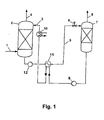
- Fig. 1 is a schematic representation of an apparatus suitable for carrying out the method according to the invention.
- a suitably pretreated, acid gas-containing gas is brought into contact with the regenerated absorption medium, which is supplied via the absorption medium line 3, in an absorber 2.
- the absorbent removes acid gases by absorption from the gas; In this case, an acid gas poor clean gas is obtained via an exhaust pipe 4.
- a pump 12 Via an absorption line 5, a pump 12, a solvent-solvent heat exchanger 11, in which the absorbent loaded with sour gas is heated with the heat of the emerging from the bottom of the desorption column 7, regenerated absorbent, and a throttle valve 6 is loaded with sour gas Absorbent fed to a desorption column 7.
- the loaded absorbent In the lower part of the desorption column 7, the loaded absorbent is heated and regenerated by means of a (not shown) Auffilers. The thus released acid gas leaves the desorption column 7 via the exhaust pipe 8.
- the regenerated absorbent is then heated by means of a pump 9 via the solvent-solvent heat exchanger 11, in which the regenerated absorbent heats the sour gas-laden absorbent and thereby cools, and a heat exchanger 10 of the absorption column 2 fed again.
- a 39 wt% (32.8 mol%) solution of methyldiethanolamine was prepared. Aliquots of 200 ml were mixed with 1% by weight of ortho-phosphoric acid (H 3 PO 4 ) or 1.2% by weight of 1-hydroxyethane-1,1-diphosphonic acid (HEDP).
- H 3 PO 4 ortho-phosphoric acid
- HEDP 1-hydroxyethane-1,1-diphosphonic acid
- the two solutions were loaded at 50 ° C at atmospheric pressure to equilibrium with H 2 S.
- the H 2 S equilibrium loading was determined by potentiometric titration against silver nitrate.
Landscapes
- Chemical & Material Sciences (AREA)
- Engineering & Computer Science (AREA)
- Analytical Chemistry (AREA)
- Chemical Kinetics & Catalysis (AREA)
- General Chemical & Material Sciences (AREA)
- Oil, Petroleum & Natural Gas (AREA)
- Environmental & Geological Engineering (AREA)
- Health & Medical Sciences (AREA)
- Biomedical Technology (AREA)
- Organic Chemistry (AREA)
- Gas Separation By Absorption (AREA)
- Organic Low-Molecular-Weight Compounds And Preparation Thereof (AREA)
Description
- Die vorliegende Erfindung betrifft ein Absorptionsmittel zum Entfernen von sauren Gasen aus Fluidströmen, insbesondere zum selektiven Entfernen von Schwefelwasserstoff aus Fluidströmen, und ein Verfahren zum Entfernen saurer Gase aus einem Fluidstrom.
- Die Entfernung von Sauergasen, wie z.B. CO2, H2S, SO2, CS2, HCN, COS oder Mercaptanen, aus Fluidströmen, wie Erdgas, Raffineriegas, Synthesegas, ist aus unterschiedlichen Gründen von Bedeutung. Der Gehalt an Schwefelverbindungen von Erdgas muss durch geeignete Aufbereitungsmaßnahmen unmittelbar an der Erdgasquelle reduziert werden, denn die Schwefelverbindungen bilden in dem vom Erdgas häufig mitgeführten Wasser Säuren, die korrosiv wirken. Für den Transport des Erdgases in einer Pipeline oder die Weiterverarbeitung in einer Erdgasverflüssigungsanlage (LNG = Liquified natural Gas) müssen daher vorgegebene Grenzwerte der schwefelhaltigen Verunreinigungen eingehalten werden. Die Verringerung des Gehalts an Kohlendioxid ist vielfach zur Einstellung eines vorgegebenen Brennwerts erforderlich.
- Zur Entfernung von Sauergasen werden Wäschen mit wässrigen Lösungen anorganischer oder organischer Basen eingesetzt. Beim Lösen von Sauergasen in dem Absorptionsmittel bilden sich mit den Basen Ionen. Das Absorptionsmittel kann durch Entspannen auf einen niedrigeren Druck und/oder Strippen regeneriert werden, wobei die ionischen Spezies zu Sauergasen zurück reagieren und/oder mittels Dampf abgestrippt werden. Nach dem Regenerationsprozess kann das Absorptionsmittel wiederverwendet werden.
- Ein Verfahren, bei dem alle sauren Gase, insbesondere CO2 und H2S, weitestgehend entfernt werden, wird auch als "Total-Absorption" bezeichnet. In bestimmten Fällen kann es dagegen wünschenswert sein, bevorzugt H2S vor CO2 zu absorbieren, um ein Brennwert-optimiertes CO2/H2S-Verhältnis für eine nachgeschaltete Claus-Anlage zu erhalten. In diesem Fall spricht man von einer "selektiven Wäsche". Ein ungünstiges CO2/H2S-Verhältnis kann die Leistung und Effizienz der Claus-Anlage durch Bildung von COS/CS2 und Verkokung des Claus-Katalysators oder durch einen zu geringen Heizwert beeinträchtigen.
- Tertiäre Amine, wie Methyldiethanolamin (MDEA), oder sterisch gehinderte Amine zeigen kinetische Selektivität für H2S gegenüber CO2. Diese Amine reagieren nicht direkt mit CO2; vielmehr wird CO2 in einer langsamen Reaktion mit dem Amin und mit Wasser zu Bicarbonat umgesetzt. Tertiäre Amine eignen sich daher insbesondere für eine selektive Entfernung von H2S aus Gasgemischen, die CO2 und H2S enthalten.
- Die Absorptionsrate von CO2 in wässrigen Lösungen von tertiären Alkanolaminen kann durch Zugabe weiterer Verbindungen, die als Aktivatoren oder Promotoren bezeichnet werden, erhöht werden. Eine der wirksamsten Absorptionsflüssigkeiten zur Entfernung von CO2 und H2S aus einem Gasstrom ist eine wässrige Lösung von Methyldiethanolamin (MDEA) und Piperazin als Promotor. Ein derartiges Absorptionsmittel ist bekannt aus der
US 4,336,233 . - Primäre Amine, wie Monoethanolamin (MEA), und sekundäre Amine, wie Diethanolamin (DEA) oder Diisopropanolamin (DIPA), können in einer schnelleren Reaktion direkt mit CO2 reagieren. Diese Amine zeigen eine deutlich geringere H2S-Selektivität. Aufgrund ihrer hohen Affinität für saure Gase können sie auch zur Wäsche von Gasströmen mit niedrigem Sauergas-Partialdruck verwendet werden. Mit der hohen Affinität für saure Gase korreliert allerdings eine hohe spezifische Regenerationsenergie.
- Die
EP-A 134 948 - Die
WO 2007/021531 offenbart Absorptionsmittel zur selektiven Entfernung unter Normalbedingungen gasförmiger saurer Komponenten aus Gemischen, die die gasförmigen sauren Komponenten und gasförmige nicht-saure Komponenten und CO2 enthalten. Die Absorptionsmittel umfassen ein über eine Alkylengruppe von wenigstens 2 Kettenatomen an den Aminstickstoff eines gehinderten sekundären oder tertiären Amins gebundenes Metallsulfonat, Metallsulfat, Metallsulfamat, Metallphosphonat, Metallphosphat, Metallphosphoramidit oder Metallcarboxylat. - Der Erfindung liegt die Aufgabe zugrunde, ein Verfahren und ein Absorptionsmittel zur Entfernung saurer Gase aus Fluidströmen anzugeben, das gegenüber Absorptionsmitteln auf der Basis von Aminen bzw. Amin/Promotor-Kombinationen einen verringerten Regenerationsenergiebedarf zeigt, ohne die Absorptionskapazität der Lösung für saure Gase wesentlich zu verringern.
- Die Aufgabe wird gelöst durch ein Absorptionsmittel zum Entfernen saurer Gase aus einem Fluidstrom, das eine wässrige Lösung
- a) wenigstens eines Amins und
- b) wenigstens einer organischen Phosphonsäure,
umfasst, wobei das molare Verhältnis von b) zu a) im Bereich von 0,0005 bis 0,1, vorzugsweise 0,01 bis 0,1, insbesondere 0,02 bis 0,09 liegt.
In bestimmten Ausführungsformen umfasst die wässrige Lösung außerdem - c) wenigstens eine Carbonsäure,
- Das erfindungsgemäße Absorptionsmittel enthält wenigstens eine organische Phosphonsäure.
- Geeignet sind beispielsweise Phosphonsäuren der Formel I
R-PO3H (I)
worin R für C1-C18-Alkyl steht, das gegebenenfalls durch bis zu vier Substituenten substituiert ist, die unabhängig ausgewählt sind unter Carboxy, Carboxamido, Hydroxy und Amino. - Hierzu zählen Alkylphosphonsäuren, wie Methylphosphonsäure, Propylphosphonsäure, 2-Methyl-propylphosphonsäure, t-Butylphosphonsäure, n-Butylphosphonsäure, 2,3-Dimethylbutylphosphonsäure, Oktylphosphonsäure; Hydroxyalkylphosphonsäuren, wie Hydroxymethylphosphonsäure, 1-Hydroxyethylphosphonsäure, 2-Hydroxyethylphosphonsäure; Arylphosphonsäuren wie Phenylphosphonsäure, Toluylphosphonsäure, Xylylphosphonsäure, Aminoalkylphosphonsäuren wie Aminomethylphosphonsäure, 1-Aminoethylphosphonsäure, 1-Dimethylaminoethylphosphonsäure, 2-Aminoethylphosphonsäure, 2-(N-Methylamino)ethylphosphonsäure, 3-Aminopropylphosphonsäure, 2-Aminopropylphosphonsäure, 1-Aminopropylphosphonsäure, 1-Aminopropyl-2-chlorpropylphosphonsäure, 2-Aminobutylphosphonsäure, 3-Aminobutylphosphonsäure, 1-Aminobutylphosphonsäure, 4-Aminobutylphosphonsäure, 2-Aminopentylphosphonsäure, 5-Aminopentylphosphonsäure, 2-Aminohexylphosphonsäure, 5-Aminohexyl phosphonsäure, 2-Aminooctylphosphonsäure, 1-Aminooctylphosphonsäure, 1-Aminobutylphosphonsäure; Amidoalkylphosphonsäuren wie 3-Hydroxymethylamino-3-oxopropylphosphonsäure; und Phosphonocarbonsäuren wie 2-Hydroxyphosphonoessigsäure und 2-Phosphonobutan-1,2,4-tricarbonsäure.
- Phosphonsäuren der Formel II

- Phosphonsäuren der Formel III

- Phosphonsäuren der Formel IV
R"-NY2 (IV)
worin R" für C1-6-Alkyl, C2-6-Hydroxyalkyl oder Y steht und Y für CH2PO3H2 steht, wie Nitrilo-tris(methylenphosphonsäure) und 2-Hydroxyethyliminobis(methylenphosphonsäure). - Unter den Phosphonsäuren sind 2-Hydroxyphosphonoessigsäure, 2-Phosphonobutan-1,2,4-tricarbonsäure, 1-Hydroxyethan-1,1-diphosphonsäure, Ethylendiamin-tetra-(methylenphosphonsäure), Diethylentriamin-penta(methylenphosphonsäure), Bis(hexamethylen)triamin-penta(methylenphosphonsäure) und Nitrilo-tris(methylenphosphonsäure), wovon 1-Hydroxyethan-1,1-diphosphonsäure besonders bevorzugt ist.
- Selbstverständlich können auch Gemische zweier oder mehrerer der vorstehend genannten Phosphonsäuren verwendet werden.
- Die Phosphonsäure wird vorzugsweise in Form der freien Säure zu der Lösung des Amins gegeben.
- Alternativ kann die Phosphonsäure in Form eines nicht-quatemären Ammoniumsalzes eingesetzt werden, d. h. als Ammoniumsalz (NH4 +-Salz) oder Salz eines primären, sekundären oder tertiären Ammoniumions. Unter den Bedingungen der Regeneration des Absorptionsmittels kann aus dem nicht-quaternären Ammoniumsalz die freie Säure freigesetzt werden. Geeignete Ammoniumsalze sind die protonierten Spezies der Amine, die als Komponente a) des Absorptionsmittels verwendet werden.
- In bestimmten Ausführungsformen enthält das erfindungsgemäße Absorptionsmittel außerdem wenigstens eine Carbonsäure. Im Allgemeinen weisen geeignete Carbonsäuren 1 bis 12 Kohlenstoffatome auf.
- Zu den geeigneten Carbonsäuren zählen
aliphatische Monocarbonsäuren, wie Methansäure (Ameisensäure), Ethansäure (Essigsäure), Propansäure (Propionsäure), Buttersäure;
aromatische Monocarbonsäuren, wie Benzoesäure, Phenylethansäure, Salicylsäure;
aliphatische Di- und Oligocarbonsäuren, wie Ethandisäure (Oxalsäure), Propandisäure (Malonsäure), Butandisäure, Pentandisäure;
aromatische Di- und Oligocarbonsäuren, wie 1,2-, 1,3-, 1,4-Benzoldicarbonsäure;
Aminocarbonsäuren, wie Glycin, N,N-Dimethylglycin, Alanin, N-Methylalanin;
Hydroxycarbonsäuren, wie Glykolsäure, Milchsäure, Äpfelsäure, Weinsäure, Citronensäure. - Das erfindungsgemäße Absorptionsmittel ist vorzugsweise im Wesentlichen frei von Metallsalzen.
- Das erfindungsgemäße Absorptionsmittel enthält wenigstens ein Amin. Das Amin verfügt nicht über saure Gruppen, wie insbesondere Phosphonsäure-, Sulfonsäure - und/oder Carbonsäuregruppen. Zu den geeigneten Aminen zählen insbesondere:
- 1. Alkanolamine (Aminoalkohole) wie
2-Aminoethanol (Monoethanolamin, MEA), N,N-Bis(2-hydroxyethyl)amin (Diethanolamin, DEA), N,N-Bis(2-hydroxypropyl)amin (Diisopropanolamin, DIPA), Tris(2-hydroxyethyl)amin (Triethanolamin, TEA), Tributanolamin, Bis(2-hydroxyethyl)-methylamin (Methyldiethanolamin, MDEA), 2-Diethylaminoethanol (Diethylethanolamin, DEEA), 2-Dimethylaminoethanol (Dimethylethanolamin, DMEA), 3-Dimethylamino-1-propanol (N,N-Dimethylpropanolamin), 3-Diethylamino-1-propanol, 2-Diisopropylaminoethanol (DIEA), N,N-Bis(2-hydroxypropyl)methylamin (Methyldiisopropanolamin, MDIPA), 2-Amino-2-methyl-1-propanol (AMP), 1-Amino-2-methyl-propan-2-ol, 2-Amino-1-butanol (2-AB); - 2. Aminoether wie
2-(2-Aminoethoxy)ethanol (AEE), 2-(2-tert-Butylaminoethoxy)ethanol (EETB), 3-Methoxypropyldimethylamin; - 3. 5-, 6- oder 7-gliedrigen gesättigten Heterocyclen mit wenigstens einer NH-Gruppe im Ring, die ein oder zwei weitere, unter Stickstoff und Sauerstoff ausgewählte Heteroatome im Ring enthalten können,
wie Piperazin, 2-Methylpiperazin, N-Methylpiperazin, N-Ethylpiperazin, N-Aminoethylpiperazin, N-Hydroxyethylpiperazin, Homopiperazin, Piperidin und Morpholin; - 4. Polyamine, z. B.
- 4.1 Alkylendiamine der Formel
H2N-R2-NH2,
worin R2 für C2-C6-Alkylen steht,
wie Hexamethylendiamin, 1,4-Diaminobutan, 1,3-Diaminopropan, 2,2-Dimethyl-1,3-diaminopropan, - 4.2 Alkylendiamine der Formel
R1-NH-R2-NH2
worin R1 für C1-C6-Alkyl oder C1-C6-Hydroxyalkyl steht und R2 für C2-C6-Alkylen steht,
wie 3-Methylaminopropylamin, N-(2-Hydroxyethyl)ethylendiamin, - 4.3 Alkylendiamine der Formel
(R1)2N-R2-NH2
worin R1 für C1-C6-Alkyl oder C1-C6-Hydroxyalkyl steht und R2 für C2-C6-Alkylen steht,
wie 3-(Dimethylamino)propylamin (DMAPA) und 3-(Diethylamino)propylamin, - 4.4 Alkylendiamine der Formel
R1-NH-R2-NH-R1
worin R1 für C1-C6-Alkyl oder C1-C6-Hydroxyalkyl steht und R2 für C2-C6-Alkylen steht,
wie N,N'-Bis(2-hydroxyethyl)ethylendiamin, - 4.5 Bistertiäre Diamine wie
N,N,N',N'-Tetramethylethylendiamin, N,N-Diethyl-N',N'-dimethylethylendiamin, N,N,N',N'-Tetraethylethylendiamin, N,N,N',N'-Tetramethyl-1,3-propandiamin (TMPDA), N,N,N',N'-Tetraethyl-1,3-propandiamin (TEPDA), N,N-Dimethyl-N',N'-diethylethylen-diamin (DMDEEDA), 1-Dimethylamino-2-dimethylaminoethoxyethan (Bis[2-(dimethyl-amino)ethyl]ether); - 4.6 Polyalkylenpolyamine
wie Diethylentriamin, Triethylentetramin und Tetraethylenpentamin, Tris(3-amino-propyl)amin, Tris(2-aminoethyl)amin;
und Gemische davon.
- 4.1 Alkylendiamine der Formel
- Alkanolamine, d. h. Amine mit wenigstens einer an das Stickstoffatom gebundenen Hydroxyalkylgruppe, sind im Allgemeinen bevorzugt.
- In einer Ausführungsform umfasst das Absorptionsmittel ausschließlich Amine mit ausschließlich tertiären und/oder sterisch gehinderten Aminogruppen. Das Absorptionsmittel dieser Ausführungsform eignet sich besonders zur selektiven Entfernung von H2S.
- Unter "sterisch gehinderten Aminogruppen" werden vorliegend verstanden
- (i) eine primäre Aminogruppe, die an ein tertiäres Kohlenstoffatom gebunden ist,
- (ii) eine Aminogruppe, die an ein sekundäres oder tertiäres Kohlenstoffatom gebunden ist, und
- (iii) eine Aminogruppe, wobei ein tertiäres oder quartäres Kohlenstoffatom in β-Position zur Aminogruppe angeordnet ist.
- Bevorzugte Amine mit ausschließlich tertiären Aminogruppen sind Tris(2-hydroxyethyl)amin (Triethanolamin, TEA), Tris(2-hydroxypropyl)amin (Triisopropanol), Tributanolamin, Bis(2-hydroxyethyl)-methylamin (Methyldiethanolamin, MDEA), 2-Diethylaminoethanol (Diethylethanolamin, DEEA), 2-Dimethylaminoethanol (Dimethylethanolamin, DMEA), 3-Dimethylamino-1-propanol, 3-Diethylamino-1-propanol, 2-Diisopropylaminoethanol (DIEA), N,N-Bis(2-hydroxypropyl)methylamin (Methyldiisopropanolamin, MDIPA).
- Bevorzugte Amine mit ausschließlich sterisch gehinderten Aminogruppen sind 2-Amino-2-methyl-1-propanol (AMP) und 1-Amino-2-methylpropan-2-ol.
- In einer anderen Ausführungsform umfasst das Absorptionsmittel wenigstens ein Amin mit ausschließlich tertiären und/oder sterisch gehinderten Aminogruppen und wenigstens einen Aktivator. Der Aktivator ist üblicherweise ein primäres oder sekundäres Amin und beschleunigt die Kohlendioxid-Aufnahme durch intermediäre Bildung einer Carbamatstruktur. Das Absorptionsmittel dieser Ausführungsform eignet sich besonders zur energiesparenden, unselektiven Entfernung von Sauergasen. Im Fall der totalen Absorption wird mindestens eine der beiden Komponenten H2S oder CO2 spezifiziert, wobei die andere entsprechend ihres Gleichgewichts am Absorberkopf abgereichert wird. Es kann auch vorkommen, dass für ein der beiden Sauergaskomponenten eine maximale Austrittsspezifikation festgesetzt wird.
- Beispiele bevorzugter Amine mit ausschließlich tertiären und/oder sterisch gehinderten Aminogruppen sind die vorstehend genannten.
- Beispiele bevorzugter Aktivatoren sind Piperazin, 2-Methylpiperazin, N-Methylpiperazin, N-Hydroxyethylpiperazin, Homopiperazin, Piperidin, Morpholin, 3-Methylaminopropylamin und 2-(2-Aminoethoxy)ethanol.
- In einer anderen Ausführungsform umfasst das Absorptionsmittel wenigstens ein (nicht sterisch gehindertes) primäres und/oder sekundäres Amin. Das Absorptionsmittel dieser Ausführungsform eignet sich besonders zur energiesparenden, unselektiven Entfernung von Sauergasen bei niedrigen Sauergaspartialdrücken.
- Beispiele bevorzugter primärer und/oder sekundärer Amine sind 2-Aminoethanol (Monoethanolamin, MEA), N,N-Bis(2-hydroxyethyl)amin (Diethanolamin, DEA), N,N-Bis(2-hydroxypropyl)amin (Diisopropanolamin, DIPA).
- Im Allgemeinen enthält die wässrige Lösung 2 bis 5 kmol / m3, insbesondere 3,5 bis 4,5 kmol / m3 Amin.
- Das Absorptionsmittel kann auch Additive, wie Korrosionsinhibitoren, Enzyme etc. enthalten. Im Allgemeinen liegt die Menge an derartigen Additiven im Bereich von etwa 0,01-3 Gew.-% des Absorptionsmittels.
- Die Erfindung betrifft außerdem ein Verfahren zum Entfernen saurer Gase aus einem Fluidstrom, bei dem man den Fluidstrom mit dem oben definierten Absorptionsmittel in Kontakt bringt.
- In der Regel regeneriert man das beladene Absorptionsmittel durch
- a) Erwärmung,
- b) Entspannung,
- c) Strippen mit einem inerten Fluid
- Das erfindungsgemäße Verfahren bzw. Absorptionsmittel ist geeignet zur Behandlung von Fluiden, insbesondere Gasströmen aller Art. Bei den sauren Gasen handelt es sich insbesondere um CO2, H2S, aber auch COS und Mercaptane. Außerdem können auch SO3, SO2, CS2 und HCN entfernt werden. Fluide, welche die sauren Gase enthalten, sind einerseits Gase, wie Erdgas, Synthesegas, Koksofengas, Spaltgas, Kohlevergasungsgas, Kreisgas, Deponiegase und Verbrennungsgase, und andererseits mit dem Absorptionsmittel im Wesentlichen nicht mischbare Flüssigkeiten, wie LPG (Liquefied Petroleum Gas) oder NGL (Natural Gas Liquids). Das erfindungsgemäße Verfahren bzw. Absorptionsmittel ist besonders zur Behandlung von kohlenwasserstoffhaltigen Fluidströmen geeignet. Die enthaltenen Kohlenwasserstoffe sind z. B. aliphatische Kohlenwasserstoffe, wie C1-C4-Kohlenwasserstoffe, wie Methan, ungesättigte Kohlenwasserstoffe, wie Ethylen oder Propylen, oder aromatische Kohlenwasserstoffe wie Benzol, Toluol oder Xylol. Das erfindungsgemäße Verfahren bzw. Absorptionsmittel ist besonders zur Entfernung von CO2 und H2S geeignet.
- In bevorzugten Ausführungsformen ist der der Fluidstrom ein
- (i) Wasserstoff enthaltender Fluidstrom oder ein Wasserstoff und Kohlendioxid enthaltender Fluidstrom; hierzu zählen Synthesegase, die z. B. durch Kohlevergasung oder Steamreforming herstellbar sind und gegebenenfalls einer Wassergas-Shift-Reaktion unterzogen sind; die Synthesegase werden z. B. zur Herstellung von Ammoniak, Methanol, Formaldehyd, Essigsäure, Harnstoff, zur Fischer-Tropsch-Synthese oder zur Energiegewinnung in einem Integrated Gasification Combined Cycle (IGCC) Prozess verwendet
- (ii) Kohlenwasserstoffe enthaltender Fluidstrom; hiezu zählen neben Erdgas Abgase verschiedener Raffinerieprozesse, wie der Tailgas Unit (TGU), eines Visbreakers (VDU), eines katalytischen Crackers (LRCUU/FCC), eines Hydrocrackers (HCU), eines Hydrotreaters (HDS/HTU), eines Cokers (DCU), einer Atmosphärischen Destillation (CDU) oder eines Liquid Treaters (z. B. LPG).
- Das erfindungsgemäße Verfahren eignet sich zur selektiven Entfernung von Schwefelwasserstoff gegenüber CO2. Unter "selektiver Entfernung von Schwefelwasserstoff" wird verstanden, dass die folgende Ungleichung erfüllt ist

worin c(H2S)feed die Konzentration von H2S im Ausgangsfluid, c(H2S)treat die Konzentration im behandelten Fluid, c(CO2)feed die Konzentration von CO2 im Ausgangsfluid und c(CO2)treat die Konzentration von CO2 im behandelten Fluid bedeuten. - Die selektive Entfernung von H2S s ist z. B. von Vorteil a) zur Einhaltung einer vorgegeben H2S Spezifikationen, wenn die maximale Sauergas-Gesamtbeladbarkeit des Absorptionsmittels bereits erreicht ist und b) zur Einstellung eines höheren H2S/CO2-Verhältnisses im Sauergasstrom, der bei der Regeneration des Absorptionsmittels freigesetzt wird und der typischerweise in eine Claus-Anlage gefahren wird. Ein Sauergasstrom mit höherem H2S/CO2-Verhältnis weist einen höheren Brennwert auf und unterdrückt die Bildung von COS (aus CO2), welches die Laufzeit des Claus-Katalysators beeinträchtigt.
- Im erfindungsgemäßen Verfahren wird das an sauren Gasbestandteilen reiche Ausgangsfluid (Rohgas) in einem Absorptionsschritt in einem Absorber in Kontakt mit dem Absorptionsmittel gebracht, wodurch die sauren Gasbestandteile zumindest teilweise ausgewaschen werden.
- Als Absorber fungiert vorzugsweise eine in üblichen Gaswäscheverfahren eingesetzte Waschvorrichtung. Geeignete Waschvorrichtungen sind beispielsweise Füllkörper, Packungs- und Bodenkolonnen, Membrankontaktoren, Radialstromwäscher, Strahlwäscher, Venturi-Wäscher und Rotations-Sprühwäscher, bevorzugt Packungs-, Füllkörper- und Bodenkolonnen, besonders bevorzugt Boden- und Füllkörperkolonnen. Die Behandlung des Fluidstroms mit dem Absorptionsmittel erfolgt dabei bevorzugt in einer Kolonne im Gegenstrom. Das Fluid wird dabei im Allgemeinen in den unteren Bereich und das Absorptionsmittel in den oberen Bereich der Kolonne eingespeist. In Bodenkolonnen sind Sieb-, Glocken- oder Ventilböden eingebaut, über welche die Flüssigkeit strömt. Füllkörperkolonnen können mit unterschiedlichen Formkörpern gefüllt werden. Wärme- und Stoffaustausch werden durch die Vergrößerung der Oberfläche aufgrund der meist etwa 25 bis 80 mm großen Formkörper verbessert. Bekannte Beispiele sind der Raschig-Ring (ein Hohlzylinder), Pall-Ring, Hiflow-Ring, Intalox-Sattel und dergleichen. Die Füllkörper können geordnet, aber auch regellos (als Schüttung) in die Kolonne eingebracht werden. Als Materialien kommen in Frage Glas, Keramik, Metall und Kunststoffe. Strukturierte Packungen sind eine Weiterentwicklung der geordneten Füllkörper. Sie weisen eine regelmäßig geformte Struktur auf. Dadurch ist es bei Packungen möglich, Druckverluste bei der Gasströmung zu reduzieren. Es gibt verschiedene Ausführungen von Packungen z. B. Gewebe- oder Blechpackungen. Als Material können Metall, Kunststoff, Glas und Keramik eingesetzt werden.
- Die Temperatur des Absorptionsmittels beträgt im Absorptionsschritt im Allgemeinen etwa 30 bis 100 °C, bei Verwendung einer Kolonne beispielsweise 30 bis 70 °C am Kopf der Kolonne und 50 bis 100 °C am Boden der Kolonne. Der Gesamtdruck beträgt im Absorptionsschritt im Allgemeinen etwa 1 bis 120 bar, bevorzugt etwa 10 bis 100 bar.
- Es wird ein an sauren Gasbestandteilen armes, d. h. ein an diesen Bestandteilen abgereichertes Produktgas (Reingas) und ein mit sauren Gasbestandteilen beladenes Absorptionsmittel erhalten. Das erfindungsgemäße Verfahren kann einen oder mehrere, insbesondere zwei, aufeinander folgende Absorptionsschritte umfassen. Die Absorption kann in mehreren aufeinander folgenden Teilschritten durchgeführt werden, wobei das die sauren Gasbestandteile enthaltende Rohgas in jedem der Teilschritte mit jeweils einem Teilstrom des Absorptionsmittels in Kontakt gebracht wird. Das Absorptionsmittel, mit dem das Rohgas in Kontakt gebracht wird, kann bereits teilweise mit sauren Gasen beladen sein, d. h. es kann sich beispielsweise um ein Absorptionsmittel, das aus einem nachfolgenden Absorptionsschritt in den ersten Absorptionsschritt zurückgeführt wurde, oder um teilregeneriertes Absorptionsmittel handeln. Bezüglich der Durchführung der zweistufigen Absorption wird Bezug genommen auf die Druckschriften
EP-A 0 159 495 ,EP-A 0 190 434 ,EP-A 0 359 991 undWO 00100271 - Gemäß einer bevorzugten Ausführungsform wird das erfindungsgemäße Verfahren so durchgeführt, dass das die sauren Gase enthaltende Fluid zunächst in einem ersten Absorptionsschritt mit dem Absorptionsmittel bei einer Temperatur von 40 bis100 °C, bevorzugt 50 bis 90 °C und insbesondere 60 bis 90 °C behandelt wird. Das an sauren Gasen abgereicherte Fluid wird dann in einem zweiten Absorptionsschritt mit dem Absorptionsmittel bei einer Temperatur von 30 bis 90 °C, bevorzugt 40 bis 80 °C und insbesondere 50 bis 80 °C, behandelt. Dabei ist die Temperatur um 5 bis 20 °C niedriger als in der ersten Absorptionsstufe.
- Aus dem mit den sauren Gasbestandteilen beladenen Absorptionsmittel können die sauren Gasbestandteile in üblicher Weise (analog zu den nachfolgend zitierten Publikationen) in einem Regenerationsschritt freigesetzt werden, wobei ein regeneriertes Absorptionsmittel erhalten wird. Im Regenerationsschritt wird die Beladung des Absorptionsmittels verringert und das erhaltene regenerierte Absorptionsmittel wird vorzugsweise anschließend in den Absorptionsschritt zurückgeführt.
- Im Allgemeinen beinhaltet der Regenerationsschritt mindestens eine Druckentspannung des beladenen Absorptionsmittels von einem hohen Druck, wie er bei der Durchführung des Absorptionsschritts herrscht, auf einen niedrigeren Druck. Die Druckentspannung kann beispielsweise mittels eines Drosselventils und/oder einer Entspannungsturbine geschehen. Die Regeneration mit einer Entspannungsstufe ist beispielsweise beschrieben in den Druckschriften
US 4,537, 753 undUS 4,553, 984 . - Die Freisetzung der sauren Gasbestandteile im Regenerationsschritt kann beispielsweise in einer Entspannungskolonne, z. B. einem senkrecht oder waagerecht eingebauten Flash-Behälter oder einer Gegenstromkolonne mit Einbauten, erfolgen.
- Bei der Regenerationskolonne kann es sich ebenfalls um eine Füllkörper-, Packungs - oder Bodenkolonne handeln. Die Regenerationskolonne weist am Sumpf einen Aufheizer auf, z. B. einen Zwangsumlaufverdampfer mit Umwälzpumpe. Am Kopf weist die Regenerationskolonne einen Auslass für die freigesetzten Sauergase auf. Mitgeführte Absorptionsmitteldämpfe werden in einem Kondensator kondensiert und in die Kolonne zurückgeführt.
- Es können mehrere Entspannungskolonnen hintereinander geschaltet werden, in denen bei unterschiedlichen Drücken regeneriert wird. Beispielsweise kann in einer Vorentspannungskolonne bei hohem Druck, der typischerweise etwa 1,5 bar oberhalb des Partialdrucks der sauren Gasbestandteile im Absorptionsschritt liegt, und in einer Hauptentspannungskolonne bei niedrigem Druck, beispielsweise 1 bis 2 bar absolut, regeneriert werden. Die Regeneration mit zwei oder mehr Entspannungsstufen ist beschrieben in den Druckschriften
US 4,537, 753 ,US 4,553, 984 ,EP-A 0 159 495 ,EP-A 0 202 600 ,EP-A 0 190 434 undEP-A 0 121 109 . - Eine Verfahrensvariante mit zwei Niederdruckentspannungsstufen (1 bis 2 bar absolut), bei der die in der ersten Niederdruckentspannungsstufe teilregenerierte Absorptionsflüssigkeit erwärmt wird, und bei der gegebenenfalls vor der ersten Niederdruckentspannungsstufe eine Mitteldruckentspannungsstufe vorgesehen wird, bei der auf mindestens 3 bar entspannt wird, ist in
DE 100 28 637 beschrieben. Dabei wird die beladene Absorptionsflüssigkeit zunächst in einer ersten Niederdruckentspannungsstufe auf einen Druck von 1 bis 2 bar (absolut) entspannt. Anschließend wird die teilregenerierte Absorptionsflüssigkeit in einem Wärmetauscher erwärmt und dann in einer zweiten Niederdruckentspannungsstufe erneut auf einen Druck von 1 bis 2 bar (absolut) entspannt. - Die letzte Entspannungsstufe kann auch unter Vakuum durchgeführt werden, das beispielsweise mittels eines Wasserdampfstrahlers, gegebenenfalls in Kombination mit einem mechanischen Vakuumerzeugungsapparat, erzeugt wird, wie beschrieben in
EP-A 0 159 495 ,EP-A 0 202 600 ,EP-A 0 190 434 undEP-A 0 121 109 (US 4,551,158 ). - Wegen der optimalen Abstimmung des Gehalts an den Aminkomponenten weist das erfindungsgemäße Absorptionsmittel eine hohe Beladbarkeit mit sauren Gasen auf, die auch leicht wieder desorbiert werden können. Dadurch können bei dem erfindungsgemäßen Verfahren der Energieverbrauch und der Lösungsmittelumlauf signifikant reduziert werden.
- Die Erfindung wird anhand der beigefügten Zeichnung und des nachfolgenden Beispiels näher veranschaulicht.
-
Fig. 1 ist eine schematische Darstellung einer zur Durchführung des erfindungsgemäßen Verfahrens geeigneten Anlage. - Gemäß
Fig. 1 wird über eine Zuleitung 1 ein geeignet vorbehandeltes, sauergase enthaltendes Gas in einem Absorber 2 mit dem regenerierten Absorptionsmittel, das über die Absorptionsmittelleitung 3 zugeführt wird, im Gegenstrom in Kontakt gebracht. Das Absorptionsmittel entfernt Sauergase durch Absorption aus dem Gas; dabei wird über eine Abgasleitung 4 ein an Sauergasen armes Reingas gewonnen. - Über eine Absorptionsmittelleitung 5, eine Pumpe 12, einen Solvent-Solvent-Wärmetauscher 11, in dem das mit Sauergas beladene Absorptionsmittel mit der Wärme des aus dem Sumpf der Desorptionskolonne 7 austretenden, regenerierten Absorptionsmittels aufgeheizt wird, und ein Drosselventil 6 wird das mit Sauergas beladene Absorptionsmittel einer Desorptionskolonne 7 zugeleitet. Im unteren Teil der Desorptionskolonne 7 wird das beladene Absorptionsmittel mittels eines (nicht dargestellten) Aufheizers erwärmt und regeneriert. Das dabei freigesetzte Sauergas verlässt die Desorptionskolonne 7 über die Abgasleitung 8. Das regenerierte Absorptionsmittel wird anschließend mittels einer Pumpe 9 über den Solvent-Solvent-Wärmetauscher 11, in dem das regenerierte Absorptionsmittel das mit Sauergas beladenen Absorptionsmittel aufheizt und selbst dabei abkühlt, und einen Wärmetauscher 10 der Absorptionskolonne 2 wieder zugeführt.
- Man stellte eine 39 Gew.-%ige (32,8 mol-%) Lösung von Methyldiethanolamin her. Aliquote von 200 ml wurden mit 1 Gew.-% Ortho-Phosphorsäure (H3PO4) bzw. 1,2 Gew.-% 1-Hydroxyethan-1,1-diphosphonsäure (HEDP) versetzt.
- Die beiden Lösungen wurden bei 50 °C bei Normaldruck bis zum Gleichgewicht mit H2S beladen. Die H2S-Gleichgewichtsbeladung wurde durch potentiometrische Titration gegen Silbernitrat bestimmt.
- Anschließend wurden die Lösungen zur Simulation des Regenerationsvorgangs in einem Erlenmeyerkolben mit aufgesetztem Rückflusskühler in einem Ölbad bei konstant 100 °C aufgekocht. Dabei wurde jeweils 10 NI/h Stickstoffgas durch die Flüssigkeit geperlt, um den Austausch zwischen Gas- und Flüssigphase zu verbessern und das freigesetzte H2S über den Kühler zu entfernen.
- Nach bestimmten Zeitintervallen wurden jeweils Proben von 20 ml entnommen und der H2S-Gehalt erneut durch potentiometrische Titration gegen Silbernitrat bestimmt. Die Ergebnisse sind in der nachstehenden Tabelle zusammengefasst.
Beispiel 1 2 Promotor H3PO4 HEDP H2S-Gleichgewichtsbeladung bei 50 °C (Nm3]H2s/t 46,9 46,8 H2S-Beladung bezogen auf Ausgangswert [%] nach 0 min 100,0 100,0 15 min 40,5 18,7 45 min 14,2 6,7 105 min 3,9 1,6 225 min 1,3 0 405 min 0,4 0 - Aus den Versuchsergebnissen ist ersichtlich, dass eine Regeneration auf eine vorgegebene Restbeladung (z. B. weniger als 2 %) im Beispiel 2 (mit HEDP) schneller erzielt wird als im Vergleichsbeispiel 1. Da in der gewählten Versuchsanordnung der Energieeintrag dem Produkt des konstanten Wärmestroms und der Zeit proportional ist, ist die erforderliche Regenerationsenergie im Beispiel 2 deutlich geringer.
- Man stellte eine wässrige Lösung von 37 Gew.-% MDEA + 3Gew.-% Piperazin (Gesamtaminkonzentration 40 Gew.-%; 33,3 mol-%) her (so genanntes aktiviertes MDEA). Ein Aliquot von 200 ml wurde mit 1,2 Gew.-% (0,6 mol-%) 1-Hydroxyethan-1,1-diphosphonsäure (HEDP) versetzt. Ein weiteres Aliquot diente als Kontrolle.
- Es wurden zwei Versuchsreihen durchgeführt. Bei der ersten Reihe wurden die Lösungen bei 50 °C bei Normaldruck bis zum Gleichgewicht mit CO2 beladen, bei der zweiten Versuchsreihe bei 70 °C. Die CO2-Gleichgewichtsbeladung wurde durch Titration mit KOH bestimmt.
- Anschließend wurden die Lösungen zur Simulation des Regenerationsvorgangs in einem Erlenmeyerkolben mit aufgesetztem Rückflusskühler in einem Ölbad bei konstant 100 °C aufgekocht. Dabei wurde jeweils 10 Nl/h Stickstoffgas durch die Flüssigkeit geperlt, um den Austausch zwischen Gas- und Flüssigphase zu verbessern und das freigesetzte CO2 über den Kühler zu entfernen.
- Nach bestimmten Zeitintervallen wurden jeweils Proben von 20 ml entnommen und der CO2-Gehalt erneut durch Titration mit KOH bestimmt. Die Ergebnisse sind in der nachstehenden Tabelle zusammengefasst.
Beispiel 3 (50 °C) 4 (50 °C) 5 (70 °C) 6 (70 °C) Promotor - HEDP - HEDP CO2-Gleichgewichtsbeladung [Nm3]CO2/t 43,5 43,0 26,4 25,6 CO2-Beladung bezogen auf Ausgangswert [%] nach 0 min 100,0 100,0 100,0 100,0 15 min 12,7 11,2 29,9 22,3 45 min 4,4 4,9 7,3 3,6 105 min 1,8 0,7 2,6 0,7 225 min 0,9 0,4 1,2 0,5 405 min 0,9 0,7 0,8 0,6 - Aus den Versuchsergebnissen ist ersichtlich, dass eine Regeneration auf eine vorgegebene Restbeladung (z. B. weniger als 2 %) in den Beispielen 4 und 6 (mit HEDP) schneller erzielt wird als in den Vergleichsbeispielen 3 und 5. Da in der gewählten Versuchsanordnung der Energieeintrag dem Produkt des konstanten Wärmestroms und der Zeit proportional ist, ist die erforderliche Regenerationsenergie in den Beispielen 4 und 6 deutlich geringer.
Claims (17)
- Absorptionsmittel zum Entfernen saurer Gase aus einem Fluidstrom, umfassend eine wässrige Lösunga) wenigstens eines Amins undb) wenigstens einer organischen Phosphonsäure,wobei das molare Verhältnis von b) zu a) im Bereich von 0,0005 bis 0,1 liegt.
- Absorptionsmittel nach Anspruch 1, wobei das molare Verhältnis von b) zu a) im Bereich von 0,01 bis 0,1 liegt.
- Absorptionsmittel nach Anspruch 1 oder 2, wobei die Phosphonsäure ausgewählt ist unter
Phosphonsäuren der Formel I
R-PO3H (I)
worin R für C1-C18-Alkyl steht, das gegebenenfalls durch bis zu vier Substituenten substituiert ist, die unabhängig ausgewählt sind unter Carboxy, Carboxamido, Hydroxy und Amino,
Phosphonsäuren der Formel II
Phosphonsäuren der Formel III
Phosphonsäuren der Formel IV
R"-NY2 (IV)
worin R" für C1-6-Alkyl, C2-6-Hydroxyalkyl oder Y steht und Y für CH2PO3H2 steht; oder Gemischen zweier oder mehrerer davon. - Absorptionsmittel nach Anspruch 3, wobei die Phosphonsäure 1-Hydroxyethan-1,1-diphosphonsäure umfasst.
- Absorptionsmittel nach einem der vorhergehenden Ansprüche, wobei die wässrige Lösung außerdem umfasstc) wenigstens eine Carbonsäure,wobei das molare Verhältnis von c) zu a) im Bereich von 0,0005 bis 0,1 liegt.
- Absorptionsmittel nach einem der vorhergehenden Ansprüche, wobei das Amin wenigstens ein Alkanolamin umfasst.
- Absorptionsmittel nach einem der vorhergehenden Ansprüche, wobei das Amin ausschließlich Amine mit ausschließlich tertiären und/oder sterisch gehinderten Aminogruppen umfasst.
- Absorptionsmittel nach einem der Ansprüche 1 bis 6, wobei das Amin wenigstens ein Amin mit ausschließlich tertiären und/oder sterisch gehinderten Aminogruppen und wenigstens einen Aktivator umfasst.
- Absorptionsmittel nach Anspruch 7 oder 8, wobei das Amin mit ausschließlich tertiären Aminogruppen ausgewählt ist unter Tris(2-hydroxyethyl)amin, Tris(2-hydroxypropyl)amin, Tributanolamin, Bis(2-hydroxyethyl)-methylamin, 2-Diethylaminoethanol, 2-Dimethylaminoethanol, 3-Dimethylamino-1-propanol, 3-Diethyl-amino-1-propanol, 2-DÜsopropylaminoethanol und N,N-Bis(2-hydroxypropyl)-methylamin; und das Amin mit ausschließlich sterisch gehinderten Aminogruppen ausgewählt ist unter 2-Amino-2-methyl-1-propanol und 1-Amino-2-methylpropan-2-ol.
- Absorptionsmittel nach Anspruch 8, wobei der Aktivator ausgewählt ist unter Piperazin, 2-Methylpiperazin, N-Methylpiperazin, Homopiperazin, Piperidin, Morpholin, 3-Methylaminopropylamin und 2-(2-Aminoethoxy)ethanol.
- Absorptionsmittel nach einem der Ansprüche 1 bis 6, wobei das Amin wenigstens ein primäres und/oder sekundäres Amin umfasst.
- Absorptionsmittel nach Anspruch 11, wobei das primäre und/oder sekundäre Amin ausgewählt ist unter 2-Aminoethanol, N,N-Bis(2-hydroxyethyl)amin und N,N-Bis(2-hydroxypropyl)amin.
- Absorptionsmittel nach einem der vorhergehenden Ansprüche, wobei die wässrige Lösung 2 bis 5 kmol / m3 Amin enthält.
- Verfahren zum Entfernen saurer Gase aus einem Fluidstrom, bei dem man den Fluidstrom mit Absorptionsmittel nach einem der vorhergehenden Ansprüche in Kontakt bringt.
- Verfahren nach Anspruch 14, zur selektiven Entfernung von Schwefelwasserstoff.
- Verfahren nach Anspruch 14 oder 15, wobei der Fluidstrom Kohlenwasserstoffe enthält.
- Verfahren nach einem der Ansprüche 14 bis 16, wobei man das beladene Absorptionsmittel durcha) Erwärmung,b) Entspannung,c) Strippen mit einem inerten Fluidoder eine Kombination zweier oder aller dieser Maßnahmen regeneriert.
Priority Applications (2)
| Application Number | Priority Date | Filing Date | Title |
|---|---|---|---|
| EP10721454.6A EP2429686B1 (de) | 2009-05-12 | 2010-05-12 | Absorptionsmittel zum selektiven entfernen von schwefelwasserstoff aus fluidströmen |
| PL10721454T PL2429686T3 (pl) | 2009-05-12 | 2010-05-12 | Absorbent do selektywnego usuwania siarkowodoru ze strumieni płynów |
Applications Claiming Priority (3)
| Application Number | Priority Date | Filing Date | Title |
|---|---|---|---|
| EP09160039 | 2009-05-12 | ||
| EP10721454.6A EP2429686B1 (de) | 2009-05-12 | 2010-05-12 | Absorptionsmittel zum selektiven entfernen von schwefelwasserstoff aus fluidströmen |
| PCT/EP2010/056556 WO2010130787A1 (de) | 2009-05-12 | 2010-05-12 | Absorptionsmittel zum selektiven entfernen von schwefelwasserstoff aus fluidströmen |
Publications (2)
| Publication Number | Publication Date |
|---|---|
| EP2429686A1 EP2429686A1 (de) | 2012-03-21 |
| EP2429686B1 true EP2429686B1 (de) | 2013-07-17 |
Family
ID=42272085
Family Applications (1)
| Application Number | Title | Priority Date | Filing Date |
|---|---|---|---|
| EP10721454.6A Active EP2429686B1 (de) | 2009-05-12 | 2010-05-12 | Absorptionsmittel zum selektiven entfernen von schwefelwasserstoff aus fluidströmen |
Country Status (15)
| Country | Link |
|---|---|
| US (1) | US8221712B2 (de) |
| EP (1) | EP2429686B1 (de) |
| JP (1) | JP5665855B2 (de) |
| KR (1) | KR20120020167A (de) |
| CN (1) | CN102421507B (de) |
| AU (1) | AU2010247405B2 (de) |
| BR (1) | BRPI1011367A2 (de) |
| CA (1) | CA2760732C (de) |
| EA (1) | EA020754B1 (de) |
| ES (1) | ES2425429T3 (de) |
| PE (1) | PE20121040A1 (de) |
| PL (1) | PL2429686T3 (de) |
| UA (1) | UA106753C2 (de) |
| WO (1) | WO2010130787A1 (de) |
| ZA (1) | ZA201109017B (de) |
Families Citing this family (57)
| Publication number | Priority date | Publication date | Assignee | Title |
|---|---|---|---|---|
| MY154251A (en) | 2007-11-12 | 2015-05-29 | Exxonmobil Upstream Res Co | Methods of generating and utility gas |
| AU2009241530C1 (en) | 2008-04-30 | 2016-12-01 | Exxonmobil Upstream Research Company | Method and apparatus for removal of oil from utility gas stream |
| BRPI1012049A2 (pt) | 2009-05-26 | 2019-04-16 | Basf Se | "processo para remover dióxido de carbono de um fluido, e, instalação para remover dióxido de carbono de um fluido" |
| MY162263A (en) | 2010-05-28 | 2017-05-31 | Exxonmobil Upstream Res Co | Integrated adsorber head and valve design and swing adsorption methods related thereto |
| TWI495501B (zh) | 2010-11-15 | 2015-08-11 | Exxonmobil Upstream Res Co | 動力分餾器及用於氣體混合物之分餾的循環法 |
| EA201391249A1 (ru) | 2011-03-01 | 2014-02-28 | Эксонмобил Апстрим Рисерч Компани | Устройства и системы, имеющие узел поворотного клапана, и связанные с этим циклические адсорбционные процессы |
| BR112013017837A2 (pt) | 2011-03-01 | 2016-10-11 | Exxonmobil Upstream Res Co | aparelho e sistemas tendo múltiplos leitos de adsorção oscilante de configuração compacta e métodos relacionados com eles |
| MX336393B (es) | 2011-03-01 | 2016-01-18 | Exxonmobil Upstream Res Co | Aparatos y sistemas que tienen un contactor adsorbente encerrado y procesos de adsorcion oscilante relacionados con los mismos. |
| CA2990793C (en) | 2011-03-01 | 2019-04-09 | Exxonmobil Upstream Research Company | Methods of removing contaminants from a hydrocarbon stream by swing adsorption and related apparatus and systems |
| US8673059B2 (en) | 2011-03-01 | 2014-03-18 | Exxonmobil Research And Engineering Company | Rapid temperature swing adsorption contactors for gas separation |
| CA2842928A1 (en) | 2011-03-01 | 2012-11-29 | Exxonmobil Upstream Research Company | Apparatus and systems having a rotary valve assembly and swing adsorption processes related thereto |
| WO2012118757A1 (en) | 2011-03-01 | 2012-09-07 | Exxonmobil Upstream Research Company | Apparatus and systems having a reciprocating valve head assembly and swing adsorption processes related thereto |
| WO2012161826A1 (en) | 2011-03-01 | 2012-11-29 | Exxonmobil Upstream Research Company | Methods of removing contaminants from a hydrocarbon stream by swing adsorption and related apparatus and systems |
| US8529857B2 (en) | 2011-03-31 | 2013-09-10 | Basf Se | Retention of amines in the removal of acid gases by means of amine absorption media |
| US20130243677A1 (en) * | 2012-03-14 | 2013-09-19 | Exxonmobil Research And Engineering Company | Amine treating process for selective acid gas separation |
| FR2990879B1 (fr) | 2012-05-25 | 2014-09-26 | Total Sa | Procede de decarbonatation de fumees. |
| FR2990878B1 (fr) | 2012-05-25 | 2014-05-16 | Total Sa | Procede de purification de melanges gazeux contenant des gaz acides. |
| FR2990950B1 (fr) | 2012-05-25 | 2014-06-13 | Total Sa | Procede de purification d'une charge liquide d'hydrocarbures contenant des composes acides. |
| FR2990880B1 (fr) | 2012-05-25 | 2017-04-28 | Total Sa | Procede d'elimination selective du sulfure d'hydrogene de melanges gazeux et utilisation d'un thioalcanol pour l'elimination selective du sulfure d'hydrogene. |
| JP5868795B2 (ja) * | 2012-06-25 | 2016-02-24 | 株式会社東芝 | 酸性ガス吸収剤、酸性ガス除去方法および酸性ガス除去装置 |
| CA2870164C (en) * | 2012-06-29 | 2020-09-01 | Dow Global Technologies Llc | Aqueous alkanolamine solution and process for the removal of h2s from gaseous mixtures |
| US8808426B2 (en) | 2012-09-04 | 2014-08-19 | Exxonmobil Research And Engineering Company | Increasing scales, capacities, and/or efficiencies in swing adsorption processes with hydrocarbon gas feeds |
| US9034078B2 (en) | 2012-09-05 | 2015-05-19 | Exxonmobil Upstream Research Company | Apparatus and systems having an adsorbent contactor and swing adsorption processes related thereto |
| CN103043744B (zh) * | 2012-12-07 | 2014-06-11 | 常州大学 | 一种煤渣灰处理工业废水的方法 |
| FR2999449B1 (fr) * | 2012-12-13 | 2015-04-03 | IFP Energies Nouvelles | Procede d'elimination de composes acides d'un effluent gazeux par une solution absorbante a base de 1,2-bis(2-dimethylaminoethoxy)-ethane et d'un activateur |
| EP3027293A1 (de) * | 2013-07-29 | 2016-06-08 | ExxonMobil Research and Engineering Company | Abtrennung von schwefelwasserstoff aus erdgas |
| JP2016536389A (ja) | 2013-10-30 | 2016-11-24 | ダウ グローバル テクノロジーズ エルエルシー | 選択的h2s除去のための混成溶媒配合物 |
| EP3062912A1 (de) | 2013-10-30 | 2016-09-07 | Dow Global Technologies LLC | Hybridlösungsmittelformulierungen zur komplettentfernung von organischem schwefel und komplettentfernung von sauergas |
| FR3020965B1 (fr) * | 2014-05-16 | 2016-05-27 | Ifp Energies Now | Solution absorbante a base de diamines tertiaires beta hydroxylees et procede d'elimination de composes acides d'un effluent gazeux |
| US9533253B2 (en) | 2014-06-05 | 2017-01-03 | Phillips 66 Company | Amine solvent blends |
| CN105344205A (zh) * | 2014-08-20 | 2016-02-24 | 中国石油化工股份有限公司 | 一种能从含co2的混合气中选择性脱除h2s的吸收剂 |
| EA033527B1 (ru) * | 2014-08-25 | 2019-10-31 | Basf Se | Удаление диоксида углерода из потока текучей среды |
| WO2016030277A1 (de) * | 2014-08-25 | 2016-03-03 | Basf Se | Diamin mit tert-alkylamino- und primärer aminogruppe zur verwendung in der gaswäsche |
| EP2990090A1 (de) * | 2014-08-25 | 2016-03-02 | Basf Se | Absorptionsmittel zur selektiven Entfernung von Schwefelwasserstoff aus einem Fluidstrom |
| BR112017003871A2 (pt) | 2014-08-25 | 2018-01-23 | Basf Se | processo para remover sulfureto de hidrogênio e dióxido de carbono de uma corrente de fluido. |
| KR20160058296A (ko) * | 2014-11-14 | 2016-05-25 | (주)티피티퍼시픽 | 2-아미노 2-메틸 1-프로판올(amp)를 포함하는 산성가스 제거용 흡수제 조성물 및 이를 이용한 산성가스 제거방법 |
| WO2017040291A1 (en) | 2015-08-28 | 2017-03-09 | Serionix, Inc. | Gas filters for acidic contaminants |
| CN108136367A (zh) | 2015-08-28 | 2018-06-08 | 塞里奥尼克斯股份有限公司 | 用于碱性污染物的气体过滤器 |
| US10617993B2 (en) * | 2015-09-29 | 2020-04-14 | Basf Se | Absorbent for the selective removal of hydrogen sulfide |
| MX2018004013A (es) * | 2015-09-29 | 2018-05-23 | Basf Se | Agente de absorcion y un metodo para remover selectivamente sulfuro de hidrogeno. |
| CA3000274C (en) * | 2015-09-29 | 2023-08-01 | Basf Se | Cyclic amine for selectively removing hydrogen sulphide |
| CN105413396A (zh) * | 2015-10-21 | 2016-03-23 | 中石化节能环保工程科技有限公司 | 捕集尾气中co2的分层吸收剂 |
| AR107033A1 (es) * | 2015-12-09 | 2018-03-14 | Basf Se | Proceso y planta para enriquecimiento de gas ácido |
| EP3445474B1 (de) * | 2016-04-18 | 2020-03-18 | Basf Se | Vormischung zur herstellung eines absorptionsmittels zur entfernung von sauergasen aus einem fluidstrom |
| WO2018026517A1 (en) | 2016-08-04 | 2018-02-08 | Exxonmobil Research And Engineering Company | Increasing scales, capacities, and/or efficiencies in swing adsorption processes with hydrocarbon gas feeds |
| EP3624922B1 (de) * | 2017-05-15 | 2021-07-07 | Basf Se | Absorptionsmittel, herstellungsverfahren dafür und verfahren zur selektiven entfernung von schwefelwasserstoff mit seiner verwendung |
| US10940407B2 (en) | 2017-07-12 | 2021-03-09 | Baker Hughes Holdings Llc | Application of formaldehyde sulfoxylates for scavenging H2S |
| CN109276987B (zh) * | 2018-10-25 | 2022-01-25 | 中国石油化工股份有限公司 | 一种用于工业尾气脱硫脱硝处理的吸收剂 |
| WO2020174559A1 (ja) * | 2019-02-26 | 2020-09-03 | 三菱重工エンジニアリング株式会社 | オフガス処理装置及びこのオフガス処理装置を備える肥料製造プラント |
| US11229875B1 (en) | 2020-09-25 | 2022-01-25 | Ineos Americas, Llc | Scrubbing fluid and methods for using same |
| WO2022129977A1 (en) | 2020-12-17 | 2022-06-23 | Totalenergies Onetech | Method for recovering high purity carbon dioxide from a gas mixture |
| WO2022129975A1 (en) | 2020-12-17 | 2022-06-23 | Totalenergies Onetech | Method for the selective removal of hydrogen sulfide from a gas stream |
| CN113318586B (zh) * | 2021-06-09 | 2022-07-19 | 华东理工大学 | 一种胺类化合物在提高有机硫溶解和吸收脱除中的应用 |
| WO2023073389A1 (en) | 2021-10-26 | 2023-05-04 | Totalenergies Onetech | Method for the purification of a gas mixture comprising carbon dioxide and optionally hydrogen sulfide |
| CN115554955B (zh) * | 2022-10-08 | 2025-04-25 | 中建安装集团有限公司 | 一种连续化生产n,n-二甲基乙二胺的装置及工艺 |
| WO2025108960A1 (en) | 2023-11-22 | 2025-05-30 | Clariant International Ltd | Method and system for removing co2 gas from a gas stream |
| WO2026004775A1 (ja) * | 2024-06-28 | 2026-01-02 | 株式会社日本触媒 | 組成物および二酸化炭素吸収剤 |
Family Cites Families (26)
| Publication number | Priority date | Publication date | Assignee | Title |
|---|---|---|---|---|
| DE2551717C3 (de) | 1975-11-18 | 1980-11-13 | Basf Ag, 6700 Ludwigshafen | und ggf. COS aus Gasen |
| DE3236600A1 (de) | 1982-10-02 | 1984-04-05 | Basf Ag, 6700 Ludwigshafen | Verfahren zum entfernen von co(pfeil abwaerts)2(pfeil abwaerts) und gegebenenfalls h(pfeil abwaerts)2(pfeil abwaerts)s aus erdgasen |
| DE3308088A1 (de) | 1983-03-08 | 1984-09-27 | Basf Ag, 6700 Ludwigshafen | Verfahren zum entfernen von co(pfeil abwaerts)2(pfeil abwaerts) und/oder h(pfeil abwaerts)2(pfeil abwaerts)s aus gasen |
| EP0134948A3 (de) | 1983-06-30 | 1987-10-14 | Union Carbide Corporation | Absorbentformulierung zur verstärkten Entfernung saurer Gase aus Gasmischungen und Verfahren zu ihrer Verwendung |
| US4553984A (en) | 1984-03-06 | 1985-11-19 | Basf Aktiengesellschaft | Removal of CO2 and/or H2 S from gases |
| DE3408851A1 (de) | 1984-03-10 | 1985-09-12 | Basf Ag, 6700 Ludwigshafen | Verfahren zum entfernen von co(pfeil abwaerts)2(pfeil abwaerts) und/oder h(pfeil abwaerts)2(pfeil abwaerts)s aus gasen |
| DE3445063A1 (de) | 1984-12-11 | 1986-06-12 | Basf Ag, 6700 Ludwigshafen | Verfahren zum entfernen von co(pfeil abwaerts)2(pfeil abwaerts) und/oder h(pfeil abwaerts)2(pfeil abwaerts)s aus gasen |
| DE3518368A1 (de) | 1985-05-22 | 1986-11-27 | Basf Ag, 6700 Ludwigshafen | Verfahren zum entfernen von co(pfeil abwaerts)2(pfeil abwaerts) und/oder h(pfeil abwaerts)2(pfeil abwaerts)s aus gasen |
| US4892674A (en) * | 1987-10-13 | 1990-01-09 | Exxon Research And Engineering Company | Addition of severely-hindered amine salts and/or aminoacids to non-hindered amine solutions for the absorption of H2 S |
| DE3828227A1 (de) | 1988-08-19 | 1990-02-22 | Basf Ag | Verfahren zum entfernen von co(pfeil abwaerts)2(pfeil abwaerts) und gegebenenfalls h(pfeil abwaerts)2(pfeil abwaerts) aus gasen |
| JPH0615014B2 (ja) * | 1990-05-31 | 1994-03-02 | 京葉プラントエンジニアリング株式会社 | 炭酸ガス吸収プロセスにおける鋼材の腐食抑制方法 |
| CA2093901A1 (en) * | 1991-08-13 | 1993-02-14 | Dane Chang | Composition and method for simultaneous absorption of sulfur dioxide and nitric oxide |
| US5851265A (en) * | 1996-09-03 | 1998-12-22 | Monsanto Company | Selective removal and recovery of sulfur dioxide from effluent gases using organic phosphorous solvents |
| US6503420B1 (en) * | 1997-10-06 | 2003-01-07 | Fmc Corporation | Anti-corrosion solutions for air dehumidification systems |
| DE19828977A1 (de) | 1998-06-29 | 1999-12-30 | Basf Ag | Verfahren zur Entfernung saurer Gasbestandteile aus Gasen |
| DE10028637A1 (de) | 2000-06-09 | 2001-12-13 | Basf Ag | Verfahren zum Entsäuern eines Kohlenwasserstoff-Fluidstroms |
| DE102004011427A1 (de) * | 2004-03-09 | 2005-09-29 | Basf Ag | Absorptionsmittel mit verbesserter Oxidationsbeständigkeit und Verfahren zum Entsäuern von Fluidströmen |
| WO2006026784A1 (en) * | 2004-09-01 | 2006-03-09 | Applied Chemical Technologies, Inc. | Methods and compositions for paint removal |
| CN1299802C (zh) * | 2004-12-24 | 2007-02-14 | 茂名学院 | 脱除乙烯裂解气中酸性气体的工艺方法 |
| US8480795B2 (en) * | 2005-08-09 | 2013-07-09 | Exxonmobil Research And Engineering Company | Absorbent composition containing molecules with a hindered amine and a metal sulfonate, phosphonate or carboxylate structure for acid gas scrubbing process |
| FR2898284B1 (fr) * | 2006-03-10 | 2009-06-05 | Inst Francais Du Petrole | Procede de desacidification d'un gaz par solution absorbante avec regeneration fractionnee par chauffage. |
| DK2026896T3 (en) * | 2006-05-18 | 2016-11-28 | Basf Se | KULDIOXIDABSORPTIONSMIDDEL WITH REDUCED Regeneration ENERGY NEEDS |
| US20080056971A1 (en) * | 2006-08-30 | 2008-03-06 | Terry Hughes | System and process for treating gasification emission streams |
| CN101264411A (zh) * | 2008-04-23 | 2008-09-17 | 顾泽元 | 一种脱硫溶剂 |
| US8361426B2 (en) | 2008-06-23 | 2013-01-29 | Basf Se | Absorption medium and method for removing sour gases from fluid streams, in particular from flue gases |
| PL2300127T3 (pl) | 2008-06-23 | 2015-08-31 | Basf Se | Absorbent i sposób usuwania kwaśnych gazów ze strumieni płynów, w szczególności z gazów spalinowych |
-
2009
- 2009-10-09 US US12/576,277 patent/US8221712B2/en active Active
-
2010
- 2010-05-12 PE PE2011001951A patent/PE20121040A1/es not_active Application Discontinuation
- 2010-05-12 UA UAA201114649A patent/UA106753C2/uk unknown
- 2010-05-12 CN CN201080020874.3A patent/CN102421507B/zh active Active
- 2010-05-12 CA CA2760732A patent/CA2760732C/en active Active
- 2010-05-12 EA EA201171402A patent/EA020754B1/ru not_active IP Right Cessation
- 2010-05-12 ES ES10721454T patent/ES2425429T3/es active Active
- 2010-05-12 BR BRPI1011367A patent/BRPI1011367A2/pt not_active Application Discontinuation
- 2010-05-12 PL PL10721454T patent/PL2429686T3/pl unknown
- 2010-05-12 EP EP10721454.6A patent/EP2429686B1/de active Active
- 2010-05-12 KR KR1020117029541A patent/KR20120020167A/ko not_active Withdrawn
- 2010-05-12 JP JP2012510293A patent/JP5665855B2/ja not_active Expired - Fee Related
- 2010-05-12 WO PCT/EP2010/056556 patent/WO2010130787A1/de not_active Ceased
- 2010-05-12 AU AU2010247405A patent/AU2010247405B2/en active Active
-
2011
- 2011-12-08 ZA ZA2011/09017A patent/ZA201109017B/en unknown
Also Published As
| Publication number | Publication date |
|---|---|
| CA2760732C (en) | 2017-05-09 |
| EP2429686A1 (de) | 2012-03-21 |
| ES2425429T3 (es) | 2013-10-15 |
| BRPI1011367A2 (pt) | 2016-03-15 |
| CA2760732A1 (en) | 2010-11-18 |
| WO2010130787A1 (de) | 2010-11-18 |
| KR20120020167A (ko) | 2012-03-07 |
| PL2429686T3 (pl) | 2013-12-31 |
| US8221712B2 (en) | 2012-07-17 |
| EA020754B1 (ru) | 2015-01-30 |
| US20100288125A1 (en) | 2010-11-18 |
| PE20121040A1 (es) | 2012-07-31 |
| ZA201109017B (en) | 2013-02-27 |
| AU2010247405A1 (en) | 2011-12-22 |
| AU2010247405B2 (en) | 2015-10-01 |
| CN102421507B (zh) | 2014-07-23 |
| CN102421507A (zh) | 2012-04-18 |
| JP5665855B2 (ja) | 2015-02-04 |
| JP2012526648A (ja) | 2012-11-01 |
| UA106753C2 (uk) | 2014-10-10 |
| EA201171402A1 (ru) | 2012-05-30 |
Similar Documents
| Publication | Publication Date | Title |
|---|---|---|
| EP2429686B1 (de) | Absorptionsmittel zum selektiven entfernen von schwefelwasserstoff aus fluidströmen | |
| EP2391437B1 (de) | Aminosäure und sauren Promotor enthaltendes Absorptionsmittel zum Entfernen saurer Gase | |
| EP2024059B1 (de) | Entfernen saurer gase aus einem fluidstrom bei verminderter coabsorption von kohlenwasserstoffen und sauerstoff | |
| EP3185988B1 (de) | Absorptionsmittel zur selektiven entfernung von schwefelwasserstoff aus einem fluidstrom | |
| EP2026896B1 (de) | Kohlendioxid-absorptionsmittel mit verringertem regenerations-energiebedarf | |
| EP1998870B1 (de) | Verfahren zum inkontaktbringen zweier phasen, deren kontakt von wärmeentwicklung begleitet ist | |
| EP3356013B1 (de) | Absorptionsmittel zur selektiven entfernung von schwefelwasserstoff | |
| EP3186222B1 (de) | Diamin mit tert-alkylamino- und primärer aminogruppe zur verwendung in der gaswäsche | |
| EP3356011B1 (de) | Zyklische amine zur selektiven entfernung von schwefelwasserstoff | |
| EP3185990B1 (de) | Entfernung von kohlendioxid aus einem fluidstrom mit einem tert-butylamin und einem aktivator | |
| WO2008145658A1 (de) | Absorptionsmittel zum entfernen von sauren gasen, umfassend eine basische aminocarbonsäure | |
| DE102005043142A1 (de) | Verfahren zum Entsäuern eines Fluidstroms und Absorptionsmittel hierfür | |
| EP3356012A1 (de) | Aminverbindungen zur selektiven entfernung von schwefelwasserstoff | |
| EP3386608B1 (de) | Verfahren und anlage zur sauergasanreicherung |
Legal Events
| Date | Code | Title | Description |
|---|---|---|---|
| PUAI | Public reference made under article 153(3) epc to a published international application that has entered the european phase |
Free format text: ORIGINAL CODE: 0009012 |
|
| 17P | Request for examination filed |
Effective date: 20111212 |
|
| AK | Designated contracting states |
Kind code of ref document: A1 Designated state(s): AL AT BE BG CH CY CZ DE DK EE ES FI FR GB GR HR HU IE IS IT LI LT LU LV MC MK MT NL NO PL PT RO SE SI SK SM TR |
|
| DAX | Request for extension of the european patent (deleted) | ||
| GRAP | Despatch of communication of intention to grant a patent |
Free format text: ORIGINAL CODE: EPIDOSNIGR1 |
|
| GRAS | Grant fee paid |
Free format text: ORIGINAL CODE: EPIDOSNIGR3 |
|
| GRAA | (expected) grant |
Free format text: ORIGINAL CODE: 0009210 |
|
| AK | Designated contracting states |
Kind code of ref document: B1 Designated state(s): AL AT BE BG CH CY CZ DE DK EE ES FI FR GB GR HR HU IE IS IT LI LT LU LV MC MK MT NL NO PL PT RO SE SI SK SM TR |
|
| REG | Reference to a national code |
Ref country code: GB Ref legal event code: FG4D Free format text: NOT ENGLISH |
|
| REG | Reference to a national code |
Ref country code: CH Ref legal event code: EP |
|
| REG | Reference to a national code |
Ref country code: IE Ref legal event code: FG4D Free format text: LANGUAGE OF EP DOCUMENT: GERMAN |
|
| REG | Reference to a national code |
Ref country code: AT Ref legal event code: REF Ref document number: 621805 Country of ref document: AT Kind code of ref document: T Effective date: 20130815 |
|
| REG | Reference to a national code |
Ref country code: DE Ref legal event code: R096 Ref document number: 502010004063 Country of ref document: DE Effective date: 20130912 |
|
| REG | Reference to a national code |
Ref country code: RO Ref legal event code: EPE |
|
| REG | Reference to a national code |
Ref country code: ES Ref legal event code: FG2A Ref document number: 2425429 Country of ref document: ES Kind code of ref document: T3 Effective date: 20131015 |
|
| REG | Reference to a national code |
Ref country code: NL Ref legal event code: T3 |
|
| REG | Reference to a national code |
Ref country code: NO Ref legal event code: T2 Effective date: 20130717 |
|
| REG | Reference to a national code |
Ref country code: LT Ref legal event code: MG4D |
|
| REG | Reference to a national code |
Ref country code: PL Ref legal event code: T3 |
|
| PG25 | Lapsed in a contracting state [announced via postgrant information from national office to epo] |
Ref country code: HR Free format text: LAPSE BECAUSE OF FAILURE TO SUBMIT A TRANSLATION OF THE DESCRIPTION OR TO PAY THE FEE WITHIN THE PRESCRIBED TIME-LIMIT Effective date: 20130717 Ref country code: IS Free format text: LAPSE BECAUSE OF FAILURE TO SUBMIT A TRANSLATION OF THE DESCRIPTION OR TO PAY THE FEE WITHIN THE PRESCRIBED TIME-LIMIT Effective date: 20131117 Ref country code: SE Free format text: LAPSE BECAUSE OF FAILURE TO SUBMIT A TRANSLATION OF THE DESCRIPTION OR TO PAY THE FEE WITHIN THE PRESCRIBED TIME-LIMIT Effective date: 20130717 Ref country code: LT Free format text: LAPSE BECAUSE OF FAILURE TO SUBMIT A TRANSLATION OF THE DESCRIPTION OR TO PAY THE FEE WITHIN THE PRESCRIBED TIME-LIMIT Effective date: 20130717 Ref country code: PT Free format text: LAPSE BECAUSE OF FAILURE TO SUBMIT A TRANSLATION OF THE DESCRIPTION OR TO PAY THE FEE WITHIN THE PRESCRIBED TIME-LIMIT Effective date: 20131118 Ref country code: CY Free format text: LAPSE BECAUSE OF FAILURE TO SUBMIT A TRANSLATION OF THE DESCRIPTION OR TO PAY THE FEE WITHIN THE PRESCRIBED TIME-LIMIT Effective date: 20130814 |
|
| PG25 | Lapsed in a contracting state [announced via postgrant information from national office to epo] |
Ref country code: GR Free format text: LAPSE BECAUSE OF FAILURE TO SUBMIT A TRANSLATION OF THE DESCRIPTION OR TO PAY THE FEE WITHIN THE PRESCRIBED TIME-LIMIT Effective date: 20131018 Ref country code: SI Free format text: LAPSE BECAUSE OF FAILURE TO SUBMIT A TRANSLATION OF THE DESCRIPTION OR TO PAY THE FEE WITHIN THE PRESCRIBED TIME-LIMIT Effective date: 20130717 Ref country code: LV Free format text: LAPSE BECAUSE OF FAILURE TO SUBMIT A TRANSLATION OF THE DESCRIPTION OR TO PAY THE FEE WITHIN THE PRESCRIBED TIME-LIMIT Effective date: 20130717 Ref country code: FI Free format text: LAPSE BECAUSE OF FAILURE TO SUBMIT A TRANSLATION OF THE DESCRIPTION OR TO PAY THE FEE WITHIN THE PRESCRIBED TIME-LIMIT Effective date: 20130717 |
|
| PG25 | Lapsed in a contracting state [announced via postgrant information from national office to epo] |
Ref country code: CY Free format text: LAPSE BECAUSE OF FAILURE TO SUBMIT A TRANSLATION OF THE DESCRIPTION OR TO PAY THE FEE WITHIN THE PRESCRIBED TIME-LIMIT Effective date: 20130717 |
|
| PG25 | Lapsed in a contracting state [announced via postgrant information from national office to epo] |
Ref country code: EE Free format text: LAPSE BECAUSE OF FAILURE TO SUBMIT A TRANSLATION OF THE DESCRIPTION OR TO PAY THE FEE WITHIN THE PRESCRIBED TIME-LIMIT Effective date: 20130717 Ref country code: SK Free format text: LAPSE BECAUSE OF FAILURE TO SUBMIT A TRANSLATION OF THE DESCRIPTION OR TO PAY THE FEE WITHIN THE PRESCRIBED TIME-LIMIT Effective date: 20130717 Ref country code: DK Free format text: LAPSE BECAUSE OF FAILURE TO SUBMIT A TRANSLATION OF THE DESCRIPTION OR TO PAY THE FEE WITHIN THE PRESCRIBED TIME-LIMIT Effective date: 20130717 Ref country code: CZ Free format text: LAPSE BECAUSE OF FAILURE TO SUBMIT A TRANSLATION OF THE DESCRIPTION OR TO PAY THE FEE WITHIN THE PRESCRIBED TIME-LIMIT Effective date: 20130717 |
|
| PLBE | No opposition filed within time limit |
Free format text: ORIGINAL CODE: 0009261 |
|
| STAA | Information on the status of an ep patent application or granted ep patent |
Free format text: STATUS: NO OPPOSITION FILED WITHIN TIME LIMIT |
|
| 26N | No opposition filed |
Effective date: 20140422 |
|
| REG | Reference to a national code |
Ref country code: DE Ref legal event code: R097 Ref document number: 502010004063 Country of ref document: DE Effective date: 20140422 |
|
| PG25 | Lapsed in a contracting state [announced via postgrant information from national office to epo] |
Ref country code: LU Free format text: LAPSE BECAUSE OF FAILURE TO SUBMIT A TRANSLATION OF THE DESCRIPTION OR TO PAY THE FEE WITHIN THE PRESCRIBED TIME-LIMIT Effective date: 20140512 |
|
| REG | Reference to a national code |
Ref country code: CH Ref legal event code: PL |
|
| PG25 | Lapsed in a contracting state [announced via postgrant information from national office to epo] |
Ref country code: CH Free format text: LAPSE BECAUSE OF NON-PAYMENT OF DUE FEES Effective date: 20140531 Ref country code: MC Free format text: LAPSE BECAUSE OF FAILURE TO SUBMIT A TRANSLATION OF THE DESCRIPTION OR TO PAY THE FEE WITHIN THE PRESCRIBED TIME-LIMIT Effective date: 20130717 Ref country code: LI Free format text: LAPSE BECAUSE OF NON-PAYMENT OF DUE FEES Effective date: 20140531 |
|
| REG | Reference to a national code |
Ref country code: IE Ref legal event code: MM4A |
|
| PG25 | Lapsed in a contracting state [announced via postgrant information from national office to epo] |
Ref country code: RO Free format text: LAPSE BECAUSE OF NON-PAYMENT OF DUE FEES Effective date: 20130717 Ref country code: IE Free format text: LAPSE BECAUSE OF NON-PAYMENT OF DUE FEES Effective date: 20140512 |
|
| PG25 | Lapsed in a contracting state [announced via postgrant information from national office to epo] |
Ref country code: MT Free format text: LAPSE BECAUSE OF FAILURE TO SUBMIT A TRANSLATION OF THE DESCRIPTION OR TO PAY THE FEE WITHIN THE PRESCRIBED TIME-LIMIT Effective date: 20130717 |
|
| PG25 | Lapsed in a contracting state [announced via postgrant information from national office to epo] |
Ref country code: SM Free format text: LAPSE BECAUSE OF FAILURE TO SUBMIT A TRANSLATION OF THE DESCRIPTION OR TO PAY THE FEE WITHIN THE PRESCRIBED TIME-LIMIT Effective date: 20130717 |
|
| REG | Reference to a national code |
Ref country code: FR Ref legal event code: PLFP Year of fee payment: 7 |
|
| PG25 | Lapsed in a contracting state [announced via postgrant information from national office to epo] |
Ref country code: BG Free format text: LAPSE BECAUSE OF FAILURE TO SUBMIT A TRANSLATION OF THE DESCRIPTION OR TO PAY THE FEE WITHIN THE PRESCRIBED TIME-LIMIT Effective date: 20130717 |
|
| PG25 | Lapsed in a contracting state [announced via postgrant information from national office to epo] |
Ref country code: BE Free format text: LAPSE BECAUSE OF FAILURE TO SUBMIT A TRANSLATION OF THE DESCRIPTION OR TO PAY THE FEE WITHIN THE PRESCRIBED TIME-LIMIT Effective date: 20140531 Ref country code: HU Free format text: LAPSE BECAUSE OF FAILURE TO SUBMIT A TRANSLATION OF THE DESCRIPTION OR TO PAY THE FEE WITHIN THE PRESCRIBED TIME-LIMIT; INVALID AB INITIO Effective date: 20100512 Ref country code: TR Free format text: LAPSE BECAUSE OF FAILURE TO SUBMIT A TRANSLATION OF THE DESCRIPTION OR TO PAY THE FEE WITHIN THE PRESCRIBED TIME-LIMIT Effective date: 20130717 |
|
| REG | Reference to a national code |
Ref country code: FR Ref legal event code: PLFP Year of fee payment: 8 |
|
| REG | Reference to a national code |
Ref country code: FR Ref legal event code: PLFP Year of fee payment: 9 |
|
| PG25 | Lapsed in a contracting state [announced via postgrant information from national office to epo] |
Ref country code: MK Free format text: LAPSE BECAUSE OF FAILURE TO SUBMIT A TRANSLATION OF THE DESCRIPTION OR TO PAY THE FEE WITHIN THE PRESCRIBED TIME-LIMIT Effective date: 20130717 |
|
| PGFP | Annual fee paid to national office [announced via postgrant information from national office to epo] |
Ref country code: ES Payment date: 20180618 Year of fee payment: 9 Ref country code: NO Payment date: 20180522 Year of fee payment: 9 |
|
| PGFP | Annual fee paid to national office [announced via postgrant information from national office to epo] |
Ref country code: IT Payment date: 20180420 Year of fee payment: 12 |
|
| PG25 | Lapsed in a contracting state [announced via postgrant information from national office to epo] |
Ref country code: AL Free format text: LAPSE BECAUSE OF FAILURE TO SUBMIT A TRANSLATION OF THE DESCRIPTION OR TO PAY THE FEE WITHIN THE PRESCRIBED TIME-LIMIT Effective date: 20130717 |
|
| PGFP | Annual fee paid to national office [announced via postgrant information from national office to epo] |
Ref country code: PL Payment date: 20190425 Year of fee payment: 10 |
|
| REG | Reference to a national code |
Ref country code: NO Ref legal event code: MMEP |
|
| REG | Reference to a national code |
Ref country code: NL Ref legal event code: MM Effective date: 20190601 |
|
| PG25 | Lapsed in a contracting state [announced via postgrant information from national office to epo] |
Ref country code: NO Free format text: LAPSE BECAUSE OF NON-PAYMENT OF DUE FEES Effective date: 20190531 |
|
| PG25 | Lapsed in a contracting state [announced via postgrant information from national office to epo] |
Ref country code: IT Free format text: LAPSE BECAUSE OF NON-PAYMENT OF DUE FEES Effective date: 20190512 Ref country code: NL Free format text: LAPSE BECAUSE OF NON-PAYMENT OF DUE FEES Effective date: 20190601 |
|
| REG | Reference to a national code |
Ref country code: ES Ref legal event code: FD2A Effective date: 20200930 |
|
| PG25 | Lapsed in a contracting state [announced via postgrant information from national office to epo] |
Ref country code: ES Free format text: LAPSE BECAUSE OF NON-PAYMENT OF DUE FEES Effective date: 20190513 |
|
| PG25 | Lapsed in a contracting state [announced via postgrant information from national office to epo] |
Ref country code: PL Free format text: LAPSE BECAUSE OF NON-PAYMENT OF DUE FEES Effective date: 20200512 |
|
| PGFP | Annual fee paid to national office [announced via postgrant information from national office to epo] |
Ref country code: DE Payment date: 20250528 Year of fee payment: 16 |
|
| PGFP | Annual fee paid to national office [announced via postgrant information from national office to epo] |
Ref country code: GB Payment date: 20250520 Year of fee payment: 16 |
|
| PGFP | Annual fee paid to national office [announced via postgrant information from national office to epo] |
Ref country code: FR Payment date: 20250526 Year of fee payment: 16 |
|
| PGFP | Annual fee paid to national office [announced via postgrant information from national office to epo] |
Ref country code: AT Payment date: 20250520 Year of fee payment: 16 |