EP2387410B1 - Clay interlaced yeast compositions and methods of utilizing the same - Google Patents
Clay interlaced yeast compositions and methods of utilizing the same Download PDFInfo
- Publication number
- EP2387410B1 EP2387410B1 EP10732102.8A EP10732102A EP2387410B1 EP 2387410 B1 EP2387410 B1 EP 2387410B1 EP 10732102 A EP10732102 A EP 10732102A EP 2387410 B1 EP2387410 B1 EP 2387410B1
- Authority
- EP
- European Patent Office
- Prior art keywords
- clay
- yeast cell
- yeast
- cell wall
- composition
- Prior art date
- Legal status (The legal status is an assumption and is not a legal conclusion. Google has not performed a legal analysis and makes no representation as to the accuracy of the status listed.)
- Active
Links
Images



Classifications
-
- C—CHEMISTRY; METALLURGY
- C12—BIOCHEMISTRY; BEER; SPIRITS; WINE; VINEGAR; MICROBIOLOGY; ENZYMOLOGY; MUTATION OR GENETIC ENGINEERING
- C12N—MICROORGANISMS OR ENZYMES; COMPOSITIONS THEREOF; PROPAGATING, PRESERVING, OR MAINTAINING MICROORGANISMS; MUTATION OR GENETIC ENGINEERING; CULTURE MEDIA
- C12N1/00—Microorganisms; Compositions thereof; Processes of propagating, maintaining or preserving microorganisms or compositions thereof; Processes of preparing or isolating a composition containing a microorganism; Culture media therefor
- C12N1/14—Fungi; Culture media therefor
- C12N1/16—Yeasts; Culture media therefor
-
- A—HUMAN NECESSITIES
- A23—FOODS OR FOODSTUFFS; TREATMENT THEREOF, NOT COVERED BY OTHER CLASSES
- A23K—FODDER
- A23K10/00—Animal feeding-stuffs
- A23K10/10—Animal feeding-stuffs obtained by microbiological or biochemical processes
- A23K10/16—Addition of microorganisms or extracts thereof, e.g. single-cell proteins, to feeding-stuff compositions
-
- A—HUMAN NECESSITIES
- A23—FOODS OR FOODSTUFFS; TREATMENT THEREOF, NOT COVERED BY OTHER CLASSES
- A23K—FODDER
- A23K10/00—Animal feeding-stuffs
- A23K10/10—Animal feeding-stuffs obtained by microbiological or biochemical processes
- A23K10/16—Addition of microorganisms or extracts thereof, e.g. single-cell proteins, to feeding-stuff compositions
- A23K10/18—Addition of microorganisms or extracts thereof, e.g. single-cell proteins, to feeding-stuff compositions of live microorganisms
-
- A—HUMAN NECESSITIES
- A23—FOODS OR FOODSTUFFS; TREATMENT THEREOF, NOT COVERED BY OTHER CLASSES
- A23K—FODDER
- A23K20/00—Accessory food factors for animal feeding-stuffs
- A23K20/20—Inorganic substances, e.g. oligoelements
- A23K20/28—Silicates, e.g. perlites, zeolites or bentonites
-
- A—HUMAN NECESSITIES
- A23—FOODS OR FOODSTUFFS; TREATMENT THEREOF, NOT COVERED BY OTHER CLASSES
- A23K—FODDER
- A23K50/00—Feeding-stuffs specially adapted for particular animals
- A23K50/70—Feeding-stuffs specially adapted for particular animals for birds
- A23K50/75—Feeding-stuffs specially adapted for particular animals for birds for poultry
-
- A—HUMAN NECESSITIES
- A23—FOODS OR FOODSTUFFS; TREATMENT THEREOF, NOT COVERED BY OTHER CLASSES
- A23L—FOODS, FOODSTUFFS OR NON-ALCOHOLIC BEVERAGES, NOT OTHERWISE PROVIDED FOR; PREPARATION OR TREATMENT THEREOF
- A23L2/00—Non-alcoholic beverages; Dry compositions or concentrates therefor; Preparation or treatment thereof
- A23L2/52—Adding ingredients
-
- A—HUMAN NECESSITIES
- A23—FOODS OR FOODSTUFFS; TREATMENT THEREOF, NOT COVERED BY OTHER CLASSES
- A23L—FOODS, FOODSTUFFS OR NON-ALCOHOLIC BEVERAGES, NOT OTHERWISE PROVIDED FOR; PREPARATION OR TREATMENT THEREOF
- A23L33/00—Modifying nutritive qualities of foods; Dietetic products; Preparation or treatment thereof
- A23L33/10—Modifying nutritive qualities of foods; Dietetic products; Preparation or treatment thereof using additives
- A23L33/14—Yeasts or derivatives thereof
-
- A—HUMAN NECESSITIES
- A61—MEDICAL OR VETERINARY SCIENCE; HYGIENE
- A61K—PREPARATIONS FOR MEDICAL, DENTAL OR TOILETRY PURPOSES
- A61K36/00—Medicinal preparations of undetermined constitution containing material from algae, lichens, fungi or plants, or derivatives thereof, e.g. traditional herbal medicines
- A61K36/06—Fungi, e.g. yeasts
-
- A—HUMAN NECESSITIES
- A61—MEDICAL OR VETERINARY SCIENCE; HYGIENE
- A61P—SPECIFIC THERAPEUTIC ACTIVITY OF CHEMICAL COMPOUNDS OR MEDICINAL PREPARATIONS
- A61P39/00—General protective or antinoxious agents
-
- C—CHEMISTRY; METALLURGY
- C12—BIOCHEMISTRY; BEER; SPIRITS; WINE; VINEGAR; MICROBIOLOGY; ENZYMOLOGY; MUTATION OR GENETIC ENGINEERING
- C12H—PASTEURISATION, STERILISATION, PRESERVATION, PURIFICATION, CLARIFICATION OR AGEING OF ALCOHOLIC BEVERAGES; METHODS FOR ALTERING THE ALCOHOL CONTENT OF FERMENTED SOLUTIONS OR ALCOHOLIC BEVERAGES
- C12H1/00—Pasteurisation, sterilisation, preservation, purification, clarification, or ageing of alcoholic beverages
- C12H1/02—Pasteurisation, sterilisation, preservation, purification, clarification, or ageing of alcoholic beverages combined with removal of precipitate or added materials, e.g. adsorption material
- C12H1/04—Pasteurisation, sterilisation, preservation, purification, clarification, or ageing of alcoholic beverages combined with removal of precipitate or added materials, e.g. adsorption material with the aid of ion-exchange material or inert clarification material, e.g. adsorption material
- C12H1/0408—Pasteurisation, sterilisation, preservation, purification, clarification, or ageing of alcoholic beverages combined with removal of precipitate or added materials, e.g. adsorption material with the aid of ion-exchange material or inert clarification material, e.g. adsorption material with the aid of inorganic added material
-
- C—CHEMISTRY; METALLURGY
- C12—BIOCHEMISTRY; BEER; SPIRITS; WINE; VINEGAR; MICROBIOLOGY; ENZYMOLOGY; MUTATION OR GENETIC ENGINEERING
- C12H—PASTEURISATION, STERILISATION, PRESERVATION, PURIFICATION, CLARIFICATION OR AGEING OF ALCOHOLIC BEVERAGES; METHODS FOR ALTERING THE ALCOHOL CONTENT OF FERMENTED SOLUTIONS OR ALCOHOLIC BEVERAGES
- C12H1/00—Pasteurisation, sterilisation, preservation, purification, clarification, or ageing of alcoholic beverages
- C12H1/02—Pasteurisation, sterilisation, preservation, purification, clarification, or ageing of alcoholic beverages combined with removal of precipitate or added materials, e.g. adsorption material
- C12H1/04—Pasteurisation, sterilisation, preservation, purification, clarification, or ageing of alcoholic beverages combined with removal of precipitate or added materials, e.g. adsorption material with the aid of ion-exchange material or inert clarification material, e.g. adsorption material
- C12H1/0416—Pasteurisation, sterilisation, preservation, purification, clarification, or ageing of alcoholic beverages combined with removal of precipitate or added materials, e.g. adsorption material with the aid of ion-exchange material or inert clarification material, e.g. adsorption material with the aid of organic added material
- C12H1/0424—Pasteurisation, sterilisation, preservation, purification, clarification, or ageing of alcoholic beverages combined with removal of precipitate or added materials, e.g. adsorption material with the aid of ion-exchange material or inert clarification material, e.g. adsorption material with the aid of organic added material with the aid of a polymer
Definitions
- the present invention relates to compositions comprising yeast cells and/or yeast cell components and methods for producing and utilizing the same.
- the disclosure provides novel yeast comprising altered cell wall structure (e.g., clay integrated (e.g., interlaced) into cell wall(s) ), methods of producing the same, compositions comprising and/or derived from the same, and methods of using the same (e.g., to sequester and/or adsorb myco-toxins).
- Compositions and methods of the invention find use in a variety of applications including dietary (e.g., admixing with feedstuffs or otherwise feeding to animals), therapeutic, prophylactic (e.g. admixing with bedding sources and/or other materials that come into contact with animals, usage during food and beverage processing and manufacture, and usage during filtration of liquids) as well as research applications.
- Mycotoxins are secondary metabolites secreted by fungi.
- Mycotoxins are toxic and/or carcinogenic compounds produced by various fungal species that grow on various agricultural commodities. Examples of mycotoxins, include but are not limited to aflatoxins, fumonisins, ochratoxin A, deoxynivalenol (a.k.a. "DON” or "vomitoxin”), patulin, and zearalenone.
- Myotoxins are often produced in cereal grains as well as forages before, during and after harvest.
- mycotoxins are lethal, some cause identifiable diseases or health problems, some weaken the immune system without producing symptoms specific to that mycotoxin, some act as allergens or irritants, and some have no known effect on animals or humans.
- the greatest economic impact of mycotoxin contamination is felt by crop and poultry producers, as well as food and feed producers.
- Mycotoxins can appear in the food chain as a result of fungal infection of plant products, and can either be eaten directly by humans, or introduced by contaminating livestock feedstuff(s). Mycotoxins contaminate organic materials (e.g. bedding) as well as water, and greatly resist decomposition during digestion so they remain in the food chain in edible products (e.g. meat, eggs and dairy products).
- inorganic materials such as clays, bentonites, and aluminosilicates, known for their adsorptive properties, have historically been added to feedstuffs.
- Feedstuff-additives in large quantities, sequester some mycotoxins in the gastrointestinal tract of the animal and minimize their toxic effects.
- additives hinder the absorption of many beneficial nutrients that are important to animals such as vitamins, minerals, and amino acids thereby decreasing the nutrient density of the diet.
- feedstuff additives particularly in animal feces, have an extremely detrimental environmental impact.
- Chemical agents such as acids, bases (e.g., ammonia, caustic soda), oxidants (e.g., hydrogen peroxide, ozone), reducing agents (e.g., bisulphites), chlorinated agents and formaldehyde, have been used to degrade mycotoxins in contaminated feeds, particularly aflatoxins (See, e.g., Hagler 1991; Phillips et al 1994; Lemke et al 2001).
- these techniques are not efficient, are expensive, generate a significant amount of chemical waste, and are often generally unsafe.
- the present disclosure provides a yeast cell comprising a yeast cell wall comprising clay interlaced into the yeast cell wall.
- the yeast cell is cultivated in a cell culture medium comprising clay.
- the clay is a mineral clay or synthetic clay belonging to the silicate group.
- the clay is selected from a zeolite, a bentonite, an aluminosilicate, a montmorillonite, a smectite, a kaolinite, an organoclay and mixtures thereof.
- the clay is an aluminosilicate clay.
- the amount of clay in the cell culture medium is from 0.125% to 4.0%.
- the amount of clay in the cell culture medium is from 0.125% to 4.0%. In some embodiments, the amount of clay in the cell culture medium is from 0.5% to 2.0%. In some embodiments, the amount of clay in the cell culture medium is from 0.5% to 2.0%.
- the yeast is selected from Saccharomyces, Candida, Kluyveromyces, Torulaspora and combinations thereof. In some embodiments, the yeast is Saccharomyces cerevisiae.
- the present disclosure provides composition comprising a clay interlaced yeast cell wall extract.
- the clay interlaced yeast cell wall extract is derived from a yeast cell cultivated in growth medium comprising a clay.
- glass beads and a bead beater are utilized to prepare the yeast cell wall extract.
- enzymatic treatment is utilized to prepare the yeast cell wall extract.
- the clay interlaced yeast cell wall extract is added to a feedstuff.
- the feedstuff is selected from a Total Mixed Ration (TMR), a forage, a pellet, a concentrate, a premix, a coproduct, grain, distiller grain, molasses, fiber, fodder, grass, hay, kernel, leaves, meal, solubles, and a supplement.
- TMR Total Mixed Ration
- the clay interlaced yeast cell wall extract is added to organic material.
- the clay interlaced yeast cell wall extract is added to water.
- a liquid is filtered through the clay interlaced yeast cell wall extract.
- the liquid is a juice, water, beer or wine.
- the composition is formulated for feeding to any member of Kingdom Animalia.
- the member of Kingdom Animalia is selected from avian, bovine, porcine, equine, ovine, and caprine, piscines, shellfish, camelids, feline, canine, and rodent species.
- the clay interlaced yeast cell wall extract sequester one or more mycotoxins.
- the mycotoxin is selected from Aflatoxins, Zearalenone, Trichothecenes, Fumonisins, and Ochratoxins.
- the mycotoxin is selected from of acetoxyscirpenediol, acetyldeoxynivalenol, acetylnivalenol, acetylneosolaniol, acetyl T-2 toxin, extended to all aflatoxins, aflatoxin B1, B2, G1 and G2, aflatrem, alternativeuic acid, alternariol, austdiol, austamide, austocystin, avenacein +1, beauvericin +2, bentenolide, brevianamide, butenolide, calonectrin, chaetoglobosin, citrinin, citreoviridin, cochliodinol, cytochalasin E, cyclopiazonic acid, deacetylcalonectrin, deactylneosolaniol, deoxynivalenol diacetate, deoxynivalenol monoacetate, di
- the present disclosure provides a compositions comprising a clay interlaced yeast cell wall extract, wherein the clay interlaced yeast cell wall extract is present in an amount effective to sequester mycotoxins.
- the clay interlaced yeast cell wall extract is present in an amount of 0.0125% to 10% by weight of a feedstuff.
- the clay interlaced yeast cell wall extract is present in an amount of 0.0125% to 4.0% by weight of a feedstuff.
- the present invention is not limited by the type of feedstuff.
- the present invention provides a method for reducing bioavailability of mycotoxins to an animal or human comprising: (a) providing: (i.) a composition comprising a clay interlaced yeast cell wall extract, and (ii) a material consumed by animal or human; (b) incorporating the clay interlaced yeast cell wall extract into the material to produce a clay interlaced yeast cell wall extract incorporated material; and (c) allowing the animal or human to consume the clay interlaced yeast cell wall extract incorporated material.
- the material is a feedstuff.
- 0.0125% to 0.4% by weight of the composition comprising a clay interlaced yeast cell wall extract is added to a feedstuff.
- the material is bedding.
- the 0.0125% to 99.0% of the composition comprising a clay interlaced yeast cell wall extract is added by weight to the bedding.
- material is a liquid.
- 0.0125% to 99.0% of the composition comprising a clay interlaced yeast cell wall extract is added by weight to the liquid.
- the animal is selected from of avian, bovine, porcine, equine, ovine, and caprine, piscines, shellfish, camelids, feline, canine, and rodent species.
- the composition comprising a clay interlaced yeast cell wall extract sequesters one or more types of mycotoxins.
- the mycotoxins are Aflatoxins, Zearalenone, Trichothecenes, Fumonisins, Ochratoxins, or combinations thereof.
- the present invention further provides incorporating an additional agent into the clay interlaced yeast cell wall extract incorporated material, wherein the agent is selected from an esterase, epoxidase, yeast and/or bacterial strain.
- the present disclosure provides a method of producing a commercial-scale quantity of clay interlaced yeast cell wall extract comprising: (a) providing: (i) yeast starter culture and (ii) yeast cell culture media, wherein the yeast cell culture media comprises the required nutrients for yeast growth and a clay; (b) introducing the yeast starter culture into the yeast cell culture media; (c) incubating the yeast in an industrial-scale fermenter under conditions configured to allow yeast growth, wherein the yeast incorporate the clay into the yeast cell wall during growth; (d) adding anti-foaming agent to the fermenter; (e) lysing the clay interlaced yeast cells walls; and (f) separtating the clay interlaced yeast cells walls from the other yeast components.
- the yeast is selected from Saccharomyces, Candida, Kluyveromyces, Torulaspora or combinations thereof.
- the clay is a mineral clay or synthetic clay belonging to the silicate group.
- the clay is a zeolite, a bentonite, an aluminosilicate, a montmorillonite, a smectite, a kaolinite, an organoclay or mixture thereof.
- the clay is an aluminosilicate clay.
- the amount of clay in the cell culture medium is from 0.125% to 4.0%. In some embodiments, the amount of clay in the cell culture medium is from 0.5% to 2.0%.
- the amount of clay in the cell culture medium is from 0.125% to 4.0%. In some embodiments, the amount of clay in the cell culture medium is from 0. 5% to 2.0%. In some embodiments, the industrial-scale fermenter is between one thousand and five million liters. In some embodiments, the anti-foaming agent is added to alleviate effects of the clay on the incubation process.
- the anti-foaming agent is a nonsilicone molecular defoamer, oil-based defoamer, powder defoamer, water-based defoamer, silicone based defoamer, polyethylene glycol-based defoamer, polypropylene glycol-based defoamer, or alkyl polyacrylates.
- the anti-foaming agent is a nonsilicone molecular defoamer.
- the lysing comprises glass beads, a bead and/or enzymatic treatment.
- yeast and "yeast cells” refers to eukaryotic microorganisms classified in the kingdom Fungi, having a cell wall, cell membrane and intracellular components. Yeasts do not form a specific taxonomic or phylogenetic grouping. Currently about 1,500 species are know; it is estimated that only 1% of all yeast species have been described. The term “ yeast " is often taken as a synonym for S. cerevisiae, but the phylogenetic diversity of yeasts is shown by their placement in both divisions Ascomycota and Basidiomycota. The budding yeasts ("true yeasts”) are classified in the order Saccharomycetales.
- yeasts are unicellular, although some species become multicellular through the formation of a string of connected budding cells known as pseudohyphae, or false hyphae .
- Yeast size can vary greatly depending on the species, typically measuring 3-4 ⁇ m in diameter, although some yeast can reach over 40 ⁇ m.
- yeast cell wall also referred to as "YCW” refers to the cell wall of a yeast organism that surrounds the plasmic membrane and the intracellular components of the yeast.
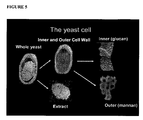
- Yeast cell wall includes both the outer layer (mainly mannan) and the inner layer (mainly glucan and chitin) of the yeast cell wall.
- a function of the cell wall is to provide structure and protect the yeast interior (its metabolic activity center). Signaling and recognition pathways take place in the yeast cell wall.
- the composition of yeast cell wall varies from strain to strain and according to growth conditions of yeast.
- yeast cell wall extract refers to the yeast cell wall of yeast that has been ruptured or "lysed” (e.g., during a rupture and lysing stage) and separated from the soluble intracellular components of the yeast cell.
- isolated when used in relation to a yeast cell wall, as in "an isolated yeast cell wall” or “isolated clay integrated yeast cell wall” or “isolated yeast cell wall comprising altered glucan:mannan structure” refers to a yeast cell wall or component thereof that is identified and separated from at least one component with which it is ordinarily associated in its natural source.
- an isolated yeast cell wall is such present in a form or setting that is different from that in which it is found in nature (e.g., that is separate from intracellular components of yeast).
- non-isolated yeast cell wall is a yeast cell wall or component thereof found in the state they exist in nature.
- isolated yeast cell wall is used to describe yeast cell wall extract.
- yeast cell walls or yeast cell wall extracts are purified by removal of non-yeast cell wall components (e.g., plasmic membrane and/or yeast intracellular components); they are also purified by the removal of contaminants or other agents that are not yeast cell wall.
- non-yeast cell wall components e.g., plasmic membrane and/or yeast intracellular components
- the removal of non-yeast cell wall components and/or non-yeast cell wall contaminants results in an increase in the percent of yeast cell wall or components thereof in a sample.
- yeast cell walls comprising clay integrated/interlaced into the yeast cell wall are purified by the removal of non-yeast cell wall components (e.g., plasmic membrane and/or yeast intracellular components), thereby the percent of yeast cell wall comprising clay integrated/interlaced into the cell wall is increased in a sample.
- non-yeast cell wall components e.g., plasmic membrane and/or yeast intracellular components
- concentrated yeast cell wall extract refers to yeast cell wall extract that is concentrated via one or more procedures (e.g., by drying (e.g., during a drying and concentrating stage)).
- a concentrated yeast cell wall extract is a yeast cell wall preparation or yeast cell wall extract preparation that is purified by removal of non-yeast cell wall components.
- modified yeast and altered yeast refer to yeast cultivated in a way that alters the composition, structure and/or function of the yeast (e.g., that alters the composition, structure and/or function of the yeast cell wall (e.g., a yeast cell wall comprising an altered glucan:mannan ratio and/or clay integrated/interlaced into the yeast cell wall that functions differently than a yeast cell wall without altered glucan:mannan ratio and/or non-clay integrated/interlaced yeast cell wall).
- the yeast cell wall e.g., a yeast cell wall comprising an altered glucan:mannan ratio and/or clay integrated/interlaced into the yeast cell wall that functions differently than a yeast cell wall without altered glucan:mannan ratio and/or non-clay integrated/interlaced yeast cell wall.
- modified yeast cell wall refers to yeast cell wall of modified or altered yeast.
- modified yeast cell wall extract refers to yeast cell wall extract of modified or altered yeast.
- concentrated modified yeast cell wall extract refers to concentrated yeast cell wall extract derived from modified or altered yeast, for example, in US Pat. No. 6,045,834 .
- clay interlaced yeast As used herein, the terms "clay interlaced yeast,” “clay integrated yeast,” refer to yeast grown or cultivated in the presence of clay that has incorporated or interlaced clay into the yeast cell wall. Clay interlaced yeast and is a specific type of modified yeast.
- interlacing of clay into yeast cell wall occurs during yeast growth (e.g., after its asexual reproductive cycle (budding) (e.g., as a daughter cell grows and forms its yeast cell wall network, clay integrates into the yeast cell)).
- budding e.g., as a daughter cell grows and forms its yeast cell wall network, clay integrates into the yeast cell
- elongation of the chains of glucan and/or chitin provide integration site(s) involved in the integration of the clay during budding, resulting in the daughter cell comprising clay integrated into its cell wall.
- the macromolecular clay structure traps yeast cell(s) in its lamellar network, wherein the yeast cell proceeds through budding, further integrating clay into the yeast cell wall.
- yeast cell wall integrated/interlaced clay remain integrated/interlaced in yeast cell wall post cell wall extraction.
- clay interlaced yeast cell wall and "clay integrated yeast cell wall”refer to yeast cell wall of yeast grown or cultivated in the presence of clay that has incorporated or interlaced clay into the yeast cell wall.
- clay interlaced yeast cell wall extract refers to yeast cell wall extract of yeast (e.g., wherein the yeast frrom which the cell wall extract is made are grown or cultivated in the presence of clay) that has incorporated or interlaced clay into the yeast cell wall.
- concentrated interlaced yeast cell wall extract and “concentrated integrated yeast cell wall extract” refer to concentrated yeast cell wall extract of yeast grown or cultivated in the presence of clay that has incorporated or interlaced clay into the yeast cell wall.
- in vivo refers to studies and/or experiments conducted within a living organism, occurring within a biological organism.
- in vitro refers to an artificial environment outside the living organism and to biological processes or reactions that would normally occur within an organism but are made to occur in an artificial environment.
- in vitro environments can comprise of, test tubes and cell culture.
- HPLC high-performance liquid chromatography
- HPLC instruments comprise a reservoir of mobile phase, a pump, an injector, a separation column, and a detector. The presence of analytes in the column effluent is recorded by quantitatively detecting a change in refractive index, UV-VIS absorption at a set wavelength, fluorescence after excitation with a suitable wavelength, or electrochemical response.
- scanning electron microscopy and the term “SEM” refer to a type of electron microscope that images the sample surface by scanning it with a high-energy beam of electrons in a raster scan pattern. The electrons interact with the atoms that make up the sample producing signals that contain information about the sample's surface topography, composition and other properties such as electrical conductivity.
- fixation agent refers to a chemical that is capable of fixing one substance to another in order to "fix”, stabilize, or otherwise preserve the substance in its current form to prevent the substance from degrading or otherwise changing. Often, fixation agents are used in scanning electron microscopy (SEM) to prepare the sample.
- Primary fixation agent refers to the first fixation agent used to "fix” a substance.
- secondary fixation agent refers to the second fixation agent used to "fix” a substance.
- Tertiary fixation agent refers to the third fixation agent used to "fix” a substance.
- analyte refers to an atom, a molecule, a grouping of atoms and/or molecules, a substance, or chemical constituent.
- An analyte, in and of itself cannot be measured, rather, aspects or properties (physical, chemical, biological) of the analyte can be determined using an analytical procedure, such as HPLC.
- HPLC high-density liquid crystal
- signal is used generally in reference to any detectable process that indicates that a reaction has occurred (for example, binding of antibody to antigen). Signals can be assessed qualitatively as well as quantitatively. Examples of types of “signals” include, radioactive signals, fluorimetric signals or colorimetric product/reagent signals.
- bioavailability refers to the fraction of a molecule or component that is available to an organism or reaches the systemic circulation. When a molecule or component is administered intravenously, its bioavailability is 100%. However, when a molecule or component is administered via other routes (such as orally), its bioavailability decreases (due to incomplete absorption and first-pass metabolism).
- the term “absorb” refers to the process by which a material “takes in” or “sucks up” another substance.
- “absorption” may refer to the process of absorbing or assimilating substances into cells or across the tissues and organs through diffusion or osmosis (e.g. absorption of nutrients by the digestive system or absorption of drugs into the blood stream).
- the term "adsorption” refers to a process that occurs when a material is sequestered by, and/or accumulates on the surface of, a solid or a liquid (sequestrant and/or adsorbent) (e.g. thereby forming a film of molecules or atoms (the adsorbate)).
- the term “sequester” and/or the term “sequestration” refers to physical association (e.g., via docking or encasement) of two or more entities that come into contact with one another (e.g., thereby forming a stable complex).
- exemplary forms of associations include, hydrogen bonding, coordination, and ion pair formation.
- Sequestration interactions may involve a variable number of chemical interactions (e.g., chemical bonds) depending on the stereochemistry and geometry of each entity (e.g., further defining the specificity of the sequestration). When two or more entities are sequestered they may be sequestered by way of chemical bonds, but may also be associated via charge or other type of interactions.
- the term "sequestration agent” and/or “sequestering agent” refers to an entity that is capable of inducing or otherwise being involved with a sequestration and/or forming a complex with a second entity.
- sorption refers to both adsorption and absorption.
- the term "effective amount” refers to the amount of a composition (e.g., comprising a yeast cell, yeast cell wall or modified yeast cell wall component of the invention) sufficient to effect beneficial or desired results.
- An effective amount can be administered and/or combined with another material in one or more administrations, applications or dosages and is not intended to be limited to a particular formulation or administration route.
- digest refers to the conversion of food, feedstuffs, or other organic compounds into absorbable form; to soften, decompose, or break down by heat and moisture or chemical action.
- digestive system refers to a system (including gastrointestinal system) in which digestion can or does occur.
- feedstuffs refers to material(s) that are consumed by animals and contribute energy and/or nutrients to an animal's diet.
- feedstuffs include, Total Mixed Ration (TMR), forage(s), pellet(s), concentrate(s), premix(es) coproduct(s), grain(s), distiller grain(s), molasses, fiber(s), fodder(s), grass(es), hay, kernel(s), leaves, meal, soluble(s), and supplement(s).
- animal refers to those of kingdom Animalia. This includes, but is not limited to livestock, farm animals, domestic animals, pet animals, marine and freshwater animals, and wild animals.
- administering refers to the act of giving a substance, including a drug, prodrug, or other agent, or therapeutic treatment to a subject (e.g., a subject or in vivo, in vitro, or ex vivo cells, tissues, and organs).
- a subject e.g., a subject or in vivo, in vitro, or ex vivo cells, tissues, and organs.
- routes of administration can be through the eyes (ophthalmic), mouth (oral), skin (topical or transdermal), nose (nasal), lungs (inhalant), oral mucosa (buccal), ear, rectal, vaginal, by injection (e.g., intravenously, subcutaneously, intratumorally, intraperitoneally.
- co-administration and the term “co-administering” refer to the administration of at least two agent(s) or therapies to a subject and/or material (e.g., feedstuff). Co-administration of two or more agents or therapies can be concurrent, or a first agent/therapy can be administered prior to a second agent/therapy.
- treatment refers to the improvement and/or reversal of the symptoms of disease (e.g., mycotoxicosis).
- treatment refers to both therapeutic treatment and prophylactic or preventative measures.
- subjects that may benefit from treatment with compositions and methods of the present invention include those in which a disease and/or disorder is to be prevented (e.g., using a prophylactic treatment of the present invention).
- the term "at risk for disease” refers to a subject that is predisposed to experiencing a particular disease. This predisposition may be genetic (e.g., a particular genetic tendency to experience the disease, such as heritable disorders), or due to other factors (e.g., age, weight, environmental conditions, exposures to detrimental compounds present in the environment).
- the term “disease”, the term “infection” and the term “pathological condition or response” refer to a state, signs, and/or symptoms that are associated with an impairment of the normal state of a living animal or of any of its organs or tissues that interrupts or modifies the performance of normal functions, and may be a response to environmental factors (such as malnutrition, industrial hazards, or climate, including mycotoxicosis), specific infective agents (such as worms, bacteria, or viruses), to inherent defect of the organism (such as various genetic anomalies), or combinations of these and other factors.
- environmental factors such as malnutrition, industrial hazards, or climate, including mycotoxicosis
- specific infective agents such as worms, bacteria, or viruses
- inherent defect of the organism such as various genetic anomalies
- mycotoxicosis refers to a condition in which mycotoxins pass the resistance barriers of the human or animal body. Mycotoxicosis can be considered either an infection or a disease and may have a deleterious effect on those afflicted.
- mycotoxin refers to toxic and/or carcinogenic compound(s) produced by various fungal species.
- the term "suffering from disease” refers to a subject (e.g., an animal or human subject) that is experiencing a particular disease and is not limited to any particular signs or symptoms, or disease.
- the term "toxic” refers to any detrimental, deleterious, harmful, or otherwise negative effect(s) on a subject, a cell, or a tissue as compared to the same cell or tissue prior to the contact or administration of the toxin/ toxicant.
- the term "acid” as used herein refers to any chemical compound that can donate proton(s) and/or accept electron(s). Acids include, hydrochloric, hydrobromic, sulfuric, nitric, perchloric, fumaric, maleic, phosphoric, glycolic, lactic, salicylic, succinic, toluence-p-sulfonic, tartaric, acetic, citric, methanesulfonic, ethanesulfonic, formic, benzoic, malonic, sulfonic, naphthalene-2-sulfonic, benzenesulfonic acid.
- Other acids such as oxalic, while not in themselves pharmaceutically acceptable, may be employed in the preparation of salts useful as intermediates in obtaining the compounds of the invention and their pharmaceutically acceptable acid addition salts.
- base refers to any chemical compound that can accept proton(s) and/or donate electron(s) or hydroxide ions.
- Bases include, alkali metal (e.g., sodium) hydroxides, alkaline earth metal (e.g., magnesium) hydroxides, ammonia, and compounds of formula NW 4 + , wherein W is C 1-4 alkyl.
- salt refers to compounds that may be derived from inorganic or organic acids and bases.
- examples of salts include, acetate, adipate, alginate, aspartate, benzoate, benzenesulfonate, bisulfate, butyrate, citrate, camphorate, camphorsulfonate, cyclopentanepropionate, digluconate, dodecylsulfate, ethanesulfonate, fumarate, flucoheptanoate, glycerophosphate, hemisulfate, heptanoate, hexanoate, chloride, bromide, iodide, 2-hydroxyethanesulfonate, lactate, maleate, methanesulfonate, 2-naphthalenesulfonate, nicotinate, oxalate, palmoate, pectinate, persulfate, phenylpropionate, picrate
- composition refers to the combination of an active agent (e.g., a composition comprising a viable yeast cell, yeast cell wall, or modified yeast cell wall component of the invention) with a carrier, inert or active, making the composition especially suitable for diagnostic or therapeutic use in vitro, in vivo or ex vivo.
- an active agent e.g., a composition comprising a viable yeast cell, yeast cell wall, or modified yeast cell wall component of the invention
- compositions that do not substantially produce more known adverse reactions than known beneficial reactions.
- an "antifoaming agent” refers to an additive used to prevent formation of foam or is added to break foam already formed.
- An "antifoaming agent” also referred to as “antifoamer” or “defoamer” refers to an additive which reduces the surface tension of a solution or media or emulsion or broth in fermenters because of aeration or agitation, thus inhibiting or modifying the formation of a foam.
- Commonly used agents are insoluble oils, dimethyl polysiloxanes and other silicones, certain alcohols such as stearyldecanol, octal decanol, sulphonates, stearates and glycols.
- the term "cell” refers to an autonomous self-replicating unit that may exist as functional independent unit of life (as in the case of unicellular organism, e.g. yeast), or as sub-unit in a multicellular organism (such as in plants and animals) that is specialized into carrying out particular functions towards the cause of the organism as a whole.
- a multicellular organism such as in plants and animals
- prokaryotic cells prokaryotic cells and eukaryotic cells.
- the term “eukaryote” refers to organisms whose cells are organized into complex structures enclosed within membranes. "Eukaryotes” are distinguishable from “prokaryotes.”
- the term “prokaryote” refers to organisms that lack a cell nucleus or other membrane-bound organelles.
- the term “eukaryote” refers to all organisms with cells that exhibit the typical characteristics of eukaryotes, such as the presence of a true nucleus bounded by a nuclear membrane, within which lie the chromosomes, the presence of membrane-bound organelles, and other characteristics commonly observed in eukaryotic organisms. Thus, the term includes, such organisms as fungi, protozoa, and animals.
- cell culture refers to any in vitro culture of cells. Included within this term are continuous cell lines (e.g., with an immortal phenotype), primary cell cultures, transformed cell lines, finite cell lines (e.g., non-transformed cells), and any other cell population maintained in vitro.
- cell reproduction refers to a process of cell multiplication having three primary stages.
- the first stage of cell reproduction involves the replication of the "parental cell's DNA.
- the second stage is the separation of the duplicated DNA into two equally sized groups of chromosomes.
- the third stage is the physical division of entire cells, usually called cytokinesis.
- Cell reproduction is more complex in eukaryotes than in other organisms.
- Non-eukaryotic cells such as bacterial cells reproduce by binary fission, a process that includes DNA replication, chromosome segregation, and cytokinesis.
- Eukaryotic cell reproduction either involves mitosis or a more complex process called meiosis.
- Mitosis and meiosis are sometimes called the two "nuclear division" processes.
- Binary fission is similar to eukaryotic cell reproduction that involves mitosis. Both lead to the production of two daughter cells with the same number of chromosomes as the parental cell.
- Meiosis is used for a special cell reproduction process of diploid organisms. It produces four special "daughter cells” (gametes) which have half the normal cellular amount of DNA. A male and a female gamete can then combine to produce a zygote, a cell which again has the normal amount of chromosomes.
- yeast reproduction refers to the reproduction cycle of yeast, which have asexual and sexual reproductive cycles, however the most common mode of vegetative growth in yeast is asexual reproduction by "budding” or “fission” with a "daughter cell” that is formed on the "parent cell”.
- the nucleus of the parent cell splits into a daughter nucleus and migrates into the daughter cell.
- the bud continues to grow until it separates from the "parent cell", forming a new cell.
- haploid cells will generally die, however under the same conditions diploid cells can undergo sporulation, entering sexual reproduction (meiosis) and producing a variety of haploid spores, which can go on to mate (conjugate), reforming the diploid.
- the term “budding” refers to a type of cell division in fungi (e.g. yeast) and in protozoa in which one of the "daughter cells" develops as a smaller protrusion from the other.
- the position of the budding cell is defined by polarity in the "parent cell”. In some protozoa the budded daughter may lie within the cytoplasm of the other daughter.
- aughter cell refers to one of the two or more cells formed in the division of a parent cell.
- parent cell and the term “mother cell” refer to the cell giving rise to daughter cells by cell division.
- the term "inoculation” refers to the act of introducing a microorganism or suspension of microorganisms (e.g. yeast, fungi, bacteria) into a culture medium. Inoculation is the act or process of introducing something to where it will grow or reproduce.
- microorganisms e.g. yeast, fungi, bacteria
- inoculum and the term “pre-inoculum” refer to cells used in an inoculation, such as cells added to start a culture.
- growth procedure refers to the reproduction of living cells applied to yeast cells where the phrase “cell growth” is shorthand for the idea of "growth in cell numbers by means of cell reproduction.” During cell reproduction one cell (the “parental cell” or “mother cell”) divides to produce "daughter cells”.
- cultivate yeast and the term “growing yeast” refer to the act of populating and/or propagating yeast.
- centrifugation refers to the separating of molecules by size or density using centrifugal forces generated by a spinning rotor that puts an object in rotation around a fixed axis, applying a force perpendicular to the axis.
- the centrifuge works using the sedimentation principle, where the centripetal acceleration is used to evenly distribute substances of greater and lesser density into different layers of density.
- concentration refers to the amount of a substance per defined space. Concentration usually is expressed in terms of mass per unit of volume. To dilute a solution, one must add more solvent, or reduce the amount of solute (e.g., by selective evaporation, spray drying, freeze drying, e.g., concentrated yeast cell wall extract or concentrated modified yeast cell wall extract). By contrast, to concentrate a solution, one must add more solute, or reduce the amount of solvent.
- the term "layer” refers to a usually horizontal deposit organized in stratum of a material forming an overlying part or segment obtained after separation by centrifugation in relation with the density properties of the material.
- harvest refers to the act of collecting or bringing together materials that have been produced (e.g. bringing together materials produced during yeast production).
- clay refers to mineral clays, synthetic, organoclays and any mixture(s) thereof.
- silicates As used herein, the term “mineral clay” refers to a naturally occurring or synthetic material composed primarily of fine-grained minerals (silicates) that show plasticity through a variable range of water content (which may be a result of water trapped in the structure by polar attraction) and can be hardened when dried and/or fired.
- silicates include phyllosilicate, bentonite, zeolite, aluminosilicate, montmorillonite, smectite, kaolinite.
- organoclay and the term “modified clay” refer to an organically modified phyllosilicate, derived from a naturally occurring clay mineral. By exchanging the original interlayer cations for organocations (typically quaternary alkylammonium ions) or polysaccharides, an organophilic surface is generated, consisting of covalently linked organic moieties. The lamellar structure remains analogous to the parent phyllosilicate.
- drying refers to spray drying, freeze drying, air drying, vacuum drying or any other kind of process that reduces or eliminates liquid in a substance.
- spray drying refers to a commonly used method of drying a substance containing liquid using hot gas to evaporate the liquid to reduce or eliminate liquid in the substance.
- the material is dried byway of spraying or atomizing into a draft of heated dry air.
- freeze-drying and the term “lyophilization” and the term “cryodesiccation” refer to the removal of a solvent from matter in a frozen state by sublimation. This is accomplished by freezing the material to be dried below its eutectic point and then providing the latent heat of sublimation. Precise control of heat input permits drying from the frozen state without product melt-back. In practical application, the process is accelerated and precisely controlled under reduced pressure conditions.
- dry free flowing powder refers to a free flowing dry powder.
- grinding refers to reducing particle size by impact, shearing, or attrition.
- washing refers to the removal or cleansing (e.g., using any type of solute (e.g. distilled water, buffer, or solvent) or mixture) of impurities or soluble unwanted component of a preparation (e.g., a yeast cell wall extract may be washed to remove non-yeast cell wall components from the sample).
- solute e.g. distilled water, buffer, or solvent
- soluble unwanted component of a preparation e.g., a yeast cell wall extract may be washed to remove non-yeast cell wall components from the sample.
- enzyme refers to as a protein or protein-based molecule with a characteristic sequence of amino acids that fold to produce a specific three-dimensional structure which gives the molecule unique properties and that acts as a catalyst or a chemical for specific chemical reactions, converting a specific set of reactants (called substrates) into specific products.
- peptide As used herein, the term "peptide,” the term “polypeptide” and the term “protein” refer to a primary sequence of amino acids that are joined by covalent “peptide linkages.” Generally, a peptide consists of a few amino acids, typically from 2-50 amino acids, and is shorter than a protein.
- polypeptide encompasses peptides and proteins. Peptides, polypeptides or proteins can be synthetic, recombinants or naturally occurring. A synthetic peptide is produced by artificial means in vitro (e.g., was not produced in vivo).
- proteases refers to any of various enzymes, including the endopeptidases and exopeptidases that catalyze the hydrolytic breakdown of proteins into peptides or amino acids.
- lysis refers to the disintegration or rupture of the yeast cell membrane and yeast cell wall resulting in the release of the intracellular components. As used herein, “lysis” occurs as a result of physical/ mechanical, enzymatic (including autolysis and hydrolysis) or osmotic mechanisms (including “alcohol shocking” and hydrolysis).
- autolysis refers to the breakdown of a part or whole cell or tissue by self-produced enzymes.
- hydrolysis refers to the process of splitting a compound into fragments with the addition of water (e.g., that is used to break down polymers into simpler units (e.g. starch into glucose)).
- alcohol shocking refers to an osmotic stress generated by the addition of an alcohol (e.g. ethanol) to growth medium to create a difference between the osmotic pressure of the medium and the osmotic pressure inside cells (e.g., yeast cells) growing in the medium. Alcohol shocking may lead to the lysis of cells (e.g., yeast cells) grown in the medium.
- alcohol e.g. ethanol
- the term "osmosis” refers to the diffusion of a solvent (e.g., water) through a semi-permeable membrane, from a solution of low solute concentration (high water potential) to a solution with high solute concentration (low water potential), up a solute concentration gradient. It is a physical process in which a solvent moves, without input of energy, across a semi-permeable membrane (permeable to the solvent, but not the solute) separating two solutions of different concentrations. Net movement of solvent is from the less-concentrated (hypotonic) to the more-concentrated (hypertonic) solution, which tends to reduce the difference in concentrations.
- a solvent e.g., water
- osmotic stress and the term “osmotic shock” refer to a sudden change in the solute concentration around a cell, causing a rapid change in the movement of water across its cell membrane.
- substrates or any solute in the supernatant water is drawn out of the cells through osmosis. This also inhibits the transport of substrates and cofactors into the cell thus “shocking" the cell.
- water enters the cell in large amounts, causing it to swell and either burst or undergo apoptosis.
- sample is used in a broad sense including a specimen or culture obtained from any source, as well as biological and environmental samples.
- Biological samples may be obtained from animals (including humans) and encompass fluids, solids, tissues, and gases.
- Biological samples include blood products, such as plasma, serum.
- Environmental samples include environmental material such as surface matter, soil, water, crystals and industrial samples.
- the term "complex” refers to an entity formed by association between two or more separate entities (e.g., association between two or more entities wherein the entities are the same or different (e.g., same or different chemical species).
- the association may be via a covalent bond or a non-covalent bond (e.g., via van der Waals, electrostatic, charge interaction, hydrophobic interaction, dipole interaction, and/or hydrogen bonding forces (e.g., urethane linkages, amide linkages, ester linkages, and combination thereof)).
- novel yeast cells comprising a cell wall structure that has been modified (e.g., clay are interlaced into the yeast cell wall ), methods of producing the same, compositions comprising and/or derived from the same, and methods of using the same (e.g., to sequester mycotoxins).
- the present disclosure provides a yeast cell wall extract (e.g., an isolated, purified, modified and/or concentrated cell wall extract) comprising clay interlaced into the cell wall (e.g., due to cultivation of the yeast cell in the presence of a clay)
- a yeast cell wall extract e.g., an isolated, purified, modified and/or concentrated cell wall extract
- the clay interlaced yeast cell wall extract comprising clay interlaced into the yeast cell wall is admixed or otherwise added to feedstuffs, organic matter (e.g., bedding), and/or water thereby sequestering mycotoxins (e.g., while in the gastrointestinal tract of the animal or during filtration), and negating or reducing the negative effects of mycotoxins.
- the present invention provides methods that significantly improve the adsorptive/sequestering properties of yeast cell wall-based material toward mycotoxins (e.g., that significantly adsorb and/or sequester and/or limit the bioavailability of a variety of mycotoxins (e.g., not adsorbed to and/or not sequestered using clay alone, yeast cell wall extract alone, a combination of yeast cell wall extract to which a clay is later added on a dry blend basis; and/or a chemical grafting of polysaccharide materials on top of clay based products) in the digestive tract of an animal).
- mycotoxins e.g., that significantly adsorb and/or sequester and/or limit the bioavailability of a variety of mycotoxins (e.g., not adsorbed to and/or not sequestered using clay alone, yeast cell wall extract alone, a combination of yeast cell wall extract to which a clay is later added on a dry blend basis; and/or a chemical grafting of polysacchari
- the present disclosure provides a novel preparation of yeast cells grown in the presence of one or more clays.
- clay interlaced yeast cell walls are extracted from the clay interlaced yeast cells grown in the presence of one or more clays.
- the clay interlaced yeast cell wall extract is purified and/or concentrated.
- the clay source is a standard commercial grade clay source (e.g., selected for exhibiting in vitro, in vivo, and/or ex vivo properties toward mycotoxins, or a clay source selected because it does not exhibit in vitro, in vivo, and/or ex vivo properties toward mycotoxins).
- compositions and methods of the present invention can be utilized for adsorbing and/or sequestering of mycotoxins in a variety of subjects.
- the present invention can benefit all animals, however, exemplary subjects include humans, avian, bovine, porcine, equine, ovine, caprine, canine, feline, piscine, camelid, rodent species as well as fish and shellfish subjects.
- compositions of the present disclosure when admixed with organic matter (e.g., including bedding and feedstuffs), and/or water, and/or fed directly to a subject, compositions of the present disclosure decrease the absorption or uptake of mycotoxins by the subject, thereby alleviating reduced performance, health and/or reducing the incidence mycotoxin-associated diseases and pathological responses in the subject.
- the present disclosure provides a method for making and/or generating yeast cells comprising clay interlaced into the yeast cell wall.
- the present disclosure provides a yeast cell generated and/or cultivated in the presence of a clay wherein the yeast cell wall comprises a glucan:mannan ratio that is greater than (e.g., 2.5% greater, 5% greater, 10% greater, 15%, 20% greater, 25% greater, 30% greater, 40% greater, 50% greater or more) the glucan:mannan ratio of yeast cells generated/cultivated in the absence of a clay (See, e.g., Example 2).
- the present disclosure provides a yeast cell wall extract obtained from (e.g., isolated, purified and/or concentrated from) a viable yeast cell generated and/or cultivated in the presence of a clay wherein the yeast cell wall comprises a glucan:mannan ratio that is greater (e.g., 2.5% greater, 5% greater, 10% greater, 15%, 20% greater, 25% greater, 30% greater, 40% greater, 50% greater or more) than the glucan:mannan ratio of yeast cells generated/cultivated in the absence of a clay (See, e.g., Example 2).
- a method of generating yeast cells comprises cultivating yeast cells including. Saccharomyces , Candida, Kluyveromyces , and Torulaspora species in the presence of one or more clays in order to alter or otherwise modify the yeast cell wall (e.g., in order to enhance the ability of the yeast cell wall to adsorb and/or sequester mycotoxins (e.g., due to the yeast cell wall interlaced with clay ).
- the present disclosure provides the blending of one or more clay based materials including, silicates (e.g., groups of tectosilicates (e.g., zeolites, quartz, feldspars); phyllosilicates (e.g., kaolinite, halloysite, dicktite, nacrit, chysotile, antigorite, lizardite, talc), pyrophyllites, smectites (e.g., montmorillonite, beidellite, nontronite; vermiculites, micasantigorite, muscovite, illite, phengite, biotite); sepiolite, palygorskite, attapulgite), and/or a hydrated aluminum silicate (e.g., montmorillonites , bentonite)) to a yeast cell culture medium (e.g., as described in Examples 1, 5, and 6).
- silicates e.g.,
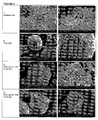
- the viable yeast cells incorporate the clay into the yeast cell wall structure (e.g., as shown in Figures 1A and 1B and Figure 2 ).
- the one or more clays blended into a yeast cell culture medium are present at a concentration of 0.075%, 0.1%, 0.125%, 0.25%, 0.5%, 1%, 2%, 4%, 5%, 6%, 7%, 8%, 9%, 10%, 12%, 15%, or more of the total growth medium.
- the amount of one or more clays blended into a yeast cell culture medium does not exceed 2% of the final content of a reactor in which the yeast cells are grown.
- an amount of clay added to yeast cell culture medium is chosen that does not lead to swelling of the yeast cell culture medium (e.g., is 2.0% or less). In some embodiments, the amount of clay added to yeast cell culture medium is chosen that produces a yeast cell wall extract harvested from the yeast that comprises an amount of clay that has regulatory approval for use as a feed additive in non-medicated animal feed (e.g., does not to exceed 2% in total ration).
- a food-grade anti-foaming agent or defoamer is added to the cell culture medium, (e.g., including nonsilicone molecular defoamers, oil based defoamers (e.g., mineral oil, vegetable oil, white oil, or other oil that is insoluble in the foaming medium) or silicone compound based defoamers (e.g., delivered as an oil or water based emulsion)).
- waxes e.g., ethylene bis stearamide (EBS), paraffinic waxes, ester waxes or fatty alcohol waxes
- hydrophobic silica are added to improve emulsification and spreading in the foaming medium.
- Experiments conducted during development of embodiments of the invention identified a number of factors as important for growth of yeast cells in the presence of one or more clays. For example, in some embodiments, it is preferred to maintain the (w/v) relationship (e.g., corresponding to grams/cubic centimeter (g/cc)) between the clay support material and the water at or below 3% (e.g., to avoid reaching a solid or semi-solid state (e.g., due to water adsorption and retentiveness of the clay material)).
- g/cc grams/cubic centimeter
- culture media and bottles used are sterilized, and inoculation with microorganisms is effected in accordance with standard procedures.
- a pre-inoculum is prepared with active dry yeast in a bottle of sterile deionized water and incubated at about 25-30 °C (e.g., 28°C) for a set period of time (e.g., 20 min).
- inoculation of the pre-inoculum is aseptically performed (e.g., at a temperature of about 30°C).
- pH and glucose levels are monitored and maintained.
- agitation of the culture is increased incrementally (e.g., from 100 to 500 rpm) during growth.
- one or more clays are added aseptically to the culture during growth (e.g., when less than half, about half, or more than half of the culture nutrients are consumed).
- the swelling properties of the clay material inhibits yeast cell growth.
- growing yeast in clay-blended yeast cell culture medium provides conditions which stress the growing yeast.
- the stress applied to the yeast by the clay-blended cell-culture medium causes yeast to produce more glucan, resulting in increased ratios of glucan:mannan.
- yeast cells cultivated in the presence of one or more clays not only interlaces the clay into the yeast cell wall, but also display an altered cell wall composition (e.g., characterized by altered ratios of glucan:mannan, total protein content, and/or remnant amounts).
- the present disclosure provides yeast cells comprising a glucan:mannan ratio that is greater (e.g., 2.5% greater, 5% greater, 10% greater, 15%, 20% greater, 25% greater, 30% greater, 40% greater, 50% greater or more) than the glucan:mannan ratio of the yeast cells cultivated in the absence of clay (See, e.g., Example 2).
- the present disclosure also provides yeast cells and yeast cell wall extracts comprising an enhanced total protein content (e.g., 100%, 200%, 300%, 400%, 500% or more enhance protein content) compared to the total protein content of yeast cells and/or yeast cell wall extracts generated in the absence of a clay (See, e.g., Example 2).
- an enhanced total protein content e.g., 100%, 200%, 300%, 400%, 500% or more enhance protein content
- the present disclosure provides yeast cell wall extracts comprising clay interlaced into the yeast cell wall and comprising an altered glucan:mannan ratio of the structure, that provides superior mycotoxin sequestration properties than conventional compositions.
- yeast cell wall extracts comprising clay interlaced into the yeast cell wall and comprising an altered glucan:mannan ratio of the structure, that provides superior mycotoxin sequestration properties than conventional compositions.
- enzymatic e.g., protease (e.g., papain)
- mechanical lysis e.g., autolysis and hydrolysis
- other methods known in the art See, e.g., Peppler, H. J. 1979. Production of yeasts and yeast products. Page 157 in: Microbial Technology & Microbial Processes, Vol.1 (2d Ed.), Academic Press ).
- clay interlaced/integrated yeast cell wall is washed to remove intracellular components and to purify and concentrate the extract.
- the resulting extract may be dried by any of a number of methods common in the art including freeze-drying and/or spray-drying (e.g., to form a hygroscopic water-insoluble powder).
- yeast cell wall extract comprising clay interlaced directly into the yeast cell wall.
- a composition comprising a yeast cell wall extract of the disclosure comprising clay integrated directly into the yeast cell wall comprises less than 0.5% clay, 0.5-1%, 1-2%, 2-5%, 5-10%, 10-15%, 15-20%, 20-30%, 30-40%, 40-50%, 50-60%, 60-70%, 70% or more clay as part of a yeast cell wall extract (on a w/w % basis).
- increasing the amount of clay in a culture medium increases the amount of clay content of a yeast cell wall extract.
- clay that is added to yeast cell growth medium that is not incorporated into a yeast cell is collected and utilized in a subsequent yeast cell growth procedure (e.g., the unincorporated clay material is recycled).
- a subsequent yeast cell growth procedure e.g., the unincorporated clay material is recycled.
- recycling of clay material is facilitated by the sedimentation properties of the clay compared to yeast.
- experiments conducted during development of embodiments of the invention have produced two recoverable layers, (i) a bottom layer containing clay material only (at 99%); and (ii) a top layer containing a clay fraction incorporated into yeast.
- the present disclosure provides a direct inclusion of clay particles into and/or onto the yeast cell wall (e.g., that survives yeast cell wall extract preparation processes (e.g., via direct interlacing of clay into the glucan polymer chains of the yeast cell wall)).
- a clay fraction traps a yeast cell during culture and upon budding, together with daughter cells, the yeast cells are encaged in a clay comprising macrostructure before the lysed and its intracellular components removed by washing.
- glucan chains grow in between the lamellar structure of the clay.
- a yeast cell or yeast cell wall component e.g., a yeast cell wall extract generated and isolated as described herein (e.g., comprising clay interlaced into the yeast cell wall and comprising an altered glucan and/or mannan structure)
- a yeast cell or yeast cell wall component is combined with one or more other agents including an enzyme (e.g., esterase, epoxidase), a bacteria, a yeast or yeast component, clay, (e.g., prior to admixing with feeds, incorporating into pelleted feeds, and/or feeding to animals)).
- the present invention utilizes yeast cells comprising altered yeast cell wall structure (e.g., clay interlaced into the yeast cell walls and cell walls comprising altered glucan and/or mannan structure), compositions comprising the same, and/or compositions derived from the same, that are utilized with one or more methods and/or materials described herein for use in compositions and/or methods for the reduction, removal and/or elimination of mycotoxins (e.g., physical, mixing, chemical, microbiological methods described herein (e.g., to adsorb and/or sequester mycotoxins)).
- altered yeast cell wall structure e.g., clay interlaced into the yeast cell walls and cell walls comprising altered glucan and/or mannan structure
- compositions comprising the same, and/or compositions derived from the same, that are utilized with one or more methods and/or materials described herein for use in compositions and/or methods for the reduction, removal and/or elimination of mycotoxins (e.g., physical, mixing, chemical, microbiological methods described
- a yeast cell or yeast cell wall component e.g., a yeast cell wall extract produced as described herein (e.g., comprising clay interlaced into the yeast cell wall and comprising an altered glucan and/or mannan structure)
- a yeast cell or yeast cell wall component is utilized with one or more physical, mixing, chemical, or microbiological methods described herein to sequester mycotoxins.
- compositions of the present invention can be utilized to adsorb and/or sequester a variety of mycotoxins including acetoxyscirpenediol, acetyldeoxynivalenol, acetylnivalenol, acetylneosolaniol, acetyl T-2 toxin, extended to all aflatoxins, aflatoxin B1, B2, G1 and G2, aflatrem, alternativeuic acid, alternariol, austdiol, austamide, austocystin, avenacein +1, beauvericin +2, bentenolide, brevianamide, butenolide, calonectrin, chaetoglobosin, citrinin, citreoviridin, cochliodinol, cytochalasin E, cyclopiazonic acid, deacetylcalonectrin, deactylne
- compositions and methods of the invention are utilized to adsorb and/or sequester aflatoxins, zearalenone, ochratoxins, trichothecene, fumonisin, patulin, and/or endophyte related ergot and possible conjugates and metabolites of the aforementioned mycotoxins.
- a drawback of using a composition comprising only (1) a clay, (2) a composition comprising only a yeast cell wall extract, as well as (3) a composition comprising a yeast cell wall extract to which a clay has been added is that such compositions and methods of using the same are less effective means than the present invention for reducing the negative effects of mycotoxins and have more drawbacks.
- clay interlaced yeast cell wall extracts of the present invention display the unexpected ability to sequester a variety of mycotoxins, and also display a strikingly enhanced ability to adsorb mycotoxins compared to conventional compositions (e.g., a composition comprising only clay(s), a composition comprising only a yeast cell wall extract, as well as a composition comprising a yeast cell wall extract to which clay(s) has been added, See Examples 2-3).
- conventional compositions e.g., a composition comprising only clay(s), a composition comprising only a yeast cell wall extract, as well as a composition comprising a yeast cell wall extract to which clay(s) has been added, See Examples 2-3.
- the present disclosure provides compositions and methods that display unexpected and superior sequestration and/or adsorption properties with respect to a variety of mycotoxins not found in conventional compositions and methods.
- the present invention provides uses of clay interlaced yeast cell wall-based materials to provide an efficient method to sequester mycotoxins in the digestive tract of animals and humans (e.g., via adsorbing mycotoxins present in feedstuffs, other organic matter and/or water) while also providing lower or no adsorption of beneficial nutrients and lesser or no negative effects on the environment.
- a preferred physical form of the disclosure is a dry free-flowing powder suitable for direct inclusion into feedstuffs, other organic matter (e.g., bedding) or as a direct supplement to an animal.
- Composition of the disclosure can be added to any organic matter (e.g., bedding, feedstuff for animals, feedstuff for humans) and/or water (e.g., water used for animal and/or human consumption, environmental water (e.g., ponds, lakes, reservoirs, fish tanks)) to remove mycotoxins from the matter.
- a composition of the disclosure is added in amounts ranging from 0.0125% to 0.4% by weight of feed.
- compositions of the disclosure When incorporated into other organic matter (e.g., animal bedding), a composition of the disclosure is added in amounts ranging from 0.0125% to 99.9%. When incorporated into a liquid (e.g., water (e.g., for filtration)), a composition of the disclosure is added in amounts ranging from 0.0125% to 100%. In some embodiments, a composition of the disclosure is added to feedstuffs in amounts from 0.025% to 0.2% by weight of feedstuff. Alternatively, compositions of the disclosure are directly fed to animals as a supplement (e.g., in an amount ranging from 2.5 to 20 grams per animal per day). One of ordinary skill in the art immediately appreciates the amount to be fed varies depending upon animal species, size, the type of feedstuff to which a composition of the invention is added, bedding material, water source, etc.
- compositions of the disclosure can be fed to any animal and humans.
- compositions of the disclosure decrease mycotoxin bioavailability, absorption or uptake of mycotoxins by the animal, improve performance and/or health and reduce incidence of disease.
- compositions of the disclosure when, compositions of the disclosure are added to organic material that animals and humans come into contact with (e.g. bedding), compositions of the disclosure decrease mycotoxin bioavailability (e.g., decrease absorption and/or uptake of mycotoxins by the animal) thereby improving performance and health and reducing incidence of disease.
- compositions of the disclosure are added to water that is intended for use by animals or humans (e.g., for consumption or other purpose), thereby decreasing mycotoxin bioavailability (e.g., decrease absorption and/or uptake of mycotoxins by an animal or human subject) and improving performance and health and reducing incidence of disease (e.g., compositions of the disclosure decrease bioavailability, absorption or uptake of mycotoxins.
- a composition of the disclosure is added to water used for human consumption (e.g., water used for manufacture of juice, wine, water bottles, coffee, tea, milk or other type of consumed liquid).
- a composition of the disclosure is added to environmental water (e.g., ponds, lakes, reservoirs, rivers, streams, irrigation channels, tanks used to house fish or other type of aquatic species).
- environmental water e.g., ponds, lakes, reservoirs, rivers, streams, irrigation channels, tanks used to house fish or other type of aquatic species.
- a composition of the disclosure e.g., yeast cell wall extract comprising clay integrated into the cell wall
- liquids e.g., consumable liquids (e.g., water used in beverage production, beverages)).
- a composition of the disclosure is utilized as or in a filter, wherein a liquid (e.g., consumable liquid (e.g., orange juice, apple juice, prune juice, grapefruit juice, cranberry juice, or other type of juice, beer, wine, distilled liquid)) is processed through a filter comprising a composition of the disclosure, wherein the composition removes one or more types of mycotoxins from the liquid.
- a liquid e.g., consumable liquid (e.g., orange juice, apple juice, prune juice, grapefruit juice, cranberry juice, or other type of juice, beer, wine, distilled liquid)
- a filter comprising a composition of the disclosure, wherein the composition removes one or more types of mycotoxins from the liquid.
- the remnant fraction (e.g., representing losses of glucans, mannan, proteins, clay, N-acetylglucosamine and/or chitin present in the yeast cell wall during the extraction process) increased in the presence and surface area of clay.
- the increase is due to the enhancement of chitin fraction involved in compensatory mechanisms of the yeast due to changes of the environment and conditions of growth.
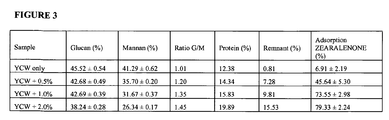
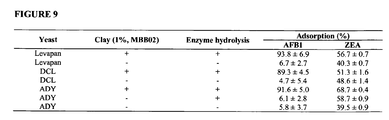
- compositions of the present disclosure comprising yeast cell wall extract from altered yeast cells (e.g., yeast cells comprising clay interlaced into the yeast cell walls and cell walls comprising altered glucan and/or mannan structure)) provided a significant and unexpected ability to adsorb and/or sequester mycotoxins (e.g., zearalenone (e.g., displaying a 79.33% efficacy compared to only a 44.7% efficacy for a conventional composition comprising a combination of yeast cell wall extract to which a clay is later added on a dry blend basis, See Examples 1-4)).
- altered yeast cells e.g., yeast cells comprising clay interlaced into the yeast cell walls and cell walls comprising altered glucan and/or mannan structure
- sequester mycotoxins e.g., zearalenone (e.g., displaying a 79.33% efficacy compared to only a 44.7% efficacy for a conventional composition comprising a combination of yeast
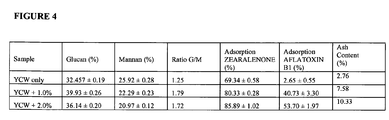
- a conventional composition comprising a combination of yeast cell wall extract to which a clay is later added on a dry blend basis accounted for a 44.7 % efficacy rate for sequestering mycotoxins, compared to a 85.89% efficacy rate for sequestering mycotoxins obtained with a composition of the present invention and an increase of aflatoxin B1 adsorption from 2.65 up to 53.70% (See, e.g., Example 3).
- yeast cells comprising a clay-interlaced yeast cell wall are produced on a variety of scales (e.g. test scale, batch-scale, pilot-scale, pre-production-scale, production-scale, commercial-scale, industrial scale).
- yeast are grown in a fermenter.
- a fermenter may be of any suitable size (e.g. 5 liter...10 liter... 25 liter... 50 liter... 100...500 liter...1K liter...5K liter...10K liter...50K liter...100K liter...500K liter...1 million liter) to produce the desired scale of yeast for use with the present invention (e.g.
- media for growing yeast can be of any suitable composition for growing yeast in accordance with the present invention.
- Suitable nutrients are sources of carbon, nitrogen, phosphorus, magnesium, sulphur, potassium and trace elements.
- nutrients are added to the culture in concentrations (% w/w of the source compound) within the ranges (percentages by weight): Carbon source 0.01 - 20% (e.g. 0.05 - 10%), Nitrogen source 0.001 - 10% (e.g. 0.001 - 3%), Phosphorus source 0.001 - 5% (e.g. 0.01 - 0.5%), Magnesium source 0.001 - 0.2% (e.g.
- yeast culture media comprises water, carbon source (e.g. sugar, glucose, dextrose, sugar cane, molasses), suitable nitrogen source (e.g. ammonia, urea ), amino acid source (e.g. peptone), salts (e.g.
- yeast culture media components may be present in any suitable amounts for yeast cell growth (See e.g. Example 5).
- the presence of clay in yeast culture media presents unanticipated complications to standard yeast growing protocols.
- the presence of clay in culture media results in unusually large amounts of foaming in the fermentor.
- the present disclosure provides antifoaming agents in the cell culture medium (e.g.
- nonsilicone molecular defoamers oil based defoamers (e.g. mineral oil, vegetable oil), powder defoamers (e.g silica), water based defoamers, silicone based defoamers, polyethylene glycol polypropylene glycol copolymers, alkyl polyacrylates ).
- antifoaming agents are required for increasing the scale of the present disclosure.
- use of an antifoaming agent is associated with an enhanced ability to scale up production of a composition of the disclosure.
- yeast culture The following protocol was used for each Bioflow fermenter (BioFlow III, New Brunswick Scientific Co., Inc., Edison, New Jersey, U.S.A.) to grow the yeast Sacchromyces cerevisiae (active dry yeast (ADY) from Fermin, Alltech Inc., Batch #689, Yeast count: 2.38x10 10 cells/gram, Viability: 92.6%).
- the yeast inoculum was prepared by transferring 28 g of fresh ADY Fermin to a pre-warmed bottle of 250ml sterile deionized water. Then, the solution was incubated at 30°C (in water bath) for 20 min and swirled several times.
- the BioFlow media was composed of 66 g of yeast extract, 10 g of peptone, 4 g of dextrose, 4 g of yeast nitrogen base and 1750 mL of deionized water.
- a control batch was produced by growing yeast alone, which required an additional 250 mL of deionized water to the reactor volume.
- Three batches containing yeast and bentonite K10 (Fluka) were produced by adding 8, 16, and 32 g to the reactor.
- the Bioflow reactor media was warmed up at 30°C and air was injected at 1L/min flow rate during 10 min prior inoculation. Agitation was set at 300 rpm and the media monitored and maintained at a minimum of pH 5.0 during the entire growth.
- An anti-foaming agent was added (Antifoam AES, 1:10, as needed).
- Ammonium phosphate dibasic (DAP) was then injected aseptically (4 g in 10 mL at pH 4.0).
- the previously re-suspended yeast was added to the fermentor.
- the glucose level was tested during growth with diabetic stripes (OneTouch, UltraMini, LifeScan, Inc., Milpitas, California, U.S.A.) and supplemental glucose was added when glucose level fell below 0.8 mg/mL.
- the agitation was progressively increased to 500 rpm over 2 h of incubation as well as the air flow (up to 4 L/min over 3 hrs).
- additional bentonite was added (8, 16, 32 g in 250 ml deionized water) to the reactor for a final concentration of 0.5%; 1.0%; and 2.0%, respectively, of clay in the final media.
- Yeast cultures were harvested when all sugar had been utilized. The content of the BioFlow was collected into sterile bottles and centrifuged at 4000 g for 20 min. The supernatant was removed and the pellet was washed with 0.125 % NaCl in H2O. The pellet was separated into 2 fractions by the distinct formation of 2 layers after centrifugation: ( i ) a clay containing layer and ( ii ) a yeast and clay containing layer. Yeast were then washed three times with 0.125% NaCl solution.
- a 'micro-method' was used employing glass beads and a minibead beater (Bead-Beater, Model #1107900, Biospec Products, Inc., Hamilton Beach/Proctor-Silex, Inc., Southern Pines, North Carolina, U.S.A.).
- the pellet was resuspended with two volume of 10mM Tris-Cl, pH 7.4 with phenylmethylsulfonofluoride (PMSF) and beat with glass beads (50:50, yeast slurry:beads) in a total volume of 5mL for 30 sec with 1 min interval rest, all the while on ice.
- the beating was repeated 10 times or until 95% of the cells were disrupted.
- the beads were re-collected and washed.
- the fractions were pooled and centrifuged at 4000 g for 20 min. The pellets were then collected, freeze-dried and ground.
- the yeast pellet was resuspended with sterile deionized water to a concentration of 13 to 15 % of dry matter.
- the yeast slurry was stirred at 60°C.
- the pH was adjusted using 10 % NaOH to 8.0 before adding enzyme at 0.3 mL/L.
- the temperature and stirring conditions were maintained over 8 h.
- the pH was monitored and adjusted every 15 min (using the 10 % NaOH) for the first two hours, and then the pH was monitored and adjusted every hour for the next six hours.
- the slurry was transferred to sterile centrifuge bottles and centrifuged at 4000 g for 20 min.
- the supernatant was discarded and the pellet washed with three volume of cold sterile water, and then centrifuged again at 4000 g for 20 min.
- the washing step was repeated two times before the pellet was frozen, freeze dried and ground.
- Yeast cells were disrupted after re-suspension of the cells in Tris-HCl buffer, pH 7.4 with PMSF using a micro-method using a bead-beater and glass beads as described (See Example 1). Yeast cell wall lysates were then analyzed in order to characterize the yeast cell walls and their ability to adsorb mycotoxins (expressed as a percent of efficacy compared to total mycotoxins present) under physiological pH conditions for each individual mycotoxin considered. The overall adsorbing/binding activity was evaluated kinetically.
- Test samples comprised a minimum of 5 levels up to 10 levels of mycotoxin concentrations tested with the different yeast cell wall preparations used at a concentration between 0.25 and 4g/L dispersed in an aqueous medium with a fixed value of pH 4 representative of digestive conditions of pH in the animal tract.
- Adsorption evaluation was calculated using a High Performance Liquid Chromatography coupled to fluorometric and diode-array detectors (e.g., to detect amounts of mycotoxin and mycotoxin adsorbed/sequestered).
- Yeast cell wall extracts obtained from yeast cells cultured in the presence of clay display a significant, unexpected, ability to sequester and to adsorb zearalenone (e.g., displaying a 79.33% efficacy for yeast cell walls extracted from yeast cells cultivated in the presence of 2% clay compared to only 6.91% efficacy of yeast cell walls extracted from yeast cells cultivated in the absence of clay.
- the 79.33 efficacy rate for yeast cell wall compositions extracted from yeast cells cultivated in the presence of 2% clay was also significantly higher than previously documented efficacy rates of only 44.7% for a conventional composition comprising a combination of yeast cell wall extract to which a clay is later added on a dry blend basis.
- the level of inclusion of the sequestrants product for AFB1 and ZEA were respectively of 0.1 and 0.4% in the reaction medium that was maintained at a constant pH of 4.0.
- the assay was performed under orbital agitation during 90 min at 37°C and the amount of bound toxin evaluated using HPLC equipped with a fluorescent detector.
- yeast grown/cultivated in the presence of clay displayed significant alteration in cell wall component/structure.
- the ratio of mannan:glucan increases (e.g., as clay increases from none, 0.5%, 1.0% to 2.0%, the mannan:glucan ratio increases from 1.01 to 1.2, 1.35 and 1.45, respectively.
- the total amount of protein also increased with increasing amounts of clay added to the cell culture medium.
- Yeast cells were treated with a protease as described in Example 1. Yeast cell wall lysates were then analyzed in order to characterize the yeast cell walls and their ability to adsorb mycotoxins (expressed as a percent of efficacy compared to total mycotoxins present) under physiological pH conditions for each individual mycotoxin considered. The overall adsorbing activity was evaluated kinetically. Tests samples comprised a minimum of 5 levels up to 10 levels of mycotoxin concentrations tested with the different yeast cell wall preparations used at a concentration between 0.25 and 4g/L dispersed in an aqueous medium with a fixed value of pH 4) representative of digestive conditions of pH in the animal tract. Adsorption evaluation was calculated using a High Performance Liquid Chromatography coupled to fluorometric and diode-array detectors (e.g., to detect amounts of mycotoxin and mycotoxin adsorbed/sequestered).
- Clay interlaced yeast cell wall extracts obtained from yeast cells cultured in the presence of clay displayed a significant, unexpected, ability to sequester and/or adsorb zearalenone and aflotoxin B1.
- yeast cell wall extracts obtained from yeast grown in the presence of 2.0% clay displayed an 85.89% efficacy for zearalenone
- yeast cell wall extracts from yeast cultivated in the absence of clay display only a 69% adsorption efficacy rate.
- Clay interlaced yeast cell wall extracts obtained from yeast grown in the presence of 2.0% clay displayed a 53.7% efficacy for aflatoxin B1 whereas yeast cell wall extracts from yeast cultivated in the absence of clay display only a 2.65% adsorption efficacy rate. Additionally, clay interlaced yeast grown/cultivated in the presence of clay displayed significant alteration in cell wall component/structure.
- the level of inclusion of the sequestrants product for AFB1 and ZEA were respectively of 0.1 and 0.4% in the reaction medium that was maintained at a constant pH of 4.0.
- the assay was performed under orbital agitation during 90 min at 37°C and the amount of bound toxin evaluated using HPLC equipped with a fluorescent detector.
- Example 1 The method of Example 1 was used with alternate sources of yeast to evaluate the influence of a smectite clay (American Colloid Company, Arlighton Height, IL, USA) added at 1.0% in the growing media on the composition of the clay interlaced yeast cell wall material.
- a smectite clay American Colloid Company, Arlighton Height, IL, USA
- Three yeast types were investigated belonging to Saccharomyces cerevisiae, ADY Fermin (08-032/460-89), a baker's yeast from Levapan (Batch # 7169281, Levapan S.A., Bogota, Columbia) and an active dry yeast from DCL (lot #1390, DCL Yeast Ltd., Alloa, Great Britain).
- the sequestration efficacy of the produced material exhibited also differences according to the yeast cell type selected (SEE FIG. 9 ). The variations observed in terms of efficacy were also related to the type of mycotoxin considered.
- the secondary fixation was achieved by placing the filters in a tube during 60 min with 100 ⁇ L of 2 % osmium tetroxide in 0.1 M Na Cac pH 7.2. The samples were then rinsed with 0.1 M Na Cac pH 7.2 and 3 times with deionized water. The dehydration of the sample was achieved by ethanol series (25% to 100%). Then, the samples were freeze-dried, mounted on a stub prepared with a carbon tape for conductivity purpose, and coated with Au/P alloy. The observations were made at 3.0 keV on an S-4300 FESEM (Hitachi, Japan). To remove any unspecific interaction between the yeast and clay, a nitrogen high pressurized gas stream was applied on each mounted sample before coating with Au/P.
- a 150 L fermenter (ML-4100, New Brunswick Scientific Co., Inc., Edison, New Jersey, U.S.A.) was used to grow the yeast Sacchromyces cerevisiae (active dry yeast (ADY) from Fermin, Alltech Inc., Batch #609, Yeast count: 2.38x10 10 cells/gram, Viability: 92.6%).
- the yeast inoculum was prepared by transferring 0.84 kg of fresh ADY Fermin to a pre-autoclaved (121 °C during 40 min) 19 L carboy with tubing, covered with a BioShield containing 7.5 L of water and that has been maintained after autoclaving at 30°C in an incubator overnight.
- Two 19 L Food carboy, covered with a BioShield were prepared by adding 9 L of water, 6 kg of dextrose and a stir bar. After mixing and dissolution of the carbon source, the food media was autoclaved (121°C during 40 min).
- a Nitrogen solution was prepared using 1 L sterile capped bottle containing 250 ml of deionized water, 120 g of diammonium phosphate adjusted to pH 4.0-4.1 with concentrated HCl.
- Two 1 L sterile capped bottle of Food Nitrogen were prepared by adding 700 mL of deionized water, 192 g of diammonium phosphate adjusted to pH 4.0-4.1 with concentrated HCl.
- a Base solution was prepared in a 19 L carboy with tubing, covered with a BioShield and containing 13.5 L of water, 1.5 L KOH. The tubing was then connected to a peristaltic pump.
- An anti foaming agent (Antifoam AES, 1:10) solution was prepared in a 19 L carboy with tubing, covered with a BioShield and containing 12 L of water, 3 L of antifoaming agent (Antifoam AES, 3 kg) and mixed. The tubing was then connected to a peristaltic pump.
- the 150 L fermentor media was composed of 1.98 kg amber, 0.3 kg of peptone, 0.12 kg of dextrose, 0.12 kg of yeast nitrogen base, 0.516 g of smectite clay (American Colloid Company, Arlighton Height, IL, USA) and 60 L of water that was brought to 121°C, 15psi for 1hr with agitation. The medium was cooled down to 30°C and this temperature was maintained throughout the propagation.
- the propagation was performed on the 150 L fermenter maintained at 30 °C with mild agitation (70% of power) and air injection (at 5 psi) prior inoculation and during entire fermentation.
- the inoculum containing 0.84 kg of ADY in 7.5 L of water was stirred for 20-30 min prior to inoculation in the 150L Fermentor.
- One bottle of Food Nitrogen was added to each Food carboy under mixing.
- the Nitrogen solution was pumped into the 150 L fermentor and allowed to mix for a minimum of 10 min prior to inoculation.
- the antifoam Carboy was attached and the anti-foaming agent pumped through the tubing into the 150 L fermentor as needed.
- a foam probe was set inside the fermentor to monitor the foaming and to allow supplementing correctly with the anti-foaming agent.
- the Base solution was attached and pumped through the tubing into the 150 L fermentor as needed.
- the evolution of the pH of the 150 L fermentor media was monitored and maintained at a minimum of pH 5.0 during the entire growth.
- the inoculation was performed by attaching the inoculum Carboy to the port and by pumping the content into the 150L fermentor. Mixing of the inoculum in the fermentor was done for 20-30 min prior to first sampling.
- the foam was monitored throughout the propagation, adjusting air and agitation up hourly.
- the pH was monitored internally and externally and adjusted as necessary to maintain a pH of 5.0 or higher.
- the glucose level was tested during growth with diabetic strips (OneTouch, UltraMini, LifeScan, Inc., Milpitas, California, U.S.A.) and supplemental glucose was added when glucose level fell below 0.8 mg/mL by slowly pumping in the Food solution or speeding up gradually overtime. If the sugar level rose above 0.8 mg/mL, the feed rate was slowed down or shut off if necessary.
- diabetic strips OneTouch, UltraMini, LifeScan, Inc., Milpitas, California, U.S.A.
- Yeast cultures were harvested when all sugar had been utilized.
- the content of the 150 L fermenter was collected into sterile bottles and centrifuged at 4000 g for 20 min. The supernatant was removed and the percentage of dry matter of the washed yeast measured. The material was then transferred back to the 150 L fermenter and water was added to bring the slurry from 9-11% to a concentration 13-15% of dry matter. Agitation was maintained at all times.
- Clay interlaced yeast cell wall extraction through enzyme hydrolysis The 13-15% of dry matter yeast slurry was stirred at 60°C. The pH was adjusted using 10 % NaOH to 8.0 before adding enzyme at 0.3 mL/L. The temperature and stirring conditions were maintained over 8 h. The pH was monitored and adjusted every 15 min (using the 10 % NaOH) for the first two hours, and then the pH was monitored and adjusted every hour for the next six hours. The slurry was transferred to sterile centrifuge bottles and centrifuged at 4000 g for 20 min. The supernatant was discarded and the pellet washed with three volume of cold sterile water, and then centrifuged again at 4000 g for 20 min. The washing step was repeated two times before the pellet was frozen, freeze dried and ground. The increase of the temperature during the spray drying phase resulted in a slightly higher yield and less accumulation of product in the spray drier.
- the inclusion of the clay material can be followed by the change in the ash concentration of the sample reaching values around 20 % for the clay interlaced yeast cell wall compared to a 5% concentration in a yeast cell wall extract that is not containing any clay material (SEE FIG. 6 ).
- a significant difference in terms of composition between the ADY Fermin yeast cell line produced previously in the Bioflow fermenters compared to the 150 L fermenter was also found with a decrease of the glucan and mannan composition in the large scale production but also an increase of the chitin content of the yeast cell wall (1.5% to 3%) accounting for the responses by the yeast cell wall to perturbing agent and implicating the cell wall signaling pathway.
- Sacchromyces cerevisiae active dry yeast (ADY) from Fermin, Alltech Inc., Yeast count: 2.38x10 10 cells/gram, Viability: 92.6%) were grown in a Bioflow fermenter (BioFlow III, New Brunswick Scientific Co., Inc., Edison, New Jersey, U.S.A.).
- the yeast inoculum was prepared by transferring 29 g of fresh ADY Fermin to a pre-warmed bottle of 87 ml sterile deionized water. Then, the solution was incubated at 30°C (in water bath) for 20 min and swirled several times.
- the BioFlow media was composed of 0.048 g calcium hipochloride, 0.24 g magnesium sulphate, 0.168 g zinc sulphate, 0.24 g magnesium chloride, 2.4 g (2.5ml of prepared food) sugar cane must, 7.5 smectite clay (0.5% in the final media, (American Colloid Company, Arlighton Height, IL, USA)) and 1440 mL of deionized water.
- the sugar cane must is a 30% of total reducing sugars (TRS) solution of molasses diluted with water. Preparation of the must was made with 669 g of molasses (62.8% TRS) and 731 mL of deionized water.
- TRS total reducing sugars
- the Bioflow reactor media was warmed up at 30°C and air was injected at 1L/min flow rate during 10 min prior inoculation. Agitation was set at 300 rpm and the media monitored and maintained at a minimum of pH 5.0 during the entire growth using phosphoric acid, 85%. An anti-foaming agent was added (Antifoam AES, 1:10, as needed). The previously re-suspended yeast was added to the fermentor. The glucose level was tested during growth with diabetic stripes (OneTouch, UltraMini, LifeScan, Inc., Milpitas, California, U.S.A.) and supplemental food (from the sugar cane must) was added when glucose level fell below 0.8 mg/mL. The agitation was progressively increased to 500 rpm over 2 h of incubation as well as the air flow (up to 4 L/min over 3 hrs). The final concentration of clay to the reactor was 0.5% in the final media.
- the amount of molasses to be added to the fermenter dependsed on the efficiency of the yeast to utilize the sugar and was comprised between 400 and 600 g. Overfeeding of molasses encountered production issues resulting in the incapacity to generate any yeast biomass through fermentation. Yeast cultures were harvested when no further growth was observed. The content of the BioFlow was collected into sterile bottles and centrifuged at 4000 g for 20 min. The supernatant was removed and the pellet was washed with 0.125 % NaCl in H2O. No separate fraction was found when molasses were used to perform the propagation of the yeast. Yeasts were then washed three times with 0.125% NaCl solution.
- the yeast pellet was resuspended with sterile deionized water to a concentration of 13 to 15 % of dry matter.
- the yeast slurry was stirred at 60°C.
- the pH was adjusted using 10 % NaOH to 8.0 before adding enzyme at 0.3 mL/L.
- the temperature and stirring conditions were maintained over 8 h.
- the pH was monitored and adjusted every 15 min (using the 10 % NaOH) for the first two hours, and then the pH was monitored and adjusted every hour for the next six hours.
- the slurry was transferred to sterile centrifuge bottles and centrifuged at 4000 g for 20 min.
- the supernatant was discarded and the pellet washed with three volume of cold sterile water, and then centrifuged again at 4000 g for 20 min.
- the washing step was repeated two times before the pellet was frozen, freeze dried and ground.
- the sequestration efficacy of the produced material exhibited also differences according to the carbon source used to propagate the yeast (SEE FIG. 8 ). The variations observed in terms of efficacy were also related to the type of mycotoxin considered.
- the composition of the material was also different from the composition of the material previously produced with dextrose as sole source of carbon. Levels of 13.4% of glucan; 17.8% of mannan; and 2.7% of chitin (N-acetyl-glucosamine) present in the yeast cell wall (and expressed by reference to the total cell) were found.
- Hybrid turkey poults (Hybrid Turkeys, Kitchener, ON, Canada) were individually weighed, wing-banded and distributed randomly into groups at the Arkell Poultry Research Station of the University of Guelph. Poults were randomly assigned to each of 5 diets. Poults were initially maintained at 32°C, and the temperature was gradually reduced by 3°C per week to reach a temperature of 21°C by the end of wk 4. This temperature was maintained for the duration of the experiment.
- Turkey poults were fed corn, wheat and soybean meal-based starter (0-3 wk), and grower (4-6 wk) diets formulated with control grains, control+ 0.2% clay interlaced yeast cell wall, contaminated grains, and contaminated grains + 0.2 % clay interlaced yeast cell wall.
- the control diet was formulated to meet or exceed the minimum nutrient requirements of turkeys according to the NRC (1994).
- Mycotoxin-contaminated diets were prepared by replacing 25 and 10% and 26 and 5% of the control corn and wheat with contaminated corn and wheat naturally contaminated with Fusarium mycotoxins during starter and grower phases, respectively.
- the levels of replacement of control grains with the contaminated grains were calculated in order to achieve a mycotoxin in challenge of about 4 mg DON/kg of diet during starter and grower phases.
- Polymeric glucomannan adsorbent supplemented diets were prepared by substituting control corn in the diets with 0.2 % of clay interlaced yeast cell wall (CIYCW). Feed and water were provided ad libitum. Representative feed samples were taken at the beginning of each phase for proximate and mycotoxin analyses. Dietary contents of protein, dry matter and ash were determined according to the Association of Official Analytical Chemists (1980). The diet formulations and nutrient contents are presented in Table 1.
- Dietary concentrations of DON, 15-acetyl-DON, ZEN, fumonisin and ochratoxin A are given in Table 2.
- Other mycotoxins were below the method detection limits which were 0.12 mg/kg for nivalenol, 0.05 mg/kg for 3-acetyl-DON, 0.07 mg/kg for neosolaniol, 0.06 for diacetoxyscirpenol and T-2 toxin and 0.04 mg/kg for HT-2 toxin, and 0.001 mg/kg for aflatoxins.
- the detection limits for DON, 15-acetyl-DON, ZEN, fumonisin and ochratoxin A were 0.06, 0.05, 0.025, 0.05 and 0.0003 mg/kg, respectively.
Landscapes
- Life Sciences & Earth Sciences (AREA)
- Chemical & Material Sciences (AREA)
- Engineering & Computer Science (AREA)
- Health & Medical Sciences (AREA)
- Polymers & Plastics (AREA)
- Zoology (AREA)
- Microbiology (AREA)
- Food Science & Technology (AREA)
- Organic Chemistry (AREA)
- Mycology (AREA)
- Biochemistry (AREA)
- Biotechnology (AREA)
- General Health & Medical Sciences (AREA)
- Animal Husbandry (AREA)
- Wood Science & Technology (AREA)
- Genetics & Genomics (AREA)
- Bioinformatics & Cheminformatics (AREA)
- General Engineering & Computer Science (AREA)
- Biomedical Technology (AREA)
- Medicinal Chemistry (AREA)
- Botany (AREA)
- Inorganic Chemistry (AREA)
- Birds (AREA)
- Physiology (AREA)
- Molecular Biology (AREA)
- Nutrition Science (AREA)
- Natural Medicines & Medicinal Plants (AREA)
- Animal Behavior & Ethology (AREA)
- Public Health (AREA)
- Veterinary Medicine (AREA)
- Pharmacology & Pharmacy (AREA)
- Virology (AREA)
- Tropical Medicine & Parasitology (AREA)
- Alternative & Traditional Medicine (AREA)
- Medical Informatics (AREA)
- Epidemiology (AREA)
- Nuclear Medicine, Radiotherapy & Molecular Imaging (AREA)
- Chemical Kinetics & Catalysis (AREA)
- Toxicology (AREA)
- General Chemical & Material Sciences (AREA)
Applications Claiming Priority (2)
| Application Number | Priority Date | Filing Date | Title |
|---|---|---|---|
| US14462009P | 2009-01-14 | 2009-01-14 | |
| PCT/US2010/021076 WO2010083336A2 (en) | 2009-01-14 | 2010-01-14 | Clay interlaced yeast compositions and methods of utilizing the same |
Publications (3)
| Publication Number | Publication Date |
|---|---|
| EP2387410A2 EP2387410A2 (en) | 2011-11-23 |
| EP2387410A4 EP2387410A4 (en) | 2013-04-24 |
| EP2387410B1 true EP2387410B1 (en) | 2016-08-17 |
Family
ID=42319249
Family Applications (1)
| Application Number | Title | Priority Date | Filing Date |
|---|---|---|---|
| EP10732102.8A Active EP2387410B1 (en) | 2009-01-14 | 2010-01-14 | Clay interlaced yeast compositions and methods of utilizing the same |
Country Status (21)
| Country | Link |
|---|---|
| US (1) | US20100178300A1 (enExample) |
| EP (1) | EP2387410B1 (enExample) |
| JP (1) | JP5829917B2 (enExample) |
| KR (1) | KR101389240B1 (enExample) |
| CN (1) | CN102548568B (enExample) |
| AU (1) | AU2010204637B2 (enExample) |
| BR (1) | BRPI1006830A2 (enExample) |
| CA (1) | CA2749376C (enExample) |
| CO (1) | CO6400196A2 (enExample) |
| DK (1) | DK2387410T3 (enExample) |
| ES (1) | ES2597505T3 (enExample) |
| HU (1) | HUE030657T2 (enExample) |
| MX (1) | MX2011007550A (enExample) |
| MY (1) | MY156370A (enExample) |
| NZ (2) | NZ594063A (enExample) |
| PE (1) | PE20120253A1 (enExample) |
| PL (1) | PL2387410T3 (enExample) |
| RS (1) | RS55309B1 (enExample) |
| RU (1) | RU2481117C2 (enExample) |
| WO (1) | WO2010083336A2 (enExample) |
| ZA (1) | ZA201104898B (enExample) |
Families Citing this family (29)
| Publication number | Priority date | Publication date | Assignee | Title |
|---|---|---|---|---|
| WO2013141451A1 (ko) * | 2012-03-20 | 2013-09-26 | 한국에너지기술연구원 | 나노클레이를 이용한 오일 함유 미생물 수확 및 바이오 오일 제조 방법 |
| US10568903B2 (en) | 2012-10-02 | 2020-02-25 | Oil-Dri Corporation Of America | Clay product and uses thereof |
| CN104004615B (zh) * | 2013-02-21 | 2016-04-06 | 安琪酵母股份有限公司 | 毒素吸附剂在葡萄酒发酵中的应用 |
| MD849Z (ro) * | 2014-04-29 | 2015-07-31 | Лариса КАЙСЫН | Procedeu de creştere a tineretului suin |
| CN112715963A (zh) * | 2014-05-09 | 2021-04-30 | 海凯尔保健食品私人有限公司 | 减轻不良反应的消化补充剂 |
| CN104531800B (zh) * | 2014-12-04 | 2018-01-26 | 武汉轻工大学 | 一种afg2的产毒培养基及寄生曲霉的afg2产毒发酵方法 |
| CN104498557B (zh) * | 2014-12-04 | 2018-01-05 | 武汉轻工大学 | 一种afg1的产毒培养基及寄生曲霉的afg1产毒发酵方法 |
| FR3034101B1 (fr) * | 2015-03-24 | 2019-07-12 | Lesaffre Et Compagnie | Extrait de levure et son utilisation pour le collage de mouts et de boissons |
| CN104799132A (zh) * | 2015-04-30 | 2015-07-29 | 邹忠义 | 一种t-2毒素的酵母菌发酵去除方法 |
| US20170095508A1 (en) * | 2015-09-15 | 2017-04-06 | Nutriquest, Llc | Antimicrobial clay compositions and methods of using |
| CN108473384A (zh) | 2015-10-27 | 2018-08-31 | 细胞酶动物营养品公司 | 动物营养成分及相关方法 |
| US10674746B2 (en) | 2015-10-27 | 2020-06-09 | Cytozyme Animal Nutrition, Inc. | Animal nutrition compositions and related methods |
| CN105349465B (zh) * | 2015-11-30 | 2018-09-07 | 广东海洋大学 | 一种潮间带微小杆菌及其应用 |
| CN106011129B (zh) * | 2016-07-27 | 2018-08-17 | 郑州点石生物技术有限公司 | 微生物核酸萃取方法 |
| PL3430913T3 (pl) | 2017-07-20 | 2021-05-31 | Tolsa, S.A. | Kompozycja do wiązania mykotoksyn i jej zastosowanie |
| CN108893416B (zh) * | 2018-06-01 | 2021-11-26 | 河南广安生物科技股份有限公司 | 一种降解呕吐毒素的酵母菌及其应用 |
| WO2020243704A1 (en) | 2019-05-31 | 2020-12-03 | Nutriquest, Llc | Therapeutic clay compositions and methods of using |
| US12696913B2 (en) | 2019-07-16 | 2026-08-04 | Ralco Nutrition, Inc. | Feed compositions |
| CN110498805B (zh) * | 2019-08-09 | 2021-04-06 | 中国科学院南海海洋研究所 | 双呋喃并呫吨酮和双呋喃并蒽醌类化合物及其制备方法和应用 |
| EP3791954A1 (en) * | 2019-09-11 | 2021-03-17 | Clariant Produkte (Deutschland) GmbH | Method for purification of liquid compositions containing at least one sphingolipid |
| CN110577867A (zh) * | 2019-09-19 | 2019-12-17 | 甘肃枣乡酒业有限公司 | 一种凹凸棒窖泥及其制作方法 |
| KR102375221B1 (ko) * | 2019-10-29 | 2022-03-16 | 경상국립대학교산학협력단 | 할로이사이트 표면처리를 통해 균사 생장이 억제된 균류 펠릿 구조체 및 그 제조방법 |
| BR102020005474A2 (pt) * | 2020-03-19 | 2021-09-08 | Samaia Neto Alberto | Fibras vegetais particuladas por processo de extrusão para obtenção de suplementos nutricionais de segurança alimentar para animais de produção e/ou domésticos |
| EP4123011B1 (en) * | 2020-03-19 | 2026-05-06 | Kunimine Industries Co., Ltd. | Agent for promoting spheroid formation |
| CN114642238A (zh) * | 2020-12-18 | 2022-06-21 | 康码(上海)生物科技有限公司 | 一种酵母细胞制剂的应用及其使用方法 |
| US12263198B1 (en) | 2021-01-15 | 2025-04-01 | Ralco Nutrition, Inc. | Compositions and methods of improving ruminant performance |
| FR3134312B1 (fr) * | 2022-04-08 | 2026-04-10 | Lesaffre & Cie | Extrait de Parois Cellulaires de Levure Saccharomyces Cerevisiae Riche en -Glucanes dans la Prévention des Effets Toxiques de la Mycotoxine Déoxynivalénol (DON) |
| CN116850267B (zh) * | 2023-07-13 | 2024-03-15 | 山东宝来利来生物工程股份有限公司 | 一种酵母细胞壁-抗菌肽a3复合制剂及其制备方法与应用 |
| KR102870069B1 (ko) * | 2025-05-22 | 2025-10-14 | 김지선 | 맥주효모 분말을 포함하는 조소 조성물 |
Family Cites Families (9)
| Publication number | Priority date | Publication date | Assignee | Title |
|---|---|---|---|---|
| US634221A (en) * | 1898-11-25 | 1899-10-03 | Jonathan Weston Richards | Globe-holder. |
| AT504U1 (de) * | 1994-10-19 | 1995-12-27 | Erber Erich Kg | Futtermittelzusatz und verwendung desselben zur inaktivierung von mykotoxinen in futtermitteln bzw. im verdauungstrakt von tieren sowie verfahren zur herstellung eines futtermittels |
| DE69935428T2 (de) * | 1998-04-17 | 2007-12-06 | Alltech, Inc. | Zusammensetzungen zur entfernung von mykotoxinen aus futtermitteln |
| US6344221B1 (en) * | 1999-05-03 | 2002-02-05 | Alltech, Inc. | Compositions and methods for reduction of effects of endophyte-infected forages |
| US20030007982A1 (en) * | 2001-04-27 | 2003-01-09 | Peter Surai | Novel method for improving antioxidant status of animals consuming feeds contaminated with mycotoxins |
| CN1146326C (zh) * | 2002-03-18 | 2004-04-21 | 浙江大学 | 吸附饲料中霉菌毒素的纳米饲料添加剂的制备方法 |
| US7740861B2 (en) * | 2004-06-16 | 2010-06-22 | University Of Massachusetts | Drug delivery product and methods |
| EP1948237B8 (en) * | 2005-08-10 | 2012-02-22 | Omnigen Research, LLC | USE OF ß-1,3 (4)-ENDOGLUCANOHYDROLASE, ß-1,3 (4) GLUCAN, DIATOMACEOUS EARTH, MINERAL CLAY AND GLUCOMANNAN TO AUGMENT IMMUNE FUNCTION |
| RU2327472C1 (ru) * | 2006-12-20 | 2008-06-27 | Государственное научное учреждение РАСХН, Краснодарский научно-исследовательский ветеринарный институт | Средство для профилактики и лечения токсикозов сельскохозяйственных животных и птицы |
-
2010
- 2010-01-14 HU HUE10732102A patent/HUE030657T2/en unknown
- 2010-01-14 RU RU2011128783/15A patent/RU2481117C2/ru active
- 2010-01-14 MY MYPI2011003282A patent/MY156370A/en unknown
- 2010-01-14 AU AU2010204637A patent/AU2010204637B2/en not_active Ceased
- 2010-01-14 JP JP2011546341A patent/JP5829917B2/ja active Active
- 2010-01-14 KR KR1020117017024A patent/KR101389240B1/ko not_active Expired - Fee Related
- 2010-01-14 MX MX2011007550A patent/MX2011007550A/es active IP Right Grant
- 2010-01-14 EP EP10732102.8A patent/EP2387410B1/en active Active
- 2010-01-14 CN CN201080012621.1A patent/CN102548568B/zh not_active Expired - Fee Related
- 2010-01-14 PE PE2011001346A patent/PE20120253A1/es not_active Application Discontinuation
- 2010-01-14 US US12/687,833 patent/US20100178300A1/en not_active Abandoned
- 2010-01-14 RS RS20160927A patent/RS55309B1/sr unknown
- 2010-01-14 WO PCT/US2010/021076 patent/WO2010083336A2/en not_active Ceased
- 2010-01-14 BR BRPI1006830A patent/BRPI1006830A2/pt not_active Application Discontinuation
- 2010-01-14 NZ NZ594063A patent/NZ594063A/xx not_active IP Right Cessation
- 2010-01-14 CA CA2749376A patent/CA2749376C/en active Active
- 2010-01-14 DK DK10732102.8T patent/DK2387410T3/en active
- 2010-01-14 ES ES10732102.8T patent/ES2597505T3/es active Active
- 2010-01-14 PL PL10732102T patent/PL2387410T3/pl unknown
- 2010-01-14 NZ NZ616301A patent/NZ616301A/en not_active IP Right Cessation
-
2011
- 2011-07-04 ZA ZA2011/04898A patent/ZA201104898B/en unknown
- 2011-08-04 CO CO11098739A patent/CO6400196A2/es active IP Right Grant
Also Published As
| Publication number | Publication date |
|---|---|
| CN102548568B (zh) | 2014-04-23 |
| CO6400196A2 (es) | 2012-03-15 |
| RU2481117C2 (ru) | 2013-05-10 |
| WO2010083336A2 (en) | 2010-07-22 |
| CA2749376A1 (en) | 2010-07-22 |
| ES2597505T3 (es) | 2017-01-19 |
| JP2012515001A (ja) | 2012-07-05 |
| MY156370A (en) | 2016-02-15 |
| BRPI1006830A2 (pt) | 2017-06-13 |
| EP2387410A2 (en) | 2011-11-23 |
| JP5829917B2 (ja) | 2015-12-09 |
| PE20120253A1 (es) | 2012-03-26 |
| ZA201104898B (en) | 2012-10-31 |
| KR101389240B1 (ko) | 2014-04-24 |
| DK2387410T3 (en) | 2016-11-07 |
| NZ616301A (en) | 2015-01-30 |
| RU2011128783A (ru) | 2013-02-20 |
| CN102548568A (zh) | 2012-07-04 |
| CA2749376C (en) | 2018-04-24 |
| HUE030657T2 (en) | 2017-05-29 |
| PL2387410T3 (pl) | 2017-02-28 |
| EP2387410A4 (en) | 2013-04-24 |
| WO2010083336A3 (en) | 2012-06-07 |
| US20100178300A1 (en) | 2010-07-15 |
| AU2010204637B2 (en) | 2014-02-13 |
| KR20110102914A (ko) | 2011-09-19 |
| RS55309B1 (sr) | 2017-03-31 |
| AU2010204637A1 (en) | 2011-07-28 |
| MX2011007550A (es) | 2011-10-28 |
| NZ594063A (en) | 2013-10-25 |
Similar Documents
| Publication | Publication Date | Title |
|---|---|---|
| DK2387410T3 (en) | Gærsammensætninger admixed with the clay, and methods of using same | |
| US8951533B2 (en) | Clay interlaced yeast compositions and methods of utilizing the same | |
| CN103141685B (zh) | 一种猪饲料用霉菌毒素脱毒剂 | |
| US11297851B2 (en) | Animal nutrition compositions and related methods | |
| WO2009021399A1 (fr) | Adsorbant de biotoxine et son procédé de production | |
| CN108251320B (zh) | 一株地衣芽孢杆菌、含有该菌的菌剂及其应用、降解玉米赤霉烯酮的方法和试剂盒 | |
| US20120082759A1 (en) | Compositions and methods for mycotoxin decontamination, nucleotide, protein and vitamin enrichment and palatability enhancement of food and animal feed using micronized yeast biomass | |
| CN113278550B (zh) | 改善肠道降解黄曲霉毒素玉米赤霉烯酮的凝结芽孢杆菌 | |
| Ferrer et al. | Influence of prebiotics, probiotics and protein ingredients on mycotoxin bioaccessibility | |
| KR101148513B1 (ko) | 천마를 활용한 에르고티오닌 증강조성물 제조방법 | |
| CN107788332B (zh) | 益生高效毒素吸附剂及其生产方法和应用 | |
| US20260053874A1 (en) | Compositions and methods to improve sequestration of mycotoxins and their use in detoxification of animal feed and animal production systems | |
| RU2506810C1 (ru) | Способ получения комплексной биологически активной кормовой добавки для осетровых рыб | |
| CN117106640A (zh) | 一种高效降解霉菌毒素的生物制剂及其制备方法 | |
| CN108251321A (zh) | 一株枯草芽孢杆菌、含有该菌的菌剂及其应用、降解玉米赤霉烯酮的方法和试剂盒 | |
| KR101218086B1 (ko) | 양어사료 및 그 제조방법 | |
| CN102697040A (zh) | 含金福菇草酸脱羧酶的干粉和菌粉的制备方法 | |
| KR20260059693A (ko) | 미세플라스틱 흡착 능력을 갖는 류코노스톡 메센테로이데스 WiKim0200 균주 및 이를 포함하는 조성물 | |
| Pereyra et al. | Biotechnological applications of the yeast cell wall with emphasis on the development of feed additives | |
| Yadav | Master of Veterinary Science | |
| CN108541509A (zh) | 一种食饲兼用的龙眼核制品及其制备方法 | |
| JP2004231565A (ja) | 癌細胞増殖抑制物質及びこれを含む健康食品 | |
| JP2018193499A (ja) | apurinic/apyrimidinic endonuclese−1(APE−1)活性化作用を呈する環状フェニルグルカン誘導体 | |
| CN105602864A (zh) | 用于畜禽养殖场现场发酵的纳豆芽孢杆菌制剂及应用 |
Legal Events
| Date | Code | Title | Description |
|---|---|---|---|
| PUAI | Public reference made under article 153(3) epc to a published international application that has entered the european phase |
Free format text: ORIGINAL CODE: 0009012 |
|
| 17P | Request for examination filed |
Effective date: 20110812 |
|
| AK | Designated contracting states |
Kind code of ref document: A2 Designated state(s): AT BE BG CH CY CZ DE DK EE ES FI FR GB GR HR HU IE IS IT LI LT LU LV MC MK MT NL NO PL PT RO SE SI SK SM TR |
|
| AX | Request for extension of the european patent |
Extension state: RS |
|
| RAX | Requested extension states of the european patent have changed |
Extension state: RS Payment date: 20110812 |
|
| R17D | Deferred search report published (corrected) |
Effective date: 20120607 |
|
| RIC1 | Information provided on ipc code assigned before grant |
Ipc: C12N 1/16 20060101ALI20130313BHEP Ipc: C12H 1/04 20060101ALI20130313BHEP Ipc: A23L 1/28 20060101ALI20130313BHEP Ipc: A23K 1/18 20060101ALI20130313BHEP Ipc: A23K 1/00 20060101ALI20130313BHEP Ipc: C12C 1/00 20060101ALI20130313BHEP Ipc: A23L 2/52 20060101ALI20130313BHEP Ipc: A23K 1/175 20060101ALI20130313BHEP Ipc: A23L 1/30 20060101ALI20130313BHEP Ipc: C12G 1/00 20060101ALI20130313BHEP Ipc: A61K 36/06 20060101AFI20130313BHEP Ipc: A23L 2/38 20060101ALI20130313BHEP |
|
| A4 | Supplementary search report drawn up and despatched |
Effective date: 20130325 |
|
| 17Q | First examination report despatched |
Effective date: 20131205 |
|
| REG | Reference to a national code |
Ref country code: DE Ref legal event code: R079 Ref document number: 602010035601 Country of ref document: DE Free format text: PREVIOUS MAIN CLASS: A61K0036060000 Ipc: A23L0031100000 |
|
| RIC1 | Information provided on ipc code assigned before grant |
Ipc: C12H 1/044 20060101ALI20160115BHEP Ipc: A23K 20/28 20160101ALI20160115BHEP Ipc: C12N 1/16 20060101ALI20160115BHEP Ipc: A23L 33/14 20160101ALI20160115BHEP Ipc: C12H 1/056 20060101ALI20160115BHEP Ipc: A23L 31/15 20160101ALI20160115BHEP Ipc: A23K 50/00 20160101ALI20160115BHEP Ipc: A23L 31/10 20160101AFI20160115BHEP Ipc: A23K 10/00 20160101ALI20160115BHEP Ipc: A23L 33/10 20160101ALI20160115BHEP Ipc: A61K 36/06 20060101ALI20160115BHEP Ipc: A23L 2/52 20060101ALI20160115BHEP |
|
| GRAP | Despatch of communication of intention to grant a patent |
Free format text: ORIGINAL CODE: EPIDOSNIGR1 |
|
| INTG | Intention to grant announced |
Effective date: 20160303 |
|
| GRAS | Grant fee paid |
Free format text: ORIGINAL CODE: EPIDOSNIGR3 |
|
| GRAA | (expected) grant |
Free format text: ORIGINAL CODE: 0009210 |
|
| AK | Designated contracting states |
Kind code of ref document: B1 Designated state(s): AT BE BG CH CY CZ DE DK EE ES FI FR GB GR HR HU IE IS IT LI LT LU LV MC MK MT NL NO PL PT RO SE SI SK SM TR |
|
| AX | Request for extension of the european patent |
Extension state: RS |
|
| REG | Reference to a national code |
Ref country code: GB Ref legal event code: FG4D |
|
| REG | Reference to a national code |
Ref country code: CH Ref legal event code: EP |
|
| REG | Reference to a national code |
Ref country code: IE Ref legal event code: FG4D |
|
| REG | Reference to a national code |
Ref country code: AT Ref legal event code: REF Ref document number: 820163 Country of ref document: AT Kind code of ref document: T Effective date: 20160915 |
|
| REG | Reference to a national code |
Ref country code: DE Ref legal event code: R096 Ref document number: 602010035601 Country of ref document: DE |
|
| REG | Reference to a national code |
Ref country code: NL Ref legal event code: FP |
|
| REG | Reference to a national code |
Ref country code: DK Ref legal event code: T3 Effective date: 20161102 |
|
| REG | Reference to a national code |
Ref country code: NO Ref legal event code: T2 Effective date: 20160817 Ref country code: LT Ref legal event code: MG4D |
|
| REG | Reference to a national code |
Ref country code: AT Ref legal event code: MK05 Ref document number: 820163 Country of ref document: AT Kind code of ref document: T Effective date: 20160817 |
|
| REG | Reference to a national code |
Ref country code: ES Ref legal event code: FG2A Ref document number: 2597505 Country of ref document: ES Kind code of ref document: T3 Effective date: 20170119 |
|
| REG | Reference to a national code |
Ref country code: FR Ref legal event code: PLFP Year of fee payment: 8 |
|
| PG25 | Lapsed in a contracting state [announced via postgrant information from national office to epo] |
Ref country code: HR Free format text: LAPSE BECAUSE OF FAILURE TO SUBMIT A TRANSLATION OF THE DESCRIPTION OR TO PAY THE FEE WITHIN THE PRESCRIBED TIME-LIMIT Effective date: 20160817 Ref country code: LT Free format text: LAPSE BECAUSE OF FAILURE TO SUBMIT A TRANSLATION OF THE DESCRIPTION OR TO PAY THE FEE WITHIN THE PRESCRIBED TIME-LIMIT Effective date: 20160817 |
|
| PG25 | Lapsed in a contracting state [announced via postgrant information from national office to epo] |
Ref country code: SE Free format text: LAPSE BECAUSE OF FAILURE TO SUBMIT A TRANSLATION OF THE DESCRIPTION OR TO PAY THE FEE WITHIN THE PRESCRIBED TIME-LIMIT Effective date: 20160817 Ref country code: LV Free format text: LAPSE BECAUSE OF FAILURE TO SUBMIT A TRANSLATION OF THE DESCRIPTION OR TO PAY THE FEE WITHIN THE PRESCRIBED TIME-LIMIT Effective date: 20160817 Ref country code: GR Free format text: LAPSE BECAUSE OF FAILURE TO SUBMIT A TRANSLATION OF THE DESCRIPTION OR TO PAY THE FEE WITHIN THE PRESCRIBED TIME-LIMIT Effective date: 20161118 Ref country code: AT Free format text: LAPSE BECAUSE OF FAILURE TO SUBMIT A TRANSLATION OF THE DESCRIPTION OR TO PAY THE FEE WITHIN THE PRESCRIBED TIME-LIMIT Effective date: 20160817 Ref country code: PT Free format text: LAPSE BECAUSE OF FAILURE TO SUBMIT A TRANSLATION OF THE DESCRIPTION OR TO PAY THE FEE WITHIN THE PRESCRIBED TIME-LIMIT Effective date: 20161219 |
|
| PG25 | Lapsed in a contracting state [announced via postgrant information from national office to epo] |
Ref country code: EE Free format text: LAPSE BECAUSE OF FAILURE TO SUBMIT A TRANSLATION OF THE DESCRIPTION OR TO PAY THE FEE WITHIN THE PRESCRIBED TIME-LIMIT Effective date: 20160817 Ref country code: RO Free format text: LAPSE BECAUSE OF FAILURE TO SUBMIT A TRANSLATION OF THE DESCRIPTION OR TO PAY THE FEE WITHIN THE PRESCRIBED TIME-LIMIT Effective date: 20160817 |
|
| REG | Reference to a national code |
Ref country code: DE Ref legal event code: R097 Ref document number: 602010035601 Country of ref document: DE |
|
| REG | Reference to a national code |
Ref country code: HU Ref legal event code: AG4A Ref document number: E030657 Country of ref document: HU |
|
| PG25 | Lapsed in a contracting state [announced via postgrant information from national office to epo] |
Ref country code: BG Free format text: LAPSE BECAUSE OF FAILURE TO SUBMIT A TRANSLATION OF THE DESCRIPTION OR TO PAY THE FEE WITHIN THE PRESCRIBED TIME-LIMIT Effective date: 20161117 Ref country code: SK Free format text: LAPSE BECAUSE OF FAILURE TO SUBMIT A TRANSLATION OF THE DESCRIPTION OR TO PAY THE FEE WITHIN THE PRESCRIBED TIME-LIMIT Effective date: 20160817 Ref country code: SM Free format text: LAPSE BECAUSE OF FAILURE TO SUBMIT A TRANSLATION OF THE DESCRIPTION OR TO PAY THE FEE WITHIN THE PRESCRIBED TIME-LIMIT Effective date: 20160817 |
|
| PLBE | No opposition filed within time limit |
Free format text: ORIGINAL CODE: 0009261 |
|
| STAA | Information on the status of an ep patent application or granted ep patent |
Free format text: STATUS: NO OPPOSITION FILED WITHIN TIME LIMIT |
|
| 26N | No opposition filed |
Effective date: 20170518 |
|
| PG25 | Lapsed in a contracting state [announced via postgrant information from national office to epo] |
Ref country code: SI Free format text: LAPSE BECAUSE OF FAILURE TO SUBMIT A TRANSLATION OF THE DESCRIPTION OR TO PAY THE FEE WITHIN THE PRESCRIBED TIME-LIMIT Effective date: 20160817 |
|
| REG | Reference to a national code |
Ref country code: CH Ref legal event code: PL |
|
| PG25 | Lapsed in a contracting state [announced via postgrant information from national office to epo] |
Ref country code: MC Free format text: LAPSE BECAUSE OF FAILURE TO SUBMIT A TRANSLATION OF THE DESCRIPTION OR TO PAY THE FEE WITHIN THE PRESCRIBED TIME-LIMIT Effective date: 20160817 |
|
| PG25 | Lapsed in a contracting state [announced via postgrant information from national office to epo] |
Ref country code: CH Free format text: LAPSE BECAUSE OF NON-PAYMENT OF DUE FEES Effective date: 20170131 Ref country code: LI Free format text: LAPSE BECAUSE OF NON-PAYMENT OF DUE FEES Effective date: 20170131 |
|
| PG25 | Lapsed in a contracting state [announced via postgrant information from national office to epo] |
Ref country code: LU Free format text: LAPSE BECAUSE OF NON-PAYMENT OF DUE FEES Effective date: 20170114 |
|
| REG | Reference to a national code |
Ref country code: FR Ref legal event code: PLFP Year of fee payment: 9 |
|
| PG25 | Lapsed in a contracting state [announced via postgrant information from national office to epo] |
Ref country code: MT Free format text: LAPSE BECAUSE OF NON-PAYMENT OF DUE FEES Effective date: 20170114 |
|
| PG25 | Lapsed in a contracting state [announced via postgrant information from national office to epo] |
Ref country code: CY Free format text: LAPSE BECAUSE OF NON-PAYMENT OF DUE FEES Effective date: 20160817 |
|
| PG25 | Lapsed in a contracting state [announced via postgrant information from national office to epo] |
Ref country code: MK Free format text: LAPSE BECAUSE OF FAILURE TO SUBMIT A TRANSLATION OF THE DESCRIPTION OR TO PAY THE FEE WITHIN THE PRESCRIBED TIME-LIMIT Effective date: 20160817 |
|
| PG25 | Lapsed in a contracting state [announced via postgrant information from national office to epo] |
Ref country code: IS Free format text: LAPSE BECAUSE OF FAILURE TO SUBMIT A TRANSLATION OF THE DESCRIPTION OR TO PAY THE FEE WITHIN THE PRESCRIBED TIME-LIMIT Effective date: 20161217 |
|
| PGFP | Annual fee paid to national office [announced via postgrant information from national office to epo] |
Ref country code: CZ Payment date: 20231221 Year of fee payment: 15 |
|
| PGFP | Annual fee paid to national office [announced via postgrant information from national office to epo] |
Ref country code: PL Payment date: 20231220 Year of fee payment: 15 Ref country code: NL Payment date: 20240126 Year of fee payment: 15 |
|
| PGFP | Annual fee paid to national office [announced via postgrant information from national office to epo] |
Ref country code: ES Payment date: 20240201 Year of fee payment: 15 Ref country code: IE Payment date: 20240129 Year of fee payment: 15 |
|
| PGFP | Annual fee paid to national office [announced via postgrant information from national office to epo] |
Ref country code: HU Payment date: 20231222 Year of fee payment: 15 Ref country code: FI Payment date: 20240125 Year of fee payment: 15 Ref country code: DE Payment date: 20240129 Year of fee payment: 15 Ref country code: GB Payment date: 20240129 Year of fee payment: 15 |
|
| PGFP | Annual fee paid to national office [announced via postgrant information from national office to epo] |
Ref country code: TR Payment date: 20240111 Year of fee payment: 15 Ref country code: NO Payment date: 20240129 Year of fee payment: 15 Ref country code: IT Payment date: 20240122 Year of fee payment: 15 Ref country code: FR Payment date: 20240125 Year of fee payment: 15 Ref country code: DK Payment date: 20240125 Year of fee payment: 15 Ref country code: BE Payment date: 20240129 Year of fee payment: 15 |
|
| REG | Reference to a national code |
Ref country code: DE Ref legal event code: R119 Ref document number: 602010035601 Country of ref document: DE |
|
| REG | Reference to a national code |
Ref country code: DK Ref legal event code: EBP Effective date: 20250131 |
|
| REG | Reference to a national code |
Ref country code: NL Ref legal event code: MM Effective date: 20250201 |
|
| PG25 | Lapsed in a contracting state [announced via postgrant information from national office to epo] |
Ref country code: HU Free format text: LAPSE BECAUSE OF NON-PAYMENT OF DUE FEES Effective date: 20250115 |
|
| GBPC | Gb: european patent ceased through non-payment of renewal fee |
Effective date: 20250114 |
|
| PG25 | Lapsed in a contracting state [announced via postgrant information from national office to epo] |
Ref country code: DE Free format text: LAPSE BECAUSE OF NON-PAYMENT OF DUE FEES Effective date: 20250801 Ref country code: FI Free format text: LAPSE BECAUSE OF NON-PAYMENT OF DUE FEES Effective date: 20250114 |
|
| PG25 | Lapsed in a contracting state [announced via postgrant information from national office to epo] |
Ref country code: NO Free format text: LAPSE BECAUSE OF NON-PAYMENT OF DUE FEES Effective date: 20250131 |
|
| PG25 | Lapsed in a contracting state [announced via postgrant information from national office to epo] |
Ref country code: NL Free format text: LAPSE BECAUSE OF NON-PAYMENT OF DUE FEES Effective date: 20250201 |
|
| PG25 | Lapsed in a contracting state [announced via postgrant information from national office to epo] |
Ref country code: GB Free format text: LAPSE BECAUSE OF NON-PAYMENT OF DUE FEES Effective date: 20250114 Ref country code: BE Free format text: LAPSE BECAUSE OF NON-PAYMENT OF DUE FEES Effective date: 20250131 |
|
| PG25 | Lapsed in a contracting state [announced via postgrant information from national office to epo] |
Ref country code: FR Free format text: LAPSE BECAUSE OF NON-PAYMENT OF DUE FEES Effective date: 20250131 |
|
| PG25 | Lapsed in a contracting state [announced via postgrant information from national office to epo] |
Ref country code: CZ Free format text: LAPSE BECAUSE OF NON-PAYMENT OF DUE FEES Effective date: 20250114 |
|
| REG | Reference to a national code |
Ref country code: BE Ref legal event code: MM Effective date: 20250131 |
|
| PG25 | Lapsed in a contracting state [announced via postgrant information from national office to epo] |
Ref country code: DK Free format text: LAPSE BECAUSE OF NON-PAYMENT OF DUE FEES Effective date: 20250131 |
|
| PG25 | Lapsed in a contracting state [announced via postgrant information from national office to epo] |
Ref country code: IT Free format text: LAPSE BECAUSE OF NON-PAYMENT OF DUE FEES Effective date: 20250114 |
|
| PG25 | Lapsed in a contracting state [announced via postgrant information from national office to epo] |
Ref country code: IE Free format text: LAPSE BECAUSE OF NON-PAYMENT OF DUE FEES Effective date: 20250114 |
|
| REG | Reference to a national code |
Ref country code: ES Ref legal event code: FD2A Effective date: 20260227 |
|
| PG25 | Lapsed in a contracting state [announced via postgrant information from national office to epo] |
Ref country code: ES Free format text: LAPSE BECAUSE OF NON-PAYMENT OF DUE FEES Effective date: 20250115 |
|
| PG25 | Lapsed in a contracting state [announced via postgrant information from national office to epo] |
Ref country code: TR Free format text: LAPSE BECAUSE OF NON-PAYMENT OF DUE FEES Effective date: 20250114 |
|
| PG25 | Lapsed in a contracting state [announced via postgrant information from national office to epo] |
Ref country code: PL Free format text: LAPSE BECAUSE OF NON-PAYMENT OF DUE FEES Effective date: 20250114 |