EP2371684A2 - Hilfswagen für Fertigungslinien - Google Patents
Hilfswagen für Fertigungslinien Download PDFInfo
- Publication number
- EP2371684A2 EP2371684A2 EP11380028A EP11380028A EP2371684A2 EP 2371684 A2 EP2371684 A2 EP 2371684A2 EP 11380028 A EP11380028 A EP 11380028A EP 11380028 A EP11380028 A EP 11380028A EP 2371684 A2 EP2371684 A2 EP 2371684A2
- Authority
- EP
- European Patent Office
- Prior art keywords
- carriage
- support structure
- assembly station
- auxiliary
- retainer
- Prior art date
- Legal status (The legal status is an assumption and is not a legal conclusion. Google has not performed a legal analysis and makes no representation as to the accuracy of the status listed.)
- Withdrawn
Links
Images

Classifications
-
- B—PERFORMING OPERATIONS; TRANSPORTING
- B23—MACHINE TOOLS; METAL-WORKING NOT OTHERWISE PROVIDED FOR
- B23P—METAL-WORKING NOT OTHERWISE PROVIDED FOR; COMBINED OPERATIONS; UNIVERSAL MACHINE TOOLS
- B23P21/00—Machines for assembling a multiplicity of different parts to compose units, with or without preceding or subsequent working of such parts, e.g. with program control
- B23P21/004—Machines for assembling a multiplicity of different parts to compose units, with or without preceding or subsequent working of such parts, e.g. with program control the units passing two or more work-stations whilst being composed
-
- B—PERFORMING OPERATIONS; TRANSPORTING
- B62—LAND VEHICLES FOR TRAVELLING OTHERWISE THAN ON RAILS
- B62D—MOTOR VEHICLES; TRAILERS
- B62D65/00—Designing, manufacturing, e.g. assembling, facilitating disassembly, or structurally modifying motor vehicles or trailers, not otherwise provided for
- B62D65/02—Joining sub-units or components to, or positioning sub-units or components with respect to, body shell or other sub-units or components
- B62D65/18—Transportation, conveyor or haulage systems specially adapted for motor vehicle or trailer assembly lines
Definitions
- the present invention refers to the field of auxiliary elements used in assembling or manufacturing a complex product in a manufacturing or production line, and more specifically it refers to an auxiliary carriage on which either different components of the complex product or elements used for the connection of said components will be deposited, which is jointly displaced with the complex product between two consecutive assembly stations.
- auxiliary carriages which help during the product assembly process are used, said carriages holding either different product components, or any other element that may be involved in the product assembly, such as for example joint or connection pieces for the components or even the assembling tools themselves.
- said auxiliary carriages consist of a simple structure consisting of tubes, bars o similar elements, connected to one another, having lower wheels for the movement of the carriage and trays and brackets of diverse nature for holding the product components, joint elements, tools, etc.
- the carriages do not have their own driving means, so it is the operator the one in charge of displacing the carriage along the working area of his/her assembly station, this task being rather tedious sometimes, since as the production lines are continuous ones, the carriage displacement must be made at each assembly for each one of the products that are mounted by the operator.
- the assembly time is noticeably increased, which has a direct impact on the production performance increasing labour costs.
- auxiliary carriages that accompany the movement of both the mobile supports and the operator, which have their own driving elements, whose movement is based on very complex robotic systems based on robots that can follow a predetermined path, having artificial vision means and other series of alternative means configured to start and stop the carriage.
- Patent US-A-20100028113 describes a mounting device which is designed to be coupled to the supports (12) which transport the entire product through the synchronizing bar (26) which temporarily links the movement of the device and that of the supports (12) of the assembly line.
- the device comprises a self-propelled carriage (14) which has a motor (44) which makes said device be able to move independently from the movement of the support (12) which has a speed that is established by the assembly line.
- the carriage (14) has a lifting platform (16) mounted on a table (20) which can displace with respect to the carriage chassis (14), in a direction parallel to the displacement direction of the support (12), by means of guides and rails (22).
- One of the ends of the table (20) is connected to restoring means (18) consisting of a spring balancer.
- the restoring means are used, along with a "V-shaped" guide member (30) fixed to the chassis (14), to make the coupling between the synchronizing bar (12) and the support (12) transporting the vehicle softer and safer, when the lifting platform (16) is elevated, and which prevents unexpected stops and problems in case that the device and the support (12) speeds are different.
- the invention refers to an auxiliary carriage for production lines provided with mobile supports that transport a complex product in the mounting process, where said mobile supports move from an assembly station to a successive assembly station over a predetermined distance, allowing for the formation of said complex product.
- the carriage comprises a support structure, some wheels at the lower part of the support structure for its lineal displacement from an assembly station to a successive assembly station, a plurality of containers and brackets coupled to the support structure and a retainer, fixed to the support structure, configured to temporarily connect the auxiliary carriage to the mobile supports that transport the complex product.
- the auxiliary carriage object of the present invention has a special feature as it comprises an energy recuperator fixed to the support structure, a main wheel for the forward movement of the carriage and some elements for connecting the energy recuperator with the main wheel for the forward movement.
- the carriage adopts a forward movement position, in which the retainer couples the carriage to the mobile elements, producing the joint displacement of the carriage and the mobile elements from the assembly station to the successive assembly station and a return position at which the retainer uncouples the carriage from the mobile elements, producing the independent displacement of the carriage due to the energy recuperator from the successive assembly station to the assembly station.
- the operator can take the parts needed for forming the product, such as connection elements and tools necessary for the assembling, from the different trays and brackets of the carriage as the carriage accompanies the path followed by the operator at all times.
- the operator has finished the complex product assembling operations s/he uncouples the retainer, releasing the carriage from the mobile elements, which, thanks to the action of the recuperator, returns along the same path it followed against the movement of the mobile elements, returning to its initial position to be coupled again by the operator when the following mobile element arrives and thus perform the assembly operations for the following product. That is, when the carriage returns to the initial position, this is made thanks to the recovery force of the recovery element, without an independent motor being required for it to be driven.
- the recuperator may comprise a casing in whose interior it will have a helical spring fixed at one end to the aforementioned casing and the elements for connecting the recuperator to the main wheel may consist of a cable and a pulley fixed to the main wheel.
- the cable will be connected at one of its ends to the free end of the helical spring and may be wound around the spring itself in the interior of the recuperator and its other end will be connected to the pulley around which it will be possible to wind said cable during the forward movement of the carriage.
- the retainer may be placed on the upper part of the support structure and operated through a pneumatic device which will be operated through a pushbutton placed in a convenient zone of the support structure and fixed thereto.
- a pneumatic device which will be operated through a pushbutton placed in a convenient zone of the support structure and fixed thereto.
- a compressed air inlet connected to the pneumatic device to achieve the displacement of the retainer, said air inlet also having outlets for auxiliary connections for pneumatic tools.
- the support structure may have a shoe placed parallel to the displacement direction, which will be configured to be inserted into a guide made in the floor which will be connected to the assembly stations. Said shoe and guide will serve to increase the stability of the carriage during its displacement and especially to accurately define the trajectory of the track followed by the carriage in its back-and-forth movements.
- the auxiliary carriage object of the present invention will be used in a manufacturing or production line in which a complex product (2) will be configured through successive mounting operations, which will be performed with the complex product placed on a mobile element (1) that will pass from an assembly station (3) to a successive assembly station (4).
- the complex product will be a vehicle, which is placed on a carrier hook from which the vehicle hangs or a similar element that transport the vehicle on the floor, which will act as a mobile element.
- the production line will have a plurality of carrier hooks or similar mobile elements on each one of which a vehicle will be placed, the assembly stations being fixed and the vehicle passing from an assembly station to the successive assembly station and then to the following one, one or several components of the vehicle being mounted at each station.
- the mounting operations will be performed between the two assembly stations, taking advantage of the path followed by the vehicle from an assembly station to the following one, thus the carriage will have to be displaced along with the carrier hook or the mobile element (1).
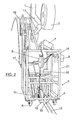
- Figure 1 shows a schematic representation of an assembly station (3) and the successive station (4), the carrier hook or mobile element (1), the vehicle (2) and the auxiliary carriage (20), which is placed in the vicinity of the carrier hook or the mobile element (1).
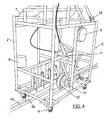
- the carriage has a support structure (5) which in the present embodiment is constituted by a plurality of cylindrical tubes (21) arranged in such a way that they constitute a spatial structure which in this case has the shape of approximately a parallelepiped.
- the structure (5) has a total of four wheels (6) that serve to achieve the displacement of the carriage over the space comprised between the two assembly stations (3) and (4).
- cleaning elements such as brushes and the like so that when the carriage is displaced said brushes eliminate the dirt that may be adhered to the wheels, the rolling being optimal at all times.
- the carriage there will be a plurality of containers (7) whose number and arrangement with respect to the carriage will be variable and will be adapted to the requests of the mounting operations that have to be performed in each case, there will also be a series of brackets (8) also in a variable number and arrangement, to hold parts and/or tools.
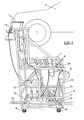
- the carriage, connected to its support structure (5) will have an energy recuperator (9) which carries a cable (10) wound in its interior, with one of its ends being connected to the aforementioned recuperator (9) and the other end being in turn connected to a pulley (11) which is coupled to a main wheel (12).
- a helical spring may be used as a recuperator, which is surrounded by a casing for its protection.
- a chain and a toothed plate (not shown in the figure) or any other mechanism that can fulfil the same function may be used.
- a retainer (13) fixed to the structure (5) which in the present embodiment, due to the height at which the vehicle is placed for its assembly, is placed on the upper part of said structure (5) as it can be seen in the figures, the main function of said retainer (13) being to temporarily relate the displacement of the carriage (20) to the displacement of the carrier hook or the mobile element (1), that is to make the carriage displace along with the carrier hook.
- the aforementioned retainer (13) will be operated by a pneumatic device (15) which will basically consist of a pneumatic cylinder actuated by compressed air for which the carriage has a compressed air inlet (17) which besides supplying air for the operation of the retainer, will serve as a source of compressed air for other uses such as for example to provide air wrenches or similar pneumatic tools with compressed air.
- the operation of the retainer (13) will be performed directly by the operator thanks to the existence of a pushbutton (16) fixed into a convenient place for the operator.
- the path of the carriage (20) must be parallel to the movement direction of the carrier hook or mobile element (1), to force said path to follow a completely straight line and prevent any deviations of the carriage, which may cause it to overturn there is a shoe (18) in the lower part parallel to said path and perpendicular to the tubes (21) to which the wheels (6) are joined, said shoe is projected beyond the lower limits of the carriage, until it is partially inserted into a groove-like guide (19) made in the floor of the area where the assembly stations are placed.
- the shoe (18) may have a guide cleaning brush so that when the displacement of the carriage is produced, said brush may extract the dirt from the aforementioned guide and the slide of the shoe (18) along the guide (19) is as smooth and seamless as possible.
- a plate (not shown in the figures) fixed to the floor by mechanical means with the possibility of changing its position and even shortening its length if necessary, said plate having a width such that on its longitudinal edges the wheels (6) of the carriage are mounted, with a staggering configuration to facilitate the guiding of the carriage according to the aforementioned straight path.
- guides (19), shoes (18) or plates is not compulsory, it being possible to avoid the use of said elements, provided that the carriage (10) path is always parallel to the movement path of the carrier hook or mobile element (1) to prevent the carriage from overturning.
- the carriage (20) When the carrier hook or mobile element (1) arrives at the assembly station (3) coming from the previous station, the carriage (20) is placed in a position which we shall call resting position at the beginning of the track between the assembly station (3) and the successive station (4), understanding as successive the following station in the production line taking the movement direction of the carrier hook or mobile element (1).
- the operator pushes the pushbutton (16) and the retainer automatically couples the carriage to the carrier hook, at that moment, the carrier hook continues its path towards the successive station (4) and the carriage in turn moves forward with the carrier hook, its track being guided by the shoe (18) and the guide (19), as the carriage is displaced, the cable (10) is wound around the pulley (11) associated with the main wheel (12), whose mission is to produce the displacement of the carriage in its return path, the wheels (6) operating like support wheels to help with the stable displacement of the carriage. While the cable (10) is wound around the pulley (11) the other end of the cable (10) pulls from the helical spring end (not shown), producing its compression. During the joint movement of the carriage and the carrier hook, the operator performs the working operations and processes of which s/he is in charge to assemble the vehicle.
- the operator pushes the pushbutton (16) again and uncouples the carriage from the carrier hook, the carrier hook continuing its path towards the following assembly station, while the carriage (20) returns, following the opposite direction, to the station (3), following the same path that it followed to arrive at the station (4), thanks to the shoe and guide.
Landscapes
- Engineering & Computer Science (AREA)
- Mechanical Engineering (AREA)
- Manufacturing & Machinery (AREA)
- Chemical & Material Sciences (AREA)
- Combustion & Propulsion (AREA)
- Transportation (AREA)
- Automatic Assembly (AREA)
Applications Claiming Priority (1)
| Application Number | Priority Date | Filing Date | Title |
|---|---|---|---|
| ES201030499A ES2343832B1 (es) | 2010-04-05 | 2010-04-05 | Carro auxiliar para lineas de produccion. |
Publications (2)
| Publication Number | Publication Date |
|---|---|
| EP2371684A2 true EP2371684A2 (de) | 2011-10-05 |
| EP2371684A3 EP2371684A3 (de) | 2012-06-27 |
Family
ID=42357323
Family Applications (1)
| Application Number | Title | Priority Date | Filing Date |
|---|---|---|---|
| EP11380028A Withdrawn EP2371684A3 (de) | 2010-04-05 | 2011-04-04 | Hilfswagen für Fertigungslinien |
Country Status (2)
| Country | Link |
|---|---|
| EP (1) | EP2371684A3 (de) |
| ES (1) | ES2343832B1 (de) |
Cited By (2)
| Publication number | Priority date | Publication date | Assignee | Title |
|---|---|---|---|---|
| WO2018046117A1 (de) * | 2016-09-09 | 2018-03-15 | Audi Ag | Transportfahrzeug |
| US20230356961A1 (en) * | 2022-05-04 | 2023-11-09 | Toyota Motor Engineering & Manufacturing North America, Inc. | Dolly apparatuses including synchronization arms |
Citations (1)
| Publication number | Priority date | Publication date | Assignee | Title |
|---|---|---|---|---|
| US20100028113A1 (en) | 2007-09-07 | 2010-02-04 | Shinji Tohyama | Workpiece mounting device |
Family Cites Families (6)
| Publication number | Priority date | Publication date | Assignee | Title |
|---|---|---|---|---|
| JPH02243234A (ja) * | 1989-03-14 | 1990-09-27 | Daifuku Co Ltd | 自動車等組立ラインへの部品供給システム |
| IE66383B1 (en) * | 1992-01-28 | 1995-12-27 | Bg Res Dev Ltd | A method and a conveyor assembly for assembling components onto a base |
| JP4613889B2 (ja) * | 2006-07-18 | 2011-01-19 | 株式会社デンソー | 多段棚運搬台車および生産ラインシステム |
| DE102006061423A1 (de) * | 2006-12-23 | 2008-06-26 | Daimler Ag | Montage- und/oder Fertigungsstraße |
| JP4899989B2 (ja) * | 2007-03-29 | 2012-03-21 | 三菱自動車工業株式会社 | スペアタイヤ移載装置 |
| JP2010082793A (ja) * | 2008-10-02 | 2010-04-15 | Honda Motor Co Ltd | 生産ライン |
-
2010
- 2010-04-05 ES ES201030499A patent/ES2343832B1/es not_active Expired - Fee Related
-
2011
- 2011-04-04 EP EP11380028A patent/EP2371684A3/de not_active Withdrawn
Patent Citations (1)
| Publication number | Priority date | Publication date | Assignee | Title |
|---|---|---|---|---|
| US20100028113A1 (en) | 2007-09-07 | 2010-02-04 | Shinji Tohyama | Workpiece mounting device |
Cited By (3)
| Publication number | Priority date | Publication date | Assignee | Title |
|---|---|---|---|---|
| WO2018046117A1 (de) * | 2016-09-09 | 2018-03-15 | Audi Ag | Transportfahrzeug |
| US20230356961A1 (en) * | 2022-05-04 | 2023-11-09 | Toyota Motor Engineering & Manufacturing North America, Inc. | Dolly apparatuses including synchronization arms |
| US11987453B2 (en) * | 2022-05-04 | 2024-05-21 | Toyota Motor Engineering & Manufacturing North America, Inc. | Dolly apparatuses including synchronization arms |
Also Published As
| Publication number | Publication date |
|---|---|
| EP2371684A3 (de) | 2012-06-27 |
| ES2343832B1 (es) | 2011-06-28 |
| ES2343832A1 (es) | 2010-08-10 |
Similar Documents
| Publication | Publication Date | Title |
|---|---|---|
| CN111148716B (zh) | 用于连接自主移动机器人的系统 | |
| CN108778980A (zh) | 伸缩驱动器,含伸缩驱动器的码垛机及其操作方法和使用 | |
| JP6350166B2 (ja) | 物品搬送台車 | |
| CN103171842A (zh) | 物品保管设备以及物品保管设备中的维修方法 | |
| US20170341877A1 (en) | Accumulator device for dynamically accumulating conveyed products, as well as a method for using such a device | |
| CA2889443A1 (en) | Accumulation pallet conveyor | |
| WO2018086748A2 (de) | Roboterarm, mobiler roboter und logistiksystem | |
| EP4309194A1 (de) | Kabelbearbeitung mit zu- und abfuhr | |
| EP3110683A1 (de) | Wechselvorrichtung und wechselverfahren für karosserieteile tragende spannrahmen zwischen einer spannrahmentransportvorrichtung und einem rahmenförderer über spannrahmenmagazinen | |
| CN107215631B (zh) | 一种agv小车自动挂纱装置 | |
| US7913532B2 (en) | Manipulator for metal sheets | |
| TW201632326A (zh) | 連結鏈節、直動伸縮機構及機械臂機構 | |
| CN216376420U (zh) | 棒材搬运机器人 | |
| CN115231175B (zh) | 一种快运货场智慧创新立库集散转运系统 | |
| KR100963430B1 (ko) | 축적식 파트 피더 | |
| CN215920498U (zh) | 一种夹持装置、机械臂和自动装车设备 | |
| JPWO2018186504A1 (ja) | 伸縮装置用複コンポーネントと伸縮装置用伸縮ユニットと伸縮装置 | |
| ES2343832B1 (es) | Carro auxiliar para lineas de produccion. | |
| CN213111452U (zh) | 一种用于搬运机器人的机械臂 | |
| JPS63123710A (ja) | シヤトル式搬送装置 | |
| CN211812128U (zh) | 管材上料架 | |
| JP5263527B2 (ja) | ラック設備 | |
| CN210285555U (zh) | 一种码垛装置 | |
| WO2011064442A1 (en) | A transfer table, a system, and a method for transferring a pallet or a work piece | |
| CN220148258U (zh) | 不同尺寸箱子立体自动仓库取箱巷道车 |
Legal Events
| Date | Code | Title | Description |
|---|---|---|---|
| PUAI | Public reference made under article 153(3) epc to a published international application that has entered the european phase |
Free format text: ORIGINAL CODE: 0009012 |
|
| AK | Designated contracting states |
Kind code of ref document: A2 Designated state(s): AL AT BE BG CH CY CZ DE DK EE ES FI FR GB GR HR HU IE IS IT LI LT LU LV MC MK MT NL NO PL PT RO RS SE SI SK SM TR |
|
| AX | Request for extension of the european patent |
Extension state: BA ME |
|
| PUAL | Search report despatched |
Free format text: ORIGINAL CODE: 0009013 |
|
| AK | Designated contracting states |
Kind code of ref document: A3 Designated state(s): AL AT BE BG CH CY CZ DE DK EE ES FI FR GB GR HR HU IE IS IT LI LT LU LV MC MK MT NL NO PL PT RO RS SE SI SK SM TR |
|
| AX | Request for extension of the european patent |
Extension state: BA ME |
|
| RIC1 | Information provided on ipc code assigned before grant |
Ipc: B62D 65/18 20060101AFI20120518BHEP |
|
| STAA | Information on the status of an ep patent application or granted ep patent |
Free format text: STATUS: THE APPLICATION IS DEEMED TO BE WITHDRAWN |
|
| 18D | Application deemed to be withdrawn |
Effective date: 20130103 |