EP2364186B1 - Photolabile duftspeicherstoffe - Google Patents
Photolabile duftspeicherstoffe Download PDFInfo
- Publication number
- EP2364186B1 EP2364186B1 EP09740085.7A EP09740085A EP2364186B1 EP 2364186 B1 EP2364186 B1 EP 2364186B1 EP 09740085 A EP09740085 A EP 09740085A EP 2364186 B1 EP2364186 B1 EP 2364186B1
- Authority
- EP
- European Patent Office
- Prior art keywords
- methyl
- substituted
- dimethyl
- carboxaldehyde
- group
- Prior art date
- Legal status (The legal status is an assumption and is not a legal conclusion. Google has not performed a legal analysis and makes no representation as to the accuracy of the status listed.)
- Not-in-force
Links
- 239000003205 fragrance Substances 0.000 title claims abstract description 107
- 239000000126 substance Substances 0.000 title abstract description 12
- 238000003860 storage Methods 0.000 title abstract description 6
- 150000002576 ketones Chemical class 0.000 claims abstract description 37
- 150000001299 aldehydes Chemical class 0.000 claims abstract description 33
- 238000000034 method Methods 0.000 claims abstract description 14
- 230000005923 long-lasting effect Effects 0.000 claims abstract description 8
- 239000012459 cleaning agent Substances 0.000 claims description 50
- 238000005406 washing Methods 0.000 claims description 50
- -1 triplal Chemical compound 0.000 claims description 48
- 125000000217 alkyl group Chemical group 0.000 claims description 27
- 239000000203 mixture Substances 0.000 claims description 26
- 125000004432 carbon atom Chemical group C* 0.000 claims description 24
- 125000002496 methyl group Chemical group [H]C([H])([H])* 0.000 claims description 22
- 125000004435 hydrogen atom Chemical group [H]* 0.000 claims description 21
- 150000001875 compounds Chemical class 0.000 claims description 19
- 230000005670 electromagnetic radiation Effects 0.000 claims description 17
- WPFVBOQKRVRMJB-UHFFFAOYSA-N hydroxycitronellal Chemical compound O=CCC(C)CCCC(C)(C)O WPFVBOQKRVRMJB-UHFFFAOYSA-N 0.000 claims description 17
- KSMVZQYAVGTKIV-UHFFFAOYSA-N decanal Chemical compound CCCCCCCCCC=O KSMVZQYAVGTKIV-UHFFFAOYSA-N 0.000 claims description 16
- CBOQJANXLMLOSS-UHFFFAOYSA-N ethyl vanillin Chemical compound CCOC1=CC(C=O)=CC=C1O CBOQJANXLMLOSS-UHFFFAOYSA-N 0.000 claims description 16
- ZRSNZINYAWTAHE-UHFFFAOYSA-N p-methoxybenzaldehyde Chemical compound COC1=CC=C(C=O)C=C1 ZRSNZINYAWTAHE-UHFFFAOYSA-N 0.000 claims description 16
- KVWWIYGFBYDJQC-UHFFFAOYSA-N methyl dihydrojasmonate Chemical compound CCCCCC1C(CC(=O)OC)CCC1=O KVWWIYGFBYDJQC-UHFFFAOYSA-N 0.000 claims description 15
- 125000002947 alkylene group Chemical group 0.000 claims description 14
- HFJRKMMYBMWEAD-UHFFFAOYSA-N dodecanal Chemical compound CCCCCCCCCCCC=O HFJRKMMYBMWEAD-UHFFFAOYSA-N 0.000 claims description 14
- YGFGZTXGYTUXBA-UHFFFAOYSA-N (±)-2,6-dimethyl-5-heptenal Chemical compound O=CC(C)CCC=C(C)C YGFGZTXGYTUXBA-UHFFFAOYSA-N 0.000 claims description 12
- NFAVNWJJYQAGNB-UHFFFAOYSA-N 2-methylundecanal Chemical compound CCCCCCCCCC(C)C=O NFAVNWJJYQAGNB-UHFFFAOYSA-N 0.000 claims description 12
- SATCULPHIDQDRE-UHFFFAOYSA-N piperonal Chemical compound O=CC1=CC=C2OCOC2=C1 SATCULPHIDQDRE-UHFFFAOYSA-N 0.000 claims description 12
- KRIOVPPHQSLHCZ-UHFFFAOYSA-N propiophenone Chemical compound CCC(=O)C1=CC=CC=C1 KRIOVPPHQSLHCZ-UHFFFAOYSA-N 0.000 claims description 12
- AKGGYBADQZYZPD-UHFFFAOYSA-N benzylacetone Chemical compound CC(=O)CCC1=CC=CC=C1 AKGGYBADQZYZPD-UHFFFAOYSA-N 0.000 claims description 10
- ULDHMXUKGWMISQ-UHFFFAOYSA-N carvone Chemical compound CC(=C)C1CC=C(C)C(=O)C1 ULDHMXUKGWMISQ-UHFFFAOYSA-N 0.000 claims description 10
- 125000003545 alkoxy group Chemical group 0.000 claims description 9
- 229910052739 hydrogen Inorganic materials 0.000 claims description 9
- 239000001257 hydrogen Substances 0.000 claims description 9
- MWOOGOJBHIARFG-UHFFFAOYSA-N vanillin Chemical compound COC1=CC(C=O)=CC=C1O MWOOGOJBHIARFG-UHFFFAOYSA-N 0.000 claims description 9
- MZZRKEIUNOYYDF-UHFFFAOYSA-N 2,4-dimethylcyclohex-3-ene-1-carbaldehyde Chemical compound CC1C=C(C)CCC1C=O MZZRKEIUNOYYDF-UHFFFAOYSA-N 0.000 claims description 8
- UEGBWDUVDAKUGA-UHFFFAOYSA-N 2,6,10-trimethylundec-9-enal Chemical compound CC(C)=CCCC(C)CCCC(C)C=O UEGBWDUVDAKUGA-UHFFFAOYSA-N 0.000 claims description 8
- OHRBQTOZYGEWCJ-UHFFFAOYSA-N 3-(3-propan-2-ylphenyl)butanal Chemical compound CC(C)C1=CC=CC(C(C)CC=O)=C1 OHRBQTOZYGEWCJ-UHFFFAOYSA-N 0.000 claims description 8
- YGCZTXZTJXYWCO-UHFFFAOYSA-N 3-phenylpropanal Chemical compound O=CCCC1=CC=CC=C1 YGCZTXZTJXYWCO-UHFFFAOYSA-N 0.000 claims description 8
- NTPLXRHDUXRPNE-UHFFFAOYSA-N 4-methoxyacetophenone Chemical compound COC1=CC=C(C(C)=O)C=C1 NTPLXRHDUXRPNE-UHFFFAOYSA-N 0.000 claims description 8
- KWOLFJPFCHCOCG-UHFFFAOYSA-N Acetophenone Chemical compound CC(=O)C1=CC=CC=C1 KWOLFJPFCHCOCG-UHFFFAOYSA-N 0.000 claims description 8
- LHXDLQBQYFFVNW-UHFFFAOYSA-N Fenchone Chemical compound C1CC2(C)C(=O)C(C)(C)C1C2 LHXDLQBQYFFVNW-UHFFFAOYSA-N 0.000 claims description 8
- NBBJYMSMWIIQGU-UHFFFAOYSA-N Propionic aldehyde Chemical compound CCC=O NBBJYMSMWIIQGU-UHFFFAOYSA-N 0.000 claims description 8
- HUMNYLRZRPPJDN-UHFFFAOYSA-N benzaldehyde Chemical compound O=CC1=CC=CC=C1 HUMNYLRZRPPJDN-UHFFFAOYSA-N 0.000 claims description 8
- GYHFUZHODSMOHU-UHFFFAOYSA-N nonanal Chemical compound CCCCCCCCC=O GYHFUZHODSMOHU-UHFFFAOYSA-N 0.000 claims description 8
- BOPPSUHPZARXTH-UHFFFAOYSA-N ocean propanal Chemical compound O=CC(C)CC1=CC=C2OCOC2=C1 BOPPSUHPZARXTH-UHFFFAOYSA-N 0.000 claims description 8
- NUJGJRNETVAIRJ-UHFFFAOYSA-N octanal Chemical compound CCCCCCCC=O NUJGJRNETVAIRJ-UHFFFAOYSA-N 0.000 claims description 8
- QJJDNZGPQDGNDX-UHFFFAOYSA-N oxidized Latia luciferin Chemical compound CC(=O)CCC1=C(C)CCCC1(C)C QJJDNZGPQDGNDX-UHFFFAOYSA-N 0.000 claims description 8
- 125000001997 phenyl group Chemical group [H]C1=C([H])C([H])=C(*)C([H])=C1[H] 0.000 claims description 8
- DTUQWGWMVIHBKE-UHFFFAOYSA-N phenylacetaldehyde Chemical compound O=CCC1=CC=CC=C1 DTUQWGWMVIHBKE-UHFFFAOYSA-N 0.000 claims description 8
- 239000002243 precursor Substances 0.000 claims description 8
- KMPQYAYAQWNLME-UHFFFAOYSA-N undecanal Chemical compound CCCCCCCCCCC=O KMPQYAYAQWNLME-UHFFFAOYSA-N 0.000 claims description 8
- PSQYTAPXSHCGMF-BQYQJAHWSA-N β-ionone Chemical compound CC(=O)\C=C\C1=C(C)CCCC1(C)C PSQYTAPXSHCGMF-BQYQJAHWSA-N 0.000 claims description 8
- FVUGZKDGWGKCFE-UHFFFAOYSA-N 1-(2,3,8,8-tetramethyl-1,3,4,5,6,7-hexahydronaphthalen-2-yl)ethanone Chemical compound CC1(C)CCCC2=C1CC(C(C)=O)(C)C(C)C2 FVUGZKDGWGKCFE-UHFFFAOYSA-N 0.000 claims description 7
- 241000402754 Erythranthe moschata Species 0.000 claims description 7
- 150000001728 carbonyl compounds Chemical class 0.000 claims description 7
- 125000005843 halogen group Chemical group 0.000 claims description 7
- OFHHDSQXFXLTKC-UHFFFAOYSA-N 10-undecenal Chemical compound C=CCCCCCCCCC=O OFHHDSQXFXLTKC-UHFFFAOYSA-N 0.000 claims description 6
- XSAYZAUNJMRRIR-UHFFFAOYSA-N 2-acetylnaphthalene Chemical compound C1=CC=CC2=CC(C(=O)C)=CC=C21 XSAYZAUNJMRRIR-UHFFFAOYSA-N 0.000 claims description 6
- WTEVQBCEXWBHNA-UHFFFAOYSA-N Citral Natural products CC(C)=CCCC(C)=CC=O WTEVQBCEXWBHNA-UHFFFAOYSA-N 0.000 claims description 6
- MIZGSAALSYARKU-UHFFFAOYSA-N cashmeran Chemical compound CC1(C)C(C)C(C)(C)C2=C1C(=O)CCC2 MIZGSAALSYARKU-UHFFFAOYSA-N 0.000 claims description 6
- 125000004122 cyclic group Chemical group 0.000 claims description 6
- 125000005592 polycycloalkyl group Polymers 0.000 claims description 6
- 239000004094 surface-active agent Substances 0.000 claims description 6
- XMLSXPIVAXONDL-UHFFFAOYSA-N trans-jasmone Natural products CCC=CCC1=C(C)CCC1=O XMLSXPIVAXONDL-UHFFFAOYSA-N 0.000 claims description 6
- 239000001674 (E)-1-(2,6,6-trimethyl-1-cyclohexenyl)but-2-en-1-one Substances 0.000 claims description 5
- XEJGJTYRUWUFFD-FNORWQNLSA-N (e)-1-(2,6,6-trimethyl-1-cyclohex-3-enyl)but-2-en-1-one Chemical compound C\C=C\C(=O)C1C(C)C=CCC1(C)C XEJGJTYRUWUFFD-FNORWQNLSA-N 0.000 claims description 5
- BGTBFNDXYDYBEY-UHFFFAOYSA-N 1-(2,6,6-trimethylcyclohexen-1-yl)but-2-en-1-one Chemical compound CC=CC(=O)C1=C(C)CCCC1(C)C BGTBFNDXYDYBEY-UHFFFAOYSA-N 0.000 claims description 5
- CTLDWNVYXLHMAS-UHFFFAOYSA-N 2,4,4,7-tetramethyloct-6-en-3-one Chemical compound CC(C)C(=O)C(C)(C)CC=C(C)C CTLDWNVYXLHMAS-UHFFFAOYSA-N 0.000 claims description 5
- POIARNZEYGURDG-FNORWQNLSA-N beta-damascenone Chemical compound C\C=C\C(=O)C1=C(C)C=CCC1(C)C POIARNZEYGURDG-FNORWQNLSA-N 0.000 claims description 5
- POIARNZEYGURDG-UHFFFAOYSA-N beta-damascenone Natural products CC=CC(=O)C1=C(C)C=CCC1(C)C POIARNZEYGURDG-UHFFFAOYSA-N 0.000 claims description 5
- 239000002537 cosmetic Substances 0.000 claims description 5
- FGQOOHJZONJGDT-UHFFFAOYSA-N vanillin Natural products COC1=CC(O)=CC(C=O)=C1 FGQOOHJZONJGDT-UHFFFAOYSA-N 0.000 claims description 5
- 235000012141 vanillin Nutrition 0.000 claims description 5
- 229930007850 β-damascenone Natural products 0.000 claims description 5
- SFEOKXHPFMOVRM-UHFFFAOYSA-N (+)-(S)-gamma-ionone Natural products CC(=O)C=CC1C(=C)CCCC1(C)C SFEOKXHPFMOVRM-UHFFFAOYSA-N 0.000 claims description 4
- LHXDLQBQYFFVNW-XCBNKYQSSA-N (+)-Fenchone Natural products C1C[C@]2(C)C(=O)C(C)(C)[C@H]1C2 LHXDLQBQYFFVNW-XCBNKYQSSA-N 0.000 claims description 4
- NFLGAXVYCFJBMK-RKDXNWHRSA-N (+)-isomenthone Natural products CC(C)[C@H]1CC[C@@H](C)CC1=O NFLGAXVYCFJBMK-RKDXNWHRSA-N 0.000 claims description 4
- HZYHMHHBBBSGHB-UHFFFAOYSA-N (2E,6E)-2,6-Nonadienal Natural products CCC=CCCC=CC=O HZYHMHHBBBSGHB-UHFFFAOYSA-N 0.000 claims description 4
- HZYHMHHBBBSGHB-DYWGDJMRSA-N (2e,6e)-nona-2,6-dienal Chemical compound CC\C=C\CC\C=C\C=O HZYHMHHBBBSGHB-DYWGDJMRSA-N 0.000 claims description 4
- CIXAYNMKFFQEFU-UHFFFAOYSA-N (4-Methylphenyl)acetaldehyde Chemical compound CC1=CC=C(CC=O)C=C1 CIXAYNMKFFQEFU-UHFFFAOYSA-N 0.000 claims description 4
- MMLYERLRGHVBEK-XYOKQWHBSA-N (4e)-5,9-dimethyldeca-4,8-dienal Chemical compound CC(C)=CCC\C(C)=C\CCC=O MMLYERLRGHVBEK-XYOKQWHBSA-N 0.000 claims description 4
- ZXGMEZJVBHJYEQ-UKTHLTGXSA-N (5e)-2,6,10-trimethylundeca-5,9-dienal Chemical compound O=CC(C)CC\C=C(/C)CCC=C(C)C ZXGMEZJVBHJYEQ-UKTHLTGXSA-N 0.000 claims description 4
- KJPRLNWUNMBNBZ-QPJJXVBHSA-N (E)-cinnamaldehyde Chemical compound O=C\C=C\C1=CC=CC=C1 KJPRLNWUNMBNBZ-QPJJXVBHSA-N 0.000 claims description 4
- DSSYKIVIOFKYAU-XCBNKYQSSA-N (R)-camphor Chemical compound C1C[C@@]2(C)C(=O)C[C@@H]1C2(C)C DSSYKIVIOFKYAU-XCBNKYQSSA-N 0.000 claims description 4
- CRIGTVCBMUKRSL-FNORWQNLSA-N 1-(2,6,6-trimethylcyclohex-2-en-1-yl)but-2-enone Chemical compound C\C=C\C(=O)C1C(C)=CCCC1(C)C CRIGTVCBMUKRSL-FNORWQNLSA-N 0.000 claims description 4
- NGTMQRCBACIUES-UHFFFAOYSA-N 1-(3,3-dimethyl-2-bicyclo[2.2.1]heptanyl)ethanone Chemical compound C1CC2C(C)(C)C(C(=O)C)C1C2 NGTMQRCBACIUES-UHFFFAOYSA-N 0.000 claims description 4
- VUIWFNRBSGUSIN-UHFFFAOYSA-N 1-methyl-4-(4-methylpent-3-enyl)cyclohex-3-ene-1-carbaldehyde Chemical compound CC(C)=CCCC1=CCC(C)(C=O)CC1 VUIWFNRBSGUSIN-UHFFFAOYSA-N 0.000 claims description 4
- 229940029225 2,6-dimethyl-5-heptenal Drugs 0.000 claims description 4
- LAUVMIDRJMQUQL-UHFFFAOYSA-N 2-(3,7-dimethylocta-2,6-dienoxy)acetaldehyde Chemical compound CC(C)=CCCC(C)=CCOCC=O LAUVMIDRJMQUQL-UHFFFAOYSA-N 0.000 claims description 4
- FSKGFRBHGXIDSA-UHFFFAOYSA-N 2-(4-propan-2-ylphenyl)acetaldehyde Chemical compound CC(C)C1=CC=C(CC=O)C=C1 FSKGFRBHGXIDSA-UHFFFAOYSA-N 0.000 claims description 4
- DNRJTBAOUJJKDY-UHFFFAOYSA-N 2-Acetyl-3,5,5,6,8,8-hexamethyl-5,6,7,8- tetrahydronaphthalene Chemical compound CC(=O)C1=C(C)C=C2C(C)(C)C(C)CC(C)(C)C2=C1 DNRJTBAOUJJKDY-UHFFFAOYSA-N 0.000 claims description 4
- ZKPFRIDJMMOODR-UHFFFAOYSA-N 2-Methyloctanal Chemical compound CCCCCCC(C)C=O ZKPFRIDJMMOODR-UHFFFAOYSA-N 0.000 claims description 4
- HMKKIXGYKWDQSV-SDNWHVSQSA-N 2-Pentyl-3-phenyl-2-propenal Chemical compound CCCCC\C(C=O)=C/C1=CC=CC=C1 HMKKIXGYKWDQSV-SDNWHVSQSA-N 0.000 claims description 4
- KNHGOYVXAHUDHP-UHFFFAOYSA-N 2-[2-(4-methylcyclohex-3-en-1-yl)propyl]cyclopentan-1-one Chemical compound C1CC(C)=CCC1C(C)CC1CCCC1=O KNHGOYVXAHUDHP-UHFFFAOYSA-N 0.000 claims description 4
- YLQPSXZFPBXHPC-UHFFFAOYSA-N 2-methyl-3-(2-propan-2-ylphenyl)propanal Chemical compound O=CC(C)CC1=CC=CC=C1C(C)C YLQPSXZFPBXHPC-UHFFFAOYSA-N 0.000 claims description 4
- FJCQUJKUMKZEMH-UHFFFAOYSA-N 2-methyl-4-(2,6,6-trimethylcyclohexen-1-yl)but-2-enal Chemical compound O=CC(C)=CCC1=C(C)CCCC1(C)C FJCQUJKUMKZEMH-UHFFFAOYSA-N 0.000 claims description 4
- LBICMZLDYMBIGA-UHFFFAOYSA-N 2-methyldecanal Chemical compound CCCCCCCCC(C)C=O LBICMZLDYMBIGA-UHFFFAOYSA-N 0.000 claims description 4
- XFFILAFLGDUMBF-UHFFFAOYSA-N 2-phenoxyacetaldehyde Chemical compound O=CCOC1=CC=CC=C1 XFFILAFLGDUMBF-UHFFFAOYSA-N 0.000 claims description 4
- IQVAERDLDAZARL-UHFFFAOYSA-N 2-phenylpropanal Chemical compound O=CC(C)C1=CC=CC=C1 IQVAERDLDAZARL-UHFFFAOYSA-N 0.000 claims description 4
- RPJGEHBYOXRURE-UHFFFAOYSA-N 2-propylbicyclo[2.2.1]hept-5-ene-3-carbaldehyde Chemical compound C1C2C=CC1C(CCC)C2C=O RPJGEHBYOXRURE-UHFFFAOYSA-N 0.000 claims description 4
- PANBRUWVURLWGY-UHFFFAOYSA-N 2-undecenal Chemical compound CCCCCCCCC=CC=O PANBRUWVURLWGY-UHFFFAOYSA-N 0.000 claims description 4
- YXRXDZOBKUTUQZ-UHFFFAOYSA-N 3,4-dimethyloct-3-en-2-one Chemical compound CCCCC(C)=C(C)C(C)=O YXRXDZOBKUTUQZ-UHFFFAOYSA-N 0.000 claims description 4
- WTPYRCJDOZVZON-UHFFFAOYSA-N 3,5,5-Trimethylhexanal Chemical compound O=CCC(C)CC(C)(C)C WTPYRCJDOZVZON-UHFFFAOYSA-N 0.000 claims description 4
- FAGYGFPZNTYLAO-UHFFFAOYSA-N 3,7-dimethyl-2-methylideneoct-6-enal Chemical compound O=CC(=C)C(C)CCC=C(C)C FAGYGFPZNTYLAO-UHFFFAOYSA-N 0.000 claims description 4
- UCSIFMPORANABL-UHFFFAOYSA-N 3,7-dimethyloctanal Chemical compound CC(C)CCCC(C)CC=O UCSIFMPORANABL-UHFFFAOYSA-N 0.000 claims description 4
- ITJHALDCYCTNNJ-UHFFFAOYSA-N 3-(2-ethylphenyl)-2,2-dimethylpropanal Chemical compound CCC1=CC=CC=C1CC(C)(C)C=O ITJHALDCYCTNNJ-UHFFFAOYSA-N 0.000 claims description 4
- URQMEZRQHLCJKR-UHFFFAOYSA-N 3-Methyl-5-propyl-2-cyclohexen-1-one Chemical compound CCCC1CC(C)=CC(=O)C1 URQMEZRQHLCJKR-UHFFFAOYSA-N 0.000 claims description 4
- DFJMIMVMOIFPQG-UHFFFAOYSA-N 3-methyl-5-phenylpentanal Chemical compound O=CCC(C)CCC1=CC=CC=C1 DFJMIMVMOIFPQG-UHFFFAOYSA-N 0.000 claims description 4
- YLNYLLVKHRZLGO-UHFFFAOYSA-N 4-(1-ethoxyethenyl)-3,3,5,5-tetramethylcyclohexan-1-one Chemical compound CCOC(=C)C1C(C)(C)CC(=O)CC1(C)C YLNYLLVKHRZLGO-UHFFFAOYSA-N 0.000 claims description 4
- ACVNYUMGXUDACR-UHFFFAOYSA-N 4-(2,6,6-trimethylcyclohex-2-en-1-yl)pentanal Chemical compound O=CCCC(C)C1C(C)=CCCC1(C)C ACVNYUMGXUDACR-UHFFFAOYSA-N 0.000 claims description 4
- TZJLGGWGVLADDN-UHFFFAOYSA-N 4-(3,4-Methylenedioxyphenyl)-2-butanone Chemical group CC(=O)CCC1=CC=C2OCOC2=C1 TZJLGGWGVLADDN-UHFFFAOYSA-N 0.000 claims description 4
- ORMHZBNNECIKOH-UHFFFAOYSA-N 4-(4-hydroxy-4-methylpentyl)cyclohex-3-ene-1-carbaldehyde Chemical compound CC(C)(O)CCCC1=CCC(C=O)CC1 ORMHZBNNECIKOH-UHFFFAOYSA-N 0.000 claims description 4
- IDWULKZGRNHZNR-UHFFFAOYSA-N 7-methoxy-3,7-dimethyloctanal Chemical compound COC(C)(C)CCCC(C)CC=O IDWULKZGRNHZNR-UHFFFAOYSA-N 0.000 claims description 4
- NBESWRYPFPFRAP-UHFFFAOYSA-N 8,8-dimethyl-2,3,4,4a,5,8a-hexahydro-1h-naphthalene-2-carbaldehyde Chemical compound C1CC(C=O)CC2C(C)(C)C=CCC21 NBESWRYPFPFRAP-UHFFFAOYSA-N 0.000 claims description 4
- AQJANVUPNABWRU-UHFFFAOYSA-N 8,8-dimethyl-2,3,4,5,6,7-hexahydro-1h-naphthalene-2-carbaldehyde Chemical compound C1C(C=O)CCC2=C1C(C)(C)CCC2 AQJANVUPNABWRU-UHFFFAOYSA-N 0.000 claims description 4
- 239000005973 Carvone Substances 0.000 claims description 4
- KKVZAVRSVHUSPL-GQCTYLIASA-N Cassiastearoptene Chemical compound COC1=CC=CC=C1\C=C\C=O KKVZAVRSVHUSPL-GQCTYLIASA-N 0.000 claims description 4
- 241000723346 Cinnamomum camphora Species 0.000 claims description 4
- ZXGMEZJVBHJYEQ-UHFFFAOYSA-N Dihydroapofarnesal Natural products O=CC(C)CCC=C(C)CCC=C(C)C ZXGMEZJVBHJYEQ-UHFFFAOYSA-N 0.000 claims description 4
- XMLSXPIVAXONDL-PLNGDYQASA-N Jasmone Chemical compound CC\C=C/CC1=C(C)CCC1=O XMLSXPIVAXONDL-PLNGDYQASA-N 0.000 claims description 4
- 241000234269 Liliales Species 0.000 claims description 4
- NFLGAXVYCFJBMK-UHFFFAOYSA-N Menthone Chemical compound CC(C)C1CCC(C)CC1=O NFLGAXVYCFJBMK-UHFFFAOYSA-N 0.000 claims description 4
- LMETVDMCIJNNKH-UHFFFAOYSA-N [(3,7-Dimethyl-6-octenyl)oxy]acetaldehyde Chemical compound CC(C)=CCCC(C)CCOCC=O LMETVDMCIJNNKH-UHFFFAOYSA-N 0.000 claims description 4
- 239000002386 air freshener Substances 0.000 claims description 4
- CRIGTVCBMUKRSL-UHFFFAOYSA-N alpha-Damascone Natural products CC=CC(=O)C1C(C)=CCCC1(C)C CRIGTVCBMUKRSL-UHFFFAOYSA-N 0.000 claims description 4
- GUUHFMWKWLOQMM-NTCAYCPXSA-N alpha-hexylcinnamaldehyde Chemical compound CCCCCC\C(C=O)=C/C1=CC=CC=C1 GUUHFMWKWLOQMM-NTCAYCPXSA-N 0.000 claims description 4
- GUUHFMWKWLOQMM-UHFFFAOYSA-N alpha-n-hexylcinnamic aldehyde Natural products CCCCCCC(C=O)=CC1=CC=CC=C1 GUUHFMWKWLOQMM-UHFFFAOYSA-N 0.000 claims description 4
- RWCCWEUUXYIKHB-UHFFFAOYSA-N benzophenone Chemical compound C=1C=CC=CC=1C(=O)C1=CC=CC=C1 RWCCWEUUXYIKHB-UHFFFAOYSA-N 0.000 claims description 4
- 239000012965 benzophenone Substances 0.000 claims description 4
- FZJUFJKVIYFBSY-UHFFFAOYSA-N bourgeonal Chemical compound CC(C)(C)C1=CC=C(CCC=O)C=C1 FZJUFJKVIYFBSY-UHFFFAOYSA-N 0.000 claims description 4
- RADAAKRXEPVXBU-UHFFFAOYSA-N buccoxime Chemical compound C1CCC2(C)CCC1(C)C2=NO RADAAKRXEPVXBU-UHFFFAOYSA-N 0.000 claims description 4
- 229960000846 camphor Drugs 0.000 claims description 4
- 229930008380 camphor Natural products 0.000 claims description 4
- KJPRLNWUNMBNBZ-UHFFFAOYSA-N cinnamic aldehyde Natural products O=CC=CC1=CC=CC=C1 KJPRLNWUNMBNBZ-UHFFFAOYSA-N 0.000 claims description 4
- IVLCENBZDYVJPA-ARJAWSKDSA-N cis-Jasmone Natural products C\C=C/CC1=C(C)CCC1=O IVLCENBZDYVJPA-ARJAWSKDSA-N 0.000 claims description 4
- 229940043350 citral Drugs 0.000 claims description 4
- NEHNMFOYXAPHSD-UHFFFAOYSA-N citronellal Chemical compound O=CCC(C)CCC=C(C)C NEHNMFOYXAPHSD-UHFFFAOYSA-N 0.000 claims description 4
- YKFKEYKJGVSEIX-UHFFFAOYSA-N cyclohexanone, 4-(1,1-dimethylethyl)- Chemical compound CC(C)(C)C1CCC(=O)CC1 YKFKEYKJGVSEIX-UHFFFAOYSA-N 0.000 claims description 4
- AKMSQWLDTSOVME-UHFFFAOYSA-N dec-9-enal Chemical compound C=CCCCCCCCC=O AKMSQWLDTSOVME-UHFFFAOYSA-N 0.000 claims description 4
- 229940073505 ethyl vanillin Drugs 0.000 claims description 4
- 229930006735 fenchone Natural products 0.000 claims description 4
- WTEVQBCEXWBHNA-JXMROGBWSA-N geranial Chemical compound CC(C)=CCC\C(C)=C\C=O WTEVQBCEXWBHNA-JXMROGBWSA-N 0.000 claims description 4
- 229930002839 ionone Natural products 0.000 claims description 4
- 150000002499 ionone derivatives Chemical class 0.000 claims description 4
- YJSUCBQWLKRPDL-UHFFFAOYSA-N isocyclocitral Chemical compound CC1CC(C)=CC(C)C1C=O YJSUCBQWLKRPDL-UHFFFAOYSA-N 0.000 claims description 4
- SDQFDHOLCGWZPU-UHFFFAOYSA-N lilial Chemical compound O=CC(C)CC1=CC=C(C(C)(C)C)C=C1 SDQFDHOLCGWZPU-UHFFFAOYSA-N 0.000 claims description 4
- 229930007503 menthone Natural products 0.000 claims description 4
- JPTOCTSNXXKSSN-UHFFFAOYSA-N methylheptenone Chemical compound CCCC=CC(=O)CC JPTOCTSNXXKSSN-UHFFFAOYSA-N 0.000 claims description 4
- KKVZAVRSVHUSPL-UHFFFAOYSA-N o-methoxycinnamic aldehyde Natural products COC1=CC=CC=C1C=CC=O KKVZAVRSVHUSPL-UHFFFAOYSA-N 0.000 claims description 4
- HEKJOMVJRYMUDB-UHFFFAOYSA-N octahydro-6-isopropyl-2(1h)-naphthalenone Chemical compound C1C(=O)CCC2CC(C(C)C)CCC21 HEKJOMVJRYMUDB-UHFFFAOYSA-N 0.000 claims description 4
- QNGNSVIICDLXHT-UHFFFAOYSA-N para-ethylbenzaldehyde Natural products CCC1=CC=C(C=O)C=C1 QNGNSVIICDLXHT-UHFFFAOYSA-N 0.000 claims description 4
- 229940100595 phenylacetaldehyde Drugs 0.000 claims description 4
- 125000000999 tert-butyl group Chemical group [H]C([H])([H])C(*)(C([H])([H])[H])C([H])([H])[H] 0.000 claims description 4
- DKZBBWMURDFHNE-UHFFFAOYSA-N trans-coniferylaldehyde Natural products COC1=CC(C=CC=O)=CC=C1O DKZBBWMURDFHNE-UHFFFAOYSA-N 0.000 claims description 4
- ZFNVDHOSLNRHNN-UHFFFAOYSA-N xi-3-(4-Isopropylphenyl)-2-methylpropanal Chemical compound O=CC(C)CC1=CC=C(C(C)C)C=C1 ZFNVDHOSLNRHNN-UHFFFAOYSA-N 0.000 claims description 4
- OJYLAHXKWMRDGS-UHFFFAOYSA-N zingerone Chemical compound COC1=CC(CCC(C)=O)=CC=C1O OJYLAHXKWMRDGS-UHFFFAOYSA-N 0.000 claims description 4
- CWRKZMLUDFBPAO-VOTSOKGWSA-N (e)-dec-4-enal Chemical compound CCCCC\C=C\CCC=O CWRKZMLUDFBPAO-VOTSOKGWSA-N 0.000 claims description 3
- PUKWIVZFEZFVAT-UHFFFAOYSA-N 2,2,5-trimethyl-5-pentylcyclopentan-1-one Chemical compound CCCCCC1(C)CCC(C)(C)C1=O PUKWIVZFEZFVAT-UHFFFAOYSA-N 0.000 claims description 3
- IZQUWQPXCQLTJY-UHFFFAOYSA-N 2-(4-propan-2-ylphenyl)propanal Chemical compound CC(C)C1=CC=C(C(C)C=O)C=C1 IZQUWQPXCQLTJY-UHFFFAOYSA-N 0.000 claims description 3
- DCSKAMGZSIRJAQ-UHFFFAOYSA-N 4-(2-methylbutan-2-yl)cyclohexan-1-one Chemical compound CCC(C)(C)C1CCC(=O)CC1 DCSKAMGZSIRJAQ-UHFFFAOYSA-N 0.000 claims description 3
- 239000002280 amphoteric surfactant Substances 0.000 claims description 3
- 125000000129 anionic group Chemical group 0.000 claims description 3
- 125000002091 cationic group Chemical group 0.000 claims description 2
- LTMQZVLXCLQPCT-UHFFFAOYSA-N 1,1,6-trimethyltetralin Chemical compound C1CCC(C)(C)C=2C1=CC(C)=CC=2 LTMQZVLXCLQPCT-UHFFFAOYSA-N 0.000 claims 4
- VLUMOWNVWOXZAU-VQHVLOKHSA-N (e)-2-methyl-3-phenylprop-2-enal Chemical compound O=CC(/C)=C/C1=CC=CC=C1 VLUMOWNVWOXZAU-VQHVLOKHSA-N 0.000 claims 2
- HBBONAOKVLYWBI-MDZDMXLPSA-N (e)-dodec-3-enal Chemical compound CCCCCCCC\C=C\CC=O HBBONAOKVLYWBI-MDZDMXLPSA-N 0.000 claims 2
- DZSVIVLGBJKQAP-RYUDHWBXSA-N 1-[(1s,5s)-2-methyl-5-propan-2-ylcyclohex-2-en-1-yl]propan-1-one Chemical compound CCC(=O)[C@H]1C[C@@H](C(C)C)CC=C1C DZSVIVLGBJKQAP-RYUDHWBXSA-N 0.000 claims 2
- GVONPEQEUQYVNH-SNAWJCMRSA-N 2-Methyl-3-(2-pentenyl)-2-cyclopenten-1-one Chemical compound CC\C=C\CC1=C(C)C(=O)CC1 GVONPEQEUQYVNH-SNAWJCMRSA-N 0.000 claims 2
- 239000001725 2-hexylcyclopent-2-en-1-one Substances 0.000 claims 2
- DDFGFKGJBOILQZ-GHMZBOCLSA-N 3-[(1S,5R)-6,6-dimethyl-2-bicyclo[3.1.1]hept-2-enyl]propanal Chemical compound C1[C@H]2C(C)(C)[C@@H]1CC=C2CCC=O DDFGFKGJBOILQZ-GHMZBOCLSA-N 0.000 claims 2
- YCIXWYOBMVNGTB-UHFFFAOYSA-N 3-methyl-2-pentylcyclopent-2-en-1-one Chemical compound CCCCCC1=C(C)CCC1=O YCIXWYOBMVNGTB-UHFFFAOYSA-N 0.000 claims 2
- MBVFRSJFKMJRHA-UHFFFAOYSA-N 4-fluoro-1-benzofuran-7-carbaldehyde Chemical compound FC1=CC=C(C=O)C2=C1C=CO2 MBVFRSJFKMJRHA-UHFFFAOYSA-N 0.000 claims 2
- NELSZVNHMFOTTB-UHFFFAOYSA-N 5-methyl-1-(4-methylpentyl)cyclohexene Chemical compound CC(C)CCCC1=CCCC(C)C1 NELSZVNHMFOTTB-UHFFFAOYSA-N 0.000 claims 2
- ZTQSAGDEMFDKMZ-UHFFFAOYSA-N Butyraldehyde Chemical compound CCCC=O ZTQSAGDEMFDKMZ-UHFFFAOYSA-N 0.000 claims 2
- 244000178870 Lavandula angustifolia Species 0.000 claims 2
- ALHUZKCOMYUFRB-OAHLLOKOSA-N Muscone Chemical compound C[C@@H]1CCCCCCCCCCCCC(=O)C1 ALHUZKCOMYUFRB-OAHLLOKOSA-N 0.000 claims 2
- 241000736199 Paeonia Species 0.000 claims 2
- 235000006484 Paeonia officinalis Nutrition 0.000 claims 2
- 229930003633 citronellal Natural products 0.000 claims 2
- 235000000983 citronellal Nutrition 0.000 claims 2
- 229940089454 lauryl aldehyde Drugs 0.000 claims 2
- ALHUZKCOMYUFRB-UHFFFAOYSA-N muskone Natural products CC1CCCCCCCCCCCCC(=O)C1 ALHUZKCOMYUFRB-UHFFFAOYSA-N 0.000 claims 2
- USPJNXWHVJTDJW-UHFFFAOYSA-N tricyclo[5.2.1.02,6]decane-3-carbaldehyde Chemical compound C1CC2C3C(C=O)CCC3C1C2 USPJNXWHVJTDJW-UHFFFAOYSA-N 0.000 claims 2
- 239000003921 oil Substances 0.000 description 42
- 235000019198 oils Nutrition 0.000 description 42
- 239000003599 detergent Substances 0.000 description 25
- IAYPIBMASNFSPL-UHFFFAOYSA-N Ethylene oxide Chemical compound C1CO1 IAYPIBMASNFSPL-UHFFFAOYSA-N 0.000 description 23
- 239000002304 perfume Substances 0.000 description 18
- 150000003254 radicals Chemical class 0.000 description 18
- 239000003795 chemical substances by application Substances 0.000 description 15
- 150000001298 alcohols Chemical class 0.000 description 10
- 239000002736 nonionic surfactant Substances 0.000 description 10
- 239000002979 fabric softener Substances 0.000 description 9
- 239000003945 anionic surfactant Substances 0.000 description 8
- 239000000243 solution Substances 0.000 description 8
- 239000004753 textile Substances 0.000 description 8
- QLAJNZSPVITUCQ-UHFFFAOYSA-N 1,3,2-dioxathietane 2,2-dioxide Chemical compound O=S1(=O)OCO1 QLAJNZSPVITUCQ-UHFFFAOYSA-N 0.000 description 7
- RTZKZFJDLAIYFH-UHFFFAOYSA-N Diethyl ether Chemical compound CCOCC RTZKZFJDLAIYFH-UHFFFAOYSA-N 0.000 description 7
- 230000000694 effects Effects 0.000 description 7
- 239000007788 liquid Substances 0.000 description 7
- YMWUJEATGCHHMB-UHFFFAOYSA-N Dichloromethane Chemical compound ClCCl YMWUJEATGCHHMB-UHFFFAOYSA-N 0.000 description 6
- HEDRZPFGACZZDS-MICDWDOJSA-N Trichloro(2H)methane Chemical compound [2H]C(Cl)(Cl)Cl HEDRZPFGACZZDS-MICDWDOJSA-N 0.000 description 6
- 125000003118 aryl group Chemical group 0.000 description 6
- 235000014113 dietary fatty acids Nutrition 0.000 description 6
- 239000000194 fatty acid Substances 0.000 description 6
- 229930195729 fatty acid Natural products 0.000 description 6
- 239000004615 ingredient Substances 0.000 description 6
- 239000000047 product Substances 0.000 description 6
- OHYLPJCEPKEQLB-ZBFHGGJFSA-N (2r,3s)-3-hydroxy-2-methyl-1-phenyldecan-1-one Chemical compound CCCCCCC[C@H](O)[C@@H](C)C(=O)C1=CC=CC=C1 OHYLPJCEPKEQLB-ZBFHGGJFSA-N 0.000 description 5
- 150000002148 esters Chemical class 0.000 description 5
- 150000004665 fatty acids Chemical class 0.000 description 5
- WCYWZMWISLQXQU-UHFFFAOYSA-N methyl Chemical compound [CH3] WCYWZMWISLQXQU-UHFFFAOYSA-N 0.000 description 5
- XLYOFNOQVPJJNP-UHFFFAOYSA-N water Substances O XLYOFNOQVPJJNP-UHFFFAOYSA-N 0.000 description 5
- ZCTQGTTXIYCGGC-UHFFFAOYSA-N Benzyl salicylate Chemical compound OC1=CC=CC=C1C(=O)OCC1=CC=CC=C1 ZCTQGTTXIYCGGC-UHFFFAOYSA-N 0.000 description 4
- LFQSCWFLJHTTHZ-UHFFFAOYSA-N Ethanol Chemical compound CCO LFQSCWFLJHTTHZ-UHFFFAOYSA-N 0.000 description 4
- GLZPCOQZEFWAFX-UHFFFAOYSA-N Geraniol Chemical compound CC(C)=CCCC(C)=CCO GLZPCOQZEFWAFX-UHFFFAOYSA-N 0.000 description 4
- 239000002253 acid Substances 0.000 description 4
- 150000007513 acids Chemical class 0.000 description 4
- 125000001931 aliphatic group Chemical group 0.000 description 4
- QUKGYYKBILRGFE-UHFFFAOYSA-N benzyl acetate Chemical compound CC(=O)OCC1=CC=CC=C1 QUKGYYKBILRGFE-UHFFFAOYSA-N 0.000 description 4
- 238000006243 chemical reaction Methods 0.000 description 4
- 230000003111 delayed effect Effects 0.000 description 4
- 239000003112 inhibitor Substances 0.000 description 4
- 150000003856 quaternary ammonium compounds Chemical class 0.000 description 4
- 150000003839 salts Chemical class 0.000 description 4
- 239000000344 soap Substances 0.000 description 4
- 125000001424 substituent group Chemical group 0.000 description 4
- 239000003760 tallow Substances 0.000 description 4
- 238000012360 testing method Methods 0.000 description 4
- 0 *C(*)C(*)(C(*)C(c1c(*)c(*)c(*)c(*)c1*)=O)O Chemical compound *C(*)C(*)(C(*)C(c1c(*)c(*)c(*)c(*)c1*)=O)O 0.000 description 3
- PRNCMAKCNVRZFX-UHFFFAOYSA-N 3,7-dimethyloctan-1-ol Chemical compound CC(C)CCCC(C)CCO PRNCMAKCNVRZFX-UHFFFAOYSA-N 0.000 description 3
- UHOVQNZJYSORNB-UHFFFAOYSA-N Benzene Chemical compound C1=CC=CC=C1 UHOVQNZJYSORNB-UHFFFAOYSA-N 0.000 description 3
- XEKOWRVHYACXOJ-UHFFFAOYSA-N Ethyl acetate Chemical compound CCOC(C)=O XEKOWRVHYACXOJ-UHFFFAOYSA-N 0.000 description 3
- LYCAIKOWRPUZTN-UHFFFAOYSA-N Ethylene glycol Chemical compound OCCO LYCAIKOWRPUZTN-UHFFFAOYSA-N 0.000 description 3
- 235000010654 Melissa officinalis Nutrition 0.000 description 3
- 244000062730 Melissa officinalis Species 0.000 description 3
- 229940027983 antiseptic and disinfectant quaternary ammonium compound Drugs 0.000 description 3
- 150000005690 diesters Chemical class 0.000 description 3
- 150000002191 fatty alcohols Chemical class 0.000 description 3
- 239000010665 pine oil Substances 0.000 description 3
- 229920006395 saturated elastomer Polymers 0.000 description 3
- 230000035807 sensation Effects 0.000 description 3
- 239000007787 solid Substances 0.000 description 3
- 239000011232 storage material Substances 0.000 description 3
- 239000012756 surface treatment agent Substances 0.000 description 3
- 239000002562 thickening agent Substances 0.000 description 3
- WIAAKUABMFXNEH-YFYNPKGQSA-N (1S,7R)-tricyclo[5.2.1.02,6]decane-4-carbaldehyde Chemical compound C([C@H]1C2)C[C@H]2C2C1CC(C=O)C2 WIAAKUABMFXNEH-YFYNPKGQSA-N 0.000 description 2
- RXBQNMWIQKOSCS-UHFFFAOYSA-N (7,7-dimethyl-4-bicyclo[3.1.1]hept-3-enyl)methanol Chemical compound C1C2C(C)(C)C1CC=C2CO RXBQNMWIQKOSCS-UHFFFAOYSA-N 0.000 description 2
- OOCCDEMITAIZTP-QPJJXVBHSA-N (E)-cinnamyl alcohol Chemical compound OC\C=C\C1=CC=CC=C1 OOCCDEMITAIZTP-QPJJXVBHSA-N 0.000 description 2
- GSUYZVWMHZWMGJ-UHFFFAOYSA-N 1-(4-methylpent-3-enyl)cyclohex-3-ene-1-carbaldehyde Chemical compound CC(C)=CCCC1(C=O)CCC=CC1 GSUYZVWMHZWMGJ-UHFFFAOYSA-N 0.000 description 2
- KBPLFHHGFOOTCA-UHFFFAOYSA-N 1-Octanol Chemical compound CCCCCCCCO KBPLFHHGFOOTCA-UHFFFAOYSA-N 0.000 description 2
- BBMCTIGTTCKYKF-UHFFFAOYSA-N 1-heptanol Chemical compound CCCCCCCO BBMCTIGTTCKYKF-UHFFFAOYSA-N 0.000 description 2
- XDFCZUMLNOYOCH-UHFFFAOYSA-N 1-hydroxydecan-3-one Chemical compound CCCCCCCC(=O)CCO XDFCZUMLNOYOCH-UHFFFAOYSA-N 0.000 description 2
- HGDVHRITTGWMJK-UHFFFAOYSA-N 2,6-dimethylheptan-2-ol Chemical compound CC(C)CCCC(C)(C)O HGDVHRITTGWMJK-UHFFFAOYSA-N 0.000 description 2
- FLUWAIIVLCVEKF-UHFFFAOYSA-N 2-Methyl-1-phenyl-2-propanyl acetate Chemical compound CC(=O)OC(C)(C)CC1=CC=CC=C1 FLUWAIIVLCVEKF-UHFFFAOYSA-N 0.000 description 2
- 125000000954 2-hydroxyethyl group Chemical group [H]C([*])([H])C([H])([H])O[H] 0.000 description 2
- VLUMOWNVWOXZAU-UHFFFAOYSA-N 2-methyl-3-phenylprop-2-enal Chemical compound O=CC(C)=CC1=CC=CC=C1 VLUMOWNVWOXZAU-UHFFFAOYSA-N 0.000 description 2
- QPRQEDXDYOZYLA-UHFFFAOYSA-N 2-methylbutan-1-ol Chemical compound CCC(C)CO QPRQEDXDYOZYLA-UHFFFAOYSA-N 0.000 description 2
- WRMNZCZEMHIOCP-UHFFFAOYSA-N 2-phenylethanol Chemical compound OCCC1=CC=CC=C1 WRMNZCZEMHIOCP-UHFFFAOYSA-N 0.000 description 2
- VAJVDSVGBWFCLW-UHFFFAOYSA-N 3-Phenyl-1-propanol Chemical compound OCCCC1=CC=CC=C1 VAJVDSVGBWFCLW-UHFFFAOYSA-N 0.000 description 2
- QGFSQVPRCWJZQK-UHFFFAOYSA-N 9-Decen-1-ol Chemical compound OCCCCCCCCC=C QGFSQVPRCWJZQK-UHFFFAOYSA-N 0.000 description 2
- 235000007173 Abies balsamea Nutrition 0.000 description 2
- QGZKDVFQNNGYKY-UHFFFAOYSA-O Ammonium Chemical compound [NH4+] QGZKDVFQNNGYKY-UHFFFAOYSA-O 0.000 description 2
- XKRFYHLGVUSROY-UHFFFAOYSA-N Argon Chemical compound [Ar] XKRFYHLGVUSROY-UHFFFAOYSA-N 0.000 description 2
- 239000004857 Balsam Substances 0.000 description 2
- 241000717739 Boswellia sacra Species 0.000 description 2
- 240000007436 Cananga odorata Species 0.000 description 2
- VEXZGXHMUGYJMC-UHFFFAOYSA-M Chloride anion Chemical compound [Cl-] VEXZGXHMUGYJMC-UHFFFAOYSA-M 0.000 description 2
- 235000008733 Citrus aurantifolia Nutrition 0.000 description 2
- 235000013162 Cocos nucifera Nutrition 0.000 description 2
- 244000060011 Cocos nucifera Species 0.000 description 2
- 239000004863 Frankincense Substances 0.000 description 2
- UFHFLCQGNIYNRP-UHFFFAOYSA-N Hydrogen Chemical compound [H][H] UFHFLCQGNIYNRP-UHFFFAOYSA-N 0.000 description 2
- DGAQECJNVWCQMB-PUAWFVPOSA-M Ilexoside XXIX Chemical compound C[C@@H]1CC[C@@]2(CC[C@@]3(C(=CC[C@H]4[C@]3(CC[C@@H]5[C@@]4(CC[C@@H](C5(C)C)OS(=O)(=O)[O-])C)C)[C@@H]2[C@]1(C)O)C)C(=O)O[C@H]6[C@@H]([C@H]([C@@H]([C@H](O6)CO)O)O)O.[Na+] DGAQECJNVWCQMB-PUAWFVPOSA-M 0.000 description 2
- 244000018716 Impatiens biflora Species 0.000 description 2
- 235000019501 Lemon oil Nutrition 0.000 description 2
- 238000005481 NMR spectroscopy Methods 0.000 description 2
- ISWSIDIOOBJBQZ-UHFFFAOYSA-N Phenol Chemical compound OC1=CC=CC=C1 ISWSIDIOOBJBQZ-UHFFFAOYSA-N 0.000 description 2
- 235000012550 Pimpinella anisum Nutrition 0.000 description 2
- 240000004760 Pimpinella anisum Species 0.000 description 2
- FAPWRFPIFSIZLT-UHFFFAOYSA-M Sodium chloride Chemical compound [Na+].[Cl-] FAPWRFPIFSIZLT-UHFFFAOYSA-M 0.000 description 2
- 240000006909 Tilia x europaea Species 0.000 description 2
- 235000011941 Tilia x europaea Nutrition 0.000 description 2
- 239000013543 active substance Substances 0.000 description 2
- 238000005575 aldol reaction Methods 0.000 description 2
- 150000001336 alkenes Chemical group 0.000 description 2
- 125000003368 amide group Chemical group 0.000 description 2
- 125000003277 amino group Chemical group 0.000 description 2
- 239000003125 aqueous solvent Substances 0.000 description 2
- 229940007550 benzyl acetate Drugs 0.000 description 2
- JZGHUJPUKVEMSW-UHFFFAOYSA-N bis(2-hexadecanoyloxyethyl)-(2-hydroxyethyl)-methylazanium Chemical compound CCCCCCCCCCCCCCCC(=O)OCC[N+](C)(CCO)CCOC(=O)CCCCCCCCCCCCCCC JZGHUJPUKVEMSW-UHFFFAOYSA-N 0.000 description 2
- 239000010630 cinnamon oil Substances 0.000 description 2
- QMVPMAAFGQKVCJ-UHFFFAOYSA-N citronellol Chemical compound OCCC(C)CCC=C(C)C QMVPMAAFGQKVCJ-UHFFFAOYSA-N 0.000 description 2
- 239000001524 citrus aurantium oil Substances 0.000 description 2
- 239000010634 clove oil Substances 0.000 description 2
- 238000004440 column chromatography Methods 0.000 description 2
- 229920001577 copolymer Polymers 0.000 description 2
- NUQDJSMHGCTKNL-UHFFFAOYSA-N cyclohexyl 2-hydroxybenzoate Chemical compound OC1=CC=CC=C1C(=O)OC1CCCCC1 NUQDJSMHGCTKNL-UHFFFAOYSA-N 0.000 description 2
- MWKFXSUHUHTGQN-UHFFFAOYSA-N decan-1-ol Chemical compound CCCCCCCCCCO MWKFXSUHUHTGQN-UHFFFAOYSA-N 0.000 description 2
- 229940095104 dimethyl benzyl carbinyl acetate Drugs 0.000 description 2
- 238000004851 dishwashing Methods 0.000 description 2
- 238000009826 distribution Methods 0.000 description 2
- UKMSUNONTOPOIO-UHFFFAOYSA-N docosanoic acid Chemical compound CCCCCCCCCCCCCCCCCCCCCC(O)=O UKMSUNONTOPOIO-UHFFFAOYSA-N 0.000 description 2
- HBBONAOKVLYWBI-UHFFFAOYSA-N dodec-3-enal Chemical compound CCCCCCCCC=CCC=O HBBONAOKVLYWBI-UHFFFAOYSA-N 0.000 description 2
- POULHZVOKOAJMA-UHFFFAOYSA-N dodecanoic acid Chemical class CCCCCCCCCCCC(O)=O POULHZVOKOAJMA-UHFFFAOYSA-N 0.000 description 2
- 239000000975 dye Substances 0.000 description 2
- 125000004185 ester group Chemical group 0.000 description 2
- RRAFCDWBNXTKKO-UHFFFAOYSA-N eugenol Chemical compound COC1=CC(CC=C)=CC=C1O RRAFCDWBNXTKKO-UHFFFAOYSA-N 0.000 description 2
- 239000001148 ferula galbaniflua oil terpeneless Substances 0.000 description 2
- 238000009472 formulation Methods 0.000 description 2
- 150000004820 halides Chemical class 0.000 description 2
- 125000005842 heteroatom Chemical group 0.000 description 2
- IPCSVZSSVZVIGE-UHFFFAOYSA-N hexadecanoic acid Chemical compound CCCCCCCCCCCCCCCC(O)=O IPCSVZSSVZVIGE-UHFFFAOYSA-N 0.000 description 2
- ZSIAUFGUXNUGDI-UHFFFAOYSA-N hexan-1-ol Chemical compound CCCCCCO ZSIAUFGUXNUGDI-UHFFFAOYSA-N 0.000 description 2
- ZOCHHNOQQHDWHG-UHFFFAOYSA-N hexan-3-ol Chemical compound CCCC(O)CC ZOCHHNOQQHDWHG-UHFFFAOYSA-N 0.000 description 2
- 229930195733 hydrocarbon Natural products 0.000 description 2
- 150000002430 hydrocarbons Chemical class 0.000 description 2
- 125000002887 hydroxy group Chemical group [H]O* 0.000 description 2
- WGCNASOHLSPBMP-UHFFFAOYSA-N hydroxyacetaldehyde Natural products OCC=O WGCNASOHLSPBMP-UHFFFAOYSA-N 0.000 description 2
- QNXSIUBBGPHDDE-UHFFFAOYSA-N indan-1-one Chemical compound C1=CC=C2C(=O)CCC2=C1 QNXSIUBBGPHDDE-UHFFFAOYSA-N 0.000 description 2
- 125000004491 isohexyl group Chemical group C(CCC(C)C)* 0.000 description 2
- ZYTMANIQRDEHIO-KXUCPTDWSA-N isopulegol Chemical compound C[C@@H]1CC[C@@H](C(C)=C)[C@H](O)C1 ZYTMANIQRDEHIO-KXUCPTDWSA-N 0.000 description 2
- 239000001851 juniperus communis l. berry oil Substances 0.000 description 2
- 239000010501 lemon oil Substances 0.000 description 2
- 239000004571 lime Substances 0.000 description 2
- CDOSHBSSFJOMGT-UHFFFAOYSA-N linalool Chemical compound CC(C)=CCCC(C)(O)C=C CDOSHBSSFJOMGT-UHFFFAOYSA-N 0.000 description 2
- UWKAYLJWKGQEPM-LBPRGKRZSA-N linalyl acetate Chemical compound CC(C)=CCC[C@](C)(C=C)OC(C)=O UWKAYLJWKGQEPM-LBPRGKRZSA-N 0.000 description 2
- 239000012669 liquid formulation Substances 0.000 description 2
- 230000007935 neutral effect Effects 0.000 description 2
- 229910052757 nitrogen Inorganic materials 0.000 description 2
- ZWRUINPWMLAQRD-UHFFFAOYSA-N nonan-1-ol Chemical compound CCCCCCCCCO ZWRUINPWMLAQRD-UHFFFAOYSA-N 0.000 description 2
- VSMOENVRRABVKN-UHFFFAOYSA-N oct-1-en-3-ol Chemical compound CCCCCC(O)C=C VSMOENVRRABVKN-UHFFFAOYSA-N 0.000 description 2
- NMRPBPVERJPACX-UHFFFAOYSA-N octan-3-ol Chemical compound CCCCCC(O)CC NMRPBPVERJPACX-UHFFFAOYSA-N 0.000 description 2
- MDHYEMXUFSJLGV-UHFFFAOYSA-N phenethyl acetate Chemical compound CC(=O)OCCC1=CC=CC=C1 MDHYEMXUFSJLGV-UHFFFAOYSA-N 0.000 description 2
- ZQBAKBUEJOMQEX-UHFFFAOYSA-N phenyl salicylate Chemical compound OC1=CC=CC=C1C(=O)OC1=CC=CC=C1 ZQBAKBUEJOMQEX-UHFFFAOYSA-N 0.000 description 2
- NBIIXXVUZAFLBC-UHFFFAOYSA-K phosphate Chemical compound [O-]P([O-])([O-])=O NBIIXXVUZAFLBC-UHFFFAOYSA-K 0.000 description 2
- 229940085991 phosphate ion Drugs 0.000 description 2
- 125000003367 polycyclic group Chemical group 0.000 description 2
- 229920000642 polymer Polymers 0.000 description 2
- 239000010671 sandalwood oil Substances 0.000 description 2
- 239000011734 sodium Substances 0.000 description 2
- 229910052708 sodium Inorganic materials 0.000 description 2
- 239000002904 solvent Substances 0.000 description 2
- BDHFUVZGWQCTTF-UHFFFAOYSA-M sulfonate Chemical compound [O-]S(=O)=O BDHFUVZGWQCTTF-UHFFFAOYSA-M 0.000 description 2
- 238000006277 sulfonation reaction Methods 0.000 description 2
- AKEJUJNQAAGONA-UHFFFAOYSA-N sulfur trioxide Chemical compound O=S(=O)=O AKEJUJNQAAGONA-UHFFFAOYSA-N 0.000 description 2
- MGSRCZKZVOBKFT-UHFFFAOYSA-N thymol Chemical compound CC(C)C1=CC=C(C)C=C1O MGSRCZKZVOBKFT-UHFFFAOYSA-N 0.000 description 2
- RUVINXPYWBROJD-ONEGZZNKSA-N trans-anethole Chemical compound COC1=CC=C(\C=C\C)C=C1 RUVINXPYWBROJD-ONEGZZNKSA-N 0.000 description 2
- 150000005691 triesters Chemical class 0.000 description 2
- 239000010679 vetiver oil Substances 0.000 description 2
- 239000002888 zwitterionic surfactant Substances 0.000 description 2
- NOOLISFMXDJSKH-UTLUCORTSA-N (+)-Neomenthol Chemical compound CC(C)[C@@H]1CC[C@@H](C)C[C@@H]1O NOOLISFMXDJSKH-UTLUCORTSA-N 0.000 description 1
- DTGKSKDOIYIVQL-WEDXCCLWSA-N (+)-borneol Chemical compound C1C[C@@]2(C)[C@@H](O)C[C@@H]1C2(C)C DTGKSKDOIYIVQL-WEDXCCLWSA-N 0.000 description 1
- 239000001871 (1R,2R,5S)-5-methyl-2-prop-1-en-2-ylcyclohexan-1-ol Substances 0.000 description 1
- AMXYRHBJZOVHOL-ODYTWBPASA-N (2E,6Z)-nona-2,6-dien-1-ol Chemical compound CC\C=C/CC\C=C\CO AMXYRHBJZOVHOL-ODYTWBPASA-N 0.000 description 1
- JNYAEWCLZODPBN-JGWLITMVSA-N (2r,3r,4s)-2-[(1r)-1,2-dihydroxyethyl]oxolane-3,4-diol Chemical compound OC[C@@H](O)[C@H]1OC[C@H](O)[C@H]1O JNYAEWCLZODPBN-JGWLITMVSA-N 0.000 description 1
- 239000001490 (3R)-3,7-dimethylocta-1,6-dien-3-ol Substances 0.000 description 1
- 239000001147 (3aR,5aS,9aS,9bR)-3a,6,6,9a-tetramethyl-2,4,5,5a,7,8,9,9b-octahydro-1H-benzo[e][1]benzofuran Substances 0.000 description 1
- ALSTYHKOOCGGFT-KTKRTIGZSA-N (9Z)-octadecen-1-ol Chemical compound CCCCCCCC\C=C/CCCCCCCCO ALSTYHKOOCGGFT-KTKRTIGZSA-N 0.000 description 1
- NSSALFVIQPAIQK-BQYQJAHWSA-N (E)-non-2-en-1-ol Chemical compound CCCCCC\C=C\CO NSSALFVIQPAIQK-BQYQJAHWSA-N 0.000 description 1
- AYQPVPFZWIQERS-VOTSOKGWSA-N (E)-oct-2-en-1-ol Chemical compound CCCCC\C=C\CO AYQPVPFZWIQERS-VOTSOKGWSA-N 0.000 description 1
- QMVPMAAFGQKVCJ-SNVBAGLBSA-N (R)-(+)-citronellol Natural products OCC[C@H](C)CCC=C(C)C QMVPMAAFGQKVCJ-SNVBAGLBSA-N 0.000 description 1
- CDOSHBSSFJOMGT-JTQLQIEISA-N (R)-linalool Natural products CC(C)=CCC[C@@](C)(O)C=C CDOSHBSSFJOMGT-JTQLQIEISA-N 0.000 description 1
- WUOACPNHFRMFPN-SECBINFHSA-N (S)-(-)-alpha-terpineol Chemical compound CC1=CC[C@@H](C(C)(C)O)CC1 WUOACPNHFRMFPN-SECBINFHSA-N 0.000 description 1
- RUJPNZNXGCHGID-UHFFFAOYSA-N (Z)-beta-Terpineol Natural products CC(=C)C1CCC(C)(O)CC1 RUJPNZNXGCHGID-UHFFFAOYSA-N 0.000 description 1
- DYLIWHYUXAJDOJ-OWOJBTEDSA-N (e)-4-(6-aminopurin-9-yl)but-2-en-1-ol Chemical compound NC1=NC=NC2=C1N=CN2C\C=C\CO DYLIWHYUXAJDOJ-OWOJBTEDSA-N 0.000 description 1
- YYMCVDNIIFNDJK-XFQWXJFMSA-N (z)-1-(3-fluorophenyl)-n-[(z)-(3-fluorophenyl)methylideneamino]methanimine Chemical compound FC1=CC=CC(\C=N/N=C\C=2C=C(F)C=CC=2)=C1 YYMCVDNIIFNDJK-XFQWXJFMSA-N 0.000 description 1
- JRJBVWJSTHECJK-LUAWRHEFSA-N (z)-3-methyl-4-(2,6,6-trimethylcyclohex-2-en-1-yl)but-3-en-2-one Chemical compound CC(=O)C(\C)=C/C1C(C)=CCCC1(C)C JRJBVWJSTHECJK-LUAWRHEFSA-N 0.000 description 1
- VSMOENVRRABVKN-MRVPVSSYSA-N 1-Octen-3-ol Natural products CCCCC[C@H](O)C=C VSMOENVRRABVKN-MRVPVSSYSA-N 0.000 description 1
- WCIQNYOXLZQQMU-UHFFFAOYSA-N 1-Phenylethyl propanoate Chemical compound CCC(=O)OC(C)C1=CC=CC=C1 WCIQNYOXLZQQMU-UHFFFAOYSA-N 0.000 description 1
- WAPNOHKVXSQRPX-UHFFFAOYSA-N 1-phenylethanol Chemical compound CC(O)C1=CC=CC=C1 WAPNOHKVXSQRPX-UHFFFAOYSA-N 0.000 description 1
- GIEMHYCMBGELGY-UHFFFAOYSA-N 10-undecen-1-ol Chemical compound OCCCCCCCCCC=C GIEMHYCMBGELGY-UHFFFAOYSA-N 0.000 description 1
- 238000001644 13C nuclear magnetic resonance spectroscopy Methods 0.000 description 1
- 238000005160 1H NMR spectroscopy Methods 0.000 description 1
- MJTPMXWJHPOWGH-UHFFFAOYSA-N 2-Phenoxyethyl isobutyrate Chemical compound CC(C)C(=O)OCCOC1=CC=CC=C1 MJTPMXWJHPOWGH-UHFFFAOYSA-N 0.000 description 1
- RNDNSYIPLPAXAZ-UHFFFAOYSA-N 2-Phenyl-1-propanol Chemical compound OCC(C)C1=CC=CC=C1 RNDNSYIPLPAXAZ-UHFFFAOYSA-N 0.000 description 1
- ZJVJPPNOQCMEPI-UHFFFAOYSA-N 2-[ethyl(methyl)amino]-2-phenylacetic acid Chemical compound CCN(C)C(C(O)=O)C1=CC=CC=C1 ZJVJPPNOQCMEPI-UHFFFAOYSA-N 0.000 description 1
- IFBPWBDEENYUEG-UHFFFAOYSA-N 2-hydroxyethyl-methyl-bis(2-octadecanoyloxyethyl)azanium Chemical compound CCCCCCCCCCCCCCCCCC(=O)OCC[N+](C)(CCO)CCOC(=O)CCCCCCCCCCCCCCCCC IFBPWBDEENYUEG-UHFFFAOYSA-N 0.000 description 1
- PFNHSEQQEPMLNI-UHFFFAOYSA-N 2-methyl-1-pentanol Chemical compound CCCC(C)CO PFNHSEQQEPMLNI-UHFFFAOYSA-N 0.000 description 1
- RIWRBSMFKVOJMN-UHFFFAOYSA-N 2-methyl-1-phenylpropan-2-ol Chemical compound CC(C)(O)CC1=CC=CC=C1 RIWRBSMFKVOJMN-UHFFFAOYSA-N 0.000 description 1
- VNWOJVJCRAHBJJ-UHFFFAOYSA-N 2-pentylcyclopentan-1-one Chemical compound CCCCCC1CCCC1=O VNWOJVJCRAHBJJ-UHFFFAOYSA-N 0.000 description 1
- QCDWFXQBSFUVSP-UHFFFAOYSA-N 2-phenoxyethanol Chemical compound OCCOC1=CC=CC=C1 QCDWFXQBSFUVSP-UHFFFAOYSA-N 0.000 description 1
- WIYQCLDTSROCTN-UHFFFAOYSA-N 2-phenoxypropanal Chemical compound O=CC(C)OC1=CC=CC=C1 WIYQCLDTSROCTN-UHFFFAOYSA-N 0.000 description 1
- BRRVXFOKWJKTGG-UHFFFAOYSA-N 3,3,5-trimethylcyclohexanol Chemical compound CC1CC(O)CC(C)(C)C1 BRRVXFOKWJKTGG-UHFFFAOYSA-N 0.000 description 1
- YGRCLLQIAOXAHD-UHFFFAOYSA-N 3,5,7,7a-tetrahydro-1h-[1,3]oxazolo[3,4-c][1,3]oxazole Chemical class C1OCC2COCN21 YGRCLLQIAOXAHD-UHFFFAOYSA-N 0.000 description 1
- DLHQZZUEERVIGQ-UHFFFAOYSA-N 3,7-dimethyl-3-octanol Chemical compound CCC(C)(O)CCCC(C)C DLHQZZUEERVIGQ-UHFFFAOYSA-N 0.000 description 1
- NMRPBPVERJPACX-QMMMGPOBSA-N 3-Octanol Natural products CCCCC[C@@H](O)CC NMRPBPVERJPACX-QMMMGPOBSA-N 0.000 description 1
- YDXQPTHHAPCTPP-UHFFFAOYSA-N 3-Octen-1-ol Natural products CCCCC=CCCO YDXQPTHHAPCTPP-UHFFFAOYSA-N 0.000 description 1
- OXYRENDGHPGWKV-UHFFFAOYSA-N 3-methyl-5-phenylpentan-1-ol Chemical compound OCCC(C)CCC1=CC=CC=C1 OXYRENDGHPGWKV-UHFFFAOYSA-N 0.000 description 1
- BGTBFNDXYDYBEY-FNORWQNLSA-N 4-(2,6,6-Trimethylcyclohex-1-enyl)but-2-en-4-one Chemical compound C\C=C\C(=O)C1=C(C)CCCC1(C)C BGTBFNDXYDYBEY-FNORWQNLSA-N 0.000 description 1
- UNDXPKDBFOOQFC-UHFFFAOYSA-N 4-[2-nitro-4-(trifluoromethyl)phenyl]morpholine Chemical compound [O-][N+](=O)C1=CC(C(F)(F)F)=CC=C1N1CCOCC1 UNDXPKDBFOOQFC-UHFFFAOYSA-N 0.000 description 1
- DKKRDMLKVSKFMJ-UHFFFAOYSA-N 4-propan-2-ylcyclohexan-1-ol Chemical compound CC(C)C1CCC(O)CC1 DKKRDMLKVSKFMJ-UHFFFAOYSA-N 0.000 description 1
- MBZRJSQZCBXRGK-UHFFFAOYSA-N 4-tert-Butylcyclohexyl acetate Chemical compound CC(=O)OC1CCC(C(C)(C)C)CC1 MBZRJSQZCBXRGK-UHFFFAOYSA-N 0.000 description 1
- HDQVGGOVPFQTRB-UHFFFAOYSA-N 6,8-dimethylnonan-2-ol Chemical compound CC(C)CC(C)CCCC(C)O HDQVGGOVPFQTRB-UHFFFAOYSA-N 0.000 description 1
- FHVDTGUDJYJELY-UHFFFAOYSA-N 6-{[2-carboxy-4,5-dihydroxy-6-(phosphanyloxy)oxan-3-yl]oxy}-4,5-dihydroxy-3-phosphanyloxane-2-carboxylic acid Chemical compound O1C(C(O)=O)C(P)C(O)C(O)C1OC1C(C(O)=O)OC(OP)C(O)C1O FHVDTGUDJYJELY-UHFFFAOYSA-N 0.000 description 1
- XJHRZBIBSSVCEL-ONEGZZNKSA-N 6E-Nonen-1-ol Chemical compound CC\C=C\CCCCCO XJHRZBIBSSVCEL-ONEGZZNKSA-N 0.000 description 1
- ZCYVEMRRCGMTRW-UHFFFAOYSA-N 7553-56-2 Chemical compound [I] ZCYVEMRRCGMTRW-UHFFFAOYSA-N 0.000 description 1
- 244000215068 Acacia senegal Species 0.000 description 1
- 229920001817 Agar Polymers 0.000 description 1
- 235000007119 Ananas comosus Nutrition 0.000 description 1
- 244000099147 Ananas comosus Species 0.000 description 1
- 244000061520 Angelica archangelica Species 0.000 description 1
- 240000007087 Apium graveolens Species 0.000 description 1
- 235000015849 Apium graveolens Dulce Group Nutrition 0.000 description 1
- 235000010591 Appio Nutrition 0.000 description 1
- 241000086254 Arnica montana Species 0.000 description 1
- 241000416162 Astragalus gummifer Species 0.000 description 1
- 235000021357 Behenic acid Nutrition 0.000 description 1
- DPUOLQHDNGRHBS-UHFFFAOYSA-N Brassidinsaeure Natural products CCCCCCCCC=CCCCCCCCCCCCC(O)=O DPUOLQHDNGRHBS-UHFFFAOYSA-N 0.000 description 1
- 235000002566 Capsicum Nutrition 0.000 description 1
- 240000004160 Capsicum annuum Species 0.000 description 1
- 235000008534 Capsicum annuum var annuum Nutrition 0.000 description 1
- OKTJSMMVPCPJKN-UHFFFAOYSA-N Carbon Chemical compound [C] OKTJSMMVPCPJKN-UHFFFAOYSA-N 0.000 description 1
- 239000004215 Carbon black (E152) Substances 0.000 description 1
- 229920002134 Carboxymethyl cellulose Polymers 0.000 description 1
- 235000005747 Carum carvi Nutrition 0.000 description 1
- 240000000467 Carum carvi Species 0.000 description 1
- NPBVQXIMTZKSBA-UHFFFAOYSA-N Chavibetol Natural products COC1=CC=C(CC=C)C=C1O NPBVQXIMTZKSBA-UHFFFAOYSA-N 0.000 description 1
- 229920002101 Chitin Polymers 0.000 description 1
- 229920001661 Chitosan Polymers 0.000 description 1
- 244000037364 Cinnamomum aromaticum Species 0.000 description 1
- 235000014489 Cinnamomum aromaticum Nutrition 0.000 description 1
- 244000223760 Cinnamomum zeylanicum Species 0.000 description 1
- 241000207199 Citrus Species 0.000 description 1
- 241000675108 Citrus tangerina Species 0.000 description 1
- 235000007129 Cuminum cyminum Nutrition 0.000 description 1
- 244000304337 Cuminum cyminum Species 0.000 description 1
- 241001327300 Cymbopogon schoenanthus Species 0.000 description 1
- NOOLISFMXDJSKH-UHFFFAOYSA-N DL-menthol Natural products CC(C)C1CCC(C)CC1O NOOLISFMXDJSKH-UHFFFAOYSA-N 0.000 description 1
- 229920001353 Dextrin Polymers 0.000 description 1
- 239000004375 Dextrin Substances 0.000 description 1
- RUPBZQFQVRMKDG-UHFFFAOYSA-M Didecyldimethylammonium chloride Chemical compound [Cl-].CCCCCCCCCC[N+](C)(C)CCCCCCCCCC RUPBZQFQVRMKDG-UHFFFAOYSA-M 0.000 description 1
- 240000002943 Elettaria cardamomum Species 0.000 description 1
- 102000004190 Enzymes Human genes 0.000 description 1
- 108090000790 Enzymes Proteins 0.000 description 1
- URXZXNYJPAJJOQ-UHFFFAOYSA-N Erucic acid Natural products CCCCCCC=CCCCCCCCCCCCC(O)=O URXZXNYJPAJJOQ-UHFFFAOYSA-N 0.000 description 1
- VGGSQFUCUMXWEO-UHFFFAOYSA-N Ethene Chemical compound C=C VGGSQFUCUMXWEO-UHFFFAOYSA-N 0.000 description 1
- GYCKQBWUSACYIF-UHFFFAOYSA-N Ethyl salicylate Chemical compound CCOC(=O)C1=CC=CC=C1O GYCKQBWUSACYIF-UHFFFAOYSA-N 0.000 description 1
- 239000005977 Ethylene Substances 0.000 description 1
- 239000005770 Eugenol Substances 0.000 description 1
- 239000001293 FEMA 3089 Substances 0.000 description 1
- 108010010803 Gelatin Proteins 0.000 description 1
- 229920002148 Gellan gum Polymers 0.000 description 1
- 239000005792 Geraniol Substances 0.000 description 1
- GLZPCOQZEFWAFX-YFHOEESVSA-N Geraniol Natural products CC(C)=CCC\C(C)=C/CO GLZPCOQZEFWAFX-YFHOEESVSA-N 0.000 description 1
- WQZGKKKJIJFFOK-GASJEMHNSA-N Glucose Natural products OC[C@H]1OC(O)[C@H](O)[C@@H](O)[C@@H]1O WQZGKKKJIJFFOK-GASJEMHNSA-N 0.000 description 1
- 229920002907 Guar gum Polymers 0.000 description 1
- 229920000084 Gum arabic Polymers 0.000 description 1
- DUKPKQFHJQGTGU-UHFFFAOYSA-N Hexyl salicylic acid Chemical compound CCCCCCOC(=O)C1=CC=CC=C1O DUKPKQFHJQGTGU-UHFFFAOYSA-N 0.000 description 1
- DTGKSKDOIYIVQL-MRTMQBJTSA-N Isoborneol Natural products C1C[C@@]2(C)[C@H](O)C[C@@H]1C2(C)C DTGKSKDOIYIVQL-MRTMQBJTSA-N 0.000 description 1
- BJIOGJUNALELMI-ONEGZZNKSA-N Isoeugenol Natural products COC1=CC(\C=C\C)=CC=C1O BJIOGJUNALELMI-ONEGZZNKSA-N 0.000 description 1
- 235000010254 Jasminum officinale Nutrition 0.000 description 1
- 240000005385 Jasminum sambac Species 0.000 description 1
- 239000005639 Lauric acid Substances 0.000 description 1
- 229920000161 Locust bean gum Polymers 0.000 description 1
- 235000006679 Mentha X verticillata Nutrition 0.000 description 1
- 235000002899 Mentha suaveolens Nutrition 0.000 description 1
- 235000001636 Mentha x rotundifolia Nutrition 0.000 description 1
- ZWEHNKRNPOVVGH-UHFFFAOYSA-N Methyl ethyl ketone Natural products CCC(C)=O ZWEHNKRNPOVVGH-UHFFFAOYSA-N 0.000 description 1
- RXBQNMWIQKOSCS-RKDXNWHRSA-N Myrtenol Natural products C1[C@H]2C(C)(C)[C@@H]1CC=C2CO RXBQNMWIQKOSCS-RKDXNWHRSA-N 0.000 description 1
- GLZPCOQZEFWAFX-JXMROGBWSA-N Nerol Natural products CC(C)=CCC\C(C)=C\CO GLZPCOQZEFWAFX-JXMROGBWSA-N 0.000 description 1
- 235000011203 Origanum Nutrition 0.000 description 1
- 241001529744 Origanum Species 0.000 description 1
- 235000021314 Palmitic acid Nutrition 0.000 description 1
- 239000006002 Pepper Substances 0.000 description 1
- 241000218657 Picea Species 0.000 description 1
- 240000008299 Pinus lambertiana Species 0.000 description 1
- 235000016761 Piper aduncum Nutrition 0.000 description 1
- 235000017804 Piper guineense Nutrition 0.000 description 1
- 240000003889 Piper guineense Species 0.000 description 1
- 235000008184 Piper nigrum Nutrition 0.000 description 1
- 235000011751 Pogostemon cablin Nutrition 0.000 description 1
- 240000002505 Pogostemon cablin Species 0.000 description 1
- ZLMJMSJWJFRBEC-UHFFFAOYSA-N Potassium Chemical compound [K] ZLMJMSJWJFRBEC-UHFFFAOYSA-N 0.000 description 1
- GOOHAUXETOMSMM-UHFFFAOYSA-N Propylene oxide Chemical compound CC1CO1 GOOHAUXETOMSMM-UHFFFAOYSA-N 0.000 description 1
- UVMRYBDEERADNV-UHFFFAOYSA-N Pseudoeugenol Natural products COC1=CC(C(C)=C)=CC=C1O UVMRYBDEERADNV-UHFFFAOYSA-N 0.000 description 1
- 241000220317 Rosa Species 0.000 description 1
- 235000017304 Ruaghas Nutrition 0.000 description 1
- 229920002472 Starch Polymers 0.000 description 1
- 235000021355 Stearic acid Nutrition 0.000 description 1
- VBIIFPGSPJYLRR-UHFFFAOYSA-M Stearyltrimethylammonium chloride Chemical compound [Cl-].CCCCCCCCCCCCCCCCCC[N+](C)(C)C VBIIFPGSPJYLRR-UHFFFAOYSA-M 0.000 description 1
- 241000218636 Thuja Species 0.000 description 1
- 239000005844 Thymol Substances 0.000 description 1
- 229920001615 Tragacanth Polymers 0.000 description 1
- GSEJCLTVZPLZKY-UHFFFAOYSA-N Triethanolamine Chemical compound OCCN(CCO)CCO GSEJCLTVZPLZKY-UHFFFAOYSA-N 0.000 description 1
- 235000007212 Verbena X moechina Moldenke Nutrition 0.000 description 1
- 240000001519 Verbena officinalis Species 0.000 description 1
- 235000001594 Verbena polystachya Kunth Nutrition 0.000 description 1
- 235000007200 Verbena x perriana Moldenke Nutrition 0.000 description 1
- 235000002270 Verbena x stuprosa Moldenke Nutrition 0.000 description 1
- 239000006096 absorbing agent Substances 0.000 description 1
- 238000010521 absorption reaction Methods 0.000 description 1
- 235000010489 acacia gum Nutrition 0.000 description 1
- 239000000205 acacia gum Substances 0.000 description 1
- HHCJRIXDMXVJQC-UHFFFAOYSA-N acetaldehyde;tert-butylbenzene Chemical compound CC=O.CC(C)(C)C1=CC=CC=C1 HHCJRIXDMXVJQC-UHFFFAOYSA-N 0.000 description 1
- 150000008062 acetophenones Chemical class 0.000 description 1
- 238000005903 acid hydrolysis reaction Methods 0.000 description 1
- 239000012190 activator Substances 0.000 description 1
- 125000002252 acyl group Chemical group 0.000 description 1
- 239000008272 agar Substances 0.000 description 1
- 235000010419 agar Nutrition 0.000 description 1
- 125000003158 alcohol group Chemical group 0.000 description 1
- 229940072056 alginate Drugs 0.000 description 1
- 229920000615 alginic acid Polymers 0.000 description 1
- 235000010443 alginic acid Nutrition 0.000 description 1
- 150000001338 aliphatic hydrocarbons Chemical class 0.000 description 1
- 238000005904 alkaline hydrolysis reaction Methods 0.000 description 1
- 150000004996 alkyl benzenes Chemical class 0.000 description 1
- OOCCDEMITAIZTP-UHFFFAOYSA-N allylic benzylic alcohol Natural products OCC=CC1=CC=CC=C1 OOCCDEMITAIZTP-UHFFFAOYSA-N 0.000 description 1
- OVKDFILSBMEKLT-UHFFFAOYSA-N alpha-Terpineol Natural products CC(=C)C1(O)CCC(C)=CC1 OVKDFILSBMEKLT-UHFFFAOYSA-N 0.000 description 1
- QUMXDOLUJCHOAY-UHFFFAOYSA-N alpha-methylbenzyl acetate Natural products CC(=O)OC(C)C1=CC=CC=C1 QUMXDOLUJCHOAY-UHFFFAOYSA-N 0.000 description 1
- XPNGNIFUDRPBFJ-UHFFFAOYSA-N alpha-methylbenzylalcohol Natural products CC1=CC=CC=C1CO XPNGNIFUDRPBFJ-UHFFFAOYSA-N 0.000 description 1
- 229940088601 alpha-terpineol Drugs 0.000 description 1
- 229910052782 aluminium Inorganic materials 0.000 description 1
- YPZUZOLGGMJZJO-LQKXBSAESA-N ambroxan Chemical compound CC([C@@H]1CC2)(C)CCC[C@]1(C)[C@@H]1[C@]2(C)OCC1 YPZUZOLGGMJZJO-LQKXBSAESA-N 0.000 description 1
- 150000003863 ammonium salts Chemical class 0.000 description 1
- 229940062909 amyl salicylate Drugs 0.000 description 1
- 229940011037 anethole Drugs 0.000 description 1
- 239000001408 angelica archangelica l. root oil Substances 0.000 description 1
- 150000001450 anions Chemical class 0.000 description 1
- 230000000845 anti-microbial effect Effects 0.000 description 1
- 239000012753 anti-shrinkage agent Substances 0.000 description 1
- 239000004599 antimicrobial Substances 0.000 description 1
- 239000003963 antioxidant agent Substances 0.000 description 1
- 239000002216 antistatic agent Substances 0.000 description 1
- 238000013459 approach Methods 0.000 description 1
- 229910052786 argon Inorganic materials 0.000 description 1
- 150000004945 aromatic hydrocarbons Chemical class 0.000 description 1
- QVGXLLKOCUKJST-UHFFFAOYSA-N atomic oxygen Chemical compound [O] QVGXLLKOCUKJST-UHFFFAOYSA-N 0.000 description 1
- 239000010619 basil oil Substances 0.000 description 1
- 229940018006 basil oil Drugs 0.000 description 1
- 239000010620 bay oil Substances 0.000 description 1
- 229940116226 behenic acid Drugs 0.000 description 1
- 235000012216 bentonite Nutrition 0.000 description 1
- JGQFVRIQXUFPAH-UHFFFAOYSA-N beta-citronellol Natural products OCCC(C)CCCC(C)=C JGQFVRIQXUFPAH-UHFFFAOYSA-N 0.000 description 1
- WHGYBXFWUBPSRW-FOUAGVGXSA-N beta-cyclodextrin Chemical compound OC[C@H]([C@H]([C@@H]([C@H]1O)O)O[C@H]2O[C@@H]([C@@H](O[C@H]3O[C@H](CO)[C@H]([C@@H]([C@H]3O)O)O[C@H]3O[C@H](CO)[C@H]([C@@H]([C@H]3O)O)O[C@H]3O[C@H](CO)[C@H]([C@@H]([C@H]3O)O)O[C@H]3O[C@H](CO)[C@H]([C@@H]([C@H]3O)O)O3)[C@H](O)[C@H]2O)CO)O[C@@H]1O[C@H]1[C@H](O)[C@@H](O)[C@@H]3O[C@@H]1CO WHGYBXFWUBPSRW-FOUAGVGXSA-N 0.000 description 1
- 229920001222 biopolymer Polymers 0.000 description 1
- 230000015572 biosynthetic process Effects 0.000 description 1
- 239000007844 bleaching agent Substances 0.000 description 1
- 229920001400 block copolymer Polymers 0.000 description 1
- CKDOCTFBFTVPSN-UHFFFAOYSA-N borneol Natural products C1CC2(C)C(C)CC1C2(C)C CKDOCTFBFTVPSN-UHFFFAOYSA-N 0.000 description 1
- 239000010684 cajeput oil Substances 0.000 description 1
- 239000010629 calamus oil Substances 0.000 description 1
- 239000010624 camphor oil Substances 0.000 description 1
- 229960000411 camphor oil Drugs 0.000 description 1
- 239000001444 canarium indicum l. oil Substances 0.000 description 1
- 150000004649 carbonic acid derivatives Chemical class 0.000 description 1
- 239000001768 carboxy methyl cellulose Substances 0.000 description 1
- 235000010948 carboxy methyl cellulose Nutrition 0.000 description 1
- 239000008112 carboxymethyl-cellulose Substances 0.000 description 1
- 229940105329 carboxymethylcellulose Drugs 0.000 description 1
- 235000005300 cardamomo Nutrition 0.000 description 1
- 235000010418 carrageenan Nutrition 0.000 description 1
- 239000000679 carrageenan Substances 0.000 description 1
- 229920001525 carrageenan Polymers 0.000 description 1
- 229940113118 carrageenan Drugs 0.000 description 1
- 239000000969 carrier Substances 0.000 description 1
- 239000012876 carrier material Substances 0.000 description 1
- 239000005018 casein Substances 0.000 description 1
- BECPQYXYKAMYBN-UHFFFAOYSA-N casein, tech. Chemical compound NCCCCC(C(O)=O)N=C(O)C(CC(O)=O)N=C(O)C(CCC(O)=N)N=C(O)C(CC(C)C)N=C(O)C(CCC(O)=O)N=C(O)C(CC(O)=O)N=C(O)C(CCC(O)=O)N=C(O)C(C(C)O)N=C(O)C(CCC(O)=N)N=C(O)C(CCC(O)=N)N=C(O)C(CCC(O)=N)N=C(O)C(CCC(O)=O)N=C(O)C(CCC(O)=O)N=C(O)C(COP(O)(O)=O)N=C(O)C(CCC(O)=N)N=C(O)C(N)CC1=CC=CC=C1 BECPQYXYKAMYBN-UHFFFAOYSA-N 0.000 description 1
- 235000021240 caseins Nutrition 0.000 description 1
- 150000001767 cationic compounds Chemical class 0.000 description 1
- 229920006317 cationic polymer Polymers 0.000 description 1
- 239000010628 chamomile oil Substances 0.000 description 1
- 235000019480 chamomile oil Nutrition 0.000 description 1
- 235000017803 cinnamon Nutrition 0.000 description 1
- AYQPVPFZWIQERS-UHFFFAOYSA-N cis-2-octen-1-ol Natural products CCCCCC=CCO AYQPVPFZWIQERS-UHFFFAOYSA-N 0.000 description 1
- BJIOGJUNALELMI-ARJAWSKDSA-N cis-isoeugenol Chemical compound COC1=CC(\C=C/C)=CC=C1O BJIOGJUNALELMI-ARJAWSKDSA-N 0.000 description 1
- 239000001507 cistus ladaniferus l. oil Substances 0.000 description 1
- 235000000484 citronellol Nutrition 0.000 description 1
- 239000001279 citrus aurantifolia swingle expressed oil Substances 0.000 description 1
- 239000001111 citrus aurantium l. leaf oil Substances 0.000 description 1
- 235000020971 citrus fruits Nutrition 0.000 description 1
- 238000004140 cleaning Methods 0.000 description 1
- 239000001555 commiphora myrrha gum extract Substances 0.000 description 1
- 239000000470 constituent Substances 0.000 description 1
- 239000010636 coriander oil Substances 0.000 description 1
- 238000005260 corrosion Methods 0.000 description 1
- 230000007797 corrosion Effects 0.000 description 1
- 239000012043 crude product Substances 0.000 description 1
- 238000002425 crystallisation Methods 0.000 description 1
- 230000008025 crystallization Effects 0.000 description 1
- 239000001941 cymbopogon citratus dc and cymbopogon flexuosus oil Substances 0.000 description 1
- 239000001939 cymbopogon martini roxb. stapf. oil Substances 0.000 description 1
- 238000000354 decomposition reaction Methods 0.000 description 1
- 235000019425 dextrin Nutrition 0.000 description 1
- 229960004670 didecyldimethylammonium chloride Drugs 0.000 description 1
- XSNQECSCDATQEL-UHFFFAOYSA-N dihydromyrcenol Chemical compound C=CC(C)CCCC(C)(C)O XSNQECSCDATQEL-UHFFFAOYSA-N 0.000 description 1
- 229930008394 dihydromyrcenol Natural products 0.000 description 1
- SZXQTJUDPRGNJN-UHFFFAOYSA-N dipropylene glycol Chemical compound OCCCOCCCO SZXQTJUDPRGNJN-UHFFFAOYSA-N 0.000 description 1
- 239000006185 dispersion Substances 0.000 description 1
- 238000004821 distillation Methods 0.000 description 1
- DTGKSKDOIYIVQL-UHFFFAOYSA-N dl-isoborneol Natural products C1CC2(C)C(O)CC1C2(C)C DTGKSKDOIYIVQL-UHFFFAOYSA-N 0.000 description 1
- 238000001035 drying Methods 0.000 description 1
- 239000003792 electrolyte Substances 0.000 description 1
- 239000000839 emulsion Substances 0.000 description 1
- 230000007613 environmental effect Effects 0.000 description 1
- DPUOLQHDNGRHBS-KTKRTIGZSA-N erucic acid Chemical compound CCCCCCCC\C=C/CCCCCCCCCCCC(O)=O DPUOLQHDNGRHBS-KTKRTIGZSA-N 0.000 description 1
- 150000002170 ethers Chemical class 0.000 description 1
- 238000007046 ethoxylation reaction Methods 0.000 description 1
- NYNCZOLNVTXTTP-UHFFFAOYSA-N ethyl 2-(1,3-dioxoisoindol-2-yl)acetate Chemical compound C1=CC=C2C(=O)N(CC(=O)OCC)C(=O)C2=C1 NYNCZOLNVTXTTP-UHFFFAOYSA-N 0.000 description 1
- BMOAQMNPJSPXIU-UHFFFAOYSA-N ethyl 2-(3-fluoro-4-nitrophenyl)propanoate Chemical compound CCOC(=O)C(C)C1=CC=C([N+]([O-])=O)C(F)=C1 BMOAQMNPJSPXIU-UHFFFAOYSA-N 0.000 description 1
- 125000001495 ethyl group Chemical group [H]C([H])([H])C([H])([H])* 0.000 description 1
- 229940005667 ethyl salicylate Drugs 0.000 description 1
- 239000010642 eucalyptus oil Substances 0.000 description 1
- 229940044949 eucalyptus oil Drugs 0.000 description 1
- 229960002217 eugenol Drugs 0.000 description 1
- 230000007717 exclusion Effects 0.000 description 1
- 239000010643 fennel seed oil Substances 0.000 description 1
- 239000000945 filler Substances 0.000 description 1
- 239000000706 filtrate Substances 0.000 description 1
- 239000006260 foam Substances 0.000 description 1
- 238000013467 fragmentation Methods 0.000 description 1
- 238000006062 fragmentation reaction Methods 0.000 description 1
- 239000000417 fungicide Substances 0.000 description 1
- 239000000499 gel Substances 0.000 description 1
- 229920000159 gelatin Polymers 0.000 description 1
- 239000008273 gelatin Substances 0.000 description 1
- 235000019322 gelatine Nutrition 0.000 description 1
- 235000011852 gelatine desserts Nutrition 0.000 description 1
- 235000010492 gellan gum Nutrition 0.000 description 1
- 239000000216 gellan gum Substances 0.000 description 1
- 229940113087 geraniol Drugs 0.000 description 1
- 239000010648 geranium oil Substances 0.000 description 1
- 235000019717 geranium oil Nutrition 0.000 description 1
- 230000002070 germicidal effect Effects 0.000 description 1
- 239000010649 ginger oil Substances 0.000 description 1
- 239000008103 glucose Substances 0.000 description 1
- 229930182470 glycoside Natural products 0.000 description 1
- 239000008187 granular material Substances 0.000 description 1
- 239000001927 guaiacum sanctum l. gum oil Substances 0.000 description 1
- 235000010417 guar gum Nutrition 0.000 description 1
- 239000000665 guar gum Substances 0.000 description 1
- 229960002154 guar gum Drugs 0.000 description 1
- 229920000591 gum Polymers 0.000 description 1
- 239000010653 helichrysum oil Substances 0.000 description 1
- CUKAXHVLXKIPKF-UHFFFAOYSA-N hept-4-en-1-ol Chemical compound CCC=CCCCO CUKAXHVLXKIPKF-UHFFFAOYSA-N 0.000 description 1
- 230000007062 hydrolysis Effects 0.000 description 1
- 238000006460 hydrolysis reaction Methods 0.000 description 1
- 239000001735 hyssopus officinalis l. herb oil Substances 0.000 description 1
- 229910052740 iodine Inorganic materials 0.000 description 1
- 239000011630 iodine Substances 0.000 description 1
- 238000010409 ironing Methods 0.000 description 1
- 229940095045 isopulegol Drugs 0.000 description 1
- 230000002045 lasting effect Effects 0.000 description 1
- 239000000171 lavandula angustifolia l. flower oil Substances 0.000 description 1
- 229930007744 linalool Natural products 0.000 description 1
- UWKAYLJWKGQEPM-UHFFFAOYSA-N linalool acetate Natural products CC(C)=CCCC(C)(C=C)OC(C)=O UWKAYLJWKGQEPM-UHFFFAOYSA-N 0.000 description 1
- 239000000865 liniment Substances 0.000 description 1
- 235000010420 locust bean gum Nutrition 0.000 description 1
- 239000000711 locust bean gum Substances 0.000 description 1
- 150000004668 long chain fatty acids Chemical class 0.000 description 1
- 239000001525 mentha piperita l. herb oil Substances 0.000 description 1
- 239000001683 mentha spicata herb oil Substances 0.000 description 1
- 229940041616 menthol Drugs 0.000 description 1
- OSWPMRLSEDHDFF-UHFFFAOYSA-N methyl salicylate Chemical compound COC(=O)C1=CC=CC=C1O OSWPMRLSEDHDFF-UHFFFAOYSA-N 0.000 description 1
- 239000004530 micro-emulsion Substances 0.000 description 1
- 150000005673 monoalkenes Chemical class 0.000 description 1
- 238000007040 multi-step synthesis reaction Methods 0.000 description 1
- WQEPLUUGTLDZJY-UHFFFAOYSA-N n-Pentadecanoic acid Natural products CCCCCCCCCCCCCCC(O)=O WQEPLUUGTLDZJY-UHFFFAOYSA-N 0.000 description 1
- ALQWDAJTEFASRJ-UHFFFAOYSA-N n-hexadecylhexadecan-1-amine;hydrochloride Chemical compound [Cl-].CCCCCCCCCCCCCCCC[NH2+]CCCCCCCCCCCCCCCC ALQWDAJTEFASRJ-UHFFFAOYSA-N 0.000 description 1
- ZYTMANIQRDEHIO-UHFFFAOYSA-N neo-Isopulegol Natural products CC1CCC(C(C)=C)C(O)C1 ZYTMANIQRDEHIO-UHFFFAOYSA-N 0.000 description 1
- 235000019720 niaouli oil Nutrition 0.000 description 1
- QIQXTHQIDYTFRH-UHFFFAOYSA-N octadecanoic acid Chemical compound CCCCCCCCCCCCCCCCCC(O)=O QIQXTHQIDYTFRH-UHFFFAOYSA-N 0.000 description 1
- OQCDKBAXFALNLD-UHFFFAOYSA-N octadecanoic acid Natural products CCCCCCCC(C)CCCCCCCCC(O)=O OQCDKBAXFALNLD-UHFFFAOYSA-N 0.000 description 1
- JRZJOMJEPLMPRA-UHFFFAOYSA-N olefin Natural products CCCCCCCC=C JRZJOMJEPLMPRA-UHFFFAOYSA-N 0.000 description 1
- 229940055577 oleyl alcohol Drugs 0.000 description 1
- XMLQWXUVTXCDDL-UHFFFAOYSA-N oleyl alcohol Natural products CCCCCCC=CCCCCCCCCCCO XMLQWXUVTXCDDL-UHFFFAOYSA-N 0.000 description 1
- 238000006384 oligomerization reaction Methods 0.000 description 1
- 235000008390 olive oil Nutrition 0.000 description 1
- 239000004006 olive oil Substances 0.000 description 1
- 230000003287 optical effect Effects 0.000 description 1
- 150000007530 organic bases Chemical class 0.000 description 1
- 239000012074 organic phase Substances 0.000 description 1
- 229910052760 oxygen Inorganic materials 0.000 description 1
- 239000001301 oxygen Substances 0.000 description 1
- 239000003002 pH adjusting agent Substances 0.000 description 1
- RUVINXPYWBROJD-UHFFFAOYSA-N para-methoxyphenyl Natural products COC1=CC=C(C=CC)C=C1 RUVINXPYWBROJD-UHFFFAOYSA-N 0.000 description 1
- 239000006072 paste Substances 0.000 description 1
- 239000001814 pectin Substances 0.000 description 1
- 229920001277 pectin Polymers 0.000 description 1
- 235000010987 pectin Nutrition 0.000 description 1
- 235000019477 peppermint oil Nutrition 0.000 description 1
- 230000008447 perception Effects 0.000 description 1
- 239000003208 petroleum Substances 0.000 description 1
- 229960003742 phenol Drugs 0.000 description 1
- 229960005323 phenoxyethanol Drugs 0.000 description 1
- 229960000969 phenyl salicylate Drugs 0.000 description 1
- WVDDGKGOMKODPV-ZQBYOMGUSA-N phenyl(114C)methanol Chemical compound O[14CH2]C1=CC=CC=C1 WVDDGKGOMKODPV-ZQBYOMGUSA-N 0.000 description 1
- 229940067107 phenylethyl alcohol Drugs 0.000 description 1
- 239000001738 pogostemon cablin oil Substances 0.000 description 1
- 229920000058 polyacrylate Polymers 0.000 description 1
- 229920001748 polybutylene Polymers 0.000 description 1
- 239000011591 potassium Substances 0.000 description 1
- 229910052700 potassium Inorganic materials 0.000 description 1
- 159000000001 potassium salts Chemical class 0.000 description 1
- 239000000843 powder Substances 0.000 description 1
- 238000002360 preparation method Methods 0.000 description 1
- 239000003755 preservative agent Substances 0.000 description 1
- 238000002203 pretreatment Methods 0.000 description 1
- UMSVPCYSAUKCAZ-UHFFFAOYSA-N propane;hydrochloride Chemical compound Cl.CCC UMSVPCYSAUKCAZ-UHFFFAOYSA-N 0.000 description 1
- 125000006239 protecting group Chemical group 0.000 description 1
- 238000000746 purification Methods 0.000 description 1
- 239000011541 reaction mixture Substances 0.000 description 1
- 239000005871 repellent Substances 0.000 description 1
- 230000002940 repellent Effects 0.000 description 1
- 239000010666 rose oil Substances 0.000 description 1
- 235000019719 rose oil Nutrition 0.000 description 1
- 239000010668 rosemary oil Substances 0.000 description 1
- 229940058206 rosemary oil Drugs 0.000 description 1
- 239000010670 sage oil Substances 0.000 description 1
- 150000004671 saturated fatty acids Chemical class 0.000 description 1
- 229930195734 saturated hydrocarbon Natural products 0.000 description 1
- 230000008786 sensory perception of smell Effects 0.000 description 1
- 150000004760 silicates Chemical class 0.000 description 1
- 229920002545 silicone oil Polymers 0.000 description 1
- 239000012748 slip agent Substances 0.000 description 1
- 238000002791 soaking Methods 0.000 description 1
- 239000011780 sodium chloride Substances 0.000 description 1
- 159000000000 sodium salts Chemical class 0.000 description 1
- 239000013042 solid detergent Substances 0.000 description 1
- 235000019721 spearmint oil Nutrition 0.000 description 1
- 238000004611 spectroscopical analysis Methods 0.000 description 1
- 238000010561 standard procedure Methods 0.000 description 1
- 235000019698 starch Nutrition 0.000 description 1
- 239000008107 starch Substances 0.000 description 1
- 239000008117 stearic acid Substances 0.000 description 1
- 238000003756 stirring Methods 0.000 description 1
- 238000006467 substitution reaction Methods 0.000 description 1
- 239000000758 substrate Substances 0.000 description 1
- 150000005846 sugar alcohols Polymers 0.000 description 1
- 150000003467 sulfuric acid derivatives Chemical class 0.000 description 1
- 239000000725 suspension Substances 0.000 description 1
- 238000013268 sustained release Methods 0.000 description 1
- 239000012730 sustained-release form Substances 0.000 description 1
- 230000008961 swelling Effects 0.000 description 1
- 238000003786 synthesis reaction Methods 0.000 description 1
- QJVXKWHHAMZTBY-GCPOEHJPSA-N syringin Chemical compound COC1=CC(\C=C\CO)=CC(OC)=C1O[C@H]1[C@H](O)[C@@H](O)[C@H](O)[C@@H](CO)O1 QJVXKWHHAMZTBY-GCPOEHJPSA-N 0.000 description 1
- 150000003505 terpenes Chemical class 0.000 description 1
- 235000007586 terpenes Nutrition 0.000 description 1
- 125000004213 tert-butoxy group Chemical group [H]C([H])([H])C(O*)(C([H])([H])[H])C([H])([H])[H] 0.000 description 1
- TUNFSRHWOTWDNC-HKGQFRNVSA-N tetradecanoic acid Chemical class CCCCCCCCCCCCC[14C](O)=O TUNFSRHWOTWDNC-HKGQFRNVSA-N 0.000 description 1
- 239000010678 thyme oil Substances 0.000 description 1
- 229960000790 thymol Drugs 0.000 description 1
- XJDNKRIXUMDJCW-UHFFFAOYSA-J titanium tetrachloride Chemical compound Cl[Ti](Cl)(Cl)Cl XJDNKRIXUMDJCW-UHFFFAOYSA-J 0.000 description 1
- 235000010487 tragacanth Nutrition 0.000 description 1
- 239000000196 tragacanth Substances 0.000 description 1
- 229940116362 tragacanth Drugs 0.000 description 1
- BJIOGJUNALELMI-UHFFFAOYSA-N trans-isoeugenol Natural products COC1=CC(C=CC)=CC=C1O BJIOGJUNALELMI-UHFFFAOYSA-N 0.000 description 1
- NSSALFVIQPAIQK-UHFFFAOYSA-N trans-non-2-en-1-ol Natural products CCCCCCC=CCO NSSALFVIQPAIQK-UHFFFAOYSA-N 0.000 description 1
- 238000012546 transfer Methods 0.000 description 1
- IMFACGCPASFAPR-UHFFFAOYSA-N tributylamine Chemical compound CCCCN(CCCC)CCCC IMFACGCPASFAPR-UHFFFAOYSA-N 0.000 description 1
- KJIOQYGWTQBHNH-UHFFFAOYSA-N undecanol Chemical compound CCCCCCCCCCCO KJIOQYGWTQBHNH-UHFFFAOYSA-N 0.000 description 1
- 150000004670 unsaturated fatty acids Chemical class 0.000 description 1
- 235000021122 unsaturated fatty acids Nutrition 0.000 description 1
- 229930195735 unsaturated hydrocarbon Natural products 0.000 description 1
- 235000013311 vegetables Nutrition 0.000 description 1
- 239000003981 vehicle Substances 0.000 description 1
- 235000020047 vermouth Nutrition 0.000 description 1
- 239000000341 volatile oil Substances 0.000 description 1
- 239000009637 wintergreen oil Substances 0.000 description 1
- 229920001285 xanthan gum Polymers 0.000 description 1
- 235000010493 xanthan gum Nutrition 0.000 description 1
- 239000000230 xanthan gum Substances 0.000 description 1
- 229940082509 xanthan gum Drugs 0.000 description 1
- 239000010457 zeolite Substances 0.000 description 1
- UHVMMEOXYDMDKI-JKYCWFKZSA-L zinc;1-(5-cyanopyridin-2-yl)-3-[(1s,2s)-2-(6-fluoro-2-hydroxy-3-propanoylphenyl)cyclopropyl]urea;diacetate Chemical compound [Zn+2].CC([O-])=O.CC([O-])=O.CCC(=O)C1=CC=C(F)C([C@H]2[C@H](C2)NC(=O)NC=2N=CC(=CC=2)C#N)=C1O UHVMMEOXYDMDKI-JKYCWFKZSA-L 0.000 description 1
Classifications
-
- C—CHEMISTRY; METALLURGY
- C11—ANIMAL OR VEGETABLE OILS, FATS, FATTY SUBSTANCES OR WAXES; FATTY ACIDS THEREFROM; DETERGENTS; CANDLES
- C11D—DETERGENT COMPOSITIONS; USE OF SINGLE SUBSTANCES AS DETERGENTS; SOAP OR SOAP-MAKING; RESIN SOAPS; RECOVERY OF GLYCEROL
- C11D3/00—Other compounding ingredients of detergent compositions covered in group C11D1/00
- C11D3/50—Perfumes
- C11D3/502—Protected perfumes
- C11D3/507—Compounds releasing perfumes by thermal or chemical activation
-
- A—HUMAN NECESSITIES
- A61—MEDICAL OR VETERINARY SCIENCE; HYGIENE
- A61K—PREPARATIONS FOR MEDICAL, DENTAL OR TOILETRY PURPOSES
- A61K8/00—Cosmetics or similar toiletry preparations
- A61K8/18—Cosmetics or similar toiletry preparations characterised by the composition
- A61K8/30—Cosmetics or similar toiletry preparations characterised by the composition containing organic compounds
- A61K8/33—Cosmetics or similar toiletry preparations characterised by the composition containing organic compounds containing oxygen
- A61K8/35—Ketones, e.g. benzophenone
-
- A—HUMAN NECESSITIES
- A61—MEDICAL OR VETERINARY SCIENCE; HYGIENE
- A61Q—SPECIFIC USE OF COSMETICS OR SIMILAR TOILETRY PREPARATIONS
- A61Q13/00—Formulations or additives for perfume preparations
-
- C—CHEMISTRY; METALLURGY
- C07—ORGANIC CHEMISTRY
- C07C—ACYCLIC OR CARBOCYCLIC COMPOUNDS
- C07C49/00—Ketones; Ketenes; Dimeric ketenes; Ketonic chelates
- C07C49/76—Ketones containing a keto group bound to a six-membered aromatic ring
- C07C49/82—Ketones containing a keto group bound to a six-membered aromatic ring containing hydroxy groups
-
- C—CHEMISTRY; METALLURGY
- C07—ORGANIC CHEMISTRY
- C07C—ACYCLIC OR CARBOCYCLIC COMPOUNDS
- C07C49/00—Ketones; Ketenes; Dimeric ketenes; Ketonic chelates
- C07C49/76—Ketones containing a keto group bound to a six-membered aromatic ring
- C07C49/82—Ketones containing a keto group bound to a six-membered aromatic ring containing hydroxy groups
- C07C49/83—Ketones containing a keto group bound to a six-membered aromatic ring containing hydroxy groups polycyclic
-
- C—CHEMISTRY; METALLURGY
- C11—ANIMAL OR VEGETABLE OILS, FATS, FATTY SUBSTANCES OR WAXES; FATTY ACIDS THEREFROM; DETERGENTS; CANDLES
- C11B—PRODUCING, e.g. BY PRESSING RAW MATERIALS OR BY EXTRACTION FROM WASTE MATERIALS, REFINING OR PRESERVING FATS, FATTY SUBSTANCES, e.g. LANOLIN, FATTY OILS OR WAXES; ESSENTIAL OILS; PERFUMES
- C11B9/00—Essential oils; Perfumes
- C11B9/0061—Essential oils; Perfumes compounds containing a six-membered aromatic ring not condensed with another ring
-
- A—HUMAN NECESSITIES
- A61—MEDICAL OR VETERINARY SCIENCE; HYGIENE
- A61Q—SPECIFIC USE OF COSMETICS OR SIMILAR TOILETRY PREPARATIONS
- A61Q19/00—Preparations for care of the skin
-
- A—HUMAN NECESSITIES
- A61—MEDICAL OR VETERINARY SCIENCE; HYGIENE
- A61Q—SPECIFIC USE OF COSMETICS OR SIMILAR TOILETRY PREPARATIONS
- A61Q19/00—Preparations for care of the skin
- A61Q19/10—Washing or bathing preparations
-
- C—CHEMISTRY; METALLURGY
- C07—ORGANIC CHEMISTRY
- C07B—GENERAL METHODS OF ORGANIC CHEMISTRY; APPARATUS THEREFOR
- C07B2200/00—Indexing scheme relating to specific properties of organic compounds
- C07B2200/07—Optical isomers
-
- C—CHEMISTRY; METALLURGY
- C07—ORGANIC CHEMISTRY
- C07C—ACYCLIC OR CARBOCYCLIC COMPOUNDS
- C07C2602/00—Systems containing two condensed rings
- C07C2602/36—Systems containing two condensed rings the rings having more than two atoms in common
- C07C2602/42—Systems containing two condensed rings the rings having more than two atoms in common the bicyclo ring system containing seven carbon atoms
Definitions
- the present invention relates to detergents or cleaners which comprise at least one particular ⁇ -hydroxyketone which, in particular upon exposure to electromagnetic radiation, can release a carbonyl compound, such as preferably a fragrance aldehyde or a fragrance ketone. Furthermore, it relates to a process for the release of fragrance aldehydes or fragrance ketones from certain ⁇ -hydroxy ketones. It also relates to a process for the long-lasting scenting of surfaces. It relates to the use of certain ⁇ -hydroxy ketones as perfume precursors in detergents and cleaners, in cosmetics and in air fresheners.
- fragrances which give the agents a pleasant and fresh smell.
- fragrances and fragrances are used synonymously in this invention.
- the fragrances usually mask the natural fragrance of the other ingredients, resulting in a positive odor impression for the consumer.
- fragrances are particularly important constituents of the composition, since the laundry should have a pleasant and fresh fragrance both in the moist and in the dry state.
- a fundamental problem with the use of fragrances is that these are volatile substances, otherwise no fragrant effect could be achieved.
- fragrances are applied to substrates and to coat the perfumed vehicles, or to encapsulate fragrances or to incorporate them in compounds (for example cyclodextrin-perfume complexes). Furthermore, there is the possibility of chemically binding the fragrances to support media, whereby the chemical bond is split slowly and the fragrance is thereby released.
- a carrier-bound perfume preform is also referred to as a "pro-fragrance" or fragrance storage material.
- the international patent application discloses WO2007 / 087977 the use of 1-aza-3,7-dioxabicyclo [3.3.0] octane compounds as fragrance storage agents for the sustained release of fragrance aldehydes and fragrance ketones by hydrolysis.
- An alternative possibility of the delayed release of fragrances is the use of so-called photoactivatable substances as fragrance storage materials.
- photoactivatable substances By the action of sunlight or other electromagnetic radiation source of certain wavelengths, the breakage a covalent bond in the fragrance storage molecule, thereby releasing a fragrance.
- the described process must tolerate the presence of oxygen and water for effective fragrance release.
- the aim of the present invention was to enable a delayed release of Energy and fragrance ketones (fragrance ketones).
- R and R 8 represent a hydrogen atom or an organic radical, in particular a linear or branched, substituted or unsubstituted alkyl or alkylene group of C 1 to C 20 , but preferably represents a methyl radical
- R 1 and R 2 independently of one another, represent a hydrogen atom or organic radicals, in particular a linear or branched, substituted or unsubstituted alkyl or alkylene group of C 1 to C 20 , preferably C 4 to C 20 , where R 1 and R 2 are R 2 together can also form a ring system, in particular an unsubstituted or substituted mono- or polycycloalkyl group of C 3 to C 8, or an unsubstituted or substituted phenyl group, and wherein R3, R4, R5, R6 and R7 independently of one another represent hydrogen, a ring system, in particular an unsubstituted or substituted mono- or polycycloalkyl group of C 3 to C 8, or an unsubstituted or
- the invention also makes it possible to prolong the fragrance effect of other fragrances which are also included in the composition. It also makes it possible to achieve a long-lasting refreshing smell. It enables the long-lasting scenting of surfaces. It provides a controllable, photoinduced release of fragrance aldehydes and perfume ketones.
- Washing or cleaning agents which are preferred according to the invention comprise at least one ⁇ -hydroxy ketone of the general formula (II) and / or of the general formula (III) wherein in these formulas (II) and (III), independently of one another, the radicals R, R 1, R 2, R 3, R 4, R 5, R 6, R 7, R 8 are defined as already mentioned in connection with the formula (I). It is preferred based on the formula (II) if the radical R is a linear or branched, substituted or unsubstituted alkyl or alkylene group of C 1 to C 20 , but preferably is a methyl radical.
- the radical R8 is a linear or branched, substituted or unsubstituted alkyl or alkylene group of C 1 to C 20 , but preferably is a methyl radical.
- the formulas (II) and (III) form simple subsets of the formula (I).
- R3, R4, R5, R6 and R7 are hydrogen.
- R3, R4, R6 and R7 are hydrogen, while the substituent in the para-position
- R5 is preferably a halogen atom, NO 2, a linear or branched, substituted or unsubstituted Alkoxy group having 1 to 15 carbon atoms or a linear or branched, substituted or unsubstituted alkyl group having 1 to 15 carbon atoms.
- R 5 is -Cl, -Br, -NO 2 or an alkyl or alkoxy group comprising 1 to 4 C atoms.
- the linear or branched, substituted or unsubstituted alkyl group is a methyl or ethyl group and / or the linear or branched, substituted or unsubstituted alkoxy group is a methoxy, ethoxy, isopropoxy or tert-butoxy group.
- Substitution in the para position (R5) is particularly preferred because the electronic structure of the aromatic ring can be most effectively modified here whereby the absorption maximum of compounds of general formula (I) can be easily adapted to a particular wavelength.
- Preference is likewise given to a compound of the general formula (I) according to the invention in which all five aryl substituents R3, R4, R5, R6 and R7 are hydrogen.
- the foregoing with respect to the general formula (I) and the five aryl substituents R3, R4, R5, R6 and R7 is of course also applicable to the general formula (II) and (III).
- the said ⁇ -hydroxy ketone of the general formula (I) according to the invention can release a preferably fragrant carbonyl compound, ie a fragrance ketone or aldehyde.
- electromagnetic radiation in the context of the present invention may preferably serve the natural sunlight. This of course also applies to the ⁇ -hydroxy ketones of the general formula (II) and (III).
- a washing or cleaning agent according to the invention is characterized in that the ⁇ -hydroxy ketone, when exposed to electromagnetic radiation comprising the wavelengths of 200 to 400 nm, is a compound of the formula (IV) and a carbonyl compound of formula (V) releases wherein the radicals R, R1, R2, R3, R4, R5, R6, R7, R8 are defined as previously mentioned in connection with the formula (I).
- the radical R is a hydrogen atom or a methyl radical.
- the radical R 8 is a hydrogen atom or a methyl radical.
- the present invention thus enables the targeted release of fragrant aldehydes and ketones by the action of electromagnetic radiation, in particular comprising the wavelengths of 200 to 400 nm.
- fragrance aldehyde When at least one fragrance aldehyde is released by the washing or cleaning agent according to the invention when exposed to electromagnetic radiation comprising the wavelengths of 200 to 400 nm, preferably selected from the group comprising Melonal, Triplal, Ligustral, Adoxal; anisaldehyde; cymal; ethyl vanillin; florhydral; helional; heliotropin; Hydroxycitronellal; koavone; laurinaldehyde; lyral; Methyl-nonyl-acetaldehyde; p, t-bucinal; phenylacetaldehyde; undecylenic; Vanillin; 2,6,10-trimethyl-9-undecenal, 3-dodecene-1-al, alpha-n-amylcinnamaldehyde, 4-methoxybenzaldehyde, benzaldehyde, 3- (4-tert-butylphenyl)
- At least one fragrance ketone is released, preferably selected from the group comprising buccoxime; Iso jasmon; Methyl beta naphthyl ketone; Musk indanon; Tonalid / musk plus; Alpha-damascone, beta-damascone, delta-damascone, iso-damascone, damascenone, damarose, methyl dihydrojasmonate, menthone, carvone, camphor, fenchone, alpha-ion, beta-ionone, dihydro-beta-ionone, gamma-methyl, etc.
- ionone fleuramon, dihydrojasmon, cis-jasmone, iso-E-super, methyl cedryl ketone or methyl cedrylon, acetophenone, methyl acetophenone, para-methoxy-acetophenone, methyl-beta-naphthyl-ketone, benzyl-acetone , Benzophenone, para-hydroxyphenylbutanone, Celery Ketone or Livescon, 6-isopropyldecahydro-2-naphthone, dimethyl octenone, Freskomenth, 4- (1-ethoxyvinyl) -3,3,5,5-tetramethylcyclohexanone , Methyl-heptenone, 2- (2- (4-methyl-3-cyclohexen-1-yl) -propyl) -cyclopentanone, 1- (p-menthene-6 (2) -yl) -1-propanone, 4- ( 4-hydroxy-3-
- the fragrance aldehydes and fragrance ketones which can be released according to the invention can have an aliphatic, cycloaliphatic, aromatic, ethylenically unsaturated structure or a combination of these structures. There may also be other heteroatoms or polycyclic structures. The structures may have suitable substituents such as hydroxyl or amino groups.
- a further preferred embodiment of the invention is present if at least one of the following ⁇ -hydroxy ketones according to the formulas (VI) or (VII) is present:
- the washing or cleaning agent according to the invention preferably contains ⁇ -hydroxy ketones of the general formula (I) in amounts of from 0.0001 to 95% by weight, based on the total washing or cleaning agent.
- a possible upper limit for the ⁇ -hydroxy ketones in the washing or cleaning agent for example, at 80 wt .-%, 70 wt .-%, 60 wt .-%, 50 wt .-%, 40 wt .-%, 30 wt .-%, 20 wt .-%, 10 wt .-% or eg also at 5 wt .-%, based on the total washing or cleaning agent.
- a possible lower limit for the ⁇ -hydroxy ketones in the washing or cleaning agent may also be, for example, 0.001% by weight, 0.01% by weight, 0.1% by weight or e.g. 0.5 wt .-%, based on the total washing or cleaning agent.
- the washing or cleaning agent according to the invention may comprise, in addition to the ⁇ -hydroxyketones, further ingredients, such as e.g. Solvent, carrier materials, other fragrances, dyes, surfactants, etc.
- further ingredients such as e.g. Solvent, carrier materials, other fragrances, dyes, surfactants, etc.
- the type and amount of the additional ingredients contained is in principle not critical and depends primarily on the intended use of detergents or cleaning agents according to the invention.
- a detergent sensibly also contains detergents common ingredients such. Surfactants, builders, etc.
- the washing or cleaning agent according to the invention contains at least one additional perfume.
- additional perfume are meant other substances than the ⁇ -hydroxy ketones of the general formula (I), which are present in any case, and which can develop a scent effect.
- fragrances or perfume oils are not subject to any restrictions.
- synthetic or natural fragrance compounds of the ester type ethers, aldehydes (fragrance aldehydes, fragrance aldehydes), ketones (fragrance ketones, fragrance ketones), alcohols, hydrocarbons, acids, carbonic esters, aromatic hydrocarbons, aliphatic hydrocarbons, saturated and / or unsaturated hydrocarbons and mixtures used as fragrance.
- fragrance aldehydes and fragrance ketones can be used, which are typically used to bring about a pleasant fragrance sensation.
- Suitable fragrance aldehydes and fragrance ketones are known in the art.
- the fragrance ketones may all comprise ketones which may impart a desired fragrance or sensation of freshness, eg those already mentioned in the description. It is also possible to use mixtures of different ketones.
- the ketones may be selected from Alpha Damascon, Delta Damascone, Iso Damascone, Carvon, gamma-methylionone, Iso-E-Super, 2,4,4,7-tetramethyl-oct-6-en-3-one, benzylacetone, beta damascone, damascenone, methyl dihydrojasmonate, methyl cedrylon, hedione and mixtures thereof.
- Suitable fragrance aldehydes may be any aldehydes which, in accordance with the fragrance ketones, impart a desired fragrance or sensation of freshness. In turn, they may be individual aldehydes or aldehyde mixtures. Suitable aldehydes are, for example, the aldehydes already mentioned above in the text.
- the fragrance aldehydes and fragrance ketones may have an aliphatic, cycloaliphatic, aromatic, ethylenically unsaturated structure or a combination of these structures. There may also be other heteroatoms or polycyclic structures. The structures may have suitable substituents such as hydroxyl or amino groups.
- Suitable fragrances of the ester type are, for example, benzyl acetate, phenoxyethyl isobutyrate, p-tert-butylcyclohexyl acetate, linalyl acetate, dimethylbenzylcarbinylacetate (DMBCA), phenylethylacetate, benzylacetate, ethylmethylphenylglycinate, allylcyclohexylpropionate, styrallylpropionate, benzylsalicylate, cyclohexylsalicylate, floramate, melusate and jasmacyclate.
- Fragrance compounds of the hydrocarbon type are e.g. Terpenes like limes and pinas.
- Suitable fragrances of the ether type are, for example, benzyl ethyl ether and ambroxan.
- Suitable fragrance-containing alcohols are, for example, 10-undecen-1-ol, 2,6-dimethylheptan-2-ol, 2-methylbutanol, 2-methylpentanol, 2-phenoxyethanol, 2-phenylpropanol, 2-tert-butycyclohexanol, 3,5,5- Trimethylcyclohexanol, 3-hexanol, 3-methyl-5-phenylpentanol, 3-octanol, 1-octen-3-ol, 3-phenylpropanol, 4-heptenol, 4-isopropylcyclohexanol, 4-tert-butycyclohexanol, 6,8-dimethyl 2-nonanol, 6-nonen-1-ol, 9-decen-1-ol, alpha-methylbenzyl alcohol, alpha-terpine
- Fragrances or perfume oils may also be natural fragrance mixtures as are available from vegetable sources, e.g. Pine, citrus, jasmine, patchouly, rose or ylang-ylang oil. Also suitable are Muskateller sage oil, chamomile oil, clove oil, lemon balm oil, mint oil, cinnamon leaf oil, lime blossom oil, juniper berry oil, vetiver oil, olibanum oil, galbanum oil and labdanum oil and orange blossom oil, neroli oil, orange peel oil and sandalwood oil.
- the fragrances or perfume oils may also be essential oils, e.g.
- the total amount of usable additional fragrances in the washing or cleaning agent according to the invention is preferably between 0.01 and 5 wt .-%, particularly preferably between 0.1 and 3 wt .-% and most preferably between 0.5 and 2 wt. -% based on the total amount of detergent or cleaning agent. Preference is given to using mixtures of different fragrances (from the various above-mentioned classes of fragrance) which together produce an appealing fragrance.
- the washing or cleaning agent may in particular be a textile treatment agent in the form of a textile detergent, fabric conditioner, softening detergent or washing aid. It may also be e.g. to be a hard surface cleaning agent, such as preferably a dishwashing detergent, especially a machine dishwashing detergent. It may also be detergents, e.g. Household cleaners, all-purpose cleaners, window cleaners, floor cleaners, etc. act.
- the ⁇ -hydroxyketone of the general formula (I) is preferably present in the washing or cleaning agent according to the invention, in particular in the form of a detergent, fabric conditioner, softening detergent or washing assistant, in amounts of preferably between 0.01 and 5 wt .-%, particularly preferably between 0.1 and 3 wt .-% and most preferably between 0.5 and 2 wt .-%, each based on the total amount of the detergent or cleaning agent.
- An inventive washing or cleaning agent may be solid or liquid, with liquid agents may be preferred.
- the agent according to the invention is a washing or cleaning agent
- the agent of the invention is a softening detergent ("2in1")
- Detergents are used for targeted pretreatment of the laundry before washing in the event of stains or heavy soiling.
- the washing aids include, for example, pre-treatment agents, soaking agents, decolorizers and stain remover.
- the agent according to the invention is a fabric softener, it is preferred that it contains a softening component.
- Fabric softeners are preferred as agents according to the invention, since they come into contact with the textiles only in the last step of a conventional textile washing operation, the rinse, and thus can attract a particularly large amount of fragrances to the textile, without the risk that the fragrances in subsequent steps are removed again.
- a further subject of the present invention is a process for the liberation of carbonyl compounds, preferably fragrance aldehydes and / or ketones, of the formula (V) of ⁇ -hydroxyketones of general (formula I) by using electromagnetic radiation comprising the wavelengths of 200 to 400 nm, wherein the radicals R, R1, R2, R3, R4, R5, R6, R7, R8 are in turn defined as previously stated, in particular in applications in connection with the use of detergents or cleaners.
- fragrance aldehydes in particular selected from the group comprising Melonal, Triplal, Ligustral, Adoxal; anisaldehyde; cymal; ethyl vanillin; florhydral; helional; heliotropin; Hydroxycitronellal; koavone; laurinaldehyde; lyral; Methyl-nonyl-acetaldehyde; p, t-bucinal; phenylacetaldehyde; undecylenic; Vanillin; 2,6,10-trimethyl-9-undecenal, 3-dodecene-1-al, alpha-n-amylcinnamaldehyde, 4-methoxybenzaldehyde, benzaldehyde, 3- (4-tert-butylphenyl) -propanal, 2-methyl- 3- (para-methoxyphenylpropanal), 2-methyl-4-
- fragrance aldehydes in particular selected from the
- fragrance ketones in particular selected from the group comprising buccoxime; Iso jasmon; Methyl beta naphthyl ketone; Musk indanon; Tonalid / musk plus; Alpha-damascone, beta-damascone, delta-damascone, iso-damascone, damascenone, damarose, methyl dihydrojasmonate, menthone, carvone, camphor, fenchone, alpha-ion, beta-ionone, dihydro-beta-ionone, gamma-methyl, etc.
- fragrance ketones in particular selected from the group comprising buccoxime; Iso jasmon; Methyl beta naphthyl ketone; Musk indanon; Tonalid / musk plus; Alpha-damascone, beta-damascone, delta-damascone, iso-damascone, damascenone, damarose,
- ionone fleuramon, dihydrojasmon, cis-jasmone, iso-E-super, methyl cedryl ketone or methyl cedrylon, acetophenone, methyl acetophenone, para-methoxy-acetophenone, methyl-beta-naphthyl-ketone, benzyl-acetone , Benzophenone, para-hydroxyphenyl butanone, celery ketone or livescone, 6-isopropyldecahydro-2-naphthone, dimethyl octenone, Freskomenth, 4- (1-ethoxy-vinyl) -3,3,5,5-tetramethyl -cyclohexanone, methyl-heptenone, 2- (2- (4-methyl-3-cyclohexen-1-yl) -propyl) -cyclopentanone, 1- (p-menthene-6 (2) -yl) -1-propanone, 4- (4-hydroxy-3
- Another object of the invention is a process for the long-lasting scenting of surfaces, wherein a washing or cleaning agent according to the invention is applied to a surface to be scented and said surface is then exposed to electromagnetic radiation comprising the wavelengths of 200 to 400 nm.
- Another object of the present invention is the use of ⁇ -hydroxy ketones of the general formula (I) as a perfume precursor in detergents and cleaners, wherein the radicals R, R1, R2, R3, R4, R5, R6, R7, R8 are defined as already indicated.
- Another object of the present invention is the use of ⁇ -hydroxy ketones of the general formula (I) as a perfume precursor in cosmetic agents, wherein the radicals R, R1, R2, R3, R4, R5, R6, R7, R8 are defined as already indicated.
- Another object of the present invention is the use of ⁇ -hydroxy ketones of the general formula (I) as perfume precursors in air fresheners, wherein the radicals R, R1, R2, R3, R4, R5, R6, R7, R8 are defined as already indicated.
- the fragrance precursors can also extend the fragrance effect of these fragrances in the presence of additional fragrances.
- a preferred embodiment of the invention is provided.
- the aforementioned use is directed to the achievement of a long-lasting fresh scent.
- a softener according to the invention may usually contain a softening component. It is most preferred that the softening component is an alkylated quaternary ammonium compound wherein at least one alkyl chain is interrupted by an ester or amido group.
- the softening component includes, for example, quaternary ammonium compounds such as monoalk (en) yltrimethylammonium compounds, dialk (en) yldimethylammonium compounds, mono-, di- or triesters of fatty acids with alkanolamines.
- quaternary ammonium compounds such as monoalk (en) yltrimethylammonium compounds, dialk (en) yldimethylammonium compounds, mono-, di- or triesters of fatty acids with alkanolamines.
- quaternary ammonium compounds are shown, for example, in the formulas (A-II) and (A-III): where in (A-II) R is an acyclic alkyl radical having 12 to 24 carbon atoms, R 1 is a saturated C 1 -C 4 alkyl or hydroxyalkyl radical, R 2 and R 3 are either R or R 1 , or an aromatic radical Rest stand.
- X- represents either a halide, methosulfate, methophosphate or phosphate ion, as well as mixtures of these.
- Examples of cationic compounds of the formula (II) are monotaltrimethylammonium chloride, monostearyltrimethylammonium chloride, didecyldimethylammonium chloride, ditallowdimethylammonium chloride or dihexadecylammonium chloride.
- R 4 is an aliphatic alk (en) yl radical having 12 to 22 carbon atoms with 0, 1, 2 or 3 double bonds and / or optionally with substituents
- R 5 is H, OH or O (CO) R 7
- R 6 is, independently of R 5, H, OH or O (CO) R 8
- R 7 and R 8 are each independently an aliphatic alk (ene) ylrest having 12 to 22 carbon atoms with 0, 1, 2 or 3 double bonds.
- m, n and p can each independently be 1, 2 or 3.
- X - can either a halide, methosulfate, methophosphate or phosphate ion and mixtures of these anions.
- R 5 represents the group O (CO) R 7 .
- R 5 is the group O (CO) R 7 and R 4 and R 7 are alk (en) yl radicals having 16 to 18 carbon atoms.
- R 6 is also OH.
- Examples of compounds of the formula (A-II) are methyl N- (2-hydroxyethyl) -N, N-di (tallow acyloxyethyl) ammonium methosulfate, bis (palmitoyloxyethyl) hydroxyethyl methyl ammonium methosulfate, 1,2 Bis- [tallowacyloxy] -3-trimethylammonium propane chloride or methyl N, N-bis (stearoyloxyethyl) -N- (2-hydroxyethyl) ammonium methosulphate.
- acyl groups are preferred, whose corresponding fatty acids have an iodine number between 1 and 100, preferably between 5 and 80, more preferably between 10 and 60 and in particular between 15 and 45 and having a cis / trans isomer ratio (in% by weight) of greater than 30:70, preferably greater than 50:50 and in particular equal to or greater than 60:40.
- Stepan under the tradename Stepantex ® methylhydroxyalkyldialkoyloxyalkylammonium or those known under Dehyquart ® Cognis products, known under Rewoquat ® products from Degussa or those known under Tetranyl® products of Kao.
- Further preferred compounds are the diester quats of the formula (A-IV) which are obtainable under the name Rewoquat® W 222 LM or CR 3099.
- R 21 and R 22 are each independently an aliphatic radical having 12 to 22 carbon atoms with 0, 1, 2 or 3 double bonds.
- ester group O (CO) R 22 where R 22 is a long-chain alk (en) yl radical, it is possible to use softening compounds which have the following groups: RO (CO), N (CO) R or RN (CO) , of which N (CO) R groups are preferred.
- cationic polymers are also suitable softening component.
- polyquaternized polymers eg Luviquat® Care from BASF
- Chitin-based biopolymers and their derivatives for example the polymer available under the trade name Chitosan® (manufacturer: Cognis).
- plasticizing components are alkylated quaternary ammonium compounds of which at least one alkyl chain is interrupted by an ester group and / or amido group.
- alkylated quaternary ammonium compounds of which at least one alkyl chain is interrupted by an ester group and / or amido group.
- Very particularly preferred are N-methyl-N- (2-hydroxyethyl) -N, N- (ditalgacyloxyethyl) ammonium methosulfate or bis (palmitoyloxyethyl) hydroxyethyl methylammonium methosulfate.
- the washing or cleaning agent according to the invention in the form of fabric softeners may also contain nonionic softening components, especially polyoxyalkylene glycol alkanoates, polybutylenes, long-chain fatty acids, ethoxylated fatty acid ethanolamides, alkyl polyglucosides, in particular sorbitan mono, di- and triesters, and fatty acid esters of polycarboxylic acids.
- nonionic softening components especially polyoxyalkylene glycol alkanoates, polybutylenes, long-chain fatty acids, ethoxylated fatty acid ethanolamides, alkyl polyglucosides, in particular sorbitan mono, di- and triesters, and fatty acid esters of polycarboxylic acids.
- the softening component is used in quantities of e.g. 0.1 to 80 wt .-%, usually 1 to 40 wt .-%, preferably 2 to 20 wt .-%, in particular 3 to 15 wt .-%, and the additional perfume advantageously in amounts of 0.1 to 20 wt .-%, preferably 1 to 13 wt .-%, in particular 2 to 8 wt .-%, each based on the total amount of the inventive composition.
- a washing or cleaning agent according to the invention but especially a fabric softener, optionally contain one or more nonionic surfactants, it being possible to use those which are customarily also used in detergents.
- nonionic surfactants it is possible to use preferably alkoxylated, advantageously ethoxylated, in particular primary, alcohols having preferably 8 to 18 carbon atoms and on average 1 to 12 moles of ethylene oxide (EO) per mole of alcohol, in which the alcohol residue is linear or preferably methyl-branched in the 2-position may be or contain linear and methyl-branched radicals in the mixture, as they are usually present in Oxoalkoholresten.
- alcohol ethoxylates with linear radicals of alcohols of native origin having 12 to 18 carbon atoms, for example of coconut, palm, tallow or oleyl alcohol, and on average 2 to 8 EO per mole of alcohol are preferred.
- the preferred ethoxylated alcohols include, for example, C 12-14 alcohols with 3 EO, 4 EO or 7 EO, C 9-11 alcohols with 7 EO, C 13-15 alcohols with 3 EO, 5 EO, 7 EO or 8 EO, C 12-18 alcohols with 3 EO, 5 EO or 7 EO and mixtures of these, such as mixtures of C 12-14 -alcohol with 3 EO and C 12-18 -alcohol with 7 EO.
- the degrees of ethoxylation given represent statistical means which, for a particular product, may be an integer or a fractional number.
- Preferred alcohol ethoxylates have a narrow homolog distribution (narrow range ethoxylates, NRE).
- fatty alcohols with more than 12 EO can also be used. Examples include tallow fatty alcohol with 14 EO, 25 EO, 30 EO or 40 EO.
- Nonionic surfactants containing EO and PO groups together in the molecule can also be used according to the invention.
- block copolymers with EO-PO block units or PO-EO block units can be used, but also EO-PO-EO copolymers or PO-EO-PO copolymers.
- nonionic surfactants and alkyl glycosides of the general formula RO (G) x can be used in which R is a primary straight-chain or methyl-branched, especially in the 2-position methyl-branched aliphatic radical having 8 to 22, preferably 12 to 18 carbon atoms and G is the symbol representing a glycose moiety having 5 or 6 C atoms, preferably glucose.
- the degree of oligomerization x which indicates the distribution of monoglycosides and oligoglycosides, is any number between 1 and 10; preferably x is 1.2 to 1.4.
- the nonionic surfactants may preferably be included in the detergents or cleaners of the invention in amounts of 0-30% by weight, e.g. in amounts> 0.1% by weight. It is e.g. possible that the washing or cleaning agent may contain 2 to 30 wt .-%, preferably 7 to 20 wt .-% and in particular 9 to 15 wt .-% of nonionic surfactant, wt .-% in each case based on the total washing or cleaning agent ,
- a washing or cleaning agent according to the invention may optionally also comprise anionic surfactant, e.g. in amounts of from 0 to 30% by weight, preferably> 0.1% by weight. It is e.g. possible that the washing or cleaning agent may contain 2 to 30 wt .-%, preferably 7 to 20 wt .-% and in particular 9 to 15 wt .-% anionic surfactant, wt .-% in each case based on the total washing or cleaning agent ,
- anionic surfactant for example, those of the sulfonate type and sulfates can be used.
- surfactants of the sulfonate type preferably come C 9-13 alkyl benzene sulfonates, olefin sulfonates, ie mixtures of alkene and hydroxyalkanesulfonates and disulfonates, such as those from C 12-18 monoolefins with end or internal double bond obtained by sulfonation with gaseous sulfur trioxide and subsequent alkaline or acidic hydrolysis of the sulfonation, into consideration.
- Particularly preferred anionic surfactants are soaps.
- Suitable are saturated and unsaturated fatty acid soaps, such as the salts of lauric acid, myristic acid, palmitic acid, stearic acid, (hydrogenated) erucic acid and behenic acid and, in particular, soap mixtures derived from natural fatty acids, for example coconut, palm kernel, olive oil or tallow fatty acids.
- the anionic surfactants may be in the form of their sodium, potassium or ammonium salts and as soluble salts of organic bases, such as mono-, di- or triethanolamine.
- the anionic surfactants are preferably present in the form of their sodium or potassium salts, in particular in the form of the sodium salts.
- washing or cleaning agent according to the invention additionally contains further advantageous ingredients which are basically known to the person skilled in the art.
- the washing or cleaning agent according to the invention may comprise further ingredients which further improve the performance and / or aesthetic properties of the composition.
- preferred washing or cleaning agents additionally comprise one or more substances from the group of builders, bleaches, bleach activators, enzymes, electrolytes, non-aqueous solvents, pH adjusters, perfume carriers, fluorescers, dyes, hydrotopes, foam inhibitors, silicone oils, antiredeposition agents , optical brighteners, grayness inhibitors, anti-shrinkage agents, anti-wrinkling agents, color transfer inhibitors, antimicrobial agents, germicides, fungicides, antioxidants, preservatives, corrosion inhibitors, antistatic agents, bittering agents, ironing aids, repellents and impregnating agents, swelling and anti-slip agents, neutral filler salts and UV absorbers.
- Suitable builders which may optionally be present in the detergents or cleaners according to the invention, for example in amounts of> 0.1% by weight (based on the total detergent or cleaning agent), are, for example, silicates, aluminum silicates (in particular zeolites), carbonates, Salts of organic di- and polycarboxylic acids and mixtures of these substances.
- a washing or cleaning agent according to the invention may optionally contain a thickening agent, e.g. in amounts> 0.01% by weight (based on the total washing or cleaning agent).
- the thickener may include, for example, a polyacrylate thickener, xanthan gum, gellan gum, guar gum, alginate, carrageenan, carboxymethyl cellulose, bentonites, wellan gum, locust bean gum, agar, tragacanth, gum arabic, pectins, polyoses, starch, dextrins, gelatin and casein include.
- Water may be present in liquid detergents or cleaners according to the invention, preferably in amounts of> 5% by weight, e.g. In amounts of 10-95 wt .-%, preferably 20-80 wt .-%, in particular 30-70 wt .-%, wt .-%, based on the total washing or cleaning agent. Water may also be present in solid detergents or cleaners according to the invention, then of course in a correspondingly smaller amount, for example in amounts of ⁇ 5% by weight or e.g. ⁇ 3% by weight.
- Non-aqueous solvents which can optionally be used in the (preferably liquid) detergents or cleaning agents according to the invention are derived, for example, from the group of monohydric or polyhydric alcohols, alkanolamines or glycol ethers.
- the viscosity of the washing or cleaning agents according to the invention can be measured by conventional standard methods (for example Brookfield LVT-II viscosimeter at 20 rpm and 20 ° C., spindle 3) and is preferably from 20 to 4000 mPas Values between 40 and 2000 mPas are particularly preferred.
- the viscosity of fabric softeners is particularly preferably in the range from 40 to 1000 mPas.
- pH adjusting agents In order to bring the pH of the washing or cleaning agent according to the invention, if it is liquid, in the desired range, the use of pH adjusting agents may be indicated. Can be used here are all known acids or alkalis, unless their use is not for technical application or environmental reasons or for reasons of consumer protection prohibited. Usually, the amount of these adjusting agents does not exceed 7% by weight or preferably 5% by weight of the total formulation. A lower limit can be, for example, 0.1% by weight.
- the pH of the washing or cleaning agent according to the invention, if it is liquid, is preferably between 1 and 6, and preferably between 1.5 and 3.5.
- compositions according to the invention may be solid or liquid formulations, in which case solid formulations may be present as powder, granules, extrudate, in tab form, as tablet or as pressed and / or melted shaped body.
- Liquid formulations may be solutions, emulsions, dispersions, suspensions, microemulsions, gels or pastes.
- the ⁇ -hydroxyketones of the general formula (I) used are via an aldol reaction of corresponding compounds of the formula (IV), in particular acetophenone derivatives or propiophenone derivatives, and carbonyl compounds of the formula (V) accessible, wherein the radicals R, R1, R2, R3, R4, R5, R6, R7, R8 are defined as previously mentioned in connection with the formula (I).
- they can be prepared via the route of the TiCl 4 / NBu 3 -induced aldol reactions (literature: Y. Tanabe et al., Tetrahedron 58 (2002), 8269-8280 ).
- the purification of the ⁇ -hydroxy ketones of the general formula (I) is preferably carried out by crystallization, distillation and / or column chromatography.
- (2R, 3S) -3-hydroxy-2-methyl-1-phenyldecan-1-one was dissolved in benzene.
- the reaction was monitored by GC / MS spectrometry. After no more than 60 minutes of exposure, substantially complete conversion of (2R, 3S) -3-hydroxy-2-methyl-1-phenyldecan-1-one to phenyl ethyl ketone and octanal was observed.
- the first smelling strip is irradiated over the entire test period with a commercially available fluorescent tube (in accordance with DIN 5035 neutral white (nw), color temperature 3300 to 5500 K) and the intensity of the fragrance is determined at the respective points in time.
- the second fragrance strip was stored in darkness.
- Scent intensity was rated by 3 trained subjects on a scale of 0 to 6, with 6 being the highest score and 0 indicating no scent perception.
- the fragrance strip 2 which was handled in the dark, has neither after 30, 60, 90 minutes and even after several hours of storage (eg 17 hours) a fragrance (corresponding to value 0 on the above scale). It turned out, however, that the perfume strip 2, after only 17 hours in darkness and then, as indicated above, irradiated, already after 60 minutes a pleasant scent caused (corresponding to value 2 on the above scale, greasy note).
Landscapes
- Chemical & Material Sciences (AREA)
- Organic Chemistry (AREA)
- Life Sciences & Earth Sciences (AREA)
- Health & Medical Sciences (AREA)
- Chemical Kinetics & Catalysis (AREA)
- Animal Behavior & Ethology (AREA)
- Public Health (AREA)
- Engineering & Computer Science (AREA)
- General Health & Medical Sciences (AREA)
- Oil, Petroleum & Natural Gas (AREA)
- Wood Science & Technology (AREA)
- Veterinary Medicine (AREA)
- Emergency Medicine (AREA)
- Birds (AREA)
- Epidemiology (AREA)
- Fats And Perfumes (AREA)
- Cosmetics (AREA)
- Detergent Compositions (AREA)
Description
- Die vorliegende Erfindung betrifft Wasch- oder Reinigungsmittel, welche mindestens ein bestimmtes β-Hydroxyketon umfassen, welches insbesondere bei Einwirken elektromagnetischer Strahlung eine Carbonylverbindung freisetzen kann, wie vorzugsweise einen Riechstoffaldehyd oder ein Riechstoffketon. Ferner betrifft sie ein Verfahren zur Freisetzung von Riechstoffaldehyden bzw. Riechstoffketonen aus bestimmten β-Hydroxyketonen. Sie betrifft ferner ein Verfahren zur lang anhaltenden Beduftung von Oberflächen. Sie betrifft die Verwendung von bestimmten β-Hydroxyketonen als Duftstoffvorläufer in Wasch- und Reinigungsmitteln, in kosmetischen Mitteln sowie in Lufterfrischern.
- Textil- und Oberflächenbehandlungsmittel bzw. kosmetische Mittel enthalten zumeist Duftstoffe (Riechstoffe), die den Mitteln einen angenehmen und frischen Geruch verleihen. Die Begriffe Riechstoffe und Duftstoffe werden in dieser Erfindung synonym gebraucht. Die Duftstoffe maskieren dabei zumeist die Eigenduftnote der anderen Inhaltstoffe, so dass beim Verbraucher ein positiver Geruchseindruck entsteht. Im Bereich Waschmittel sind Duftstoffe besonders wichtige Bestandteile der Zusammensetzung, da die Wäsche sowohl im feuchten als auch im trockenen Zustand einen angenehmen und frischen Duft aufweisen soll. Ein grundsätzliches Problem bei der Verwendung von Duftstoffen besteht jeweils darin, dass es sich bei diesen um flüchtige Substanzen handelt, ansonsten könnte kein Dufteffekt erzielt werden. Jedoch strebt man andererseits einen möglichst langanhaltenden und gleichbleibenden Dufteffekt an. Bekannt ist z.B., dass sich der Dufteindruck eines Parfums im Laufe der Zeit verändert, weil die Riechstoffe, die die frischen und leichten Noten des Parfüms darstellen durch ihren hohen Dampfdruck schneller abdampfen als die Duftstoffe, die die Herz- und Basisnoten darstellen.
- Ein Ansatz zur Lösung dieses Problems, nämlich einen möglichst langanhaltenden und gleichbleibenden Dufteffekt zu erzielen, besteht darin, Duftstoffe auf Trägermaterialien aufzubringen und die bedufteten Träger zu beschichten, oder Duftstoffe zu verkapseln oder in Verbindungen einzulagern (beispielsweise Cyclodextrin-Parfüm-Komplexe). Des Weiteren existiert die Möglichkeit, die Duftstoffe chemisch an Trägermedien zu binden, wobei die chemische Bindung langsam gespalten und der Duftstoff hierdurch freigesetzt wird. Eine solche Träger-gebundene Vorform eines Duftstoffes wird auch als "Pro-Fragrance" oder Duftspeicherstoff bezeichnet. In diesem Zusammenhang offenbart die internationale Patentanmeldung
WO2007/087977 die Verwendung von 1-Aza-3,7-dioxabicyclo[3.3.0]octan-Verbindungen als Duftspeicherstoffe zur verzögerten Freisetzung von Duftaldehyden und Duftketonen durch Hydrolyse. Eine alternative Möglichkeit der verzögerten Freisetzung von Duftstoffen stellt der Einsatz von so genannten photoaktivierbaren Substanzen als Duftspeicherstoffe dar. Durch die Einwirkung des Sonnenlichts oder einer anderen elektromagnetischen Strahlungsquelle bestimmter Wellenlänge wird der Bruch einer kovalenten Bindung im Duftspeicherstoff-Molekül induziert, wodurch ein Duftstoff freigesetzt wird. Der beschriebene Prozess muss dabei für eine wirksame Freisetzung des Duftstoffs die Anwesenheit von Sauerstoff und Wasser tolerieren. - In diesem Zusammenhang offenbart das
US-Patent 6,949,680 die Verwendung bestimmter Phenyl- oder Pyridylketone als photoaktivierbare Substanzen, die in Gegenwart von Licht in einer photochemischen Fragmentierung ein terminales Alken als Aktivstoff freisetzen. Der genannte Aktivstoff besitzt beispielsweise eine duftgebende oder antimikrobielle Aktivität die durch den photochemisch induzierten Zerfall erst verzögert und über einen längeren Zeitraum hinweg auf einer bestimmten Oberfläche freigesetzt wird. Dabei werden die genannten photolabilen Phenyl- oder Pyridylketone als Duftspeicherstoffe in einem aufwendigen, vielstufigen Syntheseverfahren unter Einsatz von Schutzgruppenoperationen hergestellt, wobei die Synthese für jeden einzelnen Aktivstoff individuell angepasst werden muss. - Das Ziel der vorliegenden Erfindung war es, eine verzögerte Freisetzung von Duftaldehyden (Riechstoffaldehyde) und Duftketonen (Riechstoffketone) zu ermöglichen.
- Überraschenderweise wurde nun gefunden, dass eine Zusammensetzung, umfassend bestimmte, nachfolgend beschriebene β-Hydroxyketone, die verzögerte Freisetzung von Duftstoffaldehyden (Riechstoffaldehyden) oder Duftstoffketonen (Riechstoffketonen) erlaubt.
- Gegenstand der vorliegenden Erfindung ist daher ein Wasch- oder Reinigungsmittel, enthaltend mindestens ein β-Hydroxyketon der allgemeinen Formel (I)

und wobei R3, R4, R5, R6 und R7 unabhängig voneinander für Wasserstoff, ein Halogenatom, NO2, eine lineare oder verzweigte, substituierte oder unsubstituierte Alkoxygruppe mit 1 bis 15 C-Atomen oder eine lineare oder verzweigte, substituierte oder unsubstituierte Alkylgruppe mit 1 bis 15 C-Atomen stehen,
dadurch gekennzeichnet, dass das genannte β-Hydroxyketon der allgemeinen Formel (I) bei Einwirken elektromagnetischer Strahlung, insbesondere umfassend die Wellenlängen von 200 bis 400 nm, zumindest ein Riechstoffaldehyd oder ein Riechstoffketon freisetzt. - Die Erfindung ermöglicht auch die Verlängerung der Duftwirkung von anderen Duftstoffen, welche ebenfalls in der Zusammensetzung enthalten sind. Sie ermöglicht ferner die Erzielung eines lange anhaltenden Frischegeruches. Sie ermöglicht die lange anhaltende Beduftung von Oberflächen. Sie ermöglicht eine steuerbare, photoinduzierte Freisetzung von Riechstoffaldehyden sowie Riechstoffketonen.
- Erfindungsgemäß bevorzugte Wasch- oder Reinigungsmittel enthalten mindestens ein β-Hydroxyketon der allgemeinen Formel (II) und/oder der allgemeinen Formel (III),


- Weiterhin bevorzugt ist eine erfindungsgemäße Verbindung der allgemeinen Formel (I) in der vier der fünf Arylsubstituenten R3, R4, R5, R6 und R7 für Wasserstoff stehen. Vorzugsweise stehen R3, R4, R6 und R7 für Wasserstoff, während der Substituent in para-Position R5 vorzugsweise für ein Halogenatom, NO2, eine lineare oder verzweigte, substituierte oder unsubstituierte Alkoxygruppe mit 1 bis 15 C-Atomen oder eine lineare oder verzweigte, substituierte oder unsubstituierte Alkylgruppe mit 1 bis 15 C-Atomen steht. In einer überaus bevorzugten Ausführungsform der Erfindung steht R5 für -Cl, -Br, -NO2 oder eine Alkyl- oder Alkoxygruppe umfassend 1 bis 4 C-Atome. Vorzugsweise handelt es sich bei der linearen oder verzweigten, substituierten oder unsubstituierten Alkylgruppe um eine Methyl- oder Ethylgruppe und/oder bei der linearen oder verzweigten, substituierten oder unsubstituierten Alkoxygruppe um eine Methoxy-, Ethoxy-, Isopropoxy- oder tert-Butoxy-Gruppe. Eine Substitution in para-Position (R5) ist besonders bevorzugt, da die elektronische Struktur des aromatischen Rings hier am effektivsten modifiziert werden kann, wodurch das Absorptionsmaximum von Verbindungen der allgemeinen Formel (I) leicht an eine bestimmte Wellenlänge angepasst werden kann. Bevorzugt ist ebenfalls eine erfindungsgemäße Verbindung der allgemeinen Formel (I), in der alle fünf Arylsubstituenten R3, R4, R5, R6 und R7 für Wasserstoff stehen. Das zuvor Gesagte bezüglich der allgemeinen Formel (I) und den fünf Arylsubstituenten R3, R4, R5, R6 und R7 trifft selbstverständlich ebenso auf die allgemeinen Formel (II) sowie (III) zu.
- Bei Einwirken elektromagnetischer Strahlung, insbesondere umfassend die Wellenlängen von 200 bis 400 nm, kann das genannte β-Hydroxyketon der allgemeinen Formel (I) erfindungsgemäß eine vorzugsweise wohlriechende Carbonylverbindung, also ein Duftstoffketon oder-aldehyd freisetzen. Als elektromagnetische Strahlung im Sinne der vorliegenden Erfindung kann vorzugsweise das natürliche Sonnenlicht dienen. Dies trifft selbstverständlich auch für die β-Hydroxyketone der allgemeinen Formel (II) sowie (III) zu.
- In einer bevorzugten Ausführungsform der Erfindung zeichnet sich ein erfindungsgemäßes Wasch-oder Reinigungsmittel dadurch aus, dass das β-Hydroxyketon bei Einwirken elektromagnetischer Strahlung umfassend die Wellenlängen von 200 bis 400 nm eine Verbindung der Formel (IV)


Dabei ist es bevorzugt, wenn in der Formel (IV) der Rest R für ein Wasserstoffatom oder für einen Methylrest steht. Dabei ist es ebenfalls bevorzugt, wenn in der Formel (V) der Rest R8 für ein Wasserstoffatom oder für einen Methylrest steht. - Die vorliegende Erfindung ermöglicht somit die gezielte Freisetzung von wohlriechenden Aldehyden sowie Ketonen durch das Einwirken elektromagnetischer Strahlung, insbesondere umfassend die Wellenlängen von 200 bis 400 nm.
- Wenn durch das erfindungsgemäße Wasch- oder Reinigungsmittel bei dem Einwirken elektromagnetischer Strahlung umfassend die Wellenlängen von 200 bis 400 nm zumindest ein Riechstoffaldehyd freigesetzt wird, vorzugsweise ausgewählt aus der Gruppe umfassend Melonal, Triplal, Ligustral, Adoxal; Anisaldehyd; Cymal; Ethylvanillin; Florhydral; Helional; Heliotropin; Hydroxycitronellal; Koavon; Laurinaldehyd; Lyral; Methyl-nonyl-acetaldehyd; p,t-Bucinal; Phenylacetaldehyd; Undecylenaldehyd; Vanillin;2,6,10-Trimethyl-9-undecenal, 3-Dodecen-1-al, alpha-n-Amylzimtaldehyd, 4-Methoxybenzaldehyd, Benzaldehyd, 3-(4-tert-Butylphenyl)-propanal, 2-Methyl-3-(para-methoxyphenylpropanal), 2-Methyl-4-(2,6,6-trimethyl-2(1)-cyclohexen-1-yl)butanal, 3-Phenyl-2-propenal, cis-/trans-3,7-Dimethyl-2,6-octadien-1-al, 3,7-Dimethyl-6-octen-1-al, [(3,7-Dimethyl-6-octenyl)oxy]acetaldehyd, 4-Isopropylbenzyaldehyd, 1,2,3,4,5,6,7,8-octahydro-8,8- Dimethyl-2-naphthaldehyd, 2,4-Dimethyl-3-cyclohexen-1-carboxyaldehyd, 2-Methyl-3-(isopropylphenyl)propanal, Decyl aldehyd, 2,6-Dimethyl-5-heptenal; 4-(tricyclo[5.2.1.0 (2,6)]-decylidene-8)-butanal; Octahydro-J-methano-1H-indenecarboxaldehyd; 3-Ethoxy-4-hydroxybenzaldehyd, para-Ethyl-alpha, alpha-dimethylhydrozimtaldehyd, alpha-Methyl-3,4-(methylenedioxy)-hydrozimtaldehyd, 3,4-Methylenedioxybenzaldehyd, alpha-n-Hexylzimtaldehyd, m-Cymene-7-carboxaldehyd, alpha-Methylphenylacetaldehyd, 7-Hydroxy-3,7-dimethyl octanal, Undecenal, 2,4,6-Trimethyl-3-cyclohexene-1-carboxaldehyd, 4-(3)(4-Methyl-3-pentenyl)-3-cyclohexen-carboxaldehyd, 1-Dodecanal, 2,4-Dimethyl cyclohexene-S-carboxaldehyd, 4-(4-Hydroxy-4-methyl pentyl-S-cylohexene-1-carboxaldehyd, 7-Methoxy-3,7-dimethyloctan-1-al, 2-Methyl undecanal, 2-Methyl decanal, 1-nonanal, 1-Octanal, 2,6,10-Trimethyl-5,9-undecadienal, 2-Methyl-3-(4-tertbutyl)propanal, Dihydrozimtaldehyd,1-methyl-4-(4-methyl-3-pentenyl)-3-cyclohexene-1-carboxaldehyd, 5 oder 6 Methoxyhexahydro-4,7-methanoindan-1 oder 2-carboxyaldehyd; 3,7-Dimethyloctan-1-al, 1 -Undecanal, 10-Undecen-1-al, 4-Hydroxy-3-methoxybenzaldehyd, 1-Methyl-3-(4-methylpentyl)-3-cyclohexencarboxyaldehyd, 7-Hydroxy-3,7-dimethyl-octanal; trans-4-decenal, 2,6-Nonadienal, para-Tolylacetaldehyd; 4-Methylphenylacetaldehyd, 2-Methyl-4-(2,6,6-trimethyl-1-cyclohexen-1-yl)-2-butenal, ortho-Methoxyzimtaldehyd, S.S.δ-Trimethyl-S-cyclohexenecarboxaldehyd; 3,7-Dimethyl-2-methylene-6-octenal, Phenoxyacetaldehyd; 5,9-Dimethyl-4,8-decadienal, Peony aldehyd (6,10-dimethyl-3-oxa-5,9-undecadien-1-al), Hexahydro-4,7-methanoindan-1-carboxaldehyd, 2-Methyl octanal, alpha-Methyl-4-(I-methylethyl) benzeneacetaldehyd, 6,6-Dimethyl-2-norpinene-2-propionaldehyd, para Methyl phenoxy acetaldehyd; 2-methyl-3-phenyl-2-propen-1-al, 3,5,5-Trimethylhexanal, Hexahydro-8,8-dimethyl-2-naphthaldehyd, 3-Propyl-bicyclo [2.2.1]-hept-5-ene-2-carbaldehyd, 9-Decenal, 3-Methyl-5-phenyl-1-pentanal, Methylnonyl acetaldehyd, 1-p-Menthene-q-carboxaldehyd, Citral, Lilial, 1-Decanal, Florhydral , 2,4-Dimethyl-3-cyclohexen-1-carboxaldehyd oder Gemische davon, so liegt eine bevorzugte Ausführungsform der Erfindung vor.
- Ebenso liegt eine weitere bevorzugte Ausführungsform der Erfindung vor, wenn bei Einwirken elektromagnetischer Strahlung umfassend die Wellenlängen von 200 bis 400 nm aus dem erfindungsgemäßen Wasch- oder Reinigungsmittel zumindest ein Riechstoffketon freigesetzt wird, vorzugsweise ausgewählt aus der Gruppe umfassend Buccoxim; Iso jasmon; Methyl beta naphthyl keton; Moschus indanon; Tonalid/Moschus plus; Alpha-Damascon, Beta-Damascon, Delta-Damascon, Iso-Damascon, Damascenon, Damarose, Methyl-dihydrojasmonat, Menthon, Carvon, Campher, Fenchon, Alpha-Ionen, Beta-Ionon, Dihydro- Beta-Ionon, Gamma-Methyl so genanntes Ionon, Fleuramon, Dihydrojasmon, Cis-Jasmon, Iso-E- Super, Methyl-cedrenyl-keton oder Methyl-cedrylon, Acetophenon, Methyl-acetophenon, Para- Methoxy-acetophenon, Methyl-beta-naphtyl-keton, Benzyl-aceton, Benzophenon, Para-Hydroxy- phenyl-butanon, Celery Keton oder Livescon, 6-Isopropyldecahydro-2-naphton, Dimethyl- octenon, Freskomenth, 4-(1-Ethoxyvinyl)-3,3,5,5,-tetramethyl-cyclohexanon, Methyl-heptenon, 2-(2-(4- Methyl-3-cyclohexen-1-yl)propyl)-cyclopentanon, 1-(p-Menthen-6(2)-yl)-1-propanon, 4-(4-Hydroxy-3-methoxyphenyl)-2-butanon, 2-Acetyl-3,3-dimethyl-norbornan, 6,7-Dihydro-1,1,2,3,3-pentamethyl-4(5H)-indanon, 4-Damascol, Dulcinyl or Cassion, Gelson, Hexalon, Isocyclemon E, Methyl- cyclocitron, Methyl-Lavendel-keton, Orivon, Para-tert-butyl-cyclohexanon, Verdon, Delphon, Muscon, Neobutenon, Plicaton, Velouton, 2,4,4,7-Tetramethyl-oct-6-en-3-on, Tetrameran sowie Hedion.
- Die erfindungsgemäß freisetzbaren Riechstoffaldehyde und Riechstoffketone können eine aliphatische, cycloaliphatische, aromatische, ethylenisch ungesättigte Struktur oder eine Kombination dieser Strukturen aufweisen. Es können ferner weitere Heteroatome oder polycyclische Strukturen vorliegen. Die Strukturen können geeignete Substituenten wie Hydroxyl- oder Aminogruppen aufweisen.
- Eine weitere bevorzugte Ausführungsform der Erfindung liegt vor, wenn zumindest eines der folgenden β-Hydroxyketone gemäß den Formeln (VI) oder (VII) enthalten ist:


- Das erfindungsgemäße Wasch- oder Reinigungsmittel enthält β-Hydroxyketone der allgemeinen Formel (I) vorzugsweise in Mengen zwischen 0,0001 und 95 Gew.-%, bezogen auf das gesamte Wasch- oder Reinigungsmittel. Eine mögliche Obergrenze für die β-Hydroxyketone in dem Wasch-oder Reinigungsmittel kann z.B auch bei 80 Gew.-%, 70 Gew.-%, 60 Gew.-%, 50 Gew.-%, 40 Gew.-%, 30 Gew.-%, 20 Gew.-%, 10 Gew.-% oder z.B. auch bei 5 Gew.-% liegen, bezogen auf das gesamte Wasch- oder Reinigungsmittel. Ein mögliche Untergrenze für die β-Hydroxyketone in dem Wasch- oder Reinigungsmittel kann z.B auch bei 0,001 Gew.-%, 0,01 Gew.-%, 0,1 Gew.-% oder z.B. 0,5 Gew.-% liegen, bezogen auf das gesamte Wasch- oder Reinigungsmittel.
- Das erfindungsgemäße Wasch- oder Reinigungsmittel kann neben den β-Hydroxyketonen weitere Inhaltsstoffe umfassen, wie z.B. Lösungsmittel, Trägermaterialen, weitere Duftstoffe, Farbstoffe, Tenside usw. Die Art und Menge der zusätzlich enthaltenen Inhaltsstoffe ist prinzipiell unkritisch und richtet sich primär nach dem Einsatzzweck der erfindungsgemäßen Wasch- oder Reinigungsmittel. Ein Waschmittel enthält sinnvollerweise auch für Waschmittel übliche Inhaltsstoffe wie z.B. Tenside, Builder usw.
- In einer bevorzugten Ausführungsform der Erfindung enthält das erfindungsgemäße Wasch- oder Reinigungsmittel mindestens einen zusätzlichen Duftstoff. Mit "zusätzlichem" Duftstoff sind also andere Substanzen als die ohnehin enthaltenen β-Hydroxyketone der allgemeinen Formel (I) gemeint, welche eine Duftwirkung entfalten können.
- Die bevorzugt zusätzlich einsetzbaren Duftstoffe bzw. Parfümöle sind keinen Beschränkungen unterworfen. So können insbesondere synthetische oder natürliche Riechstoffverbindungen vom Typ der Ester, Ether, Aldehyde (Duftaldehyde, Riechstoffaldehyde), Ketone (Duftketone, Riechstoffketone), Alkohole, Kohlenwasserstoffe, Säuren, Kohlensäureester, aromatischen Kohlenwasserstoffe, aliphatischen Kohlenwasserstoffe, gesättigten und / oder ungesättigten Kohlenwasserstoffe und Mischungen daraus als Duftstoffe verwendet werden.
- Als Duftaldehyde oder Duftketone können dabei alle üblichen Duftaldehyde und Duftketone eingesetzt werden, die typischerweise zur Herbeiführung eines angenehmen Duftempfindens eingesetzt werden. Geeignete Duftaldehyde und Duftketone sind dem Fachmann bekannt. Die Duftketone können alle Ketone umfassen, die einen erwünschten Duft oder ein Frischeempfinden verleihen können, z.B. diejenigen welche in der Beschreibung bereits genannt wurden. Es können auch Gemische unterschiedlicher Ketone eingesetzt werden. Bevorzugt können die Ketone ausgewählt sein aus Alpha Damascon, Delta Damascon, Iso Damascon, Carvon, Gamma-Methylionon, Iso-E-Super, 2,4,4,7-Tetramethyl-oct-6-en-3-on, Benzylaceton, Beta Damascon, Damascenon, Methyldihydrojasmonat, Methyl-cedrylon, Hedion und Gemischen davon.
- Geeignete Duftaldehyde können beliebige Aldehyde sein, die entsprechend der Duftketone einen gewünschten Duft oder eine Frischeempfinden vermitteln. Es kann sich wiederum um einzelne Aldehyde oder Aldehydgemische handeln. Geeignete Aldehyde sind beispielsweise die bereits vorher im Text genannten Aldehyde.
- Die Duftaldehyde und Duftketone können eine aliphatische, cycloaliphatische, aromatische, ethylenisch ungesättigte Struktur oder eine Kombination dieser Strukturen aufweisen. Es können ferner weitere Heteroatome oder polycyclische Strukturen vorliegen. Die Strukturen können geeignete Substituenten wie Hydroxyl- oder Aminogruppen aufweisen.
- Für weitere geeignete Duftstoffe, ausgewählt aus Aldehyden und Ketonen, wird auf Steffen Arctander Published 1960 and 1969 respectively, Reprinted 2000 ISBN: Aroma Chemicals Vol. 1: 0-931710-37-5, Aroma Chemicals Vol. 2: 0-931710-38-3, verwiesen.
- Geeignete Duftstoffe vom Typ der Ester sind beispielsweise Benzylacetat, Phenoxyethylisobutyrat, p-tert.-Butylcyclohexylacetat, Linalylacetat, Dimethylbenzylcarbinylacetat (DMBCA), Phenylethylacetat, Benzylacetat, Ethylmethylphenylglycinat, Allylcyclohexylpropionat, Styrallylpropionat, Benzylsalicylat, Cyclohexylsalicylat, Floramat, Melusat und Jasmacyclat. Riechstoffverbindungen vom Typ der Kohlenwasserstoffe sind z.B. Terpene wie Limonen und Pinen.
- Geeignete Duftstoffe vom Typ Ether sind beispielsweise Benzylethylether und Ambroxan. Geeignete Duftsstoffalkohole sind z.B. 10-Undecen-1-ol, 2,6-Dimethylheptan-2-ol, 2-Methylbutanol, 2-Methylpentanol, 2-Phenoxyethanol, 2-Phenylpropanol, 2-tert-Butycyclohexanol, 3,5,5-Trimethylcyclohexanol, 3-Hexanol, 3-Methyl-5-phenylpentanol, 3-Octanol, 1-Octen-3-ol, 3-Phenylpropanol, 4-Heptenol, 4-Isopropylcyclohexanol, 4-tert-Butycyclohexanol, 6,8-Dimethyl-2-nonanol, 6-Nonen-1-ol, 9-Decen-1-ol, alpha-Methylbenzylalkohol, alpha-Terpineol, Amylsalicylat, Benzylalkohol, Benzylsalicylat, beta-Terpineol, Butylsalicylat, Citronellol, Cyclohexylsalicylat, Decanol, Dihydromyrcenol, Dimethylbenzylcarbinol, Dimethylheptanol, Dimethyloctanol, Ethylsalicylat, Ethylvanilin, Anethol, Eugenol, Geraniol, Heptanol, Hexylsalicylat, Isoborneol, Isoeugenol, Isopulegol, Linalool, Menthol, Myrtenol, n-Hexanol, Nerol, Nonanol, Octanol, para-Menthan-7-ol, Phenylethylalkohol, Phenol, Phenylsalicylat, Tetrahydrogeraniol, Tetrahydrolinalool, Thymol, trans-2-cis-6-Nonadienol, trans-2-Nonen-1-ol, trans-2-Octenol, Undecanol, Vanillin, Zimtalkohol, wobei, wenn mehrere Duftstoffalkohole vorhanden sind, diese unabhängig voneinander ausgewählt sein können.
- Duftstoffe bzw. Parfümöle können auch natürliche Riechstoffgemische sein, wie sie aus pflanzlichen Quellen zugänglich sind, z.B. Pine-, Citrus-, Jasmin-, Patchouly-, Rosen- oder Ylang-Ylang-Öl. Ebenfalls geeignet sind Muskateller-Salbeiöl, Kamillenöl, Nelkenöl, Melissenöl, Minzöl, Zimtblätteröl, Lindenblütenöl, Wacholderbeeröl, Vetiveröl, Olibanumöl, Galbanumöl und Labdanumöl sowie Orangenblütenöl, Neroliöl, Orangenschalenöl und Sandelholzöl. Bei den Duftstoffen bzw. Parfümölen kann es sich auch um ätherische Öle, wie z.B. Angelikawurzelöl, Anisöl, Arnikablütenöl, Basilikumöl, Bayöl, Champacablütenöl, Edeltannenöl, Edeltannenzapfenöl, Elemiöl, Eukalyptusöl, Fenchelöl, Fichtennadelöl, Galbanumöl, Geraniumöl, Gingergrasöl, Guajakholzöl, Gurjunbalsamöl, Helichrysumöl, Ho-Öl, Ingweröl, Irisöl, Kajeputöl, Kalmusöl, Kamillenöl, Kampferöl, Kanagaöl, Kardamomenöl, Kassiaöl, Kiefernnadelöl, Kopaïvabalsamöl, Korianderöl, Krauseminzeöl, Kümmelöl, Kuminöl, Lavendelöl, Lemongrasöl, Limetteöl, Mandarinenöl, Melissenöl, Moschuskörneröl, Myrrhenöl, Nelkenöl, Neroliöl, Niaouliöl, Olibanumöl, Origanumöl, Palmarosaöl, Patchuliöl, Perubalsamöl, Petitgrainöl, Pfefferöl, Pfefferminzöl, Pimentöl, Pine-Öl, Rosenöl, Rosmarinöl, Sandelholzöl, Sellerieöl, Spiköl, Sternanisöl, Terpentinöl, Thujaöl, Thymianöl, Verbenaöl, Vetiveröl, Wacholderbeeröl, Wermutöl, Wintergrünöl, Ylang-Ylang-Öl, Ysop-Öl, Zimtöl, Zimtblätteröl, Zitronellöl, Zitronenöl sowie Zypressenöl handeln.
- Die Gesamtmenge der einsetzbaren zusätzlichen Duftstoffe in dem erfindungsgemäßen Wasch-oder Reinigungsmittel beträgt vorzugsweise zwischen 0,01 und 5 Gew.-%, besonders vorzugsweise zwischen 0,1 und 3 Gew.-% sowie ganz besonders bevorzugt zwischen 0,5 und 2 Gew.-% bezogen auf die Gesamtmenge des Wasch- oder Reinigungsmittels. Bevorzugt werden Mischungen verschiedener Duftstoffe (aus den verschiedenen oben genannten Duftstoffklassen) verwendet, die gemeinsam eine ansprechende Duftnote erzeugen.
- Bei dem Wasch- oder Reinigungsmittel kann es sich insbesondere um ein Textilbehandlungsmittel in Form eines Textilwaschmittels, Weichspülers, weichmachenden Waschmittels oder Waschhilfsmittels handeln. Ebenso kann es sich z.B. um ein Reinigungsmittel für harte Oberflächen handeln, wie vorzugsweise um ein Geschirrspülmittel, insbesondere um ein maschinelles Geschirrspülmittel. Ebenso kann es sich um Reinigungsmittel wie z.B. Haushaltsreiniger, Allzweckreiniger, Fensterreiniger, Fußbodenreiniger usw. handeln.
- Vorzugsweise ist das β-Hydroxyketon der allgemeinen Formel (I) in dem erfindungsgemäßen Wasch- oder Reinigungsmittel, insbesondere in Form eines Waschmittels, Weichspülers, weichmachenden Waschmittels oder Waschhilfsmittels, in Mengen von vorzugsweise zwischen 0,01 und 5 Gew.-%, besonders vorzugsweise zwischen 0,1 und 3 Gew.-% sowie ganz besonders bevorzugt zwischen 0,5 und 2 Gew.-%, jeweils bezogen auf die Gesamtmenge des Wasch- oder Reinigungsmittels, enthalten.
- Ein erfindungsgemäßes Wasch- oder Reinigungsmittel kann fest oder flüssig sein, wobei flüssige Mittel bevorzugt sein können.
- Insbesondere für den Fall, dass das erfindungsgemäße Mittel ein Wasch- oder Reinigungsmittel ist, ist es bevorzugt, dass es mindestens ein Tensid ausgewählt aus der Gruppe bestehend aus anionischen, nichtionischen, zwitterionischen und amphoteren Tensiden enthält.
- Für den Fall, dass das erfindungsgemäße Mittel ein weichmachendes Waschmittel ("2in1") ist, ist es bevorzugt, dass es eine weichmachende Komponente sowie mindestens ein Tensid ausgewählt aus der Gruppe bestehend aus anionischen, nichtionischen, zwitterionischen und amphoteren Tensiden enthält.
- Waschhilfsmittel werden zur gezielten Vorbehandlung der Wäsche vor dem Waschen bei Flecken oder starker Verschmutzung eingesetzt. Zu den Waschhilfsmitteln gehören beispielsweise Vorbehandlungsmittel, Einweichmittel, Entfärber und Fleckensalz.
- Für den Fall, dass das erfindungsgemäße Mittel ein Weichspüler ist, ist es bevorzugt, dass es eine weichmachende Komponente enthält.
- Weichspüler sind als erfindungsgemäße Mittel bevorzugt, da sie erst im letzten Schritt eines konventionellen Textilwaschvorgangs, dem Spülgang, in Kontakt mit den Textilien kommen und somit eine besonders große Menge der Duftstoffe auf das Textil aufziehen kann, ohne dass die Gefahr besteht, dass die Duftstoffe bei anschließenden Schritten wieder entfernt werden.
- Ein weiterer Gegenstand der vorliegenden Erfindung ist ein Verfahren zur Freisetzungen von Carbonylverbindungen, vorzugsweise Riechstoffaldehyden und/oder-ketonen, der Formel (V)

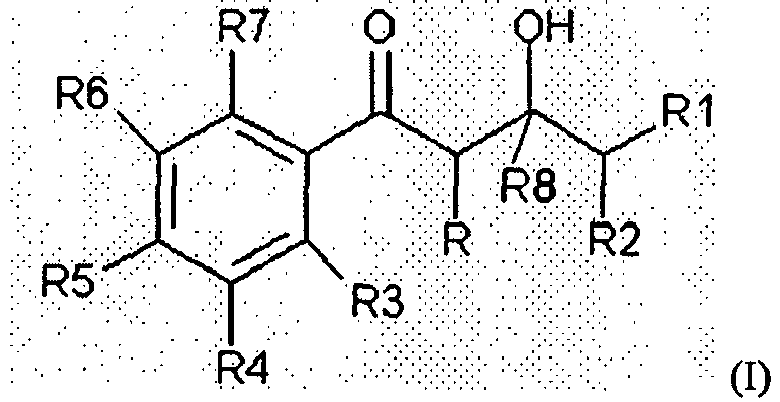
- In einer bevorzugten Ausführungsform des Verfahrens dient es zur Freisetzung von Riechstoffaldehyden, insbesondere ausgewählt aus der Gruppe umfassend Melonal, Triplal, Ligustral, Adoxal; Anisaldehyd; Cymal; Ethylvanillin; Florhydral; Helional; Heliotropin; Hydroxycitronellal; Koavon; Laurinaldehyd; Lyral; Methyl-nonyl-acetaldehyd; p,t-Bucinal; Phenylacetaldehyd; Undecylenaldehyd; Vanillin;2,6,10-Trimethyl-9-undecenal, 3-Dodecen-1-al, alpha-n-Amylzimtaldehyd, 4-Methoxybenzaldehyd, Benzaldehyd, 3-(4-tert-Butylphenyl)-propanal, 2-Methyl-3-(para-methoxyphenylpropanal), 2-Methyl-4-(2,6,6-trimethyl-2(1)-cyclohexen-1-yl)butanal, 3-Phenyl-2-propenal, cis-/trans-3,7-Dimethyl-2,6-octadien-1-al, 3,7-Dimethyl-6-octen-1-al, [(3,7-Dimethyl-6-octenyl)oxy]acetaldehyd, 4-Isopropylbenzyaldehyd, 1,2,3,4,5,6,7,8-octahydro-8,8-Dimethyl-2-naphthaldehyd, 2,4-Dimethyl-3-cyclohexen-1-carboxyaldehyd, 2-Methyl-3- (isopropylphenyl)propanal, Decyl aldehyd, 2,6-Dimethyl-5-heptenal; 4-(tricyclo[5.2.1.0 (2,6)]- decylidene-8)-butanal; Octahydro-J-methano-IH-indenecarboxaldehyd; 3-Ethoxy-4-hydroxybenzaldehyd, para-Ethyl-alpha, alpha-dimethylhydrozimtaldehyd, alpha-Methyl-3,4- (methylenedioxy)-hydrozimtalde-hyd, 3,4-Methylenedioxybenzaldehyd, alpha-n-Hexylzimtaldehyd, m-Cymene-7-carboxaldehyd, alpha-Methylphenylacetaldehyd, 7-Hydroxy-3,7-dimethyl octanal, Undecenal, 2,4,6-Trimethyl-3-cyclohexene-1-carboxaldehyd, 4-(3)(4-Methyl-3-pentenyl)-3- cyclohexen-carboxaldehyd, 1-Dodecanal, 2,4-Dimethyl cyclohexene-S-carboxaldehyd, 4-(4- Hydroxy-4-methyl pentyl-S-cylohexene-1-carboxaldehyd, 7-Methoxy-3,7-dimethyloctan-1-al, 2- Methyl undecanal, 2-Methyl decanal, 1-nonanal, 1-Octanal, 2,6,10-Trimethyl-5,9-undecadienal, 2- Methyl-3-(4-tertbutyl)propanal, Dihydrozimtaldehyd,1-methyl-4-(4-methyl-3-pentenyl)-3- cyclohexene-1-carboxaldehyd, 5 oder 6 Methoxyhexahydro-4,7-methanoindan-1 oder 2- carboxyaldehyd; 3,7-Dimethyloctan-1-al, 1 -Undecanal, 10-Undecen-1-al, 4-Hydroxy-3-methoxybenzaldehyd, 1-Methyl-3-(4-methylpentyl)-3-cyclohexencarboxyaldehyd, 7-Hydroxy-3,7-dimethyl-octanal; trans-4-decenal, 2,6-Nonadienal, para-Tolylacetaldehyd; 4-Methylphenylacetaldehyd, 2-Methyl-4-(2,6,6-trimethyl-1-cyclohexen-1-yl)-2-butenal, ortho- Methoxyzimtaldehyd, S.S.δ-Trimethyl-S-cyclohexenecarboxaldehyd; 3,7-Dimethyl-2-methylene-6- octenal, Phenoxyacetaldehyd; 5,9-Dimethyl-4,8-decadienal, Peony aldehyd (6,10-dimethyl-3-oxa- 5,9-undecadien-1-al), Hexahydro-4,7-methanoindan-1-carboxaldehyd, 2-Methyl octanal, alpha- Methyl-4-(I-methylethyl) benzeneacetaldehyd, 6,6-Dimethyl-2-norpinene-2-propionaldehyd, para Methyl phenoxy acetaldehyd; 2-methyl-3-phenyl-2-propen-1-al, 3,5,5-Trimethylhexanal, Hexahydro-8,8-dimethyl-2-naphthaldehyd, 3-Propyl-bicyclo [2.2.1]-hept-5-ene-2-carbaldehyd, 9- Decenal, 3-Methyl-5-phenyl-1-pentanal, Methylnonyl acetaldehyd, 1-p-Menthene-q-carboxaldehyd, Citral, Lilial, 1-Decanal, Florhydral sowie 2,4-Dimethyl-3-cyclohexen-1-carboxaldehyd.
- In einer bevorzugten Ausführungsform des Verfahrens dient es zur Freisetzung von Riechstoffketonen, insbesondere ausgewählt aus der Gruppe umfassend Buccoxim; Iso jasmon; Methyl beta naphthyl keton; Moschus indanon; Tonalid/Moschus plus; Alpha-Damascon, Beta-Damascon, Delta-Damascon, Iso-Damascon, Damascenon, Damarose, Methyl-dihydrojasmonat, Menthon, Carvon, Campher, Fenchon, Alpha-Ionen, Beta-Ionon, Dihydro- Beta-Ionon, Gamma-Methyl so genanntes Ionon, Fleuramon, Dihydrojasmon, Cis-Jasmon, Iso-E- Super, Methyl-cedrenyl-keton oder Methyl-cedrylon, Acetophenon, Methyl-acetophenon, Para- Methoxy-acetophenon, Methyl-beta-naphtyl-keton, Benzyl-aceton, Benzophenon, Para-Hydroxy- phenyl-butanon, Celery Keton oder Livescon, 6-Isopropyldecahydro-2-naphton, Dimethyl- octenon, Freskomenth, 4-(I-Ethoxy-vinyl)-3,3,5,5,-tetramethyl-cyclohexanon, Methyl-heptenon, 2-(2-(4-Methyl-3-cyclohexen-1-yl)-propyl)-cyclopentanon, 1-(p-Menthen-6(2)-yl)-1-propanon, 4-(4-Hydroxy-3-methoxyphenyl)-2-butanon, 2-Acetyl-3,3-dimethyl-norbornan, 6,7-Dihydro-1,1,2,3,3-pentamethyl-4(5H)-indanon, 4-Damascol, Dulcinyl or Cassion, Gelson, Hexalon, Isocyclemon E, Methyl- cyclocitron, Methyl-Lavendel-keton, Orivon, Para-tert-butyl-cyclohexanon, Verdon, Delphon, Muscon, Neobutenon, Plicaton, Velouton, 2,4,4,7-Tetramethyl-oct-6-en-3-on, Tetrameran sowie Hedion.
- Ein weiterer Gegenstand der Erfindung ist ein Verfahren zur lang anhaltenden Beduftung von Oberflächen, wobei ein erfindungsgemäßes Wasch- oder Reinigungsmittel auf eine zu beduftende Oberfläche aufgebracht wird und die genannte Oberfläche anschließend einer elektromagnetischen Strahlung umfassend die Wellenlängen von 200 bis 400 nm ausgesetzt wird.
- Ein weiterer Gegenstand der vorliegenden Erfindung liegt in der Verwendung von β-Hydroxyketonen der allgemeinen Formel (I)

- Ebenso liegt ein weiterer Gegenstand der vorliegenden Erfindung in der Verwendung von β-Hydroxyketonen der allgemeinen Formel (I)

- Ebenso liegt ein weiterer Gegenstand der vorliegenden Erfindung in der Verwendung von β-Hydroxyketonen der allgemeinen Formel (I)
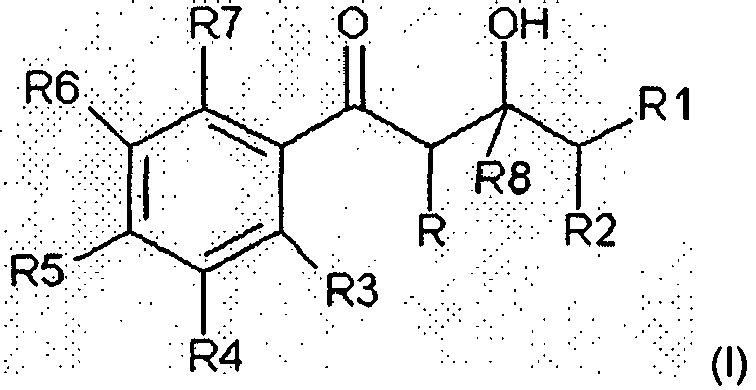
- Besonders vorteilhaft ist, dass die Duftstoffvorläufer bei Anwesenheit zusätzlicher Duftstoffe auch die Duftwirkung dieser Duftstoffe verlängern können. Ist die vorgenannte Verwendung also auf die Verlängerung der Duftwirkung von anderen Duftstoffen gerichtet, welche ebenfalls in dem Wasch- und Reinigungsmittel, kosmetischen Mittel oder Lufterfrischer enthalten sind, so liegt eine bevorzugte Ausführungsform der Erfindung vor. Ebenso liegt eine weitere bevorzugte Ausführungsform der Erfindung vor, wenn die vorgenannte Verwendung auf die Erzielung eines lange anhaltenden Frischegeruches gerichtet ist.
- Wie bereits beschrieben wurde, sind Weichspüler bevorzugte Zusammensetzungen im Sinne der Erfindung. Ein erfindungsgemäßer Weichspüler kann üblicherweise eine weichmachende Komponente enthalten. Es ist ganz besonders bevorzugt, dass die weichmachende Komponente eine alkylierte, quaternäre Ammoniumverbindung ist, wobei mindestens eine Alkylkette durch eine Ester- oder Amidogruppe unterbrochen ist.
- Die weichmachende Komponente umfasst beispielsweise quaternäre Ammoniumverbindungen wie Monoalk(en)yltrimethylammonium-Verbindungen, Dialk(en)yldimethylammonium-Verbindungen, Mono-, Di- oder Triester von Fettsäuren mit Alkanolaminen.
- Geeignete Beispiele für quaternäre Ammoniumverbindungen sind beispielsweise in den Formeln (A-II) und (A-III) gezeigt:

- Verbindungen der Formel (A-III) und (A-IV) sind so genannte Esterquats. Esterquats zeichnen sich durch eine hervorragende biologische Abbaubarkeit aus. In Formel (A-III) steht R4 für einen aliphatischen Alk(en)ylrest mit 12 bis 22 Kohlenstoffatomen mit 0, 1, 2 oder 3 Doppelbindungen und/oder gegebenenfalls mit Substituenten; R5 steht für H, OH oder O(CO)R7, R6 steht unabhängig von R5 für H, OH oder O(CO)R8, wobei R7 und R8 unabhängig voneinander jeweils für einen aliphatischen Alk(en)ylrest mit 12 bis 22 Kohlenstoffatomen mit 0, 1, 2 oder 3 Doppelbindungen steht. m, n und p können jeweils unabhängig voneinander den Wert 1, 2 oder 3 haben. X- kann entweder ein Halogenid-, Methosulfat-, Methophosphat- oder Phosphation sowie Mischungen aus diesen Anionen sein. Bevorzugt sind Verbindungen, bei denen R5 die Gruppe O(CO)R7 darstellt. Besonders bevorzugt sind Verbindungen, bei denen R5 die Gruppe O(CO)R7 darstellt und R4 und R7 Alk(en)ylreste mit 16, bis 18 Kohlenstoffatomen sind. Insbesondere bevorzugt sind Verbindungen, bei denen R6 zudem für OH steht. Beispiele für Verbindungen der Formel (A-II) sind Methyl-N-(2-hydroxyethyl)-N,N-di(talgacyloxyethyl)ammonium-methosulfat, Bis-(palmitoyloxyethyl)-hydroxyethyl-methyl-ammonium-methosulfat, 1,2-Bis-[talgacyloxy]-3-trimethylammoniumpro-panchlorid oder Methyl-N,N-bis(stearoyloxyethyl)-N-(2-hydroxyethyl)ammonium-methosulfat.
- Werden quaternierte Verbindungen der Formel (A-III) eingesetzt, die ungesättigte Alkylketten aufweisen, sind die Acylgruppen bevorzugt, deren korrespondierenden Fettsäuren eine Jodzahl zwischen 1 und 100, bevorzugt zwischen 5 und 80, mehr bevorzugt zwischen 10 und 60 und insbesondere zwischen 15 und 45 aufweisen und die ein cis/trans-Isomerenverhältnis (in Gew.-%) von größer als 30 : 70, vorzugsweise größer als 50 : 50 und insbesondere gleich oder größer als 60 : 40 haben. Handelsübliche Beispiele sind die von Stepan unter dem Warenzeichen Stepantex® vertriebenen Methylhydroxyalkyldialkoyloxyalkylammoniummethosulfate oder die unter Dehyquart® bekannten Produkte von Cognis, die unter Rewoquat® bekannten Produkte von Degussa bzw. die unter Tetranyl® bekannten Produkte von Kao. Weitere bevorzugte Verbindungen sind die Diesterquats der Formel (A-IV), die unter dem Namen Rewoquat® W 222 LM bzw. CR 3099 erhältlich sind.

- Anstelle der Estergruppe O(CO)R22, wobei R22 für einen langkettigen Alk(en)ylrest steht, können weichmachende Verbindungen eingesetzt werden, die folgende Gruppen aufweisen: RO(CO), N(CO)R oder RN(CO) weisen, wobei von diesen Gruppen N(CO)R-Gruppen bevorzugt sind.
- Weiterhin sind auch kationische Polymere geeignete weichmachende Komponente. Ebenfalls einsetzbar sind polyquaternierte Polymere (z.B. Luviquat® Care von BASF) und auch kationische Biopolymere auf Chitinbasis und deren Derivate, beispielsweise das unter der Handelsbezeichnung Chitosan® (Hersteller: Cognis) erhältliche Polymer.
- Besonders bevorzugte weichmachende Komponenten sind alkylierte quaternäre Ammoniumverbindungen, von denen mindestens eine Alkylkette durch eine Estergruppe und/oder Amidogruppe unterbrochen ist. Ganz besonders bevorzugt sind N-Methyl-N-(2-hydroxyethyl)-N,N-(ditalgacyloxyethyl)ammonium-methosulfat oder Bis-(palmitoyloxyethyl)-hydroxyethyl-methylammonium-methosulfat.
- Das erfindungsgemäße Wasch- oder Reinigungsmittel in Form von Weichspülern kann auch nichtionische weichmachende Komponenten enthalten, wie vor allem Polyoxyalkylenglycerolalkanoate, Polybutylene, langkettige Fettsäuren, ethoxylierte Fettsäureethanolamide, Alkylpolyglucoside, insbesondere Sorbitanmono,-di- und -triester, und Fettsäureester von Polycarbonsäuren.
- In dem erfindungsgemäßen Weichspüler als erfindungsgemäßes Wasch- oder Reinigungsmittel ist die weichmachende Komponente in Mengen von z.B. 0,1 bis 80 Gew.-%, üblicherweise 1 bis 40 Gew.-%, vorzugsweise 2 bis 20 Gew.-%, insbesondere 3 bis 15 Gew.-% enthalten, und der zusätzliche Duftstoff vorteilhafterweise in Mengen von 0,1 bis 20 Gew.-%, vorzugsweise 1 bis 13 Gew.-%, insbesondere 2 bis 8 Gew.-%, jeweils bezogen auf die Gesamtmenge des erfindungsgemäßen Mittels, enthalten.
- Als weitere Komponente kann ein erfindungsgemäßes Wasch- oder Reinigungsmittel, insbesondere aber ein Weichspüler, gegebenenfalls ein oder mehrere nichtionische Tenside enthalten, wobei solche eingesetzt werden können, die üblicherweise auch in Waschmitteln verwendet werden.
- Als optionale nichtionische Tenside können vorzugsweise alkoxylierte, vorteilhafterweise ethoxylierte, insbesondere primäre Alkohole mit vorzugsweise 8 bis 18 C-Atomen und durchschnittlich 1 bis 12 Mol Ethylenoxid (EO) pro Mol Alkohol eingesetzt werden, in denen der Alkoholrest linear oder bevorzugt in 2-Stellung methylverzweigt sein kann bzw. lineare und methylverzweigte Reste im Gemisch enthalten kann, so wie sie üblicherweise in Oxoalkoholresten vorliegen. Insbesondere sind jedoch Alkoholethoxylate mit linearen Resten aus Alkoholen nativen Ursprungs mit 12 bis 18 C-Atomen, zum Beispiel aus Kokos-, Palm-, Talgfett- oder Oleylalkohol, und durchschnittlich 2 bis 8 EO pro Mol Alkohol bevorzugt. Zu den bevorzugten ethoxylierten Alkoholen gehören beispielsweise C12-14-Alkohole mit 3 EO, 4 EO oder 7 EO, C9-11-Alkohol mit 7 EO, C13-15-Alkohole mit 3 EO, 5 EO, 7 EO oder 8 EO, C12-18-Alkohole mit 3 EO, 5 EO oder 7 EO und Mischungen aus diesen, wie Mischungen aus C12-14-Alkohol mit 3 EO und C12-18-Alkohol mit 7 EO. Die angegebenen Ethoxylierungsgrade stellen statistische Mittelwerte dar, die für ein spezielles Produkt eine ganze oder eine gebrochene Zahl sein können. Bevorzugte Alkoholethoxylate weisen eine eingeengte Homologenverteilung auf (narrow range ethoxylates, NRE). Zusätzlich zu diesen nichtionischen Tensiden können auch Fettalkohole mit mehr als 12 EO eingesetzt werden. Beispiele hierfür sind Talgfettalkohol mit 14 EO, 25 EO, 30 EO oder 40 EO. Auch nichtionische Tenside, die EO- und PO-Gruppen zusammen im Molekül enthalten, sind erfindungsgemäß einsetzbar. Hierbei können Blockcopolymere mit EO-PO-Blockeinheiten bzw. PO-EO-Blockeinheiten eingesetzt werden, aber auch EO-PO-EO-Copolymere bzw. PO-EO-PO-Copolymere. Selbstverständlich sind auch gemischt alkoxylierte Niotenside einsetzbar, in denen EO- und PO-Einheiten nicht blockweise, sondern statistisch verteilt sind. Solche Produkte sind durch gleichzeitige Einwirkung von Ethylen- und Propylenoxid auf Fettalkohole erhältlich.
- Außerdem können als weitere optionale nichtionische Tenside auch Alkylglykoside der allgemeinen Formel RO(G)x eingesetzt werden, in der R einen primären geradkettigen oder methylverzweigten, insbesondere in 2-Stellung methylverzweigten aliphatischen Rest mit 8 bis 22, vorzugsweise 12 bis 18 C-Atomen bedeutet und G das Symbol ist, das für eine Glykoseeinheit mit 5 oder 6 C-Atomen, vorzugsweise für Glucose, steht. Der Oligomerisierungsgrad x, der die Verteilung von Monoglykosiden und Oligoglykosiden angibt, ist eine beliebige Zahl zwischen 1 und 10; vorzugsweise liegt x bei 1,2 bis 1,4.
- Die nichtionischen Tenside können in den erfindungsgemäßen Wasch- oder Reingungsmitteln vorzugsweise in Mengen von 0-30 Gew.-% enthalten sein, z.B. in Mengen > 0,1 Gew.-%. Es ist z.B. möglich, dass das Wasch- oder Reinigungsmittel 2 bis 30 Gew.-%, vorzugsweise 7 bis 20 Gew.-% und insbesondere 9 bis 15 Gew.-% Niotensid enthalten können, Gew.-% jeweils bezogen auf das gesamte Wasch- oder Reinigungsmittel.
- Ein erfindungsgemäßes Wasch- oder Reinigungsmittel kann optional auch anionisches Tensid umfassen, z.B. in Mengen in Mengen von 0-30 Gew.-%, vorzugsweise > 0,1 Gew.-%. Es ist z.B. möglich, dass das Wasch- oder Reinigungsmittel 2 bis 30 Gew.-%, vorzugsweise 7 bis 20 Gew.-% und insbesondere 9 bis 15 Gew.-% Aniontensid enthalten können, Gew.-% jeweils bezogen auf das gesamte Wasch- oder Reinigungsmittel.
- Als optionales anionisches Tensid kann beispielsweise solches vom Typ der Sulfonate und Sulfate eingesetzt werden. Als Tenside vom Sulfonat-Typ kommen dabei vorzugsweise C9-13-Alkylbenzolsulfonate, Olefinsulfonate, d.h. Gemische aus Alken- und Hydroxyalkansulfonaten sowie Disulfonaten, wie man sie beispielsweise aus C12-18-Monoolefinen mit end- oder innenständiger Doppelbindung durch Sulfonieren mit gasförmigem Schwefeltrioxid und anschließende alkalische oder saure Hydrolyse der Sulfonierungsprodukte erhält, in Betracht. Insbesondere bevorzugte anionische Tenside sind Seifen. Geeignet sind gesättigte und ungesättigte Fettsäureseifen, wie die Salze der Laurinsäure, Myristinsäure, Palmitinsäure, Stearinsäure, (hydrierten) Erucasäure und Behensäure sowie insbesondere aus natürlichen Fettsäuren, zum Beispiel Kokos-, Palmkern-, Olivenöl- oder Talgfettsäuren, abgeleitete Seifengemische.
- Die anionischen Tenside einschließlich der Seifen können in Form ihrer Natrium-, Kalium- oder Ammoniumsalze sowie als lösliche Salze organischer Basen, wie Mono-, Di- oder Triethanolamin, vorliegen. Vorzugsweise liegen die anionischen Tenside in Form ihrer Natrium-oder Kaliumsalze, insbesondere in Form der Natriumsalze vor.
- Es ist weiterhin bevorzugt, dass das erfindungsgemäße Wasch- oder Reinigungsmittel (z.B. Textil- oder Oberflächenbehandlungsmittel) zusätzlich weitere vorteilhafte Inhaltsstoffe enthält, die dem Fachmann grundsätzlich bekannt sind. So kann das erfindungsgemäße Wasch-oder Reinigungsmittel (z.B. Textil- oder Oberflächenbehandlungsmittel) weitere Inhaltsstoffe enthalten, die die anwendungstechnischen und/oder ästhetischen Eigenschaften des Mittels weiter verbessern. Im Rahmen der vorliegenden Erfindung enthalten bevorzugte Wasch- oder Reinigungsmittel zusätzlich einen oder mehrere Stoffe aus der Gruppe der Gerüststoffe, Bleichmittel, Bleichaktivatoren, Enzyme, Elektrolyte, nichtwässrigen Lösungsmittel, pH-Stellmittel, Parfümträger, Fluoreszenzmittel, Farbstoffe, Hydrotope, Schauminhibitoren, Silikonöle, Antiredepositionsmittel, optischen Aufheller, Vergrauungsinhibitoren, Einlaufverhinderer, Knitterschutzmittel, Farbübertragungsinhibitoren, antimikrobiellen Wirkstoffe, Germizide, Fungizide, Antioxidantien, Konservierungsmittel, Korrosionsinhibitoren, Antistatika, Bittermittel, Bügelhilfsmittel, Phobier- und Imprägniermittel, Quell- und Schiebefestmittel, neutrale Füllsalze sowie UV-Absorber.
- Als Gerüststoffe, die in den erfindungsgemäßen Wasch- oder Reinigungsmitteln optional enthalten sein können, z.B. in Mengen > 0,1 Gew.-% (bezogen auf das gesamte Wasch- oder Reinigungsmittel), sind beispielsweise Silikate, Aluminiumsilikate (insbesondere Zeolithe), Carbonate, Salze organischer Di- und Polycarbonsäuren sowie Mischungen dieser Stoffe zu nennen.
- Ein erfindungsgemäßes Wasch- oder Reinigungsmittel kann optional ein Verdickungsmittel enthalten, z.B. in Mengen > 0,01 Gew.-% (bezogen auf das gesamte Wasch- oder Reinigungsmittel). Dies entspricht einer bevorzugten Ausführungsform der Erfindung. Das Verdickungsmittel kann beispielsweise einen Polyacrylat-Verdicker, Xanthan Gum, Gellan Gum, Guarkernmehl, Alginat, Carrageenan, Carboxymethylcellulose, Bentonite, Wellan Gum, Johannisbrotkernmehl, Agar-Agar, Tragant, Gummi arabicum, Pektine, Polyosen, Stärke, Dextrine, Gelatine und Casein umfassen.
- Wasser kann in efindungsgemäßen flüssigen Wasch- oder Reinigungsmitteln enthalten sein, vorzugsweise in Mengen > 5 Gew.-%, z.B. In Mengen von 10-95 Gew.-%, vorzugsweise 20-80 Gew.-%, insbesondere 30-70 Gew.-%, Gew.-% bezogen auf das gesamte Wasch- oder Reinigungsmittel. Wasser kann auch in erfindungsgemäßen festen Wasch-oder Reinigungsmitteln enthalten sein, dann natürlich in entsprechend geringerer Menge, beispielsweise in Mengen < 5 Gew.-% oder z.B. < 3 Gew.-%.
- Nichtwässrige Lösungsmittel, die in den erfindungsgemäßen (vorzugsweise flüssigen) Wasch- oder Reinigungsmiteln optional eingesetzt werden können, stammen beispielsweise aus der Gruppe der ein- oder mehrwertigen Alkohole, Alkanolamine oder Glykolether.
- Die Viskosität der erfindungsgemäßen Wasch- oder Reinigungsmittel, so sie flüssig sind, kann mit üblichen Standardmethoden (beispielsweise Brookfield-Viskosimeter LVT-II bei 20 U/min und 20°C, Spindel 3) gemessen werden und beträgt vorzugsweise 20 bis 4000 mPas, wobei Werte zwischen 40 und 2000 mPas besonders bevorzugt sind. Insbesondere bevorzugt liegt die Viskosität von Weichspülern im Bereich von 40 bis 1000 mPas.
- Um den pH-Wert der erfindungsgemäßen Wasch- oder Reinigungsmittel, so sie flüssig ist, in den gewünschten Bereich zu bringen, kann der Einsatz von pH-Stellmitteln angezeigt sein. Einsetzbar sind hier sämtliche bekannten Säuren bzw. Laugen, sofern sich ihr Einsatz nicht aus anwendungstechnischen oder ökologischen Gründen bzw. aus Gründen des Verbraucherschutzes verbietet. Üblicherweise überschreitet die Menge dieser Stellmittel 7 Gew.-% oder vorzugsweise 5 Gew.-% der Gesamtformulierung nicht. Eine Untergrenze kann z.B. bei 0,1 Gew.-% liegen. Der pH-Wert der erfindungsgemäßen Wasch- oder Reinigungsmittel, so sie flüssig ist, liegt vorzugsweise zwischen 1 und 6 und bevorzugt zwischen 1,5 und 3,5.
- Bei den erfindungsgemäßen Mitteln kann es sich um feste oder flüssige Formulierungen handeln, wobei feste Formulierungen als Pulver, Granulat, Extrudat, in Tab-Form, als Tablette oder als gepresster und/oder geschmolzener Formkörper vorliegen können. Bei flüssigen Formulierungen kann es sich um Lösungen, Emulsionen, Dispersionen Suspensionen, Mikroemulsionen, Gels oder Pasten handeln.
- Die eingesetzten β-Hydroxyketone der allgemeinen Formel (I),


- Die Aufreinigung der β-Hydroxyketone der allgemeinen Formel (I) erfolgt vorzugsweise durch Kristallisation, Destillation und/oder Säulenchromatographie.
-

- In einem ausgeheizten und mit Argon gefluteten Schlenk-Kolben wurden 2,7 ml (20 mmol) Propiophenon in 40 ml absoluten Dichlormethan vorgelegt. Diese Lösung wurde auf -78 °C gekühlt. Zu dieser Lösung wurden zuerst 24 ml einer 1 M-Titantetrachlorid-Lösung in Dichlormethan und anschließend 4,8 ml (28 mmol) Tributylamin mit einer Spritze dazugetropft. Nach 30 min Rühren bei -78 °C wurden 3,8 ml (24 mmol) Octanal dazu gegeben. Die Reaktionsmischung wurde weitere 2 Stunden bei -78 °C gerührt. Die Reaktionslösung wurde mit 40 ml Wasser gequencht und zwei Mal mit Diethylether extrahiert. Die organische Phase wurde mit Wasser, ges. NaCl-Lösung gewaschen und über MgSO4 getrocknet. Das Filtrat wurde bei vermindertem Druck von Lösungsmittel befreit. Das Rohprodukt wurde säulenchromatographisch gereinigt (Petrolether:Ethylacetat=95:5).
Ausbeute: 80 %
Analytische Daten: - Rf=0.3
- Sdp.= 175-180 °C
- 1H NMR (300 MHz, CDCl3): δ = 0.88 (3H, t, J=6.9 Hz), 1.25-1.58 (13H,m), 3.07 (s, 1H, O-H), 3.47 (1H, dq, J=2.8, 7.2 Hz), 4.03 (1H, m), 7.46-7.52 (2H,m), 7.53-7.62 (1H,m), 7.93-7.97 (2H,m).
- 13C NMR (300 MHz, CDCl3): 11.02, 14.10, 22.65, 26.11, 29.26, 29.59, 31.82, 34.33 44.45, 71.34, 128.47, 128.77, 133.44, 135.92, 205.98.
- (2R,3S)-3-hydroxy-2-methyl-1-phenyldecan-1-on wurde in Benzol gelöst. Die Reaktionslösung wurde in einem Multilamp-Photoreactor (8 W-Lampen (4×), Firma Luxchem) mit Emissionmaximum λ = 350 nm eine Stunde lang belichtet. Die Reaktion wurde mit Hilfe der GC/MS-Spektrometrie verfolgt. Nach spätestens 60 Minuten Belichtung wurde die weitgehend vollständige Umwandlung von (2R,3S)-3-hydroxy-2-methyl-1-phenyldecan-1-on in Phenylethylketon und Octanal beobachtet.
- Für den Riechtest wurden 0,2 mmol (2R,3S)-3-hydroxy-2-methyl-1-phenyldecan-1-on in 1 ml Dipropylenglykol gelöst. In die Lösung wurde ein Riechstreifen 2 cm tief eingetaucht, der anschließend unter Lichtausschluss bei 20°C getrocknet wurde. Auf diese Weise wurden 2 Riechstreifen hergestellt.
- Nach erfolgreicher Trocknung wird der erste Riechstreifen über den gesamten Testzeitraum hinweg mit einer handelsüblichen Leuchtstoffröhre (gemäß DIN 5035 neutralweiß (nw); Farbtemperatur 3300 bis 5500 K) bestrahlt und die Duftintensität zu den jeweils angegebenen Zeitpunkten bestimmt.
Der zweite Riechstoffstreifen wurde in Dunkelheit gelagert. - Die Duftintensität wurde von 3 trainierten Probanden auf einer Skala von 0 bis 6 bewertet, wobei 6 die höchste Note ist und 0 für keine Duftwahrnehmung steht.
-
- 6
- unangenehm stark
- 5
- sehr stark
- 4
- stark
- 3
- intensiv
- 2
- angenehm
- 1
- wahrnehmbar
- 0
- nicht mehr wahrnehmbar
- Die Ergebnisse des Riechtests sind in der folgenden Tabelle dargestellt, wobei die angegebenen Werte den Bereich der Duftwahrnehmung der Probandengruppe widerspiegeln.
nach 30 Minuten nach 60 Minuten nach 90Minuten Riechstoffstreifen 1 0-1 fettige Note 2 fettige Note 2 fettige Note - Der Riechstoffstreifen 2, der in Dunkelheit gehandhabt wurde, weist weder nach 30, 60, 90 Minuten und auch nicht nach mehrstündiger Lagerung (z.B. 17 Stunden) einen Duft auf (entsprechend Wert 0 nach obiger Skala).
Es zeigte sich aber, dass der Riechstoffstreifen 2, nachdem er erst 17 Stunden in Dunkelheit war und danach, wie oben angegeben, bestrahlt wurde, bereits nach 60 Minuten einen angenehmen Dufteindruck hervorrief (entsprechend Wert 2 nach obiger Skala, fettige Note).
Claims (14)
- Wasch- oder Reinigungsmittel enthaltend mindestens ein β-Hydroxyketon der allgemeinen Formel (I)

und wobei R1 und R2, unabhängig voneinander für ein Wasserstoffatom oder für organische Reste, wie insbesondere eine lineare oder verzweigte, substituierte oder unsubstituierte Alkyl- oder Alkylengruppe von C1 bis C20, vorzugsweise C4 bis C20, stehen, wobei die Reste R1 und R2 zusammen auch ein Ringsystem bilden können, insbesondere eine unsubstituierte oder substituierte Mono- oder Polycycloalkylgruppe von C3 bis C8 oder eine unsubstituierte oder substituierte Phenylgruppe darstellen können,
und wobei R3, R4, R5, R6 und R7 unabhängig voneinander für Wasserstoff, ein Halogenatom, NO2, eine lineare oder verzweigte, substituierte oder unsubstituierte Alkoxygruppe mit 1 bis 15 C-Atomen oder eine lineare oder verzweigte, substituierte oder unsubstituierte Alkylgruppe mit 1 bis 15 C-Atomen stehen,
dadurch gekennzeichnet, dass das genannte β-Hydroxyketon der allgemeinen Formel (I) bei Einwirken elektromagnetischer Strahlung, insbesondere umfassend die Wellenlängen von 200 bis 400 nm, zumindest ein Riechstoffaldehyd oder ein Riechstoffketon freisetzt. - Wasch- oder Reinigungsmittel nach Anspruch 1, enthaltend mindestens ein β-Hydroxyketon der allgemeinen Formel (II) und/oder der allgemeinen Formel (III),


- Wasch- oder Reinigungsmittel gemäß Anspruch 1 oder 2, dadurch gekennzeichnet, dass das β-Hydroxyketon bei Einwirken elektromagnetischer Strahlung umfassend die Wellenlängen von 200 bis 400 nm eine Verbindung der Formel (IV)


- Wasch- oder Reinigungsmittel gemäß einem der Ansprüche 1 bis 3, dadurch gekennzeichnet, dass bei Einwirken elektromagnetischer Strahlung umfassend die Wellenlängen von 200 bis 400 nm zumindest ein Riechstoffaldehyd freigesetzt wird, insbesondere ausgewählt aus der Gruppe umfassend Melonal, Triplal, Ligustral, Adoxal; Anisaldehyd; Cymal; Ethylvanillin; Florhydral; Helional; Heliotropin; Hydroxycitronellal; Koavon; Laurinaldehyd; Lyral; Methyl-nonyl-acetaldehyd; p,t-Bucinal; Phenylacetaldehyd; Undecylenaldehyd; Vanillin;2,6,10-Trimethyl-9-undecenal, 3-Dodecen-1-al, alpha-n-Amylzimtaldehyd, 4-Methoxybenzaldehyd, Benzaldehyd, 3-(4-tert-Butylphenyl)-propanal, 2-Methyl-3-(para-methoxy-phenylpropanal), 2-Methyl-4-(2,6,6-trimethyl-2(1)-cyclohexen-1-yl)bu-tanal, 3-Phenyl-2-propenal, cis-/trans-3,7-Dimethyl-2,6-octadien-1-al, 3,7-Dimethyl-6-octen-1-al, [(3,7-Dimethyl-6-octenyl)oxy]acet-aldehyd, 4-Isopropylbenzyaldehyd, 1 ,2,3,4,5,6,7,8-octahydro-8,8-Dimethyl-2-naphthaldehyd, 2,4-Dimethyl-3-cyclohexen-1-carboxyaldehyd, 2-Methyl-3-(isopropylphenyl)propanal, Decyl aldehyd, 2,6-Dimethyl-5-heptenal; 4-(tricyclo[5.2.1.0(2,6)]- decylidene-8)-butanal; Octahydro-J-methano-IH-indenecarboxaldehyd; 3-Ethoxy-4-hydroxybenzaldehyd, para-Ethyl-alpha, alpha-dimethylhydrozimt-aldehyd, alpha-Methyl-3,4- (methylenedioxy)-hydrozimtaldehyd, 3,4-Methylenedioxybenzaldehyd, alpha-n-Hexylzimtaldehyd, m-Cymene-7-carboxaldehyd, alpha-Methylphenylacetaldehyd, 7-Hydroxy-3,7-dimethyl octanal, Undecenal, 2,4,6-Trimethyl-3-cyclohexene-1-carboxaldehyd, 4-(3)(4-Methyl-3-pentenyl)-3- cyclohexen-carboxaldehyd, 1-Dodecanal, 2,4-Dimethyl cyclohexene-S-carboxaldehyd, 4-(4- Hydroxy-4-methyl pentyl-S-cylohexene-1-carboxaldehyd, 7-Methoxy-3,7-dimethyloctan-1-al, 2- Methyl undecanal, 2-Methyl decanal,1 -nonanal, 1-Octanal, 2,6,10-Trimethyl-5,9-undecadienal, 2- Methyl-3-(4-tertbutyl)propanal, Dihydrozimtaldehyd,1-methyl-4-(4-methyl-3-pentenyl)-3-cyclohexene-1-car-boxaldehyd, 5 oder 6 Methoxyhexahydro-4,7-methanoindan-1 oder 2- carboxyaldehyd; 3,7-Dimethyl-octan-1-al, 1 -Undecanal, 10-Undecen-1-al, 4-Hydroxy-3-methoxybenzaldehyd, 1 - Methyl-3-(4-methylpentyl)-3-cyclohexencarboxyaldehyd, 7-Hydroxy-3,7-dimethyl-octanal; trans-4-decenal, 2,6-Nonadienal, para-Tolylacetaldehyd; 4- Methylphenylacetaldehyd, 2-Methyl-4-(2,6,6-trimethyl-1-cyclo-hexen-1-yl)-2-butenal, ortho- Methoxyzimtaldehyd, S.S.δ-Trimethyl-S-cyclohexenecarboxaldehyd; 3,7-Dimethyl-2-methylene-6- octenal, Phenoxyacetaldehyd; 5,9-Dimethyl-4,8-decadienal, Peony aldehyd (6,10-dimethyl-3-oxa- 5,9-undecadien-1-al), Hexahydro-4,7-methanoindan-1-carboxaldehyd, 2-Methyl octanal, alpha- Methyl-4-(I-methylethyl) benzeneacetaldehyd, 6,6-Dimethyl-2-norpinene-2-propionaldehyd, para Methyl phenoxy acetaldehyd; 2-methyl-3-phenyl-2-propen-1-al, 3,5,5-Trimethylhexanal, Hexahydro-8,8-dimethyl-2-naphthaldehyd, 3-Propyl-bicyclo [2.2.1]-hept-5-ene-2-carbaldehyd, 9- Decenal, 3-Methyl-5-phenyl-1-pentanal, Methylnonyl acetaldehyd, 1-p-Menthene-q-carboxaldehyd, Citral, Lilial, 1-Decanal, Florhydral sowie 2,4-Dimethyl-3-cyclohexen-1-carboxaldehyd.
- Wasch- oder Reinigungsmittel gemäß einem der Ansprüche 1 bis 4, dadurch gekennzeichnet, dass bei Einwirken elektromagnetischer Strahlung umfassend die Wellenlängen von 200 bis 400 nm zumindest ein Riechstoffketon freigesetzt wird, insbesondere ausgewählt aus der Gruppe umfassend Buccoxim; Iso jasmon; Methyl beta naphthyl keton; Moschus indanon; Tonalid/Moschus plus; Alpha-Damascon, Beta-Damascon, Delta-Damascon, Iso-Damascon, Damascenon, Damarose, Methyl-dihydrojasmonat, Menthon, Carvon, Campher, Fenchon, Alpha-Ionen, Beta-Ionon, Dihydro- Beta-Ionon, Gamma-Methyl so genanntes Ionon, Fleuramon, Dihydrojasmon, Cis-Jasmon, Iso-E- Super, Methyl-cedrenyl-keton oder Methyl-cedrylon, Acetophenon, Methyl-acetophenon, Para- Methoxy-acetophenon, Methyl-beta-naphtyl-keton, Benzyl-aceton, Benzophenon, Para-Hydroxy- phenyl-butanon, Celery Keton oder Livescon, 6-Isopropyldecahydro-2-naphton, Dimethyloctenon, Freskomenth, 4-(I-Ethoxyvinyl)-3,3,5,5,-tetramethyl-cyclohexanon, Methyl-heptenon, 2-(2-(4- Methyl-3-cyclohexen-1-yl)propyl)-cyclopentanon, 1-(p-Menthen-6(2)-yl)-1-propanon, 4-(4-Hydroxy-3-methoxyphenyl)-2-butanon, 2-Acetyl-3,3-dimethyl-norbornan, 6,7-Dihydro-1,1,2,3,3-pentamethyl-4(5H)-indanon, 4-Damascol, Dulcinyl or Cassion, Gelson, Hexalon, Isocyclemon E, Methyl- cyclocitron, Methyl-Lavendel-keton, Orivon, Para-tert-butyl-cyclohexanon, Verdon, Delphon, Muscon, Neobutenon, Plicaton, Velouton, 2,4,4,7-Tetramethyl-oct-6-en-3-on, Tetrameran sowie Hedion.
- Wasch- oder Reinigungsmittel gemäß einem der Ansprüche 1 bis 5, dadurch gekennzeichnet, dass zumindest eines der folgenden β-Hydroxyketone gemäß den Formeln (VI)-(VII) enthalten ist:


- Wasch- oder Reinigungsmittel nach einem der Ansprüche 1 bis 6, dadurch gekennzeichnet, dass mindestens ein Tensid ausgewählt aus der Gruppe bestehend aus anionischen, kationischen, nichtionischen, zwitterionischen, amphoteren Tensiden oder Mischungen daraus enthalten ist bzw. sind.
- Verfahren zur Freisetzungen von Carbonylverbindungen der Formel (V)


und wobei R1 und R2, unabhängig voneinander für ein Wasserstoffatom oder für organische Reste, wie insbesondere eine lineare oder verzweigte, substituierte oder unsubstituierte Alkyl- oder Alkylengruppe von C1 bis C20, vorzugsweise C4 bis C20, stehen, wobei die Reste R1 und R2 zusammen auch ein Ringsystem bilden können, insbesondere eine unsubstituierte oder substituierte Mono-oder Polycycloalkylgruppe von C3 bis C8 oder eine unsubstituierte oder substituierte Phenylgruppe darstellen können,
und wobei R3, R4, R5, R6 und R7 unabhängig voneinander für Wasserstoff, ein Halogenatom, NO2, eine lineare oder verzweigte, substituierte oder unsubstituierte Alkoxygruppe mit 1 bis 15 C-Atomen oder eine lineare oder verzweigte, substituierte oder unsubstituierte Alkylgruppe mit 1 bis 15 C-Atomen stehen. - Verfahren gemäß Anspruch 8 zur Freisetzung von Riechstoffaldehyden, insbesondere ausgewählt aus der Gruppe umfassend Melonal, Triplal, Ligustral, Adoxal; Anisaldehyd; Cymal; Ethylvanillin; Florhydral; Helional; Heliotropin; Hydroxycitronellal; Koavon; Laurinaldehyd; Lyral; Methyl-nonyl-acetaldehyd; p,t-Bucinal; Phenylacetaldehyd; Undecylenaldehyd; Vanillin;2,6,10-Trimethyl-9-undecenal, 3-Dodecen-1-al, alpha-n-Amylzimtaldehyd, 4-Methoxybenzaldehyd, Benzaldehyd, 3-(4-tert-Butylphenyl)-propanal, 2-Methyl-3-(para-methoxyphenylpropanal), 2-Methyl-4-(2,6,6-trimethyl-2(1)-cyclohexen-1- yl)hutanal, 3-Phenyl-2-propenal, cis-/trans-3,7-Dimethyl-2,6-octadien-1-al, 3,7-Dimethyl-6-octen-1-al, [(3,7-Dimethyl-6-octenyl)oxy]acetaldehyd, 4-Isopropylbenzyaldehyd, 1 ,2,3,4,5,6,7,8-octahydro-8,8- Dimethyl-2-naphthaldehyd, 2,4-Dimethyl-3-cyclohexen-1-carboxy-aldehyd, 2-Methyl-3- (isopropylphenyl)propanal, Decyl aldehyd, 2,6-Dimethyl-5-heptenal; 4-(tricyclo[5.2. 1.0 (2,6)]- decylidene-8)-butanal; Octahydro-J-methano-IH-indenecarboxaldehyd; 3-Ethoxy-4- hydroxybenzaldehyd, para-Ethyl-alpha, alpha-dimethylhydrozimtaldehyd, alpha-Methyl-3,4- (methylenedioxy)-hydrozimtaldehyd, 3,4-Methylenedioxybenzaldehyd, alpha-n-Hexylzimt-aldehyd, m-Cymene-7-carboxaldehyd, alpha-Methylphenylacetaldehyd, 7-Hydroxy-3,7-dimethyl octanal, Undecenal, 2,4,6-Trimethyl-3-cyclohexene-1-carboxaldehyd, 4-(3)(4-Methyl-3-pentenyl)-3-cyclohexen-carboxaldehyd, 1-Dodecanal, 2,4-Dimethyl cyclohexene-S-carboxaldehyd, 4-(4-Hydroxy-4-methyl pentyl-S-cylohexene-1-carboxaldehyd, 7-Methoxy-3,7-dimethyloctan-1-al, 2- Methyl undecanal, 2-Methyl decanal,1 -nonanal, 1-Octanal, 2,6,10-Trimethyl-5,9-undecadienall 2- Methyl-3-(4-tertbutyl)propanal, Dihydrozimtaldehyd,1-methyl-4-(4-methyl-3-pentenyl)-3- cyclohexene-1-carboxaldehyd, 5 oder 6 Methoxyhexahydro-4,7-methanoindan-1 oder 2- carboxyaldehyd; 3,7-Dimethyloctan-1-al, 1 -Undecanal, 10-Undecen-1-al, 4-Hydroxy-3- methoxybenzaldehyd, 1 -Methyl-3-(4-methylpentyl)-3-cyclohexencarboxyaldehyd, 7-Hydroxy-3,7- dimethyl-octanal; trans-4-decenal, 2,6-Nonadienal, para-Tolylacetaldehyd; 4- Methylphenylacetaldehyd, 2-Methyl-4-(2,6,6-trimethyl-1-cyclohexen-1-yl)-2-butenal, ortho- Methoxyzimtaldehyd, S.S.δ-Trimethyl-S-cyclohexencarbox-aldehyd; 3,7-Dimethyl-2-methylene-6- octenal, Phenoxyacetaldehyd; 5,9-Dimethyl-4,8-decadienal, Peony aldehyd (6,10-dimethyl-3-oxa-5,9-undecadien-1-al), Hexahydro-4,7-methanoindan-1-carboxaldehyd, 2-Methyl octanal, alpha- Methyl-4-(I-methylethyl) benzeneacetaldehyd, 6,6-Dimethyl-2-norpinene-2-propionaldehyd, para Methyl phenoxy acetaldehyd; 2-methyl-3-phenyl-2-propen-1-al, 3,5,5-Trimethylhexanal, Hexahydro-8,8-dimethyl-2-naphthaldehyd, 3-Propyl-bicyclo [2.2.1]-hept-5-ene-2-carbaldehyd, 9- Decenal, 3-Methyl-5-phenyl-1-pentanal, Methylnonyl acetaldehyd, 1-p-Menthene-q-carboxaldehyd, Citral, Lilial, 1-Decanal, Florhydral sowie 2,4-Dimethyl-3-cyclohexen-1- carboxaldehyd.
- Verfahren gemäß Anspruch 8 zur Freisetzung von Riechstoffketonen, insbesondere ausgewählt aus der Gruppe umfassend Buccoxim; Iso jasmon; Methyl beta naphthyl keton; Moschus indanon; Tonalid/Moschus plus; Alpha-Damascon, Beta-Damascon, Delta-Damascon, Iso-Damascon, Damascenon, Damarose, Methyl-dihydrojasmonat, Menthon, Carvon, Campher, Fenchon, Alpha-Ionen, Beta-Ionon, Dihydro- Beta-Ionon, Gamma-Methyl so genanntes Ionon, Fleuramon, Dihydrojasmon, Cis-Jasmon, Iso-E- Super, Methyl-cedrenyl-keton oder Methyl-cedrylon, Acetophenon, Methyl-aceto-phenon, Para- Methoxy-acetophenon, Methyl-beta-naphtyl-keton, Benzylaceton, Benzophenon, Para-Hydroxy- phenyl-butanon, Celery Keton oder Livescon, 6-Isopropyldecahydro-2-naphton, Dimethyl- octenon, Freskomenth, 4-(1-Ethoxyvinyl)-3,3,5,5,-tetramethylcyclohexanon, Methyl-heptenon, 2-(2-(4- Methyl-3-cyclohexen-1-yl)propyl)-cyclopentanon, 1-(p-Menthen-6(2)-yl)-1-propanon, 4-(4-Hydroxy- 3-methoxyphenyl)-2-butanon, 2-Acetyl-3,3-dimethyl-norbornan, 6,7-Dihydro-1 ,1 ,2,3,3-pentamethyl- 4(5H)-indanon, 4-Damascol, Dulcinyl or Cassion, Gelson, Hexalon, Isocyclemon E, Methyl- cyclocitron, Methyl-Lavendel-keton, Orivon, Para-tert-butyl-cyclohexanon, Verdon, Delphon, Muscon, Neobutenon, Plicaton, Velouton, 2,4,4,7-Tetra-methyl-oct-6-en-3-on, Tetrameran sowie Hedion.
- Verfahren zur lang anhaltenden Beduftung von Oberflächen, dadurch gekennzeichnet, dass eine Zusammensetzung nach einem der Ansprüche 1 bis 7 auf eine zu beduftende Oberfläche aufgebracht wird und die genannte Oberfläche anschließend einer elektromagnetischen Strahlung umfassend die Wellenlängen von 200 bis 400 nm ausgesetzt wird.
- Verwendung von β-Hydroxyketonen der allgemeinen Formel (I)

und wobei R1 und R2, unabhängig voneinander für ein Wasserstoffatom oder für organische Reste, wie insbesondere eine lineare oder verzweigte, substituierte oder unsubstituierte Alkyl- oder Alkylengruppe von C1 bis C20, vorzugsweise C4 bis C20, stehen, wobei die Reste R1 und R2 zusammen auch ein Ringsystem bilden können, insbesondere eine unsubstituierte oder substituierte Mono-oder Polycycloalkylgruppe von C3 bis C8 oder eine unsubstituierte oder substituierte Phenylgruppe darstellen können,
und wobei R3, R4, R5, R6 und R7 unabhängig voneinander für Wasserstoff, ein Halogenatom, NO2, eine lineare oder verzweigte, substituierte oder unsubstituierte Alkoxygruppe mit 1 bis 15 C-Atomen oder eine lineare oder verzweigte, substituierte oder unsubstituierte Alkylgruppe mit 1 bis 15 C-Atomen stehen. - Verwendung von β-Hydroxyketonen der allgemeinen Formel (I)

wobei in dieser Formel, unabhängig voneinander, R und R8 für ein Wasserstoffatom oder für einen organischen Rest, insbesondere für eine lineare oder verzweigte, substituierte oder unsubstituierte Alkyl- oder Alkylengruppe von C1 bis C20 steht, vorzugsweise aber für einen Methylrest steht,
und wobei R1 und R2, unabhängig voneinander für ein Wasserstoffatom oder für organische Reste, wie insbesondere eine lineare oder verzweigte, substituierte oder unsubstituierte Alkyl- oder Alkylengruppe von C1 bis C20, vorzugsweise C4 bis C20, stehen, wobei die Reste R1 und R2 zusammen auch ein Ringsystem bilden können, insbesondere eine unsubstituierte oder substituierte Mono-oder Polycycloalkylgruppe von C3 bis C8 oder eine unsubstituierte oder substituierte Phenylgruppe darstellen können,
und wobei R3, R4, R5, R6 und R7 unabhängig voneinander für Wasserstoff, ein Halogenatom, NO2, eine lineare oder verzweigte, substituierte oder unsubstituierte Alkoxygruppe mit 1 bis 15 C-Atomen oder eine lineare oder verzweigte, substituierte oder unsubstituierte Alkylgruppe mit 1 bis 15 C-Atomen stehen. - Verwendung von β-Hydroxyketonen der allgemeinen Formel (I)

wobei in dieser Formel, unabhängig voneinander, R und R8 für ein Wasserstoffatom oder für einen organischen Rest, insbesondere für eine lineare oder verzweigte, substituierte oder unsubstituierte Alkyl- oder Alkylengruppe von C1 bis C20 steht, vorzugsweise aber für einen Methylrest steht,
und wobei R1 und R2, unabhängig voneinander für ein Wasserstoffatom oder für organische Reste, wie insbesondere eine lineare oder verzweigte, substituierte oder unsubstituierte Alkyl- oder Alkylengruppe von C1 bis C20, vorzugsweise C4 bis C20, stehen, wobei die Reste R1 und R2 zusammen auch ein Ringsystem bilden können, insbesondere eine unsubstituierte oder substituierte Mono-oder Polycycloalkylgruppe von C3 bis C8 oder eine unsubstituierte oder substituierte Phenylgruppe darstellen können,
und wobei R3, R4, R5, R6 und R7 unabhängig voneinander für Wasserstoff, ein Halogenatom, NO2, eine lineare oder verzweigte, substituierte oder unsubstituierte Alkoxygruppe mit 1 bis 15 C-Atomen oder eine lineare oder verzweigte, substituierte oder unsubstituierte Alkylgruppe mit 1 bis 15 C-Atomen stehen.
Priority Applications (1)
| Application Number | Priority Date | Filing Date | Title |
|---|---|---|---|
| PL09740085T PL2364186T3 (pl) | 2008-12-09 | 2009-10-09 | Fototrwałe substancje do przechowywania zapachów |
Applications Claiming Priority (2)
| Application Number | Priority Date | Filing Date | Title |
|---|---|---|---|
| DE102008060886A DE102008060886A1 (de) | 2008-12-09 | 2008-12-09 | Photolabile Duftspeicherstoffe |
| PCT/EP2009/063145 WO2010066486A2 (de) | 2008-12-09 | 2009-10-09 | Photolabile duftspeicherstoffe |
Publications (2)
| Publication Number | Publication Date |
|---|---|
| EP2364186A2 EP2364186A2 (de) | 2011-09-14 |
| EP2364186B1 true EP2364186B1 (de) | 2013-12-25 |
Family
ID=42145628
Family Applications (1)
| Application Number | Title | Priority Date | Filing Date |
|---|---|---|---|
| EP09740085.7A Not-in-force EP2364186B1 (de) | 2008-12-09 | 2009-10-09 | Photolabile duftspeicherstoffe |
Country Status (6)
| Country | Link |
|---|---|
| US (1) | US9217126B2 (de) |
| EP (1) | EP2364186B1 (de) |
| DE (1) | DE102008060886A1 (de) |
| ES (1) | ES2444220T3 (de) |
| PL (1) | PL2364186T3 (de) |
| WO (1) | WO2010066486A2 (de) |
Families Citing this family (61)
| Publication number | Priority date | Publication date | Assignee | Title |
|---|---|---|---|---|
| RU2573907C2 (ru) | 2010-04-26 | 2016-01-27 | Новозимс А/С | Гранула для применения в порошковых моющих средствах и композиция гранулированного моющего средства |
| EP2412792A1 (de) * | 2010-07-29 | 2012-02-01 | The Procter & Gamble Company | Flüssige Reinigungsmittelzusammensetzung |
| CN107475235B (zh) | 2011-06-20 | 2022-09-13 | 诺维信公司 | 颗粒组合物 |
| CN103620029B (zh) | 2011-06-24 | 2017-06-09 | 诺维信公司 | 具有蛋白酶活性的多肽和编码它们的多核苷酸 |
| DE102011078415A1 (de) | 2011-06-30 | 2013-01-03 | Henkel Ag & Co. Kgaa | Photolabile Duftspeicherstoffe |
| DE102011078416A1 (de) | 2011-06-30 | 2013-01-03 | Henkel Ag & Co. Kgaa | Photolabile Duftspeicherstoffe |
| EP2726500B1 (de) | 2011-06-30 | 2019-03-20 | Novozymes A/S | Verfahren zum screening von alpha-amylasen |
| US10711262B2 (en) | 2011-07-12 | 2020-07-14 | Novozymes A/S | Storage-stable enzyme granules |
| EP2744898A1 (de) | 2011-08-15 | 2014-06-25 | Novozymes A/S | Polypeptide mit cellulase-aktivität und dafür kodierende polynukleotide |
| ES2628190T3 (es) | 2011-09-22 | 2017-08-02 | Novozymes A/S | Polipéptidos con actividad de proteasa y polinucleótidos que codifican los mismos |
| US20140342433A1 (en) | 2011-11-25 | 2014-11-20 | Novozymes A/S | Subtilase Variants and Polynucleotides Encoding Same |
| MX2014007446A (es) | 2011-12-20 | 2014-08-01 | Novozymes As | Variantes de subtilasa y polinucleotidos que las codifican. |
| US9801398B2 (en) | 2012-01-26 | 2017-10-31 | Novozymes A/S | Use of polypeptides having protease activity in animal feed and detergents |
| MX350713B (es) | 2012-02-17 | 2017-09-14 | Novozymes As | Variantes de subtilisina y polinucleotidos que las codifican. |
| CN104704102A (zh) | 2012-03-07 | 2015-06-10 | 诺维信公司 | 洗涤剂组合物和洗涤剂组合物中光增亮剂的取代 |
| KR101183026B1 (ko) | 2012-04-13 | 2012-09-14 | 충남대학교산학협력단 | 신규한 (이)-10-벤질-5,7-디메틸운데카-1,5,10-트리엔-4-올 화합물 및 이를 함유하는 암 예방 또는 치료용 조성물 |
| CN113201519A (zh) | 2012-05-07 | 2021-08-03 | 诺维信公司 | 具有黄原胶降解活性的多肽以及编码其的核苷酸 |
| MX364390B (es) | 2012-06-20 | 2019-04-25 | Novozymes As | Uso de polipeptidos que tienen actividad proteasa en alimentos para animales y detergentes. |
| US9551042B2 (en) | 2012-12-21 | 2017-01-24 | Novozymes A/S | Polypeptides having protease activity and polynucleotides encoding same |
| EP3321360A3 (de) | 2013-01-03 | 2018-06-06 | Novozymes A/S | Alpha-amylase-varianten und polynukleotide zur codierung davon |
| US20160083703A1 (en) | 2013-05-17 | 2016-03-24 | Novozymes A/S | Polypeptides having alpha amylase activity |
| CN114634921B (zh) | 2013-06-06 | 2024-09-10 | 诺维信公司 | α-淀粉酶变体以及对其进行编码的多核苷酸 |
| WO2014207224A1 (en) | 2013-06-27 | 2014-12-31 | Novozymes A/S | Subtilase variants and polynucleotides encoding same |
| WO2014207227A1 (en) | 2013-06-27 | 2014-12-31 | Novozymes A/S | Subtilase variants and polynucleotides encoding same |
| JP2016523098A (ja) | 2013-07-04 | 2016-08-08 | ノボザイムス アクティーゼルスカブ | 再付着防止効果を有するポリペプチドおよびそれをコードするポリヌクレオチド |
| EP3027747B1 (de) | 2013-07-29 | 2018-02-07 | Novozymes A/S | Proteasevarianten und polynukleotide zur codierung davon |
| CN105358686A (zh) | 2013-07-29 | 2016-02-24 | 诺维信公司 | 蛋白酶变体以及对其进行编码的多核苷酸 |
| EP2832853A1 (de) | 2013-07-29 | 2015-02-04 | Henkel AG&Co. KGAA | Waschmittelzusammensetzung mit Proteasevarianten |
| WO2015049370A1 (en) | 2013-10-03 | 2015-04-09 | Novozymes A/S | Detergent composition and use of detergent composition |
| EP3453757B1 (de) | 2013-12-20 | 2020-06-17 | Novozymes A/S | Polypeptide mit proteaseaktivität und polynukleotide, die für diese kodieren |
| CN106062270A (zh) | 2014-03-05 | 2016-10-26 | 诺维信公司 | 使用木葡聚糖内糖基转移酶改进非纤维素纺织材料的性质的组合物和方法 |
| CN106062271A (zh) | 2014-03-05 | 2016-10-26 | 诺维信公司 | 用于改进具有木葡聚糖内糖基转移酶的纤维素纺织材料的性质的组合物和方法 |
| WO2015150457A1 (en) | 2014-04-01 | 2015-10-08 | Novozymes A/S | Polypeptides having alpha amylase activity |
| US20170121695A1 (en) | 2014-06-12 | 2017-05-04 | Novozymes A/S | Alpha-amylase variants and polynucleotides encoding same |
| EP3327122B1 (de) | 2014-07-04 | 2021-02-17 | Novozymes A/S | Subtilasevarianten und polynukleotide zur codierung davon |
| EP3739029A1 (de) | 2014-07-04 | 2020-11-18 | Novozymes A/S | Subtilasevarianten und polynukleotide zur codierung davon |
| WO2016079305A1 (en) | 2014-11-20 | 2016-05-26 | Novozymes A/S | Alicyclobacillus variants and polynucleotides encoding same |
| MX2017006695A (es) | 2014-12-04 | 2017-08-21 | Novozymes As | Variantes de subtilasa y polinucleotidos que las codifican. |
| PL3608403T3 (pl) | 2014-12-15 | 2025-06-23 | Henkel Ag & Co. Kgaa | Kompozycja detergentowa zawierająca warianty subtylazy |
| EP3106508B1 (de) | 2015-06-18 | 2019-11-20 | Henkel AG & Co. KGaA | Reinigungsmittelzusammensetzung mit subtilasevarianten |
| CN121406620A (zh) | 2015-06-18 | 2026-01-27 | 诺维信公司 | 枯草杆菌酶变体以及编码它们的多核苷酸 |
| US20180171318A1 (en) | 2015-10-14 | 2018-06-21 | Novozymes A/S | Polypeptides Having Protease Activity and Polynucleotides Encoding Same |
| CN108291212A (zh) | 2015-10-14 | 2018-07-17 | 诺维信公司 | 多肽变体 |
| DE102015220929A1 (de) * | 2015-10-27 | 2017-04-27 | Henkel Ag & Co. Kgaa | Photolabile Duftspeicherstoffe |
| WO2017207762A1 (en) | 2016-06-03 | 2017-12-07 | Novozymes A/S | Subtilase variants and polynucleotides encoding same |
| CN109415708A (zh) | 2016-07-13 | 2019-03-01 | 宝洁公司 | 食物芽孢杆菌脱氧核糖核酸酶变体及其用途 |
| DE102017124611A1 (de) * | 2017-10-20 | 2019-04-25 | Henkel Ag & Co. Kgaa | Thermolabile Duftspeicherstoffe von Riechstoffketonen |
| WO2019081724A1 (en) | 2017-10-27 | 2019-05-02 | Novozymes A/S | VARIANTS OF DNASE |
| PL3476936T3 (pl) | 2017-10-27 | 2022-04-11 | The Procter & Gamble Company | Kompozycje detergentu zawierające odmiany polipeptydowe |
| EP3533786A1 (de) | 2018-03-02 | 2019-09-04 | Givaudan SA | Thioether-vorstufen für keton- und aldehydduftstoffe |
| EP3781660A1 (de) | 2018-04-17 | 2021-02-24 | Novozymes A/S | Polypeptide mit kohlenhydratbindungsaktivität in waschmittelzusammensetzungen und ihre verwendung zur verminderung von falten in textilien oder geweben |
| BR112021018731A2 (pt) | 2019-03-21 | 2021-12-21 | Novozymes As | Variantes de alfa-amilase e polinucleotídeos codificando as mesmas |
| US12247237B2 (en) | 2019-04-10 | 2025-03-11 | Novozymes A/S | Polypeptide variants |
| WO2021037895A1 (en) | 2019-08-27 | 2021-03-04 | Novozymes A/S | Detergent composition |
| CN114616312A (zh) | 2019-09-19 | 2022-06-10 | 诺维信公司 | 洗涤剂组合物 |
| EP4038170A1 (de) | 2019-10-03 | 2022-08-10 | Novozymes A/S | Polypeptide mit mindestens zwei kohlenhydratbindungsdomänen |
| EP3892708A1 (de) | 2020-04-06 | 2021-10-13 | Henkel AG & Co. KGaA | Reinigungszusammensetzungen mit dispersinvarianten |
| CN116507725A (zh) | 2020-10-07 | 2023-07-28 | 诺维信公司 | α-淀粉酶变体 |
| WO2022171780A2 (en) | 2021-02-12 | 2022-08-18 | Novozymes A/S | Alpha-amylase variants |
| EP4359518A1 (de) | 2021-06-23 | 2024-05-01 | Novozymes A/S | Alpha-amylase-polypeptide |
| KR20250130619A (ko) | 2022-12-23 | 2025-09-02 | 노보자임스 에이/에스 | 카탈라제 및 아밀라제를 포함하는 세제 조성물 |
Family Cites Families (9)
| Publication number | Priority date | Publication date | Assignee | Title |
|---|---|---|---|---|
| CH583083A5 (de) * | 1973-09-25 | 1976-12-31 | Firmenich & Cie | |
| US20040067870A1 (en) * | 1999-04-20 | 2004-04-08 | The Procter & Gamble Company | Fragrance raw materials aldehydes and pro-fragrances having a tertiary alpha carbon atom |
| US6723688B1 (en) * | 1999-09-27 | 2004-04-20 | Shaklee Corporation | Cleanser that is gentle to human skin |
| SG104266A1 (en) * | 2000-04-10 | 2004-06-21 | Givaudan Sa | Fragrance precursors |
| EP1294671B1 (de) | 2000-06-15 | 2008-10-15 | Firmenich Sa | Verwendung von ketonen als vorstufen von aktiven verbindungen |
| US20020094938A1 (en) * | 2000-11-08 | 2002-07-18 | The Procter & Gamble Company | Photo-labile pro-fragrance conjugates |
| DE10354812A1 (de) * | 2003-11-21 | 2006-08-17 | Henkel Kgaa | Verfahren zur Färbung keratinhaltiger Fasern |
| DE102006003092A1 (de) | 2006-01-20 | 2007-07-26 | Henkel Kgaa | 1-Aza-3,7-dioxabicyclo[3.3.0]octan-Verbindungen und ihre Verwendung als Pro-Fragrances |
| DE102006019044A1 (de) * | 2006-04-25 | 2007-10-31 | Merck Patent Gmbh | Antioxidantien |
-
2008
- 2008-12-09 DE DE102008060886A patent/DE102008060886A1/de not_active Withdrawn
-
2009
- 2009-10-09 ES ES09740085.7T patent/ES2444220T3/es active Active
- 2009-10-09 WO PCT/EP2009/063145 patent/WO2010066486A2/de not_active Ceased
- 2009-10-09 PL PL09740085T patent/PL2364186T3/pl unknown
- 2009-10-09 EP EP09740085.7A patent/EP2364186B1/de not_active Not-in-force
-
2011
- 2011-06-09 US US13/156,537 patent/US9217126B2/en not_active Expired - Fee Related
Also Published As
| Publication number | Publication date |
|---|---|
| EP2364186A2 (de) | 2011-09-14 |
| DE102008060886A1 (de) | 2010-06-10 |
| WO2010066486A2 (de) | 2010-06-17 |
| WO2010066486A3 (de) | 2010-08-19 |
| US9217126B2 (en) | 2015-12-22 |
| ES2444220T3 (es) | 2014-02-24 |
| US20110237685A1 (en) | 2011-09-29 |
| PL2364186T3 (pl) | 2014-05-30 |
Similar Documents
| Publication | Publication Date | Title |
|---|---|---|
| US9217126B2 (en) | Photolabile fragrance storage substances | |
| DE102008016327A1 (de) | Photolabile Duftspeicherstoffe | |
| WO2009065738A2 (de) | Polyoxyalkylenamine zur verbesserten duftausbeute | |
| EP2809756B1 (de) | Kombination aus aminoalkohol, duftstoff und kieselsäureester und ihre verwendung als duftstoffvorläufer | |
| US9321986B2 (en) | Combinations of 1-aza-3,7-dioxabicyclo[3.3.0]octane compounds and silicic acid esters and the use of same as pro-fragrances | |
| EP2655582B1 (de) | Parfümzusammensetzung umfassend riechstoff-aldehyd oder -keton sowie oxazolidin-riechstoffvorläufer | |
| EP2046927A1 (de) | Oh-gruppenhaltige esterquats zur verbesserten duftstoffausbeute | |
| EP2809760B1 (de) | Verfahren zur verminderung von schlechtgerüchen | |
| EP2440643B1 (de) | Duftgebendes wasch-, reinigungs- oder pflegemittel | |
| WO2025131490A1 (de) | Thioether-basierte duftstoffvorläuferverbindung ii | |
| EP2536469B1 (de) | Stabilisierte parfümöle | |
| EP3045518B1 (de) | Flüssige reinigungsmittelzusammensetzung | |
| US20250109359A1 (en) | Dryer sheet for neutralizing body malodor from washed fabrics | |
| EP3800184B1 (de) | Acetal-/ketal-basierte duft- und insektenabwehrmittelvorläuferverbindungen | |
| DE102013225941A1 (de) | Maschinelle Geschirrspülmittel enthaltend Oxazolidin-Riechstoffvorläufer | |
| DE102019129873A1 (de) | Kontrollierte geruchstofffreisetzung mit chitosan als trägermaterial | |
| DE102019133688A1 (de) | Kontrollierte riechstofffreisetzung von carbonylverbindungen aus amino-substituierten kohlenhydrat-vorläufern | |
| EP3754008A1 (de) | Cyclische hydrazide als duftvorläuferverbindungen | |
| DE102019125274A1 (de) | Dihydrazide als duft- oder repellent-vorläuferverbindungen | |
| DE102019125288A1 (de) | Verfärbungsschutz mittels speichersystem | |
| DE102012223423A1 (de) | Wasch-, Reinigungs- oder Pflegemittel enthaltend Duftpartikel | |
| DE102019125584A1 (de) | Tetraaminopyrimidin-basierte duft- und insektenabwehrmittelvorläuferverbindungen | |
| DE102019128171A1 (de) | Heterocyclus-basierte duft- und insektenrepellentvorläuferverbindungen |
Legal Events
| Date | Code | Title | Description |
|---|---|---|---|
| PUAI | Public reference made under article 153(3) epc to a published international application that has entered the european phase |
Free format text: ORIGINAL CODE: 0009012 |
|
| 17P | Request for examination filed |
Effective date: 20110408 |
|
| AK | Designated contracting states |
Kind code of ref document: A2 Designated state(s): AT BE BG CH CY CZ DE DK EE ES FI FR GB GR HR HU IE IS IT LI LT LU LV MC MK MT NL NO PL PT RO SE SI SK SM TR |
|
| DAX | Request for extension of the european patent (deleted) | ||
| 17Q | First examination report despatched |
Effective date: 20130425 |
|
| GRAP | Despatch of communication of intention to grant a patent |
Free format text: ORIGINAL CODE: EPIDOSNIGR1 |
|
| RIC1 | Information provided on ipc code assigned before grant |
Ipc: A61K 8/35 20060101ALI20130723BHEP Ipc: C07C 49/83 20060101ALI20130723BHEP Ipc: A61Q 19/10 20060101ALI20130723BHEP Ipc: C07C 49/82 20060101ALI20130723BHEP Ipc: C11B 9/00 20060101ALI20130723BHEP Ipc: C07C 49/76 20060101ALI20130723BHEP Ipc: C11D 3/50 20060101ALI20130723BHEP Ipc: A61Q 13/00 20060101AFI20130723BHEP |
|
| INTG | Intention to grant announced |
Effective date: 20130808 |
|
| GRAS | Grant fee paid |
Free format text: ORIGINAL CODE: EPIDOSNIGR3 |
|
| GRAA | (expected) grant |
Free format text: ORIGINAL CODE: 0009210 |
|
| AK | Designated contracting states |
Kind code of ref document: B1 Designated state(s): AT BE BG CH CY CZ DE DK EE ES FI FR GB GR HR HU IE IS IT LI LT LU LV MC MK MT NL NO PL PT RO SE SI SK SM TR |
|
| REG | Reference to a national code |
Ref country code: GB Ref legal event code: FG4D Free format text: NOT ENGLISH |
|
| REG | Reference to a national code |
Ref country code: CH Ref legal event code: EP |
|
| REG | Reference to a national code |
Ref country code: AT Ref legal event code: REF Ref document number: 646253 Country of ref document: AT Kind code of ref document: T Effective date: 20140115 |
|
| REG | Reference to a national code |
Ref country code: IE Ref legal event code: FG4D Free format text: LANGUAGE OF EP DOCUMENT: GERMAN |
|
| REG | Reference to a national code |
Ref country code: DE Ref legal event code: R096 Ref document number: 502009008576 Country of ref document: DE Effective date: 20140213 |
|
| REG | Reference to a national code |
Ref country code: ES Ref legal event code: FG2A Ref document number: 2444220 Country of ref document: ES Kind code of ref document: T3 Effective date: 20140224 |
|
| PG25 | Lapsed in a contracting state [announced via postgrant information from national office to epo] |
Ref country code: NO Free format text: LAPSE BECAUSE OF FAILURE TO SUBMIT A TRANSLATION OF THE DESCRIPTION OR TO PAY THE FEE WITHIN THE PRESCRIBED TIME-LIMIT Effective date: 20140325 Ref country code: FI Free format text: LAPSE BECAUSE OF FAILURE TO SUBMIT A TRANSLATION OF THE DESCRIPTION OR TO PAY THE FEE WITHIN THE PRESCRIBED TIME-LIMIT Effective date: 20131225 Ref country code: SE Free format text: LAPSE BECAUSE OF FAILURE TO SUBMIT A TRANSLATION OF THE DESCRIPTION OR TO PAY THE FEE WITHIN THE PRESCRIBED TIME-LIMIT Effective date: 20131225 Ref country code: HR Free format text: LAPSE BECAUSE OF FAILURE TO SUBMIT A TRANSLATION OF THE DESCRIPTION OR TO PAY THE FEE WITHIN THE PRESCRIBED TIME-LIMIT Effective date: 20131225 Ref country code: LT Free format text: LAPSE BECAUSE OF FAILURE TO SUBMIT A TRANSLATION OF THE DESCRIPTION OR TO PAY THE FEE WITHIN THE PRESCRIBED TIME-LIMIT Effective date: 20131225 |
|
| REG | Reference to a national code |
Ref country code: NL Ref legal event code: VDEP Effective date: 20131225 |
|
| REG | Reference to a national code |
Ref country code: LT Ref legal event code: MG4D |
|
| PG25 | Lapsed in a contracting state [announced via postgrant information from national office to epo] |
Ref country code: LV Free format text: LAPSE BECAUSE OF FAILURE TO SUBMIT A TRANSLATION OF THE DESCRIPTION OR TO PAY THE FEE WITHIN THE PRESCRIBED TIME-LIMIT Effective date: 20131225 |
|
| REG | Reference to a national code |
Ref country code: PL Ref legal event code: T3 |
|
| PG25 | Lapsed in a contracting state [announced via postgrant information from national office to epo] |
Ref country code: IS Free format text: LAPSE BECAUSE OF FAILURE TO SUBMIT A TRANSLATION OF THE DESCRIPTION OR TO PAY THE FEE WITHIN THE PRESCRIBED TIME-LIMIT Effective date: 20140425 Ref country code: EE Free format text: LAPSE BECAUSE OF FAILURE TO SUBMIT A TRANSLATION OF THE DESCRIPTION OR TO PAY THE FEE WITHIN THE PRESCRIBED TIME-LIMIT Effective date: 20131225 |
|
| PG25 | Lapsed in a contracting state [announced via postgrant information from national office to epo] |
Ref country code: RO Free format text: LAPSE BECAUSE OF FAILURE TO SUBMIT A TRANSLATION OF THE DESCRIPTION OR TO PAY THE FEE WITHIN THE PRESCRIBED TIME-LIMIT Effective date: 20131225 Ref country code: SK Free format text: LAPSE BECAUSE OF FAILURE TO SUBMIT A TRANSLATION OF THE DESCRIPTION OR TO PAY THE FEE WITHIN THE PRESCRIBED TIME-LIMIT Effective date: 20131225 Ref country code: NL Free format text: LAPSE BECAUSE OF FAILURE TO SUBMIT A TRANSLATION OF THE DESCRIPTION OR TO PAY THE FEE WITHIN THE PRESCRIBED TIME-LIMIT Effective date: 20131225 Ref country code: PT Free format text: LAPSE BECAUSE OF FAILURE TO SUBMIT A TRANSLATION OF THE DESCRIPTION OR TO PAY THE FEE WITHIN THE PRESCRIBED TIME-LIMIT Effective date: 20140428 Ref country code: CY Free format text: LAPSE BECAUSE OF FAILURE TO SUBMIT A TRANSLATION OF THE DESCRIPTION OR TO PAY THE FEE WITHIN THE PRESCRIBED TIME-LIMIT Effective date: 20131225 |
|
| REG | Reference to a national code |
Ref country code: DE Ref legal event code: R097 Ref document number: 502009008576 Country of ref document: DE |
|
| PG25 | Lapsed in a contracting state [announced via postgrant information from national office to epo] |
Ref country code: DK Free format text: LAPSE BECAUSE OF FAILURE TO SUBMIT A TRANSLATION OF THE DESCRIPTION OR TO PAY THE FEE WITHIN THE PRESCRIBED TIME-LIMIT Effective date: 20131225 |
|
| PLBE | No opposition filed within time limit |
Free format text: ORIGINAL CODE: 0009261 |
|
| STAA | Information on the status of an ep patent application or granted ep patent |
Free format text: STATUS: NO OPPOSITION FILED WITHIN TIME LIMIT |
|
| 26N | No opposition filed |
Effective date: 20140926 |
|
| REG | Reference to a national code |
Ref country code: DE Ref legal event code: R097 Ref document number: 502009008576 Country of ref document: DE Effective date: 20140926 |
|
| PG25 | Lapsed in a contracting state [announced via postgrant information from national office to epo] |
Ref country code: SI Free format text: LAPSE BECAUSE OF FAILURE TO SUBMIT A TRANSLATION OF THE DESCRIPTION OR TO PAY THE FEE WITHIN THE PRESCRIBED TIME-LIMIT Effective date: 20131225 Ref country code: LU Free format text: LAPSE BECAUSE OF FAILURE TO SUBMIT A TRANSLATION OF THE DESCRIPTION OR TO PAY THE FEE WITHIN THE PRESCRIBED TIME-LIMIT Effective date: 20141009 Ref country code: MC Free format text: LAPSE BECAUSE OF FAILURE TO SUBMIT A TRANSLATION OF THE DESCRIPTION OR TO PAY THE FEE WITHIN THE PRESCRIBED TIME-LIMIT Effective date: 20131225 |
|
| REG | Reference to a national code |
Ref country code: CH Ref legal event code: PL |
|
| GBPC | Gb: european patent ceased through non-payment of renewal fee |
Effective date: 20141009 |
|
| PG25 | Lapsed in a contracting state [announced via postgrant information from national office to epo] |
Ref country code: BE Free format text: LAPSE BECAUSE OF NON-PAYMENT OF DUE FEES Effective date: 20141031 |
|
| REG | Reference to a national code |
Ref country code: IE Ref legal event code: MM4A |
|
| PG25 | Lapsed in a contracting state [announced via postgrant information from national office to epo] |
Ref country code: LI Free format text: LAPSE BECAUSE OF NON-PAYMENT OF DUE FEES Effective date: 20141031 Ref country code: CH Free format text: LAPSE BECAUSE OF NON-PAYMENT OF DUE FEES Effective date: 20141031 Ref country code: GB Free format text: LAPSE BECAUSE OF NON-PAYMENT OF DUE FEES Effective date: 20141009 |
|
| REG | Reference to a national code |
Ref country code: FR Ref legal event code: PLFP Year of fee payment: 7 |
|
| PG25 | Lapsed in a contracting state [announced via postgrant information from national office to epo] |
Ref country code: IE Free format text: LAPSE BECAUSE OF NON-PAYMENT OF DUE FEES Effective date: 20141009 |
|
| REG | Reference to a national code |
Ref country code: AT Ref legal event code: MM01 Ref document number: 646253 Country of ref document: AT Kind code of ref document: T Effective date: 20141009 |
|
| PG25 | Lapsed in a contracting state [announced via postgrant information from national office to epo] |
Ref country code: AT Free format text: LAPSE BECAUSE OF NON-PAYMENT OF DUE FEES Effective date: 20141009 |
|
| PG25 | Lapsed in a contracting state [announced via postgrant information from national office to epo] |
Ref country code: SM Free format text: LAPSE BECAUSE OF FAILURE TO SUBMIT A TRANSLATION OF THE DESCRIPTION OR TO PAY THE FEE WITHIN THE PRESCRIBED TIME-LIMIT Effective date: 20131225 |
|
| PG25 | Lapsed in a contracting state [announced via postgrant information from national office to epo] |
Ref country code: BG Free format text: LAPSE BECAUSE OF FAILURE TO SUBMIT A TRANSLATION OF THE DESCRIPTION OR TO PAY THE FEE WITHIN THE PRESCRIBED TIME-LIMIT Effective date: 20131225 Ref country code: GR Free format text: LAPSE BECAUSE OF FAILURE TO SUBMIT A TRANSLATION OF THE DESCRIPTION OR TO PAY THE FEE WITHIN THE PRESCRIBED TIME-LIMIT Effective date: 20140326 |
|
| PG25 | Lapsed in a contracting state [announced via postgrant information from national office to epo] |
Ref country code: MT Free format text: LAPSE BECAUSE OF FAILURE TO SUBMIT A TRANSLATION OF THE DESCRIPTION OR TO PAY THE FEE WITHIN THE PRESCRIBED TIME-LIMIT Effective date: 20131225 Ref country code: HU Free format text: LAPSE BECAUSE OF FAILURE TO SUBMIT A TRANSLATION OF THE DESCRIPTION OR TO PAY THE FEE WITHIN THE PRESCRIBED TIME-LIMIT; INVALID AB INITIO Effective date: 20091009 |
|
| REG | Reference to a national code |
Ref country code: FR Ref legal event code: PLFP Year of fee payment: 8 |
|
| REG | Reference to a national code |
Ref country code: FR Ref legal event code: PLFP Year of fee payment: 9 |
|
| PG25 | Lapsed in a contracting state [announced via postgrant information from national office to epo] |
Ref country code: MK Free format text: LAPSE BECAUSE OF FAILURE TO SUBMIT A TRANSLATION OF THE DESCRIPTION OR TO PAY THE FEE WITHIN THE PRESCRIBED TIME-LIMIT Effective date: 20131225 |
|
| REG | Reference to a national code |
Ref country code: FR Ref legal event code: PLFP Year of fee payment: 10 |
|
| PGFP | Annual fee paid to national office [announced via postgrant information from national office to epo] |
Ref country code: PL Payment date: 20180924 Year of fee payment: 10 Ref country code: TR Payment date: 20180924 Year of fee payment: 10 |
|
| PGFP | Annual fee paid to national office [announced via postgrant information from national office to epo] |
Ref country code: DE Payment date: 20181019 Year of fee payment: 10 Ref country code: CZ Payment date: 20181008 Year of fee payment: 10 |
|
| PGFP | Annual fee paid to national office [announced via postgrant information from national office to epo] |
Ref country code: FR Payment date: 20181023 Year of fee payment: 10 Ref country code: ES Payment date: 20181123 Year of fee payment: 10 Ref country code: IT Payment date: 20181024 Year of fee payment: 10 |
|
| REG | Reference to a national code |
Ref country code: DE Ref legal event code: R119 Ref document number: 502009008576 Country of ref document: DE |
|
| PG25 | Lapsed in a contracting state [announced via postgrant information from national office to epo] |
Ref country code: CZ Free format text: LAPSE BECAUSE OF NON-PAYMENT OF DUE FEES Effective date: 20191009 Ref country code: DE Free format text: LAPSE BECAUSE OF NON-PAYMENT OF DUE FEES Effective date: 20200501 |
|
| PG25 | Lapsed in a contracting state [announced via postgrant information from national office to epo] |
Ref country code: IT Free format text: LAPSE BECAUSE OF NON-PAYMENT OF DUE FEES Effective date: 20191009 Ref country code: FR Free format text: LAPSE BECAUSE OF NON-PAYMENT OF DUE FEES Effective date: 20191031 |
|
| REG | Reference to a national code |
Ref country code: ES Ref legal event code: FD2A Effective date: 20210302 |
|
| PG25 | Lapsed in a contracting state [announced via postgrant information from national office to epo] |
Ref country code: ES Free format text: LAPSE BECAUSE OF NON-PAYMENT OF DUE FEES Effective date: 20191010 |
|
| PG25 | Lapsed in a contracting state [announced via postgrant information from national office to epo] |
Ref country code: PL Free format text: LAPSE BECAUSE OF NON-PAYMENT OF DUE FEES Effective date: 20191009 |
|
| PG25 | Lapsed in a contracting state [announced via postgrant information from national office to epo] |
Ref country code: TR Free format text: LAPSE BECAUSE OF NON-PAYMENT OF DUE FEES Effective date: 20191009 |