EP2351743A1 - Bicyclic compound - Google Patents
Bicyclic compound Download PDFInfo
- Publication number
- EP2351743A1 EP2351743A1 EP09823555A EP09823555A EP2351743A1 EP 2351743 A1 EP2351743 A1 EP 2351743A1 EP 09823555 A EP09823555 A EP 09823555A EP 09823555 A EP09823555 A EP 09823555A EP 2351743 A1 EP2351743 A1 EP 2351743A1
- Authority
- EP
- European Patent Office
- Prior art keywords
- compound
- group
- ring
- optionally substituted
- reaction
- Prior art date
- Legal status (The legal status is an assumption and is not a legal conclusion. Google has not performed a legal analysis and makes no representation as to the accuracy of the status listed.)
- Withdrawn
Links
- 0 CC=*C1C2C(C3)C2CC3C1 Chemical compound CC=*C1C2C(C3)C2CC3C1 0.000 description 32
- CAQWXCIIEXXTQL-UHFFFAOYSA-N CC1Nc(ncc(C)c2)c2N1 Chemical compound CC1Nc(ncc(C)c2)c2N1 CAQWXCIIEXXTQL-UHFFFAOYSA-N 0.000 description 2
- LWKHRCKHSJASKP-UHFFFAOYSA-N Cc1c[o]c2cc(C)cnc12 Chemical compound Cc1c[o]c2cc(C)cnc12 LWKHRCKHSJASKP-UHFFFAOYSA-N 0.000 description 2
- RHJSBKHYWSPLKL-UHFFFAOYSA-N Cc1c[s]c2c1ncc(C)c2 Chemical compound Cc1c[s]c2c1ncc(C)c2 RHJSBKHYWSPLKL-UHFFFAOYSA-N 0.000 description 2
- UXXXXINEYUDYQW-UHFFFAOYSA-N Cc1cc2ncc(C)cc2[o]1 Chemical compound Cc1cc2ncc(C)cc2[o]1 UXXXXINEYUDYQW-UHFFFAOYSA-N 0.000 description 2
- WZFHJDUDQANZGI-UHFFFAOYSA-N Cc1cc2ncc(C)cc2[s]1 Chemical compound Cc1cc2ncc(C)cc2[s]1 WZFHJDUDQANZGI-UHFFFAOYSA-N 0.000 description 2
- PZQWFIGRBMJCHI-UHFFFAOYSA-N Cc1n[o]c2c1ncc(C)c2 Chemical compound Cc1n[o]c2c1ncc(C)c2 PZQWFIGRBMJCHI-UHFFFAOYSA-N 0.000 description 2
- UYQMWYOPOOZNIF-UHFFFAOYSA-N Cc1n[s]c2cc(C)cnc12 Chemical compound Cc1n[s]c2cc(C)cnc12 UYQMWYOPOOZNIF-UHFFFAOYSA-N 0.000 description 2
- MVHOAOSHABGEFL-UHFFFAOYSA-N Cc1nc2ccc(C)cc2[nH]1 Chemical compound Cc1nc2ccc(C)cc2[nH]1 MVHOAOSHABGEFL-UHFFFAOYSA-N 0.000 description 2
- BHTLHVMHQVCJCE-UHFFFAOYSA-N Cc1nc2cnc(C)cc2[nH]1 Chemical compound Cc1nc2cnc(C)cc2[nH]1 BHTLHVMHQVCJCE-UHFFFAOYSA-N 0.000 description 2
- PNYSLKIJTVYMDI-UHFFFAOYSA-N Cc1nc2ncc(C)cc2[o]1 Chemical compound Cc1nc2ncc(C)cc2[o]1 PNYSLKIJTVYMDI-UHFFFAOYSA-N 0.000 description 2
- DAKPNEUOOLTSBP-UHFFFAOYSA-N Cc1nc2ncc(C)cc2[s]1 Chemical compound Cc1nc2ncc(C)cc2[s]1 DAKPNEUOOLTSBP-UHFFFAOYSA-N 0.000 description 2
- DOUSGTKASKEIFH-UHFFFAOYSA-N CC(C(O1)=CC(C2)C1=CC=C2O)NC(C)=O Chemical compound CC(C(O1)=CC(C2)C1=CC=C2O)NC(C)=O DOUSGTKASKEIFH-UHFFFAOYSA-N 0.000 description 1
- RVXZOTFVHJHEMW-OPYLJDKGSA-N CC(C(O1)=CC(C2)C1=CC=C2OCC(C(C)CC(OC[C@@H]1OCCC1)=C1)=C1F)NC(C)=O Chemical compound CC(C(O1)=CC(C2)C1=CC=C2OCC(C(C)CC(OC[C@@H]1OCCC1)=C1)=C1F)NC(C)=O RVXZOTFVHJHEMW-OPYLJDKGSA-N 0.000 description 1
- HBSKWZMXQUZGFM-UHFFFAOYSA-N CC(C1)C=Nc2c1nc(C)[nH]2 Chemical compound CC(C1)C=Nc2c1nc(C)[nH]2 HBSKWZMXQUZGFM-UHFFFAOYSA-N 0.000 description 1
- FNBCBJRHNUZTLR-UHFFFAOYSA-N CC(C1)N=Cc2c1[n](C)cn2 Chemical compound CC(C1)N=Cc2c1[n](C)cn2 FNBCBJRHNUZTLR-UHFFFAOYSA-N 0.000 description 1
- GVRSAIMJNUHYES-UHFFFAOYSA-N CC(C1)Oc2c1cc(C)cn2 Chemical compound CC(C1)Oc2c1cc(C)cn2 GVRSAIMJNUHYES-UHFFFAOYSA-N 0.000 description 1
- ZPWVZRPBSJWOIN-UHFFFAOYSA-N CC(C1)Oc2c1nc(C)cc2 Chemical compound CC(C1)Oc2c1nc(C)cc2 ZPWVZRPBSJWOIN-UHFFFAOYSA-N 0.000 description 1
- ZUCHKXABQSKXDN-UHFFFAOYSA-N CC(C1)[O](C)c2c1ccc(C)n2 Chemical compound CC(C1)[O](C)c2c1ccc(C)n2 ZUCHKXABQSKXDN-UHFFFAOYSA-N 0.000 description 1
- RJQPBXQFIJRUAV-UHFFFAOYSA-N CC(C1=CC2=CC(CCc(cc3)ccc3O)=CCC2O1)NC(C)=O Chemical compound CC(C1=CC2=CC(CCc(cc3)ccc3O)=CCC2O1)NC(C)=O RJQPBXQFIJRUAV-UHFFFAOYSA-N 0.000 description 1
- DGQMKMUHQUCKCS-UHFFFAOYSA-N CC(C1=CC2=CC(CCc(cc3)ccc3OC)=CCC2O1)NC(C)=O Chemical compound CC(C1=CC2=CC(CCc(cc3)ccc3OC)=CCC2O1)NC(C)=O DGQMKMUHQUCKCS-UHFFFAOYSA-N 0.000 description 1
- OUQMUQTYXQIJFR-UHFFFAOYSA-N CC(C1=CC2=CC=C(CCc(cc3)ccc3OC3CCCC3)CC2O1)NC(C)=O Chemical compound CC(C1=CC2=CC=C(CCc(cc3)ccc3OC3CCCC3)CC2O1)NC(C)=O OUQMUQTYXQIJFR-UHFFFAOYSA-N 0.000 description 1
- JPRBMJGSSWSXDB-UHFFFAOYSA-N CC(C1=CC2=CC=C(CCc(cc3)ccc3OCCC3CC3)CC2O1)NC(C)=O Chemical compound CC(C1=CC2=CC=C(CCc(cc3)ccc3OCCC3CC3)CC2O1)NC(C)=O JPRBMJGSSWSXDB-UHFFFAOYSA-N 0.000 description 1
- FJGRTMIXXLTJHC-UHFFFAOYSA-N CC(N1)Oc2c1nc(C)cc2 Chemical compound CC(N1)Oc2c1nc(C)cc2 FJGRTMIXXLTJHC-UHFFFAOYSA-N 0.000 description 1
- MODKMHXGCGKTLE-UHFFFAOYSA-N CC(NCCc1ccccc1)=O Chemical compound CC(NCCc1ccccc1)=O MODKMHXGCGKTLE-UHFFFAOYSA-N 0.000 description 1
- FNHQJAZFWJFDFX-KESSSICBSA-N CC([C@H]1Oc2cc(C#Cc(cc3)ccc3OCC3CC3)ccc2C1)NC(C)=O Chemical compound CC([C@H]1Oc2cc(C#Cc(cc3)ccc3OCC3CC3)ccc2C1)NC(C)=O FNHQJAZFWJFDFX-KESSSICBSA-N 0.000 description 1
- RBXYUGOEZYYZSA-UHFFFAOYSA-N CC(c([o]c1c2)cc1ccc2O)NC(C)=O Chemical compound CC(c([o]c1c2)cc1ccc2O)NC(C)=O RBXYUGOEZYYZSA-UHFFFAOYSA-N 0.000 description 1
- HRLFFTMPSVLKCT-UHFFFAOYSA-N CC(c([s]c1c2)cc1ccc2C(OC)=O)NC(OC(C)(C)C)=O Chemical compound CC(c([s]c1c2)cc1ccc2C(OC)=O)NC(OC(C)(C)C)=O HRLFFTMPSVLKCT-UHFFFAOYSA-N 0.000 description 1
- SOZUILVAQNBZSG-UHFFFAOYSA-N CC(c([s]c1c2)nc1ccc2C(C)=O)NC(C)=O Chemical compound CC(c([s]c1c2)nc1ccc2C(C)=O)NC(C)=O SOZUILVAQNBZSG-UHFFFAOYSA-N 0.000 description 1
- DHLFMDROXNYTFJ-UHFFFAOYSA-N CC(c1cc(c(C)c(cc2)Br)c2[o]1)O Chemical compound CC(c1cc(c(C)c(cc2)Br)c2[o]1)O DHLFMDROXNYTFJ-UHFFFAOYSA-N 0.000 description 1
- JEILAVAQQFGJRP-UHFFFAOYSA-N CC(c1cc(cc(cc2)OCc(cnc(OCC3CC3)c3)c3F)c2[o]1)NC(C)O Chemical compound CC(c1cc(cc(cc2)OCc(cnc(OCC3CC3)c3)c3F)c2[o]1)NC(C)O JEILAVAQQFGJRP-UHFFFAOYSA-N 0.000 description 1
- AYCMMHQCMOFQFS-UHFFFAOYSA-N CC(c1cc2ccc(CCc(cc3)ccc3OCC3CC3)cc2[o]1)O Chemical compound CC(c1cc2ccc(CCc(cc3)ccc3OCC3CC3)cc2[o]1)O AYCMMHQCMOFQFS-UHFFFAOYSA-N 0.000 description 1
- XRADXGULLWMGLC-UHFFFAOYSA-N CC(c1cc2ccc(CO)cc2[o]1)NC(OC(C)(C)C)=O Chemical compound CC(c1cc2ccc(CO)cc2[o]1)NC(OC(C)(C)C)=O XRADXGULLWMGLC-UHFFFAOYSA-N 0.000 description 1
- KGTHTAOYPYNCFX-UHFFFAOYSA-N CC(c1cnc[s]1)O Chemical compound CC(c1cnc[s]1)O KGTHTAOYPYNCFX-UHFFFAOYSA-N 0.000 description 1
- RMRMIUIMSDLAAG-RKYZOEPWSA-N CC/C(/OC)=C\C=C(/C)\CCc(cc1CO)ccc1OCOC Chemical compound CC/C(/OC)=C\C=C(/C)\CCc(cc1CO)ccc1OCOC RMRMIUIMSDLAAG-RKYZOEPWSA-N 0.000 description 1
- TYRWVAPYRNRUJZ-UHFFFAOYSA-O CC1=C(C)c2cc(C)c[nH+]c2CC1 Chemical compound CC1=C(C)c2cc(C)c[nH+]c2CC1 TYRWVAPYRNRUJZ-UHFFFAOYSA-O 0.000 description 1
- QKYIYYMAHYAESY-UHFFFAOYSA-N CC1=CC2C=CC(C)=NC2C1 Chemical compound CC1=CC2C=CC(C)=NC2C1 QKYIYYMAHYAESY-UHFFFAOYSA-N 0.000 description 1
- KEHRDUGLGDLTPY-UHFFFAOYSA-N CC1NNc2c1cc(C)cc2 Chemical compound CC1NNc2c1cc(C)cc2 KEHRDUGLGDLTPY-UHFFFAOYSA-N 0.000 description 1
- BSQQAGJYEUQDDF-UHFFFAOYSA-N CC1NNc2c1ncc(C)c2 Chemical compound CC1NNc2c1ncc(C)c2 BSQQAGJYEUQDDF-UHFFFAOYSA-N 0.000 description 1
- LEFXMAYVQKPGMY-UHFFFAOYSA-N CC1NOc2cc(C)cnc12 Chemical compound CC1NOc2cc(C)cnc12 LEFXMAYVQKPGMY-UHFFFAOYSA-N 0.000 description 1
- FRPXUICZJUKLOO-UHFFFAOYSA-N CC1NOc2ccc(C)nc12 Chemical compound CC1NOc2ccc(C)nc12 FRPXUICZJUKLOO-UHFFFAOYSA-N 0.000 description 1
- IWCDZABPKBLCHG-UHFFFAOYSA-N CC1NSC2=C1NC(C)(C)C=C2 Chemical compound CC1NSC2=C1NC(C)(C)C=C2 IWCDZABPKBLCHG-UHFFFAOYSA-N 0.000 description 1
- WBEBCRJMPRJEEM-UHFFFAOYSA-N CC1NSc2c1ncc(C)c2 Chemical compound CC1NSc2c1ncc(C)c2 WBEBCRJMPRJEEM-UHFFFAOYSA-N 0.000 description 1
- RNQCRYJYKFZAGO-UHFFFAOYSA-N CC1Nc2cc(C)ncc2C1 Chemical compound CC1Nc2cc(C)ncc2C1 RNQCRYJYKFZAGO-UHFFFAOYSA-N 0.000 description 1
- MQPHWBXWTHQQSQ-UHFFFAOYSA-N CC1Oc2cc(C)cnc2C1 Chemical compound CC1Oc2cc(C)cnc2C1 MQPHWBXWTHQQSQ-UHFFFAOYSA-N 0.000 description 1
- QVDBFICNRSQMRT-UHFFFAOYSA-N CC1Oc2cc(C)cnc2N1 Chemical compound CC1Oc2cc(C)cnc2N1 QVDBFICNRSQMRT-UHFFFAOYSA-N 0.000 description 1
- KAHGDOPALIVEMS-UHFFFAOYSA-N CC1Oc2nc(C)ccc2C1 Chemical compound CC1Oc2nc(C)ccc2C1 KAHGDOPALIVEMS-UHFFFAOYSA-N 0.000 description 1
- IDSBQQCJAYHCNG-UHFFFAOYSA-N CC1Sc2cc(C)cnc2N1 Chemical compound CC1Sc2cc(C)cnc2N1 IDSBQQCJAYHCNG-UHFFFAOYSA-N 0.000 description 1
- IDSPPBBUUHGMFG-UHFFFAOYSA-N CC1Sc2ccc(C)nc2N1 Chemical compound CC1Sc2ccc(C)nc2N1 IDSPPBBUUHGMFG-UHFFFAOYSA-N 0.000 description 1
- IUUHAHILLCEQOM-UHFFFAOYSA-N CC1c2cnc(C)cc2NC1 Chemical compound CC1c2cnc(C)cc2NC1 IUUHAHILLCEQOM-UHFFFAOYSA-N 0.000 description 1
- QKZNGKQNVHOOQS-UHFFFAOYSA-N CCCOC1=CC=C(CCc2ccc(C=O)c(OCOC)c2)CC1 Chemical compound CCCOC1=CC=C(CCc2ccc(C=O)c(OCOC)c2)CC1 QKZNGKQNVHOOQS-UHFFFAOYSA-N 0.000 description 1
- FKBGMYOLKIRFOB-UHFFFAOYSA-N CCCOc(cc1)ccc1OCc1ccc(cc(C(C)NC=O)[o]2)c2c1 Chemical compound CCCOc(cc1)ccc1OCc1ccc(cc(C(C)NC=O)[o]2)c2c1 FKBGMYOLKIRFOB-UHFFFAOYSA-N 0.000 description 1
- JZQFCDQJIIIRFR-UHFFFAOYSA-N CCCOc1ccc(CCc2ccc(cc(C(C)NC(NS(C)(=O)=O)=O)[o]3)c3c2)cc1 Chemical compound CCCOc1ccc(CCc2ccc(cc(C(C)NC(NS(C)(=O)=O)=O)[o]3)c3c2)cc1 JZQFCDQJIIIRFR-UHFFFAOYSA-N 0.000 description 1
- JUZCHAUEARPGKQ-UHFFFAOYSA-N CCCOc1ccc(CCc2ccc3[o]c(C(C)NS(C)(=O)=O)cc3c2)cc1 Chemical compound CCCOc1ccc(CCc2ccc3[o]c(C(C)NS(C)(=O)=O)cc3c2)cc1 JUZCHAUEARPGKQ-UHFFFAOYSA-N 0.000 description 1
- SSMOMUAFNTUPTG-UHFFFAOYSA-O CCOC(c([s]c1c2)cc1ccc2[OH2+])=O Chemical compound CCOC(c([s]c1c2)cc1ccc2[OH2+])=O SSMOMUAFNTUPTG-UHFFFAOYSA-O 0.000 description 1
- WKRZWDCQKNHOKU-UHFFFAOYSA-N CCOC(c1cc2ccc(CCC3C=CC(OCC)=CC3)cc2[s]1)O Chemical compound CCOC(c1cc2ccc(CCC3C=CC(OCC)=CC3)cc2[s]1)O WKRZWDCQKNHOKU-UHFFFAOYSA-N 0.000 description 1
- OCRAAWYYQGOHTH-UHFFFAOYSA-N CCOc1ccc(CCc2cc(C)c(CO)c(OCOC)c2)cc1 Chemical compound CCOc1ccc(CCc2cc(C)c(CO)c(OCOC)c2)cc1 OCRAAWYYQGOHTH-UHFFFAOYSA-N 0.000 description 1
- XAHHZAKHJSNKRS-UHFFFAOYSA-N CCOc1ccc(CCc2ccc(cc(C(C)NC(C)=O)[o]3)c3c2)cc1 Chemical compound CCOc1ccc(CCc2ccc(cc(C(C)NC(C)=O)[o]3)c3c2)cc1 XAHHZAKHJSNKRS-UHFFFAOYSA-N 0.000 description 1
- GRVRRPDVMMIULF-UHFFFAOYSA-N CCOc1ccc(CCc2ccc(cc(C(C)NC(C)O)[o]3)c3c2)nc1 Chemical compound CCOc1ccc(CCc2ccc(cc(C(C)NC(C)O)[o]3)c3c2)nc1 GRVRRPDVMMIULF-UHFFFAOYSA-N 0.000 description 1
- KBBRVTUWQRVMGN-UHFFFAOYSA-N CCOc1ccc(COc(cc2)cc3c2c(C(C)NC=O)n[o]3)cc1 Chemical compound CCOc1ccc(COc(cc2)cc3c2c(C(C)NC=O)n[o]3)cc1 KBBRVTUWQRVMGN-UHFFFAOYSA-N 0.000 description 1
- SLPOQLJIDDAQSD-UHFFFAOYSA-N CCOc1ccc(COc2c(C)c([o]c(C(C)=O)c3)c3cc2)cc1 Chemical compound CCOc1ccc(COc2c(C)c([o]c(C(C)=O)c3)c3cc2)cc1 SLPOQLJIDDAQSD-UHFFFAOYSA-N 0.000 description 1
- FIRPPVGOWOXLBV-UHFFFAOYSA-N CCOc1ccc(COc2ccc(cc(C(C)O)[o]3)c3c2C)cc1 Chemical compound CCOc1ccc(COc2ccc(cc(C(C)O)[o]3)c3c2C)cc1 FIRPPVGOWOXLBV-UHFFFAOYSA-N 0.000 description 1
- JCXMMTIVRMVGMQ-UHFFFAOYSA-N CCOc1ccc(COc2ccc3[o]c(C(C)NC(C)=O)nc3c2)cc1 Chemical compound CCOc1ccc(COc2ccc3[o]c(C(C)NC(C)=O)nc3c2)cc1 JCXMMTIVRMVGMQ-UHFFFAOYSA-N 0.000 description 1
- TUOIVBQOYIRCCF-UHFFFAOYSA-N COCOc(cc1)cnc1OCC1CC1 Chemical compound COCOc(cc1)cnc1OCC1CC1 TUOIVBQOYIRCCF-UHFFFAOYSA-N 0.000 description 1
- UMMZZPTUHOITCC-UHFFFAOYSA-N COc1ccc(CCc(cc2)cc(C=O)c2O)cc1 Chemical compound COc1ccc(CCc(cc2)cc(C=O)c2O)cc1 UMMZZPTUHOITCC-UHFFFAOYSA-N 0.000 description 1
- KGVCIJULYUCKGF-RBZFPXEDSA-N C[C@@H]([C@H](C1)Oc2c1ccc(OCc(c(F)c1)cnc1OCC1CC1)c2)NC(C)=O Chemical compound C[C@@H]([C@H](C1)Oc2c1ccc(OCc(c(F)c1)cnc1OCC1CC1)c2)NC(C)=O KGVCIJULYUCKGF-RBZFPXEDSA-N 0.000 description 1
- ZRXXHLYJCAKLRJ-NYHFZMIOSA-N C[C@@H]([C@H]1Oc2cc(OCc(cc3)ccc3OCC3CC3)ccc2C1)NC(C)=O Chemical compound C[C@@H]([C@H]1Oc2cc(OCc(cc3)ccc3OCC3CC3)ccc2C1)NC(C)=O ZRXXHLYJCAKLRJ-NYHFZMIOSA-N 0.000 description 1
- XFMABMOSOGYLCU-UHFFFAOYSA-N Cc(cc1)cc2c1N(C)NN2 Chemical compound Cc(cc1)cc2c1N(C)NN2 XFMABMOSOGYLCU-UHFFFAOYSA-N 0.000 description 1
- YYDNBUBMBZRNQQ-UHFFFAOYSA-N Cc(cc1)ccc1S(C)(=O)=O Chemical compound Cc(cc1)ccc1S(C)(=O)=O YYDNBUBMBZRNQQ-UHFFFAOYSA-N 0.000 description 1
- VLXYDWYBNGAJPW-UHFFFAOYSA-N Cc1c[o]c2c1cc(C)nc2 Chemical compound Cc1c[o]c2c1cc(C)nc2 VLXYDWYBNGAJPW-UHFFFAOYSA-N 0.000 description 1
- PCDQZTCWNHFMEX-UHFFFAOYSA-N Cc1c[o]c2c1nc(C)cc2 Chemical compound Cc1c[o]c2c1nc(C)cc2 PCDQZTCWNHFMEX-UHFFFAOYSA-N 0.000 description 1
- YAFYSXBQSZVOOB-UHFFFAOYSA-N Cc1c[s]c2c1nc(C)cc2 Chemical compound Cc1c[s]c2c1nc(C)cc2 YAFYSXBQSZVOOB-UHFFFAOYSA-N 0.000 description 1
- BVSPBWFPSYLXHB-UHFFFAOYSA-N Cc1c[s]c2cnc(C)cc12 Chemical compound Cc1c[s]c2cnc(C)cc12 BVSPBWFPSYLXHB-UHFFFAOYSA-N 0.000 description 1
- NFAPAMUAAZVZCE-UHFFFAOYSA-N Cc1cc(CCc2ccc(C=O)c(O)c2)cc2c1OCO2 Chemical compound Cc1cc(CCc2ccc(C=O)c(O)c2)cc2c1OCO2 NFAPAMUAAZVZCE-UHFFFAOYSA-N 0.000 description 1
- BFXIKTVLVONXHG-UHFFFAOYSA-N Cc1cc(N(C)NC2)c2nc1 Chemical compound Cc1cc(N(C)NC2)c2nc1 BFXIKTVLVONXHG-UHFFFAOYSA-N 0.000 description 1
- VYYGCQKRUHDEJF-UHFFFAOYSA-N Cc1cc(cc(C)nc2)c2[o]1 Chemical compound Cc1cc(cc(C)nc2)c2[o]1 VYYGCQKRUHDEJF-UHFFFAOYSA-N 0.000 description 1
- OIDCTOINYWRMAT-UHFFFAOYSA-N Cc1cc(nc(C)cc2)c2[s]1 Chemical compound Cc1cc(nc(C)cc2)c2[s]1 OIDCTOINYWRMAT-UHFFFAOYSA-N 0.000 description 1
- MDTRBRFIICNIHJ-UHFFFAOYSA-N Cc1cc(nn[n]2C)c2nc1 Chemical compound Cc1cc(nn[n]2C)c2nc1 MDTRBRFIICNIHJ-UHFFFAOYSA-N 0.000 description 1
- COWAXQPSUTWQQK-UHFFFAOYSA-N Cc1cc2cc(C)ncc2[s]1 Chemical compound Cc1cc2cc(C)ncc2[s]1 COWAXQPSUTWQQK-UHFFFAOYSA-N 0.000 description 1
- GQSJWVHNLTXPIE-UHFFFAOYSA-N Cc1cc2nc(C)ccc2[o]1 Chemical compound Cc1cc2nc(C)ccc2[o]1 GQSJWVHNLTXPIE-UHFFFAOYSA-N 0.000 description 1
- DLOFFWSRXFCDAR-UHFFFAOYSA-N Cc1ccc2N(C)NCc2c1 Chemical compound Cc1ccc2N(C)NCc2c1 DLOFFWSRXFCDAR-UHFFFAOYSA-N 0.000 description 1
- WGFVJMBTLIGRMZ-UHFFFAOYSA-N Cc1ccc2N(C)[I]=Nc2c1 Chemical compound Cc1ccc2N(C)[I]=Nc2c1 WGFVJMBTLIGRMZ-UHFFFAOYSA-N 0.000 description 1
- FARVSSLSGAIQMM-UHFFFAOYSA-N Cc1ccc2nc[n](C)c2c1 Chemical compound Cc1ccc2nc[n](C)c2c1 FARVSSLSGAIQMM-UHFFFAOYSA-N 0.000 description 1
- SVKYDKATGVUCTQ-UHFFFAOYSA-N Cc1cnc2N(C)CNc2c1 Chemical compound Cc1cnc2N(C)CNc2c1 SVKYDKATGVUCTQ-UHFFFAOYSA-N 0.000 description 1
- ANUUQLJHUAUZKW-UHFFFAOYSA-N Cc1cnc2NCN(C)c2c1 Chemical compound Cc1cnc2NCN(C)c2c1 ANUUQLJHUAUZKW-UHFFFAOYSA-N 0.000 description 1
- DJTWLOHLBOSFRT-UHFFFAOYSA-N Cc1cnc2NNN(C)c2c1 Chemical compound Cc1cnc2NNN(C)c2c1 DJTWLOHLBOSFRT-UHFFFAOYSA-N 0.000 description 1
- AHNLTVCBWHUUSQ-UHFFFAOYSA-N Cc1cnc2[n](C)cnc2c1 Chemical compound Cc1cnc2[n](C)cnc2c1 AHNLTVCBWHUUSQ-UHFFFAOYSA-N 0.000 description 1
- PRFVWTONOGZINM-UHFFFAOYSA-N Cc1cnc2[n](C)ncc2c1 Chemical compound Cc1cnc2[n](C)ncc2c1 PRFVWTONOGZINM-UHFFFAOYSA-N 0.000 description 1
- PFGCYOCTAHXESD-UHFFFAOYSA-N Cc1cnc2nc[n](C)c2c1 Chemical compound Cc1cnc2nc[n](C)c2c1 PFGCYOCTAHXESD-UHFFFAOYSA-N 0.000 description 1
- ARVGQRZSKYBXDK-UHFFFAOYSA-N Cc1n[nH]c2ncc(C)cc12 Chemical compound Cc1n[nH]c2ncc(C)cc12 ARVGQRZSKYBXDK-UHFFFAOYSA-N 0.000 description 1
- NPRLXWVLHURZBR-UHFFFAOYSA-N Cc1n[o]c2c1cc(C)nc2 Chemical compound Cc1n[o]c2c1cc(C)nc2 NPRLXWVLHURZBR-UHFFFAOYSA-N 0.000 description 1
- YCQFADPNTDHWCZ-UHFFFAOYSA-N Cc1n[o]c2c1nc(C)cc2 Chemical compound Cc1n[o]c2c1nc(C)cc2 YCQFADPNTDHWCZ-UHFFFAOYSA-N 0.000 description 1
- CINHIGTVRVGWNK-UHFFFAOYSA-N Cc1n[s]c2c1nc(C)cc2 Chemical compound Cc1n[s]c2c1nc(C)cc2 CINHIGTVRVGWNK-UHFFFAOYSA-N 0.000 description 1
- JBSRDXGIRWSUEW-UHFFFAOYSA-N Cc1n[s]c2cnc(C)cc12 Chemical compound Cc1n[s]c2cnc(C)cc12 JBSRDXGIRWSUEW-UHFFFAOYSA-N 0.000 description 1
- GXOYETGIVURCTH-UHFFFAOYSA-N Cc1nc(cc(C)nc2)c2[s]1 Chemical compound Cc1nc(cc(C)nc2)c2[s]1 GXOYETGIVURCTH-UHFFFAOYSA-N 0.000 description 1
- SNSSGUKPDSWWKT-UHFFFAOYSA-N Cc1nc(nc(C)cc2)c2[o]1 Chemical compound Cc1nc(nc(C)cc2)c2[o]1 SNSSGUKPDSWWKT-UHFFFAOYSA-N 0.000 description 1
- QHFLHFHJVNMPBL-UHFFFAOYSA-N Cc1nc(nc(C)cc2)c2[s]1 Chemical compound Cc1nc(nc(C)cc2)c2[s]1 QHFLHFHJVNMPBL-UHFFFAOYSA-N 0.000 description 1
- LZSXKOQVSYULPZ-UHFFFAOYSA-N Cc1nc(ncc(C)c2)c2[nH]1 Chemical compound Cc1nc(ncc(C)c2)c2[nH]1 LZSXKOQVSYULPZ-UHFFFAOYSA-N 0.000 description 1
- FXOQBXURMUBJIV-UHFFFAOYSA-N Cc1nc2cc(C)ncc2[o]1 Chemical compound Cc1nc2cc(C)ncc2[o]1 FXOQBXURMUBJIV-UHFFFAOYSA-N 0.000 description 1
- LXGAMANHDSWKPI-UHFFFAOYSA-N Cc1ncc(CCN2C)c2c1 Chemical compound Cc1ncc(CCN2C)c2c1 LXGAMANHDSWKPI-UHFFFAOYSA-N 0.000 description 1
- VQUFWFUWDJZWTC-UHFFFAOYSA-N Cc1ncc2N(C)[I]=Nc2c1 Chemical compound Cc1ncc2N(C)[I]=Nc2c1 VQUFWFUWDJZWTC-UHFFFAOYSA-N 0.000 description 1
- CRKXUWSKMFLMNL-UHFFFAOYSA-N Cc1nnc2[n]1cc(C)cc2 Chemical compound Cc1nnc2[n]1cc(C)cc2 CRKXUWSKMFLMNL-UHFFFAOYSA-N 0.000 description 1
- JLUKGFBXLWRPSD-UHFFFAOYSA-N Cc1nnc2[n]1ccc(C)c2 Chemical compound Cc1nnc2[n]1ccc(C)c2 JLUKGFBXLWRPSD-UHFFFAOYSA-N 0.000 description 1
- QGULAMCGGZADDT-UHFFFAOYSA-N N#CC1=C(CBr)CCC(OCC2CC2)=C1 Chemical compound N#CC1=C(CBr)CCC(OCC2CC2)=C1 QGULAMCGGZADDT-UHFFFAOYSA-N 0.000 description 1
Classifications
-
- C—CHEMISTRY; METALLURGY
- C07—ORGANIC CHEMISTRY
- C07D—HETEROCYCLIC COMPOUNDS
- C07D235/00—Heterocyclic compounds containing 1,3-diazole or hydrogenated 1,3-diazole rings, condensed with other rings
- C07D235/02—Heterocyclic compounds containing 1,3-diazole or hydrogenated 1,3-diazole rings, condensed with other rings condensed with carbocyclic rings or ring systems
- C07D235/04—Benzimidazoles; Hydrogenated benzimidazoles
- C07D235/06—Benzimidazoles; Hydrogenated benzimidazoles with only hydrogen atoms, hydrocarbon or substituted hydrocarbon radicals, directly attached in position 2
- C07D235/14—Radicals substituted by nitrogen atoms
-
- A—HUMAN NECESSITIES
- A61—MEDICAL OR VETERINARY SCIENCE; HYGIENE
- A61P—SPECIFIC THERAPEUTIC ACTIVITY OF CHEMICAL COMPOUNDS OR MEDICINAL PREPARATIONS
- A61P1/00—Drugs for disorders of the alimentary tract or the digestive system
- A61P1/04—Drugs for disorders of the alimentary tract or the digestive system for ulcers, gastritis or reflux esophagitis, e.g. antacids, inhibitors of acid secretion, mucosal protectants
-
- A—HUMAN NECESSITIES
- A61—MEDICAL OR VETERINARY SCIENCE; HYGIENE
- A61P—SPECIFIC THERAPEUTIC ACTIVITY OF CHEMICAL COMPOUNDS OR MEDICINAL PREPARATIONS
- A61P1/00—Drugs for disorders of the alimentary tract or the digestive system
- A61P1/16—Drugs for disorders of the alimentary tract or the digestive system for liver or gallbladder disorders, e.g. hepatoprotective agents, cholagogues, litholytics
-
- A—HUMAN NECESSITIES
- A61—MEDICAL OR VETERINARY SCIENCE; HYGIENE
- A61P—SPECIFIC THERAPEUTIC ACTIVITY OF CHEMICAL COMPOUNDS OR MEDICINAL PREPARATIONS
- A61P1/00—Drugs for disorders of the alimentary tract or the digestive system
- A61P1/18—Drugs for disorders of the alimentary tract or the digestive system for pancreatic disorders, e.g. pancreatic enzymes
-
- A—HUMAN NECESSITIES
- A61—MEDICAL OR VETERINARY SCIENCE; HYGIENE
- A61P—SPECIFIC THERAPEUTIC ACTIVITY OF CHEMICAL COMPOUNDS OR MEDICINAL PREPARATIONS
- A61P11/00—Drugs for disorders of the respiratory system
-
- A—HUMAN NECESSITIES
- A61—MEDICAL OR VETERINARY SCIENCE; HYGIENE
- A61P—SPECIFIC THERAPEUTIC ACTIVITY OF CHEMICAL COMPOUNDS OR MEDICINAL PREPARATIONS
- A61P11/00—Drugs for disorders of the respiratory system
- A61P11/04—Drugs for disorders of the respiratory system for throat disorders
-
- A—HUMAN NECESSITIES
- A61—MEDICAL OR VETERINARY SCIENCE; HYGIENE
- A61P—SPECIFIC THERAPEUTIC ACTIVITY OF CHEMICAL COMPOUNDS OR MEDICINAL PREPARATIONS
- A61P13/00—Drugs for disorders of the urinary system
- A61P13/10—Drugs for disorders of the urinary system of the bladder
-
- A—HUMAN NECESSITIES
- A61—MEDICAL OR VETERINARY SCIENCE; HYGIENE
- A61P—SPECIFIC THERAPEUTIC ACTIVITY OF CHEMICAL COMPOUNDS OR MEDICINAL PREPARATIONS
- A61P13/00—Drugs for disorders of the urinary system
- A61P13/12—Drugs for disorders of the urinary system of the kidneys
-
- A—HUMAN NECESSITIES
- A61—MEDICAL OR VETERINARY SCIENCE; HYGIENE
- A61P—SPECIFIC THERAPEUTIC ACTIVITY OF CHEMICAL COMPOUNDS OR MEDICINAL PREPARATIONS
- A61P15/00—Drugs for genital or sexual disorders; Contraceptives
-
- A—HUMAN NECESSITIES
- A61—MEDICAL OR VETERINARY SCIENCE; HYGIENE
- A61P—SPECIFIC THERAPEUTIC ACTIVITY OF CHEMICAL COMPOUNDS OR MEDICINAL PREPARATIONS
- A61P19/00—Drugs for skeletal disorders
- A61P19/02—Drugs for skeletal disorders for joint disorders, e.g. arthritis, arthrosis
-
- A—HUMAN NECESSITIES
- A61—MEDICAL OR VETERINARY SCIENCE; HYGIENE
- A61P—SPECIFIC THERAPEUTIC ACTIVITY OF CHEMICAL COMPOUNDS OR MEDICINAL PREPARATIONS
- A61P19/00—Drugs for skeletal disorders
- A61P19/08—Drugs for skeletal disorders for bone diseases, e.g. rachitism, Paget's disease
- A61P19/10—Drugs for skeletal disorders for bone diseases, e.g. rachitism, Paget's disease for osteoporosis
-
- A—HUMAN NECESSITIES
- A61—MEDICAL OR VETERINARY SCIENCE; HYGIENE
- A61P—SPECIFIC THERAPEUTIC ACTIVITY OF CHEMICAL COMPOUNDS OR MEDICINAL PREPARATIONS
- A61P21/00—Drugs for disorders of the muscular or neuromuscular system
-
- A—HUMAN NECESSITIES
- A61—MEDICAL OR VETERINARY SCIENCE; HYGIENE
- A61P—SPECIFIC THERAPEUTIC ACTIVITY OF CHEMICAL COMPOUNDS OR MEDICINAL PREPARATIONS
- A61P25/00—Drugs for disorders of the nervous system
- A61P25/14—Drugs for disorders of the nervous system for treating abnormal movements, e.g. chorea, dyskinesia
- A61P25/16—Anti-Parkinson drugs
-
- A—HUMAN NECESSITIES
- A61—MEDICAL OR VETERINARY SCIENCE; HYGIENE
- A61P—SPECIFIC THERAPEUTIC ACTIVITY OF CHEMICAL COMPOUNDS OR MEDICINAL PREPARATIONS
- A61P25/00—Drugs for disorders of the nervous system
- A61P25/22—Anxiolytics
-
- A—HUMAN NECESSITIES
- A61—MEDICAL OR VETERINARY SCIENCE; HYGIENE
- A61P—SPECIFIC THERAPEUTIC ACTIVITY OF CHEMICAL COMPOUNDS OR MEDICINAL PREPARATIONS
- A61P25/00—Drugs for disorders of the nervous system
- A61P25/28—Drugs for disorders of the nervous system for treating neurodegenerative disorders of the central nervous system, e.g. nootropic agents, cognition enhancers, drugs for treating Alzheimer's disease or other forms of dementia
-
- A—HUMAN NECESSITIES
- A61—MEDICAL OR VETERINARY SCIENCE; HYGIENE
- A61P—SPECIFIC THERAPEUTIC ACTIVITY OF CHEMICAL COMPOUNDS OR MEDICINAL PREPARATIONS
- A61P29/00—Non-central analgesic, antipyretic or antiinflammatory agents, e.g. antirheumatic agents; Non-steroidal antiinflammatory drugs [NSAID]
-
- A—HUMAN NECESSITIES
- A61—MEDICAL OR VETERINARY SCIENCE; HYGIENE
- A61P—SPECIFIC THERAPEUTIC ACTIVITY OF CHEMICAL COMPOUNDS OR MEDICINAL PREPARATIONS
- A61P3/00—Drugs for disorders of the metabolism
-
- A—HUMAN NECESSITIES
- A61—MEDICAL OR VETERINARY SCIENCE; HYGIENE
- A61P—SPECIFIC THERAPEUTIC ACTIVITY OF CHEMICAL COMPOUNDS OR MEDICINAL PREPARATIONS
- A61P3/00—Drugs for disorders of the metabolism
- A61P3/04—Anorexiants; Antiobesity agents
-
- A—HUMAN NECESSITIES
- A61—MEDICAL OR VETERINARY SCIENCE; HYGIENE
- A61P—SPECIFIC THERAPEUTIC ACTIVITY OF CHEMICAL COMPOUNDS OR MEDICINAL PREPARATIONS
- A61P3/00—Drugs for disorders of the metabolism
- A61P3/06—Antihyperlipidemics
-
- A—HUMAN NECESSITIES
- A61—MEDICAL OR VETERINARY SCIENCE; HYGIENE
- A61P—SPECIFIC THERAPEUTIC ACTIVITY OF CHEMICAL COMPOUNDS OR MEDICINAL PREPARATIONS
- A61P3/00—Drugs for disorders of the metabolism
- A61P3/08—Drugs for disorders of the metabolism for glucose homeostasis
- A61P3/10—Drugs for disorders of the metabolism for glucose homeostasis for hyperglycaemia, e.g. antidiabetics
-
- A—HUMAN NECESSITIES
- A61—MEDICAL OR VETERINARY SCIENCE; HYGIENE
- A61P—SPECIFIC THERAPEUTIC ACTIVITY OF CHEMICAL COMPOUNDS OR MEDICINAL PREPARATIONS
- A61P31/00—Antiinfectives, i.e. antibiotics, antiseptics, chemotherapeutics
-
- A—HUMAN NECESSITIES
- A61—MEDICAL OR VETERINARY SCIENCE; HYGIENE
- A61P—SPECIFIC THERAPEUTIC ACTIVITY OF CHEMICAL COMPOUNDS OR MEDICINAL PREPARATIONS
- A61P35/00—Antineoplastic agents
-
- A—HUMAN NECESSITIES
- A61—MEDICAL OR VETERINARY SCIENCE; HYGIENE
- A61P—SPECIFIC THERAPEUTIC ACTIVITY OF CHEMICAL COMPOUNDS OR MEDICINAL PREPARATIONS
- A61P35/00—Antineoplastic agents
- A61P35/02—Antineoplastic agents specific for leukemia
-
- A—HUMAN NECESSITIES
- A61—MEDICAL OR VETERINARY SCIENCE; HYGIENE
- A61P—SPECIFIC THERAPEUTIC ACTIVITY OF CHEMICAL COMPOUNDS OR MEDICINAL PREPARATIONS
- A61P43/00—Drugs for specific purposes, not provided for in groups A61P1/00-A61P41/00
-
- A—HUMAN NECESSITIES
- A61—MEDICAL OR VETERINARY SCIENCE; HYGIENE
- A61P—SPECIFIC THERAPEUTIC ACTIVITY OF CHEMICAL COMPOUNDS OR MEDICINAL PREPARATIONS
- A61P5/00—Drugs for disorders of the endocrine system
-
- A—HUMAN NECESSITIES
- A61—MEDICAL OR VETERINARY SCIENCE; HYGIENE
- A61P—SPECIFIC THERAPEUTIC ACTIVITY OF CHEMICAL COMPOUNDS OR MEDICINAL PREPARATIONS
- A61P7/00—Drugs for disorders of the blood or the extracellular fluid
-
- A—HUMAN NECESSITIES
- A61—MEDICAL OR VETERINARY SCIENCE; HYGIENE
- A61P—SPECIFIC THERAPEUTIC ACTIVITY OF CHEMICAL COMPOUNDS OR MEDICINAL PREPARATIONS
- A61P9/00—Drugs for disorders of the cardiovascular system
- A61P9/04—Inotropic agents, i.e. stimulants of cardiac contraction; Drugs for heart failure
-
- A—HUMAN NECESSITIES
- A61—MEDICAL OR VETERINARY SCIENCE; HYGIENE
- A61P—SPECIFIC THERAPEUTIC ACTIVITY OF CHEMICAL COMPOUNDS OR MEDICINAL PREPARATIONS
- A61P9/00—Drugs for disorders of the cardiovascular system
- A61P9/10—Drugs for disorders of the cardiovascular system for treating ischaemic or atherosclerotic diseases, e.g. antianginal drugs, coronary vasodilators, drugs for myocardial infarction, retinopathy, cerebrovascula insufficiency, renal arteriosclerosis
-
- A—HUMAN NECESSITIES
- A61—MEDICAL OR VETERINARY SCIENCE; HYGIENE
- A61P—SPECIFIC THERAPEUTIC ACTIVITY OF CHEMICAL COMPOUNDS OR MEDICINAL PREPARATIONS
- A61P9/00—Drugs for disorders of the cardiovascular system
- A61P9/12—Antihypertensives
-
- C—CHEMISTRY; METALLURGY
- C07—ORGANIC CHEMISTRY
- C07D—HETEROCYCLIC COMPOUNDS
- C07D261/00—Heterocyclic compounds containing 1,2-oxazole or hydrogenated 1,2-oxazole rings
- C07D261/20—Heterocyclic compounds containing 1,2-oxazole or hydrogenated 1,2-oxazole rings condensed with carbocyclic rings or ring systems
-
- C—CHEMISTRY; METALLURGY
- C07—ORGANIC CHEMISTRY
- C07D—HETEROCYCLIC COMPOUNDS
- C07D263/00—Heterocyclic compounds containing 1,3-oxazole or hydrogenated 1,3-oxazole rings
- C07D263/52—Heterocyclic compounds containing 1,3-oxazole or hydrogenated 1,3-oxazole rings condensed with carbocyclic rings or ring systems
- C07D263/54—Benzoxazoles; Hydrogenated benzoxazoles
- C07D263/56—Benzoxazoles; Hydrogenated benzoxazoles with only hydrogen atoms, hydrocarbon or substituted hydrocarbon radicals, directly attached in position 2
-
- C—CHEMISTRY; METALLURGY
- C07—ORGANIC CHEMISTRY
- C07D—HETEROCYCLIC COMPOUNDS
- C07D277/00—Heterocyclic compounds containing 1,3-thiazole or hydrogenated 1,3-thiazole rings
- C07D277/60—Heterocyclic compounds containing 1,3-thiazole or hydrogenated 1,3-thiazole rings condensed with carbocyclic rings or ring systems
- C07D277/62—Benzothiazoles
- C07D277/64—Benzothiazoles with only hydrocarbon or substituted hydrocarbon radicals attached in position 2
-
- C—CHEMISTRY; METALLURGY
- C07—ORGANIC CHEMISTRY
- C07D—HETEROCYCLIC COMPOUNDS
- C07D307/00—Heterocyclic compounds containing five-membered rings having one oxygen atom as the only ring hetero atom
- C07D307/77—Heterocyclic compounds containing five-membered rings having one oxygen atom as the only ring hetero atom ortho- or peri-condensed with carbocyclic rings or ring systems
- C07D307/78—Benzo [b] furans; Hydrogenated benzo [b] furans
- C07D307/79—Benzo [b] furans; Hydrogenated benzo [b] furans with only hydrogen atoms, hydrocarbon or substituted hydrocarbon radicals, directly attached to carbon atoms of the hetero ring
- C07D307/81—Radicals substituted by nitrogen atoms not forming part of a nitro radical
-
- C—CHEMISTRY; METALLURGY
- C07—ORGANIC CHEMISTRY
- C07D—HETEROCYCLIC COMPOUNDS
- C07D333/00—Heterocyclic compounds containing five-membered rings having one sulfur atom as the only ring hetero atom
- C07D333/50—Heterocyclic compounds containing five-membered rings having one sulfur atom as the only ring hetero atom condensed with carbocyclic rings or ring systems
- C07D333/52—Benzo[b]thiophenes; Hydrogenated benzo[b]thiophenes
- C07D333/54—Benzo[b]thiophenes; Hydrogenated benzo[b]thiophenes with only hydrogen atoms, hydrocarbon or substituted hydrocarbon radicals, directly attached to carbon atoms of the hetero ring
- C07D333/58—Radicals substituted by nitrogen atoms
-
- C—CHEMISTRY; METALLURGY
- C07—ORGANIC CHEMISTRY
- C07D—HETEROCYCLIC COMPOUNDS
- C07D405/00—Heterocyclic compounds containing both one or more hetero rings having oxygen atoms as the only ring hetero atoms, and one or more rings having nitrogen as the only ring hetero atom
- C07D405/02—Heterocyclic compounds containing both one or more hetero rings having oxygen atoms as the only ring hetero atoms, and one or more rings having nitrogen as the only ring hetero atom containing two hetero rings
- C07D405/06—Heterocyclic compounds containing both one or more hetero rings having oxygen atoms as the only ring hetero atoms, and one or more rings having nitrogen as the only ring hetero atom containing two hetero rings linked by a carbon chain containing only aliphatic carbon atoms
-
- C—CHEMISTRY; METALLURGY
- C07—ORGANIC CHEMISTRY
- C07D—HETEROCYCLIC COMPOUNDS
- C07D405/00—Heterocyclic compounds containing both one or more hetero rings having oxygen atoms as the only ring hetero atoms, and one or more rings having nitrogen as the only ring hetero atom
- C07D405/02—Heterocyclic compounds containing both one or more hetero rings having oxygen atoms as the only ring hetero atoms, and one or more rings having nitrogen as the only ring hetero atom containing two hetero rings
- C07D405/12—Heterocyclic compounds containing both one or more hetero rings having oxygen atoms as the only ring hetero atoms, and one or more rings having nitrogen as the only ring hetero atom containing two hetero rings linked by a chain containing hetero atoms as chain links
-
- C—CHEMISTRY; METALLURGY
- C07—ORGANIC CHEMISTRY
- C07D—HETEROCYCLIC COMPOUNDS
- C07D407/00—Heterocyclic compounds containing two or more hetero rings, at least one ring having oxygen atoms as the only ring hetero atoms, not provided for by group C07D405/00
- C07D407/02—Heterocyclic compounds containing two or more hetero rings, at least one ring having oxygen atoms as the only ring hetero atoms, not provided for by group C07D405/00 containing two hetero rings
- C07D407/06—Heterocyclic compounds containing two or more hetero rings, at least one ring having oxygen atoms as the only ring hetero atoms, not provided for by group C07D405/00 containing two hetero rings linked by a carbon chain containing only aliphatic carbon atoms
-
- C—CHEMISTRY; METALLURGY
- C07—ORGANIC CHEMISTRY
- C07D—HETEROCYCLIC COMPOUNDS
- C07D407/00—Heterocyclic compounds containing two or more hetero rings, at least one ring having oxygen atoms as the only ring hetero atoms, not provided for by group C07D405/00
- C07D407/02—Heterocyclic compounds containing two or more hetero rings, at least one ring having oxygen atoms as the only ring hetero atoms, not provided for by group C07D405/00 containing two hetero rings
- C07D407/12—Heterocyclic compounds containing two or more hetero rings, at least one ring having oxygen atoms as the only ring hetero atoms, not provided for by group C07D405/00 containing two hetero rings linked by a chain containing hetero atoms as chain links
-
- C—CHEMISTRY; METALLURGY
- C07—ORGANIC CHEMISTRY
- C07D—HETEROCYCLIC COMPOUNDS
- C07D413/00—Heterocyclic compounds containing two or more hetero rings, at least one ring having nitrogen and oxygen atoms as the only ring hetero atoms
- C07D413/02—Heterocyclic compounds containing two or more hetero rings, at least one ring having nitrogen and oxygen atoms as the only ring hetero atoms containing two hetero rings
- C07D413/12—Heterocyclic compounds containing two or more hetero rings, at least one ring having nitrogen and oxygen atoms as the only ring hetero atoms containing two hetero rings linked by a chain containing hetero atoms as chain links
-
- C—CHEMISTRY; METALLURGY
- C07—ORGANIC CHEMISTRY
- C07D—HETEROCYCLIC COMPOUNDS
- C07D417/00—Heterocyclic compounds containing two or more hetero rings, at least one ring having nitrogen and sulfur atoms as the only ring hetero atoms, not provided for by group C07D415/00
- C07D417/02—Heterocyclic compounds containing two or more hetero rings, at least one ring having nitrogen and sulfur atoms as the only ring hetero atoms, not provided for by group C07D415/00 containing two hetero rings
- C07D417/12—Heterocyclic compounds containing two or more hetero rings, at least one ring having nitrogen and sulfur atoms as the only ring hetero atoms, not provided for by group C07D415/00 containing two hetero rings linked by a chain containing hetero atoms as chain links
-
- C—CHEMISTRY; METALLURGY
- C07—ORGANIC CHEMISTRY
- C07D—HETEROCYCLIC COMPOUNDS
- C07D471/00—Heterocyclic compounds containing nitrogen atoms as the only ring hetero atoms in the condensed system, at least one ring being a six-membered ring with one nitrogen atom, not provided for by groups C07D451/00 - C07D463/00
- C07D471/02—Heterocyclic compounds containing nitrogen atoms as the only ring hetero atoms in the condensed system, at least one ring being a six-membered ring with one nitrogen atom, not provided for by groups C07D451/00 - C07D463/00 in which the condensed system contains two hetero rings
- C07D471/04—Ortho-condensed systems
-
- C—CHEMISTRY; METALLURGY
- C07—ORGANIC CHEMISTRY
- C07D—HETEROCYCLIC COMPOUNDS
- C07D491/00—Heterocyclic compounds containing in the condensed ring system both one or more rings having oxygen atoms as the only ring hetero atoms and one or more rings having nitrogen atoms as the only ring hetero atoms, not provided for by groups C07D451/00 - C07D459/00, C07D463/00, C07D477/00 or C07D489/00
- C07D491/02—Heterocyclic compounds containing in the condensed ring system both one or more rings having oxygen atoms as the only ring hetero atoms and one or more rings having nitrogen atoms as the only ring hetero atoms, not provided for by groups C07D451/00 - C07D459/00, C07D463/00, C07D477/00 or C07D489/00 in which the condensed system contains two hetero rings
- C07D491/04—Ortho-condensed systems
-
- C—CHEMISTRY; METALLURGY
- C07—ORGANIC CHEMISTRY
- C07D—HETEROCYCLIC COMPOUNDS
- C07D491/00—Heterocyclic compounds containing in the condensed ring system both one or more rings having oxygen atoms as the only ring hetero atoms and one or more rings having nitrogen atoms as the only ring hetero atoms, not provided for by groups C07D451/00 - C07D459/00, C07D463/00, C07D477/00 or C07D489/00
- C07D491/02—Heterocyclic compounds containing in the condensed ring system both one or more rings having oxygen atoms as the only ring hetero atoms and one or more rings having nitrogen atoms as the only ring hetero atoms, not provided for by groups C07D451/00 - C07D459/00, C07D463/00, C07D477/00 or C07D489/00 in which the condensed system contains two hetero rings
- C07D491/04—Ortho-condensed systems
- C07D491/044—Ortho-condensed systems with only one oxygen atom as ring hetero atom in the oxygen-containing ring
- C07D491/048—Ortho-condensed systems with only one oxygen atom as ring hetero atom in the oxygen-containing ring the oxygen-containing ring being five-membered
Definitions
- the present invention relates to a bicyclic compound having an acetyl-CoA carboxylase (in the present specification, sometimes to be abbreviated as ACC) inhibitory action, which is useful for the prophylaxis or treatment of obesity, diabetes, hypertension, hyperlipidemia, cardiac failure, diabetic complications, metabolic syndrome, sarcopenia, cancer and the like.
- ACC acetyl-CoA carboxylase
- ACC is an enzyme that converts acetyl-CoA to malonyl-CoA, and catalyzes a rate determining reaction in fatty acid metabolism.
- Malonyl-CoA which is produced by an ACC catalyst reaction, inhibits fatty acid oxidation in mitochondria based on the feedback inhibition of carnitine palmitoyl transferase-1 (CPT-1). Accordingly, ACC plays a key role in controlling the balance between use of carbohydrate and fatty acid in the liver and skeletal muscle, and further, controlling insulin sensitivity in the liver, skeletal muscle and adipose tissue.
- a reduced level of malonyl-CoA by ACC inhibition can promote an increase in fatty acid oxidation, decreased secretion of triglyceride (TG)-rich lipoprotein (VLDL) in the liver, regulation of insulin secretion in the pancreas, and further, improvement in the insulin sensitivity in the liver, skeletal muscle and adipose tissue.
- TG triglyceride
- VLDL triglyceride-rich lipoprotein
- long-term administration of a compound having an ACC inhibitory action can strikingly decrease the TG content of the liver and adipose tissues and selectively decrease body fat in obese test subjects taking low fat diet, by promoting fatty acid oxidation and suppressing de novo synthesis of fatty acid.
- a compound having an ACC inhibitory action is extremely useful for the prophylaxis or treatment of metabolic syndrome, obesity, hypertension, diabetes, cardiovascular diseases associated with atherosclerosis and the like.
- R 1 is alkyl, aryl or the like
- R 1 is a hydrogen atom, alkyl or the like
- R 2 , R 3 and R 4 are each independently a hydrogen atom, alkyl or the like
- Xa is optionally substituted cycloalkyl, optionally substituted heteroaryl (the heteroaryl may be optionally a fused ring or a spiro ring) and or like
- Y is linker such as alkylene, alkenylene or the like
- Z is N
- n is an integer of 1 to 6, (see Patent Document 1).
- R 1 is alkyl, aryl or the like
- R 1a is a hydrogen atom, alkyl or the like
- Xa is
- R 3 is a hydrogen atom, optionally substituted alkyl or the like
- R 4 and R 4a are each independently a hydrogen atom, alkyl or the like
- R 6 is a hydrogen atom, alkyl or the like
- A is O, S, NH or the like
- Y is
- x and y are each independently an integer of 0 to 3
- z is an integer of 0 to 3
- Xb is
- R 1 , R 2 and R 3 are each independently a hydrogen atom, optionally substituted alkyl or the like, A is optionally substituted aryl, heterocyclic group or cycloalkyl, Y is
- R 4 and R 5 are each independently a hydrogen atom, optionally substituted alkyl, carboxyl group or the like
- R 6 and R 7 are each independently a hydrogen atom, halogen, -OH, -CN or the like
- R 8 and R 9 are each independently a hydrogen atom, optionally substituted alkyl or the like
- R 3 - R 9 optionally form an optionally substituted carbocycle or an optionally substituted heterocycle, (see Patent Document 3).
- R 1 is a hydrogen atom, lower alkyl or the like
- R 2 is a hydrogen atom, optionally substituted alkyl or the like
- R 3 and R 4 are each independently a hydrogen atom, lower alkyl
- a 3 is lower alkyl substituted by 5- to 14-membered heterocycle(s) (the heterocycle is optionally condensed),
- R 8 is a hydrogen atom, oxo, -CONR 9 R 10 or the like,
- R 9 and R 10 are each independently a hydrogen atom, phenyl or the like, n is 0, m is 0 or 1, and r is 1 or 2, (see Patent Document 4).
- T is a hydrogen atom, hydrocarbon, -F-R, or a bond to the one of D, E, P and Q, or form, together with the one of P and Q, a ring
- Z is an atom having valence m
- M is a valence of Z
- D, E and F are each independently a linker (when Z is N, E is neither CH 2 nor CO)
- P, Q and R are each independently a ring (Q contains sulfamate group), (see Patent Document 5).
- E is an optionally substituted cyclic group (provided that the cyclic group is not a spiro ring group, and when the cyclic group is a monocyclic group, the cyclic group has at least two optionally substituted cyclic groups as substituents);
- D and G are independently carbonyl group or sulfonyl group;
- ring P is an optionally substituted nitrogen-containing 5- or 6-membered non-aromatic heterocycle,
- ring Q is an optionally substituted aromatic ring or an optionally substituted non-aromatic heterocycle (provided that the non-aromatic heterocycle contains two or more hetero atoms);
- a and L are independently C, CH or N; and J is an optionally substituted hydrocarbon group, an optionally substituted hydroxy group, an optionally substituted heterocyclic group or an optionally substituted amino group, (see Patent Document 6).
- E is an optionally substituted cyclic group
- D is a carbonyl group or a sulfonyl group
- A is CH or N
- ring P is an optionally further substituted 5- to 7-membered ring
- ring Q is an optionally further substituted 5- to 7-membered non-aromatic ring
- ring R is an optionally fused 5- to 7-membered non-aromatic ring which is optionally further substituted, (see Patent Document 7).
- R 1 is a hydrogen atom or a substituent
- ring P is an optionally substituted 6-membered nitrogen-containing aromatic heterocycle
- ring Q is an optionally further substituted 5- to 7-membered nitrogen-containing non-aromatic heterocycle
- ring R is an optionally fused 5- to 7-membered non-aromatic ring which is optionally further substituted, (see Patent Document 9).
- ring E is an optionally further substituted 6-membered aromatic ring, or an optionally fused 5-membered aromatic heterocycle which is optionally further substituted;
- ring P is an optionally fused non-aromatic ring which is optionally further substituted;
- W is O, S, a C 1-4 alkylene or NR 3a wherein R 3a is a hydrogen atom or a substituent;
- X is 0, S, SO, SO 2 , CO, CR 1 R 2 or NR 3b wherein R 1 , R 2 and R 3b are the same or different and each is a hydrogen atom or a substituent;
- Y is an optionally substituted amino group; and n is 0, 1, 2 or 3, (see Patent Document 10).
- A is an acyl group or an optionally substituted 5- or 6-membered aromatic ring group
- ring M is an optionally fused 5- to 7-membered ring which is optionally further substituted
- the present invention relates to
- A is an acyl group or an optionally substituted 5- or 6-membered aromatic ring group
- ring M is an optionally fused 5- to 7-membered ring which is optionally further substituted
- ring P is optionally further substituted 5-membered heterocycle
- ring Q is optionally further substituted 6-membered ring
- ring P and ring Q are condensed to form an optionally further substituted bicyclic aromatic heterocycle
- R 1 is an optionally substituted C 1-6 alkyl group or an optionally substituted C 3-6 cycloalkyl group
- L 1 and L 2 are independently optionally substituted methylene, O, S, SO or SO 2 , provided that the following compounds are excluded:
- Compound (I) has an ACC inhibitory action, which is useful for the prophylaxis or treatment of obesity, diabetes, hypertension, hyperlipidemia, cardiac failure, diabetic complications, metabolic syndrome, sarcopenia, cancer and the like, and has superior efficacy.
- halogen atom in the present specification means, unless otherwise specified, a fluorine atom, a chlorine atom, a bromine atom or an iodine atom.
- C 1-3 alkylenedioxy group in the present specification means, unless otherwise specified, methylenedioxy, ethylenedioxy or the like.
- C 1-6 alkyl group in the present specification means, unless otherwise specified, methyl, ethyl, propyl, isopropyl, butyl, isobutyl, sec-butyl, tert-butyl, pentyl, isopentyl, neopentyl, 1-ethylpropyl, hexyl, isohexyl, 1,1-dimethylbutyl, 2,2-dimethylbutyl, 3,3-dimethylbutyl, 2-ethylbutyl or the like.
- C 1-6 alkoxy group in the present specification means, unless otherwise specified, methoxy, ethoxy, propoxy, isopropoxy, butoxy, isobutoxy, sec-butoxy, tert-butoxy or the like.
- C 1-6 alkoxy-carbonyl group in the present specification means, unless otherwise specified, methoxycarbonyl, ethoxycarbonyl, propoxycarbonyl, tert-butoxycarbonyl or the like.
- C 1-6 alkyl-carbonyl group in the present specification means, unless otherwise specified, acetyl, propanoyl, butanoyl, isobutanoyl, pentanoyl, isopentanoyl, hexanoyl or the like.
- A is an acyl group or an optionally substituted 5- or 6-membered aromatic ring group.
- acyl group examples include a group represented by the formula: -COR A , -CO-OR A , -SO 3 R A , -SO 2 R A , -SOR A , -CO-NR A 'R B ', -CS-NR A 'R B ' or -SO 2 NR A 'R B ' wherein R A is a hydrogen atom, an optionally substituted hydrocarbon group or an optionally substituted heterocyclic group.
- R A ' and R B ' are the same or different and each is a hydrogen atom, a sulfamoyl group mono- or di-optionally substituted by C 1-6 alkyl group(s), sulfonyl group optionally substituted by a C 1-6 alkyl group, an optionally substituted hydrocarbon group or an optionally substituted heterocyclic group, or R A ' and R B ' form, together with the adjacent nitrogen atom, an optionally substituted nitrogen-containing heterocycle, and the like.
- Examples of the "hydrocarbon group" of the above-mentioned “optionally substituted hydrocarbon group” for R A , R A' or R B' include a C 1-10 alkyl group, a C 2-10 alkenyl group, a C 2-10 alkynyl group, a C 3-10 cycloalkyl group, a C 3-10 cycloalkenyl group, a C 4-10 cycloalkadienyl group, a C 6-14 aryl group, a C 7-13 aralkyl group, a C 8-13 arylalkenyl group and the like.
- Examples of the C 1-10 alkyl group include methyl, ethyl, propyl, isopropyl, butyl, isobutyl, sec-butyl, tert-butyl, pentyl, isopentyl, neopentyl, 1-ethylpropyl, hexyl, isohexyl, 1,1-dimethylbutyl, 2,2-dimethylbutyl, 3,3-dimethylbutyl, 2-ethylbutyl, heptyl, octyl, nonyl, decyl and the like.
- Examples of the C 2-10 alkenyl group include ethenyl, 1-propenyl, 2-propenyl, 2-methyl-1-propenyl, 1-butenyl, 2-butenyl, 3-butenyl, 3-methyl-2-butenyl, 1-pentenyl, 2-pentenyl, 3-pentenyl, 4-pentenyl, 4-methyl-3-pentenyl, 1-hexenyl, 3-hexenyl, 5-hexenyl, 1-heptenyl, 1-octenyl and the like.
- Examples of the C 2-10 alkynyl group include ethynyl, 1-propynyl, 2-propynyl, 1-butynyl, 2-butynyl, 3-butynyl, 1-pentynyl, 2-pentynyl, 3-pentynyl, 4-pentynyl, 1-hexynyl, 2-hexynyl, 3-hexynyl, 4-hexynyl, 5-hexynyl, 1-heptynyl, 1-octynyl and the like.
- Examples of the C 3-10 cycloalkyl group include cyclopropyl, cyclobutyl, cyclopentyl, cyclohexyl, cycloheptyl, cyclooctyl, bicyclo[2.2.1]heptyl, bicyclo[2.2.2]octyl, bicyclo[3.2.1]octyl, bicyclo[3.2.2]nonyl, bicyclo[3.3.1]nonyl, bicyclo[4.2.1]nonyl, bicyclo[4.3.1]decyl, adamantyl and the like.
- Examples of the C 3-10 cycloalkenyl group include 2-cyclopenten-1-yl, 3-cyclopenten-1-yl, 2-cyclohexen-1-yl, 3-cyclohexen-1-yl and the like.
- Examples of the C 4-10 cycloalkadienyl group include 2,4-cyclopentadien-1-yl, 2,4-cyclohexadien-1-yl, 2,5-cyclohexadien-1-yl and the like.
- C 3-10 cycloalkyl group, C 3-10 cycloalkenyl group and C 4-10 cycloalkadienyl group are each optionally condensed with a benzene ring to form a fused ring group.
- the fused ring group include indanyl, dihydronaphthyl, tetrahydronaphthyl, fluorenyl and the like.
- Examples of the C 6-14 aryl group include phenyl, naphthyl, anthryl, phenanthryl, acenaphthyl, biphenylyl and the like.
- Examples of the C 7-13 aralkyl group include benzyl, phenethyl, naphthylmethyl, biphenylylmethyl and the like.
- Examples of the C 8-13 arylalkenyl group include styryl and the like.
- the C 1-10 alkyl group, C 2-10 alkenyl group and C 2-10 alkynyl group which are exemplified as the above-mentioned "hydrocarbon group” optionally have 1 to 3 substituents at substitutable positions.
- aromatic heterocyclic group examples include a 4- to 7-membered (preferably 5- or 6-menbered) monocyclic aromatic heterocyclic group containing, as a ring-constituting atom besides carbon atoms, 1 to 4 hetero atoms selected from an oxygen atom, a sulfur atom and a nitrogen atom, and a fused aromatic heterocyclic group.
- fused aromatic heterocyclic group examples include a group derived from a fused ring wherein a ring corresponding to the 4- to 7-membered monocyclic aromatic heterocyclic group and 1 or 2 rings selected from a 5- or 6-membered aromatic heterocycle containing 1 or 2 nitrogen atoms (e.g., pyrrole, imidazole, pyrazole, pyrazine, pyridine, pyrimidine), a 5-membered aromatic heterocycle containing one sulfur atom (e.g., thiophene) and a benzene ring are condensed, and the like.
- a fused ring wherein a ring corresponding to the 4- to 7-membered monocyclic aromatic heterocyclic group and 1 or 2 rings selected from a 5- or 6-membered aromatic heterocycle containing 1 or 2 nitrogen atoms (e.g., pyrrole, imidazole, pyrazole, pyrazine, pyridine, pyrimidine), a 5-member
- aromatic heterocyclic group examples include monocyclic aromatic heterocyclic groups such as furyl (e.g., 2-furyl, 3-furyl), thienyl (e.g., 2-thienyl, 3-thienyl), pyridyl (e.g., 2-pyridyl, 3-pyridyl, 4-pyridyl), pyrimidinyl (e.g., 2-pyrimidinyl, 4-pyrimidinyl, 5-pyrimidinyl), pyridazinyl (e.g., 3-pyridazinyl, 4-pyridazinyl), pyrazinyl (e.g., 2-pyrazinyl), pyrrolyl (e.g., 1-pyrrolyl, 2-pyrrolyl, 3-pyrrolyl), imidazolyl (e.g., 1-imidazolyl, 2-imidazolyl, 4-imidazolyl, 5-imidazolyl), pyrazolyl (e.g.,
- non-aromatic heterocyclic group examples include a 4-to 7-membered (preferably 5- or 6-menbered) monocyclic non-aromatic heterocyclic group containing, as a ring-constituting atom besides carbon atoms, 1 to 4 hetero atoms selected from an oxygen atom, a sulfur atom and a nitrogen atom, and a fused aromatic heterocyclic group.
- fused aromatic heterocyclic group examples include a group derived from a fused ring wherein a ring corresponding to the 4- to 7-membered monocyclic non-aromatic heterocyclic group and 1 or 2 rings selected from a 5- or 6-membered aromatic heterocycle containing 1 or 2 nitrogen atoms (e.g., pyrrole, imidazole, pyrazole, pyrazine, pyridine, pyrimidine), a 5-membered aromatic heterocycle containing one sulfur atom (e.g., thiophene) and a benzene ring are condensed, a group wherein the above-mentioned group is partially saturated, and the like.
- a fused ring wherein a ring corresponding to the 4- to 7-membered monocyclic non-aromatic heterocyclic group and 1 or 2 rings selected from a 5- or 6-membered aromatic heterocycle containing 1 or 2 nitrogen atoms (e.g., pyrrole, imidazole
- non-aromatic heterocyclic group examples include monocyclic non-aromatic heterocyclic groups such as pyrrolidinyl (e.g., 1-pyrrolidinyl, 2-pyrrolidinyl), piperidyl (e.g., piperidino, 2-piperidyl, 3-piperidyl, 4-piperidyl), morpholinyl (e.g., morpholino), thiomorpholinyl (e.g., thiomorpholino), piperazinyl (e.g., 1-piperazinyl, 2-piperazinyl, 3-piperazinyl), hexamethyleniminyl (e.g., hexamethylenimin-1-yl), oxazolidinyl (e.g., oxazolidin-2-yl), thiazolidinyl (e.g., thiazolidin-2-yl), imidazolidinyl (e.g., imidazolidinyl (e
- the "heterocyclic group" of the "optionally substituted heterocyclic group” for R A , R A' or R B' optionally has 1 to 3 substituents at substitutable positions.
- substituents include those similar to the substituents that the C 3-10 cycloalkyl group and the like exemplified as the "hydrocarbon group” of the "optionally substituted hydrocarbon group” for R A , R A' or R B' optionally has.
- the heterocyclic group is a "non-aromatic heterocyclic group”
- the substituent further includes an oxo group.
- the number of the substituents is not less than 2, the respective substituents may be the same or different.
- nitrogen-containing heterocycle of the "optionally substituted nitrogen-containing heterocycle” formed by R A ' and R B ' together with the adjacent nitrogen atom
- nitrogen-containing heterocycle include a 5- to 7-membered nitrogen-containing heterocycle containing, as a ring-constituting atom besides carbon atoms, at least one nitrogen atom and optionally further containing one or two hetero atoms selected from an oxygen atom, a sulfur atom and a nitrogen atom.
- nitrogen-containing heterocycle include pyrrolidine, imidazolidine, pyrazolidine, piperidine, piperazine, morpholine, thiomorpholine and the like.
- the nitrogen-containing heterocycle optionally has 1 to 3 substituents at substitutable positions.
- substituents include those similar to the substituents that the e "heterocyclic group" of the "optionally substituted heterocyclic group" for R A , R A' or R B' optionally has.
- the number of the substituents is not less than 2, the respective substituents may be the same or different.
- acyl group examples include
- the "acyl group" for A is preferably
- Examples of the "5- or 6-membered aromatic ring group" of the "optionally substituted 5- or 6-membered aromatic ring group” for A include phenyl; pyrrolyl, pyrazolyl, imidazolyl, triazolyl (1,2,3-triazolyl, 1,2,4-triazolyl, 1,3,4-triazolyl), tetrazolyl, oxazolyl, isoxazolyl, thiazolyl, isothiazolyl, oxadiazolyl, thiadiazolyl, furyl, thienyl, pyridyl, pyridazinyl, pyrimidinyl, pyrazinyl, triazinyl and the like.
- the "5- or 6-membered aromatic ring group” is preferably phenyl or a 5-membered aromatic heterocyclic group, more preferably a 5-membered aromatic heterocyclic group, particularly preferably pyrazolyl, oxazolyl, isoxazolyl, thiazolyl, isothiazolyl, thiadiazolyl or the like.
- the "5- or 6-membered aromatic ring group" of the "optionally substituted 5- or 6-membered aromatic ring group” for A optionally has 1 to 3 substituents at substitutable positions.
- substituents include those similar to the substituents that the C 3-10 cycloalkyl group and the like exemplified as the "hydrocarbon group" of the "optionally substituted hydrocarbon group” for R A , R A ' or R B' optionally has.
- the "optionally substituted 5- or 6-membered aromatic ring group" for A is preferably phenyl or a 5-membered aromatic heterocyclic group (e.g., pyrazolyl, oxazolyl, isoxazolyl, thiazolyl, isothiazolyl, thiadiazolyl), each of which is optionally substituted by 1 to 3 substituents selected from
- A is preferably
- A is more preferably
- A is particularly preferably
- Ring M is an optionally fused 5- to 7-membered ring which is optionally further substituted.
- Examples of the "5- to 7-membered ring" of the "optionally fused 5- to 7-membered ring which is optionally further substituted" for ring M include benzene, a C 5-7 cycloalkane, a C 5-7 cycloalkene, a C 5-7 cycloalkadiene, a 5- to 7-membered aromatic heterocycle and a 5-to 7-membered non-aromatic heterocycle.
- Examples of the C 5-7 cycloalkane include cyclopentane, cyclohexane and cycloheptane.
- Examples of the C 5-7 cycloalkene include 1-cyclopentene, 1-cyclohexene and 1-cyclopentene.
- Examples of the C 5-7 cycloalkadiene include 1,3-cyclopentadiene, 1,3-cyclohexadiene, 1,4-cyclohexadiene, 1,3-cycloheptadiene and 1,4-cycloheptadiene.
- Examples of the 5- to 7-membered aromatic heterocycle include a 5- to 7-membered heterocycle, from among the corresponding ring to the monocyclic aromatic heterocyclic group exemplified as the "heterocyclic group" of the "optionally substituted heterocyclic group" for R A , R A ' or R B '.
- pyrrole pyrazole
- imidazole triazole (1,2,3-triazole, 1,2,4-triazole, 1,3,4-triazole), tetrazole
- oxazole isoxazole
- thiazole isothiazole
- oxadiazole thiadiazole
- furan thiophene
- pyridine pyridazine
- pyrimidine pyrazine
- triazine triazine and the like.
- Examples of the 5- to 7-membered non-aromatic heterocycle include a 5- to 7-membered heterocycle, from among the corresponding ring to the monocyclic non-aromatic heterocyclic group exemplified as the "heterocyclic group" of the "optionally substituted heterocyclic group" for R A , R A ' or R B '.
- the "5- to 7-membered ring” is optionally condensed, and examples thereof include a ring wherein the "5- to 7-membered ring” and a ring selected from a 5- to 7-membered monocyclic aromatic heterocycle, benzene and a partially saturated ring thereof are condensed.
- Examples of the 5- to 7-membered monocyclic aromatic heterocycle include a 5- to 7-membered heterocycle, from among the corresponding ring to the monocyclic aromatic heterocyclic group exemplified as the "heterocyclic group" of the "optionally substituted heterocyclic group" for R A , R A ' or R B '.
- pyrrole pyrazole
- imidazole triazole (1,2,3-triazole, 1,2,4-triazole, 1,3,4-triazole), tetrazole
- oxazole isoxazole
- thiazole isothiazole
- oxadiazole thiadiazole
- furan thiophene
- pyridine pyridazine
- pyrimidine pyrazine
- triazine triazine and the like.
- the "optionally fused 5- to 7-membered ring” include indole, isoindole, indazole, benzimidazole, benzotriazole, benzoxazole, benzisoxazole, benzothiazole, benzoisothiazole, benzofuran, benzothiophene, quinoline, isoquinoline, quinazoline, quinoxaline, cinnoline, phthalazine, pyrrolopyridine, imidazopyridine, thienopyridine, pyrazolopyridine, pyridopyridine, pyrrolopyrimidine, imidazopyrimidine, thienopyrimidine, pyrazolopyrimidine, pyridopyrimidine, pyrrolopyridazine, imidazopyridazine, thienopyridazine, pyrazolopyridazine, pyridopyridazine, pyrrol
- the "optionally fused 5- to 7-membered ring” is preferably benzene, pyridine, dihydrobenzofuran, benzoxazole or the like, more preferably benzene, pyridine or the like.
- the "optionally fused 5- to 7-membered ring” optionally has, besides group L 2 , 1 to 3 substituents at substitutable positions.
- substituents include those similar to the substituents that the "heterocyclic group" of the "optionally substituted heterocyclic group” for R A , R A' or R B' optionally has.
- the number of the substituents is not less than 2, the respective substituents may be the same or different.
- Ring M is preferably benzene, pyridine, dihydrobenzofuran, benzoxazole or the like, each of which is optionally substituted by 1 to 3 substituents selected from
- Ring M is more preferably benzene, pyridine or the like, each of which is optionally substituted by 1 to 3 substituents selected from
- Ring M is more preferably benzene, pyridine or the like, each of which is optionally substituted by 1 to 3 substituents selected from
- ring P and ring Q are: "(1) ring P is optionally further substituted 5-membered heterocycle, ring Q is optionally further substituted 6-membered ring, and ring P and ring Q are condensed to form an optionally further substituted bicyclic aromatic heterocycle".
- Examples of the "5-membered heterocycle" of the "optionally further substituted 5-membered heterocycle” for ring P include pyrrole, pyrazole, imidazole, triazole (1,2,3-triazole, 1,2,4-triazole, 1,3,4-triazole), tetrazole, oxazole, isoxazole, thiazole, isothiazole, oxadiazole, thiadiazole, furan, thiophene and the like.
- the "5-membered heterocycle" of the "optionally further substituted 5-membered heterocycle” for ring P optionally has, besides the group -CH(R 1 )NH-A, 1 or 2 substituents at substitutable positions.
- substituents include those similar to the substituents that the C 3-10 cycloalkyl group and the like exemplified as the "hydrocarbon group" of the "optionally substituted hydrocarbon group” for R A , R A' or R B' optionally has.
- Examples of the "6-membered ring" of the "optionally further substituted 6-membered ring” for ring Q include benzene, pyridine, tetrahydropyridine, pyridazine, pyrimidine, pyrazine, triazine and the like.
- the "6-membered ring" of the "optionally further substituted 6-membered ring” for ring Q optionally has, besides the group L 1 , 1 to 3 substituents at substitutable positions.
- substituents include those similar to the substituents that the C 3-10 cycloalkyl group and the like exemplified as the "hydrocarbon group" of the "optionally substituted hydrocarbon group” for R A , R A' or R B' optionally has.
- the "bicyclic aromatic heterocycle" of the "optionally further substituted bicyclic aromatic heterocycle” formed by the condensation of ring P and ring Q optionally has, besides the group -CH(R 1 )NH-A and the group L 1 , 1 to 3 substituents at substitutable position.
- substituents include those similar to the substituents that the C 3-10 cycloalkyl group and the like exemplified as the "hydrocarbon group" of the "optionally substituted hydrocarbon group" for R A , R A' or R B' optionally has.
- the "optionally further substituted bicyclic aromatic heterocycle" formed by the condensation of ring P and ring Q is preferably
- ring P and ring Q are: "(2) ring P is an optionally further substituted 5-membered non-aromatic ring, ring Q is an optionally substituted 6-membered aromatic ring, and ring P and ring Q are condensed to form an optionally further substituted bicyclic non-aromatic ring"
- Examples of the "5-membered non-aromatic ring" of the "optionally further substituted 5-membered non-aromatic ring” for ring P include cyclopentene, dihydrofuran, dihydrothiophene, dihydropyrrole, dihydroimidazole, dihydropyrazole, dihydrotriazole, dihydrooxazole, dihydrothiazole, dihydroisoxazole, dihydroisothiazole and the like.
- the "5-membered non-aromatic ring" of the "optionally further substituted 5-membered non-aromatic ring” for ring P optionally has, besides the group -CH(R 1 )NH-A, 1 or 2 substituents at substitutable positions.
- substituents include those similar to the substituents that the C 3-10 cycloalkyl group and the like exemplified as the "hydrocarbon group" of the "optionally substituted hydrocarbon group" for R A , R A' or R B' optionally has.
- Examples of the "6-membered aromatic ring" of the "optionally further substituted 6-membered aromatic ring” for ring Q include benzene, pyridine, pyridazine, pyrimidine, pyrazine, triazine and the like.
- the "6-membered aromatic ring" of the "optionally further substituted 6-membered aromatic ring” for ring Q optionally has, besides the group L 1 , 1 to 3 substituents at substitutable positions.
- substituents include those similar to the substituents that the C 3-10 cycloalkyl group and the like exemplified as the "hydrocarbon group" of the "optionally substituted hydrocarbon group” for R A , R A' or R A' optionally has.
- the "bicyclic non-aromatic ring" of the "optionally further substituted bicyclic non-aromatic ring” formed by the condensation of ring P and ring Q optionally has, besides the group -CH(R 1 )NH-A and the group L 1 , 1 to 3 substituents at substitutable positions.
- substituents include those similar to the substituents that the C 3-10 cycloalkyl group and the like exemplified as the "hydrocarbon group" of the "optionally substituted hydrocarbon group" for R A , R A' or R B' optionally has.
- the "optionally further substituted bicyclic non-aromatic ring" formed by the condensation of ring P and ring Q is preferably
- R 1 is an optionally substituted C 1-6 alkyl group or an optionally substituted C 3-6 cycloalkyl group.
- the "C 1-6 alkyl group" of the "optionally substituted C 1-6 alkyl group” for R 1 optionally has 1 to 3 substituents at substitutable positions. Examples of the substituent include those similar to the substituents that the C 1-6 alkyl group and the like exemplified as the "hydrocarbon group" of the "optionally substituted hydrocarbon group" for R A , R A' or R B' optionally has.
- Examples of the "C 3-6 cycloalkyl group" of the “optionally substituted C 3-6 cycloalkyl group” for R 1 include cyclopropyl, cyclobutyl, cyclopentyl and cyclohexyl.
- the "C 3-6 cycloalkyl group” of the "optionally substituted C 3-6 cycloalkyl group” for R 1 optionally has 1 to 3 substituents at substitutable positions. Examples of the substituent include those similar to the substituents that the C 3-10 cycloalkyl group and the like exemplified as the "hydrocarbon group" of the "optionally substituted hydrocarbon group” for R A , R A' or R B' optionally has.
- R 1 is preferably a C 1-6 alkyl group or a C 3-6 cycloalkyl group, more preferably a C 1-6 alkyl group.
- L 1 and L 2 are: "(1) L 1 and L 2 are independently optionally substituted methylene, O, S, SO or SO 2 "
- the "methylene” of the "optionally substituted methylene” for L 1 or L 2 optionally has 1 or 2 substituents at substitutable positions.
- substituents include those similar to the substituents that the C 1-6 alkyl group and the like exemplified as the "hydrocarbon group" of the "optionally substituted hydrocarbon group” for R A , R A' or R B' optionally has.
- L 1 is preferably methylene, O, S, SO or SO 2 .
- L 2 is preferably methylene or O.
- L 1 and L 2 are: "(2) L 1 and L 2 in combination form optionally substituted vinylene, or ethynylene"
- the "vinylene” of the "optionally substituted vinylene” formed by L 1 and L 2 optionally has 1 or 2 substituents at substitutable positions.
- substituents include those similar to the substituents that the C 1-6 alkyl group and the like exemplified as the "hydrocarbon group" of the "optionally substituted hydrocarbon group” for R A , R A' or R B' optionally has.
- L 1 and L 2 in combination form vinylene or ethynylene.
- compound (I) include the following compounds.
- R 1 is a C 1-6 alkyl group or a C 3-6 cycloalkyl group (preferably a C 1-6 alkyl group); and as to L 1 and L 2 ,
- R 1 is a C 1-6 alkyl group or a C 3-6 cycloalkyl group (preferably a C 1-6 alkyl group); and as to L 1 and L 2 ,
- R 1 is a C 1-6 alkyl group; and as to L 1 and L 2 ,
- a pharmacologically acceptable salt is preferable.
- examples of such salt include salts with inorganic base, salts with organic base, salts with inorganic acid, salts with organic acid, salts with basic or acidic amino acid, and the like.
- the salt with inorganic base include alkali metal salts such as sodium salt, potassium salt and the like; alkaline earth metal salts such as calcium salt, magnesium salt and the like; aluminum salt: ammonium salt and the like.
- the salt with organic base include salts with trimethylamine, triethylamine, pyridine, picoline, ethanolamine, diethanolamine, triethanolamine, tromethamine[tris(hydroxymethyl)methylamine], tert-butylamine, cyclohexylamine, benzylamine, dicyclohexylamine, N,N-dibenzylethylenediamine and the like.
- salt with inorganic acid examples include salts with hydrochloric acid, hydrobromic acid, nitric acid, sulfuric acid, phosphoric acid and the like.
- the salt with organic acid include salts with formic acid, acetic acid, trifluoroacetic acid, phthalic acid, fumaric acid, oxalic acid, tartaric acid, maleic acid, citric acid, succinic acid, malic acid, methanesulfonic acid, benzenesulfonic acid, p-toluenesulfonic acid and the like.
- salt with basic amino acid examples include salts with arginine, lysine, ornithine and the like.
- salt with acidic amino acid include salts with aspartic acid, glutamic acid and the like.
- a prodrug of compound (I) means a compound which is converted to compound (I) with a reaction due to an enzyme, an gastric acid, etc. under the physiological condition in the living body, that is, a compound which is converted to compound (I) by oxidation, reduction, hydrolysis, etc. according to an enzyme; a compound which is converted to compound (I) by hydrolysis etc. due to gastric acid, etc.
- Examples of the prodrug of compound (I) include a compound obtained by subjecting an amino group in compound (I) to an acylation, alkylation or phosphorylation (e.g., a compound obtained by subjecting an amino group in compound (I) to an eicosanoylation, alanylation, pentylaminocarbonylation, (5-methyl-2-oxo-1,3-dioxolen-4-yl)methoxycarbonylation, tetrahydrofuranylation, pyrrolidylmethylation, pivaloyloxymethylation or tert-butylation); a compound obtained by subjecting a hydroxy group in compound (I) to an acylation, alkylation, phosphorylation or boration (e.g., a compound obtained by subjecting a hydroxy group in compound (I) to an acetylation, palmitoylation, propanoylation, pivaloylation, succinylation, fumarylation, alanylation or dimethyla
- a prodrug for compound (I) may also be one which is converted to compound (I) under a physiological condition, such as those described in IYAKUHIN no KAIHATSU, Development of Pharmaceuticals, Vol. 7, Design of Molecules, p. 163-198, Published by HIROKAWA SHOTEN, 1990 .
- compound (I) may be labeled with an isotope (e.g., 3 H, 14 C, 35 S, 125 I) and the like.
- Compound (I) may be a non-solvate (e.g., anhydride) or a solvate (e.g., hydrate).
- Compound (I) also encompasses a deuterium conversion form wherein 1 H is converted to 2 H(D).
- Compound (I) or a prodrug thereof (hereinafter sometimes to be abbreviated simply as the compound of the present invention) has low toxicity, and can be used as an agent for the prophylaxis or treatment of various diseases mentioned below in a mammal (e.g., human, mouse, rat, rabbit, dog, cat, bovine, horse, swine, monkey) directly or in the form of a pharmaceutical composition by admixing with a pharmacologically acceptable carrier and the like.
- a mammal e.g., human, mouse, rat, rabbit, dog, cat, bovine, horse, swine, monkey
- examples of the pharmacologically acceptable carrier include various organic or inorganic carrier substances conventionally used as preparation materials, which are added as excipient, lubricant, binder or disintegrant for solid dosage forms; as solvent, solubilizing agent, suspending agent, isotonicity agent, buffer or soothing agent for liquid preparation, and the like.
- preparation additives such as preservative, antioxidant, colorant, sweetener and the like can also be used.
- excipient examples include lactose, sucrose, D-mannitol, D-sorbitol, starch, pregelatinized starch, dextrin, crystalline cellulose, low-substituted hydroxypropylcellulose, sodium carboxymethylcellulose, gum arabic, pullulan, light anhydrous silicic acid, synthetic aluminum silicate and magnesium aluminometasilicate.
- lubricant examples include magnesium stearate, calcium stearate, talc and colloidal silica.
- binder examples include pregelatinized starch, sucrose, gelatin, gum arabic, methylcellulose, carboxymethylcellulose, sodium carboxymethylcellulose, crystalline cellulose, sucrose, D-mannitol, trehalose, dextrin, pullulan, hydroxypropylcellulose, hydroxypropylmethylcellulose and polyvinylpyrrolidone.
- disintegrant examples include lactose, sucrose, starch, carboxymethylcellulose, calcium carboxymethylcellulose, sodium croscarmellose, sodium carboxymethylstarch, light anhydrous silicic acid and low-substituted hydroxypropylcellulose.
- the solvent include water for injection, physiological brine, Ringer's solution, alcohol, propylene glycol, polyethylene glycol, sesame oil, corn oil, olive oil and cottonseed oil.
- solubilizing agent examples include polyethylene glycol, propylene glycol, D-mannitol, trehalose, benzyl benzoate, ethanol, trisaminomethane, cholesterol, triethanolamine, sodium carbonate, sodium citrate, sodium salicylate and sodium acetate.
- the suspending agent include surfactants such as stearyltriethanolamine, sodium lauryl sulfate, lauryl aminopropionic acid, lecithin, benzalkonium chloride, benzethonium chloride, glyceryl monostearate and the like; hydrophilic polymers such as polyvinyl alcohol, polyvinylpyrrolidone, sodium carboxymethylcellulose, methylcellulose, hydroxymethylcellulose, hydroxyethylcellulose, hydroxypropylcellulose and the like; polysorbates and polyoxyethylene hydrogenated castor oil.
- surfactants such as stearyltriethanolamine, sodium lauryl sulfate, lauryl aminopropionic acid, lecithin, benzalkonium chloride, benzethonium chloride, glyceryl monostearate and the like
- hydrophilic polymers such as polyvinyl alcohol, polyvinylpyrrolidone, sodium carboxymethylcellulose, methylcellulose, hydroxymethylcellulose, hydroxyethy
- isotonicity agent examples include sodium chloride, glycerol, D-mannitol, D-sorbitol and glucose.
- buffers such as phosphate, acetate, carbonate, citrate and the like.
- soothing agent include benzyl alcohol.
- Preferable examples of the preservative include paraoxybenzoates, chlorobutanol, benzyl alcohol, phenethyl alcohol, dehydroacetic acid and sorbic acid.
- Preferable examples of the antioxidant include sulfite, ascorbate and the like.
- the colorant include aqueous food tar colors (e.g., food colors such as Food Red No. 2 and No. 3, Food Yellow No. 4 and No. 5, Food Blue No. 1 and No. 2, etc.), water insoluble lake dye (e.g., aluminum salt of the above-mentioned aqueous food tar color) and natural dye (e.g., ⁇ -carotene, chlorophyll, ferric oxide red).
- aqueous food tar colors e.g., food colors such as Food Red No. 2 and No. 3, Food Yellow No. 4 and No. 5, Food Blue No. 1 and No. 2, etc.
- water insoluble lake dye e.g., aluminum salt of the above-mentioned aqueous food tar color
- natural dye e.g., ⁇ -carotene, chlorophyll, ferric oxide red
- sweetening agent examples include sodium saccharin, dipotassium glycyrrhizinate, aspartame and stevia.
- Examples of the dosage form of the above-mentioned pharmaceutical composition include oral preparations such as tablets (inclusive of sugar-coated tablets, film-coated tablets, sublingual tablets, orally disintegrating tablets), capsules (inclusive of soft capsules, microcapsules), granules, powders, troches, syrups, emulsions, suspensions, films (e.g., orally disintegrable films) and the like; and parenteral agents such as injections (e.g., subcutaneous injections, intravenous injections, intramuscular injections, intraperitoneal injections, drip infusions), external preparations (e.g., dermal preparations, ointments), suppository (e.g., rectal suppositories, vaginal suppositories), pellets, nasal preparations, pulmonary preparations (inhalants), eye drops and the like. These may be safely administered orally or parenterally (e.g., topically, rectally, intravenously administered).
- oral preparations
- These preparations may be release control preparations (e.g., sustained-release microcapsule) such as immediate-release preparation, sustained-release preparation and the like.
- release control preparations e.g., sustained-release microcapsule
- immediate-release preparation e.g., immediate-release preparation, sustained-release preparation and the like.
- a pharmaceutical composition can be produced by a method conventionally used in the technical field of pharmaceutical preparation, for example, the method described in the Japanese Pharmacopoeia and the like.
- the content of the compound of the present invention in the pharmaceutical composition varies depending on the dosage form, dose of the compound of the present invention, and the like, it is, for example, about 0.1 to 100 wt%.
- coating may be applied as necessary for the purpose of masking of taste, enteric property or durability.
- Examples of the coating base to be used for coating include sugar coating base, aqueous film coating base, enteric film coating base and sustained-release film coating base.
- sucrose is used as the sugar coating base.
- one or more kinds selected from talc, precipitated calcium carbonate, gelatin, gum arabic, pullulan, carnauba wax and the like may be used in combination.
- aqueous film coating base examples include cellulose polymers such as hydroxypropyl cellulose, hydroxypropylmethyl cellulose, hydroxyethyl cellulose, methylhydroxyethyl cellulose etc.; synthetic polymers such as polyvinylacetal diethylaminoacetate, aminoalkyl methacrylate copolymer E [Eudragit E (trade name)], polyvinylpyrrolidone etc.; and polysaccharides such as pullulan etc.
- cellulose polymers such as hydroxypropyl cellulose, hydroxypropylmethyl cellulose, hydroxyethyl cellulose, methylhydroxyethyl cellulose etc.
- synthetic polymers such as polyvinylacetal diethylaminoacetate, aminoalkyl methacrylate copolymer E [Eudragit E (trade name)], polyvinylpyrrolidone etc.
- polysaccharides such as pullulan etc.
- enteric film coating base examples include cellulose polymers such as hydroxypropylmethyl cellulose phthalate, hydroxypropylmethyl cellulose acetate succinate, carboxymethylethyl cellulose, cellulose acetate phthalate etc.; acrylic polymers such as methacrylic acid copolymer L [Eudragit L (trade name)], methacrylic acid copolymer LD [Eudragit L-30D55 (trade name)], methacrylic acid copolymer S [Eudragit S (trade name)] etc.; and naturally occurring substances such as shellac etc.
- cellulose polymers such as hydroxypropylmethyl cellulose phthalate, hydroxypropylmethyl cellulose acetate succinate, carboxymethylethyl cellulose, cellulose acetate phthalate etc.
- acrylic polymers such as methacrylic acid copolymer L [Eudragit L (trade name)], methacrylic acid copolymer LD [Eudragit L-30D55 (trade name)], me
- sustained-release film coating base examples include cellulose polymers such as ethyl cellulose etc.; and acrylic polymers such as aminoalkyl methacrylate copolymer RS [Eudragit RS (trade name)], ethyl acrylate-methyl methacrylate copolymer suspension [Eudragit NE (trade name)] etc.
- cellulose polymers such as ethyl cellulose etc.
- acrylic polymers such as aminoalkyl methacrylate copolymer RS [Eudragit RS (trade name)], ethyl acrylate-methyl methacrylate copolymer suspension [Eudragit NE (trade name)] etc.
- the above-mentioned coating bases may be used after mixing with two or more kinds thereof at appropriate ratios.
- a light shielding agent such as titanium oxide, red ferric oxide and the like can be used.
- the compound of the present invention shows low toxicity (e.g., acute toxicity, chronic toxicity, genetic toxicity, reproductive toxicity, cardiotoxicity, carcinogenicity and the like) and a few side effects. Therefore, it can be used as an agent for the prophylaxis or treatment or a diagnostic of various diseases in a mammal (e.g., human, bovine, horse, dog, cat, monkey, mouse, rat).
- a mammal e.g., human, bovine, horse, dog, cat, monkey, mouse, rat.
- the compound of the present invention has a superior ACC (acetyl-CoA carboxylase) inhibitory action.
- ACC acetyl-CoA carboxylase
- Examples of ACC include liver, adipose tissue or pancreas-specific isozyme (ACC1); and muscle specific isozyme (ACC2).
- the compound of the present invention particularly has a selective inhibitory action on ACC2 as compared to ACC1.
- the compound of the present invention is superior in the metabolism stability and has advantages such as long half-life of compound, difficult in vivo metabolism and the like.
- the compound of the present invention is superior in the in vivo kinetics (e.g., oral absorbability, bioavailability).
- the compound of the present invention can be used as an agent for the prophylaxis or treatment of obesity, diabetes (e.g., type 1 diabetes, type 2 diabetes, gestational diabetes, obese diabetes), hyperlipidemia (e.g., hypertriglyceridemia, hypercholesterolemia, high LDL-cholesterolemia, hypoHDL-emia, postprandial hyperlipemia), hypertension, cardiac failure, diabetic complications [e.g., neuropathy, nephropathy, retinopathy, diabetic cardiomyopathy, cataract, macroangiopathy, osteopenia, hyperosmolar diabetic coma, infections (e.g., respiratory infection, urinary tract infection, gastrointestinal infection, dermal soft tissue infections, inferior limb infection), diabetic gangrene, xerostomia, hypacusis, cerebrovascular disorder, peripheral blood circulation disorder], metabolic syndrome (pathology having three or more selected from hypertriglyceridemia (TG), low HDL cholesterol (HDL-C), hypertension, abdomen obesity and impaired glucose tolerance), sarc
- diabetes is a condition showing any of a fasting blood glucose level (glucose concentration of intravenous plasma) of not less than 126 mg/dl, a 75 g oral glucose tolerance test (75 g OGTT) 2 hr level (glucose concentration of intravenous plasma) of not less than 200 mg/dl, and a non-fasting blood glucose level (glucose concentration of intravenous plasma) of not less than 200 mg/dl.
- a condition not falling under the above-mentioned diabetes and different from "a condition showing a fasting blood glucose level (glucose concentration of intravenous plasma) of less than 110 mg/dl or a 75 g oral glucose tolerance test (75 g OGTT) 2 hr level (glucose concentration of intravenous plasma) of less than 140 mg/dl" (normal type) is called a "borderline type”.
- diabetes is a condition showing a fasting blood glucose level (glucose concentration of intravenous plasma) of not less than 126 mg/dl and a 75 g oral glucose tolerance test 2 hr level (glucose concentration of intravenous plasma) of not less than 200 mg/dl.
- impaired glucose tolerance is a condition showing fasting blood sugar level (glucose concentration of intravenous plasma) of less than 126 mg/dl and a 75 g oral glucose tolerance test 2 hr level (glucose concentration of intravenous plasma) of not less than 140 mg/dl and less than 200 mg/dl.
- a condition showing a fasting blood glucose level (glucose concentration of intravenous plasma) of not less than 110 mg/dl and less than 126 mg/dl is called IFG (Impaired Fasting Glucose).
- IFG Impaired Fasting Glucose
- IFG Impaired Fasting Glycemia
- the compound of the present invention can be also used as an agent for the prophylaxis or treatment of diabetes, borderline type, impaired glucose tolerance, IFG (Impaired Fasting Glucose) and IFG (Impaired Fasting Glycemia), as determined according to the above-mentioned new diagnostic criteria. Moreover, the compound of the present invention can prevent progress of borderline type, impaired glucose tolerance, IFG (Impaired Fasting Glucose) or IFG (Impaired Fasting Glycemia) into diabetes.
- the compound of the present invention can also be used, for example, as an agent for the prophylaxis or treatment of osteoporosis, cachexia (e.g., carcinomatous cachexia, tuberculous cachexia, diabetic cachexia, hemopathic cachexia, endocrinopathic cachexia, infectious cachexia or cachexia induced by acquired immunodeficiency syndrome), fatty liver, polycystic ovary syndrome, renal disease (e.g., diabetic nephropathy, glomerulonephritis, glomerulosclerosis, nephrosis syndrome, hypertensive nephrosclerosis, terminal renal disorder), muscular dystrophy, myocardial infarction, angina pectoris, cerebrovascular disorder (e.g., cerebral infarction, cerebral apoplexy), Alzheimer's disease, Parkinson's disease, anxiety, dementia, insulin resistance syndrome, syndrome X, hyperinsulinemia, sensory abnormality in hyperinsulinemia, irritable bowel syndrome, acute or chronic diarrhea, inflammatory disease (e.g
- the compound of the present invention can also be used as an agent for the prophylaxis or treatment of various carcinomas (particularly breast cancer (e.g., invasive ductal carcinoma, ductal carcinoma in situ, inflammatory breast cancer and the like), prostate cancer (e.g., hormone-dependent prostate cancer, non-hormone dependent prostate cancer and the like), pancreatic cancer (e.g., pancreatic duct cancer and the like), gastric cancer (e.g., papillary adenocarcinoma, mucinous adenocarcinoma, adenosquamous carcinoma and the like), lung cancer (e.g., non-small cell lung cancer, small cell lung cancer, malignant mesothelioma and the like), colorectal cancer (e.g., gastrointestinal stromal tumor and the like), rectal cancer (e.g., gastrointestinal stromal tumor and the like), colorectal cancer (e.g., familial colorectal cancer, hereditary nonpolyposis color
- the compound of the present invention can also be used for secondary prevention or suppression of progression of the above-mentioned various diseases (e.g., cardiovascular events such as myocardial infarction and the like).
- various diseases e.g., cardiovascular events such as myocardial infarction and the like.
- the dose of the compound of the present invention varies depending on the subject of administration, administration route, target disease, symptom and the like, for example, for oral administration to an adult diabetic patient, it is generally about 0.01 to 100 mg/kg body weight, preferably 0.05 to 30 mg/kg body weight, more preferably 0.1 to 10 mg/kg body weight for one dose, which is desirably administered once to 3 times a day.
- the compound can be used in combination with medicaments such as therapeutic agents for diabetes, therapeutic agents for diabetic complications, therapeutic agents for hyperlipidemia, antihypertensive agents, antiobesity agents, diuretics, antithrombotic agents and the like (hereinafter to be abbreviated as concomitant drug).
- concomitant drug therapeutic agents for diabetes, therapeutic agents for diabetic complications, therapeutic agents for hyperlipidemia, antihypertensive agents, antiobesity agents, diuretics, antithrombotic agents and the like
- concomitant drug The time of administration of the compound of the present invention and that of the concomitant drug are not limited, and these concomitant drugs may be low-molecular-weight compounds or high-molecular-weight protein, polypeptide, antibody, vaccine and the like. They may be administered simultaneously or in a staggered manner to the administration subject.
- the compound of the present invention and the concomitant drug may be administered as two kinds of preparations containing respective active ingredients or a single preparation containing both active ingredients
- the dose of the concomitant drug can be appropriately determined based on the dose employed clinically.
- the mixing ratio of the compound of the present invention and the concomitant drug can be appropriately determined according to the administration subject, administration route, target disease, condition, combination, and the like.
- the concomitant drug may be used in an amount of 0.01 to 100 parts by weight per 1 part by weight of the compound of the present invention.
- insulin preparations e.g., animal insulin preparations extracted from pancreas of bovine or swine; human insulin preparations genetically synthesized using Escherichia coli or yeast; zinc insulin; protamine zinc insulin; fragment or derivative of insulin (e.g., INS-1), oral insulin preparation
- insulin sensitizers e.g., pioglitazone or a salt thereof (preferably hydrochloride), rosiglitazone or a salt thereof (preferably maleate), Metaglidasen, AMG-131, Balaglitazone, MBX-2044, Rivoglitazone, Aleglitazar, Chiglitazar, Lobeglitazone, PLX-204, PN-2034, GFT-505, THR-0921, compound described in WO 2007/013694 , WO 2007/018314 , WO 2008/093639 or WO 2008/099794 ), ⁇ -glucosidase inhibitors (e.g.,
- Examples of the therapeutic agents for diabetic complications include aldose reductase inhibitors (e.g., tolrestat, epalrestat, zopolrestat, fidarestat, CT-112, ranirestat (AS-3201), lidorestat), neurotrophic factor and increasing drugs thereof (e.g., NGF, NT-3, BDNF, neurotrophic factors and increasing drugs thereof (e.g., 4-(4-chlorophenyl)-2-(2-methyl-1-imidazolyl)-5-[3-(2-methylphenoxy)propyl]oxazole) described in WO01/14372 , a compound described in WO 2004/039365 ), nerve regeneration promoter (e.g., Y-128), PKC inhibitors (e.g., ruboxistaurin mesylate), AGE inhibitors (e.g., ALT946, pyratoxanthine, N-phenacylthiazolium bromide (ALT766), ALT-711, EXO
- statin compounds e.g., pravastatin, simvastatin, lovastatin, atorvastatin, fluvastatin, rosuvastatin, pitavastatin or a salt thereof (e.g., sodium salt, calcium salt)
- squalene synthase inhibitors e.g., a compound described in WO97/10224 , for example, N-[[(3R,5S)-1-(3-acetoxy-2,2-dimethylpropyl)-7-chloro-5-(2,3-dimethoxyphenyl)-2-oxo-1,2,3,5-tetrahydro-4,1-benzoxazepin-3-yl]acetyl]piperidine-4-acetic acid), fibrate compounds (e.g., bezafibrate, clofibrate, simfibrate, clinofibrate), anion exchange resins (e.g., colestyramine
- antihypertensive agent examples include angiotensin converting enzyme inhibitors (e.g., captopril, enalapril, delapril etc.), angiotensin II antagonists (e.g., candesartan cilexetil, candesartan, losartan, losartan potassium, eprosartan, valsartan, telmisartan, irbesartan, tasosartan, olmesartan, olmesartan medoxomil, azilsartan, azilsartan medoxomil), calcium antagonists (e.g., manidipine, nifedipine, amlodipine, efonidipine, nicardipine, amlodipine, cilnidipine and the like), ⁇ blockers (e.g., metoprolol, atenolol, propranolol, carvedilol, pind
- antiobesity agent examples include monoamine uptake inhibitors (e.g., phentermine, sibutramine, mazindol, fluoxetine, tesofensine), serotonin 2C receptor agonists (e.g., lorcaserin), serotonin 6 receptor antagonists, histamine H3 receptor GABA modulator regulator ?(e.g., topiramate), MCH receptor antagonists (e.g., SB-568849; SNAP-7941; compound described in WO 01/82925 or WO 01/87834 ), neuropeptide Y antagonists (e.g., velneperit), cannabinoid receptor antagonists (e.g., rimonabant, taranabant), ghrelinant agonists, ghrelin receptor antagonists, ghrelinacylation enzyme inhibitors, opioid receptor antagonists (e.g., GSK-1521498), orexin receptor antagonists, melanocortin 4 receptor agonists,
- diuretics examples include xanthine derivatives (e.g., theobromine sodium salicylate, theobromine calcium salicylate), thiazide preparations (e.g., ethiazide, cyclopenthiazide, trichloromethiazide, hydrochlorothiazide, hydroflumethiazide, benzylhydrochlorothiazide, penflutizide, polythiazide, methyclothiazide), antialdosterone preparations (e.g., spironolactone, triamterene), carbonic anhydrase inhibitors (e.g., acetazolamide), chlorobenzenesulfonamide agents (e.g., chlortalidone, mefruside, indapamide), azosemide, isosorbide, ethacrynic acid, piretanide, bumetanide, furosemide and the like.
- antithrombotic agent examples include heparins (e.g., heparin sodium, heparin calcium, enoxaparin sodium, dalteparin sodium), warfarins (e.g., warfarin potassium), anti-thrombin drugs (e.g., argatroban, dabigatran), thrombolytic agents (e.g., urokinase, tisokinase,reteplase, nateplase, monteplase, pamiteplase), platelet aggregation inhibitors (e.g., ticlopidine hydrochloride, clopidogrel, E5555, SHC530348, cilostazol, ethyl icosapentate, beraprost sodium, sarpogrelate hydrochloride, prasugrel, E5555, SHC530348), FXa inhibitors (e.g., rivaroxaban, apixaban, e
- the administration time of the aforementioned concomitant drug is not limited, and the compound of the present invention and the concomitant drug may be administered to an administration subject simultaneously, or may be administered at different times.
- the dosage of the concomitant drug may be determined according to the dosage clinically used, and can be appropriately selected depending on the administration subject, administration route, diseases, combination thereof and the like.
- the administration mode of the concomitant drug is not particularly limited, and the compound of the present invention and the concomitant drug only need to be combined on administration. Examples of such administration mode include the following:
- compound (I) can be produced by, for example, Reaction Schemes 1 to 43 to be described in detail in the following or a method according thereto.
- the compound used as a starting compound may be each in the form of a salt.
- the salt include those exemplified as the salt of compound (I).
- the product can be used for the next reaction as the reaction mixture or as a crude product, or can also be isolated according to a conventional method from the reaction mixture, and can also be easily purified according to a conventional separation means (e.g., recrystallization, distillation, chromatography).
- nitrile solvents include acetonitrile, propionitrile and the like.
- amide solvents include N,N-dimethylformamide (DMF), N,N-dimethylacetamide, N-methylpyrrolidone and the like.
- halogenated hydrocarbon solvents include dichloromethane, chloroform, 1,2-dichloroethane, carbon tetrachloride and the like.
- ether solvents examples include diethyl ether, diisopropyl ether, tert-butyl methyl ether, tetrahydrofuran (THF), 1,4-dioxane, 1,2-dimethoxyethane and the like.
- aromatic solvents examples include benzene, toluene, xylene, pyridine and the like.
- aliphatic hydrocarbon solvents examples include hexane, pentane, cyclohexane and the like.
- sulfoxide solvents examples include dimethyl sulfoxide (DMSO) and the like.
- Examples of the "alcohol solvents” include methanol, ethanol, propanol, 2-propanol, butanol, isobutanol, tert-butanol and the like.
- Examples of the “ester solvents” include methyl acetate, ethyl acetate, n-butyl acetate, tert-butyl acetate and the like.
- Examples of the “ketone solvents” include acetone, methyl ethyl ketone and the like.
- Examples of the “organic acid solvents” include formic acid, acetic acid, propionic acid, trifluoroacetic acid, methanesulfonic acid and the like.
- Examples of the “inorganic bases” include sodium hydroxide, potassium hydroxide, lithium hydroxide, barium hydroxide and the like.
- Examples of the “basic salt” include sodium carbonate, potassium carbonate, cesium carbonate, sodium hydrogen carbonate, potassium hydrogen carbonate and the like.
- Examples of the "aromatic amines” include pyridine, imidazole, 2,6-lutidine and the like.
- tertiary amines examples include triethylamine, diisopropylethylamine, N-methylmorpholine, DBU (1,8-diazabicyclo[5.4.0]undec-7-ene), DBN (1,5-diazabicyclo[4.3.0]non-5-ene) and the like.
- hydrides of alkali metal or alkaline earth metal include lithium hydride, sodium hydride, potassium hydride, calcium hydride and the like.
- Examples of the "metal amides” include lithium amide, sodium amide, lithium diisopropylamide, lithium dicyclohexylamide, lithium hexamethyldisilazide, sodium hexamethyldisilazide, potassium hexamethyldisilazide and the like.
- Examples of the “alkyl metals” include n-butyllithium, sec-butyllithium, tert-butyllithium, methylmagnesium bromide and the like.
- Examples of the “aryl metals” include phenyllithium, phenylmagnesium bromide and the like.
- Examples of the “metal alkoxides” include sodium methoxide, sodium ethoxide, potassium tert-butoxide and the like.
- M, R 1 , A and L 2 are independently as defined above, and Ra, Ra' and Rb are independently an optionally substituted C 1-6 alkyl group or an optionally substituted C 7-12 aralkyl group.
- Compound (II) may be easily commercially available, or can also be produced according to a method known per se, for example, the method described in Bioorganic Medicinal Chemistry Letters, pages 3630-3635, 2007 or the like, or a method analogous thereto.
- Compound (III) can be produced, for example, by subjecting compound (II) to an alkylation reaction.
- alkylation reaction include the following "method using a base and an alkyl halide", "method employing the Mitsunobu reaction” and the like.
- the "method using a base and an alkyl halide” can be carried out according to a method known per se, for example, the method described in Journal of Chemical Society, pages 1530-1534, 1937 or the like, or a method analogous thereto. This reaction is carried out by reacting compound (II) with a 4-substituted benzyl halide in the presence of a base, in an inert solvent.
- Examples of the above-mentioned "4-substituted benzyl halide” include 4-C 1-6 alkoxybenzyl chloride, 4-C 1-6 alkoxybenzyl bromide, 4-C 7-12 aralkyloxybenzyl chloride, 4-C 7-12 aralkyloxybenzyl bromide and the like.
- the amount of the "4-substituted benzyl halide” to be used is generally 1 to 5 equivalents, preferably 1 to 1.5 equivalents, relative to compound (II).
- base examples include “inorganic bases”, “basic salts”, “aromatic amines”, “hydrides of alkali metal or alkaline earth metal”, “alkyl metals”, “aryl metals”, “metal alkoxides” and the like.
- the amount of the “base” to be used is generally 1 to 10 equivalents, preferably 1 to 3 equivalents, relative to compound (II).
- the inert solvent include nitrile solvents, amide solvents, halogenated hydrocarbon solvents, ether solvents and the like. These solvents may be used in a mixture of two or more kinds thereof at an appropriate ratio. Of those, THF, DMF and the like are preferable.
- the reaction temperature is generally -100°C to 150°C, preferably 0°C to 100°C.
- the reaction time is generally 5 min to 48 hr, preferably 30 min to 24 hr.
- the "method employing the Mitsunobu reaction” can be carried out according to a method known per se, for example, the method described in Tetrahedron Letters, pages 769-770, 1980 or the like, or a method analogous thereto.
- This reaction is carried out by reacting compound (II) with a (4-substituted phenyl)methanol in the presence of a hydroxyl group-activator in an inert solvent.
- (4-substituted phenyl)methanol examples include (4-C 1-6 alkoxyphenyl)methanols such as (4-methoxyphenyl)methanol, (4-ethoxyphenyl)methanol and the like; (4-C 7-12 aralkyloxyphenyl)methanols such as (4-benzyloxyphenyl)methanol and the like, and the like.
- the amount of the "(4-substituted phenyl)methanol” to be used is generally 1 to 10 equivalents, preferably 1 to 5 equivalents, relative to compound (II).
- hydroxyl group-activator examples include cyanomethylenetri-n-butylphosphorane, a combination of diethyl azodicarboxylate (DEAD) and triphenylphosphine, and the like.
- the amount of the "hydroxyl group-activator” to be used is generally 1 to 10 equivalents, preferably 1 to 1.5 equivalents, relative to compound (II).
- inert solvent examples include aromatic solvents, aliphatic hydrocarbon solvents, ether solvents, ester solvents, amide solvents and the like. These may be used in a mixture of two or more kinds thereof at an appropriate ratio.
- the reaction temperature is generally -70 to 150°C, preferably -20 to 100°C.
- the reaction time is generally 0.1 to 100 hr, preferably 0.1 to 40 hr.
- the alkylation reaction can be carried out according to a method known per se, for example, the method described in Journal of Medicinal Chemistry (J. Med. Chem.) pages 2439-2441, 1998 or the like, or a method analogous thereto.
- This reaction is carried out by reacting compound (III) with an alkylating agent in the presence of a base, in an inert solvent.
- alkylating agent include iodomethane, iodoethane and the like.
- the amount of the "alkylating agent" to be used is generally 1 to 5 equivalents, preferably 1 to 1.5 equivalents, relative to compound (III).
- the inert solvent include ether solvents, aromatic solvents, aliphatic hydrocarbon solvents and the like. These solvents may be used in a mixture of two or more kinds thereof at an appropriate ratio. Of those, ether solvents and the like are preferable.
- the base include "hydrides of alkali metal or alkaline earth metal", “metal amides", “alkyl metals", “aryl metals” and the like.
- the amount of the base to be used is generally 1 to 10 equivalents, preferably 1 to 1.5 equivalents, relative to compound (III).
- the reaction temperature is generally -100°C to 150°C, preferably -78°C to 100°C.
- the reaction time is generally 5 min to 48 hr, preferably 30 min to 24 hr.
- Compound (V) can be produced, for example, by subjecting compound (IV) to hydrolysis in the presence of a base.
- bases include “inorganic bases", “basic salts” and the like.
- the amount of the "base” to be used is generally 1 to 10 equivalents, preferably 1 to 5 equivalents, relative to compound (IV).
- the solvent to be used for the hydrolysis include alcohol solvents, nitrile solvents, aromatic solvents, aliphatic hydrocarbon solvents, ether solvents, amide solvents, halogenated hydrocarbon solvents and the like. These solvents are preferably used in a mixture with water at an appropriate ratio. Of those, alcohol solvents containing water are preferable.
- the reaction temperature is generally -78°C to 150°C, preferably -20°C to 100°C.
- the reaction time is generally 5 min to 100 hr, preferably 30 min to 24 hr.
- Compound (I-1a) can be produced, for example, by subjecting compound (V) directly, or after conversion to a reactive derivative thereof (e.g., an acid halide, an acid amide, an acid anhydride, an ester etc.) and the like, to a rearrangement reaction.
- a reactive derivative thereof e.g., an acid halide, an acid amide, an acid anhydride, an ester etc.
- Examples of the above-mentioned "rearrangement reaction” include Curtius rearrangement, Hofmann rearrangement, Schmidt rearrangement and the like.
- the Curtius rearrangement reaction using diphenylphosphoryl azide is exemplified in the following.
- the amount of the diphenylphosphoryl azide to be used is generally 1 to 3 equivalents, preferably 1 to 1.5 equivalents, relative to compound (V).
- This reaction is carried out in the presence of a base, as necessary.
- bases include “aromatic amines", “tertiary amines” and the like.
- inert solvent include ether solvents, alcohol solvents and the like.
- the corresponding alkoxycarbonyl compound can be produced by adding an alcohol solvent after the progress of the rearrangement.
- the reaction time is generally about 10 min to about 48 hr, preferably about 15 min to about 24 hr.
- the reaction temperature is generally -20°C to 200°C, preferably 0°C to 150°C.
- the method described in " Jikken Kagaku Kouza (The Chemical Society of Japan ed.), 4th Edition, vol. 20, pages 304 and 477-479 , a method analogous thereto and the like are employed as other reaction conditions.
- Compound (VII) can be produced, for example, by subjecting compound (I-1a) to deprotection.
- the deprotection can be carried out according to a method known per se, for example, the method described in Protective Groups in Organic Synthesis, John Wiley and Sons (1980 ) or the like.
- Compound (VIII) can be produced, for example, by subjecting compound (VII) to an acylation reaction.
- acylation reaction include the following "method using a dehydration-condensation agent", "method using a reactive derivative of carboxylic acid or a reactive derivative of sulfonic acid” and the like.
- the "method using a dehydration-condensation agent” is carried out by reacting compound (VII) with a substituted carboxylic acid in the presence of a dehydration-condensation agent, in an inert solvent. This reaction may be carried out in the presence of a base, a catalytic amount to 5 equivalents of 1-hydroxybenzotriazole (HOBt), and the like, as necessary.
- the amount of the above-mentioned "substituted carboxylic acid” to be used is generally 0.5 to 5 equivalents, preferably 0.8 to 1.5 equivalents, relative to compound (VII).
- dehydration-condensation agent examples include dicyclohexylcarbodiimide (DCC), 1-ethyl-3-(3-dimethylaminopropyl)carbodiimide hydrochloride (EDC ⁇ HCl) and the like. Of these, EDC ⁇ HCl is preferable.
- the amount of the dehydration-condensation agent to be used is generally 1 to 10 equivalents, preferably 1 to 5 equivalents, relative to compound (VII).
- inert solvent examples include nitrile solvents, amide solvents, halogenated hydrocarbon solvents, ether solvents and the like. These may be used in a mixture of two or more kinds thereof at an appropriate ratio.
- amide solvents are preferable.
- base examples include aromatic amines, tertiary amines and the like.
- the amount of the “base” to be used is generally 1 to 20 equivalents, preferably 1 to 5 equivalents, relative to compound (VII).
- the reaction temperature is generally -70 to 150°C, preferably -20 to 100°C.
- the reaction time is generally 0.1 to 100 hr, preferably 1 to 48 hr.
- the "method using a reactive derivative of carboxylic acid or a reactive derivative of sulfonic acid” is carried out by reacting compound (VII) with a reactive derivative of carboxylic acid or a reactive derivative of sulfonic acid in an inert solvent.
- This reaction may be carried out in the presence of a base, as necessary.
- “reactive derivative of carboxylic acid” include acid anhydrides, acid halides (e.g., acid chlorides, acid bromides), mixed acid anhydrides (e.g., acid anhydrides with a C 1-6 alkyl-carboxylic acid, a C 6-10 aryl-carboxylic acid, a C 1-6 alkyl-carbonic acid or the like), activated ester (e.g., esters with a phenol optionally having substituent(s), HOBt, N-hydroxysuccinimide or the like) and the like.
- acid anhydrides e.g., acid chlorides, acid bromides
- mixed acid anhydrides e.g., acid anhydrides with a C 1-6 alkyl-carboxylic acid, a C 6-10 aryl-carboxylic acid, a C 1-6 alkyl-carbonic acid or the like
- activated ester e.
- the amount of the "reactive derivative of carboxylic acid” to be used is generally 1 to 20 equivalents, preferably 1 to 5 equivalents, relative to compound (VII).
- Examples of the above-mentioned "reactive derivative of sulfonic acid” include substituted sulfonyl chlorides and the like.
- the amount of the "reactive derivative of sulfonic acid” to be used is generally 1 to 20 equivalents, preferably 1 to 5 equivalents, relative to compound (VII).
- inert solvent examples include ester solvents, ether solvents, halogenated hydrocarbon solvents, aromatic solvents, aliphatic hydrocarbon solvents, nitrile solvents, amide solvents, ketone solvents, sulfoxide solvents, water and the like. These may be used in a mixture of two or more kinds thereof at an appropriate ratio. Of these, ethyl acetate, acetonitrile, THF, dichloromethane, chloroform and the like are preferable.
- base examples include “aromatic amines", “tertiary amines” and the like.
- the amount of the "base” to be used is generally 1 to 20 equivalents, preferably 1 to 5 equivalents, relative to compound (VII).
- the reaction temperature is generally -20 to 100°C, preferably -20°C to 50°C.
- the reaction time is generally 5 min to 40 hr, preferably 30 min to 18 hr.
- Compound (IX) can be produced, for example, by subjecting compound (VIII) to deprotection.
- the deprotection can be carried out according to a method known per se, for example, the method described in Protective Groups in Organic Synthesis, John Wiley and Sons (1980 ) or the like.
- Compound (I-1) can be produced, for example, by subjecting compound (IX) to an alkylation reaction (when L 2 is methylene).
- alkylation reaction include the following "method using a base and an alkyl halide", “method employing the Mitsunobu reaction”, “method using a sulfonate” and the like.
- the "method using a base and an alkyl halide” can be carried out according to a method known per se, for example, the method described in Journal of Chemical Society, pages 1530-1534, 1937 or the like, or a method analogous thereto.
- This reaction is carried out by reacting compound (IX) with an alkyl halide in the presence of a base, in an inert solvent.
- bases include "inorganic bases”, “basic salts”, “aromatic amines”, “hydrides of alkali metal or alkaline earth metal”, “alkyl metals", “aryl metals", “metal alkoxides” and the like.
- the amount of the "base” to be used is generally 1 to 10 equivalents, preferably 1 to 5 equivalents, relative to compound (IX).
- Examples of the above-mentioned "inert solvent” include nitrile solvents, amide solvents, halogenated hydrocarbon solvents, ether solvents and the like. These may be used in a mixture of two or more kinds thereof at an appropriate ratio. Of these, THF, DMF and the like are preferable.
- the reaction temperature is generally -100°C to 150°C, preferably 0°C to 100°C.
- the reaction time is generally 5 min to 48 hr, preferably 30 min to 24 hr.
- alkyl halide examples include halomethanes having optionally fused 5- to 7-membered cyclic group(s) which is(are) optionally substituted, such as 4-alkoxybenzyl chlorides and the like, and the like.
- the alkyl halide can also be produced according to a method known per se, for example, the method described in Journal of Medicinal Chemistry, pages 2146-2163, 1998 , Synlett, pages 2130-2134, 2005 or the like, or a method analogous thereto.
- the amount of the "alkyl halide” to be used is generally 1 to 10 equivalents, preferably 1 to 5 equivalents, relative to compound (IX).
- alkyl halide can be produced by reacting an alcohol having substituent(s) in the presence of a halogenating agent, in an inert solvent.
- a halogenating agent examples include the alcohols produced in Reaction Schemes 40 to 43 mentioned below, methyl alcohols having optionally fused 5- to 7-membered cyclic group(s) which is(are) optionally substituted, and the like. Specific examples thereof include (4-methoxyphenyl)methanol, (4-ethoxyphenyl)methanol and the like.
- halogenating agent examples include thionyl chloride, a combination of carbon tetrabromide and triphenylphosphine, and the like.
- the amount of the "halogenating agent” to be used is generally 1 to 10 equivalents, preferably 1 to 2 equivalents, relative to the alcohol having substituent(s).
- inert solvent examples include nitrile solvents, halogenated hydrocarbon solvents, ether solvents, aromatic solvents and the like. These may be used in a mixture of two or more kinds thereof at an appropriate ratio. Of these, toluene, THF and the like are preferable.
- the "method employing the Mitsunobu reaction” can be carried out according to a method known per se, for example, the method described in Tetrahedron Letters, pages 769-770, 1980 or the like, or a method analogous thereto.
- This reaction is carried out by reacting compound (IX) with an alcohol having substituent(s) in the presence of a hydroxyl group-activator in an inert solvent.
- alcohol having substituent(s) include methyl alcohols having optionally fused 5-to 7-membered cyclic group(s) which is(are) optionally substituted, and the like. Specific examples thereof include (4-methoxyphenyl)methanol, (4-ethoxyphenyl)methanol and the like.
- the amount of the "alcohol having substituent(s)" to be used is generally 1 to 10 equivalents, preferably 1 to 5 equivalents, relative to compound (IX).
- Examples of the above-mentioned "hydroxyl group-activator” include cyanomethylenetri-n-butylphosphorane, a combination of DEAD and triphenylphosphine, and the like.
- the amount of the "hydroxyl group-activator” to be used is generally 1 to 10 equivalents, preferably 1 to 1.5 equivalents, relative to compound (IX).
- Examples of the above-mentioned "inert solvent” include aromatic solvents, aliphatic hydrocarbon solvents, ether solvents, ester solvents, amide solvents and the like.
- the reaction temperature is generally -70 to 150°C, preferably -20 to 100°C.
- the reaction time is generally 0.1 to 100 hr, preferably 0.1 to 40 hr.
- the "method using a sulfonate” can be carried out using compound (IX) and a sulfonate prepared from an alcohol having substituent(s), according to method known per se, for example, the method described in Journal of Medicinal Chemistry, pages 3108-3120, 1994 or the like, or a method analogous thereto.
- This reaction can be carried out by reacting compound (IX) with a "sulfonate prepared from an alcohol having substituent(s)" in the presence of a base, in an inert solvent.
- base examples include “inorganic bases”, “basic salts”, “aromatic amines”, “tertiary amines”, “hydrides of alkali metal or alkaline earth metal” and the like.
- the amount of the “base” to be used is generally 1 to 10 equivalents, preferably 1 to 2 equivalents, relative to compound (IX).
- inert solvent examples include nitrile solvents, amide solvents, halogenated hydrocarbon solvents, ether solvents, aromatic solvents and the like. Of these, DMF, N,N-dimethylacetamide is preferable. These may be used in a mixture of two or more kinds thereof at an appropriate ratio.
- the reaction temperature is generally -70 to 150°C, preferably -20 to 100°C.
- the reaction time is generally 0.1 to 100 hr, preferably 0.1 to 40 hr.
- the above-mentioned "sulfonate prepared from an alcohol having substituent(s)" can be produced by reacting an alcohol having substituent(s) with a sulfonating agent in the presence of a base, in an inert solvent.
- the amount of the "sulfonate prepared from an alcohol having substituent(s)" to be used is generally 1 to 10 equivalents, preferably 1 to 2 equivalents, relative to compound (IX).
- alcohol having substituent(s) examples include the alcohols produced in Reaction Schemes 40 to 43 mentioned below, methyl alcohols having optionally fused 5- to 7-membered cyclic group(s) which is(are) optionally substituted, and the like. Specific examples thereof include (4-methoxyphenyl)methanol, (4-ethoxyphenyl)methanol and the like.
- sulfonating agent examples include methanesulfonyl chloride, p-toluenesulfonyl chloride and the like.
- the amount of the "sulfonating agent" to be used is generally 1 to 10 equivalents, preferably 1 to 2 equivalents, relative to the alcohol having substituent(s).
- bases include “inorganic bases”, “basic salts”, “aromatic amines”, “tertiary amines”, “hydrides of alkali metal or alkaline earth metal” and the like.
- the amount of the “base” to be used is generally 1 to 10 equivalents, preferably 1 to 2 equivalents, relative to the alcohol having substituent(s).
- Examples of the above-mentioned “inert solvent” include nitrile solvents, amide solvents, halogenated hydrocarbon solvents, ether solvents, aromatic solvents and the like. These may be used in a mixture of two or more kinds thereof at an appropriate ratio.
- Compound (X) may be easily commercially available, or can also be produced according to a method known per se, for example, the method described in Photochemistry, pages 539-544, 1971 , or a method analogous thereto.
- Compound (XI) can be produced, for example, from compound (X), by a method similar to the alkylation reaction of compound (III) in the aforementioned Reaction Scheme 1.
- Compound (XII) can be produced, for example, from compound (XI) by a method similar to hydrolysis of compound (IV) in the aforementioned Reaction Scheme 1.
- Compound (XIII) can be produced, for example, from compound (XII) by a method similar to the Curtiusre arrangement reaction of compound (V) in the aforementioned Reaction Scheme 1.
- Compound (XIV) can be produced, for example, by subjecting compound (XIII) to deprotection.
- the deprotection can be carried out according to a method known per se, for example, the method described in Protective Groups in Organic Synthesis, John Wiley and Sons (1980 ) or the like.
- Compound (XV) can be produced, for example, from compound (XIV) by a method similar to the acylation reaction of compound (VII) in the aforementioned Reaction Scheme 1.
- Compound (XVI) can be produced, for example, by subjecting compound (XV) to deprotection.
- the deprotection can be carried out according to a method known per se, for example, the method described in Protective Groups in Organic Synthesis, John Wiley and Sons (1980 ) or the like.
- Compound (I-2) can be produced, for example, from compound (XVI) by a method similar to the alkylation reaction of compound (IX) in the aforementioned Reaction Scheme 1.
- M, R 1 , A and L 2 are independently as defined above, and X is a leaving group.
- Compound (XVII) may be easily commercially available, or can also be produced according to a method known per se or a method analogous thereto.
- Compound (XVIII) can be produced, for example, by subjecting compound (XVII) to a substitution reaction.
- substitution reaction include the following "method using a base and a 5- to 7-membered cyclic halide", "method employing the Mitsunobu reaction” and the like.
- the "method using a base and a 5- to 7-membered cyclic halide” can be carried out according to a method known per se, for example, the method described in Journal of Chemical Society, pages 1530-1534, 1937 or the like, or a method analogous thereto.
- This reaction is carried out by reacting compound (XVII) with a 5- to 7-membered cyclic halide in the presence of a base, in an inert solvent.
- Examples of the above-mentioned "5- to 7-membered cyclic halide” include optionally fused 5- to 7-membered cyclic halides which is(are) optionally substituted, such as 2-chloro-5-ethoxypyridine and the like, and the like.
- the amount of the "5- to 7-membered cyclic halide” to be used is generally 1 to 10 equivalents, preferably 1 to 5 equivalents, relative to compound (XVII).
- bases include “inorganic bases”, “basic salts”, “aromatic amines”, “hydrides of alkali metal or alkaline earth metal”, “alkyl metals”, “aryl metals”, “metal alkoxides” and the like.
- the amount of the "base” to be used is generally 1 to 10 equivalents, preferably 1 to 5 equivalents, relative to compound (XVII).
- inert solvent examples include nitrile solvents, amide solvents, halogenated hydrocarbon solvents, ether solvents and the like. These may be used in a mixture of two or more kinds thereof at an appropriate ratio. Of these, THF, DMF and the like are preferable.
- the reaction temperature is generally -100°C to 250°C, preferably 0°C to 100°C.
- the reaction time is generally 5 min to 48 hr, preferably 30 min to 24 hr.
- the "method employing the Mitsunobu reaction” can be carried out according to a method known per se, for example, the method described in Tetrahedron Letters, pages 769-770, 1980 or the like, or a method analogous thereto.
- This reaction is carried out by reacting compound (XVII) a 5-to 7-membered cyclic alcohol or thiol and the like in the presence of a hydroxyl group-activator in an inert solvent.
- Examples of the above-mentioned "5- to 7-membered cyclic alcohol or thiol” include optionally fused 5- to 7-membered cyclic alcohols or thiols which is(are) optionally substituted, and the like.
- the amount of the "5- to 7-membered cyclic alcohol or thiol" to be used is generally 1 to 10 equivalents, preferably 1 to 5 equivalents, relative to compound (XVII).
- Examples of the above-mentioned "hydroxyl group-activator” include cyanomethylenetri-n-butylphosphorane, a combination of DEAD and triphenylphosphine, and the like.
- the amount of the "hydroxyl group-activator” to be used is generally 1 to 10 equivalents, preferably 1 to 1.5 equivalents, relative to compound (XVII).
- inert solvent examples include aromatic solvents, aliphatic hydrocarbon solvents, ether solvents, ester solvents, amide solvents and the like. These may be used in a mixture of two or more kinds thereof at an appropriate ratio.
- the reaction temperature is generally -70 to 150°C, preferably -20 to 100°C.
- the reaction time is generally 0.1 to 100 hr, preferably 0.1 to 40 hr.
- Compound (XIX) can be produced, for example, by subjecting compound (XVIII) to a substitution reaction.
- the substitution reaction can be carried out according to a method known per se, for example, the method described in Journal of Organic Chemistry, pages 2494-2502, 2005 or the like, or a method analogous thereto.
- This reaction is carried out by reacting compound (XVIII) with hydrazine in an inert solvent.
- hydrazine include hydrazine monohydrate.
- the amount of the "hydrazine" to be used is generally 1 to 10 equivalents, preferably 1 to 5 equivalents, relative to compound (XVIII).
- inert solvent examples include aromatic solvents, aliphatic hydrocarbon solvents, ether solvents, ester solvents, amide solvents and the like. These may be used in a mixture of two or more kinds thereof at an appropriate ratio.
- the reaction temperature is generally -70 to 150°C, preferably -20 to 100°C.
- the reaction time is generally 0.1 to 100 hr, preferably 0.1 to 40 hr.
- Compound (XX) can be produced, for example, by subjecting compound (XIX) to a condensation reaction with compound (XIX'), by a method similar to the acylation reaction of compound (VII) in the aforementioned Reaction Scheme 1.
- Compound (XIX') may be an optically active form or a racemate. Specific examples thereof include N-acetyl-DL-alanine, N-tert-butoxycarbonylalanine or reactive derivatives thereof, and the like.
- the amount of compound (XIX') to be used is generally 1 to 5 equivalents, preferably 1 to 1.5 equivalents, relative to compound (XIX).
- Compound (I-3) can be produced, for example, by subjecting compound (XX) to a cyclization reaction.
- the cyclization reaction can be carried out according to a method known per se, for example, the method described in Tetrahedron, pages 5177-5186, 1990 or the like, or a method analogous thereto. This reaction is carried out by reacting compound (XX) in an inert solvent.
- An acid, an anhydride, a dehydrating agent, an activator and the like may be used, as necessary.
- Examples of the above-mentioned "acid, anhydride, dehydrating agent or activator” include sulfuric acid, hydrochloric acid, methanesulfonic acid, pyridinium methanesulfonate, acetic acid, trifluoroacetic acid, acetic anhydride, polyphosphoric acid, diphosphorus pentoxide, phosphoryl chloride, triphenylphosphine, DEAD and the like.
- azido(trimethyl)silane may be added as an additive.
- the amount of the "acid, anhydride, dehydrating agent or activator” to be used is generally 0.01 to 20 equivalents, preferably 1 to 5 equivalents, relative to compound (XX).
- inorganic solvent examples include aromatic solvents, halogenated hydrocarbon solvents, nitrile solvents, alcohol solvents, ketone solvents aromatic solvents, aliphatic hydrocarbon solvents, ether solvents, ester solvents, amide solvents and the like. These may be used in a mixture of two or more kinds thereof at an appropriate ratio.
- the reaction temperature is generally -70 to 250°C, preferably -20 to 200°C.
- the reaction time is generally 0.1 to 100 hr, preferably 0.1 to 40 hr.
- M, R 1 , A, L 2 and Ra are independently as defined above, and Rc is a hydroxy-protecting group generally used in organic chemistry and the like.
- Compound (XXI) may be easily commercially available, or can also be produced according to a method known per se or a method analogous thereto.
- Compound (XXII) can be produced, for example, by subjecting compound (XXI) to the Michael addition reaction.
- the Michael addition reaction can be carried out according to a method known per se, for example, the method described in Organic Letters, pages 5661-5664, 2006 or the like, or a method analogous thereto.
- This reaction is carried out by reacting compound (XXI) with a propiolate in the presence of a base, in an inert solvent.
- bases include “aromatic amines", “tertiary amines” and the like.
- the amount of the "base” to be used is generally 0.1 to 20 equivalents, preferably 1 to 5 equivalents, relative to compound (XXI).
- inert solvent examples include alcohol solvents, aromatic solvents, aliphatic hydrocarbon solvents, ether solvents, ester solvents, amide solvents and the like. These may be used in a mixture of two or more kinds thereof at an appropriate ratio.
- the reaction temperature is generally -70 to 150°C, preferably -20 to 100°C.
- the reaction time is generally 0.1 to 100 hr, preferably 0.1 to 40 hr.
- Compound (XXIII) can be produced, for example, by subjecting compound (XXII) to a protection reaction.
- the protection reaction can be carried out according to a method known per se, for example, the method described in Protective Groups in Organic Synthesis, John Wiley and Sons (1980 ) or the like.
- Compound (XXIV) can be produced, for example, by subjecting compound (XXIII) to the Heck reaction.
- the Heck reaction can be carried out according to a method known per se, for example, the method described in Organic Letters, pages 5661-5664, 2006 or the like, or a method analogous thereto.
- This reaction is carried out by reacting compound (XXIII) in the presence of a transition metal catalyst, a ligand and a base, in an inert solvent, under an inert gas atmosphere.
- transition metal catalyst include palladium catalysts, nickel catalysts, iron catalysts, cobalt catalysts and the like.
- Examples of the palladium catalyst include palladium acetate, dichlorobis(benzonitrile)palladium and the like.
- the amount of the "transition metal catalyst” to be used is generally 0.01 to 20 equivalents, preferably 0.01 to 0.2 equivalents, relative to compound (XXIII).
- Examples of the above-mentioned "ligand” include phosphine ligands.
- Examples of the phosphine ligand include triphenylphosphine and the like.
- the amount of the "ligand” to be used is generally 0.01 to 20 equivalents, preferably 0.01 to 0.2 equivalents, relative to compound (XXIII).
- Examples of the above-mentioned "base” include "aromatic amines", “tertiary amines” and the like.
- the amount of the "base” to be used is generally 0.1 to 20 equivalents, preferably 1 to 5 equivalents, relative to compound (XXIII).
- Examples of the above-mentioned “inert solvent” include alcohol solvents, aromatic solvents, aliphatic hydrocarbon solvents, ether solvents, ester solvents, amide solvents and the like. These may be used in a mixture of two or more kinds thereof at an appropriate ratio.
- Examples of the above-mentioned "inert gas” include nitrogen, argon and the like.
- the reaction temperature is generally -70 to 150°C, preferably -20 to 150°C.
- the reaction time is generally 0.1 to 100 hr, preferably 0.1 to 40 hr.
- Compound (XXV) can be produced, for example, by subjecting compound (XXIV) to an amidation reaction.
- the amidation reaction can be carried out according to a method known per se, for example, the method described in European Journal of Organic Chemistry, pages 2609-2622, 1999 or the like, or a method analogous thereto. This reaction is carried out by reacting compound (XXIV) with N,O-dimethylhydroxylamine or a salt thereof in the presence of a base, in an inert solvent.
- the amount of the N,O-dimethylhydroxylamine or a salt thereof to be used is generally 1 to 10 equivalents, preferably 1 to 5 equivalents, relative to compound (XXIV).
- Examples of the above-mentioned “base” include “alkyl metals” and the like. When N,O-dimethylhydroxylamine is used, the amount of the “base” to be used is generally 1 to 10 equivalents, preferably 1 to 5 equivalents, relative to compound (XXIV). When a salt of N,O-dimethylhydroxylamine is used, the amount of the “base” to be used is generally 2 to 20 equivalents, preferably 2 to 10 equivalents, relative to compound (XXIV).
- Examples of the above-mentioned “inert solvent” include aromatic solvents, aliphatic hydrocarbon solvents, ether solvents, amide solvents and the like. These may be used in a mixture of two or more kinds thereof at an appropriate ratio.
- the reaction temperature is generally -70 to 150°C, preferably -20 to 100°C.
- the reaction time is generally 0.1 to 100 hr, preferably 0.1 to 40 hr.
- Compound (XXVI) can be produced, for example, by subjecting compound (XXV) to a substitution reaction.
- the substitution reaction can be carried out according to a method known per se, for example, the method described in Tetrahedron Letters, pages 3309-3312, 1994 or the like, or a method analogous thereto.
- This reaction is carried out by reacting compound (XXV) with an "alkyl metals" in an inert solvent.
- alkyl metals include methyl magnesium bromide and the like.
- the amount of the "alkyl metals" to be used is generally 1 to 10 equivalents, preferably 1 to 5 equivalents, relative to compound (XXV).
- inert solvent examples include ether solvents and the like. Ether solvents may be used in a mixture of two or more kinds thereof at an appropriate ratio.
- the reaction temperature is generally -70 to 150°C, preferably -20 to 100°C.
- the reaction time is generally 0.1 to 100 hr, preferably 0.1 to 40 hr.
- Compound (XXVII) can be produced, for example, by subjecting compound (XXVI) to deprotection.
- the deprotection can be carried out according to a method known per se, for example, the method described in Protective Groups in Organic Synthesis, John Wiley and Sons (1980 ) or the like.
- Compound (XXVIII) can be produced, for example, from compound (XXVII) by a method similar to the substitution reaction of compound (XVII) in the aforementioned Reaction Scheme 3.
- Compound (XXIX) can be produced, for example, by subjecting compound (XXVIII) to a reduction reaction.
- the reduction reaction can be carried out according to a method known per se, for example, the method described in Bioorganic and Medicinal Chemistry, pages 2945-2952, 1999 or the like, or a method analogous thereto. This reaction is carried out by reacting compound (XXVIII) in the presence of a reducing agent, in an inert solvent.
- Examples of the above-mentioned "reducing agent” include metal hydride compounds (e.g., sodium bis(2-methoxyethoxy)aluminum hydride, diisobutylaluminum hydride), metal hydride complex compounds (e.g., sodium borohydride, sodium cyanoborohydride, lithium aluminum hydride, sodium aluminum hydride) and the like.
- the amount of the "reducing agent” to be used is generally 0.1 to 20 equivalents, preferably 1 to 5 equivalents, relative to compound (XXVIII).
- Examples of the above-mentioned "inert solvent” include alcohol solvents, aromatic solvents, aliphatic hydrocarbon solvents, ether solvents, ester solvents, amide solvents and the like.
- the reaction temperature is generally -70 to 150°C, preferably -20 to 100°C.
- the reaction time is generally 0.1 to 100 hr, preferably 0.1 to 40 hr.
- Compound (XXX) can be produced, for example, by subjecting compound (XXIX) to a substitution reaction.
- substitution reaction include "two step method” which is carried out by preparing the sulfonate and subjecting the sulfonate to an azidation, and "method using an azide ester reagent".
- the "two step method” can be carried out according to a method known per se, for example, the method described in Journal of Organic Chemistry, pages 1663-1671, 1992 or the like, or a method analogous thereto.
- This reaction is carried out by reacting compound (XXIX) with a substituted sulfonyl chloride in the presence of a base, in an inert solvent, and then reacting the resulting substituted sulfonate corresponding to compound (XXIX) with an azide compound.
- substituted sulfonyl chloride include methanesulfonyl chloride and the like.
- the amount of the "substituted sulfonyl chloride” to be used is generally 1 to 20 equivalents, preferably 1 to 5 equivalents, relative to compound (XXIX).
- base examples include "aromatic amines", “tertiary amines” and the like.
- base examples include aromatic solvents, aliphatic hydrocarbon solvents, ether solvents, ester solvents, amide solvents and the like. These may be used in a mixture of two or more kinds thereof at an appropriate ratio.
- azide compound examples include sodium azide and the like.
- the amount of the “azide compound” to be used is generally 1 to 20 equivalents, preferably 1 to 5 equivalents, relative to compound (XXIX).
- the reaction temperature is generally -70 to 150°C, preferably -20 to 100°C.
- the reaction time is generally 0.1 to 100 hr, preferably 0.1 to 40 hr.
- the "method using an azide ester reagent” can be carried out according to a method known per se, for example, the method described in Journal of Organic Chemistry, pages 5886-5888, 1993 or the like, or a method analogous thereto.
- This reaction is carried out by reacting compound (XXIX) with an azide ester reagent in the presence of a base, in an inert solvent.
- azide ester reagent include diphenyl azidophosphate and the like.
- the amount of the "azide ester reagent" to be used is generally 1 to 20 equivalents, preferably 1 to 5 equivalents, relative to compound (XXIX).
- Examples of the above-mentioned “base” include “aromatic amines", “tertiary amines” and the like.
- the amount of the “base” to be used is generally 1 to 20 equivalents, preferably 1 to 5 equivalents, relative to compound (XXIX).
- Examples of the above-mentioned “inert solvent” include aromatic solvents, aliphatic hydrocarbon solvents, ether solvents, ester solvents, amide solvents and the like. These may be used in a mixture of two or more kinds thereof at an appropriate ratio.
- the reaction temperature is generally -70 to 150°C, preferably -20 to 100°C.
- the reaction time is generally 0.1 to 100 hr, preferably 0.1 to 40 hr.
- Compound (XXXI) can be produced, for example, by subjecting compound (XXX) to a reduction reaction.
- the substitution reaction can be carried out according to a method known per se, for example, the method described in Journal of Organic Chemistry, pages 4892-4897, 1990 or the like, or a method analogous thereto.
- This reaction is carried out by reacting compound (XXX) with a phosphine compound in the presence of water, in an inert solvent.
- phosphine compound include triphenylphosphine and the like.
- the amount of the "phosphine compound” to be used is generally 1 to 20 equivalents, preferably 1 to 5 equivalents, relative to compound (XXX).
- inert solvent examples include aromatic solvents, aliphatic hydrocarbon solvents, ether solvents, ester solvents, amide solvents and the like. These may be used in a mixture of two or more kinds thereof at an appropriate ratio.
- the reaction temperature is generally -70 to 150°C, preferably -20 to 100°C.
- the reaction time is generally 0.1 to 100 hr, preferably 0.1 to 40 hr.
- Compound (I-4) can be produced, for example, from compound (XXXI) by a method similar to the acylation reaction of compound (VII) in the aforementioned Reaction Scheme 1.
- Rd is an optionally substituted C 1-6 alkyl group or an optionally substituted benzyl group, or a halogen atom.
- Compound (XXXII) may be easily commercially available, or can also be produced according to a method known per se or a method analogous thereto.
- Compound (XXXIII) can be produced, for example, by subjecting compound (XXXII) to a protection reaction or an alkylation reaction.
- the above-mentioned "protection reaction” can be carried out according to a method known per se, for example, the method described in Protective Groups in Organic Synthesis, John Wiley and Sons (1980 ) or the like.
- the alkylation reaction can be carried out, for example, by a method similar to the alkylation reaction of compound (IX) in the aforementioned Reaction Scheme 1.
- Compound (XXXIV) can be produced, for example, by subjecting compound (XXXIII) to a cyclization reaction.
- the cyclization reaction can be carried out according to a method known per se, for example, the method described in Tetrahedron, pages 7663-7666, 1990 or the like, or a method analogous thereto.
- This reaction is carried out by reacting compound (XXXIII) with an ⁇ -halocarbonyl compound in the presence of a base, in an inert solvent.
- Examples of the above-mentioned " ⁇ -halocarbonyl compound” include 1-bromopropan-2-one and the like.
- the amount of the " ⁇ -halocarbonyl compound” to be used is generally 1 to 20 equivalents, preferably 1 to 5 equivalents, relative to compound (XXXIII).
- base examples include “inorganic bases”, “basic salts”, “hydrides of alkali metal or alkaline earth metal”, “metal alkoxides” and the like.
- the amount of the “base” to be used is generally 2 to 10 equivalents, preferably 2 to 5 equivalents, relative to compound (XXXIII).
- Examples of the above-mentioned "inert solvent” include nitrile solvents, alcohol solvents, ketone solvents aromatic solvents, aliphatic hydrocarbon solvents, ether solvents, ester solvents, amide solvents and the like.
- the reaction temperature is generally -70 to 150°C, preferably -20 to 100°C.
- the reaction time is generally 0.1 to 100 hr, preferably 0.1 to 40 hr.
- Compound (XXXV) can be produced, for example, from compound (XXXIV) by a method similar to the reduction reaction of compound (XXVIII) in the aforementioned Reaction Scheme 4.
- Compound (XXXVI) can be produced, for example, from compound (XXXV) by a method similar to the substitution reaction of compound (XXIX) in the aforementioned Reaction Scheme 4.
- Compound (XXXVII) can be produced, for example, from compound (XXXVI) by a method similar to the reduction reaction of compound (XXX) in the aforementioned Reaction Scheme 4.
- Compound (XXXVIII) can be produced, for example, from compound (XXXVII) by a method similar to the acylation reaction of compound (VII) in the aforementioned Reaction Scheme 1.
- Compound (XXXIX) can be produced, for example, by subjecting compound (XXXVIII) to deprotection. The deprotection can be carried out according to a method known per se, for example, the method described in Protective Groups in Organic Synthesis, John Wiley and Sons (1980 ) or the like.
- Compound (I-5) can be produced, for example, from compound (XXXIX) by a method similar to the alkylation reaction of compound (IX) in the aforementioned Reaction Scheme 1.
- Compound (XL) may be easily commercially available, or can also be produced according to a method known per se or a method analogous thereto.
- Compound (XLI) can be produced, for example, from compound (XL) by a method similar to the protection reaction or alkylation reaction of the compound (XXXII) in aforementioned Reaction Scheme 5.
- Compound (XLII) can be produced, for example, from compound (XLI) by a method similar to the cyclization reaction of compound (XXXIII) in the aforementioned Reaction Scheme 5.
- Compound (XLIII) can be produced, for example, from compound (XLII) by a method similar to the reduction reaction of compound (XXVIII) in the aforementioned Reaction Scheme 4.
- Compound (XLIV) can be produced, for example, from compound (XLIII) by a method similar to the substitution reaction of compound (XXIX) in the aforementioned Reaction Scheme 4.
- Compound (XLV) can be produced, for example, from compound (XLIV) by a method similar to the reduction reaction of compound (XXX) in the aforementioned Reaction Scheme 4.
- Compound (XLVI) can be produced, for example, from compound (XLV) by a method similar to the acylation reaction of compound (VII) in the aforementioned Reaction Scheme 1.
- Compound (XLVII) can be produced, for example, by subjecting compound (XLVI) to deprotection.
- the deprotection can be carried out according to a method known per se, for example, the method described in Protective Groups in Organic Synthesis, John Wiley and Sons (1980 ) or the like.
- Compound (I-6) can be produced, for example, from compound (XLVII) by a method similar to the alkylation reaction of compound (IX) in the aforementioned Reaction Scheme 1.
- M, R 1 , A, L 2 , Ra and Rd are independently as defined above.
- Compound (XLVIII) may be easily commercially available, or can also be produced according to a method known per se or a method analogous thereto.
- Compound (XLIX) can be produced, for example, from compound (XLVIII) by a method similar to the cyclization reaction of compound (XXXIII) in the aforementioned Reaction Scheme 5.
- Compound (L) can be produced, for example, from compound (XLIX) by a method similar to the reduction reaction of compound (XXVIII) in the aforementioned Reaction Scheme 4.
- Compound (LI) can be produced, for example, from compound (L) by a method similar to the substitution reaction of compound (XXIX) in the aforementioned Reaction Scheme 4.
- Compound (LII) can be produced, for example, from compound (LI) by a method similar to the reduction reaction of compound (XXX) in the aforementioned Reaction Scheme 4.
- Compound (LIII) can be produced, for example, from compound (LII) by a method similar to the acylation reaction of compound (VII) in the aforementioned Reaction Scheme 1.
- Compound (LIV) can be produced, for example, from compound (LIII) by a method similar to the reduction reaction of compound (XXVIII) in the aforementioned Reaction Scheme 4.
- Compound (I-7) can be produced, for example, from compound (LIV) by a method similar to the substitution reaction of compound (XVII) in the aforementioned Reaction Scheme 3.
- M, R 1 , A, L 2 , Ra and Rd are independently as defined above.
- Compound (LV) may be easily commercially available, or can also be produced according to a method known per se or a method analogous thereto.
- Compound (LVI) can be produced, for example, from compound (LV) by a method similar to the cyclization reaction of compound (XXXIII) in the aforementioned Reaction Scheme 5.
- Compound (LVII) can be produced, for example, from compound (LVI) by a method similar to the reduction reaction of compound (XXVIII) in the aforementioned Reaction Scheme 4.
- Compound (LVIII) can be produced, for example, from compound (LVII) by a method similar to the substitution reaction of compound (XXIX) in the aforementioned Reaction Scheme 4.
- Compound (LIX) can be produced, for example, from compound (LVIII) by a method similar to the reduction reaction of compound (XXX) in the aforementioned Reaction Scheme 4.
- Compound (LX) can be produced, for example, from compound (LIX) by a method similar to the acylation reaction of compound (VII) in the aforementioned Reaction Scheme 1.
- Compound (LXI) can be produced, for example, from compound (LX) by a method similar to the reduction reaction of compound (XXVIII) in the aforementioned Reaction Scheme 4.
- Compound (I-8) can be produced, for example, from compound (LXI) by a method similar to the substitution reaction of compound (XVII) in the aforementioned Reaction Scheme 3.
- Compound (LXII) may be easily commercially available, or can also be produced according to a method known per se or a method analogous thereto.
- Compound (LXIII) can be produced, for example, from compound (LXII) by a method similar to the condensation reaction of compound (XIX) with compound (XIX') in the aforementioned Reaction Scheme 3.
- Compound (LXIV) can be produced, for example, from compound (LXIII) by a method similar to the cyclization reaction of compound (XX) in the aforementioned Reaction Scheme 3.
- Compound (LXV) can be produced, for example, by subjecting compound (LXIV) to deprotection.
- the deprotection can be carried out according to a method known per se, for example, the method described in Protective Groups in Organic Synthesis, John Wiley and Sons (1980 ) or the like.
- Compound (I-9) can be produced, for example, from compound (LXV) by a method similar to the alkylation reaction of compound (IX) in the aforementioned Reaction Scheme 1.
- Compound (LXVI) may be easily commercially available, or can also be produced according to a method known per se or a method analogous thereto.
- Compound (LXVII) can be produced, for example, from compound (LXVI) by a method similar to the condensation reaction of compound (XIX) with compound (XIX') in the aforementioned Reaction Scheme 3.
- Compound (LXVIII) can be produced, for example, from compound (LXVII) by a method similar to the cyclization reaction of compound (XX) in the aforementioned Reaction Scheme 3.
- Compound (LXIX) can be produced, for example, by subjecting compound (LXVIII) to deprotection.
- the deprotection can be carried out according to a method known per se, for example, the method described in Protective Groups in Organic Synthesis, John Wiley and Sons (1980 ) or the like.
- Compound (I-10) can be produced, for example, from compound (LXIX) by a method similar to the alkylation reaction of compound (IX) in the aforementioned Reaction Scheme 1.
- M, R 1 , A, L 2 , Ra, Rd are independently as defined above.
- Compound (LXX) may be easily commercially available, or can also be produced according to a method known per se or a method analogous thereto.
- Compound (LXXI) can be produced, for example, from compound (LXX) by a method similar to the condensation reaction of compound (XIX) with compound (XIX') in the aforementioned Reaction Scheme 3.
- Compound (LXXII) can be produced, for example, from compound (LXXI) by a method similar to the cyclization reaction of compound (XX) in the aforementioned Reaction Scheme 3.
- Compound (LXXIII) can be produced, for example, from compound (LXXII) y a method similar to the reduction reaction of compound (XXVIII) in the aforementioned Reaction Scheme 4.
- Compound (I-11) can be produced, for example, from compound (LXXIII) by a method similar to the substitution reaction of compound (XVII) in the aforementioned Reaction Scheme 3.
- M, R 1 , A, L 2 , Ra and Rd are independently as defined above, Y is OH or NH 2 , and Z is O or NH.
- Compound (LXXIV) may be easily commercially available, or can also be produced according to a method known per se or a method analogous thereto.
- Compound (LXXV) can be produced, for example, from compound (LXXIV) by a method similar to the condensation reaction of compound (XIX) with compound (XIX') in the aforementioned Reaction Scheme 3.
- Compound (LXXVI) can be produced, for example, from compound (LXXV) by a method similar to the cyclization reaction of compound (XX) in the aforementioned Reaction Scheme 3.
- Compound (LXXVII) can be produced, for example, from compound (LXXVI) by a method similar to the reduction reaction of compound (XXVIII) in the aforementioned Reaction Scheme 4.
- Compound (I-12) can be produced, for example, from compound (LXXVII) by a method similar to the substitution reaction of compound (XVII) in the aforementioned Reaction Scheme 3.
- M, R 1 , A, L 2 , Rc and Rd are independently as defined above, Re is a mercapto-protecting group generally used in organic chemistry and the like, and X 1 is a halogen atom.
- Compound (LXXVIII) may be easily commercially available, or can also be produced according to a method known per se or a method analogous thereto.
- Compound (LXXIX) can be produced, for example, by subjecting compound (LXXVIII) to an ipso substitution reaction or a cross coupling reaction using a transition metal catalyst.
- the above-mentioned "ipso substitution reaction” can be carried out according to a method known per se, for example, the method described in Synlett, pages 1255-1259, 2006 or the like, or a method analogous thereto.
- This reaction is carried out by reacting compound (LXXVIII) with a substituted thiol in the presence of a base, in an inert solvent.
- substituted thiol include thiols having a removable protecting group as a substituent. Specific examples thereof include 2-ethylhexyl 3-mercaptopropionate and the like.
- the amount of the "substituted thiol" to be used is generally 1 to 20 equivalents, preferably 1 to 5 equivalents, relative to compound (LXXVIII).
- bases include “inorganic bases”, “basic salts”, “aromatic amines”, “tertiary amines”, “hydrides of alkali metal or alkaline earth metal” and the like.
- the amount of the “base” to be used is generally 1 to 20 equivalents, preferably 1 to 5 equivalents, relative to compound (LXXVIII).
- inert solvent examples include amide solvents, sulfoxide solvents, alcohol solvents, aromatic solvents, aliphatic hydrocarbon solvents, ether solvents, ester solvents and the like. These may be used in a mixture of two or more kinds thereof at an appropriate ratio.
- the reaction temperature is generally -70 to 250°C, preferably -20 to 200°C.
- the reaction time is generally 0.1 to 100 hr, preferably 0.1 to 40 hr.
- cross coupling reaction using a transition metal catalyst can be carried out according to a method known per se, for example, the method described in Tetrahedron, pages 5253-5260, 2005 or the like, or a method analogous thereto.
- This reaction is carried out by reacting compound (LXXVIII) with a substituted thiol in the presence of a transition metal catalyst, a ligand and a base, in an inert solvent, under an inert gas atmosphere.
- substituted thiol include thiols having a removable protecting group as a substituent. Specific examples thereof include 2-ethylhexyl 3-mercaptopropionate and the like.
- the amount of the "substituted thiol" to be used is generally 1 to 20 equivalents, preferably 1 to 5 equivalents, relative to compound (LXXVIII).
- Examples of the above-mentioned “transition metal catalyst” include palladium catalysts, nickel catalysts, iron catalysts, cobalt catalysts and the like. Examples of the palladium catalyst include tris(dibenzylideneacetone)dipalladium(0) and the like.
- the amount of the "transition metal catalyst” to be used is generally 0.01 to 20 equivalents, preferably 0.01 to 0.1 equivalents, relative to compound (LXXVIII).
- Examples of the above-mentioned "ligand” include phosphine ligands and the like.
- Examples of the phosphine ligand include (9,9-dimethyl-9H-xanthene-4,5-diyl)bis(diphenylphosphane)(Xantophos) and the like.
- the amount of the "ligand” to be used is generally 0.01 to 20 equivalents, preferably 0.01 to 0.1 equivalents, relative to compound (LXXVIII).
- Examples of the above-mentioned “base” include “inorganic bases”, “basic salts”, “aromatic amines", “tertiary amines” and the like.
- the amount of the “base” to be used is generally 0.1 to 20 equivalents, preferably 1 to 5 equivalents, relative to compound (LXXVIII).
- inert solvent examples include alcohol solvents, aromatic solvents, aliphatic hydrocarbon solvents, ether solvents, ester solvents, amide solvents and the like. These may be used in a mixture of two or more kinds thereof at an appropriate ratio.
- inert gas examples include nitrogen, argon and the like.
- the reaction temperature is generally -70 to 150°C, preferably -20 to 150°C.
- the reaction time is generally 0.1 to 100 hr, preferably 0.1 to 40 hr.
- Compound (LXXX) can be produced, for example, by subjecting compound (LXXIX) to a reduction reaction.
- the reduction reaction can be carried out according to a method known per se, for example, the method described in Journal of American Chemical Society, pages 2084-2085, 1938 or the like, or a method analogous thereto.
- This reaction is carried out by reacting compound (LXXIX) in the presence of a reducing agent in an inert solvent.
- a reducing agent include zinc powder, iron powder, tin(II) chloride and the like.
- the amount of the "reducing agent" to be used is generally 1 to 20 equivalents, preferably 1 to 10 equivalents, relative to compound (LXXIX).
- inert solvent include acetic acid, alcohol solvents, aromatic solvents, aliphatic hydrocarbon solvents, ether solvents, ester solvents, amide solvents and the like. These may be used in a mixture of two or more kinds thereof at an appropriate ratio. These may be used in a mixture with water at an appropriate ratio.
- Examples of the above-mentioned “acid” include hydrochloric acid and the like.
- the amount of the "acid” to be used is generally 0.1 to 20 equivalents, preferably 1 to 10 equivalents, relative to compound (LXXIX).
- the reaction temperature is generally -70 to 150°C, preferably -20 to 100°C.
- the reaction time is generally 0.1 to 100 hr, preferably 0.1 to 40 hr.
- this reaction can also be carried out by reacting compound (LXXIX) in the presence of a metal catalyst and a hydrogen source in an inert solvent.
- a metal catalyst include palladium-carbon, palladium black, palladium chloride, platinum oxide, platinum black, platinum-palladium, Raney-nickel, Raney-cobalt and the like.
- the amount of the "metal catalyst” to be used is generally 0.001 to 1000 equivalents, preferably 0.01 to 100 equivalents, relative to compound (LXXIX).
- the hydrogen source include hydrogen gas, formic acid, amine salts of formic acid, phosphinates, hydrazine and the like.
- inert solvent examples include acetic acid, alcohol solvents, aromatic solvents, aliphatic hydrocarbon solvents, ether solvents, ester solvents, amide solvents and the like. These may be used in a mixture of two or more kinds thereof at an appropriate ratio. These may be used in a mixture with water at an appropriate ratio.
- the reaction temperature is generally -70 to 150°C, preferably -20 to 100°C.
- the reaction time is generally 0.1 to 100 hr, preferably 0.1 to 40 hr.
- Compound (LXXXI) can be produced, for example, from compound (LXXX) by a method similar to the condensation reaction of compound (XIX) with compound (XIX') in the aforementioned Reaction Scheme 3.
- Compound (LXXXII) can be produced, for example, by subjecting compound (LXXXI) to deprotection and subsequent cyclization reaction.
- the deprotection can be carried out according to a method known per se, for example, the method described in Protective Groups in Organic Synthesis, John Wiley and Sons (1980 ) or the like.
- Re is a 2-(alkoxycarbonyl)ethyl group
- the deprotection can be carried out according to a method known per se, for example, the method described in Journal of Organic Chemistry, pages 5758-5761, 2003 or the like, or a method analogous thereto.
- This reaction is carried out by reacting compound (LXXXI) in the presence of a base, in an inert solvent.
- Examples of the above-mentioned “base” include “metal alkoxides” and the like.
- the amount of the “base” to be used is generally 1 to 20 equivalents, preferably 1 to 5 equivalents, relative to compound (LXXXI).
- Examples of the above-mentioned “inert solvent” include alcohol solvents, ether solvents and the like. These may be used in a mixture of two or more kinds thereof at an appropriate ratio.
- the reaction temperature is generally -70 to 150°C, preferably -20 to 100°C.
- the reaction time is generally 0.1 to 100 hr, preferably 0.1 to 40 hr.
- the subsequent cyclization reaction can be produced by a method similar to the cyclization reaction of compound (XX) in the aforementioned Reaction Scheme 3.
- Compound (LXXXIII) can be produced, for example, by subjecting compound (LXXXII) to deprotection.
- the deprotection can be carried out according to a method known per se, for example, the method described in Protective Groups in Organic Synthesis, John Wiley and Sons (1980 ) or the like.
- Compound (I-13) can be produced, for example, from compound (LXXXIII) by a method similar to the alkylation reaction of compound (IX) in the aforementioned Reaction Scheme 1.
- Compound (LXXXIV) may be easily commercially available, or can also be produced according to a method known per se or a method analogous thereto.
- Compound (LXXXV) can be produced, for example, from compound (LXXXIV) by a method similar to the ipso substitution reaction or cross coupling reaction using a transition metal catalyst of compound (LXXVIII) in the aforementioned Reaction Scheme 13.
- Compound (LXXXVI) can be produced, for example, from compound (LXXXV) by a method similar to the reduction reaction of the compound (LXXIX) in aforementioned Reaction Scheme 13.
- Compound (LXXXVII) can be produced, for example, from compound (LXXXVI) by a method similar to the condensation reaction of compound (XIX) with compound (XIX') in the aforementioned Reaction Scheme 3.
- Compound (LXXXVIII) can be produced, for example, from compound (LXXXVII) by a method similar to the deprotection and cyclization reaction of the compound (LXXXI) in aforementioned Reaction Scheme 13.
- Compound (LXXXIX) can be produced, for example, by subjecting compound (LXXXVIII) to deprotection.
- the deprotection can be carried out according to a method known per se, for example, the method described in Protective Groups in Organic Synthesis, John Wiley and Sons (1980 ) or the like.
- Compound (I-14) can be produced, for example, from compound (LXXXIX) by a method similar to the alkylation reaction of compound (IX) in the aforementioned Reaction Scheme 1.
- M, R 1 , A, L 2 , Ra, Rd, Re and X 1 are independently as defined above.
- Compound (XC) may be easily commercially available, or can also be produced according to a method known per se or a method analogous thereto.
- Compound (XCI) can be produced, for example, from compound (XC) by a method similar to the ipso substitution reaction or cross coupling reaction using a transition metal catalyst of compound (LXXVIII) in the aforementioned Reaction Scheme 13.
- Compound (XCII) can be produced, for example, from compound (XCI) by a method similar to the reduction reaction of compound (LXXIX) in the aforementioned Reaction Scheme 13.
- Compound (XCIII) can be produced, for example, from compound (XCII) by a method similar to the condensation reaction of compound (XIX) with compound (XIX') in the aforementioned Reaction Scheme 3.
- Compound (XCIV) can be produced, for example, from compound (XCIII) by a method similar to the deprotection and cyclization reaction of compound (LXXXI) in the aforementioned Reaction Scheme 13.
- Compound (XCV) can be produced, for example, from compound (XCIV) by a method similar to the reduction reaction of compound (XXVIII) in the aforementioned Reaction Scheme 4.
- Compound (I-15) can be produced, for example, from compound (XCV) by a method similar to the substitution reaction of compound (XVII) in the aforementioned Reaction Scheme 3.
- M, R 1 , A, L 2 , Ra, Rd, Re and X 1 are independently as defined above.
- Compound (XCVI) may be easily commercially available, or can also be produced according to a method known per se or a method analogous thereto.
- Compound (XCVII) can be produced, for example, from compound (XCVI) by a method similar to the ipso substitution reaction or cross coupling reaction using a transition metal catalyst of compound (LXXVIII) in the aforementioned Reaction Scheme 13.
- Compound (XCVIII) can be produced, for example, from compound (XCVII) by a method similar to the reduction reaction of compound (LXXIX) in the aforementioned Reaction Scheme 13.
- Compound (XCIX) can be produced, for example, from compound (XCVIII) by a method similar to the condensation reaction of compound (XIX) with compound (XIX') in the aforementioned Reaction Scheme 3.
- Compound (C) can be produced, for example, from compound (XCIX) by a method similar to the deprotection and cyclization reaction of compound (LXXXI) in the aforementioned Reaction Scheme 13.
- Compound (CI) can be produced, for example, from compound (C) by a method similar to the reduction reaction of compound (XXVIII) in the aforementioned Reaction Scheme 4.
- Compound (I-16) can be produced, for example, from compound (CI) by a method similar to the substitution reaction of compound (XVII) in the aforementioned Reaction Scheme 3.
- M, R 1 , A, L 2 , Ra, Rc, Rd, Re and X 1 are independently as defined above.
- Compound (CII) may be easily commercially available, or can also be produced according to a method known per se or a method analogous thereto.
- Compound (CIII) can be produced, for example, by subjecting compound (CII) to a cyclization reaction.
- the cyclization reaction can be carried out according to a method known per se, for example, the method described in Bioorganic and Medicinal Chemistry Letters, pages 2998-3001, 2005 or the like, or a method analogous thereto.
- This reaction is carried out by reacting compound (CII) with a mercaptoacetate in the presence of a base, in an inert solvent.
- Examples of the above-mentioned "mercaptoacetate” include ethyl mercaptoacetate and the like.
- the amount of the "mercaptoacetate” to be used is generally 1 to 20 equivalents, preferably 1 to 5 equivalents, relative to compound (CII).
- base examples include “inorganic bases”, “basic salts”, “aromatic amines”, “tertiary amines”, “hydrides of alkali metal or alkaline earth metal” and the like.
- the amount of the “base” to be used is generally 1 to 20 equivalents, preferably 1 to 5 equivalents, relative to compound (CII).
- inert solvent examples include amide solvents, sulfoxide solvents, alcohol solvents, aromatic solvents, aliphatic hydrocarbon solvents, ether solvents, ester solvents, nitrile solvents and the like. These may be used in a mixture of two or more kinds thereof at an appropriate ratio.
- the reaction temperature is generally -70 to 250°C, preferably -20 to 200°C.
- the reaction time is generally 0.1 to 100 hr, preferably 0.1 to 40 hr.
- Compound (CIV) can be produced, for example, from compound (CIII) by a method similar to the amidation reaction of compound (XXIV) in the aforementioned Reaction Scheme 4.
- Compound (CV) can be produced for example, from compound (CIV) by a method similar to the substitution reaction of compound (XXV) in the aforementioned Reaction Scheme 4.
- Compound (CVI) can be produced, for example, from compound (CV) by a method similar to the reduction reaction of compound (XXVIII) in the aforementioned Reaction Scheme 4.
- Compound (CVII) can be produced, for example, from compound (CVI) by a method similar to the substitution reaction of compound (XXIX) in the aforementioned Reaction Scheme 4.
- Compound (CVIII) can be produced, for example, from compound (CVII) by a method similar to the reduction reaction of compound (XXX) in the aforementioned Reaction Scheme 4.
- Compound (CIX) can be produced, for example, from compound (CVIII) by a method similar to the acylation reaction of compound (VII) in the aforementioned Reaction Scheme 1.
- Compound (CX) can be produced, for example, by subjecting compound (CIX) to deprotection. The deprotection can be carried out according to a method known per se, for example, the method described in Protective Groups in Organic Synthesis, John Wiley and Sons (1980 ) or the like.
- Compound (I-17) can be produced, for example, from compound (CX) by a method similar to the alkylation reaction of compound (IX) in the aforementioned Reaction Scheme 1.
- M, R 1 , A, L 2 , Ra, Rc, Rd, Re and X 1 are independently as defined above.
- Compound (CXI) may be easily commercially available, or can also be produced according to a method known per se or a method analogous thereto.
- Compound (CXII) can be produced, for example, from compound (CXI) by a method similar to the substitution reaction of compound (CII) in the aforementioned Reaction Scheme 17.
- Compound (CXIII) can be produced, for example, from compound (CXII) by a method similar to the amidation reaction of compound (XXIV) in the aforementioned Reaction Scheme 4.
- Compound (CXIV) can be produced, for example, from compound (CXIII) by a method similar to the substitution reaction of compound (XXV) in the aforementioned Reaction Scheme 4.
- Compound (CXV) can be produced, for example, from compound (CXIV) by a method similar to the reduction reaction of compound (XXVIII) in the aforementioned Reaction Scheme 4.
- Compound (CXVI) can be produced, for example, from compound (CXV) by a method similar to the substitution reaction of compound (XXIX) in the aforementioned Reaction Scheme 4.
- Compound (CXVII) can be produced, for example, from compound (CXVI) by a method similar to the reduction reaction of compound (XXX) in the aforementioned Reaction Scheme 4.
- Compound (CXVIII) can be produced, for example, from compound (CXVII) by a method similar to the acylation reaction of compound (VII) in the aforementioned Reaction Scheme 1.
- Compound (CXIX) can be produced, for example, by subjecting compound (CXVIII) to deprotection.
- the deprotection can be carried out according to a method known per se, for example, the method described in Protective Groups in Organic Synthesis, John Wiley and Sons (1980 ) or the like.
- Compound (I-18) can be produced, for example, from compound (CXIX) by a method similar to the alkylation reaction of compound (IX) in the aforementioned Reaction Scheme 1.
- M, R 1 , A, L 2 , Ra, Rd, X and X 1 are independently as defined above.
- Compound (CXX) may be easily commercially available, or can also be produced according to a method known per se or a method analogous thereto.
- Compound (CXXI) can be produced, for example, from compound (CXX) by a method similar to the cyclization reaction of compound (CII) in the aforementioned Reaction Scheme 17.
- Compound (CXXII) can be produced, for example, from compound (CXXI) by a method similar to the amidation reaction of compound (XXIV) in the aforementioned Reaction Scheme 4.
- Compound (CXXIII) can be produced, for example, from compound (CXXII) by a method similar to the substitution reaction of compound (XXV) in the aforementioned Reaction Scheme 4.
- Compound (CXXIV) can be produced, for example, from compound (CXXIII) by a method similar to the reduction reaction of compound (XXVIII) in the aforementioned Reaction Scheme 4.
- Compound (CXXV) can be produced, for example, from compound (CXXIV) by a method similar to the substitution reaction of compound (XXIX) in the aforementioned Reaction Scheme 4.
- Compound (CXXVI) can be produced, for example, from compound (CXXV) by a method similar to the reduction reaction of compound (XXX) in the aforementioned Reaction Scheme 4.
- Compound (CXXVII) can be produced, for example, from compound (CXXVI) by a method similar to the acylation reaction of compound (VII) in the aforementioned Reaction Scheme 1.
- Compound (CXXVIII) can be produced, for example, an "alkoxycarbonylation reaction using a transition metal catalyst" of compound (CXXVII), a “method of reacting an activated compound (obtained from compound (CXXVII) and an alkyl metal or an aryl metal) with carbon dioxide, and then subjecting the resulting carboxylic acid derivative to an esterification reaction” and the like.
- the above-mentioned "alkoxycarbonylation reaction using a transition metal catalyst” can be carried out according to a method known per se, for example, the method described in Tetrahedron: Asymmetry, pages 1793-1804, 1994 or the like, or a method analogous thereto.
- This reaction is carried out by reacting compound (CXXVII) in the presence of a transition metal catalyst, a ligand, an alcohol and a base, in an inert solvent, under carbon monooxide gas atmosphere.
- a transition metal catalyst examples include palladium catalysts, nickel catalysts, iron catalysts, cobalt catalysts and the like.
- the palladium catalyst examples include dichlorobis(triphenylphosphine)palladium and the like.
- the amount of the "transition metal catalyst” to be used is generally 0.01 to 20 equivalents, preferably 0.01 to 1 equivalents, relative to compound (CXXVII).
- ligand include phosphine ligands.
- Examples of the phosphine ligand include triphenylphosphine and the like.
- the amount of the "ligand” to be used is generally 0.01 to 20 equivalents, preferably 0.01 to 1 equivalents, relative to compound (CXXVII).
- Examples of the above-mentioned “alcohol” include methanol, ethanol and the like.
- the amount of the “alcohol” to be used is generally 1 to 20 equivalents, preferably 1 to 10 equivalents, relative to compound (CXXVII).
- Examples of the above-mentioned “base” include “aromatic amines", “tertiary amines” and the like.
- the amount of the "base” to be used is generally 0.1 to 20 equivalents, preferably 1 to 5 equivalents, relative to compound (CXXVII).
- Examples of the above-mentioned “inert solvent” include alcohol solvents, aromatic solvents, aliphatic hydrocarbon solvents, ether solvents, ester solvents, amide solvents and the like. These may be used in a mixture of two or more kinds thereof at an appropriate ratio.
- the pressure of the above-mentioned "carbon monooxide gas” is generally 1 to 100 pressure, preferably 1 to 10 pressure.
- the reaction temperature is generally -70 to 150°C, preferably -20 to 150°C.
- the reaction time is generally 0.1 to 100 hr, preferably 0.1 to 40 hr.
- the above-mentioned "method of reacting an activated compound (obtained from compound (CXXVII) and an alkyl metal or an aryl metal) with carbon dioxide, and then subjecting the resulting carboxylic acid derivative to an esterification reaction" can be carried out according to a method known per se, for example, the method described in Tetrahedron: Asymmetry, pages 689-692, 2003 or the like, or a method analogous thereto.
- the amount of the above-mentioned "alkyl metals” or “aryl metals” to be used is generally 1 to 2 equivalents, preferably 1 to 1.5 equivalents, relative to compound (CXXVII). Carbon dioxide is generally used in an excess amount.
- This carboxylation reaction is advantageously in a solvent inert to the reaction.
- the solvent is not particularly limited as long as the reaction proceeds, and preferable examples there of include aromatic solvents, aliphatic hydrocarbon solvents, ether solvents, mixtures thereof and the like.
- the reaction time is generally 10 min to 48 hr, preferably 15 min to 24 hr.
- the reaction temperature is generally -78°C to 100°C, preferably -78°C to 50°C.
- the subsequent esterification can be carried out according to a method known per se, for example, the method described in Protective Groups in Organic Synthesis, John Wiley and Sons (1980 ) or the like.
- Compound (CXXIX) can be produced, for example, from compound (CXXVIII) by a method similar to the reduction reaction of compound (XXVIII) in the aforementioned Reaction Scheme 4.
- Compound (I-19) can be produced, for example, from compound (CXXIX) by a method similar to the substitution reaction of compound (XVII) in the aforementioned Reaction Scheme 3.
- M, R 1 , A, L 2 , Ra, Rd, X and X 1 are independently as defined above.
- Compound (CXXX) may be easily commercially available, or can also be produced according to a method known per se or a method analogous thereto.
- Compound (CXXXI) can be produced, for example, from compound (CXXX) by a method similar to the cyclization reaction of compound (CII) in the aforementioned Reaction Scheme 17.
- Compound (CXXXII) can be produced, for example, from compound (CXXXI) by a method similar to the amidation reaction of compound (XXIV) in the aforementioned Reaction Scheme 4.
- Compound (CXXXIII) can be produced, for example, from compound (CXXXII) by a method similar to the substitution reaction of compound (XXV) in the aforementioned Reaction Scheme 4.
- Compound (CXXXIV) can be produced, for example, from compound (CXXXIII) by a method similar to the reduction reaction of compound (XXVIII) in the aforementioned Reaction Scheme 4.
- Compound (CXXXV) can be produced, for example, from compound (CXXXIV) by a method similar to the substitution reaction of compound (XXIX) in the aforementioned Reaction Scheme 4.
- Compound (CXXXVI) can be produced for example, from compound (CXXXV) by a method similar to the reduction reaction of compound (XXX) in the aforementioned Reaction Scheme 4.
- Compound (CXXXVII) can be produced, for example, from compound (CXXXVI) by a method similar to the acylation reaction of compound (VII) in the aforementioned Reaction Scheme 1.
- Compound (CXXXVIII) can be produced, for example, from compound (CXXXVII) by the "alkoxycarbonylation reaction using a transition metal catalyst" of compound (CXXVII), the "method of reacting an activated compound (obtained from compound (CXXVII) and an alkyl metal or an aryl metal) with carbon dioxide, and then subjecting the resulting carboxylic acid derivative to an esterification reaction" and the like in the aforementioned Reaction Scheme 19.
- Compound (CXXXIX) can be produced, for example, from compound (CXXXVIII) by a method similar to the reduction reaction of compound (XXVIII) in the aforementioned Reaction Scheme 4.
- Compound (I-20) can be produced, for example, from compound (CXXXIX) by a method similar to the substitution reaction of compound (XVII) in the aforementioned Reaction Scheme 3.
- Compound (CXL) may be easily commercially available, or can also be produced according to a method known per se or a method analogous thereto.
- Compound (CXLI) can be produced, for example, from compound (CXL) by a method similar to the condensation reaction of compound (XIX) with compound (XIX') in the aforementioned Reaction Scheme 3.
- Compound (CXLII) can be produced, for example, from compound (CXLI) by a method similar to the reduction reaction of compound (LXXIX) in the aforementioned Reaction Scheme 13.
- Compound (CXLIII) can be produced, for example, from compound (CXLII) by a method similar to the cyclization reaction of compound (XX) in the aforementioned Reaction Scheme 3.
- Compound (CXLIV) can be produced, for example, by subjecting compound (CXLIII) to deprotection.
- the deprotection can be carried out according to a method known per se, for example, the method described in Protective Groups in Organic Synthesis, John Wiley and Sons (1980 ) or the like.
- Compound (I-21) can be produced, for example, from compound (CXLIV) by a method similar to the alkylation reaction of compound (IX) in the aforementioned Reaction Scheme 1.
- M, R 1 , A, L 2 , Rd and X 1 are independently as defined above.
- Compound (CXLV) may be easily commercially available, or can also be produced according to a method known per se or a method analogous thereto.
- Compound (CXLVI) can be produced, for example, from compound (CXLV) by a method similar to the cyclization reaction of compound (XXXIII) in the aforementioned Reaction Scheme 5.
- Compound (CXLVII) can be produced, for example, from compound (CXLVI) by a method similar to the reduction reaction of compound (XXVIII) in the aforementioned Reaction Scheme 4.
- Compound (CXLVIII) can be produced, for example, from compound (CXLVII) by a method similar to the substitution reaction of compound (XXIX) in the aforementioned Reaction Scheme 4.
- Compound (CXLIX) can be produced, for example, from compound (CXLVIII) by a method similar to the reduction reaction of compound (XXX) in the aforementioned Reaction Scheme 4.
- Compound (CL) can be produced, for example, from compound (CXLIX) by a method similar to the acylation reaction of compound (VII) in the aforementioned Reaction Scheme 1.
- Compound (LX) can also be produced, for example, from compound (CL) by the "alkoxycarbonylation reaction using a transition metal catalyst" of compound (CXXVII), the “method of reacting an activated compound (obtained from compound (CXXVII) and an alkyl metal or an aryl metal) with carbon dioxide, and then subjecting the resulting carboxylic acid derivative to an esterification reaction” and the like in the aforementioned Reaction Scheme 19.
- M, R 1 , A, L 2 , Rd and X 1 are independently as defined above.
- Compound (CLIII) may be easily commercially available, or can also be produced according to a method known per se or a method analogous thereto.
- Compound (CLIV) can be produced, for example, from compound (CLIII) by a method similar to the cyclization reaction of compound (XXXIII) in the aforementioned Reaction Scheme 5.
- Compound (CLV) can be produced, for example, from compound (CLIV) by a method similar to the reduction reaction of compound (XXVIII) in the aforementioned Reaction Scheme 4.
- Compound (CLVI) can be produced, for example, from compound (CLV) by a method similar to the substitution reaction of compound (XXIX) in the aforementioned Reaction Scheme 4.
- Compound (CLVII) can be produced, for example, from compound (CLVI) by a method similar to the reduction reaction of compound (XXX) in the aforementioned Reaction Scheme 4.
- Compound (CLVIII) can be produced, for example, from compound (CLVII) by a method similar to the acylation reaction of compound (VII) in the aforementioned Reaction Scheme 1.
- Compound (LIII) can also be produced, for example, from compound (CLVIII) by the "alkoxycarbonylation reaction using a transition metal catalyst" of compound (CXXVII), the "method of reacting an activated compound (obtained from compound (CXXVII) and an alkyl metal or an aryl metal) with carbon dioxide, and then subjecting the resulting carboxylic acid derivative to an esterification reaction” and the like in the aforementioned Reaction Scheme 19.
- M, Q, P, R 1 , A, L 2 , Re and X 1 are independently as defined above.
- Compound (CLXI) can be produced according to synthesis methods of compound (CXXVII), (CXXXVII), (CL) and (CLVIII), and the like.
- Compound (CLXII) can be produced, for example, from compound (CLXI) by a method similar to the ipso substitution reaction or cross coupling reaction using a transition metal catalyst of compound (LXXVIII) in the aforementioned Reaction Scheme 13.
- Compound (CLXIII) can be produced, for example, from compound (CLXII) by a method similar to the deprotection and cyclization reaction of compound (LXXXI) in the aforementioned Reaction Scheme 13.
- Compound (I-22) can be produced, for example, from compound (CLXIII) by a method similar to the alkylation reaction of compound (IX) in the aforementioned Reaction Scheme 1.
- Rf is a hydroxy-protecting group or the like generally used in organic chemistry and the like
- Xb is a halogen atom or a trifluoromethanesulfonyloxy group.
- Compound (CLXIV) may be easily commercially available, or can also be produced according to a method known per se or a method analogous thereto.
- Compound (CLXV) can be produced, for example, by subjecting compound (CLXIV) to a protection reaction.
- the protection reaction can be carried out according to a method known per se, for example, the method described in Protective Groups in Organic Synthesis, John Wiley and Sons (1980 ) or the like.
- Compound (CLXVI) can be produced, for example, by subjecting compound (CLXV) to a protection reaction.
- the protection reaction can be carried out according to a method known per se, for example, the method described in Protective Groups in Organic Synthesis, John Wiley and Sons (1980 ) or the like.
- Compound (CLXVII) can be produced, for example, by subjecting compound (CLXVI) to deprotection.
- the deprotection can be carried out according to a method known per se, for example, the method described in Protective Groups in Organic Synthesis, John Wiley and Sons (1980 ) or the like.
- Compound (CLXVIII) may be easily commercially available, or can also be produced according to a method known per se or a method analogous thereto.
- Compound (CLXVIII) can also be produced, for example, by subjecting compound (CLXVII) to a triflation reaction.
- the above-mentioned "triflation reaction” can be carried out according to a method known per se, for example, the method described in Journal of Organic Chemistry, pages 261-274, 1997 or the like, or a method analogous thereto. This reaction is carried out by reacting compound (CLXVII) in the presence of a triflating agent and a base, in an inert solvent.
- triflating agent examples include trifluoromethanesulfonic anhydride and the like.
- the amount of the “triflating agent” to be used is generally 1 to 20 equivalents, preferably 1 to 2 equivalents, relative to compound (CLXVII).
- base examples include "aromatic amines", “tertiary amines” and the like.
- the amount of the “base” to be used is generally 1 to 20 equivalents, preferably 1 to 5 equivalents, relative to compound (CLXVII).
- inert solvent examples include halogenated hydrocarbon solvents, aromatic solvents, aliphatic hydrocarbon solvents, ether solvents, ester solvents, amide solvents and the like. These may be used in a mixture of two or more kinds thereof at an appropriate ratio.
- the reaction temperature is generally -70 to 150°C, preferably -20 to 150°C.
- the reaction time is generally 0.1 to 100 hr, preferably 0.1 to 40 hr.
- Compound (CLXIX) can be produced, for example, by subjecting compound (CLXVIII) to the Sonogashira reaction.
- the Sonogashira reaction can be carried out according to a method known per se, for example, the method described in Tetrahedron Letters, pages 2581-2584, 1989 or the like, or a method analogous thereto. This reaction is carried out by reacting compound (CLXVIII) in the presence of an alkyne derivative having the substituent M, a transition metal catalyst, a ligand and a base, in an inert solvent, under an inert gas atmosphere.
- alkyne derivative having the substituent M examples include acetylenes having an optionally fused 5- to 7-membered ring which is optionally substituted, as a substituent, such as 1-ethoxy-4-ethynylbenzene and the like.
- the amount of the "alkyne derivative having the substituent M" to be used is generally 1 to 20 equivalents, preferably 1 to 5 equivalents, relative to compound (CLXVIII).
- transition metal catalyst include palladium catalysts, nickel catalysts, iron catalysts, cobalt catalysts and the like.
- the palladium catalyst examples include dichlorobis(triphenylphosphine)palladium and the like.
- the amount of the "transition metal catalyst” to be used is generally 0.001 to 1 equivalents, preferably 0.01 to 0.1 equivalents, relative to compound (CLXVIII).
- a copper catalyst and the like may be added as a cocatalyst.
- the copper catalyst include copper iodide and the like.
- the amount of the "cocatalyst" to be used is generally 0.001 to 1 equivalents, preferably 0.01 to 0.1 equivalents, relative to compound (CLXVIII).
- Examples of the above-mentioned "ligand” include phosphine ligands. Examples of the phosphine ligand include triphenylphosphine and the like.
- the amount of the "ligand” to be used is generally 0.01 to 20 equivalents, preferably 0.01 to 1 equivalents, relative to compound (CLXVIII).
- base examples include "aromatic amines", “tertiary amines” and the like.
- base may be used as a solvent.
- inert solvent examples include amide solvents, aromatic solvents, aliphatic hydrocarbon solvents, ether solvents, ester solvents and the like. These may be used in a mixture of two or more kinds thereof at an appropriate ratio.
- inert gas examples include nitrogen, argon and the like.
- the reaction temperature is generally -70 to 150°C, preferably -20 to 150°C.
- the reaction time is generally 0.1 to 100 hr, preferably 0.1 to 40 hr.
- Compound (CLXX) can be produced, for example, by subjecting compound (CLXIX) to a hydrogenation reaction.
- the hydrogenation reaction can be carried out according to a method known per se, for example, the method described in European Journal of Medicinal Chemistry, pages 7-18, 1992 or the like, or a method analogous thereto.
- This reaction can be carried out, for example, by reacting compound (CLXIX) in the presence of a metal catalyst and a hydrogen source, in an inert solvent.
- metal catalyst include palladium carbon, palladium black, palladium chloride, platinum oxide, platinum black, platinum palladium, Raney-nickel, Raney-cobalt and the like.
- the amount of the "metal catalyst” to be used is generally 0.001 to 1000 equivalents, preferably 0.01 to 100 equivalents, relative to compound (CLXIX).
- hydrogen source include hydrogen gas, formic acid, formic acid amine salt, phosphinates, hydrazine and the like.
- inert solvent include alcohol solvents, nitrile solvents, aromatic solvents, aliphatic hydrocarbon solvents, ether solvents, amide solvents, halogenated hydrocarbon solvents and the like. These solvents may be used in a mixture with water at an appropriate ratio. Of these, alcohol solvents are preferable.
- the reaction temperature is generally -70 to 150°C, preferably -20 to 100°C.
- the reaction time is generally 0.1 to 100 hr, preferably 0.1 to 40 hr.
- Compound (CLXXI) can be produced, for example, from compound (CLXX) by a method similar to the reduction reaction of compound (XXVIII) in the aforementioned Reaction Scheme 4.
- Compound (CLXXII) can be produced, for example, by subjecting compound (CLXXI) to an oxidization reaction.
- the oxidation reaction can be carried out according to a method known per se, for example, the method described in Journal of Medicinal Chemistry, pages 5282-5290, 2006 or the like, or a method analogous thereto. This reaction is carried out by reacting compound (CLXXI) with an oxidant in an inert solvent.
- Examples of the above-mentioned “oxidant” include manganese dioxide, tetrapropylammonium perruthenate, chromium trioxide, Dess-Martin reagent and the like.
- the amount of the "oxidant” to be used is generally 1 to 5 equivalents, preferably 1 to 1.5 equivalents, relative to compound (CLXXI).
- Examples of the above-mentioned “inert solvent” include alcohol solvents, nitrile solvents, amide solvents, halogenated hydrocarbon solvents, ether solvents, aromatic solvents and the like. These may be used in a mixture of two or more kinds thereof at an appropriate ratio. Of these, halogenated hydrocarbon solvents are preferable.
- the reaction temperature is generally -100°C to 50°C, preferably -78°C to 0°C.
- the reaction time is generally 5 min to 48 hr, preferably 30 min to 24 hr.
- Compound (CLXXIII) can be produced, for example, by subjecting compound (CLXXII) to deprotection.
- the deprotection can be carried out according to a method known per se, for example, the method described in Protective Groups in Organic Synthesis, John Wiley and Sons (1980 ) or the like.
- Compound (CLXXIV) can be produced, for example, from compound (CLXXIII) by a method similar to the cyclization reaction of compound (XXXIII) in the aforementioned Reaction Scheme 5.
- Compound (CLXXV) can be produced, for example, from compound (CLXXIV) by a method similar to the reduction reaction of compound (XXVIII) in the aforementioned Reaction Scheme 4.
- Compound (CLXXVI) can be produced, for example, from compound (CLXXV) by a method similar to the substitution reaction of compound (XXIX) in the aforementioned Reaction Scheme 4.
- Compound (CLXXVII) can be produced, for example, from compound (CLXXVI) by a method similar to the reduction reaction of compound (XXX) in the aforementioned Reaction Scheme 4.
- Compound (I-23) can be produced, for example, from compound (CLXXVII) by a method similar to the acylation reaction of compound (VII) in the aforementioned Reaction Scheme 1.
- M, R 1 , A, Ra, Rc, Rd, Rf and Xb are independently as defined above.
- Compound (CLXXVIII) may be easily commercially available, or can also be produced according to a method known per se or a method analogous thereto.
- Compound (CLXXIX) can be produced, for example, by subjecting compound (CLXXVIII) to a protection reaction.
- the protection reaction can be carried out according to a method known per se, for example, the method described in Protective Groups in Organic Synthesis, John Wiley and Sons (1980 ) or the like.
- Compound (CLXXX) can be produced, for example, by subjecting compound (CLXXIX) to a protection reaction.
- the protection reaction can be carried out according to a method known per se, for example, the method described in Protective Groups in Organic Synthesis, John Wiley and Sons (1980 ) or the like.
- Compound (CLXXXI) can be produced, for example, by subjecting compound (CLXXX) to deprotection.
- the deprotection can be carried out according to a method known per se, for example, the method described in Protective Groups in Organic Synthesis, John Wiley and Sons (1980 ) or the like.
- Compound (CLXXXII) may be easily commercially available, or can also be produced according to a method known per se or a method analogous thereto.
- compound (CLXXXII) can be produced, for example, from compound (CLXXXI) by a method similar to the triflation reaction of compound (CLXVII) in the aforementioned Reaction Scheme 25.
- Compound (CLXXXIII) can be produced, for example, from compound (CLXXXII) by a method similar to the Sonogashira reaction of the compound (CLXIX) in aforementioned Reaction Scheme 25.
- Compound (CLXXXIV) can be produced, for example, from compound (CLXXXIII) by a method similar to the hydrogenation reaction of compound (CLXVIII) in the aforementioned Reaction Scheme 25.
- Compound (CLXXXV) can be produced, for example, from compound (CLXXXIV) by a method similar to the reduction reaction of compound (XXVIII) in the aforementioned Reaction Scheme 4.
- Compound (CLXXXVI) can be produced, for example, from compound (CLXXXV) by a method similar to the oxidization reaction of compound (CLXXI) in the aforementioned Reaction Scheme 25.
- Compound (CLXXXVII) can be produced, for example, by subjecting compound (CLXXXVI) to deprotection. The deprotection can be carried out according to a method known per se, for example, the method described in Protective Groups in Organic Synthesis, John Wiley and Sons (1980 ) or the like.
- Compound (CLXXXVIII) can be produced, for example, from compound (CLXXXVII) by a method similar to the cyclization reaction of compound (XXXIII) in the aforementioned Reaction Scheme 5.
- Compound (CLXXXIX) can be produced, for example, from compound (CLXXXVIII) by a method similar to the reduction reaction of compound (XXVIII) in the aforementioned Reaction Scheme 4.
- Compound (CXC) can be produced, for example, from compound (CLXXXIX) by a method similar to the substitution reaction of compound (XXIX) in the aforementioned Reaction Scheme 4.
- Compound (CXCI) can be produced, for example, from compound (CXC) by a method similar to the reduction reaction of compound (XXX) in the aforementioned Reaction Scheme 4.
- Compound (I-24) can be produced, for example, from compound (CXCI) by a method similar to the acylation reaction of compound (VII) in the aforementioned Reaction Scheme 1.
- M, P, Q, R 1 , A, L 1 and L 2 are independently as defined above.
- Compound (CXCII) can be produced, for example, according to a method known per se or according to the aforementioned Reaction Schemes 1 to 26.
- Compound (I) can be produced, for example, from compound (CXCII) by a method similar to the acylation reaction of compound (VII) in the aforementioned Reaction Scheme 1.
- M, P, Q, R 1 , A, L 1 and L 2 are independently as defined above, and W is a hydroxy group, a mercapto group or a hydroxymethyl group.
- Compound (CXCIII) can be produced, for example, according to a method known per se, or according to the aforementioned Reaction Schemes 1 to 43 mentioned above or below.
- Compound (I) can also be produced, for example, from compound (CXCIII) by a method similar to the alkylation reaction of compound (IX) in the aforementioned Reaction Scheme 1 or the substitution reaction of compound (XVII) in the aforementioned Reaction Scheme 3.
- Compound (CXCIV) may be easily commercially available, or can also be produced according to a method known per se or a method analogous thereto.
- Compound (CXCV) can be produced, for example, from compound (CXCIV) by a method similar to the Sonogashira reaction of compound (CLXVIII) in the aforementioned Reaction Scheme 25.
- Compound (CXCVI) can be produced, for example, from compound (CXCV) by a method similar to the hydrogenation reaction of compound (CLXIX) in the aforementioned Reaction Scheme 25.
- Compound (CXCVII) can be produced, for example, from compound (CXCVI) by a method similar to the reduction reaction of compound (XXVIII) in the aforementioned Reaction Scheme 4.
- Compound (CXCVIII) can be produced, for example, from compound (CXCVII) by a method similar to the oxidization reaction of compound (CLXXI) in the aforementioned Reaction Scheme 25.
- Compound (CXCIX) can be produced, for example, from compound (CXCVIII) by a method similar to the cyclization reaction of compound (CII) in the aforementioned Reaction Scheme 17.
- Compound (CC) can be produced, for example, from compound (CXCIX) by a method similar to the amidation reaction of compound (XXIV) in the aforementioned Reaction Scheme 4.
- Compound (CCI) can be produced, for example, from compound (CC) by a method similar to the substitution reaction of compound (XXV) in the aforementioned Reaction Scheme 4.
- Compound (CCII) can be produced, for example, from compound (CCI) by a method similar to the reduction reaction of compound (XXVIII) in the aforementioned Reaction Scheme 4.
- Compound (CCIII) can be produced, for example, from compound (CCII) by a method similar to the substitution reaction of compound (XXIX) in the aforementioned Reaction Scheme 4.
- Compound (CCIV) can be produced, for example, from compound (CCIII) by a method similar to the reduction reaction of compound (XXX) in the aforementioned Reaction Scheme 4.
- Compound (I-25) can be produced, for example, from compound (CCIV) by a method similar to the acylation reaction of compound (VII) in the aforementioned Reaction Scheme 1.
- M, R 1 , A, L 2 , Ra and Rb are independently as defined above.
- Compound (CCV) may be easily commercially available, or can also be produced according to a method known per se, for example, the method described in Journal of Medicinal Chemistry, pages 2703-2705, 1993 or the like, or a method analogous thereto.
- Compound (CCVI) can be produced, for example, by subjecting compound (CCV) to a cyclization reaction.
- the cyclization reaction can be carried out according to a method known per se, for example, the method described in Bulletin of Chemical Society Japan, page 2762-2767, 1983 or the like, or a method analogous thereto.
- This reaction is carried out by reacting compound (CCV) with a ⁇ -haloester compound in the presence of a base, in an inert solvent.
- ⁇ -haloester compound include ethyl 1-bromoacetate and the like.
- the amount of the " ⁇ -haloester compound” to be used is generally 1 to 20 equivalents, preferably 1 to 5 equivalents, relative to compound (CCV).
- base examples include “inorganic bases”, “basic salts”, “hydrides of alkali metal or alkaline earth metal”, “metal alkoxides” and the like.
- the amount of the “base” to be used is generally 2 to 10 equivalents, preferably 2 to 5 equivalents, relative to compound (CCV).
- Examples of the above-mentioned "inert solvent” include nitrile solvents, alcohol solvents, ketone solvents aromatic solvents, aliphatic hydrocarbon solvents, ether solvents, ester solvents, amide solvents and the like.
- the reaction temperature is generally -70 to 150°C, preferably -20 to 100°C.
- the reaction time is generally 0.1 to 100 hr, preferably 0.1 to 40 hr.
- Compound (CCVII) can be produced, for example, by subjecting compound (CCVI) to an oxidization reaction.
- the oxidation reaction can be carried out according to a method known per se, for example, the method described in Journal of Heterocyclic Chemistry, pages 1051-1056, 1996 or the like, or a method analogous thereto.
- This reaction is carried out by reacting compound (CCVI) in the presence of an oxidant, in an inert solvent.
- an oxidant include hydrogen peroxide, m-chloroperbenzoic acid and the like.
- the amount of the "oxidant" to be used is generally 1 to 20 equivalents, preferably 1 to 5 equivalents, relative to compound (CCVI).
- inert solvent examples include halogenated hydrocarbon solvents, aromatic solvents, aliphatic hydrocarbon solvents, ester solvents, amide solvents and the like. These may be used in a mixture of two or more kinds thereof at an appropriate ratio.
- the reaction temperature is generally -70 to 150°C, preferably -20 to 100°C.
- the reaction time is generally 0.1 to 100 hr, preferably 0.1 to 40 hr.
- Compound (CCVIII) can be produced, for example, by subjecting compound (CCVII) to a rearrangement reaction.
- the rearrangement reaction can be carried out according to a method known per se, for example, the method described in Journal of American Chemical Society, pages 1286-1289, 1954 or the like, or a method analogous thereto.
- This reaction is carried out by reacting compound (CCVII) in the presence of a carboxylic anhydride, in an inert solvent or without in a solvent.
- carboxylic anhydride examples include acetic anhydride, trifluoroacetic acid anhydride and the like.
- the amount of the "carboxylic anhydride” to be used is generally 1 to 20 equivalents, preferably 1 to 5 equivalents, relative to compound (CCVII).
- Examples of the above-mentioned "inert solvent” include halogenated hydrocarbon solvents, aromatic solvents, aliphatic hydrocarbon solvents and the like. These may be used in a mixture of two or more kinds thereof at an appropriate ratio.
- the reaction temperature is generally -70 to 250°C, preferably -20 to 200°C.
- the reaction time is generally 0.1 to 100 hr, preferably 0.1 to 40 hr.
- Compound (CCIX) can be produced, for example, from compound (CCVIII) by a method similar to the aforementioned hydrolysis of compound (IV) in Reaction Scheme 1.
- Compound (CCX) can be produced, for example, from compound (CCIX) by a method similar to the substitution reaction of compound (XVII) in the aforementioned Reaction Scheme 3.
- Compound (CCXI) can be produced, for example, from compound (CCX) by a method similar to the amidation reaction of compound (XXIV) in the aforementioned Reaction Scheme 4.
- Compound (CCXII) can be produced, for example, from compound (CCXI) by a method similar to the substitution reaction of compound (XXV) in the aforementioned Reaction Scheme 4.
- Compound (CCXIII) can be produced, for example, from compound (CCXII) by a method similar to the reduction reaction of compound (XXVIII) in the aforementioned Reaction Scheme 4.
- Compound (CCXIV) can be produced, for example, from compound (CCXIII) by a method similar to the substitution reaction of compound (XXIX) in the aforementioned Reaction Scheme 4.
- Compound (CCXV) can be produced, for example, from compound (CCXIV) by a method similar to the reduction reaction of compound (XXX) in the aforementioned Reaction Scheme 4.
- Compound (I-26) can be produced for example, from compound (CCXV) by a method similar to the acylation reaction of compound (VII) in the aforementioned Reaction Scheme 1.
- Compound (CCXVI) may be easily commercially available, or can also be produced according to a method known per se, for example, the method described in Journal of Medicinal Chemistry, pages 8378-8383, 2006 or the like, or a method analogous thereto.
- Compound (CCXVII) can be produced, for example, from compound (CCXVI) by a method similar to the Sonogashira reaction of compound (CLXVIII) in the aforementioned Reaction Scheme 25.
- Compound (CCXVIII) can be produced, for example, from compound (CCXVII) by a method similar to the hydrogenation reaction of compound (CLXIX) in the aforementioned Reaction Scheme 25.
- Compound (CCXIX) can be produced, for example, by subjecting compound (CCXVIII) to a formylation reaction.
- the formylation reaction can be carried out according to a method known per se, for example, the method described in Synlett, pages 1908-1912, 2006 or the like, or a method analogous thereto.
- This reaction can be carried out by reacting compound (CCXVIII) in the presence of a base, in an inert solvent, and then adding a formylating agent.
- forms of the above-mentioned "formylating agent" include amide solvents having a formyl group such as DMF and the like, formates and the like.
- the amount of the "formylating agent” to be used is generally 1 to 20 equivalents, preferably 1 to 5 equivalents, relative to compound (CCXVIII).
- base examples include "hydrides of alkali metal or alkaline earth metal", “metal amides”, “alkyl metals”, “aryl metals” and the like.
- the amount of the “base” to be used is generally 1 to 20 equivalents, preferably 1 to 5 equivalents, relative to compound (CCXVIII).
- a "tertiary amine” such as tetramethylethylenediamine and the like may be added.
- inert solvent examples include ether solvents, aromatic solvents, aliphatic hydrocarbon solvents and the like. These may be used in a mixture of two or more kinds thereof at an appropriate ratio.
- the reaction temperature is generally -100 to 100°C, preferably -80 to 100°C.
- the reaction time is generally 0.1 to 100 hr, preferably 0.1 to 8 hr.
- Compound (CCXX) can be produced, for example, by subjecting compound (CCXIX) to deprotection.
- the deprotection can be carried out according to a method known per se, for example, the method described in Protective Groups in Organic Synthesis, John Wiley and Sons (1980 ) or the like.
- Compound (CCXXI) can be produced, for example, from compound (CCXX) by a method similar to the cyclization reaction of compound (XXXIII) in the aforementioned Reaction Scheme 5.
- Compound (CCXXII) can be produced, for example, from compound (CCXXI) by a method similar to the reduction reaction of compound (XXVIII) in the aforementioned Reaction Scheme 4.
- Compound (CCXXIII) can be produced, for example, from compound (CCXXII) by a method similar to the substitution reaction of compound (XXIX) in the aforementioned Reaction Scheme 4.
- Compound (CCXXIV) can be produced, for example, from compound (CCXXIII) by a method similar to the reduction reaction of compound (XXX) in the aforementioned Reaction Scheme 4.
- Compound (I-27) can be produced, for example, from compound (CCXXIV) by a method similar to the acylation reaction of compound (VII) in the aforementioned Reaction Scheme 1.
- Compound (CCXXV) may be easily commercially available, or can also be produced according to a method known per se, for example, the method described in Russian Journal of General Chemistry, pages 542-547, 1998 or the like, or a method analogous thereto.
- Compound (CCXXVI) can be produced, for example, by subjecting compound (CCXXV) to a cyclization reaction.
- the cyclization reaction can be carried out according to a method known per se, for example, the method described in USP 4808595 and the like, or a method analogous thereto. This reaction is carried out by reacting compound (CCXXV) in the presence of a base, in an inert solvent, and then adding a nitrile compound.
- nitrile compound include alkyl cyanides and the like.
- the amount of the "nitrile compound” to be used is generally 1 to 20 equivalents, preferably 1 to 5 equivalents, relative to compound (CCXXV).
- Examples of the above-mentioned “base” include “hydrides of alkali metal or alkaline earth metal", “metal amides", “alkyl metals”, “aryl metals” and the like.
- the amount of the “base” to be used is generally 1 to 20 equivalents, preferably 1 to 5 equivalents, relative to compound (CCXXV).
- Examples of the above-mentioned “inert solvent” include ether solvents, aromatic solvents, aliphatic hydrocarbon solvents and the like. These may be used in a mixture of two or more kinds thereof at an appropriate ratio.
- the reaction temperature is generally -100 to 100°C, preferably -80 to 100°C.
- the reaction time is generally 0.1 to 100 hr, preferably 0.1 to 8 hr.
- Compound (CCXXVII) can be produced, for example, by subjecting compound (CCXXVI) to a chlorination reaction.
- the chlorination reaction can be carried out according to a method known per se, for example, the method described in Journal of Heterocyclic Chemistry, pages 281-284, 1989 or the like, or a method analogous thereto.
- This reaction is carried out by reacting compound (CCXXVI) in the presence of a chlorinating agent, in an inert solvent or without in a solvent.
- chlorinating agent include oxyphosphorus trichloride, phosphorus pentachloride and the like.
- the amount of the "chlorinating agent” to be used is generally 1 to 20 equivalents, preferably 1 to 5 equivalents, relative to compound (CCXXVI).
- Examples of the above-mentioned "inert solvent” include halogenated hydrocarbon solvents, ether solvents, aromatic solvents, aliphatic hydrocarbon solvents and the like. These may be used in a mixture of two or more kinds thereof at an appropriate ratio.
- the reaction temperature is generally -100 to 200°C, preferably 0 to 120°C.
- the reaction time is generally 0.1 to 100 hr, preferably 0.1 to 24 hr.
- Compound (CCXXVIII) can be produced, for example, by subjecting compound (CCXXVII) to a reduction reaction.
- the reduction reaction can be carried out according to a method known per se, for example, the method described in Journal of Heterocyclic Chemistry, pages 57-60, 1971 or the like, or a method analogous thereto.
- This reaction is carried out by reacting compound (CCXXVII) in the presence of zinc, in an organic acid solvent.
- the amount of the above-mentioned "zinc" to be used is generally 1 to 20 equivalents, preferably 1 to 5 equivalents, relative to compound (CCXXVII).
- the reaction temperature is generally -100 to 200°C, preferably 0 to 120°C.
- the reaction time is generally 0.1 to 100 hr, preferably 0.1 to 24 hr.
- Compound (CCXXIX) can be produced, for example, by subjecting compound (CCXXVIII) to an addition reaction.
- the addition reaction can be carried out according to a method known per se, for example, the method described in Journal of Medicinal Chemistry, pages 1293-1310, 2000 or the like, or a method analogous thereto. This reaction is carried out by reacting compound (CCXXVIII) in the presence of a base, in an inert solvent, and then adding a formyl compound.
- Examples of the above-mentioned "formyl compound” include aldehydes such as acetoaldehyde and the like.
- the amount of the "formyl compound” to be used is generally 1 to 20 equivalents, preferably 1 to 5 equivalents, relative to compound (CCXXVIII).
- base examples include "hydrides of alkali metal or alkaline earth metal", “metal amides", “alkyl metals", “aryl metals” and the like.
- the amount of the “base” to be used is generally 1 to 20 equivalents, preferably 1 to 5 equivalents, relative to compound (CCXXVIII).
- Examples of the above-mentioned "inert solvent” include ether solvents, aromatic solvents, aliphatic hydrocarbon solvents and the like. These may be used in a mixture of two or more kinds thereof at an appropriate ratio.
- the reaction temperature is generally -100 to 100°C, preferably -80 to 100°C.
- the reaction time is generally 0.1 to 100 hr, preferably 0.1 to 8 hr.
- Compound (CCXXX) can be produced, for example, from compound (CCXXIX) by a method similar to the substitution reaction of compound (XXIX) in the aforementioned Reaction Scheme 4.
- Compound (CCXXXI) can be produced, for example, from compound (CCXXX) by a method similar to the reduction reaction of compound (XXX) in the aforementioned Reaction Scheme 4.
- Compound (I-28) can be produced, for example, from compound (CCXXXI) by a method similar to the acylation reaction of compound (VII) in the aforementioned Reaction Scheme 1.
- Compound (CCXXXII) may be easily commercially available, or can also be produced according to a method known per se or a method analogous thereto.
- Compound (CCXXXIII) can be produced, for example, by subjecting compound (CCXXXII) to an iodination reaction.
- the iodination reaction can be carried out according to a method known per se, for example, the method described in Synlett, 1678-1682, 2003 or the like, or a method analogous thereto.
- This reaction is carried out by reacting compound (CCXXXII) in the presence of an iodinating agent, in an inert solvent.
- this reaction may be carried out in the presence of a base.
- iodinating agent include N-iodosuccinimide, iodine and the like.
- the amount of the "iodinating agent" to be used is generally 1 to 20 equivalents, preferably 1 to 5 equivalents, relative to compound (CCXXXII).
- inert solvent include nitrile solvents, amide solvents, ether solvents, aromatic solvents, aliphatic hydrocarbon solvents, water and the like. These may be used in a mixture of two or more kinds thereof at an appropriate ratio.
- base examples include “basic salts”, “aromatic amines”, “tertiary amines”, “hydrides of alkali metal or alkaline earth metal”, “metal amides”, “alkyl metals”, “aryl metals”, “metal alkoxides” and the like.
- the amount of the “base” to be used is generally 0.1 to 20 equivalents, preferably 1 to 5 equivalents, relative to compound (CCXXXII).
- the base may be used as a solvent.
- the reaction temperature is generally -100 to 100°C, preferably -80 to 100°C.
- the reaction time is generally 0.1 to 100 hr, preferably 0.1 to 8 hr.
- Compound (CCXXXIV) can be produced, for example, by subjecting compound (CCXXXIII) to a cyclization reaction.
- the cyclization reaction can be carried out according to a method known per se, for example, the method described in Synthesis, pages 749-751, 1986 or the like, or a method analogous thereto.
- This reaction is carried out by reacting compound (CCXXXIII) in the presence of 2-(1-methylpropan-2-yn-1-yl)-1H-isoindole-1,3(2H)-dione, a transition metal catalyst and a base, in an inert solvent, under an inert gas atmosphere.
- a ligand may be added in this reaction, as necessary.
- the amount of the 2-(1-methylpropan-2-yn-1-yl)-1H-isoindole-1,3(2H)-dione to be used is generally 1 to 20 equivalents, preferably 1 to 5 equivalents, relative to compound (CCXXXIII).
- Examples of the above-mentioned "transition metal catalyst” include palladium catalysts, nickel catalysts, iron catalysts, cobalt catalysts and the like.
- Examples of the palladium catalyst include dichlorobis(triphenylphosphine)palladium and the like.
- the amount of the "transition metal catalyst” to be used is generally 0.001 to 1 equivalents, preferably 0.01 to 0.1 equivalents, relative to compound (CCXXXIII).
- a copper catalyst and the like may be added as a cocatalyst.
- the copper catalyst include copper iodide and the like.
- the amount of the "cocatalyst" to be used is generally 0.001 to 1 equivalents, preferably 0.01 to 0.1 equivalents, relative to compound (CCXXXIII).
- Examples of the above-mentioned "ligand” include phosphine ligands. Examples of the phosphine ligand include triphenylphosphine and the like.
- the amount of the "ligand” to be used is generally 0 to 20 equivalents, preferably 0 to 1 equivalents, relative to compound (CCXXXIII).
- Examples of the above-mentioned “base” include “aromatic amines", “tertiary amines” and the like.
- the amount of the “base” to be used is generally 0.1 to 20 equivalents, preferably 1 to 5 equivalents, relative to compound (CCXXXIII).
- the based may be used as a solvent.
- examples of the above-mentioned “inert solvent” include amide solvents, aromatic solvents, aliphatic hydrocarbon solvents, ether solvents, ester solvents and the like. These may be used in a mixture of two or more kinds thereof at an appropriate ratio.
- Examples of the above-mentioned “inert gas” include nitrogen, argon and the like.
- the reaction temperature is generally -70 to 150°C, preferably -20 to 150°C.
- the reaction time is generally 0.1 to 100 hr, preferably 0.1 to 40 hr.
- Compound (CCXXXV) can be produced, for example, by subjecting compound (CCXXXIV) to deprotection.
- the deprotection can be carried out according to a method known per se, for example, the method described in Protective Groups in Organic Synthesis, John Wiley and Sons (1980 ) or the like.
- Compound (CCXXXVI) can be produced, for example, from compound (CCXXXV) by a method similar to the acylation reaction of compound (VII) in the aforementioned Reaction Scheme 1.
- compound (CCXXXVI) can be produced from an alkyne derivative having substituent A instead of 2-(1-methylpropan-2-yn-1-yl)-1H-isoindole-1,3(2H)-dione by a method similar to the above-mentioned cyclization reaction of compound (CCXXXIII).
- alkyne derivative having substituent A examples include a propan-2-yn-1-amine having an acyl group or an optionally substituted 5- or 6-membered aromatic ring group on the nitrogen atom and having an optionally substituted C 1-6 alkyl group or an optionally substituted C 3-6 cycloalkyl group on the 1-position, such as N-(1-methylpropan-2-yn-1-yl)acetamide and the like.
- Compound (I-29) can be produced, for example, by subjecting compound (CCXXXVI) to a cross coupling reaction.
- the cross coupling reaction can be carried out according to a method known per se, for example, the method described in Journal of American Chemical Society, pages 158-163, 1984 or the like, or a method analogous thereto.
- This reaction is carried out by reacting compound (CCXXXVI) in the presence of a Grignard reagent and a transition metal catalyst, in an inert solvent, under an inert gas atmosphere.
- a ligand may be added in this reaction, as necessary.
- Examples of the above-mentioned "Grignard reagent” include 4-alkoxyphenylethylmagnesium bromide and the like.
- the amount of the "Grignard reagent" to be used is generally 2 to 10 equivalents, preferably 2 to 5 equivalents, relative to compound (CCXXXVI).
- Examples of the above-mentioned “transition metal catalyst” include palladium catalysts, nickel catalysts, iron catalysts, cobalt catalysts and the like.
- Examples of the palladium catalyst include dichloro ⁇ bis(triphenylphosphino)ferrocene ⁇ palladium, dichlorobis(triphenylphosphine)palladium and the like.
- the amount of the "transition metal catalyst” to be used is generally 0.001 to 1 equivalents, preferably 0.01 to 0.1 equivalents, relative to compound (CCXXXVI).
- Examples of the above-mentioned "ligand” include phosphine ligands.
- Examples of the phosphine ligand include triphenylphosphine and the like.
- the amount of the "ligand” to be used is generally 0 to 20 equivalents, preferably 0 to 1 equivalents, relative to compound (CCXXXVI).
- Examples of the above-mentioned “inert solvent” include amide solvents, aromatic solvents, aliphatic hydrocarbon solvents, ether solvents and the like. These may be used in a mixture of two or more kinds thereof at an appropriate ratio.
- Examples of the above-mentioned "inert gas” include nitrogen, argon and the like.
- the reaction temperature is generally -70 to 150°C, preferably -20 to 150°C.
- the reaction time is generally 0.1 to 100 hr, preferably 0.1 to 40 hr.
- Compound (CCXXXVII) may be easily commercially available, or can also be produced according to a method known per se or a method analogous thereto.
- Compound (CCXXXVIII) can be produced, for example, from compound (CCXXXVII) by a method similar to the iodination reaction of compound (CCXXXII) in the aforementioned Reaction Scheme 3.
- Compound (CCXXXIX) can be produced, for example, from compound (CCXXXVIII) by a method similar to the cyclization reaction of compound (CCXXXIII) in the aforementioned Reaction Scheme 33.
- Compound (CCXL) can be produced, for example, by subjecting compound (CCXXXIX) to deprotection.
- the deprotection can be carried out according to a method known per se, for example, the method described in Protective Groups in Organic Synthesis, John Wiley and Sons (1980 ) or the like.
- Compound (CCXLI) can be produced, for example, from compound (CCXL) by a method similar to the acylation reaction of compound (VII) in the aforementioned Reaction Scheme 1.
- compound (CCXLI) can be produced from an alkyne derivative having substituent A instead of 2-(1-methylpropan-2-yn-1-yl)-1H-isoindole-1,3(2H)-dione by a method similar to the above-mentioned cyclization reaction of compound (CCXXXVIII).
- Compound (I-30) can be produced, for example, from compound (CCXLI) by a method similar to the cross coupling reaction of compound (CCXXXVI) in the aforementioned Reaction Scheme 33.
- Compound (CCXLII) may be easily commercially available, or can also be produced according to a method known per se or a method analogous thereto.
- Compound (CCXLIII) can be produced, for example, from compound (CCXLII) by a method similar to the iodination reaction of compound (CCXXXII) in the aforementioned Reaction Scheme 3.
- Compound (CCXLIV) can be produced, for example, from compound (CCXLIII) by a method similar to the cyclization reaction of compound (CCXXXIII) in the aforementioned Reaction Scheme 33.
- Compound (CCXLV) can be produced, for example, by subjecting compound (CCXLIV) to deprotection.
- the deprotection can be carried out according to a method known per se, for example, the method described in Protective Groups in Organic Synthesis, John Wiley and Sons (1980 ) or the like.
- Compound (CCXLVI) can be produced, for example, from compound (CCXLV) by a method similar to the acylation reaction of compound (VII) in the aforementioned Reaction Scheme 1.
- compound (CCXLVI) can be produced from an alkyne derivative having substituent A instead of 2-(1-methylpropan-2-yn-1-yl)-1H-isoindole-1,3(2H)-dione by a method similar to the above-mentioned cyclization reaction of compound (CCXLIII).
- Compound (I-31) can be produced, for example, from compound (CCXLVI) by a method similar to the cross coupling reaction of compound (CCXXXVI) in the aforementioned Reaction Scheme 33.
- M, P, Q, R 1 , A, L 1 and L 2 are independently as defined above, and B is a nitrogen atom-protecting group generally used in organic chemistry and the like.
- Compound (CCXLVII) can be produced, for example, according to a method known per se or the aforementioned Reaction Schemes 1 to 35.
- Compound (CCXLVIII) can be produced, for example, by subjecting compound (CCXLVII) to the Mitsunobu reaction.
- the Mitsunobu reaction can be carried out according to a method known per se, for example, the method described in Bioorganic and Medicinal Chemical Letters, pages 1803-1807, 2007 or the like, or a method analogous thereto. This reaction is carried out by reacting compound (CCXLVII) with a sulfonamide derivative in the presence of a hydroxyl group-activator in an inert solvent.
- sulfonamide derivative examples include sulfonamides activated by a nitrobenzenesulfonyl group and the like, such as N-(isoxazol-3-yl)-4-nitrobenzenesulfonamide, and the like.
- the amount of the "sulfonamide derivative” to be used is generally 1 to 10 equivalents, preferably 1 to 5 equivalents, relative to compound (CCXLVII).
- Examples of the above-mentioned "hydroxyl group-activator” include cyanomethylenetri-n-butylphosphorane; a combination of diethyl azodicarboxylate (DEAD) and triphenylphosphine, and the like.
- the amount of the "hydroxyl group-activator" to be used is generally 1 to 10 equivalents, preferably 1 to 1.5 equivalents, relative to compound (CCXLVII).
- inert solvent include aromatic solvents, aliphatic hydrocarbon solvents, ether solvents, ester solvents, amide solvents and the like. These may be used in a mixture of two or more kinds thereof at an appropriate ratio.
- the reaction temperature is generally -70 to 150°C, preferably -20 to 100°C.
- the reaction time is generally 0.1 to 100 hr, preferably 0.1 to 40 hr.
- Compound (I-32) can be produced, for example, by subjecting compound (CCXLVIII) to deprotection.
- the deprotection can be carried out according to a method known per se, for example, the method described in Protective Groups in Organic Synthesis, John Wiley and Sons (1980 ) or the like.
- Compound (CCXLIX) can be produced, for example, by subjecting compound (XLVII) to a hydrogenation reaction.
- the hydrogenation reaction can be carried out according to a method known per se, for example, the method described in Journal of Chemical Society, pages 3362-3369, 1959 or the like, or a method analogous thereto.
- This reaction can be carried out, for example, by reacting compound (XLVII) in the presence of a metal catalyst and a hydrogen source, in an inert solvent.
- a metal catalyst include palladium carbon, palladium black, palladium chloride, platinum oxide, platinum black, platinum palladium, Raney-nickel, Raney-cobalt and the like.
- the amount of the "metal catalyst” to be used is generally 0.001 to 1000 equivalents, preferably 0.01 to 100 equivalents, relative to compound (XLVII).
- hydrogen source include hydrogen gas, formic acid, formic acid amine salt, phosphinate, hydrazine and the like.
- inert solvent include alcohol solvents, nitrile solvents, aromatic solvents, aliphatic hydrocarbon solvents, ether solvents, amide solvents, halogenated hydrocarbon solvents and the like. These solvents are preferably used in a mixture with water at an appropriate ratio. Of these, alcohol solvents are preferable.
- the reaction temperature is generally -70 to 150°C, preferably -20 to 100°C.
- the reaction time is generally 0.1 to 100 hr, preferably 0.1 to 40 hr.
- Compound (CCL) can be produced, for example, from compound (CCXLIX) by a method similar to the triflation reaction of compound (CLXVII) in the aforementioned Reaction Scheme 25.
- Compound (I-33) can be produced, for example, from compound (CCL) by a method similar to the Sonogashira reaction of compound (CLXVIII) in the aforementioned Reaction Scheme 25.
- M, P, Q, R 1 , A and Xb are independently as defined above.
- Compound (CCLI) can be produced, for example, according to a method known per se or the aforementioned Reaction Schemes 1 to 37.
- Compound (I-34) can be produced, for example, by subjecting compound (CCLI) to the Heck reaction.
- the Heck reaction can be carried out according to a method known per se, for example, the method described in Journal of Medicinal Chemistry, pages 2085-2101, 1997 or the like, or a method analogous thereto.
- This reaction is carried out by reacting compound (CCLI) with a vinyl compound in the presence of a transition metal catalyst, a ligand and a base, in an inert solvent, under an inert gas atmosphere.
- a transition metal catalyst a ligand and a base
- a ligand and a base in an inert solvent
- Examples of the above-mentioned "vinyl compound” include styrene derivatives.
- the amount of the "vinyl compound” to be used is generally 1 to 20 equivalents, preferably 1 to 10 equivalents, relative to compound (CCLI).
- transition metal catalyst examples include palladium catalysts, nickel catalysts, iron catalysts, cobalt catalysts and the like.
- Examples of the palladium catalyst include palladium acetate, dichlorobis(benzonitrile)palladium and the like.
- the amount of the "transition metal catalyst” to be used is generally 0.01 to 20 equivalents, preferably 0.01 to 0.2 equivalents, relative to compound (CCLI).
- Examples of the above-mentioned "ligand” include phosphine ligands. Examples of the phosphine ligand include triphenylphosphine and the like.
- the amount of the "ligand” to be used is generally 0.01 to 20 equivalents, preferably 0.01 to 0.2 equivalents, relative to compound (CCLI).
- Examples of the above-mentioned “base” include “aromatic amines”, “tertiary amines” and the like.
- the amount of the “base” to be used is generally 0.1 to 20 equivalents, preferably 1 to 5 equivalents, relative to compound (CCLI).
- Examples of the above-mentioned "inert solvent” include alcohol solvents, aromatic solvents, aliphatic hydrocarbon solvents, ether solvents, ester solvents, amide solvents and the like. These may be used in a mixture of two or more kinds thereof at an appropriate ratio.
- inert gas examples include nitrogen, argon and the like.
- the reaction temperature is generally -70 to 150°C, preferably -20 to 150°C.
- the reaction time is generally 0.1 to 100 hr, preferably 0.1 to 40 hr.
- M, P, Q, R 1 , A and Xb are independently as defined above.
- Compound (I-35) can be produced, for example, from compound (CCLI) by a method similar to the Sonogashira reaction of compound (CLXVIII) in the aforementioned Reaction Scheme 25.
- Rg is a hydrogen atom, an optionally substituted hydrocarbon group or an optionally substituted heterocyclic group
- Rh is an optionally substituted C 1-6 alkyl group or a C 7-12 aralkyl group
- P, Q, R 1 , L 1 , A, Ra and W are independently is as defined above.
- Examples of the "optionally substituted hydrocarbon group” and “optionally substituted heterocyclic group” for Rg include those similar to the "optionally substituted hydrocarbon group” and "optionally substituted heterocyclic group" for R A , R A ' or R B '.
- Compound (CCLII) may be easily commercially available, or can be produced, for example, according to a method known per se.
- Compound (CCLIII) can be produced, for example, by subjecting compound (CCLII) to an alkylation reaction.
- alkylation reaction include the following "method using a base and alkyl halide 2", “method employing the Mitsunobu reaction", and the like.
- the "method using a base and alkyl halide 2" can be carried out according to a method known per se, for example, the method described in Journal of Chemical Society, pages 1530-1534, 1937 or the like, or a method analogous thereto. This reaction is carried out by reacting compound (CCLII) with alkyl halide 2 in the presence of a base, in an inert solvent.
- alkyl halide 2 include halide compounds such as bromopropane, 2-iodopropane, (bromomethyl)cyclopropane and the like, and the like.
- the amount of the "alkyl halide 2" to be used is generally 1 to 10 equivalents, preferably 1 to 5 equivalents, relative to compound (CCLII).
- base examples include “inorganic bases”, “basic salts”, “aromatic amines”, “hydrides of alkali metal or alkaline earth metal”, “alkyl metals", “aryl metals”, “metal alkoxides” and the like.
- the amount of the “base” to be used is generally 1 to 10 equivalents, preferably 1 to 5 equivalents, relative to compound (CCLII).
- Examples of the above-mentioned "inert solvent” include nitrile solvents, amide solvents, halogenated hydrocarbon solvents, ether solvents and the like.
- the reaction temperature is generally -100°C to 150°C, preferably 0°C to 100°C.
- the reaction time is generally 5 min to 48 hr, preferably 30 min to 24 hr.
- the "method employing the Mitsunobu reaction” can be carried out according to a method known per se, for example, the method described in Tetrahedron Letters, pages 769-770, 1980 or the like, or a method analogous thereto.
- This reaction is carried out by reacting compound (CCLII) with alcohol 2 having substituent(s) in the presence of a hydroxyl group-activator in an inert solvent.
- alcohol 2 having substituent(s) include alcohols such as tetrahydrofuran-2-ylmethanol and the like.
- the amount of the "alcohol 2 having substituent(s)" to be used is generally 1 to 10 equivalents, preferably 1 to 5 equivalents, relative to compound (CCLII).
- hydroxyl group-activator examples include cyanomethylenetri-n-butylphosphorane, a combination of DEAD and triphenylphosphine and the like.
- the amount of the "hydroxyl group-activator” to be used is generally 1 to 10 equivalents, preferably 1 to 1.5 equivalents, relative to compound (CCLII).
- inert solvent examples include aromatic solvents, aliphatic hydrocarbon solvents, ether solvents, ester solvents, amide solvents and the like. These may be used in a mixture of two or more kinds thereof at an appropriate ratio.
- the reaction temperature is generally -70 to 150°C, preferably -20 to 100°C.
- the reaction time is generally 0.1 to 100 hr, preferably 0.1 to 40 hr.
- Compound (CCLIV) can be produced, for example, from compound (CCLIII) by a method similar to the reduction reaction of compound (XXVIII) in the aforementioned Reaction Scheme 4.
- Compound (I-36) can be produced, for example, from compound (CCLIV) and compound (CXCIII) according to a method known per se, or by a method similar to the synthetic method of compound (I-1) in the aforementioned Reaction Scheme 1.
- Compound (CCLVII) can be produced, for example, by subjecting compound (CCLVI) to a substitution reaction.
- the substitution reaction can be carried out according to a method known per se, for example, the method described in Journal of Fluorine Chemistry, pages 135-146, 2001 or the like, or a method analogous thereto.
- This reaction is carried out by reacting compound (CCLVI) with alcohol 2 having substituent(s) in the presence of a base, in an inert solvent.
- alcohol 2 having substituent(s) include alcohols such as cyclopropylmethanol, tetrahydrofuran-2-ylmethanol and the like.
- the amount of the "alcohol 2 having substituent(s)" to be used is generally 1 to 10 equivalents, preferably 1 to 5 equivalents, relative to compound (CCLVI) .
- bases include “inorganic bases”, “basic salts”, “aromatic amines”, “tertiary amines”, “hydrides of alkali metal or alkaline earth metal", “metal alkoxide” and the like.
- the amount of the “base” to be used is generally 1 to 10 equivalents, preferably 1 to 2 equivalents, relative to compound (CCLVI).
- inert solvent examples include aromatic solvents, aliphatic hydrocarbon solvents, ether solvents, ester solvents, amide solvents and the like. These may be used in a mixture of two or more kinds thereof at an appropriate ratio.
- the reaction temperature is generally -70 to 150°C, preferably -20 to 100°C.
- the reaction time is generally 0.1 to 100 hr, preferably 0.1 to 40 hr.
- Compound (CCLVIII) can be produced, for example, by subjecting compound (CCLVII) to a substitution reaction.
- the substitution reaction can be carried out according to a method known per se, for example, the method described in Journal of Organic Chemistry, pages 565-573, 1992 or the like, or a method analogous thereto.
- This reaction is carried out by reacting compound (CCLVII) in the presence of a base, in an inert solvent, and then adding a formylating agent.
- bases include "hydrides of alkali metal or alkaline earth metal", “metal amides", “alkyl metals", “aryl metals” and the like.
- the amount of the "base” to be used is generally 1 to 20 equivalents, preferably 1 to 5 equivalents, relative to compound (CCLVII).
- inert solvent include ether solvents, aromatic solvents, aliphatic hydrocarbon solvents and the like. These may be used in a mixture of two or more kinds thereof at an appropriate ratio.
- formylating agent include ethyl formate, DMF and the like.
- the amount of the "formylating agent” to be used is generally 1 to 20 equivalents, preferably 1 to 5 equivalents, relative to compound (CCLVII).
- the reaction temperature is generally -100 to 100°C, preferably -80 to 100°C.
- the reaction time is generally 0.1 to 100 hr, preferably 0.1 to 8 hr.
- Compound (CCLIX) can be produced, for example, from compound (CCLVIII) by a method similar to the reduction reaction of compound (XXVIII) in the aforementioned Reaction Scheme 4.
- Compound (I-37) can be produced, for example, from compound (CCLIX) and compound (CXCIII) according to a method known per se, or by a method similar to the synthetic method of compound (I-1) in the aforementioned Reaction Scheme 1.
- P, Q, R 1 , L 1 , A, Ra, W, Rh and X 1 are independently as defined above.
- Compound (CCLXI) can be produced, for example, from compound (CCLX) by a method similar to the substitution reaction of compound (CCLVI) in the aforementioned Reaction Scheme 41.
- Compound (CCLXII) can be produced, for example, by subjecting compound (CCLXI) to an oxidization reaction.
- the oxidation reaction can be carried out according to a method known per se, for example, the method described in Synthetic Communications, pages 969-978, 1981 or the like, or a method analogous thereto.
- This reaction is carried out by reacting compound (CCLXI) in the presence of a base, in an inert solvent, and then adding successively a trialkyloxyborane and a peroxide.
- bases include “alkyl metals", “aryl metals” and the like.
- the amount of the "base” to be used is generally 1 to 20 equivalents, preferably 1 to 2 equivalents, relatively compound (CCLXI).
- relatively compound CTLXI
- examples of the above-mentioned “inert solvent” include ether solvents, aromatic solvents, aliphatic hydrocarbon solvents and the like. These may be used in a mixture of two or more kinds thereof at an appropriate ratio.
- examples of the above-mentioned “trialkyloxyborane” include trimethoxyborane, tributyloxyborane and the like.
- the amount of the "trialkyloxyborane” to be used is generally 1 to 20 equivalents, preferably 1 to 2 equivalents, relatively compound (CCLXI).
- peroxide examples include aqueous hydrogen peroxide, m-chloroperbenzoic acid and the like.
- the amount of the "peroxide” to be used is generally 1 to 20 equivalents, preferably 1 to 10 equivalents, relatively compound (CCLXI).
- an aqueous "inorganic base” solution is generally simultaneously added.
- the amount of the aqueous “inorganic base” solution to be used is generally 1 to 20 equivalents, preferably 1 to 10 equivalents, relatively compound (CCLXI).
- the reaction temperature is generally -100 to 100°C, preferably -80 to 100°C.
- the reaction time is generally 0.1 to 100 hr, preferably 0.1 to 8 hr.
- Compound (CCLXIII) can be produced, for example, by subjecting compound (CCLXII) to an alkoxyalkylation reaction.
- the alkoxyalkylation reaction can be carried out according to a method known per se, for example, the method described in Protective Groups in Organic Synthesis, John Wiley and Sons (1980 ) or the like.
- Compound (CCLXIV) can be produced, for example, by subjecting compound (CCLXIII) to a fluorating reaction.
- the fluorating reaction can be carried out according to a method known per se, for example, the method described in US 6355660 and the like, or a method analogous thereto. This reaction is carried out by reacting compound (CCLXIII) in the presence of a base, in an inert solvent, and then adding a fluorating agent.
- bases include “alkyl metals", “aryl metals” and the like.
- the amount of the "base” to be used is generally 1 to 20 equivalents, preferably 1 to 2 equivalents, relative to compound (CCLXIII).
- inert solvent examples include ether solvents, aromatic solvents, aliphatic hydrocarbon solvents and the like. These may be used in a mixture of two or more kinds thereof at an appropriate ratio.
- fluorating agent examples include N-fluorobenzenesulfonamide and the like.
- the amount of the "fluorating agent” to be used is generally 1 to 20 equivalents, preferably 1 to 2 equivalents, relative to compound (CCLXIII).
- the reaction temperature is generally -100 to 100°C, preferably -80 to 100°C.
- the reaction time is generally 0.1 to 100 hr, preferably 0.1 to 8 hr.
- Compound (CCLXV) can be produced, for example, by subjecting compound (CCLXIV) to deprotection.
- the deprotection can be carried out according to a method known per se, for example, the method described in Protective Groups in Organic Synthesis, John Wiley and Sons (1980 ) or the like.
- Compound (CCLXVI) can be produced, for example, from compound (CCLXV) by a method similar to the triflation reaction of compound (CLXVII) in the aforementioned Reaction Scheme 25.
- Compound (CCLXVII) can be produced, for example, from compound (CCLXVI) by a method similar to the "alkoxycarbonylation reaction using a transition metal catalyst" of compound (CXXVII) in the aforementioned Reaction Scheme 19.
- Compound (CCLXVIII) can be produced, for example, from compound (CCLXVII) by a method similar to the reduction reaction of compound (XXVIII) in the aforementioned Reaction Scheme 4.
- Compound (I-38) can be produced, for example, from compound (CXCIII) and compound (CCLXVIII) according to a method known per se, or by a method similar to the synthetic method of compound (I-1) in the aforementioned Reaction Scheme 1.
- X 2 is halogen
- P, Q, R 1 , L 1 , A, W, Rh and X 1 are independently as defined above.
- Compound (CCLXIX) may be easily commercially available, or can be produced according to a method known per se or a method analogous thereto.
- Compound (CCLXX) can be produced, for example, from compound (CCLXIX) by a method similar to the alkylation reaction of compound (CCLII) in the aforementioned Reaction Scheme 40.
- Compound (CCLXXI) can be produced, for example, by subjecting compound (CCLXX) to a cyanation reaction.
- the cyanation reaction can be carried out according to a method known per se, for example, the method described in Journal of Medicinal Chemistry, pages 1158-1162, 1978 or the like, or a method analogous thereto. This reaction is carried out by reacting compound (CCLXX) in the presence of a cyanating agent, in an inert solvent.
- cyanating agent include copper(I) cyanide, zinc(II) cyanide and the like.
- the amount of the "cyanating agent” to be used is generally 1 to 20 equivalents, preferably 1 to 2 equivalents, relative compound (CCLXX).
- a transition metal catalyst may be used.
- inert solvent include amide solvents, sulfoxide solvents, nitrile solvents, ester solvents, ether solvents, aromatic solvents, aliphatic hydrocarbon solvents, aromatic amines and the like. These may be used in a mixture of two or more kinds thereof at an appropriate ratio.
- the reaction temperature is generally -100 to 300°C, preferably 20 to 200°C.
- the reaction time is generally 0.1 to 500 hr, preferably 0.1 to 48 hr.
- Compound (CCLXXII) can be produced, for example, by subjecting compound (CCLXXI) to halogenation.
- the halogenation can be carried out according to a method known per se, for example, the method described in Synthetic Communications, pages 3435-3454, 2003 or the like, or a method analogous thereto. This reaction is carried out by reacting compound (CCLXXI) in the presence of halogenating agent 2, in an inert solvent.
- halogenating agent 2 include N-bromosuccinimide, N-chlorosuccinimide and the like.
- the amount of the "halogenating agent 2" to be used is generally 1 to 20 equivalents, preferably 1 to 1.2 equivalents, relative to compound (CCLXXI).
- a radical initiator such as 2,2'-azobisisobutyronitrile and the like may be used.
- inert solvent include halogenated hydrocarbon solvents, amide solvents, sulfoxide solvents, nitrile solvents, ester solvents, ether solvents, aromatic solvents, aliphatic hydrocarbon solvents and the like. These may be used in a mixture of two or more kinds thereof at an appropriate ratio.
- the reaction temperature is generally -100 to 200°C, preferably 20 to 100°C.
- the reaction time is generally 0.1 to 100 hr, preferably 0.1 to 24 hr.
- Compound (I-39) can be produced, for example, from compound (CXCIII) and compound (CCLXXII) according to a method known per se or by a method similar to the synthetic method of compound (I-1) in the aforementioned Reaction Scheme 1.
- Compound (I-32) can be produced, for example, by subjecting compound (CCXLVII) to an amination reaction.
- alkyl halide prepared from compound (CCXLVII) can be produced, for example, by a method similar to the production of the alkyl halide in the synthesis of compound (I-1).
- examples of the above-mentioned “amine corresponding to A” include heteroarylamines such as aniline, isoxazol-3-amine and the like, and the like.
- the amount of the "amine corresponding to A” to be used is generally 1 to 10 equivalents, preferably 1 to 5 equivalents, relative to the alkyl halide prepared from compound (CCXLVII).
- base examples include “inorganic bases”, “basic salts”, “aromatic amines”, “hydrides of alkali metal or alkaline earth metal”, “alkyl metals”, “aryl metals”, “metal alkoxides” and the like.
- the amount of the “base” to be used is generally 0 to 10 equivalents, preferably 0 to 5 equivalents, relative to the alkyl halide prepared from compound (CCXLVII).
- sodium iodide and the like may be added as an additive.
- the amount of the "additive” to be used is generally 1 to 10 equivalents, preferably 1 to 5 equivalents, relative to the alkyl halide prepared from compound (CCXLVII).
- inert solvent examples include nitrile solvents, amide solvents, halogenated hydrocarbon solvents, ether solvents and the like. These may be used in a mixture of two or more kinds thereof at an appropriate ratio. Of these, THF, DMF and the like are preferable.
- the reaction temperature is generally -100°C to 150°C, preferably 0°C to 100°C.
- the reaction time is generally 5 min to 48 hr, preferably 30 min to 24 hr.
- Compound (CCLXXIII) can be produced, for example, according to a method known per se or the aforementioned Reaction Schemes 1 to 43.
- Compound (I-32) can be produced, for example, by subjecting compound (CCLXXIII) to a reductive amination reaction.
- the reductive amination reaction can be carried out according to a method known per se, for example, the method described in EP 1179532A1 and the like, or a method analogous thereto.
- amine corresponding to A include heteroarylamines such as aniline, isoxazol-3-amine and the like, and the like.
- the amount of the "amine corresponding to A” to be used is generally 1 to 10 equivalents, preferably 1 to 5 equivalents, relative to compound (CCLXXIII).
- Examples of the above-mentioned "reducing agent 2" include decaborane, sodium triacetoxyborohydride and the like.
- the amount of the "reducing agent 2" to be used is generally 1 to 10 equivalents, preferably 1 to 5 equivalents, relative to compound (CCLXXIII).
- compound (CCLXXIII) and an amine corresponding to A may be reacted with a dehydrating agent.
- dehydrating agent examples include titanium tetraisopropoxide and the like.
- the amount of the “dehydrating agent” to be used is generally 1 to 10 equivalents, preferably 1 to 5 equivalents, relative to compound (CCLXXIII).
- inert solvent examples include alcohol solvents, aromatic solvents, nitrile solvents, amide solvents, halogenated hydrocarbon solvents, ether solvents and the like. These may be used in a mixture of two or more kinds thereof at an appropriate ratio. Of these, methanol, THF and the like are preferable.
- the reaction temperature is generally -100°C to 150°C, preferably 0°C to 100°C.
- the reaction time is generally 5 min to 48 hr, preferably 30 min to 24 hr.
- Compound (CCLXXV) can be produced, for example, from compound (CCLXXIV) by a method similar to the substitution reaction of compound (CCLVI) in the aforementioned Reaction Scheme 41.
- Compound (CCLXXVI) can be produced, for example, by subjecting compound (CCLXXV) to a reduction reaction.
- the reduction reaction can be carried out according to a method known per se, for example, the method described in Journal of American Chemical Society, pages 2844-2845, 2005 or the like, or a method analogous thereto.
- This reaction is carried out by reacting compound (CCLXXV) in the presence of reducing agent 3, in an inert solvent.
- reducing agent 3 include diisobutylaluminum hydride and the like.
- the amount of the "reducing agent 3" to be used is generally 1 to 10 equivalents, preferably 1 to 5 equivalents, relative to compound (CCLXXV).
- inert solvent examples include halogenated hydrocarbon solvents, aromatic solvents, ether solvents and the like. These may be used in a mixture of two or more kinds thereof at an appropriate ratio. Of these, dichloromethane, toluene and the like are preferable.
- the reaction temperature is generally -100°C to 150°C, preferably -100°C to 30°C.
- the reaction time is generally 5 min to 48 hr, preferably 30 min to 24 hr.
- Compound (CCLXXVII) can be produced, for example, from compound (CCLXXVI) by a method similar to the reduction reaction of compound (XXVIII) in the aforementioned Reaction Scheme 4.
- Compound (I-40) can be produced, for example, from compound (CXCIII) and compound (CCLXXVII) according to a method known per se, or by a method similar to the synthetic method of compound (I-1) in the aforementioned Reaction Scheme 1.
- Compound (CCLXXIX) can be produced, for example, from compound (CCLXXVIII) by a method similar to the substitution reaction compound (CCLVI) of the aforementioned Reaction Scheme 41.
- Compound (CCLXXX) can be produced, for example, from compound (CCLXXIX) by a method similar to the reduction reaction of compound (XXVIII) in the aforementioned Reaction Scheme 4.
- Compound (I-41) can be produced, for example, from compound (CXCIII) and compound (CCLXXX) according to a method known per se, or by a method similar to the synthetic method of compound (I-1) in the aforementioned Reaction Scheme 1.
- a functional group within a molecule can also be converted to a desired functional group by a combination of chemical reactions known per se.
- Examples of the chemical reaction here include oxidation reaction, reduction reaction, alkylation reaction, acylation reaction, ureation reaction, hydrolysis reaction, amination reaction, esterification reaction, aryl coupling reaction, deprotection reaction and the like.
- the starting compound when the starting compound has an amino group, a carboxyl group, a hydroxy group, a carbonyl group or a mercapto group as a substituent, a protecting group generally used in peptide chemistry and the like may be introduced into these groups. By removing the protecting group as necessary after the reaction, the object compound can be obtained.
- amino-protecting group examples include a formyl group, a C 1-6 alkyl-carbonyl group, a C 1-6 alkoxy-carbonyl group, a benzoyl group, a C 7-10 aralkyl-carbonyl group (e.g., benzylcarbonyl), a C 7-14 aralkyloxy-carbonyl group (e.g., benzyloxycarbonyl, 9-fluorenylmethoxycarbonyl), a trityl group, a phthaloyl group, a N,N-dimethylaminomethylene group, a substituted silyl group (e.g., trimethylsilyl, triethylsilyl, dimethylphenylsilyl, tert-butyldimethylsilyl, tert-butyldiethylsilyl), a C 2-6 alkenyl group (e.g., 1-allyl) and the like. These groups are optionally substituted
- Examples of the carboxyl-protecting group include a C 1-6 alkyl group, a C 7-10 aralkyl group (e.g., benzyl), a phenyl group, a trityl group, a substituted silyl group (e.g., trimethylsilyl, triethylsilyl, dimethylphenylsilyl, tert-butyldimethylsilyl, tert-butyldiethylsilyl), a C 2-6 alkenyl group (e.g., 1-allyl) and the like. These groups are optionally substituted by 1 to 3 substituents selected from a halogen atom, a C 1-6 alkoxy group and a nitro group.
- hydroxy-protecting group examples include a C 1-6 alkyl group, a phenyl group, a trityl group, a C 7-10 aralkyl group (e.g., benzyl), a formyl group, a C 1-6 alkyl-carbonyl group, a benzoyl group, a C 7-10 aralkyl-carbonyl group (e.g., benzylcarbonyl), a 2-tetrahydropyranyl group, a 2-tetrahydrofuranyl group, a substituted silyl group (e.g., trimethylsilyl, triethylsilyl, dimethylphenylsilyl, tert-butyldimethylsilyl, tert-butyldiethylsilyl), a C 2-6 alkenyl group (e.g., 1-allyl) and the like. These groups are optionally substituted by 1 to 3 substituents selected from a halogen
- Examples of the carbonyl-protecting group include a cyclic acetal (e.g., 1,3-dioxane), a non-cyclic acetal (e.g., a di-C 1-6 alkylacetal) and the like.
- a cyclic acetal e.g., 1,3-dioxane
- a non-cyclic acetal e.g., a di-C 1-6 alkylacetal
- Examples of the mercapto-protecting group include a C 1-6 alkyl group, a phenyl group, a trityl group, a C 7-10 aralkyl group (e.g., benzyl), a C 1-6 alkyl-carbonyl group, a benzoyl group, a C 7-10 aralkyl-carbonyl group (e.g., benzylcarbonyl), a C 1-6 alkoxy-carbonyl group, a C 6-14 aryloxy-carbonyl group (e.g., phenyloxycarbonyl), a C 7-14 aralkyloxy-carbonyl group (e.g., benzyloxycarbonyl, 9-fluorenylmethoxycarbonyl), a 2-tetrahydropyranyl group, a C 1-6 alkylamino-carbonyl group (e.g., methylaminocarbonyl, ethylaminocarbonyl),
- the above-mentioned protecting group can be removed according to deprotection known per se.
- Compound (I) obtained by the above-mentioned production methods can be isolated and purified by a known means, for example, solvent extraction, liquid conversion, phase transfer, crystallization, recrystallization, chromatography and the like.
- compound (I) contains an optical isomer, a stereoisomer, a regioisomer or a rotamer, these are also encompassed in compound (I), and can be obtained as a single product according to synthesis and separation methods known per se.
- compound (I) contains an optical isomer
- an optical isomer resolved from this compound is also encompassed in compound (I).
- the optical isomer can be produced by a method known per se.
- Compound (I) may be a crystal. Crystals of compound (I) (hereinafter sometimes to be abbreviated as the crystals of the present invention) can be produced by crystallization according to crystallization methods known per se.
- the melting point means that measured using, for example, a micromelting point apparatus (Yanako, MP-500D or Buchi, B-545), a DSC (differential scanning calorimetry) device (SEIKO, EXSTAR6000) or the like.
- the melting points vary depending on the measurement apparatuses, the measurement conditions and the like.
- the crystal in the present specification may show different values from the melting point described in the present specification, as long as they are within each of a general error range.
- the crystal of the present invention is superior in physicochemical properties (e.g., melting point, solubility, stability) and biological properties (e.g., pharmacokinetics (absorption, distribution, metabolism, excretion), efficacy expression), and thus it is extremely useful as a medicament.
- physicochemical properties e.g., melting point, solubility, stability
- biological properties e.g., pharmacokinetics (absorption, distribution, metabolism, excretion), efficacy expression
- % means, unless otherwise specified, mol/mol% for yield and wt% for others.
- room temperature means 1 - 30°C unless otherwise specified.
- the basic silica gel column chromatography is Fuji Silysia Chemical Ltd. NH silica gel plate, and preparative silica gel TLC is Merck silica gel 60 F254 plate.
- the reaction mixture was diluted with ethyl acetate, and the mixture was washed with 1N hydrochloric acid, 10% aqueous potassium carbonate solution and saturated brine, and dried over anhydrous sodium sulfate.
Landscapes
- Organic Chemistry (AREA)
- Chemical & Material Sciences (AREA)
- Health & Medical Sciences (AREA)
- General Chemical & Material Sciences (AREA)
- Animal Behavior & Ethology (AREA)
- Bioinformatics & Cheminformatics (AREA)
- Veterinary Medicine (AREA)
- Public Health (AREA)
- General Health & Medical Sciences (AREA)
- Chemical Kinetics & Catalysis (AREA)
- Engineering & Computer Science (AREA)
- Medicinal Chemistry (AREA)
- Nuclear Medicine, Radiotherapy & Molecular Imaging (AREA)
- Life Sciences & Earth Sciences (AREA)
- Pharmacology & Pharmacy (AREA)
- Diabetes (AREA)
- Hematology (AREA)
- Neurology (AREA)
- Biomedical Technology (AREA)
- Physical Education & Sports Medicine (AREA)
- Neurosurgery (AREA)
- Orthopedic Medicine & Surgery (AREA)
- Rheumatology (AREA)
- Cardiology (AREA)
- Obesity (AREA)
- Urology & Nephrology (AREA)
- Pulmonology (AREA)
- Heart & Thoracic Surgery (AREA)
- Endocrinology (AREA)
- Hospice & Palliative Care (AREA)
- Oncology (AREA)
- Communicable Diseases (AREA)
- Gastroenterology & Hepatology (AREA)
- Child & Adolescent Psychology (AREA)
- Psychology (AREA)
- Reproductive Health (AREA)
- Psychiatry (AREA)
- Emergency Medicine (AREA)
- Vascular Medicine (AREA)
- Immunology (AREA)
Abstract
Description
- The present invention relates to a bicyclic compound having an acetyl-CoA carboxylase (in the present specification, sometimes to be abbreviated as ACC) inhibitory action, which is useful for the prophylaxis or treatment of obesity, diabetes, hypertension, hyperlipidemia, cardiac failure, diabetic complications, metabolic syndrome, sarcopenia, cancer and the like.
- ACC is an enzyme that converts acetyl-CoA to malonyl-CoA, and catalyzes a rate determining reaction in fatty acid metabolism. Malonyl-CoA, which is produced by an ACC catalyst reaction, inhibits fatty acid oxidation in mitochondria based on the feedback inhibition of carnitine palmitoyl transferase-1 (CPT-1). Accordingly, ACC plays a key role in controlling the balance between use of carbohydrate and fatty acid in the liver and skeletal muscle, and further, controlling insulin sensitivity in the liver, skeletal muscle and adipose tissue.
- A reduced level of malonyl-CoA by ACC inhibition can promote an increase in fatty acid oxidation, decreased secretion of triglyceride (TG)-rich lipoprotein (VLDL) in the liver, regulation of insulin secretion in the pancreas, and further, improvement in the insulin sensitivity in the liver, skeletal muscle and adipose tissue.
- In addition, long-term administration of a compound having an ACC inhibitory action can strikingly decrease the TG content of the liver and adipose tissues and selectively decrease body fat in obese test subjects taking low fat diet, by promoting fatty acid oxidation and suppressing de novo synthesis of fatty acid.
- Accordingly, a compound having an ACC inhibitory action is extremely useful for the prophylaxis or treatment of metabolic syndrome, obesity, hypertension, diabetes, cardiovascular diseases associated with atherosclerosis and the like.
- On the other hand, the following compounds have been reported.
- (1) A compound represented by the formula:
-

- wherein
R1 is alkyl, aryl or the like,
R1, is a hydrogen atom, alkyl or the like,
R2, R3 and R4 are each independently a hydrogen atom, alkyl or the like,
Xa is optionally substituted cycloalkyl, optionally substituted heteroaryl (the heteroaryl may be optionally a fused ring or a spiro ring) and or like,
Y is linker such as alkylene, alkenylene or the like,
Z is N, and
n is an integer of 1 to 6,
(see Patent Document 1). - (2) A compound represented by the formula:
-

- wherein
R1 is alkyl, aryl or the like,
R1a is a hydrogen atom, alkyl or the like,
Xa is -

- or the like,
R3 is a hydrogen atom, optionally substituted alkyl or the like,
R4 and R4a are each independently a hydrogen atom, alkyl or the like,
R6 is a hydrogen atom, alkyl or the like,
A is O, S, NH or the like,
Y is -


- wherein
x and y are each independently an integer of 0 to 3, and z is an integer of 0 to 3, and
Xb is -

- (see Patent Document 2).
- (3) A compound represented by the formula:
-

- wherein
R1, R2 and R3 are each independently a hydrogen atom, optionally substituted alkyl or the like,
A is optionally substituted aryl, heterocyclic group or cycloalkyl, Y is -

- or
-
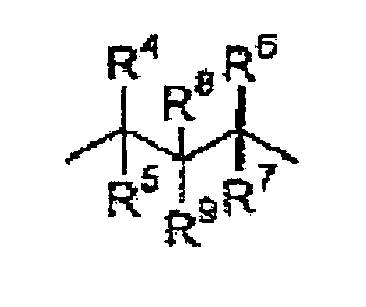
- R4 and R5 are each independently a hydrogen atom, optionally substituted alkyl, carboxyl group or the like,
R6 and R7 are each independently a hydrogen atom, halogen, -OH, -CN or the like,
R8 and R9 are each independently a hydrogen atom, optionally substituted alkyl or the like, and
R3 - R9 optionally form an optionally substituted carbocycle or an optionally substituted heterocycle,
(see Patent Document 3). - (4) A compound represented by the formula:
-

- wherein
R1 is a hydrogen atom, lower alkyl or the like,
R2 is a hydrogen atom, optionally substituted alkyl or the like,
R3 and R4 are each independently a hydrogen atom, lower alkyl, -

- or the like,
A3 is lower alkyl substituted by 5- to 14-membered heterocycle(s) (the heterocycle is optionally condensed),
R8 is a hydrogen atom, oxo, -CONR9R10 or the like,
R9 and R10 are each independently a hydrogen atom, phenyl or the like,
n is 0,
m is 0 or 1, and
r is 1 or 2,
(see Patent Document 4). - (5) A compound represented by the formula:
-

- wherein
T is a hydrogen atom, hydrocarbon, -F-R, or a bond to the one of D,
E, P and Q, or form, together with the one of P and Q, a ring,
Z is an atom having valence m,
M is a valence of Z,
D, E and F are each independently a linker (when Z is N, E is neither CH2 nor CO), and
P, Q and R are each independently a ring (Q contains sulfamate group),
(see Patent Document 5). - (6) A compound represented by the formula:
-

- wherein
E is an optionally substituted cyclic group (provided that the cyclic group is not a spiro ring group, and when the cyclic group is a monocyclic group, the cyclic group has at least two optionally substituted cyclic groups as substituents);
D and G are independently carbonyl group or sulfonyl group;
ring P is an optionally substituted nitrogen-containing 5- or 6-membered non-aromatic heterocycle,
ring Q is an optionally substituted aromatic ring or an optionally substituted non-aromatic heterocycle (provided that the non-aromatic heterocycle contains two or more hetero atoms);
A and L are independently C, CH or N; and
J is an optionally substituted hydrocarbon group, an optionally substituted hydroxy group, an optionally substituted heterocyclic group or an optionally substituted amino group,
(see Patent Document 6). - (7) A compound represented by the formula:
-

- wherein
E is an optionally substituted cyclic group;
D is a carbonyl group or a sulfonyl group;
A is CH or N;
ring P is an optionally further substituted 5- to 7-membered ring;
ring Q is an optionally further substituted 5- to 7-membered non-aromatic ring; and
ring R is an optionally fused 5- to 7-membered non-aromatic ring which is optionally further substituted,
(see Patent Document 7). - (8) A compound represented by the formula:
-

- wherein
ring M is a 5- or 6-membered aromatic ring;
W is C or N;
K is an optionally substituted methylene group or an optionally substituted imino group;
R is a hydrogen atom, an optionally substituted hydrocarbon group, an optionally substituted hydroxy group or an optionally substituted heterocyclic group;
T and U are independently a hydrogen atom or a substituent, or T and U form, together with ring M, an optionally substituted bicyclic ring;
D and G are independently a carbonyl group or a sulfonyl group; ring P is optionally substituted piperidine or an optionally substituted piperazine;
B is CH or N;
ring Q is an optionally substituted monocyclic ring;
A is C, CH or N; and
J is an optionally substituted hydrocarbon group, an optionally substituted heterocyclic group or an optionally substituted amino group,
provided that when the W moiety of ring M is =N- or -N=, U is absent,
(see Patent Document 8). - (9) A compound represented by the formula:
-

- wherein
R1 is a hydrogen atom or a substituent;
ring P is an optionally substituted 6-membered nitrogen-containing aromatic heterocycle;
ring Q is an optionally further substituted 5- to 7-membered nitrogen-containing non-aromatic heterocycle;
ring R is an optionally fused 5- to 7-membered non-aromatic ring which is optionally further substituted,
(see Patent Document 9). - (10) A compound represented by the formula:
-

- wherein
ring E is an optionally further substituted 6-membered aromatic ring, or an optionally fused 5-membered aromatic heterocycle which is optionally further substituted;
ring P is an optionally fused non-aromatic ring which is optionally further substituted;
W is O, S, a C1-4 alkylene or NR3a wherein R3a is a hydrogen atom or a substituent;
X is 0, S, SO, SO2, CO, CR1R2 or NR3b wherein R1, R2 and R3b are the same or different and each is a hydrogen atom or a substituent;
Y is an optionally substituted amino group; and
n is 0, 1, 2 or 3,
(see Patent Document 10). - (11) A compound represented by
-

- (see non-Patent Document 1).
- However, none of the above-mentioned documents reports on the bicyclic compound of the present invention.
-
- Patent Document 1:
WO 2004/021984 - Patent Document 2:
WO 00/54729 - Patent Document 3:
JP-A-9-235278 - Patent Document 4:
WO 95/09159 - Patent Document 5:
WO 03/045925 - Patent Document 6:
JP-A-2006-131559 - Patent Document 7:
WO 2007/013691 - Patent Document 8:
WO 2007/119833 - Patent Document 9:
WO 2008/090944 - Patent Document 10:
WO 2008/102749 -
- Non-Patent Document 1: Tetrahedron Letters, 48(15), 2661-2665 (2007)
- There is a demand for the development of a compound having an ACC inhibitory action, which is useful as an agent for the prophylaxis or treatment of obesity, diabetes, hypertension, hyperlipidemia, cardiac failure, diabetic complications, metabolic syndrome, sarcopenia, cancer and the like, and has superior efficacy.
- The present inventors have found for the first time that a compound represented by the formula (I):
-

- wherein
A is an acyl group or an optionally substituted 5- or 6-membered aromatic ring group;
ring M is an optionally fused 5- to 7-membered ring which is optionally further substituted;
as to ring P and ring Q, - (1) ring P is optionally further substituted 5-membered heterocycle, ring Q is optionally further substituted 6-membered ring, and ring P and ring Q are condensed to form an optionally further substituted bicyclic aromatic heterocycle, or
- (2) ring P is an optionally further substituted 5-membered non-aromatic ring, ring Q is an optionally substituted 6-membered aromatic ring, and ring P and ring Q are condensed to form an optionally substituted bicyclic non-aromatic ring;
- (1) L1 and L2 are independently optionally substituted methylene, O, S, SO or SO2, or
- (2) L1 and L2 in combination form optionally substituted vinylene, or ethynylene,
- (a) a compound wherein A is an α-aminoisobutyloyl group; and
- (b) a compound wherein A is a 5- or 6-membered aromatic ring group substituted by a group represented by the formula: -CO-(CH2)3-COORA1 wherein RA1 is a hydrogen atom or a C1-6 alkyl group, or a group represented by the formula: -CO-NRA2-CRA3RA4-CRA5RA6-COORA7 wherein RA2, RA3, RA4, RA5 and RA7 are independently a hydrogen atom or a C1-6 alkyl group; and RA6 is a hydrogen atom, a C1-6 alkyl group or a hydroxy group,
- Accordingly, the present invention relates to
- (1) compound (I);
- (2) a compound represented by the formula (I):
-

- wherein
A is an acyl group or an optionally substituted 5- or 6-membered aromatic ring group;
ring M is an optionally fused 5- to 7-membered ring which is optionally further substituted;
ring P is optionally further substituted 5-membered heterocycle,
ring Q is optionally further substituted 6-membered ring, and ring P and ring Q are condensed to form an optionally further substituted bicyclic aromatic heterocycle;
R1 is an optionally substituted C1-6 alkyl group or an optionally substituted C3-6 cycloalkyl group;
L1 and L2 are independently optionally substituted methylene, O, S, SO or SO2,
provided that the following compounds are excluded: - (a) a compound wherein A is an α-aminoisobutyloyl group; and
- (b) a compound wherein A is a 5- or 6-membered aromatic ring group substituted by a group represented by the formula: -CO-(CH2)3-COORA1 wherein RA1 is a hydrogen atom or a C1-6 alkyl group, or a group represented by the formula: -CO-NRA2-CRA3RA4-CRA5RA6-COORA7 wherein RA2, RA3, RA4, RA5 and RA7 are independently a hydrogen atom or a C1-6 alkyl group; and RA6 is a hydrogen atom, a C1-6 alkyl group or a hydroxy group,
- (3) the compound of the above-mentioned (1), wherein R1 is a C1-6 alkyl group or a C3-6 cycloalkyl group;
- (4) the compound of the above-mentioned (1), wherein R1 is a C1-6 alkyl group;
- (5) the compound of the above-mentioned (1), wherein A is
- (1) a C1-6 alkyl-carbonyl group, or
- (2) a 5-membered aromatic heterocyclic group optionally substituted by 1 to 3 substituents selected from (i) a halogen atom and (ii) a C1-6 alkyl group;
- (6) the compound of the above-mentioned (1), wherein ring M is a benzene ring or pyridine ring, each of which is optionally substituted by 1 to 3 substituents selected from
- (1) a halogen atom,
- (2) a C1-6 alkyl group,
- (3) a C1-6 alkoxy group optionally substituted by 1 to 3 substituents selected from (i) a halogen atom, (ii) a C1-6 alkoxy group, (iii) a C3-10 cycloalkyl group, (iv) a heterocyclic group and (v) a C6-14 aryl group,
- (4) a C3-10 cycloalkoxy group optionally substituted by 1 to 3 substituents selected from (i) a halogen atom and (ii) a C1-6 alkoxy group, and
- (5) a hydroxy group;
- (7) the compound of the above-mentioned (1), wherein ring P and ring Q are condensed to form
-

-
- (8) the compound of the above-mentioned (1), wherein
- (1) L1 and L2 are independently methylene or O, or
- (2) L1 and L2 in combination form ethynylene or vinylene;
- (9) the compound of the above-mentioned (1), wherein
- (1) a C1-6 alkyl-carbonyl group, or
- (2) a 5-membered aromatic heterocyclic group optionally substituted by 1 to 3 substituents selected from (i) a halogen atom and (ii) a C1-6 alkyl group;
- (1) a halogen atom,
- (2) a C2-6 alkyl group,
- (3) a C1-6 alkoxy group optionally substituted by 1 to 3 substituents selected from (i) a halogen atom, (ii) a C1-6 alkoxy group, (iii) a C3-10 cycloalkyl group, (iv) a heterocyclic group and (v) a C6-24 aryl group,
- (4) a C3-10 cycloalkoxy group optionally substituted by 1 to 3 substituents selected from (i) a halogen atom and (ii) a C1-6 alkoxy group, and
- (5) a hydroxy group;
-

- as to L1 and L2,
- (1) L1 and L2 are independently methylene or O, or
- (2) L1 and L2 in combination form ethynylene or vinylene;
- (10) N-{(1S)-1-[(2S)-6-{[4-(cyclopropylmethoxy)-2-fluorobenzyl]oxy}-2,3-dihydro-1-benzofuran-2-yl]ethyl}acetamide or a salt thereof;
- (11) N-[1-(5-{[6-(cyclopropylmethoxy)-4-fluoropyridin-3-yl]methoxy}-1-benzofuran-2-yl)ethyl]acetamide or a salt thereof;
- (12) N-(1-{6-[2-(4-ethoxyphenyl)ethyl]-1-benzofuran-2-yl}ethyl)acetamide or a salt thereof;
- (13) N-[1-(5-{[4-(cyclopropylmethoxy)benzyl]oxy}-1-benzofuran-2-yl)ethyl]acetamide or a salt thereof;
- (14) a prodrug of the compound of the above-mentioned (1);
- (15) a medicament comprising the compound of the above-mentioned (1) or a prodrug thereof;
- (16) the medicament of the above-mentioned (15), which is an acetyl-CoA carboxylase inhibitor;
- (17) the medicament of the above-mentioned (15), which is an agent for the prophylaxis or treatment of obesity, diabetes, hypertension, hyperlipidemia, cardiac failure, diabetic complications, metabolic syndrome, sarcopenia or cancer;
- (18) a method for the prophylaxis or treatment of obesity, diabetes, hypertension, hyperlipidemia, cardiac failure, diabetic complications, metabolic syndrome, sarcopenia or cancer in a mammal, which comprises administering an effective amount of the above-mentioned compound (1) or a prodrug thereof to the mammal;
- (19) use of the compound of the above-mentioned (1) or a prodrug thereof, for the production of an agent for the prophylaxis or treatment of obesity, diabetes, hypertension, hyperlipidemia, cardiac failure, diabetic complications, metabolic syndrome, sarcopenia or cancer;
- Compound (I) has an ACC inhibitory action, which is useful for the prophylaxis or treatment of obesity, diabetes, hypertension, hyperlipidemia, cardiac failure, diabetic complications, metabolic syndrome, sarcopenia, cancer and the like, and has superior efficacy.
- The definition of each symbol in the formula (I) is described in detail in the following.
The "halogen atom" in the present specification means, unless otherwise specified, a fluorine atom, a chlorine atom, a bromine atom or an iodine atom.
The "C1-3 alkylenedioxy group" in the present specification means, unless otherwise specified, methylenedioxy, ethylenedioxy or the like.
The "C1-6 alkyl group" in the present specification means, unless otherwise specified, methyl, ethyl, propyl, isopropyl, butyl, isobutyl, sec-butyl, tert-butyl, pentyl, isopentyl, neopentyl, 1-ethylpropyl, hexyl, isohexyl, 1,1-dimethylbutyl, 2,2-dimethylbutyl, 3,3-dimethylbutyl, 2-ethylbutyl or the like. - The "C1-6 alkoxy group" in the present specification means, unless otherwise specified, methoxy, ethoxy, propoxy, isopropoxy, butoxy, isobutoxy, sec-butoxy, tert-butoxy or the like.
The "C1-6 alkoxy-carbonyl group" in the present specification means, unless otherwise specified, methoxycarbonyl, ethoxycarbonyl, propoxycarbonyl, tert-butoxycarbonyl or the like.
The "C1-6 alkyl-carbonyl group" in the present specification means, unless otherwise specified, acetyl, propanoyl, butanoyl, isobutanoyl, pentanoyl, isopentanoyl, hexanoyl or the like. - A is an acyl group or an optionally substituted 5- or 6-membered aromatic ring group.
- Examples of the "acyl group" for A include a group represented by the formula: -CORA, -CO-ORA, -SO3RA, -SO2RA, -SORA, -CO-NRA'RB', -CS-NRA'RB' or -SO2NRA'RB' wherein RA is a hydrogen atom, an optionally substituted hydrocarbon group or an optionally substituted heterocyclic group. RA' and RB' are the same or different and each is a hydrogen atom, a sulfamoyl group mono- or di-optionally substituted by C1-6 alkyl group(s), sulfonyl group optionally substituted by a C1-6 alkyl group, an optionally substituted hydrocarbon group or an optionally substituted heterocyclic group, or RA' and RB' form, together with the adjacent nitrogen atom, an optionally substituted nitrogen-containing heterocycle, and the like.
- Examples of the "hydrocarbon group" of the above-mentioned "optionally substituted hydrocarbon group" for RA, RA' or RB' include a C1-10 alkyl group, a C2-10 alkenyl group, a C2-10 alkynyl group, a C3-10 cycloalkyl group, a C3-10 cycloalkenyl group, a C4-10 cycloalkadienyl group, a C6-14 aryl group, a C7-13 aralkyl group, a C8-13 arylalkenyl group and the like.
- Examples of the C1-10 alkyl group include methyl, ethyl, propyl, isopropyl, butyl, isobutyl, sec-butyl, tert-butyl, pentyl, isopentyl, neopentyl, 1-ethylpropyl, hexyl, isohexyl, 1,1-dimethylbutyl, 2,2-dimethylbutyl, 3,3-dimethylbutyl, 2-ethylbutyl, heptyl, octyl, nonyl, decyl and the like.
- Examples of the C2-10 alkenyl group include ethenyl, 1-propenyl, 2-propenyl, 2-methyl-1-propenyl, 1-butenyl, 2-butenyl, 3-butenyl, 3-methyl-2-butenyl, 1-pentenyl, 2-pentenyl, 3-pentenyl, 4-pentenyl, 4-methyl-3-pentenyl, 1-hexenyl, 3-hexenyl, 5-hexenyl, 1-heptenyl, 1-octenyl and the like.
- Examples of the C2-10 alkynyl group include ethynyl, 1-propynyl, 2-propynyl, 1-butynyl, 2-butynyl, 3-butynyl, 1-pentynyl, 2-pentynyl, 3-pentynyl, 4-pentynyl, 1-hexynyl, 2-hexynyl, 3-hexynyl, 4-hexynyl, 5-hexynyl, 1-heptynyl, 1-octynyl and the like.
- Examples of the C3-10 cycloalkyl group include cyclopropyl, cyclobutyl, cyclopentyl, cyclohexyl, cycloheptyl, cyclooctyl, bicyclo[2.2.1]heptyl, bicyclo[2.2.2]octyl, bicyclo[3.2.1]octyl, bicyclo[3.2.2]nonyl, bicyclo[3.3.1]nonyl, bicyclo[4.2.1]nonyl, bicyclo[4.3.1]decyl, adamantyl and the like.
- Examples of the C3-10 cycloalkenyl group include 2-cyclopenten-1-yl, 3-cyclopenten-1-yl, 2-cyclohexen-1-yl, 3-cyclohexen-1-yl and the like.
- Examples of the C4-10 cycloalkadienyl group include 2,4-cyclopentadien-1-yl, 2,4-cyclohexadien-1-yl, 2,5-cyclohexadien-1-yl and the like.
- The above-mentioned C3-10 cycloalkyl group, C3-10 cycloalkenyl group and C4-10 cycloalkadienyl group are each optionally condensed with a benzene ring to form a fused ring group. Examples of the fused ring group include indanyl, dihydronaphthyl, tetrahydronaphthyl, fluorenyl and the like.
- Examples of the C6-14 aryl group include phenyl, naphthyl, anthryl, phenanthryl, acenaphthyl, biphenylyl and the like.
- Examples of the C7-13 aralkyl group include benzyl, phenethyl, naphthylmethyl, biphenylylmethyl and the like.
Examples of the C8-13 arylalkenyl group include styryl and the like. - The C1-10 alkyl group, C2-10 alkenyl group and C2-10 alkynyl group which are exemplified as the above-mentioned "hydrocarbon group" optionally have 1 to 3 substituents at substitutable positions.
- Examples of the substituent include
- (1) a C3-10 cycloalkyl group (e.g., cyclopropyl, cyclohexyl);
- (2) a C6-14 aryl group (e.g., phenyl, naphthyl) optionally substituted by 1 to 3 substituents selected from
- (a) a C1-6 alkyl group optionally substituted by 1 to 3 halogen atoms,
- (b) a hydroxy group,
- (c) a C1-6 alkoxy group optionally substituted by 1 to 3 halogen atoms, and
- (d) a halogen atom;
- (3) an aromatic heterocyclic group (e.g., thienyl, furyl, pyridyl, pyrazolyl, imidazolyl, tetrazolyl, oxazolyl, thiazolyl, oxadiazolyl, thiadiazolyl) optionally substituted by 1 to 3 substituents selected from
- (a) a C1-6 alkyl group optionally substituted by 1 to 3 halogen atoms,
- (b) a hydroxy group,
- (c) a C1-6 alkoxy group optionally substituted by 1 to 3 halogen atoms, and
- (d) a halogen atom;
- (4) a non-aromatic heterocyclic group (e.g., tetrahydrofuryl, morpholinyl, thiomorpholinyl, piperidinyl, pyrrolidinyl, piperazinyl) optionally substituted by 1 to 3 substituents selected from
- (a) a C1-6 alkyl group optionally substituted by 1 to 3 halogen atoms,
- (b) a hydroxy group,
- (c) a C1-6 alkoxy group optionally substituted by 1 to 3 halogen atoms,
- (d) a halogen atom, and
- (e) an oxo group;
- (5) an amino group optionally mono- or di-substituted by substituent(s) selected from
- (a) a C1-6 alkyl group optionally substituted by 1 to 3 halogen atoms,
- (b) a C1-6 alkyl-carbonyl group optionally substituted by 1 to 3 halogen atoms,
- (c) a C1-6 alkoxy-carbonyl group optionally substituted by 1 to 3 halogen atoms,
- (d) a C1-6 alkylsulfonyl group (e.g., methylsulfonyl) optionally substituted by 1 to 3 halogen atoms,
- (e) a carbamoyl group optionally mono- or di-substituted by C1-6 alkyl group(s) optionally substituted by 1 to 3 halogen atoms, and
- (f) an aromatic heterocyclic group (e.g., thienyl, furyl, pyridyl, pyrazolyl, imidazolyl, tetrazolyl, oxazolyl, thiazolyl, oxadiazolyl, thiadiazolyl);
- (6) a C1-6 alkyl-carbonyl group optionally substituted by 1 to 3 halogen atoms;
- (7) a C1-6 alkoxy-carbonyl group optionally substituted by 1 to 3 substituents selected from
- (a) a halogen atom,
- (b) a C1-6 alkoxy group,
- (c) a C6-14 aryl group (e.g., phenyl), and
- (d) a heterocyclic group (e.g., tetrahydrofuryl);
- (8) a C1-6 alkylsulfonyl group (e.g., methylsulfonyl, ethylsulfonyl, isopropylsulfonyl) optionally substituted by 1 to 3 halogen atoms;
- (9) a carbamoyl group optionally mono- or di-substituted by C1-6 alkyl group(s) optionally substituted by 1 to 3 halogen atoms;
- (10) a thiocarbamoyl group optionally mono- or di-substituted by C1-6 alkyl group(s) optionally substituted by 1 to 3 halogen atoms;
- (11) a sulfamoyl group optionally mono- or di-substituted by C1-6 alkyl group(s) optionally substituted by 1 to 3 halogen atoms;
- (12) a carboxy group;
- (13) a hydroxy group;
- (14) a C1-6 alkoxy group optionally substituted by 1 to 3 substituents selected from
- (a) a halogen atom,
- (b) a carboxy group,
- (c) a C1-6 alkoxy group,
- (d) a C1-6 alkoxy-carbonyl group optionally substituted by 1 to 3 C6-14 aryl groups (e.g., phenyl),
- (e) an amino group optionally mono- or di-substituted by substituent(s) selected from a C1-6 alkyl group and a C1-6 alkoxy-carbonyl group,
- (f) a heterocyclic group (e.g., tetrahydrofuryl), and
- (g) a C3-10 cycloalkyl group;
- (15) a C2-6 alkenyloxy group (e.g., ethenyloxy) optionally substituted by 1 to 3 halogen atoms;
- (16) a C7-13 aralkyloxy group (e.g., benzyloxy);
- (17) a C6-14 aryloxy group (e.g., phenyloxy, naphthyloxy);
- (18) a C1-6 alkyl-carbonyloxy group (e.g., acetyloxy, tert-butylcarbonyloxy);
- (19) a C6-14 aryl-carbonyl group (e.g., benzoyl) optionally substituted by 1 to 3 substituents selected from
- (a) a halogen atom, and
- (b) a C1-6 alkyl group optionally substituted by 1 to 3 halogen atoms;
- (20) a non-aromatic heterocyclylcarbonyl group (e.g., pyrrolidinylcarbonyl, morpholinylcarbonyl) optionally substituted by 1 to 3 C1-6 alkyl groups optionally substituted by 1 to 3 halogen atoms;
- (21) a mercapto group;
- (22) a C1-6 alkylthio group (e.g., methylthio, ethylthio) optionally substituted by 1 to 3 substituents selected from
- (a) a halogen atom, and
- (b) a C1-6 alkoxy-carbonyl group;
- (23) a C7-13 aralkylthio group (e.g., benzylthio);
- (24) a C6-14 arylthio group (e.g., phenylthio, naphthylthio);
- (25) a cyano group;
- (26) a nitro group;
- (27) a halogen atom;
- (28) a C1-3 alkylenedioxy group;
- (29) a C1-3 alkyleneoxy group (e.g., methyleneoxy, ethyleneoxy);
- (30) an aromatic heterocyclylcarbonyl group (e.g., pyrazolylcarbonyl, pyrazinylcarbonyl, isoxazolylcarbonyl, pyridylcarbonyl, thiazolylcarbonyl) optionally substituted by 1 to 3 substituents selected from a C1-6 alkyl group optionally substituted by 1 to 3 halogen atoms;
- (31) a C3-10 cycloalkoxy group (e.g., cyclopropoxy, cyclopentyloxy) optionally substituted by 1 to 3 substituents selected from
- (a) a halogen atom (e.g., a fluorine atom), and
- (b) a C1-6 alkoxy group (e.g., methoxy)
- Examples of the substituent include
- (1) the groups exemplified as the substituents for the above-mentioned C1-10 alkyl group and the like;
- (2) a C1-6 alkyl group optionally substituted by 1 to 3 substituents selected from
- (a) a halogen atom,
- (b) a carboxy group,
- (c) a hydroxy group,
- (d) a C1-6 alkoxy-carbonyl group,
- (e) a C1-6 alkoxy group, and
- (f) an amino group optionally mono- or di-substituted by C1-6 alkyl group(s);
- (3) a C2-6 alkenyl group (e.g., ethenyl, 1-propenyl) optionally substituted by 1 to 3 substituents selected from
- (a) a halogen atom,
- (b) a carboxy group,
- (c) a hydroxy group,
- (d) a C1-6 alkoxy-carbonyl group,
- (e) a C1-6 alkoxy group, and
- (f) an amino group optionally mono- or di-substituted by C1-6 alkyl group(s);
- (4) a C7-13 aralkyl group (e.g., benzyl) optionally substituted by 1 to 3 substituents selected from
- (a) a C1-6 alkyl group optionally substituted by 1 to 3 halogen atoms,
- (b) a hydroxy group,
- (c) a C1-6 alkoxy group, and
- (d) a halogen atom;
- Examples of the "heterocyclic group" of the above-mentioned "optionally substituted heterocyclic group" for RA, RA' or RB' include an "aromatic heterocyclic group" and a "non-aromatic heterocyclic group".
- Examples of the aromatic heterocyclic group include a 4- to 7-membered (preferably 5- or 6-menbered) monocyclic aromatic heterocyclic group containing, as a ring-constituting atom besides carbon atoms, 1 to 4 hetero atoms selected from an oxygen atom, a sulfur atom and a nitrogen atom, and a fused aromatic heterocyclic group. Examples of the fused aromatic heterocyclic group include a group derived from a fused ring wherein a ring corresponding to the 4- to 7-membered monocyclic aromatic heterocyclic group and 1 or 2 rings selected from a 5- or 6-membered aromatic heterocycle containing 1 or 2 nitrogen atoms (e.g., pyrrole, imidazole, pyrazole, pyrazine, pyridine, pyrimidine), a 5-membered aromatic heterocycle containing one sulfur atom (e.g., thiophene) and a benzene ring are condensed, and the like.
- Preferable examples of the aromatic heterocyclic group include monocyclic aromatic heterocyclic groups such as furyl (e.g., 2-furyl, 3-furyl), thienyl (e.g., 2-thienyl, 3-thienyl), pyridyl (e.g., 2-pyridyl, 3-pyridyl, 4-pyridyl), pyrimidinyl (e.g., 2-pyrimidinyl, 4-pyrimidinyl, 5-pyrimidinyl), pyridazinyl (e.g., 3-pyridazinyl, 4-pyridazinyl), pyrazinyl (e.g., 2-pyrazinyl), pyrrolyl (e.g., 1-pyrrolyl, 2-pyrrolyl, 3-pyrrolyl), imidazolyl (e.g., 1-imidazolyl, 2-imidazolyl, 4-imidazolyl, 5-imidazolyl), pyrazolyl (e.g., 1-pyrazolyl, 3-pyrazolyl, 4-pyrazolyl), thiazolyl (e.g., 2-thiazolyl, 4-thiazolyl, 5-thiazolyl), isothiazolyl (e.g., 3-isothiazolyl, 4-isothiazolyl, 5-isothiazolyl), oxazolyl (e.g., 2-oxazolyl, 4-oxazolyl, 5-oxazolyl), isoxazolyl (e.g., 3-isoxazolyl, 4-isoxazolyl, 5-isoxazolyl), oxadiazolyl (e.g., 1,2,4-oxadiazol-5-yl, 1,3,4-oxadiazol-2-yl), thiadiazolyl (e.g., 1,3,4-thiadiazol-2-yl), triazolyl (e.g., 1,2,4-triazol-1-yl, 1,2,4-triazol-3-yl, 1,2,3-triazol-1-yl, 1,2,3-triazol-2-yl, 1,2,3-triazol-4-yl), tetrazolyl (e.g., tetrazol-1-yl, tetrazol-5-yl), triazinyl (e.g., 1,2,4-triazin-1-yl, 1,2,4-triazin-3-yl) and the like;
fused aromatic heterocyclic groups such as
quinolyl (e.g., 2-quinolyl, 3-quinolyl, 4-quinolyl, 6-quinolyl), isoquinolyl (e.g., 3-isoquinolyl), quinazolyl (e.g., 2-quinazolyl, 4-quinazolyl), quinoxalyl (e.g., 2-quinoxalyl, 6-quinoxalyl), benzofuranyl (e.g., 2-benzofuranyl, 3-benzofuranyl), benzothienyl (e.g., 2-benzothienyl, 3-benzothienyl), benzoxazolyl (e.g., 2-benzoxazolyl), benzisoxazolyl (e.g., 7-benzisoxazolyl), benzothiazolyl (e.g., 2-benzothiazolyl), benzimidazolyl (e.g., benzimidazol-1-yl, benzimidazol-2-yl, benzimidazol-5-yl), benzotriazolyl (e.g., 1H-1,2,3-benzotriazol-5-yl), indolyl (e.g., indol-1-yl, indol-2-yl, indol-3-yl, indol-5-yl), indazolyl (e.g., 1H-indazol-3-yl), pyrrolopyrazinyl (e.g., 1H-pyrrolo[2,3-b]pyrazin-2-yl, 1H-pyrrolo[2,3-b]pyrazin-6-yl), imidazopyridinyl (e.g., 1H-imidazo[4,5-b]pyridin-2-yl, 1H-imidazo[4,5-c]pyridin-2-yl, 2H-imidazo[1,2-a]pyridin-3-yl), thienopyridinyl (e.g., thieno[2,3-b]pyridin-3-yl), imidazopyrazinyl (e.g., 1H-imidazo[4,5-b]pyrazin-2-yl), pyrazolopyridinyl (e.g., 41H-pyrazolo[4,3-c]pyridin-3-yl), pyrazolothienyl (e.g., 2H-pyrazolo[3,4-b]thiophen-2-yl), pyrazolotriazinyl (e.g., pyrazolo[5,1-c][1,2,4]triazin-3-yl), pyridopyridinyl (e.g., pyrido[2,3-b]pyridin-3-yl), thienopyridyl (e.g., thieno[2,3-b]pyridin-3-yl) and the like;
and the like. - Examples of the non-aromatic heterocyclic group include a 4-to 7-membered (preferably 5- or 6-menbered) monocyclic non-aromatic heterocyclic group containing, as a ring-constituting atom besides carbon atoms, 1 to 4 hetero atoms selected from an oxygen atom, a sulfur atom and a nitrogen atom, and a fused aromatic heterocyclic group. Examples of the fused aromatic heterocyclic group include a group derived from a fused ring wherein a ring corresponding to the 4- to 7-membered monocyclic non-aromatic heterocyclic group and 1 or 2 rings selected from a 5- or 6-membered aromatic heterocycle containing 1 or 2 nitrogen atoms (e.g., pyrrole, imidazole, pyrazole, pyrazine, pyridine, pyrimidine), a 5-membered aromatic heterocycle containing one sulfur atom (e.g., thiophene) and a benzene ring are condensed, a group wherein the above-mentioned group is partially saturated, and the like.
- Preferable examples of the non-aromatic heterocyclic group include
monocyclic non-aromatic heterocyclic groups such as pyrrolidinyl (e.g., 1-pyrrolidinyl, 2-pyrrolidinyl), piperidyl (e.g., piperidino, 2-piperidyl, 3-piperidyl, 4-piperidyl), morpholinyl (e.g., morpholino), thiomorpholinyl (e.g., thiomorpholino), piperazinyl (e.g., 1-piperazinyl, 2-piperazinyl, 3-piperazinyl), hexamethyleniminyl (e.g., hexamethylenimin-1-yl), oxazolidinyl (e.g., oxazolidin-2-yl), thiazolidinyl (e.g., thiazolidin-2-yl), imidazolidinyl (e.g., imidazolidin-2-yl, imidazolidin-3-yl), oxazolinyl (e.g., oxazolin-2-yl), thiazolinyl (e.g., thiazolin-2-yl), imidazolinyl (e.g., imidazolin-2-yl, imidazolin-3-yl), dioxolyl (e.g., 1,3-dioxol-4-yl), dioxolanyl (e.g., 1,3-dioxolan-4-yl), dihydrooxadiazolyl (e.g., 4,5-dihydro-1,2,4-oxadiazol-3-yl), pyranyl (e.g., 4-pyranyl), tetrahydropyranyl (e.g., 2-tetrahydropyranyl, 3-tetrahydropyranyl, 4-tetrahydropyranyl), thiopyranyl (e.g., 4-thiopyranyl), tetrahydrothiopyranyl (e.g., 2-tetrahydrothiopyranyl, 3-tetrahydrothiopyranyl, 4-tetrahydrothiopyranyl), tetrahydrofuryl (e.g., tetrahydrofuran-3-yl, tetrahydrofuran-2-yl), pyrazolidinyl (e.g., pyrazolidin-1-yl, pyrazolidin-3-yl), pyrazolinyl (e.g., pyrazolin-1-yl), tetrahydropyrimidinyl (e.g., tetrahydropyrimidin-1-yl), dihydrotriazolyl (e.g., 2,3-dihydro-1H-1,2,3-triazol-1-yl), tetrahydrotriazolyl (e.g., 2,3,4,5-tetrahydro-1H-1,2,3-triazol-1-yl) and the like;
fused non-aromatic heterocyclic groups such as
dihydroindolyl (e.g., 2,3-dihydro-1H-indol-1-yl), dihydroisoindolyl (e.g., 1,3-dihydro-2H-isoindol-2-yl), dihydrobenzofuranyl (e.g., 2,3-dihydro-1-benzofuran-5-yl), dihydrobenzodioxinyl (e.g., 2,3-dihydro-1,4-benzodioxinyl), dihydrobenzodioxepinyl (e.g., 3,4-dihydro-2H-1,5-benzodioxepinyl), tetrahydrobenzofuranyl (e.g., 4,5,6,7-tetrahydro-1-benzofuran-3-yl), chromenyl (e.g., 4H-chromen-2-yl, 2H-chromen-3-yl), dihydrochromenyl (e.g., 3,4-dihydro-2H-chromen-2-yl), dihydroquinolinyl (e.g., 1,2-dihydroquinolin-4-yl), tetrahydroquinolinyl (e.g., 1,2,3,4-tetrahydroquinolin-4-yl), dihydroisoquinolinyl (e.g., 1,2-dihydroisoquinolin-4-yl), tetrahydroisoquinolinyl (e.g., 1,2,3,4-tetrahydroisoquinolin-4-yl), dihydrophthalazinyl (e.g., 1,4-dihydrophthalazin-4-yl)
and the like;
and the like. - The "heterocyclic group" of the "optionally substituted heterocyclic group" for RA, RA' or RB' optionally has 1 to 3 substituents at substitutable positions. Examples of the substituent include those similar to the substituents that the C3-10 cycloalkyl group and the like exemplified as the "hydrocarbon group" of the "optionally substituted hydrocarbon group" for RA, RA' or RB' optionally has. When the heterocyclic group is a "non-aromatic heterocyclic group", the substituent further includes an oxo group. When the number of the substituents is not less than 2, the respective substituents may be the same or different.
- Examples of the "nitrogen-containing heterocycle" of the "optionally substituted nitrogen-containing heterocycle" formed by RA' and RB' together with the adjacent nitrogen atom include a 5- to 7-membered nitrogen-containing heterocycle containing, as a ring-constituting atom besides carbon atoms, at least one nitrogen atom and optionally further containing one or two hetero atoms selected from an oxygen atom, a sulfur atom and a nitrogen atom. Preferable examples of the nitrogen-containing heterocycle include pyrrolidine, imidazolidine, pyrazolidine, piperidine, piperazine, morpholine, thiomorpholine and the like.
- The nitrogen-containing heterocycle optionally has 1 to 3 substituents at substitutable positions. Examples of the substituent include those similar to the substituents that the e "heterocyclic group" of the "optionally substituted heterocyclic group" for RA, RA' or RB' optionally has. When the number of the substituents is not less than 2, the respective substituents may be the same or different.
- Preferable examples of the "acyl group" include
- (1) a formyl group;
- (2) a carboxy group;
- (3) a C1-6 alkyl-carbonyl group optionally substituted by 1 to 3 substituents selected from
- (i) a halogen atom,
- (ii) an amino group,
- (iii) a carboxyl group,
- (iv) a C1-6 alkoxy-carbonyl group,
- (v) a C6-14 aryl group (e.g., phenyl), and
- (vi) a C1-6 alkoxy group;
- (4) a C1-6 alkoxy-carbonyl group optionally substituted by 1 to 3 substituents selected from
- (i) a halogen atom,
- (ii) a C6-14 aryl group (e.g., phenyl), and
- (iii) a C1-6 alkoxy group;
- (5) a C3-10 cycloalkyl-carbonyl group (e.g., cyclopropylcarbonyl, cyclopentylcarbonyl, cyclohexylcarbonyl);
- (6) a C6-14 aryl-carbonyl group (e.g., benzoyl) optionally substituted by 1 to 3 halogen atoms;
- (7) a carbamoyl group optionally mono- or di-substituted by substituent(s) selected from
- (i) a C1-6 alkyl group optionally substituted by 1 to 3 substituents selected from
- (a) a halogen atom,
- (b) a C1-6 alkoxy-carbonyl group,
- (c) a C6-14 aryl group (e.g., phenyl),
- (d) a C1-6 alkoxy group, and
- (e) an aromatic heterocyclic group (e.g., furyl),
- (ii) a C3-10 cycloalkyl group (e.g., cyclopentyl, cyclohexyl),
- (iii) a C6-14 aryl group (e.g., phenyl) optionally substituted by 1 to 3 substituents selected from
- (a) a halogen atom,
- (b) a C1-6 alkyl group optionally substituted by 1 to 3 halogen atoms, and
- (c) a C1-6 alkoxy group,
- (iv) a C1-6 alkylsulfonyl group (e.g., methylsulfonyl), and
- (v) an aromatic heterocyclic group (e.g., pyridyl) optionally substituted by 1 to 3 C1-6 alkyl groups;
- (i) a C1-6 alkyl group optionally substituted by 1 to 3 substituents selected from
- (8) a C1-6 alkylsulfonyl group (e.g., methylsulfonyl, ethylsulfonyl, isopropylsulfonyl) optionally substituted by 1 to 3 substituents selected from
- (i) a halogen atom, and
- (ii) a C6-14 aryl group (e.g., phenyl);
- (9) a C6-14 arylsulfonyl group (e.g., benzenesulfonyl) optionally substituted by 1 to 3 substituents selected from
- (i) a halogen atom, and
- (ii) a C1-6 alkyl group;
- (10) a C3-10 cycloalkylsulfonyl group (e.g., cyclopropylsulfonyl);
- (11) a sulfamoyl group optionally mono- or di-substituted by substituent(s) selected from
- (i) a C1-6 alkyl group optionally substituted by 1 to 3 substituents selected from
- (a) a halogen atom, and
- (b) a non-aromatic heterocyclic group (e.g., pyrrolidinyl) optionally substituted by oxo group(s);
- (i) a C1-6 alkyl group optionally substituted by 1 to 3 substituents selected from
- (12) a thiocarbamoyl group optionally mono- or di-substituted by substituent(s) selected from a C1-6 alkyl group optionally substituted by 1 to 3 halogen atoms;
- (13) an aromatic heterocyclylcarbonyl group (e.g., furylcarbonyl, thienylcarbonyl, pyrazolylcarbonyl, pyridylcarbonyl, isooxazolylcarbonyl, thiazolylcarbonyl) optionally substituted by 1 to 3 substituents selected from a C1-6 alkyl group optionally substituted by 1 to 3 halogen atoms;
- (14) a non-aromatic heterocyclylcarbonyl group (e.g., tetrahydrofurylcarbonyl, tetrahydropyranylcarbonyl) optionally substituted by 1 to 3 substituents selected from a C1-6 alkyl group optionally substituted by 1 to 3 halogen atoms;
- The "acyl group" for A is preferably
- (1) a C1-6 alkyl-carbonyl group (e.g., acetyl, propionyl, butyryl, isobutyryl, isoamyl) optionally substituted by 1 to 3 substituents selected from
- (i) an amino group,
- (ii) a carboxyl group,
- (iii) a C1-6 alkoxy-carbonyl group (e.g., methoxycarbonyl, ethoxycarbonyl),
- (iv) a C6-14 aryl group (e.g., phenyl), and
- (v) a C1-6 alkoxy group (e.g., methoxy);
- (2) a C1-6 alkoxy-carbonyl group (e.g., tert-butoxycarbonyl);
- (3) a C3-10 cycloalkyl-carbonyl group (e.g., cyclopropylcarbonyl, cyclopentylcarbonyl);
- (4) a C6-14 aryl-carbonyl group (e.g., benzoyl);
- (5) a carbamoyl group optionally mono- or di-substituted by substituent(s) selected from
- (i) a C1-6 alkyl group (e.g., methyl, ethyl, propyl, isopropyl) optionally substituted by 1 to 3 C6-14 aryl groups (e.g., phenyl),
- (ii) a C6-14 aryl group (e.g., phenyl),
- (iii) a C3-10 cycloalkyl group (e.g., cyclopentyl, cyclohexyl),
- (iv) a C1-6 alkylsulfonyl group (e.g., methylsulfonyl), and
- (v) an aromatic heterocyclic group (e.g., pyridyl) optionally substituted by 1 to 3 C1-6 alkyl groups (e.g., methyl);
- (6) a C1-6 alkylsulfonyl group (e.g., methylsulfonyl) optionally substituted by 1 to 3 C6-14 aryl groups (e.g., phenyl);
- (7) a C6-14 arylsulfonyl group (e.g., benzenesulfonyl) optionally substituted by 1 to 3 C1-6 alkyl groups (e.g., methyl);
- (8) a C3-10 cycloalkylsulfonyl group (e.g., cyclopropylsulfonyl);
- (9) an aromatic heterocyclylcarbonyl group (e.g., furylcarbonyl, pyrazolylcarbonyl, pyridylcarbonyl, isooxazolylcarbonyl, thiazolylcarbonyl) optionally substituted by 1 to 3 substituents selected from a C1-6 alkyl group optionally substituted by 1 to 3 halogen atoms (e.g., a fluorine atom);
- (10) an non-aromatic heterocyclylcarbonyl group (e.g., tetrahydropyranylcarbonyl);
- Examples of the "5- or 6-membered aromatic ring group" of the "optionally substituted 5- or 6-membered aromatic ring group" for A include phenyl; pyrrolyl, pyrazolyl, imidazolyl, triazolyl (1,2,3-triazolyl, 1,2,4-triazolyl, 1,3,4-triazolyl), tetrazolyl, oxazolyl, isoxazolyl, thiazolyl, isothiazolyl, oxadiazolyl, thiadiazolyl, furyl, thienyl, pyridyl, pyridazinyl, pyrimidinyl, pyrazinyl, triazinyl and the like.
- The "5- or 6-membered aromatic ring group" is preferably phenyl or a 5-membered aromatic heterocyclic group, more preferably a 5-membered aromatic heterocyclic group, particularly preferably pyrazolyl, oxazolyl, isoxazolyl, thiazolyl, isothiazolyl, thiadiazolyl or the like.
- The "5- or 6-membered aromatic ring group" of the "optionally substituted 5- or 6-membered aromatic ring group" for A optionally has 1 to 3 substituents at substitutable positions. Examples of the substituent include those similar to the substituents that the C3-10 cycloalkyl group and the like exemplified as the "hydrocarbon group" of the "optionally substituted hydrocarbon group" for RA, RA' or RB' optionally has.
- The "optionally substituted 5- or 6-membered aromatic ring group" for A is preferably phenyl or a 5-membered aromatic heterocyclic group (e.g., pyrazolyl, oxazolyl, isoxazolyl, thiazolyl, isothiazolyl, thiadiazolyl), each of which is optionally substituted by 1 to 3 substituents selected from
- (1) a C1-6 alkyl-carbonyl group optionally substituted by 1 to 3 halogen atoms;
- (2) a C1-6 alkoxy-carbonyl group optionally substituted by 1 to 3 substituents selected from
- (a) a halogen atom,
- (b) a C1-6 alkoxy group, and
- (c) a C6-14 aryl group (e.g., phenyl);
- (3) a carbamoyl group optionally mono- or di-substituted by C1-6 alkyl group(s) optionally substituted by 1 to 3 halogen atoms;
- (4) a carboxy group;
- (5) a hydroxy group;
- (6) a halogen atom;
- (7) a C1-6 alkyl group optionally substituted by 1 to 3 substituents selected from
- (a) a halogen atom,
- (b) a carboxy group,
- (c) a hydroxy group,
- (d) a C1-6 alkoxy-carbonyl group, and
- (e) a C1-6 alkoxy group;
- A is preferably
- (1) a C1-6 alkyl-carbonyl group (e.g., acetyl, propionyl, butyryl, isobutyryl, isoamyl) optionally substituted by 1 to 3 substituents selected from
- (i) an amino group,
- (ii) a carboxyl group,
- (iii) a C1-6 alkoxy-carbonyl group (e.g., methoxycarbonyl, ethoxycarbonyl),
- (iv) a C6-14 aryl group (e.g., phenyl), and
- (v) a C1-6 alkoxy group (e.g., methoxy);
- (2) a C1-6 alkoxy-carbonyl group (e.g., tert-butoxycarbonyl);
- (3) a C3-10 cycloalkyl-carbonyl group (e.g., cyclopropylcarbonyl, cyclopentylcarbonyl);
- (4) a C6-14 aryl-carbonyl group (e.g., benzoyl);
- (5) a carbamoyl group optionally mono- or di-substituted by substituent(s) selected from
- (i) a C1-6 alkyl group (e.g., methyl, ethyl, propyl, isopropyl) optionally substituted by 1 to 3 C6-14 aryl groups (e.g., phenyl),
- (ii) a C6-14 aryl group (e.g., phenyl),
- (iii) a C3-10 cycloalkyl group (e.g., cyclopentyl, cyclohexyl),
- (iv) a C1-6 alkylsulfonyl group (e.g., methylsulfonyl), and
- (v) an aromatic heterocyclic group (e.g., pyridyl) optionally substituted by 1 to 3 C1-6 alkyl groups (e.g., methyl);
- (6) a C1-6 alkylsulfonyl group (e.g., methylsulfonyl) optionally substituted by 1 to 3 C6-14 aryl groups (e.g., phenyl);
- (7) a C6-14 arylsulfonyl group (e.g., benzenesulfonyl) optionally substituted by 1 to 3 C1-6 alkyl groups (e.g., methyl);
- (8) a C3-10 cycloalkylsulfonyl group (e.g., cyclopropylsulfonyl);
- (9) an aromatic heterocyclylcarbonyl group (e.g., furylcarbonyl, pyrazolylcarbonyl, pyridylcarbonyl, isooxazolylcarbonyl, thiazolylcarbonyl) optionally substituted by 1 to 3 substituents selected from a C1-6 alkyl group optionally substituted by 1 to 3 halogen atoms (e.g., a fluorine atom);
- (10) an non-aromatic heterocyclylcarbonyl group (e.g., tetrahydropyranylcarbonyl);
- (11) phenyl or a 5-membered aromatic heterocyclic group (e.g., pyrazolyl, oxazolyl, isoxazolyl, thiazolyl, isothiazolyl, thiadiazolyl), each of which is optionally substituted by 1 to 3 substituents selected from
- (i) a C1-6 alkyl-carbonyl group optionally substituted by 1 to 3 halogen atoms,
- (ii) a C1-6 alkoxy-carbonyl group optionally substituted by 1 to 3 substituents selected from
- (a) a halogen atom,
- (b) a C1-6 alkoxy group, and
- (c) a C6-14 aryl group (e.g., phenyl),
- (iii) a carbamoyl group optionally mono- or di-substituted by C1-6 alkyl group(s) optionally substituted by 1 to 3 halogen atoms,
- (iv) a carboxy group,
- (v) a hydroxy group,
- (vi) a halogen atom,
- (vii) a C1-6 alkyl group optionally substituted by 1 to 3 substituents selected from
- (a) a halogen atom,
- (b) a carboxy group,
- (c) a hydroxy group,
- (d) a C1-6 alkoxy-carbonyl group, and
- (e) a C1-6 alkoxy group
- A is more preferably
- (1) a C1-6 alkyl-carbonyl group (e.g., acetyl, propionyl, butyryl, isobutyryl, isoamyl) optionally substituted by 1 to 3 substituents selected from
- (i) an amino group,
- (ii) a carboxyl group,
- (iii) a C1-6 alkoxy-carbonyl group (e.g., methoxycarbonyl, ethoxycarbonyl),
- (iv) a C6-14 aryl group (e.g., phenyl), and
- (v) a C1-6 alkoxy group (e.g., methoxy);
- (2) a C1-6 alkoxy-carbonyl group (e.g., tert-butoxycarbonyl);
- (3) a carbamoyl group optionally mono- or di-substituted by substituent(s) selected from
- (i) a C1-6 alkyl group (e.g., methyl, ethyl, propyl, isopropyl) optionally substituted by 1 to 3 C6-14 aryl groups (e.g., phenyl),
- (ii) a C6-14 aryl group (e.g., phenyl),
- (iii) a C3-10 cycloalkyl group (e.g., cyclopentyl, cyclohexyl),
- (iv) a C1-6 alkylsulfonyl group (e.g., methylsulfonyl), and
- (v) an aromatic heterocyclic group (e.g., pyridyl) optionally substituted by 1 to 3 C1-6 alkyl groups (e.g., methyl);
- (4) phenyl or a 5-membered aromatic heterocyclic group (e.g., pyrazolyl, oxazolyl, isoxazolyl, thiazolyl, isothiazolyl, thiadiazolyl), each of which is optionally substituted by 1 to 3 substituents selected from (i) a halogen atom and (ii) a C1-6 alkyl group;
- A is particularly preferably
- (1) a C1-6 alkyl-carbonyl group, or
- (2) a 5-membered aromatic heterocyclic group (e.g., pyrazolyl, oxazolyl, isoxazolyl, thiazolyl, isothiazolyl, thiadiazolyl) optionally substituted by 1 to 3 substituents selected from (i) a halogen atom and (ii) a C1-6 alkyl group.
- A is neither
- (a) α-aminoisobutyloyl group, nor
- (b) a 5- or 6-membered aromatic ring group substituted by a group represented by the formula: -CO-(CH2)3-COORA1 wherein RA1 is a hydrogen atom or a C1-6 alkyl group, or a group represented by the formula: - CO-NRA2-CRA3RA4-CRA5RA6-COORA7 wherein RA2, RA3, RA4, RA5 and RA7 are independently a hydrogen atom or a C1-6 alkyl group; and RA6 is a hydrogen atom, a C1-6 alkyl group or a hydroxy group.
- Ring M is an optionally fused 5- to 7-membered ring which is optionally further substituted.
Examples of the "5- to 7-membered ring" of the "optionally fused 5- to 7-membered ring which is optionally further substituted" for ring M include benzene, a C5-7 cycloalkane, a C5-7 cycloalkene, a C5-7 cycloalkadiene, a 5- to 7-membered aromatic heterocycle and a 5-to 7-membered non-aromatic heterocycle. - Examples of the C5-7 cycloalkane include cyclopentane, cyclohexane and cycloheptane.
Examples of the C5-7 cycloalkene include 1-cyclopentene, 1-cyclohexene and 1-cyclopentene.
Examples of the C5-7 cycloalkadiene include 1,3-cyclopentadiene, 1,3-cyclohexadiene, 1,4-cyclohexadiene, 1,3-cycloheptadiene and 1,4-cycloheptadiene. - Examples of the 5- to 7-membered aromatic heterocycle include a 5- to 7-membered heterocycle, from among the corresponding ring to the monocyclic aromatic heterocyclic group exemplified as the "heterocyclic group" of the "optionally substituted heterocyclic group" for RA, RA' or RB'. Specific examples thereof include pyrrole, pyrazole, imidazole, triazole (1,2,3-triazole, 1,2,4-triazole, 1,3,4-triazole), tetrazole, oxazole, isoxazole, thiazole, isothiazole, oxadiazole, thiadiazole, furan, thiophene, pyridine, pyridazine, pyrimidine, pyrazine, triazine and the like.
- Examples of the 5- to 7-membered non-aromatic heterocycle include a 5- to 7-membered heterocycle, from among the corresponding ring to the monocyclic non-aromatic heterocyclic group exemplified as the "heterocyclic group" of the "optionally substituted heterocyclic group" for RA, RA' or RB'. Specific examples thereof include pyrroline, pyrrolidine, piperidine, piperazine, morpholine, thiomorpholine, pyrazoline, pyrazolidine, imidazoline, imidazolidine, triazoline (1,2,3-triazoline, 1,2,4-triazoline, 1,3,4-triazoline), triazolidine (1,2,3-triazolidine, 1,2,4-triazolidine, 1,3,4-triazolidine), tetrazoline, tetrazolidine, oxazoline, oxazolidine, isoxazoline, isoxazolidine, thiazoline, thiazolidine, isothiazoline, isothiazolidine, oxadiazoline, oxadiazolidine, thiadiazoline, thiadiazolidine, dihydrofuran, tetrahydrofuran, dihydrothiophene, tetrahydrothiophene, dihydropyridine, tetrahydropyridine, dihydropyridazine, tetrahydropyridazine, dihydropyrimidine, tetrahydropyrimidine, dihydropyrazine, tetrahydropyrazine, dihydrotriazine, tetrahydrotriazine, pyran, dihydropyran, tetrahydropyran, thiopyran, dihydrothiopyran, tetrahydrothiopyran, dioxane, dioxolane, dioxole, azepane, azepine, oxazepane, oxazepine, thiazepane, thiazepine, diazepane, diazepine and the like.
- The "5- to 7-membered ring" is optionally condensed, and examples thereof include a ring wherein the "5- to 7-membered ring" and a ring selected from a 5- to 7-membered monocyclic aromatic heterocycle, benzene and a partially saturated ring thereof are condensed.
Examples of the 5- to 7-membered monocyclic aromatic heterocycle include a 5- to 7-membered heterocycle, from among the corresponding ring to the monocyclic aromatic heterocyclic group exemplified as the "heterocyclic group" of the "optionally substituted heterocyclic group" for RA, RA' or RB'. Specific examples thereof include pyrrole, pyrazole, imidazole, triazole (1,2,3-triazole, 1,2,4-triazole, 1,3,4-triazole), tetrazole, oxazole, isoxazole, thiazole, isothiazole, oxadiazole, thiadiazole, furan, thiophene, pyridine, pyridazine, pyrimidine, pyrazine, triazine and the like. - Specific examples of the "optionally fused 5- to 7-membered ring" include
indole, isoindole, indazole, benzimidazole, benzotriazole, benzoxazole, benzisoxazole, benzothiazole, benzoisothiazole, benzofuran, benzothiophene, quinoline, isoquinoline, quinazoline, quinoxaline, cinnoline, phthalazine, pyrrolopyridine, imidazopyridine, thienopyridine, pyrazolopyridine, pyridopyridine, pyrrolopyrimidine, imidazopyrimidine, thienopyrimidine, pyrazolopyrimidine, pyridopyrimidine, pyrrolopyridazine, imidazopyridazine, thienopyridazine, pyrazolopyridazine, pyridopyridazine, pyrrolopyrazine, imidazopyrazine, thienopyrazine, pyrazolopyrazine, pyridopyrazine, dihydroindole, dihydroisoindole, dihydrobenzofuran, tetrahydrobenzofuran, dihydrobenzothiophene, tetrahydrobenzothiophene, dihydrobenzodioxine, dihydrobenzodioxepine, chromene, dihydrochromene, dihydroquinoline, tetrahydroquinoline, dihydroisoquinoline, tetrahydroisoquinoline, dihydrophthalazine and the like. - The "optionally fused 5- to 7-membered ring" is preferably benzene, pyridine, dihydrobenzofuran, benzoxazole or the like, more preferably benzene, pyridine or the like.
- The "optionally fused 5- to 7-membered ring" optionally has, besides group L2, 1 to 3 substituents at substitutable positions. Examples of the substituent include those similar to the substituents that the "heterocyclic group" of the "optionally substituted heterocyclic group" for RA, RA' or RB' optionally has. When the number of the substituents is not less than 2, the respective substituents may be the same or different.
- Preferable examples of the substituent include
- (1) a halogen atom (e.g., a fluorine atom, a chlorine atom, a bromine atom),
- (2) a C1-6 alkyl group (e.g., methyl, propyl),
- (3) a C1-6 alkoxy group (e.g., methoxy, ethoxy, propoxy, isopropoxy, butoxy, isobutoxy) optionally substituted by 1 to 3 substituents selected from
- (i) a halogen atom (e.g., a fluorine atom),
- (ii) a C1-6 alkoxy group (e.g., methoxy),
- (iii) a C3-10 cycloalkyl group (e.g., cyclopropyl, cyclobutyl, cyclohexyl),
- (iv) a heterocyclic group (e.g., tetrahydrofuryl),
- (v) a C6-14 aryl group (e.g., phenyl), and
- (vi) a C1-6 alkylthio group (e.g., methylthio),
- (4) a C1-6 alkylthio group (e.g., ethylthio),
- (5) a C1-6 alkyl-carbonyloxy group (e.g., acetyloxy),
- (6) an aromatic heterocyclic group (e.g., pyrazolyl),
- (7) a C3-10 cycloalkoxy group (e.g., cyclopropoxy, cyclopentyloxy) optionally substituted by 1 to 3 substituents selected from
- (i) a halogen atom (e.g., a fluorine atom), and
- (ii) a C1-6 alkoxy group (e.g., methoxy),
- (8) a hydroxy group,
- (9) a C3-10 cycloalkyl group (e.g., cyclopropyl),
- (10) an aromatic heterocyclyloxy group (e.g., pyridyloxy),
- (11) a C1-3 alkylenedioxy group (e.g., methylenedioxy)
- Ring M is preferably benzene, pyridine, dihydrobenzofuran, benzoxazole or the like, each of which is optionally substituted by 1 to 3 substituents selected from
- (1) a halogen atom (e.g., a fluorine atom, a chlorine atom, a bromine atom),
- (2) a C1-6 alkyl group (e.g., methyl, propyl),
- (3) a C1-6 alkoxy group (e.g., methoxy, ethoxy, propoxy, isopropoxy, butoxy, isobutoxy) optionally substituted by 1 to 3 substituents selected from
- (i) a halogen atom (e.g., a fluorine atom),
- (ii) a C1-6 alkoxy group (e.g., methoxy),
- (iii) a C3-10 cycloalkyl group (e.g., cyclopropyl, cyclobutyl, cyclohexyl),
- (iv) a heterocyclic group (e.g., tetrahydrofuryl),
- (v) a C6-14 aryl group (e.g., phenyl), and
- (vi) a C1-6 alkylthio group (e.g., methylthio),
- (4) a C1-6 alkylthio group (e.g., ethylthio),
- (5) a C1-6 alkyl-carbonyloxy group (e.g., acetyloxy),
- (6) an aromatic heterocyclic group (e.g., pyrazolyl),
- (7) a C3-10 cycloalkoxy group (e.g., cyclopropoxy, cyclopentyloxy) optionally substituted by 1 to 3 substituents selected from
- (i) a halogen atom (e.g., a fluorine atom), and
- (ii) a C1-6 alkoxy group (e.g., methoxy),
- (8) a hydroxy group,
- (9) a C3-10 cycloalkyl group (e.g., cyclopropyl),
- (10) an aromatic heterocyclyloxy group (e.g., pyridyloxy),
- (11) a C1-3 alkylenedioxy group (e.g., methylenedioxy)
- Ring M is more preferably benzene, pyridine or the like, each of which is optionally substituted by 1 to 3 substituents selected from
- (1) a halogen atom (e.g., a fluorine atom, a chlorine atom, a bromine atom),
- (2) a C1-6 alkyl group (e.g., methyl, propyl),
- (3) a C1-6 alkoxy group (e.g., methoxy, ethoxy, propoxy, isopropoxy, butoxy, isobutoxy) optionally substituted by 1 to 3 substituents selected from
- (i) a halogen atom (e.g., a fluorine atom),
- (ii) a C1-6 alkoxy group (e.g., methoxy),
- (iii) a C3-10 cycloalkyl group (e.g., cyclopropyl, cyclobutyl, cyclohexyl),
- (iv) a heterocyclic group (e.g., tetrahydrofuryl),
- (v) a C6-14 aryl group (e.g., phenyl) and
- (vi) a C1-6 alkylthio group (e.g., methylthio),
- (4) a C3-10 cycloalkoxy group (e.g., cyclopropoxy, cyclopentyloxy) optionally substituted by 1 to 3 substituents selected from
- (i) a halogen atom (e.g., a fluorine atom), and
- (ii) a C1-6 alkoxy group (e.g., methoxy),
- (5) a hydroxy group,
- (6) a C3-10 cycloalkyl group (e.g., cyclopropyl),
- (7) an aromatic heterocyclyloxy group (e.g., pyridyloxy),
- (8) a C1-3 alkylenedioxy group (e.g., methylenedioxy)
- Ring M is more preferably benzene, pyridine or the like, each of which is optionally substituted by 1 to 3 substituents selected from
- (1) a halogen atom (e.g., a fluorine atom, a chlorine atom, a bromine atom),
- (2) a C1-6 alkyl group (e.g., methyl, propyl),
- (3) a C1-6 alkoxy group (e.g., methoxy, ethoxy, propoxy, isopropoxy, butoxy, isobutoxy) optionally substituted by 1 to 3 substituents selected from
- (i) a halogen atom (e.g., a fluorine atom),
- (ii) a C1-6 alkoxy group (e.g., methoxy),
- (iii) a C3-10 cycloalkyl group (e.g., cyclopropyl, cyclobutyl, cyclohexyl),
- (iv) a heterocyclic group (e.g., tetrahydrofuryl), and
- (v) a C6-14 aryl group (e.g., phenyl),
- (4) a C3-10 cycloalkoxy group (e.g., cyclopropoxy, cyclopentyloxy) optionally substituted by 1 to 3 substituents selected from
- (i) a halogen atom (e.g., a fluorine atom), and
- (ii) a C1-6 alkoxy group (e.g., methoxy),
- (5) a hydroxy group
- As to ring P and ring Q,
- (1) ring P is optionally further substituted 5-membered heterocycle, ring Q is optionally further substituted 6-membered ring, and ring P and ring Q are condensed to form an optionally further substituted bicyclic aromatic heterocycle, or
- (2) ring P is an optionally further substituted 5-membered non-aromatic ring, ring Q is an optionally substituted 6-membered aromatic ring, and ring P and ring Q are condensed to form an optionally further substituted bicyclic non-aromatic ring.
- When the ring P and ring Q are: "(1) ring P is optionally further substituted 5-membered heterocycle, ring Q is optionally further substituted 6-membered ring, and ring P and ring Q are condensed to form an optionally further substituted bicyclic aromatic heterocycle".
- Examples of the "5-membered heterocycle" of the "optionally further substituted 5-membered heterocycle" for ring P include pyrrole, pyrazole, imidazole, triazole (1,2,3-triazole, 1,2,4-triazole, 1,3,4-triazole), tetrazole, oxazole, isoxazole, thiazole, isothiazole, oxadiazole, thiadiazole, furan, thiophene and the like.
- The "5-membered heterocycle" of the "optionally further substituted 5-membered heterocycle" for ring P optionally has, besides the group -CH(R1)NH-A, 1 or 2 substituents at substitutable positions. Examples of the substituent include those similar to the substituents that the C3-10 cycloalkyl group and the like exemplified as the "hydrocarbon group" of the "optionally substituted hydrocarbon group" for RA, RA' or RB' optionally has.
- Preferable examples of the additional substituent for the "5-membered heterocycle" of the "optionally further substituted 5-membered heterocycle" for ring P include
- (1) a halogen atom (e.g., a chlorine atom),
- (2) a C1-6 alkyl group (e.g., methyl)
- Examples of the "6-membered ring" of the "optionally further substituted 6-membered ring" for ring Q include benzene, pyridine, tetrahydropyridine, pyridazine, pyrimidine, pyrazine, triazine and the like.
- The "6-membered ring" of the "optionally further substituted 6-membered ring" for ring Q optionally has, besides the group L1, 1 to 3 substituents at substitutable positions. Examples of the substituent include those similar to the substituents that the C3-10 cycloalkyl group and the like exemplified as the "hydrocarbon group" of the "optionally substituted hydrocarbon group" for RA, RA' or RB' optionally has.
- Preferable examples of the additional substituent for the 6-membered ring" of the "optionally further substituted 6-membered ring" for ring Q include
- (1) a halogen atom (e.g., a chlorine atom),
- (2) a C1-6 alkyl group (e.g., methyl)
- Specific examples of the "bicyclic aromatic heterocycle" of the "optionally further substituted bicyclic aromatic heterocycle" formed by the condensation of ring P and ring Q include
-





-


-





-


-



- and the like.
- The "bicyclic aromatic heterocycle" of the "optionally further substituted bicyclic aromatic heterocycle" formed by the condensation of ring P and ring Q optionally has, besides the group -CH(R1)NH-A and the group L1, 1 to 3 substituents at substitutable position. Examples of the substituent include those similar to the substituents that the C3-10 cycloalkyl group and the like exemplified as the "hydrocarbon group" of the "optionally substituted hydrocarbon group" for RA, RA' or RB' optionally has.
- Preferable examples of the additional substituent for the "bicyclic aromatic heterocycle" of the "optionally further substituted bicyclic aromatic heterocycle" formed by the condensation of ring P and ring Q include
- (1) a halogen atom (e.g., a chlorine atom),
- (2) a C1-6 alkyl group (e.g., methyl)
- The "optionally further substituted bicyclic aromatic heterocycle" formed by the condensation of ring P and ring Q is preferably
-


-




-


- or the like, each of which is optionally substituted by 1 to 3 substituents selected from
- (1) a halogen atom (e.g., a chlorine atom),
- (2) a C1-6 alkyl group (e.g., methyl)
- When ring P and ring Q are: "(2) ring P is an optionally further substituted 5-membered non-aromatic ring, ring Q is an optionally substituted 6-membered aromatic ring, and ring P and ring Q are condensed to form an optionally further substituted bicyclic non-aromatic ring"
- Examples of the "5-membered non-aromatic ring" of the "optionally further substituted 5-membered non-aromatic ring" for ring P include cyclopentene, dihydrofuran, dihydrothiophene, dihydropyrrole, dihydroimidazole, dihydropyrazole, dihydrotriazole, dihydrooxazole, dihydrothiazole, dihydroisoxazole, dihydroisothiazole and the like.
- The "5-membered non-aromatic ring" of the "optionally further substituted 5-membered non-aromatic ring" for ring P optionally has, besides the group -CH(R1)NH-A, 1 or 2 substituents at substitutable positions. Examples of the substituent include those similar to the substituents that the C3-10 cycloalkyl group and the like exemplified as the "hydrocarbon group" of the "optionally substituted hydrocarbon group" for RA, RA' or RB' optionally has.
- Preferable examples of the additional substituent for the "5-membered non-aromatic ring" of the "optionally further substituted 5-membered non-aromatic ring" for ring P include
- (1) a halogen atom (e.g., a chlorine atom),
- (2) a C1-6 alkyl group (e.g., methyl)
- Examples of the "6-membered aromatic ring" of the "optionally further substituted 6-membered aromatic ring" for ring Q include benzene, pyridine, pyridazine, pyrimidine, pyrazine, triazine and the like.
- The "6-membered aromatic ring" of the "optionally further substituted 6-membered aromatic ring" for ring Q optionally has, besides the group L1, 1 to 3 substituents at substitutable positions. Examples of the substituent include those similar to the substituents that the C3-10 cycloalkyl group and the like exemplified as the "hydrocarbon group" of the "optionally substituted hydrocarbon group" for RA, RA' or RA' optionally has.
- Preferable examples of the additional substituent for the "6-membered aromatic ring" of the "optionally further substituted 6-membered aromatic ring" for ring Q include
- (1) a halogen atom (e.g., a chlorine atom),
- (2) a C1-6 alkyl group (e.g., methyl)
- Specific examples of the "bicyclic non-aromatic ring" of the "optionally further substituted bicyclic non-aromatic ring" formed by the condensation of ring P and ring Q include
-


-


-


-




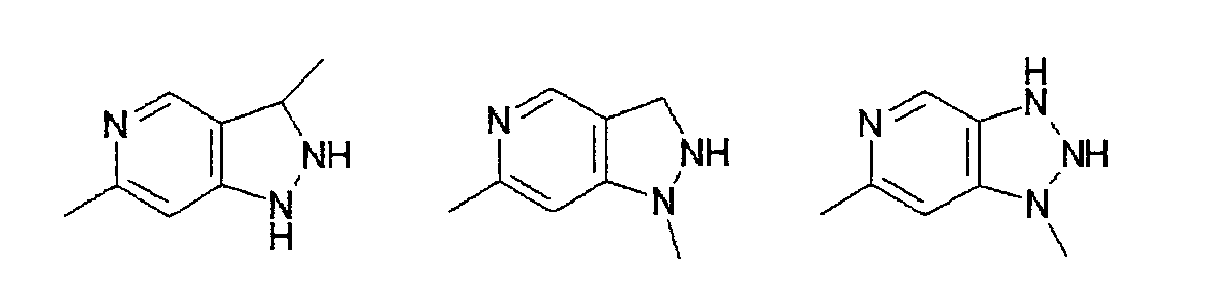

-


-


- and the like.
- The "bicyclic non-aromatic ring" of the "optionally further substituted bicyclic non-aromatic ring" formed by the condensation of ring P and ring Q optionally has, besides the group -CH(R1)NH-A and the group L1, 1 to 3 substituents at substitutable positions. Examples of the substituent include those similar to the substituents that the C3-10 cycloalkyl group and the like exemplified as the "hydrocarbon group" of the "optionally substituted hydrocarbon group" for RA, RA' or RB' optionally has.
- Preferable examples of the additional substituent for the "bicyclic non-aromatic ring" of the "optionally further substituted bicyclic non-aromatic ring" formed by the condensation of ring P and ring Q include
- (1) a halogen atom (e.g., a chlorine atom),
- (2) a C1-6 alkyl group (e.g., methyl)
- The "optionally further substituted bicyclic non-aromatic ring" formed by the condensation of ring P and ring Q is preferably
-





-


-


- or the like, each of which is optionally substituted by 1 to 3 substituents selected from
- (1) a halogen atom (e.g., a chlorine atom),
- (2) a C1-6 alkyl group (e.g., methyl)
- The "optionally further substituted bicyclic aromatic heterocycle" and the "optionally further substituted bicyclic non-aromatic ring" formed by the condensation of ring P and ring Q is preferably
-


-


-


-


- or the like, each of which is optionally substituted by 1 to 3 substituents selected from
- (1) a halogen atom (e.g., a chlorine atom),
- (2) a C1-6 alkyl group (e.g., methyl)
- The "optionally further substituted bicyclic aromatic heterocycle" and the "optionally further substituted bicyclic non-aromatic ring" formed by the condensation of ring P and ring Q is more preferably
-


- or the like, each of which is optionally substituted by 1 to 3 substituents selected from
- (1) a halogen atom (e.g., a chlorine atom),
- (2) a C1-6 alkyl group (e.g., methyl)
- The "optionally further substituted bicyclic aromatic heterocycle" and the "optionally further substituted bicyclic non-aromatic ring" formed by the condensation of ring P and ring Q is further more preferably
-

- or the like, each of which is optionally substituted by 1 to 3 substituents selected from
- (1) a halogen atom (e.g., a chlorine atom),
- (2) a C1-6 alkyl group (e.g., methyl)
- The "optionally further substituted bicyclic aromatic heterocycle" and the "optionally further substituted bicyclic non-aromatic ring" formed by the condensation of ring P and ring Q is still more preferably
-

- or the like.
- R1 is an optionally substituted C1-6 alkyl group or an optionally substituted C3-6 cycloalkyl group.
The "C1-6 alkyl group" of the "optionally substituted C1-6 alkyl group" for R1 optionally has 1 to 3 substituents at substitutable positions. Examples of the substituent include those similar to the substituents that the C1-6 alkyl group and the like exemplified as the "hydrocarbon group" of the "optionally substituted hydrocarbon group" for RA, RA' or RB' optionally has. - Examples of the "C3-6 cycloalkyl group" of the "optionally substituted C3-6 cycloalkyl group" for R1 include cyclopropyl, cyclobutyl, cyclopentyl and cyclohexyl.
The "C3-6 cycloalkyl group" of the "optionally substituted C3-6 cycloalkyl group" for R1 optionally has 1 to 3 substituents at substitutable positions. Examples of the substituent include those similar to the substituents that the C3-10 cycloalkyl group and the like exemplified as the "hydrocarbon group" of the "optionally substituted hydrocarbon group" for RA, RA' or RB' optionally has. - R1 is preferably a C1-6 alkyl group or a C3-6 cycloalkyl group, more preferably a C1-6 alkyl group.
- As to L1 and L2,
- (1) L1 and L2 are independently optionally substituted methylene, O, S, SO or SO2, or
- (2) L1 and L2 in combination form optionally substituted vinylene, or ethynylene.
- When L1 and L2 are: "(1) L1 and L2 are independently optionally substituted methylene, O, S, SO or SO2"
- The "methylene" of the "optionally substituted methylene" for L1 or L2 optionally has 1 or 2 substituents at substitutable positions. Examples of the substituent include those similar to the substituents that the C1-6 alkyl group and the like exemplified as the "hydrocarbon group" of the "optionally substituted hydrocarbon group" for RA, RA' or RB' optionally has.
- L1 is preferably methylene, O, S, SO or SO2.
L2 is preferably methylene or O. - When L1 and L2 are: "(2) L1 and L2 in combination form optionally substituted vinylene, or ethynylene"
- The "vinylene" of the "optionally substituted vinylene" formed by L1 and L2 optionally has 1 or 2 substituents at substitutable positions. Examples of the substituent include those similar to the substituents that the C1-6 alkyl group and the like exemplified as the "hydrocarbon group" of the "optionally substituted hydrocarbon group" for RA, RA' or RB' optionally has.
- Preferably, L1 and L2 in combination form vinylene or ethynylene.
- As to L1 and L2, preferably
- (1) L1 is methylene, O, S, SO or SO2, and L2 is methylene or O, or
- (2) L1 and L2 in combination form vinylene or ethynylene.
- As to L1 and L2, more preferably
- (1) L1 and L2 are independently methylene or O, or
- (2) L1 and L2 in combination form vinylene or ethynylene.
- Preferable examples of compound (I) include the following compounds.
- Compound (I) wherein
- A is
- (1) a C1-6 alkyl-carbonyl group (e.g., acetyl, propionyl, butyryl, isobutyryl, isoamyl) optionally substituted by 1 to 3 substituents selected from
- (i) an amino group,
- (ii) a carboxyl group,
- (iii) a C1-6 alkoxy-carbonyl group (e.g., methoxycarbonyl, ethoxycarbonyl),
- (iv) a C6-14 aryl group (e.g., phenyl), and
- (v) a C1-6 alkoxy group (e.g., methoxy),
- (2) a C1-6 alkoxy-carbonyl group (e.g., tert-butoxycarbonyl),
- (3) a C3-10 cycloalkyl-carbonyl group (e.g., cyclopropylcarbonyl, cyclopentylcarbonyl),
- (4) a C6-14 aryl-carbonyl group (e.g., benzoyl),
- (5) a carbamoyl group optionally mono- or di-substituted by substituent(s) selected from
- (i) a C1-6 alkyl group (e.g., methyl, ethyl, propyl, isopropyl) optionally substituted by 1 to 3 C6-14 aryl groups (e.g., phenyl),
- (ii) a C6-14 aryl group (e.g., phenyl),
- (iii) a C3-10 cycloalkyl group (e.g., cyclopentyl, cyclohexyl),
- (iv) a C1-6 alkylsulfonyl group (e.g., methylsulfonyl), and
- (v) an aromatic heterocyclic group (e.g., pyridyl) optionally substituted by 1 to 3 C1-6 alkyl groups (e.g., methyl);
- (6) a C1-6 alkylsulfonyl group (e.g., methylsulfonyl) optionally substituted by 1 to 3 C6-14 aryl groups (e.g., phenyl),
- (7) a C6-14 arylsulfonyl group (e.g., benzenesulfonyl) optionally substituted by 1 to 3 C1-6 alkyl groups (e.g., methyl),
- (8) a C3-10 cycloalkylsulfonyl group (e.g., cyclopropylsulfonyl),
- (9) an aromatic heterocyclylcarbonyl group (e.g., furylcarbonyl, pyrazolylcarbonyl, pyridylcarbonyl, isooxazolylcarbonyl, thiazolylcarbonyl) optionally substituted by 1 to 3 substituents selected from a C1-6 alkyl group optionally substituted by 1 to 3 halogen atoms (e.g., a fluorine atom),
- (10) a non-aromatic heterocyclylcarbonyl group (e.g., tetrahydropyranylcarbonyl), or
- (11) a 5-membered aromatic ring group (e.g., pyrazolyl, oxazolyl, isoxazolyl, thiazolyl, isothiazolyl) optionally substituted by 1 to 3 substituents selected from
- (i) a C1-6 alkyl-carbonyl group optionally substituted by 1 to 3 halogen atoms;
- (ii) a C1-6 alkoxy-carbonyl group optionally substituted by 1 to 3 substituents selected from
- (a) a halogen atom,
- (b) a C1-6 alkoxy group, and
- (c) a C6-14 aryl group (e.g., phenyl);
- (iii) a carbamoyl group optionally mono- or di-substituted by C1-6 alkyl group(s) optionally substituted by 1 to 3 halogen atoms;
- (iv) a carboxy group;
- (v) a hydroxy group;
- (vi) a halogen atom; and
- (vii) a C1-6 alkyl group optionally substituted by 1 to 3 substituents selected from
- (a) a halogen atom,
- (b) a carboxy group,
- (c) a hydroxy group,
- (d) a C1-6 alkoxy-carbonyl group, and
- (e) a C1-6 alkoxy group;
- (1) a C1-6 alkyl-carbonyl group (e.g., acetyl, propionyl, butyryl, isobutyryl, isoamyl) optionally substituted by 1 to 3 substituents selected from
- ring M is benzene, pyridine or dihydrobenzofuran, each of which is optionally substituted by 1 to 3 substituents selected from
- (1) a halogen atom (e.g., a fluorine atom, a chlorine atom),
- (2) a C1-6 alkyl group (e.g., propyl),
- (3) a C1-6 alkoxy group (e.g., methoxy, ethoxy, propoxy, isopropoxy, butoxy) optionally substituted by 1 to 3 substituents selected from
- (i) a halogen atom (e.g., a fluorine atom),
- (ii) a C1-6 alkoxy group (e.g., methoxy),
- (iii) a C3-10 cycloalkyl group (e.g., cyclopropyl, cyclohexyl),
- (iv) a heterocyclic group (e.g., tetrahydrofuryl), and
- (v) a C6-14 aryl group (e.g., phenyl),
- (4) a C1-6 alkylthio group (e.g., ethylthio),
- (5) a C1-6 alkyl-carbonyloxy group (e.g., acetyloxy),
- (6) an aromatic heterocyclic group (e.g., pyrazolyl),
- (7) a C3-10 cycloalkoxy group (e.g., cyclopropoxy, cyclopentyloxy) optionally substituted by 1 to 3 substituents selected from
- (i) a halogen atom (e.g., a fluorine atom), and
- (ii) a C1-6 alkoxy group (e.g., methoxy), and
- (8) a hydroxy group;
- ring P and ring Q are condensed to form
-


-





-


-


- each of which is optionally substituted by 1 to 3 substituents selected from
- (1) a halogen atom (e.g., a chlorine atom), and
- (2) a C1-6 alkyl group (e.g., methyl);
- (1) L1 is methylene, O, S, SO or SO2, and L2 is methylene or O, or
- (2) L1 and L2 in combination form ethynylene or vinylene.
- Compound (I) wherein
- ring M is benzene, pyridine or dihydrobenzofuran, each of which is optionally substituted by substituent(s) selected from
- (1) a halogen atom (e.g., a fluorine atom, a chlorine atom),
- (2) a C1-6 alkyl group (e.g., propyl),
- (3) a C1-6 alkoxy group (e.g., methoxy, ethoxy, propoxy, isopropoxy, butoxy) optionally substituted by 1 to 3 substituents selected from
- (i) a halogen atom (e.g., a fluorine atom),
- (ii) a C1-6 alkoxy group (e.g., methoxy),
- (iii) a C3-10 cycloalkyl group (e.g., cyclohexyl), and
- (iv) heterocyclic group (e.g., tetrahydrofuryl),
- (4) a C1-6 alkylthio group (e.g., ethylthio),
- (5) a C1-6 alkyl-carbonyloxy group (e.g., acetyloxy),
- (6) an aromatic heterocyclic group (e.g., pyrazolyl), and
- (7) a C3-10 cycloalkoxy group (e.g., cyclopropoxy, cyclopentyloxy) optionally substituted by 1 to 3 substituents selected from
- (i) a halogen atom (e.g., a fluorine atom), and
- (ii) a C1-6 alkoxy group (e.g., methoxy);
- ring P and ring Q are condensed to form
-


-


-


- each of which is optionally substituted by 1 to 3 substituents selected from
- (1) a halogen atom (e.g., a chlorine atom), and
- (2) a C1-6 alkyl group (e.g., methyl);
- (1) a C1-6 alkyl-carbonyl group (e.g., acetyl, propionyl, butyryl, isobutyryl, isoamyl) optionally substituted by 1 to 3 substituents selected from
- (i) an amino group,
- (ii) a carboxyl group,
- (iii) a C1-6 alkoxy-carbonyl group (e.g., methoxycarbonyl, ethoxycarbonyl),
- (iv) a C6-14 aryl group (e.g., phenyl), and
- (v) a C1-6 alkoxy group (e.g., methoxy);
- (2) a C1-6 alkoxy-carbonyl group (e.g., tert-butoxycarbonyl);
- (3) a C3-10 cycloalkyl-carbonyl group (e.g., cyclopropylcarbonyl, cyclopentylcarbonyl);
- (4) a C6-14 aryl-carbonyl group (e.g., benzoyl);
- (5) a carbamoyl group optionally mono- or di-substituted by substituent(s) selected from
- (i) a C1-6 alkyl group (e.g., methyl, ethyl, propyl, isopropyl) optionally substituted by 1 to 3 C6-14 aryl groups (e.g., phenyl),
- (ii) a C6-14 aryl group (e.g., phenyl),
- (iii) a C3-10 cycloalkyl group (e.g., cyclopentyl, cyclohexyl),
- (iv) a C1-6 alkylsulfonyl group (e.g., methylsulfonyl), and
- (v) an aromatic heterocyclic group (e.g., pyridyl) optionally substituted by 1 to 3 C1-6 alkyl groups (e.g., methyl);
- (6) a C1-6 alkylsulfonyl group (e.g., methylsulfonyl) optionally substituted by 1 to 3 C6-14 aryl groups (e.g., phenyl),
- (7) a C6-14 arylsulfonyl group (e.g., benzenesulfonyl) optionally substituted by 1 to 3 C1-6 alkyl groups (e.g., methyl);
- (8) a C3-10 cycloalkylsulfonyl group (e.g., cyclopropylsulfonyl);
- (9) an aromatic heterocyclylcarbonyl group (e.g., furylcarbonyl, pyrazolylcarbonyl, pyridylcarbonyl, isooxazolylcarbonyl, thiazolylcarbonyl) optionally substituted by 1 to 3 substituents selected from a C1-6 alkyl group optionally substituted by 1 to 3 halogen atoms (e.g., a fluorine atom); or
- (10) a non-aromatic heterocyclylcarbonyl group (e.g., tetrahydropyranylcarbonyl));
- Compound (I) wherein
- A is
- (1) a C1-6 alkyl-carbonyl group (e.g., acetyl, propionyl, butyryl, isobutyryl, isoamyl) optionally substituted by 1 to 3 substituents selected from
- (i) an amino group,
- (ii) a carboxyl group,
- (iii) a C1-6 alkoxy-carbonyl group (e.g., methoxycarbonyl, ethoxycarbonyl),
- (iv) a C6-14 aryl group (e.g., phenyl), and
- (v) a C1-6 alkoxy group (e.g., methoxy),
- (2) a C1-6 alkoxy-carbonyl group (e.g., tert-butoxycarbonyl),
- (3) a carbamoyl group optionally mono- or di-substituted by substituent(s) selected from
- (i) a C1-6 alkyl group (e.g., methyl, ethyl, propyl, isopropyl) optionally substituted by 1 to 3 C6-14 aryl groups (e.g., phenyl),
- (ii) a C6-14 aryl group (e.g., phenyl),
- (iii) a C3-10 cycloalkyl group (e.g., cyclopentyl, cyclohexyl),
- (iv) a C1-6 alkylsulfonyl group (e.g., methylsulfonyl), and
- (v) an aromatic heterocyclic group (e.g., pyridyl) optionally substituted by 1 to 3 C1-6 alkyl groups (e.g., methyl), or
- (4) a 5-membered aromatic ring group (e.g., pyrazolyl, oxazolyl, isoxazolyl, thiazolyl, isothiazolyl);
- (1) a C1-6 alkyl-carbonyl group (e.g., acetyl, propionyl, butyryl, isobutyryl, isoamyl) optionally substituted by 1 to 3 substituents selected from
- ring M is benzene or pyridine, each of which is optionally substituted by 1 to 3 substituents selected from
- (1) a halogen atom (e.g., a fluorine atom, a chlorine atom),
- (2) a C1-6 alkyl group (e.g., propyl),
- (3) a C1-6 alkoxy group (e.g., methoxy, ethoxy, propoxy, isopropoxy, butoxy) optionally substituted by 1 to 3 substituents selected from
- (i) a halogen atom (e.g., a fluorine atom),
- (ii) a C1-6 alkoxy group (e.g., methoxy),
- (iii) a C3-10 cycloalkyl group (e.g., cyclopropyl, cyclohexyl),
- (iv) a heterocyclic group (e.g., tetrahydrofuryl), and
- (v) a C6-14 aryl group (e.g., phenyl),
- (4) a C3-10 cycloalkoxy group (e.g., cyclopropoxy, cyclopentyloxy) optionally substituted by 1 to 3 substituents selected from
- (i) a halogen atom (e.g., a fluorine atom), and
- (ii) a C1-6 alkoxy group (e.g., methoxy), and
- (5) a hydroxy group;
- ring P and ring Q are condensed to form
-





- each of which is optionally substituted by 1 to 3 substituents selected from
- (1) a halogen atom (e.g., a chlorine atom), and
- (2) a C1-6 alkyl group (e.g., methyl);
- (1) L1 and L2 independently methylene or O, or
- (2) L1 and L2 in combination form ethynylene or vinylene.
- Compound (I) wherein
- A is
- (1) a C1-6 alkyl-carbonyl group (e.g., acetyl, propionyl, butyryl, isobutyryl, isoamyl) optionally substituted by 1 to 3 substituents selected from
- (i) an amino group,
- (ii) a carboxyl group,
- (iii) a C1-6 alkoxy-carbonyl group (e.g., methoxycarbonyl, ethoxycarbonyl),
- (iv) a C6-14 aryl group (e.g., phenyl), and
- (v) a C1-6 alkoxy group (e.g., methoxy),
- (2) a C1-6 alkoxy-carbonyl group (e.g., tert-butoxycarbonyl),
- (3) a carbamoyl group optionally mono- or di-substituted by substituent(s) selected from
- (i) a C1-6 alkyl group (e.g., methyl, ethyl, propyl, isopropyl) optionally substituted by 1 to 3 C6-14 aryl groups (e.g., phenyl),
- (ii) a C6-14 aryl group (e.g., phenyl),
- (iii) a C3-10 cycloalkyl group (e.g., cyclopentyl, cyclohexyl),
- (iv) a C1-6 alkylsulfonyl group (e.g., methylsulfonyl), and
- (v) an aromatic heterocyclic group (e.g., pyridyl) optionally substituted by 1 to 3 C1-6 alkyl groups (e.g., methyl), or
- (4) a 5-membered aromatic ring group (e.g., pyrazolyl, oxazolyl, isoxazolyl, thiazolyl, isothiazolyl);
- (1) a C1-6 alkyl-carbonyl group (e.g., acetyl, propionyl, butyryl, isobutyryl, isoamyl) optionally substituted by 1 to 3 substituents selected from
- ring M is benzene or pyridine, each of which is optionally substituted by 1 to 3 substituents selected from
- (1) a halogen atom (e.g., a fluorine atom, a chlorine atom),
- (2) a C1-6 alkyl group (e.g., propyl),
- (3) a C1-6 alkoxy group (e.g., methoxy, ethoxy, propoxy, isopropoxy, butoxy) optionally substituted by 1 to 3 substituents selected from
- (i) a halogen atom (e.g., a fluorine atom),
- (ii) a C1-6 alkoxy group (e.g., methoxy),
- (iii) a C3-10 cycloalkyl group (e.g., cyclopropyl, cyclohexyl),
- (iv) a heterocyclic group (e.g., tetrahydrofuryl), and
- (v) a C6-14 aryl group (e.g., phenyl),
- (4) a C3-10 cycloalkoxy group (e.g., cyclopropoxy, cyclopentyloxy) optionally substituted by 1 to 3 substituents selected from
- (i) a halogen atom (e.g., a fluorine atom), and
- (ii) a C1-6 alkoxy group (e.g., methoxy), and
- (5) a hydroxy group;
- ring P and ring Q are condensed to form
-

- R1 is a C1-6 alkyl group or a C3-6 cycloalkyl group (preferably a C1-6 alkyl group); and
as to L1 and L2, - (1) L1 and L2 independently methylene or O, or
- (2) L1 and L2 in combination form ethynylene or vinylene.
- Compound (I) wherein
- A is
- (1) a C1-6 alkyl-carbonyl group (e.g., acetyl, propionyl, butyryl, isobutyryl, isoamyl) optionally substituted by 1 to 3 substituents selected from
- (i) an amino group,
- (ii) a carboxyl group,
- (iii) a C1-6 alkoxy-carbonyl group (e.g., methoxycarbonyl, ethoxycarbonyl),
- (iv) a C6-14 aryl group (e.g., phenyl), and
- (v) a C1-6 alkoxy group (e.g., methoxy),
- (2) a C1-6 alkoxy-carbonyl group (e.g., tert-butoxycarbonyl),
- (3) a carbamoyl group optionally mono- or di-substituted by substituent(s) selected from
- (i) a C1-6 alkyl group (e.g., methyl, ethyl, propyl, isopropyl) optionally substituted by 1 to 3 C6-14 aryl groups (e.g., phenyl),
- (ii) a C6-14 aryl group (e.g., phenyl),
- (iii) a C3-10 cycloalkyl group (e.g., cyclopentyl, cyclohexyl),
- (iv) a C1-6 alkylsulfonyl group (e.g., methylsulfonyl), and
- (v) an aromatic heterocyclic group (e.g., pyridyl) optionally substituted by 1 to 3 C1-6 alkyl groups (e.g., methyl), or
- (4) phenyl or a 5-membered aromatic heterocyclic group (e.g., pyrazolyl, oxazolyl, isoxazolyl, thiazolyl, isothiazolyl, thiadiazolyl), each of which is optionally substituted by 1 to 3 substituents selected from (i) a halogen atom and (ii) a C1-6 alkyl group;
- (1) a C1-6 alkyl-carbonyl group (e.g., acetyl, propionyl, butyryl, isobutyryl, isoamyl) optionally substituted by 1 to 3 substituents selected from
- ring M is benzene or pyridine, each of which is optionally substituted by 1 to 3 substituents selected from
- (1) a halogen atom (e.g., a fluorine atom, a chlorine atom, a bromine atom),
- (2) a C1-6 alkyl group (e.g., methyl, propyl),
- (3) a C1-6 alkoxy group (e.g., methoxy, ethoxy, propoxy, isopropoxy, butoxy, isobutoxy) optionally substituted by 1 to 3 substituents selected from
- (i) a halogen atom (e.g., a fluorine atom),
- (ii) a C1-6 alkoxy group (e.g., methoxy),
- (iii) a C3-10 cycloalkyl group (e.g., cyclopropyl, cyclobutyl, cyclohexyl),
- (iv) a heterocyclic group (e.g., tetrahydrofuryl),
- (v) a C6-14 aryl group (e.g., phenyl), and
- (vi) a C1-6 alkylthio group (e.g., methylthio),
- (4) a C3-10 cycloalkoxy group (e.g., cyclopropoxy, cyclopentyloxy) optionally substituted by 1 to 3 substituents selected from
- (i) a halogen atom (e.g., a fluorine atom), and
- (ii) a C1-6 alkoxy group (e.g., methoxy), and
- (5) a hydroxy group,
- (6) a C3-10 cycloalkyl group (e.g., cyclopropyl),
- (7) an aromatic heterocyclyloxy group (e.g., pyridyloxy),
- (8) a C1-3 alkylenedioxy group (e.g., methylenedioxy);
- ring P and ring Q are condensed to form
-


- each of which is optionally substituted by 1 to 3 substituents selected from
- (1) a halogen atom (e.g., a chlorine atom), and
- (2) a C1-6 alkyl group (e.g., methyl);
- (1) L1 and L2 independently methylene or O, or
- (2) L1 and L2 in combination form ethynylene or vinylene.
- Compound (I) wherein
- A is
- (1) a C1-6 alkyl-carbonyl group (e.g., acetyl, propionyl, butyryl, isobutyryl, isoamyl) optionally substituted by 1 to 3 substituents selected from
- (i) an amino group,
- (ii) a carboxyl group,
- (iii) a C1-6 alkoxy-carbonyl group (e.g., methoxycarbonyl, ethoxycarbonyl),
- (iv) a C6-14 aryl group (e.g., phenyl), and
- (v) a C1-6 alkoxy group (e.g., methoxy),
- (2) a C1-6 alkoxy-carbonyl group (e.g., tert-butoxycarbonyl),
- (3) a carbamoyl group optionally mono- or di-substituted by substituent(s) selected from
- (i) a C1-6 alkyl group (e.g., methyl, ethyl, propyl, isopropyl) optionally substituted by 1 to 3 C6-14 aryl groups (e.g., phenyl),
- (ii) a C6-14 aryl group (e.g., phenyl),
- (iii) a C3-10 cycloalkyl group (e.g., cyclopentyl, cyclohexyl),
- (iv) a C1-6 alkylsulfonyl group (e.g., methylsulfonyl), and
- (v) an aromatic heterocyclic group (e.g., pyridyl) optionally substituted by 1 to 3 C1-6 alkyl groups (e.g., methyl), or
- (4) phenyl or a 5-membered aromatic heterocyclic group (e.g., pyrazolyl, oxazolyl, isoxazolyl, thiazolyl, isothiazolyl, thiadiazolyl), each of which is optionally substituted by 1 to 3 substituents selected from (i) a halogen atom and (ii) a C1-6 alkyl group;
- (1) a C1-6 alkyl-carbonyl group (e.g., acetyl, propionyl, butyryl, isobutyryl, isoamyl) optionally substituted by 1 to 3 substituents selected from
- ring M is benzene or pyridine, each of which is optionally substituted by 1 to 3 substituents selected from
- (1) a halogen atom (e.g., a fluorine atom, a chlorine atom, a bromine atom),
- (2) a C1-6 alkyl group (e.g., methyl, propyl),
- (3) a C1-6 alkoxy group (e.g., methoxy, ethoxy, propoxy, isopropoxy, butoxy, isobutoxy) optionally substituted by 1 to 3 substituents selected from
- (i) a halogen atom (e.g., a fluorine atom),
- (ii) a C1-6 alkoxy group (e.g., methoxy),
- (iii) a C3-10 cycloalkyl group (e.g., cyclopropyl, cyclobutyl, cyclohexyl),
- (iv) a heterocyclic group (e.g., tetrahydrofuryl),
- (v) a C6-14 aryl group (e.g., phenyl), and
- (vi) a C1-6 alkylthio group (e.g., methylthio),
- (4) a C3-10 cycloalkoxy group (e.g., cyclopropoxy, cyclopentyloxy) optionally substituted by 1 to 3 substituents selected from
- (i) a halogen atom (e.g., a fluorine atom), and
- (ii) a C1-6 alkoxy group (e.g., methoxy), and
- (5) a hydroxy group,
- (6) a C3-10 cycloalkyl group (e.g., cyclopropyl),
- (7) an aromatic heterocyclyloxy group (e.g., pyridyloxy),
- (8) a C1-3 alkylenedioxy group (e.g., methylenedioxy);
- ring P and ring Q are condensed to form
-

- R1 is a C1-6 alkyl group or a C3-6 cycloalkyl group (preferably a C1-6 alkyl group); and
as to L1 and L2, - (1) L1 and L2 independently methylene or O, or
- (2) L1 and L2 in combination form ethynylene or vinylene.
- Compound (I) wherein
- A is
- (1) a C1-6 alkyl-carbonyl group, or
- (2) a 5-membered aromatic heterocyclic group (e.g., pyrazolyl, oxazolyl, isoxazolyl, thiazolyl, isothiazolyl, thiadiazolyl) optionally substituted by 1 to 3 substituents selected from (i) a halogen atom and (ii) a C1-6 alkyl group;
- ring M is benzene or pyridine, each of which is optionally substituted by 1 to 3 substituents selected from
- (1) a halogen atom (e.g., a fluorine atom, a chlorine atom, a bromine atom),
- (2) a C1-6 alkyl group (e.g., methyl, propyl),
- (3) a C1-6 alkoxy group (e.g., methoxy, ethoxy, propoxy, isopropoxy, butoxy, isobutoxy) optionally substituted by 1 to 3 substituents selected from
- (i) a halogen atom (e.g., a fluorine atom),
- (ii) a C1-6 alkoxy group (e.g., methoxy),
- (iii) a C3-10 cycloalkyl group (e.g., cyclopropyl, cyclobutyl, cyclohexyl),
- (iv) a heterocyclic group (e.g., tetrahydrofuryl), and
- (v) a C6-14 aryl group (e.g., phenyl),
- (4) a C3-10 cycloalkoxy group (e.g., cyclopropoxy, cyclopentyloxy) optionally substituted by 1 to 3 substituents selected from
- (i) a halogen atom (e.g., a fluorine atom), and
- (ii) a C1-6 alkoxy group (e.g., methoxy), and
- (5) a hydroxy group;
- ring P and ring Q are condensed to form
-

- R1 is a C1-6 alkyl group; and
as to L1 and L2, - (1) L1 and L2 independently methylene or O, or
- (2) L1 and L2 in combination form ethynylene or vinylene.
- -N-{(1S)-1-[(2S)-6-{[4-(cyclopropylmethoxy)-2-fluorobenzyl]oxy}-2,3-dihydro-1-benzofuran-2-yl]ethyl}acetamide or a salt thereof. N-[1-(5-{[6-(cyclopropylmethoxy)-4-fluoropyridin-3-yl]methoxy}-1-benzofuran-2-yl)ethyl]acetamide or a salt thereof. N-(1-{6-[2-(4-ethoxyphenyl)ethyl]-1-benzofuran-2-yl}ethyl)acetamide or a salt thereof.
N-[1-(5-{[4-(cyclopropylmethoxy)benzyl]oxy}-1-benzofuran-2-yl)ethyl]acetamide or a salt thereof. - As a salt of the compound represented by the formula (I), a pharmacologically acceptable salt is preferable. Examples of such salt include salts with inorganic base, salts with organic base, salts with inorganic acid, salts with organic acid, salts with basic or acidic amino acid, and the like.
- Preferable examples of the salt with inorganic base include alkali metal salts such as sodium salt, potassium salt and the like; alkaline earth metal salts such as calcium salt, magnesium salt and the like; aluminum salt: ammonium salt and the like.
- Preferable examples of the salt with organic base include salts with trimethylamine, triethylamine, pyridine, picoline, ethanolamine, diethanolamine, triethanolamine, tromethamine[tris(hydroxymethyl)methylamine], tert-butylamine, cyclohexylamine, benzylamine, dicyclohexylamine, N,N-dibenzylethylenediamine and the like.
- Preferable examples of the salt with inorganic acid include salts with hydrochloric acid, hydrobromic acid, nitric acid, sulfuric acid, phosphoric acid and the like.
- Preferable examples of the salt with organic acid include salts with formic acid, acetic acid, trifluoroacetic acid, phthalic acid, fumaric acid, oxalic acid, tartaric acid, maleic acid, citric acid, succinic acid, malic acid, methanesulfonic acid, benzenesulfonic acid, p-toluenesulfonic acid and the like.
- Preferable examples of the salt with basic amino acid include salts with arginine, lysine, ornithine and the like.
- Preferable examples of the salt with acidic amino acid include salts with aspartic acid, glutamic acid and the like.
- A prodrug of compound (I) means a compound which is converted to compound (I) with a reaction due to an enzyme, an gastric acid, etc. under the physiological condition in the living body, that is, a compound which is converted to compound (I) by oxidation, reduction, hydrolysis, etc. according to an enzyme; a compound which is converted to compound (I) by hydrolysis etc. due to gastric acid, etc.
- Examples of the prodrug of compound (I) include a compound obtained by subjecting an amino group in compound (I) to an acylation, alkylation or phosphorylation (e.g., a compound obtained by subjecting an amino group in compound (I) to an eicosanoylation, alanylation, pentylaminocarbonylation, (5-methyl-2-oxo-1,3-dioxolen-4-yl)methoxycarbonylation, tetrahydrofuranylation, pyrrolidylmethylation, pivaloyloxymethylation or tert-butylation); a compound obtained by subjecting a hydroxy group in compound (I) to an acylation, alkylation, phosphorylation or boration (e.g., a compound obtained by subjecting a hydroxy group in compound (I) to an acetylation, palmitoylation, propanoylation, pivaloylation, succinylation, fumarylation, alanylation or dimethylaminomethylcarbonylation); a compound obtained by subjecting a carboxyl group in compound (I) to an esterification or amidation (e.g., a compound obtained by subjecting a carboxyl group in compound (I) to an ethyl esterification, phenyl esterification, carboxymethyl esterification, dimethylaminomethyl esterification, pivaloyloxymethyl esterification, ethoxycarbonyloxyethyl esterification, phthalidyl esterification, (5-methyl-2-oxo-1,3-dioxolen-4-yl)methyl esterification, cyclohexyloxycarbonylethyl esterification or methyl amidation etc.) and the like. These compounds can be produced from compound (I) according to a method known per se.
- A prodrug for compound (I) may also be one which is converted to compound (I) under a physiological condition, such as those described in IYAKUHIN no KAIHATSU, Development of Pharmaceuticals, Vol. 7, Design of Molecules, p. 163-198, Published by HIROKAWA SHOTEN, 1990.
- In addition, compound (I) may be labeled with an isotope (e.g., 3H, 14C, 35S, 125I) and the like.
Compound (I) may be a non-solvate (e.g., anhydride) or a solvate (e.g., hydrate).
Compound (I) also encompasses a deuterium conversion form wherein 1H is converted to 2H(D). - Compound (I) or a prodrug thereof (hereinafter sometimes to be abbreviated simply as the compound of the present invention) has low toxicity, and can be used as an agent for the prophylaxis or treatment of various diseases mentioned below in a mammal (e.g., human, mouse, rat, rabbit, dog, cat, bovine, horse, swine, monkey) directly or in the form of a pharmaceutical composition by admixing with a pharmacologically acceptable carrier and the like.
- Here, examples of the pharmacologically acceptable carrier include various organic or inorganic carrier substances conventionally used as preparation materials, which are added as excipient, lubricant, binder or disintegrant for solid dosage forms; as solvent, solubilizing agent, suspending agent, isotonicity agent, buffer or soothing agent for liquid preparation, and the like. Where necessary, preparation additives such as preservative, antioxidant, colorant, sweetener and the like can also be used.
- Preferable examples of the excipient include lactose, sucrose, D-mannitol, D-sorbitol, starch, pregelatinized starch, dextrin, crystalline cellulose, low-substituted hydroxypropylcellulose, sodium carboxymethylcellulose, gum arabic, pullulan, light anhydrous silicic acid, synthetic aluminum silicate and magnesium aluminometasilicate.
- Preferable examples of the lubricant include magnesium stearate, calcium stearate, talc and colloidal silica.
- Preferable examples of the binder include pregelatinized starch, sucrose, gelatin, gum arabic, methylcellulose, carboxymethylcellulose, sodium carboxymethylcellulose, crystalline cellulose, sucrose, D-mannitol, trehalose, dextrin, pullulan, hydroxypropylcellulose, hydroxypropylmethylcellulose and polyvinylpyrrolidone.
- Preferable examples of the disintegrant include lactose, sucrose, starch, carboxymethylcellulose, calcium carboxymethylcellulose, sodium croscarmellose, sodium carboxymethylstarch, light anhydrous silicic acid and low-substituted hydroxypropylcellulose.
- Preferable examples of the solvent include water for injection, physiological brine, Ringer's solution, alcohol, propylene glycol, polyethylene glycol, sesame oil, corn oil, olive oil and cottonseed oil.
- Preferable examples of the solubilizing agent include polyethylene glycol, propylene glycol, D-mannitol, trehalose, benzyl benzoate, ethanol, trisaminomethane, cholesterol, triethanolamine, sodium carbonate, sodium citrate, sodium salicylate and sodium acetate.
- Preferable examples of the suspending agent include surfactants such as stearyltriethanolamine, sodium lauryl sulfate, lauryl aminopropionic acid, lecithin, benzalkonium chloride, benzethonium chloride, glyceryl monostearate and the like; hydrophilic polymers such as polyvinyl alcohol, polyvinylpyrrolidone, sodium carboxymethylcellulose, methylcellulose, hydroxymethylcellulose, hydroxyethylcellulose, hydroxypropylcellulose and the like; polysorbates and polyoxyethylene hydrogenated castor oil.
- Preferable examples of the isotonicity agent include sodium chloride, glycerol, D-mannitol, D-sorbitol and glucose.
- Preferable examples of the buffer include buffers such as phosphate, acetate, carbonate, citrate and the like.
Preferable examples of the soothing agent include benzyl alcohol. - Preferable examples of the preservative include paraoxybenzoates, chlorobutanol, benzyl alcohol, phenethyl alcohol, dehydroacetic acid and sorbic acid.
Preferable examples of the antioxidant include sulfite, ascorbate and the like. - Preferable examples of the colorant include aqueous food tar colors (e.g., food colors such as Food Red No. 2 and No. 3, Food Yellow No. 4 and No. 5, Food Blue No. 1 and No. 2, etc.), water insoluble lake dye (e.g., aluminum salt of the above-mentioned aqueous food tar color) and natural dye (e.g., β-carotene, chlorophyll, ferric oxide red).
- Preferable examples of the sweetening agent include sodium saccharin, dipotassium glycyrrhizinate, aspartame and stevia.
- Examples of the dosage form of the above-mentioned pharmaceutical composition include oral preparations such as tablets (inclusive of sugar-coated tablets, film-coated tablets, sublingual tablets, orally disintegrating tablets), capsules (inclusive of soft capsules, microcapsules), granules, powders, troches, syrups, emulsions, suspensions, films (e.g., orally disintegrable films) and the like; and parenteral agents such as injections (e.g., subcutaneous injections, intravenous injections, intramuscular injections, intraperitoneal injections, drip infusions), external preparations (e.g., dermal preparations, ointments), suppository (e.g., rectal suppositories, vaginal suppositories), pellets, nasal preparations, pulmonary preparations (inhalants), eye drops and the like. These may be safely administered orally or parenterally (e.g., topically, rectally, intravenously administered).
- These preparations may be release control preparations (e.g., sustained-release microcapsule) such as immediate-release preparation, sustained-release preparation and the like.
- A pharmaceutical composition can be produced by a method conventionally used in the technical field of pharmaceutical preparation, for example, the method described in the Japanese Pharmacopoeia and the like.
- While the content of the compound of the present invention in the pharmaceutical composition varies depending on the dosage form, dose of the compound of the present invention, and the like, it is, for example, about 0.1 to 100 wt%.
- During production of an oral preparation, coating may be applied as necessary for the purpose of masking of taste, enteric property or durability.
- Examples of the coating base to be used for coating include sugar coating base, aqueous film coating base, enteric film coating base and sustained-release film coating base.
- As the sugar coating base, sucrose is used. Moreover, one or more kinds selected from talc, precipitated calcium carbonate, gelatin, gum arabic, pullulan, carnauba wax and the like may be used in combination.
- Examples of the aqueous film coating base include cellulose polymers such as hydroxypropyl cellulose, hydroxypropylmethyl cellulose, hydroxyethyl cellulose, methylhydroxyethyl cellulose etc.; synthetic polymers such as polyvinylacetal diethylaminoacetate, aminoalkyl methacrylate copolymer E [Eudragit E (trade name)], polyvinylpyrrolidone etc.; and polysaccharides such as pullulan etc.
- Examples of the enteric film coating base include cellulose polymers such as hydroxypropylmethyl cellulose phthalate, hydroxypropylmethyl cellulose acetate succinate, carboxymethylethyl cellulose, cellulose acetate phthalate etc.; acrylic polymers such as methacrylic acid copolymer L [Eudragit L (trade name)], methacrylic acid copolymer LD [Eudragit L-30D55 (trade name)], methacrylic acid copolymer S [Eudragit S (trade name)] etc.; and naturally occurring substances such as shellac etc.
- Examples of the sustained-release film coating base include cellulose polymers such as ethyl cellulose etc.; and acrylic polymers such as aminoalkyl methacrylate copolymer RS [Eudragit RS (trade name)], ethyl acrylate-methyl methacrylate copolymer suspension [Eudragit NE (trade name)] etc.
- The above-mentioned coating bases may be used after mixing with two or more kinds thereof at appropriate ratios. For coating, for example, a light shielding agent such as titanium oxide, red ferric oxide and the like can be used.
- The compound of the present invention shows low toxicity (e.g., acute toxicity, chronic toxicity, genetic toxicity, reproductive toxicity, cardiotoxicity, carcinogenicity and the like) and a few side effects. Therefore, it can be used as an agent for the prophylaxis or treatment or a diagnostic of various diseases in a mammal (e.g., human, bovine, horse, dog, cat, monkey, mouse, rat).
- The compound of the present invention has a superior ACC (acetyl-CoA carboxylase) inhibitory action. Examples of ACC include liver, adipose tissue or pancreas-specific isozyme (ACC1); and muscle specific isozyme (ACC2). The compound of the present invention particularly has a selective inhibitory action on ACC2 as compared to ACC1.
The compound of the present invention is superior in the metabolism stability and has advantages such as long half-life of compound, difficult in vivo metabolism and the like.
Moreover, the compound of the present invention is superior in the in vivo kinetics (e.g., oral absorbability, bioavailability). - The compound of the present invention can be used as an agent for the prophylaxis or treatment of obesity, diabetes (e.g., type 1 diabetes, type 2 diabetes, gestational diabetes, obese diabetes), hyperlipidemia (e.g., hypertriglyceridemia, hypercholesterolemia, high LDL-cholesterolemia, hypoHDL-emia, postprandial hyperlipemia), hypertension, cardiac failure, diabetic complications [e.g., neuropathy, nephropathy, retinopathy, diabetic cardiomyopathy, cataract, macroangiopathy, osteopenia, hyperosmolar diabetic coma, infections (e.g., respiratory infection, urinary tract infection, gastrointestinal infection, dermal soft tissue infections, inferior limb infection), diabetic gangrene, xerostomia, hypacusis, cerebrovascular disorder, peripheral blood circulation disorder], metabolic syndrome (pathology having three or more selected from hypertriglyceridemia (TG), low HDL cholesterol (HDL-C), hypertension, abdomen obesity and impaired glucose tolerance), sarcopenia, cancer and the like.
- For diagnostic criteria of diabetes, Japan Diabetes Society reported new diagnostic criteria in 1999.
- According to this report, diabetes is a condition showing any of a fasting blood glucose level (glucose concentration of intravenous plasma) of not less than 126 mg/dl, a 75 g oral glucose tolerance test (75 g OGTT) 2 hr level (glucose concentration of intravenous plasma) of not less than 200 mg/dl, and a non-fasting blood glucose level (glucose concentration of intravenous plasma) of not less than 200 mg/dl. A condition not falling under the above-mentioned diabetes and different from "a condition showing a fasting blood glucose level (glucose concentration of intravenous plasma) of less than 110 mg/dl or a 75 g oral glucose tolerance test (75 g OGTT) 2 hr level (glucose concentration of intravenous plasma) of less than 140 mg/dl" (normal type) is called a "borderline type".
- In addition, ADA (American Diabetes Association) in 1997 and WHO in 1998 reported new diagnostic criteria of diabetes.
- According to these reports, diabetes is a condition showing a fasting blood glucose level (glucose concentration of intravenous plasma) of not less than 126 mg/dl and a 75 g oral glucose tolerance test 2 hr level (glucose concentration of intravenous plasma) of not less than 200 mg/dl.
- According to the above-mentioned reports, impaired glucose tolerance is a condition showing fasting blood sugar level (glucose concentration of intravenous plasma) of less than 126 mg/dl and a 75 g oral glucose tolerance test 2 hr level (glucose concentration of intravenous plasma) of not less than 140 mg/dl and less than 200 mg/dl. According to the report of ADA, a condition showing a fasting blood glucose level (glucose concentration of intravenous plasma) of not less than 110 mg/dl and less than 126 mg/dl is called IFG (Impaired Fasting Glucose). According to the report of WHO, among the IFG (Impaired Fasting Glucose), a condition showing a 75g oral glucose tolerance test 2 hr level (glucose concentration of intravenous plasma) of less than 140 mg/dl is called IFG (Impaired Fasting Glycemia).
- The compound of the present invention can be also used as an agent for the prophylaxis or treatment of diabetes, borderline type, impaired glucose tolerance, IFG (Impaired Fasting Glucose) and IFG (Impaired Fasting Glycemia), as determined according to the above-mentioned new diagnostic criteria. Moreover, the compound of the present invention can prevent progress of borderline type, impaired glucose tolerance, IFG (Impaired Fasting Glucose) or IFG (Impaired Fasting Glycemia) into diabetes.
- The compound of the present invention can also be used, for example, as an agent for the prophylaxis or treatment of osteoporosis, cachexia (e.g., carcinomatous cachexia, tuberculous cachexia, diabetic cachexia, hemopathic cachexia, endocrinopathic cachexia, infectious cachexia or cachexia induced by acquired immunodeficiency syndrome), fatty liver, polycystic ovary syndrome, renal disease (e.g., diabetic nephropathy, glomerulonephritis, glomerulosclerosis, nephrosis syndrome, hypertensive nephrosclerosis, terminal renal disorder), muscular dystrophy, myocardial infarction, angina pectoris, cerebrovascular disorder (e.g., cerebral infarction, cerebral apoplexy), Alzheimer's disease, Parkinson's disease, anxiety, dementia, insulin resistance syndrome, syndrome X, hyperinsulinemia, sensory abnormality in hyperinsulinemia, irritable bowel syndrome, acute or chronic diarrhea, inflammatory disease (e.g., rheumatoid arthritis, spondylitis deformans, osteoarthritis, lumbago, gout, postoperative or posttraumatic inflammation, swelling, neuralgia, pharyngolaryngitis, cystitis, hepatitis (including nonalcoholic steatohepatitis), pneumonia, pancreatitis, enteritis, inflammatory bowel disease (including inflammatory colitis), ulcerative colitis, stomach mucosainjury (including stomach mucosainjury caused by aspirin)), small intestine mucosainjury, malabsorption, testis dysfunction, visceral obesity syndrome or sarcopenia.
- In addition, the compound of the present invention can also be used as an agent for the prophylaxis or treatment of various carcinomas (particularly breast cancer (e.g., invasive ductal carcinoma, ductal carcinoma in situ, inflammatory breast cancer and the like), prostate cancer (e.g., hormone-dependent prostate cancer, non-hormone dependent prostate cancer and the like), pancreatic cancer (e.g., pancreatic duct cancer and the like), gastric cancer (e.g., papillary adenocarcinoma, mucinous adenocarcinoma, adenosquamous carcinoma and the like), lung cancer (e.g., non-small cell lung cancer, small cell lung cancer, malignant mesothelioma and the like), colorectal cancer (e.g., gastrointestinal stromal tumor and the like), rectal cancer (e.g., gastrointestinal stromal tumor and the like), colorectal cancer (e.g., familial colorectal cancer, hereditary nonpolyposis colorectal cancer, gastrointestinal stromal tumor and the like), small intestinal cancer (e.g., non-Hodgkin lymphoma, gastrointestinal stromal tumor and the like), esophagus cancer, duodenal cancer, cancer of the tongue, pharyngeal cancer (e.g., nasopharyngeal cancer, mesopharyngeal cancer, hypopharyngeal cancer and the like), salivary gland cancer, brain tumor (e.g., pineal astrocytoma, pilocytic astrocytoma, diffuse astrocytoma, anaplastic astrocytoma and the like), schwannoma, liver cancer (e.g., primary liver cancer, Extrahepatic Bile Duct Cancer and the like), kidney cancer (e.g., renal cell carcinoma, transitional carcinoma of kidney pelvis and urinary duct, and the like), biliary tract cancer, endometrial carcinoma, cervical cancer, ovarian cancer (e.g., ovarian epithelial carcinoma, extragonadal germ cell tumor ovarian germ cell tumor ovarian low malignant potential tumor and the like), urinary bladder cancer, urinary tract cancer, skin cancer (e.g., intraocular (ocular) melanoma, Merkel cell carcinoma and the like), Hemangioma, malignant lymphoma, malignant melanoma, thyroid cancer (e.g., medullary thyroid carcinoma and the like), parathyroid cancer, nasal cavity cancer, paranasal sinus cancer, bone tumor (e.g., osteosarcoma, Ewing's tumor uterus sarcoma, soft tissue sarcoma and the like), vascular fibroma, retinoblastoma, penile cancer, testis tumor solid cancer in childhood (e.g., Wilms' tumor childhood kidney tumor and the like), Kaposi's sarcoma, Kaposi's sarcoma derived from AIDS, maxillary tumor fibrous histiocytoma, leiomyosarcoma, rhabdomyosarcoma, leukemia (e.g., acute myeloid leukemia, acute lymphoblastic leukemia and the like) etc.).
- The compound of the present invention can also be used for secondary prevention or suppression of progression of the above-mentioned various diseases (e.g., cardiovascular events such as myocardial infarction and the like).
- While the dose of the compound of the present invention varies depending on the subject of administration, administration route, target disease, symptom and the like, for example, for oral administration to an adult diabetic patient, it is generally about 0.01 to 100 mg/kg body weight, preferably 0.05 to 30 mg/kg body weight, more preferably 0.1 to 10 mg/kg body weight for one dose, which is desirably administered once to 3 times a day.
- With the aim of enhancing the action of the compound of the present invention or decreasing the dose of the compound and the like, the compound can be used in combination with medicaments such as therapeutic agents for diabetes, therapeutic agents for diabetic complications, therapeutic agents for hyperlipidemia, antihypertensive agents, antiobesity agents, diuretics, antithrombotic agents and the like (hereinafter to be abbreviated as concomitant drug). The time of administration of the compound of the present invention and that of the concomitant drug are not limited, and these concomitant drugs may be low-molecular-weight compounds or high-molecular-weight protein, polypeptide, antibody, vaccine and the like. They may be administered simultaneously or in a staggered manner to the administration subject. In addition, the compound of the present invention and the concomitant drug may be administered as two kinds of preparations containing respective active ingredients or a single preparation containing both active ingredients.
- The dose of the concomitant drug can be appropriately determined based on the dose employed clinically. In addition, the mixing ratio of the compound of the present invention and the concomitant drug can be appropriately determined according to the administration subject, administration route, target disease, condition, combination, and the like. For example, when the administration subject is a human, the concomitant drug may be used in an amount of 0.01 to 100 parts by weight per 1 part by weight of the compound of the present invention.
- Examples of the therapeutic agents for diabetes include insulin preparations (e.g., animal insulin preparations extracted from pancreas of bovine or swine; human insulin preparations genetically synthesized using Escherichia coli or yeast; zinc insulin; protamine zinc insulin; fragment or derivative of insulin (e.g., INS-1), oral insulin preparation), insulin sensitizers (e.g., pioglitazone or a salt thereof (preferably hydrochloride), rosiglitazone or a salt thereof (preferably maleate), Metaglidasen, AMG-131, Balaglitazone, MBX-2044, Rivoglitazone, Aleglitazar, Chiglitazar, Lobeglitazone, PLX-204, PN-2034, GFT-505, THR-0921, compound described in
WO 2007/013694 ,WO 2007/018314 ,WO 2008/093639 orWO 2008/099794 ), α-glucosidase inhibitors (e.g., voglibose, acarbose, miglitol, emiglitate), biguanides (e.g., metformin, buformin or a salt thereof (e.g., hydrochloride, fumarate, succinate)), insulin secretagogues [sulfonylureas (e.g., tolbutamide, glibenclamide, gliclazide, chlorpropamide, tolazamide, acetohexamide, glyclopyramide, glimepiride, glipizide, glybuzole), repaglinide, nateglinide, mitiglinide or a calcium salt hydrate thereof], dipeptidyl peptidase IV inhibitors (e.g., Alogliptin, Vildagliptin, Sitagliptin, Saxagliptin, BI1356, GRC8200, MP-513, PF-00734200, PHX1149, SK-0403, ALS2-0426, TA-6666, TS-021, KRP-104, 2-[[6-[(3R)-3-amino-1-piperidinyl]-3,4-dihydro-3-methyl-2,4-dioxo-1(2H)-pyrimidinyl]methyl]-4-fluorobenzonitrile or a salt thereof), β3 agonists (e.g., N-5984), GPR40 agonists (e.g., compound described inWO 2004/041266 ,WO 2004/106276 ,WO 2005/063729 ,WO 2005/063725 ,WO 2005/087710 ,WO 2005/095338 ,WO 2007/013689 orWO 2008/001931 ), GLP-1 receptor agonists[e.g., GLP-1, GLP-1MR, Liraglutide, Exenatide, AVE-0010, BIM-51077, Aib(8,35)hGLP-1(7,37)NH2, CJC-1131, Albiglutide], amylin agonists (e.g., pramlintide), phosphotyrosine phosphatase inhibitors (e.g., sodium vanadate), gluconeogenesis inhibitors (e.g., glycogen phosphorylase inhibitors glucose-6-phosphatase inhibitors, glucagon antagonists, FBPase inhibitors), SGLT2(sodium-glucose cotransporter 2)inhibitors (e.g., Depagliflozin, AVE2268, TS-033, YM543, TA-7284, Remogliflozin, ASP1941), SGLT1 inhibitors, 11β-hydroxysteroid dehydrogenase inhibitors (e.g., BVT-3498), adiponectin or an agonist thereof, IKK inhibitors (e.g., AS-2868), leptin resistance improving drugs, somatostatin receptor agonists, glucokinase activators (e.g., Piragliatin, AZD1656, AZD6370, TTP-355, compound described inWO 2006/112549 ,WO 2007/028135 ,WO 2008/047821 ,WO 2008/050821 ,WO 2008/136428 orWO 2008/156757 ), GIP(Glucose-dependent insulinotropic peptide) and the like. - Examples of the therapeutic agents for diabetic complications include aldose reductase inhibitors (e.g., tolrestat, epalrestat, zopolrestat, fidarestat, CT-112, ranirestat (AS-3201), lidorestat), neurotrophic factor and increasing drugs thereof (e.g., NGF, NT-3, BDNF, neurotrophic factors and increasing drugs thereof (e.g., 4-(4-chlorophenyl)-2-(2-methyl-1-imidazolyl)-5-[3-(2-methylphenoxy)propyl]oxazole) described in
WO01/14372 WO 2004/039365 ), nerve regeneration promoter (e.g., Y-128), PKC inhibitors (e.g., ruboxistaurin mesylate), AGE inhibitors (e.g., ALT946, pyratoxanthine, N-phenacylthiazolium bromide (ALT766), ALT-711, EXO-226, Pyridorin, pyridoxamine), GABA receptor agonists (e.g., gabapentin, Pregabalin), serotonin noradrenaline re-uptake inhibitors (e.g., duloxetine), sodium channel inhibitors (e.g., lacosamide), active oxygen scavengers (e.g., thioctic acid), cerebral vasodilators (e.g., tiapuride, mexiletine), somatostatin receptor agonists (e.g., BIM23190), apoptosis signal regulating kinase-1(ASK-1) inhibitors and the like. - Examples of the therapeutic agent for hyperlipidemia include statin compounds (e.g., pravastatin, simvastatin, lovastatin, atorvastatin, fluvastatin, rosuvastatin, pitavastatin or a salt thereof (e.g., sodium salt, calcium salt)), squalene synthase inhibitors (e.g., a compound described in
WO97/10224 - Examples of the antihypertensive agent include angiotensin converting enzyme inhibitors (e.g., captopril, enalapril, delapril etc.), angiotensin II antagonists (e.g., candesartan cilexetil, candesartan, losartan, losartan potassium, eprosartan, valsartan, telmisartan, irbesartan, tasosartan, olmesartan, olmesartan medoxomil, azilsartan, azilsartan medoxomil), calcium antagonists (e.g., manidipine, nifedipine, amlodipine, efonidipine, nicardipine, amlodipine, cilnidipine and the like), β blockers (e.g., metoprolol, atenolol, propranolol, carvedilol, pindolol), clonidine and the like.
- Examples of the antiobesity agent include monoamine uptake inhibitors (e.g., phentermine, sibutramine, mazindol, fluoxetine, tesofensine), serotonin 2C receptor agonists (e.g., lorcaserin), serotonin 6 receptor antagonists, histamine H3 receptor GABA modulator regulator ?(e.g., topiramate), MCH receptor antagonists (e.g., SB-568849; SNAP-7941; compound described in
WO 01/82925 WO 01/87834 - Examples of the diuretics include xanthine derivatives (e.g., theobromine sodium salicylate, theobromine calcium salicylate), thiazide preparations (e.g., ethiazide, cyclopenthiazide, trichloromethiazide, hydrochlorothiazide, hydroflumethiazide, benzylhydrochlorothiazide, penflutizide, polythiazide, methyclothiazide), antialdosterone preparations (e.g., spironolactone, triamterene), carbonic anhydrase inhibitors (e.g., acetazolamide), chlorobenzenesulfonamide agents (e.g., chlortalidone, mefruside, indapamide), azosemide, isosorbide, ethacrynic acid, piretanide, bumetanide, furosemide and the like.
- Examples of the antithrombotic agent include heparins (e.g., heparin sodium, heparin calcium, enoxaparin sodium, dalteparin sodium), warfarins (e.g., warfarin potassium), anti-thrombin drugs (e.g., argatroban, dabigatran), thrombolytic agents (e.g., urokinase, tisokinase, alteplase, nateplase, monteplase, pamiteplase), platelet aggregation inhibitors (e.g., ticlopidine hydrochloride, clopidogrel, E5555, SHC530348, cilostazol, ethyl icosapentate, beraprost sodium, sarpogrelate hydrochloride, prasugrel, E5555, SHC530348), FXa inhibitors (e.g., rivaroxaban, apixaban, edoxaban, YM150, compound described in
WO 02/06234 WO 2004/048363 ,WO 2005/030740 ,WO 2005/058823 orWO 2005/113504 ) and the like. - The administration time of the aforementioned concomitant drug is not limited, and the compound of the present invention and the concomitant drug may be administered to an administration subject simultaneously, or may be administered at different times. The dosage of the concomitant drug may be determined according to the dosage clinically used, and can be appropriately selected depending on the administration subject, administration route, diseases, combination thereof and the like. The administration mode of the concomitant drug is not particularly limited, and the compound of the present invention and the concomitant drug only need to be combined on administration. Examples of such administration mode include the following:
- (1) administration of a single preparation obtained by simultaneously processing the compound of the present invention and the concomitant drug,
- (2) simultaneous administration of two kinds of preparations of the compound of the present invention and the concomitant drug, which have been separately produced, by the same administration route,
- (3) administration of two kinds of preparations of the compound of the present invention and the concomitant drug, which have been separately produced, by the same administration route in a staggered manner,
- (4) simultaneous administration of two kinds of preparations of the compound of the present invention and the concomitant drug, which have been separately produced, by different administration routes,
- (5) administration of two kinds of preparations of the compound of the present invention and the concomitant drug, which have been separately produced, by different administration routes in a staggered manner (e.g., administration in the order of the compound of the present invention and the concomitant drug, or in the reverse order) and the like.
- The production method of compound (I) is explained in the following. compound (I) can be produced by, for example, Reaction Schemes 1 to 43 to be described in detail in the following or a method according thereto.
In the following Reaction Schemes 1 to 43, the compound used as a starting compound may be each in the form of a salt. Examples of the salt include those exemplified as the salt of compound (I).
In each reaction of the following Reaction Schemes 1 to 43, the product can be used for the next reaction as the reaction mixture or as a crude product, or can also be isolated according to a conventional method from the reaction mixture, and can also be easily purified according to a conventional separation means (e.g., recrystallization, distillation, chromatography).
When alkylation reaction, hydrolysis, amination reaction, esterification reaction, amidation reaction, esterification reaction, etherification reaction, oxidation reaction, reduction reaction and the like are to be performed in the following Reaction Schemes 1 to 43, these reactions are performed according to a method known per se. Examples of such method include the methods described in ORGANIC FUNCTIONAL GROUP PREPARATIONS, 2nd ed., ACADEMIC PRESS, INC., 1989; Comprehensive Organic Transformations, VCH Publishers Inc., 1989 and the like, and the like. - The following are explanations of the solvents in generic terms, which are used for the following reactions.
Examples of the "nitrile solvents" include acetonitrile, propionitrile and the like.
Examples of the "amide solvents" include N,N-dimethylformamide (DMF), N,N-dimethylacetamide, N-methylpyrrolidone and the like.
Examples of the "halogenated hydrocarbon solvents" include dichloromethane, chloroform, 1,2-dichloroethane, carbon tetrachloride and the like.
Examples of the "ether solvents" include diethyl ether, diisopropyl ether, tert-butyl methyl ether, tetrahydrofuran (THF), 1,4-dioxane, 1,2-dimethoxyethane and the like.
Examples of the "aromatic solvents" include benzene, toluene, xylene, pyridine and the like.
Examples of the "aliphatic hydrocarbon solvents" include hexane, pentane, cyclohexane and the like.
Examples of the "sulfoxide solvents" include dimethyl sulfoxide (DMSO) and the like.
Examples of the "alcohol solvents" include methanol, ethanol, propanol, 2-propanol, butanol, isobutanol, tert-butanol and the like.
Examples of the "ester solvents" include methyl acetate, ethyl acetate, n-butyl acetate, tert-butyl acetate and the like.
Examples of the "ketone solvents" include acetone, methyl ethyl ketone and the like.
Examples of the "organic acid solvents" include formic acid, acetic acid, propionic acid, trifluoroacetic acid, methanesulfonic acid and the like. - The following are explanations of the bases in generic terms, which are used for the following reactions.
Examples of the "inorganic bases" include sodium hydroxide, potassium hydroxide, lithium hydroxide, barium hydroxide and the like.
Examples of the "basic salt" include sodium carbonate, potassium carbonate, cesium carbonate, sodium hydrogen carbonate, potassium hydrogen carbonate and the like.
Examples of the "aromatic amines" include pyridine, imidazole, 2,6-lutidine and the like.
Examples of the "tertiary amines" include triethylamine, diisopropylethylamine, N-methylmorpholine, DBU (1,8-diazabicyclo[5.4.0]undec-7-ene), DBN (1,5-diazabicyclo[4.3.0]non-5-ene) and the like.
Examples of the "hydrides of alkali metal or alkaline earth metal" include lithium hydride, sodium hydride, potassium hydride, calcium hydride and the like.
Examples of the "metal amides" include lithium amide, sodium amide, lithium diisopropylamide, lithium dicyclohexylamide, lithium hexamethyldisilazide, sodium hexamethyldisilazide, potassium hexamethyldisilazide and the like.
Examples of the "alkyl metals" include n-butyllithium, sec-butyllithium, tert-butyllithium, methylmagnesium bromide and the like.
Examples of the "aryl metals" include phenyllithium, phenylmagnesium bromide and the like.
Examples of the "metal alkoxides" include sodium methoxide, sodium ethoxide, potassium tert-butoxide and the like. -

- wherein M, R1, A and L2 are independently as defined above, and Ra, Ra' and Rb are independently an optionally substituted C1-6 alkyl group or an optionally substituted C7-12 aralkyl group.
- Compound (II) may be easily commercially available, or can also be produced according to a method known per se, for example, the method described in Bioorganic Medicinal Chemistry Letters, pages 3630-3635, 2007 or the like, or a method analogous thereto.
- Compound (III) can be produced, for example, by subjecting compound (II) to an alkylation reaction.
Examples of the alkylation reaction include the following "method using a base and an alkyl halide", "method employing the Mitsunobu reaction" and the like. - The "method using a base and an alkyl halide" can be carried out according to a method known per se, for example, the method described in Journal of Chemical Society, pages 1530-1534, 1937 or the like, or a method analogous thereto.
This reaction is carried out by reacting compound (II) with a 4-substituted benzyl halide in the presence of a base, in an inert solvent.
Examples of the above-mentioned "4-substituted benzyl halide" include 4-C1-6 alkoxybenzyl chloride, 4-C1-6 alkoxybenzyl bromide, 4-C7-12 aralkyloxybenzyl chloride, 4-C7-12 aralkyloxybenzyl bromide and the like. The amount of the "4-substituted benzyl halide" to be used is generally 1 to 5 equivalents, preferably 1 to 1.5 equivalents, relative to compound (II).
Examples of the above-mentioned "base" include "inorganic bases", "basic salts", "aromatic amines", "hydrides of alkali metal or alkaline earth metal", "alkyl metals", "aryl metals", "metal alkoxides" and the like. The amount of the "base" to be used is generally 1 to 10 equivalents, preferably 1 to 3 equivalents, relative to compound (II).
Examples of the inert solvent include nitrile solvents, amide solvents, halogenated hydrocarbon solvents, ether solvents and the like. These solvents may be used in a mixture of two or more kinds thereof at an appropriate ratio. Of those, THF, DMF and the like are preferable.
The reaction temperature is generally -100°C to 150°C, preferably 0°C to 100°C.
The reaction time is generally 5 min to 48 hr, preferably 30 min to 24 hr. - The "method employing the Mitsunobu reaction" can be carried out according to a method known per se, for example, the method described in Tetrahedron Letters, pages 769-770, 1980 or the like, or a method analogous thereto.
This reaction is carried out by reacting compound (II) with a (4-substituted phenyl)methanol in the presence of a hydroxyl group-activator in an inert solvent.
Examples of the above-mentioned "(4-substituted phenyl)methanol" include (4-C1-6 alkoxyphenyl)methanols such as (4-methoxyphenyl)methanol, (4-ethoxyphenyl)methanol and the like; (4-C7-12 aralkyloxyphenyl)methanols such as (4-benzyloxyphenyl)methanol and the like, and the like. The amount of the "(4-substituted phenyl)methanol" to be used is generally 1 to 10 equivalents, preferably 1 to 5 equivalents, relative to compound (II).
Examples of the above-mentioned "hydroxyl group-activator" include cyanomethylenetri-n-butylphosphorane, a combination of diethyl azodicarboxylate (DEAD) and triphenylphosphine, and the like. The amount of the "hydroxyl group-activator" to be used is generally 1 to 10 equivalents, preferably 1 to 1.5 equivalents, relative to compound (II).
Examples of the above-mentioned "inert solvent" include aromatic solvents, aliphatic hydrocarbon solvents, ether solvents, ester solvents, amide solvents and the like. These may be used in a mixture of two or more kinds thereof at an appropriate ratio.
The reaction temperature is generally -70 to 150°C, preferably -20 to 100°C.
The reaction time is generally 0.1 to 100 hr, preferably 0.1 to 40 hr. - Compound (IV) can be produced, for example, by subjecting compound (III) to an alkylation reaction (when R1=C1-6 alkyl group).
The alkylation reaction can be carried out according to a method known per se, for example, the method described in Journal of Medicinal Chemistry (J. Med. Chem.) pages 2439-2441, 1998 or the like, or a method analogous thereto.
This reaction is carried out by reacting compound (III) with an alkylating agent in the presence of a base, in an inert solvent.
Examples of the above-mentioned "alkylating agent" include iodomethane, iodoethane and the like. The amount of the "alkylating agent" to be used is generally 1 to 5 equivalents, preferably 1 to 1.5 equivalents, relative to compound (III).
Examples of the inert solvent include ether solvents, aromatic solvents, aliphatic hydrocarbon solvents and the like. These solvents may be used in a mixture of two or more kinds thereof at an appropriate ratio. Of those, ether solvents and the like are preferable.
Examples of the base include "hydrides of alkali metal or alkaline earth metal", "metal amides", "alkyl metals", "aryl metals" and the like. The amount of the base to be used is generally 1 to 10 equivalents, preferably 1 to 1.5 equivalents, relative to compound (III).
The reaction temperature is generally -100°C to 150°C, preferably -78°C to 100°C.
The reaction time is generally 5 min to 48 hr, preferably 30 min to 24 hr. - Compound (V) can be produced, for example, by subjecting compound (IV) to hydrolysis in the presence of a base.
Examples of the above-mentioned "base" include "inorganic bases", "basic salts" and the like. The amount of the "base" to be used is generally 1 to 10 equivalents, preferably 1 to 5 equivalents, relative to compound (IV).
Examples of the solvent to be used for the hydrolysis include alcohol solvents, nitrile solvents, aromatic solvents, aliphatic hydrocarbon solvents, ether solvents, amide solvents, halogenated hydrocarbon solvents and the like. These solvents are preferably used in a mixture with water at an appropriate ratio. Of those, alcohol solvents containing water are preferable.
The reaction temperature is generally -78°C to 150°C, preferably -20°C to 100°C.
The reaction time is generally 5 min to 100 hr, preferably 30 min to 24 hr. - Compound (I-1a) can be produced, for example, by subjecting compound (V) directly, or after conversion to a reactive derivative thereof (e.g., an acid halide, an acid amide, an acid anhydride, an ester etc.) and the like, to a rearrangement reaction.
Examples of the above-mentioned "rearrangement reaction" include Curtius rearrangement, Hofmann rearrangement, Schmidt rearrangement and the like.
The Curtius rearrangement reaction using diphenylphosphoryl azide is exemplified in the following.
The amount of the diphenylphosphoryl azide to be used is generally 1 to 3 equivalents, preferably 1 to 1.5 equivalents, relative to compound (V).
This reaction is carried out in the presence of a base, as necessary.
Examples of the above-mentioned "base" include "aromatic amines", "tertiary amines" and the like.
Examples of the above-mentioned "inert solvent" include ether solvents, alcohol solvents and the like. When a solvent other than alcohol solvent is used, the corresponding alkoxycarbonyl compound can be produced by adding an alcohol solvent after the progress of the rearrangement.
The reaction time is generally about 10 min to about 48 hr, preferably about 15 min to about 24 hr.
The reaction temperature is generally -20°C to 200°C, preferably 0°C to 150°C.
The method described in "Jikken Kagaku Kouza (The Chemical Society of Japan ed.), 4th Edition, vol. 20, pages 304 and 477-479, a method analogous thereto and the like are employed as other reaction conditions. - Compound (VII) can be produced, for example, by subjecting compound (I-1a) to deprotection. The deprotection can be carried out according to a method known per se, for example, the method described in Protective Groups in Organic Synthesis, John Wiley and Sons (1980) or the like.
- Compound (VIII) can be produced, for example, by subjecting compound (VII) to an acylation reaction.
Examples of the "acylation reaction" include the following "method using a dehydration-condensation agent", "method using a reactive derivative of carboxylic acid or a reactive derivative of sulfonic acid" and the like. - The "method using a dehydration-condensation agent" is carried out by reacting compound (VII) with a substituted carboxylic acid in the presence of a dehydration-condensation agent, in an inert solvent. This reaction may be carried out in the presence of a base, a catalytic amount to 5 equivalents of 1-hydroxybenzotriazole (HOBt), and the like, as necessary.
The amount of the above-mentioned "substituted carboxylic acid" to be used is generally 0.5 to 5 equivalents, preferably 0.8 to 1.5 equivalents, relative to compound (VII).
Examples of the above-mentioned "dehydration-condensation agent" include dicyclohexylcarbodiimide (DCC), 1-ethyl-3-(3-dimethylaminopropyl)carbodiimide hydrochloride (EDC·HCl) and the like. Of these, EDC·HCl is preferable. The amount of the dehydration-condensation agent to be used is generally 1 to 10 equivalents, preferably 1 to 5 equivalents, relative to compound (VII).
Examples of the above-mentioned "inert solvent" include nitrile solvents, amide solvents, halogenated hydrocarbon solvents, ether solvents and the like. These may be used in a mixture of two or more kinds thereof at an appropriate ratio. Of these, amide solvents are preferable.
Examples of the above-mentioned "base" include aromatic amines, tertiary amines and the like. The amount of the "base" to be used is generally 1 to 20 equivalents, preferably 1 to 5 equivalents, relative to compound (VII).
The reaction temperature is generally -70 to 150°C, preferably -20 to 100°C.
The reaction time is generally 0.1 to 100 hr, preferably 1 to 48 hr.
The "method using a reactive derivative of carboxylic acid or a reactive derivative of sulfonic acid" is carried out by reacting compound (VII) with a reactive derivative of carboxylic acid or a reactive derivative of sulfonic acid in an inert solvent. This reaction may be carried out in the presence of a base, as necessary.
Examples of the above-mentioned "reactive derivative of carboxylic acid" include acid anhydrides, acid halides (e.g., acid chlorides, acid bromides), mixed acid anhydrides (e.g., acid anhydrides with a C1-6 alkyl-carboxylic acid, a C6-10 aryl-carboxylic acid, a C1-6 alkyl-carbonic acid or the like), activated ester (e.g., esters with a phenol optionally having substituent(s), HOBt, N-hydroxysuccinimide or the like) and the like. The amount of the "reactive derivative of carboxylic acid" to be used is generally 1 to 20 equivalents, preferably 1 to 5 equivalents, relative to compound (VII).
Examples of the above-mentioned "reactive derivative of sulfonic acid" include substituted sulfonyl chlorides and the like. The amount of the "reactive derivative of sulfonic acid" to be used is generally 1 to 20 equivalents, preferably 1 to 5 equivalents, relative to compound (VII).
Examples of the above-mentioned "inert solvent" include ester solvents, ether solvents, halogenated hydrocarbon solvents, aromatic solvents, aliphatic hydrocarbon solvents, nitrile solvents, amide solvents, ketone solvents, sulfoxide solvents, water and the like. These may be used in a mixture of two or more kinds thereof at an appropriate ratio. Of these, ethyl acetate, acetonitrile, THF, dichloromethane, chloroform and the like are preferable.
Examples of the above-mentioned "base" include "aromatic amines", "tertiary amines" and the like. The amount of the "base" to be used is generally 1 to 20 equivalents, preferably 1 to 5 equivalents, relative to compound (VII).
The reaction temperature is generally -20 to 100°C, preferably -20°C to 50°C.
The reaction time is generally 5 min to 40 hr, preferably 30 min to 18 hr. - Compound (IX) can be produced, for example, by subjecting compound (VIII) to deprotection. The deprotection can be carried out according to a method known per se, for example, the method described in Protective Groups in Organic Synthesis, John Wiley and Sons (1980) or the like.
- Compound (I-1) can be produced, for example, by subjecting compound (IX) to an alkylation reaction (when L2 is methylene).
Examples of the alkylation reaction include the following "method using a base and an alkyl halide", "method employing the Mitsunobu reaction", "method using a sulfonate" and the like. - The "method using a base and an alkyl halide" can be carried out according to a method known per se, for example, the method described in Journal of Chemical Society, pages 1530-1534, 1937 or the like, or a method analogous thereto.
This reaction is carried out by reacting compound (IX) with an alkyl halide in the presence of a base, in an inert solvent.
Examples of the above-mentioned "base" include "inorganic bases", "basic salts", "aromatic amines", "hydrides of alkali metal or alkaline earth metal", "alkyl metals", "aryl metals", "metal alkoxides" and the like. The amount of the "base" to be used is generally 1 to 10 equivalents, preferably 1 to 5 equivalents, relative to compound (IX).
Examples of the above-mentioned "inert solvent" include nitrile solvents, amide solvents, halogenated hydrocarbon solvents, ether solvents and the like. These may be used in a mixture of two or more kinds thereof at an appropriate ratio. Of these, THF, DMF and the like are preferable.
The reaction temperature is generally -100°C to 150°C, preferably 0°C to 100°C.
The reaction time is generally 5 min to 48 hr, preferably 30 min to 24 hr.
Examples of the above-mentioned "alkyl halide" include halomethanes having optionally fused 5- to 7-membered cyclic group(s) which is(are) optionally substituted, such as 4-alkoxybenzyl chlorides and the like, and the like. Alternatively, the alkyl halide can also be produced according to a method known per se, for example, the method described in Journal of Medicinal Chemistry, pages 2146-2163, 1998, Synlett, pages 2130-2134, 2005 or the like, or a method analogous thereto. The amount of the "alkyl halide" to be used is generally 1 to 10 equivalents, preferably 1 to 5 equivalents, relative to compound (IX).
The above-mentioned "alkyl halide" can be produced by reacting an alcohol having substituent(s) in the presence of a halogenating agent, in an inert solvent.
Examples of the above-mentioned "alcohol having substituent(s)" include the alcohols produced in Reaction Schemes 40 to 43 mentioned below, methyl alcohols having optionally fused 5- to 7-membered cyclic group(s) which is(are) optionally substituted, and the like. Specific examples thereof include (4-methoxyphenyl)methanol, (4-ethoxyphenyl)methanol and the like.
Examples of the above-mentioned "halogenating agent" include thionyl chloride, a combination of carbon tetrabromide and triphenylphosphine, and the like. The amount of the "halogenating agent" to be used is generally 1 to 10 equivalents, preferably 1 to 2 equivalents, relative to the alcohol having substituent(s).
Examples of the above-mentioned "inert solvent" include nitrile solvents, halogenated hydrocarbon solvents, ether solvents, aromatic solvents and the like. These may be used in a mixture of two or more kinds thereof at an appropriate ratio. Of these, toluene, THF and the like are preferable. - The "method employing the Mitsunobu reaction" can be carried out according to a method known per se, for example, the method described in Tetrahedron Letters, pages 769-770, 1980 or the like, or a method analogous thereto.
This reaction is carried out by reacting compound (IX) with an alcohol having substituent(s) in the presence of a hydroxyl group-activator in an inert solvent.
Examples of the above-mentioned "alcohol having substituent(s)" include methyl alcohols having optionally fused 5-to 7-membered cyclic group(s) which is(are) optionally substituted, and the like. Specific examples thereof include (4-methoxyphenyl)methanol, (4-ethoxyphenyl)methanol and the like. The amount of the "alcohol having substituent(s)" to be used is generally 1 to 10 equivalents, preferably 1 to 5 equivalents, relative to compound (IX).
Examples of the above-mentioned "hydroxyl group-activator" include cyanomethylenetri-n-butylphosphorane, a combination of DEAD and triphenylphosphine, and the like. The amount of the "hydroxyl group-activator" to be used is generally 1 to 10 equivalents, preferably 1 to 1.5 equivalents, relative to compound (IX).
Examples of the above-mentioned "inert solvent" include aromatic solvents, aliphatic hydrocarbon solvents, ether solvents, ester solvents, amide solvents and the like. These may be used in a mixture of two or more kinds thereof at an appropriate ratio.
The reaction temperature is generally -70 to 150°C, preferably -20 to 100°C.
The reaction time is generally 0.1 to 100 hr, preferably 0.1 to 40 hr. - The "method using a sulfonate" can be carried out using compound (IX) and a sulfonate prepared from an alcohol having substituent(s), according to method known per se, for example, the method described in Journal of Medicinal Chemistry, pages 3108-3120, 1994 or the like, or a method analogous thereto.
This reaction can be carried out by reacting compound (IX) with a "sulfonate prepared from an alcohol having substituent(s)" in the presence of a base, in an inert solvent.
Examples of the above-mentioned "base" include "inorganic bases", "basic salts", "aromatic amines", "tertiary amines", "hydrides of alkali metal or alkaline earth metal" and the like. The amount of the "base" to be used is generally 1 to 10 equivalents, preferably 1 to 2 equivalents, relative to compound (IX).
Examples of the above-mentioned "inert solvent" include nitrile solvents, amide solvents, halogenated hydrocarbon solvents, ether solvents, aromatic solvents and the like. Of these, DMF, N,N-dimethylacetamide is preferable. These may be used in a mixture of two or more kinds thereof at an appropriate ratio.
The reaction temperature is generally -70 to 150°C, preferably -20 to 100°C.
The reaction time is generally 0.1 to 100 hr, preferably 0.1 to 40 hr.
The above-mentioned "sulfonate prepared from an alcohol having substituent(s)" can be produced by reacting an alcohol having substituent(s) with a sulfonating agent in the presence of a base, in an inert solvent. The amount of the "sulfonate prepared from an alcohol having substituent(s)" to be used is generally 1 to 10 equivalents, preferably 1 to 2 equivalents, relative to compound (IX).
Examples of the above-mentioned "alcohol having substituent(s)" include the alcohols produced in Reaction Schemes 40 to 43 mentioned below, methyl alcohols having optionally fused 5- to 7-membered cyclic group(s) which is(are) optionally substituted, and the like. Specific examples thereof include (4-methoxyphenyl)methanol, (4-ethoxyphenyl)methanol and the like.
Examples of the above-mentioned "sulfonating agent" include methanesulfonyl chloride, p-toluenesulfonyl chloride and the like. The amount of the "sulfonating agent" to be used is generally 1 to 10 equivalents, preferably 1 to 2 equivalents, relative to the alcohol having substituent(s).
Examples of the above-mentioned "base" include "inorganic bases", "basic salts", "aromatic amines", "tertiary amines", "hydrides of alkali metal or alkaline earth metal" and the like. The amount of the "base" to be used is generally 1 to 10 equivalents, preferably 1 to 2 equivalents, relative to the alcohol having substituent(s).
Examples of the above-mentioned "inert solvent" include nitrile solvents, amide solvents, halogenated hydrocarbon solvents, ether solvents, aromatic solvents and the like. These may be used in a mixture of two or more kinds thereof at an appropriate ratio. -

- wherein M, R1, A, L2 and Ra are independently as defined above.
Compound (X) may be easily commercially available, or can also be produced according to a method known per se, for example, the method described in Photochemistry, pages 539-544, 1971, or a method analogous thereto. - Compound (XI) can be produced, for example, from compound (X), by a method similar to the alkylation reaction of compound (III) in the aforementioned Reaction Scheme 1.
Compound (XII) can be produced, for example, from compound (XI) by a method similar to hydrolysis of compound (IV) in the aforementioned Reaction Scheme 1.
Compound (XIII) can be produced, for example, from compound (XII) by a method similar to the Curtiusre arrangement reaction of compound (V) in the aforementioned Reaction Scheme 1.
Compound (XIV) can be produced, for example, by subjecting compound (XIII) to deprotection. The deprotection can be carried out according to a method known per se, for example, the method described in Protective Groups in Organic Synthesis, John Wiley and Sons (1980) or the like.
Compound (XV) can be produced, for example, from compound (XIV) by a method similar to the acylation reaction of compound (VII) in the aforementioned Reaction Scheme 1.
Compound (XVI) can be produced, for example, by subjecting compound (XV) to deprotection. The deprotection can be carried out according to a method known per se, for example, the method described in Protective Groups in Organic Synthesis, John Wiley and Sons (1980) or the like.
Compound (I-2) can be produced, for example, from compound (XVI) by a method similar to the alkylation reaction of compound (IX) in the aforementioned Reaction Scheme 1. -

- wherein M, R1, A and L2 are independently as defined above, and X is a leaving group.
- Compound (XVII) may be easily commercially available, or can also be produced according to a method known per se or a method analogous thereto.
- Compound (XVIII) can be produced, for example, by subjecting compound (XVII) to a substitution reaction.
Examples of the substitution reaction include the following "method using a base and a 5- to 7-membered cyclic halide", "method employing the Mitsunobu reaction" and the like. - The "method using a base and a 5- to 7-membered cyclic halide" can be carried out according to a method known per se, for example, the method described in Journal of Chemical Society, pages 1530-1534, 1937 or the like, or a method analogous thereto.
This reaction is carried out by reacting compound (XVII) with a 5- to 7-membered cyclic halide in the presence of a base, in an inert solvent.
Examples of the above-mentioned "5- to 7-membered cyclic halide" include optionally fused 5- to 7-membered cyclic halides which is(are) optionally substituted, such as 2-chloro-5-ethoxypyridine and the like, and the like. The amount of the "5- to 7-membered cyclic halide" to be used is generally 1 to 10 equivalents, preferably 1 to 5 equivalents, relative to compound (XVII).
Examples of the above-mentioned "base" include "inorganic bases", "basic salts", "aromatic amines", "hydrides of alkali metal or alkaline earth metal", "alkyl metals", "aryl metals", "metal alkoxides" and the like. The amount of the "base" to be used is generally 1 to 10 equivalents, preferably 1 to 5 equivalents, relative to compound (XVII).
Examples of the above-mentioned "inert solvent" include nitrile solvents, amide solvents, halogenated hydrocarbon solvents, ether solvents and the like. These may be used in a mixture of two or more kinds thereof at an appropriate ratio. Of these, THF, DMF and the like are preferable.
The reaction temperature is generally -100°C to 250°C, preferably 0°C to 100°C.
The reaction time is generally 5 min to 48 hr, preferably 30 min to 24 hr. - The "method employing the Mitsunobu reaction" can be carried out according to a method known per se, for example, the method described in Tetrahedron Letters, pages 769-770, 1980 or the like, or a method analogous thereto.
This reaction is carried out by reacting compound (XVII) a 5-to 7-membered cyclic alcohol or thiol and the like in the presence of a hydroxyl group-activator in an inert solvent.
Examples of the above-mentioned "5- to 7-membered cyclic alcohol or thiol" include optionally fused 5- to 7-membered cyclic alcohols or thiols which is(are) optionally substituted, and the like. Specific examples thereof include 4-methoxyphenol, 4-ethoxyphenol and the like. The amount of the "5- to 7-membered cyclic alcohol or thiol" to be used is generally 1 to 10 equivalents, preferably 1 to 5 equivalents, relative to compound (XVII).
Examples of the above-mentioned "hydroxyl group-activator" include cyanomethylenetri-n-butylphosphorane, a combination of DEAD and triphenylphosphine, and the like. The amount of the "hydroxyl group-activator" to be used is generally 1 to 10 equivalents, preferably 1 to 1.5 equivalents, relative to compound (XVII).
Examples of the above-mentioned "inert solvent" include aromatic solvents, aliphatic hydrocarbon solvents, ether solvents, ester solvents, amide solvents and the like. These may be used in a mixture of two or more kinds thereof at an appropriate ratio.
The reaction temperature is generally -70 to 150°C, preferably -20 to 100°C.
The reaction time is generally 0.1 to 100 hr, preferably 0.1 to 40 hr. - Compound (XIX) can be produced, for example, by subjecting compound (XVIII) to a substitution reaction.
The substitution reaction can be carried out according to a method known per se, for example, the method described in Journal of Organic Chemistry, pages 2494-2502, 2005 or the like, or a method analogous thereto.
This reaction is carried out by reacting compound (XVIII) with hydrazine in an inert solvent.
Examples of the above-mentioned "hydrazine" include hydrazine monohydrate. The amount of the "hydrazine" to be used is generally 1 to 10 equivalents, preferably 1 to 5 equivalents, relative to compound (XVIII).
Examples of the above-mentioned "inert solvent" include aromatic solvents, aliphatic hydrocarbon solvents, ether solvents, ester solvents, amide solvents and the like. These may be used in a mixture of two or more kinds thereof at an appropriate ratio.
The reaction temperature is generally -70 to 150°C, preferably -20 to 100°C.
The reaction time is generally 0.1 to 100 hr, preferably 0.1 to 40 hr. - Compound (XX) can be produced, for example, by subjecting compound (XIX) to a condensation reaction with compound (XIX'), by a method similar to the acylation reaction of compound (VII) in the aforementioned Reaction Scheme 1.
Compound (XIX') may be an optically active form or a racemate. Specific examples thereof include N-acetyl-DL-alanine, N-tert-butoxycarbonylalanine or reactive derivatives thereof, and the like. The amount of compound (XIX') to be used is generally 1 to 5 equivalents, preferably 1 to 1.5 equivalents, relative to compound (XIX). - Compound (I-3) can be produced, for example, by subjecting compound (XX) to a cyclization reaction.
The cyclization reaction can be carried out according to a method known per se, for example, the method described in Tetrahedron, pages 5177-5186, 1990 or the like, or a method analogous thereto.
This reaction is carried out by reacting compound (XX) in an inert solvent. An acid, an anhydride, a dehydrating agent, an activator and the like may be used, as necessary.
Examples of the above-mentioned "acid, anhydride, dehydrating agent or activator" include sulfuric acid, hydrochloric acid, methanesulfonic acid, pyridinium methanesulfonate, acetic acid, trifluoroacetic acid, acetic anhydride, polyphosphoric acid, diphosphorus pentoxide, phosphoryl chloride, triphenylphosphine, DEAD and the like. In addition, azido(trimethyl)silane may be added as an additive. The amount of the "acid, anhydride, dehydrating agent or activator" to be used is generally 0.01 to 20 equivalents, preferably 1 to 5 equivalents, relative to compound (XX). Excess amount thereof may be used as a solvent.
Examples of the above-mentioned "inert solvent" include aromatic solvents, halogenated hydrocarbon solvents, nitrile solvents, alcohol solvents, ketone solvents aromatic solvents, aliphatic hydrocarbon solvents, ether solvents, ester solvents, amide solvents and the like. These may be used in a mixture of two or more kinds thereof at an appropriate ratio.
The reaction temperature is generally -70 to 250°C, preferably -20 to 200°C.
The reaction time is generally 0.1 to 100 hr, preferably 0.1 to 40 hr. -

- wherein M, R1, A, L2 and Ra are independently as defined above, and Rc is a hydroxy-protecting group generally used in organic chemistry and the like.
- Compound (XXI) may be easily commercially available, or can also be produced according to a method known per se or a method analogous thereto.
- Compound (XXII) can be produced, for example, by subjecting compound (XXI) to the Michael addition reaction. The Michael addition reaction can be carried out according to a method known per se, for example, the method described in Organic Letters, pages 5661-5664, 2006 or the like, or a method analogous thereto. This reaction is carried out by reacting compound (XXI) with a propiolate in the presence of a base, in an inert solvent. Examples of the above-mentioned "base" include "aromatic amines", "tertiary amines" and the like. The amount of the "base" to be used is generally 0.1 to 20 equivalents, preferably 1 to 5 equivalents, relative to compound (XXI).
Examples of the above-mentioned "inert solvent" include alcohol solvents, aromatic solvents, aliphatic hydrocarbon solvents, ether solvents, ester solvents, amide solvents and the like. These may be used in a mixture of two or more kinds thereof at an appropriate ratio.
The reaction temperature is generally -70 to 150°C, preferably -20 to 100°C.
The reaction time is generally 0.1 to 100 hr, preferably 0.1 to 40 hr. - Compound (XXIII) can be produced, for example, by subjecting compound (XXII) to a protection reaction. The protection reaction can be carried out according to a method known per se, for example, the method described in Protective Groups in Organic Synthesis, John Wiley and Sons (1980) or the like.
- Compound (XXIV) can be produced, for example, by subjecting compound (XXIII) to the Heck reaction.
The Heck reaction can be carried out according to a method known per se, for example, the method described in Organic Letters, pages 5661-5664, 2006 or the like, or a method analogous thereto.
This reaction is carried out by reacting compound (XXIII) in the presence of a transition metal catalyst, a ligand and a base, in an inert solvent, under an inert gas atmosphere.
Examples of the above-mentioned "transition metal catalyst" include palladium catalysts, nickel catalysts, iron catalysts, cobalt catalysts and the like. Examples of the palladium catalyst include palladium acetate, dichlorobis(benzonitrile)palladium and the like. The amount of the "transition metal catalyst" to be used is generally 0.01 to 20 equivalents, preferably 0.01 to 0.2 equivalents, relative to compound (XXIII).
Examples of the above-mentioned "ligand" include phosphine ligands. Examples of the phosphine ligand include triphenylphosphine and the like. The amount of the "ligand" to be used is generally 0.01 to 20 equivalents, preferably 0.01 to 0.2 equivalents, relative to compound (XXIII).
Examples of the above-mentioned "base" include "aromatic amines", "tertiary amines" and the like. The amount of the "base" to be used is generally 0.1 to 20 equivalents, preferably 1 to 5 equivalents, relative to compound (XXIII).
Examples of the above-mentioned "inert solvent" include alcohol solvents, aromatic solvents, aliphatic hydrocarbon solvents, ether solvents, ester solvents, amide solvents and the like. These may be used in a mixture of two or more kinds thereof at an appropriate ratio.
Examples of the above-mentioned "inert gas" include nitrogen, argon and the like.
The reaction temperature is generally -70 to 150°C, preferably -20 to 150°C.
The reaction time is generally 0.1 to 100 hr, preferably 0.1 to 40 hr. - Compound (XXV) can be produced, for example, by subjecting compound (XXIV) to an amidation reaction.
The amidation reaction can be carried out according to a method known per se, for example, the method described in European Journal of Organic Chemistry, pages 2609-2622, 1999 or the like, or a method analogous thereto.
This reaction is carried out by reacting compound (XXIV) with N,O-dimethylhydroxylamine or a salt thereof in the presence of a base, in an inert solvent.
The amount of the N,O-dimethylhydroxylamine or a salt thereof to be used is generally 1 to 10 equivalents, preferably 1 to 5 equivalents, relative to compound (XXIV).
Examples of the above-mentioned "base" include "alkyl metals" and the like. When N,O-dimethylhydroxylamine is used, the amount of the "base" to be used is generally 1 to 10 equivalents, preferably 1 to 5 equivalents, relative to compound (XXIV). When a salt of N,O-dimethylhydroxylamine is used, the amount of the "base" to be used is generally 2 to 20 equivalents, preferably 2 to 10 equivalents, relative to compound (XXIV).
Examples of the above-mentioned "inert solvent" include aromatic solvents, aliphatic hydrocarbon solvents, ether solvents, amide solvents and the like. These may be used in a mixture of two or more kinds thereof at an appropriate ratio.
The reaction temperature is generally -70 to 150°C, preferably -20 to 100°C.
The reaction time is generally 0.1 to 100 hr, preferably 0.1 to 40 hr. - Compound (XXVI) can be produced, for example, by subjecting compound (XXV) to a substitution reaction.
The substitution reaction can be carried out according to a method known per se, for example, the method described in Tetrahedron Letters, pages 3309-3312, 1994 or the like, or a method analogous thereto.
This reaction is carried out by reacting compound (XXV) with an "alkyl metals" in an inert solvent.
Examples of the above-mentioned "alkyl metals" include methyl magnesium bromide and the like. The amount of the "alkyl metals" to be used is generally 1 to 10 equivalents, preferably 1 to 5 equivalents, relative to compound (XXV).
Examples of the above-mentioned "inert solvent" include ether solvents and the like. Ether solvents may be used in a mixture of two or more kinds thereof at an appropriate ratio.
The reaction temperature is generally -70 to 150°C, preferably -20 to 100°C.
The reaction time is generally 0.1 to 100 hr, preferably 0.1 to 40 hr. - Compound (XXVII) can be produced, for example, by subjecting compound (XXVI) to deprotection. The deprotection can be carried out according to a method known per se, for example, the method described in Protective Groups in Organic Synthesis, John Wiley and Sons (1980) or the like.
- Compound (XXVIII) can be produced, for example, from compound (XXVII) by a method similar to the substitution reaction of compound (XVII) in the aforementioned Reaction Scheme 3.
- Compound (XXIX) can be produced, for example, by subjecting compound (XXVIII) to a reduction reaction. The reduction reaction can be carried out according to a method known per se, for example, the method described in Bioorganic and Medicinal Chemistry, pages 2945-2952, 1999 or the like, or a method analogous thereto.
This reaction is carried out by reacting compound (XXVIII) in the presence of a reducing agent, in an inert solvent.
Examples of the above-mentioned "reducing agent" include metal hydride compounds (e.g., sodium bis(2-methoxyethoxy)aluminum hydride, diisobutylaluminum hydride), metal hydride complex compounds (e.g., sodium borohydride, sodium cyanoborohydride, lithium aluminum hydride, sodium aluminum hydride) and the like. The amount of the "reducing agent" to be used is generally 0.1 to 20 equivalents, preferably 1 to 5 equivalents, relative to compound (XXVIII).
Examples of the above-mentioned "inert solvent" include alcohol solvents, aromatic solvents, aliphatic hydrocarbon solvents, ether solvents, ester solvents, amide solvents and the like. These may be used in a mixture of two or more kinds thereof at an appropriate ratio.
The reaction temperature is generally -70 to 150°C, preferably -20 to 100°C.
The reaction time is generally 0.1 to 100 hr, preferably 0.1 to 40 hr. - Compound (XXX) can be produced, for example, by subjecting compound (XXIX) to a substitution reaction.
Examples of the substitution reaction include "two step method" which is carried out by preparing the sulfonate and subjecting the sulfonate to an azidation, and "method using an azide ester reagent". - The "two step method" can be carried out according to a method known per se, for example, the method described in Journal of Organic Chemistry, pages 1663-1671, 1992 or the like, or a method analogous thereto.
This reaction is carried out by reacting compound (XXIX) with a substituted sulfonyl chloride in the presence of a base, in an inert solvent, and then reacting the resulting substituted sulfonate corresponding to compound (XXIX) with an azide compound.
Examples of the above-mentioned "substituted sulfonyl chloride" include methanesulfonyl chloride and the like. The amount of the "substituted sulfonyl chloride" to be used is generally 1 to 20 equivalents, preferably 1 to 5 equivalents, relative to compound (XXIX).
Examples of the above-mentioned "base" include "aromatic amines", "tertiary amines" and the like. The amount of the "base" to be used is generally 1 to 20 equivalents, preferably 1 to 5 equivalents, relative to compound (XXIX).
Examples of the above-mentioned "inert solvent" include aromatic solvents, aliphatic hydrocarbon solvents, ether solvents, ester solvents, amide solvents and the like. These may be used in a mixture of two or more kinds thereof at an appropriate ratio.
Examples of the above-mentioned "azide compound" include sodium azide and the like. The amount of the "azide compound" to be used is generally 1 to 20 equivalents, preferably 1 to 5 equivalents, relative to compound (XXIX).
The reaction temperature is generally -70 to 150°C, preferably -20 to 100°C.
The reaction time is generally 0.1 to 100 hr, preferably 0.1 to 40 hr. - The "method using an azide ester reagent" can be carried out according to a method known per se, for example, the method described in Journal of Organic Chemistry, pages 5886-5888, 1993 or the like, or a method analogous thereto.
This reaction is carried out by reacting compound (XXIX) with an azide ester reagent in the presence of a base, in an inert solvent.
Examples of the above-mentioned "azide ester reagent" include diphenyl azidophosphate and the like. The amount of the "azide ester reagent" to be used is generally 1 to 20 equivalents, preferably 1 to 5 equivalents, relative to compound (XXIX).
Examples of the above-mentioned "base" include "aromatic amines", "tertiary amines" and the like. The amount of the "base" to be used is generally 1 to 20 equivalents, preferably 1 to 5 equivalents, relative to compound (XXIX).
Examples of the above-mentioned "inert solvent" include aromatic solvents, aliphatic hydrocarbon solvents, ether solvents, ester solvents, amide solvents and the like. These may be used in a mixture of two or more kinds thereof at an appropriate ratio.
The reaction temperature is generally -70 to 150°C, preferably -20 to 100°C.
The reaction time is generally 0.1 to 100 hr, preferably 0.1 to 40 hr. - Compound (XXXI) can be produced, for example, by subjecting compound (XXX) to a reduction reaction.
The substitution reaction can be carried out according to a method known per se, for example, the method described in Journal of Organic Chemistry, pages 4892-4897, 1990 or the like, or a method analogous thereto.
This reaction is carried out by reacting compound (XXX) with a phosphine compound in the presence of water, in an inert solvent.
Examples of the above-mentioned "phosphine compound" include triphenylphosphine and the like. The amount of the "phosphine compound" to be used is generally 1 to 20 equivalents, preferably 1 to 5 equivalents, relative to compound (XXX).
Examples of the above-mentioned "inert solvent" include aromatic solvents, aliphatic hydrocarbon solvents, ether solvents, ester solvents, amide solvents and the like. These may be used in a mixture of two or more kinds thereof at an appropriate ratio.
The reaction temperature is generally -70 to 150°C, preferably -20 to 100°C.
The reaction time is generally 0.1 to 100 hr, preferably 0.1 to 40 hr. - Compound (I-4) can be produced, for example, from compound (XXXI) by a method similar to the acylation reaction of compound (VII) in the aforementioned Reaction Scheme 1.
-

- wherein M, R1, A, L2, Rc are independently as defined above, and Rd is an optionally substituted C1-6 alkyl group or an optionally substituted benzyl group, or a halogen atom.
- Compound (XXXII) may be easily commercially available, or can also be produced according to a method known per se or a method analogous thereto.
- Compound (XXXIII) can be produced, for example, by subjecting compound (XXXII) to a protection reaction or an alkylation reaction.
The above-mentioned "protection reaction" can be carried out according to a method known per se, for example, the method described in Protective Groups in Organic Synthesis, John Wiley and Sons (1980) or the like.
The alkylation reaction can be carried out, for example, by a method similar to the alkylation reaction of compound (IX) in the aforementioned Reaction Scheme 1. - Compound (XXXIV) can be produced, for example, by subjecting compound (XXXIII) to a cyclization reaction.
The cyclization reaction can be carried out according to a method known per se, for example, the method described in Tetrahedron, pages 7663-7666, 1990 or the like, or a method analogous thereto.
This reaction is carried out by reacting compound (XXXIII) with an α-halocarbonyl compound in the presence of a base, in an inert solvent.
Examples of the above-mentioned "α-halocarbonyl compound" include 1-bromopropan-2-one and the like. The amount of the "α-halocarbonyl compound" to be used is generally 1 to 20 equivalents, preferably 1 to 5 equivalents, relative to compound (XXXIII).
Examples of the above-mentioned "base" include "inorganic bases", "basic salts", "hydrides of alkali metal or alkaline earth metal", "metal alkoxides" and the like. The amount of the "base" to be used is generally 2 to 10 equivalents, preferably 2 to 5 equivalents, relative to compound (XXXIII).
Examples of the above-mentioned "inert solvent" include nitrile solvents, alcohol solvents, ketone solvents aromatic solvents, aliphatic hydrocarbon solvents, ether solvents, ester solvents, amide solvents and the like. These may be used in a mixture of two or more kinds thereof at an appropriate ratio. Of these, acetonitrile, ethanol is preferable.
The reaction temperature is generally -70 to 150°C, preferably -20 to 100°C.
The reaction time is generally 0.1 to 100 hr, preferably 0.1 to 40 hr. - Compound (XXXV) can be produced, for example, from compound (XXXIV) by a method similar to the reduction reaction of compound (XXVIII) in the aforementioned Reaction Scheme 4.
Compound (XXXVI) can be produced, for example, from compound (XXXV) by a method similar to the substitution reaction of compound (XXIX) in the aforementioned Reaction Scheme 4.
Compound (XXXVII) can be produced, for example, from compound (XXXVI) by a method similar to the reduction reaction of compound (XXX) in the aforementioned Reaction Scheme 4.
Compound (XXXVIII) can be produced, for example, from compound (XXXVII) by a method similar to the acylation reaction of compound (VII) in the aforementioned Reaction Scheme 1.
Compound (XXXIX) can be produced, for example, by subjecting compound (XXXVIII) to deprotection. The deprotection can be carried out according to a method known per se, for example, the method described in Protective Groups in Organic Synthesis, John Wiley and Sons (1980) or the like.
Compound (I-5) can be produced, for example, from compound (XXXIX) by a method similar to the alkylation reaction of compound (IX) in the aforementioned Reaction Scheme 1. -

- wherein M, R1, A, L2, Rc and Rd are independently as defined above.
- Compound (XL) may be easily commercially available, or can also be produced according to a method known per se or a method analogous thereto.
Compound (XLI) can be produced, for example, from compound (XL) by a method similar to the protection reaction or alkylation reaction of the compound (XXXII) in aforementioned Reaction Scheme 5.
Compound (XLII) can be produced, for example, from compound (XLI) by a method similar to the cyclization reaction of compound (XXXIII) in the aforementioned Reaction Scheme 5.
Compound (XLIII) can be produced, for example, from compound (XLII) by a method similar to the reduction reaction of compound (XXVIII) in the aforementioned Reaction Scheme 4.
Compound (XLIV) can be produced, for example, from compound (XLIII) by a method similar to the substitution reaction of compound (XXIX) in the aforementioned Reaction Scheme 4.
Compound (XLV) can be produced, for example, from compound (XLIV) by a method similar to the reduction reaction of compound (XXX) in the aforementioned Reaction Scheme 4.
Compound (XLVI) can be produced, for example, from compound (XLV) by a method similar to the acylation reaction of compound (VII) in the aforementioned Reaction Scheme 1.
Compound (XLVII) can be produced, for example, by subjecting compound (XLVI) to deprotection. The deprotection can be carried out according to a method known per se, for example, the method described in Protective Groups in Organic Synthesis, John Wiley and Sons (1980) or the like.
Compound (I-6) can be produced, for example, from compound (XLVII) by a method similar to the alkylation reaction of compound (IX) in the aforementioned Reaction Scheme 1. -

- wherein M, R1, A, L2, Ra and Rd are independently as defined above.
- Compound (XLVIII) may be easily commercially available, or can also be produced according to a method known per se or a method analogous thereto.
Compound (XLIX) can be produced, for example, from compound (XLVIII) by a method similar to the cyclization reaction of compound (XXXIII) in the aforementioned Reaction Scheme 5.
Compound (L) can be produced, for example, from compound (XLIX) by a method similar to the reduction reaction of compound (XXVIII) in the aforementioned Reaction Scheme 4.
Compound (LI) can be produced, for example, from compound (L) by a method similar to the substitution reaction of compound (XXIX) in the aforementioned Reaction Scheme 4.
Compound (LII) can be produced, for example, from compound (LI) by a method similar to the reduction reaction of compound (XXX) in the aforementioned Reaction Scheme 4.
Compound (LIII) can be produced, for example, from compound (LII) by a method similar to the acylation reaction of compound (VII) in the aforementioned Reaction Scheme 1.
Compound (LIV) can be produced, for example, from compound (LIII) by a method similar to the reduction reaction of compound (XXVIII) in the aforementioned Reaction Scheme 4.
Compound (I-7) can be produced, for example, from compound (LIV) by a method similar to the substitution reaction of compound (XVII) in the aforementioned Reaction Scheme 3. -

- wherein M, R1, A, L2, Ra and Rd are independently as defined above.
- Compound (LV) may be easily commercially available, or can also be produced according to a method known per se or a method analogous thereto.
Compound (LVI) can be produced, for example, from compound (LV) by a method similar to the cyclization reaction of compound (XXXIII) in the aforementioned Reaction Scheme 5.
Compound (LVII) can be produced, for example, from compound (LVI) by a method similar to the reduction reaction of compound (XXVIII) in the aforementioned Reaction Scheme 4.
Compound (LVIII) can be produced, for example, from compound (LVII) by a method similar to the substitution reaction of compound (XXIX) in the aforementioned Reaction Scheme 4.
Compound (LIX) can be produced, for example, from compound (LVIII) by a method similar to the reduction reaction of compound (XXX) in the aforementioned Reaction Scheme 4.
Compound (LX) can be produced, for example, from compound (LIX) by a method similar to the acylation reaction of compound (VII) in the aforementioned Reaction Scheme 1.
Compound (LXI) can be produced, for example, from compound (LX) by a method similar to the reduction reaction of compound (XXVIII) in the aforementioned Reaction Scheme 4.
Compound (I-8) can be produced, for example, from compound (LXI) by a method similar to the substitution reaction of compound (XVII) in the aforementioned Reaction Scheme 3. -

- wherein M, R1, A, L2, Rc and Rd are independently as defined above.
- Compound (LXII) may be easily commercially available, or can also be produced according to a method known per se or a method analogous thereto.
Compound (LXIII) can be produced, for example, from compound (LXII) by a method similar to the condensation reaction of compound (XIX) with compound (XIX') in the aforementioned Reaction Scheme 3.
Compound (LXIV) can be produced, for example, from compound (LXIII) by a method similar to the cyclization reaction of compound (XX) in the aforementioned Reaction Scheme 3.
Compound (LXV) can be produced, for example, by subjecting compound (LXIV) to deprotection. The deprotection can be carried out according to a method known per se, for example, the method described in Protective Groups in Organic Synthesis, John Wiley and Sons (1980) or the like.
Compound (I-9) can be produced, for example, from compound (LXV) by a method similar to the alkylation reaction of compound (IX) in the aforementioned Reaction Scheme 1. -

- wherein M, R1, A, L2, Rc and Rd are independently as defined above.
- Compound (LXVI) may be easily commercially available, or can also be produced according to a method known per se or a method analogous thereto.
Compound (LXVII) can be produced, for example, from compound (LXVI) by a method similar to the condensation reaction of compound (XIX) with compound (XIX') in the aforementioned Reaction Scheme 3.
Compound (LXVIII) can be produced, for example, from compound (LXVII) by a method similar to the cyclization reaction of compound (XX) in the aforementioned Reaction Scheme 3.
Compound (LXIX) can be produced, for example, by subjecting compound (LXVIII) to deprotection. The deprotection can be carried out according to a method known per se, for example, the method described in Protective Groups in Organic Synthesis, John Wiley and Sons (1980) or the like.
Compound (I-10) can be produced, for example, from compound (LXIX) by a method similar to the alkylation reaction of compound (IX) in the aforementioned Reaction Scheme 1. -

- wherein M, R1, A, L2, Ra, Rd are independently as defined above.
- Compound (LXX) may be easily commercially available, or can also be produced according to a method known per se or a method analogous thereto.
Compound (LXXI) can be produced, for example, from compound (LXX) by a method similar to the condensation reaction of compound (XIX) with compound (XIX') in the aforementioned Reaction Scheme 3.
Compound (LXXII) can be produced, for example, from compound (LXXI) by a method similar to the cyclization reaction of compound (XX) in the aforementioned Reaction Scheme 3.
Compound (LXXIII) can be produced, for example, from compound (LXXII) y a method similar to the reduction reaction of compound (XXVIII) in the aforementioned Reaction Scheme 4.
Compound (I-11) can be produced, for example, from compound (LXXIII) by a method similar to the substitution reaction of compound (XVII) in the aforementioned Reaction Scheme 3. -

- wherein M, R1, A, L2, Ra and Rd are independently as defined above, Y is OH or NH2, and Z is O or NH.
- Compound (LXXIV) may be easily commercially available, or can also be produced according to a method known per se or a method analogous thereto.
Compound (LXXV) can be produced, for example, from compound (LXXIV) by a method similar to the condensation reaction of compound (XIX) with compound (XIX') in the aforementioned Reaction Scheme 3.
Compound (LXXVI) can be produced, for example, from compound (LXXV) by a method similar to the cyclization reaction of compound (XX) in the aforementioned Reaction Scheme 3.
Compound (LXXVII) can be produced, for example, from compound (LXXVI) by a method similar to the reduction reaction of compound (XXVIII) in the aforementioned Reaction Scheme 4.
Compound (I-12) can be produced, for example, from compound (LXXVII) by a method similar to the substitution reaction of compound (XVII) in the aforementioned Reaction Scheme 3. -

- wherein M, R1, A, L2, Rc and Rd are independently as defined above, Re is a mercapto-protecting group generally used in organic chemistry and the like, and X1 is a halogen atom.
- Compound (LXXVIII) may be easily commercially available, or can also be produced according to a method known per se or a method analogous thereto.
- Compound (LXXIX) can be produced, for example, by subjecting compound (LXXVIII) to an ipso substitution reaction or a cross coupling reaction using a transition metal catalyst.
- The above-mentioned "ipso substitution reaction" can be carried out according to a method known per se, for example, the method described in Synlett, pages 1255-1259, 2006 or the like, or a method analogous thereto.
This reaction is carried out by reacting compound (LXXVIII) with a substituted thiol in the presence of a base, in an inert solvent.
Examples of the above-mentioned "substituted thiol" include thiols having a removable protecting group as a substituent. Specific examples thereof include 2-ethylhexyl 3-mercaptopropionate and the like. The amount of the "substituted thiol" to be used is generally 1 to 20 equivalents, preferably 1 to 5 equivalents, relative to compound (LXXVIII).
Examples of the above-mentioned "base" include "inorganic bases", "basic salts", "aromatic amines", "tertiary amines", "hydrides of alkali metal or alkaline earth metal" and the like. The amount of the "base" to be used is generally 1 to 20 equivalents, preferably 1 to 5 equivalents, relative to compound (LXXVIII).
Examples of the above-mentioned "inert solvent" include amide solvents, sulfoxide solvents, alcohol solvents, aromatic solvents, aliphatic hydrocarbon solvents, ether solvents, ester solvents and the like. These may be used in a mixture of two or more kinds thereof at an appropriate ratio.
The reaction temperature is generally -70 to 250°C, preferably -20 to 200°C.
The reaction time is generally 0.1 to 100 hr, preferably 0.1 to 40 hr. - The above-mentioned "cross coupling reaction using a transition metal catalyst" can be carried out according to a method known per se, for example, the method described in Tetrahedron, pages 5253-5260, 2005 or the like, or a method analogous thereto.
This reaction is carried out by reacting compound (LXXVIII) with a substituted thiol in the presence of a transition metal catalyst, a ligand and a base, in an inert solvent, under an inert gas atmosphere.
Examples of the above-mentioned "substituted thiol" include thiols having a removable protecting group as a substituent. Specific examples thereof include 2-ethylhexyl 3-mercaptopropionate and the like. The amount of the "substituted thiol" to be used is generally 1 to 20 equivalents, preferably 1 to 5 equivalents, relative to compound (LXXVIII).
Examples of the above-mentioned "transition metal catalyst" include palladium catalysts, nickel catalysts, iron catalysts, cobalt catalysts and the like. Examples of the palladium catalyst include tris(dibenzylideneacetone)dipalladium(0) and the like. The amount of the "transition metal catalyst" to be used is generally 0.01 to 20 equivalents, preferably 0.01 to 0.1 equivalents, relative to compound (LXXVIII).
Examples of the above-mentioned "ligand" include phosphine ligands and the like. Examples of the phosphine ligand include (9,9-dimethyl-9H-xanthene-4,5-diyl)bis(diphenylphosphane)(Xantophos) and the like. The amount of the "ligand" to be used is generally 0.01 to 20 equivalents, preferably 0.01 to 0.1 equivalents, relative to compound (LXXVIII).
Examples of the above-mentioned "base" include "inorganic bases", "basic salts", "aromatic amines", "tertiary amines" and the like. The amount of the "base" to be used is generally 0.1 to 20 equivalents, preferably 1 to 5 equivalents, relative to compound (LXXVIII).
Examples of the above-mentioned "inert solvent" include alcohol solvents, aromatic solvents, aliphatic hydrocarbon solvents, ether solvents, ester solvents, amide solvents and the like. These may be used in a mixture of two or more kinds thereof at an appropriate ratio.
Examples of the above-mentioned "inert gas" include nitrogen, argon and the like.
The reaction temperature is generally -70 to 150°C, preferably -20 to 150°C.
The reaction time is generally 0.1 to 100 hr, preferably 0.1 to 40 hr. - Compound (LXXX) can be produced, for example, by subjecting compound (LXXIX) to a reduction reaction.
The reduction reaction can be carried out according to a method known per se, for example, the method described in Journal of American Chemical Society, pages 2084-2085, 1938 or the like, or a method analogous thereto.
This reaction is carried out by reacting compound (LXXIX) in the presence of a reducing agent in an inert solvent. In addition, an acid may be added or used as a solvent, as necessary.
Examples of the above-mentioned "reducing agent" include zinc powder, iron powder, tin(II) chloride and the like. The amount of the "reducing agent" to be used is generally 1 to 20 equivalents, preferably 1 to 10 equivalents, relative to compound (LXXIX).
Examples of the above-mentioned "inert solvent" include acetic acid, alcohol solvents, aromatic solvents, aliphatic hydrocarbon solvents, ether solvents, ester solvents, amide solvents and the like. These may be used in a mixture of two or more kinds thereof at an appropriate ratio. These may be used in a mixture with water at an appropriate ratio.
Examples of the above-mentioned "acid" include hydrochloric acid and the like. The amount of the "acid" to be used is generally 0.1 to 20 equivalents, preferably 1 to 10 equivalents, relative to compound (LXXIX).
The reaction temperature is generally -70 to 150°C, preferably -20 to 100°C.
The reaction time is generally 0.1 to 100 hr, preferably 0.1 to 40 hr. - In addition, this reaction can also be carried out by reacting compound (LXXIX) in the presence of a metal catalyst and a hydrogen source in an inert solvent.
Examples of the metal catalyst include palladium-carbon, palladium black, palladium chloride, platinum oxide, platinum black, platinum-palladium, Raney-nickel, Raney-cobalt and the like. The amount of the "metal catalyst" to be used is generally 0.001 to 1000 equivalents, preferably 0.01 to 100 equivalents, relative to compound (LXXIX).
Examples of the hydrogen source include hydrogen gas, formic acid, amine salts of formic acid, phosphinates, hydrazine and the like.
Examples of the above-mentioned "inert solvent" include acetic acid, alcohol solvents, aromatic solvents, aliphatic hydrocarbon solvents, ether solvents, ester solvents, amide solvents and the like. These may be used in a mixture of two or more kinds thereof at an appropriate ratio. These may be used in a mixture with water at an appropriate ratio.
The reaction temperature is generally -70 to 150°C, preferably -20 to 100°C.
The reaction time is generally 0.1 to 100 hr, preferably 0.1 to 40 hr. - Compound (LXXXI) can be produced, for example, from compound (LXXX) by a method similar to the condensation reaction of compound (XIX) with compound (XIX') in the aforementioned Reaction Scheme 3.
- Compound (LXXXII) can be produced, for example, by subjecting compound (LXXXI) to deprotection and subsequent cyclization reaction.
The deprotection can be carried out according to a method known per se, for example, the method described in Protective Groups in Organic Synthesis, John Wiley and Sons (1980) or the like.
When Re is a 2-(alkoxycarbonyl)ethyl group, the deprotection can be carried out according to a method known per se, for example, the method described in Journal of Organic Chemistry, pages 5758-5761, 2003 or the like, or a method analogous thereto.
This reaction is carried out by reacting compound (LXXXI) in the presence of a base, in an inert solvent.
Examples of the above-mentioned "base" include "metal alkoxides" and the like. The amount of the "base" to be used is generally 1 to 20 equivalents, preferably 1 to 5 equivalents, relative to compound (LXXXI).
Examples of the above-mentioned "inert solvent" include alcohol solvents, ether solvents and the like. These may be used in a mixture of two or more kinds thereof at an appropriate ratio.
The reaction temperature is generally -70 to 150°C, preferably -20 to 100°C.
The reaction time is generally 0.1 to 100 hr, preferably 0.1 to 40 hr.
The subsequent cyclization reaction can be produced by a method similar to the cyclization reaction of compound (XX) in the aforementioned Reaction Scheme 3. - Compound (LXXXIII) can be produced, for example, by subjecting compound (LXXXII) to deprotection. The deprotection can be carried out according to a method known per se, for example, the method described in Protective Groups in Organic Synthesis, John Wiley and Sons (1980) or the like.
Compound (I-13) can be produced, for example, from compound (LXXXIII) by a method similar to the alkylation reaction of compound (IX) in the aforementioned Reaction Scheme 1. -

- wherein M, R1, A, L2, Rc, Rd, Re and X are independently as defined above.
- Compound (LXXXIV) may be easily commercially available, or can also be produced according to a method known per se or a method analogous thereto.
Compound (LXXXV) can be produced, for example, from compound (LXXXIV) by a method similar to the ipso substitution reaction or cross coupling reaction using a transition metal catalyst of compound (LXXVIII) in the aforementioned Reaction Scheme 13.
Compound (LXXXVI) can be produced, for example, from compound (LXXXV) by a method similar to the reduction reaction of the compound (LXXIX) in aforementioned Reaction Scheme 13.
Compound (LXXXVII) can be produced, for example, from compound (LXXXVI) by a method similar to the condensation reaction of compound (XIX) with compound (XIX') in the aforementioned Reaction Scheme 3.
Compound (LXXXVIII) can be produced, for example, from compound (LXXXVII) by a method similar to the deprotection and cyclization reaction of the compound (LXXXI) in aforementioned Reaction Scheme 13.
Compound (LXXXIX) can be produced, for example, by subjecting compound (LXXXVIII) to deprotection. The deprotection can be carried out according to a method known per se, for example, the method described in Protective Groups in Organic Synthesis, John Wiley and Sons (1980) or the like.
Compound (I-14) can be produced, for example, from compound (LXXXIX) by a method similar to the alkylation reaction of compound (IX) in the aforementioned Reaction Scheme 1. -

- wherein M, R1, A, L2, Ra, Rd, Re and X1 are independently as defined above.
- Compound (XC) may be easily commercially available, or can also be produced according to a method known per se or a method analogous thereto.
Compound (XCI) can be produced, for example, from compound (XC) by a method similar to the ipso substitution reaction or cross coupling reaction using a transition metal catalyst of compound (LXXVIII) in the aforementioned Reaction Scheme 13.
Compound (XCII) can be produced, for example, from compound (XCI) by a method similar to the reduction reaction of compound (LXXIX) in the aforementioned Reaction Scheme 13.
Compound (XCIII) can be produced, for example, from compound (XCII) by a method similar to the condensation reaction of compound (XIX) with compound (XIX') in the aforementioned Reaction Scheme 3.
Compound (XCIV) can be produced, for example, from compound (XCIII) by a method similar to the deprotection and cyclization reaction of compound (LXXXI) in the aforementioned Reaction Scheme 13.
Compound (XCV) can be produced, for example, from compound (XCIV) by a method similar to the reduction reaction of compound (XXVIII) in the aforementioned Reaction Scheme 4.
Compound (I-15) can be produced, for example, from compound (XCV) by a method similar to the substitution reaction of compound (XVII) in the aforementioned Reaction Scheme 3. -

- wherein M, R1, A, L2, Ra, Rd, Re and X1 are independently as defined above.
- Compound (XCVI) may be easily commercially available, or can also be produced according to a method known per se or a method analogous thereto.
Compound (XCVII) can be produced, for example, from compound (XCVI) by a method similar to the ipso substitution reaction or cross coupling reaction using a transition metal catalyst of compound (LXXVIII) in the aforementioned Reaction Scheme 13.
Compound (XCVIII) can be produced, for example, from compound (XCVII) by a method similar to the reduction reaction of compound (LXXIX) in the aforementioned Reaction Scheme 13.
Compound (XCIX) can be produced, for example, from compound (XCVIII) by a method similar to the condensation reaction of compound (XIX) with compound (XIX') in the aforementioned Reaction Scheme 3.
Compound (C) can be produced, for example, from compound (XCIX) by a method similar to the deprotection and cyclization reaction of compound (LXXXI) in the aforementioned Reaction Scheme 13.
Compound (CI) can be produced, for example, from compound (C) by a method similar to the reduction reaction of compound (XXVIII) in the aforementioned Reaction Scheme 4.
Compound (I-16) can be produced, for example, from compound (CI) by a method similar to the substitution reaction of compound (XVII) in the aforementioned Reaction Scheme 3. -

- wherein M, R1, A, L2, Ra, Rc, Rd, Re and X1 are independently as defined above.
- Compound (CII) may be easily commercially available, or can also be produced according to a method known per se or a method analogous thereto.
- Compound (CIII) can be produced, for example, by subjecting compound (CII) to a cyclization reaction. The cyclization reaction can be carried out according to a method known per se, for example, the method described in Bioorganic and Medicinal Chemistry Letters, pages 2998-3001, 2005 or the like, or a method analogous thereto.
This reaction is carried out by reacting compound (CII) with a mercaptoacetate in the presence of a base, in an inert solvent.
Examples of the above-mentioned "mercaptoacetate" include ethyl mercaptoacetate and the like. The amount of the "mercaptoacetate" to be used is generally 1 to 20 equivalents, preferably 1 to 5 equivalents, relative to compound (CII).
Examples of the above-mentioned "base" include "inorganic bases", "basic salts", "aromatic amines", "tertiary amines", "hydrides of alkali metal or alkaline earth metal" and the like. The amount of the "base" to be used is generally 1 to 20 equivalents, preferably 1 to 5 equivalents, relative to compound (CII).
Examples of the above-mentioned "inert solvent" include amide solvents, sulfoxide solvents, alcohol solvents, aromatic solvents, aliphatic hydrocarbon solvents, ether solvents, ester solvents, nitrile solvents and the like. These may be used in a mixture of two or more kinds thereof at an appropriate ratio.
The reaction temperature is generally -70 to 250°C, preferably -20 to 200°C.
The reaction time is generally 0.1 to 100 hr, preferably 0.1 to 40 hr. - Compound (CIV) can be produced, for example, from compound (CIII) by a method similar to the amidation reaction of compound (XXIV) in the aforementioned Reaction Scheme 4.
Compound (CV), can be produced for example, from compound (CIV) by a method similar to the substitution reaction of compound (XXV) in the aforementioned Reaction Scheme 4.
Compound (CVI) can be produced, for example, from compound (CV) by a method similar to the reduction reaction of compound (XXVIII) in the aforementioned Reaction Scheme 4.
Compound (CVII) can be produced, for example, from compound (CVI) by a method similar to the substitution reaction of compound (XXIX) in the aforementioned Reaction Scheme 4.
Compound (CVIII) can be produced, for example, from compound (CVII) by a method similar to the reduction reaction of compound (XXX) in the aforementioned Reaction Scheme 4.
Compound (CIX) can be produced, for example, from compound (CVIII) by a method similar to the acylation reaction of compound (VII) in the aforementioned Reaction Scheme 1.
Compound (CX) can be produced, for example, by subjecting compound (CIX) to deprotection. The deprotection can be carried out according to a method known per se, for example, the method described in Protective Groups in Organic Synthesis, John Wiley and Sons (1980) or the like.
Compound (I-17) can be produced, for example, from compound (CX) by a method similar to the alkylation reaction of compound (IX) in the aforementioned Reaction Scheme 1. -

- wherein M, R1, A, L2, Ra, Rc, Rd, Re and X1 are independently as defined above.
- Compound (CXI) may be easily commercially available, or can also be produced according to a method known per se or a method analogous thereto.
Compound (CXII) can be produced, for example, from compound (CXI) by a method similar to the substitution reaction of compound (CII) in the aforementioned Reaction Scheme 17.
Compound (CXIII) can be produced, for example, from compound (CXII) by a method similar to the amidation reaction of compound (XXIV) in the aforementioned Reaction Scheme 4.
Compound (CXIV) can be produced, for example, from compound (CXIII) by a method similar to the substitution reaction of compound (XXV) in the aforementioned Reaction Scheme 4.
Compound (CXV) can be produced, for example, from compound (CXIV) by a method similar to the reduction reaction of compound (XXVIII) in the aforementioned Reaction Scheme 4.
Compound (CXVI) can be produced, for example, from compound (CXV) by a method similar to the substitution reaction of compound (XXIX) in the aforementioned Reaction Scheme 4.
Compound (CXVII) can be produced, for example, from compound (CXVI) by a method similar to the reduction reaction of compound (XXX) in the aforementioned Reaction Scheme 4.
Compound (CXVIII) can be produced, for example, from compound (CXVII) by a method similar to the acylation reaction of compound (VII) in the aforementioned Reaction Scheme 1.
Compound (CXIX) can be produced, for example, by subjecting compound (CXVIII) to deprotection. The deprotection can be carried out according to a method known per se, for example, the method described in Protective Groups in Organic Synthesis, John Wiley and Sons (1980) or the like.
Compound (I-18) can be produced, for example, from compound (CXIX) by a method similar to the alkylation reaction of compound (IX) in the aforementioned Reaction Scheme 1. -

- wherein M, R1, A, L2, Ra, Rd, X and X1 are independently as defined above.
- Compound (CXX) may be easily commercially available, or can also be produced according to a method known per se or a method analogous thereto.
Compound (CXXI) can be produced, for example, from compound (CXX) by a method similar to the cyclization reaction of compound (CII) in the aforementioned Reaction Scheme 17.
Compound (CXXII) can be produced, for example, from compound (CXXI) by a method similar to the amidation reaction of compound (XXIV) in the aforementioned Reaction Scheme 4.
Compound (CXXIII) can be produced, for example, from compound (CXXII) by a method similar to the substitution reaction of compound (XXV) in the aforementioned Reaction Scheme 4.
Compound (CXXIV) can be produced, for example, from compound (CXXIII) by a method similar to the reduction reaction of compound (XXVIII) in the aforementioned Reaction Scheme 4.
Compound (CXXV) can be produced, for example, from compound (CXXIV) by a method similar to the substitution reaction of compound (XXIX) in the aforementioned Reaction Scheme 4.
Compound (CXXVI) can be produced, for example, from compound (CXXV) by a method similar to the reduction reaction of compound (XXX) in the aforementioned Reaction Scheme 4.
Compound (CXXVII) can be produced, for example, from compound (CXXVI) by a method similar to the acylation reaction of compound (VII) in the aforementioned Reaction Scheme 1. - Compound (CXXVIII) can be produced, for example, an "alkoxycarbonylation reaction using a transition metal catalyst" of compound (CXXVII), a "method of reacting an activated compound (obtained from compound (CXXVII) and an alkyl metal or an aryl metal) with carbon dioxide, and then subjecting the resulting carboxylic acid derivative to an esterification reaction" and the like. The above-mentioned "alkoxycarbonylation reaction using a transition metal catalyst" can be carried out according to a method known per se, for example, the method described in Tetrahedron: Asymmetry, pages 1793-1804, 1994 or the like, or a method analogous thereto. This reaction is carried out by reacting compound (CXXVII) in the presence of a transition metal catalyst, a ligand, an alcohol and a base, in an inert solvent, under carbon monooxide gas atmosphere.
Examples of the above-mentioned "transition metal catalyst" include palladium catalysts, nickel catalysts, iron catalysts, cobalt catalysts and the like. Examples of the palladium catalyst include dichlorobis(triphenylphosphine)palladium and the like. The amount of the "transition metal catalyst" to be used is generally 0.01 to 20 equivalents, preferably 0.01 to 1 equivalents, relative to compound (CXXVII).
Examples of the above-mentioned "ligand" include phosphine ligands. Examples of the phosphine ligand include triphenylphosphine and the like. The amount of the "ligand" to be used is generally 0.01 to 20 equivalents, preferably 0.01 to 1 equivalents, relative to compound (CXXVII).
Examples of the above-mentioned "alcohol" include methanol, ethanol and the like. The amount of the "alcohol" to be used is generally 1 to 20 equivalents, preferably 1 to 10 equivalents, relative to compound (CXXVII).
Examples of the above-mentioned "base" include "aromatic amines", "tertiary amines" and the like. The amount of the "base" to be used is generally 0.1 to 20 equivalents, preferably 1 to 5 equivalents, relative to compound (CXXVII).
Examples of the above-mentioned "inert solvent" include alcohol solvents, aromatic solvents, aliphatic hydrocarbon solvents, ether solvents, ester solvents, amide solvents and the like. These may be used in a mixture of two or more kinds thereof at an appropriate ratio.
The pressure of the above-mentioned "carbon monooxide gas" is generally 1 to 100 pressure, preferably 1 to 10 pressure.
The reaction temperature is generally -70 to 150°C, preferably -20 to 150°C.
The reaction time is generally 0.1 to 100 hr, preferably 0.1 to 40 hr. - The above-mentioned "method of reacting an activated compound (obtained from compound (CXXVII) and an alkyl metal or an aryl metal) with carbon dioxide, and then subjecting the resulting carboxylic acid derivative to an esterification reaction" can be carried out according to a method known per se, for example, the method described in Tetrahedron: Asymmetry, pages 689-692, 2003 or the like, or a method analogous thereto.
The amount of the above-mentioned "alkyl metals" or "aryl metals" to be used is generally 1 to 2 equivalents, preferably 1 to 1.5 equivalents, relative to compound (CXXVII).
Carbon dioxide is generally used in an excess amount.
This carboxylation reaction is advantageously in a solvent inert to the reaction. The solvent is not particularly limited as long as the reaction proceeds, and preferable examples there of include aromatic solvents, aliphatic hydrocarbon solvents, ether solvents, mixtures thereof and the like.
The reaction time is generally 10 min to 48 hr, preferably 15 min to 24 hr.
The reaction temperature is generally -78°C to 100°C, preferably -78°C to 50°C.
The subsequent esterification can be carried out according to a method known per se, for example, the method described in Protective Groups in Organic Synthesis, John Wiley and Sons (1980) or the like. - Compound (CXXIX) can be produced, for example, from compound (CXXVIII) by a method similar to the reduction reaction of compound (XXVIII) in the aforementioned Reaction Scheme 4.
Compound (I-19) can be produced, for example, from compound (CXXIX) by a method similar to the substitution reaction of compound (XVII) in the aforementioned Reaction Scheme 3. -

- wherein M, R1, A, L2, Ra, Rd, X and X1 are independently as defined above.
- Compound (CXXX) may be easily commercially available, or can also be produced according to a method known per se or a method analogous thereto.
Compound (CXXXI) can be produced, for example, from compound (CXXX) by a method similar to the cyclization reaction of compound (CII) in the aforementioned Reaction Scheme 17.
Compound (CXXXII) can be produced, for example, from compound (CXXXI) by a method similar to the amidation reaction of compound (XXIV) in the aforementioned Reaction Scheme 4.
Compound (CXXXIII) can be produced, for example, from compound (CXXXII) by a method similar to the substitution reaction of compound (XXV) in the aforementioned Reaction Scheme 4.
Compound (CXXXIV) can be produced, for example, from compound (CXXXIII) by a method similar to the reduction reaction of compound (XXVIII) in the aforementioned Reaction Scheme 4.
Compound (CXXXV) can be produced, for example, from compound (CXXXIV) by a method similar to the substitution reaction of compound (XXIX) in the aforementioned Reaction Scheme 4.
Compound (CXXXVI), can be produced for example, from compound (CXXXV) by a method similar to the reduction reaction of compound (XXX) in the aforementioned Reaction Scheme 4.
Compound (CXXXVII) can be produced, for example, from compound (CXXXVI) by a method similar to the acylation reaction of compound (VII) in the aforementioned Reaction Scheme 1.
Compound (CXXXVIII) can be produced, for example, from compound (CXXXVII) by the "alkoxycarbonylation reaction using a transition metal catalyst" of compound (CXXVII), the "method of reacting an activated compound (obtained from compound (CXXVII) and an alkyl metal or an aryl metal) with carbon dioxide, and then subjecting the resulting carboxylic acid derivative to an esterification reaction" and the like in the aforementioned Reaction Scheme 19.
Compound (CXXXIX) can be produced, for example, from compound (CXXXVIII) by a method similar to the reduction reaction of compound (XXVIII) in the aforementioned Reaction Scheme 4.
Compound (I-20) can be produced, for example, from compound (CXXXIX) by a method similar to the substitution reaction of compound (XVII) in the aforementioned Reaction Scheme 3. -

- wherein M, R1, A, L2, Rc and Rd are independently as defined above.
- Compound (CXL) may be easily commercially available, or can also be produced according to a method known per se or a method analogous thereto.
Compound (CXLI) can be produced, for example, from compound (CXL) by a method similar to the condensation reaction of compound (XIX) with compound (XIX') in the aforementioned Reaction Scheme 3.
Compound (CXLII) can be produced, for example, from compound (CXLI) by a method similar to the reduction reaction of compound (LXXIX) in the aforementioned Reaction Scheme 13.
Compound (CXLIII) can be produced, for example, from compound (CXLII) by a method similar to the cyclization reaction of compound (XX) in the aforementioned Reaction Scheme 3.
Compound (CXLIV) can be produced, for example, by subjecting compound (CXLIII) to deprotection. The deprotection can be carried out according to a method known per se, for example, the method described in Protective Groups in Organic Synthesis, John Wiley and Sons (1980) or the like.
Compound (I-21) can be produced, for example, from compound (CXLIV) by a method similar to the alkylation reaction of compound (IX) in the aforementioned Reaction Scheme 1. -

- wherein M, R1, A, L2, Rd and X1 are independently as defined above.
- Compound (CXLV) may be easily commercially available, or can also be produced according to a method known per se or a method analogous thereto.
Compound (CXLVI) can be produced, for example, from compound (CXLV) by a method similar to the cyclization reaction of compound (XXXIII) in the aforementioned Reaction Scheme 5.
Compound (CXLVII) can be produced, for example, from compound (CXLVI) by a method similar to the reduction reaction of compound (XXVIII) in the aforementioned Reaction Scheme 4.
Compound (CXLVIII) can be produced, for example, from compound (CXLVII) by a method similar to the substitution reaction of compound (XXIX) in the aforementioned Reaction Scheme 4.
Compound (CXLIX) can be produced, for example, from compound (CXLVIII) by a method similar to the reduction reaction of compound (XXX) in the aforementioned Reaction Scheme 4.
Compound (CL) can be produced, for example, from compound (CXLIX) by a method similar to the acylation reaction of compound (VII) in the aforementioned Reaction Scheme 1.
Compound (LX) can also be produced, for example, from compound (CL) by the "alkoxycarbonylation reaction using a transition metal catalyst" of compound (CXXVII), the "method of reacting an activated compound (obtained from compound (CXXVII) and an alkyl metal or an aryl metal) with carbon dioxide, and then subjecting the resulting carboxylic acid derivative to an esterification reaction" and the like in the aforementioned Reaction Scheme 19. -

- wherein M, R1, A, L2, Rd and X1 are independently as defined above.
- Compound (CLIII) may be easily commercially available, or can also be produced according to a method known per se or a method analogous thereto.
Compound (CLIV) can be produced, for example, from compound (CLIII) by a method similar to the cyclization reaction of compound (XXXIII) in the aforementioned Reaction Scheme 5.
Compound (CLV) can be produced, for example, from compound (CLIV) by a method similar to the reduction reaction of compound (XXVIII) in the aforementioned Reaction Scheme 4.
Compound (CLVI) can be produced, for example, from compound (CLV) by a method similar to the substitution reaction of compound (XXIX) in the aforementioned Reaction Scheme 4.
Compound (CLVII) can be produced, for example, from compound (CLVI) by a method similar to the reduction reaction of compound (XXX) in the aforementioned Reaction Scheme 4.
Compound (CLVIII) can be produced, for example, from compound (CLVII) by a method similar to the acylation reaction of compound (VII) in the aforementioned Reaction Scheme 1.
Compound (LIII) can also be produced, for example, from compound (CLVIII) by the "alkoxycarbonylation reaction using a transition metal catalyst" of compound (CXXVII), the "method of reacting an activated compound (obtained from compound (CXXVII) and an alkyl metal or an aryl metal) with carbon dioxide, and then subjecting the resulting carboxylic acid derivative to an esterification reaction" and the like in the aforementioned Reaction Scheme 19. -

- wherein M, Q, P, R1, A, L2, Re and X1 are independently as defined above.
- Compound (CLXI) can be produced according to synthesis methods of compound (CXXVII), (CXXXVII), (CL) and (CLVIII), and the like.
Compound (CLXII) can be produced, for example, from compound (CLXI) by a method similar to the ipso substitution reaction or cross coupling reaction using a transition metal catalyst of compound (LXXVIII) in the aforementioned Reaction Scheme 13.
Compound (CLXIII) can be produced, for example, from compound (CLXII) by a method similar to the deprotection and cyclization reaction of compound (LXXXI) in the aforementioned Reaction Scheme 13.
Compound (I-22) can be produced, for example, from compound (CLXIII) by a method similar to the alkylation reaction of compound (IX) in the aforementioned Reaction Scheme 1. -

- wherein M, R1, A, Ra, Rc and Rd are independently is as defined above, Rf is a hydroxy-protecting group or the like generally used in organic chemistry and the like, and Xb is a halogen atom or a trifluoromethanesulfonyloxy group.
- Compound (CLXIV) may be easily commercially available, or can also be produced according to a method known per se or a method analogous thereto.
Compound (CLXV) can be produced, for example, by subjecting compound (CLXIV) to a protection reaction. The protection reaction can be carried out according to a method known per se, for example, the method described in Protective Groups in Organic Synthesis, John Wiley and Sons (1980) or the like.
Compound (CLXVI) can be produced, for example, by subjecting compound (CLXV) to a protection reaction. The protection reaction can be carried out according to a method known per se, for example, the method described in Protective Groups in Organic Synthesis, John Wiley and Sons (1980) or the like.
Compound (CLXVII) can be produced, for example, by subjecting compound (CLXVI) to deprotection. The deprotection can be carried out according to a method known per se, for example, the method described in Protective Groups in Organic Synthesis, John Wiley and Sons (1980) or the like. - Compound (CLXVIII) may be easily commercially available, or can also be produced according to a method known per se or a method analogous thereto. Compound (CLXVIII) can also be produced, for example, by subjecting compound (CLXVII) to a triflation reaction.
The above-mentioned "triflation reaction" can be carried out according to a method known per se, for example, the method described in Journal of Organic Chemistry, pages 261-274, 1997 or the like, or a method analogous thereto.
This reaction is carried out by reacting compound (CLXVII) in the presence of a triflating agent and a base, in an inert solvent.
Examples of the above-mentioned "triflating agent" include trifluoromethanesulfonic anhydride and the like. The amount of the "triflating agent" to be used is generally 1 to 20 equivalents, preferably 1 to 2 equivalents, relative to compound (CLXVII).
Examples of the above-mentioned "base" include "aromatic amines", "tertiary amines" and the like. The amount of the "base" to be used is generally 1 to 20 equivalents, preferably 1 to 5 equivalents, relative to compound (CLXVII).
Examples of the above-mentioned "inert solvent" include halogenated hydrocarbon solvents, aromatic solvents, aliphatic hydrocarbon solvents, ether solvents, ester solvents, amide solvents and the like. These may be used in a mixture of two or more kinds thereof at an appropriate ratio.
The reaction temperature is generally -70 to 150°C, preferably -20 to 150°C.
The reaction time is generally 0.1 to 100 hr, preferably 0.1 to 40 hr. - Compound (CLXIX) can be produced, for example, by subjecting compound (CLXVIII) to the Sonogashira reaction.
The Sonogashira reaction can be carried out according to a method known per se, for example, the method described in Tetrahedron Letters, pages 2581-2584, 1989 or the like, or a method analogous thereto.
This reaction is carried out by reacting compound (CLXVIII) in the presence of an alkyne derivative having the substituent M, a transition metal catalyst, a ligand and a base, in an inert solvent, under an inert gas atmosphere.
Examples of the above-mentioned "alkyne derivative having the substituent M" include acetylenes having an optionally fused 5- to 7-membered ring which is optionally substituted, as a substituent, such as 1-ethoxy-4-ethynylbenzene and the like. The amount of the "alkyne derivative having the substituent M" to be used is generally 1 to 20 equivalents, preferably 1 to 5 equivalents, relative to compound (CLXVIII).
Examples of the above-mentioned "transition metal catalyst" include palladium catalysts, nickel catalysts, iron catalysts, cobalt catalysts and the like. Examples of the palladium catalyst include dichlorobis(triphenylphosphine)palladium and the like. The amount of the "transition metal catalyst" to be used is generally 0.001 to 1 equivalents, preferably 0.01 to 0.1 equivalents, relative to compound (CLXVIII). In addition, a copper catalyst and the like may be added as a cocatalyst. Examples of the copper catalyst include copper iodide and the like. The amount of the "cocatalyst" to be used is generally 0.001 to 1 equivalents, preferably 0.01 to 0.1 equivalents, relative to compound (CLXVIII).
Examples of the above-mentioned "ligand" include phosphine ligands. Examples of the phosphine ligand include triphenylphosphine and the like. The amount of the "ligand" to be used is generally 0.01 to 20 equivalents, preferably 0.01 to 1 equivalents, relative to compound (CLXVIII).
Examples of the above-mentioned "base" include "aromatic amines", "tertiary amines" and the like. The amount of the "base" to be used is generally 0.1 to 20 equivalents, preferably 1 to 5 equivalents, relative to compound (CLXVIII). In addition, the base may be used as a solvent.
Examples of the above-mentioned "inert solvent" include amide solvents, aromatic solvents, aliphatic hydrocarbon solvents, ether solvents, ester solvents and the like. These may be used in a mixture of two or more kinds thereof at an appropriate ratio.
Examples of the above-mentioned "inert gas" include nitrogen, argon and the like.
The reaction temperature is generally -70 to 150°C, preferably -20 to 150°C.
The reaction time is generally 0.1 to 100 hr, preferably 0.1 to 40 hr. - Compound (CLXX) can be produced, for example, by subjecting compound (CLXIX) to a hydrogenation reaction.
The hydrogenation reaction can be carried out according to a method known per se, for example, the method described in European Journal of Medicinal Chemistry, pages 7-18, 1992 or the like, or a method analogous thereto.
This reaction can be carried out, for example, by reacting compound (CLXIX) in the presence of a metal catalyst and a hydrogen source, in an inert solvent.
Examples of the above-mentioned "metal catalyst" include palladium carbon, palladium black, palladium chloride, platinum oxide, platinum black, platinum palladium, Raney-nickel, Raney-cobalt and the like. The amount of the "metal catalyst" to be used is generally 0.001 to 1000 equivalents, preferably 0.01 to 100 equivalents, relative to compound (CLXIX).
Examples of the above-mentioned "hydrogen source" include hydrogen gas, formic acid, formic acid amine salt, phosphinates, hydrazine and the like.
Examples of the above-mentioned "inert solvent" include alcohol solvents, nitrile solvents, aromatic solvents, aliphatic hydrocarbon solvents, ether solvents, amide solvents, halogenated hydrocarbon solvents and the like. These solvents may be used in a mixture with water at an appropriate ratio. Of these, alcohol solvents are preferable.
The reaction temperature is generally -70 to 150°C, preferably -20 to 100°C.
The reaction time is generally 0.1 to 100 hr, preferably 0.1 to 40 hr. - Compound (CLXXI) can be produced, for example, from compound (CLXX) by a method similar to the reduction reaction of compound (XXVIII) in the aforementioned Reaction Scheme 4.
Compound (CLXXII) can be produced, for example, by subjecting compound (CLXXI) to an oxidization reaction.
The oxidation reaction can be carried out according to a method known per se, for example, the method described in Journal of Medicinal Chemistry, pages 5282-5290, 2006 or the like, or a method analogous thereto.
This reaction is carried out by reacting compound (CLXXI) with an oxidant in an inert solvent.
Examples of the above-mentioned "oxidant" include manganese dioxide, tetrapropylammonium perruthenate, chromium trioxide, Dess-Martin reagent and the like. The amount of the "oxidant" to be used is generally 1 to 5 equivalents, preferably 1 to 1.5 equivalents, relative to compound (CLXXI).
Examples of the above-mentioned "inert solvent" include alcohol solvents, nitrile solvents, amide solvents, halogenated hydrocarbon solvents, ether solvents, aromatic solvents and the like. These may be used in a mixture of two or more kinds thereof at an appropriate ratio. Of these, halogenated hydrocarbon solvents are preferable.
The reaction temperature is generally -100°C to 50°C, preferably -78°C to 0°C.
The reaction time is generally 5 min to 48 hr, preferably 30 min to 24 hr. - Compound (CLXXIII) can be produced, for example, by subjecting compound (CLXXII) to deprotection. The deprotection can be carried out according to a method known per se, for example, the method described in Protective Groups in Organic Synthesis, John Wiley and Sons (1980) or the like.
Compound (CLXXIV) can be produced, for example, from compound (CLXXIII) by a method similar to the cyclization reaction of compound (XXXIII) in the aforementioned Reaction Scheme 5.
Compound (CLXXV) can be produced, for example, from compound (CLXXIV) by a method similar to the reduction reaction of compound (XXVIII) in the aforementioned Reaction Scheme 4.
Compound (CLXXVI) can be produced, for example, from compound (CLXXV) by a method similar to the substitution reaction of compound (XXIX) in the aforementioned Reaction Scheme 4.
Compound (CLXXVII) can be produced, for example, from compound (CLXXVI) by a method similar to the reduction reaction of compound (XXX) in the aforementioned Reaction Scheme 4.
Compound (I-23) can be produced, for example, from compound (CLXXVII) by a method similar to the acylation reaction of compound (VII) in the aforementioned Reaction Scheme 1. -
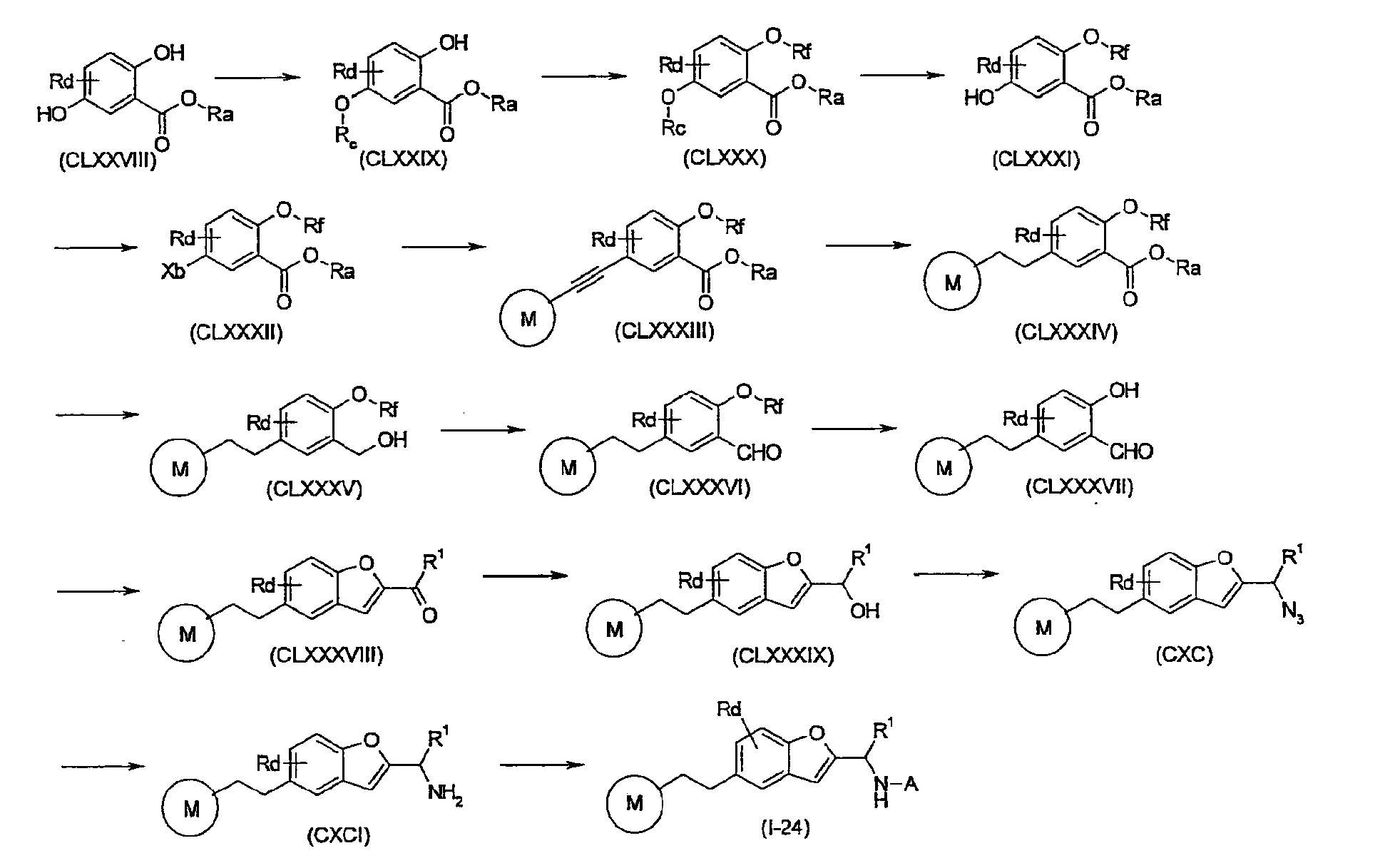
- wherein M, R1, A, Ra, Rc, Rd, Rf and Xb are independently as defined above.
- Compound (CLXXVIII) may be easily commercially available, or can also be produced according to a method known per se or a method analogous thereto.
Compound (CLXXIX) can be produced, for example, by subjecting compound (CLXXVIII) to a protection reaction. The protection reaction can be carried out according to a method known per se, for example, the method described in Protective Groups in Organic Synthesis, John Wiley and Sons (1980) or the like.
Compound (CLXXX) can be produced, for example, by subjecting compound (CLXXIX) to a protection reaction. The protection reaction can be carried out according to a method known per se, for example, the method described in Protective Groups in Organic Synthesis, John Wiley and Sons (1980) or the like.
Compound (CLXXXI) can be produced, for example, by subjecting compound (CLXXX) to deprotection. The deprotection can be carried out according to a method known per se, for example, the method described in Protective Groups in Organic Synthesis, John Wiley and Sons (1980) or the like.
Compound (CLXXXII) may be easily commercially available, or can also be produced according to a method known per se or a method analogous thereto. Alternatively, compound (CLXXXII) can be produced, for example, from compound (CLXXXI) by a method similar to the triflation reaction of compound (CLXVII) in the aforementioned Reaction Scheme 25.
Compound (CLXXXIII) can be produced, for example, from compound (CLXXXII) by a method similar to the Sonogashira reaction of the compound (CLXIX) in aforementioned Reaction Scheme 25.
Compound (CLXXXIV) can be produced, for example, from compound (CLXXXIII) by a method similar to the hydrogenation reaction of compound (CLXVIII) in the aforementioned Reaction Scheme 25.
Compound (CLXXXV) can be produced, for example, from compound (CLXXXIV) by a method similar to the reduction reaction of compound (XXVIII) in the aforementioned Reaction Scheme 4.
Compound (CLXXXVI) can be produced, for example, from compound (CLXXXV) by a method similar to the oxidization reaction of compound (CLXXI) in the aforementioned Reaction Scheme 25.
Compound (CLXXXVII) can be produced, for example, by subjecting compound (CLXXXVI) to deprotection. The deprotection can be carried out according to a method known per se, for example, the method described in Protective Groups in Organic Synthesis, John Wiley and Sons (1980) or the like.
Compound (CLXXXVIII) can be produced, for example, from compound (CLXXXVII) by a method similar to the cyclization reaction of compound (XXXIII) in the aforementioned Reaction Scheme 5.
Compound (CLXXXIX) can be produced, for example, from compound (CLXXXVIII) by a method similar to the reduction reaction of compound (XXVIII) in the aforementioned Reaction Scheme 4.
Compound (CXC) can be produced, for example, from compound (CLXXXIX) by a method similar to the substitution reaction of compound (XXIX) in the aforementioned Reaction Scheme 4.
Compound (CXCI) can be produced, for example, from compound (CXC) by a method similar to the reduction reaction of compound (XXX) in the aforementioned Reaction Scheme 4.
Compound (I-24) can be produced, for example, from compound (CXCI) by a method similar to the acylation reaction of compound (VII) in the aforementioned Reaction Scheme 1. -

- wherein M, P, Q, R1, A, L1 and L2 are independently as defined above.
- Compound (CXCII) can be produced, for example, according to a method known per se or according to the aforementioned Reaction Schemes 1 to 26.
Compound (I) can be produced, for example, from compound (CXCII) by a method similar to the acylation reaction of compound (VII) in the aforementioned Reaction Scheme 1. -

- wherein M, P, Q, R1, A, L1 and L2 are independently as defined above, and W is a hydroxy group, a mercapto group or a hydroxymethyl group.
- Compound (CXCIII) can be produced, for example, according to a method known per se, or according to the aforementioned Reaction Schemes 1 to 43 mentioned above or below.
Compound (I) can also be produced, for example, from compound (CXCIII) by a method similar to the alkylation reaction of compound (IX) in the aforementioned Reaction Scheme 1 or the substitution reaction of compound (XVII) in the aforementioned Reaction Scheme 3. -

- wherein M, R1, A, Ra, Rb, Rd, X1 and Xb are independently as defined above.
- Compound (CXCIV) may be easily commercially available, or can also be produced according to a method known per se or a method analogous thereto.
Compound (CXCV) can be produced, for example, from compound (CXCIV) by a method similar to the Sonogashira reaction of compound (CLXVIII) in the aforementioned Reaction Scheme 25.
Compound (CXCVI) can be produced, for example, from compound (CXCV) by a method similar to the hydrogenation reaction of compound (CLXIX) in the aforementioned Reaction Scheme 25.
Compound (CXCVII) can be produced, for example, from compound (CXCVI) by a method similar to the reduction reaction of compound (XXVIII) in the aforementioned Reaction Scheme 4.
Compound (CXCVIII) can be produced, for example, from compound (CXCVII) by a method similar to the oxidization reaction of compound (CLXXI) in the aforementioned Reaction Scheme 25.
Compound (CXCIX) can be produced, for example, from compound (CXCVIII) by a method similar to the cyclization reaction of compound (CII) in the aforementioned Reaction Scheme 17.
Compound (CC) can be produced, for example, from compound (CXCIX) by a method similar to the amidation reaction of compound (XXIV) in the aforementioned Reaction Scheme 4.
Compound (CCI) can be produced, for example, from compound (CC) by a method similar to the substitution reaction of compound (XXV) in the aforementioned Reaction Scheme 4.
Compound (CCII) can be produced, for example, from compound (CCI) by a method similar to the reduction reaction of compound (XXVIII) in the aforementioned Reaction Scheme 4.
Compound (CCIII) can be produced, for example, from compound (CCII) by a method similar to the substitution reaction of compound (XXIX) in the aforementioned Reaction Scheme 4.
Compound (CCIV) can be produced, for example, from compound (CCIII) by a method similar to the reduction reaction of compound (XXX) in the aforementioned Reaction Scheme 4.
Compound (I-25) can be produced, for example, from compound (CCIV) by a method similar to the acylation reaction of compound (VII) in the aforementioned Reaction Scheme 1. -

- wherein M, R1, A, L2, Ra and Rb are independently as defined above.
- Compound (CCV) may be easily commercially available, or can also be produced according to a method known per se, for example, the method described in Journal of Medicinal Chemistry, pages 2703-2705, 1993 or the like, or a method analogous thereto.
- Compound (CCVI) can be produced, for example, by subjecting compound (CCV) to a cyclization reaction.
The cyclization reaction can be carried out according to a method known per se, for example, the method described in Bulletin of Chemical Society Japan, page 2762-2767, 1983 or the like, or a method analogous thereto.
This reaction is carried out by reacting compound (CCV) with a α-haloester compound in the presence of a base, in an inert solvent.
Examples of the above-mentioned "α-haloester compound" include ethyl 1-bromoacetate and the like. The amount of the "α-haloester compound" to be used is generally 1 to 20 equivalents, preferably 1 to 5 equivalents, relative to compound (CCV).
Examples of the above-mentioned "base" include "inorganic bases", "basic salts", "hydrides of alkali metal or alkaline earth metal", "metal alkoxides" and the like. The amount of the "base" to be used is generally 2 to 10 equivalents, preferably 2 to 5 equivalents, relative to compound (CCV).
Examples of the above-mentioned "inert solvent" include nitrile solvents, alcohol solvents, ketone solvents aromatic solvents, aliphatic hydrocarbon solvents, ether solvents, ester solvents, amide solvents and the like. These may be used in a mixture of two or more kinds thereof at an appropriate ratio. Of these, acetonitrile, ethanol is preferable.
The reaction temperature is generally -70 to 150°C, preferably -20 to 100°C.
The reaction time is generally 0.1 to 100 hr, preferably 0.1 to 40 hr. - Compound (CCVII) can be produced, for example, by subjecting compound (CCVI) to an oxidization reaction.
The oxidation reaction can be carried out according to a method known per se, for example, the method described in Journal of Heterocyclic Chemistry, pages 1051-1056, 1996 or the like, or a method analogous thereto.
This reaction is carried out by reacting compound (CCVI) in the presence of an oxidant, in an inert solvent.
Examples of the above-mentioned "oxidant" include hydrogen peroxide, m-chloroperbenzoic acid and the like. The amount of the "oxidant" to be used is generally 1 to 20 equivalents, preferably 1 to 5 equivalents, relative to compound (CCVI).
Examples of the above-mentioned "inert solvent" include halogenated hydrocarbon solvents, aromatic solvents, aliphatic hydrocarbon solvents, ester solvents, amide solvents and the like. These may be used in a mixture of two or more kinds thereof at an appropriate ratio.
The reaction temperature is generally -70 to 150°C, preferably -20 to 100°C.
The reaction time is generally 0.1 to 100 hr, preferably 0.1 to 40 hr. - Compound (CCVIII) can be produced, for example, by subjecting compound (CCVII) to a rearrangement reaction.
The rearrangement reaction can be carried out according to a method known per se, for example, the method described in Journal of American Chemical Society, pages 1286-1289, 1954 or the like, or a method analogous thereto.
This reaction is carried out by reacting compound (CCVII) in the presence of a carboxylic anhydride, in an inert solvent or without in a solvent.
Examples of the above-mentioned "carboxylic anhydride" include acetic anhydride, trifluoroacetic acid anhydride and the like. The amount of the "carboxylic anhydride" to be used is generally 1 to 20 equivalents, preferably 1 to 5 equivalents, relative to compound (CCVII).
Examples of the above-mentioned "inert solvent" include halogenated hydrocarbon solvents, aromatic solvents, aliphatic hydrocarbon solvents and the like. These may be used in a mixture of two or more kinds thereof at an appropriate ratio.
The reaction temperature is generally -70 to 250°C, preferably -20 to 200°C.
The reaction time is generally 0.1 to 100 hr, preferably 0.1 to 40 hr. - Compound (CCIX) can be produced, for example, from compound (CCVIII) by a method similar to the aforementioned hydrolysis of compound (IV) in Reaction Scheme 1.
Compound (CCX) can be produced, for example, from compound (CCIX) by a method similar to the substitution reaction of compound (XVII) in the aforementioned Reaction Scheme 3.
Compound (CCXI) can be produced, for example, from compound (CCX) by a method similar to the amidation reaction of compound (XXIV) in the aforementioned Reaction Scheme 4.
Compound (CCXII) can be produced, for example, from compound (CCXI) by a method similar to the substitution reaction of compound (XXV) in the aforementioned Reaction Scheme 4.
Compound (CCXIII) can be produced, for example, from compound (CCXII) by a method similar to the reduction reaction of compound (XXVIII) in the aforementioned Reaction Scheme 4.
Compound (CCXIV) can be produced, for example, from compound (CCXIII) by a method similar to the substitution reaction of compound (XXIX) in the aforementioned Reaction Scheme 4.
Compound (CCXV) can be produced, for example, from compound (CCXIV) by a method similar to the reduction reaction of compound (XXX) in the aforementioned Reaction Scheme 4.
Compound (I-26), can be produced for example, from compound (CCXV) by a method similar to the acylation reaction of compound (VII) in the aforementioned Reaction Scheme 1. -
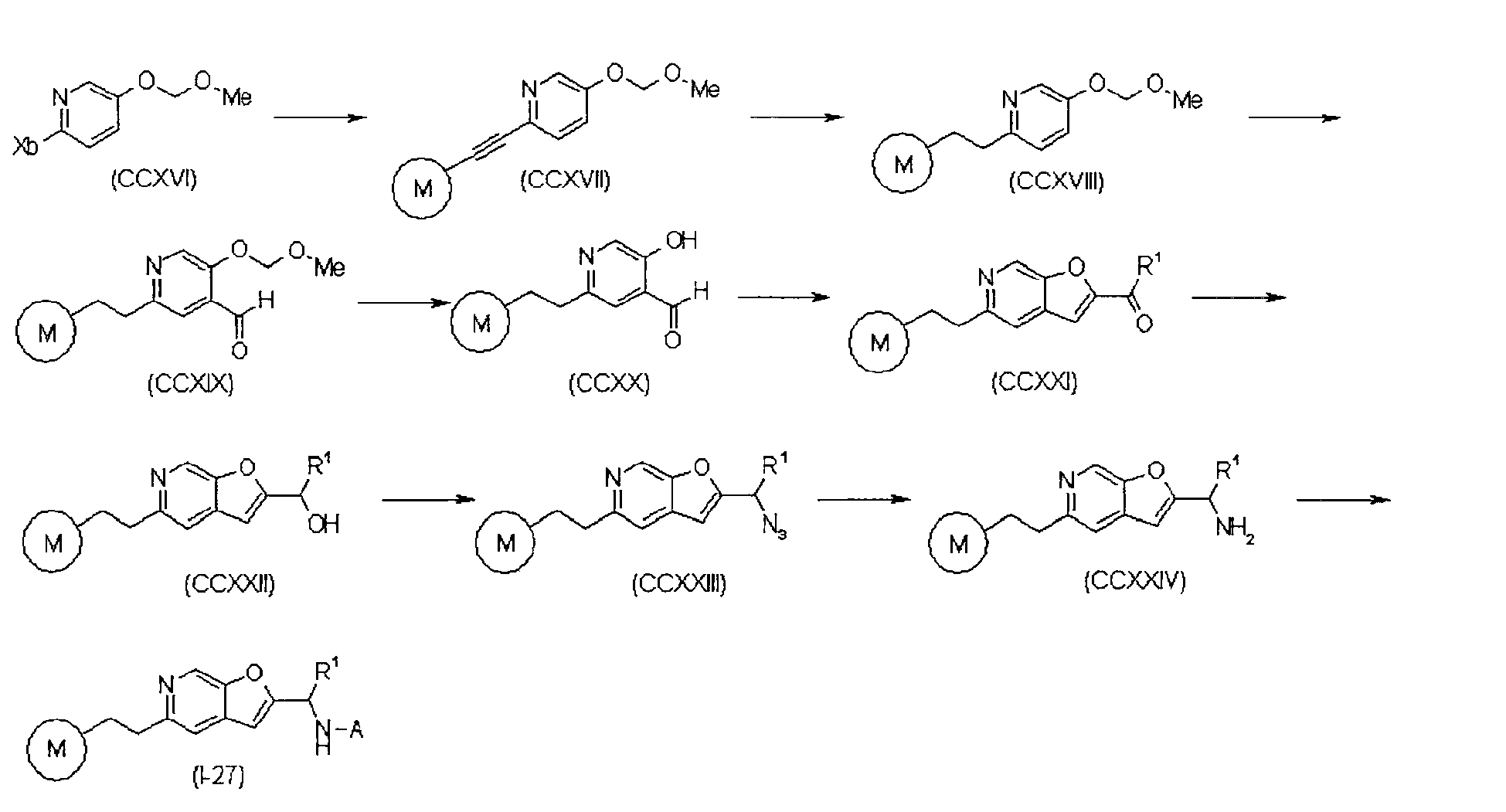
- wherein M, R1, A and Xb are independently as defined above.
- Compound (CCXVI) may be easily commercially available, or can also be produced according to a method known per se, for example, the method described in Journal of Medicinal Chemistry, pages 8378-8383, 2006 or the like, or a method analogous thereto.
- Compound (CCXVII) can be produced, for example, from compound (CCXVI) by a method similar to the Sonogashira reaction of compound (CLXVIII) in the aforementioned Reaction Scheme 25.
Compound (CCXVIII) can be produced, for example, from compound (CCXVII) by a method similar to the hydrogenation reaction of compound (CLXIX) in the aforementioned Reaction Scheme 25. - Compound (CCXIX) can be produced, for example, by subjecting compound (CCXVIII) to a formylation reaction.
The formylation reaction can be carried out according to a method known per se, for example, the method described in Synlett, pages 1908-1912, 2006 or the like, or a method analogous thereto.
This reaction can be carried out by reacting compound (CCXVIII) in the presence of a base, in an inert solvent, and then adding a formylating agent.
Examples of the above-mentioned "formylating agent" include amide solvents having a formyl group such as DMF and the like, formates and the like. The amount of the "formylating agent" to be used is generally 1 to 20 equivalents, preferably 1 to 5 equivalents, relative to compound (CCXVIII).
Examples of the above-mentioned "base" include "hydrides of alkali metal or alkaline earth metal", "metal amides", "alkyl metals", "aryl metals" and the like. The amount of the "base" to be used is generally 1 to 20 equivalents, preferably 1 to 5 equivalents, relative to compound (CCXVIII). In this case, a "tertiary amine" such as tetramethylethylenediamine and the like may be added.
Examples of the above-mentioned "inert solvent" include ether solvents, aromatic solvents, aliphatic hydrocarbon solvents and the like. These may be used in a mixture of two or more kinds thereof at an appropriate ratio.
The reaction temperature is generally -100 to 100°C, preferably -80 to 100°C.
The reaction time is generally 0.1 to 100 hr, preferably 0.1 to 8 hr. - Compound (CCXX) can be produced, for example, by subjecting compound (CCXIX) to deprotection. The deprotection can be carried out according to a method known per se, for example, the method described in Protective Groups in Organic Synthesis, John Wiley and Sons (1980) or the like.
- Compound (CCXXI) can be produced, for example, from compound (CCXX) by a method similar to the cyclization reaction of compound (XXXIII) in the aforementioned Reaction Scheme 5.
Compound (CCXXII) can be produced, for example, from compound (CCXXI) by a method similar to the reduction reaction of compound (XXVIII) in the aforementioned Reaction Scheme 4.
Compound (CCXXIII) can be produced, for example, from compound (CCXXII) by a method similar to the substitution reaction of compound (XXIX) in the aforementioned Reaction Scheme 4.
Compound (CCXXIV) can be produced, for example, from compound (CCXXIII) by a method similar to the reduction reaction of compound (XXX) in the aforementioned Reaction Scheme 4.
Compound (I-27) can be produced, for example, from compound (CCXXIV) by a method similar to the acylation reaction of compound (VII) in the aforementioned Reaction Scheme 1. -

- wherein M, R1, A and Ra are independently as defined above.
- Compound (CCXXV) may be easily commercially available, or can also be produced according to a method known per se, for example, the method described in Russian Journal of General Chemistry, pages 542-547, 1998 or the like, or a method analogous thereto.
- Compound (CCXXVI) can be produced, for example, by subjecting compound (CCXXV) to a cyclization reaction.
The cyclization reaction can be carried out according to a method known per se, for example, the method described inUSP 4808595 and the like, or a method analogous thereto.
This reaction is carried out by reacting compound (CCXXV) in the presence of a base, in an inert solvent, and then adding a nitrile compound.
Examples of the above-mentioned "nitrile compound" include alkyl cyanides and the like. The amount of the "nitrile compound" to be used is generally 1 to 20 equivalents, preferably 1 to 5 equivalents, relative to compound (CCXXV).
Examples of the above-mentioned "base" include "hydrides of alkali metal or alkaline earth metal", "metal amides", "alkyl metals", "aryl metals" and the like. The amount of the "base" to be used is generally 1 to 20 equivalents, preferably 1 to 5 equivalents, relative to compound (CCXXV).
Examples of the above-mentioned "inert solvent" include ether solvents, aromatic solvents, aliphatic hydrocarbon solvents and the like. These may be used in a mixture of two or more kinds thereof at an appropriate ratio.
The reaction temperature is generally -100 to 100°C, preferably -80 to 100°C.
The reaction time is generally 0.1 to 100 hr, preferably 0.1 to 8 hr. - Compound (CCXXVII) can be produced, for example, by subjecting compound (CCXXVI) to a chlorination reaction.
The chlorination reaction can be carried out according to a method known per se, for example, the method described in Journal of Heterocyclic Chemistry, pages 281-284, 1989 or the like, or a method analogous thereto.
This reaction is carried out by reacting compound (CCXXVI) in the presence of a chlorinating agent, in an inert solvent or without in a solvent.
Examples of the above-mentioned "chlorinating agent" include oxyphosphorus trichloride, phosphorus pentachloride and the like. The amount of the "chlorinating agent" to be used is generally 1 to 20 equivalents, preferably 1 to 5 equivalents, relative to compound (CCXXVI).
Examples of the above-mentioned "inert solvent" include halogenated hydrocarbon solvents, ether solvents, aromatic solvents, aliphatic hydrocarbon solvents and the like. These may be used in a mixture of two or more kinds thereof at an appropriate ratio.
The reaction temperature is generally -100 to 200°C, preferably 0 to 120°C.
The reaction time is generally 0.1 to 100 hr, preferably 0.1 to 24 hr. - Compound (CCXXVIII) can be produced, for example, by subjecting compound (CCXXVII) to a reduction reaction.
The reduction reaction can be carried out according to a method known per se, for example, the method described in Journal of Heterocyclic Chemistry, pages 57-60, 1971 or the like, or a method analogous thereto.
This reaction is carried out by reacting compound (CCXXVII) in the presence of zinc, in an organic acid solvent.
The amount of the above-mentioned "zinc" to be used is generally 1 to 20 equivalents, preferably 1 to 5 equivalents, relative to compound (CCXXVII).
The reaction temperature is generally -100 to 200°C, preferably 0 to 120°C.
The reaction time is generally 0.1 to 100 hr, preferably 0.1 to 24 hr. - Compound (CCXXIX) can be produced, for example, by subjecting compound (CCXXVIII) to an addition reaction.
The addition reaction can be carried out according to a method known per se, for example, the method described in Journal of Medicinal Chemistry, pages 1293-1310, 2000 or the like, or a method analogous thereto.
This reaction is carried out by reacting compound (CCXXVIII) in the presence of a base, in an inert solvent, and then adding a formyl compound.
Examples of the above-mentioned "formyl compound" include aldehydes such as acetoaldehyde and the like. The amount of the "formyl compound" to be used is generally 1 to 20 equivalents, preferably 1 to 5 equivalents, relative to compound (CCXXVIII).
Examples of the above-mentioned "base" include "hydrides of alkali metal or alkaline earth metal", "metal amides", "alkyl metals", "aryl metals" and the like. The amount of the "base" to be used is generally 1 to 20 equivalents, preferably 1 to 5 equivalents, relative to compound (CCXXVIII).
Examples of the above-mentioned "inert solvent" include ether solvents, aromatic solvents, aliphatic hydrocarbon solvents and the like. These may be used in a mixture of two or more kinds thereof at an appropriate ratio.
The reaction temperature is generally -100 to 100°C, preferably -80 to 100°C.
The reaction time is generally 0.1 to 100 hr, preferably 0.1 to 8 hr. - Compound (CCXXX) can be produced, for example, from compound (CCXXIX) by a method similar to the substitution reaction of compound (XXIX) in the aforementioned Reaction Scheme 4.
Compound (CCXXXI) can be produced, for example, from compound (CCXXX) by a method similar to the reduction reaction of compound (XXX) in the aforementioned Reaction Scheme 4.
Compound (I-28) can be produced, for example, from compound (CCXXXI) by a method similar to the acylation reaction of compound (VII) in the aforementioned Reaction Scheme 1. -

- wherein M, R1, A and Xb are independently as defined above.
- Compound (CCXXXII) may be easily commercially available, or can also be produced according to a method known per se or a method analogous thereto.
- Compound (CCXXXIII) can be produced, for example, by subjecting compound (CCXXXII) to an iodination reaction.
The iodination reaction can be carried out according to a method known per se, for example, the method described in Synlett, 1678-1682, 2003 or the like, or a method analogous thereto.
This reaction is carried out by reacting compound (CCXXXII) in the presence of an iodinating agent, in an inert solvent. In addition, this reaction may be carried out in the presence of a base.
Examples of the above-mentioned "iodinating agent" include N-iodosuccinimide, iodine and the like. The amount of the "iodinating agent" to be used is generally 1 to 20 equivalents, preferably 1 to 5 equivalents, relative to compound (CCXXXII).
Examples of the above-mentioned "inert solvent" include nitrile solvents, amide solvents, ether solvents, aromatic solvents, aliphatic hydrocarbon solvents, water and the like. These may be used in a mixture of two or more kinds thereof at an appropriate ratio.
Examples of the above-mentioned "base" include "basic salts", "aromatic amines", "tertiary amines", "hydrides of alkali metal or alkaline earth metal", "metal amides", "alkyl metals", "aryl metals", "metal alkoxides" and the like. The amount of the "base" to be used is generally 0.1 to 20 equivalents, preferably 1 to 5 equivalents, relative to compound (CCXXXII). In addition, the base may be used as a solvent.
The reaction temperature is generally -100 to 100°C, preferably -80 to 100°C.
The reaction time is generally 0.1 to 100 hr, preferably 0.1 to 8 hr. - Compound (CCXXXIV) can be produced, for example, by subjecting compound (CCXXXIII) to a cyclization reaction.
The cyclization reaction can be carried out according to a method known per se, for example, the method described in Synthesis, pages 749-751, 1986 or the like, or a method analogous thereto.
This reaction is carried out by reacting compound (CCXXXIII) in the presence of 2-(1-methylpropan-2-yn-1-yl)-1H-isoindole-1,3(2H)-dione, a transition metal catalyst and a base, in an inert solvent, under an inert gas atmosphere. In addition, a ligand may be added in this reaction, as necessary.
The amount of the 2-(1-methylpropan-2-yn-1-yl)-1H-isoindole-1,3(2H)-dione to be used is generally 1 to 20 equivalents, preferably 1 to 5 equivalents, relative to compound (CCXXXIII).
Examples of the above-mentioned "transition metal catalyst" include palladium catalysts, nickel catalysts, iron catalysts, cobalt catalysts and the like. Examples of the palladium catalyst include dichlorobis(triphenylphosphine)palladium and the like. The amount of the "transition metal catalyst" to be used is generally 0.001 to 1 equivalents, preferably 0.01 to 0.1 equivalents, relative to compound (CCXXXIII). In addition, a copper catalyst and the like may be added as a cocatalyst. Examples of the copper catalyst include copper iodide and the like. The amount of the "cocatalyst" to be used is generally 0.001 to 1 equivalents, preferably 0.01 to 0.1 equivalents, relative to compound (CCXXXIII).
Examples of the above-mentioned "ligand" include phosphine ligands. Examples of the phosphine ligand include triphenylphosphine and the like. The amount of the "ligand" to be used is generally 0 to 20 equivalents, preferably 0 to 1 equivalents, relative to compound (CCXXXIII).
Examples of the above-mentioned "base" include "aromatic amines", "tertiary amines" and the like. The amount of the "base" to be used is generally 0.1 to 20 equivalents, preferably 1 to 5 equivalents, relative to compound (CCXXXIII). In addition, the based may be used as a solvent.
Examples of the above-mentioned "inert solvent" include amide solvents, aromatic solvents, aliphatic hydrocarbon solvents, ether solvents, ester solvents and the like. These may be used in a mixture of two or more kinds thereof at an appropriate ratio.
Examples of the above-mentioned "inert gas" include nitrogen, argon and the like.
The reaction temperature is generally -70 to 150°C, preferably -20 to 150°C.
The reaction time is generally 0.1 to 100 hr, preferably 0.1 to 40 hr. - Compound (CCXXXV) can be produced, for example, by subjecting compound (CCXXXIV) to deprotection. The deprotection can be carried out according to a method known per se, for example, the method described in Protective Groups in Organic Synthesis, John Wiley and Sons (1980) or the like.
- Compound (CCXXXVI) can be produced, for example, from compound (CCXXXV) by a method similar to the acylation reaction of compound (VII) in the aforementioned Reaction Scheme 1. Alternatively, compound (CCXXXVI) can be produced from an alkyne derivative having substituent A instead of 2-(1-methylpropan-2-yn-1-yl)-1H-isoindole-1,3(2H)-dione by a method similar to the above-mentioned cyclization reaction of compound (CCXXXIII). Examples of the alkyne derivative having substituent A include a propan-2-yn-1-amine having an acyl group or an optionally substituted 5- or 6-membered aromatic ring group on the nitrogen atom and having an optionally substituted C1-6 alkyl group or an optionally substituted C3-6 cycloalkyl group on the 1-position, such as N-(1-methylpropan-2-yn-1-yl)acetamide and the like.
- Compound (I-29) can be produced, for example, by subjecting compound (CCXXXVI) to a cross coupling reaction.
The cross coupling reaction can be carried out according to a method known per se, for example, the method described in Journal of American Chemical Society, pages 158-163, 1984 or the like, or a method analogous thereto.
This reaction is carried out by reacting compound (CCXXXVI) in the presence of a Grignard reagent and a transition metal catalyst, in an inert solvent, under an inert gas atmosphere. In addition, a ligand may be added in this reaction, as necessary.
Examples of the above-mentioned "Grignard reagent" include 4-alkoxyphenylethylmagnesium bromide and the like. The amount of the "Grignard reagent" to be used is generally 2 to 10 equivalents, preferably 2 to 5 equivalents, relative to compound (CCXXXVI).
Examples of the above-mentioned "transition metal catalyst" include palladium catalysts, nickel catalysts, iron catalysts, cobalt catalysts and the like. Examples of the palladium catalyst include dichloro{bis(triphenylphosphino)ferrocene}palladium, dichlorobis(triphenylphosphine)palladium and the like. The amount of the "transition metal catalyst" to be used is generally 0.001 to 1 equivalents, preferably 0.01 to 0.1 equivalents, relative to compound (CCXXXVI).
Examples of the above-mentioned "ligand" include phosphine ligands. Examples of the phosphine ligand include triphenylphosphine and the like. The amount of the "ligand" to be used is generally 0 to 20 equivalents, preferably 0 to 1 equivalents, relative to compound (CCXXXVI).
Examples of the above-mentioned "inert solvent" include amide solvents, aromatic solvents, aliphatic hydrocarbon solvents, ether solvents and the like. These may be used in a mixture of two or more kinds thereof at an appropriate ratio.
Examples of the above-mentioned "inert gas" include nitrogen, argon and the like.
The reaction temperature is generally -70 to 150°C, preferably -20 to 150°C.
The reaction time is generally 0.1 to 100 hr, preferably 0.1 to 40 hr. -

- wherein M, R1, A and Xb are independently as defined above.
- Compound (CCXXXVII) may be easily commercially available, or can also be produced according to a method known per se or a method analogous thereto.
Compound (CCXXXVIII) can be produced, for example, from compound (CCXXXVII) by a method similar to the iodination reaction of compound (CCXXXII) in the aforementioned Reaction Scheme 3.
Compound (CCXXXIX) can be produced, for example, from compound (CCXXXVIII) by a method similar to the cyclization reaction of compound (CCXXXIII) in the aforementioned Reaction Scheme 33. - Compound (CCXL) can be produced, for example, by subjecting compound (CCXXXIX) to deprotection. The deprotection can be carried out according to a method known per se, for example, the method described in Protective Groups in Organic Synthesis, John Wiley and Sons (1980) or the like.
- Compound (CCXLI) can be produced, for example, from compound (CCXL) by a method similar to the acylation reaction of compound (VII) in the aforementioned Reaction Scheme 1. Alternatively, compound (CCXLI) can be produced from an alkyne derivative having substituent A instead of 2-(1-methylpropan-2-yn-1-yl)-1H-isoindole-1,3(2H)-dione by a method similar to the above-mentioned cyclization reaction of compound (CCXXXVIII).
Compound (I-30) can be produced, for example, from compound (CCXLI) by a method similar to the cross coupling reaction of compound (CCXXXVI) in the aforementioned Reaction Scheme 33. -

- wherein M, R1, A and Xb are independently as defined above.
- Compound (CCXLII) may be easily commercially available, or can also be produced according to a method known per se or a method analogous thereto.
Compound (CCXLIII) can be produced, for example, from compound (CCXLII) by a method similar to the iodination reaction of compound (CCXXXII) in the aforementioned Reaction Scheme 3.
Compound (CCXLIV) can be produced, for example, from compound (CCXLIII) by a method similar to the cyclization reaction of compound (CCXXXIII) in the aforementioned Reaction Scheme 33. - Compound (CCXLV) can be produced, for example, by subjecting compound (CCXLIV) to deprotection. The deprotection can be carried out according to a method known per se, for example, the method described in Protective Groups in Organic Synthesis, John Wiley and Sons (1980) or the like.
- Compound (CCXLVI) can be produced, for example, from compound (CCXLV) by a method similar to the acylation reaction of compound (VII) in the aforementioned Reaction Scheme 1. Alternatively, compound (CCXLVI) can be produced from an alkyne derivative having substituent A instead of 2-(1-methylpropan-2-yn-1-yl)-1H-isoindole-1,3(2H)-dione by a method similar to the above-mentioned cyclization reaction of compound (CCXLIII).
Compound (I-31) can be produced, for example, from compound (CCXLVI) by a method similar to the cross coupling reaction of compound (CCXXXVI) in the aforementioned Reaction Scheme 33. -

- wherein M, P, Q, R1, A, L1 and L2 are independently as defined above, and B is a nitrogen atom-protecting group generally used in organic chemistry and the like.
- Compound (CCXLVII) can be produced, for example, according to a method known per se or the aforementioned Reaction Schemes 1 to 35.
- Compound (CCXLVIII) can be produced, for example, by subjecting compound (CCXLVII) to the Mitsunobu reaction.
The Mitsunobu reaction can be carried out according to a method known per se, for example, the method described in Bioorganic and Medicinal Chemical Letters, pages 1803-1807, 2007 or the like, or a method analogous thereto.
This reaction is carried out by reacting compound (CCXLVII) with a sulfonamide derivative in the presence of a hydroxyl group-activator in an inert solvent.
Examples of the above-mentioned "sulfonamide derivative" include sulfonamides activated by a nitrobenzenesulfonyl group and the like, such as N-(isoxazol-3-yl)-4-nitrobenzenesulfonamide, and the like. The amount of the "sulfonamide derivative" to be used is generally 1 to 10 equivalents, preferably 1 to 5 equivalents, relative to compound (CCXLVII).
Examples of the above-mentioned "hydroxyl group-activator" include cyanomethylenetri-n-butylphosphorane; a combination of diethyl azodicarboxylate (DEAD) and triphenylphosphine, and the like. The amount of the "hydroxyl group-activator" to be used is generally 1 to 10 equivalents, preferably 1 to 1.5 equivalents, relative to compound (CCXLVII).
Examples of the above-mentioned "inert solvent" include aromatic solvents, aliphatic hydrocarbon solvents, ether solvents, ester solvents, amide solvents and the like. These may be used in a mixture of two or more kinds thereof at an appropriate ratio.
The reaction temperature is generally -70 to 150°C, preferably -20 to 100°C.
The reaction time is generally 0.1 to 100 hr, preferably 0.1 to 40 hr. - Compound (I-32) can be produced, for example, by subjecting compound (CCXLVIII) to deprotection. The deprotection can be carried out according to a method known per se, for example, the method described in Protective Groups in Organic Synthesis, John Wiley and Sons (1980) or the like.
-

- wherein M, R1, A and Rd are independently as defined above.
- Compound (CCXLIX) can be produced, for example, by subjecting compound (XLVII) to a hydrogenation reaction.
The hydrogenation reaction can be carried out according to a method known per se, for example, the method described in Journal of Chemical Society, pages 3362-3369, 1959 or the like, or a method analogous thereto.
This reaction can be carried out, for example, by reacting compound (XLVII) in the presence of a metal catalyst and a hydrogen source, in an inert solvent.
Examples of the above-mentioned metal catalyst" include palladium carbon, palladium black, palladium chloride, platinum oxide, platinum black, platinum palladium, Raney-nickel, Raney-cobalt and the like. The amount of the "metal catalyst" to be used is generally 0.001 to 1000 equivalents, preferably 0.01 to 100 equivalents, relative to compound (XLVII).
Examples of the above-mentioned "hydrogen source" include hydrogen gas, formic acid, formic acid amine salt, phosphinate, hydrazine and the like.
Examples of the above-mentioned "inert solvent" include alcohol solvents, nitrile solvents, aromatic solvents, aliphatic hydrocarbon solvents, ether solvents, amide solvents, halogenated hydrocarbon solvents and the like. These solvents are preferably used in a mixture with water at an appropriate ratio. Of these, alcohol solvents are preferable.
The reaction temperature is generally -70 to 150°C, preferably -20 to 100°C.
The reaction time is generally 0.1 to 100 hr, preferably 0.1 to 40 hr. - Compound (CCL) can be produced, for example, from compound (CCXLIX) by a method similar to the triflation reaction of compound (CLXVII) in the aforementioned Reaction Scheme 25.
Compound (I-33) can be produced, for example, from compound (CCL) by a method similar to the Sonogashira reaction of compound (CLXVIII) in the aforementioned Reaction Scheme 25. -

- wherein M, P, Q, R1, A and Xb are independently as defined above.
- Compound (CCLI) can be produced, for example, according to a method known per se or the aforementioned Reaction Schemes 1 to 37.
- Compound (I-34) can be produced, for example, by subjecting compound (CCLI) to the Heck reaction. The Heck reaction can be carried out according to a method known per se, for example, the method described in Journal of Medicinal Chemistry, pages 2085-2101, 1997 or the like, or a method analogous thereto. This reaction is carried out by reacting compound (CCLI) with a vinyl compound in the presence of a transition metal catalyst, a ligand and a base, in an inert solvent, under an inert gas atmosphere. Examples of the above-mentioned "vinyl compound" include styrene derivatives. The amount of the "vinyl compound" to be used is generally 1 to 20 equivalents, preferably 1 to 10 equivalents, relative to compound (CCLI). Examples of the above-mentioned "transition metal catalyst" include palladium catalysts, nickel catalysts, iron catalysts, cobalt catalysts and the like. Examples of the palladium catalyst include palladium acetate, dichlorobis(benzonitrile)palladium and the like. The amount of the "transition metal catalyst" to be used is generally 0.01 to 20 equivalents, preferably 0.01 to 0.2 equivalents, relative to compound (CCLI). Examples of the above-mentioned "ligand" include phosphine ligands. Examples of the phosphine ligand include triphenylphosphine and the like. The amount of the "ligand" to be used is generally 0.01 to 20 equivalents, preferably 0.01 to 0.2 equivalents, relative to compound (CCLI). Examples of the above-mentioned "base" include "aromatic amines", "tertiary amines" and the like. The amount of the "base" to be used is generally 0.1 to 20 equivalents, preferably 1 to 5 equivalents, relative to compound (CCLI). Examples of the above-mentioned "inert solvent" include alcohol solvents, aromatic solvents, aliphatic hydrocarbon solvents, ether solvents, ester solvents, amide solvents and the like. These may be used in a mixture of two or more kinds thereof at an appropriate ratio. Examples of the above-mentioned "inert gas" include nitrogen, argon and the like.
The reaction temperature is generally -70 to 150°C, preferably -20 to 150°C.
The reaction time is generally 0.1 to 100 hr, preferably 0.1 to 40 hr. -

- wherein M, P, Q, R1, A and Xb are independently as defined above.
- Compound (I-35) can be produced, for example, from compound (CCLI) by a method similar to the Sonogashira reaction of compound (CLXVIII) in the aforementioned Reaction Scheme 25.
-

- wherein Rg is a hydrogen atom, an optionally substituted hydrocarbon group or an optionally substituted heterocyclic group, Rh is an optionally substituted C1-6 alkyl group or a C7-12 aralkyl group, and P, Q, R1, L1, A, Ra and W are independently is as defined above. Examples of the "optionally substituted hydrocarbon group" and "optionally substituted heterocyclic group" for Rg include those similar to the "optionally substituted hydrocarbon group" and "optionally substituted heterocyclic group" for RA, RA' or RB'.
Compound (CCLII) may be easily commercially available, or can be produced, for example, according to a method known per se. - Compound (CCLIII) can be produced, for example, by subjecting compound (CCLII) to an alkylation reaction.
Examples of the alkylation reaction include the following "method using a base and alkyl halide 2", "method employing the Mitsunobu reaction", and the like. - The "method using a base and alkyl halide 2" can be carried out according to a method known per se, for example, the method described in Journal of Chemical Society, pages 1530-1534, 1937 or the like, or a method analogous thereto.
This reaction is carried out by reacting compound (CCLII) with alkyl halide 2 in the presence of a base, in an inert solvent.
Examples of the above-mentioned "alkyl halide 2" include halide compounds such as bromopropane, 2-iodopropane, (bromomethyl)cyclopropane and the like, and the like. The amount of the "alkyl halide 2" to be used is generally 1 to 10 equivalents, preferably 1 to 5 equivalents, relative to compound (CCLII).
Examples of the above-mentioned "base" include "inorganic bases", "basic salts", "aromatic amines", "hydrides of alkali metal or alkaline earth metal", "alkyl metals", "aryl metals", "metal alkoxides" and the like. The amount of the "base" to be used is generally 1 to 10 equivalents, preferably 1 to 5 equivalents, relative to compound (CCLII).
Examples of the above-mentioned "inert solvent" include nitrile solvents, amide solvents, halogenated hydrocarbon solvents, ether solvents and the like. These may be used in a mixture of two or more kinds thereof at an appropriate ratio. Of these, THF, DMF and the like are preferable.
The reaction temperature is generally -100°C to 150°C, preferably 0°C to 100°C.
The reaction time is generally 5 min to 48 hr, preferably 30 min to 24 hr. - The "method employing the Mitsunobu reaction" can be carried out according to a method known per se, for example, the method described in Tetrahedron Letters, pages 769-770, 1980 or the like, or a method analogous thereto.
This reaction is carried out by reacting compound (CCLII) with alcohol 2 having substituent(s) in the presence of a hydroxyl group-activator in an inert solvent.
Examples of the above-mentioned "alcohol 2 having substituent(s)" include alcohols such as tetrahydrofuran-2-ylmethanol and the like. The amount of the "alcohol 2 having substituent(s)" to be used is generally 1 to 10 equivalents, preferably 1 to 5 equivalents, relative to compound (CCLII).
Examples of the above-mentioned "hydroxyl group-activator" include cyanomethylenetri-n-butylphosphorane, a combination of DEAD and triphenylphosphine and the like. The amount of the "hydroxyl group-activator" to be used is generally 1 to 10 equivalents, preferably 1 to 1.5 equivalents, relative to compound (CCLII).
Examples of the above-mentioned "inert solvent" include aromatic solvents, aliphatic hydrocarbon solvents, ether solvents, ester solvents, amide solvents and the like. These may be used in a mixture of two or more kinds thereof at an appropriate ratio.
The reaction temperature is generally -70 to 150°C, preferably -20 to 100°C.
The reaction time is generally 0.1 to 100 hr, preferably 0.1 to 40 hr. - Compound (CCLIV) can be produced, for example, from compound (CCLIII) by a method similar to the reduction reaction of compound (XXVIII) in the aforementioned Reaction Scheme 4.
- Compound (I-36) can be produced, for example, from compound (CCLIV) and compound (CXCIII) according to a method known per se, or by a method similar to the synthetic method of compound (I-1) in the aforementioned Reaction Scheme 1.
-

- wherein P, Q, R1, L1, A, W and Rh are independently as defined above.
Compound (CCLVI) may be easily commercially available. - Compound (CCLVII) can be produced, for example, by subjecting compound (CCLVI) to a substitution reaction.
The substitution reaction can be carried out according to a method known per se, for example, the method described in Journal of Fluorine Chemistry, pages 135-146, 2001 or the like, or a method analogous thereto.
This reaction is carried out by reacting compound (CCLVI) with alcohol 2 having substituent(s) in the presence of a base, in an inert solvent.
Examples of the above-mentioned "alcohol 2 having substituent(s)" include alcohols such as cyclopropylmethanol, tetrahydrofuran-2-ylmethanol and the like. The amount of the "alcohol 2 having substituent(s)" to be used is generally 1 to 10 equivalents, preferably 1 to 5 equivalents, relative to compound (CCLVI) .
Examples of the above-mentioned "base" include "inorganic bases", "basic salts", "aromatic amines", "tertiary amines", "hydrides of alkali metal or alkaline earth metal", "metal alkoxide" and the like. The amount of the "base" to be used is generally 1 to 10 equivalents, preferably 1 to 2 equivalents, relative to compound (CCLVI).
Examples of the above-mentioned "inert solvent" include aromatic solvents, aliphatic hydrocarbon solvents, ether solvents, ester solvents, amide solvents and the like. These may be used in a mixture of two or more kinds thereof at an appropriate ratio.
The reaction temperature is generally -70 to 150°C, preferably -20 to 100°C.
The reaction time is generally 0.1 to 100 hr, preferably 0.1 to 40 hr. - Compound (CCLVIII) can be produced, for example, by subjecting compound (CCLVII) to a substitution reaction.
The substitution reaction can be carried out according to a method known per se, for example, the method described in Journal of Organic Chemistry, pages 565-573, 1992 or the like, or a method analogous thereto.
This reaction is carried out by reacting compound (CCLVII) in the presence of a base, in an inert solvent, and then adding a formylating agent.
Examples of the above-mentioned "base" include "hydrides of alkali metal or alkaline earth metal", "metal amides", "alkyl metals", "aryl metals" and the like. The amount of the "base" to be used is generally 1 to 20 equivalents, preferably 1 to 5 equivalents, relative to compound (CCLVII).
Examples of the above-mentioned "inert solvent" include ether solvents, aromatic solvents, aliphatic hydrocarbon solvents and the like. These may be used in a mixture of two or more kinds thereof at an appropriate ratio.
Examples of the above-mentioned "formylating agent" include ethyl formate, DMF and the like. The amount of the "formylating agent" to be used is generally 1 to 20 equivalents, preferably 1 to 5 equivalents, relative to compound (CCLVII).
The reaction temperature is generally -100 to 100°C, preferably -80 to 100°C.
The reaction time is generally 0.1 to 100 hr, preferably 0.1 to 8 hr. - Compound (CCLIX) can be produced, for example, from compound (CCLVIII) by a method similar to the reduction reaction of compound (XXVIII) in the aforementioned Reaction Scheme 4.
- Compound (I-37) can be produced, for example, from compound (CCLIX) and compound (CXCIII) according to a method known per se, or by a method similar to the synthetic method of compound (I-1) in the aforementioned Reaction Scheme 1.
-

- wherein P, Q, R1, L1, A, Ra, W, Rh and X1 are independently as defined above.
- Compound (CCLXI) can be produced, for example, from compound (CCLX) by a method similar to the substitution reaction of compound (CCLVI) in the aforementioned Reaction Scheme 41.
- Compound (CCLXII) can be produced, for example, by subjecting compound (CCLXI) to an oxidization reaction.
The oxidation reaction can be carried out according to a method known per se, for example, the method described in Synthetic Communications, pages 969-978, 1981 or the like, or a method analogous thereto.
This reaction is carried out by reacting compound (CCLXI) in the presence of a base, in an inert solvent, and then adding successively a trialkyloxyborane and a peroxide.
Examples of the above-mentioned "base" include "alkyl metals", "aryl metals" and the like. The amount of the "base" to be used is generally 1 to 20 equivalents, preferably 1 to 2 equivalents, relatively compound (CCLXI).
Examples of the above-mentioned "inert solvent" include ether solvents, aromatic solvents, aliphatic hydrocarbon solvents and the like. These may be used in a mixture of two or more kinds thereof at an appropriate ratio.
Examples of the above-mentioned "trialkyloxyborane" include trimethoxyborane, tributyloxyborane and the like. The amount of the "trialkyloxyborane" to be used is generally 1 to 20 equivalents, preferably 1 to 2 equivalents, relatively compound (CCLXI).
Examples of the above-mentioned "peroxide" include aqueous hydrogen peroxide, m-chloroperbenzoic acid and the like. The amount of the "peroxide" to be used is generally 1 to 20 equivalents, preferably 1 to 10 equivalents, relatively compound (CCLXI). In this case, an aqueous "inorganic base" solution is generally simultaneously added. The amount of the aqueous "inorganic base" solution to be used is generally 1 to 20 equivalents, preferably 1 to 10 equivalents, relatively compound (CCLXI).
The reaction temperature is generally -100 to 100°C, preferably -80 to 100°C.
The reaction time is generally 0.1 to 100 hr, preferably 0.1 to 8 hr. - Compound (CCLXIII) can be produced, for example, by subjecting compound (CCLXII) to an alkoxyalkylation reaction. The alkoxyalkylation reaction can be carried out according to a method known per se, for example, the method described in Protective Groups in Organic Synthesis, John Wiley and Sons (1980) or the like.
- Compound (CCLXIV) can be produced, for example, by subjecting compound (CCLXIII) to a fluorating reaction.
The fluorating reaction can be carried out according to a method known per se, for example, the method described inUS 6355660 and the like, or a method analogous thereto.
This reaction is carried out by reacting compound (CCLXIII) in the presence of a base, in an inert solvent, and then adding a fluorating agent.
Examples of the above-mentioned "base" include "alkyl metals", "aryl metals" and the like. The amount of the "base" to be used is generally 1 to 20 equivalents, preferably 1 to 2 equivalents, relative to compound (CCLXIII).
Examples of the above-mentioned "inert solvent" include ether solvents, aromatic solvents, aliphatic hydrocarbon solvents and the like. These may be used in a mixture of two or more kinds thereof at an appropriate ratio.
Examples of the above-mentioned "fluorating agent" include N-fluorobenzenesulfonamide and the like. The amount of the "fluorating agent" to be used is generally 1 to 20 equivalents, preferably 1 to 2 equivalents, relative to compound (CCLXIII).
The reaction temperature is generally -100 to 100°C, preferably -80 to 100°C.
The reaction time is generally 0.1 to 100 hr, preferably 0.1 to 8 hr. - Compound (CCLXV) can be produced, for example, by subjecting compound (CCLXIV) to deprotection. The deprotection can be carried out according to a method known per se, for example, the method described in Protective Groups in Organic Synthesis, John Wiley and Sons (1980) or the like.
- Compound (CCLXVI) can be produced, for example, from compound (CCLXV) by a method similar to the triflation reaction of compound (CLXVII) in the aforementioned Reaction Scheme 25.
- Compound (CCLXVII) can be produced, for example, from compound (CCLXVI) by a method similar to the "alkoxycarbonylation reaction using a transition metal catalyst" of compound (CXXVII) in the aforementioned Reaction Scheme 19.
- Compound (CCLXVIII) can be produced, for example, from compound (CCLXVII) by a method similar to the reduction reaction of compound (XXVIII) in the aforementioned Reaction Scheme 4.
- Compound (I-38) can be produced, for example, from compound (CXCIII) and compound (CCLXVIII) according to a method known per se, or by a method similar to the synthetic method of compound (I-1) in the aforementioned Reaction Scheme 1.
-

- wherein X2 is halogen, and P, Q, R1, L1, A, W, Rh and X1 are independently as defined above.
Compound (CCLXIX) may be easily commercially available, or can be produced according to a method known per se or a method analogous thereto. - Compound (CCLXX) can be produced, for example, from compound (CCLXIX) by a method similar to the alkylation reaction of compound (CCLII) in the aforementioned Reaction Scheme 40.
- Compound (CCLXXI) can be produced, for example, by subjecting compound (CCLXX) to a cyanation reaction.
The cyanation reaction can be carried out according to a method known per se, for example, the method described in Journal of Medicinal Chemistry, pages 1158-1162, 1978 or the like, or a method analogous thereto.
This reaction is carried out by reacting compound (CCLXX) in the presence of a cyanating agent, in an inert solvent.
Examples of the above-mentioned "cyanating agent" include copper(I) cyanide, zinc(II) cyanide and the like. The amount of the "cyanating agent" to be used is generally 1 to 20 equivalents, preferably 1 to 2 equivalents, relative compound (CCLXX). In this case, a transition metal catalyst may be used.
Examples of the above-mentioned "inert solvent" include amide solvents, sulfoxide solvents, nitrile solvents, ester solvents, ether solvents, aromatic solvents, aliphatic hydrocarbon solvents, aromatic amines and the like. These may be used in a mixture of two or more kinds thereof at an appropriate ratio.
The reaction temperature is generally -100 to 300°C, preferably 20 to 200°C.
The reaction time is generally 0.1 to 500 hr, preferably 0.1 to 48 hr. - Compound (CCLXXII) can be produced, for example, by subjecting compound (CCLXXI) to halogenation.
The halogenation can be carried out according to a method known per se, for example, the method described in Synthetic Communications, pages 3435-3454, 2003 or the like, or a method analogous thereto.
This reaction is carried out by reacting compound (CCLXXI) in the presence of halogenating agent 2, in an inert solvent.
Examples of the above-mentioned "halogenating agent 2" include N-bromosuccinimide, N-chlorosuccinimide and the like. The amount of the "halogenating agent 2" to be used is generally 1 to 20 equivalents, preferably 1 to 1.2 equivalents, relative to compound (CCLXXI). In addition, a radical initiator such as 2,2'-azobisisobutyronitrile and the like may be used.
Examples of the above-mentioned "inert solvent" include halogenated hydrocarbon solvents, amide solvents, sulfoxide solvents, nitrile solvents, ester solvents, ether solvents, aromatic solvents, aliphatic hydrocarbon solvents and the like. These may be used in a mixture of two or more kinds thereof at an appropriate ratio.
The reaction temperature is generally -100 to 200°C, preferably 20 to 100°C.
The reaction time is generally 0.1 to 100 hr, preferably 0.1 to 24 hr. - Compound (I-39) can be produced, for example, from compound (CXCIII) and compound (CCLXXII) according to a method known per se or by a method similar to the synthetic method of compound (I-1) in the aforementioned Reaction Scheme 1.
-

- wherein M, P, Q, R1, A, L1 and L2 are independently as defined above.
Compound (I-32) can be produced, for example, by subjecting compound (CCXLVII) to an amination reaction.
The amination reaction can be carried out according to a method known per se, for example, the method described inUS 2004/87600 A1 and the like, or a method analogous thereto.
This reaction is carried out by reacting an alkyl halide prepared from compound (CCXLVII) with an amine corresponding to A (A = an optionally substituted 5- or 6-membered aromatic ring group) in the presence of a base, in an inert solvent.
The above-mentioned "alkyl halide prepared from compound (CCXLVII)" can be produced, for example, by a method similar to the production of the alkyl halide in the synthesis of compound (I-1).
Examples of the above-mentioned "amine corresponding to A" include heteroarylamines such as aniline, isoxazol-3-amine and the like, and the like. The amount of the "amine corresponding to A" to be used is generally 1 to 10 equivalents, preferably 1 to 5 equivalents, relative to the alkyl halide prepared from compound (CCXLVII).
Examples of the above-mentioned "base" include "inorganic bases", "basic salts", "aromatic amines", "hydrides of alkali metal or alkaline earth metal", "alkyl metals", "aryl metals", "metal alkoxides" and the like. The amount of the "base" to be used is generally 0 to 10 equivalents, preferably 0 to 5 equivalents, relative to the alkyl halide prepared from compound (CCXLVII). In addition, sodium iodide and the like may be added as an additive. The amount of the "additive" to be used is generally 1 to 10 equivalents, preferably 1 to 5 equivalents, relative to the alkyl halide prepared from compound (CCXLVII).
Examples of the above-mentioned "inert solvent" include nitrile solvents, amide solvents, halogenated hydrocarbon solvents, ether solvents and the like. These may be used in a mixture of two or more kinds thereof at an appropriate ratio. Of these, THF, DMF and the like are preferable.
The reaction temperature is generally -100°C to 150°C, preferably 0°C to 100°C.
The reaction time is generally 5 min to 48 hr, preferably 30 min to 24 hr. -
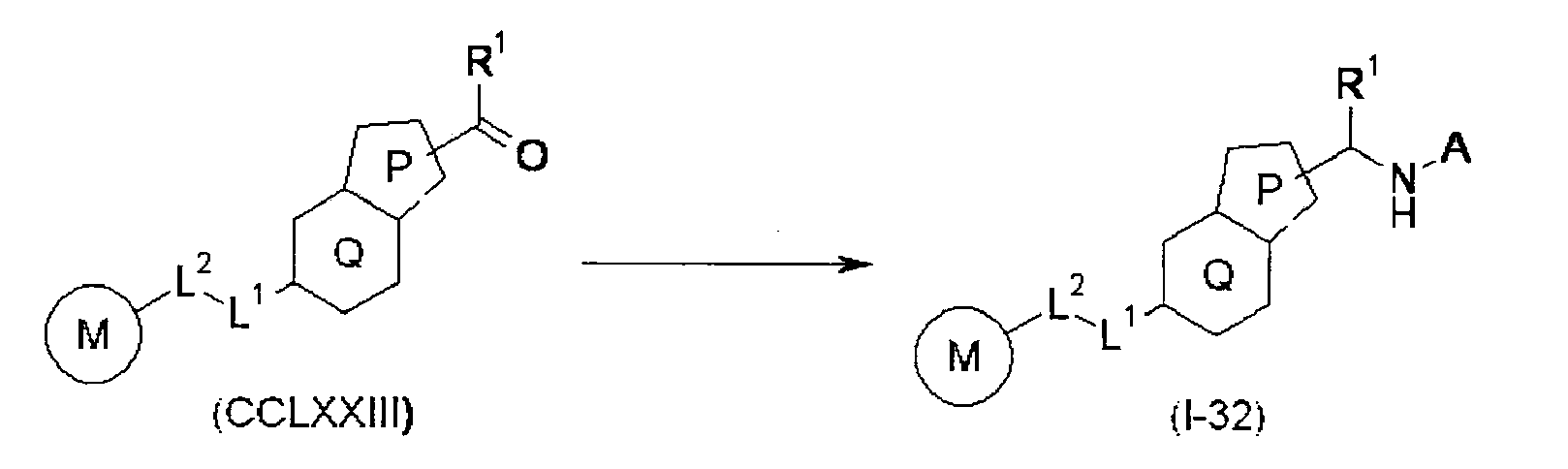
- wherein M, P, Q, R1, A, L1 and L2 are independently as defined above.
Compound (CCLXXIII) can be produced, for example, according to a method known per se or the aforementioned Reaction Schemes 1 to 43.
Compound (I-32) can be produced, for example, by subjecting compound (CCLXXIII) to a reductive amination reaction.
The reductive amination reaction can be carried out according to a method known per se, for example, the method described inEP 1179532A1 and the like, or a method analogous thereto.
This reaction is carried out by reacting compound (CCLXXIII) with an amine corresponding to A (A = an optionally substituted 5-or 6-membered aromatic ring group) in the presence of reducing agent 2, in an inert solvent.
Examples of the above-mentioned "amine corresponding to A" include heteroarylamines such as aniline, isoxazol-3-amine and the like, and the like. The amount of the "amine corresponding to A" to be used is generally 1 to 10 equivalents, preferably 1 to 5 equivalents, relative to compound (CCLXXIII).
Examples of the above-mentioned "reducing agent 2" include decaborane, sodium triacetoxyborohydride and the like. The amount of the "reducing agent 2" to be used is generally 1 to 10 equivalents, preferably 1 to 5 equivalents, relative to compound (CCLXXIII).
Before adding the "reducing agent 2", compound (CCLXXIII) and an amine corresponding to A may be reacted with a dehydrating agent. Examples of the above-mentioned "dehydrating agent" include titanium tetraisopropoxide and the like. The amount of the "dehydrating agent" to be used is generally 1 to 10 equivalents, preferably 1 to 5 equivalents, relative to compound (CCLXXIII).
Examples of the above-mentioned "inert solvent" include alcohol solvents, aromatic solvents, nitrile solvents, amide solvents, halogenated hydrocarbon solvents, ether solvents and the like. These may be used in a mixture of two or more kinds thereof at an appropriate ratio. Of these, methanol, THF and the like are preferable.
The reaction temperature is generally -100°C to 150°C, preferably 0°C to 100°C.
The reaction time is generally 5 min to 48 hr, preferably 30 min to 24 hr. -

- wherein P, Q, R1, A, L1, W, Rh, X1 and X2 are independently as defined above.
Compound (CCLXXIV) can be easily synthesized according to a method known to literatures or may be easily commercially available. - Compound (CCLXXV) can be produced, for example, from compound (CCLXXIV) by a method similar to the substitution reaction of compound (CCLVI) in the aforementioned Reaction Scheme 41.
- Compound (CCLXXVI) can be produced, for example, by subjecting compound (CCLXXV) to a reduction reaction.
The reduction reaction can be carried out according to a method known per se, for example, the method described in Journal of American Chemical Society, pages 2844-2845, 2005 or the like, or a method analogous thereto.
This reaction is carried out by reacting compound (CCLXXV) in the presence of reducing agent 3, in an inert solvent.
Examples of the above-mentioned "reducing agent 3" include diisobutylaluminum hydride and the like. The amount of the "reducing agent 3" to be used is generally 1 to 10 equivalents, preferably 1 to 5 equivalents, relative to compound (CCLXXV).
Examples of the above-mentioned "inert solvent" include halogenated hydrocarbon solvents, aromatic solvents, ether solvents and the like. These may be used in a mixture of two or more kinds thereof at an appropriate ratio. Of these, dichloromethane, toluene and the like are preferable.
The reaction temperature is generally -100°C to 150°C, preferably -100°C to 30°C.
The reaction time is generally 5 min to 48 hr, preferably 30 min to 24 hr. - Compound (CCLXXVII) can be produced, for example, from compound (CCLXXVI) by a method similar to the reduction reaction of compound (XXVIII) in the aforementioned Reaction Scheme 4.
Compound (I-40) can be produced, for example, from compound (CXCIII) and compound (CCLXXVII) according to a method known per se, or by a method similar to the synthetic method of compound (I-1) in the aforementioned Reaction Scheme 1. -

- wherein P, Q, R1, A, L1, W, Ra, Rh and X1 are independently as defined above.
Compound (CCLXXVIII) can be easily synthesized according to a method known to literatures, or may be easily commercially available. - Compound (CCLXXIX) can be produced, for example, from compound (CCLXXVIII) by a method similar to the substitution reaction compound (CCLVI) of the aforementioned Reaction Scheme 41.
Compound (CCLXXX) can be produced, for example, from compound (CCLXXIX) by a method similar to the reduction reaction of compound (XXVIII) in the aforementioned Reaction Scheme 4.
Compound (I-41) can be produced, for example, from compound (CXCIII) and compound (CCLXXX) according to a method known per se, or by a method similar to the synthetic method of compound (I-1) in the aforementioned Reaction Scheme 1. - In compound (I) thus obtained, a functional group within a molecule can also be converted to a desired functional group by a combination of chemical reactions known per se. Examples of the chemical reaction here include oxidation reaction, reduction reaction, alkylation reaction, acylation reaction, ureation reaction, hydrolysis reaction, amination reaction, esterification reaction, aryl coupling reaction, deprotection reaction and the like.
- In the above-mentioned production methods, when the starting compound has an amino group, a carboxyl group, a hydroxy group, a carbonyl group or a mercapto group as a substituent, a protecting group generally used in peptide chemistry and the like may be introduced into these groups. By removing the protecting group as necessary after the reaction, the object compound can be obtained.
- Examples of the amino-protecting group include a formyl group, a C1-6 alkyl-carbonyl group, a C1-6 alkoxy-carbonyl group, a benzoyl group, a C7-10 aralkyl-carbonyl group (e.g., benzylcarbonyl), a C7-14 aralkyloxy-carbonyl group (e.g., benzyloxycarbonyl, 9-fluorenylmethoxycarbonyl), a trityl group, a phthaloyl group, a N,N-dimethylaminomethylene group, a substituted silyl group (e.g., trimethylsilyl, triethylsilyl, dimethylphenylsilyl, tert-butyldimethylsilyl, tert-butyldiethylsilyl), a C2-6 alkenyl group (e.g., 1-allyl) and the like. These groups are optionally substituted by 1 to 3 substituents selected from a halogen atom, a C1-6 alkoxy group and a nitro group.
- Examples of the carboxyl-protecting group include a C1-6 alkyl group, a C7-10 aralkyl group (e.g., benzyl), a phenyl group, a trityl group, a substituted silyl group (e.g., trimethylsilyl, triethylsilyl, dimethylphenylsilyl, tert-butyldimethylsilyl, tert-butyldiethylsilyl), a C2-6 alkenyl group (e.g., 1-allyl) and the like. These groups are optionally substituted by 1 to 3 substituents selected from a halogen atom, a C1-6 alkoxy group and a nitro group.
- Examples of the hydroxy-protecting group include a C1-6 alkyl group, a phenyl group, a trityl group, a C7-10 aralkyl group (e.g., benzyl), a formyl group, a C1-6 alkyl-carbonyl group, a benzoyl group, a C7-10 aralkyl-carbonyl group (e.g., benzylcarbonyl), a 2-tetrahydropyranyl group, a 2-tetrahydrofuranyl group, a substituted silyl group (e.g., trimethylsilyl, triethylsilyl, dimethylphenylsilyl, tert-butyldimethylsilyl, tert-butyldiethylsilyl), a C2-6 alkenyl group (e.g., 1-allyl) and the like. These groups are optionally substituted by 1 to 3 substituents selected from a halogen atom, a C1-6 alkyl group, a C1-6 alkoxy group and a nitro group.
- Examples of the carbonyl-protecting group include a cyclic acetal (e.g., 1,3-dioxane), a non-cyclic acetal (e.g., a di-C1-6 alkylacetal) and the like.
- Examples of the mercapto-protecting group include a C1-6 alkyl group, a phenyl group, a trityl group, a C7-10 aralkyl group (e.g., benzyl), a C1-6 alkyl-carbonyl group, a benzoyl group, a C7-10 aralkyl-carbonyl group (e.g., benzylcarbonyl), a C1-6 alkoxy-carbonyl group, a C6-14 aryloxy-carbonyl group (e.g., phenyloxycarbonyl), a C7-14 aralkyloxy-carbonyl group (e.g., benzyloxycarbonyl, 9-fluorenylmethoxycarbonyl), a 2-tetrahydropyranyl group, a C1-6 alkylamino-carbonyl group (e.g., methylaminocarbonyl, ethylaminocarbonyl), and the like. These groups are optionally substituted by 1 to 3 substituents selected from a halogen atom, a C1-6 alkyl group, a C1-6 alkoxy group and a nitro group.
- The above-mentioned protecting group can be removed according to deprotection known per se.
- Compound (I) obtained by the above-mentioned production methods can be isolated and purified by a known means, for example, solvent extraction, liquid conversion, phase transfer, crystallization, recrystallization, chromatography and the like.
- When compound (I) contains an optical isomer, a stereoisomer, a regioisomer or a rotamer, these are also encompassed in compound (I), and can be obtained as a single product according to synthesis and separation methods known per se. For example, when compound (I) contains an optical isomer, an optical isomer resolved from this compound is also encompassed in compound (I).
The optical isomer can be produced by a method known per se. - Compound (I) may be a crystal.
Crystals of compound (I) (hereinafter sometimes to be abbreviated as the crystals of the present invention) can be produced by crystallization according to crystallization methods known per se.
In the present specification, the melting point means that measured using, for example, a micromelting point apparatus (Yanako, MP-500D or Buchi, B-545), a DSC (differential scanning calorimetry) device (SEIKO, EXSTAR6000) or the like.
In general, the melting points vary depending on the measurement apparatuses, the measurement conditions and the like. The crystal in the present specification may show different values from the melting point described in the present specification, as long as they are within each of a general error range.
The crystal of the present invention is superior in physicochemical properties (e.g., melting point, solubility, stability) and biological properties (e.g., pharmacokinetics (absorption, distribution, metabolism, excretion), efficacy expression), and thus it is extremely useful as a medicament. Examples - The present invention is explained in detail in the following by referring to Reference Examples, Examples, Experimental Examples and Formulation Examples, which are not to be construed as limitative, and the invention may be changed within the scope of the present invention.
- In the following Reference Examples and Examples, "%" means, unless otherwise specified, mol/mol% for yield and wt% for others. The "room temperature" means 1 - 30°C unless otherwise specified.
The basic silica gel column chromatography is Fuji Silysia Chemical Ltd. NH silica gel plate, and preparative silica gel TLC is Merck silica gel 60 F254 plate. -

- To a solution of methyl (6-hydroxy-1-benzofuran-3-yl)acetate (10.0 g, 48.5 mmol) in DMF (100 mL) were added 1-(chloromethyl)-4-ethoxybenzene (12.4 g, 72.7 mmol) and potassium carbonate (13.5 g, 97.0 mmol), and the mixture was stirred at room temperature for 3 hr. Water was added to the reaction mixture, and the mixture was extracted with ethyl acetate. The extract was washed twice with saturated brine, and dried over anhydrous magnesium sulfate. The solvent was evaporated under reduced pressure and the residue was washed with diethyl ether and hexane to give the title compound (15.8 g, yield 96%) as a white solid.
1H NMR (CDCl3) δ 1.41 (t, J = 7.0 Hz, 3H), 3.67 (s, 2H), 3.72 (s, 3H), 4.04 (q, J = 6.8 Hz, 2H), 5.02 (s, 2H), 6.90 (d, J = 8.7 Hz, 2H), 6.96 (dd, J = 8.7, 2.3 Hz, 1H), 7.07 (d, J = 2.3 Hz, 1H), 7.36 (d, J = 8.7 Hz, 2H), 7.41 (d, J = 8.7 Hz, 1H), 7.52 (s, 1H). -

- To a solution of methyl {6-[(4-ethoxybenzyl)oxy]-1-benzofuran-3-yl}acetate (15.8 g, 46.4 mmol) obtained in Reference Example 1 in THF (150 mL) was added dropwise 1.0 M lithium bis(trimethylsilyl)amide THF solution (55.0 mL, 55.0 mmol) at -78°C. The reaction mixture was stirred at the same temperature for 30 min, methyl iodide (3.47 mL, 55.7 mmol) was added thereto and the mixture was stirred at room temperature for 10 min. To the reaction mixture was added saturated aqueous ammonium chloride solution, and the mixture was extracted with ethyl acetate. The extract was washed with saturated brine, and dried over anhydrous magnesium sulfate. The solvent was evaporated under reduced pressure, and the obtained residue was purified by silica gel column chromatography (hexane:ethyl acetate=19:1 to 3:7) to give the title compound (15.3 g, yield 93%) as an oil.
1H NMR (CDCl3) δ 1.41 (t, J = 7.0 Hz, 3H), 1.59 (d, J = 7.2 Hz, 3H), 3.69 (s, 3H), 3.84-3.91 (m, 1H), 4.04 (q, J = 7.0 Hz, 2H), 5.01 (s, 2H), 6.89-6.97 (m, 4H), 7.05-7.07 (1H, m), 7.36 (d, J = 8.7 Hz, 2H), 7.46 (s, 1H). -

- To a solution of methyl 2-{6-[(4-ethoxybenzyl)oxy]-1-benzofuran-3-yl}propanoate (15.3 g, 43.2 mmol) obtained in Reference Example 2 in a mixed solvent of THF (100 mL)-methanol (40 mL) was added 1N aqueous sodium hydroxide solution (66.0 mL, 66.0 mmol), and the mixture was stirred at room temperature for 1 hr. The reaction mixture was acidified with 1N hydrochloric acid and extracted three times with ethyl acetate. The combined organic layer was washed with saturated brine and dried over anhydrous magnesium sulfate. The solvent was evaporated under reduced pressure and the obtained residue (14.2 g, yield 97%) was used for the next reaction without further purification.
-

- To a solution of 2-{6-[(4-ethoxybenzyl)oxy]-1-benzofuran-3-yl}propanoic acid (14.2 g, 41.7 mmol) obtained in Reference Example 3 in tert-butanol (120 mL) were added diphenyl azidophosphate (10.8 mL, 50.0 mmol) and triethylamine (8.70 mL, 62.6 mmol). The reaction mixture was stirred with heating under reflux for 15 hr. The solvent was evaporated under reduced pressure, and the obtained residue was purified by basic silica gel column chromatography (ethyl acetate) to give an oil. A solution (30 mL) of this oil in 4N hydrogen chloride-ethyl acetate was stirred at room temperature for 30 min. The solvent was evaporated under reduced pressure, the obtained residue was dissolved in acetic anhydride (15 mL)-pyridine (15 mL), and the mixture was stirred at room temperature for 30 min. The solvent was evaporated under reduced pressure, and the obtained solid was washed with diethyl ether and hexane. The solid was dissolved in methanol (20 mL), potassium carbonate (1.36 g, 9.79 mmol) was added thereto and the mixture was stirred at room temperature for 15 min. The reaction mixture was neutralized with 1N hydrochloric acid and extracted four times with ethyl acetate. The combined organic layer was washed with saturated brine, and dried over anhydrous magnesium sulfate. The solvent was evaporated under reduced pressure and the obtained residue was purified by silica gel column chromatography (hexane:ethyl acetate=1:4 to ethyl acetate) to give the title compound (1.04 g, yield 11%) as a white solid.
1H NMR (DMSO-d6) δ 1.43 (d, J = 6.8 Hz, 3H), 1.83 (s, 3H), 5.06-5.16 (m, 1H), 6.73 (dd, J = 8.4, 2.1 Hz, 1H), 6.87 (d, J = 8.4 Hz, 1H), 7.38 (d, J = 8.4 Hz, 1H), 7.64 (d, J = 2.1 Hz, 1H), 8.19 (d, J = 8.4 Hz, 1H), 9.49 (s, 1H). -

- To a solution of (4-propylphenyl)methanol (116 mg, 0.770 mmol) in THF (5 mL) were added triethylamine (0.220 mL, 1.54 mmol) and methanesulfonyl chloride (89.0 µL, 1.16 mmol), and the mixture was stirred at room temperature for 15 min. Water was added to the reaction mixture, and the mixture was extracted twice with ethyl acetate. The extract was washed with saturated brine, and dried over anhydrous magnesium sulfate. The solvent was evaporated under reduced pressure to give the title compound (176 mg, quantitative). This was used for the next step without purification.
-

- To a solution of methyl (6-methoxy-1,2-benzisoxazol-3-yl)acetate (3.00 g, 13.6 mmol) in anhydrous THF (70 mL) was added 60% sodium hydride (544 mg, 13.6 mmol) under ice-cooling. After stirring for 30 min, methyl iodide (0.929 mL, 14.9 mmol) in THF (4 mL) was added dropwise thereto, and the mixture was stirred for 1 hr. Water was added to the reaction mixture, and the mixture was extracted with ethyl acetate. The extract was washed with 10% aqueous potassium carbonate solution and saturated brine, and dried over anhydrous sodium sulfate. This solution was applied to basic silica gel column chromatography (ethyl acetate) to give the title compound (3.19 g, quantitative) as an oil.
1H NMR (CDCl3) δ 1.70 (d, J = 7.5 Hz, 3H), 3.71 (s, 3H), 3.88 (s, 3H), 4.21 (q, J = 7.5 Hz, 1H), 6.89 (dd, J = 1.8, 8.7 Hz, 1H), 6.98 (d, J = 1.8 Hz, 1H), 7.54 (d, J = 8.7 Hz, 1H). -

- To a solution of methyl 2-(6-methoxy-1,2-benzisoxazol-3-yl)propanoate (3.19 g, 13.6 mmol) obtained in Reference Example 6 in methanol (60 mL) was added 2N aqueous sodium hydroxide solution (10.2 mL, 20.3 mmol) under ice-cooling. The mixture was stirred for 2 hr, concentrated under reduced pressure, and partitioned between water and diisopropyl ether. To the aqueous layer was added 1N hydrochloric acid (30 mL), and the mixture was extracted with ethyl acetate. The extract was washed with saturated brine, and dried over anhydrous sodium sulfate. The solvent was evaporated under reduced pressure, and the residue was solidified with hexane to give the title compound (3.00 g, quantitative). This was used for the next step without purification.
-

- To a solution of 2-(6-methoxy-1,2-benzisoxazol-3-yl)propanoic acid (3.00 g, 13.6 mmol) obtained in Reference Example 7 in tert-butanol (60 mL) were added diisopropylethylamine (3.54 mL, 20.3 mmol) and diphenyl azidophosphate (3.21 mL, 14.9 mmol), and the mixture was stirred at room temperature for 30 min, and then stirred with heating at 90°C for 16 hr under nitrogen. The reaction mixture was allowed to cool to room temperature. The solvent was evaporated under reduced pressure, and the residue was dissolved in ethyl acetate. The organic layer was washed with 0.5N hydrochloric acid, 10% aqueous potassium carbonate solution and saturated brine, and dried over anhydrous sodium sulfate. This solution was applied to basic silica gel column chromatography (ethyl acetate). The solvent was evaporated under reduced pressure, the obtained residue was purified by silica gel column chromatography (hexane:ethyl acetate=3:1 to ethyl acetate), and the residue was solidified with hexane to give the title compound (1.87 g, yield 47%).
1H NMR (CDCl3) δ 1.45 (s, 9H), 1.65 (d, J = 6.9 Hz, 3H), 3.88 (s, 3H), 5.17 (m, 1H), 5.28 (m, 1H), 6.88 (dd, J = 2.1, 8.7 Hz, 1H), 6.97 (d, J = 2.1 Hz, 1H), 7.57 (d, J = 8.7 Hz, 1H). -

- To tert-butyl [1-(6-methoxy-1,2-benzisoxazol-3-yl)ethyl]carbamate (1.87 g, 6.40 mmol) obtained in Reference Example 8 was added 4N hydrogen chloride-ethyl acetate solution (30 mL), and the mixture was concentrated under reduced pressure 1 hr later. To the obtained residue was added pyridine (15 mL), acetic anhydride (0.907 mL, 9.59 mmol) was added dropwise thereto, and the mixture was stirred at room temperature for 3 hr. The solvent was evaporated under reduced pressure and the residue was dissolved in ethyl acetate. The organic layer was washed with 1N hydrochloric acid, 10% aqueous potassium carbonate solution and saturated brine, and dried over anhydrous sodium sulfate. The solvent was evaporated under reduced pressure and the obtained residue was triturated with diisopropyl ether to give the title compound (1.24 g, yield 83%).
1H NMR (CDCl3) δ 1.66 (d, J = 6.9 Hz, 3H), 2.05 (s, 3H), 3.88 (s, 3H), 5.61 (m, 1H), 6.23 (d, J = 7.5 Hz, 1H), 6.90 (dd, J = 2.1, 8.7 Hz, 1H), 6.97 (d, J=2.1 Hz, 1H), 7.57 (d, J=8.7 Hz, 1H). -

- To a suspension of N-[1-(6-methoxy-1,2-benzisoxazol-3-yl)ethyl]acetamide (500 mg, 2.13 mmol) obtained in Reference Example 9 in toluene (10 mL) was added 1 M boron tribromide methylene chloride solution (6.40 mL, 6.40 mmol) under ice-cooling and, under a nitrogen atmosphere, the mixture was stirred at room temperature for 1 hr. Methylene chloride (5 mL) and 1 M boron tribromide methylene chloride solution (5.00 mL, 5.00 mmol) were added thereto at room temperature, and the mixture was stirred under heating at 50°C for 16 hr. To the reaction mixture was added ethyl acetate, and the mixture was washed with saturated brine, and dried over anhydrous sodium sulfate. The solvent was evaporated under reduced pressure to give the title compound (470 mg, quantitative) as an oil. This was used for the next step without purification.
-

- To a solution of (2-fluoropyridin-4-yl)methanol (5.06 g, 39.8 mmol) in DMF (100 mL) were added triethylamine (8.30 mL, 59.7 mmol) and methanesulfonyl chloride (3.08 mL, 39.8 mmol) under ice-cooling. After stirring for 30 min, 4-ethoxyphenol (5.77 g, 41.8 mmol) and potassium carbonate (5.50 g, 39.8 mmol) were added thereto and the mixture was stirred at room temperature for 16 hr. To the reaction mixture was added ethyl acetate, and the mixture was washed with water, 10% aqueous potassium carbonate solution and saturated brine, and dried over anhydrous sodium sulfate. The solvent was evaporated under reduced pressure, and the obtained residue was purified by silica gel column chromatography (hexane:ethyl acetate=9:1 to 7:3). A mixture of the obtained product and 4-ethoxyphenol (starting material) was purified again by basic silica gel column chromatography (hexane:ethyl acetate=9:1 to 7:3) to give the title compound (822 mg, yield 8.4%).
1H NMR (CDCl3) δ 1.39 (t, J = 6.9 Hz, 3H), 3.98 (q, J = 6.9 Hz, 2H), 5.05 (s, 2H), 6.81-6.89 (m, 4H), 7.01-7.02 (m, 1H), 7.19-7.25 (m, 1H), 8.19 (d, J = 5.5 Hz, 1H). -

- To a solution of 4-[(4-ethoxyphenoxy)methyl]-2-fluoropyridine (822 mg, 3.32 mmol) obtained in Reference Example 11 in 2-ethoxyethanol (5 mL) was added hydrazine monohydrate (1.61 mL, 33.2 mmol) under a nitrogen atmosphere, and the mixture was stirred under heating at 150°C for 16 hr. The reaction mixture was allowed to cool to room temperature, and diluted with ethyl acetate, and the mixture was washed with 10% aqueous potassium carbonate solution and saturated brine, and dried over anhydrous sodium sulfate. The solvent was evaporated under reduced pressure, and the obtained residue was triturated with diisopropyl ether to give the title compound (726 mg, yield 84%).
1H NMR (CDCl3) δ 1.39 (t, J = 7.2 Hz, 3H), 3.82 (br, 2H), 3.97 (q, J = 7.2 Hz, 2H), 4.95 (s, 2H), 5.84 (s, 1H), 6.69-6.71 (m, 1H), 6.77 (s, 1H), 6.79-6.89 (m, 4H), 8.10 (d, J = 5.1 Hz, 1H). -

- To a solution of 4-[(4-ethoxyphenoxy)methyl]-2-hydrazinopyridine (300 mg, 1.16 mmol) obtained in Reference Example 12, N-acetyl-D,L-alanine (167 mg, 1.27 mmol) and 1-hydroxybenzotriazole (172 mg, 1.27 mmol) in DMF (5 mL) was added 1-ethyl-3-(3-dimethylaminopropyl)carbodiimide hydrochloride (244 mg, 1.27 mmol), and the mixture was stirred at room temperature for 1 day. The reaction mixture was diluted with ethyl acetate, and the mixture was washed with 10% aqueous potassium carbonate solution and saturated brine, and dried over anhydrous sodium sulfate. The solvent was evaporated under reduced pressure, and the obtained residue was triturated with diisopropyl ether to give the title compound (319 mg, yield 74%).
1H NMR (DMSO-d6) δ 1.23-1.31 (m, 6H) , 1. 84 (s, 3H) , 3. 93 (q, J = 6.9 Hz, 2H), 4.35 (m, 1H), 4.96 (s, 2H), 6.62 (s, 1H), 6.69 (d, J=5.4 Hz, 1H), 6.82 (d, J = 9.3 Hz, 2H), 6.90 (d, J = 9.3 Hz, 2H), 8.00 (d, J = 5.4 Hz, 1H), 8.09 (d, J = 7.8 Hz, 1H), 8.28 (d, J = 1.5 Hz, 1H), 9.82 (d, J = 1.5 Hz, 1H). -

- To a solution of 3-hydroxy-4-iodobenzoic acid (20.9 g, 79.3 mmol) in anhydrous THF (160 mL) was added 1 M borane THF solution (240 mL, 240 mmol) by small portions, and the mixture was stirred at 60°C for 2 hr. Water was added to the reaction mixture, and the mixture was extracted twice with ethyl acetate. The extract was washed with saturated brine, and dried over anhydrous sodium sulfate. The solvent was evaporated under reduced pressure, and the residue was washed with diisopropyl ether and hexane to give the title compound (17.4 g, yield 88%) as a white solid.
1H NMR (CDCl3) δ 1.69 (br, 1H), 4.64 (s, 2H), 5.33 (s, 1H), 6.70 (dd, J = 7.8, 1.5 Hz, 1H), 7.01 (d, J = 1.5 Hz, 1H), 7.63 (d, J = 7.8 Hz, 1H) . -

- A solution of 5-(hydroxymethyl)-2-iodophenol (7.2 g, 28.7 mmol) obtained in Reference Example 14 and N-methylmorpholine (1.3 mL, 11.5 mmol) in anhydrous THF (20 mL) was added dropwise to a solution of ethyl propiolate (3.94 g, 40.2 mmol) in anhydrous THF (20 mL) at 0°C. The reaction mixture was stirred at room temperature overnight. Thereafter, the solvent was evaporated under reduced pressure, and the obtained residue was purified by silica gel column chromatography (hexane to hexane:ethyl acetate=3:2) to give the title compound (4.00 g, yield 40%) as an oil.
1H NMR (CDCl3) δ 1.25 (t, J = 7.2 Hz, 3H), 1.86 (t, J = 5.8 Hz, 1H), 4.20 (q, J = 7.2 Hz, 2H), 4.69 (d, J = 5.8 Hz, 2H), 5.52 (d, J = 12.1 Hz, 1H), 6.95 (dd, J = 8.1, 1.7 Hz, 1H), 7.10 (d, J = 1.7 Hz, 1H), 7.70 (d, J = 12.1 Hz, 1H), 7.80 (d, J = 8.1 Hz, 1H). -

- To a solution of ethyl 3-[5-(hydroxymethyl)-2-iodophenoxy]prop-2-enoate (4.00 g, 11.5 mmol) obtained in Reference Example 15 in DMF (12 mL) were added tert-butyldimethylchlorosilane (1.89 g, 12.6 mmol) and imidazole (1.17 g, 17.3 mmol), and the mixture was stirred at room temperature for 1 hr. To the reaction mixture was added brine, and the mixture was extracted with ethyl acetate. The extract was washed with saturated brine, and dried over anhydrous magnesium sulfate. The solvent was evaporated under reduced pressure, and the obtained residue was purified by silica gel column chromatography (hexane to hexane:ethyl acetate=4:1) to give the title compound (4.68 g, yield 88%) as an oil.
1H NMR (CDCl3) δ 0.10 (s, 6H), 0.94 (s, 9H), 1.28 (t, J = 7.2 Hz, 3H), 4.19 (q, J = 7.2 Hz, 2H), 4.70 (s, 2H), 5.50 (d, J = 12.2 Hz, 1H), 6.87-6.95 (m, 1H), 7.01-7.08 (m, 1H), 7.70 (d, J = 12.2 Hz, 1H), 7.76 (d, J = 8.1 Hz, 1H). -

- To a solution of ethyl 3-[5-({[tert-butyl(dimethyl)silyl]oxy}methyl)-2-iodophenoxy]prop-2-enoate (4.68 g, 10.1 mmol) obtained in Reference Example 16 in acetonitrile (20 mL) were added palladium acetate (216 mg, 1.01 mmol), triphenylphosphine (264 mg, 1.01 mmol) and triethylamine (7.5 mL, 51 mmol), and the mixture was refluxed under a nitrogen atmosphere overnight. Water was added to the reaction mixture, and the mixture was extracted twice with ethyl acetate. The extract was washed with saturated brine, and dried over anhydrous magnesium sulfate. The solvent was evaporated under reduced pressure, and the obtained residue was purified by silica gel column chromatography (hexane to hexane:ethyl acetate=9:1) to give the title compound (2.76 g, yield 82%) as an oil.
1H NMR (CDCl3) δ 0.12 (s, 6H), 0.98 (s, 9H), 1.42 (t, J = 7.2 Hz, 3H), 4.41 (q, J = 7.2 Hz, 2H), 4.86 (s, 2H), 7.23-7.33 (m, 1H), 7.55 (d, J = 0.8 Hz, 1H), 7.99 (d, J = 8.1 Hz, 1H), 8.23 (s, 1H). -

- A solution of ethyl 6-({[tert-butyl(dimethyl)silyl]oxy}methyl)-1-benzofuran-3-carboxylate (2.76 g, 8.26 mmol) obtained in Reference Example 17 in anhydrous THF (8 mL) was added dropwise to a solution of N,O-dimethylhydroxylamine hydrochloride (4.03 g, 41.3 mmol) and 1.6 M n-butyllithium hexane solution (51 mL, 83 mmol) in anhydrous THF (50 mL) at 0°C, and the mixture was stirred at 0°C for 1 hr. Water was added to the reaction mixture, and the mixture was extracted twice with ethyl acetate. The extract was washed with saturated brine, and dried over anhydrous magnesium sulfate. The solvent was evaporated under reduced pressure, and the obtained residue was purified by silica gel column chromatography (hexane to hexane:ethyl acetate=3:2) to give the title compound (1.38 g, yield 48%) as an oil.
1H NMR (CDCl3) δ 0.12 (s, 6H), 0.96 (s, 9H), 3.39 (s, 3H), 3.74 (s, 3H), 4.87 (s, 2H), 7.21-7.29 (m, 1H), 7.54 (s, 1H), 8.19 (d, J = 8.3 Hz, 1H), 8.27 (s, 1H). -

- A solution of 6-({[tert-butyl(dimethyl)silyl]oxy}methyl)-N-methoxy-N-methyl-1-benzofuran-3-carboxamide (1.38 mg, 3.95 mmol) obtained in Reference Example 18 in anhydrous THF (3 mL) was added to a solution of 1.6 M methylmagnesium bromide THF solution (5.0 mL, 8.0 mmol) in anhydrous THF (8 mL), and the mixture was stirred at room temperature for 1 hr. To the reaction mixture was added aqueous saturated ammonium chloride, and the mixture was extracted twice with ethyl acetate. The extract was washed with saturated brine, and dried over anhydrous magnesium sulfate. The solvent was evaporated under reduced pressure, to give the title compound (1.19 g, quantitative) as an oil.
1H NMR (CDCl3) δ 0.10 (s, 6H), 0.94 (s, 9H), 2.56 (s, 3H), 4.83 (s, 2H), 7.36 (d, J = 8.0 Hz, 1H), 7.58 (s, 1H), 8.21 (d, J = 8.0 Hz, 1H), 8.24 (s, 1H). -

- To a solution of 1-[6-({[tert-butyl(dimethyl)silyl]oxy}methyl)-1-benzofuran-3-yl]ethanone (1.19 g, 3.91 mmol) obtained in Reference Example 19 in THF (6 mL) was added 1 M tetrabutylammonium fluoride THF solution (7.82 mL, 7.82 mmol). The mixture was stirred at room temperature for 2 hr. To the reaction mixture was added aqueous saturated ammonium chloride, and the mixture was extracted twice with ethyl acetate. The extract was washed with saturated brine, and dried over anhydrous magnesium sulfate, and the solution was passed through silica gel. The solvent was evaporated under reduced pressure to give an alcohol form (965 mg). To a solution of the obtained alcohol form (965 mg), triphenylphosphine (1.54 g, 5.88 mmol) and p-ethoxyphenol (825 mg, 5.88 mmol) in anhydrous THF (8 mL) was added dropwise 40% diethyl azodicarboxylate-toluene solution (2.7 mL, 5.88 mmol) and the mixture was stirred at room temperature for 10 min. The solvent was evaporated under reduced pressure, and the obtained residue was purified by silica gel column chromatography (hexane to hexane:ethyl acetate=7:3) to give the title compound (117 mg, yield from 1-[6-({[tert-butyl(dimethyl)silyl]oxy}methyl)-1-benzofuran-3-yl]ethanone 10%) as an oil.
1H NMR (CDCl3) δ 1.38 (t, J = 7.2 Hz, 3H), 2.56 (s, 3H), 3.97 (q, J = 7.1 Hz, 2H), 5.14 (s, 2H), 6.72-6.94 (m, 4H), 7.43 (s, 1H), 7.62 (s, 1H), 8.21 (s, 1H), 8.24 (s, 1H). -
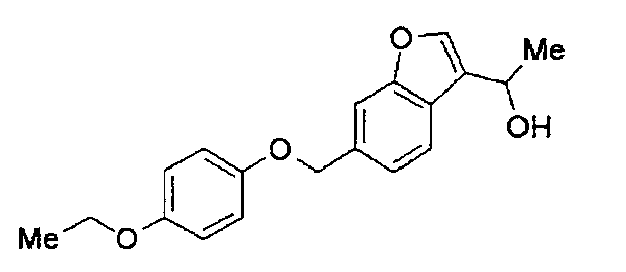
- To a solution of 1-{6-[(4-ethoxyphenoxy)methyl]-1-benzofuran-3-yl}ethanone (117 mg, 0.377 mmol) obtained in Reference Example 20 in methanol (3 mL) was added sodium borohydride (28.6 mg, 0.755 mmol) and the mixture was stirred at room temperature for 1 hr. To the reaction mixture was added brine, and the mixture was extracted twice with ethyl acetate. The extract was washed with saturated brine, and dried over anhydrous magnesium sulfate. The solvent was evaporated under reduced pressure to give the title compound (101 mg, yield 85%) as an oil.
1H NMR (CDCl3) δ 1.39 (q, J = 6.7 Hz, 3H), 1.66 (d, J = 6.6 Hz, 3H), 1.80 (s, 1H), 4.01 (q, J = 6.7 Hz, 2H), 5.12 (s, 2H), 5.14 (br, 1H), 6.71-6.96 (m, 4H), 7.31 (dd, J = 7.9, 1.3 Hz, 1H), 7.53-7.62 (m, 2H), 7.70 (d, J = 7.9 Hz, 1H). -

- To a solution of 1-16-[(4-ethoxyphenoxy)methyl]-1-benzofuran-3-yl}ethanol (101 mg, 0.322 mmol) obtained in Reference Example 21 in DMF (1.1 mL) were successively added dropwise methanesulfonyl chloride (0.038 mL, 0.483 mmol) and triethylamine (0.096 mL, 0.644 mmol) at 0°C, and the mixture was stirred at 0°C for 30 min. Sodium azide (104 mg, 1.61 mmol) was added, and the mixture was stirred at room temperature overnight. To the reaction mixture was added brine, and the mixture was extracted twice with ethyl acetate. The extract was washed with saturated brine, and dried over anhydrous magnesium sulfate. The solvent was evaporated under reduced pressure to give the title compound (114 mg, quantitative) as an oil.
1H NMR (CDCl3) δ 1.35-1.41 (m, 3H), 1.68 (d, J = 6.8 Hz, 3H), 3.93-4.01 (m, 2H), 4.79 (q, J = 7.1 Hz, 1H), 5.13 (s, 2H), 6.80-6.95 (m, 4H), 7.32-7.36 (m, 1H), 7.56-7.61 (m, 2H), 7.63-7.71 (m, 1H). -

- To a solution of 1-[6-(benzyloxy)-1-benzofuran-2-yl]ethanone (25.7 g, 96.6 mmol) in methanol (300 mL) was added sodium borohydride (3.67 g, 96.6 mmol) by small portions, and the mixture was stirred at room temperature for 1 hr. Water was added to the reaction mixture, and the solvent was evaporated. Ethyl acetate was added thereto, and the mixture was washed with water and saturated brine, and dried over anhydrous sodium sulfate. The solvent was evaporated under reduced pressure, and the obtained residue was purified by silica gel column chromatography (petroleum ether:ethyl acetate=5:1) to give the title compound (18.3 g, yield 71%).
1H NMR (CDCl3) δ 1.62 (d, J = 6.6 Hz, 3H), 2.06 (d, J = 5.1 Hz, 1H), 4.96-4.99 (m, 1H), 5.10 (s, 2H), 6.53 (s, 1H), 6.93 (dd, J = 8.7, 2.4 Hz, 1H), 7.06 (dd, J = 8.7, 2.1 Hz, 1H), 7.33-7.47 (m, 6H). -

- To a solution of 1-[6-(benzyloxy)-1-benzofuran-2-yl]ethanol (18.3 g, 68.3 mmol) obtained in Reference Example 23 in toluene (350 mL) were successively added dropwise diphenyl azidophosphate (20.7 mL, 95.6 mmol) and DBU (14.2 mL, 95.6 mmol) at 0°C. The mixture was stirred while gradually allowed to warm to room temperature for 3 hr. Ethyl acetate was added thereto, and the mixture was washed with water, and dried over anhydrous sodium sulfate. The solvent was evaporated under reduced pressure, and the obtained residue was purified by silica gel column chromatography (petroleum ether:ethyl acetate=20:1) to give the title compound (18.0 g, yield 90%) as an oil.
1H NMR (CDCl3) 5 1.63 (d, J = 6.9 Hz, 3H), 4.64 (q, J = 6.9 Hz, 1H), 5.10 (s, 2H), 6.59 (s, 1H), 6.95 (dd, J = 10.8, 5.1 Hz, 1H), 7.09 (d, J = 5.1 Hz, 1H), 7.33-7.48 (m, 6H). -

- To a solution of 2-(1-azidoethyl)-6-(benzyloxy)-1-benzofuran (18.0 g, 61.4 mmol) obtained in Reference Example 24 in THF (400 mL) were added triphenylphosphine (20.9 g, 79.8 mmol) and water (40 mL), and the mixture was refluxed overnight. After evaporation of the solvent, the obtained residue was purified by silica gel column chromatography (petroleum ether:ethyl acetate=5:1 to 2:1, then methylene chloride:methanol=19:1) to give the title compound (18.0 g, yield 90%).
1H NMR (CDCl3) δ 1.50 (d, J = 6.6 Hz, 3H), 1.88 (br, 2H), 4.17 (q, J = 6.6 Hz, 1H), 5.10 (s, 2H), 6.41 (s, 1H), 6.92 (dd, J = 8.7, 2.1 Hz, 1H), 7.05 (d, J = 2.1 Hz, 1H), 7.32-7.48 (m, 6H). -

- To a solution of N-{1-[6-(benzyloxy)-1-benzofuran-2-yl]ethyl}acetamide (7.62 g, 24.7 mmol) obtained in the below-mentioned Example 101 in methanol (200 mL) was added 10% palladium carbon (50% water-containing product, 200 mg), and the mixture was stirred at room temperature under a hydrogen atmosphere for 5 hr. Palladium carbon was removed through silica gel, and the solvent was evaporated. The obtained residue was purified by silica gel column chromatography (methylene chloride:methanol=20:1) to give the title compound (2.60 g, yield 48%) as a white solid.
1H NMR (DMSO-d6) δ 1.40 (d, J = 6.6 Hz, 3H), 1.84 (s, 3H), 5.02-5.07 (m, 1H), 6.54 (s, 1H), 6.69 (dd, J = 8.7, 2.1 Hz, 1H), 6.86 (t, J = 0.9 Hz, 1H), 7.32 (d, J = 8.1 Hz, 1H), 8.32 (d, J = 7.5 Hz, 1H), 9.43 (s, 1H). -

- To a solution of methyl 2-(1-hydroxyethyl)-1-benzofuran-6-carboxylate (1.10 g, 4.99 mmol) in toluene (20 mL) were added diphenyl azidophosphate (1.62 mL, 7.50 mmol) and DBU (1.50 mL, 9.98 mmol), and the mixture was stirred at room temperature for 2.5 hr. Ethyl acetate was added thereto, and the mixture was washed with water, and dried over anhydrous magnesium sulfate. The solvent was evaporated under reduced pressure, and the obtained residue was purified by silica gel column chromatography (hexane:ethyl acetate=20:1 to 2:3) to give the title compound (1.22 g, yield 88%) as an oil.
1H NMR (CDCl3) δ 1.68 (d, J = 6.8 Hz, 3H), 3.95 (s, 3H), 4.72 (q, J = 6.8 Hz, 1H), 6.72 (s, 1H), 7.59 (d, J = 8.3 Hz, 1H), 7.96 (dd, J = 8.3, 1.3 Hz, 1H), 8.17 (s, 1H). -

- To a solution of methyl 2-(1-azidoethyl)-1-benzofuran-6-carboxylate (1.22 g, 4.97 mmol) obtained in Reference Example 28 in THF (20 mL) was added triphenylphosphine (1.51 g, 5.75 mmol), and the mixture was stirred at 60°C for 30 min. To the reaction mixture was added water (0.5 mL), and the mixture was stirred at 60°C for 15 hr. The reaction mixture was allowed to cool to room temperature, saturated aqueous sodium hydrogen carbonate solution (1 mL) and di-tert-butyl bicarbonate (1.37 mL, 5.96 mmol) were added thereto, and the mixture was stirred at room temperature for 15 min. To the reaction mixture was added saturated brine, and the mixture was extracted twice with ethyl acetate. The extract was dried over anhydrous magnesium sulfate. The solvent was evaporated under reduced pressure, and the obtained residue was purified by silica gel column chromatography (hexane:ethyl acetate=19:1 to 3:2) to give the title compound (1.33 g, yield 87%) as an oil.
1H NMR (CDCl3) δ 1.46 (s, 9H), 1.57 (d, J = 6.8 Hz, 3H), 3.94 (s, 3H), 4.86-4.94 (m, 1H), 4.98-5.09 (m, 1H), 6.60 (s, 1H), 7.54 (d, J = 8.1 Hz, 1H), 7.92 (dd, J = 8.1, 1.3 Hz, 1H), 8.12 (s, 1H). -

- To a solution of methyl 2-{1-[(tert-butoxycarbonyl)amino]ethyl}-1-benzofuran-6-carboxylate (1.37 g, 4.31 mmol) obtained in Reference Example 29 in THF (20 mL) was added 1.5 M diisobutylaluminum hydride toluene solution (11.5 mL, 17.2 mmol) at 0°C, and the mixture was stirred at the same temperature for 10 min. To the reaction mixture was added sodium sulfate decahydrate (5.55 g, 17.2 mmol), and the mixture was stirred at room temperature for 30 min. The reaction mixture was filtered. The solvent was evaporated under reduced pressure and the obtained residue was purified by silica gel column chromatography (hexane:ethyl acetate=7:3 to 2:3) to give the title compound (0.870 g, yield 69%) as a white solid.
1H NMR (CDCl3) δ 1.46 (s, 9H), 1.55 (d, J = 6.8 Hz, 3H), 4.78 (d, J = 5.7 Hz, 2H), 4.83-4.91 (m, 1H), 4.96-5.06 (m, 1H), 6.53 (s, 1H), 7.21 (dd, J = 8.0, 1.5 Hz, 1H), 7.46 (s, 1H), 7.49 (d, J = 8.1 Hz, 1H) . -
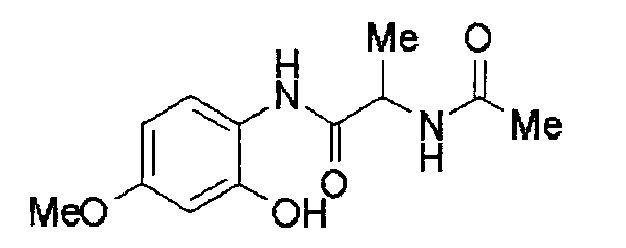
- To a solution of 2-amino-5-methoxyphenol hydrochloride (5.24 g, 29.8 mmol), N-acetyl-D,L-alanine (3.91 g, 29.8 mmol) and 1-hydroxybenzotriazole (4.03 g, 29.8 mmol) in DMF (5 mL) were added triethylamine (4.15 mL, 29.8 mmol) and 1-ethyl-3-(3-dimethylaminopropyl)carbodiimide hydrochloride (5.72 g, 29.8 mmol), and the mixture was stirred at room temperature for 3 days. The reaction mixture was diluted with ethyl acetate, and the mixture was washed with 1N hydrochloric acid, 10% aqueous potassium carbonate solution and saturated brine, and dried over anhydrous sodium sulfate. The solvent was evaporated under reduced pressure, and the obtained residue was purified by basic silica gel column chromatography (ethyl acetate to methanol:ethyl acetate=1:4), and triturated with ethyl acetate to give the title compound (740 mg, yield 9.8%).
1H NMR (CDCl3) δ 1.46 (d, J = 6.9 Hz, 3H), 2.07 (s, 3H), 3.76 (s, 3H), 4.74 (m, 1H), 6.08 (d, J = 7.2 Hz, 1H), 6.41 (dd, J = 2.7, 8.7 Hz, 1H), 6.54 (d, J = 2.7 Hz, 1H), 6.91 (d, J = 8.7 Hz, 1H), 8.91 (s, 1H), 8.93 (br, 1H). -
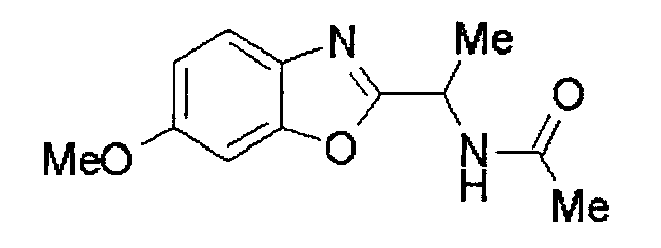
- A suspension of Nα-acetyl-N-(2-hydroxy-4-methoxyphenyl)alaninamide (740 mg, 2.93 mmol) obtained in Reference Example 31 and p-toluenesulfonic acid monohydrate (55.8 mg, 0.293 mmol) in o-xylene(15 mL) was stirred under heating under a nitrogen atmosphere at 140°C for 16 hr. The reaction mixture was diluted with ethyl acetate, and the mixture was washed with 10% aqueous potassium carbonate solution and saturated brine, and dried over anhydrous sodium sulfate. The solvent was evaporated under reduced pressure, and the obtained residue was purified by basic silica gel column chromatography (hexane:ethyl acetate=1:1 to ethyl acetate), and triturated with diisopropyl ether to give the title compound (225 mg, yield 330).
1H NMR (CDCl3) δ 1.63 (d, J = 6.9 Hz, 3H), 2.08 (s, 3H), 3.85 (s, 3H), 5.39 (m, 1H), 6.27 (d, J = 6.9 Hz, 1H), 6.92 (dd, J = 2.4, 9.0 Hz, 1H), 7.03 (d, J = 2.4 Hz, 1H), 7.54 (d, J = 9.0 Hz, 1H). -

- To a solution of N-[1-(6-methoxy-1,3-benzoxazol-2-yl)ethyl]acetamide (223 mg, 0.952 mmol) obtained in Reference Example 32 in methylene chloride (4 mL) was added 1 M boron tribromide methylene chloride solution (3.80 mL, 3.80 mmol) under ice-cooling, and the mixture was stirred at room temperature for 4 hr. To the reaction mixture was added ice, and the mixture was extracted with ethyl acetate. The extract was washed with saturated brine, and dried over anhydrous sodium sulfate. This solution was applied to basic silica gel column chromatography (THF), and the obtained residue was triturated with diisopropyl ether to give the title compound (104 mg, yield 50%). This was used for the next step without purification.
-

- Using 1-(5-hydroxy-1-benzofuran-2-yl)ethanone (1.15 g, 6.53 mmol), DMF (10 mL), tert-butyldimethylchlorosilane (1.07 g, 7.18 mmol) and imidazole (666 mg, 9.80 mmol), an operation in the same manner as in Reference Example 16 was performed to give the title compound (1.76 g, yield 98%).
1H NMR (CDCl3) δ 0.19-0.25 (m, 6H), 0.97-0.04 (m, 9H), 2.59 (s, 3H), 7.00 (dd, J = 8.9, 2.4 Hz, 1H), 7.09 (d, J = 2.3 Hz, 1H), 7.38-7.46 (m, 2H).
To a solution of 1-(5-hydroxy-1-benzofuran-2-yl)ethanone (1.15 g, 6.53 mmol) in DMF (10 mL) were added tert-butyldimethylchlorosilane (1.07 g, 7.18 mmol) and imidazole (666 mg, 9.80 mmol), and the mixture was stirred at room temperature overnight. To the reaction mixture was added brine, and the mixture was extracted with ethyl acetate. The extract was washed with saturated brine, and dried over anhydrous magnesium sulfate. The solvent was evaporated under reduced pressure, and the obtained residue was purified by silica gel column chromatography (hexane:ethyl acetate=19:1 to 7:3) to give the title compound (1.76 g, yield 98%).
1H NMR (CDCl3) δ 0.21 (s, 6H), 1.00 (s, 9H), 2.59 (s, 3H), 7.00 (dd, J=8.9, 2.5 Hz, 1H), 7.09 (d, J=2.5 Hz, 1H), 7.39-7.45 (m, 2H). -

- Using 1-(5-{[tert-butyl(dimethyl)silyl]oxy}-1-benzofuran-2-yl)ethanone (1.76 g, 6.37 mmol) obtained in Reference Example 34, methanol (18 mL) and sodium borohydride (484 mg, 12.7 mmol), an operation in the same manner as in Reference Example 23 was performed to give the title compound (1.60 g, yield 90%).
1H NMR (CDCl3) δ 0.20 (s, 6H), 1.02 (s, 9H), 1.55 (d, J = 7.2 Hz, 3H), 2.04 (s, 1H), 4.89-5.07 (m, 1H), 6.51 (s, 1H), 6.77 (dd, J = 8.8, 2.3 Hz, 1H), 6.96 (d, J = 2.3 Hz, 1H), 7.21-7.32 (m, 1H).
To a solution of 1-(5-{[tert-butyl(dimethyl)silyl]oxy}-1-benzofuran-2-yl)ethanone (1.76 g, 6.37 mmol) obtained in Reference Example 34 in methanol (18 mL) was added sodium borohydride (484 mg, 12.7 mmol) by small portions, and the mixture was stirred at room temperature for 1.5 hr. Water was added to the reaction mixture, and the solvent was evaporated. Ethyl acetate was added thereto, and the mixture was washed with water and saturated brine, and dried over anhydrous magnesium sulfate. The solvent was evaporated under reduced pressure to give the title compound (1.60 g, yield 90%) as an oil.
1H NMR (CDCl3) δ 0.19 (s, 6H), 1.00 (s, 9H), 1.62 (d, J = 7.2 Hz, 3H), 2.04 (s, 1H), 4.96-5.02 (m, 1H), 6.51 (s, 1H), 6.77 (dd, J = 8.8, 2.3 Hz, 1H), 6.96 (d, J = 2.3 Hz, 1H), 7.25-7.33 (m, 1H). -

- To a solution of 1-(5-{[tert-butyl(dimethyl)silyl]oxy}-1-benzofuran-2-yl)ethanol (1.60 g, 5.76 mmol) obtained in Reference Example 35 in anhydrous DMF (5.8 mL) were successively added dropwise methanesulfonyl chloride (0.665 mL, 8.64 mmol) and triethylamine (1.71 mL, 11.5 mmol) at 0°C, and the mixture was stirred at the same temperature for 30 min. Sodium azide (1.87 g, 28.8 mmol) was added thereto, and the mixture was further stirred at room temperature overnight. To the reaction mixture was added brine, and the mixture was extracted twice with ethyl acetate. The extract was washed with saturated brine, and dried over anhydrous magnesium sulfate. The solvent was evaporated under reduced pressure, and the obtained residue was purified by silica gel column chromatography (hexane to hexane:ethyl acetate=4:1) to give the title compound (1.12 g, yield 61%) as an oil.
1H NMR (CDCl3) δ 0.19 (s, 6H), 1.00 (s, 9H), 1.64 (d, J = 6.8 Hz, 3H), 4.65 (q, J = 6.8 Hz, 1H), 6.56 (s, 1H), 6.80 (dd, J = 9.0, 2.5 Hz, 1H), 6.97 (d, J = 2.5 Hz, 1H), 7.30 (d, J = 9.0 Hz, 1H). -

- To a solution of {[2-(1-azidoethyl)-1-benzofuran-5-yl]oxy}(tert-butyl)dimethylsilane (1.12 g, 3.53 mmol) obtained in Reference Example 36 in THF (7 mL) and water (1 mL) was added triphenylphosphine (1.38 g, 5.29 mmol), and the mixture was stirred at 50°C overnight. To the reaction mixture was added brine, and the mixture was extracted with ethyl acetate. The extract was dried over anhydrous magnesium sulfate. The solvent was evaporated under reduced pressure, and the obtained residue was directly used for the next reaction. To the obtained residue were added ethyl acetate (5 mL) and acetic anhydride (0.67 mL, 7.1 mmol) and the mixture was stirred at room temperature for 10 min. The solvent was evaporated under reduced pressure, and the obtained residue was purified by basic silica gel column chromatography (hexane:ethyl acetate=9:1 to 1:4) to give the title compound (931 mg, yield 79%).
1H NMR (CDCl3) δ 0.18 (s, 6H), 0.99 (s, 9H), 1.55 (d, J = 7.0 Hz, 3H), 2.01 (s, 3H), 5.24-5.38 (m, 1H), 5.81 (br, 1H), 6.47 (s, 1H), 6.77 (dd, J = 8.8, 2.4 Hz, 1H), 6.93 (d, J = 2.4 Hz, 1H), 7.23-7.28 (m, 1H). -

- To a solution of N-[1-(5-{[tert-butyl(dimethyl)silyl]oxy}-1-benzofuran-2-yl)ethyl]acetamide (931 mg, 2.79 mmol) obtained in Reference Example 37 in THF (5 mL) was added 1 M tetrabutylammonium fluoride THF solution (3.63 mL, 3.63 mmol) and the mixture was stirred at room temperature for 2 hr. To the reaction mixture was added aqueous saturated ammonium chloride, and the mixture was extracted twice with ethyl acetate. The extract was washed with aqueous saturated ammonium chloride and saturated brine, dried over anhydrous sodium sulfate, and the solution was passed through silica gel. The solvent was evaporated under reduced pressure, and the obtained white solid was washed with diisopropyl ether to give the title compound (525 mg, yield 86%).
1H NMR (CDCl3) δ 1.55 (d, J = 7.0 Hz, 3H), 2.01 (s, 3H), 4.77 (s, 1H), 5.24-5.42 (m, 1H), 5.76 (br, 1H), 6.47 (s, 1H), 6.77 (dd, J = 8.8, 2.5 Hz, 1H), 6.92 (d, J = 2.5 Hz, 1H), 7.24-7.31 (m, 1H). -

- To a solution of ethyl 6-methoxy-1-benzothiophene-2-carboxylate (5.58 g, 23.6 mmol) in methylene chloride (50 mL) was added dropwise 1 M boron tribromide methylene chloride solution (71 mL, 70.8 mmol) at -20°C, and the mixture was stirred at room temperature for 3 hr. The reaction mixture was poured into ice, and the mixture was extracted twice with ethyl acetate. The extract was washed with saturated brine and dried over anhydrous sodium sulfate. The solvent was evaporated under reduced pressure, and the obtained residue was purified by silica gel column chromatography (hexane to hexane:ethyl acetate=3:2) to give the title compound (1.76 g, yield 34%) as a white solid.
1H NMR (CDCl3) δ 1.41 (t, J = 7.1 Hz, 3H), 4.39 (q, J = 7.1 Hz, 2H), 5.48 (s, 1H), 6.96 (dd, J = 8.7, 2.3 Hz, 1H), 7.25-7.30 (m, 1H), 7.73 (d, J = 8.7 Hz, 1H), 7.97 (s, 1H). -

- Using ethyl 6-hydroxy-1-benzothiophene-2-carboxylate (1.76 g, 7.93 mmol) obtained in Reference Example 39, DMF (8 mL), tert-butyldimethylchlorosilane (1.31 g, 8.72 mmol) and imidazole (809 mg, 11.9 mmol), an operation in the same manner as in Reference Example 16 was performed to give the title compound (2.54 g, yield 95%). 1H NMR (CDCl3) δ 0.21 (s, 6H), 1. 00 (s, 9H), 1.40 (t, J = 7.2 Hz, 3H), 4.39 (q, J = 7.2 Hz, 2H), 6.93 (dd, J = 8.7, 2.1 Hz, 1H), 7.26 (s, 1H), 7.71 (d, J = 8.7 Hz, 1H), 7.96 (d, J = 0.75 Hz, 1H).
-
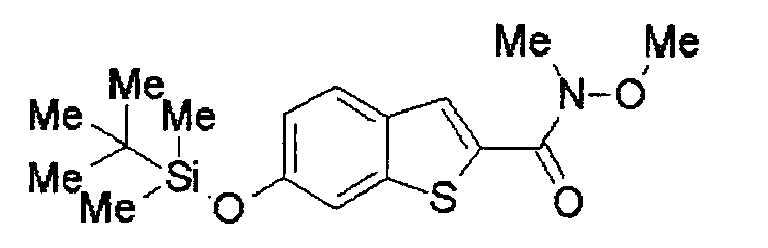
- Using ethyl 6-{[tert-butyl(dimethyl)silyl]oxy}-1-benzothiophene-2-carboxylate (2.54 g, 7.55 mmol) obtained in Reference Example 40, anhydrous THF (46 mL), N,O-dimethylhydroxylamine hydrochloride (3.66 g, 37.8 mmol) and 1.6 M n-butyllithium hexane solution (48 mL, 75.6 mmol), an operation in the same manner as in Reference Example 18 was performed to give the title compound (2.65 g, quantitative).
1H NMR (CDCl3) δ 0.23 (s, 6H), 1.00 (s, 9H), 3.41 (s, 3H), 3.82 (s, 3H), 6.93 (dd, J = 8.7, 2.3 Hz, 1H), 7.21-7.29 (m, 1H), 7.72 (d, J = 8.7 Hz, 1H), 8.11 (s, 1H). -

- Using 6-([tert-butyl(dimethyl)silyl]oxy)-N-methoxy-N-methyl-1-benzothiophene-2-carboxamide (2.65 g, 7.55 mmol) obtained in Reference Example 41, anhydrous THF (16 mL) and 1 M methylmagnesium bromide THF solution (15.1 mL, 15.1 mmol), an operation in the same manner as in Reference Example 19 was performed to give the title compound (1.19 g, yield 52%).
1H NMR (CDCl3) δ 0.25 (s, 6H), 1.03 (s, 9H), 2.62 (s, 3H), 6.94 (dd, J = 8.7, 2.2 Hz, 1H), 7.22-7.32 (m, 1H), 7.73 (d, J = 8.7 Hz, 1H), 7.85 (s, 1H). -

- Using 1-(6-{[tert-butyl(dimethyl)silyl]oxy}-1-benzothiophen-2-yl)ethanone (1.19 g, 3.89 mmol) obtained in Reference Example 42, methanol (7 mL) and sodium borohydride (294 mg, 7.76 mmol), an operation in the same manner as in Reference Example 21 was performed to give the title compound (950 mg, yield 79%).
1H NMR (CDCl3) δ 0.20 (s, 6H), 1.00 (s, 9H), 1.64 (d, J = 6.4 Hz, 3H), 2.00 (d, J = 4.7 Hz, 1H), 5.09-5.24 (m, 1H), 6.87 (dd, J = 8.7, 2.3 Hz, 1H), 7.09 (s, 1H), 7.23-7.28 (m, 1H), 7.55 (d, J = 8.5 Hz, 1H). -

- Using 1-(6-{[tert-butyl(dimethyl)silyl]oxy}-1-benzothiophen-2-yl)ethanol (101 mg, 0.322 mmol) obtained in Reference Example 43, DMF (1.1 mL), methanesulfonyl chloride (0.356 mL, 4.63 mmol), triethylamine (0.915 mL, 6.16 mmol) and sodium azide (1.00 mg, 15.4 mmol), an operation in the same manner as in Reference Example 22 was performed to give the title compound (759 mg, yield 74%) as an oil.
1H NMR (CDCl3) δ 0.22 (s, 6H), 1.00 (s, 9H), 1.65 (d, J = 6.8 Hz, 3H), 4.84 (q, J = 6.8 Hz, 1H), 6.89 (dd, J = 8.7, 2.3 Hz, 1H), 7.14 (s, 1H), 7.23-7.28 (m, 1H), 7.57 (d, J=8.3 Hz, 1H). -

- Using {[2-(1-azidoethyl)-1-benzothiophen-6-yl]oxy}(tert-butyl)dimethylsilane (759 mg, 2.27 mmol) obtained in Reference Example 44, THF (5 mL), water (1 mL), triphenylphosphine (894 mg, 3.41 mmol), ethyl acetate (5 mL) and acetic anhydride (0.42 mL, 4.54 mmol) and an operation in the same manner as in Reference Example 37 was performed to give the title compound (765 mg, yield 97%).
1H NMR (CDCl3) δ 0.22 (s, 6H), 1.00 (s, 9H), 1.62 (d, J = 6.8 Hz, 3H), 2.01 (s, 3H), 5.33-5.50 (m, 1H), 5.73 (br, 1H), 6.87 (dd, J = 8.6, 2.3 Hz, 1H), 7.09 (s, 1H), 7.22 (d, J = 2.3 Hz, 1H), 7.50-7.56 (m, 1H) . -

- Using N-[1-(6-{[tert-butyl(dimethyl)silyl]oxy}-1-benzothiophen-2-yl)ethyl]acetamide (765 mg, 2.19 mmol) obtained in Reference Example 45, THF (2.2 mL) and 1 M tetrabutylammonium fluoride THF solution (2.85 mL, 2.85 mmol) and an operation in the same manner as in Reference Example 38 was performed to give the title compound (373 mg, yield 72%) as a white solid.
1H NMR (CDCl3) δ 1.62 (d, J = 6.8 Hz, 3H), 2.02 (s, 3H), 5.16 (s, 1H), 5.39-5.52 (m, 1H), 5.72 (br, 1H), 6.88 (dd, J = 8.5, 2.5 Hz, 1H), 7.08 (s, 1H), 7.26 (s, 1H), 7.55 (d, J=8.5 Hz, 1H). -

- To a solution of methyl 2-hydroxy-4-iodobenzoate (1.00 g, 3.60 mmol) and 1-ethoxy-4-ethynylbenzene (789 mg, 5.40 mmol) and copper(I) iodide (68.6 mg, 0.360 mmol) in triethylamine (9 mL) was added bis(triphenylphosphine)palladium(II) chloride (253 mg, 0.360 mmol), and the mixture was stirred under an argon stream at room temperature for 15 min. The reaction mixture was diluted with ethyl acetate, and the mixture was washed with water, and dried over anhydrous magnesium sulfate. The solvent was evaporated under reduced pressure and the obtained residue was dissolved in DMF (10 mL). Potassium carbonate (2.59 g, 18.8 mmol) and chloromethyl methyl ether (1.07 mL, 14.0 mmol) were added thereto, and the mixture was stirred at room temperature for 20 min. Water was added to the reaction mixture, and the mixture was extracted with ethyl acetate. The extract was washed twice with saturated brine, and dried over anhydrous magnesium sulfate. The solvent was evaporated under reduced pressure and the obtained residue was purified by silica gel column chromatography (hexane:ethyl acetate=9:1 to 1:1) to give the title compound (623 mg, yield 51%) as a yellow solid.
1H NMR (CDCl3) δ 1.43 (t, J=7.0 Hz, 3H), 3.54 (s, 3H), 3.89 (s, 3H), 4.05 (q, J = 7.0 Hz, 2H), 5.28 (s, 2H), 6.87 (d, J = 8.9 Hz, 2H), 7.17 (dd, J = 8.0, 1.4 Hz, 1H), 7.33 (d, J = 1.4 Hz, 1H), 7.47 (d, J = 8.9 Hz, 2H), 7.76 (d, J = 8.0 Hz, 1H). -

- A solution of methyl 4-[(4-ethoxyphenyl)ethynyl]-2-(methoxymethoxy)benzoate (623 mg, 1.83 mmol) obtained in Reference Example 47 and 10% palladium carbon (50% water-containing product, 1.00 g) in ethanol (5 mL)-THF (1 mL) was stirred under a hydrogen atmosphere (normal pressure) for 30 min. After filtration, the filtrate was concentrated under reduced pressure, a solution of the obtained residue in THF (5 mL) was added to a suspension of lithium aluminum hydride (100 mg, 2.63 mmol) in THF (5 mL), and the mixture was stirred at room temperature for 15 min. To the reaction mixture were successively added water (0.10 mL), 15% aqueous sodium hydroxide solution (0.10 mL) and water (0.30 mL), and the mixture was stirred at room temperature for 15 min. After filtration, the filtrate was concentrated under reduced pressure, and the obtained residue was purified by silica gel column chromatography (hexane:ethyl acetate=4:1 to 2:3) to give the title compound (415 mg, yield 71%) as an oil.
1H NMR (CDCl3) δ 1.40 (t, J = 7.0 Hz, 3H), 2.21 (t, J = 6.5 Hz, 1H), 2.82-2.89 (m, 4H), 3.49 (s, 3H), 4.01 (q, J = 7.0 Hz, 2H), 4.67 (d, J = 6.5 Hz, 2H), 5.20 (s, 2H), 6.79-6.84 (m, 3H), 6.89 (d, J = 1.3 Hz, 1H), 7.07 (d, J = 8.7 Hz, 2H), 7.20 (d, J = 7.5 Hz, 1H). -

- To a solution of {4-[2-(4-ethoxyphenyl)ethyl]-2-(methoxymethoxy)phenyl}methanol (415 mg, 1.32 mmol) obtained in Reference Example 48 in acetonitrile (10 mL) were added molecular sieves 4A (powder, 0.75 g), 4-methylmorpholine N-oxide (232 mg, 1.98 mmol) and tetrapropylammonium perruthenate (23.1 mg, 0.0656 mmol), and the mixture was stirred at room temperature for 15 min. The reaction mixture was filtered. The solvent was evaporated under reduced pressure, and the obtained residue was purified by silica gel column chromatography (hexane:ethyl acetate=19:1 to 3:2) to give the title compound (345 mg, yield 83%) as an oil.
1H NMR (CDCl3) δ 1.40 (t, J = 7.0 Hz, 3H), 2.83-2.95 (m, 4H), 3.51 (s, 3H), 4.01 (q, J = 7.0 Hz, 2H), 5.24 (s, 2H), 6.81 (d, J = 8.7 Hz, 2H), 6.89 (d, J = 7.9 Hz, 1H), 6.94 (d, J = 1.1 Hz, 1H), 7.04 (d, J = 8.7 Hz, 2H), 7.75 (d, J = 7.9 Hz, 1H), 10.43 (d, J = 0.6 Hz, 1H). -

- To a solution of 4-[2-(4-ethoxyphenyl)ethyl]-2-(methoxymethoxy)benzaldehyde (345 mg, 1.10 mmol) obtained in Reference Example 49 in THF (5 mL) was added 6N hydrochloric acid (2 mL) and the mixture was stirred at 60°C for 2 hr. The reaction mixture was neutralized with saturated aqueous sodium hydrogen carbonate solution, and the mixture was extracted twice with ethyl acetate. The extract was dried over anhydrous magnesium sulfate. The solvent was evaporated under reduced pressure and the obtained residue was purified by silica gel column chromatography (hexane:ethyl acetate=19:1 to 7:13) to give the title compound (255 mg, yield 86%) as a white solid.
1H NMR (CDCl3) δ 1.40 (t, J = 7.0 Hz, 3H), 2.83-2.94 (m, 4H), 4.01 (q, J = 7.0 Hz, 2H), 6.78-6.83 (m, 4H), 7.05 (d, J = 8.7 Hz, 2H), 7.43 (d, J=8.3 Hz, 1H), 9.83 (s, 1H), 11.03 (s, 1H) . -

- To a solution of 4-[2-(4-ethoxyphenyl)ethyl]-2-hydroxybenzaldehyde (255 mg, 0.943 mmol) obtained in Reference Example 50 in acetonitrile (10 mL) were added potassium carbonate (262 mg, 1.89 mmol) and bromoacetone (0.120 mL, 1.42 mmol), and the mixture was stirred at 80°C for 13 hr. Water was added to the reaction mixture, and the mixture was extracted twice with ethyl acetate, and the combined organic layer was dried over anhydrous magnesium sulfate. The solvent was evaporated and the obtained residue was purified by silica gel column chromatography (hexane:ethyl acetate=19:1 to 3:2) to give the title compound (234 mg, yield 80%) as a white solid.
1H NMR (CDCl3) δ 1.40 (t, J = 7.0 Hz, 3H), 2.59 (s, 3H), 2.88-2.93 (m, 2H), 3.01-3.06 (m, 2H), 4.01 (q, J = 7.0 Hz, 2H), 6.80 (d, J = 8.7 Hz, 2H), 7.06 (d, J = 8.7 Hz, 2H), 7.13 (dd, J = 8.1, 1.3 Hz, 1H), 7.34 (s, 1H), 7.47 (d, J = 1.3 Hz, 1H), 7.59 (d, J = 8.1 Hz, 1H). -
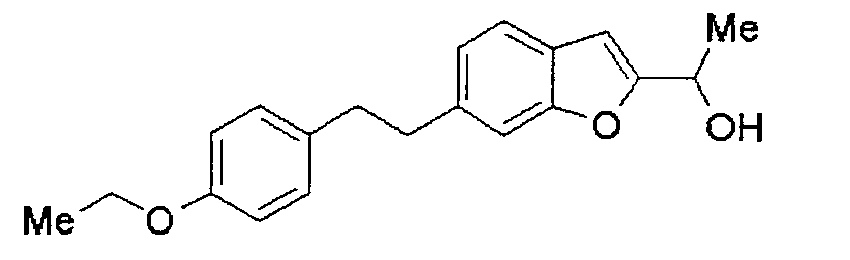
- To a solution of 1-{6-[2-(4-ethoxyphenyl)ethyl]-1-benzofuran-2-yl}ethanone (234 mg, 0.759 mmol) obtained in Reference Example 51 in THF (2 mL)-methanol (5 mL) was added sodium borohydride (28.8 mg, 0.759 mmol), and the mixture was stirred at room temperature for 10 min. To the reaction mixture was added aqueous ammonium chloride solution, and the mixture was extracted twice with ethyl acetate. The combined organic layer was dried over anhydrous magnesium sulfate. The solvent was evaporated and the obtained residue was purified by silica gel column chromatography (hexane:ethyl acetate=4:1 to 1:1) to give the title compound (229 mg, yield 97%) as an oil.
1H NMR (CDCl3) δ 1.26 (t, J = 7.0 Hz, 3H), 1.63 (d, J = 6.4 Hz, 3H), 2.86-2.92 (m, 2H), 2.96-3.02 (m, 2H), 4.01 (q, J = 7.0 Hz, 2H), 4.96-5.04 (m, 1H), 6.56 (s, 1H), 6.81 (d, J = 8.7 Hz, 2H), 7.03 (dd, J = 8.1, 1.5 Hz, 1H), 7.08 (d, J = 8.7 Hz, 2H), 7.42 (d, J = 8.1 Hz, 1H) . -

- Using 1-{6-[2-(4-ethoxyphenyl)ethyl]-1-benzofuran-2-yl}ethanol (230 mg, 0.741 mmol) obtained in Reference Example 52, an operation in the same manner as in Reference Example 28 was performed to give the title compound (237 mg, yield 95%) as an oil.
1H NMR (CDCl3) δ 1.40 (t, J = 7.0 Hz, 3H), 1.65 (d, J = 6.8 Hz, 3H), 2.86-2.92 (m, 2H), 2.97-3.02 (m, 2H), 4.01 (q, J = 7.0 Hz, 2H), 4.67 (q, J = 6.8 Hz, 1H), 6.62 (s, 1H), 6.81 (d, J = 8.7 Hz, 2H), 7.04-7.10 (m, 3H), 7.28 (s, 1H), 7.44 (d, J = 8.0 Hz, 1H). -

- To a solution of 2,4-dihydroxy-3-methylbenzaldehyde (1.00 g, 6.57 mmol) in DMF (20 mL) were added potassium carbonate (1.36 g, 9.86 mmol) and 1-(chloromethyl)-4-ethoxybenzene (1.23 g, 7.23 mmol), and the mixture was stirred at room temperature for 15 hr. Water was added to the reaction mixture, and the mixture was extracted with ethyl acetate. The organic layer was washed twice with saturated brine, and dried over anhydrous magnesium sulfate. The solvent was evaporated under reduced pressure and the obtained residue was purified by silica gel column chromatography (hexane:ethyl acetate=9:1 to 3:2) to give the title compound (336 mg, yield 18%)
as a white solid.
1H NMR (CDCl3) δ 1.42 (t, J = 7.0 Hz, 3H), 2.13 (s, 3H), 4.05 (q, J = 7.0 Hz, 2H), 5.10 (s, 2H), 6.61 (d, J=8.7 Hz, 1H), 6.92 (d, J = 8.7 Hz, 2H), 7.32-7.36 (m, 3H), 9.71 (s, 1H), 11.45 (s, 1H). -

- Using 4-[(4-ethoxybenzyl)oxy]-2-hydroxy-3-methylbenzaldehyde (336 mg, 1.17 mmol) obtained in Reference Example 54, an operation in the same manner as in Reference Example 51 was performed to give the title compound (326 mg, yield 85%) as a yellow solid.
1H NMR (CDCl3) δ 1.42 (t, J = 7.0 Hz, 3H), 2.44 (s, 3H), 2.58 (s, 3H), 4.05 (q, J = 7.0 Hz, 2H), 5.09 (s, 2H), 6.91 (d, J = 8.7 Hz, 2H), 7.01 (d, J = 8.7 Hz, 1H), 7.35 (d, J = 8.7 Hz, 2H), 7.44-7.46 (m, 2H) . -

- Using 1-{6-[(4-ethoxybenzyl)oxy]-7-methyl-1-benzofuran-2-yl}ethanone (326 mg, 1.00 mmol) obtained in Reference Example 55, an operation in the same manner as in Reference Example 52 was performed to give the title compound (285 mg, yield 88%) as an oil.
1H NMR (CDCl3) δ 1. 42 (t, J = 7.0 Hz, 3H), 1. 63 (d, J = 6.6 Hz, 3H), 2.40 (s, 3H), 4.04 (q, J = 7.0 Hz, 2H), 5.04 (s, 2H), 6.52 (d, J = 0.6 Hz, 1H), 6.89-6.91 (m, 3H), 7.25-7.27 (m, 1H), 7.36 (d, J = 8.7 Hz, 2H). -

- Using 1-{6-[(4-ethoxybenzyl)oxy]-7-methyl-1-benzofuran-2-yl}ethanol (285 mg, 0.873 mmol) obtained in Reference Example 56, an operation in the same manner as in Reference Example 28 was performed to give the title compound (227 mg, yield 74%) as an oil.
1H NMR (CDCl3) δ 0.89-0.91 (m, 3H), 1.64 (d, J = 7.0 Hz, 3H), 2.40 (s, 3H), 4.04 (q, J = 7.0 Hz, 2H), 5.04 (s, 2H), 6.58 (d, J = 0.6 Hz, 1H), 6.89-6.93 (m, 3H), 7.23-7.29 (m, 1H), 7.36 (d, J = 8.7 Hz, 2H). -

- Using 1-(5-bromo-1-benzothiophen-2-yl)ethanone (1.29 g, 5.06 mmol), an operation in the same manner as in Reference Example 52 was performed to give the title compound (1.17 g, yield 90%) as an oil.
1H NMR (CDCl3) δ 1.65 (d, J = 6.4 Hz, 3H), 2.08 (d, J = 4.7 Hz, 1H), 5.16-5.24 (m, 1H), 7.12 (s, 1H), 7.39 (dd, J = 8.5, 1.9 Hz, 1H), 7.66 (d, J = 8.5 Hz, 1H), 7.85 (d, J = 1.9 Hz, 1H). -

- Using 1-(5-bromo-1-benzothiophen-2-yl)ethanol (1.17 g, 4.55 mmol) obtained in Reference Example 58, an operation in the same manner as in Reference Example 28 was performed to give the title compound (1.23 g, yield 95%) as an oil.
1H NMR (CDCl3) δ 1.67 (d, J = 6.8 Hz, 3H), 4.88 (q, J = 6.8 Hz, 1H), 7.16 (s, 1H), 7.43 (dd, J = 8.7, 1.9 Hz, 1H), 7.67 (d, J = 8.7 Hz, 1H), 7.88 (d, J = 1.9 Hz, 1H). -

- Using 2-(1-azidoethyl)-5-bromo-1-benzothiophene (1.23 g, 4.36 mmol) obtained in Reference Example 59, an operation in the same manner as in Reference Example 29 was performed to give the title compound (1.13 g, yield 72%) as a white solid.
1H NMR (CDCl3) δ 1.46 (s, 9H), 1.60 (d, J = 6.8 Hz, 3H), 4.86 (br, 1H), 5.12 (br, 1H), 7.08 (s, 1H), 7.38 (dd, J = 8.7, 1.9 Hz, 1H), 7.63 (d, J = 8.7 Hz, 1H), 7.83 (d, J = 1.9 Hz, 1H). -

- To a solution of tert-butyl [1-(5-bromo-1-benzothiophen-2-yl)ethyl]carbamate (1.13 g, 3.18 mmol) obtained in Reference Example 60 in DMF (10 mL)-methanol (6 mL) were added triethylamine (0.887 mL, 6.36 mmol) and [1,1'-bis(diphenylphosphino)ferrocene]palladium(II) dichloride dichloromethane complex (1:1) (260 mg, 0.318 mmol), and the mixture was stirred under a carbon monooxide atmosphere (normal pressure) at 80°C for 15 hr. The reaction mixture was diluted with ethyl acetate, and the mixture was washed three times with saturated brine, and dried over anhydrous magnesium sulfate. The solvent was evaporated under reduced pressure and the obtained residue was purified by silica gel column chromatography (hexane:ethyl acetate=17:3 to 1:1) to give the title compound (854 mg, yield 80%)
as a white solid.
1H NMR (CDCl3) δ 1.46 (s, 9H), 1.62 (d, J = 6.8 Hz, 3H), 3.95 (s, 3H), 4.89 (br, 1H), 5.14 (br, 1H), 7.22 (s, 1H), 7.81 (d, J = 8.3 Hz, 1H), 7.95 (dd, J = 8.3, 1.5 Hz, 1H), 8.40 (d, J = 1.5 Hz, 1H). -

- Using methyl 2-{1-[(tert-butoxycarbonyl)amino]ethyl}-1-benzothiophene-5-carboxylate (854 mg, 2.55 mmol) obtained in Reference Example 61, an operation in the same manner as in Reference Example 30 was performed to give the title compound (534 mg, yield 68%).
1H NMR (CDCl3) δ 1.46 (s, 9H), 1.60 (d, J = 6.8 Hz, 3H), 4.78 (d, J = 5.7 Hz, 2H), 4.87 (br, 1H), 5.12 (br, 1H), 7.14 (s, 1H), 7.30 (d, J = 8.3 Hz, 1H), 7.69 (s, 1H), 7.76 (d, J = 8.3 Hz, 1H). -

- Using 3-bromo-6-hydroxy-2-methylbenzaldehyde (560 mg, 2.60 mmol), an operation in the same manner as in Reference Example 51 was performed to give the title compound (425 mg, yield 65%) as a yellow solid.
1H NMR (CDCl3) δ 2.59 (s, 3H), 2.62 (s, 3H), 7.30 (d, J = 8.7 Hz, 1H) , 7.52 (s, 1H), 7.61 (d, J=8.7 Hz, 1H). -

- Using 1-(5-bromo-4-methyl-1-benzofuran-2-yl)ethanone (425 mg, 1.68 mmol) obtained in Reference Example 63, an operation in the same manner as in Reference Example 52 was performed to give the title compound (359 mg, yield 83%) as an oil.
1H NMR (CDCl3) δ 1.64 (d, J = 6.6 Hz, 3H), 2.53 (s, 3H), 4.97-5.05 (m, 1H), 6.63 (s, 1H), 7.17 (d, J = 8.7 Hz, 1H), 7.41 (d, J = 8.7 Hz, 1H). -

- Using 1-(5-bromo-4-methyl-1-benzofuran-2-yl)ethanol (359 mg, 1.41 mmol) obtained in Reference Example 64, an operation in the same manner as in Reference Example 28 was performed to give the title compound (342 mg, yield 87%) as an oil.
1H NMR (CDCl3) δ 1.66 (d, J = 6.8 Hz, 3H), 2.54 (s, 3H), 4.69 (q, J = 6.8 Hz, 1H), 6.67 (s, 1H), 7.19 (d, J = 8.7 Hz, 1H), 7.44 (d, J = 8.7 Hz, 1H). -

- Using 2-(1-azidoethyl)-5-bromo-4-methyl-1-benzofuran (342 mg, 1.22 mmol) obtained in Reference Example 65, an operation in the same manner as in Reference Example 29 was performed to give the title compound (392 mg, yield 90%) as an oil.
1H NMR (CDCl3) δ 1.46 (s, 9H), 1.55 (d, J = 6.8 Hz, 3H), 2.51 (s, 3H), 4.87 (br, 1H), 4.99 (br, 1H), 6.55 (s, 1H), 7.14 (d, J = 8.7 Hz, 1H), 7.39 (d, J = 8.7 Hz, 1H). -

- Using tert-butyl [1-(5-bromo-4-methyl-1-benzofuran-2-yl)ethyl]carbamate (392 mg, 1.11 mmol) obtained in Reference Example 66, an operation in the same manner as in Reference Example 61 was performed to give the title compound (370 mg, quantitative) as an oil.
1H NMR (CDCl3) δ 1.46 (s, 9H), 1.56 (d, J = 6.8 Hz, 3H), 2.74 (s, 3H), 3.90 (s, 3H), 4.89 (br, 1H), 5.02 (br, 1H), 6.66 (s, 1H), 7.26-7.30 (m, 1H), 7.88 (d, J = 8.7 Hz, 1H). -

- Using methyl 2-{1-[(tert-butoxycarbonyl)amino]ethyl}-4-methyl-1-benzofuran-5-carboxylate (377 mg, 1.14 mmol) obtained in Reference Example 67, an operation in the same manner as in Reference Example 30 was performed to give the title compound (177 mg, yield 51%) as an oil.
1H NMR (CDCl3) δ 1.46 (s, 9H), 1.55 (d, J = 5.3 Hz, 3H), 2.51 (s, 3H), 4.77 (d, J = 5.7 Hz, 2H), 4.89 (br, 1H), 5.01 (br, 1H), 6.58 (s, 1H), 7.22-7.28 (m, 2H). -
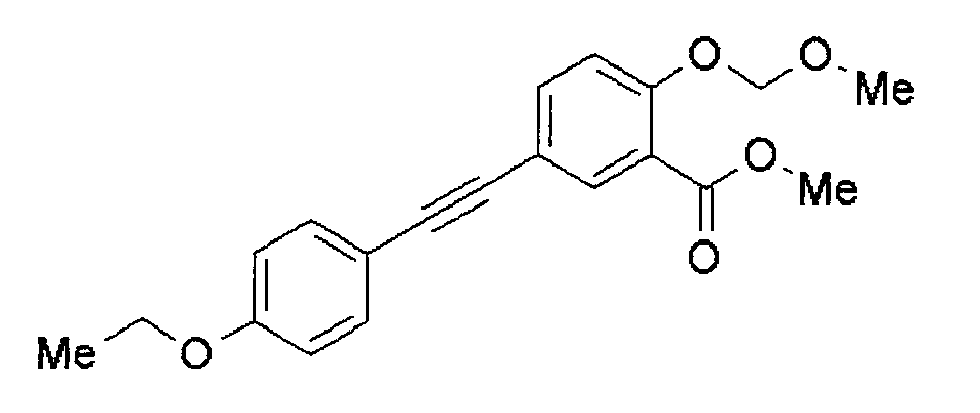
- Using methyl 2-hydroxy-5-iodobenzoate (2.78 g, 10.0 mmol), an operation in the same manner as in Reference Example 47 was performed to give the title compound (880 mg, yield 26%) as a yellow solid.
1H NMR (CDCl3) δ 1.42 (t, J = 7.0 Hz, 3H), 3.52 (s, 3H), 3.90 (s, 3H), 4.05 (q, J = 7.0 Hz, 2H), 5.27 (s, 2H), 6.86 (d, J = 8.7 Hz, 2H), 7.17 (d, J = 8.7 Hz, 1H), 7.43 (d, J = 8.7 Hz, 2H), 7.56 (dd, J = 8.7, 2.3 Hz, 1H), 7.94 (d, J = 2.3 Hz, 1H). -

- Using methyl 5-[(4-ethoxyphenyl)ethynyl]-2-(methoxymethoxy)benzoate (880 mg, 2.59 mmol) obtained in Reference Example 69, an operation in the same manner as in Reference Example 48 was performed to give the title compound (756 mg, yield 92%) as an oil.
1H NMR (CDCl3) δ 1.40 (t, J = 7.0 Hz, 3H), 2.79-2.85 (m, 4H), 3.49 (s, 3H), 4.01 (q, J = 7.0 Hz, 2H), 4.68 (d, J = 6.6 Hz, 2H), 5.21 (s, 2H), 6.81 (d, J = 8.7 Hz, 2H), 6.99-7.14 (m, 5H). -

- Using {5-[2-(4-ethoxyphenyl)ethyl]-2-(methoxymethoxy)phenyl}methanol (756 mg, 2.39 mmol) obtained in Reference Example 70, an operation in the same manner as in Reference Example 49 was performed to give the title compound (580 mg, yield 77%) as an oil.
1H NMR (CDCl3) δ 1.40 (t, J = 7.0 Hz, 3H), 2.80-2.88 (m, 4H), 3.52 (s, 3H), 4.01 (q, J = 7.0 Hz, 2H), 5.27 (s, 2H), 6.81 (d, J = 8.7 Hz, 2H), 7.06 (d, J = 8.7 Hz, 2H), 7.11 (d, J = 1.1 Hz, 1H), 7.29 (dd, J = 8.7, 2.3 Hz, 1H), 7.67 (d, J = 2.3 Hz, 1H), 10.48 (d, J = 0.6 Hz, 1H) . -

- Using 5-[2-(4-ethoxyphenyl)ethyl]-2-(methoxymethoxy)benzaldehyde (580 mg, 1.85 mmol) obtained in Reference Example 71, an operation in the same manner as in Reference Example 50 was performed to give the title compound (492 mg, yield 98%) as a white solid.
1H NMR (CDCl3) 5 1.40 (t, J =7.0 Hz, 3H), 2.80-2.91 (m, 4H), 4.00 (q, J = 7.0 Hz, 2H), 6.80 (d, J = 8.7 Hz, 2H), 6.89 (d, J = 8.3 Hz, 1H), 7.02 (d, J = 8.7 Hz, 2H), 7.25-7.31 (m, 2H), 9.82 (s, 1H), 10.86 (s, 1H) . -

- Using 5-[2-(4-ethoxyphenyl)ethyl]-2-hydroxybenzaldehyde (492 mg, 1.82 mmol) obtained in Reference Example 72, an operation in the same manner as in Reference Example 51 was performed to give the title compound (480 mg, yield 85%) as a yellow solid.
1H NMR (CDCl3) δ 1.40 (t, J = 7.0 Hz, 3H), 2.60 (s, 3H), 2.86-2.92 (m, 2H), 2.96-3.02 (m, 2H), 4.01 (q, J = 7.0 Hz, 2H), 6.80 (d, J = 8.7 Hz, 2H), 7.05 (d, J = 8.7 Hz, 2H), 7.25-7.29 (m, 1H), 7.43-7.49 (m, 3H) . -

- Using 1-{5-[2-(4-ethoxyphenyl)ethyl]-1-benzofuran-2-yl}ethanone (480 mg, 1.56 mmol) obtained in Reference Example 73, an operation in the same manner as in Reference Example 52 was performed to give the title compound (369 mg, yield 76%) as an oil. 1H NMR (CDCl3) δ 1.40 (t, J = 7.0 Hz, 3H), 1.63 (d, J = 6.4 Hz, 3H), 2.03 (br, 1H), 2.84-2.90 (m, 2H), 2.93-2.99 (m, 2H), 4.01 (q, J = 7.0 Hz, 2H), 5.00 (br, 1H), 6.54 (s, 1H), 6.80 (d, J = 8.7 Hz, 2H), 7.05-7.10 (m, 3H), 7.31 (d, J = 1.5 Hz, 1H), 7.35 (d, J = 8.3 Hz, 1H).
-

- Using 1-{5-[2-(4-ethoxyphenyl)ethyl]-1-benzofuran-2-yl}ethanol (369 mg, 1.19 mmol) obtained in Reference Example 74, an operation in the same manner as in Reference Example 28 was performed to give the title compound (400 mg, quantitative) as an oil.
1H NMR (CDCl3) δ 1.40 (t, J = 7.0 Hz, 3H), 1.65 (d, J = 7.0 Hz, 3H), 2.85-2.90 (m, 2H), 2.94-3.00 (m, 2H), 4.01 (q, J = 7.0 Hz, 2H), 4.67 (q, J = 7.0 Hz, 1H), 6.60 (s, 1H), 6.81 (d, J = 8.7 Hz, 2H), 7.06-7.11 (m, 3H), 7.32 (d, J = 1.3 Hz, 1H), 7.37 (d, J = 8.7 Hz, 1H). -

- A suspension of 4-(benzyloxy)-1-chloro-2-nitrobenzene (5.00 g, 19.0 mmol), 2-ethylhexyl 3-sulfanylpropanoate (4.55 g, 20.9 mmol) and potassium carbonate (3.93 g, 28.4 mmol) in DMF (20 mL) was stirred under heating at 60°C for 16 hr. The reaction mixture was diluted with ethyl acetate, and the mixture was washed with water, 10% aqueous potassium carbonate solution and saturated brine, and dried over anhydrous sodium sulfate. The solvent was evaporated under reduced pressure, and the obtained residue was purified by silica gel column chromatography (hexane:ethyl acetate=19:1 to 3:1) to give the title compound (5.67 g, yield 67%) as an oil.
1H NMR (CDCl3) δ 0.86-0.91 (m, 6H), 1.23-1.40 (m, 8H), 1.55-1.59 (m, 1H), 2.67 (t, J = 7.5 Hz, 2H), 3.20 (t, J = 7.5 Hz, 2H), 4.02 (m, 2H), 5.10 (s, 2H), 7.20 (dd, J = 2.7 9.0 Hz, 1H), 7.33-7.43 (m, 6H), 7.73 (d, J = 2.7 Hz, 1H). -

- A solution of 2-ethylhexyl 3-{[4-(benzyloxy)-2-nitrophenyl]sulfanyl}propanoate (5.66 g, 12.7 mmol) obtained in Reference Example 76 in acetic acid (10 mL) was added dropwise under ice-cooling to a solution (66 mL) of zinc powder (8.31 g, 127 mmol) in 90% aqueous acetic acid over 30 min, and the mixture was stirred for 1 hr. The reaction mixture was filtered through celite, and the filtrate was concentrated under reduced pressure. The obtained residue was diluted with ethyl acetate, and the mixture was washed with 10% aqueous potassium carbonate solution and saturated brine, and dried over anhydrous sodium sulfate. The solution was applied to basic silica gel column chromatography (ethyl acetate) to give the title compound (5.28 g, quantitative) as an oil.
1H NMR (CDCl3) 5 0.86-0.91 (m, 6H), 1.23-1.40 (m, 8H), 1.54-1.58 (m, 1H), 2.53 (t, J = 7.2 Hz, 2H), 2.89 (t, J = 7.2 Hz, 2H), 3.99 (m, 2H), 4.42 (s, 2H), 5.01 (s, 2H), 6.31-6.35 (m, 2H), 7.26-7.42 (m, 6H) . -

- To a solution of 2-ethylhexyl 3-{[2-amino-4-(benzyloxy)phenyl]sulfanyl}propanoate (1.00 g, 2.41 mmol) obtained in Reference Example 77, N-acetyl-D,L-alanine (347 mg, 2.65 mmol), 1-hydroxybenzotriazole (358 mg, 2.65 mmol) and 4,4-dimethylaminopyridine (294 mg, 2.65 mmol) in DMF (3 mL) was added 1-ethyl-3-(3-dimethylaminopropyl)carbodiimide hydrochloride (507 mg, 2.65 mmol), and the mixture was stirred at room temperature for 16 hr. The reaction mixture was diluted with ethyl acetate, and the mixture was washed with 1N hydrochloric acid, 10% aqueous potassium carbonate solution and saturated brine, and dried over anhydrous sodium sulfate. This solution was applied to basic silica gel column chromatography (ethyl acetate). The solvent was evaporated under reduced pressure, and the obtained residue was purified by silica gel column chromatography (hexane:ethyl acetate=3:1 to 1:3) to give the title compound (812 mg, yield 64%) as an oil.
1H NMR (CDCl3) δ 0.86-0.91 (m, 6H), 1.28-1.40 (m, 8H), 1.50-1.59 (m, 4H), 2.07 (s, 3H), 2.52 (t, J = 6.9 Hz, 2H), 2.89 (t, J = 6.9 Hz, 2H), 4.01 (d, J = 5.7 Hz, 2H), 4.75 (m, 1H), 5.07 (s, 2H), 6.36 (br, 1H), 6.68 (dd, J = 2.7, 8.4 Hz, 1H), 7.32-7.45 (m, 6H), 8.24 (d, J = 2.7 Hz, 1H), 9.22 (s, 1H). -

- A suspension of N-{1-[5-(benzyloxy)-1,3-benzothiazol-2-yl]ethyl}acetamide (257 mg, 0.787 mmol) obtained in the below-mentioned Example 102 and 10% palladium carbon (50% water-containing product, 500 mg) in THF (7 mL) was stirred under a hydrogen atmosphere for 1 hr. The reaction mixture was filtered through celite. The solvent was evaporated under reduced pressure, 10% palladium carbon (50% water-containing product, 2.0 g) and THF (30 mL) were added again thereto, and the mixture was stirred under a hydrogen atmosphere for 16 hr. The reaction mixture was filtered through celite. The solvent was evaporated under reduced pressure, and the obtained residue was purified by silica gel column chromatography (hexane:ethyl acetate=1:1 to ethyl acetate), and triturated with ethyl acetate to give the title compound (10.5 mg, yield 5.6%).
1H NMR (DMSO-d6) δ 1.52 (d, J = 6.9 Hz, 3H), 1.90 (s, 3H), 5.19 (m, 1H), 6.89 (dd, J = 2.1, 8.7 Hz, 1H), 7.25 (d, J = 2.1 Hz, 1H), 7.77 (d, J = 8.7 Hz, 1H), 8.70 (d, J = 7.2 Hz, 1H), 9.63 (s, 1H). -

- Methyl 3-fluoro-4-nitrobenzoate (8.72 g, 43.8 mmol) was added to a suspension of 2-ethylhexyl 3-sulfanylpropanoate (10.5 g, 48.2 mmol) and potassium carbonate (9.08 g, 65.7 mmol) in DMF (50 mL) at room temperature, and the mixture was stirred for 16 hr. The reaction mixture was diluted with ethyl acetate, and the mixture was washed with water, 10% aqueous potassium carbonate solution and saturated brine, and dried over anhydrous sodium sulfate. The solvent was evaporated under reduced pressure, and the obtained residue was purified by silica gel column chromatography (hexane:ethyl acetate=9:1 to 7:3) to give the title compound (14.4 g, yield 83%).
1H NMR (CDCl3) δ 0.87-0.92 (m, 6H), 1.24-1.38 (m, 8H), 1.57-1.59 (m, 1H), 2.75 (t, J = 7.2 Hz, 2H), 3.33 (t, J = 7.2 Hz, 2H), 3.98 (s, 3H), 4.06 (m, 2H), 7.88 (dd, J = 1.8 8.4 Hz, 1H), 8.09 (d, J = 1.8 Hz, 1H), 8.22 (d, J = 8.4 Hz, 1H). -

- Using methyl 3-({3-[(2-ethylhexyl)oxy]-3-oxopropyl}sulfanyl)-4-nitrobenzoate (13.4 g, 33.7 mmol) obtained in Reference Example 81 and zinc powder (22.1 g, 337 mmol) and in the same manner as in Reference Example 77, the title compound (12.4 g, quantitative) was obtained.
1H NMR (CDCl3) δ 0.86-0.91 (m, 6H), 1.23-1.40 (m, 8H), 1.53-1.63 (m, 1H), 2.56 (t, J = 7.2 Hz, 2H), 2.99 (t, J = 7.2 Hz, 2H), 3.85 (s, 3H), 3.99 (m, 2H), 4.87 (s, 2H), 6.69 (d, J = 8.4 Hz, 1H), 7.80 (dd, J = 1.8, 8.4 Hz, 1H), 8.08 (d, J = 1.8 Hz, 1H). -

- To a solution of N-(tert-butoxycarbonyl)-D,L-alanine (1.70 g, 8.98 mmol) and triethylamine (1.25 mL, 8.98 mmol) in THF (10 mL) was added 2-methylpropyl chlorocarbonate (1.16 mL, 8.98 mmol) under ice-cooling, and the mixture was stirred for 30 min. To this solution was added a solution of methyl 4-amino-3-({3-[(2-ethylhexyl)oxy]-3-oxopropyl}sulfanyl)benzoate (3.00 g, 8.16 mmol) obtained in Reference Example 82 in THF (4 mL) under a nitrogen atmosphere, and the mixture was heated under reflux at 80°C for 16 hr. After being allowed to cool to room temperature, the reaction mixture was diluted with ethyl acetate, and the mixture was washed with 0.5N hydrochloric acid, 10% aqueous potassium carbonate solution and saturated brine, and dried over anhydrous sodium sulfate. This solution was applied to basic silica gel column chromatography (ethyl acetate). The solvent was evaporated under reduced pressure, and the obtained residue was purified by silica gel column chromatography (hexane:ethyl acetate=19:1 to 7:3) to give methyl 4-{[N-(tert-butoxycarbonyl)alanyl]amino}-3-({3-[(2-ethylhexyl)oxy]-3-oxopropyl}sulfanyl)benzoate (1.66 g). To the obtained oil (1.66 g, 3.08 mmol) was added trifluoroacetic acid (15 mL), and the mixture was stirred for 10 min. The reaction mixture was concentrated under reduced pressure. Ethyl acetate was added to the residue, and the mixture was washed with 10% aqueous potassium carbonate solution and saturated brine, and dried over anhydrous sodium sulfate. The solvent was evaporated under reduced pressure to give methyl 4-(alanylamino)-3-({3-[(2-ethylhexyl)oxy]-3-oxopropyl}sulfanyl)benzoate (1.32 g). To a solution of this oil (1.32 g, 3.01 mmol) in ethyl acetate (15 mL) was added acetic anhydride (0.437 mL, 4.62 mmol) at room temperature and the mixture was stirred for 30 min. The solvent was evaporated under reduced pressure, and the residue was dissolved in ethyl acetate. The solution was purified by basic silica gel column chromatography (ethyl acetate) and the obtained residue was triturated with hexane to give the title compound (1.04 g, yield 70%).
1H NMR (CDCl3) δ 0.87-0.91 (m, 6H), 1.28-1.40 (m, 8H), 1.51-1.58 (m, 4H), 2.08 (s, 3H), 2.57 (t, J = 6.9 Hz, 2H), 3.01 (t, J = 6.9 Hz, 2H), 3.90 (s, 3H), 4.02 (m, 2H), 4.77 (m, 1H), 6.33 (d, J = 8.1 Hz, 1H), 8.01 (dd, J = 2.1, 8.7 Hz, 1H), 8.22 (d, J = 2.1 Hz, 1H), 8.52 (d, J=8.7 Hz, 1H), 9.39 (s, 1H). -

- Using methyl 4-[(N-acetylalanyl)amino]-3-({3-[(2-ethylhexyl)oxy]-3-oxopropyl}sulfanyl)benzoate (1.03 g, 2.14 mmol) obtained in Reference Example 83, a method in the same manner as in the below-mentioned Example 102 was performed, and the obtained residue was triturated with diisopropyl ether to give the title compound (477 mg, yield 79%).
1H NMR (CDCl3) δ 1.69 (d, J = 8.1 Hz, 3H), 2.10 (s, 3H), 3.96 (s, 3H), 5.51 (m, 1H), 6.39 (d, J = 6.6 Hz, 1H), 7.99 (d, J = 8.4 Hz, 1H), 8.14 (dd, J = 1.8, 8.4 Hz, 1H), 8.57 (d, J = 1.8 Hz, 1H). -

- To a suspension of lithium aluminum hydride (59.6 mg, 1.57 mmol) in THF (7 mL) was added dropwise a solution of methyl 2-[1-(acetylamino)ethyl]-1,3-benzothiazole-6-carboxylate (220 mg, 0.785 mmol) obtained in Reference Example 84 in THF (5 mL) under ice-cooling, and the mixture was stirred for 30 min. After completion of the reaction, sodium sulfate decahydrate (760 mg) was slowly added thereto, and the mixture was filtered through celite. The filtrate was concentrated under reduced pressure, and the obtained residue was triturated with diisopropyl ether to give the title compound (142 mg, yield 73%).
1H NMR (DMSO-d6) δ 1.54 (d, J = 7.2 Hz, 3H), 1.91 (s, 3H), 4.61 (d. J = 5.7 Hz, 2H), 5.24 (m, 1H), 5.32 (t, J = 5.7 Hz, 1H), 7.41 (dd, J = 1.8, 8.4 Hz, 1H), 7.88 (d, J = 8.4 Hz, 1H), 7.95 (d, J = 1.8 Hz, 1H), 8.74 (d, J = 8.1 Hz, 1H). -

- To a solution of ethyl 3-formyl-4-hydroxybenzoate (4.00 g, 11.5 mmol) in acetonitrile (85 mL) were added bromoacetone (9.68 g, 64.1 mmol) and potassium carbonate (14.7 g, 106 mmol), and the mixture was stirred at 70°C overnight. Water was added to the reaction mixture, and the mixture was extracted twice with ethyl acetate. The extract was washed with saturated brine, and dried over anhydrous magnesium sulfate. The solution was passed through silica gel. The solvent was evaporated under reduced pressure, and the obtained solid was washed with diisopropyl ether to give the title compound (6.59 g, yield 67%).
1H NMR (CDCl3) δ 1.43 (t, J = 7.2 Hz, 3H), 2.64 (s, 3H), 4.42 (q, J = 7.2 Hz, 2H), 7.56 (d, J = 0.8 Hz, 1H), 7.62 (d, J = 8.8 Hz, 1H), 8.20 (dd, J = 8.8, 1.7 Hz, 1H), 8.47 (d, J = 1.7 Hz, 1H). -

- Using ethyl 2-acetyl-1-benzofuran-5-carboxylate (6.59 g, 28.4 mmol) obtained in Reference Example 86, methanol (56 mL) and sodium borohydride (2.09 g, 56.8 mmol), an operation in the same manner as in Reference Example 21 was performed to give the title compound (5.52 g, yield 83%).
1H NMR (CDCl3) δ 1.42 (t, J = 7.1 Hz, 3H), 1.66 (d, J = 6.6 Hz, 3H), 2.05-2.18 (m, 1H), 4.40 (q, J=7.2 Hz, 2H), 4.94-5.12 (m, 1H), 6.68 (s, 1H), 7.47 (d, J = 8.7 Hz, 1H), 8.01 (dd, J = 8.7, 1.7 Hz, 1H), 8.28 (d, J = 1.7 Hz, 1H) . -

- Using ethyl 2-(1-hydroxyethyl)-1-benzofuran-5-carboxylate (5.52 g, 23.5 mmol) obtained in Reference Example 87, DMF (4.6 mL), methanesulfonyl chloride (2.7 mL, 35.3 mmol), triethylamine (6.9 mL, 47.0 mmol) and sodium azide (7.64 g, 117 mmol), an operation in the same manner as in Reference Example 22 was performed to give the title compound (4.34 g, yield 72%).
1H NMR (CDCl3) δ 1.42 (t, J = 7.2 Hz, 3H), 1.68 (d, J = 6.8 Hz, 3H), 4.40 (q, J = 7.2 Hz, 2H), 4.71 (q, J = 6.8 Hz, 1H), 6.73 (s, 1H), 7.50 (d, J = 8.7 Hz, 1H), 8.04 (dd, J = 8.7, 1.9 Hz, 1H), 8.31 (d, J = 1.9 Hz, 1H). -

- Using ethyl 2-(1-azidoethyl)-1-benzofuran-5-carboxylate (4.34 g, 16.7 mmol) obtained in Reference Example 88, THF (17 mL), water (1.7 mL), triphenylphosphine (6.58 g, 25.1 mmol), ethyl acetate (5 mL) and acetic anhydride (2.4 mL, 25.1 mmol), an operation in the same manner as in Reference Example 37 was performed to give the title compound (2.42 g, yield 53%).
1H NMR (CDCl3) δ 1.41 (t, J = 7.2 Hz, 3H), 1.58 (d, J = 7.0 Hz, 3H), 2.04 (s, 3H), 4.39 (q, J = 7.2 Hz, 2H), 5.29-5.48 (m, 1H), 5.82 (br, 1H), 6.63 (s, 1H), 7.45 (d, J = 8.7 Hz, 1H), 8.00 (dd, J = 8.7, 1.7 Hz, 1H), 8.25 (d, J = 1.7 Hz, 1H). -

- To a solution of ethyl 2-[1-(acetylamino)ethyl]-1-benzofuran-5-carboxylate (2.22 g, 9.52 mmol) obtained in Reference Example 89 in THF (32 mL) was added lithium aluminum hydride (722 mg, 19.0 mmol) at 0°C. After stirring at room temperature for 1 hr, water (0.056 mL), 15% aqueous sodium hydroxide solution (0.056 mL), water (0.17 mL) and celite were successively added, and the mixture was further stirred for 30 min at room temperature. The precipitate was removed by filtration, and the filtrate was concentrated under reduced pressure. The obtained solid was washed with diethyl ether to give the title compound (1.56 g, yield 70%).
1H NMR (CDCl3) δ 1.57 (d, J = 7.0 Hz, 3H), 1.69 (br, 1H), 2.03 (s, 3H), 4.76 (s, 2H), 5.28-5.44 (m, 1H), 5.80 (br, 1H), 6.55 (s, 1H), 7.23-7.31 (m, 1H), 7.42 (d, J = 8.5 Hz, 1H), 7.52 (d, J = 1.1 Hz, 1H) . -

- To a solution of 3-hydroxy-6-methylpyridine-2-carbaldehyde (4.92 mmol, 35.9 mmol) in DMF (70 mL) were added potassium carbonate (9.93 g, 71.8 mmol) and ethyl bromoacetate (5.97 mL, 53.9 mmol), and the mixture was stirred at 100°C for 30 min. Water was added to the reaction mixture, and the mixture was extracted with ethyl acetate. The organic layer was washed with saturated brine, and dried over anhydrous magnesium sulfate. The solvent was evaporated and the obtained residue was purified by silica gel column chromatography (hexane:ethyl acetate=19:1 to 3:2) to give the title compound (2.36 g, yield 32%) as an oil.
1H NMR (CDCl3) δ 1.41-1.47 (m, 3H), 2.88-2.89 (m, 3H), 4.43-4.51 (m, 2H), 7.22-7.25 (m, 1H), 7.60 (br, 1H), 7.75-7.78 (m, 1H). -

- To a solution of ethyl 5-methylfuro[3,2-b]pyridine-2-carboxylate (690 mg, 3.37 mmol) obtained in Reference Example 91 in methylene chloride (5 mL) was added 75% m-chloroperbenzoic acid (930 mg, 4.03 mmol), and the mixture was stirred at room temperature for 30 min. The reaction mixture was directly applied to basic silica gel chromatography (ethyl acetate), and the obtained crude product was dissolved in acetic anhydride (5 mL). This solution was stirred at 110°C for 20 min. The solvent was evaporated under reduced pressure and the obtained residue was dissolved in methanol (10 mL), and potassium carbonate (932 mg, 6.73 mmol) was added thereto. The reaction mixture was stirred at room temperature for 15 min. Water was added thereto, and the mixture was extracted twice with ethyl acetate. The combined organic layer was dried over anhydrous magnesium sulfate. The solvent was evaporated and the obtained residue was purified by silica gel column chromatography (ethyl acetate) to give the title compound (242 mg, yield 35%) as a white solid.
1H NMR (CDCl3) δ 4.04 (s, 3H), 4.90 (s, 2H), 7.35 (d, J = 8.7 Hz, 1H), 7.66 (s, 1H), 7.88 (d, J = 8.7 Hz, 1H). -

- To a solution of methyl 5-(hydroxymethyl)furo[3,2-b]pyridine-2-carboxylate (242 mg, 1.17 mmol) obtained in Reference Example 92 in THF (10 mL) were added triethylamine (0.327 mL, 2.34 mmol) and methanesulfonyl chloride (0.136 mL, 1.75 mmol), and the mixture was stirred at room temperature for 10 min. To the reaction mixture was added saturated aqueous sodium hydrogen carbonate solution, the mixture was extracted with ethyl acetate, and the organic layer was dried over anhydrous magnesium sulfate. The solvent was evaporated, to a solution of the obtained residue in DMF (5 mL) were added 4-ethoxyphenol (242 mg, 1.75 mmol) and potassium carbonate (324 mg, 2.34 mmol), and the mixture was stirred at 60°C for 30 min. Water was added to the reaction mixture, and the mixture was extracted with ethyl acetate. The extract was washed twice with saturated brine, and dried over anhydrous magnesium sulfate. The solvent was evaporated and the obtained residue was purified by silica gel column chromatography (ethyl acetate) to give the title compound (200 mg, yield 52%) as a white solid.
1H NMR (CDCl3) δ 1.38 (t, J = 7.0 Hz, 3H), 3.97 (q, J = 7.0 Hz, 2H), 4.02 (s, 3H), 5.26 (s, 2H), 6.81-6.85 (m, 2H), 6.90-6.95 (m, 2H), 7.64 (d, J = 8.7 Hz, 1H), 7.67 (d, J = 0.8 Hz, 1H), 7.89 (d, J = 8.7 Hz, 1H). -

- To a solution of methyl 5-[(4-ethoxyphenoxy)methyl]furo[3,2-b]pyridine-2-carboxylate (200 mg, 0.611 mmol) obtained in Reference Example 93 in THF (5 mL)-methanol (3 mL) was added 1N aqueous sodium hydroxide solution (1.20 mL, 1.20 mmol), and the mixture was stirred at room temperature for 15 min. The reaction mixture was acidified with 1N hydrochloric acid, and the mixture was extracted twice with ethyl acetate, and the combined organic layer was dried over anhydrous magnesium sulfate. The solvent was evaporated, to a solution of the obtained residue in DMF (10 mL) were added N,O-dimethylhydroxylamine hydrochloride (89.4 mg, 0.917 mmol) and 1-ethyl-3-(3-dimethylaminopropyl)carbodiimide hydrochloride (176 mg, 0.917 mmol), triethylamine (0.128 mL, 0.917 mmol) and 4-dimethylaminopyridine (7.50 mg, 0.0611 mmol), and the mixture was stirred at room temperature for 2 hr. Water was added to the reaction mixture, and the mixture was extracted with ethyl acetate. The organic layer was washed twice with saturated brine and dried over anhydrous magnesium sulfate. The solvent was evaporated and the obtained residue was purified by silica gel column chromatography (hexane:ethyl acetate=3:2 to ethyl acetate) to give the title compound (178 mg, yield 82%) as a white solid.
1H NMR (CDCl3) δ 1.38 (t, J = 7.0 Hz, 3H), 3.44 (s, 3H), 3.84 (3H, s) 3.97 (q, J = 7.0 Hz, 2H), 5.26 (s, 2H), 6.81-6.85 (m, 2H), 6.90-6.94 (m, 2H), 7.61 (d, J = 8.7 Hz, 1H), 7.66 (d, J = 0.8 Hz, 1H), 7.90 (d, J = 8.7 Hz, 1H). -

- To a solution of 5-[(4-ethoxyphenoxy)methyl]-N-methoxy-N-methylfuro[3,2-b]pyridine-2-carboxamide (178 mg, 0.499 mmol) obtained in Reference Example 94 in THF (5 mL) was added 1.0 M methylmagnesium bromide THF solution (0.750 mL, 0.750 mmol), and the mixture was stirred at room temperature for 15 min. To the reaction mixture was added saturated aqueous ammonium solution, and the mixture was extracted twice with ethyl acetate. The combined organic layer was dried over anhydrous magnesium sulfate, the solvent was evaporated and the obtained residue was dissolved in THF (5 mL)-methanol (3 mL). To this solution was added sodium borohydride (18.9 mg, 0.449 mmol), and the mixture was stirred at room temperature for 15 min. To the reaction mixture was added saturated aqueous ammonium solution, and the mixture was extracted twice with ethyl acetate. The combined organic layer was dried over anhydrous magnesium sulfate, and the solvent was evaporated. The obtained residue was purified by silica gel column chromatography (hexane:ethyl acetate=7:3 to 1:4) to give the title compound (110 mg, yield 70%)
as an oil.
1H NMR (CDCl3) δ 1.38 (t, J = 7.0 Hz, 3H), 1.66 (d, J = 6.4 Hz, 3H), 3.97 (q, J = 7.0 Hz, 2H), 5.01-5.10 (m, 1H), 5.23 (s, 2H), 6.80-6.84 (m, 3H), 6.89-6.93 (m, 2H), 7.44 (d, J = 8.7 Hz, 1H), 7.71 (d, J = 8.7 Hz, 1H). -
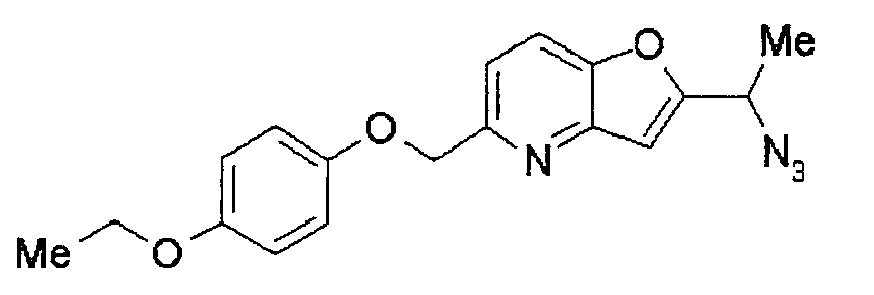
- Using 1-{5-[(4-ethoxyphenoxy)methyl]furo[3,2-b]pyridin-2-yl}ethanol (110 mg, 0.351 mmol) obtained in Reference Example 95, an operation in the same manner as in Reference Example 28 was performed to give the title compound (118 mg, quantitative) as an oil.
1H NMR (CDCl3) δ 1.38 (t, J=7.0 Hz, 3H), 1.69 (d, J = 6.8 Hz, 3H), 3.97 (q, J = 7.2 Hz, 2H), 4.74 (q, J = 6.9 Hz, 1H), 5.24 (s, 2H), 6.80-6.85 (m, 3H), 6.89-6.94 (m, 2H), 7.47 (d, J = 8.7 Hz, 1H), 7.75 (d, J = 8.7 Hz, 1H). -

- Using methyl 2-hydroxy-4-iodobenzoate (4.63 g, 16.6 mmol) and 1-ethynyl-4-propoxybenzene (3.20 g, 20.0 mmol), an operation in the same manner as in Reference Example 47 was performed to give the title compound (5.85 g, yield 99%) as a yellow solid.
1H NMR (CDCl3) δ 1.04 (t, J = 7.4 Hz, 3H), 1.76-1.88 (m, 2H), 3.54 (s, 3H), 3.90 (s, 3H), 3.94 (t, J = 6.6 Hz, 2H), 5.28 (s, 2H), 6.88 (d, J = 8.7 Hz, 2H), 7.17 (dd, J = 8.1, 1.3 Hz, 1H), 7.33 (d, J = 1.3 Hz, 1H), 7.46 (d, J = 8.7 Hz, 2H), 7.76 (d, J = 8.1 Hz, 1H). -

- Using methyl 2-(methoxymethoxy)-4-[(4-propoxyphenyl)ethynyl]benzoate (5.85 g, 16.5 mmol) obtained in Reference Example 97, an operation in the same manner as in Reference Example 48 was performed to give the title compound (4.42 g, yield 81%) as a white solid.
1H NMR (CDCl3) δ 1.03 (t, J = 7.4 Hz, 3H), 1.73-1.85 (m, 2H), 2.81-2.88 (m, 4H), 3.48 (s, 3H), 3.89 (t, J = 6.6 Hz, 2H), 4.67 (d, J = 6.4 Hz, 2H), 5.19 (s, 2H), 6.80-6.84 (m, 3H), 6.89 (d, J = 1.1 Hz, 1H), 7.07 (d, J = 8.7 Hz, 2H), 7.20 (d, J = 7.6 Hz, 1H). -

- Using {2-(methoxymethoxy)-4-[2-(4-propoxyphenyl)ethyl]phenyl}methanol (4.42 g, 13.4 mmol) obtained in Reference Example 98, an operation in the same manner as in Reference Example 49 was performed to give the title compound (3.90 g, yield 89%) as an oil.
1H NMR (CDCl3) δ 1.03 (t, J = 7.0 Hz, 3H), 1.74-1.85 (m, 2H), 2.82-2.95 (m, 4H), 3.51 (s, 3H), 3.89 (t, J = 6.6 Hz, 2H), 5.24 (s, 2H), 6.81 (d, J = 8.7 Hz, 2H), 6.89 (d, J = 7.9 Hz, 1H), 6.94 (d, J = 1.1 Hz, 1H), 7.04 (d, J = 8.7 Hz, 2H), 7.75 (d, J = 7.9 Hz, 1H), 10.43 (d, J = 0.6 Hz, 1H). -

- Using 2-(methoxymethoxy)-4-[2-(4-propoxyphenyl)ethyl]benzaldehyde (3.90 g, 11.9 mmol) obtained in Reference Example 99, an operation in the same manner as in Reference Example 50 was performed to give the title compound (3.21 g, yield 95%) as a yellow solid.
1H NMR (CDCl3) δ 1.03 (t, J = 7.4 Hz, 3H), 1.74-1.85 (m, 2H), 2.82-2.94 (m, 4H), 3.89 (t, J = 6.6 Hz, 2H), 6.78-6.84 (m, 4H), 7.05 (d, J = 8.7 Hz, 2H), 7.43 (d, J = 8.3 Hz, 1H), 9.83 (s, 1H), 11.03 (s, 1H) . -

- Using 2-hydroxy-4-[2-(4-propoxyphenyl)ethyl]benzaldehyde (3.21 g, 11.3 mmol) obtained in Reference Example 100, an operation in the same manner as in Reference Example 51 was performed to give the title compound (3.64 g, quantitative) as a yellow solid.
1H NMR (CDCl3) δ 1.03 (t, J = 7.4 Hz, 3H), 1.74-1.85 (m, 2H), 2.59 (s, 3H), 2.88-2.94 (m, 2H), 3.00-3.05 (m, 2H), 3.89 (t, J = 6.6 Hz, 2H), 6.81 (d, J = 8.3 Hz, 2H), 7.06 (d, J = 8.3 Hz, 2H), 7.13 (dd, J = 8.1, 1.3 Hz, 1H), 7.34 (s, 1H), 7.46 (d, J = 1.3 Hz, 1H), 7.59 (d, J = 8.1 Hz, 1H). -

- Using 1-{6-[2-(4-propoxyphenyl)ethyl]-1-benzofuran-2-yl}ethanone (3.64 g, 11.3 mmol) obtained in Reference Example 101, an operation in the same manner as in Reference Example 52 was performed to give the title compound (2.98 g, yield 81%) as a white solid.
1H NMR (CDCl3) δ 1.03 (t, J = 7.4 Hz, 3H), 1.63 (d, J = 6.6 Hz, 3H), 1.74-1.86 (m, 2H), 2.86-2.92 (m, 2H), 2.96-3.02 (m, 2H), 3.90 (t, J = 6.6 Hz, 2H), 4.96-5.04 (m, 1H), 6.56 (s, 1H), 6.81 (d, J = 8.7 Hz, 2H), 7.04 (dd, J = 8.0, 1.4 Hz, 1H), 7.08 (d, J = 8.7 Hz, 2H), 7.42 (d, J = 8.0 Hz, 1H). -

- Using 1-{6-[2-(4-propoxyphenyl)ethyl]-1-benzofuran-2-yl}ethanol (1.08 g, 3.33 mmol) obtained in Reference Example 102, an operation in the same manner as in Reference Example 28 was performed to give the title compound (1.16 g, quantitative) as an oil.
1H NMR (CDCl3) δ 1.03 (t, J = 7.4 Hz, 3H), 1.65 (d, J = 6.8 Hz, 3H), 1.74-1.85 (m, 2H), 2.86-2.92 (m, 2H), 2.97-3.02 (m, 2H), 3.90 (t, J = 6.6 Hz, 2H), 4.67 (q, J = 6.8 Hz, 1H), 6.62 (s, 1H), 6.82 (d, J = 8.3 Hz, 2H), 7.04-7.10 (m, 3H), 7.29 (s, 1H), 7.44 (d, J = 8.0 Hz, 1H). -

- To a solution of 2-(1-azidoethyl)-6-[2-(4-propoxyphenyl)ethyl]-1-benzofuran (462 mg, 1.32 mmol) obtained in Reference Example 103 in THF (10 mL) was added triphenylphosphine (416 mg, 1.58 mmol), and the mixture was stirred at 60°C for 30 min. To the reaction mixture was added water (0.5 mL), and the mixture was stirred at 60°C for 15 hr. The solvent was evaporated under reduced pressure and the obtained residue was purified by basic silica gel column chromatography (hexane:ethyl acetate=4:1 to 2:3) to give the title compound (391 mg, yield 91%) as a white solid.
1H NMR (CDCl3) δ 1.03 (t, J = 7.4 Hz, 3H), 1.51 (d, J = 6.4 Hz, 3H), 1.74-1.85 (m, 2H), 2.86-2.91 (m, 2H), 2.96-3.01 (m, 2H), 3.90 (t, J = 6.4 Hz, 2H), 4.18 (q, J = 6.4 Hz, 1H), 6.44 (s, 1H), 6.81 (d, J = 8.7 Hz, 2H), 7.02 (dd, J = 8.0, 1.1 Hz, 1H), 7.09 (d, J = 8.7 Hz, 2H), 7.24 (s, 1H), 7.39 (d, J = 8.0 Hz, 1H). -

- To a solution of N-(tert-butoxycarbonyl)-D,L-alanine (3.40 g, 17.9 mmol) and triethylamine (2.50 mL, 17.9 mmol) in THF (20 mL) was added 2-methylpropyl chlorocarbonate (2.33 mL, 17.9 mmol) under ice-cooling, and the mixture was stirred for 1 hr. To this solution was added dropwise a solution of methyl 3-amino-4-hydroxybenzoate (3.00 g, 17.9 mmol) in THF (10 mL) under a nitrogen atmosphere, and the mixture was stirred at room temperature for 3 days. The reaction mixture was diluted with ethyl acetate, and the mixture was washed with 0.5N hydrochloric acid and saturated brine, and dried over anhydrous sodium sulfate. The solvent was evaporated under reduced pressure, and the obtained residue was triturated with hexane-chloroform (1:1) to give the title compound (2.57 g, yield 42%). 1H NMR (CDCl3) δ 1.46-1.49 (m, 12H), 3.87 (s, 3H), 4.42 (m, 1H), 4.95 (d, J = 7.2 Hz, 1H), 7.01 (d, J = 8.4 Hz, 1H), 7.70 (d, J = 1.8 Hz, 1H), 7.80 (dd, J = 1.8, 8.4 Hz, 1H), 8.87 (br, 1H), 9.68 (s, 1H).
-

- To methyl 3-{[N-(tert-butoxycarbonyl)alanyl]amino}-4-hydroxybenzoate (2.56 g, 7.57 mmol) obtained in Reference Example 105 was added 4N hydrogen chloride-ethyl acetate solution (40 mL), and the mixture was concentrated under reduced pressure 1 hr later. The obtained residue was triturated with diisopropyl ether to give the title compound (2.08 g, quantitative). This was used for the next step without purification.
-

- To a solution of methyl 3-(alanylamino)-4-hydroxybenzoate hydrochloride (2.08 g, 7.57 mmol) obtained in Reference Example 106 in DMF (20 mL) were added triethylamine (1.26 mL, 9.08 mmol) and acetic anhydride (0.715 mL, 7.57 mmol) under ice-cooling, and the mixture was stirred for 1 hr. The reaction mixture was diluted with ethyl acetate, and the mixture was washed with 1N hydrochloric acid saturated with sodium chloride and saturated brine, and dried over anhydrous sodium sulfate. The solvent was evaporated under reduced pressure, and the obtained residue was triturated with diisopropyl ether to give the title compound (1.82 g, yield 86%).
1H NMR (CDCl3) δ 1.49 (d, J = 7.2 Hz, 3H), 2.12 (s, 3H), 3.87 (s, 3H), 4.83 (m, 1H), 6.12 (br, 1H), 7.00 (d, J = 8.4 Hz, 1H), 7.79 (dd, J = 2.1, 8.4 Hz, 1H), 7.84 (d, J = 1.8 Hz, 1H), 9.36 (s, 1H), 9.73 (s, 1H) . -

- Using methyl 3-[(N-acetylalanyl)amino]-4-hydroxybenzoate (1.80 g, 6.42 mmol) obtained in Reference Example 107, a method in the same manner as in Reference Example 32 was performed, and the obtained residue was triturated with diisopropyl ether to give the title compound (269 mg, yield 16%).
1H NMR (CDCl3) δ 1.66 (d, J = 6.9 Hz, 3H), 2.10 (s, 3H), 3.95 (s, 3H), 5.44 (m, 1H), 6.27 (d, J = 7.2 Hz, 1H), 7.54 (d, J = 8.4 Hz, 1H), 8.09 (dd, J = 1.8, 8.4 Hz, 1H), 8.37 (d, J = 1.8 Hz, 1H). -

- Using methyl 2-[1-(acetylamino)ethyl]-1,3-benzoxazole-5-carboxylate (267 mg, 1.02 mmol) obtained in Reference Example 108, a method in the same manner as in Reference Example 85 was performed, and the obtained residue was purified by preparative silica gel TLC (ethyl acetate) and triturated with diisopropyl ether to give the title compound (25.4 mg, yield 11%).
1H NMR (DMSO-d6) δ 1.50 (d, J = 7.2 Hz, 3H), 1.88 (s, 3H), 4.58 (d, J = 5.4 Hz, 2H), 5.16 (m, 1H), 5.27 (t, J = 5.4 Hz, 1H), 7.31 (d, J = 8.4 Hz, 1H), 7.60-7.63 (m, 2H), 8.60 (d, J = 8.4 Hz, 1H). -

- To a suspension of methyl 4-fluoro-3-nitrobenzoate (10.0 g, 50.2 mmol) and potassium carbonate (13.9 g, 100 mmol) in DMF (120 mL) was added dropwise under ice-cooling 2-ethylhexyl 3-sulfanylpropanoate (12.1 g, 55.2 mmol), and the mixture was stirred at room temperature for 3 hr. The reaction mixture was diluted with ethyl acetate, and the mixture was washed with water, 10% aqueous potassium carbonate solution and saturated brine, and dried over anhydrous sodium sulfate. This solution was applied to basic silica gel column chromatography (ethyl acetate). The solvent was evaporated under reduced pressure, and the obtained residue was purified by silica gel column chromatography (hexane:ethyl acetate=19:1 to 3:1) to give the title compound (20.0 g, quantitative).
1H NMR (CDCl3) δ 0.86-0.91 (m, 6H), 1.23-1.40 (m, 8H), 1.56-1.60 (m, 1H), 2.76 (t, J = 7.5 Hz, 2H), 3.30 (t, J = 7.5 Hz, 2H), 3.96 (s, 3H), 4.06 (m, 2H), 7.48 (d, J = 8.4 Hz, 1H), 8.18 (m, 1H), 8.84 (m, 1H). -

- Using methyl 4-({3-[(2-ethylhexyl)oxy]-3-oxopropyl}sulfanyl)-3-nitrobenzoate (20.0 g, 50.2 mmol) obtained in Reference Example 110 and zinc powder (32.8 g, 502 mmol) and in the same manner as in Reference Example 77, the title compound (17.8 g, yield 96%) was obtained.
1H NMR (CDCl3) δ 0.86-0.91 (m, 6H), 1.24-1.40 (m, 8H), 1.52-1.58 (m, 1H), 2.56 (t, J = 7.2 Hz, 2H), 3.06 (t, J = 7.2 Hz, 2H), 3.88 (s, 3H), 3.98 (m, 2H), 4.42 (s, 2H), 7.31-7.40 (m, 3H). -

- Using methyl 3-amino-4-({3-[(2-ethylhexyl)oxy]-3-oxopropyl}sulfanyl)benzoate (3.00 g, 8.16 mmol) obtained in Reference Example 111, a method in the same manner as in Reference Example 83 was performed, and the obtained residue was triturated with diisopropyl ether to give the title compound (2.88 g, yield from methyl 3-amino-4-({3-[(2-ethylhexyl)oxy]-3-oxopropyl}sulfanyl)benzoate 74%).
1H NMR (CDCl3) δ 0.86-0.91 (m, 6H), 1.28-1.39 (m, 8H), 1.50-1.59 (m, 4H), 2.08 (s, 3H), 2.58 (t, J = 6.9 Hz, 2H), 3.07 (t, J = 6.9 Hz, 2H), 3.91 (s, 3H), 4.02 (m, 2H), 4.75 (m, 1H), 6.25 (d, J = 7.5 Hz, 1H), 7.56 (d, J = 8.1 Hz, 1H), 7.75 (dd, J = 1.8, 8.1 Hz, 1H), 8.52 (d, J = 1.8 Hz, 1H), 8.98 (s, 1H). -

- Using methyl 3-[(N-acetylalanyl)amino]-4-({3-[(2-ethylhexyl)oxy]-3-oxopropyl}sulfanyl)benzoate (2.87 g, 5.97 mmol) obtained in Reference Example 112, a method in the same manner as in the below-mentioned Example 102 was performed, and the obtained residue was triturated with diisopropyl ether to give the title compound (1.42 g, yield 85%).
1H NMR (DMSO-d6) δ 1.56 (d, J = 7.2 Hz, 3H), 1.93 (s, 3H), 3.90 (s, 3H), 5.26 (m, 1H), 7.97 (dd, J = 1.8, 8.1 Hz, 1H), 8.21 (d, J = 8.1 Hz, 1H), 8.44 (d, J = 1.8 Hz, 1H), 8.82 (d, J = 7.2 Hz, 1H). -

- Using methyl 2-[1-(acetylamino)ethyl]-1,3-benzothiazole-5-carboxylate (500 mg, 1.80 mmol) obtained in Reference Example 113, a method in the same manner as in Reference Example 85 was performed, and the obtained residue was triturated with ethyl acetate to give the title compound (307 mg, yield 68%).
1H NMR (DMSO-d6) δ 1.54 (d, J = 7.2 Hz, 3H), 1.91 (s, 3H), 4.62 (d, J = 5.7 Hz, 2H), 5.23 (m, 1H), 5.31 (t, J = 5.7 Hz, 1H), 7.36 (dd, J = 1.5, 8.4 Hz, 1H), 7.85 (d, J = 1.5 Hz, 1H), 7.97 (d, J = 8.4 Hz, 1H), 8.75 (d, J = 7.5 Hz, 1H). -

- To a solution of ethyl 4-(benzyloxy)-2-hydroxy-6-methylbenzoate (15.0 g, 52.4 mmol) in DMF (100 mL) were added potassium carbonate (14.5 g, 105 mmol) and bromomethyl methyl ether (6.40 mL, 78.5 mmol), and the mixture was stirred at room temperature for 20 min. Water was added to the reaction mixture, and the mixture was extracted with ethyl acetate. The extract was washed twice with saturated brine, and dried over anhydrous magnesium sulfate. The solvent was evaporated under reduced pressure and the obtained residue was purified by silica gel column chromatography (hexane:ethyl acetate=19:1 to 4:1) to give the title compound (14.9 g, yield 86%) as a yellow solid.
1H NMR (CDCl3) δ 1.36 (t, J = 7.4 Hz, 3H), 2.29 (s, 3H), 3.46 (s, 3H), 4.36 (q, J = 7.2 Hz, 2H), 5.04 (s, 2H), 5.13 (s, 2H), 6.47 (d, J = 2.2 Hz, 1H), 6.64 (d, J=2.2 Hz, 1H), 7.28-7.43 (m, 5H). -

- To a solution of ethyl 4-(benzyloxy)-2-(methoxymethoxy)-6-methylbenzoate (14.9 g, 45.1 mmol) obtained in Reference Example 115 in ethanol (100 mL) was added 10% palladium carbon (50% water-containing product, 13.0 g), and the mixture was stirred under a hydrogen atmosphere (normal pressure) for 30 min. After filtration, the solvent was evaporated under reduced pressure, and the obtained solid was washed with diethyl ether and hexane to give the title compound (8.09 g, yield 75%) as a white solid.
1H NMR (CDCl3) 5 1.36 (t, J = 7.0 Hz, 3H), 2.26 (s, 3H), 3.46 (s, 3H), 4.37 (q, J=7.0 Hz, 2H), 5.13 (s, 2H), 6.31 (s, 1H), 6.48 (s, 1H). -

- To a solution of ethyl 4-hydroxy-2-(methoxymethoxy)-6-methylbenzoate (3.00 g, 12.5 mmol) obtained in Reference Example 116 in THF (50 mL) were added triethylamine (3.50 mL, 25.0 mmol) and N-phenylbis(trifluoromethanesulfonimide) (7.70 g, 18.7 mmol), and the mixture was stirred at room temperature for 2 hr. The solvent was evaporated under reduced pressure and the obtained residue was purified by silica gel column chromatography (hexane:ethyl acetate=9:1 to 3:2) to give the title compound (4.33 g, yield 93%) as an oil.
1H NMR (CDCl3) 5 1.38 (t, J = 7.2 Hz, 3H), 2.34 (s, 3H), 3.47 (s, 3H), 4.41 (q, J = 7.2 Hz, 2H), 5.18 (s, 2H), 6.78 (d, J = 1.9 Hz, 1H), 6.94 (d, J = 1.9 Hz, 1H). -

- To a solution of ethyl 2-(methoxymethoxy)-6-methyl-4-{[(trifluoromethyl)sulfonyl]oxy}benzoate (2.17 g, 5.82 mmol) obtained in Reference Example 117, 1-ethoxy-4-ethynylbenzene (1.30 mL, 8.73 mmol) and copper(I) iodide (111 mg, 0.582 mmol) in triethylamine (14 mL) was added bis(triphenylphosphine)palladium(II) chloride (409 mg, 0.582 mmol), and the mixture was stirred under an argon stream 60°C for 15 min. The reaction mixture was diluted with ethyl acetate, and the mixture was washed with water, and dried over anhydrous magnesium sulfate. The solvent was evaporated under reduced pressure and the obtained residue was purified by silica gel column chromatography (hexane:ethyl acetate=9:1 to 3:2) to give the title compound (1.89 g, yield 88%) as an oil.
1H NMR (CDCl3) δ 1.26 (t, J = 7.2 Hz, 3H), 1.38 (t, J = 7.2 Hz, 3H), 2.29 (s, 3H), 3.48 (s, 3H), 4.12 (q, J = 7.2 Hz, 2H), 4.40 (q, J = 7.2 Hz, 2H), 5.19 (s, 2H), 6.86 (d, J = 8.9 Hz, 2H), 7.02 (s, 1H), 7.12 (s, 1H), 7.45 (d, J = 8.9 Hz, 2H). -

- Using ethyl 4-[(4-ethoxyphenyl)ethynyl]-2-(methoxymethoxy)-6-methylbenzoate (1.89 g, 5.13 mmol) obtained in Reference Example 118, an operation in the same manner as in Reference Example 48 was performed to give the title compound (1.23 g, yield 72%) as an oil.
1H NMR (CDCl3) δ 1.40 (t, J = 7.0 Hz, 3H), 2.38 (s, 3H), 2.79-2.85 (m, 4H), 3.49 (s, 3H), 4.01 (q, J = 7.0 Hz, 2H), 4.72 (d, J = 4.5 Hz, 2H), 5.17 (s, 2H), 6.72 (s, 1H), 6.75 (s, 1H), 6.81 (d, J = 8.7 Hz, 2H), 7.08 (d, J = 8.7 Hz, 2H). -

- Using {4-[2-(4-ethoxyphenyl)ethyl]-2-(methoxymethoxy)-6-methylphenyl}methanol (1.23 g, 3.72 mmol) obtained in Reference Example 119, an operation in the same manner as in Reference Example 49 was performed to give the title compound (1.07 g, yield 87%) as an oil.
1H NMR (CDCl3) 5 1.40 (t, J = 7.0 Hz, 3H), 2.55 (s, 3H), 2.81-2.87 (m, 4H), 3.50 (s, 3H), 4.01 (q, J = 7.0 Hz, 2H), 5.21 (s, 2H), 6.69 (s, 1H), 6.80-6.84 (m, 3H), 7.06 (d, J = 8.7 Hz, 2H), 10.61 (s, 1H). -

- Using 4-[2-(4-ethoxyphenyl)ethyl]-2-(methoxymethoxy)-6-methylbenzaldehyde (1.07 g, 3.26 mmol) obtained in Reference Example 120, an operation in the same manner as in Reference Example 50 was performed to give the title compound (849 mg, yield 92%) as an oil.
1H NMR (CDCl3) δ 1.40 (t, J = 7.0 Hz, 3H), 2.56 (s, 3H), 2.78-2.89 (m, 4H), 4.01 (q, J = 7.0 Hz, 2H), 6.53 (s, 1H), 6.64 (s, 1H), 6.81 (d, J = 8.7 Hz, 2H), 7.07 (d, J = 8.7 Hz, 2H), 10.25 (s, 1H), 11.93 (s, 1H) . -

- Using 4-[2-(4-ethoxyphenyl)ethyl]-2-hydroxy-6-methylbenzaldehyde (849 mg, 2.99 mmol) obtained in Reference Example 121, an operation in the same manner as in Reference Example 51 was performed to give the title compound (964 mg, quantitative) as a yellow solid.
1H NMR (CDCl3) δ 1.40 (t, J = 7.0 Hz, 3H), 2.52 (s, 3H), 2.59 (s, 3H), 2.86-2.92 (m, 2H), 2.95-3.01 (m, 2H), 4.01 (q, J = 7.0 Hz, 2H), 6.80 (d, J = 8.7 Hz, 2H), 6.94 (s, 1H), 7.07 (d, J = 8.7 Hz, 2H), 7.17 (s, 1H), 7.50 (d, J = 0.8 Hz, 1H). -

- Using 1-{6-[2-(4-ethoxyphenyl)ethyl]-4-methyl-1-benzofuran-2-yl}ethanone (964 mg, 2.99 mmol) obtained in Reference Example 122, an operation in the same manner as in Reference Example 52 was performed to give the title compound (899 mg, yield 79%) as an oil. 1H NMR (CDCl3) δ 1.40 (t, J = 7.0 Hz, 3H), 1.63 (d, J = 6.4 Hz, 3H), 2.46 (s, 3H), 2.84-2.90 (m, 2H), 2.92-2.98 (m, 2H), 4.12 (q, J = 7.0 Hz, 2H), 4.96-5.04 (m, 1H), 6.58 (s, 1H), 6.81 (d, J = 8.3 Hz, 2H), 6.86 (s, 1H), 7.08-7.11 (m, 3H).
-

- Using 1-{6-[2-(4-ethoxyphenyl)ethyl]-4-methyl-1-benzofuran-2-yl}ethanol (899 mg, 2.77 mmol) obtained in Reference Example 123, an operation in the same manner as in Reference Example 28 was performed to give the title compound (816 mg, yield 84%) as an oil.
1H NMR (CDCl3) δ 1.40 (t, J = 7.0 Hz, 3H), 1.65 (d, J = 6.8 Hz, 3H), 2.47 (s, 3H), 2.84-2.90 (m, 2H), 2.93-2.98 (m, 2H), 4.01 (q, J=7.0 Hz, 2H), 4.67 (q, J = 7.0 Hz, 1H), 6.63 (s, 1H), 6.82 (d, J = 8.5 Hz, 2H), 6.88 (s, 1H), 7.10 (d, J=8.7Hz, 2H), 7.12 (s, 1H). -

- To a solution of ethyl 5-methoxy-1-benzothiophene-2-carboxylate (1.77 g, 7.49 mmol) in methylene chloride (15 mL) was added dropwise 1 M boron tribromide methylene chloride solution (22.5 mL, 22.5 mmol) at -20°C, and the mixture was stirred at the same temperature for 2 hr. The reaction mixture was poured into ice, and the mixture was extracted twice with ethyl acetate. The extract was washed with saturated brine, dried over anhydrous sodium sulfate, and the solution was passed through silica gel. The solvent was evaporated under reduced pressure, and the obtained solid was washed with hexane to give the title compound (1.53 g, yield 92%).
1H NMR (CDCl3) δ 1.41 (t, J = 7.2 Hz, 3H), 4.40 (q, J = 7.2 Hz, 2H), 5.01 (s, 1H), 7.05 (dd, J = 8.8, 2.4 Hz, 1H), 7.22-7.33 (m, 1H), 7.71 (d, J=8.8Hz, 1H), 7.93 (s, 1H). -

- Using ethyl 5-hydroxy-1-benzothiophene-2-carboxylate (1.53 g, 6.88 mmol) obtained in Reference Example 125, DMF (7 mL), tert-butyldimethylchlorosilane (1.35 g, 9.63 mmol) and imidazole (839 mg, 12.3 mmol), an operation in the same manner as in Reference Example 16 was performed to give the title compound (1.80 g, yield 78%).
1H NMR (CDCl3) δ 0.22 (s, 6H), 1.04 (s, 9H), 1.41 (t, J=7.2 Hz, 3H), 4.40 (q, J = 7.2 Hz, 2H), 7.02 (dd, J = 8.7, 2.5 Hz, 1H), 7.23-7.33 (m, 1H), 7.68 (d, J = 8.7 Hz, 1H), 7.94 (s, 1H). -

- Using ethyl 5-{[tert-butyl(dimethyl)silyl]oxy}-1-benzothiophene-2-carboxylate (1.80 g, 5.35 mmol) obtained in Reference Example 126, anhydrous THF (50 mL), N,O-dimethylhydroxylamine hydrochloride (2.61 g, 26.7 mmol) and 1.6 M n-butyllithium hexane solution (33 mL, 53.5 mmol), an operation in the same manner as in Reference Example 18 was performed to give the title compound (2.13 g, quantitative).
1H NMR (CDCl3) δ 0.23 (s, 6H), 1.03 (s, 9H), 3.41 (s, 3H), 3.82 (s, 3H), 7.00 (dd, J = 8.7, 2.3 Hz, 1H), 7.29 (d, J = 2.3 Hz, 1H), 7.68 (d, J=8.7Hz, 1H), 8.08 (s, 1H). -

- Using 5-{[tert-butyl(dimethyl)silyl]oxy}-N-methoxy-N-methyl-1-benzothiophene-2-carboxamide (2.13 g, 5.35 mmol) obtained in Reference Example 127, anhydrous THF (13 mL) and 1 M methylmagnesium bromide THF solution (10.7 mL, 10.7 mmol), an operation in the same manner as in Reference Example 19 was performed to give the title compound (2.54 g, quantitative).
1H NMR (CDCl3) δ 0.23 (s, 6H), 1.01 (s, 9H), 2.64 (s, 3H), 7.03 (dd, J = 8.7, 2.3 Hz, 1H), 7.30 (d, J = 2.3 Hz, 1H), 7.70 (d, J = 8.7 Hz, 1H), 7.83 (s, 1H). -

- Using 1-(5-{[tert-butyl(dimethyl)silyl]oxy}-1-benzothiophen-2-yl)ethanone (2.54 g, 5.35 mmol) obtained in Reference Example 128, methanol (10.6mL) and sodium borohydride (406 mg, 10.7 mmol), an operation in the same manner as in Reference Example 21 was performed to give the title compound (1.46 g, yield 89%).
1H NMR (CDCl3) δ 0.20 (s, 6H), 1.00 (s, 9H), 1.65 (d, J = 6.4 Hz, 3H), 2.01 (d, J = 4.7 Hz, 1H), 5.11-5.25 (m, 1H), 6.86 (dd, J = 8.7, 2.3 Hz, 1H), 7.08 (s, 1H), 7.15 (d, J = 2.3 Hz, 1H), 7.62 (d, J = 8.7 Hz, 1H). -

- Using 1-(5-{[tert-butyl(dimethyl)silyl]oxy}-1-benzothiophen-2-yl)ethanol (1.46 g, 4.74 mmol) obtained in Reference Example 129, DMF (10 mL), methanesulfonyl chloride (0.547 mL, 7.11 mmol), triethylamine (1.41 mL, 9.48 mmol) and sodium azide (1.54 mg, 23.7 mmol), an operation in the same manner as in Reference Example 22 was performed to give the title compound (2.10 g) as an oil.
1H NMR (CDCl3) δ 0.21 (s, 6H), 1.00 (s, 9H), 1.66 (d, J = 6.7 Hz, 3H), 4.86 (q, J= 6.7 Hz, 1H), 6.86-6.93 (m, 1H), 7.12 (s, 1H), 7.17 (d, J = 2.3 Hz, 1H), 7.63 (d, J = 8.7 Hz, 1H). -

- To a solution of {[2-(1-azidoethyl)-1-benzothiophen-5-yl]oxy}(tert-butyl)dimethylsilane (2.10 g, 4.74 mmol) obtained in Reference Example 130 in THF (10 mL) and water (1 mL) was added triphenylphosphine (polystyrene-supported, 1.84 mmol/g, 3.09 g, 5.68 mmol), and the mixture was heated under reflux overnight. The resin was filtered off, and the solvent was evaporated under reduced pressure. To the obtained residue were added ethyl acetate (5 mL) and acetic anhydride (0.42 mL, 4.54 mmol), and the mixture was stirred at room temperature for 10 min. The solvent was evaporated under reduced pressure, and the obtained residue was purified by silica gel column chromatography (hexane to hexane:ethyl acetate=3:7) to give the title compound (857 mg, yield from {[2-(1-azidoethyl)-1-benzothiophen-5-yl]oxy}(tert-butyl)dimethylsilane 52%) as an oil.
1H NMR (CDCl3) δ 0.20 (s, 6H), 1.00 (s, 9H), 1.56-1.66 (m, 3H), 1.98-2.03 (m, 3H), 5.32-5.55 (m, 1H), 5.75 (d, J = 7.6 Hz, 1H), 6.86 (dd, J = 8.7, 2.3 Hz, 1H), 7.04-7.10 (m, 1H), 7.13 (d, J = 2.3 Hz, 1H), 7.59 (d, J = 8.7 Hz, 1H). -
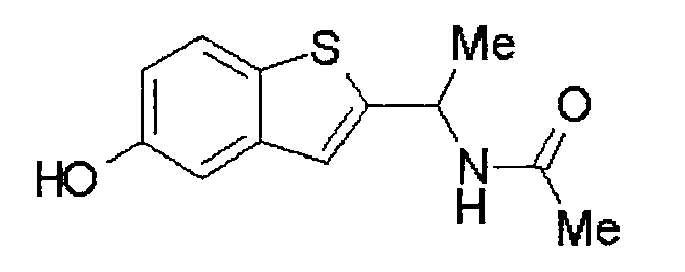
- Using N-[1-(5-{[tert-butyl(dimethyl)silyl]oxy}-1-benzothiophen-2-yl)ethyl]acetamide (857 mg, 2.45 mmol) obtained in Reference Example 131, THF (5.0 mL) and 1M tetrabutylammonium fluoride THF solution (3.7 mL, 3.68 mmol) and an operation in the same manner as in Reference Example 38 was performed to give the title compound (412 mg, yield 72%) as a white solid.
1H NMR (CDCl3) δ 1.62 (d, J = 6.8 Hz, 3H), 2.03 (s, 3H), 5.24 (br, 1H), 5.40-5.53 (m, 1H), 5.73 (br, 1H), 6.87 (dd, J = 8.5, 2.5 Hz, 1H), 7.05 (s, 1H), 7.12 (d, J=2.7 Hz, 1H), 7.60 (d, J = 8.5 Hz, 1H). -

- Using 4-(benzyloxy)-2-fluoro-1-nitrobenzene (10.3 g, 41.6 mmol) and 2-ethylhexyl 3-sulfanylpropanoate (10.0 g, 45.8 mmol) and in the same manner as in Reference Example 81, the title compound (18.6 g, quantitative) was obtained as an oil.
1H NMR (CDCl3) δ 0.86-0.91 (m, 6H), 1.23-1.40 (m, 8H), 1.54-1.60 (m, 1H), 2.70 (t, J = 7.5 Hz, 2H), 3.16 (t, J = 7.5 Hz, 2H), 4.05 (m, 2H), 5.17 (s, 2H), 6.79 (dd, J = 2.4 9.3 Hz, 1H), 6.87 (d, J = 2.4 Hz, 1H), 7.34-7.44 (m, 5H), 8.25 (d, J = 9.3 Hz, 1H). -

- Using obtained in Reference Example 133 2-ethylhexyl 3-{[5-(benzyloxy)-2-nitrophenyl]sulfanyl}propanoate (18.6 g, 41.6 mmol) and zinc powder (27.2 g, 416 mmol) and in the same manner as in Reference Example 77, the title compound (14.5 g) was obtained as an oil. This was used for the next step without purification.
-
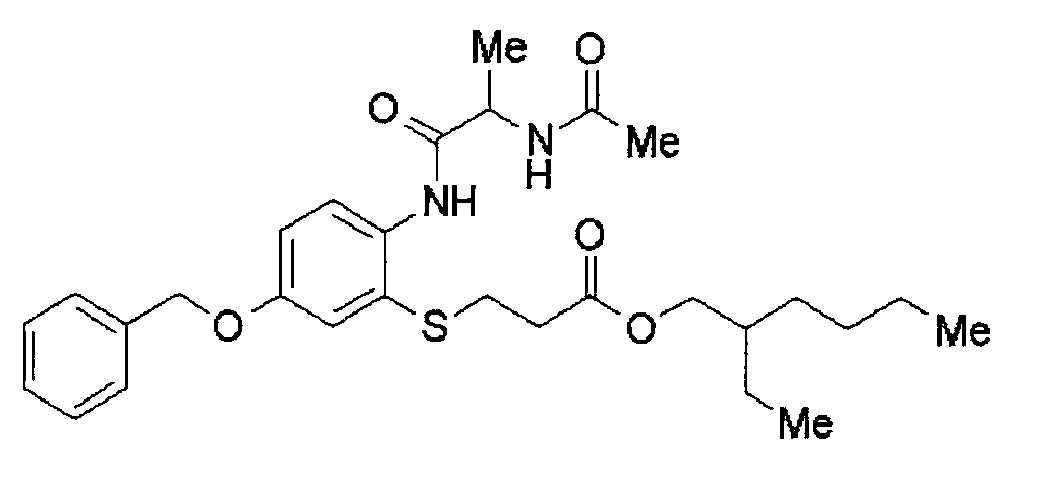
- Using obtained in Reference Example 134 2-ethylhexyl 3-{[2-amino-5-(benzyloxy)phenyl]sulfanyl}propanoate (4.00 g, 9.62 mmol) and N-acetyl-D,L-alanine (1.26 g, 9.62 mmol) and in the same manner as in Reference Example 13, the title compound (2.24 g, yield 45%) was obtained as a solid.
1H NMR (CDCl3) δ 0.86-0.91 (m, 6H), 1.26-1.40 (m, 8H), 1.49-1.57 (m, 4H), 2.07 (s, 3H), 2.53 (t, J = 6.9 Hz, 2H), 2.98 (t, J = 6.9 Hz, 2H), 4.01 (m, 2H), 4.72 (m, 1H), 5.04 (s, 2H), 6.33 (br, 1H), 6.96 (dd, J = 2.7, 9.0 Hz, 1H), 7.13 (d, J = 2.7 Hz, 1H), 7.29-7.42 (m, 1H), 8.21 (d, J=9.0Hz, 1H), 8.80 (s, 1H). -

- To a solution of N-{1-[6-(benzyloxy)-1,3-benzothiazol-2-yl]ethyl}acetamide (150 mg, 0.460 mmol) obtained in the below-mentioned Example 103 in trifluoroacetic acid (2 mL) was added thioanisole (0.2 mL), and the mixture was stirred under heating at 55°C for 16 hr. The reaction mixture was concentrated under reduced pressure, and the obtained residue was purified by silica gel column chromatography (hexane:ethyl acetate=1:1 to ethyl acetate), and triturated with diisopropyl ether to give the title compound (76.0 mg, yield 70%).
1H NMR (DMSO-d6) δ 1.51 (d, J = 7.2 Hz, 3H), 1.89 (s, 3H), 5.18 (m, 1H), 6.92 (dd, J = 2.1, 8.7 Hz, 1H), 7.31 (d, J = 2.1 Hz, 1H), 7.71 (d, J=8.7Hz, 1H), 8.67 (d, J=7.8Hz, 1H), 9.70 (s, 1H). -

- Using 2-amino-4-methoxyphenol (3.00 g, 21.6 mmol) and N-(tert-butoxycarbonyl)-D,L-alanine (4.08 g, 21.6 mmol), a method in the same manner as in Reference Example 13 was performed, and the obtained residue was triturated with ethyl acetate to give the title compound (5.42 g, yield 81%).
1H NMR (CDCl3) δ 1.45-1.48 (m, 12H), 3.73 (s, 3H), 4.38 (m, 1H), 4.97 (m, 1H), 6.67-6.70 (m, 2H), 6.91 (d, J=9.3Hz, 1H), 7.89 (s, 1H), 8.73 (br, 1H). -

- Using tert-butyl {2-[(2-hydroxy-5-methoxyphenyl)amino]-1-methyl-2-oxoethyl}carbamate (5.42 g, 17.5mmol) obtained in Reference Example 138 and in the same manner as in Reference Example 106, the title compound (4.31 g, quantitative) was obtained. This was used for the next step without purification.
-

- Using N-(2-hydroxy-5-methoxyphenyl)alaninamide hydrochloride (4.31 g, 17.5 mmol) obtained in Reference Example 139 and acetic anhydride (1.65 mL, 17.5 mmol), a method in the same manner as in Reference Example 107 was performed, and the obtained residue was triturated with ethyl acetate to give the title compound (2.61 g, yield 59%).
1H NMR (CDCl3) δ 1.27 (d, J = 6.9 Hz, 3H), 1.88 (s, 3H), 3.64 (s, 3H), 4.45 (m, 1H), 6.50 (dd, J = 3.0, 8.7, 1H), 6.75 (d, J = 8.7 Hz, 1H), 7.61 (d, J = 3.0 Hz, 1H), 8.31 (d, J = 7.2 Hz, 1H), 9.06 (s, 1H), 9.37 (s, 1H). -

- Using Nα-acetyl-N-(2-hydroxy-5-methoxyphenyl)alaninamide (1.00 g, 3.96 mmol) obtained in Reference Example 140, a method in the same manner as in Reference Example 32 was performed, and the obtained residue was triturated with diisopropyl ether-hexane (1:1) to give the title compound (462 mg, yield 50%).
1H NMR (CDCl3) δ 1.63 (d, J = 6.9 Hz, 3H), 2.09 (s, 3H), 3.84 (s, 3H), 5.39 (m, 1H), 6.26 (br, 1H), 6.93 (dd, J = 2.4, 8.7 Hz, 1H), 7.16 (d, J = 2.4 Hz, 1H), 7.39 (d, J = 8.7 Hz, 1H). -

- Using N-[1-(5-methoxy-1,3-benzoxazol-2-yl)ethyl]acetamide (250 mg, 1.07 mmol) obtained in Reference Example 141, a method in the same manner as in Reference Example 33 was performed, and the obtained residue was triturated with diisopropyl ether to give the title compound (195 mg, yield 83%).
1H NMR (DMSO-d6) δ 1.48 (d, J = 6.9 Hz, 3H), 1.87 (s, 3H), 5.12 (m, 1H), 6.78 (dd, J = 2.1, 9.0, 1H), 6.99 (d, J = 2.1 Hz, 1H), 7.45 (d, J = 9.0 Hz, 1H), 8.56 (d, J = 8.1 Hz, 1H), 9.43 (s, 1H). -

- Using methyl 2-hydroxy-4-iodobenzoate (1.36 g, 4.88 mmol) and 1-ethynyl-4-(trifluoromethoxy)benzene (1.00 g, 5.37 mmol), an operation in the same manner as in Reference Example 47 was performed to give the title compound (1.82 g, yield 98%) as a yellow solid.
1H NMR (CDCl3) δ 3.55 (s, 3H), 3.91 (s, 3H), 5.29 (s, 2H), 7.18-7.23 (m, 3H), 7.36 (d, J = 1.3 Hz, 1H), 7.57 (d, J = 8.9 Hz, 2H), 7.78 (d, J = 8.1 Hz, 1H). -

- Using methyl 2-(methoxymethoxy)-4-{[4-(trifluoromethoxy)phenyl]ethynyl}benzoate (1.82 g, 4.79 mmol) obtained in Reference Example 143, an operation in the same manner as in Reference Example 48 was performed to give the title compound (1.39 g, yield 89%) as an oil.
1H NMR (CDCl3) δ 2.86-2.93 (m, 4H), 3.48 (s, 3H), 4.67 (d, J = 6.1 Hz, 2H), 5.17 (s, 2H), 6.80-6.83 (m, 3H), 6.85 (s, 1H), 7.09-7.18 (m, 4H), 7.21 (d, J = 7.6 Hz, 1H). -

- Using [2-(methoxymethoxy)-4-{2-[4-(trifluoromethoxy)phenyl]ethyl}phenyl]methanol (1.39 g, 3.90 mmol) obtained in Reference Example 144, an operation in the same manner as in Reference Example 49 was performed to give the title compound (1.20 g, yield 87%) as an oil.
1H NMR (CDCl3) δ 2.92-2.98 (m, 4H), 3.50 (s, 3H), 5.22 (s, 2H), 6.89-6.91 (m, 2H), 7.10-7.16 (m, 4H), 7.77 (d, J = 8.3 Hz, 1H), 10.43 (s, 1H). -

- Using 2-(methoxymethoxy)-4-{2-[4-(trifluoromethoxy)phenyl]ethyl}benzaldehyde (1.20 g, 3.39 mmol) obtained in Reference Example 145, an operation in the same manner as in Reference Example 50 was performed to give the title compound (966 mg, yield 92%) as an oil.
1H NMR (CDCl3) δ 2.91-2.96 (m, 4H), 6.77-6.80 (m, 2H), 7.11-7.18 (m, 4H), 7.45 (d, J = 7.7 Hz, 1H), 9.84 (s, 1H), 11.04 (s, 1H). -

- Using 2-hydroxy-4-{2-[4-(trifluoromethoxy)phenyl]ethyl}benzaldehyde (966 mg, 3.11 mmol) obtained in Reference Example 146, an operation in the same manner as in Reference Example 51 was performed to give the title compound (1.08 g, quantitative) as an oil.
1H NMR (CDCl3) δ 2.59 (s, 3H), 2.95-3.00 (m, 2H), 3.04-3.09 (m, 2H), 7.10-7.18 (m, 5H), 7.35 (s, 1H), 7.47 (d, J = 0.9 Hz, 1H), 7.60 (d, J = 8.1 Hz, 1H). -

- Using 1-(6-{2-[4-(trifluoromethoxy)phenyl]ethyl}-1-benzofuran-2-yl)ethanone (1.08 g, 3.11 mmol) obtained in Reference Example 147, an operation in the same manner as in Reference Example 52 was performed to give the title compound (833 mg, yield 70%) as an oil. 1H NMR (CDCl3) δ 1.63 (d, J = 6.6 Hz, 3H), 2.92-3.05 (m, 4H), 4.96-5.04 (m, 1H), 6.57 (s, 1H), 7.01 (dd, J=8.0, 1.4 Hz, 1H), 7.09-7.19 (m, 4H), 7.25 (s, 1H), 7.43 (d, J =7.9 Hz, 1H).
-

- Using 1-(6-{2-[4-(trifluoromethoxy)phenyl]ethyl}-1-benzofuran-2-yl)ethanol (833 mg, 2.38 mmol) obtained in Reference Example 148, an operation in the same manner as in Reference Example 28 was performed to give the title compound (825 mg, yield 92%) as an oil.
1H NMR (CDCl3) δ 1.65 (d, J = 7.0 Hz, 3H), 2.93-3.06 (m, 4H), 4.68 (d, J = 7.0 Hz, 1H), 6.63 (s, 1H), 7.03 (dd, J = 7.9, 1.3 Hz, 1H), 7.10-7.20 (m, 4H), 7.28 (s, 1H), 7.45 (d, J=7.9Hz, 1H). -
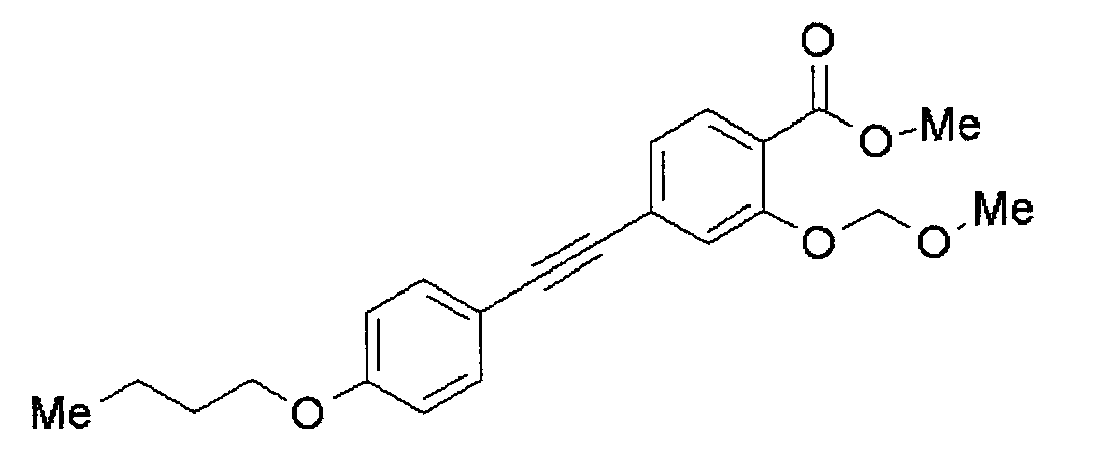
- Using methyl 2-hydroxy-4-iodobenzoate (1.45 g, 5.22 mmol) and 1-butoxy-4-ethynylbenzene (1.00 g, 5.74 mmol), an operation in the same manner as in Reference Example 47 was performed to give the title compound (1.92 g, yield 99%) as an oil.
1H NMR (CDCl3) δ 0.98 (t, J = 7.4 Hz, 3H), 1.44-1.56 (m, 2H), 1.73-1.83 (m, 2H), 3.52 (s, 3H), 3.90 (s, 3H), 3.98 (t, J =6.6 Hz, 2H), 5.28 (s, 2H), 6.87 (d, J = 8.9 Hz, 2H), 7.17 (dd, J=8.1, 1.5 Hz, 1H), 7.33 (d, J = 1.3 Hz, 1H), 7.46 (d, J = 8.9 Hz, 2H), 7.76 (d, J =8.1 Hz, 1H). -

- Using methyl 4-[(4-butoxyphenyl)ethynyl]-2-(methoxymethoxy)benzoate (1.92 g, 5.22 mmol) obtained in Reference Example 150, an operation in the same manner as in Reference Example 48 was performed to give the title compound (1.15 g, yield 64%) as an oil.
1H NMR (CDCl3) δ 0.97 (t, J = 7.4 Hz, 3H), 1.42-1.55 (m, 2H), 1.71-1.80 (m, 2H), 2.83-2.88 (m, 4H), 3.49 (s, 3H), 3.94 (t, J = 6.6 Hz, 2H), 4.67 (d, J = 6.2 Hz, 2H), 5.20 (s, 2H), 6.80-6.84 (m, 3H), 6.89 (d, J = 1.3 Hz, 1H), 7.07 (d, J = 8.7 Hz, 2H), 7.20 (d, J = 7.7 Hz, 1H). -

- Using {4-[2-(4-butoxyphenyl)ethyl]-2-(methoxymethoxy)phenyl}methanol (1.15 g, 3.34 mmol) obtained in Reference Example 151, an operation in the same manner as in Reference Example 49 was performed to give the title compound (1.00 g, yield 87%) as an oil.
1H NMR (CDCl3) δ 0.97 (t, J = 7.4 Hz, 3H), 1.42-1.55 (m, 2H), 1.71-1.80 (m, 2H), 2.82-2.95 (m, 4H), 3.51 (s, 3H), 3.93 (t, J = 6.5 Hz, 2H), 5.24 (s, 2H), 6.81 (d, J = 8.1 Hz, 2H), 6.89 (d, J = 8.1 Hz, 2H), 6.94 (s, 1H), 7.04 (d, J = 8.7 Hz, 2H), 7.75 (d, J = 7.9 Hz, 1H), 10.44 (s, 1H). -

- Using 4-[2-(4-butoxyphenyl)ethyl]-2-(methoxymethoxy)benzaldehyde (1.00 g, 2.92 mmol) obtained in Reference Example 152, an operation in the same manner as in Reference Example 50 was performed to give the title compound (862 mg, yield 99%) as an oil.
1H NMR (CDCl3) δ 0.97 (t, J = 7.4 Hz, 3H), 1.42-1.52 (m, 2H), 1.71-1.80 (m, 2H), 2.83-2.94 (m, 4H), 3.93 (t, J = 6.5 Hz, 2H), 6.78-6.83 (m, 4H), 7.05 (d, J = 8.5 Hz, 2H), 7.44 (d, J = 8.3 Hz, 1H), 9.83 (s, 1H), 11.03 (s, 1H). -

- Using 4-[2-(4-butoxyphenyl)ethyl]-2-hydroxybenzaldehyde (862 mg, 2.89 mmol) obtained in Reference Example 153, an operation in the same manner as in Reference Example 51 was performed to give the title compound (829 mg, yield 85%) as an oil.
1H NMR (CDCl3) δ 0.97 (t, J = 7.4 Hz, 3H), 1.43-1.53 (m, 2H), 1.71-1.80 (m, 2H), 2.60 (s, 3H), 2.87-2.93 (m, 2H), 3.01-3.06 (m, 2H), 3.93 (t, J = 6.5 Hz, 2H), 6.80 (d, J = 8.7 Hz, 2H), 7.06 (d, J = 8.7 Hz, 2H), 7.13 (dd, J = 8.1, 1.3 Hz, 1H), 7.34 (s, 1H), 7.47 (d, J = 0.9 Hz, 1H), 7.59 (d, J = 8.1 Hz, 1H). -

- Using 1-{6-[2-(4-butoxyphenyl)ethyl]-1-benzofuran-2-yl}ethanone (829 mg, 2.47 mmol) obtained in Reference Example 154, an operation in the same manner as in Reference Example 52 was performed to give the title compound (690 mg, yield 82%) as an oil.
1H NMR (CDCl3) δ 0.97 (t, J = 7.4 Hz, 3H), 1.42-1.55 (m, 2H), 1.63 (d, J = 6.8 Hz, 3H), 1.71-1.83 (m, 2H), 2.86-2.91 (m, 2H), 2.96-3.02 (m, 2H), 3.94 (t, J = 6.4 Hz, 2H), 4.96-5.04 (m, 1H), 6.56 (s, 1H), 6.81 (d, J = 8.3 Hz, 2H), 7.04 (d, J = 8.0, 1.5 Hz, 1H), 7.08 (dd, J = 8.3 Hz, 2H), 7.26 (s, 1H), 7.42 (d, J=8.0Hz, 1H). -

- Using 1-{6-[2-(4-butoxyphenyl)ethyl]-1-benzofuran-2-yl}ethanol (690 mg, 2.04 mmol) obtained in Reference Example 155, an operation in the same manner as in Reference Example 28 was performed to give the title compound (553 mg, yield 75%) as an oil.
1H NMR (CDCl3) δ 0.97 (t, J = 7.4 Hz, 3H), 1.43-1.52 (m, 2H), 1.65 (d, J = 6.8 Hz, 3H), 1.71-1.80 (m, 2H), 2.86-2.92 (m, 2H), 2.97-3.02 (m, 2H), 3.94 (t, J = 6.5 Hz, 2H), 4.67 (q, J = 8.7 Hz, 1H), 6.62 (s, 1H), 6.81 (d, J = 8.7 Hz, 2H), 7.04-7.10 (m, 3H), 7.29 (s, 1H), 7.44 (d, J = 7.9 Hz, 1H). -

- Using 1-(6-bromo-1-benzothiophen-2-yl)ethanone (1.91 g, 7.50 mmol), an operation in the same manner as in Reference Example 52 was performed to give the title compound (1.92 g, quantitative) as an oil.
1H NMR (CDCl3) δ 1.65 (d, J = 6.4 Hz, 3H), 5.14-5.22 (m, 1H), 7.14 (s, 1H), 7.43 (dd, J = 8.5, 1.7 Hz, 1H), 7.56 (d, J = 8.5 Hz, 1H), 7.94 (s, 1H). -

- Using 1-(6-bromo-1-benzothiophen-2-yl)ethanol (1.92 g, 7.50 mmol) obtained in Reference Example 157, an operation in the same manner as in Reference Example 28 was performed to give the title compound (1.97 g, yield 93%) as an oil.
1H NMR (CDCl3) δ 1.67 (d, J = 6.8 Hz, 3H), 4.87 (q, J = 6.8 Hz, 1H), 7.19 (s, 1H), 7.46 (dd, J = 8.5, 1.9 Hz, 1H), 7.59 (d, J = 8.5 Hz, 1H), 7.95 (d, J =1.9 Hz, 1H). -

- Using 2-(1-azidoethyl)-6-bromo-1-benzothiophene (1.97 g, 6.98 mmol) obtained in Reference Example 158, an operation in the same manner as in Reference Example 29 was performed to give the title compound (2.38 g, yield 95%) as an oil.
1H NMR (CDCl3) 5 1.46 (s, 9H), 1.60 (d, J = 6.8 Hz, 3H), 4.86 (br, 1H), 7.11 (s, 1H), 7.42 (dd, J = 8.5, 1.9 Hz, 1H), 7.54 (d, J = 8.5 Hz, 1H), 7.91 (d, J = 1.9 Hz, 1H). -

- Using tert-butyl [1-(6-bromo-1-benzothiophen-2-yl)ethyl]carbamate (1.13 g, 3.18 mmol) obtained in Reference Example 159, an operation in the same manner as in Reference Example 61 was performed to give the title compound (914 mg, yield 85%) as an oil.
1H NMR (CDCl3) δ 1.46 (s, 9H), 1.62 (d, J = 7.0 Hz, 3H), 3.95 (s, 3H), 4.90 (br, 1H), 5.15 (br, 1H), 7.21 (s, 1H), 7.72 (d, J = 8.3 Hz, 1H), 7.99 (dd, J = 8.3, 1.4 Hz, 1H), 8.50 (s, 1H). -

- Using methyl 2-{1-[(tert-butoxycarbonyl)amino]ethyl}-1-benzothiophene-6-carboxylate (914 mg, 2.72 mmol) obtained in Reference Example 160, an operation in the same manner as in Reference Example 30 was performed to give the title compound (286 mg, yield 34%) as an oil.
1H NMR (CDCl3) δ 1.46 (s, 9H), 1.60 (d, J = 6.8 Hz, 3H), 4.79 (d, J = 5.8 Hz, 2H), 4.87 (br, 1H), 5.12 (br, 1H), 7.14 (s, 1H), 7.32 (dd, J =8.1, 1.3 Hz, 1H), 7.67 (d, J = 8.1 Hz, 1H), 7.79 (s, 1H). -
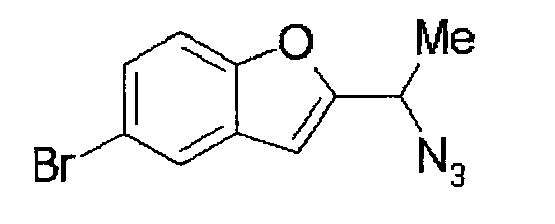
- Using 1-(5-bromo-1-benzofuran-2-yl)ethanol (6.11 g, 25.4 mmol), DMF (50 mL), methanesulfonyl chloride (2.9 mL, 38.0 mmol), triethylamine (7.5mL, 50.8 mmol) and sodium azide (8.64 g, 127 mmol), an operation in the same manner as in Reference Example 22 was performed to give the title compound 5.22 g as an oil. This was used for the next step without purification.
-

- To a solution of 2-(1-azidoethyl)-5-bromo-1-benzofuran (5.22 g, 19.6 mmol) obtained in Reference Example 162 in THF (20 mL) and water (2 mL) was added triphenylphosphine (7.71 g, 294 mmol) and the mixture was refluxed for 4 hr. Ethyl acetate was added thereto, and the mixture was extracted twice with 1N hydrochloric acid. The extract was basified with 8N aqueous sodium hydroxide solution, and extracted twice with ethyl acetate. The extract was washed with saturated brine, and dried over magnesium sulfate. The solvent was evaporated under reduced pressure, and to the obtained residue were added ethyl acetate (10 mL) and acetic anhydride (2.75 mL, 29.4 mmol), and the mixture was stirred at room temperature for 3 min.
The solvent was evaporated under reduced pressure, and the obtained solid was washed with diisopropyl ether to give the title compound (4.29 g, yield from 1-(5-bromo-1-benzofuran-2-yl)ethanol 78%).
1H NMR (CDCl3) δ 1.56 (d, J = 6.8 Hz, 3H), 2.03 (s, 3H), 5.26-5.48 (m, 1H), 6.52 (s, 1H), 7.22-7.43 (m, 2H), 7.64 (s, 1H). -
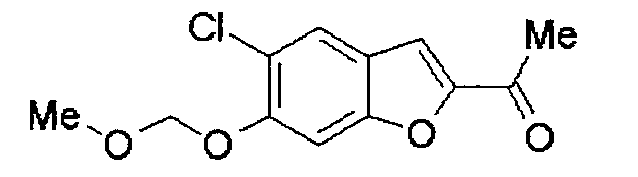
- Using 5-chloro-2-hydroxy-4-(methoxymethoxy)benzaldehyde (1.50 g, 6.94 mmol), acetonitrile (14 mL), bromoacetone (1.57 g, 10.4 mmol) and potassium carbonate (2.87 g, 20.8 mmol), an operation in the same manner as in Reference Example 86 was performed to give the title compound (1.28 g, yield 72%).
1H NMR (CDCl3) δ 2.58 (s, 3H), 3.54 (s, 3H), 5.32 (s, 2H), 7.40 (s, 1H), 7.42 (s, 1H), 7.71 (s, 1H). -

- Using 1-[5-chloro-6-(methoxymethoxy)-1-benzofuran-2-yl]ethanone (1.28 g, 5.03 mmol) obtained in Reference Example 164, methanol (10 mL) and sodium borohydride (383 mg, 10.1 mmol), an operation in the same manner as in Reference Example 21 was performed to give the title compound (1.28 g, quantitative).
1H NMR (CDCl3) δ 1.61 (d, J = 6.8 Hz, 3H), 2.03 (d, J = 5.1 Hz, 1H), 3.54 (s, 3H), 4.91-5.05 (m, 1H), 5.27 (s, 2H), 6.51 (s, 1H), 7.34 (s, 1H), 7.52 (s, 1H). -

- Using 1-[5-chloro-6-(methoxymethoxy)-1-benzofuran-2-yl]ethanol (1.28 g, 5.00 mmol) obtained in Reference Example 165, DMF (10 mL), methanesulfonyl chloride (0.58 mL, 7.50 mmol), triethylamine (1.5 mL, 10.0 mmol) and sodium azide (1.70 g, 25.0 mmol), an operation in the same manner as in Reference Example 22 was performed to give the title compound (1.79 g, quantitative).
1H NMR (CDCl3) δ 1.64 (d, J = 6.8 Hz, 3H), 3.55 (s, 3H), 4.65 (q, J = 7.0 Hz, 1H), 5.28 (s, 2H), 6.56 (s, 1H), 7.36 (s, 1H), 7.54 (s, 1H). -

- Using 2-(1-azidoethyl)-5-chloro-6-(methoxymethoxy)-1-benzofuran (1.79 g, 5.00 mmol) obtained in Reference Example 166, THF (5 mL), water (1 mL) and triphenylphosphine (1.96 g, 7.50 mmol), an operation in the same manner as in Reference Example 25 was performed to give the title compound (1.14 g, yield 81%).
1H NMR (CDCl3) δ 1.49 (d, J = 6.8 Hz, 3H), 3.55 (s, 2H), 4.07-4.17 (m, 1H), 5.26 (s, 2H), 6.39 (s, 1H), 7.26 (s, 1H), 7.49 (s, 1H). -

- To a solution of 1-[5-chloro-6-(methoxymethoxy)-1-benzofuran-2-yl]ethanamine (1.14 g, 4.06 mmol) obtained in Reference Example 167 in THF (8 mL) was added acetic anhydride (0.42 mL, 4.46 mmol) and the mixture was stirred at room temperature for 10 min. 1N Hydrochloric acid (5 mL) and concentrated hydrochloric acid (2 mL) were added thereto, and the mixture was further stirred at 50°C for 2 hr. Brine was added thereto, and the mixture was extracted twice with ethyl acetate. The extract was washed with saturated brine, and dried over anhydrous sodium sulfate. The solution was passed through silica gel. The solvent was evaporated under reduced pressure, and the obtained solid was washed with diethyl ether to give the title compound (766 mg, yield 74%) as a white solid.
1H NMR (CDCl3) δ 1.55 (d, J = 6.8 Hz, 3H), 2.02 (s, 3H), 5.20-5.42 (m, 1H), 5.69-5.86 (m, 2H), 6.44 (s, 1H), 7.11 (d, J = 0.8 Hz, 1H), 7.44 (s, 1H). -

- To methyl 4-bromo-2-fluorobenzoate (1.29 g, 5.54 mmol) in THF (10 mL)-triethylamine (5 mL) solvent were added 1-ethoxy-4-ethynylbenzene (1.24 mL, 8.30 mmol), copper(I) iodide (106 mg, 0.544 mmol) and bis(triphenylphosphine)palladium(II) chloride (195 mg, 0.277 mmol), and the mixture was stirred under an argon stream at room temperature for 15 min. The reaction mixture was diluted with ethyl acetate, and the mixture was washed with water, and dried over anhydrous magnesium sulfate. The solvent was evaporated under reduced pressure and the obtained residue was purified by silica gel column chromatography (hexane:ethyl acetate=97:3 to 17:3) to give the title compound (1.38 g, yield 84%) as an oil.
1H NMR (CDCl3) δ 1.43 (t, J = 7.0 Hz, 3H), 3.93 (s, 3H), 4.04 (q, J = 7.0 Hz, 2H), 6.88 (d, J = 8.7 Hz, 2H), 7.23-7.33 (m, 2H), 7.46 (d, J =8.7 Hz, 2H), 7.90 (t, J = 8.0 Hz, 1H). -
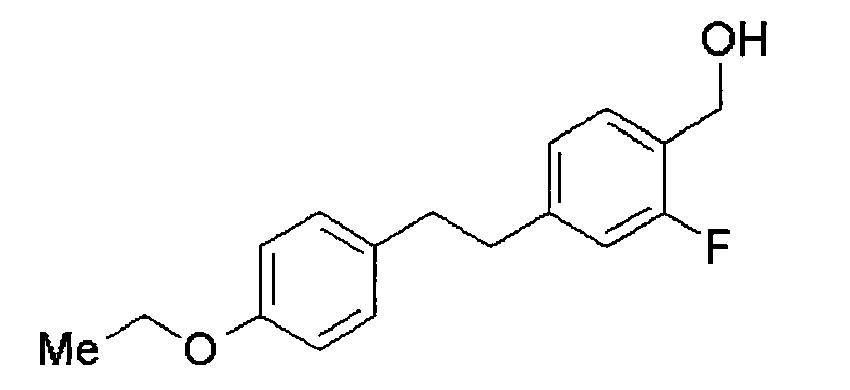
- Using methyl 4-[(4-ethoxyphenyl)ethynyl]-2-fluorobenzoate (1.32 g, 4.43 mmol) obtained in Reference Example 169, an operation in the same manner as in Reference Example 48 was performed to give the title compound (1.14 g, yield 94%) as a white solid.
1H NMR (CDCl3) δ 1.40 (t, J=7.0 Hz, 3H), 2.80-2.91 (m, 4H), 4.01 (q, J = 7.0 Hz, 2H), 4.72 (t, J =6.0 Hz, 2H), 6.81 (d, J = 8.7 Hz, 2H), 6.86 (dd, J = 11.1, 1.5 Hz, 1H), 6.93 (dd, J = 7.7, 1.5 Hz, 1H), 7.05 (d, J = 8.7 Hz, 2H), 7.29 (t, J = 7.8 Hz, 1H). -

- Using {4-[2-(4-ethoxyphenyl)ethyl]-2-fluorophenyl}methanol (1.14 g, 4.16 mmol) obtained in Reference Example 170, an operation in the same manner as in Reference Example 49 was performed to give the title compound (886 mg, yield 78%) as an oil.
1H NMR (CDCl3) δ 1.40 (t, J = 7.0 Hz, 3H), 2.84-2.90 (m, 2H), 2.92-2.98 (m, 2H), 4.01 (q, J = 7.0 Hz, 2H), 6.81 (d, J = 8.7 Hz, 2H), 6.93 (dd, J = 11.4, 1.5 Hz, 1H), 7.00-7.07 (m, 3H), 7.76 (t, J = 7.8 Hz, 1H), 10.30 (s, 1H). -

- To a solution of ethyl mercaptoacetateester (0.450 mL, 4.07 mmol) in DMSO (10 mL) was added sodium hydride (60%, 196 mg, 4.89 mmol) and the mixture was stirred at room temperature for 10 min. To this reaction mixture was added 4-[2-(4-ethoxyphenyl)ethyl]-2-fluorobenzaldehyde (886 mg, 3.26 mmol) obtained in Reference Example 171, and the mixture was stirred at room temperature for 20 min. Water was added to the reaction mixture, and the mixture was extracted with ethyl acetate. The organic layer was washed twice with saturated brine, and dried over anhydrous magnesium sulfate. The solvent was evaporated under reduced pressure, and the obtained residue was purified by basic silica gel column chromatography (hexane:ethyl acetate=19:1 to 1:1) to give the title compound (723 mg, yield 63%) as an oil.
1H NMR (CDCl3) δ 1.38-1.43 (m, 6H), 2.88-2.94 (m, 2H), 2.99-3.05 (m, 2H), 4.01 (q, J = 7.0 Hz, 2H), 4.40 (q, J = 7.0 Hz, 2H), 6.80 (d, J = 8.7 Hz, 2H), 7.06 (d, J = 8.7 Hz, 2H), 7.21 (dd, J = 8.2, 1.4 Hz, 2H), 7.62 (s, 1H), 7.77 (d, J = 8.3 Hz, 1H), 8.01 (s, 1H). -

- Using ethyl 6-[2-(4-ethoxyphenyl)ethyl]-1-benzothiophene-2-carboxylate (723 mg, 2.04 mmol) obtained in Reference Example 172, an operation in the same manner as in Reference Example 94 was performed to give the title compound (254 mg, yield 34%) as an oil.
1H NMR (CDCl3) δ 1.40 (t, J = 7.0 Hz, 3H), 2.89-2.94 (m, 2H), 3.00-3.05 (m, 2H), 3.42 (s, 3H), 3.82 (s, 3H), 4.01 (q, J = 7.0 Hz, 2H), 6.81 (d, J = 8.3 Hz, 2H), 7.08 (d, J = 8.7 Hz, 2H), 7.21 (dd, J = 8.3, 1.5 Hz, 1H), 7.62 (s, 1H), 7.78 (d, J = 8.3 Hz, 1H), 8.16 (s, 1H). -

- Using 6-[2-(4-ethoxyphenyl)ethyl]-N-methoxy-N-methyl-1-benzothiophene-2-carboxamide (254 mg, 0.688 mmol) obtained in Reference Example 173, an operation in the same manner as in Reference Example 95 was performed to give the title compound (172 mg, yield 77%) as a white solid.
1H NMR (CDCl3) δ 1.40 (t, J = 7.0 Hz, 3H), 1.65 (d, J = 6.4 Hz, 3H), 2.01 (d, J = 4.7 Hz, 1H), 2.85-2.92 (m, 2H), 2.96-3.02 (m, 2H), 4.01 (q, J = 7.0 Hz, 2H), 5.15-5.23 (m, 1H), 6.81 (d, J = 8.7 Hz, 2H), 7.07 (d, J = 8.5 Hz, 2H), 7.13-7.16 (m, 2H), 7.60-7.30 (m, 2H). -

- Using 1-{6-[2-(4-ethoxyphenyl)ethyl]-1-benzothiophen-2-yl}ethanol (172 mg, 0.527 mmol) obtained in Reference Example 174, an operation in the same manner as in Reference Example 28 was performed to give the title compound (168 mg, yield 90%) as an oil. 1H NMR (CDCl3) δ 1.40 (t, J = 7.0 Hz, 3H), 1.66 (d, J = 6.8 Hz, 3H), 2.85-2.93 (m, 2H), 2.97-3.02 (m, 2H), 4.01 (q, J = 6.8 Hz, 2H), 4.87 (q, J = 6.8 Hz, 1H), 6.81 (d, J = 8.7 Hz, 2H), 7.08 (d, J = 8.7 Hz, 2H), 7.17 (dd, J = 8.3, 1.5 Hz, 1H), 7.19 (s, 1H), 7.60 (s, 1H), 7.64 (d, J = 8.3 Hz, 1H).
-

- To a solution of 5-bromo-2-ethoxypyridine (5.00 g, 24.8 mmol) in THF (50 mL)-triethylamine (25 mL) were added trimethylsilylacetylene (5.3 mL, 37.2 mmol), copper(I) iodide (237 mg, 1.24 mmol) and bis(triphenylphosphine)palladium(II) chloride (870 mg, 1.24 mmol), and the mixture was stirred under an argon stream at 60°C for 1 hr. Water was added to the reaction mixture, the mixture was extracted twice with hexane, and the combined organic layer was dried over anhydrous magnesium sulfate. The solvent was evaporated under reduced pressure and the obtained residue was purified by silica gel column chromatography (hexane to hexane:ethyl acetate=19:1) to give an oil. To a solution of the oil in THF (50 mL) was added 1 M tetrabutylammonium fluoride THF solution (26.0 mL, 26.0 mmol), and the mixture was stirred at room temperature for 30 min. To the reaction mixture was added saturated aqueous sodium hydrogen carbonate solution, and the mixture was extracted twice with diethyl ether. The combined organic layer was dried over anhydrous magnesium sulfate. The solvent was evaporated under reduced pressure and the obtained residue was purified by silica gel column chromatography (hexane to hexane:ethyl acetate=19:1) to give the title compound (690 mg, yield 19%) as an oil.
1H NMR (CDCl3) δ 1.39 (t, J = 7.0 Hz, 3H), 3.10 (s, 1H), 4.33-4.40 (m, 2H), 6.67 (dd, J = 8.6, 0.7 Hz, 1H), 7.63 (dd, J = 8.6, 2.1 Hz, 1H), 8.29 (d, J = 2.1 Hz, 1H). -

- Using methyl 2-hydroxy-4-iodobenzoate (1.09 g, 3.91 mmol) and 2-ethoxy-5-ethynylpyridine (690 mg, 4.69 mmol) obtained in Reference Example 176, an operation in the same manner as in Reference Example 47 was performed to give the title compound (660 mg, yield 49%) as a yellow solid.
1H NMR (CDCl3) δ 1.40 (t, J = 7.2 Hz, 3H), 3.55 (s, 3H), 3.90 (s, 3H), 4.39 (q, J = 7.2 Hz, 2H), 5.28 (s, 2H), 6.72 (dd, J = 8.7, 2.3 Hz, 1H), 7.18 (dd, J = 8.0, 1.5 Hz, 1H), 7.34 (d, J = 1.5 Hz, 1H), 7.68 (dd, J = 8.7, 2.3 Hz, 2H), 7.77 (d, J = 8.0 Hz, 1H). -

- Using methyl 4-[(6-ethoxypyridin-3-yl)ethynyl]-2-(methoxymethoxy)benzoate (660 mg, 1.94 mmol) obtained in Reference Example 177, an operation in the same manner as in Reference Example 48 was performed to give the title compound (425 mg, yield 69%) as an oil.
1H NMR (CDCl3) δ 1.38 (t, J = 7.0 Hz, 3H), 2.78-2.89 (m, 4H), 3.48 (s, 3H), 4.31 (q, J = 7.0 Hz, 2H), 4.67 (d, J = 6.2 Hz, 2H), 5.20 (s, 2H), 6.64 (d, J = 8.7 Hz, 1H), 6.80 (dd, J = 7.6, 1.4 Hz, 1H), 6.87 (d, J = 1.4 Hz, 1H), 7.21 (d, J = 7.6 Hz, 1H), 7.34 (dd, J = 8.7, 2.5 Hz, 1H), 7.90 (d, J = 2.5 Hz, 1H). -

- Using {4-[2-(6-ethoxypyridin-3-yl)ethyl]-2-(methoxymethoxy)phenyl}methanol (425 mg, 1.34 mmol) obtained in Reference Example 178, an operation in the same manner as in Reference Example 49 was performed to give the title compound (342 mg, yield 81%) as an oil.
1H NMR (CDCl3) δ 1.38 (t, J = 7.0 Hz, 3H), 2.81-2.94 (m, 4H), 3.51 (s, 3H), 4.31 (q, J = 7.0 Hz, 2H), 5.25 (s, 2H), 6.64 (d, J = 8.7 Hz, 1H), 6.88 (d, J = 8.0 Hz, 1H), 6.94 (s, 1H), 7.33 (dd, J = 8.7, 2.5 Hz, 1H), 7.76 (d, J = 8.0 Hz, 1H), 7.89 (d, J = 2.5 Hz, 1H), 10.43 (s, 1H). -

- Using 4-[2-(6-ethoxypyridin-3-yl)ethyl]-2-(methoxymethoxy)benzaldehyde (342 mg, 1.08 mmol) obtained in Reference Example 179, an operation in the same manner as in Reference Example 50 was performed to give the title compound (274 mg, yield 94%) as an oil.
1H NMR (CDCl3) δ 1.38 (t, J = 7.0 Hz, 3H), 2.82-2.93 (m, 4H), 4.31 (q, J = 7.0 Hz, 2H), 6.64 (d, J = 8.3 Hz, 1H), 6.77-6.79 (m, 2H), 7.34 (dd, J = 8.5, 2.5 Hz, 1H), 7.45 (d, J = 8.3 Hz, 1H), 7.90 (d, J = 2.5 Hz, 1H), 9.84 (s, 1H), 11.03 (s, 1H). -

- Using 4-[2-(6-ethoxypyridin-3-yl)ethyl]-2-hydroxybenzaldehyde (274 mg, 1.01 mmol) obtained in Reference Example 180, an operation in the same manner as in Reference Example 51 was performed to give the title compound (312 mg, quantitative) as an oil.
1H NMR (CDCl3) δ 1.38 (t, J = 7.2 Hz, 3H), 2.59 (s, 3H), 2.87-2.92 (m, 2H), 3.00-3.05 (m, 2H), 4.31 (q, J = 7.2 Hz, 2H), 6.63 (d, J = 8.3 Hz, 1H), 7.11 (dd, J = 8.3, 1.1 Hz, 1H), 7.31-7.35 (m, 2H), 7.46 (d, J = 1.1 Hz, 1H), 7.60 (d, J = 8.3 Hz, 1H), 7.89 (d, J = 2.3 Hz, 1H). -

- Using 1-{6-[2-(6-ethoxypyridin-3-yl)ethyl]-1-benzofuran-2-yl}ethanone (312 mg, 1.01 mmol) obtained in Reference Example 181, an operation in the same manner as in Reference Example 52 was performed to give the title compound (248 mg, yield 77%) as an oil.
1H NMR (CDCl3) δ 1.38 (t, J = 7.0 Hz, 3H), 1.63 (d, J = 6.8 Hz, 3H), 2.10 (d, J = 4.5 Hz, 1H), 2.84-2.89 (m, 2H), 2.95-3.00 (m, 2H), 4.31 (q, J = 7.0 Hz, 2H), 4.96-5.04 (m, 1H), 6.56 (s, 1H), 6.63 (d, J = 8.3 Hz, 1H), 7.01 (dd, J = 8.0, 1.5 Hz, 1H), 7.23 (s, 1H), 7.33 (dd, J = 8.5, 2.5 Hz, 1H), 7.42 (d, J = 8.0 Hz, 1H), 7.90 (d, J = 2.5 Hz, 1H). -

- Using 1-{6-[2-(6-ethoxypyridin-3-yl)ethyl]-1-benzofuran-2-yl}ethanol (248 mg, 0.796 mmol) obtained in Reference Example 182, an operation in the same manner as in Reference Example 28 was performed to give the title compound (259 mg, yield 96%) as an oil. 1H NMR (CDCl3) δ 1.38 (t, J = 7.0 Hz, 3H), 1.65 (d, J = 6.8 Hz, 3H), 2.85-2.90 (m, 2H), 2.96-3.01 (m, 2H), 4.31 (q, J = 7.0 Hz, 2H), 4.67 (q, J = 6.8 Hz, 1H), 6.62-6.65 (m, 2H), 7.03 (dd, J = 8.0, 1.1 Hz, 1H), 7.26-7.28 (m, 1H), 7.34 (dd, J = 8.5, 2.5 Hz, 1H), 7.44 (d, J = 8.0 Hz, 1H), 7.91 (d, J = 2.5 Hz, 1H).
-

- Using 2-bromo-5-ethoxypyridine (5.00 g, 24.8 mmol), an operation in the same manner as in Reference Example 176 was performed to give the title compound (3.48 g, yield 95%) as a white solid.
1H NMR (CDCl3) δ 1.44 (t, J = 7.0 Hz, 3H), 3.06 (s, 1H), 4.09 (q, J = 7.0 Hz, 2H), 7.12 (dd, J = 8.7, 3.0 Hz, 1H), 7.41 (d, J = 8.6 Hz, 1H), 8.26 (d, J = 3.0 Hz, 1H). -

- Using methyl 2-hydroxy-4-iodobenzoate (1.09 g, 3.91 mmol) and 5-ethoxy-2-ethynylpyridine (690 mg, 4.69 mmol) obtained in Reference Example 184, an operation in the same manner as in Reference Example 47 was performed to give the title compound (918 mg, yield 69%) as a yellow solid.
1H NMR (CDCl3) δ 1.46 (t, J = 7.0 Hz, 3H), 3.53 (s, 3H), 3.90 (s, 3H), 4.12 (q, J = 7.0 Hz, 2H), 5.26 (s, 2H), 7.17 (dd, J = 8.7, 3.0 Hz, 1H), 7.24 (dd, J = 8.0, 1.4 Hz, 1H), 7.42 (d, J = 1.4 Hz, 1H), 7.48 (d, J = 8.7 Hz, 1H), 7.77 (d, J = 8.0 Hz, 1H), 8.31 (d, J = 3.0 Hz, 1H). -

- Using methyl 4-[(5-ethoxypyridin-2-yl)ethynyl]-2-(methoxymethoxy)benzoate (918 mg, 2.69 mmol) obtained in Reference Example 185, an operation in the same manner as in Reference Example 48 was performed to give the title compound (793 mg, yield 93%) as an oil.
1H NMR (CDCl3) δ 1.43 (t, J = 7.0 Hz, 3H), 2.22 (t, J = 6.3 Hz, 1H), 2.95-3.06 (m, 4H), 3.48 (s, 3H), 4.06 (q, J = 7.0 Hz, 2H), 4.66 (d, J = 6.2 Hz, 2H), 5.19 (s, 2H), 6.84 (dd, J = 7.5, 1.5 Hz, 1H), 6.93 (d, J = 1.5 Hz, 1H), 6.99 (d, J = 8.1 Hz, 1H), 7.07-7.11 (m, 1H), 7.20 (d, J = 7.5 Hz, 1H), 8.24 (d, J = 3.0 Hz, 1H). -

- Using {4-[2-(5-ethoxypyridin-2-yl)ethyl]-2-(methoxymethoxy)phenyl}methanol (793 mg, 2.50 mmol) obtained in Reference Example 186, an operation in the same manner as in Reference Example 49 was performed to give the title compound (682 mg, yield 86%) as an oil.
1H NMR (CDCl3) 5 1.43 (t, J = 7.0 Hz, 3H), 3.01-3.08 (m, 4H), 3.50 (s, 3H), 4.06 (q, J = 7.0 Hz, 2H), 5.24 (s, 2H), 6.91 (d, J = 8.0 Hz, 1H), 6.97 (d, J = 8.3 Hz, 1H), 7.00 (d, J = 1.1 Hz, 1H), 7.06-7.10 (m, 1H), 7.74 (d, J = 8.0 Hz, 1H), 8.25 (s, 1H), 10.43 (s, 1H). -

- Using 4-[2-(5-ethoxypyridin-2-yl)ethyl]-2-(methoxymethoxy)benzaldehyde (682 mg, 2.16 mmol) obtained in Reference Example 187, an operation in the same manner as in Reference Example 50 was performed to give the title compound (557 mg, yield 95%) as an oil.
1H NMR (CDCl3) δ 1.39 (t, J = 7.0 Hz, 3H), 3.01-3.07 (m, 4H), 4.06 (q, J = 7.0 Hz, 2H), 6.81-6.85 (m, 2H), 6.97 (d, J = 8.5 Hz, 1H), 7.06-7.10 (m, 1H), 7.43 (d, J = 7.9 Hz, 1H), 8.24 (d, J = 2.6 Hz, 1H), 9.83 (s, 1H), 11.02 (s, 1H). -

- Using 4-[2-(5-ethoxypyridin-2-yl)ethyl]-2-hydroxybenzaldehyde (557 mg, 2.06 mmol) obtained in Reference Example 188, an operation in the same manner as in Reference Example 51 was performed to give the title compound (594 mg, yield 93%) as an oil.
1H NMR (CDCl3) δ 1.43 (t, J = 7.0 Hz, 3H), 2.59 (s, 3H), 3.05-3.11 (m, 2H), 3.15-3.21 (m, 2H), 4.06 (q, J = 7.0 Hz, 2H), 6.96 (d, J = 8.35 Hz, 1H), 7.07 (dd, J = 8.5, 3.0 Hz, 1H), 7.16 (dd, J = 8.1, 1.3 Hz, 1H), 7.35 (s, 1H), 7.46 (d, J = 1.3 Hz, 1H), 7.59 (d, J = 8.1 Hz, 1H), 8.25 (d, J = 3.0 Hz, 1H). -

- Using 1-{6-[2-(5-ethoxypyridin-2-yl)ethyl]-1-benzofuran-2-yl}ethanone (594 mg, 1.92 mmol) obtained in Reference Example 189, an operation in the same manner as in Reference Example 52 was performed to give the title compound (525 mg, yield 88%) as an oil.
1H NMR (CDCl3) δ 1.42 (t, J = 7.0 Hz, 3H), 1.63 (d, J = 6.6 Hz, 3H), 3.03-3.16 (m, 4H), 4.05 (q, J = 7.0 Hz, 2H), 4.96-5.03 (m, 1H), 6.55 (s, 1H), 6.97 (d, J = 8.5 Hz, 1H), 7.03-7.09 (m, 2H), 7.26-7.28 (m, 1H), 7.41 (d, J = 7.9 Hz, 1H), 8.25 (d, J = 2.8 Hz, 1H). -

- Using 1-{6-[2-(5-ethoxypyridin-2-yl)ethyl]-1-benzofuran-2-yl}ethanol (525 mg, 1.69 mmol) obtained in Reference Example 190, an operation in the same manner as in Reference Example 28 was performed to give the title compound (512 mg, yield 90%) as an oil.
1H NMR (CDCl3) δ 1.43 (t, J = 7.0 Hz, 3H), 1.65 (d, J = 6.6 Hz, 3H), 3.03-3.17 (m, 4H), 4.06 (q, J = 7.0 Hz, 2H), 4.67 (q, J = 6.8 Hz, 1H), 6.61 (s, 1H), 6.98 (d, J = 8.3 Hz, 1H), 7.06-7.10 (m, 2H), 7.30 (s, 1H), 7.43 (d, J = 8.0 Hz, 1H), 8.26 (d, J = 2.5 Hz, 1H). -

- Using N-(tert-butoxycarbonyl)-D,L-alanine (3.74 g, 19.7 mmol), 2-methylpropyl chlorocarbonate (2.56 mL, 19.7 mmol) and methyl 4-amino-3-hydroxybenzoate (3.00 g, 19.7 mmol), a method in the same manner as in Reference Example 105 was performed, and the obtained residue was triturated with ethyl acetate to give the title compound (2.94 g, yield 48%).
1H NMR (CDCl3) δ 1.46-1.48 (m, 12H), 3.89 (s, 3H), 4.39 (m, 1H), 5.02 (br, 1H), 7.39 (m, 1H), 7.56 (dd, J = 1.8, 8.4 Hz, 1H), 7.65 (d, J = 1.8 Hz, 1H), 8.73 (br, 1H), 8.96 (br, 1H). -

- Using methyl 4-{[N-(tert-butoxycarbonyl)alanyl]amino}-3-hydroxybenzoate (2.93 g, 8.66 mmol) obtained in Reference Example 192, a method in the same manner as in Reference Example 106 was performed, and the obtained residue was triturated with diisopropyl ether to give the title compound (2.38 g, quantitative). This was used for the next step without purification.
-

- Using methyl 4-(alanylamino)-3-hydroxybenzoate hydrochloride (2.38 g, 8.66 mmol) obtained in Reference Example 193 and acetic anhydride (0.823 mL, 8.66 mmol), a method in the same manner as in Reference Example 107 was performed, and the obtained residue was triturated with ethyl acetate to give the title compound (1.70 g, yield from methyl 4-(alanylamino)-3-hydroxybenzoate hydrochloride 70%).
1H NMR (DMSO-d6) δ 1.28 (d, J = 7.2 Hz, 3H), 1.88 (s, 3H), 3.80 (s, 3H), 4.50 (m, 1H), 7.39-7.44 (m, 2H), 8.15 (d, J = 8.1 Hz, 1H), 8.34 (d, J = 6.9 Hz, 1H), 9.23 (s, 1H), 10.43 (s, 1H). -

- A solution of methyl 4-[(N-acetylalanyl)amino]-3-hydroxybenzoate (1.69 g, 6.03 mmol) obtained in Reference Example 194 and p-toluenesulfonic acid monohydrate (115 mg, 0.603 mmol) in toluene (30 mL) was heated under reflux using the Dean-Stark apparatus for 16 hr. After being allowed to cool to room temperature, the mixture was diluted with ethyl acetate and THF, and washed with 10% aqueous potassium carbonate solution and saturated brine. This solution was applied to basic silica gel column chromatography (ethyl acetate). The solvent was evaporated under reduced pressure, and the obtained residue was triturated with ethyl acetate-diisopropyl ether (1:2) to give the title compound (657 mg, yield 42%).
1H NMR (CDCl3) δ 1.67 (d, J = 6.9 Hz, 3H), 2.10 (s, 3H), 3.96 (s, 3H), 5.45 (m, 1H), 6.25 (m, 1H), 7.69-7.72 (m, 1H), 8.05 (dd, J = 1.5, 8.4 Hz, 1H), 8.21 (m, 1H). -

- Using methyl 2-[1-(acetylamino)ethyl]-1,3-benzoxazole-6-carboxylate (300 mg, 1.14 mmol) obtained in Reference Example 195 and lithium aluminum hydride (86.8 mg, 2.29 mmol) and in the same manner as in Reference Example 109, the title compound (22.2 mg, yield 8.3%) as an oil.
1H NMR (CDCl3) δ 1.63 (d, J = 6.9 Hz, 3H), 2.08 (s, 3H), 4.80 (s, 2H), 5.40 (m, 1H), 6.46 (br, 1H), 7.30 (m, 1H), 7.53 (s, 1H), 7.60 (d, J = 8.4 Hz, 1H). -

- To a solution of N-(tert-butoxycarbonyl)-D,L-alanine (3.76 g, 19.9 mmol) and triethylamine (2.76 mL, 19.9 mmol) in THF (25 mL) was added 2-methylpropyl chlorocarbonate (2.58 mL, 19.9 mmol) under ice-cooling, and the mixture was stirred for 30 min. To this solution was added dropwise a solution of methyl 3,4-diaminobenzoate (3.00 g, 18.1 mmol) in THF (15 mL) under a nitrogen atmosphere, and the mixture was stirred at room temperature for 1 hr. The reaction mixture was diluted with ethyl acetate, and the mixture was washed with 10% aqueous potassium carbonate solution and saturated brine, and dried over anhydrous sodium sulfate. This solution was applied to basic silica gel column chromatography (ethyl acetate). The solvent was evaporated under reduced pressure, and the obtained residue was triturated with ethyl acetate to give the title compound (4.21 g, yield 69%).
1H NMR (DMSO-d6) δ 1.27 (d, J = 7.2 Hz, 3H), 1.39 (s, 9H), 3.74 (s, 3H), 4.08 (m, 1H), 5.74 (br, 2H), 6.71 (d, J = 8.4 Hz, 1H), 7.14 (d, J = 6.3 Hz, 1H), 7.53 (dd, J = 1.8, 8.4 Hz, 1H), 7.70 (s, 1H), 9.19 (s, 1H). -

- A solution of methyl 4-amino-3-{[N-(tert-butoxycarbonyl)alanyl]amino}benzoate (4.20 g, 12.4 mmol) obtained in Reference Example 197 in acetic acid (30 mL) was stirred under heating at 80°C for 16 hr. The reaction mixture was allowed to cool to room temperature, and concentrated under reduced pressure. The residue was dissolved in ethyl acetate, and the solution was washed with 10% aqueous potassium carbonate solution and saturated brine, and dried over anhydrous sodium sulfate. This solution was applied to basic silica gel column chromatography (ethyl acetate). The solvent was evaporated under reduced pressure, and the obtained residue was triturated with hexane to give the title compound (3.16 g, yield 79%).
1H NMR (DMSO-d6) δ 1.47 (sx2, 9H), 1.75 (d, J = 6.9 Hz, 3H), 3.93 (sx2, 3H), 5.00 (m, 1H), 5.15 (m, 1H), 7.42, 7.73 (m, 1H), 7.93-7.99 (m, 1H), 8.15, 8.45 (m, 1H), 10.45 (m, 1H). -
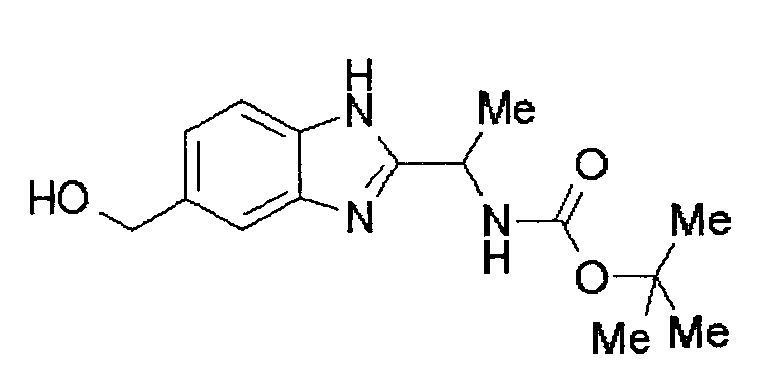
- Using methyl 2-{1-[(tert-butoxycarbonyl)amino]ethyl}-1H-benzoimidazole-5-carboxylate (500 mg, 1.57 mmol) obtained in Reference Example 198 and lithium aluminum hydride (119 mg, 3.13 mmol) and in the same manner as in Reference Example 85, the title compound (409 mg, yield 90%) was obtained as an oil.
1H NMR (CDCl3) δ 1.45 (sx2, 9H), 1.69 (m, 3H), 4.75 (s, 2H), 4.97 (m, 1H), 5.33 (br, 1H), 7.17-7.20 (m, 1H), 7.30-7.34 (m, 1H), 7.65 (m, 1H), 10.45 (m, 1H). -

- Using tert-butyl (1-{5-[(4-ethoxyphenoxy)methyl]-1H-benzimidazol-2-yl}ethyl)carbamate (86.9 mg, 0.211 mmol) obtained in Example 59, a method in the same manner as in Reference Example 106 was performed, and the obtained residue was triturated with ethyl acetate to give the title compound (56.9 mg, yield 70%). This was used for the next step without purification.
-

- Using tert-butyl {1-[5-(benzyloxy)-1H-benzimidazol-2-yl]ethyl}carbamate (400 mg, 1.09 mmol) obtained in the below-mentioned Example 104, a method in the same manner as in Reference Example 106 was performed, and the obtained residue was triturated with diisopropyl ether to give the title compound (370 mg, quantitative). This was used for the next step without purification.
-

- A solution of N-{1-[5-(benzyloxy)-1H-benzimidazol-2-yl]ethyl}acetamide (151 mg, 0.488 mmol) obtained in the below-mentioned Example 105 and 10% palladium carbon (50% water-containing product, 500 mg) in methanol (5 mL) was stirred under a hydrogen atmosphere for 16 hr. The reaction mixture was filtered through celite, and the solvent was evaporated under reduced pressure. The obtained residue was purified by basic silica gel column chromatography (methanol), and triturated with diisopropyl ether to give the title compound (98.6 mg, yield 92%).
1H NMR (DMSO-d6) δ 1.45 (d, J = 7.2 Hz, 3H), 1.87 (s, 3H), 5.06 (m, 1H), 6.59 (dd, J = 2.1, 8.4 Hz, 1H), 6.79 (d, J = 2.1 Hz, 1H), 7.25 (d, J = 8.4 Hz, 1H), 8.38 (d, J = 7.8 Hz, 1H). -

- To a solution of 1-(5-hydroxy-1-benzofuran-2-yl)ethanone (2.40 g, 13.7 mmol) in anhydrous DMF (1 mL) were added 4-ethoxybenzyl chloride (2.81 g, 16.5 mmol) and potassium carbonate (3.78 g, 27.4 mmol) and the mixture was stirred at 50°C overnight. Saturated brine was added thereto, and the mixture was extracted three times with ethyl acetate. The extract was washed with saturated brine, and dried over anhydrous magnesium sulfate. The solvent was evaporated under reduced pressure to give 1-{5-[(4-ethoxybenzyl)oxy]-1-benzofuran-2-yl}ethanone (6.95 g). This was directly used for the next reaction.
To a solution of the obtained 1-{5-[(4-ethoxybenzyl)oxy]-1-benzofuran-2-yl}ethanone (6.95 g) in methanol (50 mL) was added sodium borohydride (1.04 g, 27.4 mmol) by small portions, and the mixture was stirred at room temperature for 30 min. Water was added to the reaction mixture, and the solvent was evaporated. Ethyl acetate was added thereto, and the mixture was washed with water and saturated brine, and dried over anhydrous magnesium sulfate. The solvent was evaporated under reduced pressure, and the obtained residue was purified by silica gel column chromatography (hexane to hexane:ethyl acetate=3:2) to give the title compound (2.87 g, yield 67%).
1H NMR (CDCl3) δ 1.42 (t, J = 7.0 Hz, 3H), 1.62 (d, J = 6.6 Hz, 3H), 2.02 (d, J = 5.1 Hz, 1H), 4.04 (q, J = 7.0 Hz, 2H), 4.92-5.04 (m, 1H), 5.00 (s, 2H), 6.54 (s, 1H), 6.85-6.93 (m, 2H), 6.95 (d, J = 2.5 Hz, 1H), 7.07 (d, J = 2.6 Hz, 1H), 7.29-7.41 (m, 3H). -

- Using 1-{5-[(4-ethoxybenzyl)oxy]-1-benzofuran-2-yl}ethanol (2.87 g, 9.19 mmol) obtained in Reference Example 205, DMF (20 mL), methanesulfonyl chloride (1.06 mL, 13.4 mmol) and triethylamine (2.73 mL, 18.4 mmol), an operation in the same manner as in Reference Example 22 was performed to give 2-(1-azidoethyl)-5-[(4-ethoxybenzyl)oxy]-1-benzofuran (4.62 g). This was used for the next reaction without purification.
-

- Using 2-(1-azidoethyl)-5-[(4-ethoxybenzyl)oxy]-1-benzofuran (4.62 g) obtained in Reference Example 206, THF (400 mL), triphenylphosphine (20.9 g, 79.8 mmol) and water (40 mL), an operation in the same manner as in Reference Example 25 was performed to give the title compound (1.42 g, yield 50%).
1H NMR (CDCl3) δ 1.42 (t, J = 7.0 Hz, 3H), 1.50 (d, J = 6.8 Hz, 3H), 4.04 (q, J = 7.0 Hz, 2H), 4.17 (q, J = 6.8 Hz, 1H), 5.00 (s, 2H), 6.42 (s, 1H), 6.86-6.94 (m, 3H), 7.05 (d, J=2.4 Hz, 2H), 7.31 (d, J=8.9 Hz, 1H), 7.36 (d, J = 8.6 Hz, 2H). -

- Using methyl 2-hydroxy-4-iodobenzoate (1.52 g, 5.46 mmol) and 5-ethynyl-2,3-dihydro-1-benzofuran (944 mg, 6.55 mmol), an operation in the same manner as in Reference Example 47 was performed to give the title compound (1.13 g, yield 61%) as a yellow solid.
1H NMR (CDCl3) δ 3.22 (t, J = 8.7 Hz, 2H), 3.54 (s, 3H), 3.89 (s, 3H), 4.61 (t, J = 8.7 Hz, 2H), 5.28 (s, 2H), 6.76 (d, J = 8.3 Hz, 1H), 7.16 (dd, J = 8.0, 1.5 Hz, 1H), 7.31-7.38 (m, 3H), 7.76 (d, J = 8.0 Hz, 1H). -

- Using methyl 4-(2,3-dihydro-1-benzofuran-5-ylethynyl)-2-(methoxymethoxy)benzoate (1.13 g, 3.34 mmol) obtained in Reference Example 208, an operation in the same manner as in Reference Example 48 was performed to give the title compound (820 mg, yield 78%) as an oil.
1H NMR (CDCl3) δ 2.78-2.90 (m, 4H), 3.17 (t, J = 8.7 Hz, 2H), 3.49 (s, 3H), 4.54 (t, J = 8.7 Hz, 2H), 4.67 (d, J = 6.8 Hz, 2H), 5.20 (s, 2H), 6.69 (d, J = 8.0 Hz, 1H), 6.83 (dd, J = 7.6, 1.1 Hz, 1H), 6.90-6.92 (m, 2H), 7.02 (s, 1H), 7.21 (d, J = 7.6 Hz, 1H). -

- Using {4-[2-(2,3-dihydro-1-benzofuran-5-yl)ethyl]-2-(methoxymethoxy)phenyl}methanol (820 mg, 2.61 mmol) obtained in Reference Example 209, an operation in the same manner as in Reference Example 49 was performed to give the title compound (767 mg, yield 93%) as an oil.
1H NMR (CDCl3) δ 2.81-2.94 (m, 4H), 3.17 (t, J = 8.7 Hz, 2H), 3.51 (s, 3H), 4.54 (t, J = 8.7 Hz, 2H), 5.25 (s, 2H), 6.89 (d, J = 8.0 Hz, 1H), 6.86-6.91 (m, 2H), 6.95-6.99 (m, 2H), 7.75 (d, J = 8.0 Hz, 1H), 10.44 (s, 1H). -

- Using 4-[2-(2,3-dihydro-1-benzofuran-5-yl)ethyl]-2-(methoxymethoxy)benzaldehyde (767 mg, 2.45 mmol) obtained in Reference Example 210, an operation in the same manner as in Reference Example 50 was performed to give the title compound (457 mg, yield 69%) as a white solid.
1H NMR (CDCl3) δ 2.81-2.93 (m, 4H), 3.17 (t, J = 8.7 Hz, 2H), 4.55 (t, J = 8.7 Hz, 2H), 6.69 (d, J = 8.1 Hz, 1H), 6.80-6.83 (m, 2H), 6.89 (dd, J = 8.1, 1.7 Hz, 1H), 6.99 (s, 1H), 7.44 (d, J = 8.3 Hz, 1H), 9.84 (s, 1H), 11.04 (s, 1H). -

- Using 4-[2-(2,3-dihydro-1-benzofuran-5-yl)ethyl]-2-hydroxybenzaldehyde (457 mg, 1.71 mmol) obtained in Reference Example 211, an operation in the same manner as in Reference Example 51 was performed to give the title compound (523 mg, quantitative) as an oil.
1H NMR (CDCl3) δ 2.61 (s, 3H), 2.87-2.92 (m, 2H), 3.00-3.05 (m, 2H), 3.17 (t, J = 8.7 Hz, 2H), 4.55 (t, J = 8.7 Hz, 2H), 6.69 (d, J = 8.1 Hz, 1H), 6.89 (d, J = 8.1 Hz, 1H), 7.01 (s, 1H), 7.14 (dd, J = 8.1, 1.5 Hz, 1H), 7.34 (s, 1H), 7.47 (d, J = 1.5 Hz, 1H), 7.60 (d, J = 7.9 Hz, 1H). -

- Using 1-{6-[2-(2,3-dihydro-1-benzofuran-5-yl)ethyl]-1-benzofuran-2-yl}ethanone (523 mg, 1.71 mmol) obtained in Reference Example 212, an operation in the same manner as in Reference Example 52 was performed to give the title compound (452 mg, yield 86%) as an oil.
1H NMR (CDCl3) δ 1.63 (d, J = 6.6 Hz, 3H), 2.85-2.91 (m, 2H), 2.95-3.01 (m, 2H), 3.18 (t, J = 8.7 Hz, 2H), 4.55 (t, J = 8.7 Hz, 2H), 4.97-5.05 (m, 1H), 6.57 (s, 1H), 6.70 (d, J = 8.1 Hz, 1H), 6.92 (d, J = 6.4 Hz, 1H), 7.03-7.06 (m, 2H), 7.26-7.27 (m, 1H), 7.43 (d, J = 7.9 Hz, 1H). -

- Using 1-{6-[2-(2,3-dihydro-1-benzofuran-5-yl)ethyl]-1-benzofuran-2-yl}ethanol (452 mg, 1.47 mmol) obtained in Reference Example 213, an operation in the same manner as in Reference Example 28 was performed to give the title compound (394 mg, yield 80%) as an oil.
1H NMR (CDCl3) δ 1.65 (d, J = 6.8 Hz, 3H), 2.85-2.91 (m, 2H), 2.96-3.02 (m, 2H), 3.17 (t, J = 8.7 Hz, 2H), 4.55 (t, J = 8.7 Hz, 2H), 4.68 (q, J = 6.8 Hz, 1H), 6.62 (s, 1H), 6.70 (d, J = 8.1 Hz, 1H), 6.92 (d, J = 8.3 Hz, 1H), 7.03 (s, 1H), 7.06 (dd, J = 8.0, 1.2 Hz, 1H) , 7.29 (s, 1H), 7.45 (d, J = 7.9 Hz, 1H). -

- To a solution of methyl 2-hydroxy-4-iodobenzoate (6.55 g, 23.6 mmol), 1-ethynyl-4-(methoxymethoxy)benzene (4.58 g, 28.3 mmol) and copper(I) iodide (450 mg, 2.36 mmol) in triethylamine (50 mL) was added bis(triphenylphosphine)palladium(II) chloride (1.66 mg, 2.36 mmol), and the mixture was stirred under an argon stream at room temperature for 30 min. The reaction mixture was diluted with ethyl acetate, and the mixture was washed with water, and dried over anhydrous magnesium sulfate. The solvent was evaporated under reduced pressure and the obtained residue was dissolved in DMF (30 mL). Imidazole (2.42 g, 35.4 mmol) and tert-butyl(chloro)dimethylsilane (4.27 g, 28.3 mmol) were added thereto, and the mixture was stirred at room temperature for 1.5 hr. Water was added to the reaction mixture, and the mixture was extracted with ethyl acetate. The extract was washed twice with saturated brine, and dried over anhydrous magnesium sulfate. The solvent was evaporated under reduced pressure and the obtained residue was purified by silica gel column chromatography (hexane:ethyl acetate=19:1 to 3:2) to give the title compound (8.50 g, yield 84%) as an oil.
1H NMR (CDCl3) δ 0.28 (s, 6H), 1.03 (s, 9H), 3.50 (s, 3H), 3.87 (s, 3H), 5.21 (s, 2H), 6.99 (d, J = 1.5 Hz, 1H), 7.03 (d, J = 8.7 Hz, 2H), 7.13 (dd, J = 8.3, 1.5 Hz, 1H), 7.49 (d, J = 8.7 Hz, 2H), 7.74 (d, J = 8.3 Hz, 1H). -

- Using methyl 2-{[tert-butyl(dimethyl)silyl]oxy}-4-{[4-(methoxymethoxy)phenyl]ethynyl}benzoate (8.50 g, 20.0 mmol) obtained in Reference Example 215, an operation in the same manner as in Reference Example 48 was performed to give the title compound (890 mg, yield 14%) as a white solid.
1H NMR (CDCl3) δ 2.80-2.87 (m, 4H), 3.48 (s, 3H), 4.82-4.87 (m, 2H), 5.15 (s, 2H), 6.67 (dd, J = 7.6, 1.9 Hz, 1H), 6.73 (s, 1H), 6.92-6.97 (m, 3H), 7.09 (d, J = 8.7 Hz, 2H). -

- To a solution of 2-(hydroxymethyl)-5-{2-[4-(methoxymethoxy)phenyl]ethyl}phenol (890 mg, 3.09 mmol) obtained in Reference Example 216 in methylene chloride (20 mL) was added manganese dioxide (1.35 g, 15.5 mmol), and the mixture was stirred at room temperature for 30 min. The reaction mixture was filtered. The solvent was evaporated under reduced pressure and the obtained residue was purified by silica gel column chromatography (hexane:ethyl acetate=9:1 to 1:1) to give the title compound (514 mg, yield 58%) as an oil.
1H NMR (CDCl3) δ 2.86-2.95 (m, 4H), 3.48 (s, 3H), 5.15 (s, 2H), 6.77-6.85 (m, 2H), 6.95 (d, J = 8.7 Hz, 2H), 7.07 (d, J = 8.7 Hz, 2H), 7.44 (d, J = 8.3 Hz, 1H), 9.84 (s, 1H), 11.03 (s, 1H). -

- To a solution of 2-hydroxy-4-{2-[4-(methoxymethoxy)phenyl]ethyl}benzaldehyde (514 mg, 1.79 mmol) obtained in Reference Example 217 in acetonitrile (10 mL) were added potassium carbonate (495 mg, 3.58 mmol) and bromoacetone (0.227 mL, 2.69 mmol), and the mixture was stirred at 80°C for 2 hr. Water was added to the reaction mixture, and the mixture was extracted twice with ethyl acetate, and the combined organic layer was dried over anhydrous magnesium sulfate. The solvent was evaporated and the obtained residue was purified by basic silica gel column chromatography (ethyl acetate) to give an oil. To a solution of the oil in methanol (10 mL) was added sodium borohydride (67.8 mg, 1.79 mmol), and the mixture was stirred at room temperature for 10 min.
To the reaction mixture was added aqueous ammonium chloride solution, and the mixture was extracted twice with ethyl acetate. The combined organic layer was dried over anhydrous magnesium sulfate and the solvent was evaporated. The obtained residue was purified by silica gel column chromatography (hexane:ethyl acetate=4:1 to 1:4) to give the title compound (307 mg, yield 52%) as an oil.
1H NMR (CDCl3) δ 1.63 (d, J = 6.4 Hz, 3H), 2.87-2.93 (m, 2H), 2.97-3.03 (m, 2H), 3.48 (s, 3H), 4.96-5.04 (m, 1H), 5.15 (s, 2H), 6.56 (s, 1H), 6.95 (d, J = 8.7 Hz, 2H), 7.04 (dd, J = 8.0, 1.1 Hz, 1H), 7.10 (d, J = 8.7 Hz, 2H), 7.26-7.28 (m, 1H), 7.43 (d, J = 8.0 Hz, 1H). -

- Using 1-(6-{2-[4-(methoxymethoxy)phenyl]ethyl}-1-benzofuran-2-yl)ethanol (307 mg, 0.941 mmol) obtained in Reference Example 218, an operation in the same manner as in Reference Example 28 was performed to give the title compound (263 mg, yield 79%) as an oil. 1H NMR (CDCl3) δ 1.65 (d, J = 7.2 Hz, 3H), 2.87-2.93 (m, 2H), 2.97-3.03 (m, 2H), 3.48 (s, 3H), 4.67 (q, J = 7.2 Hz, 1H), 5.15 (s, 2H), 6.82 (s, 1H), 6.96 (d, J = 8.7 Hz, 2H), 7.06 (dd, J = 8.0, 1.1 Hz, 1H), 7.11 (d, J = 8.7 Hz, 2H), 7.29 (s, 1H), 7.44 (d, J = 8.0 Hz, 1H).
-

- A solution of 5-bromopyridin-2-ol (5.22 g, 30.0 mmol) and N-iodosuccinimide (7.42 g, 33.0 mmol) in acetonitrile (150 mL) was heated under reflux under a nitrogen atmosphere for 1 hr. After being allowed to cool to room temperature, the resulting solid was collected and washed with acetonitrile to give the title compound (7.07 g, yield 79%).
-

- To a solution of 5-bromo-3-iodopyridin-2-ol (1.00 g, 3.33 mmol) obtained in Reference Example 220, 2-((1S)-methylprop-2-yn-1-yl)-1H-isoindole-1,3(2H)-dione (664 mg, 3.33 mmol), copper(I) iodide (127 mg, 0.667 mmol) and triethylamine (0.464 mL, 3.33 mmol) in DMF (6 mL) was added bis(triphenylphosphine)palladium(II) chloride (117 mg, 0.167 mmol), and the mixture was deaerated, and stirred under a nitrogen atmosphere with heating at 60°C for 16 hr. The reaction mixture was diluted with ethyl acetate, and the mixture was washed with water, 10% aqueous sodium carbonate solution and saturated brine, and dried over anhydrous sodium sulfate. The solution was purified by basic silica gel column chromatography (ethyl acetate). The solvent was evaporated under reduced pressure and the obtained residue was purified by silica gel column chromatography (hexane:ethyl acetate=3:1 to 1:1) to give the title compound (553 mg, yield 45%).
1H NMR (CDCl3) δ 1.93 (d, J = 7.2 Hz, 3H), 5.67-5.75 (m, 1H) , 6.79 (d, J = 1.5 Hz, 1H), 7.58-7.88 (m, 4H), 7.97 (d, J = 2.1 Hz, 1H), 8.27 (d, J = 2.1 Hz, 1H). -

- To a solution of 2-[(1S)-1-(5-bromofuro[2,3-b]pyridin-2-yl)ethyl]-1H-isoindole-1,3(2H)-dione (552 mg, 1.49 mmol) obtained in Reference Example 221 in methanol (15 mL) was added hydrazine monohydrate (0.443 mL, 8.92 mmol) and the mixture was stirred at 60°C for 1 hr. The solvent was evaporated under reduced pressure, ethyl acetate was added thereto and the resulting solid was filtered off. The filtrate was concentrated under reduced pressure, ethyl acetate was added thereto and the resulting solid was filtered off again. The filtrate was concentrated under reduced pressure, and to the obtained residue were added ethyl acetate (13 mL) and acetic anhydride (0.17 mL, 1.78 mmol), and the mixture was stirred at room temperature for 1 hr. The solvent was evaporated under reduced pressure and the obtained solid was washed with diisopropyl ether to give the title compound (359 mg, yield 85%).
1H NMR (CDCl3) δ 1.58 (d, J = 6.9 Hz, 3H), 2.02 (s, 3H), 5.32-5.37 (m, 1H), 5.94 (d, J = 7.5 Hz, 1H), 6.54 (s, 1H), 7.95 (d, J = 2.4 Hz, 1H), 8.30 (d, J = 2.4 Hz, 1H). -

- To a solution of 5-bromopyridin-3-ol (2.75 g, 15.8 mmol) and sodium carbonate (3.35 g, 31.6 mmol) in water (45 mL) was added iodine (4.01 g, 15.8 mmol), and the mixture was stirred at room temperature for 1 hr. 6N Hydrochloric acid (7 mL) was added thereto, and the mixture was weakly acidified with 1N hydrochloric acid (about 5 mL) (pH 4). The resulting solid was collected, washed with water and dissolved in ethyl acetate. The solution was washed with saturated brine, and dried over anhydrous sodium sulfate. The solvent was evaporated under reduced pressure and the obtained solid was washed with a small amount of acetonitrile to give the title compound (3.57 g, yield 75%).
1H NMR (DMSO-d6) δ 7.28 (d, J = 2.1 Hz, 1H), 8.00 (d, J = 2.1 Hz, 1H), 11.39 (br, 1H). -

- Using 5-bromo-2-iodopyridin-3-ol (1.00 g, 3.33 mmol) obtained in Reference Example 223, 2-((1S)-methylprop-2-yn-1-yl)-1H-isoindole-1,3(2H)-dione (664 mg, 3.33 mmol), copper(I) iodide (127 mg, 0.667 mmol), triethylamine (0.464 mL, 3.33 mmol), DMF (6 mL) and bis(triphenylphosphine)palladium(II) chloride (117 mg, 0.167 mmol), an operation in the same manner as in Reference Example 221 was performed to give the title compound (334 mg, yield 27%).
1H NMR (CDCl3) δ 1.95 (d, J = 7.2 Hz, 3H), 5.64-5.72 (m, 1H), 6.92 (m, 1H), 7.71-7.87 (m, 5H), 8.55 (d, J = 1.8 Hz, 1H). -

- To a solution of 2-[(1S)-1-(6-bromofuro[3,2-b]pyridin-2-yl)ethyl]-1H-isoindole-1,3(2H)-dione (332 mg, 0.867 mmol) obtained in Reference Example 224 in methanol (9 mL) was added hydrazine monohydrate (0.252 mL, 5.20 mmol), and the mixture was stirred at 60°C for 1 hr. The solvent was evaporated under reduced pressure, ethyl acetate was added thereto and the resulting solid was filtered off. The filtrate was concentrated under reduced pressure, ethyl acetate was added thereto and the resulting solid was filtered off again. The filtrate was concentrated under reduced pressure, and to the obtained residue were added ethyl acetate (9 mL) and acetic anhydride (0.098 mL, 1.04 mmol), and the mixture was stirred at room temperature for 2 hr. The solvent was evaporated under reduced pressure and the obtained solid was washed with diisopropyl ether to give the title compound (243 mg, yield 99%).
1H NMR (DMSO-d6) δ 1.46 (d, J = 7.2 Hz, 3H), 1.88 (s, 3H), 5.08-5.27 (m, 1H), 6. 93 (s, 1H), 8.39 (s, 1H), 8.47 (d, J = 8.1 Hz, 1H), 8.57 (d, J = 1.8 Hz, 1H). -

- A solution of 2-chloro-4-hydroxybenzaldehyde (1.00 g, 6.39 mmol), bromomethylcyclopropane (0.93 mL, 9.58 mmol) and potassium carbonate (1.77 g, 12.8 mmol) in DMF (8 mL) was stirred under heating at 50°C for 1 day. The reaction mixture was diluted with water, and the mixture was extracted with ethyl acetate. The extract was washed with saturated brine, and dried over anhydrous sodium sulfate. The solvent was evaporated under reduced pressure, and the obtained residue was purified by silica gel column chromatography (hexane:ethyl acetate=4:1 to 3:1) to give the title compound (1.08 g, yield 80%) as an oil.
-

- To a solution of 2-chloro-4-(cyclopropylmethoxy)benzaldehyde (1.07 g, 5.08 mmol) obtained in Reference Example 226 in a mixed solvent of methanol (6 mL) and THF (6 mL) was added sodium borohydride (192 mg, 5.08 mmol), and the mixture was stirred at room temperature for 30 min. The reaction mixture was diluted with water, and the mixture was extracted with ethyl acetate. The extract was washed with saturated brine, and dried over anhydrous sodium sulfate. The solvent was evaporated under reduced pressure, and the obtained residue was purified by silica gel column chromatography (hexane:ethyl acetate=9:1 to 7:3) to give the title compound (1.12 g, quantitative) as an oil.
1H NMR (CDCl3) δ0.32-0.36 (m, 2H), 0.62-0.68 (m, 2H), 1.21-1.31 (m, 1H), 1.84-1.88 (m, 1H), 3.78 (d, J = 6.9 Hz, 2H), 4.69 (d, J = 6.0 Hz, 2H), 6.80 (dd, J = 8.4, 2.7 Hz, 1H), 6.92 (d, J = 2.7 Hz, 1H), 7.32 (d, J = 8.4 Hz, 1H). -

- A solution of N-[1-(6-hydroxy-1-benzofuran-2-yl)ethyl]acetamide (3.52 g, 16.1 mmol) obtained in Reference Example 27 and 10% palladium carbon (50% water-containing product, 2.00 g) in THF (80 mL) was stirred under a hydrogen atmosphere (normal pressure) for 3 hr. After filtration, the filtrate was concentrated under reduced pressure, and the obtained residue was purified by silica gel column chromatography (ethyl acetate) to give the title compound (3.44 g, yield 97%) as an oil. This was used for the next reaction without purification.
- 1:1 mixture (less polar mixture) of (2R)-2-[(1R)-1-(acetylamino)ethyl]-2,3-dihydro-1-benzofuran-6-yl trifluoromethanesulfonate and (2S)-2-[(1S)-1-(acetylamino)ethyl]-2,3-dihydro-1-benzofuran-6-yl trifluoromethanesulfonate
-


- 1:1 mixture (more polar mixture) of (2R)-2-[(1S)-1-(acetylamino)ethyl]-2,3-dihydro-1-benzofuran-6-yl trifluoromethanesulfonate and (2S)-2-[(1R)-1-(acetylamino)ethyl]-2,3-dihydro-1-benzofuran-6-yl trifluoromethanesulfonate
-


- N-[1-(6-Hydroxy-2,3-dihydro-1-benzofuran-2-yl)ethyl]acetamide (3.43 g, 15.5 mmol) obtained in Reference Example 228, triethylamine (3.23 mL, 23.3 mmol) and N-phenylbis(trifluoromethanesulfonimide) (8.31 g, 23.3 mmol) in THF (40 mL) was stirred at room temperature for 16 hr. The reaction mixture was diluted with ethyl acetate, and the mixture was washed with 1N hydrochloric acid, 10% aqueous potassium carbonate solution and saturated brine, and dried over anhydrous sodium sulfate. The solution was purified by basic silica gel column chromatography (ethyl acetate). The solvent was evaporated under reduced pressure, and the residue was triturated with diisopropyl ether to give the title compound 1.59 g (less polar compound: yield 29%). The filtrate was purified by silica gel column chromatography (hexane:ethyl acetate=1:1 to ethyl acetate), and the obtained residue was triturated with hexane to give the title compound (2.31 g) (more polar compound: yield 42%).
less polar compound: 1H NMR (CDCl3) δ 1.34 (d, J = 6.9 Hz, 3H), 1.92 (s, 3H), 3.00-3.24 (m, 2H), 4.34-4.40 (m, 1H), 4.83-4.89 (m, 1H), 5.43 (d, J = 10.2 Hz, 1H), 6.68 (d, J = 2.1 Hz, 1H), 6.74 (dd, J = 8.1, 2.1 Hz, 1H), 7.14 (d, J = 8.1 Hz, 1H).
more polar compound: 1H NMR (CDCl3) δ 1.12 (d, J = 6.9 Hz, 3H), 2.02 (s, 3H), 2.95-3.03 (m, 1H), 3.27-3.36 (m, 1H), 4.20-4.27 (m, 1H), 4.90-4.96 (m, 1H), 5.66 (br, 1H), 6.67 (d, J = 2.4 Hz, 1H), 6.74 (dd, J = 8.1, 2.4 Hz, 1H), 7.16 (d, J = 8.1 Hz, 1H). -
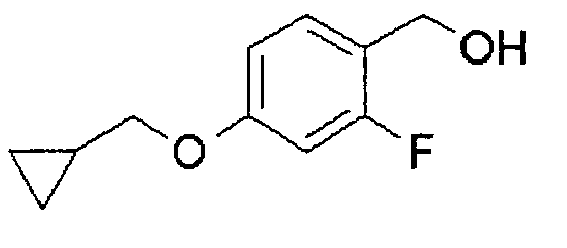
- To a solution of 4-(cyclopropylmethoxy)-2-fluorobenzoic acid (5.00 g, 23.8 mmol) in THF (100 mL) was added dropwise 1 M borane-THF solution (54.7 mL, 54.7 mmol), and the mixture was stirred at room temperature for 3 hr. To the reaction mixture was slowly added dropwise water (100 mL). To this solution was further added water, and the mixture was extracted with ethyl acetate. The extract was washed with 10% aqueous potassium carbonate solution and saturated brine, and dried over anhydrous sodium sulfate. The solution was purified by basic silica gel column chromatography (ethyl acetate), and the obtained residue was triturated with hexane to give the title compound (4.08 g, yield 87%).
1H NMR (CDCl3) δ0.32-0.37 (m, 2H), 0.62-0.67 (m, 2H), 1.21-1.31 (m, 1H), 1.66-1.70 (m, 1H), 3.77 (d, J = 6.9 Hz, 2H), 4.66 (d, J = 6.0 Hz, 2H), 6.58-6.69 (m, 2H), 7.23-7.29 (m, 1H). -

-
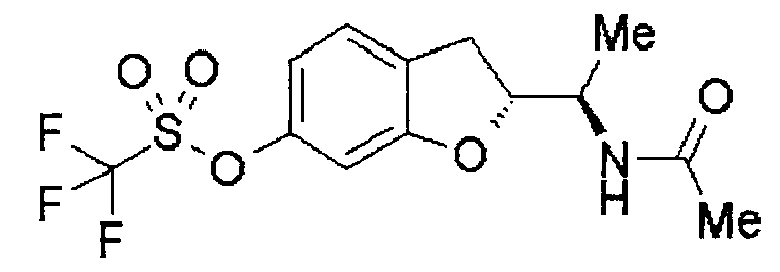
- A 1:1 mixture (less polar mixture) (228 mg) (obtained in Reference Example 229) of (2R)-2-[(1R)-1-(acetylamino)ethyl]-2,3-dihydro-1-benzofuran-6-yl trifluoromethanesulfonate and (2S)-2-[(1S)-1-(acetylamino)ethyl]-2,3-dihydro-1-benzofuran-6-yl trifluoromethanesulfonate was optically resolved by high performance liquid chromatography (HPLC) under the following conditions to give two kinds of optically active forms of "retention time longer (110 mg)" and "retention time shorter (113 mg)".
<preparative HPLC conditions>
column: CHIRALPAK AS (50 mmIDx500 mmL)
mobile phase: hexane:ethanol=1:1
flow rate: 60 mL/min
column temperature: 25°C
detection: UV 220 nm
compound injection volume: 130 mg/40 mL
<HPLC analysis conditions>
column: CHIRALPAK AS (4.6 mmIDx250 mmL)
mobile phase: hexane:ethanol=1:1
flow rate: 0.5 mL/min
column temperature: 30°C
detection: UV 220 nm
retention time of "retention time longer": 8.8 min
retention time of "retention time shorter": 7.1 min -

- To a solution of 1-(cyclopropylmethoxy)-4-iodobenzene (2.49 g, 9.09 mmol) and copper(I) iodide (86.6 mg, 0.455 mmol) in a mixed solvent of THF-triethylamine (8 mL-2 mL) was added bis(triphenylphosphine)palladium(II) chloride (319 mg, 0.455 mmol), and the mixture was deaerated. Trimethylsilylacetylene (1.54 mL, 10.9 mmol) was added dropwise thereto, and the mixture was stirred under a nitrogen atmosphere for 30 min. The reaction mixture was diluted with ethyl acetate, and the mixture was washed with water and saturated brine, and dried over anhydrous sodium sulfate. The solution was purified by basic silica gel column chromatography (ethyl acetate), and the solvent was evaporated under reduced pressure. The obtained residue was purified by silica gel column chromatography (hexane to hexane:ethyl acetate=9:1) to give the title compound (1.52 g, yield 69%) as an oil.
1H NMR (CDCl3) δ 0.23 (s, 9H), 0.32-0.37 (m, 2H), 0.61-0.67 (m, 2H), 1.23-1.28 (m, 1H), 3.78 (d, J = 6.9 Hz, 2H), 6.67-6.82 (m, 2H), 7.35-7.40 (m, 2H). -

- To a solution of {[4-(cyclopropylmethoxy)phenyl]ethynyl}(trimethyl)silane (1.52 g, 6.22 mmol) obtained in Reference Example 232 in methanol (8 mL) was added potassium carbonate (1.72 g, 12.4 mmol), and the mixture was stirred at room temperature for 16 hr. The reaction mixture was diluted with ethyl acetate, and the mixture was washed with water and saturated brine, and dried over anhydrous sodium sulfate. The solution was purified by basic silica gel column chromatography (ethyl acetate) to give the title compound (1.07 g, quantitative) as an oil.
1H NMR (CDCl3) δ0.32-0.38 (m, 2H), 0.62-0.68 (m, 2H), 1.24-1.29 (m, 1H), 2.99 (s, 1H), 3.79 (d, J = 6.9 Hz, 2H), 6.81-6.85 (m, 2H), 7.38-7.43 (m, 2H). -

- To a solution of methyl 3-chloro-4-(cyclopropylmethoxy)benzoate (2.42 g, 10.1 mmol) in THF (25 mL) was added dropwise 1.5 M diisobutylaluminum hydride-toluene solution (16.8 mL, 25.1 mmol) under ice-cooling and the mixture was stirred for 30 min. The reaction was quenched with water, and the mixture was extracted with ethyl acetate. The extract was washed with 1N hydrochloric acid, 10% aqueous potassium carbonate solution and saturated brine, and dried over anhydrous sodium sulfate. The solution was purified by basic silica gel column chromatography (ethyl acetate) to give the title compound (2.07 g, yield 97%) as an oil.
1H NMR (CDCl3) δ0.36-0.41 (m, 2H), 0.62-0.68 (m, 2H), 1.23-1.34 (m, 1H), 1.64 (m, 1H), 3.88 (d, J = 6.6 Hz, 2H), 4.59 (d, J = 5.7 Hz, 2H), 6.88 (d, J = 8.7 Hz, 1H), 7.17 (dd, J = 2.1, 8.7 Hz, 1H), 7.37 (d, J = 2.1 Hz, 1H). -

- To a solution of 6-chloropyridin-2-ol (3.00 g, 23.2 mmol) and sodium carbonate (4.88 g, 46.4 mmol) in water (60 mL) was added iodine (5.84 g, 23.0 mmol), and the mixture was stirred at room temperature overnight. The resulting solid was collected by filtration, 1N hydrochloric acid was added to the obtained solid, and the mixture was extracted twice with ethyl acetate. The extract was washed with saturated brine, and dried over anhydrous sodium sulfate. The solvent was evaporated under reduced pressure, and to the obtained residue were added diisopropyl ether and hexane, and the resulting solid was collected by filtration to give the title compound (1.04 g, yield 18%).
1H NMR (CDCl3) δ 6.42 (d, J = 8.0 Hz, 1H), 8.00 (d, J = 8.0 Hz, 1H), 11.4 (br, 1H). -

- Using 6-chloro-3-iodopyridin-2-ol (500 mg, 1.96 mmol) obtained in Reference Example 235, 2-(1-methylprop-2-yn-1-yl)-1H-isoindole-1,3(2H)-dione (390 mg, 1.96 mmol), copper(I) iodide (18.6 mg, 0.0980 mmol), triethylamine (1.45 mL, 9.80 mmol), THF (6.5 mL) and bis(triphenylphosphine)palladium(II) chloride (68.7 mg, 0.0980 mmol), an operation in the same manner as in Reference Example 221 was performed to give the title compound (71.9 mg, yield 11%).
1H NMR (CDCl3) δ 1.93 (d, J = 7.2 Hz, 3H), 5.58-5. 80 (m, 1H), 6.74 (s, 1H), 7.16-7.43 (m, 1H), 7.68-7.93 (m, 5H). -

- To a solution of 2-[1-(6-chlorofuro[2,3-b]pyridin-2-yl)ethyl]-1H-isoindole-1,3(2H)-dione (71.9 mg, 0.221 mmol) obtained in Reference Example 236 in methanol (3 mL) was added hydrazine monohydrate (0.5 mL, 10.0 mmol), and the mixture was stirred at 50°C for 30 min. The solvent was evaporated under reduced pressure, ethyl acetate was added thereto, and the resulting solid was filtered off. The solvent of the obtained filtrate was evaporated again under reduced pressure. Ethyl acetate was added thereto, and the resulting solid was filtered off. The solvent was evaporated under reduced pressure, and to the obtained residue were added ethyl acetate (3 mL) and acetic anhydride (0.100 mL, 1.05 mmol), and the mixture was stirred at room temperature for 5 min. The solvent was evaporated under reduced pressure, and the obtained solid was washed with diisopropyl ether to give the title compound (71.2 mg, quantitative). 1H NMR (CDCl3) δ 1.50-1.66 (m, 3H), 2.01 (s, 3H), 5.23-5.47 (m, 1H), 5.86 (br, 1H), 6.59 (s, 1H), 7.20-7.36 (m, 1H), 7.80 (d, J = 8.3 Hz, 1H).
-

- To a solution of 1-{6-[2-(4-ethoxyphenyl)ethyl]-1-benzofuran-2-yl}ethanol (100 mg, 0.322 mmol) obtained in Reference Example 52, N-(isoxazol-3-yl)-4-nitrobenzenesulfonamide (104 mg, 0.387 mmol) and triphenylphosphine (109 mg, 0.418 mmol) in anhydrous THF (1.5 mL) was added 40% diethyl azodicarboxylate-toluene solution (0.190 mL, 0.418 mmol), and the mixture was stirred at room temperature for 2 days. The solvent was evaporated, and the obtained residue was purified by silica gel column chromatography (hexane to hexane:ethyl acetate=3:2) to give the title compound (127 mg, yield 70%) as a white solid.
1H NMR (CDCl3) δ 1.41 (t, J = 7.2 Hz, 3H), 1.68 (d, J = 7.3 Hz, 3H), 2.80-2.99 (m, 4H), 4.02 (q, J = 7.2 Hz, 2H), 5.71 (q, J = 7.3 Hz, 1H), 6.29 (d, J = 1.9 Hz, 1H), 6.51 (s, 1H), 6.82 (d, J = 8.7 Hz, 2H), 6.95 (s, 1H), 7.01 (d, J = 7.9 Hz, 1H), 7.07 (d, J = 8.7 Hz, 2H), 7.33 (d, J = 7.8 Hz, 1H), 7.97 (d, J = 9.0 Hz, 2H), 8.16-8.23 (m, 2H), 8.32-8.36 (m, 1H). -

- Using N-[1-(6-hydroxy-1-benzofuran-2-yl)ethyl]acetamide (2.21 g, 10.1 mmol) obtained in Reference Example 27, THF (20 mL), triethylamine (3.00 mL, 20.2 mmol) and N-phenylbis(trifluoromethanesulfonimide) (5.70 g, 15.2 mmol), an operation in the same manner as in Reference Example 117 was performed to give the title compound (3.13 g, yield 88%) as a white solid.
1H NMR (CDCl3) δ 1.58 (d, J =6.9 Hz, 3H), 2,03 (s, 3H), 5.32-5.42 (m, 1H), 5.79 (d, J = 7.5 Hz, 1H), 6.61 (s, 1H), 7.15 (dd, J = 8.3, 2.3 Hz, 1H), 7.41 (d, J = 2.3 Hz, 1H), 7.55 (d, J = 8.3 Hz, 1H). -

- Using 1-{6-[2-(4-cyclopropylphenyl)ethyl]-1-benzofuran-2-yl}ethanol (500 mg, 1.48 mmol) obtained in Reference Example 52, N-(3,4-dimethylisoxazol-5-yl)-4-nitrobenzenesulfonamide (441 mg, 1.48 mmol), triphenylphosphine (426 mg, 1.63 mmol), anhydrous THF (3 mL) and 40% diethyl azodicarboxylate-toluene solution (0.740 mL, 1.63 mmol), an operation in the same manner as in Reference Example 238 was performed to give the title compound (125 mg, yield 16%) as a white solid.
1H NMR (CDCl3) δ 0.24-0.43 (m, 2H), 0.59-0.69 (m, 2H), 1.20-1.34 (m, 1H), 1.52 (d, J = 7.2 Hz, 3H), 1.68 (s, 3H), 2.19 (s, 3H), 2.80-2.99 (m, 4H), 3.78 (d, J = 7.2 Hz, 2H), 5.51 (q, J = 7.2 Hz, 1H), 6.42 (s, 1H), 6.76-6.87 (m, 2H), 6.96-7.03 (m, 2H), 7.03-7.12 (m, 2H), 7.31 (d, J = 8.3 Hz, 1H), 7.92-8.04 (m, 2H), 8.19-8.31 (d, J = 9.0 Hz, 2H). -

- To a suspension of 2-fluoro-4-(hydroxymethyl)phenol (1.08 g, 7.61 mmol) and potassium carbonate (2.10 g, 15.2 mmol) in ethanol (15 mL) was added bromomethylcyclopropane (1.54 g, 11.4 mmol), and the mixture was stirred at 70°C for 4 hr. Water was added thereto, and the mixture was extracted twice with ethyl acetate, and the extract was washed with saturated brine, and dried over anhydrous magnesium sulfate. The solvent was evaporated under reduced pressure, and the obtained residue was purified by silica gel column chromatography (hexane:ethyl acetate=19:1 to hexane:ethyl acetate=3:2) to give the title compound (777 mg, yield 52%) as a white solid.
1H NMR (CDCl3) δ 0.32-0.41 (m, 2H), 0.60-0.69 (m, 2H), 1.20-1.37 (m, 1H), 1.65 (br, 1H), 3.87 (d, J = 6.8 Hz, 2H), 4.61 (s, 2H), 6.88-6.96 (m, 1H), 7.00-7.05 (m, 1H), 7.11 (dd, J = 11.9, 1.8 Hz, 1H) -

- To a solution of 2,2,6,6-tetramethylpiperidine (11.6 mL, 68.8 mmol) in THF (100 mL) was added 1.6 M n-butyllithium hexane solution (39.0 mL, 62.4 mmol) at -78°C, and the mixture was warmed to -20°C and stirred at the same temperature for 10 min. To this solution was added a solution of N,N-diethyl-2-methylfuran-3-carboxamide (11.3 g, 62.5 mmol) in THF (10 mL), and the mixture was further stirred for 1 hr. To the solution was added 3-(4-ethoxyphenyl)propanenitrile (11.5 g, 65.6 mmol), and the mixture was stirred at room temperature for 15 hr. 6N Hydrochloric acid was added thereto and the mixture was extracted twice with ethyl acetate. The combined organic layer was dried over anhydrous magnesium sulfate and the solvent was evaporated under reduced pressure. The obtained solid was washed with ethyl acetate to give the title compound (2.74 g, yield 15%) as a white solid.
1H NMR (CDCl3) δ 1.40 (t, J = 7.0 Hz, 3H), 2.91-3.02 (m, 4H), 4.00 (q, J = 7.0 Hz, 2H), 6.35 (s, 1H), 6.81 (d, J = 8.7 Hz, 2H), 6.93-6.94 (m, 1H), 7.18 (d, J = 8.7 Hz, 2H), 7.46 (d, J = 1.9 Hz, 1H), 11.78 (br, 1H). -
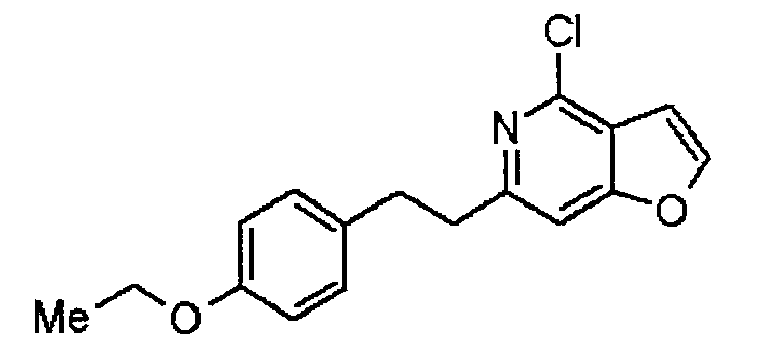
- 6-[2-(4-Ethoxyphenyl)ethyl]furo[3,2-c]pyridin-4(5H)-one(2.74 g, 9.67 mmol) obtained in Reference Example 242 and phosphorus oxychloride (10 mL) were stirred at 110°C for 30 min. The reaction mixture was neutralized with saturated aqueous sodium hydrogen carbonate, and the mixture was extracted twice with ethyl acetate, and the combined organic layer was dried over anhydrous magnesium sulfate. The solvent was evaporated under reduced pressure and the obtained residue was purified by silica gel column chromatography (hexane:ethyl acetate=19:1 to 13:7) to give the title compound (2.52 g, yield 86%) as an oil.
1H NMR (CDCl3) δ 1.39 (t, J = 7.0 Hz, 3H), 2.99-3.05 (m, 2H), 3.10-3.16 (m, 2H), 4.00 (q, J = 7.0 Hz, 2H), 6.80 (d, J = 8.3 Hz, 2H), 6.83 (dd, J = 2.3, 1.1 Hz, 1H), 7.09 (d, J = 8.3 Hz, 2H), 7.13 (s, 1H), 7.61 (d, J = 2.3 Hz, 1H). -

- To a solution of 4-chloro-6-[2-(4-ethoxyphenyl)ethyl]furo[3,2-c]pyridine (2.52 g, 8.35 mmol) obtained in Reference Example 243 in acetic acid (25 mL) was added zinc powder (5.47 g, 83.5 mmol) and the mixture was stirred at 50°C for 20 min. The reaction mixture was filtered, and the filtrate was concentrated. The obtained residue was neutralized with saturated aqueous sodium hydrogen carbonate and the mixture was extracted twice with ethyl acetate, and the combined organic layer was dried over anhydrous magnesium sulfate. The solvent was evaporated under reduced pressure and the obtained residue was purified by silica gel column chromatography (hexane:ethyl acetate=13:7 to 0:1) to give the title compound (2.00 g, yield 80%) as a white solid.
1H NMR (CDCl3) δ 1.39 (t, J = 6.8 Hz, 3H), 3.00-3.08 (m, 2H), 3.14-3.20 (m, 2H), 4.00 (q, J = 6.8 Hz, 2H), 6.76-6.82 (m, 3H), 7.11 (d, J = 8.7 Hz, 2H), 7.22 (s, 1H), 7.58 (d, J = 2.3 Hz, 1H), 8.87 (s, 1H). -

- To a solution of 6-[2-(4-ethoxyphenyl)ethyl]furo[3,2-c]pyridine (401 mg, 1.50 mmol) obtained in Reference Example 244 in THF (10 mL) was added 1.6 M n-butyllithium hexane solution (1.08 mL, 1.73 mmol) at -78°C, and the mixture was stirred at the same temperature for 15 min. To this solution was added acetoaldehyde (0.168 mL, 3.00 mmol) and the mixture was stirred at room temperature for 15 min. Water was added to the reaction mixture, and the mixture was extracted twice with ethyl acetate, and the combined organic layer was dried over anhydrous magnesium sulfate. The solvent was evaporated under reduced pressure and the obtained residue was purified by silica gel column chromatography (hexane:ethyl acetate=1:1 to 0:1) to give the title compound (399 mg, yield 85%) as an oil.
1H NMR (CDCl3) δ 1.39 (t, J = 7.0 Hz, 3H), 1.64 (d, J = 6.4 Hz, 3H), 2.99-3.05 (m, 2H), 3.13-3.19 (m, 2H), 4.00 (q, J = 7.0 Hz, 2H), 4.98-5.07 (m, 1H), 6.64 (s, 1H), 6.80 (d, J = 8.7 Hz, 2H), 7.10 (d, J = 8.7 Hz, 2H), 7.16 (s, 1H), 8.79 (s, 1H). -

- To a solution of 1-{6-[2-(4-ethoxyphenyl)ethyl]furo[3,2-c]pyridin-2-yl}ethanol (623 mg, 2.00 mmol) obtained in Reference Example 245 in toluene (10 mL) were added diphenyl azidophosphate (0.647 my, 3.00 mmol) and DBU (0.598 mL, 4.00 mmol), and the mixture was stirred at room temperature for 2 hr. Ethyl acetate was added thereto, and the mixture was washed with water, and dried over anhydrous magnesium sulfate. The solvent was evaporated under reduced pressure, and the obtained residue was purified by silica gel column chromatography (hexane:ethyl acetate=17:3 to 2:3) to give the title compound (622 mg, yield 92%) as an oil.
1H NMR (CDCl3) δ 1.40 (t, J = 7.0 Hz, 3H), 1.66 (d, J = 7.0 Hz, 3H), 3.00-3.05 (m, 2H), 3.14-3.20 (m, 2H), 4.00 (q, J = 7.0 Hz, 2H), 4.69 (q, J = 6.0 Hz, 1H), 6.69 (s, 1H), 6.80 (d, J = 8.3 Hz, 2H), 7.11 (d, J = 8.3 Hz, 2H), 7.20 (s, 1H), 8.82 (d, J = 0.7 Hz, 1H). -

- To a solution of 2-bromo-5-(methoxymethoxy)pyridine (2.50 g, 11.5 mmol), 1-ethoxy-4-ethynylbenzene (2.57 mL, 17.2 mmol) and copper(I) iodide (220 mg, 1.15 mmol) in a mixed solvent of THF-triethylamine (20 mL-10 mL) was added bis(triphenylphosphine)palladium(II) chloride (807 mg, 1.15 mmol), and the mixture was stirred under an argon stream at 60°C for 15 min. The reaction mixture was diluted with ethyl acetate, and the mixture was washed with water, and dried over anhydrous magnesium sulfate. The solvent was evaporated under reduced pressure and the obtained residue was purified by silica gel column chromatography (hexane:ethyl acetate=4:1 to 3:7) to give the title compound (3.21 g, yield 98%) as a yellow solid.
1H NMR (CDCl3) δ 1.42 (t, J = 7.0 Hz, 3H), 3.50 (s, 3H), 4.05 (q, J = 7.0 Hz, 2H), 5.21 (s, 2H), 6.86 (d, J = 8.7 Hz, 2H), 7.32-7.36 (m, 1H), 7.42-7.45 (m, 1H), 7.50 (d, J = 8.7 Hz, 2H), 8.38 (d, J = 2.3 Hz, 1H). -

- A solution of 2-[(4-ethoxyphenyl)ethynyl]-5-(methoxymethoxy)pyridine (3.21 g, 11.3 mmol) obtained in Reference Example 247 and 10% palladium carbon (50% water-containing product, 5.00 g) in ethanol (20 mL)-THF (10 mL) was stirred under a hydrogen atmosphere (normal pressure) for 30 min. After filtration, the filtrate was concentrated under reduced pressure, and the obtained residue was purified by silica gel column chromatography (hexane:ethyl acetate=4:1 to 3:7) to give the title compound (2.48 g, yield 76%) as an oil.
1H NMR (CDCl3) δ 1.40 (t, J = 7.2 Hz, 3H), 2.91-3.04 (m, 4H), 3.49 (s, 3H), 4.00 (q, J = 7.2 Hz, 2H), 5.17 (s, 2H), 6.80 (d, J = 8.3 Hz, 2H), 6.99 (d, J = 8.3 Hz, 1H), 7.09 (d, J = 8.3 Hz, 2H), 7.26 (dd, J = 8.3, 3.0 Hz, 1H), 8.34 (d, J = 3.0 Hz, 1H). -

- To a solution of 2-[2-(4-ethoxyphenyl)ethyl]-5-(methoxymethoxy)pyridine (2.48 g, 8.63 mmol) obtained in Reference Example 248 in THF (20 mL) was added 1.6 M n-butyllithium hexane solution (6.50 mL, 10.4 mmol) at -78°C, and the mixture was stirred at the same temperature for 30 min. To the solution was added DMF (1.00 mL, 12.9 mmol), and the mixture was stirred at 0°C for 10 min. Water was added to the reaction mixture, and the mixture was extracted twice with ethyl acetate, and the combined organic layer was dried over anhydrous magnesium sulfate. The solvent was evaporated under reduced pressure and the obtained residue was purified by silica gel column chromatography (ethyl acetate) to give the title compound (2.72 g, quantitative) as an oil.
1H NMR (CDCl3) δ 1.39 (t, J = 7.0 Hz, 3H), 2.93-2.99 (m, 2H), 3.04-3.10 (m, 2H), 3.55 (s, 3H), 4.00 (q, J = 7.0 Hz, 2H), 5.34 (s, 2H), 6.80 (d, J = 8.7 Hz, 2H), 7.10 (d, J = 8.7 Hz, 2H), 7.42 (s, 1H), 8.67 (s, 1H), 10.49 (s, 1H). -

- To a solution of 2-[2-(4-ethoxyphenyl)ethyl]-5-(methoxymethoxy)pyridine-4-carbaldehyde (2.72 g, 8.63 mmol) obtained in Reference Example 249 in THF (30 mL) was added 6N hydrochloric acid (14 mL) and the mixture was stirred at 60°C for 30 min. The reaction mixture was neutralized with saturated aqueous sodium hydrogen carbonate solution and extracted twice with ethyl acetate. The extract was dried over anhydrous magnesium sulfate, the solvent was evaporated under reduced pressure and the obtained residue was purified by silica gel column chromatography (hexane:ethyl acetate=4:1 to 3:7) to give the title compound (1.85 g, yield 79%) as a yellow solid.
1H NMR (CDCl3) δ 1.39 (t, J =7.0 Hz, 3H), 2.95-3.01 (m, 2H), 3.06-3.11 (m, 2H), 4.00 (q, J = 7.0 Hz, 2H), 6.80 (d, J = 8.7 Hz, 2H), 7.05 (d, J = 8.7 Hz, 2H), 7.12 (s, 1H), 8.50 (s, 1H), 9.92 (s, 1H), 10.10 (s, 1H). -

- To a solution of 2-[2-(4-ethoxyphenyl)ethyl]-5-hydroxypyridine-4-carbaldehyde (1.85 g, 6.82 mmol) obtained in Reference Example 250 in acetonitrile (30 mL) were added potassium carbonate (1.89 g, 13.7 mmol) and bromoacetone (0.688 mL, 8.18 mmol) and the mixture was stirred at 85°C for 1 hr. Water was added to the reaction mixture, and the mixture was extracted with ethyl acetate, and the organic layer was dried over anhydrous magnesium sulfate. The solvent was evaporated and the obtained residue was purified by basic silica gel column chromatography (ethyl acetate) to give an oil. The obtained oil was dissolved in methanol (20 mL), sodium borohydride (258 mg, 6.82 mmol) was added thereto and the mixture was stirred at room temperature for 15 min. To the reaction mixture was added aqueous ammonium chloride solution, and the mixture was extracted twice with ethyl acetate, and the combined organic layer was dried over anhydrous magnesium sulfate. The solvent was evaporated. The obtained residue was purified by silica gel column chromatography (hexane:ethyl acetate=3:1 to 1:4) to give the title compound (1.12 g, yield 52%) as a yellow solid.
1H NMR (CDCl3) δ 1.39 (t, J = 7.0 Hz, 3H), 1.65 (d, J = 6.4 Hz, 3H), 2.98-3.04 (m, 2H), 3.09-3.15 (m, 2H), 4.00 (q, J = 7.0 Hz, 2H), 4.99-5.08 (m, 1H), 6.57 (s, 1H), 6.79 (d, J = 8.7 Hz, 2H), 7.09 (d, J = 8.7 Hz, 2H), 7.23 (s, 1H), 8.75 (s, 1H). -

- To a solution of 1-{5-[2-(4-ethoxyphenyl)ethyl]furo[2,3-c]pyridin-2-yl}ethanol (1.12 g, 3.60 mmol) obtained in Reference Example 251 in toluene (20 mL) was added diphenyl azidophosphate (1.17 mL, 5.39 mmol) and DBU (1.08 mL, 7.20 mmol), and the mixture was stirred at room temperature for 2.5 hr. Ethyl acetate was added thereto, and the mixture was washed with water, and dried over anhydrous magnesium sulfate. The solvent was evaporated under reduced pressure, and the obtained residue was purified by silica gel column chromatography (hexane:ethyl acetate=9:1 to 1:4) to give the title compound (1.20 g, yield 99%) as an oil.
1H NMR (CDCl3) δ 1.39 (t, J = 7.0 Hz, 3H), 1.67 (d, J = 7.0 Hz, 3H), 2.98-3.05 (m, 2H), 3.10-3.16 (m, 2H), 4.00 (q, J = 7.0 Hz, 2H), 4.71 (q, J = 7.0 Hz, 1H), 6.60 (s, 1H), 6.80 (d, J = 8.7 Hz, 2H), 7.09 (d, J = 8.7 Hz, 2H), 7.24 (s, 1H), 8.79 (s, 1H). -

- To a solution of 6-bromopyridin-3-ol (5.00 g, 28.8 mmol) in DMF (50 mL) were added potassium carbonate (7.96 g, 55.6 mmol) and (bromomethyl)cyclopropane (4.18 mL, 43.1 mmol), and the mixture was stirred at 60°C for 30 min. The reaction mixture was diluted with ethyl acetate, and the mixture was washed three times with saturated brine, and dried over anhydrous magnesium sulfate. The solvent was evaporated under reduced pressure, and the obtained residue was purified by silica gel column chromatography (hexane:ethyl acetate=19:1 to 1:1) to give the title compound (6.32 g, yield 96%) as an oil.
1H NMR (CDCl3) δ 0.34-0.39 (m, 2H), 0.64-0.70 (m, 2H), 1.20-1.33 (m, 1H), 3.83 (d, J = 6.8 Hz, 2H), 7.09 (dd, J = 8.7, 3.0 Hz, 1H), 7.35 (d, J = 8.7 Hz, 1H), 8.05 (d, H = 3.0 Hz, 1H). -

- Using 2-bromo-5-(cyclopropylmethoxy)pyridine (4.76 g, 20.9 mmol) obtained in Reference Example 253, an operation in the same manner as in Reference Example 176 was performed to give the title compound (3.53 g, yield 97%) as an oil.
1H NMR (CDCl3) δ 0.35-0.40 (m, 2H), 0.64-0.71 (m, 2H), 1.21-1.34 (m, 1H), 3.06 (s, 1H), 3.86 (d, J = 6.8 Hz, 2H), 7.13 (dd, J = 8.7, 3.0 Hz, 1H), 7.41 (d, J = 8.7 Hz, 1H), 8.27 (d, H = 3.0 Hz, 1H). -

- To a solution of 5-iodopyridin-2-ol (5.32 g, 24.0 mmol) in DMF (50 mL) were added cesium carbonate (23.4 g, 72.0 mmol) and (bromomethyl)cyclopropane (4.67 mL, 48.2 mmol), and the mixture was stirred at 60°C for 15 min. The reaction mixture was diluted with ethyl acetate, and the mixture was washed three times with saturated brine, and dried over anhydrous magnesium sulfate. The solvent was evaporated under reduced pressure, and the obtained residue was purified by silica gel column chromatography (hexane:ethyl acetate=4:1 to 1:4) to give the title compound (2.17 g, yield 32%) as an oil.
1H NMR (CDCl3) δ 0.34 (q, J = 4.9 Hz, 2H), 0.58-0.64 (m, 2H), 1.19-1.33 (m, 1H), 4.09 (d, J = 7.2 Hz, 2H), 6.61 (d, J = 8.7 Hz, 1H), 7.77 (dd, J = 8.7, 2.3 Hz, 1H), 8.30 (d, H = 2.3 Hz, 1H). -

- Using 2-(cyclopropylmethoxy)-5-iodopyridine (2.17 g, 7.89 mmol) obtained in Reference Example 255, an operation in the same manner as in Reference Example 176 was performed to give the title compound (1.36 g, yield 99%) as an oil.
1H NMR (CDCl3) δ 0.32-0.37 (m, 2H), 0.58-0.65 (m, 2H), 1.21-1.34 (m, 1H), 3.10 (s, 1H), 4.14 (d, J = 7.2 Hz, 2H), 6.72 (d, J = 8.7 Hz, 1H), 7.64 (dd, J = 8.7, 2.3 Hz, 1H), 8.28 (d, H = 2.3 Hz, 1H). -

- N-[1-(5-hydroxy-1-benzofuran-2-yl)ethyl]acetamide (30 g) obtained in Reference Example 38 was optically resolved by supercritical chromatography (SFC) under the following conditions, and two kinds of optically active forms of "retention time longer (14.1 g)" and "retention time shorter (14.1 g)".
<preparative HPLC conditions>
column: CHIRALPAK AD-H (4.6 mmIDx250 mmL)
mobile phase: CO2: ethanol=7:3
flow rate: 50 mL/min
column temperature: 35°C
detection: UV 220 nm
compound injection volume: 10 mg/mL (in ethanol), 4.0 mL
<HPLC analysis conditions>
column: CHIRALPAK AD-H (4.6 mmIDx250 mmL)
mobile phase: CO2:methanol=7:3
pressure: 100 bar
flow rate: 2.0 mL/min
column temperature: 35°C
detection: UV 220 nm
retention time of "retention time longer": 2.01 min
retention time of "retention time shorter": 1.47 min -

- To a solution of N-[1-(5-hydroxy-1-benzofuran-2-yl)ethyl]acetamide (1.97 g, 8.99 mmol, retention time longer) obtained in Reference Example 257 in a mixed solvent of THF (30 mL)-ethanol (20 mL) was added 10% palladium carbon (50% water-containing product, 2.00 g), and the mixture was stirred under a hydrogen atmosphere at room temperature for 2 hr. Palladium carbon was filtered off, and the solvent was evaporated. The obtained residue (1.99 g, quantitatively) was directly used for the next reaction without purification.
-

- To a solution (20 mL) of (2S)-2-[(1S)-1-(acetylamino)ethyl]-2,3-dihydro-1-benzofuran-6-yl trifluoromethanesulfonate (retention time longer) (2.81 g, 7.96 mmol) obtained in Reference Example 231 in THF was added 10% aqueous tetraethylammonium hydroxide solution (36 mL, 24 mmol), and the mixture was stirred at room temperature overnight. 1N Hydrochloric acid was added thereto, and the mixture was extracted twice with ethyl acetate. The organic layer was washed with saturated brine, and dried over anhydrous sodium sulfate. The solvent was evaporated under reduced pressure, and the obtained solid was washed with hexane to give the title compound (1.74 g, yield 99%) as a carnation solid.
1H NMR (CDCl3) δ 1.33 (d, J = 6.8 Hz, 3H), 1.92 (s, 3H), 2.85-3.01 (m, 1H), 3.05-3.20 (m, 1H), 4.23-4.39 (m, 1H), 4.60-4.85 (m, 1H), 5.54 (br, 1H), 6.26-6.37 (m, 2H), 6.90-7.00 (m, 1H). -

- To a solution of cyclopropylmethanol (3.87 g, 47.7 mmol) in THF (50 mL) was added sodium hydride (oil, 60%, 2.08 g, 52.1 mmol), and the mixture was stirred at room temperature for 20 min. To this solution was added 2,6-difluoropyridine (5.00 g, 43.4 mmol) and the mixture was stirred at room temperature for 30 min. The reaction was quenched with water, and the mixture was extracted with ethyl acetate. The extract was dried over anhydrous magnesium sulfate. The solvent was evaporated under reduced pressure and the obtained residue was purified by silica gel column chromatography (hexane:ethyl acetate=99:1 to 4:1) to give the title compound (5.69 g, yield 78%) as an oil.
1H NMR (CDCl3) δ0.32-0.37 (m, 2H), 0.59-0.65 (m, 2H), 1.21-1.34 (m, 1H), 4.10 (d, J = 7.2 Hz, 2H), 6.44 (dd, J = 7.7, 2.5 Hz, 1H), 6.62 (dd, J = 7.9, 1.5 Hz, 1H), 7.59-7.67 (m, 1H). -

- To a solution of 2-(cyclopropylmethoxy)-6-fluoropyridine (7.00 g, 41.9 mmol) obtained in Reference Example 260 in THF (100 mL) was added 2.0M lithiumdiisopropylamide-THF solution (25.0 mL, 50.2 mmol) at -78°C, and the mixture was stirred at the same temperature for 1 hr. To this solution was added ethyl formate (5.08 mL, 62.9 mmol), and the reaction mixture was stirred at room temperature for 30 min. The reaction was quenched with water, and the mixture was extracted with ethyl acetate. The extract was washed twice with saturated brine, and dried over anhydrous magnesium sulfate. The solvent was evaporated under reduced pressure and the obtained residue was purified by silica gel column chromatography (hexane:ethyl acetate=19:1 to 3:1) to give the title compound (4.66 g, yield 57%) as an oil.
1H NMR (CDCl3) δ0.34-0.40 (m, 2H), 0.58-0.68 (m, 2H), 1.23-1.36 (m, 1H), 4.21 (d, J = 7.2 Hz, 2H), 6.73 (d, J = 8.7 Hz, 1H), 8.13-8.19 (m, 1H), 10.2 (s, 1H). -

- To a solution of 6-(cyclopropylmethoxy)-2-fluoropyridine-3-carbaldehyde (4.66 g, 23.9 mmol) obtained in Reference Example 261 in a mixed solvent of THF (50 mL)-methanol (20 mL) was added sodium borohydride (230 mg, 5.97 mmol) and the mixture was stirred at room temperature for 10 min. To the reaction mixture was added aqueous ammonium chloride solution, and the mixture was extracted twice with ethyl acetate, and the combined organic layer was dried over anhydrous magnesium sulfate. The solvent was evaporated under reduced pressure and the obtained residue was purified by silica gel column chromatography (hexane:ethyl acetate=4:1 to 1:4) to give the title compound (621 mg, yield 13%) as an oil.
1H NMR (CDCl3) δ0.32-0.40 (m, 2H), 0.58-0.65 (m, 2H), 1.20-1.33 (m, 1H), 4.09 (d, J = 7.2 Hz, 2H), 4.65 (s, 2H), 6.64 (d, J = 8.0 Hz, 1H), 7.69-7.75 (m, 1H). -

- To a solution of [6-(cyclopropylmethoxy)-2-fluoropyridin-3-yl]methanol (200 mg, 1.01 mmol) obtained in Reference Example 262 and triphenylphosphine (345 mg, 1.31 mmol) in THF (5 mL) was added carbon tetrabromide (504 mg, 1.52 mmol), and the mixture was stirred at room temperature for 10 min. The solvent was evaporated under reduced pressure and the obtained residue was purified by silica gel column chromatography (hexane:ethyl acetate=9:1 to 1:1) to give the title compound (262 mg, quantitative) as an oil.
-

- To a solution of cyclopropylmethanol (0.890 mL, 11.0 mmol) in DMF (30 mL) was added sodium hydride (oil, 60%, 440 mg, 11.0 mmol), and the mixture was stirred at room temperature for 10 min. To this solution was added 2,5-dibromopyridine (2.00 g, 8.46 mmol) and the mixture was stirred at 70°C for 1 hr. The reaction was quenched with water, and the mixture was extracted with ethyl acetate. The organic layer was washed twice with saturated brine, and dried over anhydrous magnesium sulfate. The solvent was evaporated under reduced pressure and the obtained residue was purified by silica gel column chromatography (hexane:ethyl acetate=49:1 to 17:3) to give the title compound (1.88 g, yield 97%) as an oil.
1H NMR (CDCl3) δ0.31-0.36 (m, 2H), 0.58-0.64 (m, 2H), 1.20-1.33 (m, 1H), 4.09 (d, J = 7.2 Hz, 2H), 6.68 (d, J = 9.5 Hz, 1H), 7.63 (dd, J = 8.9, 2.5 Hz, 1H), 8.16 (d, J = 2.3 Hz, 1H). -

- To a solution of 5-bromo-2-(cyclopropylmethoxy)pyridine (1.88 g, 8.24 mmol) obtained in Reference Example 264 in THF (15 mL) was added 1.6 M n-butyllithium-hexane solution (7.25 mL, 11.6 mmol) at - 78°C, and the mixture was stirred at the same temperature for 20 min. To this solution was added trimethylborane (1.29 mL, 11.6 mmol) and the mixture was stirred at -78°C for 30 min. The reaction mixture was allowed to warm to 0°C, aqueous hydrogen peroxide (30%, 5 mL) and 8N aqueous sodium hydroxide solution (1.55 mL, 12.4 mmol) were added thereto, and the mixture was stirred for 15 min. Water was added to the reaction mixture, the mixture was extracted twice with ethyl acetate, and the combined organic layer was dried over anhydrous magnesium sulfate. The solvent was evaporated under reduced pressure and the obtained residue was purified by silica gel column chromatography (hexane:ethyl acetate=3:1 to 3:7) to give the title compound (855 mg, yield 62%) as a white solid.
1H NMR (CDCl3) 50.30-0.35 (m, 2H), 0.57-0.63 (m, 2H), 1.19-1.32 (m, 1H), 4.04 (d, J =6.8 Hz, 2H), 5.59 (br, 1H), 6.69 (d, J = 9.5 Hz, 1H), 7.19 (dd, J =8.9, 3.2 Hz, 1H), 7.74 (d, J = 2.7 Hz, 1H). -

- To a suspension of 6-(cyclopropylmethoxy)pyridin-3-ol (855 mg, 5.18 mmol) obtained in Reference Example 265 and potassium carbonate (1.44 g, 10.4 mmol) in DMF (15 mL) was added chloromethyl methyl ether (0.635 mL, 7.77 mmol) and the mixture was stirred at room temperature for 1 hr. The reaction was quenched with water, and the mixture was extracted with ethyl acetate. The organic layer was washed twice with saturated brine, and dried over anhydrous magnesium sulfate. The solvent was evaporated under reduced pressure and the obtained residue was purified by silica gel column chromatography (hexane:ethyl acetate=9:1 to 3:2) to give the title compound (789 mg, yield 72%) as an oil.
1H NMR (CDCl3) δ0.31-0.36 (m, 2H), 0.57-0.63 (m, 2H), 1.22-1.32 (m, 1H), 3.49 (s, 3H), 4.07 (d, J =7.2 Hz, 2H), 5.09 (s, 2H), 6.71 (d, J = 9.1 Hz, 1H), 7.33 (dd, J =9.1, 3.0 Hz, 1H), 7.92 (d, J = 3.0 Hz, 1H). -

- To a solution of 2-(cyclopropylmethoxy)-5-(methoxymethoxy)pyridine (789 mg, 3.77 mmol) obtained in Reference Example 266 in THF (10 mL) was added 1.6 M n-butyllithium-hexane solution (3.10 mL, 4.90 mmol) at -78°C, and the mixture was stirred at the same temperature for 30 min. To this solution was added N-fluoro-N-(phenylsulfonyl)benzenesulfonamide (1.78 g, 5.66 mmol), and the mixture was stirred at room temperature for 10 min. The reaction was quenched with water, and the mixture was extracted with ethyl acetate. The extract was dried over anhydrous magnesium sulfate.
The solvent was evaporated under reduced pressure and the obtained residue was purified by silica gel column chromatography (hexane:ethyl acetate=9:1 to 7:3) to give 2-(cyclopropylmethoxy)-4-fluoro-5-(methoxymethoxy)pyridine as an oil. The 2-(cyclopropylmethoxy)-4-fluoro-5-(methoxymethoxy)pyridine was dissolved in THF (10 mL), 6N hydrochloric acid (2.90 mL, 17.4 mmol) was added thereto and the mixture was stirred at 50°C for 1 hr. The reaction mixture was neutralized with saturated aqueous sodium hydrogen carbonate, and the mixture was extracted twice with ethyl acetate. The combined organic layer was dried over anhydrous magnesium sulfate. The solvent was evaporated under reduced pressure and the obtained residue was purified by silica gel column chromatography (hexane:ethyl acetate=17:3 to 1:1) to give the title compound (279 mg, yield 40%) as a white solid.
1H NMR (CDCl3) δ0.30-0.35 (m, 2H), 0.57-0.63 (m, 2H), 1.19-1.31 (m, 1H), 4.05 (d, J = 6.8 Hz, 2H), 5.28 (br, 1H), 6.53 (d, J = 11.0 Hz, 1H), 7.86 (d, J = 11.0 Hz, 1H). -
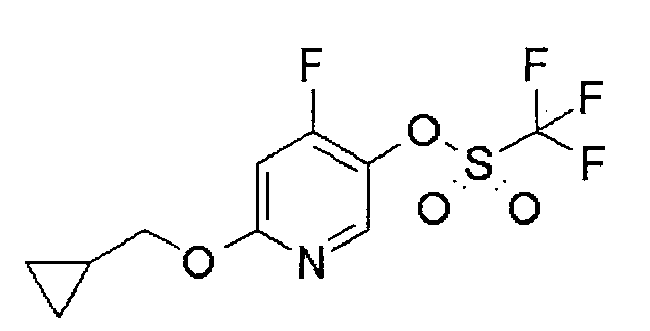
- To a solution of 6-(cyclopropylmethoxy)-4-fluoropyridin-3-ol (279 mg, 1.52 mmol) obtained in Reference Example 267 and triethylamine (0.425 mL, 3.04 mmol) in THF (10 mL) was added 1,1,1-trifluoro-N-phenyl-N-[(trifluoromethyl)sulfonyl]methanesulfonamide (814 mg, 2.28 mmol), and the mixture was stirred at room temperature for 1 hr. The solvent was evaporated under reduced pressure and the obtained residue was purified by silica gel column chromatography (hexane:ethyl acetate=19:1 to 3:1) to give the title compound (480 mg, quantitative) as a white solid.
1H NMR (CDCl3) δ0.32-0.37 (m, 2H), 0.60-0.66 (m, 2H), 1.20-1.33 (m, 1H), 4.15 (d, J = 7.2 Hz, 2H), 6.62 (d, J = 11.0 Hz, 1H), 8.11 (d, J = 11.0 Hz, 1H). -

- To a solution of 6-(cyclopropylmethoxy)-4-fluoropyridin-3-yl trifluoromethanesulfonate (480 mg, 1.52 mmol) obtained in Reference Example 268 and triethylamine (0.483 mL, 3.46 mmol) in a mixed solvent of DMF (5 mL)-methanol (2 mL) was added [1,1'-bis(diphenylphosphino)ferrocene]dichloropalladium(II) (141 mg, 0.173 mmol), and the mixture was stirred under a carbon monooxide atmosphere at 80°C for 1 hr. The reaction was quenched with water, and the mixture was extracted with ethyl acetate. The organic layer was washed twice with saturated brine, and dried over anhydrous magnesium sulfate. The solvent was evaporated under reduced pressure and the obtained residue was purified by silica gel column chromatography (hexane:ethyl acetate=19:1 to 7:3) to give the title compound (275 mg, yield 71%) as an oil.
1H NMR (CDCl3) δ0.33-0.38 (m, 2H), 0.59-0.66 (m, 2H), 1.21-1.33 (m, 1H), 3.92 (s, 3H), 4.21 (d, J = 7.2 Hz, 2H), 6.47 (d, J = 11.0 Hz, 1H), 8.73 (d, J = 11.0 Hz, 1H). -

- To a solution of methyl 6-(cyclopropylmethoxy)-4-fluoropyridine-3-carboxylate (275 mg, 1.22 mmol) obtained in Reference Example 269 in THF (5 mL) was added diisobutylaluminum hydride (1.5 M toluene solution, 2.04 mL, 3.06 mL) and the mixture was stirred at room temperature for 10 min. To the reaction mixture was added sodium sulfate 10 hydrate and the mixture was stirred for 30 min. After filtration, the solvent was evaporated under reduced pressure and the obtained residue was purified by silica gel column chromatography (hexane:ethyl acetate=4:1 to 0:1) to give the title compound (194 mg, yield 81%) as an oil.
1H NMR (CDCl3) δ0.32-0.37 (m, 2H), 0.58-0.64 (m, 2H), 1.20-1.32 (m, 1H), 1.78 (t, J = 5.9 Hz, 1H), 4.14 (d, J = 7.2 Hz, 2H), 4.68 (d, J = 5.7 Hz, 2H), 6.47 (d, J = 11.0 Hz, 1H), 8.11 (d, J = 11.0 Hz, 1H). -

- To a solution of [6-(cyclopropylmethoxy)-4-fluoropyridin-3-yl]methanol (200 mg, 1.01 mmol) obtained in Reference Example 270 and triphenylphosphine (345 mg, 1.31 mmol) in THF (5 mL) was added carbon tetrabromide (504 mg, 1.52 mmol), and the mixture was stirred at room temperature for 10 min. The solvent was evaporated under reduced pressure and the obtained residue was purified by silica gel column chromatography (hexane:ethyl acetate=9:1 to 1:1) to give the title compound (262 mg, quantitative) as an oil.
-

- A solution of 2-fluoro-4-hydroxybenzoic acid (50.0 g, 294 mmol) and conc, sulfuric acid (10 mL) in methanol (700 mL) was stirred under heating at 90°C for 16 hr. The reaction solution was concentrated, and the resulting colorless crystals were washed with water and dried to give the title compound (51 g, yield 94%) as colorless crystals.
1H NMR (DMSO-d6) δ 3.79 (s, 3H), 6.61-6.72 (m, 2H), 7.73-7.79 (m, 1H), 10.80 (br, 1H). -

- To a solution of (2S)-tetrahydrofurfurylalcohol (30.0 g, 294 mmol), methyl 2-fluoro-4-hydroxybenzoate (50.0 g, 294 mmol) obtained in Reference Example 272 and triphenylphosphine (88.9 g, 339 mmol) in THF (350 mL) was slowly added dropwise 40% diethyl azodicarboxylate-toluene solution (166 mL, 339 mmol) at 0°C, and the mixture was stirred at room temperature for 2 hr. The reaction solution was concentrated, and triphenylphosphine oxide was precipitated from ethyl acetate-hexane and removed by filtration through a glass filter. The mother liquor was concentrated and the residue was purified by basic silica gel column chromatography (hexane:ethyl acetate=19:1 to 9:1) to give colorless crystals. The obtained colorless crystals were dissolved in tetrahydrofuran (500 mL), 8N aqueous sodium hydroxide solution (100 mL) was added thereto, and the mixture was stirred under heating at 60°C for 3 hr. The reaction solution was concentrated, cooled to 0°C, and neutralized with 6N hydrochloric acid, and the mixture was extracted with ethyl acetate. The organic layer was washed with saturated brine, dried over anhydrous magnesium sulfate. The solvent was evaporated under reduced pressure to give the title compound (60.0 g, yield 85%) as colorless crystals.
1H NMR (DMSO-d6) δ 1.60-1.71 (m, 1H), 1.75-1.92 (m, 2H), 1.94-2.06 (m, 1H),3.69 (q, J = 6.9 Hz, 1H), 3.77 (q, J =6.9 Hz, 1H), 3.96-4.09 (m, 2H), 4.12-4.20 (m, 1H), 6.84-6.92 (m, 2H), 7.78-7.84 (m, 1H), 12.85 (br, 1H). -

- To a solution of 2-fluoro-4-[(2S)-tetrahydrofuran-2-ylmethoxy]benzoic acid (1.00 g, 4.16 mmol) obtained in Reference Example 273 in THF (10 mL) was added dropwise 1M borane-THF solution (8.3 mL, 8.3 mmol), and the mixture was stirred at room temperature for 30 min. To the reaction mixture was slowly added dropwise water, and to this solution was further added water. The mixture was extracted with ethyl acetate, and the extract was washed with saturated brine, and dried over anhydrous magnesium sulfate. The solution was purified by basic silica gel column chromatography (ethyl acetate), and the solvent was evaporated to give the title compound (984 mg, quantitative) as a colorless oil.
1H NMR (CDCl3) δ 1.52-1.64 (m, 1H), 1.64-1.83 (m, 2H), 1.88-2.15 (m, 2H), 3.77-3.88 (m, 1H), 3.88-4.00 (m, 3H), 4.22-4.32 (m, 1H), 4.67 (d, J = 6.0 Hz, 2H), 6.52-6.81 (m, 2H), 7.16-7.38 (m, 1H). -

- To a solution of 3-bromo-4-methylphenol (5.08 g, 27.1 mmol) in DMF (30 mL) were added (bromomethyl)cyclopropane (4.39 g, 32.5 mmol) and potassium carbonate (7.49 g, 54.3 mmol), and the mixture was stirred at 60°C overnight. Then, water was added thereto, and the mixture was extracted with ethyl acetate-hexane. The extract was washed with saturated brine, and the solvent was evaporated. The obtained residue was purified by silica gel column chromatography (hexane to hexane:ethyl acetate=17:1) and the obtained oil was used for the next reaction.
To the obtained oil were added N-methylpyrrolidone (50 mL) and copper(I) cyanide (4.83 g, 54.2 mmol), and the mixture was stirred under nitrogen at 120°C overnight. Then, water and ethyl acetate were added thereto, the resulting solid was filtered through celite, and the filtrate was extracted with ethyl acetate. The extract was washed with saturated brine, and dried over anhydrous magnesium sulfate. The solvent was evaporated under reduced pressure. The obtained residue was purified by silica gel column chromatography (hexane to hexane:ethyl acetate=17:1) to give the title compound (3.60 g, yield 71%).
1H NMR (CDCl3) δ0.25-0.40 (m, 2H), 0.56-0.71 (m, 2H), 1.13-1.37 (m, 1H), 2.46 (s, 3H), 3.78 (d, J = 6.8 Hz, 2H), 6.99-7.10 (m, 2H), 7.19 (d, J = 8.3 Hz, 1H). -

- To a solution of 5-(cyclopropylmethoxy)-2-methylbenzonitrile (2.06 g, 11.0 mmol) obtained in Reference Example 275 in carbon tetrachloride (40 mL) were added N-bromosuccinimide (2.14 g. 12.1 mmol) and 2,2'-azodi(isobutyronitrile) (180 mg, 1.10 mmol) and the mixture was heated under reflux overnight. The resulting white solid was removed by filtration, and the solvent was evaporated. The resulting solid was washed with diisopropyl ether to give the title compound (1.54 g, yield 53%) as a white solid.
1H NMR (CDCl3) δ0.30-0.42 (m, 2H), 0.63-0.73 (m, 2H), 1.13-1.37 (m, 1H), 3.82 (d, J = 6.8 Hz, 2H), 4.61 (s, 2H), 7.05-7.15 (m, 2H), 7.44 (d, J = 8.7 Hz, 1H). -

- Using methyl 2-hydroxy-4-iodobenzoate (5.79 g, 20.8 mmol) and 1-benzyloxy-4-ethynylbenzene (5.20 g, 25.0 mmol), an operation in the same manner as in Reference Example 47 was performed to give the title compound ((7.37 g, yield 87%) as a brown solid.
1H NMR (CDCl3) δ 3.54 (s, 3H), 3.90 (s, 3H), 5.09 (s, 2H), 5.28 (s, 2H), 6.96 (d, J = 8.9 Hz, 2H), 7.17 (dd, J = 8.1, 1.5 Hz, 1H), 7.33-7.49 (m, 8H), 7.76 (d, J = 8.1 Hz, 1H). -

- A solution of methyl 2-(methoxymethoxy)-4-[(4-benzyloxyphenyl)ethynyl]benzoate (7.37 g, 18.3 mmol) obtained in Reference Example 277 and 10% palladium carbon (50% water-containing product, 11.0 g) in ethanol (50 mL)-THF (10 mL) was stirred under a hydrogen atmosphere (normal pressure) for 2 hr. After filtration of the reaction mixture, the filtrate was concentrated under reduced pressure. To a solution of the obtained residue in DMF (50 mL) were added potassium carbonate (7.63 g, 55.2 mmol) and bromomethylcyclopropane (3.60 mL, 36.7 mmol) and the mixture was stirred at 60°C for 1 hr. The reaction mixture was diluted with ethyl acetate, and the mixture was washed three times with saturated brine, and dried over anhydrous magnesium sulfate. The solvent was evaporated under reduced pressure and the obtained residue was purified by basic silica gel column chromatography (hexane:ethyl acetate=9:1 to 1:1) to give methyl 4-{2-[4-(cyclopropylmethoxy)phenyl]ethyl}-2-(methoxymethoxy)benzoate (4.69 g, yield 69%). A solution of methyl 4-{2-[4-(cyclopropylmethoxy)phenyl]ethyl}-2-(methoxymethoxy)benzoate (4.69 g, 12.7 mmol) in THF (10 mL) was added to a suspension of lithium aluminum hydride (481 mg, 12.7 mmol) in THF (30 mL), and the mixture was stirred at room temperature for 15 min. To the reaction mixture were successively added water (0.48 mL), 15% aqueous sodium hydroxide solution (0.48 mL) and water (1.5 mL), and the mixture was stirred at room temperature for 30 min. After filtration, the filtrate was concentrated under reduced pressure, and the obtained residue was purified by silica gel column chromatography (hexane:ethyl acetate=7:3 to 0:1) to give the title compound (4.23 g, yield 97%) as an oil.
1H NMR (CDCl3) δ 0.31-0.36 (m, 2H), 0.60-0.67 (m, 2H), 1.21-1.31 (m, 1H), 2.81-2.88 (m, 4H), 3.49 (s, 3H), 3.77 (d, J = 7.2 Hz, 2H), 4.67 (d, J = 6.4 Hz, 2H), 5.20 (s, 2H), 6.80-6.84 (m, 3H), 6.89 (s, 1H), 7.07 (d, J = 8.3 Hz, 2H), 7.20 (d, J = 7.5 Hz, 1H). -

- Using [4-{2-[4-(cyclopropylmethoxy)phenyl]ethyl}-2-(methoxymethoxy)phenyl]methanol (4.23 g, 12.4 mmol) obtained in Reference Example 278, an operation in the same manner as in Reference Example 49 was performed to give the title compound (3.45 g, yield 81%) as an oil.
1H NMR (CDCl3) δ 0.31-0.36 (m, 2H), 0.61-0.67 (m, 2H), 1.21-1.31 (m, 1H), 2.82-2.95 (m, 4H), 3.51 (s, 3H), 3.77 (d, J = 6.8 Hz, 2H), 5.24 (s, 2H), 6.81 (d, J = 8.7 Hz, 2H), 6.89 (d, J = 8.0 Hz, 1H), 6.94 (s, 1H), 7.04 (d, J = 8.7 Hz, 2H), 7.75 (d, J = 8.0 Hz, 1H), 10.43 (s, 1H). -

- Using 4-{2-[4-(cyclopropylmethoxy)phenyl]ethyl}-2-(methoxymethoxy)benzaldehyde (3.52 g, 10.3 mmol) obtained in Reference Example 279, an operation in the same manner as in Reference Example 50 was performed to give the title compound (2.46 g, yield 81%) as a yellow solid.
1H NMR (CDCl3) δ 0.31-0.36 (m, 2H), 0.60-0.67 (m, 2H), 1.20-1.33 (m, 1H), 2.86-2.94 (m, 4H), 3.77 (d, J = 6.8 Hz, 2H), 6.78-6.84 (m, 4H), 7.05 (d, J = 8.7 Hz, 2H), 7.43 (d, J = 8.0 Hz, 1H), 9.83 (s, 1H), 11.02 (s, 1H). -

- Using 4-{2-[4-(cyclopropylmethoxy)phenyl]ethyl}-2-hydroxybenzaldehyde (2.46 g, 8.30 mmol) obtained in Reference Example 280, an operation in the same manner as in Reference Example 51 was performed to give the title compound (2.77 g, quantitative) as a yellow solid.
-
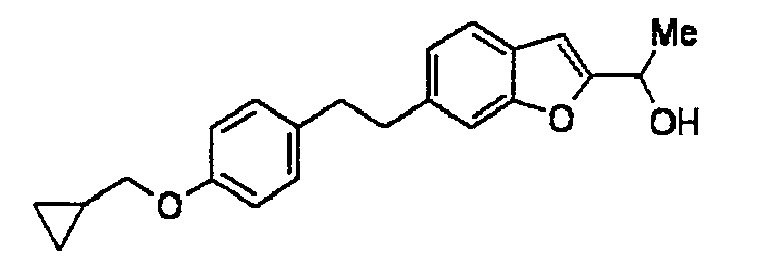
- Using 1-(6-{2-[4-(cyclopropylmethoxy)phenyl]ethyl}-1-benzofuran-2-yl)ethanone (2.77 g, 8.30 mmol) obtained in Reference Example 281, an operation in the same manner as in Reference Example 52 was performed to give the title compound (2.05 g, yield 73%) as an oil.
1H NMR (CDCl3) δ 0.31-0.36 (m, 2H), 0.60-0.68 (m, 2H), 1.20-1.32 (m, 1H), 1.63 (d, J = 6.8 Hz, 3H), 2.86-2.91 (m, 2H), 2.96-3.02 (m, 2H), 3.78 (d, J = 6.8 Hz, 2H), 4.96-5.04 (m, 1H), 6.56 (s, 1H), 6.82 (d, J = 8.7 Hz, 2H), 7.03 (dd, J = 8.0, 1.5 Hz, 1H), 7.08 (d, J = 8.7 Hz, 2H), 7.24-7.26 (m, 1H), 7.44 (d, J = 8.0 Hz, 1H). -

- Using 1-(6-{2-[4-(cyclopropylmethoxy)phenyl]ethyl}-1-benzofuran-2-yl)ethanol (2.05 g, 6.09 mmol) obtained in Reference Example 282, an operation in the same manner as in Reference Example 28 was performed to give the title compound (2.05 g, yield 93%) as an oil.
1H NMR (CDCl3) δ 0.31-0.36 (m, 2H), 0.60-0.66 (m, 2H), 1.20-1.31 (m, 1H), 1.65 (d, J = 6.8 Hz, 3H), 2.86-2.92 (m, 2H), 2.96-3.02 (m, 2H), 3.78 (d, J = 6.8 Hz, 2H), 4.67 (q, J = 6.8 Hz, 1H), 6.62 (s, 1H), 6.82 (d, J = 8.7 Hz, 2H), 7.04-7.09 (m, 3H), 7.28 (s, 1H), 7.44 (d, J = 8.0 Hz, 1H). -

- Using methyl 2-hydroxy-4-iodobenzoate (1.43 g, 5.13 mmol) and 5-ethynyl-1,3-benzodioxole (900 mg, 6.16 mmol), an operation in the same manner as in Reference Example 47 was performed to give the title compound (1.32 g, yield 75%) as a brown solid.
1H NMR (CDCl3) δ 3.54 (s, 3H), 3.90 (s, 3H), 5.28 (s, 2H), 6.00 (s, 2H), 6.80 (d, J = 8.3 Hz, 1H), 6.98 (d, J = 1.5 Hz, 1H), 7.08 (dd, J = 8.1, 1.7 Hz, 1H), 7.17 (dd, J = 8.0, 1.5 Hz, 1H), 7.33 (d, J = 1.1 Hz, 1H), 7.76 (d, J = 8.0 Hz, 1H). -
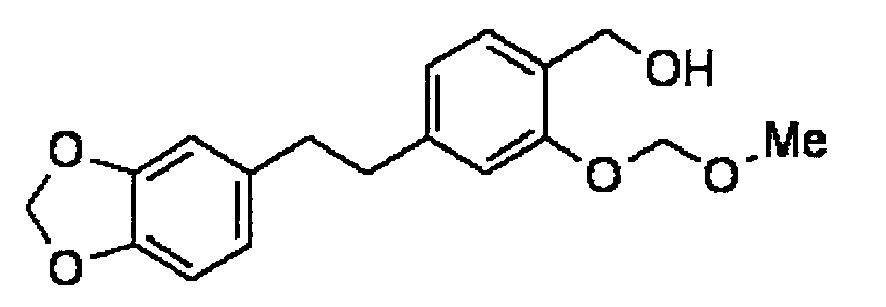
- Using methyl 4-[(1,3-benzodioxol-5-yl)ethynyl]-2-(methoxymethoxy)benzoate (1.32 g, 3.88 mmol) obtained in Reference Example 284, an operation in the same manner as in Reference Example 48 was performed to give the title compound (1.02 g, yield 83%) as an oil.
1H NMR (CDCl3) δ 2.19 (t, J = 6.4 Hz, 1H), 2.78-2.89 (m, 4H), 3.49 (s, 3H), 4.67 (d, J= 6.4 Hz, 2H), 5.20 (s, 2H), 5.92 (s, 2H), 6.59-6.62 (m, 1H), 6.67 (d, J = 1.9 Hz, 1H), 6.71 (d, J = 8.0 Hz, 1H), 6.82 (dd, J = 7.6, 1.5 Hz, 1H), 6.89 (d, J = 1.5 Hz, 1H), 7.20 (d, J = 7.6 Hz, 1H). -

- Using {4-[2-(1,3-benzodioxol-5-yl)ethyl]-2-(methoxymethoxy)phenyl}methanol (1.02 g, 3.22 mmol) obtained in Reference Example 285, an operation in the same manner as in Reference Example 49 was performed to give the title compound (741 mg, yield 73%) as an oil.
1H NMR (CDCl3) δ 2.81-2.94 (m, 4H), 3.51 (s, 3H), 5.25 (s, 2H), 5.92 (s, 2H), 6.56-6.60 (m, 1H), 6.65 (d, J = 1.7 Hz, 1H), 6.71 (d, J = 7.9 Hz, 1H), 6.89 (d, J = 8.1 Hz, 1H), 6.95 (s, 1H), 7.75 (d, J = 7.9 Hz, 1H), 10.44 (d, J = 0.6 Hz, 1H). -
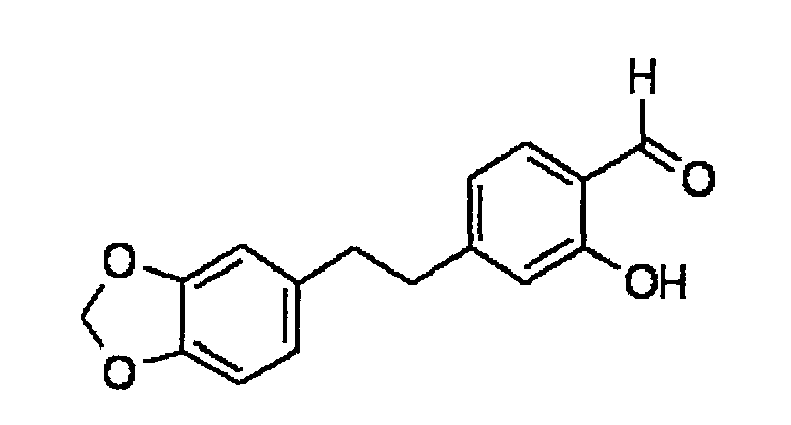
- Using 4-[2-(1,3-benzodioxol-5-yl)ethyl]-2-(methoxymethoxy)benzaldehyde (741 mg, 2.36 mmol) obtained in Reference Example 286, an operation in the same manner as in Reference Example 50 was performed to give the title compound (637 mg, quantitative) as a yellow solid.
1H NMR (CDCl3) δ 2.81-2.93 (m, 4H), 5.92 (s, 2H), 6.57-6.60 (m, 1H), 6.65 (d, J = 1.9 Hz, 1H), 6.71 (d, J = 8.0 Hz, 1H), 6.79-6.82 (m, 2H), 7.44 (d, J = 8.3 Hz, 1H), 9.84 (s, 1H), 11.03 (s, 1H). -

- Using 4-[2-(1,3-benzodioxol-5-yl)ethyl]-2-hydroxybenzaldehyde (687 mg, 2.55 mmol) obtained in Reference Example 287, an operation in the same manner as in Reference Example 51 was performed to give the title compound (786 mg, quantitative) as a yellow solid.
1H NMR (CDCl3) δ 2.59 (s, 3H), 2.86-2.92 (m, 2H), 3.00-3.05 (m, 2H), 5.92 (s, 2H), 6.57-6.60 (m, 1H), 6.66 (d, J = 1.5 Hz, 1H), 6.70 (d, J = 8.0 Hz, 1H), 7.13 (dd, J = 8.1, 1.3 Hz, 1H), 7.33 (s, 1H), 7.46 (d, J = 1.1 Hz, 1H), 7.59 (d, J = 8.0 Hz, 1H). -

- Using 1-{6-[2-(1,3-benzodioxol-5-yl)ethyl]-1-benzofuran-2-yl}ethanone (786 mg, 2.55 mmol) obtained in Reference Example 288, an operation in the same manner as in Reference Example 52 was performed to give the title compound (617 mg, yield 78%) as a white solid.
1H NMR (CDCl3) δ 1.63 (d, J = 6.8 Hz, 3H), 2.84-2.90 (m, 2H), 2.95-3.01 (m, 2H), 4.96-5.04 (m, 1H), 5.92 (s, 2H), 6.56 (s, 1H), 6.60-6.63 (m, 1H), 6.68 (d, J = 1.5 Hz, 1H), 6.71 (d, J = 7.6 Hz, 1H), 7.03 (dd, J = 8.0, 1.5 Hz, 1H), 7.25 (s, 1H), 7.42 (d, J = 8.0 Hz, 1H). -

- Using 1-{6-[2-(1,3-benzodioxol-5-yl)ethyl]-1-benzofuran-2-yl}ethanol (617 mg, 1.99 mmol) obtained in Reference Example 289, an operation in the same manner as in Reference Example 28 was performed to give the title compound (523 mg, yield 78%) as an oil. 1H NMR (CDCl3) δ 1.65 (d, J = 6.8 Hz, 3H), 2.85-2.90 (m, 2H), 2.96-3.01 (m, 2H), 4.67 (q, J = 6.8 Hz, 1H), 5.92 (s, 2H), 6.60-6.63 (m, 2H), 6.69 (d, J = 1.5 Hz, 1H), 6.72 (d, J = 7.6 Hz, 1H), 7.05 (dd, J =8.0, 1.5 Hz, 1H), 7.28 (s, 1H), 7.44 (d, J = 8.0 Hz, 1H).
-
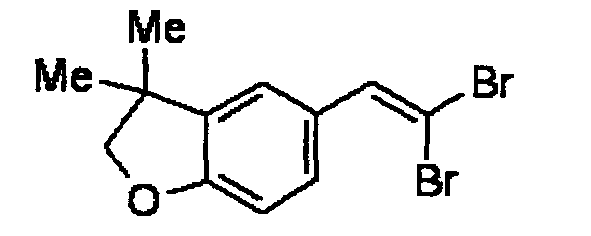
- To a solution of 3,3-dimethyl-2,3-dihydro-1-benzofuran-5-carbaldehyde (4.18 g, 23.7 mmol) and triphenylphosphine (15.5 g, 59.3 mmol) in THF (40 mL) was added carbon tetrabromide, and the mixture was stirred at room temperature for 15 min. The solvent was evaporated under reduced pressure and the obtained residue was purified by silica gel column chromatography (hexane:ethyl acetate=49:1 to 7:3) to give the title compound (5.75 g, yield 73%) as an oil.
1H NMR (CDCl3) δ1.35 (s, 6H), 4.27 (s, 2H), 6.77 (d, J = 8.0 Hz, 1H), 7.31-7.35 (m, 2H), 7.41 (s, 1H). -

- To a solution of 5-(2,2-dibromoethenyl)-3,3-dimethyl-2,3-dihydro-1-benzofuran (5.75 g, 17.3 mmol) obtained in Reference Example 291 in THF (40 mL) was added 1.6 M n-butyllithium hexane solution (23.8 mL, 38.1 mmol) at -78°C, and the mixture was stirred at the same temperature for 10 min. Water was added to the reaction mixture and the mixture was extracted with diethyl ether, and dried over anhydrous magnesium sulfate. The solvent was evaporated under reduced pressure and the obtained residue was purified by silica gel column chromatography (hexane:ethyl acetate=4:1 to 2:3) to give the title compound (2.98 g, quantitative) as an oil.
1H NMR (CDCl3) δ 1.33 (s, 6H), 2.97 (s, 1H), 4.25 (s, 2H), 6.72 (d, J = 8.1 Hz, 1H), 7.23 (d, J = 1.7 Hz, 1H), 7.29 (dd, J = 8.1, 1.7 Hz, 1H). -

- Using methyl 2-hydroxy-4-iodobenzoate (3.40 g, 12.4 mmol) and 5-ethynyl-3,3-dimethyl-2,3-dihydro-1-benzofuran (2.98 g, 17.3 mmol) obtained in Reference Example 292, an operation in the same manner as in Reference Example 47 was performed to give the title compound (3.18 g, yield 69%) as a brown solid.
1H NMR (CDCl3) δ 1.36 (s, 6H), 3.54 (s, 3H), 3.90 (s, 3H), 4.28 (s, 2H), 5.28 (s, 2H), 6.77 (d, J = 8.3 Hz, 1H), 7.17 (dd, J = 8.0, 1.5 Hz, 1H), 7.29-7.35 (m, 3H), 7.76 (d, J = 8.0 Hz, 1H). -

- Using methyl 4-[(3,3-dimethyl-2,3-dihydro-1-benzofuran-5-yl)ethynyl]-2-(methoxymethoxy)benzoate (3.18 g, 8.68 mmol) obtained in Reference Example 293, an operation in the same manner as in Reference Example 48 was performed to give the title compound (2.50 g, yield 84%) as an oil.
1H NMR (CDCl3) δ 1.31 (s, 6H), 2.20 (t, J = 6.6 Hz, 1H), 2.79-2.90 (m, 4H), 3.49 (s, 3H), 4.21 (s, 2H), 4.67 (d, J = 6.6 Hz, 2H), 5.20 (s, 2H), 6.69 (d, J = 8.0 Hz, 1H), 6.82-6.94 (m, 4H), 7.21 (d, J = 7.5 Hz, 1H). -

- Using {4-[2-(3,3-dimethyl-2,3-dihydro-1-benzofuran-5-yl)ethyl]-2-(methoxymethoxy)phenyl}methanol (2.50 g, 7.30 mmol) obtained in Reference Example 294, an operation in the same manner as in Reference Example 49 was performed to give the title compound (1.85 g, yield 74%) as an oil.
1H NMR (CDCl3) δ 1.30 (s, 6H), 2.83-2.95 (m, 4H), 3.51 (s, 3H), 4.21 (s, 2H), 5.24 (s, 2H), 6.69 (d, J=8.0 Hz, 1H), 6.83 (d, J = 1.9 Hz, 1H), 6.88-6.93 (m, 3H), 7.76 (d, J= 8.0 Hz, 1H), 10.44 (s, 1H). -
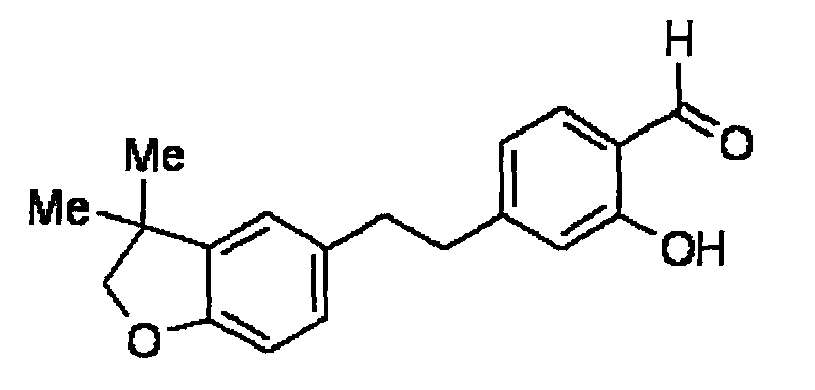
- Using 4-[2-(3,3-dimethyl-2,3-dihydro-1-benzofuran-5-yl)ethyl]-2-(methoxymethoxy)benzaldehyde (1.85 g, 5.43 mmol) obtained in Reference Example 295, an operation in the same manner as in Reference Example 50 was performed to give the title compound (1.41 g, yield 87%) as an oil.
1H NMR (CDCl3) δ 1.30 (s, 6H), 2.84-2.92 (m, 4H), 4.21 (s, 2H), 6.70 (d, J =8.0 Hz, 1H), 6.79-6.83 (m, 3H), 6.91 (dd, J = 8.0, 1.9 Hz, 1H), 6.44 (d, J = 8.3 Hz, 1H), 9.84 (s, 1H), 11.03 (s, 1H). -

- Using 4-[2-(3,3-dimethyl-2,3-dihydro-1-benzofuran-5-yl)ethyl]-2-hydroxybenzaldehyde (1.41 g, 4.76 mmol) obtained in Reference Example 296, an operation in the same manner as in Reference Example 51 was performed to give the title compound (1.59 g, quantitative) as a yellow solid.
-

- Using 1-{6-[2-(3,3-dimethyl-2,3-dihydro-1-benzofuran-5-yl)ethyl]-1-benzofuran-2-yl}ethanone (1.59 g, 4.76 mmol) obtained in Reference Example 297, an operation in the same manner as in Reference Example 52 was performed to give the title compound (1.31 g, yield 81%) as a white solid.
1H NMR (CDCl3) δ 1.29 (s, 6H), 1.63 (d, J = 6.4 Hz, 3H), 2.85-2.91 (m, 2H), 2.95-3.01 (m, 2H), 4.21 (s, 2H), 4.96-5.04 (m, 1H), 6.57 (s, 1H), 6.69-6.71 (d, J =8.3 Hz, 1H), 6.82 (d, J = 1.9 Hz, 1H), 6.94 (dd, J = 7.6, 1.9 Hz, 1H), 7.04 (dd, J = 7.9, 1.1 Hz, 1H), 7.23 (s, 1H), 7.43 (d, J = 7.9 Hz, 1H). -

- Using 1-{6-[2-(3,3-dimethyl-2,3-dihydro-1-benzofuran-5-yl)ethyl]-1-benzofuran-2-yl}ethanol (1.31 g, 3.89 mmol) obtained in Reference Example 298, an operation in the same manner as in Reference Example 28 was performed to give the title compound (1.17 g, yield 83%) as an oil.
1H NMR (CDCl3) δ 1.29 (s, 6H), 1.65 (d, J = 6.8 Hz, 3H), 2.86-2.92 (m, 2H), 2.96-3.02 (m, 2H), 4.21 (s, 2H), 4.67 (q, J = 6.8 Hz, 1H), 6.62 (s, 1H), 6.70 (d, J = 8.0 Hz, 1H) , 6.81 (d, J = 1.9 Hz, 1H), 6.94 (dd, J = 8.0, 1.9 Hz, 1H), 7.05 (dd, J = 8.0, 1.5 Hz, 1H), 7.25 (s, 1H), 7.45 (d, J = 8.0 Hz, 1H). -

- Using (2R)-tetrahydrofuran-2-ylmethanol (1.71 g, 10.0 mmol) and methyl 2-fluoro-4-hydroxybenzoate (1.24 g, 12.0 mmol) obtained in Reference Example 272 and in the same manner as in Reference Example 273, the title compound (2.49 g, yield 98%) was obtained as colorless crystals.
1H NMR (CDCl3) δ 1.70-1.81 (m, 1H), 1.93-2.15 (m, 3H), 3.80-4.01 (m, 7H), 4.24-4.32 (m, 1H), 6.64-6.76 (m, 2H), 7.80-7.90 (m, 1H). -

- A solution of methyl 2-fluoro-4-[(2R)-tetrahydrofuran-2-ylmethoxy]benzoate (2.49 g, 9.79 mmol) obtained in Reference Example 300 in THF (20 mL) was added to a suspension of lithium aluminum hydride (350 mg, 9.22 mmol) in THF (10 mL), and the mixture was stirred at room temperature for 15 min. To the reaction mixture were sequentially added water (0.35 mL), 15% aqueous sodium hydroxide solution (0.35 mL) and water (1.1 mL), and the mixture was stirred at room temperature for 30 min. After filtration, the filtrate was concentrated under reduced pressure, and the obtained residue was purified by silica gel column chromatography (hexane:ethyl acetate=4:1 to 3:7) to give the title compound (2.13 g, yield 96%) as an oil.
1H NMR (CDCl3) δ 1.67-1.81 (m, 2H), 1.90-2.12 (m, 2H), 3.80-3.97 (m, 4H), 4.24-4.30 (m, 1H), 4.67 (d, J = 6.0 Hz, 2H), 6.63-6.73 (m, 2H), 7.25-7.31 (m, 1H). -
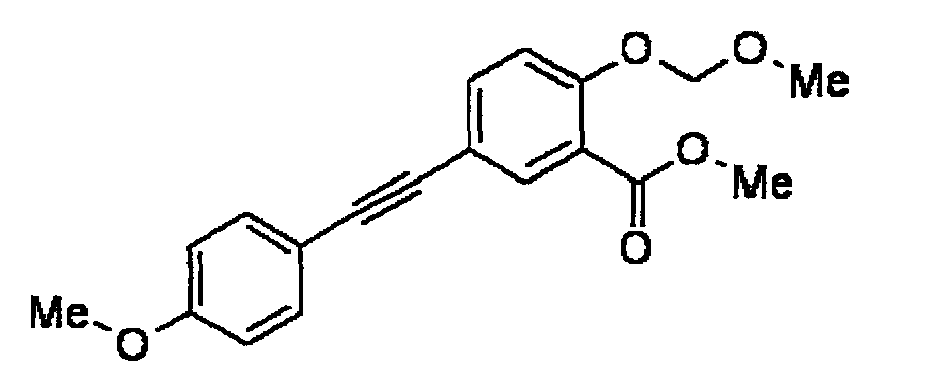
- Using methyl 2-hydroxy-5-iodobenzoate (8.35 g, 30.0 mmol) and 1-methoxy-4-ethynylbenzene (4.76 g, 36.0 mmol), an operation in the same manner as in Reference Example 47 was performed to give the title compound (7.42 g, yield 70%) as an oil.
1H NMR (CDCl3) δ 3.52 (s, 3H), 3.83 (s, 3H), 3.90 (s, 3H), 5.27 (s, 2H), 6.84-6.90 (m, 2H), 7.17 (d, J = 8.7 Hz, 1H), 7.41-7.48 (m, 2H), 7.56 (dd, J = 8.7, 2.3 Hz, 1H), 7.94 (d, J = 2.3 Hz, 1H). -

- Using methyl 2-(methoxymethoxy)-5-[(4-methoxyphenyl)ethynyl]benzoate (7.42 g, 22.8 mmol) obtained in Reference Example 302, an operation in the same manner as in Reference Example 48 was performed to give the title compound (5.43 g, yield 79%) as a colorless oil.
1H NMR (CDCl3) δ 2.40 (br, 1H), 2.82 (s like, 4H), 3.46 (s, 3H), 3.77 (s, 3H), 4.67 (d, J = 3.4 Hz, 2H), 5.19 (s, 2H), 6.79-6.84 (m, 2H), 6.97-7.15 (m, 5H). -

- Using {2-(methoxymethoxy)-5-[2-(4-methoxyphenyl)ethyl]phenyl}methanol (17.0 g, 56.0 mmol) obtained in Reference Example 303, an operation in the same manner as in Reference Example 49 was performed to give the title compound (14.4 g, yield 85%) as a colorless oil.
1H NMR (CDCl3) δ 2.78-2.90 (m, 4H), 3.51 (s, 3H), 3.77 (s, 3H), 5.27 (s, 2H), 6.77-6.85 (m, 2H), 7.03-7.13 (m, 3H), 7.29 (dd, J = 8.5, 2.4 Hz, 1H), 7.67 (d, J = 2.6 Hz, 1H), 10.48 (s, 1H). -

- Using 2-(methoxymethoxy)-5-[2-(4-methoxyphenyl)ethyl]benzaldehyde (2.48 g, B.26 mmol) obtained in Reference Example 304, an operation in the same manner as in Reference Example 50 was performed to give the title compound (2.02 g, yield 96%) as a white solid.
1H NMR (CDCl3) δ 2.80-2.91 (m, 4H), 3.78 (s, 3H), 6.78-6.84 (m, 2H), 6.89 (d, J = 8.3 Hz, 1H), 7.00-7.08 (m, 2H), 7.23-7.32 (m, 2H), 9.81 (s, 1H), 10.86 (s, 1H). -

- Using 2-hydroxy-5-[2-(4-methoxyphenyl)ethyl]benzaldehyde (2.00 g, 7.79 mmol) obtained in Reference Example 305, an operation in the same manner as in Reference Example 51 was performed to give the title compound (1.20 g, yield 52%) as a yellow solid.
1H NMR (CDCl3) δ 2.60 (s, 3H), 2.86-2.94 (m, 2H), 2.96-3.04 (m, 2H), 3.78 (s, 3H), 6.81 (d, J = 8.7 Hz, 2H), 7.06 (d, J = 8.7 Hz, 2H), 7.23-7.30 (m, 1H), 7.40-7.51 (m, 3H). -

- Using 1-{5-[2-(4-methoxyphenyl)ethyl]-1-benzofuran-2-yl}ethanone (2.43 g, 8.25 mmol) obtained in Reference Example 306, an operation in the same manner as in Reference Example 52 was performed to give the title compound (1.95 g, yield 80%) as a white solid.
1H NMR (CDCl3) δ 1.62 (d, J = 6.4 Hz, 3H), 2.11 (d, J = 5.3 Hz, 1H), 2.78-3.01 (m, 4H), 3.78 (s, 3H), 4.94-5.05 (m, 1H), 6.54 (s, 1H), 6.78-6.85 (m, 2H), 7.03-7.12 (m, 3H), 7.29-7.37 (m, 2H). -

- Using 1-{5-[2-(4-methoxyphenyl)ethyl]-1-benzofuran-2-yl}ethanol (1.90 g, 6.40 mmol) obtained in Reference Example 307, an operation in the same manner as in Reference Example 28 was performed to give the title compound (1.41 g, yield 69%) as a colorless oil.
1H NMR (CDCl3) δ 1.65 (d, J = 7.2 Hz, 3H), 2.83-3.01 (m, 4H), 3.77 (s, 3H), 4.67 (q, J= 7.0 Hz, 1H), 6.59 (s, 1H), 6.78-6.85 (m, 2H), 7.05-7.12 (m, 3H), 7.31-7.39 (m, 2H). -

- N-[1-(6-hydroxy-1-benzofuran-3-yl)ethyl]acetamide (1.81 g) obtained in Reference Example 4 was optically resolved by high performance liquid chromatography (HPLC) under the following conditions to give two kinds of optically active forms of "retention time longer (824 mg)" and "retention time shorter (764 mg)".
<Preparative HPLC conditions>
column: CHIRALPAK AD (50 mmIDx500 mmL)
mobile phase: hexane:ethanol=9:1
flow rate: 80 mL/min
column temperature: 30°C
detection: UV 220 nm
<HPLC analysis conditions>
column: CHIRALPAK AD (4.6 mmIDx250 mmL)
mobile phase: hexane:ethanol=9:1
flow rate: 1.0 mL/min
column temperature: 30°C
detection: UV 220 nm
retention time of "retention time longer": 20.4 min
retention time of "retention time shorter": 14.6 min -
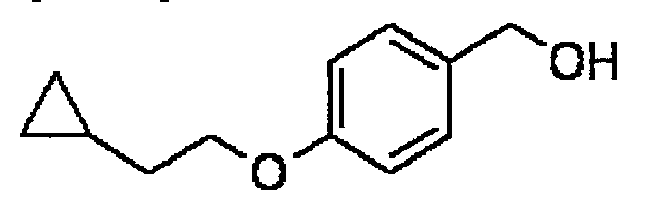
- Using 4-(2-cyclopropylethoxy)benzoic acid (6.20 g, 30.1 mmol) and in the same manner as in Reference Example 274, the title compound (5.76 g, quantitative) was obtained as a white solid. 1H NMR (CDCl3) δ0.08-0.15 (m, 2H), 0.44-0.52 (m, 2H), 0.75-0.95 (m, 1H), 1.60-1.75 (m, 2H), 4.04 (t, J = 6.6 Hz, 2H), 4.62 (s, 2H), 6.85-6.94 (m, 2H), 7.29 (d, J = 8.4 Hz, 2H).
-
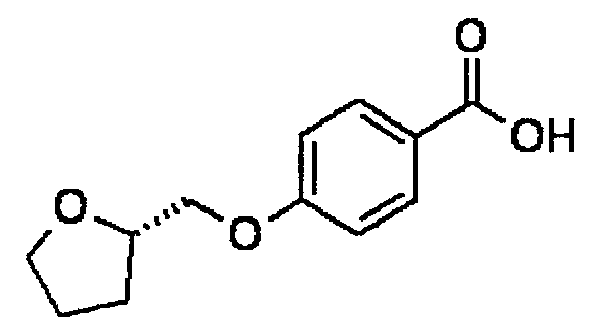
- To a solution of (2S)-tetrahydrofuran-2-ylmethanol (49.6 g, 486 mmol), 4-methyl hydroxybenzoate (73.9 g, 486 mmol) and triphenylphosphine (147 g, 560 mmol) in THF (600 ml) was slowly added dropwise a solution (273 mL, 600 mmol) of 40% diethyl azodicarboxylate (DEAD) in toluene at 0°C, and the mixture was stirred at room temperature for 2 hr. The reaction solution was concentrated, triphenylphosphine oxide was precipitated from ethyl acetate-hexane, and removed by filtration through a glass filter, and the mother liquor was concentrated. The residue was purified by basic silica gel column chromatography (ethyl acetate:hexane=1:9) to give a colorless oil. The obtained colorless oil was dissolved in tetrahydrofuran (400 ml), methanol (300 mL) and water (100 ml), 8N aqueous sodium hydroxide solution (100 ml) was added thereto, and the mixture was stirred under heating at 90°C for 2 hr. The reaction solution was concentrated, cooled to 0°C, and neutralized with 6N hydrochloric acid to allow precipitation of crystals. The crystals were dissolved in THF, and the solution was extracted with ethyl acetate. The organic layer was washed with saturated brine, dried over anhydrous magnesium sulfate, and the solvent was evaporated under reduced pressure to give the title compound (68 g, yield 51%) as colorless crystals.
1H NMR (DMSO-d6) δ 1.64-1.72 (m, 1H), 1.82-1.92 (m, 2H), 1.95-2.04 (m, 1H), 3.68 (q, J =7.2 Hz, 1H),3.78 (q, J = 7.2 Hz, 1H), 3.95-4.06 (m, 2H), 4.14-4.19 (m, 1H), 7.02 (d, J = 8.7 Hz, 2H), 7.88 (d, J = 8.7 Hz, 2H), 12.62 (s, 1H). -

- Using 4-[(2S)-tetrahydrofuran-2-ylmethoxy]benzoic acid (7.50 g, 33.7 mmol) obtained in Reference Example 311 and in the same manner as in Reference Example 274, the title compound (6.98 g, quantitative) was obtained as an oil.
1H NMR (CDCl3) δ 1.68-1.86 (m, 1H), 1.90-2.15 (m, 3H), 3.76-3.88 (m, 1H), 3.90-4.03 (m, 3H), 4.18-4.38 (m, 1H), 4.62 (s, 2H), 6.92 (d, J =8.7Hz, 2H), 7. 27 (d, J=8.7Hz, 2H). -

- A mixture of 4-(hydroxymethyl)phenol (3.20 g, 25.8 mmol), potassium carbonate (7.12 g, 51.6 mmol) and (bromomethyl)cyclobutane (3.75 mL, 33.6 mmol) in ethanol (50 mL) was stirred at 70°C overnight. Water was added thereto, ethanol was evaporated under reduced pressure, and the mixture was extracted twice with ethyl acetate.
The combined organic layer was washed with saturated brine, and dried over anhydrous magnesium sulfate. The solvent was evaporated under reduced pressure, and the obtained residue was purified by silica gel chromatography (hexane:ethyl acetate=19:1 to 13:7), and then purified by basic silica gel chromatography (hexane:ethyl acetate=19:1 to 13:7), and the solvent was evaporated to give the title compound (1.17 g, yield 23%) as an oil.
1H NMR (CDCl3) δ 1.78-2.02 (m, 4H), 2.09-2.26 (m, 2H), 2.64-2.86 (m, 1H), 3.93 (d, J = 6.8 Hz, 2H), 4.61 (s, 2H), 6.90 (d, J = 9.0 Hz, 2H), 7.29 (d, J = 9.0 Hz, 2H). -
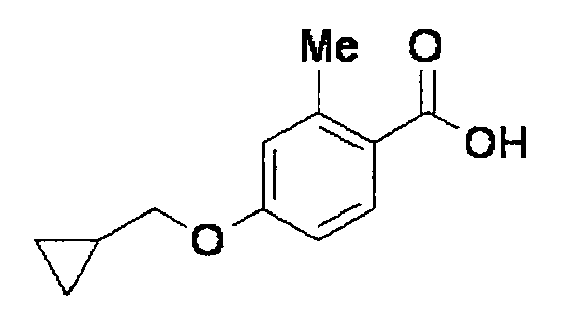
- A suspension of (bromomethyl)cyclopropane (20.0 g, 148 mmol), 4-hydroxy-2-methylbenzoic acid (10.1 g, 66.4 mmol) and potassium carbonate (22.0 g, 159 mmol) in DMF (150 mL) was stirred at 60°C overnight. Ethyl acetate was added thereto, the mixture was left standing, and the resulting precipitate was removed by filtration. The filtrate was concentrated under reduced pressure, water was added thereto, and the mixture was extracted with ethyl acetate. The organic layer was washed with saturated brine, and dried over anhydrous sodium sulfate. The solvent was evaporated under reduced pressure. To the obtained residue were added methanol (50 mL), water (50 mL), THF (100 mL) and lithium hydroxide monohydrate (3.00 g, 71.4 mmol), and the mixture was stirred at 50°C for 3 hr. After being allowed to cool to room temperature, the mixture was acidified with 1N hydrochloric acid, and the resulting precipitate was collected by filtration, washed with water, and dried to give the title compound (13.5 g, yield 92%) as a white solid.
1H NMR (CDCl3) δ0.27-0.46 (m, 2H), 0.56-0.80 (m, 2H), 1.13-1.45 (m, 1H), 2.63 (s, 3H), 3.86 (d, J = 7.0 Hz, 2H), 6.67-6.94 (m, 2H), 8.05 (d, J = 9.4 Hz, 1H) -

- Using 4-(cyclopropylmethoxy)-2-methylbenzoic acid (1.00 g, 4.84 mmol) obtained in Reference Example 314 and in the same manner as in Reference Example 274, the title compound (868 mg, yield 94%) was obtained as a white solid.
1H NMR (CDCl3) δ0.25-0.45 (m, 2H), 0.55-0.73 (m, 2H), 1.17-1.32 (m, 1H), 1.46 (br, 1H), 2.35 (s, 3H), 3.79 (d, J = 6.8 Hz, 2H), 4.62 (s, 2H), 6.71 (dd, J = 8.3, 2.3 Hz, 1H), 6.76 (d, J = 2.3 Hz, 1H), 7.21 (d, J = 8.3 Hz, 1H). -

- A solution (30 mL) of 3,5-difluoropyridine-2-carbonitrile (1.51 g, 10.8 mmol) in tert-butanol was added dropwise to a solution (40 mL) of sodium tert-butoxide (1.04 g, 10.8 mmol) in tert-butanol (40 mL), and the mixture was stirred at room temperature for 2 hr. The reaction mixture was diluted with ethyl acetate, and the mixture was washed with water, 10% aqueous potassium carbonate solution and saturated brine, and dried over anhydrous sodium sulfate. The solvent was evaporated under reduced pressure and the obtained residue was purified by silica gel column chromatography (hexane:ethyl acetate=3:1) to give a mixture (1.63 g) of 5-tert-butoxy-3-fluoropyridine-2-carbonitrile and 3-tert-butoxy-5-fluoropyridine-2-carbonitrile. To the obtained mixture (1.62 g, 8.34 mmol) was added 4N hydrogen chloride-dioxane (40 mL), and the mixture was stirred at 60°C for 2 hr, and concentrated. To a solution of the obtained residue (1.46 g, 8.34 mmol) and potassium carbonate (2.31 g, 16.7 mmol) in DMF (20 mL) was added cyclopropylmethyl bromide (1.21 mL, 12.5 mmol), and the mixture was stirred at 60°C for 16 hr. The reaction mixture was diluted with ethyl acetate, and the mixture was washed with water, 10% aqueous potassium carbonate solution and saturated brine, and dried over anhydrous sodium sulfate. The solution was purified by basic silica gel column chromatography (ethyl acetate). The solvent was evaporated under reduced pressure and the obtained residue was purified by silica gel column chromatography (hexane:ethyl acetate=1:0 to 7:3) to give the title compound (365 mg, yield 23%). 1H NMR (CDCl3) δ0.38-0.43 (m, 2H), 0.70-0.76 (m, 2H), 1.24-1.33 (m, 1H), 3.92 (d, J = 7.2 Hz, 2H), 7.00 (dd, J = 10.2, 2.4 Hz, 1H), 8.22 (dd, J = 2.4, 1.2 Hz, 1H).
-
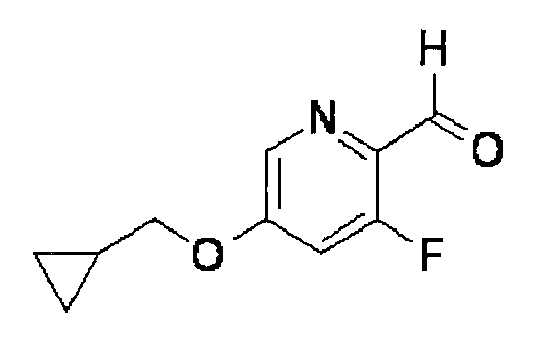
- To a solution of 5-(cyclopropylmethoxy)-3-fluoropyridine-2-carbonitrile (363 mg, 1.89 mmol) obtained in Reference Example 316 in THF (10 mL) was added a solution (1.51 mL, 2.27 mmol) of 1.5M diisobutylaluminum hydride in toluene under ice-cooling, and the mixture was stirred for 2 hr. A solution (0.755 mL, 1.13 mmol) of 1.5M diisobutylaluminum hydride in toluene was added at room temperature, and the mixture was stirred for 16 hr. After completion of the reaction, sodium sulfate 10 hydrate was added thereto, and the mixture was diluted with ethyl acetate, and filtered through celite. To the filtrate was added 1N hydrochloric acid (10 mL), and the mixture was stirred at room temperature for 16 hr. The mixture was basified with potassium carbonate, and the mixture was extracted with ethyl acetate. The extract was washed three times with saturated brine, and dried over anhydrous sodium sulfate. The solvent was evaporated under reduced pressure to give the title compound (252 mg, yield 68%) as an oil.
1H NMR (CDCl3) δ 0.36-0.44 (m, 2H), 0.64-0.76 (m, 2H), 1.24-1.36 (m, 1H), 3.94 (d, J = 7.2 Hz, 2H), 6.96 (dd, J = 11.4, 2.4 Hz, 1H), 8.30 (d, J = 1.5 Hz, 1H), 10.10 (s, 1H). -

- To a solution of 5-(cyclopropylmethoxy)-3-fluoropyridine-2-carbaldehyde (252 mg, 1.29 mmol) obtained in Reference Example 317 in a mixed solvent of methanol (3 mL) and THF (3 mL) was added sodium borohydride (48.8 mg, 1.29 mmol), and the mixture was stirred for 30 min. The reaction mixture was diluted with ethyl acetate, and the mixture was washed with saturated brine, and dried over anhydrous sodium sulfate. The solvent was evaporated under reduced pressure and the obtained residue was purified by silica gel column chromatography (hexane:ethyl acetate=3:1 to 1:1) to give the title compound (108 mg, yield 43%).
1H NMR (CDCl3) δ 0.35-0.40 (m, 2H), 0.66-0.72 (m, 2H), 1.21-1.33 (m, 1H), 3.58 (t, J = 5.4 Hz, 1H), 3.85 (d, J = 6.9 Hz, 2H), 4.75 (d, J = 5.4 Hz, 2H), 6.96 (dd, J = 10.8, 2.4 Hz, 1H), 8.09 (d, J = 1.8 Hz, 1H). -

- To a solution of 6-fluoro-4-methylpyridine-3-carboxylic acid (4.94 g, 31.8 mmol), cyclopropylmethanol (3.78 mL, 47.8 mmol) and N,N-dimethylpyridin-4-amine (778 mg, 6.37 mmol) in DMF (30 mL) was added N-[3-(dimethylamino)propyl]-N'-ethylcarbodiimide hydrochloride (6.71 g, 35.0 mmol), and the mixture was stirred for 3 days. The reaction mixture was diluted with ethyl acetate, and the mixture was washed with 10% aqueous potassium carbonate solution and saturated brine, and dried over anhydrous sodium sulfate. The solution was purified by basic silica gel column chromatography (ethyl acetate). The solvent was evaporated under reduced pressure and the obtained residue was purified by silica gel column chromatography (hexane:ethyl acetate=9:1 to 3:1) to give the title compound (3.86 g, yield 58%).
1H NMR (CDCl3) δ 0.35-0.40 (m, 2H), 0.61-0.66 (m, 2H), 1.21-1.31 (m, 1H), 2.66 (s, 3H), 4.16 (d, J = 6.9 Hz, 2H), 6.80 (m, 1H), 8.79 (s, 1H). -

- To a solution of cyclopropylmethyl 6-fluoro-4-methylpyridine-3-carboxylate (3.85 g, 18.4 mmol) obtained in Reference Example 319 and cyclopropylmethanol (1.75 mL, 22.1 mmol) in DMF (30 mL) was added 60% sodium hydride (883 mg, 22.1 mmol) under ice-cooling.
After stirring for 30 min, the mixture was stirred at room temperature for 10 min. The reaction was quenched with ice, and the mixture was extracted with ethyl acetate, washed with 10% aqueous potassium carbonate solution and saturated brine, and dried over anhydrous sodium sulfate. The solvent was evaporated under reduced pressure to give cyclopropylmethyl 6-(cyclopropylmethoxy)-4-methylpyridine-3-carboxylate (4.54 g, 94%) as an oil. To a solution of the obtained cyclopropylmethyl 6-(cyclopropylmethoxy)-4-methylpyridine-3-carboxylate (4.54 g, 17.4 mmol) in THF (100 mL) was added lithium aluminum hydride (989 mg, 26.1 mmol) under ice-cooling, and the mixture was stirred for 30 min. To the reaction mixture was slowly added sodium sulfate decahydrate, and the mixture was filtered through celite. The filtrate was concentrated, the residue was dissolved in ethyl acetate, and the solution was applied to basic silica gel column chromatography (ethyl acetate). The solvent was evaporated under reduced pressure and the obtained residue was purified by silica gel column chromatography (hexane:ethyl acetate=9:1 to 1:1) to give the title compound (2.87 g, yield 85%).
1H NMR (CDCl3) δ 0.31-0.36 (m, 2H), 0.57-0.62 (m, 2H), 1.22-1.29 (m, 1H), 1.58 (t, J = 5.1 Hz, 1H), 2.36 (s, 3H), 4.10 (d, J = 7.2 Hz, 2H), 4.62 (d, J = 4.8 Hz, 2H), 6.61 (s, 1H), 7.95 (s, 1H). -

- To a solution of {2-fluoro-4-[(2R)-tetrahydrofuran-2-ylmethoxy]phenyl}methanol (630 mg, 2.78 mmol) obtained in Reference Example 301 and triphenylphosphine (875 mg, 3.34 mmol) in THF (10 mL) was added carbon tetrabromide (1.29 g, 3.89 mmol), and the mixture was stirred at room temperature for 30 min, and concentrated under reduced pressure. The obtained residue was purified by silica gel chromatography to give (2R)-2-{[4-(bromomethyl)-3-fluorophenoxy]methyl}tetrahydrofuran (800 mg).
-

- A mixture of 2-bromo-4-(hydroxymethyl)phenol (3.00 g, 14.7 mmol), iodoethane (4.60 mL, 44.3 mmol) and potassium carbonate (6.12 g, 44.3 mmol) in ethanol (30 mL) was stirred at room temperature for 2 days. The obtained reaction mixture was filtered through celite, and the solvent was evaporated under reduced pressure. The residue was applied to silica gel chromatography (ethyl acetate). The solvent was evaporated under reduced pressure to give (3-bromo-4-ethoxyphenyl)methanol (2.98 g) as a white solid.
-

- To (3-bromo-4-ethoxyphenyl)methanol (2.98 g) obtained in Reference Example 322 were successively added toluene (15 mL), triphenylphosphine (4.23 g, 16.2 mmol) and carbon tetrabromide (5.32 g, 16.2 mmol), and the mixture was stirred at room temperature for 30 min. The obtained reaction mixture was purified by silica gel chromatography (hexane:ethyl acetate=1:0 to 7:3) to give 2-bromo-4-(bromomethyl)-1-ethoxybenzene (2.47 g).
-

- To a solution of N-[1-(6-hydroxy-1-benzofuran-3-yl)ethyl]acetamide (17.8 mg, 0.0760 mmol) obtained in Reference Example 4 in DMF (5 mL) were added 4-ethoxybenzyl chloride (39.0 mg, 0.228 mmol) and potassium carbonate (52.4 mg, 0.380 mmol), and the mixture was stirred at 60°C for 30 min. Water was added to the reaction mixture, and the mixture was extracted with ethyl acetate. The extract was washed twice with saturated brine, and dried over anhydrous magnesium sulfate. The solvent was evaporated under reduced pressure and the obtained residue was purified by preparative silica gel TLC (ethyl acetate) to give the title compound (11.2 mg, yield 42%) as a white solid.
1H NMR (CDCl3) 5 1.41 (t, J = 7.0 Hz, 3H), 1.59 (d, J = 6.8 Hz, 3H), 1.99 (s, 3H), 4.04 (q, J = 7.0 Hz, 2H), 5.01 (s, 2H), 5.34-5.43 (1H, m), 5.61 (d, J = 8.5 Hz, 1H), 6.89-6.96 (m, 3H), 7.06 (d, J = 2.1 Hz, 1H), 7.35 (d, J = 8.7 Hz, 2H), 7.43-7.47 (m, 2H). -
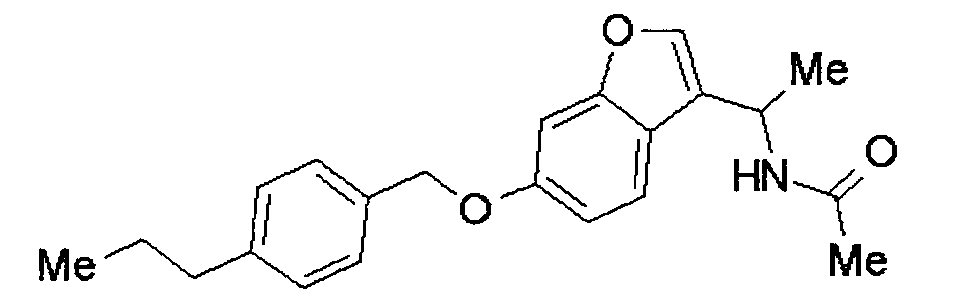
- To a solution of N-[1-(6-hydroxy-1-benzofuran-3-yl)ethyl]acetamide (42.2 mg, 0.193 mmol) obtained in Reference Example 4 in DMF (5 mL) were added 4-propylbenzyl methanesulfonate (176 mg, 0.770 mmol) obtained in Reference Example 5 and potassium carbonate (107 mg, 0.770 mmol), and the mixture was stirred at 70°C for 30 min. Water was added to the reaction mixture, and the mixture was extracted with ethyl acetate. The extract was washed twice with saturated brine, and dried over anhydrous magnesium sulfate. The solvent was evaporated under reduced pressure and the obtained residue was purified by preparative silica gel TLC (hexane:ethyl acetate=1:9) to give the title compound (47.3 mg, yield 70%) as a white solid.
1H NMR (CDCl3) δ 0.94 (t, J = 7.4 Hz, 3H), 1.58 (d, J = 6.8 Hz, 3H), 1.60-1.70 (m, 2H), 1.98 (s, 3H), 2.57-2.62 (m, 2H), 5.05 (s, 2H), 5.33-5.43 (1H, m), 5.64 (d, J = 7.6 Hz, 1H), 6.95 (dd, J = 8.7, 2.3 Hz, 1H), 7.06 (d, J = 2.3 Hz, 1H), 7.19 (d, J = 8.3 Hz, 2H), 7.35 (d, J = 8.3 Hz, 2H), 7.42 (d, J = 1.1 Hz, 1H), 7.46 (d, J = 8.7 Hz, 1H). -

- To a solution of N-[1-(6-hydroxy-1-benzofuran-3-yl)ethyl]acetamide (35.3 mg, 0.161 mmol) obtained in Reference Example 4 in DMF (5 mL) were added 1-(chloromethyl)-4-(1-methylethoxy)benzene (119 mg, 0.644 mmol) and potassium carbonate (89.0 mg, 0.644 mmol), and the mixture was stirred at 70°C for 30 min. Water was added to the reaction mixture, and the mixture was extracted with ethyl acetate. The extract was washed twice with saturated brine, and dried over anhydrous magnesium sulfate. The solvent was evaporated under reduced pressure and the obtained residue was purified by preparative silica gel TLC (hexane:ethyl acetate=1:9) to give the title compound (38.0 mg, yield 64%) as a white solid.
1H NMR (CDCl3) δ 1.33 (d, J = 6.0 Hz, 6H), 1.57 (d, J = 6.8 Hz, 3H), 1.98 (s, 3H), 4.49-4.61 (m, 1H), 5.00 (s, 2H), 5.33-5.42 (1H, m), 5.68 (br, 1H), 6.89 (d, J = 8.7 Hz, 2H), 6.94 (dd, J = 8.6, 2.2 Hz, 1H), 7.06 (d, J = 2.2 Hz, 1H), 7.34 (d, J = 8.6 Hz, 2H), 7.42 (s, 1H), 7.45 (d, J = 8.6 Hz, 1H). -

- To a solution of N-[1-(6-hydroxy-1-benzofuran-3-yl)ethyl]acetamide (35.0 mg, 0.160 mmol) obtained in Reference Example 4 in THF (5 mL) were added [4-(1H-pyrazol-1-yl)phenyl]methanol (41.8 mg, 0.240 mmol), triphenylphosphine (63.0 mg, 0.240 mmol) and 2.2 M diethyl azodicarboxylate toluene solution (0.110 mL, 0.240 mmol), and the mixture was stirred at room temperature for 30 min. The solvent was evaporated under reduced pressure and the obtained residue was purified by preparative HPLC to give the title compound (29.4 mg, yield 33%) as a white solid.
- <Preparative HPLC conditions>
preparation system: Waters large scale preparation system (UV Purification System)
column: Develosil ODS-UG-10
column temperature: room temperature (25°C)
detection: UV 220 nm
mobile phase: A (0.1% aqueous trifluoro acetic acid solution), B: 0.1% trifluoroacetic acid acetonitrile solution
gradient: 0.00 min (A/B=95/5), 1.00 min (A/B=95/5), 2.00 min (A/B=80/20), 5.00 min (A/B=5/95), 5.10 min (A/B=0/100), 7.00 min
(A/B=100/0)
flow rate: 150 mL/min
1H NMR (CDCl3) δ 1.59 (d, J = 7.0 Hz, 3H), 2.00 (s, 3H), 5.13 (s, 2H), 5.35-5.44 (1H, m), 5.59 (d, J = 8.7 Hz, 1H), 6.47 (dd, J = 2.5, 1.9 Hz, 1H), 6.97 (dd, J = 8.6, 2.2 Hz, 1H), 7.07 (d, J = 2.1 Hz, 1H), 7.44 (d, J = 1.1 Hz, 1H), 7.48 (d, J = 8.6 Hz, 1H), 7.53 (d, J = 8.7 Hz, 2H), 7.71 (d, J = 8.6 Hz, 2H), 7.73 (s, 1H), 7.93 (d, J = 2.2 Hz, 1H). -
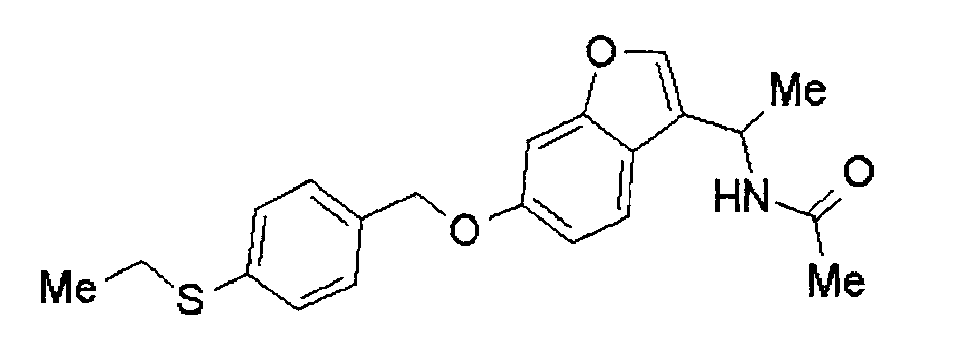
- To a solution of N-[1-(6-hydroxy-1-benzofuran-3-yl)ethyl]acetamide (35.0 mg, 0.161 mmol) obtained in Reference Example 4 in DMF (5 mL) were added 1-(chloromethyl)-4-(ethylsulfanyl)benzene (120 mg, 0.664 mmol) and potassium carbonate (89.0 mg, 0.644 mmol), and the mixture was stirred at 70°C for 20 min. Water was added to the reaction mixture, and the mixture was extracted with ethyl acetate. The extract was washed twice with saturated brine, and dried over anhydrous magnesium sulfate. The solvent was evaporated under reduced pressure and the obtained residue was purified by preparative silica gel TLC (hexane:ethyl acetate=2:8) to give the title compound (50.1 mg, yield 94%) as a white solid.
1H NMR (CDCl3) δ 1.32 (t, J = 7.4 Hz, 3H), 1.58 (d, J = 6.4 Hz, 3H), 1.98 (s, 3H), 2.95 (q, J = 7.4 Hz, 2H), 5.05 (s, 2H), 5.33-5.43 (1H, m), 5.64 (d, J = 8.7 Hz, 1H), 6.94 (dd, J = 8.7, 2.3 Hz, 1H), 7.04 (d, J = 2.3 Hz, 1H), 7.29-7.38 (m, 4H), 7.43 (d, J = 1.1 Hz, 1H), 7.46 (d, J = 8.3 Hz, 1H). -

- To a solution of N-[1-(6-hydroxy-1,2-benzisoxazol-3-yl)ethyl]acetamide (470 mg, 2.13 mmol) obtained in Reference Example 10 and potassium carbonate (447 mg, 3.20 mmol) in DMF (5 mL) was added 4-ethoxybenzyl chloride (364 mg, 2.13 mmol), and the mixture was stirred under heating at 70°C for 30 min. To the reaction mixture was added ethyl acetate, and the mixture was washed with saturated brine, and dried over anhydrous sodium sulfate. The solvent was evaporated under reduced pressure, and the obtained residue was triturated with ethyl acetate to give the title compound (103 mg, yield 14%).
1H NMR (CDCl3) δ 1.42 (t, J = 6.9 Hz, 3H), 1.65 (d, J = 6.9 Hz, 3H), 2.05 (s, 3H), 4.04 (q, J = 6.9 Hz, 2H), 5.05 (s, 2H), 5.61 (m, 1H), 5.57 (1H, s), 6.19 (d, J = 7.8 Hz, 1H), 6.91 (d, J = 8.7 Hz, 2H), 6.97 (dd, J = 1.8, 9.0 Hz, 1H), 7.04 (d, J = 1.8 Hz, 1H), 7.35 (d, J = 8.7 Hz, 2H), 7.56 (d, J = 9.0 Hz, 1H). -

- To a solution of N-[2-(2-{4-[(4-ethoxyphenoxy)methyl]pyridin-2-yl}hydrazino)-1-methyl-2-oxoethyl]acetamide (166 mg, 0.446 mmol) obtained in Reference Example 13, triphenylphosphine (140 mg, 0.535 mmol) and azido(trimethyl)silane (0.0710 mL, 0.535 mmol) in THF (3 mL) was added 40% diethyl azodicarboxylate toluene solution (0.243 mL, 0.535 mmol) under ice-cooling, and the mixture was stirred at room temperature for 2 hr. The reaction mixture was diluted with ethyl acetate, the resulting powder was collected and washed successively with ethyl acetate and diisopropyl ether to give the title compound (96.7 mg, yield 61%).
1H NMR (DMSO-d6) δ 1.28 (t, J = 6.9 Hz, 3H), 1.64 (d, J = 7.2 Hz, 3H), 1.82 (s, 3H), 3.93 (q, J = 6.9 Hz, 2H), 5.12 (s, 2H), 5.56 (m, 1H), 6.84 (d, J = 9.0 Hz, 2H), 6.96 (d, J = 9.0 Hz, 2H), 7.01 (d, J = 7.2 Hz, 1H), 7.74 (s, 1H), 8.32 (d, J = 7.2 Hz, 1H), 8.54 (d, J = 8.1 Hz, 1H). -
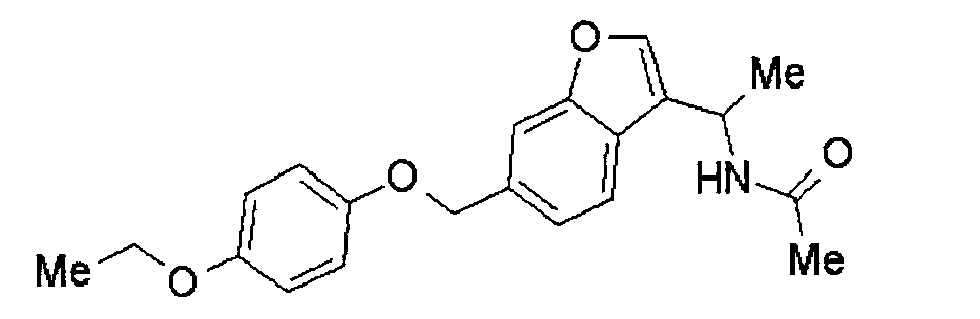
- To a solution of 3-(1-azidoethyl)-6-[(4-ethoxyphenoxy)methyl]-1-benzofuran (114 mg, 0.338 mmol) obtained in Reference Example 22 and water (0.3 mL) in THF (3 mL) was added triphenylphosphine (132 mg, 0.507 mmol). Then, the mixture was stirred at 50°C overnight. The reaction mixture was dried over anhydrous magnesium sulfate, and the desiccant was filtered off. Acetic anhydride (0.064 mL, 0.68 mmol) was added to the filtrate, and the mixture was stirred at room temperature for 5 min. After stirring, the solvent was evaporated under reduced pressure, and the obtained residue was purified by basic silica gel column chromatography (hexane to hexane:ethyl acetate=1:4), and preparative silica gel TLC (hexane:ethyl acetate=2:3) to give the title compound (6.4 mg, yield 5%) as a white solid.
1H NMR (CDCl3) δ 1.38 (t, J = 7.0 Hz, 3H), 1.61 (d, J = 6.8 Hz, 3H), 2.00 (s, 3H), 3.98 (q, J = 7.0 Hz, 2H), 5.12 (s, 2H), 5.39-5.48 (m, 1H), 5.57 (1H, s, 1H), 6.82 (d, J = 9.1 Hz, 2H), 6.91 (d, J = 9.1 Hz, 2H), 7.30 (d, J = 8.3 Hz, 1H), 7.49-7.66 (m, 3H). -

- To a solution of p-ethoxybenzylalcohol (416 mg, 2.74 mmol) in toluene (1 mL) was added thionyl chloride (1.0 mL). The solution was stirred at room temperature for 10 min, and the solvent was evaporated. To the obtained residue were added DMF (1 mL), N-[1-(6-hydroxy-1-benzofuran-2-yl)ethyl]acetamide (200 mg, 0.913 mmol) obtained in Reference Example 27 and 60% sodium hydride (55 mg, 1.37 mmol). The reaction mixture was stirred at room temperature for 30 min, saturated brine was added thereto, and the mixture was extracted with ethyl acetate. The obtained organic layer was washed with saturated brine, and dried over anhydrous magnesium sulfate. After evaporation of the solvent, the obtained residue was purified by basic silica gel column chromatography (hexane:ethyl acetate=9:1 to ethyl acetate), and triturated with diethyl ether to give the title compound (155 mg, yield 48%).
1H NMR (CDCl3) δ 1.42 (t, J = 6.9 Hz, 3H), 1.55 (d, J = 7.3 Hz, 3H), 2.01 (s, 3H), 4.04 (q, J = 6.9 Hz, 2H), 5.01 (s, 2H), 5.25-5.37 (m, 1H), 5.79 (br, 1H), 6.48 (s, 1H), 6.89-6.92 (m, 3H), 7.03 (s, 1H), 7.35-7.38 (m, 3H). -
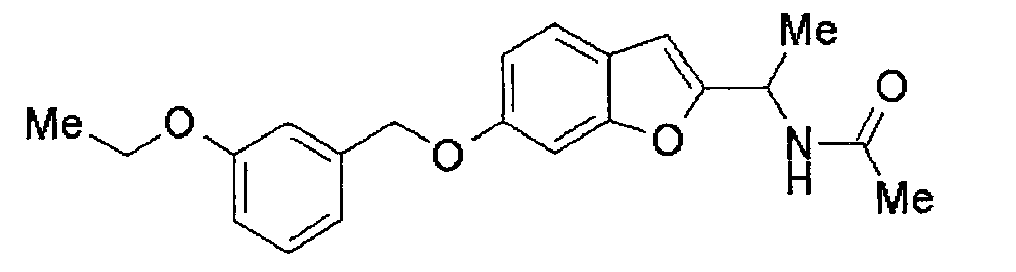
- To a solution of m-ethoxybenzylalcohol (276 mg, 1.82 mmol) in toluene (2 mL) was added thionyl chloride (0.66 mL). The solution was stirred at room temperature for 5 min, and the solvent was evaporated. To the obtained residue were added DMF (2 mL), N-[1-(6-hydroxy-1-benzofuran-2-yl)ethyl]acetamide (200 mg, 0.913 mmol) obtained in Reference Example 27, and potassium carbonate (252 mg, 1.82 mmol). The reaction mixture was stirred at 50°C overnight, saturated brine was added thereto, and the mixture was extracted with ethyl acetate. The obtained organic layer was washed with saturated brine, and dried over anhydrous magnesium sulfate. After evaporation of the solvent, the obtained residue was purified by basic silica gel column chromatography (hexane to hexane:ethyl acetate=2:3), and triturated with diisopropyl ether and hexane to give the title compound (60.9 mg, yield 19%).
1H NMR (CDCl3) δ 1.41 (t, J = 7.2 Hz, 3H), 1.54 (d, J = 6.8 Hz, 3H), 2.01 (s, 3H), 4.05 (q, J = 7.2 Hz, 2H), 5.07 (s, 2H), 5.26 - 5.37 (m, 1H), 5.78 (br, 1H), 6.48 (s, 1H), 6.85 (dd, J = 7.8, 2.1 Hz, 1H), 6.90-6.95 (m, 1H), 6.98-7.05 (m, 3H), 7.26 (d, J = 8.3 Hz, 1H), 7.37 (d, J = 8.4 Hz, 1H). -

- To a solution of tert-butyl {1-[6-(hydroxymethyl)-1-benzofuran-2-yl]ethyl}carbamate (88.0 mg, 0.302 mmol) obtained in Reference Example 30, 4-ethoxyphenol (62.6 mg, 0.453 mmol) and triphenylphosphine (119 mg, 0.453 mmol) in THF (5 mL) was added 2.2 M diethyl azodicarboxylate toluene solution (0.210 mL, 0.460 mmol), and the mixture was stirred at room temperature for 15 min. The solvent was evaporated under reduced pressure and the obtained residue was purified by preparative silica gel TLC (hexane:ethyl acetate=1:9) to give the title compound (55.2 mg, yield 44%) as an oil.
1H NMR (CDCl3) δ 1.38 (t, J = 7.0 Hz, 3H), 1.45 (s, 9H), 1.54 (d, J = 6.8 Hz, 3H), 3.97 (2H, q, J = 6.8 Hz), 4.86-4.90 (m, 1H), 5.00 (br, 1H), 5.10 (s, 2H), 6.53 (s, 1H), 6.80-6.84 (m, 2H), 6.88-6.93 (m, 2H), 7.24-7.26 (m, 1H), 7.48-7.51 (m, 2H). -
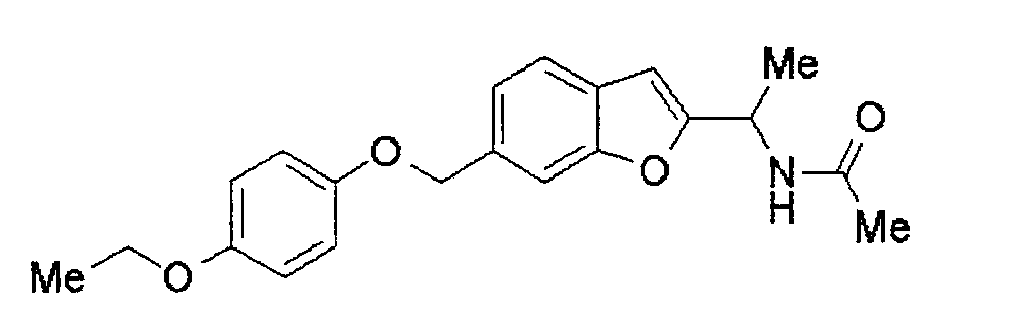
- A solution (5 mL) of tert-butyl (1-{6-[(4-ethoxyphenoxy)methyl]-1-benzofuran-2-yl}ethyl)carbamate (49.5 mg, 0.121 mmol) obtained in Example 11 in 4N hydrogen chloride-ethyl acetate was stirred at room temperature for 30 min. The solvent was evaporated under reduced pressure and the obtained residue was dissolved in pyridine (3 mL)-acetic anhydride (3 mL), and the solution was stirred at room temperature for 15 min. The solvent was evaporated under reduced pressure and the obtained residue was purified by preparative silica gel TLC (hexane:ethyl acetate=1:3) to give the title compound (16.7 mg, yield 39%) as a white solid.
1H NMR (CDCl3) 5 1.38 (t, J = 7.0 Hz, 3H), 1.56 (d, J = 6.8 Hz, 3H), 2.02 (s, 3H), 3.98 (2H, q, J = 6.8 Hz), 5.11 (s, 2H), 5.31-5.40 (m, 1H), 5.81 (d, J = 7.7 Hz, 1H), 6.56 (s, 1H), 6.80-6.85 (m, 2H), 6.88-6.93 (2H, m), 7.24-7.27 (m, 1H), 7.48-7.54 (m, 2H). -

- Using 4-(1-methylethoxy)benzyl alcohol (291 mg, 1.81 mmol), N-[1-(6-hydroxy-1-benzofuran-2-yl)ethyl]acetamide (200 mg, 0.913 mmol) obtained in Reference Example 27 and potassium carbonate (251 mg, 1.81 mmol), an operation in the same manner as in Example 10 was performed to give the title compound (185 mg, yield 55%) as a white solid.
1H NMR (CDCl3) δ 1.34 (d, J = 6.1 Hz, 6H), 1.53-1.57 (m, 3H), 2.01 (s, 3H), 4.49-4.62 (m, 1H), 5.01 (s, 2H), 5.25-5.38 (m, 1H), 5.75 (br, 1H), 6.48 (s, 1H), 6.87-6.95 (m, 3H), 7.04 (d, J=1.9Hz, 1H), 7.27-7.41 (m, 3H). -

- Using 4-(cyclohexylmethoxy)benzyl alcohol (398 mg, 1.81 mmol), N-[1-(6-hydroxy-1-benzofuran-2-yl)ethyl]acetamide (200 mg, 0.913 mmol) obtained in Reference Example 27 and potassium carbonate (251 mg, 1.81 mmol), an operation in the same manner as in Example 10 was performed to give the title compound (286 mg, yield 74%) as a white solid.
1H NMR (CDCl3) δ 0.90-1.43 (m, 5H), 1.49-1.59 (m, 3H), 1.65-1.92 (m, 6H), 2.01 (s, 3H), 3.76 (d, J = 6.4 Hz, 2H), 5.01 (s, 2H), 5.22-5.41 (m, 1H), 5.75 (br, 1H), 6.48 (s, 1H), 6.85-6.95 (m, 3H), 7.04 (d, J = 2.1 Hz, 1H), 7.31-7.42 (m, 3H). -

- Using N-[1-(6-hydroxy-1,3-benzoxazol-2-yl)ethyl]acetamide (103 mg, 0.468 mmol) obtained in Reference Example 33, potassium carbonate (97.0 mg, 0.702 mmol) and 4-ethoxybenzyl chloride (79.8 mg, 0.468 mmol), an operation in the same manner as in Example 6 was performed, and the obtained residue was triturated with diisopropyl ether to give the title compound (120 mg, yield 72%).
1H NMR (CDCl3) δ 1.42 (t, J = 6.9 Hz, 3H), 1.61-1.66 (m, 5H), 2.08 (s, 3H), 4.04 (q, J = 6.9 Hz, 2H), 5.02 (s, 2H), 5.38 (m, 1H), 6.28 (d, J = 6.9 Hz, 1H), 6.90 (d, J = 8.7 Hz, 2H), 6.98 (dd, J = 2.4, 8.7 Hz, 1H), 7.08 (d, J = 2.4 Hz, 1H), 7.33 (d, J = 8.7 Hz, 2H), 7.54 (d, J = 8.7 Hz, 1H). -

- To a solution of tert-butyl {1-[6-(hydroxymethyl)-1-benzofuran-2-yl]ethyl}carbamate (280 mg, 0.962 mmol) obtained in Reference Example 30, 4-(1-methylethoxy)phenol (220 mg, 1.44 mmol) and triphenylphosphine (378 mg, 1.44 mmol) in THF (10 mL) was added 2.2 M diethyl azodicarboxylate toluene solution (0.660 mL, 1.45 mmol), and the mixture was stirred at room temperature for 15 min. The solvent was evaporated under reduced pressure and the obtained residue was purified by silica gel column chromatography (hexane:ethyl acetate=19:1 to 3:2) to give tert-butyl [1-(6-{[4-(1-methylethoxy)phenoxy]methyl}-1-benzofuran-2-yl)ethyl]carbamate as an oil. A solution (8 mL) of this oil in 4N hydrogen chloride-ethyl acetate was stirred at room temperature for 30 min. The solvent was evaporated under reduced pressure, the obtained residue was dissolved in pyridine (5 mL)-acetic anhydride (5 mL), and the solution was stirred at room temperature for 15 min. The solvent was evaporated under reduced pressure and the obtained residue was purified by silica gel column chromatography (hexane:ethyl acetate=1:1 to ethyl acetate) to give the title compound (125 mg, yield 42%) as a white solid.
1H NMR (CDCl3) δ 1.30 (d, J = 6.1 Hz, 6H), 1.56 (d, J = 6.8 Hz, 3H), 2.02 (s, 3H), 4.35-4.45 (m, 1H), 5.10 (s, 2H), 5.30-5.40 (m, 1H), 5.80 (d, J = 8.3 Hz, 1H), 6.56 (s, 1H), 6.80-6.85 (m, 2H), 6.87-6.91 (m, 2H), 7.26 (dd, J = 8.0, 1.5 Hz, 1H), 7.48-7.52 (m, 2H). -

- To a solution of tert-butyl {1-[6-(hydroxymethyl)-1-benzofuran-2-yl]ethyl}carbamate (280 mg, 0.962 mmol) obtained in Reference Example 30, 4-propoxyphenol (220 mg, 1.44 mmol) and triphenylphosphine (378 mg, 1.44 mmol) in THF (10 mL) was added 2.2 M diethyl azodicarboxylate toluene solution (0.660 mL, 1.45 mmol), and the mixture was stirred at room temperature for 15 min. The solvent was evaporated under reduced pressure and the obtained residue was purified by silica gel column chromatography (hexane:ethyl acetate=19:1 to 3:2) to give tert-butyl (1-{6-[(4-propoxyphenoxy)methyl]-1-benzofuran-2-yl}ethyl)carbamate as an oil. A solution (8 mL) of this oil in 4N hydrogen chloride-ethyl acetate was stirred at room temperature for 30 min. The solvent was evaporated under reduced pressure, the obtained residue was dissolved in pyridine (5 mL)-acetic anhydride (5 mL), and the solution was stirred at room temperature for 15 min. The solvent was evaporated under reduced pressure and the obtained residue was purified by silica gel column chromatography (hexane:ethyl acetate=1:1 to ethyl acetate) to give the title compound (76.9 mg, yield 22%) as a white solid.
1H NMR (CDCl3) δ 1.02 (t, J=7.4 Hz, 3H), 1.56 (d, J = 6.8 Hz, 3H), 1.72-1.84 (2H, m), 2.02 (s, 3H), 3.86 (t, J = 6.6 Hz, 2H), 5.11 (s, 2H), 5.31-5.40 (m, 1H), 5.79 (d, J = 8.7 Hz, 1H), 6.56 (s, 1H), 6.81-6.85 (m, 2H), 6.88-6.92 (m 2H), 7.26 (dd, J = 7.8, 1.4 Hz, 1H), 7.49-7.52 (m, 2H). -

- To a solution of N-[1-(5-hydroxy-1-benzofuran-2-yl)ethyl]acetamide (50.0 mg, 0.228 mmol) obtained in Reference Example 38 in anhydrous DMF (1 mL) were added 4-ethoxybenzyl chloride (77.6 mg, 0.456 mmol) and potassium carbonate (62.9 mg, 0.456 mmol). The reaction mixture was stirred at 50°C overnight, saturated brine was added thereto, and the mixture was extracted with ethyl acetate. The extract was washed with saturated brine, and dried over anhydrous magnesium sulfate. The solution was passed through silica gel, the solvent was evaporated under reduced pressure, and the obtained white solid was washed with diethyl ether to give the title compound (62.4 mg, yield 77%).
1H NMR (CDCl3) δ 1.42 (t, J = 7.0 Hz, 3H), 1.55 (d, J = 7.0 Hz, 3H), 2.02 (s, 3H), 4.04 (q, J = 7.0 Hz, 2H), 4.99 (s, 2H), 5.26-5.40 (m, 1H), 5.79 (br, 1H), 6.49 (s, 1H), 6.84-6.96 (m, 3H), 7.04 (d, J = 2.4 Hz, 1H), 7.28-7.39 (m, 3H). -

- Using N-[1-(6-hydroxy-1-benzothiophen-2-yl)ethyl]acetamide (53.6 mg, 0.228 mmol) obtained in Reference Example 46, anhydrous DMF (1 mL), 4-ethoxybenzyl chloride (77.6 mg, 0.456 mmol) and potassium carbonate (62.9 mg, 0.456 mmol), an operation in the same manner as in Example 18 was performed to give the title compound (59.5 mg, yield 71%) as a white solid.
1H NMR (CDCl3) δ 1.42 (t, J = 7.0 Hz, 3H), 1.61 (d, J = 6.8 Hz, 3H), 2.01 (s, 3H), 4.04 (q, J = 7.0 Hz, 2H), 5.03 (s, 2H), 5.36-5.50 (m, 1H), 5.70 (br, 1H), 6.91 (d, J = 8.5 Hz, 2H), 7.02 (dd, J = 8.7, 2.3 Hz, 1H), 7.09 (s, 1H), 7.32 (d, J = 2.3 Hz, 1H), 7.36 (d, J = 8.5 Hz, 2H), 7.57 (d, J = 9.4 Hz, 1H). -

- To a solution of 2-(1-azidoethyl)-6-[2-(4-ethoxyphenyl)ethyl]-1-benzofuran (237 mg, 0.707 mmol) obtained in Reference Example 53 in THF (5 mL) was added triphenylphosphine (278 mg, 1.06 mmol), and the mixture was stirred at 60°C for 30 min. To the reaction mixture was added water (0.5 mL), and the mixture was stirred at 60°C for 15 hr. The reaction mixture was allowed to cool to room temperature, saturated aqueous sodium hydrogen carbonate solution (1 mL) and di-tert-butyl bicarbonate (0.20 mL, 0.870 mmol) were added thereto, and the mixture was stirred at room temperature for 15 min. To the reaction mixture was added saturated brine, and the mixture was extracted twice with ethyl acetate. The extract was dried over anhydrous magnesium sulfate, and the solvent was evaporated under reduced pressure. The obtained residue was purified by silica gel column chromatography (hexane:ethyl acetate=9:1 to 1:1) to give tert-butyl (1-{6-[2-(4-ethoxyphenyl)ethyl]-1-benzofuran-2-yl}ethyl)carbamate (240 mg). This was dissolved in 4N hydrogen chloride-ethyl acetate (5 mL), and the mixture was stirred at room temperature for 30 min. The solvent was evaporated under reduced pressure, the obtained residue was dissolved in pyridine (3 mL)-acetic anhydride (3 mL), and the solution was stirred at room temperature for 15 min. The solvent was evaporated under reduced pressure and the obtained residue was purified by silica gel column chromatography (hexane:ethyl acetate=1:1 to ethyl acetate) to give the title compound (179 mg, yield 72%) as a white solid.
1H NMR (CDCl3) δ 1.39 (t, J = 7.0 Hz, 3H), 1.54 (d, J = 6.8 Hz, 3H), 2.00 (s, 3H), 2.85-2.90 (m, 2H), 2.95-3.01 (m, 2H), 4.00 (q, J=7.0 Hz, 2H), 5.27-5.37 (m, 1H), 5.93 (d, J=8.0 Hz, 1H), 6.50 (s, 1H), 6.80 (d, J = 8.7 Hz, 2H), 7.02 (d, J = 8.7 Hz, 2H), 7.22 (s, 1H), 7.39 (d, J=8.0Hz, 1H). -

- To a solution of 2-(1-azidoethyl)-6-[(4-ethoxybenzyl)oxy]-7-methyl-1-benzofuran (227 mg, 0.646 mmol) obtained in Reference Example 57 in THF (10 mL) was added triphenylphosphine (255 mg, 0.969 mmol), and the mixture was stirred at 60°C for 30 min. To the reaction mixture was added water (0.1 mL), and the mixture was stirred at 60°C for 15 hr. The solvent was evaporated under reduced pressure and the obtained residue was purified by basic silica gel column chromatography (hexane:ethyl acetate=3:1 to 3:7) to give 1-{6-[(4-ethoxybenzyl)oxy]-7-methyl-1-benzofuran-2-yl}ethanamine. This was dissolved in pyridine (3 mL)-acetic anhydride (3 mL), and the solution was stirred at room temperature for 15 min. The solvent was evaporated under reduced pressure, and the residue was washed with ethyl acetate to give the title compound (67.5 mg, yield 28%) as a white solid.
1H NMR (CDCl3) δ 1.42 (t, J = 7.0 Hz, 3H), 1.55-1.57 (m, 3H), 2.02 (s, 3H), 2.38 (s, 3H), 4.04 (q, J = 7.0 Hz, 2H), 5.03 (s, 2H), 5.27-5.37 (m, 1H), 5.79 (d, J = 8.0 Hz, 1H), 6.48 (s, 1H), 6.89-6.91 (m, 3H), 7.22-7.29 (m, 1H), 7.35 (d, J = 8.3 Hz, 2H). -

- To a solution of tert-butyl {1-[5-(hydroxymethyl)-1-benzothiophen-2-yl]ethyl}carbamate (384 mg, 1.25 mmol) obtained in Reference Example 62, 4-ethoxyphenol (259 mg, 1.88 mmol) and triphenylphosphine (494 mg, 1.88 mmol) in THF (10 mL) was added 2.2 M diethyl azodicarboxylate toluene solution (0.855 mL, 1.88 mmol), and the mixture was stirred at room temperature for 15 min. The solvent was evaporated under reduced pressure and the obtained residue was purified by silica gel column chromatography (hexane:ethyl acetate=9:1 to 1:1) to give tert-butyl (1-{5-[(4-ethoxyphenoxy)methyl]-1-benzothiophen-2-yl}ethyl)carbamate as an oil. A solution (5 mL) of this oil in 4N hydrogen chloride-ethyl acetate was stirred at room temperature for 30 min. The solvent was evaporated under reduced pressure, the obtained residue was dissolved in pyridine (3 mL)-acetic anhydride (3 mL), and the solution was stirred at room temperature for 15 min. The solvent was evaporated under reduced pressure, and the residue was washed with diisopropyl ether to give the title compound (135 mg, yield 44%) as a white solid.
1H NMR (CDCl3) δ 1.38 (t, J = 7.0 Hz, 3H), 1.63 (d, J = 6.8 Hz, 3H), 2.02 (s, 3H), 3.98 (q, J = 7.0 Hz, 2H), 5.11 (s, 2H), 5.43-5.52 (m, 1H), 5.73 (d, J = 8.1 Hz, 1H), 6.80-6.84 (m, 2H), 6.88-6.92 (m, 2H), 7.18 (s, 1H), 7.36 (dd, J = 8.3, 1.7 Hz, 1H), 7.75 (d, J = 1.7 Hz, 1H), 7.77 (d, J = 8.3 Hz, 1H). -

- To a solution of tert-butyl {1-[5-(hydroxymethyl)-4-methyl-1-benzofuran-2-yl]ethyl}carbamate (85.6 mg, 0.281 mmol) obtained in Reference Example 68, 4-ethoxyphenol (58.1 mg, 0.421 mmol) and triphenylphosphine (110 mg, 0.421 mmol) in THF (5 mL) was added 2.2 M diethyl azodicarboxylate toluene solution (0.191 mL, 0.421 mmol), and the mixture was stirred at room temperature for 15 min. The solvent was evaporated under reduced pressure and the obtained residue was purified by silica gel column chromatography (hexane:ethyl acetate=9:1 to 1:1) to give tert-butyl (1-{5-[(4-ethoxyphenoxy)methyl]-4-methyl-1-benzofuran-2-yl}ethyl)carbamate as an oil. A solution (3 mL) of this oil in 4N hydrogen chloride-ethyl acetate was stirred at room temperature for 30 min. The solvent was evaporated under reduced pressure, the obtained residue was dissolved in pyridine (3 mL)-acetic anhydride (3 mL), and the solution was stirred at room temperature for 15 min. The solvent was evaporated under reduced pressure and the obtained residue was purified by preparative HPLC to give the title compound (3.00 mg, yield 6.6%) as a white solid.
- <Preparative HPLC conditions>
preparation system: Waters large scale preparation system (UV Purification System)
column: Develosil ODS-UG-10
column temperature: room temperature (25°C)
detection: UV 220 nm
mobile phase: A (0.1% aqueous trifluoro acetic acid solution), B: 0.1% trifluoroacetic acid acetonitrile solution
gradient: 0.00 min (A/B=95/5), 1.00 min (A/B=95/5), 2.00 min (A/B=80/20), 5.00 min (A/B=5/95), 5.10 min (A/B=0/100), 7.00 min
(A/B=100/0)
flow rate: 150 mL/min
1H NMR (CDCl3) δ 1.39 (t, J = 7.0 Hz, 3H), 1.57 (d, J = 7.2 Hz, 3H), 2.03 (s, 3H), 2.49 (s, 3H), 3.99 (q, J = 7.0 Hz, 2H), 5.05 (s, 2H), 5.34-5.41 (m, 1H), 5.81 (d, J = 8.0 Hz, 1H), 6.62 (s, 1H), 6.82-6.86 (m, 2H), 6.89-6.94 (m, 2H), 7.23-7.32 (m, 2H). -

- To a solution of 2-(1-azidoethyl)-5-[2-(4-ethoxyphenyl)ethyl]-1-benzofuran (400 mg, 1.19 mmol) obtained in Reference Example 75 in THF (5 mL) was added triphenylphosphine (469 mg, 1.79 mmol), and the mixture was stirred at 60°C for 30 min. To the reaction mixture was added water (0.1 mL), and the mixture was stirred at 60°C for 15 hr. The solvent was evaporated under reduced pressure and the obtained residue was purified by basic silica gel column chromatography (hexane:ethyl acetate=3:1 to 1:4) to give 1-{5-[2-(4-ethoxyphenyl)ethyl]-1-benzofuran-2-yl}ethanamine. This was dissolved in pyridine (3 mL)-acetic anhydride (3 mL), and the solution was stirred at room temperature for 15 min. The solvent was evaporated under reduced pressure, and the residue was washed with diethyl ether to give the title compound (251 mg, yield 60%) as a white solid.
1H NMR (CDCl3) δ 1.40 (t, J = 7.0 Hz, 3H), 1.56 (d, J = 6.8 Hz, 3H), 2.02 (s, 3H), 2.83-2.89 (m, 2H), 2.93-2.98 (m, 2H), 4.01 (q, J = 7.0 Hz, 2H), 5.29-5.39 (m, 1H), 5.78 (d, J = 8.0 Hz, 1H), 6.49 (s, 1H), 6.80 (d, J = 8.3 Hz, 2H), 7.04-7.08 (m, 3H), 7.28 (d, J = 1.5 Hz, 1H), 7.32 (d, J = 8.3 Hz, 1H). -

- Using N-[1-(5-hydroxy-1,3-benzothiazol-2-yl)ethyl]acetamide (10.5 mg, 0.0444 mmol) obtained in Reference Example 80, potassium carbonate (18.4 mg, 0.133 mmol) and 4-ethoxybenzyl chloride (7.6 mg, 0.044 mmol), an operation in the same manner as in Example 6 was performed, and the obtained residue was triturated with ethyl acetate to give the title compound (7.4 mg, yield 45%).
1H NMR (CDCl3) δ 1.42 (t, J = 6.9 Hz, 3H), 1.66 (d, J = 6.9 Hz, 3H), 2.08 (s, 3H), 4.04 (q, J = 6.9 Hz, 2H), 5.06 (s, 2H), 5.46 (m, 1H), 6.37 (d, J = 6.9 Hz, 1H), 6.90 (d, J = 9.0 Hz, 2H), 7.08 (dd, J = 2.7, 8.7 Hz, 1H), 7.35 (d, J = 9.0 Hz, 2H), 7.53 (d, J = 2.7 Hz, 1H), 7.69 (d, J = 8.7 Hz, 1H). -

- To a solution of N-{1-[6-(hydroxymethyl)-1,3-benzothiazol-2-yl]ethyl}acetamide (150 mg, 0.599 mmol) obtained in Reference Example 85, 4-ethoxyphenol (99.3 mg, 0.719 mmol) and triphenylphosphine (189 mg, 0.719 mmol) in THF (6 mL) was added 2.2 M diethyl azodicarboxylate toluene solution (0.327 mL, 0.719 mmol), and the mixture was stirred at room temperature for 1 hr. The solvent was evaporated under reduced pressure, and the obtained residue was purified by silica gel column chromatography (hexane:ethyl acetate=1:1 to ethyl acetate), and triturated with a small amount of ethyl acetate to give the title compound (25.7 mg, yield 12%).
1H NMR (CDCl3) δ 1.39 (t, J = 6.9 Hz, 3H), 1.68 (d, J = 6.9 Hz, 3H), 2.09 (s, 3H), 3.97 (q, J = 6.9 Hz, 2H), 5.13 (s, 2H), 5.48 (m, 1H), 6.40 (d, J = 6.9 Hz, 1H), 6.82 (d, J = 9.3 Hz, 2H), 6.90 (d, J = 9.3 Hz, 2H), 7.51 (dd, J = 1.5, 8.4 Hz, 1H), 7.93 (d, J = 1.5 Hz, 1H), 7.96 (d, J = 8.4 Hz, 1H). - optically active forms (two kinds) of N-(1-{5-[(4-ethoxybenzyl)oxy]-1-benzofuran-2-yl}ethyl)acetamide
-

- N-(1-{5-[(4-Ethoxybenzyl)oxy]-1-benzofuran-2-yl}ethyl)acetamide (478 mg) obtained in Example 18 was optically resolved by high performance liquid chromatography (HPLC) under the following conditions to give two kinds of optically active forms of "retention time longer (233 mg)" and "retention time shorter (231 mg)".
- <Preparative HPLC conditions>
column: CHIRALPAK AS (50 mmID×500 mmL)
mobile phase: hexane:ethanol=1:9
flow rate: 45 mL/min
column temperature: 25°C
detection: UV 220 nm
compound injection volume: 478 mg/96 mL - <HPLC analysis conditions>
column: CHIRALPAK AS (4.6 mmIDx250 mmL)
mobile phase: hexane:ethanol=1:9
flow rate: 1.0 mL/min
column temperature: 30 °C
detection: UV 220 nm
retention time of "retention time longer": 27.24 min
retention time of "retention time shorter": 12.28 min -

- Using N-[1-(5-hydroxy-1-benzofuran-2-yl)ethyl]acetamide (100 mg, 0.456 mmol) obtained in Reference Example 38, anhydrous DMF (1 mL), 1-(bromomethyl)-2-chloro-4-ethoxybenzene (291 mg, 1.17 mmol) and potassium carbonate (126 mg, 0.913 mmol), an operation in the same manner as in Example 18 was performed to give the title compound (88.6 mg, yield 50%) as a white solid.
1H NMR (CDCl3) δ 1.41 (t, J = 7.0 Hz, 3H), 1.55 (d, J = 7.0 Hz, 3H), 2.02 (s, 3H), 4.02 (q, J = 7.0 Hz, 2H), 5.10 (s, 2H), 5.24-5.41 (m, 1H), 5.78 (br, 1H), 6.50 (s, 1H), 6.80 (dd, J = 8.6, 2.4 Hz, 1H), 6.94 (m, 2H), 7.05 (d, J = 2.4 Hz, 1H), 7.33 (d, J = 8.9 Hz, 1H), 7.42 (d, J = 8.5 Hz, 1H) -

- Using N-{1-[5-(hydroxymethyl)-1-benzofuran-2-yl]ethyl}acetamide (500 mg, 2.14 mmol) obtained in Reference Example 90, 4-propoxyphenol (487 mg, 3.21 mmol), triphenylphosphine (841 mg, 3.21 mmol), THF (4.3 mL) and 2.2 M diethyl azodicarboxylate toluene solution (1.5 mL, 3.2 mmol), a method in the same manner as in Example 11 was performed, and the obtained residue was triturated with diisopropyl ether to give the title compound (276 mg, yield 35%).
1H NMR (CDCl3) δ 1.02 (t, J = 7.4 Hz, 3H), 1.57 (d, J = 7.0 Hz, 3H), 1.72-1.84 (m, 2H), 2.02 (s, 3H), 3.86 (t, J = 6.7 Hz, 2H), 5.07 (s, 2H), 5.31-5.41 (m, 1H), 5.79 (br, 1H), 6.55 (s, 1H), 6.82 (d, J = 9.3 Hz, 2H), 6.89 (d, J = 9.3 Hz, 2H), 7.31 (dd, J = 8.5, 1.8 Hz, 1H), 7.43 (d, J = 8.5 Hz, 1H), 7.57 (d, J = 1.8 Hz, 1H). -

- Using N-{1-[5-(hydroxymethyl)-1-benzofuran-2-yl]ethyl}acetamide (500 mg, 2.14 mmol) obtained in Reference Example 90, 4-(1-methylethoxy)phenol (487 mg, 3.21 mmol), triphenylphosphine (841 mg, 3.21 mmol), THF (4.3 mL) and 2.2 M diethyl azodicarboxylate toluene solution (1.5 mL, 3.2 mmol), a method in the same manner as in Example 11 was performed, and the obtained residue was triturated with diisopropyl ether to give the title compound (299 mg, yield 38%).
1H NMR (CDCl3) δ 1. 30 (d, J = 5.5 Hz, 6H), 1.57 (d, J = 7.2 Hz, 3H), 2.03 (s, 3H), 4.35-4.48 (m, 2H), 5.07 (s, 2H), 5.31-5.41 (m, 1H), 5.79 (br, 1H), 6.56 (s, 1H), 6.82 (d, J = 9.3 Hz, 2H), 6.89 (d, J = 9.3 Hz, 2H), 7.31 (dd, J = 8.5, 1.8 Hz, 1H), 7.43 (d, J = 8.5 Hz, 1H), 7.57 (d, J = 1.8 Hz, 1H). -

- To a solution of 2-(1-azidoethyl)-5-[(4-ethoxyphenoxy)methyl]furo[3,2-b]pyridine (118 mg, 0.351 mmol) obtained in Reference Example 96 in THF (5 mL) was added triphenylphosphine (155 mg, 0.590 mmol), and the mixture was stirred at 60°C for 30 min. To the reaction mixture was added water (0.1 mL), and the mixture was stirred at 60°C for 15 hr. The solvent was evaporated under reduced pressure and the obtained residue was purified by basic silica gel column chromatography (ethyl acetate) to give 1-{5-[(4-ethoxyphenoxy)methyl]furo[3,2-b]pyridin-2-yl}ethanamine. This was dissolved in pyridine (2 mL)-acetic anhydride (2 mL), and the solution was stirred at room temperature for 15 min. The solvent was evaporated under reduced pressure, and the residue was washed with ethyl acetate to give the title compound (72.7 mg, yield from 2-(1-azidoethyl)-5-[(4-ethoxyphenoxy)methyl]furo[3,2-b]pyridine 58%) as a white solid.
1H NMR (CDCl3) δ 1.38 (t, J = 7.0 Hz, 3H), 1.59 (d, J = 6.8 Hz, 3H), 2.05 (s, 3H), 3.97 (q, J = 7.0 Hz, 2H), 5.22 (s, 2H), 5.37-5.47 (m, 1H), 5.80 (d, J=7.6Hz, 1H), 6.75 (s, 1H), 6.79-6.85 (m, 2H), 6.88-6.93 (m, 2H), 7.43 (d, J = 8.3 Hz, 1H), 7.70 (d, J = 8.7 Hz, 1H). -

- A solution of 1-{6-[2-(4-propoxyphenyl)ethyl]-1-benzofuran-2-yl}ethanamine (320 mg, 0.989 mmol) obtained in Reference Example 104 in pyridine (3 mL)-acetic anhydride (3 mL) was stirred at room temperature for 15 min. The solvent was evaporated under reduced pressure and the obtained residue was purified by basic silica gel column chromatography (hexane:ethyl acetate=4:1 to 1:4) to give the title compound (197 mg, yield 54%) as a white solid.
1H NMR (CDCl3) δ 1.03 (t, J = 7.4 Hz, 3H), 1.55 (d, J = 4.9 Hz, 3H), 1.74-1.86 (m, 2H), 2.02 (s, 3H), 2.85-2.91 (m, 2H), 2.96-3.01 (m, 2H), 3.90 (t, J = 6.6 Hz, 2H), 5.29-5.39 (m, 1H), 5.79 (d, J = 6.8 Hz, 1H), 6.52 (s, 1H), 6.81 (d, J = 8.7 Hz, 2H), 7.03 (dd, J = 8.0, 1.1 Hz, 1H), 7.08 (d, J = 8.7 Hz, 1H), 7.24 (s, 1H), 7.40 (d, J = 8.0 Hz, 1H). -

- To a solution of 1-{6-[2-(4-propoxyphenyl)ethyl]-1-benzofuran-2-yl}ethanamine (325 mg, 1.01 mmol) obtained in Reference Example 104 in THF (5 mL) were added triethylamine (0.282 mL, 2.02 mmol) and methanesulfonyl chloride (0.0940 mL, 1.20 mmol), and the mixture was stirred at room temperature for 10 min. To the reaction mixture was added saturated aqueous sodium hydrogen carbonate solution, and the mixture was extracted with ethyl acetate, and the extract was dried over anhydrous magnesium sulfate. The solvent was evaporated under reduced pressure and the obtained residue was purified by silica gel column chromatography (hexane:ethyl acetate=3:1 to 2:3) to give the title compound (225 mg, yield 55%) as a white solid.
1H NMR (CDCl3) δ 1.03 (t, J = 7.4 Hz, 3H), 1.66 (d, J = 7.0 Hz, 3H), 1.74-1.86 (m, 2H), 2.85 (s, 3H), 2.87-2.92 (m, 2H), 2.97-3.02 (m, 2H), 3.90 (t, J = 6.6 Hz, 2H), 4.67 (d, J = 8.3 Hz, 1H), 4.78-4.88 (m, 1H), 6.60 (s, 1H), 6.81 (d, J = 8.7 Hz, 2H), 7.05-7.09 (m, 3H), 7.25 (s, 1H), 7.43 (d, J = 7.9 Hz, 1H). -
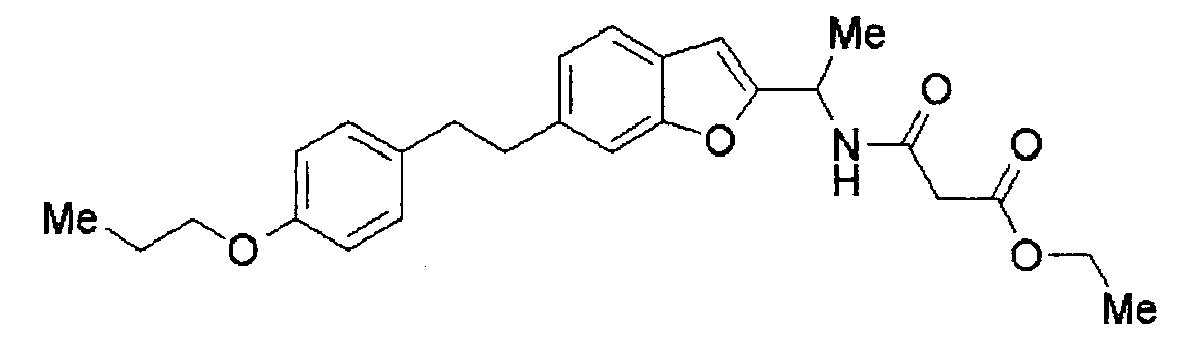
- To a solution of 1-{6-[2-(4-propoxyphenyl)ethyl]-1-benzofuran-2-yl}ethanamine (370 mg, 1.15 mmol) obtained in Reference Example 104 in DMF (5 mL) were added 3-ethoxy-3-oxopropanoic acid (227 mg, 1.72 mmol), 1-hydroxybenzotriazole (233 mg, 1.72 mmol) and 1-ethyl-3-(3-dimethylaminopropyl)carbodiimide hydrochloride (330 mg, 1.72 mmol), and the mixture was stirred at room temperature for 15 hr. Water was added to the reaction mixture, and the mixture was extracted with ethyl acetate. The organic layer was washed twice with saturated brine and dried over anhydrous magnesium sulfate, and the solvent was evaporated. The obtained residue was purified by silica gel column chromatography (hexane:ethyl acetate=3:1 to 2:3) to give the title compound (236 mg, yield 47%) as a white solid.
1H NMR (CDCl3) δ 1.03 (t, J = 7.4 Hz, 3H), 1.29 (t, J = 7.3 Hz, 3H), 1.59 (d, J = 4.7 Hz, 3H), 1.74-1.86 (m, 2H), 2.85-2.91 (m, 2H), 2.95-3.01 (m, 2H), 3.35 (s, 2H), 3.90 (t, J = 6.6 Hz, 2H), 4.21 (t, J = 7.3 Hz, 2H), 5.32-5.42 (m, 1H), 6.53 (s, 1H), 6.82 (d, J = 8.7 Hz, 2H), 7.03 (dd, J = 7.9, 1.3 Hz, 1H), 7.08 (d, J = 8.7 Hz, 2H), 7.40 (d, J = 7.9 Hz, 1H), 7.53 (d, J = 8.1 Hz, 1H). -
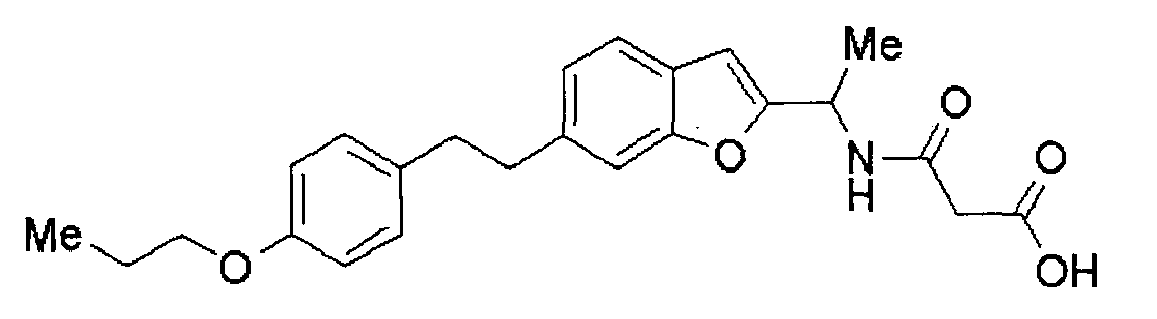
- To a solution of ethyl 3-oxo-3-[(1-{6-[2-(4-propoxyphenyl)ethyl]-1-benzofuran-2-yl}ethyl)amino]propanoate (214 mg, 0.489 mmol) obtained in Example 34 in THF-methanol (5 mL-3 mL) was added 1N aqueous sodium hydroxide solution (0.750 mL, 0.750 mmol), and the mixture was stirred at room temperature for 15 min. The reaction mixture was acidified with 1N hydrochloric acid and extracted twice with ethyl acetate, and the combined organic layer was dried over anhydrous magnesium sulfate. The solvent was evaporated, and the residue was washed with diethyl ether to give the title compound (158 mg, yield 79%) as a white solid.
1H NMR (CDCl3) δ 1.03 (t, J = 7.4 Hz, 3H), 1.61 (d, J = 7.0 Hz, 3H), 1.74-1.85 (m, 2H), 2.85-2.91 (m, 2H), 2.96-3.02 (m, 2H), 3.34 (s, 2H), 3.90 (t, J = 6.6 Hz, 2H), 5.33-5.42 (m, 1H), 6.56 (s, 1H), 6.81 (d, J= 8.7 Hz, 2H), 7.03-7.08 (m, 3H), 7.22 (s, 1H), 7.41 (d, J = 7.9 Hz, 1H). -

- To a solution of N-{1-[5-(hydroxymethyl)-1,3-benzoxazol-2-yl]ethyl}acetamide (25.0 mg, 0.107 mmol) obtained in Reference Example 109, 4-ethoxyphenol (17.7 mg, 0.128 mmol) and triphenylphosphine (polystyrene-supported, 1.84 mol/g, 145 mg, 0.267 mmol) in THF (2 mL) was added 2.2 M diethyl azodicarboxylate toluene solution (0.0582 mL, 0.128 mmol), and the mixture was stirred at room temperature for 2 hr. The resin was filtered off, and the filtrate was concentrated under reduced pressure. The obtained residue was purified by preparative silica gel TLC (ethyl acetate), and triturated with diisopropyl ether to give the title compound (2.2 mg, yield 5.8%).
1H NMR (CDCl3) δ 1.38 (t, J = 6.9 Hz, 3H), 1.64 (d, J = 7.2 Hz, 3H), 2.09 (s, 3H), 3.97 (q, J = 6.9 Hz, 2H), 5.10 (s, 2H), 5.42 (m, 1H), 6.36 (br, 1H), 6.81 (d, J = 9.0 Hz, 2H), 6.89 (d, J = 9.0 Hz, 2H), 7.40 (d, J = 8.1 Hz, 1H), 7.50 (d, J = 8.1 Hz, 1H), 7.73 (s, 1H). -

- Using N-{1-[5-(hydroxymethyl)-1,3-benzothiazol-2-yl]ethyl}acetamide (150 mg, 0.599 mmol) obtained in Reference Example 114 and 4-ethoxyphenol (99.3 mg, 0.719 mmol), a method in the same manner as in Example 36 was performed, and the obtained residue was triturated with diisopropyl ether to give the title compound (82.8 mg, yield 37%).
1H NMR (CDCl3) δ 1.38 (t, J = 6.9 Hz, 3H), 1.67 (d, J = 6.9 Hz, 3H), 2.09 (s, 3H), 3.97 (q, J = 6.9 Hz, 2H), 5.15 (s, 2H), 5.48 (m, 1H), 6.39 (d, J = 7.2 Hz, 1H), 6.82 (d, J = 9.0 Hz, 2H), 6.90 (d, J = 9.0 Hz, 2H), 7.44 (dd, J = 1.5, 8.4 Hz, 1H), 7.84 (d, J = 8.4 Hz, 1H), 8.03 (d, J = 1.5 Hz, 1H). -

- To a solution of 2-(1-azidoethyl)-6-[2-(4-ethoxyphenyl)ethyl]-4-methyl-1-benzofuran (816 mg, 2.34 mmol) obtained in Reference Example 124 in THF (10 mL) was added triphenylphosphine (919 mg, 3.50 mmol), and the mixture was stirred at 60°C for 30 min. To the reaction mixture was added water (0.2 mL), and the mixture was stirred at 60°C for 15 hr. The solvent was evaporated under reduced pressure and the obtained residue was purified by basic silica gel column chromatography (hexane:ethyl acetate=7:13 to 1:3) to give 1-{6-[2-(4-ethoxyphenyl)ethyl]-4-methyl-1-benzofuran-2-yl}ethanamine. This was dissolved in pyridine (3 mL)-acetic anhydride (3 mL), and the solution was stirred at room temperature for 15 min. The solvent was evaporated under reduced pressure and the residue was washed with diethyl ether and hexane to give the title compound (458 mg, yield 53%) as a white solid.
1H NMR (CDCl3) δ 1.40 (t, J = 7.2 Hz, 3H), 1.56 (d, J = 7.2 Hz, 3H), 2.01 (s, 3H), 2.44 (s, 3H), 2.83-2.89 (m, 2H), 2.91-2.97 (m, 2H), 4.01 (q, J = 7.2 Hz, 2H), 5.28-5.38 (m, 1H), 5.82 (d, J = 7.2 Hz, 1H), 6.53 (s, 1H), 6.81 (d, J = 8.3 Hz, 2H), 6.85 (s, 1H), 7.08-7.10 (m, 3H). -

- Using N-[1-(5-hydroxy-1-benzothiophen-2-yl)ethyl]acetamide (100 mg, 0.425 mmol) obtained in Reference Example 132, anhydrous DMF (1.4 mL), 4-ethoxybenzyl chloride (144 mg, 0.855 mmol) and potassium carbonate (117 mg, 0.850 mmol), an operation in the same manner as in Example 18 was performed to give the title compound (135 mg, yield 86%).
1H NMR (CDCl3) δ 1.42 (t, J = 7.2 Hz, 3H), 1.62 (d, J = 6.8 Hz, 3H), 2.01 (s, 3H), 4.04 (q, J = 7.2 Hz, 2H), 5.02 (s, 2H), 5.35-5.53 (m, 1H), 5.71 (s, 1H), 6.90 (d, J = 8.6 Hz, 2H), 7.01 (dd, J = 8.7, 2.7 Hz, 1H), 7.10 (s, 1H), 7.23 (d, J = 2.7 Hz, 1H), 7.35 (d, J = 8.6 Hz, 1H), 7.63 (d, J = 8.7 Hz, 1H). -

- Using N-{1-[5-(hydroxymethyl)-1-benzofuran-2-yl]ethyl}acetamide (137 mg, 0.587 mmol) obtained in Reference Example 90, 4-ethoxyphenol (121 mg, 0.881 mmol), triphenylphosphine (polystyrene-supported, 1.84 mol/g, 798 mg, 1.48 mmol), THF (4.3 mL) and 2.2 M diethyl azodicarboxylate toluene solution (0.32 mL, 0.70 mmol), a method in the same manner as in Example 36 was performed, and the obtained residue was triturated with diisopropyl ether to give the title compound (66.4 mg, yield 32%).
1H NMR (CDCl3) δ 1.38 (t, J = 7.1 Hz, 3H), 1.57 (d, J = 7.2 Hz, 3H), 2.03 (s, 3H), 3.97 (q, J = 7.1 Hz, 2H), 5.07 (s, 2H), 5.31-5.41 (m, 1H), 5.79 (br, 1H), 6.56 (s, 1H), 6.82 (d, J=9.3Hz, 2H), 6.89 (d, J = 9.3 Hz, 2H), 7.31 (dd, J = 8.5, 1.8 Hz, 1H), 7.43 (d, J = 8.5 Hz, 1H), 7.57 (d, J = 1.8 Hz, 1H). -

- Using N-[1-(6-hydroxy-1,3-benzothiazol-2-yl)ethyl]acetamide (72.7 mg, 0.308 mmol) obtained in Reference Example 137, potassium carbonate (128 mg, 0.923 mmol) and 4-ethoxybenzyl chloride (57.8 mg, 0.338 mmol), an operation in the same manner as in Example 6 was performed, and the obtained residue was triturated with diisopropyl ether to give the title compound (88.2 mg, yield 77%).
1H NMR (CDCl3) δ 1.42 (t, J = 6.9 Hz, 3H), 1.66 (d, J = 6.9 Hz, 3H), 2.08 (s, 3H), 4.04 (q, J = 6.9 Hz, 2H), 5.04 (s, 2H), 5.44 (m, 1H), 6.38 (d, J = 7.8 Hz, 1H), 6.91 (d, J = 9.0 Hz, 2H), 7.11 (dd, J = 2.4, 8.7 Hz, 1H), 7.32-7.36 (m, 3H), 7.84 (d, J = 8.7 Hz, 1H). -

- Using N-[1-(5-hydroxy-1,3-benzoxazol-2-yl)ethyl]acetamide (112 mg, 0.509 mmol) obtained in Reference Example 142, potassium carbonate (211 mg, 1.53 mmol) and 4-ethoxybenzyl chloride (95.5 mg, 0.559 mmol), an operation in the same manner as in Example 6 was performed, and the obtained residue was triturated with diisopropyl ether to give the title compound (140 mg, yield 78%).
1H NMR (CDCl3) δ 1.42 (t, J = 6.9 Hz, 3H), 1.62 (d, J = 6.9 Hz, 3H), 2.08 (s, 3H), 4.03 (q, J = 6.9 Hz, 2H), 5.01 (s, 2H), 5.39 (m, 1H), 6.25 (d, J = 7.8 Hz, 1H), 6.90 (d, J = 8.7 Hz, 2H), 6.98 (dd, J = 2.4, 9.0 Hz, 1H), 7.22 (d, J = 2.4 Hz, 1H), 7.32-7.39 (m, 3H). -

- To a solution of 2-(1-azidoethyl)-6-{2-[4-(trifluoromethoxy)phenyl]ethyl}-1-benzofuran (825 mg, 2.20 mmol) obtained in Reference Example 149 in THF (10 mL) was added triphenylphosphine (865 mg, 3.30 mmol), and the mixture was stirred at 60°C for 30 min. To the reaction mixture was added water (0.2 mL), and the mixture was stirred at 60°C for 15 hr. The solvent was evaporated under reduced pressure and the obtained residue was purified by basic silica gel column chromatography (hexane:ethyl acetate=7:3 to 1:3) to give 1-(6-{2-[4-(trifluoromethoxy)phenyl]ethyl}-1-benzofuran-2-yl)ethanamine. This was dissolved in pyridine (3 mL)-acetic anhydride (3 mL), and the solution was stirred at room temperature for 15 min. The solvent was evaporated under reduced pressure and the obtained residue was purified by silica gel column chromatography (hexane:ethyl acetate=3:7 to 0:1) to give the title compound (686 mg, yield from 2-(1-azidoethyl)-6-{2-[4-(trifluoromethoxy)phenyl]ethyl}-1-benzofuran 60%) as a white solid.
1H NMR (CDCl3) δ 1.56 (d, J = 8.0 Hz, 3H), 2.02 (s, 3H), 2.92-3.04 (m, 4H), 5.29-5.39 (m, 1H), 5.79 (d, J = 8.0 Hz, 1H), 6.52 (s, 1H), 7.01 (dd, J = 8.0, 1.1 Hz, 1H), 7.09-7.19 (m, 4H), 7.22 (s, 1H), 7.41 (d, J = 8.0 Hz, 1H). -

- To a solution of 2-(1-azidoethyl)-6-[2-(4-butoxyphenyl)ethyl]-1-benzofuran (553 mg, 1.53 mmol) obtained in Reference Example 156 in THF (10 mL) was added triphenylphosphine (599 mg, 2.28 mmol), and the mixture was stirred at 60°C for 30 min. To the reaction mixture was added water (0.2 mL), and the mixture was stirred at 60°C for 15 hr. The solvent was evaporated under reduced pressure and the obtained residue was purified by basic silica gel column chromatography (hexane:ethyl acetate=7:3 to 1:4) to give 1-{6-[2-(4-butoxyphenyl)ethyl]-1-benzofuran-2-yl}ethanamine. This was dissolved in pyridine (3 mL)-acetic anhydride (3 mL), and the solution was stirred at room temperature for 15 min. The solvent was evaporated under reduced pressure and the obtained residue was purified by silica gel column chromatography (hexane:ethyl acetate=1:1 to ethyl acetate) to give the title compound (448 mg, yield from 2-(1-azidoethyl)-6-[2-(4-butoxyphenyl)ethyl]-1-benzofuran 77%) as a white solid.
1H NMR (CDCl3) δ 0.96 (t, J = 7.4 Hz, 3H), 1.42-1.49 (m, 2H), 1.53 (d, J = 6.8 Hz, 3H), 1.70-1.79 (m, 2H), 1.98 (s, 3H), 2.84-2.90 (m, 2H), 2.94-3.00 (m, 2H), 3.92 (t, J = 6.5 Hz, 2H), 5.26-5.36 (m, 1H), 6.07 (d, J = 8.3 Hz, 1H), 6.49 (s, 1H), 6.80 (d, J = 8.7 Hz, 2H), 7.02 (dd, J = 7.9, 1.3 Hz, 1H), 7.06 (d, J = 8.7 Hz, 2H), 7.22 (s, 1H), 7.38 (d, J = 7.9 Hz, 1H). -

- To a solution of tert-butyl {1-[6-(hydroxymethyl)-1-benzothiophen-2-yl]ethyl}carbamate (286 mg, 0.931 mmol) obtained in Reference Example 161, 4-ethoxyphenol (193 mg, 1.40 mmol) and triphenylphosphine (368 mg, 1.40 mmol) in THF (10 mL) was added 2.2 M diethyl azodicarboxylate toluene solution (0.640 mL, 1.41 mmol), and the mixture was stirred at room temperature for 15 min. The solvent was evaporated under reduced pressure and the obtained residue was purified by silica gel column chromatography (hexane:ethyl acetate=9:1 to 1:1) to give tert-butyl (1-{6-[(4-ethoxyphenoxy)methyl]-1-benzothiophen-2-yl}ethyl)carbamate as an oil. A solution (5 mL) of this oil in 4N hydrogen chloride-ethyl acetate was stirred at room temperature for 30 min. The solvent was evaporated under reduced pressure, the obtained residue was dissolved in pyridine (3 mL)-acetic anhydride (3 mL), and the solution was stirred at room temperature for 15 min. The solvent was evaporated under reduced pressure, and the residue was washed with diethyl ether to give the title compound (89.6 mg, yield from tert-butyl{1-[6-(hydroxymethyl)-1-benzothiophen-2-yl]ethyl}carbamate 26%) as a white solid.
1H NMR (CDCl3) δ 1.38 (t, J = 7.0 Hz, 3H), 1.63 (d, J = 6.8 Hz, 3H), 2.02 (s, 3H), 3.98 (q, J = 7.0 Hz, 2H), 5.11 (s, 2H), 5.43-5.52 (m, 1H), 5.74 (d, J = 8.1 Hz, 1H), 6.80-6.85 (m, 2H), 6.88-6.93 (m, 2H), 7.18 (s, 1H), 7.37 (dd, J = 8.1, 1.4 Hz, 1H), 7.70 (d, J = 8.1 Hz, 1H), 7.84 (s, 1H). -

- To a solution of 1-{6-[2-(4-propoxyphenyl)ethyl]-1-benzofuran-2-yl}ethanamine (325 mg, 1.01 mmol) obtained in Reference Example 104 in DMF (5 mL) were added Boc-glycine (266 mg, 1.52 mmol), 1-hydroxybenzotriazole (206 mg, 1.52 mmol) and 1-ethyl-3-(3-dimethylaminopropyl)carbodiimide hydrochloride (292 mg, 1.52 mmol), and the mixture was stirred at room temperature for 15 hr. Water was added to the reaction mixture, and the mixture was extracted with ethyl acetate. The organic layer was washed twice with saturated brine and dried over anhydrous magnesium sulfate, and the solvent was evaporated. The obtained residue was purified by silica gel column chromatography (hexane:ethyl acetate=4:1 to 2:3) to give tert-butyl {2-oxo-2-[(1-{6-[2-(4-propoxyphenyl)ethyl]-1-benzofuran-2-yl}ethyl)amino]ethyl}carbamate as a white solid. A solution (3 mL) of the solid in 4N hydrogen chloride-ethyl acetate was stirred at room temperature for 30 min. The precipitated solid was collected by filtration and washed with diethyl ether to give the title compound (218 mg, yield from 1-{6-[2-(4-propoxyphenyl)ethyl]-1-benzofuran-2-yl}ethanamine 52%) as a white solid.
1H NMR (CDCl3) 5 0.96 (t, J = 7.4 Hz, 3H), 1.49 (d, J = 6.8 Hz, 3H), 1.64-1.76 (m, 2H), 2.82-2.87 (m, 2H), 2.92-2.97 (m, 2H), 3.59 (d, J = 5.3 Hz, 2H), 3.68 (d, J = 4.5 Hz, 1H), 3.87 (t, J = 6.6 Hz, 2H), 5.11-5.21 (m, 1H), 6.73 (s, 1H), 6.81 (d, J = 8.3 Hz, 2H), 7.07-7.12 (m, 3H), 7.35 (s, 1H), 7.46 (d, J = 8.0 Hz, 1H), 8.13 (br, 2H). - optically active forms (two kinds) of N-(1-{6-[2-(4-propoxyphenyl)ethyl]-1-benzofuran-2-yl}ethyl)acetamide
-

- N-(1-{6-[2-(4-propoxyphenyl)ethyl]-1-benzofuran-2-yl}ethyl)acetamide (110 mg) obtained in Example 32 was optically resolved by high performance liquid chromatography (HPLC) under the following conditions to give two kinds of optically active forms of "retention time longer (47.2 mg)" and "retention time shorter (50.1 mg)".
- <Preparative HPLC conditions>
column: CHIRALPAK AS (50 mmIDx500 mmL)
mobile phase: hexane:ethanol=9:1
flow rate: 80 mL/min
column temperature: 30°C
detection: UV 220 nm
compound injection volume: 110 mg/44 mL (hexane:ethanol=9:1) - <HPLC analysis conditions>
column: CHIRALPAK AS (4.6 mmID×250 mmL)
mobile phase: hexane:ethanol=9:1
flow rate: 1.0 mL/min
column temperature: 30°C
detection: UV 220 nm
retention time of "retention time longer": 13.09 min
retention time of "retention time shorter": 9.98 min -

- Using N-[1-(5-hydroxy-1-benzofuran-2-yl)ethyl]acetamide (100 mg, 0.456 mmol) obtained in Reference Example 38, anhydrous DMF (1 mL), 1-(bromomethyl)-2-fluoro-4-ethoxybenzene (233 mg, 0.948 mmol) and potassium carbonate (126 mg, 0.913 mmol), an operation in the same manner as in Example 18 was performed to give the title compound (93.6 mg, yield 55%).
1H NMR (CDCl3) δ 1.41 (t, J = 7.0 Hz, 3H), 1.55 (d, J = 7.0 Hz, 3H), 2.02 (s, 3H), 4.02 (q, J = 7.0 Hz, 2H), 5.05 (s, 2H), 5.26-5.41 (m, 1H), 5.80 (br, 1H), 6.50 (s, 1H), 6.59-6.71 (m, 2H), 6.92 (dd, J = 8.9, 2.5 Hz, 1H), 7.06 (d, J = 2.4 Hz, 1H), 7.29-7.41 (m, 2H). -

- To a solution of N-[1-(5-bromo-1-benzofuran-2-yl)ethyl]acetamide (1.00 g, 3.55 mmol) obtained in Reference Example 163 in 1,2-dimethoxyethane (20 mL) were added tris(dibenzylideneacetone)dipalladium(0) (81.1 mg, 0.0885 mmol), (9,9-dimethyl-9H-xanthen-4,5-diyl)bis(diphenylphosphane) (Xantophos, 102 mg, 0.177 mmol), N,N-diisopropylethylamine (915 mg, 7.10 mmol) and 2-ethylhexyl 2-mercaptopropionate (928 mg, 4.26 mmol), and the mixture was refluxed overnight under a nitrogen atmosphere. Brine was added thereto, and the mixture was extracted twice with ethyl acetate. The extract was washed with saturated brine, and dried over magnesium sulfate. The residue was passed through silica gel, and the solvent was evaporated under reduced pressure to give an oil.
To the obtained oil were added THF (9 mL), ethanol (1 mL) and sodium ethoxide (482 mg, 7.10 mmol), and the mixture was stirred at 40°C for 1 hr. To the reaction mixture was added 1N hydrochloric acid, and the mixture was extracted twice with ethyl acetate. The extract was washed with saturated brine, and dried over anhydrous sodium sulfate. The solvent was evaporated under reduced pressure, and the obtained residue was purified by silica gel column chromatography (hexane to hexane:ethyl acetate=1:4) to give a mixture (750 mg) of N-[1-(5-sulfanyl-1-benzofuran-2-yl)ethyl]acetamide and N-[1-(5-bromo-1-benzofuran-2-yl)ethyl]acetamide.
To a solution of the obtained mixture (750 mg) of N-[1-(5-sulfanyl-1-benzofuran-2-yl)ethyl]acetamide and N-[1-(5-bromo-1-benzofuran-2-yl)ethyl]acetamide in anhydrous DMF (6.4 mL) were added 4-ethoxybenzyl chloride (1.09 g, 6.38 mmol) and potassium carbonate (880 mg, 0.456 mmol), and the reaction mixture was stirred at room temperature overnight. Saturated brine was added thereto, and the mixture was extracted twice with ethyl acetate. The extract was washed with saturated brine, and dried over anhydrous magnesium sulfate. The solvent was evaporated under reduced pressure, and the obtained residue was purified by silica gel column chromatography (hexane:ethyl acetate=4:1 to 1:4), and the obtained solid was washed with diethyl ether to give N-(1-{5-[(4-ethoxybenzyl)sulfanyl]-1-benzofuran-2-yl}ethyl)acetamide (205 mg, yield from (N-[1-(5-{[tert-butyl(dimethyl)silyl]oxy}-1-benzothiophen-2-yl)ethyl]acetamide 16%). 1H NMR (CDCl3) δ 1.39 (t, J = 7.0 Hz, 3H), 1.56 (d, J = 7.2 Hz, 3H), 2.02 (s, 3H), 3.94-4.05 (m, 4H), 5.29-5.36 (m, 1H), 5.77 (br, 1H), 6.48 (s, 1H), 6.77 (d, J = 8.7 Hz, 2H), 7.11 (d, J = 8.7 Hz, 2H), 7.20-7.25 (m, 1H), 7.28-7.33 (m, 1H), 7.48 (d, J = 1.5 Hz, 1H). -

- To a solution of N-(1-{5-[(4-ethoxybenzyl)sulfanyl]-1-benzofuran-2-yl}ethyl)acetamide (100 mg, 0.271 mmol) obtained in Example 49 in ethyl acetate (2 mL) was added 75% m-chloroperbenzoic acid (79.8 mg, 0.324 mmol), and the mixture was stirred at room temperature for 1.5 hr. To the reaction mixture was added aqueous sodium hydrogen carbonate solution, and the mixture was extracted twice with ethyl acetate. The extract was washed with saturated brine, and dried over anhydrous magnesium sulfate. The solvent was evaporated under reduced pressure, and the obtained residue was purified by silica gel column chromatography (hexane:ethyl acetate=4:1 to ethyl acetate), and washed with diethyl ether to give the title compound (19.1 mg, yield 18%).
1H NMR (CDCl3) δ 1.40 (t, J = 7.0 Hz, 3H), 1.59 (d, J = 7.2 Hz, 3H), 2.05 (s, 3H), 4.00 (q, J = 7.0 Hz, 2H), 4.26 (s, 2H), 5.27-5.52 (m, 1H), 5.81 (br, 1H), 6.60 (s, 1H), 6.75 (d, J = 8.8 Hz, 2H), 6.96 (d, J = 8.8 Hz, 2H), 7.45 (d, J = 8.8 Hz, 1H), 7.49 (dd, J = 8.8, 1.1 Hz, 1H), 7.84 (d, J = 1.1 Hz, 1H). -

- To a solution of N-(1-{5-[(4-ethoxybenzyl)sulfanyl]-1-benzofuran-2-yl}ethyl)acetamide (100 mg, 0.271 mmol) obtained in Example 49 in ethyl acetate (2 mL) was added 75% m-chloroperbenzoic acid (79.8 mg, 0.324 mmol), and the mixture was stirred at room temperature for 1.5 hr. Aqueous sodium hydrogen carbonate solution was added thereto, and the mixture was extracted twice with ethyl acetate. The extract was washed with saturated brine, and dried over anhydrous magnesium sulfate. The solvent was evaporated under reduced pressure, and the obtained residue was purified by silica gel column chromatography (hexane:ethyl acetate=4:1 to ethyl acetate), and the obtained solid was washed with diethyl ether to give the title compound (25.5 mg, yield 25%).
1H NMR (CDCl3) δ 1.40 (t, J = 7.0 Hz, 3H), 1.59 (d, J = 6.8 Hz, 3H), 2.05 (s, 3H), 3.88-4.11 (m, 4H), 5.31-5.45 (m, 1H), 5.88 (br, 1H), 6.56 (s, 1H), 6.74 (d, J = 8.7 Hz, 2H), 6.85 (d, J = 8.7 Hz, 2H), 7.21 (dd, J = 8.6, 1.7 Hz, 1H), 7.45 (d, J = 8.6 Hz, 1H), 7.58 (d, J = 1.7 Hz, 1H). -

- Using N-[1-(5-chloro-6-hydroxy-1-benzofuran-2-yl)ethyl]acetamide (100 mg, 0.394 mmol) obtained in Reference Example 168, anhydrous DMF (1 mL), 4-ethoxybenzyl chloride (133 mg, 0.787 mmol) and potassium carbonate (108 mg, 0.787 mmol), an operation in the same manner as in Example 18 was performed to give the title compound (112 mg, yield 73%) as a white solid.
1H NMR (CDCl3) δ 1.42 (t, J = 7.0 Hz, 3H), 1.54 (d, J = 7.0 Hz, 3H), 2.02 (s, 3H), 4.04 (q, J = 7.0 Hz, 2H), 5.10 (s, 2H), 5.24-5.38 (m, 1H), 5.74 (br, 1H), 6.44 (s, 1H), 6.91 (d, J = 8.7 Hz, 2H), 7.06 (s, 1H), 7.39 (d, J = 8.7 Hz, 2H), 7.49 (s, 1H). -

- Using N-[1-(5-hydroxy-1-benzofuran-2-yl)ethyl]acetamide (1.00 g, 4.56 mmol) obtained in Reference Example 38, 4-acetoxybenzylalcohol (984 mg, 5.93 mmol), triphenylphosphine (polystyrene-supported, 1.84 mol/g, 3.22 g, 5.93 mmol), THF (50 mL) and 2.2 M diethyl azodicarboxylate toluene solution (2.7 mL, 5.9 mmol), the method in the same manner as in Example 3 was performed, and the obtained residue was triturated with diethyl ether to give the title compound (177 mg, yield 11%).
1H NMR (CDCl3) δ 1.55 (d, J = 6.9 Hz, 3H), 2.02 (s, 3H), 2.30 (s, 3H), 5.07 (s, 2H), 5.26-5.40 (m, 1H), 5.79 (d, J = 7.7 Hz, 1H), 6.50 (s, 1H), 6.93 (dd, J = 8.9, 2.6 Hz, 1H), 7.03 (d, J = 2.6 Hz, 1H), 7.08-7.15 (m, 2H), 7.33 (d, J = 8.9 Hz, 1H), 7.45 (d, J = 8.7 Hz, 2H). -

- To a solution of 2-(1-azidoethyl)-6-[2-(4-ethoxyphenyl)ethyl]-1-benzothiophene (168 mg, 0.478 mmol) obtained in Reference Example 175 in THF (5 mL) was added triphenylphosphine (188 mg, 0.717 mmol), and the mixture was stirred at 60°C for 30 min. To the reaction mixture was added water (0.1 mL), and the mixture was stirred at 60°C for 15 hr. The solvent was evaporated under reduced pressure and the obtained residue was purified by basic silica gel column chromatography (hexane:ethyl acetate=7:3 to 1:4) to give 1-{6-[2-(4-ethoxyphenyl)ethyl]-1-benzothiophen-2-yl}ethanamine. This was dissolved in pyridine (3 mL)-acetic anhydride (3 mL), and the solution was stirred at room temperature for 15 min. The solvent was evaporated under reduced pressure, and the residue was washed with diethyl ether to give the title compound (97.1 mg, yield from (2-(1-azidoethyl)-6-[2-(4-ethoxyphenyl)ethyl]-1-benzothiophene 55%) as a white solid.
1H NMR (CDCl3) δ 1.40 (t, J = 7.0 Hz, 3H), 1.62 (d, J = 6.8 Hz, 3H), 2.02 (s, 3H), 2.86-2.91 (m, 2H), 2.95-3.01 (m, 2H), 4.01 (q, J = 7.0 Hz, 2H), 5.41-5.50 (m, 1H), 5.72 (d, J = 8.7 Hz, 1H), 6.80 (d, J = 8.7 Hz, 2H), 7.07 (d, J = 8.7 Hz, 2H), 7.12-7.16 (m, 2H), 7.55 (s, 1H), 7.60 (d, J = 8.3 Hz, 1H). -

- To a solution of 1-{6-[2-(4-propoxyphenyl)ethyl]-1-benzofuran-2-yl}ethanamine (325 mg, 1.01 mmol) obtained in Reference Example 104 in DMF (5 mL) were added pyridine (0.120 mL, 1.50 mmol) and phenyl chloroformate (0.152 mL, 1.20 mmol), and the mixture was stirred at room temperature for 30 min. To the reaction mixture were added methanesulfonamide (115 mg, 1.20 mmol), 1,8-diazabicyclo[5.4.0]undec-7-ene (0.380 mL, 1.40 mmol) and 4-dimethylaminopyridine (171 mg, 1.40 mmol), and the mixture was stirred at 50°C for 30 min. The reaction mixture was acidified with 1N hydrochloric acid, and extracted with ethyl acetate, and the extract was dried over anhydrous magnesium sulfate. The solvent was evaporated under reduced pressure and the obtained residue was purified by silica gel column chromatography (hexane:ethyl acetate=4:1 to 2:3) to give the title compound (63.5 mg, yield 14%) as a white solid.
1H NMR (CDCl3) δ 0.96 (t, J = 7.4 Hz, 3H), 1.47 (d, J = 7.0 Hz, 3H), 1.64-1.76 (m, 2H), 2.81-2.86 (m, 2H), 2.91-2.97 (m, 2H), 3.23 (s, 3H), 3.86 (t, J = 6.6 Hz, 2H), 4.94-5.03 (m, 1H), 6.67 (s, 1H), 6.81 (d, J = 8.7 Hz, 2H), 7.02 (d, J = 8.3 Hz, 1H), 7.06-7.12 (m, 3H), 7.38 (s, 1H), 7.46 (d, J = 7.9 Hz, 1H), 10.01 (br, 1H). -

- To a solution of 5-{2-[2-(1-azidoethyl)-1-benzofuran-6-yl]ethyl}-2-ethoxypyridine (259 mg, 0.770 mmol) obtained in Reference Example 183 in THF (5 mL) was added triphenylphosphine (242 mg, 0.924 mmol), and the mixture was stirred at 60°C for 30 min. To the reaction mixture was added water (0.1 mL), and the mixture was stirred at 60°C for 15 hr. The solvent was evaporated under reduced pressure and the obtained residue was purified by basic silica gel column chromatography (hexane:ethyl acetate=7:3 to 1:4) to give 1-{6-[2-(6-ethoxypyridin-3-yl)ethyl]-1-benzofuran-2-yl}ethanamine. This was dissolved in pyridine (2.5 mL)-acetic anhydride (2.5 mL), and the solution was stirred at room temperature for 15 min. The solvent was evaporated under reduced pressure, and the residue was washed with diethyl ether to give the title compound (120 mg, yield from 5-{2-[2-(1-azidoethyl)-1-benzofuran-6-yl]ethyl}-2-ethoxypyridine 44%) as a white solid.
1H NMR (CDCl3) δ 1.38 (t, J = 7.2 Hz, 3H), 1.56 (d, J = 6.8 Hz, 3H), 2.02 (s, 3H), 2.84-2.89 (m, 2H), 2.95-3.00 (m, 2H), 4.31 (q, J = 7.2 Hz, 2H), 5.29-5.39 (m, 1H), 5.84 (d, J = 7.4 Hz, 1H), 6.52 (s, 1H), 6.63 (d, J = 8.5 Hz, 1H), 7.00 (dd, J = 7.9, 1.3 Hz, 1H), 7.20 (s, 1H), 7.34 (dd, J = 8.5, 2.5 Hz, 1H), 7.40 (d, J = 7.9 Hz, 1H), 7.89 (d, J = 2.5 Hz, 1H). -

- To a solution of 2-{2-[2-(1-azidoethyl)-1-benzofuran-6-yl]ethyl}-5-ethoxypyridine (512 mg, 1.53 mmol) obtained in Reference Example 191 in THF (10 mL) was added triphenylphosphine (599 mg, 2.29 mmol), and the mixture was stirred at 60°C for 30 min. To the reaction mixture was added water (0.1 mL), and the mixture was stirred at 60°C for 15 hr. The solvent was evaporated under reduced pressure and the obtained residue was purified by basic silica gel column chromatography (hexane:ethyl acetate=7:3 to 1:4) to give 1-{6-[2-(5-ethoxypyridin-2-yl)ethyl]-1-benzofuran-2-yl}ethanamine. This was dissolved in pyridine (3 mL)-acetic anhydride (3 mL), and the solution was stirred at room temperature for 15 min. The solvent was evaporated under reduced pressure and the obtained residue was purified by silica gel column chromatography (hexane:ethyl acetate=1:1 to ethyl acetate) to give the title compound (435 mg, yield from 1-{6-[2-(5-ethoxypyridin-2-yl)ethyl]-1-benzofuran-2-yl}ethanol 80%) as a white solid.
1H NMR (CDCl3) δ 1.43 (t, J = 7.0 Hz, 3H), 1.55 (d, J = 7.0 Hz, 3H), 2.02 (s, 3H), 3.02-3.15 (m, 4H), 4.06 (q, J = 7.0 Hz, 2H), 5.28-5.38 (m, 1H), 5.84 (br, 1H), 6.51 (s, 1H), 6.97 (d, J = 8.5 Hz, 1H), 7.03-7.10 (m, 2H), 7.25 (s, 1H), 7.39 (d, J = 7.9 Hz, 1H), 8.25 (d, J = 2.8 Hz, 1H). -

- Using N-{1-[6-(hydroxymethyl)-1,3-benzoxazol-2-yl]ethyl}acetamide (22.2 mg, 0.0948 mmol) obtained in Reference Example 196 and 4-ethoxyphenol (26.2 mg, 0.190 mmol), an operation in the same manner as in Example 36 was performed, and the obtained residue was triturated with hexane to give the title compound (7.3 mg, yield 22%).
1H NMR (CDCl3) δ 1.39 (t, J = 6.9 Hz, 3H), 1.64 (d, J = 6.9 Hz, 3H), 2.09 (s, 3H), 3.97 (q, J = 6.9 Hz, 2H), 5.12 (s, 2H), 5.42 (m, 1H), 6.25 (br, 1H), 6.82 (d, J = 9.0 Hz, 2H), 6.89 (d, J = 9.0 Hz, 2H), 7.37 (d, J = 7.8 Hz, 1H), 7.60 (s, 1H), 7.66 (d, J = 7.8 Hz, 1H). -

- Using tert-butyl {1-[5-(hydroxymethyl)-1H-benzimidazol-2-yl]ethyl}carbamate (398 mg, 1.37 mmol) obtained in Reference Example 199 and 4-ethoxyphenol (377 mg, 2.73 mmol), a method in the same manner as in Example 36 was performed, and the obtained residue was triturated with diisopropyl ether to give the title compound (86.9 mg, yield 16%).
1H NMR (CDCl3) δ 1.38 (t, J = 6.9 Hz, 3H), 1.46 (s, 9H), 1.73 (d, J = 6.9 Hz, 3H), 3.97 (q, J = 6.9 Hz, 2H), 4.97 (m, 1H), 5.11 (s, 2H), 5.13 (m, 1H), 6.81 (d, J = 9.0 Hz, 2H), 6.91 (d, J = 9.0 Hz, 2H), 7.29 (m, 1H), 7.39-7.49 (m, 1H), 7.71-7.77 (m, 1H), 10.18 (br, 1H). -

- To a solution of 1-{5-[(4-ethoxyphenoxy)methyl]-1H-benzimidazol-2-yl}ethanamine dihydrochloride (55.2 mg, 0.144 mmol) obtained in Reference Example 200 in DMF (1 mL) were added triethylamine (0.0599 mL, 0.431 mmol) and acetic anhydride (0.0163 mL, 0.172 mmol), and the mixture was stirred at room temperature for 2 hr. The reaction mixture was diluted with ethyl acetate, and the mixture was washed with 10% aqueous potassium carbonate solution and ) saturated brine, and dried over anhydrous sodium sulfate. This solution was applied to basic silica gel column chromatography (ethyl acetate). The solvent was evaporated under reduced pressure, and the obtained residue was triturated with diisopropyl ether to give the title compound (31.2 mg, yield 56.5%).
1H NMR (CDCl3) δ 1.37 (t, J = 6.9 Hz, 3H), 1.68 (d, J = 7.2 Hz, 3H), 2.00 (s, 3H), 3.96 (q, J = 6.9 Hz, 2H), 5.09 (s, 2H), 5.28 (m, 1H), 6.77-6.82 (m, 2H), 6.85-6.90 (m, 2H), 7.21 (d, J = 7.5 Hz, 1H), 7.29 (dd, J = 1.5, 8.1 Hz, 1H), 7.54 (d, J = 8.1 Hz, 1H), 7.60 (s, 1H). -

- A suspension of N-[1-(5-hydroxy-1H-benzimidazol-2-yl)ethyl]acetamide (62.0 mg, 0.283 mmol) obtained in Reference Example 204, potassium carbonate (78.2 mg, 0.566 mmol) and 4-ethoxybenzyl chloride (48.3 mg, 0.283 mmol) in DMF (1 mL) was stirred under heating at 60°C for 1 hr. The reaction mixture was diluted with ethyl acetate, and the mixture was washed with 10% aqueous potassium carbonate solution and saturated brine, and dried over anhydrous sodium sulfate. This solution was applied to basic silica gel column chromatography (ethyl acetate). The solvent was evaporated under reduced pressure, and the obtained residue was purified by silica gel column chromatography (hexane:ethyl acetate=1:1 to methanol:ethyl acetate=1:9). The obtained crude product was purified by preparative basic silica gel TLC (ethyl acetate) and triturated with diisopropyl ether to give the title compound (3.8 mg, yield 3.8%).
1H NMR (CDCl3) δ 1.41 (t, J = 6.9 Hz, 3H), 1.67 (d, J = 6.9 Hz, 3H), 2.00 (s, 3H), 4.02 (q, J = 6.9 Hz, 2H), 4.98 (s, 2H), 5.23 (m, 1H), 6.72 (d, J = 6.9 Hz, 1H), 6.88 (d, J = 8.4 Hz, 2H), 6.91 (dd, J = 2.4, 8.7 Hz, 1H), 6.97 (s, 1H), 7.06 (br, 1H), 7.33 (d, J = 8.4 Hz, 2H), 7.43 (br, 1H). -

- A solution (0.50 mL, 0.0600 mmol) of 1-{5-[(4-ethoxybenzyl)oxy]-1-benzofuran-2-yl}ethanamine obtained in Reference Example 207 in 0.12 M DMF, a 0.18 M solution (0.50 mL, 0.0900 mmol) of the corresponding carboxylic acid in DMF, and a 0.18 M solution (0.50 mL, each 0.0900 mmol) of 1-hydroxybenzotriazole and 1-ethyl-3-(3'-dimethylaminopropyl)carbodiimide hydrochloride in DMF were mixed at room temperature, and the mixture was stirred as it was for 4 hr. To the reaction mixture were added ethyl acetate (3.0 mL) and 2% aqueous sodium hydrogen carbonate solution (1.5 mL) and the mixture was shaken. The organic layer was recovered by upper layer Phase Septube (manufactured by Wako Pure Chemical Industries, Ltd.). The solvent was evaporated under reduced pressure, and the residue was dissolved in DMSO-methanol (1:1, 1.0 mL), and the solution was purified by preparative HPLC to give the object compound (purity not less than 80%, LC/MS analysis).
- To a mixed solution of a 0.12 M solution (0.50 mL, 0.0600 mmol) of 1-{5-[(4-ethoxybenzyl)oxy]-1-benzofuran-2-yl}ethanamine obtained in Reference Example 207 in DMF and a 0.24 M solution (0.50 mL, 0.120 mmol) of triethylamine in DMF was added the corresponding acid chloride or sulfonyl chloride (0.0900 mmol) at room temperature, and the mixture was stirred as it was for 24 hr. To the reaction mixture were added ethyl acetate (3.0 mL) and 2% aqueous sodium hydrogen carbonate solution (1.5 mL) and the mixture was shaken. The organic layer was recovered by upper layer Phase Septube (manufactured by Wako Pure Chemical Industries, Ltd.). The solvent was evaporated under reduced pressure, and the residue was dissolved in DMSO-methanol (1:1, 1.0 mL), and the solution was purified by preparative HPLC to give the object compound (purity not less than 80%, LC/MS analysis).
- To a 0.12 M solution (0.50 mL, 0.0600 mmol) of 1-{5-[(4-ethoxybenzyl)oxy]-1-benzofuran-2-yl}ethanamine obtained in Reference Example 207 in DMF was added a 0.18 M solution (0.50 mL, 0.0900 mmol) of the corresponding isocyanate in DMF at room temperature, and the mixture was stirred for 24 hr. To the reaction mixture were added ethyl acetate (3.0 mL) and 2% aqueous sodium hydrogen carbonate solution (1.5 mL) and the mixture was shaken. The organic layer was recovered by upper layer Phase Septube (manufactured by Wako Pure Chemical Industries, Ltd.). The solvent was evaporated under reduced pressure, and the residue was dissolved in DMSO-methanol (1:1, 1.0 mL) and the solution was purified by preparative HPLC.
- The purification by preparative HPLC in the above-mentioned Examples was performed under the following conditions.
apparatus: Gilson Inc. High-throughput purification system
column: YMC CombiPrep ODS-A S-5 µm, 50×20 mm
solvent: SOLUTION A; 10 mM aqueous hydrogencarbonate ammonium solution, SOLUTION B; acetonitrile
gradient cycle: 0 min (SOLUTION A/SOLUTION B=95/5), 1.00 min
(SOLUTION A/SOLUTION B=95/5), 5.20 min (SOLUTION A/SOLUTION B=5/95), 6.40 min (SOLUTION A/SOLUTION B=5/95), 6.50 min (SOLUTION A/SOLUTION B=95/5), 6.60 min (SOLUTION A/SOLUTION B=95/5)
flow rate: 20 mL/min, detection method: UV 220 nm
The structural formulas and mass spectrum data of the compounds obtained in Examples 62 to 93 are shown in Table 1 and Table 2. -
Table 1 
Ex. No . A MS (m/Z) Ex. No. A MS (m/Z) 62 
368 71 
417 63 
380 64 
382 72 
421 65 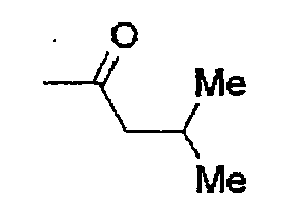
396 73 
423 66 
406 74 
434 67 
408 75 
382 68 
416 76 
384 69 
417 77 
407 70 
417 78 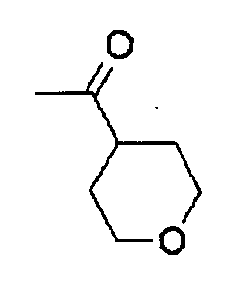
424 -
Table 2 
Ex. No. A MS(m/Z) Ex. No. A MS(m/Z) 79 
430 87 
445 80 
434 88 
437 89 
397 81 
485 90 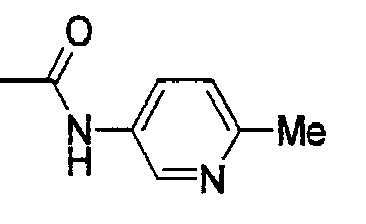
446 82 
466 91 
423 83 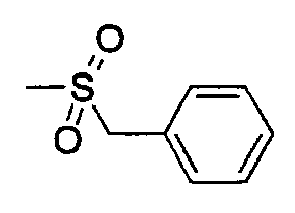
466 92 
397 84 
416 93 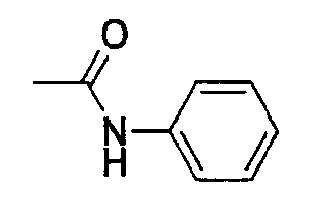
431 85 
459 86 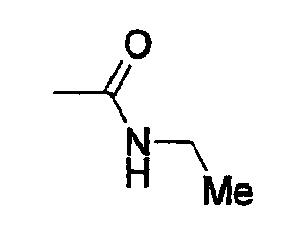
383 -

- To a solution of 2-(1-azidoethyl)-6-[2-(2,3-dihydro-1-benzofuran-5-yl)ethyl]-1-benzofuran (394 mg, 1.18 mmol) obtained in Reference Example 214 in THF (10 mL) was added triphenylphosphine (465 mg, 1.77 mmol), and the mixture was stirred at 60°C for 30 min. To the reaction mixture was added water (0.1 mL), and the mixture was stirred at 60°C for 15 hr. The solvent was evaporated under reduced pressure and the obtained residue was purified by basic silica gel column chromatography (hexane:ethyl acetate=7:3 to 1:4) to give 1-{6-[2-(2,3-dihydro-1-benzofuran-5-yl)ethyl]-1-benzofuran-2-yl}ethanamine. This was dissolved in pyridine (3 mL)-acetic anhydride (3 mL), and the solution was stirred at room temperature for 15 min. The solvent was evaporated under reduced pressure and the obtained residue was purified by silica gel column chromatography (hexane:ethyl acetate=1:1 to ethyl acetate) to give the title compound (313 mg, yield from 2-(1-azidoethyl)-6-[2-(2,3-dihydro-1-benzofuran-5-yl)ethyl]-1-benzofuran 76%) as a white solid.
1H NMR (CDCl3) δ 1.56 (d, J = 7.2 Hz, 3H), 2.02 (s, 3H), 2.84-2.90 (m, 2H), 2.95-3.01 (m, 2H), 3.18 (t, J = 8.7 Hz, 2H), 4.55 (t, J = 8.7 Hz, 2H), 5.29-5.39 (m, 1H), 5.80 (d, J = 8.0 Hz, 1H), 6.52 (s, 1H), 6.89 (d, J = 8.3 Hz, 1H), 6.90 (d, J = 8.3 Hz, 1H), 7.03-7.05 (m, 2H), 7.25 (s, 1H), 7.41 (d, J = 8.0 Hz, 1H). -

- To a solution of 2-(1-azidoethyl)-6-{2-[4-(methoxymethoxy)phenyl]ethyl}-1-benzofuran (263 mg, 0.748 mmol) obtained in Reference Example 219 in THF (10 mL) was added triphenylphosphine (236 mg, 0.898 mmol), and the mixture was stirred at 60°C for 30 min. To the reaction mixture was added water (0.1 mL), and the mixture was stirred at 60°C for 15 hr. The solvent was evaporated under reduced pressure and the obtained residue was purified by basic silica gel column chromatography (hexane:ethyl acetate=7:3 to 1:4) to give 1-(6-{2-[4-(methoxymethoxy)phenyl]ethyl}-1-benzofuran-2-yl)ethanamine. This was dissolved in pyridine (3 mL)-acetic anhydride (3 mL), and the solution was stirred at room temperature for 15 min. The solvent was evaporated under reduced pressure and the obtained residue was purified by silica gel column chromatography (hexane:ethyl acetate=1:1 to ethyl acetate) to give the title compound (219 mg, yield from 2-(1-azidoethyl)-6-{2-[4-(methoxymethoxy)phenyl]ethyl}-1-benzofuran 79%) as a white solid.
1H NMR (CDCl3) δ 1.56 (d, J = 7.0 Hz, 3H), 2.02 (s, 3H), 2.86-2.92 (m, 2H), 2.96-3.02 (m, 2H), 3.48 (s, 3H), 5.15 (s, 2H), 5.29-5.39 (m, 1H), 5.84 (br, 1H), 6.52 (s, 1H), 6.95 (d, J = 8.7 Hz, 2H), 7.04 (dd, J = 7.9, 1.3 Hz, 1H), 7.10 (d, J = 8.7 Hz, 2H), 7.25 (s, 1H), 7.41 (d, J = 7.9 Hz, 1H). -

- To a solution of 1-{5-[(4-ethoxybenzyl)oxy]-1-benzofuran-2-yl}ethanamine (50.0 mg, 0.160 mmol) obtained in Reference Example 207 in THF (1.0 mL) was added dihydrofuran-2,5-dione (16.1 mg, 0.160 mmol), and the mixture was stirred at room temperature for 1 hr. The resulting solid was collected by filtration, and washed with diisopropyl ether to give the title compound (56.0 mg, yield 85%).
1H NMR (CDCl3) δ 1.32 (t, J = 7.0 Hz, 3H), 1.42 (d, J = 7.0 Hz, 3H), 2.34 - 2.46 (m, 4H), 4.02 (q, J = 7.0 Hz, 2H), 5.01 (s, 2H), 5.02-5.14 (m, 1H), 6.61 (s, 1H), 6.85-6.95 (m, 3H), 7.15 (d, J = 2.4 Hz, 1H), 7.36 (d, J = 8.7 Hz, 2H), 7.41 (d, J = 8.9 Hz, 1H), 8.41 (d, J = 8.1 Hz, 1H). -

- Using 1-{5-[(4-ethoxybenzyl)oxy]-1-benzofuran-2-yl}ethanamine (100 mg, 0.320 mmol) obtained in Reference Example 207, DMF (5 mL), 5-methoxy-5-oxopentanoic acid (51.6 mg, 0.353 mmol), 1-hydroxybenzotriazole (48.7 mg, 0.353 mmol) and 1-ethyl-3-(3-dimethylaminopropyl)carbodiimide hydrochloride (67.4 mg, 0.353 mmol), an operation in the same manner as in Example 46 was performed to give the title compound (37.7 mg, yield 27%) as a white solid.
1H NMR (CDCl3) δ 1.41 (t, J = 7.0 Hz, 3H), 1.54 (d, J = 7.0 Hz, 3H), 1.91-2.05 (m, 2H), 2.23-2.31 (m, 2H), 2.39 (t, J=7.1 Hz, 2H), 3.66 (s, 3H), 4.04 (q, J = 7.0 Hz, 2H), 4.99 (s, 2H), 5.25-5.41 (m, 1H), 5.92 (d, J = 8.3 Hz, 1H), 6.48 (s, 1H), 6.83-6.97 (m, 3H), 7.04 (d, J = 2.4 Hz, 1H), 7.31 (d, J = 9.0 Hz, 1H), 7.35 (d, J = 8.9 Hz, 2H). -

- Using methyl 5-[(1-{5-[(4-ethoxybenzyl)oxy]-1-benzofuran-2-yl}ethyl)amino]-5-oxopentanoate (214 mg, 0.489 mmol) obtained in Example 97, methanol (2.0 mL) and 8N aqueous sodium hydroxide solution (0.10 mL, 0.82 mmol), an operation in the same manner as in Example 35 was performed to give the title compound (10.2 mg, yield 30%) as a white solid.
1H NMR (CDCl3) δ 1.32 (t, J = 6.8 Hz, 3H), 1.42 (d, J = 6.8 Hz, 3H), 1.60-1.74 (m, 2H), 1.88-1.95 (m, 2H), 2.11 (t, J=7.4 Hz, 2H), 4.02 (q, J= 6.8 Hz, 2H), 5.01 (s, 2H), 5.03-5.16 (m, 1H), 6.59 (s, 1H), 6.83-6.90 (m, 1H), 6.92 (d, J = 8.7 Hz, 2H), 7.16 (d, J = 2.3 Hz, 1H), 7.36 (d, J = 8.3 Hz, 2H), 7.40 (d, J = 9.1 Hz, 1H). -

- To a solution of 1-{5-[(4-ethoxybenzyl)oxy]-1-benzofuran-2-yl}ethanamine (50.0 mg, 0.160 mmol) obtained in Reference Example 207 in pyridine (0.50 mL) was added methyl isocyanate (0.019 mL, 0.32 mmol), and the mixture was stirred at room temperature for 10 min. The reaction mixture was concentrated under reduced pressure, and the obtained solid was washed with ethyl acetate to give the title compound (22.4 mg, yield 38%).
1H NMR (CDCl3) δ 1.41 (t, J = 7.0 Hz, 3H), 1.54 (d, J = 6.8 Hz, 3H), 2.78 (d, J = 4.9 Hz, 3H), 4.04 (q, J = 7.0 Hz, 2H), 4.28-4.38 (m, 1H), 4.64 (d, J = 8.1 Hz, 1H), 4.99 (s, 2H), 5.04-5.18 (m, 1H), 6.48 (s, 1H), 6.86-6.93 (m, 3H), 7.03 (d, J = 2.6 Hz, 1H), 7.30 (d, J = 9.0 Hz, 1H), 7.35 (d, J = 8.8 Hz, 2H). -

- To a solution of 1-{5-[(4-ethoxybenzyl)oxy]-1-benzofuran-2-yl}ethanamine (50.0 mg, 0.160 mmol) obtained in Reference Example 207 in THF (1.0 mL) was added trichloroacetyl isocyanate (0.029 mL, 0.24 mmol) under ice-cooling, and the mixture was stirred for 5 min. 8M Ammonia methanol solution (0.80 mL) was added thereto, and the mixture was stirred at room temperature overnight. The reaction mixture was concentrated under reduced pressure, and the residue was purified by silica gel column chromatography (hexane:ethyl acetate=3:2 to ethyl acetate), and triturated with diisopropyl ether to give the title compound (6.0 mg, yield 11%).
1H NMR (CDCl3) δ 1.33 (t, J = 7.0 Hz, 3H), 1.41 (d, J = 7.0 Hz, 3H), 4.02 (q, J = 7.0 Hz, 2H), 4. 82 - 4.97 (m, 1H), 5.00 (s, 2H), 5.52 (s, 2H), 6.48 (d, J = 8.5 Hz, 1H), 6.55 (s, 1H), 6.82-6.96 (m, 3H), 7.15 (d, J = 2.4 Hz, 1H), 7.30-7.45 (m, 3H). -

- To a solution of 1-[6-(benzyloxy)-1-benzofuran-2-yl]ethanamine (14.4 g, 53.9 mmol) obtained in Reference Example 25 in methylene chloride (200 mL) were added pyridine (8.7 mL, 110 mmol) and acetic anhydride (6.1 mL, 65 mmol), and the mixture was stirred at room temperature for 1 hr. Water was added thereto, and the mixture was washed with 0.5N hydrochloric acid. The aqueous layer was extracted with methylene chloride. The combined organic layer was dried over anhydrous sodium sulfate. The solvent was evaporated to give the title compound (15.0 g, yield 90%) as a white solid.
1H NMR (CDCl3) δ 1.53 (d, J = 6.6 Hz, 3H), 2.00 (s, 3H), 5.09 (s, 2H), 5.28-5.33 (m, 1H), 5.94 (d, J = 7.8 Hz, 1H), 6.47 (s, 1H), 6.92 (dd, J = 8.4, 2.1 Hz, 1H), 7.03 (d, J = 2.1 Hz, 1H), 7.30-7.48 (m, 6H). -

- To a solution of 2-ethylhexyl 3-({2-[(N-acetylalanyl)amino]-4-(benzyloxy)phenyl}sulfanyl)propanoate (812 mg, 1.54 mmol) obtained in Reference Example 78 in THF (7 mL) was added 28% sodium methoxide methanol solution (2 mL) under a nitrogen atmosphere, and the mixture was stirred at room temperature for 1 hr. The reaction mixture was ice-cooled, trifluoroacetic acid (4 mL) was slowly added, and the mixture was stirred under heating at 80°C for 16 hr. The reaction mixture was diluted with ethyl acetate, and the mixture was washed with 10% aqueous potassium carbonate solution and saturated brine, and dried over anhydrous sodium sulfate. This solution was applied to basic silica gel column chromatography (ethyl acetate). The solvent was evaporated under reduced pressure, and the obtained residue was purified by silica gel column chromatography (hexane:ethyl acetate=1:1 to ethyl acetate), and triturated with diisopropyl ether to give the title compound (275 mg, yield 55%).
1H NMR (CDCl3) δ 1.65 (d, J =6.9 Hz, 3H), 2.06 (s, 3H), 5.13 (s, 2H), 5.45 (m, 1H), 6.51 (d, J = 6.6 Hz, 1H), 7.09 (dd, J = 2.4, 8.7 Hz, 1H), 7.30-7.46 (m, 5H), 7.52 (d, J = 2.4 Hz, 1H), 7.68 (d, J = 8.7 Hz, 1H). -

- Using 2-ethylhexyl 3-({2-[(N-acetylalanyl)amino]-5-(benzyloxy)phenyl}sulfanyl)propanoate (2.24 g, 4.24 mmol) obtained in Reference Example 135, a method in the same manner as in Example 102 was performed, and the obtained residue was triturated with diisopropyl ether to give the title compound (932 mg, yield 68%). 1H NMR (CDCl3) δ 1.65 (d, J = 6.9 Hz, 3H), 2.08 (s, 3H), 5.12 (s, 2H), 5.44 (m, 1H), 6.38 (d, J = 9.0 Hz, 1H), 7.14 (dd, J = 2.7, 9.0 Hz, 1H), 7.31-7.46 (m, 6H), 7.85 (d, J = 9.0 Hz, 1H).
-

- To a solution of N-(tert-butoxycarbonyl)-D,L-alanine (3.49 g, 18.4 mmol) and triethylamine (2.56 mL, 18.4 mmol) in THF (100 mL) was added 2-methylpropyl chlorocarbonate (2.39 mL, 18.4 mmol) under ice-cooling, and the mixture was stirred for 30 min. To this solution was added 4-(benzyloxy)-2-nitroaniline (3.00 g, 12.3 mmol), and the mixture was heated under reflux at 90°C for 16 hr under a nitrogen atmosphere. After being allowed to cool to room temperature, the reaction mixture was diluted with ethyl acetate, and the mixture was washed with 0.5N hydrochloric acid, 10% aqueous potassium carbonate solution and saturated brine, and dried over anhydrous sodium sulfate. This solution was applied to basic silica gel column chromatography (ethyl acetate). The solvent was evaporated under reduced pressure to give tert-butyl (2-{[4-(benzyloxy)-2-nitrophenyl]amino}-1-methyl-2-oxoethyl)carbamate (5.10 g) as a crude product. To a solution (66 mL) of the obtained oil (5.10 g, 12.3 mmol) in 90% aqueous acetic acid was slowly added zinc powder (8.03 g, 123 mmol) under ice-cooling, and the mixture was stirred for 30 min. The reaction mixture was filtered through celite, and the filtrate was stirred under heating at 70°C for 2 hr. The reaction mixture was allowed to cool to room temperature, and the solvent was evaporated under reduced pressure. The obtained residue was diluted with ethyl acetate, and the mixture was washed with 10% aqueous potassium carbonate solution and saturated brine, and dried over anhydrous sodium sulfate. The solution was applied to basic silica gel column chromatography (ethyl acetate), and the solvent was evaporated under reduced pressure. The obtained residue was purified by silica gel column chromatography (hexane:ethyl acetate=1:1 to ethyl acetate), and triturated with diisopropyl ether to give the title compound (663 mg, yield in 3 steps 15%).
1H NMR (DMSO-d6) δ 1.40 (s, 9H), 1.44 (d, J = 6.9 Hz, 3H), 4.80 (m, 1H), 5.11 (s, 2H), 6.83 (dd, J=2.1, 8.7 Hz, 1H), 7.03 (br, 1H), 7.30-7.47 (m, 7H), 11.95 (br, 1H). -

- Using 1-[5-(benzyloxy)-1H-benzimidazol-2-yl]ethanamine dihydrochloride (400 mg, 1.09 mmol) obtained in Reference Example 202, the method in the same manner as in Reference Example 10 was performed, and the obtained residue was triturated with ethyl acetate and hexane to give the title compound (320 mg, yield 95%).
1H NMR (CDCl3) δ 1.68 (d, J = 6.9 Hz, 3H), 2.00 (s, 3H), 5.08 (s, 2H), 5.23 (m, 1H), 6.69 (d, J = 7.2 Hz, 1H), 6.95 (dd, J = 2.4, 8.7 Hz, 1H), 7.06 (br, 1H), 7.27-7.44 (m, 6H), 10.40 (br, 1H). -

- To a solution of N-[(1S)-1-(5-bromofuro[2,3-b]pyridin-2-yl)ethyl]acetamide (200 mg, 0.706 mmol) obtained in Reference Example 222 in THF (3 mL) were added bisdiphenylphosphinoferrocenepalladium(II) chloride (28.8 mg, 0.0353 mmol) and 2-(4-ethoxyphenyl)ethylmagnesium bromide (THF solution 0.7 M, 3.03 mL, 2.12 mmol), and the mixture was heated under reflux for 30 min under a nitrogen atmosphere. The mixture was allowed to cool to room temperature, water was added thereto, and the mixture was extracted with ethyl acetate. The extract was washed with saturated brine, and dried over anhydrous sodium sulfate. The solution was applied to basic silica gel column chromatography (ethyl acetate), and the obtained residue was triturated with ethyl acetate to give the title compound (44.8 mg, yield 18%) as a white solid.
1H NMR (CDCl3) δ 1.40 (t, J = 7.0 Hz, 3H), 1.56-1.58 (m, 3H), 2.01 (s, 3H), 2.87-2.99 (m, 4H), 3.99 (q, J = 7.0 Hz, 2H), 5.30-5.35 (m, 1H), 5.89 (d, J = 8.1 Hz, 1H), 6.49 (s, 1H), 6.79 (d, J = 8.4 Hz, 2H), 7.02 (d, J = 8.4 Hz, 2H), 7.56 (d, J = 2.1 Hz, 1H), 8.03 (d, J = 2.1 Hz, 1H) -

- Using N-[(1S)-1-(6-bromofuro[3,2-b]pyridin-2-yl)ethyl]acetamide (237 mg, 0.837 mmol) obtained in Reference Example 225, bisdiphenylphosphinoferrocenepalladium(II) chloride (34.2 mg, 0.0419 mmol) and 2-(4-ethoxyphenyl)ethylmagnesium bromide (THF solution 0.7 M, 3.59 mL, 2.51 mmol), a method in the same manner as in Example 106 was performed, and the obtained residue was triturated with diisopropyl ether to give the title compound (77.0 mg, yield 26%) as a white solid.
1H NMR (CDCl3) δ 1.40 (t, J = 7.0 Hz, 3H), 1.58 (d, J = 7.2 Hz, 3H), 2.04 (s, 3H), 2.87-3.03 (m, 4H), 3.99 (q, J = 7.0 Hz, 2H), 5.36-5.41 (m, 1H), 5.80 (d, J = 8.1 Hz, 1H), 6.71 (m, 1H), 6.81 (d, J = 8.4 Hz, 2H), 7.04 (d, J = 8.4 Hz, 2H), 7.42 (s, 1H), 8.29 (d, J = 1.5 Hz, 1H) -
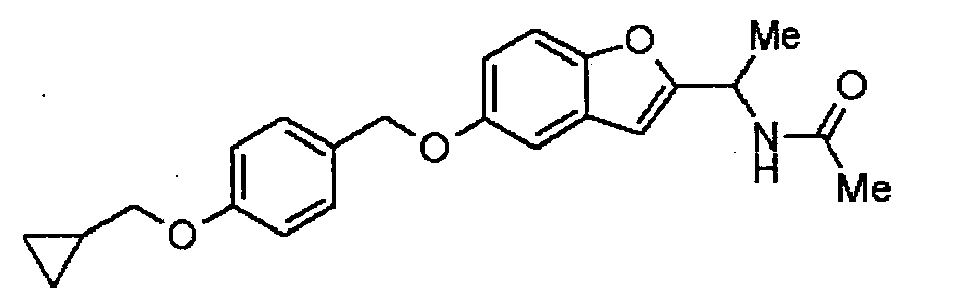
- To a solution of [4-(cyclopropylmethoxy)phenyl]methanol (200 mg, 1.12 mmol) and DMF (1 drop) in THF (2 mL) was added thionyl chloride (0.098 mL, 1.35 mmol), and the mixture was stirred at room temperature for 30 min and concentrated under reduced pressure. To the obtained residue were added DMF (4 mL), N-[1-(5-hydroxy-1-benzofuran-2-yl)ethyl]acetamide (224 mg, 1.02 mmol) obtained in Reference Example 38 and potassium carbonate (211 mg, 1.53 mmol), and the mixture was stirred overnight at 70°C. Water was added thereto and the mixture was extracted with ethyl acetate. The extract was washed with 10% aqueous potassium carbonate solution and saturated brine, and dried over anhydrous sodium sulfate. The solution was applied to basic silica gel column chromatography (ethyl acetate). The solvent was evaporated, and the residue was triturated with a small amount of ethyl acetate to give the title compound (178 mg, yield 46%).
1H NMR (CDCl3) δ0.32-0.37 (m, 2H), 0.62-0.68 (m, 2H), 1.23-1.28 (m, 1H), 1.55 (d, J = 8.4 Hz, 3H), 2.02 (s. 3H), 3.80 (d, J = 6.9 Hz, 2H), 4.99 (s, 2H), 5.30-5.35 (m, 1H), 5.77 (d, J = 8.7 Hz, 1H), 6.48 (s, 1H), 6.89-6.93 (m, 3H), 7.02 (d, J = 2.4 Hz, 1H), 7.29-7.35 (m, 3H).
elemental analysis value as C23H25NO4
Calculated: C, 72.80; H, 6.64; N, 3.69.
experiment value: C, 72.41; H, 6.75; N, 3.70. -

- To a solution of [2-chloro-4-(cyclopropylmethoxy)phenyl]methanol (216 mg, 1.02 mmol) obtained in Reference Example 227 and DMF (1 drop) in THF (2 mL) was added thionyl chloride (0.089 mL, 1.22 mmol), and the mixture was stirred at room temperature for 30 min and concentrated under reduced pressure. To the obtained residue were added DMF (2 mL), N-[1-(5-hydroxy-1-benzofuran-2-yl)ethyl]acetamide (202 mg, 0.923 mmol) obtained in Reference Example 38 and potassium carbonate (191 mg, 1.38 mmol), and the mixture was stirred at 70°C overnight. Water was added thereto and the mixture was extracted with ethyl acetate. The extract was washed with 10% aqueous potassium carbonate solution and saturated brine, and dried over anhydrous sodium sulfate. The solution was applied to basic silica gel column chromatography (ethyl acetate), and the obtained residue was triturated with a small amount of ethyl acetate to give the title compound (120 mg, yield 31%).
1H NMR (CDCl3) δ0.32-0.37 (m, 2H), 0.62-0.67 (m, 2H), 1.24-1.28 (m, 1H), 1.55 (d, J = 6.9 Hz, 3H), 2.02 (s. 3H), 3.78 (d, J = 6.9 Hz, 2H), 5.10 (s, 2H), 5.30-5.35 (m, 1H), 5.76 (d, J = 8.7 Hz, 1H), 6.49 (s, 1H), 6.81 (dd, J = 8.4, 2.4 Hz, 1H), 6.92-6.96 (m, 2H), 7.04 (d, J = 2.4 Hz, 1H), 7.32 (d, J = 8.7 Hz, 1H), 7.41 (d, J = 8.4 Hz, 1H).
elemental analysis value as C23H24NO4Cl
Calculated: C, 66.74; H, 5.84; N, 3.38.
experiment value: C, 66.36; H, 5.84; N, 3.36. -
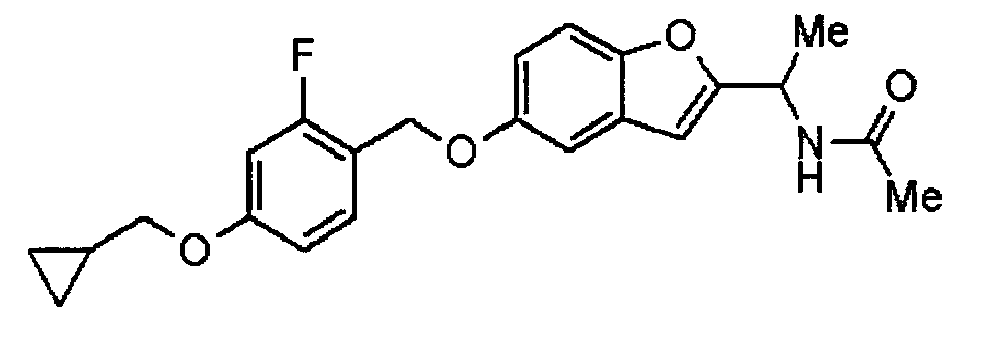
- To a solution of [4-(cyclopropylmethoxy)-2-fluorophenyl]methanol (269 mg, 1.37 mmol) obtained in Reference Example 230 and DMF (1 drop) in THF (2 mL) was added thionyl chloride (0.120 mL, 1.64 mmol), and the mixture was stirred at room temperature for 30 min and concentrated under reduced pressure. To the obtained residue were added DMF (2 mL), N-[1-(5-hydroxy-1-benzofuran-2-yl)ethyl]acetamide (200 mg, 0.912 mmol) obtained in Reference Example 38 and potassium carbonate (252 mg, 1.82 mmol), and the mixture was stirred at 70°C overnight. Water was added thereto and the mixture was extracted with ethyl acetate. The extract was washed with 10% aqueous potassium carbonate solution and saturated brine, and dried over anhydrous sodium sulfate. The residue was applied to basic silica gel column chromatography (ethyl acetate), and triturated with diisopropyl ether to give the title compound (330 mg, yield 92%).
1H NMR (CDCl3) δ0.32-0.37 (m, 2H), 0.62-0.68 (m, 2H), 1.24-1.29 (m, 1H), 1.55 (d, J = 7.2 Hz, 3H), 2.02 (s. 3H), 3.78 (d, J = 6.9 Hz, 2H), 5.05 (s, 2H), 5.30-5.34 (m, 1H), 5.78 (d, J = 8.4 Hz, 1H), 6.48 (d, J = 0.6 Hz, 1H), 6.61-6.71 (m, 2H), 6.91 (dd, J = 9.0, 2.7 Hz, 1H), 7.05 (d, J = 2.7 Hz, 1H), 7.29-7.38 (m, 2H).
elemental analysis value for C23H24NO4F
Calculated: C, 69.51; H, 6.09; N, 3.52.
Found: C, 69.44; H, 6.16; N, 3.53. - 1:1 mixture of N-{(1R)-1-[(2R)-6-{[4-(cyclopropylmethoxy)phenyl]ethynyl}-2,3-dihydro-1-benzofuran-2-yl]ethyl}acetamide and N-{(1S)-1-[(2S)-6-{[4-(cyclopropylmethoxy)phenyl]ethynyl}-2,3-dihydro-1-benzofuran-2-yl]ethyl}acetamide
-


- A solution of 1-(cyclopropylmethoxy)-4-ethynylbenzene (292 mg, 1.70 mmol) obtained in Reference Example 233, a 1:1 mixture (less polar mixture) (500 mg, 1.42 mmol) (obtained in Reference Example 229) of (2R)-2-[(1R)-1-(acetylamino)ethyl]-2,3-dihydro-1-benzofuran-6-yl trifluoromethanesulfonate and (2S)-2-[(1S)-1-(acetylamino)ethyl]-2,3-dihydro-1-benzofuran-6-yl trifluoromethanesulfonate, and copper(I) iodide (27.0 mg, 0.142 mmol) in a mixed solvent of DMF-triethylamine (6 mL-1.5 mL) was deaerated, bis(triphenylphosphine)palladium(II) chloride (50.0 mg, 0.071 mmol) was added thereto, and the mixture was stirred under heating at 80°C for 16 hr under a nitrogen atmosphere. The reaction mixture was diluted with ethyl acetate, and the mixture was washed with water and saturated brine, and dried over anhydrous sodium sulfate. The solution was purified by basic silica gel column chromatography (ethyl acetate), and the solvent was evaporated under reduced pressure. The obtained residue was triturated with ethyl acetate and diisopropyl ether (1:2) to give the title compound (247 mg, yield 47%).
1H NMR (CDCl3) δ 0.33-0.38 (m, 2H), 0.63-0.69 (m, 2H), 1.24-1.30 (m, 1H), 1.29 (d, J = 8.1 Hz, 3H), 1.90 (s, 3H), 2.98-3.06 (m, 1H), 3.17-3.25 (m, 1H), 3.81 (d, J = 6.9 Hz, 2H), 4.30-4.37 (m, 1H), 4.75-4.82 (m, 1H), 5.44 (d, J = 8.7 Hz, 1H), 6.84-6.89 (m, 3H), 7.00-7.10 (m, 2H), 7.40-7.44 (m, 2H).
elemental analysis value as C24H25NO3·0.1H2O
Calculated: C, 76.41; H, 6.73; N, 3.71.
experiment value: C, 76.13; H, 6.70; N, 3.69. - 1:1 mixture of N-{(1S)-1-[(2R)-6-{[4-(cyclopropylmethoxy)phenyl]ethynyl}-2,3-dihydro-1-benzofuran-2-yl]ethyl}acetamide and N-{(1R)-1-[(2S)-6-{[4-(cyclopropylmethoxy)phenyl]ethynyl}-2,3-dihydro-1-benzofuran-2-yl]ethyl}acetamide
-


- A solution of 1-(cyclopropylmethoxy)-4-ethynylbenzene (292 mg, 1.70 mmol) obtained in Reference Example 233, a 1:1 mixture (more polar mixture) (500 mg, 1.42 mmol) (obtained in Reference Example 229) of (2R)-2-[(1S)-1-(acetylamino)ethyl]-2,3-dihydro-1-benzofuran-6-yl trifluoromethanesulfonate and (2S)-2-[(1R)-1-(acetylamino)ethyl]-2,3-dihydro-1-benzofuran-6-yl trifluoromethanesulfonate, and copper(I) iodide (27.0 mg, 0.142 mmol) in a mixed solvent of DMF-triethylamine (6 mL-1.5 mL) was deaerated, bis(triphenylphosphine)palladium(II) chloride (50.0 mg, 0.071 mmol) was added thereto, and the mixture was stirred under heating at 80°C for 16 hr under a nitrogen atmosphere. The reaction mixture was diluted with ethyl acetate, and the mixture was washed with water and saturated brine, and dried over anhydrous sodium sulfate. The solution was purified by basic silica gel column chromatography (ethyl acetate), and the solvent was evaporated under reduced pressure. The obtained residue was triturated with ethyl acetate and diisopropyl ether (1:2) to give the title compound (197 mg, yield 37%).
1H NMR (CDCl3) δ 0.33-0.38 (m, 2H), 0.63-0.69 (m, 2H), 1.09 (d, J = 6.6 Hz, 3H), 1.28 (m, 1H), 2.02 (s, 3H), 2.91-2.99 (m, 1H), 3.28-3.37 (m, 1H), 3.81 (d, J = 6.9 Hz, 2H), 4.19-4.24 (m, 1H), 4.84-4.90 (m, 1H), 5.74 (d, J = 8.7 Hz, 1H), 6.84-6.87 (m, 3H), 6.99-7.11 (m, 2H), 7.43 (d, J = 8.7 Hz, 2H).
elemental analysis value as C24H25NO3
Calculated: C, 76.77; H, 6.71; N, 3.73.
experiment value: C, 76.82; H, 6.71; N, 3.65. -

- To a solution of [3-chloro-4-(cyclopropylmethoxy)phenyl]methanol (291 mg, 1.37 mmol) obtained in Reference Example 234 and DMF (1 drop) in THF (2 mL) was added thionyl chloride (0.120 mL, 1.64 mmol), and the mixture was stirred at room temperature for 30 min and concentrated under reduced pressure. To the obtained residue were added DMF (2 mL), N-[1-(5-hydroxy-1-benzofuran-2-yl)ethyl]acetamide (200 mg, 0.912 mmol) obtained in Reference Example 38 and potassium carbonate (252 mg, 1.82 mmol), and the mixture was stirred at 70°C overnight. Water was added thereto and the mixture was extracted with ethyl acetate. The extract was washed with 10% aqueous potassium carbonate solution and saturated brine, and dried over anhydrous sodium sulfate. The solution was applied to basic silica gel column chromatography (ethyl acetate), and the residue was triturated with ethyl acetate and diisopropyl ether (1:1) to give the title compound (284 mg, yield 75% .
1H NMR (CDCl3) δ0.36-0.41 (m, 2H), 0.62-0.67 (m, 2H), 1.26-1.34 (m, 1H), 1.55 (d, J = 6.9 Hz, 3H), 2.02 (s, 3H), 3.88 (d, J = 6.6 Hz, 2H), 4.97 (s, 2H), 5.30-5.35 (m, 1H), 5.78 (d, J = 8.1 Hz, 1H), 6.49 (s, 1H), 6.89-6.92 (m, 2H), 7.01 (d, J=2.1 Hz, 1H), 7.23-7.26 (m, 1H), 7.31 (d, J = 9.0 Hz, 1H), 7.45 (d, J = 2.1 Hz, 1H).
elemental analysis value as C23H24NO4Cl
Calculated: C, 66.74; H, 5.84; N, 3.38.
experiment value: C, 69.64; H, 5.83; N, 3.28. -

- Using 1-ethynyl-4-propoxybenzene (43.5 mg, 0.272 mmol), (2R)-2-[(1R)-1-(acetylamino)ethyl]-2,3-dihydro-1-benzofuran-6-yl trifluoromethanesulfonate (retention time shorter) (80.0 mg, 0.226 mmol) obtained in Reference Example 231, copper(I) iodide (4.3 mg, 0.023 mmol), (triphenylphosphine)palladium(II) chloride (7.9 mg, 0.011 mmol) and DMF-triethylamine (2 mL-0.5 mL), an operation in the same manner as in Example 111 was performed, and the obtained residue was triturated with hexane and diisopropyl ether (1:1) to give the title compound (40.2 mg, yield 49%).
1H NMR (CDCl3) δ 1.04 (t, J = 7.5 Hz, 3H), 1.34 (d, J = 6.9 Hz, 3H), 1.76-1.88 (m, 2H), 1.90 (s, 3H), 2.98-3.06 (m, 1H), 3.17-3.26 (m, 1H), 3.93 (t, J = 6.6 Hz, 2H), 4.31-4.37 (m, 1H), 4.75-4.82 (m, 1H), 5.45 (d, J = 8.7 Hz, 1H), 6.83-6.90 (m, 3H), 7.00-7.10 (m, 2H), 7.41-7.46 (m, 2H). -

- Using 1-ethynyl-4-propoxybenzene (43.5 mg, 0.272 mmol), (2S)-2-[(1S)-1-(acetylamino)ethyl]-2,3-dihydro-1-benzofuran-6-yl trifluoromethanesulfonate (retention time longer) (80.0 mg, 0.226 mmol) obtained in Reference Example 231, copper(I) iodide (4.3 mg, 0.023 mmol), (triphenylphosphine)palladium(II) chloride (7.9 mg, 0.011 mmol) and DMF-triethylamine (2 mL-0.5 mL), an operation in the same manner as in Example 111 was performed, and the obtained residue was triturated with hexane and diisopropyl ether (1:1) to give the title compound (52.8 mg, yield 64%).
1H NMR (CDCl3) δ 1.04 (t, J = 7.5 Hz, 3H), 1.34 (d, J = 6.9 Hz, 3H), 1.76-1.88 (m, 2H), 1.90 (s, 3H), 2.97-3.06 (m, 1H), 3.17-3.26 (m, 1H), 3.93 (t, J = 6.6 Hz, 2H), 4.31-4.37 (m, 1H), 4.75-4.82 (m, 1H), 5.45 (d, J = 9.3 Hz, 1H), 6.83-6.90 (m, 3H), 7.00-7.10 (m, 2H), 7.41-7.46 (m, 2H). -

- N-[1-(5-{[4-(cyclopropylmethoxy)-2-fluorobenzyl]oxy}-1-benzofuran-2-yl)ethyl]acetamide (268 mg) obtained in Example 110 was optically resolved by high performance liquid chromatography (HPLC) under the following conditions to give two kinds of optically active forms of "retention time longer (120 mg)" and "retention time shorter (129 mg)".
<Preparative HPLC conditions>
column: CHIRALPAK AD (50 mmID×500 mmL)
mobile phase: hexane:ethanol=1:1
flow rate: 60 mL/min
column temperature: 30°C
detection: UV 220 nm
compound injection volume: 30 mg/60 mL
<HPLC analysis conditions>
column: CHIRALPAK AD (4.6 mmID×250 mmL)
mobile phase: hexane:ethanol=17:3
flow rate: 1.0 mL/min
column temperature: 30°C
detection: UV 220 nm
retention time of "retention time longer": 13.9 min
retention time of "retention time shorter": 9.9 min - 1:1 mixture of N-{(1R)-1-[(2R)-6-{[4-(benzyloxy)phenyl]ethynyl}-2,3-dihydro-1-benzofuran-2-yl]ethyl}acetamide and N-{(1S)-1-[(2S)-6-{[4-(benzyloxy)phenyl]ethynyl}-2,3-dihydro-1-benzofuran-2-yl]ethyl}acetamide
-


- To a solution of 1-(benzyloxy)-4-ethynylbenzene (283 mg, 1.36 mmol), a 1:1 mixture (less polar mixture) (400 mg, 1.13 mmol) (obtained in Reference Example 229) of (2R)-2-[(1R)-1-(acetylamino)ethyl]-2,3-dihydro-1-benzofuran-6-yl trifluoromethanesulfonate and (2S)-2-[(1S)-1-(acetylamino)ethyl]-2,3-dihydro-1-benzofuran-6-yl trifluoromethanesulfonate, and copper(I) iodide (21.6 mg, 0.113 mmol) in DMF-triethylamine (4 mL-1 mL) was added (triphenylphosphine)palladium(II) chloride (39.7 mg, 0.057 mmol), and the mixture was deaerated and stirred under heating at 80°C for 16 hr under a nitrogen atmosphere. The reaction mixture was diluted with ethyl acetate, and the mixture was washed with water and saturated brine, and dried over anhydrous sodium sulfate. The solution was purified by basic silica gel column chromatography (ethyl acetate), and the solvent was evaporated under reduced pressure. The residue was triturated with ethyl acetate to give the title compound (218 mg, yield 47%).
1H NMR (CDCl3) δ 1.34 (d, J = 6.6 Hz, 3H), 1.90 (s, 3H), 2.98-3.06 (m, 1H), 3.17-3.26 (m, 1H), 4.31-4.36 (m, 1H), 4.75-4.82 (m, 1H), 5.08 (s, 2H), 5.45 (d, J = 8.4 Hz, 1H), 6.90-6.95 (m, 3H), 7.00-7.10 (m, 2H), 7.33-7.46 (m, 7H). - 1:1 mixture of N-{(1S)-1-[(2R)-6-{[4-(benzyloxy)phenyl]ethynyl}-2,3-dihydro-1-benzofuran-2-yl]ethyl}acetamide and N-{(1R)-1-[(2S)-6-{[4-(benzyloxy)phenyl]ethynyl}-2,3-dihydro-1-benzofuran-2-yl]ethyl}acetamide
-


- To a solution of 1-(benzyloxy)-4-ethynylbenzene (377 mg, 1.81 mmol), a 1:1 mixture (more polar mixture) (533 mg, 1.51 mmol) (obtained in Reference Example 229) of (2R)-2-[(1S)-1-(acetylamino)ethyl]-2,3-dihydro-1-benzofuran-6-yl trifluoromethanesulfonate and (2S)-2-[(1R)-1-(acetylamino)ethyl]-2,3-dihydro-1-benzofuran-6-yl trifluoromethanesulfonate, and copper(I) iodide (28.7 mg, 0.151 mmol) in DMF-triethylamine (6 mL-1.5 mL) was added (triphenylphosphine)palladium(II) chloride (52.9 mg, 0.075 mmol), and the mixture was deaerated and stirred under heating at 80°C for 16 hr under a nitrogen atmosphere. The reaction mixture was diluted with ethyl acetate, and the mixture was washed with water and saturated brine, and dried over anhydrous sodium sulfate. The solution was purified by basic silica gel column chromatography (ethyl acetate), and the solvent was evaporated under reduced pressure, and the residue was triturated with ethyl acetate to give the title compound (331 mg, yield 53%).
1H NMR (CDCl3) δ 1.09 (d, J = 6.9 Hz, 3H), 2.02 (s, 3H), 2.92-3.00 (m, 1H), 3.28-3.67 (m, 1H), 4.18-4.24 (m, 1H), 4.84-4.90 (m, 1H), 5.08 (s, 2H), 5.73 (br, 1H), 6.88 (s, 1H), 6.94 (d, J = 8.7 Hz, 2H), 7.00-7.11 (m, 2H), 7.32-7.46 (m, 7H). - 1:1 mixture of N-[(1R)-1-{(2R)-6-[2-(4-hydroxyphenyl)ethyl]-2,3-dihydro-1-benzofuran-2-yl}ethyl]acetamide and N-[(1S)-1-{(2S)-6-[2-(4-hydroxyphenyl)ethyl]-2,3-dihydro-1-benzofuran-2-yl}ethyl]acetamide
-


- A solution of a 1:1 mixture (125 mg, 0.304 mmol) (obtained in Example 117) of N-{(1R)-1-[(2R)-6-{[4-(benzyloxy)phenyl]ethynyl}-2,3-dihydro-1-benzofuran-2-yl]ethyl}acetamide and N-{(1S)-1-[(2S)-6-{[4-(benzyloxy)phenyl]ethynyl}-2,3-dihydro-1-benzofuran-2-yl]ethyl}acetamide, and 10% palladium carbon (50% water-containing product, 300 mg) in THF (3 mL) was stirred for 3 hr under a hydrogen atmosphere (normal pressure). After filtration, the filtrate was concentrated under reduced pressure, and the residue was triturated with diisopropyl ether to give the title compound (90.0 mg, yield 91%). This was used for the next reaction without purification.
- 1:1 mixture of N-[(1S)-1-{(2R)-6-[2-(4-hydroxyphenyl)ethyl]-2,3-dihydro-1-benzofuran-2-yl}ethyl]acetamide and N-[(1R)-1-{(2S)-6-[2-(4-hydroxyphenyl)ethyl]-2,3-dihydro-1-benzofuran-2-yl}ethyl]acetamide
-


- A solution of a 1:1 mixture (323 mg, 0.785 mmol) (obtained in Example 118) of N-{(1S)-1-[(2R)-6-([4-(benzyloxy)phenyl]ethynyl)-2,3-dihydro-1-benzofuran-2-yl]ethyl}acetamide and N-{(1R)-1-[(2S)-6-{[4-(benzyloxy)phenyl]ethynyl}-2,3-dihydro-1-benzofuran-2-yl]ethyl}acetamide, and 10% palladium carbon (50% water-containing product, 1.00 g) in THF (8 mL) was stirred for 2 hr under a hydrogen atmosphere (normal pressure). After filtration, the filtrate was concentrated under reduced pressure, and the residue was triturated with diisopropyl ether to give the title compound (212 mg, yield 83%). This was used for the next reaction without purification.
- 1:1 mixture of N-{(1R)-1-[(2R)-6-{2-[4-(cyclopropylmethoxy)phenyl]ethyl}-2,3-dihydro-1-benzofuran-2-yl]ethyl}acetamide and N-{(1S)-1-[(2S)-6-{2-[4-(cyclopropylmethoxy)phenyl]ethyl}-2,3-dihydro-1-benzofuran-2-yl]ethyl}acetamide
-


- A solution of a 1:1 mixture (85.2 mg, 0.262 mmol) (obtained in Example 119) of N-[(1R)-1-{(2R)-6-[2-(4-hydroxyphenyl)ethyl]-2,3-dihydro-1-benzofuran-2-yl}ethyl]acetamide and N-[(1S)-1-{(2S)-6-[2-(4-hydroxyphenyl)ethyl]-2,3-dihydro-1-benzofuran-2-yl}ethyl]acetamide, bromomethylcyclopropane (0.051 mL, 0.524 mmol) and potassium carbonate (109 mg, 0.785 mmol) in ethanol (1.5 mL) was stirred under heating at 60°C for 16 hr. The reaction mixture was diluted with ethyl acetate, and the mixture was washed with 10% aqueous potassium carbonate solution and saturated brine, and dried over anhydrous sodium sulfate. The solution was applied to basic silica gel column chromatography (ethyl acetate). The solvent was evaporated under reduced pressure, and the residue was triturated with a small amount of diisopropyl ether and hexane to give the title compound (86.3 mg, yield 87%).
1H NMR (CDCl3) δ0.31-0.36 (m, 2H), 0.61-0.67 (m, 2H), 1.27-1.28 (m, 1H), 1.33 (d, J = 6.9 Hz, 3H), 1.90 (s, 3H), 2.82 (s-like, 4H), 2.92-3.00 (m, 1H), 3.11-3.19 (m, 1H), 3.77 (d, J = 6.9 Hz, 2H), 4.29-4.35 (m, 1H), 4.71-4.77 (m, 1H), 5.49 (d, J = 9.3 Hz, 1H), 6.62 (s, 1H), 6.66 (d, J = 7.8 Hz, 1H), 6.81 (d, J = 8.4 Hz, 2H), 7.02 (d, J = 7.5 Hz, 1H), 7.07 (d, J = 8.4 Hz, 2H).
elemental analysis value as C24H29NO3
Calculated: C, 75.96; H, 7.70; N, 3.69.
experiment value: C, 75.92; H, 7.64; N, 3.71. - 1:1 mixture of N-{(1S)-1-[(2R)-6-{2-[4-(cyclopropylmethoxy)phenyl]ethyl}-2,3-dihydro-1-benzofuran-2-yl]ethyl}acetamide and N-{(1R)-1-[(2S)-6-{2-[4-(cyclopropylmethoxy)phenyl]ethyl}-2,3-dihydro-1-benzofuran-2-yl]ethyl}acetamide
-


- A solution of a 1:1 mixture (200 mg, 0.615 mmol) (obtained in Example 120) of N-[(1S)-1-{(2R)-6-[2-(4-hydroxyphenyl)ethyl]-2,3-dihydro-1-benzofuran-2-yl}ethyl]acetamide and N-[(1R)-1-{(2S)-6-[2-(4-hydroxyphenyl)ethyl]-2,3-dihydro-1-benzofuran-2-yl}ethyl]acetamide, bromomethylcyclopropane (0.119 mL, 1.23 mmol) and potassium carbonate (255 mg, 1.84 mmol) in ethanol (3 mL) was stirred under heating at 60°C for 16 hr. The reaction mixture was diluted with ethyl acetate, and the mixture was washed with 10% aqueous potassium carbonate solution and saturated brine, and dried over anhydrous sodium sulfate. The solution was applied to basic silica gel column chromatography (ethyl acetate). The solvent was evaporated under reduced pressure, and the residue was triturated with diisopropyl ether to give the title compound (201 mg, yield 86%).
1H NMR (CDCl3) δ0.33-0.36 (m, 2H), 0.60-0.67 (m, 2H), 1.10 (d, J = 6.6 Hz, 3H), 1.24-1.29 (m, 1H), 2.01 (s, 3H), 2.82 (s-like, 4H), 2.88-2.95 (m, 1H), 3.23-3.31 (m, 1H), 3.77 (d, J = 6.6 Hz, 2H), 4.17-4.24 (m, 1H), 4.79-4.86 (m, 1H), 5.75 (d, J = 9.0 Hz, 1H), 6.57 (s, 1H), 6.65 (dd, J = 7.5, 1.5 Hz, 1H), 6.81 (d, J = 8.7 Hz, 2H), 7.01-7.07 (m, 3H).
elemental analysis value for C24H29NO3
Calculated: C, 75.96; H, 7.70; N, 3.69.
experiment value: C, 76.02; H, 7.72; N, 3.68. -

- To a solution of N-[1-(6-chlorofuro[2,3-b]pyridin-2-yl)ethyl]acetamide (18.6 mg, 0.0782 mmol) obtained in Reference Example 237 in dimethoxyethane (3 mL) were added bisdiphenylphosphinoferrocenepalladium(II) chloride (12.2 mg, 0.0149 mmol) and 2-(4-ethoxyphenyl)ethylmagnesium bromide (THF solution 0.7 M, 2.0 mL, 1.4 mmol), and the mixture was refluxed for 30 min under a nitrogen atmosphere. Saturated aqueous ammonium chloride solution was added thereto, and the mixture was extracted twice with ethyl acetate. The extract was washed with saturated brine, and dried over anhydrous magnesium sulfate. The solvent was evaporated under reduced pressure, and the obtained residue was purified by silica gel column chromatography (hexane:ethyl acetate=4:1 to 3:7) to give the title compound (9.4 mg, yield 34%) as a white solid.
1H NMR (CDCl3) δ 1.40 (t, J = 7.0 Hz, 3H), 1.54-1.62 (m, 3H), 2.01 (s, 3H), 2.96-3.19 (m, 4H), 4.00 (q, J = 7.0 Hz, 2H), 5.27-5.41 (m, 1H), 5.89 (d, J = 8.7 Hz, 1H), 6.53 (s, 1H), 6.81 (d, J = 8.7 Hz, 2H), 7.00 (d, J = 7.8 Hz, 1H), 7.11 (d, J = 8.7 Hz, 2H), 7.72 (d, J = 7.8 Hz, 1H) -

- To a solution of N-(1-{6-[2-(4-ethoxyphenyl)ethyl]-1-benzofuran-2-yl}ethyl)-N-isoxazol-3-yl-4-nitrobenzenesulfonamide (127 mg, 0.226 mmol) obtained in Reference Example 238 in DMF (1 mL) were added sulfanylacetic acid (0.166 mL, 1.81 mmol) and lithium hydroxide dihydrate (75.6 mg, 1.81 mmol), and the mixture was stirred at 70°C overnight. Aqueous sodium hydrogen carbonate solution was added thereto, and the mixture was extracted with ethyl acetate. The extract was washed with saturated brine, and dried over anhydrous magnesium sulfate. The solvent was evaporated under reduced pressure, and the residue was passed through basic silica gel, and the solvent was evaporated under reduced pressure. The obtained solid was washed with diisopropyl ether to give the title compound (22.6 mg, yield 27%) as a white solid.
1H NMR (CDCl3) δ 1.40 (t, J = 7.0 Hz, 3H), 1.66 6 (d, J = 6.8 Hz, 3H), 2.80-3.04 (m, 4H), 4.01 (q, J = 7.0 Hz, 2H), 4.30 (d, J = 7.9 Hz, 1H), 4.77-4.97 (m, 1H), 5.86 (d, J = 1.5 Hz, 1H), 6.55 (s, 1H), 6.76-6.86 (m, 2H), 7.02 (d, J = 7.9 Hz, 1H), 7.05-7.13 (m, 2H), 7.24 (s, 1H), 7.39 (d, J = 7.9 Hz, 1H), 8.05 (d, J = 1.5 Hz, 1H). -

- To a solution of 2-[1-(acetylamino)ethyl]-1-benzofuran-6-yl trifluoromethanesulfonate (300 mg, 0.854 mmol) obtained in Reference Example 239, 1-ethenyl-4-ethoxybenzene (0.638 mL, 4.27 mmol) and triethylamine (1.27 mL, 8.54 mmol) in anhydrous DMF (2 mL) was added bisdiphenylphosphinoferrocenepalladium(II) chloride (34.8 mg, 0.0427 mmol), and the mixture was stirred at 100°C for 2 days under a nitrogen atmosphere. 1N Aqueous sodium hydroxide solution was added thereto, and the mixture was extracted twice with ethyl acetate. The extract was washed with saturated brine, and dried over anhydrous magnesium sulfate. The solvent was evaporated under reduced pressure, and the obtained residue was purified by silica gel column chromatography (hexane:ethyl acetate=9:1 to 2:3) to give the title compound (25.6 mg, yield 9%) as a white solid.
1H NMR (CDCl3) δ 1.43 (q, J = 7.0 Hz, 3H), 1.50-1.64 (m, 3H), 2.03 (s, 3H), 4.06 (q, J = 7.0 Hz, 2H), 5.26-5.47 (m, 1H), 5.80 (d, J = 8.7 Hz, 1H), 6.54 (s, 1H), 6.85-6.93 (m, 2H), 7.02 (d, J = 18.0 Hz, 1H), 7.09 (d, J = 18.0 Hz, 1H), 7.33-7.40 (m, 1H), 7.42-7.50 (m, 3H), 7.54 (s, 1H). -

- Using N-[1-(6-{2-[4-(cyclopropylmethoxy)phenyl]ethyl}-1-benzofuran-2-yl)ethyl]-N-(3,4-dimethylisoxazol-5-yl)-4-nitrobenzenesulfonamide (125 mg, 0.247 mmol) obtained in Reference Example 240, DMF (1 mL), sulfanylacetic acid (0.166 mL, 1.81 mmol) and lithium hydroxide dihydrate (75.6 mg, 1.81 mmol), an operation in the same manner as in Example 124 was performed to give the title compound (44.5 mg, yield 42%) as a white solid.
1H NMR (CDCl3) δ 0.29-0.39 (m, 2H), 0.60-0.71 (m, 2H), 1.17-1.34 (m, 1H), 1.66 (d, J = 6.8 Hz, 3H), 1.74 (s, 3H), 2.10 (s, 3H), 2.83-3.04 (m, 4H), 3.78.(d, J = 6.8 Hz, 2H), 4.25 (d, J = 9.1 Hz, 1H), 4.93-5.12 (m, 1H), 6.53 (s, 1H), 6.74-6.86 (m, 2H), 7.02 (dd, J = 8.0, 1.5 Hz, 1H), 7.05-7.11 (m, 2H), 7.24 (s, 1H), 7.39 (d, J = 8.1 Hz, 1H) . -
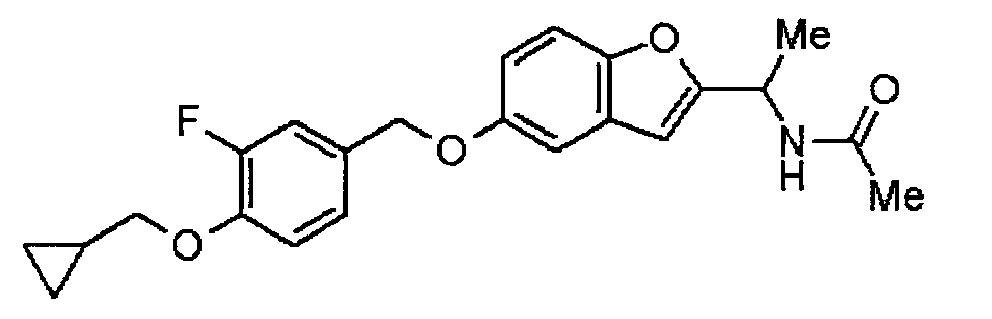
- To a solution of [4-(cyclopropylmethoxy)-3-fluorophenyl]methanol (268 mg, 1.36 mmol) obtained in Reference Example 241 in toluene (2 mL) was added thionyl chloride (0.196 mL, 2.72 mmol), and the mixture was stirred at room temperature for 30 min and concentrated under reduced pressure. To the obtained residue were added DMF (2 mL), N-[1-(5-hydroxy-1-benzofuran-2-yl)ethyl]acetamide (200 mg, 0.913 mmol) obtained in Reference Example 38 and potassium carbonate (252 mg, 1.83 mmol), and the mixture was stirred at 60°C overnight. Water was added thereto and the mixture was extracted with ethyl acetate. The extract was washed with 10% aqueous potassium carbonate solution and saturated brine, and dried over anhydrous sodium sulfate. The solution was purified by basic silica gel column chromatography (hexane:ethyl acetate=19:1 to 2:3), the solvent was evaporated, and the obtained solid was washed with diisopropyl ether to give the title compound (309 mg, yield 57%).
1H NMR (CDCl3) δ0.31-0.40 (m, 2H), 0.61-0.69 (m, 2H), 1.23-1.38 (m, 1H), 1.55 (d, J = 7.2 Hz, 3H), 2.02 (s, 3H), 3.87 (d, J = 7.2 Hz, 2H), 4.98 (s, 2H), 5.26-5.39 (m, 1H), 5.80 (d, J = 7.9 Hz, 1H), 6.49 (s, 1H), 6.88-6.98 (m, 2H), 7.02 (d, J = 2.6 Hz, 1H), 7.10 (d, J = 8.3 Hz, 1H), 7.18 (dd, J = 12.1, 1.9 Hz, 1H), 7.32 (d, J = 9.0 Hz, 1H) . -

- To a solution of [4-(cyclopropylmethoxy)phenyl]methanol (243 mg, 1.36 mmol) in toluene (2 mL) was added thionyl chloride (0.196 mL, 2.72 mmol), and the mixture was stirred at room temperature for 30 min, and concentrated under reduced pressure. To the obtained residue were added DMF (2 mL), N-[1-(5-hydroxy-1-benzofuran-2-yl)ethyl]acetamide (200 mg, 0.913 mmol) obtained in Reference Example 38 and potassium carbonate (252 mg, 1.83 mmol), and the mixture was stirred at 50°C overnight. Water was added thereto and the mixture was extracted with ethyl acetate. The extract was washed with 10% aqueous potassium carbonate solution and saturated brine, and dried over anhydrous sodium sulfate. The solution was purified by basic silica gel column chromatography (hexane:ethyl acetate=4:1 to 2:3), the solvent was evaporated, and the obtained solid was washed with diisopropyl ether to give the title compound (139 mg, yield 40%).
1H NMR (CDCl3) δ0.31-0.39 (m, 2H), 0.60-0.70 (m, 2H), 1.21-1.35 (m, 1H), 1.54 (d, J = 7.2 Hz, 3H), 2.01 (s, 3H), 3.81 (d, J = 6.8 Hz, 2H), 5.01 (s, 2H), 5.25-5.37 (m, 1H), 5.77 (d, J = 7.9 Hz, 1H), 6.48 (s, 1H), 6.87-6.96 (m, 3H), 7.03 (d, J = 1.9 Hz, 1H), 7.35-7.38 (m, 3H). - N-{(1R)-1-[(2R)-6-{[4-(cyclopropylmethoxy)phenyl]ethynyl}-2,3-dihydro-1-benzofuran-2-yl]ethyl}acetamide and N-{(1S)-1-[(2S)-6-{[4-(cyclopropylmethoxy)phenyl]ethynyl}-2,3-dihydro-1-benzofuran-2-yl]ethyl}acetamide (two kinds)
-

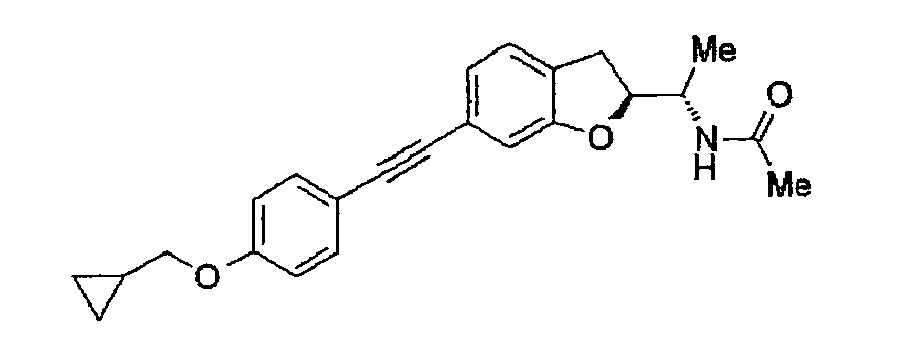
- A 1:1 mixture (194 mg) (obtained in Example 111) of N-{(1R)-1-[(2R)-6-{[4-(cyclopropylmethoxy)phenyl]ethynyl}-2,3-dihydro-1-benzofuran-2-yl]ethyl}acetamide and N-{(1S)-1-[(2S)-6-{[4-(cyclopropylmethoxy)phenyl]ethynyl}-2,3-dihydro-1-benzofuran-2-yl]ethyl}acetamide was optically resolved by high performance liquid chromatography (HPLC) under the following conditions to give two kinds of optically active forms of "retention time longer (94 mg)" and "retention time shorter (91 mg)".
<Preparative HPLC conditions>
column: CHIRALPAK AD (50 mmID×500 mmL)
mobile phase: hexane:ethanol=17:3
flow rate: 80 mL/min
column temperature: 30°C
detection: UV 220 nm
<HPLC analysis conditions>
column: CHIRALPAK AD-H (4.6 mmID×250 mmL)
mobile phase: hexane:ethanol=17:3
flow rate: 1.0 mL/min
column temperature: 30°C
detection: UV 220 nm
retention time of "retention time longer": 17.5 min
retention time of "retention time shorter": 13.1 min -


- A 1:1 mixture (390 mg) (obtained in Example 121) of N-{(1R)-1-[(2R)-6-{2-[4-(cyclopropylmethoxy)phenyl]ethyl}-2,3-dihydro-1-benzofuran-2-yl]ethyl}acetamide and N-{(1S)-1-[(2S)-6-{2-[4-(cyclopropylmethoxy)phenyl]ethyl}-2,3-dihydro-1-benzofuran-2-yl]ethyl}acetamide was optically resolved by high performance liquid chromatography (HPLC) under the following conditions to give two kinds of optically active forms of "retention time longer (167 mg)" and "retention time shorter (170 mg)".
<Preparative HPLC conditions>
column: CHIRALPAK OJ-H (50 mmID×500 mmL)
mobile phase: CO2:methanol=13:7
flow rate: 50 mL/min
column temperature: 35°C
detection: UV 220 nm
compound injection volume: 1.0 mL at 20 mg/mL (in methanol)
<HPLC analysis conditions>
column: CHIRALPAK OJ-H (4.6 mmID×250 mmL)
mobile phase: CO2:methanol=3:2
pressure: 100 bar
flow rate: 4.0 mL/min
column temperature: 35°C
detection: UV 220 nm
retention time of "retention time longer": 1.26 min
retention time of "retention time shorter": 1.00 min - N-{(1S)-1-[(2R)-6-{2-[4-(cyclopropylmethoxy)phenyl]ethyl}-2,3-dihydro-1-benzofuran-2-yl]ethyl}acetamide and N-{(1R)-1-[(2S)-6-{2-[4-(cyclopropylmethoxy)phenyl]ethyl}-2,3-dihydro-1-benzofuran-2-yl]ethyl}acetamide (two kinds)
-


- A 1:1 mixture (150 mg) (obtained in Example 122) of N-{(1S)-1-[(2R)-6-{2-[4-(cyclopropylmethoxy)phenyl]ethyl}-2,3-dihydro-1-benzofuran-2-yl]ethyl}acetamide and N-{(1R)-1-[(2S)-6-{2-[4-(cyclopropylmethoxy)phenyl]ethyl}-2,3-dihydro-1-benzofuran-2-yl]ethyl}acetamide was optically resolved by high performance liquid chromatography (HPLC) under the following conditions to give two kinds of optically active forms of "retention time longer (62.0 mg)" and "retention time shorter (57.6 mg)".
<Preparative HPLC conditions>
column: CHIRALPAK OJ-H (50 mmID×500 mmL)
mobile phase: CO2:methanol=6:4
flow rate: 50 mL/min
column temperature: 35°C
detection: UV 220 nm
compound injection volume: 4.0 mL at 3.0 mg/mL (in methanol)
<HPLC analysis conditions>
column: CHIRALPAK OJ-H (4.6 mmID×250 mmL)
mobile phase: CO2:methanol=3:2
pressure: 100 bar
flow rate: 4.0 mL/min
column temperature: 35°C
detection: UV 220 nm
compound injection volume:0.005 mL at 1.5 mg/mL (in methanol)
retention time of "retention time longer": 1.31 min
retention time of "retention time shorter": 1.06 min -

- N-[1-(5-{[4-(cyclopropylmethoxy)benzyl]oxy}-1-benzofuran-2-yl)ethyl]acetamide (115 mg) obtained in Example 108 was optically resolved by high performance liquid chromatography (HPLC) under the following conditions to give two kinds of optically active forms of "retention time longer (53 mg)" and "retention time shorter (53 mg)".
<Preparative HPLC conditions>
column: CHIRALPAK AD (50 mmID×500 mmL)
mobile phase: hexane:ethanol=17:3
flow rate: 80 mL/min
column temperature: 30°C
detection: UV 220 nm
compound injection volume: 60 mg/300 mL
<HPLC analysis conditions>
column: CHIRALPAK AD (4.6 mmID×250 mmL)
mobile phase: hexane:ethanol=17:3
flow rate: 1.0 mL/min
column temperature: 30°C
detection: UV 220 nm
retention time of "retention time longer": 16.5 min
retention time of "retention time shorter": 11.5 min -


- A 1:1 mixture (148 mg) (obtained in Example 112) of N-{(1S)-1-[(2R)-6-{[4-(cyclopropylmethoxy)phenyl]ethynyl}-2,3-dihydro-1-benzofuran-2-yl]ethyl}acetamide and N-{(1R)-1-[(2S)-6-{[4-(cyclopropylmethoxy)phenyl]ethynyl}-2,3-dihydro-1-benzofuran-2-yl]ethyl}acetamide was optically resolved by high performance liquid chromatography (HPLC) under the following conditions to give two kinds of optically active forms of "retention time longer (53 mg)" and "retention time shorter (69 mg)".
<Preparative HPLC conditions>
column: CHIRALPAK AD (50 mmID×500 mmL)
mobile phase: hexane:ethanol=17:3
flow rate: 80 mL/min
column temperature: 30°C
detection: UV 220 nm
compound injection volume: 70 mg/200 mL
<HPLC analysis conditions>
column: CHIRALPAK AD (4.6 mmID×250 mmL)
mobile phase: hexane:ethanol=17:3
flow rate: 1.0 mL/min
column temperature: 30°C
detection: UV 220 nm
retention time of "retention time longer": 17.2 min
retention time of "retention time shorter": 13.6 min -

- N-[1-(5-{[2-chloro-4-(cyclopropylmethoxy)benzyl]oxy}-1-benzofuran-2-yl)ethyl]acetamide (72 mg) obtained in Example 109 was optically resolved by high performance liquid chromatography (HPLC) under the following conditions to give two kinds of optically active forms of "retention time longer (34 mg)" and "retention time shorter (30 mg)".
<Preparative HPLC conditions>
column: CHIRALPAK AD (50 mmID×500 mmL)
mobile phase: hexane:ethanol=17:3
flow rate: 80 mL/min
column temperature: 30°C
detection: UV 220 nm
compound injection volume: 72 mg/200 mL
<HPLC analysis conditions>
column: CHIRALPAK AD (4.6 mmID×250 mmL)
mobile phase: hexane:ethanol=17:3
flow rate: 1.0 mL/min
column temperature: 30°C
detection: UV 220 nm
retention time of "retention time longer": 12.5 min
retention time of "retention time shorter": 9.1 min -

- To a solution of 2-(1-azidoethyl)-6-[2-(4-ethoxyphenyl)ethyl]furo[3,2-c]pyridine (622 mg, 1.85 mmol) obtained in Reference Example 246 in THF (5 mL) was added triphenylphosphine (582 mg, 2.20 mmol), and the mixture was stirred at 60°C for 30 min. To the reaction mixture was added water (1.0 mL), and the mixture was stirred at 60°C for 15 hr. The solvent was evaporated under reduced pressure and the obtained residue was purified by basic silica gel column chromatography (hexane:ethyl acetate1:1 to 0:1) to give 1-{6-[2-(4-ethoxyphenyl)ethyl]furo[3,2-c]pyridin-2-yl}ethanamine. This was dissolved in pyridine (3 mL)-acetic anhydride (3 mL), and the solution was stirred at room temperature for 15 min. The solvent was evaporated under reduced pressure and the obtained residue was purified by basic silica gel column chromatography (hexane:ethyl acetate=1:1 to 0:1, ethyl acetate:methanol=1:0 to 9:1) to give the title compound (444 mg, yield from 2-(1-azidoethyl)-6-[2-(4-ethoxyphenyl)ethyl]furo[3,2-c]pyridine 68%) as a white solid.
1H NMR (CDCl3) δ 1.39 (t, J = 7.0 Hz, 3H), 1.56 (d, J = 6.8 Hz, 3H), 2.03 (s, 3H), 2.99-3.04 (m, 2H), 3.13-3.17 (m, 2H), 4.00 (q, J=7.0 Hz, 2H), 5.31-5.40 (m, 1H), 5.84 (d, J = 8.3 Hz, 1H), 6.58 (s, 1H), 6.80 (d, J = 8.7 Hz, 2H), 7.10 (d, J = 8.7 Hz, 2H), 7.14 (s, 1H), 8.77 (s, 1H). -

- To a solution of 2-(1-azidoethyl)-5-[2-(4-ethoxyphenyl)ethyl]furo[2,3-c]pyridine (1.20 g, 3.57 mmol) obtained in Reference Example 252 in THF (10 mL) was added triphenylphosphine (1.13 g, 4.28 mmol), and the mixture was stirred at 60°C for 30 min. To the reaction mixture was added water (1.0 mL), and the mixture was stirred at 60°C for 15 hr. The solvent was evaporated under reduced pressure and the obtained residue was dissolved in pyridine (5 mL)-acetic anhydride (5 mL), and the solution was stirred at room temperature for 15 min. The solvent was evaporated under reduced pressure and the obtained residue was purified by silica gel column chromatography (hexane:ethyl acetate=2:3 to 0:1, ethyl acetate:methanol=1:0 to 9:1) to give the title compound (781 mg, yield 62%) as a white solid.
1H NMR (CDCl3) δ 1.39 (t, J = 7.0 Hz, 3H), 1.58 (d, J = 7.2 Hz, 3H), 2.04 (s, 3H), 2.97-3.03 (m, 2H), 3.08-3.15 (m, 2H), 4.00 (q, J = 7.0 Hz, 2H), 5.33-5.42 (m, 1H), 5.84 (d, J = 7.9 Hz, 1H), 6.51 (s, 1H), 6.79 (d, J = 8.7 Hz, 2H), 7.09 (d, J = 8.7 Hz, 2H), 7.20 (d, J = 0.8 Hz, 1H), 8.74 (s, 1H). -

- To a solution of 2-[1-(acetylamino)ethyl]-1-benzofuran-6-yl trifluoromethanesulfonate (150 mg, 0.427 mmol) obtained in Reference Example 239 in DMF (3 mL)-triethylamine (1 mL) were added 5-(cyclopropylmethoxy)-2-ethynylpyridine (148 mg, 0.854 mmol) obtained in Reference Example 254, copper(I) iodide (8.20 mg, 0.0427 mmol) and bis(triphenylphosphine)palladium(II) chloride (30.0 mg, 0.0427 mmol), and the mixture was stirred at 100°C for 18 hr under an argon stream. The reaction mixture was diluted with ethyl acetate, and the mixture was washed three times with saturated brine, and dried over anhydrous magnesium sulfate. The solvent was evaporated under reduced pressure and the obtained residue was purified by basic silica gel column chromatography (hexane:ethyl acetate=2:3 to 0:1) to give the title compound (69.6 mg, yield 43%) as a yellow solid.
1H NMR (CDCl3) δ 0.36-0.41 (m, 2H), 0.66-0.72 (m, 2H), 1.23-1.34 (m, 1H), 1.58 (d, J = 6.8 Hz, 3H), 2.04 (s, 3H), 3.89 (d, J = 6.8 Hz, 2H), 5.32-5.42 (m, 1H), 5.84 (d, J = 8.3 Hz, 1H), 6.57 (s, 1H), 7.17 (dd, J = 8.5, 3.0 Hz, 1H), 7.41-7.49 (m, 3H), 7.64 (s, 1H), 8.32 (d, J = 3.0 Hz, 1H). -

- To a solution of 2-[1-(acetylamino)ethyl]-1-benzofuran-6-yl trifluoromethanesulfonate (150 mg, 0.427 mmol) obtained in Reference Example 239 in DMF (3 mL)-triethylamine (1 mL) were added 2-(cyclopropylmethoxy)-5-ethynylpyridine (148 mg, 0.854 mmol) obtained in Reference Example 256, copper(I) iodide (8.20 mg, 0.0427 mmol) and bis(triphenylphosphine)palladium(II) chloride (30.0 mg, 0.0427 mmol), and the mixture was stirred at 100°C for 15 hr under an argon stream. The reaction mixture was diluted with ethyl acetate, and the mixture was washed three times with saturated brine, and dried over anhydrous magnesium sulfate. The solvent was evaporated under reduced pressure and the obtained residue was purified by silica gel column chromatography (hexane:ethyl acetate=3:7 to 0:1) to give the title compound (103 mg, yield 64%) as a yellow solid.
1H NMR (CDCl3) δ 0.34-0.39 (m, 2H), 0.60-0.66 (m, 2H), 1.23-1.34 (m, 1H), 1.57-1.59 (m, 3H), 2.04 (s, 3H), 4.16 (d, J = 7.2 Hz, 2H), 5.32-5.42 (m, 1H), 5.81 (d, J = 8.3 Hz, 1H), 6.57 (s, 1H), 6.76 (d, J = 8.6 Hz, 1H), 7.36-7.39 (m, 1H), 7.47 (d, J = 7.9 Hz, 1H), 7.58 (s, 1H), 7.70 (dd, J = 8.5, 2.5 Hz, 1H), 8.33 (d, J = 1.9 Hz, 1H). -

- Using 2-(cyclopropylmethoxy)-5-ethynylpyridine (353 mg, 2.04 mmol) obtained in Reference Example 256, (2S)-2-[(1S)-1-(acetylamino)ethyl]-2,3-dihydro-1-benzofuran-6-yl trifluoromethanesulfonate (retention time longer, 600 mg, 1.70 mmol) obtained in Reference Example 231, copper(I) iodide (32.3 mg, 0.170 mmol), (triphenylphosphine)palladium(II) chloride (59.6 mg, 84.9 mmol) and DMF-triethylamine (6 mL-1.5 mL), an operation in the same manner as in Example 111 was performed, and the obtained residue was triturated with diisopropyl ether to give the title compound (133 mg, yield 21%).
1H NMR (CDCl3) δ 0.33-0.39 (m, 2H), 0.59-0.66 (m, 2H), 1.24-1.30 (m, 1H), 1.34 (d, J = 6.9 Hz, 1H), 1.90 (s, 3H), 2.99-3.26 (m, 2H), 4.14 (d, J = 6.9 Hz, 2H), 4.31-4.37 (m, 1H), 4.76-4.82 (m, 1H), 5.45 (d, J = 5.7 Hz, 1H), 6.73-6.76 (m, 1H), 6.90 (s, 1H), 7.01-7.11 (m, 2H), 7.66 (dd, J = 2.4, 8.7 Hz, 1H), 8.28 (m, 1H). -

- To a solution of [4-(cyclopropylmethoxy)-2-fluorophenyl]methanol (793 mg, 4.04 mmol) obtained in Reference Example 230 and DMF (1 drop) in THF (10 mL) was added thionyl chloride (0.443 mL, 6.06 mmol), and the mixture was stirred at room temperature for 30 min and concentrated under reduced pressure. To the obtained residue were added DMF (10 mL), N-[1-(5-hydroxy-2, 3-dihydro-1-benzofuran-2-yl)ethyl]acetamide (447 mg, 2.02 mmol) obtained in Reference Example 258 and potassium carbonate (1.40 g, 10.1 mmol), and the mixture was stirred at 60°C for 2 hr. Water was added thereto and the mixture was extracted with ethyl acetate. The extract was washed twice with saturated brine, and dried over anhydrous magnesium sulfate. The solvent was evaporated under reduced pressure and the obtained residue was purified by silica gel column chromatography (hexane:ethyl acetate=3:7 to 0:1) to give the title compound (520 mg, yield 64%) as an oil.
1H NMR (CDCl3) δ 0.32-0.37 (m, 2H), 0.62-0.68 (m, 2H), 1.10 (d, J = 6.8 Hz, 1.5H), 1.21-1.30 (m, 1H), 1.33 (d, J = 6.8 Hz, 1.5H), 1.91 (s, 1.5H), 2.01 (s, 1.5H), 2.90-3.03 (m, 1H), 3.12-3.33 (m, 1H), 3.78 (d, J = 6.8 Hz, 2H), 4.17-4.36 (m, 1H), 4.70-4.85 (m, 1H), 4.95 (s, 2H), 5.53 (d, J = 9.1 Hz, 0.5H), 5.78 (d, J = 8.7 Hz, 0.5H), 6.61-6.74 (m, 4H), 6.80 (s, 1H), 7.30-7.36 (m, 1H). -

- N-[1-(5-{[4-(cyclopropylmethoxy)-2-fluorobenzyl]oxy}-2,3-dihydro-1-benzofuran-2-yl)ethyl]acetamide (432 mg) obtained in Example 140 was optically resolved by high performance liquid chromatography (HPLC) under the following conditions to give two kinds of optically active forms of "retention time longer (201 mg)" and "retention time shorter (209 mg)".
<Preparative HPLC conditions>
column: CHIRALPAK AS (50 mmID×500 mmL)
mobile phase: hexane:ethanol=2:8
flow rate: 60 mL/min
column temperature: 30°C
detection: UV 220 nm
compound injection volume: 216 mg/30 mL
<HPLC analysis conditions>
column: CHIRALPAK AS (4.6 mmID×250 mmL)
mobile phase: hexane:ethanol=2:8
flow rate: 0.5 mL/min
column temperature: 40°C
detection: UV 220 nm
retention time of "retention time longer": 15.9 min
retention time of "retention time shorter": 8.3 min -

- N-{(1S)-1-[(2S)-6-hydroxy-2,3-dihydro-1-benzofuran-2-yl]ethy}acetamide (100 mg, 0.453 mmol) obtained in Reference Example 259, 5-(bromomethyl)-2-(cyclopropylmethoxy)-4-fluoropyridine (262 mg, 1.01 mmol) obtained in Reference Example 271 and potassium carbonate (125 mg, 0.906 mmol) were mixed, and the mixture was stirred at 60°C for 1 hr. Water was added thereto and the mixture was extracted with ethyl acetate. The extract was washed twice with saturated brine, and dried over anhydrous magnesium sulfate. The solvent was evaporated under reduced pressure and the obtained residue was purified by basic silica gel column chromatography (hexane:ethyl acetate=3:2 to 0:1) to give the title compound (180 mg, yield 99%) as an oil.
1H NMR (CDCl3) δ 0.32-0.37 (m, 2H), 0.58-0.65 (m, 2H), 1.22-1.30 (m, 1H), 1.33 (d, J = 6.8 Hz, 3H), 1.91 (s, 3H), 2.88-2.98 (m, 1H), 3.09-3.18 (m, 1H), 4.14 (d, J = 6.8 Hz, 2H), 4.29-4.35 (m, 1H), 4.75-4.81 (m, 1H), 4.97 (s, 2H), 5.49 (d, J = 8.7 Hz, 1H), 6.43-6.51 (m, 3H), 7.02 (d, J = 8.0 Hz, 1H), 8.17 (d, J = 11.0 Hz, 1H). -

- N-{(1S)-1-[(2S)-6-hydroxy-2,3-dihydro-1-benzofuran-2-yl]ethy}acetamide (100 mg, 0.453 mmol) obtained in Reference Example 259, 3-(bromomethyl)-6-(cyclopropylmethoxy)-2-fluoropyridine (262 mg, 1.01 mmol) obtained in Reference Example 263 and potassium carbonate (125 mg, 0.906 mmol) were mixed, and the mixture was stirred at 60°C for 1 hr. Water was added thereto and the mixture was extracted with ethyl acetate. The extract was washed twice with saturated brine, and dried over anhydrous magnesium sulfate. The solvent was evaporated under reduced pressure and the obtained residue was purified by basic silica gel column chromatography (hexane:ethyl acetate=3:2 to 0:1) to give the title compound (161 mg, yield 88%) as an oil.
1H NMR (CDCl3) δ 0.32-0.37 (m, 2H), 0.59-0.65 (m, 2H), 1.22-1.30 (m, 1H), 1.33 (d, J = 6.8 Hz, 3H), 1.91 (s, 3H), 2.90-3.00 (m, 1H), 3.09-3.17 (m, 1H), 4.11 (d, J = 7.2 Hz, 2H), 4.29-4.37 (m, 1H), 4.74-4.81 (m, 1H), 4.97 (s, 2H), 5.48 (d, J = 9.1 Hz, 1H), 6.42-6.48 (m, 2H), 6.66 (dd, J = 8.1, 1.0 Hz, 1H), 7.01 (d, J = 8.0 Hz, 1H), 7.77 (dd, J = 9.8, 8.0 Hz, 1H). -
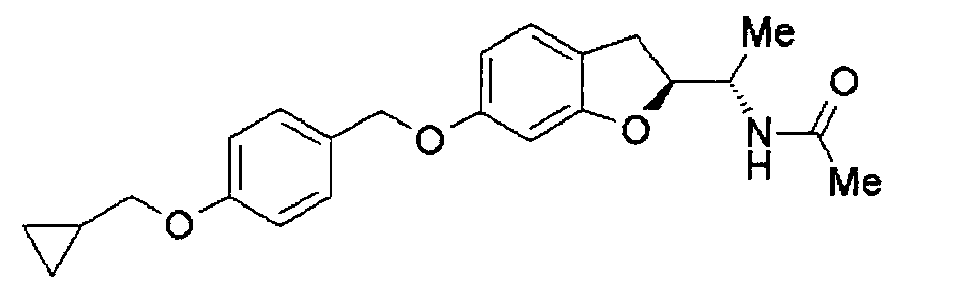
- To a solution of [4-(cyclopropylmethoxy)phenyl]methanol (2.75 g, 15.4 mmol) in toluene (15 mL) was added thionyl chloride (1.5 mL, 21 mmol), and the mixture was stirred at room temperature for 30 min, and concentrated under reduced pressure. To the obtained residue were added DMF (10 mL), N-{(1S)-1-[(2S)-6-hydroxy-2,3-dihydro-1-benzofuran-2-yl]ethyl}acetamide (2.28 g, 10.3 mmol) obtained in Reference Example 259 and potassium carbonate (5.69 g, 41.2 mmol), and the mixture was stirred at 70°C overnight. Water was added thereto and the mixture was extracted with ethyl acetate. The extract was washed with saturated brine, and dried over anhydrous magnesium sulfate. The solvent was evaporated under reduced pressure and the obtained residue was purified by silica gel column chromatography (hexane:ethyl acetate=19:1 to 1:1), and crystallized from acetone-heptane to give the title compound (2.24 g, yield 58%). 1H NMR (CDCl3) δ0.30-0.42 (m, 2H), 0.61-0.70 (m, 2H), 1.19-1.36 (m, 1H), 1.33 (d, J = 6.8 Hz, 3H), 1.91 (s, 3H), 2.85-3.01 (m, 1H), 3.06-3.18 (m, 1H), 3.80 (d, J = 6.8 Hz, 2H), 4.21-4.38 (m, 1H), 4.60-4.85 (m, 1H), 4.93 (s, 2H), 5.49 (d, J = 9.4 Hz, 1H), 6.38-6.51 (m, 2H), 6.86-6.94 (m, 2H), 7.00 (d, J = 8.3 Hz, 1H), 7.29-7.36 (m, 2H).
-

- To a solution of [4-(cyclopropylmethoxy)-2-fluorophenyl]methanol (265 mg, 1.36 mmol) obtained in Reference Example 230 in toluene (2 mL) was added thionyl chloride (0.20 mL, 2.7 mmol), and the mixture was stirred at room temperature for 30 min, and concentrated under reduced pressure. To the obtained residue were added DMF (1.5 mL), N-{(1S)-1-[(2S)-6-hydroxy-2,3-dihydro-1-benzofuran-2-yl]ethyl}acetamide (200 mg, 0.904 mmol) obtained in Reference Example 259 and potassium carbonate (498 mg, 3.62 mmol), and the mixture was stirred at 60°C overnight. Water was added thereto and the mixture was extracted with ethyl acetate. The extract was washed with saturated brine, and dried over anhydrous magnesium sulfate. The solution was applied to basic silica gel column chromatography (ethyl acetate), and the obtained residue was triturated with diisopropyl ether-diethyl ether to give the title compound (303 mg, yield 84%) as a white solid.
1H NMR (CDCl3) δ0.31-0.42 (m, 2H), 0.61-0.71 (m, 2H), 1.19-1.30 (m, 1H), 1.33 (d, J = 6.8 Hz, 3H), 1.91 (s, 3H), 2.87-2.99 (m, 1H), 3.07-3.19 (m, 1H), 3.79 (d, J = 6.8 Hz, 2H), 4.23-4.38 (m, 1H), 4.60-4.85 (m, 1H), 4.99 (s, 2H), 5.50 (d, J = 8.7 Hz, 1H), 6.42-6.50 (m, 2H), 6.64 (dd, J = 11.9, 2.4 Hz, 1H), 6.70 (dd, J = 8.3, 2.6 Hz, 1H), 7.01 (d, J = 7.9 Hz, 1H), 7.34 (t, J = 8.7 Hz, 1H). -

- To a solution of {2-fluoro-4-[(2S)-tetrahydrofuran-2-ylmethoxy]phenyl}methanol (153 mg, 0.677 mmol) obtained in Reference Example 274 in toluene (1 mL) was added thionyl chloride (0.063 mL, 0.90 mmol), and the mixture was stirred at room temperature for 30 min, and concentrated under reduced pressure. To the obtained residue were added DMF (2 mL), N-{(1S)-1-[(2S)-6-hydroxy-2,3-dihydro-1-benzofuran-2-yl]ethyl}acetamide (100 mg, 0.451 mmol) obtained in Reference Example 259 and potassium carbonate (249 mg, 1.81 mmol), and the mixture was stirred at 70°C overnight. Water was added thereto and the mixture was extracted with ethyl acetate. The extract was washed with saturated brine, and dried over anhydrous magnesium sulfate. The solution was applied to basic silica gel column chromatography (ethyl acetate), and the obtained residue was triturated with diisopropyl ether to give the title compound (135 mg, yield 70%) as a white solid.
1H NMR (CDCl3) δ 1.32 (d, J =6.8 Hz, 3H), 1.70-1.82 (m, 1H), 1.87-2.15 (m, 6H), 2.84-3.01 (m, 1H), 3.06-3.21 (m, 1H), 3.77-4.00 (m, 4H), 4.19-4.40 (m, 2H), 4.60-4.85 (m, 1H), 4.99 (s, 2H), 5.53 (d, J = 8.7 Hz, 1H), 6.40-6.52 (m, 2H), 6.62-6.79 (m, 2H), 7.00 (d, J = 7.9 Hz, 1H), 7.34 (t, J = 8.1 Hz, 1H). -

- A solution of 2-(bromomethyl)-5-(cyclopropylmethoxy)benzonitrile (180 mg, 0.677 mmol) obtained in Reference Example 276, N-{(1S)-1-[(2S)-6-hydroxy-2,3-dihydro-1-benzofuran-2-yl]ethyl}acetamide (100 mg, 0.451 mmol) obtained in Reference Example 259 and potassium carbonate (186 mg, 1.35 mmol) in DMF (2 mL) was stirred at 70°C overnight. Thereafter, water was added thereto, and the mixture was extracted with ethyl acetate. This extract was washed with saturated brine, and dried over anhydrous magnesium sulfate. The solution was applied to basic silica gel column chromatography (ethyl acetate), and the obtained residue was triturated with diisopropyl ether to give the title compound (140 mg, yield 74%) as a white solid.
1H NMR (CDCl3) δ0.31-0.43 (m, 2H), 0.63-0.74 (m, 2H), 1.19-1.37 (m, 4H), 1.92 (s, 3H), 2.89-3.00 (m, 1H), 3.07-3.20 (m, 1H), 3.78-3.87 (m, 2H), 4.20-4.40 (m, 1H), 4.60-4.85 (m, 1H), 5.11 (s, 2H), 5.51 (d, J = 9.0 Hz, 1H), 6.43-6.52 (m, 2H), 7.02 (d, J = 8.3 Hz, 1H), 7.11-7.18 (m, 2H), 7.52 (d, J = 8.7 Hz, 1H). -

- To a solution of [5-(cyclopropylmethoxy)-3-fluoropyridin-2-yl]methanol (108 mg, 0.548 mmol) obtained in Reference Example 318, N-[1-(5-hydroxy-1-benzofuran-2-yl)ethyl]acetamide (retention time longer, 120 mg, 0.548 mmol) obtained in Reference Example 257 and polystyrene-supported triphenylphosphine (496 mg, 1.10 mmol) in THF (5 mL) was added dimethoxyethyl azodicarboxylate (154 mg, 0.657 mmol), and the mixture was stirred at room temperature for 3 days. After filtration, the solvent was evaporated under reduced pressure and the obtained residue was purified by basic silica gel column chromatography (hexane:ethyl acetate=1:1 to 0:1), and triturated with diisopropyl ether to give the title compound (97.2 mg, yield 45%) .
1H NMR (CDCl3) δ0.37-0.39 (m, 2H), 0.68-0.70 (m, 2H), 1.26-1.29 (m, 1H), 1.55 (d, J = 6.9 Hz, 3H), 2.02 (s, 3H), 3.86 (d, J = 6.9 Hz, 2H), 5.18 (d, J = 2.1 Hz, 2H), 5.18-5.34 (m, 1H), 5.75 (d, J = 6.9 Hz, 1H), 6.50 (s, 1H), 6.94-6.98 (m, 2H), 7.12 (d, J = 3.0 Hz, 1H), 7.30 (d, J = 9.3 Hz, 1H), 8.17 (d, J = 1.5 Hz, 1H). -

- To a solution of [6-(cyclopropylmethoxy)-4-methylpyridin-3-yl]methanol (132 mg, 0.684 mmol) obtained in Reference Example 320, N-[1-(5-hydroxy-1-benzofuran-2-yl)ethyl]acetamide (retention time longer, 150 mg, 0.684 mmol) obtained in Reference Example 257 and polystyrene-supported triphenylphosphine (619 mg, 1.37 mmol) in THF (7 mL) was added dimethoxyethyl azodicarboxylate (192 mg, 0.821 mmol), and the mixture was stirred at room temperature for 16 hr. After filtration, the solvent was evaporated under reduced pressure and the obtained residue was purified by basic silica gel column chromatography (hexane:ethyl acetate=1:1 to 0:1), and triturated with diisopropyl ether to give the title compound (105 mg, yield 39%).
1H NMR (CDCl3) δ0.32-0.37 (m, 2H), 0.57-0.64 (m, 2H), 1.24-1.30 (m, 1H), 1.56 (d, J = 6.9 Hz, 3H), 2.02 (s, 3H), 2.36 (s, 3H), 4.11 (d, J = 6.9 Hz, 2H), 4.96 (s, 2H), 5.31-5.36 (m, 1H), 5.76 (d, J = 6.9 Hz, 1H), 6.51 (s, 1H), 6.65 (s, 1H), 6.90 (dd, J = 9. 0, 2.7 Hz, 1H), 7.07 (d, J = 2.7 Hz, 1H), 7.32 (d, J = 8.7 Hz, 1H), 8.05 (s, 1H). -

- To a solution of 2-(1-azidoethyl)-6-{2-[4-(cyclopropylmethoxy)phenyl]ethyl}-1-benzofuran (2.05 g, 5.67 mmol) obtained in Reference Example 283 in THF (30 mL)-water (5 mL) was added triphenylphosphine (1.79 g, 6.81 mmol), and the mixture was stirred at 60°C for 15 hr. The solvent was evaporated under reduced pressure and the obtained residue was purified by basic silica gel column chromatography (hexane:ethyl acetate=3:1 to 1:4) to give 1-(6-{2-[4-(cyclopropylmethoxy)phenyl]ethyl}-1-benzofuran-2-yl)ethanamine. This was dissolved in pyridine (10 mL)-acetic anhydride (10 mL), and the solution was stirred at room temperature for 15 min. The solvent was evaporated under reduced pressure and the obtained residue was purified by purified by basic silica gel column chromatography (ethyl acetate) to give the title compound (1.40 g, yield from (2-(1-azidoethyl)-6-{2-[4-(cyclopropylmethoxy)phenyl]ethyl}-1-benzofuran 65%) as a white solid.
1H NMR (CDCl3) δ 0.31-0.36 (m, 2H), 0.60-0.66 (m, 2H), 1.22-1.33 (m, 1H), 1.55 (d, J = 6.8 Hz, 3H), 2.01 (s, 3H), 2.85-2.91 (m, 2H), 2.95-3.01 (m, 2H), 3.77 (d, J = 6.8 Hz, 2H), 5.28-5.38 (m, 1H), 5.82 (d, J = 8.3 Hz, 1H), 6.51 (s, 1H), 6.82 (d, J = 8.7 Hz, 2H), 7.03 (dd, J = 8.0, 1.1 Hz, 1H), 7.07 (d, J = 8.7 Hz, 2H), 7.23 (s, 1H), 7.40 (d, J = 8.0 Hz, 1H). -

- To a solution of 5-{2-[2-(1-azidoethyl)-1-benzofuran-6-yl]ethyl}-1,3-benzodioxole (523 mg, 1.56 mmol) obtained in Reference Example 290 in THF (10 mL) was added triphenylphosphine (491 mg, 1.87 mmol), and the mixture was stirred at 60°C for 30 min. To the reaction mixture was added water (1 mL), and the mixture was stirred at 60°C for 15 hr. The solvent was evaporated under reduced pressure and the obtained residue was purified by basic silica gel column chromatography (hexane:ethyl acetate=13:7 to 0:1) to give 1-{6-[2-(1,3-benzodioxol-5-yl)ethyl]-1-benzofuran-2-yl}ethanamine. This was dissolved in pyridine (5 mL)-acetic anhydride (5 mL), and the solution was stirred at room temperature for 15 min. The solvent was evaporated under reduced pressure and the obtained residue was purified by silica gel column chromatography (hexane:ethyl acetate=1:1 to ethyl acetate) to give the title compound (367 mg, yield from 5-{2-[2-(1-azidoethyl)-1-benzofuran-6-yl]ethyl}-1,3-benzodioxole 67%) as a white solid.
1H NMR (CDCl3) δ 1.56 (d, J = 6.8 Hz, 3H), 2.02 (s, 3H), 2.84-2.89 (m, 2H), 2.95-3.00 (m, 2H), 5.29-5.39 (m, 1H), 5.81 (d, J = 7.7 Hz, 1H), 5.92 (s, 2H), 6.52 (s, 1H), 6.60-6.63 (m, 1H), 6.68 (d, J = 1.5 Hz, 1H), 6.72 (d, J = 7.7 Hz, 1H), 7.02 (dd, J = 7.9, 1.1 Hz, 1H), 7.23 (s, 1H), 7.40 (d, J = 7.9 Hz, 1H). -

- To a solution of 2-(1-azidoethyl)-6-[2-(3,3-dimethyl-2,3-dihydro-1-benzofuran-5-yl)ethyl]-1-benzofuran (1.17 g, 3.70 mmol) obtained in Reference Example 299 in THF (20 mL) was added triphenylphosphine (1.17 g, 4.44 mmol), and the mixture was stirred at 60°C for 30 min. To the reaction mixture was added water (2 mL), and the mixture was stirred at 60°C for 2.5 hr. The solvent was evaporated under reduced pressure and the obtained residue was purified by basic silica gel column chromatography (hexane:ethyl acetate=7:3 to 1:4) to give 1-{6-[2-(3,3-dimethyl-2,3-dihydro-1-benzofuran-5-yl)ethyl]-1-benzofuran-2-yl}ethanamine. This was dissolved in pyridine (5 mL)-acetic anhydride (5 mL), and the solution was stirred at room temperature for 15 min. The solvent was evaporated under reduced pressure and the obtained residue was purified by silica gel column chromatography (hexane:ethyl acetate=1:1 to ethyl acetate) to give the title compound (978 mg, yield from 2-(1-azidoethyl)-6-[2-(3,3-dimethyl-2,3-dihydro-1-benzofuran-5-yl)ethyl]-1-benzofuran 70%) as a white solid.
1H NMR (CDCl3) δ 1.29 (s, 6H), 1.55 (d, J = 6.8 Hz, 3H), 2.02 (s, 3H), 2.85-2.91 (m, 2H), 2.95-3.01 (m, 2H), 4.21 (s, 2H), 5.29-5.38 (m, 1H), 5.80 (d, J = 7.6 Hz, 1H), 6.52 (s, 1H), 6.70 (d, J = 8.3 Hz, 1H), 6.81 (d, J = 1.9 Hz, 1H), 6.94 (dd, J = 8.0, 2.0 Hz, 1H), 7.03 (dd, J = 7.8, 1.3 Hz, 1H), 7.20 (s, 1H), 7.40 (d, J = 8.0 Hz, 1H). -

- To a solution of [6-(cyclopropylmethoxy)-2-fluoropyridin-3-yl]methanol (99.0 mg, 0.502 mmol) obtained in Reference Example 262 in THF (5 mL) were added triethylamine (0.140 mL, 1.00 mmol) and methanesulfonyl chloride (0.595 mL, 0.753 mmol), and the mixture was stirred at room temperature for 30 min. The reaction mixture was diluted with ethyl acetate, and the mixture was washed with saturated aqueous sodium hydrogen carbonate solution, and dried over anhydrous magnesium sulfate. The solvent was evaporated under reduced pressure, and to a solution of the obtained residue and N-[1-(5-hydroxy-1-benzofuran-2-yl)ethyl]acetamide (retention time longer, 73.4 mg, 0.335 mmol) obtained in Reference Example 257 in DMF (5 mL) was added potassium carbonate (92.7 mg, 0.670 mmol). The mixture was stirred at 60°C for 1 hr, water was added thereto and the mixture was extracted with ethyl acetate. The extract was washed twice with saturated brine, and dried over anhydrous magnesium sulfate. The solvent was evaporated under reduced pressure and the obtained residue was purified by preparative TLC (hexane:ethyl acetate=1:9) to give the title compound (37.7 mg, yield 28%) as a white solid.
1H NMR (CDCl3) δ 0.32-0.37 (m, 2H), 0.59-0.65 (m, 2H), 1.21-1.34 (m, 1H), 1.55 (d, J = 6.8 Hz, 3H), 2.02 (s, 3H), 4.11 (d, J = 7.2 Hz, 2H), 5.03 (s, 2H), 5.28-5.38 (m, 1H), 5.77 (d, J = 8.3 Hz, 1H), 6.50 (s, 1H), 6.64 (d, J = 8.3 Hz, 1H), 6.91 (dd, J = 8.9, 2.5 Hz, 1H), 7.05 (d, J = 2.3 Hz, 1H), 7.33 (d, J = 9.1 Hz, 1H), 7.76-7.82 (m, 1H). -

- To a solution of N-[1-(5-hydroxy-1-benzofuran-2-yl)ethyl]acetamide (retention time longer, 1.31 g, 5.96 mmol) obtained in Reference Example 257 and 5-(bromomethyl)-2-(cyclopropylmethoxy)-4-fluoropyridine (2.32 g, 8.93 mmol) obtained in Reference Example 271 in DMF (15 mL) was added potassium carbonate (1.65 mg, 11.9 mmol), and the mixture was stirred at 60°C for 45 min. Water was added thereto and the mixture was extracted with ethyl acetate. The extract was washed twice with saturated brine, and dried over anhydrous magnesium sulfate. The solvent was evaporated under reduced pressure and the obtained residue was purified by basic silica gel column chromatography (hexane:ethyl acetate=3:2 to 0:1) to give the title compound (1.90 g, yield 80%) as a white solid.
1H NMR (CDCl3) δ 0.32-0.37 (m, 2H), 0.58-0.64 (m, 2H), 1.20-1.33 (m, 1H), 1.56 (d, J = 6.8 Hz, 3H), 2.02 (s, 3H), 4.14 (d, J = 7.2 Hz, 2H), 5.04 (s, 2H), 5.29-5.38 (m, 1H), 5.79 (d, J = 8.0 Hz, 1H), 6.48-6.51 (m, 2H), 6.91 (dd, J = 8.7, 2.7 Hz, 1H), 7.07 (d, J = 2.7 Hz, 1H), 7.33 (d, J = 9.1 Hz, 1H), 8.19 (d, J = 10.2 Hz, 1H). -
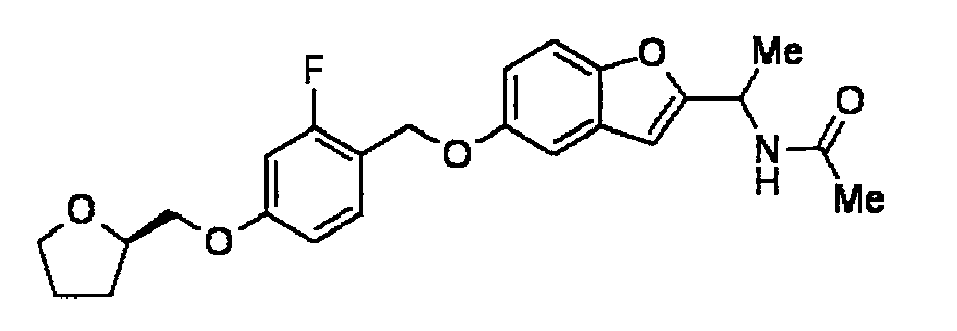
- To a solution of (2R)-2-{[4-(bromomethyl)-3-fluorophenoxy]methyl}tetrahydrofuran (800 mg, 2.78 mmol) obtained in Reference Example 321 in DMF (5 mL) were added N-[1-(5-hydroxy-1-benzofuran-2-yl)ethyl]acetamide (retention time longer) (219 mg,
1.00 mmol) obtained in Reference Example 257 and potassium carbonate (415 mg, 3.00 mmol), and the mixture was stirred at 70°C for 45 min. Water was added thereto and the mixture was extracted with ethyl acetate. The extract was washed twice with saturated brine, and dried over anhydrous magnesium sulfate. The solvent was evaporated under reduced pressure and the obtained residue was purified by basic silica gel column chromatography (hexane:ethyl acetate=1:1 to 0:1) to give the title compound (292 mg, yield 68%) as a white solid. 1H NMR (CDCl3) δ 1.55 (d, J = 5.7 Hz, 3H), 1.69-1.81 (m, 1H), 1.90-2.13 (m, 6H), 3.80-3.97 (m, 4H), 4.22-4.30 (m, 1H), 5.05 (s, 2H), 5.28-5.38 (m, 1H) , 5.78 (d, J = 8.3 Hz, 1H) , 6.50 (s, 1H) , 6. 65-6. 74 (m, 2H), 6.92 (dd, J = 8.7, 2.7 Hz, 1H), 7.05 (d, J = 2.7 Hz, 1H), 7.30-7.39 (m, 2H). -

- To a solution of 2-(1-azidoethyl)-5-[2-(4-methoxyphenyl)ethyl]-1-benzofuran (1.39 g, 4.33 mmol) obtained in Reference Example 308 in THF (20 mL) was added triphenylphosphine (1.36 g, 5.20 mmol), and the mixture was stirred at 60°C for 1 hr.
To the reaction mixture was added water (2 mL), and the mixture was stirred at 60°C for 15 hr. The solvent was evaporated under reduced pressure and the obtained residue was purified by basic silica gel column chromatography (hexane:ethyl acetate=1:1 to 0:1) to give 1-{5-[2-(4-methoxyphenyl)ethyl]-1-benzofuran-2-yl}ethanamine. This was dissolved in pyridine (30 mL)-acetic anhydride (15 mL), and the solution was stirred at room temperature for 2 hr. The solvent was evaporated under reduced pressure and the obtained residue was recrystallized from hexane-ethyl acetate to give the title compound (978 mg, yield 81%) as colorless crystals.
1H NMR (CDCl3) δ 1.56 (d, J = 6.8 Hz, 3H), 2.02 (s, 3H), 2.82-3.00 (m, 4H), 3.79 (s, 3H), 5.28-5.40 (m, 1H), 5.82 (d, J = 7.9 Hz, 1H), 6.49 (s, 1H), 6.78-6.85 (m, 2H), 7.03-7.11 (m, 3H), 7.27-7.35 (m, 2H). -

- To a solution of N-(1-{5-[2-(4-methoxyphenyl)ethyl]-1-benzofuran-2-yl}ethyl)acetamide (922 mg, 2.73 mmol) obtained in Example 156 in methylene chloride (50 mL) was added 1M boron tribromide-methylene chloride solution (5.46 mL, 5.46 mmol) at -78°C, and the mixture was stirred at the same temperature for 4 hr. The reaction mixture was warmed to 0°C, and methanol was added thereto. The solvent was evaporated under reduced pressure, and the residue was extracted with ethyl acetate and water. The organic layer was washed with saturated brine, and dried over anhydrous magnesium sulfate. The solvent was evaporated under reduced pressure and the obtained residue was recrystallized from hexane-ethyl acetate to give the title compound (774 mg, yield 88%) as colorless crystals. 1H-NMR (DMSO-d6) δ 1.43 (d, J = 6.8 Hz, 3H), 1.85 (s, 3H), 2.71-2.96 (m, 4H), 5.03-5.16 (m, 1H), 6.59-6.69 (m, 3H), 6.98 (d, J= 8.3 Hz, 2H), 7.08 (d, J = 8.3 Hz, 1H), 7.32-7.43 (m, 2H), 8.37 (d, J= 8.3 Hz, 1H), 9.10 (br s, 1H).
-

- A suspension of N-(1-{5-[2-(4-hydroxyphenyl)ethyl]-1-benzofuran-2-yl}ethyl)acetamide (333 mg, 1.03 mmol) obtained in Example 157, bromopropane (1.08 g, 6.37 mmol) and potassium carbonate (924 mg, 6.68 mmol) in DMF (10 mL) was stirred at 80°C for 2 days. Water was added thereto, and the mixture was extracted with ethyl acetate. The extract was washed with saturated brine, and dried over anhydrous magnesium sulfate. The solution was applied to silica gel column chromatography (hexane:ethyl acetate=9:11 to 0:1), and recrystallized from hexane-ethyl acetate to give the title compound (294 mg, yield 78%) as colorless crystals.
1H NMR (CDCl3) δ 1.03 (t, J = 7.3 Hz, 3H), 1.56 (d, J = 6.8 Hz, 3H), 1.72-1.87 (m, 2H), 2.01 (s, 3H), 2.82-3.00 (m, 4H), 3.89 (t, J = 6.6 Hz, 2H), 5.28-5.39 (m, 1H), 5.83 (d, J = 8.3 Hz, 1H), 6.49 (s, 1H), 6.77-6.84 (m, 2H), 7.03-7.09 (m, 3H), 7.27-7.35 (m, 2H). -

- Using N-(1-{5-[2-(4-hydroxyphenyl)ethyl]-1-benzofuran-2-yl}ethyl)acetamide (328 mg, 1.01 mmol) obtained in Example 157 and (bromomethyl)cyclopropane (3.97 g, 29.3 mmol) and in the same manner as in Example 158, the title compound was obtained (122 mg, yield 32%) as colorless crystals.
1H NMR (CDCl3) δ 0.30-0.37 (m, 2H), 0.59-0.68 (m, 2H), 1.19-1.34 (m, 1H), 1.56 (d, J = 7.2 Hz, 3H), 2.02 (s, 3H), 2.81-3.00 (m, 4H), 3.77 (d, J = 6.8 Hz, 2H), 5.28-5.40 (m, 1H), 5.80 (d, J = 8.0 Hz, 1H), 6.49 (s, 1H), 6.78-6.84 (m, 2H), 7.03-7.09 (m, 3H), 7.27-7.35 (m, 2H). -

- Using N-(1-{5-[2-(4-hydroxyphenyl)ethyl]-1-benzofuran-2-yl}ethyl)acetamide (124 mg, 0.348 mmol) obtained in Example 157 and bromobutane (263 mg, 1.92 mmol) and in the same manner as in Example 158, the title compound was obtained (96.3 mg, yield 66%) as colorless crystals.
1H NMR (CDCl3) δ 0.97 (t, J = 7.3 Hz, 3H), 1.42-1.60 (m, 5H), 1.69-1.82 (m, 2H), 2.02 (s, 3H), 2.82-2.99 (m, 4H), 3.93 (t, J = 6.6 Hz, 2H), 5.27-5.40 (m, 1H), 5.81 (d, J=8.3Hz, 1H), 6.49 (s, 1H), 6.78-6.84 (m, 2H), 7.03-7.09 (m, 3H), 7.28-7.35 (m, 2H). -

- To a solution of [4-(cyclopropylmethoxy)-2-fluorophenyl]methanol (414 mg, 2.10 mmol) obtained in Reference Example 230 in toluene (10 mL) was added thionyl chloride (752 mg, 6.32 mmol), and the mixture was stirred at room temperature for 1 hr and concentrated under reduced pressure. To the obtained 1-(chloromethyl)-4-(cyclopropylmethoxy)-2-fluorobenzene (199 mg, 0.93 mmol) were added DMF (10 mL), N-[1-(6-hydroxy-1-benzofuran-3-yl)ethyl]acetamide (136 mg, 0.619 mmol) obtained in Reference Example 4 and potassium carbonate (171 mg, 1.24 mmol), and the mixture was stirred at 50°C for 3 hr. Water was added thereto and the mixture was extracted with ethyl acetate. The extract was washed with saturated brine, and dried over anhydrous sodium sulfate. The solvent was evaporated under reduced pressure and the obtained residue was purified by basic silica gel column chromatography (hexane:ethyl acetate=50:50 to 0:100), and recrystallized from hexane-ethyl acetate to give the title compound (132 mg, yield 53%) as colorless crystals.
1H NMR (CDCl3) δ 0.31-0.38 (m, 2H), 0.61-0.70 (m, 2H), 1.20-1.33 (m, 1H), 1.59 (d, J = 6.8 Hz, 3H), 1.99 (s, 3H), 3.79 (d, J = 6.8 Hz, 2H), 5.07 (s, 2H), 5.33-5.45 (m, 1H), 5.57 (d, J = 8.7 Hz, 1H), 6.61-6.73 (m, 2H), 6.94 (dd, J = 8.7, 2.3 Hz, 1H), 7.08 (d, J = 2.3 Hz, 1H), 7.33-7.40 (m, 1H), 7.43-7.49 (m, 2H). -

- To a solution of [4-(cyclopropylmethoxy)phenyl]methanol (428 mg, 2.40 mmol) in toluene (10 mL) was added thionyl chloride (856 mg, 7.20 mmol), and the mixture was stirred at room temperature for 1 hr and concentrated under reduced pressure. To the obtained 1-(chloromethyl)-4-(cyclopropylmethoxy)benzene (179 mg, 0.910 mmol) were added DMF (10 mL), N-[1-(6-hydroxy-1-benzofuran-3-yl)ethyl]acetamide (133 mg, 0.607 mmol) obtained in Reference Example 4 and potassium carbonate (168 mg, 1.21 mmol) and the mixture was stirred at 50°C for 17 hr. Water was added thereto and the mixture was extracted with ethyl acetate. The extract was washed with saturated brine, and dried over anhydrous sodium sulfate. The solvent was evaporated under reduced pressure and the obtained residue was purified by basic silica gel column chromatography (hexane:ethyl acetate=50:50 to 0:100) and recrystallized from hexane-ethyl acetate to give the title compound (110 mg, yield 48%) as colorless crystals.
1H NMR (CDCl3) δ 0.31-0.39 (m, 2H), 0.60-0.69 (m, 2H), 1.20-1.34 (m, 1H), 1.59 (d, J = 6.8 Hz, 3H), 1.99 (s, 3H), 3.81 (d, J = 6.8 Hz, 2H), 5.02 (s, 2H), 5.33-5.45 (m, 1H), 5.56 (d, J = 8.3 Hz, 1H), 6.89-6.97 (m, 3H), 7.06 (d, J = 2.3 Hz, 1H), 7.33-7.38 (m, 2H), 7.41-7.49 (m, 2H). -

- To a solution of N-[1-(6-hydroxy-1-benzofuran-3-yl)ethyl]acetamide (retention time longer) (127 mg, 0.577 mmol) obtained in Reference Example 309 and 5-(bromomethyl)-2-(cyclopropylmethoxy)-4-fluoropyridine (125 mg, 0.481 mmol) obtained in Reference Example 271 in DMF (10 mL) was added potassium carbonate (99.7 mg, 0.721 mmol), and the mixture was stirred at 60°C for 18 hr. Water was added thereto and the mixture was extracted with ethyl acetate. The extract was washed with saturated brine, and dried over anhydrous magnesium sulfate. The solvent was evaporated under reduced pressure and the obtained residue was purified by basic silica gel column chromatography (hexane:ethyl acetate=1:1 to 0:1) and recrystallized from hexane-ethyl acetate to give the title compound (87.5 mg, yield 46%) as colorless crystals.
1H NMR (CDCl3) δ 0.30-0.38 (m, 2H), 0.58-0.66 (m, 2H), 1.20-1.36 (m, 1H), 1.59 (d, J = 6.8 Hz, 3H), 2.00 (s, 3H), 4.14 (d, J = 7.2 Hz, 2H), 5.06 (s, 2H), 5.34-5.46 (m, 1H), 5.57 (d, J = 8.3 Hz, 1H), 6.50 (d, J = 10.9 Hz, 1H), 6.93 (dd, J = 8.7, 2.3 Hz, 1H), 7.09 (d, J = 1.9 Hz, 1H), 7.44-7.52 (m, 2H), 8.20 (d, J= 10.2 Hz, 1H). -

- To a solution of N-[1-(6-hydroxy-1-benzofuran-3-yl)ethyl]acetamide (retention time longer) (142 mg, 0.647 mmol) obtained in Reference Example 309 and 3-(bromomethyl)-6-(cyclopropylmethoxy)-2-fluoropyridine (140 mg, 0.539 mmol) obtained in Reference Example 263 in DMF (10 mL) was added potassium carbonate (112 mg, 0.808 mmol), and the mixture was stirred at 60°C for 18 hr. Water was added thereto and the mixture was extracted with ethyl acetate. The extract was washed with saturated brine, and dried over anhydrous magnesium sulfate. The solvent was evaporated under reduced pressure and the obtained residue was purified by basic silica gel column chromatography (hexane:ethyl acetate=1:1 to 0:1), and recrystallized from hexane-ethyl acetate to give the title compound (89.5 mg, yield 42%) as colorless crystals.
1H NMR (CDCl3) δ 0.31-0.39 (m, 2H), 0.58-0.66 (m, 2H), 1.21-1.35 (m, 1H), 1.59 (d, J = 6.8 Hz, 3H), 2.00 (s, 3H), 4.11 (d, J = 7.2 Hz, 2H), 5.05 (s, 2H), 5.37-5.44 (m, 1H), 5.57 (d, J = 8.7 Hz, 1H), 6.66 (d, J = 7.2 Hz, 1H), 6.93 (dd, J = 8.7, 2.3 Hz, 1H), 7.07 (d, J = 1.9 Hz, 1H), 7.44-7.51 (m, 2H), 7.79 (dd, J = 9.8, 8.3 Hz, 1H). -

- To a solution of N-[1-(6-{2-[4-(methoxymethoxy)phenyl]ethyl}-1-benzofuran-2-yl)ethyl]acetamide (200 mg, 0.545=mmol) obtained in Example 95 in THF (5 mL) was added 6N hydrochloric acid (0.910 mL), and the mixture was stirred at 60°C for 40 min. The reaction mixture was neutralized with saturated aqueous sodium hydrogen carbonate solution and extracted twice with ethyl acetate, and the combined organic layer was dried over anhydrous magnesium sulfate. The solvent was evaporated and the obtained solid was washed with diethyl ether to give the title compound (177 mg, quantitative) as a white solid.
1H NMR (CDCl3) δ 1.56 (d, J = 6.8 Hz, 3H), 2.02 (s, 3H), 2.81-3.07 (m, 4H), 5.01 (s, 1H), 5.28-5.38 (m, 1H), 6.52 (s, 1H), 6.74 (d, J = 8.3 Hz, 2H), 7.02 (m, 3H), 7.21-7.28 (m, 1H), 7.40 (d, J = 8.0 Hz, 1H). -
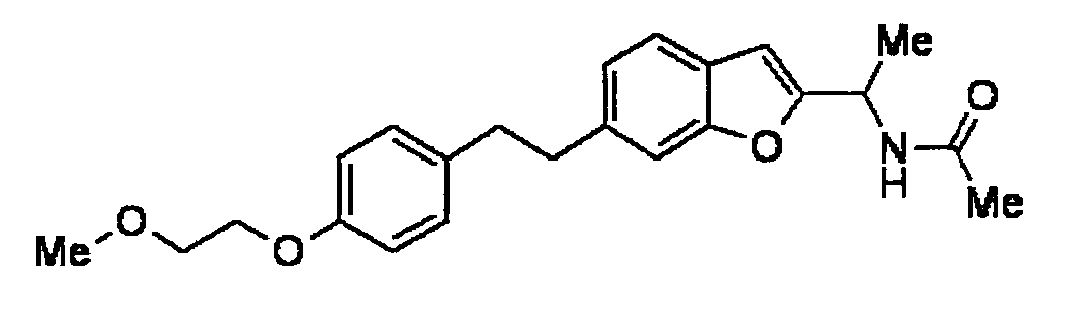
- Using N-(1-{6-[2-(4-hydroxyphenyl)ethyl]-1-benzofuran-2-yl}ethyl)acetamide (32.3 mg, 0.100 mmol) obtained in Example 165 and 2-chloroethyl methyl ether (0.0189 mL, 0.200 mmol) and in the same manner as in Example 158, the title compound was obtained (9.4 mg, yield 25%) as a white solid.
1H NMR (CDCl3) δ 1.54-1.60 (m, 3H), 2.02 (s, 3H), 2.84-3.03 (m, 4H), 3.45 (s, 3H), 3.72-3.78 (m, 2H), 4.08-4.14 (m, 2H), 5.28-5.40 (m, 1H), 5.79 (d, J = 8.7 Hz, 1H), 6.52 (s, 1H), 6.84 (d, J = 8.6 Hz, 2H), 7.02 (d, J = 8.0 Hz, 1H), 7.07 (d, J = 8.6 Hz, 2H), 7.22 (m, 1H), 7.40 (d, J = 8.0 Hz, 1H). -

- Using N-(1-{6-[2-(4-hydroxyphenyl)ethyl]-1-benzofuran-2-yl}ethyl)acetamide (32.3 mg, 0.100 mmol) obtained in Example 165 and 1-bromomethoxypropane (0.0306 mL, 0.200 mmol) and in the same manner as in Example 158, the title compound was obtained (10.5 mg, yield 27%) as a white solid.
1H NMR (CDCl3) δ 1.52-1.63 (m, 3H), 2.00-2.10 (m, 2H), 2.02 (s, 3H), 2.83-3.06 (m, 4H), 3.35 (s, 3H), 3.55 (t, J = 6.1 Hz, 2H), 4.03 (t, J = 6.1 Hz, 2H), 5.28-5.40 (m, 1H), 5.80 (d, J = 8.0 Hz, 1H), 6.52 (s, 1H) , 6.82 (d, J = 8.6 Hz, 2H), 7.03 (d, J= 8.0 Hz, 1H) , 7.08 (d, J = 8.6 Hz, 2H), 7.21-7.29 (m, 1H), 7.40 (d, J = 8.0 Hz, 1H). -

- Using N-(1-{6-[2-(4-hydroxyphenyl)ethyl]-1-benzofuran-2-yl}ethyl)acetamide (32.3 mg, 0.100 mmol) obtained in Example 165 and 1-bromo-2-methylpropane (0.0225 mL, 0.200 mmol) and in the same manner as in Example 158, the title compound was obtained (10.3 mg, yield 27%) as a white solid.
1H NMR (CDCl3) δ 1.02 (d, J = 6.8 Hz, 6H), 1.53-1.58 (m, 3H), 2.00-2.09 (m, 4H), 2.83-3.06 (m, 4H), 3.70 (d, J = 6.4 Hz, 2H), 5.27-5.40 (m, 1H), 5.78 (d, J = 8.7 Hz, 1H), 6.52 (s, 1H), 6.81 (d, J = 8.6 Hz, 2H), 7.03 (dd, J = 8.0, 1.5 Hz, 1H), 7.08 (d, J = 8.6 Hz, 2H), 7.24 (s, 1H), 7.40 (d, J = 8.0 Hz, 1H). -

- Using N-(1-{6-[2-(4-hydroxyphenyl)ethyl]-1-benzofuran-2-yl}ethyl)acetamide (150 mg, 0.464 mmol) obtained in Example 165 and 2-chloroethylmethylsulfide (0.182 mL, 1.86 mmol) and in the same manner as in Example 158, the title compound was obtained (91.9 mg, yield 50%) as a white solid.
1H NMR (CDCl3) δ 1.51-1.62 (m, 3H), 2.02 (s, 3H), 2.21 (s, 3H), 2.81-3.09 (m, 6H), 4.14 (t, J = 6.8 Hz, 2H), 5.27-5.41 (m, 1H), 5.79 (d, J = 9.0 Hz, 1H), 6.52 (s, 1H), 6.82 (d, J = 8.5 Hz, 2H), 7.03 (d, J = 7.9 Hz, 1H), 7.08 (d, J = 8.5 Hz, 2H), 7.23 (s, 1H), 7.40 (d, J = 7.9 Hz, 1H). -

- Using N-(1-{6-[2-(4-hydroxyphenyl)ethyl]-1-benzofuran-2-yl}ethyl)acetamide (40.0 mg, 0.123 mmol) obtained in Example 165 and bromocyclopentane (0.147 mL, 1.85 mmol) and in the same manner as in Example 158, the title compound was obtained (11.9 mg, yield 25%) as a white solid.
1H NMR (CDCl3) δ 1.42-1.93 (m, 11H), 2.02 (s, 3H), 2.80-3.04 (m, 4H), 4.73 (br, 1H), 5.25-5.44 (m, 1H), 5.77 (d, J = 8.3 Hz, 1H), 6.52 (s, 1H), 6.79 (d, J = 8.3 Hz, 2H), 6.98-7.11 (m, 3H), 7.26 (s, 1H), 7.40 (d, J = 7.5 Hz, 1H). -

- To a suspension of (2-methyl-1,3-benzoxazol-6-yl)methanol (66.5 mg, 0.408 mmol) in toluene (1 mL) were added carbon tetrabromide (135 mg, 0.408 mmol) and triphenylphosphine (106 mg, 0.408 mmol) and the mixture was stirred at room temperature for 30 min. The reaction mixture was directly applied to silica gel, and concentrated to dryness to give 6-(bromomethyl)-2-methyl-1,3-benzoxazole as an oil. To the obtained oil (92.0 mg, 0.408 mmol) were added DMF (4 mL), N-[1-(5-hydroxy-1-benzofuran-2-yl)ethyl]acetamide (30.0 mg, 0.136 mmol) obtained in Reference Example 38 and potassium carbonate (37.8 mg, 0.274 mmol), and the mixture was stirred at 50°C for 2 hr. The reaction mixture was directly purified by basic silica gel column chromatography (hexane:ethyl acetate=4:1 to 3:7), and the solvent was evaporated. The residue was triturated with a small amount of ethyl acetate and diethyl ether to give the title compound (17.8 mg, yield 36%) as a white solid.
1H NMR (CDCl3) δ 1.50-1.56 (m, 3H), 2.02 (s, 3H), 2.64 (s, 3H), 5.19 (s, 2H), 5.26-5.41 (m, 1H), 5.76 (d, J= 9.5 Hz, 1H), 6.49 (s, 1H), 6.94 (dd, J = 8.7, 2.7 Hz, 1H), 7.05 (d, J = 2.3 Hz, 1H), 7.30-7.40 (m, 2H), 7.58 (s, 1H), 7.64 (d, J = 8.4 Hz, 1H). - N-[1-(6-{2-[4-(pyridin-2-yloxy)phenyl]ethyl}-1-benzofuran-2-yl)ethyl]acetamide
-

- N-(1-{6-[2-(4-hydroxyphenyl)ethyl]-1-benzofuran-2-yl}ethyl)acetamide (40.0 mg, 0.123 mmol) obtained in Example 165, 2-fluoropyridine (0.0369 mL, 0.371 mmol) and potassium carbonate (51.3 mg, 0.371 mmol) were stirred in DMSO (0.5 mL) at 100°C for 2 days. The reaction mixture was purified by basic silica gel column chromatography (hexane:ethyl acetate=1:0 to 2:3), and the solvent was evaporated. The residue was triturated with a small amount of diisopropyl ether to give the title compound (17.1 mg, yield 35%) as a white solid.
1H NMR (CDCl3) δ 1.48-1.71 (m, 3H), 2.02 (s, 3H), 2.90-3.12 (m, 4H), 5.28-5.43 (m, 1H), 5.78 (d, J = 8.3 Hz, 1H), 6.53 (s, 1H), 6.89 (d, J = 8.3 Hz, 1H), 6.94-7.01 (m, 1H), 7.02-7.10 (m, 3H), 7.16-7.35 (m, 3H), 7.42 (d, J = 8.0 Hz, 1H), 7.62-7.74 (m, 1H), 8.14-8.26 (m, 1H). -

- Using N-(1-{6-[2-(4-hydroxyphenyl)ethyl]-1-benzofuran-2-yl}ethyl)acetamide (150 mg, 0.464 mmol) obtained in Example 165 and (bromomethyl)cyclobutane (0.155 mL, 1.39 mmol) and in the same manner as in Example 158, the title compound was obtained (127 mg, yield 70%) as a white solid.
1H NMR (CDCl3) δ 1.54-1.58 (m, 3H), 1.79-2.00 (m, 4H), 2.02 (s, 3H), 2.07-2.20 (m, 2H), 2.69-2.83 (m, 1H), 2.84-3.03 (m, 4H), 3.90 (d, J = 6.8 Hz, 2H), 5.28-5.40 (m, 1H), 5.77 (d, J = 7.6 Hz, 1H), 6.52 (s, 1H), 6.78-6.85 (m, 2H), 7.03 (dd, J = 8.0, 1.1 Hz, 1H), 7.08 (d, J = 8.3 Hz, 2H), 7.24 (s, 1H), 7.40 (d, J = 8.0 Hz, 1H). -

- To a solution of N-(1-{6-[2-(4-hydroxyphenyl)ethyl]-1-benzofuran-2-yl}ethyl)acetamide (50.0 mg, 0.154 mmol) obtained in Example 165, 2-cyclopropylethanol (0.0529 mL, 0.616 mmol) and triphenylphosphine (161 mg, 0.616 mmol) in THF (1 mL) were added di(methoxyethyl) azodicarboxylate (144 mg, 0.616 mmol), and the mixture was stirred at room temperature for 30 min. The reaction mixture was directly purified by basic silica gel column chromatography (hexane:ethyl acetate=1:0 to 2:3), and the solvent was evaporated. The residue was triturated with a small amount of diisopropyl ether and hexane to give the title compound (25.9 mg, yield 43%) as a white solid.
1H NMR (CDCl3) δ0.09-0.15 (m, 2H), 0.43-0.53 (m, 2H), 0.78-0.94 (m, 1H), 1.47-1.61 (m, 3H), 1.63-1.70 (m, 2H), 2.02 (s, 3H), 2.82-3.04 (m, 4H), 4.01 (t, J = 6.6 Hz, 2H), 5.26-5.43 (m, 1H), 5.79 (br, 1H), 6.52 (s, 1H), 6.78-6.87 (m, 2H), 7.00-7.11 (m, 3H), 7.24 (s, 1H), 7.40 (d, J = 8.1 Hz, 1H). -

- To 2-bromo-4-(bromomethyl)-1-ethoxybenzene (2.47 g) obtained in Reference Example 323 were added DMF (10 mL), N-[1-(6-hydroxy-1-benzofuran-2-yl)ethyl]acetamide (1.40 g, 6.39 mmol) obtained in Reference Example 27 and potassium carbonate (1.76 g, 12.8 mmol),
and the mixture was stirred at 100°C overnight. Water was added thereto and the mixture was extracted three times with ethyl acetate. The combined organic layer was washed with saturated brine, and dried over magnesium sulfate. The solvent was evaporated under reduced pressure, and the residue was purified by basic silica gel column chromatography (hexane:ethyl acetate=9:1 to 2:3), and the solvent was evaporated. The residue was triturated with a small amount of hexane and diisopropyl ether to give the title compound (1.28 g, yield 46%) as a white solid.
1H NMR (CDCl3) δ 1.48 (t, J = 7.0 Hz, 3H), 1.47-1.54 (m, 3H), 2.02 (s, 3H), 4.11 (q, J = 7.0 Hz, 2H), 4.99 (s, 2H), 5.23-5.42 (m, 1H), 5.76 (d, J = 8.3 Hz, 1H), 6.49 (s, 1H), 6.85-6.96 (m, 2H), 7.02 (d, J = 1.9 Hz, 1H), 7.32 (dd, J = 8.5, 2.1 Hz, 1H), 7.38 (d, J = 8.3 Hz, 1H), 7.64 (d, J = 2.2 Hz, 1H). -

- To a solution of 1-(6-{2-[4-(cyclopropylmethoxy)phenyl]ethyl}-1-benzofuran-2-yl)ethanol (100 mg, 0.298 mmol) obtained in Reference Example 282 in THF (2 mL) was added thionyl chloride (0.0390 mL 0.535 mmol), and the mixture was stirred at room temperature for 1 hr. To the reaction mixture was added aqueous sodium hydrogen carbonate solution, and the mixture was extracted twice with ethyl acetate. The combined organic layer was washed with saturated brine, and dried over magnesium sulfate. The solvent was evaporated under reduced pressure and to the obtained residue were added DMF (1 mL), sodium iodide (80.0 mg, 0.573 mmol) and 3-aminoisoxazole (0.0266 mL, 0.358 mmol), and the mixture was stirred at 60°C for 1 hr. Water was added to the reaction mixture, and the mixture was extracted twice with ethyl acetate. The combined organic layer was washed with saturated brine, and dried over magnesium sulfate. The solvent was evaporated under reduced pressure and the obtained residue was purified by silica gel column chromatography (hexane:ethyl acetate=1:0 to 3:2), and the solvent was evaporated. The residue was triturated with a small amount of hexane, diisopropyl ether and toluene to give the title compound (18.6 mg, yield 16%) as a white solid.
1H NMR (CDCl3) δ0.29-0.39 (m, 2H), 0.59-0.71 (m, 2H), 1.18-1.35 (m, 1H), 1.66 (d, J = 6.8 Hz, 3H), 2.81-3.04 (m, 4H), 3.78 (d, J = 6.8 Hz, 2H), 4.30 (d, J = 8.0 Hz, 1H), 4.80-4.98 (m, 1H), 5.86 (d, J = 1.9 Hz, 1H), 6.55 (s, 1H), 6.82 (d, J = 8.3 Hz, 2H), 7.02 (d, J = 8.0 Hz, 1H), 7.08 (d, J = 8.3 Hz, 2H), 7.23 (s, 1H), 7.39 (d, J = 8.0 Hz, 1H), 8.04 (d, J = 2.1 Hz, 1H). -

- To a solution of 1-(6-{2-[4-(cyclopropylmethoxy)phenyl]ethyl}-1-benzofuran-2-yl)ethanone (50.0 mg, 0.149 mmol) obtained in Reference Example 281 and aniline (13.9 mg, 0.149 mmol) in THF (0.5 mL)-methanol (0.5 mL) was added decaborane (18.2 mg 0.149 mmol), and the mixture was stirred at room temperature for 1 hr. Water was added to the reaction mixture, and the mixture was extracted twice with ethyl acetate. The combined organic layer was washed with saturated brine, and dried over magnesium sulfate. The solvent was evaporated under reduced pressure and the obtained residue was purified by silica gel column chromatography (hexane:ethyl acetate=1:0 to 3:2) and basic silica gel column chromatography (hexane:ethyl acetate=1:0 to 3:2). After evaporation of the solvent, to a solution of the obtained oil in ethyl acetate was added 4-toluenesulfonic acid monohydrate (13.6 mg, 0.0715 mmol), and the mixture was stirred at room temperature. The resulting solid was collected by filtration to give the title compound (19.9 mg, yield 23%) as a white solid.
1H NMR (CDCl3) δ0.26-0.42 (m, 2H), 0.57-0.68 (m, 2H), 1.18-1.34 (m, 1H), 1.76 (d, J = 7.2 Hz, 3H), 2.35 (s, 3H), 2.73-3.02 (m, 4H), 3.77 (d, J = 6.8 Hz, 2H), 4.80 (q, J = 6.8 Hz, 1H) , 6.61 (s, 1H) , 6.81 (d, J = 8.7 Hz, 2H), 6.98 (d, J = 8.0 Hz, 1H), 7.02-7.09 (m, 3H), 7.09-7.17 (m, 4H), 7.20 (d, J = 7.2 Hz, 1H), 7.20-7.30 (m, 3H), 7.78 (d, J = 8.4 Hz, 2H). -

- A solution of N-(1-{6-[(3-bromo-4-ethoxybenzyl)oxy]-1-benzofuran-2-yl}ethyl)acetamide (100 mg, 0.231 mmol) obtained in Example 175, cyclopropylboronic acid (58.9 mg, 0.693 mmol), tert-butoxy potassium (77.6 mg, 0.693 mmol), tricyclohexylphosphine (6.50 mg, 0.0231 mmol) and palladium(II) acetate (2.60 mg, 0.0115 mmol) in toluene (4 mL) was stirred under argon at 100°C overnight. To the reaction mixture was added aqueous sodium hydrogen carbonate solution, and the mixture was extracted twice with ethyl acetate. The combined organic layer was washed with saturated brine, and dried over magnesium sulfate. The solvent was evaporated under reduced pressure and the obtained residue was purified by basic silica gel column chromatography (hexane:ethyl acetate=9:1 to 1:1) and triturated with a small amount of hexane and diisopropyl ether to give the title compound (54.6 mg, yield 60%) as a white solid.
1H NMR (CDCl3) δ0.63-0.72 (m, 2H), 0.89-0.97 (m, 2H), 1.45 (t, J= 7.2 Hz, 3H), 1.49-1.55 (m, 3H), 2.01 (s, 3H), 2.15-2.30 (m, 1H), 4.07 (q, J = 7.2 Hz, 2H), 4.96 (s, 2H), 5.25-5.39 (m, 1H), 5.75 (d, J = 6.0 Hz, 1H), 6.48 (s, 1H), 6.83 (d, J = 8.3 Hz, 1H), 6.87-6.94 (m, 2H), 7.03 (d, J = 2.3 Hz, 1H), 7.18 (dd, J = 8.3, 2.3 Hz, 1H), 7.36 (d, J=8.7Hz, 1H). -

- To a solution of 1-(6-{2-[4-(cyclopropylmethoxy)phenyl]ethyl}-1-benzofuran-2-yl)ethanol (300 mg, 0.893 mmol) obtained in Reference Example 282 in toluene (2 mL) was added thionyl chloride (0.116 mL 1.61 mmol), and the mixture was stirred at room temperature for 30 min. The solvent was evaporated under reduced pressure. To the obtained residue were added DMF (2 mL) and 5-amino-3-methylisoxazole (262 mg, 2.68 mmol), and the mixture was stirred at 70°C overnight. The reaction mixture was purified by basic silica gel column chromatography (hexane:ethyl acetate=19:1 to 3:2), and the solvent was evaporated. The residue was triturated with a small amount of hexane and diisopropyl ether to give the title compound (79.0 mg, yield 21%) as a white solid.
1H NMR (CDCl3) δ0.30-0.40 (m, 2H), 0.59-0.68 (m, 2H), 1.18-1.35 (m, 1H), 1.66 (d, J = 6.8 Hz, 3H), 2.14 (s, 3H), 2.84-3.03 (m, 4H), 3.78 (d, J = 6.8 Hz, 2H), 4.59-4.71 (m, 1H), 4.75 (d, J = 7.5 Hz, 1H), 4.88 (s, 1H), 6.53 (s, 1H), 6.76-6.86 (m, 2H), 7.03 (dd, J=7.9, 1.5 Hz, 1H), 7.06-7.12 (m, 2H), 7.22-7.25 (m, 1H), 7.40 (d, J=7.8 Hz, 1H). -
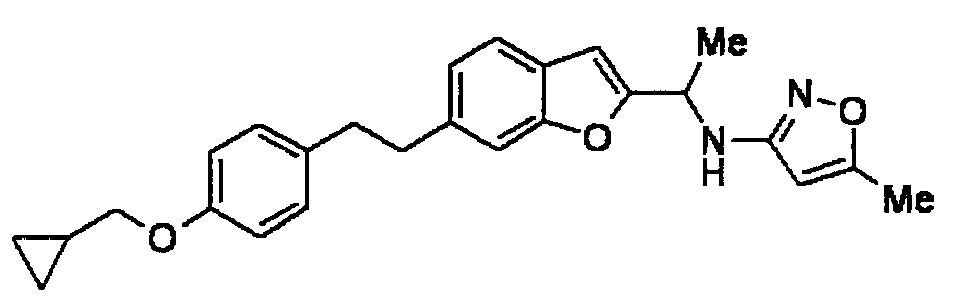
- Using 1-(6-{2-[4-(cyclopropylmethoxy)phenyl]ethyl}-1-benzofuran-2-yl)ethanol (300 mg, 0.893 mmol) obtained in Reference Example 282 and 3-amino-5-methylisoxazole (262 mg, 2.68 mmol) and in the same manner as in Example 179, the title compound was obtained (79.0 mg, yield 21%) as a white solid.
1H NMR (CDCl3) δ0.29-0.38 (m, 2H), 0.57-0.69 (m, 2H), 1.19-1.35 (m, 1H), 1.64 (d, J = 6.8 Hz, 3H), 2.27 (s, 3H), 2.83-3.04 (m, 4H), 3.78 (d, J = 6.8 Hz, 2H), 4.18 (d, J = 8.7 Hz, 1H), 4.74-4.92 (m, 1H), 5.51 (s, 1H), 6.54 (s, 1H), 6.74-6.86 (m, 2H), 7.02 (d, J = 7.9 Hz, 1H), 7.05-7.11 (m, 2H), 7.23 (s, 1H), 7.39 (d, J = 7.8 Hz, 1H). -

- Using 1-(6-{2-[4-(cyclopropylmethoxy)phenyl]ethyl}-1-benzofuran-2-yl)ethanol (300 mg, 0.893 mmol) obtained in Reference Example 282 and 5-amino-1,2,4-thiadiazole (270 mg, 2.68 mmol) and in the same manner as in Example 179, the title compound was obtained (25.3 mg, yield 7%) as a white solid.
1H NMR (CDCl3) δ0.31-0.39 (m, 2H), 0.58-0.69 (m, 2H), 1.18-1.35 (m, 1H), 1.75 (d, J = 6.8 Hz, 3H), 2.82-3.09 (m, 4H), 3.77 (d, J = 6.8 Hz, 2H), 4.78-4.93 (m, 1H), 6.13 (d, J=7.5Hz, 1H), 6.63 (s, 1H), 6.78-6.87 (m, 2H), 7.01-7.11 (m, 3H), 7.24 (s, 1H), 7.42 (d, J = 7.8 Hz, 1H), 7.93 (s, 1H). -

- Using 1-(6-{2-[4-(cyclopropylmethoxy)phenyl]ethyl}-1-benzofuran-2-yl)ethanol (300 mg, 0.893 mmol) obtained in Reference Example 282 and 4-methylisoxazol-3-amine (284 mg, 2.90 mmol) and in the same manner as in Example 179, the title compound was obtained (59.2 mg, yield 16%) as a white solid.
1H NMR (CDCl3) δ0.29-0.40 (m, 2H), 0.59-0.68 (m, 2H), 1.20-1.35 (m, 1H), 1.68 (d, J = 6.8 Hz, 3H), 1.89 (s, 3H), 2.79-3.06 (m, 4H), 3.78 (d, J = 6.8 Hz, 2H), 3.91 (d, J = 7.6 Hz, 1H), 4.92-5.14 (m, 1H), 6.58 (s, 1H), 6.82 (d, J = 8.7 Hz, 2H), 7.02 (d, J = 8.0 Hz, 1H), 7.08 (d, J = 8.7 Hz, 2H), 7.22-7.25 (m, 1H), 7.40 (d, J = 8.0 Hz, 1H), 7.83 (s, 1H). -

- To a solution of [4-(2-cyclopropylethoxy)phenyl]methanol (391 mg, 2.04 mmol) obtained in Reference Example 310 in toluene (2 mL) was added thionyl chloride (0.295 mL, 4.09 mmol), and the mixture was stirred at room temperature for 30 min, and concentrated under reduced pressure. To the obtained residue were added DMF (2 mL), N-[1-(5-hydroxy-1-benzofuran-2-yl)ethyl]acetamide (300 mg, 1.36 mmol) obtained in Reference Example 38 and potassium carbonate (756 mg, 5.48 mmol) and the mixture was stirred at 70°C overnight. Water was added thereto and the mixture was extracted with ethyl acetate. The extract was washed with saturated brine, and dried over anhydrous sodium sulfate. The solvent was evaporated under reduced pressure and the obtained residue was applied to basic silica gel column chromatography (ethyl acetate) and triturated with diisopropyl ether to give the title compound (486 mg, yield 91%) as a white solid. 1H NMR (CDCl3) δ0.09-0.17 (m, 2H), 0.44-0.53 (m, 2H), 0.75-0.95 (m, 1H), 1.51-1.59 (m, 3H), 1.60-1.70 (m, 2H), 2.02 (s, 3H), 4.04 (t, J = 6.8 Hz, 2H), 5.00 (s, 2H), 5.27-5.40 (m, 1H), 5.78 (d, J = 7.9 Hz, 1H), 6.49 (s, 1H), 6.87-6.96 (m, 3H), 7.04 (d, J = 2.6 Hz, 1H), 7.29-7.39 (m, 3H).
-

- To a solution of {4-[(2S)-tetrahydrofuran-2-ylmethoxy]phenyl}methanol (424 mg, 2.04 mmol) obtained in Reference Example 312 in toluene (2 mL) was added thionyl chloride (0.295 mL, 4.09 mmol), and the mixture was stirred at room temperature for 30 min, and concentrated under reduced pressure. To the obtained residue were added DMF (2 mL), N-[1-(5-hydroxy-1-benzofuran-2-yl)ethyl]acetamide (300 mg, 1.36 mmol) obtained in Reference Example 38 and potassium carbonate (756 mg, 5.48 mmol), and the mixture was stirred at 70°C overnight. Water was added thereto and the mixture was extracted with ethyl acetate. The extract was washed with saturated brine, and dried over anhydrous sodium sulfate. The solvent was evaporated under reduced pressure and the obtained residue was applied to basic silica gel column chromatography (ethyl acetate) and triturated with diisopropyl ether to give the title compound (466 mg, yield 84%) as a white solid.
1H NMR (CDCl3) δ 1.55 (d, J = 6.9 Hz, 3H), 1.69-1.84 (m, 1H), 1.84-2.16 (m, 3H), 2.02 (s, 3H), 3.79-4.03 (m, 4H), 4.22-4.35 (m, 1H), 5.00 (s, 2H), 5.24-5.38 (m, 1H), 5.80 (d, J = 8.3 Hz, 1H), 6.49 (s, 1H), 6.87-6.97 (m, 3H), 7.03 (d, J=2.3Hz, 1H), 7.28-7.40 (m, 3H). -

- To a solution of [4-(cyclobutylmethoxy)phenyl]methanol (392 mg, 2.04 mmol) obtained in Reference Example 313 in toluene (2 mL) was added thionyl chloride (0.295 mL, 4.09 mmol), and the mixture was stirred at room temperature for 30 min, and concentrated under reduced pressure. To the obtained residue were added DMF (2 mL), N-[1-(5-hydroxy-1-benzofuran-2-yl)ethyl]acetamide (300 mg, 1.36 mmol) obtained in Reference Example 38 and potassium carbonate (756 mg, 5.48 mmol) and the mixture was stirred at 70°C overnight. Water was added thereto and the mixture was extracted with ethyl acetate. The extract was washed with saturated brine, and dried over anhydrous sodium sulfate. The solvent was evaporated under reduced pressure and the obtained residue was applied to basic silica gel column chromatography (ethyl acetate) and triturated with diisopropyl ether to give the title compound (482 mg, yield 90%) as a white solid. 1H NMR (CDCl3) δ 1.78-1.99 (m, 4H), 2.01 (s, 3H), 2.08-2.25 (m, 2H), 2.65-2.87 (m, 1H), 3.93 (d, J = 6.8 Hz, 2H), 5.00 (s, 2H), 5.19-5.40 (m, 1H), 5.78 (d, J = 8.3 Hz, 1H), 6.49 (s, 1H), 6.83-6.97 (m, 3H), 7.04 (d, J=2.6Hz, 1H), 7.29-7.40 (m, 3H).
-

- To a solution of [4-(cyclopropylmethoxy)-2-methylphenyl]methanol (262 mg, 1.37 mmol) obtained in Reference Example 315 in toluene (2 mL) was added thionyl chloride (0.196 mL, 2.71 mmol), and the mixture was stirred at room temperature for 30 min, and concentrated under reduced pressure. To the obtained residue were added DMF (2 mL), N-[1-(5-hydroxy-1-benzofuran-2-yl)ethyl]acetamide (200 mg, 0.913 mmol) obtained in Reference Example 38 and potassium carbonate (503 mg, 3.65 mmol), and the mixture was stirred at 60°C overnight. Water was added thereto and the mixture was extracted with ethyl acetate. The extract was washed with saturated brine, and dried over anhydrous sodium sulfate. The solvent was evaporated under reduced pressure and the obtained residue was applied to basic silica gel column chromatography (ethyl acetate) and triturated with hexane-diisopropyl ether to give the title compound (222 mg, yield 62%) as a white solid.
1H NMR (CDCl3) δ0.27-0.41 (m, 2H), 0.56-0.71 (m, 2H), 1.23-1.31 (m, 1H), 1.55 (d, J = 6.8 Hz, 3H), 2.02 (s, 3H), 2.36 (s, 3H), 3.80 (d, J = 7.2 Hz, 2H), 4.97 (s, 2H), 5.30-5.36 (m, 1H), 5,81 (d, J = 8.0 Hz, 1H), 6.50 (s, 1H), 6.72 (dd, J = 8.1, 2.5 Hz, 1H), 6.79 (d, J = 2.3 Hz, 1H), 6.92 (dd, J = 8.7, 2.7 Hz, 1H), 7.03 (d, J = 2.7 Hz, 1H), 7.26-7.35 (m, 2H). -

- To a solution of {2-fluoro-4-[(2S)-tetrahydrofuran-2-ylmethoxy]phenyl}methanol (103 mg, 0.457 mmol) obtained in Reference Example 274 in toluene (1 mL) was added thionyl chloride (0.0630 mL, 0.912 mmol), and the mixture was stirred at room temperature for 30 min, and concentrated under reduced pressure. To the obtained residue were added DMF (1 mL), N-[1-(5-hydroxy-1-benzofuran-2-yl)ethyl]acetamide (retention time longer) (50.0 mg, 0.228 mmol) obtained in Reference Example 257 and potassium carbonate (157 mg, 1.14 mmol) and the mixture was stirred at 70°C overnight. Water was added thereto and the mixture was extracted with ethyl acetate. The extract was washed with saturated brine, and dried over anhydrous magnesium sulfate. The solvent was evaporated under reduced pressure and the obtained residue was applied to basic silica gel column chromatography (ethyl acetate) and triturated with diisopropyl ether to give the title compound (85.5 mg, yield 88%) as a white solid.
1H NMR (CDCl3) δ 1.55 (d, J = 6.8 Hz, 3H), 1.67-1.84 (m, 1H), 1.85-2.16 (m, 6H), 3.78-3.99 (m, 4H), 4.17-4.32 (m, 1H), 5.05 (s, 2H), 5.25-5.39 (m, 1H), 5.81 (d, J=8.3Hz, 1H), 6.49 (s, 1H), 6.60-6.78 (m, 3H), 7.05 (d, J = 2.7 Hz, 1H), 7.28-7.41 (m, 2H). -

- N-[1-(6-{ [4-(cyclopropylmethoxy)-2-fluorobenzyl]oxy}-1-benzofuran-3-yl)ethyl]acetamide (610 mg) obtained in Example 161 was optically resolved by high performance liquid chromatography (HPLC) under the following conditions to give two kinds of optically active forms of "retention time longer (285 mg)" and "retention time shorter (286 mg)".
<preparative HPLC conditions>
column: CHIRALCEL OJ (50 mmIDx500 mmL)
mobile phase: hexane:ethanol=7:3
flow rate: 60 mL/min
column temperature: 40°C
detection: UV 220 nm
<HPLC analysis conditions>
column: CHIRALCEL OJ (4.6 mmID×250 mmL)
mobile phase: hexane:ethanol=7:3
flow rate: 0.5 mL/min
column temperature: 40°C
detection: UV 220 nm
retention time of "retention time longer": 19.5 min
retention time of "retention time shorter": 15.0 min -

- N-(1-{6-[2-(4-butoxyphenyl)ethyl]-1-benzofuran-2-yl}ethyl)acetamide (340 mg) obtained in Example 44 was optically resolved by high performance liquid chromatography (HPLC) under the following conditions to give two kinds of optically active forms of "retention time longer (132 mg)" and "retention time shorter (158 mg) ".
<preparative HPLC conditions>
column: CHIRALPAK AS (50 mmID×500 mmL)
mobile phase: hexane:ethanol=9:1
flow rate: 80 mL/min
column temperature: 25°C
detection: UV 220 nm
<HPLC analysis conditions>
column: CHIRALPAK AS (4.6 mmID×250 mmL)
mobile phase: hexane:ethanol=9:1
flow rate: 1.0 mL/min
column temperature: 30°C
detection: UV 220 nm
retention time of "retention time longer": 13.4 min
retention time of "retention time shorter": 10.3 min -

- N-(1-{6-[2-(4-ethoxyphenyl)ethyl]-1-benzofuran-2-yl}ethyl)acetamide (295 mg) obtained in Example 20 was optically resolved by high performance liquid chromatography (HPLC) under the following conditions to give two kinds of optically active forms of "retention time longer (141 mg)" and "retention time shorter (133 mg)".
<preparative HPLC conditions>
column: CHIRALPAK AS (50 mmIDx500 mmL)
mobile phase: hexane:ethanol=9:1
flow rate: 80 mL/min
column temperature: 25°C
detection: UV 220 nm
<HPLC analysis conditions>
column: CHIRALPAK AS (4.6 mmIDx250 mmL)
mobile phase: hexane:ethanol=9:1
flow rate: 1.0 mL/min
column temperature: 30°C
detection: UV 220 nm
retention time of "retention time longer": 19.1 min
retention time of "retention time shorter": 13.7 min -

- N-[1-(6-{2-[4-(cyclopropylmethoxy)phenyl]ethyl}-1-benzofuran-2-yl)ethyl]acetamide (340 mg) obtained in Example 150 was optically resolved by high performance liquid chromatography (HPLC) under the following conditions to give two kinds of optically active forms of "retention time longer (136 mg)" and "retention time shorter (149 mg) ".
<preparative HPLC conditions>
column: CHIRALPAK AS (50 mmID×500 mmL)
mobile phase: hexane:ethanol=9:1
flow rate: 80 mL/min
column temperature: 25°C
detection: UV 220 nm
<HPLC analysis conditions>
column: CHIRALPAK AS (4.6 mmIDx250 mmL)
mobile phase: hexane:ethanol=9:1
flow rate: 1.0 mL/min
column temperature: 30°C
detection: UV 220 nm
retention time of "retention time longer": 16.9 min
retention time of "retention time shorter": 13.0 min - The ACC2 inhibitory action of the compound of the present invention was evaluated by the following method.
- Human ACC2 gene was cloned by PCR using a human skeletal muscle cDNA library (Clontech) as a template and Primer 1 and Primer 2 shown below. Primer 1 and Primer 2 were prepared by adding SalI, XbaI restriction enzyme recognition sequences based on the information of the base sequence of human ACC2 gene (Genbank Accession U89344).
- Primer 1: 5'-AAAAGTCGACCCACCATGGTCTTGCTTCTTTGTCTATCTTG-3' (SEQ ID NO:1)
- Primer 2: 5'-TTTTTCTAGATCAGGTAGAGGCCGGGCTGTCCATG-3' (SEQ ID NO:2)
- Primer 3: 5'-CCAGGTCGACCCGCCAACGGGACTGGGACACAAGG-3' (SEQ ID NO:3)
- Primer 4: 5'-CGCACTCTCAGTTTCCCGGATTCCC-3' (SEQ ID NO:4)
- SF-9 cells (Invitrogen) were inoculated to a medium (2 L) for insect cells (Sf-900IISFM medium (Invitrogen) containing 10% fetal bovine serum (Trace), 50 mg/L Gentamicin (Invitrogen), 0.1% Pluronic F-68 (Invitrogen)) at 0.5×10⁶ cells/mL, and cultured with shaking in Wave Bioreactor (Wave) at 27°C, 20 rpm, rocking angle 6°, oxygen concentration 30%.
On day 4 of the culture, 3 L of the medium for insect cells was added, the rocking angle was set to 8°, and the cells were cultured. On day 5 of the culture, 100 mL of recombinant Baculovirus BAC-ACC2 (Nd) was added, 5 L of the medium for insect cells was further added, the rocking angle was set to 11°, and the cells were cultured for 3 days. The culture medium was centrifuged at 1000xg for 10 min to give virus-infected cells. The cells were washed with phosphate buffered saline (Invitrogen) and centrifuged under the same conditions. The obtained cells were cryopreserved at -80°C.
The cryopreserved cells were thawed in ice and suspended in 900 mL of 25 mM HEPES buffer (pH 7.5) containing 10% Glycerol, 0.13 M NaCl, 1 mM EDTA, 25 mM Sodium β-Glycerophosphate and 1 mM Sodium Orthovanadate, and supplemented with Complete Protease Inhibitor (Nippon Boehringer Ingelheim Co., Ltd.). The obtained suspension was homogenized three times in a polytron homogenizer (Kinematica) at 20,000 rpm for 30 sec. The obtained cell disruption solution was clarified by centrifugation at 31000xg for 60 min, and filtered through a 0.45 µm filter. The filtrate was passed through a column packed with 60 mL of Ni-NTA Super Flow Gel (QUIAGEN) at a flow rate of about 5 mL/min. The column was washed with buffer A (50 mM HEPES (pH 7.5) containing 0.3 M NaCl), further washed with buffer A containing 20 mM Imidazole, and eluted with buffer A containing 100 mM Imidazole. The eluate was concentrated with Vivaspin 20 (Vivascience) with a molecular weight cut off of 30K. The obtained concentrate was dialyzed against 50 mM HEPES (pH 7.5) containing 10 mM MgCl2, 2 mM Dithiothreitol, 10 mM Tripotassium Citrate and 0.3 M NaCl. The inner dialysate was filtered through a 0.22 µm filter to give ACC2 (Nd). The obtained ACC2 (Nd) was cryopreserved at -80°C. - ACC2 (Nd) (1.1 mg/ml) obtained in the above-mentioned (2) was diluted with an enzyme reaction buffer (50 mM HEPES (pH 7.5), 10 mM MgCl2, 10 mM Tripottasium Citrate, 2 mM Dithiothreitol, 0.75 mg/ml Fatty acid free BSA) to a concentration of 6.4 µg/ml, and the mixture was added to each well of a 384 well assay plate (Nunc 265196) by 10 µl. A test compound was dissolved in dimethyl sulfoxide (DMSO) and the mixture was diluted with an enzyme reaction buffer and the resulting solution (5 µl) was added to each well. The mixture was incubated at 30°C for 60 min. Then, a substrate solution (50 mM KHCO3, 200 µM ATP, 200 µM Acetyl-CoA, 5 µl) was added to each well, and the mixture was reacted at 30°C for 20 min (test compound addition group).
In addition, a reaction was performed in the same manner as above and without adding the test compound (test compound non-addition group).
Furthermore, a reaction was performed in the same manner as above and without adding the test compound and Acetyl-CoA (control group).
The reaction was quenched by adding a malachite green solution to each of the obtained reaction mixtures by 5 µl and stirring the mixtures. The obtained reaction mixture was left standing at room temperature for 20 min, and absorbance (620 nm) was measured using wallac1420 (PerkinElmer Japan Co., Ltd.). The above-mentioned malachite green solution was prepared by mixing Solution A (0.12% malachite green solution, prepared with 5N H2SO4, preserved at 4°C in shading), Solution B (7.5% aqueous ammonium molybdate solution, prepared when in use) and Solution C (11% aqueous Tween 20 solution, preserved at room temperature) at a ratio of Solution A: Solution B: Solution C=100:25:2 (volume ratio).
ACC2 inhibitory rate (%) was determined according to the following calculation formula. The calculation results are shown in Table 3 together with those of Experimental Example 2.
- The ACC1 inhibitory action of the compound of the present invention was evaluated by the following method.
- Human ACC1 gene was cloned by PCR using a human liver cDNA library (Clontech) as a template and Primer 1 and Primer 2 shown below. Primer 1 and Primer 2 were prepared by adding SalI, NotI restriction enzyme recognition sequences based on the information of the base sequence of human ACC1 gene (Genbank Accession U19822).
- Primer 1: 5'-AAAAGTCGACCCACCATGGATGAACCTTCTCCCTTGGCCC-3' (SEQ ID NO: 5)
- Primer 2: 5'-AAAAGCGGCCGCCTACGTAGAAGGGGAGTCCATAGTG-3' (SEQ ID NO: 6)
- SF-9 cells (Invitrogen) were inoculated to a medium (1 L) for insect cells (Sf-900IISFM medium (Invitrogen) containing 10% fetal bovine serum (Trace), 50 mg/L Gentamicin (Invitrogen), 0.1% Pluronic F-68 (Invitrogen)) at 1×10⁶ cells/mL, and cultured with shaking in 2L meyer at 27°C, 100 rpm.
After 24 hr of the culture, 10 mL of recombinant Baculovirus BAC-ACC1 was added, and the cells were cultured for 3 days. The culture medium was centrifuged at 1000xg for 5 min to give virus-infected cells. The cells were washed with phosphate buffered saline (Invitrogen) and centrifuged under the same conditions. The obtained cells were cryopreserved at -80°C.
The cryopreserved cells were thawed in ice and suspended in 100 mL of 25 mM HEPES buffer (pH 7.5) containing 10% Glycerol, 0.13 M NaCl, 1 mM EDTA, 25 mM Sodium β-Glycerophosphate and 1 mM Sodium Orthovanadate, and supplemented with Complete Protease Inhibitor (Nippon Boehringer Ingelheim Co., Ltd.). The obtained suspension was homogenized three times in a polytron homogenizer (Kinematica) at 20,000 rpm for 30 sec. The obtained cell disruption solution was clarified by centrifugation at 185700xg for 50 min, and filtered through a 0.45 µm filter. The filtrate was passed through a column packed with 12 mL of Ni-NTA Super Flow Gel (QUIAGEN) at a flow rate of about 5 mL/min. The column was washed with buffer A (50 mM HEPES (pH 7.5) containing 0.3 M NaCl), further washed with buffer A containing 20 mM Imidazole, and eluted with buffer A containing 100 mM Imidazole. The eluate was concentrated with Vivaspin 20 (Vivascience) with a molecular weight cut off of 30K. The obtained concentrate was dialyzed against Sephadex G-25 (Amersham Biosciences, 358 mL) equilibrated with 50 mM HEPES (pH 7.5) containing 10 mM MgCl2, 2 mM Dithiothreitol, 10 mM Tripotassium Citrate and 0.3 M NaCl. The inner dialysate was concentrated with Vivaspin 20 (Vivascience) with molecular weight cut off of 30K, and concentrate was filtered through a 0.22 µm filter to give ACC1. The obtained ACC1 was cryopreserved at -80°C. - ACC1 (0.93 mg/ml) obtained in the above-mentioned (2) was diluted with an enzyme reaction buffer (50 mM HEPES (pH 7.5), 10 mM MgCl2, 10 mM Tripottasium Citrate, 2 mM Dithiothreitol, 0.75 mg/ml Fatty acid free BSA) to a concentration of 8 µg/ml, and the mixture was added to each well of a 384 well assay plate (Nunc 265196) by 10 µl. A test compound was dissolved in dimethyl sulfoxide (DMSO) and the mixture was diluted with an enzyme reaction buffer and the resulting solution (5 µl) was added to each well. The mixture was incubated at 30°C for 60 min. Then, a substrate solution (50 mM KHCO3, 200 µM ATP, 200 µM Acetyl-CoA, 5 µl) was added to each well, and the mixture was reacted at 30°C for 20 min (test compound addition group).
In addition, a reaction was performed in the same manner as above and without adding the test compound (test compound non-addition group).
Furthermore, a reaction was performed in the same manner as above and without adding the test compound and Acetyl-CoA (control group).
The reaction was quenched by adding a malachite green solution to each of the obtained reaction mixtures by 5 µl and stirring the mixtures. The obtained reaction mixture was left standing at room temperature for 20 min, and absorbance (620 nm) was measured using wallac1420 (PerkinElmer Japan Co., Ltd.). The above-mentioned malachite green solution was prepared by mixing Solution A (0.12% malachite green solution, prepared with 5N H2SO4, preserved at 4°C in shading), Solution B (7.5% aqueous ammonium molybdate solution, prepared when in use) and Solution C (11% aqueous Tween 20 solution, preserved at room temperature) at a ratio of Solution A: Solution B: Solution C=100:25:2 (volume ratio).
ACC1 inhibitory rate (%) was determined in the same manner as in the aforementioned Experimental Example 1-(3). The inhibitory rates against ACC1 and ACC2 at 10 µm are shown in Table 3. -
[Table 3-1] Example No. ACC1 10 µM inhibitory rate (%) ACC2 10 µM inhibitory rate (%) 18 15 85 19 24 78 20 23 83 27 18 76 28 19 81 32 36 84 37 -4 77 39 17 80 42 1 76 44 35 78 47 37 91 48 10 78 94 19 80 95 43 80 107 12 70 110 40 78 111 30 78 115 25 76 116 (retention time longer) 24 63 121 35 73 123 8 78 124 16 81 125 33 83 129 (retention time longer) 51 86 130 (retention time longer) 25 62 132 (retention time longer) 46 91 134 (retention time longer) 33 55 135 14 81 138 22 70 139 37 100 140 20 66 141 (retention time shorter) 41 95 142 42 74 143 8 73 144 48 88 145 42 88 146 40 84 150 27 81 -
[Table 3-2] 152 39 78 153 24 70 154 39 78 164 50 93 169 23 75 170 30 84 174 34 80 175 15 74 176 31 88 189 (retention time shorter) 37 77 190 (retention time longer) 29 79 191 (retention time shorter) 20 75 - As shown in Table 3, the compound of the present invention has a superior ACC2 inhibitory action. It shows only a low activity against ACC1, and has superior ACC2 selectivity.
-
Formulation Example 1 (production of capsules) 1) compound of Example 1 30 mg 2) finely divided powder cellulose 10 mg 3) lactose 19 mg 4) magnesium stearate 1 mg total 60 mg 1), 2), 3) and 4) are mixed and filled in a gelatin capsule. -
Formulation Example 2 (production of tablets) 1) compound of Example 1 30 g 2) lactose 50 g 3) cornstarch 15 g 4) calcium carboxymethylcellulose 44 g 5) magnesium stearate 1 g 1000 tablets total 140 g - The compound of the present invention has ACC (acetyl-CoA carboxylase) inhibitory action, and is useful for the prophylaxis or treatment of obesity, diabetes, hypertension, hyperlipidemia, cardiac failure, diabetic complications, metabolic syndrome, sarcopenia, cancer and the like.
- This application is based on patent application Nos.
276171/2008 037468/2009 142769/2009 

as to L1 and L2,
ring M is
a benzene ring or pyridine ring, each of which is optionally substituted by 1 to 3 substituents selected from
The C3-10 cycloalkyl group, C3-10 cycloalkenyl group, C4-10 cycloalkadienyl group, C6-14 aryl group, C7-13 aralkyl group and C8-13 arylalkenyl group which are exemplified as the above-mentioned "hydrocarbon group" optionally have 1 to 3 substituents at substitutable positions.
as to L1 and L2,
A is an acyl group
(preferably
L2 is methylene or O.
as to L1 and L2,
as to L1 and L2,
A plasmid for expression of ACC2 without a mitochondrial targeting sequence was prepared by PCR using the expression plasmid as a template, and Primer 3 (SalI restriction enzyme recognition sequence was added) and Primer 4 prepared by reference to the information of human ACC2 gene base sequence (Genbank Accession U89344) .
Using the expression plasmid ACC2mito7/pFAST-BacHTa and BAC-TO-BAC Baculovirus Expression System (Invitrogen), virus stock BAC-ACC2 of recombinant Baculovirus (N terminal deleted (hereinafter Nd)) was prepared.
Using the expression plasmid ACC1/pFAST-BacHTc and BAC-TO-BAC Baculovirus Expression System (Invitrogen), virus stock BAC-ACC1 of recombinant Baculovirus was prepared.
Claims (19)
- A compound represented by the formula (I):
 A is an acyl group or an optionally substituted 5- or 6-membered aromatic ring group;ring M is an optionally fused 5- to 7-membered ring which is optionally further substituted;as to ring P and ring Q,(1) ring P is optionally further substituted 5-membered heterocycle, ring Q is optionally further substituted 6-membered ring, and ring P and ring Q are condensed to form an optionally further substituted bicyclic aromatic heterocycle, or(2) ring P is an optionally further substituted 5-membered non-aromatic ring, ring Q is an optionally substituted 6-membered aromatic ring, and ring P and ring Q are condensed to form an optionally substituted bicyclic non-aromatic ring;R1 is an optionally substituted C1-6 alkyl group or an optionally substituted C3-6 cycloalkyl group; andas to L1 and L2,provided that the following compounds are excluded:(1) L1 and L2 are independently optionally substituted methylene, O, S, SO or SO2, or(2) L1 and L2 in combination form optionally substituted vinylene, or ethynylene,(a) a compound wherein A is an α-aminoisobutyloyl group; and(b) a compound wherein A is a 5- or 6-membered aromatic ring group substituted by a group represented by the formula: -CO-(CH2)3-COORA1 wherein RA1 is a hydrogen atom or a C1-6 alkyl group, or a group represented by the formula: -CO-NRA2-CRA3RA4-CRA5RA6-COORA7 wherein RA2, RA3, RA4, RA5 and RA7 are independently a hydrogen atom or a C1-6 alkyl group; and RA6 is a hydrogen atom, a C1-6 alkyl group or a hydroxy group,or a salt thereof.
 - A compound represented by the formula (I):
 A is an acyl group or an optionally substituted 5- or 6-membered aromatic ring group;ring M is an optionally fused 5- to 7-membered ring which is optionally further substituted;ring P is optionally further substituted 5-membered heterocycle,ring Q is optionally further substituted 6-membered ring, and ring P and ring Q are condensed to form an optionally further substituted bicyclic aromatic heterocycle;R1 is an optionally substituted C1-6 alkyl group or an optionally substituted C3-6 cycloalkyl group;L1 and L2 are independently optionally substituted methylene, O, S, SO or SO2,provided that the following compounds are excluded:(a) a compound wherein A is an α-aminoisobutyloyl group; and(b) a compound wherein A is a 5- or 6-membered aromatic ring group substituted by a group represented by the formula: -CO-(CH2)3-COORA1 wherein RA1 is a hydrogen atom or a C1-6 alkyl group, or a group represented by the formula: -CO-NRA2-CRA3RA4-CRA5RA6-COORA7 wherein RA2, RA3, RA4, RA5 and RA7 are independently a hydrogen atom or a C1-6 alkyl group; and RA6 is a hydrogen atom, a C1-6 alkyl group or a hydroxy group,or a salt thereof.
 - The compound of claim 1, wherein R1 is a C1-6 alkyl group or a C3-6 cycloalkyl group.
- The compound of claim 1, wherein R1 is a C1-6 alkyl group.
- The compound of claim 1, wherein A is(1) a C1-6 alkyl-carbonyl group, or(2) a 5-membered aromatic heterocyclic group optionally substituted by 1 to 3 substituents selected from (i) a halogen atom and (ii) a C1-6 alkyl group.
- The compound of claim 1, wherein ring M is a benzene ring or pyridine ring, each of which is optionally substituted by 1 to 3 substituents selected from(1) a halogen atom,(2) a C1-6 alkyl group,(3) a C1-6 alkoxy group optionally substituted by 1 to 3 substituents selected from (i) a halogen atom, (ii) a C1-6 alkoxy group, (iii) a C3-10 cycloalkyl group, (iv) a heterocyclic group and (v) a C6-14 aryl group,(4) a C3-10 cycloalkoxy group optionally substituted by 1 to 3 substituents selected from (i) a halogen atom and (ii) a C1-6 alkoxy group, and(5) a hydroxy group.
- The compound of claim 1, wherein ring P and ring Q are condensed to form

- The compound of claim 1, wherein(1) L1 and L2 are independently methylene or O, or(2) L1 and L2 in combination form ethynylene or vinylene.
- The compound of claim 1, whereinA is(1) a C1-6 alkyl-carbonyl group, or(2) a 5-membered aromatic heterocyclic group optionally substituted by 1 to 3 substituents selected from (i) a halogen atom and (ii) a C1-6 alkyl group;R1 is a C1-6 alkyl group;ring M isa benzene ring or pyridine ring, each of which is optionally substituted by 1 to 3 substituents selected from(1) a halogen atom,(2) a C1-6 alkyl group,(3) a C1-6 alkoxy group optionally substituted by 1 to 3 substituents selected from (i) a halogen atom, (ii) a C1-6 alkoxy group, (iii) a C3-10 cycloalkyl group, (iv) a heterocyclic group and (v) a C6-14 aryl group,(4) a C3-10 cycloalkoxy group optionally substituted by 1 to 3 substituents selected from (i) a halogen atom and (ii) a C1-6 alkoxy group, and(5) a hydroxy group;ring P and ring Q are condensed to formas to L1 and L2
 (1) L1 and L2 are independently methylene or O, or(2) L1 and L2 in combination form ethynylene or vinylene.
 - N-{(1S)-1-[(2S)-6-{[4-(Cyclopropylmethoxy)-2-fluorobenzyl]oxy}-2,3-dihydro-1-benzofuran-2-yl]ethyl}acetamide or a salt thereof.
- N-[1-(5-{[6-(Cyclopropylmethoxy)-4-fluoropyridin-3-yl]methoxy}-1-benzofuran-2-yl)ethyl]acetamide or a salt thereof.
- N-(1-{6-[2-(4-Ethoxyphenyl)ethyl]-1-benzofuran-2-yl}ethyl)acetamide or a salt thereof.
- N-[1-(5-{[4-(Cyclopropylmethoxy)benzyl]oxy}-1-benzofuran-2-yl)ethyl]acetamide or a salt thereof.
- A prodrug of the compound of claim 1.
- A medicament comprising the compound of claim 1 or a prodrug thereof.
- The medicament of claim 15, which is an acetyl-CoA carboxylase inhibitor.
- The medicament of claim 15, which is an agent for the prophylaxis or treatment of obesity, diabetes, hypertension, hyperlipidemia, cardiac failure, diabetic complications, metabolic syndrome, sarcopenia or cancer.
- A method for the prophylaxis or treatment of obesity, diabetes, hypertension, hyperlipidemia, cardiac failure, diabetic complications, metabolic syndrome, sarcopenia or cancer in a mammal, which comprises administering an effective amount of the compound of claim 1 or a prodrug thereof to the mammal.
- Use of the compound of claim 1 or a prodrug thereof, for the production of an agent for the prophylaxis or treatment of obesity, diabetes, hypertension, hyperlipidemia, cardiac failure, diabetic complications, metabolic syndrome, sarcopenia or cancer.
Applications Claiming Priority (4)
| Application Number | Priority Date | Filing Date | Title |
|---|---|---|---|
| JP2008276171 | 2008-10-27 | ||
| JP2009037468 | 2009-02-20 | ||
| JP2009142769 | 2009-06-15 | ||
| PCT/JP2009/068356 WO2010050445A1 (en) | 2008-10-27 | 2009-10-26 | Bicyclic compound |
Publications (2)
| Publication Number | Publication Date |
|---|---|
| EP2351743A1 true EP2351743A1 (en) | 2011-08-03 |
| EP2351743A4 EP2351743A4 (en) | 2012-05-09 |
Family
ID=42128807
Family Applications (1)
| Application Number | Title | Priority Date | Filing Date |
|---|---|---|---|
| EP09823555A Withdrawn EP2351743A4 (en) | 2008-10-27 | 2009-10-26 | Bicyclic compound |
Country Status (4)
| Country | Link |
|---|---|
| US (1) | US8501804B2 (en) |
| EP (1) | EP2351743A4 (en) |
| JP (1) | JP5535931B2 (en) |
| WO (1) | WO2010050445A1 (en) |
Cited By (15)
| Publication number | Priority date | Publication date | Assignee | Title |
|---|---|---|---|---|
| WO2012032014A1 (en) * | 2010-09-06 | 2012-03-15 | Boehringer Ingelheim International Gmbh | Ethyne derivatives, pharmaceutical compositions and uses thereof |
| WO2012074126A1 (en) * | 2010-11-30 | 2012-06-07 | Takeda Pharmaceutical Company Limited | Bicyclic compound |
| WO2013071169A1 (en) * | 2011-11-11 | 2013-05-16 | Nimbus Apollo, Inc. | Acc inhibitors and uses thereof |
| WO2014182950A1 (en) | 2013-05-10 | 2014-11-13 | Nimbus Apollo, Inc. | Acc inhibitors and uses thereof |
| US9988399B2 (en) | 2013-05-10 | 2018-06-05 | Gilead Apollo, Llc | Bicyclic compounds as ACC inhibitors and uses thereof |
| US10150728B2 (en) | 2013-10-17 | 2018-12-11 | Shionogi & Co., Ltd. | Alkylene derivatives |
| US10179793B2 (en) | 2015-10-26 | 2019-01-15 | Gilead Apollo, Llc | ACC inhibitors and uses thereof |
| US10183951B2 (en) | 2016-03-02 | 2019-01-22 | Gilead Apollo, Llc | Solid forms of a thienopyrimidinedione ACC inhibitor and methods for production thereof |
| US10208063B2 (en) | 2013-05-10 | 2019-02-19 | Gilead Apollo, Llc | ACC inhibitors and uses thereof |
| US10208044B2 (en) | 2013-05-10 | 2019-02-19 | Gilead Apollo, Llc | ACC inhibitors and uses thereof |
| US10800791B2 (en) | 2015-11-25 | 2020-10-13 | Gilead Apollo, Llc | Triazole ACC inhibitors and uses thereof |
| US10941157B2 (en) | 2015-11-25 | 2021-03-09 | Gilead Apollo, Llc | Pesticidal compositions and uses thereof |
| US10941158B2 (en) | 2015-11-25 | 2021-03-09 | Gilead Apollo, Llc | Pyrazole ACC inhibitors and uses thereof |
| US11098055B2 (en) | 2015-11-25 | 2021-08-24 | Gilead Apollo, Llc | Ester ACC inhibitors and uses thereof |
| US11833150B2 (en) | 2017-03-28 | 2023-12-05 | Gilead Sciences, Inc. | Methods of treating liver disease |
Families Citing this family (14)
| Publication number | Priority date | Publication date | Assignee | Title |
|---|---|---|---|---|
| UY33354A (en) * | 2010-04-27 | 2011-12-01 | Takeda Pharmaceutical | BICYCLE COMPOUND AS ACC INHIBITOR |
| US8835472B2 (en) | 2010-09-02 | 2014-09-16 | Boehringer Ingelheim International Gmbh | Compounds, pharmaceutical compositions and uses thereof |
| WO2012108478A1 (en) * | 2011-02-09 | 2012-08-16 | 武田薬品工業株式会社 | Monocyclic compound |
| JPWO2013061962A1 (en) * | 2011-10-24 | 2015-04-02 | 武田薬品工業株式会社 | Bicyclic compound |
| JP6106179B2 (en) * | 2012-02-24 | 2017-03-29 | 武田薬品工業株式会社 | Aromatic ring compounds |
| EP2876109A4 (en) | 2012-07-23 | 2016-03-16 | Yuhan Corp | FUSHANE-CONTAINING FURANE-CONTAINING COMPOUND OR SALT THEREOF AND PHARMACEUTICAL COMPOSITION COMPRISING THE SAME |
| MX2016002479A (en) | 2013-09-12 | 2016-05-31 | Pfizer | Use of acetyl-coa carboxylase inhibitors for treating acne vulgaris. |
| JP2016079168A (en) | 2014-10-17 | 2016-05-16 | 塩野義製薬株式会社 | 9 membered condensed-ring derivative |
| CN107207444B (en) * | 2014-11-26 | 2020-07-24 | 武田药品工业株式会社 | Bicyclic compounds |
| HRP20191327T1 (en) | 2015-06-03 | 2019-11-01 | Bristol Myers Squibb Co | 4-HYDROXY-3- (HETEROARYL) PYRIDIN-2-ON APJ AGONISTS FOR USE IN THE TREATMENT OF CARDIOVASCULAR DISORDERS |
| JP2019512519A (en) * | 2016-03-21 | 2019-05-16 | ザ スクリプス リサーチ インスティテュート | Pd (II) -Catalyzed Enantioselective .BETA.-Methylene C (sp3) -H Bond Activation |
| CN112218871B (en) * | 2018-06-05 | 2022-10-18 | 南京明德新药研发有限公司 | Thieno [2,3-c ] pyridazin-4 (1H) -one derivatives and application thereof |
| MX2023014819A (en) | 2021-06-14 | 2024-03-21 | Scorpion Therapeutics Inc | Urea derivatives which can be used to treat cancer. |
| JPWO2023090411A1 (en) * | 2021-11-19 | 2023-05-25 |
Family Cites Families (79)
| Publication number | Priority date | Publication date | Assignee | Title |
|---|---|---|---|---|
| US4808595A (en) | 1986-12-24 | 1989-02-28 | Merck & Co., Inc. | Furopyridine sulfonamides and their opthalmological compositions |
| ES2059408T3 (en) * | 1987-02-10 | 1994-11-16 | Abbott Lab | A PROCESS FOR THE PREPARATION OF A COMPOUND. |
| US4992464A (en) | 1987-02-10 | 1991-02-12 | Abbott Laboratories | Heteroaryl N-hydroxy amides and ureas with polar substituents as 5-lipoxygenase inhibitors |
| US5250565A (en) | 1987-02-10 | 1993-10-05 | Abbott Laboratories | Indole-,benzofuran-,and benzothiophene-containing lipoxygenase-inhibiting compounds |
| US4873259A (en) | 1987-06-10 | 1989-10-10 | Abbott Laboratories | Indole, benzofuran, benzothiophene containing lipoxygenase inhibiting compounds |
| US5290798A (en) * | 1991-09-30 | 1994-03-01 | Merck Frosst Canada, Inc. | (hetero-arylmethoxy)indoles as inhibitors of leukotriene biosynthesis |
| DE69317399T2 (en) | 1993-01-29 | 1998-07-02 | American Cyanamid Co | Aminocycloalkanobenzodioxole as beta-3 selective adrenergic agents |
| AU674613B2 (en) | 1993-09-28 | 1997-01-02 | Otsuka Pharmaceutical Co., Ltd. | Quinoxaline derivative as antidiabetic agent |
| JPH0859458A (en) | 1994-08-25 | 1996-03-05 | Zeria Pharmaceut Co Ltd | Hyperlipidemia therapeutic agent containing indane derivative |
| CN1072649C (en) | 1995-09-13 | 2001-10-10 | 武田药品工业株式会社 | Benzoxazepine compounds, their production method and use |
| JP4136024B2 (en) | 1995-12-29 | 2008-08-20 | 富山化学工業株式会社 | 2-aminothiazol derivative or salt thereof |
| HUP0102902A3 (en) * | 1998-06-16 | 2002-02-28 | Sod Conseils Rech Applic | Cyclic somatostatin analogs, process for production thereof and their use |
| TWI248435B (en) | 1998-07-04 | 2006-02-01 | Boehringer Ingelheim Pharma | Benzimidazoles, the preparation thereof and their use as pharmaceutical compositions |
| US6525203B1 (en) | 1999-03-12 | 2003-02-25 | Bristol-Myers Squibb Company | Heterocyclic aromatic compounds useful as growth hormone secretagogues |
| US6518292B1 (en) | 1999-03-12 | 2003-02-11 | Bristol-Myers Squibb Co. | Heterocyclic aromatic compounds usefuls as growth hormone secretagogues |
| JP4011819B2 (en) | 1999-04-12 | 2007-11-21 | エーザイ・アール・アンド・ディー・マネジメント株式会社 | Process for producing indole derivatives and intermediates thereof |
| US6355660B1 (en) | 1999-07-20 | 2002-03-12 | Dow Agrosciences Llc | Fungicidal heterocyclic aromatic amides and their compositions, methods of use and preparation |
| AR035016A1 (en) | 1999-08-25 | 2004-04-14 | Takeda Chemical Industries Ltd | COMPOSITION OF AZOL PROMOTER OF PRODUCTION / SECRETION OF NEUROTROFINE, COMPOSITE PRODROGA OF THE SAME, PHARMACEUTICAL COMPOSITION THAT INCLUDES IT AND USE OF THE SAME TO PREPARE THIS LAST. |
| PT1285651E (en) * | 2000-04-28 | 2010-10-21 | Takeda Pharmaceutical | Melanin concentrating hormone antagonists |
| EP1283199A4 (en) * | 2000-05-16 | 2003-12-17 | Takeda Chemical Industries Ltd | MELANIN CONCENTRATION HORMONE ANTAGONIST |
| EP1302462A4 (en) | 2000-07-17 | 2007-07-18 | Takeda Pharmaceutical | Sulphonic derivatives, process for their preparation and their use |
| CN1235583C (en) | 2001-03-05 | 2006-01-11 | 特兰斯泰克制药公司 | Benzimidazole derivatives as therapeutic agents |
| MXPA04001253A (en) | 2001-08-09 | 2004-06-03 | Ono Pharmaceutical Co | Carboxylic acid derivative compounds and drugs comprising these compounds as the active ingredient. |
| CN100473648C (en) | 2001-11-21 | 2009-04-01 | 斯特里克斯有限公司 | Sulfamate-containing 1,2, 4-triazole derivatives as aromatase inhibitors |
| GB0127923D0 (en) | 2001-11-21 | 2002-01-16 | Sterix Ltd | Compound |
| JP2005194191A (en) * | 2001-12-28 | 2005-07-21 | Ajinomoto Co Inc | Drug against obesity and therapeutic drug for fatty liver |
| US6878709B2 (en) | 2002-01-04 | 2005-04-12 | Schering Corporation | 3,4-di-substituted pyridazinediones as CXC chemokine receptor antagonists |
| EP1482931B1 (en) * | 2002-03-05 | 2011-10-19 | TransTech Pharma, Inc. | Mono- and bicyclic azole derivatives that inhibit the interaction of ligands with rage |
| MY139563A (en) | 2002-09-04 | 2009-10-30 | Bristol Myers Squibb Co | Heterocyclic aromatic compounds useful as growth hormone secretagogues |
| EP1551818B1 (en) | 2002-10-09 | 2009-02-04 | Schering Corporation | Thiadiazoledioxides and thiadiazoleoxides as cxc- and cc-chemokine receptor ligands |
| BR0315815A (en) | 2002-11-01 | 2005-09-13 | Takeda Pharmaceutical | Agents for preventing or treating neuropathy, for promoting the production or secretion of a neurotropic factor, for improving pain, neuroprotective and pharmaceutical compound, methods for preventing or treating neuropathy and for promoting the production or secretion of a neurotropic factor. improve pain to protect a nerve in a mammal and produce a compound and use of a compound |
| TW200413381A (en) | 2002-11-04 | 2004-08-01 | Hoffmann La Roche | Novel amino-substituted dihydropyrimido [4,5-d]pyrimidinone derivatives, their manufacture and use as pharmaceutical agents |
| AU2003277576A1 (en) | 2002-11-08 | 2004-06-07 | Takeda Pharmaceutical Company Limited | Receptor function controlling agent |
| US20070004736A1 (en) | 2002-11-22 | 2007-01-04 | Keiji Kubo | Imidazole derivative, process for producing the same, and use |
| AU2003900608A0 (en) | 2003-02-11 | 2003-02-27 | Fujisawa Pharmaceutical Co., Ltd. | Hdac inhibitor |
| US20040186151A1 (en) | 2003-02-12 | 2004-09-23 | Mjalli Adnan M.M. | Substituted azole derivatives as therapeutic agents |
| US7820837B2 (en) | 2003-05-30 | 2010-10-26 | Takeda Pharmaceutical Company Limited | Condensed ring compound |
| EP1669352A4 (en) | 2003-09-30 | 2008-12-17 | Takeda Pharmaceutical | THIAZOLINE DERIVATIVE AND USE |
| WO2005058823A1 (en) | 2003-12-17 | 2005-06-30 | Takeda Pharmaceutical Company Limited | Urea derivative, process for producing the same, and use |
| WO2005066137A1 (en) | 2003-12-19 | 2005-07-21 | Neurogen Corporation | 2,5-diaryl-1h-imidazole-4-carboxamides as neurokinin-3 receptor modulators for the treatment of central nervous system and peripheral diseases |
| US7338968B2 (en) | 2003-12-19 | 2008-03-04 | Schering Corporation | Thiadiazoles AS CXC- and CC- chemokine receptor ligands |
| WO2005068460A1 (en) | 2003-12-22 | 2005-07-28 | Schering Corporation | Isothiazole dioxides as cxc- and cc- chemokine receptor ligands |
| US7456218B2 (en) | 2003-12-25 | 2008-11-25 | Takeda Pharmaceutical Company Limited | 3-(4-benzyloxyphenyl) propanoic acid derivatives |
| WO2005063725A1 (en) | 2003-12-26 | 2005-07-14 | Takeda Pharmaceutical Company Limited | Phenylpropanoic acid derivatives |
| WO2005087710A1 (en) | 2004-03-15 | 2005-09-22 | Takeda Pharmaceutical Company Limited | Aminophenylpropanoic acid derivative |
| JP4859665B2 (en) | 2004-03-30 | 2012-01-25 | 武田薬品工業株式会社 | Alkoxyphenylpropanoic acid derivatives |
| DE102004017932A1 (en) * | 2004-04-14 | 2005-11-03 | Boehringer Ingelheim Pharma Gmbh & Co. Kg | New alkyne compounds having MCH antagonist activity and medicaments containing these compounds |
| TWI396686B (en) | 2004-05-21 | 2013-05-21 | Takeda Pharmaceutical | Cyclic guanamine derivatives, as well as their products and usage |
| CA2568742A1 (en) | 2004-05-29 | 2005-12-08 | 7Tm Pharma A/S | Substituted thiazoleacetic as crth2 ligands |
| PE20060426A1 (en) | 2004-06-02 | 2006-06-28 | Schering Corp | TARTARIC ACID DERIVATIVES AS INHIBITORS OF MMPs, ADAMs, TACE AND TNF-alpha |
| CN101039942A (en) | 2004-09-27 | 2007-09-19 | 伊利舍医药品公司 | Sulfonamides and uses thereof |
| US7776869B2 (en) | 2004-10-18 | 2010-08-17 | Amgen Inc. | Heteroaryl-substituted alkyne compounds and method of use |
| JP2006131559A (en) | 2004-11-05 | 2006-05-25 | Takeda Chem Ind Ltd | Nitrogen-containing heterocyclic compound |
| WO2006094209A2 (en) | 2005-03-03 | 2006-09-08 | Sirtris Pharmaceuticals, Inc. | N-benzimidazolylalkyl-substituted amide sirtuin modulators |
| US8957070B2 (en) | 2005-04-20 | 2015-02-17 | Takeda Pharmaceutical Company Limited | Glucokinase activator compounds, methods of activating glucokinase and methods of treating diabetes and obesity |
| WO2006124874A2 (en) * | 2005-05-12 | 2006-11-23 | Kalypsys, Inc. | Inhibitors of b-raf kinase |
| WO2007002764A2 (en) | 2005-06-29 | 2007-01-04 | Schering Corporation | Di-substituted oxadiazoles as cxc-chemokine receptor ligands |
| US20090054435A1 (en) | 2005-07-29 | 2009-02-26 | Hiroshi Imoto | Phenoxyalkanoic Acid Compound |
| EP1916234B1 (en) | 2005-07-29 | 2014-11-12 | Takeda Pharmaceutical Company Limited | Cyclopropanecarboxylic acid compound |
| CA2617042A1 (en) | 2005-07-29 | 2007-02-01 | Takeda Pharmaceutical Company Limited | Spiro-cyclic compound |
| JP4094660B1 (en) | 2005-08-10 | 2008-06-04 | 武田薬品工業株式会社 | Diabetes treatment |
| CA2619706A1 (en) | 2005-08-17 | 2007-02-22 | Schering Corporation | Novel high affinity quinoline-based kinase ligands |
| JP2007063225A (en) | 2005-09-01 | 2007-03-15 | Takeda Chem Ind Ltd | Imidazopyridine compound |
| AR057960A1 (en) * | 2005-12-02 | 2007-12-26 | Osi Pharm Inc | BICYCLE PROTEIN QUINASE INHIBITORS |
| US8748627B2 (en) * | 2006-02-15 | 2014-06-10 | Abbvie Inc. | Acetyl-CoA carboxylase (ACC) inhibitors and their use in diabetes, obesity and metabolic syndrome |
| US20090281097A1 (en) | 2006-04-14 | 2009-11-12 | Takeda Pharmaceutical Company Limited | Nitrogen-containing heterocyclic compound |
| AU2007265966B2 (en) | 2006-06-27 | 2012-05-17 | Takeda Pharmaceutical Company Limited | Fused cyclic compounds |
| EP2298772A1 (en) | 2006-10-18 | 2011-03-23 | Takeda Pharmaceutical Company Limited | Fused heterocyclic compounds |
| CN101573357B (en) | 2006-10-19 | 2013-01-23 | 武田药品工业株式会社 | Indole compounds |
| US20100093777A1 (en) | 2007-01-25 | 2010-04-15 | Takeda Pharmaceutical Company Limited | Spiro-ring compound |
| WO2008093639A1 (en) | 2007-01-29 | 2008-08-07 | Takeda Pharmaceutical Company Limited | Pyrazole compound |
| AU2008215490A1 (en) | 2007-02-09 | 2008-08-21 | Takeda Pharmaceutical Company Limited | Fused ring compounds as partial agonists of PPAR-gamma |
| EP2123652A1 (en) | 2007-02-20 | 2009-11-25 | Takeda Pharmaceutical Company Limited | Heterocyclic compound |
| JPWO2008136428A1 (en) | 2007-04-27 | 2010-07-29 | 武田薬品工業株式会社 | Nitrogen-containing 5-membered heterocyclic compound |
| EP2157859A4 (en) | 2007-06-19 | 2011-01-12 | Takeda Pharmaceutical | INDAZOLE COMPOUNDS FOR ACTIVATING GLUCOKINASE |
| WO2009026701A1 (en) | 2007-08-29 | 2009-03-05 | Methylgene Inc. | Sirtuin inhibitors |
| EP2234487A4 (en) | 2007-12-19 | 2011-09-07 | Scripps Research Inst | ANILIDES AND ANALOGUE AS RHO-KINASEHEMMER |
| WO2009110985A2 (en) * | 2008-02-29 | 2009-09-11 | Renovis, Inc. | Amide compounds, compositions and uses thereof |
| KR101616140B1 (en) | 2008-03-05 | 2016-04-27 | 다케다 야쿠힌 고교 가부시키가이샤 | Heterocyclic compound |
-
2009
- 2009-10-26 JP JP2010535786A patent/JP5535931B2/en not_active Expired - Fee Related
- 2009-10-26 WO PCT/JP2009/068356 patent/WO2010050445A1/en not_active Ceased
- 2009-10-26 EP EP09823555A patent/EP2351743A4/en not_active Withdrawn
- 2009-10-26 US US13/126,103 patent/US8501804B2/en not_active Expired - Fee Related
Cited By (30)
| Publication number | Priority date | Publication date | Assignee | Title |
|---|---|---|---|---|
| WO2012032014A1 (en) * | 2010-09-06 | 2012-03-15 | Boehringer Ingelheim International Gmbh | Ethyne derivatives, pharmaceutical compositions and uses thereof |
| US8729102B2 (en) | 2010-11-30 | 2014-05-20 | Takeda Pharmaceutical Company Limited | Bicyclic compound |
| WO2012074126A1 (en) * | 2010-11-30 | 2012-06-07 | Takeda Pharmaceutical Company Limited | Bicyclic compound |
| CN109970760B (en) * | 2011-11-11 | 2022-04-26 | 吉利德阿波罗公司 | ACC inhibitors and uses thereof |
| EA030264B1 (en) * | 2011-11-11 | 2018-07-31 | Джилид Аполло, Ллс | Acc inhibitors and uses thereof |
| US8969557B2 (en) | 2011-11-11 | 2015-03-03 | Nimbus Apollo, Inc. | ACC inhibitors and uses thereof |
| CN109970760A (en) * | 2011-11-11 | 2019-07-05 | 吉利德阿波罗公司 | ACC inhibitor and its purposes |
| US9453026B2 (en) | 2011-11-11 | 2016-09-27 | Gilead Apollo, Inc. | ACC inhibitors and uses thereof |
| US10472374B2 (en) | 2011-11-11 | 2019-11-12 | Gilead Apollo, Llc | ACC inhibitors and uses thereof |
| US9944655B2 (en) | 2011-11-11 | 2018-04-17 | Gilead Apollo, Llc | ACC inhibitors and uses thereof |
| WO2013071169A1 (en) * | 2011-11-11 | 2013-05-16 | Nimbus Apollo, Inc. | Acc inhibitors and uses thereof |
| EA030958B1 (en) * | 2013-05-10 | 2018-10-31 | Джилид Аполло, Ллс | Acc inhibitors and uses thereof |
| WO2014182950A1 (en) | 2013-05-10 | 2014-11-13 | Nimbus Apollo, Inc. | Acc inhibitors and uses thereof |
| US9988399B2 (en) | 2013-05-10 | 2018-06-05 | Gilead Apollo, Llc | Bicyclic compounds as ACC inhibitors and uses thereof |
| US9765089B2 (en) | 2013-05-10 | 2017-09-19 | Gilead Apollo, Llc | ACC inhibitors and uses thereof |
| CN105358143B (en) * | 2013-05-10 | 2019-01-22 | 吉利德阿波罗公司 | ACC inhibitors and their uses |
| US10208063B2 (en) | 2013-05-10 | 2019-02-19 | Gilead Apollo, Llc | ACC inhibitors and uses thereof |
| US10208044B2 (en) | 2013-05-10 | 2019-02-19 | Gilead Apollo, Llc | ACC inhibitors and uses thereof |
| CN105358143A (en) * | 2013-05-10 | 2016-02-24 | 尼普斯阿波罗有限公司 | Acc inhibitors and uses thereof |
| US10150728B2 (en) | 2013-10-17 | 2018-12-11 | Shionogi & Co., Ltd. | Alkylene derivatives |
| US10179793B2 (en) | 2015-10-26 | 2019-01-15 | Gilead Apollo, Llc | ACC inhibitors and uses thereof |
| US10800791B2 (en) | 2015-11-25 | 2020-10-13 | Gilead Apollo, Llc | Triazole ACC inhibitors and uses thereof |
| US10941157B2 (en) | 2015-11-25 | 2021-03-09 | Gilead Apollo, Llc | Pesticidal compositions and uses thereof |
| US10941158B2 (en) | 2015-11-25 | 2021-03-09 | Gilead Apollo, Llc | Pyrazole ACC inhibitors and uses thereof |
| US11098055B2 (en) | 2015-11-25 | 2021-08-24 | Gilead Apollo, Llc | Ester ACC inhibitors and uses thereof |
| US10487090B2 (en) | 2016-03-02 | 2019-11-26 | Gilead Apollo, Llc | Solid forms of a thienopyrimidinedione ACC inhibitor and methods for production thereof |
| US11104687B2 (en) | 2016-03-02 | 2021-08-31 | Gilead Apollo, Llc | Solid forms for a thienopyrimidinedione ACC inhibitor and methods for production thereof |
| US10183951B2 (en) | 2016-03-02 | 2019-01-22 | Gilead Apollo, Llc | Solid forms of a thienopyrimidinedione ACC inhibitor and methods for production thereof |
| US11912718B2 (en) | 2016-03-02 | 2024-02-27 | Gilead Apollo, Llc | Solid forms of a thienopyrimidinedione ACC inhibitor and methods for production thereof |
| US11833150B2 (en) | 2017-03-28 | 2023-12-05 | Gilead Sciences, Inc. | Methods of treating liver disease |
Also Published As
| Publication number | Publication date |
|---|---|
| US20120010247A1 (en) | 2012-01-12 |
| WO2010050445A1 (en) | 2010-05-06 |
| US8501804B2 (en) | 2013-08-06 |
| JP5535931B2 (en) | 2014-07-02 |
| JPWO2010050445A1 (en) | 2012-03-29 |
| EP2351743A4 (en) | 2012-05-09 |
Similar Documents
| Publication | Publication Date | Title |
|---|---|---|
| US8501804B2 (en) | Bicyclic compound | |
| EP2838891B1 (en) | Aromatic ring compound as ghrelin o-acyltransferase inhibitor | |
| EP2649062B1 (en) | Bicyclic compounds as inhibitors of acetyl-coa carboxylase (acc) | |
| EP2210876B1 (en) | Heterocyclic compound as glucagon antagonist | |
| EP2202223B1 (en) | Heterocyclic compound as blood rbp4 lowering agent | |
| EP1421078B1 (en) | Indole derivatives as beta-3 adrenergic agonists for the treatment of type 2 diabetes | |
| US9133129B2 (en) | Bicyclic compound | |
| EP2251326A1 (en) | Heterocyclic compound | |
| EP2471789A1 (en) | Fused heterocyclic ring derivative and use thereof | |
| TW201105654A (en) | Azetidinyl diamides as monoacylglycerol lipase inhibitors | |
| JP5528348B2 (en) | Fused ring compounds and uses thereof | |
| SG185759A1 (en) | Bicyclic compound derivatives and their use as acc inhibitors. | |
| EP2128163A1 (en) | Spiro-ring compound | |
| WO2010001869A1 (en) | Tetra-substituted benzene compound and use thereof | |
| EP2371826A1 (en) | Novel fused ring compound and use thereof | |
| EP4382527A1 (en) | Aromatic acetylene derivative, and preparation method therefor and use thereof | |
| EP2471793B1 (en) | Fused heterocyclic ring derivative and use thereof | |
| WO2013147026A1 (en) | Aromatic ring compound | |
| HK1150604A (en) | Heterocyclic compound | |
| HK1152932B (en) | Fused ring compounds and use thereof |
Legal Events
| Date | Code | Title | Description |
|---|---|---|---|
| PUAI | Public reference made under article 153(3) epc to a published international application that has entered the european phase |
Free format text: ORIGINAL CODE: 0009012 |
|
| 17P | Request for examination filed |
Effective date: 20110427 |
|
| AK | Designated contracting states |
Kind code of ref document: A1 Designated state(s): AT BE BG CH CY CZ DE DK EE ES FI FR GB GR HR HU IE IS IT LI LT LU LV MC MK MT NL NO PL PT RO SE SI SK SM TR |
|
| RIN1 | Information on inventor provided before grant (corrected) |
Inventor name: KINA, ASATO Inventor name: YAMASHITA, TOHRU Inventor name: KAMATA, MAKOTO Inventor name: TAWADA, MICHIKO |
|
| RIN1 | Information on inventor provided before grant (corrected) |
Inventor name: YAMASHITA, TOHRU Inventor name: KINA, ASATO Inventor name: TAWADA, MICHIKO Inventor name: KAMATA, MAKOTO |
|
| DAX | Request for extension of the european patent (deleted) | ||
| A4 | Supplementary search report drawn up and despatched |
Effective date: 20120412 |
|
| RIC1 | Information provided on ipc code assigned before grant |
Ipc: A61P 9/12 20060101ALI20120504BHEP Ipc: C07D 405/06 20060101ALI20120504BHEP Ipc: C07D 235/14 20060101AFI20120504BHEP Ipc: C07D 491/04 20060101ALI20120504BHEP Ipc: C07D 417/12 20060101ALI20120504BHEP Ipc: C07D 407/06 20060101ALI20120504BHEP Ipc: A61P 3/04 20060101ALI20120504BHEP Ipc: A61P 35/00 20060101ALI20120504BHEP Ipc: A61P 3/10 20060101ALI20120504BHEP Ipc: A61K 31/4196 20060101ALI20120504BHEP Ipc: A61K 31/343 20060101ALI20120504BHEP Ipc: A61P 3/06 20060101ALI20120504BHEP Ipc: A61K 31/4355 20060101ALI20120504BHEP Ipc: A61P 9/04 20060101ALI20120504BHEP Ipc: A61K 31/437 20060101ALI20120504BHEP Ipc: A61K 31/423 20060101ALI20120504BHEP Ipc: A61P 21/00 20060101ALI20120504BHEP Ipc: A61K 31/428 20060101ALI20120504BHEP Ipc: A61K 31/443 20060101ALI20120504BHEP |
|
| 17Q | First examination report despatched |
Effective date: 20121210 |
|
| STAA | Information on the status of an ep patent application or granted ep patent |
Free format text: STATUS: THE APPLICATION IS DEEMED TO BE WITHDRAWN |
|
| 18D | Application deemed to be withdrawn |
Effective date: 20150501 |