EP2313377B1 - Verfahren zur stereoselektiven synthese bicyclischer heterocyclen - Google Patents
Verfahren zur stereoselektiven synthese bicyclischer heterocyclen Download PDFInfo
- Publication number
- EP2313377B1 EP2313377B1 EP09804535.4A EP09804535A EP2313377B1 EP 2313377 B1 EP2313377 B1 EP 2313377B1 EP 09804535 A EP09804535 A EP 09804535A EP 2313377 B1 EP2313377 B1 EP 2313377B1
- Authority
- EP
- European Patent Office
- Prior art keywords
- formula
- compound
- methyl
- compounds
- chloro
- Prior art date
- Legal status (The legal status is an assumption and is not a legal conclusion. Google has not performed a legal analysis and makes no representation as to the accuracy of the status listed.)
- Active
Links
- ACDGQSDJVBKOAN-MGCOHNPYSA-N CN(CCN(C1)[C@H](CC2)CC[C@@H]2O)C1=O Chemical compound CN(CCN(C1)[C@H](CC2)CC[C@@H]2O)C1=O ACDGQSDJVBKOAN-MGCOHNPYSA-N 0.000 description 2
- BCJUDTIFZMUVFM-UHFFFAOYSA-N CN(CC(OC)OC)C(CCl)=O Chemical compound CN(CC(OC)OC)C(CCl)=O BCJUDTIFZMUVFM-UHFFFAOYSA-N 0.000 description 1
- VBLHBIVIYALIRV-UHFFFAOYSA-N CN(CC(OC)OC)C(CNC1CCCCC1)=O Chemical compound CN(CC(OC)OC)C(CNC1CCCCC1)=O VBLHBIVIYALIRV-UHFFFAOYSA-N 0.000 description 1
- ODHXWVQVZILUJT-UHFFFAOYSA-N CN(CCN(C1)C(CC2)CCC2OS(C)(=O)=O)C1=O Chemical compound CN(CCN(C1)C(CC2)CCC2OS(C)(=O)=O)C1=O ODHXWVQVZILUJT-UHFFFAOYSA-N 0.000 description 1
- YXXIKNDNYIUFMT-UHFFFAOYSA-N CN(CCN(C1)C(CC2)CCC2Oc(cc(c(N=CN2Cc3ccccc3)c3)C2=O)c3OC)C1=O Chemical compound CN(CCN(C1)C(CC2)CCC2Oc(cc(c(N=CN2Cc3ccccc3)c3)C2=O)c3OC)C1=O YXXIKNDNYIUFMT-UHFFFAOYSA-N 0.000 description 1
- HUMIEJNVCICTPJ-UHFFFAOYSA-N CNCC(OC)OC Chemical compound CNCC(OC)OC HUMIEJNVCICTPJ-UHFFFAOYSA-N 0.000 description 1
- IMLXLGZJLAOKJN-IZLXSQMJSA-N N[C@H](CC1)CC[C@@H]1O Chemical compound N[C@H](CC1)CC[C@@H]1O IMLXLGZJLAOKJN-IZLXSQMJSA-N 0.000 description 1
Classifications
-
- C—CHEMISTRY; METALLURGY
- C07—ORGANIC CHEMISTRY
- C07D—HETEROCYCLIC COMPOUNDS
- C07D241/00—Heterocyclic compounds containing 1,4-diazine or hydrogenated 1,4-diazine rings
- C07D241/02—Heterocyclic compounds containing 1,4-diazine or hydrogenated 1,4-diazine rings not condensed with other rings
- C07D241/06—Heterocyclic compounds containing 1,4-diazine or hydrogenated 1,4-diazine rings not condensed with other rings having one or two double bonds between ring members or between ring members and non-ring members
- C07D241/08—Heterocyclic compounds containing 1,4-diazine or hydrogenated 1,4-diazine rings not condensed with other rings having one or two double bonds between ring members or between ring members and non-ring members with oxygen atoms directly attached to ring carbon atoms
-
- A—HUMAN NECESSITIES
- A61—MEDICAL OR VETERINARY SCIENCE; HYGIENE
- A61P—SPECIFIC THERAPEUTIC ACTIVITY OF CHEMICAL COMPOUNDS OR MEDICINAL PREPARATIONS
- A61P35/00—Antineoplastic agents
-
- C—CHEMISTRY; METALLURGY
- C07—ORGANIC CHEMISTRY
- C07D—HETEROCYCLIC COMPOUNDS
- C07D471/00—Heterocyclic compounds containing nitrogen atoms as the only ring hetero atoms in the condensed system, at least one ring being a six-membered ring with one nitrogen atom, not provided for by groups C07D451/00 - C07D463/00
- C07D471/12—Heterocyclic compounds containing nitrogen atoms as the only ring hetero atoms in the condensed system, at least one ring being a six-membered ring with one nitrogen atom, not provided for by groups C07D451/00 - C07D463/00 in which the condensed system contains three hetero rings
- C07D471/20—Spiro-condensed systems
Definitions
- the present invention is a process for the stereoselective preparation of compounds of general formula (I) and their salts, in particular their physiologically tolerated salts with inorganic or organic acids and bases, which have valuable pharmacological properties, in particular an inhibitory effect on tyrosine kinase-mediated signal transduction, their use for the treatment of diseases, in particular tumors and benign prostatic hyperplasia (BPH) , diseases of the lungs and respiratory tract.
- diseases in particular tumors and benign prostatic hyperplasia (BPH) , diseases of the lungs and respiratory tract.
- Quinazoline derivatives are known in the art as drugs, for example, for the treatment of tumors as well as diseases of the lung and the respiratory tract. Processes for the preparation of quinazoline derivatives are described in WO03082831 as in EP1921070 described.
- the present invention solves the above object via the synthesis method described below.
- a chlorinating agent selected from the group consisting of oxalyl chloride, thionyl chloride, phosphorus oxychloride, phosphorus pentachloride, an N-chlorosuccinimide / triphenylphosphane combination, a carbon tetrachloride / Triphenylphosphan combination, dichlorotriphenylphosphorane and P, P-dichloro-phenylphosphine used becomes.
- Another object of the invention is the compound of formula (II).
- Another object of the invention is the compound of formula (VIII).
- the compounds according to the invention can be used in the form of the tautomers and in the form of the free bases or the corresponding acid addition salts with pharmacologically acceptable acids, for example acid addition salts with hydrohalic acids, for example hydrochloric or hydrobromic acid, inorganic acids, for example phosphoric acid or sulfuric acid or organic acids, for example oxalates.
- pharmacologically acceptable acids for example acid addition salts with hydrohalic acids, for example hydrochloric or hydrobromic acid, inorganic acids, for example phosphoric acid or sulfuric acid or organic acids, for example oxalates.
- hydrohalic acids for example hydrochloric or hydrobromic acid
- inorganic acids for example phosphoric acid or sulfuric acid or organic acids, for example oxalates.
- Fumaric, diglycol, toluenesulfonic, benzoic, succinic or methanesulfonic acid for example, toluenesulfonic acid.
- Process step (1a) is preferably selected in a solvent selected from the group consisting of dimethylformamide (DMF), N-methyl-2-pyrrolidone (NMP), N-ethyl-2-pyrrolidone (NEP) and dimethyl sulfoxide (DMSO), preferably in NMP carried out.
- a solvent selected from the group consisting of dimethylformamide (DMF), N-methyl-2-pyrrolidone (NMP), N-ethyl-2-pyrrolidone (NEP) and dimethyl sulfoxide (DMSO), preferably in NMP carried out.
- Process step (1a) is preferably carried out in a temperature range from 70 ° C to 150 ° C, preferably from 100 ° C to 145 ° C, particularly preferably at a temperature of 140 ° C.
- process step (1a) preference is given to using bases selected from the group consisting of Na 2 CO 3 , K 2 CO 3 , Cs 2 CO 3 , preferably Na 2 CO 3 .
- Process step (2a) is preferably carried out in a solvent selected from the group consisting of DMF, NMP, NEP and DMSO, preferably carried out in NMP.
- Process step (2a) is preferably carried out in a temperature range from 70 ° C to 150 ° C, preferably from 100 ° C to 140 ° C, particularly preferably at a temperature of 130 ° C.
- Process step (1b) is preferably carried out in a solvent selected from the group consisting of H 2 O, HOAc, EtOH, n-PrOH, i-PrOH, amyl alcohol and NMP, preferably in H 2 O / HOAc.
- Process step (1b) is preferably carried out in a temperature range from 0 ° C to 140 ° C, preferably from 60 ° C to 100 ° C, particularly preferably at a temperature of 80 ° C.
- process step (1 b) are preferably catalysts selected from the group consisting of Pd / C, Pd (OH) 2 preferably Pd / C, are used.
- Process step (1c) is preferably carried out in a solvent selected from the group consisting of dioxane, acetonitrile, tetrahydrofuran (THF) and diethylene glycol dimethyl ether, preferably in dioxane / acetonitrile.
- Process step (1c) is preferably carried out in a temperature range from 20 ° C to 140 ° C, preferably from 70 ° C to 130 ° C, particularly preferably at a temperature of 120 ° C.
- Process step (1d) is preferably carried out in a solvent selected from the group consisting of H 2 O, HCl aqueous , NMP and acetonitrile, preferably in aqueous HCl.
- auxiliary acids selected from the group consisting of HCl, H 2 SO 4 , H 3 PO 4 , MsOH and TsOH, preferably HCl.
- Process step (1d) is preferably carried out in a temperature range from 5.degree. C. to 100.degree. C., preferably from 10.degree. C. to 40.degree. C., particularly preferably at a temperature of 20.degree.
- the two filtrates of the two batches are combined and poured onto 7100 ml of 30% potassium carbonate solution. At 50 ° C is extracted with 15 L of tert-amyl alcohol. The aqueous phase is extracted twice more with 7500 ml of tert-amyl alcohol. Of the combined organic phases, 28 L of solvent are distilled off. 6 L of n-butyl acetate are added and 8 L of solvent are distilled off. 15 L of n-butyl acetate and 1 kg of Celite are added and heated to 120.degree. The solid is filtered off and washed with 5,000 ml of hot n-butyl acetate. The filtrate is at -5 ° C cooled.
- the compound of the formula (VIII) is formed as an intermediate of the synthesis step (1a). It can also be prepared by storing 350 mg of (trans) -1-methanesulfonyloxy-4- (4-methyl-3-oxopiperazin-1-yl) cyclohexane (II) in a vacuum drying oven at 110 ° C. for 15.5 h. 350 mg new product of the compound of formula (VIII) arise.
- Mass spectrum (ESI + ): m / z 195 [M] +
Landscapes
- Chemical & Material Sciences (AREA)
- Organic Chemistry (AREA)
- Health & Medical Sciences (AREA)
- Life Sciences & Earth Sciences (AREA)
- General Chemical & Material Sciences (AREA)
- Medicinal Chemistry (AREA)
- Nuclear Medicine, Radiotherapy & Molecular Imaging (AREA)
- Pharmacology & Pharmacy (AREA)
- Chemical Kinetics & Catalysis (AREA)
- Animal Behavior & Ethology (AREA)
- General Health & Medical Sciences (AREA)
- Public Health (AREA)
- Veterinary Medicine (AREA)
- Pharmaceuticals Containing Other Organic And Inorganic Compounds (AREA)
- Plural Heterocyclic Compounds (AREA)
- Acyclic And Carbocyclic Compounds In Medicinal Compositions (AREA)
Description
- Gegenstand der vorliegenden Erfindung ist ein Verfahren zur stereoselektiven Herstellung von Verbindungen der allgemeinen Formel (I)

- Chinazolinderivate sind aus dem Stand der Technik als Wirkstoffe beispielsweise zur Behandlung von Tumorerkrankungen als auch von Erkrankungen der Lunge und der Atemwege bekannt. Verfahren zur Herstellung von Chinazolinderivaten werden in
WO03082831 EP1921070 beschrieben. - Es ist die Aufgabe der vorliegenden Erfindung ein stereoselektives Verfahren zur Herstellung der erfindungsgemäßen Chinazolinderivate bereitzustellen.
- Die vorliegende Erfindung löst die vorstehend genannte Aufgabe über das im Folgenden beschriebene Syntheseverfahren.
- Gegenstand der Erfindung ist somit ein Verfahren zur stereoselektiven Herstellung von Verbindungen der allgemeinen Formel (I),

worin
R1 ein Rest ausgewählt aus der Gruppe bestehend aus 3-Chlor-2-fluor-phenyl-amino-, 3-Chlor-4-fluor-phenylamino-, 2-Fluor-3-methyl-phenylamino-, 2,5-Difluor-3-methyl-phenylamino-, 3-Chlor-2-methyl-phenylamino- und 2-Fluor-5-methyl-phenylamino-, vorzugsweise 3-Chlor-2-fluor-phenyl-amino- oder 3-Chlor-4-fluor-phenylamino-, besonders bevorzugt 3-Chlor-2-fluor-phenyl-amino-,
bedeutet,
wobei das Verfahren die Reaktionsschritte (1a) bis (1d) umfasst, worin - (1a) die Umsetzung einer Verbindung der Formel (II)


- (1b) die Abspaltung des Benzylrestes der Verbindung der Formel (IV) in Anwesenheit eines Katalysators zu einer Verbindung der Formel (V)

- (1c) die Umsetzung der Verbindung der Formel (V) mit einem Chlorierungsmittel zu dem Hydrochlorid einer Verbindung der Formel (VI)

- (1d) die Umsetzung der Verbindung der Formel (VI) mit einer der Verbindungen (i) bis (vi) zu einer Verbindung der Formel (I),
wobei- (i) 3-Chlor-2-fluor-anilin,
- (ii) 3-Chlor-4-fluor-anilin,
- (ii) 2-Fluor-3-methyl-anilin,
- (iii) 2,5-Difluor-3-methyl-anilin,
- (iv) 3-Chlor-2-methyl-anilin, und
- (vi) 2-Fluor-5-methyl-anilin,
bedeutet,
wobei die Schritte (1a) bis (1d) in der genannten Reihenfolge nacheinander erfolgen, oder
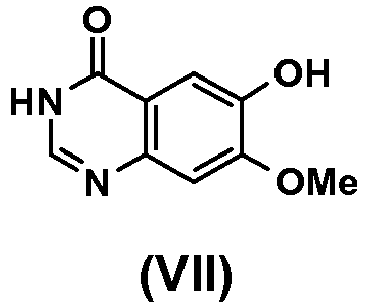
wobei das Verfahren die Reaktionsschritte (2a), (1c) und (1d) umfasst, worin - (2a) die Umsetzung einer Verbindung der Formel (II)


- Bevorzugt ist ein Verfahren zur stereoselektiven Herstellung von Verbindungen der allgemeinen Formel (I), wobei das Verfahren aus den Verfahrensschritten (1a) bis (1 d) besteht.
- Ferner bevorzugt ist ein Verfahren zur stereoselektiven Herstellung von Verbindungen der allgemeinen Formel (I), wobei das Verfahren aus den Verfahrensschritten (2a), (1c) und (1d) besteht.
- Ferner bevorzugt ist ein Verfahren zur stereoselektiven Herstellung von Verbindungen der allgemeinen Formel (IV), dadurch gekennzeichnet dass das Verfahren aus dem Verfahrensschritt (1a) besteht.
- Ferner bevorzugt ist ein Verfahren zur stereoselektiven Herstellung von Verbindungen der allgemeinen Formel (V), dadurch gekennzeichnet dass das Verfahren aus dem Verfahrensschritt (1b) besteht.
- Ferner bevorzugt ist ein Verfahren zur stereoselektiven Herstellung von Verbindungen der allgemeinen Formel (VI), dadurch gekennzeichnet dass das Verfahren aus dem Verfahrensschritt (1c) besteht.
- Ferner bevorzugt ist ein Verfahren zur stereoselektiven Herstellung von Verbindungen der allgemeinen Formel (I), dadurch gekennzeichnet dass das Verfahren aus dem Verfahrensschritt (1d) besteht.
- Ferner bevorzugt ist ein Verfahren zur stereoselektiven Herstellung von Verbindungen der allgemeinen Formel (IV), dadurch gekennzeichnet dass das Verfahren aus dem Verfahrensschritt (2a) besteht.
- Insbesondere bevorzugt ist ein Verfahren, worin in Verfahrensschritt (1b) ein Palladium/Kohle Katalysator eingesetzt wird.
- Weiterhin Insbesondere bevorzugt ist ein Verfahren, worin ein Chlorierungsmittel ausgewählt aus der Gruppe bestehend aus Oxalylchlorid, Thionylchlorid, Phosphoroxychlorid, Phosphorpentachlorid, einer N-Chlorsuccinimid/ Triphenylphosphan - Kombination, einer Tetrachlorkohlenstoff/Triphenylphosphan-Kombination, Dichlortriphenylphosphoran und P,P-Dichlor-phenylphosphinoxid eingesetzt wird.
- Ein weiterer Gegenstand der Erfindung ist die Verbindung der Formel (II).

- Ein weiterer Gegenstand der Erfindung ist die Verbindung der Formel (VIII).

- Die erfindungsgemäßen Verbindungen können in Form der Tautomere sowie in Form der freien Basen oder der entsprechenden Säureadditionssalze mit pharmakologisch unbedenklichen Säuren - wie beispielsweise Säureadditionssalze mit Halogenwasserstoffsäuren, beispielsweise Chlor- oder Bromwasserstoffsäure, anorganischen Säuren, beispielsweise Phosphorsäure oder Schwefelsäure oder organischen Säuren, wie beispielsweise Oxal-, Fumar-, Diglycol-, Toluolsulfon-, Benzoe-, Bernstein-, oder Methansulfonsäure, vorliegen.
- Verfahrensschritt (1a) wird vorzugsweise in einem Lösungsmittel ausgewählt aus der Gruppe bestehend aus Dimethylformamid (DMF), N-Methyl-2-pyrrolidon (NMP), N-Ethyl-2-pyrrolidon (NEP) und Dimethylsulfoxid (DMSO), bevorzugt in NMP durchgeführt.
- Verfahrensschritt (1a) wird vorzugsweise in einem Temperaturbereich von 70 C° bis 150 C°, bevorzugt von 100 C° bis 145 C°, insbesondere bevorzugt bei einer Temperatur von 140 C°, durchgeführt.
- In Verfahrensschritt (1a) werden vorzugsweise Basen ausgewählt aus der Gruppe bestehend aus Na2CO3, K2CO3, Cs2CO3, bevorzugt Na2CO3, eingesetzt.
- Verfahrensschritt (2a) wird vorzugsweise in einem Lösungsmittel ausgewählt aus der Gruppe bestehend aus DMF, NMP, NEP und DMSO, bevorzugt in NMP durchgeführt.
- Verfahrensschritt (2a) wird vorzugsweise in einem Temperaturbereich von 70 C° bis 150 C°, bevorzugt von 100 C° bis 140 C°, insbesondere bevorzugt bei einer Temperatur von 130 C°, durchgeführt.
- Verfahrensschritt (1 b) wird vorzugsweise in einem Lösungsmittel ausgewählt aus der Gruppe bestehend aus H2O, HOAc, EtOH, n-PrOH, i-PrOH, Amylalkohol und NMP, bevorzugt in H2O/HOAc durchgeführt.
- Verfahrensschritt (1 b) wird vorzugsweise in einem Temperaturbereich von 0 C° bis 140 C°, bevorzugt von 60 C° bis 100 C°, insbesondere bevorzugt bei einer Temperatur von 80 C°, durchgeführt.
- In Verfahrensschritt (1 b) werden vorzugsweise Katalysatoren ausgewählt aus der Gruppe bestehend aus Pd/C, Pd(OH)2 bevorzugt Pd/C, eingesetzt.
- Verfahrensschritt (1 c) wird vorzugsweise in einem Lösungsmittel ausgewählt aus der Gruppe bestehend aus Dioxan, Acetonitril, Tetrahydrofuran (THF) und Diethylenglycoldimethylether, bevorzugt in Dioxan/Acetonitril durchgeführt. Verfahrensschritt (1 c) wird vorzugsweise in einem Temperaturbereich von 20 C° bis 140 C°, bevorzugt von 70 C°.bis 130 C°, insbesondere bevorzugt bei einer Temperatur von 120 C°, durchgeführt.
- Verfahrensschritt (1d) wird vorzugsweise in einem Lösungsmittel ausgewählt aus der Gruppe bestehend aus H2O, HClwässrig, NMP und Acetonitril, bevorzugt in HClwässrig durchgeführt.
- In Verfahrensschritt (1d) werden vorzugsweise Hilfssäuren ausgewählt aus der Gruppe bestehend aus HCl, H2SO4, H3PO4, MsOH und TsOH, bevorzugt HCl, verwendet.
- Verfahrensschritt (1d) wird vorzugsweise in einem Temperaturbereich von 5.C° bis 100 C°, bevorzugt von 10 C°.bis 40 C°, insbesondere bevorzugt bei einer Temperatur von 20 C°, durchgeführt.
- Schema 1 bis 3 illustrieren die erfindungsgemäße Synthese.


- Das nachfolgende Beispiel dient der Illustration des exemplarisch durchgeführten Verfahrens zur Herstellung der Verbindung der Formel (I). Dieses Beispiel ist als Erläuterung der Erfindung zu verstehen, ohne selbiges auf deren Gegenstand zu beschränken.
-

- Zu einer Mischung aus 300 ml (Methylamino)-acetaldehyddimethylacetal, 1200 ml 2-Methyltetrahydrofuran und 1200 ml gesättigter Kaliumcarbonatlösung werden bei 2°C 195 ml Chloracetylchlorid in 200 ml 2-Methyltetrahydrofuran innerhalb einer Stunde zugetropft. Nach 40 min werden 1450 ml Wasser zugegeben und die Phasen getrennt. Die wässrige Phase wird mit 600 ml 2-Methyltetrahydrofuran extrahiert. Die vereinigten organischen Phasen werden über Natriumsulfat getrocknet und eingedampft. Es verbleiben 451g Produkt.
Massenspektrum (ESI+): m/z = 196 [M+H]+ -

- Zu einer Suspension aus 35.3 g trans-4-Aminocyclohexanol und 53 g Kaliumcarbonat in 150 ml n-Butylacetat werden bei 90-100°C innerhalb von 2.5 h 50g 2-Chloro-N-(2,2-dimethoxy-ethyl)-N-methyl-acetamid in 100 ml n-Butylacetat getropft. Nach 45 min wird die Suspension bei 65°C filtriert und mit 70 ml 65°C warmen n-Butylacetat gewaschen. Vom Filtrat werden 100 ml Lösungsmittel abdestilliert und die eingeengte Lösung wird bei 40°C mit Produkt angeimpft. Nach 16 h bei Raumtemperatur wird der Niederschlag abfiltriert und mit 70 ml Tertbutylmethylether gewaschen. Nach Trocknen erhält man 50 g Produkt.
Massenspektrum (ESI+): m/z = 275 [M+H]+ -

- Zu einer Lösung aus 822 g (trans)-1-Hydroxy-4-{[N-(2,2-dimethoxy-ethyl)-N-methyl-amino]-carbonylmethylamino}-cyclohexan in 4500 ml Methanol und 450 ml Wasser werden 82 g Platin auf Kohle (5%) gegeben. Nach Zugabe von 499 ml konzentrierter Salzsäure wird sofort begonnen mit Wasserstoff zu hydrieren. Während des Hydriervorgangs wird auf 50°C erwärmt. Nach 3 h wird filtriert.
- Dieser Ansatz wird in gleicher Größe wiederholt.
- Die beiden Filtrate der beiden Ansätze werden vereinigt und auf 7100 ml 30%ige Kaliumcarbonatlösung gegossen. Bei 50°C wird mit 15 L tert-Amylalkohol extrahiert. Die wässrige Phase wird noch zweimal mit je 7500 ml tert-Amylalkohol extrahiert. Von den vereinigten organischen Phasen werden 28 L Lösungsmittel abdestilliert. Es werden 6 L n-Butylacetat zugefügt und 8 L Lösungsmittel abdestilliert. Es werden 15 L n-Butylacetat und 1 kg Celite zugefügt und auf 120°C erhitzt. Der Feststoff wird abfiltriert und mit 5000 ml heißem n-Butylacetat gewaschen. Das Filtrat wird auf -5°C abgekühlt. Nach 3 h wird der Niederschlag abfiltriert und mit 5000 ml Tertbutylmethylether gewaschen. Nach Trocknen erhält man 1025 g Produkt.
Massenspektrum (ESI+): m/z = 213 [M+H]+ -

- Zu 150 g (trans)-1-Hydroxy-4-(4-methyl-3-oxo-piperazin-1-yl)-cyclohexan und 162 ml Triethylamin in 2300 ml THF werden 109 g Mesylchlorid in 250 ml THF so zugetropft, dass die Temperatur 35°C nicht übersteigt. Nach 25 min wird die Suspension filtriert und mit 300 ml THF nachgewaschen. Das Filtrat wird bei 40°C im Vakkum eingeengt bis auf 520 g Gesamtmasse. Zu der Suspension werden 230 ml Ethylacetat gegeben. Nach 15 min wird filtriert und der Niederschlag mit 230 ml Ethylacetat und 150ml Methyl-tert-butylether gewaschen. Nach Trocknen erhält man 153.1 g Produkt. Massenspektrum (ESI+): m/z = 291 [M+H]+
-

- Zu 20 g 3-Benzyl-3,4-dihydro-4-oxo-6-hydroxy-7-methoxy-chinazolin (III) und 16.52 g Natriumcarbonat in 160 ml N-Methyl-2-pyrrolidinon werden bei 130°C schrittweise sechsmal je 4.11 g (gesamt: 24.68 g) (trans)-1-Methansulfonyloxy-4-(4-methyl-3-oxo-piperazin-1-yl)-cyclohexan (II) innerhalb von 3.5 h zugegeben. Nach 19.5 h wird das Reaktionsgemisch langsam in 400 ml 80°C warmes Wasser eingegossen. Nach 70 min wird die Suspension bei Raumtemperatur abfiltriert und der Niederschlag mit Wasser gewaschen. Das feuchte Rohprodukt wird in 500 ml Ethanol und 275 ml Wasser bei Rückfluss gelöst. Nach Abkühlen auf 5°C und Rühren wird der Niederschlag abgesaugt und getrocknet. Man erhält 26.8 g Produkt.
Massenspektrum (ESI+): m/z = 477 [M+H]+
oder
Zu 193 g (trans)-1-Hydroxy-4-(4-methyl-3-oxo-piperazin-1-yl)-cyclohexan und 168 ml Triethylamin in 1710 ml THF werden bei 40°C 88 ml Mesylchlorid zugegeben. Die Suspension wird so filtriert, dass das Filtrat direkt in 640 ml N-Methyl-2-pyrrolidinon einfliest. Nach Nachwaschen mit 1280 ml warmen THF wird das Filtrat bei 60°C im Vakuum eingeengt. Der ölige Rückstand wird portionsweise zu 214 g 3-Benzyl-3,4-dihydro-4-oxo-6-hydroxy-7-methoxy-chinazolin (III) und 177 g Natriumcarbonat in 640 ml N-Methyl-2-pyrrolidinon bei 130°C gegeben. Es werden 340 ml N-Methyl-2-pyrrolidinon zugegeben. Nach 16 h werden bei 95°C 2140 ml Wasser zugegeben. Nach 80 min wird der Niederschlag abfiltriert und mit 3000 ml Wasser gewaschen. Nach Trocknen erhält man 346 g Produkt.
Massenspektrum (ESI+): m/z = 477 [M+H]+ -
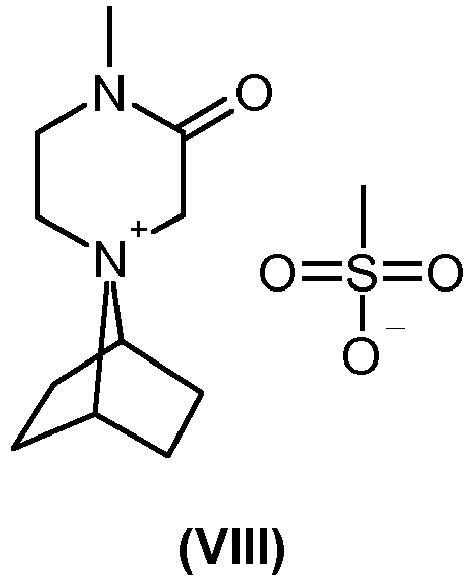
- Die Verbindung der Formel (VIII) entsteht als Zwischenprodukt des Syntheseschritts (1a). Sie lässt sich ebenfalls herstellen, indem 350mg (trans)-1-Methansulfonyloxy-4-(4-methyl-3-oxo-piperazin-1-yl)-cyclohexan (II) für 15.5 h im Vakuumtrockenofen bei 110 °C aufbewahrt werden. 350 mg neues Produkt der Verbindung der Formel (VIII) entstehen.
Massenspektrum (ESI+): m/z = 195 [M]+ -

- 355g 3-Benzyl-3,4-dihydro-4-oxo-6-[trans-4-(4-methyl-3-oxo-piperazin-1-yl)-cyclohexyloxy]-7-methoxy-chinazolin werden in einer Lösung aus 1775 ml Wasser und 1065 ml Eisessig mit 35.5 g Palladium auf Kohle (10% Pd) 23 Stunden lang bei 80°C hydriert. Der Katalysator wird abfiltriert und mit 500 ml Wasser gewaschen. 950 ml 50%ige Natronlauge werden zugegeben. Zur Suspension werden 3000 ml tert-Amylalkohol zugegeben und die Phasen getrennt. Die wässrige Phase wird mit 3000 ml tert-Amylalkohol extrahiert. Die vereinigten organischen Phasen werden eingedampft und der Rückstand wird in 3000 ml Ethanol bei 78°C gelöst. 76 ml von HCl in Ethanol (10 mol/L) werden zugegeben. Nach Animpfen mit Produkthydrochlorid und Kühlen auf -3°C wird der Niederschlag abgesaugt und mit 200 ml Ethanol und 800 ml Methyl-tert-butylether gewaschen. Nach Trocknen erhält man 266g Produkt als Hydrochlorid.
Massenspektrum (ESI+): m/z = 387 [M+H]+
oder - Zu 2 g 3,4-Dihydro-4-oxo-6-hydroxy-7-methoxy-chinazolin (VII) in 16 ml N-Methyl-2-pyrrolidinon werden bei 130°C 2.4 g Natriumcarbonat gegeben. Anschließend werden bei 130°C schrittweise sechsmal je 600 mg (gesamt: 2.4 g) (trans)-1-Methansulfonyloxy-4-(4-methyl-3-oxo-piperazin-1-yl)-cyclohexan (II) innerhalb von 4 h zugegeben und der Ansatz für 20 h bei 130°C gehalten. Nach 10 Tagen werden 25 ml Wasser zugegeben und der Ansatz wird mit 25 ml Isopropylacetat, 50ml Dichlormethan und 25ml Dichlormethan extrahiert. Die organischen Phasen werden eingedampft und der Rückstand wird mit präparativer HPLC aufgetrennt. Man erhält 500 mg des Produkts.
Massenspektrum (ESI+): m/z = 387 [M+H]+ -

- 210g 3,4-Dihydro-4-oxo-6-[trans-4-(4-methyl-3-oxo-piperazin-1-yl)-cyclohexyloxy]-7-methoxy-chinazolin hydrochlorid [(V) HCl] in 1680 ml Acetonitril werden zum Rückfluss erhitzt und 840 ml Lösungsmittel abdestilliert (Entfernung von Wasserspuren). Es werden 221.4 g Triphenylphosphin in 840 ml Dioxan zugegeben. Es werden 119.4 g N-Chlorsuccinimid in 600 ml Acetonitril zugegeben. Es werden 260 ml Acetonitril zugegeben. Der Ansatz wird 45 min bei 80°C gerührt und dann auf 30°C abgekühlt. Es werden 8.94 ml Wasser und 420 ml Dioxan zugesetzt. Der Niederschlag wird unter Schutzgas abfiltriert und mit 1200 ml THF gewaschen. Das Produkt fällt als Hydrochlorid an und wird ohne Trocknung weiterverarbeitet. Ein kleiner Anteil wurde getrocknet und darauf bezogen kann die Ausbeute mit ca. 210g kalkuliert werden.
Massenspektrum (ESI+): m/z = 405 [M+H]+ -

- 400 g rohes 4-Chloro-6-[trans-4-(4-methyl-3-oxo-piperazin-1-yl)-cyclohexyloxy]-7-methoxy-chinazolin (VI) (direkt aus vorheriger Synthese; enthält noch THF - entspricht ca. 210 g 4-Chloro-6-[trans-4-(4-methyl-3-oxo-piperazin-1-yl)-cyclohexyloxy]-7-methoxy-chinazolin hydrochlorid) werden zu 86.7 g 3-Chlor-2-Fluoranilin in 2200 ml 2N Salzsäure bei 20°C gegeben. Nach 1h werden 2200 ml Toluol zugegeben und der Ansatz für 1 h auf 65°C erwärmt. Der Ansatz wird für 19 h bei Raumtemperatur gerührt und dann für 1h bei 6°C. Der Niederschlag wird abgesaugt und mit 400 ml 2N Salzsäure und 400 ml Toluol gewaschen. Nach Trocknen erhält man das Rohprodukt als Hydrochlorid bzw. Dihydrochlorid. Dieses wird in 1900 ml Wasser und 1900 ml Ethanol gelöst. Es werden 920 ml 1 N NaOH zugegeben und 1000 ml Lösungsmittel abdestilliert. Es wird mit Produkt angeimpft und 740 ml Lösungsmittel abdestilliert. Nach Abkühlen auf 7°C wird der Niederschlag mit 1000 ml Wasser gewaschen und getrocknet. Der Niederschlag wird in 7400 ml Ethanol bei 78°C gelöst. 50 g Aktivkohle werden zugegeben und die Lösung wird filtriert und mit 900 ml heißem Ethanol gewaschen. Von der Lösung werden 5300 ml abdestilliert. Es wird mit Produkt angeimpft und 1000 ml Lösungsmittel abdestilliert. Nach Rühren für 66 h bei Raumtemperatur wird der Niederschlag abfiltriert und mit 500 ml Ethanol gewaschen. Nach Trocknen erhält man 191 g Produkt.
Massenspektrum (ESI+): m/z = 514 [M+H]+ - Analog zu vorstehend beschriebener Vorgehensweise werden Verbindungen der allgemeinen Formel (I) hergestellt.
wobei die Schritte in der genannten Reihenfolge nacheinander erfolgen.
Claims (10)
- Verfahren zur stereoselektiven Herstellung von Verbindungen der allgemeinen Formel (I)

worin
R1 ein Rest ausgewählt aus der Gruppe bestehend aus 3-Chlor-2-fluorphenyl-amino-, 3-Chlor-4-fluor-phenylamino-, 2-Fluor-3-methyl-phenylamino-, 2,5-Difluor-3-methyl-phenylamino-, 3-Chlor-2-methyl-phenylamino- und 2-Fluor-5-methyl-phenylamino-,
bedeutet,
dadurch gekennzeichnet, dass das Verfahren die Reaktionsschritte (1a) bis (1d) umfasst, wobei(1a) die Umsetzung einer Verbindung der Formel (II)

 (1b) die Abspaltung des Benzylrestes der Verbindung der Formel (IV) in Anwesenheit eines Katalysators zu einer Verbindung der Formel (V)
 (1c) die Umsetzung der Verbindung der Formel (V) mit einem Chlorierungsmittel zu dem Hydrochlorid einer Verbindung der Formel (VI)
 (1d) die Umsetzung der Verbindung der Formel (VI) mit einer der Verbindungen (i) bis (vi) zu einer Verbindung der Formel (I),
wobei(i) 3-Chlor-2-fluor-anilin,(ii) 3-Chlor-4-fluor-anilin,(ii) 2-Fluor-3-methyl-anilin,(iii) 2,5-Difluor-3-methyl-anilin,(iv) 3-Chlor-2-methyl-anilin, und(vi) 2-Fluor-5-methyl-anilin,bedeutet,
wobei die Schritte (1a) bis (1d) in der genannten Reihenfolge nacheinander erfolgen,
oder
dadurch gekennzeichnet, dass das Verfahren die Reaktionsschritte (2a), (1c) und (1d) umfasst, wobei(2a) die Umsetzung einer Verbindung der Formel (II)wobei die Schritte in der genannten Reihenfolge nacheinander erfolgen.


- Verfahren gemäß Anspruch 1 zur stereoselektiven Herstellung von Verbindungen der allgemeinen Formel (I), dadurch gekennzeichnet, dass das Verfahren aus den Verfahrensschritten (1a) bis (1d) besteht.
- Verfahren gemäß Anspruch 1 zur stereoselektiven Herstellung von Verbindungen der allgemeinen Formel (I), dadurch gekennzeichnet, dass das aus den Verfahrensschritten (2a), (1c) und (1d) besteht.
- Verfahren gemäß Anspruch 1 zur stereoselektiven Herstellung von Verbindungen der allgemeinen Formel (IV), dadurch gekennzeichnet dass das Verfahren aus dem Verfahrensschritt (1a) besteht.
- Verfahren gemäß Anspruch 1 zur stereoselektiven Herstellung von Verbindungen der allgemeinen Formel (V), dadurch gekennzeichnet dass das Verfahren aus dem Verfahrensschritt (1b) besteht.
- Verfahren gemäß Anspruch 1 zur stereoselektiven Herstellung von Verbindungen der allgemeinen Formel (VI), dadurch gekennzeichnet dass das Verfahren aus dem Verfahrensschritt (1c) besteht.
- Verfahren gemäß Anspruch 1 zur stereoselektiven Herstellung von Verbindungen der allgemeinen Formel (I), dadurch gekennzeichnet dass das Verfahren aus dem Verfahrensschritt (1d) besteht.
- Verfahren gemäß Anspruch 1 zur stereoselektiven Herstellung von Verbindungen der allgemeinen Formel (IV), dadurch gekennzeichnet dass das Verfahren aus dem Verfahrensschritt (2a) besteht.
- Verbindung der Formel (II)

- Verbindung der Formel (VIII)

Priority Applications (1)
| Application Number | Priority Date | Filing Date | Title |
|---|---|---|---|
| EP09804535.4A EP2313377B1 (de) | 2008-08-08 | 2009-07-23 | Verfahren zur stereoselektiven synthese bicyclischer heterocyclen |
Applications Claiming Priority (3)
| Application Number | Priority Date | Filing Date | Title |
|---|---|---|---|
| EP08104993 | 2008-08-08 | ||
| PCT/EP2009/059512 WO2010015524A1 (de) | 2008-08-08 | 2009-07-23 | Verfahren zur stereoselektiven synthese bicyclischer heterocyclen |
| EP09804535.4A EP2313377B1 (de) | 2008-08-08 | 2009-07-23 | Verfahren zur stereoselektiven synthese bicyclischer heterocyclen |
Publications (2)
| Publication Number | Publication Date |
|---|---|
| EP2313377A1 EP2313377A1 (de) | 2011-04-27 |
| EP2313377B1 true EP2313377B1 (de) | 2016-01-06 |
Family
ID=40092082
Family Applications (1)
| Application Number | Title | Priority Date | Filing Date |
|---|---|---|---|
| EP09804535.4A Active EP2313377B1 (de) | 2008-08-08 | 2009-07-23 | Verfahren zur stereoselektiven synthese bicyclischer heterocyclen |
Country Status (7)
| Country | Link |
|---|---|
| US (1) | US8263768B2 (de) |
| EP (1) | EP2313377B1 (de) |
| JP (1) | JP5611207B2 (de) |
| AR (1) | AR072997A1 (de) |
| CA (1) | CA2731895C (de) |
| TW (1) | TW201014845A (de) |
| WO (1) | WO2010015524A1 (de) |
Families Citing this family (1)
| Publication number | Priority date | Publication date | Assignee | Title |
|---|---|---|---|---|
| EP2289881A1 (de) * | 2009-08-06 | 2011-03-02 | Boehringer Ingelheim International GmbH | Verfahren zur stereoselektiven Synthese bicyclischer Heterocyclen |
Family Cites Families (4)
| Publication number | Priority date | Publication date | Assignee | Title |
|---|---|---|---|---|
| TW200813014A (en) | 2002-03-28 | 2008-03-16 | Astrazeneca Ab | Quinazoline derivatives |
| NZ536114A (en) * | 2002-03-30 | 2007-11-30 | Boehringer Ingelheim Pharma | 4-(N-phenylamino)-quinazolines / quinolines as tyrosine kinase inhibitors |
| EP1921070A1 (de) | 2006-11-10 | 2008-05-14 | Boehringer Ingelheim Pharma GmbH & Co. KG | Bicyclische Heterocyclen, diese Verbindungen enthaltende Arzneimittel, deren Verwendung und Verfahren zu ihrer Herstelllung |
| JP5377332B2 (ja) | 2007-02-06 | 2013-12-25 | ベーリンガー インゲルハイム インターナショナル ゲゼルシャフト ミット ベシュレンクテル ハフツング | 二環式へテロ環、それらの化合物を含む薬剤、その使用及びその製法 |
-
2009
- 2009-07-23 CA CA2731895A patent/CA2731895C/en active Active
- 2009-07-23 WO PCT/EP2009/059512 patent/WO2010015524A1/de not_active Ceased
- 2009-07-23 US US13/057,871 patent/US8263768B2/en active Active
- 2009-07-23 JP JP2011521519A patent/JP5611207B2/ja active Active
- 2009-07-23 EP EP09804535.4A patent/EP2313377B1/de active Active
- 2009-08-07 AR ARP090103058A patent/AR072997A1/es unknown
- 2009-08-10 TW TW098126781A patent/TW201014845A/zh unknown
Also Published As
| Publication number | Publication date |
|---|---|
| EP2313377A1 (de) | 2011-04-27 |
| TW201014845A (en) | 2010-04-16 |
| JP5611207B2 (ja) | 2014-10-22 |
| JP2011530494A (ja) | 2011-12-22 |
| US20120116080A1 (en) | 2012-05-10 |
| CA2731895A1 (en) | 2010-02-11 |
| US8263768B2 (en) | 2012-09-11 |
| CA2731895C (en) | 2016-11-08 |
| WO2010015524A1 (de) | 2010-02-11 |
| AR072997A1 (es) | 2010-10-06 |
Similar Documents
| Publication | Publication Date | Title |
|---|---|---|
| EP1678165B1 (de) | Verfahren zur herstellung von aminocrotonylverbindungen | |
| EP2896617B1 (de) | Verfahren zur herstellung von substituierten (z)-alpha-fluoro-beta-amino-acrylaldehyden | |
| DE60107859T2 (de) | Benzimidazolderivate, ihre herstellung und therapeutische verwendung | |
| DE69723846T2 (de) | Verfahren zur Herstellung von Sildenafil | |
| DE2614406C2 (de) | ||
| DE60021194T2 (de) | Phenylpiperazin-derivate als inhibitoren der serotonin-wiederaufnahme | |
| DE69811360T2 (de) | Diazepinoindolone als phophodiesterase 4 inhibitoren | |
| EP2462126B1 (de) | Verfahren zur stereoselektiven synthese bicyclischer heterocyclen | |
| EP1210335A1 (de) | Aminocarbonyl-substituierte benzimidazolderivate, verfahren zu ihrer herstellung und ihre verwendung als arzneimittel | |
| DD281806A5 (de) | Verfahren zur herstellung von chinoloncarbonsaeuren | |
| DE3346575A1 (de) | Neue benzimidazole, ihre herstellung und diese verbindungen enthaltende arzneimittel | |
| DE2841644C2 (de) | ||
| EP2313377A1 (de) | Verfahren zur stereoselektiven synthese bicyclischer heterocyclen | |
| DE2819873A1 (de) | N-phenyl-n-(4-piperidinyl)-amide, verfahren zu deren herstellung und deren verwendung als analgetika | |
| DE60103928T2 (de) | Benzimidazolderivate, ihre herstellung und therapeutische verwendung | |
| EP0271099A2 (de) | Substituierte Aminopropionsäureamide, Verfahren zu ihrer Herstellung, diese enthaltende Mittel und ihre Verwendung sowie die bei der Herstellung anfallenden neuen Zwischenprodukte | |
| CH638516A5 (en) | Process for preparing substituted aminoquinazoline derivatives | |
| DE69607622T2 (de) | Verfahren zur herstellung von ethyl 3s[[4-[[4-(aminoiminomethyl)phenyl)amino)-2,4-dioxobutyl)amino)-4-pentynsäure | |
| EP2812317B1 (de) | Verfahren zur stereoselektiven synthese von 1,4-geschützten 9-hydroxy-5-oxo-1,4-diaza-spiro [5.5]undecane | |
| DE60022316T2 (de) | 6-substituierte 7-heterochinoxalin-carbonsäure- derivate und ihre additionssalze und verfahren zur herstellung von beiden | |
| DE4207234A1 (de) | Neue aminocarbonsaeure-derivate mit antiallergischer/antiasthmatischer wirkung und verfahren zu deren herstellung | |
| CH605922A5 (en) | Quinazolines prepn. | |
| WO2007003486A1 (de) | Verfahren zur herstellung von chinazolinonderivaten | |
| EP0090769A2 (de) | Verfahren zur Herstellung von 1,2,5,6-Tetrahydro-4H-pyrrolo(3,2,1-ij)-chinolin-4-on und neue 5-Halogen-1,2,3-(1,2-dihydropyrrolo)-4-chinolone als Zwischenprodukte zur Durchführung des Verfahrens | |
| DE60308720T2 (de) | Verfahren zur herstellung von imidazolverbindungen |
Legal Events
| Date | Code | Title | Description |
|---|---|---|---|
| PUAI | Public reference made under article 153(3) epc to a published international application that has entered the european phase |
Free format text: ORIGINAL CODE: 0009012 |
|
| 17P | Request for examination filed |
Effective date: 20110308 |
|
| AK | Designated contracting states |
Kind code of ref document: A1 Designated state(s): AT BE BG CH CY CZ DE DK EE ES FI FR GB GR HR HU IE IS IT LI LT LU LV MC MK MT NL NO PL PT RO SE SI SK SM TR |
|
| AX | Request for extension of the european patent |
Extension state: AL BA RS |
|
| DAX | Request for extension of the european patent (deleted) | ||
| 17Q | First examination report despatched |
Effective date: 20140826 |
|
| GRAP | Despatch of communication of intention to grant a patent |
Free format text: ORIGINAL CODE: EPIDOSNIGR1 |
|
| INTG | Intention to grant announced |
Effective date: 20150708 |
|
| GRAS | Grant fee paid |
Free format text: ORIGINAL CODE: EPIDOSNIGR3 |
|
| GRAA | (expected) grant |
Free format text: ORIGINAL CODE: 0009210 |
|
| AK | Designated contracting states |
Kind code of ref document: B1 Designated state(s): AT BE BG CH CY CZ DE DK EE ES FI FR GB GR HR HU IE IS IT LI LT LU LV MC MK MT NL NO PL PT RO SE SI SK SM TR |
|
| REG | Reference to a national code |
Ref country code: GB Ref legal event code: FG4D Free format text: NOT ENGLISH |
|
| REG | Reference to a national code |
Ref country code: CH Ref legal event code: EP |
|
| REG | Reference to a national code |
Ref country code: IE Ref legal event code: FG4D Free format text: LANGUAGE OF EP DOCUMENT: GERMAN |
|
| REG | Reference to a national code |
Ref country code: AT Ref legal event code: REF Ref document number: 768740 Country of ref document: AT Kind code of ref document: T Effective date: 20160215 |
|
| REG | Reference to a national code |
Ref country code: DE Ref legal event code: R096 Ref document number: 502009012018 Country of ref document: DE |
|
| REG | Reference to a national code |
Ref country code: LT Ref legal event code: MG4D |
|
| REG | Reference to a national code |
Ref country code: NL Ref legal event code: MP Effective date: 20160106 |
|
| PG25 | Lapsed in a contracting state [announced via postgrant information from national office to epo] |
Ref country code: NL Free format text: LAPSE BECAUSE OF FAILURE TO SUBMIT A TRANSLATION OF THE DESCRIPTION OR TO PAY THE FEE WITHIN THE PRESCRIBED TIME-LIMIT Effective date: 20160106 |
|
| REG | Reference to a national code |
Ref country code: FR Ref legal event code: PLFP Year of fee payment: 8 |
|
| PG25 | Lapsed in a contracting state [announced via postgrant information from national office to epo] |
Ref country code: GR Free format text: LAPSE BECAUSE OF FAILURE TO SUBMIT A TRANSLATION OF THE DESCRIPTION OR TO PAY THE FEE WITHIN THE PRESCRIBED TIME-LIMIT Effective date: 20160407 Ref country code: IT Free format text: LAPSE BECAUSE OF FAILURE TO SUBMIT A TRANSLATION OF THE DESCRIPTION OR TO PAY THE FEE WITHIN THE PRESCRIBED TIME-LIMIT Effective date: 20160106 Ref country code: NO Free format text: LAPSE BECAUSE OF FAILURE TO SUBMIT A TRANSLATION OF THE DESCRIPTION OR TO PAY THE FEE WITHIN THE PRESCRIBED TIME-LIMIT Effective date: 20160406 Ref country code: FI Free format text: LAPSE BECAUSE OF FAILURE TO SUBMIT A TRANSLATION OF THE DESCRIPTION OR TO PAY THE FEE WITHIN THE PRESCRIBED TIME-LIMIT Effective date: 20160106 Ref country code: ES Free format text: LAPSE BECAUSE OF FAILURE TO SUBMIT A TRANSLATION OF THE DESCRIPTION OR TO PAY THE FEE WITHIN THE PRESCRIBED TIME-LIMIT Effective date: 20160106 Ref country code: HR Free format text: LAPSE BECAUSE OF FAILURE TO SUBMIT A TRANSLATION OF THE DESCRIPTION OR TO PAY THE FEE WITHIN THE PRESCRIBED TIME-LIMIT Effective date: 20160106 |
|
| PG25 | Lapsed in a contracting state [announced via postgrant information from national office to epo] |
Ref country code: LV Free format text: LAPSE BECAUSE OF FAILURE TO SUBMIT A TRANSLATION OF THE DESCRIPTION OR TO PAY THE FEE WITHIN THE PRESCRIBED TIME-LIMIT Effective date: 20160106 Ref country code: PL Free format text: LAPSE BECAUSE OF FAILURE TO SUBMIT A TRANSLATION OF THE DESCRIPTION OR TO PAY THE FEE WITHIN THE PRESCRIBED TIME-LIMIT Effective date: 20160106 Ref country code: SE Free format text: LAPSE BECAUSE OF FAILURE TO SUBMIT A TRANSLATION OF THE DESCRIPTION OR TO PAY THE FEE WITHIN THE PRESCRIBED TIME-LIMIT Effective date: 20160106 Ref country code: PT Free format text: LAPSE BECAUSE OF FAILURE TO SUBMIT A TRANSLATION OF THE DESCRIPTION OR TO PAY THE FEE WITHIN THE PRESCRIBED TIME-LIMIT Effective date: 20160506 Ref country code: LT Free format text: LAPSE BECAUSE OF FAILURE TO SUBMIT A TRANSLATION OF THE DESCRIPTION OR TO PAY THE FEE WITHIN THE PRESCRIBED TIME-LIMIT Effective date: 20160106 Ref country code: IS Free format text: LAPSE BECAUSE OF FAILURE TO SUBMIT A TRANSLATION OF THE DESCRIPTION OR TO PAY THE FEE WITHIN THE PRESCRIBED TIME-LIMIT Effective date: 20160506 |
|
| REG | Reference to a national code |
Ref country code: DE Ref legal event code: R097 Ref document number: 502009012018 Country of ref document: DE |
|
| PG25 | Lapsed in a contracting state [announced via postgrant information from national office to epo] |
Ref country code: EE Free format text: LAPSE BECAUSE OF FAILURE TO SUBMIT A TRANSLATION OF THE DESCRIPTION OR TO PAY THE FEE WITHIN THE PRESCRIBED TIME-LIMIT Effective date: 20160106 Ref country code: DK Free format text: LAPSE BECAUSE OF FAILURE TO SUBMIT A TRANSLATION OF THE DESCRIPTION OR TO PAY THE FEE WITHIN THE PRESCRIBED TIME-LIMIT Effective date: 20160106 |
|
| PLBE | No opposition filed within time limit |
Free format text: ORIGINAL CODE: 0009261 |
|
| STAA | Information on the status of an ep patent application or granted ep patent |
Free format text: STATUS: NO OPPOSITION FILED WITHIN TIME LIMIT |
|
| PG25 | Lapsed in a contracting state [announced via postgrant information from national office to epo] |
Ref country code: SK Free format text: LAPSE BECAUSE OF FAILURE TO SUBMIT A TRANSLATION OF THE DESCRIPTION OR TO PAY THE FEE WITHIN THE PRESCRIBED TIME-LIMIT Effective date: 20160106 Ref country code: CZ Free format text: LAPSE BECAUSE OF FAILURE TO SUBMIT A TRANSLATION OF THE DESCRIPTION OR TO PAY THE FEE WITHIN THE PRESCRIBED TIME-LIMIT Effective date: 20160106 Ref country code: RO Free format text: LAPSE BECAUSE OF FAILURE TO SUBMIT A TRANSLATION OF THE DESCRIPTION OR TO PAY THE FEE WITHIN THE PRESCRIBED TIME-LIMIT Effective date: 20160106 Ref country code: SM Free format text: LAPSE BECAUSE OF FAILURE TO SUBMIT A TRANSLATION OF THE DESCRIPTION OR TO PAY THE FEE WITHIN THE PRESCRIBED TIME-LIMIT Effective date: 20160106 |
|
| 26N | No opposition filed |
Effective date: 20161007 |
|
| PG25 | Lapsed in a contracting state [announced via postgrant information from national office to epo] |
Ref country code: BE Free format text: LAPSE BECAUSE OF NON-PAYMENT OF DUE FEES Effective date: 20160731 |
|
| PG25 | Lapsed in a contracting state [announced via postgrant information from national office to epo] |
Ref country code: BG Free format text: LAPSE BECAUSE OF FAILURE TO SUBMIT A TRANSLATION OF THE DESCRIPTION OR TO PAY THE FEE WITHIN THE PRESCRIBED TIME-LIMIT Effective date: 20160406 Ref country code: SI Free format text: LAPSE BECAUSE OF FAILURE TO SUBMIT A TRANSLATION OF THE DESCRIPTION OR TO PAY THE FEE WITHIN THE PRESCRIBED TIME-LIMIT Effective date: 20160106 |
|
| REG | Reference to a national code |
Ref country code: CH Ref legal event code: PL |
|
| PG25 | Lapsed in a contracting state [announced via postgrant information from national office to epo] |
Ref country code: MC Free format text: LAPSE BECAUSE OF FAILURE TO SUBMIT A TRANSLATION OF THE DESCRIPTION OR TO PAY THE FEE WITHIN THE PRESCRIBED TIME-LIMIT Effective date: 20160106 |
|
| PG25 | Lapsed in a contracting state [announced via postgrant information from national office to epo] |
Ref country code: CH Free format text: LAPSE BECAUSE OF NON-PAYMENT OF DUE FEES Effective date: 20160731 Ref country code: LI Free format text: LAPSE BECAUSE OF NON-PAYMENT OF DUE FEES Effective date: 20160731 |
|
| REG | Reference to a national code |
Ref country code: IE Ref legal event code: MM4A |
|
| REG | Reference to a national code |
Ref country code: FR Ref legal event code: PLFP Year of fee payment: 9 |
|
| PG25 | Lapsed in a contracting state [announced via postgrant information from national office to epo] |
Ref country code: IE Free format text: LAPSE BECAUSE OF NON-PAYMENT OF DUE FEES Effective date: 20160723 |
|
| PG25 | Lapsed in a contracting state [announced via postgrant information from national office to epo] |
Ref country code: LU Free format text: LAPSE BECAUSE OF NON-PAYMENT OF DUE FEES Effective date: 20160723 |
|
| REG | Reference to a national code |
Ref country code: AT Ref legal event code: MM01 Ref document number: 768740 Country of ref document: AT Kind code of ref document: T Effective date: 20160723 |
|
| PG25 | Lapsed in a contracting state [announced via postgrant information from national office to epo] |
Ref country code: AT Free format text: LAPSE BECAUSE OF NON-PAYMENT OF DUE FEES Effective date: 20160723 |
|
| PG25 | Lapsed in a contracting state [announced via postgrant information from national office to epo] |
Ref country code: CY Free format text: LAPSE BECAUSE OF FAILURE TO SUBMIT A TRANSLATION OF THE DESCRIPTION OR TO PAY THE FEE WITHIN THE PRESCRIBED TIME-LIMIT Effective date: 20160106 Ref country code: HU Free format text: LAPSE BECAUSE OF FAILURE TO SUBMIT A TRANSLATION OF THE DESCRIPTION OR TO PAY THE FEE WITHIN THE PRESCRIBED TIME-LIMIT; INVALID AB INITIO Effective date: 20090723 |
|
| PG25 | Lapsed in a contracting state [announced via postgrant information from national office to epo] |
Ref country code: MT Free format text: LAPSE BECAUSE OF FAILURE TO SUBMIT A TRANSLATION OF THE DESCRIPTION OR TO PAY THE FEE WITHIN THE PRESCRIBED TIME-LIMIT Effective date: 20160106 Ref country code: TR Free format text: LAPSE BECAUSE OF FAILURE TO SUBMIT A TRANSLATION OF THE DESCRIPTION OR TO PAY THE FEE WITHIN THE PRESCRIBED TIME-LIMIT Effective date: 20160106 Ref country code: MK Free format text: LAPSE BECAUSE OF FAILURE TO SUBMIT A TRANSLATION OF THE DESCRIPTION OR TO PAY THE FEE WITHIN THE PRESCRIBED TIME-LIMIT Effective date: 20160106 |
|
| REG | Reference to a national code |
Ref country code: FR Ref legal event code: PLFP Year of fee payment: 10 |
|
| PGFP | Annual fee paid to national office [announced via postgrant information from national office to epo] |
Ref country code: DE Payment date: 20250722 Year of fee payment: 17 |
|
| PGFP | Annual fee paid to national office [announced via postgrant information from national office to epo] |
Ref country code: GB Payment date: 20250722 Year of fee payment: 17 |
|
| PGFP | Annual fee paid to national office [announced via postgrant information from national office to epo] |
Ref country code: FR Payment date: 20250725 Year of fee payment: 17 |