EP2307629B2 - Trennwand aus transparenten wandelementen - Google Patents
Trennwand aus transparenten wandelementen Download PDFInfo
- Publication number
- EP2307629B2 EP2307629B2 EP09761402.8A EP09761402A EP2307629B2 EP 2307629 B2 EP2307629 B2 EP 2307629B2 EP 09761402 A EP09761402 A EP 09761402A EP 2307629 B2 EP2307629 B2 EP 2307629B2
- Authority
- EP
- European Patent Office
- Prior art keywords
- pane
- elements
- profile frame
- wall
- partitioning wall
- Prior art date
- Legal status (The legal status is an assumption and is not a legal conclusion. Google has not performed a legal analysis and makes no representation as to the accuracy of the status listed.)
- Active
Links
Images


Classifications
-
- E—FIXED CONSTRUCTIONS
- E04—BUILDING
- E04B—GENERAL BUILDING CONSTRUCTIONS; WALLS, e.g. PARTITIONS; ROOFS; FLOORS; CEILINGS; INSULATION OR OTHER PROTECTION OF BUILDINGS
- E04B2/00—Walls, e.g. partitions, for buildings; Wall construction with regard to insulation; Connections specially adapted to walls
- E04B2/74—Removable non-load-bearing partitions; Partitions with a free upper edge
- E04B2/82—Removable non-load-bearing partitions; Partitions with a free upper edge characterised by the manner in which edges are connected to the building; Means therefor; Special details of easily-removable partitions as far as related to the connection with other parts of the building
- E04B2/827—Partitions constituted of sliding panels
-
- E—FIXED CONSTRUCTIONS
- E06—DOORS, WINDOWS, SHUTTERS, OR ROLLER BLINDS IN GENERAL; LADDERS
- E06B—FIXED OR MOVABLE CLOSURES FOR OPENINGS IN BUILDINGS, VEHICLES, FENCES OR LIKE ENCLOSURES IN GENERAL, e.g. DOORS, WINDOWS, BLINDS, GATES
- E06B3/00—Window sashes, door leaves, or like elements for closing wall or like openings; Layout of fixed or moving closures, e.g. windows in wall or like openings; Features of rigidly-mounted outer frames relating to the mounting of wing frames
- E06B3/02—Wings made completely of glass
- E06B3/025—Wings made completely of glass consisting of multiple glazing units
-
- E—FIXED CONSTRUCTIONS
- E06—DOORS, WINDOWS, SHUTTERS, OR ROLLER BLINDS IN GENERAL; LADDERS
- E06B—FIXED OR MOVABLE CLOSURES FOR OPENINGS IN BUILDINGS, VEHICLES, FENCES OR LIKE ENCLOSURES IN GENERAL, e.g. DOORS, WINDOWS, BLINDS, GATES
- E06B3/00—Window sashes, door leaves, or like elements for closing wall or like openings; Layout of fixed or moving closures, e.g. windows in wall or like openings; Features of rigidly-mounted outer frames relating to the mounting of wing frames
- E06B3/32—Arrangements of wings characterised by the manner of movement; Arrangements of movable wings in openings; Features of wings or frames relating solely to the manner of movement of the wing
- E06B3/34—Arrangements of wings characterised by the manner of movement; Arrangements of movable wings in openings; Features of wings or frames relating solely to the manner of movement of the wing with only one kind of movement
- E06B3/42—Sliding wings; Details of frames with respect to guiding
- E06B3/46—Horizontally-sliding wings
- E06B3/4609—Horizontally-sliding wings for windows
Definitions
- the present invention relates to a partition wall with a plurality of wall elements which are movably accommodated via a guide device.
- the lateral flat surfaces of the wall elements are formed by transparent pane elements in order to create a transparent, mobile partition made up of several wall elements.
- Such wall elements to form a mobile partition with transparent pane elements are used in rooms such as shops to form a mobile window front, in shops for the variable separation of customer areas, in public buildings and especially in banks, in which after business hours an inner part of the customer area is separated from an outer part part is separated.
- the transparent pane elements have fittings on which guide devices are attached in order to accommodate the wall elements, for example, in a ceiling rail system and to guide them in this.
- the pane elements are often arranged individually and form the body of the wall element itself.
- the fittings are then arranged on the top and bottom of the pane element, so that when several wall elements are arranged side by side to form the partition wall, the pane elements made of glass directly border each other.
- partitions with several glass elements which are made up of transparent pane elements, have the disadvantage that no sound insulation is possible, since the pane elements are only single and not double-walled and on the other hand have no seal in the edge area of the pane elements.
- wall elements for forming partition walls are known which have sound insulation devices, such devices are not known for wall elements consisting of transparent pane elements. The problem already arises from the integration of a sound insulation device in the fittings, which enclose the pane element at least on the top and bottom.
- partition walls with several wall elements are known, the wall elements having a frame structure in which cut-to-size panels are used, which consist of MDF panels, solid wood panels or plastic panels.
- Such wall elements have sound insulation devices in order to create a soundproof mobile partition.
- Wall elements are also known with windows made in the form of a cut-out within the side panels. The window cutout within the side panels does not interfere with the integration of the soundproofing device, which usually takes up a considerable amount of space and is based on a spindle system, through which sealing elements are moved both against the floor and against the ceiling of the room.
- the DE 29822256 U1 shows a mobile glass partition wall according to the preamble of claim 1, in which a largely automatic extension of the sealing strips is made possible via pneumatically actuatable lifting elements when the sliding elements move together.
- This glass partition cannot achieve the required sound levels because the glass panes are too close together in the profile.
- the partition wall according to the invention has a plurality of wall elements which are movably accommodated via a guide device, the wall elements having two transparent pane elements arranged parallel to one another at a distance, and the wall elements having a profile frame for accommodating the pane elements and in which a sound insulation device is also accommodated, in order to seal the wall elements in a sound-insulating manner at least against a floor and against a ceiling.
- the partition according to the invention combines the properties of a transparent partition with the advantages of sound insulation. Only by receiving the pane elements in a profile frame according to the invention is it possible to integrate a sound insulation device in the wall elements.
- the sound insulation is created on the one hand by the sound-insulating sealing of the wall elements against the floor and against the ceiling of the room, on the other hand the plane-parallel arrangement of two transparent pane elements at a distance from one another contributes to the sound insulation.
- This is only made possible by the profile frame, which forms the wall element in combination with the transparent pane elements. Due to the given distance between the two transparent pane elements, the effect of the sound insulation is intensified, with a larger distance between the pane elements leading to better values of the sound insulation.
- the wall element should not exceed a given width, so that it is advantageous to arrange the pane elements in the wall element on the outside as far as possible.
- the profile frame should therefore do not protrude significantly beyond the outer surfaces of the disc elements.
- the distance between the two panes of glass accommodated in the profile frame has a value of at least 80 mm, with the wall element not exceeding a total thickness of 100 mm.
- the side surfaces of the wall element are predominantly formed by the pane elements, with the profile frame surrounding the pane elements only at the edges and enclosing them.
- Such conventional wall elements have side surfaces which are mainly formed by the non-transparent side panels.
- the wall element according to the invention has only one profile frame, which is made so narrow that it only appears at the edge, and the pane elements are enclosed in the profile frame.
- the ratio between the side surface formed by the profile frame compared to the side surface formed by the pane element can be compared to a window sash of a building. In the case of a window sash, a window frame only encloses the window pane at the edge, without the window frame forming a significant part of the side surface of the window.
- the pane elements are formed from glass panes, it being possible for at least one of the two pane elements to have a single pane of glass or else a double pane of glass.
- the use of double glass panes also enables thermal insulation if the partition wall according to the invention has to fulfill the function of thermal insulation.
- the profile frame can also have a thermal separation in that it has, for example, both an inside and an outside aluminum profile, which are held together on the inside by plastic webs. This creates a barrier against heat flow from a warm to a cold side, separated by the partition. In this case, it may be sufficient to design at least one of the two pane elements as a double pane, with the second pane being able to be a single pane.
- the glass panes are also possible to form the glass panes as single glass panes and to combine them either with the same thickness or with a different thickness.
- the combination of different glass pane thicknesses leads to lower resonance effects, which in turn can further increase the sound insulation.
- a possible embodiment of the profile frame has vertically running side frame parts, which are combined in the manner of a tongue and groove connection in such a way that several wall elements can be arranged next to one another and form a form fit.
- a wall panel has a first vertically extending side frame member on a first side that includes a groove, with the opposing second vertically extending frame member on the second side having a tongue geometry.
- sealing elements to improve the sound insulation can be provided in the tongue and groove joining geometry.
- the profile frame consists of a horizontal upper beam on the upper side and a horizontal lower beam on the bottom side. As a result, a mostly rectangular profile frame is formed, with the vertically running side frame parts being connected to the respective upper and lower beams.
- connection can be made using angle profiles, which can be made of a stronger material, such as steel, since the weight of the disc elements is carried by the angle profiles, because the wall elements are usually held with a guide device that is attached to the ceiling of the room is.
- Such wall elements can have heights of more than four meters, so that with two glass panes of greater thickness used in the profile frame, a considerable weight arises, which is first absorbed by the lower beam and is introduced via the angle profiles into the vertically running side frame parts.
- the partition wall has a sound insulation device which is arranged in the upper beam and/or in the lower beam.
- the sound insulation device has sealing elements that can be moved out of the upper rail towards the ceiling and out of the lower rail towards the floor.
- the sealing elements must be movably arranged in the upper and lower rail, since the sealing elements are only moved towards the ceiling and the floor after the wall element has reached the end position in the partition wall. Consequently, the wall element can be moved within the guide device without the sealing elements sealing against the ceiling and the floor.
- the invention provides that in a wall element, a first drive unit is provided in the upper beam and a second drive unit in the lower beam, which separately move a respective sealing element both against the ceiling and against the floor.
- the wall element according to the invention has separate drive units for the sealing elements for sealing against the ceiling and against the floor.
- the drive units To the inventive To create the design of the wall element with a profile frame in which the drive units are introduced on the top and bottom, the drive units must be adapted to the available space within the upper beam and the lower beam.
- An alternative embodiment of a drive unit can comprise a spindle system, which has only one drive, which is integrated in one of the vertically running side frame parts and interacts with both the ceiling-side and the bottom-side sealing element. Only then can the drive of the sealing elements be reduced to one drive unit on the top and bottom. Irrespective of the arrangement of the drive unit in the side frame parts or in the upper and lower beam, it has at least been relocated from the middle of the wall element. Consequently, the transparency through the wall elements is not impeded by the arrangement of the drive unit.
- the profile frame is advantageously determined by a width which does not exceed a value of 200 mm, preferably a value of 150 mm and particularly preferably a value of 120 mm. This is the only way to ensure that the side surface of the wall element is predominantly formed by the pane element.
- the sill height from the floor to the upper edge of the profile frame in the area of the lower beam is limited to a value of 120 mm, with a small width of the profile frame contributing to a desirable, filigree appearance of the partition.
- clip strips are provided, through which the pane elements are accommodated in the profile frame.
- the clip strips are arranged on the outside of the profile frame, so that both pane elements are held by the clip strips against the profile frame by means of elastic pressure.
- the clip strip on the side of the lower beam can be made in one piece with the lower beam, so that the pane elements can first be inserted or set into the clip strip on the underside.
- the clip strips are then used on the side frame parts and on the upper beam to fasten the pane element in the profile frame.
- the clip strips which are arranged on the vertically running side frame parts and on the upper beam, have a U-shaped extruded profile.
- the U-shaped extruded profile causes a form fit in the side frame part with a first leg of the U, and with a second leg of the U produces a pressure of the pane element against the profile frame.
- This second leg of the U is longer than the first leg of the U and extends in sections over the disc element.
- plug-in seals are provided which interact with the clip strips.
- the plug-in seals are pressed in over the entire circumference of the profile frame between the second leg of the clip strip and the pane element and can snap into the clip strip.
- the plug-in seals can be made of a rubber-like material in order to create a seal against contaminants that can get between the pane elements and to allow flexibility between the profile frame and the pane element, for example to compensate for thermal expansion.
- the wall element has a total thickness of about 100 mm. This reduces the stacking height of the wall elements in a parking position. Furthermore, a smaller thickness of the wall element contributes to a more filigree appearance, while at the same time it is desirable to accommodate the pane elements with a large distance from one another in the profile frame. Consequently, the clip strips have only a small height above the disk element, which is less than the thickness of the disk element, in order not to increase the overall thickness of the wall elements unnecessarily.
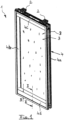
- FIG 1 a perspective view of a wall element 1 is shown.
- Several of these wall elements 1 can be arranged adjacent to each other in a room to form a partition wall.
- they In order to move the wall elements 1, they have a guide device 2, via which the wall elements 1 can be moved in a rail system, for example integrated in the ceiling of a room.
- the guide device 2 has a large number of rollers, which either run only to guide the wall element 1 in the rail system or can be driven in order to form an automatically movable partition wall.
- the wall element 1 essentially has two transparent pane elements 3 which are arranged at a parallel distance from one another and are accommodated in a profile frame 4 .
- the profile frame 4 has a rectangular shape and surrounds the pane elements 3.
- the profile frame 4 forms only a small part of the side surface of the wall element 1, so that the width B of the profile frame 4 only covers a small proportion the overall lateral dimensions of the wall element 1 occupies.
- the profile frame 4 has two vertically running side frame parts 4a and 4b, which are connected via an upper beam 4c on the upper side and a lower beam 4d on the lower side of the wall element 1.
- FIG 2 follows a cross-sectional view in the cross-sectional plane II-II, which is laid through the lower beam 4d.
- figure 2 shows the cross-sectional view through the wall element 1 in the area of the lower beam 4d according to section II-II figure 1 .
- the disk elements 3 can be seen in cross section, with a thin disk element 3 being used on the left and a thicker disk element 3 on the right, which are arranged at a distance from one another.
- the distance between the pane elements 3 is determined by the width of the profile frame 4 .
- the pane elements 3 are accommodated as far apart as possible within a profile frame 4, which is further reinforced by a glazing tape 10 in order to compensate for the smaller thickness of the pane element 3 on the left side.
- a sound insulation device 5 which has at least one sealing element 8 which can be moved against a floor 11 by means of a drive unit 9 .
- the sealing element 8 consists of at least one rubber lip which, in addition to further sealing elements 12, extends over the entire width of the wall element 1.
- the sealing elements 8 and 12 are accommodated in a receiving frame 13 which can be moved vertically against the ground by the drive unit 9 .
- the lower rail 4d has clip strips 6 on the outside, which are designed in one piece with the lower rail 4d.
- the clip strips 6 have a U-shaped cross section, so that the disc elements 3 can be inserted into the clip strips 6 first. Due to the arrangement of the clip strips 6 on the underside, the pane elements 3 are held in this by their gravity, so that a plug-in seal 7 can then be inserted between the clip strip 6 and the pane elements 3 in order to finally accommodate the pane element 3 in the profile frame 4.
- a detailed view of the arrangement of a plug-in seal 7 in the clip strip 6 is shown in detail III in FIG figure 3 shown in more detail.
- FIG 3 shows a detailed view of Detail III from figure 2 .
- the clip bar 6 is part of the lower beam 4d and has a leg that extends beyond the pane element 3 on the outside.
- the clip strip 6 has a latching geometry 14 through which the plug-in seal 7 can be held.
- This has a depression 15 into which the nose-like latching geometry 14 of the clip bar 6 can hook. Consequently, there is the possibility of pressing the plug-in seal 7 between the clip bar 6 and the disk element 3 , with the plug-in seal 7 being shown in an undeformed state and the deformation taking place in such a way that the plug-in seal 7 presses against the surface of the disk element 3 .
- the Figures 4a and 4b show a cross-sectional view of the profile frame 4 in the area of the side frame parts 4a and 4b.
- the Figure 4a is a cross section of the left side arranged side frame part 4a and in FIG Figure 4b a cross-sectional view of the side frame part 4b of the profile frame 4 is shown.
- the side frame part 4a is designed as a groove part, whereas the side frame part 4b forms a tongue part which is intended to engage in the groove part 4a of an adjacent wall element.
- Further sealing elements 16 and 17 are arranged in the tongue and groove geometry in order to make the joint between the wall elements themselves soundproof.
- the view also shows two pane elements 3 which are accommodated at a distance from one another in the side frame part 4a and 4b.
- the recording takes place via clip strips 6, which act together with a plug-in seal 7 in the same way as is already the case with the recording of the disk element 3 in the area of the lower beam according to FIG figure 3 is described.
- the clip strips 6 are designed as individual parts in the area of the side frame parts 4a and 4b and have a U-shape with a short and a long U-leg.
- the short leg of the U engages in a form-fitting manner in a geometry of the side frame parts 4a and 4b, so that the long leg of the U extends over a section over the pane element 3 .
- a plug-in seal 7 is again used, which is designed in the same way as the plug-in seal 7 in the area of the lower beam.
- the figure 5 shows a detailed view of the arrangement of the clip strip 6 on the side frame profile 4a according to detail IV Figure 4a .
- the pane element 3 shown here is thinner, so that a glazing tape 10 is inserted in the receiving geometry of the side frame part 4a in order to compensate for the width of the receiving recess for receiving the pane element 3 .
- the connection between the plug-in seal 7 and the clip strip 6 takes place in the same way via a locking geometry 14, which is formed on the clip strip 6 and positively engages in a recess 15 in of plug-in seal 7 is present.
- the plug-in seal 7 has an elastic material such as a rubber band and the like, so that it can deform and the deformation causes a contact pressure of the pane element 3 against the glazing band 10 or against the profile frame 4 .
- the pane elements 3 can also consist of a polarizing glass in order to temporarily eliminate the transparency of the pane elements with appropriate electrical wiring. Furthermore, a special gas can be introduced between the two pane elements 3, which enables improved insulation properties for sound insulation.
- the material of the profile frames 4 can be an aluminum extruded profile, which can also be designed in parts and includes a plastic bridge in order to create thermal insulation between the two outer surfaces of the wall element 1 .
Landscapes
- Engineering & Computer Science (AREA)
- Civil Engineering (AREA)
- Structural Engineering (AREA)
- Architecture (AREA)
- Physics & Mathematics (AREA)
- Electromagnetism (AREA)
- Building Environments (AREA)
- Securing Of Glass Panes Or The Like (AREA)
- Specific Sealing Or Ventilating Devices For Doors And Windows (AREA)
Description
- Die vorliegende Erfindung betrifft eine Trennwand mit mehreren Wandelementen, die über eine Führungseinrichtung beweglich aufgenommen sind. Die seitlichen Planflächen der Wandelemente sind durch transparente Scheibenelemente gebildet, um eine durchsichtige mobile Trennwand aus mehreren Wandelementen zu schaffen.
- Derartige Wandelemente zur Bildung einer mobilen Trennwand mit transparenten Scheibenelementen finden Anwendung in Räumen wie Ladenlokale zur Bildung einer mobilen Fensterfront, in Geschäften zur variablen Abtrennung von Kundenbereichen, in öffentlichen Gebäuden und insbesondere in Banken, in denen nach Geschäftsschluss ein innerer Teil des Kundenbereiches von einem äußeren Teil abgetrennt wird. Die transparenten Scheibenelemente weisen Beschläge auf, an denen Führungseinrichtungen angebracht sind, um die Wandelemente beispielsweise in einem Deckenschienensystem aufzunehmen und in diesem zu führen. Häufig sind die Scheibenelemente einzeln angeordnet und bilden den Körper des Wandelementes selbst. Die Beschläge sind dann auf der Oberseite und der Unterseite des Scheibenelementes angeordnet, so dass dann, wenn mehrere Wandelemente nebeneinander angeordnet sind, um die Trennwand zu bilden, die Scheibenelemente aus Glas unmittelbar aneinander angrenzen.
- Derartige Trennwände mit mehreren Glaselementen, die aus transparenten Scheibenelementen aufgebaut sind, weisen den Nachteil auf, dass keine Schallisolation ermöglicht ist, da die Scheibenelemente einerseits nur einfach und nicht doppelwandig vorhanden sind und andererseits im Randbereich der Scheibenelemente keine Abdichtung aufweisen. Zwar sind Wandelemente zur Bildung von Trennwänden bekannt, die über Schallisolationseinrichtungen verfügen, derartige Einrichtungen sind jedoch nicht für Wandelemente bekannt, die aus transparenten Scheibenelementen bestehen. Das Problem ergibt sich bereits aus der Integration einer Schallisolationseinrichtung in die Beschläge, die wenigstens oberseitig und unterseitig das Scheibenelement einfassen.
- Ferner sind Trennwände mit mehreren Wandelementen bekannt, wobei die Wandelemente eine Rahmenstruktur aufweisen, in der zugeschnittene Platten eingesetzt sind, die aus MDF-Platten, aus Massivholzplatten oder aus Kunststoffplatten bestehen. Derartige Wandelemente weisen Schallisolationseinrichtungen auf, um eine schalldichte mobile Trennwand zu schaffen. Wandelemente sind ferner mit Fenstern bekannt, die in Gestalt eines Ausschnittes innerhalb der Seitenplatten in diese eingebracht sind. Der Fensterausschnitt innerhalb der Seitenplatten stört dabei nicht die Integration der Schallisolationseinrichtung, die gewöhnlich einen erheblichen Bauraum einnimmt und auf einem Spindelsystem basiert, durch das Dichtelemente sowohl gegen den Boden als auch gegen die Decke des Raumes bewegt werden.
- Die
DE 29822256 U1 zeigt eine mobile Glastrennwand gemäß dem Oberbegriff des Anspruchs 1, bei der über pneumatische betätigbare Huborgane ein weitestgehend automatisches Ausfahren der Dichtleisten ermöglicht wird, wenn die Schiebeelemente zusammenfahren. Diese Glastrennwand kann die erforderlichen Schallwerte nicht erreichen, da die Glasscheiben in einem zu geringen Abstand im Profil angeordnet sind. - In der
EP 1029997 A2 wird eine mobile Trennwand mit Glasscheiben beschrieben, bei der die thermische Abdichtung zwischen den Wandelementen offenbart wird. - Es ist daher die Aufgabe der vorliegenden Erfindung, eine Trennwand mit mehreren Wandelementen zu schaffen, die einen erweiterten Funktionsumfang aufweist und eine erhöhte Schallisolation ermöglicht.
- Diese Aufgabe wird ausgehend von einer Trennwand aus transparenten Wandelementen gemäß des Anspruches 1 in Verbindung mit den kennzeichnenden Merkmalen gelöst. Vorteilhafte Weiterbildungen der Erfindung sind in den abhängigen Ansprüchen angegeben.
- Die erfindungsgemäße Trennwand weist mehrere Wandelemente auf, die über eine Führungseinrichtung beweglich aufgenommen sind, wobei die Wandelemente zwei in einem Abstand parallel zueinander angeordnete transparente Scheibenelemente aufweist, und wobei die Wandelemente einen Profilrahmen zur Aufnahme der Scheibenelemente aufweisen und in dem ferner eine Schallisolationseinrichtung aufgenommen ist, um die Wandelemente wenigstens gegen einen Boden und gegen eine Decke schallisolierend abzudichten.
- Die erfindungsgemäße Trennwand kombiniert die Eigenschaften einer transparenten Trennwand mit den Vorteilen einer Schallisolation. Erst durch die erfindungsgemäße Aufnahme der Scheibenelemente in einem Profilrahmen wird die Voraussetzung geschaffen, eine Schallisolationseinrichtung in den Wandelementen zu integrieren. Die Schallisolation wird einerseits durch die schallisolierende Abdichtung der Wandelemente gegen den Boden und gegen die Decke des Raumes geschaffen, wobei andererseits die planparallele Anordnung von zwei transparenten Scheibenelementen in einem Abstand zueinander zur Schallisolation beiträgt. Dies wird erst durch den Profilrahmen ermöglicht, der in Kombination der transparenten Scheibenelemente das Wandelement bildet. Durch den gegebenen Abstand der beiden transparenten Scheibenelemente zueinander wird der Effekt der Schallisolation verstärkt, wobei ein größerer Abstand zwischen den Scheibenelementen zu besseren Werten der Schallisolation führt.
- Je größer der Abstand der Scheibenelemente zueinander ist, desto größer ist die Wirkung der Schallisolation. Hingegen sollte das Wandelement ein gegebenes Breitenmaß nicht übersteigen, so dass es von Vorteil ist, die Scheibenelemente im Wandelement möglichst außenseitig anzuordnen. Der Profilrahmen sollte folglich nicht wesentlich über die Außenflächen der Scheibenelemente hinausragen. Dabei weist der Abstand der beiden im Profilrahmen aufgenommen Glasscheiben einen Wert von wenigstens 80 mm auf, wobei das Wandelement insgesamt ein Dickenmaß von 100 mm nicht überschreitet.
- Gemäß einer vorteilhaften Ausführungsform sind die Seitenflächen des Wandelementes überwiegend durch die Scheibenelemente gebildet, wobei der Profilrahmen die Scheibenelemente nur randseitig umgibt und diese einfasst. Damit wird eine klare Unterscheidung des erfindungsgemäßen Wandelementes von bekannten Wandelementen geschaffen, die als Seitenflächen in einem Rahmen eingefasste nicht-transparente Platten aufweisen und die einen Fensterausschnitt besitzen. Derartige herkömmliche Wandelemente besitzen Seitenflächen, die überwiegend durch die nichttransparenten Seitenplatten gebildet sind. Vorliegend besitzt das erfindungsgemäße Wandelement jedoch lediglich einen Profilrahmen, der derart schmal ausgeführt ist, dass dieser nur randseitig in Erscheinung tritt, und die Scheibenelemente im Profilrahmen eingefasst sind. Das Verhältnis zwischen der Seitenfläche, die durch den Profilrahmen gebildet wird, verglichen zur Seitenfläche, die durch das Scheibenelement gebildet wird, kann mit einem Fensterflügel eines Gebäudes verglichen werden. Bei einem Fensterflügel fasst ein Fensterrahmen die Fensterscheibe lediglich randseitig ein, ohne dass der Fensterrahmen einen wesentlichen Anteil an der Seitenfläche des Fensters bildet.
- Die Scheibenelemente sind aus Glasscheiben gebildet, wobei bevorzugt wenigstens eine der beiden Scheibenelemente eine Einfachglasscheibe oder auch eine Doppelglasscheibe aufweisen kann. Durch Verwendung von Doppelglasscheiben wird neben einer verbesserten Schallisolation auch eine Wärmeisolation ermöglicht, sofern die erfindungsgemäße Trennwand die Funktion einer Wärmedämmung erfüllen muss. Der Profilrahmen kann dabei ferner eine thermische Trennung aufweisen, in dem dieser beispielsweise sowohl ein innenseitiges als auch ein außenseitiges Aluminiumprofil besitzt, die über Kunststoffstege innenseitig zusammengehalten sind. Damit entsteht eine Barriere gegen einen Wärmefluss von einer warmen zu einer kalten Seite, die durch die Trennwand getrennt sind. Dabei kann es hinreichend sein, zumindest eine der beiden Scheibenelemente als Doppelglasscheibe auszuführen, wobei die zweite Glasscheibe eine Einfachglasscheibe sein kann.
- Es ist weiterhin möglich die Glasscheiben als Einfachglasscheiben auszubilden und entweder mit einer gleichen oder mit einer unterschiedlichen Dicke zu kombinieren. Beispielsweise ist es von Vorteil, Glasscheibendicken von 6 mm und 6 mm zu kombinieren, wobei auch eine Kombination von 8 mm und 10 mm möglich ist, die eine verbesserte Schallisolation ermöglicht. Die Kombination von unterschiedlichen Glasscheibendicken führt zu geringeren Resonanzeffekten, wodurch wiederum die Schallisolation weiter verstärkt werden kann.
- Eine mögliche Ausführungsform des Profilrahmens besitzt vertikal verlaufende Seitenrahmenteile, die nach Art einer Nut-Feder-Verbindung derart kombiniert sind, dass mehrere Wandelemente nebeneinander angeordnet werden können und einen Formschluss bilden. Folglich weist ein Wandelement ein erstes vertikal verlaufendes Seitenrahmenteil auf einer ersten Seite auf, das eine Nut umfasst, wobei das gegenüberliegende zweite vertikal verlaufende Rahmenteil auf der zweiten Seite eine Federgeometrie besitzt. In der Nut-Feder-Fügegeometrie können wiederum Dichtelemente zur Verbesserung der Schallisolation vorgesehen sein. Der Profilrahmen besteht auf der oberen Seite aus einem horizontal verlaufendem Oberholm und auf der Bodenseite auf einem horizontal verlaufendem Unterholm. Im Ergebnis wird ein zumeist rechteckiger Profilrahmen gebildet, wobei die vertikal verlaufenden Seitenrahmenteile mit den jeweiligen Ober- und Unterholmen verbunden sind. Die Verbindung kann über Winkelprofile erfolgen, wobei diese aus einem festeren Werkstoff, beispielsweise einem Stahlwerkstoff, ausgebildet sein können, da das Gewicht der Scheibenelemente über die Winkelprofile getragen wird, denn die Wandelemente sind meist mit einer Führungseinrichtung aufgenommen, die an der Decke des Raumes angebracht ist. Derartige Wandelemente können Höhen von über vier Metern aufweisen, so dass bei zwei im Profilrahmen eingesetzten Glasscheiben größerer Dicke ein beträchtliches Gewicht entsteht, das zunächst vom Unterholm aufgenommen wird und über die Winkelprofile in die vertikal verlaufenden Seitenrahmenteile eingeleitet wird.
- Gemäß der vorliegenden Erfindung weist die Trennwand eine Schallisolationseinrichtung auf, die im Oberholm und/oder im Unterholm angeordnet ist. Die Schallisolationseinrichtung besitzt Dichtelemente, die jeweils aus dem Oberholm gegen die Decke und aus dem Unterholm gegen den Boden fahrbar sind. Die Dichtelemente müssen im Ober- und Unterholm verfahrbar angeordnet sein, da die Dichtelemente erst nach Erreichen der Endposition des Wandelementes in der Trennwand gegen die Decke und den Boden verfahren werden. Folglich kann das Wandelement innerhalb der Führungseinrichtung bewegt werden, ohne dass die Dichtelemente gegen die Decke und den Boden abdichten.
- Zum Verfahren der Dichtelemente ist erfindungsgemäß vorgesehen, dass in einem Wandelement eine erste Antriebseinheit im Oberholm und eine zweite Antriebseinheit im Unterholm vorgesehen ist, die getrennt voneinander ein jeweiliges Dichtelement sowohl gegen die Decke als auch gegen den Boden verfahren. Im Unterschied zu herkömmlichen Wandelementen, in denen eine einzige Antriebseinheit sowohl ein erstes Dichtelement gegen die Decke als auch ein weiteres zweites Dichtelement gegen den Boden verfährt, weist das erfindungsgemäße Wandelement getrennte Antriebseinheiten für die Dichtelemente zum Abdichten gegen die Decke und gegen den Boden auf. Um die erfindungsgemäße Ausführung des Wandelementes mit einem Profilrahmen zu schaffen, in dem die Antriebseinheiten oberseitig und unterseitig eingebracht sind, müssen die Antriebseinheiten dem verfügbaren Bauraum innerhalb des Oberholms und des Unterholms angepasst sein. Eine alternative Ausführungsform einer Antriebseinheit kann ein Spindelsystem umfassen, welches nur einen Antrieb aufweist, der in einem der vertikal verlaufenden Seitenrahmenteile integriert ist, und sowohl mit dem deckenseitigen als auch mit dem bodenseitigen Dichtelement zusammenwirkt. Nur dann kann der Antrieb der Dichtelemente oberseitig und unterseitig auf eine Antriebseinheit reduziert werden. Unabhängig von der Anordnung der Antriebseinheit in den Seitenrahmenteilen oder im Ober- und Unterholm ist diese zumindest aus der Mitte des Wandelementes verlagert worden. Folglich ist die Transparenz durch die Wandelemente nicht durch die Anordnung der Antriebseinheit behindert.
- Vorteilhafterweise ist der Profilrahmen durch eine Breite bestimmt, die einen Wert von 200 mm, bevorzugt einen Wert von 150 mm und besonders bevorzugt einen Wert von 120 mm nicht übersteigt. Nur so kann gewährleistet sein, dass die Seitenfläche des Wandelementes überwiegend durch das Scheibenelement gebildet wird. Insbesondere die Brüstungshöhe vom Boden bis zur Oberkante des Profilrahmens im Bereich des Unterholms ist mit einem Wert von 120 mm begrenzt, wobei eine geringe Breite des Profilrahmens zu einem wünschenswerten, filigranen Erscheinungsbild der Trennwand beiträgt.
- Erfindungsgemäß sind Clipleisten vorgesehen, durch die die Scheibenelemente im Profilrahmen aufgenommen sind. Die Clipleisten werden außenseitig am Profilrahmen angeordnet, so dass beide Scheibenelemente durch die Clipleisten mittel eines elastischen Andruckes gegen den Profilrahmen gehalten werden. Die Clipleiste auf der Seite des Unterholms kann einteilig mit dem Unterholm ausgeführt sein, so dass die Scheibenelemente zunächst in die unterseitige Clipleiste eingesetzt bzw. eingestellt werden können. Nachfolgend werden die Clipleisten an den Seitenrahmenteilen sowie am Oberholm eingesetzt, um das Scheibenelement im Profilrahmen zu befestigen. Die Clipleisten, die an den vertikal verlaufenden Seitenrahmenteilen sowie am Oberholm angeordnet sind, weisen ein U-förmiges Strangprofil auf. Das U-förmige Strangprofil bewirkt mit einem ersten U-Schenkel einen Formschluss im Seitenrahmenteil, und erzeugt mit einem zweiten U-Schenkel einen Andruck des Scheibenelementes gegen den Profilrahmen. Dieser zweite U-Schenkel ist gegenüber dem ersten U-Schenkel länger ausgeführt und erstreckt sich abschnittsweise über das Scheibenelement. Um eine elastische Aufnahme der Scheibenelemente im Profilrahmen zu ermöglichen, sind Steckdichtungen vorgesehen, die mit den Clipleisten zusammenwirken. Die Steckdichtungen werden auf dem gesamten Umfang des Profilrahmens zwischen dem zweiten Schenkel der Clipleiste und dem Scheibenelement eingedrückt, und können in der Clipleiste verrasten. Die Steckdichtungen können aus einem gummiartigen Material bestehen, um sowohl eine Abdichtung gegen Verunreinigungen zu schaffen, die zwischen die Scheibenelemente gelangen können, als auch eine Nachgiebigkeit zwischen dem Profilrahmen und dem Scheibenelement zu ermöglichen, um beispielsweise Wärmedehnungen auszugleichen.
- Das Wandelement weist insgesamt ein Dickenmaß von etwa 100 mm auf. Damit wird die Stapelhöhe der Wandelemente in einer Parkposition verringert. Ferner trägt eine geringere Dicke des Wandelementes zu einem filigraneren Erscheinungsbild bei, wobei es zugleich wünschenswert ist, die Scheibenelemente mit einem großen Abstand zueinander im Profilrahmen aufzunehmen. Folglich weisen die Clipleisten nur eine geringe Höhe über dem Scheibenelement auf, die geringer ist als die Dicke des Scheibenelementes, um die Gesamtdicke der Wandelemente nicht unnötig zu vergrößern.
- Weitere, die Erfindung verbessernde Maßnahmen werden nachstehend gemeinsam mit der Beschreibung eines bevorzugten Ausführungsbeispiels der Erfindung anhand der Figuren näher dargestellt.
- Es zeigen:
- Figur 1:
- eine perspektivische Ansicht eines erfindungsgemäßen Wandelementes zur Bildung einer mobilen Trennwand;
- Figur 2:
- eine Querschnittsansicht in der Querschnittsebene, die in
Figur 1 mit II-II gekennzeichnet ist; - Figur 3:
- eine Detailansicht der Anordnung der Clipleiste am Profilrahmen mit einer zugeordneten Steckdichtung gemäß des Details III, das in der
Figur 2 gezeigt ist; - Figur 4a:
- eine Querschnittsansicht des Profilrahmens im Bereich eines vertikal verlaufenden Seitenrahmenteils, das als Nut ausgeführt ist;
- Figur 4b:
- eine Querschnittsansicht durch ein vertikal verlaufendes Seitenrahmenteil, dass als Feder ausgeführt ist und
- Figur 5:
- eine Detailansicht der Anordnung einer Clipleiste mit einer Steckdichtung im Bereich eines Seitenrahmenteils gemäß des Details IV aus der
Figur 4a . - In
Figur 1 ist eine perspektivische Ansicht eines Wandelementes 1 dargestellt. Mehrere dieser Wandelemente 1 können in einem Raum angrenzend aneinander angeordnet werden, um eine Trennwand zu bilden. Um die Wandelemente 1 zu verfahren, besitzen diese eine Führungseinrichtung 2, über die die Wandelemente 1 in einem Schienensystem verfahrbar sind, dass beispielsweise in der Decke eines Raumes integriert ist. Die Führungseinrichtung 2 weist eine Vielzahl von Rollen auf, die entweder nur zur Führung des Wandelementes 1 im Schienensystem laufen oder angetrieben sein können, um eine automatisch verfahrbare Trennwand zu bilden. Das Wandelement 1 weist im Wesentlichen zwei in einem parallelen Abstand zueinander angeordnete transparente Scheibenelemente 3 auf, die in einem Profilrahmen 4 aufgenommen sind. Der Profilrahmen 4 besitzt eine rechteckige Form und umrandet die Scheibenelemente 3. Wie in der perspektivischen Ansicht des Wandelementes 1 gezeigt, bildet der Profilrahmen 4 lediglich einen geringen Teil der Seitenfläche des Wandelementes 1, so dass die Breite B des Profilrahmens 4 nur einen geringen Anteil an den seitlichen Gesamtabmessungen des Wandelementes 1 einnimmt. Der Profilrahmen 4 weist zwei vertikal verlaufende Seitenrahmenteile 4a und 4b auf, die über einen Oberholm 4c auf der oberen Seite und einen Unterholm 4d auf der unteren Seite des Wandelementes 1 verbunden sind. InFigur 2 folgt eine Querschnittsansicht in der Querschnittsebene II-II, der durch den Unterholm 4d gelegt ist. -
Figur 2 zeigt die Querschnittsansicht durch das Wandelement 1 im Bereich des Unterholms 4d gemäß des Schnittes II-II ausFigur 1 . Im Querschnitt sind die Scheibenelemente 3 erkennbar, wobei linksseitig ein dünnes und rechtsseitig ein dickeres Scheibenelement 3 eingesetzt ist, die in einem Abstand zueinander angeordnet sind. Der Abstand der Scheibenelemente 3 zueinander wird durch die Breite des Profilrahmens 4 bestimmt. Dabei sind die Scheibenelemente 3 möglichst in einem großen Abstand zueinander innerhalb eines Profilrahmens 4 aufgenommen, was durch ein Vorlegeband 10 noch verstärkt ist, um die geringere Dicke des Scheibenelementes 3 auf der linken Seite auszugleichen. - Innerhalb des Unterholmes 4d des Profilrahmens 4 ist eine Schallisolationseinrichtung 5 integriert, die wenigstens ein Dichtelement 8 aufweist, das mittels einer Antriebseinheit 9 gegen einen Boden 11 verfahrbar ist. Das Dichtelement 8 besteht wenigstens aus einer Gummilippe, die sich neben weiteren Dichtelementen 12 über der gesamten Breite des Wandelementes 1 hinweg erstreckt. Die Dichtelemente 8 und 12 sind in einem Aufnahmerahmen 13 aufgenommen, der durch die Antriebseinheit 9 vertikal gegen den Boden bewegbar ist.
- Der Unterholm 4d weist außenseitige Clipleisten 6 auf, die einteilig mit dem Unterholm 4d ausgeführt sind. Die Clipleisten 6 besitzen einen U-förmigen Querschnitt, so dass die Scheibenelemente 3 zunächst in die Clipleisten 6 eingesetzt werden können. Aufgrund der unterseitigen Anordnungen der Clipleisten 6 sind die Scheibenelemente 3 in diesem durch ihre Schwerkraft gehalten, so dass anschließend eine Steckdichtung 7 zwischen der Clipleiste 6 und den Scheibenelementen 3 eingesetzt werden kann, um das Scheibenelement 3 endgültig in dem Profilrahmen 4 aufzunehmen. Eine detaillierte Ansicht der Anordnung einer Steckdichtung 7 in der Clipleiste 6 ist gemäß des Details III in der
Figur 3 genauer dargestellt. -
Figur 3 zeigt eine detaillierte Ansicht des Details III ausFigur 2 . Die Clipleiste 6 ist Bestandteil des Unterholms 4d, und besitzt einen Schenkel, der sich außenseitig über das Scheibenelement 3 hinweg erstreckt. Endseitig besitzt die Clipleiste 6 eine Rastgeometrie 14, durch die die Steckdichtung 7 gehalten werden kann. Diese weist eine Vertiefung 15 auf, in die die nasenartige Rastgeometrie 14 der Clipleiste 6 einhaken kann. Folglich besteht die Möglichkeit, die Steckdichtung 7 zwischen die Clipleiste 6 und das Scheibenelement 3 einzudrücken, wobei die Steckdichtung 7 in unverformtem Zustand gezeigt ist, und die Verformung derart stattfindet, dass die Steckdichtung 7 gegen die Oberfläche des Scheibenelementes 3 drückt. - Die
Figuren 4a und 4b zeigen eine quergeschnittene Ansicht des Profilrahmens 4 im Bereich der Seitenrahmenteile 4a und 4b. In derFigur 4a ist ein Querschnitt des linksseitig angeordneten Seitenrahmenteiles 4a und in derFigur 4b ist eine quer geschnittene Ansicht des Seitenrahmenteiles 4b des Profilrahmens 4 gezeigt. Das Seitenrahmenteil 4a ist als Nut-Teil ausgeführt, wohingegen das Seitenrahmenteil 4b einen Feder-Teil bildet, der zum Eingriff in den Nut-Teil 4a eines benachbarten Wandelementes bestimmt ist. Weitere Dichtelemente 16 und 17 sind in der Feder-Nut-Geometrie angeordnet, um auch die Fügestelle zwischen den Wandelementen selbst schalldicht zu gestalten. - Die Ansicht zeigt ferner zwei Scheibenelemente 3, die in einem Abstand zueinander im Seitenrahmenteil 4a und 4b aufgenommen sind. Die Aufnahme erfolgt über Clipleisten 6, die auf gleiche Weise mit einer Steckdichtung 7 zusammen wirken, wie dies bereits durch die Aufnahme des Scheibenelementes 3 im Bereich des Unterholms gemäß der
Figur 3 beschrieben ist. Jedoch sind die Clipleisten 6 im Bereich der Seitenrahmenteile 4a und 4b als Einzelteile ausgeführt, und besitzen eine U-förmige Gestalt mit einem kurzen und einem langen U-Schenkel. Der kurze U-Schenkel greift formschlüssig in eine Geometrie des Seitenrahmenteils 4a und 4b ein, so dass sich der lange U-Schenkel über einen Abschnitt über das Scheibenelement 3 hinweg erstreckt. Endseitig am langen U-Schenkel der Clipleiste 6 ist wiederum eine Steckdichtung 7 eingesetzt, die auf gleiche Weise ausgeführt ist, wie die Steckdichtung 7 im Bereich des Unterholms. - Die
Figur 5 zeigt eine Detailansicht der Anordnung der Clipleiste 6 am Seitenrahmenprofil 4a gemäß des Details IV ausFigur 4a . Das hierin gezeigte Scheibenelement 3 ist dünner ausgeführt, so dass in der Aufnahmegeometrie des Seitenrahmenteils 4a ein Vorlegeband 10 eingesetzt ist, um die Breite der Aufnahmeaussparung zur Aufnahme des Scheibenelementes 3 auszugleichen. - Die Verbindung zwischen der Steckdichtung 7 und der Clipleiste 6 erfolgt auf gleiche Weise über eine Rastgeometrie 14, die an der Clipleiste 6 ausgebildet ist und in eine Vertiefung 15 formschlüssig eingreift, die in der Steckdichtung 7 vorhanden ist. Die Steckdichtung 7 weist ein elastisches Material wie ein Gummiband und dergleichen auf, so dass sich dieses verformen kann und durch die Verformung ein Anpressdruck des Scheibenelementes 3 gegen das Vorlegeband 10 bzw. gegen den Profilrahmen 4 hervorruft.
- Die Erfindung beschränkt sich in ihrer Ausführung nicht auf das vorstehend angegebene bevorzugte Ausführungsbeispiel. Vielmehr ist eine Anzahl von Varianten denkbar, welche von der dargestellten Lösung auch bei grundsätzlich anders gearteten Ausführungen Gebrauch macht. Insbesondere können die Scheibenelemente 3 auch aus einem Polarisationsglas bestehen, um mit entsprechender elektrischer Beschaltung die Transparenz der Scheibenelemente vorübergehend aufzuheben. Ferner kann zwischen den beiden Scheibenelementen 3 ein spezielles Gas eingeleitet werden, dass verbesserte Isolationseigenschaften zur Schallisolation ermöglicht. Das Material der Profilrahmen 4 kann ein Aluminium-Strangpressprofil sein, welches auch geteilt ausgeführt sein kann und eine Kunststoffbrücke umfasst, um eine Wärmeisolation zwischen den beiden Außenflächen des Wandelementes 1 zu schaffen.
-
- 1
- Wandelement
- 2
- Führungseinrichtung
- 3
- Scheibenelement
- 4
- Profilrahmen
- 4a
- Seitenrahmenteil
- 4b
- Seitenrahmenteil
- 4c
- Oberholm
- 4d
- Unterholm
- 5
- Schallisolationseinrichtung
- 6
- Clipleiste
- 7
- Steckdichtung
- 8
- Dichtelement
- 9
- Antriebseinheit
- 10
- Vorlegeband
- 11
- Boden
- 12
- Dichtelement
- 13
- Aufnahmerahmen
- 14
- Rastgeometrie
- 15
- Vertiefung
- 16
- Dichtelement
- 17
- Dichtelement
- B
- Breite des Profilrahmens
Claims (12)
- Trennwand mit mehreren Wandelementen (1), die über eine Führungseinrichtung (2) beweglich aufgenommen sind, wobei die Wandelemente (1) zwei in einem Abstand parallel zueinander angeordnete transparente Scheibenelemente (3) aus Glas aufweisen, und wobei die Wandelemente (1) einen Profilrahmen (4) zur Aufnahme der Scheibenelemente (3) aufweisen und in dem ferner eine Schallisolationseinrichtung (5) aufgenommen ist, um das Wandelement (1) wenigstens gegen einen Boden und gegen eine Decke schallisolierend abzudichten, dadurch gekennzeichnet, dass die Scheibenelemente (3) außenseitig am Wandelement (1) angeordnet sind und in einem Abstand von wenigstens 80 mm zueinander im Profilrahmen aufgenommen sind,wobei Clipleisten (6) vorgesehen sind, durch die die Scheibenelemente (3) im Profilrahmen (4) aufgenommen sind, undwobei die Clipleisten (6) außenseitig am Profilrahmen (4) angeordnet sind, und beide Scheibenelemente (3) durch die Clipleisten (6) mittels elastischen Andrucks gegen den Profilrahmen (4) gehalten sind.
- Trennwand nach Anspruch 1, dadurch gekennzeichnet, dass die Seitenfläche des Wandelementes (1) überwiegend durch die Scheibenelemente (3) gebildet ist, wobei der Profilrahmen (4) die Scheibenelemente (3) nur randseitig umgibt und diese einfasst.
- Trennwand nach Anspruch 1, dadurch gekennzeichnet, dass wenigstens eine der Glasscheiben (3) eine Einfachglasscheibe oder eine Doppelglasscheibe aufweist.
- Trennwand nach Anspruch 3, dadurch gekennzeichnet, dass die Glasscheiben (3) als Einfachglasscheiben ausgebildet sind und in Glasscheibendicken von etwa 6mm und etwa 6mm oder von etwa 10mm und etwa 8mm kombiniert im Profilrahmen (4) aufgenommen sind.
- Trennwand nach einem der vorgenannten Ansprüche, dadurch gekennzeichnet, dass der Profilrahmen (4) vertikal verlaufende Seitenrahmenteile (4a, 4b) und einen deckenseitigen, horizontal verlaufenden Oberholm (4c) und einen bodenseitigen, horizontal verlaufenden Unterholm (4d) aufweist.
- Trennwand nach Anspruch 5, dadurch gekennzeichnet, dass die Schallisolationseinrichtung (5) im Oberholm (4c) und/oder im Unterholm (4d) aufgenommene Dichtelemente (8) aufweist, die aus dem Oberholm (4c) gegen die Decke und aus dem Unterholm (4d) gegen den Boden fahrbar sind.
- Trennwand nach Anspruch 5 oder 6, dadurch gekennzeichnet, dass in einem Wandelement (1) eine erste Antriebseinheit (9) im Oberholm und eine zweite Antriebseinheit (9) im Unterholm vorgesehen ist, wobei die Dichtelemente (8) mittels der Antriebseinheiten (9) gegen die Decke und/oder gegen den Boden verfahrbar sind.
- Trennwand nach einem der vorgenannten Ansprüche, dadurch gekennzeichnet, dass der Profilrahmen (4) durch eine Breite (B) vom eingefassten Scheibenelement (3) bis zum Rand des Wandelementes (1) hin bestimmt ist, die einen Wert von 200mm, bevorzugt von 150mm und besonders bevorzugt von 120mm nicht übersteigt, um die Seitenfläche des Wandelementes (1) überwiegend durch das Scheibenelement (3) zu bilden.
- Trennwand nach einem der vorgenannten Ansprüche, dadurch gekennzeichnet, dass das seitliche und zur Dicke des Wandelementes (1) beitragende Höhenmaß der Clipleisten (6) über dem Scheibenelement (3) geringer ist als die Dicke eines Scheibenelementes (3).
- Trennwand nach einem der vorgenannten Ansprüche, dadurch gekennzeichnet, dass die Clipleisten (6), die am Ober- und/oder am Unterholm (4c, 4d) angeordnet sind, als Teil des Profilrahmens (4) ausgebildet sind, wobei Steckdichtungen (7) vorgesehen sind, die zwischen der Clipleiste (6) und dem Scheibenelement (3) einsetzbar sind und eine Druckvorspannung des Scheibenelementes (4) gegen den Profilrahmen (4) erzeugen.
- Trennwand nach einem der vorgenannten Ansprüche, dadurch gekennzeichnet, dass die Clipleisten (6), die an den vertikal verlaufenden Seitenrahmenteilen (4a, 4b) und am Oberholm (4c) angeordnet sind, ein U-förmiges Strangprofil aufweisen, das mit einem ersten U-Schenkel einen Formschluss im Seitenrahmenteil (4a, 4b) bzw. zum Oberholm (4c) bildet und mit einem zweiten U-Schenkel einen Andruck des Scheibenelementes (3) gegen den Profilrahmen (4) erzeugt.
- Trennwand nach einem der vorgenannten Ansprüche, dadurch gekennzeichnet, dass das Wandelement (1) ein Dickenmaß aufweist, das kleiner als 120mm und bevorzugt kleiner als oder gleich 100mm ist.
Priority Applications (1)
| Application Number | Priority Date | Filing Date | Title |
|---|---|---|---|
| EP11001243.2A EP2372032B1 (de) | 2008-06-11 | 2009-05-29 | Trennwand aus transparenten Wandelementen |
Applications Claiming Priority (2)
| Application Number | Priority Date | Filing Date | Title |
|---|---|---|---|
| DE102008027821A DE102008027821A1 (de) | 2008-06-11 | 2008-06-11 | Trennwand aus transparenten Wandelementen |
| PCT/EP2009/003854 WO2009149839A2 (de) | 2008-06-11 | 2009-05-29 | Trennwand aus transparenten wandelementen |
Related Child Applications (3)
| Application Number | Title | Priority Date | Filing Date |
|---|---|---|---|
| EP11001243.2A Division EP2372032B1 (de) | 2008-06-11 | 2009-05-29 | Trennwand aus transparenten Wandelementen |
| EP11001243.2A Division-Into EP2372032B1 (de) | 2008-06-11 | 2009-05-29 | Trennwand aus transparenten Wandelementen |
| EP11001243.2 Division-Into | 2011-02-16 |
Publications (3)
| Publication Number | Publication Date |
|---|---|
| EP2307629A2 EP2307629A2 (de) | 2011-04-13 |
| EP2307629B1 EP2307629B1 (de) | 2017-05-17 |
| EP2307629B2 true EP2307629B2 (de) | 2023-08-02 |
Family
ID=41317697
Family Applications (2)
| Application Number | Title | Priority Date | Filing Date |
|---|---|---|---|
| EP11001243.2A Active EP2372032B1 (de) | 2008-06-11 | 2009-05-29 | Trennwand aus transparenten Wandelementen |
| EP09761402.8A Active EP2307629B2 (de) | 2008-06-11 | 2009-05-29 | Trennwand aus transparenten wandelementen |
Family Applications Before (1)
| Application Number | Title | Priority Date | Filing Date |
|---|---|---|---|
| EP11001243.2A Active EP2372032B1 (de) | 2008-06-11 | 2009-05-29 | Trennwand aus transparenten Wandelementen |
Country Status (6)
| Country | Link |
|---|---|
| US (1) | US20110078960A1 (de) |
| EP (2) | EP2372032B1 (de) |
| CN (1) | CN102057113A (de) |
| AU (1) | AU2009257001A1 (de) |
| DE (1) | DE102008027821A1 (de) |
| WO (1) | WO2009149839A2 (de) |
Families Citing this family (7)
| Publication number | Priority date | Publication date | Assignee | Title |
|---|---|---|---|---|
| US8839592B2 (en) * | 2012-08-01 | 2014-09-23 | Dana Francis Foran | Dust free construction barrier system |
| EP2965903B1 (de) * | 2014-07-11 | 2018-09-05 | ISOCLIMA S.p.A. | Umschaltbares Fenster |
| US10041249B1 (en) * | 2015-07-31 | 2018-08-07 | Timothy Hebert | Adjustable barrier for partitioning a building space |
| CA2997063A1 (en) | 2017-03-01 | 2018-09-01 | Abatement Technologies, Inc. | Rigid panel containment system and related methods |
| US12054942B2 (en) | 2020-12-08 | 2024-08-06 | STARC Systems, Inc. | Temporary wall system with fire block protection |
| US12305388B2 (en) | 2022-07-15 | 2025-05-20 | STARC Systems, Inc. | Cap for a temporary wall system providing fire barrier protection |
| US12000136B2 (en) * | 2023-01-23 | 2024-06-04 | Nan Ya Plastics Corporation | Foldable living compartment |
Citations (1)
| Publication number | Priority date | Publication date | Assignee | Title |
|---|---|---|---|---|
| EP0629752A1 (de) † | 1993-05-25 | 1994-12-21 | Rosconi Ag | Mobile Trennwand |
Family Cites Families (93)
| Publication number | Priority date | Publication date | Assignee | Title |
|---|---|---|---|---|
| US3072975A (en) * | 1958-12-08 | 1963-01-15 | Richards Wilcox Mfg Co | Sealing mechanism for movable partition panels, doors and the like |
| US3049195A (en) * | 1959-01-09 | 1962-08-14 | Nat Res Dev | Demountable partitions |
| US3110131A (en) * | 1959-05-27 | 1963-11-12 | Jeffress Dyer Inc | Building construction |
| FR1267535A (fr) * | 1960-09-15 | 1961-07-21 | Cadres préfabriqués monolithiques avec éléments d'articulation et d'étanchéité destinés à constituer des dormants et battants | |
| US3335532A (en) * | 1964-01-08 | 1967-08-15 | Barrie B Greenbie | Movable partition or wall |
| US3226777A (en) * | 1964-03-23 | 1966-01-04 | Kollsman Paul | Flush closing sliding door assemblies |
| US3387418A (en) * | 1964-07-15 | 1968-06-11 | James W. Tyrer | Molding and partition assembly system |
| US3341992A (en) * | 1964-10-07 | 1967-09-19 | Robert Haws Co | Portable room dividing panel |
| US3295257A (en) * | 1965-03-12 | 1967-01-03 | Hough Mfg Corp | Wall panel assembly |
| NO117609B (de) * | 1966-07-01 | 1969-09-01 | Knag As A | |
| US3400504A (en) * | 1966-07-06 | 1968-09-10 | Ray H. Neisewander | Movable wall partition |
| US3557499A (en) * | 1968-09-16 | 1971-01-26 | Formica Corp | Movable wall panel system |
| US3587205A (en) * | 1968-10-29 | 1971-06-28 | Joseph Henry Gartside | Buildings |
| US3614050A (en) * | 1969-10-07 | 1971-10-19 | William Greenhalgh | Reusable forming unit |
| US3638376A (en) * | 1970-01-05 | 1972-02-01 | Hough Mfg Corp | Portable partition |
| US3755968A (en) * | 1972-01-20 | 1973-09-04 | Hough Mfg Corp | Floating constant contact seal for operable partitions |
| US3798839A (en) * | 1972-08-31 | 1974-03-26 | Industrial Acoustics Co | Movable wall panel |
| US3967420A (en) * | 1974-04-30 | 1976-07-06 | Papsco, Inc. | Portable wall system and method of installing same |
| US4073092A (en) * | 1975-06-27 | 1978-02-14 | Hough Manufacturing Corporation | Lost motion suspension system for operable partitions |
| US4084366A (en) * | 1975-11-14 | 1978-04-18 | Haworth Mfg., Inc. | Sound absorbing panel |
| US4031664A (en) * | 1976-01-20 | 1977-06-28 | United States Gypsum Company | Suspension system for sound absorption panels |
| US4014137A (en) * | 1976-03-08 | 1977-03-29 | Hough Manufacturing Corporation | Drop action panel arrangement for operable partitions |
| JPS574175Y2 (de) * | 1976-08-11 | 1982-01-26 | ||
| US4038790A (en) * | 1976-09-16 | 1977-08-02 | Paisley John C | Partition structure |
| US4454690A (en) * | 1976-09-28 | 1984-06-19 | Panelfold, Inc. | Portable and operable wall system |
| US4277920A (en) * | 1976-09-28 | 1981-07-14 | Panelfold Doors, Inc. | Portable and operable wall systems |
| US4103463A (en) * | 1976-09-28 | 1978-08-01 | Panelfold Doors, Inc. | Portable wall system |
| DE2811604C3 (de) * | 1978-03-17 | 1980-12-11 | Dornier System Gmbh, 7990 Friedrichshafen | Rahmen |
| US4227355A (en) * | 1978-03-30 | 1980-10-14 | United States Gypsum Company | Support system for sound absorbing panels |
| US4263761A (en) * | 1979-02-09 | 1981-04-28 | Kristoff Kim C | Portable acoustical panel system |
| DE3011946C2 (de) * | 1980-03-27 | 1985-03-21 | Golde GmbH Spritzgußwerk, 8192 Geretsried | Schiebefenster oder -tür |
| US4395854A (en) * | 1980-12-15 | 1983-08-02 | American Standard Inc. | Universal latch means for drop seal assembly for a moveable wall |
| US4612744A (en) * | 1981-08-07 | 1986-09-23 | Shamash Jack E | Method, components, and system for assembling buildings |
| US4443978A (en) * | 1982-12-14 | 1984-04-24 | Butler-Merritt Inc. | Movable thermal barrier for solar heated building |
| US4535578A (en) * | 1983-06-09 | 1985-08-20 | American Standard Inc. | Seal-actuating mechanism for a wall panel |
| CH666514A5 (de) * | 1984-05-24 | 1988-07-29 | Heinrich Saelzer | Rahmen fuer mit einer plattenfoermigen fuellung versehene bauteile. |
| US4703598A (en) * | 1986-04-28 | 1987-11-03 | Haworth, Inc. | Combined noise seal and retainer for panel |
| DE3619392A1 (de) * | 1986-06-09 | 1987-12-10 | Hueppe Gmbh | Zweischaliges teleskopelement einer beweglichen trennwand |
| US5524402A (en) * | 1988-11-16 | 1996-06-11 | Sykes; Christopher C. | Partition structures and frame elements therefor |
| US5214889A (en) * | 1990-01-18 | 1993-06-01 | Herman Miller, Inc. | Electrified wall panel system |
| US5042555A (en) * | 1990-10-01 | 1991-08-27 | Modernfold, Inc. | Floor-supported movable wall panel with height adjustment system |
| JPH0552072A (ja) * | 1991-08-16 | 1993-03-02 | Masaaki Kamezaki | 大形冷凍庫等用スライデイング式ドア |
| WO1993023637A1 (en) * | 1992-05-18 | 1993-11-25 | Whalley, Kevin | A system for stone cladding of buildings |
| US5577348A (en) * | 1993-05-25 | 1996-11-26 | Rosconi Ag | Partition wall with sliding termination panel |
| US5481834A (en) * | 1994-04-08 | 1996-01-09 | Hufcor, Inc. | Fire-rated panel |
| US5603192A (en) * | 1995-04-03 | 1997-02-18 | Advanced Equipment Corporation | Operable wall panel mounting apparatus |
| US6141926A (en) * | 1995-10-26 | 2000-11-07 | Tetrad Marketing/Sales Ltd. | Panel construction and connection system |
| CH689233A5 (de) * | 1996-05-07 | 1998-12-31 | Dorma Tuerautomatik Ag | Schiebewand |
| US6223485B1 (en) * | 1996-06-07 | 2001-05-01 | Herman Miller, Inc. | Wall panel system |
| ES2116259T3 (es) * | 1996-06-21 | 2003-03-01 | Dorma Gmbh & Co Kg | Tabique corredizo. |
| US6112466A (en) * | 1997-02-21 | 2000-09-05 | Hufcor, Inc. | Seal mechanism for partition |
| US6168112B1 (en) * | 1998-02-14 | 2001-01-02 | Daimlerchrysler Aerospace Airbus Gmbh | Double pane window for an aircraft cabin |
| DE59809300D1 (de) * | 1998-04-27 | 2003-09-18 | Kaba Gilgen Ag Schwarzenburg | Schiebestapelwand sowie Verfahren zu deren Betrieb |
| US6571519B1 (en) * | 1998-06-05 | 2003-06-03 | Krueger International, Inc. | Panel partition system with centralized power and communication distribution |
| US6647652B1 (en) * | 1998-10-30 | 2003-11-18 | Steelcase Development Inc. | Display board system |
| US6079174A (en) * | 1998-12-04 | 2000-06-27 | Hufcor, Inc. | Wall panel having movable cap |
| CA2291532C (en) * | 1998-12-04 | 2006-02-14 | Dorma Gmbh + Co. Kg. | Light alloy frame profile system for doors and windows |
| DE29822256U1 (de) * | 1998-12-16 | 1999-02-18 | Dorma Gmbh + Co. Kg, 58256 Ennepetal | Mobile Glastrennwand mit Abschlußprofil |
| DE19907232B4 (de) | 1999-02-19 | 2004-12-16 | Dorma Gmbh + Co. Kg | Mobile Trennwand mit Abschlußprofil |
| CN1300438C (zh) * | 1999-06-17 | 2007-02-14 | 自动窗公司 | 玻璃窗自动开闭用的遥控装置 |
| US6374456B1 (en) * | 1999-07-01 | 2002-04-23 | Modernfold, Inc. | Linear motion trolley and track systems for operable walls |
| DE19962074C2 (de) * | 1999-12-21 | 2001-10-25 | Dorma Gmbh & Co Kg | Gehäuse, insbesondere für Antriebe von automatisch und horizontal verfahrbaren Elementen |
| JP2001288962A (ja) * | 2000-02-03 | 2001-10-19 | Toyota Auto Body Co Ltd | 建具の自動開閉装置 |
| DE10009009C2 (de) * | 2000-02-25 | 2003-01-02 | Dorma Gmbh & Co Kg | Beschlag für eine Duschabtrennung mit einer integrierten Dichtung |
| US6711871B2 (en) * | 2000-05-03 | 2004-03-30 | Herman Miller, Inc. | Wall panel with off-module components |
| US20020157335A1 (en) * | 2000-05-25 | 2002-10-31 | Vos Richard L. | Full wall height floor-to-ceiling adapter and a frame-based workspace definition system incorporating the same |
| US6729085B2 (en) * | 2001-02-09 | 2004-05-04 | Herman Miller, Inc. | Wall panel system |
| EP1249548B1 (de) * | 2001-04-12 | 2016-04-06 | H & T Raumdesign AG | Wandelement einer Schiebewand |
| DE10124733A1 (de) * | 2001-05-21 | 2002-11-28 | Geze Glas Design Gmbh | Vorrichtung zur Höhenanpassung einer Trennwand |
| US6715530B2 (en) * | 2002-03-28 | 2004-04-06 | Modernfold, Inc. | Latch assembly system for operable wall panels |
| DE10216981B4 (de) * | 2002-04-16 | 2006-02-09 | Dorma Gmbh + Co. Kg | Dichtung für eine Duschabtrennung |
| US20040003556A1 (en) * | 2002-06-06 | 2004-01-08 | Zerbst Norman F. | Workspace panel system privacy door |
| NL1024937C2 (nl) * | 2003-12-03 | 2005-06-06 | Unispace A G | Geluidswerende scheidingswand en werkwijze voor het monteren van een dergelijke scheidingswand. |
| US7213632B1 (en) * | 2004-03-17 | 2007-05-08 | Advanced Office Concepts Inc | Portable folding room dividing partition |
| US7603821B2 (en) * | 2005-01-13 | 2009-10-20 | Steelcase Inc. | Partition panel system and method |
| DE102005048155A1 (de) * | 2005-10-06 | 2007-04-19 | Dorma Gmbh + Co. Kg | Mobile Trennwand |
| DE102005048156B9 (de) * | 2005-10-06 | 2010-08-12 | Dorma Gmbh + Co. Kg | Mobile Trennwand |
| DE102005048157A1 (de) * | 2005-10-06 | 2007-04-19 | Dorma Gmbh + Co. Kg | Mobile Trennwand |
| DE102006012753A1 (de) * | 2006-03-17 | 2007-09-20 | Dorma Gmbh + Co. Kg | Mobile Trennwand mit Teleskopeinheit |
| DE102006026008A1 (de) * | 2006-06-01 | 2007-12-06 | Dorma Gmbh + Co. Kg | Türantrieb mit während der Türbewegung veränderbarer Federvorspannung |
| US20080209827A1 (en) * | 2007-01-16 | 2008-09-04 | Webb Scott T | Temporary movable/removable compression partition wall system |
| US7712270B2 (en) * | 2007-01-16 | 2010-05-11 | Guevremont Clement | Building panel |
| US8745924B2 (en) * | 2007-09-26 | 2014-06-10 | Zero International, Inc. | Automatic door bottom with release mechanism |
| US8136306B2 (en) * | 2008-06-10 | 2012-03-20 | Richard Anthony Scheps | Retractable enclosure |
| DE102008028831C5 (de) * | 2008-06-19 | 2013-06-06 | Dorma Gmbh + Co. Kg | Antriebssystem zum Antrieb und zur Führung eines Wandelementes für ein Raumtrennwandsystem |
| US7861474B2 (en) * | 2008-10-21 | 2011-01-04 | Haworth, Inc. | Ceiling attachment for full-height panel |
| DE102008059517A1 (de) * | 2008-11-28 | 2010-06-02 | Dorma Gmbh + Co. Kg | Trennwand mit verfahrbaren Wandelementen |
| US8042316B2 (en) * | 2009-01-15 | 2011-10-25 | Lg Chem, Ltd. | Fireproof door |
| US8051616B2 (en) * | 2009-06-02 | 2011-11-08 | Won-Door Corporation | Movable partitions, header assemblies for movable partitions, and related methods |
| DE202009009548U1 (de) * | 2009-07-10 | 2009-09-10 | Dorma Gmbh + Co. Kg | Deckenschienensystem zur Führung von Wandelementen |
| DE102010012378B3 (de) * | 2010-03-22 | 2011-09-22 | Solarlux Aluminium Systeme Gmbh | Schiebewand |
| AU2011250605B2 (en) * | 2010-05-05 | 2016-06-16 | Allsteel Inc. | Moveable and demountable wall panel system for butt-glazed wall panels |
| US8402699B2 (en) * | 2010-07-14 | 2013-03-26 | Kimball International, Inc. | Sliding privacy door for partition systems |
-
2008
- 2008-06-11 DE DE102008027821A patent/DE102008027821A1/de not_active Withdrawn
-
2009
- 2009-05-29 US US12/997,553 patent/US20110078960A1/en not_active Abandoned
- 2009-05-29 EP EP11001243.2A patent/EP2372032B1/de active Active
- 2009-05-29 CN CN200980121384XA patent/CN102057113A/zh active Pending
- 2009-05-29 EP EP09761402.8A patent/EP2307629B2/de active Active
- 2009-05-29 AU AU2009257001A patent/AU2009257001A1/en not_active Abandoned
- 2009-05-29 WO PCT/EP2009/003854 patent/WO2009149839A2/de not_active Ceased
Patent Citations (1)
| Publication number | Priority date | Publication date | Assignee | Title |
|---|---|---|---|---|
| EP0629752A1 (de) † | 1993-05-25 | 1994-12-21 | Rosconi Ag | Mobile Trennwand |
Non-Patent Citations (3)
| Title |
|---|
| "Flexible Trennwand Silent@", PROSPEKT MIT VEROFFENTLICHUNGSDATUMSANGABE ''STAND 10/00, ANDERUNGEN VORBEHALTEN, pages 4 † |
| FRICK ET AL.: "Baukonstruktionslehre ", 2006, Wiesbaden, pages: 613,618 † |
| FRICK ET AL.: "Baukonstruktionslehre", 2008, Wiesbaden, article "5.4 verglasungen", pages: 371-372,645 † |
Also Published As
| Publication number | Publication date |
|---|---|
| DE102008027821A1 (de) | 2009-12-17 |
| EP2307629A2 (de) | 2011-04-13 |
| EP2372032A1 (de) | 2011-10-05 |
| EP2372032B1 (de) | 2018-12-12 |
| WO2009149839A2 (de) | 2009-12-17 |
| AU2009257001A1 (en) | 2009-12-17 |
| WO2009149839A3 (de) | 2010-04-15 |
| US20110078960A1 (en) | 2011-04-07 |
| EP2307629B1 (de) | 2017-05-17 |
| CN102057113A (zh) | 2011-05-11 |
Similar Documents
| Publication | Publication Date | Title |
|---|---|---|
| EP2307629B1 (de) | Trennwand aus transparenten wandelementen | |
| DE4410075A1 (de) | Fenster | |
| DE3210253A1 (de) | Fensterkonstruktion | |
| EP2666948A1 (de) | Rahmenanordnung für ein Sektionaltorpaneel | |
| EP2327855B1 (de) | Isolierglaseinheit und Tragkonstruktion mit mindestens einer derartigen Isolierglaseinheit | |
| EP0541117A1 (de) | Container, insbesondere Wohncontainer | |
| WO1993023650A1 (de) | Alu-holz-verbundprofil | |
| DE19707624C2 (de) | Dämmprofil für Befestigungsprofile für Fassadenplatten | |
| DE102021105839A1 (de) | Fassadenkonstruktion | |
| EP0550841B1 (de) | Fassadenkonstruktion | |
| AT410461B (de) | Verbundprofil für fenster oder türen | |
| EP0780525B1 (de) | Fassadenprofilkonstruktion | |
| DE102007018305A1 (de) | Profilrahmenkonstruktion mit verringertem linearen Wärmedurchgangskoeffizienten | |
| DE2939028C2 (de) | Fertigbau-Wandelement | |
| EP1524378B1 (de) | Pfosten und Riegel Gebäudefassade mit Fenster | |
| AT396385B (de) | Stockrahmenprofil | |
| EP3862523A1 (de) | Profil | |
| DE10319278A1 (de) | Fassadenelement zum Verkleiden einer Gebäudewand | |
| DE4422153C1 (de) | Profilsatz zur Rundumverleistung von Fenster- oder Türelementen am Baukörper | |
| DE29620668U1 (de) | Profilelement zur Festlegung einer Festverglasung | |
| EP1574632B1 (de) | Trockenbauwand | |
| DE3049605A1 (de) | Rahmen-fluegel-aufbau fuer fenster, tueren o.dgl. | |
| EP1079058B1 (de) | Zargenprofil | |
| AT505747A1 (de) | Wandsystem | |
| DE19618837C1 (de) | Befestigungsvorrichtung für Laibungsplatten an Fenster- und Türstöcken |
Legal Events
| Date | Code | Title | Description |
|---|---|---|---|
| PUAI | Public reference made under article 153(3) epc to a published international application that has entered the european phase |
Free format text: ORIGINAL CODE: 0009012 |
|
| 17P | Request for examination filed |
Effective date: 20110111 |
|
| AK | Designated contracting states |
Kind code of ref document: A2 Designated state(s): AT BE BG CH CY CZ DE DK EE ES FI FR GB GR HR HU IE IS IT LI LT LU LV MC MK MT NL NO PL PT RO SE SI SK TR |
|
| AX | Request for extension of the european patent |
Extension state: AL BA RS |
|
| DAX | Request for extension of the european patent (deleted) | ||
| RAP1 | Party data changed (applicant data changed or rights of an application transferred) |
Owner name: DORMA DEUTSCHLAND GMBH |
|
| GRAP | Despatch of communication of intention to grant a patent |
Free format text: ORIGINAL CODE: EPIDOSNIGR1 |
|
| STAA | Information on the status of an ep patent application or granted ep patent |
Free format text: STATUS: GRANT OF PATENT IS INTENDED |
|
| RIC1 | Information provided on ipc code assigned before grant |
Ipc: E06B 3/67 20060101ALI20161122BHEP Ipc: E06B 3/46 20060101ALI20161122BHEP Ipc: E06B 3/02 20060101ALI20161122BHEP Ipc: E04B 2/82 20060101AFI20161122BHEP |
|
| INTG | Intention to grant announced |
Effective date: 20161215 |
|
| GRAS | Grant fee paid |
Free format text: ORIGINAL CODE: EPIDOSNIGR3 |
|
| GRAA | (expected) grant |
Free format text: ORIGINAL CODE: 0009210 |
|
| STAA | Information on the status of an ep patent application or granted ep patent |
Free format text: STATUS: THE PATENT HAS BEEN GRANTED |
|
| RAP1 | Party data changed (applicant data changed or rights of an application transferred) |
Owner name: DORMAKABA DEUTSCHLAND GMBH |
|
| AK | Designated contracting states |
Kind code of ref document: B1 Designated state(s): AT BE BG CH CY CZ DE DK EE ES FI FR GB GR HR HU IE IS IT LI LT LU LV MC MK MT NL NO PL PT RO SE SI SK TR |
|
| REG | Reference to a national code |
Ref country code: GB Ref legal event code: FG4D Free format text: NOT ENGLISH |
|
| REG | Reference to a national code |
Ref country code: CH Ref legal event code: EP Ref country code: CH Ref legal event code: NV Representative=s name: RENTSCH PARTNER AG, CH |
|
| REG | Reference to a national code |
Ref country code: IE Ref legal event code: FG4D Free format text: LANGUAGE OF EP DOCUMENT: GERMAN |
|
| REG | Reference to a national code |
Ref country code: AT Ref legal event code: REF Ref document number: 894598 Country of ref document: AT Kind code of ref document: T Effective date: 20170615 |
|
| REG | Reference to a national code |
Ref country code: DE Ref legal event code: R096 Ref document number: 502009013984 Country of ref document: DE |
|
| REG | Reference to a national code |
Ref country code: NL Ref legal event code: MP Effective date: 20170517 |
|
| REG | Reference to a national code |
Ref country code: CH Ref legal event code: PCAR Free format text: NEW ADDRESS: BELLERIVESTRASSE 203 POSTFACH, 8034 ZUERICH (CH) |
|
| REG | Reference to a national code |
Ref country code: LT Ref legal event code: MG4D |
|
| PG25 | Lapsed in a contracting state [announced via postgrant information from national office to epo] |
Ref country code: FI Free format text: LAPSE BECAUSE OF FAILURE TO SUBMIT A TRANSLATION OF THE DESCRIPTION OR TO PAY THE FEE WITHIN THE PRESCRIBED TIME-LIMIT Effective date: 20170517 Ref country code: NO Free format text: LAPSE BECAUSE OF FAILURE TO SUBMIT A TRANSLATION OF THE DESCRIPTION OR TO PAY THE FEE WITHIN THE PRESCRIBED TIME-LIMIT Effective date: 20170817 Ref country code: LT Free format text: LAPSE BECAUSE OF FAILURE TO SUBMIT A TRANSLATION OF THE DESCRIPTION OR TO PAY THE FEE WITHIN THE PRESCRIBED TIME-LIMIT Effective date: 20170517 Ref country code: ES Free format text: LAPSE BECAUSE OF FAILURE TO SUBMIT A TRANSLATION OF THE DESCRIPTION OR TO PAY THE FEE WITHIN THE PRESCRIBED TIME-LIMIT Effective date: 20170517 Ref country code: GR Free format text: LAPSE BECAUSE OF FAILURE TO SUBMIT A TRANSLATION OF THE DESCRIPTION OR TO PAY THE FEE WITHIN THE PRESCRIBED TIME-LIMIT Effective date: 20170818 Ref country code: HR Free format text: LAPSE BECAUSE OF FAILURE TO SUBMIT A TRANSLATION OF THE DESCRIPTION OR TO PAY THE FEE WITHIN THE PRESCRIBED TIME-LIMIT Effective date: 20170517 |
|
| PG25 | Lapsed in a contracting state [announced via postgrant information from national office to epo] |
Ref country code: LV Free format text: LAPSE BECAUSE OF FAILURE TO SUBMIT A TRANSLATION OF THE DESCRIPTION OR TO PAY THE FEE WITHIN THE PRESCRIBED TIME-LIMIT Effective date: 20170517 Ref country code: SE Free format text: LAPSE BECAUSE OF FAILURE TO SUBMIT A TRANSLATION OF THE DESCRIPTION OR TO PAY THE FEE WITHIN THE PRESCRIBED TIME-LIMIT Effective date: 20170517 Ref country code: BG Free format text: LAPSE BECAUSE OF FAILURE TO SUBMIT A TRANSLATION OF THE DESCRIPTION OR TO PAY THE FEE WITHIN THE PRESCRIBED TIME-LIMIT Effective date: 20170817 Ref country code: IS Free format text: LAPSE BECAUSE OF FAILURE TO SUBMIT A TRANSLATION OF THE DESCRIPTION OR TO PAY THE FEE WITHIN THE PRESCRIBED TIME-LIMIT Effective date: 20170917 Ref country code: PL Free format text: LAPSE BECAUSE OF FAILURE TO SUBMIT A TRANSLATION OF THE DESCRIPTION OR TO PAY THE FEE WITHIN THE PRESCRIBED TIME-LIMIT Effective date: 20170517 Ref country code: NL Free format text: LAPSE BECAUSE OF FAILURE TO SUBMIT A TRANSLATION OF THE DESCRIPTION OR TO PAY THE FEE WITHIN THE PRESCRIBED TIME-LIMIT Effective date: 20170517 |
|
| PG25 | Lapsed in a contracting state [announced via postgrant information from national office to epo] |
Ref country code: CZ Free format text: LAPSE BECAUSE OF FAILURE TO SUBMIT A TRANSLATION OF THE DESCRIPTION OR TO PAY THE FEE WITHIN THE PRESCRIBED TIME-LIMIT Effective date: 20170517 Ref country code: EE Free format text: LAPSE BECAUSE OF FAILURE TO SUBMIT A TRANSLATION OF THE DESCRIPTION OR TO PAY THE FEE WITHIN THE PRESCRIBED TIME-LIMIT Effective date: 20170517 Ref country code: SK Free format text: LAPSE BECAUSE OF FAILURE TO SUBMIT A TRANSLATION OF THE DESCRIPTION OR TO PAY THE FEE WITHIN THE PRESCRIBED TIME-LIMIT Effective date: 20170517 Ref country code: DK Free format text: LAPSE BECAUSE OF FAILURE TO SUBMIT A TRANSLATION OF THE DESCRIPTION OR TO PAY THE FEE WITHIN THE PRESCRIBED TIME-LIMIT Effective date: 20170517 Ref country code: RO Free format text: LAPSE BECAUSE OF FAILURE TO SUBMIT A TRANSLATION OF THE DESCRIPTION OR TO PAY THE FEE WITHIN THE PRESCRIBED TIME-LIMIT Effective date: 20170517 |
|
| REG | Reference to a national code |
Ref country code: DE Ref legal event code: R026 Ref document number: 502009013984 Country of ref document: DE |
|
| REG | Reference to a national code |
Ref country code: IE Ref legal event code: MM4A |
|
| PLBI | Opposition filed |
Free format text: ORIGINAL CODE: 0009260 |
|
| PLAX | Notice of opposition and request to file observation + time limit sent |
Free format text: ORIGINAL CODE: EPIDOSNOBS2 |
|
| PG25 | Lapsed in a contracting state [announced via postgrant information from national office to epo] |
Ref country code: IT Free format text: LAPSE BECAUSE OF FAILURE TO SUBMIT A TRANSLATION OF THE DESCRIPTION OR TO PAY THE FEE WITHIN THE PRESCRIBED TIME-LIMIT Effective date: 20170517 |
|
| 26 | Opposition filed |
Opponent name: GEZE GMBH Effective date: 20180215 |
|
| PG25 | Lapsed in a contracting state [announced via postgrant information from national office to epo] |
Ref country code: LU Free format text: LAPSE BECAUSE OF NON-PAYMENT OF DUE FEES Effective date: 20170529 |
|
| REG | Reference to a national code |
Ref country code: BE Ref legal event code: MM Effective date: 20170531 |
|
| PG25 | Lapsed in a contracting state [announced via postgrant information from national office to epo] |
Ref country code: IE Free format text: LAPSE BECAUSE OF NON-PAYMENT OF DUE FEES Effective date: 20170529 |
|
| REG | Reference to a national code |
Ref country code: FR Ref legal event code: ST Effective date: 20180418 |
|
| PG25 | Lapsed in a contracting state [announced via postgrant information from national office to epo] |
Ref country code: SI Free format text: LAPSE BECAUSE OF FAILURE TO SUBMIT A TRANSLATION OF THE DESCRIPTION OR TO PAY THE FEE WITHIN THE PRESCRIBED TIME-LIMIT Effective date: 20170517 |
|
| REG | Reference to a national code |
Ref country code: AT Ref legal event code: MM01 Ref document number: 894598 Country of ref document: AT Kind code of ref document: T Effective date: 20170529 |
|
| PLBB | Reply of patent proprietor to notice(s) of opposition received |
Free format text: ORIGINAL CODE: EPIDOSNOBS3 |
|
| PG25 | Lapsed in a contracting state [announced via postgrant information from national office to epo] |
Ref country code: FR Free format text: LAPSE BECAUSE OF NON-PAYMENT OF DUE FEES Effective date: 20170717 Ref country code: AT Free format text: LAPSE BECAUSE OF NON-PAYMENT OF DUE FEES Effective date: 20170529 Ref country code: BE Free format text: LAPSE BECAUSE OF NON-PAYMENT OF DUE FEES Effective date: 20170531 |
|
| PG25 | Lapsed in a contracting state [announced via postgrant information from national office to epo] |
Ref country code: MT Free format text: LAPSE BECAUSE OF FAILURE TO SUBMIT A TRANSLATION OF THE DESCRIPTION OR TO PAY THE FEE WITHIN THE PRESCRIBED TIME-LIMIT Effective date: 20170517 |
|
| REG | Reference to a national code |
Ref country code: DE Ref legal event code: R100 Ref document number: 502009013984 Country of ref document: DE |
|
| PG25 | Lapsed in a contracting state [announced via postgrant information from national office to epo] |
Ref country code: HU Free format text: LAPSE BECAUSE OF FAILURE TO SUBMIT A TRANSLATION OF THE DESCRIPTION OR TO PAY THE FEE WITHIN THE PRESCRIBED TIME-LIMIT; INVALID AB INITIO Effective date: 20090529 Ref country code: MC Free format text: LAPSE BECAUSE OF FAILURE TO SUBMIT A TRANSLATION OF THE DESCRIPTION OR TO PAY THE FEE WITHIN THE PRESCRIBED TIME-LIMIT Effective date: 20170517 |
|
| PLCK | Communication despatched that opposition was rejected |
Free format text: ORIGINAL CODE: EPIDOSNREJ1 |
|
| APBM | Appeal reference recorded |
Free format text: ORIGINAL CODE: EPIDOSNREFNO |
|
| APBP | Date of receipt of notice of appeal recorded |
Free format text: ORIGINAL CODE: EPIDOSNNOA2O |
|
| APAH | Appeal reference modified |
Free format text: ORIGINAL CODE: EPIDOSCREFNO |
|
| PG25 | Lapsed in a contracting state [announced via postgrant information from national office to epo] |
Ref country code: CY Free format text: LAPSE BECAUSE OF NON-PAYMENT OF DUE FEES Effective date: 20170517 |
|
| PG25 | Lapsed in a contracting state [announced via postgrant information from national office to epo] |
Ref country code: MK Free format text: LAPSE BECAUSE OF FAILURE TO SUBMIT A TRANSLATION OF THE DESCRIPTION OR TO PAY THE FEE WITHIN THE PRESCRIBED TIME-LIMIT Effective date: 20170517 |
|
| PG25 | Lapsed in a contracting state [announced via postgrant information from national office to epo] |
Ref country code: TR Free format text: LAPSE BECAUSE OF FAILURE TO SUBMIT A TRANSLATION OF THE DESCRIPTION OR TO PAY THE FEE WITHIN THE PRESCRIBED TIME-LIMIT Effective date: 20170517 |
|
| PG25 | Lapsed in a contracting state [announced via postgrant information from national office to epo] |
Ref country code: PT Free format text: LAPSE BECAUSE OF FAILURE TO SUBMIT A TRANSLATION OF THE DESCRIPTION OR TO PAY THE FEE WITHIN THE PRESCRIBED TIME-LIMIT Effective date: 20170517 |
|
| APBQ | Date of receipt of statement of grounds of appeal recorded |
Free format text: ORIGINAL CODE: EPIDOSNNOA3O |
|
| APAN | Information on closure of appeal procedure modified |
Free format text: ORIGINAL CODE: EPIDOSCNOA9O |
|
| APBU | Appeal procedure closed |
Free format text: ORIGINAL CODE: EPIDOSNNOA9O |
|
| PUAH | Patent maintained in amended form |
Free format text: ORIGINAL CODE: 0009272 |
|
| STAA | Information on the status of an ep patent application or granted ep patent |
Free format text: STATUS: PATENT MAINTAINED AS AMENDED |
|
| 27A | Patent maintained in amended form |
Effective date: 20230802 |
|
| AK | Designated contracting states |
Kind code of ref document: B2 Designated state(s): AT BE BG CH CY CZ DE DK EE ES FI FR GB GR HR HU IE IS IT LI LT LU LV MC MK MT NL NO PL PT RO SE SI SK TR |
|
| REG | Reference to a national code |
Ref country code: DE Ref legal event code: R102 Ref document number: 502009013984 Country of ref document: DE |
|
| PGFP | Annual fee paid to national office [announced via postgrant information from national office to epo] |
Ref country code: DE Payment date: 20250521 Year of fee payment: 17 |
|
| PGFP | Annual fee paid to national office [announced via postgrant information from national office to epo] |
Ref country code: GB Payment date: 20250521 Year of fee payment: 17 |
|
| PGFP | Annual fee paid to national office [announced via postgrant information from national office to epo] |
Ref country code: CH Payment date: 20250601 Year of fee payment: 17 |