EP2302178A1 - Ventilbetätigungssystem für verbrennungsmotoren - Google Patents
Ventilbetätigungssystem für verbrennungsmotoren Download PDFInfo
- Publication number
- EP2302178A1 EP2302178A1 EP09742675A EP09742675A EP2302178A1 EP 2302178 A1 EP2302178 A1 EP 2302178A1 EP 09742675 A EP09742675 A EP 09742675A EP 09742675 A EP09742675 A EP 09742675A EP 2302178 A1 EP2302178 A1 EP 2302178A1
- Authority
- EP
- European Patent Office
- Prior art keywords
- pin
- valve
- internal combustion
- combustion engine
- shift
- Prior art date
- Legal status (The legal status is an assumption and is not a legal conclusion. Google has not performed a legal analysis and makes no representation as to the accuracy of the status listed.)
- Withdrawn
Links
- 238000002485 combustion reaction Methods 0.000 title claims abstract description 45
- 230000007246 mechanism Effects 0.000 claims abstract description 86
- 230000008859 change Effects 0.000 claims abstract description 14
- 230000005540 biological transmission Effects 0.000 claims abstract description 8
- 239000000446 fuel Substances 0.000 claims description 10
- 230000000452 restraining effect Effects 0.000 claims description 3
- 230000004044 response Effects 0.000 abstract description 9
- 238000010276 construction Methods 0.000 description 23
- 238000010586 diagram Methods 0.000 description 19
- 239000007789 gas Substances 0.000 description 12
- 238000000746 purification Methods 0.000 description 9
- 230000009467 reduction Effects 0.000 description 7
- 230000006866 deterioration Effects 0.000 description 5
- 238000006073 displacement reaction Methods 0.000 description 5
- 238000000034 method Methods 0.000 description 5
- 230000008569 process Effects 0.000 description 3
- 239000003054 catalyst Substances 0.000 description 2
- 230000000694 effects Effects 0.000 description 2
- 238000005265 energy consumption Methods 0.000 description 2
- 230000006872 improvement Effects 0.000 description 2
- 238000003780 insertion Methods 0.000 description 2
- 230000037431 insertion Effects 0.000 description 2
- 229910000510 noble metal Inorganic materials 0.000 description 2
- QVGXLLKOCUKJST-UHFFFAOYSA-N atomic oxygen Chemical compound [O] QVGXLLKOCUKJST-UHFFFAOYSA-N 0.000 description 1
- 230000003247 decreasing effect Effects 0.000 description 1
- 238000002474 experimental method Methods 0.000 description 1
- 239000000314 lubricant Substances 0.000 description 1
- 239000000463 material Substances 0.000 description 1
- 239000001301 oxygen Substances 0.000 description 1
- 229910052760 oxygen Inorganic materials 0.000 description 1
- 230000003134 recirculating effect Effects 0.000 description 1
Images












Classifications
-
- F—MECHANICAL ENGINEERING; LIGHTING; HEATING; WEAPONS; BLASTING
- F01—MACHINES OR ENGINES IN GENERAL; ENGINE PLANTS IN GENERAL; STEAM ENGINES
- F01L—CYCLICALLY OPERATING VALVES FOR MACHINES OR ENGINES
- F01L1/00—Valve-gear or valve arrangements, e.g. lift-valve gear
- F01L1/26—Valve-gear or valve arrangements, e.g. lift-valve gear characterised by the provision of two or more valves operated simultaneously by same transmitting-gear; peculiar to machines or engines with more than two lift-valves per cylinder
- F01L1/267—Valve-gear or valve arrangements, e.g. lift-valve gear characterised by the provision of two or more valves operated simultaneously by same transmitting-gear; peculiar to machines or engines with more than two lift-valves per cylinder with means for varying the timing or the lift of the valves
-
- F—MECHANICAL ENGINEERING; LIGHTING; HEATING; WEAPONS; BLASTING
- F01—MACHINES OR ENGINES IN GENERAL; ENGINE PLANTS IN GENERAL; STEAM ENGINES
- F01L—CYCLICALLY OPERATING VALVES FOR MACHINES OR ENGINES
- F01L1/00—Valve-gear or valve arrangements, e.g. lift-valve gear
- F01L1/12—Transmitting gear between valve drive and valve
- F01L1/18—Rocking arms or levers
- F01L1/185—Overhead end-pivot rocking arms
-
- F—MECHANICAL ENGINEERING; LIGHTING; HEATING; WEAPONS; BLASTING
- F01—MACHINES OR ENGINES IN GENERAL; ENGINE PLANTS IN GENERAL; STEAM ENGINES
- F01L—CYCLICALLY OPERATING VALVES FOR MACHINES OR ENGINES
- F01L13/00—Modifications of valve-gear to facilitate reversing, braking, starting, changing compression ratio, or other specific operations
- F01L13/0015—Modifications of valve-gear to facilitate reversing, braking, starting, changing compression ratio, or other specific operations for optimising engine performances by modifying valve lift according to various working parameters, e.g. rotational speed, load, torque
- F01L13/0036—Modifications of valve-gear to facilitate reversing, braking, starting, changing compression ratio, or other specific operations for optimising engine performances by modifying valve lift according to various working parameters, e.g. rotational speed, load, torque the valves being driven by two or more cams with different shape, size or timing or a single cam profiled in axial and radial direction
-
- F—MECHANICAL ENGINEERING; LIGHTING; HEATING; WEAPONS; BLASTING
- F02—COMBUSTION ENGINES; HOT-GAS OR COMBUSTION-PRODUCT ENGINE PLANTS
- F02D—CONTROLLING COMBUSTION ENGINES
- F02D13/00—Controlling the engine output power by varying inlet or exhaust valve operating characteristics, e.g. timing
- F02D13/02—Controlling the engine output power by varying inlet or exhaust valve operating characteristics, e.g. timing during engine operation
- F02D13/0203—Variable control of intake and exhaust valves
-
- F—MECHANICAL ENGINEERING; LIGHTING; HEATING; WEAPONS; BLASTING
- F01—MACHINES OR ENGINES IN GENERAL; ENGINE PLANTS IN GENERAL; STEAM ENGINES
- F01L—CYCLICALLY OPERATING VALVES FOR MACHINES OR ENGINES
- F01L1/00—Valve-gear or valve arrangements, e.g. lift-valve gear
- F01L1/20—Adjusting or compensating clearance
- F01L1/22—Adjusting or compensating clearance automatically, e.g. mechanically
- F01L1/24—Adjusting or compensating clearance automatically, e.g. mechanically by fluid means, e.g. hydraulically
- F01L1/2405—Adjusting or compensating clearance automatically, e.g. mechanically by fluid means, e.g. hydraulically by means of a hydraulic adjusting device located between the cylinder head and rocker arm
-
- F—MECHANICAL ENGINEERING; LIGHTING; HEATING; WEAPONS; BLASTING
- F01—MACHINES OR ENGINES IN GENERAL; ENGINE PLANTS IN GENERAL; STEAM ENGINES
- F01L—CYCLICALLY OPERATING VALVES FOR MACHINES OR ENGINES
- F01L13/00—Modifications of valve-gear to facilitate reversing, braking, starting, changing compression ratio, or other specific operations
- F01L13/0015—Modifications of valve-gear to facilitate reversing, braking, starting, changing compression ratio, or other specific operations for optimising engine performances by modifying valve lift according to various working parameters, e.g. rotational speed, load, torque
- F01L13/0036—Modifications of valve-gear to facilitate reversing, braking, starting, changing compression ratio, or other specific operations for optimising engine performances by modifying valve lift according to various working parameters, e.g. rotational speed, load, torque the valves being driven by two or more cams with different shape, size or timing or a single cam profiled in axial and radial direction
- F01L2013/0052—Modifications of valve-gear to facilitate reversing, braking, starting, changing compression ratio, or other specific operations for optimising engine performances by modifying valve lift according to various working parameters, e.g. rotational speed, load, torque the valves being driven by two or more cams with different shape, size or timing or a single cam profiled in axial and radial direction with cams provided on an axially slidable sleeve
-
- F—MECHANICAL ENGINEERING; LIGHTING; HEATING; WEAPONS; BLASTING
- F01—MACHINES OR ENGINES IN GENERAL; ENGINE PLANTS IN GENERAL; STEAM ENGINES
- F01L—CYCLICALLY OPERATING VALVES FOR MACHINES OR ENGINES
- F01L2305/00—Valve arrangements comprising rollers
-
- F—MECHANICAL ENGINEERING; LIGHTING; HEATING; WEAPONS; BLASTING
- F01—MACHINES OR ENGINES IN GENERAL; ENGINE PLANTS IN GENERAL; STEAM ENGINES
- F01L—CYCLICALLY OPERATING VALVES FOR MACHINES OR ENGINES
- F01L2820/00—Details on specific features characterising valve gear arrangements
- F01L2820/03—Auxiliary actuators
- F01L2820/031—Electromagnets
-
- Y—GENERAL TAGGING OF NEW TECHNOLOGICAL DEVELOPMENTS; GENERAL TAGGING OF CROSS-SECTIONAL TECHNOLOGIES SPANNING OVER SEVERAL SECTIONS OF THE IPC; TECHNICAL SUBJECTS COVERED BY FORMER USPC CROSS-REFERENCE ART COLLECTIONS [XRACs] AND DIGESTS
- Y02—TECHNOLOGIES OR APPLICATIONS FOR MITIGATION OR ADAPTATION AGAINST CLIMATE CHANGE
- Y02T—CLIMATE CHANGE MITIGATION TECHNOLOGIES RELATED TO TRANSPORTATION
- Y02T10/00—Road transport of goods or passengers
- Y02T10/10—Internal combustion engine [ICE] based vehicles
- Y02T10/12—Improving ICE efficiencies
Definitions
- the present invention relates to a valve train system that can change valve operation characteristics of an intake valve(s) and/or an exhaust valve(s) mounted on an internal combustion engine.
- Patent document 1 discloses a mechanism in which a cam piece equipped with a multiple kinds of cams is provided for each cylinder, and the cam used to drive a valve of each cylinder is changed by sliding each cam piece in the axial direction.
- Patent document 2 discloses a structure in which a mechanism that changes the cam used to drive a valve by rotating a rocker shaft is used in common by a plurality of cylinders. Patent document 2 also discloses a structure in which a plurality of rocker shafts are rotated utilizing pressure of lubricant oil.
- Patent document 3 discloses a structure of a valve train system in which enabling and disabling of a valve is switched by shifting a rocker arm unit in the axial direction, wherein the rocker arm unit is moved in the axial direction by inserting/removing a pin into/out of a rail groove provided on a cam shaft.
- Patent document 4 discloses a structure of a valve train system that opens and closes a valve using an electric motor, wherein the system is provided with a mechanism that can provide switching between a state in which power of the electric motor is transmitted to the valve and a state in which power of the electric motor is not transmitted to the valve, the mechanism being driven by a hydraulic or electromagnetic force.
- An object of the present invention is to simplify a valve train system that can change valve operation characteristics of an intake valve(s) and/or an exhaust valve(s) mounted on an internal combustion engine while improving the response in changing valve operation characteristics.
- the mass of a member that is to be shifted by an actuator when the valve operation characteristics of the intake valve(s) and/or the exhaust valve(s) are changed is made smaller, whereby the response upon changing the valve operation characteristics is improved, and the actuator is used in common.
- a unit for changing the operating angle and the lift of the valve is provided for each valve or each cylinder. Accordingly, an actuator that generates power for the above unit is usually provided for each valve or each cylinder.
- the common use of the actuator may lead to a deterioration in the response.
- a deterioration in the response might be prevented by increasing the rating of the actuator, this can cancel the advantages achieved by the common use of the actuator.
- the mass of the member that is shifted to change the valve operation characteristics is reduced, whereby an improvement in the response of the valve train system and a reduction in the size and weight of the valve train system can favorably achieved.
- the mass of the member (or switching pin) that is moved by the actuator when changing the valve operation characteristics is made small. Therefore, a quick change of the valve operation characteristics can be achieved without increasing the rating of the actuator even in the case where a plurality of switching pins are moved forward and backward by one actuator. In consequence, a preferable improvement in the response of the valve train system and a reduction in the size and weight thereof can be achieved.
- the plurality of power transmission members provided in the changing mechanism may be, for example, a first swing member that is caused to swing by a cam and a second swing member that swings with the operation of the valve.
- the switching pin may be supported by one of the first swing member and the second swing member in such a way as to be able to move forward and backward and inserted/retracted into/out of an engagement bore provided in the other of the first swing member and the second swing member.
- a cam (or sub cam) different from the cam (which will be hereinafter referred to as the "main cam") that is in contact with the first swing member may be in contact with the second swing member. If this is the case, the valve is opened/closed in accordance with the cam profile of the sub cam, while the first swing member and the second swing member are being disconnected. In consequence, the valve operation characteristics during the time in which the first swing member and the second swing member are being connected and the valve operation characteristics during the time in which the first swing member and the second swing member are being disconnected can be made different from each other.
- the sub cam it is necessary for the sub cam to have a cam profile that provides an operating angle and a lift that are smaller than those of the main cam. This is because if the operating angle and the lift (or the height of the cam nose) of the sub cam are larger than those of the main cam, it becomes impossible to operate the valve in accordance with the cam profile of the main cam during the time in which the first swing member and the second swing member are being connected.
- the distribution mechanism may comprise a shift member that can shift with the forward and backward motion of the plurality of switching pins.
- the actuator may be, for example, an actuator that comprises a biasing member that biases the shift member in the direction of forward motion of the switching pins and a drive unit that causes the shift member to shift in the direction of backward motion of the switching pins.
- the aforementioned drive unit may cause the shift member to shift utilizing a torque of the cam. If this is the case, it is not necessary for the actuator to generate a power for moving the switching pins forward/backward. Therefore, the rating of the actuator can further be made smaller, and the switching pins can be moved forward/backward more quickly.
- the structure that causes the shift member to shift utilizing a torque of the cam may be, for example, a helical groove provided on an outer circumferential surface of a rotary member that rotates with the cam, and an insert pin that is attached on the shift member and can be inserted/removed into/out of the helical groove.
- a helical groove provided on an outer circumferential surface of a rotary member that rotates with the cam
- an insert pin that is attached on the shift member and can be inserted/removed into/out of the helical groove.
- the shift member may comprise a shaft member that is in contact with the switching pins, can move forward and backward in the same direction as the switching pins and can rotate in a circumferential direction, and a pivoting member that is fixed to the shaft member and can pivot about the shaft member serving as a pivot shaft.
- the insert pin may be mounted on the pivoting member. Then, the drive unit can insert the insert pin into the helical groove by pressing the pivoting member.
- the insert pin may be provided between a portion of the pivoting member that is in contact with the drive unit and a portion of the pivoting member that is connected to the shaft member. If this is the case, the point of application (i.e. the portion on which the insert pin is provided) is located between the power point (i.e. the portion that is in contact with the drive unit) and the pivot support of the pivoting member (i.e. the portion connected to the shaft member). Therefore, a reactive force exerted on the pivoting member by the helical groove can be received by two portions, namely the aforementioned power point and the pivot support. Consequently, a deformation of the pivoting member by the afore-described reactive force can be made small. Furthermore, since the power point and the point of application are located on the opposite sides, the degree of freedom in arranging the drive unit can be increased.
- a volume portion may be provided on a surface of the aforementioned pivoting member that faces in the direction in which the insert pin is removed from the helical groove and in the direction in which the weight of the shift member acts.
- the weight of the volume portion acts in the direction in which the insert pin is removed from the helical groove. Consequently, it is possible to remove the insert pin quickly out of the helical groove.
- the volume portion may be either located adjacent to or continuous with the portion that is in contact with the drive unit, as long as the above-described condition is met. Since this leads to an increase in the area of the portion with which the drive unit can be in contact, the pivoting of the pivoting member by the drive unit is likely to be ensured, even if an age deterioration occurs, or an assembly error and/or initial tolerance exist.
- the valve train system according to the present invention may further be provided with a restraining mechanism that mechanically restrains a shift of the aforementioned shift member in the forward direction when the shift member has shifted to reach its backside extremity.
- the biasing member exerts a force that pushes back the shift member in the forward direction.
- the shift member to maintain the disconnection of the first swing member and the second swing member, it is necessary to keep the shift member at the backside extremity against the biasing force of the biasing member.
- a countermeasure for this that uses the power of the actuator may be conceived of. However, this can lead to an increase in the energy consumption in the actuator.
- the restraining mechanism that mechanically restrains a shift of the shift member may be adopted, whereby the energy consumption in the actuator can be reduced.
- the valve train system according to the present invention may further comprise a control means for controlling the actuator in such a way that the first swing member and the second swing member are disconnected at a time when a fuel cut operation of the internal combustion engine is started.
- the opening/closing operation of the intake valve and/or the exhaust valve can be disabled immediately. In consequence, the entrance of fresh air into the exhaust gas purification apparatus can be prevented.
- valve train system according to the present invention is provided with a sub cam, the quantity of air passing through the combustion chamber and the exhaust gas purification apparatus can be decreased as quickly as possible, because the operating angle and the lift provided by the cam profile of the sub cam are smaller than those of the main cam. In consequence, a deterioration or decrease in the purifying capability of the exhaust gas purification apparatus can be prevented from occurring.
- a simplification of a valve train system that can change valve operation characteristics of an intake valve(s) and/or an exhaust valve(s) mounted on an internal combustion engine can be achieved while improving the response in changing valve operation characteristics.
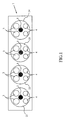
- FIG. 1 is a diagram showing the general configuration of an internal combustion engine to which the present invention is applied.
- the internal combustion engine 1 shown in Fig. 1 is a four-stroke-cycle, spark-ignition internal combustion engine (gasoline engine).
- the internal combustion engine 1 has four cylinders 21, 22, 23, 24.
- Two intake valves 3 and two exhaust valves 4 are provided for each cylinder 21, 22, 23, 24.
- an ignition plug 5 for generating a spark in the cylinder is provided for each cylinder 21, 22, 23, 24.
- each intake valve 3 is opened and closed utilizing the driving forces of cams 70, 71 mounted on an intake cam shaft 6 and the biasing force of a valve spring 50.
- the intake cam shaft 6 is linked with the engine output shaft (or crankshaft), which is not shown in the drawings, by a timing chain or timing belt so as to be rotated at half the speed of the crankshaft.
- main cam 70 and two sub cams 71 are provided on the intake cam shaft 6.
- the main cam 70 is disposed between the two sub cams 71.
- the cam profile of the main cam 70 is designed in such a way as to provide a larger operating angle and a larger lift (or cam nose height) than the sub cams 71.
- the cam profile of the sub cam 71 is designed in such a way as to make the lift of the intake valve 3 equal to zero (namely, the height of the cam nose is zero).
- the sub cam 71 is a cam that has only the base circle portion (i.e. zero lift cam) .
- a changing mechanism 81, 82, 83, 84 is interposed between the cams 70, 71 of each cylinder 21, 22, 23, 24 and the intake valves 3.
- the actuating forces of the cams 70, 71 are transmitted to the two intake valves 3 through the changing mechanism 81, 82, 83, 84.
- the changing mechanism 81, 82, 83, 84 is a mechanism that changes valve operation characteristics of the intake valves 3 by providing switching between a state in which the actuating force of the main cam 70 is transmitted to the intake valves 3 and a state in which the actuating force of the sub cams 71 is transmitted to the intake valves 3.
- the state in which the actuating force of the sub cams 71 is transmitted to the intake valves 3 is a state in which the intake valves 3 are not opened/closed (i.e. valve inactive state).
- the changing mechanism (which will be hereinafter referred to as the "first changing mechanism”) 82 for the number one cylinder (#1) 21 and the changing mechanism (which will be hereinafter referred to as the “second changing mechanism”) 82 for the number two cylinder (#2) 22 are driven by one actuator (which will be hereinafter referred to as the "first actuator") 91.
- the first changing mechanism 81, the second changing mechanism 82, and the first actuator 91 will be collectively referred to as the first changing group.
- the changing mechanism (which will be hereinafter referred to as the "third changing mechanism”) 83 for the number three cylinder (#3) 23 and the changing mechanism (which will be hereinafter referred to as the "fourth changing mechanism") 84 for the number four cylinder (#4) 24 are driven by one actuator (which will be hereinafter referred to as the "second actuator") 92.
- the third changing mechanism 83, the fourth changing mechanism 84, and the second actuator 92 will be collectively referred to as the second changing group.
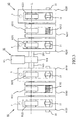
- Fig. 3 is a plan view of the first changing group.
- the first changing mechanism 81 includes a rocker shaft 10 arranged in parallel to the intake cam shaft 6.
- the rocker shaft 10 is supported on a cylinder head of the internal combustion engine 1 via a lash adjusters 11.
- first roller rocker arm 8110 and two second roller rocker arms 8120, 8130 are swingably mounted on the rocker shaft 10.
- the first roller rocker arm 8110 is disposed between the two second roller rocker arms 8120, 8130.
- the length of the first roller rocker arm 8110 is shorter than the length of the second roller rocker arms 8120, 8130.
- a first roller 8111 is rotatably supported on the tip portion of the first roller rocker arm 8110.
- the first roller rocker arm 8110 is biased in the direction indicated by arrow X in Fig. 4 by a coil spring 8112 attached on the rocker shaft 10.
- the coil spring 8112 biases the first roller rocker arm 8110 so that the first roller 8111 is always kept in contact with the main cam 70.
- the first roller rocker arm 8110 having the above construction is swung about the rocker shaft 10 by the cooperation of the actuating force of the main cam 70 and the biasing force of the coil spring 8112.
- the first roller rocker arm 8110 corresponds to the first swing member according to the present invention.
- the base end of the intake valve 3 (or, specifically, the base end of the valve stem) is in contact with the tip portion of each of the second roller rocker arms 8120, 8130.
- Second rollers 8121, 8131 are rotatably supported on the portions of the respective second roller rocker arms 8120, 8130 that are closer to the rocker shaft 10 than the portions with which the intake valves 3 are in contact are.
- the outer diameter of the second rollers 8121, 8131 is the same as the outer diameter of the first roller 8111.
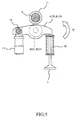
- the positions of the second rollers 8121, 8131 are determined in such a way that the central axes of the second rollers 8121, 8131 and the central axis of the first roller 8111 are aligned on the same line (i.e. virtual line L in Fig. 3 ) when the first roller 8111 is in contact with the base circle portion of the main cam 70 (see Fig. 4 ) and the second rollers 8121, 8131 are in contact with the base circle portions of the sub cams 71 (see Fig. 5 ).
- the second roller rocker arms 8120, 8130 are biased in the direction indicated by arrow Y in Fig. 5 by valve springs 30. Therefore, the second rollers 8121, 8131 are pressed against the sub cams 71 by the valve springs 30 while the sub cams 71 are lifting the intake valves 3. However, this does not apply to the sub cams 71 of this embodiment, because the sub cams 71 in this embodiment are zero lift cams.
- the second roller rocker arms 8120, 8130 having the above construction correspond to the second swing member according to the present invention.
- first switching mechanism a mechanism that provides switching between connection and disconnection of the first roller rocker arm 8110 and the second roller rocker arms 8120, 8130 will be described.
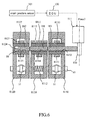
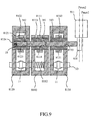
- Fig. 6 is a horizontal cross sectional view of the first changing mechanism 81. It is assumed that the second changing mechanism 82 is located on the right side in Fig. 6 .
- the shaft 8113 (which will be hereinafter referred to as the "first support shaft") that rotatably supports the first roller 8111 is provided with a first pin bore 8114 extending along the axial direction. Both ends of the first pin bore 8114 open on both sides of the first roller rocker arm 8110.
- a first pin 181 having a cylindrical shape is slidably inserted in the first pin bore 8114.
- the outer diameter of the first pin 181 is substantially equal to the inner diameter of the first pin bore 8114.
- the length of the first pin 181 along the axial direction is substantially equal to that of the first pin 8114.
- the shafts 8122, 8132 (which will be hereinafter referred to as the "second support shafts") that rotatably support the second rollers 8121, 8131 are provided with second pin bores 8123, 8133 extending along the axial direction.
- the inner diameter of the second pin bores 8123, 8133 is substantially equal to the inner diameter of the first pin bore 8114.
- One second pin bore 8123 among the two second pin bores 8123, 8133 is configured to open at the end that faces the first roller rocker arm 8110 and to be closed at the end 8124 facing away from the first roller rocker arm 8110. (The end that is closed will be hereinafter referred to as the "closed end”.)
- a second pin 182 having a cylindrical shape is slidably inserted in the second pin bore 8123.
- the outer diameter of the second pin 182 is substantially equal to the inner diameter of the second pin bore 8123.
- the length of the second pin 182 along the axial direction is shorter than that of the second pin bore 8123.
- a return spring 18 is interposed between the base end (i.e. the end facing the closed end 8124) of the second pin 182 and the closed end 8124.
- the return spring 18 is a member that biases the second pin 182 toward the first roller rocker arm 8110 and corresponds to the biasing member according to the present invention.
- both ends of the other second pin bore 8133 among the two second pin bores 8123, 8133 (that is, the second pin bore located on the second changing mechanism 82 side with respect to the first roller rocker arm 8110) open on both sides of the second roller rocker arm 8130, as with the first pin bore 8114.
- a second pin 183 having a cylindrical shape is slidably inserted in the second pin bore 8133.
- the outer diameter of the second pin 183 is substantially equal to the inner diameter of the second pin bore 8133.
- the length of the second pin 183 along the axial direction is longer than that of the second pin bore 8133.
- the center axes of the pin bores 8114, 8123, 8133 need not coincide with the center axes of the respective support shafts 8113, 8122, 8132. However, the relative positions of the three pin bores 8114, 8123, 8133 should satisfy the following condition.
- the relative positions of the three pin bores 8114, 8123, 8133 are determined in such a way that the central axes of the three pin bores 8114, 8123, 8133 are aligned on the same line when the first roller 8111 is in contact with the base circle portion of the main cam 70 (see Fig. 4 ) and the second rollers 8121, 8131 are in contact with the base circle portions of the sub cams 71 (see Fig. 5 ).
- the second pin 182 is always biased toward the first roller rocker arm 8110 by the return spring 18. Consequently, the tip end of the second pin 182 is pressed against the base end of the first pin 181. Accordingly, the tip end of the first pin 181 is pressed against the base end of the second pin 183. In consequence, the tip end of the second pin 183 is always in contact with a shift member 910 of the first actuator 91.
- the shift member 910 mentioned above is a member that can shift or move forward and backward along the axial direction of the support shafts 8113, 8122, 8132 (namely, the axial direction of the pins 181, 182, 183). This member is driven or shifted by a drive unit 911.
- the drive unit 911 mentioned above is an apparatus that causes the shift member 910 to shift using a hydraulic pressure or electrical power as the power source.
- the drive unit 911 is electrically controlled by an ECU 100.
- the ECU 100 is an electronic control unit for controlling the operation state of the internal combustion engine 1.
- the ECU 100 controls the drive unit 911 based on an output signal of a crank position sensor 101 etc.
- the crank position sensor 101 is a sensor that senses the rotational angle of the output shaft (or crankshaft) of the internal combustion engine 1.
- the dimensions and relative positions of the shift member 910, return spring 18, first pin 181, and second pins 182, 183 should be determined in such a way as to satisfy the following two conditions.
- the first roller rocker arm 8110 will receive the actuating force of the main cam 70 to swing, and the second roller rocker arms 8120, 8130 will receive the actuating forces of the sub cams 71 to swing.
- the sub cams 71 are zero lift cams, the second roller rocker arms 8120, 8130 will not swing. Consequently, a valve inactive state in which the operation of opening/closing the intake valves 3 is performed is achieved.
- the central axis of the first pin 181 and the central axes of the second pins 182, 183 become offset. At that time, it is necessary that a portion of the end face of the first pin 181 and a portion of the end face of each of the second pins 182, 183 are in contact with each other. Therefore, the shape and dimension of the end faces of the first pin 181 and the second pins 182, 183 should be determined in such a way as to meet this condition.
- the active state and the inactive state of the intake valves 3 can be switched by shifting the pins 181, 182, and 183 in the axial direction by the first actuator 91.
- the pins 181, 182, and 183 in this process correspond to the switching pins according to the present invention.
- the second changing mechanism includes, as with the above-described first changing mechanism, one first roller rocker arm 8210 and two second roller rocker arms 8220, 8230 that are swingably mounted on the rocker shaft 10.
- the first roller rocker arm 8210 corresponds to the first swing member according to the present invention.
- a first roller 8211 is rotatably supported on the tip portion of the first roller rocker arm 8210.
- the first roller 8211 is pressed against the main cam 70 by a biasing force of a coil spring 8212 attached on the rocker shaft 10.
- the second roller rocker arms 8220, 8230 correspond to the second swing member according to the present invention.
- the base end of the intake valve 3 is in contact with the tip portion of each of the second roller rocker arms 8220, 8230.
- Second rollers 8221, 8231 are rotatably supported on the portions of the respective second roller rocker arms 8220, 8230 that are closer to the rocker shaft 10 than the portions with which the intake valves 3 are in contact are.
- the second rollers 8221, 8231 are pressed against the sub cams 71 by valve springs 30 and/or lash adjuster 11.
- a mechanism (which will be hereinafter referred to as the "second switching mechanism") that provides switching between connection and disconnection of the first roller rocker arm 8210 and the second roller rocker arms 8220, 8230 has a construction that is substantially symmetric with the first switching mechanism.
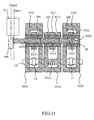
- Fig. 10 is a cross sectional view of the second changing mechanism 82. It is assumed that the first changing mechanism 81 is located on the left side in Fig. 10 .
- the shaft (first support shaft) 8213 that rotatably supports the first roller 8211 is provided with a first pin bore 8214 extending along the axial direction. Both ends of the first pin bore 8214 open on both sides of the first roller rocker arm 8210.
- a first pin 281 having a cylindrical shape is slidably inserted in the first pin bore 8214.
- the outer diameter of the first pin 281 is substantially equal to the inner diameter of the first pin bore 8214.
- the length of the first pin 281 along the axial direction is substantially equal to that of the first pin bore 8214.
- the shafts (second support shafts) 8222, 8232 that rotatably support the second rollers 8221, 8231 are provided with second pin bores 8223, 8233 extending along the axial direction.
- the inner diameter of the second pin bores 8223, 8233 is substantially equal to the inner diameter of the first pin bore 8214.
- One second pin bore 8223 among the two second pin bores 8223, 8233 (that is, the second pin bore located opposite to the first changing mechanism 81 with respect to the first roller rocker arm 8210) is configured to open at the end that faces the first roller rocker arm 8210 and to be closed at the end 8224 facing away from the first roller rocker arm 8210. (The end that is closed will be hereinafter referred to as the "closed end”.)
- a second pin 282 having a cylindrical shape is slidably inserted in the second pin bore 8223.
- the outer diameter of the second pin 282 is substantially equal to the inner diameter of the second pin bore 8223.
- the length of the second pin 282 along the axial direction is substantially equal to that of the second pin bore 8223.
- a return spring 28 is interposed between the base end of the second pin 282 (i.e. the end facing the closed end 8224) and the closed end 8224.
- the return spring 28 is a member that biases the second pin 282 toward the first roller rocker arm 8210 and corresponds to the biasing member according to the present invention.
- Both ends of the other second pin bore 8233 among the two second pin bores 8223, 8233 (that is, the second pin bore located on the first changing mechanism 81 side with respect to the first roller rocker arm 8210) open on both sides of the second roller rocker arm 8230, as with the first pin bore 8214.
- a second pin 283 having a cylindrical shape is slidably inserted in the second pin bore 8233.
- the outer diameter of the second pin 283 is substantially equal to the inner diameter of the second pin bore 8233.
- the length of the second pin 283 along the axial direction is longer than that of the second pin bore 8233.
- the relative positions of the three pin bores 8214, 8223, 8233 are determined in such a way as to meet the conditions same as those for the pin bores 8114, 8123, 8133 in the above-described first switching mechanism.
- the second pin 282 is always biased toward the first roller rocker arm 8210 by the return spring 28. Consequently, the tip end of the second pin 282 is pressed against the base end of the first pin 281. Accordingly, the tip end of the first pin 281 is pressed against the base end of the second pin 283. In consequence, the tip end of the second pin 283 is always in contact with a shift member 910 of the first actuator 91.
- the active state and the inactive state of the intake valves 3 can be switched by shifting the pins 281, 282, and 283 in the axial direction by the first actuator 91.
- the pins 281, 282, and 283 in this process correspond to the switching pins according to the present invention.
- Fig. 12 is a plan view showing the structure of the shift member 910.
- the shift member 910 includes a rotary member 9101 rotatably supported on the cylinder head and two arms 9102, 9103 that extend in radial directions from the outer periphery of the rotary member 9101.
- the tip end of one arm 9102 among the two arms 9102, 9103 is in contact with the tip end of the second pin 183 in the above-described first changing mechanism 81.
- the other arm 9103 among the two arms 9102, 9103 is in contact with the tip end of the second pin 283 in the above-described second changing mechanism 82.
- the tip end of the two arms 9102, 9103 can shift or displace the second pins 183, 283 in the axial direction.
- the drive unit 911 may rotate the shaft 9104 of the rotary member 9101.
- the drive unit 911 as such may be, for example, an electric motor.
- Another embodiment of the drive unit 911 may be, as shown in Fig. 13 , a spring 9111 that biases a drive arm 9105 provided on the rotary member 9101 in a rotational direction and a solenoid 9112 that presses the drive arm 9105 in the direction opposite to the direction of biasing by the spring 9106.
- the spring 9111 can be eliminated by making the biasing force of the return spring 18 in the above-described first switching mechanism larger than that of the return spring 28 in the second switching mechanism.
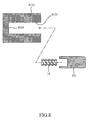
- shift member 910 may be, as shown in Fig. 14 , a cylindrical member 9106 that is supported between the second pin 183 in the first changing mechanism 81 and the second pin 283 in the second changing mechanism 82 in such a way as to be able to move forward and backward along the axial direction.
- the central axis of the cylindrical member 9106 and the central axis of the second pins 183, 283 be offset in view of a displacement that may caused when the second roller rocker arms 8130, 8230 swing.
- the reason why this is preferred is that the outer diameter of the cylindrical member 9106 need not be too large, and the sliding resistance between the cylindrical member 9106 and the second pins 183, 283 during the swinging operation of the changing mechanism 81, 82 can be made low.
- An exemplary drive unit 911 that is suitable for use with the shift member 910 shown in Fig. 14 may be a spring 9114 that biases the cylindrical member 9106 toward the second changing mechanism 82 and a solenoid 9113 that presses the cylindrical member 9106 toward the first changing mechanism 81.
- the spring 9114 in this case can also be eliminated by making the biasing force of the return spring 18 in the above-described first switching mechanism larger than that of the return spring 28 in the second switching mechanism.
- Another embodiment of the drive unit 911 may be an electric motor that is linked with the cylindrical member 9106 by a rack mechanism.
- the two changing mechanism 81, 82 can be driven by one actuator 91.
- the driving since it is sufficient for the first actuator 91 to displace the switching pins only by a small distance, the valve operation characteristics of the intake valves 3 of the two cylinders 21, 22 can be switched promptly. Furthermore, since the masses of the switching pins are small, the first actuator 91 can displace the switching pins by a low power.
- the biasing force of one of the return springs 18, 28 might act as a resistance against the displacement of the switching pins.
- the biasing force of the other of the return springs 18, 28 will act as an assistance, the required power of the first actuator 91 can be made small.
- the first changing group described above it is possible to improve the response in changing the valve operation characteristics while making the rating of the first actuator 91 low. Furthermore, since one actuator is used in common by two changing mechanism, a simplification of the construction of the first changing group can be achieved. In consequence, a preferable reduction in the size and weight of the first changing group can be achieved.
- advantages the same as the first changing group can be achieved by adopting the construction the same as the first changing group. In consequence, a preferable reduction in the size and weight of the entire valve train system can be achieved.
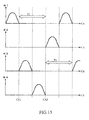
- the ECU 100 controls the first actuator 91 in such a way that the switching pins are displaced during the base circle period of the main cams 70 for the number one cylinder (#1) 21 and the number two cylinder (#2) 22 (i.e. during the period in which the base circle portions of the main cams 70 are in contact with the first rollers 8111, 8211).
- the ECU 100 control the first actuator 91 in such a way that the switching pins start to displace at the time of the beginning of the base circle period T1 or at a time immediately after the beginning thereof.
- the ECU 100 may cause the first actuator 91 to operate at the time when the output signal of the crank position sensor 101 indicates the crank angle CA1 corresponding to the beginning of the base circle period T1.
- the crank angle CAI can be determined in advance by an experiment.
- the ECU 100 may cause the second actuator 92 to operate at the time of beginning CA2 of the base circle period T2 of the main cams 70 for the number three cylinder (#3) 23 and the number four cylinder (#4) 24.
- the displacement of the switching pins can be completed during the base circle periods T1, T2.
- the above-described control may preferably be performed, for example, at a time when a fuel cut operation of the internal combustion engine 1 is started, or at a time when the fuel cut operation of the internal combustion engine 1 is ended.
- the switching pins are displaced to disconnect the first roller rocker arm and the second roller rocker arms for each cylinder at the time when the fuel cut operation of the internal combustion engine 1 is started, the intake valves 3 are brought into an inactive state immediately; therefore, the above-described malfunctioning can be prevented from occurring.
- actuators 91, 92 are characterized in that the switching pins are displaced utilizing the rotational force of the intake cam shaft 6.
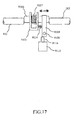
- a shift member 910 of the first actuator 91 comprises a cylindrical member 9106 disposed between the second pin 183 in the first changing mechanism 81 and the second pin 283 in the second changing mechanism 82.
- This cylindrical member 9106 corresponds to the shaft member according to the present invention and is supported by a carrier 9107 fixed on the cylinder head in such a way that it can move forward and backward along the axial direction and rotate in the circumferential direction.
- An arm 9108 is provided on and extending from the outer circumferential surface of the cylindrical member 9106. This arm 9108 corresponds to the pivoting member according to the present invention. The tip end portion of the arm 9108 is located at a position opposed to the circumferential surface of the intake cam shaft 6. An insert pin 9109 is provided on the tip end portion of the arm 9108.
- a large diameter portion 600 having an outer diameter larger than the diameter of the intake cam shaft 6 is provided on the outer circumferential surface of the intake cam shaft 6 that is opposed to the insert pin 9109.
- the circumferential surface of the large diameter portion 600 has a helical groove 60 that extends in the circumferential direction.
- the width of the helical groove 60 is a little larger than the outer diameter of the insert pin 9109.
- the base end position of the helical groove 60 with respect to the axial direction of the intake cam shaft 6 is determined in such a way as to coincide with the position of the insert pin 9109 when the shift member 910 is located at the extremity Pmax1 mentioned before.
- the base end position (rotational angular position) of the helical groove 60 with respect to the circumferential direction (rotational direction) of the intake cam shaft 6 is set to the rotational angular position at the time when the base circle period T1 begins.
- the dead end position of the helical groove 60 with respect to the axial direction of the intake cam shaft 6 is determined in such a way as to coincide with the position of the insert pin 9109 when the shift member 910 is located at the extremity Pmax2 mentioned before.
- the dead end position of the helical groove 60 with respect to the circumferential direction of the intake cam shaft 6 is set to a position in front of the rotational angular position at the time when the base circle period T1 ends.
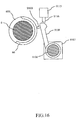
- the drive unit 911 of the first actuator 91 comprises a solenoid 9115 for inserting the insert pin 9109 into the helical groove 60, a removing spring 9117 for removing the insert pin 9109 out of the helical groove 60, and a spring 9114 that biases the cylindrical member 9106 toward the second changing mechanism 82 (i.e. toward the extremity Pmax1).
- the solenoid 9115 is disposed at a position that allows the drive shaft 9116 of the solenoid 9115 to press the back side (or the side opposite to the side on which the insert pin 9109 is provided) of the tip end portion of the arm 9108 toward the large diameter portion 600.
- the removing spring 9117 is disposed at a position that allows it to biases the cylindrical member 9106 in such a direction that the tip end portion of the arm 9108 is moved away from the large diameter portion 600.
- the removing spring 9117 is provided around the cylindrical member 9106, as shown in Fig. 19 .
- One end of the removing spring 9117 is fixedly attached to the arm 9108, and the other end is fixedly attached to the cylinder head or the carrier 9107.
- the drive shaft 9116 of the solenoid 9115 presses the tip end portion of the arm 9108 toward the large diameter portion 600.
- the position of the base end of the helical groove 60 and the position of the insert pin 9109 with respect to the axial direction of the intake cam shaft 6 coincide with each other.
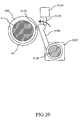
- the insert pin 9109 is inserted into the helical groove 60 (see Fig. 20 ).
- the position of the insert pin 9109 with respect to the axial direction of the intake cam shaft 6 changes along the helical groove 60.
- the position of the cylindrical member 9106 with respect to the axial direction changes from the extremity Pmax1 toward the extremity Pmax2.
- the cylindrical member 9106 reaches the extremity Pmax2 (see Fig. 21 ).
- the insert pin 9109 may be adapted to drop down from the large diameter portion 600 to the circumferential surface of the intake cam shaft 6 as shown in Fig. 22 , when the insert pin 9109 reaches the terminal end of the helical groove 60. If this is the case, the side face of the insert pin 9109 abuts the step between the circumferential surface of the intake cam shaft 6 and the circumferential surface of the large diameter portion 600, whereby the position of the cylindrical member 9106 is maintained at the extremity Pmax2.
- the solenoid 9115 may move the drive shaft 9116 backward, or supply of drive current to the solenoid 9115 may be simply stopped. Then, the biasing force of the removing spring 9117 causes the insert pin 9109 to be disengaged from the step; consequently, the cylindrical member 9106 is shifted from the extremity Pmax2 to the extremity Pmax1 by the biasing force of the spring 9114.
- the rating of the first actuator 91 can be made smaller. Furthermore, since the timing of shift of the shift member 910 is determined uniquely by the arrangement of the helical groove 60, it is not necessary for the ECU 100 to control the timing of shift. In consequence, reduction in the size and weight of the first actuator 91 can be achieved, and simplification of the control logic can be achieved.
- the spring 9114 can be eliminated by making the biasing force of the return spring 18 larger than that of the return spring 28. If this is the case, a further simplification of the construction of the first actuator 91 can be achieved.
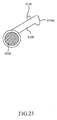
- the position of the insert pin 9109 on the arm 9108 may be offset from the tip end portion of the arm 9108 toward the base end portion, as shown in Fig. 23 .
- the position of the insert pin 9109 with respect to the axial direction of the arm 9108 may be arranged between the portion 9108a that is in contact with the drive shaft 9116 (power point) and the portion connected with the cylindrical member 9106 (fulcrum) .
- the degree of freedom in arranging the solenoid 9115 is increased. Consequently, the solenoid 9115 can be disposed outside the cam carrier 12 without an unwanted increase in the length of the drive shaft 9116.
- the reactive force exerted on the arm 9108 by the helical groove 60 via the insert pin 9109 can be received by two portions, namely the portion 9108a that is in contact with the drive shaft 9116 and the portion connected with the cylindrical member 9106. Therefore, a deformation of the arm 9108 can be made small.
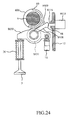
- a volume portion 98 may be provided on the side (lower side) of the arm 9108 opposite to the side (upper side) on which the insert pin 9109 is provided. If the volume portion 98 like this is provided on the arm 9108, the weight of the volume portion 98 is added to the biasing force of the removing spring 9117 when the insert pin 9109 is removed out of the helical groove 60. In consequence, it is possible to remove the insert pin 9109 out of the helical groove 60 quickly.
- the volume portion be provided at a position 9108b in the vicinity of the tip end of the arm 9108 and adjacent to the portion that is in contact with the drive shaft 9116, as shown in Fig. 25 .
- the above described advantageous effect is achieved more remarkably, and the area of the portion with which the drive shaft 9116 can be in contact with is increased.
- the solenoid 9115 can cause the arm 9108 to swing with improved reliability, even if an age deterioration occurs, or an assembly error and/or initial tolerance exist.
- the arm 9108 may be adapted to be supported by a rotation shaft 9119 that is independent from the cylindrical member 9106, as shown in Fig. 26 . This is advantageous in that a high degree of freedom in the movable range of the arm 9108 and in the mount angle of the solenoid 9115 is achieved.
- the number of the intake valves or the exhaust valves per cylinder is not limited to two; the present invention can be applied to any internal combustion engine provided with at least one intake valve or exhaust valve per cylinder.
Landscapes
- Engineering & Computer Science (AREA)
- Mechanical Engineering (AREA)
- General Engineering & Computer Science (AREA)
- Chemical & Material Sciences (AREA)
- Combustion & Propulsion (AREA)
- Valve Device For Special Equipments (AREA)
- Valve-Gear Or Valve Arrangements (AREA)
Applications Claiming Priority (3)
| Application Number | Priority Date | Filing Date | Title |
|---|---|---|---|
| JP2008122616 | 2008-05-08 | ||
| JP2008308593A JP2009293613A (ja) | 2008-05-08 | 2008-12-03 | 内燃機関の動弁システム |
| PCT/JP2009/058099 WO2009136551A1 (ja) | 2008-05-08 | 2009-04-23 | 内燃機関の動弁システム |
Publications (2)
| Publication Number | Publication Date |
|---|---|
| EP2302178A1 true EP2302178A1 (de) | 2011-03-30 |
| EP2302178A4 EP2302178A4 (de) | 2012-01-11 |
Family
ID=41264606
Family Applications (1)
| Application Number | Title | Priority Date | Filing Date |
|---|---|---|---|
| EP09742675A Withdrawn EP2302178A4 (de) | 2008-05-08 | 2009-04-23 | Ventilbetätigungssystem für verbrennungsmotoren |
Country Status (5)
| Country | Link |
|---|---|
| US (1) | US20110088642A1 (de) |
| EP (1) | EP2302178A4 (de) |
| JP (1) | JP2009293613A (de) |
| CN (1) | CN102016244A (de) |
| WO (1) | WO2009136551A1 (de) |
Cited By (1)
| Publication number | Priority date | Publication date | Assignee | Title |
|---|---|---|---|---|
| EP2644854A1 (de) * | 2012-03-30 | 2013-10-02 | Honda Motor Co., Ltd. | Variabler Ventiltrieb für einen Verbrennungsmotor |
Families Citing this family (22)
| Publication number | Priority date | Publication date | Assignee | Title |
|---|---|---|---|---|
| JP4672781B2 (ja) * | 2009-03-30 | 2011-04-20 | トヨタ自動車株式会社 | 内燃機関の制御装置 |
| JP4752949B2 (ja) * | 2009-05-28 | 2011-08-17 | トヨタ自動車株式会社 | 内燃機関の可変動弁装置 |
| WO2011064852A1 (ja) * | 2009-11-25 | 2011-06-03 | トヨタ自動車株式会社 | 内燃機関の可変動弁装置 |
| WO2011064845A1 (ja) * | 2009-11-25 | 2011-06-03 | トヨタ自動車株式会社 | 内燃機関の可変動弁装置 |
| EP2532846B1 (de) * | 2010-02-04 | 2015-04-08 | Yanmar Co., Ltd. | Motor |
| JP5440263B2 (ja) * | 2010-03-03 | 2014-03-12 | トヨタ自動車株式会社 | 内燃機関の可変動弁装置 |
| JP5461252B2 (ja) * | 2010-03-15 | 2014-04-02 | 本田技研工業株式会社 | 内燃機関の可変動弁装置 |
| JP2011196266A (ja) * | 2010-03-19 | 2011-10-06 | Toyota Motor Corp | 内燃機関の可変動弁装置 |
| JP5521718B2 (ja) * | 2010-04-07 | 2014-06-18 | トヨタ自動車株式会社 | 内燃機関の可変動弁装置 |
| JP5510095B2 (ja) * | 2010-06-15 | 2014-06-04 | トヨタ自動車株式会社 | 内燃機関の可変動弁装置 |
| JP5907552B2 (ja) * | 2010-09-07 | 2016-04-26 | 本田技研工業株式会社 | 内燃機関の可変動弁装置 |
| JP5525403B2 (ja) * | 2010-09-30 | 2014-06-18 | 本田技研工業株式会社 | 内燃機関の可変動弁装置 |
| CN102337941A (zh) * | 2011-09-27 | 2012-02-01 | 上海北星实业有限公司 | 一种引擎上的配气机构 |
| JP6005382B2 (ja) * | 2012-03-30 | 2016-10-12 | 本田技研工業株式会社 | 内燃機関の可変動弁装置 |
| JP5826145B2 (ja) * | 2012-09-28 | 2015-12-02 | 本田技研工業株式会社 | 内燃機関の可変動弁装置 |
| US9790876B2 (en) * | 2013-03-14 | 2017-10-17 | Cummins Ip, Inc. | Advanced exhaust gas recirculation fueling control |
| JP6170089B2 (ja) * | 2015-04-23 | 2017-07-26 | 株式会社オティックス | 内燃機関の可変動弁機構 |
| DE212016000178U1 (de) * | 2015-09-25 | 2018-06-01 | Eaton Intelligent Power Limited | Steuerung zur Zylinderabschaltung |
| EP3339584B1 (de) | 2015-10-05 | 2020-03-11 | Yamaha Hatsudoki Kabushiki Kaisha | Motorventilvorrichtung |
| DE112016005846T5 (de) | 2016-01-19 | 2018-08-30 | Eaton Intelligent Power Limited | Zylinderdeaktivierung und Motorbremsung für das Wärmemanagement |
| US10895174B2 (en) * | 2016-12-05 | 2021-01-19 | Eaton Intelligent Power Limited | Heavy duty variable valve actuation |
| WO2023129804A1 (en) * | 2021-12-27 | 2023-07-06 | Cummins Inc. | Rocker system, camshaft, and valve train for use with an internal combustion engine |
Family Cites Families (13)
| Publication number | Priority date | Publication date | Assignee | Title |
|---|---|---|---|---|
| JPH04194306A (ja) * | 1990-11-28 | 1992-07-14 | Mazda Motor Corp | 多気筒エンジンの動弁装置 |
| DE4230877A1 (de) * | 1991-09-30 | 1993-04-01 | Volkswagen Ag | Ventilsteuerung fuer ein hubventil mit zwei nocken |
| JP3365805B2 (ja) * | 1993-01-20 | 2003-01-14 | 株式会社オティックス | 可変動弁機構 |
| JP3102227B2 (ja) * | 1993-10-12 | 2000-10-23 | 三菱自動車工業株式会社 | 多気筒エンジンの休筒運転制御方法 |
| JP3565912B2 (ja) * | 1994-09-28 | 2004-09-15 | 本田技研工業株式会社 | 内燃機関における動弁特性および空燃比の切換制御方法 |
| JPH10196334A (ja) * | 1996-12-27 | 1998-07-28 | Takashi Hikita | 可変バルブタイミング・リフト機構 |
| US5960755A (en) * | 1998-06-09 | 1999-10-05 | Ford Global Technologies, Inc. | Internal combustion engine with variable camshaft timing and variable duration exhaust event |
| DE19945340A1 (de) * | 1999-09-22 | 2001-03-29 | Schaeffler Waelzlager Ohg | Auf unterschiedliche Hübe für wenigstens ein Gaswechselventil umschaltbarer Ventiltrieb einer Brennkraftmaschine |
| US6318318B1 (en) * | 2001-05-15 | 2001-11-20 | Ford Global Technologies, Inc. | Rocker arm assembly |
| JP2003120375A (ja) * | 2001-10-11 | 2003-04-23 | Toyota Motor Corp | ディーゼルエンジンの制御装置 |
| US6805083B2 (en) * | 2002-10-10 | 2004-10-19 | Ford Global Technologies, Llc | Cam cover gasket |
| JP4265336B2 (ja) * | 2003-08-06 | 2009-05-20 | トヨタ自動車株式会社 | 内燃機関の弁駆動システム及び方法、並びに動力出力装置 |
| DE102004008670B4 (de) * | 2004-02-21 | 2013-04-11 | Schaeffler Technologies AG & Co. KG | Ventiltrieb mit Nockenumschaltung für die Gaswechselventile eines 4-Takt-Verbrennungsmotors |
-
2008
- 2008-12-03 JP JP2008308593A patent/JP2009293613A/ja not_active Withdrawn
-
2009
- 2009-04-23 WO PCT/JP2009/058099 patent/WO2009136551A1/ja not_active Ceased
- 2009-04-23 CN CN2009801162994A patent/CN102016244A/zh active Pending
- 2009-04-23 US US12/991,615 patent/US20110088642A1/en not_active Abandoned
- 2009-04-23 EP EP09742675A patent/EP2302178A4/de not_active Withdrawn
Cited By (1)
| Publication number | Priority date | Publication date | Assignee | Title |
|---|---|---|---|---|
| EP2644854A1 (de) * | 2012-03-30 | 2013-10-02 | Honda Motor Co., Ltd. | Variabler Ventiltrieb für einen Verbrennungsmotor |
Also Published As
| Publication number | Publication date |
|---|---|
| US20110088642A1 (en) | 2011-04-21 |
| JP2009293613A (ja) | 2009-12-17 |
| CN102016244A (zh) | 2011-04-13 |
| WO2009136551A1 (ja) | 2009-11-12 |
| EP2302178A4 (de) | 2012-01-11 |
Similar Documents
| Publication | Publication Date | Title |
|---|---|---|
| EP2302178A1 (de) | Ventilbetätigungssystem für verbrennungsmotoren | |
| EP1905967B1 (de) | Verbrennungsmotor mit variabler Ventilhebung | |
| US4909197A (en) | Cam follower assembly with pinless roller | |
| JP4962370B2 (ja) | 内燃機関の可変動弁機構 | |
| JP5126426B2 (ja) | 内燃機関の制御装置 | |
| EP2505797A1 (de) | Variable ventilvorrichtung für einen verbrennungsmotor | |
| KR20120012478A (ko) | 내연기관용 가변밸브구동장치 | |
| US20030121484A1 (en) | Continuously variable valve timing, lift and duration for internal combustion engine | |
| WO2009151352A1 (en) | Late miller internal combustion engine | |
| WO2008100738A1 (en) | Multi-step valve actuation system | |
| CN101255808B (zh) | 具有轴装式凸轮从动件的发动机/气门机构 | |
| JPH09184407A (ja) | 内燃機関の動弁機構 | |
| US20030127063A1 (en) | Continually variable valve timing, lift, and duration for internal combustion engine | |
| US20130042830A1 (en) | Valve operating apparatus for internal combustion engine | |
| JP2015075052A (ja) | 内燃機関 | |
| WO2021165993A1 (en) | A power unit with variable valve timing system | |
| JP6237091B2 (ja) | 内燃機関 | |
| KR100897263B1 (ko) | 무단 가변 밸브 리프트 장치 | |
| US20120204825A1 (en) | Variable valve timing device for internal combustion engine utilizing hydraulic valve actuators | |
| US20120199085A1 (en) | Camshaft arrangement | |
| US7007647B2 (en) | Rotary actuator device for controlling the stroke of gas charge exchange valves in the cylinder head of an internal combustion engine | |
| US12234753B2 (en) | Tappet assembly for valve lift profile modification | |
| JP2002295274A (ja) | 内燃機関の可変動弁装置 | |
| CN120367674B (zh) | 气缸可在单气门驱动与双气门驱动之间切换的重型发动机 | |
| CN100393987C (zh) | 内燃机的气门驱动装置 |
Legal Events
| Date | Code | Title | Description |
|---|---|---|---|
| PUAI | Public reference made under article 153(3) epc to a published international application that has entered the european phase |
Free format text: ORIGINAL CODE: 0009012 |
|
| 17P | Request for examination filed |
Effective date: 20101201 |
|
| AK | Designated contracting states |
Kind code of ref document: A1 Designated state(s): AT BE BG CH CY CZ DE DK EE ES FI FR GB GR HR HU IE IS IT LI LT LU LV MC MK MT NL NO PL PT RO SE SI SK TR |
|
| AX | Request for extension of the european patent |
Extension state: AL BA RS |
|
| DAX | Request for extension of the european patent (deleted) | ||
| A4 | Supplementary search report drawn up and despatched |
Effective date: 20111208 |
|
| RIC1 | Information provided on ipc code assigned before grant |
Ipc: F01L 1/26 20060101ALI20111202BHEP Ipc: F01L 1/18 20060101ALI20111202BHEP Ipc: F02D 13/02 20060101ALI20111202BHEP Ipc: F01L 1/08 20060101ALI20111202BHEP Ipc: F01L 13/00 20060101AFI20111202BHEP |
|
| STAA | Information on the status of an ep patent application or granted ep patent |
Free format text: STATUS: THE APPLICATION HAS BEEN WITHDRAWN |
|
| 18W | Application withdrawn |
Effective date: 20120619 |