EP2292603B1 - Organische lichtemittierende Vorrichtung - Google Patents
Organische lichtemittierende Vorrichtung Download PDFInfo
- Publication number
- EP2292603B1 EP2292603B1 EP10172315A EP10172315A EP2292603B1 EP 2292603 B1 EP2292603 B1 EP 2292603B1 EP 10172315 A EP10172315 A EP 10172315A EP 10172315 A EP10172315 A EP 10172315A EP 2292603 B1 EP2292603 B1 EP 2292603B1
- Authority
- EP
- European Patent Office
- Prior art keywords
- groups
- unsubstituted
- substituted
- group
- organic light
- Prior art date
- Legal status (The legal status is an assumption and is not a legal conclusion. Google has not performed a legal analysis and makes no representation as to the accuracy of the status listed.)
- Active
Links
- 0 Cc(cc1)cc2c1-c1ccc(C)cc1C2(*)O Chemical compound Cc(cc1)cc2c1-c1ccc(C)cc1C2(*)O 0.000 description 4
Images
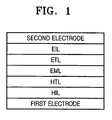
Classifications
-
- C—CHEMISTRY; METALLURGY
- C07—ORGANIC CHEMISTRY
- C07D—HETEROCYCLIC COMPOUNDS
- C07D209/00—Heterocyclic compounds containing five-membered rings, condensed with other rings, with one nitrogen atom as the only ring hetero atom
- C07D209/56—Ring systems containing three or more rings
- C07D209/58—[b]- or [c]-condensed
- C07D209/70—[b]- or [c]-condensed containing carbocyclic rings other than six-membered
-
- C—CHEMISTRY; METALLURGY
- C07—ORGANIC CHEMISTRY
- C07F—ACYCLIC, CARBOCYCLIC OR HETEROCYCLIC COMPOUNDS CONTAINING ELEMENTS OTHER THAN CARBON, HYDROGEN, HALOGEN, OXYGEN, NITROGEN, SULFUR, SELENIUM OR TELLURIUM
- C07F7/00—Compounds containing elements of Groups 4 or 14 of the Periodic Table
- C07F7/02—Silicon compounds
- C07F7/08—Compounds having one or more C—Si linkages
- C07F7/10—Compounds having one or more C—Si linkages containing nitrogen having a Si-N linkage
-
- C—CHEMISTRY; METALLURGY
- C09—DYES; PAINTS; POLISHES; NATURAL RESINS; ADHESIVES; COMPOSITIONS NOT OTHERWISE PROVIDED FOR; APPLICATIONS OF MATERIALS NOT OTHERWISE PROVIDED FOR
- C09K—MATERIALS FOR MISCELLANEOUS APPLICATIONS, NOT PROVIDED FOR ELSEWHERE
- C09K11/00—Luminescent materials, e.g. electroluminescent or chemiluminescent
- C09K11/06—Luminescent materials, e.g. electroluminescent or chemiluminescent containing organic luminescent materials
-
- H—ELECTRICITY
- H05—ELECTRIC TECHNIQUES NOT OTHERWISE PROVIDED FOR
- H05B—ELECTRIC HEATING; ELECTRIC LIGHT SOURCES NOT OTHERWISE PROVIDED FOR; CIRCUIT ARRANGEMENTS FOR ELECTRIC LIGHT SOURCES, IN GENERAL
- H05B33/00—Electroluminescent light sources
- H05B33/10—Apparatus or processes specially adapted to the manufacture of electroluminescent light sources
-
- H—ELECTRICITY
- H05—ELECTRIC TECHNIQUES NOT OTHERWISE PROVIDED FOR
- H05B—ELECTRIC HEATING; ELECTRIC LIGHT SOURCES NOT OTHERWISE PROVIDED FOR; CIRCUIT ARRANGEMENTS FOR ELECTRIC LIGHT SOURCES, IN GENERAL
- H05B33/00—Electroluminescent light sources
- H05B33/12—Light sources with substantially two-dimensional [2D] radiating surfaces
- H05B33/14—Light sources with substantially two-dimensional [2D] radiating surfaces characterised by the chemical or physical composition or the arrangement of the electroluminescent material, or by the simultaneous addition of the electroluminescent material in or onto the light source
-
- H—ELECTRICITY
- H10—SEMICONDUCTOR DEVICES; ELECTRIC SOLID-STATE DEVICES NOT OTHERWISE PROVIDED FOR
- H10K—ORGANIC ELECTRIC SOLID-STATE DEVICES
- H10K50/00—Organic light-emitting devices
- H10K50/10—OLEDs or polymer light-emitting diodes [PLED]
- H10K50/14—Carrier transporting layers
- H10K50/15—Hole transporting layers
-
- H—ELECTRICITY
- H10—SEMICONDUCTOR DEVICES; ELECTRIC SOLID-STATE DEVICES NOT OTHERWISE PROVIDED FOR
- H10K—ORGANIC ELECTRIC SOLID-STATE DEVICES
- H10K85/00—Organic materials used in the body or electrodes of devices covered by this subclass
- H10K85/60—Organic compounds having low molecular weight
- H10K85/631—Amine compounds having at least two aryl rest on at least one amine-nitrogen atom, e.g. triphenylamine
- H10K85/636—Amine compounds having at least two aryl rest on at least one amine-nitrogen atom, e.g. triphenylamine comprising heteroaromatic hydrocarbons as substituents on the nitrogen atom
-
- C—CHEMISTRY; METALLURGY
- C09—DYES; PAINTS; POLISHES; NATURAL RESINS; ADHESIVES; COMPOSITIONS NOT OTHERWISE PROVIDED FOR; APPLICATIONS OF MATERIALS NOT OTHERWISE PROVIDED FOR
- C09K—MATERIALS FOR MISCELLANEOUS APPLICATIONS, NOT PROVIDED FOR ELSEWHERE
- C09K2211/00—Chemical nature of organic luminescent or tenebrescent compounds
- C09K2211/10—Non-macromolecular compounds
- C09K2211/1003—Carbocyclic compounds
- C09K2211/1007—Non-condensed systems
-
- C—CHEMISTRY; METALLURGY
- C09—DYES; PAINTS; POLISHES; NATURAL RESINS; ADHESIVES; COMPOSITIONS NOT OTHERWISE PROVIDED FOR; APPLICATIONS OF MATERIALS NOT OTHERWISE PROVIDED FOR
- C09K—MATERIALS FOR MISCELLANEOUS APPLICATIONS, NOT PROVIDED FOR ELSEWHERE
- C09K2211/00—Chemical nature of organic luminescent or tenebrescent compounds
- C09K2211/10—Non-macromolecular compounds
- C09K2211/1003—Carbocyclic compounds
- C09K2211/1011—Condensed systems
-
- C—CHEMISTRY; METALLURGY
- C09—DYES; PAINTS; POLISHES; NATURAL RESINS; ADHESIVES; COMPOSITIONS NOT OTHERWISE PROVIDED FOR; APPLICATIONS OF MATERIALS NOT OTHERWISE PROVIDED FOR
- C09K—MATERIALS FOR MISCELLANEOUS APPLICATIONS, NOT PROVIDED FOR ELSEWHERE
- C09K2211/00—Chemical nature of organic luminescent or tenebrescent compounds
- C09K2211/10—Non-macromolecular compounds
- C09K2211/1003—Carbocyclic compounds
- C09K2211/1014—Carbocyclic compounds bridged by heteroatoms, e.g. N, P, Si or B
-
- C—CHEMISTRY; METALLURGY
- C09—DYES; PAINTS; POLISHES; NATURAL RESINS; ADHESIVES; COMPOSITIONS NOT OTHERWISE PROVIDED FOR; APPLICATIONS OF MATERIALS NOT OTHERWISE PROVIDED FOR
- C09K—MATERIALS FOR MISCELLANEOUS APPLICATIONS, NOT PROVIDED FOR ELSEWHERE
- C09K2211/00—Chemical nature of organic luminescent or tenebrescent compounds
- C09K2211/10—Non-macromolecular compounds
- C09K2211/1018—Heterocyclic compounds
- C09K2211/1025—Heterocyclic compounds characterised by ligands
- C09K2211/1029—Heterocyclic compounds characterised by ligands containing one nitrogen atom as the heteroatom
-
- C—CHEMISTRY; METALLURGY
- C09—DYES; PAINTS; POLISHES; NATURAL RESINS; ADHESIVES; COMPOSITIONS NOT OTHERWISE PROVIDED FOR; APPLICATIONS OF MATERIALS NOT OTHERWISE PROVIDED FOR
- C09K—MATERIALS FOR MISCELLANEOUS APPLICATIONS, NOT PROVIDED FOR ELSEWHERE
- C09K2211/00—Chemical nature of organic luminescent or tenebrescent compounds
- C09K2211/10—Non-macromolecular compounds
- C09K2211/1018—Heterocyclic compounds
- C09K2211/1025—Heterocyclic compounds characterised by ligands
- C09K2211/1088—Heterocyclic compounds characterised by ligands containing oxygen as the only heteroatom
-
- C—CHEMISTRY; METALLURGY
- C09—DYES; PAINTS; POLISHES; NATURAL RESINS; ADHESIVES; COMPOSITIONS NOT OTHERWISE PROVIDED FOR; APPLICATIONS OF MATERIALS NOT OTHERWISE PROVIDED FOR
- C09K—MATERIALS FOR MISCELLANEOUS APPLICATIONS, NOT PROVIDED FOR ELSEWHERE
- C09K2211/00—Chemical nature of organic luminescent or tenebrescent compounds
- C09K2211/10—Non-macromolecular compounds
- C09K2211/1018—Heterocyclic compounds
- C09K2211/1025—Heterocyclic compounds characterised by ligands
- C09K2211/1092—Heterocyclic compounds characterised by ligands containing sulfur as the only heteroatom
Definitions
- the present invention relates to a heterocyclic compound and an organic light-emitting device including the heterocyclic compound.
- Organic light-emitting devices are self-emission type display devices and have wide viewing angles, high contrast ratios, and short response times. Due to these characteristics, organic light-emitting devices are drawing more attention.
- organic light-emitting devices can be roughly classified into inorganic light-emitting devices which include emission layers containing inorganic compounds, and organic light-emitting devices which include emission layers containing organic compounds.
- Organic light-emitting devices have higher luminance, lower driving voltages, and shorter response times than inorganic light-emitting devices, and can render multi-colored displays.
- organic light-emitting devices produce various colors. Thus, much research into such organic light-emitting devices has been conducted.
- an organic light-emitting device has a stack structure including an anode, a cathode and an organic emission layer between the anode and cathode.
- a hole injection layer and/or a hole transport layer may be further stacked between the anode and the organic emission layer, and/or an electron transport layer may be further stacked between the organic emission layer and the cathode.
- an organic light-emitting device may have an anode/hole transport layer/organic emission layer/cathode structure or an anode/hole transport layer/organic emission layer/electron transport layer/cathode structure.
- hole transport layer As the material for forming the hole transport layer, polyphenyl compounds or anthracene derivatives can be used.
- organic light-emitting devices including hole injection layers and/or hole transport layers formed of such materials do not have satisfactory life span, efficiency, and power consumption characteristics, thus leaving much room for improvement.
- EP2138551 discloses organic electroluminescent compounds of formula: and organic electroluminescent devices comprising these compounds.
- L 1 is a substituent selected from and A and B independently represent a chemical bond, or a substituent selected from and m and n independently represent an integer from 0 to 4; provided that, if both X 1 and X 2 represent NR 33 , and both Y 1 and Y 2 represent a chemical bond, then R 33 does not represent hydrogen or (C1-C5) alkyl.
- US2003 008172 discloses an OLED including a conjugated poly(N-alkyl-2,7-carbazole) derivative as active material, wherein the derivative is represented by formula in which n is an integer of about 3 to about 100, and R is a linear or branched alkyl group containing 1 to 22 carbon atoms, or poly(ethyleneoxy), cyano, aryl, amide or benzoyl.
- the present invention provides a heterocyclic compound that imparts improved electrical characteristics, charge transporting capabilities and light-emission capabilities, an organic light-emitting device including the heterocyclic compound, and, a flat panel display device including the organic light-emitting device.
- each of Ar1 and Ar2 is independently selected from substituted and unsubstituted C6-C60 aryl groups, substituted and unsubstituted C4-C60 heteroaryl groups, and substituted and unsubstituted C6-C60 condensed polycyclic groups.
- X1 is selected from single bonds, substituted and unsubstituted C6-C30 aryl groups, substituted and unsubstituted C4-C30 heteroaryl groups, and substituted and unsubstituted C6-C30 condensed polycyclic groups.
- Each of R1, R2, and R3 is independently selected from hydrogen, heavy hydrogen, substituted and unsubstituted C1-C50 alkyl groups, substituted and unsubstituted C1-C50 alkoxy groups, substituted and unsubstituted C6-C60 aryl groups, substituted and unsubstituted C4-C60 heteroaryl groups, and substituted and unsubstituted C6-C60 condensed polycyclic groups.
- Each of R4 and R5 is independently selected from hydrogen, heavy hydrogen, substituted and unsubstituted C1-C30 alkyl groups, substituted and unsubstituted C1-C30 alkoxy groups, substituted and unsubstituted C6-C30 aryl groups, substituted and unsubstituted C4-C30 heteroaryl groups, and substituted and unsubstituted C6-C30 condensed polycyclic groups.
- the heterocyclic compound may include a compound represented by Formulae 2 through 6:
- Ar1, Ar2, Ar3, Ar4, Ar5, Ar6, Ar7, Ar8, Ar9 and Ar10 may be identical to each other;
- X1, X2, and X3 may be identical to each other;
- R2 and R3 may be identical to each other; or
- R4 and R5 may be identical to each other.
- R1 through R3 or X1 through X3 may each be independently selected from phenyl groups, naphthyl groups, biphenyl groups, fluorene groups, and phenanthrene groups.
- R4 and R5 may each be a methyl group.
- each of Ar3 through Ar10 may be independently selected from unsubstituted monocyclic to tricyclic aryl groups, unsubstituted C4-C30 heteroaryl groups, substituted monocyclic to tricyclic aryl groups, and substituted C4-C30 heteroaryl groups.
- suitable unsubstituted monocyclic to tricyclic aryl groups include phenyl groups, naphthyl groups, biphenyl groups, terphenyl groups, anthracenyl groups, fluorenyl groups and carbazolyl groups.
- Nonlimiting examples of suitable substituted C4-C30 heteroaryl groups include groups with at least one substituent selected from C1-C5 alkyl groups, C1-C4 alkoxy groups, cyano groups, amine groups, phenoxy groups, phenyl groups, naphthyl groups and halogen groups.
- the organic layer may include a single film having both a hole injection function and a hole transport function.
- the organic layer comprises at least one layer comprising the heterocyclic compound of Formula 1, the at least one layer formed using a wet process.
- Each of R1, R2, and R3 is independently selected from hydrogen, heavy hydrogen, substituted and unsubstituted C1-C50 alkyl groups, substituted and unsubstituted C1-C50 alkoxy groups, substituted and unsubstituted C6-C60 aryl groups, substituted and unsubstituted C4-C60 heteroaryl groups, and substituted and unsubstituted C6-C60 condensed polycyclic groups.
- the heterocyclic compounds of Formula 1 may be suitable as a material for an emission layer and/or a charge transport layer or charge injection layer of an organic light-emitting device.
- the heterocyclic compounds of Formula 1 have high glass transition temperatures (Tg) or melting points due to the introduction of the heterocyclic group.
- Tg glass transition temperatures
- the heterocyclic compound has thermal resistance against Joule's heat generated in an organic layer, between organic layers, or between an organic layer and a metallic electrode when light emission occurs, and has high durability in high-temperature environments.
- each of R4 and R5 may be, for example, a methyl group
- each of Ar3 through Ar10 may be independently selected from, for example, unsubstituted monocyclic to tricyclic aryl groups, unsubstituted C4-C30 heteroaryl groups, substituted monocyclic to tricyclic aryl groups, and substituted C4-C30 heteroaryl groups.
- suitable unsubstituted monocyclic to tricyclic aryl groups include phenyl groups, naphthyl groups, biphenyl groups, terphenyl groups, anthracenyl groups, fluorenyl groups, and carbazolyl groups.
- At least one hydrogen atom of the alkyl group may be substituted with a heavy hydrogen atom, a halogen atom, a hydroxyl group, a nitro group, a cyano group, an amino group, an amidino group, hydrazine, hydrazone, a carboxyl group or a salt thereof, a sulfonic acid group or a salt thereof, a phosphoric acid group or a salt thereof, a C1-C10 alkyl group, a C1-C10 alkoxy group, a C2-C10 alkenyl group, a C2-C10 alkynyl group, a C6-C16 aryl group, or a C4-C16 heteroaryl group.
- Nonlimiting examples of the substituted or unsubstituted C6-C30 aryl group include phenyl groups, C1-C10 alkylphenyl groups (for example, ethylphenyl groups), halophenyl group s(for example, o-, m-, and p-fluorophenyl groups, dichlorophenyl groups), cyanophenyl groups, dicyanophenyl groups, trifluoromethoxyphenyl groups, biphenyl groups, halobiphenyl groups, cyanobiphenyl groups, C1-C10 alkyl biphenyl groups, C1-C10 alkoxybiphenyl groups, o-, m-, and p-toryl groups, o-, m-, and p-cumenyl groups, mesityl groups, phenoxyphenyl groups, ( ⁇ , ⁇ -dimethylbenzene)phenyl groups, (N,N'-dimethyl)aminophen
- the unsubstituted C4-C60 heteroaryl group used herein includes one, two or three hetero atoms selected from N, O, P and S. In some embodiments, at least two rings may be fused to each other or linked to each other by a single bond.
- the organic light emitting device may be a top-emission type organic light-emitting device or a bottom-emission type organic light-emitting device.
- the first electrode material may include at least one material selected from indium tin oxide (ITO), indium zinc oxide (IZO), tin oxide (SnO2), zinc oxide (ZnO), aluminum (Al), silver (Ag), and magnesium (Mg), which have good conductivity, and may form a transparent or reflective electrode.
- ITO indium tin oxide
- IZO indium zinc oxide
- SnO2 tin oxide
- ZnO zinc oxide
- Al aluminum
- silver Ag
- Mg magnesium
- the HTL may be formed on the HIL using various methods, for example vacuum deposition, spin coating, casting, LB deposition, or the like.
- the deposition or coating conditions may be similar to those used to form the HIL, although the deposition or coating conditions may vary according to the material that is used to form the HTL.
- the HTL material may include the heterocyclic compound of Formula 1 described above.
- known HTL materials may be used.
- HTL materials include carbazole derivatives such as N-phenylcarbazole or polyvinylcarbazole, and amine derivatives having an aromatic condensed ring, such as NPB, N,N'-bis(3-methylphenyl)- N,N'-diphenyl-[1,1-biphenyl]-4,4'-diamine (TPD).
- NPB N,N'-bis(3-methylphenyl)- N,N'-diphenyl-[1,1-biphenyl]-4,4'-diamine
- TCTA may not only transport holes but also inhibit excitons from being diffused from the EML.
- Nonlimiting examples of suitable hosts include Alq3, CPB (4,4'-N,N'-dicarbazolebiphenyl), 9,10-di(naphthalen-2-yl)anthracene (ADN), and distyrylarylene (DSA).
- suitable hosts include Alq3, CPB (4,4'-N,N'-dicarbazolebiphenyl), 9,10-di(naphthalen-2-yl)anthracene (ADN), and distyrylarylene (DSA).
- red dopants include platinum(II) octaethylporphyrin (PtOEP), Ir(piq)3, Btp2Ir(acac), and DCJTB.
- Nonlimiting examples of green dopants include Ir(ppy)3 (where "ppy” denotes phenylpyridine), Ir(ppy)2(acac), Ir(mpyp)3, and C545T.
- Nonlimiting examples of blue dopants include F2Irpic, (F2ppy)2Ir(tmd), Ir(dfppz)3, ter-fluorene, 4,4'-bis(4-diphenylaminostyryl)biphenyl (DPAVBi), and 2,5,8,11-tetra-t-butyl phenylene (TBP).
- the amount of the dopant may be about 0.1 to about 20 parts by weight, or about 0.5 to about 12 parts by weight, based on 100 parts by weight of the EML material (which is equivalent to the total weight of the host and the dopant). When the amount of the dopant is within these ranges, concentration quenching may be substantially prevented.
- the EML may have a thickness of about 100 ⁇ to about 1000 ⁇ .
- the EML may have a thickness of about 200 ⁇ to about 600 ⁇ .
- the EML may have good light-emitting characteristics without a substantial increase in driving voltage.
- the ETL material may include the heterocyclic compound of Formula 1 described above.
- the ETL may be formed of any known material.
- Nonlimiting examples of such ETL materials include quinoline derivatives, such as tris(8-quinolinolate)aluminum (Alq3), TAZ, or Balq.
- An organic light-emitting device was manufactured as in Example 1, except that Compound 14 was used instead of Compound 2 to form the HTL.
- the organic light-emitting device had a driving voltage of 6.88 V at a current density of 50 mA/cm 2 , a high emission brightness of 8,076 cd/m 2 , and an emission efficiency of 16.91 cd/A.
Landscapes
- Chemical & Material Sciences (AREA)
- Organic Chemistry (AREA)
- Engineering & Computer Science (AREA)
- Materials Engineering (AREA)
- Physics & Mathematics (AREA)
- Manufacturing & Machinery (AREA)
- Spectroscopy & Molecular Physics (AREA)
- Optics & Photonics (AREA)
- Electroluminescent Light Sources (AREA)
- Indole Compounds (AREA)
Claims (14)
- Heterozyklische Verbindung, die durch Formel 1 dargestellt ist:
 jedes Ar1 und Ar2 unabhängig aus der Gruppe bestehend aus substituierten und unsubstituierten C6-C60-Arylgruppen, substituierten und unsubstituierten C4-C60-Heteroarylgruppen und substituierten und unsubstituierten kondensierten polyzyklischen C6-C60-Gruppen ausgewählt ist;X1 aus der Gruppe bestehend aus einzelnen Bindungen, substituierten und unsubstituierten C6-C30-Arylgruppen, substituierten und unsubstituierten C4-C30-Heteroarylgruppen und substituierten und unsubstituierten kondensierten polyzyklischen C6-C30-Gruppen ausgewählt ist;jedes R1, R2 und R3 unabhängig aus Wasserstoff, schwerem Wasserstoff, substituierten und unsubstituierten C1-C50-Alkylgruppen, substituierten und unsubstituierten C1-C50-Alkoxygruppen, substituierten und unsubstituierten C6-C60-Arylgruppen, substituierten und unsubstituierten C4-C60-Heteroarylgruppen und substituierten und unsubstituierten kondensierten polyzyklischen C6-C60-Gruppen ausgewählt ist;jedes R4 und R5 unabhängig aus der Gruppe bestehend aus Wasserstoff, schwerem Wasserstoff, substituierten und unsubstituierten C1-C30-Alkylgruppen, substituierten und unsubstituierten C1-C30-Alkoxygruppen, substituierten und unsubstituierten C6-C30-Arylgruppen, substituierten und unsubstituierten C4-C30-Heteroarylgruppen und substituierten und unsubstituierten kondensierten polyzyklischen C6-C30-Gruppen ausgewählt ist; und wobei bis zum vorhandenen Umfang Ar1, Ar2, Ar3, Ar4, Ar5, Ar6, Ar7, Ar8, Ar9 und Ar10 identisch miteinander sind oder X1 X2 und X3 identisch miteinander sind oder R2 und R3 identisch miteinander sind oder R4 und R5 identisch miteinander sind.
 - Heterozyklische Verbindung nach Anspruch 1, wobei die Verbindung, die durch Formel 1 dargestellt ist, aus der Gruppe bestehend aus Verbindungen ausgewählt ist, die durch die Formeln 2 bis 6 dargestellt sind:


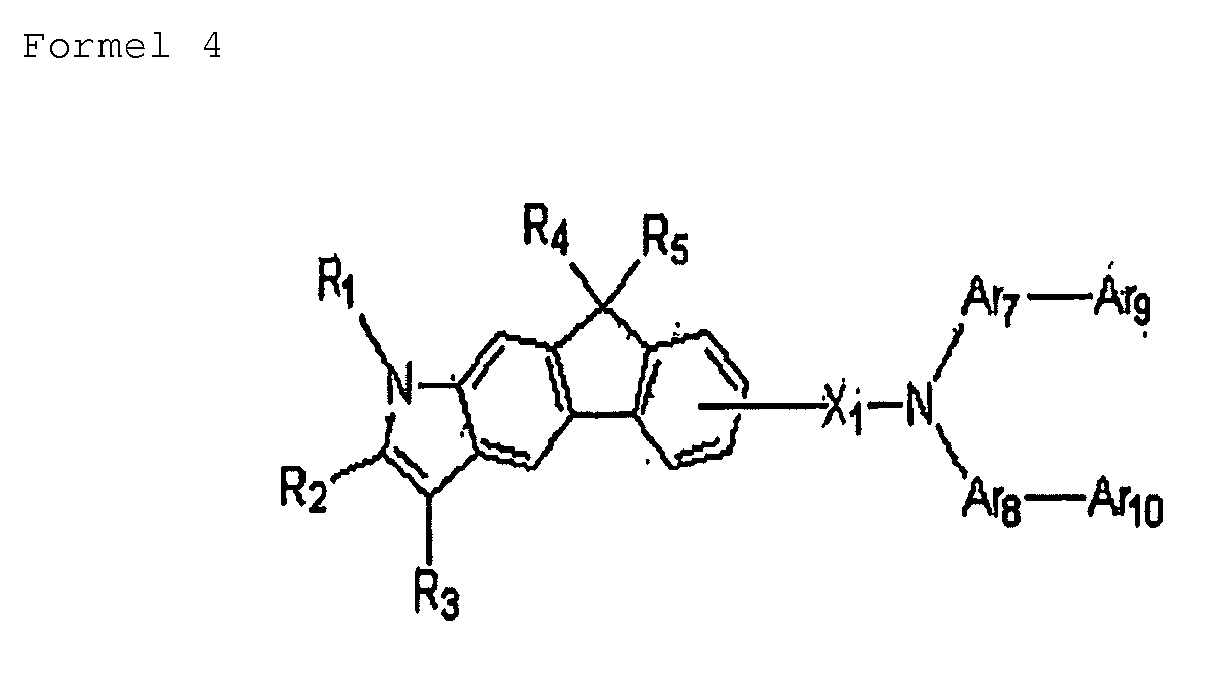
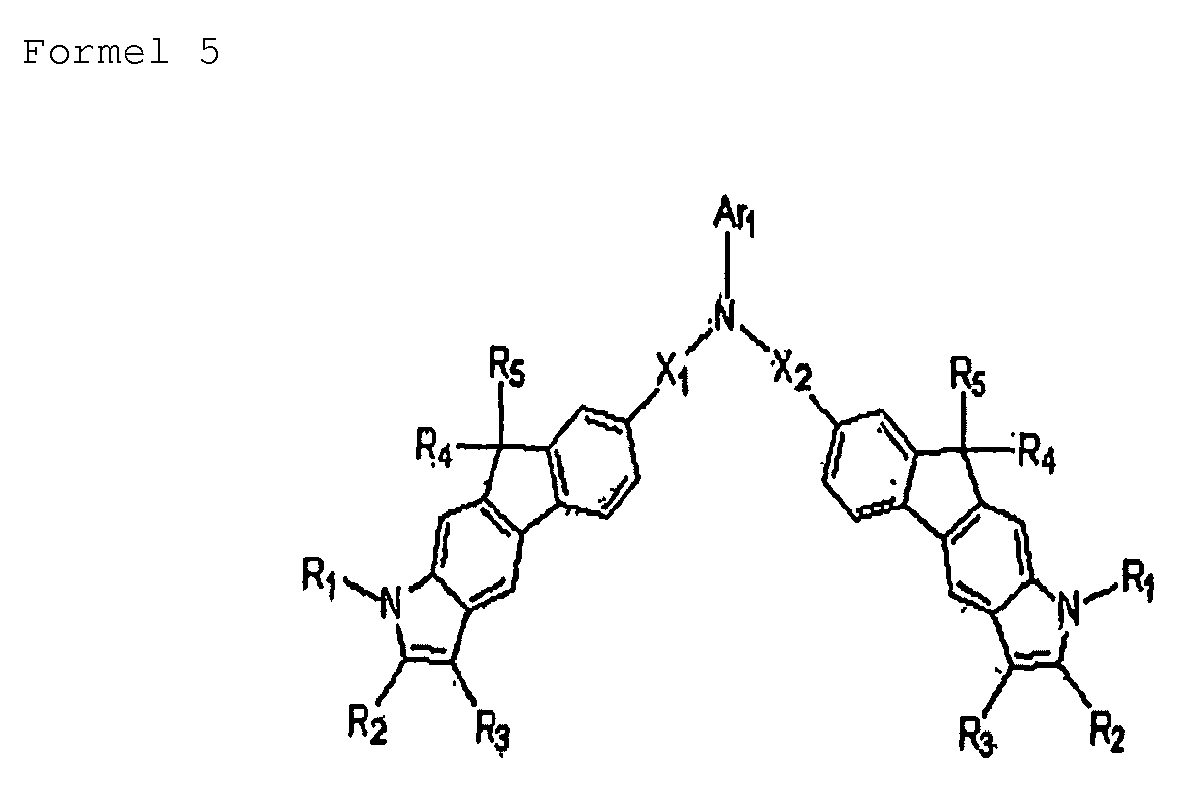
 jedes Ar1 bis Ar10 unabhängig aus der Gruppe bestehend aus substituierten und unsubstituierten C6-C60-Arylgruppen, substituierten und unsubstituierten C4-C60-Heteroarylgruppen und substituierten und unsubstituierten kondensierten polyzyklischen C6-C60-Gruppen ausgewählt ist;jedes X1 bis X3 unabhängig aus der Gruppe bestehend aus einzelnen Bindungen, substituierten und unsubstituierten C6-C30-Arylgruppen, substituierten und unsubstituierten C4-C30-Heteroarylgruppen und substituierten und unsubstituierten kondensierten polyzyklischen C6-C30-Gruppen ausgewählt ist;jedes R1, R2 und R3 unabhängig aus der Gruppe bestehend aus Wasserstoff, schwerem Wasserstoff, substituierten und unsubstituierten C1-C50-Alkylgruppen, substituierten und unsubstituierten C1-C50-Alkoxygruppen, substituierten und unsubstituierten C6-C60-Arylgruppen, substituierten und unsubstituierten C4-C60-Heteroarylgruppen und substituierten und unsubstituierten kondensierten polyzyklischen C6-C60-Gruppen ausgewählt ist;jedes R4 und R5 unabhängig aus der Gruppe bestehend aus Wasserstoff, schwerem Wasserstoff, substituierten und unsubstituierten C1-C30-Alkylgruppen, substituierten und unsubstituierten C1-C30-Alkoxygruppen, substituierten und unsubstituierten C6-C30-Arylgruppen, substituierten und unsubstituierten C4-C30-Heteroarylgruppen und substituierten und unsubstituierten kondensierten polyzyklischen C6-C30-Gruppen ausgewählt ist.
 - Heterozyklische Verbindung nach Anspruch 1 oder 2, wobei bis zum vorhandenen Umfang jedes R1 bis R3 oder X1 bis X3 unabhängig aus der Gruppe bestehend aus Phenylgruppen, Naphthylgruppen, Biphenylgruppen, Fluorengruppen und Phenanthrengruppen ausgewählt sind.
- Heterozyklische Verbindung nach einem der Ansprüche 1 bis 3, wobei jedes der R4 und R5 eine Methylgruppe ist.
- Heterozyklische Verbindung nach Anspruch 2 oder einem Unteranspruch desselben, wobei jedes von Ar3 bis Ar10 unabhängig aus der Gruppe bestehend aus Folgendem ausgewählt ist:unsubstituierten monozyklischen bis trizyklischen Arylgruppen, die aus der Gruppe bestehend aus Phenylgruppen, Naphthylgruppen, Biphenylgruppen, Terphenylgruppen, Anthracenylgruppen, Fluorenylgruppen und Carbazolylgruppen ausgewählt sind;unsubstituierten C4-C30-Heteroarylgruppen;substituierten monozyklischen bis trizyklischen Arylgruppen, die aus der Gruppe bestehend aus Phenylgruppen, Naphthylgruppen, Biphenylgruppen, Terphenylgruppen, Anthracenylgruppen, Fluorenylgruppen und Carbazolylgruppen ausgewählt sind, welche mindestens einen Substituenten haben, der aus der Gruppe bestehend aus C1-C5-Alkylgruppen, C1-C5-Alkoxygruppen, Cyanogruppen, Amingruppen, Phenoxygruppen, Phenylgruppen, Naphthylgruppen und Halogengruppen ausgewählt ist; undsubstituierten C4-C30-Heteroarylgruppen, die mindestens einen Substituenten haben, welcher aus der Gruppe bestehend aus C1-C5-Alkylgruppen, C1-C4-Alkoxygruppen, Cyanogruppen, Amingruppen, Phenoxygruppen, Phenylgruppen, Naphthylgruppen und Halogengruppen ausgewählt ist.
- Heterozyklische Verbindung nach einem der Ansprüche 1 und 4 bis 5, wobei die Verbindung, die durch Formel 1 dargestellt wird, aus der Gruppe bestehend aus den Verbindungen 2, 14, 23, 32, 42 und 76 ausgewählt ist.
- Organische Licht emittierende Vorrichtung, umfassend:eine erste Elektrode;eine zweite Elektrode; undeine organische Schicht zwischen der ersten Elektrode und der zweiten Elektrode, wobei die organische Schicht die heterozyklische Verbindung nach einem der Ansprüche 1 bis 6 umfasst.
- Organische Licht emittierende Vorrichtung nach Anspruch 7, wobei die organische Schicht eine Lochinjektionsschicht oder eine Lochtransportschicht umfasst.
- Organische Licht emittierende Vorrichtung nach Anspruch 7 oder 8, wobei die organische Schicht einen einzelnen Film umfasst, der für Lochinjektion und Lochtransport konfiguriert ist.
- Organische Licht emittierende Vorrichtung nach Anspruch 7, 8 oder 9, wobei die organische Schicht eine Emissionsschicht umfasst.
- Organische Licht emittierende Vorrichtung nach einem der Ansprüche 7 bis 10, wobei die organische Schicht eine Emissionsschicht umfasst und (I) die heterozyklische Verbindung ein Ausgangsmaterial für eine fluoreszierende oder phosphoreszierende Vorrichtung ist oder (II) die heterozyklische Verbindung ein fluoreszierendes Dotierungsmittel ist.
- Organische Licht emittierende Vorrichtung nach einem der Ansprüche 7 bis 11, wobei die organische Schicht eine Emissionsschicht und eine Lochinjektionsschicht oder eine Lochtransportschicht umfasst.
- Organische Licht emittierende Vorrichtung nach einem der Ansprüche 7 bis 12, wobei die organische Schicht mindestens eine Schicht umfasst, die die heterozyklische Verbindung nach einem der Ansprüche 1 bis 7 umfasst, wobei die mindestens eine Schicht unter Verwendung eines Nassverfahrens gebildet ist.
- Flachbildschirmvorrichtung, die die organische Licht emittierende Vorrichtung nach einem der Ansprüche 7 bis 13 umfasst, wobei die erste Elektrode der organischen Licht emittierenden Vorrichtung elektrisch mit einer Source-Elektrode oder einer Drain-Elektrode eines Dünnschichttransistors verbunden ist.
Applications Claiming Priority (1)
| Application Number | Priority Date | Filing Date | Title |
|---|---|---|---|
| KR1020090073520A KR101097312B1 (ko) | 2009-08-10 | 2009-08-10 | 유기 발광 소자 |
Publications (2)
| Publication Number | Publication Date |
|---|---|
| EP2292603A1 EP2292603A1 (de) | 2011-03-09 |
| EP2292603B1 true EP2292603B1 (de) | 2012-10-03 |
Family
ID=42989293
Family Applications (1)
| Application Number | Title | Priority Date | Filing Date |
|---|---|---|---|
| EP10172315A Active EP2292603B1 (de) | 2009-08-10 | 2010-08-09 | Organische lichtemittierende Vorrichtung |
Country Status (5)
| Country | Link |
|---|---|
| US (1) | US8338000B2 (de) |
| EP (1) | EP2292603B1 (de) |
| JP (1) | JP5211104B2 (de) |
| KR (1) | KR101097312B1 (de) |
| CN (1) | CN101993410B (de) |
Cited By (1)
| Publication number | Priority date | Publication date | Assignee | Title |
|---|---|---|---|---|
| AU2018413791B2 (en) * | 2018-03-23 | 2023-05-18 | Step Pharma S.A.S. | Aminopyrimidine derivatives as CTPS1 inhibitors |
Families Citing this family (22)
| Publication number | Priority date | Publication date | Assignee | Title |
|---|---|---|---|---|
| KR20120011445A (ko) * | 2010-07-29 | 2012-02-08 | 롬엔드하스전자재료코리아유한회사 | 신규한 유기 발광 화합물 및 이를 포함하는 유기 전계 발광 소자 |
| DE102011102586A1 (de) * | 2011-05-27 | 2012-11-29 | Merck Patent Gmbh | Organische elektronische Vorrichtung |
| KR20120139073A (ko) | 2011-06-16 | 2012-12-27 | 삼성디스플레이 주식회사 | 신규한 헤테로고리 화합물 및 이를 포함한 유기발광 소자 |
| KR101853875B1 (ko) | 2011-06-22 | 2018-05-03 | 삼성디스플레이 주식회사 | 헤테로고리 화합물 및 이를 포함한 유기발광 소자 |
| KR101930848B1 (ko) * | 2011-08-11 | 2018-12-20 | 삼성디스플레이 주식회사 | 헤테로고리 화합물 및 이를 포함하는 유기 전계 발광 소자 |
| CN102516089A (zh) * | 2011-10-28 | 2012-06-27 | 黑龙江省科学院石油化学研究院 | 一种9,9-二甲基-2-(n-联苯基)-氨基芴的合成方法 |
| KR101537436B1 (ko) * | 2012-08-17 | 2015-07-17 | 주식회사 두산 | 신규 화합물 및 이를 포함하는 유기 전계 발광 소자 |
| KR101547623B1 (ko) * | 2012-10-24 | 2015-08-26 | 주식회사 두산 | 유기 전계 발광 소자 |
| CN103193760B (zh) * | 2013-05-06 | 2015-07-01 | 深圳市华星光电技术有限公司 | 含砜基的化合物、采用含砜基的化合物的有机电致发光器件及其制备方法 |
| KR102507373B1 (ko) * | 2015-12-21 | 2023-03-08 | 솔루스첨단소재 주식회사 | 유기 발광 화합물 및 이를 이용한 유기 전계 발광 소자 |
| KR20170074652A (ko) * | 2015-12-22 | 2017-06-30 | 주식회사 두산 | 유기 화합물 및 이를 포함하는 유기 전계 발광 소자 |
| CN106009041B (zh) * | 2016-05-31 | 2018-07-13 | 广州质量监督检测研究院 | 一种有机硼氮阻燃剂的制备方法 |
| CN107286175B (zh) * | 2017-05-18 | 2020-05-22 | 华南理工大学 | 一种以三芳胺基团为核的星形双极性小分子发光材料及其制备方法与应用 |
| WO2019090462A1 (en) * | 2017-11-07 | 2019-05-16 | Dow Global Technologies Llc | Polymeric charge transfer layer and organic electronic device comprising the same |
| EP3492454A1 (de) * | 2017-11-30 | 2019-06-05 | Step Pharma S.A.S. | Verbindungen |
| US11655246B2 (en) | 2017-11-30 | 2023-05-23 | Step Pharma S.A.S. | Aminothiazole compounds as inhibitors of CTPS1 |
| US11505547B2 (en) | 2017-11-30 | 2022-11-22 | Step Pharma S.A.S. | Compounds |
| BR112021005986A2 (pt) | 2018-10-23 | 2021-06-29 | Step Pharma S.A.S. | derivados de aminopirimidina como inibidores de ctps1 |
| KR102929794B1 (ko) * | 2019-02-20 | 2026-02-24 | 듀폰스페셜티머터리얼스코리아 유한회사 | 유기 전계 발광 화합물 및 이를 포함하는 유기 전계 발광 소자 |
| WO2020171587A1 (en) * | 2019-02-20 | 2020-08-27 | Rohm And Haas Electronic Materials Korea Ltd. | Organic electroluminescent compound and organic electroluminescent device comprising the same |
| DK3980411T3 (da) | 2019-06-04 | 2025-10-13 | Step Pharma S A S | N-(5-(6-ethoxypyrazin-2-yl)pyridin-2-yl)-4-(2-(ethylsulfonamido)pyrimidin-4-yl)tetrahydro-2h-pyran-4-carboxamid som en human ctps1-inhibitor til behandling af proliferative sygdomme |
| CN110373182B (zh) * | 2019-07-10 | 2023-06-06 | 吉林奥来德光电材料股份有限公司 | 一种有机发光化合物及其制备方法和器件 |
Family Cites Families (11)
| Publication number | Priority date | Publication date | Assignee | Title |
|---|---|---|---|---|
| KR100354500B1 (ko) | 2000-09-05 | 2002-09-30 | 한화석유화학 주식회사 | 플로렌계 중합체 및 이를 이용한 전기발광 소자 |
| US6630254B2 (en) * | 2001-04-10 | 2003-10-07 | National Research Council Of Canada | Conjugated polycarbazole derivatives in Organic Light Emitting Diodes |
| US7867629B2 (en) | 2003-01-10 | 2011-01-11 | Idemitsu Kosan Co., Ltd. | Nitrogenous heterocyclic derivative and organic electroluminescent element employing the same |
| JP4693336B2 (ja) | 2003-01-14 | 2011-06-01 | 出光興産株式会社 | 含窒素複素環誘導体及びそれを用いた有機エレクトロルミネッセンス素子 |
| US7037599B2 (en) | 2003-02-28 | 2006-05-02 | Eastman Kodak Company | Organic light emitting diodes for production of polarized light |
| JP4843897B2 (ja) | 2003-09-16 | 2011-12-21 | コニカミノルタホールディングス株式会社 | 有機エレクトロルミネッセンス素子、表示装置及び照明装置 |
| US7118812B2 (en) | 2003-12-05 | 2006-10-10 | Eastman Kodak Company | Organic element for electroluminescent devices |
| CN101371377A (zh) | 2005-12-01 | 2009-02-18 | 新日铁化学株式会社 | 有机场致发光元件 |
| JP4995475B2 (ja) | 2006-04-03 | 2012-08-08 | 出光興産株式会社 | ベンズアントラセン誘導体、及びそれを用いた有機エレクトロルミネッセンス素子 |
| JP2008133225A (ja) | 2006-11-29 | 2008-06-12 | Toyo Ink Mfg Co Ltd | インドール誘導体およびその用途 |
| KR20100000772A (ko) | 2008-06-25 | 2010-01-06 | 다우어드밴스드디스플레이머티리얼 유한회사 | 신규한 유기 발광 화합물 및 이를 발광재료로서 채용하고있는 유기 발광 소자 |
-
2009
- 2009-08-10 KR KR1020090073520A patent/KR101097312B1/ko active Active
-
2010
- 2010-05-17 JP JP2010113453A patent/JP5211104B2/ja active Active
- 2010-08-06 US US12/852,398 patent/US8338000B2/en active Active
- 2010-08-09 EP EP10172315A patent/EP2292603B1/de active Active
- 2010-08-10 CN CN201010250630.6A patent/CN101993410B/zh active Active
Cited By (1)
| Publication number | Priority date | Publication date | Assignee | Title |
|---|---|---|---|---|
| AU2018413791B2 (en) * | 2018-03-23 | 2023-05-18 | Step Pharma S.A.S. | Aminopyrimidine derivatives as CTPS1 inhibitors |
Also Published As
| Publication number | Publication date |
|---|---|
| CN101993410A (zh) | 2011-03-30 |
| CN101993410B (zh) | 2014-08-20 |
| KR20110016031A (ko) | 2011-02-17 |
| JP2011037826A (ja) | 2011-02-24 |
| EP2292603A1 (de) | 2011-03-09 |
| KR101097312B1 (ko) | 2011-12-23 |
| US8338000B2 (en) | 2012-12-25 |
| US20110031483A1 (en) | 2011-02-10 |
| JP5211104B2 (ja) | 2013-06-12 |
Similar Documents
| Publication | Publication Date | Title |
|---|---|---|
| EP2292603B1 (de) | Organische lichtemittierende Vorrichtung | |
| JP4589223B2 (ja) | フェニルカルバゾール系化合物とその製造方法及び有機電界発光素子 | |
| EP2298740B1 (de) | 1-H-benzo[g]indol- Verbindungen und sie enthaltende organische lichtemittierende Vorrichtung | |
| EP2298739B1 (de) | Polycyclische Heteroaryl Verbindungen enthaltende organische lichtemittierende Vorrichtung | |
| EP2289877B1 (de) | Polycyclishe Heteroaryl Verbindungen enthaltend organische lichtemittierende Vorrichtung | |
| JP5676182B2 (ja) | ヘテロ環化合物及びこれを含む有機発光素子 | |
| EP2298737B1 (de) | Indolverbindungen und sie enthaltende organische lichtemittierende Vorrichtung | |
| JP5900946B2 (ja) | 有機発光素子 | |
| EP2293650B1 (de) | Dipyrrolo[a,h]pyrenes für organische Licht-emittierende Vorrichtungen | |
| EP2298771B1 (de) | Organische lichtemittierende Vorrichtung | |
| EP2301920B1 (de) | Naphthoindol Derivate enthaltende organische lichtemittierende Vorrichtung | |
| KR101736987B1 (ko) | 헤테로 고리 화합물 및 이를 포함하는 유기 발광 소자 | |
| KR100787451B1 (ko) | 칼렉스아렌계 화합물 및 이를 이용한 유기 발광 소자 |
Legal Events
| Date | Code | Title | Description |
|---|---|---|---|
| PUAI | Public reference made under article 153(3) epc to a published international application that has entered the european phase |
Free format text: ORIGINAL CODE: 0009012 |
|
| AK | Designated contracting states |
Kind code of ref document: A1 Designated state(s): AL AT BE BG CH CY CZ DE DK EE ES FI FR GB GR HR HU IE IS IT LI LT LU LV MC MK MT NL NO PL PT RO SE SI SK SM TR |
|
| AX | Request for extension of the european patent |
Extension state: BA ME RS |
|
| 17P | Request for examination filed |
Effective date: 20110221 |
|
| GRAP | Despatch of communication of intention to grant a patent |
Free format text: ORIGINAL CODE: EPIDOSNIGR1 |
|
| GRAS | Grant fee paid |
Free format text: ORIGINAL CODE: EPIDOSNIGR3 |
|
| GRAA | (expected) grant |
Free format text: ORIGINAL CODE: 0009210 |
|
| RAP1 | Party data changed (applicant data changed or rights of an application transferred) |
Owner name: SAMSUNG DISPLAY CO., LTD. |
|
| AK | Designated contracting states |
Kind code of ref document: B1 Designated state(s): AL AT BE BG CH CY CZ DE DK EE ES FI FR GB GR HR HU IE IS IT LI LT LU LV MC MK MT NL NO PL PT RO SE SI SK SM TR |
|
| REG | Reference to a national code |
Ref country code: GB Ref legal event code: FG4D |
|
| REG | Reference to a national code |
Ref country code: AT Ref legal event code: REF Ref document number: 577906 Country of ref document: AT Kind code of ref document: T Effective date: 20121015 Ref country code: CH Ref legal event code: EP |
|
| REG | Reference to a national code |
Ref country code: IE Ref legal event code: FG4D |
|
| REG | Reference to a national code |
Ref country code: DE Ref legal event code: R096 Ref document number: 602010003048 Country of ref document: DE Effective date: 20121129 |
|
| REG | Reference to a national code |
Ref country code: AT Ref legal event code: MK05 Ref document number: 577906 Country of ref document: AT Kind code of ref document: T Effective date: 20121003 |
|
| PG25 | Lapsed in a contracting state [announced via postgrant information from national office to epo] |
Ref country code: SI Free format text: LAPSE BECAUSE OF FAILURE TO SUBMIT A TRANSLATION OF THE DESCRIPTION OR TO PAY THE FEE WITHIN THE PRESCRIBED TIME-LIMIT Effective date: 20121003 |
|
| REG | Reference to a national code |
Ref country code: NL Ref legal event code: VDEP Effective date: 20121003 |
|
| REG | Reference to a national code |
Ref country code: LT Ref legal event code: MG4D |
|
| PG25 | Lapsed in a contracting state [announced via postgrant information from national office to epo] |
Ref country code: NO Free format text: LAPSE BECAUSE OF FAILURE TO SUBMIT A TRANSLATION OF THE DESCRIPTION OR TO PAY THE FEE WITHIN THE PRESCRIBED TIME-LIMIT Effective date: 20130103 Ref country code: ES Free format text: LAPSE BECAUSE OF FAILURE TO SUBMIT A TRANSLATION OF THE DESCRIPTION OR TO PAY THE FEE WITHIN THE PRESCRIBED TIME-LIMIT Effective date: 20130114 Ref country code: FI Free format text: LAPSE BECAUSE OF FAILURE TO SUBMIT A TRANSLATION OF THE DESCRIPTION OR TO PAY THE FEE WITHIN THE PRESCRIBED TIME-LIMIT Effective date: 20121003 Ref country code: NL Free format text: LAPSE BECAUSE OF FAILURE TO SUBMIT A TRANSLATION OF THE DESCRIPTION OR TO PAY THE FEE WITHIN THE PRESCRIBED TIME-LIMIT Effective date: 20121003 Ref country code: SE Free format text: LAPSE BECAUSE OF FAILURE TO SUBMIT A TRANSLATION OF THE DESCRIPTION OR TO PAY THE FEE WITHIN THE PRESCRIBED TIME-LIMIT Effective date: 20121003 Ref country code: HR Free format text: LAPSE BECAUSE OF FAILURE TO SUBMIT A TRANSLATION OF THE DESCRIPTION OR TO PAY THE FEE WITHIN THE PRESCRIBED TIME-LIMIT Effective date: 20121003 Ref country code: LT Free format text: LAPSE BECAUSE OF FAILURE TO SUBMIT A TRANSLATION OF THE DESCRIPTION OR TO PAY THE FEE WITHIN THE PRESCRIBED TIME-LIMIT Effective date: 20121003 Ref country code: IS Free format text: LAPSE BECAUSE OF FAILURE TO SUBMIT A TRANSLATION OF THE DESCRIPTION OR TO PAY THE FEE WITHIN THE PRESCRIBED TIME-LIMIT Effective date: 20130203 |
|
| PG25 | Lapsed in a contracting state [announced via postgrant information from national office to epo] |
Ref country code: PL Free format text: LAPSE BECAUSE OF FAILURE TO SUBMIT A TRANSLATION OF THE DESCRIPTION OR TO PAY THE FEE WITHIN THE PRESCRIBED TIME-LIMIT Effective date: 20121003 Ref country code: BE Free format text: LAPSE BECAUSE OF FAILURE TO SUBMIT A TRANSLATION OF THE DESCRIPTION OR TO PAY THE FEE WITHIN THE PRESCRIBED TIME-LIMIT Effective date: 20121003 Ref country code: LV Free format text: LAPSE BECAUSE OF FAILURE TO SUBMIT A TRANSLATION OF THE DESCRIPTION OR TO PAY THE FEE WITHIN THE PRESCRIBED TIME-LIMIT Effective date: 20121003 Ref country code: GR Free format text: LAPSE BECAUSE OF FAILURE TO SUBMIT A TRANSLATION OF THE DESCRIPTION OR TO PAY THE FEE WITHIN THE PRESCRIBED TIME-LIMIT Effective date: 20130104 Ref country code: PT Free format text: LAPSE BECAUSE OF FAILURE TO SUBMIT A TRANSLATION OF THE DESCRIPTION OR TO PAY THE FEE WITHIN THE PRESCRIBED TIME-LIMIT Effective date: 20130204 |
|
| PG25 | Lapsed in a contracting state [announced via postgrant information from national office to epo] |
Ref country code: AT Free format text: LAPSE BECAUSE OF FAILURE TO SUBMIT A TRANSLATION OF THE DESCRIPTION OR TO PAY THE FEE WITHIN THE PRESCRIBED TIME-LIMIT Effective date: 20121003 |
|
| PG25 | Lapsed in a contracting state [announced via postgrant information from national office to epo] |
Ref country code: CZ Free format text: LAPSE BECAUSE OF FAILURE TO SUBMIT A TRANSLATION OF THE DESCRIPTION OR TO PAY THE FEE WITHIN THE PRESCRIBED TIME-LIMIT Effective date: 20121003 Ref country code: BG Free format text: LAPSE BECAUSE OF FAILURE TO SUBMIT A TRANSLATION OF THE DESCRIPTION OR TO PAY THE FEE WITHIN THE PRESCRIBED TIME-LIMIT Effective date: 20130103 Ref country code: SK Free format text: LAPSE BECAUSE OF FAILURE TO SUBMIT A TRANSLATION OF THE DESCRIPTION OR TO PAY THE FEE WITHIN THE PRESCRIBED TIME-LIMIT Effective date: 20121003 Ref country code: EE Free format text: LAPSE BECAUSE OF FAILURE TO SUBMIT A TRANSLATION OF THE DESCRIPTION OR TO PAY THE FEE WITHIN THE PRESCRIBED TIME-LIMIT Effective date: 20121003 Ref country code: DK Free format text: LAPSE BECAUSE OF FAILURE TO SUBMIT A TRANSLATION OF THE DESCRIPTION OR TO PAY THE FEE WITHIN THE PRESCRIBED TIME-LIMIT Effective date: 20121003 |
|
| PLBE | No opposition filed within time limit |
Free format text: ORIGINAL CODE: 0009261 |
|
| STAA | Information on the status of an ep patent application or granted ep patent |
Free format text: STATUS: NO OPPOSITION FILED WITHIN TIME LIMIT |
|
| PG25 | Lapsed in a contracting state [announced via postgrant information from national office to epo] |
Ref country code: IT Free format text: LAPSE BECAUSE OF FAILURE TO SUBMIT A TRANSLATION OF THE DESCRIPTION OR TO PAY THE FEE WITHIN THE PRESCRIBED TIME-LIMIT Effective date: 20121003 Ref country code: RO Free format text: LAPSE BECAUSE OF FAILURE TO SUBMIT A TRANSLATION OF THE DESCRIPTION OR TO PAY THE FEE WITHIN THE PRESCRIBED TIME-LIMIT Effective date: 20121003 |
|
| 26N | No opposition filed |
Effective date: 20130704 |
|
| REG | Reference to a national code |
Ref country code: DE Ref legal event code: R097 Ref document number: 602010003048 Country of ref document: DE Effective date: 20130704 |
|
| PG25 | Lapsed in a contracting state [announced via postgrant information from national office to epo] |
Ref country code: CY Free format text: LAPSE BECAUSE OF FAILURE TO SUBMIT A TRANSLATION OF THE DESCRIPTION OR TO PAY THE FEE WITHIN THE PRESCRIBED TIME-LIMIT Effective date: 20121003 |
|
| PG25 | Lapsed in a contracting state [announced via postgrant information from national office to epo] |
Ref country code: MC Free format text: LAPSE BECAUSE OF FAILURE TO SUBMIT A TRANSLATION OF THE DESCRIPTION OR TO PAY THE FEE WITHIN THE PRESCRIBED TIME-LIMIT Effective date: 20121003 |
|
| REG | Reference to a national code |
Ref country code: IE Ref legal event code: MM4A |
|
| PG25 | Lapsed in a contracting state [announced via postgrant information from national office to epo] |
Ref country code: IE Free format text: LAPSE BECAUSE OF NON-PAYMENT OF DUE FEES Effective date: 20130809 |
|
| REG | Reference to a national code |
Ref country code: CH Ref legal event code: PL |
|
| PG25 | Lapsed in a contracting state [announced via postgrant information from national office to epo] |
Ref country code: LI Free format text: LAPSE BECAUSE OF NON-PAYMENT OF DUE FEES Effective date: 20140831 Ref country code: CH Free format text: LAPSE BECAUSE OF NON-PAYMENT OF DUE FEES Effective date: 20140831 |
|
| PG25 | Lapsed in a contracting state [announced via postgrant information from national office to epo] |
Ref country code: SM Free format text: LAPSE BECAUSE OF FAILURE TO SUBMIT A TRANSLATION OF THE DESCRIPTION OR TO PAY THE FEE WITHIN THE PRESCRIBED TIME-LIMIT Effective date: 20121003 |
|
| PG25 | Lapsed in a contracting state [announced via postgrant information from national office to epo] |
Ref country code: TR Free format text: LAPSE BECAUSE OF FAILURE TO SUBMIT A TRANSLATION OF THE DESCRIPTION OR TO PAY THE FEE WITHIN THE PRESCRIBED TIME-LIMIT Effective date: 20121003 Ref country code: MT Free format text: LAPSE BECAUSE OF FAILURE TO SUBMIT A TRANSLATION OF THE DESCRIPTION OR TO PAY THE FEE WITHIN THE PRESCRIBED TIME-LIMIT Effective date: 20121003 |
|
| PG25 | Lapsed in a contracting state [announced via postgrant information from national office to epo] |
Ref country code: LU Free format text: LAPSE BECAUSE OF NON-PAYMENT OF DUE FEES Effective date: 20130809 Ref country code: MK Free format text: LAPSE BECAUSE OF FAILURE TO SUBMIT A TRANSLATION OF THE DESCRIPTION OR TO PAY THE FEE WITHIN THE PRESCRIBED TIME-LIMIT Effective date: 20121003 Ref country code: HU Free format text: LAPSE BECAUSE OF FAILURE TO SUBMIT A TRANSLATION OF THE DESCRIPTION OR TO PAY THE FEE WITHIN THE PRESCRIBED TIME-LIMIT; INVALID AB INITIO Effective date: 20100809 |
|
| REG | Reference to a national code |
Ref country code: FR Ref legal event code: PLFP Year of fee payment: 7 |
|
| REG | Reference to a national code |
Ref country code: FR Ref legal event code: PLFP Year of fee payment: 8 |
|
| REG | Reference to a national code |
Ref country code: FR Ref legal event code: PLFP Year of fee payment: 9 |
|
| PG25 | Lapsed in a contracting state [announced via postgrant information from national office to epo] |
Ref country code: AL Free format text: LAPSE BECAUSE OF FAILURE TO SUBMIT A TRANSLATION OF THE DESCRIPTION OR TO PAY THE FEE WITHIN THE PRESCRIBED TIME-LIMIT Effective date: 20121003 |
|
| P01 | Opt-out of the competence of the unified patent court (upc) registered |
Effective date: 20230515 |
|
| PGFP | Annual fee paid to national office [announced via postgrant information from national office to epo] |
Ref country code: DE Payment date: 20250721 Year of fee payment: 16 |
|
| PGFP | Annual fee paid to national office [announced via postgrant information from national office to epo] |
Ref country code: GB Payment date: 20250722 Year of fee payment: 16 |
|
| PGFP | Annual fee paid to national office [announced via postgrant information from national office to epo] |
Ref country code: FR Payment date: 20250725 Year of fee payment: 16 |